
76th Legislature SEX OFFENDER LAWS: SUMMARY OF CHANGES
|
|
|
- Clemence Riley
- 9 years ago
- Views:
Transcription
1 SENATE RESEARCH CENTER Prepared for Senator Florence Shapiro and Senator John Whitmire 76th Legislature SEX OFFENDER LAWS: SUMMARY OF CHANGES By: Todd E. Reimers & Tammy L. Edgerly October 1999 Cover design by Hector Meza Photo courtesy of Senate Media The Texas Senate does not discriminate on the basis of race, color, national origin, sex, religion, age, or disability in employment or the provision of services.

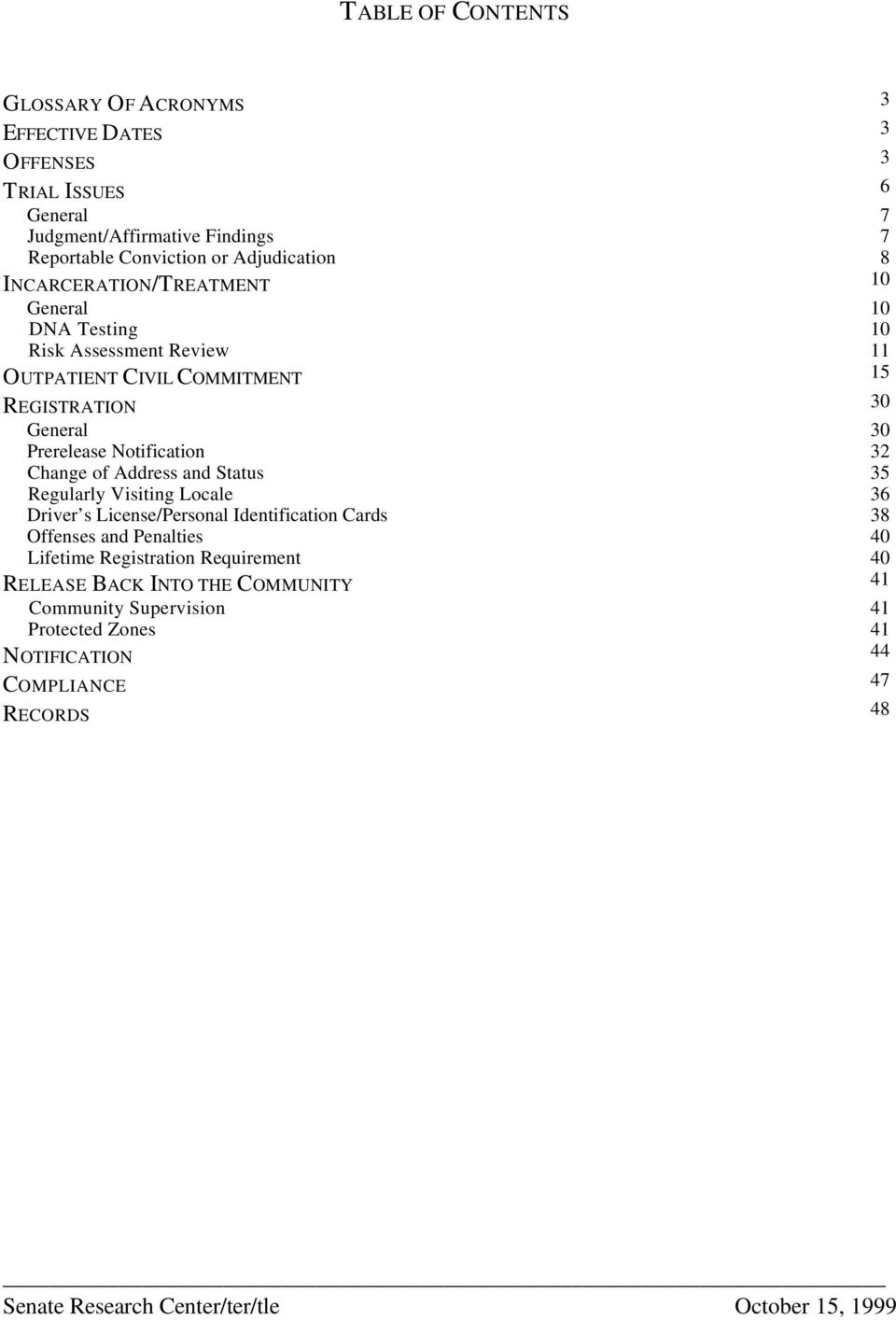
2 TABLE OF CONTENTS GLOSSARY OF ACRONYMS 3 EFFECTIVE DATES 3 OFFENSES 3 TRIAL ISSUES 6 General 7 Judgment/Affirmative Findings 7 Reportable Conviction or Adjudication 8 INCARCERATION/TREATMENT 10 General 10 DNA Testing 10 Risk Assessment Review 11 OUTPATIENT CIVIL COMMITMENT 15 REGISTRATION 30 General 30 Prerelease Notification 32 Change of Address and Status 35 Regularly Visiting Locale 36 Driver s License/Personal Identification Cards 38 Offenses and Penalties 40 Lifetime Registration Requirement 40 RELEASE BACK INTO THE COMMUNITY 41 Community Supervision 41 Protected Zones 41 NOTIFICATION 44 COMPLIANCE 47 RECORDS 48
3 GLOSSARY OF ACRONYMS CCP - Code of Criminal Procedure Council - Interagency Council on Sex Offender Treatment DPS - Texas Department of Public Safety H&SC - Health and Safety Code ID - Personal Identification TDCJ - Texas Department of Criminal Justice TDCJ-ID - Texas Department of Criminal Justice - Institutional Division TXMHMR - Texas Department of Mental Health and Mental Retardation TYC - Texas Youth Commission EFFECTIVE DATES Except as otherwise provided, these Acts take effect September 1, OFFENSES Summary The group of persons required to register as sex offenders is expanded to include persons who commit certain sex offenses under federal law or the Code of Military Justice. A new offense has been created to prosecute people who attempt over the Internet to solicit children into sexual relations. The new law allows the prosecution of a person who, with the intent to solicit someone the person believes to be a minor to engage in illicit sexual activities, in fact is soliciting an adult posing as a minor. For example, this adult could be a police officer patrolling the Internet. The penalty for promoting child pornography is increased from a third to a second degree felony. The use of Rohypnol in the commission of a sex crime is an aggravated sexual assault carrying a penalty of a first degree felony. If Rohypnol is used while committing robbery, theft, or crimes against a person (other than a first degree felony or a Class A misdemeanor) the penalty is enhanced to the next highest category. In an attempt to ensure that more sex offenders serve their sentences behind bars, people who sexually assault adults may not receive judge ordered community supervision. Now, a person who sexually assaults an adult receives the same sentencing treatment as a person who sexually assaults a child. Recognizing that some crimes could be stopped or averted through intervention, it is now a Class A misdemeanor to fail to stop or report aggravated sexual assault of a child younger than 14 years of age.

4 Details Adds to the definition of sexually violent offense an offense under federal law or the Uniform Code of Military Justice if the offense contains elements that are substantially similar to the elements of Section 21.11(a)(1) (Indecency with a child), (Sexual assault), (Aggravated sexual assault), (Sexual performance by a child), 20.04(a)(4) (Aggravated kidnapping) if the defendant committed the offense with the intent to violate or abuse the victim sexually, or (Burglary) if the offense is punishable under Subsection (d) of that section and the defendant committed the offense with intent to commit crimes prohibited by Section (Indecency with a child), (Sexual assault), (Aggravated sexual assault), (Prohibited sexual conduct), or 20.04(a)(4) (Aggravated kidnapping) Penal Code, if the defendant committed the offense with the intent to violate or abuse the victim sexually. (Article 62.01(6)(E), CCP, Definitions) (H.B. 2145) Provides that a person commits an offense if, with intent that an offense under CCP Section (Indecency with a child), (Sexual assault), (Aggravated sexual assault), or (Sexual performance by a child) be committed, the person by any means requests, commands, or attempts to induce a minor or another whom the person believes to be a minor to engage in specific conduct that, under the circumstances surrounding the actor s conduct as the actor believes them to be, would constitute an offense under one of these sections or would make the minor or other believed by the person to be a minor a party to the commission of an offense under one of those sections. (Section , Penal Code, Criminal solicitation of a minor) (H.B. 2145) Redefines sexual conduct to include lewd exhibition of the anus, or any portion of the female breast below the top of the areola. (Section 43.25(a)(2), Penal Code, Sexual Performance by a Child) (H.B. 2145) Increases from a third to a second degree felony to knowingly or intentionally promote or possess with intent to promote material containing a film image that visually depicts a child younger than 18 years of age at the time the film image of the child was made who is engaging in sexual conduct and the person knows that the material depicts the child as described above. (Section 43.26(g), Penal Code, Possession or Promotion of Child Pornography) (H.B. 2145) Makes it an offense to administer or provide Rohypnol (flunitrazepam) or gamma hydroxybutyrate to the intended victim of an aggravated sexual assault with the intent of facilitating the assault. (Section (a)(2)(vi), Penal Code, Aggravated Sexual Assault) (S.B. 1100) If the court determines, beyond a reasonable doubt, that the defendant used Rohypnol or gamma hydroxybutyrate to facilitate the commission of robbery, theft, or a crime against persons, the court must make an affirmative finding of that fact in the punishment phase of the trial, and enter the affirmative finding in the judgment of the case. (Article , CCP, Finding that Controlled Substance Used to Commit Offense) (S.B. 1100)

5 Enhances the penalty to the next highest category for the offense in the case of an affirmative finding that a defendant used Rohypnol or gamma hydroxybutyrate to facilitate the commission of robbery, theft, or a crime against a person, other than a first degree felony or a Class A misdemeanor. If the offense is a Class A misdemeanor, the minimum term of confinement for the offense is increased to 180 days. (Section 12.48, Penal Code, Penalty if Controlled Substance Used to Commit Offense) (S.B. 1100) Adds to the list of 3g offenses the offense of sexual assault of an adult, making these offenders ineligible for judge ordered community supervision. (Article 42.12, Section 3g, CCP, Limitation on Judge Ordered Community Supervision) (H.B. 1535) Makes it a Class A misdemeanor to fail to stop or report aggravated sexual assault of a child. A person, other than persons such as a parent or guardian, commits a Class A misdemeanor if the person observes actual or attempted sexual assault of a child younger than 14 years of age, fails to assist the child or immediately report the commission of the offense to a peace officer, and could assist the child or immediately report the commission without placing him/herself in danger of suffering serious bodily injury or death. (Section 38.17, Penal Code, Failure to Stop or Report Aggravated Sexual Assault of a Child) (H.B. 628)

6 TRIAL ISSUES General Summary An affirmative defense in the prosecution of indecency with a child is provided if the actor is not more than three years older than the victim of the opposite sex, the act was consensual, and the actor is not a registered sex offender. An affirmative defense in the prosecution of sexual assault is provided if the actor is not more than three years older than the victim, the actor is not a registered sex offender, and the victim is at least 14 years of age. To ensure that an offender is aware of all the legal ramifications of being considered a sex offender, before a plea of guilty or nolo contendere is accepted, the court must inform the defendant of sex offender registration requirements, and the court must determine whether the defendant s attorney has advised the defendant of his or her sex offender registration requirements. Details Modifies the circumstances under which the affirmative defense to indecency with a child may be used as follows. The affirmative defense may be used if the actor (1) was not more than three years older than the victim and of the opposite sex; (2) did not use duress, force, or a threat against the victim at the time of the offense; and (3) at the time of the offense was not required under Chapter 62, CCP, to register for life as a sex offender; or was not a person who under Chapter 62, CCP, had a reportable conviction or adjudication for an offense under this section. (Section 21.11(b), Penal Code, Indecency with a child) (H.B. 2145) Modifies the circumstances under which the affirmative defense to sexual assault may be used as follows: if the actor was not more than three years older than the victim at the time of the offense: was not required under Chapter 62, CCP, to register for life as a sex offender or was not a person who under Chapter 62, CCP, had a reportable conviction or adjudication for an offense under this section and the victim was a child of 14 years of age or older. (Section (e), Penal Code, Sexual Assault) (H.B. 2145) Requires the court to inform the defendant, before a plea of guilty or nolo contendere is accepted, of the requirement to meet the registration requirements of Chapter 62, CCP, if the defendant is convicted of or placed on deferred adjudication for an offense for which a person is subject to registration under that chapter. (Article 26.13, CCP, Plea of Guilty) (H.B. 2145) Requires the court to determine whether the attorney representing the defendant has advised the defendant regarding the registration requirements of Chapter 62, CCP, before a plea of guilty or nolo contendere is accepted. (Article 26.13, CCP, Plea of Guilty) (H.B. 2145)

7 Judgment/Affirmative Findings Summary If the victim of unlawful restraint, kidnapping, or aggravated kidnapping is found to be younger than 17 years of age, that finding must be entered into the papers in the case. Details Requires a judgment to reflect an affirmative finding of the age of a victim pursuant to Article , CCP. (Article 42.01, Sec. 7, CCP, Judgment) (H.B. 2145) Requires the judge to make an affirmative finding of fact and enter the affirmative finding of fact in the judgment in the case if the judge determines the victim or intended victim was younger than 17 years of age at the time of the offense, in the trial of an offense under Section (Unlawful Restraint), (Kidnapping), or (Aggravated Kidnapping), Penal Code, or an attempt, conspiracy, or solicitation to commit one of those offenses. (Article , CCP, Finding of Age of Victim) (H.B. 2145) The change in law made by this Act requiring registration under Chapter 62, CCP, and as amended by this Act, for individuals charged with unlawful restraint, kidnapping, or aggravated kidnapping, or attempt, solicitation, or conspiracy to commit one of those offenses, applies only to an individual for whom deferred adjudication in the case is entered or a trial or disposition hearing for the offense or conduct is commenced on or after the effective date of September 1, 1999, regardless of when the offense was committed or the conduct occurred. An individual for whom a deferred adjudication is entered or a trial or disposition hearing has commenced before the effective date of this Act is covered by the law in effect when the deferred adjudication was entered or when the trial or disposition hearing commenced, and the former law is continued in effect for that purpose. Requires the judge, if the judge places the defendant on community supervision for an offense under Section (Unlawful Restraint), (Kidnapping), or (Aggravated Kidnapping), Penal Code, or an attempt, conspiracy, or solicitation to commit one of those offenses, to make an affirmative finding of fact and file a statement of that affirmative finding with the papers in the case if the judge determines that the victim or intended victim was younger than 17 years of age at the time of the offense. (Article 42.12, Sec. 5(e), CCP, Deferred Adjudication; Community Supervision) (H.B. 2145) The change in law made by this Act requiring registration under Chapter 62, CCP, and as amended by this Act, for individuals charged with unlawful restraint, kidnapping, or aggravated kidnapping, or attempt, solicitation, or conspiracy to commit one of those offenses, applies only to an individual for whom deferred adjudication in the case is entered or a trial or disposition hearing for the offense or conduct is commenced on or after the effective date of September 1, 1999, regardless of when the offense was committed or the conduct occurred. An individual for whom a deferred adjudication is entered or a trial or disposition hearing has commenced before the effective date of this Act is
8 covered by the law in effect when the deferred adjudication was entered or when the trial or disposition hearing commenced, and the former law is continued in effect for that purpose. Requires a judge to enter an affirmative finding in the order, if the judge orders a disposition and there is an affirmative finding that the victim or intended victim was younger than 17 years of age at the time of the conduct. (Section 54.04, Family Code, Disposition Hearing) (H.B. 2145) Reportable Conviction or Adjudication Summary A person with a reportable conviction or adjudication must register as a sex offender. The definition of reportable conviction or adjudication is expanded to include: A conviction or adjudication for violation of or a conviction for an attempt, conspiracy, or solicitation to commit unlawful restraint, kidnapping, or aggravated kidnapping, if the papers in the case contain an affirmative finding that the victim is younger than 17 years of age; or a deferred adjudication for violation of or a conviction for an attempt, conspiracy, or solicitation to commit unlawful restraint, kidnapping, or aggravated kidnapping, if the papers in the case contain an affirmative finding that the victim is younger than 17 years of age. A reportable conviction or adjudication includes any disposition under the laws of another state, federal law, or the Uniform Code of Military Justice for an offense containing elements that are substantially similar to the elements of offenses included under the definition of reportable conviction or adjudication. The second conviction or adjudication for delinquent conduct under the laws of another state or federal law that are substantially similar to the elements of the offense of indecent exposure are also a reportable conviction or adjudication. As such, there is a requirement that a person convicted or adjudicated under these other bodies of law and residing in Texas must register as a sex offender in Texas. Details The change in law made by H.B to 62.01(5), CCP, applies to juvenile offenders adjudicated as having engaged in delinquent conduct before, on, or after the effective date of this Act ( ). Adds to the definition of reportable conviction or adjudication a conviction for a violation of Section (Unlawful restraint), (Kidnapping), or (Aggravated kidnapping), Penal Code, if the judgment in the case contains an affirmative finding that the victim or intended victim was younger than 17 years of age at the time of the offense in the trial of an offense. (Article 62.01(5)(E), CCP, Definitions) (H.B. 2145)

9 Adds to the definition of reportable conviction or adjudication an adjudication of delinquent conduct if the order in the hearing contains an affirmative finding that the victim or intended victim was younger than 17 years of age at the time of the offense in the trial of an offense under Section (Unlawful Restraint), (Kidnapping), or (Aggravated Kidnapping), Penal Code, or an attempt, conspiracy, or solicitation to commit one of those offenses. (Article 62.01(5) (H), CCP, Definitions) (H.B. 2145) Adds to the definition of reportable conviction or adjudication a deferred adjudication if the order in the hearing contains an affirmative finding that the victim or intended victim was younger than 17 years of age at the time of the offense in the trial of an offense under Section (Unlawful Restraint), (Kidnapping), or (Aggravated Kidnapping), Penal Code, or an attempt, conspiracy, or solicitation to commit one of those offenses. (Article 62.01(5)(I), CCP, Definitions) (H.B. 2145) Adds to the definition of reportable conviction or adjudication a conviction under federal law for an offense containing elements that are substantially similar to the elements of Section (Indecency with a child), (Sexual Assault), (Aggravated sexual assault), (Prohibited sexual conduct), (Compelling prostitution), (Sexual performance by a child), (Possession or promotion of child pornography), 20.04(a)(4) (Aggravated kidnapping) if the defendant committed the offense with the intent to violate or abuse the victim, (Burglary) if the offense is punishable under Subsection (d) of that section and the defendant committed the offense with the intent to commit a felony listed in Paragraph (A) or (C), (Unlawful restraint) with an affirmative finding under Article , (Kidnapping) with an affirmative finding under Article , (Aggravated kidnapping) with an affirmative finding under Article , and a conviction for an attempt, conspiracy, or solicitation as defined by Chapter 15, Penal Code, for any of the offenses listed above. (Article 62.01(5)(J), CCP, Definitions) (H.B. 2145) Adds to the definition of reportable conviction or adjudication an adjudication of delinquent conduct under the laws of another state or federal law based on a violation of an offense containing elements that are substantially similar to the elements of Section (Indecency with a child), (Sexual Assault), (Aggravated sexual assault), (Prohibited sexual conduct), (Compelling prostitution), (Sexual performance by a child), (Possession or promotion of child pornography), 20.04(a)(4) (Aggravated kidnapping) if the defendant committed the offense with the intent to violate or abuse the victim, (Burglary) if the offense is punishable under Subsection (d) of that section and the defendant committed the offense with the intent to commit a felony listed in paragraph (A) or (C), (Unlawful restraint) with an affirmative finding under Article , (Kidnapping) with an affirmative finding under Article , (Aggravated kidnapping) with an affirmative finding under Article , and a conviction for an attempt, conspiracy, or solicitation as defined by Chapter 15, Penal Code, for any of the offenses listed above (Article 62.01(5)(K), CCP, Definitions). (H.B. 2145)

10 Adds to the definition of reportable conviction or adjudication the second conviction under federal law for an offense containing elements that are substantially similar to the elements of the offense of indecent exposure. (Article 62.01(5)(L), CCP, Definitions) (H.B. 2145) Adds to the definition of reportable conviction or adjudication the second adjudication of delinquent conduct under the laws of another state or federal law based on a violation of an offense containing elements that are substantially similar to the elements of the offense of indecent exposure. (Article 62.01(5)(M), CCP, Definitions) (H.B. 2145) INCARCERATION/TREATMENT General Details Expands the definition of penal institution to include a juvenile secure pre-adjudication or postadjudication facility operated by or under a local juvenile probation department. (Article 62.01(3), CCP, Definitions) (H.B. 2145) DNA Testing Summary Advancements in DNA testing have aided law enforcement personnel in solving old and new criminal investigations. Requiring DNA sampling of a broader range of offenders increases the likelihood of solving criminal cases. DNA sampling is now required for adults and juveniles convicted of murder, aggravated assault, burglary of a habitation or burglary of a habitation with intent to commit certain felonies, or for any penal offense which requires registration as a sex offender. To further broaden the database, DNA sampling is also required for a person convicted or adjudicated of any offense if he or she had a prior conviction for any of the offenses listed above. Details Requires the collection of DNA samples from any inmate convicted or adjudicated of murder, aggravated assault, burglary of a habitation or burglary of a habitation with the intent to commit another felony (other than felony theft), or for any offense which requires sex offender registration. The collection of DNA samples is required for an inmate committing any offense if the inmate had previously been convicted or adjudicated as having engaged in the offenses listed above or in an offense under federal law or laws of another state that involves the same conduct as an offense listed above. (Section (a), Government Code, DNA Records of Certain Inmates) (H.B. 1188)

11 Provides that the collection of DNA samples also applies to a juvenile convicted or adjudicated of murder, aggravated assault, burglary of a habitation or burglary of a habitation with the intent to commit another felony (other than felony theft), or for any offense which requires sex offender registration and commitment to the TYC. The collection of DNA samples is required for a juvenile committing any offense if the juvenile had previously been convicted or adjudicated as having engaged in the offenses listed above or in an offense under federal law or a law of another state that involves the same conduct as an offense listed above. (Section (a), Government Code, DNA Records of Certain Juveniles) (H.B. 1188) Allows medical staff employees of the TDCJ-ID to obtain from incarcerated sex offenders a voluntary sample or specimen for the purpose of creating a DNA record. (Section (f), Government Code, DNA Records of Certain Inmates) (H.B. 3215) Allows an employee of TDCJ-ID to use force to obtain the required sample or specimen when and to the degree the employee reasonably believes the force is necessary to obtain the required sample or specimen. (Section (g), Government Code, DNA Records of Certain Inmates) (H.B. 3215) Allows TDCJ to contract with an individual or entity for phlebotomy services. (Section (h), Government Code, DNA Records of Certain Inmates) (H.B. 3215) Requires TYC to obtain blood samples or other specimens from juvenile sex offenders, preserve each collected sample or specimen, maintain a record of the collection, and send the sample or specimen to the public safety director for scientific analysis. (Section (c), Government Code, DNA Records of Certain Juveniles) (H.B. 3215) Allows medical staff employees of TYC to obtain from incarcerated sex offenders a voluntary sample or specimen for the purpose of creating a DNA record. (Section (d), Government Code, DNA Records of Certain Juveniles) (H.B. 3215) Allows an employee of TYC to use force to obtain the required sample or specimen when and to the degree the employee reasonably believes the force is necessary to obtain the required sample or specimen. (Section (e), Government Code, DNA Records of Certain Juveniles) (H.B. 3215) Allows TYC to contract with an individual or entity for the phlebotomy services. (Section (f), Government Code, DNA Records of Certain Juveniles) (H.B. 3215) Risk Assessment Review Summary To better understand the level of risk a sex offender poses to the community, a screening by a judge or an official of a penal institution provides for the assignment of numeric risk levels to

12 adult or juvenile sex offenders on an individual basis. Each level is based on a point system derived from the danger the person poses to the community or the likelihood that the person will continue to engage in criminal sexual conduct. Under the initial risk assessment procedure, all persons will be assigned either level one or level two. The levels range from one for the most dangerous to three for the least dangerous. The numeric risk level assignment impacts the intensity of the offender s registration requirements, and can determine, among other things, whether or not there is a neighborhood notification requirement. DPS will notify local law enforcement when a registered sex offender moves to its area. That local law enforcement authority must then verify with DPS the registrant s numeric risk level within eight days of receiving the risk level notice. If an offender who was originally evaluated by the risk assessment committee as a numeric risk level two is approved for and assessed to numeric risk level three, the local law enforcement authority will not be required to conduct community notification in a newspaper. However, local schools must be notified about all registrants whose victims were children under the age of 17, no matter what their numeric risk level. (See section on Prerelease Notification for requirements when a sex offender is 17 years of age or older and still enrolled in a public or private secondary school.) Details The risk assessment review committee will determine risk assessments only on persons subject to the requirements of sex offender registration who are released from a penal institution or placed on community supervision or juvenile probation on or after January 1, Those persons who are subject to the requirements of sex offender registration and who are released or on community supervision or juvenile probation prior to January 1, 2000 will not be subject to risk assessment review. (S.B. 1650). Requires a risk assessment review committee to determine the risk level to the community, using the sex offender screening tool, of persons who are required to register before the person is due to be released from a penal institution. Requires the risk assessment review committee to assign a numeric risk level of one or two, and immediately send written notice of the risk level to the prison from which the person will be released. (Article 62.03(a), CCP, Prerelease Notification) (S.B. 1650) Requires an official of the penal institution to send the person s numeric risk level to DPS and the applicable local law enforcement in this state or the designated law enforcement agency in another state seven days before the date on which a person who will be subject to registration is due to be released from a penal institution. (Article 62.03(b), CCP, Prerelease Notification) (S.B. 1650) Requires a court that sentences a person, subject to registration, to deferred adjudication, juvenile probation, or community supervision, or imposes only a fine, to determine the person s risk level to the community using the sex offender screening tool, assign the person a numeric risk level of one or two, and ensure prerelease notification and registration requirements. Requires a

13 community supervision and corrections department representative, who is available in the court when the court pronounces the sentence of deferred adjudication or community supervision, or an appropriate individual designated by the court, to obtain the person s numeric risk level from the court and conduct the prerelease notification and registration requirements. (Article 62.03(c), CCP, Prerelease Notification) (S.B. 1650) Requires the local law enforcement authority to verify the person s numeric risk level within eight days of receiving a registration form from a penal institution, a community supervision and corrections department representative, or an appropriate individual designated by the court. (Article 62.03(e), CCP, Prerelease Notification) (S.B. 1650) Requires local law enforcement authorities to include the person s numeric risk level and guidelines used to determine a person s risk level in the notice by publication in a newspaper. (Article 62.03(f), CCP, Prerelease Notification) (S.B. 1650) Requires TDCJ to establish a risk assessment review committee composed of at least five members, each of whom is a state employee whose service on the review committee is in addition to the employee s regular duties, including one with experience in law enforcement, one member having experience as a sex offender treatment provider, one member having experience working with juvenile sex offenders, and one member having experience with victims of sex offenses. (Article (a), CCP, Risk Assessment Review Committee; Sex Offender Screening Tool) (S.B. 1650) Requires TDCJ to establish the risk assessment review committee no later than September 1, Requires the risk assessment review committee to develop or select a screening tool to be used in determining the level of risk of a person subject to registration. Requires the screening tool to have a designation for levels one, two, and three, with level one being the highest level of risk and level three being the lowest level of risk. Each level must be based on a point system that will indicate concerns as to the danger the person poses to the community or the likelihood that the person will continue to engage in criminal sexual conduct. (Article (b), CCP, Risk Assessment Review Committee; Sex Offender Screening Tool) (S.B. 1650) Requires the review committee to develop or select a sex offender screening tool no later than December 1, Requires the review committee to make the sex offender screening tool available to all judges hearing criminal cases not later than December 15, Initially all persons will be assigned either level one or two, but a person may apply for reassessment to a level three if: the person changes addresses under Article 62.04, CCP, and intends to move; the person was initially assigned a risk level of two; the committee considers any information available to the committee that was used to assign to the person a risk level of two; and the basis on which the person is subject to registration is a conviction of or a grant of deferred adjudication for Section 21.11, Penal Code (Indecency with a child) or Section (a)(2), Penal Code (Sexual assault of a child) or an adjudication of delinquent conduct based on a violation of one of those offenses, committed against a victim who is of the opposite

14 sex of the person and is not more than five years younger than the person. (Article (c), CCP, Risk Assessment Review Committee; Sex Offender Screening Tool) (S.B. 1650) Requires every person released from a penal institution or placed on community supervision or juvenile probation on or after January 1, 2000, and for whom registration is required under Chapter 62 to be assigned a numeric risk level as required by Chapter 62. Requires the local law enforcement authority to verify the person s numeric risk level within eight days of receiving information that the person is moving to his or her municipality, county, or state. Eliminates the requirement that local law enforcement conduct community notification by newspaper if the person changing addresses was originally evaluated by the risk assessment committee as a risk level of two but is approved for and assessed to risk level three. Requires the local law enforcement authority to notify the school superintendent of the public school district and the administrator of any private primary or secondary school by mail if the person s victims were under the age of 17, regardless of the assessed risk level. (Article 62.04(f), CCP, Change of Address) (S.B. 1650)

15 OUTPATIENT CIVIL COMMITMENT Summary In recognition that there is a small segment of the sex offender population that poses a gravely harmful threat to society, sexually violent predators will be subjected to extensive, long-term supervision and treatment after the offender has served his or her sentence and has been released. This civil commitment of sex offenders does not institutionalize the person, but intensively monitors the person within the community. People who are incarcerated in TDCJ or committed to TXMHMR for certain sexually violent offenses and who are due to be released must be assessed by the multidisciplinary team. The multidisciplinary team must determine whether the person is a repeat sexually violent offender and whether the person is likely to commit a sexually violent offense after release or discharge, notify TDCJ or TXMHMR of its finding, and recommend the assessment of the person for a behavioral abnormality as appropriate. TDCJ or TXMHMR then must determine whether the person suffers from a behavioral abnormality that makes the person likely to engage in a predatory act of sexual violence. If such a determination is made, TDCJ or TXMHMR must then notify the attorney representing the state, who may file a petition alleging predator status for that offender. Trials will be conducted in Montgomery County to determine whether the offender is a sexually violent predator. If such a determination is made by the judge or jury, the person will be committed for outpatient treatment and supervision upon release from TDCJ or the TXMHMR facility. The treatment and supervision must be continued until the offender is deemed no longer likely to engage in a predatory act of sexual violence. Before entering an order directing a person s civil commitment, the judge must impose on the person requirements necessary to ensure the person s compliance with treatment and supervision and to protect the community. The requirements must include: requiring the person to reside in a particular location; prohibiting the person s contact with a victim or potential victim of the person; prohibiting the person s use of alcohol or controlled substances; requiring the person s participation in a specific course of treatment; requiring the person to submit to tracking and to any other appropriate supervision; prohibiting the person from changing residence without prior authorization from the judge and from leaving the state without that authorization; establishing a child safety zone, if determined appropriate; requiring the person to notify the case manager within 48 hours of any change in the person s status that affects proper treatment and supervision, including a change in the person s physical health, job status, and any incarceration; and any other requirements determined necessary by the judge. The Council is responsible for developing standards of care and case management for the committed offenders.
16 If a civilly committed sex offender violates any of the requirements of his or her commitment, he or she commits a third degree felony. If a civilly committed sex offender violates any requirement of the sex offender registration program, he or she commits a second degree felony. The status of a civilly committed sex offender is reviewed once every two years. The judge may modify the requirements imposed on the offender or find that the offender is no longer likely to engage in a predatory act of sexual violence. Under this process, an offender may petition for release from civil commitment under certain circumstances. Additionally, an offender has the right to the assistance of counsel, appointed through the Office of State Counsel for Offenders, at all stages of the proceedings. Upon notification that a sex offender who has been civilly committed is about to be released from a penal institution or intends to move to a new residence within Texas, DPS must notify area residents, in writing, that a civilly committed sex offender is moving into their neighborhood. In an area that has not been subdivided, notice must be sent to residents within a one-mile radius of the sex offender s residence. In an area that has been subdivided, notice must be sent to residents within a three-block area. The sex offender must reimburse DPS for the cost of notifying area residents. A person who is civilly committed as a sexually violent predator must report to the local law enforcement authority with whom the person is required to register not less than once every 30 days following the date the person first registers to verify the information in the registration form. A person is considered to be complying with the time frame if the person registers at any time on or after the 27 th day following that date but before the 33 rd day after that date. Details Establishes a procedure for the civil commitment of sexually violent predators. (Title 11, Chapter 841, H&SC, Civil Commitment of Sexually Violent Predators) (S.B. 365) Provides that the changes made relating to the civil commitment of a sex offender under Title 11, H&SC, apply only to an individual who on or after January 1, 2000, is serving a sentence in TDCJ or is committed to TXMHMR for an offense committed before, on, or after September 1, (Section 4.04, S.B. 365) Subchapter A. General Provisions. Sets forth legislative findings, including the finding that a civil commitment procedure for the long-term supervision and treatment of sexually violent predators is necessary and in the interest of the state. (Section , H&SC, Legislative Findings) (S.B. 365) Defines the following terms for use in this chapter. Attorney representing the state means an attorney employed by the prison prosecution unit to initiate and pursue a civil commitment proceeding.

17 Behavioral abnormality means a congenital or acquired condition that, by affecting a person s emotional or volitional capacity, predisposes the person to commit a sexually violent offense, to the extent that the person becomes a menace to the heath and safety of another person. Case manager means a person employed by or under contract with the Interagency Council on Sex Offender Treatment to perform duties related to outpatient treatment and supervision of a person committed under this chapter. Council means the Interagency Council on Sex Offender Treatment. Predatory act means an act that is committed for the purpose of victimization that is directed toward a stranger, a person of casual acquaintance with whom no substantial relationship exists, or a person with whom a relationship has been established or promoted for the purpose of victimization. A person is considered a repeat sexually violent offender if the person is convicted of more than one sexually violent offense and a sentence is imposed for at least one of the offenses, or (1) if the person: (A) is convicted of a sexually violent offense, regardless of whether the sentence for the offense was ever imposed or whether the sentence was probated and the person was subsequently discharged from community supervision; (B) enters a plea of guilty or nolo contendere for a sexually violent offense in return for a grant of deferred adjudication; (C) is adjudged not guilty by reason of insanity of a sexually violent offense; or (D) is adjudicated by a juvenile court as having engaged in delinquent conduct constituting a sexually violent offense and is committed to the TYC under Section 54.04(d)(3) or (m), Family Code, which places the child in jeopardy of determinate sentencing; and (2) after the date on which under Subdivision (1) the person is convicted, receives a grant of deferred adjudication, is adjudged not guilty by reason of insanity, or is adjudicated by a juvenile court as having engaged in delinquent conduct, the person commits a sexually violent offense for which the person: (A) is convicted, but only if the sentence for the offense is imposed; or (B) is adjudged not guilty by reason of insanity. Secure correctional facility means a county jail or a confinement facility operated by or under contract with any division of TDCJ. Sexually violent offense means engaging in sexual conduct with a child younger than 17 years of age (other than a spouse), sexual assault, aggravated sexual assault, aggravated kidnapping which includes intending to inflict bodily injury or to abuse or violate the victim sexually, first degree felony burglary with the intent to commit certain sexual offenses, a preparatory attempt, conspiracy, or solicitation to commit certain sexual offenses, an offense under prior state law that contain elements substantially similar to Texas law on certain sexual offenses, or an offense under the law of another state, federal law, or military law that contain elements substantially similar to Texas law on certain sexual offenses.
18 A person is considered a sexually violent predator for the purposes of this chapter if the person is a repeat sexually violent offender and suffers from a behavioral abnormality that makes a person likely to engage in a predatory act of sexual violence. Tracking service means an electronic monitoring service, global positioning satellite service, or other appropriate technological service that is designed to track a person s location. (Section , H&SC, Definitions) (S.B. 365) Provides that a person is considered a sexually violent predator for the purposes of this chapter if the person is a repeat sexually violent offender and suffers from a behavioral abnormality that makes a person likely to engage in a predatory act of sexual violence. (Section (a), H&SC, Sexually Violent Predator) (S.B. 365) Provides that a person is considered a repeat sexually violent offender if the person is convicted of more than one sexually violent offense and a sentence is imposed for at least one of the offenses, or (1) if the person: (A) is convicted of a sexually violent offense, regardless of whether the sentence for the offense was ever imposed or whether the sentence was probated and the person was subsequently discharged from community supervision; (B) enters a plea of guilty or nolo contendere for a sexually violent offense in return for a grant of deferred adjudication; (C) is adjudged not guilty by reason of insanity of a sexually violent offense; or (D) is adjudicated by a juvenile court as having engaged in delinquent conduct constituting a sexually violent offense and is committed to the TYC under Section 54.04(d)(3) or (m), Family Code; and (2) after the date on which under Subdivision (1) the person is convicted, receives a grant of deferred adjudication, is adjudged not guilty by reason of insanity, or is adjudicated by a juvenile court as having engaged in delinquent conduct, the person commits a sexually violent offense for which the person: (A) is convicted, but only if the sentence for the offense is imposed; or (B) is adjudged not guilty by reason of insanity. (Section (b), H&SC, Sexually Violent Predator) (S.B. 365) Makes a special division of the prison prosecution unit responsible for initiating and pursuing a civil commitment proceeding. (Section , H&SC, Prison Prosecution Unit) (S.B. 365) Requires the Office of State Counsel for Offenders to represent a person subject to a civil commitment proceeding. (Section , H&SC, Office of State Counsel for Offenders) (S.B. 365) Provides that Chapter 841, H&SC, does not prohibit a person committed under this chapter from filing at any time a petition for release, or create for the committed person a cause of action

19 against another person for the failure of TDCJ or TXMHMR to give notice within the time period outlined by law in Subchapter B. (Section , H&SC, Application of Chapter) (S.B. 365) Makes the Council responsible for providing appropriate and necessary treatment and supervision through the case management system. (Section , H&SC, Duties of Interagency Council on Sex Offender Treatment) (S.B. 365)

20 Subchapter B. Notice of Potential Predator; Initial Determination. Requires TDCJ to give to the multidisciplinary team written notice of the anticipated release of a person who is serving a sentence for a sexually violent offense, and who may be a repeat sexually violent offender. (Section (a), H&SC, Notice of Potential Predator) (S.B. 365) Requires TXMHMR to give to the multidisciplinary team written notice of the anticipated discharge of a person who is committed to TXMHMR after having been adjudged not guilty by reason of insanity of a sexually violent offense and who may be a repeat sexually violent offender. (Section (b), H&SC, Notice of Potential Predator) (S.B. 365) Requires TDCJ or TXMHMR to give notice not later than the first day of the 16 th month before the person s anticipated release or discharge date, but under exigent circumstances may be given at any time before the anticipated release or discharge date. The notice must contain the person s name, identifying factors, anticipated residence after release or discharge, criminal history, documentation of the person s institutional adjustment and actual treatment, and an assessment of the likelihood that the person will commit a sexually violent offense after release or discharge. (Section (c), H&SC, Notice of Potential Predator) (S.B. 365) Requires the executive director of TDCJ and the commissioner of TXMHMR jointly to establish a multidisciplinary team to review records of a person referred to the team as described above. The multidisciplinary team must include two persons from TXMHMR, three persons from TDCJ (one of whom must be from victim services), one person from DPS, and one person from the Council. (Section (a), H&SC, Multidisciplinary Team) (S.B. 365) Allows the multidisciplinary team to request the assistance of other persons in determining whether the person is a repeat sexually violent offender and the person is likely to commit a sexually violent offense after release or discharge, and whether to recommend the assessment of the person for a behavioral abnormality, as appropriate. (Section (b), H&SC, Multidisciplinary Team) (S.B. 365) Requires the multidisciplinary team, not later than the 30 th day after the date the team receives notice of release from TDCJ or discharge from TXMHMR, to determine whether the person is a repeat sexually violent offender and whether the person is likely to commit a sexually violent offense after release or discharge, give notice of that determination to TDCJ or TXMHMR as appropriate, and recommend the assessment of the person for behavioral abnormality as appropriate. (Section (c), H&SC, Multidisciplinary Team) (S.B. 365) Not later than the 30 th day after the date of the multidisciplinary team s recommendation, requires TDCJ or TXMHMR as appropriate to determine whether the person suffers from a behavioral abnormality that makes the person likely to engage in a predatory act of sexual violence. To aid in the determination, TDCJ or TXMHMR must use an expert to examine the person. Either department may contract for the expert services. The expert must make a clinical

21 assessment based on testing for psychopathy, a clinical interview, and other appropriate assessments and techniques to help in the determination. (Section (a), H&SC, Assessment for Behavioral Abnormality) (S.B. 365) If TDCJ or TXMHMR determines that the person suffers from a behavioral abnormality, requires TDCJ or TXMHMR to give notice of that determination and provide corresponding documentation to the attorney representing the state not later than the 30 th day after the date of the recommendation made by the multidisciplinary team. (Section (b), H&SC, Assessment for Behavioral Abnormality) (S.B. 365) Subchapter C. Petition Alleging Predator Status. If a person is referred to the attorney representing the state, allows the attorney to file, in Montgomery County district court other than a family district court, a petition alleging that the person is a sexually violent predator and stating facts sufficient to support the allegation. (Section (a), H&SC, Petition Alleging Predator Status) (S.B. 365) Requires the petition to be filed within 60 days after the date the person is referred to the attorney representing the state. (Section (b), H&SC, Petition Alleging Predator Status) (S.B. 365) Subchapter D. Trial. Requires the judge to conduct a trial to determine whether the person is a sexually violent predator within 60 days after the date the petition is filed. (Section (a), H&SC, Trial) (S.B. 365) Entitles the person or the state to a jury trial on demand. The demand must be filed not later than the 10 th day before the date the trial is scheduled to begin. (Section (b), H&SC, Trial) (S.B. 365) Entitles the person and the state to an immediate examination of the person by an expert. (Section (c), H&SC, Trial) (S.B. 365) Provides that other rights of the person at the trial include the rights to: appear at the trial, present evidence on the person s behalf, cross-examine a witness who testifies against the person, view and copy all petitions and reports in the court file. (Section (d), H&SC, Trial) (S.B. 365) Allows the attorney representing the state to rely on the filed petition alleging predator status and supplement the petitioner with documentary evidence or live testimony. (Section (e), H&SC, Trial) (S.B. 365)
22 Requires the judge and jury to determine whether, beyond a reasonable doubt, the person is a sexually violent predator. The state or the person is entitled to appeal the determination. (Section (a), H&SC, Determination of Predator Status) (S.B. 365) Requires a jury determination that the person is a sexually violent predator to be made by a unanimous verdict. (Section (b), H&SC, Determination of Predator Status) (S.B. 365) Allows the judge to continue a trial if the person is not substantially prejudiced by the continuance and on request of either party and a showing of good cause or on the judge s own motion in the due administration of justice. (Section , H&SC, Continuance) (S.B. 365) Requires a trial following a mistrial to begin within 90 days after the date of the mistrial, unless the later trial is continued. (Section , H&SC, Mistrial) (S.B. 365) Subchapter E. Civil Commitment. If the judge or jury determines that the person is a sexually violent predator, requires the judge to commit the person for outpatient treatment and supervision to be coordinated by the case manager. The outpatient treatment and supervision must begin on the person s release from a secure correctional facility or discharge from a state hospital and must continue until the person s behavioral abnormality has changed to the extent that the person is no longer likely to engage in a predatory act of sexual violence. (Section , H&SC, Civil Commitment of a Predator) (S.B. 365) Before entering an order directing a person s civil commitment, requires the judge to impose on the person requirements necessary to ensure the person s compliance with treatment and supervision and to protect the community. The requirements must include: requiring the person to reside in a particular location; prohibiting the person s contact with a victim or potential victim of the person; prohibiting the person s use of alcohol or controlled substances; requiring the person s participation in a specific course of treatment, requiring the person to submit to tracking and to any other appropriate supervision; prohibiting the person from changing the person s residence without prior authorization from the judge and from leaving the state without that authorization; establishing a child safety zone, if determined appropriate; requiring the person to notify the case manager within 48 hours of any change in the person s status that affects proper treatment and supervision, including a change in the person s physical health, job status, and any incarceration; and any other requirements determined necessary by the judge. (Section (a), H&SC, Commitment Requirements) (S.B. 365) Requires the judge to provide a copy of the requirements imposed to the person and the Council. The Council must provide a copy to the case manager and service providers. (Section (b), H&SC, Commitment Requirements) (S.B. 365) Requires the judge to transfer, immediately after the person s commitment, jurisdiction of the case to a district court, other than a family district court, in the county in which the defendant is residing. (Section (c), H&SC, Commitment Requirements) (S.B. 365)
23 Requires the Council to approve and contract for the provision of a treatment plan for the committed person to be developed by the treatment provider. The plan may include the monitoring of the person with a polygraph or plethysmograph and the treatment provider may receive annual compensation of up to $6,000 for providing the required treatment. (Section (a), H&SC, Treatment; Supervision) (S.B. 365) Requires the case manager to provide supervision to the person. The provision of supervision must include tracking services and, if required by court order, supervised housing. (Section (b), H&SC, Treatment; Supervision) (S.B. 365) Requires the Council to enter into an interagency agreement with DPS for the provision of tracking services. DPS must contract with the General Services Commission for the equipment necessary to implement the services. (Section (c), H&SC, Treatment; Supervision) (S.B. 365) Requires the Council to contract for any necessary supervised housing. The committed person may not be housed for any period of time in a mental health facility, state school, or community center. Community center means a center established under Chapter 534, H&SC. (The purpose of these centers is to aid in providing a continuum of services to persons in Texas with mental illness or retardation.) A mental health facility has the meaning assigned in Section , H&SC. State school means a state-supported and structured residential facility operated by TXMHMR to provide to clients with mental retardation a variety of services, including medical treatment, specialized therapy, and personal, social, and vocational training. (Section (d), H&SC, Treatment; Supervision) (S.B. 365) Requires the case manager to coordinate the outpatient treatment and supervision of a civilly committed offender required by this chapter, including periodic assessment of treatment and supervision success; make timely recommendations to the judge on whether to allow the committed person to change residence, leave the state, and on any other appropriate matters; and provide a report to the Council, semiannually or more frequently, which must include any known change in the person s status that affects proper treatment and supervision, and any recommendations made to the judge. (Section (e), H&SC, Treatment; Supervision) (S.B. 365) Requires a treatment or supervision provider, other than the case manager, to submit monthly or more frequently if required by the case manager, a report to the case manager stating whether the person is complying with treatment or supervision requirements. (Section , H&SC, Provider Status Reports) (S.B.365) Makes it a third degree felony if a person violates a requirement imposed under Section , H&SC (Commitment Requirements). (Section , H&SC, Criminal Penalty) (S.B. 365)
24 Subchapter F. Commitment Review. Requires a person civilly committed to receive a biennial examination. The Council must contract for an expert to perform the examination. (Section (a), H&SC, Biennial Examination) (S.B. 365) Requires the case manager to provide a report of the biennial examination to the judge in preparation for a biennial judicial review. The report must include consideration of whether to modify a requirement imposed on the person and whether to release the person from all requirements imposed. The case manager must provide a copy of the report to the Council. (Section (b), H&SC, Biennial Examination) (S.B. 365) Requires the judge to conduct a biennial review of the status of the committed person. (Section (a), H&SC, Biennial Review) (S.B. 365) Entitles the person to be represented by counsel at the review, but the person is not entitled to be present at the review. (Section (b), H&SC, Biennial Review) (S.B. 365) Requires the judge to set a hearing if the judge determines at the review that a requirement imposed on the person should be modified, or probable cause exists to believe that the person s behavioral abnormality has changed to the extent that the person is no longer likely to engage in a predatory act of sexual violence. (Section (c), H&SC, Biennial Review) (S.B. 365) Entitles the committed person and the state, at a hearing set as a result of the biennial review, to an immediate examination of the person by an expert. (Section (a), H&SC, Hearing) (S.B. 365) If a hearing is set to modify a requirement imposed under the civil commitment process, provides that hearsay evidence is admissible if it is considered otherwise reliable by the judge. (Section (b), H&SC, Hearing) (S.B. 365) If such a hearing is set, entitles the committed person to be present and to have the benefit of all constitutional protections provided to the person at the initial civil commitment proceeding. On the request of the person or the attorney representing the state, the court must conduct the hearing before a jury. The burden of proof at that hearing is on the state to prove beyond a reasonable doubt that the person s behavioral abnormality has not changed to the extent that the person is no longer likely to engage in a predatory act of sexual violence. (Section (c), H&SC, Hearing) (S.B. 365) Subchapter G. Petition for Release. Requires the case manager to authorize the committed person to petition the court for release if the manager determines the person s behavioral abnormality has changed to the extent that the person is no longer likely to engage in a predatory act of sexual violence. (Section (a), H&SC, Authorized Petition for Release) (S.B. 365)
25 Requires the petitioner to serve a petition on the court and the attorney representing the state. (Section (b), H&SC, Authorized Petition for Release) (S.B. 365) Requires the judge to set a hearing on a petition within 30 days after receiving the petition. The petitioner and the state are entitled to an immediate examination of the petitioner by an expert. (Section (c), H&SC, Authorized Petition for Release) (S.B. 365) Requires the court to conduct the hearing before a jury on request of the petitioner or the attorney representing the state. (Section (d), H&SC, Authorized Petition for Release) (S.B. 365) Places the burden of proof at that hearing on the state to prove beyond a reasonable doubt that the petitioner s behavioral abnormality has not changed to the extent that the person is no longer likely to engage in a predatory act of sexual violence. (Section (e), H&SC, Authorized Petition for Release) (S.B. 365) Requires the case manager to provide the committed person, on the person s commitment and annually thereafter, with written notice of the person s right to file a petition for release with the court without the case manager s authorization. (Section , H&SC, Right to File Unauthorized Petition for Release) (S.B. 365) If an unauthorized petition for release is filed, requires the person to serve a petition on the court and the attorney representing the state. (Section (a), H&SC, Review of Unauthorized Petition for Release) (S.B. 365) Requires the judge to attempt as soon as practicable to review the petition. (Section (b), H&SC, Review of Unauthorized Petition for Release) (S.B. 365) Except as provided by Subsection (d), requires the judge to deny, without a hearing, an unauthorized petition for release if the petition is frivolous or if the petitioner previously filed an unauthorized petition and the judge determined on review of the previous petition or after a hearing that the petition was frivolous or the petitioner s behavioral abnormality has not changed to the extent that the person is no longer likely to engage in a predatory act of sexual violence. (Section (c), H&SC, Review of Unauthorized Petition for Release) (S.B. 365) Provides that the judge is not required to deny a petition under Subsection (c) if probable cause exists to believe that the petitioner s behavioral abnormality has changed to the extent that the person is no longer likely to engage in a predatory act of sexual violence. (Section (d), H&SC, Review of Unauthorized Petition for Release) (S.B. 365) If the judge does not deny an unauthorized petition, requires the judge to conduct as soon as practicable a hearing on the petition. (Section (a), H&SC, Hearing on Unauthorized Petition for Release) (S.B. 365)
26 Entitles the petitioner and the state to an immediate examination of the person by an expert. (Section (b), H&SC, Hearing on Unauthorized Petition for Release) (S.B. 365) Requires the court to conduct the hearing before a jury on request of the petitioner or the attorney representing the state. (Section (c), H&SC, Hearing on Unauthorized Petition for Release) (S.B. 365) Places the burden of proof at that hearing on the state to prove beyond a reasonable doubt that the petitioner s behavioral abnormality has not changed to the extent that the person is no longer likely to engage in a predatory act of sexual violence. (Section (d), H&SC, Hearing on Unauthorized Petition for Release) (S.B. 365) Miscellaneous Provisions. Requires the Council, by rule, to administer this chapter. Rules adopted by the Council must be consistent with the purposes of this chapter. (Section (a), H&SC, Rulemaking Authority) (S.B. 365) Requires the Council, by rule, to develop standards of care and case management for a person committed under this chapter. (Section (b), H&SC, Rulemaking Authority) (S.B. 365) To protect the public and to enable a determination relating to whether a person is a sexually violent predator, requires any entity that possesses relevant information relating to the person to release the information to an entity charged with making a determination under this chapter. (Section (a), H&SC, Release or Exchange of Information) (S.B. 365) To protect the public and to enable the provision of supervision and treatment to a person who is a sexually violent predator, requires any entity that possesses relevant information relating to the person to release the information to the case manager. (Section (b), H&SC, Release or Exchange of Information) (S.B.365) On the written request of any attorney for another state or a political subdivision in another state, requires TDCJ, the Council, a service provider, the multidisciplinary team and the attorney representing the state to release to the attorney any available information relating to a person who is sought in connection with an attempt to civilly commit the person as a sexually violent predator in another state. (Section (c), H&SC, Release or Exchange of Information) (S.B. 365) To protect the public and to enable a determination relating to whether a person is a sexually violent predator or to enable the provision of supervision and treatment to a person who is a sexually violent predator, allows TDCJ, the Council, a service provider, the multidisciplinary team, and the attorney representing the state to exchange any available information relating to the person. (Section (d), H&SC, Release or Exchange of Information) (S.B. 365)
27 Provides that information subject to release or exchange includes information relating to the supervision, treatment, criminal history, or physical or mental health of the person, regardless of whether the information is otherwise confidential and regardless of when the information was created or collected. The person s consent is not required for release or exchange of information. (Section (e), H&SC, Release or Exchange of Information) (S.B. 365) Makes a psychological report, drug and alcohol report, treatment record, diagnostic report, medical record, or victim impact statement submitted to the court under this chapter part of the record of the court. (Section (a), H&SC, Report, Record or Statement Submitted to Court) (S.B. 365) Requires the report, record, or statement to be sealed and to be opened only on order of the judge, as provided by this chapter, or in connection with a criminal proceeding as otherwise provided by law. (Section (b), H&SC, Report, Record or Statement Submitted to Court) (S.B. 365) Entitles a person subject to a civil commitment proceeding to the assistance of counsel at all stages of the proceeding. (Section (a), H&SC, Counsel) (S.B. 365) Requires the court to appoint counsel through the Office of State Counsel for Offenders to assist a person, if the person is indigent. (Section (b), H&SC, Counsel) (S.B. 365) Allows a person who is examined under this chapter to retain an expert to perform an examination or participate in a civil commitment proceeding on the person s behalf. (Section (a), H&SC, Expert) (S.B. 365) Requires the judge to determine, on the indigent person s request, whether expert services for the indigent person examined under the chapter are necessary. If the judge determines that the services are necessary, the judge must appoint an expert to perform an examination or participate in a civil commitment proceeding on the person s behalf. (Section (b), H&SC, Expert) (S.B. 365) Requires the court to approve reasonable compensation for expert services rendered on behalf of an indigent person on the filing of a certified compensation claim supported by a written statement specifying time expended on behalf of the person, services rendered on behalf of the person, expenses incurred on behalf of the person, and compensation received in the same case or for the same services from any other source. (Section (c), H&SC, Expert) (S.B. 365) Requires the court to ensure that an expert retained or appointed has for purposes of examination reasonable access to a person examined under this chapter as well as to all relevant medical and psychological records and reports. (Section (d), H&SC, Expert) (S.B. 365) On request, entitles a person subject to civil commitment and the attorney representing the state to a jury trial or a hearing before a jury for that proceeding, except for a hearing set, as a result of
28 a biennial review, by the judge for modification. The number and selection of jurors are governed by Chapter 33 (The Mode of Trial), CCP. (Section (a), H&SC, Civil Commitment Proceeding; Procedure and Costs) (S.B. 365) Subjects a civil commitment proceeding to the rules of procedure and appeal for civil cases. (Section (b), H&SC, Civil Commitment Proceeding; Procedure and Costs) (S.B. 365) In an amount not to exceed $1,600, requires the state to pay the costs of a civil commitment trial. For any civil commitment proceeding conducted under this chapter, the state must pay the costs of state or appointed counsel or experts and the costs of the person s outpatient treatment and supervision. (Section (c), H&SC, Civil Commitment Proceeding; Procedure and Costs) (S.B. 365) Provides that the following persons are immune from liability for good faith conduct under this chapter: an employee or officer of TDCJ, TXMHMR, or the Council; a member of the multidisciplinary team; the attorney representing the state; and a person contracting, appointed, or volunteering to perform a service under this chapter. (Section , H&SC, Immunity) (S.B. 365) Provides that an adjudication or disposition of a juvenile is not considered a conviction of crime and therefore does not impose any civil disability ordinarily resulting from a conviction or operate to disqualify the child in any civil service application or appointment, except for those civil disabilities imposed on the person as a civilly committed sexually violent predator. (Section 51.13(a), Family Code, Effect of Adjudication or Disposition) (S.B. 365) Adds subsequent civil commitment proceedings to the list of proceedings for which the adjudication or disposition of a child or evidence adduced in a hearing under the Juvenile Justice Code (Chapter 51, Family Code) may be used. (Section 51.13(b), Family Code, Effect of Adjudication or Disposition) (S.B. 365) Adds subsequent civil commitment proceedings to the list of proceedings for which a commitment to TYC may be received in evidence or used in any way. (Section , Family Code, Commitment Records) (S.B. 365) Makes it a second degree felony if a person, after civil commitment but before the person is released from all requirements of the civil commitment process, fails to comply with any requirement of the sex offender registration system. (Art , CCP, Failure to Comply: Individuals Subject to Commitment) (S.B. 1224) This section takes effect on January 1, Provides that when the court releases a person from all requirements of the civil commitment process, the person s duty to verify registration as a sex offender is no longer imposed and the person is required to follow the registration requirements outlined in Article 62.06, CCP, dealing with law enforcement verification of registration information. (Art (b), CCP, Verification of Individuals Subject to Commitment) (S.B. 1224) This section takes effect on January 1, 2000.
29 Requires DPS to notify in writing each residential address within a one-mile radius, in an area that has not been subdivided, or a three-block area, in an area that has been subdivided, of the intended residence of a person subject to registration who is civilly committed and due to be released from a penal institution or move into an area intends to live. This notice must be made no later than the seventh day after the date on which the person is released or the 10 th day after the date on which the person moves. (Art (a), CCP, Additional Public Notice for Individuals Subject to Civil Commitment) (S.B. 1224) This section takes effect on January 1, Requires DPS to include in the notice any information that is public information under this chapter. DPS may not release any information that is not public information. (Art (b), CCP, Additional Public Notice for Individuals Subject to Civil Commitment) (S.B. 1224) This section takes effect on January 1, Requires DPS to verify a person s numeric risk level upon notice from the risk assessment review committee that a person subject to registration is due to be released from a penal institution, has been placed on community supervision or juvenile probation, or intends to move to a new residence in this state. Requires DPS to mail or deliver the notice not later than seven days after the person is released or the 10th day after the person moves to all residences within a one-mile radius, in an area that has not been subdivided, or a three-block area, in an area that has been subdivided, if the person is assigned a numeric risk level of 1. Requires DPS to use employees of the department whose duties in providing notice are in addition to the employees regular duties. (Article (a), CCP, Additional Public Notice for Certain Offenders) (S.B. 1650) Requires DPS to establish procedures for a civilly committed sex offender to pay to DPS all costs incurred by DPS in providing notice. The person must pay those costs in accordance with the procedure established under this section. (Art (c), CCP, Additional Public Notice for Individuals Subject to Civil Commitment) (S.B. 1224) This section takes effect on January 1, Provides that DPS duty to provide notice ends on the date the court releases the person from all requirements of the civil commitment process. (Art (d), CCP, Additional Public Notice for Individuals Subject to Civil Commitment) (S.B. 1224) This section takes effect on January 1, Requires a person who is civilly committed as a sexually violent predator to report to the local law enforcement authority with whom the person is required to register not less than once every 30 days following the date the person first registers to verify the information in the registration form. A person is considered to be complying with the time frame if the person registers at any time on or after the 27 th day following that date but before the 33 rd day after that date. (Art (a), CCP, Verification of Individuals Subject to Commitment) (S.B. 1224) This section takes effect on January 1, 2000.
30 REGISTRATION General Summary If Texas has a reciprocal agreement with another state regarding the registration of sex offenders, a person required to register in the other state is required to register when he or she moves to Texas even if their offense is not substantially similar to an offense in Texas. The duty to register expires at the same time it would in the conviction state. Persons who are convicted of or received deferred adjudication for two or more sexually violent offenses are required to verify registration once every 90 days. The intent of this change is to require persons who are dispositioned on the same date for multiple cause numbers/multiple victims to register once every 90 days. The old word occasions presented a problem because each court appearance was a single occasion, even though the person was being dispositioned for multiple offenses/multiple victims. Therefore, this change requires 90-day verification for anyone who is dispositioned on a single court appearance for multiple counts/offenses. Anyone who is required to register once a year will now be required to report in a time period around his or her birthday. Sex offenders who live outside of Texas, but work or go to school in Texas (such as those who commute from bordering states) must register as sex offenders in the municipality or county in which the person resides or goes to school. These persons are subject to the school notifications, but not the newspaper publication requirements. Details Defines residence to include a residence established in this state by a person who has established a residence in another state, but is employed, carries on a vocation, or is a student. (Article 62.01(7), CCP, Definitions) (H.B. 2145) Provides that a person is employed or carries on a vocation if the person works full-time or parttime for a consecutive period exceeding 14 days or for an aggregate period exceeding 30 days in a calendar year, whether the person works for compensation or for governmental or educational benefit. (Article , CCP, Workers or Students) (H.B. 2145) Provides that a person is a student if the person enrolls in any educational facility, including: a public or primary or secondary school, including a high school or alternative learning center; or a public or private institution of higher education, including a college, university, community college, or technical or trade institute. (Article , CCP, Workers or Students) (H.B. 2145)
31 Requires a person who is required to register as a condition of parole, release to mandatory supervision, or community supervision to register or verify registration with the local law enforcement authority in the municipality where the person intends to reside for more than seven days. (Article 62.02(a), CCP, Registration) (H.B. 2145) Requires a person to register with the law enforcement authority in another state not later than the 10th day after the date the person begins to work or attend school in another state, if the other state has a registration requirement for sex offenders, the person has a reportable conviction or adjudication, the person resides in this state, and is employed, has a vocation or is a student in another state. (Article 62.02(g), CCP, Registration) (H.B. 2145) Requires a person to comply with annual verification requirements when moving to Texas if the person has an out-of-state requirement for registration in a state with which DPS has entered into a reciprocal registration agreement and who is not otherwise required to re-register because the person does not have a reportable conviction for an offense under the laws of another state containing elements that are substantially similar to an offense requiring registration under Texas law, or the person does not have a reportable adjudication of delinquent conduct based on a violation of an offense under the laws of another state containing elements that are substantially similar to an offense requiring registration under Texas law. Provides that the duty to register would expire the same as it would in the conviction state. Allows DPS to negotiate and enter into a reciprocal registration agreement with any other state to prevent residents of this state and residents of the other state from frustrating the public purpose of the registration of sex offenders. (Article , CCP, Out-of-State Registrants) (H.B. 2145) Requires a person who has been convicted two or more times (the previous language was, who has on two or more occasions been convicted of or... ) for a sexually violent offense, received an order of deferred adjudication two or more times, or been convicted and received an order of deferred adjudication to report to the local law enforcement authority with whom the person is required to register not less than once in each 90-day period following the date the person first registered. Provides that a person complies with a requirement that the person register within a 90-day period following a date if the person registers at any time on or after the 83rd day following that date but before the 98th day after that date. Changes the date of annual verification for offenders from the initial date of registration to the person s date of birth. (Article 62.06(a), CCP, Law Enforcement Verification of Registration Information) (H.B. 2145) The changes made in law by this Act relating to persons required to report to local law enforcement not less than once in each 90-day period, applies only to a defendant who, on or after the effective date of this Act is confined in a penal institution or is under the supervision and control of a juvenile probation office or an agency or entity operating under contract with a juvenile probation office, TYC, a community supervision and corrections department, or the Parole Division of TDCJ. As this Act relates to persons required to report to local law enforcement once in each year, the local law enforcement authority with whom a person verifies registration by reporting to the authority not earlier than the 30th day before and not later than the 30th day after the anniversary of the date on which the person first registered with the
32 authority shall inform the person that on the next occasion and each succeeding occasion on which the person verifies registration that person must comply with Articles 62.06(a) and (b). Adds to the list of those persons who must report to the local law enforcement authority at least every 90-day period to verify registration information, a person subject to registration who has been convicted of and received an order of deferred adjudication for a sexually violent offense. (Article 62.06(b), CCP, Law Enforcement Verification of Registration Information) (H.B. 2145) The changes made in law by this Act relating to persons required to report to local law enforcement not less than once in each 90-day period, applies only to a defendant who, on or after the effective date of this Act is confined in a penal institution or is under the supervision and control of a juvenile probation office or an agency or entity operating under contract with a juvenile probation office, TYC, a community supervision and corrections department, or the Parole Division of TDCJ. As this Act relates to persons required to report to local law enforcement once in each year, the local law enforcement authority with whom a person verifies registration by reporting to the authority not earlier than the 30th day before and not later than the 30th day after the anniversary of the date on which the person first registered with the authority shall inform the person that on the next occasion and each succeeding occasion on which the person verifies registration that person must comply with Article 62.06(a) and (b). Requires a person to register if the person has a reportable conviction or adjudication, resides in another state, and is employed, carries on a vocation, or is a student in Texas. Provides that the registration and verification and the reporting of a change of address are based on the municipality or county in which the person works or attends school. Provides that the person is subject to the school notification requirements based on the public school district in which the person works or attends school. Provides that a person who has a reportable conviction or adjudication, resides in another state, and is employed, carries on a vocation, or is a student in this state is not subject to Texas expiration of duty to register and the newspaper publication requirements. Provides that the duty to register ends when the person no longer works or studies in this state, provides notice to the local law enforcement authority, and receives notice of verification of that fact from the authority. Requires the authority to verify that the person no longer works or studies in Texas and to provide to the person notice of that verification within a reasonable time. Provides that Article , CCP, does not apply to a person who has a reportable conviction or adjudication, who resides in another state, and is employed or carries on a vocation or is a student in this state if the person establishes another residence in this state to work or attend school in this state; however, the person remains subject to the other articles of this chapter based on the person s residence in this state. (Article , CCP, Registration of Certain Workers or Students) (H.B. 2145) Adds to the list of those required to register any offender who is under the supervision and control of TYC on or after September 1, (Section 26) (H.B. 2145) Prerelease Notification
33 Summary The people for whom the Parole Division of TDCJ or a community supervision and corrections department must give prerelease notification is expanded to include sex offenders convicted under federal law who have been placed under the supervision of TDCJ or a community supervision and corrections department. To ensure greater monitoring of juvenile sex offenders, TYC, a public or private vendor operating under contract with TYC, a local juvenile probation department, or a juvenile secure preadjudication or post-adjudication facility must give pre-release notification to the juvenile sex offender relating to sex offender registration requirements and must notify DPS and the appropriate local law enforcement agency of the juvenile sex offender s upcoming release. To further protect victims, area schools and school personnel must be notified when the sex offender is due to be released, if the victim of the sex offender was under 17 years age or if the offender is 17 years of age and older and still enrolled in a public or private secondary school. (See section on Risk Assessment Review for further requirements when a registrant s victim was a child under the age of 17.) A primary means of notifying the community of the presence of a sex offender is an ad in the newspaper. More information may now be published about sex offenders in these ads, including the person s full name, numeric street address, and either a recent photograph or the Internet address that contains the person s photograph. To let sex offenders know that they cannot circumvent the registration requirements, an official of a Texas penal institution must inform sex offenders that if they intend to reside in another state and work or attend school in this state they must register or verify registration with the law enforcement authority in the county in which the person is employed or enrolled as a student. If a Texan who must register works or attends school in another state that has a sex offender registration requirement, he or she must register with the appropriate authority in that state. Details Changes the list of people for whom the Parole Division of TDCJ or a community supervision and corrections department is responsible for pre-release notification to add persons convicted under federal law for an offense containing elements that are substantially similar to Section (Indecency with a child), (Sexual Assault), (Aggravated sexual assault), (Prohibited sexual conduct), (Compelling prostitution), (Sexual performance by a child), (Possession or promotion of child pornography), 20.04(a)(4) (Aggravated kidnapping) if the defendant committed the offense with the intent to violate or abuse the victim, (Burglary) if the offense is punishable under Subsection (d) of that section and the defendant committed the offense with the intent to commit a felony listed in paragraph (A) or (C), (Unlawful restraint) with an affirmative finding under Article , (Kidnapping) with an affirmative finding under Article , (Aggravated kidnapping)
34 with an affirmative finding under Article , a conviction for an attempt, conspiracy, or solicitation as defined by Chapter 15, Penal Code, for any of the offenses listed above or persons convicted a second time under federal law for an offense containing elements that are substantially similar to the elements of the offense of indecent exposure. Makes TYC, a public or private vendor operating under contract with the TYC, a local juvenile probation department, or a juvenile secure pre-adjudication or post-adjudication facility responsible for prerelease notification of juvenile offenders that have a reportable adjudication of delinquent conduct under the laws of another state or federal law based on a violation of an offense containing elements that are substantially similar to the elements of Section (Indecency with a child), (Sexual Assault), (Aggravated sexual assault), (Prohibited sexual conduct), (Compelling prostitution), (Sexual performance by a child), (Possession or promotion of child pornography), 20.04(a)(4) (Aggravated kidnapping) if the defendant committed the offense with the intent to violate or abuse the victim, (Burglary) if the offense is punishable under Subsection (d) of that section and the defendant committed the offense with the intent to commit a felony listed in Paragraph (A) or (C), (Unlawful restraint) with an affirmative finding under Article , (Kidnapping) with an affirmative finding under Article , (Aggravated kidnapping) with an affirmative finding under Article , a conviction for an attempt, conspiracy, or solicitation as defined by Chapter 15, Penal Code, for any of the offenses listed above, or the second adjudication of delinquent conduct under the laws of another state or federal law based on a violation of an offense containing elements that are substantially similar to the elements of the offense of indecent exposure. (Article 62.03(d), CCP, Prerelease notification) (H.B. 2145). The change in law made by this Act to this section applies to juvenile offenders adjudicated as having engaged in delinquent conduct before, on, or after the effective date of this Act ( ). Requires the local law enforcement authority to verify the age of the person subject to registration within eight days after receiving a registration form. Requires the local law enforcement authority to notify by mail the superintendent of the public school district and to the administrator of any private primary or secondary school located in the public school district in which a person intends to reside if the person subject to registration is 17 years of age or older and a student enrolled in public or private secondary school. Requires the superintendent or administrator, upon receipt, to release the information contained in the notice to appropriate school district personnel, including peace officers and security personnel, principals, nurses, and counselors. (Article 62.03(e), CCP, Prerelease Notification) (H.B. 2145) Adds to the list of information to be included in the notice by publication in a newspaper: the person s full name, numeric street address or physical address, if a numeric street address is not available; and either a recent photograph of the person or the Internet address of a website on which a person s photograph is available free of charge. (Article 62.03(f), CCP, Prerelease Notification) (H.B. 2145) Requires an official of a penal institution to inform a person subject to registration before he or she is due to be released that if that person intends to reside in another state and to work or
35 attend school in this state, the person must register or verify registration with the local law enforcement authority in the municipality or county in which the person intends to work or attend school within seven days after the person begins work or school. Requires an official of a penal institution to inform a person subject to registration before he or she is due to be released that if the person intends to reside in this state and to work or attend school in another state which has a sex offender registration requirement, the person must register or verify registration with the authorized local law enforcement authority within 10 days after the date on which the person begins work or school. (Article 62.03(h), CCP, Prerelease Notification) (H.B. 2145) Change of Address and Status Summary If a person who is required to register as a sex offender changes address, the person must report within seven days to the local law enforcement authority of his or her new residence. The new local law enforcement authority must verify the age of the registrant within eight days. Area schools and school personnel must be notified, if the offender is 17 years of age and older and still enrolled in a public or private secondary school. The registrant s full name, numeric street address and either a recent photograph or the Internet address that contains the person s photograph must be published in the newspaper in the area of the new residence. If a registrant who was originally assigned a numeric risk level two changes residence, he or she has the opportunity to have his or her numeric risk level reassessed to a numeric risk level three, the least restrictive assignment. (Each level is based on a point system that will be the basis for concerns as to the danger the person poses to the community or the likelihood that the person will continue to engage in criminal sexual conduct.) If the risk assessment review committee assigns a numeric risk level three to the registrant, the new numeric risk level must be forwarded to DPS and the local law enforcement authority in the area of the new residence. The new numeric risk level assignment will change notification requirements applicable to the sex offender. If a registrant remains in the same area, his or her health or job status changes, and he or she is not monitored by a supervising officer such as a parole or probation officer, the registrant must notify the local law enforcement authority of the changes. Details Requires a person required to register who changes address to report to the local law enforcement authority in the municipality or county in which the person s new residence is located and provide the authority proof of identity and proof of residence within seven days after changing address. (Article 62.04(a), CCP, Change of Address) (H.B. 2145)
36 Requires the local law enforcement authority to verify the age of the person subject to registration within eight days after receiving a registration form from DPS indicating a person required to register is moving to another municipality or county in this state. Requires the local law enforcement authority to notify by mail the superintendent of the public school district and the administrator of any private primary or secondary school located in the public school district in which a person intends to reside if the person subject to registration is 17 years of age or older and a student enrolled in public or private secondary school. Requires the superintendent or administrator, upon receipt, to release the information contained in the notice to appropriate school district personnel, including peace officers and security personnel, principals, nurses, and counselors. (Article 62.04(f), CCP, Change of Address) (H.B. 2145) Adds to the list of information the local law enforcement authority must include in the notice by publication in a newspaper when a person required to register is moving to another municipality or county in this state. Requires notice by publication in a newspaper to include: the person s full name, numeric street address or physical address, if a numeric street address is not available; and either a recent photograph of the person or the Internet address of a website on which a person s photograph is available free of charge. (Article 62.04(g), CCP, Change of Address) (H.B. 2145) Requires the local law enforcement authority to forward change of address information for a registered sex offender to DPS and if the person meets the criteria to be reassigned a numeric risk level of three, to the risk assessment review committee. Requires the risk assessment review committee to determine whether the person meets the criteria to be reassigned a numeric risk level of three; assign the person a numeric risk level of three, if the person meets the criteria; and send a person s risk level to DPS and to the local law enforcement authority in the municipality or county where the person intends to reside. (Article 62.04(d), CCP, Change of Address) (S.B. 1650) Requires a person required to register who is not supervised by a juvenile probation officer, community supervision and corrections department officer, or parole officer to report to the local law enforcement authority any change in the person s physical health or job status not later than the seventh day after the date of the change. Provides that a person s job status changes if the person leaves employment for any reason, remains employed by an employer but changes the location at which the person works, or begins employment with a new employer. Provides that a person s health status changes if the person is hospitalized as a result of illness. (Article 62.05, CCP, Status Report by Supervising Officer) (H.B. 2145) Regularly Visiting Locale Summary
37 If a registered sex offender on three or more occasions during any month spends more than 48 consecutive hours in an additional municipality or county in Texas, the registrant must register with the local law enforcement authority. Details Requires any person subject to registration to register in an additional county or municipality if the person on at least three occasions during any month spends more than 48 consecutive hours in a municipality or county in this state. Requires the person to provide the appropriate local law enforcement authority in the additional municipalities or counties with all information required of a registered sex offender, the address of any location at which the person lodged during the time of any visits, and a statement as to whether the person intends to return to the area during the succeeding month. Provides that local law enforcement is not required to conduct community or school notification, unless required to do so under other articles. (Article , CCP, Registration of Persons Regularly Visiting Location) (H.B. 2145)
38 Driver s License/Personal Identification Cards Summary A person required to register as a sex offender has new responsibilities relating to obtaining and annually renewing a driver s license or ID. For a registered sex offender, the court must issue an order requiring DPS to include in a sex offender s driver s license record or ID record maintained by DPS an indication that the person is subject to sex offender registration. The sex offender must apply to DPS in person for an original or annual renewal driver s license or ID within a certain time period. Failure to appear in person to apply for an original or renew a driver s license or ID results in an automatic revocation of the driver s license or ID. To implement this requirement, DPS must determine from its records which adults and juveniles are required to register as a sex offender, and to notify, by October 30, 2000, those registrants of the requirement to get a new driver s license or ID. DPS must establish a procedure to automatically inform a peace officer or employee of a law enforcement agency who provides DPS with a driver s license, ID, or license plate number as to whether the detained person or the owner/driver of that car is required to register as a sex offender. Details Outlines the court s duties regarding new requirements related to a driver s license or identification record for a person (adult or juvenile) required to register as a sex offender. Requires the court to: issue an order requiring DPS to include in any driver s license record or ID certificate record maintained by DPS the fact that the person is subject to sex offender registration requirements; require the person subject to registration to apply in person for an original or renewal driver s license or ID not later than 30 days after the date the person is released from a penal institution or is released by a court on juvenile probation or community supervision; or DPS sent written notice to the registrant, and to annually renew the license or ID in person; notify the registrant of the consequences of this requirement; and send DPS pertinent records and orders of the registrant s case. (Article , CCP, Special Driver s License or Identification Requirements for Certain Sex Offenders) (H.B. 1939) Failure of a registrant to apply in person for the issuance of an original or renewal driver s license or ID within the applicable 30-day time period results in an automatic revocation of any driver s license or ID issued by DPS. (Article 62.03(a), CCP, Prerelease Notification) (H.B. 1939)
39 Requires a registrant to apply, in person, for an original or renewal driver s license or ID card within 30 days of release or notice by DPS, and to annually apply for renewal in person until the registrant s duty to register expires. To implement this requirement, DPS must determine from its records which adults and juveniles are required to register as a sex offender, and to notify, by October 30, 2000, those registrants of the requirement to get a new driver s license or ID. (Article , CCP, Requirements Relating to Driver s License or Personal Identification Certificate) (H.B. 1939) Requires DPS to establish a procedure by which a peace officer or employee of a law enforcement agency who provides DPS with a driver s license, personal ID, or license plate number is automatically provided information as to whether that person or the owner/driver of that car is required to register as a sex offender. (Article , CCP, Information Provided to a Peace Officer) (H.B. 1939) Requires DPS, on receipt of a court order, to ensure that any driver s license record or personal ID certificate record maintained by DPS for the person includes an indication that the person is required to register as a sex offender. DPS is required to maintain the indication on the pertinent record until the person s duty to register ends. (Section , Transportation Code, Information Regarding Certain Sex Offenders) (H.B. 1939) Requires DPS to automatically revoke each personal ID certificate of a person who is required to register as a sex offender and who fails to apply to DPS for a renewal of the ID as required by the sex offender registration system. DPS may issue a personal ID certificate to a person whose certificate is revoked only if the person applies for an original or renewal certificate. (Section (h), Transportation Code, Personal Identification Certificate) (H.B. 1939) Allows DPS to issue an original or renewal personal ID to a person whose driver s license or personal ID record indicates the person must register as a sex offender if the person applies in person and pays a fee of $20. The renewal, duplicate, or corrected personal ID expires on the first birthday of the ID holder occurring after the date of application for the ID. The initial ID issued expires on the second birthday after the date of application for the ID. (Section , Transportation Code, Expiration and Renewal Requirements for Certain Sex Offenders) (H.B. 1939) Allows DPS to issue an original or renewal driver s license to a person whose driver s license or personal ID record indicates the person must register as a sex offender if the person applies in person and pays a fee of $20. Proof of insurance is not required for a person to receive an initial driver s license under this section. The renewal, duplicate, or corrected driver s license expires on the first birthday of the license holder occurring after the date of application for the license. The initial driver s license issued expires on the second birthday after the date of application for the license. (Section , Transportation Code, Renewal of License Issued to Certain Sex Offenders) (H.B. 1939)
40 Prohibits a provisional, occupational, or driver s license from being renewed by mail if the person s driver s license or personal ID record indicates he or she is required to register as a sex offender. (Section (b), Transportation Code, Renewal by Mail) (H.B. 1939) Provides that a driver s license is automatically revoked if the holder of the license is required to register as a sex offender and fails to apply in person for a license renewal as required by registration requirements. DPS may issue a license to a sex offender whose license is revoked only if the person applies in person, pays the fee, and is otherwise qualified for the license. (Section , Transportation Code, Automatic Revocation for Certain Sex Offenders) (H.B. 1939) Offenses and Penalties Summary The following are penalties for failure to comply with registration requirements. It is a state jail felony if a person who is required to register for 10 years fails to register. It is a third degree felony if the person who fails to register has a lifetime requirement for registration and is required to register annually. It is a second degree felony if the person who fails to register has a lifetime requirement for registration and is required to register once in each 90-day period. The punishment for the offense is increased to the punishment for the next highest degree of felony, if it is shown at trial that the person has previously been convicted of failure to comply with registration requirements. A sex offender may not petition for exemption from the lifetime requirement for registration. Details Adds penalties for failure to comply with any registration requirements. Provides that it is a state jail felony if a person who is required to register for 10 years fails to register. Provides that it is a third degree felony if the person who fails to register has a lifetime requirement for registration and is required to register annually. Provides that it is a second degree felony if the person who fails to register has a lifetime requirement for registration and is required to register once in each 90-day period. Increases the punishment for the offense to the punishment for the next highest degree of felony, if it is shown at trial that the person has previously been convicted of failure to comply with registration requirements. (Article 62.10, CCP, Failure to Comply with Registration Requirements) (H.B. 2145) Details Lifetime Registration Requirement
41 Provides that a sex offender may not petition for exemption from the lifetime requirement for registration. (Repeals Article 62.12(c), CCP, Expiration of Duty to Register) (H.B. 2145) RELEASE BACK INTO THE COMMUNITY Community Supervision Summary In many cases, judges are given discretion to dismiss proceedings prior to the expiration of the community supervision term and discharge a defendant. However, a judge may not dismiss a defendant charged with an offense requiring the defendant to register as a sex offender. Additionally, the community supervision of a sex offender may not be reduced or terminated. Details Makes a defendant charged with an offense requiring the defendant to register as a sex offender under Chapter 62, CCP, an exception to the law that allows a judge to dismiss the proceedings prior to the expiration of the community supervision term and discharge a defendant. Prohibits a judge from dismissing the proceedings and discharging a defendant charged with an offense requiring the defendant to register as a sex offender under Chapter 62, CCP. (Article 42.12, Sec. 5(c), CCP, Deferred Adjudication; Community Supervision) (H.B. 2145) The change in law made by this Act applies only to a defendant who receives deferred adjudication for an offense or is convicted of an offense on or after the effective date of this Act ( ). Those receiving deferred adjudication or who are convicted of an offense before the effective date of this Act are covered by the former law. Does not allow a defendant convicted of an offense for which upon conviction, registration as a sex offender is required under Chapter 62, CCP, to have his or her community supervision reduced or terminated. (Article 42.12, Sec. 20(b), CCP, Reduction or Termination of Community Supervision) (H.B. 2145) The change in law made by this Act applies only to a defendant who receives deferred adjudication for an offense or is convicted of an offense on or after the effective date of this Act ( ). Those receiving deferred adjudication or who are convicted of an offense before the effective date of this Act are covered by the former law. Allows a judge who grants community supervision to a person to require the person to make one payment in an amount not to exceed $50 to a children s advocacy center, if the person is charged with or convicted of an offense under Section (Indecency With a Child) or (a)(2) (Sexual Assault of a Child), Penal Code. (Article 42.12, Sec. 11(g), CCP, Basic Conditions of Community Supervision). (H.B. 2145) This change applies only to new convictions entered on or after Protected Zones
42 Summary Child safety zones can be imposed by judges and a parole panel on certain sex offenders. These zones limit where and around whom a sex offender may be present. For example, an offender may not supervise or participate in any program that includes as participants or recipients persons who are 17 years of age or younger and that regularly provides athletic, civic, or cultural activities. Additionally, an offender may not go in or on, or within a distance specified by the judge of, a premises where children commonly gather, including a school, day-care facility, playground, public or private youth center, public swimming pool, or video arcade facility. Details Allows a judge to establish a child safety zone applicable to a defendant as a condition of community supervision if the defendant is convicted of a Section 3g(a)(1) [Murder, Capital murder, Indecency with a child, Aggravated kidnapping, Aggravated sexual assault, Aggravated robbery, Drug-free zones, and Sexual assault] offense or an offense for which the judgment contains an affirmative finding of a deadly weapon. Requires as a condition of community supervision that the defendant not: supervise or participate in any program that includes as participants or recipients persons who are 17 years of age or younger and that regularly provides athletic, civic or cultural activities; or go in or on, or within a distance specified by the judge of, a premises where children commonly gather, including a school, day-care facility, playground, public or private youth center, public swimming pool, or video arcade facility. (Article 42.12, Sec. 13D(a), CCP, Defendants Placed on Community Supervision for Violent Offenses; Protecting Children) (S.B. 660) Allows a defendant to request a judge to modify the child safety zone because the zone interferes with the ability of the defendant to attend school or hold a job and consequently constitutes an undue hardship for the defendant: or is broader than necessary to protect the public. (Article 42.12, Sec. 13D(b), CCP, Defendants Placed on Community Supervision for Violent Offenses; Protecting Children) (S.B. 660) This section does not apply to a defendant described by Section 13B-Defendants Placed on Community Supervision for Sexual Offenses Against Children. (Article 42.12, Sec. 13D(c), CCP, Defendants Placed on Community Supervision for Violent Offenses; Protecting Children) (S.B. 660) Defines playground, premises, school, video arcade facility, and youth center to have the meanings assigned by Section , H&SC. (Article 42.12, Sec. 13D(d), CCP, Defendants Placed on Community Supervision for Violent Offenses; Protecting Children) (S.B. 660) Allows a parole panel to establish a child safety zone applicable to an inmate as a condition of parole or release to mandatory supervision if the defendant is serving a sentence for a Section 3g(a)(1) [Murder, Capital Murder, Indecency with a child, Aggravated kidnapping, Aggravated
43 sexual assault, Aggravated robbery, Drug-free zones, and Sexual assault] offense or an offense for which the judgment contains an affirmative finding of a deadly weapon. Requires as a condition of parole or release to mandatory supervision that the defendant not: supervise or participate in any program that includes as participants or recipients persons who are 17 years of age or younger and that regularly provides athletic, civic or cultural activities; or go in or on, or within a distance specified by the judge of, a premises where children commonly gather, including a school, day-care facility, playground, public or private youth center, public swimming pool, or video arcade facility. (Sec (a), Government Code, Child Safety Zone) (S.B. 660) Allows an inmate to request the parole panel to modify the child safety zone because the zone interferes with the ability of the defendant to attend school or hold a job and consequently constitutes an undue hardship for the defendant: or is broader than necessary to protect the public. (Sec (b), Government Code, Child Safety Zone) (S.B. 660) This section does not apply to a defendant described by Section Child Safety Zone. (Sec (c), Government Code, Child Safety Zone) (S.B. 660) Defines playground, premises, school, video arcade facility, and youth center to have the meanings assigned by Section , H&SC. (Sec (d), Government Code, Child Safety Zone) (S.B. 660)
44 NOTIFICATION Summary To keep local law enforcement abreast of the sex offender population, the Parole Division of TDCJ must notify the county sheriff if the total number of sex offenders under its control residing in that county exceeds 10 percent of the total number of sex offenders in the state under the control of the Parole Division of TDCJ. In an effort to avoid high concentrations of sex offenders in a particular area, a parole panel is restricted from requiring a sex offender to live in a certain locale if the total number of sex offenders under the supervision and control of the Parole Division of TDCJ exceeds 22 percent of the total number of sex offenders in the state under the control of the Parole Division of TDCJ. Upon notification that a sex offender is about to be released from a penal institution, has been placed on community supervision or juvenile probation, or intends to move to a new residence within Texas, DPS must verify the sex offender s numeric risk level. If the sex offender is a numeric risk level one, DPS must notify area residents in writing that a serious sex offender is moving into their neighborhood. In an area that has not been subdivided, notice must be sent to residents within a one-mile radius of the sex offender s residence. In an area that has been subdivided, notice must be sent to residents within a three-block area. The sex offender must reimburse DPS for the cost of notifying area residents. The local law enforcement authority may notify the public in any manner deemed appropriate by the authority, including: holding a neighborhood meeting, posting notices in the area where the person intends to reside, distributing printed notices to area residents, or establishing a specialized local website. If both parents are appointed as conservators of a child, a parent who resides for at least 30 days with, marries, or intends to marry a sex offender or a person charged with a sex offense must notify the other parents of this information. The notice must be made as soon as practicable, but no later than 40 days after the parent and sex offender start living together or 10 days after the marriage occurs. Failure to inform the other parent is a Class C misdemeanor. Details Requires DPS to establish the procedures required by Article , CCP, no later than January 1, Provides that Article , CCP, applies only to a person subject to the requirements of Chapter 62 for a reportable conviction or adjudication, as defined by that chapter, that occurs on or after January 1, A person subject to the requirements of Chapter 62, CCP, for a reportable conviction or adjudication, as defined by that chapter, that occurs before January 1, 2000, is covered by the law in effect when the reportable conviction or adjudication occurs, and the former law is continued in effect for that purpose.
45 Deletes language that would keep a person s photograph and numeric street address from becoming public information. (Article 62.08(b), CCP, Central Database; Public Information) (H.B. 2145) Adds a recent photograph of each person subject to registration under Chapter 62, CCP, as public information to be made available by DPS. (Section (a), Government Code, Access to Certain Information by Public) (H.B. 2145) Requires DPS to implement this system not later than January 1, Requires the Parole Division of TDCJ to notify the county sheriff, on the first working day of each month, if the total number of sex offenders under the supervision and control of the Parole Division of TDCJ residing in that county exceeds 10 percent of the total number of sex offenders in the state under the supervision and control of the Parole Division of TDCJ. (Sec (g), Government Code, Residence During Release) (S.B. 1368) Requires the local law enforcement authority to include in the notice by publication in a newspaper the person s numeric risk level and the guidelines used to determine the person s risk level generally. (Article 62.04(g)(4), CCP, Change of Address) (S.B. 1650) Requires DPS to include all public information under this chapter in the notice. Prohibits DPS from including information that is not public information under this chapter. (Article (b), CCP, Additional Public Notice for Certain Offenders) (S.B. 1650) Requires a person, other than a person subject to registration on the basis of an adjudication of delinquent conduct, to pay DPS all costs incurred in providing direct notification. (Article (c), CCP, Additional Public Notice for Certain Offenders) (S.B. 1650) Allows the local law enforcement authority to provide notice to the public in any manner determined appropriate by the authority, including: holding a neighborhood meeting, posting notices in the area where the person intends to reside, distributing printed notices to area residents, or establishing a specialized local website. (Article (d), CCP, Additional Public Notice for Certain Offenders) (S.B. 1650) Provides that the owner of a single-family residential property or the owner s agent has no duty to make a disclosure to a prospective buyer or tenant under this chapter. (Article (e), CCP, Additional Public Notice For Certain Offenders) (S.B. 1650) Prohibits DPS from charging for the release of public information in the agency s Internet file on registered sex offenders. (Section , Government Code, Fees) (H.B. 1432) If both parents are appointed as conservators of a child, a parent who resides for at least 30 days with, marries, or intends to marry a sex offender or a person charged with a sex offense must notify the other parents of this information. The notice must be made as soon as practicable, but no later than 40 days after the parent and sex offender start living together or 10 days after the
46 marriage occurs. Failure to inform the other parent is a Class C misdemeanor. (Section , Family Code, Parents Duty to Provide Information) (H.B. 1462)
47 COMPLIANCE Summary DPS must create a sex offender compliance unit that investigates and arrests determined to have committed a sexually violent offense. individuals Details Requires the Director of DPS to create a sex offender compliance unit that investigates and arrests individuals determined to have committed a sexually violent offense, as defined by Article 62.01, CCP. (Section , Government Code, Sex Offender Compliance Unit) (S.B. 565)
48 RECORDS Summary A local mental health or mental retardation authority is entitled to obtain only criminal history information that relates to a sexual offense, a drug-related offense, a theft offense, criminal homicide, assault or battery, or an offense involving personal injury or threat for an employee, an applicant, or a volunteer. Details Adds a record or file relating to a child that is subject to disclosure under Chapter 62, CCP, Sex Offender Registration Program, as an exception to the inspection and maintenance of a physical record or file concerning a child. (Section (a), Family Code, Physical Records or Files) (H.B. 2145) The change in law to this section applies only to records and files created or maintained under Chapter 62, CCP, on or after September 1, Expands the list of entities to include a local mental health or mental retardation authority which is entitled to obtain only criminal history information that relates to a sexual offense, a drugrelated offense, a theft offense, criminal homicide, assault or battery, or an offense involving personal injury or threat. These entities can obtain information on an employee, an applicant for employment, or a volunteer. Prohibits the criminal history record information from being released or disclosed to a person, other than the contractor that employs the person, except on court order or with the consent of the person who is the subject of the criminal history record information. Requires TXMHMR, a local mental health or mental retardation authority, or a community center to collect and destroy conviction information that relates to a person immediately after making an employment decision or taking a personnel action relating to the person who is the subject of the criminal history record information. (Section , Government Code, Access to Criminal History Record Information: Texas Department of Mental Health and Mental Retardation; Local Authorities; Community Centers) (S.B. 542)
64th Legislature AN ACT GENERALLY REVISING LAWS REGARDING SEX OFFENDER REGISTRATION; REQUIRING THE
 64th Legislature HB0088 AN ACT GENERALLY REVISING LAWS REGARDING SEX OFFENDER REGISTRATION; REQUIRING THE OFFENDER TO PROVIDE E-MAIL ADDRESSES AND SOCIAL MEDIA SCREEN NAMES WHEN REGISTERING; REQUIRING
Texas Civil Commitment-Outpatient Sexually Violent Predator Treatment Program (OSVPTP) Health & Safety Code, Chapter 841
 Texas Civil Commitment-Outpatient Sexually Violent Predator Treatment Program (OSVPTP) Health & Safety Code, Chapter 841 U.S. History There have been a number of high profile sexually violent crimes that
TEXAS DEPARTMENT OF CRIMINAL JUSTICE PAROLE DIVISION
 TEXAS DEPARTMENT OF CRIMINAL JUSTICE PAROLE DIVISION NUMBER: PD/POP-3.6.4 DATE: 12/10/13 POLICY AND OPERATING PROCEDURE PAGE: 1 of 15 SUPERSEDES: 09/01/11 SUBJECT: SEX OFFENDER REGISTRATION PROGRAM AUTHORITY:
Senate Bill No. 86 Committee on Transportation and Homeland Security
 Senate Bill No. 86 Committee on Transportation and Homeland Security CHAPTER... AN ACT relating to offenses; providing that counseling and evaluations required for certain offenses may be conducted in
Colorado Legislative Council Staff
 Colorado Legislative Council Staff Room 029 State Capitol, Denver, CO 80203-1784 (303) 866-3521 FAX: 866-3855 TDD: 866-3472 MEMORANDUM October 9, 2012 TO: Interested Persons FROM: Hillary Smith, Research
CAUSE NO. THE STATE OF TEXAS IN THE 49th DISTRICT COURT ZAPATA COUNTY, TEXAS
 CAUSE NO. STATE S EXHIBIT #1 THE STATE OF TEXAS IN THE 49th DISTRICT COURT VS. OF ZAPATA COUNTY, TEXAS PLEA OF GUILTY, ADMONISHMENTS, VOLUNTARY STATEMENTS, WAIVERS, STIPULATION & JUDICIAL CONFESSION (Defendant
KENTUCKY VICTIMS RIGHTS LAWS1
 CONSTITUTION STATUTES KENTUCKY VICTIMS RIGHTS LAWS1 Kentucky does not have a victims' rights amendment to its constitution. Title XXXVIII, Witnesses, Evidence, Notaries, Commissioners of Foreign Deeds,
JUSTICE SYSTEM: FOCUS ON SEX OFFENDERS
 JUSTICE SYSTEM: FOCUS ON SEX OFFENDERS TABLE OF CONTENTS Federal Sex Offender Laws... 1 Jacob Wetterling Act of 1994... 2 Megan s Law (1996)... 2 Pam Lychner Act of 1996... 2 Adam Walsh Act of 2006...
Issue Brief. Arizona State Senate ARIZONA SEX OFFENDER REGISTRATION AND NOTIFICATION INTRODUCTION ADAM WALSH ACT. November 23, 2009.
 Arizona State Senate Issue Brief November 23, 2009 Note to Reader: The Senate Research Staff provides nonpartisan, objective legislative research, policy analysis and related assistance to the members
Texas PENAL CODE CHAPTER 21. SEXUAL OFFENSES
 Texas PENAL CODE CHAPTER 21. SEXUAL OFFENSES 21.01. DEFINITIONS. In this chapter: (1) "Deviate sexual intercourse" means: (A) any contact between any part of the genitals of one person and the mouth or
CRIME VICTIM ASSISTANCE STANDARDS
 V I C T I M S E R V I C E S D I V I S I O N Texas Department of Criminal Justice Victim Services Division CRIME VICTIM ASSISTANCE STANDARDS Developed and distributed by the The Texas Crime Victim Clearinghouse
Victims of Crime Act
 Victims of Crime Act PURPOSE Recognizing the state's concern for victims of crime, it is the purpose of the Victims of Crime Act [31-26-1 NMSA 1978] to assure that: A. the full impact of a crime is brought
Tarrant County College Police Department
 Tarrant County College Police Department VICTIM ASSISTANCE An Assistance Program for Victims and Family Survivors of Violent Crimes Tarrant County College The Tarrant County College District Police Department
A Guide to Sex Offender Registration and Community Notification in Illinois
 State of Illinois Rod R. Blagojevich, Governor Illinois State Police Larry G. Trent, Director A Guide to Sex Offender Registration and Community Notification in Illinois January 1, 2006 Illinois State Police
Title 15 CRIMINAL PROCEDURE -Chapter 23 ALABAMA CRIME VICTIMS Article 3 Crime Victims' Rights
 Section 15-23-60 Definitions. As used in this article, the following words shall have the following meanings: (1) ACCUSED. A person who has been arrested for committing a criminal offense and who is held
RHODE ISLAND SEX-OFFENDER REGISTRATION AND NOTIFICATION
 RHODE ISLAND SEX-OFFENDER REGISTRATION AND NOTIFICATION CONTACT INFORMATION Rhode Island State Police Bureau of Criminal Investigation 150 South Main Street Providence, RI 02903-2907 Telephone: 401-421-5268
The Rights of Crime Victims in Texas
 The Rights of Crime Victims in Texas 1 Housekeeping Please turn off cell phones and pagers or place in a silent mode. Questions can be answered in presentations or during break. 2 Constitutional Rights
MINNESOTA SEX-OFFENDER REGISTRATION AND NOTIFICATION
 MINNESOTA SEX-OFFENDER REGISTRATION AND NOTIFICATION CONTACT Minnesota Department of Corrections INFORMATION 1450 Energy Park Drive, Suite 200 St. Paul, MN 55108-5219 Department of Corrections Telephone:
CRIMINAL LAW AND VICTIMS RIGHTS
 Chapter Five CRIMINAL LAW AND VICTIMS RIGHTS In a criminal case, a prosecuting attorney (working for the city, state, or federal government) decides if charges should be brought against the perpetrator.
AN ACT. The goals of the alcohol and drug treatment divisions created under this Chapter include the following:
 ENROLLED Regular Session, 1997 HOUSE BILL NO. 2412 BY REPRESENTATIVE JACK SMITH AN ACT To enact Chapter 33 of Title 13 of the Louisiana Revised Statutes of 1950, comprised of R.S. 13:5301 through 5304,
Purpose of the Victim/Witness Unit
 Purpose of the Victim/Witness Unit The Victim/Witness Assistance Division of the Lake County State s Attorney s Office was formed to serve the needs of people like you. The division is meant to ensure
Consequences of Convictions for Sex Crimes
 Consequences of Convictions for Sex Crimes Sex Offender Registration Act, Sex Offender Commitment Act, Lifetime Supervision for Sex Offenders SORA 29 Chapter 40 1 Sex Offender Registration Act (SORA):
DELAWARE COUNTY TREATMENT COURT APPLICATION
 DELAWARE COUNTY TREATMENT COURT APPLICATION Please read each question carefully before answering. Failure to complete this form accurately will delay the processing of your application. False or misleading
The rights of crime victims in Maryland. The role and responsibilities of Law Enforcement
 The rights of crime victims in Maryland The role and responsibilities of Law Enforcement Prepared by the Governor s Office of Crime Control & Prevention and the Maryland State Board of Victim Services
OFFICE OF THE DISTRICT ATTORNEY
 OFFICE OF THE DISTRICT ATTORNEY TWENTIETH JUDICIAL DISTRICT Stanley L. Garnett, District Attorney Boulder Office: Justice Center, 1777 6th St., Boulder, Colorado 80302 303.441.3700 fax: 303.441.4703 Longmont
GEORGIA SEX-OFFENDER REGISTRATION AND NOTIFICATION
 GEORGIA SEX-OFFENDER REGISTRATION AND NOTIFICATION CONTACT INFORMATION Georgia Bureau of Investigation Georgia Crime Information Center 3121 Panthersville Road PO Box 370808 Decatur, GA 30037-0808 Telephone:
NOT TO BE PUBLISHED IN THE OFFICIAL REPORTS
 Filed 7/7/16 P. v. Salazar CA5 NOT TO BE PUBLISHED IN THE OFFICIAL REPORTS California Rules of Court, rule 8.1115(a), prohibits courts and parties from citing or relying on opinions not certified for publication
System Overview ~~~~~ Presented by: Darcie McElwee
 System Overview ~~~~~ Presented by: Darcie McElwee SYSTEM OVERVIEW OBJECTIVES Upon conclusion of this module the participant will be able to: Describe the overall structure, case flow process, and roles
Juvenile Sex Offender
 Understanding the Criminal Consequences of Underage Sexual Activities Community-Based Juvenile Sex Offender Treatment Program (JSOTP) We hope this general overview will alleviate your concerns. Feel free
CHAPTER 23. BE IT ENACTED by the Senate and General Assembly of the State of New Jersey:
 CHAPTER 23 AN ACT concerning treatment for drug and alcohol dependent persons, amending N.J.S.2C:35-14 and N.J.S.2C:44-6, and supplementing Title 2C of the New Jersey Statutes. BE IT ENACTED by the Senate
THE TEXAS CRIMINAL JUSTICE PROCESS
 THE STATE BAR OF TEXAS CRIMINAL JUSTICE SECTION THE TEXAS CRIMINAL JUSTICE PROCESS A CITIZEN S GUIDE STATE BAR OF TEXAS CRIMINAL JUSTICE SECTION January 1, 1996 Revised 2005 The Criminal Justice Section
Information for Crime Victims and Witnesses
 Office of the Attorney General Information for Crime Victims and Witnesses MARCH 2009 LAWRENCE WASDEN Attorney General Criminal Law Division Special Prosecutions Unit Telephone: (208) 332-3096 Fax: (208)
OLMSTED COUNTY ATTORNEY DOMESTIC ABUSE PROSECUTION POLICY POLICY STATEMENT:
 OLMSTED COUNTY ATTORNEY DOMESTIC ABUSE PROSECUTION POLICY POLICY STATEMENT: It is the policy of the Olmsted County Attorney to pursue all domestic abuse allegations with zealous, yet discretionary prosecution
DEPARTMENT OF CORRECTIONS
 DEPARTMENT OF CORRECTIONS Public Safety/Executive Agency FY14 Headcount: 11,007 http://www2.illinois.gov/idoc/pages/default.aspx Summary of Agency Operations The Department of Corrections (DOC) operates
First Regular Session Sixty-ninth General Assembly STATE OF COLORADO INTRODUCED HOUSE SPONSORSHIP SENATE SPONSORSHIP
 First Regular Session Sixty-ninth General Assembly STATE OF COLORADO INTRODUCED LLS NO. 1-01.01 Richard Sweetman x HOUSE BILL 1- Waller, HOUSE SPONSORSHIP (None), SENATE SPONSORSHIP House Committees Judiciary
(2) If you have no other information regarding his mental illness, you might contact the county mental health coordinator at 214 875 2323
 CHECKLIST FOR DEFENDANTS WITH MENTAL HEALTH ISSUES IN DALLAS (see below for more information and for defense attorneys outside Dallas County) (1) What is the diagnosed mental illness? The defense attorney
THE PUBLIC SAFETY AND REHABILITATION ACT OF 2016. This measure shall be known and may be cited as The Public Safety and Rehabilitation Act of 2016.
 SECTION 1. Title. THE PUBLIC SAFETY AND REHABILITATION ACT OF 2016 This measure shall be known and may be cited as The Public Safety and Rehabilitation Act of 2016. SEC. 2. Purpose and Intent. In enacting
2010 CRIMINAL CODE SENTENCING PROVISIONS. Effective July 29, 2010
 010 CRIMINAL CODE SENTENCING PROVISIONS Effective July 9, 010-0- GENERAL CRIMES SENTENCING RANGES Class NON-DANGEROUS OFFENSES ( 13-70) First Offense ( 13-70(D)) MIT* MIN P MAX AGG* 3 4 5 10 1.5 3.5 3.5
First Regular Session Seventieth General Assembly STATE OF COLORADO INTRODUCED SENATE SPONSORSHIP
 First Regular Session Seventieth General Assembly STATE OF COLORADO INTRODUCED LLS NO. 1-00.01 Richard Sweetman x HOUSE BILL 1- HOUSE SPONSORSHIP Saine and McCann, Cooke and Johnston, SENATE SPONSORSHIP
DOMESTIC VIOLENCE Guidelines on Police Response Procedures in Domestic Violence Cases
 DOMESTIC VIOLENCE Guidelines on Police Response Procedures in Domestic Violence Cases Issued October 1991 Revised November 1994 Introduction. These general guidelines consolidate the police response procedures
Chapter 813. Driving Under the Influence of Intoxicants 2013 EDITION. Title 59 Page 307 (2013 Edition)
 Chapter 813 2013 EDITION Driving Under the Influence of Intoxicants GENERAL PROVISIONS 813.010 Driving under the influence of intoxicants; penalty 813.011 Felony driving under the influence of intoxicants;
Texas Department of Criminal Justice Parole Division Stuart Jenkins, Director 8610 Shoal Creek Boulevard Austin, Texas 78757
 Published by the Texas Department of Criminal Justice Parole Division Stuart Jenkins, Director 8610 Shoal Creek Boulevard Austin, Texas 78757 And Texas Board of Pardons and Paroles Rissie Owens, Chair
Councilmembers Jim Graham and Tommy Wells introduced the following bill, which was referred to the Committee on.
 1 1 1 1 0 1 0 1 Councilmember Tommy Wells Councilmember Jim Graham A BILL IN THE COUNCIL OF THE DISTRICT OF COLUMBIA Councilmembers Jim Graham and Tommy Wells introduced the following bill, which was referred
Sexually Dangerous Person (SDP) Civil Commitment
 Sexually Dangerous Person (SDP) Civil Commitment The Massachusetts SDP statute, G.L. c. 123A, allows for an individual to be civilly committed (incarcerated) for a day to life if that person has been found
Adult Plea Negotiation Guidelines
 From the office of the Rice County Attorney: Adult Plea Negotiation Guidelines Revision June, 2004 1. These guidelines apply to any adult felony defendant case prosecuted by this office, which is not disposed
Criminal Justice System Commonly Used Terms & Definitions
 Criminal Justice System Commonly Used Terms & Definitions A B C D E F G H I J K L M N O P Q R S T U V W X Y Z Accused: Acquittal: Adjudication: Admissible Evidence: Affidavit: Alford Doctrine: Appeal:
IN THE CIRCUIT COURT IN AND FOR OKALOOSA COUNTY, FLORIDA
 IN THE CIRCUIT COURT IN AND FOR OKALOOSA COUNTY, FLORIDA STATE OF FLORIDA, Clerk Case Number(s): Plaintiff, Defendant. PLEA AND SENTENCING AGREEMENT 1. TIIE FOLLOWING REFLECTS ALL TERMS OF THE PLEA AND
RHODE ISLAND VICTIMS RIGHTS LAWS1
 Constitution RHODE ISLAND VICTIMS RIGHTS LAWS1 Article 1, 23 - Rights of victims of crime A victim of crime shall, as a matter of right, be treated by agents of the state with dignity, respect and sensitivity
SENATE BILL No. 795. Introduced by Senator Blakeslee. February 18, 2011. An act to amend Section 1370 of the Penal Code, relating to competency.
 SENATE BILL No. Introduced by Senator Blakeslee February, 0 An act to amend Section 0 of the Penal Code, relating to competency. legislative counsel s digest SB, as introduced, Blakeslee. Competency: involuntary
Criminal Records and Expungement. Rhode Island Public Defender
 Criminal Records and Expungement Rhode Island Public Defender Criminal Records How do I access a criminal record? The only way to obtain an official RI criminal record is by going to the Bureau of Criminal
An act relative to updating Massachusetts sex offender laws
 An act relative to updating Massachusetts sex offender laws SECTION 1. Chapter 6 of the General Laws is hereby amended by striking out sections 178C to 178Q, inclusive, as appearing in the 2010 Official
Kansas Legislator Briefing Book 2015
 K a n s a s L e g i s l a t i v e R e s e a r c h D e p a r t m e n t Kansas Legislator Briefing Book 2015 M-1 Tort Claims Act M-2 Death Penalty in Kansas M-3 Kansas Administrative Procedure Act M-4 Sex
State Enactments Imposing Restrictions on Sex Offenders, especially as related to contact with children. February 2006
 State Enactments Imposing Restrictions on Sex Offenders, especially as related to contact with children February 2006 The following are laws that broadly impose restrictions and penalties on sex offenders.
SEALING OF RECORDS. Conviction / Acquittal / Dismissal CLARK COUNTY DISTRICT ATTORNEY S OFFICE. DAVID ROGER District Attorney
 SEALING OF RECORDS Conviction / Acquittal / Dismissal CLARK COUNTY DISTRICT ATTORNEY S OFFICE DAVID ROGER District Attorney NOTICE: This Website contains instructions for using the Clark County District
CHAPTER 89. BE IT ENACTED by the Senate and General Assembly of the State of New Jersey:
 CHAPTER 89 AN ACT concerning juvenile justice, amending and supplementing various parts of the statutory law, and repealing section 7 of P.L.1982, c.77. BE IT ENACTED by the Senate and General Assembly
AN ACT RELATING TO SEX OFFENDERS; REQUIRING ADDITIONAL REGISTRATION INFORMATION; REQUIRING SEX OFFENDERS TO REGISTER AND UPDATE
 AN ACT RELATING TO SEX OFFENDERS; REQUIRING ADDITIONAL REGISTRATION INFORMATION; REQUIRING SEX OFFENDERS TO REGISTER AND UPDATE INFORMATION WITHIN FIVE BUSINESS DAYS; PROVIDING FOR VERIFICATION OF REGISTRATION;
CRIMINAL JUSTICE GLOSSARY
 CRIMINAL JUSTICE GLOSSARY ACQUITTAL: a judgment of a court, based either on the verdict of a jury or a judicial officer, that the defendant is not guilty of the offense(s) for which he or she was tried.
VICTIM ASSISTANCE INFORMATION. PHIL SANDLIN Constable
 VICTIM ASSISTANCE INFORMATION PHIL SANDLIN Constable Harris County Precinct 8 16603 Buccaneer Ln. Houston, Texas 77062 24 Hour Dispatch (281) 488-4040 Fax (281) 488-8380 Precinct 8 Case #: Officer Name/Unit
Your Criminal Justice System
 Your Criminal Justice System Helpful Information for the Victims and Witnesses of Crime Provided by Kansas Attorney General Derek Schmidt Victims Services Division 120 SW 10th Ave, 2nd Floor Topeka, KS
HOW A TYPICAL CRIMINAL CASE IS PROSECUTED IN ALASKA
 HOW A TYPICAL CRIMINAL CASE IS PROSECUTED IN ALASKA The Office of Victims Rights receives many inquiries from victims about how a criminal case in Alaska is investigated by police and then prosecuted by
FLORIDA STATE UNIVERSITY POLICE DEPARTMENT Chief David L. Perry
 FLORIDA STATE UNIVERSITY POLICE DEPARTMENT Chief David L. Perry 830 West Jefferson Street 850-644-1234 VICTIMS' RIGHTS BROCHURE YOUR RIGHTS AS A VICTIM OR WITNESS: ------- We realize that for many persons,
ETHICS: RESTRICTED ACCESS AND SEALING OF JUVENILE RECORDS IN TEXAS
 ETHICS: RESTRICTED ACCESS AND SEALING OF JUVENILE RECORDS IN TEXAS PRESENTED BY RILEY N. SHAW CHIEF JUVENILE PROSECUTOR TARRANT COUNTY CRIMINAL DISTRICT ATTORNEY S OFFICE OFFICE 817-838-4613 EMAIL: [email protected]
Driving under the influence of alcohol, drugs, or other intoxicating substances;
 OCGA 40-6-391 Brief Description Driving under the influence of alcohol, drugs, or other intoxicating substances; Statutory Language (a) A person shall not drive or be in actual physical control of any
Cuyahoga County Common Pleas Court Local Rules 33.0 ASSIGNMENT AND COMPENSATION OF COUNSEL TO DEFEND
 33.0 ASSIGNMENT AND OF COUNSEL TO DEFEND PART I. (A) No attorney will be assigned to defend any indigent person in a criminal case unless his or her name appears on one of the approved trial counsel lists
CHAPTER 93. BE IT ENACTED by the Senate and General Assembly of the State of New Jersey: 1. N.J.S.2C:35-14 is amended to read as follows:
 CHAPTER 93 AN ACT concerning medication-assisted treatment for certain persons, amending N.J.S.2C:35-14, and supplementing Title 2C of the New Jersey Statutes. BE IT ENACTED by the Senate and General Assembly
As used in this chapter, the following words shall, unless the context clearly requires otherwise, have the following
 Page 1 Massachusetts General Laws Annotated Currentness Part IV. Crimes, Punishments and Proceedings in Criminal Cases (Ch. 263-280) Title II. Proceedings in Criminal Cases (Ch. 275-280) Chapter 278A.
A Summary of Virginia s Crime Victim and Witness Rights Act
 A Summary of Virginia s Crime Victim and Witness Rights Act Your Rights and Responsibilities Department of Criminal Justice Services Victims Services Section December 2008 www.dcjs.virginia.gov Table of
General District Courts
 General District Courts To Understand Your Visit to Court You Should Know: It is the courts wish that you know your rights and duties. We want every person who comes here to receive fair treatment in accordance
Information about the Criminal Justice System**
 1 Victim s Guide to the Nebraska Criminal Justice System Information about the Criminal Justice System** ** Please note that the information contained in this booklet is only in relationship to felony
CHAPTER 73 HOUSE BILL 2294 AN ACT
 House Engrossed State of Arizona House of Representatives Fifty-second Legislature First Regular Session CHAPTER HOUSE BILL AN ACT AMENDING SECTIONS -.0, -0.0, - AND -, ARIZONA REVISED STATUTES; RELATING
SORNA Substantial Implementation Review State of Tennessee
 September 2011 SORNA Substantial Implementation Review State of Tennessee The U.S. Department of Justice, Office of Justice Programs, Office of Sex Offender Sentencing, Monitoring, Apprehending, Registering,
HARRIS COUNTY, TEXAS DIFFERENTIATED FELONY CASE MANAGEMENT
 HARRIS COUNTY, TEXAS DIFFERENTIATED FELONY CASE MANAGEMENT PREAMBLE The following Differentiated Felony Case Management (DFCM) system is the result of a collaborative effort by the following entities:
IN THE MUNICIPAL COURT OF THE CITY OF SEATTLE
 IN THE MUNICIPAL COURT OF THE CITY OF SEATTLE THE CITY OF SEATTLE, PLAINTIFF vs, DEFENDANT Statement of Defendant on Plea of Guilty Case # 1. My true name is. 2. My age is. Date of Birth. 3. I went through
PAROLE IN TEXAS. Answers to Common Questions. Texas Department of Criminal Justice Parole Division. Texas Board of Pardons and Paroles
 PAROLE IN TEXAS Answers to Common Questions Texas Board of Pardons and Paroles Texas Department of Criminal Justice Parole Division Published by the Texas Board of Pardons and Paroles Rissie Owens, Chair
Arizona Constitution: Article II, Section 2.1 Victims Bill of Rights. Arizona Revised Statutes:
 Arizona Laws Arizona Constitution: Article II, Section 2.1 Victims Bill of Rights Arizona Revised Statutes: Title 13, Chapter 40 Crime Victims Rights Title 8, Chapter 3, Article 7 Victims Rights for Juvenile
What you don t know can hurt you.
 What you don t know can hurt you. Why you need a defense lawyer if you are charged with a misdemeanor. A misdemeanor conviction is SERIOUS A misdemeanor is not a minor crime. If you are convicted of a
court. However, without your testimony the defendant might go unpunished.
 Office of State Attorney Michael J. Satz VICTIM RIGHTS BROCHURE YOUR RIGHTS AS A VICTIM OR WITNESS: CRIMINAL JUSTICE PROCESS The stages of the criminal justice system are as follows: We realize that for
IAC 7/2/08 Parole Board[205] Ch 11, p.1. CHAPTER 11 PAROLE REVOCATION [Prior to 2/22/89, Parole, Board of[615] Ch 7]
![IAC 7/2/08 Parole Board[205] Ch 11, p.1. CHAPTER 11 PAROLE REVOCATION [Prior to 2/22/89, Parole, Board of[615] Ch 7]](/thumbs/30/14732577.jpg "IAC 7/2/08 Parole Board[205] Ch 11, p.1. CHAPTER 11 PAROLE REVOCATION [Prior to 2/22/89, Parole, Board of[615] Ch 7]") IAC 7/2/08 Parole Board[205] Ch 11, p.1 CHAPTER 11 PAROLE REVOCATION [Prior to 2/22/89, Parole, Board of[615] Ch 7] 205 11.1(906) Voluntary termination of parole. Any voluntary termination of parole should
IAC 7/2/08 Parole Board[205] Ch 11, p.1 CHAPTER 11 PAROLE REVOCATION [Prior to 2/22/89, Parole, Board of[615] Ch 7] 205 11.1(906) Voluntary termination of parole. Any voluntary termination of parole should
UNITED STATES DISTRICT COURT FOR THE MIDDLE DISTRICT OF TENNESSEE DIVISION. UNITED STATES OF AMERICA ) ) ) v. ) No. ) (Judge ) ) )
 UNITED STATES DISTRICT COURT FOR THE MIDDLE DISTRICT OF TENNESSEE DIVISION UNITED STATES OF AMERICA ) ) ) v. ) No. ) (Judge ) ) ) PETITION TO ENTER A PLEA OF GUILTY (Misdemeanor) I,, respectfully represent
SEALING YOUR JUVENILE RECORDS
 SEALING YOUR JUVENILE RECORDS Revised and Updated by Kathryn Seligman, Kimberly Fitzgerald, and Alyssa Mellott February 2005 FIRST DISTRICT APPELLATE PROJECT 730 Harrison Street, Suite 201 San Francisco,
Subchapter 6.600 Criminal Procedure in District Court
 Subchapter 6.600 Criminal Procedure in District Court Rule 6.610 Criminal Procedure Generally (A) Precedence. Criminal cases have precedence over civil actions. (B) Pretrial. The court, on its own initiative
Adam Walsh Child Protection and Safety Act. Or SORNA Sex Offender Registration and Notification Act By Chris Phillis Maricopa Public Defender
 Adam Walsh Child Protection and Safety Act Or SORNA Sex Offender Registration and Notification Act By Chris Phillis Maricopa Public Defender Signed into law by George W. Bush on July 27, 2006 Creates a
ANNUAL REPORT ALLEGAN COUNTY PROSECUTING ATTORNEY
 ALLEGAN COUNTY PROSECUTING ATTORNEY FREDERICK ANDERSON Allegan County Building 113 Chestnut Street Allegan, Michigan 49010 Telephone: (269) 673-0280 Fax: (269) 673-0599 E-mail: [email protected]
IN THE COURT OF APPEAL OF THE STATE OF CALIFORNIA SECOND APPELLATE DISTRICT DIVISION THREE
 Filed 6/21/16 P. v. Archuleta CA2/3 NOT TO BE PUBLISHED IN THE OFFICIAL REPORTS California Rules of Court, rule 8.1115(a), prohibits courts and parties from citing or relying on opinions not certified
Senate Bill No. 38 Committee on Transportation and Homeland Security
 Senate Bill No. 38 Committee on Transportation and Homeland Security CHAPTER... AN ACT relating to criminal records; creating the Records and Technology Division of the Department of Public Safety; enumerating
TEXAS SAFE SCHOOLS ACT
 TEXAS SAFE SCHOOLS ACT Your Rights and Responsibilities 2007-2009 UPDATE Texas AFT www.texasaft.org July 2009 Dear Colleague, Seventeen years ago, Texas AFT launched its campaign for a Safe Schools Act
Maryland Courts, Criminal Justice, and Civil Matters
 Maryland Courts, Criminal Justice, and Civil Matters Presentation to the New Members of the Maryland General Assembly Department of Legislative Services Office of Policy Analysis Annapolis, Maryland December
I. CRIMINAL BACKGROUND SCREENING GUIDELINES & PROCEDURES. A. Criminal Background Screening Requirements
 I. CRIMINAL BACKGROUND SCREENING GUIDELINES & PROCEDURES A. Criminal Background Screening Requirements 1. General Rule (a) Pursuant to F.S. 1012.32, 1012.315 &/or F.S. 1012.465 an applicant for employment
GETTING TO KNOW THE CRIMINAL JUSTICE SYSTEM
 Patricia A. DeAngelis District Attorney GETTING TO KNOW THE CRIMINAL JUSTICE SYSTEM AN OFFENSE IS COMMITTED There are three types of offenses that can be committed in New York State: VIOLATION MISDEMEANOR
MINNESOTA S EXPERIENCE IN REVISING ITS JUVENILE CODE AND PROSECUTOR INPUT IN THE PROCESS September 1997
 MINNESOTA S EXPERIENCE IN REVISING ITS JUVENILE CODE AND PROSECUTOR INPUT IN THE PROCESS September 1997 In 1991, Minnesota began a major effort to substantially revise the laws governing our juvenile justice
CRIMINAL RECORD AND ABUSE HISTORY VERIFICATION
 WHEN AND HOW TO FILE CRIMINAL RECORD AND ABUSE HISTORY VERIFICATION When did this form go into effect? September 2013 Who must file this form? Anyone who files a "Complaint for Custody" or a "Petition
INSTRUCTIONS FOR FLORIDA SUPREME COURT APPROVED FAMILY LAW FORM 12.980(a), PETITION FOR INJUNCTION FOR PROTECTION AGAINST DOMESTIC VIOLENCE (06/12)
 INSTRUCTIONS FOR FLORIDA SUPREME COURT APPROVED FAMILY LAW FORM 12.980(a), PETITION FOR INJUNCTION FOR PROTECTION AGAINST DOMESTIC VIOLENCE (06/12) When should this form be used? If you are a victim of
THE VALUE OF A DIRECT VERDICT STRATEGY
 THE VALUE OF A DIRECT VERDICT STRATEGY Houston Criminal Attorney John Floyd Discusses His Recent Victory by Instructed Verdict; After State Rests Judge Instructs Jury to Acquit on Charges of Sexual Assault
CHAPTER 15. AN ACT concerning rehabilitation of drug and alcohol dependent offenders and amending N.J.S.2C:35-14 and N.J.S.2C:35-15.
 CHAPTER 15 AN ACT concerning rehabilitation of drug and alcohol dependent offenders and amending N.J.S.2C:35-14 and N.J.S.2C:35-15. BE IT ENACTED by the Senate and General Assembly of the State of New