
Rural Sanitation, Hygiene and Water Supply
|
|
|
- Martin Robinson
- 9 years ago
- Views:
Transcription
1 Rural Sanitation, Hygiene and Water Supply KEY STATISTICS Use of sanitary latrines (% of rural population) 32 Defecating in the open (% of rural population) 9 Use of hanging latrines (% of rural population) 20 Children with diarrhoea during last two weeks (% rural) 7 Safe disposal of faeces of children (under 5) (% rural) 15 Access to safe drinking water (% of rural population) 72* *Source:WHO-UNICEF Joint Monitoring Programme Report on Water and Sanitation, September All other key statistics from MICS BACKGROUND More than three-quarters of Bangladeshis - over 115 million people - live in rural areas. In many of these areas, running water and sanitary latrines are luxury items. Among the poorest families, almost one in three people defecates in the open. Open defecation exposes children to feces in their everyday environment. Of all the latrines in rural areas, only 32 per cent meet the international standards for a sanitary latrine in that they completely isolate excreta from the human environment through the use of a water seal U- bend or some other lid or barrier. Without pipes and drainage, people must travel to water sources to collect their drinking and cooking water. 96 per cent of the time, it is the women and children in the family who carry the heavy pots of water back to the house. Every year, localised flooding ruins many water sources and latrines, and hampers efforts to build new ones. Severe floods and cyclones are becoming more common, wiping away entire villages along with their water and sanitation infrastructure. Poor sanitation practices have dire health impacts. Diarrhea, typhoid and other diseases are spread by bacteria in feces. Diarrhoea and respiratory disease - the combined leading causes of childhood mortality globally and in Bangladesh - are common amongst rural children. 1 UNICEF efforts to improve the water, sanitation and hygiene situation of rural Bangladesh, not only contribute to millennium development goal 7 (target C) to halve, by 2015, the proportion of people without sustainable access to safe drinking water and basic sanitation; they also contribute to goal 4 to reduce child mortality by two-thirds. ISSUES Over recent years, the number of people defecating in the open has decreased in rural 1 Source: Bangladesh Health and Injury Survey
2 Bangladesh. Growing numbers of people are installing latrines and defecating in a fixed place. Unfortunately, because of the low awareness about the health and environmental benefits of sanitary latrines, many newly-installed latrines are unsanitary. Unsanitary latrines either leak raw sewage into the surrounding environment or fail to prevent flies and other vermin from accessing the pit that contains the raw waste. Hanging latrines, those constructed over ditches, ponds and rivers, are still used in many areas. Fecal matter in water sources increases the spread of disease-carrying bacteria. When a new sanitary latrine is installed, complete with a U-bend water seal, a significant amount of water is required to flush out the latrine after use. Because water must be carried to the latrine from a water source, people often break the water seal so that flushing requires less water. Latrines with broken seals are not sanitary as insects are still able to enter the waste pit. Open defecation remains a major issue in certain rural areas, particularly in the Chittagong Hill Tracts (CHT) and other remote areas home to many of Bangladesh's ethnic minorities. In these areas almost one third of people defecate in the open bush or fields. Among other problems, this practice means that children can be playing in contaminated areas. While safe water sources reached 97 per cent coverage in the early 1990s, the discovery of arsenic contamination in tube wells reduced this figure to about 74 per cent. Lack of infrastructure, in terms of water points, is a big issue for rural people; and many resort to using unsafe surface water for drinking and cooking. Simply having the technology to wash both hands properly does not mean everyone will do it. Although 56 per cent of rural people in a 2008 survey 2 said that they washed their hands with soap or ash after defecation, only 17 per cent were observed to do so. Less than one per cent were seen to wash their hands before preparing food. Many rural Bangladeshi people still practice the traditional habit of eating with their right hand and cleaning themselves or a baby's bottom with their left. Therefore, many wash only their right hand before eating and wash only their left hand after defecation or cleaning a baby's bottom. This practice does not ensure proper elimination of the microorganisms that cause infectious disease. Shehzad Noorani/UNICEF The availability and cost of soap is another issue for rural people in a country where 83 per cent of the population lives on less than US$2 a day. Although 10 US cents for a bar of soap is not necessarily a major expenditure, there are many conflicting living expenses. Hygiene often slips down the list. Even where soap is unavailable, cooking ash from woodfires is a suitable alternative to soap; yet people are not motivated to use either. Diarrhoea, resulting from poor sanitation and hygiene, causes many children to miss days from school. Some schools do not even have latrines available for students to use. Many adolescent girls miss one in four weeks of school because of a lack of facilities to deal with menstrual hygiene. Menstrual hygiene is a problem for many adolescent girls and women, who lack the privacy to properly wash and dry menstrual rags. In some rural areas, superstition and tradition means that rags are dried in the dark, away from male view. About 2 Health Impact Study Baseline Survey, Bangladesh The survey covered 1700 households in 90 upazilas (sub-districts) in 36 districts. 2
3 two in five rural women commonly experience vaginal infections caused by damp rags. 3 In many places - particularly in markets and rural bazaars - there is a lack of properly maintained public amenities. ACTION UNICEF is working with the Government of Bangladesh on the largest intensive hygiene, sanitation and water quality improvement project ever attempted in a developing country. The Sanitation, Hygiene Education and Water Supply in Bangladesh (SHEWA-B) project, funded by DFID, builds on earlier UNICEF projects devoted to raising awareness about the importance of proper sanitation and to changing sanitation and hygiene behaviors. Expanded in both scope and coverage, SHEWA-B activities target rural and urban communities in sixteen plain lands districts and the three districts of the Chittagong Hill Tracts (CHT). UNICEF-supported activities are tailored to the different groups in the CHT villages (called paras), through integrated service delivery points (para centres). Social mobilization Through awareness-raising activities in both the plain lands and the CHT, UNICEF is working to create demand from local communities to improve their own hygiene behaviours, sanitation practices and water supply points. One of the key ways this is done is through the use of para workers in the CHT and community hygiene promoters (CHPs) in the plain land districts. CHPs are generally young women trained from within the community, who educate their neighbours about the health benefits of sound hygiene practices. They facilitate discussions about sanitation and organise events to promote good hygiene within their communities. These include individual home visits, school visits, courtyard meetings, group meetings, tea stall and grocery shop sessions, video and film showings and dramas. CHPs are also often involved in teaching children and adolescents about hygiene and organizing hygiene fairs. Courtyard or tea stall sessions can often involve hand-washing demonstrations, extolling the need to wash both hands properly with soap. CHPs also talk with both men and women about menstrual hygiene, in particular the need to dry rags in direct sunlight to avoid mildew and other infection-causing bacteria. CHPs plan and conduct public walks around their villages, during which community members identify all the water and sanitation facilities, including the location of latrines, areas where people defecate in the open and sources of water used for drinking, cooking and 3 German Red Cross Report
4 Louise Russell /UNICEF washing. Based on these walks, CHPs produce hygiene and sanitation maps of their villages/paras which are used in planning for infrastructural improvements. The maps are also used to monitor whether latrines are kept clean and whether people use new facilities. Other than just a handy planning and monitoring tool, the maps serve as constant reminders of the villages' sanitation situations, encouraging positive peer pressure among community members to ensure that courtyards and latrines are kept clean and open defecation ceases. Under the banner of the International Year of Sanitation 2008, UNICEF launched a national hand washing campaign. Broadcast on television and radio across the country, a campaign jingle and several short films explain the benefits of proper hand washing. UNICEF is interacting with the government on various other public events throughout 2008 to raise the public profile of sanitation. School sanitation and hygiene education UNICEF and its partners have a strong school focus to both promote better hygiene behaviours and increase the community's sanitation practices. Schools are assisted in installing latrines, for both boys and girls, and safe water sources. Menstrual sanitation facilities have been piloted in 24 secondary schools, and facilities are now being included in latrine plans across the country. In primary schools, children from grades 1 to 5 have weekly lessons on safe water, sanitation and hygiene. They are also encouraged to pass on what they have learnt to other children and to their families and communities to spread the information and good practices. These lessons are taken a step further in "student brigades". Student brigades are responsible for cleaning the school surrounds and latrines, cleaning their classrooms, spreading hygiene messages among their neighbours, conducting surveys, and participating in rallies and fairs. They even visit the homes of students who have missed a few days school to see why their peers have not been attending. Student brigades also teach boys about housework, a skill they might not otherwise learn in the patriarchal society. Safe water supply UNICEF has helped many communities improve their safe water supply, with a specific 4
5 focus on arsenic mitigation. UNICEF addressed the naturally occurring arsenic contamination of groundwater by testing more than 1 million tube wells, providing alternative safe water in 68 upazillas (under SHEWA-B) and implementing public information and awareness campaigns on arsenic mitigation. CHPs discourage people from using open ponds and other unsafe water sources in their courtyard sessions. Emergency Response Following two sets of floods and Cyclone Sidr in 2007, UNICEF led the joint UN and NGO response in water, sanitation and hygiene (WASH) relief. These disasters contaminated thousands of tube wells, polluted surface ponds and destroyed thousands of latrines in several districts. Following the cyclone, UNICEF distributed 5 million water purification tablets, 20 tonnes of bleaching powder, 120,000 jerry cans, 250 water tanks and 50,000 bars of soap. Ten water treatment trucks traveled through affected areas to purify pond water to potable standard. UNICEF is also assisting with the rebuilding of latrines for the hardcore poor in Sidr-affected areas. IMPACT Although access to sanitary latrines continues to be a problem, improvements have been made in terms of people's sanitation behaviours. The percentage of rural people defecating in the open has decreased from 23 per cent in 2003 to only 9 per cent in 2006.Convincing people to defecate in a fixed place is the first step in sanitation improvement. The next step is to encourage people to invest in quality latrines that completely isolate excreta from the human environment. Under SHEWA-B, over 9,000 community hygiene promoters have been trained to draw up village sanitation maps, prepare community action plans, motivate people to install sanitary latrines and educate them in safe hygiene practices. Through these activities SHEWA-B will reach 30 million people across Bangladesh by In the CHT, where, on average, less than a third of the population has access to safe drinking water and open defecation is four times the national figure, CHPs are beginning to work in the 2,220 para centres, each reaching between 150 and 200 people. Fact-sheet updated July
water, sanitation and hygiene
 water, sanitation and hygiene situation Lack of water and sanitation is one of the biggest issues affecting the health of children across Cambodia, particularly those who live in the countryside. Too many
Water, Sanitation and Hygiene
 Water, Sanitation and Hygiene UNICEF/Giacomo Pirozzi for children unite for children UNICEF/Julie Pudlowski Fast facts Tanzanians that lack access to improved drinking water sources 46% Tanzanians with
Water Partners International. August 2008
 Water Partners International IMPACT EVALUATION OF URBAN AND RURAL WATER AND SANITATION PROJECTS, BANGLADESH FINAL REPORT August 2008 Bureau of Research, Testing and Consultation Bangladesh University of
Child and Maternal Nutrition in Bangladesh
 Child and Maternal Nutrition in Bangladesh KEY STATISTICS Nutrition % of the population Malnutrition, in children (birth to 59 months) Wasting (weight-for-height) 17.4 2 Stunting (height-for-age) 43.2
Addressing special needs of girls Challenges in school
 Presented in SACOSAN II, 2006 at Islamabad, Pakistan Addressing special needs of girls Challenges in school - Authors - Qumrun Nahar Project Officer WES Section, UNICEF, Bangladesh Rokeya Ahmed Poverty
Cholera / Response / 1. Response to an Epidemic of Cholera
 Cholera / Response / 1 Response to an Epidemic of Cholera Goal of Response Activities Reduce deaths good case management mobilizing staff and supplies increasing access to care Prevent new cases intensive
Maternal and Neonatal Health in Bangladesh
 Maternal and Neonatal Health in Bangladesh KEY STATISTICS Basic data Maternal mortality ratio (deaths per 100,000 births) 320* Neonatal mortality rate (deaths per 1,000 births) 37 Births for women aged
Promoting hygiene. 9.1 Assessing hygiene practices CHAPTER 9
 74 CHAPTER 9 Promoting hygiene The goal of hygiene promotion is to help people to understand and develop good hygiene practices, so as to prevent disease and promote positive attitudes towards cleanliness.
Changing hygiene behavior in schools and communities
 Changing hygiene behavior in schools and communities Successes and lessons learned from Nasirnagar, Bangladesh, March 2009 BACKGROUND In 2006, Save the Children conducted formative research into hygiene
Sanitation and hygiene approaches
 Sanitation and hygiene approaches Part of a series of WaterAid technology briefs. Available online at www.wateraid.org/ technologies January 2013 Introduction There are different ways to develop and implement
Cholera Prevention and Control: Introduction and Community Engagement. Module 1
 Cholera Prevention and Control: Introduction and Community Engagement Module 1 Introduction This guide instructs how to prevent cholera illnesses and deaths in your communities. These slides and modules
Final Report Endline KAP Survey (Knowledge, Attitudes and Practices)
 Annex 1 Endline KAP survey Mission East/KIRDARC Final Report Endline KAP Survey (Knowledge, Attitudes and Practices) conducted in the frame of an ECHO funded project Clean water, improved sanitation and
DONOR REPORT WATER PROJECTS 2015
 DONOR REPORT WATER PROJECTS 2015 UPDATED: MAY 2015 ISLAMIC RELIEF USA WATER PROJECTS FUNDING IN PROGRESS. 2 URGENT WATER REPAIRS FOR GAZA FEB. 2015 - JULY 2015 LOCATION: Gaza Working with American Near
HIV and AIDS in Bangladesh
 HIV and AIDS in Bangladesh BACKGROUND The first case of HIV/AIDS in Bangladesh was detected in 1989. Since then 1495 cases of HIV/AIDS have been reported (as of December 2008). However UNAIDS estimates
Prepared as a contribution to Sanitation and Water 2008 A World Vision/AusAid Conference October 27-29, 2009 Melbourne, Australia
 A Snapshot of Drinking Water and Sanitation in South-eastern Asia and the Pacific A regional perspective based on the 2008 Report of the WHO/UNICEF Joint Monitoring Programme for Water Supply and Sanitation
Water and Health. Information brief
 Lack of safe water, sanitation and hygiene remains one of the world s most urgent health issues. Almost one tenth of the global disease burden could be prevented by improving water supply, sanitation,
Max Foundation plan 2014-2016
 Max Foundation plan 2014-2016 Page1 Content 1. Introduction 3 2. Goal 4 3. Our values 5 4. How we work 6 5. Max-WASH approach 7 6. Were we work 9 7. Ambition 10 Page2 1. Introduction Max Foundation prevents
INVESTIGATION OF SANITATION AND HYGIENE PRACTICES IN SELECTED RURAL AREAS OF THE NORTHERN PROVINCE, SOUTH AFRICA. ABSTRACT
 Presented at the WISA 2000 Biennial Conference, Sun City, South Africa, 28 May - 1 June 2000 INVESTIGATION OF SANITATION AND HYGIENE PRACTICES IN SELECTED RURAL AREAS OF THE NORTHERN PROVINCE, SOUTH AFRICA.
Birth Registration in Bangladesh
 Birth Registration in Bangladesh KEY STATISTICS Population under 18 years 61.3 million* Proportion of children aged under five who have birth 53.6%** (2009) 9.8% (2006) registration Age of criminal responsibility
Personal, domestic and community hygiene
 65 CHAPTER 8 Personal, domestic and community hygiene Good hygiene is an important barrier to many infectious diseases, including the faecal oral diseases, and it promotes better health and well-being.
Introduction CHAPTER 1
 1 CHAPTER 1 Introduction Many factors determine the health both of individuals and of the communities in which they live. These factors include income, social relationships, access to and use of basic
Exploring Menstrual Hygiene Management in Schools
 Exploring Menstrual Hygiene Management in Schools Research tools for exploratory studies conducted by Water For People India & Sanhita Gender Resource Center, West Bengal, India Menstrual Hygiene Management
Collection and disposal of wastewater
 10 Collection and disposal of wastewater 10.1 Characteristics and hazards of wastewater from health-care establishments Wastewater from health-care establishments is of a similar quality to urban wastewater,
ZIMBABWE EMERGENCY WATER AND SANITATION PROGRAM (ZEWSP) Funded by. BASELINE SURVEY REPORT December 2005-May 2006
 ZIMBABWE EMERGENCY WATER AND SANITATION PROGRAM (ZEWSP) Funded by THE OFFICE OF FOREIGN DISASTER ASSISTANCE (OFDA) UNITED STATTES AGENCY FOR INTERNATIONAL DEVELOPMENT (USAID) Cooperative Agreement No:
WaterPartners International Project Funding Proposal: Gulomekeda and Ganta-afeshum, Ethiopia
 WaterPartners International Project Funding Proposal: Gulomekeda and Ganta-afeshum, Ethiopia Project Summary: Location: Eastern Region of the Tigray Regional State Number of Individual Beneficiaries: 1,720
Water is essential for life and health. In emergencies,
 Have you read section A? Gender and water, sanitation and hygiene in emergencies Water is essential for life and health. In emergencies, when adequate and appropriate water, sanitation and hygiene are
Her right to education. How water, sanitation and hygiene in schools determines access to education for girls
 Her right to education How water, sanitation and hygiene in schools determines access to education for girls Acknowledgements Written by Bethlehem Mengistu. With thanks to Faith Gugu, Christina Chacha
International Year of Sanitation (IYS) 2008 - Cambodia
 National Launching International Year of Sanitation (IYS) 2008 - Cambodia In Cambodia IYS (International Year of Sanitation) was nationally launched in Kampong Speu Province on 24 January 2008. Participated
SAMPLE ACTIVITY. from
 SAMPLE ACTIVITY from The Water SourceBook Distributed By Legacy, Inc., Partners in Environmental Education Funding for this project is made possible by proceeds from the sale of Alabama's Protect Our Environment
Emergency Plan Of Action update
 Emergency Plan Of Action update Tajikistan: Floods DREF n MDRTJ019 Update n 1 Date of issue: 30 June 2014 Operation n MDRTJ019 Glide n FL-2014-000063-TJK Timeframe covered by this update: 11 May 2014 23
SAMPLE TERMS OF REFERENCE FOR SANITATION MARKETING CONSUMER (MARKET) RESEARCH
 SAMPLE TERMS OF REFERENCE FOR SANITATION MARKETING CONSUMER (MARKET) RESEARCH 1. SUMMARY [Organization] is seeking to hire an independent research firm to conduct a consumer survey in the [area if applicable
FOOD POISONING. Information Leaflet. Your Health. Our Priority. Infection Prevention Stepping Hill Hospital
 FOOD POISONING Information Leaflet Your Health. Our Priority. Page 2 of 5 What is Food Poisoning? Food poisoning is an illness that occurs after eating or drinking anything that is contaminated. Usually
Wastewater Who to ask: wastewater operator, health aides, public health nurse
 Wastewater Wastewater Who to ask: wastewater operator, health aides, public health nurse 35. Have there ever been any outbreaks of sewage related diseases in the village? If yes, what diseases and when?
INFECTION CONTROL POLICY
 INFECTION CONTROL POLICY Infection control is the name given to a wide range of policies, procedures and techniques intended to prevent the spread of infectious diseases amongst staff and service users.
RURAL COMMUNITY REHABILITATION THROUGH EMERGENCY PUBLIC WORKS IN RESPONSE TO THE ISLANDS DEADLY FLASH-FLOOD DAMAGE IN THE SOLOMON 1 BACKGROUND
 RURAL COMMUNITY REHABILITATION THROUGH EMERGENCY PUBLIC WORKS IN RESPONSE TO THE DEADLY FLASH-FLOOD DAMAGE IN THE SOLOMON ISLANDS Report of the pilot programme April 2014 1 BACKGROUND 1. The Solomon Islands
Promoting Household Water Treatment through Multiple Delivery and Communications Channels: Evaluating Programs in Zimbabwe and Benin
 Promoting Household Water Treatment through Multiple Delivery and Communications Channels: Evaluating Programs in Zimbabwe and Benin Cecilia Kwak Population Service International Household Water Treatment
Investing in sustainable sanitation and hygiene. Water Supply & Sanitation Collaborative Council GLOBAL SANITATION FUND
 GLOBAL SANITATION FUND Investing in sustainable sanitation and hygiene WATER SUPPLY & SANITATION Water Supply & Sanitation Collaborative Council COLLABORAT IVE IL COUNC GLOBAL SANITATION FUND Sustainable
Water Supply & Sanitation in Rural Armenia
 Water Supply & Sanitation in Rural Armenia Armenian Women for Health and Healthy Environment Elena Manvelyan, MD. PhD Workshop on equitable access to water Paris, 5-65 6 July 2007 Armenia Area: 29.750
October 5, 2013. SITUATION REPORT Muslim Aid-UK, Bangladesh Field Office
 Hazard Type : Water Logged (Update # 01) Location : Tala, Satkhira District, Bangladesh Reporting Date : October 05,. Time: 07.30 PM BST Prepared by : Shofiul Alam, Emergency Response Coordinator, MABFO
4.1 Principles of life skills-based hygiene education
 Chapter 4 Life skills-based hygiene education This chapter has been adapted from the booklet produced by IRC and UNICEF: Life skills-based hygiene education. The document can be downloaded free of charge.
Population, Health, and Human Well-Being-- Benin
 Population, Health, and Human Well-Being-- Benin Demographic and Health Indicators Benin Sub- Saharan Africa World Total Population (in thousands of people) 1950 2,046 176,775 2,519,495 2002 6,629 683,782
Cross sectional study on household sanitation, hygiene and water access level in Debay Tilat Gin Woreda, East Gojjam, Ethiopia
 Cross sectional study on household sanitation, hygiene and water access level in Debay Tilat Gin Woreda, East Gojjam, Ethiopia Abstract Introduction An estimated.6 billion people lack access to improved
Urban development: promoting jobs, upgrading slums, and developing alternatives to new slum formation 1
 Urban development: promoting jobs, upgrading slums, and developing alternatives to new slum formation 1 The Cities Alliance has reproduced this section of the Millennium Project s Report to the UN Secretary
Lesson Plan: How Do We Know What is Healthy Water?
 Lesson Plan: How Do We Know What is Healthy Water? Estimated Time: 1-3 days ph /Chlorine / Hardness State Standards taught and addressed Grade 8: Standards Taught (and evaluated at end of lesson) Science
Good Hygiene Practices - presentation by -
 Good Hygiene Practices - presentation by - National Environment Agency 9 May 2006 Introduction Outline Personal hygiene Environmental hygiene Food hygiene Hygiene Common elements Personal hygiene Environmental
Water and Sanitation. Action Sheet 19. Key message. 1. Protection risks
 Handbook for the Protection of Internally Displaced Persons Action Sheet 19 Water and Sanitation Key message The human right to water entitles everyone to sufficient, safe, acceptable, physically accessible
Please, Wash Your Hands! We have a huge in issue in this world today and I don t think it gets addressed as
 Britney Boykin Persuasive Speech Please, Wash Your Hands! We have a huge in issue in this world today and I don t think it gets addressed as much as it should. Since we were little bitty we have been taught
Water: Unifying theme for multi-sectoral programs in Madagascar
 Madagascar Water: Unifying theme for multi-sectoral programs in Madagascar Presented by: Fara Raharisolo Health Population & Nutrition Office Contact: [email protected] DIORANO-WASH Platform (Part
WASH (water, sanitation and hygiene) in Day Care Centers (WinD)
 WASH (water, sanitation and hygiene) in Day Care Centers (WinD) Importance of implementing a WASH (water, sanitation and hygiene) program in day care centers: WASH can break the link between nutrient malabsorption
Sanitary Food Preparation & Safe Food Handling
 70 Feeding Infants 10 Sanitary Food Preparation & Safe Food Handling Babies are more susceptible to bacteria than older children, and unsanitary food conditions can cause serious infections. General cleanliness,
Nigeria. Water and Sanitation Sector Monitoring
 Water and Sanitation Summary Sheet Nigeria Water and Sanitation Sector Profile Access to safe water and sanitation is a major challenge in Nigeria. Water and Sanitation coverage rates in Nigeria are amongst
Worker Health, Hygiene, and Personal Practices. Please pass the apple from the back of the room to the front
 Worker Health, Hygiene, and Personal Practices Please pass the apple from the back of the room to the front Penn State Farm Food Safety Workshop 2011 Would you eat the apple we just passed around? How
02.11 Food and Nutrition Services
 02.11 Purpose Audience To assure proper and safe food handling, storage, and preparation. All Department of employees. Personnel The following guidelines shall be used to monitor proper and safe food handling,
Swachh Vidyalaya Puraskar. Recognizing excellence in Water, Sanitation and Hygiene. in schools. Instituted by
 Swachh Vidyalaya Puraskar Recognizing excellence in Water, Sanitation and Hygiene in schools Instituted by Ministry of Human Resource Development Government of India 2 Content 1. Swachh Bharat Swachh Vidyalaya:
A copy of Worksheet 1 at the appropriate level for each pupil. Ask pupils to answer the question 'What is sewerage?'
 Waste Water Treatment 1. Fascinating Facts Aim: To introduce pupils to key facts about waste water Materials: A copy of Worksheet 1 at the appropriate level for each pupil String Method: Ask pupils to
Community Health Worker Training Materials for Cholera Prevention and Control
 Community Health Worker Training Materials for Cholera Prevention and Control U.S. Department of Health and Human Services Centers for Disease Control and Prevention v2.0 CS218556 Table of Contents Community
HEALTH AND SAFETY IN THE FOOD INDUSTRY DETECTING HARMFUL MICROORGANISMS HEALTH AND SAFETY PRECAUTIONS (EXAMPLES FROM CONQUEST FOODS)
 HEALTH AND SAFETY IN THE FOOD INDUSTRY DETECTING HARMFUL MICROORGANISMS HEALTH AND SAFETY PRECAUTIONS (EXAMPLES FROM CONQUEST FOODS) Relevant to: Applied Science Unit 1 Identifying biological hazards Carrying
Community-managed latrines
 Part of a series of WaterAid technology briefs. Available online at www.wateraid.org/ technologies January 2013 Introduction are technically very similar to individual latrines, except they are larger
BIOSECURITY PROCEDURES IN POULTRY PRODUCTION
 1 Annex VII CHAPTER 6.4. BIOSECURITY PROCEDURES IN POULTRY PRODUCTION Article 6.4.1. Introduction This chapter provides recommended biosecurity procedures in poultry production and is not specifically
GENDER AND DEVELOPMENT. Uganda Case Study: Increasing Access to Maternal and Child Health Services. Transforming relationships to empower communities
 GENDER AND DEVELOPMENT Uganda Case Study: Increasing Access to Maternal and Child Health Services The Context World Vision has been active in working with local communities to increase access to health
Personal Protective Equipment PPE
 Trainer notes for personal protection equipment (PPE) presentation Personal Protective Equipment PPE A short presentation on the principles of infection control in social care 1 P a g e Different types
UNICEF in South Africa
 UNICEF in South Africa A message from the Representative 47,900,000 people live in South Africa 20,200,000 are children 294,000 children are HIV-positive 1 in 17 children die before their fifth birthday
Making Global Handwashing Day More Than Just a Day: Governments Take Action
 Making Global Handwashing Day More Than Just a Day: Governments Take Action About the Global Public-Private Partnership for Handwashing (PPPHW) Every day, families around the world battle communicable
This Food Safety Plan was developed in New York as an example for growers. Each grower must develop their own plan which fits their operation.
 G1 This Food Safety Plan was developed in New York as an example for growers. Each grower must develop their own plan which fits their operation. This is a food safety and security program which incorporates
e-bug: A Resource for Schools and General Practitioners
 e-bug: A Resource for Schools and General Practitioners e-bug is a Europe-wide education resource that aims to improve young people s understanding of the importance of hand and respiratory hygiene and
WASH FUTURES. Call for abstracts. www.wash2016.com. Australian WASH. Water, Sanitation & Hygiene Conference 2016
 FUTURES Water, Sanitation & Hygiene Conference 2016 www.wash2016.com Call for abstracts Futures: Pathways to universal and sustained water, sanitation and hygiene The future of action on water, sanitation
Consumer Behavior: How do we understand sanitation consumers in target markets?
 GUIDANCE NOTE 2 Consumer Behavior: How do we understand sanitation consumers in target markets? Mimi Jenkins and Danielle Pedi In this Guidance Note you will learn: How to think about households as consumers
The INEE Minimum Standards Linkages to the Sphere Minimum Standards
 The INEE Minimum Standards Linkages to the Sphere Minimum Standards Coordination and collaboration between education and other humanitarian sectors is essential to ensure an effective response that addresses
MAINTENANCE OF SMALL WATER SUPPLY, SANITATION AND IRRIGATION SCHEMES
 MAINTENANCE OF SMALL WATER SUPPLY, SANITATION AND IRRIGATION SCHEMES John van Rijn INDEVELOPMENT MAINTENANCE OF SMALL WATER SUPPLY, SANITATION AND IRRIGATION SCHEMES Any part of this publication may be
Division of Epidemiology, Environmental and Occupational Health Consumer and Environmental Health Services
 Division of Epidemiology, Environmental and Occupational Health Consumer and Environmental Health Services FACTS Cryptosporidium in Drinking Water What Is Cryptosporidium? 3 Why Is Cryptosporidium a Concern
A Snapshot of Drinking Water and Sanitation in Africa 2012 Update
 A Snapshot of Drinking Water and Sanitation in 1 Update A regional perspective based on new data from the WHO/UNICEF Joint Monitoring Programme for Water Supply and Sanitation UNICEF/NYHQ8-46/Harneis,
Public Works Department Sewer Backup No-Fault Assistance
 Public Works Department Sewer Backup No-Fault Assistance Spanish Fork City and its employees will help to alleviate some of the problems created by this unfortunate backup. City employees are working hard
Implementing Water, Sanitation and Hygiene (WASH)
 Implementing Water, Sanitation and Hygiene (WASH) Why WASH? One of the world s most urgent issues is lack of safe water, sanitation and hygiene. Water-related improvements are crucial to meet the development
Water, sanitation and hygiene in health care facilities in Asia and the Pacific
 Water, sanitation and hygiene in health care facilities in Asia and the Pacific A necessary step to achieving universal health coverage and improving health outcomes This note sets out the crucial role
INDEX. Introduction 3. The Septic System 3. What Does The Septic Tank Do? 4. Where It All Goes 5. Problems 7. Some Dontʼs 8
 1 INDEX Introduction 3 The Septic System 3 What Does The Septic Tank Do? 4 Where It All Goes 5 Problems 7 Some Dontʼs 8 Management of Your On-Site System 9 Tank Maintenance 9 Disposal Field Area 10 Appendix
How the World's Best Kept Secret Could Be Building a Water Tower And Fishing Bridge
 Just Open the Tap, the Water Will Flow The construction of a driller well and water tower by the local community of Suak Sring Gading village is related by Pak Ridwan, the leader of the group: We were
Supporting Tanzanian School Girls with their Menstrual Hygiene Management
 Supporting Tanzanian School Girls with their Menstrual Hygiene Management Presented by: Astrid van Agthoven, Tanzania Thematic session II: Approaches to addressing MHM for girls Outline of the presentation
Child Sexual Abuse, Exploitation and Trafficking in Bangladesh
 Child Sexual Abuse, Exploitation and Trafficking in Bangladesh BACKGROUND Children in Bangladesh are vulnerable to being trafficked into bonded labour or brothels; being sexually abused in the home, the
Help protect our special places by maintaining your septic tank
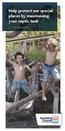 Help protect our special places by maintaining your septic tank BC3136 A septic tank guide Help protect our special places Rural Auckland is a special place, but the remoteness also means that many homes
What Every Realtor Should Know About Private Drinking Water Wells
 What Every Realtor Should Know About Private Drinking Water Wells So, tell me about this well? Is the water good? If you are a real estate agent representing the buyer or the seller of a property served
Hygiene Standards for all Food Businesses
 Hygiene Standards for all Food Businesses Food hygiene laws are not simply a list of rules. They are intended to let food business operators assess the risks to food safety in their business and apply
Potato Microbiology. Sarah Follenweider, The English High School 2009 Summer Research Internship Program
 Potato Microbiology Sarah Follenweider, The English High School 2009 Summer Research Internship Program Introduction: A number of microorganisms thrive on the nutrients that can be found in a potato. My
Marketing Mix: Place 1
 Marketing Mix: Place 1 The learning objectives for this module include understanding the steps to develop a marketing strategy what is meant by marketing mix guiding principles behind developing a place
Malawi Population Data Sheet
 Malawi Population Data Sheet 2012 Malawi s Population Is Growing Rapidly Malawi Population (Millions) 26.1 19.1 13.1 9.9 8.0 4.0 5.5 1966 1977 1987 1998 2008 2020 2030 Malawi s population is growing rapidly,
JAC-CEN-DEL COMMUNITY SCHOOLS BLOODBORNE PATHOGENS UNIVERSAL PRECAUTIONS A BACK TO SCHOOL TRADITION
 JAC-CEN-DEL COMMUNITY SCHOOLS BLOODBORNE PATHOGENS UNIVERSAL PRECAUTIONS A BACK TO SCHOOL TRADITION UNIVERSAL PRECAUTIONS AGAINST BLOODBORNE PATHOGENS Employees working in a school system are potentially
Biology Lab: Water Testing and Purification
 Biology Lab: Water Testing and Purification In this lab activity, students learn how to collect water samples aseptically and how to use a microscope to look for and identify fresh water invertebrates.
EU Life+ Project: Combining Water and Energy Efficiency. A report by the Energy Saving Trust and Waterwise UK.
 : Combining Water and Energy Efficiency A report by the Energy Saving Trust and Waterwise UK. Combining Water and Energy Effi ciency Water in the home External to household Overview The EU Life+ RENEW
A Snapshot of Drinking Water and Sanitation in Africa A regional perspective based on new data from the WHO/UNICEF Joint Monitoring Programme for
 A Snapshot of Drinking Water and Sanitation in A regional perspective based on new data from the WHO/UNICEF Joint Monitoring Programme for Water Supply and Sanitation Prepared for AMCOM as a contribution
GLOBAL GRANT MONITORING AND EVALUATION PLAN SUPPLEMENT
 ENGLISH (EN) GLOBAL GRANT MONITORING AND EVALUATION PLAN SUPPLEMENT Global grant sponsors for humanitarian projects and vocational training teams must incorporate monitoring and evaluation measures within
What to do if sewage floods your property
 What to do if sewage floods your property This leaflet will answer some of your questions and concerns, as well as give you helpful information and advice. What we will do for you Sewer flooding is unpleasant
UNICEF-Turkey TERMS OF REFERENCE SHORT-TERM INSTITUTIONAL CONSULTANCY
 UNICEF-Turkey TERMS OF REFERENCE SHORT-TERM INSTITUTIONAL CONSULTANCY DEVELOPMENT OF WASH IN SCHOOL EDUCATION CONTENT AND METHODS AND PILOT IMPLEMENTATION (REF: EDU/TURA/2014- I) Programme/Project/Activity
Reproduced by Sabinet Online in terms of Government Printer s Copyright Authority No. 10505 dated 02 February 1998 GOVERNMENT NOTICE
 STAATSKOERANT, 15 MEl 2012 No.35354 3 GOVERNMENT NOTICE DEPARTMENT OF HEALTH DEPARTEMENT VAN GESONDHEID No. R. 391 15 May 2012 HEALTH PROFESSIONS ACT, 1974 (ACT NO.56 OF 1974) REGULATIONS DEFINING THE
Finger Facts Subjects: Science and PSHE Key Stages 1 and 2
 Hands Up Finger Facts Subjects: Science and PSHE Key Stages 1 and 2 Learning objectives To understand more about microbes To recognise how microbes can be spread To recognise the link between good hygiene
Emergency Drinking Water Supply
 Emergency Drinking Water Supply Seb Fisher Managing Director, Groundwater Engineering February 2014 Company Profile Groundwater Engineering is an international company specializing in water well engineering,