
Consultation Paper CP25/14. The PRA Rulebook: Part 2
|
|
|
- Penelope Cain
- 9 years ago
- Views:
Transcription
1 Consultation Paper CP25/14 The PRA Rulebook: Part 2 November 2014
2 Prudential Regulation Authority 20 Moorgate London EC2R 6DA Prudential Regulation Authority, registered office: 8 Lothbury, London EC2R 7HH. Registered in England and Wales No:
3 Consultation Paper CP25/14 The PRA Rulebook: Part 2 November 2014 The Bank of England and the Prudential Regulation Authority (PRA) reserve the right to publish any information which it may receive as part of this consultation. Information provided in response to this consultation, including personal information, may be subject to publication or release to other parties or to disclosure, in accordance with access to information regimes under the Freedom of Information Act 2000 or the Data Protection Act 1998 or otherwise as required by law or in discharge of our statutory functions. Please indicate if you regard all, or some of, the information you provide as confidential. If the Bank of England or the PRA receives a request for disclosure of this information, the Bank of England or the PRA will take your indication(s) into account, but cannot give an assurance that confidentiality can be maintained in all circumstances. An automatic confidentiality disclaimer generated by your IT system on s will not, of itself, be regarded as binding on the Bank of England and the PRA. This Consultation Paper proposes changes to rules, guidance and other provisions in the PRA Handbook. Responses are to be received by Friday 23 January Please address any comments or enquiries to: Tunde Koleoso and Nadeem Alam Prudential Policy Directorate Bank of England Threadneedle Street London EC2R 8AH [email protected] Prudential Regulation Authority 2014
4 Contents 1 Overview 5 2 Change in control 6 3 Close links 7 4 Notifications 7 5 General provisions 7 6 Internal governance 7 7 Building societies 7 8 Transfers of business 7 Appendices 9

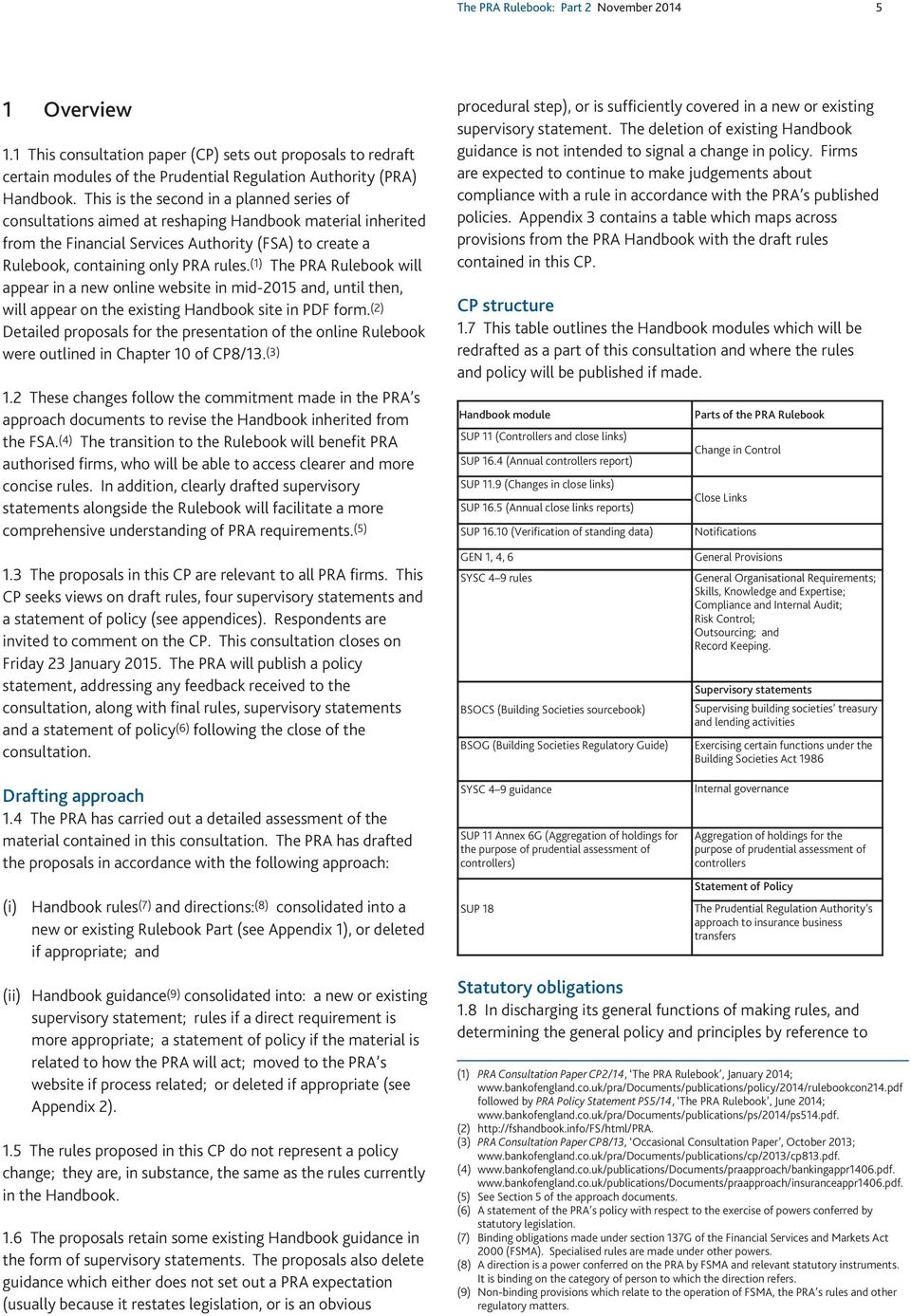
5 The PRA Rulebook: Part 2 November Overview 1.1 This consultation paper (CP) sets out proposals to redraft certain modules of the Prudential Regulation Authority (PRA) Handbook. This is the second in a planned series of consultations aimed at reshaping Handbook material inherited from the Financial Services Authority (FSA) to create a Rulebook, containing only PRA rules. (1) The PRA Rulebook will appear in a new online website in mid-2015 and, until then, will appear on the existing Handbook site in PDF form. (2) Detailed proposals for the presentation of the online Rulebook were outlined in Chapter 10 of CP8/13. (3) 1.2 These changes follow the commitment made in the PRA s approach documents to revise the Handbook inherited from the FSA. (4) The transition to the Rulebook will benefit PRA authorised firms, who will be able to access clearer and more concise rules. In addition, clearly drafted supervisory statements alongside the Rulebook will facilitate a more comprehensive understanding of PRA requirements. (5) 1.3 The proposals in this CP are relevant to all PRA firms. This CP seeks views on draft rules, four supervisory statements and a statement of policy (see appendices). Respondents are invited to comment on the CP. This consultation closes on Friday 23 January The PRA will publish a policy statement, addressing any feedback received to the consultation, along with final rules, supervisory statements and a statement of policy (6) following the close of the consultation. procedural step), or is sufficiently covered in a new or existing supervisory statement. The deletion of existing Handbook guidance is not intended to signal a change in policy. Firms are expected to continue to make judgements about compliance with a rule in accordance with the PRA s published policies. Appendix 3 contains a table which maps across provisions from the PRA Handbook with the draft rules contained in this CP. CP structure 1.7 This table outlines the Handbook modules which will be redrafted as a part of this consultation and where the rules and policy will be published if made. Handbook module SUP 11 (Controllers and close links) SUP 16.4 (Annual controllers report) SUP 11.9 (Changes in close links) SUP 16.5 (Annual close links reports) SUP (Verification of standing data) GEN 1, 4, 6 SYSC 4 9 rules BSOCS (Building Societies sourcebook) BSOG (Building Societies Regulatory Guide) Parts of the PRA Rulebook Change in Control Close Links Notifications General Provisions General Organisational Requirements; Skills, Knowledge and Expertise; Compliance and Internal Audit; Risk Control; Outsourcing; and Record Keeping. Supervisory statements Supervising building societies treasury and lending activities Exercising certain functions under the Building Societies Act 1986 Drafting approach 1.4 The PRA has carried out a detailed assessment of the material contained in this consultation. The PRA has drafted the proposals in accordance with the following approach: (i) Handbook rules (7) and directions: (8) consolidated into a new or existing Rulebook Part (see Appendix 1), or deleted if appropriate; and SYSC 4 9 guidance SUP 11 Annex 6G (Aggregation of holdings for the purpose of prudential assessment of controllers) SUP 18 Internal governance Aggregation of holdings for the purpose of prudential assessment of controllers Statement of Policy The Prudential Regulation Authority s approach to insurance business transfers (ii) Handbook guidance (9) consolidated into: a new or existing supervisory statement; rules if a direct requirement is more appropriate; a statement of policy if the material is related to how the PRA will act; moved to the PRA s website if process related; or deleted if appropriate (see Appendix 2). 1.5 The rules proposed in this CP do not represent a policy change; they are, in substance, the same as the rules currently in the Handbook. 1.6 The proposals retain some existing Handbook guidance in the form of supervisory statements. The proposals also delete guidance which either does not set out a PRA expectation (usually because it restates legislation, or is an obvious Statutory obligations 1.8 In discharging its general functions of making rules, and determining the general policy and principles by reference to (1) PRA Consultation Paper CP2/14, The PRA Rulebook, January 2014; followed by PRA Policy Statement PS5/14, The PRA Rulebook, June 2014; (2) (3) PRA Consultation Paper CP8/13, Occasional Consultation Paper, October 2013; (4) (5) See Section 5 of the approach documents. (6) A statement of the PRA s policy with respect to the exercise of powers conferred by statutory legislation. (7) Binding obligations made under section 137G of the Financial Services and Markets Act 2000 (FSMA). Specialised rules are made under other powers. (8) A direction is a power conferred on the PRA by FSMA and relevant statutory instruments. It is binding on the category of person to which the direction refers. (9) Non-binding provisions which relate to the operation of FSMA, the PRA s rules and other regulatory matters.
6 6 The PRA Rulebook: Part 2 November 2014 which it performs particular functions, the PRA must, so far as reasonably practicable, act in a way that advances its general objective to promote the safety and soundness of PRA authorised firms. (1) 1.9 Overall, the proposals advance the PRA s general objective by assisting firms to meet PRA requirements The proposals are implemented in accordance with the PRA policy framework, and ensure consistent and clear communication of the PRA s expectations. This assists the PRA and the firms it regulates to make judgements that advance the general objective to promote the safety and soundness of PRA firms In making its rules and establishing its practices and procedures, the PRA must have regard to the Regulatory Principles as set out in the Financial Services and Markets Act 2000 (FSMA). (2) The PRA considers the proposals in this CP to be compatible with the PRA s duties under the Regulatory Principles. Impact on mutuals 1.12 The PRA has a statutory obligation to state whether the impact of the proposed rules on mutuals will be significantly different from the impact of the proposed rules on other firms. (3) The proposals in the two draft supervisory statements (see Appendices 2c and 2d) apply to building societies exclusively. In the PRA s opinion, the impact of the proposals (both the draft rules and the draft supervisory statements) on mutuals will not be significantly different from their impact on other firms. Competition 1.13 The PRA has a legal requirement to facilitate competition as a secondary objective subordinate to its general objective to promote the safety and soundness of the firms that it regulates and secure the appropriate degree of protection for policyholders. (4) 1.14 The PRA has assessed whether the proposals in this CP facilitate effective competition. Most of the proposals relate to existing rules and guidance provisions which are being carried over to the Rulebook. Those provisions that implement European Directives have not been assessed from a competition perspective. These changes in the PRA s opinion do not give rise to any adverse effects on competition, and the PRA considers the content of this consultation to be compatible with its secondary objective Transition to the Rulebook will benefit PRA firms who will be able to access clearer and more concise rules which apply to them. In addition, clearly drafted supervisory statements will facilitate a more comprehensive understanding of the PRA s expectations. Cost benefit analysis 1.16 The PRA is required to perform a cost benefit analysis of the impact of its policy proposals. (5) The PRA considers that the proposals in this CP do not amount to a material change to its rules or policy. The proposals are designed to make existing rules clearer and more concise. They will assist firms to comply with existing PRA rules. Therefore, the PRA does not expect the incremental costs to firms arising from the move to the Rulebook to be significant. Given the benefits, the PRA has considered that any costs will be minimal and justified. Equality and diversity 1.17 The PRA may not act in an unlawfully discriminatory manner. It is required, under the Equalities Act 2010, to have due regard to the need to eliminate discrimination and to promote equality of opportunity in carrying out its policies, services and functions. (6) To meet this requirement, the PRA has performed an assessment of the equality and diversity implications of the policy proposals. The conclusion reached is that the proposals do not give rise to equality and diversity implications. 2 Change in control 2.1 This chapter sets out the PRA s proposal to replace the rules and guidance in Chapter 11 (Controllers and close links) of the Supervision manual (SUP 11) and SUP 16.4 (Annual controllers report) with a new Rulebook Part Change in Control (see Appendix 1a) and a new supervisory statement Aggregation of holdings for the purpose of prudential assessment of controllers (see Appendix 2a). 2.2 The draft rules are in substance the same as the rules currently in SUP 11. The proposals do not represent a change in policy with respect to the PRA s change in control regime. 2.3 The PRA proposes to delete SUP (1). This provision requires notification under SUP R, SUP AR or SUP R to be in writing. The PRA considers that the requirement for notification to be in writing is fully covered by the existing notification rules. 2.4 The PRA proposes to redraft SUP G as rule 4.2 in the Change in Control Part. The draft rule will ensure that a firm fully understands the steps that have to be taken to demonstrate that it has kept itself informed about the identity of its controllers. (1) FSMA, section 2B(1)-(2). (2) FSMA, sections 2H and 3B. (3) FSMA, section 138K. (4) FSMA, section 2H(1). (5) FSMA, section 138(J)(2)(a). (6) Equalities Act 2010, section 149(1).

7 The PRA Rulebook: Part 2 November The draft supervisory statement which publishes the PRA s expectations on the aggregation of holdings for the purpose of prudential assessment of controllers is in substance the same as the guidance in SUP 11 Annex 6G. 3 Close links 3.1 This chapter sets out the PRA s proposal to replace the rules set out in SUP 11.9 (Changes in close links) and SUP 16.5 (Annual close links reports) with a new Rulebook Part Close Links (see Appendix 1b). (1) 3.2 The draft rules, which set out the requirements that PRA-authorised firms must comply with to ensure that the relationships with their owners and other members of their group do not prevent their effective supervision, are in substance the same as the rules in SUP 11.9 and SUP Notifications 4.1 This chapter sets out the PRA s proposal to amend the existing Notifications Part to include two new rules that set out requirements on firms to verify the accuracy of standing data and report changes to the PRA (see Appendix 1c). The draft rules will replace the rules in SUP (Verification of standing data). The draft rules are in substance the same as the rules in SUP General provisions 5.1 This chapter sets out the PRA s proposal to replace Chapters 1, 4 and 6 of the General Provisions sourcebook (GEN) with a new Rulebook Part General Provisions (see Appendix 1d). Chapter 2 of GEN will be deleted once the Handbook is deleted, as it is necessary to keep it in force to assist readers to interpret the Handbook. 5.2 The draft rules, which among other things, apply to emergencies resulting in non-compliance with rules and requirements for disclosure to retail clients, do not represent a change in policy and are, in substance, the same as the rules in GEN. 6 Internal governance 6.1 This chapter sets out the PRA s proposals to replace the rules and policy in Chapters 4 9 of the Senior Management Arrangements, Systems and Controls sourcebook (SYSC), with six new Rulebook Parts (see Appendix 1e), and one supervisory statement Internal governance (see Appendix 2b). 6.2 The draft rules will apply to banks, building societies and PRA-designated investment firms. The PRA s rules in SYSC 4 9 will continue to apply to credit unions and UK branches of banks, building societies and investment firms incorporated outside the EU, whose provisions will be subject to a review at a later date. 6.3 The draft rules are, in substance, the same as the rules in SYSC 4 9, with the deletion of several rules that are not prudential in nature and so not relevant to advancing the PRA s objectives. The Financial Conduct Authority will retain these rules in its Handbook. 6.4 The draft supervisory statement publishes guidance that currently exists in SYSC 4 9. The PRA will update the supervisory statement at a later date when the Senior Managers Regime has been implemented. (2) 7 Building societies 7.1 This chapter sets out the PRA s proposal to replace the guidance in the Building Societies Regulatory Guide (BSOG) and the Building Societies sourcebook (BSOCS) respectively, with two new supervisory statements Exercising certain functions under the Building Societies Act 1986 (see Appendix 2c) and Supervising building societies treasury and lending activities (see Appendix 2d). 7.2 The draft supervisory statement in Appendix 2c sets out the PRA s expectations in relation to the Building Societies Act 1986, and on various constitutional and other provisions relating to building societies. 7.3 The draft supervisory statement in Appendix 2d sets out the PRA s approach and expectations of firms in relation to its supervision of building societies treasury and lending activities. 7.4 The PRA intends to review the draft supervisory statement in Appendix 2d in 2015 and will consult on any changes at a later date. 8 Transfers of business 8.1 This chapter sets out the PRA s proposal to replace the guidance in SUP 18 with a statement of policy The Prudential Regulation Authority s approach to insurance business transfers (see Appendix 2e). 8.2 The statement of policy sets out the PRA s approach and expectations in relation to transfers of insurance business under Part VII of FSMA, some insurance business transfers outside the United Kingdom and friendly society transfers of engagements and amalgamations. The draft statement does not represent a change in policy. (1) Close links are relationships that a PRA-authorised firm has with other persons which could have an influence on the safety and soundness of the PRA-authorised firm. (2) PRA Consultation Paper CP14/14 / FCA Consultation Paper CP14/13, Strengthening accountability in banking: a new regulatory framework for individuals, July 2014;

8 8 The PRA Rulebook: Part 2 November 2014

9 The PRA Rulebook: Part 2 November Appendices Appendix 1: Draft instruments 1a Change in control 1b Close links 1c Notifications 1d General provisions 1e Internal governance 1f Consequentials 1g Glossary Appendix 2: Draft supervisory statements and statement of policy 2a Aggregation of holdings for the purpose of the prudential assessment of controllers 2b Internal governance 2c Exercising certain functions under the Building Societies Act d Supervising building societies treasury and lending activities 2e The Prudential Regulation Authority s approach to insurance business transfers Appendix 3: Rulebook mapping table

10 Appendix 1a Powers exercised PRA RULEBOOK: CHANGE IN CONTROL INSTRUMENT [YEAR] A. The Prudential Regulation Authority ( PRA ) makes this instrument in the exercise of the following powers and related provisions in the Financial Services and Markets Act 2000 ( the Act ): (1) section 137G (the PRA s general rules); (2) section 137T (general supplementary powers); (3) section 179 (Requirements for section 178 notices); and (4) section 191E (Requirements for notices under section 191D). B. The rule-making powers (section 137G and section 137T of the Act) referred to above are specified for the purpose of section 138G(2) (Rule-making instrument) of the Act. Pre-conditions to making C. In accordance with section 138J of the Act (consultation by the PRA), the PRA consulted the Financial Conduct Authority. After consulting, the PRA published a draft of proposed rules and had regard to representations made. PRA Rulebook: Change in Control Instrument [YEAR] D. The PRA makes the rules and gives the directions in Annex A to this instrument. Commencement E. This instrument comes into force on [DATE]. Citation F. This instrument may be cited as the PRA Rulebook: Change in Control Instrument [Year]. By order of the Board of the Prudential Regulation Authority [DATE]
11 Appendix 1a Annex A In this Annex, the text is all new and is not underlined. Part CHANGE IN CONTROL Chapter content 1. APPLICATION AND DEFINITIONS 2. OBLIGATIONS ON CONTROLLERS 3. OBLIGATIONS ON FIRMS 4. ONGOING NOTIFICATION REQUIREMENTS 5. ANNUAL CONTROLLERS REPORT 6. FORMS Links
12 Appendix 1a 1 APPLICATION AND DEFINITIONS 1.1 (1) Unless otherwise stated, this Part applies to every firm except: (a) (b) an incoming firm; a non-directive friendly society. (2) Chapter 5 (Annual Controllers Report) does not apply to a credit union. (3) The PRA directs that Chapter 2 (Obligations on Controllers) applies to persons required to give to the PRA a section 178 notice or a notice under section 191D of FSMA. 1.2 In this Part, the following definitions shall apply: acquiring control has the meaning given in section 181 of FSMA, read in conjunction with the Exemption Order. Annual Controllers Report means the relevant form referred to in Chapter 6.5 ceasing to have control has the meaning given in section 183(3) of FSMA, read in conjunction with the Exemption Order. change in control controller means any situation amounting to acquiring control, ceasing to have control, increasing control, or reducing control. has the meaning given in section 422 of FSMA, read in conjunction with the Exemption Order. Controller s Form means the relevant form referred to in Chapter 6.1 to 6.4. Exemption Order means the Financial Services and Markets Act 2000 (Controllers) (Exemption) Order 2009 (SI 2009/774). increasing control has the meaning given in section 182 of FSMA, read in conjunction with the Exemption Order. reducing control has the meaning given in section 183(1) and (2) of FSMA, read in conjunction with the Exemption Order.

13 Appendix 1a section 178 notice has the meaning given in section 178(3) of FSMA. UK domestic firm means a firm that has its registered office (or, if it has no registered office, its head office) in the United Kingdom. 2 OBLIGATIONS ON CONTROLLERS 2.1 The PRA directs that a person submitting a section 178 notice in accordance with section 178(1) of FSMA must do so using the relevant Controller s Form. 2.2 (1) The PRA directs that a person who has submitted a section 178 notice must notify the PRA immediately if the person becomes aware, or has information which reasonably suggests, that the person has or may have provided the PRA with information which was or may have been false, misleading, incomplete or inaccurate, or has or may have changed in a material particular. (2) The notification must include: (a) (b) (c) details of the information which is or may be false, misleading, incomplete or inaccurate, or has or may have changed; an explanation of why such information was or may have been provided; and the correct information. (3) If the information in (2)(c) cannot be submitted with the section 178 notice (because it is not immediately available), the PRA directs that it must instead be submitted as soon as possible afterwards. (4) The requirement in (1) ceases if the change in control occurs or will not take place. 2.3 The PRA directs that a notice under section 191D of FSMA must provide details of the extent of control (if any) that the controller will have following the change in control. 3 OBLIGATIONS ON FIRMS 3.1 A UK domestic firm, other than a non-directive firm or a building society, must notify the PRA of: (1) a person acquiring control over the firm; (2) an existing controller increasing control over the firm; (3) an existing controller reducing control over the firm; or (4) an existing controller ceasing to have control over the firm. 3.2 A building society or a non-directive firm must notify the PRA of: (1) a person acquiring control over the firm; or
14 Appendix 1a (2) an existing controller ceasing to have control over the firm unless that person s acquiring or ceasing to have control is exempt from the notification requirement in sections 178 or 191D of FSMA by virtue of the Exemption Order. 3.3 An overseas firm other than an incoming firm must notify the PRA of: (1) a person acquiring control over the firm; (2) an existing controller increasing control over the firm; (3) an existing controller reducing control over the firm; or (4) an existing controller ceasing to have control over the firm. 3.4 The notifications in 3.1 to 3.3 must: (1) be made: (a) (b) as soon as the firm becomes aware that a person, whether alone or acting in concert, has decided to acquire control, to increase control or to reduce control; or if the change in control takes place without the knowledge of the firm, within 14 days of the firm becoming aware of the change in control concerned; (2) in relation to acquiring control or increasing control, contain as much of the following information as the firm is able to provide, having made reasonable enquiries from persons and other sources as appropriate: (a) (b) (c) (d) the name of the firm; the name of the controller or proposed controller and, if it is a body corporate and is not an authorised person, the names of its directors and its controllers; a description of the proposed event including the shareholding and voting power of the person concerned, both before and after the change in control; and any other information of which the PRA would reasonably expect notice; (3) in relation to a reducing control, contain the following: (a) (b) the name of the controller; and details of the extent of control (if any) which the controller will have following the reduction in control. 3.6 (1) A UK domestic firm must notify the PRA immediately if, in the period between a section 178 notice being submitted and the occurrence of the change in control, the firm becomes aware, or has information which reasonably suggests, that the person submitting the notice has or may have provided the PRA with information which was or may have been false, misleading, incomplete or inaccurate, or has or may have changed in a material particular. (2) The notification must include:
15 Appendix 1a (a) (b) (c) details of the information which is or may be false, misleading, incomplete or inaccurate, or has or may have changed; an explanation why such information was or may have been provided; and the correct information. (3) If the information in (2)(c) cannot be submitted with the notification (because it is not immediately available), it must instead be submitted as soon as possible afterwards. 3.7 During the period referred to in 3.6, a UK domestic firm must take reasonable steps to keep itself informed about the circumstances of the controller or the proposed controller to which the notification related. 3.8 A firm must notify the PRA: (1) when a change in control which was previously notified under has taken place; or (2) if the firm has grounds for reasonably believing that the event will not now take place. 3.9 The notification under 3.8 must be given within 14 days of the change in control or of having the grounds (as applicable). 4 ONGOING NOTIFICATION REQUIREMENTS 4.1 A firm must notify PRA immediately it becomes aware of any of the following matters in respect of one or more of its controllers: (1) if a controller, or any entity subject to his control, is or has been the subject of any legal action or investigation which might put into question the integrity of the controller; (2) if there is a significant deterioration in the financial position of a controller; (3) if a corporate controller undergoes a substantial change or series of changes in its governing body; (4) if a controller, who is authorised in another EEA State as a MiFID investment firm, CRD credit institution or UCITS management company or under the Insurance Directives or the Insurance Mediation Directive, ceases to be so authorised (registered in the case of an IMD insurance intermediary). 4.2 A firm must take reasonable steps to keep itself informed about controllers, including if applicable: (1) monitoring its register of shareholders (or equivalent); (2) monitoring notifications to the firm in accordance with Part 22 of the Companies Act 2006; (3) monitoring public announcements made under the relevant disclosure provisions of the Takeover Code or other rules made by the Takeover Panel;
16 Appendix 1a (4) monitoring the entitlement of delegates, or persons with voting rights in respect of group insurance contracts, to exercise or control voting power at general meetings. 5 ANNUAL CONTROLLERS REPORT 5.1 A firm must submit (or procure that another firm in its group submits) to the PRA, by electronic means, a written Annual Controllers Report which contains the information specified in the form referred to at 6.5, within four months of the firm s accounting reference date. Exemptions 5.2 A friendly society or a building society is only required to submit a report under 5.1 if it is aware that it has a controller. 5.3 In relation to a building society, a controller does not include a person who is exempt from the obligation to notify a change in control under the Exemption Order. 5.4 An insurer need not submit a report under 5.1 to the extent that the information has already been provided to the PRA under IPRU(INS) 9.30 R (Additional information on controllers). 6 FORMS 6.1 The Controllers Form to be used by a limited company or limited liability partnership can be found here. 6.2 The Controllers Form to be used by a partnership is can be found here. 6.3 The Controllers Form to be used by an individual (other than in that individual s capacity as a trustee, settler or beneficiary of a trust) can be found here. 6.4 The Controllers Form to be used by a person in their capacity as a trustee, settler or beneficiary of a trust can be found here. 6.5 The Annual Controllers Report can be found here.
17 Appendix 1b Powers exercised PRA RULEBOOK: CLOSE LINKS INSTRUMENT [YEAR] A. The Prudential Regulation Authority ( PRA ) makes this instrument in the exercise of the following powers and related provisions in the Financial Services and Markets Act 2000 ( the Act ): (1) section 137G (the PRA s general rules); and (2) section 137T (general supplementary powers). B. The rule-making powers referred to above are specified for the purpose of section 138G(2) (Rulemaking instrument) of the Act. Pre-conditions to making C. In accordance with section 138J of the Act (consultation by the PRA), the PRA consulted the Financial Conduct Authority. After consulting, the PRA published a draft of proposed rules and had regard to representations made. PRA Rulebook: Close Links Instrument [YEAR] D. The PRA makes the rules in Annex A to this instrument. Commencement E. This instrument comes into force on [DATE]. Citation F. This instrument may be cited as the PRA Rulebook: Close Links Instrument [Year]. By order of the Board of the Prudential Regulation Authority [DATE]

18 Appendix 1b Annex A In this Annex, the text is all new and is not underlined. Part CLOSE LINKS Chapter content 1. APPLICATION AND DEFINITIONS 2. REQUIREMENT TO NOTIFY CHANGES IN CLOSE LINKS 3. ELECTION TO NOTIFY CHANGES IN CLOSE LINKS ON A MONTHLY BASIS 4. ANNUAL CLOSE LINKS REPORT 5. FORMS Links
19 Appendix 1b 1 APPLICATION AND DEFINITIONS 1.1 Unless otherwise stated, this Part applies to every firm except an incoming firm. 1.2 In this Part, the following definitions shall apply: close links has the meaning given in threshold condition 5F(3) (Effective Supervision). Close Links Annual Report means the form referred to at 5.3. Close Links Monthly Report means the form referred to at 5.2. Close Links Notification Form means the form referred to at REQUIREMENT TO NOTIFY CHANGES IN CLOSE LINKS 2.1 A firm must notify (or procure that another firm in its group notifies) the PRA that it has begun to have or ceased to have close links with any person. 2.2 Where a firm has elected to report changes in close links on a monthly basis under 3.1, it must: (1) within fifteen business days of the end of each month, report (or procure that another firm in its group reports) electronically for that month, by completing the Close Links Monthly Report and submitting it through the relevant platform provided by the PRA; (2) on a quarterly basis, submit (or procure that another firm in its group submits) a group organisation chart, unless there have been no changes since the submission of the previous organisation chart to the PRA, in which case the group organisation chart is not required. 2.3 The Close Links Monthly Report must include the information specified in the form. 2.4 Where a firm has not elected to report changes in close links on a monthly basis under 3.1, it must make (or procure that another firm in its group makes) a notification by completing the Close Links Notification Form as soon as reasonably practicable and no later than one month after it becomes aware that it has begun to have or ceased to have close links with any person. 2.5 The notification submitted under 2.4 must be made by completing the Close Links Notification Form and must include all the relevant information specified therein.

20 Appendix 1b 3 ELECTION TO NOTIFY CHANGES IN CLOSE LINKS ON A MONTHLY BASIS 3.1 A firm wishing to report changes in close links on a monthly basis must send a written notice of election to the firm s usual supervisory contact at the PRA. 3.2 A firm wishing to cease reporting changes in close links on a monthly basis must send a written notice of that intention to its usual supervisory contact at the PRA at least one month before changing its close links reporting practice. 4 ANNUAL CLOSE LINKS REPORT 4.1 A firm must submit (or procure that another firm in its group submits) annually by electronic means to the PRA the Close Links Annual Report, within four months of the firm s accounting reference date. 4.2 An unincorporated friendly society is only required to submit a report under 4.1 if it is aware that it has close links. 4.3 The Close Links Annual Report must include the information specified in the form. 5 FORMS 5.1 The Close Links Notification Form can be found here. 5.2 The Close Links Monthly Report can be found here. 5.3 The Close Links Annual Report can be found here.

21 Appendix 1b Part CLOSE LINKS Externally defined glossary terms Term Definition source friendly society s417 FSMA group s421 FSMA person Schedule 1 Interpretation Act 1978 threshold condition s55b(1) FSMA
22 Appendix 1c PRA RULEBOOK: NOTIFICATIONS (AMENDMENT) (VERIFICATION OF STANDING DATA) INSTRUMENT [YEAR] Powers exercised A. The Prudential Regulation Authority ( PRA ) makes this instrument in the exercise of the following powers and related provisions in the Financial Services and Markets Act 2000 ( the Act ): (1) section 137G (the PRA s general rules); and (2) section 137T (general supplementary powers). B. The rule-making powers referred to above are specified for the purpose of section 138G(2) (Rulemaking instrument) of the Act. Pre-conditions to making C. In accordance with section 138J of the Act (Consultation by the PRA), the PRA consulted the Financial Conduct Authority. After consulting, the PRA published a draft of proposed rules and had regard to representations made. PRA Rulebook: Notifications (Amendment) (Verification of Standing Data) Instrument [YEAR] D. The PRA makes the rules amending the Notifications Part of the PRA Rulebook as set out in Annex A to this instrument. Commencement E. This instrument comes into force on [DATE]. Citation F. This instrument may be cited as the PRA Rulebook: Notifications (Amendment) (Verification of Standing Data) Instrument [Year]. By order of the Board of the Prudential Regulation Authority [DATE] Page 1 of 2
23 Appendix 1c Annex A Amendments to the Notifications Part of the Rulebook In this Annex new text is underlined and deleted text is struck through. 5 CORE INFORMATION REQUIREMENTS A A firm must, within 30 business days of its accounting reference date, check the accuracy of its standing data through the ONA system. If any standing data is incorrect, the firm must correct the standing data by submitting the form referred to in 10.2 (Standing Data Form). 5.5 (1) A firm other than a credit union must submit the forms required in 5.1 to A online using the ONA system. (2) (a) a firm must submit any notice required by 5.1 to 5.3 in the way set out in 7.4 to 7.6; and (aa) (b) a firm must submit any notice required by 5.3A to [email protected] or via post or hand delivery to the FCA marked for the attention of the Static Data team ; and the rules in relation to non-compliance with rules by a firm in the case of an emergency do not apply. (3) A credit union must submit corrected standing data to [email protected] or via post or hand delivery to the FCA marked for the attention of the Static Data Team. Page 2 of 2
24 Appendix 1d PRA RULEBOOK: GENERAL PROVISIONS INSTRUMENT [YEAR] Powers exercised A. The Prudential Regulation Authority ( PRA ) makes this instrument in the exercise of the following powers and related provisions in the Financial Services and Markets Act 2000 ( the Act ): (1) section 137G (the PRA s general rules); and (2) section 137T (General supplementary powers). B. The rule-making powers referred to above are specified for the purpose of section 138G(2) (Rulemaking instrument) of the Act. Pre-conditions to making C. In accordance with section 138J of the Act (Consultation by the PRA), the PRA consulted the Financial Conduct Authority. After consulting, the PRA published a draft of proposed rules and had regard to representations made. PRA Rulebook: General Provisions Instrument [Year] D. The PRA makes the rules in the Annex to this instrument. Commencement E. This instrument comes into force on [DATE]. Citation F. This instrument may be cited as the PRA Rulebook: General Provisions Instrument [Year]. By order of the Board of the Prudential Regulation Authority [DATE] Page 1 of 10
25 Appendix 1d Annex A In this Annex, the text is all new and is not underlined. Part GENERAL PROVISIONS Chapter content 1. APPLICATION AND DEFINITIONS 2. EMERGENCY 3. DISCLOSURE TO RETAIL CLIENTS 4. REFERRING TO APPROVAL BY THE PRA 5. STATEMENTS ABOUT AUTHORISATION AND REGULATION BY THE PRA 6. INSURANCE AGAINST FINANCIAL PENALTIES Page 2 of 10
26 Appendix 1d 1 APPLICATION AND DEFINITIONS 1.1 Unless stated otherwise, this Part applies to every firm. 1.2 In this Part, the following definitions shall apply: client consumer has the meaning given in the FCA Handbook from time to time other than for the purposes of the part of the FCA Handbook in Specialist sourcebooks that has the title Professional Firms. has the meaning given in the FCA Handbook from time to time for the purposes of the FCA s rule in GEN 4.4.1(1)(a)(i). cross-border services customer (1) in relation to a UK firm, services provided within an EEA State other than the UK under the freedom to provide services; or (2) in relation to an incoming EEA firm or an incoming Treaty firm, services provided within the UK under the freedom to provide services. has the meaning given in the FCA Handbook from time to time for the purposes of the FCA s rule in GEN 4.4.1R(1)(a)(ii). eligible counterparty has the meaning given in the FCA Handbook from time to time for the purposes other than for the purposes of the part of the FCA Handbook in High Level Standards that has the title Principles for Businesses. equivalent business of a third country investment firm the business of a third country investment firm carried on from an establishment in the UK that would be MiFID business if that firm were a MiFID investment firm. financial penalty GEN means a financial penalty that the PRA has imposed, or may impose, under FSMA. It does not include a financial penalty imposed by any other body. means the part of the FCA Handbook in High Level Standards which has the title General Provisions. habitual residence (1) if the policyholder is an individual, the address given by the policyholder as his residence if it reasonably appears to be a residential address and there is no evidence to the contrary; or Page 3 of 10
27 Appendix 1d (2) if the policyholder is not an individual or a group of individuals, the State in which the policyholder has its place of establishment, or, if it has more than one, its relevant place of establishment. home finance transaction has the meaning given in the FCA Handbook from time to time other than for the parts of the FCA Handbook in Prudential Standards that have the titles Prudential sourcebook for Insurers and Interim Prudential sourcebook for Insurers. incoming ECA provider MiFID business has the meaning given in the FCA Handbook from time to time. means investment services and activities and, where relevant, ancillary services carried on by a MiFID investment firm. MiFID or equivalent third country business MTF MiFID business or the equivalent business of a third country investment firm. has the meaning given in the FCA Handbook from time to time non-investment insurance contract has the meaning given in the FCA Handbook from time to time. professional client has the meaning given in the FCA Handbook from time to time. regulated market retail client State of the risk has the meaning given in the FCA Handbook from time to time. means a client who is neither a professional client or an eligible counterparty. means references to the EEA State in which a risk is situated in accordance with paragraphs 6(3) and 6(4) of Schedule 12 to FSMA. UK domestic firm means a firm that has its registered office (or, if it has no registered office, its head office) in the UK. 2 EMERGENCY 2.1 This Chapter applies to every person to whom a PRA rule applies. Page 4 of 10
28 Appendix 1d 2.2 (1) If any emergency arises which: (a) (b) (c) makes it impracticable for a person to comply with a particular PRA rule; could not have been avoided by the person taking all reasonable steps; and is outside the control of the person, its associates and agents (and of its and their employees), the person will not be in contravention of that rule to the extent that, in consequence of the emergency, compliance with that rule is impracticable. (2) (1) applies only for so long as: (a) (b) the consequences of the emergency continue; and the person can demonstrate that it is taking all practicable steps to deal with those consequences, to comply with the rule, and to mitigate losses and potential losses to its clients (if any). (3) The person must notify the PRA as soon as practicable of the emergency and of the steps it is taking and proposes to take to deal with the consequences of the emergency. 3 DISCLOSURE TO RETAIL CLIENTS 3.1 This Chapter: (1) subject to (2), applies to: (a) (b) (c) (d) every firm and with respect to every regulated activity; activities carried on from an establishment maintained by the firm (or by its appointed representative) in the UK; letters delivered by hand, sent by post and sent by fax and also electronic mail; letters sent by any of the firm's employees, which includes its appointed representatives and their employees. (2) does not apply to: (a) (b) (c) (d) (e) an incoming ECA provider when the firm is acting as such; an incoming EEA firm which has permission only for cross-border services and which does not carry on regulated activities in the UK; an incoming firm not falling under (a) or (b), to the extent that the firm is subject to equivalent rules imposed by its home Member State; MiFID or equivalent third country business; general insurance business if: (i) the State of the risk is an EEA State other than the UK; or Page 5 of 10
29 Appendix 1d (ii) the State of the risk is outside the EEA and the policyholder is not in the UK when the contract of insurance is entered into; (f) long-term insurance business if: (i) (ii) the policyholder s habitual residence is in an EEA State other than the UK; or the policyholder s habitual residence is outside the EEA and is not present in the UK when the contract of insurance is entered into; or (g) text messages, account statements, business cards or compliment slips (used as such). 3.2 A firm must take reasonable care to ensure that every letter (or electronic equivalent) which it or its employees send to a retail client, with a view to or in connection with the firm carrying on a regulated activity, includes the following disclosure: (1) for a UK domestic firm, "Authorised by the Prudential Regulation Authority and regulated by the Financial Conduct Authority and the Prudential Regulation Authority"; [See Note 1] (2) for an overseas firm (which is not an incoming firm), "[Authorised and regulated by [name of the overseas regulator of the overseas firm in the jurisdiction of that overseas firm's registered office (or, if it has no registered office, its head office)]]. Authorised by the Prudential Regulation Authority. Subject to regulation by the Financial Conduct Authority and limited regulation by the Prudential Regulation Authority. Details about the extent of our regulation by the Prudential Regulation Authority are available from us on request." [See Notes 1, 2, 3 and 3a] (3) for an incoming firm without a top-up permission either: (a) (b) "Authorised by [name of Home State regulator]"; or "Authorised by [name of Home State regulator] and subject to limited regulation by the Financial Conduct Authority and Prudential Regulation Authority. Details about the extent of our regulation by the Financial Conduct Authority and Prudential Regulation Authority are available from us on request"; [See Note 1, 2, 2a, 2b and 3] (4) for an incoming firm with a top-up permission, "Authorised by [name of Home State regulator] and the Prudential Regulation Authority and subject to limited regulation by the Financial Conduct Authority and Prudential Regulation Authority. Details about the extent of our authorisation and regulation by the Prudential Regulation Authority, and regulation by the Financial Conduct Authority are available from us on request"; [See Note 1, 2, 2b and 3] (5) for an appointed representative of a firm, "[Name of appointed representative] is an appointed representative of [name of firm] which is [then continue with the required disclosure of the firm]"; and Page 6 of 10
30 Appendix 1d [See Note 4] (6) for the Society, Authorised under the Financial Services and Markets Act 2000". [Note 1: A firm must use the formulation "Financial Conduct Authority" or "Prudential Regulation Authority" and not the abbreviated formulation "FCA" or "PRA" respectively.] [Note 2: An incoming firm or overseas firm is free to translate the name of its Home State regulator or overseas regulator into English if it wishes. In doing so, it must ensure that the State in which the regulator is based is clear. ] [Note 2a: An incoming firm without a top-up permission may make either disclosure (a) or disclosure (b) unless it otherwise indicates or implies to the customer that it is regulated or supervised by the FCA or PRA, in which case it must make disclosure (b).] [Note 2b: An incoming EEA firm exercising establishment rights in the UK under the CRD, which do not include the activity of acceptance of deposits and other repayable funds, will be subject to branch liquidity and other supervision by the FCA.] [Note 3: If a firm offers to make details about the extent of its authorisation by the PRA or regulation by the FCA or PRA available on request and a customer requests such details, it must provide those details in a way that is clear, fair and not misleading.] [Note 3a: An overseas firm that is not an incoming firm is only required to disclose its authorisation and/or regulated by an overseas regulator if it is so authorised and/or regulated.] [Note 4: If the appointed representative has more than one principal, the disclosure must relate to the principal or principals responsible for the regulated activity or activities concerned. The required disclosure of the firm is that which would apply were the firm to make the disclosure under the rules applicable to the firm.] [General Note: Any person to which this Chapter applies is permitted to add words to the relevant required disclosure statement but only if the person has taken reasonable steps to satisfy itself that the presentation of its statutory status will, as a consequence, be fair, clear and not misleading and be likely to be understood by the average member of the group to whom it is directed or by whom it is likely to be received.] 4 REFERRING TO APPROVAL BY THE PRA 4.1 This Chapter applies to every firm and with respect to the carrying on of both regulated activities and activities that are not regulated activities. 4.2 (1) Unless required to do so under the regulatory system, a firm must ensure that neither it nor anyone acting on its behalf claims in any way that any aspect of its affairs have the approval or endorsement of the PRA or another competent authority. (2) (1) does not apply to statements that explain, in a way that is fair, clear and not misleading, that: (a) (b) the firm is an authorised person; the firm has permission to carry on a specific activity; Page 7 of 10
31 Appendix 1d (c) (d) the firm's approved persons have been approved by the PRA for the purposes of section 59 of FSMA (Approval for particular arrangements); or the firm has been given express written approval by the PRA in respect of a specific aspect of the firm's affairs. 5 STATEMENTS ABOUT AUTHORISATION AND REGULATION BY THE PRA 5.1 This Chapter: (1) subject to (2), applies to: (a) (b) every firm and with respect to every regulated activity; activities carried on from an establishment maintained by the firm (or by its appointed representative) in the UK, provided that, in the case of the MiFID business of an incoming EEA firm, it only applies to business conducted within the territory of the UK. (2) does not apply to: (a) (b) (c) (d) an incoming ECA provider when the firm is acting as such; an incoming EEA firm which has permission only for cross-border services and which does not carry on regulated activities in the UK; an incoming firm not falling under (a) or (b), to the extent that the firm is subject to equivalent rules imposed by its home Member State; MiFID or equivalent third country business that is a transaction: (i) (ii) (iii) between an MTF operator and a member of participant in relation to the use of the MTF; concluded under the rules governing an MTF between members or participants of the MTF, unless the member or participant is, acting on its client s behalf, executing the client s orders on an MTF; or concluded on a regulated market by members or participants of the regulated market, unless the member or participant is, acting on its client s behalf, executing the client s orders on a regulated market. 5.2 A firm must not indicate or imply that it is authorised by the PRA in respect of business for which it is not so authorised. 5.3 A firm must not indicate or imply that it is regulated or otherwise supervised by the PRA in respect of business for which it is not regulated by the PRA. 6 DISCLOSURE TO RETAIL CLIENTS ON ACTIVITIES FROM NON-UK ESTABLISHMENTS 6.1 This Chapter: (1) subject to (2), applies to every firm and with respect to every regulated activity if, in any communication: Page 8 of 10
32 Appendix 1d (a) made to: (i) (ii) (iii) (in relation to a non-investment insurance contract) a consumer; (in relation to a home finance transaction) a customer; or (in all other cases) a retail client; and (b) in connection with a regulated activity carried on from an establishment of the firm (or its appointed representative) that is not in the UK; (2) does not apply to: (a) (b) (c) (d) an incoming ECA provider when the firm is acting as such; an incoming EEA firm which has permission only for cross-border services and which does not carry on regulated activities in the UK; an incoming firm not falling under (a) or (b), to the extent that the firm is subject to equivalent rules imposed by its home Member State; MiFID or equivalent third country business. 6.2 If the firm indicates that it is a PRA-authorised person it must also, where relevant, and with equal prominence, indicate in writing that in some or all respects the regulatory system applying will be different from that of the UK. The firm may also indicate the protections and complaints or compensation arrangements available under another relevant system of regulation. 6.3 A firm need not provide the information required by 6.2 if it has already provided it in writing to the customer to whom the communication is made. 7 INSURANCE AGAINST FINANCIAL PENALTIES 7.1 This Chapter applies to every firm, but only with respect to business that can be regulated under section 137G of FSMA. 7.2 No firm may pay a financial penalty imposed on a present or former employee, director or partner of the firm or of an affiliated company. 7.3 No firm may enter into, arrange, claim on or make a payment under a contract of insurance that is intended to have, or has or would have, the effect of indemnifying any person against all or part of a financial penalty. 6.4 The Society and managing agents must not cause or permit any member, in the conduct of that member s insurance business at the Society, to enter into, arrange, claim on or make a payment under a contract of insurance that is intended to have, or has or would have, the effect of indemnifying any person against all or part of a financial penalty. Page 9 of 10
33 Appendix 1d Part GENERAL PROVISIONS Externally defined glossary terms Term Definition source appointed representative s39(2) FSMA home Member State Article 4(1)(43) CRR person Schedule 1 Interpretation Act 1978 PRA-authorised person s2b(5) FSMA regulated activity s22 FSMA rule s417(1) FSMA Page 10 of 10
34 Appendix 1e PRA RULEBOOK: CRR FIRMS: INTERNAL GOVERNANCE INSTRUMENT [YEAR] Powers exercised A. The Prudential Regulation Authority ( PRA ) makes this instrument in the exercise of the following powers and related provisions in the Financial Services and Markets Act 2000 ( the Act ): (1) section 137G (The PRA s general rules); (2) section 137H (General rules about remuneration); (3) section 137P(control of information rules); and (4) section 137T (General supplementary powers). B. The rule-making powers referred to above are specified for the purpose of section 138G (2) (Rule-making instrument) of the Act. Pre-conditions to making C. In accordance with section 138J of the Act (Consultation by the PRA), the PRA consulted the Financial Conduct Authority. After consulting, the PRA published a draft of proposed rules and had regard to representations made. PRA Rulebook: CRR Firms: Internal Governance Instrument [YEAR] D. The PRA makes the rules in Annexes A to F to this instrument. Part General Organisational Requirements Skills, Knowledge and Expertise Compliance and Internal Audit Risk Control Outsourcing Record Keeping Annex A B C D E F Commencement E. This instrument comes into force on [DATE]. Citation F. This instrument may be cited as the PRA Rulebook: CRR Firms: Internal Governance Instrument [Year]. By order of the Board of the Prudential Regulation Authority [DATE] Page 1 of 33
35 Appendix 1e Annex A In this Annex, the text is all new and is not underlined. Part GENERAL ORGANISATIONAL REQUIREMENTS Chapter content 1. APPLICATION AND DEFINITIONS 2. GENERAL REQUIREMENTS 3. PERSONS WHO EFFECTIVELY DIRECT THE BUSINESS 4. RESPONSIBILITY OF SENIOR PERSONNEL 5. MANAGEMENT BODY 6. NOMINATION COMMITTEE Links Page 2 of 33
36 Appendix 1e 1 APPLICATION AND DEFINITIONS 1.1 Unless otherwise stated, this Part applies to a CRR firm; (1) with respect to the carrying on of the following from an establishment in the UK: (a) (b) (c) (d) (e) regulated activities; activities that constitute dealing in investments as principal, disregarding the exclusion in article 15 of Regulated Activities Order; ancillary activities; in relation to MiFID business, ancillary services; and unregulated activities in a prudential context; and (2) with respect to the carrying on of passported activities by it from a branch in another EEA state; (3) in a prudential context with respect to activities wherever they are carried on; and (4) taking into account any activity of other members of a group of which the firm is a member. 1.2 In this Part, the following definitions shall apply: chief executive function means PRA controlled function CF3 in the table of PRA controlled functions, described more fully in SUP 10B.6.7 R of the PRA Handbook. PRA controlled function means a function, relating to the carrying on of a regulated activity by a firm, which is specified by the PRA (in the table of PRA controlled functions), under section 59 of FSMA. table of PRA controlled functions means the table of PRA controlled functions in SUP 10B.4.3 R of the PRA Handbook. 2 GENERAL REQUIREMENTS 2.1 A firm must have robust governance arrangements, which include a clear organisational structure with well defined, transparent and consistent lines of responsibility, effective processes to identify, manage, monitor and report the risks it is or might be exposed to, and internal control mechanisms, including sound administrative and accounting procedures and effective control and safeguard arrangements for information processing systems. [Note: Art. 74 (1) of the CRD, Art. 13(5) second paragraph of MiFID] 2.2 The arrangements, processes and mechanisms referred to in 2.1 must be comprehensive and proportionate to the nature, scale and complexity of the risks inherent in the business Page 3 of 33
37 Appendix 1e model and of the firm's activities and must take into account the specific technical criteria described in 2.6, Skills, Knowledge and Expertise 3.2, Risk Control and (for a firm to which SYSC 19A applies), SYSC 19A of the PRA Handbook. 2.3 A firm must, taking into account the nature, scale and complexity of the business of the firm, and the nature and range of the financial services and activities undertaken in the course of that business: (1) establish, implement and maintain decision-making procedures and an organisational structure which clearly and in a documented manner specifies reporting lines and allocates functions and responsibilities; (2) establish, implement and maintain adequate internal control mechanisms designed to secure compliance with decisions and procedures at all levels of the firm; and (3) establish, implement and maintain effective internal reporting and communication of information at all relevant levels of the firm. [Note: Arts. 5(1) final paragraph, 5(1)(a), 5(1)(c) and 5(1)(e) of the MiFID implementing Directive] 2.4 A firm must establish, implement and maintain systems and procedures that are adequate to safeguard the security, integrity and confidentiality of information, taking into account the nature of the information in question. [Note: Art. 5(2) of the MiFID implementing Directive] 2.5 A firm must take reasonable steps to ensure continuity and regularity in the performance of its regulated activities. To this end the firm must employ appropriate and proportionate systems, resources and procedures. [Note: Art. 13(4) of MiFID] 2.6 A firm must establish, implement and maintain an adequate business continuity policy aimed at ensuring, in the case of an interruption to its systems and procedures, that any losses are limited, the preservation of essential data and functions, and the maintenance of its regulated activities, or, where that is not possible, the timely recovery of such data and functions and the timely resumption of those activities. [Note: Art. 5(3) of the MiFID implementing Directive and Art 85(2) of the CRD] 2.7 A firm must establish, implement and maintain accounting policies and procedures that enable it, at the request of the PRA, to deliver in a timely manner to the PRA financial reports which reflect a true and fair view of its financial position and which comply with all applicable accounting standards and rules. [Note: Art. 5(4) of the MiFID implementing Directive] 2.8 A firm must monitor and, on a regular basis, evaluate the adequacy and effectiveness of its systems, internal control mechanisms and arrangements established in accordance with 2.3 to 2.7 and take appropriate measures to address any deficiencies. [Note: Art. 5(5) of the MiFID implementing Directive] 2.9 (1) A firm must have in place appropriate procedures for its employees to report breaches internally through a specific, independent and autonomous channel. Page 4 of 33
38 Appendix 1e (2) The channel in (1) may be provided through arrangements provided for by social partners. [Note: Art. 71 (3) of the CRD] 3 PERSONS WHO EFFECTIVELY DIRECT THE BUSINESS 3.1 The senior personnel of a firm must be of sufficiently good repute and sufficiently experienced as to ensure the sound and prudent management of the firm. [Note: Art. 9(1) of MiFID, Art. 13(1) of the CRD] 3.2 A firm must ensure that its management is undertaken by at least two persons meeting the requirements laid down in 3.1. [Note: Art. 9(4) first paragraph of MiFID and Art. 13(1) of the CRD] 4 RESPONSIBILITY OF SENIOR PERSONNEL 4.1 A firm, when allocating functions internally, must ensure that senior personnel and, where appropriate, the supervisory function, are responsible for ensuring that the firm complies with its obligations under the regulatory system. In particular, senior personnel and, where appropriate, the supervisory function must assess and periodically review the effectiveness of the policies, arrangements and procedures put in place to comply with the firm's obligations under the regulatory system and take appropriate measures to address any deficiencies. [Note: Art. 9(1) of the MiFID implementing Directive] 4.2 A firm must ensure that: (1) its senior personnel receive on a frequent basis, and at least annually, written reports on the matters covered by Compliance and Internal Audit 2.2 to 2.4 and 3.1, and Risk Control 2.1, 2.2 and 2.4 to 2.6, indicating in particular whether the appropriate remedial measures have been taken in the event of any deficiencies; and (2) the supervisory function, if any, receives on a regular basis written reports on the same matters. [Note: Art. 9(2) and Art. 9(3) of the MiFID implementing Directive] 5 MANAGEMENT BODY 5.1 A firm must ensure that the management body defines, oversees and is accountable for the implementation of governance arrangements that ensure effective and prudent management of the firm, including the segregation of duties in the organisation and the prevention of conflicts of interest. The firm must ensure that the management body: (1) has overall responsibility for the firm; (2) approves and oversees implementation of the firm s strategic objectives, risk strategy and internal governance; (3) ensures the integrity of the firm's accounting and financial reporting systems, including financial and operational controls and compliance with the regulatory system; (4) oversees the process of disclosure and communications; Page 5 of 33
39 Appendix 1e (5) has responsibility for providing effective oversight of senior management; and (6) monitors and periodically assesses the effectiveness of the firm's governance arrangements and takes appropriate steps to address any deficiencies. [Note: Art. 88(1) of the CRD] 5.2 A firm must ensure that the members of the management body of the firm: (1) are of sufficiently good repute; (2) possess sufficient knowledge, skills and experience to perform their duties; (3) possess adequate collective knowledge, skills and experience to understand the firm's activities, including the main risks; (4) reflect an adequately broad range of experiences; (5) commit sufficient time to perform their functions in the firm; and (6) act with honesty, integrity and independence of mind to effectively assess and challenge the decisions of senior management where necessary and to effectively oversee and monitor management decision-making. [Note: Art. 91(1)-(2) and (7)-(8) of the CRD] 5.3 A firm must devote adequate human and financial resources to the induction and training of members of the management body. [Note: Art. 91(3) of the CRD] 5.4 A firm must ensure that the members of the management body of the firm do not hold more directorships than is appropriate taking into account individual circumstances and the nature, scale and complexity of the firm's activities. [Note: Art. 91(3) of the CRD] 5.5 (1) A firm that is significant must ensure that the members of the management body of the firm do not hold more than one of the following combinations of directorship in any organisation at the same time: (a) (b) one executive directorship with two non-executive directorships; and four non-executive directorships. (2) Paragraph (1) does not apply to members of the management body that represent the UK. [Note: Art. 91(3) of the CRD] 5.6 For the purposes of 5.4 and 5.5: (1) directorships in organisations which do not pursue predominantly commercial objectives shall not count; and (2) the following shall count as a single directorship: Page 6 of 33
40 Appendix 1e (a) executive or non-executive directorships held within the same group; or (b) executive or non-executive directorships held within: (i) (ii) firms that are members of the same institutional protection scheme provided that the conditions set out in Article 113(7) of the CRR are fulfilled; or undertakings (including non-financial entities) in which the firm holds a qualifying holding. [Note: Art. 91(4) and (5) of the CRD] 5.7 A firm must ensure that the chairman of the firm's management body does not exercise simultaneously the chief executive function within the same firm, unless justified by the firm and authorised by the PRA. 6 NOMINATION COMMITTEE 6.1 A firm that is significant must: (1) establish a nomination committee composed of members of the management body who do not perform any executive function in the firm; (2) ensure that the nomination committee is able to use any forms of resources the nomination committee deems appropriate, including external advice; and (3) ensure that the nomination committee receives appropriate funding. [Note: Art. 88(2) of the CRD] 6.2 A firm that has a nomination committee must ensure that the nomination committee: (1) engage a broad set of qualities and competences when recruiting members to the management body and for that purpose puts in place a policy promoting diversity on the management body; (2) identifies and recommends for approval, by the management body or by general meeting, candidates to fill management body vacancies, having evaluated the balance of knowledge, skills, diversity and experience of the management body; (3) prepares a description of the roles and capabilities for a particular appointment, and assesses the time commitment required; (4) decides on a target for the representation of the underrepresented gender in the management body and prepares a policy on how to increase the number of the underrepresented gender in the management body in order to meet that target; (5) periodically, and at least annually, assesses the structure, size, composition and performance of the management body and makes recommendations to the management body with regard to any changes; (6) periodically, and at least annually, assesses the knowledge, skills and experience of individual members of the management body and of the management body collectively, and reports this to the management body; Page 7 of 33
41 Appendix 1e (7) periodically reviews the policy of the management body for selection and appointment of senior management and makes recommendations to the management body; and (8) in performing its duties, and to the extent possible, on an ongoing basis, takes account of the need to ensure that the management body's decision making is not dominated by any one individual or small group of individuals in a manner that is detrimental to the interest of the firm as a whole. [Note: Art. 88(2) and Art. 91(10) of the CRD] 6.3 A firm that does not have a nomination committee must engage a broad set of qualities and competences when recruiting members to the management body. For that purpose a firm that does not have a nomination committee must put in place a policy promoting diversity on the management body. [Note: Art. 91(10) of the CRD] 6.4 A firm that maintains a website must explain on the website how it complies with the requirements of this Chapter. [Note: Art. 96 of the CRD] Page 8 of 33
42 Appendix 1e Part GENERAL ORGANISATIONAL REQUIREMENTS Externally defined glossary terms Term Definition source EEA State Schedule 1 Interpretation Act 1978 group s421 FSMA person Schedule 1 Interpretation Act 1978 qualifying holding Art. 4(1)(36) of the CRR regulated activity s22 FSMA Page 9 of 33
43 Appendix 1e Annex B In this Annex, the text is all new and is not underlined. Part SKILLS, KNOWLEDGE AND EXPERTISE Chapter content 1. APPLICATION AND DEFINITIONS 2. SKILLS, KNOWLEDGE AND EXPERTISE 3. SEGREGATION OF FUNCTIONS 4. AWARENESS OF PROCEDURES 5. GENERAL Links Page 10 of 33
44 Appendix 1e 1 APPLICATION 1.1 Unless otherwise stated, this Part applies to a CRR firm (1) with respect to the carrying on of the following from an establishment in the UK: (a) (b) (c) (d) (e) regulated activities; activities that constitute dealing in investments as principal, disregarding the exclusion in article 15 of Regulated Activities Order; ancillary activities; in relation to MiFID business, ancillary services; and unregulated activities in a prudential context; and (2) with respect to the carrying on of passported activities by it from a branch in another EEA state; (3) in a prudential context with respect to activities wherever they are carried on; and (4) taking into account any activity of other members of a group of which the firm is a member. 2 SKILLS, KNOWLEDGE AND EXPERTISE 2.1 A firm must employ personnel with the skills, knowledge and expertise necessary for the discharge of the responsibilities allocated to them. [Note: Art. 5(1)(d) of the MiFID implementing Directive] 3 SEGREGATION OF FUNCTIONS 3.1 A firm must ensure that the performance of multiple functions by its relevant persons does not and is not likely to prevent those persons from discharging any particular functions soundly, honestly and professionally. [Note: Art. 5(1)(g) of the MiFID implementing Directive] 3.2 The senior personnel of a firm must define arrangements concerning the segregation of duties within the firm and the prevention of conflicts of interest. [Note: Art. 88 of the CRD] 4 AWARENESS OF PROCEDURES 4.1 A firm must ensure that its relevant persons are aware of the procedures which must be followed for the proper discharge of their responsibilities. [Note: Art. 5(1)(b) of the MiFID implementing Directive] 5 GENERAL 5.1 The systems, internal control mechanisms and arrangements established by a firm in accordance with this Part must take into account the nature, scale and complexity of its Page 11 of 33
45 Appendix 1e business and the nature and range of financial services and activities undertaken in the course of that business. [Note: Art. 5(1) final paragraph of the MiFID implementing Directive] 5.1 A firm must monitor and, on a regular basis, evaluate the adequacy and effectiveness of its systems, internal control mechanisms and arrangements established in accordance with this Part, and take appropriate measures to address any deficiencies. [Note: Art. 5(5) of the MiFID implementing Directive] Page 12 of 33
46 Appendix 1e Part SKILLS, KNOWLEDGE AND EXPERTISE Externally defined glossary terms Term Definition source EEA State Schedule 1 Interpretation Act 1978 group s421 FSMA person Schedule 1 Interpretation Act 1978 regulated activity s22 FSMA Page 13 of 33
47 Appendix 1e Annex C [In this Annex, the text is all new and is not underlined Part COMPLIANCE AND INTERNAL AUDIT Chapter content 1. APPLICATION AND DEFINITIONS 2. COMPLIANCE 3. INTERNAL AUDIT Links Page 14 of 33
48 Appendix 1e 1 APPLICATION AND DEFINITIONS 1.1 Unless otherwise stated, this Part applies to a CRR firm (1) with respect to the carrying on of the following from an establishment in the UK: (a) (b) (c) (d) (e) regulated activities; activities that constitute dealing in investments as principal, disregarding the exclusion in article 15 of Regulated Activities Order; ancillary activities; in relation to MiFID business, ancillary services; and unregulated activities in a prudential context; and (2) with respect to the carrying on of passported activities by it from a branch in another EEA state; (3) in a prudential context with respect to activities wherever they are carried on; and (4) taking into account any activity of other members of a group of which the firm is a member. 1.2 In this Part, the following definitions shall apply: client has the meaning given in the FCA Handbook from time to time other than for the purposes of the part of the FCA Handbook in Specialist sourcebooks that has the title Professional Firms. competent authority means the authority, designated by each EEA State in accordance with Article 48 of MiFID, unless otherwise specified in MiFID. [Note: Art. 4(1)(22) of MiFID] financial instruments mean the instruments specified in Section C of Annex I of MiFID. host Member State has the meaning given in Article 4(1)(21) of MiFID. [Note: Art. 2(6) of the MiFID implementing Directive] tied agent means a person who, under the full and unconditional responsibility of only one MiFID investment firm or third country investment firm on whose behalf it acts, promotes investment services and/or ancillary services to clients or prospective clients, receives and transmits instructions or orders from the client in respect of investment services Page 15 of 33
49 Appendix 1e or financial instruments, places financial instruments and/or provides advice to clients or prospective clients in respect of those financial instruments or investment services. [Note: Art. 4(1)(25) of MiFID] third country investment firm 2 COMPLIANCE means a firm which would be a MiFID investment firm if it had its head office in an EEA State. 2.1 A firm must establish, implement and maintain adequate policies and procedures sufficient to ensure compliance of the firm including its managers, employees and appointed representatives (or where applicable, tied agents) with its obligations under the regulatory system and for countering the risk that the firm might be used to further financial crime. [Note: Art. 13(2) of MiFID] 2.2 A firm must, taking into account the nature, scale and complexity of its business, and the nature and range of financial services and activities undertaken in the course of that business, establish, implement and maintain adequate policies and procedures designed to detect any risk of failure by the firm to comply with its obligations under the regulatory system, as well as associated risks, and put in place adequate measures and procedures designed to minimise such risks and to enable the PRA to exercise its powers effectively under the regulatory system and to enable any other competent authority to exercise its powers effectively under MiFID. [Note: Art. 6(1) of the MiFID implementing Directive] 2.3 A firm must maintain a permanent and effective compliance function which operates independently and which has the following responsibilities: (1) to monitor and, on a regular basis, to assess the adequacy and effectiveness of the measures and procedures put in place in accordance with 2.2 and the actions taken to address any deficiencies in the firm's compliance with its obligations; and (2) to advise and assist the relevant persons responsible for carrying out regulated activities to comply with the firm's obligations under the regulatory system. [Note: Art. 6(2) of the MiFID implementing Directive] 2.4 In order to enable the compliance function to discharge its responsibilities properly and independently, a firm must ensure that the following conditions are satisfied: (1) the compliance function must have the necessary authority, resources, expertise and access to all relevant information; (2) a compliance officer must be appointed and must be responsible for the compliance function and for any reporting as to compliance required by General Organisation Requirements 4.2; (3) the relevant persons involved in the compliance functions must not be involved in the performance of services or activities they monitor; Page 16 of 33
50 Appendix 1e (4) the method of determining the remuneration of the relevant persons involved in the compliance function must not compromise their objectivity and must not be likely to do so. [Note: Art. 6(3) first paragraph of the MiFID implementing Directive] 2.5 A firm need not comply with 2.4(3) or (4) if it is able to demonstrate that in view of the nature, scale and complexity of its business, and the nature and range of financial services and activities, the requirements under those rules are not proportionate and that its compliance function continues to be effective. [Note: Art. 6(3) second paragraph of the MiFID implementing Directive] 2.6 (1) This rule applies to a firm conducting investment services and activities from a branch in another EEA State. (2) References to the regulatory system in 2.1, 2.2 and 2.3 apply in respect of a firm's branch as if regulatory system includes a host Member State's requirements under MiFID and the MiFID implementing Directive which are applicable to the investment services and activities conducted from the firm's branch. [Note: Art. 13(2) of MiFID] 3 INTERNAL AUDIT 3.1 A firm must, where appropriate and proportionate in view of the nature, scale and complexity of its business and the nature and range of its financial services and activities, undertaken in the course of that business, establish and maintain an internal audit function which is separate and independent from the other functions and activities of the firm and which has the following responsibilities: (1) to establish, implement and maintain an audit plan to examine and evaluate the adequacy and effectiveness of the firm's systems, internal control mechanisms and arrangements; (2) to issue recommendations based on the result of work carried out in accordance with (1); (3) to verify compliance with those recommendations; and (4) to report in relation to internal audit matters in accordance with General Organisational Requirements 4.2. [Note: Art. 8 of the MiFID implementing Directive] Page 17 of 33
51 Appendix 1e Part COMPLIANCE AND INTERNAL AUDIT Externally defined glossary terms Term Definition source appointed representative s39(2) FSMA group s421 FSMA EEA State Schedule 1 Interpretation Act 1978 person Schedule 1 Interpretation Act 1978 regulated activity s22 FSMA Page 18 of 33
52 Appendix 1e Annex D [In this Annex, the text is all new and is not underlined. Part RISK CONTROL Chapter content 1. APPLICATION AND DEFINITIONS 2. RISK CONTROL 3. RISK COMMITTEE Links Page 19 of 33
53 Appendix 1e 1 APPLICATION 1.1 Unless otherwise stated, this Part applies to a CRR firm (1) with respect to the carrying on of the following from an establishment in the UK: (a) (b) (c) (d) (e) regulated activities; activities that constitute dealing in investments as principal, disregarding the exclusion in article 15 of Regulated Activities Order; ancillary activities; in relation to MiFID business, ancillary services; and unregulated activities in a prudential context; and (2) with respect to the carrying on of passported activities by it from a branch in another EEA state; (3) in a prudential context with respect to activities wherever they are carried on; and (4) taking into account any activity of other members of a group of which the firm is a member. 2 RISK CONTROL 2.1 A firm must establish, implement and maintain adequate risk management policies and procedures, including effective procedures for risk assessment, which identify the risks relating to the firm's activities, processes and systems, and where appropriate, set the level of risk tolerated by the firm. [Note: Art. 7(1)(a) of the MiFID implementing Directive, Art. 13(5) second paragraph of MiFID] 2.2 A firm must adopt effective arrangements, processes and mechanisms to manage the risk relating to the firm's activities, processes and systems, in light of that level of risk tolerance. [Note: Art. 7(1)(b) of the MiFID implementing Directive] 2.3 The management body of a firm must approve and periodically review the strategies and policies for taking up, managing, monitoring and mitigating the risks the firm is or might be exposed to, including those posed by the macroeconomic environment in which it operates in relation to the status of the business cycle. [Note: Art. 76(1) of the CRD] 2.4 A firm must monitor the following: (1) the adequacy and effectiveness of the firm's risk management policies and procedures; (2) the level of compliance by the firm and its relevant persons with the arrangements, processes and mechanisms adopted in accordance with 2.2; (3) the adequacy and effectiveness of measures taken to address any deficiencies in those policies, procedures, arrangements, processes and mechanisms, including Page 20 of 33
54 Appendix 1e failures by the relevant persons to comply with such arrangements or processes and mechanisms or follow such policies and procedures. [Note: Art. 7(1)(c) of the MiFID implementing Directive] 2.5 A firm must, where appropriate and proportionate in view of the nature, scale and complexity of its business and the nature and range of the investment services and activities undertaken in the course of that business, establish and maintain a risk management function that operates independently and carries out the following tasks: (1) implementation of the policies and procedures referred to in 2.1 to 2.4; and (2) provision of reports and advice to senior personnel in accordance with General Organisational Requirements 4.2. [Note: Art. 7(2) first paragraph of the MiFID implementing Directive] 2.6 Where a firm is not required under 2.5 to maintain a risk management function that functions independently, it must nevertheless be able to demonstrate that the policies and procedures which it has adopted in accordance with 2.1 to 2.4 satisfy the requirements of those rules and are consistently effective. [Note: Art. 7(2) second paragraph of the MiFID implementing Directive] 2.7 (1) The management body of a firm has overall responsibility for risk management. It must devote sufficient time to the consideration of risk issues. (2) The management body of a firm must be actively involved in and ensure that adequate resources are allocated to the management of all material risks addressed in the rules implementing the CRD and in the CRR as well as in the valuation of assets, the use of external ratings and internal models related to those risks. (3) A firm must establish reporting lines to the management body that cover all material risks and risk management policies and changes thereof. [Note: Art. 76(2) of the CRD] 3 RISK COMMITTEE 3.1 (1) A firm that is significant must establish a risk committee composed of members of the management body who do not perform any executive function in the firm. Members of the risk committee must have appropriate knowledge, skills and expertise to fully understand and monitor the risk strategy and the risk appetite of the firm. (2) The risk committee must advise the management body on the institution's overall current and future risk appetite and assist the management body in overseeing the implementation of that strategy by senior management. (3) The risk committee must review whether prices of liabilities and assets offered to clients take fully into account the firm's business model and risk strategy. Where prices do not properly reflect risks in accordance with the business model and risk strategy, the risk committee must present a remedy plan to the management body. [Note: Art. 76(3) of the CRD] Page 21 of 33
55 Appendix 1e 3.2 (1) A firm must ensure that the management body in its supervisory function and, where a risk committee has been established, the risk committee have adequate access to information on the risk profile of the firm and, if necessary and appropriate, to the risk management function and to external expert advice. (2) The management body in its supervisory function and, where one has been established, the risk committee must determine the nature, the amount, the format, and the frequency of the information on risk which it is to receive. [Note: Art. 76(4) of the CRD] 3.3 In order to assist in the establishment of sound remuneration policies and practices, the risk committee must, without prejudice to the tasks of the remuneration committee, examine whether incentives provided by the remuneration system take into consideration risk, capital, liquidity and the likelihood and timing of earnings. [Note: Art. 76(4) of the CRD] 3.4 (1) A firm s risk management function (2.5) must be independent from the operational functions and have sufficient authority, stature, resources and access to the management body. (2) The risk management function must ensure that all material risks are identified, measured and properly reported. It must be actively involved in elaborating the firm's risk strategy and in all material risk management decisions and it must be able to deliver a complete view of the whole range of risks of the firm. (3) A firm must ensure that the risk management function is able to report directly to the management body in its supervisory function, independent from senior management and that it can raise concerns and warn the management body, where appropriate, where specific risk developments affect or may affect the firm, without prejudice to the responsibilities of the management body in its supervisory and/or managerial functions pursuant to the CRD and the CRR. [Note: Art. 76(5) of the CRD] 3.5 The head of the risk management function must be an independent senior manager with distinct responsibility for the risk management function. Where the nature, scale and complexity of the activities of the firm do not justify a specially appointed person, another senior person within the firm may fulfil that function, provided there is no conflict of interest. The head of the risk management function must not be removed without prior approval of the management body and must be able to have direct access to the management body where necessary. [Note: Art. 76(5) of the CRD] Page 22 of 33
56 Appendix 1e Part RISK CONTROL Externally defined glossary terms Term Definition source EEA State Schedule 1 Interpretation Act 1978 group s421 FSMA person Schedule 1 Interpretation Act 1978 regulated activity s22 FSMA Page 23 of 33
57 Appendix 1e Annex E In this Annex, the text is all new and is not underlined. Part OUTSOURCING Chapter content 1. APPLICATION AND DEFINITIONS 2. OUTSOURCING Links Page 24 of 33
58 Appendix 1e 1 APPLICATION AND DEFINITIONS 1.1 Unless otherwise stated, this Part applies to a CRR firm (1) with respect to the carrying on of the following from an establishment in the UK: (a) (b) (c) (d) (e) regulated activities; activities that constitute dealing in investments as principal, disregarding the exclusion in article 15 of Regulated Activities Order; ancillary activities; in relation to MiFID business, ancillary services; and unregulated activities in a prudential context; and (2) with respect to the carrying on of passported activities by it from a branch in another EEA state; (3) in a prudential context with respect to activities wherever they are carried on; and (4) taking into account any activity of other members of a group of which the firm is a member. 1.2 In this Part, the following definitions shall apply: authorisation control listed activities 2 OUTSOURCING means authorisation as an authorised person for the purposes of FSMA. means control as defined in Article 1 of the Seventh Council Directive 83/349/EEC (The Seventh Company Law Directive). means an activity listed in Annex 1 to the CRD. 2.1 A firm must: (1) when relying on a third party for the performance of operational functions which are critical for the performance of regulated activities, listed activities or ancillary services (in this chapter "relevant services and activities") on a continuous and satisfactory basis, ensure that it takes reasonable steps to avoid undue additional operational risk; (2) not undertake the outsourcing of important operational functions in such a way as to impair materially: (a) the quality of its internal control; and Page 25 of 33
59 Appendix 1e (b) the ability of the PRA to monitor the firm's compliance with all obligations under the regulatory system and, if different, of a competent authority to monitor the firm's compliance with all obligations under MiFID. [Note: Art. 13(5) first paragraph of MiFID] 2.2 For the purposes of this Part an operational function is regarded as critical or important if a defect or failure in its performance would materially impair the continuing compliance of a firm with the conditions and obligations of its authorisation or its other obligations under the regulatory system, or its financial performance, or the soundness or the continuity of its relevant services and activities. [Note: Art. 13(1) of the MiFID implementing Directive] 2.3 Without prejudice to the status of any other function, the following functions will not be considered as critical or important for the purposes of this Part: (1) the provision to the firm of advisory services, and other services which do not form part of the relevant services and activities of the firm, including the provision of legal advice to the firm, the training of personnel of the firm, billing services and the security of the firm's premises and personnel; and (2) the purchase of standardised services, including market information services and the provision of price feeds. [Note: Art. 13(2) of the MiFID implementing Directive] 2.4 If a firm outsources critical or important operational functions or any relevant services and activities, it remains fully responsible for discharging all of its obligations under the regulatory system and must comply, in particular, with the following conditions: (1) the outsourcing must not result in the delegation by senior personnel of their responsibility; (2) the relationship and obligations of the firm towards its clients under the regulatory system must not be altered; (3) the conditions with which the firm must comply in order to be authorised, and to remain so, must not be undermined; (4) none of the other conditions subject to which the firm's authorisation was granted must be removed or modified. [Note: Art. 14(1) of the MiFID implementing Directive] 2.5 A firm must exercise due skill and care and diligence when entering into, managing or terminating any arrangement for the outsourcing to a service provider of critical or important operational functions or of any relevant services and activities. [Note: Art. 14(2) first paragraph of the MiFID implementing Directive] 2.6 A firm must in particular take the necessary steps to ensure that the following conditions are satisfied: (1) the service provider must have the ability, capacity, and any authorisation required by law to perform the outsourced functions, services or activities reliably and professionally; Page 26 of 33
60 Appendix 1e (2) the service provider must carry out the outsourced services effectively, and to this end the firm must establish methods for assessing the standard of performance of the service provider; (3) the service provider must properly supervise the carrying out of the outsourced functions, and adequately manage the risks associated with the outsourcing; (4) appropriate action must be taken if it appears that the service provider may not be carrying out the functions effectively and in compliance with applicable laws and regulatory requirements; (5) the firm must retain the necessary expertise to supervise the outsourced functions effectively and to manage the risks associated with the outsourcing, and must supervise those functions and manage those risks; (6) the service provider must disclose to the firm any development that may have a material impact on its ability to carry out the outsourced functions effectively and in compliance with applicable laws and regulatory requirements; (7) the firm must be able to terminate the arrangement for the outsourcing where necessary without detriment to the continuity and quality of its provision of services to clients; (8) the service provider must co-operate with the PRA and any other relevant competent authority in connection with the outsourced activities; (9) the firm, its auditors, the PRA and any other relevant competent authority must have effective access to data related to the outsourced activities, as well as to the business premises of the service provider; and the PRA and any other relevant competent authority must be able to exercise those rights of access; (10) the service provider must protect any confidential information relating to the firm and its clients; (11) the firm and the service provider must establish, implement and maintain a contingency plan for disaster recovery and periodic testing of backup facilities where that is necessary having regard to the function, service or activity that has been outsourced. [Note: Art. 14(2) second paragraph of the MiFID implementing Directive] 2.7 A firm must ensure that the respective rights and obligations of the firm and of the service provider are clearly allocated and set out in a written agreement. [Note: Art. 14(3) of the MiFID implementing Directive] 2.8 If a firm and the service provider are members of the same group, the firm may, for the purpose of complying with 2.5 to 2.9, take into account the extent to which the firm controls the service provider or has the ability to influence its actions. [Note: Art. 14(4) of the MiFID implementing Directive] 2.9 A firm must make available on request to the PRA and any other relevant competent authority all information necessary to enable the PRA and any other relevant competent authority to supervise the compliance of the performance of the outsourced activities with the requirements of the regulatory system. Page 27 of 33
61 Appendix 1e [Note: Art. 14(5) of the MiFID implementing Directive] Page 28 of 33
62 Appendix 1e Part OUTSOURCING Externally defined glossary terms Term Definition source authorised person Schedule 1 Interpretation Act 1978 EEA State Schedule 1 Interpretation Act 1978 group s421 FSMA person Schedule 1 Interpretation Act 1978 regulated activity s22 FSMA Page 29 of 33
63 Appendix 1e Annex F In this Annex, the text is all new and is not underlined. Part RECORD KEEPING Chapter content 1. APPLICATION AND DEFINITIONS 2. RECORD KEEPING Links Page 30 of 33
64 Appendix 1e 1 APPLICATION 1.1 Unless otherwise stated, this Part applies to a CRR firm (1) with respect to the carrying on of the following from an establishment in the UK: (a) (b) (c) (d) (e) regulated activities; activities that constitute dealing in investments as principal, disregarding the exclusion in article 15 of Regulated Activities Order; ancillary activities; in relation to MiFID business, ancillary services; and unregulated activities in a prudential context; and unless another applicable rule which is relevant to the activity has a wider territorial scope, in which case this Part applies with that wider scope in relation to the activity described in that rule (2) with respect to the carrying on of passported activities by it from a branch in another EEA state; (3) in a prudential context with respect to activities wherever they are carried on; and (4) taking into account any activity of other members of a group of which the firm is a member. 2 RECORD KEEPING 2.1 A firm must arrange for orderly records to be kept of its business and internal organisation, including all services and transactions undertaken by it, which must be sufficient to enable the PRA or any other relevant competent authority under MiFID to monitor the firm's compliance with the requirements under the regulatory system, and in particular to ascertain that the firm has complied with all obligations with respect to clients. [Note: Art. 13(6) of MiFID, and Art. 5(1)(f) of the MiFID implementing Directive ] 2.2 A firm must retain all records kept by it under this Part in relation to its MiFID business for a period of at least five years. [Note: Art. 51 (1) of the MiFID implementing Directive] 2.3 In relation to its MiFID business, a firm must retain records in a medium that allows the storage of information in a way accessible for future reference by the PRA or any other relevant competent authority under MiFID, and so that the following conditions are met: (1) the PRA or any other relevant competent authority under MiFID must be able to access them readily and to reconstitute each key stage of the processing of each transaction; (2) it must be possible for any corrections or other amendments, and the contents of the records prior to such corrections and amendments, to be easily ascertained; and Page 31 of 33
65 Appendix 1e (3) it must not be possible for the records otherwise to be manipulated or altered. [Note: Art. 51(2) of the MiFID implementing Directive] Page 32 of 33
66 Appendix 1e RECORD KEEPING Externally defined glossary terms Term Definition source EEA State Schedule 1 Interpretation Act 1978 group s421 FSMA regulated activity s22 FSMA Page 33 of 33
67 Appendix 1f HANDBOOK (RULEBOOK CONSEQUENTIALS) INSTRUMENT [YEAR] Powers exercised A. The Prudential Regulation Authority ( PRA ) makes this instrument in the exercise of the following powers and related provisions in the Financial Services and Markets Act 2000 ( the Act ): (1) [section 137G (The PRA s general rules)]; and (2) [section 137T (General supplementary powers). B. The rule-making powers referred to above are specified for the purpose of section 138G(2) (Rulemaking instrument) of the Act. Pre-conditions to making C. In accordance with section 138J of the Act (Consultation by the PRA), the PRA consulted the Financial Conduct Authority. After consulting, the PRA published a draft of proposed rules and had regard to representations made. Commencement D. This instrument comes into force on [DATE]. Amendments E. The modules of the PRA s Handbook of rules and guidance listed in column (1) below are amended in accordance with the Annexes to this instrument listed in column (2). (1) (2) Glossary of definitions Annex A Senior Management Arrangements, Systems Annex B and Controls sourcebook (SYSC) Supervision manual (SUP) Annex C Prudential sourcebook for Mortgage and Home Annex D Finance Firms, and Insurance Intermediaries (MIPRU) General Provisions (GEN) Annex E Fees Manual (FEES) Annex F Conduct of Business Sourcebook (COBS) Annex G Deletion F. Each of the following modules and sections of the PRA s Handbook is deleted: BSOCS (Building Societies sourcebook) BSOG (The Building Societies Regulatory Guide) SUP 11 (Controllers and close links) SUP 16.4 (Annual controllers report) SUP 16.5 (Annual Close Links Reports) SUP (Verification of standing data) SUP 18 (Transfers of business) GEN 1 (Appropriate regulator approval and emergencies) GEN 4 (Statutory status disclosure) Page 1 of 29
68 Appendix 1f GEN 6 (Insurance against financial penalties) Citation G. This instrument may be cited as the Handbook (Rulebook Consequentials) Instrument [Year]. By order of the Board of the Prudential Regulation Authority [DATE] Page 2 of 29
69 Appendix 1f Annex A Amendments to the Glossary of definitions In this Annex new text is underlined and deleted text is struck through. appropriate regulator (1) in In the FCA Handbook, the FCA; and in the PRA Handbook, the PRA;. (2) (a) in SUP 11 "appropriate regulator" has the meaning given in section 178 of the Act, and [deleted] (b) in SUP 18 "appropriate regulator" has the meaning given in section 103A of the Act. [deleted] common platform firm (A) In the PRA Handbook (except SYSC 4-9): (AB) In the PRA Handbook (in SYSC 4-9), has the same meaning as in (A) except that it excludes CRR firms. competent employees rule (a) (b) For a firm which is not a common platform firm or a CRR firm, SYSC 3.1.6R. (c) for a CRR firm, Skills, Knowledge and Expertise 2.1 of the PRA Rulebook. contingency funding plan (1) (2) (in BIPRU 12 and BSOCS) a plan for dealing with liquidity crises as required by BIPRU R. credit institution (A) In the PRA Handbook: Page 3 of 29
70 Appendix 1f (1) (2) (in REC and in SUP 11 (Controllers and close links) and SUP 16 (Reporting requirements)): designated money market fund (in BIPRU 12 and BSOCS) a collective investment scheme authorised under the UCITS Directive or which is subject to supervision and, if applicable, authorised by an authority under the national law of an EEA State, and which satisfies the following conditions: IPRU the Interim Prudential sourcebook, comprising IPRU(BANK), IPRU(BSOC), IPRU(FSOC), IPRU(INS) and IPRU(INV), or according to the context one of these Interim Prudential sourcebooks. listed (A) In the PRA Handbook: (1) (except in LR, SUP 11, INSPRU and IPRU(INS)) included in an official list. (2) (in SUP 11, INSPRU and IPRU(INS)): non-directive firm (in SUP 11 (Controllers and close links) and SUP 16 (Reporting requirements)) (in accordance with the Financial Services and Markets Act 2000 (Controllers) (Exemption) Order 2009 (SI 2009/774)) a UK domestic firm other than: PD (1) (2) (in GENPRU, and BIPRU and BSOCS) probability of default. Page 4 of 29
71 Appendix 1f Society (1) (except in BSOCS) thethe society incorporated by Lloyd's Act 1871 by the name of Lloyd's. (2) (in BSOCS) a building society. [deleted] subsidiary undertaking (1) (2) (3) (in LR and BSOCS) as defined in section 1162 of the Companies Act 2006.[deleted] Delete the following definitions altogether. The deleted text is not shown Act BSOCS CIS administrator CIS trustee composite insurer discretionary investment manager early repayment charge employee firm type independent expert IPRU(BSOC) non-discretionary investment manager own account trading firm qualifying money market fund scheme report SDL share society voting power Page 5 of 29
72 Appendix 1f wholesale only bank Page 6 of 29
73 Appendix 1f Annex B Amendments to the Senior Management Arrangements, Systems and Controls sourcebook (SYSC) In this Annex new text is underlined and deleted text is struck through. 1.1A Application 1.1A.1A G Chapters 4 to 9 are not applicable to CRR firms. CRR firms are subject to the rules in the General Organisational Requirements Part of the PRA Rulebook. 1 Annex 1 Detailed application of SYSC Part 2 Application of the common platform requirements (SYSC 4 to 10) 2.1 R The common platform requirements apply to every firm apart from an insurer, a managing agent and the Society unless provided otherwise in a specific rule. [deleted] 2.1A R The common platform organisational requirements apply to every firm apart from a CRR firm, an insurer, a managing agent and the Society unless provided otherwise in a specific rule. 2.1B R SYSC 10 applies to every firm apart from an insurer, a managing agent and the Society unless provided otherwise in a specific rule. Part 3 Tables summarising the application of the common platform requirements to different types of firm 3.1 G The common platform requirements apply in the following four ways (subject to the provisions in Part 2 of this Annex).[deleted] 3.1A G The common platform requirements apply in accordance with Part 2 of this Annex and the provisions in 3.2BR, 3.2CR, 3.2DG, 3.2ER, 3.3AG and 3.4R. 3.2 G For a common platform firm, they apply in accordance with Column A in the table below. [deleted] Page 7 of 29
74 Appendix 1f 3.2C R For a common platform firm other than a CRR firm, Provision SYSC 4 to Provision SYSC 9 apply in accordance with Column A in the table below. 3.2D G SYSC 4 to 9 are not applicable to CRR firms. CRR firms are subject to the rules in the General Organisational Requirements, Skills, Knowledge and Expertise, Compliance and Internal Audit, Risk Control, Outsourcing and Record Keeping Parts of the PRA Rulebook. 3.2E R For a common platform firm, Provision SYSC 10 applies in accordance with Column A in the table below. 3.3 G For all other firms apart from insurers, managing agents, the Society and full-scope UK AIFMs of unauthorised AIFs, they apply in accordance with Column B in the table below. For these firms, where a rule is shown modified in Column B as 'Guidance', it should be read as guidance (as if "should" appeared in that rule instead of "must") and should be applied in a proportionate manner, taking into account the nature, scale and complexity of the firm's business. [deleted] 3.3A G For all other firms apart from CRR firms, insurers, managing agents, the Society and full-scope UK AIFMs of unauthorised AIFs, they apply in accordance with Column B in the table below. For these firms, where a rule is shown modified in Column B as 'Guidance', it should be read as guidance (as if "should" appeared in that rule instead of "must") and should be applied in a proportionate manner, taking into account the nature, scale and complexity of the firm's business. 3.4 R For the purposes of Provision 4 to Provision 9 in the table below, the reference to: 12.1 Application (1) common platform firm in Column A must be read as a common platform firm apart from a CRR firm ; and (2) all other firms in Column B must be read as all other firms apart from CRR firms. Page 8 of 29
75 Appendix 1f A R When applying SYSC R, CRR firms must read references to: (1) SYSC 4.1.1R and SYSC 4.1.2R as references to General Organisation Requirements 2.1 and 2.2 of the PRA Rulebook; (2) SYSC 4.1.7R as a reference to General Organisation Requirement 2.6 of the PRA Rulebook; (3) SYSC 4.3A as a reference to chapters 5 and 6 of the General Organisation Requirements Part of the PRA Rulebook; (4) SYSC 5.1.7R as a reference to Skills, Knowledge and Expertise 3.2 of the PRA Rulebook; (5) SYSC 7 as a reference to Chapters 2 and 3 of the Risk Control Part of the PRA Rulebook; 13.8 External events and other changes G The high level requirement for appropriate systems and controls at SYSC 3.1.1R applies at all times, including when a business continuity plan is invoked. However, the appropriate regulator recognises that, in an emergency, a firm may be unable to comply with a particular rule and the conditions for relief are outlined in GEN 1.3 (Emergency). [deleted] A G The high level requirement for appropriate systems and controls at SYSC 3.1.1R applies at all times, including when a business continuity plan is invoked. However, the appropriate regulator recognises that, in an emergency, a firm may be unable to comply with a particular rule and the conditions for relief are outlined in Chapter 2 of the General Provisions Part of the PRA Rulebook. 19A.1 General application and purpose Page 9 of 29
76 Appendix 1f 19A.1.1 R (1) The Remuneration Code applies to : [deleted] (a) (b) (c) (d) a building society; [deleted] a bank; [deleted] an investment firm; [deleted] an overseas firm that; [deleted] (i) (ii) (iii) is not an EEA firm; [deleted] has its head office outside the EEA; and [deleted] would be a firm referred to in (a), (b) or (c) if it had been a UK domestic firm, had carried on all of its business in the UK and had obtained whatever authorisations for doing so as are required under the Act. [deleted] (2) In relation to a firm that falls under (1)(d), the Remuneration Code applies only in relation to activities carried on from an establishment in the United Kingdom. [deleted] (3) Otherwise, the Remuneration Code applies to a firm within (1) in the same way as SYSC 4.1.1R (General Requirements). [deleted] 19A.1.1B R (1) The Remuneration Code applies to : (a) (b) (c) (d) a building society; a bank; an investment firm; an overseas firm that; (i) (ii) (iii) is not an EEA firm; has its head office outside the EEA; and would be a firm referred to in (a), (b) or (c) if it had been a UK domestic firm, had carried on all of its business in the UK and had obtained whatever authorisations for doing so as are required under the Act. (2) In relation to a firm that falls under (1)(d), the Remuneration Code applies only in relation to activities carried on from an establishment in the United Kingdom. (3) Otherwise, the Remuneration Code applies to a firm within (1) in the Page 10 of 29
77 Appendix 1f same way as SYSC 4.1.1R (General Requirements) or, in the case of a CRR firm, General Organisational Requirements 2.1 in the PRA Rulebook. 19A.1.2 G Part 2 of SYSC 1 Annex 1 provides for the application of SYSC 4.1.1R (General Requirements). In particular, and subject to the provisions on group risk systems and controls requirements in SYSC 12, this means that: [deleted] (1) in relation to what the Remuneration Code applies to, it: [deleted] (a) (b) (c) applies in relation to regulated activities, activities that constitute dealing in investments as principal (disregarding the exclusion in article 15 of the Regulated Activities Order (Absence of holding out etc)), ancillary activities and (in relation to MiFID business) ancillary services; [deleted] applies with respect to the carrying on of unregulated activities in a prudential context; and [deleted] takes into account activities of other group members; and [deleted] (2) in relation to where the Remuneration Code applies, it applies in relation to: [deleted] (a) (b) (c) a firm's UK activities; [deleted] a firm's passported activities carried on from a branch in another EEA State; and [deleted] a UK domestic firm's activities wherever they are carried on, in a prudential context. [deleted] 19A.1.2A G Subject to the provisions on group risk systems and controls requirements in SYSC 12: (1) in relation to what the Remuneration Code applies to, it: (a) (b) applies in relation to regulated activities, activities that constitute dealing in investments as principal (disregarding the exclusion in article 15 of the Regulated Activities Order (Absence of holding out etc)), ancillary activities and (in relation to MiFID business) ancillary services; applies with respect to the carrying on of unregulated activities in a prudential context; and Page 11 of 29
78 Appendix 1f (c) takes into account activities of other group members; and (2) in relation to where the Remuneration Code applies, it applies in relation to: (a) (b) (c) a firm's UK activities; a firm's passported activities carried on from a branch in another EEA State; and a UK domestic firm's activities wherever they are carried on, in a prudential context. Purpose 19A.1.6 G (1) The aim of the Remuneration Code is to ensure that firms have riskfocused remuneration policies, which are consistent with and promote effective risk management and do not expose them to excessive risk. It expands upon the general organisational requirements in SYSC 4. [deleted] (2) The Remuneration Code implements the main provisions of the CRD which relate to remuneration. The Committee of European Banking Supervisors published Guidelines on Remuneration Policies and Practices on 10 December Provisions of the Capital Requirements (Amendment) Regulations 2012 (SI 2012/917) together with the European Banking Authority's Guidelines to article 22(3) and (5) of the Banking Consolidation Directive relating to the collection of remuneration benchmarking information and high earners information have been implemented through SUP 16 Annex 33AR and SUP 16 Annex 34AR. The Guidelines can be found at %20Guidelines/2012/EBA-GL GL-4-on-remunerationbenchmarking-exercise-.pdf and %20Guidelines/2012/EBA-GL GL-5-on-remuneration-datacollection-exercise-.pdf. [deleted] (3) [deleted] 19A.1.6A G (1) The aim of the Remuneration Code is to ensure that firms have riskfocused remuneration policies, which are consistent with and promote effective risk management and do not expose them to excessive risk. It expands upon the general organisational requirements in General Organisational Requirements 2.1 of the PRA Rulebook. (2) The Remuneration Code implements the main provisions of the CRD Page 12 of 29
79 Appendix 1f which relate to remuneration. The Committee of European Banking Supervisors published Guidelines on Remuneration Policies and Practices on 10 December Provisions of the Capital Requirements Regulations 2013 (SI 2013/3115) together with the European Banking Authority's Guidelines to article 75(1) and (3) of the CRD relating to the collection of remuneration benchmarking information and high earners information have been implemented through the Remuneration Reporting Requirements Part of the PRA Rulebook. The Guidelines can be found at. /eba-publishes-guidelines-to-streamline-data-collection-onremuneration-practices 19A.2 General requirement 19A.2.2 G (1) If a firm's remuneration policy is not aligned with effective risk management it is likely that employees will have incentives to act in ways that might undermine effective risk management. [deleted] (2) The Remuneration Code covers all aspects of remuneration that could have a bearing on effective risk management including salaries, bonuses, long-term incentive plans, options, hiring bonuses, severance packages and pension arrangements. In applying the Remuneration Code, a firm should have regard to applicable good practice on remuneration and corporate governance, such as guidelines on executive contracts and severance produced by the Association of British Insurers (ABI) and the National Association of Pension Funds (NAPF). In considering the risks arising from its remuneration policies, a firm will also need to take into account its statutory duties in relation to equal pay and non-discrimination. [deleted] (3) As with other aspects of a firm's systems and controls, in accordance with SYSC 4.1.2R remuneration policies, procedures and practices must be comprehensive and proportionate to the nature, scale and complexity of the common platform firm's activities. What a firm must do in order to comply with the Remuneration Code will therefore vary. For example, while the Remuneration Code refers to a firm's remuneration committee and risk management function, it may be appropriate for the governing body of a smaller firm to act as the remuneration committee, and for the firm not to have a separate risk management function. [deleted] (4) The principles in the Remuneration Code are used by the appropriate regulator to assess the quality of a firm's remuneration policies and whether they encourage excessive risk-taking by a firm's employees. Page 13 of 29
80 Appendix 1f [deleted] (5) The appropriate regulator may also ask remuneration committees to provide the appropriate regulator with evidence of how well the firm's remuneration policies meet the Remuneration Code's principles, together with plans for improvement where there is a shortfall. The appropriate regulator also expects relevant firms to use the principles in assessing their exposure to risks arising from their remuneration policies as part of the internal capital adequacy assessment process (ICAAP).[deleted] (6) The Remuneration Code is principally concerned with the risks created by the way remuneration arrangements are structured, not with the absolute amount of remuneration, which is generally a matter for firms' remuneration committees. [deleted] 19A.2.2A G (1) If a firm's remuneration policy is not aligned with effective risk management it is likely that employees will have incentives to act in ways that might undermine effective risk management. (2) The Remuneration Code covers all aspects of remuneration that could have a bearing on effective risk management including salaries, bonuses, long-term incentive plans, options, hiring bonuses, severance packages and pension arrangements. In applying the Remuneration Code, a firm should have regard to applicable good practice on remuneration and corporate governance, such as guidelines on executive contracts and severance produced by the Association of British Insurers (ABI) and the National Association of Pension Funds (NAPF). In considering the risks arising from its remuneration policies, a firm will also need to take into account its statutory duties in relation to equal pay and non-discrimination. (3) As with other aspects of a firm's systems and controls, in accordance with General Organisational Requirement 2.2 of the PRA Rulebook, remuneration policies, procedures and practices must be comprehensive and proportionate to the nature, scale and complexity of the common platform firm's activities. What a firm must do in order to comply with the Remuneration Code will therefore vary. For example, while the Remuneration Code refers to a firm's remuneration committee and risk management function, it may be appropriate for the governing body of a smaller firm to act as the remuneration committee, and for the firm not to have a separate risk management function. (4) The principles in the Remuneration Code are used by the appropriate regulator to assess the quality of a firm's remuneration policies and whether they encourage excessive risk-taking by a firm's employees. Page 14 of 29
81 Appendix 1f (5) The appropriate regulator may also ask remuneration committees to provide the appropriate regulator with evidence of how well the firm's remuneration policies meet the Remuneration Code's principles, together with plans for improvement where there is a shortfall. The appropriate regulator also expects relevant firms to use the principles in assessing their exposure to risks arising from their remuneration policies as part of the internal capital adequacy assessment process (ICAAP). (6) The Remuneration Code is principally concerned with the risks created by the way remuneration arrangements are structured, not with the absolute amount of remuneration, which is generally a matter for firms' remuneration committees. Record-keeping 19A.2.4 G In line with the record-keeping requirements in SYSC 9, a firm should ensure that its remuneration policies, practices and procedures are clear and documented. Such policies, practices and procedures would include performance appraisal processes and decisions. [deleted] 19A.2.4A G In line with the record-keeping requirements in the Record Keeping Part of the PRA Rulebook, a firm should ensure that its remuneration policies, practices and procedures are clear and documented. Such policies, practices and procedures would include performance appraisal processes and decisions. 19A.3 Remuneration principles for banks, building societies and investment firms 19A.3.5 R A firm must: [deleted] 19A.3.5A R A firm must: (1) maintain a record of its Remuneration Code staff in accordance with the general record-keeping requirements (SYSC 9); and [deleted] (2) take reasonable steps to ensure that its Remuneration Code staff understand the implications of their status as such, including the potential for remuneration which does not comply with certain requirements of the Remuneration Code to be rendered void and recoverable by the firm. [deleted] Page 15 of 29
82 Appendix 1f (1) maintain a record of its Remuneration Code staff in accordance with the general record-keeping requirements in the Record Keeping Part of the PRA Rulebook; and (2) take reasonable steps to ensure that its Remuneration Code staff understand the implications of their status as such, including the potential for remuneration which does not comply with certain requirements of the Remuneration Code to be rendered void and recoverable by the firm. 19A.3.13 G (1) A firm should be able to demonstrate that its decisions are consistent with an assessment of its financial condition and future prospects. In particular, practices by which remuneration is paid for potential future revenues whose timing and likelihood remain uncertain should be evaluated carefully and the governing body or remuneration committee (or both) should work closely with the firm's risk function in evaluating the incentives created by its remuneration system. [deleted] (2) The governing body and any remuneration committee are responsible for ensuring that the firm's remuneration policy complies with the Remuneration Code and where relevant should take into account relevant guidance, such as that issued by the Basel Committee on Banking Supervision, the International Association of Insurance Supervisors (IAIS) and the International Organization of Securities Commissions (IOSCO). [deleted] (3) The periodic review of the implementation of the remuneration policy should assess compliance with the Remuneration Code. [deleted] (4) Guidance on what the supervisory function might involve is set out in SYSC 4.3.3G. [deleted] 19A.3.13A G (1) A firm should be able to demonstrate that its decisions are consistent with an assessment of its financial condition and future prospects. In particular, practices by which remuneration is paid for potential future revenues whose timing and likelihood remain uncertain should be evaluated carefully and the governing body or remuneration committee (or both) should work closely with the firm's risk function in evaluating the incentives created by its remuneration system. (2) The governing body and any remuneration committee are responsible for ensuring that the firm's remuneration policy complies with the Remuneration Code and where relevant should take into account relevant guidance, such as that issued by the Basel Committee on Banking Supervision, the International Association of Page 16 of 29
83 Appendix 1f Insurance Supervisors (IAIS) and the International Organization of Securities Commissions (IOSCO). (3) The periodic review of the implementation of the remuneration policy should assess compliance with the Remuneration Code. (4) Guidance on what the supervisory function might involve is set out in paragraph 2.8 of the PRA s Supervisory Statement: internal governance. 19A.3.17 G (1) This Remuneration Principle is designed to manage the conflicts of interest which might arise if other business areas had undue influence over the remuneration of employees within control functions. Conflicts of interest can easily arise when employees are involved in the determination of remuneration for their own business area. Where these could arise they need to be managed by having in place independent roles for control functions (including, notably, risk management and compliance) and human resources. It is good practice to seek input from a firm's human resources function when setting remuneration for other business areas. [deleted] (2) The need to avoid undue influence is particularly important where employees from the control functions are embedded in other business areas. This Remuneration Principle does not prevent the views of other business areas being sought as an appropriate part of the assessment process. [deleted] (3) The appropriate regulator would generally expect the ratio of the potential variable component of remuneration to the fixed component of remuneration to be significantly lower for employees in risk management and compliance functions than for employees in other business areas whose potential bonus is a significant proportion of their remuneration. Firms should nevertheless ensure that the total remuneration package offered to those employees is sufficient to attract and retain staff with the skills, knowledge and expertise to discharge those functions. The requirement that the method of determining the remuneration of relevant persons involved in the compliance function must not compromise their objectivity or be likely to do so also applies (see SYSC 6.1.4R(4)). [deleted] 19A.3.17A G (1) This Remuneration Principle is designed to manage the conflicts of interest which might arise if other business areas had undue influence over the remuneration of employees within control functions. Conflicts of interest can easily arise when employees are involved in the determination of remuneration for their own business area. Where these could arise they need to be managed by having in place independent roles for control functions (including, notably, risk Page 17 of 29
84 Appendix 1f management and compliance) and human resources. It is good practice to seek input from a firm's human resources function when setting remuneration for other business areas. (2) The need to avoid undue influence is particularly important where employees from the control functions are embedded in other business areas. This Remuneration Principle does not prevent the views of other business areas being sought as an appropriate part of the assessment process. (3) The appropriate regulator would generally expect the ratio of the potential variable component of remuneration to the fixed component of remuneration to be significantly lower for employees in risk management and compliance functions than for employees in other business areas whose potential bonus is a significant proportion of their remuneration. Firms should nevertheless ensure that the total remuneration package offered to those employees is sufficient to attract and retain staff with the skills, knowledge and expertise to discharge those functions. The requirement that the method of determining the remuneration of relevant persons involved in the compliance function must not compromise their objectivity or be likely to do so also applies (see Compliance and Internal Audit 2.4(4) of the PRA Rulebook) Application and purpose G The reverse stress testing requirements are an integral component of a firm's business planning and risk management under SYSC and the Risk Control Part of the PRA Rulebook. For BIPRU firms as referred to in SYSC R (1)(a), this chapter amplifies SYSC 7.1.1G to SYSC 7.1.8G on risk control Risk Control in the PRA Rulebook. For insurers as referred to in SYSC R (1)(b), this chapter amplifies SYSC G to SYSC G on business planning and risk management Risk control: guidance on governance arrangements G (1) This chapter provides additional guidance on risk-centric governance arrangements for effective risk management. It expands upon the general organisational requirements in SYSC 2, SYSC 3, SYSC 4, SYSC 7 and FUND 3.7, and so applies to the same extent as SYSC 3.1.1R (for insurers, managing agents and the Society), SYSC 4.1.1R (for every other firm) and FUND 3.7 (for a full-scope UK AIFM of an authorised AIF). [deleted] Page 18 of 29
85 Appendix 1f (2) Firms should, taking account of their size, nature and complexity, consider whether in order to fulfil the general organisational requirements in SYSC 2, SYSC 3, SYSC 4, SYSC 7 and (for a fullscope UK AIFM of an authorised AIF) FUND 3.7 their risk control arrangements should include: [deleted] (a) (b) appointing a Chief Risk Officer; and [deleted] establishing a governing body risk committee. [deleted] The functions of a Chief Risk Officer and governing body risk committee are explained further in this section.[deleted] (3) The appropriate regulator considers that banks and insurers that are included in the FTSE 100 Index are examples of the types of firm that should structure their risk control arrangements in this way. However, this guidance will also be relevant to some similar sized firms (whether or not listed) and some smaller firms, by virtue of their risk profile or complexity. [deleted] A G (1) This chapter provides additional guidance on risk-centric governance arrangements for effective risk management. It expands upon the general organisational requirements in SYSC 2, SYSC 3, SYSC 4, SYSC 7 and the General Organisational Requirements Part and the Risk Control Part of the PRA Rulebook, and so applies to the same extent as SYSC 3.1.1R (for insurers, managing agents and the Society), SYSC 4.1.1R and the General Organisational Requirements Part and the Risk Control Part of the PRA Rulebook (for CRR firms). (2) Firms should, taking account of their size, nature and complexity, consider whether in order to fulfil the general organisational requirements in SYSC 2, SYSC 3, SYSC 4, SYSC 7 and the General Organisational Requirements Part and the Risk Control Part of the PRA Rulebook and their risk control arrangements should include: (a) (b) appointing a Chief Risk Officer; and establishing a governing body risk committee. The functions of a Chief Risk Officer and governing body risk committee are explained further in this section. (3) The appropriate regulator considers that banks and insurers that are included in the FTSE 100 Index are examples of the types of firm that should structure their risk control arrangements in this way. However, this guidance will also be relevant to some similar sized firms (whether or not listed) and some smaller firms, by virtue of their risk profile or complexity. Page 19 of 29
86 Appendix 1f Annex C Amendments to the Supervision manual (SUP) In this Annex new text is underlined and deleted text is struck through. 10B.9 Systems and controls function 10B.9.1 R (2) setting and controlling its risk exposure (see SYSC G, and SYSC 7.1.6R and, for CRR firms, Risk Control 2.5 of the PRA Rulebook); and. (3) adherence to internal systems and controls, procedures and policies (see SYSC G, and SYSC 6.2 and, for CRR firms, Compliance and Internal Audit 3.1 of the PRA Rulebook). 10B.11 Application for approval and withdrawing an application for approval 10B.11.6 G (2) Usually this will be the firm that is employing the PRA candidate to perform the PRA controlled function. Where a firm has outsourced the performance of a PRA controlled function, the details of the outsourcing determine where responsibility lies and whom the PRA anticipates will submit PRA-approved persons application forms. SUP 10B.11.7G describes some common situations. The firm which is outsourcing is referred to as "A" and the person to whom the performance of the PRA controlled function has been outsourced, or which makes the arrangement for the PRA controlled function to be performed, is referred to as "B". In each situation, A must take reasonable care to ensure that, in accordance with section 59(2) of the Act, no person performs a PRA controlled function under an arrangement entered into by its contract or in relation to the carrying on by A of a regulated activity, without approval from the PRA. See also SYSC 3.2.4G and SYSC 8.1.1R, and, for CRR firms, Outsourcing 2.1 of the PRA Rulebook and SYSC 13.9 for insurers. 10B.11.7 A G The reference to SYSC 8 in in the table above must be read as SYSC 8 or, in the case of a CRR firm, the Outsourcing Part of the PRA Rulebook. Page 20 of 29
87 Appendix 1f 10B.14 How to apply for approval and give notifications 10B.14.4 G Where SUP 10B.14.1D (4) or the equivalent situation under SUP 10B.14.2R applies to a firm, GEN 1.3.2R (Emergency) does General Provisions 2.1 of the PRA Rulebook do not apply.q 16.1 Application R (1) Section(s) (2) Categories of firm to which section applies (3) Applicable rules and guidance SUP 16.4 and SUP 16.5 All categories of firm except: Entire sections (-a) (a) (b) (c) (d) (e) (f) (g) (h) (i) (j) (ja) a credit union; an ICVC; an incoming EEA firm; an incoming Treaty firm; a non-directive friendly society; [deleted] a sole trader; a service company; a UCITS qualifier; a firm with permission to carry on only retail investment activities; a firm with permission to carry on only insurance mediation activity, home finance mediation activity, or both; an FCA-authorised person with permission to carry on only credit- Page 21 of 29
88 Appendix 1f related regulated activity; (k) a firm falling within a combination of (i),(j) and (ja). SUP All categories of firm except: Entire section (a) an ICVC; (b) (c) (d) a UCITS qualifier; a credit union; and a dormant account fund operator General provisions on reporting G This chapter has been split into the following sections, covering: [deleted] (1) annual controllers reports (SUP 16.4); [deleted] (2) annual close links reports (SUP 16.5); [deleted] (3) compliance reports (SUP 16.6); [deleted] (4) [deleted] (5) persistency reports (SUP 16.8); [deleted]; (6) annual appointed representatives reports (SUP 16.9); [deleted]; (7) Verification of standing data (SUP 16.10); [deleted] (8) product sales data reporting (SUP 16.11); [deleted]; (9) integrated regulatory reporting (SUP 16.12); [deleted]; (10) reporting under the Payment Services Regulations (SUP 16.13); [deleted]; (11) client money and asset return (SUP 16.14); [deleted]; (12) reporting under the Electronic Money Regulations (SUP 16.15). [deleted]; (13) prudent valuation reporting (SUP 16.16);[deleted]; (14) remuneration reporting (SUP 16.17) [deleted]; and Page 22 of 29
89 Appendix 1f (15) AIFMD reporting (SUP 16.18) [deleted] A G This chapter has been split into the following sections, covering: (1) compliance reports (SUP 16.6); (2) persistency reports (SUP 16.8); (3) annual appointed representatives reports (SUP 16.9); (4) product sales data reporting (SUP 16.11); (5) integrated regulatory reporting (SUP 16.12); (6) reporting under the Payment Services Regulations (SUP 16.13); (7) client money and asset return (SUP 16.14); (8) reporting under the Electronic Money Regulations (SUP 16.15). (9) prudent valuation reporting (SUP 16.16); (11) remuneration reporting (SUP 16.17); and (11) AIFMD reporting (SUP 16.18) R (1) A firm must notify the appropriate regulator if it changes its accounting reference date.[deleted] (2) When a firm extends its accounting period, it must make the notification in (1) before the previous accounting reference date.[deleted] (3) When a firm shortens its accounting period, it must make the notification in (1) before the new accounting reference date. [deleted] (4) SUP AR to SUP CG (Requirement to check the accuracy of standing data and to report changes to the appropriate regulator) apply to any notification made under (1). [deleted] A R (1) A firm must notify the appropriate regulator if it changes its accounting reference date. (2) When a firm extends its accounting period, it must make the notification in (1) before the previous accounting reference date. (3) When a firm shortens its accounting period, it must make the Page 23 of 29
90 Appendix 1f notification in (1) before the new accounting reference date. (4) Notifications 5.3A and 5.5 (Core Information Requirements) apply to any notification made under (1) G Examples of reports covering a group are: [deleted] (1) The compliance reports required from banks under SUP R;[deleted] (2) annual controllers reports required under SUP R; [deleted] (3) annual close links reports required under SUP R; [deleted] (4) consolidated financial reports required from banks under SUP R; [deleted] (5) consolidated reporting statements required from securities and futures firms under SUP R; [deleted] (6) Reporting in relation to defined liquidity groups under SUP [deleted] A G Examples of reports covering a group are: (1) The compliance reports required from banks under SUP R; (2) [deleted]; (3) [deleted]; (4) consolidated financial reports required from banks under SUP R; (5) consolidated reporting statements required from securities and futures firms under SUP R; (3) Reporting in relation to defined liquidity groups under SUP Page 24 of 29
91 Appendix 1f TP 1 Transitional provisions TP 1.2 (1) (2) Material to which the transitional provision applies (3) (4) Transitional provision (5) Transitional provision: dates in force (6) Handbook provision: coming into force 10A SUP 16.4 SUP 16.5 R SUP 16.4 (Annual controllers report) and SUP 16.5 (Annual close links report) do not apply to a firm with permission to carry on only insurance mediation activity, mortgage mediation activity, or both (1) in respect of mortgage mediation activities, 31 October March 2005; (2) in respect of insurance mediation activities, 14 January March 2005, 1 April C SUP R A firm whose accounting reference date falls between 1 April 2005 and 30 June 2005 (inclusive) need not comply with SUP R until its accounting reference date in 1 April June April 2005 Page 25 of 29
92 Appendix 1f Annex D Amendments to the Prudential sourcebook for Mortgage and Home Finance Firms, and Insurance Intermediaries (MIPRU) In this Annex new text is underlined and deleted text is struck through. 2.3 Knowledge, ability and good repute G Firms are reminded that Principle 3 requires firms to take reasonable care to organise and control their affairs responsibly and effectively. Principle 3 is amplified by the rule which requires firms to take reasonable care to establish and maintain such systems and controls as are appropriate to its business (SYSC 3.1.1R and SYSC 4.1.1R). A firm's systems and controls should enable it to satisfy itself of the suitability of anyone who acts for it (SYSC G and SYSC 5.1.2G). This includes the assessment of an individual's honesty and competence. In addition, the competent employees rule ( SYSC 3.1.6R and SYSC 5.1.1R) sets out a high-level competence requirement which every firm should follow.[deleted] 2.3.5A G Firms are reminded that Principle 3 requires firms to take reasonable care to organise and control their affairs responsibly and effectively. Principle 3 is amplified by the rule which requires firms to take reasonable care to establish and maintain such systems and controls as are appropriate to its business (SYSC 3.1.1R, SYSC 4.1.1R and, for CRR firms, General Organisational Requirement 2.1 of the PRA Rulebook). A firm's systems and controls should enable it to satisfy itself of the suitability of anyone who acts for it (SYSC G). This includes the assessment of an individual's honesty and competence. In addition, the competent employees rule (SYSC 3.1.6R, SYSC 5.1.1R Skills, Knowledge and Expertise 2.1 of the PRA Rulebook) sets out a high-level competence requirement which every firm should follow. Page 26 of 29
93 Appendix 1f Annex E General Provisions (GEN) In this Annex new text is underlined. TP1 Transitional provisions GEN TP 1.3 (4) Transitional Provisions applying to GEN only The references to GEN 6.1 in the table above must be read as GEN 6.1 and General Provisions 7 in the PRA Rulebook. Page 27 of 29
94 Appendix 1f Annex F Amendments to the Fees manual (FEES) In this Annex new text is underlined. 4.2 Obligation to pay periodic fees A R A CRR firm need not pay a periodic fee on the date on which it is due under the relevant provision in FEES 4.2.1R, if that date falls during a period during which circumstances of the sort set out in General Provisions 2.2 in the PRA Rulebook exist, and that firm has reasonable grounds to believe that those circumstances impair its ability to pay the fee, in which case the firm must pay it on or before the fifth business day after the end of that period. Page 28 of 29
95 Appendix 1f Annex H Amendments to the Conduct of Business Sourcebook (COBS) In this Annex new text is underlined and deleted text is struck through Treating with-profits policyholders fairly G A reattribution expert's report should comply with the applicable rules on expert evidence. The scope and content of the report should be substantially similar to that of the report required of an independent expert under SUP 18.2 (Insurance business transfers), as if (where appropriate) a reference to:[deleted] (1) the 'scheme report' was a reference to the 'reattribution expert's report'; [deleted] (2) the 'independent expert' was a reference to the 'reattribution expert'; and[deleted] (3) the 'scheme' was a reference to the proposal for a 'reattribution'.[deleted] A G A reattribution expert's report should comply with the applicable rules on expert evidence. The scope and content of the report should be substantially similar to that expected of the report of an independent expert as set out in the PRA s Statement of Policy: The Prudential Regulation Authority s approach to insurance business transfers, as if (where appropriate) a reference to: (1) the 'scheme report' was a reference to the 'reattribution expert's report'; (2) the 'independent expert was a reference to the 'reattribution expert'; and (3) the 'scheme' was a reference to the proposal for a reattribution'. Page 29 of 29
96 Appendix 1g PRA RULEBOOK: GLOSSARY INSTRUMENT [YEAR] Powers exercised A. The Prudential Regulation Authority ( PRA ) makes this instrument in the exercise of the following powers and related provisions in the Financial Services and Markets Act 2000 ( the Act ): (1) section 137G (the PRA s general rules); and (2) section 137T (General supplementary powers). B. The rule-making powers referred to above are specified for the purpose of section 138G(2) (Rulemaking instruments) of the Act. Pre-conditions to making C. In accordance with section 138J of the Act (Consultation by the PRA), the PRA consulted the Financial Conduct Authority. After consulting, the PRA published a draft of proposed rules and directions and had regard to representations made. PRA Rulebook: Glossary Instrument [Year] D. The PRA makes the rules in the Annex to this instrument. Commencement E. This instrument comes into force on [DATE]. Citation F. This instrument may be cited as the PRA Rulebook: Glossary Instrument [Year]. By order of the Board of the Prudential Regulation Authority [DATE] Page 1 of 7
97 Appendix 1g Annex PRA RULEBOOK GLOSSARY Insert the following new definitions into the Glossary Part of the PRA Rulebook: accounting reference date (1) in relation to a company incorporated in the UK under the Companies Acts, means the accounting reference date of that company determined in accordance with section 391 of the Companies Act 2006; (2) in relation to any other body, means the last day of its financial year. ancillary service associate branch means any of the services listed in Section B of Annex 1 to MiFID. means (in relation to a person ("A")): (1) an affiliated company of A; (2) an appointed representative of A, or a tied agent of A, or of any affiliated company of A; (3) any other whose business or domestic relationship with A or his associate might reasonably be expected to give rise to a community of interest between them which may involve a conflict of interest in dealings with third parties. means (1) (in relation to a credit institution): (a) (b) a place of business which forms a legally dependent part of a credit institution and which carries out directly all or some of the transactions inherent in the business of credit institutions; for the purposes of the CRD and in accordance with Article 38 of the CRD, any number of places of business set up in the same EEA State by a credit institution with headquarters in another EEA State are to be regarded as a single branch; or (2) (in relation to an investment firm) has the meaning given in Article 4(1)(26) of MiFID. contract of insurance has the meaning given in Article 3(1) of the Regulated Activities Order. cross border services means: Page 2 of 7
98 Appendix 1g (1) (in relation to a UK firm) services provided within an EEA State other than the UK under the freedom to provide services; and (2) (in relation to an incoming EEA firm or an incoming Treaty firm) services provided within the UK under the freedom to provide services. EEA the European Economic Area. European Economic Area means the area established by the agreement on the European Economic Area signed at Oporto on 2 May 1992, as it has effect for the time being and which consists of the EEA States. home Member State has the meaning given in Article 4(1)(43) of the CRR. IMD insurance intermediary has the meaning given in article 2(1) of the Insurance Mediation Directive. Insurance Directives means the Consolidated Life Directive and the First Non-Life Directive, Second Non- Life Directive and Third Non-Life Directive. Insurance Mediation Directive means the European Parliament and Council Directive of 9 December 2002 on insurance mediation (No 2002/92/EC). investment firm means any person whose regular occupation or business is the provision of one or more investment services to third parties and/or the performance of one or more investment activities on a professional basis. investment services and/or activities MiFID means any of the services and activities listed in Section A of Annex I to MiFID. means The European Parliament and Council Directive on markets in financial instruments (No. 2004/39/EC). MiFID business means investment services and activities and, where relevant, ancillary services carried on by a MiFID investment firm. MiFID implementing Directive means Commission Directive No. 2006/73/EC implementing Directive 2004/39/EC of the European Parliament and of the Council as regards organisational requirements Page 3 of 7
99 Appendix 1g and operating conditions for investment firms and defined terms for the purposes of that Directive. MiFID investment firm mutual means a firm to which MiFID applies. means an insurer which: (1) if it is a body corporate has no share capital (except a wholly owned subsidiary with no share capital but limited by guarantee); or (2) is a friendly society; or (3) is a society registered or deemed to be registered under the Industrial and Provident Societies Act 1965 or the Industrial and Provident Societies (Northern Ireland) Act non-directive firm (in accordance with the Financial Services and Markets Act 2000 (Controllers) (Exemption) Order 2009 (SI 2009/774)) a UK domestic firm other than: (1) a credit institution authorised under the Banking Consolidation Directive; (2) an investment firm authorised under the European Parliament and Council Directive on markets in financial instruments (No. 2004/39/EC) (MiFID); (3) a management company as defined in article 2(1)(b) of the European Parliament and1 Council Directive of 13 July 2009 on the coordination of laws, regulations and administrative provisions relating to undertakings for collective investment in transferable securities (UCITS) (No 2009/65/EC),1 2, 3, 4, as amended (the UCITS Directive), authorised under that directive; (4) an undertaking pursuing the activity of direct insurance within the meaning of: (a) (b) article 2 of the Consolidated Life Directive, authorised under that directive; or article 1 of the First Non-Life Directive, authorised under that directive; (5) an undertaking pursuing the activity of reinsurance within the meaning of article 2.1(a) of the Reinsurance Directive, authorised under that directive. non-directive friendly society means: (1) a friendly society whose insurance business is restricted to the provision of benefits which vary according to the resources available and in which the contributions of the members are determined on a flat-rate basis; (2) a friendly society whose long-term insurance business is restricted to the provision of benefits for employed and self-employed persons belonging to an Page 4 of 7
100 Appendix 1g undertaking or group of undertakings, or a trade or group of trades, in the event of death or survival or of discontinuance or curtailment of activity (whether or not the commitments arising from such operations are fully covered at all times by mathematical reserves); (3) a friendly society which undertakes to provide benefits solely in the event of death where the amount of such benefits does not exceed the average funeral costs for a single death or where the benefits are provided in kind; (4) a friendly society (carrying on long-term insurance business): (a) (b) whose registered rules contain provisions for calling up additional contributions from members or reducing their benefits or claiming assistance from other persons who have undertaken to provide it; and whose annual gross premium income (other than from contracts of reinsurance) has not exceeded 5 million Euro for each of the three preceding financial years; (5) a friendly society (carrying on general insurance business): (a) (b) (c) whose registered rules contain provisions for calling up additional contributions from members or reducing their benefits; whose gross premium income (other than from contracts of reinsurance) for the preceding financial year did not exceed 5 million Euro; and whose members provided at least half of that gross premium income; (6) (a) (b) a friendly society whose liabilities in respect of general insurance contracts are fully reinsured with or guaranteed by other mutuals; and; the mutuals providing the reinsurance or the guarantee are subject to the rules of the First Non-Life Directive. outsourcing partner and in each case whose insurance business is limited to that described in any of (1) to (6). means an arrangement of any form between a firm and a service provider by which that service provider performs a process, a service or an activity which would otherwise be undertaken by the firm itself means (in relation to a firm which is a partnership) any person appointed to direct its affairs, including: (1) a person occupying the position of a partner (by whatever name called); and Page 5 of 7
101 Appendix 1g (2) a person in accordance with whose directions or instructions (not being advice given in a professional capacity) the partners are accustomed to act. passported activity policy policyholder means an activity carried on by an EEA firm, or by a UK firm, under an EEA right has the meaning given in Article 2 of the Financial Services and Markets Act 2000 (Meaning of "Policy" and "Policyholder") Order 2001 (SI 2001/2361)). has the meaning given in Article 3 of the Financial Services and Markets Act 2000 (Meaning of "Policy" and "Policyholder") Order 2001 (SI 2001/2361)). prudential context means, in relation to activities carried on by a firm, the context in which the activities have, or might reasonably be regarded as likely to have, a negative effect on: (1) the safety and soundness of firms; or (2) the ability of the firm to meet either: (a) (b) the "fit and proper" test in threshold conditions 4E and 5E (Suitability); or the applicable requirements and standards under the regulatory system relating to the firm's financial resources. relevant person means any of the following: (1) a director, partner or equivalent, manager or appointed representative (or where applicable, tied agent) of the firm; (2) a director, partner or equivalent, or manager of any appointed representative (or where applicable, tied agent) of the firm; (3) an employee of the firm or of an appointed representative (or where applicable, tied agent) of the firm; as well as any other natural person whose services are placed at the disposal and under the control of the firm or an appointed representative or a tied agent of the firm and who is involved in the provision by the firm of regulated activities; or (4) a natural person who is directly involved in the provision of services to the firm or its appointed representative (or where applicable, tied agent) under an outsourcing arrangement, for the purpose of the provision by the firm of regulated activities. Second Non-Life Directive Page 6 of 7
102 Appendix 1g means the Council Directive of 22 June 1988 on the coordination of laws, etc and laying down provisions to facilitate the effective exercise of freedom to provide services and amending Directive 73/239/EEC (No 88/357/EEC). senior personnel standing data means those persons who effectively direct the business of the firm, which could include a firm's governing body and other persons who effectively direct the business of the firm. means the information relating to a firm held by the PRA on the following matters: (1) Communications with a firm: (a) (b) (c) (d) (e) (f) (g) name; trading name(s); registered office; principal place of business; website address; complaints contact and complaints officer; and the name and address of the primary compliance contact; (2) Other information about a firm: (a) (b) (c) name and address of the firm s auditor; accounting reference date; and locum. supervisory function means any function within a firm that is responsible for the supervision of its senior personnel. third country investment firm a firm which would be a MiFID investment firm if it had its head office in the EEA. Page 7 of 7
103 The PRA Rulebook: Part 2 November Appendix 2a Supervisory statement Aggregation of holdings for the purpose of prudential assessment of controllers 1 Introduction 1.1 This draft supervisory statement sets out the expectations of the Prudential Regulation Authority (PRA) on how one person s holding of shares or voting power should be aggregated with that of another person for the purpose of determining whether those persons have decided to acquire or increase control over a UK-authorised person. This statement complements the requirements of sections 178, 181 and 182 of the Financial Services and Markets Act 2000 (FSMA). 1.2 This supervisory statement is relevant to all firms and persons to which the Change in Control Rulebook Part of the PRA Rulebook applies. This supervisory statement contains an overview of the controllers regime and provides examples of circumstances that would require the holding of shares or voting power of two or more persons to be aggregated. 2 Controllers regime 2.1 The PRA s controllers regime is intended to ensure that all controllers, or potential controllers, of a UK-authorised firm are suitable to act as a controller. Controllers or potential controllers of a UK-authorised firm will commit a criminal offence under section 191F of FSMA if they fail to notify the PRA about proposed acquisitions, increases or decreases of control. 3 Aggregation of holdings 3.1 The two situations that would require the holdings of two or more persons to be aggregated for the purpose of determining whether they are acquiring or increasing control within the meaning of sections 181 or 182 of FSMA are where: (a) shares or voting power are held, or to be held, by persons acting in concert; and (b) one person s holding of voting power is attributed to another person (deemed voting power) in addition to any other voting power held. 3.2 The situations described above may apply concurrently. For example, a person, H, could be acting in concert pursuant to section 178(2) of FSMA. Additionally, P could have deemed voting power under section 422(5)(a)(i) of FSMA, where H has concluded an agreement that obliges him and a third party shareholder in the firm to adopt a lasting common policy towards the management of that firm by a concerted exercise of the voting power they hold. 4 Acting in concert 4.1 There is no definition of the phrase acting in concert in FSMA. The Level 3 Guidelines (1) state that, for the purposes of the Acquisition Directive, persons are acting in concert when each of them decides to exercise their rights linked to the shares they acquire in accordance with an explicit or implicit agreement made between them. 4.2 The relevant persons must therefore: (a) hold shares and/or voting power in the firm or a parent undertaking of the firm; and (b) reach a decision to exercise the rights linked to those shares in accordance with an agreement (in writing or otherwise) between them. 4.3 The PRA considers the rights linked to shares referred to in (ii) are most likely to be voting rights. The PRA will consider persons to be acting in concert where they decide to exercise other share-related rights, either in addition to or instead of voting rights, in accordance with an agreement made between them. 4.4 The PRA does not consider it necessary for the agreement, between the persons to be acting in concert to specify that the rights attached to their respective shares must be exercised in the same way. The PRA will consider persons to be acting in concert when, in line with the Level 3 Guidelines, they take the decision to exercise their rights in accordance with an agreement between them. 4.5 Once this decision has been taken, shares or voting rights must be aggregated to determine whether control has been, or will be, acquired. The same analysis applies to increases in control and reductions in control, as set out in sections 182 (1) Guidelines published jointly by the Committee of European Banking Supervisors (CEBS), the Committee of European Insurance and Occupational Pensions Supervisors (CEIOPS) and the Committee of European Securities Regulators (CESR). The definition provided by the Guidelines is relied upon by the PRA in respect of change in control notifications, and should not be confused with the definition of acting in concert in the Takeover Code.
104 2 The PRA Rulebook: Part 2 November 2014 and 183 of FSMA respectively. The requirement to aggregate holdings of shares and/or voting power under section 178(2) of FSMA may apply to existing holdings, as well as to new purchases, of shares and/or voting power. 4.6 Although the term acting in concert has a potentially wide meaning, not all common actions taken by shareholders, in relation to shares or voting power, will require the aggregation of holdings of shares or voting power for the purposes of section 178 of FSMA. 4.7 In particular, there may be circumstances in which persons (who between them hold the percentage level or more of the shares or voting power in a firm or its parent undertaking prompting notification) may engage in a concerted exercise of voting power without this amounting to acting in concert in a manner requiring aggregation of their holdings. 4.8 The PRA expects persons who are unsure as to whether they are acting in concert, to seek legal advice and discuss the situation with the firm s supervisor before complying formally with the PRA s notification requirements. 4.9 Section 422(5)(a) of FSMA sets out circumstances where deemed voting power must be aggregated with other (actual or deemed) voting power for the purposes of determining whether section 181(2)(b) of FSMA applies The cases set out in section 422(5)(a) of FSMA may result in the attribution of voting power to a person, P, without aggregation where H holds no other actual or deemed voting power in the relevant firm and is not acting in concert with any other person The provisions of section 422(5)(a) of FSMA were transposed into FSMA in order to implement Directive 2004/109/EC (the Transparency Directive). These provisions have direct application to Part XII of FSMA and in particular to the meaning of voting power for the purposes of that Part, by virtue of section 191G (Interpretation) of FSMA The PRA would not generally regard shareholders as acting in concert for the purposes of section 178(2) of FSMA or as having deemed voting power requiring aggregation pursuant to section 422(5)(a)(i) of FSMA simply because they have agreed to vote together on a particular issue, for example: (a) rejection of a proposal for the remuneration of directors; (b) appointment or removal of a particular director; or (c) approval or rejection of an acquisition or disposal proposed by the firm s board of directors There may be circumstances in which voting together on a specific issue would amount to acting in concert for these purposes. Where, for example, shareholders who have no previous agreement in relation to the exercise of their voting rights agree to act together for the purpose of voting to enable them to obtain control of the board of a firm. This may not fall within section 422(5)(a)(i) of FSMA, if those shareholders have no lasting common policy towards the firm s management. However, those circumstances are likely to be exceptional An agreement that does no more than require particular management actions to be put to a vote of shareholders, such as major acquisitions, disposals or new issues of shares, would not of itself trigger the requirement to notify. This is because there is no agreement as to how the shareholders will exercise their rights on, or whether the shareholders will adopt a common policy towards, those proposals An agreement that gives certain shareholders veto rights over key decisions by the firm may bring those shareholders within the ambit of section 178(1) of FSMA, regardless of whether they are acting in concert by virtue of their being able to exercise significant influence over the management of the firm Acting in concert covers all agreements as to how to exercise voting power on future issues generally. It would, therefore, require the aggregation of holdings by the parties to the agreement, for the purposes of section 178 of FSMA. It may also fall within the ambit of section 433(5)(a)(i) of FSMA, but this will depend on whether the parties to the agreement have adopted a lasting common policy that relates to the management of the relevant undertaking The PRA considers that acting in concert may also arise as a result of passive shareholder agreements. In these, a shareholder (the passive shareholder) agrees explicitly or implicitly with another shareholder or group of shareholders (the active shareholder ) that it will not exercise its voting power For example, where the passive shareholder holds 2% of the voting power and the active shareholder holds 9% of the voting power, each would be regarded as having control (11% of the voting power) because their holdings are required to be aggregated under the acting in concert provisions However, persons that acquire shares as part of an investment or hedging programme, and adhere consistently to a stated policy of not voting those shares, would not be regarded by the PRA as having entered into an agreement with other shareholders, and would not be regarded as acting in concert with them.
105 The PRA Rulebook: Part 2 November There may be circumstances where multiple purchasers of shares, who are each party to a share purchase agreement and whose combined shareholding will fall within section 181(2) of FSMA, are required to give notice pursuant to section 178(1) of FSMA, on the basis that the existence of the agreement means they are acting in concert If it is clear that the only agreement between one or more persons consists in their being parties to the same share purchase agreement, and the terms which relate strictly to the purchase of shares and do not govern or seek to regulate the purchasers relationship with each other following completion of the share purchase, the purchasers would not be regarded by the PRA as acting in concert for the purpose of requiring notification under section 178 of FSMA If, however, the share purchase agreement: contains provisions governing or regulating the exercise of the rights linked to the shares to be acquired by the purchasers or the purchasers have entered into or propose to enter into a shareholders or other agreement with similar effect). Depending on the terms of the relevant agreement(s), the proposed acquirers may be regarded by the PRA to be acting in concert as per section 178 of FSMA, 4.23 Where there is evidence to suggest that the parties do in fact intend to co-operate in relation to the exercise of voting or other rights relating to the shares they are acquiring, notwithstanding that no provisions to that effect appear in the share purchase or other written agreement, this may conclude that there is an implicit agreement between them by virtue of which they are acting in concert Where an agreement is conditional on any necessary approval by the PRA, notice must be given under section 178(1) of FSMA before control is acquired. The point in time at which this occurs may depend on a number of circumstances. In the context of a share purchase agreement that requires for PRA approval of the purchaser to be obtained before the acquisition is completed, the purchaser will not usually be required to give a section 178(1) of FSMA notice prior to entering into the agreement. section 178(1) of FSMA. Bare pre-emption rights will simply indicate each shareholder s (the offeror) agreement to give fellow shareholders an option to purchase these shares, if they wish to sell. The acquisition of shares under these arrangements cannot take place until the offeror decides to sell these shares and other shareholders decide to buy them Shareholders will not usually be regarded as acting in concert in holding or acquiring shares simply by agreeing to give each other future pre-emption rights The existence of drag along and tag along rights in a shareholders agreement (designed to ensure equivalent treatment of shareholders of the same class in the event an offer is made, or to be made, by a non-shareholder to purchase the shares of any single shareholder in a private company) would not result in the shareholders who have the benefit of those rights being considered as acting in concert in their holding or acquiring of shares The definition of acting in concert in the Takeover Code (the Code) derives from the Takeover Directive. (1) It has relevance in determining whether the relationship between persons with interests in shares carrying voting rights requires those rights to be aggregated for the purpose of assessing whether the threshold for the making of a mandatory offer to all other shareholders in a company, to which the Code applies, has been reached The notes on the definition in the Code confirm that the Takeover Panel s views in relation to acting in concert...relate only to the Code and should not be taken as guidance on any other statutory or regulatory provisions The information in this supervisory statement is given for a different purpose and has no relevance to how acting in concert is to be interpreted in the context of the Code. It is relevant to considering whether the holdings of persons who have reached an agreement in relation to the shares or voting rights they do, or will, hold must be aggregated, for the purpose of determining whether they are subject to the requirements for prudential assessment specified in FSMA There may be circumstances in which control is acquired at the time the agreement is entered into. For example, where the parties have agreed that the purchaser will be entitled (whether by virtue of a power of attorney contained in the agreement or otherwise) to exercise the voting rights attached to the shares being acquired in the period between signing and completion. In that case, the purchaser will need to consider whether to give notice under section 178(1) of FSMA prior to entering into the agreement Pre-emption rights, drag along rights and tag along rights are unlikely to trigger the requirement to notify under (1) 2004/25/EC.
106 The PRA Rulebook: Part 2 November Appendix 2b Supervisory statement Internal governance 1 Introduction 1.1 This draft supervisory statement is relevant to banks, building societies and Prudential Regulation Authority (PRA) designated investment firms. It sets outs the expectations of the PRA in relation to how firms should comply with the rules in the General Organisational Requirements, Skills, Knowledge and Expertise, Compliance and Internal Audit, Risk Control, Outsourcing, Record Keeping and Conflict Parts of the PRA Rulebook. 2 Internal governance Business continuity 2.1 The PRA expects the matters dealt with in a business firm s continuity policy to include the following: (a) resource requirements such as people, systems and other assets, and arrangements for obtaining these resources; (b) the recovery priorities for the firm s operations; (c) communication arrangements for internal and external concerned parties (including the appropriate regulator, clients and the media); (d) escalation and invocation plans that outline the processes for implementing the business continuity plans, together with relevant contact information; (e) processes to validate the integrity of information affected by the disruption; and (f) regular testing of the business continuity policy in an appropriate and proportionate manner in accordance with rule 2.8 in the General Organisational Requirements Part. Audit committee 2.2 Depending on the nature, scale and complexity of its business, the PRA expects it may be appropriate for a firm to form an Audit Committee. An Audit Committee would typically examine management s process for ensuring the appropriateness and effectiveness of systems and controls. Where a firm establishes an Audit Committee, the Chair of that Committee will need approval by the PRA as a Senior Manager. 2.3 The Audit Committee would also examine the arrangements made by management to ensure compliance with requirements and standards under the regulatory system, oversee the operations of the internal audit function (if applicable) and provide an interface between management and external auditors. It should have an appropriate number of non-executive directors and it should have formal terms of reference. Persons who effectively direct the business 2.4 In the case of a body corporate, the PRA expects that the persons referred to in rule 2.3 of the General Organisational Requirements Part of the PRA Rulebook should either be executive directors or persons granted executive powers by, and reporting immediately to, the governing body. In the case of a partnership, they should be active partners. 2.5 The PRA expects at least two independent minds should be applied to the formulation and implementation of the policies of a firm. Where a firm nominates two individuals to direct its business, the PRA will not regard them as both effectively directing the business where one of them makes some, albeit significant, decisions relating to only a few aspects of the business. 2.6 The two independent minds should be involved in the decision-making process on all significant decisions. Both should demonstrate the qualities and application to influence strategy, day-to-day policy and its implementation. This does not require their day-to-day involvement in the execution and implementation of policy. It does, however, require involvement in strategy and general direction, as well as knowledge of, and influence on, the way in which strategy is being implemented through day-to-day policy. 2.7 Where there are more than two individuals directing the business of a firm, the PRA does not regard it as necessary for all of these individuals to be involved in all decisions relating to the determination of strategy and general direction. However, at least two individuals should be involved in all such decisions. Both individuals judgement should be engaged so that major errors leading to difficulties for the firm are less likely to occur. 2.8 Similarly, each individual should have sufficient experience and knowledge of the business, and the necessary personal qualities and skills, to detect and resist any imprudence, dishonesty or other irregularities by the other individual. Where a single individual, whether a
107 2 The PRA Rulebook: Part 2 November 2014 chief executive, managing director or otherwise, is particularly dominant in such a firm, this will raise doubts about whether rule 3.2 in the General Organisational Requirements Part of the PRA Rulebook is met. Responsibility of senior personnel 2.9 In the PRA s view, the supervisory function does not include a general meeting of the shareholders of a firm, or equivalent bodies, but could involve, for example, a separate supervisory board within a two-tier board structure or the establishment of a non-executive committee of a single-tier board structure. An individual s suitability 2.10 In the PRA s view, a firm s systems and controls should enable it to determine the suitability of anyone who acts for it. This includes assessing an individual s honesty and competence. This assessment should normally be made at the point of recruitment The PRA expects that any assessment of an individual s suitability takes into account the level of responsibility that the individual will assume within the firm. The nature of this assessment will generally differ depending on whether it takes place at the start of the individual s recruitment, at the end of the probationary period (if there is one) or subsequently. Segregation of functions 2.12 In the PRA s view, the effective segregation of duties is an important element in the internal controls of a firm in the prudential context. In particular, it helps to ensure that no one individual is completely free to commit a firm s assets or incur liabilities on its behalf. Segregation can also help to ensure that a firm s governing body receives objective and accurate information on financial performance, the risks faced by the firm and the adequacy of its systems The PRA expects a firm to ensure that no single individual has unrestricted authority to do all of the following: (a) initiate a transaction; (b) bind the firm; (c) make payments; and (d) account for it Where a firm is unable to ensure the complete segregation of duties (for example, because it has a limited number of staff), it should ensure that there are adequate compensating controls in place (for example, frequent review of an area by relevant senior managers) Where a firm outsources its internal audit function, the PRA expects it to take reasonable steps to ensure that every individual involved in the performance of this service is independent from the individuals who perform its external audit. This should not prevent services from being undertaken by a firm s external auditors provided that the work is carried out under the supervision and management of the firm s own internal staff. Compliance remuneration 2.16 In setting the method of determining the remuneration of relevant persons involved in the compliance function, in the PRA s view, firms that SYSC 19A applies to will also need to comply with the Remuneration Code. Internal audit 2.17 The term internal audit function in Internal Audit 3.1 and General Organisational Requirements 2.1 in the PRA Rulebook refers to the generally understood concept of internal audit within a firm, ie, the function of assessing adherence to and the effectiveness of internal systems and controls, procedures and policies. The internal audit function is not a controlled function itself, but it is part of the systems and controls function (CF28). Risk control 2.18 The PRA considers that for a firm included within the scope of SYSC 20 (Reverse stress testing) the strategies, policies and procedures for identifying, taking up, managing, monitoring and mitigating the risks to which the firm is, or might be, exposed include conducting reverse stress testing. A firm that falls outside the scope of SYSC 20 should consider conducting reverse stress tests on its business plan as well. This would further senior personnel s understanding of the firm s vulnerabilities and would help them design measures to prevent or mitigate the risk of business failure In setting the method of determining the remuneration of employees involved in the risk management function, in the PRA s view, firms that SYSC 19A applies to will also need to comply with the Remuneration Code The PRA considers the term risk management function in rules 2.5 and 2.6 in the Risk Control Part of the PRA Rulebook to refer to the generally understood concept of risk assessment within a firm, that is, the function of setting and controlling risk exposure In rule 3.2 of the Risk Control Part of the PRA Rulebook, a CRR firm that is significant is subject to requirements regarding the establishment of nomination and risk committees and certain restrictions on the holding of certain combinations of directorships.
108 The PRA Rulebook: Part 2 November For the purposes of those requirements, a firm whose size, interconnectedness, complexity and business type gives it the capacity to cause some disruption to the UK financial system (and through that to economic activity more widely) by failing or by carrying on its business in an unsafe manner Rule 2.1 of the General Requirements Part of the PRA Rulebook requires a firm to have effective processes to identify, manage, monitor and report risks and internal control mechanisms. Except in relation to those functions described in rule 2.1 of the Outsourcing Part of the PRA Rulebook, where a firm relies on a third party for the performance of operational functions which are not critical or important for the performance of relevant services and activities on a continuous and satisfactory basis, the firm should take into account, (in a manner that is proportionate given the nature, scale and complexity of the outsourcing), the rules in the Internal Governance Part of the PRA Rulebook complying with that requirement A firm should notify the PRA when it intends to rely on a third party for the performance of operational functions that are critical or important for the performance of relevant services and activities on a continuous and satisfactory basis. Record keeping 2.25 Subject to any other record-keeping rule, the PRA expects records to be capable of being reproduced in the English language on paper. Where a firm is required to retain a record of a communication that was not made in the English language, it may retain it in that language. However, it should be able to provide a translation on request. If a firm s records relate to business carried on from an establishment in a country or territory outside the United Kingdom, an official language of that country or territory may be used instead of the English In relation to the retention of records for non-markets in Financial Instruments Directive 2004/39/EC (MiFID) business, in the PRA s view, a firm should have appropriate systems and controls in place with respect to the adequacy of, access to, and the security of its records so that the firm may fulfil its regulatory and statutory obligations. With respect to retention periods, the general principle is that records should be retained for as long as is relevant for the purposes for which they are made.
109 The PRA Rulebook: Part 2 November 2014 Appendix 2c Supervisory Statement - Exercising functions under the Building Societies Act 1986 Contents 1. Introduction Principal purpose of a building society and related matters Merger Procedures Transfer Procedures Appendices
110 The PRA Rulebook: Part 2 November 2014 Appendix 2c 1. Introduction 1.1 The purpose of this supervisory statement is to set out the expectations of the Prudential Regulation Authority (PRA) on the Building Societies Act 1986(as amended) (1986 Act) and on various constitutional and other provisions relating to building societies. 1.2 This supervisory statement applies to building societies. 2. Principal purpose of a building society and related matters 2.1 A building society can only be or remain established under the 1986 Act if its purpose, or principal purpose, is making loans which are secured on residential property and funded substantially by the society's members 1 (the principal purpose test) (section 5 of the 1986 Act). 2.2 If an established building society no longer meets the principal purpose test, the PRA may: a. direct it to submit a restructuring plan designed to ensure that the society will meet the principal purpose test by a certain date and that it will continue to meet that test in the future (section 36 of the 1986 Act); b. direct it to submit to its members for their approval at a meeting the requisite resolutions for a transfer of the society s business to a company (section 36 of the 1986 Act); or c. petition the High Court for the society s winding-up (section 37 of the 1986 Act). 2.3 Building societies are subject to lending and funding limits, which help to determine their compliance with the principal purpose test (sections 6 and 7 of the 1986 Act). 2.4 Section 7 of the 1986 Act provides that at least 50% of the funds (excluding those qualifying as own funds) of a society (or, if appropriate, of the society s group) must be raised in the form of shares held by individual members of the society (excluding share 1 Being a shareholding or borrowing member of a society 2 accounts held by individuals as bare trustees for corporate bodies) or by a small business. 2.5 When the PRA assesses a building society's compliance with the principal purpose test, it takes into account: a. whether the society is meeting, and is expected to continue to meet, its lending and funding limits (sections 6 and 7 of the 1986 Act); b. the actual and projected proportion of the society s gross income that is, or is expected to be, derived from activities that are related to the making of loans secured on residential property. (Income from the society s property related insurance and valuation services might be regarded as related to the making of loans secured on residential property, but income from the society's motor insurance business (if any) would not); and c. all other relevant quantitative and qualitative factors. 2.6 The PRA expects societies to draw up their corporate and other business plans so as to provide reasonable assurance that they will comply with the principal purpose test and their other obligations under the 1986 Act. 2.7 In particular, societies should ensure that any programme of securitisation does not threaten compliance either with the principal purpose, or with the lending or funding nature limits. Sections 6(3) and 7(3) of the 1986 Act respectively make clear that only items included in total assets or total liabilities in a society s accounts count towards the nature limits. 2.8 The adoption of International Accounting Standards by some societies changed the accounting treatment of securitised assets for those societies from 1 January The Building Societies Act 1986 (Modification of the Lending Limit and Funding Limit Calculations) Order 2004 (S.I. 2004/3200) amended the 1986 Act so that securitised assets and related liabilities may continue to be excluded from nature limit calculations, regardless of how they are included in the accounts of a society. Therefore societies which use International Accounting Standards to prepare their accounts will not be disadvantaged in relation to the nature limits.
111 The PRA Rulebook: Part 2 November 2014 Appendix 2c Structural risk management restrictions 2.9 Section 9A of the 1986 Act prohibits a society or its subsidiary undertakings (subject to certain defined exemptions) from: a. acting as a market maker in securities, commodities, or currencies; b. trading in commodities or currencies; or c. entering into any transactions involving derivative investments Section 9A of the 1986 Act contains definitions of the above terms, and societies are directed particularly to section 9A(9) for the purposes of compliance monitoring Section 9A of the 1986 Act also includes a purpose test for entering into derivatives contracts and a safe harbour clause for society counterparties stating that any transaction in contravention of the section 9A of the 1986 Act prohibitions is not, however, thereby invalid and may be enforced against the society The exemptions in section 9A of the 1986 Act fall into two broad categories: a. those which allow a society or subsidiary undertaking to provide certain retail services to its customers, including: i. acting as market maker in currency or securities transactions of less than 100,000; ii. trading in currencies (but not commodities) up to a value of 100,000 per transaction; iii. entering into contracts for differences in respect of customers who wish to hedge exposures arising from their own loans or deposits with the society or a connected undertaking; or iv. acting as market maker or entering into derivative investments in its capacity as manager of a collective investment scheme; and b. those which allow a society or subsidiary undertaking to use derivative investments in order to limit the extent to which it, or a connected undertaking, will be affected by 3 changes in interest rates, exchange rates, any index of retail prices, any index of residential property prices, any index of the prices of securities, or the creditworthiness of any borrower(s) The Treasury may, by negative resolution order, amend the 100,000 transaction limit and may add factors to, or remove factors from, the list found paragraph The factor relating to credit worthiness was added to the original list in section 9A(4)(b) by the Building Societies (Restricted Transactions) Order 2001 (SI 2001/1826). The Treasury may, by affirmative resolution order, make more significant amendments to section 9A(4)(b) of the 1986 Act Boards should have procedures and controls to ensure that use of section 9A of the 1986 Act exemptions by their society (and subsidiary undertakings, if any) is within the law. The exemptions permitting transactions of up to 100,000 (as market-maker in currency or securities transactions, or trading currencies) may not be abused by artificially breaking up larger transactions into a number of smaller amounts falling within the 100,000 ceiling (section 9A(8) of the 1986 Act is the relevant anti-avoidance provision) Compliance with the 1986 Act may be assisted by specifying the purposes and circumstances in which hedging transactions may be undertaken, or derivatives used, both in the financial risk management policy documents and in the internal arrangements for delegation, identifying the specific authority in section 9A of the 1986 Act. Whatever the hedging policies adopted, and however the control and authorisation arrangements are organised, it is important that they should be accurately and fully documented. Constitutional matters Constitutional form 2.16 Building societies have a particular constitutional form: they are mutuals run for the benefit of their members (i.e. their borrowers and savers). A society cannot 2 a person who is indebted to a society in respect of a loan fully, or where the Rules so provide, substantially secured on land
112 therefore be owned or controlled by an outside institution or major shareholder 3. Society boards and management have a special responsibility to protect the interests of their members through the highest standards of corporate governance Although societies are not publicly quoted, they should have regard to the UK Corporate Governance Code 4 or the Combined Code 5 as appropriate when they establish and review their corporate governance arrangements. Fit and proper test for directors 2.18 A building society's directors are elected by its members. Subject to certain exceptions, any natural person may be elected as a building society director (section 60 of the 1986 Act). Members have the right to nominate any candidate for election. Unless that person is subject to a prohibition order made under section 56 of the Financial Services and Markets Act 2000 (as amended) (FSMA), the board 6 cannot refuse to accept a candidates nomination because the board does not regard that person as fit and proper Prior to the election, the board should take reasonable steps to establish whether there are any facts or matters concerning the candidate s fitness and propriety which the members should be aware of. If there are, the board should bring them to the members' attention before the election takes place. The PRA will not vet candidates for election A person elected as an executive or nonexecutive director of a building society must not exercise a controlled function 7 unless the PRA gives its approval (sections 59 and 60 of FSMA). The PRA will not approve a director 3 a person holding a share in a society (by investing in one or more share accounts or holding PIBS or other deferred shares) 4 the UK Corporate Governance Code, published by the Financial Reporting Council 5 the Combined Code on Corporate Governance, developed by the Corporate Governance Committee of the Financial Reporting Council for accounting periods beginning before 29 June the board of directors of a building society 7 a function, relating to the carrying on of a regulated activity by a firm, which is specified, under section 59 of the Act (Approval for particular arrangements), in the table of controlled functions shown in the Supervision manual of the Handbook 4 The PRA Rulebook: Part 2 November 2014 Appendix 2c unless it is satisfied that he meets, and will continue to meet, the Fit and Proper Test for Approved Persons (see the Fit and Proper Test for Approved Persons sourcebook in the Handbook (FIT)). An approved person 8 must also comply with the requirements of the Statement of Principle and Code of Practice for Approved Persons sourcebook in the Handbook (APER). Other requirements and guidance 2.21 Part VII of the 1986 Act contains requirements relating to the management of building societies Every building society must have at least two directors and one of the directors must be appointed chairman (section 58 of the 1986 Act). The chairman should not hold an executive position in the society. This helps to separate strategic direction from the day to day management of the business and helps the chairman to take an independent view of management issues. It also protects against undue concentration of power Every building society must have a chief executive (section 59(1) of the 1986 Act). The chief executive should be a member of the board A small building society may not need as many executive directors as a large building society, but every society should have at least one Given the mutual status of building societies, a clear majority of directors on a society s board should be non-executive. Nonexecutive directors should not be given the expectation that they will remain on the board until retirement. They should serve for a fixed term, both initially and for any subsequent term. The appropriate ratio of non-executives to executives will vary with the scale, nature and complexity of the society s business It will rarely be appropriate or desirable for a chief executive or other executive director to remain as a non-executive board member after his or her retirement. 8 a person approved under section 59 of FSMA (Approval for particular arrangements) to perform a controlled function
113 The PRA Rulebook: Part 2 November 2014 Appendix 2c 2.27 The board should have an appropriate range of skills and experience to control and direct the society s activities effectively. The composition of the board should be reviewed at regular intervals to ensure that its management and other resources are at least adequate for the society's current business and the business it proposes to undertake When a director is to be appointed under a formal service contract, the board should consider carefully the terms of the contract it offers. When it does so, it should take into account (for example) the need to attract and retain directors with appropriate experience, knowledge and skill; the need to preserve the boards freedom of action; the potential cost of the contract proposed; the period of notice the society will have to give, and the potential liability it will incur, if it terminates the contract other than for misconduct. The objective should be for notice or contract periods of one year or less The Building Societies (Accounts & Related Provisions) Regulations 1998 (SI 1998/504) (The Accounts Regulations) require a building society to give particulars of its directors and chief executives service contracts in its annual Report and Accounts. If there are no service contracts, the building society should say so Every building society must have a secretary (section 59(2) of the 1986 Act). The secretary should ensure that board procedures are followed and regularly reviewed. He should also provide guidance on the boards responsibilities and how they should be discharged. Dealings with directors 2.31 Part VII of the 1986 Act places restrictions on certain types of dealing between a building society and its directors. For example: a. it requires a director, who is interested in a contract with the society, to declare that interest to the board (section 63 of the 1986 Act); and b. it prohibits a building society from entering into an arrangement, by which a director will acquire a non-cash asset of more than a certain value from the society, unless the 5 society has approved the arrangement by resolution at a general meeting A building society should maintain written procedures and controls which ensure compliance with these restrictions. Loans to directors 2.33 The 1986 Act also restricts a building society s ability to make loans to a director or a person connected with a director (section 65 of the 1986 Act). In the circumstances, it would be inappropriate for a building society to follow its usual loan procedures when a director or connected person makes a loan application. The responsibility for approving such loans should not rest with staff members, even if the loan falls within a normal staff mandate A building society should have written procedures for dealing with loan applications from directors or persons connected with them and every director should be familiar with them. Those procedures should include consideration by the board, or a board committee, before any loan application is approved. That review should have regard, for example, to the terms of the proposed loan and whether it is permitted by the 1986 Act. Accounting records and reporting requirements Accounting records and systems 2.35 Every building society is required (by section 71 of the 1986 Act) to keep accounting records which: a. explain its transactions; b. disclose, with reasonable accuracy and promptness, the state of its business at any time; and c. enable the directors and the society to properly discharge their respective duties under the 1986 Act and article 4 of the IAS Regulations 9 (if applicable) The accounting records should contain: 9 the Regulation of the European Parliament and of the Council of 19th July 2002 on the application of international accounting standards (1606/2002/EC)
114 The PRA Rulebook: Part 2 November 2014 Appendix 2c a. day to day entries of all sums received and paid by the society; b. day to day entries of every transaction which will, or may reasonably be expected to, give rise to assets or liabilities of the society; and c. a record of the society s assets and liabilities and, in particular, the assets and liabilities of any class specifically regulated under section 6 (the lending limit) and section 7 (the funding limit) of the 1986 Act. Reporting requirements 2.37 The Accounts Regulations set out specific legal and regulatory requirements about the form and content of the financial statements which a building society and its directors must produce. A building society should ensure that the documents it presents to its members are understandable and balanced so that they report the society s setbacks as well as its successes The Accounts Regulations and the 1986 Act require a building society to disclose to its members, by its annual report and accounts: a. the interests of the society s directors; b. the interests of its chief executive (on the matter of service contracts) and other officers (on the matter of options to subscribe for shares or debentures); i. individual directors remuneration; ii. particulars of service contracts for the directors and chief executive; iii. current and past directors additional retirement benefits; and iv. directors interests in the shares or debentures of a connected undertaking In the interests of transparency, a building society should also explain whether it adheres to some or all of the UK Corporate Governance Code or the Combined Code as appropriate and, if so, in what respects. Electronic communications Paragraphs 9 to 14 of Schedule 9 to the Financial Services (Banking Reform) Act 2013 (which insert sections 115A to 115C into the 1986 Act) contain provisions relating to website communications by a society, including; a. that a person is deemed to have agreed to access a document, information or facility on a website if the person has been asked individually and has agreed to do so: or has been asked and the society has not received a response within 28 days. A person may revoke the agreement; b. the above does not apply to certain communications including Schedule 16 Statements and Transfer Statements 10 ; c. a person has a right to receive a hard copy of any document received by other means (eg, electronic communications); d. an intended recipient may agree with a society to receive a document in a way that is not by hard copy or by electronic means. 3. Merger Procedures Introduction 3.1 This chapter ultimately derives from the Merger Procedures Guidance Note issued by the Commission 11 in May It gives guidance on the requirements of the 1986 Act, as amended. Under FSMA certain functions of the Commission were transferred to the Financial Services Authority and subsequently, to the FCA 12 and PRA. 3.2 This chapter is not intended to be exhaustive and is not a substitute for looking at the 1986 Act as amended and the Mergers 10 the statement required by Schedule 17 to the 1986 Act to be sent in or with the notice of the meeting at which the Transfer Resolutions are to be considered or, if a Transfer Summary is sent, made available to every member entitled to notice of a meeting of the society 11 the Building Societies Commission [Note: the functions of the Bank of England under the Banking Act 1987, which was repealed by the Act, were transferred to the Authority by the Bank of England Act Similarly, the functions of the Commission, and of the Central Office of the Registry of Friendly Societies were transferred to the Authority by and under the Act.] 12 the Financial Conduct Authority
115 The PRA Rulebook: Part 2 November 2014 Appendix 2c Regulations 1987 (SI 1987/2005) as amended by the Mergers (Amendment) Regulations 1995 (SI 1995/1874), the Merger Notification Statement Regulations 1999 (SI 1999/1215), where applicable, and a society's own Rules. Nor is it a substitute for the society seeking its own legal advice. It gives a description of the relevant provisions of the 1986 Act, of the information which must be made available to the PRA and to societies' members, together with an outline of the procedures to be followed at general meetings, and the voting majorities required to pass the Merger Resolutions 13 which the members are to be asked to approve. 3.3 This chapter describes the role of the PRA in approving the statements to members under Schedule 16 to the 1986 Act, in its prudential supervision of mergers, and in confirmation hearings. It also gives a broad indication of the way in which the PRA may be expected to exercise its discretionary powers. Except as described otherwise, this chapter is concerned only with voluntary mergers under Sections 93 and 94 of the 1986 Act. 3.4 The 1986 Act assigns most of the functions relating to Merger Procedures to "the appropriate authority". In order to clarify this the term "PRA" is used throughout this chapter, including where guidance is being given. 3.5 It is for the boards of societies to assess the case for a merger, and they must explain and recommend their decision to their members. However the PRA's staff are available to give advice on the procedures to be followed and the information required to ensure that the members can reach fully informed decisions. Societies are strongly recommended to consult the PRA early on in the formative stages of merger discussions. Such consultation will, of course, be treated in the strictest confidence. It will also be helpful to have regard to the indicative timetable set out in paragraph Societies should consult their own legal advisers about the application of the provisions 13 the shareholding members' resolution and borrowing members' resolution required to approve a merger where no direction under section 42B(3) of the 1986 Act has been given. 7 of the 1986 Act, and the general law, to the particular features of a proposed merger. 3.7 This chapter considers each stage of the merger procedure in chronological order. The remainder of this section gives a synopsis of the relevant requirements of the 1986 Act, which are then discussed in more detail in subsequent sections: a. Preliminary Matters considers the rationale 14 for a merger and its terms and the handling of public announcements, and gives guidance on certain prudential issues. b. Information Provided to Members discusses the form and content of the statutory Schedule 16 Statement and the accompanying rationale and statements by the board of the society, and describes the form of application to be made to the PRA for approval of the Statement 15. c. General Meetings and Resolutions discusses the resolutions and majorities required to pass them, the notice of meeting, the register of members and members entitlement to vote, the arrangements for general meetings and the scrutineers report. It also describes the PRA's discretionary powers. d. Confirmation describes the form of application to the PRA for confirmation of a merger, and the procedures which the PRA expects to follow in considering and hearing written and oral representations and in reaching its decision. e. Transfer of Engagements under Direction, describes the modified procedure to be followed when a society has been directed by the PRA to transfer its engagements to another society and/or to proceed by board resolution. f. Registration and Dissolution, briefly discusses the process of registration of amalgamations or transfers of engagements 14 the explanation of the reasons for a proposed merger provided to the members of a society by its board of directors 15 the statutory statement required by Schedule 16 to the 1986 Act to be sent to every member entitled to notice of a meeting of the society
116 and dissolution of the amalgamated or transferor societies. g. Timetable, reviews the expected timetable, including statutory notice periods, which may be expected to apply to a merger from start to finish. Statutory requirements 3.8 The statutory provisions concerning mergers are in Sections 93 to 96 of, and Schedule 16 to, the 1986 Act, where three types of transaction are provided for: a. Amalgamation, where two or more societies unite to form a new successor society; b. Transfer of engagements, where a society (the transferor) transfers its membership and the whole of its undertaking to another (the transferee), which then continues as before; and c. Partial transfer of engagements, where a society transfers only a part of its membership and business to another society (for example, some outlying branches). The procedures for all three are much the same, and the differences are explained in the relevant sections of this chapter. 3.9 The practice as described in this chapter is derived exclusively from previous experience of transfers of engagements because, so far, there have been neither amalgamations nor partial transfers under the 1986 Act. However, it is not expected that the PRA's handling of amalgamation procedures would be significantly different from what is described here The purposes of the provisions of the 1986 Act are to ensure that the members are given all the material information they need about the terms of the merger which they are asked to approve and a proper opportunity to cast their votes. Subsequently, they are to be given the opportunity to make representations about that process before the merger is confirmed The 1986 Act makes no provision for a merger to be initiated by any other means than a proposal by a board put to the society's members. It requires that each member who is entitled to receive notice of the general 8 The PRA Rulebook: Part 2 November 2014 Appendix 2c meeting at which the Merger Resolutions are to be moved must also receive a copy of the Schedule 16 Statement. A merger must be approved by a shareholding members resolution and a borrowing members 16 resolution. There is an additional voting requirement for the approval of a partial transfer of engagements If the terms of a merger include provision for the payment of compensation to directors or other officers for loss of office or of income, then the proposed payments must be approved by a separate special resolution. A further special resolution may also be required if there is to be a distribution to members which exceeds the limits described in paragraph Sections 93 to 96 of the 1986 Act specify certain procedures for the consideration of representations by interested parties concerning confirmation, and the criteria which the PRA must consider before deciding whether or not to confirm a merger. The PRA may not consider matters concerning the merits of merger proposals or the fairness of the terms which the members have approved by passing the Merger Resolutions The statutory requirements of the 1986 Act are explained and discussed in more detail in subsequent sections of this chapter. In addition, societies and their advisers must have regard to the legislation mentioned below. Enterprise Act Societies should inform the Office of Fair Trading of a proposed amalgamation or transfer of engagements where the UK turnover associated with the enterprise which is being acquired exceeds 70 million or the enterprises which cease to be distinct supply or acquire goods or services of any description and, as a result of the merger, together supply or acquire at least 25 per cent of all those particular goods or services of that kind supplied in the UK or in a substantial part of it The Office of Fair Trading (OFT) has a function to obtain and review information 16 a person who is indebted to a society in respect of a loan fully, or where the Rules so provide, substantially secured on land
117 The PRA Rulebook: Part 2 November 2014 Appendix 2c relating to merger situations, and a duty to refer to the Competition Commission for further investigation any relevant merger situations where it believes that it is or may be the case that the merger may or may be expected to result in a substantial lessening of competition It is essential that any submission to the OFT is undertaken at the earliest possible opportunity since, should the OFT decide to refer a merger to the Competition Commission that would be a material fact to be disclosed in the Schedule 16 Statement, unless it is impracticable to put the matter to members until the Competition Commission has reported. Transfer of Undertakings (Protection of Employment) Regulations 2006 (SI 2006/246) 3.18 These Regulations have the effect that the employees of a transferor society automatically become the employees of the transferee society 17 following the merger. They require, in particular, information to be given in certain cases to employees representatives, long enough before the merger takes place, to enable consultations to be held between the society and those representatives. Failure to inform or consult in this way is a ground for reference of the matter to an employment tribunal and there are other significant provisions Societies are advised to consult "A Guide to the 2006 TUPE Regulations for Employees, Employers and Representatives" which explains the Regulations and which is available from the TUPE section of the Department of Trade and Industry Employment Matters webpage, under the heading "Trade Unions and collective rights" see Taxes Acts 3.20 Societies should take advice on the timing and amount of tax liabilities. Electronic Communications 3.21 Societies should be aware of the provisions of sections 115A to 115C of the 1986 Act (see section Electronic Communications ) Preliminary matters Rationale for a merger 3.22 It is a matter for the board to decide whether to recommend a merger to its members. The overriding duty of the board is to reach a view having regard to what is in the best interests of the society, and its members as a whole, both present and future, borrowing members and shareholding members 18. The board may also reasonably consider the interests of customers who are not members, of the staff, suppliers of goods and services, and of the wider community A well planned and well matched merger can benefit both the shareholding and borrowing members and the staffs of both societies by producing a combined society with the financial strength and management expertise and experience needed to compete successfully in the market place. It must be recognised, however, that in many instances it will take time for economies of scale to be achieved and a careful assessment of projected costs is essential to a realistic view of whether such economies are likely to be achievable On the other hand, a merger between two weak and over-extended societies may produce an even weaker one. It is better to negotiate a merger from a reasonably secure position than to be obliged to seek a merger when the society has become too weak to carry on as an independent entity This chapter cannot deal exhaustively with all the factors to be taken into account by a board when deciding whether to recommend a merger to its members. Moreover, there will be factors peculiar to particular cases. However, the following paragraphs draw attention to those matters which the PRA expects boards to consider in all cases Consideration of a merger can normally be expected to emerge from the board's regular consideration of the strategic options 17 a society accepting a transfer of engagements from another society 9 18 a person holding a share in a society (by investing in one or more share accounts or holding PIBS or other deferred shares)
118 The PRA Rulebook: Part 2 November 2014 Appendix 2c available to the society. That is not to say that merger as a transferor society should always figure as an option in every society's corporate plan. On the other hand, every board should be alive to business trends which point to, or which, if not altered, will point to, the need to consider options for merger. In short, a merger should be foreseen and planned Alternatively, of course, a board which wishes its society to remain independent must have a clear strategic view of how that can be achieved in a variety of realistic planning scenarios. Whether or not a board is considering a merger, it should as a matter of prudence, know how it would respond to a proposal or counterproposal to merge or to transfer its business to a commercial company If a board foresees the possibility of a merger, then it should plan for that eventuality. Societies which see themselves as transferees will need to consider the desired characteristics of potential partners, including, for example, geographical presence, mortgage book quality, and product market share Societies contemplating the transfer of their engagements will need to consider whether the interests of their members would best be served by a local or regional alliance or access to a national network of branches and services The board may also reasonably consider the interests of customers who are not members, of the staff, suppliers of goods and services, and of the wider community. It is also reasonable, particularly for local and regional societies, to consider the implications for the local economy, where, for example, a regional or head office may eventually be closed to achieve economies of scale The range of issues which both boards have to consider will vary from case to case and is for the board to decide. At one end of the scale there will be the case where a small society merges with a large one and, at the other end, where two or more societies of broadly comparable size join to form one significantly larger Whatever the proposal under consideration the board will necessarily have regard to this primary duty to reach a view on 10 what is in the best interests of the society, and its members as a whole. It will also be conscious of the need to give an account of the boards rationale in recommending the merger to members, in particular if a statutory merger statement is included in the Merger Document 19 (see paragraph 3.89). Terms of a merger 3.33 The terms negotiated between the parties in a merger will be set out in a formal agreement. In the case of a transfer of engagements, Section 94(6) of the 1986 Act requires the extent of the transfer, and in practice the other agreed terms, to be recorded in an Instrument of Transfer 20. For an amalgamation, Section 93(2) of the 1986 Act requires the parties to agree on a Memorandum 21 and Rules for the successor society, and each to approve the terms of the amalgamation by Merger Resolutions, so that there must be agreement on the terms The PRA will expect the Instrument of Transfer or amalgamation agreement 22 to be signed before the PRA approves the Schedule 16 statement, although it will be conditional on, among other things, approval by members and confirmation by the PRA. In both cases the boards of the societies will have approved the Instrument or agreement and the Schedule 16 statement and, in the case of an amalgamation, the Memorandum and Rules of the successor society Before such approval by the boards, drafts of the proposed Memorandum and Rules should have been cleared with the FCA and the PRA. The Rules 23 of transferee societies should provide that members of transferor societies are not disenfranchised for any period after the merger 24 is effected (see paragraph and rule 4(9) of the BSA 25 Model Rules 6th edition). 19 the document or booklet containing the Schedule 16 Statement 20 The Instrument of Transfer of Engagements required by section 94(6) of the 1986 Act 21 the Memorandum of a building society required by paragraph 2 of Schedule 2 to the 1986 Act 22 a formal agreement between societies on the terms of their amalgamation 23 the Rules of a building society. 24 an amalgamation or transfer of engagements 25 the Building Societies Association
119 The PRA Rulebook: Part 2 November 2014 Appendix 2c 3.36 Although vesting of the property, rights and liabilities of the transferor society in the transferee society on completion of a transfer of engagements is a statutory process by virtue of Section 94(8) of the 1986 Act, the Instrument of Transfer performs an important function. Not only is it required by the 1986 Act, but it is required to identify the extent of the transfer (Section 94(6)), since a transfer can be of all or part of the engagements of the transferor society. Thus, on a transfer of all the engagements of a society, the Instrument of Transfer should include a specific statement that all are included If the transfer is of part only, then the instrument should specify precisely what is being transferred. As explained, an amalgamation agreement is required in practice for all amalgamations, but again the actual process of transferring the assets of the societies to, and vesting them in, the new society is by operation of the 1986 Act. Section 93(4) of the 1986 Act does not allow for exceptions to the vesting since the nature of an amalgamation is that all the assets of all the societies are vested in the successor society The Instrument of Transfer, or amalgamation agreement, will also allow matters of detail to be recorded. So it will contain, for example, provision for: a. any changes to the terms and conditions of CCDS, PPDS, PIBS 26 and share and deposit accounts, including the integration of the product lines of the transferor society(ies) into those of the transferee or successor society; b. any changes to the terms and conditions of mortgage accounts and other loans; c. any bonus to be paid to members; d. the terms and conditions on which staff will be employed or made redundant; e. pension scheme arrangements; f. integration of operations; g. the terms and conditions on which directors and other officers are to continue in office or 26 Permanent interest-bearing shares, a type of deferred share 11 cease to hold office, including the posts they will hold and any extra-contractual compensation to be paid for loss of office or reduction in emoluments; h. the specified target date for completion of the merger, bearing in mind that the actual date is a product of the 1986 Act (Sections 93(3)(b) & (4) and 94(8)), and for action if that date is not achieved; i. any conditions precedent, such as members votes and the PRA's confirmation, and for the circumstances in which the Instrument or amalgamation agreement might be terminated. Bonus Payments to Members 3.39 Whether any bonus is to be paid to members and, if so, its amount and distribution, are matters to be agreed by the boards of the societies concerned and to be approved by their members, subject to the discretion described in paragraphs to However, the PRA will wish to be satisfied that the combined society will maintain a prudent level of capital resources after the bonus is paid A bonus may, for example, be paid to the members of a transferor society with a higher capital ratio than the transferee society so as to equalise the reserves which both bring to the combined society. If it is thought desirable also to pay a bonus to the members of the transferee society, then the reserves of the combined society may be equalised at a level below the capital ratio of the transferee society, but only if it is prudent to do so. The statutory requirements for approval of bonus payments are described in paragraph A bonus is a distribution of the funds of either or both societies, and may be paid by a number of methods, or some combination of them, including, for example: a flat rate lump sum; a sum calculated as a percentage of balances; or an increase or (for mortgage accounts) a decrease in the interest rates paid or charged for a limited period Maintenance of interest rate differentials existing before the date of completion of the merger between those offered by (say) the transferor society and the transferee society would not normally be characterised as a bonus. However, each society, and the PRA, will wish to be satisfied that any differential is
120 The PRA Rulebook: Part 2 November 2014 Appendix 2c consistent with its established pricing policy and is not the result of a change adopted, for example, when the society decided to seek a merger. Each case where interest rate differentials are to be maintained, for whatever period, will need to be considered to determine whether or not it constitutes a bonus, and societies may wish to take professional advice on the matter. Compensation to Directors and Other Officers 3.43 Any compensation proposed to be paid to directors or other officers must be disclosed in the Schedule 16 Statement and approved by a separate special resolution of the members (see paragraphs 3.76 and to 3.106) Compensation is not defined in the 1986 Act, except to the extent that section 96(8) says that it includes benefits in kind. In the PRA's opinion, compensation does not include statutory redundancy payments, damages for breach of contract or other payments, for example, falling due under the terms of a preexisting contract of employment, or a preexisting arrangement giving rise to a reasonable expectation. However, it does include any proposed ex-gratia payments in money or moneys worth Societies should consider very carefully the extent to which any proposed payment may exceed the amount provided for by statute or contract. In view of the requirement in Section 96(3) of the 1986 Act that unauthorised payments must be repaid by the recipient, societies are advised to take legal advice on any payments which are not specifically authorised by the terms of a resolution passed by the members in accordance with Section 96(1) of the 1986 Act All proposed payments requiring approval by such special resolution should be disclosed in the Schedule 16 Statement under the power in paragraph 1(4)(f) of that Schedule. In addition, the Schedule 16 Statement should disclose any other payments to directors or other officers arising directly from the merger. So that members are aware of the direct interest of the directors or other officers in a merger, societies should consider whether the amount, as distinct from the fact, of statutory or contractual payments should be disclosed where these arise directly from the merger Societies need to consider whether any 12 facts relevant to any director or other officer, or to any person(s) connected with them, should be disclosed where these are material to the interests of the members who are to be asked to vote on the proposed merger. In determining the amount of compensation which might be justified, the board must strike a balance between fairness to the individuals who will suffer a loss of income and the interests of the members, bearing in mind that the compensation will be at a cost either to any bonus to the members or to the reserves to be transferred to the combined society Public announcement 3.48 Boards of both societies may wish to announce a merger proposal as soon as agreement in principle has been reached between them and, in particular, to inform their members and staff of the proposed terms. However, boards will often wish to delay an announcement for as long as possible, perhaps for prudential or commercial reasons, or because they first wish to settle all the details of the proposed terms. Societies with listed 27 CCDS 28, PPDS 29 or PIBS 30 will need to have regard to the FCA's requirement concerning early disclosure of information affecting the price of securities Subject to this, there is no objection to delay, and there may be good reasons for it. Unfortunately, experience shows that every days delay after agreement in principle has been reached carries an increasing risk of premature leak. The reasons for delay may make the merger a subject for intense speculation and increase the risks of a leak. In these circumstances then, boards must have contingency plans to make an early announcement to deal with any potentially damaging rumours and to avoid members being misled or left in a state of uncertainty The announcement, particularly information provided directly to members and staff, should make it clear that the merger 27 included in an official list, being (a) the list maintained by the FCA in accordance with section 74(1) of the Financial Services and Markets Act 2000 (The official list) for the purposes of Part VI of the Act (Official Listing); (b) any corresponding list maintained by a competent authority for listing in another EEA State 28 Core Capital Deferred Shares 29 Profit-participating deferred shares 30 Permanent interest bearing shares
121 The PRA Rulebook: Part 2 November 2014 Appendix 2c proposal is subject to approval by the members and completion of the statutory procedures. Boards should be careful to avoid giving even the impression that the outcome is a foregone conclusion, and should indicate any matters of substance on which the proposed terms of the merger remain to be settled. Briefing of staff who will be responsible for responding to enquiries from members and the press should be considered carefully and prepared in advance of the announcement to avoid any risk of members being unintentionally misled The PRA is not required to approve the content or wording of announcements or preliminary information sent to members. However, it will be happy to comment on drafts shown to it at an early stage, and may be able to help societies to avoid unintentionally misleading statements. Prudential issues 3.52 Before a firm proposal is agreed, the participating societies should consult with the PRA's staff to discover whether there is any prudential objection to the proposal. The PRA will need to be satisfied that the combined society will be managed prudently from the date of completion of the merger and comply with the Principles for Businesses and with all the relevant rules made by the PRA The PRA will also wish to know that postmerger arrangements and agreements provide for the proper integration or rationalisation of the operations of the combined society, and of its connected undertakings, joint ventures or arrangements with third parties (for example, for the provision of unsecured loans, insurance and investment services) and that any commercial conflicts of interest have been resolved In all cases, prudential information should be provided, but the amount of information will depend upon the circumstances of each case. For example, if a merger involves societies of much the same total asset size, or where the merger will result in a significant increase in the transferee society's assets, or involves a change of strategy, new kinds of business or carrying on business in a new geographical area, the PRA will expect substantial prudential information and societies should also expect this to form the basis of more detailed discussions with the PRA's staff On the other hand, in a merger where a small society is transferring its engagements to a very much larger one, the prudential information to be provided is likely to be that much less. In all cases the PRA will ask for the prudential information at an early stage so that there is adequate time for discussion before it is asked formally to approve the Schedule 16 Statement Boards should note, that while the PRA will expect the kinds of information described here, it is for the boards themselves to exercise due diligence and to be satisfied that the merger and its terms are prudent and in the interests of their members The PRA's need for prudential information can be expected generally to relate to prudential issues, but societies may find it helpful to note the following paragraphs which describe some of the particular issues which the PRA will expect to be addressed. Direction and management 3.58 Current and future board composition and succession plans for, say, the three years immediately following the merger Current and future senior management and structure, indicating spans of responsibility (which may most easily be presented in chart form) and any areas where there may be a need for additional expertise or experience to be acquired by the combined society with plans and timescale for acquiring such expertise. Accounting and control systems 3.60 Generally, outline plans and timetables for the integration of accounting, control and inspection systems, including the linking or harmonisation of computer systems. This may usefully be divided between initial or short term arrangements and foreseen longer term developments. More particularly, the information should include arrangements to ensure continuity and the integration of: a. accounting records b. systems of internal control, including management information systems and IT systems; and c. systems of inspection (internal audit)
122 The PRA Rulebook: Part 2 November 2014 Appendix 2c 3.61 For all significant mergers the PRA will wish to receive, prior to the effective date of the merger, a letter from the transferee society's external auditors stating whether, in their opinion, the accounting records and systems of control and of inspection established for the merged society will be effective from the effective date. Business plan 3.62 The rationale for the merger will need to be explained and justified in full, including existing and potential future business and marketing opportunities, the benefits of geographical concentration or diversification of business, economies of scale (particularly administrative), and future funding and lending strategies. Proposals for rationalisation or integration of administrative offices and branches will need to be set out in full, including the implications of the proposed merger for the terms and conditions of staff employment and their future job prospects with the combined society. Financial prospects 3.63 Information on the financial prospects for the combined society will need to include: a. estimates, broken down to an appropriate level of detail, of short term additional costs and long term savings (if any) anticipated from the merger; and b. revenue account, balance sheet and solvency ratio projections for the first three to five years of operation This information must be supported by statements of the assumptions on which it has been based. In addition, the effect of changes on those assumptions should be illustrated, from a best case to a worst case scenario. Connected undertakings and agencies 3.65 The integration and future operation, management and control of connected undertakings, together with arrangements with other parties for the continuing provision of services under agency agreements, should be described in full. Information Provided To Members Statutory requirements 3.66 Part I of Schedule 16 to the 1986 Act requires a building society which desires to merge with another society to send to every member entitled to notice of a meeting of the society a statement concerning the matters specified in the Schedule. The statement is to be included in or with the notice of the meeting at which the Merger Resolutions are to be moved. No statement shall be sent unless its contents, so far as they concern the specified matters, have been approved by the PRA. Where the transferee society has obtained the consent of the PRA to proceed by board resolution then it is exempt from this requirement (see paragraphs to 3.152). The Schedule 16 Statement 3.67 The Schedule 16 Statement must set out the present financial positions of each of the merging societies, the terms of the merger agreed between them and summarise the main provisions of the Instrument of Transfer. It must also include any other matter which the PRA may require. In the case of an amalgamation, the Statement must additionally include the proposed Memorandum and Rules of the successor society which are to be approved by the special resolution required to approve the merger (Section 93(2) of the 1986 Act), as well as the terms of the amalgamation agreement between the societies The Schedule 16 Statement does not have to be a discrete document. In fact it will usually be convenient to include it in a comprehensive Merger Document also containing the boards rationale for recommending the merger, the notice of the meeting at which the Merger Resolutions are to be moved, an explanation of the merger procedure (including details of the confirmation stage see section 5) and a description of the requirements of the society's Rules concerning entitlement to vote. However, the Schedule 16 Statement within the Merger Document should be clearly identified as such (either by printing it on a different colour of paper or by some other means). An example of a pro forma Merger Document is given in Appendix The required contents of the Schedule 16 Statement are discussed in detail in the following paragraphs. The financial position 14
123 The PRA Rulebook: Part 2 November 2014 Appendix 2c 3.70 Paragraph 1(4)(a) of Schedule 16 to the 1986 Act requires the Statement to contain information concerning the financial position of each of the societies participating in the merger. The members should be given sufficient information to enable them to gain an accurate understanding of the key financial features of their businesses. The information will include a balance sheet, recent results and certain financial ratios; for this purpose it is necessarily rather more detailed than is required for the annual Summary Financial Statement. In addition, further information will be required concerning accounting policies and other matters, as set out in paragraph The information should comprise consolidated accounts of each society and its connected undertakings prepared at a common balance sheet date which should be no more than 6 months before the date on which the Statement is approved by the PRA, or the date on which the Statement is to be sent to the members if that is expected to be significantly later. Information regarding results should relate to the relevant period ending on the chosen balance sheet date The figures may be derived from audited or unaudited accounts. In either case, the source must be stated. If unaudited figures are used, the PRA will require a letter of comfort from the relevant society's external auditors confirming that, in their opinion: a. the figures have been correctly abstracted from the society's records; b. the financial information is not misleading in the context in which it appears; and c. in reviewing the data relating to the Statement, nothing has come to their attention which would cast doubt on the directors statement (see paragraph 3.73) that there has been no material change affecting the information given Since the financial information will necessarily relate to a period ending somewhat before the date of approval of the Schedule 16 Statement, the board is required to state whether or not there have been any material changes to the financial position in the interim. If the effect of a change cannot be quantified, it must be described so that the 15 members at least know that it has been identified and is relevant to their consideration of the proposed merger. Failure to disclose such changes will be relevant to the PRA's subsequent consideration of the society's application for confirmation of the merger (see paragraphs 3.157, and 3.170) Differences in accounting policies could result in some loss of comparability between the financial information given for each society. Some adjustments to the figures may, therefore, be necessary to give the members a proper understanding of the societies relative financial positions. Any adjustments made should be explained by way of a note. If there are no significant differences in accounting policies, then that should be stated for the avoidance of doubt Notes to the financial position should also provide information on the following matters: a. the book amounts and market values of listed securities held as liquid assets; b. the book amounts and current market values of land and buildings; with an indication of the basis on which current market value has been determined; c. any significant differences in policy or practice with regard to the depreciation and estimated asset lives of tangible fixed assets; d. pension arrangements of each society including, for funded schemes, details of latest actuarial valuations; e. summary information on the business of connected undertakings; f. an estimate of the costs and benefits of the proposed merger Subparagraphs 1(4)(b) and (c) of Schedule 16 to the 1986 Act require the Statement to disclose any interests of the directors in the merger and any compensation to be paid to them or other officers. This information must be comprehensive and clear. It should include the following: a. the interests of the directors in the merger, including appointment of existing directors to the main board or local board of the combined society, or to any other position with that
124 society, together with any significant resultant change in present or expected future levels of fees or other emoluments and benefits in kind; b. any compensation payable to directors or other officers for loss of office or reduction in emoluments, and the basis on which it is calculated; if a global sum is proposed to be given to a group of persons, the intended manner of apportionment should be stated (see paragraph 3.43 to 3.47); c. any payments to be made to directors or other officers arising from the merger, whether provided for in contracts of employment or under covenant or some arrangement giving rise to a reasonable expectation; d. any proposed benefits to directors or other officers by way of fees for professional services, stating the nature of the services to be provided and the anticipated annual fee income; and e. any other benefits to directors or other officers, or to any persons connected with them, arising from, or as a consequence of, the merger. f. If the directors or other officers have no material interest, either by way of change in remuneration, as widely defined above, or by payment of compensation for loss of office or in any other form, for example, a pension, this should be stated explicitly, for the avoidance of doubt. Bonus Payments to Members 3.77 Paragraph 1(4)(d) of Schedule 16 to the 1986 Act requires the Statement to specify the bonus, if any, to be paid to members in consideration of the merger. The PRA's views on what may, or may not, be regarded as bonus are given in paragraph 3.41 to 3.42, and the statutory requirements for approval of bonus payments are described in paragraph The method of calculation of a bonus should be explained in the Schedule 16 Statement; for example, x% of the lower of the share account balances held at the end of the last financial year and those balances held on the effective date of merger (giving precise dates and times for calculating the balances), and the estimated maximum total amount payable to members. The effect on the 16 The PRA Rulebook: Part 2 November 2014 Appendix 2c reserves of the combined society should be shown by stating the estimated gross and net costs of the bonus and the resulting reduction in the reserve/asset ratio (see also Appendix 1, items A.3 and B.6). The ratio of gross capital to shares and borrowing of the combined society, after allowing for the net cost of the bonus to be paid to members, should be estimated to be x%, and on the same basis of calculation, but not accounting for the bonus payment, the ratio should be estimated to be y% As is noted in paragraph 3.38, the Instrument of Transfer (or amalgamation agreement) will normally make provision for a number of matters in addition to those concerning the interests of directors and other officers and any bonus to be paid to the members. Such matters must be explained in the Schedule 16 Statement, together with any other matters of which the PRA may require particulars to be given (see paragraph 1(4)(f) of Schedule 16 to the 1986 Act). They are discussed in the following paragraphs Post-merger membership rights should be secured by the adoption of BSA Model Rules which cover this matter or a similar Rule to the same effect. The purpose of the Rule is to ensure that members of a transferor society are not disenfranchised. It provides that they are deemed to have been members of the transferee society from the date when they became members of the transferor society Societies Rules, in conformity with the 1986 Act, must provide, inter alia, that a member is entitled to vote on a resolution of the society if he was a member at the end of the last financial year before the voting date and on the voting date. If, for example, a transferee society has a financial year ending on 31 December, its Annual General Meeting (AGM) in the following April and the effective date for a merger is in March, then the deemed membership Rule will enfranchise those who were members of the transferor society on or before 31 December. The existence, or absence, of this Rule must be recorded in the Schedule 16 Statement in any case where it is likely to have any significant effect on members rights Proposed changes to the terms and conditions of share and deposit accounts must be fully and clearly explained in the Schedule
125 The PRA Rulebook: Part 2 November 2014 Appendix 2c 16 Statement. In a transfer of engagements, shares and deposits held with the transferor society will become held with the transferee society. Such accounts will either be transferred into the nearest equivalent account of the transferee society, become new products of the transferee society, or continue on existing terms but be closed to new investors It is most helpful to tabulate the proposed integration of accounts in a schedule listing the accounts of the transferor society opposite the accounts of the transferee society to which they are to be transferred, together with the interest rates payable, or proposed to be paid, on each account. A similar presentation will be required to show the proposed integration of accounts in an amalgamation. In preparing this the provisions of Section 8 of the 1986 Act should be borne in mind Proposed changes to the terms and conditions of mortgage accounts must be explained (see paragraph 1(4)(e) of Schedule 16 to the 1986 Act). Alternatively, if no changes are proposed to be made, the Schedule 16 Statement must include an assurance to that effect, for the avoidance of doubt Terms and conditions of employment of staff, including any special bonus or other benefits in connection with the merger, as provided by the Instrument of Transfer (or amalgamation agreement), must be set out. In addition, the PRA will require the Schedule 16 Statement to include an explanation of the Boards intentions with regard to the closure or integration of head office departments and branches, any reductions in the number of staff employed and redundancies, insofar as these matters are not provided for in the Instrument of Transfer (or amalgamation agreement) Future pension arrangements for staff, directors and other officers, as provided by the Instrument of Transfer (or amalgamation agreement), are to be set out. Finally, the conditional and termination clauses of the Instrument of Transfer (or amalgamation agreement) should be summarised. Board Rationale and Statements 3.87 A board putting a merger proposal to its members has, in addition to its statutory duty 17 to provide a Schedule 16 Statement, a fiduciary duty to provide its members with essential factual information and a fair assessment of the issues so that they can take informed decisions on whether to approve the boards proposals. The PRA, therefore, expects that the Merger Document (see paragraph 3.68) will include an explanation by or on behalf of the board of the reasons for the merger and the choice of merger partner This rationale should give a fair assessment of the advantages and disadvantages of the merger and should be entirely consistent with the facts set out in the Schedule 16 Statement. In addition to explaining the rationale and its consequences for the members, it should explain the effect on the staffs terms and conditions of employment and expectations for future employment prospects. The planned timescale for integration of the businesses should also be explained The 1986 Act requires that members must be notified of written non-confidential proposals to their society either to merge with another society or to be taken over by a commercial company. Part II of Schedule 16 to the 1986 Act imposes a duty to send a merger statement to members, advising them of a proposal to merge, and Part IA of Schedule 17 to the 1986 Act imposes a like duty to send a transfer proposal notification, advising them of a proposed takeover If a proposal of either kind has been received, then notification of the prescribed particulars must be sent to every member entitled to notice of a meeting, either separately or together with every notice of the society's annual general meeting, and (where such notification has not already been given) must be included with every notice of the special meeting at which Merger Resolutions are to be moved Where notification of takeover or other merger proposals accompanies the notice of a meeting to consider Merger Resolutions, then a. any merger statement must give notice of the fact that a written merger proposal has 31 the transfer of business of a society to an existing company
126 The PRA Rulebook: Part 2 November 2014 Appendix 2c been received unless notice has already been given to members, or it was received 42 or less days before the meeting, with details of the identity of the proposer, with or without particulars regarding the proposal. If the proposer requests in writing that the proposal be treated as confidential, disclosure is not required. The merger which the members are being asked to vote upon need not be the subject of a merger statement. b. any transfer proposal notification must give notice of the fact that a written proposal has been received with details of the identity of the proposer, with or without particulars regarding the proposal. If the proposer requests in writing that the proposal be treated as confidential, disclosure is not required An invitation to discuss a possible proposal probably would not constitute a proposal within either Schedule. Provision of merger or transfer proposal statements is a statutory requirement. Provided they accompany the notice of meeting, they may be included in a Schedule 16 Statement, or alternatively may more conveniently be included as one or more discrete paragraphs within the boards rationale explaining its choice of merger partner The rationale itself is not a statutory requirement, and is not subject to approval by the PRA. However, the PRA will take account of the information it provides when considering whether to confirm the merger (see section Purpose of Confirmation, particularly paragraphs and 3.169). Societies will, therefore, find it helpful to consult the PRA's staff about the drafting and content of the rationale The whole Merger Document should be covered by a responsibility statement by the directors of each society. This may be given along the following lines: The directors of Building Society and the directors of Building Society accept responsibility for the information relating to their respective societies which is contained in this document. To the best of the knowledge and belief of the directors (who have taken all reasonable care to ensure that such is the case) the information contained in this document is in accordance with the facts and does not omit anything likely to affect the import of such information The PRA will require the Schedule 16 Statement to include a statement as to whether or not the merger will conflict with any contractual obligations, including agency agreements, of either society or their connected undertakings. Application and the PRA's Approval 3.96 A society's formal application to the PRA for approval of a Schedule 16 Statement is likely to be the culmination of many weeks of discussion with the PRA's staff who will have reviewed and commented upon a draft or successive drafts of the Statement, having had regard also to drafts of the Instrument of Transfer (or amalgamation agreement) and the prudential information described in Preliminary matters. Societies should also have cleared any proposed Rule changes or, in the case of an amalgamation, the proposed Memorandum and Rules of the successor society, with the FCA and the PRA The probable sequence of events is described more fully in section Timetable. The case where the PRA has consented to a transferee society proceeding by board resolution, and thereby exempting it from the requirement to put Merger Resolutions, and sending a Schedule 16 Statement, to its members, is described in paragraphs Schedule 16 Statements must be prepared to the same standards as apply to financial statements and directors reports. An application to the PRA for approval of a Schedule 16 Statement must be made in writing and should include a declaration made on behalf of the board, that the Statement is complete and includes all material information of which, in the opinion of the directors, the members should be aware. That declaration should say whether or not there have been any other merger or takeover proposals (confidential or otherwise see paragraph ) and confirm that the information about them is correct. The application should be accompanied by the following documents: a. an authenticated copy of the executed amalgamation agreement or Instrument of Transfer, as the case may be; b. two authenticated copies of the final draft of the Merger Document (or documents) in
127 The PRA Rulebook: Part 2 November 2014 Appendix 2c printers proof form, including the Schedule 16 Statement, the board rationale, the notice of the general meeting and Merger Resolutions (including, in the case of an amalgamation, per section 93(2)(d) of the 1986 Act, three copies of the proposed Memorandum and Rules of the successor society), any merger or transfer proposal statements as mentioned in paragraphs , and the directors responsibility statements; c. any other documents, such as a covering letter for the Merger Document(s) and proxy voting forms 32 ; d. an assurance from the chairman of each society that the Schedule 16 Statement is complete, accompanied by a compliance schedule listing the requirements of the 1986 Act and of this chapter for a Schedule 16 Statement and indicating where in the statement of that society that requirement has been met and confirmation that all the interests of the directors and officers are included in it; e. an assurance by, or on behalf, of the board that the society's systems for verification of membership records are capable of providing the information required to fulfil the relevant requirements of the 1986 Act and the Rules (see paragraph 3.122); f. a letter of comfort from the society's external auditors as specified in paragraph ; g. the appropriate fee as specified in the current Fees Rules 33 ; h. confirmation that the final draft as submitted for approval does not differ from that previously seen by the PRA or, where it does, indicating each change that has been made Per section 93(2)(d) of the 1986 Act, in the case of an amalgamation, three copies of the proposed Memorandum and Rules of the successor society must also be sent to the FCA. 32 an instrument appointing a proxy to attend a meeting of a society and vote on the member's behalf. 33 e Rules made by the FCA under paragraph 23 of schedule 1ZA and the PRA under paragraph 31 of schedule 1ZB to the Act prescribing the fees to be paid in connection with the discharge of the FCA's or the PRA's functions under the 1986 Act The PRA's approval of the Schedule 16 Statement will be confirmed by returning to the society one authenticated copy of the Statement with the PRA's certificate of approval signed by an authorised signatory for the PRA. There is no statutory requirement for copies of Schedule 16 Statements to be placed on the public files of societies but, because the documents are in the public domain, it will be the PRA's practice to pass copies to the FCA for filing. Were a public announcement about the merger not to be made until after the PRA had approved the Schedule 16 Statement, the PRA would not pass a copy of the Statement to the FCA until after the announcement. The supporting documents listed above will not be passed to the FCA for inclusion on the public file The PRA is required to consult the FCA before approving a Schedule 16 Statement. General Meetings and Resolutions This section describes the requirements of the 1986 Act concerning members entitlement to vote, the register of members and the sending of notices of meetings. It also discusses general meeting arrangements, the resolutions and majorities required and the counting of votes. Finally, it gives guidance on the discretion which the PRA may exercise in these matters. The directors of each society 34 must satisfy themselves that they observe the general law on meetings, the relevant provisions of the 1986 Act and their own Rules. Resolutions and Voting Majorities The 1986 Act provides that a merger must be approved by the requisite Merger Resolutions (Sections 93(2)(c) and 94(2) and (5)(a)) as follows: a. a shareholding members resolution (see definition in paragraph 27A of Schedule 2 to the 1986 Act) passed on a poll by a majority of at least 75% of shareholders qualified to vote and voting; and b. a borrowing members resolution passed on a poll by a simple majority of borrowing members qualified to vote and voting (see 34 a building society
128 definition in paragraph 29(1) of Schedule 2 to the 1986 Act); provided that, in each case, notice has been duly given that the resolution is to be moved as a shareholding members resolution or a borrowing members resolution, as the case may be. A member may vote either in person at the meeting or by appointing a proxy (paragraphs 27A(b) and 29(1) of Schedule 2 to the 1986 Act do not provide that the voting on these may be conducted by postal ballot) In the case of a partial transfer of engagements, in addition to the approval of the members as a whole by passage of the shareholding members resolution and borrowing members resolution described above, the society must obtain the approval of an affected shareholders resolution, which must be passed by the majority of the affected shareholders eligible to vote; that is, those shareholders in respect of whose shares it is proposed that the engagements should be transferred (Section 94(3) and (4)) of the 1986 Act. But note that the resolution must be passed by a majority of the affected members eligible to vote, not just a simple majority of those who actually do vote Section 96(1) of the 1986 Act provides that, where a society wishes to pay compensation to directors or other officers for loss of office or diminution of emoluments, such compensation must be approved by a special resolution of the society's members (see also paragraph ), separate from the Merger Resolutions. The special resolution must be passed by a majority of at least 75% of those qualified to vote and voting The Treasury has not made regulations under Section 96(2) of the 1986 Act to set limits below which compensation may be paid without the authority of a special resolution. Therefore, in every case where compensation is proposed, the members must vote on the proposal as a separate issue from whether they approve the merger itself. Other officers include, in addition to the Chief Executive and Secretary, any persons who exercise managerial functions under the immediate authority of a director or the Chief Executive of a society (Section 119 of the 1986 Act defines manager and officer). 20 The PRA Rulebook: Part 2 November 2014 Appendix 2c The members approval of bonus payments is required as part of the Merger Resolutions (see section 96(4) to (6) of the 1986 Act) and see paragraph 3.59 for the PRA's view of what may constitute a bonus). If the total gross cost of the proposed bonus(es) (i.e. without any adjustment for prospective corporation tax recovery) is within the prescribed limit, then approval for it need only be included in each of the Merger Resolutions of the society whose funds are to be distributed. If it exceeds that limit then it must be included in each of the Merger Resolutions of each participating society. The prescribed limit was changed by the Building Societies (Mergers) (Amendment) Regulations SI 1995/1874 amending S1 1987/2005 and now is: a. in either a full transfer of engagements or an amalgamation, 5% of the total assets, as stated in the Schedule 16 Statement, of the society to whose members the bonus is to be paid; b. in a partial transfer of engagements, 5% of the share liabilities, as given in the Schedule 16 Statement, to be transferred; c. or a sum equal to the society's reserves after deducting its fixed assets (apportioned pro rata in respect of paragraph b. above ), whichever is the less. The Regulations should be consulted for the full detail of the calculations. Entitlement to Vote Paragraph 5 of Schedule 2 to the 1986 Act provides that no person may be a member of a building society unless he or she is a shareholding member or a borrowing member. A shareholding member is a person who holds a share in the society (that is, an investment in a share account, CCDS, PPDS or PIBS). A borrowing member is a person who is indebted to the society in respect of a loan fully secured on land. However, the Rules may provide that borrowing membership is conferred by a loan substantially secured on land, or shall cease if the loan is foreclosed or the land is taken into possession by the society. A minor (that is a person under 18 years of age) may be a member, but may not vote on any resolution The mandatory provisions of Schedule 2 to the 1986 Act concerning a members entitlement to vote on a resolution, which must
129 The PRA Rulebook: Part 2 November 2014 Appendix 2c be reflected in societies Rules, are that the member must be a member on the voting date, must have been a member at the end of the last financial year before the voting date (paragraph 23(1) of Schedule 2) and must have attained the age of 18 years (paragraphs 5(3) and 34(2) of Schedule 2) on or before the date of the meeting. So far as borrowing members are concerned, the member is not entitled to vote in that capacity if his indebtedness to the society at any relevant date is less than 100 (paragraphs 29(2) and 36 of Schedule 2) However, Schedule 2 specifies the following further provisions, some, none or all of which may be included in a society's Rules with respect to the entitlement of shareholding members to vote on any resolution; a person must (see Schedule 2 paragraphs 23(3) to (5) and 36): a. have a qualifying shareholding (which must not be set higher than 100), in one or more share accounts, CCDS, PPDS or PIBS, on the qualifying shareholding date; b. hold shares on the voting date; and c. have held shares continuously between those two dates The qualifying shareholding date is either the last day of the financial year preceding the voting date or, if the voting date falls during that part of a financial year which follows the conclusion of the society's Annual General Meeting commenced in that year, the first day of the period beginning 56 days before the date of the meeting. Therefore, if a society's Rules include the provisions concerning shareholding and continuity of membership described in paragraph 3.110, and if the voting date is later than the Annual General Meeting (AGM) in that year, a person to be entitled to vote on a shareholding members resolution must: a. have been a shareholding member on the last day of the previous financial year; b. have held shares to the value of at least 100 on the day 56 days before the date of the meeting; c. have held shares continuously from the 56th day through to the voting date; and 21 d. hold shares on the voting date There is no requirement for continuity of shareholding between paragraphs a. and b. (In contrast, in the case of an ordinary or special resolution, membership at paragraph (a) may be satisfied by either borrowing or shareholding membership provided the shareholding member satisfies the other conditions of paragraph b. to d. in order to vote in his or her capacity as a shareholder.) Note also that a person cannot meet a requirement for holding shares on a given date, or during a given period, by relying on his holding of a share account with an overdrawn balance; and a person cannot meet a requirement for being a member on a given date (for example, at paragraph a.) by relying on his holding of such a share account The mandatory provisions of Schedule 2 to the 1986 Act concerning entitlement to vote on a borrowing members resolution are, as noted above, that the member must have been, and be, indebted to the society for at least 100 (whether on one or more accounts) at the end of the last financial year before the voting date, and on the voting date, in respect of an advance fully secured (or, if the Rules permit, substantially secured) on land (paragraphs 5(2), 23(1), 29(2) and 36 of Schedule 2) and have attained the age of 18 years by the date of the meeting (paragraphs 5(3) and 34(2) of Schedule 2). But note that there is no dispensation in the 1986 Act for the Rules to reduce the qualifying amount below 100, nor to provide for a continuity of membership qualification Schedule 2 makes provision in respect of joint shareholders (paragraph 7) and joint borrowers (paragraph 8). The only person entitled to exercise the right to vote on behalf of the joint shareholders or joint borrowers is the one who is named first in the records of the society, described respectively as the representative joint (share)holder or the representative joint borrower A member may vote once only on any resolution, irrespective of the number of accounts he or she may hold. The amount of the balance(s) held on an account(s) is not material, except to qualify to vote (see paragraphs and 4.118). Thus, a member with several share accounts and/or
130 The PRA Rulebook: Part 2 November 2014 Appendix 2c several mortgage accounts, whether as sole and/or representative joint shareholder or representative joint borrower, may vote once only on any resolution When the membership votes as a whole on an ordinary or a special resolution, each member may vote only once, whether he or she is a shareholding or a borrowing member or both. Where shareholding members and borrowing members vote separately, as on the Merger Resolutions, members entitled to vote may vote only once, if a shareholding member, on the shareholding members resolution and once, if a borrowing member, on the borrowing members resolution. A person entitled to vote both as a shareholding member and as a borrowing member may, of course, vote once on each resolution The voting date is defined by paragraph 23(6) of Schedule 2 as, for this purpose, either: a. for members who appoint a proxy, the last date specified by the society for the receipt of proxy voting forms, which may not be more than 7 days before the date of the meeting (paragraph 24(6) of Schedule 2). A proxy vote remains valid if the member ceases to be a member after the proxy voting date but before the date of the meeting (paragraph 24(2) of Schedule 2); or b. for all other members, the date of the meeting The guidance given in the foregoing paragraphs of this section is intended to give a general description of the provisions of the 1986 Act and of the Rules suggested by the BSA Model Rules. Societies should satisfy themselves that they observe the specific provisions of the 1986 Act and of their own Rules. Register of Members Every society is required to maintain a register of the names and addresses of its members and whether each member is a shareholding member or a borrowing member or both (paragraph 13 of Schedule 2 to the 1986 Act). The register should, so far as possible, be de-duplicated; that is, multiple account holders should be identified and their names recorded once only in the register A society's systems must also be capable of recognising those members who are eligible to vote by, for example, aggregating share account balances of multiple account holders to check that they have the requisite qualifying shareholding, by checking members continuity of shareholding (if and where applicable), and by identifying minors including (separately) those who will shortly attain their majority (see paragraphs and 3.113) Other situations requiring careful consideration are, for example, in relation to powers of attorney, personal representatives, and death of the representative joint holder or borrower. This information is required to ensure that the notice of the meeting is sent to all the members entitled to receive it and so that the scrutineers have adequate systems to validate the votes cast on the Merger Resolutions (see also paragraph ) It will be necessary for the directors of a society contemplating a merger to satisfy themselves, in consultation with their external auditors, that the society's systems are capable of delivering the information described above. The PRA will require an assurance on this point when the society applies for approval of the Schedule 16 Statement (see paragraph 3.98 e.). One of the criteria which the PRA has to consider at the confirmation stage is whether some relevant requirement of the 1986 Act or the Rules was not fulfilled (see paragraphs to 3.177) The problem of avoiding duplication in the register of members is significant for most societies of any size. It has been aggravated by the proliferation of types of account over the last decade or so. Societies generally now seek to establish, when new accounts are opened, whether or not the applicant is an existing member and, if so, which accounts are relevant to voting and other membership rights. The task of identifying multiple account holders is complicated by confidentiality requirements. For example, if two accounts are held by a Mr A Smith and a Dr A Smith, both at the same address, the society cannot know (in the absence of other information such as date of birth) whether the two accounts belong to the same person, one opened before and one after he qualified, or by the doctor and his son. 22
131 3.124 A letter of enquiry to one asking about both accounts would risk breaching customer confidentiality. If it is the same person, there is a risk that he will be given the opportunity to vote twice or, if neither account holds more than 100 but they aggregate above that qualifying amount, be denied a vote to which he is entitled Where a society identifies a number of accounts which appear to be held by a single member, but it cannot be sure, then it must send separate meeting notices in respect of each account. However, its systems should identify the possible multiple holding so that, if more than one vote is received in respect of that group of accounts, the scrutineers are alerted to the possibility, and can check the proxy forms for evidence of invalid duplicate votes. The voters declaration suggested by the BSA, in conformity with paragraph 34 of Schedule 2 to the 1986 Act, provides some protection against votes being cast by minors, and attempts the same for duplicate votes (see Enclosure 2 to BSA Circular 5177). It is, however, the duty of each society to make sure that its register of members is reliable. General Meeting Arrangements Paragraphs to consider the requirements for sending notices of meetings and Schedule 16 Statements to members, and the conduct of meetings at which Merger Resolutions are to be moved. It is for societies to satisfy themselves that they comply with the relevant requirements of the 1986 Act, their Rules and the general law on meetings. Notice of Meeting The statutory requirements concerning notices are in paragraph 22 of Schedule 2 to the 1986 Act. Notice of the meeting must be given to each shareholding and borrowing member of the society who would be eligible to vote at the meeting if the meeting were held on the date of the notice (a single date for all notices irrespective of when they are despatched) In addition, notice must also be given to any person who will attain the age of 18 years after the date of the notice but on or before the date of the meeting, and to every person who becomes a shareholding or borrowing member of the society after the date of the notice but before the final date for receipt of proxy voting forms, and who would, in either case, be 23 The PRA Rulebook: Part 2 November 2014 Appendix 2c eligible to vote at the meeting if he remained a member until then. (In practice, this may mean sending out a notice to every such person, even if they will, in fact, not be entitled to vote). The Schedule 16 Statement must be sent in or with the notices (paragraph 1(2) of Schedule 16 to the 1986 Act). Accidental omission to give notice of a meeting to any person entitled to receive it does not invalidate the proceedings at the meeting. However, accidental omission does not include a systemic failure to send notices (e.g. omitting to send notices to new members, or omission of a group or class of members from the mailing list arising from a fault in a computer programme), nor all cases of error by management see also paragraph The 1986 Act also provides, in paragraph 21 of Schedule 2, for the length of notice to be given to members. The period of notice given must be not less than 21 days or such longer period as the society's Rules prescribe. The precise procedures for sending notices, the way in which the days are to be counted, and presumed receipt of notices duly sent, will normally be set out in the Rules. Particular points to note are: a. the 21 days notice expires with the closing date for the receipt of proxy voting forms, not the date of the meeting; b. if reliance is to be placed on a provision in the Rules that notices can be deemed to be served 24 hours after posting, then first class post or equivalent means of delivery should be used, but it is advisable to allow a margin of at least an extra day or two, or more if second class post is used; c. if a society contracts with a commercial mailing firm, it must ensure that the firm is comprehensively instructed about the society's despatch and delivery requirements, and the society should carry out spot checks to satisfy itself that its instructions are being properly carried out. A failure by the contractor may invalidate the meeting, even if the society itself has used its best endeavours to police the operation The Schedule 16 Statement is required, by paragraph 1(2) of that Schedule, to be sent in or with the notice of the meeting to every member entitled to that notice. As is suggested in paragraph 3.68, it may be expedient to
132 include both in a comprehensive Merger Document Notices and Statements need not be sent to any member in whose case the society has reason to believe that communications sent to him at his registered address are unlikely to be received by him (paragraph 14 of Schedule 2 to the 1986 Act). However, a society is required instead to place notices of the meeting prominently in every branch office, or to place advertisements in newspapers circulating in the areas in which the society's members live. Such notices or advertisements must be placed at least 21 days before the date of the meeting, and must state where members can obtain copies of the Schedule 16 Statement, the Merger Resolutions and proxy voting forms (Schedule 2, paragraph 35(4)) It should be noted, however, that a members registered address may not be the address shown in the society's register of members but a different address to which the member has requested that communications from the society be sent (Schedule 2, paragraph 13(4)). Conduct of the Meeting The meeting should be held at a time and place considered by the board to be most convenient for the generality of the society's members. This may well not be the same as the traditional time and place for the annual general meeting. In deciding on this, the board should take account of the geographical location of their members. For example, for a society with a majority of its members living in a compact geographical region there must be a strong presumption in favour of an evening meeting. Consideration should be given to the possibility of a larger attendance than usual at a meeting to consider a merger Subject to the society's Rules, its chairman will normally chair the meeting. His function as chairman of the meeting is to ensure that all views are presented and properly discussed. He is unlikely to be able to fulfil that role if he acts also as chief advocate of a merger which is controversial among members. In such cases it might be appropriate to give to another director the initial task of explaining the merger and of responding to questions from members. 24 The PRA Rulebook: Part 2 November 2014 Appendix 2c Merger Resolutions or the other resolutions mentioned in paragraphs to 3.106, cannot be amended at the meeting except in a way which does not change their substance at all. This is because an amendment to such a resolution has to be subject to the same procedure and period of notice to members as the resolution itself. If a board decides, after due notice of such a resolution has been sent to the members, that the resolution should be amended, then it will be necessary to submit the amended resolution, with due notice, to a general meeting at a later date, unless of course there is still time to fulfil the notice requirements. Conduct of the Voting The conduct of the voting must not only be fair but also be seen to be fair, otherwise the result may be called into question. So it is highly desirable that the votes are counted by independent scrutineers. The board may ask the scrutineers, in advance of the meeting, for a running tally of the number of votes being cast if it thinks it might properly encourage more members to vote if the response is low. However, to ask the scrutineers how the votes are being cast, before the time comes at the meeting to instruct proxies, carries the risk of accusations, however unfounded they may be, and possible challenge at the confirmation stage, that the board suppressed proxy votes against the resolutions, or unduly influenced members to vote in favour A board which asks the scrutineers for a running tally of votes, and which circulates its members with further exhortations to vote, must be prepared to argue its case in the face of such accusations at the confirmation hearing. Any circular to members sent after the Merger Document must, therefore, be very carefully considered Experience has demonstrated the need for societies to take the greatest care to ensure that they comply strictly with the statutory procedural requirements and their own Rules on meetings and resolutions. The chairman of the meeting should ensure that he or she is well briefed and aware of the Rules and the general law relating to procedural resolutions, such as resolutions to adjourn the meeting. The PRA will require a confirmatory report from the scrutineers on the validity of the voting procedures when the society applies for confirmation (see paragraph 3.146).
133 3.139 The procedures for the conduct of proxy voting will normally be provided for in the society's Rules, in conformity with paragraphs 24 and 34 of Schedule 2 to the 1986 Act which requires that every proxy form sent by a society to its members must enable the member to direct the proxy how to vote (Schedule 2 paragraph 24(4A)). To minimise the risk of the society's proxy voting procedures being misunderstood, the PRA recommends that the proxy form should include: a. adequate space to insert the name of a proxy other than the chairman of the meeting, and a statement (which must also appear in the notice of the meeting) that the proxy appointed need not be a member of the society (a reminder that the voting members own name should not be inserted might avoid a common problem); b. provision to instruct the proxy to vote either in favour of the resolution, or against it; c. an explicit statement that if the member does not instruct the proxy to vote for or against the resolution, then the proxy will cast the vote, or abstain, as he or she thinks fit; d. the declaration in accordance with paragraph 34 of Schedule 2; e. full recital of the text of the shareholding members resolution or borrowing members resolution or, if this is not practicable (e.g. because of space restrictions), a clear indication that the full text may be found in the notice of the meeting; f. instructions as to the return of the completed proxy forms, including the last date for receipt by the society or by the scrutineers. A preaddressed and pre-paid envelope or other sealed means of return should be provided The 1986 Act does not require societies to send proxy voting forms to members with notices of meetings (except where directors are to be elected). However, the PRA believes that, on a matter as important as a merger, societies would be well advised to send a proxy voting form to members with the notice of meeting. This will avoid any suggestion that members were discouraged from voting, that obstacles were put in their way, or that the 25 The PRA Rulebook: Part 2 November 2014 Appendix 2c society wished (for whatever reason) to be able to identify those who had requested proxy voting forms. If a society decides, nevertheless, not to send proxy forms to members entitled to vote, then it should make clear to the members that proxy voting forms can be obtained on demand from its branches and/or by application to a central point The arrangements for the collection of the proxy forms should be such as to secure confidentiality and to avoid the risk of loss, whether accidental or deliberate. The procedures may provide for return of proxy forms to the scrutineers either directly (if permitted by the society's Rules) or to the society's offices. Where proxy forms are returned to the society's offices, the PRA recommends that the procedures should incorporate the following features: a. the proxy form should be enveloped or otherwise sealed so that the members voting instructions are concealed; b. the envelope provided should be clearly marked so that the society can readily identify and separate it from other mail without the envelope being opened; c. staff responsible for receiving and sorting mail should be given specific instructions about the handling of proxy forms and the overriding importance of security; d. secure storage of proxy forms should be provided up to the point at which they are handed over to the scrutineers; e. equivalent handling and security procedures should be applied to proxy forms handed in at branches. f. The PRA suggests that proxy voting forms for shareholders and borrowers should be easily distinguishable, perhaps by colour coding, both as an aid to members who may be entitled to vote in each capacity, and as an aid to the scrutineers counting the votes. g. Members may, after submitting a proxy vote, choose to attend the meeting and vote in person. There must, therefore, be satisfactory systems in place at the meeting to identify and cancel any proxy votes they may have returned.
134 The PRA Rulebook: Part 2 November 2014 Appendix 2c Ballots Paragraph 33 and 33A of Schedule 2 to the 1986 Act specifically exclude shareholding members resolutions and borrowing members resolutions from its permission for the Rules to provide for voting by postal or electronic ballot. This is reinforced in the definition of these resolutions in paragraphs 27A and 29 of Schedule 2. Although other resolutions associated with the merger process might be capable of being approved by ballot, in practice voting on all resolutions related to the merger will be by members voting in person or by proxy at a general meeting. Scrutineers Report The scrutineers are responsible for checking the validity of votes cast in person and by proxy. Given the need to ensure that the vote represents the views of the members, the scrutineers should be independent of the society and should not have a direct interest in the result of the voting. It will usually be appropriate to appoint the society's auditors, and it is desirable that they should be appointed not just for the arithmetical count of votes but also to supervise the voting process as a whole so that they are in a position to confirm, after the vote, that all the requirements of the 1986 Act and the society's Rules have been complied with. This would include: a. determining and validating member mailing lists for notices of meetings and Schedule 16 Statements; b. despatch procedures; c. timing of notices and despatch of documents; d. form and content of proxy voting forms; e. receipt and custody of completed proxy voting forms; f. validation of completed proxy voting forms to establish that members are qualified to vote and that forms are properly completed; g. identification and validation of members attending and voting at the general meeting; h. voting procedures at the meeting including casting of proxy votes, count of votes cast in person and aggregation of proxy and personal votes To fulfil the duties outlined above, it is suggested that the scrutineers would need to: a. examine the systems and procedures to be employed by the society, before they are implemented, to ensure that they are satisfactory; b. carry out such checks and tests as they consider necessary during the operation of the procedures as will enable them to be satisfied that the specified procedures are being carried out in practice; c. provide that where validation functions are carried out by the society's staff this is done under the direction and supervision of the scrutineers; d. direct and supervise the count of the votes cast both by proxy and personally at the meeting Validation checks during the counting of votes may be expected to include the following: a. only proxy forms which comply with the 1986 Act and the society's Rules have been used; b. the member is eligible to vote under the 1986 Act and under the society's Rules (a proxy vote may still be valid even though the member ceases to be a member after the closing date for receipt of proxies see paragraph b.); c. only one proxy form per member eligible to vote is included in the count (separate forms may be sent to and returned by a person eligible to vote on both a shareholding members resolution and a borrowing members resolution); d. minors are excluded or that there is an explicit confirmation by each member voting by proxy that he is aged 18 or over; e. the proxy form is completed and signed and is otherwise valid (where a proxy voting form lacks a signature but is otherwise valid, it is usual, if time permits, for the scrutineers to 26
135 The PRA Rulebook: Part 2 November 2014 Appendix 2c return the form to the member for signature and return in a pre-paid envelope) The scrutineers initial report will be made to the society at the meeting (which may be adjourned for this purpose). The PRA will require, in support of a society's application for confirmation under Sections 93(2)(d), 94(7)(a) and 95(3), a report from the scrutineers on the result of the vote (distinguishing between votes cast in person and by proxy), the total number of members eligible to vote (and the proportion of that number that the votes cast represent), and also confirmation that, in the opinion of the scrutineers the arrangements for the conduct of voting were such as to ensure that: a. notices of the meeting and Schedule 16 Statements were sent to all those entitled to receive them, in accordance with the 1986 Act and the Rules of the society having regard, among other things, to the matters referred to in this chapter; b. the periods of notice given complied with the requirements of the 1986 Act and of the society's Rules, taking into consideration established conventions for the counting of days; c. there were satisfactory procedures to ensure confidentiality of proxy voting forms and to minimise the risk of loss or unauthorised access; d. there were satisfactory procedures to ensure that the count of votes cast personally at the meeting included only votes cast by members eligible to vote and who had not mandated, or had withdrawn, a proxy vote In relation to the notice of the meeting, the scrutineers report may properly have regard to the provision of paragraph 22(3) of Schedule 2 to the 1986 Act that accidental omission to give notice of a meeting to, or nonreceipt of notice of a meeting by, any person entitled to receive notice of the meeting shall not invalidate the proceedings at that meeting. It should be noted, however, that there is authority to the effect that accidental and nonreceipt would not cover all cases of error on the part of the society, for example an erroneous decision of management not to send notices to particular persons or groups of persons The PRA would find it helpful if the scrutineers report would also comment upon any procedural difficulties encountered and give an analysis of the reasons why votes were found to be invalid, if the numbers of invalid votes appear to be significant (see also paragraph 3.171). The PRA's Discretion The PRA has power under Section 94(5)(b) of the 1986 Act to exempt the transferee society in a transfer of engagements from the duty to call a meeting and put a Schedule 16 Statement and Merger Resolutions to its members, but to proceed instead by board resolution (see paragraph 1(1) of Schedule 16 to the 1986 Act). Before it exercises this discretion the PRA will wish to review the prudential information described in section Preliminary matters and, in particular, will wish to be satisfied that the merger will not affect the interests of the members of the transferee society to any significant extent In assessing this last point, the PRA will consider, in particular, the reduction, if any, in the capital ratios of the merged society immediately following the merger and any plans to eliminate, or mitigate, this reduction; and any plans to remove products and services, close branches or change interest rates as a result of the merger. The PRA will also wish to know whether the merger will mean a change of policy by the society, for example by a significant move into a new geographical area or into a new business activity Unless it is persuaded otherwise in the circumstances of any particular case, the PRA will not normally grant this exemption unless the total assets of the transferee society are substantially larger than the total assets of the transferor society, and a total asset ratio of 5:1 will be used by the PRA as a broad first measure of relative significance. The general presumption will be that a society, being a mutual institution, should consult its members over an issue as important as a merger unless there are compelling arguments to the contrary However, if the transferor society proposes to pay bonuses in excess of the prescribed limit (see paragraph 3107) then, notwithstanding that the PRA has granted an exemption, the transferee society must seek
136 The PRA Rulebook: Part 2 November 2014 Appendix 2c the approval of its members of a resolution on the terms of the merger (Section 96(4)(b) of the 1986 Act). Similarly, if the transferee society has to change its Rules to avoid disenfranchising members of the transferor society (see paragraph 3.80) it must do so by special resolution. It would be wrong to invite the members to approve a Rule change which was a consequence of a merger without inviting them to approve the merger itself. Confirmation No merger can take effect until it has been confirmed by the PRA. This section describes the form of application and public notice required and explains the PRA's view of how the statutory Confirmation Criteria should be interpreted. Finally, it gives guidance on the procedure customarily followed by the PRA when considering confirmation applications and hearing representations. Section 93(2)(d) of the 1986 Act, on amalgamations, and Section 94(7)(a), on transfers of engagements, together with paragraph 7 of Schedule 16, provide that when the necessary Merger Resolutions have been passed the societies concerned must apply to the PRA for confirmation of the merger in such manner as the PRA may direct The societies are also required, by paragraph 8 of Schedule 16, to publish notices of their applications in one or more of the London, Edinburgh and Belfast Gazettes as the PRA directs, and if it so directs, in one or more newspapers. The choice of official Gazettes and national or local newspapers will, of course, have regard to the area in which the societies members live The parties in an amalgamation should make a joint application for confirmation to the PRA, while the parties to a transfer of engagements should make separate applications for confirmation of the transfer. These applications should specify the date on which the merger is intended to take effect and should be accompanied by two authenticated copies of the Instrument of Transfer, or the amalgamation agreement, and of the Merger Document or separate Schedule 16 Statement. In addition, in the case of an amalgamation, three signed copies of the 28 Memorandum and Rules of the successor 35 to the amalgamating societies should be sent to the PRA and the FCA. The scrutineers report described in paragraphs to 3.148, and a certified copy of the minutes of the general meeting at which the Merger Resolutions were moved, must be enclosed with each application A pro forma public notice of application, and pro forma letters of application are set out in Appendix 2. The Confirmation Criteria 36 : Statutory Provisions Section 95(3) and (4) of the 1986 Act provides that the Authority must confirm an amalgamation or transfer of engagements unless it considers that any one or more of the following Three Criteria apply: a. some information material to the members decision about the merger was not made available to all the members eligible to vote; or b. the vote on any resolution approving the merger does not represent the views of the members eligible to vote; or c. some relevant requirement of the 1986 Act or of the Rules of any of the societies was not fulfilled. Section 95(5) then provides that the PRA shall not be precluded from confirming a merger by virtue only of the non-fulfilment of some relevant requirement of the 1986 Act or the Rules (the Third Criterion 37 in paragraph c.) if it appears to the PRA that the failure 35 A company, whether an existing company or a specially formed company, to which the business of a society is proposed to be transferred 36 means in relation to mergers- the three criteria specified in section 95(4) of the 1986 Act which the Prudential Regulator (being (a) in relation to a building society which is a PRA-authorised person, the PRA; and (b) in relation to a building society which is not a PRA-authorised person, the FCA) has to consider when deciding whether to confirm a merger of the business of one society with the business of another society; and means in relation to transfers- the four criteria specified in section 98(3) of the 1986 Act which the Prudential Regulator has to consider when deciding whether to confirm a transfer of the business of a society to a commercial company 37 See "Confirmation Criteria", and relating respectively, in relation to mergers, to the criteria specified in subsections (a), (b) and (c) of section 95(4) of the 1986 Act
137 The PRA Rulebook: Part 2 November 2014 Appendix 2c could not have been material to the members decision about the merger, and the PRA gives a direction under that sub-section that the failure is to be disregarded Where the PRA would be precluded from confirming a merger by reason of any of the defects specified in the Three Criteria 38, Section 95(6) provides that it may direct a society to remedy the defects. A direction under that sub-section may require a society to call a further meeting; for example, to vote again in the light of a revised Schedule 16 Statement containing material information previously omitted, or after correction of defects in the systems for sending notices of meeting and Statements and validation of votes. If the PRA is then satisfied, having considered evidence furnished by the society, that the defects have been substantially remedied, it must confirm the merger. If not, then confirmation must be refused. Scope of the PRA's powers The PRA's powers in connection with applications for confirmation of a merger are confined to considerations of whether, in the light of the facts, any of the Three Criteria apply. It is not for the PRA to consider, or make judgements about, the merits of a proposed merger or the fairness of its terms; these matters are first for the board of a society, and then for its members to decide. Once the members have approved the merger and its terms, the PRA has no powers to require a society to make any changes to those terms. The PRA's discretionary powers are similarly confined to the matters described in paragraphs and The PRA has no general power to determine disputes between a society and its members. Disputes concerning the services provided by societies in the ordinary course of their business are generally a matter, in the first instance, for a society's internal complaints procedure. They may also fall within the jurisdiction of the Financial Services Ombudsman. Disputes between a building society and a member of the society, in his 38 the criteria prescribed by section 95(4) of the 1986 Act which the Prudential Regulator has to consider when deciding whether to confirm a merger [Note: the Three Criteria are varied in certain circumstances see section 6 of chapter 2 of this Guide.] 29 capacity as a member, in respect of any rights or obligations arising from the Rules of the society or the provisions of the 1986 Act, fall within the jurisdiction of the High Court or, in Scotland, the Court of Session (Section 85 of and Schedule 14 to the 1986 Act) However, the FCA does have power, on the written application of an eligible member, to direct that the member has the right to obtain names and addresses from the society's register of members. Before it gives such a direction, the FCA is required to be satisfied that the member requires that right for the purpose of communicating with members of the society on a subject relating to its affairs, and must have regard to the interests of the members as a whole and to all the other circumstances (Schedule 2, paragraph 15). A fee is payable by the applicant. Chapter 1A on applications for access to the register of members explains who is eligible to apply. Purpose of Confirmation The purpose of the confirmation process is to enable: a. interested parties to make representations with regard to the Three Criteria; b. the society to respond to those representations; c. the PRA to make such enquiry as it considers necessary to reach informed conclusions on the Three Criteria The PRA, in reaching its view on each of the Three Criteria, has to assess not only the points made to it in representations, and the society's responses, but also to make such further enquiries as it considers necessary. In deciding how far it should pursue such enquiries, the PRA has to have regard to the role and effect of confirmation, and to the mischief which it is intended to prevent. The PRA considers that one role of confirmation is to provide a protection to members against the provision to them by the society of information which is inadequate, obscure or misleading, and against voting irregularities: in other words to ensure that the vote represents the informed decision of the members The PRA would hope that this safeguard would work in the majority of cases by raising relevant issues early by causing the board of a
138 The PRA Rulebook: Part 2 November 2014 Appendix 2c society to take care not to put confirmation at risk on this account rather than by the PRA finding that it needed to withhold confirmation at the last stage. In considering the First Criterion 39, the PRA will have regard to the totality of the information provided to the members by the board of a society and not exclusively to the Schedule 16 Statement The task of the PRA is accordingly: a. to reach a considered view on each of the Three Criteria; b. if that view is that none applies, to confirm; c. if either of the First Two Criteria apply to direct the appropriate remedial action, or to refuse confirmation; d. if the Third Criterion applies, to consider whether it is appropriate to direct that any failure be disregarded: if not, to direct the appropriate remedial action or to refuse confirmation In considering the Three Criteria, the PRA may well have to look again at the Schedule 16 Statement, or at issues which were considered in connection with approving that Statement. In doing so, it has a duty to consider information and arguments put to it by representers and by the society, which of their nature were not available earlier, as well as those arising from its own further consideration of the criteria The PRA would clearly only change the view reached at the time of approval of the Schedule 16 Statement if there were good reasons to do so. But it is under a duty to examine the Statement and connected issues at the time of confirmation in the light of any new information and arguments which become available. Accordingly, the PRA cannot be bound at the confirmation stage to the view that was taken at the earlier stage as to whether further factual information should be included in the Schedule 16 Statement or as to the accuracy of its contents. 39 See "Confirmation Criteria", and relating respectively, in relation to mergers, to the criteria specified in subsections (a), (b) and (c) of section 95(4) of the 1986 Act The task of considering each of the Three Criteria is still necessary even if there are no representations. Without such enquiry and consideration the confirmation process would not properly be carried out. The PRA's view of how the Three Criteria should be interpreted and applied is given in the following paragraphs. The First Criterion This criterion requires the PRA to consider whether some material information was not made available to the members. The PRA's own view, in which it concurs with the view developed by the Commission in its confirmation decisions, can be summed up as follows: a. the words made available to all the members eligible to vote mean that the criterion is mainly, if not exclusively, directed to the information provided by a society to the generality of its members; b. the extent of information not made available can reasonably be assessed by considering how far the totality of information made available falls short of what might be expected to be put to its members by a financial institution of standing and repute seeking to put sufficient information and a fair and balanced assessment of it, and the board's conclusions, to the members to enable them to take an informed decision; c. the words material to the members decision require the PRA then to focus on whether it is within the bounds of reasonable possibility that the members decision would have been different, had any deficiency in information been made good, i.e. whether it could have changed the decisions on voting of sufficient members to lead to a different conclusion. If it is within the bounds of reasonable possibility that the deficiency might have changed the outcome, it is not for the PRA to determine whether it would actually have done so it should put the decision back to the members. This test requires the PRA to take account both of the size of the vote and of the size of the majority within it; d. the relevance of a particular piece of information to an investor and to a borrower may well be different. Accordingly, it is necessary to consider materiality separately in relation to the shareholding members
139 resolution and the borrowing members resolution The PRA's approach to determining whether this criterion is met will accordingly be: a. to review the material put to members, in the light of the members representations made and the society's responses, but also taking points of its own accord; b. to consider, on the basis of that review, what information relevant to the decision of shareholders, or of borrowers, or both, might reasonably have been expected to be put to members by the board of a society of repute considering its fiduciary duty, and the extent to which (if at all) the information actually put falls short of that; c. to consider separately in relation to the shareholding members resolution and in relation to the borrowing members resolution, whether any deficiency so identified was sufficient to amount to information material to the members decision. The Second Criterion This criterion requires the PRA to consider whether the votes on the Merger Resolutions do not represent the views of the members. The main mischief to which it appears to be directed is a merger approved by a small and unrepresentative vote. However, a very low turnout, of itself, does not necessarily mean that the criterion applies. It has to be considered in the context of the other criteria, and of any other factors which may have affected the turnout: for example, whether all the members entitled to vote were fully and clearly informed of the terms of the merger proposal and its consequences; whether the members were afforded adequate facilities and opportunity to cast their votes; and the scrutineers report on the conduct and counting of votes, including the number of, and reasons for, invalid proxy votes. The Third Criterion This criterion requires the PRA to consider whether the relevant requirements of 40 See "Confirmation Criteria", and relating respectively, in relation to mergers, to the criteria specified in subsections (a), (b) and (c) of section 95(4) of the 1986 Act. 31 The PRA Rulebook: Part 2 November 2014 Appendix 2c the 1986 Act and the Rules have been fulfilled. The phrase some relevant requirement of this Act or the rules of the society appears explicitly three times in Section 95 of the 1986 Act: a. sub-section (4)(c) in the specification of this criterion; b. sub-section (5) which gives the PRA power to disregard certain non-fulfilments; c. sub-section (10) which provides that a failure to meet such a relevant requirement shall not invalidate a transfer of engagements, although such failure by a society without a reasonable excuse is a criminal offence. The interpretation of the phrase is also directly relevant to sub-section (6) the power of the PRA to give the society a direction to remedy defects specified in paragraphs (a) to (c) of sub-section (4) Sub-section (11) defines relevant requirement: In this section relevant requirement, with reference to this Act or the rules of a society, means a requirement of section 93 or 94 or this section or of Schedule 16 to this Act or of any rules prescribing the procedure to be followed by the society in approving or effecting an amalgamation or transfer of engagements The PRA considers that this sub-section should be read naturally. The words prescribing the procedure to be followed by the society in approving or effecting a merger apply only to the Rules, in order to specify which of the Rules of the society are relevant requirements. They do not apply as a matter of normal construction of the sentence to the applicable provisions of this Act: nor is it necessary that they should do so, since those provisions are specified in the sub-section The PRA recognises that the interpretation of relevant requirement of FSMA, which it considers stems from the natural construction of Section 95(11) of the 1986 Act and which is necessary to give effect to Parliaments intentions for Section 95(6) and (10), does not quite fit Section 95(5). The test which the PRA has to apply in the case of subsection (5) to a non-fulfilment of a relevant requirement of the 1986 Act is:
140 if it appears to the PRA that it could not have been material to the members decision about the amalgamation or transfer 41. That test clearly is designed to relate to a failure to meet a procedural requirement or to some other failure which might have an effect on the voting The wording of Section 95 of the 1986 Act is such that no construction of the phrase is entirely free from difficulty. The PRA view is that the wording, and the intentions of Parliament, are best met by following the natural construction of sub-section (11), as a result applying a wide interpretation in subsections (4), (6) and (10), but only considering that it is open to the PRA to make a direction under sub-section (5) in relation to nonfulfilment of a procedural requirement or other failure to which the test in that sub-section is apposite The PRA considers that the relevant requirements of the Rules are those which prescribe the procedure to be followed that is, in particular, the Rules concerning membership, special meetings, notice of meetings, procedure at meetings, entitlement of members to vote on resolutions, appointment of proxies and joint shareholders and borrowers. Procedure The procedure to be followed in the confirmation process is prescribed by Part III, paragraphs 7 to 9, of Schedule 16 to the 1986 Act. Any interested party has the right to make written representations, and/or to give notice of intention to make oral representations to the PRA with respect to a society's application for confirmation. Written representations are to be copied to the participating societies, which are to be afforded the opportunity to comment on them in writing or orally at the hearing of their applications. (The PRA will in general be prepared to use electronic rather than paperbased communication if requested by the society or a prospective representer and some of the following procedures may have to be adapted accordingly.) Representations Persons making representations should state why they claim to be interested parties, 41 a conversion or takeover or both, as the context requires 32 The PRA Rulebook: Part 2 November 2014 Appendix 2c for example their category of membership of the society, and the ground or grounds for their representations by reference to the Three Criteria discussed above. Written representations, or notice of a persons intention to make oral representations, or both, must be in writing. They must reach the PRA at the address, and by the date, given in the Merger Document issued to members and subsequently published by notice in the official Gazettes and newspapers as required by the 1986 Act Persons who make written representations and who subsequently decide also to make oral representations must, nevertheless, give notice of that intention in writing to the PRA by the same date. Representations received out of time will not be considered unless, exceptionally and at the sole discretion of the PRA, they appear to the PRA to raise matters of substance relevant to the Three Criteria which are not already under consideration Representations or notices to the PRA will fall into one of the following three categories: a. written representations only b. written representations with notice of intention to make oral representations c. notice of intention to make oral representations only The PRA will acknowledge the receipt of each representation or notice and will send a copy of Appendix 5, on merger confirmation procedures, to each representer. It will send copies of all written representations to the societies concerned and will afford them an opportunity to comment on them Copies of the society's comments on representations in the category set out in paragraph b. will be sent to those who made the representations so that they may concentrate their oral representations on the points which they consider to remain at issue. Persons making written representations who wish to see the society's response must, therefore, give notice of intention to make oral representations. The PRA will consider the written representations in the category set out in paragraph a. and the societies
141 The PRA Rulebook: Part 2 November 2014 Appendix 2c responses to them in advance of the date set for hearing oral representations The society may, exceptionally, apply to put to the PRA in confidence documents which the society considers to be commercially sensitive: the PRA will decide on the merits of each case whether, and on what terms, to accept them as being confidential. Persons in the category set out in paragraph c. will be asked to inform the PRA, in advance of the hearing, of the subject and general grounds of the representations they intend to make and their responses will be copied to the society Interested parties may join together in making collective representations and they may also appoint a person, either one of their number or another, to represent them at the hearing. They should notify the PRA in advance if this is what they intend to do. Conduct of the hearing The PRA may appoint one or more persons to hear and decide applications on its behalf. In the absence of notices of intention to make oral representations the PRA would expect to decide the applications having regard to the written representations, the societies responses and other information available to it, without the need for an oral hearing The PRA will notify the societies and those making oral representations of the time and place of the hearing. If there are a significant number of persons wishing to make oral representations, then the hearing may extend beyond one day and may be adjourned from time to time and from place to place. The PRA will try to advise participants of the day when they may expect to make their representations and when the societies representatives may be expected to respond The PRA expects that hearings will be in public. Members of the general public and the press will be asked to wait outside at the outset of the hearing. The participants will then be asked if any of them has good reason to object to the admission of the general public and the press (such as, for example, the need to refer to personal financial affairs). The PRA may decide that parts of the hearing shall be in private if that appears to it to be desirable. If there are no reasonable objections, the general public and the press will then be 33 admitted, within the limits of the space available The procedure will be informal. While all participants will be invited to speak concisely and to avoid repetition the PRA will be considerate towards those who are not professionally represented. The individual or panel taking the hearing on behalf of the PRA may question the participants as the hearing proceeds. The sequence of events will be broadly as follows: a. any preliminary matters (such as the admission of the public or other procedural questions) will be dealt with; b. the person(s) appointed to hear the applications will introduce the proceedings; c. the representatives of the societies will be invited to present their applications for confirmation, including a description of the events at the meetings at which the Merger Resolutions were put to the members, the statement of the voting on the resolutions, as well as any other matters which they wish to introduce at that stage; d. the other participants will be invited to make their representations; where appropriate the PRA would expect to call them in a list marshalled, so far as possible, by subject matter; e. the representatives of the societies (or of the relevant society) will be invited to reply to, or comment on, the points made by the other participants; f. the other participants will be invited to comment on the societies replies in so far as those replies raise new issues The above procedure may be varied according to the circumstances at the hearing, and is intended only as a guide to the probable order of events. The hearing may be adjourned if the PRA considers that is necessary to enable facts to be checked or additional information to be obtained. The PRA's decision The PRA will not normally give an oral decision at the end of the hearing and may be expected to reserve its decision to be issued later in writing, setting out its reasons. Copies
142 The PRA Rulebook: Part 2 November 2014 Appendix 2c of the written decision will be sent to the participants and, on request, to any other person. The decision may also be published, and the PRA usually asks the FCA to place copies on the public files of the participating societies The PRA is required to consult the FCA before confirming an amalgamation or transfer of engagements or making a direction under section 95 of the 1986 Act. The PRA will notify the FCA if it confirms an amalgamation or transfer of engagements and will furnish the FCA with a copy of any direction it makes. Transfer of Engagements Under Direction This section describes the PRA's powers to direct a society to transfer all its engagements to one or more other societies and/or to proceed by board resolution, and the modified merger procedure consequently prescribed by the 1986 Act. Section 42B of the 1986 Act provides that, if the PRA considers it expedient to do so to protect the investments of shareholders or depositors, it may direct a society, among other things, to transfer all its engagements to one or more other societies within a specified period (subsection (1)(a)). In such a case, or where the PRA would have directed a transfer of engagements, but for the fact that negotiations were already under way, the PRA may also direct that the approval of the transfer of engagements by the transferor society may be by board resolution rather than by Merger Resolution In these circumstances, because neither a Schedule 16 Statement nor Merger Resolutions are required, the 1986 Act requires the society instead to send to every member entitled to notice of a meeting a Merger Notification Statement 42 before it applies for confirmation of the transfer of engagements, (paragraphs 3 and 4 of Schedule 8A to the 1986 Act). Finally, in these circumstances, the First and Second Criteria concerning information made available to, and the views of, the members (see section Confirmation ) are replaced by a single criterion: the members or a proportion of them would be unreasonably prejudiced by the 42 a statement sent to members in the circumstances described in chapter 2 of this Guide 34 transfer; (paragraph 5 of Schedule 8A to the 1986 Act) The PRA is required to consult the FCA before giving a direction under section 42B of the 1986 Act Where a society is proceeding under a Section 42B(3) direction by board resolution, the Schedule 16 Statement is replaced by a Merger Notification Statement and a general meeting of the society is not required. The contents of the Merger Notification Statement are prescribed by The Building Societies (Merger Notification Statement) Regulations 1999 (SI 1999/1215) The Merger Notification Statement must have been approved by the PRA before it is sent to the members, and must be sent within the specified time limit. Applications for approval should, in general, follow the procedure described in paragraph 3.73, and the final draft of the Merger Notification Statement should be accompanied by the relevant documents listed in paragraph 3.98, but as appropriate to the particular case and the less extensive information the statement is required to contain. The statement must include particulars of any compensation payable to directors or other officers of the transferor society to which the PRA has given its consent under paragraph 2(1) of Schedule 8A to the 1986 Act General Meetings and Resolutions from does not apply, except that the directors will need to be satisfied that the society's register of members is correct to enable the society to send Merger Notification Statements to those entitled to receive them When the board has resolved to transfer the society's engagements and Merger Notification Statements have been sent to its members, the society may apply to the PRA for confirmation of the transfer of engagements, but using an adaptation agreed with the PRA of the pro forma in Appendix 3. The procedure described in section Confirmation is to be followed, including the publication of notices in the official Gazettes and newspapers and the form of application. However, the lapse of time between each stage of the procedure may be modified according to the particular circumstances of a
143 The PRA Rulebook: Part 2 November 2014 Appendix 2c case, and having regard to the need to protect the investments of shareholders or depositors While a scrutineers report will not be required, the PRA will require a report from the society's external auditors on the adequacy of the society's systems to fulfil the requirements of the 1986 Act and the Rules with regard to the sending of Merger Notification Statements. This is, of course, relevant to the PRA's consideration of the Third Criterion As is noted in paragraph 3.193, the First and Second Criteria are replaced, in those circumstances, by a single criterion as to whether the members or a proportion of them would be unreasonably prejudiced by the transfer. Whether this special criterion applies will be a matter of judgement for the PRA to make in the light of any representations made to it and its own enquiries in respect of the particular case. It follows also that, in considering the Third Criterion, the PRA will take account of the modified procedure. Registration And Dissolution When the PRA has confirmed a merger (whether voluntary or under direction) it will notify the FCA and the societies concerned In the case of an amalgamation, the FCA is required to be satisfied as regards the proposed Rules, Memorandum and name of the successor society. The amalgamating societies are, therefore, advised to clear drafts of the proposed Rules and Memorandum with the FCA at an early stage (see paragraph 3.96). When they apply to the PRA for confirmation under Section 93(2) of the 1986 Act, the amalgamating societies must send three signed copies of the Rules and Memorandum to the PRA and the FCA (Section 93(2)(d)). If the FCA is satisfied on these matters it will, upon confirmation by the PRA, register the successor society and issue to it a certificate of incorporation specifying the date (the specified date) from which the incorporation takes effect, and will return to it one copy each of the Rules and Memorandum together with a certificate of registration. Copies are placed on the public file of the successor society On the specified date of the amalgamation, all the property, rights and liabilities of the amalgamating societies are transferred to the successor society, the successor is given such permission under Part 4A of FSMA as the PRA considers appropriate, and the amalgamated societies are dissolved and their registrations cancelled by the FCA, having consulted the PRA (Section 93, sub-sections (4), (5) and (6) and Section 103(1) of the 1986 Act). In deciding on the appropriate terms of the permission for the successor society, the PRA will have regard to the terms of the permissions of the amalgamating societies, including any limitations or requirements. It will also have regard to the business plan for the successor society In the case of a transfer of engagements, the FCA will register a copy of the Instrument of Transfer and issue a registration certificate to the transferee society. A copy of the Instrument of Transfer and the registration certificate are placed on the public file of the transferee society. On the date specified in the registration certificate, the property, rights and liabilities of the transferor society are transferred to the transferee society, by virtue of Section 94(8) of the 1986 Act, the transferor society's authorisation is revoked by the FCA, and the society itself is dissolved (Section 94(10)). The transferor society's registration is subsequently cancelled by the FCA, having consulted the PRA, under Section 103(1). Timetable The time taken to complete a merger will vary from case to case. As a general rule of thumb, it is unlikely that a merger can proceed from board decision through approval of the Schedule 16 Statement, general meeting and confirmation hearing, to the effective date, in less than 6 months. It is essential to the good and orderly management of a merger that the societies concerned meet with the PRA's staff as soon as their boards have resolved to seek a merger, and agree upon a provisional timetable. This can then be fixed by the time the Schedule 16 Statement is approved. The members can then be notified, as they must be, of the date provisionally set for the confirmation hearing and of the proposed date of completion of the merger in the Merger Document. 35
144 The PRA Rulebook: Part 2 November 2014 Appendix 2c The likely sequence of events is as follows: Stage 1 Stage 2 Stage 3 Informal consultations with the PRA's supervisory staff on both substance and timing of the proposed merger. Submission to the PRA of: (a) prudential information: this should be available to the PRA for discussion with the society well before the Schedule 16 Statement is submitted for approval; (b) written details of the proposed terms of the merger: it will be helpful for both the societies and the PRA to be clear about these matters as soon as possible after Stage 1 and well before Stage 3 is reached. Submission to the FCA and the PRA, in the case of an amalgamation, of preliminary draft Rules and Memorandum, noting any unresolved issues. Submission to the PRA and, in respect of (b) below, to the FCA, in draft, of the following: (a) the Instrument of Transfer or amalgamation agreement embodying the merger terms provisionally agreed by the respective boards of directors; (b) in the case of an amalgamation, the proposed Rules and Memorandum of the successor society; (c) the Merger Document, including the Schedule 16 Statement, unless consent to proceed by way of board resolution is being sought in respect of the transferee society, together with the explanations of change, comparability and commitments referred to in paragraph 3.73 to 3.75 and 3.95; Stage 4 Stage 5 Stage 6 (e) the proxy voting forms to be used. After examination of these drafts, the PRA or, as the case may be, the FCA will return them with any comments and, if necessary, will discuss them with the societies and their advisers. Any clearance by the PRA at this stage is provisional, and the PRA may seek further modification of the documents in the light of later information. Similarly, any clearance given by the FCA is subject to review of the proofs submitted at stage 4. If the transferee society is applying for consent to proceed by way of board resolution, formal application to do so (with supporting justification) should be made to the PRA at this stage. Submission of printers proofs of the above draft documents. Informal clearance of near-final proofs (particularly of the Schedule 16 Statement(s)) by the PRA. Informal clearance of proof copies of Rules and Memorandum by the FCA and the PRA, in the case of an amalgamation. Formal submission of the Schedule 16 Statement(s) for approval by the PRA. The covering letter should include a declaration on behalf of the board of the society either: (a) that there has been no material change in the financial position of the society since the date of the information provided in the Schedule 16 Statement; or (b) that there has been such a change and that it is fairly reflected in the wording of the statement. This submission should be accompanied by: (c) a certified copy of the Instrument of Transfer or amalgamation agreement as executed; (d) notice of the meeting at which the Merger Resolutions are to be moved, which may form part of (c) above; 36 (d) two copies of the final printers proof of the Schedule 16 Statement signed by the secretaries of each society;
145 The PRA Rulebook: Part 2 November 2014 Appendix 2c (e) a final printers proof of the complete Merger Document to be sent to members, together with any covering letter and other documents to be sent with it, including proxy voting forms; (f) an assurance from the chairman of each society that the Schedule 16 Statement is complete and that all material interests of directors and officers are disclosed in it; (g) an assurance by or on behalf of the board on systems. (h) letter of comfort from the society's external auditors when required (see BSOG G); (i) (j) confirmation that drafts submitted for approval are identical to those seen at stage 5; the fee payable by each society to the PRA. NB Schedule 16 Statements should not be printed for distribution to members until after Stage 7. Stage 11 Stage 12 Stage 13 for the merger, and be accompanied by two authenticated copies of the Instrument of Transfer or amalgamation agreement. In addition, in an amalgamation, three signed copies, each, of the Memorandum and Rules of the successor society, should be sent to the FCA, and to the PRA. The societies must report to the PRA on the outcome of their meetings. Notification by the PRA of the time and place of the confirmation hearing, if it is necessary to hold an oral hearing. The societies should allow sufficient time before the proposed effective date for the PRA to consider and write its decision, and in case it proves necessary to adjourn the hearing. Confirmation hearing and decision by the PRA whether to confirm the merger. The PRA must consult the FCA before confirming an amalgamation. Registration by the FCA to give effect to the amalgamation or transfer of engagements. Stage 7 Stage 8 Stage 9 Stage 10 Approval by the PRA of the Schedule 16 Statement, or the PRA's consent to proceed by board resolution. Approval or consent will be given by letter and one proof copy of the Schedule 16 Statement, with the certificate of approval signed on behalf of the PRA, will be returned to the society. Printing and circulation of documents to members in time to be received by them at least 21 days before the voting date for the meeting at which the Merger Resolutions are to be moved (see BSOG G, BSOG G and BSOG G). The meetings at which the Merger Resolutions are moved. If the Merger Resolutions have been passed, application to the PRA for confirmation and publication of notices of that application in the London and Edinburgh or Belfast Gazettes, and in other newspapers (as the PRA directs). The application must notify the PRA of the specified effective date The following table indicates the likely minimum time to be taken by the main stages outlined above: Pre Day 1 Day 1 Day 28 Day 35 Day 35- Board Resolution to Merge Initial discussions with PRA re timetable and prudential information Submission of terms and initial prudential information to PRA Submission of draft Rules and Memorandum to the FCA and PRA (amalgamations) First draft of Schedule 16 Statement and chairman's letter and notice of meetings, draft Rules and Memorandum (amalgamations) (Stage 3) PRA gives informal approval to Schedule 16 Statement, Instrument of Transfer signed (Stage 5) Formal Schedule 16 approval by the PRA (Stage 7) Printing, enveloping and mailing of Schedule 16 Statement and notice of 37
146 The PRA Rulebook: Part 2 November 2014 Appendix 2c 43 meetings (Stage 8) Day Day 72 Day 75 Day 93 Day 114 Day 142 Day 160 Last date for receipt of proxy votes (depending on Act and Rules) SGM 43 (Stage 9) Application to PRA for confirmation (Stage 10) and submission of Rules and Memorandum to the FCA and PRA (amalgamations) Closing date for receipt of representations Confirmation hearing (Stage 12) PRA's Decision on Confirmation (Stage 12) Notes: Effective Date a. Within the above timetable prudential information is to be submitted. b. A significant amount of financial information needs to be assessed by the PRA prior to approval of Schedule 16 Statement. c. Prior to approval of Schedule 16 Statement a plan/timetable for integration of systems to be drawn up. Auditors sign off required prior to effective date. d. Where the PRA is the PRA it is under a statutory obligation to consult the FCA in respect of approval of the Transfer Statement and Confirmation. This consultation will take place within the above timetable. 4 Transfer Procedures 4.1 This chapter provides information on the requirements of the 1986 Act relevant to, and on the procedures to be followed by, a building society proposing to 43 Special General Meeting 38 transfer its business to a company having permission under FSMAto carry on those regulated activities which it will undertake as a result of the transfer. It is not intended to be exhaustive, and is not a substitute for looking at the 1986 Act and the Transfer Regulations 44, on which a society should seek its own legal advice. 4.2 This chapter describes the relevant provisions of the 1986 Act, and the information which must be made available to the PRA, the FCA, and to the society's members, and outlines the procedures to be followed at general meetings, including the voting majorities required to pass the Transfer Resolutions The chapter also describes the role of the PRA in approving the Transfer Statement which must be sent to the members and in the confirmation procedure, together with its ongoing prudential supervision during the transfer process. The Transfer Summary 46, which a society may send to its members instead of the Transfer Statement, is also discussed. 4.4 This chapter considers each stage of the transfer procedure in chronological order. The remainder of this section gives a synopsis of the relevant requirements of the 1986 Act, which are then discussed in more detail in subsequent sections. 4.5 It is for the directors of a society to assess the case for transfer, and they must explain and recommend their decision to the members. However, the PRA's is willing to discuss with a society the procedures to be followed and the information required to ensure that the 44 the Building Societies (Transfer of Business) Regulations 1998 (SI 1998/212) 45 the shareholding members' resolution and borrowing members' resolution required to approve a transfer where no direction under section 42B(4) of the 1986 Act has been given 46 The summary of the Transfer Statement which may, in accordance with Schedule 17 to the 1986 Act, be sent, instead of the Transfer Statement, in or with the notice of the meeting at which the Transfer Resolutions are to be considered, to every member entitled to receive that notice
147 The PRA Rulebook: Part 2 November 2014 Appendix 2c members can reach fully informed decisions. Societies are strongly recommended to consult the PRA early on in the formative stages of transfer proposals. Such consultation will be treated in the strictest confidence. It will be helpful, also, to have regard to the indicative timetable set out in section Timetable. Statutory requirements 4.6 The provisions of the 1986 Act concerning transfers are in sections 97 to 102D of, and paragraph 30 of Schedule 2 and Schedule 17 to the 1986 Act, where two types of transfer of business are provided for: a. to a specially formed company 47, known as conversion 48 ; or b. to an existing company 49, known as a takeover. 4.7 The procedures are the same in each case, except that the specification of the turnout required to pass the shareholding members' resolution to approve a takeover is, in effect, higher than is required to approve a conversion. The 1986 Act provides that a company shall have qualified protection from takeover for up to five years after the vesting date 50. A takeover may take the form of a transfer of business of a society to a subsidiary of the society which is an existing 47 a company formed by a society (and by no other than its nominees) for the purpose of assuming and conducting the society's business in its place, which is a company within the meaning of the Companies Act and is a public company limited by shares, or is incorporated in an EEA State other than the United Kingdom and has power to offer its shares or debentures to the public. 48 the transfer of business of a society to a specially formed company 49 A company which is a company within the meaning of the Companies Act and is a public company limited by shares, or is incorporated in an EEA State other than the United Kingdom and has power to offers its shares and debentures to the public, and which is carrying on business as a going concern on the date of the Transfer Agreement 50 the date on which all the property, rights and liabilities of the society making the transfer, except any shares in the successor company, are transferred to the successor company 39 company carrying on business as a going concern. 4.8 One of the principal purposes of the provisions of the 1986 Act is to ensure that the members are given all the material information they need about the terms of the transfer which they are asked to approve, and proper opportunity to cast their votes. They will be given the opportunity to make representations about that process before the transfer is confirmed. The 1986 Act also prescribes certain mandatory terms, and places restrictions on certain permitted terms, of a transfer. 4.9 The 1986 Act makes no provision for a transfer to be initiated by any means other than a recommendation of an agreed proposal put by the board of a society to its members and the Transfer Regulations require the board of a society to give particulars, in the Transfer Statement, of the options for the future conduct of the society's business which it considered before deciding to recommend the transfer to the members and of the reasons why it recommends the proposed terms Each member who is entitled to receive notice of the general meeting at which the Transfer Resolutions are to be moved must also receive (or have made readily available to him if the Transfer Summary is provided) a copy of a statutory Transfer Statement. A transfer must be approved by a shareholding members' resolution and a borrowing members' resolution. The majorities required to pass these resolutions are described in section General Meetings and Resolutions If the terms of a transfer include provision for the payment of compensation to directors or other officers for loss of office or of income attributable to the transfer, then the proposed payments must be authorised by a separate special resolution. If the terms include provision for any director or other officer to receive increased emoluments in consequence of the transfer, then an ordinary resolution
148 approving that provision must be put before a meeting of the society The 1986 Act specifies certain procedures for the consideration of representations by interested parties concerning confirmation, and the criteria which the PRA must consider before deciding whether or not to confirm a transfer. The matters which the PRA may consider do not include the merits of the transfer proposals, nor the fairness of the terms, which the members will have approved by passing the Transfer Resolutions The statutory requirements of the 1986 Act are explained and discussed in more detail in subsequent sections of this chapter. However, as is stated in paragraph 4.1, this chapter is not exhaustive and is not a substitute for considering, and taking professional advice on, the primary documents, which include: the Building Societies Act 1986, as amended by or under other legislation, including: (a) the Building Societies (Joint Account Holders) Act 1995 the Building Societies (Distributions) Act 1997, the Building Societies Act 1997, the Financial Services and Markets Act 2000 (in particular by the Financial Services and Markets Act 2000 (Mutual Societies) Order 2001), the Financial Services and Markets Act 2000 (Consequential Amendments and Repeals) Order 2001, the Financial Services and Markets Act (Mutual Society) Order, the Building Societies (Transfer of Business) Regulations 1998 (SI 1998/212) and Paragraph 8 of Schedule 9 to the Financial Services (Banking Reform) Act (b) Judgments of the High Court in: Abbey National Building Society v The Building Societies Commission [1989] 5 BCC 259, Cheltenham & Gloucester Building Society v The Building Societies Commission [1994] 4 All ER 65, [1995] Ch 185, and [1994] 3 WLR 1238, The Building Societies Commission v Halifax Building Society and Leeds Permanent Building Society [1995] 3 All ER 193 and R v The 40 The PRA Rulebook: Part 2 November 2014 Appendix 2c Building Societies Commission, ex parte Whitmey, unreported, 16 April 1997, Lightman J (relating to the Alliance & Leicester Confirmation Decision). (c) Building Societies Commission Confirmation Decisions on applications by Abbey National Building Society (5 June 1989), Cheltenham & Gloucester Building Society (5 July 1995), National & Provincial Building Society (3 July 1996), Alliance & Leicester Building Society (11 March 1997), Woolwich Building Society (16 May 1997), Halifax Building Society (23 May 1997), Bristol and West Building Society (9 July 1997), Northern Rock Building Society (18 July 1997), Birmingham Midshires Building Society (18 March 1999) and Bradford & Bingley Building Society (28 September 2000). Electronic Communications 4.14 Societies should be aware of the provisions of paragraphs 9 to 14 of Schedule 9 to the Financial Services (Banking Reform) Act 2013 (see section Electronic Communications ). Preliminary Matters Rationale for a Transfer 4.15 It is a matter for the board of a society to decide whether to recommend a transfer to its members. The overriding duty of the board is to reach a view having regard to what is in the best interests of the society in the short and long term, including the interests of the members as a whole, both present and future, as members of a building society, both borrowing members and shareholding members. The board of a society may also reasonably consider the interests of customers who are not members, of the staff, of suppliers of goods and services, and of the wider community The decision of the board to recommend a transfer must be based on a proper evaluation of the issues in relation to a strategic assessment of how the society can best serve its members. One
149 The PRA Rulebook: Part 2 November 2014 Appendix 2c element of that assessment will be the forward business plan of the successor company 51 (including, in the case of a takeover, how the successor company plans to integrate the business of the society) which will be relevant to: a. the presentation of the case to the members; and b. the submission to the Banking Regulator 52 for permission to carry on the regulated activities which it will undertake as a result of the transfer Copies of the plan should be provided to the PRA and to the Banking Regulator (if the latter is a different authority in another member state) Neither conversion nor takeover are likely to figure routinely as options in societies' corporate plans. However, a board may develop the society's business in ways which point to the need to consider the transfer option: in which case, a transfer should be foreseen and emerge from the board's strategic plans. If a board is considering the options of conversion or merger with another society, it should, as a matter of prudence, consider how it would respond to a counter proposal and develop appropriate contingency plans When a board is seriously considering conversion or a takeover, the range of issues which it will need to assess will vary from case to case and is for the board to decide. However, the board will necessarily have regard to its primary duty to reach a view on what is in the best interest of the members, as members of a building society, and not only their short-term interests. It will also be conscious of the requirement to give, in the Transfer Statement, a factual account of the options which it considered and of the reasons why it 51 A company, whether an existing company or a specially formed company, to which the business of a society is proposed to be transferred 52 the Prudential Regulator or other competent authority in another EEA state, as the case may be 41 decided to recommend to the members the terms of any proposed transfer and of the qualifying conditions for any distribution of funds or shares in the successor company in consideration of the transfer. Public Announcement 4.20 A board will usually wish to announce its proposals as soon as possible after it has decided to recommend a transfer to the society's members. In particular, the board will no doubt wish to inform the members and staff of the proposed terms so that they do not then operate their accounts, or otherwise act, in ignorance of proposals which would have affected their behaviour The board will also wish to avoid misleading potential investors and borrowers; and societies with listed CCDS, PPDS or PIBS must have regard to the FCA's requirements concerning early disclosure of any information which might affect the price of securities. However, a board may not feel able to make an immediate announcement, perhaps for prudential or commercial reasons, or because it first wishes to settle all the details of the proposed terms. In these circumstances, the board must have contingency plans to make an early announcement to deal with any potentially damaging rumours and to avoid members being misled or left in a state of uncertainty. In considering the timing and terms of an announcement, the board will wish to minimise the risk of destabilising flows of funds The announcement, particularly information provided directly to members and staff, should make it clear that the proposal is subject to approval by the members and completion of the statutory procedures. It should also be made clear, in the case of a takeover, and if such is the case, that the proposal is subject to completion of due diligence investigations by the acquirer and, in either a conversion or takeover when shares in the successor company are to be issued, that the proposal is subject to the shares being listed on the London Stock Exchange or elsewhere.
150 4.23 The PRA expects that Boards should be careful to avoid appearing to assume that the outcome is a foregone conclusion, and should identify any matters of substance on which the proposed terms of the transfer remain to be settled. Briefing of staff who will be responsible for responding to enquiries from members and the Press should be considered carefully and prepared in advance of the announcement to avoid any risk of members being unintentionally misled A Freephone helpline may be desirable for members' enquiries about whether they qualify for any distribution under the proposed transfer scheme, but again the staff must be well briefed. It is essential that the announcement, and subsequent information given to members before they are sent the statutory Transfer Statement, or Summary, and in any briefing of the Press, is entirely consistent with what will appear in that Statement In particular, members should be advised to await the Transfer Summary, and especially the Transfer Statement which will contain full details of the proposals and the information relevant to their decision on how they wish to vote. The PRA is happy to comment on drafts shown to it at an early stage, and may be able to help societies to avoid unintentionally misleading statements 4.26 The board should consult the PRA and, if a different body, the Banking Regulator at an early stage in its consideration of transfer proposals, and certainly no later than its decision in principle to seek a transfer. The complexities of the statutory provisions are such that it is necessary to have the proposed transfer terms specified very closely indeed before it is possible for the PRA to take a view on whether the proposals are fully in conformity with the 1986 Act The Banking Regulator will not be in a position, at this early stage, to give positive assurances as to the permission to be given to the successor 42 The PRA Rulebook: Part 2 November 2014 Appendix 2c company. However, a prudent board will seek the views of the PRA, and also, if different, of the Banking Regulator, before it decides to announce its transfer proposals to the members This preliminary discussion with the PRA will necessarily cover the proposed structure of the successor company or group and a written specification of the transfer terms, particularly the scheme for distribution of any consideration to be offered to the members for the loss of their membership rights in the society, which members and other persons are to benefit, and the criteria for qualification Should there be a difference of view between the PRA and the society as to whether a scheme, or a particular feature of it, is in conformity with the 1986 Act, it may prove desirable to apply to the High Court for a declaration. It will then be necessary for any preliminary announcement of the board's proposals to make the position clear, and for it to allow sufficient time in its proposed timetable for the application to be heard, and for any appeal. Prudential Issues 4.30 In addition to information about the proposed transfer scheme, the PRA expects the board to provide it with information about its plans for ensuring the prudent management of the society through to the proposed vesting date. That information will be consistent with what the board itself will require, bearing in mind that it is for the board to exercise due diligence and to be satisfied that the society's business continues to be directed and managed prudently. The information required is: a. the names and responsibilities of senior managers assigned to manage the transfer process; b. an assessment of the systems requirements of the transfer process, together with the specification of work to be done by consultants (e.g. the external auditors/scrutineers) and their report(s);
151 c. contingency plans, with sensitivity and risk assessments, for managing funding and liquidity during the transitional period; and d. copies of the business plans of the successor company as submitted in connection with its permission to carry on the regulated activities which it will undertake as a result of the transfer The PRA will also wish to have a letter from or on behalf of the society's board, which consents to the PRA discussing the society's affairs with the Banking Regulator (if a different body) and the competent authority for listing in the UK (if a different body from the PRA and an issue of shares in the successor company is intended to be made in connection with the transfer) A transfer is exceptionally timeconsuming for senior management. The PRA expects to be satisfied that the society has sufficient management resources to cover both the transfer and its day-to-day business within its proposed transfer timetable. It will usually be necessary for the society severely to limit new business developments and initiatives during the transitional period It should be noted that the requirements for information to be provided to members mean that full disclosure will be required in the Transfer Statement of any negotiations in progress on acquisition or other links during the transfer process. The Banking Regulator must be kept fully informed of any such plans because any changes to the society's business, structure, controls etc. may well be relevant to the terms of its successor company's permission The PRA will appoint a project team, responsible for operational management of the PRA's functions in relation to the transfer process. The expectation would be that the team will include the Manager responsible for the society's supervision and one of the PRA's legal 43 The PRA Rulebook: Part 2 November 2014 Appendix 2c advisers. Names and contact numbers will be provided to the society The PRA expects a society to appoint a project team, headed by a senior manager responsible to the board for management of the whole process and with authority to control the drafting and verification of the Transfer Document 53, other briefing and information to members, and responses to representations at the confirmation stage. Strong central control under the direction of the board is, in the PRA's view, essential for effective management of a transfer The PRA expects the society to provide a systems report from its auditors together with an action plan to remedy any shortcomings. The Banking Regulator, if a different body, may have similar requirements. This report is only part of the full information package which the Banking Regulator will (or is likely to) require in connection with the successor company's permission to carry on the regulated activities which it will undertake as a result of the transfer and which will be needed so that the PRA can be satisfied in relation to its requirements up to the vesting date The society will need to develop plans to deal with a number of possible contingencies; for example, receipt of a counter-offer (whether private or public) during the transfer process, changes in market conditions or financial results which materially affect the information given in the Transfer Statement, failure to obtain the members' approval, delay of the planned vesting date and of any flotation, and greater exposure to liquidity risk during the transitional period The Transfer Agreement 54 should include provision for its termination if, for any reason, flotation does not take place 53 the document or booklet containing, inter alia, either the Transfer Statement or the Transfer Summary 54 the agreement required by section 97(4)(b) of the 1986 Act between a society and its successor company on the terms of the transfer
152 within a specified period after confirmation, and for the board to decide not to proceed if market conditions or other developments mean that it would not be reasonable to do so having regard to the basis on which it secured the approval of the members. The PRA expects to see the society's contingency plans Before it approves the Transfer Statement, the PRA will need to be satisfied that the successor company is expected to have permission to carry on such regulated activities as will enable it to undertake the business it will have as result of the transfer. It will also ask the Banking Regulator, if different, to confirm that the information given in the draft Transfer Statement appears to be consistent with, and has no material omission of, information available to the Banking Regulator. Terms of a Transfer 4.40 This section discusses the provisions of the 1986 Act which prescribe the terms of a transfer which must be included in the Transfer Agreement and the restrictions on terms which may be included. It also discusses the formation of, and protective provisions for, specially formed companies and the status of existing companies Section 97(4) of the 1986 Act provides that in order to transfer its business to a company, inter alia, a society must agree conditionally with its successor in a Transfer Agreement on the terms of the transfer which, in so far as they are "regulated terms" (as defined in Section 97(12)), comply with Sections 99 and 100 of the 1986 Act and with the Transfer Regulations. In the case of a specially formed company, a society must also secure that the articles of association of the successor company have the requisite protective provisions prescribed by Section 101(2) of the 1986 Act. 44 The PRA Rulebook: Part 2 November 2014 Appendix 2c The Qualifying Day The choice of Qualifying Day is important because it is a determining factor in deciding which members must have conferred upon them a right to the Statutory Cash Bonus 56 provided by Section 100 of the 1986 Act. It may also be relevant in deciding which members may receive certain rights under a proposed distribution of funds or of shares in the successor company. The Commission's view was that there can be only one Qualifying Day for these purposes, which must be clearly distinguished from any other "reference dates" which may be chosen by a society for the purposes of its transfer scheme Subsection (13) of Section 100 defines the Qualifying Day as the day specified in the Transfer Agreement as the qualifying day for the purposes of that subsection. This does not appear to restrict the society's choice of qualifying day. A number of arguments for such a restriction have been advanced, including that the use of the past tense "which expired with the qualifying day" in subsection (9), read in the context of Section 100 as a whole, indicates that the Qualifying Day must pre-date the Transfer Agreement. The PRA has not been required to express a view on the matter (and see paragraphs 4.20 and 17.4 of the Commission's Decision to confirm the transfer of the business of Cheltenham & Gloucester Building Society to a subsidiary of Lloyds Bank plc) The PRA takes the view that the conditional Transfer Agreement must have been signed by the society and its successor company and commenced (albeit conditionally) before the PRA can approve the Transfer Statement. The PRA must be satisfied, before it 55 the day specified in the Transfer Agreement as the qualifying day for the purposes of section 100 of the 1986 Act 56 the bonus required by section 100(2)(b) and (4) of the 1986 Act to be paid to every shareholder of the society who held shares on the Qualifying Day and was not eligible to vote on the requisite shareholding members' resolution.
153 approves the Transfer Statement that the Statement correctly describes the proposed terms of the transfer as provided by the Transfer Agreement, and the Agreement cannot properly be said to exist until it has been signed by the parties concerned The Transfer Agreement, as is made clear by its definition in Section 97(12) of the 1986 Act, is necessarily conditional, inter alia, on the society's members' approval of the Transfer Resolutions under Section 97(4)(c), and confirmation of the transfer by the PRA (which includes confirmation by the Banking Regulator that it expects to authorise the successor company) under Section 98(2) of the 1986 Act. Share Accounts 4.46 Section 100(2)(a) and (3) of the 1986 Act provide that the terms of a transfer must require the successor company to assume as from the vesting date a liability in respect of a deposit to every member of the society equal to the value of the shares held by such member immediately before the vesting date. In other words, amounts held in share accounts on the eve of the vesting date must become identical amounts held in deposit accounts from the start of the vesting date. Statutory Cash Bonus 4.47 Section 100(2)(b) and (4) of the 1986 Act provide that the terms of a transfer must confer a right to a distribution of funds by way of bonus, whether paid by the society or its successor company, on every member of the society who held shares in the society on the Qualifying Day but was not eligible to vote on the shareholding members' resolution. Where the account is in joint names, Schedule 2 to the 1986 Act and the Rules of a society prescribe who is eligible to vote Broadly speaking, members who are not entitled to vote on the resolution are those who are under 18 years of age on the date of the meeting or, if the Rules so provide, those who had less than the qualifying shareholding (usually 100) on the qualifying shareholding date or 45 The PRA Rulebook: Part 2 November 2014 Appendix 2c who ceased to hold shares in the period between the qualifying shareholding date and the voting date. However, the High Court declared in Abbey National Building Society v The Building Societies Commission that, in order to qualify for the Statutory Cash Bonus, in addition to having held shares in the society on the Qualifying Day, a member also must have held shares continuously between the Qualifying Day and the vesting date In coming to this judgement, the Vice Chancellor found the sequence of tenses used in subsection (4) of Section 100 of the 1986 Act to be illuminating: "It says that a member is... a qualifying member if he held... shares in the society on the qualifying day and was not... eligible to vote... The subsection is therefore looking at somebody who at a particular point of time is a member and who had certain qualifications in the past... the relevant date for establishing membership is the vesting day... it is implicit in subsection (4) that the person... must have been a member on the qualifying day and have remained a member thereafter continuously through until the vesting day". In settling the terms of the declaration, the Vice Chancellor confirmed that when referring to the member remaining a member between the two dates, he intended to mean as a member holding shares The bonus is to be calculated as that proportion which the society's reserves bear to its total liability to its members in respect of shares, as shown in the latest balance sheet of the society, applied to the value of the shares held by the member on the Qualifying Day. If a Transfer Statement is approved and sent to the members just before, or shortly after, the end of the financial year of the society, it will be important to note that the Annual Report and Accounts for the year will have been published by the vesting date, when qualifying membership has to be established and the bonus is due to be paid. In those circumstances, "the latest balance sheet of the society" will be that published in the most recent Annual
154 Accounts. The same considerations may apply when a society publishes half-yearly results The PRA may direct, however, where it confirms a transfer of a society's business to an existing company (i.e. only in a takeover), that no Statutory Cash Bonus is paid or that a lesser amount is paid than that referred to in paragraph 4.50, having regard to what is equitable between the members. Distributions to Members 4.52 Section 100(1) of the 1986 Act provides that: "Subject to subsections (2) to (10), the terms of a transfer of business by a building society to the company which is to be its successor may include provision for part of the funds of the society or its successor to be distributed among, or other rights in relation to shares in the successor conferred on, members of the society, in consideration of the transfer" In respect of rights to shares, Section 100(8) of the 1986 Act provides that: "The terms of a transfer of a society s business may confer a right to acquire shares in the successor on a member of the society only if the member (a) held shares in the society throughout the period of two years ending with the qualifying day, or (b) on that day hold deferred shares in the society that are of a class described in the transfer agreement; and it is unlawful for any right in relation to shares to be conferred in contravention of this subsection"; and, in respect of a distribution of funds, Section 100(9) of the 1986 Act provides that: "Where the successor is an existing company, any distribution of funds to members of the society, except for the distribution required by subsection (2)(b), shall only be made to those members who (a) held shares in the society throughout the period of two years ending with the qualifying day, or (b) on that day, hold deferred shares in the society that are of a class described 46 The PRA Rulebook: Part 2 November 2014 Appendix 2c in the transfer agreement ; and it is unlawful for any distribution to be made in contravention of the provisions of this subsection"; while, in respect of a transfer to a specially formed company, Section 100(10) of the 1986 Act provides: "The following restrictions apply to any distribution of funds, or any conferring of rights in relation to shares, in connection with the transfer of its business from the society to its successor where the successor is a company specially formed by the society, that is to say: a. no distribution shall be made except that required by subsection (2)(b); and b. where negotiable instruments acknowledging rights to shares are issued by the successor within the period of two years beginning with the vesting date, no such instruments shall be issued to former members of the society unless they are also issued, and on the same terms, to all other members of the company; and it is unlawful for any distribution of funds to be made in contravention of the provisions of this subsection" The meanings of subsections (1), (8), (9) and (10) of Section 100 of the 1986 Act (before the amendments to subsections (8) and (9) were made by paragraph 8 of Schedule 9 to the Financial Services (Banking Reform) Act 2013) have been considered by the High Court in four cases: Cheltenham & Gloucester Building Society v The Building Societies Commission, in relation to distributions of funds, and Abbey National Building Society v The Building Societies Commission, The Building Societies Commission v Halifax Building Society and Leeds Permanent Building Society and R v The Building Societies Commission, ex parte Whitmey in relation to share distributions. These judgments related to specific proposals and may not necessarily be directly relevant in all respects to transfer schemes proposed by other societies in the future.
155 4.55 A society must obtain its own advice when formulating proposals for a cash or share distribution scheme. In particular, they may not be relevant having regard to the wording of section 100(8) and (9) of the 1986 Act brought in by paragraph 8 of Schedule 9 to the Financial Services (Banking Reform) Act As is explained in paragraph , the PRA will have to see a fully specified description of the distribution scheme before it can form its own view of whether it is in conformity with the 1986 Act. The PRA expects the society to enclose copies of the legal advice it has received when submitting a scheme for consideration. Joint Share Account Holders 4.57 Paragraph 7 of Schedule 2 to the 1986 Act deals with joint shareholders and defines the "representative joint holder" as "that one of the joint holders who is named first in the records of the society". Paragraphs 7(5) and (5A) of that Schedule provide that, for the purposes of Sections 87 and 93 to 102 of the 1986 Act, the shares shall be treated as held by the representative joint holder alone and, accordingly, joint holders, other than the representative joint holder, shall not be regarded as members of the society by reason only of being a joint holder of those shares The effect of this provision (but subject to the provisions of Section 102A) is that if, for example, the representative joint holder dies, or the order of names on the account is changed in the two years preceding the Qualifying Day, any rights to a distribution under a transfer scheme, which are conferred on those who have held shares for two years up to the Qualifying Day, cannot devolve upon any other joint account holder, unless that holder is in his or her own right, by virtue of another account holding, a two-year shareholding member Section 102A, however, provides that, in certain circumstances, second named joint holders, who have themselves held shares in the society continuously during the two year qualifying period, 47 The PRA Rulebook: Part 2 November 2014 Appendix 2c whether as sole or joint holders of shares, may qualify for a right which otherwise could only have gone to a first named holder Cases which would be covered by the provisions of Section 102A include: the death of the first named holder, including where, for example, a third named joint account holder would move up the scale if both the previous first named and second named holders were killed in the same car accident; the creation of a joint account, for example, on marriage; the division of a joint account on divorce or separation, or for any other reason, where the previous first named holder has ceased to hold shares in the society; and when there has been a change in the order of names within an account Section 102A applies only to joint share account holders (joint borrowers are not affected) and is only relevant where the application of the two year qualifying period prescribed by Section 100 is relevant to a proposed distribution of funds or conferring of rights to shares. The provisions of Section 102A are permissive, not mandatory (see paragraphs 13.2 to 13.5 of the Commission's Confirmation Decision on the application by National & Provincial Building Society) and are not "relevant requirements" of the 1986 Act (see paragraph 4.179) It is for the society's board when proposing a transfer scheme to decide whether to incorporate in its distribution scheme none, some, or all of the cases where Section 102A allows membership of a joint account, other than as the first named holder, to count towards the two year qualifying period. Finally, these provisions do not affect the position of the personal representatives or beneficiaries of deceased sole holders of share accounts. Societies should obtain their own advice on all these matters when considering how they wish to construct the terms of a proposed distribution scheme.
156 The PRA Rulebook: Part 2 November 2014 Appendix 2c Trustee Account Holders A member who holds funds in a share account, or holds a mortgage account, on trust for another person is not a Trustee Account Holder unless the following conditions are satisfied. Sections 102B to D of the 1986 Act require that, if the terms of a transfer include distributions of funds or of rights to shares to members of the society, then each Trustee Account Holder shall be treated by the society and its successor as not being disentitled from receiving, in addition to any distribution to which he or she may be entitled in any other capacity, a separate distribution in respect of each account which he or she holds in trust for certain categories of beneficiaries (provided that, as holder of that account, he or she meets the conditions for receipt of a distribution under the scheme) An account may be either a share account or a mortgage account of which the Trustee Account Holder may be the sole or representative joint holder. A member may receive only one distribution for each account he or she holds as a Trustee Account Holder (irrespective of the number of account holders or beneficiaries of that account) and a member who holds only one account may receive only one distribution in respect of that account whether as a member or, if he or she so decides, as a Trustee Account Holder If a person is a qualifying beneficiary of more than one account held by a Trustee Account Holder (referred to in Section 102D(5) as "duplicate accounts"), then only a single 57 a person who is a shareholding or borrowing member of a society, by virtue of being the sole or representative joint holder of an account which he holds in trust for another person or persons any one or more of whom cannot reasonably practicably act in relation to that account themselves by reason of ill-health or old age or any physical or mental incapacity or disability, as provided by section 102D of the 1986 Act, whether or not the account holder is a shareholding or borrowing member in respect of any other accounts 48 distribution is required to be paid in respect of the duplicate accounts whether or not there are other qualifying beneficiaries of those accounts. A change in the identity of the Trustee Account Holder during any qualifying period for a distribution does not affect the entitlement to a distribution in respect of the account. The categories of qualifying beneficiaries of such accounts are persons who cannot reasonably practicably act in relation to the accounts themselves by reason of ill-health or old age or any physical or mental incapacity or disability A society will need to take its own legal advice as to the interpretation of these Sections and whether and, if so, what advice it should give to its members to help them decide whether they are Trustee Account Holders. The PRA expects to see that advice to help it reach a view on whether the society's proposals appear to it to be lawful, while recognising that only the courts can interpret the law. With that important proviso in mind, the PRA has taken the view that a scheme may provide that a member is a Trustee Account Holder if the funds (or debt) in the relevant account are held either wholly or partly for one or more qualifying beneficiaries. CCDS, PPDS and PIBS do not appear to be share "accounts" as described by Sections 102B to D so that a person could not be a Trustee Account Holder in respect of a holding of PIBS A society is not required to notify its members of these provisions. However, unless it does so, it will not gain the protection of Section 102B(4) which provides that a Trustee Account Holder will not be entitled to a distribution in that capacity if the society has notified him that he must make a statutory declaration and the Trustee Account Holder has not made such a declaration before the date specified in the society's notice to him. Moreover, the Transfer Regulations require that the Transfer Statement must contain a forecast of the amount and proportion of the total consideration which is expected to be distributed to Trustee Account Holders.
157 4.68 The PRA expects the final date for receipt of statutory declarations from Trustee Account Holders to be shortly before the vesting date so that declarations may take account of any changes in the identity of the account holder or the status of the beneficiary or beneficiaries. Trustee Account Holders must also be able to make an informed judgement as to whether the terms of the distribution scheme are such that making a statutory declaration will be in the best interests of the beneficiary or beneficiaries of an account; they cannot do this until the full terms of the proposed scheme have been published in the Transfer Statement and made available for inspection in the Transfer Agreement The PRA expects, therefore, that societies will issue notices under section 102B to Trustee Account Holders not later than despatch of notices of the SGM at which the Transfer Resolutions are to be considered, and that the specified date for returning statutory declarations by Trustee Account Holders will be on, or shortly before, the vesting date or, in any event, not less than 1 month after the despatch of the notices No regulations have been made by the Treasury under Section 102D(11). However, to meet the requirement that the Transfer Statement must contain a forecast of distributions to Trustee Account Holders, and so that it can determine the qualifying conditions for, and estimate the value of distributions to members generally, and individually, particularly if the scheme includes a variable element, the PRA expects that a society will need to write to all its members at least 2 months before the Transfer Statement is expected to be issued advising them of the procedures for dealing with distributions to Trustee Account Holders, perhaps also with the notices envisaged by Section 102B(4), and asking them, if appropriate, to register their interest in making statutory declarations as Trustee Account Holders The Successor Company 49 The PRA Rulebook: Part 2 November 2014 Appendix 2c 4.71 In a conversion, the successor company must be specially formed by the society (and by no others than its nominees) wholly or partly for the purpose of assuming and conducting the society's business in its place and must be a company within the meaning of the Companies Act 2006 which is a public company limited by shares (Section 97(12) of the 1986 Act) or a body corporate incorporated in another EEA State with power to offer its shares or debentures to the public (Section (97(13)) Section 98(3) of the 1986 Act provides that the PRA shall not confirm the transfer if there is a substantial risk that the successor will not have such permission under FSMAas will enable it to carry on the business which it will have as a result of the transfer. The society must secure that the successor company is formed having articles of association with the "requisite protective provisions" (Section 97(4)(a) of the 1986 Act) 4.73 The terms of the transfer must include provision to secure that the society ceases to hold any shares in the specially formed successor company by the date on which the society is to dissolve (Section 100(11) of the 1986 Act). The provisions of the 1986 Act concerning the dissolution of the society and the disposal of any shares in its successor are discussed in section Notification and Dissolution The terms of the transfer must include provision to secure that the society ceases to hold any shares in the specially formed successor company by the date on which the society is to dissolve (Section 100(11) of the 1986 Act). The provisions of the 1986 Act concerning the dissolution of the society and the disposal of any shares in its successor are discussed in section Notification and Dissolution The requisite protective provisions are the provisions of Section 101 of the 1986 Act which require the successor company to ensure that it does not allow one person, or two or more persons
158 acting in concert, to hold more than 15% of the shares of the company during the period from the company's incorporation until 5 years after the vesting date. The purpose of this provision is, clearly, to protect the newly converted bank from takeover. The provisions will cease to apply if the PRA so directs, or if the successor company acquires another financial institution, as defined in Section 101(6), or if the shareholders resolve to that effect by a majority representing at least 75% of the nominal value of shares giving voting rights. The PRA is required to consult the FCA before making a direction under section For a takeover, an existing company, which is to assume and conduct the society's business in its place, is defined in Section 97(12) and (13) of the 1986 Act as a company as defined in section 1(1) of the Companies Act 2006, which is a public company limited by shares, or a body corporate incorporated in another EEA State with power to offer shares or debentures to the public, "carrying on business as a going concern on the date of the transfer agreement" Section 98(3) provides that the PRA shall not confirm the transfer if there is a substantial risk that the successor will not have such permission under FSMAas will enable it to carry on the business which it will have a result of the transfer. The effect of these provisions is that the business of a society may be transferred to a body corporate incorporated in another EEA State which, at the date of the Transfer Agreement, is a going concern and which is acceptable as a deposit taker to the appropriate regulatory authority. To be a going concern, the company must actively be carrying on a business before it can enter into an agreement to acquire the business of a society. Conversely, it would not seem possible to use a company which carries on no substantive business, other than employing its capital, simply as a vehicle for taking over a society. 50 The PRA Rulebook: Part 2 November 2014 Appendix 2c 4.78 The successor company does not need to have the required permission under FSMAat the time of the takeover offer or the Transfer Agreement; but it must be carrying on business as a going concern. However, the subsequent obtaining of the necessary permission is a key criterion. An offer will not be credible unless the company has first obtained an indication from the PRA or other EEA competent authority that it is prepared to authorise, or to continue the authorisation of, the successor company, upon transfer on terms which will enable it to carry on the business it will have following the transfer. As a practical matter, the authorities would find it difficult to authorise an institution whose business from the time of authorisation was not predominantly banking or deposit taking and would require to be satisfied that the parent company (if any) as controller was fit and proper. Compensation For Loss of Office and Increased Emoluments 4.79 Any compensation for loss of office or diminution of emoluments attributable to the transfer which is proposed to be paid to directors and other officers must be approved by a separate special resolution, in addition to the Transfer Resolutions required to approve the terms of transfer as a whole (Section 99 of the 1986 Act). Loss of office includes loss of office in any other body held by virtue of the director's or other officer's position in the society. "Compensation" is not defined in the 1986 Act, except to the extent that Section 99(6) says that it includes benefits in kind In the PRA's opinion, compensation does not include statutory redundancy payments, damages for breach of contract, or other payments, for example, falling due under the terms of a pre-existing contract of employment, or a pre-existing arrangement giving rise to a reasonable expectation. However, it does include any proposed ex-gratia payments or other provision of benefits in money or money's worth. Societies should consider very carefully the extent to which any proposed payment may exceed the amount provided for by
159 statute or contract. In view of the requirement in Section 99(4) that unauthorised payments must be repaid by the recipient, societies are advised to take legal advice on any payments which are not specifically authorised by the terms of a special resolution passed by the members in accordance with Section 99(2)(a). The Treasury has not made any regulations under Section 99(2)(b) and (3) All proposed payments requiring approval by special resolution must be disclosed in the Transfer Statement. In addition, the PRA expects disclosure in the Transfer Statement of any other payments to directors or other officers arising directly from the transfer. So that members are aware of the direct interest of the directors or other officers in a transfer, societies should consider whether the amount, as distinct from the fact, of any statutory or contractual payments should be disclosed where these arise directly from the transfer. More generally, societies need to consider whether any facts relevant to any director or other officer, or to any person(s) connected with any director, should be disclosed where these are material to the decision of the members who are to be asked to vote on the proposed transfer Increased emoluments are defined by Section 99A of the 1986 Act as an increase in consequence of the transfer, and included in the terms of the transfer, for any director or other officer, whether by way of increased remuneration or the grant of share options or otherwise. The PRA expects this formulation to include the receipt of distributions of funds or of rights to shares in consideration of the transfer which are made to directors or other officers in their capacity as employees or pensioners of the society or any of its subsidiaries. However, this is a matter which can only be conclusively determined by the courts Any such increase in emoluments is required by Section 99A(2) of the 1986 Act to be put before a meeting of the society in an ordinary resolution approving such provision. However, 51 The PRA Rulebook: Part 2 November 2014 Appendix 2c although such an ordinary resolution must be put to a meeting, it is not required to be passed in order to authorise such increases which will be authorised by the general approval of the transfer and its terms provided by the passage of the Transfer Resolutions. Neither is it required that the ordinary resolution be put before the meeting which is to consider the Transfer Resolutions. However, as is explained below, any proposed increase in emoluments will have to be explained in the Transfer Statement, and the PRA will have to be satisfied that the requisite ordinary resolution was put before a meeting of the society when it considers a society's application for confirmation of a transfer. Information provided to Members Statutory Requirements 4.84 Section 98(1) of and Part I of Schedule 17 to the 1986 Act require a building society which desires to transfer its business to a company to send a statement relating to the proposed transfer to every member entitled to notice of a meeting of the society. This may be either a Transfer Statement or a Transfer Summary, and is to be included in or with the notice of the meeting at which the Transfer Resolutions are to be moved. If a Transfer Summary is sent, then the society must also make the Transfer Statement available forthwith, free of charge, to every member who asks for it. The Treasury has power to make regulations for the purpose of specifying the matters of which Transfer Statements and Transfer Summaries are to give particulars. No Transfer Statement shall be sent or made available unless its contents, so far as they concern the matters so specified, and any other matters which the PRA may require in the case of a particular transfer, have been approved by the PRA. The Transfer Summary, however, is not required to be approved by the PRA. The Transfer Statement 4.85 The Transfer Statement has to contain the particulars of the "prescribed matters" which are set out in Schedule 1
160 The PRA Rulebook: Part 2 November 2014 Appendix 2c to the Transfer Regulations. It must also include particulars of any other matters which the PRA may require (paragraph 3(1)(b) of Schedule 17 to the 1986 Act). Note that Regulation 3(2) of the Transfer Regulations provides that if a particular matter is not ascertainable at the time, a forecast may be given; for example, of the percentage amount of the Statutory Cash Bonus, or of the division of any distribution of shares or cash among different classes of recipient (see subparagraph (c)) The principal matters the PRA expects a Transfer Statement to contain can be summarised as follows: (a) a factual statement of the strategic options considered by the board and the reasons why it decided to recommend the particular proposals being put to the members. In the case of a takeover, the board must also provide a valuation of the business compared with the consideration which is proposed to be paid by the successor company, and state whether it considers the offer price to be fair and reasonable; (b) disclosure of the names of any building societies or companies from which written proposals for merger or takeover were received within the preceding 12 months as required by Regulation 3 of the Transfer Regulations. The fact of the proposal, the name of the proposer and the terms of the proposal must be disclosed, unless the proposer has requested either that the whole matter, or just the terms of the proposal, be treated as confidential. An invitation to discuss a possible merger or takeover would probably not constitute a "proposal". A society should consider carefully, and take advice on, whether any approach it has received does qualify as a disclosable proposal. If no proposals have been received that fact could be stated in the Transfer Statement, for the avoidance of doubt; (c) details of any share and/or cash distribution scheme, as provided by the Transfer Agreement, and showing 52 separately the estimated amount of the benefits (if any) to be conferred on members, Trustee Account Holders, and on others such as employees and pensioners of the society, and giving information about the value of any shares including, if unquoted ordinary shares, an illustrative estimate of the market price of the shares if they had been issued at some specified date within the previous 6 months; (d) the consequences of the transfer for members of the society, including a clear explanation of the potential effects on interest rates and containing, in particular, a factual statement of changes in the factors relevant to the determination of interest rates on retail deposits and loans by the successor company compared with the society (having regard to the need for the company to pay dividends to its shareholders), and including any change in the terms on which deposits are to be held and any changes in the applicable terms of the statutory protection scheme and complaints handling arrangements; (e) the consequences of the transfer for employees of the society, including any changes in the branch structure or economies in head office departments; (f) the financial interests of the directors and other officers arising from, or as a consequence of, the transfer. If directors or other officers have no financial interests in the transfer, either by way of increased emoluments, compensation or other benefits, this should be stated explicitly, for the avoidance of doubt; (g) the main features of the published consolidated annual accounts of the society group for the last 3 financial years and its current financial position, including the amount of the society's reserves, at a date not more than 6 months prior to the date of the Transfer Statement; (h) in the case of a takeover, the main features of the published annual accounts of the successor company
161 group for the last 3 financial years, its current financial position at a date not more than 6 months prior to the date of the Transfer Statement, and key business indicators of the society group and the successor company group for each of the past 3 financial years. If the successor company is a significant subsidiary within a group, the PRA may require corresponding information about the company alone to be given; (i) the future financial prospects of the successor company; (j) the intended range and relative importance of the activities of the successor company and any change proposed following the transfer; (k) in the case of a takeover, the structure and activities of any group to which the successor company belongs; (l) a summary of the provisions of the Transfer Agreement concerning the conditions precedent to its completion and providing for its termination; (m) a statement as to whether the transfer will conflict with any contractual obligations of the society (which would include agency agreements); (n) the total estimated costs and expenses of the transfer, together with (if applicable) the estimated amount of, and the terms on which, fees and disbursements will be paid to advisers, such as merchant bankers, relating to the valuation of the business; (o) responsibility statements by the directors of the society and the successor company, and opinions of the external auditors and any other experts, such as merchant bank advisers; (p) if a Transfer Summary is issued, a statement that the full Transfer Statement will be provided free and on request and how it can be obtained. 53 The PRA Rulebook: Part 2 November 2014 Appendix 2c The Transfer Summary 4.87 A Transfer Summary may be sent, instead of the Transfer Statement, in or with the notice of the meeting at which the Transfer Resolutions are to be considered, to every member entitled to that notice. As its title indicates, the Transfer Summary must contain information derived from the Transfer Statement, particulars of which are prescribed by Schedule 2 to the Transfer Regulations: principally, that is, the matters described in paragraph , in summary form, excepting detailed financial information and terms of the Transfer Agreement The basic qualifying conditions for a distribution of funds or shares might, for example, be summarised in the form of flow charts. More complex information, such as that relating to successors to deceased members, or second named joint account holders, should also be summarised with affected persons being referred to the Transfer Statement and, perhaps, special leaflets on particular terms Unlike the Transfer Statement, the Transfer Summary does not have to be approved by the PRA. It is to be compiled by, and on the responsibility of, the directors of the society and of the successor company. If a society decides to send a Transfer Summary, rather than the Transfer Statement, with the notice of the meeting, then the Transfer Summary must contain the director's responsibility statements and state that it has not been approved by the PRA while the full Transfer Statement, which has been so approved, is on request available free of charge, to any member of the society to whom the Transfer Summary was sent, at any branch or office of the society or by post. The Transfer Document 4.90 The Transfer Statement or Transfer Summary does not have to be a separate document. In practice it will usually be convenient to include it in a comprehensive Transfer Document which will also contain the notice of the meeting at which the Transfer Resolutions are to be moved, an
162 explanation of the transfer procedure (including details of the confirmation stage - see section Confirmation ) and a description of the requirements of the society's Rules concerning entitlement to vote It may also be convenient to include additional material required by the PRA in connection with a flotation. However, the statutory Transfer Statement or Transfer Summary within the Transfer Document should be clearly identified as such (either by printing it on a different colour of paper or by some other means). An illustrative example of the structure of a Transfer Document containing a Transfer Statement is given in Appendix 1. A Transfer Document containing a Transfer Summary should take much the same form (in that case, the Transfer Statement made available to the members on request could be a separate document) If shares in the successor company are proposed to be offered to members, either for subscription or free of charge, the society will need to consider whether and, if so, how it should combine the information relevant to the members decision on the proposed transfer, and that relevant to the share offer, in one document. The two requirements differ, particularly in extent. Combining the Transfer Statement and share prospectus may run the risk of confusing the issues for some members The PRA and its staff may be willing, but only if time and its resources permit, to comment informally on material additional to the statutory Transfer Statement which the board proposes to put to the members. The PRA considers that, if asked, it can best help the board and the members' by making informal comments at the formative stage. However, it will only comment on the clear understanding that the final decision on what information to put to the members without the Transfer Statement is for the board to decide. The PRA is conscious that it may have to assess such additional material in the light of representations on the society's application for confirmation of the 54 The PRA Rulebook: Part 2 November 2014 Appendix 2c proposed transfer, and any comments which it does offer are without prejudice to its position in those proceedings However, the PRA cannot undertake the additional work of reviewing and commenting upon the draft Transfer Summary. As is noted in paragraph 4.89, the board alone is responsible for ensuring that the Summary fairly and accurately summarises the prescribed information in the Transfer Statement, and that it fulfils the requirements of the 1986 Act and the Transfer Regulations. As with the other information provided to the members in addition to the Transfer Statement, the PRA will review the Transfer Summary at the confirmation stage of the transfer procedure. Board Statements 4.95 The Transfer Regulations, deliberately confine the particulars required to be included in the statutory Transfer Statement to information which is factual and which can be verified by a society and its professional advisers, including factual statements of the reasons why the board decided to recommend the transfer and its terms (which may include statements of the board's belief and opinions, clearly identified as such) and the options it considered for the future conduct of the society's business, all of which can be verified by reference to the board's minutes and papers. A board may choose to engage in more general advocacy of the merits or fairness of its proposals elsewhere in the documents sent to members, in which case, the PRA may have to have regard to whether such material is consistent with the information given in the statutory Transfer Statement when it comes to consider an application for confirmation The PRA expects the whole Transfer Document to be covered by responsibility statements by the directors of the society and the successor company. This may be given along the following lines (either a joint statement or separate statements by each board):
163 The PRA Rulebook: Part 2 November 2014 Appendix 2c "The directors of... Building Society and the directors of... accept responsibility for the information relating respectively to the society and the company which is contained in this document. To the best of the knowledge and belief of the directors (who have taken all reasonable care to ensure that such is the case) the information contained in this document is in accordance with the facts and does not omit anything likely to affect the import of such information". Application and PRA Approval 4.97 It will be helpful to both the society and the PRA for the society to consult the PRA about the outline structure of, and main features to be contained in, the Transfer Document at an early, formative stage. The PRA will also be prepared to consider a full specification of the proposed cash or share distribution scheme. Thereafter, a formal written application for approval of the statutory Transfer Statement must be made to the PRA by, or on behalf of, the board and accompanied by a draft Transfer Statement which should be as complete as is reasonably practicable at that stage, together with the fee prescribed by the current Fees Rules The PRA will then consider the application and decide whether or not to approve the Transfer Statement. It must satisfy itself that: a. in its opinion, the terms of the transfer scheme described in the Transfer Statement are consistent with the 1986 Act; b. the Transfer Statement contains particulars of the matters required by the Transfer Regulations c. there is no further material information which it appears to the PRA, on the basis of what it knows at that time, is relevant to the decision of the members and is appropriate to the Transfer Statement (since that Statement carries the explicit approval of the PRA); d. the information in the Transfer Statement is presented clearly, in a balanced way, is consistent with the 55 facts as known to the PRA, and is supported by responsibility statements from the directors and by opinions from the society's auditors and advisers. For that purpose, the PRA will require supporting documentary information, including, in particular: e. the draft Transfer Agreement, which will incorporate a full specification of the transfer distribution scheme (the Transfer Statement by itself being an inadequate basis for considering the legal issues); f. a description, supported by opinions of the society's auditors and legal advisers, of the terms of the proposed scheme of distributions of funds or shares to members, Trustee Account Holders and others, including the systems and procedures required to make the distributions and copies of the notices and other documents to be used; g. in the case of a specially formed company, the draft articles of association of the successor company (including the requisite protective provisions); h. the Rules of the society (6 copies); i. the full accounts and auditors' reports on which the financial information is based; j. a checklist of the information required by the Transfer Regulations showing where each item may be found in the draft Transfer Statement Before approving a Transfer Statement the PRA is required to consult the FCA. The process of consideration will consist of discussions and correspondence between the PRA and the society, which are likely to lead to the production by the society of one or more redrafts of the Transfer Statement to take account of the PRA's comments, and refinements proposed by the society, to improve the clarity, completeness and drafting of the Statement.
164 The PRA Rulebook: Part 2 November 2014 Appendix 2c The time necessary to complete this process will depend upon the quality and completeness of the draft Statement submitted with the first application, the complexity of the proposed terms of the transfer and whether they include any novel features, and whether it proves necessary to apply to the High Court for the determination of any legal issues. The PRA will seek to deal with the process efficiently and expeditiously. However, its speed of response will necessarily be affected by the factors referred to above as well as the commitments and priorities of the PRA relevant resources. The draft Transfer Statement must also be fully verified, to the satisfaction of the board, which process may be expected to take up to 6 weeks The Fees Rules provide that a further fee is payable by the society each time it submits a revised draft Transfer Statement to the PRA for approval. However, the PRA may waive or reduce the additional fee where it is satisfied that the revisions to the original, or previous, draft are not substantial When the society has settled on the final draft of a Transfer Statement which the PRA is minded to approve, the society should submit two authenticated copies of the final draft Transfer Statement to the PRA with the following documents a. a certified copy of the Transfer Agreement made between the society and the successor company; b. the Memorandum and articles of association of the successor company; c. a checklist of the information required to be included in the Transfer Statement pursuant to the Transfer Regulations; d. certified copy of an opinion from the society's auditors pursuant to paragraph 17 of Part I of Schedule 1 to the Transfer Regulations; e. certified copies of any other experts' reports or opinions which appear or are referred to in the Transfer Statement; 56 f. certified copy of an opinion from the successor company's auditors pursuant to paragraph 17 of Part I of Schedule 1 to the Transfer Regulations; g. statutory accounts of the society and its connected undertakings for the previous 3 financial years, together with a reconciliation between those accounts and the figures appearing in the Transfer Statement; h. in the case of an existing company, consolidated statutory accounts of the company/group for the previous 3 financial years, together with a reconciliation between those accounts and the figures appearing in the Transfer Statement; i. certified copy of a letter of consent from the society's auditors relating to the issue of the Transfer Statement; j. in the case of an existing company, certified copy of a letter of consent from the successor company's auditors relating to the issue of the Transfer Statement; k. certified copy of a letter of consent from the Banking Regulator relating to the issue of the Transfer Statement with the inclusion of a statement as to the willingness of the Banking Regulator to authorise or, as the case may be, to continue to authorise the successor company on terms which will enable it to carry on the business it will have as a result of the transfer; l. certified copies of letters of consent from any other experts relating to the issue of the Transfer Statement with the inclusion of any reports or opinions referred to in paragraph (e); m. certified copies of responsibility letters signed by the directors of the society (see paragraph 4.96); n. certified copies of responsibility letters signed by the directors of the
165 The PRA Rulebook: Part 2 November 2014 Appendix 2c successor company (see paragraph 4.96); o. certified copies of the minutes of the boards of the society and the successor company approving the Transfer Statement, the Transfer Agreement and related documents and approving the release of the responsibility letters mentioned in paragraphs m. and n. (respectively) to the PRA; p. an assurance from the directors of the society concerning the society's register of members and its systems (see paragraph 4.102); q. a declaration by the directors of the society, and a similar declaration (as appropriate) by the directors of the successor company, in accordance with the declaration in Appendix The PRA's statement of approval of the Transfer Statement will be given as is set out in Appendix 1. The PRA's approval of the Transfer Statement will be confirmed by returning to the society one authenticated copy of the Transfer Statement with the PRA's certificate of approval signed by an authorised signatory for the PRA. The society will be asked to give 50 copies of the printed Transfer Document and Transfer Summary, if any, to the PRA when they are available. There is no statutory requirement for copies of the Transfer Statement and Transfer Summary to be placed on the public file of a society but, because they are both public documents, the PRA will arrange for copies of the Transfer Document and Transfer Statement, if printed separately, to be placed on the public file If a public announcement of the transfer proposal is not to be made until after the PRA has approved the Transfer Statement, or until the Transfer Document is sent to the society's members, the Document and Statement will not be placed on the public file until after the announcement. None of the other documents referred to in 57 paragraph above will be placed on the public file The number of copies of the Transfer Statement to be printed will, of course, depend upon whether a society intends to distribute a Transfer Summary to its members with the notice of the general meeting. In that case, the society must make its own judgement about the number of copies of the full Transfer Statement to be printed, bearing in mind the requirements of paragraph 4(2) of Schedule 17 that sufficient copies must be available at every office or branch of the society and for despatch by mail. A Note on Style A Transfer Document is bound to be lengthy and somewhat complex. It has to contain a lot of information, but its complexity will depend to a large extent on the terms of the transfer, particularly the transfer distribution scheme, proposed by the board. Bearing in mind that the purpose of the Transfer Statement is to provide information to the generality of members, it should be written in a clear and concise style and, so far as possible, in plain English. The PRA expects that, because the statutory Transfer Statement is largely concerned with matters of fact, those matters are presented clearly and unambiguously To the extent that it is necessary to include statements of the opinion or belief of the board, those statements should be clearly identified as such in the Transfer Statement. The board's views on the fairness and merits of the proposed transfer and its terms will form a separate part of the Transfer Document, as discussed in paragraph Appendix 1 suggests a structure for the Transfer Document which is designed to present its readers with a clear and logical sequence of topics. The PRA suggests that one of the main tasks of the society's project manager (see paragraph 4.34) should be to ensure that the Transfer Document is drafted in a clear and concise style. This will be a great help in achieving the PRA
166 approval of the Transfer Statement, and the board's verification of the whole Transfer Document, without undue difficulty and within a reasonable timescale. General Meetings and Resolutions Resolutions and Voting Majorities This section describes the requirements of the 1986 Act concerning members' entitlement to vote, the register of members and the sending of notices of meetings. It also discusses general meeting arrangements, the resolutions and majorities required and the counting of votes The directors of a society must satisfy themselves that they observe the general law on meetings, the relevant provisions of the 1986 Act and the society's own Rules. The 1986 Act provides that a transfer must be approved by the requisite Transfer Resolutions in accordance with paragraph 30 of Schedule 2 (Section 97(4)(c)) as follows: a. a borrowing members' resolution passed on a poll by a simple majority of borrowing members qualified to vote and voting (see paragraph 29(1) of Schedule 2 for the definition of a borrowing members' resolution); and b. a shareholding members' resolution (see definition in paragraph 27A of Schedule 2) passed on a poll by a majority of at least 75% of shareholders qualified to vote and voting, and on which: i. in the case of a conversion, not less than 50% of shareholders qualified to vote on a shareholding members' resolution voted; or (ii) in the case of a takeover, not less than 50% of shareholders qualified to vote on a shareholding members' resolution (or shareholders so eligible who held not less than 90% of the total share balances held on the voting date by all shareholders qualified to vote) voted in favour; 58 The PRA Rulebook: Part 2 November 2014 Appendix 2c provided that, in each case, notice has been duly given that the resolution is to be moved as a shareholding members' resolution or a borrowing members' resolution, as the case may be, and, in the case of the shareholding members' resolution, that the resolution will not be effective unless it satisfies the requirements specified in (2) A member may vote either in person at the meeting or by appointing a proxy, and paragraphs 33(1) and 33A of Schedule 2 provides that the voting on Transfer Resolutions may not be conducted by postal ballot or by electronic ballot Section 99(2) of the 1986 Act provides (see paragraph 4.79) that, where a society proposes to pay compensation to directors or other officers for loss of office or diminution of emoluments, attributable to the transfer, such compensation must be approved by a special resolution of the society's members; that is, a resolution passed by a majority of at least 75% of members (both shareholding and borrowing members together) qualified to vote and voting (paragraph 27 of Schedule 2 to the 1986 Act) This resolution is separate from the Transfer Resolutions required to approve the other terms of transfer. The Treasury has not made regulations under Section 99(3) of the 1986 Act to set limits below which compensation may be paid without the authority of a special resolution. Therefore, in every case where compensation is proposed, the members must vote on the proposal as a separate issue from whether they approve the proposed transfer itself. "Other officers" include, in addition to the Chief Executive and Secretary, any persons who exercise managerial functions under the immediate authority of a director or the Chief Executive of a society (see "manager" and "officer" in Section 119 of the 1986 Act).
167 4.113 As is described in paragraphs 4.82 and 4.83, if the terms of a transfer include provision for increased emoluments of directors or other officers in consequence of the transfer, an ordinary resolution approving any such provision must be put before a meeting of the society. An ordinary resolution is passed by a simple majority of members (both shareholding and borrowing members voting together) qualified to vote and voting. However, it is not required that the resolution must be put to the same meeting as the Transfer Resolutions, neither is approval of the ordinary resolution required to authorise such increased emoluments which, as terms of the transfer, are authorised by the passage of the Transfer Resolutions. The purpose of Section 99A of the 1986 Act is to give the members an opportunity to express their views on these matters separately from their decision on whether or not to approve the transfer and its terms. Notice of the Meeting Paragraph 22 of Schedule 2 to the 1986 Act requires that notice of a meeting shall be given to every member of a society who would be eligible to vote at the meeting. The notice is also to be given to every member who will attain the age of 18 years on or before the date of the meeting, and to every person who becomes a shareholding or borrowing member of the society after the date of the notice but before the date specified by the society as the final date for the receipt of proxy voting forms. Note also that the Transfer Statement or the Transfer Summary, as the case may be, must also be sent to every member entitled to notice of the meeting (paragraphs 2 and 4(1) of Schedule 17 to the 1986 Act). Entitlement to Vote Paragraph 5 of Schedule 2 to the 1986 Act provides that no person may be a member of a building society unless he or she is a shareholding member or a borrowing member. A shareholding member is a person who holds a share in the society (that is, an investment in a share account or CCDS, PPDS or 59 The PRA Rulebook: Part 2 November 2014 Appendix 2c PIBS). A borrowing member is a person who is indebted to the society in respect of a loan fully secured on land. However, the Rules may provide that borrowing membership is conferred by a loan substantially secured on land, or shall cease if the loan is foreclosed or the land is taken into possession by the society. A minor (that is a person under 18 years of age) may be a member, but may not vote on any resolution The mandatory provisions of Schedule 2 to the 1986 Act concerning a member's entitlement to vote on a resolution, which must be reflected in societies' Rules, are that the member must be a member on the voting date, must have been a member at the end of the last financial year before the voting date (paragraph 23(1) of Schedule 2) and must have attained the age of 18 years (paragraphs 5(3) and 34(2) of Schedule 2) on or before the date of the meeting. So far as borrowing members are concerned, the member is not entitled to vote in that capacity if his indebtedness to the society at any relevant time is less than 100 (paragraphs 29(2) and 36 of Schedule 2) However, Schedule 2 specifies the following further provisions, some, none or all of which may be included in a society's Rules with respect to the entitlement of shareholding members to vote on any resolution; a person must (see Schedule 2 paragraphs 23(3) to (5) and 36): a. have a qualifying shareholding (which must not be set higher than 100), in one or more share accounts or CCDS, PPDS or PIBS, on the "qualifying shareholding date"; b. hold shares on the voting date; and c. have held shares continuously between those two dates The "qualifying shareholding date" is either: the last day of the financial year preceding the voting date; or, if the voting date falls during that part of a financial year which follows the
168 conclusion of the society's AGM commenced in that year, the first day of the period beginning 56 days before the date of the meeting. Therefore, if a society's Rules, following the BSA Model Rules (Sixth Edition), include the provisions concerning shareholding and continuity of membership, described in paragraph 4.117, and if the voting date is later than the AGM in that year, a person to be entitled to vote on a shareholding members' resolution must: a. have been a shareholding member on the last day of the previous financial year; b. have held shares to the value of at least 100 on the day 56 days before the date of the meeting; c. have held shares continuously from the 56th day through to the voting date; and d. hold shares on the voting date. But note that there is no requirement for continuity of shareholding between a. and b. (In contrast, in the case of an ordinary or special resolution, membership at a. may be satisfied by either borrowing or shareholding membership provided the shareholding member satisfies the other conditions of b. to d. in order to vote in his or her capacity as a shareholder.) A person cannot meet a requirement for "holding shares" on a given date, or during a given period, by relying on his holding of a share account with an overdrawn balance; and a person cannot meet a requirement for being a "member" on a given date (for example, at a) by relying on his holding of such a share account The mandatory provisions of Schedule 2 concerning entitlement to vote on a borrowing members' resolution are, as noted above, that the member must have been, and be, indebted to the society for at least 100 (whether on one or more accounts) at the end of the last financial year before the voting date, and on the voting date, in respect of an advance fully secured (or, if the Rules 60 The PRA Rulebook: Part 2 November 2014 Appendix 2c permit, substantially secured) on land (paragraphs 5(2), 23(1), 29(2) and 36 of Schedule 2) and have attained the age of 18 years by the date of the meeting (paragraphs 5(3) and 34(2) of Schedule 2). There is however no dispensation in the 1986 Act for the Rules to reduce the qualifying amount below 100, nor to provide for a continuity of membership qualification Schedule 2 makes provision in respect of joint shareholders (paragraph 7) and joint borrowers (paragraph 8). The only person entitled to exercise the right to vote on behalf of the joint shareholders or joint borrowers is the one who is named first in the records of the society, described respectively as the "representative joint holder" or the "representative joint borrower" A member may vote once only on any resolution, irrespective of the number of accounts he or she may hold. The amount of the balance(s) held on account(s) is not material, except to qualify to vote - see paragraphs to Thus, a member with several share accounts and/or several mortgage accounts, whether as sole and/or representative joint holder, may vote once only on any resolution When the membership votes as a whole on an ordinary or a special resolution, each member may vote only once, whether he or she is a shareholding or a borrowing member or both. Where shareholding members and borrowing members vote separately, as on the Transfer Resolutions, members entitled to vote may vote only once, if a shareholding member, on the shareholding members' resolution and once, if a borrowing member, on the borrowing members' resolution. A person entitled to vote both as a shareholding member and as a borrowing member may of course, vote once on each resolution The "voting date" is defined by paragraph 23(6) of Schedule 2 as, for this purpose, either:
169 The PRA Rulebook: Part 2 November 2014 Appendix 2c a. for members who appoint a proxy, the last date specified by the society for the receipt of proxy voting forms, which may not be more than 7 days before the date of the meeting (paragraph 24(6) of Schedule 2). A proxy vote remains valid if the member ceases to be a member after the proxy voting date but before the date of the meeting (paragraph 24(2) of Schedule 2); or b. for all other members, the date of the meeting The information given in the foregoing paragraphs of this section is intended to give a general description of the provisions of the 1986 Act and of the Rules suggested by the BSA Model Rules. Societies are advised to satisfy themselves that they observe the specific provisions of the 1986 Act and of their own Rules. Register of Members Every society is required to maintain a register of the names and addresses of its members and whether each member is a shareholding member or a borrowing member or both (Schedule 2, paragraph 13). The register should, so far as possible, be "de-duplicated"; that is, multiple account holders should be identified and their names recorded once only in the register A society's systems must also be capable of recognising those members who are eligible to vote by, for example, aggregating share account balances of multiple account holders to check that they have the requisite qualifying shareholding, by checking members' continuity of shareholding, and by identifying minors (see paragraphs 3.108, and 3.110). This information is required to ensure that the notice of the meeting is sent to all the members entitled to receive it, and that the scrutineers have adequate systems to validate the votes cast on the Transfer Resolutions The directors of a society contemplating a transfer must satisfy themselves, in 61 consultation with their external auditors, or other advisers, that the society's systems are capable of delivering the information described above. The PRA will require an assurance on this point when the society applies for approval of the Transfer Statement. One of the criteria which the PRA has to consider at the confirmation stage is whether some relevant requirement of the 1986 Act or the Rules was not fulfilled (see section Confirmation ) The problem of avoiding duplication in the register of members is significant for most societies of any size. Societies generally now seek to establish, when new accounts are opened, whether or not the applicant is an existing member and, if so, which accounts are relevant to voting and other membership rights. The task of identifying multiple account holders is complicated by confidentiality requirements. For example, if two accounts are held by a Mr A Smith and a Dr A Smith, both at the same address, the society cannot know (in the absence of other information such as date of birth) whether the two accounts belong to the same person, one opened before and one after he qualified, or by the doctor and his son A letter of enquiry to one asking about both accounts would risk breaching customer confidentiality. If it is the same person, there is a risk that he will be given the opportunity to vote twice or, if neither account holds more than 100 but they aggregate above that qualifying amount, be denied a vote to which he is entitled. It is good practice for a society, when it has announced its intention to transfer its business, to write to all its members individually setting out the information about them which it holds on its records, inviting them to confirm that the information is correct and to say whether they have received more than one such letter as a shareholder or as a borrower Where a society identifies a number of accounts which appear to be held by a single member, but it cannot be sure, then it must send separate meeting notices in respect of each account which
170 satisfies the qualifying conditions for entitlement to vote. Where such accounts do not separately entitle the member to vote but would do so if aggregated (by satisfying the 100 minimum shareholding condition) the society may consider it advisable to send separate notices in respect of each account with the warning that, on the information available to it, the society believes that the member is not eligible to vote. However, its systems should identify the possible multiple holding so that, if more than one vote is received in respect of that group of accounts, the scrutineers are alerted to the possibility, and can check the proxy forms for evidence of invalid duplicate votes The voter's declaration suggested by the BSA Model Rules, in conformity with paragraph 34 of Schedule 2 to the 1986 Act, provides some protection against votes being cast by minors, but none against duplicate votes. It is, however, the duty of each society to make sure that its register of members is reliable. Notice of Meeting The statutory requirements concerning notices to members are in paragraph 22 of Schedule 2 to the 1986 Act. Notice of the meeting must be given to each shareholding and borrowing member of the society who would be eligible to vote at the meeting if the meeting were held on the date of the notice (a single date for all notices irrespective of when they are despatched). In addition, notice must also be given to any person who will attain the age of 18 years after the date of the notice but on or before the date of the meeting, and to every person who becomes a shareholding or borrowing member of the society after the date of the notice but before the final date for receipt of proxy voting forms, provided, in each case, that the member will be entitled to vote The Transfer Statement or Transfer Summary must be sent in or with the notice to every person entitled to receive it (paragraphs 2 and 4 of Schedule 17 to the 1986 Act). Accidental omission to give notice of a meeting to any person entitled to receive it does not invalidate the proceedings at the meeting. However, "accidental omission" does not 62 The PRA Rulebook: Part 2 November 2014 Appendix 2c include a systemic failure to send notices (e.g. omitting to send notices to new shareholders or borrowers, or omission of a group or class of members from the mailing list arising from a fault in a computer programme), nor all cases of error by management - see also paragraph The 1986 Act also provides, in paragraph 21 of Schedule 2, for the length of notice to be given to members. The period of notice given must be not less than 21 days or such longer period as the society's Rules prescribe. The precise procedures for sending notices, the way in which the days are to be counted, and presumed receipt of notices duly sent, will normally be set out in the Rules. Particular points to note are: a. the 21 days' notice expires with the closing date for the receipt of proxy voting forms, not the date of the meeting; b. if reliance is to be placed on a provision in the Rules that notices can be deemed to be served 24 hours after posting, then first class post or equivalent means of delivery should be used. However, it is advisable to allow a margin of at least an extra day or two, but more if second class post is used; c. if a society contracts with a commercial mailing firm, it must ensure that the firm is comprehensively instructed about the society's despatch and delivery requirements, and the society should carry out spot checks to satisfy itself that its instructions are being properly carried out. A failure by the contractor may invalidate the meeting, even if the society itself has used its best endeavours to police the operation The Transfer Statement or Transfer Summary is required, by paragraph 4(1) of Schedule 17 to the 1986 Act, to be sent "in or with" the notice of the meeting to every member entitled to that notice.
171 4.135 Notices and Statements or Summaries need not be sent to any member in whose case the society has reason to believe that communications sent to him at his registered address are unlikely to be received by him (paragraph 14 of Schedule 2 to the 1986 Act). In those circumstances, a society is required to place notices of the meeting prominently in every branch office, or to place advertisements in newspapers circulating in the areas in which the society's members live. Such notices or advertisements must be published at least 21 days before the date of the meeting, and must state where members can obtain copies of the Transfer Summary, the Transfer Statement, the Transfer Resolutions and proxy voting forms (paragraph 35 of Schedule 2 to the 1986 Act) It should be noted, however, that a member's "registered address" may not be the address shown in the society's register of members but a different address to which the member has requested that communications from the society be sent (paragraph 13(4) of Schedule 2 to the 1986 Act). Conduct of the Meeting The meeting should be held at a time and place considered by the board to be most convenient for the generality of the society's members. This may not necessarily be the same as the traditional time and place for the AGM. In deciding on this, the board should take account of the geographical location of their members, and the probability that an unusually large number of members may wish to attend a meeting to consider a proposed transfer Subject to the society's Rules, its chairman will normally chair the meeting. His function as chairman of the meeting is to ensure that all views may be presented and properly discussed. He is unlikely to be able to fulfil that role if he acts also as chief advocate of proposals which are controversial among members. In such cases it might be appropriate to give to another director the tasks of explaining the board's recommendations and of responding to questions from members. 63 The PRA Rulebook: Part 2 November 2014 Appendix 2c A Transfer Resolution cannot be amended at the meeting except in a way which does not change its substance at all. This is because an amendment to such a resolution has to be subject to the same procedure and period of notice to members as the resolution itself. If a board decides, after due notice of such a resolution has been sent to the members, that the resolution should be amended, then it will be necessary to submit the amended resolution, with due notice, to a general meeting at a later date, unless of course there is still time to fulfil the notice requirements. Conduct of the Voting The conduct of the voting must not only be fair but also be seen to be fair, otherwise the result may be called into question by representers at the confirmation stage. The votes must be counted by independent scrutineers. The board may ask the scrutineers, in advance of the meeting, for a running tally of the number of votes being cast if it thinks it might properly encourage more members to vote if the response is low. However, to ask the scrutineers how the votes are being cast, before the time comes at the meeting to instruct proxies, carries the risk of accusations, however unfounded they may be, and possible challenge at the confirmation stage on the grounds that the board suppressed proxy votes against the Resolutions, or unduly influenced members to vote in favour A board which asks the scrutineers for a running tally of votes, and which circulates its members with further exhortations to vote, must be prepared to argue its case in the face of such accusations at the confirmation hearing. Any circular to members sent after the Transfer Document was sent to them must, therefore, be very carefully considered Experience has demonstrated the need for societies to take the greatest care to ensure that they comply strictly with the statutory procedural requirements and their own Rules on meetings and resolutions. The person chairing the meeting should ensure that he or she is well briefed and aware of the Rules and the general law relating to procedural resolutions, such as resolutions to adjourn the meeting. The PRA will require a confirmatory report from the scrutineers on the validity of the voting procedures when the
172 society applies for confirmation (see paragraph 3.143) The procedures for the conduct of proxy voting will normally be provided for in the society's Rules, in conformity with paragraphs 24 and 34 of Schedule 2. The 1986 Act requires that every proxy form sent by a society to its members must enable the member to direct the proxy how to vote (paragraph 24(4A)). In addition, to minimise the risk of the society's proxy voting procedures being misunderstood, the PRA recommends that the design of the proxy form is carefully considered (preferably a selfcontained form clearly to be returned intact) and that it should include: a. adequate space to insert the name of a proxy other than the chairman of the meeting, and a statement (which must also appear in the notice of the meeting) that the proxy appointed need not be a member of the society (a reminder that the voting member's own name should not be inserted will also be helpful); b. an explicit statement that if the member does not instruct his proxy to vote for or against the resolution, then the proxy will cast the vote, or abstain, as he thinks fit; c. the declaration, as provided by the Rules, in accordance with paragraph 34 of Schedule 2; d. full recital of the text of the shareholding members' or borrowing members' resolution(s) or, if this is not practicable (e.g. because of space restrictions), a clear indication that the full text may be found in the notice of the meeting; e. instructions as to the return of completed proxy forms, including the last effective date for receipt by the society or by the scrutineers. A preaddressed and pre-paid envelope or other sealed means of return should be provided The 1986 Act does not require societies to send proxy voting forms to members with notices of meetings. However, the PRA believes that, on a matter as important as a transfer, and bearing in mind the 50% turnout (conversion) and 50% support (takeover) requirements on the shareholding members' resolutions, societies would be well advised to 64 The PRA Rulebook: Part 2 November 2014 Appendix 2c send a proxy voting form to members with the meeting notice. If a society decides, nevertheless, not to send proxy forms to members entitled to vote, then it should make clear to the members that proxy voting forms can be obtained on demand from its branches and/or by application to a central point The arrangements for the collection of the proxy forms should be such as to secure confidentiality and to avoid the risk of loss, whether accidental or deliberate. The Rules may provide for return of proxy forms to the scrutineers either directly or to the society's principal office. Where proxy forms are returned to the society's offices, the PRA recommends that the procedures should incorporate the following features: a. the proxy form should be enveloped or otherwise sealed so that the members' voting instructions are concealed; b. the envelope provided should be clearly marked so that the society can readily identify and separate it from other mail without the envelope being opened; c. staff responsible for receiving and sorting mail should be given specific instructions about the handling of proxy forms and the overriding importance of security; d. secure storage of proxy forms should be provided up to the point at which they are handed over to the scrutineers; e. equivalent handling and security procedures should be applied to proxy forms handed in at branches The PRA expects proxy voting forms for shareholders and borrowers to be easily distinguishable, perhaps by colour coding, both as an aid to members who may be entitled to vote in each capacity, and as an aid to the scrutineers counting the votes Members may attend the meeting and vote in person. There must, therefore, be satisfactory systems in place in accordance with the Rules to identify and cancel any proxy votes they may previously have returned. Scrutineers' Report The scrutineers are responsible for checking the validity of votes cast in person
173 and by proxy. The scrutineers must be independent of the society and not have a direct interest in the result of the voting. For example, they should not be officers expecting to receive compensation or appointments under the terms of the transfer. It will usually be appropriate to appoint the society's auditors, and it is desirable that they should be appointed not just for the arithmetical count of votes but also to supervise the voting process as a whole so that they are in a position to confirm, after the vote, that all the requirements of the 1986 Act and the society's Rules have been complied with. This would include: a. determining and validating member mailing lists for notices of the meeting and Transfer Statements or Transfer Summaries and for Trustee Account Holders (see paragraphs 4.63 and 4.114); b. despatch procedures; c. timing of notices and despatch of documents; d. form and content of proxy voting forms; e. receipt and custody of completed proxy voting forms; f. validation of completed proxy voting forms to establish that members are qualified to vote and that forms are properly completed; g. identification and validation of members attending and voting at the general meeting; h. voting procedures at the meeting including casting of proxy votes, count of votes cast in person and aggregation of proxy and personal votes cast on the Transfer Resolutions, and on any special resolution required to authorise the payment of compensation to directors or other officers; i. voting procedures at the meeting, or at another meeting, as the case may be, and the count of votes on any ordinary resolution to approved increased emoluments of directors or other officers (if required) To fulfil the duties outlined above, the PRA expects that the scrutineers would need to: a. examine the systems and procedures to be employed by the society, before they are implemented, to ensure that they are satisfactory; 65 The PRA Rulebook: Part 2 November 2014 Appendix 2c b. carry out such checks and tests as they consider necessary during the operation of the procedures as will enable them to be satisfied that the specified procedures are being carried out in practice; c. provide that where validation functions are carried out by the society's staff this is done under the direction and supervision of the scrutineers; d. direct and supervise the count of the votes cast both by proxy and personally at the meeting Validation checks during the counting of votes may be expected to include the following: a. only proxy forms which comply with the 1986 Act and the society's Rules have been used; b. the member is eligible to vote under the 1986 Act and under the society's Rules (NB a proxy vote may still be valid even though the member has ceased to be entitled to attend and vote at the meeting after the closing date for receipt of proxies - see paragraph a.); c. only one proxy form per member eligible to vote is included in the count (separate forms may be sent to and returned by a person eligible to vote on both the shareholding members' resolution and the borrowing members' resolution); d. minors are excluded and that there is an explicit confirmation by each member voting by proxy that he is aged 18 or over; (5) the proxy form is completed and signed and is otherwise valid (where a proxy form lacks a signature but is otherwise valid, it is usual, if time permits, for the scrutineers to return the form to the member for signature and return in a pre-paid envelope) The scrutineers' initial report will be made to the society at the meeting (which may be adjourned for this purpose). The PRA will require, in support of a society's application for confirmation under Sections 97(4)(d) and 98 of the 1986 Act, a report from the scrutineers on the result of the vote on each Resolution (distinguishing between votes cast in person and by proxy), the total number of members eligible to vote (and the proportion of that number that the votes cast represent), the
174 The PRA Rulebook: Part 2 November 2014 Appendix 2c numbers of invalid votes cast and also confirmation that, in the opinion of the scrutineers, the arrangements for the conduct of the voting were such as to ensure that: a. notices of the meeting and Transfer Statements or Transfer Summaries were sent to all those entitled to receive them, in accordance with the 1986 Act and the Rules of the society having regard, inter alia, to the matters referred to in this chapter; b. the periods of notice given complied with the requirements of the 1986 Act and of the society's Rules, taking into consideration established conventions for the counting of days; c. there were satisfactory procedures to ensure the security of proxy voting forms and to minimise the risk of loss or unauthorised access; d. there were satisfactory procedures to ensure that the count of votes cast personally at the meeting included only votes cast by members eligible to vote and who had not mandated, or had withdrawn, a proxy vote In relation to the notice of the meeting, the scrutineers' report may properly have regard to the provision of paragraph 22(3) of Schedule 2 to the 1986 Act that "accidental omission to give notice of a meeting to, or nonreceipt of notice of a meeting by, any person entitled to receive notice of the meeting does not invalidate the proceedings at that meeting". It should be noted, however, that there is authority to the effect that "accidental" and "non-receipt" would not cover all cases of "error" on the part of the society, for example an erroneous decision of management not to send notices to particular persons or groups of persons The PRA expect the scrutineers' report to comment upon any procedural difficulties encountered and, if the numbers of invalid votes appear to be significant, give an analysis of the reasons why votes were found to be invalid (see also section Confirmation ). Confirmation No transfer can take effect until it has been confirmed by the PRA. This section first describes the form of application and public notice required. It then explains the PRA view of how the statutory Confirmation Criteria should be interpreted. Finally, it gives guidance on the procedure customarily followed by the PRA when considering confirmation applications and hearing representations. Sections 97(4)(d) and 98(2) of, together with Part II of Schedule 17 to the 1986 Act, provide that when the necessary Transfer Resolutions have been passed the society must apply to the PRA for confirmation of the transfer in such manner as the PRA may direct The society is also required, by paragraph 7 of Schedule 17, to publish notices of its application in one or more of the London, Edinburgh and Belfast Gazettes as the PRA directs and, if it so directs, in one or more newspapers. The choice of official Gazettes and national or local newspapers will, of course, have regard to the area in which the society's members live The application should specify the date on which the transfer is intended to take effect and should be accompanied by two authenticated copies of the Transfer Agreement. The scrutineers' report described in section General Meetings and Resolutions, and a certified copy of the minutes of the general meeting at which the Transfer Resolutions were moved, together with a transcript of the meeting, must also be enclosed with the application, together with 10 copies each of the Transfer Document and the Transfer Summary (if sent), and copies of all other documents sent to members and any advertising material in connection with the proposed transfer. If a Transfer Summary was sent, the application should also be accompanied by a checklist of the information prescribed by Schedule 2 to the Transfer Regulations showing where each item may be found in the Transfer Summary A pro forma public notice of application, and pro forma letter of application are at Appendix 2. The appropriate fee is payable with the application, and a further fee is payable by the society if there is an oral hearing of the application, as prescribed by the Fees Rules. The Confirmation Criteria: Statutory Provisions Section 98(2) and (3) of the 1986 Act provides that the PRA must confirm a proposed transfer unless it considers that any 66
175 one or more of the following four Confirmation Criteria apply: a. some information material to the members' decision about the transfer was not made available to all the members eligible to vote; or b. the vote on any resolution approving the transfer does not represent the views of the members eligible to vote; or c. there is a substantial risk that the successor will not have - i. such permission under Part 4A of FSMAor ii. such permission under paragraph 15 of Schedule 3 to FSMA (as a result of qualifying for authorisation under paragraph 12 of that Schedule), as will enable it to carry on the business which it will have as a result of the transfer without being taken (by virtue of section 20 of FSMA) to have contravened a requirement imposed on it by the PRA under FSMA; or d. some relevant requirement of the 1986 Act or of the Rules of the society was not fulfilled Section 98(4) of the 1986 Act then provides that the PRA shall not be precluded from confirming a transfer of business by virtue only of the non-fulfilment of some relevant requirement of the 1986 Act or the Rules (the Fourth Criterion in paragraph d.) if it appears to the PRA that the failure could not have been material to the members' decision about the transfer, and the PRA gives a direction under that subsection that the failure is to be disregarded. Section 98(7) then provides that a failure to comply with a relevant requirement of the 1986 Act or the Rules shall not invalidate a transfer, once confirmed Where the PRA would be precluded from confirming a transfer by reason of any of the defects specified in the Confirmation Criteria, Section 98(5) and (6) of the 1986 Act provides that it may direct a society to remedy the defects. A direction under Section 98(5) may, amongst other things, require a society to: a. call a further meeting; for example, to vote again in the light of a revised Transfer Statement containing material information previously omitted or after correction of defects in the systems for sending meeting notices 67 The PRA Rulebook: Part 2 November 2014 Appendix 2c and Transfer Statements or Transfer Summaries and validation of votes; b. secure the variation of the Transfer Agreement; or c. secure the alteration of the protective provisions in the articles of association of a specially formed successor company If the PRA is then satisfied, having considered evidence furnished by the society, that the defects have been substantially remedied, it must confirm the transfer. If not, then confirmation must be refused. The PRA is required to consult the FCA before confirming a transfer. Scope of the PRA's Powers The PRA powers in connection with applications for confirmation of a transfer are confined to considerations of whether, in the light of the facts, any of the Confirmation Criteria apply. It is not for the PRA to consider, or make judgements about, the merits of a proposed transfer or the fairness of its terms; these matters are first for the board of a society, and then for its members, to decide. Once the members have approved the transfer and its terms, the PRA has no powers to require a society to make any changes to those terms, although it may direct a society to remedy any failure to comply with a relevant requirement of the 1986 Act as a condition of confirmation The PRA has no general power to determine disputes between a society and its members, nor to seek to enforce other legislation or the general law. Disputes concerning services provided by societies in the ordinary course of their business are generally a matter, in the first instance, for a society's internal complaints procedure. They may also fall within the jurisdiction of the Financial Services Ombudsman Scheme. Disputes between a building society and a member of the society, in his or her capacity as a member, in respect of any rights or obligations arising from the Rules of the society or the provisions of the 1986 Act, fall within the jurisdiction of the High Court or, in Scotland, the Court of Session (Section 85 of and Schedule 14 to the 1986 Act) However, the FCA does have power, on the written application of certain members, to direct that the member has the right to obtain
176 The PRA Rulebook: Part 2 November 2014 Appendix 2c names and addresses from the society's register of members. Before it gives such a direction, the FCA is required to be satisfied that the member requires that right for the purpose of communicating with other members of the society on a subject relating to its affairs, and must have regard to the interests of the members as a whole and to all the other circumstances (paragraph 15 of Schedule 2 to the 1986 Act). A fee is payable by the applicant. Chapter 1A of this Supervisory Statement gives guidance on applications for access to the register of members. Purpose of Confirmation The purpose of the confirmation process is to enable: a. interested parties to make representations with regard to the Confirmation Criteria; b. the society to respond to those representations; c. the PRA to make such enquiry as it considers necessary to reach informed conclusions on each of the Confirmation Criteria The PRA, in reaching its view on each of the Confirmation Criteria, has not only to assess the points made to it in representations, and the society's responses, but also to make such further enquiries as it considers necessary. In deciding how far it should pursue such enquiries, the PRA has to have regard to the role and effect of confirmation, and to the mischiefs which it is intended to prevent The PRA considers that one role of confirmation is to provide a protection to members against the provision to them by the society of information which is inadequate, obscure or misleading, and against voting irregularities: in other words to ensure that the vote represents the informed decision of the members. The PRA would hope that this safeguard would work in the majority of cases by causing the board of a society to take care during the preparation of the Transfer Statement not to put confirmation at risk on this account; otherwise the PRA might find that it had to withhold confirmation at the last stage. In considering the First Criterion, the PRA will have regard to the totality of the information provided to the members by the 68 board of a society, and not exclusively to the Transfer Statement and Transfer Summary The task of the PRA is accordingly: a. to reach a considered view on each of the Confirmation Criteria; b. if that view is that none applies, to confirm; c. if one or more of the First Three Criteria apply, to direct the appropriate remedial action, or to refuse confirmation; d. if the Fourth Criterion applies, to consider whether it is appropriate to direct that failure be disregarded; if not, to direct the appropriate remedial action or to refuse confirmation In considering the Confirmation Criteria, the PRA may well have to look again at the Transfer Statement, or at issues which were considered in connection with approving that Statement. It may also then have to consider the adequacy of the Transfer Summary. In doing so, it has a duty to consider information and arguments put to it by representers and by the society, which of their nature were not available earlier, as well as those arising from its own consideration of the Criteria The PRA would clearly only change the view reached at the time of approval of the Transfer Statement if there were good reason to do so. But it is under a duty to examine the Statement and connected issues at the time of confirmation in the light of any new information and arguments which become available. Accordingly, the PRA cannot be bound at the confirmation stage to the view that was taken at the earlier stage as to whether further factual information should be included in the Transfer Statement or as to the accuracy of its contents or the view taken as to the legality of the scheme The task of considering each of the Confirmation Criteria would still be necessary even if there were no representations. Without such enquiry and consideration the confirmation process would not properly be carried out. The PRA view of how the Confirmation Criteria should be interpreted and applied is given in the following paragraphs. The First Criterion This criterion requires the PRA to consider whether some material information
177 The PRA Rulebook: Part 2 November 2014 Appendix 2c was not made available to the members. The PRA own view, in which it concurs with the view previously adopted by the Commission in its confirmation decisions, can be summarised as follows: a. the words "made available to all the members eligible to vote" mean that the criterion is mainly, if not exclusively, directed to the information provided by a society to the generality of its members; b. the extent of "information... not made available" can reasonably be assessed by considering how far the totality of information made available falls short of what might be expected to be put to its members by a financial institution of standing and repute seeking to put sufficient information and a fair and balanced assessment of it, and the board's conclusions, to the members to enable them to take an informed decision; c. the words "material to the members' decision" require the PRA then to focus on whether it is within the bounds of reasonable possibility that the members' decision would have been different had any deficiency in the information been made good, i.e. whether it could have changed the decisions on voting of sufficient members to lead to a different conclusion. If it is within the bounds of reasonable possibility that the deficiency might have changed the outcome, it is not for the PRA to determine whether it would actually have done so - it should put the decision back to the members. This test requires the PRA to take account both of the size of the vote and of the size of the majority within it; d. the relevance of a particular piece of information to an investor and to a borrower may well be different. Accordingly, it is necessary to consider materiality separately in relation to the shareholding members' resolution and the borrowing members' resolution The PRA's approach to determining whether this criterion is met is accordingly: a. to review the material put to members, in the light of the representations made and the society's responses, but also taking points of its own accord; 69 b. to consider, on the basis of that review, what information relevant to the decision of shareholders, or of borrowers, or both, might reasonably have been expected to be put to members by the board of a society of repute considering its fiduciary duty, and the extent to which (if at all) the information actually put falls short of that; c. to consider separately in relation to the shareholding members' resolution and in relation to the borrowing members' resolution, whether any deficiency so identified was sufficient to amount to "information material to the members' decision". The Second Criterion This criterion requires the PRA to consider whether the votes on the Transfer Resolutions do not represent the views of the members. The main mischief to which it appears to be directed is a resolution approved by a small and unrepresentative vote. The Third Criterion This criterion is concerned with a matter of fact, to be established by reference to the Banking Regulator if a different body. The Fourth Criterion This criterion requires the PRA to consider whether the relevant requirements of the 1986 Act and the Rules have been fulfilled. The phrase "relevant requirement of this Act or the rules of the society" appears explicitly three times in Section 98 of the 1986 Act: a. sub-section (3)(d) in the specification of this criterion; b. sub-section (4) which gives the PRA power to disregard certain nonfulfilments; c. sub-section (7) which provides that a failure to meet such a relevant requirement shall not invalidate a transfer of business, although such failure by a society without a reasonable excuse is a criminal offence The interpretation of the phrase is also directly relevant to sub-section (5) - the power of the PRA to give the society a direction to remedy defects specified in paragraphs (a) to (d) of sub-section (3) Sub-section (8) defines "relevant requirement" as:
178 a requirement of the applicable provisions of this Act or of any rules prescribing the procedure to be followed by the society in approving the transfer and its terms." Section 97(2) in turn defines "the applicable provisions" other than Section 97 as: "section 98, section 99, section 99A, section 100, section 101, section 102, sections 102B, 102C and 102D, paragraph 30 of Schedule 2 and Schedule 17." Section 102A (joint account holders) of the 1986 Act is not an applicable provision and, thus, not a relevant requirement. The PRA considers that sub-section (8) of Section 98 should be read naturally. The words "prescribing the procedure to be followed by the society in approving the transfer and its terms" apply only to the Rules, in order to specify which of the Rules of the society are "relevant requirements". They do not apply as a matter of normal construction of the sentence to the "applicable provisions of this Act"; nor is it necessary that they should do so, since those provisions are specified in Section 97(2) In the PRA's view, the above interpretation of "relevant requirement of the 1986 Act" stems from the natural construction of Sections 98(8) and 97(2) which, in turn, is necessary to give effect to Parliament's intentions for Section 98(5), (6) and (7). The PRA recognises that this interpretation does not quite fit Section 98(4). The test which the PRA has to apply in the case of sub-section (4) to a non-fulfilment of a relevant requirement of the 1986 Act is: "if it appears to the PRA that it could not have been material to the members' decision about the transfer" That test is designed to relate to a failure to meet a procedural requirement or to some other failure which might have an effect on the voting. The wording of Section 98 is such that no construction of the phrase is entirely free from difficulty. The PRA view is that the wording, and the intentions of Parliament, are best met by following the natural construction of sub-section (8), as a result applying a wide interpretation in subsections (3), (5) and (7), and implicitly in (6), but only considering that it is open to the PRA to make a direction under sub-section (4) in relation to non-fulfilment of a procedural 70 The PRA Rulebook: Part 2 November 2014 Appendix 2c requirement or other failure to which the test in that sub-section is apposite The PRA accordingly considers that the relevant requirements are those in: a. sections 97 to 102, and 102B to D of, together with paragraph 30 of Schedule 2 to and Schedule 17 to the 1986 Act; b. the Transfer Regulations; and c. the Rules which prescribe the procedure to be followed; that is, in particular, the Rules concerning: membership; special meetings; notice of meetings; procedure at meetings; entitlement of members to vote on resolutions; appointment of proxies; and joint shareholders and borrowers. Procedure The procedure to be followed in confirmation proceedings is prescribed by Part II of Schedule 17 to the 1986 Act. Any interested party has the right to make written and/or oral representations to the PRA with respect to a society's application for confirmation. Written representations are to be copied to the society, which is to be afforded the opportunity to comment on them orally at the hearing of its application or in writing. (The PRA will in general be prepared to use electronic rather than paper-based communication if requested by the society or a prospective representer and some of the following procedures may have to be adapted accordingly.) Representations Persons making representations should state why they claim to be interested parties, for example, their category of membership of the society, and the ground or grounds for their representations by reference to the Confirmation Criteria discussed above. Notice of a person's intention to make oral representations must be in writing Such notices and written representations must reach the PRA at the address, and by the specified date customarily given in the Transfer Document issued to members and subsequently confirmed by notice published in the official Gazettes and newspapers as required by the 1986 Act. Persons who make written representations but subsequently decide also to make oral representations must, nevertheless, give notice of that intention in writing to the PRA by
179 the same date. Representations received out of time will not be considered unless, exceptionally and at the sole discretion of the PRA, they appear to the PRA to raise matters of substance relevant to the Confirmation Criteria which are not already under consideration Representations or notices to the PRA will fall into one of the following three categories: a. written representations only; b. written representations with notice of intention to make oral representations; c. notice of intention to make oral representations only The PRA will acknowledge the receipt of each representation or notice and will send a copy of the chapter of this Supervisory Statement on confirmation procedures to each representer. It will send copies of all written representations and notices to the society and will afford it an opportunity to comment on the written representations The PRA will consider the written representations in the category set out in paragraph a. and the society's responses to them in advance of the date set for hearing oral representations. Copies of the society's comments on representations in the category set out in paragraph b. will be sent to those who made the representations so that they may concentrate their oral representations on the points which they consider to remain at issue. A person making written representations who also wishes to see the society's response must, therefore, also give notice of intention to make oral representations The society may, exceptionally, apply to put to the PRA in confidence documents which the society considers to be commercially sensitive: the PRA will decide on the merits of each case whether, and on what terms, to accept them as being confidential. Persons in the category set out in paragraph c. will be asked to inform the PRA, in advance of the hearing, of the subject and general grounds of the representations they intend to make, and their responses will be copied to the Society Interested parties may join together in making collective representations and they 71 The PRA Rulebook: Part 2 November 2014 Appendix 2c may also appoint a person, either one of their number or another, to represent them at the hearing. They should notify the PRA in advance if this is what they intend to do. Conduct of the hearing The PRA will usually appoint one or more persons to hear and decide an application on its behalf. In the absence of notices of intention to make oral representations the PRA would expect to decide the application, having regard to the written representations, the society's responses and other information available to it, without the need for a public hearing. If there is a public hearing, an additional fee is payable by the society The PRA will notify the society and those making oral representations of the time and place of the hearing. If there are a significant number of persons wishing to make oral representations, then the hearing may extend beyond one day and may be adjourned from time to time and from place to place. The PRA will try to advise participants of the day when they may expect to make their representations and of when the society's representatives may be expected to respond The PRA expects that hearings will be in public. Members of the general public and the press will be asked to wait outside at the outset of the hearing. The participants will then be asked if any of them has good reason to object to the admission of the general public and the press (such as, for example, the need to refer to personal financial affairs). The PRA may decide that parts of the hearing shall be in private if that appears to it to be desirable. If there are no reasonable objections, the general public and the press will then be admitted, within the limits of the space available. Only the representatives of the society and those who have given due notice of intention to make oral representations may address the PRA The procedure will be informal. While all participants will be invited to speak concisely and to avoid repetition, the PRA will be considerate towards those who are not professionally represented. The panel taking the hearing on behalf of the PRA may question the participants as the hearing proceeds. The sequence of events will be broadly as follows:
180 The PRA Rulebook: Part 2 November 2014 Appendix 2c a. any preliminary matters (such as the admission of the public or other procedural questions) will be dealt with; b. the chairman of the PRA panel will introduce the proceedings; c. the representatives of the society will be invited to present the application for confirmation, including a description of the events at the meeting at which the Transfer Resolutions were put to the members, the voting on the Resolutions, and any other matters which they wish to introduce at that stage; d. the other participants will be invited to make their representations; where appropriate the PRA would expect to call them in a list marshalled, so far as possible, by subject matter; e. the representatives of the society will be invited to reply to, or comment on, the points made by the other participants; f. the other participants will be invited to comment on the society's replies insofar as those replies raised new issues This procedure may be varied according to the circumstances at the hearing, and is intended only as a guide to the probable order of events. The hearing may be adjourned if the PRA considers that necessary to enable facts to be checked or additional information to be obtained. The PRA's decision The PRA will not give an oral decision at the end of the hearing, and will reserve its decision to be issued later in writing, setting out its reasons. Copies of the written decision will be sent to the participants, and can be purchased by any other person. The PRA will ask the FCA to place a copy on the public file of the society. Transfers under Direction This section describes the PRA's powers to direct a society to transfer its business to a company, and to proceed by board resolution, and the modified transfer procedure consequently prescribed by the 1986 Act. Section 42B of the 1986 Act provides that, if the PRA considers it expedient to do so to protect the investments of shareholders or depositors, it may direct a society, inter alia, to transfer its business to a company within a specified time (subsection (1)(b)) The PRA must consult the FCA before giving a direction under section 42B of the 1986 Act. In such a case, or where the PRA would have directed a transfer, but for the fact that negotiations were already under way, the PRA may also direct that the approval of the transfer shall be by board resolution rather than the Transfer Resolutions. In these circumstances, because neither a Transfer Statement nor Transfer Resolutions are required, the 1986 Act requires the society instead to send to every member entitled to notice of a meeting a statement (referred to below as a "transfer notification statement") before it applies for confirmation of the transfer (paragraphs 9 and 10 of Schedule 8A to the 1986 Act) Finally, in these circumstances, the first two Confirmation Criteria concerning information made available to, and the views of, the members (see section 6) are replaced by a single criterion: "the members or a proportion of them would be unreasonably prejudiced by the transfer;" (set out in paragraph 11 of Schedule 8A to the 1986 Act Where a society is proceeding under a Section 42B direction by board resolution, the Transfer Statement is replaced by a transfer notification statement and a general meeting of the society is not required. The contents of the transfer notification statement are prescribed by Schedule 3 to the Transfer Regulations. In brief, the members are to be informed that the statement is issued on the responsibility of the directors of the society and the successor company, and: a. that the board, acting under direction of the PRA, has resolved to transfer the business; b. of the confirmation procedure, including the last date for receipt by the PRA of written representations and notices of intention to make oral representations and the expected date of the hearing of the society's application; 72
181 c. of the name, address and nature of the successor company, and the proposed vesting date; d. of the consequences for the members, including the loss of membership rights in the society, any changes in the terms and conditions of share and mortgage accounts, and deposit protection schemes; e. the terms of any distribution of funds or shares in the successor company and of the Statutory Cash Bonus; and f. of the interests of the directors and other officers of the society in the transfer, including any compensation or increase in emoluments to which the PRA has given its consent under paragraphs 7 and 8 of Schedule 8A to the 1986 Act The transfer notification statement must have been approved by the PRA before it is sent to the members. Applications for approval should, in general, follow the procedure described in paragraphs 4.97 to 4.103, and the final draft of the statement should be accompanied by the relevant documents listed in paragraph 4.102, but as appropriate to the particular case and the less extensive information the statement is required to contain Section General Meetings and Resolutions does not apply, except that the directors will need to be satisfied that the society's register of members is correct to enable the society to send transfer notification statements, and notices under Section 102B (Trustee Account Holders) of the 1986 Act, to those to whom they must be sent if the society is to gain the protection of Section 102B(4) When the board has resolved to transfer the business and transfer notification statements have been sent to its members, the society may apply to the PRA for confirmation of the transfer, but using an adaptation agreed with the PRA of the pro forma in Appendix 4. The procedure described in section Confirmation is to be followed, including the publication of notices in the official Gazettes and newspapers and the form of application. However, the lapse of time between each stage of the procedure may be modified according to the particular circumstances of a case, and having regard to the need to protect the investments of shareholders or depositors. 73 The PRA Rulebook: Part 2 November 2014 Appendix 2c While a scrutineer's report will not be required, the PRA will require a report from the society's external auditors on the adequacy of the society's systems to fulfil the requirements of the 1986 Act and the Rules with regard to the sending of transfer notification statements and notices to Trustee Account Holders. This is relevant to the PRA's consideration of the Fourth Confirmation Criterion As is noted in paragraph , the First and Second Confirmation Criteria are replaced, in those circumstances, by a single criterion as to whether the members or a proportion of them "would be unreasonably prejudiced by the transfer". Whether this special criterion applies will be a matter of judgement for the PRA to make in the light of any representations made to it and its own enquiries in respect of the particular case. In making its judgement, the PRA will also have regard to the view it then takes as to whether it should exercise its discretion under Section 100(7) of the 1986 Act to direct that no Statutory Cash Bonus, or a reduced bonus, is to be paid "having regard to what is equitable between the members of the society". It follows also that, in considering the Fourth Criterion, the PRA will take account of the modified procedure The Fees Rules provide that fees are to be paid to the PRA: a. with an application for approval of a transfer notification statement under paragraph 9(4) of Schedule 8A to the 1986 Act, and a further fee with any subsequent substantial revision; b. with an application for confirmation under Section 97(4)(d) of, paragraph 6 of Schedule 17 and Schedule 8A to, the 1986 Act; and a further fee if oral representations are to be heard. Notification and Dissolution When the PRA has confirmed a transfer (whether voluntary or under direction) it will notify the FCA and the society concerned. Section 97(8) of the 1986 Act requires the society to notify the PRA and the FCA of the vesting date, and it must do so no later than 7 days before that date, and, unless a notice is given under subsection (10), subsection (9) provides that the society shall be dissolved on that date. Subsection (10) provides that, if
182 necessary for the purpose of facilitating the disposal of its shares in its successor, the society may include, in the notice of the vesting date, notice of a later date for the dissolution of the society, and it is on this later date that the society is dissolved. A society which gives such a notice must cease to transact any business as from the notified vesting date, except such as may be necessary to dispose of its shares in its successor Section 97(7) of the 1986 Act provides that, where a society continues to hold shares in its successor after the vesting date, the consideration for the disposal of those shares, together with any other property, rights or liabilities of the society acquired or incurred after that date, shall be transferred to and vested in the successor company on the date specified for the society's dissolution. All other property, rights and liabilities of the society are to be transferred to the successor company on the vesting date The FCA will record the relevant date, or dates, notified to the PRA and the FCA by the society. The society will be dissolved on the vesting date or on the later date for dissolution referred to in paragraph 4.198, and its registration will subsequently be cancelled by the FCA under the provisions of Section 103(1)(a) of the 1986 Act having consulted the PRA. Timetable The PRA expects the society to draw up a project plan covering the key elements in the transfer process and the relationships between them, and specifying when it wishes to receive the necessary clearances from the PRA. The time needed for the process will depend, among other things, on the length of time it takes to settle the final terms of the distribution scheme, the complexity of those terms and whether the scheme raises new legal issues (perhaps requiring resolution by application to the High Court), and the time needed to verify the register of members and the record of Trustee Account Holders It will also be affected by the facility with which the society and its advisers can develop satisfactory documents and respond to enquiries and representations. The plan and the timetable will need to cover all that will be 74 The PRA Rulebook: Part 2 November 2014 Appendix 2c required of the society, and the successor company, in relation to the requirements of the Banking Regulator, and of the FCA concerning the listing of any shares in the successor company The PRA expects the society to discuss its plans with it during their formative stages, when the PRA will be prepared to give a view on their feasibility. However, although the PRA may agree that a planned timetable appears to be manageable, it cannot undertake to meet any deadlines set by the society. In particular, the PRA cannot be constrained in the proper performance of its statutory functions by, for example, the society's wish to put the Transfer Resolutions to a SGM on or before the date of the AGM in that year, or the planned flotation date The PRA will be mindful of the need to ensure that there is adequate time, compatible with its other business and commitments, to: a. consider whether the proposed distribution scheme is in conformity with the 1986 Act; b. consider and approve the Transfer Statement, including time to deal with renewed applications if significant changes have to be made; c. give interested parties an opportunity to make considered representations at the confirmation stage, for the society to respond to those representations, and for the PRA to consider all the evidence and arguments, including making any necessary further enquiries of its own, and to meet any statutory requirement for consultation; and d. write a reasoned confirmation decision The likely sequence of events is as follows: Stage 1 Informal preliminary discussions with the PRA and, if different, the Banking Regulator on both substance and timing of the proposed transfer. Stage 2 Public announcement of the transfer proposals. The PRA will be ready to comment on drafts of the announcement and any supporting material, although the terms of the announcement are for the society to
183 The PRA Rulebook: Part 2 November 2014 Appendix 2c decide and the PRA is not required to approve them. Stage 3 Consultation with the PRA on the outline structure of, and main features to be contained in, the Transfer Statement, and on the full specification of the proposed cash and/or share distribution scheme. Stage 4 Submission to the PRA of the prudential information described in section Preliminary Matters. Stage 5 Initial application to the PRA, with the appropriate fee, for approval of a full draft of the Transfer Statement, contained within a draft Transfer Document, supported by the material described in paragraph Stage 6 Consideration by the PRA, and discussion with the society and its advisers, of the draft documents, including submission by the society of revised drafts as necessary. At this stage, the PRA's staff will also be ready to comment informally on draft proxy forms and other material proposed to be sent to the members with, or in advance of, the Transfer Document. By this stage also, the society ought to have undertaken any mailing to members which it thinks necessary to verify its register of members (see paragraphs to 4.131), and to notify them of the rights of Trustee Account Holders (See paragraph 4.131). Stage 7 (if necessary) Further application to the PRA, with a further fee, for approval of a significantly revised Transfer Statement (see paragraph 4.101). Stage 8 Production of printer's proofs of the draft documents. At this stage it will be advisable for the society to determine, perhaps by mailing to a sufficient number of staff, whether the notice and Transfer Document pack (especially if it contains the Transfer Statement) is deliverable through domestic letter boxes. Stage 9 Informal indication by the PRA that it is satisfied with near-final proofs of the Transfer Statement, and the Transfer Agreement. Stage 10 Formal submission to the PRA of the final draft of the Transfer Statement, together with the supporting documents described in paragraph Stage 11 Approval by the PRA of the Transfer Statement. One proof copy of the Statement, identified and signed on behalf of the PRA, will be returned to the society. Stage 12 Printing and distribution of meeting notice and Transfer Document to members of the society in time to be received by them at least 21 days before the last date for receipt of proxy forms for the meeting at which the Transfer Resolutions are to be moved. The PRA would appreciate being provided with a number (to be agreed) of copies of the final printed Transfer Document and any Transfer Summary and of the Transfer Statement if printed separately for distribution on request. Although not required by the 1986 Act, one copy of each will be passed to the FCA to be placed on the public file of the society. Stage 13 The meeting at which the Transfer Resolutions are moved. Stage 14 If the Transfer Resolutions are passed, application to the PRA for confirmation and publication of notices of that application in the official Gazettes and newspapers. The application should be accompanied by the requisite fee and the material specified in paragraph Stage 15 Last date for receipt by the PRA of representations with respect to the applications. A minimum of four weeks should be allowed between Stages 14 and 15 and a further four weeks to Stage 16 (with extra time allowed for any public holidays which intervene). Representations will be copied to the society for its comments as and when they are received. The PRA will then require sufficient time before the hearing to consider and assess all the representations and the society's responses, and to make any further enquiries which it may think necessary. Stage 16 The confirmation hearing. Stage 17 Notification to the society and representers, and publication, of the PRA's Decision. It is advisable to allow a minimum of four weeks between Stages 16 and 17, again allowing extra time for any public holidays. 75
184 The PRA Rulebook: Part 2 November 2014 Appendix 2c Stage 18 Notification by the society to the PRA and the FCA of the vesting date and, if later, the date of dissolution of the society. Stage 19 Vesting date and, if later Stage 20 Dissolution of the society When considering the proposed vesting date, the society will no doubt consult its merchant bank advisers as to timing, particularly when shares are to be offered for subscription to raise new capital, having regard to other possible major share offers The PRA is required to consult the FCA before approving a merger. This will happen before Stage
185 The PRA Rulebook: Part 2 November 2014 Appendix 2c Appendix 1 - Transfer Document This Appendix consists only of one or more forms. Forms are to be found through the following address: Transfer Document - bsog_chapter3_ann1.pdf 77
186 The PRA Rulebook: Part 2 November 2014 Appendix 2c Appendix 2 - Pro forma This Appendix consists only of one or more forms. Forms are to be found through the following address: Pro forma - bsog_chapter3_ann2.pdf 78
187 The PRA Rulebook: Part 2 November 2014 Appendix 2c Appendix 3 - Notice of Application This Appendix consists only of one or more forms. Forms are to be found through the following address: Notice of Application - bsog_chapter3_ann2.pdf 79
188 Appendix 4 Application to the Authority for confirmation The PRA Rulebook: Part 2 November 2014 Appendix 2c This Appendix consists only of one or more forms. Forms are to be found through the following address: Application to the Authority for confirmation - bsog_chapter3_ann2.pdf 80
189 Appendix 5 - Transfer Confirmation Procedures The PRA Rulebook: Part 2 November 2014 Appendix 2c 1 Introduction 1.1 This Appendix is for the use of those making written representations to the PRA and/or those participating in oral confirmation hearings. It sets out the procedures which the PRA intends to follow. 1.2 The 1986 Act provides that when a society has approved the transfer of its business to a plc by passing the transfer resolutions, it must then obtain confirmation by the PRA and its terms (Section 97(4) of the 1986 Act). If the PRA confirms the transfer, then all the property, rights and liabilities of the society, except any shares in its successor company, transfer on the vesting date to the successor company (Section 97(6) of the 1986 Act), which date is specified in or determined by the transfer agreement between the society and the successor company. 2 The role of confirmation 2.1 The criteria to which the PRA has to have regard are limited. It is not within the PRA's power to make any judgment about the merits or fairness of the proposals which the members have approved. 2.2 Section 98(2) and (3) of the 1986 Act provide that the PRA must confirm a transfer unless it considers that: (1) some information material to the members' decision about the transfer was not made available to all the members eligible to vote; or (2) the vote on any resolution approving the transfer does not represent the views of the members eligible to vote; or, (3) there is a substantial risk that the successor will not have - (i) (ii) such permission under Part 4A of FSMA, or such permission under paragraph 15 of Schedule 3 to that Act (as a result of qualifying for authorisation under paragraph 12 of that schedule), as will enable it to carry on the business which it will have as a result of the transfer without being taken (by virtue of section 20 of that Act) to have contravened a requirement imposed on it by the PRA under that Act; or (4) some relevant requirement of the 1986 Act or the rules of the society was not fulfilled. 2.3 These are the only grounds on which the PRA may refuse confirmation, or direct the society to remedy any defects. If the PRA finds that there are defects it may direct the society to take steps to remedy them. If the PRA is then satisfied that the defects have been substantially remedied, it must confirm the transfer; if not, it must refuse confirmation (Section 98(5) and (6) of the 1986 Act). 2.4 In the case of the ground mentioned in paragraph 2.2(4), the PRA may direct that nonfulfillment of some relevant requirement of the 1986 Act or of the rules of the society is to be disregarded, if it appears to the PRA that the failure could not have been material to the members' decision (Section 98(4) of the 1986 Act). "Relevant requirement" in this context means a requirement of the provisions of the 1986 Act applicable to the transfer of a society's business (which are Sections 97 to 102 and 102B to D, paragraph 30 of Schedule 2, Schedule 17 and the Transfer Regulations made under the 1986 Act) and any Rules prescribing the procedure to be followed by the society in approving the transfer and its terms (that is, generally, the rules concerning: membership; special meetings; notice of meetings; 81
190 The PRA Rulebook: Part 2 November 2014 Appendix 2c procedure at meetings; entitlement of members to vote on resolutions; appointment of proxies; and joint shareholders and borrowers). 2.5 The 1986 Act provides that any accidental omission to give the notice of the meeting to, or non-receipt of the notice by, a person entitled to receive it does not invalidate the proceedings at the special general meeting (Schedule 2, paragraph 22(3)). 3 Purpose of the hearing 3.1 The purpose of the hearing is to enable interested parties to make representations, and to enable the PRA to make such enquiry as it considers necessary, both of the society and of those making representations, in order to reach an informed view. The PRA will examine all the representations, whether written or oral, in relation to the four statutory criteria described in paragraph 2.2. In the light of that examination, and consideration of all the representations and the society's response, and after any consultation required by the 1986 Act, the PRA will make its decision. 4 Making representations to the PRA 4.1 Any interested party has the right to make written and oral representations to the PRA with respect to the society's application for confirmation. Those making written representations and those giving notice of intention to make oral representations should state clearly why they claim to be interested parties (e.g. the category of their membership of the society). Those making written representations should also identify the ground or grounds, in paragraph 2.2, to which their representations are directed and it will be helpful if those giving notice of intention to make oral representations will do likewise. 4.2 Written representations, or written notice of a person's intention to make oral representations, or both, must be addressed to the Prudential Regulation Authority and must reach the PRA at 20 Moorgate, London, EC2R 6DA by the date quoted in the transfer documentation issued to members. Unwritten representations and notice (for example by telephone) cannot be accepted. Persons who make written representations but subsequently decide also to make oral representations must, nevertheless, give notice of that intention, in writing, to the PRA at the above address by the same date (paragraph 7 of Schedule 17 to the 1986 Act). The PRA will in general be prepared to use electronic rather than paper-based communication for notices and written representations if requested by the society or a prospective representer. A specific electronic address will be provided for that purpose, and some of the relevant procedures may have to be adapted accordingly. 4.3 Representations or notices to the PRA will fall into one of the following three categories: (1) written representations only; (2) written representations with notice of intention to make oral representations; (3) notice of intention to make oral representations only. 4.4 The PRA will send copies of all written representations to the society, and will afford it an opportunity to comment on them (paragraph 8 of Schedule 17 to the 1986 Act). The PRA will consider the written representations in 1 the categories set out in paragraph 4.3 (1) and (2), and the society's responses to them. A synopsis of the representations (probably in the form of a summary of each of the main points made and the numbers of persons making each point) and the society's responses may be made available to those participating in the oral hearing. This is intended to inform those making oral representations of the points already under consideration by the PRA with a view to avoiding unnecessary repetition. 4.5 Copies of the society's comments on representations in 1 the category set out in 4.3 (2) will be sent to those who made the representations in time for the oral hearing so that they may concentrate their oral representations on the points which they consider to remain at issue. A 82
191 The PRA Rulebook: Part 2 November 2014 Appendix 2c person making written representations who wishes to see the society's comments must, therefore, also give notice of intention to make oral representations. Any documents referred to in the society's comments will be made available by the society for inspection at a specified place which will be notified to those making oral representations. (The society may, exceptionally, apply to put to the PRA in confidence documents which the society considers to be commercially sensitive: the PRA will decide on hearing argument whether, and on what terms, to accept them as being confidential). Persons in 1the category set out in 4.3 (3) will be asked to inform the PRA, in advance of the oral hearing, of the subject and general grounds of the representations they intend to make; the PRA will copy any response to the society. 4.6 Interested parties may join together in making collective representations and they may also appoint a person, either one of their number or another, to represent them at the oral hearing. They should notify the PRA in advance if this is what they intend to do. The PRA will notify this to the society. 5 Panel taking the hearing 5.1 A Panel will be appointed by the PRA to consider and decide the application on its behalf. The panel will conduct the oral hearing if one is required. 6 Time and place 6.1 Oral hearings will normally start at about mid-morning on the date quoted in the transfer documentation sent to members and at a place which will be notified to the participants. If there is a significant number of persons wishing to make oral representations, then the hearing may extend beyond one day and may be adjourned from time to time and from place to place. The PRA will try to advise participants of the day when they may expect to make their representations, and of when the society's representatives may be expected to respond. 7 Procedure at the hearing 7.1 The PRA expects that oral hearings will be held in public. Members of the general public and the press will be asked to wait outside at the commencement of the hearing. The participants will then be asked if any of them has good reason to object to the admission of the general public or the press (such as, for example, the need to refer to personal financial affairs). Unless an objection by a participant is upheld by the PRA, the press and the general public will then be admitted, within the limits of the space available. However, the PRA may decide that parts of the hearing shall be in private if that appears to it to be desirable. 7.2 The procedure will be informal. All participants will be expected to speak concisely and avoid repetition. The PRA will be considerate towards those who are not professionally represented. Members of the Panel taking the hearing may question the participants. The sequence of events will be broadly as follows: (1) any preliminary matters (such as the admission of the public or other procedural questions) will be dealt with; (2) the chairman of the Panel will introduce the proceedings; (3) the representatives of the society will be invited to speak to the application, including a description of the events at the meeting at which the transfer resolutions were put to the members, a statement of the voting on the resolutions, and any other matters which they wish to introduce at that stage; (4) the other participants will be invited to speak to their representations. The PRA expects to call them in a list marshalled, so far as possible, by subject matter; 83
192 The PRA Rulebook: Part 2 November 2014 Appendix 2c (5) the representatives of the society will be invited to reply to, or comment on, the points made by the other participants; (6) the other participants will be invited to comment on the society's replies. 7.3 This procedure may be varied according to the circumstances at the hearing, and is intended only as a guide to the probable order of events. The hearing may be adjourned if the PRA considers that necessary to enable facts to be checked or additional information to be obtained. 8 The PRA decision 8.1 At the end of the oral hearing, the PRA will reserve its decision. A copy of its written decision, including its findings on the points made in representations, will be published and copies will be sent to the society, and to those making written and/or oral representations. 84
193 The PRA Rulebook: Part 2 November 2014 Appendix 2d Supervisory Statement - Supervising building societies treasury and lending activities Contents 1. Introduction 3 2. Financial risks and treasury activities Lending Treasury investments and liquidity risk management Funding Financial risk management Business model diversification.23 Appendices..24 1
194 The PRA Rulebook: Part 2 November 2014 Appendix 2d 1 Introduction 1.1 The purpose of this supervisory statement is to set out the approach and expectations of the Prudential Regulation Authority (PRA) to its supervision of building societies treasury and lending activities. This statement complements the requirements of the Building Societies Act 1986 (the 1986 Act). This supervisory statement is aimed at all building societies (societies). 2 Financial risks and treasury activities 2.1 This chapter describes the key financial risks to which societies are exposed and also sets out the framework within which the PRA will supervise the treasury activities of societies. Supervisory standards for treasury activities Setting risk limits 2.2 Under section 5 of the 1986 Act, a society's principal purpose is that of making loans that are secured on residential property and are funded substantially by its members, not undertaking, and trading in, financial risk for profit. 2.3 Societies should therefore adopt a riskaverse approach to maturity mismatch and to structural risk management. A degree of maturity mismatch and structural risk is inherent in normal society operations, but boards of societies (boards) should set risk limits that either: a. ensure that, as far as possible, exposures to changes in interest rates are minimised; or b. where interest rate positions are to be taken, restrict potential reductions in income or economic value, estimated under robust stress testing scenarios, to levels that would not compromise the current or future viability of their societies. 2.4 Societies should aim to eliminate, as far as is practicable, all exposures to risk arising from movements in currency exchange rates. A society's system for financial risk management should be adequate. 2.5 The PRA has devised five models for financial risk management and treasury operations, described as supervisory treasury approaches, of increasing sophistication, to assist societies. The approaches are described as Administered, Matched, Extended, Comprehensive and Trading. 2.6 The PRA expects societies to conduct its treasury activities in accordance with the most suitable (for it) of these five models, in order to demonstrate that it has complied with rule 2.1 of the General Organisational Requirements Part, rules 2.1 and 2.3 of the Risk Control Part of the PRA Rulebook in the context of financial risk management. Supervisory standards for managing risks in the lending book 2.7 Under section 6 of the 1986 Act, societies are required to ensure that a minimum of 75% of their commercial assets is fully secured on residential property. Since residential lending will always be such a significant part of a society's business, it is essential that the risks arising from further concentrations within the total lending book are properly managed and mitigated to align with the board's risk appetite. 2.8 Societies should therefore adopt formal, board-approved lending policy statements that include limits on the type of lending that will be undertaken (both as a proportion of periodic flows and of stocks), as well as setting out the key underwriting policies and controls. As with financial risk limits, boards should aim to: a. ensure that, as far as possible, credit risks arising from lending are aligned with management risk appetite through careful underwriting; and b. ensure that any additional risk taken is appropriately priced and managed so that loss levels under stressed conditions would not compromise the current or future viability of their societies. 2.9 The PRA has devised three models for lending book management, described as supervisory lending approaches, of increasing sophistication, to assist societies. The approaches are described as Traditional, Limited and Mitigated The PRA expects societies to conduct its lending activities in accordance with the most suitable of these three models in order to demonstrate that it has complied with rule 2.1 of the General Organisational Requirements Part and rule 2.1 of the Risk Control Part of the PRA Rulebook, in the context of loan book management. 2
195 The PRA Rulebook: Part 2 November 2014 Appendix 2d Supervisory discussions on change of approach 2.11 With regard to any of the five approaches to treasury risk and financial risk management, or the three approaches to managing the lending book, the PRA expects societies to develop their expertise, and change their approach if necessary The approach categories should be seen, not as discrete compartments, but rather as stages in the continuous evolution of risk management and systems, with a change of approach marking a milestone in that progress. Societies should develop their risk management and systems to the level appropriate to support the scale and nature of their business Any society that wishes to move between the five approaches to treasury risk and financial risk management, or the three approaches to managing the lending book, should contact the PRA at an early stage The PRA expects societies to demonstrate that it has the requisite expertise, management information systems, accounting systems and controls before any significant change in the society's treasury activities or lending policy is implemented. Supervisory approaches to treasury management 2.15 Where societies have treasury operations in subsidiary undertakings, these should adopt the same approach category as the parent society. Administered approach 2.16 Societies in the Administered approach category should have balance sheets where loan assets and funding liabilities are entirely in Sterling and predominantly (>95%) subject to administered rates It is anticipated that the Administered approach will tend to suit small or very small societies where balance sheet management is typically undertaken by the Chief Executive in conjunction with the board Societies in this category should not hold any treasury investments, or issue any funding instruments, that contain complex structured optionality, whether this optionality relates to interest payable or receivable, instrument term or any other variable It is likely to be appropriate for a society that falls into this category to apply for a simplified ILAS waiver. Matched approach 2.20 Societies adopting the Matched approach should have balance sheets where assets and liabilities are entirely in Sterling and use hedging contracts (or internal matching of assets and liabilities with similar interest rate and maturity features) to neutralise the risk arising from loans or funding other than at administered rates, on a tranche by tranche, product by product basis This approach is characteristic of small to medium sized societies, with limited treasury skills or resources. Typically the Chief Executive of such societies will be supported by a Finance Director or Finance Manager, and report direct to the board on treasury matters (or through an appropriate committee) The policies of such societies can allow use of standard hedging products for transactions permitted by section 9A of the 1986 Act, for example interest rate swaps; and plain vanilla over the counter (OTC) options such as swaptions, caps, collars and floors (options purchased only); for the purpose only of matching individual products and within the exemptions permitted by section 9A. Structural hedging of the whole balance sheet should not be permitted Risk management for such societies should be achieved internally through: a. matching reports (detailing individual products and the hedging instruments associated with them); and b. gap analysis. For gapping purposes, reserves will need to be treated as having no fixed repricing date, and gap limits should be set at the minimum level required to give flexibility in timing the hedges for individual mortgage and investment products, with some allowance for residual risks (those too small to be economic to hedge) and for holdings of fixed rate liquid assets. Basis risk should be minimised by setting cautious limits for fixed rate, bank base rate and any other market rate assets and liabilities Gap monitoring reports should be updated and considered by the board at least 3
196 The PRA Rulebook: Part 2 November 2014 Appendix 2d monthly. By implication, societies adopting this approach should not be taking an interest rate view for the purposes of determining a hedging strategy Societies in this category should not hold any treasury investments, or issue any funding instruments, that contain complex structured optionality, whether this optionality relates to interest payable or receivable, instrument term or any other variable It is likely to be appropriate for a society that falls into this category to apply for a simplified ILAS waiver. Extended approach 2.27 The principal difference between the Matched and the Extended approaches lies in the capability to measure and hedge structural risk across the whole balance sheet, including reserves, rather than just hedging individual transactions The approach will thus allow a society to allocate reserves to specific repricing bands representing a considered view of the characteristics of those reserves, and/or the assets deemed to represent them, or to manage interest rate gaps as part of a strategy for hedging the endowment effect of interest free reserves against adverse interest rate movements. Risk analysis should also enable it to position its balance sheet to take advantage of a particular interest view The PRA expects that some societies on the extended approach will, subject to being able to satisfy the relevant conditions, elect to apply for a simplified ILAS waiver whilst others may choose to remain as standard ILAS BIPRU firms. For a society that is a standard ILAS BIPRU firm, the PRA will discuss with the society the maximum level of wholesale funding that the society should hold A society that wishes to operate the simplified ILAS approach will need to satisfy the relevant conditions in BIPRU 12.6, including those relating to the minimum percentage of total liabilities accounted for by retail deposits A society on the extended approach can potentially fund and hold assets denominated in Sterling, Euros or US dollars, whether it is a simplified ILAS BIPRU firm or a standard ILAS BIPRU firm A society adopting the extended approach should: a. adopt policies and systems to enable it to undertake the hedging of individual transactions within the context of an overall strategy for structural hedging, based on detailed analysis of its balance sheet; and b. use the output of that analysis to enable it to position its balance sheet to take advantage of a particular interest view Management of interest risk for such societies will typically be controlled by the board acting through an Assets and Liabilities Committee (ALCO) or equivalent subcommittee, which will normally be responsible for agreeing any interest rate view Reporting to the ALCO, there will typically be a Treasurer running a small treasury department with appropriate segregation between dealing and settlement activities. Hedging instruments available to be authorised by the board will be the same as for the Matched approach, with the addition of (as far as permitted by section 9A): a. FRAs/futures; and b. foreign exchange swaps/forward contracts/options (purchase only) Risk management systems should be based on full balance sheet gap analysis, possibly supplemented by static simulation. Gap limits could allow leeway for risk positions, to be controlled by sensitivity limits covering potential changes in both earnings and economic value. Comprehensive approach 2.36 The principal differences between the Extended and the Comprehensive approaches lie in: a. the depth and quality of the risk management systems put in place to monitor and control structural risk; b. the frequency of analysis undertaken; and c. the currencies in which treasury operations would be undertaken Like the extended approach societies, comprehensive approach societies will manage risk using a board/alco/treasurer 4
197 The PRA Rulebook: Part 2 November 2014 Appendix 2d reporting structure, but the latter will typically subdivide the treasury department further with a separate middle office risk management function, segregated from front office (dealing) and back office (settlement/accounting) Hedging instruments available for use under agreed board policy will include those for the extended approach plus (as far as permitted by section 9A): a. complex interest rate swaps; b. complex interest rate caps/collars/floors (purchase only); c. House Price Index derivatives; and d. credit derivatives Risk analysis should extend beyond static gap/static sensitivity analysis to, for example: a. dynamic simulation (such as projecting forward balance sheet elements and simulating the impact of different interest rate scenarios) b. duration for individual portfolio elements, or present value of a basis point move calculations, to highlight sensitivity to nonparallel shifts in the yield curve; and c. value at risk, using correlation/historic simulation and/or Monte Carlo simulation; The impact on both earnings and economic value should be assessed internally on a regular basis Risk positions could reflect an interest view, subject to sensitivity limits set by the board/alco and incorporating basis risk assessment/control. Foreign exchange mismatch (i.e. exchange rate exposure) should be subject to appropriate risk management over foreign exchange movements It is likely to be appropriate for a society on the comprehensive approach to be a standard ILAS BIPRU firm. Trading approach 2.42 The Trading approach is a category for those societies that wish to take advantage of the ability to trade in securities. Essentially, those societies will adopt the comprehensive approach for the purpose of managing interest risk arising in their banking book, but with additional policies, financial instruments, systems and expertise for managing the market risks inherent in running a separate trading book Such a society should control the additional market risks through a Market Risk Committee of the board and risk management systems should include complex portfolio management, option pricing and value at risk models It is likely to be appropriate for a society on the trading approach to be a standard ILAS BIPRU firm. Supervisory approach to managing the lending book 2.45 This section outlines the three models, or supervisory approaches, to managing the lending book. Traditional lending approach 2.46 Societies in the Traditional lending approach category should restrict their lending activities mainly to prime quality residential mortgages for owner-occupiers. The traditional approach should suit small or very small societies where lending decisions are fully underwritten on an individual basis, typically by the Chief Executive or a direct report, under clearly delegated mandates Societies adopting this approach should have board-approved lending policies that: a. set a minimum limit of at least 85% of loan book for prime owner-occupied mortgages (subject to a mortgage indemnity guarantee or other recognised collateral for loan to values (LTV) in excess of 80%); b. limit other types of lending within the maximum 15% balance to prime owneroccupied >80% to <90% LTV without external insurance, prime buy to let, shared ownership, social landlords and secured commercial lending (including fully secured on land) only; c. require the use of approved independent valuers; d. require stress tests to be undertaken at least annually to identify potential shortfalls in the value of security and allow it to review the appropriateness of its lending limits; and 5
198 The PRA Rulebook: Part 2 November 2014 Appendix 2d e. limit exposure to connected counterparties to <10% capital resources. Limited lending approach 2.48 The Limited lending approach is suitable for societies that have a slightly higher appetite for credit risk than those on the traditional approach. Societies adopting this approach should control the amount of risk assumed through a comprehensive system of policy limits. These limits will prevent the society from becoming over-exposed to nontraditional lending, and will take account of the differing risks associated with the type of lending and the type of security held In general it is anticipated that the limited approach will tend to suit medium-sized and larger societies where: a. there is operational segregation between underwriting and the review/audit/compliance functions that check compliance with policy and legislation and that review lending/underwriting quality; b. there is operational segregation between underwriting and the mortgage sales function; c. lending decisions are fully underwritten on an individual or systematically creditscored basis, under clearly delegated mandates; and d. relevant specialist expertise is employed for non-traditional lending, with access to appropriate sources of external and internal information on how risks are developing Societies adopting this approach should have board-approved lending policies that: a. set a minimum limit of at least 65% of total loan book for prime owner-occupied mortgages; b. set sub-limits, both in terms of total loan book and lending in a twelve-month period, for other types of lending within the maximum 35% balance; and c. require stress-testing and scenario analysis of outcomes to be undertaken at least semi-annually. Mitigated lending approach 2.51 The Mitigated lending approach is suitable for societies that undertake a diverse range of lending. Societies adopting this approach should mitigate their risk through sophisticated credit risk management systems that control the amount of risk assumed, both through a comprehensive system of policy limits and through the operation of stochastic risk models In general, it is anticipated that the mitigated approach will tend to suit only the largest societies where: a. there is a segregated and independent risk function reporting directly to the board (or a board-level committee); b. there is full segregation between credit underwriting and the review/audit/compliance functions that check compliance with policy and legislation, and which review lending/underwriting quality; c. underwriting is independent of mortgage sales function; d. lending decisions are underwritten on an individual or systematically credit-scored basis (but subject to manual override), under clearly delegated mandates; and e. relevant specialist expert teams are employed for non-traditional lending, with access to appropriate sources of external and internal information on how risks are developing Societies adopting this approach should: a. have board-approved lending policies that set appropriate limits, both in terms of total loan book and lending in a twelve-month period, for each type of lending; and b. undertake full econometric risk analysis, stress-testing and scenario analysis of outcomes at least quarterly. Review of financial risk management approach and assessment of lending approach 2.54 Societies should perform an initial review of their current financial risk management approach in the light of this supervisory statement and undertake a selfassessment of controls over their lending book 6
199 The PRA Rulebook: Part 2 November 2014 Appendix 2d in the light of the lending criteria contained in this statement Having done so, the society should inform its supervisor at the PRA in writing of the approaches that it considers are the ones most suited to its systems and controls for managing financial and lending risks, provide details of any features of its systems, controls or activities that fall outside the parameters of those approaches, and discuss with its supervisor what, if any, actions are needed on the part of the society to address these The PRA recognises that, where the need to make changes to funding profile, treasury investments or lending profile to achieve compliance with the internal Parts of the Rulebook is identified, it is likely that the move to achieve this will be gradual. The PRA will discuss with each society an appropriate period of time over which any realignment should be undertaken Subsequent to this initial review, societies should continue to review the suitability of their allocated approaches as appropriate and speak to their supervisor at the earliest opportunity if they anticipate that their systems, controls or activities will fall outside the parameters of those approaches. 3 Lending 3.1 This chapter sets out expectations of the PRA on the management by societies of their lending, using the three approaches to lending, in order to enable them to comply with the requirements in the General Organisation Requirements and Risk Control Parts of the PRA Rulebook. The chapter also outlines factors the PRA will consider when assessing whether a society meets these requirements in relation to lending risk management. Risks of mortgage lending Affordability 3.2 The primary risk associated with mortgage lending is that the borrower will be unable or unwilling to service the loan. In this respect, some types of mortgage will present greater risks than others. In particular, risks are likely to be increased for lenders (and in some cases also for consumers): a. where repayment commitments represent an unusually high percentage of disposable income; or b. where an unusually large proportion of the borrower's income is variable; or c. where the borrower has an impaired credit history. 3.3 The PRA expects societies to ensure that they consider the risk profile of the different types of lending that they undertake, put sublimits and other mitigating controls in place where they consider it appropriate and price their lending to reflect the perceived residual risks. 3.4 Societies should also consider when product features such as fixed mortgage rates expire and whether to set a maturity profile. If large numbers of mortgage loans revert to, for example, another base rate or a standard variable rate (SVR) simultaneously the society may experience operational strain dealing with the associated administration and customer queries. 3.5 Also, if interest rates have changed significantly, societies may need to respond to a significant number of customers experiencing payment shock at the same time. In such a situation a society may experience a profitability strain resulting from abnormally high redemption levels. 3.6 Whilst non-sterling mortgages expose a society to foreign exchange risks as well as all other risks which normally attach to mortgage lending, it may also expose the borrower to exchange rate risk which, if it crystallises, impacts on their ability to afford the loan. 3.7 The PRA expects that societies (other than those with the most sophisticated lending risk management controls) should therefore set very conservative limits for such business, and confine such loans to borrowers with income denominated in the relevant currency. 3.8 Societies must also comply with the general law and other regulatory requirements relating to affordability and other aspects of granting a mortgage. Valuation of security 3.9 If a mortgage fails to perform, a society ultimately relies upon the value of its security to safeguard its interests, so the reliability of the value is important. The integrity, competence and expertise of the valuer are important, particularly where experience in more complex valuation areas (for example, related to commercial lending) is needed. 7
200 The PRA Rulebook: Part 2 November 2014 Appendix 2d 3.10 In addition to general property price movements, significant local price variations can occur. Therefore lending outside a society's home area (or for larger societies lending on overseas property) can have an increased risk if local price drivers are not fully appreciated Societies should consider this in setting their lending policy, balancing the potential risks against the advantages of lowering the concentration risk to which they might be exposed. Automatic valuation models (AVMs) 3.12 If a society proposes to use an automatic valuation model (AVM), either as part of its loan origination process or subsequent revaluation for credit decision purposes, it should do so within the terms of clear and well-considered policies In doing so it should note that, in the calculation of the credit risk capital component, in relation to risk weights assigned to exposures secured by mortgages on residential property, the property should be valued by an independent valuer at or less than market value An independent valuer is a person who possesses the necessary qualifications, ability and experience to execute a valuation and who is independent from the credit decision process This means that, for those purposes, the use of AVM output must always fall within a process leading to a valuation that can be ascribed to an independent valuer The society should also consider the limitations of AVMs before making a decision regarding whether an AVM is appropriate, particularly when the valuation plays an important role in the calculation of capital requirements In determining a reasonable approach to AVMs a society should consider that: a. all AVMs have estimation errors; b. there are strengths and weaknesses of various AVMs. For example, many AVMs could be well suited to urban areas with many similar properties, but most will find it difficult accurately to value a property with little in common to those close by, for example in rural areas; c. AVMs should not be used to value nondomestic properties The higher the LTV, the greater the risk that an over-valuation of the property could result in the CRD risk weighting being misstated. Societies should be particularly careful in those situations If a society chooses to use AVMs, its lending policy should set out clearly when it intends to do so. For example, it may set a maximum LTV or loan amount. A society should also have procedures for reviewing its use of AVMs based on experience and market developments Statistical methods, such as house price indices or AVMs, can also be used to monitor the value of a property, identify property that needs revaluation and amend valuations assigned to a property. If AVMs are used in this way, the principles of AVM use are the same as for loan origination and societies should consider the appropriateness of AVMs to obtain a prudent value. Non-traditional lending 3.21 Non-traditional lending can present additional risks, when compared with the more conventional prime owner-occupied lending model. The PRA expects societies to recognise this within their risk assessment and management processes, procedures and lending policy. Sub-prime lending 3.22 Whilst the risk of default on sub-prime owner-occupied lending is initially greater than that for prime (all other things being equal) the PRA recognises that sub-prime borrowers may demonstrate affordability over time. In these circumstances, the PRA is content for societies to reclassify seasoned sub-prime lending as prime after five years (at the LTV at origination), if they wish to do so. Buy-to-let 3.23 Whilst buy-to-let (BTL) lending is secured on residential property and therefore falls within the Building Societies Act nature limit (the statutory requirement that 75% of lending should be secured on residential property), it presents different risks to those of conventional residential mortgages to owneroccupiers. 8
201 The PRA Rulebook: Part 2 November 2014 Appendix 2d 3.24 The PRA expects Boards and Management to recognise that existing experience and skills in residential mortgage lending do not simply transfer to buy-to-let and that the potentially significant differences in risk profile mean that different post-completion administration arrangements will be appropriate 3.25 A society undertaking BTL lending should, when determining its risk appetite, have regard to the underlying commercial nature of this type of business. Relevant factors which societies should consider and address within their lending policy include: a. the degree to which the investor borrower is dependent on the cash flow performance of the investment property to service the loan; b. the basis on which the security is valued and rental income is assessed for underwriting purposes (including how rental voids are treated); c. what tenancy basis and kinds of BTL are acceptable; d. information required to assess the extent of the investor-borrower's broader exposure to the BTL sector (e.g. total number of properties in portfolio and whether encumbered or unencumbered); e. the maximum permitted exposure to an investor-borrower or connected investorborrowers (which may be based on value and/or number of investment properties held); and f. what post-completion loan administration is required (and the extent to which this is appropriate and proportionate to the underlying commercial nature of BTL lending) including: i. monitoring of exposure on a scheduled basis (e.g. annual review); and ii. requirements for the investorborrower to provide financial information on a periodic basis which enables the lender to have an appropriate understanding of their overall exposure. Equity release: Lifetime Mortgages and Home Reversion Plans 3.26 Lifetime mortgages create a residential mortgage exposure (and fall within the nature limit) and also carry a morbidity risk associated with the potential deterioration of health of the borrower. In addition, those with interest roll-up features carry a mortality risk associated with the longevity of the loan, so their risks differ from conventional lending risks Because of these risk characteristics the PRA would not expect limited approach societies to offer such products where any applicant is under 65, nor to extend loans greater than 25% LTV for borrowers of 65. If they wish to offer larger LTV advances to older borrowers they should ensure that they have appropriate actuarial expertise to enable them to assess the associated risks Home reversion plans are likely to carry even more complex risks, since they not only have an actuarial risk but also expose lenders directly to variations in the market value of the property with which the individual plan is associated. As such, societies should enter those markets only if they have more sophisticated lending management control structures. In these circumstances, societies should set very conservative limits on the amount of such business that can be done. Commercial lending 3.29 Commercial property may require different valuation skills to domestic property, and historically has a higher default rate than conventional owner-occupied lending. It may or may not fall within the nature limits, depending on whether the business of the commercial enterprise is to provide residential property Commercial lending can be divided into three broad types, owner occupied, commercial developments and investments. Each of these broad types typically has different associated risk profiles and is likely to require different risk management capabilities Societies on different lending approaches are likely to have different risk management capabilities with respect to the three types. Societies on the traditional approach should restrict themselves to owneroccupied commercial lending. The PRA expects that societies on the limited approach might have the risk management capabilities to undertake small scale residential development (ten properties or less) or small scale commercial investments. 9
202 The PRA Rulebook: Part 2 November 2014 Appendix 2d 3.32 Commercial lending may be lumpy in character, particularly that falling into the commercial investments category. When considering the risks associated with any commercial lending, societies should be mindful of the absolute size of individual loans, their absolute total exposure to commercial lending and the extent to which they are exposed to concentration risk, whether geographic concentration, concentration to particular counterparties or particular sectors of the economy Societies should also be mindful of the additional complexity that may attach where commercial property is owned by a special purpose vehicle or where it is financed by a syndicated loan. Societies on either the traditional or limited approach should not undertake any syndicated lending Societies should also ensure that when undertaking commercial lending they establish that a realistic alternative use exists for the property, in case they later have to enforce the security. Social landlords (including Registered Social Landlords) 3.35 Lending to housing associations can be difficult to evaluate and for smaller societies these can represent significant sized loans. Whilst loans may be low LTV, the saleability of underlying properties varies and would usually not be with vacant possession As such, societies considering such lending should consider not only the portfolio valuation but also the financial management record of the landlord, including arrears management and losses through voids. The skills necessary to undertake such assessments are those of underwriting commercial lending rather than residential lending, combined with a good understanding of the sector and its risk profile As such, societies should ensure that they have appropriate underwriting skills for this type of lending and that they set a maximum proportion of their lending book for these loans, to ensure that they retain a balanced portfolio. Shared ownership lending 3.38 Shared ownership lending can be more complex than mainstream mortgage lending. Societies will need to assess the borrower's ability to afford the loan, which may be more complicated than for traditional lending. In addition, the value of collateral may be affected by conditions imposed by the social landlord on resale, for example to market the property only to those groups identified as a priority by the local authority Also, administering such lending is likely to be more resource-intensive than conventional lending, since the mortgage agreement is three-way and relationships with both the borrower and social landlord need to be maintained. Particular matters that societies should consider include (but are not necessarily restricted to) the following In the event of default, if monies raised by repossession and sale of the share purchase are insufficient to cover the debt the society has protections allowing it to recoup certain losses from the social landlord's share of the property so long as they have complied with required procedures at the time of extending the original and any subsequent amounts, and before taking action for arrears. Societies should ensure that they understand what protection is available and have procedures to ensure compliance with procedural requirements Security is held over the leasehold on the owned portion of the property, not the freehold. If the borrower fails to pay rent to the social landlord, the lease may be terminated by the landlord; if terminated then security for the loan would be lost. Whilst a social landlord must inform a society and give it time to remedy the breach to retain the security (costs recoverable under the mortgage protection scheme) the PRA expects societies to consider how they will manage such risk situations and decide as a matter of policy which if any costs they will consider paying Given the added complexity and costs of administering such lending, societies should set a maximum proportion of their lending book for such loans, to ensure that they retain a balanced portfolio. Board and management responsibilities 3.43 To comply with rule 2.1 of the General Organisation Requirements Part and 2.1 of the Risk Control Part of the Rulebook, societies should have a lending policy. This should be agreed and formally approved by the board and be consistent with the society's strategic 10
203 The PRA Rulebook: Part 2 November 2014 Appendix 2d plan and its financial risk management policy statement The board and management should take steps to ensure that staff involved in all aspects of lending are aware of the lending policy, both on an ongoing basis and particularly where the lending policy has been changed. What steps would be most appropriate to achieve this will depend on the number of staff concerned and the complexity of the lending policy To comply with rule 2.8 of the General Organisation Requirements Part (Regular monitoring), the PRA expects societies to check, on a regular basis, that staff are complying with this lending policy. Lending policy 3.46 This section sets out the expectations of the PRA on the issues which should be addressed in the lending policy. The list of issues is not exhaustive, not all points will be relevant to all societies and societies may wish to combine some of the subjects within sections of their policy. Contents of policy The introduction section should include: a. background to the society's approach to the management of credit risk, including its high-level lending strategy and its risk appetite expressed in a clear and numeric way that can be easily understood by all staff; b. ratification process for obtaining board approval, including amendments to the policy statement as well as complete revisions; and c. arrangements for, and frequency of, review (which should be conducted at least on an annual basis) The objectives of the policy should cross-refer to the society's general statement of risk appetite (as set out in its ICAAP for Pillar 2 capital adequacy purposes), and should set out the society's general philosophical approach to lending The policy should set out the society's business and operational characteristics, including: a. board controls and organisational structure/reporting lines; b. high level framework for ensuring compliance with MCOB and other regulatory requirements; c. delegation process and authorities; d. new product development process and approved sources of new lending business; e. marketing and administration controls; and f. processes for ensuring compliance with policy (including arrangements for internal audit review etc) The risk management section should include a description of: a. the risk management structure and reporting lines; b. controls over underwriting quality and adherence to delegated limits; c. how risks associated with untypical cash flow characteristics (including interest rollup and payment holidays) are to be managed; d. training and competence requirements for underwriters and mortgage sales staff; e. the process for developing internal risk scoring systems and procedures for risk categorisation including monitoring of manual overrides; f. large exposure limits for connected counterparties, by loan and borrower type; g. exposure limits for individual portfolios, including BTL portfolios; h. concentration risk exposure limits by product type, borrower type, security type, introducer and geographical area (expressed both in terms of the overall lending book and as a proportion of new lending in a given period); i. limits on the acquisition of individual loans or portfolios of loans, either by way of subparticipation or syndication; j. the processes for ensuring how the success of risk management is to be assessed and potential lessons captured 11
204 The PRA Rulebook: Part 2 November 2014 Appendix 2d and used to amend underwriting policy as necessary; and k. the management information to be reported to the board The lending permitted section should include details of the lending which the society intends to undertake by borrower and property/security type and origination source, including (as applicable): a. prime residential mortgage lending to individuals; b. near/sub-prime residential mortgage lending to individuals; c. buy-to-let mortgage lending to individuals and corporate bodies; d. shared-ownership residential lending to individuals; e. second-charge residential lending to individuals; f. lifetime mortgage lending to individuals; g. home reversion plans for individuals; h. commercial mortgages for owneroccupiers; i. commercial mortgages for investors (both individuals and corporate bodies); j. commercial property development loans, both on residential and commercial real estate; k. lending to registered social landlords; and l. unsecured lending to individuals (by way of personal loan, overdraft, credit card or otherwise) The policy should also set out the acceptable types of security, including: a. which types of security are acceptable (title, tenure, construction, location etc); b. the maximum original loan to value ratio permitted for each lending type; c. requirements for additional security such as guarantees, charges over other assets, life cover, accident/sickness/unemployment cover or for additional credit insurance (mortgage indemnity guarantee or similar) (including procedures for checking that such cover can be relied upon and is effective and checking the credit worthiness of the provider); d. requirements for buildings insurance cover; and e. arrangements for obtaining a reliable security valuation (including procedures for appointing valuers, use of automated valuation models) The underwriting requirements for each type of loan should be specified in the policy, including: a. minimum required levels of income (or rent) to confirm affordability of the loan for the borrower (including at higher rates of interest); b. information requirements for verifying stated income/outgoings levels (for both individuals and corporate borrowers); c. credit checks, credit scoring requirements, manual override flexibility arrangements; d. requirements for face-to-face interviews, site visits, use of specialist advisers; e. evidential requirements to establish the previous track record of the borrower; and f. any requirements for third party references The policy should set out the basis for pricing new lending, including: a. the required hurdle rate of return for new lending products; b. requirements for adjusting pricing to reflect risk; c. the approach to setting fees, routine charges and early repayment charges, etc; and d. the methodology for setting and collecting early repayment charges The policy should be consistent with the provisions relating to conduct of business that apply to the society. 12
205 The PRA Rulebook: Part 2 November 2014 Appendix 2d Lending risk management structures 3.55 Appendix 1 sets out the type of controls that the management of societies should put in place (and where appropriate clearly document within their lending policy documentation) in each of the three lending models to manage lending risk It sets out the expectations of the PRA on credit risk management processes and procedures in accordance with the three lending approaches. It shows the criteria which societies should use in assessing the controls over their lending book It is designed to draw management and supervisory attention to areas of a society's credit risk management which are different from the PRA's general expectation for societies on their respective lending approach Societies should expect their supervisors to focus in greater detail on those areas of difference, to identify whether business risks and controls are aligned and if not to develop plans to address the misalignment. As such, these expectations should not be interpreted as hard limits but as input into establishing appropriate policies and the basis for supervisory dialogue. Lending types and lending limits 3.59 Given the lending risk management controls and processes, the lending limits which societies following one of the three lending models have in their lending policy should resemble the above table If a society plans to become exposed to mortgages of sub-types not covered in the above table, they should speak to their supervisor before entering the market, and again if their exposure reaches an agreed threshold to be set by the supervisor based on the perceived risk characteristics of the subtype The table in Appendix 2 sets out the criteria which societies should use in assessing the controls over their lending book. It is designed to draw management and supervisory attention to areas of a society's business model which are different from the PRA's general expectation for societies on their lending approach Societies should expect their supervisors to focus in greater detail on those areas of difference, to identify whether business risks and controls are aligned and if not to develop plans to address the misalignment. As such, these expectations should not be interpreted as hard limits but as input into establishing appropriate policies and the basis for supervisory dialogue. 4 Treasury investments and liquidity risk management Introduction 4.1 This chapter sets out the expectations of the PRA's specific to societies on management of their treasury investments, using the five approaches to financial risk management in order to enable them to comply with BIPRU 12, GENPRU 1.2 and General Organisational Requirements, Skills, Knowledge and Expertise, Compliance and Internal Audit and Risk Controls Parts of the PRA Rulebook. It outlines factors the PRA will consider when assessing the adequacy of a society's treasury investment risk management. 4.2 Treasury investments may be held for a variety of purposes which broadly fall into three categories: a. assets held for inclusion in a society's liquid assets buffer as required by BIPRU 12.7; b. other assets held operationally for matching and cash flow management purposes; and c. assets which management have decided to hold in order to generate income. Board and management responsibilities over treasury activities Degree of risk 4.3 Financial risk management refers to the potential risks to societies of treasury activities. In particular, the size and complexity of some transactions can make them vulnerable to losses, and the impact of losses on individual transactions in the treasury area can be significant and immediate. 4.4 Boards have ultimate responsibility for deciding the degree of risk taken by their societies, including all categories of treasury assets and risks arising from the management of treasury activities. 4.5 A society specialises in long-term mortgage lending which is financed mainly by liabilities which are contractually short-term. 13
206 The PRA Rulebook: Part 2 November 2014 Appendix 2d This feature of societies' business creates maturity mismatches which can give rise to cash flow imbalances. 4.6 To ensure that it can meet its obligations as they fall due, a society is required to hold an adequate liquid assets buffer of the kind described in BIPRU In addition to cash flow mismatches which occur over time, societies can face intra-day mismatches, as outflows may precede inflows. Societies should ensure that they manage this risk in full compliance with the intra-day liquidity management provisions of BIPRU R to BIPRU E. Liquidity policy statement 4.7 Societies should have a liquidity policy statement, which, among other things, includes the strategies, policies, processes and systems to manage liquidity risk, and the liquidity risk tolerance, required by BIPRU. The provisions on the responsibilities placed on a society's governing body to approve these strategies, policies, processes and systems and to establish and document a liquidity risk tolerance are set out in BIPRU R to BIPRU G. 4.8 The liquidity policy should be approved by the society's board and be consistent with the society's strategic plan and its financial risk management policy statement. Societies should also have regard to the provisions in GENPRU 1.2, and General Organisational Requirements, Skills, Knowledge and Expertise, Compliance and Internal Audit and Risk Controls Parts of the PRA Rulebook. 4.9 Where a society chooses to hold treasury investments other than for the purposes of its BIPRU 12 liquid assets buffer, then the society's liquidity policy statement should include all such investments Liquidity policy statements should set out the board's objectives for liquidity risk management, the limits within which liquidity should be maintained, the range of treasury investments in which the society can invest and conditions under which authority is exercised The document should establish the framework for operating limits and high level controls, and should set out the board's policy on credit assessment, ratings and exposure limits A liquidity policy statement should be a working document and personnel in the treasury and settlement areas should be familiar with its contents, as should members of ALCO and/or the Finance Committee. When aspects of the policy or limits change, the policy document should be amended as frequently as necessary. The board should agree all substantive changes Boards should establish the objectives for liquidity risk management, including meeting obligations as they fall due (including any unexpected adverse cash flow), smoothing out the effect of maturity mismatches and the maintenance of public confidence. The need to earn a return on treasury investments may also be recognised as an objective, although this should be secondary to the security of the assets. Societies should also have regard to the provisions in BIPRU If a society enters into a formal arrangement with a broker where securities are delivered to and from the broker and a customer agreement between the broker and the society is completed, the society should differentiate between advice and discretionary fund management If the society has entered into an agreement involving the provision of advice, it should ensure that no transaction is undertaken without its prior consent. As with discretionary fund management, societies should make certain that all transactions are within the terms of its liquidity policy statement Societies may, for convenience, wish to combine their liquidity policy statement with documentation required to satisfy the provisions of BIPRU 12.4 relating to contingency funding plans. If they do so, societies need to be clear how any combined document meets the separate requirements The liquidity policy statement should include a number of points which includes the following non-exhaustive list: 4.18 The introduction section should include: a. background to the society's approach to liquidity risk management; b. the ratification process for obtaining board approval, including amendments to the policy statement as well as complete revisions; and 14
207 The PRA Rulebook: Part 2 November 2014 Appendix 2d c. arrangements for, and frequency of, review (which should be conducted at least on an annual basis) The objectives section should set out whether the PRA has granted the society a simplified ILAS waiver of the kind described in BIPRU A simplified ILAS BIPRU firm should still have a full liquidity policy statement The operational characteristics section should set out the society's business and operational characteristics, which impact on the amount and composition of liquidity and treasury investments, and the intended range for liquidity and liquidity net of mortgage commitments as a percentage of SDL The risk management section should include: a. exposure policies, including controls and limits as appropriate, for countries, sectors and counterparties, including exposure to brokers; b. the policy adopted for the use of credit ratings, stating the minimum quality acceptable and procedures for ensuring credit ratings are up to date, together with other information such as market intelligence which should also be reviewed when considering how to make treasury investments; c. the policy of assessment to be adopted towards sectors that are non-rated; d. operational and settlement risk, including: framework of board authorisation, delegations and operating limits (including, inter alia, dealer limits, transaction and day limits); deal authorisation, confirmation checking, segregation of duties; e. the policy in regard to use of repo and reverse repo facilities and the potential encumbrance of treasury investments held; f. procedures and criteria for exceptional overrides in relation to dealing, operational rules, limits and authorisation; and g. the policy for liquidity risk management information and reporting to the board The maturity structure section should include the policy for maturity mismatch and a maturity ladder of treasury investments. This should give a clear view of the maturity pattern of treasury investments to be followed, showing the maximum proportions to mature within each time band In relation to a society which is a simplified ILAS BIPRU firm, there should be a clear policy with regard to managing the peak cumulative wholesale net cash outflow over the next 3 months in order that an adequate liquid assets buffer is maintained The categories of assets and activities section should set out the society's policy for the following: a. assets held in the liquid assets buffer; b. inter-society and local authority deposits; c. repo/reverse repo (both gilt-edged stock and non-gilt-edged securities); d. stock lending; e. mortgage backed securities (including, where applicable, US) mortgage backed securities and covered bonds; f. foreign currency securities and the handling of foreign currency exposures (for those on the extended, comprehensive or trading approaches); g. commercial paper; h. bank deposits, certificates of deposit and other bank securities; and i. collateral eligible for use in the Bank of England's open market operations and discount window facility 4.25 The society's policy for membership and use of any clearing system or depository should be set out clearly, including a section dealing with authorisation and operational controls. Liquidity implications and the role of standby facilities should be included in the policy statement The role of external professional advisers should be clearly stated, where applicable. Custody arrangements should be clearly set out. If the arrangement is to use services provided by a broker then a society 15
208 The PRA Rulebook: Part 2 November 2014 Appendix 2d should ensure that it retains legal ownership of the investments. Appendix 3 sets out the criteria which societies should use in developing the review of financial risk management. It is designed to draw management and supervisory attention to areas of a society's business model which are different from the PRA's general expectation for societies on their respective treasury management approach Societies should expect their supervisors to focus in greater detail on those areas of difference, to identify whether business risks and controls are aligned and if not to develop plans to address the misalignment. As such, these expectations should not be interpreted as hard limits but as input into establishing appropriate policies and the basis for supervisory dialogue. 5 Funding Funding risks 5.1 Societies' core business, financing longterm residential mortgages with short-term personal savings, necessarily involves a high degree of maturity transformation, and this constitutes a major financial risk that all societies need to manage. 5.2 Wholesale markets may provide funding at a more definitive maturity than deposit funding, but may concentrate the refinancing risks societies face. Exposure to re-financing risk needs careful management, and an awareness of the risk of over-reliance on an assumption of continued access to the wholesale market. 5.3 The particular constitution of societies means that the scale of deposit funding has a significant impact on the position of investor members. The public perceives society share accounts to be as secure as (or even more secure than) bank deposits although they hold a subordinated creditor rank. 5.4 A society which gears itself up significantly with wholesale funds thereby dilutes the security of its members, whilst at the same time increasing its refinancing and liquidity risks. 5.5 To access the wholesale markets some societies have been credit-rated by external agencies. Obtaining such a rating exposes the society to the danger of a change in market view of the sector or the society, and the process of obtaining and continuing management of the rating needs careful consideration and monitoring. 5.6 The PRA would not expect societies on the Administered or Matched approaches to have external ratings, and would expect societies on the extended approach, if they have external ratings at all, to confine them to covered bond issues only. Wholesale maturity structure for a society which is a simplified ILAS BIPRU firm 5.7 For simplified ILAS BIPRU firms BIPRU R sets out how they should calculate the wholesale net cash outflow component of their simplified buffer requirement 5.8 Whilst a society which is a simplified ILAS BIPRU firm may choose to fund lending activities with wholesale funding of duration greater than three months, such funding will still influence the peak cumulative wholesale cash outflow position (and thus the simplified buffer requirement) when it is within three months from maturity. 5.9 Societies using wholesale funding should therefore manage their wholesale maturity profile so that it does not cause excessive volatility to their liquid assets buffer To achieve this, a society which is a simplified ILAS BIPRU firm should ensure that its maturity profile of wholesale funding, net of any maturing treasury assets held to redeem the funding, resembles the respective profiles set out above Whilst the section 7 funding limit is expressed as a minimum of 50% share account funding, societies should, for prudential monitoring purposes, draw up a funding policy which incorporates an internal policy limit based on a maximum level of funds raised by means other than the issue of shares (i.e. an inversion of the nature limit ) In order to avoid any possibility of an inadvertent breach of the 1986 Act, these internal policy limits should be set at levels below the 50% statutory maximum Similarly, one of the conditions in BIPRU 12.6 to be satisfied by a firm for it to be eligible for a simplified ILAS waiver is that a minimum percentage of the firm's total liabilities are accounted for by retail deposits. 16
209 The PRA Rulebook: Part 2 November 2014 Appendix 2d 5.14 The funding policy drawn up by a simplified ILAS BIPRU firm should include an internal policy limit referring to a maximum percentage of the firm's total liabilities accounted for by liabilities other than retail deposits (i.e. an inversion of the condition in BIPRU 12.6). This maximum percentage should be set at a level below that necessary to satisfy the conditions in BIPRU In setting funding limits, the board should consider all funding requirements over the period of their society's current corporate plan, and avoid setting limits at levels where usage is either unplanned or highly unlikely Wholesale funding can be divided into three broad types originating from different sources: offshore/overseas retail deposits upstreamed to the society, deposits from nonfinancial /non-individuals and wholesale funding from the financial markets Boards should set policy sub-limits for each of these sources as well as an overall limit (e.g. a society might set an overall deposit liabilities limit of 30%, with sub-limits of 25% for wholesale deposit funding and 10% for offshore/overseas funding, the total of the sublimits exceeding the overall limit only on the basis that both could not be used to their full extent simultaneously or to the extent that some of the funding is both wholesale and offshore/overseas) The PRA would expect that societies adopting the extended, comprehensive or trading approaches to treasury management are likely to have the systems and capabilities to transact repo business. The PRA would expect that their boards would obtain full legal advice before agreeing counterparty documentation Whilst societies on the matched treasury risk management approach may have appropriate treasury risk management controls and procedures to undertake repo transactions, they should discuss any such plans with their supervisor before undertaking those transactions. Funding risk management table 5.20 Appendix 4 sets out information on wholesale funding in accordance with the five approaches. It shows the criteria which societies should use in developing the review of financial risk management It is designed to draw management and supervisory attention to areas of a society's business model which are different from the PRA's general expectation for societies on their respective treasury management approach Societies should expect their supervisors to focus in greater detail on those areas of difference, to identify whether business risks and controls are aligned and if not to develop plans to address the misalignment As such, these expectations should not be interpreted as hard limits but as input into establishing appropriate policies and the basis for supervisory dialogue. 6 Financial risk management Introduction 6.1 This chapter sets out the expectations of the PRA on financial risk management. As part of the implementation of the Capital Adequacy Directive (CAD), the Banking Consolidation Directive (BCD) and the Markets in Financial Instruments Directive (MiFID), provisions relating to a society's organisational and risk systems and controls have been introduced in General Organisational Requirements, Skills, Knowledge and Expertise, Compliance and Internal Audit and Risk Controls Parts of the PRA Rulebook. 6.2 This chapter generally explains the application of the high level requirements in General Organisational Requirements, Skills, Knowledge and Expertise, Compliance and Internal Audit and Risk Controls Parts of the PRA Rulebook (even if there may not be a specific cross reference) in the context of financial risk management. General Systems for controlling and managing financial risks 6.3 In meeting the requirements of rule 2.1 of General Organisational Requirements and rule 2.1 of Risk Control Part of the PRA Rulebook, in the context of financial risk management, a society should have an adequate system for managing and containing financial risks to the net worth of its business, and risks to its net income, whether arising from fluctuations in interest or exchange rates or from other factors. Systems for controlling index-related risks 17
210 The PRA Rulebook: Part 2 November 2014 Appendix 2d 6.4 The arrangements, processes, and mechanisms required in rule 2.2 of Risk Control should include systems and procedures for identifying, monitoring and controlling all material maturity mismatch, interest rate, base rate, foreign exchange and similar (e.g. index-related) risks, and for reporting exposures to senior management and the board of the society on a regular, and timely, basis. 6.5 Societies should also have interest margin management systems in place to estimate the expected profitability of new mortgage and savings products, and to project forward the cumulative effect of mortgage incentives and loyalty schemes. Credit limits for counterparties 6.6 Societies should have credit limits in place for all counterparties both for making treasury investments and for transacting derivative contracts. Policy statement on financial risk management 6.7 In meeting the requirements in rule 2.3 of Risk Control Part of the Rulebook in the context of financial risk management, the board of a society should approve and periodically review a policy statement on financial risk management. 6.8 The policy statement establishes guidelines for the society's senior managers on the control of financial risks, including: operational risk; structural risk; funding risk; and counterparty credit risk (including settlement). 6.9 These documents should be consistent with the type of business undertaken by the society and compliant with sections 7 and 9A of the 1986 Act. Policy statements on strategic framework for treasury operations 6.10 Policy statements should set out the strategic framework for treasury operations, recording the rationale for that framework, i.e. why and how treasury activities are expected to support the society's core business, and the approach category being followed, derived, where possible, from the results of a financial risk review (either by the society's internal audit function or using external resources) They should clearly state the conditions under which authority is delegated to a board sub-committee, or to management, and should establish the operating limits and high level controls that will maintain exposures within levels consistent with the policy, and the procedures/controls on the introduction of new products or activities Copies of the policy statements should be made available to, and read by, all personnel involved in treasury operations. Structural risks 6.13 Most societies are susceptible to interest rate exposure arising not only as a result of changes (or potential changes) in the general level of interest rates or the relationship between short term and long term rates, but also from divergence of rates for different balance sheet elements (basis risk), for example, the risk that it may not be possible to decrease administered savings rates in line with decreases in money market (LIBOR) rates, resulting in a margin squeeze where lending is LIBOR-based In this chapter, risks which arise from the different interest rate or currency characteristics of assets and liabilities, and from transactions based on other financial reference rates or indices, are referred to as structural risks. Operational risks 6.15 The extension of society activities into more complex forms of funding, liquidity and off balance sheet instruments has dramatically increased the operational risks involved The documentation, accounting treatment and settlement procedures for such instruments can be highly complex, with significant costs and penalties arising from operational mistakes Societies involved in these areas of activity need rigorous management procedures and control systems to ensure that robust legal documentation is used, that compliance with market practice is achieved, and that deal recording and settlement systems are effective (with appropriate contingency arrangements in place). Key risk categories 6.18 The key financial risks which societies should manage and control, are: a. maturity mismatch, including the risks: i. that the society may be unable to refinance term wholesale borrowings on a rollover date due to general 18
211 The PRA Rulebook: Part 2 November 2014 Appendix 2d ii. iii. iv. market conditions (which may or may not be related to the position of the society itself); associated with the bunching of rollover dates for wholesale funding or maturities of term retail funding; from concentration on a limited number of funding providers, giving rise to increased dependence particularly on roll-over days; and arising from the prepayment (early repayment) profile of mortgages, and those inherent in the early withdrawal characteristics of retail savings products (i.e. behavioural as opposed to contractual maturity risks); b. interest rate risk to a society's earnings (most significantly, to its interest margin) and to its economic value (the present value of future cash flows) arising from: i. repricing mismatches, e.g. where, in a rising interest rate environment, liabilities reprice earlier than the assets which they are funding, or, in a falling rate environment, assets reprice earlier than the liabilities funding them (in both cases leaving the society with a reduction in future income); repricing risk is inherent in fixed rate instruments, the market value of which will change with interest rate movements (e.g. gilts), and unhedged fixed rate retail products (e.g. unhedged fixed rate mortgages funded by variable rate liabilities would yield less margin should the cost of the liabilities increase due to changes in market rates); ii. iii. yield curve risk, where unanticipated changes to the shape or slope of the yield curve will cause assets and liabilities to reprice relative to each other - possibly exposing positions which were hedged against a parallel shift in rates only; interest basis mismatches, arising from the imperfect correlation of rates on instruments with similar repricing characteristics, e.g. between LIBOR rates and mortgage rates (both of which are variable but are subject to different market forces), or between LIBOR and iv. reference gilt rates, or between 3 and 12 month LIBOR rates etc. Risk can also arise where the underlying market rate is the same for matching assets and liabilities, but the margin paid relative to the offer rate diverges from the margin received relative to the bid rate balance sheet composition, where an increase in the proportion of assets and liabilities repricing at fixed or variable wholesale market rates implies a reduced administered rate element in the balance sheet, which will nevertheless have to bear (at least in the short term) the full brunt of any rate changes required in order for a society to widen its margins, if necessary for business or profitability reasons (e.g. in the event of a significant credit deterioration leading to rising provision levels); v. optionality (i.e. explicit/contracted option contracts, such as caps, collars and floors, which confer the right, but not the obligation, to fix an interest rate for an agreed amount and for an agreed period and embedded/implied options included within products, such as early withdrawal or redemption entitlements), magnifying the effect of other interest rate risks: in particular, societies may be subject to implied optionality in respect of retail savings rates (for which a minimum rate payable - a floor - above 0% may need to be assumed), and from prepayment of mortgages/pre-withdrawal of deposits (where the customer may effectively have an option which may not be adequately hedged by way of early repayment charges); and vi. product pricing, arising particularly where products are not immediately profitable and where longer term payback is dependent upon the achievement of specific cost and/or pricing assumptions; c. currency risk, arising from the effects of changing exchange rates on unmatched 19
212 The PRA Rulebook: Part 2 November 2014 Appendix 2d assets and liabilities denominated in different currencies; and d. index-related risk, arising from the effects of movements in an index of financial assets (e.g. the FTSE 100), or similar reference rate, on unmatched assets or liabilities paying or receiving a return based on that index/rate Societies' financial risk management policies should also cover: a. settlement risk: the risk of losses arising from failure to settle transactions accurately, or on a timely basis; b. counterparty risk: associated with settlement risk, where a counterparty cannot or will not complete a transaction; and c. operational risk in treasury and related activities: including failure of internal controls or procedures, and the risk arising from errors in legal documentation. IT security 6.20 Reliance on computerised dealing, information, treasury management and risk assessment systems renders societies particularly vulnerable to software or hardware failure. Boards of societies should: a. ensure that treasury IT systems' access, both physical and logical, is subject to robust security; b. exercise strong control over the development and modification of treasury IT systems; and c. involve internal audit in reviewing the development or modification of treasury IT systems. Risk management systems 6.21 This section amplifies rule 2.1 and rule 2.2 of Risk Control Part of the Rulebook specifically in the context of treasury management. A society should have in place information systems that are capable of: a. measuring the level of maturity mismatch and structural risk inherent in its balance sheet; b. assessing the potential impact of interest rate (and, if applicable, currency exchange rate) changes on its earnings and its economic value (including the effect of any standard interest rate shock as specified by the PRA in BIPRU 2.3); c. reporting accurately, and promptly, on risk positions (to management, to the board and, if requested, to the PRA) including generating the information necessary to carry out its ICAAP and reporting the results of stress testing for interest rate risk in the banking book; d. recording accurately, and on a timely basis, all new transactions and/or cash flows which will affect calculations of structural risk exposures; e. managing the settlement timetable and processes for individual treasury instruments; and f. monitoring credit risk and settlement risk positions incurred with individual and groups of counterparties The scale and scope of the risk measurement system employed should reflect the sophistication of a society's treasury operations, those societies wishing to adopt more sophisticated approaches requiring more complex techniques to capture different facets of risk. Control limits 6.23 Control limits confine structural risk positions within levels considered by board and management to be prudent, given the size, complexity and capital needs of the society's business Where applicable, limits should also be applied to individual instrument types, asset/liability portfolios, and to separate business activities or subsidiary undertakings. Limits should also cover both the quantum and term/run-off of positions and should take due account of the extent to which margins are constrained, limiting business flexibility The structure of limits should enable the board and management to monitor actual levels of sensitivity, under different pre-defined market index, interest rate and exchange rate scenarios, against the policy specified maxima, to ensure that corrective action can be taken if required The number and type of limits which should be applied will depend upon the 20
213 The PRA Rulebook: Part 2 November 2014 Appendix 2d relative sophistication of a society's treasury operations Where limits are set as part of the overall board policy, these should be treated as absolute. Therefore any limit exceptions should be reported immediately to executive managers, and the policy should make clear what action is expected of management in those circumstances Limits set by management should similarly be subject to clear guidelines covering the circumstances and periods for which breaches may be permitted (if at all) and the arrangements for notification of exceptions. Stress testing 6.29 The risk measurement systems put in place should evaluate the impact, on income or economic value as appropriate, of abnormal market conditions. The amount and type of the stress testing required will depend upon the sophistication of treasury operations undertaken, and the level of risk taken, but where required should be regular and systematic Within the range of scenarios tested, it is good practice for the scenario to reflect the events that would cause the society's business model to fail without any mitigating management action. Boards and management should, periodically, review the extent of that stress testing to ensure that any worst case scenarios remain valid. Contingency plans should be in place to deal with the consequences should those scenarios become reality. Board information reporting 6.31 The PRA attaches considerable importance to the quality, timeliness, and frequency of the management information which the board uses to satisfy itself that treasury activities are being undertaken in accordance with its policies and guidelines. Information obtained by the board should include regular and systematic stress testing, as described above, which should be taken into account when policies and limits are established or reviewed. Counterparty risk 6.32 Counterparty limits should cover: a. risk exposures (e.g. deposits or marketable instruments); b. market risk exposures (e.g. mark to market positive value of swaps, plus appropriate addition for potential future exposure increases arising from changes in market rates); and c. settlement risk exposures (e.g. currency deals where amounts are paid out before funds are received) Boards should determine the extent to which authority to set counterparty limits is delegated to management, but delegation to a single individual should not be permitted. Personnel with dealing mandates should not be given authority to set new or increased counterparty limits. No dealings should take place with counterparties which do not have a pre-approved limit Limits should be established on the basis of a robust methodology, which should be fully documented and reviewed regularly. For societies with more active treasury operations, a separate credit risk committee with responsibility for preparing a credit policy statement and counterparty list may be appropriate; less active societies may incorporate a section on credit risk within their liquidity policy statements, with appropriate cross-references to other policy and procedures statements In all cases, the counterparty list and individual limits should be subject to formal credit review at least annually, with interim arrangements in place to add, amend or remove limits as appropriate If reliance is placed on sources of information or opinion external to both the society and the counterparty (e.g. rating agencies), the nature of the source, and arrangements for ensuring that the information relied upon is kept up to date, should be made explicit in the credit risk policy document and in procedures manuals Where ratings are reduced (or put on watch with negative implications ), or where a society becomes aware of information on a counterparty which might affect its perceived creditworthiness (whether or not this results in a rate change), it should have systems for reviewing individual counterparty limits and, possibly, suspending or removing individual names from authorised lists in an expeditious manner. 21
214 The PRA Rulebook: Part 2 November 2014 Appendix 2d 6.38 Arrangements for obtaining information on counterparties where this is in the public domain should also be included in procedures manuals Exposures to counterparties should be monitored on a consolidated basis, aggregating exposures of the society and any subsidiary undertakings (where applicable), and setting total exposure limits for groups of connected counterparties. Similarly, country, sector and market concentrations should be monitored continuously against agreed limits. Large shareholdings and deposits 6.40 Undue dependence on individual funding sources that account for a large proportion of a society's overall liabilities will involve risk of liquidity problems should those funds be withdrawn or not be available for rollover. These potential problems apply whether the funds in question are raised from the retail or the wholesale markets A small society is relatively more exposed to this type of risk, and should consider the implications of concentration on individual shareholders or depositors when assessing its liquidity levels and need for committed facilities. In the management of large retail investment accounts, a society should normally avoid: a. obtaining funding from a single shareholder or depositor which exceeds 1% of shares, deposits and loans; and b. allowing the aggregate total of funding, from those single shareholders or depositors which individually represent more than onequarter of 1% of shares, deposits and loans, to exceed 5% of shares, deposits and loans. Committed facilities 6.42 A society with high levels of maturing funding, or vulnerability to withdrawal of individual deposits, may consider arranging committed facilities (or maintain higher than average levels of liquidity) In arranging committed facilities, a society should consider: a. the credit standing and capacity of the provider of the facility; b. the documented basis of the commitment (i.e. is it an unconditional commitment or a best endeavours arrangement); and c. the cost/fee structure compared to alternatives In extreme cases, there remains a risk that a provider may renege on a contractual commitment to provide funding, or purport to rely on widely drawn events of default or material adverse change clauses, and face the legal consequences (if any) rather than lend money to a society in difficulties Societies should not, therefore, become over reliant on committed facilities to plug short term cash flow difficulties and should be cautious on how any such facilities should be treated in stress testing. Independent review and controls Internal audit 6.46 This section amplifies rule 3.1 of the Compliance and Internal Audit Part of the PRA Rulebook in the context of treasury management. Each board should ensure that its society's internal audit department (if it has one) has the skills and resources available to undertake an audit of the treasury function Internal audit should evaluate, on a continuing basis, the adequacy and integrity of the society's controls over maturity mismatch, over the level of structural risk taken and should assess the effectiveness of treasury management procedures Societies with complex treasuries or lacking internal auditors with treasury expertise may outsource treasury audit to an audit firm with the appropriate expertise and experience The work of outsourced internal audit should be fully integrated into the society's overall audit procedures and plans, with appropriate reporting lines into the audit committee. However, in order to avoid conflicts of interest, internal audit should not be contracted out to the society's own external auditors, even if the function were to be performed by a completely different branch of the audit firm Appendix 5 sets out information on financial risk management processes and procedures in accordance with the five approaches. It shows the criteria which societies should use in developing the review of financial risk management. It is designed to draw management and supervisory attention to areas of a society's treasury risk management which are different from the PRA's general expectation for societies on their respective treasury management approach. 22
215 The PRA Rulebook: Part 2 November 2014 Appendix 2d 6.51 Societies should expect their supervisors to focus in greater detail on those areas of difference, to identify whether business risks and controls are aligned and if not to develop plans to address the misalignment. As such, these expectations should not be interpreted as hard limits but as input into establishing appropriate policies and the basis for supervisory dialogue. 7 Business model diversification Pre-notification of business model diversification 7.1 Any society which proposes to embark on any diversification into an area (whether regulated or unregulated, associated with the retail housing market or otherwise): a. which is not covered by the tables in the Appendices; and b. where the investment (of any form) to set it up exceeds 5% of own funds or the projected post implementation income within any of the 3 years following the diversification exceeds 10% of projected net interest margin plus other income net of commission paid for that year; should pre-notify the PRA and provide a board-approved best/worst case analysis of the risks and potential exit costs, together with a revised ICAAP for supervisory review and evaluation before proceeding, whether the proposed diversification is by acquisition or by investment to enter an area or facilitate organic growth. 7.2 Societies should also note the provisions of section 92A of the 1986 Act in relation to acquisition or establishment of a business. 23
216 The PRA Rulebook: Part 2 November 2014 Appendix 2d Appendix 1 Credit risk management processes and procedures Asset characteristics - high level Traditional Limited Mitigated Mainly restricted to high A minimum of 50% of Exposures to nontraditional quality lending to total loan assets to lending allowed individuals, secured on comprise high quality up to statutory maxima but residential property for lending to individuals, controlled through: owner-occupation secured on residential Structure of boardapproved purposes: property for owneroccupation limits (subject to LTV <= 80% or with purposes: PRA agreement) external insurance cover LTV <= 80% or with Credit risk mitigation on higher LTV exposures external insurance cover or other recognised on higher LTV collateral exposures or other Fully underwritten recognised collateral Restricted affordability Fully underwritten criteria Restricted affordability criteria Lending policy statement Pricing model Risk appetite statement Risk management structure Loan exposure restrictions Underwriting Other lending controlled through structure of board-approved limits set at levels comfortably within statutory maxima. Approved by board and reviewed at least annually Board to set clear hurdle return on new lending Board or appropriate and articulate this through key operational plans committee to set clear Clear delegated responsibility for monitoring actual hurdle return required on return achieved v hurdle on regular periodic basis loan book as minimum approach - use of economic capital and risk-based return modelling encouraged Approved by board at least annually Reviewed to consider continued applicability at least semi-annually Approved by board at least annually Reviewed to consider continued applicability quarterly If no dedicated risk Risk management management function, function (fully CEO/FD will fulfil this role independent of lending and sales functions) reporting direct to CEO Lending policy restricts exposure to connected counterparties to <= 10% of capital resources Cases fully underwritten on an individual basis Lending policy restricts exposure to connected counterparties absolutely to <= 15% of capital resources Independent underwriting function Approved by board or credit risk committee (or similar) at least annually Reviewed to consider continued applicability at least quarterly Head of Risk function (senior executive) supported by risk management team, reporting to credit risk committee (or similar) Lending policy does not restrict exposures within statutory or regulatory limits Independent underwriting function Limited delegation under mandates Cases underwritten individually or Cases systematically credit scored (with manual over- 24
217 The PRA Rulebook: Part 2 November 2014 Appendix 2d Traditional Limited Mitigated Board to approve all loans where aggregate exposure to borrower and/or connected clients systematically credit scored Hierarchy of fully delegated mandates ride where appropriate) Hierarchy of fully delegated mandates => 2.5% of capital resources (with exception reporting PD/LGD modelling to senior management) Appropriate specialist expertise for all categories of nonresidential lending Portfolio underwriting Appropriate specialist expertise for all categories of non-residential lending Risk mitigation Valuations Risks mitigated by combination of: conservative LTV or external insurance on exposures > 80% LTV other recognised collateral restricted affordability criteria Undertaken by independent valuer May use specialist antifraud systems Risks mitigated by combination of: conservative LTV or external insurance on exposures > 80% LTV other recognised collateral stop-loss/excess of loss insurance Undertaken by external or staff valuer Use specialist anti-fraud systems Risks mitigated by combination of: external insurance (where used) other recognised collateral stop-loss/excess of loss insurance (or similar) at pool or portfolio level credit default swaps loan book sales Undertaken by external or staff valuer AVMs within parameters recorded in policy statement Segregation of duty between: Underwriting function Segregation at executive and mortgage sales manager level function (providing four-eyes check over lending) Underwriting function and the lending review/audit/ compliance functions which check Segregation at executive manager level AVMs within parameters recorded in policy statement Segregation at an operational level Segregation at an operational level AVMs within parameters recorded in policy statement Full segregation Full segregation (1) compliance with underwriting and fraud policy and legislation; and (2) lending/ underwriting quality (by review of MI, live fraud cases, bad debt cases etc). Stress testing Simple stress testing (changes in security values based on Stress testing and scenario analysis (at level of individual asset Econometric analysis and full stress testing/scenario analysis on at least 25
218 In this table: AVMs = automated valuation models HPI = house price index LTV = loan to value The PRA Rulebook: Part 2 November 2014 Appendix 2d Traditional Limited Mitigated appropriate HPI movements) undertaken on annual basis, or more frequently if market conditions warrant pools) on semi-annual basis quarterly basis Other recognised collateral = charge over acceptable assets, 3rd party guarantees etc 26
219 The PRA Rulebook: Part 2 November 2014 Appendix 2d Appendix 2 Lending limits Lending types Normal loan to value at origination and other limits applying Asset limits as % total loan book as lending in rolling 12 month period Traditional Prime owner-occupier <= 80% LTV, or >80% to 95% LTV Min 85% Min 80% with external insurance > 80% to <= 90% LTV without Max 7.5% Max 10% external insurance Prime Buy to Let <= 70% LTV (min rental cover Max 15% Max 20% 130%, calculated assuming no void periods) Shared ownership <= 90% of share purchased by Max 10% Max 15% borrower Social Landlords <= 80% Max 7.5% Max 7.5% Commercial/FSOL <= 50% Max 5% Max 10% Limited Prime owner-occupier In total Min 65% Min 55% of which: <= 80% LTV, or >80% to 100% Min 55% Min 40% LTV with external insurance > 80% to <= 95% LTV without Max 10% Max 15% external insurance Prime Buy-to-Let In total (min rental cover 125%, calculated assuming no void periods) Max 25% Of which no lending > 80% LTV and LTV between 60% and 80% Max 20% Max 20% Impaired credit history <= 70% Max 10% Max 10% (all types) Lifetime mortgages <= 25% (min age of youngest Max 10% Max 15% applicant => 65) Shared ownership <= 95% of share purchased by Max 15% Max 20% borrower Social Landlords <= 80% Max 15% Max 15% Commercial/FSOL <= 60% Max 10% Max 15% Non-sterling mortgages Only permitted where borrower Max 5% Max 5% also has income in relevant currency Mitigated Any lending permitted subject to statutory constraints and to lending policy set by management. In this table: FSOL = fully secured on land Shared ownership = part-owned by the occupier and part by a social housing provider. This does not include shared equity arrangements where the society takes part of the equity interest. LTV is based at loan to value at origination and should be calculated after taking into account any alternative recognised collateral. 27
220 The PRA Rulebook: Part 2 November 2014 Appendix 2d Appendix 3 Treasury Investments ADMINISTERED APPROACH TREASURY Bank of England reserve account No max INVESTMENTS Call deposits: bank No max Term deposits: bank (includes CDs) Max 15% SDL Term deposits: societies Max 10% SDL Term deposits: Local Authorities/Regional Gvt Max 10% SDL Gilts <3 years No max Treasury bills No max Designated money market funds No max Qualifying money market funds No max Bank of England CAPACITY Reserve account Standing deposit facility (if eligible) MINIMUM Simplified buffer requirement LIQUIDITY LIMITS CURRENCY Sterling only MATCHED APPROACH TREASURY Bank of England Reserve account No max INVESTMENTS Call deposits: bank No max Term deposits: bank (includes CDs) Max 15% SDL Term deposits: societies Max 10% SDL Term deposits: Local Authorities/Regional Gvt Max 10% SDL Gilts <5 years No max Treasury bills No max Designated money market funds No max Qualifying money market funds No max Reverse repo (Gilts only, after agreement with supervisor) Up to limits above Bank of England CAPACITY Reserve account Standing deposit facility (if eligible) MINIMUM Simplified buffer requirement LIQUIDITY LIMITS CURRENCY Sterling only EXTENDED APPROACH TREASURY Bank of England Reserve account No max INVESTMENTS Call deposits: banks No max Term deposits: banks (includes CDs) Max 15% SDL Term deposits: societies Max 10% SDL Term deposits: Local Authorities/Regional Gvt Max 10% SDL Gilts <5 years No max Gilts >5 years Max 5% SDL 28
221 The PRA Rulebook: Part 2 November 2014 Appendix 2d Bank of England CAPACITY MINIMUM LIQUIDITY LIMITS CURRENCY Supranational Bonds <5 years Treasury bills FRNs, MTNs or fixed rate bonds <5 years UK RMBS (senior securitised position only) UK covered bonds (CRD compliant only) Designated money market funds Qualifying money market funds Reverse repo Max 5% SDL No max Max 5% SDL Max 5% SDL Max 5% SDL No max No max Up to limits above Reserve account Standing deposit facility OMO counterparty (optional, subject to BoE acceptance) Simplified buffer requirement or individual liquidity guidance if a standard ILAS BIPRU firm No less than 99.5% of total balance sheet assets and liabilities denominated in Sterling, US$ or (whether on simplified buffer requirement or individual liquidity guidance if a standard ILAS BIPRU firm) COMPREHENSIVE and TRADING APPROACHES TREASURY Self-defined list based on market depth and marketability INVESTMENTS (subject to satisfying the requirements of BIPRU 12) Bank of England Reserve account CAPACITY Standing deposit facility OMO counterparty (subject to BoE acceptance) MINIMUM individual liquidity guidance LIQUIDITY LIMITS CURRENCY Any traded currency Own defined limits In this table: CDs = certificates of deposit FRN = floating rate note issued by bank or building society ILAS = individual liquidity adequacy standards MTNs = medium term notes OMO = open market operations RMBS = residential mortgage backed securities Treasury Investments - all treasury investments including those held within the liquid assets buffer as required by BIPRU 12.7 In relation to minimum liquidity limits, a society that is a simplified ILAS BIPRU firm should note that the simplified ILAS approach does not relieve a simplified ILAS BIPRU firm from the obligation to hold liquidity resources which are adequate for the purpose of meeting the overall liquidity adequacy rule or from the obligation in BIPRU R to assess and maintain on an ongoing basis the adequacy of its liquidity resources. 29
222 Appendix 4 Wholesale Funding from Financial Markets The PRA Rulebook: Part 2 November 2014 Appendix 2d ADMINISTERED APPROACH WHOLESALE FUNDING FROM FINANCIAL MARKETS - OVERALL & SECTORAL LIMITS MATURITY STRUCTURE OF WHOLESALE NET CASH OUTFLOW FROM FINANCIAL MARKETS FUNDING INSTRUMENTS EXTERNAL RATINGS Bank of England CAPACITY CURRENCY MATCHED APPROACH WHOLESALE FUNDING FROM FINANCIAL MARKETS - OVERALL & SECTORAL LIMITS MATURITY STRUCTURE OF WHOLESALE NET CASH OUTFLOW FROM FINANCIAL MARKETS FUNDING INSTRUMENTS EXTERNAL RATINGS Bank of England CAPACITY CURRENCY EXTENDED APPROACH WHOLESALE FUNDING FROM FINANCIAL MARKETS - OVERALL & SECTORAL LIMITS For societies wishing to operate the simplified ILAS approach For standard ILAS BIPRU firms MATURITY STRUCTURE OF WHOLESALE NET CASH OUTFLOW FROM FINANCIAL MARKETS For societies wishing to operate the simplified ILAS approach For standard ILAS BIPRU firms FUNDING INSTRUMENTS Total Wholesale Max 10% SDL Any single sector Max 5% SDL source < 3 mths Max 5% SDL < 12 mths Max 10% SDL Term deposits and facilities No Standing lending facility (if eligible) Discount window (if eligible) Sterling only Total Wholesale Max 15% SDL Any single sector Max 7.5% SDL source < 3 mths Max 5% SDL < 12 mths Max 10% SDL Term deposits and facilities Repo (after agreement with supervisor) No Standing lending facility (if eligible) Discount window facility (if eligible) OMO counterparty (optional, subject to BoE acceptance) Sterling only Total Wholesale See conditions in BIPRU 12.6 Any single sector Max 7.5% SDL source Total wholesale and sector limits as agreed individually < 3 mths Max 5% SDL < 12 mths Max 15% SDL < 2 years Max 20% SDL As agreed individually Term deposits and facilities CDs FRNs Fixed rate bonds Covered bonds Securitisations CP 30
223 The PRA Rulebook: Part 2 November 2014 Appendix 2d EXTERNAL RATINGS Bank of England CAPACITY CURRENCY COMPREHENSIVE APPROACH W/SALE FUNDING FROM FINANCIAL MARKETS - OVERALL & SECTORAL LIMITS MATURITY STRUCTURE OF WHOLESALE NET CASH OUTFLOW FROM FINANCIAL MARKETS FUNDING INSTRUMENTS EXTERNAL RATINGS Bank of England CAPACITY CURRENCY TRADING APPROACH WHOLESALE FUNDING FROM FINANCIAL MARKETS - OVERALL & SECTORAL LIMITS MATURITY STRUCTURE OF WHOLESALE NET CASH OUTFLOW FROM FINANCIAL MARKETS FUNDING INSTRUMENTS EXTERNAL RATINGS Bank of England CAPACITY CURRENCY Repo Covered bonds only Standing lending facility Discount window facility OMO counterparty (optional, subject to BoE acceptance) No less than 99.5% of total balance sheet assets and liabilities denominated in Sterling, US$ or Total wholesale and sector limits as agreed individually As agreed individually Term deposits and facilities CDs FRNs Fixed rate bonds Covered bonds Securitisations CP Repo Yes Standing lending facility Discount window facility OMO counterparty (subject to BoE acceptance) Any traded currency Total wholesale and sector limits as agreed individually As agreed individually Bank loans B Soc loans LA loans CDs FRNs Fixed rate bonds Covered bonds Securitisations CP Repo Yes Standing lending facility Discount window facility OMO counterparty (subject to BoE acceptance) Any traded currency In this and subsequent tables: CDs = certificates of deposit CPs = commercial paper FRNs = floating rate notes ILAS = individual liquidity adequacy standards 31
224 The PRA Rulebook: Part 2 November 2014 Appendix 2d LA loans = local authority loans 32
225 The PRA Rulebook: Part 2 November 2014 Appendix 2d Appendix 5 Financial Risk Management ADMINISTERED APPROACH RISK MANAGEMENT CEO (+FD/FM) & Board Dealing / settlement segregation (4 eyes) RISK ANALYSIS None (but MTM fixed rate liquid assets at least monthly) FIXED RATE Commercial assets: Minimum 95% on administered rates LENDING/FUNDING Liabilities: Minimum 95% SDL on administered rates No fixed rate lending > 1 year COUNTERPARTY LIMITS Single name/connected group limits UK Counterparties only Instrument type and maturity limits HEDGING INSTRUMENTS None TREASURY SYSTEMS/CONTROLS Management accounting system Internal Audit MATCHED APPROACH RISK MANAGEMENT RISK ANALYSIS FIXED RATE LENDING/FUNDING CEO + FD (or FM) & Board Dealing / settlement segregation (4 eyes) Matching Report + (min mthly) Gap Analysis Minimal gap/npv limits (to cover residuals, prepayment and pipeline only) No structural hedging (incl reserves) No interest rate view Basis risk report Commercial assets: A minimum of 65% either on administered rates or due to revert to administered rates in the next 12 months and of that a minimum 50% already on administered rates. Liabilities: Minimum 65% SDL on administered rates Fixed rate lending/funding max 5 years to reprice date (subject to limits). Max stock fixed rate (> 1 yr) 20% commercial assets + 20% SDL Max fixed rate lending/funding 25% loans advanced/retail funding p.a. COUNTERPARTY LIMITS Single name/connected group limits Country limits Instrument type and maturity limits HEDGING INSTRUMENTS Match funding Vanilla interest rate swaps Vanilla interest rate caps/collars/floors (purchase only) FTSE swaps (receive only) TREASURY SYSTEMS/CONTROLS Management accounting system Simple treasury matching system Internal Audit EXTENDED APPROACH RISK MANAGEMENT RISK ANALYSIS (CEO)/FD + Treasurer ALCO Front Office + Back Office Monthly (min.) static gap (+ static simulation modelling) Gap limits Sensitivity limits (NPV & NII) Structural hedging 33
226 FIXED RATE LENDING/FUNDING The PRA Rulebook: Part 2 November 2014 Appendix 2d Reserves hedging (strategic) Interest rate view No FX mismatch Basis risk modelling Commercial assets: A minimum of 50% either on administered rates or due to revert to administered rates in the next 12 months, and of that a minimum 30% already on administered rates. Liabilities: Minimum 45% SDL on administered rates COUNTERPARTY LIMITS Single name/connected group limits Country limits Sector limits Instrument type limits Currency limits HEDGING INSTRUMENTS Match funding Vanilla interest rate swaps Vanilla interest rate caps/collars /floors (purchase only) Swaptions (purchase only) FRAs / Futures (purchase only) FTSE swaps (receive only) FX swaps/forward contracts (purchase only) FX options (purchase only) TREASURY SYSTEMS/CONTROLS Treasury IT system capable of modelling optionality in static balance sheet. Specialist IT and Treasury Internal Audit COMPREHENSIVE APPROACH RISK MANAGEMENT FD + Treasurer (+Risk Director) ALCO + Daily Treasury Committee RISK ANALYSIS FIXED RATE LENDING/FUNDING Front + Middle + Back Office Very frequent dynamic balance sheet modelling (future flows) Multiple scenario & yield curve simulation modelling with sensitivity limits (NPV & NII) Basis risk modelling Internal transfer pricing systems Structural hedging Reserves hedging (strategic) Interest view FX mismatch < 2% own funds Commercial assets: Minimum 30% on administered rates Liabilities: Minimum 30% SDL on administered rates COUNTERPARTY LIMITS Comprehensive limit structure HEDGING INSTRUMENTS Match funding Complex interest rate swaps Complex interest rate caps/collars/floors (purchase only) Swaptions (purchase only) HPI derivatives (purchase only) Credit derivatives (purchase only) FRAs/Futures (purchase only) FTSE swaps (receive only) FX swaps/forward contracts (purchase only) FX options (purchase only) TREASURY SYSTEMS/CONTROLS Treasury IT system capable of projecting forward balance sheet and simulating different interest rate environments, plus measuring embedded optionality, basis risk etc. Specialist IT and Treasury Audit 34
227 The PRA Rulebook: Part 2 November 2014 Appendix 2d TRADING APPROACH RISK MANAGEMENT RISK ANALYSIS FD + Treasurer (+Risk Director) ALCO + Daily Treasury Ctee Front + Middle + Back Office Banking + Trading books Banking book: daily (min) duration / simulation analysis. Multiple yield curves and interest rate basis. Structural & reserve hedging Interest rate view. Trading book: Valuation at risk and equivalent measures. Daily P&L (MTM). Product, currency, counterparty limits. Dealing position limits etc. FIXED RATE No limits LENDING/FUNDING COUNTERPARTY LIMITS Comprehensive limit structure, including cross banking and trading book limits HEDGING INSTRUMENTS Any available (subject to the 1986 Act s9a restrictions on use) TREASURY SYSTEMS/CONTROLS In this table: ALCO = Assets and Liabilities Committee HPIs = house price indices MTM = mark to market NII = net interest income NPV = net present value Treasury IT system capable of projecting forward balance sheet and simulating different interest rate environments, plus measuring embedded optionality, basis risk etc. Trading book systems Specialist IT and Treasury Audit 35
228 1 The PRA Rulebook: Part 2 November 2014 Appendix 2e Statement of Policy The Prudential Regulation Authority s approach to insurance business transfers November 2014 Contents 1 Introduction 2 2 Transfers of insurance business under Part VII of the Financial Services and Markets Act Insurance business transfers outside the United Kingdom 13 4 Friendly society transfers and amalgamations 14
229 The PRA Rulebook: Part 2 November Introduction 1.1 The purpose of this draft statement of policy is to set out the approach and expectations of the Prudential Regulation Authority (PRA) in relation to transfers of insurance business under Part VII of the Financial Services and Markets Act 2000 (FSMA), some insurance business transfers outside the United Kingdom and friendly society transfer of engagements and amalgamations. It is relevant to insurance firms and friendly societies authorised by the PRA. 1.2 While this draft statement sets out the PRA s expectations in relation to insurance business transfers, the PRA will consult with the Financial Conduct Authority (FCA) in advance of forming any decision in respect of a transfer and will seek to avoid introducing, inadvertently, incompatible requirements. (1) The FCA has also set out its own approach to and expectations in respect of insurance business transfers in SUP 18 of the FCA Handbook. 1.3 Chapter 1 is aimed at any firm, or one or more underwriting members of the Society of Lloyd s, or one or more persons who have ceased to be such a member, proposing to make an application to transfer the whole or part of its business by an insurance business transfer scheme under section 107 of the FSMA or to accept such a transfer. Chapter 1 is also aimed at the independent expert approved by the PRA to make the scheme report under section 109 of FSMA. 1.4 Chapter 2 is aimed at any firm proposing to accept certain transfers of insurance business taking place outside of the United Kingdom. 1.5 Chapter 3 is aimed at any friendly societies proposing to amalgamate under section 85 of the Friendly Societies Act 1992, to any friendly society proposing to transfer engagements under section 86 of that Act to another person or body of persons and to any person or body of persons (whether or not a friendly society) proposing to accept such a transfer. 1.6 Chapters 1 and 2 should be read in conjunction with Part VII of FSMA, all relevant secondary legislation (2) and the high-level expectations outlined in The PRA s approach to insurance supervision. (3) Chapter 3 should be read in conjunction with the Friendly Societies Act 1992 and The PRA s approach to insurance supervision. (4) 1.7 In this statement, reference to the regulators means the PRA and the FCA. (1) See (2) Including, but not limited to, the Financial Services and Markets Act 2000 (Control of Business Transfers) (Requirements on Applications) Regulations 2001 (SI2001/3625) and the Financial Services and Markets Act 2000 (Control of Transfers of Business Done at Lloyd s) Order 2001 (SI 2001/3626). (3) The PRA s approach to insurance supervision, June 2014; publications/documents/praapproach/insuranceappr1406.pdf. (4) Ibid, footnote (3).
230 3 The PRA Rulebook: Part 2 November Transfers of insurance business under Part VII of the Financial Services and Markets Act 2000 Introduction to insurance business transfers 2.1 Insurance business transfers are subject to Part VII of FSMA and must be approved by the court under section 111 of FSMA. The following pieces of statutory legislation also apply: (1) The Financial Services and Markets Act 2000 (Control of Business Transfers) (Requirements on Applicants) Regulations 2001 (SI 2001/3625) (the Business Transfers Regulations). (2) The Financial Services and Markets Act 2000 (Control of Transfers of Business Done at Lloyd s) Order 2001(SI 2001/3626) (the Lloyd s Order). These regulations set out minimum requirements for publicising schemes, notifying certain interested parties directly (subject to the discretion of the court), and giving information to anyone who requests it. 2.2 An insurance business transfer scheme is defined in section 105 of FSMA and the definition has been extended to transfers from underwriting members and former members of Lloyd s. The business transferred may include liabilities and potential liabilities on expired policies, liabilities on current policies and liabilities on contracts to be written in the period until the transfer takes effect. The parties to schemes approved under foreign legislation or involving novations of reinsurance or a captive insurer can apply to the court for an order sanctioning the scheme. 2.3 The PRA is likely to consider a novation or a number of novations as amounting to an insurance business transfer only if their number or value were such that the novation was to be regarded as a transfer of part of the business. A novation is an agreement between the policyholder and two insurers whereby a contract with one insurer is replaced by a contract with the other. If an insurer agrees to meet the liabilities (this may include undertaking the administration of the policies) of another insurer by means of a reinsurance contract, including Lloyd s reinsurance to close, this would not constitute an insurance business transfer because the contractual liability remains with the original insurer; nor would an arrangement whereby an insurer offers to renew the policies of another insurer on their expiry date. 2.4 Under section 112 of FSMA, the court has wide discretion to transfer property and liabilities to the transferee and to make orders in relation to incidental, consequential and supplementary matters. 2.5 Amalgamations of friendly societies and transfers of engagements from friendly societies to other bodies (whether or not friendly societies) are governed by part VIII of the Friendly Societies Act 1992 and Schedule 15 to that Act applies. 2.6 Legislation in respect of other transactions, for example, cross-border mergers, does not negate the requirements under Part VII of FSMA. It is for the firms participating in such transactions to determine whether or not the proposed transfer gives rise to an insurance business transfer. The regulators 2.7 Part VII of FSMA prescribes certain statutory functions in relation to insurance business transfer schemes for both the PRA and the FCA. In accordance with FSMA, the PRA and the FCA maintain a Memorandum of Understanding, (1) which describes each regulator s role in relation to the exercise of its functions under FSMA relating to matters of common regulatory interest and how each regulator intends to ensure the co-ordinated exercise of such functions. (2) Under the Memorandum of Understanding, the PRA will lead the process for insurance business transfers and will be responsible for specific regulatory functions connected with Part VII applications, including the provision of certificates under section 111 of FSMA. 2.8 By virtue of section 110 of FSMA, both the PRA and the FCA are entitled to be heard in the proceedings. The Memorandum of Understanding (3) confirms that both the PRA and the FCA may provide the court with written representations setting out their views on the proposed transfer scheme, for example, by way of a report to the court. The PRA will decide in relation to each insurance business transfer whether it is necessary or appropriate to prepare a report, bearing in mind its objectives and other relevant matters. 2.9 As set out in the Memorandum of Understanding, before nominating or approving an independent expert under section 109(2)(b) of FSMA or approving the form of a scheme report under section 109(3) the PRA will first consult the FCA. Further, the PRA will consult appropriately with the FCA before approving the notices required under the Business Transfers Regulations Transfers may have both positive and negative effects on individual policyholders. A key concern for the PRA will be to satisfy itself that each policyholder has adequate information (1) (2) However, note that to the extent that a proposed transfer relates to with-profits policies, the roles and responsibilities set out in the With-Profits Memorandum of Understanding between the PRA and FCA will also apply: (3)
231 The PRA Rulebook: Part 2 November and reasonable time within which to determine whether or not he is adversely affected and, if adversely affected, whether to make representations to the court. When reaching its view, the PRA will act in a way it considers most appropriate to advancing its own statutory objectives. Initial steps 2.11 The PRA will consult with the FCA both at the outset and throughout the insurance business transfer process When an insurance business transfer scheme is being considered, the scheme promoters should first approach the PRA at an early stage, but should also consider whether any aspect of their proposals should be discussed with the FCA, in order to enable the regulators to consider the issues that are likely to arise, and to enable a practical timetable for the scheme to be established The initial documentary information on the scheme should be provided to the PRA, who will share it with the FCA, and should include its broad outline and its purpose. The PRA may indicate to the promoters how closely it wishes to monitor the progress of the scheme, including the extent to which it wishes to see draft documentation The promoters should ensure that any relevant fees are paid before any application will be considered Where a transfer involves a significant restructuring the PRA may levy a Special Project Fee for restructuring in accordance with FEES 3 Annex 9 in the PRA Handbook. Independent expert Qualifications 2.16 Under section 109(2) of FSMA a scheme report may only be made by a person: (1) appearing to the PRA to have the skills necessary to enable him to make a proper report; and (2) nominated or approved for the purpose by the PRA The regulators expect the independent expert making the scheme report to be a neutral person, who: (1) is independent, that is any direct or indirect interest or connection he, or his employer, has or has had in either the transferor or transferee should not be such as to prejudice his status in the eyes of the court; and (2) has relevant knowledge, both practical and theoretical, and experience of the types of insurance business transacted by the transferor and transferee. The principles (1) set out in PRA Supervisory Statement SS7/14 also apply to the independent expert For a transfer of long-term insurance business the independent expert should be an actuary familiar with the role and responsibilities of the actuarial function holder. If the relevant insurance business includes with-profits insurance business, the independent expert should be familiar with the role and responsibilities of a with-profits actuary For a transfer of general insurance business the independent expert should normally be competent at assessing technical provisions and the uncertainties of the liabilities they represent (such as an actuary). Exceptionally, where issues other than the ability of the transferee to meet the liabilities to be transferred are much more significant in assessing the likely effects of the scheme, this criterion might not be applied. In this case the independent expert would be expected to take advice from an appropriately qualified practitioner about the adequacy of the financial resources of the transferee The independent expert would not normally be expected to be knowledgeable about: (1) general insurance business if the business being transferred is long-term insurance business only; or (2) about long-term insurance business if the business being transferred is general insurance business only. However, where either the transferor or transferee is a composite, he should understand the relevance of the general insurance business to the security of the long-term insurance business policyholders, and vice versa, and may need to seek independent specialist advice. Appointment 2.21 The PRA may only nominate or approve an appointment after consultation with the FCA The suitability of a person to act as an independent expert depends on the nature of the scheme and the firms concerned. On the basis of the preliminary information supplied by the scheme promoters (and any other knowledge it has of the circumstances and the firms), the regulators will consider what skills are needed to make a proper report on the scheme and what criteria should therefore be applied to the (1) PRA Supervisory Statement SS7/14, Reports by skilled persons, June 2014;
232 5 The PRA Rulebook: Part 2 November 2014 choice of independent expert. The PRA will inform the promoters of the criteria that the regulators decide to apply Under section 107(2) of FSMA, the application to the court may be made by the transferor, the transferee or both. When reasonably practical, the intended applicant should choose their nominee for independent expert, in the light of any criteria advised by the PRA. The intended applicant(s) should then advise the PRA of their choice, unless the PRA wishes them to defer nomination or to make its own nomination. The notification should be accompanied by reasons why the party considers the nominee to be a suitable person to act as independent expert. Relevant details provided should include information about the nominee s experience and qualifications; the proposed terms and conditions of the nominee s appointment, including any remuneration arrangements; and any current or previous professional or commercial arrangements with the transferor, transferee or their associated companies, including the remuneration (direct or indirect) for those arrangements with the nominee and/or with any professional firm or company in which the nominee has or has had any interest The PRA may wish to have preliminary discussions with the nominee about the transfer before the PRA determines if they are suitably qualified to address issues arising from the transfer. The PRA, in consultation with the FCA, will consider the suitability of the nominee and will inform the firm that nominated them whether they have been approved. Since the nature of the scheme is a factor in determining the suitability of the nominee, the PRA cannot approve a nominee before the broad outlines of the scheme have been determined The PRA may itself nominate the independent expert (following consultation with the FCA), either where it indicates that a nomination is not required by the parties, or where it does not approve the parties own nomination. In either case, the PRA will inform the promoters of its nominee The PRA expects firms to co-operate fully with the independent expert and provide him with access to all relevant information and appropriate staff. Scheme report 2.27 Under section 109 of FSMA, a scheme report must accompany an application to the court to approve an insurance business transfer scheme. This report must be made in a form approved by the PRA (following consultation with the FCA). The PRA would generally expect a scheme report to contain at least the information specified in 2.30 below before giving its approval When the PRA has approved the form of a scheme report, the scheme promoter may expect to receive written confirmation to that effect There may be matters relating to the scheme or the parties to the transfer that the regulators wish to draw to the attention of the independent expert. The regulators may also wish the report to address particular issues. The independent expert would therefore be expected to contact the regulators at an early stage to establish whether there are such matters or issues. The independent expert should form his own opinion on such issues, which may differ from the opinion of the regulators The scheme report should comply with the applicable rules on expert evidence and contain the following information: (1) who appointed the independent expert and who is bearing the costs of that appointment; (2) confirmation that the independent expert has been approved or nominated by the PRA; (3) a statement of the independent expert s professional qualifications and (where appropriate) descriptions of the experience that makes them appropriate for the role; (4) whether the independent expert, or his employer, has, or has had, direct or indirect interest in any of the parties which might be thought to influence his independence, and details of any such interest; (5) the scope of the report; (6) the purpose of the scheme; (7) a summary of the terms of the scheme in so far as they are relevant to the report; (8) what documents, reports and other material information the independent expert has considered in preparing the report and whether any information that they requested has not been provided; (9) the extent to which the independent expert has relied on: (a) information provided by others; and (b) the judgement of others; (10) the people the independent expert has relied on and why, in their opinion, such reliance is reasonable;
233 The PRA Rulebook: Part 2 November (11) Their opinion of the likely effects of the scheme on policyholders (this term is defined to include persons with certain rights and contingent rights under the policies), distinguishing between: (a) transferring policyholders; (b) policyholders of the transferor whose contracts will not be transferred; and (c) policyholders of the transferee; (12) Their opinion on the likely effects of the scheme on any reinsurer of a transferor, any of whose contracts of reinsurance are to be transferred by the scheme; (13) what matters (if any) that the independent expert has not taken into account or evaluated in the report that might, in their opinion, be relevant to policyholders consideration of the scheme; and (14) for each opinion that the independent expert expresses in the report, an outline of their reasons The purpose of the scheme report is to inform the court and the independent expert, therefore, has a duty to the court. However reliance will also be placed on it by policyholders, reinsurers, and others affected by the scheme and by the regulators. The amount of detail that it is appropriate to include will depend on the complexity of the scheme, the materiality of the details themselves and the circumstances The summary of the terms of the scheme should include: (1) a description of any reinsurance arrangements that it is proposed should pass to the transferee under the scheme; and (2) a description of any guarantees or additional reinsurance that will cover the transferred business or the business of the transferor that will not be transferred The independent expert s opinion of the likely effects of the scheme on policyholders should: (1) include a comparison of the likely effects if it is or is not implemented; (2) state whether they considered alternative arrangements and, if so, what; (3) where different groups of policyholders are likely to be affected differently by the scheme, include comment on those differences they consider may be material to the policyholders; and (4) include their views on: (a) the effect of the scheme on the security of policyholders contractual rights, including the likelihood and potential effects of the insolvency of the insurer; (b) the likely effects of the scheme on matters such as investment management, new business strategy, administration, claims handling, expense levels and valuation bases in relation to how they may affect: (i) the security of policyholders contractual rights; (ii) levels of service provided to policyholders; or (iii) for long-term insurance business, the reasonable expectations of policyholders; and (c) the cost and tax effects of the scheme, in relation to how they may affect the security of policyholders contractual rights, or for long-term insurance business, their reasonable expectations The independent expert is not expected to comment on the likely effects on new policyholders, that is, (those whose contracts are entered into after the effective date of the transfer) For any mutual company involved in the scheme, the report should: (1) describe the effect of the scheme on the proprietary rights of members of the company, including the significance of any loss or dilution of the rights of those members to secure or prevent further changes which could affect their entitlements as policyholders; (2) state whether, and to what extent, members will receive compensation under the scheme for any diminution of proprietary rights; and (3) comment on the appropriateness of any compensation, paying particular attention to any differences in treatment between members with voting rights and those without For a scheme involving long-term insurance business, the report should: (1) describe the effect of the scheme on the nature and value of any rights of policyholders to participate in profits;
234 7 The PRA Rulebook: Part 2 November 2014 (2) if any such rights will be diluted by the scheme, describe how any compensation offered to policyholders as a group (such as the injection of funds, allocation of shares, or cash payments) compares with the value of that dilution, and whether the extent and method of its proposed division is equitable as between different classes and generations of policyholders; (3) describe the likely effect of the scheme on the approach used to determine: (a) the amounts of any non-guaranteed benefits such as bonuses and surrender values; and (b) the levels of any discretionary charges; (4) describe what safeguards are provided by the scheme against a subsequent change of approach to these matters that could act to the detriment of existing policyholders of either firm; (5) include the independent expert s overall assessment of the likely effects of the scheme on the reasonable expectations of long-term insurance business policyholders; (6) state whether the independent expert is satisfied that for each firm, the scheme is equitable to all classes and generations of its policyholders; and (7) state whether, in the independent expert s opinion, for each relevant firm the scheme has sufficient safeguards (such as principles of financial management or certification by a with-profits actuary or actuarial function holder) to ensure that the scheme operates as presented Where the transfer forms part of a wider chain of events or corporate restructuring, it may not be appropriate to consider the transfer in isolation and the independent expert should seek sufficient explanations on corporate plans to enable them to understand the wider picture. Likewise, the independent expert will also need information on the operational plans of the transferee and, if only part of the business of the transferor is transferred, of the transferor. These will need to have sufficient detail to allow them to understand in broad terms how the business will be run A transfer may provide for benefits to be reduced for some or all of the policies being transferred. This might happen if the transferor is in financial difficulties. If there is such a proposal, the independent expert should report on what reductions they consider ought to be made, unless: (1) the information required is not available and will not become available in time for his report, for instance it might depend on future events; or (2) he is unable to report on this aspect in the time available. Under such circumstances, the transfer might be urgent and it might be appropriate for the reduction in benefits to take place after the event, by means of an order under section 112 of FSMA. The PRA considers any such reductions against its statutory objectives. Section 113 of FSMA allows the court, on the application of the PRA, to appoint an independent actuary to report on any such post-transfer reduction in benefits The PRA expects the independent expert to provide a supplementary report for the final court hearing. Any supplementary reports will form part of the scheme report required to be produced under section 109 of FSMA and must also comply with The purpose of the supplementary report is for the independent expert to provide an update on any relevant new information or events that have occurred since the date of the scheme report and to provide an opinion on whether they have affected the transfer. Matters that should be considered include, but are not limited to: (1) the latest available financial information in respect of the transferor and transferee; (2) any recent economic, financial or regulatory developments; and (3) any representations made by policyholders or affected persons that raise issues not previously considered in the scheme report. Consultation with European Economic Area regulators and/or other foreign regulators 2.41 Under the terms of the Memorandum of Understanding, the PRA will lead when carrying out consultation with European Economic Area (EEA) regulators and/or other foreign regulators The matters set out in 2.43 to 2.48 below derive from the requirements of the relevant European directives (1) and the associated agreements between EEA regulators. Schedule 12 of FSMA implements some of these requirements. (1) 2002/83/EC (Consolidated Life Directive); 73/239/EEC (First Non-Life Directive); 88/357/EEC (Second Non-Life Directive); 92/49/EEC (Third Non-Life Directive); 2005/68/EC (Reinsurance Directive); 2009/138/EC (Solvency II Directive)..
235 The PRA Rulebook: Part 2 November (1) If the transferee is (or will be) an EEA firm (authorised in its Home State to carry on insurance business under any relevant European directives) (1) or a Swiss general insurance company, then the PRA has to consult the transferee s Home State regulator, who has three months to respond. It will be necessary for the PRA to obtain from the transferee s Home State regulator a certificate confirming that the transferee will meet the Home State s solvency margin requirements (if any) after the transfer. (2) If the transferee is (or will be) an EEA firm (authorised in its Home State to carry on insurance business under any relevant European Directives) (2) it will be necessary for the PRA to obtain from the transferee s Home State regulator a certificate confirming that the transferee will meet the Home State s solvency margin requirements (if any) after the transfer. (3) If the transferee is authorised in the United Kingdom, the PRA will need to certify that the transferee will meet its solvency margin requirements after the transfer. If the PRA has serious concerns about the firm, the PRA will not be in a position to reply favourably The transferor will need to provide the PRA with the information that the Home State regulator requires from the PRA. This information includes: (1) the transfer agreement or a draft, with: (a) the names and addresses of the transferor and transferee; and (b) the classes of insurance business and details of the nature of the risks or commitments to be transferred; (2) for the business to be transferred (both before and after reinsurance): (a) the amount of technical provisions; (b) the amount of premiums (in the most recent financial period); and (c) for general insurance business, the claims incurred (in the most recent financial period); (3) details of assets to be transferred; (4) details of any guarantees (including reinsurance arrangements), whether provided by the transferor or a third party, to protect the provisions for the business transferred against deterioration; and (5) the states of the risks or the states of the commitments of the business being transferred If the transferee is not (and will not be) authorised and will be neither an EEA firm or a Swiss general insurance company, then the PRA will consult the transferee s insurance supervisor in the place where the business is to be transferred. The PRA will need confirmation from this supervisor that the transferee will meet their solvency margin requirements there (if any) after the transfer If the transferor is a UK insurer (other than a pure reinsurer) and the business to be transferred includes business carried on from a branch in another EEA State, then the PRA will consult the host state regulator, who has three months to respond. The PRA will need to be given the information that the host state regulator requires from it. This information should identify the parties to the transfer and include the transfer agreement or draft transfer agreement or a summary containing relevant information, and describe arrangements for settling claims if the branch is to be closed If the transferor is a UK insurer and the business to be transferred includes a long-term insurance contract (other than reinsurance) for which the state of the commitment is an EEA State other than the United Kingdom, then the PRA will consult the host state regulator. If the transferor is a UK insurer and the business to be transferred includes a general insurance contract (other than reinsurance) for which the state of the risk is an EEA State other than the United Kingdom, then the PRA must consult the host state regulator. The PRA will need to be given the information that the host state regulator requires from it. This information should identify the parties to the transfer and include the transfer agreement or draft transfer agreement or a summary containing relevant information. It would be helpful (especially for long-term insurance business) if a draft of the scheme report was also available. The PRA will also require sufficient information about the business proposed to be transferred to be satisfied that the applicants have undertaken sufficient steps to identify the state of the risk or the state of the commitment, as the case may be. The consent of the host state regulator to the transfer is required, unless they do not respond within three months Where the transferor is a UK-deposit insurer and, following the transfer, it will no longer be carrying on insurance business in the United Kingdom, the PRA will need to collaborate with regulatory bodies in the other EEA States in which it is carrying on business to ensure that effective supervision of the business carried on in the EEA continues. (1) 2002/83/EC (Consolidated Life Directive); 73/239/EEC (First Non-Life Directive); 88/357/EEC (Second Non-Life Directive); 92/49/EEC (Third Non-Life Directive); 2009/138/EC (Solvency II Directive). (2) 2005/68/EC (Reinsurance Directive); 2009/138/EC (Solvency II Directive).
236 9 The PRA Rulebook: Part 2 November 2014 The transferor will be expected to co-operate with the PRA and the other regulatory bodies in this process and demonstrate that it will meet the requirements of its regulators following the transfer. Notice provisions 2.49 Under the Business Transfers Regulations, unless the court directs otherwise, notice of the application must be sent to all policyholders of the parties and reinsurers (or a person acting on its behalf) any of whose contracts of reinsurance are proposed to be transferred as part of the insurance business transfer scheme. It may also be appropriate to give notice to others affected, for example, to anyone with an interest in the policies being transferred who has notified the transferor of their interest The Business Transfers Regulations require that notice of the application must be published in: (1) the London, Edinburgh and Belfast Gazettes; and (2) unless the court directs otherwise, in accordance with requirements in those regulations. The PRA may consider wider publication appropriate in some circumstances The Business Transfer Regulations require that the PRA approve in advance the notices sent to policyholders and published in the press Where a transfer involves underwriting members of Lloyd s as transferor or transferee, any notice requirements of the Society will also apply The PRA is entitled to be heard by the court on any application for a transfer. A consideration for the PRA in determining whether to oppose a transfer would be its view on whether adequate steps had been taken to tell policyholders and, as appropriate, other affected persons, about the transfer and whether they had adequate information and time to consider it. The PRA would not normally consider adequate a period of less than six weeks between sending notices to policyholders and the date of the court hearing. Therefore it would be sensible, before requesting from the court a waiver of the publication requirements or the requirement to send statements direct to policyholders, to consult the PRA on its views about what waivers might be appropriate and what substitute arrangements might be made. The PRA will take into account the practicality and costs of sending notices to policyholders (especially for firms in financial difficulty), the likely benefits for policyholders of receiving notices and the efficacy of other arrangements proposed for informing policyholders (including additional advertising or, where appropriate, electronic communication) As the consent (or presumed consent) of the host state is required for a transfer covering contracts for which another EEA State is the state of the risk (for general insurance business) or the state of the commitment (for long-term insurance business), it is advisable to obtain the consent of the regulatory body in the host state to any waiver of publication in that state. The approval of the court will still be required. Statement to policyholders 2.55 It would normally be appropriate to include with the notice referred to in 2.49 above a statement setting out the terms of the scheme and containing a summary of the scheme report. Ideally every recipient should understand in broad terms from the summary how the scheme is likely to affect them. This objective will be most nearly achieved if the summary is clear and concise while containing sufficient detail for the purpose. A lengthy summary or one that was hard to understand would not be appropriate. The Business Transfers Regulations require the scheme report, the notice and the statement to be made available to anyone requesting them. The internet can be used for this purpose if it is suitable for the person making the request Where the transferee is a friendly society, the notice should include information about the meeting at which a special resolution in accordance with paragraph 7 of Schedule 12 to the Friendly Societies Act 1992 is to be voted on, including the date of the meeting, how notice of the meeting is to be given to members and the terms of the special resolution. After the meeting the friendly society should inform the PRA whether the special resolution has been passed. The court will also need to be informed, so one way of informing the PRA may be to include it in the affidavit to the court The PRA should be given the opportunity to comment on the statement referred to in 2.55 above before it is sent, unless the PRA informs the promoters in writing that this is not necessary. Assessment of scheme and the PRA s report(s) to the court 2.58 The assessment is a continuing process, starting when the scheme promoters first approach the regulators about a proposed scheme. Among the considerations that the regulators may consider when reviewing the scheme are: (1) the potential risk posed by the transfer to its statutory objectives;
237 The PRA Rulebook: Part 2 November (2) the purpose of the scheme; (3) how the security of policyholders (who include persons with certain rights and contingent rights under the policies) contractual rights appears to be affected; (4) how the scheme compares with possible alternatives, particularly those that do not require approval (whether by the court or the PRA); (5) how policyholders rights and reasonable expectations appear to be affected; (6) the compensation offered to policyholders for any loss of rights or expectations; (7) how any reinsurer of a transferor, any of whose contracts of reinsurance are to be transferred by the scheme may be affected; (8) how for other persons (besides policyholders and reinsurers) who have an interest in policies, their rights and the security of those rights appear to be affected; (9) the opportunity given to policyholders and other persons affected by the scheme to consider the scheme, that is whether they have been properly notified, whether they have had adequate information and whether they have had adequate time to consider that information; (10) the opinion of the independent expert; (11) for a transfer that involves underwriting members of the Society of Lloyd s, or persons who have ceased to be such a member, as transferor or transferee, the effect on the Society; (12) the views of other regulatory bodies consulted in connection with the proposed transfer; and (13) any views expressed by policyholders, reinsurers or any other affected parties The scheme report will be an important factor in the view the PRA forms on a scheme. Considerable reliance will be placed on the opinions of the independent expert and the reasons for them. However the PRA will form its own view taking into account other relevant information and having regard to its statutory objectives The PRA may exercise its other powers under FSMA, if it considers this a more effective method of advancing its statutory objectives The PRA is not required under its statutory objectives to object to a scheme merely because another scheme might have been in the better interests of policyholders, if the scheme itself is not adverse to their interests. There may be circumstances where the PRA might require a firm to consider or to implement an alternative scheme Where a transfer involves underwriting members of the Society of Lloyd s, or persons who have ceased to be such a member, as transferor or transferee, the PRA will consult the Society. Where the business of a syndicate is being transferred, the transfer involves all members participating in the relevant syndicate years The Business Transfer Regulations require that copies of the application to the court, the scheme report and the statement for policyholders referred to in 2.55 above are also given to the regulators The provision of reports from the PRA to assist the court is standard practice. A first report will be provided to the court in advance of the directions hearing and a second report will be provided to the court in advance of the final hearing. Where additional information needs to be given to the court by the PRA, this will be provided using the most appropriate format for the circumstances in each case, and may include the provision of one or more additional reports to the court In order to enable the PRA to assess the scheme and to facilitate the process, the parties to the proposed scheme will need to ensure timely provision of all relevant information to the PRA for its consideration of that scheme To enable the PRA to assess the scheme and facilitate the provision to the court of a first report in advance of a directions hearing, near final versions of relevant documents will need to be made available to the PRA as soon as practicable. Scheme promoters should be aware that where such documents are produced less than six weeks before the date set for the hearing the PRA will be less likely to be in a position to complete their assessment in advance of the hearing. Final versions of any such documents should be provided as soon as they are available Relevant documents in 2.66 will include: (1) the scheme report; (2) if the business to be transferred includes long-term insurance business, copies of reports on the transfer by the actuarial function holder and (if the insurance business includes with-profits business) the with-profits actuary of both firms;
238 11 The PRA Rulebook: Part 2 November 2014 (3) draft notices under article 3 of the Business Transfers Regulations; (4) where a proposed transfer involves an underwriting member or former underwriting member of the Society as transferor or transferee, a copy of the resolution or certificate required by article 4 of Lloyd s Order Order 2001 (SI 2001/3626); (5) any witness statements or other evidence that the parties to the proposed transfer intend to submit to the court for the directions hearing; and (6) the draft order Matters included at 2.67(5) above should include sufficient information to enable: (1) the PRA to decide which other non-uk regulators must be consulted. This information must be provided to the PRA as soon as it is available; (2) the PRA (in consultation with the FCA) to decide whether to approve the notices at 2.67(3) above; and (3) the regulators to form an opinion on any matters arising in connection with press advertising and notifications, including in relation to any waivers the parties to the proposed transfer intend to seek from the court under article 4 of the Business Transfers Regulations A copy of any order made at the directions hearing should be provided by the applicant to the PRA as soon as it is available To enable the PRA to assess the scheme and to facilitate the provision to the court of any supplementary report(s) in advance of the final hearing, near-final versions of relevant documents will need to be made available to the PRA as soon as practicable. Scheme promoters should be aware that where such documents are produced less than six weeks before the date set for that hearing, the PRA will be less likely to be in a position to complete their assessment in advance of the hearing. Final versions of any such documents should be provided as soon as they are available The relevant documents referred to in 2.70 will usually include: (1) any witness statements or other evidence that the parties to the proposed transfer intend to submit to the court for the final hearing; (2) the notice or notices published and sent in accordance with the order of the court at 2.69 above; (3) proof of publication of the notice or notices at (2); (4) any supplementary report(s) of the independent expert; (5) any objections or other representations received from policyholders and/or other affected persons together with any responses to any such objections or representations; and (6) the draft final order Provided that any necessary consents have been obtained in respect of confidential information, where the PRA has made a report it will give a copy of its report to the court and will give a copy of its report as filed with the court to each of the parties to the proposed transfer as soon as practicable after such filing Provided that any necessary consents have been obtained in respect of confidential information, the parties to the proposed transfer should give a copy of any report at 2.72 to the independent expert The parties to the proposed transfer should, in each case, consider whether it would facilitate the effective running of the process to give copies to any other person, including any person who alleges that they would be adversely affected by the carrying out of the scheme and intends to be heard in accordance with section 110 of FSMA. Where any such provision is to be made, any necessary consents should first be obtained in respect of confidential information The court is likely to want to know the opinion of the PRA. The PRA will decide in each case, taking all relevant matters into account, the most effective method to make known to the court its opinion Where the PRA has indicated to the parties to the proposed transfer that it intends to appear at any hearing before the court in relation to a proposed scheme under Part VII of FSMA, a copy set of documents filed with the court should be provided to it as soon as practicable. Post-transfer advertising 2.77 Under section 114 of FSMA the court must direct that notice of the transfer be published by the transferee in any EEA State other than the United Kingdom which is the state of the commitment or the state of the risk as regards any policy included in the transfer which evidences a contract of insurance (other than a contract of reinsurance) Under section 114A of FSMA the court may direct that notice of a transfer be published by the transferee in any EEA state which is the state of the commitment or the state of
239 The PRA Rulebook: Part 2 November the risk as regards any policy included in the transfer which evidences a contract of reinsurance Where the court directs that a notice referred to in 2.78 or 10.2 must be published, the PRA would expect the transferee to publish notice in at least one national newspaper in each relevant EEA State. Such publication should include the notification of the transfer to the policyholders in the state of the commitment or the state of the risk. The parties should also be mindful of relevant provisions of the national laws of the relevant state of the commitment or the state of the risk.
240 13 The PRA Rulebook: Part 2 November Insurance business transfers outside the United Kingdom Introduction 3.1 Under section 115 of FSMA, the PRA has the power to give a certificate confirming that a firm possesses the necessary margin of solvency, to facilitate an insurance business transfer to the firm under overseas legislation from a firm authorised in another EEA State or from a Swiss general insurance company. This chapter provides guidance on how the PRA would exercise this power and on related matters. PRA response to proposal 3.2 Unless otherwise expressly stated by the PRA, all the procedural aspects for dealing with insurance business transfers outside the United Kingdom should be discussed by firms with the PRA in the first instance. 3.3 Under a co-operation agreement between EEA regulators, if it has serious concerns about the proposed transferee, the PRA should inform the regulatory body of the transferor within three months of the original request from that regulatory body. The PRA is not obliged to reply, but if it does not, its opinion is taken to be favourable. Although the protocol does not apply to Switzerland, the PRA is required to co-operate with the Swiss regulatory body and would apply similar principles to a proposed transfer from a Swiss general insurance company. 3.4 The information that the regulatory body of the transferor is required to supply will normally be sufficient for the PRA to determine whether the transfer is likely to have a material effect on the transferee. 3.5 If the effect of the transfer is not likely to be material and the PRA does not already have serious concerns about the transferee, the PRA can reply favourably. 3.6 If the effect of the transfer may be material, the PRA will need to consider whether to request a scheme of operations or other information from the proposed transferee to assist in determining whether the likely effect of the transfer is such that the PRA should have serious concerns. 3.7 If the effect of the transfer may have a material adverse effect on the transferee or the security of policyholders, the PRA will consider whether it is appropriate to exercise its powers under FSMA to achieve its statutory objectives. 3.8 If the transfer involves a transfer of business from a branch established in the United Kingdom, the PRA will consider whether the notification of UK policyholders and advertising of the transfer in the United Kingdom is appropriate.
241 The PRA Rulebook: Part 2 November Friendly Society transfers and amalgamations Introduction 4.1 It is for the committee of management of a friendly society to decide whether to recommend an amalgamation or a transfer of engagements to the society s members. This chapter provides some details of the procedures to be followed and the information to be provided to a friendly society s members so that they are appropriately informed before they exercise their right to vote on the proposals. General considerations 4.2 In general, although the legislation governing transfers of engagements involving friendly societies is the Friendly Societies Act 1992, similar issues arise in these transfers as in insurance business transfers under Part VII of FSMA and so the PRA would expect firms to be subject to a similar process as that followed under FSMA. Accordingly, firms should usually first discuss the procedural aspects for dealing with friendly society transfers and amalgamations with the PRA. The PRA will consult the FCA as required by the Friendly Societies Act 1992, or as may otherwise appear to be appropriate. 4.3 Friendly societies are encouraged to discuss a proposed transfer or amalgamation with the regulators at an early stage to help ensure that a workable timetable is developed. This is particularly important where there are notification requirements for supervisory authorities in EEA States other than the United Kingdom, or for an amalgamation where additional procedures are required. 4.4 The regulators will want to be satisfied that after an amalgamation or a transfer the business will be prudently managed and continue to comply with all applicable requirements. 4.5 For a transfer to another friendly society, if the conditions of 87(1) and 87(2) of the Friendly Societies Act 1992 are met, a report is required from the appropriate actuary of the transferee to confirm that it will meet the necessary margin of solvency. Where the conditions of 87(1) and 87(3) are met, the PRA may require a report from the appropriate actuary of the transferee to confirm that it will have an excess of assets over liabilities. 4.6 For a transfer of long-term insurance business, the PRA may, under section 88 of the Friendly Societies Act 1992, require a report from an independent actuary on the terms of the proposed transfer and on their opinion of the likely effects of the transfer on long-term policyholder members of either the transferor or (if it is a friendly society) the transferee. A summary is included in the statement sent to members and the full report is required to be made available to anyone on payment of a reasonable fee. The general principles in of Chapter 1 (1) apply to the independent actuary s report. 4.7 Under the Friendly Societies Act 1992 the PRA is required to confirm a proposed transfer of engagements. It will do so only where it is satisfied that the transfer is in the interests of the members of each friendly society participating in the transfer. The PRA will therefore ask that the participating societies actuaries confirm that the transfer is in the interests of the members. 4.8 Under the Friendly Societies Act 1992, members will normally have the opportunity to vote on a proposed transfer or amalgamation (save for the exceptions set out in 4.12 and 4.13). A friendly society has to ensure that, before casting their votes, its members are clearly and fully informed of the terms on which the amalgamation or transfer of engagements is to take place and that they have all the information needed to understand how their interests will be affected. If the society s rules permit, delegates can vote except on an affected members resolution under section 86. The PRA may not confirm an amalgamation or a transfer if it considers that information material to the members decision was not made available to all the members eligible to vote. 4.9 Amendments to a friendly society s registered rules may be necessary to permit a transfer to it. The FCA will need to be consulted in the usual way about registration of the appropriate rules. Similarly for an amalgamation, each of the amalgamating societies has to approve the memorandum and rules of the new society and the requirements of Schedule 3 to the Friendly Societies Act 1992 have to be met. It will be necessary to allow adequate time for these processes For an amalgamation the successor society, and for a transfer the transferee, may need to apply for permission, or to vary its permission, under Part 4A of FSMA. The regulators will need sufficient time before a transfer is confirmed to consider whether any necessary permission or variation should be given. If the transferee is an EEA firm or a Swiss general insurance company, then confirmation will be needed from its Home State regulator that it meets the Home State s solvency margin requirements (see 4.26 (3)) It is likely that the information sent to members will include a statement explaining the reasons for the amalgamation or transfer and the choice of partner. Although this is not a statutory statement and not subject to the PRA s (1) Statement of the PRA s policy on transfers of insurance business under Part VII of the Financial Services and Markets Act 2000.
242 15 The PRA Rulebook: Part 2 November 2014 approval, the PRA s views on the content of the statement will be a factor that it will take into account before considering whether to confirm the amalgamation or transfer. A friendly society will therefore find it helpful to consult the PRA about the content of such a statement. Exercise of discretion by the PRA 4.12 The PRA has discretion under section 86(3)(b) of the Friendly Societies Act 1992 to allow a transferee society to resolve to undertake to fulfil the engagements of a transferor society by resolution of the committee of management, rather than by special resolution. Among the issues that the PRA would wish to be satisfied on before exercising this discretion, are that the transfer will be in the interests of the members of both societies and that the transfer will not mean a change of policy by the transferee society. The PRA is unlikely to exercise this discretion unless the transferee is significantly larger than the business to be transferred The PRA has discretion under section 89 of the Friendly Societies Act 1992 to modify some of the requirements for a transfer of engagements from a friendly society, on the application of a specified number of its members, if it is satisfied that it is expedient to do so in the interests of its members or potential members. Schedule 15 statement to members 4.14 Schedule 15 to the Friendly Societies Act 1992 requires a statement to be sent to every member of a friendly society entitled to vote on a transfer or amalgamation. Among other matters this statement has to cover the financial position of the friendly society and every other participant in the transfer or amalgamation. The members should be provided with sufficient financial information about the respective financial positions of the participants to gain an understanding of the relative financial strengths and key features of the participants. The statement has to include a summary of any actuary s report under section 88, though the PRA may direct that the summary is to be provided separately if inclusion appears impractical The financial information provided under 4.14 would normally contain comparative statements of balance sheets at the same date, and include main investments, reserves and funds or technical provisions, with details of the number of members of each participant as at the balance sheet date and the premium income of the relevant fund of each participant during the financial year to which the balance sheet relates to 4.19 below give further details of the financial information to be included If the information relates to a position some time in the past, the information should state that there has been no significant change or include a clear description of the changes. Differences in accounting policies and reporting requirements could lead to the loss of some comparability between participants. Such differences and their estimated financial effects (if any) should be explained The information should state whether any of the participants has any significant future capital commitments. The PRA will require it to state that the transfer of engagements or amalgamation will not conflict with any contractual commitment by a society, any subsidiary or any body jointly controlled by it and others Brief details should be given of the date of the last actuarial valuation and the position revealed (surplus/deficit, necessary margin of solvency and free assets) for each participant The PRA may require confirmation from the auditors of either friendly society involved in the transfer or amalgamation about the reasonableness of any part of the information in the statement. For instance such confirmation would normally be required if the financial information relates to a date more than six months previously The statement is required to include particulars of any: (1) any interest of the members of the committee of management in the amalgamation or transfer; and (2) any compensation or other consideration proposed to be paid to committee members or other officers of the society and to the officers of every other society or person participating in the amalgamation or transfer. Under section 92 of the Friendly Societies Act 1992, any compensation must be approved by a special resolution, separate from any resolution approving other terms of the amalgamation or transfer. This enables members to vote on this as a separate issue Under schedule 15 to the Friendly Societies Act 1992, the PRA may require the statement to include any other matter. Under this provision, inclusion of the terms on which the amalgamation or the transfer of engagements is to be made will usually be required The statement should be clearly separate from other information sent to members. It has to be approved by the PRA and if it is not in a self-contained document, the approved element should appear in a separate section.
243 The PRA Rulebook: Part 2 November Chapter 1 provides an example of the information for members required by Schedule 15. Confirmation procedures and criteria 4.24 Under the Friendly Societies Act 1992: (1) when the members of a transferor society have approved the transfer of its engagements by passing a special resolution and the transferee has approved the transfer (by passing a resolution where the transferee is a friendly society); or (2) when two or more societies have approved a proposed amalgamation by passing a special resolution; it, or they jointly, must then obtain confirmation by the PRA of the transfer. Notice of the application will need to be published in one or more of the London, Edinburgh or Belfast Gazettes and other newspapers as directed by the PRA. If the PRA confirms a transfer, then the FCA will register the society s instrument of transfer after receiving an application on the appropriate form by the transferor society and the transferee. If the PRA confirms an amalgamation, the FCA will register the successor society. All the property, rights and liabilities pass on the transfer date specified by the PRA For a friendly society subject to any of the relevant European directives, (1) if the transfer or amalgamation includes policies where the state of the risk or the state of the commitment is an EEA State other than the United Kingdom, consultation with the Host State regulator is required and 6.3 to 6.7 of Chapter 1 (2) apply (for an amalgamation they apply as if the business of the amalgamating societies is to be transferred to the successor society). Paragraph 6(1) of Schedule 15 to the Friendly Societies Act 1992 requires publication of the application to the PRA for confirmation of an amalgamation or transfer and the PRA may require the notice of the application to be published in two national newspapers in the Host State The criteria that the PRA must use in determining whether to confirm a proposed amalgamation or transfer is set out in Schedule 15 to the Friendly Societies Act These criteria include that: (1) confirmation must not be given if the PRA considers that: (a) there is a substantial risk that the successor society or transferee will be lawfully unable to carry out the engagements to be transferred to it; (b) information material to the members decision about the amalgamation or transfer was not made available to all the members eligible to vote; (c) the vote on any resolution approving the amalgamation or transfer does not represent the views of the members eligible to vote; or (d) some relevant requirement of the Friendly Societies Act 1992 or the rules of any of the participating societies was not fulfilled (but it can modify some requirements and direct that certain failures may be disregarded, see 4.13 above and 4.28 below; (2) the PRA must be satisfied that: (a) the transferee or successor society will have any permissions necessary under Part 4A of FSMA; (b) for a transfer, it is in the interests of the members of each friendly society participating in it (see 2.6 above); and (c) for a friendly society subject to any of the relevant European directives, (3) where a transfer includes policies where the state of the risk or the state of the commitment is an EEA State other than the United Kingdom, the Host State regulator has been notified of the transfer and has consented or has not refused consent to the transfer; and (3) for a transfer, the transferee possesses the necessary margin of solvency after taking the proposed transfer into account or, where it is not required to maintain a necessary margin of solvency, possesses an excess of assets over liabilities (for a transferee that is a Swiss general insurance company or an EEA firm. This is evidenced by a certificate from its Home State regulator) If authorisation or a Part 4A permission is needed, the PRA will need to consider the application for authorisation or permission in the usual way. If the authorisation or permission is refused, confirmation cannot be given even if all the other criteria are met The PRA may (as an alternative to refusing confirmation) direct the society to remedy certain procedural defects in a (1) 2002/83/EC (Consolidated Life Directive); 73/239/EEC (First Non-Life Directive); 88/357/EEC (Second Non-Life Directive); 92/49/EEC (Third Non-Life Directive); 2005/68/EC (Reinsurance Directive); 2009/138/EC (Solvency II Directive). (2) Statement of the PRA s policy on transfers of insurance business under Part VII of the Financial Services and Markets Act (3) 2002/83/EC (Consolidated Life Directive); 73/239/EEC (First Non-Life Directive); 88/357/EEC (Second Non-Life Directive); 92/49/EEC (Third Non-Life Directive); 2005/68/EC (Reinsurance Directive); 2009/138/EC (Solvency II Directive).
244 17 The PRA Rulebook: Part 2 November 2014 proposed transfer or amalgamation, and after they have been remedied confirm the application. If it appears to the PRA that failure to meet a relevant requirement of the Friendly Societies Act 1992 or the rules of the friendly society is not material to the members decision, then it may direct that this failure is to be disregarded. Confirmation procedures: representations 4.29 Any interested party has the right to make representations to the PRA about an application for confirmation of a transfer or amalgamation. This includes any person (whether a member of the friendly society or not) who claims that they would be adversely affected by the amalgamation or transfer. The person making the representations should state clearly why they claim to be an interested party and the ground to which the representations are directed Written representations, or written notice of a person s intention to make oral representations, or both, are required to reach the PRA by the date published in the relevant Gazettes and other newspapers. Those giving notice of intent to make oral representations are advised to state the nature and general grounds of the oral representations they intend to make. Persons who make written representations but subsequently decide also to make oral representations are required, nevertheless, to give notice of that intention, in writing, to the PRA by the same date The PRA will send copies of all written representations to the society, and will give them an opportunity to comment on the representations. It may consider the written representations and the society s response to them, before the date set for any pre-confirmation hearing to hear oral representations. A synopsis of the written representations (probably in the form of a summary of each of the points made and the numbers of persons making each point) and the society s responses will be made available to those participating in any pre-confirmation hearing. This is intended to inform those making oral representations of the points already being considered by the PRA The regulators expect that any documents referred to in the society s comments will be made available by the society for inspection at its registered office and, if reasonably possible, at the venue of the hearing on the date of the hearing. However if a society applies to put documents which it considers to be sensitive to the regulator(s) in confidence, the regulators will balance any disadvantage this might cause interested parties in making representations against the commercial damage that publication of the documents might cause, and may permit the documents or sensitive parts of them not to be available for inspection. Pre-confirmation hearing 4.33 Interested parties may be represented and may make collective representations. Such arrangements should be notified to the PRA in advance to enable it to make appropriate arrangements The hearing referred to in 6.3 will be at a time and place that will be notified to the participants and will be conducted by the PRA s representatives. The hearing may last longer than one day and may be adjourned. The PRA will try to tell participants when they may expect to make their representations and when the society may be expected to respond The PRA expects that any pre-confirmation hearings will be held in public though this is not required. At the start, members of the general public and the press will be asked to wait outside while participants are asked if any of them has good reason to object to the admission of the general public or the press. Unless an objection by a participant is upheld by the PRA s representatives, the press and the general public will then be admitted, within the limits of the space available. The PRA s representatives may decide that parts of the hearing will be in private if that appears to them to be necessary The procedure will be informal. All participants will be expected to speak concisely and avoid repetition. The PRA will, as far as practicable, help those who are not professionally represented. Those taking the hearing may question the participants. The sequence of events will normally be: (1) any preliminary matters (such as the admission of the public or other procedural questions) will be dealt with; (2) the chair of the hearing will introduce the proceedings; (3) the society representatives will be invited to speak on the application, including a description of the events at the meeting at which the resolution to amalgamate or transfer was put to the members, a statement of the voting on the resolution, and any other matters that they wish to introduce at that stage; (4) the other participants will be invited to speak to their representations. The PRA expects to call them in order of a list arranged, as far as possible, by subject matter; (5) the society representatives will be invited to reply to, or comment on, the points made by the other participants; and (6) the other participants will be invited to comment on the society s replies.
245 The PRA Rulebook: Part 2 November The procedure in 4.36 above may be varied according to the circumstances at the hearing, and is intended only as a guide. The hearing may be adjourned if the PRA s representatives consider it necessary in order to enable facts to be checked or additional information to be obtained The PRA will not decide whether to confirm the transfer or amalgamation at the hearing. A copy of its written decision, including its findings on the points made in representations, will be sent to the society and to those making representations. It will also be available to any other person on request and may be published.
246 Appendix 2e Annex 1 Friendly Society transfer or amalgamation (information requirements related to Schedule 15 Friendly Societies Act 1992) Transfer/Amalgamation of [Society A] to/with [Society B] Proposed effective date: Comparative financial positions (a) Balance Sheet as at 31 December 20- ASSETS Land and buildings (4) Government securities Equities Other investments (6) Fixed assets Other assets Cash at bank and in hand LIABILITIES Benefit funds [technical provisions] (7) [Management fund] Other liabilities and provisions Reserve funds [Reserves] (8) Society A Society B NOTES (1) The above figures are extracted from the audited accounts [unaudited accounts] of
247 Appendix 2e Transfer/Amalgamation of [Society A] to/with [Society B] [Society A and Society B] for the year [period] ended: (2) There has been no significant change in the financial position of the [participants] [except for ] (3) The future capital commitments of [the participants] are: [None of [the participants] has any significant future capital commitments.] (4) Land and buildings have been brought into account on the following bases: (include statement of any differences in accounting policies and where material any estimated financial effects) (5) Investments have been brought into account on the following bases: (include statement of any differences in accounting policies and where material any estimated financial effects) (6) Other investments comprise: (include statement of any differences in accounting policies and where material any estimated financial effects) (7) Benefit Funds [Technical
248 Appendix 2e Transfer/Amalgamation of [Society A] to/with [Society B] Provisions] comprise:(include statement of any differences in accounting policies and where material any estimated financial effects) (8) Reserve Funds [Reserves] comprise: (9) The membership at [ ] and premium income received during [ ] for each [participant] were: (10) Brief summary of the financial position of each [participant] as shown in the last actuarial investigation: (11) Summary of independent actuary's report under section 88 of the Friendly Societies Act 1992: (12) The interests of committee members of the [participants] in the transfer [amalgamation] are: (13) Proposed compensation to be paid to committee members and[/or] to other officers is: (14) The terms of the transfer[amalgamati on] are:
249 The PRA Rulebook: Part 2 November 2014 Appendix 3 Rulebook mapping table The table below maps across provisions from the Prudential Regulation Authority s Handbook with the draft provisions that will, once made, be incorporated into the PRA Rulebook. Chapter 1 of each Part sets out the rules on application and definitions. It has not been included from this table, as well as chapters which contain rules that set out links to forms. Rulebook Part/chapter/rule Handbook module/rule General Organisational Requirements SYSC General requirements R R R R R R R R R 3 Persons who effectively direct the business R R 4 Responsibility of senior personnel R R 5 Management body A.1R A.3R A.4R A.5R A.6R A.7R A.2R 6 Nomination committee A.8R A.9R A.10R A.11R Skills, knowledge and expertise 2 Skills, knowledge and expertise R 3 Segregation of functions R R 1
250 The PRA Rulebook: Part 2 November 2014 Appendix 3 4 Awareness of procedures R 5 General R R Compliance and internal audit 2 Compliance R R R R R R 3 Internal audit R Risk Control 2 Risk control R R R R R R 3 Risk committee R R R R R Outsourcing 2 Outsourcing R R R R R R R R Record keeping Record keeping R R R 2
251 The PRA Rulebook: Part 2 November 2014 Appendix 3 Notifications SUP Core information requirements 5.3A SUP AR(3) 5.5(2) SUP AR 5.5(3) SUP AR(2) Change in control SUP 11/SUP Obligations on controllers D D AD 3 Obligations on firms R AR AR R R, R, R(3) and R D R R R 4 Ongoing notification requirements R and G R 5 Annual controllers reports R R R R Close links SUP 11.9/SUP Requirement to notify changes in close links 2.1 SUP BR(1) 2.2 SUP BR(1)(a), SUP CAR, SUP BR(2) 2.3 SUP CBR 2.4 SUP BR(1) 2.5 SUP BR(1)(b) 3 Election to notify changes in close links on a monthly basis 3.1 SUP BR(1) 3.2 SUP BR(2) 4 Annual close links report 4.1 SUP R(6), SUP AR 4.2 SUP R 4.3 SUP R(6) General Provisions GEN 1, 4, 6 3
252 The PRA Rulebook: Part 2 November 2014 Appendix 3 2 Emergency 2.2 (1) 1.3.2R(1) 2.2 (2) 1.3.2R(2) 2.2 (3) 1.3.2R(3) 3 Disclosure to retail clients 3.1 (2) (e) 4.3.4R(1) 3.1 (2) (f) 4.3.4R(2) 3.1 (2) (g) 4.3.3G R 3.2(1) 4 Annex 1AR(1) 3.2(2) 4 Annex 1AR(2) 3.2(3) 4 Annex 1AR(3) 3.2(4) 4 Annex 1AR(4) 3.2(5) 4 Annex 1AR(5) 3.2(5) 4 Annex 1AR(6) 4 Referring to approval by the PRA 4.2 (1) 1.2.2R(1) 4.2 (2) 1.2.2R(2) 5 Statements about authorisation and regulation by the PRA 5.1 (1) (b) 4.1.4R 5.1 (1) (c) R (1) 5.1 (2) (a) 4.1.1R(1) 5.1 (2) (b) 4.1.1R(2) 5.1 (2) (c) 4.1.1R(3) 5.1 (2) (d) 4.1.1R(5) A R A R 6 Disclosure to retail clients on activities from non-uk establishments 6.1 (1) 4.4.1R(1) 6.1 (1) (a) 4.4.1R(1) (a) 6.1 (1) (b) 4.4.1R(1) (b) 6.1 (2) (d) 4.1.1R(5) R (1) and (2) R(3) 7 Insurance against financial penalties R AR R R 4
Responses to CP8/13 (No. 2)
 Policy Statement PS1/14 Responses to CP8/13 (No. 2) January 2014 Prudential Regulation Authority 20 Moorgate London EC2R 6DA Prudential Regulation Authority, registered office: 8 Lothbury, London EC2R
Consultation Paper CP43/15 Solvency II: external audit of the public disclosure requirement
 Consultation Paper CP43/15 Solvency II: external audit of the public disclosure requirement November 2015 Prudential Regulation Authority 20 Moorgate London EC2R 6DA Prudential Regulation Authority, registered
Policy Statement PS20/15 Strengthening individual accountability in banking: UK branches of non EEA banks. August 2015
 Policy Statement PS20/15 Strengthening individual accountability in banking: UK branches of non EEA banks August 2015 Prudential Regulation Authority 20 Moorgate London EC2R 6DA Prudential Regulation Authority,
Addendum to Consultation Paper CP38/15 Ensuring operational continuity in resolution
 Addendum to Consultation Paper CP38/15 Ensuring operational continuity in resolution December 2015 Prudential Regulation Authority 20 Moorgate London EC2R 6DA Prudential Regulation Authority, registered
Consultation Paper CP13/14. Implementing the Bank Recovery and Resolution Directive
 Consultation Paper CP13/14 Implementing the Bank Recovery and Resolution Directive July 2014 Prudential Regulation Authority 20 Moorgate London EC2R 6DA Prudential Regulation Authority, registered office:
Consultation Paper CP24/15 Implementing a UK leverage ratio framework
 Consultation Paper CP24/15 Implementing a UK leverage ratio framework July 2015 Prudential Regulation Authority 20 Moorgate London EC2R 6DA Prudential Regulation Authority, registered office: 8 Lothbury,
Supervisory Statement SS8/15 Solvency II: composites. March 2015. Appendix 2.8
 Supervisory Statement SS8/15 Solvency II: composites March 2015 Appendix 2.8 Prudential Regulation Authority 20 Moorgate London EC2R 6DA Prudential Regulation Authority, registered office: 8 Lothbury,
Depositor and dormant account protection
 Policy Statement PS6/15 Depositor and dormant account protection April 2015 Prudential Regulation Authority 20 Moorgate London EC2R 6DA Prudential Regulation Authority, registered office: 8 Lothbury, London
Consultation Paper CP37/15 The implementation of ring-fencing: prudential requirements, intragroup arrangements and use of financial market
 Consultation Paper CP37/15 The implementation of ring-fencing: prudential requirements, intragroup arrangements and use of financial market infrastructures October 2015 Prudential Regulation Authority
Consultation Paper CP38/15 Ensuring operational continuity in resolution
 Consultation Paper CP38/15 Ensuring operational continuity in resolution October 2015 Prudential Regulation Authority 20 Moorgate London EC2R 6DA Prudential Regulation Authority, registered office: 8 Lothbury,
The Prudential Regulation Authority s approach to insurance business transfers
 Statement of Policy The Prudential Regulation Authority s approach to insurance business transfers April 2015 Prudential Regulation Authority 20 Moorgate London EC2R 6DA Prudential Regulation Authority,
Financial Conduct Authority
 Financial Conduct Authority CP15/22 Strengthening accountability in banking: Final rules (including feedback on CP14/31 and CP15/5) and consultation on extending the Certification Regime to wholesale market
Consultation Paper CP21/14. Policyholder protection
 Consultation Paper CP21/14 Policyholder protection October 2014 Prudential Regulation Authority 20 Moorgate London EC2R 6DA Prudential Regulation Authority, registered office: 8 Lothbury, London EC2R 7HH.
CAPITAL RESOURCES AND PROFESSIONAL INDEMNITY INSURANCE REQUIREMENTS FOR PERSONAL INVESTMENT FIRMS (NO 2) INSTRUMENT 2015
 CAPITAL RESOURCES AND PROFESSIONAL INDEMNITY INSURANCE REQUIREMENTS FOR PERSONAL INVESTMENT FIRMS (NO 2) INSTRUMENT 2015 Powers exercised A. The Financial Conduct Authority makes this instrument in the
Policy Statement PS25/15 Contractual stays in financial contracts governed by third-country law. November 2015
 Policy Statement PS25/15 Contractual stays in financial contracts governed by third-country law November 2015 Prudential Regulation Authority 20 Moorgate London EC2R 6DA Prudential Regulation Authority,
2013 No. 0000 FINANCIAL SERVICES AND MARKETS. The Alternative Investment Fund Managers Regulations 2013
 Draft Regulations laid before Parliament under paragraphs 2 and 2A(3)(a) of Schedule 2 to the European Communities Act 1972, for approval by resolution of each House of Parliament. DRAFT STATUTORY INSTRUMENTS
Policyholder protection
 Policy Statement PS5/15 Policyholder protection April 2015 Prudential Regulation Authority 20 Moorgate London EC2R 6DA Prudential Regulation Authority, registered office: 8 Lothbury, London EC2R 7HH. Registered
PRA RULEBOOK: NOTIFICATIONS INSTRUMENT 2014
 PRA 2014/20 Powers exercised PRA RULEBOOK: NOTIFICATIONS INSTRUMENT 2014 A. The Prudential Regulation Authority ( PRA ) makes this instrument in the exercise of the following powers and related provisions
2015 No. 575 FINANCIAL SERVICES AND MARKETS. The Solvency 2 Regulations 2015
 S T A T U T O R Y I N S T R U M E N T S 2015 No. 575 FINANCIAL SERVICES AND MARKETS The Solvency 2 Regulations 2015 Made - - - - 6th March 2015 Laid before Parliament 9th March 2015 Coming into force in
Notification of intention to establish a branch in another EEA state (excluding the Payment Services Directive and Electronic Money Directive)
 Passporting Notification of intention to establish a branch in another EEA state (excluding the Payment Services Directive and Electronic Money Directive) Full name of firm (SUP 13 Annex 1R Notification
Bulletin 4: Financial Reporting Council
 Guidance Audit and Assurance Financial Reporting Council April 2014 Bulletin 4: Recent Developments in Company Law, The Listing Rules and Auditing Standards that affect United Kingdom Auditor s Reports
Consultation Paper FCA CP15/31** PRA CP36/15. Strengthening accountability in banking and insurance: regulatory references
 Consultation Paper FCA CP15/31** PRA CP36/15 Strengthening accountability in banking and insurance: regulatory references October 2015 Strengthening accountability in banking and insurance FCA CP15/31
PRA RULEBOOK: GLOSSARY AND INSURANCE CONSEQUENTIALS INSTRUMENT 2015
 PRA RULEBOOK: GLOSSARY AND INSURANCE CONSEQUENTIALS INSTRUMENT 2015 Powers exercised A. The Prudential Regulation Authority ( PRA ) makes this instrument in the exercise of the following powers and related
Supervisory Statement SS39/15 Whistleblowing in deposit-takers, PRA-designated investment firms and insurers. October 2015
 Supervisory Statement SS39/15 Whistleblowing in deposit-takers, PRA-designated investment firms and insurers October 2015 Prudential Regulation Authority 20 Moorgate London EC2R 6DA Prudential Regulation
06/14. Implementing MiFID for Firms and Markets. Addendum Capital/Professional Indemnity Insurance (PII) requirements. Financial Services Authority
 Consultation Paper 06/14 Financial Services Authority Implementing MiFID for Firms and Markets Addendum Capital/Professional Indemnity Insurance (PII) requirements July 2006 Introduction As indicated
2013 No. 1773 FINANCIAL SERVICES AND MARKETS. The Alternative Investment Fund Managers Regulations 2013
 S T A T U T O R Y I N S T R U M E N T S 2013 No. 1773 FINANCIAL SERVICES AND MARKETS The Alternative Investment Fund Managers Regulations 2013 Made - - - - 16th July 2013 Coming into force - - 22nd July
Consultation Paper CP11/16 Underwriting standards for buy-tolet mortgage contracts
 Consultation Paper CP11/16 Underwriting standards for buy-tolet mortgage contracts March 2016 Prudential Regulation Authority 20 Moorgate London EC2R 6DA Prudential Regulation Authority, registered office:
LONDON STOCK EXCHANGE HIGH GROWTH SEGMENT RULEBOOK 27 March 2013
 LONDON STOCK EXCHANGE HIGH GROWTH SEGMENT RULEBOOK 27 March 2013 Contents INTRODUCTION... 2 SECTION A ADMISSION... 3 A1: Eligibility for admission... 3 A2: Procedure for admission... 4 SECTION B CONTINUING
Strengthening individual accountability in banking
 Supervisory Statement SS28/15 Strengthening individual accountability in banking July 2015 Prudential Regulation Authority 20 Moorgate London EC2R 6DA Prudential Regulation Authority, registered office:
2015 No. 0000 FINANCIAL SERVICES AND MARKETS. The Small and Medium Sized Businesses (Credit Information) Regulations 2015
 Draft Regulations to illustrate the Treasury s current intention as to the exercise of powers under clause 4 of the the Small Business, Enterprise and Employment Bill. D R A F T S T A T U T O R Y I N S
Consultation Paper CP12/14. Financial Services Authority. Tracing employers liability insurers historical policies
 Consultation Paper CP12/14 Financial Services Authority Tracing employers liability insurers historical policies Contents Abbreviations used in this paper 3 1 Overview 5 2 Background 7 3 Proposed requirements
Implementation of the Mortgage Credit Directive and the new regime for second charge mortgages, feedback to CP14/20 and final rules
 Financial Conduct Authority Implementation of the Mortgage Credit Directive and the new regime for second charge mortgages, feedback to CP14/20 and final rules March 2015 Policy Statement PS15/9 PS15/9
Consultation Paper CP20/14. Depositor protection
 Consultation Paper CP20/14 Depositor protection October 2014 Prudential Regulation Authority 20 Moorgate London EC2R 6DA Prudential Regulation Authority, registered office: 8 Lothbury, London EC2R 7HH.
The implementation of ring-fencing: consultation on legal structure, governance and the continuity of services and facilities
 Consultation Paper CP19/14 The implementation of ring-fencing: consultation on legal structure, governance and the continuity of services and facilities October 2014 Prudential Regulation Authority 20
2015 No. 1945 FINANCIAL SERVICES AND MARKETS. The Small and Medium Sized Business (Credit Information) Regulations 2015
 S T A T U T O R Y I N S T R U M E N T S 2015 No. 1945 FINANCIAL SERVICES AND MARKETS The Small and Medium Sized Business (Credit Information) Regulations 2015 Made - - - - 26th November 2015 Coming into
Turquoise Equities. Rule Book. Issued 3 July 2016
 Turquoise Equities Rule Book Issued Contents 2 Core Rules 8 2.1 Status of Turquoise 8 2.2 Governing law 8 7.1 Powers of Turquoise Management to discipline Members 18 7.2 Sanctions 18 8 Appeals 19 3 Participation
Consultation Paper CP19/15. Contractual stays in financial contracts governed by third-country law
 Consultation Paper CP19/15 Contractual stays in financial contracts governed by third-country law May 2015 Prudential Regulation Authority 20 Moorgate London EC2R 6DA Prudential Regulation Authority, registered
Consultation Paper CP18/15. Corporate governance: Board responsibilities
 Consultation Paper CP18/15 Corporate governance: Board responsibilities May 2015 Prudential Regulation Authority 20 Moorgate London EC2R 6DA Prudential Regulation Authority, registered office: 8 Lothbury,
Detailed proposals for the FCA regime for consumer credit. Appendix 1 Made rules (legal instrument)
 Detailed proposals for the FCA regime for consumer credit CP13/10 Appendix 1 Made rules (legal instrument) CP13/10 Detailed proposals for the FCA regime for consumer credit Appendix 2 Draft Handbook text
GUIDELINE ON THE APPLICATION OF THE OUTSOURCING REQUIREMENTS UNDER THE FSA RULES IMPLEMENTING MIFID AND THE CRD IN THE UK
 GUIDELINE ON THE APPLICATION OF THE OUTSOURCING REQUIREMENTS UNDER THE FSA RULES IMPLEMENTING MIFID AND THE CRD IN THE UK This Guideline does not purport to be a definitive guide, but is instead a non-exhaustive
Supervising international banks: the Prudential Regulation Authority s approach to branch supervision
 Supervisory Statement SS10/14 Supervising international banks: the Prudential Regulation Authority s approach to branch supervision September 2014 Prudential Regulation Authority 20 Moorgate London EC2R
Consultation Paper CP5/13. Strengthening capital standards: implementing CRD IV
 Consultation Paper CP5/13 Strengthening capital standards: implementing CRD IV August 2013 Prudential Regulation Authority 20 Moorgate London EC2R 6DA Prudential Regulation Authority, registered office:
CONSULTATION PAPER NO 2. 2004
 CONSULTATION PAPER NO 2. 2004 REGULATION OF GENERAL INSURANCE MEDIATION BUSINESS This consultation paper explains the need for the Island to regulate general insurance mediation business and examines the
Proposed guidance for firms outsourcing to the cloud and other third-party IT services
 Guidance consultation 15/6 Proposed guidance for firms outsourcing to the cloud and other third-party IT services November 2015 1. Introduction and consultation 1.1 The purpose of this draft guidance is
Implementation of the UCITS V Directive
 Financial Conduct Authority Policy Statement Implementation of the UCITS V Directive PS16/2 February 2016 Implementation of the UCITS V Directive PS16/2 Contents Abbreviations used in this paper 3 1 Overview
Regulated Mortgages. March 2012
 Regulated Mortgages March 2012 1 Introduction Since 31 October 2004, Regulated Mortgage Contracts have been subject to statutory control, supervised by the Financial Services Authority ("FSA"). Under Section
Consultation Paper CP27/14. CRD IV: Liquidity
 Consultation Paper CP27/14 CRD IV: Liquidity November 2014 Prudential Regulation Authority 20 Moorgate London EC2R 6DA Prudential Regulation Authority, registered office: 8 Lothbury, London EC2R 7HH. Registered
Practice Note. 19(Revised) March 2011 THE AUDIT OF BANKS AND BUILDING SOCIETIES IN THE UNITED KINGDOM
 March 2011 Practice Note 19(Revised) THE AUDIT OF BANKS AND BUILDING SOCIETIES IN THE UNITED KINGDOM The Auditing Practices Board The Auditing Practices Board (APB), which is part of the Financial Reporting
Changes to Consumer Credit Regulation
 A Guide for Motor Dealers Introduction Motor Dealers are invariably also credit brokers and are currently required to be licensed by the Office of Fair Trading (OFT) for (at least) their credit broking
Key Rules for General Insurance Brokers
 Key Rules for General Insurance Brokers Contents 1. Introduction 3 2. Principles for businesses 6 3. Conduct of business rules 7 Financial promotion 7 Initial disclosure 9 Arranging and suitable advice
2016 No. 0000 FINANCIAL SERVICES AND MARKETS. The Central Securities Depositories Regulations 2016
 Consultation draft November 2015. S T A T U T O R Y I N S T R U M E N T S 2016 No. 0000 FINANCIAL SERVICES AND MARKETS The Central Securities Depositories Regulations 2016 Made - - - -... 2016 Laid before
Client money held in Individual Savings Accounts: Feedback to CP14/9 and final rules
 Financial Conduct Authority Policy Statement PS14/10 Client money held in Individual Savings Accounts: Feedback to CP14/9 and final rules July 2014 In this Policy Statement we report on the main issues
UCITS IV: Management Companies, and passports. February 2011
 February 2011 This briefing paper sets out the new provisions which will apply to UCITS Management Companies, explains how the passport is now designed to work, and summarises the changes made to the long
July 2014. Handbook of Prudential Requirements for Investment Intermediaries. Page 0 of 12 Page 0 of 12
 July 2014 Handbook of Prudential Requirements for Investment Intermediaries Page 0 of 12 Page 0 of 12 Handbook of Prudential Requirements for Investment Intermediaries Contents Table of Contents Introduction
Variation of Permission (VOP) Application
 Variation of Permission (VOP) Application Consumer Credit Activities Firm Name Firm Reference Number Does the firm have an Interim Permission (IP)? No YesEnter your IP Number below Important information
Policy Statement: Licensing Policy in respect of those activities that require a permit under the Insurance Business (Jersey) Law 1996
 Policy Statement: Licensing Policy in respect of those activities that require a permit under the Insurance Business (Jersey) Law 1996 Issued: 11 February 2011 Glossary of terms: The following table provides
Strengthening individual accountability in banking
 Supervisory Statement SS28/15 Strengthening individual accountability in banking December 2015 (Updated January 2016) Prudential Regulation Authority 20 Moorgate London EC2R 6DA Prudential Regulation Authority,
Authorisation Requirements and Standards for Debt Management Firms
 2013 Authorisation Requirements and Standards for Debt Management Firms 2 Contents Authorisation Requirements and Standards for Debt Management Firms Contents Chapter Part A: Authorisation Requirements
Financial Services (Banking Reform) Act 2013
 Financial Services (Banking Reform) Act 2013 CHAPTER 33 26.75 Financial Services (Banking Reform) Act 2013 CHAPTER 33 CONTENTS PART 1 RING-FENCING Ring-fencing 1 Objectives of Prudential Regulation Authority
2015 No. 0000 FINANCIAL SERVICES AND MARKETS. The Small and Medium Sized Business (Finance Platforms) Regulations 2015
 Draft Regulations to illustrate the Treasury s current intention as to the exercise of powers under clause 5 of the Small Business, Enterprise and Employment Bill. D R A F T S T A T U T O R Y I N S T R
2015 No. 910 FINANCIAL SERVICES AND MARKETS. The Mortgage Credit Directive Order 2015
 S T A T U T O R Y I N S T R U M E N T S 2015 No. 910 FINANCIAL SERVICES AND MARKETS The Mortgage Credit Directive Order 2015 Made - - - - 25th March 2015 Coming into force in accordance with article 1
Consultation Paper CP13/16 Solvency II: Remuneration requirements
 Consultation Paper CP13/16 Solvency II: Remuneration requirements April 2016 Prudential Regulation Authority 20 Moorgate London EC2R 6DA Prudential Regulation Authority, registered office: 8 Lothbury,
Authorised Persons Regulations
 Authorised Persons Regulations Contents Part 1: General Provisions Article 1: Preliminary... Article 2: Definitions... Article 3: Compliance with the Regulations and Rules... Article 4: Waivers... Part
Preparing to become a Hedge Fund/Open-ended Fund AIFM. May 2013. March2013. Preparing to become an AIFM 1
 Preparing to become a Hedge Fund/Open-ended Fund AIFM May 2013 March2013 Preparing to become an AIFM 1 Complying with AIFMD We are pleased that the text of the implementing measures has been published.
Financial Regulation: An overview of the FCA s proposal of the new Consumer Credit regime October 2013
 Financial Regulation: An overview of the FCA s proposal of the new Consumer Credit regime October 2013 Consultation Paper 13/10: Detailed Proposals for the FCA regime for Consumer Credit In early October
Guidelines. ADI Authorisation Guidelines. www.apra.gov.au Australian Prudential Regulation Authority. April 2008
 Guidelines ADI Authorisation Guidelines April 2008 www.apra.gov.au Australian Prudential Regulation Authority Disclaimer and copyright These guidelines are not legal advice and users are encouraged to
STATUTORY INSTRUMENTS. CENTRAL BANK (SUPERVISION AND ENFORCEMENT) ACT 2013 (SECTION 48(1)) CLIENT ASSET REGULATIONS 2015 FOR INVESTMENT FIRMS
 STATUTORY INSTRUMENTS. S.I. No. )04, of 2015 CENTRAL BANK (SUPERVISION AND ENFORCEMENT) ACT 2013 (SECTION 48(1)) CLIENT ASSET REGULATIONS 2015 FOR INVESTMENT FIRMS S.I. No. (74 of 2015 CENTRAL BANK (SUPERVISION
How To Write A New Law In The Uk
 Transposition of the Markets in Financial Instruments Directive II March 2015 Transposition of the Markets in Financial Instruments Directive II March 2015 Crown copyright 2015 This publication is licensed
Appendix 1. This appendix is a proposed new module of the DFSA Rulebook. Therefore, the text is not underlined as it is all new text.
 Appendix 1 This appendix is a proposed new module of the DFSA Rulebook. Therefore, the text is not underlined as it is all new text. The DFSA Rulebook Auditor Module (AUD) PART 1 INTRODUCTION 1 APPLICATION
General Protocol relating to the collaboration of the insurance supervisory authorities of the Member States of the European Union March 2008
 CEIOPS-DOC-07/08 General Protocol relating to the collaboration of the insurance supervisory authorities of the Member States of the European Union March 2008 CEIOPS e.v. - Westhafenplatz 1 60327 Frankfurt
This factsheet contains help and information for financial advisers who wish to advise their clients who live in Europe.
 Financial Conduct Authority Factsheet No.025 Investment advisers Passporting This factsheet contains help and information for financial advisers who wish to advise their clients who live in Europe. Introduction
PRA RULEBOOK: SOLVENCY II FIRMS: SURPLUS FUNDS INSTRUMENT 2015
 PRA RULEBOOK: SOLVENCY II FIRMS: SURPLUS FUNDS INSTRUMENT 2015 Powers exercised A. The Prudential Regulation Authority ( PRA ) makes this instrument in the exercise of the following powers and related