
Queensland COAL MINING SAFETY AND HEALTH ACT 1999
|
|
|
- Maurice Cain
- 9 years ago
- Views:
Transcription
1 Queensland COAL MINING SAFETY AND HEALTH ACT 1999 Act No. 39 of 1999
2

3 Queensland COAL MINING SAFETY AND HEALTH ACT 1999 TABLE OF PROVISIONS Section Page PART 1 PRELIMINARY Division 1 Introduction 1 Short title Commencement Division 2 Operation of Act 3 Act binds all persons What does this Act apply to Who does this Act apply to Division 3 Objects of Act 6 Objects of Act How objects are to be achieved Division 4 Interpretation 8 Dictionary Meaning of coal mine Meaning of on-site activities Meaning of safety and health Meaning of competence Meaning of consultation Meaning of standard operating procedure Meaning of accident Meaning of serious accident Meaning of high potential incident Meaning of risk

4 2 19 Meaning of hazard Meaning of principal hazard Meaning of coal mine operator Meaning of geographically separated Meaning of physical overlapping of coal mining operations When is a coal mine operator not in control Meaning of site senior executive Meaning of supervisor Meaning of industry safety and health representative Meaning of site safety and health representative PART 2 THE CONTROL AND MANAGEMENT OF RISK AND OTHER BASIC CONCEPTS Division 1 Control and management of risk 29 What is an acceptable level of risk How is an acceptable level of risk achieved What happens if the level of risk is unacceptable Division 2 Cooperation 32 Cooperation to achieve objects of Act PART 3 SAFETY AND HEALTH OBLIGATIONS Division 1 Preliminary 33 Obligations for safety and health Discharge of obligations Person may owe obligations in more than 1 capacity Person not relieved of obligations How obligation can be discharged if regulation or recognised standard made How obligations can be discharged if no regulation or recognised standard made Division 2 Generally applicable safety and health obligations of persons 39 Obligations of persons generally Division 3 Obligations of holders, coal mine operators, site senior executives and others 40 Obligations of holders

5 3 41 Obligations of coal mine operators Obligations of site senior executive for coal mine Obligations of contractors Obligations of designers, manufacturers, importers and suppliers of plant etc. for use at coal mines Obligations of erectors and installers of plant Obligations of manufacturers, importers and suppliers of substances for use at coal mines Obligation of provider of services at coal mines Division 4 Defences 48 Defences for div 2 or PART 4 PROVISIONS ABOUT THE OPERATION OF COAL MINES Division 1 Notices about coal mines 49 Notices by holder Notices by coal mine operator Notice of management structure Notice about exploration activities Division 2 Management of coal mines 53 Appointment of coal mine operator Appointment of site senior executive Management structure for safe operations at coal mines Competencies of supervisors Appointment of another site senior executive during temporary absence Other appointments during absences Additional requirements for management of surface mines Additional requirements for management of underground mines Appointment of ventilation officer Division 3 Safety and health management systems 62 Safety and health management system Principal hazard management plan Review of principal hazard management plans and standard operating procedures

6 4 Division 4 Records and reporting 65 Changes in management structure to be reported to an inspector Management structure to be recorded in the mine record Plans of coal mine workings Mine record Display of reports and directives Division 5 Protection of abandoned coal mines 70 Responsibility for protecting abandoned coal mines PART 5 RECOGNISED STANDARDS 71 Purpose of recognised standards Recognised standards Use of recognised standards in proceedings PART 6 INDUSTRY CONSULTATIVE ARRANGEMENTS Division 1 Purposes of part 74 Purposes of pt Division 2 Coal mining safety and health advisory council and its functions 75 Coal mining safety and health advisory council Functions of council Annual report Division 3 Membership and conduct of council proceedings 78 Membership of council Organisations to submit names to Minister Appointment of members Duration of appointment Conditions of appointment Member ceasing as member Times and places of council meetings Presiding at meetings of the council Quorum and voting at meetings of the council Recommendation to Minister if vote not unanimous Taking part in meetings by telephone etc Resolutions without meetings

7 5 90 Minutes by the council Committees PART 7 SITE SAFETY AND HEALTH REPRESENTATIVES Division 1 Purposes of part 92 Purposes of pt Division 2 Site safety and health representatives 93 Election of site safety and health representatives Further election if site safety and health representative not available Person must be qualified to act as site safety and health representative Ceasing to be a site safety and health representative Removal from office by Minister Election after removal from office Functions of site safety and health representatives Powers of site safety and health representative Stopping of operations by site safety and health representatives Effect of report Site senior executive not to restart operations until risk at an acceptable level Site safety and health representative not to unnecessarily impede production Protection of site safety and health representatives performing functions Site senior executive to tell site safety and health representatives about certain things Site senior executive to display identity of site safety and health representatives PART 8 INDUSTRY SAFETY AND HEALTH REPRESENTATIVES Division 1 Purposes of part 108 Purposes of pt Division 2 Industry safety and health representatives 109 Appointment of industry safety and health representatives Industry safety and health representative to work full-time Funding of industry safety and health representative

8 6 112 Termination of appointment Appointment after termination Filling of temporary vacancy Vacancy generally Persons not to pretend to be industry safety and health representatives if not appointed Industry safety and health representative restricted to safety and health purposes Functions of industry safety and health representatives Powers of industry safety and health representatives Industry safety and health representative not to unnecessarily impede production Inadequate or ineffective safety and health management systems Identity cards Failure to return identity card Production or display of identity card PART 9 INSPECTORS AND INSPECTION OFFICERS AND DIRECTIVES Division 1 Inspectors and inspection officers 125 Appointments Qualifications for appointment as inspector Qualifications for appointment as inspection officer Functions of inspectors and inspection officers Further functions of inspectors Identity cards Failure to return identity card Production or display of identity card Division 2 Powers of inspectors and inspection officers Subdivision 1 Power to enter places 133 Entry to places Subdivision 2 Procedure for entry 134 Consent to entry Application for warrant Issue of warrant

9 7 137 Special warrants Warrants procedure before entry Subdivision 3 General powers 139 General powers after entering coal mine or other places Failure to help inspector or inspection officer Failure to answer questions Site senior executive must help inspector or inspection officer Subdivision 4 Power to seize evidence 143 Seizing evidence at coal mine or other place Securing things after seizure Tampering with things subject to seizure Powers to support seizure Receipts to be given on seizure Forfeiture Return of things that have been seized Access to things that have been seized Subdivision 5 Power to stop and secure plant and equipment 151 Inspector may stop and secure plant and equipment Subdivision 6 Power to obtain information 152 Power to require name and address Failure to give name or address Power to require production of documents Failure to produce document Failure to certify copy of document Power to require attendance of persons before an inspector to answer questions Failure to comply with requirement about attendance Person must answer question about serious accident or high potential incident Subdivision 7 Additional powers of chief inspector 160 Additional powers of chief inspector

10 8 Division 3 Directives by inspectors, inspection officers and industry safety and health representatives Subdivision 1 Power to give and way of giving directives 161 Directive may be given How directive is given How directive is given for ss 166, 167 and Subdivision 2 Matters for which directives may be given 164 Directive to ensure coal mine worker competent Directive to carry out test Directive to reduce risk Directive to suspend operations for unacceptable level of risk Directive to review safety and health management system and principal hazard management plans Directive to suspend operations for ineffective safety and health management system Directive to isolate site Directive about separate part of the mine Directive to provide independent engineering study Subdivision 3 Recording of directives and other matters 173 Records must be kept Directives Subdivision 4 Review of directives 175 Application for review Procedure for review Review of directive Stay of operation of directive Division 4 General enforcement offences 179 False or misleading statements False or misleading documents Obstructing inspectors, inspection officers or industry safety and health representatives PART 10 BOARD OF EXAMINERS Division 1 Purposes of part 182 Purposes of pt

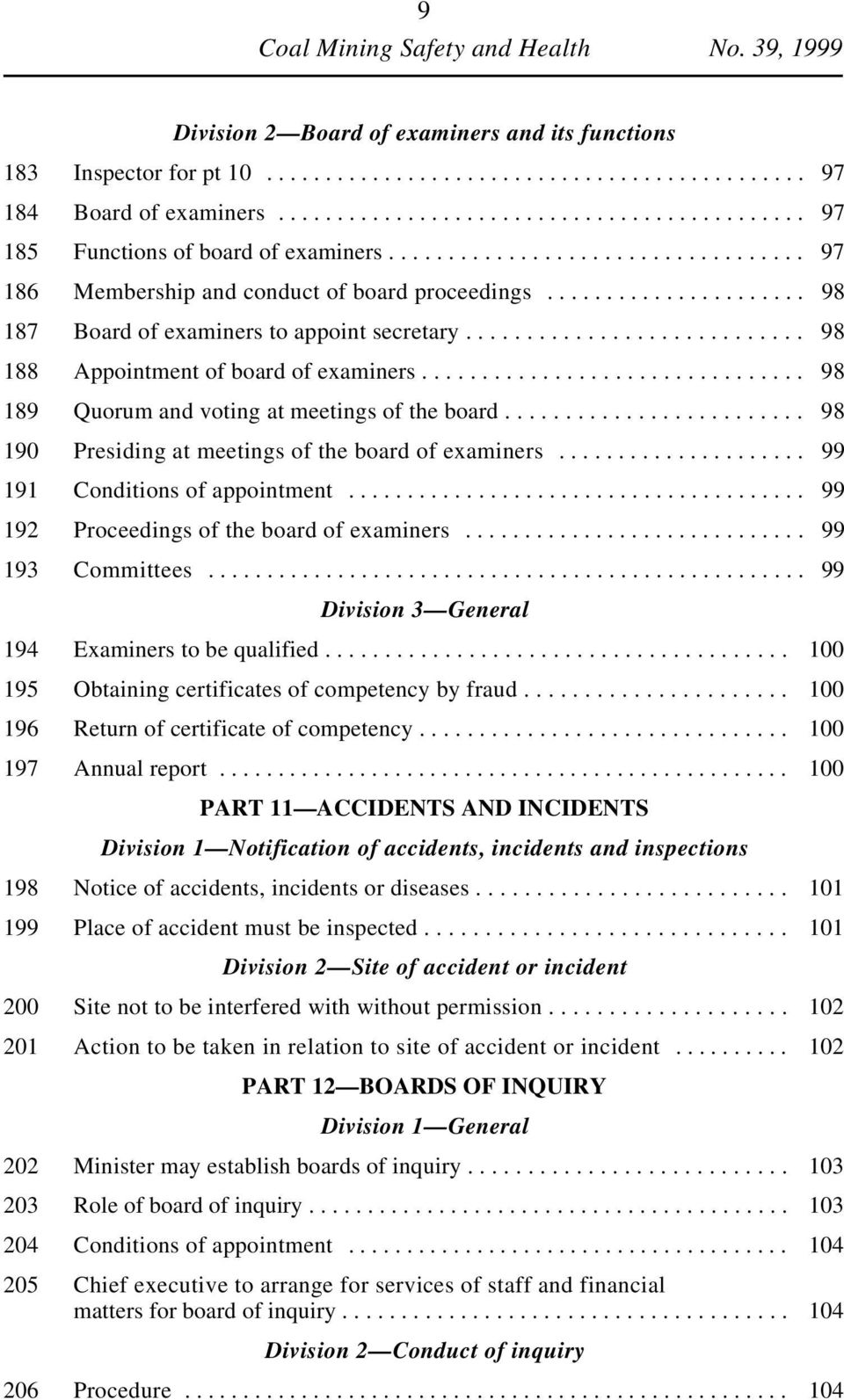
11 9 Division 2 Board of examiners and its functions 183 Inspector for pt Board of examiners Functions of board of examiners Membership and conduct of board proceedings Board of examiners to appoint secretary Appointment of board of examiners Quorum and voting at meetings of the board Presiding at meetings of the board of examiners Conditions of appointment Proceedings of the board of examiners Committees Division 3 General 194 Examiners to be qualified Obtaining certificates of competency by fraud Return of certificate of competency Annual report PART 11 ACCIDENTS AND INCIDENTS Division 1 Notification of accidents, incidents and inspections 198 Notice of accidents, incidents or diseases Place of accident must be inspected Division 2 Site of accident or incident 200 Site not to be interfered with without permission Action to be taken in relation to site of accident or incident PART 12 BOARDS OF INQUIRY Division 1 General 202 Minister may establish boards of inquiry Role of board of inquiry Conditions of appointment Chief executive to arrange for services of staff and financial matters for board of inquiry Division 2 Conduct of inquiry 206 Procedure
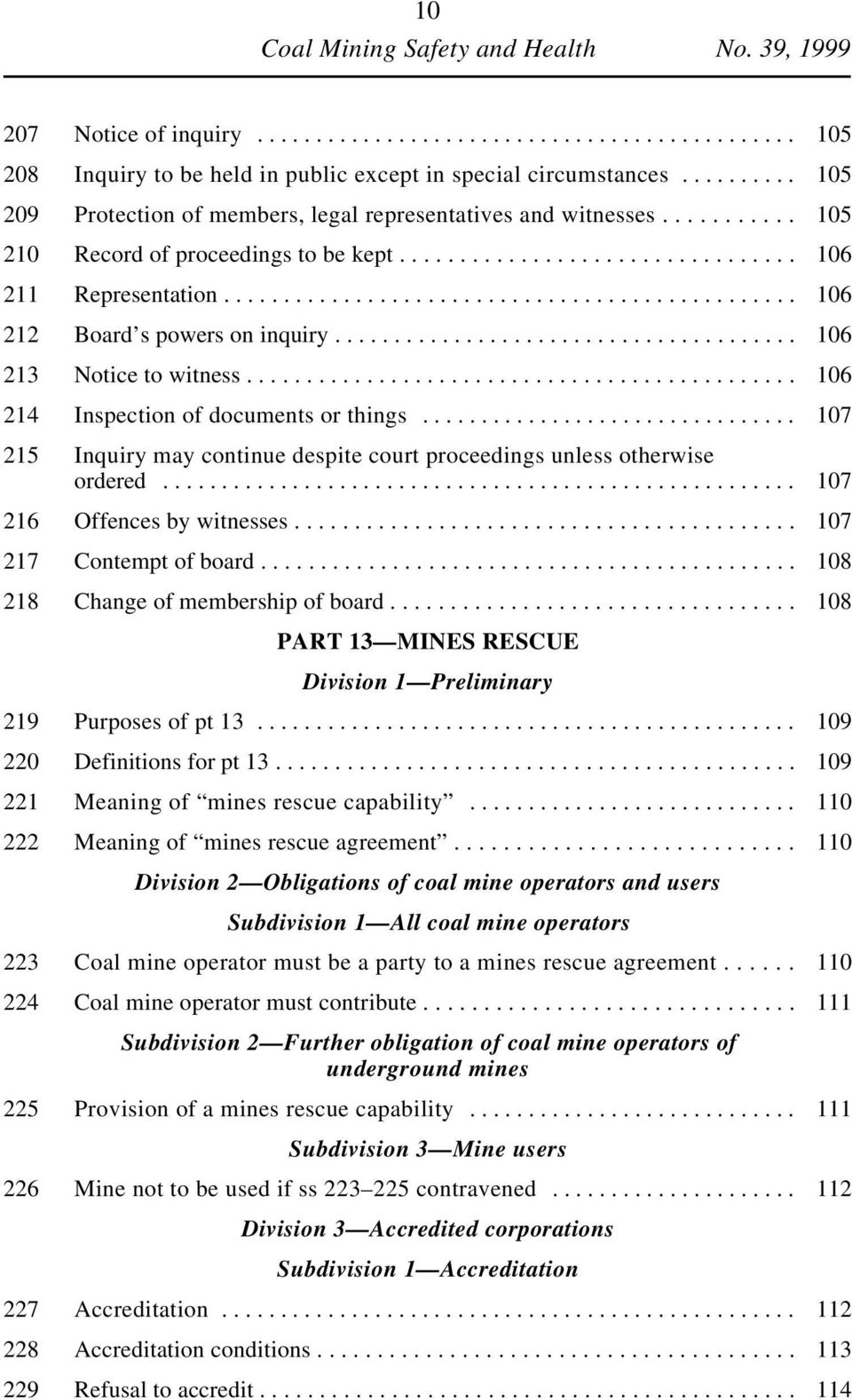
12 Notice of inquiry Inquiry to be held in public except in special circumstances Protection of members, legal representatives and witnesses Record of proceedings to be kept Representation Board s powers on inquiry Notice to witness Inspection of documents or things Inquiry may continue despite court proceedings unless otherwise ordered Offences by witnesses Contempt of board Change of membership of board PART 13 MINES RESCUE Division 1 Preliminary 219 Purposes of pt Definitions for pt Meaning of mines rescue capability Meaning of mines rescue agreement Division 2 Obligations of coal mine operators and users Subdivision 1 All coal mine operators 223 Coal mine operator must be a party to a mines rescue agreement Coal mine operator must contribute Subdivision 2 Further obligation of coal mine operators of underground mines 225 Provision of a mines rescue capability Subdivision 3 Mine users 226 Mine not to be used if ss contravened Division 3 Accredited corporations Subdivision 1 Accreditation 227 Accreditation Accreditation conditions Refusal to accredit
13 Amending, suspending or cancelling accreditations grounds Amending, suspending or cancelling accreditations procedure Subdivision 2 Functions and performance 232 Functions Performance criteria Reporting to Minister Subdivision 3 Miscellaneous 235 Accredited corporation must keep records PART 14 APPEALS Division 1 Appeals against particular decisions of Minister or board of examiners 236 Appeals against Minister s decisions Appeals against board of examiners decision How to start appeal Stay of operation of decisions Hearing procedures Powers of court on appeal Appeal to District Court on questions of law only Division 2 Appeals against chief inspector s directives and review decisions 243 Who may appeal How to start appeal Stay of operation of directive or review decision Hearing procedures Assessors Powers of court on appeal PART 15 LEGAL PROCEEDINGS Division 1 Evidence 249 Application of div Proof of appointments and authority unnecessary Proof of signatures unnecessary Evidentiary aids Expert reports

14 Analyst s certificate or report Division 2 Proceedings 255 Proceedings for offences Recommendation to prosecute Limitation on time for starting proceedings Court may order suspension or cancellation of certificate Forfeiture on conviction Dealing with forfeited things Responsibility for acts or omissions of representatives Executive officers must ensure corporation complies with Act Representation Costs of investigation Recovery of fees Division 3 Evidentiary provisions 266 Service of documents How document to be given to coal mine operator PART 16 OFFENCES 268 Person not to encourage refusal to answer questions Impersonating inspector or inspection officers and others Protection for officers PART 17 GENERAL Division 1 General safety matters 271 Contraband must not be taken into an underground mine Children under 16 not to be employed underground Withdrawal of persons in case of danger Where coal mine worker exposed to immediate personal danger Representation by coal mine worker Division 2 Miscellaneous 276 Protection from liability PART 18 ADMINISTRATION 277 Delegations Delegation of chief inspector s powers

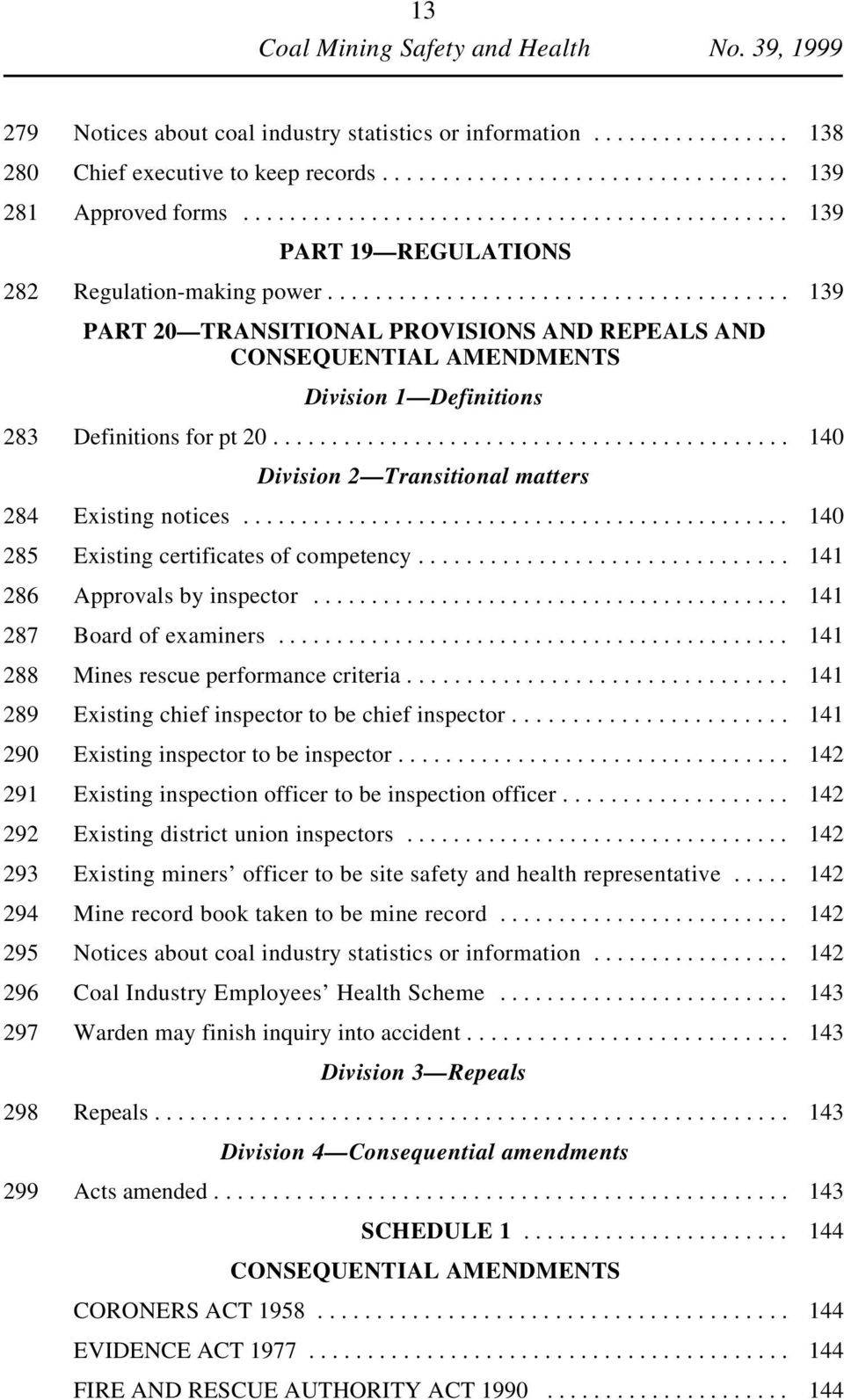
15 Notices about coal industry statistics or information Chief executive to keep records Approved forms PART 19 REGULATIONS 282 Regulation-making power PART 20 TRANSITIONAL PROVISIONS AND REPEALS AND CONSEQUENTIAL AMENDMENTS Division 1 Definitions 283 Definitions for pt Division 2 Transitional matters 284 Existing notices Existing certificates of competency Approvals by inspector Board of examiners Mines rescue performance criteria Existing chief inspector to be chief inspector Existing inspector to be inspector Existing inspection officer to be inspection officer Existing district union inspectors Existing miners officer to be site safety and health representative Mine record book taken to be mine record Notices about coal industry statistics or information Coal Industry Employees Health Scheme Warden may finish inquiry into accident Division 3 Repeals 298 Repeals Division 4 Consequential amendments 299 Acts amended SCHEDULE CONSEQUENTIAL AMENDMENTS CORONERS ACT EVIDENCE ACT FIRE AND RESCUE AUTHORITY ACT
16 14 FOREIGN OWNERSHIP OF LAND REGISTER ACT FORESTRY ACT FREEDOM OF INFORMATION ACT PROPERTY LAW ACT QUEENSLAND INTERNATIONAL TOURIST CENTRE AGREEMENT ACT REPEAL ACT WORKPLACE HEALTH AND SAFETY ACT SCHEDULE SUBJECT MATTER FOR REGULATIONS SCHEDULE DICTIONARY
17 Queensland Act 1999 Act No. 39 of 1999 An Act to regulate the operation of coal mines, to protect the safety and health of persons at coal mines and persons who may be affected by coal mining operations, and for other purposes [Assented to 2 September 1999]
18 s 1 16 s 5 The Parliament of Queensland enacts PART 1 PRELIMINARY Division 1 Introduction Short title 1. This Act may be cited as the Act Commencement 2. This Act commences on a day to be fixed by proclamation. Division 2 Operation of Act Act binds all persons 3.(1) This Act binds all persons, including the State and, so far as the legislative power of the Parliament permits, the Commonwealth and all the other States. (2) Nothing in this Act makes the State liable to be prosecuted for an offence. What does this Act apply to 4. This Act applies to coal mines and coal mining operations. Who does this Act apply to 5. This Act applies to everyone who may affect the safety or health of persons while the persons are at a coal mine; and
19 s 6 17 s 7 everyone who may affect the safety or health of persons as a result of coal mining operations; and a person whose safety or health may be affected while at a coal mine or as a result of coal mining operations. Division 3 Objects of Act Objects of Act 6. The objects of this Act are to protect the safety and health of persons at coal mines and persons who may be affected by coal mining operations; and to require that the risk of injury or illness to any person resulting from coal mining operations be at an acceptable level. How objects are to be achieved 7. The objects of this Act are to be achieved by (d) (e) (f) imposing safety and health obligations on persons who operate coal mines or who may affect the safety or health of others at coal mines; and providing for safety and health management systems at coal mines to manage risk effectively; and making regulations and recognised standards for the coal mining industry to require and promote risk management and control; and establishing a safety and health advisory council to allow the coal mining industry to participate in developing strategies for improving safety and health; and providing for safety and health representatives to represent the safety and health interests of coal mine workers; and providing for inspectors and other officers to monitor the effectiveness of risk management and control at coal mines, and to take appropriate action to ensure adequate risk management;

20 s 8 18 s 9 and (g) providing a way for the competencies of persons at coal mines to be assessed and recognised; and (h) requiring management structures so that persons may competently supervise the safe operation of coal mines; and (i) (j) (k) providing for an appropriate coal mines rescue capability; and providing for a satisfactory level of preparedness for emergencies at coal mines; and providing for the health assessment of coal mine workers. Division 4 Interpretation Dictionary 8. The dictionary in schedule 3 defines particular words used in this Act. Meaning of coal mine 9.(1) A coal mine is any of the following places (d) (e) a place where on-site activities are carried on within the boundaries of land the subject of a mining tenure; a place where on-site activities are carried on on land adjoining, adjacent to, or contiguous with, the boundaries of land the subject of a mining tenure and within which is a place mentioned in paragraph ; a place where on-site activities are carried on unlawfully because land at the place is not the subject of a mining tenure; a place that was a coal mine while works are done to secure it after its abandonment; a place where tourism, education or research related to coal mining happens that is declared under a regulation to be a coal mine.

21 s s 10 (2) A coal mine includes buildings for administration, accommodation and associated facilities within the boundaries of land the subject of the mining tenure for the mine or on land adjoining, adjacent to, or contiguous with the boundaries of the land the subject of the mining tenure. (3) Despite subsection (1)(d), a place that was a coal mine is not a coal mine after its abandonment merely because work is being done at the place by or for the State to ensure public safety; or to rehabilitate it; or to secure it. Meaning of on-site activities 10.(1) On-site activities are activities carried on principally for, or in connection with, exploring for or winning coal and include the following constructing (i) (ii) things required or permitted to be constructed under an exploration permit, mineral development licence or mining lease; or for a place mentioned in section 9(1) things that are required or permitted to be constructed under an exploration permit, mineral development licence or mining lease; (d) treating coal and disposing of waste substances; rehabilitating of a place after coal mining operations; maintaining and testing plant, equipment or machinery. (2) On-site activities do not include the following airborne geophysical surveys; transporting product from a coal mine on public roads or public railways or on any other railway; air transport to and from a coal mine;
22 s s 16 (d) (e) pastoral activities; an activity declared not to be an on-site activity under a regulation. Meaning of safety and health 11. A person s safety and health is the person s safety or health, to the extent it is or may be affected by coal mining operations or other activities at a coal mine. Meaning of competence 12. Competence for a task at a coal mine is the demonstrated skill and knowledge required to carry out the task to a standard necessary for the safety and health of persons. Meaning of consultation 13. Consultation with coal mine workers is discussion between the site senior executive or supervisors and affected coal mine workers about a matter with the aim of reaching agreement about the matter. Meaning of standard operating procedure 14. A standard operating procedure at a coal mine is a way of working, or an arrangement of facilities, at the coal mine to achieve an acceptable level of risk, developed after consultation with coal mine workers. Meaning of accident 15. An accident at a coal mine is an event, or a series of events, at the coal mine causing injury to a person. Meaning of serious accident 16. A serious accident at a coal mine is an accident at a coal mine that causes
23 s s 21 the death of a person; or a person to be admitted to a hospital as an in-patient for treatment for the injury. Meaning of high potential incident 17. A high potential incident at a coal mine is an event, or a series of events, that causes or has the potential to cause a significant adverse effect on the safety or health of a person. Meaning of risk 18.(1) Risk means the risk of injury or illness to a person arising out of a hazard. (2) Risk is measured in terms of consequences and likelihood. Meaning of hazard 19. A hazard is a thing or a situation with potential to cause injury or illness to a person. Meaning of principal hazard 20. A principal hazard at a coal mine is a hazard at the coal mine with the potential to cause multiple fatalities. Meaning of coal mine operator 21.(1) A coal mine operator for a coal mine is the holder; or if another person has been appointed as the coal mine operator under section 53 and the appointment is notified to the chief inspector under section 49,1 the other person. (2) If 1 Section 49 (Notices by holder)
24 s s 21 another person mentioned in subsection (1) is appointed as the coal mine operator for a separate part of a surface mine; and the appointment is notified to the chief inspector under section 49; the person s responsibilities and safety and health obligations under this Act as a coal mine operator for a coal mine are limited to the separate part of the surface mine. (3) If 1 or more persons are appointed as coal mine operators for separate parts of a surface mine; and the appointments are notified to the chief inspector under section 49; the holder s responsibilities and safety and health obligations under this Act as a coal mine operator for the coal mine are limited to the part of the mine to which the appointments do not apply. (4) For this section, a part of a surface mine is taken to be a separate part of a surface mine only if the part is geographically separated2 from the rest of the mine; and there is no physical overlapping3 of coal mining operations between the part and the operations in another part of the mine; and the coal mine operator for the part is in control4 of (i) the coal mining operations carried out in the part of the mine; and (ii) the resources associated with the operations. (5) A person may be appointed coal mine operator for more than 1 mine or separate part of a surface mine. 2 See section 22 (Meaning of geographically separated ). 3 See section 23 (Meaning of physical overlapping of coal mining operations ). 4 See section 24 (When is a coal mine operator not in control).
25 s s 23 Meaning of geographically separated 22.(1) For section 21(4), a part of a surface mine is geographically separated from the rest of the mine if there is a clear boundary between the part of the surface mine and the rest of the mine. (2) Examples of a part of a surface mine that is geographically separated from the rest of the mine include the following a treatment plant that has all of its own facilities; a surface mine excavation that has it own facilities, including haul roads not shared with persons involved in operations in another part of the mine; a place where exploration activities are carried out if persons carrying out the activities do not share facilities with persons involved in coal mining operations in another part of the mine. Meaning of physical overlapping of coal mining operations 23.(1) For section 21(4), physical overlapping of coal mining operations for a surface mine includes the common use with persons involved in coal mining operations in another part of the mine of haul roads; and stockpiles, if vehicles associated with coal mining operations in another part of the mine travel onto the stockpiles; and mine workshops, stores and stores systems, hard stands and amenities. (2) However, the following are not physical overlapping of coal mining operations for a surface mine vehicles from 1 part of the mine dumping into a receival hopper in another part of the mine if the vehicles do not travel into the other part of the mine; a conveyor system in 1 part of the mine discharging into a bin or onto a stockpile controlled by persons in another part of the mine; a workshop in 1 part of the mine servicing vehicles from another part of the mine;
26 s s 26 (d) a laboratory in 1 part of the mine providing a service to another part of the mine. When is a coal mine operator not in control 24. For section 21(4), a coal mine operator is not in control of coal mining operations and associated resources for part of a surface mine if a person involved with coal mining operations in the part of the mine can transfer resources to another part of the mine; or a person involved with coal mining operations in the part of the mine has the general management of another part of the mine; or a person involved in coal mining in the part of the mine can control the supply of services, including supervision and safety inspections, to another part of the mine. Meaning of site senior executive 25.(1) The site senior executive for a coal mine is the most senior officer employed by the coal mine operator for the coal mine who is located at or near the coal mine; and has responsibility for the coal mine. (2) Subsection (1) does not require an officer with responsibility for exploration activities under an exploration permit or mineral development licence to be located at or near the coal mine. (3) If the officer only has responsibility for a separate part of a surface mine, the officer s responsibilities and safety and health obligations under this Act as a site senior executive for a coal mine are limited to the separate part of the surface mine for which the officer has responsibility. Meaning of supervisor 26. A supervisor at a coal mine is a coal mine worker whose duties include the giving of directions to other coal mine workers.
27 s s 29 Meaning of industry safety and health representative 27. An industry safety and health representative is a person who is appointed under section 109(1)5 to represent coal mine workers on safety and health matters and who performs the functions and exercises the powers of an industry safety and health representative mentioned in part 8, division 2. Meaning of site safety and health representative 28. A site safety and health representative for a coal mine is a coal mine worker elected under section 93 by coal mine workers at the coal mine to exercise the powers and perform the functions of a site safety and health representative mentioned in part 7 division 2. PART 2 THE CONTROL AND MANAGEMENT OF RISK AND OTHER BASIC CONCEPTS Division 1 Control and management of risk What is an acceptable level of risk 29.(1) For risk to a person from coal mining operations to be at an acceptable level, the operations must be carried out so that the level of risk from the operations is within acceptable limits; and as low as reasonably achievable. (2) To decide whether risk is within acceptable limits and as low as reasonably achievable regard must be had to the likelihood of injury or illness to a person arising out of the 5 Section 109 (Appointment of industry safety and health representatives)
28 s s 31 risk; and the severity of the injury or illness. How is an acceptable level of risk achieved 30.(1) To achieve an acceptable level of risk, this Act requires that management and operating systems must be put in place for each coal mine. (2) This Act provides that the systems must incorporate risk management elements and practices appropriate for each coal mine to (d) (e) (f) identify, analyse, and assess risk; and avoid or remove unacceptable risk; and monitor levels of risk and the adverse consequences of retained residual risk; and investigate and analyse the causes of serious accidents and high potential incidents with a view to preventing their recurrence; and review the effectiveness of risk control measures, and take appropriate corrective and preventive action; and mitigate the potential adverse effects arising from residual risk. (3) Also, the way an acceptable level of risk of injury or illness may be achieved may be prescribed under a regulation. What happens if the level of risk is unacceptable 31.(1) If there is an unacceptable level of risk to persons at a coal mine, this Act requires that persons be evacuated to a safe location; and action be taken to reduce the risk to an acceptable level. (2) Action to reduce the risk to an acceptable level may include stopping the use of specified plant or substances. (3) The action may be taken by the coal mine operator for the mine, the site senior executive for the mine, industry safety and health representatives,
29 s s 33 site safety and health representatives, coal mine workers, inspectors or inspection officers. Division 2 Cooperation Cooperation to achieve objects of Act 32.(1) This Act seeks to achieve cooperation between coal operators, site senior executives and coal workers to achieve the objects of the Act. (2) Cooperation is an important strategy in achieving the objects of the Act and is achieved at an industry level by (i) (ii) the establishment of the coal mining safety and health advisory council under part 6; and the appointment of industry safety and health representatives under part 8; and at coal mine level by (i) (ii) the election of site safety and health representatives under part 7; and the process of involving coal mine workers in the management of risk. PART 3 SAFETY AND HEALTH OBLIGATIONS Division 1 Preliminary Obligations for safety and health 33.(1) Coal mine workers or other persons at coal mines or persons who may affect safety and health at coal mines or as a result of coal mining operations, have obligations under division 2 ( safety and health obligations ).
30 s s 35 (2) The following persons have obligations under division 3 (also safety and health obligations ) (d) (e) (f) (g) (h) a holder; a coal mine operator; a site senior executive; a contractor; a designer, manufacturer, importer or supplier of plant for use at a coal mine; an erector or installer of plant at a coal mine; a manufacturer, importer or supplier of substances for use at a coal mine; a person who supplies a service at a coal mine. Discharge of obligations 34. A person on whom a safety and health obligation is imposed must discharge the obligation. Maximum penalty (d) if the contravention caused death or grievous bodily harm 800 penalty units or 2 years imprisonment; or if the contravention involved exposure to a substance that is likely to cause death or grievous bodily harm 500 penalty units or 1 year s imprisonment; or if the contravention caused bodily harm 500 penalty units or 1 year s imprisonment; or otherwise 400 penalty units. Person may owe obligations in more than 1 capacity 35. A person on whom a safety and health obligation is imposed may be subject to more than 1 safety and health obligation.
31 s s 38 Example A person may be a coal mine operator, contractor and supplier of plant at the same time for a single coal mine and be subject to obligations in each of the capacities. Person not relieved of obligations 36. To remove doubt, nothing in this Act that imposes a safety and health obligation on a person relieves another person of the person s safety and health obligations under this Act. How obligation can be discharged if regulation or recognised standard made 37.(1) If a regulation prescribes a way of achieving an acceptable level of risk, a person may discharge the person s safety and health obligation in relation to the risk only by following the prescribed way. (2) If a regulation prohibits exposure to a risk, a person may discharge the person s safety and health obligation in relation to the risk only by ensuring the prohibition is not contravened. (3) Subject to subsections (1) and (2), if a recognised standard states a way or ways of achieving an acceptable level of risk, a person discharges the person s safety and health obligation in relation to the risk only by adopting and following a stated way; or adopting and following another way that achieves a level of risk that is equal to or better than the acceptable level.6 How obligations can be discharged if no regulation or recognised standard made 38.(1) This section applies if there is no regulation or recognised standard prescribing or stating a way to discharge the person s safety and health obligation in relation to a risk. 6 For this section and the following section, see defences provided for under division 4.
32 s s 39 (2) The person may choose an appropriate way to discharge the person s safety and health obligation in relation to the risk. (3) However, the person discharges the person s safety and health obligation in relation to the risk only if the person takes reasonable precautions, and exercises proper diligence, to ensure the obligation is discharged. Division 2 Generally applicable safety and health obligations of persons Obligations of persons generally 39.(1) A coal mine worker or other person at a coal mine or a person who may affect the safety and health of others at a coal mine or as a result of coal mining operations has the following obligations to comply with this Act and procedures applying to the worker or person that are part of a safety and health management system for the mine; if the coal mine worker or other person has information that other persons need to know to fulfil their obligations or duties under this Act, or to protect themselves from the risk of injury or illness, to give the information to the other persons; to take any other reasonable and necessary course of action to ensure anyone is not exposed to an unacceptable level of risk. (2) A coal mine worker or other person at a coal mine has the following additional obligations to work or carry out the worker s or person s activities in a way that does not expose the worker or person or someone else to an unacceptable level of risk; to ensure, to the extent of the responsibilities and duties allocated to the worker or person, that the work and activities under the worker s or person s control, supervision, or leadership is conducted in a way that does not expose the worker or person or someone else to an unacceptable level of risk; to the extent of the worker s or person s involvement, to
33 s s 40 participate in and conform to the risk management practices of the mine; (d) (e) (f) to comply with instructions given for safety and health of persons by the coal mine operator or site senior executive for the mine or a supervisor at the mine; to work at the coal mine only if the worker or person is in a fit condition to carry out the work without affecting the safety and health of others; not to do anything wilfully or recklessly that might adversely affect the safety and health of someone else at the mine. Division 3 Obligations of holders, coal mine operators, site senior executives and others Obligations of holders 40.(1) This section applies if the holder and the coal mine operator for a coal mine are or are to be different persons. (2) The holder must inform a person proposing to enter into a contract with the holder to act as coal mine operator, by notice, of all relevant information available to the holder that may help the proposed coal mine operator (i) to ensure the site senior executive for the coal mine develops and implements a safety and health management system for the mine; and (ii) to prepare and implement principal hazard management plans for the mine; and include in the contract appointing the coal mine operator an obligation on the operator (i) (ii) to establish a safety and health management system for the mine; and other than for exploration activities under an exploration permit or mineral development licence to be a party to a
34 s s 42 mines rescue agreement. Maximum penalty for subsection (2) 100 penalty units. Obligations of coal mine operators 41.(1) A coal mine operator for a coal mine has the following obligations (d) to ensure the risk to coal mine workers while at the operator s mine is at an acceptable level, including, for example, by providing and maintaining a place of work and plant in a safe state; to ensure the operator s own safety and health and the safety and health of others is not affected by the way the operator conducts coal mining operations; to appoint a site senior executive for the mine; to ensure the site senior executive for the mine (i) (ii) develops and implements a safety and health management system for the mine; and develops, implements and maintains a management structure for the mine that helps ensure the safety and health of persons at the mine; (e) (f) to audit and review the effectiveness and implementation of the safety and health management system to ensure the risk to persons from coal mining operations is at an acceptable level; to provide adequate resources to ensure the effectiveness and implementation of the safety and health management system. (2) Without limiting subsection (1), the coal mine operator has an obligation not to operate the coal mine without a safety and health management system for the mine. Obligations of site senior executive for coal mine 42. A site senior executive for a coal mine has the following obligations in relation to the safety and health of persons who may be affected by coal
35 s s 43 mining operations (d) (e) (f) to ensure the risk to persons from coal mining operations is at an acceptable level; to ensure the risk to persons from any plant or substance provided by the site senior executive for the performance of work by someone other than the site senior executive s coal mine workers is at an acceptable level; to develop and implement a safety and health management system for the mine; to develop, implement and maintain a management structure for the mine that helps ensure the safety and health of persons at the mine; to train coal mine workers so that they are competent to perform their duties; to provide for (i) (ii) adequate planning, organisation, leadership and control of coal mining operations; and the carrying out of critical work at the mine that requires particular technical competencies; and (iii) adequate supervision and control of coal mining operations on each shift at the mine; and (iv) regular monitoring and assessment of the working environment, work procedures, equipment, and installations at the mine; and (v) appropriate inspection of each workplace at the mine including, where necessary, pre-shift inspections. Obligations of contractors 43. A contractor at a coal mine has an obligation to ensure, to the extent that they relate to the work undertaken by the contractor, that provisions of this Act and any applicable safety and health management system are complied with.
36 s s 44 Obligations of designers, manufacturers, importers and suppliers of plant etc. for use at coal mines 44.(1) A designer or importer of plant for use at a coal mine has an obligation to ensure the plant is designed so that, when used properly, the risk to persons from the use of the plant is at an acceptable level. (2) A manufacturer or importer of plant for use at a coal mine has an obligation to ensure the plant is constructed so that, when used properly, the risk to persons from the use of the plant is at an acceptable level. (3) A designer, manufacturer or importer of plant for use at a coal mine has an obligation to ensure the plant undergoes appropriate levels of testing and examination to ensure compliance with the obligation imposed by subsection (1) or (2). (4) Also, a designer, manufacturer, importer or supplier of plant for use at a coal mine has the following obligations to take all reasonable steps to ensure appropriate information about the safe use of the plant is available, including information about the maintenance necessary for the safe use of the plant; to take the action the chief inspector reasonably requires to prevent the use of unsafe plant anywhere. Example of subsection (4) The chief inspector may require a designer, manufacturer, importer or supplier of plant to recall the plant to prevent its use. (5) For subsection (4), information is appropriate if the information states the use for which the plant has been designed and tested; and any conditions that must be followed if the plant is to be used safely so that risk to persons is at an acceptable level. (6) If a supplier of plant becomes aware of a hazard or defect associated with the plant the supplier has supplied to a coal mine operator for a coal mine or to a contractor for use at a coal mine, that may create an unacceptable level of risk to users of the plant, the supplier has an obligation to take all reasonable steps to inform the coal mine operator or contractor of the nature of the hazard or defect and its significance; and
37 s s 46 any modifications or controls the supplier is aware of that have been developed to eliminate or correct the hazard or defect or manage the risk. Obligations of erectors and installers of plant 45. An erector or installer of plant at a coal mine has an obligation to erect or install the plant in a way that is safe and does not expose persons at the mine to an unacceptable level of risk; and to ensure nothing about the way the plant was erected or installed makes it unsafe or likely to expose persons at the mine to an unacceptable level of risk when used properly. Obligations of manufacturers, importers and suppliers of substances for use at coal mines 46.(1) A manufacturer or importer of a substance for use at a coal mine has the following obligations to ensure the substance is safe so that, when used properly, the risk to persons from the use of the substance is at an acceptable level; to ensure the substance undergoes appropriate levels of testing and examination to ensure compliance with the obligation imposed by paragraph. (2) Also, a manufacturer, importer or supplier of a substance for use at a coal mine has the following obligations to ensure appropriate information about the safe use, storage and disposal of the substance is provided with the substance; to take the action the chief inspector reasonably requires to prevent the use of an unsafe substance at a coal mine. Example of subsection (2) The chief inspector may require a manufacturer, importer or supplier of a substance to recall the substance to prevent its use. (3) For subsection (2), information is appropriate if the information clearly identifies the substance and states
38 s s 48 the precautions, if any, to be taken for the safe use, storage or disposal of the substance; and the risks, if any, associated with the use, storage or disposal of the substance. Obligation of provider of services at coal mines 47. A person who provides a service at a coal mine has the following obligations to ensure the safety and health of coal mine workers or other persons is not adversely affected as a result of the service provided; to ensure the fitness for use of plant at the coal mine is not adversely affected by the service provided. Division 4 Defences Defences for div 2 or 3 48.(1) It is a defence in a proceeding against a person for a contravention of an obligation imposed on the person under division 2 or 3 in relation to a risk for the person to prove if a regulation has been made about the way to achieve an acceptable level of risk the person followed the way prescribed in the regulation to prevent the contravention; or subject to paragraph, if a recognised standard has been made stating a way or ways to achieve an acceptable level of a risk (i) (ii) that the person adopted and followed a stated way to prevent the contravention; or that the person adopted and followed another way that achieved a level of risk that is equal to or better than the acceptable level to prevent the contravention; or if no regulation or recognised standard prescribes or states a way to discharge the person s safety and health obligation in relation to
39 s s 49 the risk that the person took reasonable precautions and exercised proper diligence to prevent the contravention. (2) Also, it is a defence in a proceeding against a person for an offence against section 34 for the person to prove that the commission of the offence was due to causes over which the person had no control. (3) The Criminal Code, sections 23 and 24,7 do not apply in relation to a contravention of section 34.8 (4) In this section, a reference to a recognised standard is a reference to the recognised standard in force at the time of the contravention. PART 4 PROVISIONS ABOUT THE OPERATION OF COAL MINES Division 1 Notices about coal mines Notices by holder 49.(1) Before coal mining operations start at a coal mine or a separate part of a surface mine, the holder for the mine must give the chief inspector notice of the name and address of the coal mine operator for the mine or part;9 and the name of, and a description of the land comprising, the mine or part; and the date on which operations are to start at the mine or part. Maximum penalty 40 penalty units. 7 Criminal Code, sections 23 (Intention motive) and 24 (Mistake of fact) 8 Section 34 (Discharge of obligations) 9 The coal mine operator may be the holder or a person appointed as coal mine operator under section 53 (Appointment of coal mine operator).
40 s s 51 (2) Subsection (1) and do not apply to exploration activities under an exploration permit or mineral development licence. (3) The holder must not change the following for a coal mine without first giving the chief inspector notice the coal mine operator; the name of the mine. Maximum penalty for subsection (3) 40 penalty units. Notices by coal mine operator 50.(1) Before coal mining operations start at a coal mine, the coal mine operator must give the inspector for the region in which the coal mine is situated notice of the name and address of the site senior executive for the mine. Maximum penalty 40 penalty units. (2) Also, the coal mine operator must, within 7 days after the appointment, give the inspector for the region notice of the following appointments including the name and address of the person appointed the appointment of a new site senior executive; an appointment under section Maximum penalty 40 penalty units. (3) When land is added to or omitted from a coal mine, the coal mine operator must, within 1 month after the addition or omission, give to the chief inspector written particulars of the land added or omitted. Maximum penalty 40 penalty units. Notice of management structure 51. Before coal mining operations start at a coal mine, the site senior executive must give a copy of the management structure the site senior 10 Section 57 (Appointment of another site senior executive during temporary absence)
41 s s 54 executive must document under section 5511 to the inspector for the region in which the mine is situated. Maximum penalty 40 penalty units. Notice about exploration activities 52. If exploration activities are to be carried out on land under an exploration permit or mineral development licence, the coal mine operator must give the inspector for the region in which the land subject to the exploration permit or mineral development licence is situated notice of the nature of the intended activity and the planned start date and duration of the activity. Maximum penalty 40 penalty units. Division 2 Management of coal mines Appointment of coal mine operator 53.(1) The holder for a coal mine may, by written contract, appoint a person as the coal mine operator for the mine or, if mine is or includes a separate part of a surface mine, the separate part. (2) An appointment of a person as coal mine operator for a part of a coal mine that is not a separate part of a surface mine is ineffective. Appointment of site senior executive 54.(1) A coal mine operator for a coal mine or for a separate part of a surface mine must not appoint more than 1 site senior executive for the mine or for the part for which the person is coal mine operator. Maximum penalty 500 penalty units. (2) A coal mine operator must not appoint a person to be site senior executive for more than 1 coal mine. Maximum penalty 500 penalty units. 11 Section 55 (Management structure for safe operations at coal mines)
42 s s 56 (3) However, a person may be appointed to be site senior executive for more than 1 coal mine if the mines are part of a mining project; or the mines consist only of exploration activities under an exploration permit or mineral development licence. (4) In this section appoint includes employ and purport to appoint. Management structure for safe operations at coal mines 55.(1) The site senior executive for a coal mine must develop and maintain a management structure for the coal mine in a way that allows development and implementation of the safety and health management system; and document the management structure. Maximum penalty 40 penalty units. (2) The document must state the responsibilities of the site senior executive; and the responsibilities and competencies required for senior positions in the structure; and the names of the persons holding the senior positions and their competencies. Maximum penalty 40 penalty units. (3) For subsection (2), an inspector may by notice given to the site senior executive declare a position to be a senior position. Competencies of supervisors 56. A site senior executive must not assign the tasks of a supervisor to a person unless the person is competent to perform the task assigned; and if there is a safety and health competency for supervisors
43 s s 59 recognised by the council, has the relevant competency. Maximum penalty 100 penalty units. Appointment of another site senior executive during temporary absence 57.(1) If the site senior executive for a coal mine is temporarily absent from duty for more than 14 days, the coal mine operator for the mine must appoint, in writing, a person to act as the site senior executive during the absence. Maximum penalty 100 penalty units. (2) The person acting as the site senior executive is subject to all of the obligations of a site senior executive. Other appointments during absences 58.(1) This section applies if a person is mentioned in the management structure for a coal mine documented under section 55; and actively supervises coal mine workers where there is a risk to the workers; and is temporarily absent from duty. (2) The site senior executive for the coal mine must appoint another competent person to perform the person s duties while the person is absent. Maximum penalty for subsection (2) 40 penalty units. Additional requirements for management of surface mines 59. A site senior executive must appoint a person holding an open cut examiner s certificate of competency to carry out the responsibilities and duties prescribed under a regulation in 1 or more surface mine excavations. Maximum penalty 200 penalty units.
44 s s 60 Additional requirements for management of underground mines 60.(1) This section applies to an underground mine. (2) The site senior executive must appoint a person to be underground mine manager to control and manage the mine. Maximum penalty 400 penalty units. (3) However, the site senior executive may be appointed underground mine manager by the coal mine operator for the mine. (4) The site senior executive must appoint an alternate underground mine manager if the mine is to be managed in accordance with a commute system. Maximum penalty 400 penalty units. (5) The coal mine operator or site senior executive must not appoint a person as an underground mine manager unless the person has a first class certificate of competency for an underground coal mine. Maximum penalty 400 penalty units. (6) A person must not give a direction to the underground mine manager about a technical matter in relation to the underground mine unless the person giving the direction is the holder of a first class certificate of competency for an underground coal mine. Maximum penalty 200 penalty units. (7) A person must not give a direction to the underground mine manager that may adversely affect safety and health at the underground mine. Maximum penalty 200 penalty units. (8) The underground mine manager must appoint a person holding a first or second class certificate of competency or a deputy s certificate of competency to be responsible for the control and management of underground activities when the manager is not in attendance at the mine. Maximum penalty 200 penalty units. (9) The underground mine manager must appoint a person holding a first or second class certificate of competency or a deputy s certificate of competency to have control of activities in 1 or more explosion risk zones. Maximum penalty 200 penalty units.
45 s s 61 (10) The underground mine manager must appoint a person or persons with appropriate competencies to control and manage the mechanical and electrical engineering activities of the mine. Maximum penalty 200 penalty units. (11) A coal mine operator or site senior executive may appoint a person as underground mine manager for more than 1 mine at the same time only with the written approval of the chief inspector. Maximum penalty 200 penalty units. Appointment of ventilation officer 61.(1) This section applies to an underground mine. (2) The site senior executive must appoint an appropriate person as ventilation officer for the mine. Maximum penalty 200 penalty units. (3) The underground mine manager may be appointed ventilation officer. (4) A person is an appropriate person to be appointed as ventilation officer for the mine only if the person satisfies the following conditions the person has competencies recognised by the council as appropriate for the duties and responsibilities of the position; on appointment, the person is directly responsible for the implementation of the mine ventilation system and for the establishment of effective standards of ventilation for the mine. (5) If the ventilation officer is not the underground mine manager, despite subsection (4), the ventilation officer is subject to the direction and control of the underground mine manager for the implementation of the mine ventilation system and for the establishment of effective standards of ventilation for the mine. (6) If no other competent person has been appointed during a temporary absence of the ventilation officer, the duties and responsibilities of the ventilation officer are taken to be assumed by the underground mine manager. (7) An inspector may, by notice, require an underground mine manager appointed as a ventilation officer to demonstrate to the inspector s
46 s s 62 satisfaction that the mine manager can effectively carry out the duties of both the underground mine manager and the ventilation officer. (8) If an underground mine manager appointed as a ventilation officer is unable to demonstrate to the inspector s satisfaction that the mine manager can effectively carry out the duties of both positions, the inspector may give a directive the inspector considers appropriate. (9) The site senior executive must not appoint a person as ventilation officer at more than 1 mine at the same time unless the chief inspector gives the site senior executive notice that the chief inspector is satisfied the person can effectively carry out the duties of a ventilation officer at the mines. Maximum penalty for subsection (9) 200 penalty units. Division 3 Safety and health management systems Safety and health management system 62.(1) A safety and health management system for a coal mine is a system that incorporates risk management elements and practices that ensure safety and health of persons who may be affected by coal mining operations. (2) A safety and health management system must be an auditable documented system that forms part of an overall management system that includes organisational structure, planning activities, responsibilities, practices, procedures, processes and resources for developing, implementing, achieving, reviewing and maintaining a safety and health policy. (3) The safety and health management system must be adequate and effective to achieve an acceptable level of risk by defining the coal mine operator s safety and health policy; and containing a plan to implement the coal mine operator s safety and health policy; and stating how the coal mine operator intends to develop the capabilities and support mechanisms necessary to achieve the policy; and
47 s s 63 (d) (e) including principal hazard management plans and standard operating procedures; and containing a way of (i) (ii) measuring, monitoring and evaluating the performance of the safety and health management system; and taking the action necessary to prevent or correct matters that do not conform with the safety and health management system; and (f) (g) containing a plan to regularly review and continually improve the safety and health management system so that risk to persons at the coal mine is at an acceptable level; and if there is a significant change to the coal mining operations of the coal mine containing a plan to immediately review the safety and health management system so that risk to persons is at an acceptable level. (4) The site senior executive must make available for inspection, by coal mine workers employed at the coal mine, a copy of the safety and health management system. Maximum penalty 100 penalty units. (5) The site senior executive must give a copy of a principal hazard management plan to a coal mine worker whose work at the coal mine is affected by the requirements of the plan and who requests a copy of the hazard management plan. Maximum penalty 100 penalty units. Principal hazard management plan 63.(1) A principal hazard management plan must identify, analyse and assess risk associated with principal hazards; and include standard operating procedures and other measures to control risk. (2) The site senior executive must give a copy of the principal hazard management plan to a person that employs persons at the coal mine whose
48 s s 66 work is affected by the plan s requirements. Maximum penalty for subsection (2) 200 penalty units. Review of principal hazard management plans and standard operating procedures 64.(1) This section applies if a safety and health management system has been developed for a new coal mine; or it is proposed to change a safety and health management system at an existing coal mine. (2) The site senior executive must review the principal hazard management plans and standard operating procedures in consultation with coal mine workers affected by the plans and operating procedures. Maximum penalty 200 penalty units. (3) The review under subsection (2) must take place for a new coal mine as soon as practicable after the start of coal mining operations; or for a change at an existing coal mine before the change happens. Division 4 Records and reporting Changes in management structure to be reported to an inspector 65. The site senior executive for a coal mine must give notice of any change in the management structure at the mine to the inspector for the region in which the mine is situated within 14 days after the change happens. Maximum penalty 50 penalty units. Management structure to be recorded in the mine record 66.(1) The site senior executive for a coal mine must enter in the mine record details of
49 s s 67 the management structure and of the persons holding positions in the structure at the mine; and changes to the management structure. Maximum penalty 50 penalty units. (2) The details must be entered within 7 days after the establishment of, or changes to, the management structure. Plans of coal mine workings 67.(1) A site senior executive for a coal mine must keep at the mine plans showing, as far as practicable (i) (ii) the extent of the mine workings and the current position of any part of the mine workings; and for an underground mine, the significant topographical features on the surface above the mine; and plans showing the extent of mining undertaken at or near the mine; and information likely to be required to evaluate the effect of the mine on (i) (ii) the safety of adjoining coal mines; and any potential uncontrolled flow of material into the mine workings; and (d) information likely to be required to evaluate the effect of any adjoining mine on the safety of the mine. Maximum penalty 100 penalty units. (2) A site senior executive for a coal mine must produce to the chief inspector, before 31 December each year, plans showing the extent of the mine workings. Maximum penalty 100 penalty units. (3) Also, a site senior executive for a coal mine, if asked by an inspector, inspection officer or industry safety and health representative, must produce to the inspector, officer or representative plans showing the extent of the
50 s s 68 mine workings or the current position of any part of the mine workings and the information mentioned in subsection (1) and (d). Maximum penalty 100 penalty units. (4) If a coal mine is abandoned, the person who was the coal mine operator for the mine immediately before the abandonment must, within 14 days after the abandonment, give the chief inspector plans showing the extent of mining undertaken at the mine.12 Maximum penalty 200 penalty units. (5) A site senior executive of a mine must, as soon as reasonably practicable, provide information mentioned in subsection (1) or (d) to the site senior executive of an adjoining mine if asked by the site senior executive of the adjoining mine; or if the information is relevant to the safety of the adjoining mine. Maximum penalty 100 penalty units. (6) The accuracy of the plans mentioned in this section must be certified by a person competent in mining surveying. (7) A reference in this section to plans is a reference to plans as certified under subsection (6). Mine record 68.(1) A coal mine operator for a coal mine must keep a mine record that includes (d) all reports of, and findings and recommendations resulting from inspections, investigations and audits carried out at the mine under this Act; and all directives issued under this Act to the coal mine operator and the operator s agents or representatives; and a record of all remedial actions taken as a result of directives issued under this Act; and a record of and reports about all serious accidents and high 12 The plans given to the chief inspector form part of the records under section 280.
51 s s 70 potential incidents that have happened at the mine; and (e) all other reports or information that may be prescribed under a regulation for this section. Maximum penalty 200 penalty units. (2) For subsection (1), a matter must be kept in the mine record for 7 years after the matter is included in the record. (3) Subsection (2) applies whether the matter was included under this Act or the repealed Coal Mining Act (4) The coal mine operator must ensure the mine record, relating to the previous 6 months at least, is available at all reasonable times for inspection by coal mine workers at the mine. Maximum penalty 200 penalty units. (5) A person must not destroy, deface or alter the mine record so that it is no longer a correct and complete record. Maximum penalty 400 penalty units. Display of reports and directives 69. The site senior executive for a coal mine must display a copy of current directives and reports of inspections carried out at the mine under this Act in 1 or more conspicuous positions at the mine in a way likely to come to the attention of coal mine workers at the mine affected by the directive or report. Maximum penalty 100 penalty units. Division 5 Protection of abandoned coal mines Responsibility for protecting abandoned coal mines 70.(1) If a coal mine is abandoned, the person who was the coal mine operator for the mine immediately before the abandonment must ensure at the time of abandonment that the abandoned coal mine is safe and made secure. Maximum penalty 800 penalty units.
52 s s 72 (2) If the coal mine operator does not comply with subsection (1), the holder for the coal mine must ensure the abandoned coal mine is safe and made secure. Maximum penalty 800 penalty units. (3) Without limiting subsection (1) or (2), while the holder is the holder for the coal mine the holder must ensure the mine is safe and made secure. Maximum penalty 800 penalty units. (4) If an abandoned coal mine is not safe and made secure, the chief executive may make it safe and secure and recover the cost of making it safe and secure from the person with the obligation to ensure the mine is safe and made secure. (5) A conviction under this section, with or without penalty, does not affect the chief executive s ability to recover the cost of making the mine safe and secure. PART 5 RECOGNISED STANDARDS Purpose of recognised standards 71. A standard may be made for safety and health (a recognised standard ) stating ways to achieve an acceptable level of risk to persons arising out of coal mining operations. Recognised standards 72.(1) The Minister may make recognised standards. (2) The Minister must notify the making of a recognised standard by gazette notice. (3) The chief executive must keep a copy of each recognised standard and any document applied, adopted or incorporated by the standard available for inspection, without charge, during normal business hours at each department office dealing with safety and health. (4) The chief executive, on payment by a person of a reasonable fee
53 s s 75 decided by the chief executive, must give a copy of a recognised standard to the person. Use of recognised standards in proceedings 73. A recognised standard is admissible in evidence in a proceeding under this Act if the proceeding relates to a contravention of a safety and health obligation imposed on a person under part 3; and it is claimed that the person contravened the obligation by failing to achieve an acceptable level of risk; and the recognised standard is about achieving an acceptable level of risk. PART 6 INDUSTRY CONSULTATIVE ARRANGEMENTS Division 1 Purposes of part Purposes of pt The main purposes of this part are to provide for the establishment of a coal mining safety and health advisory council and to state its functions. Division 2 Coal mining safety and health advisory council and its functions Coal mining safety and health advisory council 75. The coal mining safety and health advisory council (the council ) is established.
54 s s 76 Functions of council 76.(1) The primary function of the council is to give advice and make recommendations to the Minister about promoting and protecting the safety and health of persons at coal mines. (2) Without limiting subsection (1), the council must discharge its primary function by periodically reviewing (i) (ii) the effectiveness of this Act, regulations and recognised standards; and the effectiveness of the control of risk to any person from coal mining operations; and within 3 years after the commencement, reviewing the effectiveness of the board of examiners and the need for the continuation of its functions. (3) The council also has the function of recognising, establishing and publishing the competencies accepted by it as qualifying a person to perform the tasks prescribed under a regulation; or the safety and health competencies required to perform the duties of a person under this Act. (4) In periodically reviewing effectiveness under subsection (2), the council must have regard to the following (d) (e) (f) the risk management performance of the coal mining industry; the appropriateness of recognised standards; education, training, and standards of competency within the coal mining industry; the implementation of recommendations from inspectors investigations, coroners inquests, boards of inquiry, and other sources; the promotion of community knowledge and awareness of safety and health in the coal mining industry; any other matter referred to it by the Minister.
55 s s 80 Annual report 77.(1) As soon as practicable, but within 4 months, after the end of each financial year, the council must prepare and give to the Minister a report on the council s operations for the year. (2) The Minister must table a copy of the report in the Legislative Assembly within 14 sitting days after receiving it. Division 3 Membership and conduct of council proceedings Membership of council 78.(1) The council is to consist of 9 members, 1 of whom is the chairperson. (2) The chairperson must be an inspector appointed by the Minister as the chairperson. Organisations to submit names to Minister 79.(1) The following organisations, within 1 month of being asked to do so by the Minister, may submit a panel of names of individuals experienced in coal mining operations the organisations nominate to be members of the council organisations representing coal mine operators; industrial organisations representing coal mine workers. (2) Only 1 panel may be submitted by all organisations representing coal mine operators. (3) Only 1 panel may be submitted by all industrial organisations representing coal mine workers. (4) Each panel must include 4 or more names. Appointment of members 80.(1) The Minister must appoint 3 persons from each panel to be members of the council.
56 s s 82 (2) One of the persons appointed from the panel submitted by industrial organisations representing coal mine workers must be a member of the industrial organisation that represents the majority of the coal mine workers in Queensland. (3) The Minister must appoint 2 inspectors to be members of the council, in addition to the inspector appointed to be chairperson. (4) The Minister may appoint a person to be a member only if the person is experienced in coal mining operations. (5) In selecting a person for appointment to the council, the Minister must also consider the following in relation to the person breadth of experience in the coal mining industry; demonstrated commitment to promoting safety and health standards in the coal mining industry; practical knowledge of the coal mining industry and of relevant legislation. (6) If a panel of names is not submitted to the Minister within the stated time, the Minister may appoint 3 persons the Minister considers appropriate to be members of the council. (7) The members who are not inspectors must be appointed under this Act and not under the Public Service Act Duration of appointment 81.(1) A member of the council may be appointed by the Minister for a term of not more than 3 years. (2) A person, other than the chairperson, may not be a member of the council for more than 8 consecutive years. Conditions of appointment 82.(1) A member of the council is entitled to the remuneration and allowances that are decided by the Governor in Council. (2) A member holds office on the conditions not provided by this Act that are decided by the Governor in Council.
57 s s 86 Member ceasing as member 83. The office of a member of the council becomes vacant if the member (d) finishes a term of office and is not reappointed; or resigns by notice of resignation given to the Minister; or is absent from 3 consecutive meetings of the council without leave of the council and without reasonable excuse; or is removed from office by the Minister for any reason or none. Times and places of council meetings 84.(1) The council may hold its meetings at the times and places it decides. (2) However, the council must meet at least twice a year. (3) The chairperson may call a meeting of the council at any time; and must call a meeting if asked by at least 4 members. (4) Also, the Minister may call a meeting of the council at any time. Presiding at meetings of the council 85.(1) The chairperson must preside at all meetings of the council at which the chairperson is present. (2) In the absence of the chairperson, an inspector nominated by the chairperson presides. Quorum and voting at meetings of the council 86.(1) At a meeting of the council 4 members constitute a quorum; and a question must be decided by a majority of the votes of the members present and voting; and
58 s s 89 each member present has a vote on each question to be decided and, if the votes are equal, the member presiding also has a casting vote. (2) A quorum must include a member who represents coal mine operators; and a member who represents coal mine workers; and a member who represents inspectors. Recommendation to Minister if vote not unanimous 87.(1) If the council gives advice or makes a recommendation to the Minister about a matter, the council must advise the Minister whether the council s decision about the matter was unanimous. (2) If the decision was not unanimous, the council must advise the Minister of the views of the minority. Taking part in meetings by telephone etc. 88.(1) The council may permit members to take part in a particular meeting, or all meetings, by any technology permitting contemporaneous communication with other council members. (2) A member who takes part in a meeting of the council under a permission under subsection (1) is taken to be present at the meeting. Resolutions without meetings 89.(1) If at least 6 members of the council sign a document containing a statement that they are in favour of a resolution stated in the document, the resolution is taken to have been passed at a meeting of the council held on the day when the last of the members signing the document signs the document. (2) However, the 6 members must include a member who represents coal mine operators; and a member who represents coal mine workers; and
59 s s 93 a member who represents inspectors. (3) If a resolution is, under subsection (1), taken to have been passed at a council meeting, each member must be advised immediately of the matter and be given a copy of the terms of the resolution. (4) For subsection (1), 2 or more separate documents containing a statement in identical terms, each of which is signed by 1 or more members, are taken to be a single document. Minutes by the council 90. The council must keep minutes of its proceedings. Committees 91. The council may appoint committees to advise it on a particular issue. PART 7 SITE SAFETY AND HEALTH REPRESENTATIVES Division 1 Purposes of part Purposes of pt The main purposes of this part are to provide for the election of site safety and health representatives and to state their functions and powers. Division 2 Site safety and health representatives Election of site safety and health representatives 93.(1) The coal mine workers at a coal mine may elect up to 2 of their number to be site safety and health representatives for the mine for the term decided by the coal mine workers.
60 s s 95 (2) If there is more than 1 site senior executive at a coal mine, the coal mine workers in each part of the mine for which a site senior executive has responsibility may elect 2 coal mine workers to be site safety and health representatives for each part for the term decided by the coal mine workers. (3) A person elected under subsection (1) or (2), becomes a site safety and health representative only if the person holds the appropriate safety and health competencies accepted by the council for a site safety health representative.13 (4) When performing functions or exercising powers under this part, a site safety and health representative is taken to be performing part of the coal mine worker s duties as a coal mine worker. Further election if site safety and health representative not available 94.(1) If a site safety and health representative is not available when a coal mine operation is considered unsafe by affected coal mine workers, coal mine workers at the mine or part of the mine may elect 2 coal mine workers who are practical miners to inspect the coal mining operation. (2) A person elected under subsection (1) is taken to be a site safety and health representative for the period a site safety and health representative is not available; and the coal mining operation is considered unsafe by affected coal mine workers. Person must be qualified to act as site safety and health representative 95.(1) A person must not act as a site safety and health representative unless the person holds the competencies mentioned in section 93(3). Maximum penalty 40 penalty units. (2) Subsection (1) does not apply to a person elected under section 94. (3) A site safety and health representative must perform the functions and exercise the powers of a site safety and health representative under this 13 The council has a function for establishing and publishing these competencies see section 76 (Functions of council).
61 s s 98 Act for safety and health purposes and for no other purpose. Maximum penalty for subsection (3) 40 penalty units. Ceasing to be a site safety and health representative 96. A coal mine worker stops being a site safety and health representative if the worker tells the site senior executive that the worker resigns as site safety and health representative; or stops being a worker at the mine; or is removed from office by a vote of coal mine workers. Removal from office by Minister 97.(1) The Minister may remove a site safety and health representative from office by notice if the Minister considers the representative is not performing the representative s functions satisfactorily. (2) The notice must contain the Minister s reasons for removing the site safety and health representative from office. Election after removal from office 98. If a site safety and health representative is removed from office by the Minister, another site safety and health representative may be elected under this division. (2) However, another person must not be elected to be a site safety and health representative until after the time for filing an appeal under part 14, division 1 has ended; or if an appeal against the Minister s decision has been filed an Industrial Magistrates Court has confirmed the Minister s decision to remove the site safety and health representative. (3) The provisions of this division apply to the election.
62 s s 99 Functions of site safety and health representatives 99.(1) A site safety and health representative for a coal mine has the following functions (d) to inspect the coal mine to assess whether the level of risk to coal mine workers is at an acceptable level; to review procedures in place at the coal mine to control the risk to coal mine workers so that it is at an acceptable level; to detect unsafe practices and conditions at the coal mine and to take action to ensure the risk to coal mine workers is at an acceptable level; to investigate complaints from coal mine workers at the mine regarding safety or health. (2) The site senior executive and supervisors at the coal mine must give reasonable help to a site safety and health representative in carrying out the representative s functions. Maximum penalty 40 penalty units. (3) The site senior executive or the site senior executive s representative may accompany the site safety and health representative during an inspection. (4) A site safety and health representative who makes an inspection of the coal mine must make a written report on the inspection; and give a copy of the report to the site senior executive; and if the inspection indicates the existence or possible existence of danger, immediately (i) notify the site senior executive or the responsible supervisor; and (ii) send a copy of the report to an inspector. (5) If a site safety and health representative believes a safety and health management system is inadequate or ineffective, the representative must inform the site senior executive. (6) If the site safety and health representative is not satisfied the site
63 s s 101 senior executive is taking the action necessary to make the safety and health management system adequate and effective, the representative must advise an inspector.14 (7) The inspector must investigate the matter and report the results of the investigation in the mine record. Powers of site safety and health representative 100. A site safety and health representative for a coal mine has the following powers to enter any area of the coal mine at any time to carry out the functions of the site safety and health representative, if reasonable notice is given to the site senior executive or the site senior executive s representative; to examine any documents relevant to safety and health held by the site senior executive under this Act, if the site safety and health representative has reason to believe the documents contain information required to assess whether procedures are in place at the coal mine to achieve an acceptable level of risk to the coal mine workers. Stopping of operations by site safety and health representatives 101.(1) This section applies if a site safety and health representative reasonably believes a danger to the safety or health of coal mine workers exists because of coal mining operations. (2) The safety and health representative may, by written report to the site senior executive stating the reasons for the representative s belief, order the suspension of coal mining operations. (3) If the site safety and health representative reasonably believes there is immediate danger to the safety and health of coal mine workers from coal mining operations, the representative may 14 Under section 97, the Minister may remove the site safety and health representative from office if the Minister considers the representative is not performing the representative s functions satisfactorily.
64 s s 105 stop the operations and immediately advise the supervisor in charge of the operations; or require the supervisor in charge of the operations to stop the operations. (4) The site safety and health representative must give a written report to the site senior executive about the action taken under subsection (3) and the reasons for the action. Effect of report 102. If the site senior executive receives a report under section 101(2), the site senior executive must stop the coal mining operations mentioned in the report. Maximum penalty 200 penalty units. Site senior executive not to restart operations until risk at an acceptable level 103. The site senior executive must ensure that the coal mining operations stopped under section 101 are not restarted until the risk to coal mine workers from the operations is at an acceptable level. Maximum penalty 200 penalty units. Site safety and health representative not to unnecessarily impede production 104. A site safety and health representative must not unnecessarily impede production at a coal mine when exercising the representative s powers or performing the representative s functions. Maximum penalty 200 penalty units. Protection of site safety and health representatives performing functions 105. A coal mine operator, site senior executive, contractor or other supervisor must not
65 s s 107 prevent or attempt to prevent a site safety and health representative from performing his or her functions; or penalise a safety and health representative for performing his or her functions. Maximum penalty 200 penalty units. Site senior executive to tell site safety and health representatives about certain things 106.(1) A site senior executive for a coal mine must tell a site safety and health representative at the mine about the following things (d) (e) an injury or illness to a person from coal mining operations that causes an absence from work of the person; a high potential incident happening at the coal mine; any proposed changes to the coal mine, or plant or substances used at the coal mine, that affect, or may affect, the safety and health of persons at the mine; the presence of an inspector or inspection officer at the coal mine if the representative is at the mine; a directive given by an inspector, inspection officer or industry safety and health representative about a matter. Maximum penalty 40 penalty units. (2) For subsection (1), the site senior executive must tell each representative as soon as practicable after the thing comes to the site senior executive s knowledge. Site senior executive to display identity of site safety and health representatives 107.(1) A site senior executive for a coal mine must display a notice as required by subsections (2) and (3) advising the identity of each site safety and health representative for the mine. Maximum penalty 40 penalty units. (2) The site senior executive must display the notice within 5 days after
66 s s 110 the site senior executive is notified of the representative s election. (3) The site senior executive must display the notice in 1 or more conspicuous positions at the mine in a way likely to come to the attention of workers at the mine. PART 8 INDUSTRY SAFETY AND HEALTH REPRESENTATIVES Division 1 Purposes of part Purposes of pt The main purposes of this part are to provide for the appointment of industry safety and health representatives and to state their functions and powers. Division 2 Industry safety and health representatives Appointment of industry safety and health representatives 109.(1) The union may, after a ballot of its members, appoint up to 3 persons to be industry safety and health representatives. (2) The persons appointed must be holders of a first or second class certificate of competency or a deputy s certificate of competency. (3) The appointment must be for 4 years. Industry safety and health representative to work full-time 110. An industry safety and health representative must work full-time in that capacity performing the functions of an industry safety and health representative.
67 s s 114 Funding of industry safety and health representative 111. The union must fund the industry safety and health representative for the representative s term as industry safety and health representative. Termination of appointment 112.(1) The Minister may end the appointment of an industry safety and health representative by notice if the Minister considers the representative is not performing the representative s functions satisfactorily. (2) The notice must contain the Minister s reasons for ending the appointment of the industry safety and health representative. Appointment after termination 113.(1) If a person s appointment as industry safety and health representative is ended by the Minister, the union may appoint another person to be industry safety and health representative. (2) However, the union must not appoint another person to be an industry safety and health representative unless the time for filing an appeal under part 14, division 1 has ended; or if an appeal against the Minister s decision has been filed, an Industrial Magistrates Court has confirmed the Minister s decision to end the appointment of the industry safety and health representative. (3) The provisions of this division about appointment apply to the appointment. Filling of temporary vacancy 114.(1) If a person is temporarily unable to perform the functions of an industry safety and health representative, the union may appoint a substitute for the period the person is unable to perform the functions. (2) The provisions of this division about appointment apply to the appointment.
68 s s 118 Vacancy generally 115. The position of industry safety and health representative becomes vacant if the representative finishes a term and is not reappointed; or resigns by notice of resignation given to the Minister; or has the representative s appointment terminated by the Minister. Persons not to pretend to be industry safety and health representatives if not appointed 116. A person not appointed as an industry safety and health representative must not pretend to be an industry safety and health representative. Maximum penalty 40 penalty units. Industry safety and health representative restricted to safety and health purposes 117. An industry safety and health representative must not perform a function or exercise a power of an industry safety and health representative under this Act for a purpose other than a safety and health purpose. Maximum penalty 40 penalty units. Functions of industry safety and health representatives 118.(1) An industry safety and health representative has the following functions to inspect coal mines to assess whether the level of risk to the safety and health of coal mine workers is at an acceptable level; to review procedures in place at coal mines to control the risk to safety and health of coal mine workers so that it is at an acceptable level; to detect unsafe practices and conditions at coal mines and to take action to ensure the risk to the safety and health of coal mine workers is at an acceptable level;
69 s s 119 (d) (e) (f) to participate in investigations into serious accidents and high potential incidents and other matters related to safety or health at coal mines; to investigate complaints from coal mine workers regarding safety or health at coal mines; to help in relation to initiatives to improve safety or health at coal mines. (2) The following persons may accompany the industry safety and health representative during an inspection the site senior executive or a person representing the site senior executive; a site safety and health representative or a person representing the site safety and health representative. Powers of industry safety and health representatives 119.(1) An industry safety and health representative has the following powers (d) (e) to make inquiries about the operations of coal mines relevant to the safety or health of coal mine workers; to enter any part of a coal mine at any time to carry out the representative s functions, if reasonable notice of the proposed entry is given to the site senior executive or the site senior executive s representative; to examine any documents relevant to safety and health held by persons with obligations under this Act, if the representative has reason to believe the documents contain information required to assess whether procedures are in place at a coal mine to achieve an acceptable level of risk to coal mine workers; to copy safety and health management system documents, including principal hazard management plans, standard operating procedures and training records; to require the person in control or temporarily in control of a coal mine to give the representative reasonable help in the exercise of a
70 s s 121 power under paragraphs to (d); (f) to issue a directive under section (2) A person in control or temporarily in control of a coal mine required to help the industry safety and health representative under subsection (1)(e) must comply with the requirement, unless the person has a reasonable excuse. Maximum penalty 100 penalty units. (3) If the industry safety and health representative requires access to documents for subsection (1), a person with an obligation under the Act with access to the documents must produce them as soon as reasonably practicable after being asked, unless the person has a reasonable excuse. Maximum penalty 100 penalty units. Industry safety and health representative not to unnecessarily impede production 120. An industry safety and health representative must not unnecessarily impede production at a coal mine when exercising the representative s powers or performing the representative s functions. Maximum penalty 100 penalty units. Inadequate or ineffective safety and health management systems 121.(1) If an industry safety and health representative believes a safety and health management system is inadequate or ineffective, the representative must advise the site senior executive stating the reasons for the representative s belief. (2) If the industry safety and health representative is not satisfied the site senior executive is taking the action necessary to make the safety and health management system adequate and effective, the representative must advise an inspector. (3) The inspector must investigate the matter and report the results of the investigation in the mine record. 15 Section 167 (Directive to suspend operations for unacceptable level of risk)
71 s s 124 Identity cards 122.(1) The chief executive must give each industry safety and health representative an identity card. (2) The identity card must contain a recent photograph of the representative; and be signed by the representative; and identify the person as an industry safety and health representative under this Act. Failure to return identity card 123. A person who ceases to be an industry safety and health representative must return the person s identity card to the chief executive as soon as practicable, but within 21 days, after ceasing to be an industry safety and health representative, unless the person has a reasonable excuse. Maximum penalty 40 penalty points. Production or display of identity card 124.(1) An industry safety and health representative may exercise a power in relation to another person only if the representative first produces the representative s identity card for the other person s inspection; or has the identity card displayed so it is clearly visible to the other person. (2) However, if for any reason it is not practicable to comply with subsection (1) before exercising the power, the industry safety and health representative must produce the identity card for the other person s inspection at the first reasonable opportunity.
72 s s 128 PART 9 INSPECTORS AND INSPECTION OFFICERS AND DIRECTIVES Division 1 Inspectors and inspection officers Appointments 125.(1) The chief executive must appoint officers or employees of the public service as inspectors or inspection officers. (2) The chief executive must appoint an inspector to be chief inspector of coal mines. Qualifications for appointment as inspector 126. The chief executive may appoint a person as an inspector only if the chief executive considers the person has a professional engineering qualification relevant to coal mining operations from an Australian university or an equivalent qualification; and appropriate competencies, and adequate experience, at senior level in mining operations, to effectively perform an inspector s functions under this Act. Qualifications for appointment as inspection officer 127. The chief executive may appoint a person as an inspection officer only if the chief executive considers the person has appropriate competencies, or other adequate experience, to effectively perform an inspection officer s functions under this Act. Functions of inspectors and inspection officers 128. Inspectors and inspection officers have the following functions to enforce this Act; to monitor safety and health performance at coal mines;
73 s s 130 (d) (e) (f) (g) (h) (i) to inspect and audit coal mines to assess whether risk to persons is at an acceptable level; to help persons to achieve the purposes of this Act by providing advice and information on how the purposes are to be achieved; to check that safety and health management systems and procedures are in place to control risk to persons affected by coal mining operations; to provide the advice and help that may be required from time to time during emergencies at coal mines that may affect the safety or health of persons; if unsafe practices or conditions at coal mines are detected, to ensure timely corrective or remedial action is being taken and, if not, require it to be taken; to investigate serious accidents and high potential incidents and other matters at coal mines that affect the successful management of risk to persons; to investigate complaints about matters relating to safety or health resulting from coal mining operations. Further functions of inspectors 129. Inspectors have the following additional functions to advise the chief inspector on safety and health at coal mines; to make recommendations to the chief inspector about prosecutions under this Act. Identity cards 130.(1) The chief executive must give each inspector and inspection officer an identity card. (2) The identity card must contain a recent photograph of the inspector or inspection officer; and be signed by the inspector or inspection officer; and
74 s s 133 identify the person as an inspector or inspection officer under this Act. Failure to return identity card 131. A person who ceases to be an inspector or inspection officer must return the person s identity card to the chief executive as soon as practicable, but within 21 days, after ceasing to be an inspector or inspection officer, unless the person has a reasonable excuse. Maximum penalty 40 penalty points. Production or display of identity card 132.(1) An inspector or inspection officer may exercise a power in relation to another person only if the inspector or inspection officer first produces the inspector s or inspection officer s identity card for the other person s inspection; or has the identity card displayed so it is clearly visible to the other person. (2) However, if for any reason it is not practicable to comply with subsection (1) before exercising the power, the inspector or inspection officer must produce the identity card for the other person s inspection at the first reasonable opportunity. Division 2 Powers of inspectors and inspection officers Subdivision 1 Power to enter places Entry to places 133.(1) An inspector or inspection officer may enter a place if its occupier consents to the entry; or it is a public place and the entry is made when it is open to the public; or
75 s s 134 (d) (e) the entry is authorised by a warrant; or it is a coal mine; or it is a workplace under the control of a person who has an obligation under this Act and is (i) (ii) open for carrying on business; or otherwise open for entry. (2) For the purpose of asking the occupier of a place for consent to enter, an inspector or inspection officer may, without the occupier s consent or a warrant enter land around premises at the place to an extent that is reasonable to contact the occupier; or enter part of the place the inspector or inspection officer reasonably considers members of the public ordinarily are allowed to enter when they wish to contact the occupier. (3) For subsection (1)(e), a workplace does not include a part of the place where a person resides. (4) An inspector or inspection officer who enters a coal mine or workplace must not unnecessarily impede production. (5) In this section workplace means a workplace to which the Workplace Health and Safety Act 1995 applies. Subdivision 2 Procedure for entry Consent to entry 134.(1) This section applies if an inspector or inspection officer intends to ask an occupier of a place to consent to the inspector or inspection officer or another inspector or inspection officer entering the place. (2) Before asking for the consent, the inspector or inspection officer must tell the occupier the purpose of the entry; and
76 s s 135 that the occupier is not required to consent. (3) If the consent is given, the inspector or inspection officer may ask the occupier to sign an acknowledgment of the consent. (4) The acknowledgment must state the occupier has been told (i) (ii) the purpose of the entry; and that the occupier is not required to consent; and (d) the purpose of the entry; and the occupier gives the inspector or inspection officer consent to enter the place and exercise powers under this part; and the time and date the consent was given. (5) If the occupier signs an acknowledgment, the inspector or inspection officer must immediately give a copy to the occupier. (6) A court must find the occupier did not consent to an inspector or inspection officer entering the place under this part if an issue arises in a proceeding before the court whether the occupier of a place consented to the entry; and an acknowledgment is not produced in evidence for the entry; and it is not proved by the person relying on the lawfulness of the entry that the occupier consented to the entry. Application for warrant 135.(1) An inspector may apply to a magistrate for a warrant for a place. (2) The application must be sworn and state the grounds on which the warrant is sought. (3) The magistrate may refuse to consider the application until the inspector gives the magistrate all the information the magistrate requires about the application in the way the magistrate requires. Example The magistrate may require additional information supporting the application to be given by statutory declaration.
77 s s 137 Issue of warrant 136.(1) The magistrate may issue a warrant only if the magistrate is satisfied there are reasonable grounds for suspecting there is a particular thing or activity (the evidence ) that may provide evidence of an offence against this Act; and the evidence is at the place, or may be at the place, within the next 7 days. (2) The warrant must state that a stated inspector may, with necessary and reasonable help and force (i) (ii) enter the place and any other place necessary for entry; and exercise the inspector s powers under this part; and (d) (e) the offence for which the warrant is sought; and the evidence that may be seized under the warrant; and the hours of the day or night when the place may be entered; and the date, within 14 days after the warrant s issue, the warrant ends. Special warrants 137.(1) An inspector may apply for a warrant (a special warrant ) by phone, fax, radio or another form of communication if the inspector considers it necessary because of urgent circumstances; or other special circumstances, including, for example, the inspector s remote location. (2) Before applying for the warrant, the inspector must prepare an application stating the grounds on which the warrant is sought. (3) The inspector may apply for the warrant before the application is sworn. (4) After issuing the warrant, the magistrate must immediately fax a copy to the inspector if it is reasonably practicable to fax the copy.
78 s s 138 (5) If it is not reasonably practicable to fax a copy to the inspector the magistrate must tell the inspector (i) (ii) what the terms of the warrant are; and the date and time the warrant was issued; and the inspector must complete a form of warrant (a warrant form ) and write on it (i) (ii) the magistrate s name; and the date and time the magistrate issued the warrant; and (iii) the terms of the warrant. (6) The facsimile warrant, or the warrant form properly completed by the inspector, authorises the entry and the exercise of the other powers stated in the warrant issued by the magistrate. (7) The inspector must, at the first reasonable opportunity, send to the magistrate the sworn application; and if the inspector completed a warrant form the completed warrant form. (8) On receiving the documents, the magistrate must attach them to the warrant. (9) A court must find the exercise of the power by an inspector was not authorised by a special warrant if an issue arises in a proceeding before the court whether the exercise of the power was authorised by a special warrant; and the warrant is not produced in evidence; and it is not proved by the person relying on the lawfulness of the entry that the inspector obtained the warrant. Warrants procedure before entry 138.(1) This section applies if an inspector named in a warrant issued under this part for a place is intending to enter the place under the warrant.
79 s s 139 (2) Before entering the place, the inspector must do or make a reasonable attempt to do the following things (d) identify himself or herself to a person present at the place who is an occupier of the place by producing a copy of the inspector s notice of appointment or other document evidencing the appointment; give the person a copy of the warrant or if the entry is authorised by a facsimile warrant or warrant form mentioned in section 137(6), a copy of the facsimile warrant or warrant form; tell the person the inspector is permitted by the warrant to enter the place; give the person an opportunity to allow the inspector immediate entry to the place without using force. (3) However, the inspector need not comply with subsection (2) if the inspector believes on reasonable grounds that immediate entry to the place is required to ensure the effective execution of the warrant is not frustrated. Subdivision 3 General powers General powers after entering coal mine or other places 139.(1) This section applies to an inspector or inspection officer who enters a coal mine or other place. (2) However, if an inspector or inspection officer enters a place to get the occupier s consent to enter premises, this section applies to the inspector or inspection officer only if the consent is given or the entry is otherwise authorised. (3) For monitoring and enforcing compliance with this Act, the inspector or inspection officer may search any part of the coal mine or other place; or inspect, measure, test, photograph or film any part of the coal mine or other place or anything at the coal mine or other place; or take a thing, or a sample of or from a thing, at the coal mine or other place for analysis or testing; or
80 s s 141 (d) (e) (f) (g) copy a document at the coal mine or other place; or take into or onto the coal mine or other place any persons, equipment and materials the inspector or inspection officer reasonably requires for exercising a power under this division; or require a person at the coal mine or other place, to give the inspector or inspection officer reasonable help to exercise the inspector s or inspection officer s powers under paragraphs to (e); or require a person at the coal mine or other place, to answer questions by the inspector or inspection officer to help the inspector or inspection officer ascertain whether this Act is being or has been complied with. (4) When making a requirement mentioned in subsection (3)(f) or (g), the inspector or inspection officer must warn the person it is an offence to fail to comply with the requirement, unless the person has a reasonable excuse. Failure to help inspector or inspection officer 140. A person required to give reasonable help under section 139(3)(f) must comply with the requirement, unless the person has a reasonable excuse. Maximum penalty 100 penalty units. Failure to answer questions 141.(1) A person of whom a requirement is made under section 139(3)(g) must not, unless the person has a reasonable excuse, fail to comply with a requirement to answer a question.16 Maximum penalty 40 penalty units. (2) It is a reasonable excuse for the person to fail to comply with the requirement if complying with the requirement might tend to incriminate 16 Also, a person must not state anything the person knows to be false or misleading in a material particular see section 179.
81 s s 144 the person. (3) This section is subject to section Site senior executive must help inspector or inspection officer 142.(1) An inspector or inspection officer may require a site senior executive to help the inspector or inspection officer in the performance of the inspector s or inspection officer s functions. (2) A site senior executive required to help an inspector or inspection officer must comply with the requirement, unless the site senior executive has a reasonable excuse. Maximum penalty 100 penalty units. Subdivision 4 Power to seize evidence Seizing evidence at coal mine or other place 143.(1) An inspector or inspection officer who enters a coal mine or other place under this part may seize a thing at the coal mine or other place if the inspector or inspection officer reasonably believes the thing is evidence of an offence against this Act. (2) However, an inspection officer must not seize a document. Securing things after seizure 144. Having seized a thing, an inspector or inspection officer may move the thing from the place where it was seized (the place of seizure ); or leave the thing at the place of seizure, but take reasonable action to restrict access to it. 17 Section 159 (Person must answer question about serious accident or high potential incident)
82 s s 146 Examples of restricting access to a thing 1. Sealing a thing and marking it to show access to it is restricted. 2. Sealing the entrance to a room where the thing is situated and marking it to show access to it is restricted. Tampering with things subject to seizure 145. If an inspector or inspection officer restricts access to a thing seized, a person must not tamper, or attempt to tamper, with the thing, or something restricting access to the thing, without an inspector s or inspection officer s approval. Maximum penalty 100 penalty units. Powers to support seizure 146.(1) To enable a thing to be seized, an inspector may require the person in control of it to take it to a stated reasonable place by a stated reasonable time; and if necessary, to remain in control of it at the stated place for a reasonable time. (2) The requirement must be made by notice; or if for any reason it is not practicable to give notice, may be made orally and confirmed by notice as soon as practicable. (3) A person of whom the requirement is made must comply with the requirement, at the person s expense, unless the person has a reasonable excuse. Maximum penalty 100 penalty units. (4) A further requirement may be made under this section about the same thing if it is necessary and reasonable to make the further requirement.
83 s s 148 Receipts to be given on seizure 147.(1) As soon as practicable after an inspector or inspection officer seizes a thing, the inspector or inspection officer must give a receipt for it to the person from whom it was seized. (2) However, if for any reason it is not practicable to comply with subsection (1), the inspector or inspection officer must leave the receipt at the place of seizure in a conspicuous position and in a reasonably secure way. (3) The receipt must describe generally each thing seized and its condition. (4) This section does not apply to a thing if it is impracticable or would be unreasonable to give the receipt, given the thing s nature, condition and value. Forfeiture 148.(1) A thing that has been seized under this subdivision is forfeited to the State if the inspector or inspection officer who seized the thing can not find its owner, after making reasonable inquiries; or can not return it to its owner, after making reasonable efforts. (2) In applying subsection (1) subsection (1) does not require the inspector or inspection officer to make inquiries if it would be unreasonable in the particular circumstances to make inquiries to find the owner; and subsection (1) does not require the inspector or inspection officer to make efforts if it would be unreasonable in the particular circumstances to make efforts to return the thing to its owner. (3) Regard must be had to a thing s nature, condition and value in deciding whether it is reasonable to make inquiries or efforts; and if making inquiries or efforts what inquiries or efforts, including the period over which they are made, are reasonable.
84 s s 151 Return of things that have been seized 149.(1) If a thing has been seized but not forfeited, the inspector or inspection officer must return it to its owner at the end of 6 months; or if a proceeding for an offence involving the thing is started within 6 months, at the end of the proceeding and any appeal from the proceeding. (2) However, unless the thing has been forfeited, the inspector or inspection officer must immediately return a thing seized as evidence to its owner if the inspector or inspection officer stops being satisfied its continued retention as evidence is necessary. Access to things that have been seized 150.(1) Until a thing that has been seized is forfeited or returned, an inspector or inspection officer must allow its owner to inspect it and, if it is a document, to copy it. (2) Subsection (1) does not apply if it is impracticable or would be unreasonable to allow the inspection or copying. (3) For this section, if an inspector has required a person to take a thing to a stated place by a stated reasonable time under section the inspector may require the person to return the thing to the place from which it was taken. (4) The person must return the thing at the person s expense. Subdivision 5 Power to stop and secure plant and equipment Inspector may stop and secure plant and equipment 151.(1) If an inspector or inspection officer believes plant or equipment at a coal mine is likely to cause serious bodily injury or create an immediate threat to health, the inspector or inspection officer may stop the operation of the plant or equipment and prevent it from being further operated. 18 Section 146 (Powers to support seizure)
85 s s 153 (2) If an inspector or inspection officer has taken action under subsection (1), the inspector or inspection officer must confirm the action by entry in the mine record. (3) The site senior executive must ensure that the plant or equipment is not returned to operation until the risk to persons from the plant or equipment is at an acceptable level. Maximum penalty for subsection (3) 200 penalty units. Subdivision 6 Power to obtain information Power to require name and address 152.(1) This section applies if an inspector or inspection officer finds a person committing an offence against this Act; or an inspector or inspection officer finds a person in circumstances that lead, or has information that leads, the inspector or inspection officer reasonably to suspect the person has just committed an offence against this Act. (2) The inspector or inspection officer may require the person to state the person s name and residential address. (3) When making the requirement, the inspector or inspection officer must warn the person it is an offence to fail to state the person s name or residential address, unless the person has a reasonable excuse. (4) The inspector or inspection officer may require the person to give the inspector or inspection officer evidence of the correctness of the stated name or residential address if the inspector or inspection officer reasonably suspects the stated name or address to be false. (5) A requirement under subsection (2) or (4) is a personal details requirement. Failure to give name or address 153.(1) A person of whom a personal details requirement is made must
86 s s 154 comply with the requirement, unless the person has a reasonable excuse. Maximum penalty 40 penalty units. (2) A person does not commit an offence against subsection (1) if the person was required to state the person s name and residential address by an inspector or inspection officer who suspected the person had committed an offence against this Act; and the person is not proved to have committed the offence. Power to require production of documents 154.(1) An inspector or inspection officer may require a person who has a safety and health obligation under this Act to make available, or produce, for inspection by the inspector or inspection officer at a reasonable time and place nominated by the inspector or inspection officer, a document to which the person has access that relates or is related to the person s obligations under this Act. (2) The inspector or inspection officer may keep the document to copy it. (3) If the inspector or inspection officer copies the document, or an entry in the document, the inspector or inspection officer may require the person responsible for keeping the document to certify the copy as a true copy of the document or entry. (4) The inspector or inspection officer must return the document to the person as soon as practicable after copying it. (5) However, if a requirement ( document certification requirement ) is made of a person under subsection (3), the inspector or inspection officer may keep the document until the person complies with the requirement. (6) Also, an inspector may keep the document if the inspector believes it is required for the investigation of a serious accident or high potential incident. (7) A requirement under subsection (1) is a document production requirement.
87 s s 156 Failure to produce document 155.(1) A person of whom a document production requirement is made must comply with the requirement, unless the person has a reasonable excuse. Maximum penalty 200 penalty units. (2) It is not a reasonable excuse to fail to produce the document that producing the document might incriminate the person. (3) If the requirement is made in relation to an investigation of a serious accident or high potential incident and the document is the personal property of an individual to whom the requirement is directed, before requiring the production of the document, the inspector must advise the person of the following that if the document might incriminate the person, the person may claim, before producing the document, that producing the document might incriminate the person; the document is admissible as evidence in a proceeding against the person for an offence under this Act but is not admissible in any other proceeding for an offence. (4) If a document that is personal property, produced under a document production requirement, might incriminate the person and the person claims, before producing the document, that producing the document might incriminate the person the document is admissible in a proceeding against the person for an offence under this Act; and the document or anything obtained as a direct or indirect result of the person s producing the document is not admissible in any other proceeding for an offence against the person. Failure to certify copy of document 156. A person of whom a document certification requirement is made must comply with the requirement, unless the person has a reasonable excuse. Maximum penalty 100 penalty units.
88 s s 158 Power to require attendance of persons before an inspector to answer questions 157.(1) An inspector may require a person to attend before the inspector and to answer questions (d) relevant to the discharge of the person s safety and health obligations under this Act; or on safety and health matters relevant to coal mining operations; or to ascertain whether this Act is being complied with; or relevant to any action carried out by the inspector under this Act. (2) A requirement made of a person under this section to attend before an inspector must be made by notice given to the person; and state a reasonable time and place for the person s attendance. (3) When making a requirement under this section, the inspector must warn the person it is an offence to fail to comply with the requirement, unless the person has a reasonable excuse. Failure to comply with requirement about attendance 158.(1) A person of whom a requirement is made under section 157 must not, unless the person has a reasonable excuse fail to attend before the inspector at the time and place stated in the relevant notice; or when attending before the inspector fail to comply with a requirement to answer a question.19 Maximum penalty 40 penalty units. (2) It is a reasonable excuse for a person to fail to comply with a requirement to answer a question if complying with the requirement might tend to incriminate the person. (3) This section is subject to section Also a person must not state anything the person knows to be false or misleading in a material particular see section 179.
89 s s 160 Person must answer question about serious accident or high potential incident 159.(1) This section applies if a person refuses to answer a question about a serious accident or high potential incident asked by an inspector. (2) If the inspector requires the person to answer the question, the inspector must advise the person of the following that if the answer might incriminate the person, the person may claim, before giving the answer, that giving the answer might incriminate the person; the effect of making the claim on the admissibility of the answer and any information, document or other thing obtained as a direct or indirect result of the person giving the answer as evidence in any proceeding against the person. (3) The person must answer the question, unless the person has a reasonable excuse. Maximum penalty 40 penalty units. (4) It is not a reasonable excuse to fail to answer the question that answering might tend to incriminate the person. (5) Subsection (6) applies if an answer might incriminate the person and the person claims, before giving the answer, that giving the answer might incriminate the person. (6) Neither the answer nor any information, document or other thing obtained as a direct or indirect result of the person giving the answer is admissible in any proceeding against the person, other than a proceeding in which the falsity or misleading nature of the answer is relevant. Subdivision 7 Additional powers of chief inspector Additional powers of chief inspector 160. The chief inspector has the powers of an inspector and the following additional powers to initiate prosecutions for offences under the Act;
90 s s 163 to give a directive under section 172;20 to review, and confirm, vary or set aside, directives given by inspectors, inspection officers or industry safety and health representatives. Division 3 Directives by inspectors, inspection officers and industry safety and health representatives Subdivision 1 Power to give and way of giving directives Directive may be given 161. A directive may be given by a person, and for a matter, mentioned in subdivision 2. How directive is given 162.(1) Other than for sections 166, 167 and 170,21 the directive must be given in writing to the coal mine operator for the coal mine to which the directive relates. (2) The person giving the directive must give a copy of the directive to the site senior executive for the mine. (3) Failure to comply with subsection (2) does not affect the validity of the directive. How directive is given for ss 166, 167 and For sections 166, 167 and 170, a directive is to be given in the way stated in the sections. 20 Section 172 (Directive to provide independent engineering study) 21 Sections 166 (Directive to reduce risk), 167 (Directive to suspend operations for unacceptable level of risk) and 170 (Directive to isolate site)
91 s s 167 Subdivision 2 Matters for which directives may be given Directive to ensure coal mine worker competent 164. If an inspector believes that a particular task at a coal mine should be performed only by persons with a particular competency, the inspector may give a directive that the task be performed only by a person with the competency. Directive to carry out test 165. If an inspector reasonably suspects a risk from coal mining operations is not at an acceptable level, the inspector may give a directive to carry out stated tests to decide whether the level of risk is at an acceptable level. Directive to reduce risk 166.(1) If an inspector or inspection officer reasonably believes a risk from coal mining operations may reach an unacceptable level, the inspector or officer may give a directive to any person to take stated corrective or preventative action to prevent the risk reaching an unacceptable level. (2) The directive may be given orally or by notice. (3) If the directive is given orally, the person giving the directive must confirm the directive by notice to the person in control of the mine or part of the mine affected by the directive and to the relevant site senior executive. (4) Failure to comply with subsection (3) does not affect the validity of the directive. Directive to suspend operations for unacceptable level of risk 167.(1) If an inspector, inspection officer or industry safety and health representative believes risk from coal mining operations is not at an acceptable level, the inspector, officer or representative may give a directive to any person to suspend operations in all or part of the mine. (2) The directive may be given orally or by notice.
92 s s 171 (3) If the directive is given orally, the person giving the directive must confirm the directive by notice to the person in control of the mine or part of the mine affected by the directive and to the relevant site senior executive. (4) Failure to comply with subsection (3) does not affect the validity of the directive. Directive to review safety and health management system and principal hazard management plans 168. If an inspector believes the safety and health management system or a principal hazard management plan for a coal mine is ineffective, the inspector may give a directive to review the safety and health management system or the principal hazard management plan and make it effective. Directive to suspend operations for ineffective safety and health management system 169. If an inspector believes there is not an effective safety and health management system for a coal mine or part of a coal mine, the inspector may give a directive suspending operations in all or part of the mine. Directive to isolate site 170.(1) If an inspector believes it is necessary to preserve evidence after a serious accident or high potential incident, the inspector may give a directive to any person to isolate and protect the accident or incident site. (2) The directive may be given orally or by notice. (3) If the directive is given orally, the inspector must confirm the directive by notice to the person in control of the mine or part of the mine affected by the directive and to the relevant site senior executive. (4) Failure to comply with subsection (3) does not affect the validity of the directive. Directive about separate part of the mine 171.(1) This section applies if part of a surface mine taken to be a separate part of a surface mine under section 21(4) is operated in a way so
93 s s 173 that it is no longer a separate part of a surface mine under section 21(4). (2) An inspector may give a directive to a person to operate the part of the surface mine so that it is a separate part of a mine under section 21(4). (3) If the directive is not complied with, an inspector may give a further directive suspending operations in the part of the surface mine. Directive to provide independent engineering study 172.(1) The chief inspector may give a directive to provide an independent engineering study about risks arising out of coal mining operations; or the safety of part or all of any plant, building or structure at the mine; or a serious accident or high potential incident at the mine. (2) The directive must state the reasons for and objectives of the study; and that the person who undertakes the study must be a person approved by the chief inspector. (3) For subsection (2), the chief inspector may approve a person only if the person has relevant professional qualifications and experience for the study; and is not an employee of the coal mine operator for the mine or of a contractor at the mine. Subdivision 3 Recording of directives and other matters Records must be kept 173.(1) An inspector, inspection officer or industry safety and health representative must keep an accurate record of all reports and directives given by the inspector, officer or representative under this Act. (2) An inspector, inspection officer or industry safety and health
94 s s 174 representative must make a written report of every inspection of a coal mine made by the inspector, officer or representative under this Act. (3) An inspector, inspection officer or industry safety and health representative must give the coal mine operator and the site senior executive of the mine a copy of the report as soon as practicable after making it. Directives 174.(1) If an inspector, inspection officer, or industry safety and health representative has given a directive, the inspector, officer or representative must enter it in the mine record as soon as reasonably practicable after giving it; and must state the reason for the directive in the mine record. (2) A person to whom a directive is given must comply with the directive as soon as reasonably practicable. Maximum penalty 800 penalty units or 2 years imprisonment. (3) The site senior executive must enter in the mine record the action taken to comply with the directive as soon as practicable after the action is taken. Maximum penalty 40 penalty units. (4) The site senior executive must make copies of directives available for inspection by coal mine workers. Maximum penalty 40 penalty units. (5) A directive remains effective until (e) for a directive by an industry safety and health representative it is withdrawn in writing by the representative or an inspector; or for a directive by an inspector it is withdrawn in writing by the inspector or another inspector; or for a directive of an inspection officer it is withdrawn in writing by the inspection officer or an inspector; or for a directive by an industry safety and health representative, an inspection officer or an inspector and not otherwise withdrawn the chief inspector varies or sets aside the directive
95 s s 176 after reviewing it under subdivision 4; or (f) the Industrial Court stays, varies or sets aside the directive. Subdivision 4 Review of directives Application for review 175. A person who is given a directive from an inspector (other than the chief inspector), inspection officer or industry safety and health representative may apply under this division for the directive to be reviewed. Procedure for review 176.(1) The application must be made in writing to the chief inspector; and be supported by enough information to allow the chief inspector to decide the application. (2) The application must be made to the chief inspector within 7 days after the day on which the person received the directive; or the longer period, within 2 months after the day, the chief inspector in special circumstances allows. (3) The chief inspector must consider the application within 7 days after receiving it and immediately advise the applicant in writing whether the chief inspector considers the applicant has complied with subsection (1). (4) If the chief inspector does not consider the application is supported by enough information to allow the chief inspector to decide the application, the chief inspector must advise the applicant what further information the chief inspector requires. (5) When the chief inspector is satisfied the applicant has complied with subsection (1), the chief inspector must immediately advise the applicant in writing of that fact.
96 s s 178 Review of directive 177.(1) The chief inspector must, within 14 days after giving the advice mentioned in section 176(5), review the directive and make a decision (the review decision ) to confirm the directive appealed against; or to vary or set aside the directive appealed against. (2) The chief inspector may give a directive in substitution for a directive the chief inspector decides to set aside. (3) Within 7 days after making the review decision, the chief inspector must give notice of the decision to the applicant. (4) The notice must include the reasons for the review decision; and if the notice does not set aside the directive, tell the applicant of the applicant s right of appeal against the decision. (5) If the chief inspector does not review the directive within the time allowed under subsection (1); or having reviewed the directive, advise the applicant of the review decision within the time allowed under subsection (3); the applicant may appeal against the directive under part Stay of operation of directive 178.(1) If a person applies under this division for a directive to be reviewed, the person may immediately apply to the Industrial Court for a stay of the directive. (2) The court may stay the directive to secure the effectiveness of the review and any later appeal to the court. (3) A stay may be given on conditions the court considers appropriate; and 22 Part 14 (Appeals)
97 s s 180 operates for the period fixed by the court; and may be revoked or amended by the court. (4) The period of a stay must not extend past the time when the chief inspector reviews the directive and any later period the court allows the person to enable the person to appeal against the decision. (5) An application made for a review of a directive affects the directive, or the carrying out of the directive, only if the directive is stayed. (6) However, a directive under section must not be stayed. Division 4 General enforcement offences False or misleading statements 179.(1) A person must not state anything to an inspector or inspection officer the person knows is false or misleading in a material particular. Maximum penalty 100 penalty units. (2) It is enough for a complaint for an offence against subsection (1) to allege and prove that the statement made was false or misleading to the person s knowledge, without specifying which. False or misleading documents 180.(1) A person must not give an inspector, inspection officer or industry safety and health representative a document containing information the person knows is false or misleading in a material particular. Maximum penalty 100 penalty units. (2) Subsection (1) does not apply to a person if the person, when giving the document tells the inspector, inspection officer or industry safety and health representative, to the best of the person s ability, how it is false or misleading; and 23 Section 167 (Directive to suspend operations for unacceptable level of risk)
98 s s 181 if the person has, or can reasonably obtain, the correct information gives the correct information. (3) Also, a person must not make an entry in a document required or permitted to be made or kept under this Act knowing the entry to be false or misleading in a material particular. Maximum penalty 100 penalty units. (4) It is enough for a complaint for an offence against subsection (1) or (3) to allege and prove that the document or entry was false or misleading to the person s knowledge, without specifying which. Obstructing inspectors, inspection officers or industry safety and health representatives 181.(1) A person must not obstruct an inspector, inspection officer or industry health and safety representative in the exercise of a power, unless the person has a reasonable excuse. Maximum penalty 100 penalty units. (2) If a person has obstructed an inspector, inspection officer or industry safety and health representative and the inspector, officer or representative decides to proceed with the exercise of the power, the inspector, officer or representative must warn the person that it is an offence to obstruct the inspector, officer or representative, unless the person has a reasonable excuse; and the inspector, officer or representative considers the person s conduct an obstruction.
99 s s 185 PART 10 BOARD OF EXAMINERS Division 1 Purposes of part Purposes of pt The main purposes of this part are to provide for a board of examiners and to state its functions. Division 2 Board of examiners and its functions Inspector for pt In this part inspector includes an inspector appointed under the Mining and Quarrying Safety and Health Act Board of examiners 184. The board of examiners is established. Functions of board of examiners 185. The board of examiners has the following functions (d) to decide the competencies necessary for holders of certificates of competency; to assess applicants, or have applicants assessed, for certificates of competency; to grant certificates of competency to persons who have demonstrated to the board s satisfaction the appropriate competencies necessary to hold the certificates; to ensure the competencies under this Act are consistent with the competencies required by other States for the holders of certificates of competency.
100 s s 189 Membership and conduct of board proceedings 186.(1) The board of examiners is to consist of a chairperson and at least 6 other members. (2) An inspector is to be chairperson. (3) Each member must have at least 10 years practical experience in the mining industry. (4) No more than 3 members may be inspectors. (5) At least 6 of the members must be currently engaged in the mining industry. (6) Inspectors are taken to be currently engaged in the mining industry. (7) A member, other than the chairperson, may be appointed for a term of not more than 5 years. (8) The chairperson may be appointed for the term the Governor in Council considers appropriate. Board of examiners to appoint secretary 187. The board of examiners must appoint a person to be secretary to the board. Appointment of board of examiners 188.(1) The members of the board of examiners are to be appointed by the Governor in Council by gazette notice. (2) The members who are not inspectors are appointed under this Act and not the Public Service Act Quorum and voting at meetings of the board 189. At a meeting of the board of examiners a quorum consists of half the number of members appointed to the board or, if that number is not a whole number, the next higher whole number; and
101 s s 193 a question must be decided by a majority of the votes of the members present and voting; and each member present has a vote on each question to be decided and, if the votes are equal, the member presiding also has a casting vote. Presiding at meetings of the board of examiners 190.(1) The chairperson must preside at all meetings of the board of examiners at which the chairperson is present. (2) In the absence of the chairperson, an inspector nominated by the chairperson presides. (3) The inspector nominated must be a member of the board. Conditions of appointment 191.(1) A member of the board of examiners, other than a member who is an inspector, is entitled to be paid the fees and allowances decided by the Governor in Council. (2) A member holds office on conditions not provided by this Act that are decided by the Minister. Proceedings of the board of examiners 192.(1) The way the board of examiners is to conduct its proceedings may be prescribed under a regulation. (2) If the way the board is to conduct its proceedings is not prescribed, the board may conduct its proceedings in the way it considers appropriate. Committees 193. The board may appoint committees to advise it on particular issues.
102 s s 197 Division 3 General Examiners to be qualified 194. A person must not assess an applicant for a certificate of competency unless the person has appropriate qualifications and experience to assess the applicant. Maximum penalty 100 penalty units. Obtaining certificates of competency by fraud 195.(1) A person must not become, or attempt to become, the holder of a certificate of competency by giving false information to the board of examiners. Maximum penalty 400 penalty units. (2) The board of examiners may cancel a certificate of competency by notice to the holder if the board is satisfied that the holder obtained the certificate of competency by giving false information to the board. Return of certificate of competency 196. The holder of a certificate of competency must, unless the holder has a reasonable excuse, immediately return the certificate to the board of examiners if the board has given the holder notice under section 195(2); or an industrial magistrate suspends or cancels the certificate under section Maximum penalty 400 penalty units. Annual report 197.(1) As soon as practicable, but within 4 months, after the end of each financial year, the board of examiners must prepare and give to the Minister 24 Section 258 (Court may order suspension or cancellation of certificate)
103 s s 199 a report on the board s operations for the year. (2) The Minister must table a copy of the report in the Legislative Assembly within 14 sitting days after receiving it. PART 11 ACCIDENTS AND INCIDENTS Division 1 Notification of accidents, incidents and inspections Notice of accidents, incidents or diseases 198.(1) On becoming aware of a serious accident or high potential incident at a coal mine, the site senior executive for the coal mine must immediately notify an inspector and an industry safety and health representative about the accident or incident either orally or by notice. Maximum penalty 40 penalty units. (2) If the site senior executive makes an oral report under subsection (1), the executive must confirm the report by notice within 48 hours. Maximum penalty 40 penalty units. (3) However, if the serious accident results in death, the site senior executive must confirm the oral report by notice within 24 hours. Maximum penalty 80 penalty units. (4) As soon as practicable after receiving a report of a disease prescribed under a regulation as a disease that must be reported under this section, the site senior executive must give an inspector and an industry safety and health representative notice about the disease. Maximum penalty 40 penalty units. Place of accident must be inspected 199. As soon as practicable after receiving a report of a serious accident causing death at a coal mine, an inspector must inspect the place of the
104 s s 201 accident, investigate the accident to determine its nature and cause, and report the findings of the investigation to the chief inspector. Division 2 Site of accident or incident Site not to be interfered with without permission 200.(1) A person must not interfere with a place at a coal mine that is the site of a serious accident or high potential incident of a type prescribed by regulation, without the permission of an inspector. Maximum penalty 200 penalty units. (2) Permission under subsection (1) must not be unreasonably withheld. (3) For this division, action taken to save life or prevent further injury at a place is not interference with the place. Action to be taken in relation to site of accident or incident 201.(1) If there is a serious accident or high potential incident, the site senior executive must carry out an investigation to decide the causes of the accident or incident; and prepare a report about the accident or incident that includes recommendations to prevent the accident or incident happening again; and if the accident or incident is a type prescribed by regulation forward the report to an inspector. Maximum penalty 100 penalty units. (2) The site senior executive must ensure that the place of the accident or incident is not interfered with until all relevant details about the accident or incident have been recorded and, if possible, photographed; and sufficient measurements have been taken to allow the development of an accurate plan of the site; and
105 s s 203 a list of witnesses to the accident or incident has been compiled. Maximum penalty 100 penalty units. PART 12 BOARDS OF INQUIRY Division 1 General Minister may establish boards of inquiry 202.(1) The Minister may establish a board of inquiry about a serious accident or high potential incident by gazette notice. (2) The notice, or a later gazette notice, may specify issues relevant to the inquiry including, for example, the membership of the board, who is the chairperson of the board, and its terms of reference. (3) The Minister may exercise powers under this section for a serious accident or high potential incident whether or not the accident or incident has been investigated by an inspector; and whether or not a board of inquiry had previously inquired into the accident or incident. Role of board of inquiry 203.(1) The board of inquiry must inquire into the circumstances and probable causes of the relevant serious accident or high potential incident; and give the Minister a written report of the board s findings. (2) The report may contain the recommendations the board considers appropriate and other relevant matters. (3) The Minister must table a copy of the report in the Legislative Assembly within 14 days after receiving the report.
106 s s 206 (4) However, if the board gives the Minister a separate report of issues that the board considers should not be made public, the Minister need not table the separate report in the Legislative Assembly. Conditions of appointment 204.(1) A member of the board of inquiry is entitled to be paid the remuneration and allowances decided by the Governor in Council. (2) A member holds office on conditions not provided by this Act that are decided by the Minister. Chief executive to arrange for services of staff and financial matters for board of inquiry 205. As soon as practicable after the board of inquiry is established, the chief executive must consult with the chairperson of the board and arrange for the services of officers and employees of the department and other persons to be made available to the board for the conduct of the inquiry; and for financial matters relevant to the board. Division 2 Conduct of inquiry Procedure 206.(1) When conducting its inquiry, the board of inquiry must observe natural justice; and must act as quickly, and with as little formality and technicality, as is consistent with a fair and proper consideration of the issues. (2) In conducting the inquiry, the board is not bound by the rules of evidence; and may inform itself in any way it considers appropriate, including by holding hearings; and
107 s s 209 (d) may decide the procedures to be followed for the inquiry; and must give a person involved in the serious accident or high potential incident the opportunity of defending all claims made against the person. (3) However, the board must comply with this division and any procedural rules prescribed under a regulation. (4) The chairperson of the board presides at the inquiry. Notice of inquiry 207. The chairperson of the board of inquiry must give at least 14 days notice of the time and place of the inquiry to any person the chairperson considers may be concerned in the serious accident or high potential incident the subject of the inquiry; and any other person the chairperson reasonably believes should be given the opportunity to appear at the inquiry. Inquiry to be held in public except in special circumstances 208.(1) The inquiry must be held in public. (2) However, the board may, of its own initiative or on the application of a person represented at the inquiry, direct that the inquiry, or a part of the inquiry, be held in private, and give directions about the persons who may be present. (3) The board may give a direction under subsection (2) only if it is satisfied it is proper to make the direction in the special circumstances of the case. Protection of members, legal representatives and witnesses 209.(1) A member of the board of inquiry has, in the performance of the member s duties, the same protection and immunity as a Supreme Court judge performing the functions of a judge. (2) A lawyer or other person appearing before the inquiry for someone
108 s s 213 has the same protection and immunity as a lawyer appearing for a party in a proceeding in the Supreme Court. (3) A person summoned to attend or appearing before the inquiry as a witness has the same protection as a witness in a proceeding in the Supreme Court. Record of proceedings to be kept 210. The board of inquiry must keep a record of its proceedings. Representation 211. A person may be represented before the inquiry by a lawyer or agent. Board s powers on inquiry 212.(1) In conducting the inquiry, the board may (d) act in the absence of any person who has been given a notice under section or some other reasonable notice; and receive evidence on oath or by statutory declaration; and adjourn the inquiry; and disregard any defect, error, omission or insufficiency in a document. (2) A member of the board may administer an oath to a person appearing as a witness before the inquiry. Notice to witness 213.(1) The chairperson of the board of inquiry may, by notice ( attendance notice ) given to a person, require the person to attend at the inquiry at a stated time and place to give evidence or produce stated documents or things. 25 Section 207 (Notice of inquiry)
109 s s 216 (2) A person required to appear as a witness before the inquiry is entitled to the witness fees prescribed under a regulation or, if no witness fees are prescribed, the reasonable witness fees decided by the chairperson. Inspection of documents or things 214.(1) If a document or thing is produced to the board at the inquiry, the board may inspect the document or thing; and copy or photograph the document or thing if it is relevant to the inquiry. (2) The board may also take possession of the document or thing, and keep it while it is necessary for the inquiry. (3) While it keeps a document or thing, the board must permit a person otherwise entitled to possession of it to inspect, copy or photograph the document or thing at a reasonable place and time the board decides. Inquiry may continue despite court proceedings unless otherwise ordered 215. The inquiry may start or continue, and a report may be prepared or given, despite a proceeding before any court or tribunal, unless a court or tribunal with the necessary jurisdiction orders otherwise. Offences by witnesses 216.(1) A person given an attendance notice must not fail, without reasonable excuse to attend as required by the notice; or continue to attend as required by the chairperson of the board of inquiry until excused from further attendance. Maximum penalty 30 penalty units. (2) A person appearing as a witness at the inquiry must take an oath when required by the chairperson of the board. Maximum penalty 30 penalty units.
110 s s 218 (3) Also, a person appearing as a witness at the inquiry must not fail, without reasonable excuse to answer a question the person is required to answer by a member of the board; or to produce a document or thing the person is required to produce under an attendance notice. Maximum penalty 30 penalty units. (4) It is a reasonable excuse to refuse to answer a question or produce a document or thing on the ground that the answer or production of the document or thing might tend to incriminate the person. Contempt of board 217. A person must not deliberately interrupt a board of inquiry; or create or continue, or join in creating or continuing, a disturbance in or near a place where the board is conducting its inquiry; or do anything that would be contempt of court if the board were a judge acting judicially. Maximum penalty 30 penalty units. Change of membership of board 218. The inquiry of a board of inquiry is not affected by a change in its membership.
111 s s 220 PART 13 MINES RESCUE Division 1 Preliminary Purposes of pt The main purposes of this part are to (d) ensure each coal mine operator of an underground coal mine provides a mines rescue capability for the mine; and provide for accreditation of corporations to help coal mine operators of underground coal mines provide a mines rescue capability; and provide for performance criteria for accredited corporations; and ensure accredited corporations (i) (ii) provide mines rescue services; and meet the performance criteria; and (iii) have sufficient funding to meet the performance criteria. Definitions for pt In this part coal mine operator does not include the coal mine operator of a mine at which no person is employed and no work is being undertaken by a contractor. mine does not include a mine that has been abandoned; or at which no person is employed and no work is being undertaken by a contractor; or if it consists only of exploration activities under (i) (ii) an exploration permit; or a mineral development licence where the size of the excavation is less than 50 cubic metres.
112 s s 223 Meaning of mines rescue capability 221. Mines rescue capability is the ability to provide a suitable number of trained persons and maintained equipment to allow continuous rescue operations to take place and to help the escape or safe recovery of anyone from a mine if it has, or may have, an irrespirable atmosphere. Meaning of mines rescue agreement 222.(1) A mines rescue agreement, for a coal mine operator, is a written agreement that (i) (ii) has been entered into between the coal mine operator and an accredited corporation; and if the coal mine operator is the coal mine operator of an underground mine provides for the corporation to help the coal mine operator provide a mines rescue capability for the mine; and (iii) remains in force; or if the coal mine operator is a member of an accredited corporation that is a company limited by guarantee, not having a capital divided into shares the corporation s articles of association. (2) A person is a party to a mines rescue agreement if the person is a party to an agreement mentioned in subsection (1); or a member of an accredited corporation mentioned in subsection (1). Division 2 Obligations of coal mine operators and users Subdivision 1 All coal mine operators Coal mine operator must be a party to a mines rescue agreement 223. A coal mine operator must be a party to a mines rescue agreement
113 s s 225 for the coal mine operator s mine. Maximum penalty penalty units. Coal mine operator must contribute 224.(1) An accredited corporation may require contributions from each coal mine operator who is a party to a mines rescue agreement with the corporation to allow the corporation to provide mines rescue services; and fix different contributions from different coal mine operators (i) (ii) who own the same class of mine; or who own different classes of mine. Examples of different classes of mine 1. Underground mines. 2. Surface mines. 3. Bord and pillar underground mines. 4. Longwall underground mines. 5. High-wall mines. (2) Subsection (1) does not limit any other obligation a coal mine operator has to pay an amount to the corporation. (3) A coal mine operator must pay all contributions the coal mine operator is required to pay under subsection (1) at the times fixed by the corporation. Maximum penalty 200 penalty units. Subdivision 2 Further obligation of coal mine operators of underground mines Provision of a mines rescue capability 225.(1) A coal mine operator for an underground mine must provide a mines rescue capability for the mine.
114 s s 227 Maximum penalty penalty units. (2) The obligation under subsection (1) is in addition to any other obligation the coal mine operator has under any law. (3) The coal mine operator discharges the obligation by complying with any requirement about mines rescue capability imposed on the coal mine operator under a regulation; and ensuring the site senior executive of the mine complies with any requirement about mines rescue capability imposed on the site senior executive under a regulation. (4) The coal mine operator commits an offence against subsection (1) on each occasion that the coal mine operator contravenes subsection (3). Subdivision 3 Mine users Mine not to be used if ss contravened 226. A person must not use a mine for mining while the coal mine operator for the mine is contravening section 223, 224 or 225 in relation to the mine. Maximum penalty 50 penalty units. Division 3 Accredited corporations Subdivision 1 Accreditation Accreditation 227.(1) A corporation may apply to the Minister for a grant of accreditation to provide mines rescue services. (2) The Minister may grant or refuse the accreditation. (3) However, before granting an accreditation, the Minister must be satisfied the corporation is able
115 s s 228 (i) (ii) to provide mines rescue services for every underground mine; and to comply with the performance criteria; and the Minister is able to audit or monitor the mines rescue services provided by the corporation and its compliance with the performance criteria; and if the corporation fails to provide mines rescue services or comply with the performance criteria it has made suitable provision for the Minister to remedy the failure by (i) managing the corporation s mines rescue services; and (ii) requiring contributions for the corporation under section 224(1)26 to allow the Minister to manage its mines rescue services. Accreditation conditions 228.(1) The Minister may accredit a corporation on the conditions the Minister considers appropriate. (2) A condition may provide for the following security for the provision of mines rescue services for every underground mine and compliance with the performance criteria; enforcement of the security, even if there is a penalty or liability under this part; payment of any reasonable costs of remedying a failure by the corporation to provide mines rescue services or comply with the performance criteria. (3) Subsection (2) does not limit the conditions the Minister may impose. (4) In subsection (2) security includes mortgage, bond, insurance and surety. 26 Section 224 (Coal mine operator must contribute)
116 s s 231 Refusal to accredit 229. If the Minister refuses to accredit a corporation, the Minister must give the applicant a notice within 14 days stating the following (d) the decision; the reasons for the decision; that the applicant may appeal against the decision to an Industrial Magistrates Court within 28 days; how the applicant may start an appeal.27 Amending, suspending or cancelling accreditations grounds 230. Each of the following is a ground for amending, suspending or cancelling a corporation s accreditation (d) (e) (f) the accreditation was obtained because of incorrect or misleading information; the corporation has not provided a mines rescue service; the corporation can not provide mines rescue services for every underground mine; the corporation has contravened the performance criteria or a condition of the accreditation; the corporation has not reported to the Minister on its compliance with the performance criteria; the corporation has committed an offence against this Act. Amending, suspending or cancelling accreditations procedure 231.(1) If the Minister considers a ground exists to amend, suspend or cancel an accreditation (the proposed action ), the Minister must give the accredited corporation notice stating the following the proposed action; the ground for the proposed action; 27 For how to start an appeal, see section 238 (How to start appeal).
117 s s 231 (d) (e) (f) an outline of the facts and circumstances forming the basis for the ground; if the proposed action is to amend the accreditation, including a condition of the accreditation the proposed amendment; if the proposed action is to suspend the accreditation the proposed suspension period; that the corporation may show, within a stated time of at least 28 days, why the proposed action should not be taken. (2) If, after considering all written representations made within the stated time, the Minister still considers a ground exists to take the proposed action, the Minister may if the proposed action was to amend the accreditation amend the accreditation; or if the proposed action was to suspend the accreditation suspend the accreditation for no longer than the period stated in the notice; or if the proposed action was to cancel the accreditation amend the accreditation, suspend the accreditation for a period or cancel it. (3) The Minister must inform the corporation of the decision by notice. (4) If the Minister decides to amend, suspend or cancel the accreditation, the notice must state the following (d) (e) the decision; the reasons for the decision; that the corporation may apply within 28 days for the decision to be reviewed; how the corporation may apply for the review; that the corporation may apply for a stay of the decision if the corporation applies for a review. (5) The decision takes effect on the later of the following the day the notice is given to the corporation; the day stated in the notice.
118 s s 233 (6) Subsections (1) to (5) do not apply if the Minister proposes to amend the accreditation only (i) (ii) for a formal or clerical reason; or in another way that does not adversely affect the corporation s interests; or if the corporation asks the Minister to amend the accreditation and the Minister proposes to give effect to the request. (7) The Minister may amend an accreditation under subsection (6) by notice given to the corporation. Subdivision 2 Functions and performance Functions 232. An accredited corporation has the following functions providing the following services ( mines rescue services ) (i) (ii) helping each coal mine operator for an underground mine who is a party to a mines rescue agreement with the corporation to provide a mines rescue capability; providing underground mines rescue training programs; (iii) providing staff and equipment to comply with subparagraphs (i) and (ii) and the performance criteria; complying with the performance criteria; reporting to the Minister under section 234 on its compliance with the performance criteria. Performance criteria 233.(1) The mines rescue performance criteria for the provision of mines rescue services for underground mines by an accredited corporation are that the corporation provides appropriate mines rescue training programs; and
119 s s 234 (d) (e) (f) provides equipment and resources to perform its obligations under mines rescue agreements; and ensures mines rescue equipment is maintained, tested and certified to any specification by its manufacturer; and effectively performs audits or other exercises to show the corporation s ability to respond to an emergency; and provides an effective procedure for coal mine operators to help each other in an emergency; and does anything else prescribed under a regulation. (2) In subsection (1) mines rescue equipment means equipment for use in an emergency by the corporation or a coal mine operator for an underground mine who is party to a mines rescue agreement with the corporation. Reporting to Minister 234.(1) Within 1 month after the end of each financial year, each accredited corporation must give the Minister a written report about whether it complied with the performance criteria in the year. Maximum penalty 100 penalty units. (2) Also, the Minister may, by notice, ask an accredited corporation to give the Minister, within a stated time of at least 7 days, stated documents or information about the corporation; or the mines rescue services provided by the corporation. (3) The corporation must comply with the request, unless it has a reasonable excuse for not complying. Maximum penalty 100 penalty units. (4) An accredited corporation must not give the Minister a report, required documents or information it knows is false or misleading in a material particular. Maximum penalty 500 penalty units.
120 s s 236 (5) A complaint against a corporation for an offence against subsection (4) is sufficient if it states the report, required documents or information was false or misleading in a material particular without specifying which. Subdivision 3 Miscellaneous Accredited corporation must keep records 235.(1) An accredited corporation must keep a record of the coal mine operators who are party to a mines rescue agreement with the corporation. (2) If a coal mine operator who is a party to a mines rescue agreement with the corporation asks, the corporation must give the coal mine operator a certificate stating that the coal mine operator is a party to a mines rescue agreement with the corporation; and whether the coal mine operator has paid all contributions required by the corporation under section 224(1).28 (3) A certificate under subsection (2) signed by an officer of the corporation is evidence of the matters stated in it. PART 14 APPEALS Division 1 Appeals against particular decisions of Minister or board of examiners Appeals against Minister s decisions 236. The following persons may appeal against the Minister s decision under the following provisions to an Industrial Magistrates Court under this 28 Section 224 (Coal mine operator must contribute)
121 s s 238 division a person who is removed from office as site safety and health representative section 97;29 a person whose appointment as industry safety and health representative has been terminated section 112;30 the applicant for accreditation sections 227 and 228;31 (d) the accredited corporation section Appeals against board of examiners decision 237. A person whose certificate is cancelled by the board of examiners under section may appeal against the board s decision to an Industrial Magistrates Court under this division. How to start appeal 238.(1) An appeal is started by the appellant filing a notice of appeal with an Industrial Magistrates Court; and serving a copy of the notice on (i) (ii) if the appeal is against the Minister s decision the Minister; or if the appeal is against the board of examiners decision the board of examiners. (2) The notice of appeal must be filed within 28 days after the appellant receives notice of the decision appealed against. (3) The court may at any time extend the period for filing the notice of 29 Section 97 (Removal from office) 30 Section 112 (Termination of appointment) 31 Section 227 (Accreditation) Section 228 (Accreditation conditions) 32 Section 231 (Amending, suspending or cancelling accreditations procedure) 33 Section 195 (Obtaining certificates of competency by fraud)
122 s s 240 appeal. (4) The notice of appeal must state the grounds of the appeal. Stay of operation of decisions 239.(1) An Industrial Magistrates Court may stay a decision appealed against to secure the effectiveness of the appeal. (2) A stay may be given on conditions the court considers appropriate; and has effect for the period stated by the court; and may be revoked or amended by the court. (3) The period of a stay given by the court must not extend past the time when the court decides the appeal. (4) An appeal against a decision does not affect the operation or carrying out of the decision unless the decision is stayed. Hearing procedures 240.(1) Unless this division otherwise provides, the practice and procedure for the appeal are to be in accordance with the rules of court or, if the rules make no provision or insufficient provision, in accordance with the directions of the court. (2) An appeal must be by way of rehearing, unaffected by the original decision-maker s decision. (3) In deciding an appeal, an Industrial Magistrates Court is not bound by the rules of evidence; and must observe natural justice. (4) In this section original decision-maker means the Minister or the board of examiners.
123 s s 243 Powers of court on appeal 241.(1) In deciding an appeal, an Industrial Magistrates Court may confirm the decision appealed against; or set aside the decision and substitute another decision; or set aside the decision and return the matter to the original decision-maker with directions that the court considers appropriate. (2) In substituting another decision, the court has the same powers as the original decision-maker. Example In an appeal against the Minister s decision to cancel an accreditation, the court may decide to cancel the accreditation or to amend the accreditation by imposing conditions. (3) If the court substitutes another decision, the substituted decision is taken to be the decision of the original decision-maker. (4) The court may make an order for costs it considers appropriate. Appeal to District Court on questions of law only 242.(1) An appellant may appeal against the decision of an Industrial Magistrates Court to the District Court, but only on a question of law. (2) On hearing the appeal, the court may make any order for costs it considers appropriate. Division 2 Appeals against chief inspector s directives and review decisions Who may appeal 243. A person whose interests are affected by the following may appeal to the Industrial Court a directive given by the chief inspector;
124 s s 245 a review decision of the chief inspector under part 9, division 3, subdivision 4.34 How to start appeal 244.(1) An appeal is started by filing notice of appeal with the registrar of the Industrial Court; and complying with any rules of court applying to the appeal. (2) The notice of appeal must be filed within 28 days after if the appeal is from a directive the day the appellant receives the directive; or if the appeal is from a review decision the day the appellant receives reasons for the review decision. (3) The court may at any time extend the period for filing the notice of appeal. (4) The notice of appeal must state fully the grounds of the appeal and the facts relied on. Stay of operation of directive or review decision 245.(1) The Industrial Court may grant a stay of a directive or review decision appealed against to secure the effectiveness of the appeal. (2) A stay may be given on the conditions the court considers appropriate; and operates for the period fixed by the court; and may be revoked or amended by the court. (3) The period of a stay must not extend past the time when the court decides the appeal. 34 Part 9 (Inspectors and inspection officers and directives), division 3 (Directives by inspectors, inspection officers and industry safety and health representatives) subdivision 4 (Review of directives)
125 s s 248 (4) An appeal against a directive or review decision affects the directive or decision, or the carrying out of the directive or decision, only if the directive or decision is stayed. (5) However, the following must not be stayed a directive by the chief inspector under section 167;35 a review decision about a directive given by another person under section 167. Hearing procedures 246.(1) The procedure for an appeal is to be in accordance with the rules of court or, if the rules make no provision or insufficient provision, in accordance with directions of the Industrial Court. (2) An appeal is by way of rehearing, unaffected by the chief inspector s review decision or a directive given. Assessors 247. If the Industrial Court is satisfied the appeal involves an issue of special knowledge and skill, the court may appoint 1 or more assessors to help in deciding the appeal. Powers of court on appeal 248.(1) In deciding an appeal, the Industrial Court may (d) confirm the directive or review decision appealed against; or vary the directive or review decision appealed against; or set aside the directive or review decision appealed against and make a directive or decision in substitution for the directive or review decision set aside; or set aside the directive or review decision appealed against and return the issue to the person who gave the directive or to the maker of the review decision with directions the court considers 35 Section 167 (Directive to suspend operations for unacceptable level of risk)
126 s s 251 appropriate. (2) If on appeal the court acts under subsection (1) or, the decision is taken, for this Act (other than this part), to be that of the chief inspector or the person who gave the directive. PART 15 LEGAL PROCEEDINGS Division 1 Evidence Application of div This division applies to a proceeding under this Act. Proof of appointments and authority unnecessary 250.(1) It is not necessary to prove the appointment of the chief executive, the chief inspector, an inspector, an inspection officer, an industry safety and health representative or a site safety and health representative; or the authority of the chief executive, the chief inspector, an inspector, an inspection officer, an industry safety and health representative or a site safety and health representative to do anything under this Act. (2) Subsection (1) does not apply if reasonable notice is given to the party relying on the appointment or authority that the appointment or authority is to be challenged. Proof of signatures unnecessary 251. A signature purporting to be the signature of the chief executive, the chief inspector, an inspector, an inspection officer, an industry safety and health representative or a site safety and health representative is evidence of the signature it purports to be.
127 s s 252 Evidentiary aids 252.(1) A certificate stating any of the following matters is evidence of the matter a stated document is (i) (ii) an appointment or a copy of an appointment; or a directive or a copy of a directive given under this Act; or (iii) a decision, or a copy of a decision, given or made under this Act; or (iv) a record or document, a copy of a record or document, or an extract from a record or document, kept under this Act; (d) (e) on a stated day, or during a stated period, a stated certificate, approval or appointment was, or was not, in force for a stated person or thing; on a stated day, or during a stated period, a standard issued or published by National Occupational Health and Safety Commission or Standards Australia or something in the standard was, or was not, in force; on a stated day a stated person was given a stated directive, direction, requirement or notice under this Act; a stated amount is payable under this Act by a stated person and has not been paid. (2) A document purporting to be published by or under the authority of National Occupational Health and Safety Commission or Standards Australia is, on its production, evidence of its contents. (3) In a complaint starting a proceeding, a statement that the matter of the complaint came to the complainant s knowledge on a stated day is evidence of the matter. (4) Any instrument, equipment or installation used by an inspector or inspection officer or analyst in accordance with any conditions prescribed under a relevant document for its use is taken to be accurate and precise in the absence of evidence to the contrary. (5) In this section
128 s s 254 certificate means a certificate purporting to be signed by the chief executive, the chief inspector, an inspector, an inspection officer, an industry safety and health representative or a site safety and health representative. Expert reports 253.(1) An expert report is admissible in evidence, whether or not the person making the report (the expert ) attends to give oral evidence. (2) However, if the expert does not attend to give oral evidence in the proceeding, the report is admissible only with the court s leave. (3) In deciding whether to grant leave, the court must have regard to the following (d) the contents of the report; the reasons the expert is not attending to give oral evidence; the risk that its admission or exclusion from evidence will result in unfairness to a party, in particular having regard to a party s ability to dispute the contents of the report if the expert does not give oral evidence; any other relevant circumstance. (4) An expert report when admitted is evidence of any fact or opinion of which the expert could have given oral evidence. (5) In this section expert report means a report made by a person that deals entirely or mainly with issues on which the person is qualified to give expert evidence, but does not include an analyst s report. Analyst s certificate or report 254. The production by a party of a signed analyst s report stating any of the following is evidence of them the analyst s qualifications; the analyst took, or received from a stated person, the sample mentioned in the report;
129 s s 255 (d) the analyst analysed the sample on a stated day, or during a stated period, and at a stated place; the results of the analysis. Division 2 Proceedings Proceedings for offences 255.(1) A prosecution for an offence against this Act is by way of summary proceedings before an industrial magistrate. (2) More than 1 contravention of a safety and health obligation under section 34 may be charged as a single charge if the acts or omissions giving rise to the claimed contravention happened within the same period and in relation to the same coal mine. (3) A person dissatisfied with a decision of an industrial magistrate in proceedings brought under subsection (1) who wants to appeal must appeal to the Industrial Court. (4) The Workplace Relations Act 1997 applies, with necessary changes, to a proceeding before an industrial magistrate brought under subsection (1) and to a proceeding on appeal before the Industrial Court brought under subsection (3). (5) A prosecution for an offence against this Act must be started by complaint of the chief inspector or someone else authorised by the Minister or by the Attorney-General. (6) In this section person dissatisfied with a decision in a proceeding means a party to the proceeding; or a person bound by the decision; or if a person other than the chief inspector started the proceeding, the chief inspector.
130 s s 259 Recommendation to prosecute 256.(1) The following persons may recommend to the chief inspector that there be a prosecution for an offence against this Act an inspector; an industry safety and health representative; a site senior executive. (2) Subsection (1) does not limit the chief inspector s power to prosecute. Limitation on time for starting proceedings 257. A proceeding for an offence against this Act must start within 1 year after the commission of the offence; or within 6 months after the offence comes to the complainant s knowledge but within 3 years after the commission of the offence. Court may order suspension or cancellation of certificate 258.(1) This section applies if a person convicted of an offence against this Act is the holder of a certificate of competency. (2) An industrial magistrate, on application by the complainant during the proceedings for the offence, may suspend or cancel the certificate of competency of the person convicted. Forfeiture on conviction 259.(1) On conviction of a person for an offence against this Act, an Industrial Magistrates Court may order the forfeiture to the State of anything used to commit the offence; or anything else the subject of the offence. (2) The court may make the order whether or not the thing has been seized; and
131 s s 261 if the thing has been seized, whether or not the thing has been returned to its owner. (3) The court may make any order to enforce the forfeiture it considers appropriate. (4) This section does not limit the court s powers under the Penalties and Sentences Act 1992 or another law. Dealing with forfeited things 260.(1) On the forfeiture of a thing to the State, the thing becomes the State s property and may be dealt with by the chief executive as the chief executive considers appropriate. (2) Without limiting subsection (1), the chief executive may destroy the thing. Responsibility for acts or omissions of representatives 261.(1) Subsections (2) and (3) apply in a proceeding for an offence against this Act. (2) If it is relevant to prove a person s state of mind about a particular act or omission, it is enough to show the act was done or omitted to be done by a representative of the person within the scope of the representative s actual or apparent authority; and the representative had the state of mind. (3) An act done or omitted to be done for a person by a representative of the person within the scope of the representative s actual or apparent authority is taken to have been done or omitted to be done also by the person, unless the person proves the person could not, by the exercise of reasonable diligence, have prevented the act or omission. (4) In this section representative means of a corporation an executive officer, employee or agent of the corporation; or
132 s s 263 of an individual an employee or agent of the individual. state of mind of a person includes the person s knowledge, intention, opinion, belief or purpose; and the person s reasons for the intention, opinion, belief or purpose. Executive officers must ensure corporation complies with Act 262.(1) The executive officers of a corporation must ensure that the corporation complies with this Act. (2) If a corporation commits an offence against a provision of this Act, each of the corporation s executive officers also commits an offence, namely, the offence of failing to ensure that the corporation complies with the provision. Maximum penalty the penalty for the contravention of the provision by an individual. (3) Evidence that the corporation has been convicted of an offence against a provision of this Act is evidence that each of the executive officers committed the offence of failing to ensure that the corporation complies with the provision. (4) However, it is a defence for an executive officer to prove if the officer was in a position to influence the conduct of the corporation in relation to the offence the officer exercised reasonable diligence to ensure the corporation complied with the provision; or the officer was not in a position to influence the conduct of the corporation in relation to the offence. Representation 263. A party to a proceeding under this Act may be represented by the party s lawyer or agent.
133 s s 266 Costs of investigation 264.(1) If a court convicts a person of an offence against this Act, the court may order the person to pay the department s reasonable costs of investigating the offence, including reasonable costs of preparing for the prosecution of the offence. (2) This section does not limit the orders for costs the court may make. Recovery of fees 265.(1) A fee payable under this Act and not paid may be recovered by the chief executive in summary proceedings under the Justices Act 1886; or by action for a debt in a court of competent jurisdiction. (2) A fee may also be recovered in a proceeding for an offence against this Act. (3) An order made under subsection (2) is enforceable under the Justices Act 1886 as an order for payment of money made by a magistrate under that Act. (4) If an order is made under subsection (2) the order may be filed in the registry of a Magistrates Court; and on being filed, is taken to be an order made by a Magistrates Court and may be enforced accordingly. Division 3 Evidentiary provisions Service of documents 266.(1) If a document is required or permitted under this Act to be given to a person, the document may be given to the person by facsimile transmission directed and sent to the last transmission number given to the giver of the document by the person as the facsimile transmission number for service of documents on the person; or
134 s s 268 the facsimile transmission number operated (i) at the address of the person last known to the giver of the document; or (ii) if the person is a company, at the company s registered office. (2) A document given in accordance with subsection (1) is taken to have been given on the day the copy is transmitted. (3) This section does not limit any other means of giving documents authorised or permitted by law including, for example, under the Acts Interpretation Act 1954, part How document to be given to coal mine operator 267. A document to be given to a coal mine operator for a coal mine, is taken to have been given to the coal mine operator if it is addressed to the coal mine operator; and given to the site senior executive at the coal mine. PART 16 OFFENCES Person not to encourage refusal to answer questions 268.(1) A person must not encourage or influence, or attempt to encourage or influence, by general direction, promise of advantage, threat of dismissal or otherwise, a coal mine worker to refuse to answer questions put to the coal mine worker by an inspector, inspection officer or industry safety and health representative. Maximum penalty 40 penalty units. (2) To remove any doubt, subsection (1) does not apply to the provision of legal advice to a coal mine worker by a lawyer. 36 Acts Interpretation Act 1954, part 10 (Service of documents)
135 s s 271 Impersonating inspector or inspection officers and others 269. A person must not pretend to be an inspector, inspection officer, industry safety and health representative or site safety and health representative. Maximum penalty 40 penalty units. Protection for officers 270.(1) A person must not disadvantage an officer for exercising the officer s powers under this Act. Maximum penalty 500 penalty units. (2) In this section officer means (d) an inspector; or an inspection officer; or an industry safety and health representative; or a site safety and health representative. PART 17 GENERAL Division 1 General safety matters Contraband must not be taken into an underground mine 271.(1) An underground mine manager or a person authorised by the underground mine manager may search a person at a coal mine who is, or who may be going, underground to ensure that the person has not taken or does not take contraband underground. (2) A search under subsection (1) must be conducted in accordance with the relevant standard operating procedure for the coal mine. (3) However, a person must not be searched by a person of the opposite
136 s s 273 sex and must not be requested to undress for the search. (4) A search may be conducted at any time, whether or not there is a suspicion that the person may have possession of contraband. (5) A person may refuse to be searched. (6) If a person refuses to be searched if the person is underground the person must immediately return to the surface; or if the person is at the surface the person must not go underground. Maximum penalty for subsection (6) 100 penalty units. Children under 16 not to be employed underground 272. The site senior executive for a coal mine must ensure that a person under the age of 16 does not work as an underground coal mine worker at the mine. Maximum penalty 100 penalty units. Withdrawal of persons in case of danger 273.(1) If a coal mine is dangerous, all persons exposed to the danger must withdraw to a place of safety. (2) If a coal mine worker is competent and able to eliminate the danger from a hazard, the worker must take the action necessary to eliminate the danger. Maximum penalty 100 penalty units. (3) If the coal mine worker is not competent or able to eliminate the danger, the worker must take measures to prevent immediate danger to other coal mine workers that the worker is able reasonably to take; and immediately report the situation to the coal mine worker s supervisor. Maximum penalty 100 penalty units.
137 s s 273 (4) A competent person must be appointed to assess the danger from the hazard or hazards that have resulted in the withdrawal of persons to a place of safety. (5) Subject to subsection (6), a person must not be readmitted into the coal mine or part of the coal mine that is dangerous until the persons mentioned in subsection (6) have declared that risk is at an acceptable level. (6) The minimum number of competent persons necessary to reduce the risk to an acceptable level may be readmitted to the coal mine or part of the coal mine if appropriate precautions are taken so that the risk to those persons is within acceptable limits. (7) For this section, a coal mine is taken to be dangerous if sealing operations are to commence; or the coal mine or part of the coal mine has been sealed; or the controls detailed in a principal hazard management plan have not been implemented or maintained. (8) However, for this section, a coal mine is not considered dangerous if sealing operations are being undertaken in an emergency and an inspector has been notified; or sealing operations are being undertaken following written acknowledgment from an inspector that sealing operations comply with recognised standards and good mining practice; or written consent has been received from an inspector for persons to be underground following a sealing. (9) As soon as practicable after being appointed, the person appointed under subsection (4) must enter in the mine record a report on the withdrawal of persons and remedial action taken to eliminate the danger. Maximum penalty 100 penalty units. (10) The site senior executive must notify the inspector of any action taken under this section immediately after the action is taken. Maximum penalty 200 penalty units.
138 s s 275 Where coal mine worker exposed to immediate personal danger 274.(1) Subject to section 273(2) and (3), if a coal mine worker (the original worker ) believes that there is immediate personal danger, the worker has the right to remove himself or herself to a position of safety; and to refuse to undertake a task allocated to the worker that may place the worker in immediate personal danger. (2) The coal mine operator for the coal mine or the coal mine operator s representative must not disadvantage the coal mine worker for exercising the worker s rights under subsection (1). Maximum penalty 200 penalty units. (3) Subsection (4) applies if the coal mine operator or the operator s representative subsequently asks or directs another coal mine worker (the subsequent worker ) to place himself or herself in the position from which the original worker has removed himself or herself, or to undertake a task that the original worker has refused to undertake. (4) The operator or the operator s representative must advise the subsequent worker that the original worker exercised rights under subsection (1) because the original worker believed that there was a serious danger to the original worker s safety or health. Maximum penalty for subsection (4) 200 penalty units. Representation by coal mine worker 275.(1) A coal mine worker may make, either personally or by a representative, a representation to an inspector or inspection officer about an alleged contravention of this Act; or a thing or practice at the coal mine that is, or is likely to be, dangerous. (2) The inspector or inspection officer must investigate the matter. (3) The name of the person making a representation must not be disclosed except for a prosecution under subsection (4). (4) A coal mine worker must not make a false or frivolous
139 s s 277 representation. Maximum penalty for subsection (4) 40 penalty units. Division 2 Miscellaneous Protection from liability 276.(1) An official does not incur civil liability for an act done, or omission made, honestly and without negligence under this Act. (2) If subsection (1) prevents a civil liability attaching to an official, the liability attaches instead to the State. (3) In this section official means (d) (e) (f) (g) (h) the Minister; or the chief inspector; or an inspector; or an inspection officer; or a person acting under the direction of or helping an inspector; or a member of the council; or an industry safety and health representative; or a site safety and health representative. PART 18 ADMINISTRATION Delegations 277.(1) The Minister or chief executive may delegate his or her powers under this Act to an appropriately qualified public service employee. (2) However, the Minister may delegate a power under a provision
140 s s 279 required under section 227(3)37 to any appropriately qualified person for mines rescue services. (3) In this section appropriately qualified includes having the qualifications, experience or standing appropriate to exercise the power. Example of standing A person s classification level in the public service. Delegation of chief inspector s powers 278.(1) The chief inspector may delegate any of the chief inspector s powers to an inspector. (2) However, the chief inspector may delegate a power to an inspector only if the chief inspector is satisfied the inspector has the expertise and experience to properly exercise the power. (3) Also, the chief inspector must not delegate to an inspector the power to review an inspector s directive under part 9, division 3. Notices about coal industry statistics or information 279.(1) The chief executive may, by notice, require a person to keep and give the chief executive statistics or other information in the person s custody, possession or power about the coal mining industry. Examples of matters the notice may require 1. The keeping and giving of records of production, disposal, sales and employment numbers. 2. The compilation and giving of statistics, returns and other information, including about attendance and absenteeism for work at coal mines. 3. That the records, statistics, returns or other information must be kept in an approved form. (2) The chief executive may, by notice, amend a notice. (3) The person must comply with the notice, unless the person has a 37 Section 227 (Accreditation)
141 s s 282 reasonable excuse for not complying. Maximum penalty for subsection (3) 40 penalty units. Chief executive to keep records 280.(1) The chief executive must keep and maintain records that include a database of information about (i) (ii) hazards associated with coal mining operations and methods of controlling the hazards; and lost time accidents and illnesses and high potential incidents; and plans showing the extent of operations undertaken at abandoned mines; and current recognised standards. (2) The chief executive, on payment by a person of a reasonable fee decided by the chief executive, must give a person access to the records. Approved forms 281. The chief inspector may approve forms for use under this Act. PART 19 REGULATIONS Regulation-making power 282.(1) The Governor in Council may make regulations under this Act. (2) Without limiting subsection (1), a regulation may be made about any matter mentioned in schedule 2.
142 s s 284 PART 20 TRANSITIONAL PROVISIONS AND REPEALS AND CONSEQUENTIAL AMENDMENTS Division 1 Definitions Definitions for pt In this part commencement means the commencement of this section. former Act means the Coal Mining Act former entity means The Queensland Coal Board established under the former Act. Division 2 Transitional matters Existing notices 284.(1) A notice mentioned in subsection (3) and in force under the former Act immediately before the commencement remains in force as a notice for this Act. (2) The notice may be amended or repealed by a regulation under this Act; and is to be read with the changes necessary to make it consistent with this Act and adapt its operation to the provisions of this Act. (3) The notices are notice of a second working extraction under part 60 of the Coal Mining (Underground Coal Mines) General Rule 1983; and notice of sealing under part 3.1C of the Coal Mining (Underground Coal Mines) General Rule 1983.
143 s s 289 Existing certificates of competency 285. If a certificate of competency issued by the board of examiners under the former Act and in force at the commencement is mentioned in this Act, it is taken to be a certificate of competency granted under this Act. Approvals by inspector 286. If an approval of the chief inspector or an inspector for a stated use for stated plant is in force under the former Act immediately before the commencement, and a certificate by a nationally accredited testing station is required under this Act for the stated use for the plant, the approval of the chief inspector or inspector is taken to be a certificate given under this Act. Board of examiners 287.(1) The board of examiners established under the Mines Regulation Act 1964 is taken to be the board of examiners under this Act for 6 months after the commencement. (2) A person who immediately before the commencement was a member of the board of examiners continues to be a member for 6 months after the commencement. (3) To remove doubt, for this Act, the board of examiners has only the functions and powers set out in this Act. Mines rescue performance criteria 288. Mines rescue performance criteria fixed and notified by the Minister under section 103O of the former Act and in force immediately before the commencement are taken to be mines rescue performance criteria fixed and notified by the Minister under section 233 of this Act. Existing chief inspector to be chief inspector 289. A person who, immediately before the commencement, was the chief inspector of coal mines under the former Act, is taken to be appointed as the chief inspector under this Act.
144 s s 295 Existing inspector to be inspector 290. A person who, immediately before the commencement, was an inspector under the former Act is taken to be appointed as an inspector under this Act. Existing inspection officer to be inspection officer 291. A person who, immediately before the commencement, was an inspection officer under the former Act is taken to be appointed as an inspection officer under this Act. Existing district union inspectors 292. A person who, immediately before the commencement, was a district union inspector under the former Act is taken to be appointed as an industry safety and health representative under this Act until the day the person s appointment under the former Act would have ended. Existing miners officer to be site safety and health representative 293. A person who, immediately before the commencement, was a miners officer under the former Act is taken to be a site safety and health representative under this Act and may, subject to this Act, continue to be a site safety and health representative for 6 months after the commencement. Mine record book taken to be mine record 294. The record book for a mine under the former Act is taken to be the mine record for the mine under this Act. Notices about coal industry statistics or information 295. A notice under section 110 of the former Act and in force immediately before the commencement is taken to be a notice by the chief executive under section Section 279 (Notices about coal industry statistics or information)
145 s s 299 Coal Industry Employees Health Scheme 296.(1) The Coal Industry Employees Health Scheme Order 1993 under the former Act, as in force immediately before the commencement, continues in force as a regulation under this Act and may be cited as a Coal Mining (Industry Employees Health Scheme) Regulation (2) A reference in the regulation to the former entity is taken to be a reference to the chief executive. Warden may finish inquiry into accident 297.(1) If a warden has started an inquiry into an accident under the former Act and the inquiry has not been finished at the commencement, the warden may finish the inquiry under the former Act as if it had not been repealed. (2) In this section warden means a warden under the Mineral Resources Act Division 3 Repeals Repeals 298. The following Acts are repealed Coal Mining Act 1925; Coal Mining Act Amendment Act Division 4 Consequential amendments Acts amended 299. Schedule 1 amends the Acts mentioned in it.
146 144 SCHEDULE 1 CONSEQUENTIAL AMENDMENTS section 299 ĆORONERS ACT Section 4(1), Coal Mining Act 1925 omit, insert Act EVIDENCE ACT Section 57(1), first dot point, Coal Mining Act 1925 omit. FIRE AND RESCUE AUTHORITY ACT Section 95(1), Coal Mining Act 1925 omit, insert Act Section 104A, definition building, paragraph, Coal Mining Act 1925 omit, insert Act 1999.
147 145 SCHEDULE 1 (continued) FOREIGN OWNERSHIP OF LAND REGISTER ACT Section 4, definition interest in land, paragraph (o), Coal Mining Act 1925 omit, insert Act FORESTRY ACT Section 5, definition Mining Acts, Coal Mining Act 1925 omit, insert Act FREEDOM OF INFORMATION ACT After section 42(1) insert (1A) Matter is also exempt matter if it consists of information given in the course of an investigation of a contravention or possible contravention of the law (including revenue law); and the information was given under compulsion under an Act that abrogated the privilege against self-incrimination..
148 146 SCHEDULE 1 (continued) PROPERTY LAW ACT Section 3, definition Coal Mining Act, Coal Mining Act 1925 omit, insert Act QUEENSLAND INTERNATIONAL TOURIST CENTRE AGREEMENT ACT REPEAL ACT Section 18, third dot point, Coal Mining Act 1925 omit, insert Act WORKPLACE HEALTH AND SAFETY ACT Section 3(1) omit, insert a coal mine to which the Act 1999 applies; or.
149 147 SCHEDULE 2 SUBJECT MATTER FOR REGULATIONS section 282 PART 1 GENERAL 1. The performance objectives used to achieve an acceptable level of risk. Example of matters under item 1 Prescribing that procedures must be developed and implemented to control exposure to noise at a coal mine. 2. Prohibiting anything or, prescribing anything, to achieve an acceptable level of risk. Example of item 2 Prescribing the level of respirable dust that is acceptable at a coal mine. 3. Matters of an administrative nature. Example of item 3 Notice of an accident at a coal mine. 4. Fees payable under this Act. 5. Creating offences and prescribing penalties of not more than 400 penalty units for offences against the regulation. PART 2 MATTERS ABOUT SAFETY AND HEALTH 6. Coal mining operations and installations and equipment at coal mines, including the operation of the working environment; 7. Prescribing standard operating procedures and requirements for coal
150 148 SCHEDULE 2 (continued) mines, including for emergencies at coal mines. 8. Ways to investigate for, identify and assess hazards at coal mines. 9. Prescribing the tasks for which the council is to establish and publish competencies. 10. Investigations and reports by coal mine operators of accidents and incidents at coal mines. 11. Reports of diseases affecting coal mine workers. 12. Prescribing activities at coal mines for which standard operating procedures are to be developed and situations in which those procedures must be developed. 13. Prescribing activities at coal mines for which principal hazard management plans must be developed. 14. Records to be kept and returns to be lodged by coal mine operators and requirements as to inspection of the records. 15. Notices to be given and the persons by whom and to whom the notices are to be given. 16. Mines rescue capability or the provision of mines rescue services under part Prohibiting the consumption or ingestion of alcohol or another substance that could impair the ability of persons to adequately and safely carry out their duties or that may endanger the life, safety or health of anyone at a coal mine. 18. Prohibiting a person carrying out activities at a coal mine while under the influence of alcohol or another substance that could impair the ability of a person to adequately and safely carry out their duties or that may endanger the life, safety or health of anyone at a coal mine. 19. The mine record, its custody and care, information to be entered in it and persons who may be required to make entries. 20. Materials or objects to be classified as contraband. 21. Proceedings of the board of examiners. 22. Proceedings of the council.
151 149 SCHEDULE 2 (continued) 23. Safety and health duties of coal mine workers, including reporting requirements. 24. Monitoring requirements to safeguard safety and health. 25. Design requirements, monitoring, testing and other safeguards for the use of electrical equipment and electricity. 26. Design requirements, monitoring, testing and other safeguards for the use of mechanical equipment and appliances. 27. The equipment for which certificates must be obtained from nationally accredited testing stations. 28. Requirements for the safe use of explosives. 29. Exposure levels for toxic chemicals, substances and other potentially debilitating disturbances that may affect health. 30. Protection barriers or other precautions necessary to protect coal mines from hazards that may engulf workings. 31. Exits in underground mines from workings to surface. 32. Survey plans, including how often plans must be given to the chief executive. 33. Special rules that may from time to time be required to address health or safety problems at a specified mine. 34. The health of persons employed or to be employed at a coal mine, including about (d) the appointment, qualifications and removal of doctors for coal mines; or pre-employment and periodic medical examinations and health assessments to decide a person s fitness for work at a coal mine; or the ownership, storage, confidentiality and release of the results of medical examinations and health assessments; or reciprocal arrangements between coal mining operations for the exchange of information or the recognition of medical examinations or health assessments.
152 150 SCHEDULE 2 (continued) 35. Matters relating to common survey standards. 36. The responsibilities and duties of open-cut examiners. 37. Without limiting items 6 to 36, another matter about safety and health.
153 151 SCHEDULE 3 DICTIONARY section 8 acceptable level of risk to a person from coal mining operations, see section 29. accident see section 15. accredited corporation, for part 13, means a corporation accredited under section 227. attendance notice see section 213. board of examiners see sections 184 and 287. bodily harm see Criminal Code, section 1. certificate of competency means a certificate of competency granted by the board of examiners under this Act. chief inspector means the chief inspector of coal mines. coal mine generally, see section 9; or for a person who is in control of, has responsibility for or is appointed for a separate part of a surface mine, means the part of the mine for which the person has control, responsibility or is appointed. coal mining operations means activities, including on-site activities, carried out at a coal mine that are associated with the following in relation to coal (d) exploration; extracting; the processing and treatment; installing and maintaining equipment used for extraction,
154 152 processing and treatment. coal mine operator see section 21. SCHEDULE 3 (continued) coal mine worker means an individual who carries out work at a coal mine and includes the following individuals who carry out work at a coal mine an employee of the coal mine operator; a contractor or employee of a contractor. commute system means a schedule specifying the regular periods when underground mine managers and other supervisors and their alternates are to assume their duties at a coal mine. competence, for a task at a coal mine, see section 12. consultation, with coal mine workers, see section 13. contraband is material that by its hazardous nature presents an unacceptable risk if taken underground. conviction includes a plea of guilty or a finding of guilt by a court even though a conviction is not recorded. council see section 75. executive officer of a corporation means a person who is a member of the governing body of the corporation; or concerned with, or takes part in, the corporations management, whatever the person s position is called and whether or not the person is a director of the corporation. exploration permit means an exploration permit granted under the Mineral Resources Act explosion risk zone means any part of a mine on the return side of a place where a methane level equal to or greater than a level prescribed by regulation is likely to be found. explosive has the meaning given in the Explosives Act geographically separated see section 22.
155 153 SCHEDULE 3 (continued) grievous bodily harm see Criminal Code, section 1. hazard see section 19. high potential incident see section 17. holder, for a coal mine, means the holder under the Mineral Resources Act 1989 of a exploration permit, mineral development licence or mining lease for the coal mine. industrial organisation means an association of employees registered under the Industrial Organisations Act 1997 as an industrial organisation of employees. industry safety and health representative see section 109. inspection officer means a person appointed an inspection officer under this Act. inspector generally, means a person appointed as an inspector under this Act; and for part 10, see section 183. mine, for part 13, see section 220. mine record see section 68. mineral development licence means a mineral development licence granted under the Mineral Resources Act mines rescue agreement see section 222(1). mines rescue capability see section 221. mines rescue services see section 232. mining lease means a mining lease granted under the Mineral Resources Act mining project means coal mining carried on under 2 or more mining leases as a single integrated undertaking. mining tenure means an exploration permit, mineral development licence or mining lease granted under the Mineral Resources Act 1989.
156 154 SCHEDULE 3 (continued) notice means signed written notice. obstruct includes hinder, resist and attempt to obstruct. on-site activities see section 10. party, to a mines rescue agreement, see section 222(2). performance criteria means the performance criteria under section 233. physical overlapping of coal mining operations see section 23. plant includes machinery, equipment, appliance, pressure vessel, implement and tool; and personal protective equipment; and a component of plant and a fitting, connection, accessory or adjunct to plant. principal hazard see section 20. principal hazard management plan see section 63. product includes as mined material, waste material, treated and semi treated material. recognised standard see section 71. residual risk means the remaining level of risk after measures to control risk have been taken under this Act. risk see section 18. safety and health see section 11. safety and health management system see section 62. safety and health obligations see section 33. separate part of a surface mine see section 21(4). serious accident see section 16. site safety and health representative see section 93. site senior executive, for a coal mine, see section 25.
157 155 SCHEDULE 3 (continued) standard operating procedure see section 14. supervisor see section 26. supplier of plant, equipment or goods, means a person who contracts to supply plant, equipment or goods to coal mine operators. surface mine means a coal mine other than an underground coal mine; or the surface operations of an underground coal mine. surface mine excavation means an area where extraction operations are being conducted, and includes an area beyond the main working face in which shot holes are being charged; or being prepared for the extraction of coal. treatment means any process carried out with the objective of preparing material won in a coal mining operation for its end purpose. unacceptable level of risk means risk that is not at an acceptable level. underground mine means a coal mine where coal mine workers normally work beneath the surface of the earth, and includes structures, apparatus and equipment that extend continuously from the surface into an underground mine, but does not include the surface operations of the mine. union means the Construction Forestry Mining and Energy Union Mining and Energy Division Queensland District Branch. State of Queensland 1999
Queensland PLUMBING AND DRAINAGE ACT 2002
 Queensland PLUMBING AND DRAINAGE ACT 2002 Act No. 77 of 2002 Queensland PLUMBING AND DRAINAGE ACT 2002 TABLE OF PROVISIONS Section Page PART 1 PRELIMINARY 1 Short title....................................................
It is hereby notified that the President has assented to the following Act which is hereby published for general information:-
 PRESIDENT'S OFFICE No. 967. 14 June 1996 NO. 29 OF 1996: MINE HEALTH AND SAFETY ACT, 1996. It is hereby notified that the President has assented to the following Act which is hereby published for general
Casino Control Act 2006
 Australian Capital Territory A2006-2 Republication No 13 Effective: 14 October 2015 Republication date: 14 October 2015 Last amendment made by A2015-33 Authorised by the ACT Parliamentary Counsel About
How To Get A Job In A Police Station
 Queensland Working with Children (Risk Management and Screening) Act 2000 Current as at 2 January 2015 Information about this reprint This reprint shows the legislation current as at the date on the cover
Queensland CORRECTIVE SERVICES AMENDMENT ACT 2003
 Queensland CORRECTIVE SERVICES AMENDMENT ACT 2003 Act No. 48 of 2003 Queensland CORRECTIVE SERVICES AMENDMENT ACT 2003 TABLE OF PROVISIONS Section Page PART 1 PRELIMINARY 1 Short title....................................................
Queensland NURSING ACT 1992
 Queensland NURSING ACT 1992 Act No. 55 of 1992 Queensland NURSING ACT 1992 TABLE OF PROVISIONS Section Page PART 1 PRELIMINARY 1 Short title..................................................... 10 2 Commencement................................................
Casino, Liquor and Gaming Control Authority Act 2007 No 91
 New South Wales Casino, Liquor and Gaming Control Authority Act 2007 No 91 Contents Part 1 Part 2 Preliminary Page 1 Name of Act 2 2 Commencement 2 3 Definitions 2 4 Meaning of gaming and liquor legislation
Work Health and Safety Act 2011
 Australian Capital Territory A2011-35 Republication No 8 Effective: 1 January 2015 Republication date: 1 January 2015 Last amendment made by A2014-53 Authorised by the ACT Parliamentary Counsel About this
Building Work Contractors Act 1995
 Version: 21.11.2015 South Australia Building Work Contractors Act 1995 An Act to regulate building work contractors and the supervision of building work; and for other purposes. Contents Part 1 Preliminary
Tax Agent Services Act 2009
 Tax Agent Services Act 2009 No. 13, 2009 An Act to establish the Tax Practitioners Board and to provide for the registration of tax agents and BAS agents, and for related purposes Note: An electronic version
Act 5 Foreign Exchange Act 2004
 ACTS SUPPLEMENT No. 3 3rd December, 2004. ACTS SUPPLEMENT to The Uganda Gazette No. 64 Volume XCVII dated 3rd December, 2004. Printed by UPPC, Entebbe, by Order of the Government. Act 5 Foreign Exchange
The Electrical Safety Regulation (pre and post 1 January 2014)
 The Electrical Safety Regulation (pre and post 1 January 2014) The following table provides an overview comparison between the Electrical Safety Regulation 2002 (the ESR 2002) current as at 1 July 2013
The Dangerous Goods Transportation Act
 1 DANGEROUS GOODS TRANSPORTATION c. D-1.2 The Dangerous Goods Transportation Act being Chapter D-1.2 of the Statutes of Saskatchewan, 1984-85-86 (effective June 11, 1985) as amended by the Statutes of
Queensland. Classification of Computer Games and Images and Other Legislation Amendment Act 2013
 Queensland Classification of Computer Games and Images and Other Legislation Amendment Act 2013 Act No. 3 of 2013 Queensland Classification of Computer Games and Images and Other Legislation Amendment
AUDIT ACT. 2008 Revised Edition CAP. 32.02
 AUDIT ACT CAP. 32.02 Audit Act CAP. 32.02 Arrangement of Sections AUDIT ACT Arrangement of Sections Section PART 1 PRELIMINARY 7 1 Short title... 7 2 Definitions... 7 PART 2 AUDITOR-GENERAL AND THE AUDIT
Queensland PERSONAL INJURIES PROCEEDINGS ACT 2002
 Queensland PERSONAL INJURIES PROCEEDINGS ACT 2002 Act No. 24 of 2002 Queensland PERSONAL INJURIES PROCEEDINGS ACT 2002 TABLE OF PROVISIONS Section Page CHAPTER 1 PRELIMINARY PART 1 INTRODUCTION 1 Short
The Private Vocational Schools Regulation Act, 1995
 1 PRIVATE VOCATIONAL SCHOOLS REGULATION, 1995 c. P-26.2 The Private Vocational Schools Regulation Act, 1995 being Chapter P-26.2 of the Statutes of Saskatchewan, 1995 (effective December 15, 1995) as amended
Queensland WHISTLEBLOWERS PROTECTION ACT 1994
 Queensland WHISTLEBLOWERS PROTECTION ACT 1994 Act No. 68 of 1994 Queensland WHISTLEBLOWERS PROTECTION ACT 1994 Section PART 1 PRELIMINARY TABLE OF PROVISIONS Division 1 Title and commencement Page 1 Short
Queensland ENVIRONMENTAL PROTECTION AMENDMENT ACT 1997
 Queensland ENVIRONMENTAL PROTECTION AMENDMENT ACT 1997 Act No. 7 of 1997 Queensland ENVIRONMENTAL PROTECTION AMENDMENT ACT 1997 Section TABLE OF PROVISIONS Page 1 Short title.....................................................
Queensland. Credit (Commonwealth Powers) Act 2010
 Queensland Credit (Commonwealth Powers) Act 2010 Act No. 16 of 2010 Queensland Credit (Commonwealth Powers) Act 2010 Contents Page Part 1 Preliminary 1 Short title...........................................
Education Services for Overseas Students Act 2000
 Education Services for Overseas Students Act 2000 Act No. 164 of 2000 as amended This compilation was prepared on 17 December 2008 taking into account amendments up to Act No. 144 of 2008 The text of any
Motor Vehicle Accidents (Lifetime Support Scheme) Act 2013
 Version: 1.7.2015 South Australia Motor Vehicle Accidents (Lifetime Support Scheme) Act 2013 An Act to provide a scheme for the lifetime treatment, care and support of persons catastrophically injured
THE PRIVATE SECURITY SERVICE BILL (No. VI of 2004) Explanatory Memorandum
 THE PRIVATE SECURITY SERVICE BILL (No. VI of 2004) Explanatory Memorandum The object of this Bill is to provide for the licensing of private security services, the registration of security guards, the
Motor Accidents Compensation Amendment Act 2006 No 17
 New South Wales Motor Accidents Compensation Amendment Act 2006 No 17 Contents Page 1 Name of Act 2 2 Commencement 2 3 Amendment of Motor Accidents Compensation Act 1999 No 41 2 4 Consequential amendments
Compulsory Drug Treatment Correctional Centre Act 2004 No 42
 New South Wales Compulsory Drug Treatment Correctional Centre Act 2004 No 42 Contents Page 1 Name of Act 2 2 Commencement 2 3 Amendment of Drug Court Act 1998 No 150 2 4 Amendment of Crimes (Sentencing
Prevention of Cruelty to Animals Act
 Prevention of Cruelty to Animals Act [RSBC 1996] CHAPTER 372 Contents Part 1 Interpretation and Application 1 Definitions 2 Application Part 2 The Society 3 Society continued 4 Membership of society 5
DESCRIPTION OF THE MEDICINES FOR HUMAN USE (CLINICAL TRIALS) REGULATIONS 2004
 DESCRIPTION OF THE MEDICINES FOR HUMAN USE (CLINICAL TRIALS) REGULATIONS 2004 Page 1 of 17 TABLE OF CONTENTS INTRODUCTION 4 EXECUTIVE SUMMARY 4 PUBLIC HEALTH BENEFITS 5 Good clinical practice 5 Good manufacturing
Foreign Exchange Act, 2006 Act 723
 Foreign Exchange Act, 2006 Act 723 Section ARRANGEMENT OF SECTIONS Authority of Bank of Ghana and licensing 1. Authority of Bank of Ghana 2. Responsibility of Bank of Ghana 3. Requirement of licence 4.
Queensland MOTOR ACCIDENT INSURANCE AMENDMENT ACT 2000
 Queensland MOTOR ACCIDENT INSURANCE AMENDMENT ACT 2000 Act No. 17 of 2000 Queensland MOTOR ACCIDENT INSURANCE AMENDMENT ACT 2000 Section TABLE OF PROVISIONS Page 1 Short title.....................................................
INTRODUCTION TO THE WORK HEALTH AND SAFETY ACT
 INTRODUCTION TO THE WORK HEALTH AND SAFETY ACT Harmonisation Topics Agenda Person Conducting a Business or Undertaking (PCBU s) Directors & Officers inc due diligence Workers Consultation Health & Safety
Work Health and Safety Act 2012
 Version: 19.11.2015 South Australia Work Health and Safety Act 2012 An Act to provide for the health, safety and welfare of persons at work; and for other purposes. Contents Part 1 Preliminary Division
Road Transport (Drink Driving) Legislation Amendment Bill 2010
 00 THE LEGISLATIVE ASSEMBLY FOR THE AUSTRALIAN CAPITAL TERRITORY (As presented) (Minister for Transport) Road Transport (Drink Driving) Legislation Amendment Contents Page Part Preliminary Name of Act
The Credit Reporting Act
 1 CREDIT REPORTING c. C-43.2 The Credit Reporting Act being Chapter C-43.2 of The Statutes of Saskatchewan, 2004 (effective March 1, 2005). NOTE: This consolidation is not official. Amendments have been
HEALTH AND SAFETY AT WORK AMENDMENT ACT 2004 BERMUDA 2004 : 21 HEALTH AND SAFETY AT WORK AMENDMENT ACT 2004
 BERMUDA 2004 : 21 HEALTH AND SAFETY AT WORK AMENDMENT ACT 2004 [Date of Assent: 20 July 2004] [Operative Date: 20 July 2004] ARRANGEMENT OF SECTIONS 1 Short title 2 Amendment of section 1 3 Amendment of
Part 10. Directors and Company Secretaries
 Part 10 Division 1 Subdivision 1 Section 453 A4183 Part 10 Directors and Company Secretaries Division 1 Appointment, Removal and Resignation of Directors Subdivision 1 Requirement to have Directors 453.
VIRGIN ISLANDS PRIVATE SECURITY INDUSTRY ACT, 2007 ARRANGEMENT OF SECTIONS PRELIMINARY PART I LICENSING
 No. 10 of 2007 VIRGIN ISLANDS PRIVATE SECURITY INDUSTRY ACT, 2007 ARRANGEMENT OF SECTIONS Section 1. Short title and commencement. 2. Interpretation. 3. Disapplication of Cap. 200. PRELIMINARY PART I LICENSING
Pest Control Products Act
 Pest Control Products Act CHAPTER P-9 An Act to regulate products used for the control of pests and the organic functions of plants and animals 1 Short title SHORT TITLE 1. This Act may be cited as the
ANTIGUA AND BARBUDA THE SMALL BUSINESS DEVELOPMENT ACT, 2007. No. of 2007
 ANTIGUA AND BARBUDA THE SMALL BUSINESS DEVELOPMENT ACT, 2007 No. of 2007 The Small Business Development Act, 2007 No. of 2007 THE SMALL BUSINESS DEVELOPMENT ACT, 2007 ARRANGEMENT Sections 1. Short title.
Work Health and Safety Act 2012
 Version: 2.2.2015 South Australia Work Health and Safety Act 2012 An Act to provide for the health, safety and welfare of persons at work; and for other purposes. Contents Part 1 Preliminary Division 1
Civil Law (Wrongs) (Proportionate Liability and Professional Standards) Amendment Act 2004
 Australian Capital Territory Civil Law (Wrongs) (Proportionate Liability and Professional Standards) Amendment Act 2004 Contents Page 1 Name of Act 2 2 Commencement 2 3 Legislation amended 2 4 New chapter
Witness Protection Act 1995 No 87
 New South Wales Witness Protection Act 1995 No 87 Status information Currency of version Current version for 5 October 2012 to date (generated 10 October 2012 at 19:15). Legislation on the NSW legislation
Health Services Act 1997 No 154
 New South Wales Health Services Act 1997 No 154 Contents Chapter 1 Preliminary Page 1 Name of Act 2 2 Commencement 2 3 Definitions 2 4 Objects of Act 2 5 Notes 3 ~~ ~ Chapter 2 6 7 8 9 10 11 12 13 Structure
Number 19 of 2013. Criminal Justice Act 2013
 Number 19 of 2013 Criminal Justice Act 2013 Number 19 of 2013 CRIMINAL JUSTICE ACT 2013 CONTENTS PART 1 PRELIMINARY AND GENERAL SECTION 1. Short title, collective citation and commencement PART 2 AMENDMENT
Queensland DRUG REHABILITATION (COURT DIVERSION) ACT 2000
 Queensland DRUG REHABILITATION (COURT DIVERSION) ACT 2000 Act No. 3 of 2000 Queensland DRUG REHABILITATION (COURT DIVERSION) ACT 2000 Section TABLE OF PROVISIONS PART 1 PRELIMINARY Page 1 Short title.....................................................
Occupational Safety and Health Act 1984
 Western Australia Occupational Safety and Health Act 1984 STATUS OF THIS DOCUMENT This document is from an electronic database of legislation maintained by the Parliamentary Counsel s Office of Western
Small Business Grants (Employment Incentive) Act 2015 No 14
 New South Wales Small Business Grants (Employment Incentive) Act 2015 No 14 Contents Page Part 1 Part 2 Preliminary 1 Name of Act 2 2 Commencement 2 3 Object of Act 2 4 Definitions 2 Grant scheme 5 Grant
PRISONERS INTERNATIONAL TRANSFER (QUEENSLAND) ACT 1997
 Queensland PRISONERS INTERNATIONAL TRANSFER (QUEENSLAND) ACT 1997 Reprinted as in force on 1 April 1999 (Act not amended up to this date) Reprint No. 1 This reprint is prepared by the Office of the Queensland
A BILL for AN ACT. Serial 270 Volatile Substance Abuse Prevention Bill 2004 Ms Scrymgour
 Serial 270 Volatile Substance Abuse Prevention Bill 2004 Ms Scrymgour A BILL for AN ACT to provide for the prevention of volatile substance abuse and the protection of individuals and communities from
COMPUTER MISUSE AND CYBERSECURITY ACT (CHAPTER 50A)
 COMPUTER MISUSE AND CYBERSECURITY ACT (CHAPTER 50A) (Original Enactment: Act 19 of 1993) REVISED EDITION 2007 (31st July 2007) An Act to make provision for securing computer material against unauthorised
Liquor Control (Supply and Consumption) Bill
 Liquor Control (Supply and Consumption) Bill Bill No. 1/2015. Read the first time on 19 January 2015. LIQUOR CONTROL (SUPPLY AND CONSUMPTION) ACT 2015 (No. of 2015) Section ARRANGEMENT OF SECTIONS PART
PRIVATE VOCATIONAL TRAINING ACT
 Province of Alberta PRIVATE VOCATIONAL TRAINING ACT Revised Statutes of Alberta 2000 Chapter P-24 Current as of November 1, 2010 Office Consolidation Published by Alberta Queen s Printer Alberta Queen
Health Administration Act 1982 No 135
 New South Wales Health Administration Act 1982 No 135 Status information Currency of version Historical version for 1 July 2011 to 13 May 2013 (generated 21 May 2013 at 13:52). Legislation on the NSW legislation
GOVERNMENT GAZETTE REPUBLIC OF NAMIBIA
 No. 3966 Government Gazette 27 December 2007 1 GOVERNMENT GAZETTE OF THE REPUBLIC OF NAMIBIA N$6.40 WINDHOEK - 27 December 2007 No. 3966 CONTENTS GOVERNMENT NOTICE Page No. 232 Promulgation of Environmental
REGISTER OF DELEGATIONS COUNCIL TO CEO Environmental Protection Act 1994
 1 Chief Executive Officer Power, as an affected person, to make written comments to the chief executive about a TOR notice. 2 Chief Executive Officer Power to make a written submission about a submitted
Province of Alberta DRUG PROGRAM ACT. Statutes of Alberta, 2009 Chapter D-17.5. Assented to June 4, 2009. Published by Alberta Queen s Printer
 Province of Alberta Statutes of Alberta, Assented to June 4, Published by Alberta Queen s Printer Alberta Queen s Printer 5 th Floor, Park Plaza 10611-98 Avenue Edmonton, AB T5K 2P7 Phone: 780-427-4952
ELIZABETHAE SECUNDAE REGINAE
 674 Qllm15f1T14 ANNO VICESIMO TERTIO ELIZABETHAE SECUNDAE REGINAE No. 71 of 1974 An Act to make provision for the establishment and management of trust accounts by contractors and matters connected therewith
Occupational Health and Safety Act
 Occupational Health and Safety Act CHAPTER 7 OF THE ACTS OF 1996 as amended by 2000, c. 28, ss. 86, 87; 2004, c. 6, s. 24; 2007, c. 14, s. 7; 2009, c. 24; 2010, c. 37, ss. 117-126; 2010, c. 66; 2011, c.
Securing safe, clean drinking water for all
 Securing safe, clean drinking water for all Enforcement policy Introduction The Drinking Water Inspectorate (DWI) is the independent regulator of drinking water in England and Wales set up in 1990 by Parliament
Work Health and Safety (WHS) Policy
 Basketball Queensland s Commitment Basketball Queensland (BQ) is committed to achieving organisational best practice in Work Health, and Safety (WHS). BQ has an organisational goal of Zero Harm and Loss
MONEYLENDERS ACT 1991
 MONEYLENDERS ACT 1991 (Chapter 6) Arrangement of Sections PART I MONEYLENDERS 1. Registration of moneylenders. 2. Applications for registration. 3. Duration and renewal of registration. 4. Termination
International Transfer of Prisoners (South Australia) Act 1998
 Version: 2.4.2000 South Australia International Transfer of Prisoners (South Australia) Act 1998 An Act relating to the transfer of prisoners to and from Australia. Contents Part 1 Preliminary 1 Short
PUBLIC SERVICE ACT 2005. An Act to make provision in respect of the public service of Lesotho and for related matters. PART I - PRELIMINARY
 PUBLIC SERVICE ACT 2005 An Act to make provision in respect of the public service of Lesotho and for related matters. Enacted by the Parliament of Lesotho Short title and commencement PART I - PRELIMINARY
Licensing Act 2003 CHAPTER 17 CONTENTS PART 1
 Licensing Act 2003 CHAPTER 17 CONTENTS PART 1 LICENSABLE ACTIVITIES 1 Licensable activities and qualifying club activities 2 Authorisation for licensable activities and qualifying club activities PART
PLEASE NOTE. For more information concerning the history of this Act, please see the Table of Public Acts.
 PLEASE NOTE This document, prepared by the Legislative Counsel Office, is an office consolidation of this Act, current to December 2, 2015. It is intended for information and reference purposes only. This
ANTIGUA AND BARBUDA THE SMALL BUSINESS DEVELOPMENT ACT, 2007. No. 24 of 2007
 ANTIGUA AND BARBUDA THE SMALL BUSINESS DEVELOPMENT ACT, 2007 No. 24 of 2007 [Published in the Official Gazette Vol. XXVIII No. 5 dated 17th January, 2008. ] Printed at the Government Printing Office, Antigua
How To Manage A Major International Event
 New South Wales Sydney 2009 World Masters Games Organising Committee Act 2005 No 65 Contents Part 1 Part 2 Part 3 Preliminary Page 1 Name of Act 2 2 Commencement 2 3 Definitions 2 Constitution of SWMGOC
The Hearing Aid Sales and Service Act
 1 HEARING AID SALES AND SERVICE c. H-2.01 The Hearing Aid Sales and Service Act being Chapter H-2.01 of The Statutes of Saskatchewan, 2001 (effective March 10, 2006) as amended by the Statutes of Saskatchewan,
Aviation Legislation Amendment (International Airline Licences and Carriers Liability Insurance) Bill 2008 No., 2008
 00 The Parliament of the Commonwealth of Australia HOUSE OF REPRESENTATIVES Presented and read a first time Aviation Legislation Amendment (International Airline Licences and Carriers Liability Insurance)
Children s Hearings (Scotland) Act 2011 2011 asp 1
 Children s Hearings (Scotland) Act 2011 (asp 1) Section Children s Hearings (Scotland) Act 2011 2011 asp 1 CONTENTS PART 1 THE NATIONAL CONVENER AND CHILDREN S HEARINGS SCOTLAND The National Convener and
PLEASE NOTE. For more information concerning the history of this Act, please see the Table of Public Acts.
 PLEASE NOTE This document, prepared by the Legislative Counsel Office, is an office consolidation of this Act, current to December 2, 2015. It is intended for information and reference purposes only. This
Home Building Amendment Act 2004 No 101
 New South Wales Home Building Amendment Act 2004 No 101 Contents Page 1 Name of Act 2 2 Commencement 2 3 Amendment of Home Building Act 1989 No 147 2 4 Amendment of Home Building Regulation 2004 2 5 Amendment
A Short Guide to The Safety, Health and Welfare at Work Act, 2005
 A Short Guide to The Safety, Health and Welfare at Work Act, 2005 3 A Short Guide to the Safety, Health and Welfare at Work Act, 2005 Published in August 2005 by the Health and Safety Authority, 10 Hogan
The Limited Partnership Bill, 2010 THE LIMITED LIABILITY PARTNERSHIP BILL 2010 ARRANGEMENT OF CLAUSES PART I PRELIMINARY. Clause
 THE LIMITED LIABILITY PARTNERSHIP BILL 2010 ARRANGEMENT OF CLAUSES 1 Short title and commencement. 2 Interpretation. PART I PRELIMINARY Clause PART II REGISTRAR AND REGISTRAR OF LIMITED LIABILITY PARTNERSHIPS
Health Care Act 2008. Contents. South Australia. Part 1 Preliminary. Part 2 Minister and Chief Executive. Part 3 Health Performance Council
 Version: 16.9.2012 South Australia Health Care Act 2008 An Act to provide for the administration of hospitals and other health services; to establish the Health Performance Council and Health Advisory
2012 DEGREE AUTHORIZATION 2012 CHAPTER D-2.1
 1 DEGREE AUTHORIZATION c. D-2.1 CHAPTER D-2.1 An Act respecting the Authority to Provide Degree Programs and to Grant Post-secondary Degrees and making consequential amendments to other Acts TABLE OF CONTENTS
Motor Accidents Compensation Amendment (Claims and Dispute Resolution) Act 2007 No 95
 New South Wales Motor Accidents Compensation Amendment (Claims and Dispute Contents Page 1 Name of Act 2 2 Commencement 2 3 Amendment of Motor Accidents Compensation Act 1999 No 41 2 4 Amendment of other
ANNO VICESIMO PRIMO. Nor 33 of 1972
 334 ANNO VICESIMO PRIMO ELIZABETHAE SECUNDAE REGINAE Nor 33 of 1972 An Act to regulate the extent of shareholdings in bodies corporate that are gas suppliers and the voting rightc of shareholders therein
Number 28 of 2012 QUALIFICATIONS AND QUALITY ASSURANCE (EDUCATION AND TRAINING) ACT 2012 ARRANGEMENT OF SECTIONS. PART 1 Preliminary and General
 Number 28 of 2012 QUALIFICATIONS AND QUALITY ASSURANCE (EDUCATION AND TRAINING) ACT 2012 ARRANGEMENT OF SECTIONS PART 1 Preliminary and General Section 1. Short title and commencement. 2. Interpretation.
Labuan Limited Partnerships and Limited Liability Partnerships
 Labuan Limited Partnerships and Limited Liability Partnerships 1 laws OF MALAYSIA Act 707 LABUAN LIMITED PARTNERSHIPS AND LIMITED LIABILITY PARTNERSHIPS ACT 2010 2 Laws of Malaysia Act 707 Date of Royal
Queensland. Right to Information Act 2009
 Queensland Right to Information Act 2009 Current as at 1 July 2014 Information about this reprint This reprint shows the legislation current as at the date on the cover and is authorised by the Parliamentary
TEACHERS ACT [SBC 2011] Chapter 19. Contents PART 1 - DEFINITIONS
![TEACHERS ACT [SBC 2011] Chapter 19. Contents PART 1 - DEFINITIONS](/thumbs/32/15435472.jpg "TEACHERS ACT [SBC 2011] Chapter 19. Contents PART 1 - DEFINITIONS") [SBC 2011] Chapter 19 Contents 1 Definitions PART 1 - DEFINITIONS PART 2 COMMISSIONER AND DIRECTOR OF CERTIFICATION 2 Appointment of commissioner 3 Commissioner s power to delegate 4 Recommendations about
[SBC 2011] Chapter 19 Contents 1 Definitions PART 1 - DEFINITIONS PART 2 COMMISSIONER AND DIRECTOR OF CERTIFICATION 2 Appointment of commissioner 3 Commissioner s power to delegate 4 Recommendations about
Emergency Management Act 2004
 Version: 17.8.2015 South Australia Emergency Management Act 2004 An Act to establish strategies and systems for the management of emergencies in the State; and for other purposes. Contents Part 1 Preliminary
CHAPTER E12 - ENVIRONMENTAL IMPACT ASSESSMENT ACT
 CHAPTER E12 - ENVIRONMENTAL IMPACT ASSESSMENT ACT ARRANGEMENT OF SECTIONS PART I General principles of environmental impact assessment SECTION 1.Goals and objectives of environmental impact assessment.
New South Wales. 1 Name of Act 2 Commencement 3 Definitions 4 Who is a witness?
 New South Wales Page 1 Name of Act 2 Commencement 3 Definitions 4 Who is a witness? 5 Witness protection program 5 6 Inclusion in the witness protection program 5 7 Assessing witness for inclusion in witness
The Occupational Health and Safety Act, 1993
 1 The Occupational Health and Safety Act, 1993 Repealed by Chapter S-15.1 of the Statutes of Saskatchewan, 2013 (effective April 29, 2014) Formerly Chapter * of the Statutes of Saskatchewan 1993, (effective
PLEASE NOTE. For more information concerning the history of this Act, please see the Table of Public Acts.
 PLEASE NOTE This document, prepared by the Legislative Counsel Office, is an office consolidation of this Act, current to May 19, 2010. It is intended for information and reference purposes only. This
ENVIRONMENTAL INVESTMENT FUND OF NAMIBIA ACT 13 OF 2001 [ASSENTED TO 6 DECEMBER 2001] [DATE OF COMMENCEMENT: TO BE PROCLAIMED]
![ENVIRONMENTAL INVESTMENT FUND OF NAMIBIA ACT 13 OF 2001 [ASSENTED TO 6 DECEMBER 2001] [DATE OF COMMENCEMENT: TO BE PROCLAIMED]](/thumbs/26/8630988.jpg "ENVIRONMENTAL INVESTMENT FUND OF NAMIBIA ACT 13 OF 2001 [ASSENTED TO 6 DECEMBER 2001] [DATE OF COMMENCEMENT: TO BE PROCLAIMED]") ENVIRONMENTAL INVESTMENT FUND OF NAMIBIA ACT 13 OF 2001 [ASSENTED TO 6 DECEMBER 2001] [DATE OF COMMENCEMENT: TO BE PROCLAIMED] (Signed by the President) ACT To provide for the establishment of an Environmental
ENVIRONMENTAL INVESTMENT FUND OF NAMIBIA ACT 13 OF 2001 [ASSENTED TO 6 DECEMBER 2001] [DATE OF COMMENCEMENT: TO BE PROCLAIMED] (Signed by the President) ACT To provide for the establishment of an Environmental
Number 45 of 2013. Credit Reporting Act 2013
 Number 45 of 2013 Credit Reporting Act 2013 Number 45 of 2013 CREDIT REPORTING ACT 2013 CONTENTS PART 1 PRELIMINARY AND GENERAL Section 1. Short title and commencement 2. Interpretation 3. Regulations
COLLECTIVE INVESTMENT LAW DIFC LAW No. 2 of 2010
 ---------------------------------------------------------------------------------------------- COLLECTIVE INVESTMENT LAW DIFC LAW No. 2 of 2010 ----------------------------------------------------------------------------------------------
The Clean Up of Clandestine Drug Lab Sites in Minnesota
 CLEANUP OF CLANDESTINE DRUG LAB SITES ORDINANCE for Renville County ARTICLE I. GENERAL PROVISIONS SECTION 1.10 SECTION 1.20 SECTION 1.30 SECTION 1.40 SECTION 1.50 SECTION 1.60 SECTION 1.70 TITLE AND STATUTORY
OCCUPATIONAL HEALTH AND SAFETY ACT
 Province of Alberta OCCUPATIONAL HEALTH AND SAFETY ACT Revised Statutes of Alberta 2000 Current as of May 24, 2006 Office Consolidation Published by Alberta Queen s Printer Queen s Printer Bookstore Main
PEST DESTROYERS ACT.
 PEST DESTROYERS ACT. Act No. 10, 1945. An Act to regulate the sale and prevent the adulteration of pest destroyers; to provide for the inspection and analysis and for the registration of pest destroyers;
THE MURREE-KAHUTA DEVELOPMENT AUTHORITY ACT, 1986
 1 of 8 6/2/2011 4:18 PM THE MURREE-KAHUTA DEVELOPMENT AUTHORITY ACT, 1986 (Pb. Act I of 1987) C O N T E N T S SECTIONS CHAPTER I PRELIMINARY 1. Short title, extent and commencement. 2. Definitions. CHAPTER
2013 No. 233 ENVIRONMENTAL PROTECTION. The Timber and Timber Products (Placing on the Market) Regulations 2013
 STATUTORY INSTRUMENTS 2013 No. 233 ENVIRONMENTAL PROTECTION The Timber and Timber Products (Placing on the Market) Regulations 2013 Made - - - - 6th February 2013 Laid before Parliament 8th February 2013