
Hole-Filling Method Using Depth Based In-Painting For View Synthesis in Free Viewpoint Television (FTV) and 3D Video
|
|
|
- Darlene Gregory
- 9 years ago
- Views:
Transcription
1 MISUBISHI ELECRIC RESEARCH LABORAORIES Hole-Filling Method Using Depth Based In-Painting For View Synthesis in Free Viewpoint elevision (FV) and 3D Video Kwan-Jung Oh, Sehoon Yea, Yo-Sung Ho R June 2009 Abstract Depth image-based rendering (DIBR) is generally used to synthesize a virtual view in free viewpoint television (FV) and 3D video. One of the key techniques in DIBR is how to fill the holes caused by disocclusion regions and wrong depth values. In this paper, we propose a new hole-filling method using depth-based in-painting. he proposed method is designed by combining the depth-based-hole-filling and in-painting. From the experiments, we confirm that the proposed hole-filling method provides better rendering quality objectively and subjectively. Picture Coding Symposium 2009 his work may not be copied or reproduced in whole or in part for any commercial purpose. Permission to copy in whole or in part without payment of fee is granted for nonprofit educational and research purposes provided that all such whole or partial copies include the following: a notice that such copying is by permission of Mitsubishi Electric Research Laboratories, Inc.; an acknowledgment of the authors and individual contributions to the work; and all applicable portions of the copyright notice. Copying, reproduction, or republishing for any other purpose shall require a license with payment of fee to Mitsubishi Electric Research Laboratories, Inc. All rights reserved. Copyright c Mitsubishi Electric Research Laboratories, Inc., Broadway, Cambridge, Massachusetts 02139

2 MERLCoverPageSide2

3 HOLE-FILLING MEHOD USING DEPH BASED IN-PAINING FOR VIEW SYNHESIS IN FREE VIEWPOIN ELEVISION (FV) AND 3D VIDEO Kwan-Jung Oh, Sehoon Yea*, and Yo-Sung Ho School of Information and Mechatronics Gwangju Institute of Science and echnology (GIS) 261 Cheomdan-gwagiro, Buk-gu, Gwangju Republic of Korea Mitsubishi Electric Research Laboratories (MERL)* 201 Broadway, Cambridge, MA 02139, USA* {kjoh81, ABSRAC Depth image-based rendering (DIBR) is generally used to synthesize a virtual view in free viewpoint television (FV) and 3D video. One of the key techniques in DIBR is how to fill the holes caused by disocclusion regions and wrong depth values. In this paper, we propose a new hole-filling method using depth-based in-painting. he proposed method is designed by combining the depth-based holefilling and the in-painting. From the experiments, we confirm that the proposed hole-filling method provides better rendering quality objectively and subjectively. Index erms DIBR, View Synthesis, FV, 3D Video, Hole-filling, In-painting 1. INRODUCION Free viewpoint television (FV) and 3D video provide both realistic 3D impression and free view navigation of the scene to users and are now considered key technologies that could spur a next wave of multimedia experiences such as 3D cinema, 3D broadcasting, 3D displays, and 3D mobile services etc [1]-[3]. Among the key technical building blocks of the whole processing chain that constitutes such systems are coding and rendering. he role of efficient coding becomes much more important in these 3D systems due to the drastic potential increase in the volume of data. Some of the past researches and standardization efforts to address this issue include MPEG-2 multiview video profile (MVP) [4], MPEG-4 multiple auxiliary component (MAC) [5], and MPEG/JV multiview video coding (MVC) [6]. On the other hand, given the ever increasing diversity of forms of 3D services and displays, proper rendering of 3D views is indispensable that could meet the requirements that enable the key features of the application at hand. In other words, it becomes necessary to resample the views and resize each view depending on the number of views and resolutions required by the display, respectively. he case when there are more views to be rendered at the display than are actually coded such as FV, the resampling means generation of virtual views based upon the actual views. he problem of generating an arbitrary view of a 3D scene has been heavily addressed in the area of computer graphics. Among the techniques for rendering, image-based rendering (IBR) techniques [7] have drawn much attention lately for rendering real world scenes. hese techniques use image rather than geometry as primitives for rendering virtual views and often are classified into three categories depending on how much geometric information is used: rendering without geometry, with explicit geometry, and with implicit geometry. he 3D warping and layered-depthimages (LDI) belongs to the second category whereas view morphing and view interpolation belong to the third category. Recently, the moving picture experts group (MPEG) has initiated a new exploration experiment (EE) specifically targeted towards FV applications. Whereas the previous MPEG/JV standardization activities for MVC focused on improvement of compression efficiency for generic multiview coding scenarios, this new EE activities currently focus on depth estimation and rendering and reference softwares [8] are released. he reference software for rendering exploits an inpainting technique to fill the holes occurred during view synthesis. However, since the existing hole-filling technique does not consider the disocclusion property, it wrongly fills the holes located on the border between a foreground and a background from both a foreground and a background neighboring pixels even though it naturally fills the other holes. o complement this defect, we propose a new holefilling method using depth-based in-painting. he proposed hole-filling technique fills the holes only from neighborhood located on background by distinguishing the foreground and background using depth value.
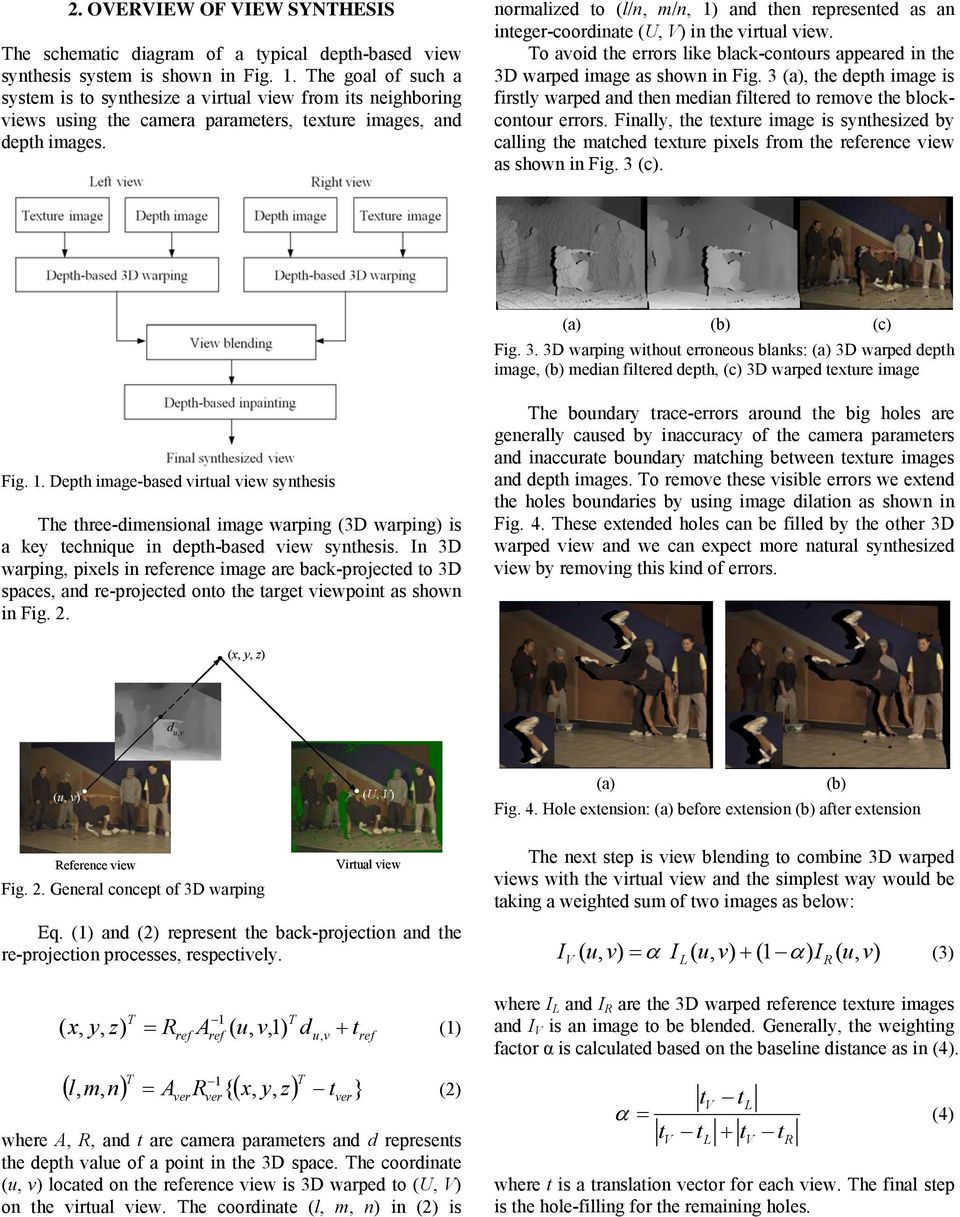
4 2. OVERVIEW OF VIEW SYNHESIS he schematic diagram of a typical depth-based view synthesis system is shown in Fig. 1. he goal of such a system is to synthesize a virtual view from its neighboring views using the camera parameters, texture images, and depth images. normalized to (l/n, m/n, 1) and then represented as an integer-coordinate (U, V) in the virtual view. o avoid the errors like black-contours appeared in the 3D warped image as shown in Fig. 3 (a), the depth image is firstly warped and then median filtered to remove the blockcontour errors. Finally, the texture image is synthesized by calling the matched texture pixels from the reference view as shown in Fig. 3 (c). (a) (b) (c) Fig. 3. 3D warping without erroneous blanks: (a) 3D warped depth image, (b) median filtered depth, (c) 3D warped texture image Fig. 1. Depth image-based virtual view synthesis he three-dimensional image warping (3D warping) is a key technique in depth-based view synthesis. In 3D warping, pixels in reference image are back-projected to 3D spaces, and re-projected onto the target viewpoint as shown in Fig. 2. he boundary trace-errors around the big holes are generally caused by inaccuracy of the camera parameters and inaccurate boundary matching between texture images and depth images. o remove these visible errors we extend the holes boundaries by using image dilation as shown in Fig. 4. hese extended holes can be filled by the other 3D warped view and we can expect more natural synthesized view by removing this kind of errors. (x, y, z) d u,v (u, v) (U, V) (a) (b) Fig. 4. Hole extension: (a) before extension (b) after extension Reference view Fig. 2. General concept of 3D warping Virtual view Eq. (1) and (2) represent the back-projection and the re-projection processes, respectively. ( t (1) 1 x, y, z) = Rref Aref ( u, v,1) du, v + 1 ( l, m, n) = A R {( x, y, z) t } ver ver where A, R, and t are camera parameters and d represents the depth value of a point in the 3D space. he coordinate (u, v) located on the reference view is 3D warped to (U, V) on the virtual view. he coordinate (l, m, n) in (2) is ver ref (2) he next step is view blending to combine 3D warped views with the virtual view and the simplest way would be taking a weighted sum of two images as below: I V ( u, v) α I ( u, v) + (1 α) I ( u, v) = (3) L where I L and I R are the 3D warped reference texture images and I V is an image to be blended. Generally, the weighting factor α is calculated based on the baseline distance as in (4). t t V L α = (4) tv tl + tv tr where t is a translation vector for each view. he final step is the hole-filling for the remaining holes. R
5 3. PROPOSED HOLE-FILLING MEHOD Even though the view blending efficiently fills up most disocclusion regions, some holes still remain. In general, these kinds of remaining holes are caused by still remaining disocclusion regions and wrong depth values. Disocclusion regions are defined as areas that cannot be seen in the reference image, but exist in the synthesized one. Most of the existing hole-filling methods use image interpolation or in-painting techniques and fill up the remaining holes using neighboring pixels solely based upon geometrical distance. However, observe that it makes more sense to fill up the holes using the background pixels rather than the foreground ones as the disoccluded area usually belongs to the background by definition. herefore, we propose a depth based hole-filling algorithm which prefers the background pixels over the foreground ones in addition to considering the existing in-painting technique. he general in-painting problem is as follow [9]: the region to be in-painted Ω and its boundary Ω are defined and the pixel p belong to Ω would be in-painted by its neighboring region B ε (p) as shown in Fig. 5. known neighborhood Bε(P fg ) foreground region hole to be filled background region border known neighborhood Bε(P bg ) hole to be filled Replace Bε(P fg )to Bε(P bg ) Fig. 6 Manipulation of hole to have neighborhood only come from background o distinguish the foreground with background we use a corresponding depth data for blended image. For the horizontally opposite two depth pixels on hole, we regard the pixel having larger depth value as a foreground. Fig. 7 shows the procedure of the proposed hole-filling technique using depth based in-painting. known neighborhood Bε(P) P (a) (b) boundary Ω Fig. 5 General in-painting circumstance region Ω to be in-painted his concept is quite reasonable for common image inpainting but it should be changed to be applied to holefilling in view synthesis because Ω of a certain hole can be located on the both foreground and background. In this case, we replace the boundary region bordering on foreground to the background region located on the opposite side as depicted in (5). hat is, we intentionally manipulate the hole to have neighborhood only come from background as shown in Fig. 6. Now, since the holes only have the background pixels the in-painted image is more natural compared to the previous result. p fg Ω fg p bg Ω Bε ( p fg ) Bε ( pbg ) where fg and bg mean the foreground and background. bg (5) (c) (d) Fig. 7 In-painting procedure: (a) image with holes, (b) boundary region copy from background, (c) proposed depth based inpainting, (d) previous in-painting 4. EXPERIMENAL RESULS AND ANALYSIS We have tested the proposed algorithm on test sequences, Breakdancers and Ballet [10]. Among the 8 views, view 3 and view 5 are selected as reference views and view 4 is set as the virtual view. he proposed method is evaluated by existing objective evaluation measures, such as PSNR, SSIM [11], and VQM [12]. Whereas the larger value means the better quality in PSNR, the smaller value means the better quality for VQM. In case of SSIM, the closer value to 1 means the better quality. he experimental results for depth based in-painting are given in able 1 and able 2 and synthesized sample images in Fig. 8. he proposed depth-based in-painting shows the better results by filling up the remaining holes
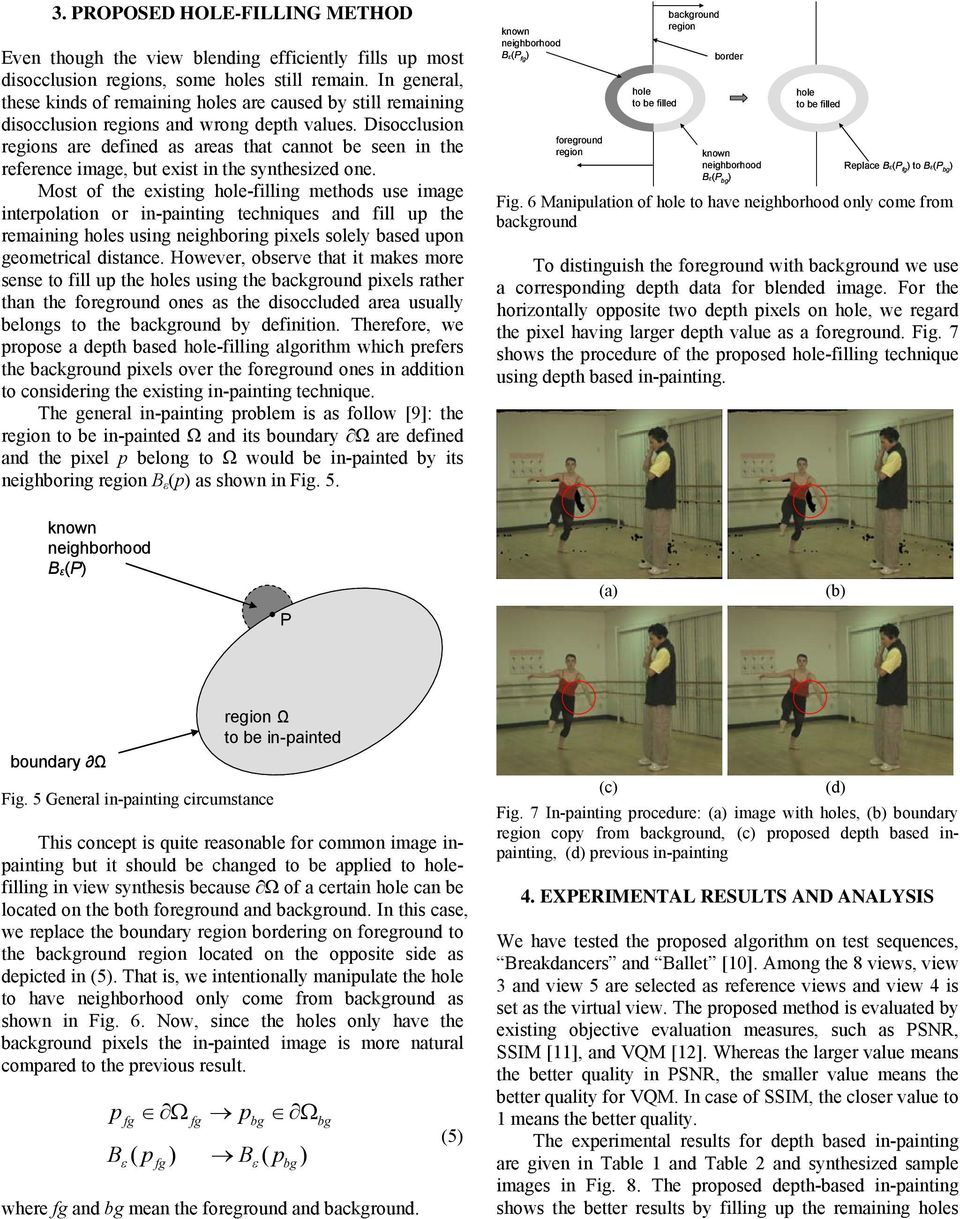
6 using pixels located in background when the holes border on both foreground and background. able 1. Experimental results for Breakdancers Evaluation Measures Previous Proposed PSNR SSIM VQM able 2. Experimental results for Ballet Evaluation Measures Previous Proposed PSNR SSIM VQM CONCLUSIONS In this paper, we have proposed a hole-filling method using depth-based in-painting technique. he proposed method intentionally manipulates the holes to have neighborhood only come from background by considering depth value. And then, the existing in-painting technique is applied to fill up the holes. he effectiveness of the proposed method was confirmed by evaluating the quality of the synthesized image using various quality measures such as PSNR, SSIM, and VQM. We observed that the proposed method produced both subjectively and objectively better results compared with those by the current reference software being used in the MPEG FV/3D video standardization activities. ACKNOWLEDGMEN his work was supported in part by IRC through RBRC at GIS (IIA-2008-C ). REFERENCES Fig. 8 Results of hole-filling: (top) previous in-painting, (bottom) proposed depth based in-painting As shown in experimental results and examples for synthesized images, the proposed depth-based in-painting shows subjectively and objectively better results for holefilling compared with the previous in-painting. [1] M. animoto, Overview of free viewpoint television, Proc. of Signal Processing: Image Communication, vol. 21, pp , July [2] A. Smolic and P. Kauff, Interactive 3D video representation and coding technologies, Proc. of IEEE, Special Issue on Advances in Video Coding and Delivery. vol. 93, pp , [3] F. Isgro, E. rucco, P. Kauff, and O. Schreer, 3D image processing in the future of immersive media, Proc. of IEEE ransactions on Circuits and Systems for Video echnology, vol.14, no. 3, pp , [4] X. Chen and A. Luthra, MPEG-2 multiview profile and its application in 3D V, Proc. of SPIE-Multimedia Hardware Architectures, vol. 3021, pp , [5] H.A. Karim, S. Worrall, A. H. Sadka, and A. M. Kondoz, 3D video compression using MPEG-4-multiple auxiliary component (MPEG4-MAC), Proc. of IEE 2nd International Conference on Visual Information Engineering (VIE2005), Apr [6] ISO/IEC JC1/SC29/WG11, Survey of algorithms used for multi-view video coding (MVC), Doc. N6909, Jan [7] S. C. Chan, H.Y. Shum, and K.. Ng, Image-based rendering and synthesis, Proc. of IEEE Signal Processing Magazines, pp , Nov [8] ISO/IEC JC1/SC29/WG11, Reference Softwares for Depth Estimation and View Synthesis, Doc. M15377, Apr [9] A. elea, An image inpainting technique based on the fast marching method, Proc. of Journal of Graphics ools, vol.9, no.1, pp.25 36, [10] MSR 3D video Sequences. Available at: microsoft.com/vision/imagebasedrealities/3dvideodownload/. [11] Z. Wang, A. C. Bovik, H. R. Sheik, and E. P. Simoncelli, Image quality assessment: From error visibility to structural similarity, Proc. of IEEE ransaction on Image Processing vol. 13, no. 4, pp , [12] F. Xiao, DC-based video quality evaluation, Final Project for EE392J Stanford Univ
Adaptive Block Truncation Filter for MVC Depth Image Enhancement
 2014 IEEE International Conference on Acoustic, Speech and Signal Processing (ICASSP) Adaptive Block Truncation Filter for MVC Depth Image Enhancement Xuyuan Xu 1, Lai-Man Po 1, Chun-Ho Cheung 2, Litong
A Novel Hole filling method based on Projection onto Convex Set in DIBR
 3rd International Conference on Multimedia Technology ICMT 2013) A Novel Hole filling method based on Projection onto Convex Set in DIBR Weiquan Wang1 and Yingyun Yang2 and Qian Liang3 Abstract. Depth
Quality improving techniques for free-viewpoint DIBR
 Quality improving techniques for free-viewpoint DIBR Luat Do a, Sveta Zinger a and Peter H.N. de With a,b a Eindhoven University of Technology, P.O. Box 513, 5600 MB Eindhoven, Netherlands b Cyclomedia
The Open University s repository of research publications and other research outputs
 Open Research Online The Open University s repository of research publications and other research outputs Disocclusion Hole-Filling in DIBR-Synthesized Images using Multi-Scale Template Matching Conference
REPRESENTATION, CODING AND INTERACTIVE RENDERING OF HIGH- RESOLUTION PANORAMIC IMAGES AND VIDEO USING MPEG-4
 REPRESENTATION, CODING AND INTERACTIVE RENDERING OF HIGH- RESOLUTION PANORAMIC IMAGES AND VIDEO USING MPEG-4 S. Heymann, A. Smolic, K. Mueller, Y. Guo, J. Rurainsky, P. Eisert, T. Wiegand Fraunhofer Institute
Key Terms 2D-to-3D-conversion, depth image-based rendering, hole-filling, image warping, optimization.
 Disparity-Map-Based Rendering for Hole Prevention Mr. S. K. Somasundaram, Department of Computer Science & Engineering, Associate Professor, PSNA College of Engineering & Technology, Anna University,Chennai,
Adaptive Image Warping Using Disparity Map-Based Rendering For Hole Prevention In 3D View Synthesis
 Adaptive Image Warping Using Disparity Map-Based Rendering For Hole Prevention In 3D View Synthesis Yoganandhan.S Lakshmanan.V VinithaSubashini.B Department Of Computer Science and Engineering [email protected]
Immersive Medien und 3D-Video
 Fraunhofer-Institut für Nachrichtentechnik Heinrich-Hertz-Institut Ralf Schäfer [email protected] http://ip.hhi.de Immersive Medien und 3D-Video page 1 Outline Immersive Media Examples Interactive Media
Study and Implementation of Video Compression Standards (H.264/AVC and Dirac)
 Project Proposal Study and Implementation of Video Compression Standards (H.264/AVC and Dirac) Sumedha Phatak-1000731131- [email protected] Objective: A study, implementation and comparison of
Study and Implementation of Video Compression standards (H.264/AVC, Dirac)
 Study and Implementation of Video Compression standards (H.264/AVC, Dirac) EE 5359-Multimedia Processing- Spring 2012 Dr. K.R Rao By: Sumedha Phatak(1000731131) Objective A study, implementation and comparison
Performance Analysis and Comparison of JM 15.1 and Intel IPP H.264 Encoder and Decoder
 Performance Analysis and Comparison of 15.1 and H.264 Encoder and Decoder K.V.Suchethan Swaroop and K.R.Rao, IEEE Fellow Department of Electrical Engineering, University of Texas at Arlington Arlington,
Color Segmentation Based Depth Image Filtering
 Color Segmentation Based Depth Image Filtering Michael Schmeing and Xiaoyi Jiang Department of Computer Science, University of Münster Einsteinstraße 62, 48149 Münster, Germany, {m.schmeing xjiang}@uni-muenster.de
Efficient Coding Unit and Prediction Unit Decision Algorithm for Multiview Video Coding
 JOURNAL OF ELECTRONIC SCIENCE AND TECHNOLOGY, VOL. 13, NO. 2, JUNE 2015 97 Efficient Coding Unit and Prediction Unit Decision Algorithm for Multiview Video Coding Wei-Hsiang Chang, Mei-Juan Chen, Gwo-Long
Parametric Comparison of H.264 with Existing Video Standards
 Parametric Comparison of H.264 with Existing Video Standards Sumit Bhardwaj Department of Electronics and Communication Engineering Amity School of Engineering, Noida, Uttar Pradesh,INDIA Jyoti Bhardwaj
Image Processing and Computer Graphics. Rendering Pipeline. Matthias Teschner. Computer Science Department University of Freiburg
 Image Processing and Computer Graphics Rendering Pipeline Matthias Teschner Computer Science Department University of Freiburg Outline introduction rendering pipeline vertex processing primitive processing
Service-Oriented Visualization of Virtual 3D City Models
 Service-Oriented Visualization of Virtual 3D City Models Authors: Jan Klimke, Jürgen Döllner Computer Graphics Systems Division Hasso-Plattner-Institut, University of Potsdam, Germany http://www.hpi3d.de
View Sequence Coding using Warping-based Image Alignment for Multi-view Video
 View Sequence Coding using Warping-based mage Alignment for Multi-view Video Yanwei Liu, Qingming Huang,, Wen Gao 3 nstitute of Computing Technology, Chinese Academy of Science, Beijing, China Graduate
Automatic Detection of PCB Defects
 IJIRST International Journal for Innovative Research in Science & Technology Volume 1 Issue 6 November 2014 ISSN (online): 2349-6010 Automatic Detection of PCB Defects Ashish Singh PG Student Vimal H.
SSIM Technique for Comparison of Images
 SSIM Technique for Comparison of Images Anil Wadhokar 1, Krupanshu Sakharikar 2, Sunil Wadhokar 3, Geeta Salunke 4 P.G. Student, Department of E&TC, GSMCOE Engineering College, Pune, Maharashtra, India
Introduction to Computer Graphics
 Introduction to Computer Graphics Torsten Möller TASC 8021 778-782-2215 [email protected] www.cs.sfu.ca/~torsten Today What is computer graphics? Contents of this course Syllabus Overview of course topics
MATLAB-based Applications for Image Processing and Image Quality Assessment Part II: Experimental Results
 154 L. KRASULA, M. KLÍMA, E. ROGARD, E. JEANBLANC, MATLAB BASED APPLICATIONS PART II: EXPERIMENTAL RESULTS MATLAB-based Applications for Image Processing and Image Quality Assessment Part II: Experimental
Video compression: Performance of available codec software
 Video compression: Performance of available codec software Introduction. Digital Video A digital video is a collection of images presented sequentially to produce the effect of continuous motion. It takes
Text Localization & Segmentation in Images, Web Pages and Videos Media Mining I
 Text Localization & Segmentation in Images, Web Pages and Videos Media Mining I Multimedia Computing, Universität Augsburg [email protected] www.multimedia-computing.{de,org} PSNR_Y
Template-based Eye and Mouth Detection for 3D Video Conferencing
 Template-based Eye and Mouth Detection for 3D Video Conferencing Jürgen Rurainsky and Peter Eisert Fraunhofer Institute for Telecommunications - Heinrich-Hertz-Institute, Image Processing Department, Einsteinufer
A Survey of Video Processing with Field Programmable Gate Arrays (FGPA)
 A Survey of Video Processing with Field Programmable Gate Arrays (FGPA) Heather Garnell Abstract This paper is a high-level, survey of recent developments in the area of video processing using reconfigurable
A method of generating free-route walk-through animation using vehicle-borne video image
 A method of generating free-route walk-through animation using vehicle-borne video image Jun KUMAGAI* Ryosuke SHIBASAKI* *Graduate School of Frontier Sciences, Shibasaki lab. University of Tokyo 4-6-1
SYNTHESIZING FREE-VIEWPOINT IMAGES FROM MULTIPLE VIEW VIDEOS IN SOCCER STADIUM
 SYNTHESIZING FREE-VIEWPOINT IMAGES FROM MULTIPLE VIEW VIDEOS IN SOCCER STADIUM Kunihiko Hayashi, Hideo Saito Department of Information and Computer Science, Keio University {hayashi,saito}@ozawa.ics.keio.ac.jp
COURSE GUIDE 3D Modelling and Animation Master's Degree in Digital Media Catholic University of Valencia
 COURSE GUIDE 3D Modelling and Animation Master's Degree in Digital Media Catholic University of Valencia Course 203 / 4 2 TEACHING GUIDE OF THE SUBJECT ECTS SUBJECT: 3D Modelling and Animation 6 Subject-Matter:
Silhouette completion in DIBR with the help of skeletal tracking
 KASIMIDOU ELEFTHERIA Silhouette completion in DIBR with the help of skeletal tracking Diploma Thesis Supervision: Prof. Pascal Frossard Prof. Anastasios Delopoulos Autumn 2015 ACKNOWLEDGMENTS Working
Consolidated Visualization of Enormous 3D Scan Point Clouds with Scanopy
 Consolidated Visualization of Enormous 3D Scan Point Clouds with Scanopy Claus SCHEIBLAUER 1 / Michael PREGESBAUER 2 1 Institute of Computer Graphics and Algorithms, Vienna University of Technology, Austria
A Short Introduction to Computer Graphics
 A Short Introduction to Computer Graphics Frédo Durand MIT Laboratory for Computer Science 1 Introduction Chapter I: Basics Although computer graphics is a vast field that encompasses almost any graphical
A 3D-TV Approach Using Depth-Image-Based Rendering (DIBR)
 A 3D-TV Approach Using Depth-Image-Based Rendering (DIBR) CHRISTOPH FEHN Image Processing Department Fraunhofer-Institut für Nachrichtentechnik, Heinrich-Hertz Institut Einsteinufer 37, 10587 Berlin, Germany
Kapitel 12. 3D Television Based on a Stereoscopic View Synthesis Approach
 Kapitel 12 3D Television Based on a Stereoscopic View Synthesis Approach DIBR (Depth-Image-Based Rendering) approach 3D content generation DIBR from non-video-rate depth stream Autostereoscopic displays
CREATE A 3D MOVIE IN DIRECTOR
 CREATE A 3D MOVIE IN DIRECTOR 2 Building Your First 3D Movie in Director Welcome to the 3D tutorial for Adobe Director. Director includes the option to create three-dimensional (3D) images, text, and animations.
Real-Time Depth-Image-Based Rendering for 3DTV Using OpenCL
 Real-Time Depth-Image-Based Rendering for 3DTV Using OpenCL Roberto Gerson de Albuquerque Azevedo, Fernando Ismério, Alberto Barbosa Raposo, and Luiz Fernando Gomes Soares Department of Informatics, Pontifical
Vision based Vehicle Tracking using a high angle camera
 Vision based Vehicle Tracking using a high angle camera Raúl Ignacio Ramos García Dule Shu [email protected] [email protected] Abstract A vehicle tracking and grouping algorithm is presented in this work
Johannes Sametinger. C. Doppler Laboratory for Software Engineering Johannes Kepler University of Linz A-4040 Linz, Austria
 OBJECT-ORIENTED DOCUMENTATION C. Doppler Laboratory for Software Engineering Johannes Kepler University of Linz A-4040 Linz, Austria Abstract Object-oriented programming improves the reusability of software
A Prototype For Eye-Gaze Corrected
 A Prototype For Eye-Gaze Corrected Video Chat on Graphics Hardware Maarten Dumont, Steven Maesen, Sammy Rogmans and Philippe Bekaert Introduction Traditional webcam video chat: No eye contact. No extensive
Detection and Restoration of Vertical Non-linear Scratches in Digitized Film Sequences
 Detection and Restoration of Vertical Non-linear Scratches in Digitized Film Sequences Byoung-moon You 1, Kyung-tack Jung 2, Sang-kook Kim 2, and Doo-sung Hwang 3 1 L&Y Vision Technologies, Inc., Daejeon,
Performance Verification of Super-Resolution Image Reconstruction
 Performance Verification of Super-Resolution Image Reconstruction Masaki Sugie Department of Information Science, Kogakuin University Tokyo, Japan Email: [email protected] Seiichi Gohshi Department
A Remote Maintenance System with the use of Virtual Reality.
 ICAT 2001 December 5-7, Tokyo, JAPAN A Remote Maintenance System with the use of Virtual Reality. Moez BELLAMINE 1), Norihiro ABE 1), Kazuaki TANAKA 1), Hirokazu TAKI 2) 1) Kyushu Institute of Technology,
HSI BASED COLOUR IMAGE EQUALIZATION USING ITERATIVE n th ROOT AND n th POWER
 HSI BASED COLOUR IMAGE EQUALIZATION USING ITERATIVE n th ROOT AND n th POWER Gholamreza Anbarjafari icv Group, IMS Lab, Institute of Technology, University of Tartu, Tartu 50411, Estonia [email protected]
 Tracking Moving Objects In Video Sequences Yiwei Wang, Robert E. Van Dyck, and John F. Doherty Department of Electrical Engineering The Pennsylvania State University University Park, PA16802 Abstract{Object
Loss-resilient Coding of Texture and Depth for Free-viewpoint Video Conferencing
 IEEE TRANSACTIONS ON MULTIMEDIA, APRIL 2014 1 Loss-resilient Coding of Texture and Depth for Free-viewpoint Video Conferencing Bruno Macchiavello Camilo Dorea Edson M. Hung Gene Cheung Senior Member, IEEE
CUBE-MAP DATA STRUCTURE FOR INTERACTIVE GLOBAL ILLUMINATION COMPUTATION IN DYNAMIC DIFFUSE ENVIRONMENTS
 ICCVG 2002 Zakopane, 25-29 Sept. 2002 Rafal Mantiuk (1,2), Sumanta Pattanaik (1), Karol Myszkowski (3) (1) University of Central Florida, USA, (2) Technical University of Szczecin, Poland, (3) Max- Planck-Institut
White paper. HDTV (High Definition Television) and video surveillance
 White paper HDTV (High Definition Television) and video surveillance Table of contents Introduction 3 1. HDTV impact on video surveillance market 3 2. Development of HDTV 3 3. How HDTV works 4 4. HDTV
AUTOMATIC MULTI-VIEW TEXTURE MAPPING OF 3D SURFACE PROJECTIONS
 AUTOMATIC MULTI-VIEW TEXTURE MAPPING OF 3D SURFACE PROJECTIONS L. Grammatikopoulos 1,2, I. Kalisperakis 1,2, G. Karras 2, E. Petsa 1 1 Department of Surveying, Technological Educational Institute of Athens
PRODUCING DV VIDEO WITH PREMIERE & QUICKTIME
 This article contains guidelines and advice on producing DV video for the screen using a DV camcorder, Adobe Premiere and QuickTime. PRODUCING DV VIDEO WITH PREMIERE & QUICKTIME PRODUCING DV VIDEO WITH
PHYSIOLOGICALLY-BASED DETECTION OF COMPUTER GENERATED FACES IN VIDEO
 PHYSIOLOGICALLY-BASED DETECTION OF COMPUTER GENERATED FACES IN VIDEO V. Conotter, E. Bodnari, G. Boato H. Farid Department of Information Engineering and Computer Science University of Trento, Trento (ITALY)
MeshLab and Arc3D: Photo-Reconstruction and Processing of 3D meshes
 MeshLab and Arc3D: Photo-Reconstruction and Processing of 3D meshes P. Cignoni, M Corsini, M. Dellepiane, G. Ranzuglia, (Visual Computing Lab, ISTI - CNR, Italy) M. Vergauven, L. Van Gool (K.U.Leuven ESAT-PSI
Image Processing Based Automatic Visual Inspection System for PCBs
 IOSR Journal of Engineering (IOSRJEN) ISSN: 2250-3021 Volume 2, Issue 6 (June 2012), PP 1451-1455 www.iosrjen.org Image Processing Based Automatic Visual Inspection System for PCBs Sanveer Singh 1, Manu
Using Photorealistic RenderMan for High-Quality Direct Volume Rendering
 Using Photorealistic RenderMan for High-Quality Direct Volume Rendering Cyrus Jam [email protected] Mike Bailey [email protected] San Diego Supercomputer Center University of California San Diego Abstract With
Requirements Analysis Concepts & Principles. Instructor: Dr. Jerry Gao
 Requirements Analysis Concepts & Principles Instructor: Dr. Jerry Gao Requirements Analysis Concepts and Principles - Requirements Analysis - Communication Techniques - Initiating the Process - Facilitated
Efficient Prediction Structures for Multi-view Video Coding
 Efficient Prediction Structures for Multi-view Video Coding Philipp Merkle, Member, IEEE, Aljoscha Smolic, Karsten Müller, Senior Member, IEEE, and Thomas Wiegand, Member, IEEE Abstract An experimental
Skills Inventory: Art/Media Communications. 1. Pre-employment Training/Career Development. A. Formal; e.g., certificates. Date Description Location
 Skills Inventory: Art/Media Communications 1. Pre-employment Training/Career Development A. Formal; e.g., certificates Date Description Location Art/Design and Communication Skills Inventory: Art/Media
How To Make A Texture Map Work Better On A Computer Graphics Card (Or Mac)
 Improved Alpha-Tested Magnification for Vector Textures and Special Effects Chris Green Valve (a) 64x64 texture, alpha-blended (b) 64x64 texture, alpha tested (c) 64x64 texture using our technique Figure
WHICH HD ENDOSCOPIC CAMERA?
 WHICH HD ENDOSCOPIC CAMERA? Colin Dobbyne ORTV 2 Hillcrest Park, Hoyle Road Calverton, Nottingham NG14 6QJ t. +44 (0)115 965 55 77 f: +44 (0)115 965 55 22 e: [email protected] Welcome Thank you for downloading
An automatic system for sports analytics in multi-camera tennis videos
 Workshop on Activity Monitoring by Multiple Distributed Sensing (AMMDS) in conjunction with 2013 10th IEEE International Conference on Advanced Video and Signal Based Surveillance An automatic system for
A Method of Caption Detection in News Video
 3rd International Conference on Multimedia Technology(ICMT 3) A Method of Caption Detection in News Video He HUANG, Ping SHI Abstract. News video is one of the most important media for people to get information.
IMPACT OF COMPRESSION ON THE VIDEO QUALITY
 IMPACT OF COMPRESSION ON THE VIDEO QUALITY Miroslav UHRINA 1, Jan HLUBIK 1, Martin VACULIK 1 1 Department Department of Telecommunications and Multimedia, Faculty of Electrical Engineering, University
Immersive 3-D Video Conferencing: Challenges, Concepts, and Implementations
 Proc. SPIE Visual Communications and Image Processing (VCIP), Lugano, Switzerland, July 2003. Immersive 3-D Video Conferencing: Challenges, Concepts, and Implementations Peter Eisert Image Processing Department
Bandwidth Adaptation for MPEG-4 Video Streaming over the Internet
 DICTA2002: Digital Image Computing Techniques and Applications, 21--22 January 2002, Melbourne, Australia Bandwidth Adaptation for MPEG-4 Video Streaming over the Internet K. Ramkishor James. P. Mammen
Visibility optimization for data visualization: A Survey of Issues and Techniques
 Visibility optimization for data visualization: A Survey of Issues and Techniques Ch Harika, Dr.Supreethi K.P Student, M.Tech, Assistant Professor College of Engineering, Jawaharlal Nehru Technological
REMOTE RENDERING OF COMPUTER GAMES
 REMOTE RENDERING OF COMPUTER GAMES Peter Eisert, Philipp Fechteler Fraunhofer Institute for Telecommunications, Einsteinufer 37, D-10587 Berlin, Germany [email protected], [email protected]
Character Animation from 2D Pictures and 3D Motion Data ALEXANDER HORNUNG, ELLEN DEKKERS, and LEIF KOBBELT RWTH-Aachen University
 Character Animation from 2D Pictures and 3D Motion Data ALEXANDER HORNUNG, ELLEN DEKKERS, and LEIF KOBBELT RWTH-Aachen University Presented by: Harish CS-525 First presentation Abstract This article presents
Wavelet-Based Printed Circuit Board Inspection System
 Wavelet-Based Printed Circuit Board Inspection System Zuwairie Ibrahim and Syed Abdul Rahman Al-Attas Abstract An automated visual printed circuit board (PCB) inspection system proposed in this paper is
Very Low Frame-Rate Video Streaming For Face-to-Face Teleconference
 Very Low Frame-Rate Video Streaming For Face-to-Face Teleconference Jue Wang, Michael F. Cohen Department of Electrical Engineering, University of Washington Microsoft Research Abstract Providing the best
Low-resolution Character Recognition by Video-based Super-resolution
 2009 10th International Conference on Document Analysis and Recognition Low-resolution Character Recognition by Video-based Super-resolution Ataru Ohkura 1, Daisuke Deguchi 1, Tomokazu Takahashi 2, Ichiro
A NEW SUPER RESOLUTION TECHNIQUE FOR RANGE DATA. Valeria Garro, Pietro Zanuttigh, Guido M. Cortelazzo. University of Padova, Italy
 A NEW SUPER RESOLUTION TECHNIQUE FOR RANGE DATA Valeria Garro, Pietro Zanuttigh, Guido M. Cortelazzo University of Padova, Italy ABSTRACT Current Time-of-Flight matrix sensors allow for the acquisition
Video Coding Technologies and Standards: Now and Beyond
 Hitachi Review Vol. 55 (Mar. 2006) 11 Video Coding Technologies and Standards: Now and Beyond Tomokazu Murakami Hiroaki Ito Muneaki Yamaguchi Yuichiro Nakaya, Ph.D. OVERVIEW: Video coding technology compresses
EE3414 Multimedia Communication Systems Part I
 EE3414 Multimedia Communication Systems Part I Spring 2003 Lecture 1 Yao Wang Electrical and Computer Engineering Polytechnic University Course Overview A University Sequence Course in Multimedia Communication
A Study on SURF Algorithm and Real-Time Tracking Objects Using Optical Flow
 , pp.233-237 http://dx.doi.org/10.14257/astl.2014.51.53 A Study on SURF Algorithm and Real-Time Tracking Objects Using Optical Flow Giwoo Kim 1, Hye-Youn Lim 1 and Dae-Seong Kang 1, 1 Department of electronices
How To Improve Performance Of H.264/Avc With High Efficiency Video Coding (Hevc)
 Evaluation of performance and complexity comparison for coding standards HEVC vs. H.264/AVC Zoran M. Milicevic and Zoran S. Bojkovic Abstract In order to compare the performance and complexity without
Subdivision Mapping: Making the Pieces Fit David P. Thaler, GIS Analyst A geographit White Paper, June 2009
 Subdivision Mapping: Making the Pieces Fit P David P. Thaler, GIS Analyst A geographit White Paper, June 2009 1525 Oregon Pike, Suite 202 Lancaster, PA USA 17601-7300 Phone: 717-399-7007 Fax: 717-399-7015
High Quality Image Magnification using Cross-Scale Self-Similarity
 High Quality Image Magnification using Cross-Scale Self-Similarity André Gooßen 1, Arne Ehlers 1, Thomas Pralow 2, Rolf-Rainer Grigat 1 1 Vision Systems, Hamburg University of Technology, D-21079 Hamburg
PERFORMANCE ANALYSIS OF HIGH RESOLUTION IMAGES USING INTERPOLATION TECHNIQUES IN MULTIMEDIA COMMUNICATION SYSTEM
 PERFORMANCE ANALYSIS OF HIGH RESOLUTION IMAGES USING INTERPOLATION TECHNIQUES IN MULTIMEDIA COMMUNICATION SYSTEM Apurva Sinha 1, Mukesh kumar 2, A.K. Jaiswal 3, Rohini Saxena 4 Department of Electronics
JPEG compression of monochrome 2D-barcode images using DCT coefficient distributions
 Edith Cowan University Research Online ECU Publications Pre. JPEG compression of monochrome D-barcode images using DCT coefficient distributions Keng Teong Tan Hong Kong Baptist University Douglas Chai
Proposal for a Virtual 3D World Map
 Proposal for a Virtual 3D World Map Kostas Terzidis University of California at Los Angeles School of Arts and Architecture Los Angeles CA 90095-1467 ABSTRACT The development of a VRML scheme of a 3D world
VIRTUAL VIDEO CONFERENCING USING 3D MODEL-ASSISTED IMAGE-BASED RENDERING
 VIRTUAL VIDEO CONFERENCING USING 3D MODEL-ASSISTED IMAGE-BASED RENDERING Peter Eisert Fraunhofer Institute for Telecommunications, Heinrich-Hertz-Institute Image Processing Department Einsteinufer 37,
Internet of Things (IoT): A vision, architectural elements, and future directions
 SeoulTech UCS Lab 2014-2 st Internet of Things (IoT): A vision, architectural elements, and future directions 2014. 11. 18 Won Min Kang Email: [email protected] Table of contents Open challenges
Example Chapter 08-Number 09: This example demonstrates some simple uses of common canned effects found in popular photo editors to stylize photos.
 08 SPSE ch08 2/22/10 11:34 AM Page 156 156 Secrets of ProShow Experts: The Official Guide to Creating Your Best Slide Shows with ProShow Gold and Producer Figure 8.18 Using the same image washed out and
Interactive Visualization of Magnetic Fields
 JOURNAL OF APPLIED COMPUTER SCIENCE Vol. 21 No. 1 (2013), pp. 107-117 Interactive Visualization of Magnetic Fields Piotr Napieralski 1, Krzysztof Guzek 1 1 Institute of Information Technology, Lodz University
An Automatic Tool for Checking Consistency between Data Flow Diagrams (DFDs)
 An Automatic Tool for Checking Consistency between Data Flow Diagrams (DFDs) Rosziati Ibrahim, Siow Yen Yen Abstract System development life cycle (SDLC) is a process uses during the development of any
Super-resolution method based on edge feature for high resolution imaging
 Science Journal of Circuits, Systems and Signal Processing 2014; 3(6-1): 24-29 Published online December 26, 2014 (http://www.sciencepublishinggroup.com/j/cssp) doi: 10.11648/j.cssp.s.2014030601.14 ISSN:
One-Way Pseudo Transparent Display
 One-Way Pseudo Transparent Display Andy Wu GVU Center Georgia Institute of Technology TSRB, 85 5th St. NW Atlanta, GA 30332 [email protected] Ali Mazalek GVU Center Georgia Institute of Technology TSRB,
Efficient View-Dependent Image-Based Rendering with Projective Texture-Mapping
 Efficient View-Dependent Image-Based Rendering with Projective Texture-Mapping Paul Debevec, Yizhou Yu, and George Borshukov Univeristy of California at Berkeley [email protected] Abstract. This
BUILDING TELEPRESENCE SYSTEMS: Translating Science Fiction Ideas into Reality
 BUILDING TELEPRESENCE SYSTEMS: Translating Science Fiction Ideas into Reality Henry Fuchs University of North Carolina at Chapel Hill (USA) and NSF Science and Technology Center for Computer Graphics and