
Using a Protocol Template for Case Study Planning
|
|
|
- Brice Carson
- 9 years ago
- Views:
Transcription
1 Using a Protocol Template for Case Study Planning Pearl Brereton School of Computing and Mathematics, Keele University, Keele, Staffordshire ST5 5BG, UK [email protected] Barbara Kitchenham School of Computing and Mathematics, Keele University, Keele, Staffordshire ST5 5BG, UK [email protected] David Budgen Department of Computer Science, Durham University, Durham, Science Laboratories, South Road, Durham City, DH1 3LE, UK. [email protected] Zhi Li School of Computing and Mathematics, Keele University, Keele, Staffordshire ST5 5BG, UK [email protected] Abstract. In order to undertake a series of case studies aimed at investigating systematic literature reviews, we have developed a case study protocol template. This paper introduces the template and discusses our experiences of using the template and the resulting case study protocol. We suggest that using our template to prepare a protocol and using the protocol for case study planning can improve the rigour of software engineering case studies. Keywords: case study, template, protocol. 1.INTRODUCTION We are currently undertaking a program of research aimed at better understanding the role of systematic literature reviews (SLRs) in software engineering. This is part of the Evidenced-based Practices Informing Computing (EPIC) project which is funded by the UK Engineering and Physical Sciences Research Council. SLRs are a method used to find, critically evaluate and aggregate all relevant research papers (referred to as primary studies) on a specific research question or research topic. The method was developed in medicine and has been adopted by many other disciplines including social sciences, economics, and nursing. The method is intended to ensure that the review is unbiased, rigorous and auditable (see for example, Petticrew and Roberts, 2006; Fink, 2005; Khan et al., 2003). We are using the participant-observer case study approach as our main research methodology for investigating software engineering SLRs, and plan a series of case studies investigating issues such as: The problems facing novice researchers. The impact of limited search procedures. The repeatability of the SLR process. The usefulness of the SLR guidelines (Kitchenham and Charters, 2007). We believe that case studies are a very useful research method for software engineering research but are a method that is quite difficult to apply rigorously. Zannier et al. (2006) reviewed 63 papers randomly selected from 1227 papers published in 29 years of ICSE proceedings. Looking at the type of evaluation undertaken in the articles, they commented:

2 From our perspective, the term case study was frequently used improperly. Case studies lacked hypotheses and/or a real world case. In addition, we believe the case study methodology has wider applicability than it might at first appear. We agree with Yin (2003) that a proper case study takes place in the field, which in the case of software engineering means in real commercial software projects. However, we also think that validation exercises based on implementing an existing system using a new methodology can provide useful information about the advantages and limitations of new technologies (although not information about potential productivity or timescale advantages since examples are seldom produced under the strict process controls required for commercial products). Such studies are not case studies; they should be referred to as large-scale examples. To improve their rigour, such large-scale examples would benefit from adopting some of the procedures recommended for case studies. Recently, Höst and Runeson (2007) developed checklists for undertaking case studies and reviewing case studies. These provide help both for case study researchers and readers of case studies. In this paper we present a generic template that may help case study researchers to construct a case study protocol. This relates to the case study design and preparation for data collection sections in Höst and Runeson s checklist for researchers. In section 2, we explain how we developed our case study protocol and present the basic case study template. In section 3, we discuss our experiences of using the template and how we needed to amend it to suit our specific case study. In section 4, we discuss the benefits of using a case study protocol, and present our final conclusion in section TEMPLATE CONSTRUCTION As part of our overall planning of our research program (Brereton et al., 2007) we identified the need to plan a series of case studies. To ensure a consistent planning process, we decided to develop a basic case study protocol template. The aim of the template was to provide a common structure for our case study protocols and guidance on how to construct them. We reviewed some of the well-known case study papers and text book but did not find any existing template, although Yin (2003) presented an example of a case study protocol. For this reason we constructed our own template based on basic case study methodologies described by Eisenhardt (1989), Stake (1995), and Yin (2003). At a high level most of the approaches to case study conduct are quite similar, in spite of the very different philosophical approaches taken by different case study experts. For example Eisenhardt (1989) who is concerned with using case studies to develop theories suggests the following activities: Getting started by defining the research question and a priori questions but not defining hypotheses or theory. Selecting cases by considering a particular population and using theoretical concerns to focus on specific cases. Crafting instruments and protocols using multiple data collection methods, using qualitative and quantitative data, and preferably multiple researchers. Entering the field i.e. incorporating field notes with data analyses and using flexible and opportunistic data collection methods. Analysing the data both within case and across cases. Shaping hypotheses by iterative tabulation of evidence looking for identified constructs, replication logic across cases, and looking for evidence to explain why relationships exist. Enfolding the literature i.e. comparing with existing similar and conflicting literature. Reaching closure using the concept of theoretical saturation which says researchers stop looking for more cases/data when they believe more data will only give a marginal improvement to the existing results. Stake (1995), like Eisenhardt, takes an interpretive approach to case study research, but is particularly concerned with program evaluation which involves evaluation of social or education policies. He discusses the following case studies issues: Criteria for selection of cases including whether it is an intrinsic case (i.e. the case itself is the object of interest) or an instrumental case (i.e. the case is used to study something else, for example we intend to use a specific systematic literature review to investigate the SLR methodology). Research questions, issues, and information questions, where issues may specify possible cause-effect relationships, or potential problems (and are important for intrinsic case studies), and information questions may provide information the case study researcher needs to perform his/her task but are more detailed than the main research question.

3 Data gathering involving organising data gathering, access and permissions required for field visits, types of data gathering such as observation, interview and document review. Analysis and Interpretation considering aggregation of data by categories or direct interpretation. Case study researcher roles considering the approach to be taken in the study (e.g. teacher, advocate, evaluator, biographer, interpreter). Triangulation and validation including member checking (asking people interviewed or observed to comment on drafts of the case study report). Report Writing which includes organising the report early on, identifying potential readers, story telling (i.e. the organizational structure of the report), and the use of vignettes (short descriptions that illustrate some aspect of the case). Yin (2003) takes a slightly more positivist approach to case studies and discusses the following tasks: Case study design i.e. multiple or single case, holistic or embedded, flexible, or closed; the five components of a research design: questions, propositions, units of analysis, logic linking data to propositions, criteria for interpretation; and validation. Preparing for data collection including general training (e.g. interviewing techniques), training for the specific case, development of a protocol, selecting the cases(s), conducting a pilot case study. Collecting evidence which involves considering six sources of evidence and basic principles i.e. using multiple sources, creating a case study database, and maintaining a chain of evidence. Analysing evidence. Determining the appropriate analysis strategy (i.e. using theoretical propositions, using a framework based on rival explanations, and/or developing case descriptions) and using appropriate analysis techniques (i.e. pattern matching, explanation building, time-series analysis, logic models and/or cross-case synthesis), keeping in mind three principles (attending to all the evidence, presenting the evidence separately from any interpretation, and exploring alternative interpretations). Reporting case studies. Identify the audience, determine the best structure, have the report reviewed, and start writing early. These lists demonstrate that there is some general agreement about the individual tasks in a case study, although details vary. In particular, Eisenhardt s goal is to develop theory, so not until the last-but-one stage in her case study process does she consult existing literature. Our research program aims to understand the SLR process and to evaluate and to improve our SLR guidelines. Thus, we are more concerned with procedures and less with the attitudes of people to the procedures (although we are concerned about problems facing novices). Generally our goals are more consistent with Yin s case study methodology than Eisenhardt s, but like Stake we are concerned with evaluation, although in our case we are concerned with the evaluation of a technology. For this reason, we based our template on Yin s case study methodology while also incorporating some of Stake s ideas. Yin provides an example of a case study protocol and suggests that a case study protocol should include: An overview of the case study project including objectives, issues and relevant findings about the topic being investigated. Field procedures, including procedures governing access to case study sites. Case study questions, data collection forms and sources of information for answering each question A guide for the case study report including an outline of the report and references. Using Yin s approach, we produced a case study template suitable for our research program. We show a generalised version of the template in Appendix A. The actual template we used for our own research program included elements that were specific to the type of case studies we intended to undertake. We removed these elements to construct the generalised template shown in Appendix A. In addition to covering the general case study tasks outlined by Yin and Stake, we included several additional sections: We included two validation sections, one intended to consider validation of the plan itself, the other intended to specify issues related to the context of the case study that might impact results. We included a Divergences section to record changes to the protocol. One of the issues emphasised by case study researchers was that unlike a classic quantitative experiment data collection and analysis are not sequential steps in a case study. Case study researchers need to begin analysis as

4 soon as data becomes available and to be prepared to change their data collection and analysis plans if necessary. This means a case study protocol is likely to be frequently amended. We included a schedule section intended to specify major case study milestones. 3. TEMPLATE USE The reason we constructed a template was to assist in planning our series of case studies. In this section we will discuss some of the issues that arose when we constructed our protocol, but first we will briefly describe the case study context and goals. 3.1 The First EPIC Case Study Our case study scoping document (Brereton et al., 2007) identified a list of research questions the EPIC project should address and the basic case study design we would use (i.e. multiple-case embedded design), and some constraints within which the case studies would take place: The case study topic should be of interest in its own right and so lead to an SLR which would be of value to software engineering researchers and practitioners Whenever appropriate a previous published software engineering review (formal or informal) would be used as a baseline against which our SLR would be evaluated. If no previous review was available on the topic, and two independent SLRs were required, the research team members at Durham and Keele would undertake the SLR independently of one another. The research topics and questions we intended to address in the first case study are shown in Table 1. Other research questions defined in the scoping document were not considered relevant to this case study. (Note the original wordings of the questions in the scoping document were amended slightly in the case study protocol, and we present only the latest wording.) The software engineering topic we proposed to use in our case study was Unit Testing. This topic was chosen because it is an important software engineering topic that has already been subject to a systematic literature review under taken by Juristo and her colleagues (Juristio et al., 2004; Juristo et al., 2006). However, Juristo et al. restricted their search process to the IEEE and ACM digital libraries. Thus, we would have a case study appropriate to address RQ1 and RQ3. Since this would be the first SLR undertaken by the two research assistants appointed to the EPIC project (one at Durham University, the other at Keele University), it would also address RQ8 which was agreed by the research team to be the main research question. RQ9 and RQ10 relate to issues that affect all SLRs, so we intend to consider these issues in all our case studies. In addition, questions related to search strings (RQ6 and RQ7) would be investigated on an opportunistic basis in all our case studies. Case Study Topic ID Research Question Stability of SLR process RQ1 To what extent does the use of the systematic literature review methodology lead to repeatable results? Breadth of Literature Search RQ3 To what extent is the adoption of an extended search space vital for answering detailed research questions? Problems facing Novices RQ8 Given the existing literature on evidence-based software engineering, including the Guidelines developed by the EBSE project, what are the particular problems facing novice researchers when conducting their first systematic literature review? Manual versus Automated Search Strategies RQ6 Are automated search strategies preferable to manual search strategies in the software engineering? Complex versus simple search strings RQ7 Are complex focused search strings effective in software engineering? Protocols RQ9 To what extent do systematic literature reviews deviate from their protocols? Quality Checklists RQ10 How useful are the quality checklists provided in the current version of the Guidelines (Kitchenham & Charters, 2007)? Table 1 Research Topics and Questions

5 3.2 Constructing the Protocol Constructing a protocol from a template involves not only completing the template sections but also reviewing the relevance of the template section in the specific context. For example, when we used the template for our first case study plan, we omitted some elements of the template: We did not include a section related to case study selection because this issue was addressed in a higher level document (Brereton et al., 2007). We did not include a section on field procedures, since the object of our study is systematic literature reviews, and members of the EPIC research team (i.e. two research assistants, one at the University of Keele and the other at the University of Durham) would themselves be performing the reviews. We also found that we needed to revise the basic structure of sections 5 and 6 because we trying to address several very different research questions in the same case study, i.e. The problems faced by novice researchers when they use the SLR methodology. The extent to which the SLR methodology leads to repeatable results. The implications of restricted search procedures. Each of these research questions was refined into sub-questions or propositions. However, when we attempted to define data collection and analysis for all the questions together sections 5 and 6 became very difficult to understand. We found it necessary to re-write section 5 and 6 for each research question, so we ended up with headings for each top level research question and subsections defining the data, data collection, and analysis procedures that addressed each of the relevant sub-questions or propositions. One issue that we did not include in the first version of our template was the role of team members. This was a major error, which fortunately was detected during a team review of the protocol. Since we are using a participant-observer design, we needed to define the roles of the research team in terms of their roles as part of the case study team and as part of the SLR team. In particular, two of the senior researchers have two roles: They are members of the case study team responsible for planning the case study activities. They are members of the SLR team responsible for supervising the research assistants. Both these roles needed to be properly specified to ensure that the different responsibilities of each role were understood. We also needed to consider how much of the case study plan should be visible to the research assistants. In practice, we provided a separate specification of work for RAs outlining the tasks they were to perform and the data they were to collect without informing them of the specific case study research questions. One area where we deviated from the advice of all the case study experts is that our protocol does not include a planned report structure in the report section. We take the view that a well-organised and maintained case study protocol should provide much of the information needed in a case study report. Furthermore, we do not have to report formally to external sponsors and other stakeholders, as is assumed by case study researchers in the social sciences and education. In terms of the development process for the protocol, a major benefit that arose from using the template was that it made it easier to manage and control the process. Writing a protocol is essentially a design task, and a recognised characteristic of design activities is that they are largely opportunistic in nature, rather than following a rigid or sequential set of steps. Here, our experience was that our ideas were able to evolve in an opportunistic manner, but with the use of the template ensuring that we did not lose sight of the overall goals. 4. THE VALUE OF A PROTOCOL From our experience, one of the most important benefits of our case study protocol came from forcing us to specify in detail how we intended to answer our research questions. Relating the data we intended to collect back to the research questions and recalling the need to triangulate our results (i.e. collect different data to address the same question) caused us to refine our data collection procedures. With respect to analysis, thinking in detail about the data and how they would be interpreted forced us to consider the different outcomes we might find, and to specify the different causes for the different outcomes. This again led us to refine our data collection procedures so that we could properly distinguish between the different causes. In practice, we identified the need for data prospectively that it would have been difficult or invalid to attempt to extract at the end of the case study (e.g. de-briefing questionnaires for RAs that can be applied after each main SLR stage, procedures for the supervisors to assist the evaluation of the quality checklists in the SLR guidelines). Another advantage of a protocol is that when circumstances change, it is easier to understand how to adjust the case study to address those circumstances against a formal case study plan than against an informal understanding. In our case, we found from reviewing the SLR protocols that the RAs were unable to duplicate the

6 data collection and analysis process in the SLR we were using as a baseline. Reviewing our case study protocol, we could see that stopping the investigation of the repeatability of the SLR process after the data extraction would provide some useful information about repeatability but would avoid problems with data extraction and analysis confounding the investigation of our other research questions. 5. CONCLUSIONS This paper has introduced a template that can help the production of a case study protocol. We believe that this template will support Höst and Runeson (2007) checklists to improve the rigour of case studies in software engineering. The use of a protocol is an important means of improving the rigour of case studies and other related evaluation methods. We have used the template to produce a protocol for the first of a series of case studies. In our experience, the discipline of producing a protocol has great benefits with respect to ensuring that the data collection and analysis procedures are able to reliably answer the research questions. It also provides a baseline against which a case study plan can be revised if required. In addition, the provision of a written research plan that can be formally reviewed helps to reduce the problem of completing a template in the letter but not in the spirit. Software engineering researchers often employ examples (or scenarios) that enable them to illustrate the value of their work. Recent instances of such an approach includes the papers by Bleinstein et al. (2006) and Boness et al. (2008). On a smaller scale, examples are often employed in student projects and are particularly valuable for MSc students, who often have to complete their development and evaluation activities within a very constrained timeframe. For both groups, a more formal case study structure would provide an underpinning methodology that could improve the validity of their conclusions -- and the use of a template can make this approach much more accessible. However, currently we have only limited experience of using the template, although we intend to use it for future EPIC case studies. In addition, it is being trialled by students at the University of Durham. We welcome any feedback from other researchers currently planning case studies on the value of the template. REFERENCES Bleistein, S.J., Cox, K., Verner, J. and Phalp, K. T. (2006) B-SCP: A requirements analysis framework for validating strategic alignment of organizational IT based on strategy, context, and process," Information and Software Technology, vol. 46, pp Boness, K., Finklestein, A. and Harrison, R. (2008) A lightweight technique for assessing risks in requirements analysis. IET Software 2(1) pp Brereton, O. P., Kitchenham, B.A. (2007) The Scope of EPIC Case Studies. EPIC technical Report EPIC Eisenhardt, K.M.(1989) Building Theories from Case Study Research, Academy of Management Review, Vol. 14, No. 4, October, pp (see also rejoinder by Dyer & Wilkins, 1991, and response by Eisenhardt, 1991). Fink, A. (2005) Conducting Research Literature Reviews. From the Internet to Paper, Sage Publication, Inc. Juristo, N., Moreno, A.M. and Vegas,S. (2004) Reviewing 25 years of Testing Technique Experiments, Empirical Software Engineering Journal, Issue 1-2, March, pp Juristo, N., Moreno, A.M. Vegas,S. and Solari, M. (2006) In Search of What We Experimentally Know about Unit Testing, IEEE Software, 23 (6), pp Höst, M. and Runeson, P. (2007) Checklists for Software Engineering Case Study Research, in Proceedings of 1st International Symposium on Empirical Software Engineering & Measurement (ESEM). IEEE Computer Society Press, pp Khan, Khalid, S., Kunz, Regina, Kleijnen, Jos and Antes, Gerd. (2003) Systematic Reviews to Support Evidencebased Medicine, The Royal Society of Medicine Press Ltd. Kitchenham, B.A. and Charters, S. (2007) Guidelines for performing Systematic Literature Reviews in Software Engineering Technical Report EBSE Petticrew, Mark and Helen Roberts. (2005) Systematic Reviews in the Social Sciences: A Practical Guide, Blackwell Publishing, ISBN Stake, R.E. (1995) The Art of Case Study Research, Sage, Thousand Oaks, CA. Yin, Robert K. (2003) Case Study Research: Design and Methods, 3 rd Edition, Sage Publications. Zannier, C, Melnick, G. and Maurer, F. (2006) On the Success of Empirical Studies in the International Conference on Software Engineering.ICSE06, pp Acknowledgements This study was funded by the UK Engineering and Physical Sciences Research Council project EP/E046983/1.

7 APPENDIX A: CASE STUDY PROTOCOL TEMPLATE 1. Background a) identify previous research on the topic b) define the main research question being addressed by this study c) identify any additional research questions that will be addressed 2. Design a) identify whether single-case or multiple-case and embedded or holistic designs will be used, and show the logical links between these and the research questions b) describe the object of study (e.g. a new testing procedure; a new feature in a browser) c) identify any propositions or sub-questions derived from each research question and the measures to be used to investigate the propositions 3. Case Selection a) Criteria for case selection 4. Case Study Procedures and Roles a) Procedures governing field procedures b) Roles of case study research team members 5. Data Collection a) identify the data to be collected b) define a data collection plan c) define how the data will be stored 6. Analysis a) identify the criteria for interpreting case study findings b) identify which data elements are used to address which research question/sub question/proposition and how the data elements will be combined to answer the question c) consider the range of possible outcomes and identify alternative explanations of the outcomes, and identify any information that is needed to distinguish between these d) the analysis should take place as the case study task progresses 7. Plan Validity (see Figure 2.3 and Chapter 5 in Yin (2003)) a) general: check plan against Höst and Runeson s (2007) checklist items for the design and the data collection plan b) construct validity - show that the correct operational measures are planned for the concepts being studied. Tactics for ensuring this include using multiple sources of evidence, establishing chains of evidence, expert reviews of draft protocols and reports c) internal validity - show a causal relationship between outcomes and intervention/treatment (for explanatory or causal studies only). d) external validity identify the domain to which study finding can be generalized. Tactics include using theory for single-case studies and using multiple-case studies to investigate outcomes in different contexts. 8. Study Limitations Specify residual validity issues including potential conflicts of interest (i.e. that are inherent in the problem, rather than arising from the plan). 9. Reporting
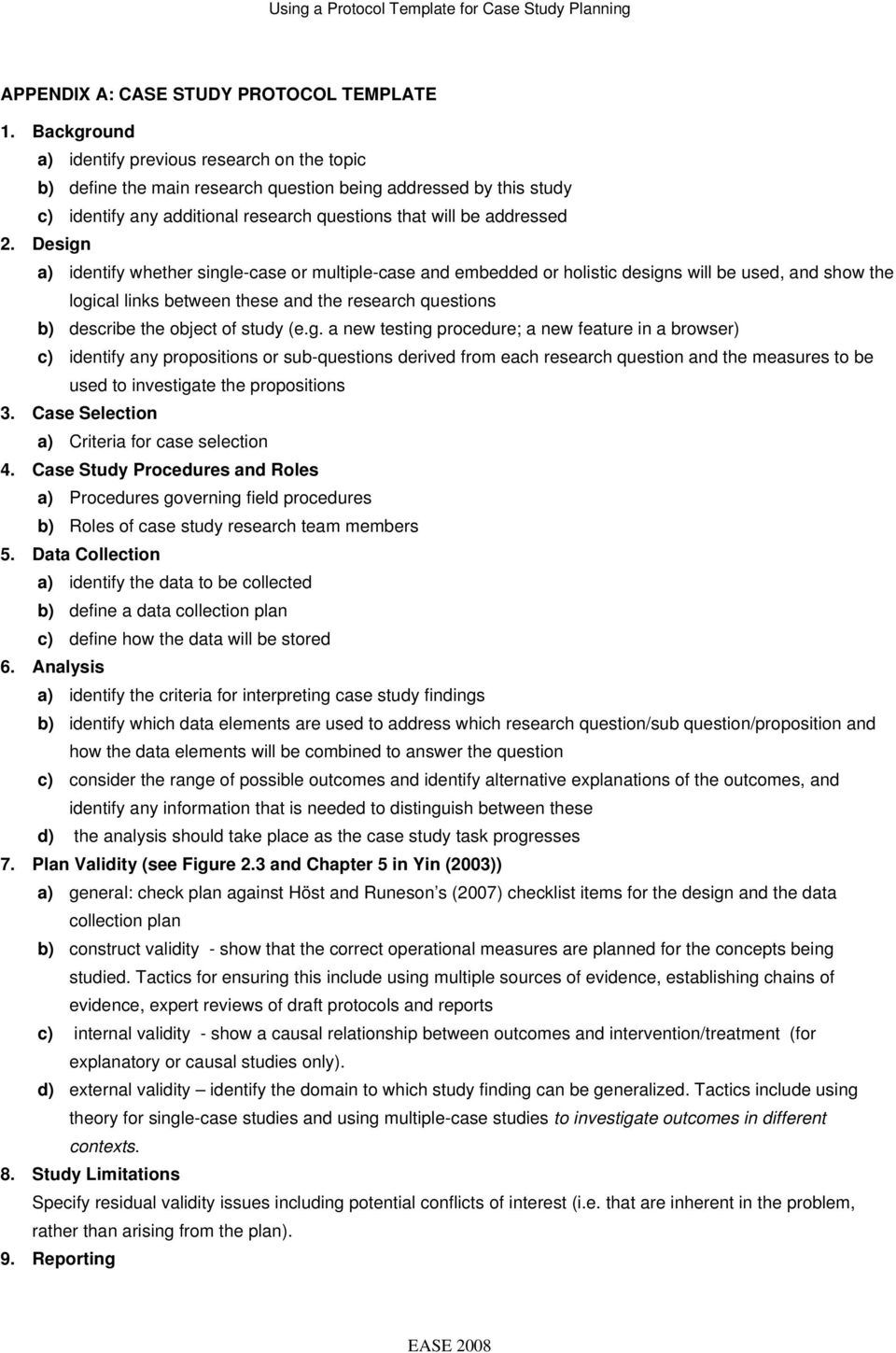
8 Identify target audience, relationship to larger studies (Yin, 2003) 10. Schedule Give time estimates for all of the major steps: Planning, Data Collection, Data Analysis, Reporting. Note Data Collection and Data Analysis are not expected to be sequential stages 11. Appendices a) Validation: report results of checking plan against Höst and Runeson s (2007) checklist items b) Divergences: update while conducting the study by noting any divergences from the above steps.

IHTE-1800 Research methods: Case and action research. Sari Kujala, spring 2007
 IHTE-1800 Research methods: Case and action research Sari Kujala, spring 2007 Contents Introduction Case study research - What it is? When to apply? - Process - Improving the quality Action study - What
Using Case Studies in Research
 Biographical Note Professor Jennifer Rowley can be contacted at the School of Management and Social Sciences, Edge Hill College of Higher Education, Ormskirk, Lancashire, England L39 4QP. by Jennifer Rowley
1. Systematic literature review
 1. Systematic literature review Details about population, intervention, outcomes, databases searched, search strings, inclusion exclusion criteria are presented here. The aim of systematic literature review
Performing systematic literature review in software engineering
 Central Page 441 of 493 Performing systematic literature review in software engineering Zlatko Stapić Faculty of Organization and Informatics University of Zagreb Pavlinska 2, 42000 Varaždin, Croatia [email protected]
Guidelines for performing Systematic Literature Reviews in Software Engineering
 Guidelines for performing Systematic Literature Reviews in Software Engineering Version 2.3 EBSE Technical Report EBSE-2007-01 Software Engineering Group School of Computer Science and Mathematics Keele
Current State of Evidence-Based Software Engineering
 Current State of Evidence-Based Software Engineering Barbara Kitchenham 1 Kitchenham 2007 Agenda Background Aims Method Results Conclusions 2 1 Background At ICSE04 Kitchenham, Dybå, and Jørgensen, proposed
Evidence-Based Software Engineering. Barbara Kitchenham Tore Dybå (SINTEF) Magne Jørgensen (Simula Laboratory)
 1 Evidence-Based Software Engineering Barbara Kitchenham Tore Dybå (SINTEF) Magne Jørgensen (Simula Laboratory) Agenda The evidence-based paradigm Evidence-Based Software Engineering (EBSE) Goals Procedures
Case study research design
 Case study research design Contents 1 Introduction... 1 2 Applications of case study design... 3 3 Outline of the design... 3 4 Strengths and weaknesses of case study designs... 9 5 References... 10 1
A Systematic Review Process for Software Engineering
 A Systematic Review Process for Software Engineering Paula Mian, Tayana Conte, Ana Natali, Jorge Biolchini and Guilherme Travassos COPPE / UFRJ Computer Science Department Cx. Postal 68.511, CEP 21945-970,
Protocol for the Systematic Literature Review on Web Development Resource Estimation
 Protocol for the Systematic Literature Review on Web Development Resource Estimation Author: Damir Azhar Supervisor: Associate Professor Emilia Mendes Table of Contents 1. Background... 4 2. Research Questions...
Research & Development Guidance for Students
 Research & Development Guidance for Students 2 Contents Introduction 3 Understanding the Research Approval Process 3 Is My Project Audit, Research or Something Else 4 What Next? 4 R&D Step by step Guide
CHAPTER III METHODOLOGY. The purpose of this study was to describe which aspects of course design
 CHAPTER III METHODOLOGY The purpose of this study was to describe which aspects of course design and/or instruction are more effective and successful in the online environment than in the face-to-face
University Reviews: Exploring a New and Coordinated Approach
 University Reviews: Exploring a New and Coordinated Approach Abstract Sue Leahy University of Technology Sydney The University of Technology, Sydney (UTS) has endorsed the implementation of a new model
DATA COLLECTION CHALLENGES
 DATA COLLECTION CHALLENGES Sasha Hurrell This essay is part of a series of papers commissioned by The Partnering Initiative through its Case Study Project to develop insights into the process of researching/writing
Review of Literature
 Topic 3 Review of Literature LEARNING OUTCOMES By the end of this topic, you should be able to: 1. Define what is review of literature; 2. Identify the importance of a good literature review; 3. List the
Software Development Multi-Sourcing Relationship Management Model (Sdmrmm) Protocol (A Systematic Literature Review)
 IOSR Journal of Computer Engineering (IOSRJCE) ISSN: 2278-0661 Volume 3, Issue 2 (July-Aug. 2012), PP 24-31 Software Development Multi-Sourcing Relationship Management Model (Sdmrmm) Protocol (A Systematic
Information and Software Technology
 Information and Software Technology 52 (2010) 792 805 Contents lists available at ScienceDirect Information and Software Technology journal homepage: www.elsevier.com/locate/infsof Systematic literature
Grounded Theory. 1 Introduction... 1. 2 Applications of grounded theory... 1. 3 Outline of the design... 2
 Grounded Theory Contents 1 Introduction... 1 2 Applications of grounded theory... 1 3 Outline of the design... 2 4 Strengths and weaknesses of grounded theory... 6 5 References... 6 1 Introduction This
A SYSTEMATIC LITERATURE REVIEW ON AGILE PROJECT MANAGEMENT
 LAPPEENRANTA UNIVERSITY OF TECHNOLOGY Department of Software Engineering and Information Management MASTER S THESIS A SYSTEMATIC LITERATURE REVIEW ON AGILE PROJECT MANAGEMENT Tampere, April 2, 2013 Sumsunnahar
A developmental framework for pharmacists progressing to advanced levels of practice
 ACLF Advanced to Consultant level Framework A developmental framework for pharmacists progressing to advanced levels of practice Version 2009(a) CoDEG www.codeg.org ADVANCED AND CONSULTANT LEVEL COMPETENCY
Developing an implementation research proposal. Session 2: Research design
 Developing an implementation research proposal Session 2: Research design Learning objectives After completing this session, you will be able to: Develop a research design outlining your data collection
DESMET: A method for evaluating software engineering methods and tools
 DESMET: A method for evaluating software engineering methods and tools by Barbara Kitchenham, Stephen Linkman and David Law Abstract DESMET was a DTI-backed project with the goal of developing and validating
Assessment Policy. 1 Introduction. 2 Background
 Assessment Policy 1 Introduction This document has been written by the National Foundation for Educational Research (NFER) to provide policy makers, researchers, teacher educators and practitioners with
This alignment chart was designed specifically for the use of Red River College. These alignments have not been verified or endorsed by the IIBA.
 Red River College Course Learning Outcome Alignment with BABOK Version 2 This alignment chart was designed specifically for the use of Red River College. These alignments have not been verified or endorsed
Review Protocol Agile Software Development
 Review Protocol Agile Software Development Tore Dybå 1. Background The concept of Agile Software Development has sparked a lot of interest in both industry and academia. Advocates of agile methods consider
What are research, evaluation and audit?
 1 What are research, evaluation and audit? Barbara Sen, Maria J. Grant and Hannah Spring I don t do research. I don t have the time. I am too busy with the day to day running of the library. I do evaluations
AIS Electronic Library (AISeL) Association for Information Systems. Mark Borman University of Sydney, [email protected]
 Association for Information Systems AIS Electronic Library (AISeL) AMCIS 2005 Proceedings Americas Conference on Information Systems (AMCIS) 1-1-2005 Improving Understanding of the Competencies Required
QUAๆASSURANCE IN FINANCIAL AUDITING
 Table of contents Subject Page no. A: CHAPTERS Foreword 5 Section 1: Overview of the Handbook 6 Section 2: Quality Control and Quality Assurance 8 2. Quality, quality control and quality assurance 9 2.1
Collaborative development of evaluation capacity and tools for natural resource management
 Collaborative development of evaluation capacity and tools for natural resource management Helen Watts (Adaptive Environmental Management, formerly NSW Department of Environment and Climate Change) Sandra
CHILDREN AND ADULTS SERVICE RESEARCH APPROVAL GROUP
 DURHAM COUNTY COUNCIL CHILDREN AND ADULTS SERVICE RESEARCH APPROVAL GROUP INFORMATION PACK Children and Adults Service Version 4 October 2015 Children and Adults Service Research Approval Group Page 1
Case Studies. Dewayne E Perry ENS 623 [email protected]
 Case Studies Dewayne E Perry ENS 623 [email protected] Adapted from Perry, Sim & Easterbrook,Case Studies for Software Engineering, ICSE 2004 Tutorial 1 What is a case study? A case study is an empirical
Guide to the National Safety and Quality Health Service Standards for health service organisation boards
 Guide to the National Safety and Quality Health Service Standards for health service organisation boards April 2015 ISBN Print: 978-1-925224-10-8 Electronic: 978-1-925224-11-5 Suggested citation: Australian
Single and Multiple-Case Study Designs IS493
 1 2 Research Strategies Basic oppositions Survey research versus Case study quantitative versus qualitative The whole gamut Experiment Survey Archival analysis Historical research Case study 3 Basic Conditions
Framework and Resources for Early Childhood Education Reviews
 Framework and Resources for Early Childhood Education Reviews Education Reviews in Early Childhood Education Services Contents 1 Introduction 1 The purpose of this framework ERO s approach to early childhood
The overall aim for this project is To improve the way that the University currently manages its research publications data
 Project Plan Overview of Project 1. Background The I-WIRE project will develop a workflow and toolset, integrated into a portal environment, for the submission, indexing, and re-purposing of research outputs
Comparison of Research Designs Template
 Comparison of Comparison of The following seven tables provide an annotated template to guide you through the comparison of research designs assignment in this course. These tables help you organize your
Interview studies. 1 Introduction... 1. 2 Applications of interview study designs... 2. 3 Outline of the design... 3
 Interview studies Contents 1 Introduction... 1 2 Applications of interview study designs... 2 3 Outline of the design... 3 4 Strengths and weaknesses of interview study designs... 6 5 References... 7 1
Engineering Gateways degrees. Bachelors and MSc Professional Engineering
 Engineering Gateways degrees Bachelors and MSc Professional Engineering A guide for Higher Education Institutions Flexible work-based pathways to being registered as a professionally qualified engineer
Sound Transit Internal Audit Report - No. 2014-3
 Sound Transit Internal Audit Report - No. 2014-3 IT Project Management Report Date: Dec. 26, 2014 Table of Contents Page Background 2 Audit Approach and Methodology 2 Summary of Results 4 Findings & Management
Chapter 7: Monitoring and Evaluation
 Chapter 7: Monitoring and Evaluation The Training Program is relatively new and is still developing. Careful monitoring and evaluation of the Program by the people most closely involved in it will help
Guidelines for conducting and reporting case study research in software engineering
 Empir Software Eng (2009) 14:131 164 DOI 10.1007/s10664-008-9102-8 Guidelines for conducting and reporting case study research in software engineering Per Runeson Martin Höst Published online: 19 December
Article Four Different Types of Evidence / Literature Reviews
 Article Four Different Types of Evidence / Literature Reviews The rapid growth in the number of reviews undertaken can partly be explained by the current emphasis on evidence-based practice. Healthcare
2016 Charter School Application Evaluation Rubric. For applications submitted to The Louisiana Board of Elementary and Secondary Education
 2016 Charter School Application Evaluation Rubric For applications submitted to The Louisiana Board of Elementary and Secondary Education 2016 Charter School Application Evaluation Rubric The purpose of
1. Trustees annual report
 1. Trustees annual report Accounting and reporting by charities Overview and the purpose of the trustees annual report 1.1. The primary purpose of the trustees annual report (the report) is to ensure that
FoNS guidelines for writing a final project report July 2012 1
 Guidelines for writing a final project report July 2012 FoNS has a strong commitment to disseminating the work of the project teams that we support. Developing and changing practice to improve patient
Analysing Interview Data
 Analysing Interview Data Dr Maria de Hoyos & Dr Sally-Anne Barnes Warwick Institute for Employment Research 15 February 2012 Show of hands Aims of the session To reflect on the nature and purpose of interviews
Research at Henley Business School
 The DBA at Henley We attract experienced and motivated individuals to undertake significant research that shapes organisational thinking and provides an increasingly complex business environment. We are
Systematic Mapping Studies in Software Engineering
 Systematic Mapping Studies in Software Engineering Kai Petersen,2, Robert Feldt, Shahid Mujtaba,2, Michael Mattsson School of Engineering, Blekinge Institute of Technology, Box 520 SE-372 25 Ronneby (kai.petersen
BSBMKG506B Plan market research
 BSBMKG506B Plan market research Revision Number: 1 BSBMKG506B Plan market research Modification History Not applicable. Unit Descriptor Unit descriptor This unit describes the performance outcomes, skills
Information Visualization for Agile Development in Large Scale Organizations
 Master Thesis Software Engineering September 2012 Information Visualization for Agile Development in Large Scale Organizations Numan Manzoor and Umar Shahzad School of Computing School of Computing Blekinge
Improving Software Requirements through Formal Methods: A Review
 International Journal of Information and Computation Technology. ISSN 0974-2239 Volume 3, Number 7 (2013), pp. 729-736 International Research Publications House http://www. irphouse.com /ijict.htm Improving
Draft proposal Standards for assessment in RACP training programs
 Draft proposal Standards for assessment in RACP training programs February 2014 Page 1 Contents Introduction... 3 Quick guide to the proposed RACP standards for assessment... 4 Standards for assessment
Qualitative Research. A primer. Developed by: Vicki L. Wise, Ph.D. Portland State University
 Qualitative Research A primer Developed by: Vicki L. Wise, Ph.D. Portland State University Overview In this session, we will investigate qualitative research methods. At the end, I am hopeful that you
Evaluating Survey Questions
 Evaluating Survey What Respondents Do to Answer a Question Chase H. Harrison Ph.D. Program on Survey Research Harvard University Comprehend Question Retrieve Information from Memory Summarize Information
Standards of proficiency. Occupational therapists
 Standards of proficiency Occupational therapists Contents Foreword 1 Introduction 3 Standards of proficiency 7 Foreword We are pleased to present the Health and Care Professions Council s standards of
Solvency II Own Risk and Solvency Assessment (ORSA)
 Solvency II Own Risk and Solvency Assessment (ORSA) Guidance notes September 2011 Contents Introduction Purpose of this Document 3 Lloyd s ORSA framework 3 Guidance for Syndicate ORSAs Overview 7 December
Data Quality Policy. Appendix A. 1. Why do we need a Data Quality Policy?... 2. 2 Scope of this Policy... 2. 3 Principles of data quality...
 Data Quality Policy Appendix A Updated August 2011 Contents 1. Why do we need a Data Quality Policy?... 2 2 Scope of this Policy... 2 3 Principles of data quality... 3 4 Applying the policy... 4 5. Roles
The University of Adelaide Business School
 The University of Adelaide Business School MBA Projects Introduction There are TWO types of project which may be undertaken by an individual student OR a team of up to 5 students. This outline presents
International group work in software engineering
 International group work in software engineering Julian M. Bass Robert Gordon University Aberdeen, UK [email protected] J. T. Lalchandani IIIT-B Bangalore, India [email protected] R. McDermott Robert Gordon
Writing Your PG Research Project Proposal
 Writing Your PG Research Project Proposal Typically, most research project proposals will contain the following elements: The proposed title of your research project An outline of the scope and rationale
Information and Software Technology
 Information and Software Technology 55 (2013) 1341 1354 Contents lists available at SciVerse ScienceDirect Information and Software Technology journal homepage: www.elsevier.com/locate/infsof Systematic
Develop Project Charter. Develop Project Management Plan
 Develop Charter Develop Charter is the process of developing documentation that formally authorizes a project or a phase. The documentation includes initial requirements that satisfy stakeholder needs
Evaluating Intergenerational Projects: A Practical Guide to Useful Resources
 Evaluating Intergenerational Projects: A Practical Guide to Useful Resources November 2009 Evaluating Intergenerational Projects: A Practical Guide to Useful Resources Foreword This guide has been developed
A Systematic Review of Automated Software Engineering
 A Systematic Review of Automated Software Engineering Gegentana Master of Science Thesis in Program Software Engineering and Management Report No. 2011:066 ISSN:1651-4769 University of Gothenburg Department
CRO Forum Paper on the Own Risk and Solvency Assessment (ORSA): Leveraging regulatory requirements to generate value. May 2012.
 CRO Forum Paper on the Own Risk and Solvency Assessment (ORSA): Leveraging regulatory requirements to generate value May 2012 May 2012 1 1. Introduction 1.1. Purpose of the paper In this discussion paper
Successfully completing case study research: combining rigour, relevance and pragmatism
 Info Systems J (1998) 8, 273±289 273 Successfully completing case study research: combining rigour, relevance and pragmatism Peta Darke, Graeme Shanks & Marianne Broadbent* School of Information Management
Request for feedback on the revised Code of Governance for NHS Foundation Trusts
 Request for feedback on the revised Code of Governance for NHS Foundation Trusts Introduction 8 November 2013 One of Monitor s key objectives is to make sure that public providers are well led. To this
Teaching and Learning Methods
 Programme Specification (Postgraduate) Date amended: 1. Programme Title (EdD) 2. Awarding body or institution University of Leicester 3. a) Mode of Study part time b) Type of Study postgraduate research
A COMPARISON OF PRINCE2 AGAINST PMBOK
 Introduction This comparison takes each part of the PMBOK and gives an opinion on what match there is with elements of the PRINCE2 method. It can be used in any discussion of the respective merits of the
Requirements Engineering: Elicitation Techniques
 2008:PR003 Requirements Engineering: Elicitation Techniques Sai Ganesh. Gunda Source:http://www.marcocioffi.com/archives/2005/04/requirements-engineering/ MASTER S THESIS Software Engineering, 2008 Department
Quick Guide: Meeting ISO 55001 Requirements for Asset Management
 Supplement to the IIMM 2011 Quick Guide: Meeting ISO 55001 Requirements for Asset Management Using the International Infrastructure Management Manual (IIMM) ISO 55001: What is required IIMM: How to get
Using qualitative research to explore women s responses
 Using qualitative research to explore women s responses Towards meaningful assistance - how evidence from qualitative studies can help to meet survivors needs Possible questions Why do survivors of SV
COURSE APPROVAL GUIDELINES APS COLLEGE OF ORGANISATIONAL PSYCHOLOGISTS
 COURSE APPROVAL GUIDELINES APS COLLEGE OF ORGANISATIONAL PSYCHOLOGISTS Updated January 2007 1. General Introduction and Principles These Guidelines have been developed for use by tertiary institutions
Quality management/change management: two sides of the same coin?
 University of Wollongong Research Online Deputy Vice-Chancellor (Education) - Papers Deputy Vice-Chancellor (Education) 2004 Quality management/change management: two sides of the same coin? Felicity McGregor
Faculty of Nursing. Master s Project Manual. For Faculty Supervisors and Students
 1 Faculty of Nursing Master s Project Manual For Faculty Supervisors and Students January 2014 2 Table of Contents Overview of the Revised MN Streams in Relation to Project 3 The Importance of Projects
Research Data Management Framework: Capability Maturity Guide
 ANDS Guides Research Data Management Framework: Capability Maturity Guide Introduction The outline set out below shows five levels of attainment or maturity which institutions may achieve in managing their
PORTFOLIO, PROGRAMME & PROJECT MANAGEMENT MATURITY MODEL (P3M3)
 PORTFOLIO, PROGRAMME & PROJECT MANAGEMENT MATURITY MODEL (P3M3) 1st February 2006 Version 1.0 1 P3M3 Version 1.0 The OGC logo is a Registered Trade Mark of the Office of Government Commerce This is a Value
REPORTING ACCOUNTANTS WORK ON FINANCIAL REPORTING PROCEDURES. Financing Change initiative
 REPORTING ACCOUNTANTS WORK ON FINANCIAL REPORTING PROCEDURES consultation PAPER Financing Change initiative inspiring CONFIdENCE icaew.com/financingchange ICAEW operates under a Royal Charter, working
Procurement Programmes & Projects P3M3 v2.1 Self-Assessment Instructions and Questionnaire. P3M3 Project Management Self-Assessment
 Procurement Programmes & Projects P3M3 v2.1 Self-Assessment Instructions and Questionnaire P3M3 Project Management Self-Assessment Contents Introduction 3 User Guidance 4 P3M3 Self-Assessment Questionnaire
What Is a Portfolio? Why develop a professional portfolio?
 01-Forde-Ch-01:01-Forde-Ch-01 8/1/2008 7:36 PM Page 1 1 What Is a Portfolio? In this introductory chapter we discuss what we mean by a professional portfolio. We explore different models of portfolios
Reaching CMM Levels 2 and 3 with the Rational Unified Process
 Reaching CMM Levels 2 and 3 with the Rational Unified Process Rational Software White Paper TP174 Table of Contents INTRODUCTION... 1 LEVEL-2, REPEATABLE... 3 Requirements Management... 3 Software Project
The Role of Controlled Experiments in Software Engineering Research
 The Role of Controlled Experiments in Software Engineering Research Victor R. Basili 1 The Experimental Discipline in Software Engineering Empirical studies play an important role in the evolution of the
Logan City Council. Strategic Planning and Performance Management Framework
 Logan City Council Strategic Planning and Performance Management Framework 1 Table of contents 1. Overview 3 a) Purpose 3 b) Key Features 3 2. Context 4 a) National Framework for Sustainability 4 b) Elements
Higher National Unit Specification. General information for centres. Occupational Therapy Support: Audit. Unit code: F3NE 34
 Higher National Unit Specification General information for centres Unit code: F3NE 34 Unit purpose: This Unit is designed to enable candidates to develop the competences required to audit an aspect of
Principles to Guide the Design and Implementation of Doctoral Programs in Mathematics Education
 Principles to Guide the Design and Implementation of Doctoral Programs in Mathematics Education A Task Force Report for the Association of Mathematics Teacher Educators Forward This report, in some ways,
Individual performance assessment and motivation in agile teams
 Individual performance assessment and motivation in agile teams Helen Sharp The Open University, UK [email protected] With particular acknowledgement to Rien Sach, César França and Marian Petre Agile
National Disability Authority Resource Allocation Feasibility Study Final Report January 2013
 National Disability Authority Resource Allocation Feasibility Study January 2013 The National Disability Authority (NDA) has commissioned and funded this evaluation. Responsibility for the evaluation (including
Developing and Implementing Integrated Care Pathways Guide 2: Developing Integrated Care Pathways
 Effective Interventions Unit pathways Developing and Implementing Integrated Care Pathways Guide 2: Developing Integrated Care Pathways WHAT IS THE PURPOSE OF THIS GUIDE? This is the second in a series
CASE STUDIES: Research Methods
 Helpsheet Giblin Eunson Library CASE SUDIES: Research Methods Use this sheet to help you: understand the key elements of a case study write research-based case studies in eight steps develop awareness
www.monitor.gov.uk The NHS Foundation Trust Code of Governance
 www.monitor.gov.uk The NHS Foundation Trust Code of Governance About Monitor Monitor is the sector regulator for health services in England. Our job is to protect and promote the interests of patients
Module Handbook. Literature Review Project (Nursing) NM3733. RN/BSc (Hons) Nursing 2009 Curriculum. Research Theme. September 2008 cohort
 School of Community and Health Sciences RN/BSc (Hons) Nursing 2009 Curriculum Research Theme Module Handbook Literature Review Project (Nursing) NM3733 September 2008 cohort Year 3 (September 2010 August
How to audit your business strategy
 How to audit your business strategy Andrew Carey Why conduct a business strategy audit? Nearly all the major initiatives undertaken by corporate executives today are called strategic. With everything having
Planning your research
 Planning your research Many students find that it helps to break their thesis into smaller tasks, and to plan when and how each task will be completed. Primary tasks of a thesis include - Selecting a research