
ROMEO & JULIET UNIT STUDY PACKET
|
|
|
- Sophia Sutton
- 9 years ago
- Views:
Transcription
1 Name: Block: Mr. Kullman 9 th Grade English ROMEO & JULIET UNIT STUDY PACKET Contents: Page Number Notes: Elizabethan Literature 2 Notes: Shakespeare s Life 3 Notes: Shakespeare s Tragedy 4 Characters in Romeo and Juliet 5-6 Synopsis of Acts 7-8 Prologue to Romeo and Juliet 9 Act 1, Scene Study Questions and Vocabulary

2 Notes: Elizabethan Literature THE ELIZABETHAN AGE ( ) England s Elizabethan Age was part of a general European movement known as the Renaissance (a term that means rebirth ). It was a new age that grew out of the wreck and ruin of the Middle Ages. Where the Middle Ages had related humankind to God, the Renaissance concentrated more upon humankind itself. It was an age of extraordinarily gifted and brilliant individuals which has not been matched in any other age. THE RENAISSANCE When the Turks captured Constantinople in 1453, many Greek scholars living there fled to Italy where they revived an interest in classical learning. At the same time, the invention of the printing press increased the production and availability of books, while the development of banking, an idea brought to Italy from China by Marco Polo, helped to create a wealthy merchant class. This merchant class became very influential in the big cities, where they invested heavily in art, music and literature. Great voyages of discovery and scientific advances in astronomy contributed to an explosion of intellect. Soon, the common religious beliefs of Europe s Catholic Church were being questioned and challenged by the leaders of the Protestant Reformation. The resulting conflicts often erupted into ruinous wars, especially in France and Germany. A group of scholars, called humanists, believed that religious bigotry and fanaticism were destructive forces and that men had a right to think and act for themselves. The influence of the humanists on literature, both in England and abroad, was great and far-reaching. THE REIGN OF QUEEN ELIZABETH Following the disastrous Wars of the Roses, Henry Tudor (Henry VII) ruled England. His son, Henry VIII, married six times in an effort to beget a male heir to the throne. He also broke England s ties with the Catholic Church, making England a primarily Protestant country. Henry finally did have a son, but Edward died shortly after his father, leaving Mary, his daughter, ruler of England. Mary, a Catholic, was unpopular and soon Elizabeth, Henry s daughter by his second wife, Anne Boleyn, succeeded to the throne. She ruled England with an astuteness and intellect that rivaled any of her male monarch counterparts throughout the rest of Europe. In fact, Elizabeth I is widely regarded as one of Europe s most successful rulers. Under her rule, England became a world power, taxes were reduced, education became broader and art and scholarship were encouraged. ELIZABETHAN LITERATURE Literature in England moved from primitive comedy and religious pageant to great masterpieces within a period of twenty-five years. This astonishing occurrence was due to the fact that the language matured quickly with the development of a passion for drama and poetry among the educated men of the time. A great energy and self-confidence had been one result of the defeat of the Spanish Armada in The English people began to see themselves as a significant force in world affairs as well as in the world of art and literature. A group of dramatists began writing dramatic poems and plays which have not been equaled before or since. The greatest of these writers was William Shakespeare. 2

3 Notes: Shakespeare s Life EARLY LIFE Shakespeare was descended from Warwickshire Farmers and grew up in the town of Stratfordon-Avon in England. His father, John, was a glove maker by trade. He owned property and held city offices, and so this gave him some status in his town. Shakespeare s mother, Mary Arden, was a member of Warwickshire gentry. He was born in 1564, probably around April 23, and attended the Stratford grammar school where he would have received basic instruction in mathematics, Latin and Greek, and rhetoric. He married Anne Hathaway, a woman who was seven years older than he, when she became pregnant with his child. They had a daughter, Susanna, and two years later, his wife gave birth to twins named Hamnet and Judith. We know little about him from the years of There is a rumor that has persisted for centuries that Shakespeare was forced to flee to London when he was caught poaching deer on Sir Thomas Lucy s estate. After 1592 he had moved to London where he was a successful playwright, actor, and poet. THE LONDON YEARS The years Shakespeare spent in London were very exciting indeed. It was a rich period in English history and the events of the time led to a period of literary achievement that has been unequaled in any country or time since. In London, a group of writers who became known as the University Wits flourished amid the rowdy atmosphere of Renaissance England. The action centered in an area known as Southwark, just across the Thames River from the center of London. Here there were public houses (pubs), gambling establishments, bear baiting arenas, houses of prostitution, and London s theaters, the Rose and the Curtain. Though not a university man like Marlowe, Kyd, and Nashe, Shakespeare stepped into the life of literary London and created a sensation with his poetry and plays, which included comedies, tragedies and histories. Shakespeare became a fairly wealthy man once he was able to purchase a share in an acting company, The Lord Chamberlain s Men. When Shakespeare returned to Stratford to retire, it was to the second largest home in town, and he had earned permission to address himself as Mister Shakespeare. THE LONDON THEATER Women were not allowed on the stage during Shakespeare s time, so all female roles were played by young boys. Before the Curtain, Rose and later, The Globe, were built, all plays were performed in the yards of public inns and sometimes in the great halls of castles and estates. Only the reigning monarch or another member of the royal family could give permission for an acting troupe to operate, and it was Queen Elizabeth who sponsored the most famous, The Lord Chamberlain s Men. When the Queen died and King James took the throne, the group became known as The King s Men. The theaters were continually disrupted by closings due to outbreaks of the plague. 3

4 Notes: Shakespearean Tragedy To many of us today, tragedy means only a story with an unhappy ending. True tragedy as it was defined by Aristotle, in ancient Greece, contains the following elements: A. A hero who has a tragic flaw. (A tragic flaw is a defect in his character which causes his downfall. B. It reveals the universal forces that control human life. (Examples: love, hate, ambition, honor, greed, etc.) C. The tragic hero himself commits the action that tumbles him into destruction. D. The tragic hero is or becomes aware that his own actions have caused his downfall. E. In spite of C and D, the hero can act in no other way because of his basic character - his destiny is predetermined. F. There is often the idea of a malignant fate in tragedy - a divinity that shapes our ends. Other terms associated with drama: a. Antagonist: a character in a story or play who opposes the chief character or protagonist. b. Archetype: an image, story-pattern or character type that recurs frequently in literature and evokes strong, often unconscious associations in the reader. For example, the wicked witch and the enchanted prince in fairy tales are examples of archetypes. c. Couplet: a pair of rhyming lines with identical meter. NOTE: a Heroic Couplet is two lines of iambic pentameter. d. Dialogue: the conversation between two or more people. e. Dramatic Convention: any of several devices that the audience accepts as a substitution for reality in a play. For instance, the audience accepts that an interval between acts or scenes may represent hours, days, weeks, months or years or a bare stage may represent a meadow. f. Dramatic Irony: When the audience of reader knows more than the characters. g. Foil: a character whose traits are the opposite of those of another character and who thus points up the strengths or weaknesses of another character. h. Metaphor: implicitly compares unlike things i. Protagonist: the leading character in a literary work. j. Simile: explicitly compares unlike things often using like or as k. Aside: a comment made by a character to the audience only; it is sort of like the character whispering in your ear and sharing a secret. l. Monologue: a lengthy speech intended for other characters and not the audience. m. Soliloquy: a long speech given by a character who is alone on stage. Only the audience hears the speech. It is like being inside the character s head. a. Story Diagram Climax Exposition Denoument (Resolution) 4

5 Characters in Shakespeare s Romeo and Juliet Romeo - The son and heir of Montague and Lady Montague. A young man of about sixteen, Romeo is handsome, intelligent, and sensitive. Though impulsive and immature, his idealism and passion make him an extremely likable character. He lives in the middle of a violent feud between his family and the Capulets, but he is not at all interested in violence. His only interest is love. At the beginning of the play he is madly in love with a woman named Rosaline, but the instant he lays eyes on Juliet, he falls in love with her and forgets Rosaline. Thus, Shakespeare gives us every reason to question how real Romeo s new love is, but Romeo goes to extremes to prove the seriousness of his feelings. He secretly marries Juliet, the daughter of his father s worst enemy; he happily takes abuse from Tybalt; and he would rather die than live without his beloved. Romeo is also an affectionate and devoted friend to his relative Benvolio, Mercutio, and Friar Lawrence. Juliet - The daughter of Capulet and Lady Capulet. A beautiful thirteen-year-old girl, Juliet begins the play as a naïve child who has thought little about love and marriage, but she grows up quickly upon falling in love with Romeo, the son of her family s great enemy. Because she is a girl in an aristocratic family, she has none of the freedom Romeo has to roam around the city, climb over walls in the middle of the night, or get into swordfights. Nevertheless, she shows amazing courage in trusting her entire life and future to Romeo, even refusing to believe the worst reports about him after he gets involved in a fight with her cousin. Juliet s closest friend and confidant is her Nurse, though she s willing to shut the Nurse out of her life the moment the Nurse turns against Romeo. Friar Lawrence - A Franciscan friar, friend to both Romeo and Juliet. Kind, civic-minded, a proponent of moderation, and always ready with a plan, Friar Lawrence secretly marries the impassioned lovers in hopes that the union might eventually bring peace to Verona. As well as being a Catholic holy man, Friar Lawrence is also an expert in the use of seemingly mystical potions and herbs. Mercutio - A kinsman to the Prince, and Romeo s close friend. One of the most extraordinary characters in all of Shakespeare s plays, Mercutio overflows with imagination, wit, and, at times, a strange, biting satire and brooding fervor. Mercutio loves wordplay, especially sexual double entendres. He can be quite hotheaded, and hates people who are affected, pretentious, or obsessed with the latest fashions. He finds Romeo s romanticized ideas about love tiresome, and tries to convince Romeo to view love as a simple matter of sexual appetite. The Nurse - Juliet s nurse, the woman who breast-fed Juliet when she was a baby and has cared for Juliet her entire life. A vulgar, long-winded, and sentimental character, the Nurse provides comic relief with her frequently inappropriate remarks and speeches. But, until a disagreement near the play s end, the Nurse is Juliet s faithful confidante and loyal intermediary in Juliet s affair with Romeo. She provides a contrast with Juliet, given that her view of love is earthy and sexual, whereas Juliet is idealistic and intense. The Nurse believes in love and wants Juliet to have a nice-looking husband, but the idea that Juliet would want to sacrifice herself for love is incomprehensible to her. 5

6 Tybalt - A Capulet, Juliet s cousin on her mother s side. Vain, fashionable, supremely aware of courtesy and the lack of it, he becomes aggressive, violent, and quick to draw his sword when he feels his pride has been injured. Once drawn, his sword is something to be feared. He loathes Montagues. Capulet - The patriarch of the Capulet family, father of Juliet, husband of Lady Capulet, and enemy, for unexplained reasons, of Montague. He truly loves his daughter, though he is not well acquainted with Juliet s thoughts or feelings, and seems to think that what is best for her is a good match with Paris. Often prudent, he commands respect and propriety, but he is liable to fly into a rage when either is lacking. Lady Capulet - Juliet s mother, Capulet s wife. A woman who herself married young (by her own estimation she gave birth to Juliet at close to the age of fourteen), she is eager to see her daughter marry Paris. She is an ineffectual mother, relying on the Nurse for moral and pragmatic support. Montague - Romeo s father, the patriarch of the Montague clan and bitter enemy of Capulet. At the beginning of the play, he is chiefly concerned about Romeo s melancholy. Lady Montague - Romeo s mother, Montague s wife. She dies of grief after Romeo is exiled from Verona. Paris - A kinsman of the Prince, and the suitor of Juliet most preferred by Capulet. Once Capulet has promised him he can marry Juliet, he behaves very presumptuous toward her, acting as if they are already married. Benvolio - Montague s nephew, Romeo s cousin and thoughtful friend, he makes a genuine effort to defuse violent scenes in public places, though Mercutio accuses him of having a nasty temper in private. He spends most of the play trying to help Romeo get his mind off Rosaline, even after Romeo has fallen in love with Juliet. Prince Escalus - The Prince of Verona. A kinsman of Mercutio and Paris. As the seat of political power in Verona, he is concerned about maintaining the public peace at all costs. Friar John - A Franciscan friar charged by Friar Lawrence with taking the news of Juliet s false death to Romeo in Mantua. Friar John is held up in a quarantined house, and the message never reaches Romeo. Sampson & Gregory - Two servants of the house of Capulet, who, like their master, hate the Montagues. At the outset of the play, they successfully provoke some Montague men into a fight. Abram - Montague s servant, who fights with Sampson and Gregory in the first scene of the play. 6

7 SYNOPSIS OF ROMEO AND JULIET Act I. Sampson and Gregory (servants to the Capulets) and Abraham and Balthasar (servants to the Montague family) start a street fight, which is joined by Benvolio (Montague) and Tybalt (Capulet). Escalus, the Prince of Verona who angrily learns of this fight, declares a death penalty for further feuding between the two families. Romeo is lovesick; Rosaline, the object of his affections, will not return his love. His friend Benvolio tells Romeo to look at other girls. Meanwhile Capulet is keen for Paris to marry his daughter Juliet and plans a party to be held later that night. Romeo and friends decide to turn up uninvited. Romeo hopes to see Rosaline. Lady Capulet discusses the idea of marriage to Paris with Juliet. Juliet keeps her options open. The Nurse wishes Juliet happiness. Meanwhile Mercutio attempts to cheer a lovesick Romeo up, telling him to be rough with love if need be. At the Capulet's party, Romeo, who is disguised by a mask, falls in love with Juliet on sight. Capulet stops Tybalt from attacking Romeo at his party, telling him there will be other opportunities. Both Romeo and Juliet learn that they are each enemies of the other's family. Act II. Ignoring the danger, Romeo scales the Capulet's wall to be near Juliet, the woman he cannot forget. Unnoticed in Juliet's orchard, Romeo learns of Juliet's love for him. After declaring their feelings for each other, the two decide to marry. Juliet will send Romeo a messenger in the morning to make plans for their wedding. The very next day, we meet Romeo's friend, Friar Lawrence. He wonders how Romeo can forget Rosaline so quickly but agrees to marry the two since he hopes this marriage it will end the long running feud between Romeo s and Juliet s families. Romeo catches up with his friends Mercutio and Benvolio. Juliet's messenger, the Nurse, arrives and tells Romeo the wedding is set for later that day. The Nurse brings Romeo ropes which will allow Romeo to climb into Juliet's bedchamber as her husband later that night. Act II ends with Romeo and Juliet's marriage. Act III. Benvolio and Mercutio (both Montagues) meet Tybalt (Capulet). Tybalt attempts to provoke Romeo into fighting, but Romeo refuses since Tybalt is Juliet s cousin. Mercutio fights Tybalt and is killed. Romeo then kills Tybalt. Escalus, the Prince of Verona, banishes Romeo from Verona threatening death should he ever return. Juliet learns of Romeo killing Tybalt and despite being torn between her loyalty for her family and Romeo, she mourns her husband Romeo's banishment. Romeo learns of the banishment order and realizes he will not be able to see Juliet again. Friar Lawrence suggests Romeo go to Juliet's bed chamber to comfort his wife. Capulet, who does not know of Romeo and Juliet's marriage, decides that the marriage of Juliet to Paris must now 7

8 proceed. He tells his wife to make Juliet aware of Paris' love for her. The day of the marriage has been decided; it will be Thursday. We learn that Romeo has spent the night with Juliet. Juliet learns that she is to marry Paris. She tries to fight her father's wishes, but fails to dissuade him. Juliet decides to commit suicide if all else fails. Act IV. Paris reveals that the wedding will occur on Thursday. Juliet is cold to Paris. Friar Lawrence tells Juliet to take a potion simulating death, allowing Romeo to take her away, unopposed to Mantua since everyone will think she is dead at the Capulet's ancient vault or burial ground. Capulet makes plans for Juliet's wedding. Juliet, who has decided to drink Friar Lawrence's potion, no longer opposes the wedding, delighting Capulet. Hearing this good news, Capulet, who is keen to have Juliet marry Paris decides to move the wedding forward. It will now be on Wednesday morning, not Thursday as previously planned. Juliet succeeds in sleeping alone which allows her to take the potion in privacy. Juliet worries about the Friar's intentions before the potion takes effect and she falls asleep. Lady Capulet and the Nurse are busy making preparations for the wedding. It is 3 o'clock in the morning and Capulet, hearing music announcing Paris' arrival, tells the Nurse to wake Juliet. The Capulet's learn that their daughter Juliet is dead. The wedding preparations are changed to those of a funeral. Act V. In Mantua, Romeo learns of Juliet's death, and decides to risk his own life by returning to Verona at once to see Juliet one last time. Romeo also buys some poison from a local Apothecary. Friar John explains to Friar Lawrence that his letter informing Romeo that Juliet is not dead did not reach Romeo. Friar Lawrence tries again to inform Romeo of his plan and heads off to the Capulet burial chamber where Juliet will soon awaken. Paris mourns his bride that never was. Romeo arrives, opening Juliet's coffin to look at his love one last time. Paris fights Romeo whom he believes is desecrating Juliet's grave. Paris dies, and Romeo places him beside Juliet. Romeo takes his poison, kisses Juliet, and dies. Friar Lawrence arrives too late. Juliet now awakens and asks for her Romeo. Friar Lawrence leaves, leaving Juliet alone. Juliet kisses Romeo and stabs herself, dying. The Prince, Capulets, and Montagues arrive. Balthasar and Friar Lawrence explain everything. Prince Escalus scolds the two families who finally end their feud. The play ends with the Prince summarizing this tragic love story. 8

9 Prologue to Romeo and Juliet Two households, both alike in dignity (In fair Verona, where we lay our scene), From ancient grudge break to new mutiny, Where civil blood makes civil hands unclean. From forth the fatal loins of these two foes A pair of star-crossed lovers take their life; Whose misadventured piteous overthrows Doth with their death bury their parents strife. The fearful passage of their death-marked love And the continuance of their parents rage, Which, but their children s end, naught could remove, Is now the two hours traffic of our stage; The which, if you with patient ears attend, What here shall miss, our toil shall strive to mend. 9

10 SCENE I. Enter SAMPSON and GREGORY, with swords and bucklers, of the house of Capulet. SAMPSON 1 Gregory, on my word, we'll not carry coals. GREGORY 1 No, for then we should be colliers. SAMPSON 1 I mean, an we be in choler, we'll draw. GREGORY 1 Ay, while you live, draw your neck out of collar. SAMPSON 1 I strike quickly, being moved. GREGORY 1 But thou art not quickly moved to strike. SAMPSON 1 A dog of the house of Montague moves me. GREGORY 1 To move is to stir; and to be valiant is to stand. Therefore if thou art moved thou runn'st away. SAMPSON 1 of Montague's. A dog of that house shall move me to stand. I will take the wall of any man or maid GREGORY 1 That shows thee a weak slave, for the weakest goes to the wall. SAMPSON 1 Tis true, and therefore women, being the weaker vessels, are ever thrust to the wall. Therefore I will push Montague's men from the wall, and thrust his maids to the wall. GREGORY 1 The quarrel is between our masters and us their men. SAMPSON 1 'Tis all one. I will show myself a tyrant. When I have fought with the men, I will be civil with the maids; I will cut off their heads. GREGORY 1 The heads of the maids? SAMPSON 1 Ay, the heads of the maids, or their maidenheads. Take it in what sense thou wilt. GREGORY 1 They must take it in sense that feel it. SAMPSON 1 flesh. Me they shall feel while I am able to stand, and 'tis known I am a pretty piece of GREGORY 1 'Tis well thou art not fish; if thou hadst, thou hadst been poor-john. Draw thy tool. Here comes of the house of the Montagues. SAMPSON 1 My naked weapon is out. Quarrel, I will back thee. GREGORY 1 How! Turn thy back and run? SAMPSON 1 Fear me not. 10

11 GREGORY 2 No, marry. I fear thee! SAMPSON 2 Let us take the law of our sides; let them begin. GREGORY 2 I will frown as I pass by, and let them take it as they list. SAMPSON 2 Nay, as they dare. I will bite my thumb at them, which is a disgrace to them if they bear it. [He bites his thumb] ABRAHAM SAMPSON 2 ABRAHAM SAMPSON 2 Do you bite your thumb at us, sir? I do bite my thumb, sir. Do you bite your thumb at us, sir? [Aside to GREGORY] Is the law of our side, if I say ay? GREGORY 2 [Aside to SAMPSON] No. SAMPSON 2 No, sir, I do not bite my thumb at you, sir, but I bite my thumb, sir. GREGORY 2 Do you quarrel, sir? ABRAHAM SAMPSON 2 ABRAHAM SAMPSON 2 Quarrel sir? No, sir. But if you do, sir, I am for you. I serve as good a man as you. No better. Well, sir. Enter Benvolio GREGORY 2 [Aside to SAMPSON] Say better ; here comes one of my master's kinsmen. SAMPSON 2 ABRAHAM SAMPSON 2 They fight Yes, better, sir. You lie. Draw, if you be men. - Gregory, remember thy washing blow. BENVOLIO Part, fools! [Drawing his sword.] Put up your swords. You know not what you do. Enter TYBALT, drawing his sword. TYBALT What, art thou drawn among these heartless hinds? Turn thee, Benvolio; look upon thy death. BENVOLIO I do but keep the peace. Put up thy sword, Or manage it to part these men with me. 11
![Do you bite your thumb at us, sir? [Aside to GREGORY] Is the law of our side, if I say ay? GREGORY 2 [Aside to SAMPSON] No.](/docs-images/47/20869973/images/page_11.jpg "SAMPSON 2 No, sir, I do not bite my thumb at you, sir, but I bite my thumb, sir. GREGORY 2 Do you quarrel, sir? ABRAHAM SAMPSON 2 ABRAHAM SAMPSON 2 Quarrel sir? No, sir. But if you do, sir, I am for you.")
12 TYBALT What, drawn, and talk of peace? I hate the word As I hate hell, all Montagues, and thee. Have at thee, coward! They fight. Enter three or four Citizens with clubs or partisans. CITIZENS Clubs, bills, and partisans! Strike! Beat them down! Down with the Capulets! Down with the Montagues! Enter old CAPULET in his gown, and his Wife. CAPULET What noise is this? Give me my long sword, ho! LADY CAPULET A crutch, a crutch! Why call you for a sword? Enter old Montague and his Wife. CAPULET My sword, I say! Old Montague is come And flourishes his blade in spite of me. MONTAGUE Thou villain Capulet! --Hold me not; let me go. LADY MONTAGUE Thou shalt not stir one foot to seek a foe. Enter Prince Escalus with his train. PRINCE Rebellious subjects, enemies to peace, Profaners of this neighbor-stained steel,-- Will they not hear? -- What ho! You men, you beasts, That quench the fire of your pernicious rage With purple fountains issuing from your veins: On pain of torture, from those bloody hands Throw your mistempered weapons to the ground, And hear the sentence of your moved prince. Three civil brawls bred of an airy word By thee, old Capulet, and Montague, Have thrice disturbed the quiet of our streets And made Verona's ancient citizens Cast by their grave-beseeming ornaments To wield old partisans in hands as old, Cankered with peace, to part your cankered hate. If ever you disturb our streets again, Your lives shall pay the forfeit of the peace. For this time all the rest depart away. You, Capulet, shall go along with me, And, Montague, come you this afternoon To know our farther pleasure in this case, To old Free-town, our common judgment-place. Once more, on pain of death, all men depart. All but Montague, Lady Montague, and Benvolio exit. 12

13 Study Questions and Vocabulary Directions: Study Questions: Answer the following questions in complete sentences on a separate sheet of paper. For each question, provide the line number(s) where you found your answer. Vocabulary: 1) Write down a sentence in which the word appears (the sentence may be from Romeo and Juliet or one you found on the internet. 2) Write your own sentence using the word correctly. The sentence must demonstrate your knowledge of the meaning of the word. ACT I ACT 1 scene 1 (I.i.) 1. What character traits do Sampson and Gregory possess? 2. What does the conversation between Gregory and Sampson reveal about the Montagues and the Capulets? 3. In I.i.32, Gregory says to draw thy tool. What does he mean? 4. In I.i.39, Sampson says let us take the law of our sides; let them begin. What does he mean? 5. How are Tybalt and Benvolio different? 6. How is this an example of Dramatic Foil? 7. Whom does Tybalt fight? (1.1.59). 8. When the Prince enters the scene, whom does he address and why? How do the actions of the men differ from those of the women? What does the Prince accuse the family of doing to the citizens of Verona, and what does the Prince say will happen? (See princes speech) 11. What can you infer about Benvolio s character based on his interaction with Romeo s parents? (Reread lines ). 12. What personality traits are revealed by Benvolio s concern for Romeo? 13. Read Romeo s short speech in I.i What does Romeo compare himself to? 14. Why is Romeo sad? ACT 1 scene 2 (I.ii.) 15. Count Paris is having a conversation with Lord Capulet. What are they discussing? What are Lord Capulet s objections? 16. In Lord Capulet s conversation with Paris, what character traits do you notice about Capulet? 17. What does Lord Capulet tell Paris he wishes for his daughter? 17. In Romeo s conversation with Benvolio, a servant enters the scene. Why does the servant enter the scene? 18. After the servant exits, Benvolio reveals something important to Romeo. What is it and what does he suggest (I.ii.89-94)? 19. When Romeo speaks in lines I.ii , what does he reveal about his affections for Rosaline? 20. In the closing lines of I.ii., what does Romeo agree to do with Benvolio? ACT 1 scene 3 (I.III.) 21. Why do you think Lady Capulet tells the Nurse to give leave awhile and almost immediately after tells the Nurse to stay and hear our counsel? 13

14 22. What does the conversation among Juliet, Lady Capulet, and the Nurse reveal about their relationships? 23. The Nurse speaks of someone named Susan. Who is Susan? 24. Why does the Nurse s devotion to Juliet seem so deep? 25. Read the conversation between Juliet and her mother. What are they talking about? (recall the earlier conversation between Lord Capulet and Paris) 26. What does the Nurse think of Paris? 27. In Lady Capulet s speech about Paris (I.iii ), what does she compare Paris to? ACT 1 scene 4 (I.iv.) 28. What reason does Romeo give Mercutio for not wanting to go to the feast? 29. What advice about love does Mercutio give Romeo? 30. Why is the Queen Mab speech both funny and serious? 31. What character traits does Mercutio reveal in his Queen Mab speech? 32. After the Queen Mab speech, Romeo says that Mercutio talk st of nothing. What does he literally and figurative mean? 33. At the very end of I.iv, Romeo speaks just before Benvolio s closing line. Rewrite Romeo s words into modern English. 34. What does Romeo fear will happen to him? ACT 1 scene 5 (I.v.) 35. How do the servingmen characters add to the play? 36. Romeo says, Did my heart love till now? Forswear it, sight, / For I ne er saw true beauty till this night, (I.v). What does it mean? 37. Who is Romeo describing in the lines above and why do you think so? 38. Tybalt begins speaking at I.v.61. Recall the last time you saw Tybalt. Does he seem different or the same and why do you think so? 39. How does Tybalt recognize Romeo? 40. How does Lord Capulet respond when Tybalt says he will not tolerate Romeo s presence at the party? 41. After Tybalt exits at approximately line 103, to whom does Romeo apologize and why? 42. What character traits are revealed about Romeo and Juliet in their conversation? 43. The Nurse enters around line 125. What does the Nurse reveal that worries Romeo? 44. What conflict does Romeo acknowledge? 45. After Juliet has a speech with the Nurse, what conflict does she acknowledge? ACT 1 Vocabulary 1. Profane (verb): to treat (something sacred) with abuse, irreverence, or contempt; to debase by a wrong, unworthy, or vulgar use 2. Pernicious (adjective): highly injurious or destructive; deadly 3. Portentous (adjective): something that foreshadows a coming event 4. Transgression (noun): a violation of a law, command, or duty 5. Posterity (noun): future generations 6. Languish (verb): to be or become feeble, weak, or dispirited (sad and unenthusiastic) 7. Heretics (noun): one who differs in opinion from an accepted belief or doctrine 8. Esteem (noun): the regard in which one is held; especially : high regard 9. Obscure (verb): to make dark, dim, or indistinct; to conceal or hide 10. Boisterous (adjective): noisy and rowdy; expressing high spirits 14

15 11. Purge (verb): to declare of guilt ACT II ACT 2 scene 1 (II.i.) Near Capulet s Orchard 1. Why is Romeo alone in the beginning of Act II? 2. Why does Mercutio make fun of Romeo in his speech (II.i.8-24)? ACT 2 scene 2 (II.ii.) Capulet s Orchard 3. Read the closing lines of Benvolio in II.i. and the first line of Romeo in II.ii. The couplet found and wound is broken up. Why does Shakespeare break up the couplet from one scene to the next? 4. To what object does Romeo compare Juliet? And, why is it an example of a metaphor? 5. What object does Romeo wish to be so that he can touch Juliet s face? 6. What does Juliet mean when she asks, O Romeo, Romeo, wherefore art thou Romeo? (II.ii.36)? 7. In line 52, Juliet speaks part of the line and Romeo the rest: Take all myself. I take thee at thy word (II.ii.52) What does the splitting of the iambic pentameter between the characters suggest? 8. What is more serious to Romeo than death (II.ii.71-74)? 9. In Juliet s longer speech (II.ii ), she says, Fain would I dwell on form; fain, fain deny. The word form in this line means conventional behavior or to follow social expectations. What does Juliet think of form? 10. Why does Romeo say his name is hateful to him? 11. Why does Juliet say she has no joy in being betrothed (engaged) tonight (II.ii )? 12. Rephrase what Romeo and Juliet are saying in lines Juliet enters again at line 148. What does she say to Romeo? 14. What plans do Romeo and Juliet make? 15. Who is Romeo going to see after he leaves Juliet? ACT 2 scene 3 (II.iii) 16. Why is the Friar surprised to see Romeo? Where does he think Romeo has been? 17. The emphasized words and syllables in blank verse often reveal the meaning in a speech. Read the Friar s words below and then explain how the bold words express the meaning of his speech. Holy Saint Francis, what a change is here! Is Rosaline, that thou didst love so dear, So soon forsaken? Young men s love then lies Not truly in their hearts, but in their eyes. 18. Read the Friar s lines II.iii What does he hope will happen? ACT 2 scene 4 (II.iv) 19. Read the opening exchange between Benvolio and Mercutio. What do we learn? 20. Where does Mercutio think Romeo has been during the night? 21. Why do you think the conversation between Romeo and his friends is in prose (38)? 22. How does Romeo respond when Mercutio says Romeo gave them the slip the night before (line 50)? 23. Continue to read the exchange between Mercutio and Romeo. At what point does Mercutio get serious? 15

16 24. During the exchange of comments, the Nurse enters the scene. Why is she there (give two reasons)? 25. Read the Nurse s long speech (II.iv ). What is she saying? 26. Why do you think Shakespeare has the Nurse speak in prose instead of blank verse? 27. The Nurse is critical of Romeo. How does Romeo respond? 28. Based on your knowledge of Friar Lawrence and the Nurse, how are their roles in the play similar? 29. What does Romeo ask the Nurse to tell Juliet? ACT 2 scene 5 (II.v.) Capulet s Orchard 30. What problems does Juliet describe in her long speech prior to the Nurse entering? 31. Why is Juliet so impatient? 32. Read the following lines by Juliet and put them in your own words. How art thou out of breath, when thou hast breath To say to me that thou art out of breath? The excuse that thou dost make in this delay Is longer than the tale thou dost excuse. (II.v.33-36) 33. How does Juliet get the Nurse to respond? 34. How does the Nurse describe Romeo? 35. Why does the Nurse ask where Lady Capulet is? 36. As II.v. closes, Juliet s last word, farewell, rhymes with the Nurses last word, cell. Why does Shakespeare do this? ACT 2 scene 6 (II.vi.) 37. What happens in scene vi? 38. What is the purpose of scene vi? ACT 2 Vocabulary 1. Invocation (noun): the act or process of petitioning for help or support 2. Discourse (noun): verbal interchange of ideas (conversation); a formal and orderly expression of thought on a subject 3. Enmity (noun): positive, active, and typically mutual hatred or ill will 4. Impute (verb): to lay the responsibility or blame for often falsely or unjustly 5. Predominant (adjective): being most frequent or common 6. Chide (verb): to voice disapproval to; to scold 7. Lamentable (adjective): to be regretted; mournful 8. Drudge (verb): to do hard, menial, or monotonous work ACT III ACT 3 scene 1 (III.i.) (Public Street) 1. Why does Benvolio want to get off the street? 2. What things does Mercutio say to encourage Benvolio to fight? 3. How would you paraphrase the exchange between Tybalt and Mercuito to make the language more modern (III.i.38-50)? 4. Why is Mercutio angry with Romeo s response to Tybalt? 5. What is the outcome of the duel between Tybalt and Mercutio? 6. Read Romeo s speech (III.i ). Does Romeo feel guilty about what has happened? 16

17 7. What news does Benvolio bring to Romeo about Mercutio? 8. What is the outcome of Romeo and Tybalt s altercation? 9. After the altercation with Tybalt, who warns Romeo and what does he advise him to do? 10. What does Lady Capulet ask of the Prince and why? 11. Is the information Benvolio gives the Prince in his long speech ( ) accurate? Why or why not? 12. Why does the Prince have a special interest in the outcome of events of Romeo, Mercutio, and Tybalt? 13. What punishment does the Prince order for Romeo? ACT 3 scene 2 (III.ii.) 14. What is Juliet talking about in her opening speech? 15. What information does the Nurse bring Juliet, and what does Juliet think has happened? 16. What is the effect of Juliet s allusion to the devil and hell in III.ii.49-57? 17. (Hint: The cockatrice was a snake like creature with yellow rooster s feathers. With a look of its eyes, it could transform people into stone. Its power and snake like appearance is very similar to the basilisk in Harry Potter. Shakespeare also uses the basilisk allusion in his plays). 18. Read Juliet s speech (79-91) and list three oxymorons. 19. At the end of the scene, what does the Nurse say she will do? ACT 3 scene 3 (III.iii.) 20. Read the following lines from Friar Lawrence and interpret it. Affliction is enamored of thy parts, And thou art wedded to calamity. (III.iii.2-3) 21. How is Romeo reacting to being banished? What does the Friar think of the banishment? 22. How does the language in Romeo s monologue (III.iii.31-54) foreshadow future events? Use the text to support your answer. 23. In the exchange between Romeo and the Friar, what do we learn about Romeo s state of mind? 24. In Romeo s exchange with the Friar, what word does Romeo repeatedly use? 25. What does Romeo attempt to do just prior to the Friar s long speech that begins on III.iii.118? 26. Read Friar Lawrence s lines that follow and paraphrase. Art thou a man? Thy form cries out thou art. Thy tears are womanish; thy wild acts denote The unreasonable fury of a beast. Unseemly woman in a seeming man, (III.iii ) 27. In the Friar s long speech ( ), what three reasons does the Friar give to persuade Romeo to change his attitude? 28. What is the Friar s plan? Explain why you think his plan is or is not a good one. 29. How does the Friar say he will contact Romeo? ACT 3 scene 4 (III.iv) 30. Summarize the opening exchange between Capulet, Lady Capulet, and Paris in III.iv. 31. What do the Capulets plan for Juliet on Thursday? 32. How is the exchange between Capulet, Lady Capulet, and Paris a use of dramatic irony? (Ask yourself what the characters are talking about and what the audience knows). 17

18 ACT 3 scene 5 (III.v.) 33. Who leaves Juliet s chambers just before Lady Capulet arrives? 34. How is Lady Capulet s question ( Evermore weeping for your cousin s death? (III.v.71)) an example of dramatic irony? 35. What is important about Juliet s aside in III.v.86-88? 36. What does Capulet say will happen if Juliet does not get married at the church on Thursday? 37. In III.v , what does Juliet say will happen if her mother does not delay the marriage? How would you describe Juliet s state of mind? 38. What does Juliet do when she cannot convince her parents to delay the marriage? 39. What does Juliet decide to do at the end of the scene? ACT 3 Vocabulary 1. Consort (verb): to keep company; associate with 2. Tedious (adjective): tiresome because of length or dullness; boring 3. Validity (adjective): well-grounded or justifiable; being relevant and meaningful; logically correct 4. Abhor (verb): to regard with extreme dislike; to hate 5. Beseech (verb): to beg for urgently or anxiously; to request earnestly ACT IV ACT 4 scene 1 (IV.i.) 1. According to Paris, why does Capulet want Paris and Juliet s marriage to happen soon? 2. How does Juliet act toward Paris? 3. What does Juliet threaten to do in her speech to the Friar? (IV.i.51-68) 4. What is the Friar s plan for Juliet? (Be specific about what will happen) 5. What is the Friar going to do to notify Romeo about their plan? ACT 4 scene 2 (IV.ii.) 6. What does Juliet tell her father she has decided to do? ACT 4 scene 3 (IV.iii) 7. What worries does Juliet express in her long speech? (list at least three) 8. What does Juliet do at the end of the scene? ACT 4 scene 4 (IV.iv) 9. What is happening around the Capulet s home? 10. What does Capulet ask the nurse to do at the end of the scene? ACT 4 scene 5 (IV.v) 11. How does the Nurse react to Juliet s death? How does Lady Capulet react? Capulet? Paris? 12. What does the Friar say to comfort the family? (IV.v.71-89) 13. What will Capulet do with the things that had been prepared for Juliet s wedding? 14. Why does the scene end with an exchange between Peter and the musicians? ACT V 18

19 ACT 5 scene 1 (V.i.) 1. In Romeo s opening speech, what does he say he has dreamed about? 2. What does Balthasar tell Romeo? 3. From the text, what do you think an apothecary is? 4. Why does Romeo decide to see the apothecary? Why does Romeo think the apothecary will see him? 5. What does Romeo buy from the apothecary? What will it do? ACT 5 scene 2 (V.ii.) 6. Why was Friar John unable to give Romeo the letter from Friar Lawrence? 7. What is Friar Lawrence s plan? ACT 5 scene 3 (V.iii.) 8. At the beginning of the scene, what is Paris doing? What does this tell us about his feelings for Juliet? 9. What does Romeo tell Balthasar he will do if Balthasar returns to pry into what Romeo is doing? 10. What does Paris think is Romeo s reason for visiting Juliet s tomb? (V.iii.49-53) 11. What does Romeo mean when he tells Paris: By heaven, I love thee better than myself,/ For I come hither armed against myself (V.iii.64-65)? 12. What is Paris dying wish? Does Romeo comply with Paris request? Why? 13. What clues does Romeo have the Juliet might not actually be dead? (look at his speech in V.iii ) 14. How does Romeo kill himself? 15. What does Friar Lawrence tell Juliet she should do? ( ) 16. How does Juliet first try to kill herself? When that doesn t work, what does she do? 17. Who else do we learn has died that night? 18. What does the Prince mean when he says: Capulet, Montague, See what a scourge is laid upon your hate, That heaven finds means to kill your joys with love, And I, for winking at your discords too, Have lost a brace of kinsmen. All are punished. (V.iii ) 19. What does Montague promise Capulet he will do? What does Capulet tell Montague he will do? ACT 4 and 5 Vocabulary 1. Inundate (verb): to cover with a flood; to overflow; to overwhelm 2. Prorogue (verb): to postpone; to suspend or end a legislative session 3. Orison (noun): prayer 4. Cull (verb): to select from a group; to choose 5. Solace (noun): lessening of grief or anxiety; a source of relief or consolation 6. Dirges (noun): a song or hymn of grief or lamentation 7. Penury (noun): a cramping and oppressive lack of resources (as money); severe poverty 8. Impeach (verb): to bring an accusation against 19

20 20

ROMEO AND JULIET: Act I Reading and Study Guide
 Name Period ROMEO AND JULIET: Act I Reading and Study Guide I. VOCABULARY: Be able to define the following words and understand them when they appear in the play. adversary boisterous nuptial II. LITERARY
ROMEO AND JULIET: Act I Reading and Study Guide
 Name Date Period ROMEO AND JULIET: Act I Reading and Study Guide I. VOCABULARY: Define the following words. adversary boisterous nuptial aside blank verse characterization conflict External: 1. vs. 2.
Romeo and Juliet Literary Terms and Study Guide
 Romeo and Juliet Literary Terms and Study Guide Characters: The Montagues Lord Montague Lady Montague Romeo Benvolio Balthasar Abraham, servant (I.1 only) The Capulets Lord Capulet Lady Capulet Juliet
Romeo & Juliet : Plot Breakdown. Exposition. Act I:I
 Romeo & Juliet : Plot Breakdown Exposition Act I:I Introduction to two crude capulets who are making crude jokes Fighting in the streets started by Tybalt Prince stops the fight > 3 times these families
Romeo and Juliet: Unit Test PLEASE DO NOT WRITE ON THIS TEST! MARK ALL ANSWERS ON YOUR SCANTRON.
 Romeo and Juliet: Unit Test PLEASE DO NOT WRITE ON THIS TEST! MARK ALL ANSWERS ON YOUR SCANTRON. Part I: Character Identification: Identify each character as part of the Capulet family (including friends
Romeo & Juliet. Student Worksheet 1 Reading task 1. shakespeare for life. www.macmillanreaders.com/shakespeare. ROMEO & JULIET: Student worksheet
 Student Worksheet 1 Reading task 1 Before reading the synopsis, read the quiz questions and try to predict the correct answers. Once you ve completed your answers read the play synopsis to check your answers
Romeo and Juliet. Sample Analytical Paper Topics
 Romeo and Juliet Sample Analytical Paper Topics The following paper topics are based on the entire play. Following each topic is a thesis and sample outline. Use these as a starting point for your paper.
Romeo and Juliet Act 2 Summary Notes
 See Act 2 PowerPoint to accompany notes. Play Quia review games and take my Quia practice quizzes to prepare yourself for quizzes and the final exam. Act 2 Prologue Summarizes Act 1 Addresses the speed
Romeo and Juliet Study Packet. Name. English 9 Mr. Cullen Room 120
 Romeo and Juliet Study Packet Name English 9 Mr. Cullen Room 120 Table of Contents Literary Terms...... 2 Prologue to Act I..4 Video Preview....5 Act I Questions....7 Act II Questions... 12 Act III Questions.....17
Lesson 79: Romeo and Juliet Act 4
 Lesson 79: Romeo and Juliet Act 4 Scene 1 The last scene of Act 3 occurred on Tuesday morning. The day is still Tuesday when Scene 1 of Act 5 begins. Paris asks Friar Laurence to perform his and Juliet
ROMEO AND JULIET STUDY QUESTIONS
 PROLOGUE ROMEO AND JULIET STUDY QUESTIONS 1. A prologue gives the reader information. Explain what it says about the plot and length of the play. ACT I, SCENE 1 1. Why do Tybalt and Benvolio fight? 2.
Take thou some new infection to thy eye, / And the rank position of the old will die (I.i.49-50).
 Romeo and Juliet Study Guide Questions Act I Answer the following questions as you read the play in class, or as you review at home. They will help as a study guide for taking tests. Ensure to provide
ROMEO AND JULIET Study Questions
 ROMEO AND JULIET Study Questions As you read the play either at home or in class, try to answer the questions as best you can and plan to come to class seeking the answers you could not get on your own.
Romeo and Juliet Questions
 Romeo and Juliet Questions Prologue 1. What is the purpose of the Prologue? 2. What events does the Prologue foreshadow? 3. What is the name of the poetic form which Shakespeare uses for the Prologue?
Two Example Sections. Quick Text. Featuring a translation into quick modern English.
 Two Example Sections Featuring a translation into quick modern English. Created to support the teaching of two set sections for a particular English Test in the UK, this document can be used for more general
Romeo and Juliet. 2. Benvolio (a Montague) and Tybalt (a Capulet) get involved in the fight. Which one to you seems most aggressive? Why?
 Act 1 Reading Questions Act 1, Scene 1 1. Two Capulets, Samson and Gregory, start a fight with two Montagues, Abraham and Balthazar. Who do you think is most to blame for provoking the fight? 2. Benvolio
Romeo & Juliet - Questions & Important Quotes
 Act 1 Romeo & Juliet - & Important Quotes Act 1 Scene 1 lines 39-44 Sampson/Abram lines 85-90 Prince lines 114-115 Lady Montague lines 159-164 Romeo & Benvolio lines 173-177 Romeo Act 1 lines 8-12 Capulet
Comparing a Play and a Film
 A Rose by Any Other Name INTRODUCTION Attention-getter What s in a name? That which we call a rose By any other word would smell as sweet. (Romeo and Juliet II.2.43-44) Introduction of film, play, and
Romeo and Juliet. a Play and Film Study Guide. Teacher s Book
 Romeo and Juliet a Play and Film Study Guide Teacher s Book Romeo and Juliet a Play and Film Study Guide This study guide was written for students with pre-intermediate to intermediate level English.
MULTIPLE CHOICE STUDY GUIDE/QUIZ QUESTIONS - Romeo and Juliet
 MULTIPLE CHOICE STUDY GUIDE/QUIZ QUESTIONS - Romeo and Juliet Act I 1. Why do Sampson and Gregory fight with Montague's men? a. Montague's men pushed Sampson against the wall. b. Gregory hurt one of the
WILLIAM SHAKESPEARE- Biography
 Name WILLIAM SHAKESPEARE- Biography William Shakespeare is often called the world s greatest playwright. He wrote comedies, tragedies, and historical plays in England in the last part of the 16 th and
Romeo and Juliet Act One Study Guide. The Montagues. The Capulets
 Romeo and Juliet ct One Study Guide Characters The Montagues Lord Montague Lady Montague Romeo envolio althasar bram The Capulets Lord Capulet Lady Capulet Juliet Tybalt Old Man Nurse Peter Sampson Gregory
Romeo and Juliet Study Guide
 Romeo and Juliet Study Guide Romeo and Juliet Act I Questions ACT I, SCENE i 1) At the opening of the play, how does the quarrel begin and how does it escalate? The quarrel begins with Sampson and Gregory,
Higher Still. Notes. www.hsn.uk.net. Essay 1 1 Essay 2 3 Essay 3 5
 Higher English Romeo and Juliet Sample Essays Contents Essay 1 1 Essay 2 3 Essay 3 5 These notes were created specially for the website, and we require that any copies or derivative works attribute the
Unit 4: Chapter 8 Chapter Literary Focus
 Chapter Literary Focus SKILL BUILDER ELEMENTS OF DRAMA Write T or F on the line to tell whether it is true or false. 1. A story is prose narrative, while a play consists entirely of the characters words
Romeo and Juliet What happened in the crypt?
 CLASS: TEACHER: 1 2 3 Learning Activities Skills Assessment Resources Sentence level for Informally Evidence cards (r1) Shakespeare through oracy Crime-Scene OHT (r2) Group work/ oracy and their Teacher
Romeo and Juliet. William Shakespeare. Act 1, Scene 3
 Romeo and Juliet By William Shakespeare Act 1, Scene 3 SCENE. A room in Capulet's house. (Enter and ), where's my daughter? call her forth to me. Now, by my maidenhead, at twelve year old, I bade her come.
ROMEO AND JULIET William Shakespeare
 100-Question Test Name Period Date ROMEO AND JULIET William Shakespeare MATCHING - CHARACTER IDENTIFICATION SECTION A Directions: Choose the character that matches each description. Not all of the characters
Romeo & Juliet Study Guide
 Romeo & Juliet Study Guide Name: Period: Teacher: INSTRUCTIONS: Answer the questions for each act and scene thoroughly using COMPLETE SENTENCES!. Please note that many of the questions have multiple parts
Romeo and Juliet. TASK: Find a map of Italy. Your map should be A4 size. Clearly label the major Italian cities.
 Romeo and Juliet Worksheet One. Romeo and Juliet takes place in the Italian city of Verona. TASK: Find a map of Italy. Your map should be A4 size. Clearly label the major Italian cities. On a separate
Words that may come in handy. Match the words in the left column with the explanations in the right column, and write the word over the definition.
 Romeo and Juliet William Shakespeare Pre-reading 1. Vocabulary: Match word and definition. Words that may come in handy. Match the words in the left column with the explanations in the right column, and
The Functions of Mercutio in Romeo and Juliet
 The Functions of Mercutio in Romeo and Juliet by Sharon Yu 游 欣 樺 Romeo and Juliet is a famous tragedy written by William Shakespeare. The plot is based on an Italian tale but Shakespeare makes it more
Insight Text Guide. Victoria Bladen. Romeo and Juliet. William Shakespeare
 Insight Text Guide Victoria Bladen Romeo and Juliet William Shakespeare Copyright Insight Publications 2010 First published in 2010, reprinted 2011 by Insight Publications Pty Ltd ABN 57 005 102 983 89
Romeo and Juliet Act 3 Scene 5
 What do we learn about Juliet s relationship with her father from? Why does Lord Capulet arrange his daughter s wedding to Paris? He wants to see his daughter settled and married to a man he approves of
Romeo and Juliet UNIT TEST
 Romeo and Juliet UNIT TEST Name: Directions: This test has six parts: multiple choice, true-false, match the quote, literary term identification, term application, and short essay. Each question is worth
Maria Gustafsson, Falkbergsskolan, Tullinge www.lektion.se. Romeo and Juliet WILLIAM SHAKESPEARE. Workbook. Name...
 Romeo and Juliet WILLIAM SHAKESPEARE Workbook Name... 1 ROMEO & JULIET (Summary) FULL TITLE: The Most Excellent and Lamentable Tragedy of Romeo and Juliet SETTINGS: Renaissance (fourteenth or fifteenth
Note: These activities are suitable for students who don t know a lot (possibly nothing at all) about Shakespeare s writing.
 Shakespeare Teacher s notes Level: Topic: Subject(s): Time (approx): Preparation: Lower Intermediate (and above) Shakespeare Literature and History Activity 1: 15-20 minutes Activity 2: 10 minutes Activity
ROMEO AND JULIET. But it is in Romeo and Juliet that we meet the subject head on, at its most intense and, indeed, at its most perfect.
 ROMEO AND JULIET You already know Romeo and Juliet. Even if you ve never seen a performance or read the script of Shakespeare s play, you know about the two youngsters who fell passionately in love but
Units 10/11: Drama. Romeo and Juliet. Discussion and Study Guide. Name: Period: Mrs. Wibbelsman Literature
 Units 10/11: Drama Romeo and Juliet Discussion and Study Guide Name: Period: Mrs. Wibbelsman Literature This packet is due at the end of the unit for a QUIZ grade. It will be periodically reviewed to ensure
Active Reading Hamlet Act 1
 Active Reading Hamlet Act 1 All the major characters of Hamlet emerge in the first act. As you read act 1, focus on Hamlet s developing relationships with the characters listed below. In each box state
Clinging to Shakespeare: A Desperate Parent s Reading of Romeo and Juliet. Kate Flowers, NBCT. Santa Clara High School
 Clinging to Shakespeare: A Desperate Parent s Reading of Romeo and Juliet Kate Flowers, NBCT Santa Clara High School Thou shall not stir a foot to seek a foe. Lady Montague, Act One, Scene One. Lady Montague
Grade 10 Romeo and Juliet Scene-by-Scene Questions
 Grade 10 Romeo and Juliet Scene-by-Scene Questions The Prologue 1. In which northern Italian city is the play set? Verona 2. What is the purpose of the prologue? It introduces the play by outlining the
Student Script for Primary Schools. Romeo & Juliet. William Shakespeare
 Student Script for Primary Schools Romeo & Juliet by William Shakespeare Abridged for the Shakespeare Schools Festival by Martin Lamb 30 minute version 11.05.11 Shakespeare Schools Festival (SSF) We are
Assignment For the Romeo and Juliet Essay
 Student 1 Assignment For the Romeo and Juliet Essay For this assignment, you are to write a thesis driven essay, which quotes from the text of Romeo and Juliet by William Shakespeare. This essay, which
The Tudor Myth. and the Place of the Stage
 The Tudor Myth and the Place of the Stage Shakespeare s History Plays Two tetralogies (series of four plays): First Tetralogy (1590-93): Henry VI, parts 1,2 and 3 Richard III Second Tetralogy (1595-1599):
Devotion NT347 CHILDREN S DEVOTIONS FOR THE WEEK OF: LESSON TITLE: The Hall of Faith. THEME: God wants us to trust Him. SCRIPTURE: Hebrews 11:1-40
 Devotion NT347 CHILDREN S DEVOTIONS FOR THE WEEK OF: LESSON TITLE: The Hall of Faith THEME: God wants us to trust Him. SCRIPTURE: Hebrews 11:1-40 Dear Parents Welcome to Bible Time for Kids! This is a
Duties of a Husband. Lesson
 Lesson 6 Duties of a Husband A happy young man hurried home to his parents to share with them the good news that his girl friend had promised to marry him. But the father, rather than responding as his
Romeo and Juliet: Exploring Timeless Social Issues
 TM Character Education Infused English-Language Arts Lessons William M. Habermehl County Superintendent of Schools Grade Level: 9 Character Education Focus: Respect, Responsibility, and Integrity Summary
William Shakespeare. Some Key Dates. His life
 William Shakespeare His life Some Key Dates 23 April 1564 Shakespeare's birthday 27 Nov 1582 Marries Anne Hathaway c1590 Departs to work in London 1594 Forms The Lord Chamberlain s Men acting company 1596
WILL WE BE MARRIED IN THE LIFE AFTER DEATH?
 Explanatory Notes: WILL WE BE MARRIED IN THE LIFE AFTER DEATH? Series title: Topic: Marriage in heaven / heaven as a marriage Table of Contents: Message 1: What is the Life after Death Like? p. 1 Message
Macbeth: Timeline. 3 witches plan to meet Macbeth: he is doomed from the start. Purpose: to show evil will influence events from the start.
 Macbeth: Timeline (Macbeth s journey from good to evil) Act I, Scene i 3 witches plan to meet Macbeth: he is doomed from the start. Purpose: to show evil will influence events from the start. Act I, Scene
WELCOME TO GOD S FAMILY
 WELCOME TO GOD S FAMILY To all who received him, to those who believed in his name, he gave the right to become children of God children born not of natural descent, nor of human decision or a husband
Shakespeare paper: Romeo and Juliet
 En KEY STAGE 3 English test LEVELS 4 7 Shakespeare paper: Romeo and Juliet Please read this page, but do not open the booklet until your teacher tells you to start. 2009 Write your name, the name of your
Julius Caesar: Act I Reading and Study Guide
 Julius Caesar: Act I Reading and Study Guide Name Pd. I. VOCABULARY: Be able to define the following words and understand them when they appear in the play. wherefore exeunt ( k s - nt, - nt ) vulgar What
Romeo and Juliet Theme Analysis Essay
 and Juliet Theme Analysis Essay To help review and fully analyze the common themes from this play, let s write a five paragraph essay focusing on how one of the overall theme is fully developed through
Macbeth act V practice test
 Macbeth act V practice test Multiple Choice Identify the letter of the choice that best completes the statement or answers the question. Recalling and Interpreting (The Tragedy of Macbeth, Act 5 ) 1. During
Act 5: scene 1:32-34 (34-36) scene 4: 25-29 (25-29) scene 5: 26-30 (26-30) scene 7: 15-18 (15-17) scene 8: 17-20 (17-20)
 Macbeth Unit Test Study Guide January 17 Exam will be between thirty and forty scan-tron multiple choice (40 points) Characters Be able to identify characters by either quotes or descriptions. To review
Choral speaking in groups, showing the tension between the Capulets and the Montagues.
 Drama Scheme of Work Romeo & Juliet Lesson 1 Choral speaking in groups, showing the tension between the Capulets and the Montagues. (If possible, write the following Shakespearean swear words on the board
William Shakespeare. Words
 1 is often called the world s greatest playwright. He wrote comedies, tragedies and historical plays in England in the last part of the 16th and the early 17th century. was born in 1564 in the English
Oedipus and Troy Maxson: The Classic and Modern Tragic Heroes of Literature
 Carlson 1 Oedipus and Troy Maxson: The Classic and Modern Tragic Heroes of Literature What makes a hero? Many would think of modern day superheroes such as Super Man, Spider Man, and Wonder Woman. Fighting
Shakespeare paper: The Tempest
 En KEY STAGE 3 English test LEVELS 4 7 Shakespeare paper: The Tempest Please read this page, but do not open the booklet until your teacher tells you to start. 2009 Write your name, the name of your school
Macbeth Act IV. FIRST WITCH Round about the cauldron go; In the poisoned entrails throw.
 Macbeth Act IV ACT IV SCENE I. A cavern. In the middle, a boiling cauldron.[thunder. Enter the witches, putting horrible things in their soup cauldron] FIRST WITCH Round about the cauldron go; In the poisoned
Devotion NT267 CHILDREN S DEVOTIONS FOR THE WEEK OF: LESSON TITLE: The Second Coming. THEME: Jesus is coming again. SCRIPTURE: Matthew 24:27-31
 Devotion NT267 CHILDREN S DEVOTIONS FOR THE WEEK OF: LESSON TITLE: The Second Coming THEME: Jesus is coming again. SCRIPTURE: Matthew 24:27-31 Dear Parents Welcome to Bible Time for Kids. Bible Time for
THE FORGIVING FATHER
 BOOK 1, PART 3, LESSON 4 THE FORGIVING FATHER THE BIBLE: Luke 15:11-32 THEME: We can discover what Jesus wants us to do and be by hearing the parables Jesus told. PREPARING FOR THE LESSON MAIN IDEA: Jesus
Phillis Wheatley, 1753-1784: Early African- American Poet
 17 December 2011 voaspecialenglish.com Phillis Wheatley, 1753-1784: Early African- American Poet A rare signed edition of Phillis Wheatley s poetry from 1773 (Download an MP3 of this story at voaspecialenglish.com)
Macbeth Study Guide Questions: Act 3
 Macbeth Study Guide Questions: Act 3 3.1 1. What are Banquo s specific suspicions and fears? 2. What does Macbeth call Banquo? 3. What series of questions does Macbeth ask Banquo? Significance? 4. What
Poetry Unit Test. Directions: Read the following poem, and answer the questions below.
 Poetry Unit Test Directions: Read the following poem, and answer the questions below. The West Wind It s a warm wind, the west wind, full of birds cries; I never hear the west wind but tears are in my
Ordinary Moments of Grace
 Ordinary Moments of Grace To everything there is a time and a season for every purpose under heaven. A time to be born and a time to die. A time to sow and a time to reap. A time to laugh and a time to
The Qualities of a Godly Father. Mark 5: 21-24; 35-43
 The Qualities of a Godly Father Mark 5: 21-24; 35-43 Today is a special day for many of the men here. Today has been set aside to honor fathers. Being a father is one of the great joys in life. I am blessed
Three Great Plays of Shakespeare
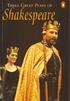 Three Great Plays of Shakespeare Level 4 Retold by Karen Holmes Series Editors: Andy Hopkins and Jocelyn Potter Contents Introduction page Romeo and Juliet l Macbeth 24 King Lear 37 Activities 63 V Introduction
Parenting. Coping with DEATH. For children aged 6 to 12
 Parenting Positively Coping with DEATH For children aged 6 to 12 This booklet will help you to understand more about death and the feelings we all have when someone we care about, like a parent, a brother
Teaching Companion. Romeo and Juliet. Teaching Guide
 Teaching Companion Romeo and Juliet Teaching Guide www.teachingcompanion.com Copyright 2010 Romeo and Juliet Unit Calendar Week 1 Week 2 Week 3 Monday Tuesday Wednesday Thursday Friday Secret Messages
ROMEO AND JULIET. by William Shakespeare PERSONS REPRESENTED
 ROMEO AND JULIET by William PERSONS REPRESENTED Escalus, Prince of Verona. Paris, a young Nobleman, kinsman to the Prince. Montague,}Heads of two Houses at variance with each other. Capulet, } An Old Man,
2. What advice does the doctor send back? That he can find no medical reason for her illness, and he should look for an unnatural reason.
 The Crucible Study Guide Answers Act I: 1. As the play begins, why has Reverend Parris sent for a doctor? His daughter Betty is sick as if in a coma 2. What advice does the doctor send back? That he can
THEME: Jesus sent the Holy Spirit to indwell and empower us.
 Devotion NT285 CHILDREN S DEVOTIONS FOR THE WEEK OF: LESSON TITLE: The Day of Pentecost THEME: Jesus sent the Holy Spirit to indwell and empower us. Dear Parents SCRIPTURE: Acts 2:1-41 Dear Parents, Welcome
THE ART OF ACTING 3: SHAKESPEARE S VERSE. Daniel Foster
 THE ART OF ACTING 3: SHAKESPEARE S VERSE Daniel Foster As most of you know, performing Shakespeare often requires the speaking of verse, usually blank verse, with a rhyming couplet at the end of certain
Macbeth. Sample Analytical Paper Topics
 Macbeth Sample Analytical Paper Topics These analytical papers are designed to review your knowledge of the drama and apply that knowledge to a critical paper. The topics may request that you examine the
THEME: God desires for us to demonstrate His love!
 Devotion NT320 CHILDREN S DEVOTIONS FOR THE WEEK OF: LESSON TITLE: The Gift of Love THEME: God desires for us to demonstrate His love! SCRIPTURE: 1 Corinthians 13:1-13 Dear Parents Welcome to Bible Time
LESSON TITLE: Jesus Heals Blind Bartimaeus
 Devotion NT257 CHILDREN S DEVOTIONS FOR THE WEEK OF: LESSON TITLE: Jesus Heals Blind Bartimaeus THEME: Jesus always has time for us! SCRIPTURE: Mark 10:46-52 Dear Parents Welcome to Bible Time for Kids!
The Balcony Scene Romeo and Juliet Act 2 Scene 2
 Name: Period: Packet#: Oh Romeo, Romeo. The Balcony Scene Romeo and Juliet Act 2 Scene 2 Wherefore art thou Romeo? Oh, wilt thou leave me so unsatisfied?. Annotating The Balcony Scene Romeo and Juliet
BELLSHAKESPEARE ONLINE RESOURCES
 BELLSHAKESPEARE ONLINE RESOURCES SUCH SWEET SORROW THEMATIC CONCERNS OF ROMEO AND JULIET Opposing Forces Opposing forces are found throughout the play. The antithetical language, images of night and day,
Romeo and Juliet Annotated Bibliography. Working Thesis: The connotations associated with light and dark imagery illustrate that an
 Last Name 1 First Name Last Name Ms. Teacher Classics and Composition II: 5 th Hour 3 November 2015 Romeo and Juliet Annotated Bibliography Working Thesis: The connotations associated with light and dark
BASIC CATHOLIC PRAYERS
 BASIC CATHOLIC PRAYERS Sign of the Cross In the name of the Father, and of the Son, and of the Holy Spirit. Amen. The Apostles Creed I believe in God, the Father almighty, creator of heaven and earth.
LESSON TITLE: The Great Commandment. THEME: Love is the fulfillment of the Law. SCRIPTURE: Mark 12:28-34 CHILDREN S DEVOTIONS FOR THE WEEK OF:
 Devotion NT264 CHILDREN S DEVOTIONS FOR THE WEEK OF: LESSON TITLE: The Great Commandment THEME: Love is the fulfillment of the Law. SCRIPTURE: Mark 12:28-34 Dear Parents Welcome to Bible Time for Kids.
Montgomery County Public Schools English 9B Exam Review
 Montgomery County Public Schools English 9B Exam Review June 2013 FORMAT Five Readings an excerpt from a Shakespeare play (not Romeo and Juliet) two poems a narrative a nonfiction article related to the
Macbeth. by William Shakespeare -1-
 Macbeth by William Shakespeare witches also told Banquo that he would be the father of kings. Macbeth, who was already Thane of Glamis, asked the witches why they called him Thane of Cawdor and king; but
Worksheet 7.2: Chapter 7 Freytag s Pyramid
 Worksheet 7.2: Chapter 7 Freytag s Pyramid English Language and Literature coursebook, pages 163 and 166. Figure 7.2 on page 163 of the coursebook is a simple yet fundamental tool for your understanding
Introduction. Slowly, this strange fear grew into horror. Yes, horror. If I tell you why, you will not believe me. You will think I am mad.
 Introduction Slowly, this strange fear grew into horror. Yes, horror. If I tell you why, you will not believe me. You will think I am mad. The Black Cat is one of Edgar Allan Poe s most famous horror stories.
Selection Review #1. Tuck Everlasting. Prologue and Chapters 1-5
 45 Selection Review #1 Prologue and Chapters 1-5 1. Tell how the descriptions of the road and the wood affect the mood or atmosphere of the story. The descriptions of the road and the wood create a suspenseful
Glory be to the Father, and to the Son, and to the Holy Spirit: As it was in the beginning, is now, and ever shall be, world without end. Amen.
 Traditional Prayers The Sign of the Cross. In the name of the Father, and of the Son, and of the Holy Ghost. Amen The Lord's Prayer, or Our Father. Our Father, Who art in heaven, hallowed be Thy name.
Othello Study Guide Questions
 Othello Study Guide Questions Act I 1. Why is Iago angry at Othello? 2. What is revealed about Iago s character when he says, I am not what I am (line 71)? 3. What kind of imagery does Iago use in telling
THEME: We should take every opportunity to tell others about Jesus.
 Devotion NT307 CHILDREN S DEVOTIONS FOR THE WEEK OF: LESSON TITLE: Paul Goes Before Agrippa THEME: We should take every opportunity to tell others about Jesus. SCRIPTURE: Acts 25:13 26:32 Dear Parents
Macbeth. by William Shakespeare -1-
 Macbeth by William Shakespeare witches also told Banquo that he would be the father of kings. Macbeth, who was already Thane of Glamis, asked the witches why they called him Thane of Cawdor and king; but
THEME: God tells us how we can be leaders in His church.
 Devotion NT338 CHILDREN S DEVOTIONS FOR THE WEEK OF: LESSON TITLE: So You Want to Be a Leader? THEME: God tells us how we can be leaders in His church. SCRIPTURE: 1 Timothy 3:1-16 Dear Parents Welcome
THEME: Jesus knows all about us and He loves us.
 Devotion NT224 CHILDREN S DEVOTIONS FOR THE WEEK OF: LESSON TITLE: The Woman at the Well THEME: Jesus knows all about us and He loves us. SCRIPTURE: John 4:1-42 Dear Parents Welcome to Bible Time for Kids!
Precious Pilgrim, Have you ever had a statement that stuck to you? Such has
 Come Holy Spirit May You be glorified through these words, Lord Jesus Precious Pilgrim, Have you ever had a statement that stuck to you? Such has been the case for these words: It is what it i s. Thi s
PUSD High Frequency Word List
 PUSD High Frequency Word List For Reading and Spelling Grades K-5 High Frequency or instant words are important because: 1. You can t read a sentence or a paragraph without knowing at least the most common.
OVERCOMING THE FEAR OF REJECTION Series: Freedom From Your Fears - Part 7 of 10
 Series: Freedom From Your Fears - Part 7 of 10 Proverbs 29:25 Fear of man is a dangerous trap, but to trust in God means safety. (Living Bible) INTRODUCTION Today we're looking at the Fear of Rejection.
Self-imposed Curses Psalm 34:13 - Keep your tongue from evil, and your lips from speaking deceit.
 Power of Your Spoken Words - Sins of the Tongue Introduction: the tongue is powerful and we can use it for good or for evil. (God s word tells us that the power of life and death is in the tongue) We know