
Chapter I Introduction
|
|
|
- Austen Cobb
- 9 years ago
- Views:
Transcription
1

2 INTRODUCTION OVERVIEW 1.1 Rationale of the Study 1.2 to Yoga 1.3 History of Yoga Pre-Classical Yoga Classical Yoga Post-Classical Yoga Modern Period 1.4 Yoga Schools Purna Yoga Jnana Yoga Bhakti Yoga Karma Yoga Raj Yoga Hatha Yoga Kundalini Yoga Mantra Yoga Tantra Yoga 1.5 Patanjali Yoga Sutras Yama Niyama Asana Pranayama Pratyahara Dharana Dhyana Samadhi 1.6 Pranayama 1.7 Major Types of Pranayamas Anulom Vilom Pranayama Bahya Pranayama

3 Bhastrika Pranayama Bhramari Pranayama Digra Pranayama Kapalbhati Pranayama Nadi Sodhana Pranayama Shitali Pranayama Udgit Pranayama Ujjayi Pranayama 1.8 Pranayamas and their Efficacy Autonomic Variables Yoga / Pranayama as Treatment Variables Change in Autonomic Variables Resulting to Autonomic Wellbeing Psychological Wellbeing Physiological/Organic Wellbeing 1.9 Autonomic Nervous System Anatomy of Autonomic Nervous System Sympathetic Division Parasympathetic Division Sensory Neurons Motor Neurons Functions of Sympathetic and Parasympathetic Divisions Sympathetic Nervous System Parasympathetic Nervous System 1.10 Pranayama and Autonomic Nervous System 1.11 Statement of the Problem 1.12 Objectives of the Study 1.13 Delimitations of the Study 1.14 Limitations of the Study 1.15 Hypotheses of the Study 1.16 Definitions and Explanations of the Related Terms 1.17 Significance of the Study

4 CHAPTER I INTRODUCTION 1.1. Rationale of the Study In this era every man is busy. He wants to earn more and more money to enjoy all the luxury facilities to become rich and able to lead a happy life. It is well known to all that health is wealth moreover, good health is our prime factor of prosperity. When we are having good health or harmonious fitness, only then we will be able to enjoy all the modern luxury facilities. It means every person should do something for keeping oneself fit and healthy. The need of understanding and practice of art and science of wellbeing for modern lifestyle is of paramount importance. 1 Today s life is full of stress and strain, of tension and nervousness, of irritability, hurry and excitement. There are so many ways and means to keep one healthy and physically fit in this scientific era such as playing games and sports, aerobic exercises, weight training, dancing, gymnastic exercise, slimming exercises, yoga etc. Due to the busy schedule in this competitive era an individual can spare a little time for these physical fitness means. What we needed is a system of exercises which will help in the all round development of the body, mind and personality. A good system of exercise should help the body to resist disease. Such exercises should be capable of being practiced by men and women, children and old persons, by the healthy and the sick. The exercise system should non-tiring yet invigorating, and it should suit the rich and the poor. If anyone puts into practice a few of the elementary principles of yoga he will be far better equipped to cope with his complex existence. 2 Yoga is capable to bring about natural changes in every single individual in the world and that would be a great revolution indeed. It offers us a conscious process to solve such problems as depression, unhappiness, restlessness, emotional conflicts, hyper activity etc. It helps to evoke the hidden potentialities of human beings in a systematic 1 2 Y.P. Yadav and Rachna Yadav, Art of Yoga, New Delhi: Friends Publications,1998, p.7. Amaldas Brahmachari, Yoga and Contemplation, Shantivanam Ashram, Tahnirpalli, Tiruchirappaili, Tamilnadu India, 1994, p. 17.

5 and scientific way so that the human being can rise intellectually, face the challenges of the modern technological era with its hectic speed and live happily without frustration. 3 Thakur and Babdopadhyay 4 compared yoga asanas and gymnastic activities on self-concept and attitude among school going boys. One hundred fifty (150) male school children of District Howrah, West Bengal State were randomly selected as subjects for the conducted study. The age limit of the subjects was from 10 to 12 years. All the subjects were divided into three equal groups such as Y, G and C. Group Y (yoga asanas group) and group G (gymnastic group) were experimental groups and group C was control group. The result of the study showed that yoga asanas group was superior to gymnastics group and control group and gymnastic group was also superior to control group. Shome and Bannerjee 5 made an attempt to observe the improvement occurring in the psychological variables following aerobic and yoga practices among the adolescents. The purpose of the study was to evaluate acute psychological (intelligence, interest, memory and reaction time) responses to hatha yoga asana (poses), aerobic dance and combined (hatha yoga and aerobic dance). 120 subjects (12 to 16 years) were recruited and randomized to four groups. Experimental subjects completed a six week supervised exercise program. Control subjects continued usual activity. Three experimental groups were practiced thrice a week and 30 minutes per day. It was supervised that hatha yoga, aerobic dance, combined groups increased intelligence, interest, memory and reaction time but it showed that combined group (yoga and aerobic) is better than all the other groups. Hence, combination practices with yoga are suggestable. The calming effects of savasana, yoga nidra, and pranayama have been widely studied and reported. The effects of these practices provide a great service to many yoga Amaldas Brahmachari, Yoga and Contemplation, Shantivanam Ashram, Tahnirpalli, Tiruchirappaili, Tamilnadu India, 1994, p. 17. Kuntal Thakur and Kanchan Bandopadhyay, A Comparative Study of Yogasana and Gymnastic Activities on Self- Concept and Attitude of School Going Boys, Proceedings: India International Congress in Sports Psychology, LNUPE, Gwalior, India, 2009, M. Shome and K. Banerjee, Effect of Hatha Yoga and Aerobic Dance Practice on Selected Psychological Variables of Adolescent Girls, Proceedings: India International Congress in Sports Psychology, LNUPE, Gwalior, India, 2009,

6 aspirants by giving them a short-term time out from stress, and also by creating positive physiological changes in bodily systems (including the nervous system). In yoga, one can practice repetition to change deeply embedded physical, psychological, or emotional patterns. One can use repetition in meditation to observe and understand the behavior patterns, and then create new ones. Imagine the profound and lasting effects that could result from changing these deeper patterns that affect the way we view ourselves, others, and the world. 6 Joshi, Joshi and Gokhale, 7 assessed the effect of short term pranayama practice on breathing rate and ventilatory functions of lung. Thirty three normal male and forty two female subjects, of average age of 18.5 years, underwent six weeks course in pranayama and their ventilatory lung functions were studied before and after this practice. They had improved ventilatory functions in the form of lowered respiratory rate (RR) and increases in the forced vital capacity (FVC), forced expiratory volume at the end of 1 st second (FEV1%), maximum voluntary ventilation (MVV), peak expiratory flow rate (PEFR- lit/sec) and prolongation of breath holding time. A study was done by Subbalakshmi Saxena et al. 8 on immediate effect of nadi shodhana pranayama on some selected parameters of cardiovascular, pulmonary and higher functions of brain. The conducted study suggests that the nadi-shodhana pranayama rapidly alters cardiopulmonary responses and improves simple problem solving. Yoga is the most popular and adopted form of physical activity for all the ages and sex worldwide. Similar trends have been observed in India. Hence, its needs to be evaluated time to time to sustain the motivation as one of the most accepted way of active lifestyle. Before conducting any research in yoga/pranayamas, an understanding of yoga/pranayamas is important L.N. Joshi, V.D. Joshi and L.V. Gokhale, Effect of Short Term Pranaym Practice on Breathing Rate and Ventilatory Functions of Lung, Indian Journal of Physiology and Pharmacology, 1992, 36(2) : N.K. Subbalakshmi, S.K. Saxena, Urmimala and Urban J.A. D Souza, Immediate Effect of Nadi Shodhana Pranayama on Some Selected Parameters of Cardiovascular, Pulmonary,and Higher Functions of Brain, Thai Journal of Physiological Sciences, Aug 2005, 18 (2):10-16 ISSN

7 1.2. to Yoga Yoga is commonly known as a generic term for a physical, mental and spiritual discipline originating in ancient India 9, 10 and found in hinduism, buddhism, jainism and sikhism. 11,12,13 The sanskrit word yoga has the literal meaning of yoke, from a root yuj meaning to join, to unite, or to attach. As a term for a system of abstract meditation or mental abstraction it was introduced by Patañjali in the 2nd century BC. Someone who practices yoga or follows the yoga philosophy with a high level of commitment is called a yogi or yogini. 14 Yoga is one of the six orthodox schools in hindu philosophy. 15 For ages past, our yoga rishis had great knowledge about the body, the emotions and the mind and their functions. In our ancient sanskrit writings, we have anatomical terms for all of the body parts known today and an incredible insight into the physiological functions of the body as well as the effect emotions and the mind have on the same body. Yoga, which means union or oneness, is the original holistic concept now popularly advised by science and religion alike to return man to his original pristine clarity of mind, purity of emotions and cleanliness of body and environment. 16 Yoga is a science and its practice must be approached with the dedication of an alert, aware, conscious scientist. The aim of yoga is the development of integrated balance between body and mind. 17 This is done by attaining the highest state of consciousness through various methods and techniques. Yogic discipline aims at increasing the internal awareness from the gross body to the level of pure consciousness Sherri Baptiste and Megan Scott, Yoga with Weights for Dummies, Wiley publication, 2006, 12(16) p.325 ISBN Yogani, Advanced Yoga Practices Easy Lessons for Ecstatic Living, Nashville,Tennessee, U.S.A and London, England, U.K, 2010, 2, p.50isbn Denise Lardner Carmody and John Carmody, Serene Compassion, Oxford University Press US, 1996, p. 68. Stuart Ray Sarbacker, Samādhi: The Numinous and Cessative in Indo-Tibetan Yoga, SUNY Press, 2005, pp Shrut Ratnakar, Tattvarthasutra Manu Doshi Translation of Tattvarthasutra, Ahmedabad, 2007, 6(1), p American Heritage Dictionary at /org of yoga. Yogamaharishi Dr. Swami Gitananda Giri Guru Maharaj, Yoga and Physiological Functions, a talk presented to the Association of Physiologists and Pharmacologists of India, Pondicherry Branch., Ibid. 4

8 In short, it ultimately results in making the personality totally integrated and balanced. This concept is beautifully stated in Bhagavat Gita 18, 19 Samatvam Yoga Uchyate (evenness of mind is called YOGA) History of Yoga Yoga s history has many places of obscurity and uncertainty due to its oral transmission of sacred texts and the secretive nature of its teachings. The early writings on yoga were transcribed on fragile palm leaves that were easily damaged, destroyed or lost. The development of yoga can be traced back to over 5,000 years ago, but some researchers think that yoga may be up to 10,000 years old. 20 Several seals discovered at indus valley civilization 21 sites and the standing deities on the seals which shows kayotsarga 22 (a standing posture of meditation) position. Some type of connection between the indus valley seals and later yoga and meditation practices is speculated upon by many scholars, though there is no conclusive evidence. 23 Yoga s long rich history can be divided into four main periods of innovation, practice and development Pre-Classical Yoga The beginnings of yoga were developed by the indus- sarasvati civilization in Northern India over 5,000 years ago. The word yoga was first mentioned in the oldest sacred texts, the rig veda. The Vedas were a collection of texts containing songs, mantras and rituals to be used by the vedic priests. Yoga was slowly refined and developed by the brahmans and rishis (mystic seers) who documented their practices and beliefs in the upanishads, a huge work containing over 200 scriptures. The most renowned of the yogic scriptures is the Bhagavad- Gita, composed around 500 B.C.E MV. Rajapurkar, Pranayama - Modulator of Cerebral Functions (Ahypothesis), Yoga Mimamsa, Jan 1999, 33(4): A.C. Bhaktivedanta Swami Prabhupada, Bhagavad-Gita As It Is, Bhaktivedanta Book Trust International, Ch. II.48, Jonathan Mark Kenoyer, Around the Indus in 90 Slides, Possehl, 2003, pp of yoga, Mohen-jo-Daro: Sindh 5000 Years Ago in Modern Review, August, Karel Werner, Yoga and Indian Philosophy, Motilal Banarsidass Publ., 1998, p ISBN

9 The upanishads took the idea of ritual sacrifice from the vedas and internalized it, teaching the sacrifice of the ego through self-knowledge, action (karma yoga) and wisdom (jnana yoga) Classical Yoga In the pre-classical stage, yoga was a mishmash of various ideas, beliefs and techniques that often conflicted and contradicted each other. The classical period is defined by Patanjali s Yoga-Sûtras, the first systematic presentation of yoga. Written sometime in the second century, this text describes the path of raja yoga, often called classical yoga. Patanjali organized the practice of yoga into an eight limbed path containing the steps and stages towards obtaining samadhi or enlightenment. Patanjali is often considered the father of yoga and his yoga-sûtras still strongly influence most styles of modern yoga Post-Classical Yoga A few centuries after Patanjali, yoga masters created a system of practices designed to rejuvenate the body and prolong life. They rejected the teachings of the ancient vedas and embraced the physical body as the means to achieve enlightenment. They developed tantra yoga, with radical techniques to cleanse the body and mind to break the knots that bind us to our physical existence. This exploration of these physical-spiritual connections and body centered practices led to the creation of what we primarily think of yoga in the west: hatha yoga Modern Period Yoga came to the attention of an educated western public in the mid 19th century along with other topics of hindu philosophy. The first Hindu teacher to actively advocate and disseminate aspects of yoga to a western audience was Swami Vivekananda, who toured Europe and the United States in the 1890s. 28 In the late 1800s Ibid. Ibid. Eric. Shaw, 35 Moments, Yoga Journal,

10 and early 1900s, yoga masters began to travel to the west, attracting attention and followers. This began at the 1893 Parliament of religions in Chicago, when Swami Vivekananda wowed the attendees with his lectures on yoga and the universality of the world s religions. In the 1920s and 30s, hatha yoga was strongly promoted in India with the work of T. Krishnamacharya, Swami Sivananda and other yogis practicing hatha yoga. Krishnamacharya opened the first hatha yoga school in Mysore in 1924 and in 1936 Sivananda founded the divine life society on the banks of the holy ganges river. Krishnamacharya produced three students that would continue his legacy and increase the popularity of hatha yoga: B.K.S. Iyengar, T.K.V. Desikachar and Pattabhi Jois. Sivananda was a prolific author, writing over 200 books on yoga, and established nine ashrams and numerous yoga centers located around the world. The importation of yoga to the west still continued at a trickle until Indra Devi opened her yoga studio in hollywood in Since then, many more western and Indian teachers have become pioneers, popularizing hatha yoga and gaining millions of followers. Hatha yoga now has many different schools or styles, all emphasizing the many different aspects of the practice. The different yoga schools simply adhere to different applications of inner discipline, all of which ultimately lead to the liberation of the soul and to a unique understanding of the divine unity. 29 In the west, the term yoga is today typically associated with hatha yoga and its asanas (postures) or as a form of exercise. 30 In the 1960s, western interest in Hindu spirituality reached its peak, giving rise to a great number of Neo-Hindu schools specifically advocated to a western public. Among the teachers of hatha yoga who were active in the west in this period were B.K.S. Iyengar, K. Pattabhi Jois and Swami Vishnu- Devananda and Swami Satchidananda. 31,32, Elizabeth De Michelis, A History of Modern Yoga, Published by Continuum, 2005, p.234. Cushman Cushman, The New Yoga, Yoga Journal.com, Jan/Feb 2000, lifestyle/ 281. Retrieved Mira Silvaand Shyam Mehta, Yoga the Iyengar Way, Alfred A. Knopf, New York 1995, p. 9. ISBN T. K. V. Desikachar, Health, Healing and beyond: Yoga and the Living Tradition of Krishnamacharya, (cover jacket text). Aperture, USA,2005, ISBN

11 1.4. Yoga Schools New schools of yoga were introduced in the context of hindu revivalism towards the end of the 19th century. 34 The schools are merely named according to the yogi`s objective of self-transformation and the instrument chosen for such anticipated change. The yoga schools are: Purna Yoga Ashtanga yoga and it s different variations, for the most part, aim at the fullest development of any one human faculty the mind, emotions, life-force or the physical body. Such partial perfection is then allowed to spill over to one s entire being. But Sri Aurobindo s purna yoga or integral yoga focuses on the whole being in order to bring about total transformation. The approach, objective and means of purna yoga are all integral in essence. The main stages of purna yoga are: (1) aspiration for the divine (2) surrender of the individual soul to the universal soul (3) rejection of all obstructions to the path of total transformation. Realizing the divine within oneself is the first step of integral yoga. The means of achieving this state of divine awareness is through a regular practice of concentration, meditation or prayer. The next step involves the realization of the divine in entities beyond the subjective self. A realization of all constituent consciousnesses of the universe - an acceptance of a common origin of all beings. The third stage consists of a true identification with the transcendental divine, which is neither limited within the being of a single individual nor within any other constituents of existence Jnana Yoga This terminology involving various yogas has given rise to the concept of the four yogas in modern Hinduism from the 1890s. The term yoga ceases to translate to a system of meditation and takes on the much more general sense of religious path. Thus, jnana yoga is the path of knowledge, as alternative possibilities towards Ibid. 8

12 religious fulfillment. 37 Jnana refers to knowledge but the emphasis is not on acquiring information but on developing the analytical powers of the mind. The manner in which the power of analysis is applied depends on the metaphysical system within which it is practiced. In the samkhya system of Indian philosophy, the focus is on understanding one s own inner self. In advaita vedanta (non-dualist vedanta philosophy), the idea is to understand the difference between reality and illusion Bhakti Yoga The bhakti movement was a development in medieval Hinduism advocating the concept of a personal God (or supreme personality of godhead ), initiated by the Alvars of South India in the 6th to 9th centuries, and gaining influence throughout India by the 12th to 15th centuries, giving rise to sects such as Gaudiya Vaishnavism. 39 The Bhagavata Purana is an important text of the bhakti movement within Vaishnavism. It focusses on the concept of bhakti (devotion to god) in the theological framework of Krishnaism. Madhusudana Sarasvati divided the Gita into three sections, the middle six with bhakti yoga. 40 Bhakti yoga is all about getting in touch with the divine being by following the outpourings of one`s heart. The term bhakti can be roughly translated to mean devotion, and this emotion coupled with the christian concept of faith leads to a state of mind which can be described as being immersed in bhakti. This strand of yoga principally advocates love and devotion as the path to moksha or liberation Karma Yoga The term yoga ceases to translate to a system of meditation and takes on the much more general sense of religious path. Thus, karma yoga is the the path of action, as alternative possibilities towards religious fulfillment. 42 Originally, it was believed that the practice of karma yoga, accompanied by the observance of certain Norman Cutler, Songs of Experience, Indiana University Press, 1987, pp. 1. ISBN A.C. Bhaktivedanta Swami Prabhupada, Bhagavad-Gita As It Is, by courtesy of the Bhaktivedanta Book Trust International, Ch. II,48,

13 rituals, would lead to liberation from the cycle of birth and death. In the Bhagavad Gita, lord Krishna further extended the semantics of the term karma to mean detached action, that is, subjugation of the individual will to divine purpose. According to the Bhagavad Gita, these three different paths of yoga (jnana, bhakti and karma) help to define three different categories of men- reflective, emotional and active, respectively- distinguished on account of the distribution of emphasis on the theoretical, emotional and practical aspects of human personalities Raja Yoga Raja yoga or ashtanga yoga, which was formulated by Patanjali into a definite system from classical yoga, forms one of the shad-darshanas or classical systems of Indian philosophy. The school of raja yoga prescribes to a particular meditative system, which focuses on the analysis and control of the field of human consciousness. Often known as the royal road or the royal path ( raja in sanskrit denotes king or royal ), it offers a comprehensive method for controlling waves of thought by channeling mental and physical energies into spiritual energy Hatha Yoga The earliest definition of hatha yoga is found in the 11th century Buddhist text Vimalaprabha, which defines it in relation to the center channel, bindu etc. 45 Hatha Yoga, sometimes referred to as the psychophysical yoga, 46 was further described by yogi Swatmarama, compiler of the hatha yoga pradipika in 15th century India. Hatha yoga differs substantially from the raja yoga of Patanjali in that it focuses on shatkarma, the purification of the physical body as leading to the purification of the mind ( ha ), and prana, or vital energy (tha). 47,48 Compared to the seated asana, or sitting meditation Ibid. James Mallinson, Sāktism and Hathayoga, 6 March <URL> [accessed 10 June 2012] p. 2, resources/saktismhathayoga. James A Raub, Psychophysiologic Effects of Hatha Yoga on Musculoskeletal and Cardiopulmonary Function: A Literature Review, p.65, Christy Turlington, Living Yoga: Creating a Life Practice, p Nancy Gerstein, Guiding Yoga s Light: Yoga Lessons for Yoga Teachers, p

14 posture, of Patanjali s raja yoga, 49 it marks the development of asanas (plural) into the full body postures now in popular usage and, along with its many modern variations, is the style that many people associate with the word yoga today. 50 Hatha yoga exercises have resulted in severe bodily dysfunction or injury. Practitioners suggest that this is primarily the case when individuals push themselves or are pushed beyond what their physical condition will support. 51 The school of hatha yoga attaches a lot of importance to the perfect physical form, believing it to be a way of attaining spiritual perfection. And to this end it takes the help of pranayama (breath-control exercises) and mudras (hand gestures) to attain self-realization. Often seen as part of raja yoga, the origins of hatha yoga can be traced to Gorakhnath, the 12th-century founder of the kanphata yogis. The word hatha is derived from the two root terms, ha meaning the sun and tha meaning the moon. Taken together, the term stands for union of force. Hence, central to hatha yoga disciplines is the harmonizing of its positive (sun) and negative (moon) currents Kundalini Yoga Kundalini is the potential form of prana or life force, lying dormant in our bodies. It is conceptualized as a coiled up serpent (literally, kundalini in sanskrit is coiled up ) lying at the base of our spine, which can spring awake when activated by spiritual disciplines. The practitioners of kundalini yoga concentrate on psychic centers or chakras in the body in order to generate a spiritual power, which is known as kundalini energy. The practice comprises of awakening and then forcing this energy, flowing through nadis or channels, up the psychic channel of the sushumna, which runs from the base of the spine to the brain. The three main channels running alongside the spinal cord are ida, pingala and the sushumna. When this kundalini energy, pictured as the serpent residing in the first chakra at the root of the spine (muladhar chakra), is Frank Jude Boccio, Mindfulness Yoga: The Awakened Union of Breath Body and Mind, p.6, www. wikipedia.org. Georg Feuerstein, The Shambhala Guide to Yoga, Boston and London: Shambhala Publications, Inc. 1996, p. 56. William J. Broad, How Yoga Can Wreck Your Body, New York Times, January 5,

15 raised up through the rest of the chakras until it reaches the seventh and the highest chakra (sahasrara) located at the crown of the head self-realization occurs. This induces the blissful state of samadhi. The school of sahaja yoga is very similar to the kundalini school. 53 About kundalini yoga there are numerous literature references. 54, Mantra Yoga Mantra yoga refers to the repetition of mantras (words or sounds) during various yoga meditation techniques. This ritualistic chanting helps bind the mind to a single thought until it attains the state of samadhi Tantra Yoga The roots of tantra yoga go back to ancient fertility cults of India. The history of this strain of yoga, like the kundalini school, is linked with the worship of shakti, the primordial female energy. The objective of tantra yoga is to merge with the ultimate by the arousal and channeling of sexual energy.the tantra school equates spiritual awakening with the awakening and rising of the kundalini power. According to tantra, the kundalini is present in everything, even in the smallest of particles, in the form of cosmic energy. Only a fraction of it is operative, while an unmeasured residuum is left coiled up and untapped at the base root. 57 Patanjali systematized the various yogic practices and traditions of his times by encapsulating them in the form of aphorisms in his yoga sutra. In this momentous work, he describes the aim of yoga as knowledge of the self and outlines the eight steps or methods of achieving it Yogi Svatmarama, Hatha Yoga Pradipika, Motilal Banarsidass Publishers Private Limited, Delhi, 2008, p.95. Swami Prabhavananda and Chrisopher Isherwood, Patanjali Yoga Sutras, Sri Ramakrishna Math Publishers, 2001, p Ibid. Nalini Sharma and Shri Ram Sharma, Holistic Insight into Health Promotion and Healing in Yoga, Journal of Clinical and Diagnostic Research [serial online] February 2008, [cited: 2008 Feb 4]; 2: , Available from and year=2008andmonth= February andvolume =2and issue= 1andpage= andid=

16 The aim of yoga is to keep the health intact and to cure the diseases of human being. Yoga promotes the four dimensions to remain in most natural or original state. As yoga on one hand, affects the human body promoting the physical health, it also affects senses, the psyche and soul, promoting the mental health on the other hand. Hence the approach of yoga towards health is psychosomatic Patanjali Yoga Sutras Following are the eight limbs or steps prescribed in the second pada of the yoga sutras 60 : Yama Code of conduct self-restraint Niyama religious observances commitments to practice, such as study and devotion Asana integration of mind and body through physical activity Pranayama regulation of breath leading to integration of mind and body Pratyahara abstraction of the senses, withdrawal of the senses of perception from their objects Dharana concentration, one-pointedness of mind Dhyana meditation (quiet activity that leads to samadhi) Samadhi the quiet state of blissful awareness, superconscious state Yama, niyama, asana, pranayama, pratyahara, dharma, dhyana, samadhi. Although all the eight subdivisions are health promoting, yet out of them, yama, niyama, asana and pranayama are more important in this prospect where as pratyahara, dharma, dhyana and samadhi are more of spiritual importance. Yama, niyama, dhyana etc are more concerned to mental health while asana, pranayama are concerned with physical health Nalini Sharma and Shri Ram Sharma, Holistic Insight into Health Promotion and Healing in Yoga, Journal of Clinical and Diagnostic Research [serial online] February 2008, [cited: 2008 Feb 4]; 2: , Available from and year=2008andmonth= February andvolume =2and issue= 1andpage= andid= Nalini Sharma and Shri Ram Sharma, Holistic Insight into Health Promotion and Healing in Yoga, Journal of Clinical and Diagnostic Research, [serial online] February

17 1.6. Pranayama Patanjali, foremost exponent of yoga, described pranayama as the gradual unforced cessation of breathing. Pranayama is derived from two sanskrit words- prana (life) or yama (control). Pranayam or control of prana or life force yields heart beat pulse and mind control. 62 The process of pranayama involves systematic and disciplined inspiration and expiration with retention of breath or holding of breath in specific proportion and specific manner. 63 In ancient Indian yoga books, lots of pranayamas are described to various benefits. These are bhastrika, kapalbhati, bahya, anuloma viloma, bhramari, udgeeth, ujjayi, sheetali, deergha, nadi shodhana, etc Major Types of Pranayamas 65 Some major types of pranayama yoga are as follows: Anulom Vilom Pranayama Bahya Pranayama Bhastrika Pranayama Bhramari Pranayama Digra Pranayama Kapalbhati Pranayama Nadi Sodhana Pranayama Shitali Pranayama Udgit Pranayama Ujjayi Pranayama The procedure of the selected pranayamas has been discussed as following Sri Paramhansa Yogananda, God Talks with Arjuna. The Bhagavad Gita Royal Science of God- Realization, The Immortal Dialogue between Soul and Spirit, A New Translation and Commentary, 2002, chapter IV Verse 29 pp Nalini Sharma and Shri Ram Sharma, Holistic Insight into Health Promotion and Healing in Yoga, Journal of Clinical and Diagnostic Research, [serial online] February 2008 [cited: 2008 Feb 4 ]; 2: , Available from andyear=2008andmonth= Februaryandvolume =2and issue= 1andpage= andid=

18 Following steps instruct on how to perform the nadi sodhana pranayama: Sit down in a comfortable place assuming a cross legged position. Now use your thumb (right hand) to close the right side of your nose. Inhale deeply using the left nostril. Now close the left nostril and exhale using the right one. In the same way, now with the left nostril still closed, inhale using the right nostril and exhale with the left one. You can continue doing this exercise for around 10 to 15 times. 66 Another pranayama called bhramari (also known as the bumble bee breath or the humming breath) has been said to vibrate the brain, in particular the pineal gland to produce more melatonin. In experiments conducted by this author on bhramari and melatonin, this has not found been to be true. Bhramari does, however produce measurable benefits in health and well being in pregnancy and childbirth. This has been shown in Indian studies with several hundred women having less complications, less episiotomies, higher birth weights and less interventions overall. 67 Another Indian study showed numerous benefits in surgical patients with shorter healing times, less infections, less anaesthetic and less post operative problems overall. 68 There is ample evidence that bhramari works as a stress reducer and is very effective for stressed business people and corporate high achievers. There is just no evidence to show that bhramari works by vibrating the brain, however it does affect the heart by slowing it down and having a calming effect on stressed people. 69 The soft palate must be lifted toward the top of the pharynx sufficiently to produce flutter which may be very hard to control. The sound produced is commonly described as similar to the buzzing of a bee. Although, in bhramari, one breathes both in and out through both nostrils, producing a snoring, buzzing or humming sound in both directions. The sound your produce may somewhat be different, inhaling produces a sound with a higher pitch than exhaling which has a lower pitch. Bhramari is customarily described to involve rapid inhalation that produces a high humming sound V. Singh., The Role of Bhramari in Pregnancy, Yoga, Sivananda Math India, 1995, 6 (1) pp V. Singh., The Role of Bhramari in Surgery, Yoga, European Edition, Swan Graphics, London, December 1994, 28, pp Autonomic Nervous System at Dorland s Medical Dictionary. 15

19 like that of a male bee and slow exhalation that produces a low humming sound like that of a female bee. 70 Kapalbhati of course dates back to the yoga sutras of Sage Patanjali, but recently its popularity has been revived by the work of Ramdev Swamiji. Kapalbhati is part of Ramdev Swamiji s set of six pranayamas and the practice of this set has spread like wildfire across India as well as the rest of the world. 71 To practice this breathing exercise sit up in a comfortable position, cross legged is best. Elongate your spine upwards, lengthen your neck and subtly bring your chin back and in like a soldier at attention. This will align the spine with the back of your head. Close your eyes. Have your hands in gyan mudra. In gyan mudra have your thumb tips and index finger meeting, with the wrists resting gently on the knees and the palms turned slightly upwards. Relax your stomach muscles. Now expel the air as forcefully as you are comfortable with through the nose. This should cause the abdominal muscles to contract sharply and should draw the abdomen inwards towards the spine (like when you suck in your stomach). Then allow the inhalation to occur completely passively without any additional effort. To repeat, the exhalation is done using conscious sharp force, while the inhalation is just a recoil action bringing the air back into the lungs. All the breathing takes place through the nose. Right after the passive inhalation, exhale again forcefully and continue at a steady rhythm. Do a round of 10 repetitions. Work your way up to doing 5 rounds, while taking a break between each round. Unlike doing bhastrika Yoga pranayama you use force during both the inhalation and the exhalation, in kapalbhati force is only to be used during the exhalation. 72 Once you feel comfortable with the beginner s version of kapalbhati yoga pranayama, perform the breathing exercise with more force if possible and also increase the number of repetition per round to 50. You may also prefer to do a single round, but, with many more repetitions instead (up to five minutes worth) build up to doing this Kapalbhati Yoga Breathing Exercise for Optimum Health and Healing, Free Online Pranayama Book, Ch V, Ibid. 16

20 pranayama for 15 minutes straight or equivalent number of rounds with more repetitions per rounds. 73 Anulom pranayama is a type of pranayama. Anulom in sanskrit means alternate. It is one of the easier types of pranayama, and can be practiced without expert guidance. Anulom pranayama is breathing through alternate nostrils of the nose. It is otherwise known as nadi shuddhi pranayama or nadi shodhona pranayama. It is practiced by sitting in any asana, such as sukhasana, vajrasana or padmasana. Alternate nostrils are closed, generally by using the right hand s thumb, ring finger, and little finger. The thumb is used for closing the right nostril and the ring and little fingers are used to close the left nostril. The mouth is closed, and is not used for breathing. No sound should be produced while inhaling or exhaling. The cycle of practice is: The right nostril is closed with the thumb. Air is exhaled through the left nostril, and inhaled back through the same nostril. The left nostril is closed with the ring finger. Air is exhaled through the right nostril, and inhaled back through the same nostril. 74 This is repeated at a normal breathing rate. It is advisable to have an inhale : exhale ratio of 1 : 2. Changing nostril after exhaling is considered wrong. Many health benefits are claimed for this pranayama. 75 It is advisable to practise single nostril breathing before doing this pranayama. This pranayama can also be practiced with breath retention (kumbhaka), after a long practice of the ordinary one. The inhale : retention : exhale ratio must be 1:4:2. 76,77 Agnisar Kriya is a cleansing technique draws its name from the words agni (fire), Sar (essence) and kriya (action). Fire is the essential element of digestion and this cleansing action stimulates this fire for the digestive system to work at its optimum level. In this, while standing bend slightly forward from the waist while keeping the back straight. Take support by resting your hands on your knees or just above so that the back is not strained. Please make sure the arms are straight Kapalbhati Yoga Breathing Exercise for Optimum Health and Healing, Free Online Pranayama Book, Ch V, Ibid. Ibid. M.M. Gore, Anatomy and Physiology of Yogic Practices, Kanchan Prakhan, 2003, pp

21 Now, breathe in deeply. After this, exhale fully contracting the abdomen and lungs so that all the air is expelled. While holding breath in this position, contract or flap your abdominal muscles in and out. Note that this should be done rapidly while holding the exhaled position without inhaling. Do this as many times possible and then take a slow, deep breath inside. This is one round of the practice. Beginners may find that they lose control of the abdominal muscles and are unable to coordinate the flapping movement. These muscles must be slowly developed over time. Therefore, in the beginning three such rounds, each of ten flapping cycles are more than enough. This should gradually be built up to 100 inward-outward flapping cycles in each round. Time: This practice should be done on an empty stomach but after evacuating the bowels. People with high blood pressure, heart disease or internal ulcers of any kind should avoid this. Also, people with hyperthyroidism or chronic diarrhea should avoid this. 79 Shitali Pranayama: Sheetal also means cool, and this pranayama technique will help you achieve the same. To perform shitali pranayama, be seated in a comfortable position. Cross your legs and take five to six deep breaths to get yourself prepared. Now open your mouth in a o shape and start to inhale through the mouth. When you exhale, do so with your nose. This can be repeated five to ten times. 80 Ujjayi Pranayama: Ujjayi means the ocean and this pranayama is about mimicking the oceanic sound or the sound of the waves. To do this, be seated in a comfortable position crossing your legs. Now start to inhale and exhale deeply using your mouth. While doing this, constrict your throat as if something is choaking it when you exhale and inhale the air. This will produce a sound similar to the ocean when you breath. Now close your mouth and start to breath using your nose, but maintain the same tone to your throat so you still continue to make the same sound as your breath. 81,82,83 You can repeat this prayanama breathing exercise for about ten to fifteen times Ibid. M.M. Gore, Anatomy and Physiology of Yogic Practices, Kanchan Prakhan, 2003, pp Swami Kuvalyananda, Pranayama, Kavailyadhama, 2005, pp
22 The dirga pranayam is a bit different from other types as it involves lying down on your back instead of being in a seated position. This technique involves very deep inhalation and exhalation. To perform this panayama, lie down on your back and close your eyes. Breath normally and then slowly take deep breaths, relaxing your body. Now inhale a lot of air in slowly to fill your belly up. Your belly should rise up like a balloon. Hold this position for a few seconds and exhale drawing the belly inwards ensure there is no air left. In the second step, inhale deeply to fill up the belly. Inhale a bit more to fill up air in your rib cage. When you exhale, exhale air from your rib cage and then from your belly. In the third step, inhale deeply to fill up your belly and rib cage with air. Inhale a bit more to fill up your heart center (area around the heart) with air. When you exhale, exhale air from the heart center, then the rib cage and then the belly. Repeat the whole process for five to six times Pranayamas and their Efficacy To make a breakthrough in the field of research of effects of pranayama have to be studied extensively. By learning to control your breath, you can gain control over your emotions and other mental states as well. Becoming aware of our breath, we gradually become more sensitive to our mind and to the flow of energy throughout the body and a stronger energy awareness develops within us. How you breathe also affects the heart, brain and nervous system, with a direct correlation between the breath and anxiety or well-being. When stressed, the breath is shorter, more frequent and quite shallow. This breathing pattern maintains a level of arousal. Slower and deeper breathing results in a more relaxed state via autonomic reflexive stimulation and decreases the partial pressure of carbon dioxide in the lungs and bloodstream. With a corresponding increase in the ph of the blood, it becomes less acidic and more effective blood oxygen synthesis occurs. There are also benefits in metabolism and brain function. For example, levels of noradrenalin, a compound that functions as a hormone and as a neurotransmitter in the nervous system, actually increase with a deeper breath A Jr Stancak and M Kuna, EEG Changes during Forced Alternate Nostril Breathing, Int-J- Psychophysiol, Oct 1994, 18(1):
23 Although some yoga teachers don t even teach breath control, many teach specific breathing techniques that go with specific physical or mental practices, while others use more generalized breathing techniques in more general situations. Anecdotal and subjective feedback indicates that different patterns of breathing are promoted as being beneficial, sometimes with various esoteric and medical claims being ascribed to these techniques. While some yogic breathing and pranayama practices have been scientifically investigated, no study to date has fully described and cross-correlated the differential effects on the brain and cardiac-autonomic nervous systems of the all the main breathing techniques commonly practised in yoga classes today. We hope to uncover techniques that may be of use or perhaps even avoided in the treatment of certain illnesses. 86 Nadi shodhan pranayama (alternate nostril breathing) affects brain hemisphericity by alternately stimulating the right-brain and then the left-brain. This process is brought about by the action of the air flowing through the nostrils that stimulates the contra-lateral (opposite) side of the brain via nerve endings just underneath the mucous layer inside the nostrils. Each side of the body is governed by nerves originating in the opposite side of the brain, and so stimulating airflow in one nostril increases nervous activity in the brain on the opposite side to that nostril. Because each side of the brain specialises in different activities and processes, the autonomic nervous system is also correspondingly stimulated and relaxed via this pranayama. 87 Increasing the flow of air in the right nostril stimulates the sympathetic nervous system and increases the heart rate, produces more sweaty palms, dilates the pupils and opens up the lungs i.e. the fight or flight reaction. Increasing the flow of air through the left nostril however, stimulates the parasympathetic nervous system and increases digestion, lowers the heart rate and relaxes the body. So by practising nadi shodhan pranayam, we are helping to balance both of these systems in relation to each other as well as balancing brain activity A Jr Stancak and M Kuna, EEG Changes during Forced Alternate Nostril Breathing, Int-J- Psychophysiol, Oct 1994, 18(1): Ibid. D Shannahoff - Khalsa and B. Kennedy, The Effects of Unilateral Forced Nostril Breathing on the Heart, Int-J-Neurosci., Nov 1993, 73(1-2):
24 Nadi shodhan is a powerful practice that may be taught incorrectly by teachers that are unaware of the subtle nature of this practice says researcher Philip Stevens who has researched the physiology of this practice and traveled widely running seminars educating people about the neurological effects of various yoga practices above and beyond the physical benefits. Many yoga teachers teach this practice in a manner that is handed down from teacher to student without questioning the validity of the technique. For example, people are often taught to press the nare (side of the nose) into the septum in order to block the flow of air in that nostril. The problem is that pressure on the nerves inside the nostrils competes neurologically with the effect that the flow of air is meant to have on the nerves in the opposite nostril. Consequently, some people can even feel sick from the stimulation and competition to both branches of the autonomic nervous system which co-stimulates and perturbates the enteric nervous system in the gastrointestinal tract, which causes the nausea. 89 It is far better then, to block the flow of air by occlusion (by gently blocking the outside of the nostrils) like the Tibetans do. If done correctly, nadi shodhan can be the panacea of all brain balancing practices. It has been shown to be effective against stress and particularly good for men to practice in order to help balance cerebral hemisphere activity. Women already have a greater balance between the hemispheres (from more fibres in the corpus collosum) and will certainly benefit from nadi shodhan as well, but men have the most to gain as they are usually more imbalanced towards the left hemisphere. 90 The practice of forced unilateral nostril breathing (breathing through one nostril only) can bring about measurable changes in the parasympathetic and sympathetic branches of the autonomic nervous system. 91 For example, changes in blood glucose levels can be induced with effects on both brain hemisphericity and autonomic activity. A practical use of this yogic technique is to use unilateral ( i.e single sided), right-nostril breathing to directly decrease intra-ocular (eyeball) pressure in both open and closed D Shannahoff - Khalsa and B. Kennedy, The Effects of Unilateral Forced Nostril Breathing on the Heart, Int-J-Neurosci., Nov 1993, 73(1-2): Ibid. S. Telles, R. Nagarathna and HR Nagendra, Breathing Through a Particular Nostril Can alter Metabolism and Autonomic Activities, Indian-J-Physiol-Pharmacol., Apr 1994, 38(2):
25 angle glaucoma. Lateral-right recumbent posture (lying on the right side) (or the use of a yoga danda under the right arm) can also be used to shift autonomic activity and associated nasal airflow dominance to significantly increase melatonin levels at night. 92 An extensive study was done by Shaw and Gupta 93 on review of literature related to autonomic variables, psychological variables and yoga. The review of literature were subjected to microsoft excel (version-7) data base with the column headings viz. s. no., author, title of the study, journal/book/ dissertation, year of publication, volume/issue/page number, subjects, treatment variables, psychological wellbeing, autonomic wellbeing and physiological/ organic wellbeing which has been synthesized and abridged for documentation in Table -1. Table-1 Distribution of Studies on Autonomic Variable and Yoga for Wellbeing S. No. Measured Variables Reference (Year) Treatment Variable (Yoga) Psychological Wellbeing Autonomic Wellbeing Physiological/ Organic Wellbeing 1 Heart rate variability A. G. Ramakrishnan,H. R. Nagendra et al. (Oct. 1998) Kapalbhati and Nadi shodana 2 Respiratory Movements, Blood pressure and ECG A. Jr. Stancák,M. Kuna et al.(1991) Kapalbhati 3 Autonomic activation C James Corby,T. Roth Walton et al. (May, 1978) Tantric yoga meditation 4 Autonomic and EEG Frederick. Travis (Aug. 2001) Transcendental Meditation practice 5 Hearth rate variability Friedman,Lisa Nicole(June.-2002) Zen breath meditation 6 Autonomic balance 7 Cold pressure test and Deep breathing differences H. S. Nayar,N. T. Joseph et al.(jan.1983) K. Udupa,A. B. Bhavanani et al.(july. 2002) Yoga (General) Shavasan S. Telles, R. Nagarathna and HR Nagendra, Breathing through a Particular Nostril Can alter Metabolism and Autonomic Activities, Indian-J-Physiol-Pharmacol., Apr 1994, 38(2): D. Shaw and Rekha Gupta, Autonomic Variables for Yoga and Psychological Studies, National Conference of Sports Psychology Organized by Acharya Nagarjuna University, Sports Psychology Association of India (SPAI) and Asia South Pacific Association of Sports Psychology (ASPASP),7 th -9 th February,
26 Table-1 contd S. No. Measured Variables Reference (Year) Treatment Variable (Yoga) Psychological Wellbeing Autonomic Wellbeing Physiological/ Organic Wellbeing 8 Weight, Blood pressure ECG and EEG M. Satyanarayana,K. R. Rajeswari et al.(apr. 1992) (Santhi Kriya) breathing and relaxation 9 Blood Pressure, ECG and Respiration 10 Heart rate variability 11 Hemispheric stimulation M. Kuna,Srinivasan et al.(oct. 1991) Mc. Craty, Craty, Rollin et al.(1993) R. G. Bickford,D. Shannahoff-Khalsa (1987) Kapalbhati Nostril breathing 12 Autonomic patterns R. Keith. Wallace, (1997) Respiratory suspensions 13 Metabolism and Autonomic activities R. Nagarathna,H. R. Nagendra(1994) Nostril breathing 14 Oxygen consumption, Blood pressure Pulse volume and Skin resistance R. Nagarathna,H. R. Nagendra(1996) Anuloma viloma pranayama 15 Heart rate variability R. Raghuraj,H.R. Nagendra et al.(1998) Kapalbhati and Nadi Suddhi 16 Cardiac Parasympathetic Tone S. Takeuchi,J. Hayano(1994) Relaxation training 17 Autonomic and Respiratory variables. Shirley. Telles,(Jan. 2003) Sirsasana 18 Metabolism and Autonomic activities Shirley. Telles,R Nagarathana et al.(1994) Pranayam (General) 19 Cardiac Autonomic balance 20 Sympathetic activity T.N. Sathyaprabha,P. Satishchandra et al.(february. 2008) U. S. Ray,S. Mukhopadhyaya et al.(jan. 2001) Yoga Yoga (General) 21 Autonomic Activity of Heart Varun Malhotra,OP Tandon et al.(2009) Suryanadi Anuloma Viloma Pranayama 22 Sympathetic activity VempatiS.Telles et.al.(apr. 2002) Yoga (General) 23 Heart rate variability Y. Sato W. Kubota,M. Toichi et al.(apr. 2001) Zen breath meditation 24 Heart rate variability Yuji. Sasaki,Yoshihiro. Saito(Nov/Dec 1999) Meditation 23
27 After the extensive review of research work it was postulated that researches on yogic kriyas/pranayamas can explore the relationship between certain kriyas/ pranayamas and their effects on the heart, brain and autonomic nervous system 94,95,96,97,98,99,100,101,102,103 to strengthen the book of knowledge for authentic and specific practice of healthy lifestyle but before experienting the yogic kriyas/ pranayamas on autonomic functions, a comprehensive understanding of autonomic 104,105,106,107,108,109,110,111,112 nervous system is important Arpita, Physiological and Psychological Effects of Hatha Yoga: A Review of the Literature, The Journal of the International Association of Yoga Therapists, 1990, 1:(1-2) R. G. Bickford, and D Shannahoff-Khalsa, Selective Hemispheric Stimulation by Uninostril Forced Nostril Breathing, Human Neurobiology, 1987, 6: PMID: RL. Bijlani, Scientific Medicine Shows Signs of A Paradigm Shift, New Approaches to Medicine and Health (NAMAH) 2003, 11(1): E. B. Brown, Physiological Effects of Hyperventilation, Physiological Reviews, 1953, 33, James C Corby, T. Roth Walton et.al. Psychophysiological Correlates of the Practice of Tantric Yoga Meditation, Archives of General Psychiatry, May 1978, 35(5): Mc. Rollin Craty, Mike Atkinson and William A Tiller, Subtle Energies and Energy, Medicine Journal, 1993, 4(3). E Diener. Subjective Wellbeing, Psychol Bull, 1984, 65: Lisa Nicole Friedman, Zen Breath Meditation Awareness Improves Heart Rate Variability in Patients with Coronary Artery Disease, Ph.D. Dissertation, Alliant International University, San Diego. Dissertation Abstracts International, Jun 2002, B 62/12, p P. Grossman, Respiration, Stress, and Cardiovascular Function, Psychophysiology, 1983, 20, J.K. Kiecolt-Glaser, L Mc Guire, TF Robles and R. Glaser, Emotions, Morbidity, and Mortality: New Perspectives from Psychoneuroimmunology, Annu Rev Psychol., 2002, 53: Y. Kubota, W Sato, M. Toichi, T. Murai, el.al., Frontal Midline Theta Rhythm is Correlated with Cardiac Autonomic Activities during the Performance of an Attention Demanding Meditation Procedure, Cognitive Brain Research, Apr 2001, 11(2): PMID: R.J. Larson, RA. Emmoms and E Diener, An Evaluation of Subjective Well-Being Measures, Social Indicators Research, 1985, 17: 1 7. L.C. Lum, The Syndrome of Chronic Habitual Hyperventilation, Modern Trends in Psychosomatic Medicine, O. W. Hill (Ed.), 1976, 3, pp , Boston: Butterworths. G.J. Magarian, Hyperventilation Syndromes: Infrequently Recognized Common Expressions of Anxiety, Medicine, 1982, 61, Varun Malhotra, OP Tandon, Rajkumar Patil, Tarun et al., Suryanadi Anuloma Viloma Pranayama Modifies Autonomic Activity of Heart, The Journal of Yoga Spring 2009, 8(1). R. Nagarathna and H. R. Nagendra. Physiological Measures of Right Nostril Breathing, Journal of Alternative and Complementary Medicine, 1996, 2(4): PMID: R. Nagarathna, and H. R Nagendra. Breathing through A Particular Nostril Can Alter Metabolism and Autonomic Activities, Indian Journal of Physiology and Pharmacology, 1994, 38(2): PMID: H.S. Nayar, N. T., Joseph and S. Joseph, Physiological Effects of Yogic Practices. National Institute of Mental Health and Neuro Sciences of India (NIMHANS), Journal, Jan1983, 1(1): M.A. Okun and W.A. Stock, Correlates and Components of SWB, Journal of Applied Gerentology, 1984, 6,
28 1.9. Autonomic Nervous System The autonomic nervous system (ANS or visceral nervous system) is the part of the peripheral nervous system that acts as a control system functioning largely below the level of consciousness, and controls visceral functions. 113 The ANS affects heart rate, digestion, respiration rate, salivation, perspiration, diameter of the pupils, micturition (urination), and sexual arousal. Whereas most of its actions are involuntary, some, such as breathing, work in tandem with the conscious mind. It is classically divided into two subsystems: the parasympathetic nervous system (PSNS) and sympathetic nervous system (SNS). 114 Relatively recently, a third subsystem of neurons that have been named non-adrenergic and non-cholinergic neurons (because they use nitric oxide as a neurotransmitter) have been described and found to be integral in autonomic function, particularly in the gut and the lungs. 115 With regard to function, the ANS is usually divided into sensory (afferent) and motor (efferent) subsystems. Within these systems, however, there are inhibitory and excitatory synapses between neurons. The enteric nervous system is sometimes considered part of the autonomic nervous system, and sometimes considered an independent system Anatomy of Autonomic Nervous System ANS innervation is divided into sympathetic nervous system and parasympathetic nervous system divisions. The sympathetic division has thoracolumbar outflow, meaning that the neurons begin at the thoracic and lumbar (T1-L2) portions of the spinal cord. The parasympathetic division has craniosacral outflow, meaning that the neurons begin at the cranial nerves (CN 3, CN7, CN 9, CN 10) and sacral (S2-S4) spinal cord. The ANS is unique in that it requires a sequential two-neuron efferent pathway; the preganglionic neuron must first synapse onto a postganglionic neuron before innervating Autonomic Nervous System at Dorland s Medical Dictionary. Retrieved Maria G. Belvisi, C. David Stretton, Magdi Yacouba and Peter J. Barnes, Nitric Oxide is the Endogenous Neurotransmitter of Bronchodilator Nerves in Humans Cited at
29 the target organ. The preganglionic, or first, neuron will begin at the outflow and will synapse at the postganglionic, or second, neuron s cell body. The post ganglionic neuron will then synapse at the target organ Sympathetic Division The sympathetic division (thoracolumbar outflow) consists of cell bodies in the lateral horn of spinal cord (intermediolateral cell columns) of the spinal cord from T1 to L2. These cell bodies are GVE (general visceral efferent) neurons and are the preganglionic neurons. There are several locations upon which preganglionic neurons can synapse for their postganglionic neurons: Paravertebral ganglia of the sympathetic chain (these run on either side of the vertebral bodies) Prevertebral ganglia (celiac ganglia, superior mesenteric ganglia, inferior mesenteric ganglia) Chromaffin cells of adrenal medulla (this is the one exception to the two-neuron pathway rule: synapse is direct onto cell bodies) These ganglia provide the postganglionic neurons from which innervation of target organs follows. Examples of splanchnic (visceral) nerves are: Cervical cardiac nerves & thoracic visceral nerves which synapse in the sympathetic chain Thoracic splanchnic nerves (greater, lesser, least) which synapse in the prevertebral ganglion Lumbar splanchnic nerves which synapse in the prevertebral ganglion Sacral splanchnic nerves which synapse in the inferior hypogastric plexus These all contain afferent (sensory) nerves as well, also known as GVA (general visceral afferent) neurons Ibid. 26
30 Parasympathetic Division The parasympathetic division (craniosacral outflow) consists of cell bodies from one of two locations: brainstem (cranial nerves III, VII, IX, X) or sacral spinal cord (S2, S3, S4). These are the preganglionic neurons, which synapse with postganglionic neurons in these locations: Parasympathetic ganglia of the head (ciliary (CN III), submandibular (CN VII), pterygopalatine (CN VII), Otic (CN IX) In or near wall of organ innervated by vagus (CN X), sacral nerves (S2, S3, S4)) These ganglia provide the postganglionic neurons from which innervations of target organs follows. Examples are: The preganglionic parasympathetic splanchnic (visceral) nerves Vagus nerve, which wanders through the thorax and abdominal regions innervating, among other organs, the heart, lungs, liver and stomach Sensory Neurons Sensory neurons are typically classified as the neurons responsible for converting various external stimuli that comes from the environment into corresponding internal stimuli. They are activated by sensory input (vision, touch, hearing, etc.), and send projections into the central nervous system that convey sensory information to the brain or spinal cord. Unlike neurons of the central nervous system, whose inputs come from other neurons, sensory neurons are activated by physical modalities such as light, sound, and temperature. 120 The sensory arm is made of primary visceral sensory neurons found in the peripheral nervous system (PNS), in cranial sensory ganglia : the geniculate, petrosal and nodose ganglia, appended respectively to cranial nerves VII, IX and X. These sensory neurons monitor the levels of carbon dioxide, oxygen and sugar in the blood, arterial pressure and the chemical composition of the stomach and gut content. (They D. Purves, G.J Augustine, D. Fitzpatrick et al., Neuroscience, Sinauer Associates, Sunderland, Mass. Print., 2008,4, pp
31 also convey the sense of taste, a conscious perception). Blood oxygen and carbon dioxide are in fact directly sensed by the carotid body, a small collection of chemosensors at the bifurcation of the carotid artery, innervated by the petrosal (IXth) ganglion. Primary sensory neurons project (synapse) onto second order or relay visceral sensory neurons located in the medulla oblongata, forming the nucleus of the solitary tract (nts), that integrates all visceral information. The nts also receives input from a nearby chemosensory center, the area postrema that detects toxins in the blood and the cerebrospinal fluid and is essential for chemically induced vomiting or conditional taste aversion (the memory that ensures that an animal which has been poisoned by a food never touches it again). All these visceral sensory informations constantly and unconsciously modulate the activity of the motor neurons of the ANS 121. For further study on sensory neuron, one can refer. 122,123,124,125,126,127, Motor Neurons Motor neurons of the ANS are also located in ganglia of the PNS, called autonomic ganglia. They belong to three categories with different effects on their target organs: sympathetic, parasympathetic and enteric. Sympathetic ganglia are located in two sympathetic chains close to the spinal cord: the prevertebral and preaortic chains. Parasympathetic ganglia, in contrast, are located in close proximity to the target organ: the submandibular ganglion close to salivary glands, paracardiac ganglia close to the heart etc. Enteric ganglia, which as their name implies innervate the digestive tube, are located inside its walls and collectively contain as many neurons as P. Alguire, Clinical Methods: The History, Physical and Laboratory Examinations, London: Butterworths 1990, 3, pp.222 ISBN X.. De Jong, Mechanisms of Disease: Age-Related Macular Degeneration, New England Journal of Medicine, 2006, 355 (14): P. W. Halligan, A. Zeman and A. Berger. Phantoms in the Brain - Question the Assumption that the Adult Brain Is Hard Wired, British Medical Journal, 1999, : Y. Lee, C. H Lee, and U. Oh, Painful Channels in Sensory Neurons, Molecules and Cells, 2005, 20(3): E.M. Priuska and J. Schact, Mechanism and Prevention of Aminoglycoside Ototoxicity: Outer Hair Cells as Targets and Tools, Ear, Nose, Throat J., 1997,76: Schwartz and Begley, Constraint-Induced Movement Therapy, excerpted from A Rehab Revolution, Stroke Connection Magazine, 2002, p GA Stefanatos, A Gershkoff and S Madigan, On Pure Word Deafness, Temporal Processing and the Left Hemisphere, Journal of the International Neuropsychological Society, JINS, 2005,11 (4):
32 the entire spinal cord, including local sensory neurons, motor neurons and interneurons. It is the only truly autonomous part of the ANS and the digestive tube can function surprisingly well even in isolation. For that reason the enteric nervous system has been called the second brain. The activity of autonomic ganglionic neurons is modulated by preganglionic neurons (also called improperly but classically visceral motoneurons ) located in the central nervous system. Preganglionic sympathetic neurons are in the spinal cord, at thoraco-lumbar levels. Preganglionic parasympathetic neurons are in the medulla oblongata (forming visceral motor nuclei: the dorsal motor nucleus of the vagus nerve (dmnx), the nucleus ambiguus, and salivatory nuclei) and in the sacral spinal cord. Enteric neurons are also modulated by input from the CNS, from preganglionic neurons located, like parasympathetic ones, in the medulla oblongata (in the dmnx).the feedback from the sensory to the motor arm of visceral reflex pathways is provided by direct or indirect connections between the nucleus of the solitary tract and visceral motoneurons. 129 For further study on motor neuron, one can refer 130,131, Functions of Sympathetic and Parasympathetic Divisions Sympathetic and parasympathetic divisions typically function in opposition to each other. But this opposition is better termed complementary in nature rather than antagonistic. For an analogy, one may think of the sympathetic division as the accelerator and the parasympathetic division as the brake. The sympathetic division typically functions in actions requiring quick responses. The parasympathetic division functions with actions that do not require immediate reaction. Consider sympathetic as fight or flight and parasympathetic as rest and digest. However, many instances of sympathetic and parasympathetic activity cannot be ascribed to fight or rest situations. For example, standing up from a reclining or sitting position would entail an unsustainable drop in blood pressure if not for a compensatory increase in the arterial sympathetic tonus. Another example is the constant, second to second modulation of heart rate by Silverthorn and Dee Unglaub, Human Physiology: An Integrated Approach. Pearson, 2010, pp ISBN L. Sherwood, Human Physiology: From Cells to Systems, Pacific Grove, 4, 2001, CA: Brooks-Cole. ISBN E. N Marieb and J. Mallatt, Human Anatomy, Menlo Park, CA: Benjamin/Cummings, 1997, 2, p.235 ISBN
33 sympathetic and parasympathetic influences, as a function of the respiratory cycles. More generally, these two systems should be seen as permanently modulating vital functions, in usually antagonistic fashion, to achieve homeostasis. Some typical actions of the sympathetic and parasympathetic systems are listed below. 133 There are numerous literature and references about functions of parasympathetic and sympathetic 134,135,136,137,138,139 divisions Sympathetic Nervous System 140 Promotes a fight or flight response, corresponds with arousal and energy generation, and inhibits digestion. Diverts blood flow away from the gastro-intestinal (GI) tract and skin via vasoconstriction. Blood flow to skeletal muscles and the lungs is enhanced (by as much as 1200% in the case of skeletal muscles). Dilates bronchioles of the lung, which allows for greater alveolar oxygen exchange. Increases heart rate and the contractility of cardiac cells (myocytes), thereby providing a mechanism for the enhanced blood flow to skeletal muscles. Dilates pupils and relaxes the ciliary muscle to the lens, allowing more light to enter the eye and far vision. Provides vasodilation for the coronary vessels of the heart. Constricts all the intestinal sphincters and the urinary sphincter K.L. Moore and A.M. Agur, Essential Clinical Anatomy, Baltimore: Lippincott Williams & Wilkins, 2007, 3, pp ISBN N Takai, T Shida, K Uchihashi, Y Ueda and Y.Yoshida, Cholecystokinin as Neurotransmitter and Neuromodulator in Parasympathetic Secretion in the Rat Submandibular Gland. Ann N Y Acad Sci., April 15, 1998;842: Per Brodal, The Central Nervous System: Structure and Function, Oxford University Press US, 2004, 3, pp ISBN Lauralee, Sherwood, Human Physiology: From Cells to Systems, Cengage Learning, 2008, 7, pp ISBN Silverthorn and Dee Unglaub, Human Physiology: An Integrated Approach Pearson/ Benjamin Cummings, 2009, 4, pp ISBN H.P Rang, M.M Dale, J.M Ritter and R.J. Flower, Rang and Dale s Pharmacology, Elsevier, 2007, 6, pp ISBN
34 Inhibits peristalsis. Stimulates orgasm Parasympathetic Nervous System Promotes a rest and digest response, promotes calming of the nerves return to regular function, and enhances digestion: 141 Dilates blood vessels leading to the GI tract, increasing blood flow. This is important following the consumption of food, due to the greater metabolic demands placed on the body by the gut. The parasympathetic nervous system can also constrict the bronchiolar diameter when the need for oxygen has diminished. Dedicated cardiac branches of the vagus and thoracic spinal accessory nerves impart parasympathetic control of the heart or myocardium. During accommodation, the parasympathetic nervous system causes constriction of the pupil and contraction of the ciliary muscle to the lens, allowing for closer vision. The parasympathetic nervous system stimulates salivary gland secretion and accelerates peristalsis, so, in keeping with the rest and digest functions, appropriate PNS activity mediates digestion of food and indirectly, the absorption of nutrients. Is also involved in erection of genitals, via the pelvic splanchnic nerves 2 4. Stimulates sexual arousal Pranayama and Autonomic Nervous System It is widely recognized that most of what activates the fight-or flight response is in reality not a matter of life and death. When the source of stress is psychological rather than physical danger, there is the opportunity to change the habitual pattern that triggers the sympathetic nervous system. In particular, yoga techniques offer the possibility of reducing inappropriate activation of the sympathetic nervous system. The calming effects of shavasana, yoga nidra, and pranayama have been widely studied and
35 reported. The effects of these practices provide a great service to many yoga aspirants by giving them a short-term time out from stress, and also by creating positive physiological changes in bodily systems (including the nervous system). For example, deep breathing activates the parasympathetic nervous system, possibly because regular movement of the diaphragm stimulates the vagus nerve. These practices can induce the relaxation response, which provides a healthy respite from chronic stress. While these techniques are valuable, they may only calm us temporarily. If underlying patterns in our psyches continue to trigger the fight-or-flight response inappropriately, we end up simply repeating the same old patterns. Such patterns are often deep, long-standing, and subconscious. Unless we choose to change them and develop tools to do so, the fallback position is to repeat and reinforce the patterns, making already strong tendencies ever stronger. In yoga, we can practice repetition to change deeply embedded physical, psychological, or emotional patterns. We can use repetition in meditation to observe and understand our behavior patterns, and then create new ones. Imagine the profound and lasting effects that could result from changing these deeper patterns that affect the way we view ourselves, others, and the world. 142 A good way to increase our understanding of our behavior patterns is through meditation on the patterns themselves. Patanjali describes what is often referred to today as cognitive reframing. In the language of the yoga sutras, this term equates to reprogramming our individual citta (mind or energy field) as part of the process of transformation. How does this work? Through our thoughts and our actions, we are continually recording patterns on citta. Patanjali shows us that we have the choice of reinforcing old patterns and, thus, repeating the same behaviors, or creating new patterns and changing our behavior. By choosing to focus the mind, we can end the distractions that cause the mind to be agitated. An agitated state of mind calls up unconscious tendencies associated with the stress response, while a focused mind evokes patterns associated with the parasympathetic, rest and regeneration response. Each time we consciously focus the mind, ending a vrtti (disturbance), we are reprogramming our individual citta. Patanjali calls this process nirodah parinama. When we do this continually, a new pattern emerges, the old pattern recedes, and we experience the calm
36 flow of transformation. Because transformation is a journey inward, the old pattern being replaced is called the vyutthana (externalization) samskara. Researchers studying the effects of pranayama or meditation have found changes in both brain activation and emotion experience. 143,144,145,146,147,148,149,150 Thus regular pranayama / any other type of breathing exercise along with calorie restriction and adequate nutrition will have beneficial effect on life span by prolongation. Also effective control of autonomic discharge by yoga practice will result in filtering out effects of stressors on visceral behaviour, Endocrine behaviour, thus minimizing the damaging effects of different types of stressors either mental / physical on one s daily life. 151 Sex differences and autonomic functions are well documented but training effects on the autonomic functions in regard to the sex differences absolutely missing or negligible. Research reviews suggest that very fewer studies have been conducted on female population in regard to autonomic functions. At present Indian women are struggling most in all the spectrum of life equally with its counterpart. Hence, Indian women deserve much more attention in all prospective including the autonomic research. Indian women are with greater stress, organic dysfunction and/or physical functional deficiency. There are several studies available on the positive effect of physical training on autonomic functions including mental relaxation. Effects of yoga on autonomic functions are very few. Effects of specific yoga asanas or prayanama or Madanmohan et al., Effect of Slow and Fast Pranayams on Reaction Time and Cardiorespiratory Variables, Indian Journal of Physiology and Pharmacology, 2005, 49(3): L.N. Joshi, V.D. Joshi and L.V. Gokhale, Effect of Short Term Pranaym Practice on Breathing Rate and Ventilatory Functions of Lung, Indian Journal of Physiology and Pharmacology, 1992, 36(2): N.K. Subbalakshmi, S.K. Saxena, Urmimala, and Urban J.A. D Souza, Immediate Effect of Nadi Shodhana Pranayama on Some Selected Parameters of Cardiovascular, Pulmonary,and Higher Functions of Brain, Thai Journal of Physiological Sciences, Aug 2005,18 (2):10-16 ISSN P.Raghuraj, R.Nagarathna, H.R.Nagendra and Shirley telles Pranayama Increases Grip Strength without Lateralized Effects Indian J Physiol Pharmacol 1997, 41(2); K Upadhyay Dhungel, V Malhotra,D Sarkar and R Prajapati, Effect of Alternate Nostril Breathing Exercise on Cardio Respiratory Functions, Nepal Med Coll J, 2008, 10(1): D. Shannahoff- kalsa, Lateralized Rhythms of the Central and Autonomic Nervous Systems, Int. J. Psychophysiol 1991,11(3): Ayesha Akthar Khanam, Usha Sachdeva, Randeep Guleria and K.K.Deepak, Study of Pulmonary and Autonomic Functions of Asthma patients after Yoga Training Indian J Physiol Parmacol 1996, 40(4): Arun Kumar S.R, Effect of Nadi-Shodhana Pranayama on Autonomic Functions Among Healthy School Childrens in the Age Group Of Years, Dissertation Submitted to the Rajiv Gandhi University of Health Sciences, Karnataka, Bangalore, , p
37 kriyas are not available at all with special reference to female populations. Considering yogasanas as postural or physical training and pranayama as mental/ spiritual training as well as based on review of literature regarding the positive effect of yoga on autonomic functions can be generalized in general. Incidentally the specific knowledge and/or programs of specific yogasans or pranayamas or kriyas on autonomic functions are absent, whereas now a days it is the mass practices of Indian, which deserve a great deal of experimentation as well as cross sectional research for male and female independently. Hence, the research scholar herself being female researcher and greater research gap as well as need of research on female population, she was motivated to undertake a study on the effect of specific yogic kriyas and pranayamas on selected autonomic functions of female populations age ranging from 35 to 45 years adopting noninvasive experimentation. The reason for targeting specific age range of female were (1) the age range from 35 to 45 years are most challenging age range of a female lifespan with wide range of responsibilities and difficulties (2) the onset of sedentary lifestyle with effect from thirty years and above, after child delivery, motherhood leads to number of increased hypokinetic problems, diseases and sickness of Indian female with progressing rate along with the increase of age (3) the age range from 35 to 45 years are ever neglected Indian female population for research specifically experimentation for their wellbeing including autonomic functions Statement of the Problem The conducted study was entitled as A Study on the Effect of Selected Yogic Kriyas and Pranayamas on Selected Autonomic Functions (A Noninvasive Study) Objectives of the Study The study was conducted with the following objectives: To find out the effect of anulom vilom on the autonomic functions of sedentary females age ranging from 35 years to 45 years. To find out the effect of kapalbhati on the autonomic functions of sedentary females age ranging from 35 years to 45 years. 34
38 To find out the effect of bhramari on the autonomic functions of sedentary females age ranging from 35 years to 45 years. To find out the effect of agnisar on the autonomic functions of sedentary females age ranging from 35 years to 45 years Delimitations of the Study The study was delimited to the following yogic kriyas and pranayams: Anulom vilom Kapalbhati Bhramari Aginsar The study was further delimited to the sedentary females age ranging from 35 years to 45 years Limitations of the Study On the process of research following limitations were identified: The heterogeneity of dietary intake and life style if any of sedentary females were considered as the limitation of the study, although the considered sedentary female samples were with homogeneous socioeconomic status as they were interviewed during taking consent for experimentation on them. Consideration of larger sample size (N 25) for each experimental and control group (matched) has overcome such limitation by randomization Hypotheses of the Study The proposed hypotheses were as following: It was hypothesized that there will be positive effect of anulom vilom on the autonomic functions of sedentary females age ranging from 35 years to 45 years. 35
39 It was hypothesized that there will be positive effect of kapalbhati on the autonomic functions of sedentary females age ranging from 35 years to 45 years. It was hypothesized that there will be positive effect of bhramari on the autonomic functions of sedentary females age ranging from 35 years to 45 years. It was hypothesized that there will be positive effect of agnisar on the autonomic functions of sedentary females age ranging from 35 years to 45 years Definitions and Explanations of the Related Terms Autonomic Nervous System Autonomic nervous system (ANS) is the part of nervous system which controls the activity of the viscera. Its action is generally unconscious and independent of will. Consequently, the motor processes are all reflex action and control by the autonomic system is mostly homolateral. 152 Sympathetic Nervous System Sympathetic nervous system controls the many important functions of the autonomic nervous system i.e. increasing heart rate, force of contraction, excitability, conductivity of muscles. Broadly speaking, its functions are catabolic in nature. 153 Parasympathetic Nervous System Parasympathetic nervous system works opposite to the sympathetic nervous system and anabolic in nature As per the manual developd by All India Institute of Medical Sciences; Autonomic Function Lab, Department of Physiology, Cardiovascular Autonomic Function Testing Principles and Methods; New Delhi-29. Ibid Ibid 36
40 Pranayama Pranayama is a sanskrit word meaning extension of the prana or breath or more accurately, extension of the life force. The word is composed of two sanskrit words, prāna, life force, or vital energy, particularly, the breath, and ayama, to extend, draw out, restrain, or control. 155 Kapalbhati Kapalbhati (pronounced KAH-pah-lah-BAH-tee) (aka kapalbhati or bhalabhai in the gherand samhita), is an important part of shatkarma (sometimes known as shatkriya), the yogic system of body cleansing techniques. It is intended mainly to the cleaning of the cranial sinuses but has many other effects, according to the gherand samhita and other sources. The technique of kapalbhati involves short and strong forceful exhalations and inhalation happens automatically. 156 Anulom Vilom Pranayama Anulom vilom pranayama is a type of pranayama. Anulom in sanskrit means alternate. It is one of the easier types of pranayama, and can be practiced without expert guidance. Anulom vilom pranayama is breathing through alternate nostrils of the nose. 157 Bhramari Pranayama The original word in the term bhramari is bhramar (humming bee). This pranayam relates to the word bhramar, i.e. the sound that bhramar emits. The characteristics of this pranayama are to create a sound like that of the humming bee. 158 Agnisar Agnisar is a cleansing practice - agni means fire, and in this practice the internal fire is stoked, helping to heat up the body from within in order to stimulate digestion
41 and detoxify the bodily systems. Sukhasana or easy sitting pose is a good position for this practice, although many other poses are also appropriate. Then, with that body awareness, move into a more suitable position where the spine can stretch. Agnisar can also be done standing, with the feet spread wide apart, knees bent in an easy standingsquat and the hands resting on the thighs for support Significance of the Study The conducted research identified following significance of the study: The study is helpful to understand the effect of kapalbhati for the improvement of autonomic functions of the sedentary females age ranging from 35 years to 45 years. The study is helpful to understand the effect of agnisar for the improvement of autonomic functions of the sedentary females age ranging from 35 years to 45 years. The study is helpful to understand the effect of bhramari for the improvement of autonomic functions of the sedentary females age ranging from 35 years to 45 years. The study is helpful to understand the effect of anulom vilom for the improvement of autonomic functions of the sedentary females age ranging from 35 years to 45 years. Comparative effect of anulom vilom, kapalbhati, bhramari and agnisar (yogic kriyas/ pranayamas) treatment on the autonomic functions of the sedentary females age ranging from 35 years to 45 years have been registered, such findings are useful for specific treatment with specific purpose. The findings are helpful for solving /rehabilitation of many medical problems associated with autonomic control viz. blood pressure, cardio respiratory and problems of the systems/organs depends on autonomic functions etc. of the sedentary females age ranging from 35 years to 45 years
42 The study has determined and documented significant experimental effect of anulom vilom, kapalbhati, bhramari and agnisar independently in regard to specific autonomic variables. The investigation further illustrared the significance of specific pranayama treatment and their relative importance in terms of significant autonomic variables. The study has determined the sensitivity of autonomic (sympathetic and parasympathetic) variables for further research and support. The study has determined the common as well as unique autonomic (sympathetic and parasympathetic) variables, those demonstrated significant experimental effect of anulom vilom, kapalbhati, bhramari and agnisar, hence increased the paradigm of experimentations. The study has determined that the selected autonomic (sympathetic and parasympathetic) variables are good criterion measure/s for further study/treatment adopting specific kriya/ pranayama, hence validated selected autonomic variables. 39
Sembrando Semillas con Yoga
 Sembrando Semillas con Yoga INVITATION MAY YOGA TEACHER TRAINING MACHU PICCHU Cusco Perú 200 hours YTTC Sembrando Semillas con Yoga, Cusco-Perú Center of Yoga & Meditation, Human & Environmental Development
PART ONE The course begins with an initial two hour class that provides the perfect foundation for the beginning student to build their practice.
 WELCOME TO THE STUDIO CIRQ ASHTANGA YOGA COURSE FOR BEGINNERS PART ONE The course begins with an initial two hour class that provides the perfect foundation for the beginning student to build their practice.
BULGARIAN ASHTANGA YOGA ACADEMY TEACHER TRAINING PROGRAMME
 BULGARIAN ASHTANGA YOGA ACADEMY TEACHER TRAINING PROGRAMME 1.MISSION AND GOALS The Bulgarian Ashtanga Yoga Academy s mission is to offer students the means to develop their knowledge, abilities and qualities
Sister Science Beyond Asana. Your Perfect Pranayama Practice Module 2: Lesson 2
 Sister Science - Beyond Asana Course Your Perfect Pranayama Practice Module 2: Lesson 2 Hi There, This is Andy here, co-founder of Yoga Veda Institute & Director of the Sacred Breath Self Healing retreat
DIFFERENT TYPES OF YOGA MUDRAS
 DIFFERENT TYPES OF YOGA MUDRAS The different types of Yoga Mudra aid a person to achieve better health and mental condition through proper and regular practice. Yoga Mudra is a gesture, often done with
Eight Limbs of Yoga (Yoga Sutras of Patanjali)
 Eight Limbs of Yoga (Yoga Sutras of Patanjali) Pranayama (Breathing Techniques) (Part 3) Subhash Mittal Integral Yoga Studio www.integralyogastudio.com 919 926 9717 [email protected] 1 Invocation
Easy Yogic Breathing for a Restful Sleep
 YOGA POSES Enliven your days with the benefits of yoga. Discover physical and breathing poses to complement your mood, calm your mind and achieve balance in your body. Easy Yogic Breathing for a Restful
MEDITATION TO ADJUST YOUR MAGNETIC FIELD AFTER AN EARTHQUAKE
 MEDITATION TO ADJUST YOUR MAGNETIC FIELD AFTER AN EARTHQUAKE What It Will Do for You: The magnetic relationship of the 2 hemispheres of the brain is readjusted with this meditation. How to Do It Sit straight.
Breathe using your diaphragm
 Breathe using your diaphragm Diaphragmatic breathing is the healthiest form of breathing. It is also the most natural - observe how a very young baby breathes. They will use their diaphragm and full torso
Visit the actual Online Home Page Here 200 HOUR YOGA & AYURVEDA SPECIALIST (YAS)
 Visit the actual Online Home Page Here 200 HOUR YOGA & AYURVEDA SPECIALIST (YAS) Namaste and welcome to the Online Distance Learning Yoga and Ayurveda Specialist (YAS) program. The online format allows
BWY TRAINING. BWY Diploma in Teaching Yoga. Overview
 BWY Diploma in Teaching Yoga Overview Welcome to the British Wheel of Yoga Diploma Course in Teaching Yoga. The aim of this overview is to provide you with an overall picture of what the course involves.
Prāṇāyāma! Alternate Nostril Breathing for Whole Brain Activation!!!!!!!!! By the Yogis of India! This text written by John Vincent!!!!
 Prāṇāyāma Alternate Nostril Breathing for Whole Brain Activation By the Yogis of India This text written by John Vincent Caution: Always go at your own pace and stop if you feel faint or dizzy. Do not
Kriya for Negative Mind
 Kriya for Negative Mind Bron: The Ten Light Bodies of Conciousness van Nirvair Singh Khalsa So So So So Hung Hung Hung Hung 3 MINUTES. Let s start with this pranayam. It s going to be a 4:4 breathing pattern.
Course Syllabus for The Kaivalya Yoga Method Teacher Training with YogaDownload.com
 Course Syllabus for The Kaivalya Yoga Method Teacher Training with YogaDownload.com This syllabus outlines what you can expect in each of the seven courses within The Kaivalya Yoga Method Teacher Training
Ashtanga Yoga: A Brief History and Overview
 Ashtanga Yoga: A Brief History and Overview Don't miss this excellent contribution by certified teacher Philippa Asher "Ashtanga Yoga: A Brief History and Overview" is a great resource for teachers, students
Restoryoga a system of self-care for managing chronic pain
 Restoryoga a system of self-care for managing chronic pain Kathy Felkai On February 26th, I had the honour of presenting the practice of yoga for managing chronic pain at The Canadian Pain Society s 4th
What is Yoga? Yoga?? What is Yoga? 4/4/15. Yoga s Spiritual Roots. Yoga is 90% waste removal!
 Yoga?? Yoga is 90% waste removal! Desikachar via Kaminoff Either the goal of yoga is to be free, or the goal of yoga is to get it right. You can't really have it both ways. Because if you choose freedom,
Sensory Sanctuary Staff Occupational Therapy Stress Management Program [email protected]
 Abdominal Breathing Technique How it s done: With one hand on the chest and the other on the belly, take a deep breath in through the nose, ensuring the diaphragm (not the chest) inflates with enough air
OM APVITRAHA PVITRO WA SARWAVUSTHANG GATOPIWA YAHA SMRET PUNDRIKADSHAM SA BAHYABYYANTRHA SUCHIHI
 Below is a bare outline of Yogi Gupta s steps for materialization of psychic projection taken from his Two Month Course in Psychic Development in Yoga and Yogic Powers, and from students notes from classes
Internal Chi Breathing
 Internal Chi Breathing By Michael Winn Note: This article is adapted from a transcript of the audio course Chi Kung Fundamentals #3: Internal Chi Breathing. If you wish to learn the breathing method only,
Then in the second half of the course, we learn how to teach yoga.
 Level 1 Yoga Teacher Training With Anusara Yoga Teacher Jayendra Hanley and Guest Teachers February 2015 - June 2016 Bindi Yoga Studio in Amersfoort, the Netherlands Combining much practice with supportive
DRAFT OUTLINE YOGA IN HOSPICE CARE PRESENTATION Michele Hoffman, E-RYT, CYT April 21, 2015
 DRAFT OUTLINE YOGA IN HOSPICE CARE PRESENTATION Michele Hoffman, E-RYT, CYT April 21, 2015 1. What is Yoga? Holistic practice over 5,000 years old which works on all levels of being mind, body and spirit.
Comparison of Religions
 Comparison of Religions Eastern (Indian-Hinduism, Buddhism, and Jainism) and Western (Judaism, Christianity, Islam) Religions Pravin K. Shah Jain Study Center of North Carolina 401 Farmstead Drive, Cary
Tai Chi Nation guide to Qigong - Part 1
 Tai Chi Nation guide to Qigong - Part 1 We hope this guide will help introduce you to and inspire you in the practice of Tai Chi Qigong. We love this wonderful art and have gained so much benefit from
Guo Lin walking Qigong and the standing Guo Lin Qigong practices.
 Guo Lin walking Qigong and the standing Guo Lin Qigong practices. These are the forms used by Guo Lin to treat her own cancer, and used to treat the cancer of many others. If you have cancer, please consult
Reduce Stress with This 15-Minute Restorative Yoga Sequence
 Reduce Stress with This 15-Minute Restorative Yoga Sequence Try this short, stress-busting restorative yoga sequence to ease tension around the holidays, at work, and more Stress it s something everyone
Consciousness Transference at the Time of Death. Joan Halifax Roshi Upaya Zen Center Project on Being with Dying 1
 Consciousness Transference at the Time of Death Joan Halifax Roshi Upaya Zen Center Project on Being with Dying 1 Coming Home to the Pureland Phowa or the transference of consciousness at the time of death
YOGA ASSOCIATION OF ALBERTA CHECKLIST FOR YAA HATHA YOGA INITIAL CERTIFICATION
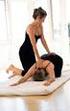 APPENDIX H YOGA ASSOCIATION OF ALBERTA CHECKLIST FOR YAA HATHA YOGA INITIAL CERTIFICATION for Hatha Yoga Teachers Certified Through Other Teacher Training Programs Up-to-date YAA membership. See website
Meditation for Stress Management
 What is? Meditation is the focusing of attention on one thing to the exclusion of all other thoughts. Often, people are able to relieve their stress through meditation, because by focusing on only one
Qigong. Ba Duan Jin. The Eight Pieces of Brocade
 Qigong Ba Duan Jin The Eight Pieces of Brocade by Col and g Hamilton Yiheyuan Martial Arts Contents Page Introduction 2 Preparation 2 1. Hold up the Sky 3 2. The Archer 4 3. Join Heaven and Earth 5 4a.
OUR MISSION. WE HELP YOU TO ACHIEVE WELLBEING. Your Wellbeing.
 OUR MISSION. Your Wellbeing. WE HELP YOU TO ACHIEVE WELLBEING 01 OUR FOCUS. Develop employee s total potential. HELP EMPLOYEES GET FIT, GET WELL, GET INSPIRED TO EXPERIENCE ULTIMATE BLISS IN LIFE. 02 WORK-RELATED
Guided Meditation Quotes for Techniques Practice
 Guided Meditation Quotes for Techniques Practice Introduction The quotes used in this document serve as a sample model for conducting a guided meditation at the meditation groups long meditations. You
Brain Yoga - Instruction Guide. Congratulations!
 Brain Yoga - Instruction Guide Brain Yoga offers real help to those with learning difficulties, autism, Alzheimer s disease and anyone whose memory is not as sharp as it should be. This report is the companion
Yoga Teacher Training Home Study Course. Part 3b. Teaching and Practicing Sun Salutations
 Yoga Teacher Training Home Study Course Part 3b Teaching and Practicing Sun Salutations Sun Salutations (Surya Namaskar) A sun salutation is a graceful sequence of positions performed as one continuous
Exploring the. Lazy Yoga. in Thai Massage
 Exploring the Lazy Yoga in Thai Massage Cyndi Karges Prairie Yoga - 200 Hr. Teacher Training (2010-2011) Thai Massage is an ancient style of healing that includes elements of reflexology, yoga, energy
Once you begin pranayama do it every day for 30 days (not during menstruation)
 The 5 Ashtanga Pranayamas and their benefits There are 5 pranayamas that Pattabhi Jois researched and put together to go with the Ashtanga practice. Just like the ashtanga practice they are quite intense
Dr.M.SHOBITHA, H.O.D PHYSIOLOGY, HIMSR, JAMIA HAMDARD
 Dr.M.SHOBITHA, H.O.D PHYSIOLOGY, HIMSR, JAMIA HAMDARD What is stress? Physiological events during stress. Symptoms during stress Self help for treating stress. Meditation- Definition Techniques of meditation
YOGA: ITS ORIGIN, HISTORY AND DEVELOPMENT
 YOGA: ITS ORIGIN, HISTORY AND DEVELOPMENT Dr. Ishwar V. Basavaraddi Director Morarji Desai National Institute of Yoga 68, Ashoka Road, New Delhi -110001 Yoga is an Art and Scince of healthy living. It
Yoga Breathing Technique - Postures, Breath Work and Meditation by Georg Feuerstein and Gary Kraftsow
 Yoga Breathing Technique - Postures, Breath Work and Meditation by Georg Feuerstein and Gary Kraftsow Georg: What do you mean when you say you are using the breath in the execution of asanas? Gary: There
Comprehensive Resilience Module
 Resilience And Risk Reduction Comprehensive Resilience Module Spiritual Dimension Meditation Meditation Overview There are many types of meditation that can help you develop your human spirit and build
OSTEOPATHIC CARE OF CHILDREN
 OSTEOPATHIC CARE OF CHILDREN OSTEOPATHIC HEALTHCARE OF MAINE OSTEOPATHIC CARE OF CHILDREN Donald V. Hankinson, D.O. Childhood is a time when the potential for mental, physical and spiritual growth is profound.
The Energy Medicine Daily Routine
 The Energy Medicine Daily Routine Improve your well-being in less than 10 minutes a day! Through years of practice we have designed a Daily Energy Routine that combines the most potent techniques we know
Yoga for Healthy Digestion
 Yoga for Healthy Digestion By Margaux Permutt CDA Annual Meeting 2015 Vocabulary Words Yoga- Means "Union" the object being to unite body and breath, mind and body. Yoga is an ancient practice from India
Kriya for Positive Mind
 Kriya for Positive Mind Bron: The Ten Light Bodies of Conciousness van Nirvair Singh Khalsa Ego Eliminator (heart center) 6 MINUTES. Sit cross-legged. Lift left arm up to 60 degrees with the palm up. Right
ALIGNMENT WITH THE HIGHER SELF & MEETING SPIRIT GUIDES
 ALIGNMENT WITH THE HIGHER SELF & MEETING SPIRIT GUIDES Experiencing Spiritual Connection This becomes more and more obvious to you with practice you will get a distinct feeling and knowing when you are
The effects of Yoga --reduction of stress
 Outline The effects of Yoga --reduction of stress Reporter : Zing-I I Wu Adviser : Li-Chuan Lin About Yoga Stress symptom Introduction Discussion Conclusion Future research About Yoga From : India Yoga
This is a guided meditation to enable you to begin to start clearing, balancing and energizing the Chakra s.
 This is a guided meditation to enable you to begin to start clearing, balancing and energizing the Chakra s. Julian, Reiki Master and Teacher in :- Usui Reiki, Usui Tibetan Reiki, Seichem, Kundalini Reiki,
2011 FIRETHROAT PRESS LLC ALL RIGHTS RESERVED www.firethroatpress.com
 Types of Meditation BY DALE VERKUILEN 2011 FIRETHROAT PRESS LLC ALL RIGHTS RESERVED www.firethroatpress.com TYPES OF MEDITATION The following discussion will offer descriptions of five types of meditation.
Take a few minutes for yourself and incorporate some Office Yoga into your daily routine.
 OFFICE YOGA Working in an office or at a computer for prolonged periods of time can put strain on the neck, shoulder and back muscles which in turn can lead to tension and stiffness. This tension can cause
The Eight Pieces of Brocade
 The Eight Pieces of Brocade Ba Duan Jin (The Eight Pieces of Brocade) was developed during the twelfth century by the famous general Yueh Fei (who also created the Hsing I internal martial art) as a way
THE CHAKRA INSTITUTE - A not-for-profit organization dedicated to advancing the theory of
 THE CHAKRA INSTITUTE - A not-for-profit organization dedicated to advancing the theory of Microchakra Psychology and the practice of InnerTuning. It offers: PROFESSIONAL INNERTUNING TRAINING PROGRAMS These
Historical Review of Yoga and Response Pattern of Non-Insulin Dependent Diabetics to Yoga Treatment
 International Journal of Education and Science Research Review E-ISSN 2348-6457 Volume-2, Issue-1 February- 2015 P-ISSN 2348-1817 Historical Review of Yoga and Response Pattern of Non-Insulin Dependent
Wu Ming Qigong for Breast Cancer Treatment and Prevention
 Wu Ming Qigong for Breast Cancer Treatment and Prevention The most powerful tool traditional Chinese medicine has to offer for breast cancer treatment and prevention is qigong (pronounced chee-kung), an
Religious Differences or Religious Similarities? History teaches us that religion plays a major role in society worldwide.
 Religious Differences or Religious Similarities? History teaches us that religion plays a major role in society worldwide. Religious differences have led to wars and violent groups. I, however, believe
Diagram 2(i): Structure of the Neuron
 Diagram 2(i): Structure of the Neuron Generally speaking, we can divide the nervous system into different parts, according to location and function. So far we have mentioned the central nervous system
Chapter 1. Hatha-yoga philosophy and practice. Para-religious aspects of hatha-yoga
 Krzysztof T. Konecki Lodz University Is our body the temple of the soul? Contemporary yoga practice as a psycho-sociological phenomenon (#$%&'()#*+,-+.$/01234"356+,')78$9&-.:;)
Info. from the nurses of the Medical Service. LOWER BACK PAIN Exercise guide
 Info. from the nurses of the Medical Service LOWER BACK PAIN Exercise guide GS/ME 03/2009 EXERCISE GUIDE One of the core messages for people suffering with lower back pain is to REMAIN ACTIVE. This leaflet
Meditation to Relieve the Stress of Being a Teenager! By Susan Searle
 Meditation to Relieve the Stress of Being a Teenager! By Susan Searle Purpose Research shows that people who are more religious or spiritual use their spirituality to cope with life. They re better able
Jainism Jainism also began in India; religion teaches ahimsa nonviolence - Jains believe all living things have souls and should not be hurt
 Lesson 3 Buddhism and India s Golden Age MAIN IDEAS Belief System A teacher called the Buddha developed a new religion that focused on helping people to escape suffering. Government The Maurya rulers united
THE CHOIR: SING WHILE YOU WORK. THE BASICS OF SINGING bbc.co.uk/thechoir
 THE BASICS OF ING THE BASICS OF ING Gareth Malone Welcome to The Choir: Sing While You Work guide to singing. If you re reading this, congratulations, as you have either already taken that first step and
Best Online Yoga Teacher's Training and Instructor Certification Program at the best price. YOGA INSTRUCTOR CERTIFICATION PROGRAM By Anmol Mehta
 Best Online Yoga Teacher's Training and Instructor Certification Program at the best price. YOGA INSTRUCTOR CERTIFICATION PROGRAM By Anmol Mehta YOGA TEACHER'S TRAINING AND CERTIFICATION PROGRAM HIGHLIGHTS
How To Develop Devotional Plan For Your Life
 How To Develop Devotional Plan For Your Life Daily devotions is a phrase used to describe the discipline of Bible reading and prayer with which Christians start or end their day. Bible reading can take
The Link Between Hypnosis & Thai Yoga Bodywork
 The Link Between Hypnosis & Thai Yoga Bodywork By: Terry Ann Wohl When Trilby, the beautiful model-singer in the infamous 1931 movie, tells Svengali that she is unable to work all day because she has had
30 Scripts for Relaxation, Imagery & Inner Healing - Vol. 2
 30 Scripts for Relaxation, Imagery & Inner Healing - Vol. 2 Julie Lusk Whole Person Press Table of Contents Becoming Relaxed The cornerstone of all guided imagery work lies in the ability to relax the
YIYT Release2_October 21, 2014 1
 Yoga teachers are eligible to register for a YogaNext Intermediate Yoga Teacher (YIYT) credential upon demonstrating that they have sufficient training-hours and teaching experience to fulfill the YogaNext
Spiritus Contra Spiritum: A Yogic Approach to Alcoholism
 Spiritus Contra Spiritum: A Yogic Approach to Alcoholism "His craving for alcohol was the equivalent, on a low level, of the spiritual thirst of our being for wholeness; expressed in medieval language:
diploma of energy healing
 diploma of energy healing 1.5 year program. intake february 2016 + fast track starts in may. can commence some subjects any term overview 2016 A course for soul-centred transformation Accredited by the
Physical therapies. Massage
 This information is an extract from the booklet, Understanding complementary therapies. You may find the full booklet helpful. We can send you a copy free see page 6. This information discusses eight physical
M.A. PSYCHOLOGY CONSCIOUSNESS, HEALTH, & HEALING. in SPIRITUAL. with an Emphasis in
 M.A. in SPIRITUAL PSYCHOLOGY with an Emphasis in CONSCIOUSNESS, HEALTH, & HEALING The First Year at USM is Learning the game, the Second Year is Playing the game and the Third Year Consciousness, Health,
Yogi Tea Bag Inspirations received from all the Yogi Tea Debby has consumed over the last year
 Yogi Tea Bag Inspirations received from all the Yogi Tea Debby has consumed over the last year A Act selfless, you will be infinite. Appreciate yourself and honor your soul. As a plant can t live without
Meditation for Health Purposes
 Meditation for Health Purposes Meditation for health purposes is a mind-body practice in complementary and alternative medicine (CAM).* There are many types of meditation, most of which originated in ancient
Whole Brain Thinking
 Whole Brain Thinking Here is an ancient exercise to help you expand your mind - and your consciousness. Learn how to use all levels of your brain. Instructions for the Tibetan Exercise of Paradox Step
Shinnyo-En at a glance
 Shinnyo-En at a glance What is Shinnyo-En? Shinnyo-En is an independent Buddhist order, which belongs to the Mahayana school of Buddhism in Japan. The complex Buddhist term Shinnyo ( reality ) designates
Key Words Immortality: endless life or existence; life after death
 Key Words Immortality: endless life or existence; life after death Legacy: something handed down from an ancestor; a way of being remembered after death Resurrection: rising from the dead or returning
ATTUNEMENT INFORMATION
 ATTUNEMENT INFORMATION www.reiki-attunement-courses.com 1 ABOUT REIKI Reiki is a wonderful healing energy that we can all use in our daily lives. Not only can it help us heal from different ailments and
About the health benefits of walking, march and Nording Walking.
 About the health benefits of walking, march and Nording Walking. Project and realization: Marta Szymańska, Kl. I F Walking is the most natural and the simplest form of physical activity. It doesn t require
2016 Yoga Studies & Hatha Yoga Teacher-Training Diploma
 Qi Academy of Hatha Yoga 2016 Yoga Studies & Hatha Yoga Teacher-Training Diploma Pursue your passion & take your Yoga to the world 12 months that will transform your yoga practice and prepare you to share
UNIVERSITY OF METAPHYSICS: [email protected] www.universityofmetaphysics.com UNIVERSITY OF SEDONA: [email protected] www.universityofsedona.
 COMMUNICATIONS ADDRESS: 2675 W. State Route 89A, No. 465, Sedona, AZ 86336 ADMINISTRATION TOLL FREE WITHIN THE CONTINENTAL US: (888) 866-4685 OUTSIDE US: (928) 203-0730 FAX (928) 204-0543 UNIVERSITY OF
The neurobiology of energy healing...a hands on approach.
 The neurobiology of energy healing...a hands on approach. Have you ever considered why we use our hands for healing? After all it's not called "hands on healing" for nothing. Why do some practitioners
YOGA A REMEDY TO RESPIRATORY ILLNESS
 Krishnan, Dr.Sripriya Yoga A Remedy To Respiratory Illness in Martin J. Bunch, V. Madha Suresh and T. Vasantha Kumaran, eds., Proceedings of the Third International Conference on Environment and Health,
North Bergen School District Benchmarks
 Grade: 10,11, and 12 Subject: Anatomy and Physiology First Marking Period Define anatomy and physiology, and describe various subspecialties of each discipline. Describe the five basic functions of living
''Importance of Diksha/Initiation
 The Kriya as taught by Sri Mukherjee has been the best discovery in the field of Kriya since my initiation into Kriya in 1975 (I practiced the preliminary techniques of my lineage since 1973.) I have talked
Pathological Gambling and Spirituality
 Pathological Gambling and Spirituality Joanna Franklin MS NCGC II [email protected] Special thanks to Lori Rugle PhD and the patients and staff of the Custer Center and Las Vegas GTP Defining Spirituality
Relaxation technique 1: Breathing meditation for stress relief. Relaxation technique 2: Progressive muscle relaxation for stress relief
 Relaxation technique 1: Breathing meditation for stress relief With its focus on full, cleansing breaths, deep breathing is a simple, yet powerful, relaxation technique. It s easy to learn, can be practiced
Mindfulness exercises and meditations (extended version)
 Mindfulness exercises and meditations (extended version) Grounding Exercise This exercise was first introduced to me at The Centre for Transpersonal Psychology by Barbara Somers and Ian Gordon Brown in
Relaxation Techniques. Stressed out? Join the crowd-the crowd that is learning to relax, that is.
 Relaxation Techniques Stressed out? Join the crowd-the crowd that is learning to relax, that is. Relaxation Exercises to Reduce Stress, Anxiety, and Depression The body s natural relaxation response is
Chetek-Weyerhaeuser High School
 Chetek-Weyerhaeuser High School Anatomy and Physiology Units and Anatomy and Physiology A Unit 1 Introduction to Human Anatomy and Physiology (6 days) Essential Question: How do the systems of the human
BREATHE BETTER SWIM FASTER
 BREATHE BETTER SWIM FASTER Breath control is fundamental to efficient swimming. Like singers, swimmers need to train their breathing for effective performance. Controlled breathing is the main factor contributing
Basic techniques of pulmonary physical therapy (I) 100/04/24
 Basic techniques of pulmonary physical therapy (I) 100/04/24 Evaluation of breathing function Chart review History Chest X ray Blood test Observation/palpation Chest mobility Shape of chest wall Accessory
Kinesiology Graduate Course Descriptions
 Kinesiology Graduate Course Descriptions KIN 601 History of Exercise and Sport Science 3 credits Historical concepts, systems, patterns, and traditions that have influenced American physical activity and
Pranayama. Hatha Yoga Pradipika says, When this prana is controlled, the mind gets controlled.
 Pranayama Pranayama is the fourth limb of ashtanga yoga. Pranayama is a practice to regulate the breath; to control the prana. Prana is the vital force. Ayama means to extend. Pranayama means to extend
A Stretch-Break Program for Your Workplace! www.healthyworkplaceweek.ca
 www.healthyworkplaceweek.ca A Stretch-Break Program for Your Workplace! Why is stretching at work important? Sitting at a desk or computer; or standing at your work station for extended periods of time
Acts 11 : 1-18 Sermon
 Acts 11 : 1-18 Sermon Imagine a church being riven apart by different personalities leading different groups each trying to pull it in different directions. Imagine a church whose future is threatened
Yoga Routine. Khun Reinhard. (www.khunreinhard.com)
 Yoga Routine by Khun Reinhard (www.khunreinhard.com) Yoga-Routine Khun Reinhard - 2 - December 2013 Introduction This yoga routine has been taught by the author of this paper over many years to more than
THE TOP 5 TIPS FOR BECOMING MORE ASSERTIVE. Being Assertive is not just using a certain set of communication skills or
 THE TOP 5 TIPS FOR BECOMING MORE ASSERTIVE Being Assertive is not just using a certain set of communication skills or behaviours. Assertiveness is, first and foremost an attitude of mind with an accompanying
CONTENTS. Note to the Reader 00. Acknowledgments 00. About the Author 00. Preface 00. Introduction 00
 Natural Therapies for Emphysema By Robert J. Green Jr., N.D. CONTENTS Note to the Reader 00 Acknowledgments 00 About the Author 00 Preface 00 Introduction 00 1 Essential Respiratory Anatomy and Physiology
AN INTRODUCTION TO PSYCHOLOGY
 An Introduction to MODULE - I 1 AN INTRODUCTION TO PSYCHOLOGY As human beings our curiosity drives us to know the reasons behind various events happening around us. Whenever we meet somebody or see someone
Yoga Teacher Education Program Handbook
 The George Washington University School of Public Health and Health Services Department of Exercise Science Yoga Teacher Education Program Handbook Table of Contents Program Overview...3 The Yoga Alliance...3
Santosha Yoga 200 Hour Initial Yoga Teacher Certification Program with dina Lang
 Santosha Yoga 200 Hour Initial Yoga Teacher Certification Program with dina Lang Leader: Dina Lang, ERYT 500, co-owner of Santosha Yoga Specialties lead by: Janci Butler, Nina Pitzel and Robin Parker When