
Percent of all vaginal births attended by CNMs/CMs, 2013: 2.55%
|
|
|
- Sybil Casey
- 9 years ago
- Views:
Transcription
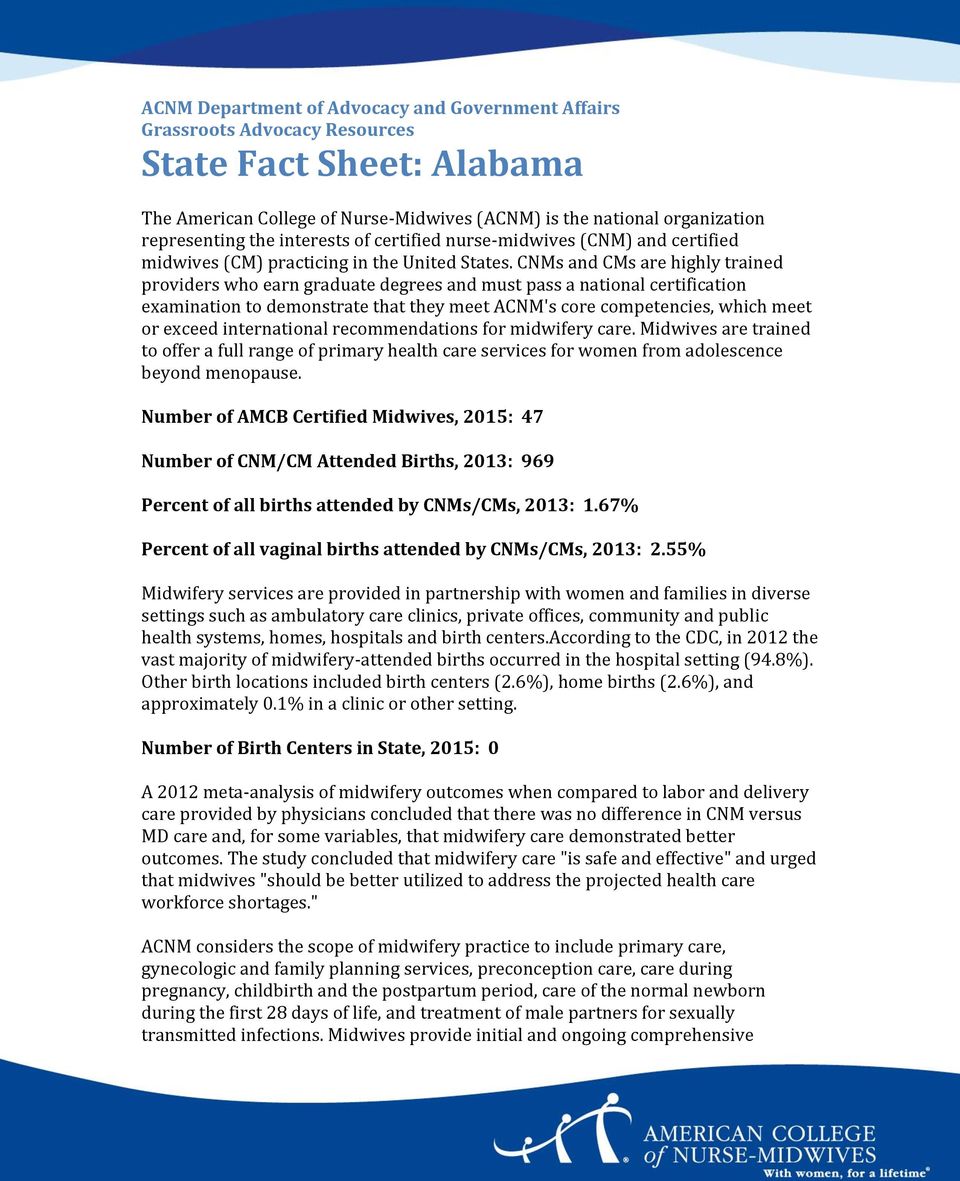
1 ACNM Department of Advocacy and Government Affairs Grassroots Advocacy Resources State Fact Sheet: Alabama The American College of Nurse-Midwives (ACNM) is the national organization representing the interests of certified nurse-midwives (CNM) and certified midwives (CM) practicing in the United States. CNMs and CMs are highly trained providers who earn graduate degrees and must pass a national certification examination to demonstrate that they meet ACNM's core competencies, which meet or exceed international recommendations for midwifery care. Midwives are trained to offer a full range of primary health care services for women from adolescence beyond menopause. Number of AMCB Certified Midwives, 2015: 47 Number of CNM/CM Attended Births, 2013: 969 Percent of all births attended by CNMs/CMs, 2013: 1.67% Percent of all vaginal births attended by CNMs/CMs, 2013: 2.55% Midwifery services are provided in partnership with women and families in diverse settings such as ambulatory care clinics, private offices, community and public health systems, homes, hospitals and birth centers.according to the CDC, in 2012 the vast majority of midwifery-attended births occurred in the hospital setting (94.8%). Other birth locations included birth centers (2.6%), home births (2.6%), and approximately 0.1% in a clinic or other setting. Number of Birth Centers in State, 2015: 0 A 2012 meta-analysis of midwifery outcomes when compared to labor and delivery care provided by physicians concluded that there was no difference in CNM versus MD care and, for some variables, that midwifery care demonstrated better outcomes. The study concluded that midwifery care "is safe and effective" and urged that midwives "should be better utilized to address the projected health care workforce shortages." ACNM considers the scope of midwifery practice to include primary care, gynecologic and family planning services, preconception care, care during pregnancy, childbirth and the postpartum period, care of the normal newborn during the first 28 days of life, and treatment of male partners for sexually transmitted infections. Midwives provide initial and ongoing comprehensive
2 assessment, diagnosis and treatment. They conduct physical examinations; prescribe medications including controlled substances and contraceptive methods; admit, manage and discharge patients; order and interpret laboratory and diagnostic tests and order the use of medical devices. Midwifery care also includes health promotion, disease prevention, and individualized wellness education and counseling. State Scope of Practice Statement: The practice of midwifery in Alabama is defined as "care for the mother during pregnancy and labor providing continuous physical and emotional support and continuous evaluation of progress throughout labor and delivery" [Ala. Code ]. Regulatory Environment (Autonomous Practice, Collaborative Requirement, or Supervisory): Alabama requires a collaborative agreement as a condition for practice. Medicaid Coverage: Medicaid covers approximately half of all births in the United States, with the percent ranging from 20 to over 60 percent among states. As such, it is a key payer for midwifery services and it is critical that midwives understand when their patients may qualify for Medicaid coverage, what services are covered, and how to get paid for their services to Medicaid beneficiaries. The fee-for-service Medicaid reimbursement rate for midwives is currently 80% of the physician rate. Regulatory Board: Joint Committee of the Board of Nursing and Board of Medical Examiners Recognized Midwifery Credentials: CNM Midwifery Education Programs: None Currently

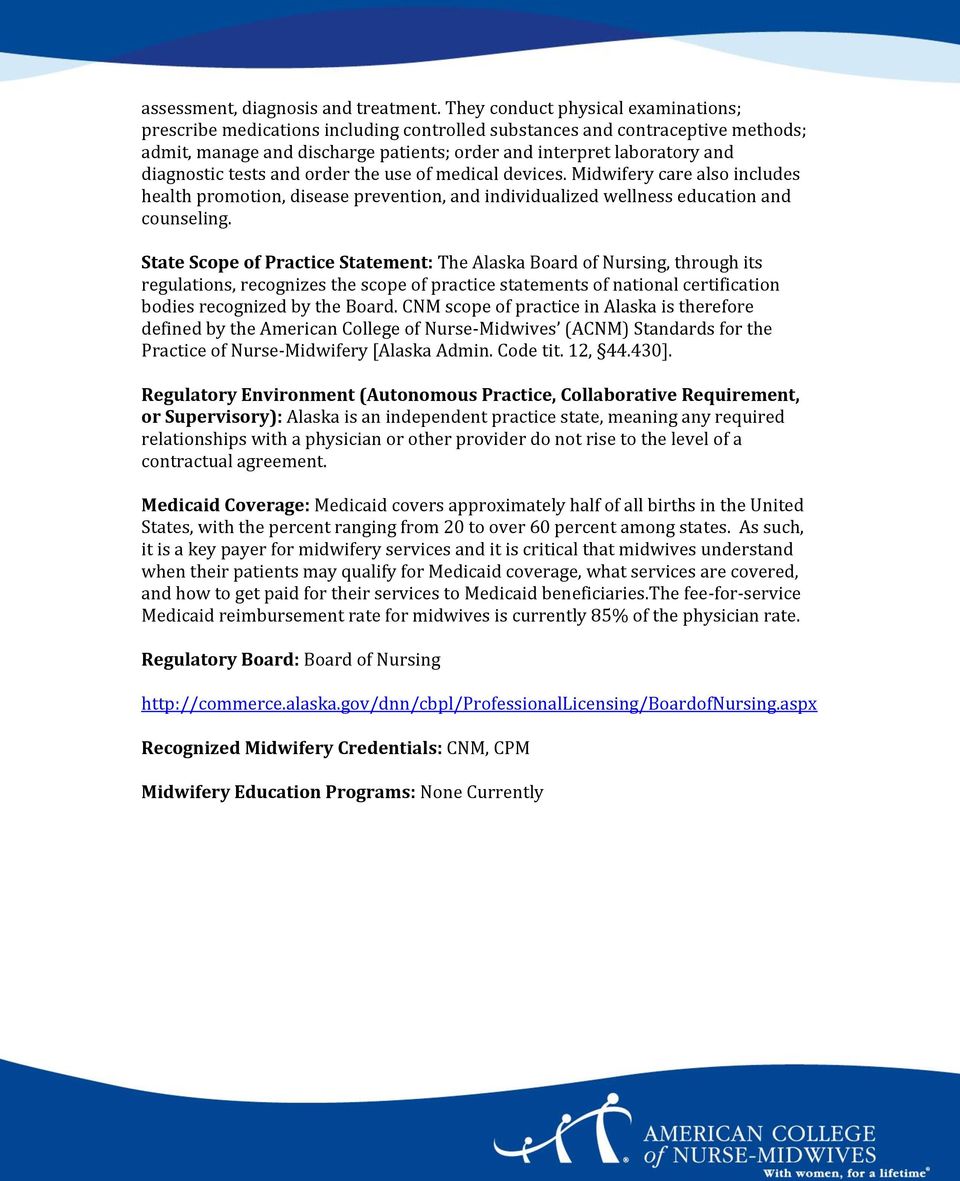
3 ACNM Department of Advocacy and Government Affairs Grassroots Advocacy Resources State Fact Sheet: Alaska The American College of Nurse-Midwives (ACNM) is the national organization representing the interests of certified nurse-midwives (CNM) and certified midwives (CM) practicing in the United States. CNMs and CMs are highly trained providers who earn graduate degrees and must pass a national certification examination to demonstrate that they meet ACNM's core competencies, which meet or exceed international recommendations for midwifery care. Midwives are trained to offer a full range of primary health care services for women from adolescence beyond menopause. Number of AMCB Certified Midwives, 2015: 91 Number of CNM/CM Attended Births, 2013: 3063 Percent of all births attended by CNMs/CMs, 2013: 26.80% Percent of all vaginal births attended by CNMs/CMs, 2013: 34.81% Midwifery services are provided in partnership with women and families in diverse settings such as ambulatory care clinics, private offices, community and public health systems, homes, hospitals and birth centers.according to the CDC, in 2012 the vast majority of midwifery-attended births occurred in the hospital setting (94.8%). Other birth locations included birth centers (2.6%), home births (2.6%), and approximately 0.1% in a clinic or other setting. Number of Birth Centers in State, 2015: 10 A 2012 meta-analysis of midwifery outcomes when compared to labor and delivery care provided by physicians concluded that there was no difference in CNM versus MD care and, for some variables, that midwifery care demonstrated better outcomes. The study concluded that midwifery care "is safe and effective" and urged that midwives "should be better utilized to address the projected health care workforce shortages." ACNM considers the scope of midwifery practice to include primary care, gynecologic and family planning services, preconception care, care during pregnancy, childbirth and the postpartum period, care of the normal newborn during the first 28 days of life, and treatment of male partners for sexually transmitted infections. Midwives provide initial and ongoing comprehensive

4 assessment, diagnosis and treatment. They conduct physical examinations; prescribe medications including controlled substances and contraceptive methods; admit, manage and discharge patients; order and interpret laboratory and diagnostic tests and order the use of medical devices. Midwifery care also includes health promotion, disease prevention, and individualized wellness education and counseling. State Scope of Practice Statement: The Alaska Board of Nursing, through its regulations, recognizes the scope of practice statements of national certification bodies recognized by the Board. CNM scope of practice in Alaska is therefore defined by the American College of Nurse-Midwives (ACNM) Standards for the Practice of Nurse-Midwifery [Alaska Admin. Code tit. 12, ]. Regulatory Environment (Autonomous Practice, Collaborative Requirement, or Supervisory): Alaska is an independent practice state, meaning any required relationships with a physician or other provider do not rise to the level of a contractual agreement. Medicaid Coverage: Medicaid covers approximately half of all births in the United States, with the percent ranging from 20 to over 60 percent among states. As such, it is a key payer for midwifery services and it is critical that midwives understand when their patients may qualify for Medicaid coverage, what services are covered, and how to get paid for their services to Medicaid beneficiaries.the fee-for-service Medicaid reimbursement rate for midwives is currently 85% of the physician rate. Regulatory Board: Board of Nursing Recognized Midwifery Credentials: CNM, CPM Midwifery Education Programs: None Currently
5 ACNM Department of Advocacy and Government Affairs Grassroots Advocacy Resources State Fact Sheet: Arizona The American College of Nurse-Midwives (ACNM) is the national organization representing the interests of certified nurse-midwives (CNM) and certified midwives (CM) practicing in the United States. CNMs and CMs are highly trained providers who earn graduate degrees and must pass a national certification examination to demonstrate that they meet ACNM's core competencies, which meet or exceed international recommendations for midwifery care. Midwives are trained to offer a full range of primary health care services for women from adolescence beyond menopause. Number of AMCB Certified Midwives, 2015: 204 Number of CNM/CM Attended Births, 2013: 5568 Percent of all births attended by CNMs/CMs, 2013: 6.51% Percent of all vaginal births attended by CNMs/CMs, 2013: 8.91% Midwifery services are provided in partnership with women and families in diverse settings such as ambulatory care clinics, private offices, community and public health systems, homes, hospitals and birth centers.according to the CDC, in 2012 the vast majority of midwifery-attended births occurred in the hospital setting (94.8%). Other birth locations included birth centers (2.6%), home births (2.6%), and approximately 0.1% in a clinic or other setting. Number of Birth Centers in State, 2015: 9 A 2012 meta-analysis of midwifery outcomes when compared to labor and delivery care provided by physicians concluded that there was no difference in CNM versus MD care and, for some variables, that midwifery care demonstrated better outcomes. The study concluded that midwifery care "is safe and effective" and urged that midwives "should be better utilized to address the projected health care workforce shortages." ACNM considers the scope of midwifery practice to include primary care, gynecologic and family planning services, preconception care, care during pregnancy, childbirth and the postpartum period, care of the normal newborn during the first 28 days of life, and treatment of male partners for sexually transmitted infections. Midwives provide initial and ongoing comprehensive

6 assessment, diagnosis and treatment. They conduct physical examinations; prescribe medications including controlled substances and contraceptive methods; admit, manage and discharge patients; order and interpret laboratory and diagnostic tests and order the use of medical devices. Midwifery care also includes health promotion, disease prevention, and individualized wellness education and counseling. State Scope of Practice Statement: Certified nurse-midwives (CNM) in Arizona are regulated as a category of registered nurse practitioner (RNP) by the Board of Nursing. CNMs are noted to have an expanded scope of practice within a specialty area that includes: (i) Assessing clients, synthesizing and analyzing data and understanding and applying principles of health care at an advanced level. (ii) Managing the physical and psychosocial health status of clients. (iii) Analyzing multiple sources of data, identifying alternative possibilities as to the nature of a health care problem and selecting, implementing and evaluating appropriate treatment. (iv) Making independent decisions in solving complex client care problems. (v) Diagnosing, performing diagnostic and therapeutic procedures, and prescribing, administering and dispensing therapeutic measures, including legend drugs, medical devices and controlled substances within the scope of registered nurse practitioner practice on meeting the requirements established by the board. (vi) Recognizing the limits of the nurse's knowledge and experience and planning for situations beyond the nurse's knowledge, educational preparation and expertise by consulting with or referring clients to other health care providers when appropriate. (vii) Delegating to a medical assistant pursuant to (viii) Performing additional acts that require education and training as prescribed by the board and that are recognized by the nursing profession as proper to be performed by a nurse practitioner [Ariz.Rev. Stat. Ann ]. Regulatory Environment (Autonomous Practice, Collaborative Requirement, or Supervisory): Arizona is an independent practice state, meaning any required relationships with a physician or other provider do not rise to the level of a contractual agreement. Medicaid Coverage: Medicaid covers approximately half of all births in the United States, with the percent ranging from 20 to over 60 percent among states. As such, it is a key payer for midwifery services and it is critical that midwives understand when their patients may qualify for Medicaid coverage, what services are covered, and how to get paid for their services to Medicaid beneficiaries. The fee-for-service Medicaid reimbursement rate for midwives is currently 90% of the physician rate. Regulatory Board: Board of Nursing

7 Recognized Midwifery Credentials: CNM, CPM Midwifery Education Programs: None Currently

8 ACNM Department of Advocacy and Government Affairs Grassroots Advocacy Resources State Fact Sheet: Arkansas The American College of Nurse-Midwives (ACNM) is the national organization representing the interests of certified nurse-midwives (CNM) and certified midwives (CM) practicing in the United States. CNMs and CMs are highly trained providers who earn graduate degrees and must pass a national certification examination to demonstrate that they meet ACNM's core competencies, which meet or exceed international recommendations for midwifery care. Midwives are trained to offer a full range of primary health care services for women from adolescence beyond menopause. Number of AMCB Certified Midwives, 2015: 32 Number of CNM/CM Attended Births, 2013: 210 Percent of all births attended by CNMs/CMs, 2013: 0.56% Percent of all vaginal births attended by CNMs/CMs, 2013: 0.85% Midwifery services are provided in partnership with women and families in diverse settings such as ambulatory care clinics, private offices, community and public health systems, homes, hospitals and birth centers.according to the CDC, in 2012 the vast majority of midwifery-attended births occurred in the hospital setting (94.8%). Other birth locations included birth centers (2.6%), home births (2.6%), and approximately 0.1% in a clinic or other setting. Number of Birth Centers in State, 2015: 1 A 2012 meta-analysis of midwifery outcomes when compared to labor and delivery care provided by physicians concluded that there was no difference in CNM versus MD care and, for some variables, that midwifery care demonstrated better outcomes. The study concluded that midwifery care "is safe and effective" and urged that midwives "should be better utilized to address the projected health care workforce shortages." ACNM considers the scope of midwifery practice to include primary care, gynecologic and family planning services, preconception care, care during pregnancy, childbirth and the postpartum period, care of the normal newborn during the first 28 days of life, and treatment of male partners for sexually transmitted infections. Midwives provide initial and ongoing comprehensive
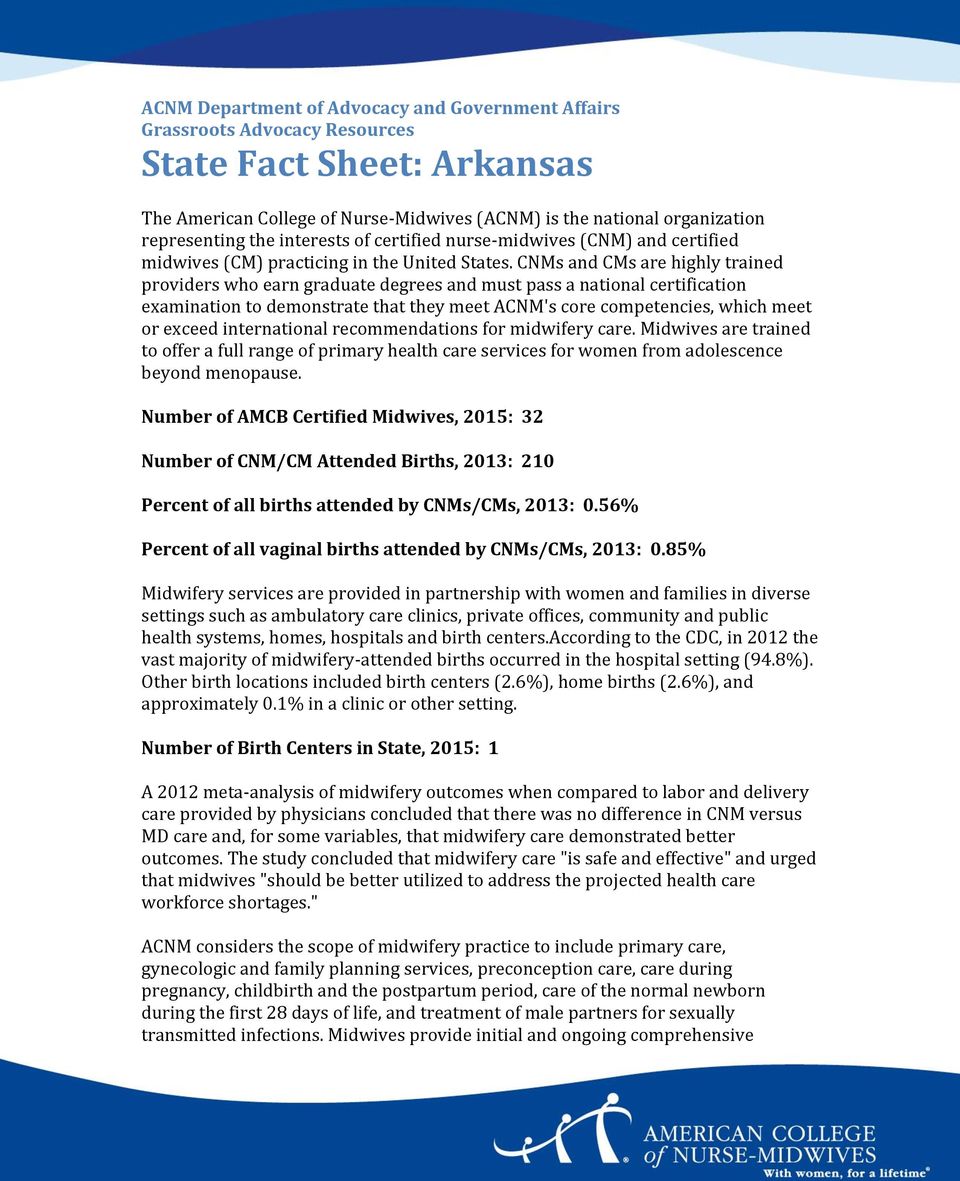
9 assessment, diagnosis and treatment. They conduct physical examinations; prescribe medications including controlled substances and contraceptive methods; admit, manage and discharge patients; order and interpret laboratory and diagnostic tests and order the use of medical devices. Midwifery care also includes health promotion, disease prevention, and individualized wellness education and counseling. State Scope of Practice Statement: The practice of nurse-midwifery in Arkansas is defined as "the performance for compensation of nursing skills relevant to the management of women's health care, focusing on pregnancy, childbirth, the postpartum period, care of the newborn, family planning, and gynecological needs of women, within a health care system that provides for consultation, collaborative management, or referral as indicated by the health status of the client" [Ark. Code Ann ]. Regulatory Environment (Autonomous Practice, Collaborative Requirement, or Supervisory): Arkansas requires a collaborative agreement as a condition for practice. Medicaid Coverage: Medicaid covers approximately half of all births in the United States, with the percent ranging from 20 to over 60 percent among states. As such, it is a key payer for midwifery services and it is critical that midwives understand when their patients may qualify for Medicaid coverage, what services are covered, and how to get paid for their services to Medicaid beneficiaries.the fee-for-service Medicaid reimbursement rate for midwives is currently 80% of the physician rate. Regulatory Board: Board of Nursing Recognized Midwifery Credentials: CNM, CPM Midwifery Education Programs: None Currently

10 ACNM Department of Advocacy and Government Affairs Grassroots Advocacy Resources State Fact Sheet: California The American College of Nurse-Midwives (ACNM) is the national organization representing the interests of certified nurse-midwives (CNM) and certified midwives (CM) practicing in the United States. CNMs and CMs are highly trained providers who earn graduate degrees and must pass a national certification examination to demonstrate that they meet ACNM's core competencies, which meet or exceed international recommendations for midwifery care. Midwives are trained to offer a full range of primary health care services for women from adolescence beyond menopause. Number of AMCB Certified Midwives, 2015: 1028 Number of CNM/CM Attended Births, 2013: Percent of all births attended by CNMs/CMs, 2013: 8.72% Percent of all vaginal births attended by CNMs/CMs, 2013: 12.99% Midwifery services are provided in partnership with women and families in diverse settings such as ambulatory care clinics, private offices, community and public health systems, homes, hospitals and birth centers.according to the CDC, in 2012 the vast majority of midwifery-attended births occurred in the hospital setting (94.8%). Other birth locations included birth centers (2.6%), home births (2.6%), and approximately 0.1% in a clinic or other setting. Number of Birth Centers in State, 2015: 34 A 2012 meta-analysis of midwifery outcomes when compared to labor and delivery care provided by physicians concluded that there was no difference in CNM versus MD care and, for some variables, that midwifery care demonstrated better outcomes. The study concluded that midwifery care "is safe and effective" and urged that midwives "should be better utilized to address the projected health care workforce shortages." ACNM considers the scope of midwifery practice to include primary care, gynecologic and family planning services, preconception care, care during pregnancy, childbirth and the postpartum period, care of the normal newborn during the first 28 days of life, and treatment of male partners for sexually transmitted infections. Midwives provide initial and ongoing comprehensive

11 assessment, diagnosis and treatment. They conduct physical examinations; prescribe medications including controlled substances and contraceptive methods; admit, manage and discharge patients; order and interpret laboratory and diagnostic tests and order the use of medical devices. Midwifery care also includes health promotion, disease prevention, and individualized wellness education and counseling. State Scope of Practice Statement: The statute defines the scope of practice of nurse-midwifery as the furthering or undertaking...to assist a woman in childbirth so long as progress meets criteria accepted as normal. This scope of practice specifically excludes the assisting of childbirth by any artificial, forcible, or mechanical means and the performance of any version of these practices [Cal. Bus. & Prof. Code ]. The statute authorizes CNMs to attend cases of normal childbirth and to provide prenatal, intrapartum, and postpartum care, including family-planning care, for the mother, and immediate care for the newborn [Cal. Bus. & Prof. Code ]. Regulatory Environment (Autonomous Practice, Collaborative Requirement, or Supervisory): California requires a supervisory relationship with a physician as a condition for practice. Medicaid Coverage: Medicaid covers approximately half of all births in the United States, with the percent ranging from 20 to over 60 percent among states. As such, it is a key payer for midwifery services and it is critical that midwives understand when their patients may qualify for Medicaid coverage, what services are covered, and how to get paid for their services to Medicaid beneficiaries. The fee-for-service Medicaid reimbursement rate for midwives is currently 100% of the physician rate. Regulatory Board: Board of Registered Nurses Recognized Midwifery Credentials: CNM, CPM Midwifery Education Programs: California State University - Fullerton; San Diego State University; University of California - San Francisco

12 ACNM Department of Advocacy and Government Affairs Grassroots Advocacy Resources State Fact Sheet: Colorado The American College of Nurse-Midwives (ACNM) is the national organization representing the interests of certified nurse-midwives (CNM) and certified midwives (CM) practicing in the United States. CNMs and CMs are highly trained providers who earn graduate degrees and must pass a national certification examination to demonstrate that they meet ACNM's core competencies, which meet or exceed international recommendations for midwifery care. Midwives are trained to offer a full range of primary health care services for women from adolescence beyond menopause. Number of AMCB Certified Midwives, 2015: 372 Number of CNM/CM Attended Births, 2013: 8106 Percent of all births attended by CNMs/CMs, 2013: 12.47% Percent of all vaginal births attended by CNMs/CMs, 2013: 16.42% Midwifery services are provided in partnership with women and families in diverse settings such as ambulatory care clinics, private offices, community and public health systems, homes, hospitals and birth centers.according to the CDC, in 2012 the vast majority of midwifery-attended births occurred in the hospital setting (94.8%). Other birth locations included birth centers (2.6%), home births (2.6%), and approximately 0.1% in a clinic or other setting. Number of Birth Centers in State, 2015: 3 A 2012 meta-analysis of midwifery outcomes when compared to labor and delivery care provided by physicians concluded that there was no difference in CNM versus MD care and, for some variables, that midwifery care demonstrated better outcomes. The study concluded that midwifery care "is safe and effective" and urged that midwives "should be better utilized to address the projected health care workforce shortages." ACNM considers the scope of midwifery practice to include primary care, gynecologic and family planning services, preconception care, care during pregnancy, childbirth and the postpartum period, care of the normal newborn during the first 28 days of life, and treatment of male partners for sexually transmitted infections. Midwives provide initial and ongoing comprehensive

13 assessment, diagnosis and treatment. They conduct physical examinations; prescribe medications including controlled substances and contraceptive methods; admit, manage and discharge patients; order and interpret laboratory and diagnostic tests and order the use of medical devices. Midwifery care also includes health promotion, disease prevention, and individualized wellness education and counseling. State Scope of Practice Statement: The Board of Nursing recognizes ACNM's "Standards for the Practice of Midwifery" as defining the appropriate scope for nurse-midwifery practice in Colorado. Regulatory Environment (Autonomous Practice, Collaborative Requirement, or Supervisory): Colorado is an independent practice state, meaning any required relationships with a physician or other provider do not rise to the level of a contractual agreement. Medicaid Coverage: Medicaid covers approximately half of all births in the United States, with the percent ranging from 20 to over 60 percent among states. As such, it is a key payer for midwifery services and it is critical that midwives understand when their patients may qualify for Medicaid coverage, what services are covered, and how to get paid for their services to Medicaid beneficiaries.the fee-for-service Medicaid reimbursement rate for midwives is currently 100% of the physician rate. Regulatory Board: Board of Nursing Recognized Midwifery Credentials: CNM, CPM Midwifery Education Programs: University of Colorado-Denver

14 ACNM Department of Advocacy and Government Affairs Grassroots Advocacy Resources State Fact Sheet: Connecticut The American College of Nurse-Midwives (ACNM) is the national organization representing the interests of certified nurse-midwives (CNM) and certified midwives (CM) practicing in the United States. CNMs and CMs are highly trained providers who earn graduate degrees and must pass a national certification examination to demonstrate that they meet ACNM's core competencies, which meet or exceed international recommendations for midwifery care. Midwives are trained to offer a full range of primary health care services for women from adolescence beyond menopause. Number of AMCB Certified Midwives, 2015: 203 Number of CNM/CM Attended Births, 2013: 3968 Percent of all births attended by CNMs/CMs, 2013: 11.01% Percent of all vaginal births attended by CNMs/CMs, 2013: 16.87% Midwifery services are provided in partnership with women and families in diverse settings such as ambulatory care clinics, private offices, community and public health systems, homes, hospitals and birth centers.according to the CDC, in 2012 the vast majority of midwifery-attended births occurred in the hospital setting (94.8%). Other birth locations included birth centers (2.6%), home births (2.6%), and approximately 0.1% in a clinic or other setting. Number of Birth Centers in State, 2015: 2 A 2012 meta-analysis of midwifery outcomes when compared to labor and delivery care provided by physicians concluded that there was no difference in CNM versus MD care and, for some variables, that midwifery care demonstrated better outcomes. The study concluded that midwifery care "is safe and effective" and urged that midwives "should be better utilized to address the projected health care workforce shortages." ACNM considers the scope of midwifery practice to include primary care, gynecologic and family planning services, preconception care, care during pregnancy, childbirth and the postpartum period, care of the normal newborn during the first 28 days of life, and treatment of male partners for sexually transmitted infections. Midwives provide initial and ongoing comprehensive

15 assessment, diagnosis and treatment. They conduct physical examinations; prescribe medications including controlled substances and contraceptive methods; admit, manage and discharge patients; order and interpret laboratory and diagnostic tests and order the use of medical devices. Midwifery care also includes health promotion, disease prevention, and individualized wellness education and counseling. State Scope of Practice Statement: Nurse-midwifery is defined as "the management of women's health care needs, focusing particularly on family planning and gynecological needs of women, pregnancy, childbirth, the postpartum period and the care of newborns, occurring within a health care team and in collaboration with qualified obstetriciangynecologists" [Conn. Gen. Stat a]. Regulatory Environment (Autonomous Practice, Collaborative Requirement, or Supervisory): Connecticut is an independent practice state, meaning any required relationships with a physician or other provider do not rise to the level of a contractual agreement. Medicaid Coverage: Medicaid covers approximately half of all births in the United States, with the percent ranging from 20 to over 60 percent among states. As such, it is a key payer for midwifery services and it is critical that midwives understand when their patients may qualify for Medicaid coverage, what services are covered, and how to get paid for their services to Medicaid beneficiaries. The fee-for-service Medicaid reimbursement rate for midwives is currently 90% of the physician rate. Regulatory Board: State Department of Public Health Recognized Midwifery Credentials: CNM Midwifery Education Programs: Yale University

16 ACNM Department of Advocacy and Government Affairs Grassroots Advocacy Resources State Fact Sheet: Delaware The American College of Nurse-Midwives (ACNM) is the national organization representing the interests of certified nurse-midwives (CNM) and certified midwives (CM) practicing in the United States. CNMs and CMs are highly trained providers who earn graduate degrees and must pass a national certification examination to demonstrate that they meet ACNM's core competencies, which meet or exceed international recommendations for midwifery care. Midwives are trained to offer a full range of primary health care services for women from adolescence beyond menopause. Number of AMCB Certified Midwives, 2015: 33 Number of CNM/CM Attended Births, 2013: 949 Percent of all births attended by CNMs/CMs, 2013: 8.77% Percent of all vaginal births attended by CNMs/CMs, 2013: 12.71% Midwifery services are provided in partnership with women and families in diverse settings such as ambulatory care clinics, private offices, community and public health systems, homes, hospitals and birth centers.according to the CDC, in 2012 the vast majority of midwifery-attended births occurred in the hospital setting (94.8%). Other birth locations included birth centers (2.6%), home births (2.6%), and approximately 0.1% in a clinic or other setting. Number of Birth Centers in State, 2015: 1 A 2012 meta-analysis of midwifery outcomes when compared to labor and delivery care provided by physicians concluded that there was no difference in CNM versus MD care and, for some variables, that midwifery care demonstrated better outcomes. The study concluded that midwifery care "is safe and effective" and urged that midwives "should be better utilized to address the projected health care workforce shortages." ACNM considers the scope of midwifery practice to include primary care, gynecologic and family planning services, preconception care, care during pregnancy, childbirth and the postpartum period, care of the normal newborn during the first 28 days of life, and treatment of male partners for sexually transmitted infections. Midwives provide initial and ongoing comprehensive

17 assessment, diagnosis and treatment. They conduct physical examinations; prescribe medications including controlled substances and contraceptive methods; admit, manage and discharge patients; order and interpret laboratory and diagnostic tests and order the use of medical devices. Midwifery care also includes health promotion, disease prevention, and individualized wellness education and counseling. State Scope of Practice Statement: The Board of Nursing recognizes ACNM's "Standards for the Practice of Midwifery" as defining the appropriate scope for nurse-midwifery practice in Delaware. Regulatory Environment (Autonomous Practice, Collaborative Requirement, or Supervisory): In most circumstances, Delaware requires a collaborative agreement as a condition for practice. Medicaid Coverage: Medicaid covers approximately half of all births in the United States, with the percent ranging from 20 to over 60 percent among states. As such, it is a key payer for midwifery services and it is critical that midwives understand when their patients may qualify for Medicaid coverage, what services are covered, and how to get paid for their services to Medicaid beneficiaries. The fee-for-service Medicaid reimbursement rate for midwives is currently 100% of the physician rate. Regulatory Board: Board of Nursing Recognized Midwifery Credentials: CNM, CM Midwifery Education Programs: None Currently

18 ACNM Department of Advocacy and Government Affairs Grassroots Advocacy Resources State Fact Sheet: DC The American College of Nurse-Midwives (ACNM) is the national organization representing the interests of certified nurse-midwives (CNM) and certified midwives (CM) practicing in the United States. CNMs and CMs are highly trained providers who earn graduate degrees and must pass a national certification examination to demonstrate that they meet ACNM's core competencies, which meet or exceed international recommendations for midwifery care. Midwives are trained to offer a full range of primary health care services for women from adolescence beyond menopause. Number of AMCB Certified Midwives, 2015: 33 Number of CNM/CM Attended Births, 2013: 996 Percent of all births attended by CNMs/CMs, 2013: 10.73% Percent of all vaginal births attended by CNMs/CMs, 2013: 16.03% Midwifery services are provided in partnership with women and families in diverse settings such as ambulatory care clinics, private offices, community and public health systems, homes, hospitals and birth centers.according to the CDC, in 2012 the vast majority of midwifery-attended births occurred in the hospital setting (94.8%). Other birth locations included birth centers (2.6%), home births (2.6%), and approximately 0.1% in a clinic or other setting. Number of Birth Centers in State, 2015: 1 A 2012 meta-analysis of midwifery outcomes when compared to labor and delivery care provided by physicians concluded that there was no difference in CNM versus MD care and, for some variables, that midwifery care demonstrated better outcomes. The study concluded that midwifery care "is safe and effective" and urged that midwives "should be better utilized to address the projected health care workforce shortages." ACNM considers the scope of midwifery practice to include primary care, gynecologic and family planning services, preconception care, care during pregnancy, childbirth and the postpartum period, care of the normal newborn during the first 28 days of life, and treatment of male partners for sexually transmitted infections. Midwives provide initial and ongoing comprehensive

19 assessment, diagnosis and treatment. They conduct physical examinations; prescribe medications including controlled substances and contraceptive methods; admit, manage and discharge patients; order and interpret laboratory and diagnostic tests and order the use of medical devices. Midwifery care also includes health promotion, disease prevention, and individualized wellness education and counseling. State Scope of Practice Statement: CNMs, as APRNs, may (1) Initiate, monitor, and alter drug therapies; (2) Initiate appropriate therapies or treatments; (3) Make referrals for appropriate therapies or treatments; and (4) Perform additional functions within his or her specialty determined in accordance with rules and regulations promulgated by the board [D.C. Code ]. Under the regulations CNMs may perform the following functions: (a) Manage the care of the normal obstetrical patient; (b) Perform minor surgical procedure; (c) Manage the normal obstetrical patient during labor and delivery to include amniotomy, episiotomy, and repair; (d) Initiate and perform local anesthetic procedures and order the necessary anesthetic agents to perform the procedures; (e) Manage care of the newborn; (f) Perform post-partum examination; (g) Provide gynecological care for women; (h) Prescribe appropriate medications; (i) Provide family planning and STD services; (j) Provide primary health care; and (k) Such other functions and services the Board deems appropriate upon review and analysis of professional and association literature which articulates scopes and standards for nurse-midwifery practice [D.C. Mun. Regs. tit. 17, ]. Regulatory Environment (Autonomous Practice, Collaborative Requirement, or Supervisory): Washington DC has independent practice, meaning any required relationships with a physician or other provider do not rise to the level of a contractual agreement. Medicaid Coverage: Medicaid covers approximately half of all births in the United States, with the percent ranging from 20 to over 60 percent among states. As such, it is a key payer for midwifery services and it is critical that midwives understand when their patients may qualify for Medicaid coverage, what services are covered, and how to get paid for their services to Medicaid beneficiaries.the fee-for-service Medicaid reimbursement rate for midwives is currently 100% of the physician rate. Regulatory Board: Board of Nursing Recognized Midwifery Credentials: CNM Midwifery Education Programs: Georgetown University

20 ACNM Department of Advocacy and Government Affairs Grassroots Advocacy Resources State Fact Sheet: Florida The American College of Nurse-Midwives (ACNM) is the national organization representing the interests of certified nurse-midwives (CNM) and certified midwives (CM) practicing in the United States. CNMs and CMs are highly trained providers who earn graduate degrees and must pass a national certification examination to demonstrate that they meet ACNM's core competencies, which meet or exceed international recommendations for midwifery care. Midwives are trained to offer a full range of primary health care services for women from adolescence beyond menopause. Number of AMCB Certified Midwives, 2015: 656 Number of CNM/CM Attended Births, 2013: Percent of all births attended by CNMs/CMs, 2013: 10.41% Percent of all vaginal births attended by CNMs/CMs, 2013: 16.30% Midwifery services are provided in partnership with women and families in diverse settings such as ambulatory care clinics, private offices, community and public health systems, homes, hospitals and birth centers.according to the CDC, in 2012 the vast majority of midwifery-attended births occurred in the hospital setting (94.8%). Other birth locations included birth centers (2.6%), home births (2.6%), and approximately 0.1% in a clinic or other setting. Number of Birth Centers in State, 2015: 31 A 2012 meta-analysis of midwifery outcomes when compared to labor and delivery care provided by physicians concluded that there was no difference in CNM versus MD care and, for some variables, that midwifery care demonstrated better outcomes. The study concluded that midwifery care "is safe and effective" and urged that midwives "should be better utilized to address the projected health care workforce shortages." ACNM considers the scope of midwifery practice to include primary care, gynecologic and family planning services, preconception care, care during pregnancy, childbirth and the postpartum period, care of the normal newborn during the first 28 days of life, and treatment of male partners for sexually transmitted infections. Midwives provide initial and ongoing comprehensive

21 assessment, diagnosis and treatment. They conduct physical examinations; prescribe medications including controlled substances and contraceptive methods; admit, manage and discharge patients; order and interpret laboratory and diagnostic tests and order the use of medical devices. Midwifery care also includes health promotion, disease prevention, and individualized wellness education and counseling. State Scope of Practice Statement: Certified nurse-midwives in Florida are regulated by the Board of Nursing (BON) as a category of advanced registered nurse practitioner (ARNP). The statute defines advanced or specialized nursing practice as the performance of advanced-level nursing acts... which, by virtue of post-basic specialized education, training, and experience, are proper to be performed by an ARNP. Those acts include nursing diagnosis and nursing treatments as well as acts of medical diagnosis and treatment,prescription, and operation which are identified and approved by a joint committee of representatives from the Boards of Medicine and Nursing [Fla. Stat. Ann ]. Regulatory Environment (Autonomous Practice, Collaborative Requirement, or Supervisory): Florida requires a supervisory relationship with a physician as a condition for practice. Medicaid Coverage: Medicaid covers approximately half of all births in the United States, with the percent ranging from 20 to over 60 percent among states. As such, it is a key payer for midwifery services and it is critical that midwives understand when their patients may qualify for Medicaid coverage, what services are covered, and how to get paid for their services to Medicaid beneficiaries. The fee-for-service Medicaid reimbursement rate for midwives is currently 80% of the physician rate. Regulatory Board: Board of Nursing Recognized Midwifery Credentials: CNM, CPM Midwifery Education Programs: University of Florida
22 ACNM Department of Advocacy and Government Affairs Grassroots Advocacy Resources State Fact Sheet: Georgia The American College of Nurse-Midwives (ACNM) is the national organization representing the interests of certified nurse-midwives (CNM) and certified midwives (CM) practicing in the United States. CNMs and CMs are highly trained providers who earn graduate degrees and must pass a national certification examination to demonstrate that they meet ACNM's core competencies, which meet or exceed international recommendations for midwifery care. Midwives are trained to offer a full range of primary health care services for women from adolescence beyond menopause. Number of AMCB Certified Midwives, 2015: 447 Number of CNM/CM Attended Births, 2013: Percent of all births attended by CNMs/CMs, 2013: 14.02% Percent of all vaginal births attended by CNMs/CMs, 2013: 21.09% Midwifery services are provided in partnership with women and families in diverse settings such as ambulatory care clinics, private offices, community and public health systems, homes, hospitals and birth centers.according to the CDC, in 2012 the vast majority of midwifery-attended births occurred in the hospital setting (94.8%). Other birth locations included birth centers (2.6%), home births (2.6%), and approximately 0.1% in a clinic or other setting. Number of Birth Centers in State, 2015: 1 A 2012 meta-analysis of midwifery outcomes when compared to labor and delivery care provided by physicians concluded that there was no difference in CNM versus MD care and, for some variables, that midwifery care demonstrated better outcomes. The study concluded that midwifery care "is safe and effective" and urged that midwives "should be better utilized to address the projected health care workforce shortages." ACNM considers the scope of midwifery practice to include primary care, gynecologic and family planning services, preconception care, care during pregnancy, childbirth and the postpartum period, care of the normal newborn during the first 28 days of life, and treatment of male partners for sexually transmitted infections. Midwives provide initial and ongoing comprehensive
23 assessment, diagnosis and treatment. They conduct physical examinations; prescribe medications including controlled substances and contraceptive methods; admit, manage and discharge patients; order and interpret laboratory and diagnostic tests and order the use of medical devices. Midwifery care also includes health promotion, disease prevention, and individualized wellness education and counseling. State Scope of Practice Statement: The certified nurse-midwife (CNM) provides independent management of women's health care, focusing particularly on pregnancy,childbirth, the postpartum period, care of the newborn, and the family planning and gynecological needs of women. The certified nurse-midwife practices within a health care system that provides for consultation, collaborative management, or referral as indicated by the health status of the client. The certified nurse-midwife must practice in accordance with the Board-approved American College of Nurse-Midwives' current Standards for the Practice of Nurse-Midwifery [Ga. Comp. R. & Regs ]. Regulatory Environment (Autonomous Practice, Collaborative Requirement, or Supervisory): Georgia requires a collaborative agreement as a condition for practice. Medicaid Coverage: Medicaid covers approximately half of all births in the United States, with the percent ranging from 20 to over 60 percent among states. As such, it is a key payer for midwifery services and it is critical that midwives understand when their patients may qualify for Medicaid coverage, what services are covered, and how to get paid for their services to Medicaid beneficiaries.the fee-for-service Medicaid reimbursement rate for midwives is currently 100% of the physician rate. Regulatory Board: Board of Nursing Recognized Midwifery Credentials: CNM Midwifery Education Programs: Emory University
24 ACNM Department of Advocacy and Government Affairs Grassroots Advocacy Resources State Fact Sheet: Hawaii The American College of Nurse-Midwives (ACNM) is the national organization representing the interests of certified nurse-midwives (CNM) and certified midwives (CM) practicing in the United States. CNMs and CMs are highly trained providers who earn graduate degrees and must pass a national certification examination to demonstrate that they meet ACNM's core competencies, which meet or exceed international recommendations for midwifery care. Midwives are trained to offer a full range of primary health care services for women from adolescence beyond menopause. Number of AMCB Certified Midwives, 2015: 53 Number of CNM/CM Attended Births, 2013: 1671 Percent of all births attended by CNMs/CMs, 2013: 8.81% Percent of all vaginal births attended by CNMs/CMs, 2013: 11.76% Midwifery services are provided in partnership with women and families in diverse settings such as ambulatory care clinics, private offices, community and public health systems, homes, hospitals and birth centers.according to the CDC, in 2012 the vast majority of midwifery-attended births occurred in the hospital setting (94.8%). Other birth locations included birth centers (2.6%), home births (2.6%), and approximately 0.1% in a clinic or other setting. Number of Birth Centers in State, 2015: 0 A 2012 meta-analysis of midwifery outcomes when compared to labor and delivery care provided by physicians concluded that there was no difference in CNM versus MD care and, for some variables, that midwifery care demonstrated better outcomes. The study concluded that midwifery care "is safe and effective" and urged that midwives "should be better utilized to address the projected health care workforce shortages." ACNM considers the scope of midwifery practice to include primary care, gynecologic and family planning services, preconception care, care during pregnancy, childbirth and the postpartum period, care of the normal newborn during the first 28 days of life, and treatment of male partners for sexually transmitted infections. Midwives provide initial and ongoing comprehensive
25 assessment, diagnosis and treatment. They conduct physical examinations; prescribe medications including controlled substances and contraceptive methods; admit, manage and discharge patients; order and interpret laboratory and diagnostic tests and order the use of medical devices. Midwifery care also includes health promotion, disease prevention, and individualized wellness education and counseling. State Scope of Practice Statement: CNMs are regulated as a category of advanced practice registered nurse (APRN). the advanced practice registered nurse may perform the following generic acts which include, but are not limited to:(1) Provide direct care by utilizing advanced scientific knowledge, skills, nursing and related theories to assess, plan, and implement appropriate health and nursing care to patients;(2) Provide indirect care. Plan, guide, evaluate and direct the nursing care given by other personnel associated with the health care team;(3) Teach, counsel, or plan care for individuals or group, utilizing a synthesis of advanced skills, theories, and knowledge of biologic, pharmacologic, physical, sociocultural and psychological aspects of care to accomplish desired objectives;(4) Serve as a consultant and resource of advanced clinical knowledge and skills to those involved directly or indirectly in patient care;(5) Participate in joint and periodic evaluation of services rendered including, but not limited to, chart reviews, case reviews, patient evaluations, and outcome of case statistics;(6) Establish collaborative, consultative, and referral networks as appropriate with other health care professionals. Patients who require care beyond the scope of practice of an APRN shall be referred to an appropriate health care provider;(7) Manage the plan of care prescribed for the patient;(8) Initiate and maintain accurate records and authorize appropriate regulatory and other legal documents;(9) Recognize, develop, and implement professional and community educational programs related to health care;(10) Conduct research and analyze the health needs of individuals and populations and design programs which target at-risk groups and cultural and environmental factors which foster health and prevent illness;(11) Participate in policy analysis and development of new policy initiative in the area of practice specialty; and(12) Contribute to the development, maintenance, and change of health care delivery systems to improve quality of health care services and consumer access to services [Haw. Code R ]. Regulatory Environment (Autonomous Practice, Collaborative Requirement, or Supervisory): Hawaii is an independent practice state, meaning any required relationships with a physician or other provider do not rise to the level of a contractual agreement. Medicaid Coverage: Medicaid covers approximately half of all births in the United States, with the percent ranging from 20 to over 60 percent among states. As such, it is a key payer for midwifery services and it is critical that midwives understand
26 when their patients may qualify for Medicaid coverage, what services are covered, and how to get paid for their services to Medicaid beneficiaries. The fee-for-service Medicaid reimbursement rate for midwives is currently 75% of the physician rate. Regulatory Board: Board of Nursing Recognized Midwifery Credentials: CNM Midwifery Education Programs: None Currently
27 ACNM Department of Advocacy and Government Affairs Grassroots Advocacy Resources State Fact Sheet: Idaho The American College of Nurse-Midwives (ACNM) is the national organization representing the interests of certified nurse-midwives (CNM) and certified midwives (CM) practicing in the United States. CNMs and CMs are highly trained providers who earn graduate degrees and must pass a national certification examination to demonstrate that they meet ACNM's core competencies, which meet or exceed international recommendations for midwifery care. Midwives are trained to offer a full range of primary health care services for women from adolescence beyond menopause. Number of AMCB Certified Midwives, 2015: 53 Number of CNM/CM Attended Births, 2013: 1753 Percent of all births attended by CNMs/CMs, 2013: 7.83% Percent of all vaginal births attended by CNMs/CMs, 2013: 10.22% Midwifery services are provided in partnership with women and families in diverse settings such as ambulatory care clinics, private offices, community and public health systems, homes, hospitals and birth centers.according to the CDC, in 2012 the vast majority of midwifery-attended births occurred in the hospital setting (94.8%). Other birth locations included birth centers (2.6%), home births (2.6%), and approximately 0.1% in a clinic or other setting. Number of Birth Centers in State, 2015: 9 A 2012 meta-analysis of midwifery outcomes when compared to labor and delivery care provided by physicians concluded that there was no difference in CNM versus MD care and, for some variables, that midwifery care demonstrated better outcomes. The study concluded that midwifery care "is safe and effective" and urged that midwives "should be better utilized to address the projected health care workforce shortages." ACNM considers the scope of midwifery practice to include primary care, gynecologic and family planning services, preconception care, care during pregnancy, childbirth and the postpartum period, care of the normal newborn during the first 28 days of life, and treatment of male partners for sexually transmitted infections. Midwives provide initial and ongoing comprehensive
28 assessment, diagnosis and treatment. They conduct physical examinations; prescribe medications including controlled substances and contraceptive methods; admit, manage and discharge patients; order and interpret laboratory and diagnostic tests and order the use of medical devices. Midwifery care also includes health promotion, disease prevention, and individualized wellness education and counseling. State Scope of Practice Statement: The advanced practice registered nurse in the role of certified nurse midwife provides the full range of primary health care services to women throughout the lifespan, including gynecologic care, family planning services, preconception care, prenatal and postpartum care, childbirth, care of the newborn and reproductive health care treatment of the male partners of female clients [Idaho Admin. Code r ]. Regulatory Environment (Autonomous Practice, Collaborative Requirement, or Supervisory): Idaho is an independent practice state, meaning any required relationships with a physician or other provider do not rise to the level of a contractual agreement. Medicaid Coverage: Medicaid covers approximately half of all births in the United States, with the percent ranging from 20 to over 60 percent among states. As such, it is a key payer for midwifery services and it is critical that midwives understand when their patients may qualify for Medicaid coverage, what services are covered, and how to get paid for their services to Medicaid beneficiaries. The fee-for-service Medicaid reimbursement rate for midwives is currently 85% of the physician rate. Regulatory Board: Board of Nursing Recognized Midwifery Credentials: CNM, CPM Midwifery Education Programs: None Currently
29 ACNM Department of Advocacy and Government Affairs Grassroots Advocacy Resources State Fact Sheet: Illinois The American College of Nurse-Midwives (ACNM) is the national organization representing the interests of certified nurse-midwives (CNM) and certified midwives (CM) practicing in the United States. CNMs and CMs are highly trained providers who earn graduate degrees and must pass a national certification examination to demonstrate that they meet ACNM's core competencies, which meet or exceed international recommendations for midwifery care. Midwives are trained to offer a full range of primary health care services for women from adolescence beyond menopause. Number of AMCB Certified Midwives, 2015: 444 Number of CNM/CM Attended Births, 2013: 9792 Percent of all births attended by CNMs/CMs, 2013: 6.24% Percent of all vaginal births attended by CNMs/CMs, 2013: 8.99% Midwifery services are provided in partnership with women and families in diverse settings such as ambulatory care clinics, private offices, community and public health systems, homes, hospitals and birth centers.according to the CDC, in 2012 the vast majority of midwifery-attended births occurred in the hospital setting (94.8%). Other birth locations included birth centers (2.6%), home births (2.6%), and approximately 0.1% in a clinic or other setting. Number of Birth Centers in State, 2015: 2 A 2012 meta-analysis of midwifery outcomes when compared to labor and delivery care provided by physicians concluded that there was no difference in CNM versus MD care and, for some variables, that midwifery care demonstrated better outcomes. The study concluded that midwifery care "is safe and effective" and urged that midwives "should be better utilized to address the projected health care workforce shortages." ACNM considers the scope of midwifery practice to include primary care, gynecologic and family planning services, preconception care, care during pregnancy, childbirth and the postpartum period, care of the normal newborn during the first 28 days of life, and treatment of male partners for sexually transmitted infections. Midwives provide initial and ongoing comprehensive
30 assessment, diagnosis and treatment. They conduct physical examinations; prescribe medications including controlled substances and contraceptive methods; admit, manage and discharge patients; order and interpret laboratory and diagnostic tests and order the use of medical devices. Midwifery care also includes health promotion, disease prevention, and individualized wellness education and counseling. State Scope of Practice Statement: The scope of practice includes, but is not limited to, advanced nursing patient assessment and diagnosis; ordering diagnostic and therapeutic tests and procedures, performing those tests and procedures when using health care equipment, and interpreting and using the results of diagnostic and therapeutic tests and procedures, providing palliative and end-of-life care; providing advanced counseling, patient education, health education, and patient advocacy; prescriptive authority as defined in 65-40; and delegating selected nursing activities or tasks [225 Ill. Comp. Stat. 65/65-30.]. Regulatory Environment (Autonomous Practice, Collaborative Requirement, or Supervisory): Illinois requires a collaborative agreement as a condition for practice. Medicaid Coverage: Medicaid covers approximately half of all births in the United States, with the percent ranging from 20 to over 60 percent among states. As such, it is a key payer for midwifery services and it is critical that midwives understand when their patients may qualify for Medicaid coverage, what services are covered, and how to get paid for their services to Medicaid beneficiaries. The fee-for-service Medicaid reimbursement rate for midwives is currently 100% of the physician rate. Regulatory Board: Department of Financial and Professional Regulation Recognized Midwifery Credentials: CNM Midwifery Education Programs: University of Illinois - Chicago
31 ACNM Department of Advocacy and Government Affairs Grassroots Advocacy Resources State Fact Sheet: Indiana The American College of Nurse-Midwives (ACNM) is the national organization representing the interests of certified nurse-midwives (CNM) and certified midwives (CM) practicing in the United States. CNMs and CMs are highly trained providers who earn graduate degrees and must pass a national certification examination to demonstrate that they meet ACNM's core competencies, which meet or exceed international recommendations for midwifery care. Midwives are trained to offer a full range of primary health care services for women from adolescence beyond menopause. Number of AMCB Certified Midwives, 2015: 155 Number of CNM/CM Attended Births, 2013: 5298 Percent of all births attended by CNMs/CMs, 2013: 6.38% Percent of all vaginal births attended by CNMs/CMs, 2013: 9.06% Midwifery services are provided in partnership with women and families in diverse settings such as ambulatory care clinics, private offices, community and public health systems, homes, hospitals and birth centers.according to the CDC, in 2012 the vast majority of midwifery-attended births occurred in the hospital setting (94.8%). Other birth locations included birth centers (2.6%), home births (2.6%), and approximately 0.1% in a clinic or other setting. Number of Birth Centers in State, 2015: 3 A 2012 meta-analysis of midwifery outcomes when compared to labor and delivery care provided by physicians concluded that there was no difference in CNM versus MD care and, for some variables, that midwifery care demonstrated better outcomes. The study concluded that midwifery care "is safe and effective" and urged that midwives "should be better utilized to address the projected health care workforce shortages." ACNM considers the scope of midwifery practice to include primary care, gynecologic and family planning services, preconception care, care during pregnancy, childbirth and the postpartum period, care of the normal newborn during the first 28 days of life, and treatment of male partners for sexually transmitted infections. Midwives provide initial and ongoing comprehensive
32 assessment, diagnosis and treatment. They conduct physical examinations; prescribe medications including controlled substances and contraceptive methods; admit, manage and discharge patients; order and interpret laboratory and diagnostic tests and order the use of medical devices. Midwifery care also includes health promotion, disease prevention, and individualized wellness education and counseling. State Scope of Practice Statement: Practice of nurse-midwifery means the practice of nursing and the extension of that practice, including well-woman gynecological healthcare, family planning, and care to the normal and expanding family throughout pregnancy, labor, delivery, and post-delivery [848 Ind. Admin. Code 3-1-2]. Regulatory Environment (Autonomous Practice, Collaborative Requirement, or Supervisory): Indiana requires a collaborative agreement as a condition for practice. Medicaid Coverage: Medicaid covers approximately half of all births in the United States, with the percent ranging from 20 to over 60 percent among states. As such, it is a key payer for midwifery services and it is critical that midwives understand when their patients may qualify for Medicaid coverage, what services are covered, and how to get paid for their services to Medicaid beneficiaries. The fee-for-service Medicaid reimbursement rate for midwives is currently 75% of the physician rate. Regulatory Board: Board of Nursing Recognized Midwifery Credentials: CNM, CPM Midwifery Education Programs: University of Indianapolis
33 ACNM Department of Advocacy and Government Affairs Grassroots Advocacy Resources State Fact Sheet: Iowa The American College of Nurse-Midwives (ACNM) is the national organization representing the interests of certified nurse-midwives (CNM) and certified midwives (CM) practicing in the United States. CNMs and CMs are highly trained providers who earn graduate degrees and must pass a national certification examination to demonstrate that they meet ACNM's core competencies, which meet or exceed international recommendations for midwifery care. Midwives are trained to offer a full range of primary health care services for women from adolescence beyond menopause. Number of AMCB Certified Midwives, 2015: 96 Number of CNM/CM Attended Births, 2013: 2866 Percent of all births attended by CNMs/CMs, 2013: 7.33% Percent of all vaginal births attended by CNMs/CMs, 2013: 10.44% Midwifery services are provided in partnership with women and families in diverse settings such as ambulatory care clinics, private offices, community and public health systems, homes, hospitals and birth centers.according to the CDC, in 2012 the vast majority of midwifery-attended births occurred in the hospital setting (94.8%). Other birth locations included birth centers (2.6%), home births (2.6%), and approximately 0.1% in a clinic or other setting. Number of Birth Centers in State, 2015: 1 A 2012 meta-analysis of midwifery outcomes when compared to labor and delivery care provided by physicians concluded that there was no difference in CNM versus MD care and, for some variables, that midwifery care demonstrated better outcomes. The study concluded that midwifery care "is safe and effective" and urged that midwives "should be better utilized to address the projected health care workforce shortages." ACNM considers the scope of midwifery practice to include primary care, gynecologic and family planning services, preconception care, care during pregnancy, childbirth and the postpartum period, care of the normal newborn during the first 28 days of life, and treatment of male partners for sexually transmitted infections. Midwives provide initial and ongoing comprehensive
34 assessment, diagnosis and treatment. They conduct physical examinations; prescribe medications including controlled substances and contraceptive methods; admit, manage and discharge patients; order and interpret laboratory and diagnostic tests and order the use of medical devices. Midwifery care also includes health promotion, disease prevention, and individualized wellness education and counseling. State Scope of Practice Statement: The certified nurse-midwife is authorized to manage the care of normal newborns and women, antepartally, intrapartally, postpartally or gynecologically [Iowa Admin. Code r (152)]. Regulatory Environment (Autonomous Practice, Collaborative Requirement, or Supervisory): Iowa is an independent practice state, meaning any required relationships with a physician or other provider do not rise to the level of a contractual agreement. Medicaid Coverage: Medicaid covers approximately half of all births in the United States, with the percent ranging from 20 to over 60 percent among states. As such, it is a key payer for midwifery services and it is critical that midwives understand when their patients may qualify for Medicaid coverage, what services are covered, and how to get paid for their services to Medicaid beneficiaries. The fee-for-service Medicaid reimbursement rate for midwives is currently 85% of the physician rate. Regulatory Board: Board of Nursing Recognized Midwifery Credentials: CNM Midwifery Education Programs: None Currently
35 ACNM Department of Advocacy and Government Affairs Grassroots Advocacy Resources State Fact Sheet: Kansas The American College of Nurse-Midwives (ACNM) is the national organization representing the interests of certified nurse-midwives (CNM) and certified midwives (CM) practicing in the United States. CNMs and CMs are highly trained providers who earn graduate degrees and must pass a national certification examination to demonstrate that they meet ACNM's core competencies, which meet or exceed international recommendations for midwifery care. Midwives are trained to offer a full range of primary health care services for women from adolescence beyond menopause. Number of AMCB Certified Midwives, 2015: 81 Number of CNM/CM Attended Births, 2013: 1920 Percent of all births attended by CNMs/CMs, 2013: 4.94% Percent of all vaginal births attended by CNMs/CMs, 2013: 7.02% Midwifery services are provided in partnership with women and families in diverse settings such as ambulatory care clinics, private offices, community and public health systems, homes, hospitals and birth centers.according to the CDC, in 2012 the vast majority of midwifery-attended births occurred in the hospital setting (94.8%). Other birth locations included birth centers (2.6%), home births (2.6%), and approximately 0.1% in a clinic or other setting. Number of Birth Centers in State, 2015: 3 A 2012 meta-analysis of midwifery outcomes when compared to labor and delivery care provided by physicians concluded that there was no difference in CNM versus MD care and, for some variables, that midwifery care demonstrated better outcomes. The study concluded that midwifery care "is safe and effective" and urged that midwives "should be better utilized to address the projected health care workforce shortages." ACNM considers the scope of midwifery practice to include primary care, gynecologic and family planning services, preconception care, care during pregnancy, childbirth and the postpartum period, care of the normal newborn during the first 28 days of life, and treatment of male partners for sexually transmitted infections. Midwives provide initial and ongoing comprehensive
36 assessment, diagnosis and treatment. They conduct physical examinations; prescribe medications including controlled substances and contraceptive methods; admit, manage and discharge patients; order and interpret laboratory and diagnostic tests and order the use of medical devices. Midwifery care also includes health promotion, disease prevention, and individualized wellness education and counseling. State Scope of Practice Statement: CNMs are authorized by the regulations to perform the following: (a) Provide independent nursing diagnosis; (b) develop and manage the medical plan of care for patients or clients, based on the authorization for collaborative practice; (c) provide health care services for which the nursemidwife is educationally prepared and for which competency has been established and maintained; (d) in a manner consistent with subsection (c), provide health care for women, focusing on gynecological needs, pregnancy, childbirth, the postpartum period, care of the newborn, and family planning, including indicated partner evaluation, treatment, and referral for infertility and sexually transmitted diseases; and (e) provide innovation in evidence-based nursing practice based upon advanced clinical expertise, decision making, and leadership skills and serve as a consultant, researcher, and patient advocate for individuals, families, groups, and communities to achieve quality, cost-effective patient outcomes and solutions [Kan. Admin. Regs ]. Regulatory Environment (Autonomous Practice, Collaborative Requirement, or Supervisory): Kansas requires a collaborative agreement as a condition for practice. Medicaid Coverage: Medicaid covers approximately half of all births in the United States, with the percent ranging from 20 to over 60 percent among states. As such, it is a key payer for midwifery services and it is critical that midwives understand when their patients may qualify for Medicaid coverage, what services are covered, and how to get paid for their services to Medicaid beneficiaries. The fee-for-service Medicaid reimbursement rate for midwives is currently 100% of the physician rate. Regulatory Board: Board of Nursing Recognized Midwifery Credentials: CNM Midwifery Education Programs: University of Kansas
37 ACNM Department of Advocacy and Government Affairs Grassroots Advocacy Resources State Fact Sheet: Kentucky The American College of Nurse-Midwives (ACNM) is the national organization representing the interests of certified nurse-midwives (CNM) and certified midwives (CM) practicing in the United States. CNMs and CMs are highly trained providers who earn graduate degrees and must pass a national certification examination to demonstrate that they meet ACNM's core competencies, which meet or exceed international recommendations for midwifery care. Midwives are trained to offer a full range of primary health care services for women from adolescence beyond menopause. Number of AMCB Certified Midwives, 2015: 121 Number of CNM/CM Attended Births, 2013: 3313 Percent of all births attended by CNMs/CMs, 2013: 5.95% Percent of all vaginal births attended by CNMs/CMs, 2013: 9.26% Midwifery services are provided in partnership with women and families in diverse settings such as ambulatory care clinics, private offices, community and public health systems, homes, hospitals and birth centers.according to the CDC, in 2012 the vast majority of midwifery-attended births occurred in the hospital setting (94.8%). Other birth locations included birth centers (2.6%), home births (2.6%), and approximately 0.1% in a clinic or other setting. Number of Birth Centers in State, 2015: 0 A 2012 meta-analysis of midwifery outcomes when compared to labor and delivery care provided by physicians concluded that there was no difference in CNM versus MD care and, for some variables, that midwifery care demonstrated better outcomes. The study concluded that midwifery care "is safe and effective" and urged that midwives "should be better utilized to address the projected health care workforce shortages." ACNM considers the scope of midwifery practice to include primary care, gynecologic and family planning services, preconception care, care during pregnancy, childbirth and the postpartum period, care of the normal newborn during the first 28 days of life, and treatment of male partners for sexually transmitted infections. Midwives provide initial and ongoing comprehensive
38 assessment, diagnosis and treatment. They conduct physical examinations; prescribe medications including controlled substances and contraceptive methods; admit, manage and discharge patients; order and interpret laboratory and diagnostic tests and order the use of medical devices. Midwifery care also includes health promotion, disease prevention, and individualized wellness education and counseling. State Scope of Practice Statement: ACNM's "Standards for the Practice of Midwifery" as defining the appropriate scope for nurse-midwifery practice in Kentucky. Regulatory Environment (Autonomous Practice, Collaborative Requirement, or Supervisory): Kentucky requires a collaborative agreement for the obtainment of prescriptive authority. Medicaid Coverage: Medicaid covers approximately half of all births in the United States, with the percent ranging from 20 to over 60 percent among states. As such, it is a key payer for midwifery services and it is critical that midwives understand when their patients may qualify for Medicaid coverage, what services are covered, and how to get paid for their services to Medicaid beneficiaries. The fee-for-service Medicaid reimbursement rate for midwives is currently 75% of the physician rate. Regulatory Board: Board of Nursing Recognized Midwifery Credentials: CNM Midwifery Education Programs: Frontier Nursing University
39 ACNM Department of Advocacy and Government Affairs Grassroots Advocacy Resources State Fact Sheet: Louisiana The American College of Nurse-Midwives (ACNM) is the national organization representing the interests of certified nurse-midwives (CNM) and certified midwives (CM) practicing in the United States. CNMs and CMs are highly trained providers who earn graduate degrees and must pass a national certification examination to demonstrate that they meet ACNM's core competencies, which meet or exceed international recommendations for midwifery care. Midwives are trained to offer a full range of primary health care services for women from adolescence beyond menopause. Number of AMCB Certified Midwives, 2015: 52 Number of CNM/CM Attended Births, 2013: 1654 Percent of all births attended by CNMs/CMs, 2013: 2.62% Percent of all vaginal births attended by CNMs/CMs, 2013: 4.27% Midwifery services are provided in partnership with women and families in diverse settings such as ambulatory care clinics, private offices, community and public health systems, homes, hospitals and birth centers.according to the CDC, in 2012 the vast majority of midwifery-attended births occurred in the hospital setting (94.8%). Other birth locations included birth centers (2.6%), home births (2.6%), and approximately 0.1% in a clinic or other setting. Number of Birth Centers in State, 2015: 2 A 2012 meta-analysis of midwifery outcomes when compared to labor and delivery care provided by physicians concluded that there was no difference in CNM versus MD care and, for some variables, that midwifery care demonstrated better outcomes. The study concluded that midwifery care "is safe and effective" and urged that midwives "should be better utilized to address the projected health care workforce shortages." ACNM considers the scope of midwifery practice to include primary care, gynecologic and family planning services, preconception care, care during pregnancy, childbirth and the postpartum period, care of the normal newborn during the first 28 days of life, and treatment of male partners for sexually transmitted infections. Midwives provide initial and ongoing comprehensive
40 assessment, diagnosis and treatment. They conduct physical examinations; prescribe medications including controlled substances and contraceptive methods; admit, manage and discharge patients; order and interpret laboratory and diagnostic tests and order the use of medical devices. Midwifery care also includes health promotion, disease prevention, and individualized wellness education and counseling. State Scope of Practice Statement: CNM practice is defined in the statute as the nurse-midwifery care of newborns and women in the antepartum, intrapartum, postpartum, and/or gynecological periods [La. Rev. Stat. Ann. 37:913(1)(a)]. Regulatory Environment (Autonomous Practice, Collaborative Requirement, or Supervisory): Louisiana requires a collaborative agreement as a condition for practice. Medicaid Coverage: Medicaid covers approximately half of all births in the United States, with the percent ranging from 20 to over 60 percent among states. As such, it is a key payer for midwifery services and it is critical that midwives understand when their patients may qualify for Medicaid coverage, what services are covered, and how to get paid for their services to Medicaid beneficiaries. The fee-for-service Medicaid reimbursement rate for midwives is currently 80% of the physician rate. Regulatory Board: Board of Nursing Recognized Midwifery Credentials: CNM, CPM Midwifery Education Programs: None Currently
41 ACNM Department of Advocacy and Government Affairs Grassroots Advocacy Resources State Fact Sheet: Maine The American College of Nurse-Midwives (ACNM) is the national organization representing the interests of certified nurse-midwives (CNM) and certified midwives (CM) practicing in the United States. CNMs and CMs are highly trained providers who earn graduate degrees and must pass a national certification examination to demonstrate that they meet ACNM's core competencies, which meet or exceed international recommendations for midwifery care. Midwives are trained to offer a full range of primary health care services for women from adolescence beyond menopause. Number of AMCB Certified Midwives, 2015: 103 Number of CNM/CM Attended Births, 2013: 2260 Percent of all births attended by CNMs/CMs, 2013: 17.78% Percent of all vaginal births attended by CNMs/CMs, 2013: 25.36% Midwifery services are provided in partnership with women and families in diverse settings such as ambulatory care clinics, private offices, community and public health systems, homes, hospitals and birth centers.according to the CDC, in 2012 the vast majority of midwifery-attended births occurred in the hospital setting (94.8%). Other birth locations included birth centers (2.6%), home births (2.6%), and approximately 0.1% in a clinic or other setting. Number of Birth Centers in State, 2015: 2 A 2012 meta-analysis of midwifery outcomes when compared to labor and delivery care provided by physicians concluded that there was no difference in CNM versus MD care and, for some variables, that midwifery care demonstrated better outcomes. The study concluded that midwifery care "is safe and effective" and urged that midwives "should be better utilized to address the projected health care workforce shortages." ACNM considers the scope of midwifery practice to include primary care, gynecologic and family planning services, preconception care, care during pregnancy, childbirth and the postpartum period, care of the normal newborn during the first 28 days of life, and treatment of male partners for sexually transmitted infections. Midwives provide initial and ongoing comprehensive
42 assessment, diagnosis and treatment. They conduct physical examinations; prescribe medications including controlled substances and contraceptive methods; admit, manage and discharge patients; order and interpret laboratory and diagnostic tests and order the use of medical devices. Midwifery care also includes health promotion, disease prevention, and individualized wellness education and counseling. State Scope of Practice Statement: The certified nurse-midwife provides only those health care services for which the certified nurse-midwife is educationally and clinically prepared and for which competency has been maintained. Such health care services for which the certified nurse-midwife is independently responsible and accountable includes:(1) primary health care and case management of women during pregnancy, childbirth, and the postpartum period(2) primary health care of the newborn up to age one(3) provision of gynecological care, family planning services, and treatment of sexually transmitted diseases in contacts [Code Me. R , Ch. 8, 1]. Regulatory Environment (Autonomous Practice, Collaborative Requirement, or Supervisory): Maine is an independent practice state, meaning any required relationships with a physician or other provider do not rise to the level of a contractual agreement. Medicaid Coverage: Medicaid covers approximately half of all births in the United States, with the percent ranging from 20 to over 60 percent among states. As such, it is a key payer for midwifery services and it is critical that midwives understand when their patients may qualify for Medicaid coverage, what services are covered, and how to get paid for their services to Medicaid beneficiaries. The fee-for-service Medicaid reimbursement rate for midwives is currently 100% of the physician rate. Regulatory Board: Board of Nursing Recognized Midwifery Credentials: CNM Midwifery Education Programs: None Currently
43 ACNM Department of Advocacy and Government Affairs Grassroots Advocacy Resources State Fact Sheet: Maryland The American College of Nurse-Midwives (ACNM) is the national organization representing the interests of certified nurse-midwives (CNM) and certified midwives (CM) practicing in the United States. CNMs and CMs are highly trained providers who earn graduate degrees and must pass a national certification examination to demonstrate that they meet ACNM's core competencies, which meet or exceed international recommendations for midwifery care. Midwives are trained to offer a full range of primary health care services for women from adolescence beyond menopause. Number of AMCB Certified Midwives, 2015: 290 Number of CNM/CM Attended Births, 2013: 6990 Percent of all births attended by CNMs/CMs, 2013: 9.74% Percent of all vaginal births attended by CNMs/CMs, 2013: 14.81% Midwifery services are provided in partnership with women and families in diverse settings such as ambulatory care clinics, private offices, community and public health systems, homes, hospitals and birth centers.according to the CDC, in 2012 the vast majority of midwifery-attended births occurred in the hospital setting (94.8%). Other birth locations included birth centers (2.6%), home births (2.6%), and approximately 0.1% in a clinic or other setting. Number of Birth Centers in State, 2015: 2 A 2012 meta-analysis of midwifery outcomes when compared to labor and delivery care provided by physicians concluded that there was no difference in CNM versus MD care and, for some variables, that midwifery care demonstrated better outcomes. The study concluded that midwifery care "is safe and effective" and urged that midwives "should be better utilized to address the projected health care workforce shortages." ACNM considers the scope of midwifery practice to include primary care, gynecologic and family planning services, preconception care, care during pregnancy, childbirth and the postpartum period, care of the normal newborn during the first 28 days of life, and treatment of male partners for sexually transmitted infections. Midwives provide initial and ongoing comprehensive
44 assessment, diagnosis and treatment. They conduct physical examinations; prescribe medications including controlled substances and contraceptive methods; admit, manage and discharge patients; order and interpret laboratory and diagnostic tests and order the use of medical devices. Midwifery care also includes health promotion, disease prevention, and individualized wellness education and counseling. State Scope of Practice Statement: Practice nurse midwifery means the management and care of essentially normal newborns and of essentially normal women antepartally, intrapartally and postpartally. ractice nurse midwifery includes: (i) Family planning and well woman reproductive care ;(ii) The prescribing of substances commonly used in the practice of nurse midwifery as determined by the Board in consultation with the State Board of Pharmacy and the State Board of Physicians; (iii) The prescribing of controlled substances on Schedules II, III, IV, and V commonly used in the practice of nurse midwifery as determined by the Board in consultation with the State Board of Pharmacy and the State Board of Physicians; and (iv) The dispensing of the substances prescribed in accordance with the provisions of subparagraphs (ii) and (iii) of this paragraph in the course of treating a patient at:1. A medical facility or clinic that is operated on a nonprofit basis; 2. A health center that operates on a campus of an institution of higher education; or 3. A public health facility, a medical facility under contract with a State or local health department, or a facility funded with public funds [Md. Code Ann., Health Occ ]. Regulatory Environment (Autonomous Practice, Collaborative Requirement, or Supervisory): Maryland is an independent practice state, meaning any required relationships with a physician or other provider do not rise to the level of a contractual agreement. Medicaid Coverage: Medicaid covers approximately half of all births in the United States, with the percent ranging from 20 to over 60 percent among states. As such, it is a key payer for midwifery services and it is critical that midwives understand when their patients may qualify for Medicaid coverage, what services are covered, and how to get paid for their services to Medicaid beneficiaries. The fee-for-service Medicaid reimbursement rate for midwives is currently 100% of the physician rate. Regulatory Board: Board of Nursing Recognized Midwifery Credentials: CNM Midwifery Education Programs: None Currently
45 ACNM Department of Advocacy and Government Affairs Grassroots Advocacy Resources State Fact Sheet: Massachusetts The American College of Nurse-Midwives (ACNM) is the national organization representing the interests of certified nurse-midwives (CNM) and certified midwives (CM) practicing in the United States. CNMs and CMs are highly trained providers who earn graduate degrees and must pass a national certification examination to demonstrate that they meet ACNM's core competencies, which meet or exceed international recommendations for midwifery care. Midwives are trained to offer a full range of primary health care services for women from adolescence beyond menopause. Number of AMCB Certified Midwives, 2015: 425 Number of CNM/CM Attended Births, 2013: Percent of all births attended by CNMs/CMs, 2013: 15.22% Percent of all vaginal births attended by CNMs/CMs, 2013: 21.87% Midwifery services are provided in partnership with women and families in diverse settings such as ambulatory care clinics, private offices, community and public health systems, homes, hospitals and birth centers.according to the CDC, in 2012 the vast majority of midwifery-attended births occurred in the hospital setting (94.8%). Other birth locations included birth centers (2.6%), home births (2.6%), and approximately 0.1% in a clinic or other setting. Number of Birth Centers in State, 2015: 2 A 2012 meta-analysis of midwifery outcomes when compared to labor and delivery care provided by physicians concluded that there was no difference in CNM versus MD care and, for some variables, that midwifery care demonstrated better outcomes. The study concluded that midwifery care "is safe and effective" and urged that midwives "should be better utilized to address the projected health care workforce shortages." ACNM considers the scope of midwifery practice to include primary care, gynecologic and family planning services, preconception care, care during pregnancy, childbirth and the postpartum period, care of the normal newborn during the first 28 days of life, and treatment of male partners for sexually transmitted infections. Midwives provide initial and ongoing comprehensive
46 assessment, diagnosis and treatment. They conduct physical examinations; prescribe medications including controlled substances and contraceptive methods; admit, manage and discharge patients; order and interpret laboratory and diagnostic tests and order the use of medical devices. Midwifery care also includes health promotion, disease prevention, and individualized wellness education and counseling. State Scope of Practice Statement: The scope of practice for nurse-midwives is defined to include: "(a) Assessing the health status of women and infants by obtaining health and medical histories, performing physical examinations, and diagnosing health and developmental problems.(b) Instituting and providing health care to patients in a continuous manner, helping patients develop an understanding of the importance of following a prescribed therapeutic regimen, and arranging patient referrals to physicians or other health care providers.(c) Providing instruction and counseling to women, their families, and other patient groups concerning the promotion and maintenance of personal health during pregnancy and the post-natal period.(d) Acting in collaboration with other health care providers and agencies to provide coordinated services to women and their families.(e) Managing the care of women with normal pregnancies during the labor, delivery, and post-partum period.(f) Assessing the growth and development of infants.(g) Managing diagnostic and therapeutic regimens for contraception and acute and chronic gynecologic illness.(h) Such other additional professional activities as authorized by the guidelines under which a particular nurse midwife practices" [244 Mass. Code Regs. 4.26]. Regulatory Environment (Autonomous Practice, Collaborative Requirement, or Supervisory): Massachusetts is an independent practice state, meaning any required relationships with a physician or other provider do not rise to the level of a contractual agreement. Medicaid Coverage: Medicaid covers approximately half of all births in the United States, with the percent ranging from 20 to over 60 percent among states. As such, it is a key payer for midwifery services and it is critical that midwives understand when their patients may qualify for Medicaid coverage, what services are covered, and how to get paid for their services to Medicaid beneficiaries. The fee-for-service Medicaid reimbursement rate for midwives is currently 100% of the physician rate for independent providers.
47 Regulatory Board: Board of Registration in Nursing Recognized Midwifery Credentials: CNM Midwifery Education Programs: Baystate Medical Center
48 ACNM Department of Advocacy and Government Affairs Grassroots Advocacy Resources State Fact Sheet: Michigan The American College of Nurse-Midwives (ACNM) is the national organization representing the interests of certified nurse-midwives (CNM) and certified midwives (CM) practicing in the United States. CNMs and CMs are highly trained providers who earn graduate degrees and must pass a national certification examination to demonstrate that they meet ACNM's core competencies, which meet or exceed international recommendations for midwifery care. Midwives are trained to offer a full range of primary health care services for women from adolescence beyond menopause. Number of AMCB Certified Midwives, 2015: 318 Number of CNM/CM Attended Births, 2013: 7411 Percent of all births attended by CNMs/CMs, 2013: 6.53% Percent of all vaginal births attended by CNMs/CMs, 2013: 9.51% Midwifery services are provided in partnership with women and families in diverse settings such as ambulatory care clinics, private offices, community and public health systems, homes, hospitals and birth centers.according to the CDC, in 2012 the vast majority of midwifery-attended births occurred in the hospital setting (94.8%). Other birth locations included birth centers (2.6%), home births (2.6%), and approximately 0.1% in a clinic or other setting. Number of Birth Centers in State, 2015: 4 A 2012 meta-analysis of midwifery outcomes when compared to labor and delivery care provided by physicians concluded that there was no difference in CNM versus MD care and, for some variables, that midwifery care demonstrated better outcomes. The study concluded that midwifery care "is safe and effective" and urged that midwives "should be better utilized to address the projected health care workforce shortages." ACNM considers the scope of midwifery practice to include primary care, gynecologic and family planning services, preconception care, care during pregnancy, childbirth and the postpartum period, care of the normal newborn during the first 28 days of life, and treatment of male partners for sexually transmitted infections. Midwives provide initial and ongoing comprehensive
49 assessment, diagnosis and treatment. They conduct physical examinations; prescribe medications including controlled substances and contraceptive methods; admit, manage and discharge patients; order and interpret laboratory and diagnostic tests and order the use of medical devices. Midwifery care also includes health promotion, disease prevention, and individualized wellness education and counseling. State Scope of Practice Statement: The scope of practice of nurse-midwifery is not defined or specified by statute or rule.the statutes only define the practice of nursing and registered professional nursing (RN) nursing. Regulatory Environment (Autonomous Practice, Collaborative Requirement, or Supervisory): Michigan requires a collaborative agreement for the obtainment of prescriptive authority. Medicaid Coverage: Medicaid covers approximately half of all births in the United States, with the percent ranging from 20 to over 60 percent among states. As such, it is a key payer for midwifery services and it is critical that midwives understand when their patients may qualify for Medicaid coverage, what services are covered, and how to get paid for their services to Medicaid beneficiaries.the fee-for-service Medicaid reimbursement rate for midwives is currently 100% of the physician rate. Regulatory Board: Board of Nursing Recognized Midwifery Credentials: CNM Midwifery Education Programs: University of Michigan; Wayne State University
50 ACNM Department of Advocacy and Government Affairs Grassroots Advocacy Resources State Fact Sheet: Minnesota The American College of Nurse-Midwives (ACNM) is the national organization representing the interests of certified nurse-midwives (CNM) and certified midwives (CM) practicing in the United States. CNMs and CMs are highly trained providers who earn graduate degrees and must pass a national certification examination to demonstrate that they meet ACNM's core competencies, which meet or exceed international recommendations for midwifery care. Midwives are trained to offer a full range of primary health care services for women from adolescence beyond menopause. Number of AMCB Certified Midwives, 2015: 283 Number of CNM/CM Attended Births, 2013: 7586 Percent of all births attended by CNMs/CMs, 2013: 10.99% Percent of all vaginal births attended by CNMs/CMs, 2013: 14.95% Midwifery services are provided in partnership with women and families in diverse settings such as ambulatory care clinics, private offices, community and public health systems, homes, hospitals and birth centers.according to the CDC, in 2012 the vast majority of midwifery-attended births occurred in the hospital setting (94.8%). Other birth locations included birth centers (2.6%), home births (2.6%), and approximately 0.1% in a clinic or other setting. Number of Birth Centers in State, 2015: 7 A 2012 meta-analysis of midwifery outcomes when compared to labor and delivery care provided by physicians concluded that there was no difference in CNM versus MD care and, for some variables, that midwifery care demonstrated better outcomes. The study concluded that midwifery care "is safe and effective" and urged that midwives "should be better utilized to address the projected health care workforce shortages." ACNM considers the scope of midwifery practice to include primary care, gynecologic and family planning services, preconception care, care during pregnancy, childbirth and the postpartum period, care of the normal newborn during the first 28 days of life, and treatment of male partners for sexually transmitted infections. Midwives provide initial and ongoing comprehensive
51 assessment, diagnosis and treatment. They conduct physical examinations; prescribe medications including controlled substances and contraceptive methods; admit, manage and discharge patients; order and interpret laboratory and diagnostic tests and order the use of medical devices. Midwifery care also includes health promotion, disease prevention, and individualized wellness education and counseling. State Scope of Practice Statement: Nurse-midwife practice means "(1) the management, diagnosis, and treatment of women's primary health care including pregnancy, childbirth, postpartum period, care of the newborn, family planning, partner care management relating to sexual health, and gynecological care of women across the life span;(2) ordering, performing, supervising, and interpreting diagnostic studies, excluding interpreting computed tomography scans, magnetic resonance imaging scans, positron emission tomography scans, nuclear scans, and mammography;(3) prescribing pharmacologic and nonpharmacologic therapies; and(4) consulting with, collaborating with, or referring to other health care providers as warranted by the needs of the patient" [MN LEGIS 235 (2014), 2014 Minn. Sess. Law Serv. Ch. 235 (S.F. 511)]. Regulatory Environment (Autonomous Practice, Collaborative Requirement, or Supervisory): Minnesota is an independent practice state, meaning any required relationships with a physician or other provider do not rise to the level of a contractual agreement. Medicaid Coverage: Medicaid covers approximately half of all births in the United States, with the percent ranging from 20 to over 60 percent among states. As such, it is a key payer for midwifery services and it is critical that midwives understand when their patients may qualify for Medicaid coverage, what services are covered, and how to get paid for their services to Medicaid beneficiaries.the fee-for-service Medicaid reimbursement rate for midwives is currently 100% of the physician rate. Regulatory Board: Board of Nursing Recognized Midwifery Credentials: CNM, CPM Midwifery Education Programs: University of Minnesota
52 ACNM Department of Advocacy and Government Affairs Grassroots Advocacy Resources State Fact Sheet: Mississippi The American College of Nurse-Midwives (ACNM) is the national organization representing the interests of certified nurse-midwives (CNM) and certified midwives (CM) practicing in the United States. CNMs and CMs are highly trained providers who earn graduate degrees and must pass a national certification examination to demonstrate that they meet ACNM's core competencies, which meet or exceed international recommendations for midwifery care. Midwives are trained to offer a full range of primary health care services for women from adolescence beyond menopause. Number of AMCB Certified Midwives, 2015: 37 Number of CNM/CM Attended Births, 2013: 882 Percent of all births attended by CNMs/CMs, 2013: 2.28% Percent of all vaginal births attended by CNMs/CMs, 2013: 3.67% Midwifery services are provided in partnership with women and families in diverse settings such as ambulatory care clinics, private offices, community and public health systems, homes, hospitals and birth centers.according to the CDC, in 2012 the vast majority of midwifery-attended births occurred in the hospital setting (94.8%). Other birth locations included birth centers (2.6%), home births (2.6%), and approximately 0.1% in a clinic or other setting. Number of Birth Centers in State, 2015: 0 A 2012 meta-analysis of midwifery outcomes when compared to labor and delivery care provided by physicians concluded that there was no difference in CNM versus MD care and, for some variables, that midwifery care demonstrated better outcomes. The study concluded that midwifery care "is safe and effective" and urged that midwives "should be better utilized to address the projected health care workforce shortages." ACNM considers the scope of midwifery practice to include primary care, gynecologic and family planning services, preconception care, care during pregnancy, childbirth and the postpartum period, care of the normal newborn during the first 28 days of life, and treatment of male partners for sexually transmitted infections. Midwives provide initial and ongoing comprehensive
53 assessment, diagnosis and treatment. They conduct physical examinations; prescribe medications including controlled substances and contraceptive methods; admit, manage and discharge patients; order and interpret laboratory and diagnostic tests and order the use of medical devices. Midwifery care also includes health promotion, disease prevention, and individualized wellness education and counseling. State Scope of Practice Statement: Scope of practice is not specifically defined for CNMs. However, certified nurse practitioners, including CNMs, are required to practice according to standards and guidelines of the national certification organization for the specialty group [ Miss. Code R. 2.3(a)]. Regulatory Environment (Autonomous Practice, Collaborative Requirement, or Supervisory): Mississippi requires a collaborative agreement as a condition for practice. Medicaid Coverage: Medicaid covers approximately half of all births in the United States, with the percent ranging from 20 to over 60 percent among states. As such, it is a key payer for midwifery services and it is critical that midwives understand when their patients may qualify for Medicaid coverage, what services are covered, and how to get paid for their services to Medicaid beneficiaries. The fee-for-service Medicaid reimbursement rate for midwives is currently 90% of the physician rate. Regulatory Board: Board of Nursing Recognized Midwifery Credentials: CNM Midwifery Education Programs: None Currently
54 ACNM Department of Advocacy and Government Affairs Grassroots Advocacy Resources State Fact Sheet: Missouri The American College of Nurse-Midwives (ACNM) is the national organization representing the interests of certified nurse-midwives (CNM) and certified midwives (CM) practicing in the United States. CNMs and CMs are highly trained providers who earn graduate degrees and must pass a national certification examination to demonstrate that they meet ACNM's core competencies, which meet or exceed international recommendations for midwifery care. Midwives are trained to offer a full range of primary health care services for women from adolescence beyond menopause. Number of AMCB Certified Midwives, 2015: 88 Number of CNM/CM Attended Births, 2013: 2489 Percent of all births attended by CNMs/CMs, 2013: 3.31% Percent of all vaginal births attended by CNMs/CMs, 2013: 4.77% Midwifery services are provided in partnership with women and families in diverse settings such as ambulatory care clinics, private offices, community and public health systems, homes, hospitals and birth centers.according to the CDC, in 2012 the vast majority of midwifery-attended births occurred in the hospital setting (94.8%). Other birth locations included birth centers (2.6%), home births (2.6%), and approximately 0.1% in a clinic or other setting. Number of Birth Centers in State, 2015: 3 A 2012 meta-analysis of midwifery outcomes when compared to labor and delivery care provided by physicians concluded that there was no difference in CNM versus MD care and, for some variables, that midwifery care demonstrated better outcomes. The study concluded that midwifery care "is safe and effective" and urged that midwives "should be better utilized to address the projected health care workforce shortages." ACNM considers the scope of midwifery practice to include primary care, gynecologic and family planning services, preconception care, care during pregnancy, childbirth and the postpartum period, care of the normal newborn during the first 28 days of life, and treatment of male partners for sexually transmitted infections. Midwives provide initial and ongoing comprehensive
55 assessment, diagnosis and treatment. They conduct physical examinations; prescribe medications including controlled substances and contraceptive methods; admit, manage and discharge patients; order and interpret laboratory and diagnostic tests and order the use of medical devices. Midwifery care also includes health promotion, disease prevention, and individualized wellness education and counseling. State Scope of Practice Statement: ACNM's "Standards for the Practice of Midwifery" are incorporated by reference and given full force and effect as the scope setting document within the administrative rules [Mo. Code Regs. Ann. tit. 20, ] Regulatory Environment (Autonomous Practice, Collaborative Requirement, or Supervisory): Missouri requires a collaborative agreement as a condition for practice. Medicaid Coverage: Medicaid covers approximately half of all births in the United States, with the percent ranging from 20 to over 60 percent among states. As such, it is a key payer for midwifery services and it is critical that midwives understand when their patients may qualify for Medicaid coverage, what services are covered, and how to get paid for their services to Medicaid beneficiaries.the fee-for-service Medicaid reimbursement rate for midwives is currently 100% of the physician rate. Regulatory Board: Board of Nursing Recognized Midwifery Credentials: CNM Midwifery Education Programs: None Currently
56 ACNM Department of Advocacy and Government Affairs Grassroots Advocacy Resources State Fact Sheet: Montana The American College of Nurse-Midwives (ACNM) is the national organization representing the interests of certified nurse-midwives (CNM) and certified midwives (CM) practicing in the United States. CNMs and CMs are highly trained providers who earn graduate degrees and must pass a national certification examination to demonstrate that they meet ACNM's core competencies, which meet or exceed international recommendations for midwifery care. Midwives are trained to offer a full range of primary health care services for women from adolescence beyond menopause. Number of AMCB Certified Midwives, 2015: 50 Number of CNM/CM Attended Births, 2013: 1201 Percent of all births attended by CNMs/CMs, 2013: 9.70% Percent of all vaginal births attended by CNMs/CMs, 2013: 13.61% Midwifery services are provided in partnership with women and families in diverse settings such as ambulatory care clinics, private offices, community and public health systems, homes, hospitals and birth centers.according to the CDC, in 2012 the vast majority of midwifery-attended births occurred in the hospital setting (94.8%). Other birth locations included birth centers (2.6%), home births (2.6%), and approximately 0.1% in a clinic or other setting. Number of Birth Centers in State, 2015: 7 A 2012 meta-analysis of midwifery outcomes when compared to labor and delivery care provided by physicians concluded that there was no difference in CNM versus MD care and, for some variables, that midwifery care demonstrated better outcomes. The study concluded that midwifery care "is safe and effective" and urged that midwives "should be better utilized to address the projected health care workforce shortages." ACNM considers the scope of midwifery practice to include primary care, gynecologic and family planning services, preconception care, care during pregnancy, childbirth and the postpartum period, care of the normal newborn during the first 28 days of life, and treatment of male partners for sexually transmitted infections. Midwives provide initial and ongoing comprehensive
57 assessment, diagnosis and treatment. They conduct physical examinations; prescribe medications including controlled substances and contraceptive methods; admit, manage and discharge patients; order and interpret laboratory and diagnostic tests and order the use of medical devices. Midwifery care also includes health promotion, disease prevention, and individualized wellness education and counseling. State Scope of Practice Statement: According to the regulations, "Nurse-midwifery practice means the independent management of care of essentially normal newborns and women, antepartally, intrapartally, postpartally and/or gynecologically, This occurs within a health care system that provides for medical consultation, collaborative management, and referral" [ARM ]. Regulatory Environment (Autonomous Practice, Collaborative Requirement, or Supervisory): Montana is an independent practice state, meaning any required relationships with a physician or other provider do not rise to the level of a contractual agreement. Medicaid Coverage: Medicaid covers approximately half of all births in the United States, with the percent ranging from 20 to over 60 percent among states. As such, it is a key payer for midwifery services and it is critical that midwives understand when their patients may qualify for Medicaid coverage, what services are covered, and how to get paid for their services to Medicaid beneficiaries. The fee-for-service Medicaid reimbursement rate for midwives is currently 90% of the physician rate. Regulatory Board: Board of Nursing Recognized Midwifery Credentials: CNM, CPM Midwifery Education Programs: None Currently
58 ACNM Department of Advocacy and Government Affairs Grassroots Advocacy Resources State Fact Sheet: Nebraska The American College of Nurse-Midwives (ACNM) is the national organization representing the interests of certified nurse-midwives (CNM) and certified midwives (CM) practicing in the United States. CNMs and CMs are highly trained providers who earn graduate degrees and must pass a national certification examination to demonstrate that they meet ACNM's core competencies, which meet or exceed international recommendations for midwifery care. Midwives are trained to offer a full range of primary health care services for women from adolescence beyond menopause. Number of AMCB Certified Midwives, 2015: 43 Number of CNM/CM Attended Births, 2013: 1533 Percent of all births attended by CNMs/CMs, 2013: 5.87% Percent of all vaginal births attended by CNMs/CMs, 2013: 8.31% Midwifery services are provided in partnership with women and families in diverse settings such as ambulatory care clinics, private offices, community and public health systems, homes, hospitals and birth centers.according to the CDC, in 2012 the vast majority of midwifery-attended births occurred in the hospital setting (94.8%). Other birth locations included birth centers (2.6%), home births (2.6%), and approximately 0.1% in a clinic or other setting. Number of Birth Centers in State, 2015: 1 A 2012 meta-analysis of midwifery outcomes when compared to labor and delivery care provided by physicians concluded that there was no difference in CNM versus MD care and, for some variables, that midwifery care demonstrated better outcomes. The study concluded that midwifery care "is safe and effective" and urged that midwives "should be better utilized to address the projected health care workforce shortages." ACNM considers the scope of midwifery practice to include primary care, gynecologic and family planning services, preconception care, care during pregnancy, childbirth and the postpartum period, care of the normal newborn during the first 28 days of life, and treatment of male partners for sexually transmitted infections. Midwives provide initial and ongoing comprehensive
59 assessment, diagnosis and treatment. They conduct physical examinations; prescribe medications including controlled substances and contraceptive methods; admit, manage and discharge patients; order and interpret laboratory and diagnostic tests and order the use of medical devices. Midwifery care also includes health promotion, disease prevention, and individualized wellness education and counseling. State Scope of Practice Statement: CNMs attend cases of normal childbirth, providing prenatal, intrapartum, and postpartum care, as well as normal obstetrical and gynecological services for women, and care for the newborn immediately following birth [Neb. Rev. Stat ]. While CNMs can practice within hospitals, physician s offices or any other approved health care facility, CNMs may not attend home deliveries [Neb. Rev. Stat ]. Regulatory Environment (Autonomous Practice, Collaborative Requirement, or Supervisory): Nebraska requires a supervisory relationship with a physician as a condition for practice. Medicaid Coverage: Medicaid covers approximately half of all births in the United States, with the percent ranging from 20 to over 60 percent among states. As such, it is a key payer for midwifery services and it is critical that midwives understand when their patients may qualify for Medicaid coverage, what services are covered, and how to get paid for their services to Medicaid beneficiaries. The fee-for-service Medicaid reimbursement rate for midwives is currently 100% of the physician rate. Regulatory Board: Department of Health and Human Services Division of Public Health Recognized Midwifery Credentials: CNM Midwifery Education Programs: None Currently
60 ACNM Department of Advocacy and Government Affairs Grassroots Advocacy Resources State Fact Sheet: Nevada The American College of Nurse-Midwives (ACNM) is the national organization representing the interests of certified nurse-midwives (CNM) and certified midwives (CM) practicing in the United States. CNMs and CMs are highly trained providers who earn graduate degrees and must pass a national certification examination to demonstrate that they meet ACNM's core competencies, which meet or exceed international recommendations for midwifery care. Midwives are trained to offer a full range of primary health care services for women from adolescence beyond menopause. Number of AMCB Certified Midwives, 2015: 33 Number of CNM/CM Attended Births, 2013: 1387 Percent of all births attended by CNMs/CMs, 2013: 3.96% Percent of all vaginal births attended by CNMs/CMs, 2013: 6.04% Midwifery services are provided in partnership with women and families in diverse settings such as ambulatory care clinics, private offices, community and public health systems, homes, hospitals and birth centers.according to the CDC, in 2012 the vast majority of midwifery-attended births occurred in the hospital setting (94.8%). Other birth locations included birth centers (2.6%), home births (2.6%), and approximately 0.1% in a clinic or other setting. Number of Birth Centers in State, 2015: 0 A 2012 meta-analysis of midwifery outcomes when compared to labor and delivery care provided by physicians concluded that there was no difference in CNM versus MD care and, for some variables, that midwifery care demonstrated better outcomes. The study concluded that midwifery care "is safe and effective" and urged that midwives "should be better utilized to address the projected health care workforce shortages." ACNM considers the scope of midwifery practice to include primary care, gynecologic and family planning services, preconception care, care during pregnancy, childbirth and the postpartum period, care of the normal newborn during the first 28 days of life, and treatment of male partners for sexually transmitted infections. Midwives provide initial and ongoing comprehensive
61 assessment, diagnosis and treatment. They conduct physical examinations; prescribe medications including controlled substances and contraceptive methods; admit, manage and discharge patients; order and interpret laboratory and diagnostic tests and order the use of medical devices. Midwifery care also includes health promotion, disease prevention, and individualized wellness education and counseling. State Scope of Practice Statement: CNMs are regulated as advanced practitioners of nursing (APN). n advanced practitioner of nursing may perform the following acts in addition to the functions of a registered nurse if the advanced practitioner of nursing is properly prepared and the acts are currently within the standard of practice for his or her clinical specialty and appear in his or her protocols:1. Systematically assess the health status of persons and families by:(a) Taking, recording and interpreting medical histories and performing physical examinations; and(b) Performing or initiating selected diagnostic procedures.2. Based on information obtained in the assessment of a person's health, manage the care of selected persons and families with common, acute, recurrent or long-term health problems. Management may include:(a) Initiation of a program of treatment;(b) Evaluation of responses to health problems and programs of treatment;(c) Informing a person or family of the status of the patient's health and alternatives for care;(d) Evaluation of compliance with a program of treatment agreed upon by the person or family and the advanced practitioner of nursing;(e) Modification of programs of treatment based on the response of the person or family to treatment;(f) Referral to appropriate providers of health care; and(g) Commencement of care required to stabilize a patient's condition in an emergency until a physician can be consulted [Nev. Admin. Code ]. Regulatory Environment (Autonomous Practice, Collaborative Requirement, or Supervisory): Nevada is an independent practice state, meaning any required relationships with a physician or other provider do not rise to the level of a contractual agreement. Medicaid Coverage: Medicaid covers approximately half of all births in the United States, with the percent ranging from 20 to over 60 percent among states. As such, it is a key payer for midwifery services and it is critical that midwives understand when their patients may qualify for Medicaid coverage, what services are covered, and how to get paid for their services to Medicaid beneficiaries. The fee-for-service Medicaid reimbursement rate for midwives is currently 88% of the physician rate. Regulatory Board: Board of Nursing
62 Recognized Midwifery Credentials: CNM Midwifery Education Programs: None Currently
63 ACNM Department of Advocacy and Government Affairs Grassroots Advocacy Resources State Fact Sheet: New Hampshire The American College of Nurse-Midwives (ACNM) is the national organization representing the interests of certified nurse-midwives (CNM) and certified midwives (CM) practicing in the United States. CNMs and CMs are highly trained providers who earn graduate degrees and must pass a national certification examination to demonstrate that they meet ACNM's core competencies, which meet or exceed international recommendations for midwifery care. Midwives are trained to offer a full range of primary health care services for women from adolescence beyond menopause. Number of AMCB Certified Midwives, 2015: 98 Number of CNM/CM Attended Births, 2013: 2349 Percent of all births attended by CNMs/CMs, 2013: 18.95% Percent of all vaginal births attended by CNMs/CMs, 2013: 26.95% Midwifery services are provided in partnership with women and families in diverse settings such as ambulatory care clinics, private offices, community and public health systems, homes, hospitals and birth centers.according to the CDC, in 2012 the vast majority of midwifery-attended births occurred in the hospital setting (94.8%). Other birth locations included birth centers (2.6%), home births (2.6%), and approximately 0.1% in a clinic or other setting. Number of Birth Centers in State, 2015: 4 A 2012 meta-analysis of midwifery outcomes when compared to labor and delivery care provided by physicians concluded that there was no difference in CNM versus MD care and, for some variables, that midwifery care demonstrated better outcomes. The study concluded that midwifery care "is safe and effective" and urged that midwives "should be better utilized to address the projected health care workforce shortages." ACNM considers the scope of midwifery practice to include primary care, gynecologic and family planning services, preconception care, care during pregnancy, childbirth and the postpartum period, care of the normal newborn during the first 28 days of life, and treatment of male partners for sexually transmitted infections. Midwives provide initial and ongoing comprehensive
64 assessment, diagnosis and treatment. They conduct physical examinations; prescribe medications including controlled substances and contraceptive methods; admit, manage and discharge patients; order and interpret laboratory and diagnostic tests and order the use of medical devices. Midwifery care also includes health promotion, disease prevention, and individualized wellness education and counseling. State Scope of Practice Statement: CNMs are regulated as a category of advanced practice registered nurse (APRN). APRN scope of practice specifically includes performing acts of advanced assessment, diagnosing, prescribing, selecting, administering, and providing therapeutic measures and treatment regimes; obtaining consultation, planning, and implementing collaborative management, referral, or transferring the care of the client as appropriate; and providing such functions common to a nurse practitioner for which the ARNP is educationally and experientially prepared [N.H. Rev. Stat. Ann. 326-B:11]. Regulatory Environment (Autonomous Practice, Collaborative Requirement, or Supervisory): New Hampshire is an independent practice state, meaning any required relationships with a physician or other provider do not rise to the level of a contractual agreement. Medicaid Coverage: Medicaid covers approximately half of all births in the United States, with the percent ranging from 20 to over 60 percent among states. As such, it is a key payer for midwifery services and it is critical that midwives understand when their patients may qualify for Medicaid coverage, what services are covered, and how to get paid for their services to Medicaid beneficiaries. The fee-for-service Medicaid reimbursement rate for midwives is currently 100% of the physician rate. Regulatory Board: Board of Nursing Recognized Midwifery Credentials: CNM, CPM Midwifery Education Programs: None Currently
65 ACNM Department of Advocacy and Government Affairs Grassroots Advocacy Resources State Fact Sheet: New Jersey The American College of Nurse-Midwives (ACNM) is the national organization representing the interests of certified nurse-midwives (CNM) and certified midwives (CM) practicing in the United States. CNMs and CMs are highly trained providers who earn graduate degrees and must pass a national certification examination to demonstrate that they meet ACNM's core competencies, which meet or exceed international recommendations for midwifery care. Midwives are trained to offer a full range of primary health care services for women from adolescence beyond menopause. Number of AMCB Certified Midwives, 2015: 299 Number of CNM/CM Attended Births, 2013: 7437 Percent of all births attended by CNMs/CMs, 2013: 7.25% Percent of all vaginal births attended by CNMs/CMs, 2013: 11.69% Midwifery services are provided in partnership with women and families in diverse settings such as ambulatory care clinics, private offices, community and public health systems, homes, hospitals and birth centers.according to the CDC, in 2012 the vast majority of midwifery-attended births occurred in the hospital setting (94.8%). Other birth locations included birth centers (2.6%), home births (2.6%), and approximately 0.1% in a clinic or other setting. Number of Birth Centers in State, 2015: 0 A 2012 meta-analysis of midwifery outcomes when compared to labor and delivery care provided by physicians concluded that there was no difference in CNM versus MD care and, for some variables, that midwifery care demonstrated better outcomes. The study concluded that midwifery care "is safe and effective" and urged that midwives "should be better utilized to address the projected health care workforce shortages." ACNM considers the scope of midwifery practice to include primary care, gynecologic and family planning services, preconception care, care during pregnancy, childbirth and the postpartum period, care of the normal newborn during the first 28 days of life, and treatment of male partners for sexually transmitted infections. Midwives provide initial and ongoing comprehensive
66 assessment, diagnosis and treatment. They conduct physical examinations; prescribe medications including controlled substances and contraceptive methods; admit, manage and discharge patients; order and interpret laboratory and diagnostic tests and order the use of medical devices. Midwifery care also includes health promotion, disease prevention, and individualized wellness education and counseling. State Scope of Practice Statement: The statute provides a broad scope of practice, stating midwifery practice as a person [who] attends a woman in childbirth as a midwife [N.J. Stat. Ann. 45:10-1]. The regulations are more detailed, defining specific practice functions in the area of normal antepartum, intrapartum, postpartum, and well-women health care [N.J. Admin. Code 13:35-2A.8 through 13:35-2A.13]. Regulatory Environment (Autonomous Practice, Collaborative Requirement, or Supervisory): New Jersey is an independent practice state, meaning any required relationships with a physician or other provider do not rise to the level of a contractual agreement. Medicaid Coverage: Medicaid covers approximately half of all births in the United States, with the percent ranging from 20 to over 60 percent among states. As such, it is a key payer for midwifery services and it is critical that midwives understand when their patients may qualify for Medicaid coverage, what services are covered, and how to get paid for their services to Medicaid beneficiaries. The fee-for-service Medicaid reimbursement rate for midwives is currently 70% of the physician rate. Regulatory Board: Board of Medical Examiners Recognized Midwifery Credentials: CNM, CM, CPM Midwifery Education Programs: Rutgers Biomedical Health Sciences
67 ACNM Department of Advocacy and Government Affairs Grassroots Advocacy Resources State Fact Sheet: New Mexico The American College of Nurse-Midwives (ACNM) is the national organization representing the interests of certified nurse-midwives (CNM) and certified midwives (CM) practicing in the United States. CNMs and CMs are highly trained providers who earn graduate degrees and must pass a national certification examination to demonstrate that they meet ACNM's core competencies, which meet or exceed international recommendations for midwifery care. Midwives are trained to offer a full range of primary health care services for women from adolescence beyond menopause. Number of AMCB Certified Midwives, 2015: 197 Number of CNM/CM Attended Births, 2013: 6574 Percent of all births attended by CNMs/CMs, 2013: 24.95% Percent of all vaginal births attended by CNMs/CMs, 2013: 32.73% Midwifery services are provided in partnership with women and families in diverse settings such as ambulatory care clinics, private offices, community and public health systems, homes, hospitals and birth centers.according to the CDC, in 2012 the vast majority of midwifery-attended births occurred in the hospital setting (94.8%). Other birth locations included birth centers (2.6%), home births (2.6%), and approximately 0.1% in a clinic or other setting. Number of Birth Centers in State, 2015: 5 A 2012 meta-analysis of midwifery outcomes when compared to labor and delivery care provided by physicians concluded that there was no difference in CNM versus MD care and, for some variables, that midwifery care demonstrated better outcomes. The study concluded that midwifery care "is safe and effective" and urged that midwives "should be better utilized to address the projected health care workforce shortages." ACNM considers the scope of midwifery practice to include primary care, gynecologic and family planning services, preconception care, care during pregnancy, childbirth and the postpartum period, care of the normal newborn during the first 28 days of life, and treatment of male partners for sexually transmitted infections. Midwives provide initial and ongoing comprehensive
68 assessment, diagnosis and treatment. They conduct physical examinations; prescribe medications including controlled substances and contraceptive methods; admit, manage and discharge patients; order and interpret laboratory and diagnostic tests and order the use of medical devices. Midwifery care also includes health promotion, disease prevention, and individualized wellness education and counseling. State Scope of Practice Statement: "Practice by CNMs encompasses independently providing a full range of primary health care services for women from adolescence to beyond menopause. These services include primary care, gynecologic and family planning services, pre-conception care, care during pregnancy, childbirth and the postpartum period, care of the normal newborn, and treatment of male partners for sexually transmitted infections. Midwives provide initial and ongoing comprehensive assessment, diagnosis and treatment. They conduct physical examinations; independently prescribe, distribute and administer dangerous drugs, devices and contraceptive methods, and controlled substances in Schedules II-V of the Controlled Substances Act (NMSA 1978, Section ); admit, manage and discharge patients; order and interpret laboratory and diagnostic tests; and order the use of medical devices. Midwifery care also includes health promotion, disease prevention, and individualized wellness education and counseling" [N.M. Admin. Code ]. Regulatory Environment (Autonomous Practice, Collaborative Requirement, or Supervisory): New Mexico is an independent practice state, meaning any required relationships with a physician or other provider do not rise to the level of a contractual agreement. Medicaid Coverage: Medicaid covers approximately half of all births in the United States, with the percent ranging from 20 to over 60 percent among states. As such, it is a key payer for midwifery services and it is critical that midwives understand when their patients may qualify for Medicaid coverage, what services are covered, and how to get paid for their services to Medicaid beneficiaries. The fee-for-service Medicaid reimbursement rate for midwives is currently 100% of the physician rate. Regulatory Board: Department of Health Recognized Midwifery Credentials: CNM, CPM Midwifery Education Programs: University of New Mexico
69 ACNM Department of Advocacy and Government Affairs Grassroots Advocacy Resources State Fact Sheet: New York The American College of Nurse-Midwives (ACNM) is the national organization representing the interests of certified nurse-midwives (CNM) and certified midwives (CM) practicing in the United States. CNMs and CMs are highly trained providers who earn graduate degrees and must pass a national certification examination to demonstrate that they meet ACNM's core competencies, which meet or exceed international recommendations for midwifery care. Midwives are trained to offer a full range of primary health care services for women from adolescence beyond menopause. Number of AMCB Certified Midwives, 2015: 969 Number of CNM/CM Attended Births, 2013: Percent of all births attended by CNMs/CMs, 2013: 10.12% Percent of all vaginal births attended by CNMs/CMs, 2013: 15.32% Midwifery services are provided in partnership with women and families in diverse settings such as ambulatory care clinics, private offices, community and public health systems, homes, hospitals and birth centers.according to the CDC, in 2012 the vast majority of midwifery-attended births occurred in the hospital setting (94.8%). Other birth locations included birth centers (2.6%), home births (2.6%), and approximately 0.1% in a clinic or other setting. Number of Birth Centers in State, 2015: 2 A 2012 meta-analysis of midwifery outcomes when compared to labor and delivery care provided by physicians concluded that there was no difference in CNM versus MD care and, for some variables, that midwifery care demonstrated better outcomes. The study concluded that midwifery care "is safe and effective" and urged that midwives "should be better utilized to address the projected health care workforce shortages." ACNM considers the scope of midwifery practice to include primary care, gynecologic and family planning services, preconception care, care during pregnancy, childbirth and the postpartum period, care of the normal newborn during the first 28 days of life, and treatment of male partners for sexually transmitted infections. Midwives provide initial and ongoing comprehensive
70 assessment, diagnosis and treatment. They conduct physical examinations; prescribe medications including controlled substances and contraceptive methods; admit, manage and discharge patients; order and interpret laboratory and diagnostic tests and order the use of medical devices. Midwifery care also includes health promotion, disease prevention, and individualized wellness education and counseling. State Scope of Practice Statement: "The practice of the profession of midwifery is defined as the management of normal pregnancies, child birth and postpartum care as well as primary preventive reproductive health care of essentially healthy women, and shall include newborn evaluation, resuscitation and referral for infants" [N.Y. Educ. Law 6951]. Regulatory Environment (Autonomous Practice, Collaborative Requirement, or Supervisory): New York is an independent practice state, meaning any required relationships with a physician or other provider do not rise to the level of a contractual agreement. Medicaid Coverage: Medicaid covers approximately half of all births in the United States, with the percent ranging from 20 to over 60 percent among states. As such, it is a key payer for midwifery services and it is critical that midwives understand when their patients may qualify for Medicaid coverage, what services are covered, and how to get paid for their services to Medicaid beneficiaries.the fee-for-service Medicaid reimbursement rate for midwives is currently 85% of the physician rate. Regulatory Board: Board of Regents Recognized Midwifery Credentials: CNM, CM Midwifery Education Programs: Columbia University; New York University; Stony Brook University; SUNY Downstate Medical Center
71 ACNM Department of Advocacy and Government Affairs Grassroots Advocacy Resources State Fact Sheet: North Carolina The American College of Nurse-Midwives (ACNM) is the national organization representing the interests of certified nurse-midwives (CNM) and certified midwives (CM) practicing in the United States. CNMs and CMs are highly trained providers who earn graduate degrees and must pass a national certification examination to demonstrate that they meet ACNM's core competencies, which meet or exceed international recommendations for midwifery care. Midwives are trained to offer a full range of primary health care services for women from adolescence beyond menopause. Number of AMCB Certified Midwives, 2015: 373 Number of CNM/CM Attended Births, 2013: Percent of all births attended by CNMs/CMs, 2013: 12.59% Percent of all vaginal births attended by CNMs/CMs, 2013: 17.85% Midwifery services are provided in partnership with women and families in diverse settings such as ambulatory care clinics, private offices, community and public health systems, homes, hospitals and birth centers.according to the CDC, in 2012 the vast majority of midwifery-attended births occurred in the hospital setting (94.8%). Other birth locations included birth centers (2.6%), home births (2.6%), and approximately 0.1% in a clinic or other setting. Number of Birth Centers in State, 2015: 3 A 2012 meta-analysis of midwifery outcomes when compared to labor and delivery care provided by physicians concluded that there was no difference in CNM versus MD care and, for some variables, that midwifery care demonstrated better outcomes. The study concluded that midwifery care "is safe and effective" and urged that midwives "should be better utilized to address the projected health care workforce shortages." ACNM considers the scope of midwifery practice to include primary care, gynecologic and family planning services, preconception care, care during pregnancy, childbirth and the postpartum period, care of the normal newborn during the first 28 days of life, and treatment of male partners for sexually transmitted infections. Midwives provide initial and ongoing comprehensive
72 assessment, diagnosis and treatment. They conduct physical examinations; prescribe medications including controlled substances and contraceptive methods; admit, manage and discharge patients; order and interpret laboratory and diagnostic tests and order the use of medical devices. Midwifery care also includes health promotion, disease prevention, and individualized wellness education and counseling. State Scope of Practice Statement: The practice of midwifery is defined in the statute as the act of providing prenatal, intrapartum, postpartum, newborn and interconceptional care. These categories are further defined to specifically include the following: family planning and gynecological care; attending women in uncomplicated labor; attending spontaneous deliveries of infants in vertex presentation from 37 to 42 weeks gestation; and amniotomy, local anesthesia, episiotomy and repair, and repair of lacerations. Newborn care appears to be limited to assessment and care immediately after delivery. Although the scope of practice is defined in laundry list manner, it is expressed as including but not limited to, thus allowing some leeway [N.C. Gen. Stat (1-5)]. Regulatory Environment (Autonomous Practice, Collaborative Requirement, or Supervisory): North Carolina requires a supervisory relationship with a physician as a condition for practice. Medicaid Coverage: Medicaid covers approximately half of all births in the United States, with the percent ranging from 20 to over 60 percent among states. As such, it is a key payer for midwifery services and it is critical that midwives understand when their patients may qualify for Medicaid coverage, what services are covered, and how to get paid for their services to Medicaid beneficiaries. The fee-for-service Medicaid reimbursement rate for midwives is currently 97% of the physician rate. Regulatory Board: Midwifery Joint Committee Recognized Midwifery Credentials: CNM Midwifery Education Programs: East Carolina University
73 ACNM Department of Advocacy and Government Affairs Grassroots Advocacy Resources State Fact Sheet: North Dakota The American College of Nurse-Midwives (ACNM) is the national organization representing the interests of certified nurse-midwives (CNM) and certified midwives (CM) practicing in the United States. CNMs and CMs are highly trained providers who earn graduate degrees and must pass a national certification examination to demonstrate that they meet ACNM's core competencies, which meet or exceed international recommendations for midwifery care. Midwives are trained to offer a full range of primary health care services for women from adolescence beyond menopause. Number of AMCB Certified Midwives, 2015: 16 Number of CNM/CM Attended Births, 2013: 645 Percent of all births attended by CNMs/CMs, 2013: 6.13% Percent of all vaginal births attended by CNMs/CMs, 2013: 8.55% Midwifery services are provided in partnership with women and families in diverse settings such as ambulatory care clinics, private offices, community and public health systems, homes, hospitals and birth centers.according to the CDC, in 2012 the vast majority of midwifery-attended births occurred in the hospital setting (94.8%). Other birth locations included birth centers (2.6%), home births (2.6%), and approximately 0.1% in a clinic or other setting. Number of Birth Centers in State, 2015: 0 A 2012 meta-analysis of midwifery outcomes when compared to labor and delivery care provided by physicians concluded that there was no difference in CNM versus MD care and, for some variables, that midwifery care demonstrated better outcomes. The study concluded that midwifery care "is safe and effective" and urged that midwives "should be better utilized to address the projected health care workforce shortages." ACNM considers the scope of midwifery practice to include primary care, gynecologic and family planning services, preconception care, care during pregnancy, childbirth and the postpartum period, care of the normal newborn during the first 28 days of life, and treatment of male partners for sexually transmitted infections. Midwives provide initial and ongoing comprehensive
74 assessment, diagnosis and treatment. They conduct physical examinations; prescribe medications including controlled substances and contraceptive methods; admit, manage and discharge patients; order and interpret laboratory and diagnostic tests and order the use of medical devices. Midwifery care also includes health promotion, disease prevention, and individualized wellness education and counseling. State Scope of Practice Statement: Scope of practice is not specifically defined for CNMs. APRN scope of practice may include "a. Perform a comprehensive assessment of clients and synthesize and analyze data within a nursing framework; b. Identify, develop, plan, and maintain evidence-based, client-centered nursing care; c. Prescribe a therapeutic regimen of health care, including diagnosing, prescribing, administering, and dispensing legend drugs and controlled substances; d. Evaluate prescribed health care regimen ;e. Assign and delegate nursing interventions that may be performed by others; f. Promote a safe and therapeutic environment; g. Provide health teaching and counseling to promote, attain, and maintain the optimum health level of clients; h. Communicate and collaborate with the interdisciplinary team in the management of health care and the implementation of the total health care regimen; i. Manage and evaluate the clients' physical and psychosocial health-illness status; j. Manage, supervise, and evaluate the practice of nursing; k. Utilize evolving client information management systems; l. Integrate quality improvement principles in the delivery and evaluation of client care; m. Teach the theory and practice of nursing; n. Analyze, synthesize, and apply research outcomes in practice; and o. Integrate the principles of research in practice" [N.D. Admin. Code ]. Regulatory Environment (Autonomous Practice, Collaborative Requirement, or Supervisory): North Dakota is an independent practice state, meaning any required relationships with a physician or other provider do not rise to the level of a contractual agreement. Medicaid Coverage: Medicaid covers approximately half of all births in the United States, with the percent ranging from 20 to over 60 percent among states. As such, it is a key payer for midwifery services and it is critical that midwives understand when their patients may qualify for Medicaid coverage, what services are covered, and how to get paid for their services to Medicaid beneficiaries. The fee-for-service Medicaid reimbursement rate for midwives is currently 75% of the physician rate. Regulatory Board: Board of Nursing
75 Recognized Midwifery Credentials: CNM Midwifery Education Programs: None Currently
76 ACNM Department of Advocacy and Government Affairs Grassroots Advocacy Resources State Fact Sheet: Ohio The American College of Nurse-Midwives (ACNM) is the national organization representing the interests of certified nurse-midwives (CNM) and certified midwives (CM) practicing in the United States. CNMs and CMs are highly trained providers who earn graduate degrees and must pass a national certification examination to demonstrate that they meet ACNM's core competencies, which meet or exceed international recommendations for midwifery care. Midwives are trained to offer a full range of primary health care services for women from adolescence beyond menopause. Number of AMCB Certified Midwives, 2015: 359 Number of CNM/CM Attended Births, 2013: 9444 Percent of all births attended by CNMs/CMs, 2013: 6.80% Percent of all vaginal births attended by CNMs/CMs, 2013: 9.83% Midwifery services are provided in partnership with women and families in diverse settings such as ambulatory care clinics, private offices, community and public health systems, homes, hospitals and birth centers.according to the CDC, in 2012 the vast majority of midwifery-attended births occurred in the hospital setting (94.8%). Other birth locations included birth centers (2.6%), home births (2.6%), and approximately 0.1% in a clinic or other setting. Number of Birth Centers in State, 2015: 5 A 2012 meta-analysis of midwifery outcomes when compared to labor and delivery care provided by physicians concluded that there was no difference in CNM versus MD care and, for some variables, that midwifery care demonstrated better outcomes. The study concluded that midwifery care "is safe and effective" and urged that midwives "should be better utilized to address the projected health care workforce shortages." ACNM considers the scope of midwifery practice to include primary care, gynecologic and family planning services, preconception care, care during pregnancy, childbirth and the postpartum period, care of the normal newborn during the first 28 days of life, and treatment of male partners for sexually transmitted infections. Midwives provide initial and ongoing comprehensive
77 assessment, diagnosis and treatment. They conduct physical examinations; prescribe medications including controlled substances and contraceptive methods; admit, manage and discharge patients; order and interpret laboratory and diagnostic tests and order the use of medical devices. Midwifery care also includes health promotion, disease prevention, and individualized wellness education and counseling. State Scope of Practice Statement: CNM scope of practice is defined in the statute as nursing care that requires knowledge and skill obtained from advanced formal education and clinical experience. CNMs may, in collaboration with physicians, provide the management of preventive services and those primary care services necessary to provide health care to women "antepartally, intrapartally, postpartally, and gynecologically" [Ohio Rev. Code Ann (A)]. CNMs may perform episiotomies and repair vaginal tears. They are prohibited from performing version, delivering breech or face presentation, using forceps, doing any obstetric operation, or treating any other abnormal condition, except in emergencies [Ohio Rev. Code Ann (A)]. Regulatory Environment (Autonomous Practice, Collaborative Requirement, or Supervisory): Ohio requires a collaborative agreement as a condition for practice. Medicaid Coverage: Medicaid covers approximately half of all births in the United States, with the percent ranging from 20 to over 60 percent among states. As such, it is a key payer for midwifery services and it is critical that midwives understand when their patients may qualify for Medicaid coverage, what services are covered, and how to get paid for their services to Medicaid beneficiaries. The fee-for-service Medicaid reimbursement rate for midwives is currently 100% of the physician rate. Regulatory Board: Board of Nursing Recognized Midwifery Credentials: CNM Midwifery Education Programs: Case Western Reserve University; Ohio State University; University of Cincinnati
78 ACNM Department of Advocacy and Government Affairs Grassroots Advocacy Resources State Fact Sheet: Oklahoma The American College of Nurse-Midwives (ACNM) is the national organization representing the interests of certified nurse-midwives (CNM) and certified midwives (CM) practicing in the United States. CNMs and CMs are highly trained providers who earn graduate degrees and must pass a national certification examination to demonstrate that they meet ACNM's core competencies, which meet or exceed international recommendations for midwifery care. Midwives are trained to offer a full range of primary health care services for women from adolescence beyond menopause. Number of AMCB Certified Midwives, 2015: 59 Number of CNM/CM Attended Births, 2013: 2157 Percent of all births attended by CNMs/CMs, 2013: 4.04% Percent of all vaginal births attended by CNMs/CMs, 2013: 6.04% Midwifery services are provided in partnership with women and families in diverse settings such as ambulatory care clinics, private offices, community and public health systems, homes, hospitals and birth centers.according to the CDC, in 2012 the vast majority of midwifery-attended births occurred in the hospital setting (94.8%). Other birth locations included birth centers (2.6%), home births (2.6%), and approximately 0.1% in a clinic or other setting. Number of Birth Centers in State, 2015: 1 A 2012 meta-analysis of midwifery outcomes when compared to labor and delivery care provided by physicians concluded that there was no difference in CNM versus MD care and, for some variables, that midwifery care demonstrated better outcomes. The study concluded that midwifery care "is safe and effective" and urged that midwives "should be better utilized to address the projected health care workforce shortages." ACNM considers the scope of midwifery practice to include primary care, gynecologic and family planning services, preconception care, care during pregnancy, childbirth and the postpartum period, care of the normal newborn during the first 28 days of life, and treatment of male partners for sexually transmitted infections. Midwives provide initial and ongoing comprehensive
79 assessment, diagnosis and treatment. They conduct physical examinations; prescribe medications including controlled substances and contraceptive methods; admit, manage and discharge patients; order and interpret laboratory and diagnostic tests and order the use of medical devices. Midwifery care also includes health promotion, disease prevention, and individualized wellness education and counseling. State Scope of Practice Statement: Nurse-midwifery practice means providing management of care of normal newborns and women, antepartally, intrapartally, postpartally and gynecologically, occurring within a health care system which provides for medical consultation, medical management or referral, and is in accord with the standards for nurse-midwifery practice as defined by the American College of Nurse-Midwives [Okla. Stat. Ann. tit. 59, 567.3a]. Regulatory Environment (Autonomous Practice, Collaborative Requirement, or Supervisory): Oklahoma requires a collaborative agreement for the obtainment of prescriptive authority. Medicaid Coverage: Medicaid covers approximately half of all births in the United States, with the percent ranging from 20 to over 60 percent among states. As such, it is a key payer for midwifery services and it is critical that midwives understand when their patients may qualify for Medicaid coverage, what services are covered, and how to get paid for their services to Medicaid beneficiaries. The fee-for-service Medicaid reimbursement rate for midwives is currently 100% of the physician rate. Regulatory Board: Board of Nursing Recognized Midwifery Credentials: CNM Midwifery Education Programs: None Currently
80 ACNM Department of Advocacy and Government Affairs Grassroots Advocacy Resources State Fact Sheet: Oregon The American College of Nurse-Midwives (ACNM) is the national organization representing the interests of certified nurse-midwives (CNM) and certified midwives (CM) practicing in the United States. CNMs and CMs are highly trained providers who earn graduate degrees and must pass a national certification examination to demonstrate that they meet ACNM's core competencies, which meet or exceed international recommendations for midwifery care. Midwives are trained to offer a full range of primary health care services for women from adolescence beyond menopause. Number of AMCB Certified Midwives, 2015: 315 Number of CNM/CM Attended Births, 2013: 8043 Percent of all births attended by CNMs/CMs, 2013: 17.81% Percent of all vaginal births attended by CNMs/CMs, 2013: 24.70% Midwifery services are provided in partnership with women and families in diverse settings such as ambulatory care clinics, private offices, community and public health systems, homes, hospitals and birth centers.according to the CDC, in 2012 the vast majority of midwifery-attended births occurred in the hospital setting (94.8%). Other birth locations included birth centers (2.6%), home births (2.6%), and approximately 0.1% in a clinic or other setting. Number of Birth Centers in State, 2015: 13 A 2012 meta-analysis of midwifery outcomes when compared to labor and delivery care provided by physicians concluded that there was no difference in CNM versus MD care and, for some variables, that midwifery care demonstrated better outcomes. The study concluded that midwifery care "is safe and effective" and urged that midwives "should be better utilized to address the projected health care workforce shortages." ACNM considers the scope of midwifery practice to include primary care, gynecologic and family planning services, preconception care, care during pregnancy, childbirth and the postpartum period, care of the normal newborn during the first 28 days of life, and treatment of male partners for sexually transmitted infections. Midwives provide initial and ongoing comprehensive
81 assessment, diagnosis and treatment. They conduct physical examinations; prescribe medications including controlled substances and contraceptive methods; admit, manage and discharge patients; order and interpret laboratory and diagnostic tests and order the use of medical devices. Midwifery care also includes health promotion, disease prevention, and individualized wellness education and counseling. State Scope of Practice Statement: The Nurse-Midwife Nurse Practitioner independently provides health care to women, focusing on pregnancy, childbirth, the postpartum period, care of the newborn, and the family planning and gynecological needs of women. The scope of practice includes treating the male partners of their female clients for sexually transmitted diseases, and reproductive health. Counseling related to sexuality, relationship, and reproductive issues is included in this scope [Or. Admin. R (9)(c)]. Regulatory Environment (Autonomous Practice, Collaborative Requirement, or Supervisory): Oregon is an independent practice state, meaning any required relationships with a physician or other provider do not rise to the level of a contractual agreement. Medicaid Coverage: Medicaid covers approximately half of all births in the United States, with the percent ranging from 20 to over 60 percent among states. As such, it is a key payer for midwifery services and it is critical that midwives understand when their patients may qualify for Medicaid coverage, what services are covered, and how to get paid for their services to Medicaid beneficiaries. The fee-for-service Medicaid reimbursement rate for midwives is currently 100% of the physician rate. Regulatory Board: Board of Nursing Recognized Midwifery Credentials: CNM, CPM Midwifery Education Programs: Oregon Health & Science University
82 ACNM Department of Advocacy and Government Affairs Grassroots Advocacy Resources State Fact Sheet: Pennsylvania The American College of Nurse-Midwives (ACNM) is the national organization representing the interests of certified nurse-midwives (CNM) and certified midwives (CM) practicing in the United States. CNMs and CMs are highly trained providers who earn graduate degrees and must pass a national certification examination to demonstrate that they meet ACNM's core competencies, which meet or exceed international recommendations for midwifery care. Midwives are trained to offer a full range of primary health care services for women from adolescence beyond menopause. Number of AMCB Certified Midwives, 2015: 429 Number of CNM/CM Attended Births, 2013: Percent of all births attended by CNMs/CMs, 2013: 11.41% Percent of all vaginal births attended by CNMs/CMs, 2013: 16.38% Midwifery services are provided in partnership with women and families in diverse settings such as ambulatory care clinics, private offices, community and public health systems, homes, hospitals and birth centers.according to the CDC, in 2012 the vast majority of midwifery-attended births occurred in the hospital setting (94.8%). Other birth locations included birth centers (2.6%), home births (2.6%), and approximately 0.1% in a clinic or other setting. Number of Birth Centers in State, 2015: 6 A 2012 meta-analysis of midwifery outcomes when compared to labor and delivery care provided by physicians concluded that there was no difference in CNM versus MD care and, for some variables, that midwifery care demonstrated better outcomes. The study concluded that midwifery care "is safe and effective" and urged that midwives "should be better utilized to address the projected health care workforce shortages." ACNM considers the scope of midwifery practice to include primary care, gynecologic and family planning services, preconception care, care during pregnancy, childbirth and the postpartum period, care of the normal newborn during the first 28 days of life, and treatment of male partners for sexually transmitted infections. Midwives provide initial and ongoing comprehensive
83 assessment, diagnosis and treatment. They conduct physical examinations; prescribe medications including controlled substances and contraceptive methods; admit, manage and discharge patients; order and interpret laboratory and diagnostic tests and order the use of medical devices. Midwifery care also includes health promotion, disease prevention, and individualized wellness education and counseling. State Scope of Practice Statement: Midwifery practice is defined in the regulations as management of the care of essentially normal women and their normal neonates. This includes antepartum, intrapartum, postpartum and nonsurgically- related gynecological care [49PA. Code 18.1]. Regulatory Environment (Autonomous Practice, Collaborative Requirement, or Supervisory): Pennsylvania requires a collaborative agreement as a condition for practice. Medicaid Coverage: Medicaid covers approximately half of all births in the United States, with the percent ranging from 20 to over 60 percent among states. As such, it is a key payer for midwifery services and it is critical that midwives understand when their patients may qualify for Medicaid coverage, what services are covered, and how to get paid for their services to Medicaid beneficiaries. The fee-for-service Medicaid reimbursement rate for midwives is currently 100% of the physician rate. Regulatory Board: State Board of Medicine Recognized Midwifery Credentials: CNM Midwifery Education Programs: Midwifery Institute of Philadelphia University; University of Pennsylvania
84 ACNM Department of Advocacy and Government Affairs Grassroots Advocacy Resources State Fact Sheet: Rhode Island The American College of Nurse-Midwives (ACNM) is the national organization representing the interests of certified nurse-midwives (CNM) and certified midwives (CM) practicing in the United States. CNMs and CMs are highly trained providers who earn graduate degrees and must pass a national certification examination to demonstrate that they meet ACNM's core competencies, which meet or exceed international recommendations for midwifery care. Midwives are trained to offer a full range of primary health care services for women from adolescence beyond menopause. Number of AMCB Certified Midwives, 2015: 66 Number of CNM/CM Attended Births, 2013: 1203 Percent of all births attended by CNMs/CMs, 2013: 11.13% Percent of all vaginal births attended by CNMs/CMs, 2013: 16.19% Midwifery services are provided in partnership with women and families in diverse settings such as ambulatory care clinics, private offices, community and public health systems, homes, hospitals and birth centers.according to the CDC, in 2012 the vast majority of midwifery-attended births occurred in the hospital setting (94.8%). Other birth locations included birth centers (2.6%), home births (2.6%), and approximately 0.1% in a clinic or other setting. Number of Birth Centers in State, 2015: 0 A 2012 meta-analysis of midwifery outcomes when compared to labor and delivery care provided by physicians concluded that there was no difference in CNM versus MD care and, for some variables, that midwifery care demonstrated better outcomes. The study concluded that midwifery care "is safe and effective" and urged that midwives "should be better utilized to address the projected health care workforce shortages." ACNM considers the scope of midwifery practice to include primary care, gynecologic and family planning services, preconception care, care during pregnancy, childbirth and the postpartum period, care of the normal newborn during the first 28 days of life, and treatment of male partners for sexually transmitted infections. Midwives provide initial and ongoing comprehensive
85 assessment, diagnosis and treatment. They conduct physical examinations; prescribe medications including controlled substances and contraceptive methods; admit, manage and discharge patients; order and interpret laboratory and diagnostic tests and order the use of medical devices. Midwifery care also includes health promotion, disease prevention, and individualized wellness education and counseling. State Scope of Practice Statement: The license to practice midwifery authorizes the holder to practice the independent management of cases of normal childbirth, including prenatal, intrapartum, postpartum, and normal newborn care, and well woman care including the management of common health problems that provides for consultation, collaborative management, or referral as indicated by the health status of the client in accordance with standards established by the American College of Nurse-Midwives...[R.I. Code R ]. Regulatory Environment (Autonomous Practice, Collaborative Requirement, or Supervisory): Rhode Island is an independent practice state, meaning any required relationships with a physician or other provider do not rise to the level of a contractual agreement. Medicaid Coverage: Medicaid covers approximately half of all births in the United States, with the percent ranging from 20 to over 60 percent among states. As such, it is a key payer for midwifery services and it is critical that midwives understand when their patients may qualify for Medicaid coverage, what services are covered, and how to get paid for their services to Medicaid beneficiaries. The fee-for-service Medicaid reimbursement rate for midwives is currently 100% of the physician rate. Regulatory Board: State Department of Health Recognized Midwifery Credentials: CNM, CM Midwifery Education Programs: None Currently
86 ACNM Department of Advocacy and Government Affairs Grassroots Advocacy Resources State Fact Sheet: South Carolina The American College of Nurse-Midwives (ACNM) is the national organization representing the interests of certified nurse-midwives (CNM) and certified midwives (CM) practicing in the United States. CNMs and CMs are highly trained providers who earn graduate degrees and must pass a national certification examination to demonstrate that they meet ACNM's core competencies, which meet or exceed international recommendations for midwifery care. Midwives are trained to offer a full range of primary health care services for women from adolescence beyond menopause. Number of AMCB Certified Midwives, 2015: 123 Number of CNM/CM Attended Births, 2013: 2438 Percent of all births attended by CNMs/CMs, 2013: 4.30% Percent of all vaginal births attended by CNMs/CMs, 2013: 6.56% Midwifery services are provided in partnership with women and families in diverse settings such as ambulatory care clinics, private offices, community and public health systems, homes, hospitals and birth centers.according to the CDC, in 2012 the vast majority of midwifery-attended births occurred in the hospital setting (94.8%). Other birth locations included birth centers (2.6%), home births (2.6%), and approximately 0.1% in a clinic or other setting. Number of Birth Centers in State, 2015: 4 A 2012 meta-analysis of midwifery outcomes when compared to labor and delivery care provided by physicians concluded that there was no difference in CNM versus MD care and, for some variables, that midwifery care demonstrated better outcomes. The study concluded that midwifery care "is safe and effective" and urged that midwives "should be better utilized to address the projected health care workforce shortages." ACNM considers the scope of midwifery practice to include primary care, gynecologic and family planning services, preconception care, care during pregnancy, childbirth and the postpartum period, care of the normal newborn during the first 28 days of life, and treatment of male partners for sexually transmitted infections. Midwives provide initial and ongoing comprehensive
87 assessment, diagnosis and treatment. They conduct physical examinations; prescribe medications including controlled substances and contraceptive methods; admit, manage and discharge patients; order and interpret laboratory and diagnostic tests and order the use of medical devices. Midwifery care also includes health promotion, disease prevention, and individualized wellness education and counseling. State Scope of Practice Statement: A scope of practice statement specific to nursemidwifery is not contained within statute or administrative rule. Regulatory Environment (Autonomous Practice, Collaborative Requirement, or Supervisory): South Carolina requires a supervisory relationship with a physician as a condition for practice. Medicaid Coverage: Medicaid covers approximately half of all births in the United States, with the percent ranging from 20 to over 60 percent among states. As such, it is a key payer for midwifery services and it is critical that midwives understand when their patients may qualify for Medicaid coverage, what services are covered, and how to get paid for their services to Medicaid beneficiaries. The fee-for-service Medicaid reimbursement rate for midwives is currently 100% of the physician rate. Regulatory Board: Board of Nursing Recognized Midwifery Credentials: CNM, CPM Midwifery Education Programs: None Currently
88 ACNM Department of Advocacy and Government Affairs Grassroots Advocacy Resources State Fact Sheet: South Dakota The American College of Nurse-Midwives (ACNM) is the national organization representing the interests of certified nurse-midwives (CNM) and certified midwives (CM) practicing in the United States. CNMs and CMs are highly trained providers who earn graduate degrees and must pass a national certification examination to demonstrate that they meet ACNM's core competencies, which meet or exceed international recommendations for midwifery care. Midwives are trained to offer a full range of primary health care services for women from adolescence beyond menopause. Number of AMCB Certified Midwives, 2015: 28 Number of CNM/CM Attended Births, 2013: 824 Percent of all births attended by CNMs/CMs, 2013: 6.73% Percent of all vaginal births attended by CNMs/CMs, 2013: 8.88% Midwifery services are provided in partnership with women and families in diverse settings such as ambulatory care clinics, private offices, community and public health systems, homes, hospitals and birth centers.according to the CDC, in 2012 the vast majority of midwifery-attended births occurred in the hospital setting (94.8%). Other birth locations included birth centers (2.6%), home births (2.6%), and approximately 0.1% in a clinic or other setting. Number of Birth Centers in State, 2015: 1 A 2012 meta-analysis of midwifery outcomes when compared to labor and delivery care provided by physicians concluded that there was no difference in CNM versus MD care and, for some variables, that midwifery care demonstrated better outcomes. The study concluded that midwifery care "is safe and effective" and urged that midwives "should be better utilized to address the projected health care workforce shortages." ACNM considers the scope of midwifery practice to include primary care, gynecologic and family planning services, preconception care, care during pregnancy, childbirth and the postpartum period, care of the normal newborn during the first 28 days of life, and treatment of male partners for sexually transmitted infections. Midwives provide initial and ongoing comprehensive
89 assessment, diagnosis and treatment. They conduct physical examinations; prescribe medications including controlled substances and contraceptive methods; admit, manage and discharge patients; order and interpret laboratory and diagnostic tests and order the use of medical devices. Midwifery care also includes health promotion, disease prevention, and individualized wellness education and counseling. State Scope of Practice Statement: The nurse practitioner or nurse midwife advanced practice nursing functions include: (1) Providing advanced nursing assessment, nursing intervention, and nursing case management; (2) Providing advanced health promotion and maintenance education and counseling to clients, families, and other members of the health care team; (3) Utilizing research findings to evaluate and implement changes in nursing practice, programs, and policies; and (4) Recognizing limits of knowledge and experience, planning for situations beyond expertise, and consulting with or referring clients to other health care providers as appropriate [S.D. Codified Laws 36-9A-13.1]. Regulatory Environment (Autonomous Practice, Collaborative Requirement, or Supervisory): South Dakota requires a collaborative agreement as a condition for practice. Medicaid Coverage: Medicaid covers approximately half of all births in the United States, with the percent ranging from 20 to over 60 percent among states. As such, it is a key payer for midwifery services and it is critical that midwives understand when their patients may qualify for Medicaid coverage, what services are covered, and how to get paid for their services to Medicaid beneficiaries. The fee-for-service Medicaid reimbursement rate for midwives is currently 100% of the physician rate. Regulatory Board: Joint Regulation: Board of Nursing and Board of Medicine Recognized Midwifery Credentials: CNM Midwifery Education Programs: None Currently
90 ACNM Department of Advocacy and Government Affairs Grassroots Advocacy Resources State Fact Sheet: Tennesse The American College of Nurse-Midwives (ACNM) is the national organization representing the interests of certified nurse-midwives (CNM) and certified midwives (CM) practicing in the United States. CNMs and CMs are highly trained providers who earn graduate degrees and must pass a national certification examination to demonstrate that they meet ACNM's core competencies, which meet or exceed international recommendations for midwifery care. Midwives are trained to offer a full range of primary health care services for women from adolescence beyond menopause. Number of AMCB Certified Midwives, 2015: 204 Number of CNM/CM Attended Births, 2013: 4574 Percent of all births attended by CNMs/CMs, 2013: 5.72% Percent of all vaginal births attended by CNMs/CMs, 2013: 8.55% Midwifery services are provided in partnership with women and families in diverse settings such as ambulatory care clinics, private offices, community and public health systems, homes, hospitals and birth centers.according to the CDC, in 2012 the vast majority of midwifery-attended births occurred in the hospital setting (94.8%). Other birth locations included birth centers (2.6%), home births (2.6%), and approximately 0.1% in a clinic or other setting. Number of Birth Centers in State, 2015: 4 A 2012 meta-analysis of midwifery outcomes when compared to labor and delivery care provided by physicians concluded that there was no difference in CNM versus MD care and, for some variables, that midwifery care demonstrated better outcomes. The study concluded that midwifery care "is safe and effective" and urged that midwives "should be better utilized to address the projected health care workforce shortages." ACNM considers the scope of midwifery practice to include primary care, gynecologic and family planning services, preconception care, care during pregnancy, childbirth and the postpartum period, care of the normal newborn during the first 28 days of life, and treatment of male partners for sexually transmitted infections. Midwives provide initial and ongoing comprehensive
91 assessment, diagnosis and treatment. They conduct physical examinations; prescribe medications including controlled substances and contraceptive methods; admit, manage and discharge patients; order and interpret laboratory and diagnostic tests and order the use of medical devices. Midwifery care also includes health promotion, disease prevention, and individualized wellness education and counseling. State Scope of Practice Statement: CNM practice is not defined in the statute or regulations, nor has any national scope of practice been adopted. Regulatory Environment (Autonomous Practice, Collaborative Requirement, or Supervisory): Tennessee requires a collaborative agreement for the obtainment of prescriptive authority. Medicaid Coverage: Medicaid covers approximately half of all births in the United States, with the percent ranging from 20 to over 60 percent among states. As such, it is a key payer for midwifery services and it is critical that midwives understand when their patients may qualify for Medicaid coverage, what services are covered, and how to get paid for their services to Medicaid beneficiaries. The fee-for-service Medicaid reimbursement rate for midwives is currently 90% of the physician rate. Regulatory Board: Board of Nursing Recognized Midwifery Credentials: CNM, CPM Midwifery Education Programs: Vanderbilt University
92 ACNM Department of Advocacy and Government Affairs Grassroots Advocacy Resources State Fact Sheet: Texas The American College of Nurse-Midwives (ACNM) is the national organization representing the interests of certified nurse-midwives (CNM) and certified midwives (CM) practicing in the United States. CNMs and CMs are highly trained providers who earn graduate degrees and must pass a national certification examination to demonstrate that they meet ACNM's core competencies, which meet or exceed international recommendations for midwifery care. Midwives are trained to offer a full range of primary health care services for women from adolescence beyond menopause. Number of AMCB Certified Midwives, 2015: 452 Number of CNM/CM Attended Births, 2013: Percent of all births attended by CNMs/CMs, 2013: 3.16% Percent of all vaginal births attended by CNMs/CMs, 2013: 4.80% Midwifery services are provided in partnership with women and families in diverse settings such as ambulatory care clinics, private offices, community and public health systems, homes, hospitals and birth centers.according to the CDC, in 2012 the vast majority of midwifery-attended births occurred in the hospital setting (94.8%). Other birth locations included birth centers (2.6%), home births (2.6%), and approximately 0.1% in a clinic or other setting. Number of Birth Centers in State, 2015: 65 A 2012 meta-analysis of midwifery outcomes when compared to labor and delivery care provided by physicians concluded that there was no difference in CNM versus MD care and, for some variables, that midwifery care demonstrated better outcomes. The study concluded that midwifery care "is safe and effective" and urged that midwives "should be better utilized to address the projected health care workforce shortages." ACNM considers the scope of midwifery practice to include primary care, gynecologic and family planning services, preconception care, care during pregnancy, childbirth and the postpartum period, care of the normal newborn during the first 28 days of life, and treatment of male partners for sexually transmitted infections. Midwives provide initial and ongoing comprehensive
93 assessment, diagnosis and treatment. They conduct physical examinations; prescribe medications including controlled substances and contraceptive methods; admit, manage and discharge patients; order and interpret laboratory and diagnostic tests and order the use of medical devices. Midwifery care also includes health promotion, disease prevention, and individualized wellness education and counseling. State Scope of Practice Statement: Regulation adopts the ACNM Standards as the official scope for CNM practice [22 Tex.Admin. Code (1)]. Regulatory Environment (Autonomous Practice, Collaborative Requirement, or Supervisory): Texas requires a collaborative agreement for the obtainment of prescriptive authority. Medicaid Coverage: Medicaid covers approximately half of all births in the United States, with the percent ranging from 20 to over 60 percent among states. As such, it is a key payer for midwifery services and it is critical that midwives understand when their patients may qualify for Medicaid coverage, what services are covered, and how to get paid for their services to Medicaid beneficiaries. The fee-for-service Medicaid reimbursement rate for midwives is currently 92% of the physician rate. Regulatory Board: Board of Nursing Recognized Midwifery Credentials: CNM, CPM Midwifery Education Programs: Baylor University; Texas Tech University Health Sciences Center
94 ACNM Department of Advocacy and Government Affairs Grassroots Advocacy Resources State Fact Sheet: Utah The American College of Nurse-Midwives (ACNM) is the national organization representing the interests of certified nurse-midwives (CNM) and certified midwives (CM) practicing in the United States. CNMs and CMs are highly trained providers who earn graduate degrees and must pass a national certification examination to demonstrate that they meet ACNM's core competencies, which meet or exceed international recommendations for midwifery care. Midwives are trained to offer a full range of primary health care services for women from adolescence beyond menopause. Number of AMCB Certified Midwives, 2015: 142 Number of CNM/CM Attended Births, 2013: 4096 Percent of all births attended by CNMs/CMs, 2013: 8.04% Percent of all vaginal births attended by CNMs/CMs, 2013: 10.15% Midwifery services are provided in partnership with women and families in diverse settings such as ambulatory care clinics, private offices, community and public health systems, homes, hospitals and birth centers.according to the CDC, in 2012 the vast majority of midwifery-attended births occurred in the hospital setting (94.8%). Other birth locations included birth centers (2.6%), home births (2.6%), and approximately 0.1% in a clinic or other setting. Number of Birth Centers in State, 2015: 10 A 2012 meta-analysis of midwifery outcomes when compared to labor and delivery care provided by physicians concluded that there was no difference in CNM versus MD care and, for some variables, that midwifery care demonstrated better outcomes. The study concluded that midwifery care "is safe and effective" and urged that midwives "should be better utilized to address the projected health care workforce shortages." ACNM considers the scope of midwifery practice to include primary care, gynecologic and family planning services, preconception care, care during pregnancy, childbirth and the postpartum period, care of the normal newborn during the first 28 days of life, and treatment of male partners for sexually transmitted infections. Midwives provide initial and ongoing comprehensive
95 assessment, diagnosis and treatment. They conduct physical examinations; prescribe medications including controlled substances and contraceptive methods; admit, manage and discharge patients; order and interpret laboratory and diagnostic tests and order the use of medical devices. Midwifery care also includes health promotion, disease prevention, and individualized wellness education and counseling. State Scope of Practice Statement: The practice of nurse-midwifery is defined to mean the practice of nursing within the generally recognized scope and standards of nurse midwifery as defined by rule and consistent with professionally recognized preparations and educational standards of a certified nurse midwife by a person licensed under this chapter, which practice includes:(i) having a safe mechanism for obtaining medical consultation, collaboration, and referral with one or more consulting physicians who have agreed to consult, collaborate, and receive referrals, but who are not required to sign a written document regarding the agreement;(ii) providing a patient with information regarding other health care providers and health care services and referral to other health care providers and health care services when requested or when care is not within the scope of practice of a certified nurse midwife; and(iii) maintaining written documentation of the parameters of service for independent and collaborative midwifery management and transfer of care when needed; and(c) the authority to:(i) elicit and record a patient's complete health information, including physical examination, history, and laboratory findings commonly used in providing obstetrical, gynecological, and well infant services to a patient;(ii) assess findings and upon abnormal findings from the history, physical examination, or laboratory findings, manage the treatment of the patient, collaborate with the consulting physician or another qualified physician, or refer the patient to the consulting physician or to another qualified physician as appropriate;(iii) diagnose, plan, and implement appropriate patient care, including the administration and prescribing of:(a) prescription drugs;(b) schedule IV-V controlled substances; and(c) schedule II-III controlled substances in accordance with a consultation and referral plan;(iv) evaluate the results of patient care;(v) consult as is appropriate regarding patient care and the results of patient care;(vi) manage the intrapartum period according to accepted standards of nurse midwifery practice and a written intrapartum referral plan, including performance of routine episiotomy and repairs, and administration of anesthesia, including local, pudendal, or paracervical block anesthesia, but not including general anesthesia and major conduction anesthesia;(vii) manage the postpartum period;(viii) provide gynecological services;(ix) provide noncomplicated newborn and infant care to the age of one year [Utah Code Ann a-102]. Regulatory Environment (Autonomous Practice, Collaborative Requirement, or Supervisory): Utah is an independent practice state, meaning any required
96 relationships with a physician or other provider do not rise to the level of a contractual agreement. Medicaid Coverage: Medicaid covers approximately half of all births in the United States, with the percent ranging from 20 to over 60 percent among states. As such, it is a key payer for midwifery services and it is critical that midwives understand when their patients may qualify for Medicaid coverage, what services are covered, and how to get paid for their services to Medicaid beneficiaries. The fee-for-service Medicaid reimbursement rate for midwives is currently 100% of the physician rate. Regulatory Board: Department of Commerce Division of Occupational and Professional Licensing Recognized Midwifery Credentials: CNM, CPM Midwifery Education Programs: University of Utah
97 ACNM Department of Advocacy and Government Affairs Grassroots Advocacy Resources State Fact Sheet: Vermont The American College of Nurse-Midwives (ACNM) is the national organization representing the interests of certified nurse-midwives (CNM) and certified midwives (CM) practicing in the United States. CNMs and CMs are highly trained providers who earn graduate degrees and must pass a national certification examination to demonstrate that they meet ACNM's core competencies, which meet or exceed international recommendations for midwifery care. Midwives are trained to offer a full range of primary health care services for women from adolescence beyond menopause. Number of AMCB Certified Midwives, 2015: 73 Number of CNM/CM Attended Births, 2013: 1247 Percent of all births attended by CNMs/CMs, 2013: 20.87% Percent of all vaginal births attended by CNMs/CMs, 2013: 28.68% Midwifery services are provided in partnership with women and families in diverse settings such as ambulatory care clinics, private offices, community and public health systems, homes, hospitals and birth centers.according to the CDC, in 2012 the vast majority of midwifery-attended births occurred in the hospital setting (94.8%). Other birth locations included birth centers (2.6%), home births (2.6%), and approximately 0.1% in a clinic or other setting. Number of Birth Centers in State, 2015: 0 A 2012 meta-analysis of midwifery outcomes when compared to labor and delivery care provided by physicians concluded that there was no difference in CNM versus MD care and, for some variables, that midwifery care demonstrated better outcomes. The study concluded that midwifery care "is safe and effective" and urged that midwives "should be better utilized to address the projected health care workforce shortages." ACNM considers the scope of midwifery practice to include primary care, gynecologic and family planning services, preconception care, care during pregnancy, childbirth and the postpartum period, care of the normal newborn during the first 28 days of life, and treatment of male partners for sexually transmitted infections. Midwives provide initial and ongoing comprehensive
98 assessment, diagnosis and treatment. They conduct physical examinations; prescribe medications including controlled substances and contraceptive methods; admit, manage and discharge patients; order and interpret laboratory and diagnostic tests and order the use of medical devices. Midwifery care also includes health promotion, disease prevention, and individualized wellness education and counseling. State Scope of Practice Statement: The Board of Nursing recognizes ACNM's "Standards for the Practice of Midwifery" as defining the appropriate scope for nurse-midwifery practice in Vermont. Regulatory Environment (Autonomous Practice, Collaborative Requirement, or Supervisory): Vermont is an independent practice state, meaning any required relationships with a physician or other provider do not rise to the level of a contractual agreement. Medicaid Coverage: Medicaid covers approximately half of all births in the United States, with the percent ranging from 20 to over 60 percent among states. As such, it is a key payer for midwifery services and it is critical that midwives understand when their patients may qualify for Medicaid coverage, what services are covered, and how to get paid for their services to Medicaid beneficiaries. The fee-for-service Medicaid reimbursement rate for midwives is currently 100% of the physician rate. Regulatory Board: Board of Nursing Recognized Midwifery Credentials: CNM, CPM Midwifery Education Programs: None Currently
99 ACNM Department of Advocacy and Government Affairs Grassroots Advocacy Resources State Fact Sheet: Virginia The American College of Nurse-Midwives (ACNM) is the national organization representing the interests of certified nurse-midwives (CNM) and certified midwives (CM) practicing in the United States. CNMs and CMs are highly trained providers who earn graduate degrees and must pass a national certification examination to demonstrate that they meet ACNM's core competencies, which meet or exceed international recommendations for midwifery care. Midwives are trained to offer a full range of primary health care services for women from adolescence beyond menopause. Number of AMCB Certified Midwives, 2015: 263 Number of CNM/CM Attended Births, 2013: 7376 Percent of all births attended by CNMs/CMs, 2013: 7.22% Percent of all vaginal births attended by CNMs/CMs, 2013: 10.65% Midwifery services are provided in partnership with women and families in diverse settings such as ambulatory care clinics, private offices, community and public health systems, homes, hospitals and birth centers.according to the CDC, in 2012 the vast majority of midwifery-attended births occurred in the hospital setting (94.8%). Other birth locations included birth centers (2.6%), home births (2.6%), and approximately 0.1% in a clinic or other setting. Number of Birth Centers in State, 2015: 8 A 2012 meta-analysis of midwifery outcomes when compared to labor and delivery care provided by physicians concluded that there was no difference in CNM versus MD care and, for some variables, that midwifery care demonstrated better outcomes. The study concluded that midwifery care "is safe and effective" and urged that midwives "should be better utilized to address the projected health care workforce shortages." ACNM considers the scope of midwifery practice to include primary care, gynecologic and family planning services, preconception care, care during pregnancy, childbirth and the postpartum period, care of the normal newborn during the first 28 days of life, and treatment of male partners for sexually transmitted infections. Midwives provide initial and ongoing comprehensive
100 assessment, diagnosis and treatment. They conduct physical examinations; prescribe medications including controlled substances and contraceptive methods; admit, manage and discharge patients; order and interpret laboratory and diagnostic tests and order the use of medical devices. Midwifery care also includes health promotion, disease prevention, and individualized wellness education and counseling. State Scope of Practice Statement: CNMs practice in accordance with ACNM's Standards of Practice. Regulatory Environment (Autonomous Practice, Collaborative Requirement, or Supervisory): Virginia requires a supervisory relationship with a physician as a condition for practice. Medicaid Coverage: Medicaid covers approximately half of all births in the United States, with the percent ranging from 20 to over 60 percent among states. As such, it is a key payer for midwifery services and it is critical that midwives understand when their patients may qualify for Medicaid coverage, what services are covered, and how to get paid for their services to Medicaid beneficiaries. The fee-for-service Medicaid reimbursement rate for midwives is currently 100% of the physician rate. Regulatory Board: Joint Regulation: Board of Nursing and Board of Medicine Recognized Midwifery Credentials: CNM, CPM Midwifery Education Programs: Shenandoah University
101 ACNM Department of Advocacy and Government Affairs Grassroots Advocacy Resources State Fact Sheet: Washington The American College of Nurse-Midwives (ACNM) is the national organization representing the interests of certified nurse-midwives (CNM) and certified midwives (CM) practicing in the United States. CNMs and CMs are highly trained providers who earn graduate degrees and must pass a national certification examination to demonstrate that they meet ACNM's core competencies, which meet or exceed international recommendations for midwifery care. Midwives are trained to offer a full range of primary health care services for women from adolescence beyond menopause. Number of AMCB Certified Midwives, 2015: 374 Number of CNM/CM Attended Births, 2013: 8063 Percent of all births attended by CNMs/CMs, 2013: 9.32% Percent of all vaginal births attended by CNMs/CMs, 2013: 12.71% Midwifery services are provided in partnership with women and families in diverse settings such as ambulatory care clinics, private offices, community and public health systems, homes, hospitals and birth centers.according to the CDC, in 2012 the vast majority of midwifery-attended births occurred in the hospital setting (94.8%). Other birth locations included birth centers (2.6%), home births (2.6%), and approximately 0.1% in a clinic or other setting. Number of Birth Centers in State, 2015: 19 A 2012 meta-analysis of midwifery outcomes when compared to labor and delivery care provided by physicians concluded that there was no difference in CNM versus MD care and, for some variables, that midwifery care demonstrated better outcomes. The study concluded that midwifery care "is safe and effective" and urged that midwives "should be better utilized to address the projected health care workforce shortages." ACNM considers the scope of midwifery practice to include primary care, gynecologic and family planning services, preconception care, care during pregnancy, childbirth and the postpartum period, care of the normal newborn during the first 28 days of life, and treatment of male partners for sexually transmitted infections. Midwives provide initial and ongoing comprehensive
102 assessment, diagnosis and treatment. They conduct physical examinations; prescribe medications including controlled substances and contraceptive methods; admit, manage and discharge patients; order and interpret laboratory and diagnostic tests and order the use of medical devices. Midwifery care also includes health promotion, disease prevention, and individualized wellness education and counseling. State Scope of Practice Statement: There is not a specific nurse-midwifery scope statement contained within law or rule, although general elements of scope of practice are addressed under the umbrella of advanced nursing practice. ACNM's Standards of Practice has been recognized by the regulatory board. Regulatory Environment (Autonomous Practice, Collaborative Requirement, or Supervisory): Washington is an independent practice state, meaning any required relationships with a physician or other provider do not rise to the level of a contractual agreement. Medicaid Coverage: Medicaid covers approximately half of all births in the United States, with the percent ranging from 20 to over 60 percent among states. As such, it is a key payer for midwifery services and it is critical that midwives understand when their patients may qualify for Medicaid coverage, what services are covered, and how to get paid for their services to Medicaid beneficiaries. The fee-for-service Medicaid reimbursement rate for midwives is currently 100% of the physician rate. Regulatory Board: Washington State Nursing Quality Care Assurance Commission Recognized Midwifery Credentials: CNM, CPM Midwifery Education Programs: Seattle University; University of Washington
103 ACNM Department of Advocacy and Government Affairs Grassroots Advocacy Resources State Fact Sheet: West Virginia The American College of Nurse-Midwives (ACNM) is the national organization representing the interests of certified nurse-midwives (CNM) and certified midwives (CM) practicing in the United States. CNMs and CMs are highly trained providers who earn graduate degrees and must pass a national certification examination to demonstrate that they meet ACNM's core competencies, which meet or exceed international recommendations for midwifery care. Midwives are trained to offer a full range of primary health care services for women from adolescence beyond menopause. Number of AMCB Certified Midwives, 2015: 65 Number of CNM/CM Attended Births, 2013: 2575 Percent of all births attended by CNMs/CMs, 2013: 12.37% Percent of all vaginal births attended by CNMs/CMs, 2013: 19.24% Midwifery services are provided in partnership with women and families in diverse settings such as ambulatory care clinics, private offices, community and public health systems, homes, hospitals and birth centers.according to the CDC, in 2012 the vast majority of midwifery-attended births occurred in the hospital setting (94.8%). Other birth locations included birth centers (2.6%), home births (2.6%), and approximately 0.1% in a clinic or other setting. Number of Birth Centers in State, 2015: 1 A 2012 meta-analysis of midwifery outcomes when compared to labor and delivery care provided by physicians concluded that there was no difference in CNM versus MD care and, for some variables, that midwifery care demonstrated better outcomes. The study concluded that midwifery care "is safe and effective" and urged that midwives "should be better utilized to address the projected health care workforce shortages." ACNM considers the scope of midwifery practice to include primary care, gynecologic and family planning services, preconception care, care during pregnancy, childbirth and the postpartum period, care of the normal newborn during the first 28 days of life, and treatment of male partners for sexually transmitted infections. Midwives provide initial and ongoing comprehensive
104 assessment, diagnosis and treatment. They conduct physical examinations; prescribe medications including controlled substances and contraceptive methods; admit, manage and discharge patients; order and interpret laboratory and diagnostic tests and order the use of medical devices. Midwifery care also includes health promotion, disease prevention, and individualized wellness education and counseling. State Scope of Practice Statement: The West Virginia statute does not define a particular scope of practice for nurse-midwifery. Rather, nurse-midwifery is defined as practice according to ACNM standards for nurse-midwifery practice, [W.V.C ; ], which means that the ACNM Standards for the Practice of Midwifery have been adopted by reference. Regulatory Environment (Autonomous Practice, Collaborative Requirement, or Supervisory): West Virginia requires a collaborative agreement for the obtainment of prescriptive authority. Medicaid Coverage: Medicaid covers approximately half of all births in the United States, with the percent ranging from 20 to over 60 percent among states. As such, it is a key payer for midwifery services and it is critical that midwives understand when their patients may qualify for Medicaid coverage, what services are covered, and how to get paid for their services to Medicaid beneficiaries. The fee-for-service Medicaid reimbursement rate for midwives is currently 100% of the physician rate. Regulatory Board: Board of Examiners for Registered Nursing Professionals Recognized Midwifery Credentials: CNM Midwifery Education Programs: None Currently
105 ACNM Department of Advocacy and Government Affairs Grassroots Advocacy Resources State Fact Sheet: Wisconsin The American College of Nurse-Midwives (ACNM) is the national organization representing the interests of certified nurse-midwives (CNM) and certified midwives (CM) practicing in the United States. CNMs and CMs are highly trained providers who earn graduate degrees and must pass a national certification examination to demonstrate that they meet ACNM's core competencies, which meet or exceed international recommendations for midwifery care. Midwives are trained to offer a full range of primary health care services for women from adolescence beyond menopause. Number of AMCB Certified Midwives, 2015: 204 Number of CNM/CM Attended Births, 2013: 6075 Percent of all births attended by CNMs/CMs, 2013: 9.12% Percent of all vaginal births attended by CNMs/CMs, 2013: 12.27% Midwifery services are provided in partnership with women and families in diverse settings such as ambulatory care clinics, private offices, community and public health systems, homes, hospitals and birth centers.according to the CDC, in 2012 the vast majority of midwifery-attended births occurred in the hospital setting (94.8%). Other birth locations included birth centers (2.6%), home births (2.6%), and approximately 0.1% in a clinic or other setting. Number of Birth Centers in State, 2015: 7 A 2012 meta-analysis of midwifery outcomes when compared to labor and delivery care provided by physicians concluded that there was no difference in CNM versus MD care and, for some variables, that midwifery care demonstrated better outcomes. The study concluded that midwifery care "is safe and effective" and urged that midwives "should be better utilized to address the projected health care workforce shortages." ACNM considers the scope of midwifery practice to include primary care, gynecologic and family planning services, preconception care, care during pregnancy, childbirth and the postpartum period, care of the normal newborn during the first 28 days of life, and treatment of male partners for sexually transmitted infections. Midwives provide initial and ongoing comprehensive
106 assessment, diagnosis and treatment. They conduct physical examinations; prescribe medications including controlled substances and contraceptive methods; admit, manage and discharge patients; order and interpret laboratory and diagnostic tests and order the use of medical devices. Midwifery care also includes health promotion, disease prevention, and individualized wellness education and counseling. State Scope of Practice Statement: The scope of practice for a CNM includes the overall management of women s health care, pregnancy, childbirth, postpartum care for newborns, family planning, and gynecological services consistent with the standards of practice of the American College of Nurse-Midwives (ACNM) and the education, training, and experience of the nurse midwife [Wis. Stat. Ann (1)(b)]. Regulatory Environment (Autonomous Practice, Collaborative Requirement, or Supervisory): Wisconsin requires a collaborative agreement as a condition for practice. Medicaid Coverage: Medicaid covers approximately half of all births in the United States, with the percent ranging from 20 to over 60 percent among states. As such, it is a key payer for midwifery services and it is critical that midwives understand when their patients may qualify for Medicaid coverage, what services are covered, and how to get paid for their services to Medicaid beneficiaries. The fee-for-service Medicaid reimbursement rate for midwives is currently 100% of the physician rate for master's prepared CNMs. Regulatory Board: Board of Nursing Recognized Midwifery Credentials: CNM, CPM Midwifery Education Programs: Marquette University
107 ACNM Department of Advocacy and Government Affairs Grassroots Advocacy Resources State Fact Sheet: Wyoming The American College of Nurse-Midwives (ACNM) is the national organization representing the interests of certified nurse-midwives (CNM) and certified midwives (CM) practicing in the United States. CNMs and CMs are highly trained providers who earn graduate degrees and must pass a national certification examination to demonstrate that they meet ACNM's core competencies, which meet or exceed international recommendations for midwifery care. Midwives are trained to offer a full range of primary health care services for women from adolescence beyond menopause. Number of AMCB Certified Midwives, 2015: 21 Number of CNM/CM Attended Births, 2013: 342 Percent of all births attended by CNMs/CMs, 2013: 4.48% Percent of all vaginal births attended by CNMs/CMs, 2013: 6.19% Midwifery services are provided in partnership with women and families in diverse settings such as ambulatory care clinics, private offices, community and public health systems, homes, hospitals and birth centers.according to the CDC, in 2012 the vast majority of midwifery-attended births occurred in the hospital setting (94.8%). Other birth locations included birth centers (2.6%), home births (2.6%), and approximately 0.1% in a clinic or other setting. Number of Birth Centers in State, 2015: 0 A 2012 meta-analysis of midwifery outcomes when compared to labor and delivery care provided by physicians concluded that there was no difference in CNM versus MD care and, for some variables, that midwifery care demonstrated better outcomes. The study concluded that midwifery care "is safe and effective" and urged that midwives "should be better utilized to address the projected health care workforce shortages." ACNM considers the scope of midwifery practice to include primary care, gynecologic and family planning services, preconception care, care during pregnancy, childbirth and the postpartum period, care of the normal newborn during the first 28 days of life, and treatment of male partners for sexually transmitted infections. Midwives provide initial and ongoing comprehensive
108 assessment, diagnosis and treatment. They conduct physical examinations; prescribe medications including controlled substances and contraceptive methods; admit, manage and discharge patients; order and interpret laboratory and diagnostic tests and order the use of medical devices. Midwifery care also includes health promotion, disease prevention, and individualized wellness education and counseling. State Scope of Practice Statement: The regulations do not define nurse-midwifery but, rather, adopt the respective national organizations' scope of practice statements for each specialty, which would include ACNM s Standards for the Practice of Nurse-Midwifery [Rules, Board of Nursing Ch. 4 7]. Regulatory Environment (Autonomous Practice, Collaborative Requirement, or Supervisory): Wyoming is an independent practice state, meaning any required relationships with a physician or other provider do not rise to the level of a contractual agreement. Medicaid Coverage: Medicaid covers approximately half of all births in the United States, with the percent ranging from 20 to over 60 percent among states. As such, it is a key payer for midwifery services and it is critical that midwives understand when their patients may qualify for Medicaid coverage, what services are covered, and how to get paid for their services to Medicaid beneficiaries. The fee-for-service Medicaid reimbursement rate for midwives is currently 100% of the physician rate. Regulatory Board: Board of Nursing Recognized Midwifery Credentials: CNM, CPM Midwifery Education Programs: None Currently
ACNM Department of Advocacy and Government Affairs Grassroots Advocacy Resources State Fact Sheet: Alabama
 ACNM Department of Advocacy and Government Affairs Grassroots Advocacy Resources State Fact Sheet: Alabama The American College of Nurse- Midwives (ACNM) is the national organization representing the interests
Session of 2015. HOUSE BILL No. 2280. By Committee on Health and Human Services 2-10
 Session of HOUSE BILL No. 0 By Committee on Health and Human Services -0 0 0 AN ACT concerning the board of nursing; relating to the certified nursemidwives; amending K.S.A. Supp. -0 and repealing the
The Education, Training and Practice of the Certified Nurse-Midwife
 The Education, Training and Practice of the Certified Nurse-Midwife Joint Legislative Oversight Committee on Health and Human Services, Subcommittee on Midwives February 26, 2014 Dr. Rebecca C. Bagley,
Certified Nurse-Midwife and Women s Health Care Nurse Practitioner
 Certified Nurse-Midwife and Women s Health Care Nurse Practitioner Practice Agreements at Chicago Revised March 2007 TABLE OF CONTENTS SIGNATURES OF AGREEMENT 3 ORGANIZATION RELATIONSHIPS AND MEMBERSHIP
Midwifery in the United States and the Consensus Model for APRN Regulation
 Midwifery in the United States and the Consensus Model for APRN Regulation The American College of Nurse-Midwives, the Accreditation Commission for Midwifery Education, and the American Midwifery Certification
MUNICIPAL REGULATIONS FOR NURSE- MIDWIVES
 MUNICIPAL REGULATIONS FOR NURSE- MIDWIVES CHAPTER 58 NURSE-MIDWIVES Secs. 5800 Applicability 5801 General Requirement 5802 Term of Certificate 5803 Renewal of Certificate 5804 Educational and Experience
UNMH Certified Nurse-Midwife (CNM) Clinical Privileges
 All new applicants must meet the following requirements as approved by the UNMH Board of Trustees effective: 03/27/2015 INSTRUCTIONS Applicant: Check off the "Requested" box for each privilege requested.
POLICIES AND PROCEDURES
 Purpose: To establish guidelines for the clinical practice of Nurse Midwives. Policy: The Central California Alliance for Health (the Alliance) requires all Nurse Midwives to meet the Alliance s guidelines
CHAPTER 27 THE SCOPE OF PROFESSIONAL NURSING PRACTICE AND ARNP AND CNM PROTOCOLS
 I. INTRODUCTION CHAPTER 27 THE SCOPE OF PROFESSIONAL NURSING PRACTICE AND ARNP AND CNM PROTOCOLS Advance registered nurse practitioners (ARNPs) and clinical nurse practitioners (CNPs) have their scope
DATE NAME TITLE ORGANIZATION ADDRESS CITY, ST ZIPXX. Dear SALUTATION:
 DATE NAME TITLE ORGANIZATION ADDRESS CITY, ST ZIPXX Dear SALUTATION: Considering your leadership role in the Veterans Health Administration (VHA) helping to carry out Secretary McDonald s directive to
Texas State Government Effectiveness and Efficiency APRN Prescriptive Authority & Recommendations
 Texas State Government Effectiveness and Efficiency APRN Prescriptive Authority & Recommendations SUBMITTED TO THE 82ND TEXAS LEGISLATURE JANUARY 2011 LEGISLATIVE BUDGET BOARD STAFF INCREASE ACCESS TO
Chart Overview of Nurse Practitioner Scopes of Practice in the United States
 Chart Overview of Nurse Practitioner Scopes of Practice in the United States Sharon Christian, JD, Catherine Dower, JD, Edward O Neil, PhD, MPA, FAAN Center for the Health Professions University of California,
GENERAL ASSEMBLY OF NORTH CAROLINA SESSION 2013 S 1 SENATE BILL 499. Short Title: Update/Modernize/Midwifery Practice Act.
 GENERAL ASSEMBLY OF NORTH CAROLINA SESSION S 1 SENATE BILL Short Title: Update/Modernize/Midwifery Practice Act. (Public) Sponsors: Senators Hartsell, Randleman, Stein (Primary Sponsors); Cook, D. Davis,
Randy Fink Frontier Nursing University December 5 th, 2012
 Randy Fink Frontier Nursing University December 5 th, 2012 A Registered Nurse trained in one of four advanced practice roles at the graduate level (National Council of State Boards of Nursing, 2008) Certified
36States Require Physician Supervision of Nurse Anesthetists
 36States Require Physician Supervision of Nurse Anesthetists 34 states follow the federal requirement that physicians supervise nurse anesthetists. State law also requires physician supervision or direction
KENTUCKY BOARD OF NURSING 312 Whittington Parkway, Suite 300 Louisville, Kentucky 40222-5172 http://kbn.ky.gov ADVISORY OPINION STATEMENT
 (Revised 4/2016) KENTUCKY BOARD OF NURSING 312 Whittington Parkway, Suite 300 Louisville, Kentucky 40222-5172 http://kbn.ky.gov ADVISORY OPINION STATEMENT ROLES OF NURSES IN THE CARE OF PRENATAL AND INTRAPARTUM
02- DEPARTMENT OF PROFESSIONAL AND FINANCIAL REGULATION. Chapter 8 REGULATIONS RELATING TO ADVANCED PRACTICE REGISTERED NURSING
 02- DEPARTMENT OF PROFESSIONAL AND FINANCIAL REGULATION 380 BOARD OF NURSING Chapter 8 REGULATIONS RELATING TO ADVANCED PRACTICE REGISTERED NURSING SUMMARY: This chapter identifies the role of a registered
Fairview Health Services CERTIFIED NURSE MIDWIFE Delineation of Privileges CROSSWALK FOR REQUESTING FAIRVIEW PRIVILEGES
 PAGE 1 OF 4 Fairview Health Services CERTIFIED NURSE MIDWIFE Delineation of Privileges Applicant s Name (please print): CROSSWALK FOR REQUESTING FAIRVIEW PRIVILEGES I Want to Work at the Following Fairview
Midwifery in New York
 Midwifery in New York Barbara Hughes, CNM, MS, MBA, FACNM Wilson Hughes Consulting, LLC The culture of midwifery: It s all about listening to women, caring for women, empowering women, and doing the right
A.P.R.N. LICENSURE S.B. 68: SUMMARY OF INTRODUCED BILL IN COMMITTEE
 A.P.R.N. LICENSURE S.B. 68: SUMMARY OF INTRODUCED BILL IN COMMITTEE Senate Bill 68 (as introduced 2-3-15) Sponsor: Senator Mike Shirkey Committee: Health Policy Date Completed: 3-2-15 CONTENT The bill
Provider restrictions apply please see Behavioral Health Policy.
 Payment Policy Mid-Level Practitioner EFFECTIVE DATE: 02 02 2006 POLICY LAST UPDATED: 10 01 2013 OVERVIEW This policy documents the services covered when rendered by a BCBSRI credentialed Mid-level practitioners
Advanced Practice Registered Nurses in Texas
 Advanced Practice Registered Nurses in Texas Lynda Woolbert, MSN, RN, PNP Executive Director Coalition for Nurses in Advanced Practice www.cnaptexas.org 1 What is an APRN? RN with advanced education, national
AMENDMENTS TO RULES OF THE BOARD OF REGENTS AND REGULATIONS OF THE COMMISSIONER OF EDUCATION
 AMENDMENTS TO RULES OF THE BOARD OF REGENTS AND REGULATIONS OF THE COMMISSIONER OF EDUCATION Pursuant to sections 207, 6504, 6506, 6507, 6509, and 6951 of the Education Law 1. The Rules of the Board of
Advanced Registered Nurse Practitioners. Dr. Liane Connelly Fort Hays State University
 Advanced Registered Nurse Practitioners Dr. Liane Connelly Fort Hays State University What is an ARNP? In Kansas ARNPs are Registered Nurses with a Bachelor of Science in Nursing Degree They have completed
244 CMR: BOARD OF REGISTRATION IN NURSING
 244 CMR 4.00: ADVANCED PRACTICE REGISTERED NURSING Section 4.01: Purpose Authority 4.02: Definitions 4.03: Clinical Categories of Advanced Practice Registered Nurses 4.04: Prohibition of Practice without
Table A-7. State Medical Record Laws: Minimum Medical Record Retention Periods for Records Held by Medical Doctors and Hospitals*
 Summary of statutory or regulatory provision by entity. Alabama As long as may be necessary to treat the patient and for medical legal purposes. Ala. Admin. Code r. 545-X-4-.08 (2007). (1) 5 years. Ala.
NP CE Requirements. California California Nurse Practitioners must complete 30 hours of continuing nursing education every two years.
 NP CE Requirements Alabama Nurse practitioners will renew their license every two years. They must complete 24 hours of Board-approved continuing education. If they have prescriptive authority, 6 of the
Anita Mar)nez, RN, MS, CNM St. Joseph s Hospital and Medical Center Center For Women s Health
 Anita Mar)nez, RN, MS, CNM St. Joseph s Hospital and Medical Center Center For Women s Health An Honorable Profession From the Beginning of Human History Ancient Egypt Greeks Old Testament Romans Medieval
STATE OF OKLAHOMA. 2nd Session of the 46th Legislature (1998) AS INTRODUCED An Act relating to professions and occupations;
 STATE OF OKLAHOMA 2nd Session of the 46th Legislature (1998) HOUSE BILL NO. 2685 By: Deutschendorf AS INTRODUCED An Act relating to professions and occupations; amending 59 O.S. 1991, Section 567.3a, as
THE IMMUNIZATION LAW AND POLICY PROGRAM MILKEN INSTITUTE, SCHOOL OF PUBLIC HEALTH AND HEALTH SERVICES GEORGE WASHINGTON UNIVERSIY.
 THE IMMUNIZATION LAW AND POLICY PROGRAM MILKEN INSTITUTE, SCHOOL OF PUBLIC HEALTH AND HEALTH SERVICES GEORGE WASHINGTON UNIVERSIY Standing Orders: Non-Physician Health Professionals & Immunization Practice
SUBCHAPTER 1 GENERAL PROVISIONS
 SUBCHAPTER 1 GENERAL PROVISIONS 17-87-101. License Required - Purpose. 17-87-102. Definitions. 17-87-103. Exceptions. 17-87-104. Penalty. 17-87-105. Injunction. 17-87-106. Construction of Chapter. 17-87-101.
CHAPTER ONE GENERAL PROVISIONS
 CHAPTER ONE GENERAL PROVISIONS SECTION I PURPOSE AND AUTHORITY A. PURPOSE 1. ARKANSAS NURSE PRACTICE ACT - Requires that any person who practices or offers to practice professional nursing, advanced practice
Defining Scope of Practice for Nurse Practitioners: A Regulatory Perspective
 Defining Scope of Practice for Nurse Practitioners: A Regulatory Perspective Tracy Klein, MS, WHCNP,FNP Advanced Practice Consultant Oregon State Board of Nursing September 2006 Who determines your scope
CURRICULUM VITAE EDUCATION. Baylor College of Medicine, Certified Nurse Midwifery Program 1987 LICENSURE/CERTIFICATIONS
 CURRICULUM VITAE Patricia Jones, CNM 1826 Portsmouth Houston, Texas 77098 EDUCATION Baylor College of Medicine, Certified Nurse Midwifery Program 1987 LICENSURE/CERTIFICATIONS Advanced Registered Nurse
Certified Nurse Midwives in Delivery: What benefits they bring! Presented by: Deborah Johnson, CNM Jodee Gutierrez CNM
 Certified Nurse Midwives in Delivery: What benefits they bring! Presented by: Deborah Johnson, CNM Jodee Gutierrez CNM History of Midwifery Midwife means with woman French Sage femme Spanish La Partera
Renown Regional Medical Center Department Of Obstetrics and Gynecology. Policies and Procedures Certified Nurse Midwives ( CNM S)
 1. Overview: Department Of Obstetrics and Gynecology Policies and Procedures Certified Nurse Midwives ( CNM S) supports the practice of Nurse Midwifery and will participate with Certified Nurse Midwives
How To Work Together To Normalize Childbirth
 Collaborative Practice between Certified Nurse-Midwives and Obstetricians and the Factors Involved in Working Together to Normalize Childbirth: An Integrative Review Kathleen Ann Menasche, DNP, CNM Coming
YALE NEW HAVEN HOSPITAL CORE PRIVILEGES LICENSED NURSE MIDWIFE
 YALE NEW HAVEN HOSPITAL CORE PRIVILEGES LICENSED NURSE MIDWIFE Nurse Midwives are licensed in Connecticut pursuant to CGS Section 20 75a et seq. recognizes that actual midwife function will vary with training
REGISTERED NURSE PRACTITIONER (RNP) PRACTICING IN AN ACUTE CARE SETTING October 2009 Adopted by the Board 11/19/09 Background
 Janice Brewer Governor Joey Ridenour Executive Director Arizona State Board of Nursing 4747 N. 7 th Street Phoenix, AZ 85014-3653 Phone (602) 771-7888 Fax (602) 771-7800 E-Mail: [email protected] Home
Medicare Information for Advanced Practice Nurses and Physician Assistants. September 2010 / ICN: 901623
 R Medicare Information for Advanced Practice Nurses and Physician Assistants September 2010 / ICN: 901623 This publication provides information about required qualifications, coverage criteria, billing,
Testimony of the American College of Nurse-Midwives. at a Hearing of the House Committee on Energy and Commerce Subcommittee on Health.
 Testimony of the American College of Nurse-Midwives at a Hearing of the House Committee on Energy and Commerce Subcommittee on Health on the Improving Access to Maternity Care Act (H.R.1209) Wednesday,
Advanced Practice Nurses Authority to Diagnose and Prescribe
 Advanced Practice Nurses Authority to Diagnose and Prescribe ted ec ot. r p e ht ion th rig mat of ty y r y p s o cie Co inf rte So u l o a dc dic ide Me e t a St ois v ro P n Illi www.isms.org ADVANCED
-1609- BEFORE THE BOARD OF NURSING DEPARTMENT OF LABOR AND INDUSTRY STATE OF MONTANA ) ) ) ) ) ) ) ) ) ) ) ) ) ) ) ) ) ) )
 -1609- BEFORE THE BOARD OF NURSING DEPARTMENT OF LABOR AND INDUSTRY STATE OF MONTANA In the matter of the amendment of ARM 24.159.301 definitions, 24.159.1405, 24.159.1412 through 24.159.1414, 24.159.1418,
Outpatient/Ambulatory Health Services
 Outpatient/Ambulatory Health Services Service Definition Outpatient/ambulatory medical care includes the provision of professional diagnostic and therapeutic services rendered by a physician, physician
ALABAMA BOARD OF NURSING ADMINISTRATIVE CODE CHAPTER 610-X-5 ADVANCED PRACTICE NURSING COLLABORATIVE PRACTICE TABLE OF CONTENTS
 ALABAMA BOARD OF NURSING ADMINISTRATIVE CODE CHAPTER 610-X-5 ADVANCED PRACTICE NURSING COLLABORATIVE PRACTICE TABLE OF CONTENTS 610-X-5-.01 610-X-5-.02 610-X-5-.03 610-X-5-.04 610-X-5-.05 610-X-5-.06 610-X-5-.07
FORT HAMILTON HOSPITAL DELINEATION OF CLINICAL PRIVILEGES & QUALIFICATIONS ADVANCED PRACTICE NURSE CERTIFIED NURSE-MIDWIFE (CNM)
 Name FORT HAMILTON HOSPITAL DELINEATION OF CLINICAL PRIVILEGES & QUALIFICATIONS ELIGIBILITY REQUIREMENTS ADVANCED PRACTICE NURSE CERTIFIED NURSE-MIDWIFE (CNM) Required Qualifications: Demonstration of
CHAPTER 152 SENATE BILL 1362 AN ACT
 Senate Engrossed State of Arizona Senate Fiftieth Legislature Second Regular Session 0 CHAPTER SENATE BILL AN ACT AMENDING SECTION -0, ARIZONA REVISED STATUTES; AMENDING TITLE, CHAPTER, ARTICLE, ARIZONA
Nurse-Midwifery Education in Georgia: Immense Potential
 Nurse-Midwifery Education in Georgia: Immense Potential MaryJane Lewitt, PhD, APRN, CNM, FACNM Nurse-Midwifery Program Director Emory University Nell Hodgson Woodruff School of Nursing Presentation Goals
What Is a Nurse Practitioner?
 CHAPTER 1 What Is a Nurse Practitioner? Individuals who have never experienced the care of a nurse practitioner (NP) whether they are physicians, reporters, lawmakers, bureaucrats, lobbyists, or new patients
Please see Section IX. for Additional Information:
 The Florida Senate BILL ANALYSIS AND FISCAL IMPACT STATEMENT (This document is based on the provisions contained in the legislation as of the latest date listed below.) BILL: CS/SB 614 Prepared By: The
Model Regulation Service - January 1993 GUIDELINES ON GIFTS OF LIFE INSURANCE TO CHARITABLE INSTITUTIONS
 Model Regulation Service - January 1993 These Guidelines have been prepared for use by state insurance department personnel who may be presented with questions or concerns regarding charitable gifts of
CareerOneStop (Example for Nursing)
 CareerOneStop (Example for Nursing) Chris Jones (imaginary student) is interested in evaluating a career in nursing. Chris has underlined facts that are particularly important to him and has indicated
Thank you for coming to our San Diego Workshop THIS INITIATIVE IS BEING SUPPORTED BY A SPONSORSHIP FROM PFIZER
 Thank you for coming to our San Diego Workshop THIS INITIATIVE IS BEING SUPPORTED BY A SPONSORSHIP FROM PFIZER Session 3 THIS INITIATIVE IS BEING SUPPORTED BY A SPONSORSHIP FROM PFIZER Disclosure The Immunization
Regions Hospital Delineation of Privileges Nurse Practitioner
 Regions Hospital Delineation of Privileges Nurse Practitioner Applicant s Last First M. Instructions: Place a check-mark where indicated for each core group you are requesting. Review education and basic
RULES AND REGULATIONS LICENSING OF MIDWIVES (R23-13-MID)
 RULES AND REGULATIONS FOR LICENSING OF MIDWIVES (R23-13-MID) STATE OF RHODE ISLAND AND PROVIDENCE PLANTATIONS DEPARTMENT OF HEALTH March 1978 As Amended: March 1982 November 1989 December 1990 September
Regions Hospital Delineation of Privileges Certified Nurse Midwife
 Regions Hospital Delineation of Privileges Certified Nurse Midwife Applicant s Name: Last First M. Instructions: Place a check-mark where indicated for each core group you are requesting. Review education
PRINCIPLES for MODEL U.S. MIDWIFERY LEGISLATION & REGULATION
 PRINCIPLES for MODEL U.S. MIDWIFERY LEGISLATION & REGULATION Approved October 12, 2015 by US MERA ACME, ACNM, AMCB, MANA, MEAC, NACPM, NARM 1 Table of Contents Introduction.. 3 Glossary.. 4 Midwifery Regulatory
Model Regulation Service April 2005 GUIDELINES ON CORPORATE OWNED LIFE INSURANCE
 Model Regulation Service April 2005 Corporate Owned Life Insurance (COLI) is life insurance a corporate employer buys covering one or more employees. With COLI, the employer is generally the applicant,
ADULT PROTECTIVE SERVICES, INSTITUTIONAL ABUSE AND LONG TERM CARE OMBUDSMAN PROGRAM LAWS: CITATIONS, BY STATE
 ADULT PROTECTIVE SERVICES, INSTITUTIONAL ABUSE AND LONG TERM CARE OMBUDSMAN PROGRAM LAWS: CITATIONS, BY STATE (Laws current as of 12/31/06) Prepared by Lori Stiegel and Ellen Klem of the American Bar Association
BE IT ENACTED BY THE LEGISLATURE OF THE STATE OF ALASKA:
 LAWS OF ALASKA 01 Source SB 1 Chapter No. AN ACT Relating to direct-entry midwives. BE IT ENACTED BY THE LEGISLATURE OF THE STATE OF ALASKA: THE ACT FOLLOWS ON PAGE 1 Enrolled SB 1 AN ACT 1 Relating to
DEPARTMENT OF REGULATORY AGENCIES. Division of Registrations
 DEPARTMENT OF REGULATORY AGENCIES Division of Registrations 3 CCR 716-1 CHAPTER XV RULES AND REGULATIONS FOR PRESCRIPTIVE AUTHORITY FOR ADVANCED PRACTICE NURSES BASIS: The authority for the promulgation
AN ACT RELATING TO HEALTH INSURANCE; AMENDING A SECTION OF THE NEW MEXICO INSURANCE CODE TO PROVIDE FOR FREEDOM OF CHOICE OF
 AN ACT RELATING TO HEALTH INSURANCE; AMENDING A SECTION OF THE NEW MEXICO INSURANCE CODE TO PROVIDE FOR FREEDOM OF CHOICE OF HOSPITAL AND PRACTITIONER TO INCLUDE LICENSED PROFESSIONAL MENTAL HEALTH COUNSELORS
Registered Midwife Clinical Privileges REAPPOINTMENT 2015-2016 Effective from July 1, 2015 to June 30, 2016
 Name: Initial privileges (initial appointment) Renewal of privileges (reappointment) All new applicants must meet the following requirements as approved by the governing body, effective: 04/Jun/2013. Applicant:
Mandatory Reporting of Child Abuse 6/2009 State Mandatory Reporters Language on Privilege Notes Alabama
 Alabama any other person called upon to render aid to any child ALA. CODE 26-14-10 Alaska ALA. CODE 26-14-3(a) paid employees of domestic violence and sexual assault programs, and crisis intervention and
NP CE Requirements. Arizona - APNs initially licensed on/before 7/1/04 must complete one of the following to renew:
 NP CE Requirements Alabama - Nurse practitioners will renew their license every two years. They must complete 24 hours of Board-approved continuing education. If they have prescriptive authority, 6 of
PARTNERSHIP HEALTHPLAN OF CALIFORNIA POLICY / PROCEDURE
 PARTNERSHIP HEALTHPLAN OF CALIFORNIA POLICY / PROCEDURE Policy/Procedure Number: MPQG1011 External Policy Internal Policy 06/20/2007 - Healthy Kids Applies to: Medi-Cal Healthy Kids Employees Reviewing
Chapter 44a Nurse Midwife Practice Act. Part 1 General Provisions
 Chapter 44a Nurse Midwife Practice Act Part 1 General Provisions 58-44a-101 Title. This chapter is the "Nurse Midwife Practice Act." Enacted by Chapter 187, 1994 General Session 58-44a-102 Definitions.
BOARD OF MEDICINE: 2009 SCOPE OF PRACTICE: A COMPARISON OF FLORIDA HEALTHCARE PRACTITIONERS
 BOARD OF MEDICINE: 2009 SCOPE OF PRACTICE: A COMPARISON OF FLORIDA HEALTHCARE PRACTITIONERS Anesthesiologist Assistant Medicine - Medical Doctor Medicine - House Physician PROFESSIONS Anesthesiologist
Service Licenses and Renewal Requirements For New Permanent Services
 SUBSTITUTE FOR HOUSE BILL NO. 4598 A bill to amend 1978 PA 368, entitled "Public health code," by amending sections 16192 and 16201 (MCL 333.16192 and 333.16201), section 16192 as amended by 2013 PA 268
AN ACT IN THE COUNCIL OF THE DISTRICT OF COLUMBIA
 AN ACT IN THE COUNCIL OF THE DISTRICT OF COLUMBIA Codification District of Columbia Official Code 2001 Edition 2009 Summer Supp. West Group Publisher To amend the District of Columbia Health Occupations
ARTICLE 4. ADVANCED PRACTICE NURSING AND PRESCRIPTIVE AUTHORITY FOR ADVANCED PRACTICE NURSING
 ARTICLE 4. ADVANCED PRACTICE NURSING AND PRESCRIPTIVE AUTHORITY FOR ADVANCED PRACTICE NURSING Rule 1. Definitions 848 IAC 4-1-1 Applicability Sec. 1. The definitions in this rule apply throughout this
BEFORE THE ALABAMA BOARD OF NURSING IN THE MATTER OF: ) PETITION FOR ) DECLARATORY RULING STEVE SYKES, M.D., ) ) ) Petitioner. ) DECLARATORY RULING
 BEFORE THE ALABAMA BOARD OF NURSING IN THE MATTER OF: ) PETITION FOR ) DECLARATORY RULING STEVE SYKES, M.D., ) ) ) Petitioner. ) DECLARATORY RULING COMES NOW the Alabama Board of Nursing, by and through
ADVANCED EDUCATION REQUIREMENTS
 EDUCATION REQUIREMENTS STATE Alabama Yes The applicant for approval to practice as a certified registered nurse anesthetist shall have... [e]arned at least a master's degree, or post-master's certificate
ALABAMA BOARD OF MEDICAL EXAMINERS ADMINISTRATIVE CODE CHAPTER 540-X-8 ADVANCED PRACTICE NURSES: COLLABORATIVE PRACTICE TABLE OF CONTENTS
 Medical Examiners Chapter 540-X-8 ALABAMA BOARD OF MEDICAL EXAMINERS ADMINISTRATIVE CODE CHAPTER 540-X-8 ADVANCED PRACTICE NURSES: COLLABORATIVE PRACTICE TABLE OF CONTENTS 540-X-8-.01 540-X-8-.02 540-X-8-.03
CERTIFICATION REQUIREMENTS
 Alabama Yes The Council on Certification of Nurse Anesthetists. [Alabama Board of Nursing Admin. Code, 610-X-9-.01(1)(d)] Alaska Yes Current national certification or recertification. [Professional Regulations,
CHAPTER 3 SCOPE AND STANDARDS OF NURSING PRACTICE AND CNA ROLE
 CHAPTER 3 SCOPE AND STANDARDS OF NURSING PRACTICE AND CNA ROLE Section 1. Statement of Purpose. These Board Rules are adopted to implement the Board's authority to regulate the scope and practice of nursing
The Collaborative Models of Mental Health Care for Older Iowans. Model Administration. Collaborative Models of Mental Health Care for Older Iowans 97
 6 The Collaborative Models of Mental Health Care for Older Iowans Model Administration Collaborative Models of Mental Health Care for Older Iowans 97 Collaborative Models of Mental Health Care for Older
FREQUENTLY ASKED QUESTIONS REGARDING NURSE PRACTITIONER PRACTICE. Practice Questions
 BUSINESS, CONSUMER SERVICES, AND HOUSING AGENCY GOVERNOR EDMUND G. BROWN JR. BOARD OF REGISTERED NURSING PO Box 944210, Sacramento, CA 94244-2100 P (916) 322-3350 F (916) 574-8637 www.rn.ca.gov Louise
State Regulation of Practice and the Utilization of Nurse Midwives for Medicaid Funded Prenatal Care
 State Regulation of Practice and the Utilization of Nurse Midwives for Medicaid Funded Prenatal Care Andrea Sonenberg, NP, CNM, DNSc Assistant Professor Lienhard School of Nursing Pace University Pleasantville,
Your Telehealth Program:
 3rd Annual Telehealth Summit of South Carolina Your Telehealth Program: Are You Compliant with the Legal and Regulatory Hurdles? What Do You Need to Know to Make Sure You Don t Trip? Greg Billings Executive
DEPARTMENT OF SOCIAL SERVICES AUDIT PROTOCOL PHYSICIAN SERVICES UPDATED FEBRUARY 1, 2015
 DEPARTMENT OF SOCIAL SERVICES AUDIT PROTOCOL PHYSICIAN SERVICES UPDATED FEBRUARY 1, 2015 Listed are the most common audit findings noted for physician services provided under the State Medicaid program,
UNIVERSITY OF KANSAS SCHOOL OF NURSING NURSE-MIDWIFERY EDUCATION PROGRAM PRECEPTOR MANUAL 2012-2013
 UNIVERSITY OF KANSAS SCHOOL OF NURSING NURSE-MIDWIFERY EDUCATION PROGRAM PRECEPTOR MANUAL 2012-2013 Contact Information: Cara Busenhart, RN, CNM, MSN University of Kansas School of Nursing Room 2071 Nurse
HANDBOOK FOR ADVANCED PRACTICE NURSES
 HANDBOOK FOR ADVANCED PRACTICE NURSES CHAPTER N 200 Policy and Procedures for Advanced Practice Nurse Services Illinois Department of Public Aid FOREWORD PURPOSE CHAPTER N-200 ADVANCED PRACTICE NURSE SERVICES
CHAPTER 18. STATE BOARD OF MEDICINE PRACTITIONERS OTHER THAN MEDICAL DOCTORS
 Ch. 18 OTHER PRACTITIONERS 49 CHAPTER 18. STATE BOARD OF MEDICINE PRACTITIONERS OTHER THAN MEDICAL DOCTORS Subchap. Sec. A. LICENSURE AND REGULATION OF MIDWIFE ACTIVITIES... 18.1 B. REGISTRATION AND PRACTICE