
Mental Health Act 1983 & Mental Health Amendment Act 2007 Procedures Guidelines & Information
|
|
|
- Shannon Carr
- 9 years ago
- Views:
Transcription
1 Mental Health Act 1983 & Mental Health Amendment Act 2007 Procedures Guidelines & Information V1.3 February 2014 Procedures Guidelines & Information Page 1 of 97
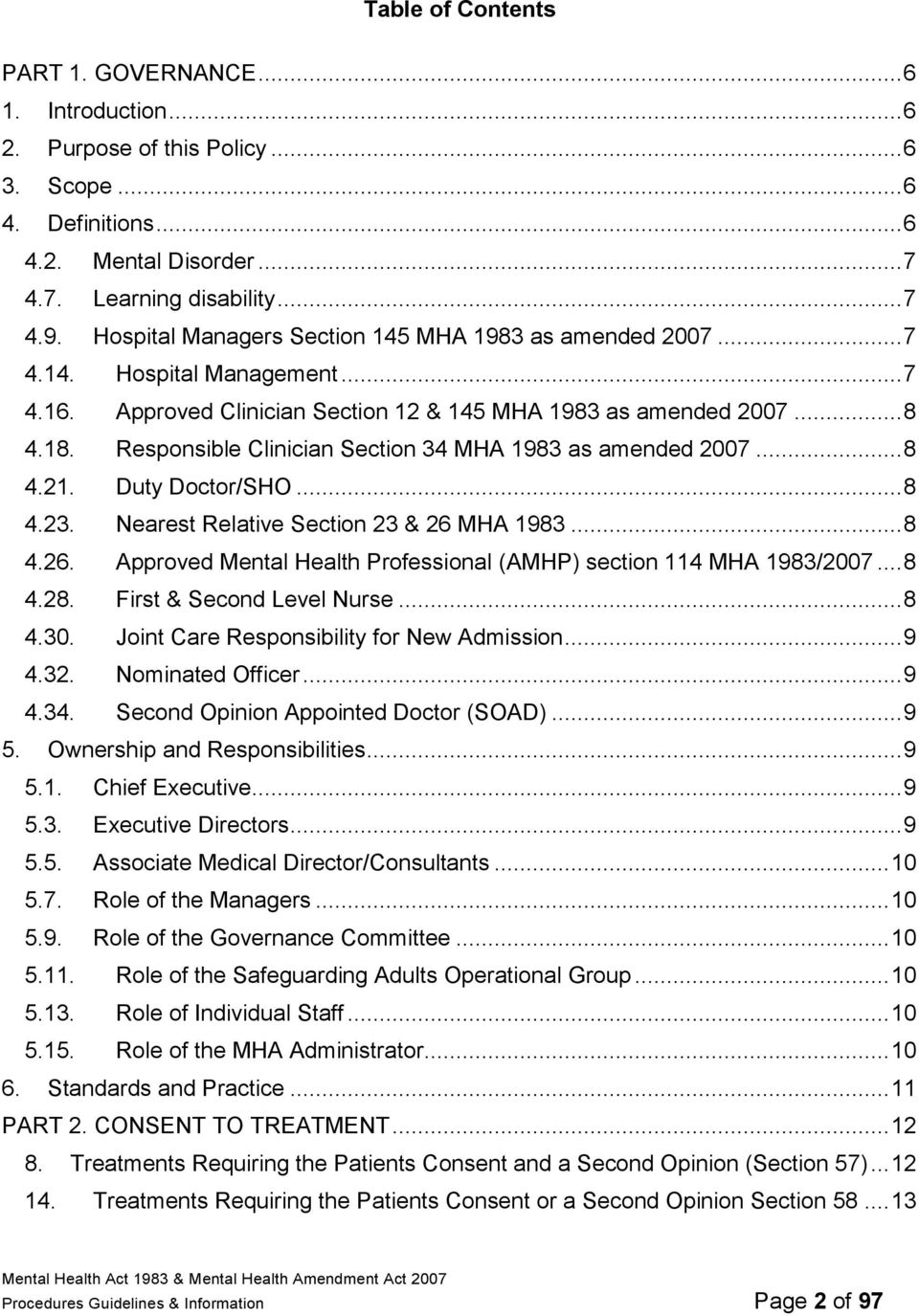
2 Table of Contents PART 1. GOVERNANCE Introduction Purpose of this Policy Scope Definitions Mental Disorder Learning disability Hospital Managers Section 145 MHA 1983 as amended Hospital Management Approved Clinician Section 12 & 145 MHA 1983 as amended Responsible Clinician Section 34 MHA 1983 as amended Duty Doctor/SHO Nearest Relative Section 23 & 26 MHA Approved Mental Health Professional (AMHP) section 114 MHA 1983/ First & Second Level Nurse Joint Care Responsibility for New Admission Nominated Officer Second Opinion Appointed Doctor (SOAD) Ownership and Responsibilities Chief Executive Executive Directors Associate Medical Director/Consultants Role of the Managers Role of the Governance Committee Role of the Safeguarding Adults Operational Group Role of Individual Staff Role of the MHA Administrator Standards and Practice PART 2. CONSENT TO TREATMENT Treatments Requiring the Patients Consent and a Second Opinion (Section 57) Treatments Requiring the Patients Consent or a Second Opinion Section Procedures Guidelines & Information Page 2 of 97
3 20. Treatments Requiring the Patients Consent or a Second Opinion Section 58a (ECT and Medication Administered As Part of ECT) Treatment without consent general points (Section 63) Withdrawing Consent PART 3. NOMINATED OFFICERS Operational Procedures PART 4. RECEIPT & SCRUTINY OF MHA DOCUMENTS PART 5. INFORMATION TO BE PROVIDED TO PATIENTS, NEAREST RELATIVES AND OTHERS PART 6. INFORMATION FOR THE NEAREST RELATIVE UNDER THE MENTAL HEALTH ACT PART 7. REQUESTS FOR DISCHARGE BY MHA MANAGERS AND REVIEW TRIBUNALS PART 8. REVIEWS BY MANAGERS AND MENTAL HEALTH TRIBUNALS See Appendix 3. Procedure for Managers at Mental Health Act Reviews PART 9. MENTAL HEALTH REVIEW TRIBUNALS PART 10. RENEWAL & EXTENSION OF DETENTION ORDERS & CTO s PART 11. INVOLVEMENT AFTER DISCHARGE FROM HOSPITAL PART 12. COMMON LAW POWERS OF DETENTION PART 13. RECORDS PART 14. CHILDREN AND YOUNG PEOPLE Parental Responsibility (Code of Practice36.5) Admission and Treatment of 16 and 17 year olds (Code of Practice 36.21) Under 16s (Code of Practice 36.38) Age-appropriate services Confidentiality PART 15. ADMISSION FOR ASSESSMENT SECTION PROCEDURE FOR ADMISSION TO WARD CHECK LIST FOR DETENTION DOCUMENTS SECTION PART 16. ADMISSION FOR TREATMENT SECTION PROCEDURE FOR ADMISSION TO WARD SECTION CHECK LIST FOR DETENTION DOCUMENTS SECTION PART 17. ADMISSION FOR ASSESSMENT ON CASES OF EMERGENCY SECTION PROCEDURE FOR ADMISSION TO WARD SECTION NURSE IN CHARGE CHECK LIST FOR DETENTION DOCUMENTS SECTION Procedures Guidelines & Information Page 3 of 97

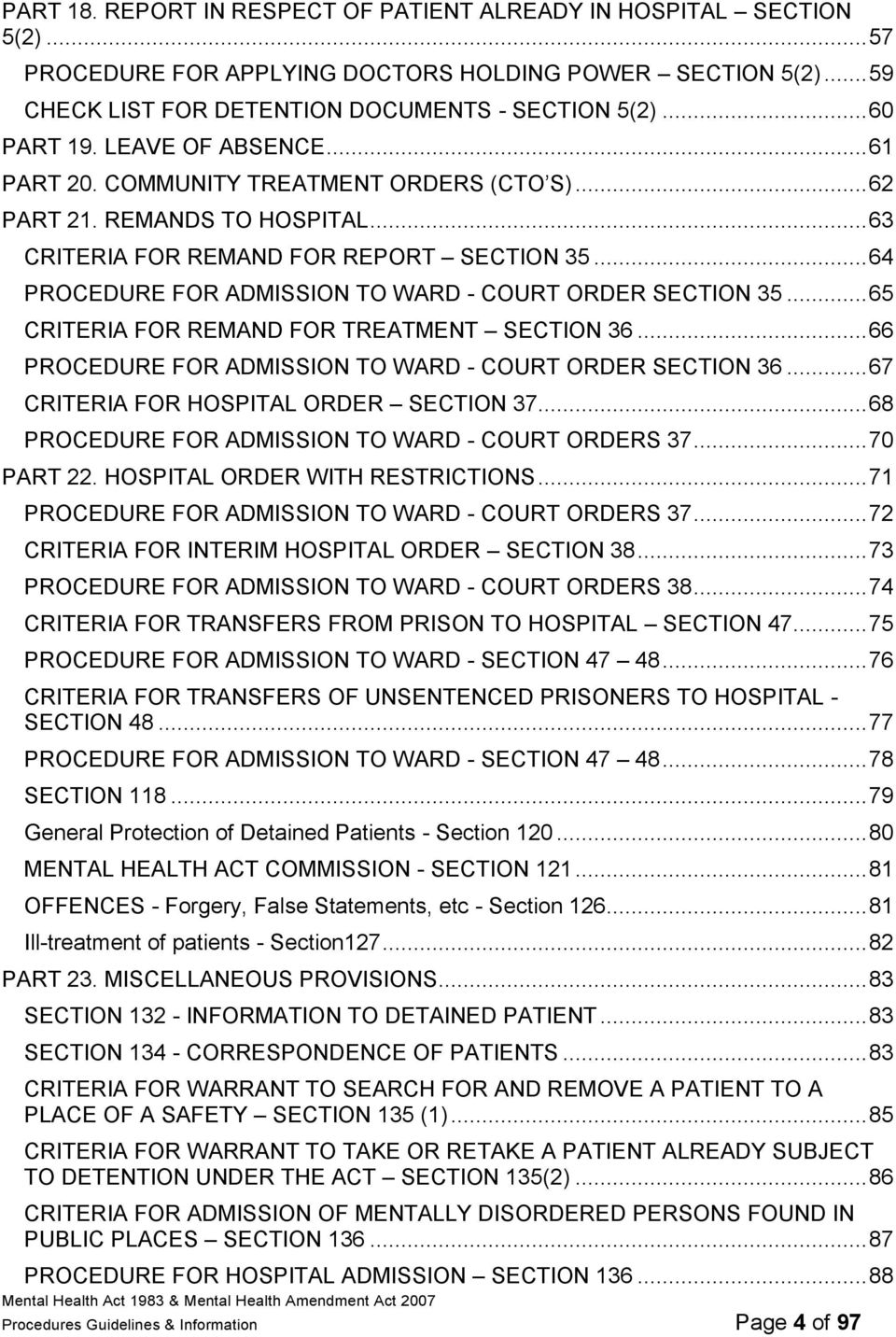
4 PART 18. REPORT IN RESPECT OF PATIENT ALREADY IN HOSPITAL SECTION 5(2) PROCEDURE FOR APPLYING DOCTORS HOLDING POWER SECTION 5(2) CHECK LIST FOR DETENTION DOCUMENTS - SECTION 5(2) PART 19. LEAVE OF ABSENCE PART 20. COMMUNITY TREATMENT ORDERS (CTO S) PART 21. REMANDS TO HOSPITAL CRITERIA FOR REMAND FOR REPORT SECTION PROCEDURE FOR ADMISSION TO WARD - COURT ORDER SECTION CRITERIA FOR REMAND FOR TREATMENT SECTION PROCEDURE FOR ADMISSION TO WARD - COURT ORDER SECTION CRITERIA FOR HOSPITAL ORDER SECTION PROCEDURE FOR ADMISSION TO WARD - COURT ORDERS PART 22. HOSPITAL ORDER WITH RESTRICTIONS PROCEDURE FOR ADMISSION TO WARD - COURT ORDERS CRITERIA FOR INTERIM HOSPITAL ORDER SECTION PROCEDURE FOR ADMISSION TO WARD - COURT ORDERS CRITERIA FOR TRANSFERS FROM PRISON TO HOSPITAL SECTION PROCEDURE FOR ADMISSION TO WARD - SECTION CRITERIA FOR TRANSFERS OF UNSENTENCED PRISONERS TO HOSPITAL - SECTION PROCEDURE FOR ADMISSION TO WARD - SECTION SECTION General Protection of Detained Patients - Section MENTAL HEALTH ACT COMMISSION - SECTION OFFENCES - Forgery, False Statements, etc - Section Ill-treatment of patients - Section PART 23. MISCELLANEOUS PROVISIONS SECTION INFORMATION TO DETAINED PATIENT SECTION CORRESPONDENCE OF PATIENTS CRITERIA FOR WARRANT TO SEARCH FOR AND REMOVE A PATIENT TO A PLACE OF A SAFETY SECTION 135 (1) CRITERIA FOR WARRANT TO TAKE OR RETAKE A PATIENT ALREADY SUBJECT TO DETENTION UNDER THE ACT SECTION 135(2) CRITERIA FOR ADMISSION OF MENTALLY DISORDERED PERSONS FOUND IN PUBLIC PLACES SECTION PROCEDURE FOR HOSPITAL ADMISSION SECTION Procedures Guidelines & Information Page 4 of 97
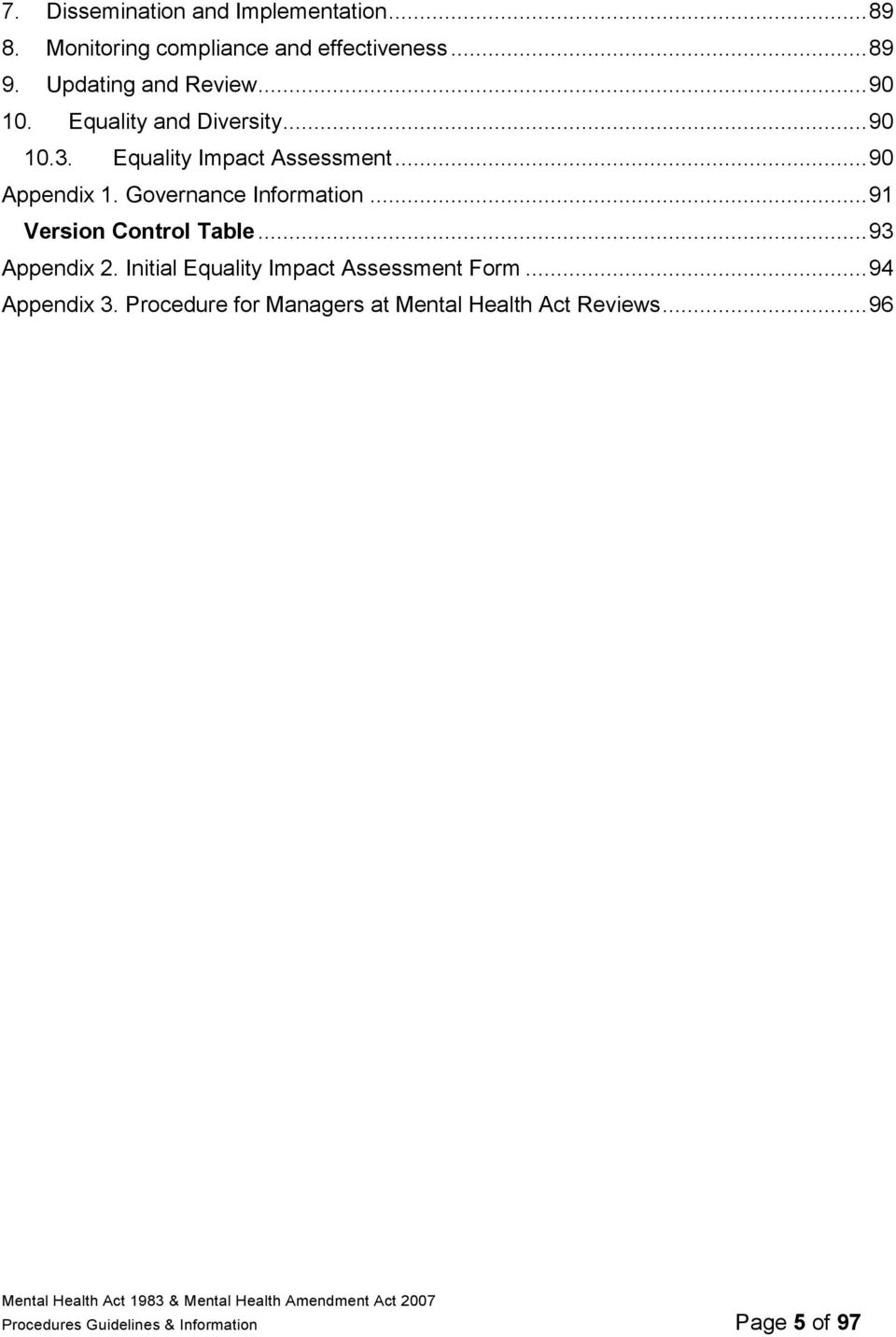
5 7. Dissemination and Implementation Monitoring compliance and effectiveness Updating and Review Equality and Diversity Equality Impact Assessment Appendix 1. Governance Information Version Control Table Appendix 2. Initial Equality Impact Assessment Form Appendix 3. Procedure for Managers at Mental Health Act Reviews Procedures Guidelines & Information Page 5 of 97
6 PART 1. GOVERNANCE 1. Introduction 1.1. The main purpose of the Mental Health Act 1983 and the Mental Health Amendment Act 2007 (MHA) is to allow compulsory action to be taken, where necessary, to make sure that people with mental disorders get the care and treatment they need for their own health or safety, or for the protection of other people. It sets out the criteria that must be met before compulsory measures can be taken, along with protections and safeguards for patients. In England, the Care Quality Commission is responsible for monitoring the way the Act is used and protecting the interests of patients This version supersedes any previous versions of this document. 2. Purpose of this Policy 2.1. Legislation requires that all staff employed in Health (or Social Care) are guided by the principles of the Mental Health Act 1983, the Mental Health Amendment Act 2007 (MHA) and the Code of Practice (CoP) and associated legalities concerning the detention and treatment of patients as described in this document The purpose of this policy is to underpin the implementation of the Mental Health Act 1983, the Mental Health Amendment Act 2007 (MHA) and the Code of practice within our acute hospital setting in line with the statutory framework It outlines the procedures for the receipt and scrutiny of MHA documents, requests for discharge, the renewal and extension of detention orders, common law powers of detention, procedures and checklists for detention under a variety of sections, leave of absence and remands to hospital. 3. Scope 3.1. All staff working in RCHT whose practice is within the remit of this document hold a formal duty of regard to the Mental Health Act 1983, the Mental Health Amendment Act 2007 (MHA) and the Code of practice and will need to take active responsibility for equipping themselves to practice within the law All Staff must be able to explain how they have regard to both the Act and the Code when taking compulsory action to make sure that people with mental disorders get the care and treatment they need for their own health or safety, or for the protection of other people. Ensuring that the necessary criteria have been met before compulsory measures are taken. 4. Definitions 4.1. The definition of terms used in this document is listed below along with any commonly used abbreviations. Where definition is defined in law the associated Procedures Guidelines & Information Page 6 of 97

7 statute is referred to Mental Disorder 4.3. Mental disorder is defined as any disorder or disability of the mind But a person with a learning disability shall not be considered by reason of that disability to be a) suffering from mental disorder for the purposes of the provisions mentioned in the paragraph below, or 4.5. b) Requiring treatment in hospital for mental disorder for the purposes of Section 17E and 50 to 53 of the MHA 1983 as amended, unless that disability is associated with abnormally aggressive or seriously irresponsible conduct on his part Dependence on alcohol or drugs is not considered a disorder or disability of the mind for the purpose s of the section above Learning disability 4.8. Learning disability means a state of arrested or incomplete development of the mind, which includes significant impairment of intelligence and social functioning Hospital Managers Section 145 MHA 1983 as amended In relation to a hospital vested in the Secretary of State for the purposes of his functions under the NHS Act 2006 the Primary Care Trust, Strategic Health Authority, Health Authority or Special Health Authority responsible for the administration of the hospital; 4.11.In relation to a hospital vested in a Primary Care Trust or a NHS Trust, the Trust 4.12.In relation to a registered establishment, the person or persons registered in respect of the establishment In practice, this means all members of the Board of Directors of that Trust or for private hospitals the persons registered. However, Section 23 authorises only the Chairman and the Non Executive Directors of the Trust to discharge patients detained under the Act. The Trust can appoint Associate Managers to assist in the review process. A minimum of three Hospital Managers, properly constituted, can order the discharge of a detained patient should the criteria, for their continued compulsory assessment or treatment, no longer be present Hospital Management 4.15.Officers of the Trust who exercise delegated authority on behalf of the Directors of the Health Authority, Special Health Authority, Primary Care Trust, NHS Trust or NHS Foundation Trust in the day-to-day running of the Hospital. Procedures Guidelines & Information Page 7 of 97

8 4.16. Approved Clinician Section 12 & 145 MHA 1983 as amended Means a person approved by the Secretary of State to act as an approved clinician for the purposes of this Act Responsible Clinician Section 34 MHA 1983 as amended In relation to a patient liable to be detained by virtue of an application for admission for assessment or an application for admission for treatment, or a community patient, the approved clinician with overall responsibility for the patient s care; 4.20.In relation to a patient subject to guardianship, the approved clinician authorised by the responsible local social services authority to act (either generally or in a particular case or for any particular purpose) as the responsible clinician Duty Doctor/SHO 4.22.The Duty Doctor of a Hospital is any Registered Medical Practitioner on the roster, to provide on-call cover, referred to as the Duty SHO Nearest Relative Section 23 & 26 MHA The nearest relative is usually identified from: - husband, wife or civil partner, son or daughter (over 18), father or mother, brother or sister, grandparent, grandchild, uncle or aunt, nephew or niece The Act authorise the nearest relative to make applications for admission, order the discharge of their relative from detention, unless certain conditions exist, and under specific circumstances to apply for a mental health review tribunal Approved Mental Health Professional (AMHP) section 114 MHA 1983/ A person who has been approved by the appropriate local social services authority, to act as an approved mental health professional First & Second Level Nurse 4.29.Nurses trained in nursing mentally ill or mentally impaired people who are registered in Part 3, 5, 13 or 14 of the United Kingdom Central Council for Nursing, Midwifery and Health Visiting. (a) Registered in Sub-Part 1 of the register, whose entry includes an entry to indicate the nurse s field of practice is mental health nursing OR (b) Registered in Sub-Part 2 of the register, whose entry includes an entry to indicate the nurse s field of practice is mental health nursing Procedures Guidelines & Information Page 8 of 97

9 OR (c) Registered in Sub-Part 1 of the register, whose entry includes an entry to indicate the nurse s field of practice is learning disabilities nursing OR (d) Registered in Sub-Part 2 of the register, whose entry includes an entry to indicate the nurse s field of practice is learning disabilities nursing Joint Care Responsibility for New Admission 4.31.Patients conveyed to the Hospital by an Applicant (AMHP, nearest relative or nominee) for detention under the Act will be received by the Nurse-in-Charge of the ward. The patient will remain the joint responsibility of the Applicant and Ward Staff until scrutinising and acceptance of the Admission Papers is complete, and an Authorised Officer of the Trust has completed Form H3 Record of Detention In Hospital Nominated Officer 4.33.Employees (Post Holders) of a Health Authority, Special Health Authority, Primary Care Trust, NHS Trust, NHS Foundation Trust or registered establishment who are nominated to perform delegated administrative procedures, on behalf of the Health Authority, Special Health Authority, Primary Care Trust, NHS Trust, NHS Foundation Trust or registered establishment, and to administer the Mental Health Act on their behalf Second Opinion Appointed Doctor (SOAD) 4.35.The SOAD safeguards the rights of patients detained under the Mental Health Act who either refuse the treatment prescribed to them or are deemed incapable of consenting. The role of the SOAD is to decide whether the treatment recommended is clinically defensible and whether due consideration has been given to the views and rights of the patient. 5. Ownership and Responsibilities 5.1. Chief Executive 5.2. The Chief Executive and wider Trust Board have key roles and responsibilities to ensure the Trust meets requirements set out by statutory and regulatory authorities such as the Department of Health, Commissioners and the Care Quality Commission. The Trust s Chief Executive has overall responsibility to have processes in place to: Ensure that clinical staff are aware of this policy and adhere to its requirements Ensure that appropriate resources exist to meet the requirements of this policy 5.3. Executive Directors 5.4. The Executive Directors are responsible for ensuring that all operational managers in their area are aware of this policy, understand its requirements and support its implementation with relevant staff. Procedures Guidelines & Information Page 9 of 97

10 5.5. Associate Medical Director/Consultants 5.6. The Associate Medical Director and Consultants are responsible for ensuring procedures are understood and carried out by medical staff involved in the implementation of this policy Role of the Managers 5.8. Managers are responsible for implementing the policy with their immediate staff and ensuring that they carry out the duties prescribed in this policy and as required by the Mental Health Act 1983, the Mental Health Amendment Act 2007 (MHA) and the Code of practice Role of the Governance Committee 5.10.The Governance Committee is responsible for: Rigorously keeping under review all aspects of the Trust's quality and clinical governance. This includes, in particular, ensuring that the Trust meets all its duties and obligations under the NHS Constitution; plus all other statutory, regulatory, and best practice requirements by which it is bound as a public body and for whose good implementation it is accountable to the people and community of Cornwall. The Committee will ensure that the Trust complies with the requirements of the Mental Health Act Role of the Safeguarding Adults Operational Group 5.12.The Safeguarding Adults Operational Group is responsible for disseminating significant information and developments relating to the Safeguarding Adults local and national agendas and will ensure that all RCHT Safeguarding Adult policies contain robust up to date links and information pertaining to the Mental Health Act, the Mental Capacity Act and the Deprivation of Liberty Safeguards. The membership will also support and identify ongoing staff training needs and take forward proposals for training through senior management channels Role of Individual Staff 5.14.All staff members have responsibility to comply with the requirements of this and associated policies and have a legal duty to have regard to it when working with, or caring for adults who are, or appear to be, suffering from a mental disorder Role of the MHA Administrator 5.16.The Senior Manager responsible for:- The day-to-day management of the Act in accordance with statutory legislation, Codes of Practice, national guidelines and local policies and procedures. The management of patient applications to Mental Health Review bodies, and MHA Managers. Procedures Guidelines & Information Page 10 of 97

11 Providing of advice, support and training in relation to the Mental Health Act 1983/7 and other associated statutory legislation, national guidance, policy or procedures. The development and review of Trust policies and procedures relating to the application and administration of the MHA 1983 as amended by the MHA 2007, the Code of Practice 2008 and regulations and the MCA 2005 and its Code of Practice. 6. Standards and Practice 6.1. To aid readability the detailed guidance and procedures are contained in the following parts: Part 1 Governance (this section) Part 2 Consent Part 3 Nominated Officers Part 4 Receipt and Scrutiny of MHA Documents Part 5 Information to be Provided to Patients, Nearest Relatives Part 6 Information for the Nearest Relative Under the Mental Health Act 1983 Part 7 Requests for Discharge by MHA Managers and Review Tribunals Part 8 Reviews by Managers and Mental Health Tribunals Part 9 Mental Health Review Tribunals Part 10 Renewal & Extension of Detention Orders & CTO s Part 11 Involvement After Discharge From Hospital Part 12 Common Law Powers of Detention Part 13 Records Part 14 Admission for Assessment Part 15 Admission for Treatment Section 3 Part 16 Admission for Assessment on Cases of Emergency Section 4 Part 17 Nurses Holding Powers Section 5(4) Part 18 Report in Respect of Patient Already in Hospital Section 5(2) Part 19 Leave of Absence Part 20 Community Treatment Orders (CTO s) Part 21 Remands to Hospital Part 22 Hospital Order With Restrictions Part 23 Miscellaneous Provisions Procedures Guidelines & Information Page 11 of 97

12 PART 2. CONSENT TO TREATMENT 1. Consent is the voluntary and continuing permission of a patient to be given a particular treatment, based on a sufficient knowledge of the purpose, nature, likely effects and risks of that treatment, including the likelihood of its success and any alternatives to it. Permission given under any unfair or undue pressure is not consent. (MHA COP ch 23.31) 2. By definition, a person who lacks capacity to consent does not consent to treatment, even if they co-operate with the treatment or actively seek it. (MHA CoP 23.32) 3. It is the duty of everyone seeking consent to use reasonable care and skill, not only in giving information prior to seeking consent, but also in meeting the continuing obligation to provide the patient with sufficient information about the proposed treatment and alternatives to it. (MHA CoP 23.33) 4. Part IV (Sections 56 64) Part 4A (64A 64K) of the Act is mainly concerned with Consent to Treatment for long-term detained patients, but certain safe guards in this part of the Act also apply to informal patients. The provisions on the most serious forms of treatment require Consent and a Second Opinion and extend to informal patients. (CoP Ch 23) Section Section 57 Section 58 Section 58A Forms of treatment covered Neurosurgery for mental disorder Surgical implantation of hormones to reduce male sex drive Medication (after an initial three-month period) except medication administered as part of electro-convulsive therapy (ECT) ECT and medication administered as part of ECT 5. CODE OF PRACTICE 6. Part IV & Part4A of the Act provides specific statutory authority for treatment, for forms of medical disorder, to be given to most patients liable to be detained, without their consent in certain circumstances. It also provides specific safeguards. Patients liable to be detained are those who are detained or have been granted leave of absence (Section 17) or Discharged under section 17A Community Treatment Order (CTO). It also provides specific safeguards to all patients when treatments are proposed that give rise to special concern. 7. Its provisions can be summarised as follows: - 8. Treatments Requiring the Patients Consent and a Second Opinion (Section 57) 9. Psychosurgery and the surgical implantation of hormones for the suppression of male sexual drive (these safeguards apply to all patients). 10. CODE OF PRACTICE Procedures Guidelines & Information Page 12 of 97

13 11. Where section 57 applies, these treatments can be given only if all three of the following requirements are met: The patient consents to the treatment; A SOAD (and two other people by the Commission) certify that the patient has the capacity to consent and has done so; and The SOAD also certifies that it is appropriate for the treatment to be given to the patient. 12. A decision to administer treatments to which section 57 applies requires particularly careful consideration, given their significance and sensitivity. Hospitals proposing to offer such treatments are strongly encouraged to agree with the Commission the procedures which will be followed to implement the requirements of section Before asking the Commission to put in hand the process of issuing a certificate, referring professionals should personally satisfy themselves that the patient is capable of giving valid consent and is willing to consent. 14. Treatments Requiring the Patients Consent or a Second Opinion Section The administration of medicine beyond 3 months. These safeguards apply to all patients liable to be detained except those detained under Section 4, Section 5(2) or 5(4), Section 35, Section 135, Section 136 and Section 37(4), also patients conditionally discharged under Section 42(2) and Section 73 and 74. All these patients can only be treated with their consent or under common law. 16. CODE OF PRACTICE 17. Section 58 does not apply to medication administered as part of electroconvulsive therapy (ECT). That is covered by section 58A instead (CoP Ch ). 18. Section 58 applies only to detained patients. They cannot be given medication to which section 58 applies unless: The approved clinician in charge of the treatment, or a SOAD, certifies that the patient has the capacity to consent and has done so; or A SOAD certifies that the treatment is appropriate and either that: the patient does not have the capacity to consent; or the patient has the capacity to consent but has refused to do so. 19. Hospital managers should ensure that systems are in place to remind both the clinician in charge of the medication and the patient at least four weeks before the expiry of the three-month period. Procedures Guidelines & Information Page 13 of 97
14 20. Treatments Requiring the Patients Consent or a Second Opinion Section 58a (ECT and Medication Administered As Part of ECT) 21. The key differences from section 58 are that: Patients who have the capacity to consent may not be given treatment under section 58A unless they do in fact consent; No patient aged under 18 can be given treatment under section 58A unless a SOAD has certified that the treatment is appropriate; and There is no initial three-month period during which a certificate is not needed (even for the medication administered as part of the ECT). 22. A patient who has capacity to consent may not be given treatment under section 58A unless the clinician in charge, or a SOAD, has certified that the patient has the capacity to consent and has done so. If the patient is under 18, only a SOAD may give the certificate, and the SOAD must certify that the treatment is appropriate. 23. A patient who lacks the capacity to consent may not be given treatment under section 58A unless a SOAD certifies that the patient lacks capacity to consent and that: The treatment is appropriate; No valid and applicable advance decision has been made by the patient under the Mental Capacity Act 2005 (MCA) refusing the treatment; No suitably authorised attorney or deputy objects to the treatment on the patient s behalf; and The treatment would not conflict with a decision of the Court of Protection, which prevents the treatment being given. 24. In all cases, SOADs should indicate on the certificate the maximum number of administrations of ECT, which it approves. 25. Treatment without consent general points (Section 63) 26. Although the Mental Health Act permits some medical treatment for mental disorder to be given without consent, the patient s consent should still be sought before treatment is given, wherever practicable. The patient s consent or refusal should be recorded in their notes, as should the treating clinician s assessment of the patient s capacity to consent. 27. If a patient initially consents, but then withdraws that consent (or loses the capacity to consent), the treatment should be reviewed. The clinician in charge of the treatment must consider whether to proceed in the absence of consent, to provide alternative treatment instead or to give no further treatment. 28. Clinicians authorising or administering treatment without consent under the Mental Health Act are performing a function of a public nature and are therefore subject to the provisions of the Human Rights Act It is unlawful for them to act in a way, which is incompatible with a patient s rights as set out in the European Procedures Guidelines & Information Page 14 of 97

15 Convention on Human Rights ( the Convention ). 29. All medical treatments for mental disorders given by or under the direction of the patients Approved Clinician and which are not referred to in Section 57 and 58 (this provision applies to the same patients as Section 58). 30. Urgent cases where certificates are not required (sections 62, 64B, 64C and 64E) 31. Sections 57, 58 and 58A do not apply in urgent cases where treatment is immediately necessary (section 62). Similarly, a Part 4A certificate is not required in urgent cases where the treatment is immediately necessary (sections 64B, 64C and 64E). 32. This applies only if the treatment in question is immediately necessary to: Save the patient s life; Prevent a serious deterioration of the patient s condition, and the treatment does not have unfavourable physical or psychological consequences, which cannot be reversed; Alleviate serious suffering by the patient, and the treatment does not have unfavourable physical or psychological consequences which cannot be reversed and does not entail significant physical hazard; or Prevent patients behaving violently or being a danger to themselves or others, and the treatment represents the minimum interference necessary for that purpose, does not have unfavourable physical or psychological consequences which cannot be reversed and does not entail significant physical hazard. 33. If the treatment is ECT, or medication administered as part of ECT, only the first two categories above apply. 34. Withdrawing Consent 35. Consent is the voluntary and continuing permission of a patient to be given a particular treatment, based on a sufficient knowledge of the purpose, nature, likely effects and risks of that treatment, including the likelihood of its success and any alternatives to it. 36. Permission given under any unfair or undue pressure is not consent. 37. Patients should be told that their consent to treatment can be withdrawn at any time. 38. Where patients withdraw their consent (or are considering withdrawing it), they should be given a clear explanation of the likely consequences of not receiving the treatment and (where relevant) the circumstances in which the treatment may be given without their consent under the Mental Health Act. 39. A record should be kept of the information provided to patients. Procedures Guidelines & Information Page 15 of 97
16 40. By definition, a person who lacks capacity to consent does not consent to treatment, even if they co-operate with the treatment or actively seek it. 41. It is the duty of everyone seeking consent to use reasonable care and skill, not only in giving information prior to seeking consent, but also in meeting the continuing obligation to provide the patient with sufficient information about the proposed treatment and alternatives to it. 42. Where the consent of a patient to any treatment has been given for the purpose of section 57 or 58, the patient, may subject to section 62, at any time before the completion of the treatment, withdraw his consent, and those sections shall apply as if the remainder of the treatment were a separate form of treatment. 43. The patient should receive an explanation of the likely consequences of not receiving treatment. Procedures Guidelines & Information Page 16 of 97

17 PART 3. NOMINATED OFFICERS 1 Specialist Nurse Mental Health and Wellbeing (MHA Administrator) and Site Co-ordinators, appointed by the Trust to administer the Mental Health Act documentation and records. 2 Nominated to: - To inform patients of their rights under the MHA 1983 as amended, Receive and check the validity and scrutinise statutory documentation under the Mental Health Act 1983, To authorise amendments to statutory documentation, To invalidate MHA documentation that does not meet the requirements of the statutory regulations. To complete form H3 Record of Admission. To authorise the transfer of patients under Section 19 of the Act, To contact, in writing, the patient s nearest relative informing them of the patient s admission to hospital under the Act. To assist patients in the completion of applications for reviews of their detention, To arrange, coordinate and facilitate MHA Managers reviews and Mental Health Review Tribunals. Refer patients to the Mental Health Review tribunal in accordance with the regulations. Assist patient with the Trust s complaints procedure 3 Specialist Nurse Mental Health and Wellbeing (MHA Administrator), The Senior Manager responsible to the MHA Managers (NHS Trust Board) for the Management of the Mental Health Act 1983/2007 within the Trust. 4 Nominated to act on behalf of the MHA Managers in the daily application and administration of the MHA Act 1983, excluding sitting as a panel member for the purposes of reviewing detained patients. 5 Operational Procedures 6 These operational procedures are the minimum to which Nominated Officers will adhere to effectively and efficiently, without bias to their employer or patient when implementing the Mental Health Act 1983, 2007 and the Code of Practice They are not intended to replace or define any of the provisions of the Mental Health Act 1983 as amended by the Mental Health Amendment Act 2007or it s Code of Practice These procedures have been developed to support the statutory requirements within the Mental Health Act. Ensuring patients rights are observed and expedited as efficiently as practicable within operational conditions and circumstances. Procedures Guidelines & Information Page 17 of 97

18 9 All Nominated Officers have a duty to remain familiar with the Mental Health Act 1983 (As amended), the Mental Capacity 2005, associated Codes of Practice and other relevant legislation or national guidelines. Procedures Guidelines & Information Page 18 of 97

19 PART 4. RECEIPT & SCRUTINY OF MHA DOCUMENTS 1. Regulations require specific statutory forms to be used for certain applications, recommendations, decisions, reports and records under the Act. The forms are set out in the regulations themselves. If no hard copies of the statutory forms are available, photocopies of the original blank forms can be completed instead, as can computergenerated versions. However, the wording of the forms must correspond to the current statutory versions of the forms set out in the regulations. (CoP ch 13) 2. Regulations say that applications for detention under the Act must be delivered to a person who is authorised by the hospital managers to receive them. 3. People who act on the authority of these documents should also make sure that they are in the proper form, as an incorrectly completed or indecipherable form may not constitute authority for a patient s detention. 4. There are distinctions between receiving admission documents and scrutinising them. 5. Receipt involves physically receiving documents and checking that they appear to amount to an application that has been duly made (since that is sufficient to give the managers the power to detain the patient). (Re S-C (mental patient: habeas corpus) [1996] 1 All ER 532). 6. Scrutiny involves more detailed checking for omissions, errors and other defects and, where permitted, taking action to have the documents rectified after they have already been acted on. 7. Errors, omissions and defects in Applications and Medical Recommendations fall into one of two categories, as follows: Invalidating Deficiencies Deficiencies that render the Application invalid and further detention of the patient unlawful. In general, any departure from the laid down procedure will invalidate the Application. Section 15 MHA 1983/ Examples are: - Applications and Medical Recommendations completed outside of the specified time limits. Application or Medical Recommendations signed by an unauthorised person, e.g. an applicant who is not the nearest relative or an Approved Mental Health Professional, a doctor who is not registered. Application or Medical Recommendation with no signature. Conveying patients to Hospital outside of the specified time limit. Use of incorrect forms for the Section under which the patient is to be detained. Significant miss spelling or illegibility of patient s name. Procedures Guidelines & Information Page 19 of 97

20 7.3. Rectifiable Deficiencies: - Genuine minor errors and omissions in the compilation of the documents where such error or omissions misrepresents the fact that the correct procedure was followed In such cases, the defective documents must be returned to the Applicant as quickly as possible with a covering letter, on behalf of the MHA Managers, identifying the deficiency. The rectified document must be returned to the Hospital Management within 14 days of the patients admission otherwise authority to detain the patient may lapse. Examples of rectifiable deficiencies are: Dates entered incorrectly when in fact the procedural timescales laid down where adhered to. Minor spelling errors or omissions relating to names, places or qualifications. Medical Recommendations containing insufficient details of the patient s condition. Medical Recommendations, which are each in them selves, correct, but where neither is from an approved clinician, a further Medical Recommendation must be sought from Approved clinician. 8. In practice, staff receiving admission documents may accept them at face value. In other words, if the contents of the documents appear conform to the regulations; receiving staff can accept them as valid even though the actual procedure may not have been followed correctly. (Re S-C (mental patient: habeas corpus) [1996] 1 All ER 532). 9. Where Nominated officer or Managers become aware that procedures have not been followed they must investigate the circumstances of the admission and the continued validity of the detention. 10. A comprehensive checklist has been produced to assist staff in their perusal of Admission Documents, a copy of which is included. 11. Admission procedure flow charts are included for each section of the Act covered by this document. Where staff have concerns or are unsure of the validity of the documents, they should contact the Specialist Nurse for Mental Health and Wellbeing or MHA Advisor. Procedures Guidelines & Information Page 20 of 97
21 PART 5. INFORMATION TO BE PROVIDED TO PATIENTS, NEAREST RELATIVES AND OTHERS 1. Effective communication is essential in ensuring appropriate care and respect for patients rights. It is important that the language used is clear and unambiguous and that people giving information check that the information that has been communicated has been understood. MHA COP The Nominated Officer will ensure that the patient has been informed of these rights as soon as practicable after arrival at the hospital. 3. In the event that a patient is unable to be informed of the rights on admission a period of no longer that 18 hours should be allowed to pass before an attempt to inform that patient again is made. 4. The member of staff who signs the Form H3 (Record of Admission) will be responsible for informing the patient s nearest relative, (as soon as practicable) of the patient s admission to hospital under the Act. Written confirmation will be sent by the Hospital Administrative Department. 5. Once the patient has been informed of their rights, a record must be made in the patient s Nursing Notes, on the Document Checklist and the Trust Patient Rights form (Section 132). 6. If it is believed that a patient has not understood their rights, record the fact in the Nursing Notes and ensure that the patient is revisited at a more suitable time to inform the patient of their rights. Each subsequent attempt to give the patient the information should be recorded in the patient s health record. 7. Everything possible should be done to overcome barriers to effective communication, which may be caused by any of a number of reasons for example, if the patient s first language is not English. Patients may have difficulty in understanding technical terms and jargon or in maintaining attention for extended periods. They may have a hearing or visual impairment or have difficulty in reading or writing. A patient s cultural background may also be very different from that of the person speaking to them. MHA COP Where an interpreter is needed, every effort should be made to identify who is appropriate to the patient, given the patient s gender, religion, language, dialect, cultural background and age. The patient s relatives and friends should only exceptionally be used as intermediaries or interpreters. Interpreters (both professional and nonprofessional) must respect the confidentiality of any personal information they learn about the patient through their involvement. MHA COP Independent advocates engaged by patients can be invaluable in helping patients to understand the questions and information being presented to them and in helping them to communicate their views to staff. Procedures Guidelines & Information Page 21 of 97
22 10. Wherever possible, patients should be engaged in the process of reaching decisions, which affect their care and treatment under the Act. Consultation with patients involves assisting them in understanding the issue, their role and the roles of others who are involved in taking the decision. Ideally decisions should be agreed with the patient. Where a decision is made that is contrary to the patient s wishes, that decision and the authority for it should be explained to the patient using a form of communication that the patient understands. MHA COP The Act requires hospital managers to take steps to ensure that patients who are detained in hospital under the Act, or who are on Supervised Community Treatment (SCT), understand important information about how the Act applies to them. This must be done as soon as practicable after the start of the patient s detention or SCT. This information must also be given to SCT patients who are recalled to hospital 12. It is the duty of the Applicant, the person making the application to detain a patient under the Mental Health Act, to inform the patient of their rights under the Act. 13. In addition, the member of staff receiving Mental Health Act Documents from an applicant must also inform the patient of their rights under the Act. Information must be given to the patient both orally and in writing. These are not alternatives. Those providing information to patients should ensure that all relevant information is conveyed in a way that the patient understands using the information leaflets provided. 14. It is not sufficient to repeat what is already written on an information leaflet as a way of providing information orally. MHA COP Patients must be informed of the provisions of the Act under which they are detained or on SCT, and the effect of those provisions. of the rights (if any) of their nearest relative to discharge them (and what can happen if their responsible clinician does not agree with that decision); for SCT patients, of the effect of the community treatment order, including the conditions which they are required to keep to and the circumstances in which their responsible clinician may recall them to hospital. As part of this, they should be told: the reasons for their detention or SCT; the maximum length of the current period of detention or SCT; that their detention or SCT may be ended at any time if it is no longer required or the criteria for it are no longer met; that they will not automatically be discharged when the current period of detention or SCT ends; and that their detention or SCT will not automatically be renewed or extended when the current period of detention or SCT ends. 16. Patients should also be told the essential legal and factual grounds for their detention or SCT. For the patient to be able to effectively challenge the grounds for their detention or SCT, should they wish, they should be given the full facts rather than simply the broad reasons. This should be done promptly and clearly. Procedures Guidelines & Information Page 22 of 97
23 17. In addition, a copy of the detention or SCT documentation should be made available to the patient, unless the hospital managers are of the opinion (based on the advice of the authors of the documents) that the information disclosed would adversely affect the health or well being of the patient or others. It may be necessary to remove any personal information about third parties. Where the section of the Act under which the patient is being detained changes, they must be provided with the above information to reflect the new situation. This also applies where a detained patient becomes an SCT patient, where an SCT patient s community treatment order is revoked, or where a conditionally discharged patient is recalled to hospital. 18. Information about consent to treatment 19. Patients must be told what the Act says about treatment for their mental disorder. In particular, they must be told: the circumstances (if any) in which they can be treated without their consent and the circumstances in which they have the right to refuse treatment; the role of second opinion appointed doctors (SOADs) and the circumstances in which they may be involved; and (where relevant) the rules on electro-convulsive therapy (ECT). 20. Information about seeking a review of detention or SCT 21. Patients must be informed: of the right of the responsible clinician and the hospital managers to discharge them (and, for restricted patients, that this is subject to the agreement of the Secretary of State for Justice); of their right to ask the hospital managers to discharge them; that the hospital managers must consider discharging them when their detention is renewed or their SCT extended; (for NHS patients in independent hospitals) of the power of the relevant NHS body to discharge them; of their rights to apply to the Tribunal; of the rights (if any) of their nearest relative to apply to the Tribunal on their behalf; about the role of the Tribunal; and how to apply to the Tribunal. 22. Hospital managers should ensure that patients are offered assistance to request a hospital managers hearing or make an application to the Tribunal. They should also be told: how to contact a suitably qualified legal representative (and should be given assistance to do so if required); that free legal aid may be available; and how to contact any other organisation which may be able to help them make Procedures Guidelines & Information Page 23 of 97
24 an application to the Tribunal. 23. It is particularly important that patients on SCT who may not have daily contact with people who could help them make an application to the Tribunal are informed and supported in this process. 24. SCT patients whose community treatment orders are revoked, and conditionally discharged patients recalled to hospital, should be told that their cases would be referred automatically to the Tribunal. 25. Communication with other people nominated by the patient 26. Patients may want to nominate one or more people who they would wish to be involved in, or notified of, decisions related to their care and treatment. 27. Patients may nominate an independent mental health advocate, another independent advocate or a legal professional. But they may also nominate a relative, friend or other informal supporter. The involvement of such friends, relatives or other supporters can have significant benefits for the care and treatment of the patient. It can provide reassurance to the patient, who may feel distrustful of professionals who are able to impose compulsory measures on them, or are relatively unfamiliar and unknown to the patient. Procedures Guidelines & Information Page 24 of 97
25 PART 6. INFORMATION FOR THE NEAREST RELATIVE UNDER THE MENTAL HEALTH ACT The Nearest Relative has the right to Request a mental health assessment of their nearest relative by an Approved Mental Health Professional. Complete an application for their nearest relative to be admitted to hospital under Section 2 (for assessment and any necessary treatment), Section 3 (for longer term treatment), Section 4 (for admission in an emergency.) An application would require the support of two medical recommendations. (Note the Code of Practice says that it is preferable for the Approved Mental Health Profession (AMHP) to make the application.) Be informed if the AMHP intends to make an application, or has done so, for a Section 2 admission. Be consulted before an AMHP applies for admission under Section 3, or for admission to Guardianship. (Except where it would not be reasonably practicable to do so) Object to a Section 3 admission, or admission to Guardianship. (Note - the detention cannot then go ahead, but the ASW could apply to the County Court to have the nearest relative displaced or removed, because if the objection is unreasonable or because the nearest relative is incapable of carrying out the functions of a nearest relative by means of mental disorder.) Be informed of the outcome of an assessment. If the AMHP decides not to apply for admission, the nearest relative can use his/her independent right to apply for admission under the Act. Receive written information about your rights and those of the patient, unless the patient objects. Be given written confirmation of a detained patient s discharge from their detention order, unless the patient objects. Be given information about Mental Health Review Tribunals, including their role, how to apply, how to contact an appropriate solicitor, about legal aid and other help. Discharge the patient from detention in hospital, by giving the hospital managers seventy-two hours notice. However, the Responsible Clinician (RC) may provide a report to the hospital managers in barring your order for discharge. If this occurs then you, the nearest relative, may not then order discharge before six months have passed. If the patient is detained under a Section 3, and your order for discharge has been barred you may apply to a Mental Health Review Tribunal for the patient s discharge. Delegate your powers as nearest relative to someone else provided the other person agrees to take on this role. If you change your mind, you can at any time revoke, this authorisation, in writing. 2. Information About Mental Health Review Tribunals 3. Patients who have been compulsory detained under Section 2 or 3 can appeal to the Tribunal for their discharge. Tribunals are held at the hospital and Procedures Guidelines & Information Page 25 of 97
26 individuals have the right to legal representation. The Tribunal is made up of three people, a legal member (usually a Lawyer), an Approved Clinician (usually a Psychiatrist), and a layperson. They will decide whether patients should remain compulsorily detained. 4. If detained under a Section 2, patients have to apply within fourteen days and the hearing should be held within a week of their application. For other sections, the Tribunal will usually be held several weeks after the patient applies. 5. Before the hearing, the patient s Responsible Clinician or Approved Clinician and Approved Mental health professional will write reports. Copies will be sent to the patient s solicitor and the Tribunal office. The medical member of the Tribunal will visit the patient before the Tribunal takes place, to assess the patient s mental health. They will then report to the Tribunal. 6. The Tribunal is not formal like a court and the chairperson should try to make the patient feel comfortable. 7. The Tribunal s decision will be given soon afterwards, or by post a few days later. If the patient is not discharged, the Tribunal can make recommendations regarding their future care, whether informal or formal. 8. The patient does not have to leave hospital if they are discharged from their detention order. They can stay on the ward as an informal patient. 9. Information About Mental Health Act Managers 1.2 Patients can also apply to the hospital managers for discharge from their detention order at any time during the duration of the order. Hospital Managers are the executive and Non executive Directors of the Trust. However, only the Non executive Directors or Appointed Managers can make decisions about releasing those patients detained under the Mental Health act or subject to Community Treatment Orders. 1.3 This type of review is a less formal meeting than a Tribunal. However, the Managers have similar powers to the Tribunal. 1.4 Before the meeting the Mental Health Act administrator will request reports from the Responsible Clinician or Approved Clinician, Approved Mental health Professional and ward or community key worker, which patients are entitled to see. These professionals are usually present at the Hearing. 1.5 During the hearing, the managers will ask the professionals about the care and treatment received by the patient and future care plans should the care and treatment received should the patient be discharged. 1.6 Patients have the opportunity to ask questions and have their say. The Mental Health act Managers can discharge the patient if they believe that the patient no longer needs care and treatment under the Mental Health Act. Procedures Guidelines & Information Page 26 of 97
27 PART 7. REQUESTS FOR DISCHARGE BY MHA MANAGERS AND REVIEW TRIBUNALS 1. Where a patient requests a review their detention, with a view to being discharged, the patient should be encouraged and where necessary supported to complete the appropriate application form (MHRT Managers). The completed form should be forwarded as soon as practicable to the MHA Administrator s office Where patients are unwilling or unable to complete the form, an appropriate member of staff should either complete the form on the patient behalf or contact the MHA Administrato s office. 2. Nominated Officers shall provide assistance and support for patients, or their nearest relative, applying for a review for discharge. N.B. Nearest relatives can only apply for a hearing where their order to discharge the patient has been barred, under section 25, by the Responsible Clinician. 3. The Nominated Officer shall inform the patient of their Right to be legally represented at reviews and of the Law Societies list of approved Solicitor. Any preferences for legal representatives, expressed by the applicant, should be recorded on the application form. 4. The Nominated Officer will contact the representative, nominated by the patient, within one working day by telephone followed by written confirmation within 24 hours, or 72 hours if requests are made at weekends or during bank holidays. (Refer to MHA Departmental procedures). 5. A record of the patient s application should be made in the patient s health record. 6. Once a review has been requested the MHA Administrator shall, within 24 hours, or within 72 hours if requests are made at weekends or bank holidays, contact the Responsible Clinician, Approved Clinician, Approved Mental Health Professional and Appropriate Mental Health Team or Ward confirming that a review has been requested. In addition, all other relevant professionals involved with the care of the patient should be advised. 7. A mutually suitable date and time, where practicable, will be arranged by the Mental Health Act Administrator to accommodate the RC, AC, AMHP and other staff concerned with the review. 8. Those professional required to attend Tribunals or MHA Managers reviews are required to provide written reports. 9. The report should contain; a background history, the current situation, detailing the criteria for continued detention, to include medication, treatment/care plans, conclude with a prognosis and details of future plans for the patient s care as an inpatient and following discharge. (Section 117) Procedures Guidelines & Information Page 27 of 97
28 10. For patients detained under section 2, reports are required to be submitted as soon as practicable. This is to ensure that the patient s legal representative has adequate time to review the reports and discuss their content with the patient. 11. For patients detained under sections 3, or 37 reports are required to be submitted within three weeks of the date of the application (MHRT Rules and procedures). Reports dealing with patients subject to restriction Orders, 41 & 49, shall be forwarded to the Ministry of Justice for consideration and comment. 12. Staff wishing to submit confidential reports to Review Bodies, should prepare separate reports clearly identifying those reports that should not be disclosed to the patient. However, Staff should be aware, that confidential reports cannot be withheld from a patient s legal representative. 13. The final decision regarding disclosure of confidential reports to patients rests with the Tribunal Panel. Criteria for non disclosure is that the content of the report will be detrimental to the health or safety of the patient, including emotional distress, or the information contained within the report comes from a third party and disclosure would be detrimental to the patient or the third party. 14. Following confirmation of a review date, the RC should endeavour to examine the patient at least 72 hours before the Review is held. 15. Following a MHA Manager s review and where practicable the MHA Managers should, in person, inform the patient of their decision. Confirmation of the decision and the MHA Manager s reasons for their decision should be provided in writing as soon as practicable however, no later than 7 days from the date of the review. Procedures Guidelines & Information Page 28 of 97
29 PART 8. REVIEWS BY MANAGERS AND MENTAL HEALTH TRIBUNALS See Appendix 3. Procedure for Managers at Mental Health Act Reviews 1. Once the date time and venue for the review has been arranged the MHA Administrator shall confirm those arrangements, in writing, with the RC, AMHP/Mental Health Team, ward team leader, the patient s legal representative and with the patient s consent the patients nearest relative. 2. The MHA Managers attending the review shall be informed in writing, detailing the number of Reviews, those who are scheduled to attend and the date, time and venue of the review. 3. Where the RC is unable to attend the Review personally, they should direct their Nominated Deputy to attend in their absence. The Mental Health Act Administrator should be advised accordingly. The RC/AC should, when practicable, examine the patient and provide a signed written report. This should be forwarded to the Mental Health Act Administrator. 4. Where RC/AC s have been unable to prepare reports, Locum s or Nominated Deputies submitting reports should personally examine the patient before submitting the report and not simply rely on extracting information from the patient s health records. 5. When Nominated Deputies are called upon to attend Reviews on behalf of the RC/AC, they should endeavour to examine the patient, personally, at least 72 hours before the Reviews. They should ensure that they have been briefed by the RC/AC and have read the reports submitted to the Review Bodies. 6. Where the RC is unable to attend or nominate a Deputy to attend, the Mental Health Act Administrator should be informed immediately. This information can be conveyed to the MHRT/Managers and the patients legal Representative, as appropriate. A decision will be made whether or not to postpone and reschedule the review 7. Reports for MHA Managers (for Section 3 or 37) shall, where practicable be provided 7 days before the review. 8. Reports for MHA Managers (for Section 2 or 4) will be provided as soon as practicable. 9. Reports for Tribunals (for Section 3 or 37) will be provided three weeks from the date of application. 10. Reports for Tribunals (for Section 2) will be provided as soon as practicable. 11. Hospital managers have a common law duty to give reasons for their decisions. Procedures Guidelines & Information Page 29 of 97
30 The decisions of managers panels, and the reasons for them, should be fully recorded at the end of each review. The decision should be communicated as soon as practicable, both orally and in writing, to the patient, to the nearest relative (where relevant) and to the professionals concerned. On completion of Reviews, the patient will be informed of the decision, unless otherwise directed by the Managers or Tribunal President, immediately after the review has concluded and in writing within 7 days. 12. Copies of the papers relating to the review, and the formal record of the decision, should be kept in the patient s notes. 13. Where the Patient s nearest relative does not attend the review the MHA Administrator shall, with the patient s consent, inform the patient s nearest relative of the decision. 14. NHS bodies have the power to discharge NHS patients who are detained in independent hospitals and NHS SCT patients whose responsible hospital is an independent hospital. This is in addition to the power of the managers of the independent hospitals themselves. The NHS body concerned is the one that has contracted with the independent hospital in respect of the patient. 15. As a result, NHS bodies contracting with independent hospitals should take steps to satisfy themselves that the independent hospital s own arrangements for taking discharge decisions are adequate to protect the rights of NHS patients. 16. Where a patient has been detained under Section 2 of the Mental Health Act and has not exercised their Rights to request a review on admission, a representative of the MHA Managers shall visit the patient within 5 days of the admission, to ascertain their intention and/or awareness of their right to apply for review. 17. Where a patient has been detained under Section 3 or 37 of the Mental Health Act and has not exercised their Rights of review, a representative of the MHA Managers shall visit the patient within 5 days to ascertain their intention and/or awareness of their right to apply for a review. 18. Where patient s, who are detained under Section 3 or 37, have their detention renewed, and have not applied for a Tribunal during the first six months of their detention, the MHA Administrator or other Nominated Officer shall refer the case to the Tribunal at the commencement of the renewal. 19. Where patients have not had a Tribunal for one year their case shall be referred to the Tribunal office. Procedures Guidelines & Information Page 30 of 97
31 PART 9. MENTAL HEALTH REVIEW TRIBUNALS 1. Part V (Sections 65 79) deals with the constitution and powers of the Mental Health Review Tribunals. Patients have increased opportunities to apply to a Tribunal as indicated in some of the previous Sections. Patients are entitled to free legal advice and representation. 2. The Tribunal is an independent judicial body. Its main purpose is to review the cases of detained, conditionally discharged, and supervised community treatment (SCT) patients under the Act and to direct the discharge of any patients where it thinks it appropriate. It also considers applications for discharge from guardianship. 3. Code of Practice 4. Hospital managers and the Local Social Services Authority (LSSA) are under a duty to take steps to ensure that patients understand their rights to apply for a Tribunal hearing. 5. Hospital managers and the LSSA should also advise patients of their entitlement to free legal advice and representation. They should do both whenever: patients are first detained in hospital, received into guardianship or discharged to SCT; their detention or guardianship is renewed or SCT is extended; and their status under the Act changes for example, if they move from detention under section 2 to detention under section 3 or if their community treatment order is revoked. 6. Unless the patient requests otherwise, the information should normally also be given to their nearest relative (subject to the normal considerations about involving nearest relatives (CoP Ch 2). 7. Hospital managers and professionals should enable detained patients to be visited by their legal representatives at any reasonable time. This is particularly important where visits are necessary to discuss a Tribunal application. 8. Where the patient consents, legal representatives and independent doctors should be given prompt access to the patient s medical records. Delays in providing access can hold up Tribunal proceedings and should be avoided. 9. The Managers should ensure that the patients remain aware of their rights to apply for a Tribunal and are given every opportunity and assistance to exercise these rights, including facilities for representation. Patients should be told of their right to be represented by a Solicitor of their choice and the Law Societies Mental Health Review Tribunal Representation Panel List and about other appropriate organisations. Assistance should be given in the use of any of them. Every detained patient who applies to a Tribunal must be given reasonable assistance in securing representation (if the patient wishes). Procedures Guidelines & Information Page 31 of 97
32 PART 10. RENEWAL & EXTENSION OF DETENTION ORDERS & CTO s 1. Responsible Clinicians (RC) considering renewing detention orders (in accordance with Section 20 of the MHA ) must provide an appropriate renewal report on Statutory Form H5. Before renewing the detention the RC shall personally examine the patient and consult one or more other persons professionally involved with the care of the patient. 2. But before responsible clinicians can submit that report, they are required to obtain the written agreement of another professional ( the second professional ) that the criteria are met. This second professional must be professionally concerned with the patient s treatment and must not belong to the same profession as the responsible clinician. 3. The Act does not say who the second professional should be. Practice should be based on the principle that the involvement of a second professional is intended to provide an additional safeguard for patient ensuring that: renewal is formally agreed by at least two suitably qualified and competent professionals who are familiar with the patient s case; those two professionals are from different disciplines, and so bring different, but complementary, professional perspectives to bear; and the two professionals are able to reach their own decisions independently of one another. Accordingly, second professionals should: have sufficient experience and expertise to decide whether the patient s continued detention is necessary and lawful, but need not be approved clinicians (nor be qualified to be one); have been actively involved in the planning, management or delivery of the patient s treatment; and have had sufficient recent contact with the patient to be able to make an informed judgment about the patient s case. 4. Second professionals should satisfy themselves, in line with the local policies, that they have sufficient information on which to make the decision. Whether that requires a separate clinical interview or examination of the patient will depend on the nature of the contact that the second professional already has with the patient and on the other circumstances of the case. 5. The MHA Administrator on receipt of a renewal authority (form H5) from the RC shall inform, in writing, the patient and the nearest relative. Procedures Guidelines & Information Page 32 of 97
33 6. Renewal authorities should preferably be completed, and forwarded to the Mental Health Act Administrator, at least two weeks before the expiry of the existing Detention Order, SCT. This allows adequate time for a Review, by the Managers, to be arranged before the renewal comes into effect. (Code of Practice, Chapter 29) 7. The MHA Managers are required, as a matter of good practice, to hold a review where the RC has renewed the authority for detention or SCT. If a patient s detention or SCT is renewed or extended by their responsible clinician, the hospital managers must always decide whether the patient should be discharged anyway, even if the patient has indicated that they do not wish to challenge the renewal or extension. It is for hospital managers to decide whether to adopt a different procedure in uncontested cases. (Code of Practice, chapter 31) 8. The appropriate MHA Administrator shall arrange for the renewal to be reviewed by the MHA Managers. Every effort should be made to ensure that the review is held before the expiry of the existing section. 9. Initial arrangements made via the telephone, must be confirmed in writing to the RC/AC, AMHP/Appropriate Mental Health Team and ward requesting the provision of detailed reports for consideration by the MHA Managers. 10. Note: With the patient s consent, the nearest relative should be informed that a renewal order has been made, of the proposed review, and of their right to contact the MHA Managers: - providing such information relating to the need for the patient s continued detention or discharge. Patient s relatives should not be invited to attend without the consent of the patient. 11. Following confirmation of a review date, the RC/AC should endeavour to examine the patient at least 72 hours before the Review being held. 12. Following a MHA Manager s review and where practicable, the MHA Managers should, in person, inform the patient of their decision. Confirmation of the decision and the MHA Manager s reasons for their decision should be provided in writing as soon as practicable however, no later than 7 days from the date of the review. Procedures Guidelines & Information Page 33 of 97
34 PART 11. INVOLVEMENT AFTER DISCHARGE FROM HOSPITAL 1. Section 117: All patients who have been detained in hospital under Section 3, 37, 45, 47 or 48 are entitled to Aftercare. Health and Social Services should agree on aftercare services for the patient in the community and these will remain in place until the patient no longer needs them. 2. Care Programme Approach: Every patient in touch with the specialist psychiatric services should have a programme of care arranged to meet their particular needs. This should be arranged in consultation with the patient and their carer(s) and with those people who are involved in offering the care. 3. Supervision Register: A small number of people with serious mental health problems will be placed on a Supervision Register held by the relevant Health Trust. Those placed on the Register will be those considered to be at significant risk of suicide, violence to others or self neglect. The aim of the Register is to ensure that this group of people are not lost to follow-up services. 4. Community Treatment Orders (CTO) The purpose of CTO s is to allow suitable patients to be safely treated in the community rather than under detention in hospital, and to provide a way to help prevent relapse and minimise the risk of harm to the patient or to others that this might cause. It is intended to help patients to maintain stable mental health outside hospital and to promote recovery. CTO s provide a framework for the management of patient care in the community and gives the responsible clinician the power to recall the patient to hospital for treatment if necessary. This is a new form of supervision for some patients in the community. It is designed to ensure that they receive the aftercare services provided for them under section 117. Procedures Guidelines & Information Page 34 of 97
35 PART 12. COMMON LAW POWERS OF DETENTION 1. In common law any individual is entitled to apprehend and restrain a person who is mentally disordered and who presents or reasonably appears to present an immediate risk to himself or others. 2. Emergencies may arise with informal patients when there is no qualified nurse present and the Registered Medical Practitioner, Responsible Clinician or his nominated Deputy cannot be contacted to exercise Holding Power under Section 5(2) (3). 3. Situations may also occur where staff cannot exercise Holding Powers because the patient is not an in-patient of the Hospital. 4. Under such circumstances, it is lawful for any person to restrain the patient to contain the immediate emergency. 5. All staff should be aware that: - Only the minimum level of restraint necessary to contain the emergency should be used. Authority for the use of restraint ceases as soon as the immediate emergency is over general concern for the patient s health or welfare does NOT constitute an ongoing authority to restrain or detain. The use of sedation without the patient s consent should be avoided unless prescribed by a qualified medical practitioner. 6. Whenever possible, staff should use the powers conferred by the Mental Health 1983 as amended 2007, in preference to common law. 7. The Act provides well-defined authority for actions in relation to patients, which offers considerable protection from legal challenge, whereas actions carried out under common law may have to be justified retrospectively. (MHA Manual Richard Jones 2008) 8. In the event that staff are required to restrain a member of the public presenting with a mental disorder and who presents an immediate risk to themselves or others, the duty Manager must be informed and a written record must be made as soon as practicable. Procedures Guidelines & Information Page 35 of 97
36 PART 13. RECORDS 1. Nominated Officers will liaise with the Managers, within 1 working day, should any concerns arise from records maintained i.e., persistent failure of staff to act promptly when called to assess patients detained under Section 4 and 5 of the Mental Health Act. 2. In addition, persistent use of Section 5 with a particular patient should be drawn to the attention of the Managers. 3. Nominated Officers shall make and maintain records of patients detained under the Act and submit such records to Managers on request. Procedures Guidelines & Information Page 36 of 97
37 PART 14. CHILDREN AND YOUNG PEOPLE 1. The legal framework governing the admission to hospital and treatment of children is complex, and it is important to remember a number of factors. Those responsible for the care of children and young people in hospital should be familiar with other relevant legislation, including the Children Acts 1989 and 2004, Mental Capacity Act 2005 (MCA), Family Law Reform Act 1969, Human Rights Act 1998 and the United Nations Convention on the Rights of the Child, as well as relevant case law, common law principles and relevant codes of practice. 2. When taking decisions under the Act about children and young people, the following should always be borne in mind: the best interests of the child or young person; the child or young person s views, wishes and feelings should always be considered; all children and young people should receive the same access to educational provision as their peers; children and young people have as much right to expect their dignity to be respected as anyone else; and children and young people have as much right to privacy and confidentiality as anyone else 3. Any intervention that is considered necessary by reason of their mental disorder should be the option that is least restrictive and least likely to expose them to the risk of any stigmatisation, consistent with effective care and treatment, and it should also result in the least possible separation from family, carers, friends and community or interruption of their education, as is consistent with their wellbeing; 4. There is no minimum age limit for detention in hospital under the Mental Health Act. However, where the child or young person with a mental disorder needs to be detained, but the primary purpose is not to provide medical treatment for mental disorder, consideration should be given to using section 25 of the Children Act Remember, any intervention in the life of a child or young person that is considered necessary by reason of their mental disorder should be the option that is least restrictive and least likely to expose them to the risk of any stigmatisation. 5. At least one of the people involved in the assessment of a person who is under 18 years old, i.e. one of the two medical practitioners or the approved mental health professional (AMHP), should be a clinician specialising in Children and Adolescent Mental Health Services (CAMHS). Where this is not possible, a CAMHS clinician should be consulted as soon as possible. 6. Children and young people should always be kept as fully informed as possible, just as an adult would be, and should receive clear and detailed information concerning their care and treatment, explained in a way they can understand and in a format that is appropriate to their age; Procedures Guidelines & Information Page 37 of 97
38 7. Parental Responsibility (Code of Practice36.5) 7.1 It is essential that those taking decisions under the Mental Health Act are clear about who has parental responsibility. Legally, under the Children Act 1989, consent to treat a child or young person is needed from only one person with parental responsibility, although it is good practice to involve both parents and others close to the child or young person in the decision-making process. However, if one person with parental responsibility strongly disagreed with the decision to treat and was likely to challenge it in court, it might be appropriate to seek authorisation from the court before relying on the consent of another person with parental responsibility. 7.2 People with parental responsibility may in certain circumstances consent on behalf of a child under 16 to them being given medical treatment or being admitted informally for such treatment. Even in these circumstances, mental health professionals can rely on such consent only where it is within what in this guidance is called the zone of parental control. This may also apply to young people of 16 or 17 years of age who are given medical treatment for mental disorder and who lack the ability to consent for themselves, and to decisions about such young people being admitted for such treatment informally if they lack capacity. Assessing whether a particular decision falls within the parameters of the zone of parental control, two key questions must be considered: 1. is the decision one that a parent would be expected to make, having regard both to what is considered to be normal practice in our society and to any relevant human rights decisions made by the courts?; and 2. are there no indications that the parent might not act in the best interests of the child or young person? The less confident a professional is that they can answer both questions in the affirmative, the more likely it will be that the decision in question falls outside the zone 7.3 In assessing where the boundaries of the zone lie in any particular case, and so whether a parent s consent may be relied upon, it might be helpful to consider the following factors: the nature and invasiveness of what is to be done to the patient (including the extent to which their liberty will be curtailed) the more extreme the intervention, the more likely it will be that it falls outside the zone; whether the patient is resisting treating a child or young person who is resisting needs more justification; the general social standards in force at the time concerning the sorts of decisions it is acceptable for parents to make anything that goes beyond the kind of decisions parents routinely make will be more suspect; the age, maturity and understanding of the child or young person the greater these are, the more likely it will be that it should be the child or young person who takes the decision; and the extent to which a parent s interests may conflict with those of the child or young person this may suggest that the parent will not act in the child or young person s best interests. Procedures Guidelines & Information Page 38 of 97
39 8. Admission and Treatment of 16 and 17 year olds (Code of Practice 36.21) 8.1 Where a patient who is 16 or 17 years old has capacity (as defined in the MCA) to consent to being admitted to hospital for treatment of a mental disorder, they themselves may consent or not consent to being admitted, regardless of the views of a person with parental responsibility. 8.2 Different considerations apply to a decision to informally admit a young person aged 16 or 17 where the young person lacks capacity. The MCA may apply in the same way as it does to those who are aged 18 or over, unless the admission and treatment amounts to a deprivation of liberty. If there is a deprivation of liberty, admission of a 16 or 17 year old cannot be authorised under the MCA, and the legality of any such admission should be assessed under common law principles. Common law principles allow a person with parental responsibility in these circumstances to consent, but only if the matter is within the zone of parental control. If it is outside the zone, then consideration should be given to whether the young person meets all the criteria for detention under the Mental Health Act. If the Act is not applicable, it may be necessary to seek authorisation from the court. 8.3 Special provision is made for the treatment of young people. By virtue of section 8 of the Family Law Reform Act 1969, people who are 16 or 17 years old are presumed to be capable of consenting to their own medical treatment and to any ancillary procedures involved in that treatment. A young person who has capacity to consent (within the meaning of the MCA) may nonetheless not be capable of consenting in a particular case, for example because they are overwhelmed by the implications of the relevant decision. 8.4 When assessing whether a young person is capable of consent, the same criteria should be used as for adults. 8.5 As would apply in the case of an adult, consent will be valid only if it is given voluntarily by an appropriately informed patient capable of consenting to the particular intervention. However, unlike in the case of an adult, the refusal by a person aged 16 or 17 to consent may in certain circumstances be overridden by a court. 8.6 In an emergency, where a 16 or 17 year old who is capable of consenting refuses to have treatment, it is likely that the young person s decision could be overruled and the clinician concerned could act without the young persons / parental consent, if the refusal would in all likelihood lead to the death of or to severe permanent injury to the young person. In such cases the clinician should strive to take any such decision after discussion with another senior clinician. All such discussion should be recorded in the patients medical notes. 8.7 Different considerations also apply to a decision to treat a young person aged 16 or 17 informally where the young person lacks capacity or is otherwise not capable of consenting. Where the young person lacks capacity, the MCA will apply in the same way as it does to those aged 18 and over, unless the treatment amounts to a deprivation of liberty. If the treatment amounts to a deprivation of liberty, it cannot be authorised under the MCA for a 16 or 17 year old, and the legality of any such treatment should be assessed under common law principles. Procedures Guidelines & Information Page 39 of 97
40 8.8 Common law principles will also apply if the young person has capacity to consent (as defined in the MCA) but for some other reason is not capable of consenting, for example because they are overwhelmed by the implications of the decision. This means that a person with parental responsibility could consent on their behalf if the matter is within the zone of parental control. If it is not, then consideration should be given to whether the young person meets all the criteria for detention under the Mental Health Act. If they do not, it may be necessary to seek authorisation from the court. 9. Under 16s (Code of Practice 36.38) 9.1 In the case of Gillick, the court held that children who have sufficient understanding and intelligence to enable them to understand fully what is involved in a proposed intervention will also have the competence to consent to that intervention. This is sometimes described as being Gillick competent. A child may be Gillick competent to consent to admission to hospital, medical treatment, research or any other activity that requires their consent. The understanding required for different interventions will vary considerably. A child may have the competence to consent to some interventions but not others. The child s competence to consent should be assessed carefully in relation to each decision that needs to be made. 9.2 In some cases, for example because of a mental disorder, a child s mental state may fluctuate significantly, so that on some occasions the child appears to be Gillick competent in respect of a particular decision and on other occasions does not. In cases such as these, careful consideration should be given to whether the child is truly Gillick competent at any time to take a relevant decision. 9.3 If the child is Gillick competent and is able to give voluntary consent after receiving appropriate information, that consent will be valid and additional consent by a person with parental responsibility will not be required 9.4 Where a child who is Gillick competent consents, they may be admitted to hospital as an informal patient. Where a child who is Gillick competent to do so has consented to being admitted informally, they may be given treatment if they are competent to consent to it and do consent. Consent should be sought for each aspect of the child s care and treatment as it arises. Blanket consent forms should not be used. 9.5 Where a child is not Gillick competent, it will usually be possible for a person with parental responsibility to consent on their behalf to their informal admission to hospital for treatment for mental disorder. Before relying on parental consent in relation to a child who is under 16 years old and who is not Gillick competent, an assessment should be made of whether the matter is within the zone of parental control. 9.6 The child s views should be taken into account, even if they are not Gillick competent. How much weight the child s views should be given will depend on how mature the child is. Where a child has been Gillick competent to make a decision but then loses competence, any views they expressed before losing competence should be taken into account and may act as parameters limiting the zone of parental control. For example, if a child has expressed willingness to receive one form of treatment but not another while Gillick competent but then loses competence, it might not be appropriate to give the treatment to Procedures Guidelines & Information Page 40 of 97
41 the child as an informal patient where the child has previously refused it, even if a person with parental responsibility consents. 9.7 If the decision regarding the admission and treatment of a child (including how the child is to be kept safely in one place) is within the zone of parental control, and consent is given by a person with parental responsibility, then the clinician may rely on that consent and admit and treat the child as an informal patient on that basis. 9.8 If the decision is not within the zone of parental control, or the consent of a person with parental responsibility is not given, the child cannot be admitted and treated informally on the basis of the parent s consent. An application can be made under the Mental Health Act if the child meets all the criteria for detention under the Act. If the criteria are not met, it may be necessary to seek authorisation from the court. 10 Age-appropriate services 10.1 Section 131A of the Act says that children and young people admitted to hospital for the treatment of mental disorder should be accommodated in an environment that is suitable for their age (subject to their needs). This means that children and young people should have: appropriate physical facilities; staff with the right training, skills and knowledge to understand and address their specific needs as children and young people; a hospital routine that will allow their personal, social and educational development to continue as normally as possible; and equal access to educational opportunities as their peers, in so far as that is consistent with their ability to make use of them, considering their mental state. 11 Confidentiality 11.1 All children and young people have a right to confidentiality. Under 16s who are Gillick competent and young people aged 16 or 17 are entitled to make decisions about the use and disclosure of information they have provided in confidence in the same way as adults. For example, they may be receiving treatment or counselling that they do not want their parents to know about. However, there are circumstances when the duty of care to the patient might require confidentiality to be breached to the extent of informing those with parental responsibility. Procedures Guidelines & Information Page 41 of 97
42 PART 15. ADMISSION FOR ASSESSMENT SECTION 2 1. This allows for admission for assessment for up to 28 days. The assessment may be followed by treatment. The term assessment replaces observation used in the 1959 Act. It provides for a more active evaluation. The patient has the right to apply to a Mental Health Review Tribunal, within 14 days of admission, and to the MHA Managers, at any time during their detention, for discharge of the Assessment Order. 2. Code Of Practice 3. Section 2 should be used if: the full extent of the nature and degree of a patient s condition is unclear; there is a need to carry out an initial in-patient assessment in order to formulate a treatment plan, or to reach a judgement about whether the patient will accept treatment on a voluntary basis following admission; or there is a need to carry out a new in-patient assessment in order to re-formulate a treatment plan, or to reach a judgement about whether the patient will accept treatment on a voluntary basis. 4. Criteria For Admission For Assessment 5. Patient suffering from mental disorder of a nature or degree which warrants detention in hospital for assessment (or for assessment followed by medical treatment for a least a limited period). AND; 6. Detention is in the interest of patient s health or safety or for the protection of others. 7. Medical Recommendations OR; Two doctors must examine the patient, either jointly or separately. One of which must be approved under Section 12, and recorded on the joint examination Form A3. Where separate examinations are carried out no more than five days must have lapsed between the two examinations. Examinations are recorded on two separate Form A4 s. 8. Application Patient s nearest relative or an Approved Mental Health Professional may make applications. Nearest relative must have seen the patient within 14 days prior to making the Application. Completes Application Form 1. Procedures Guidelines & Information Page 42 of 97
43 Approved Mental Health Professional must have interviewed the patient within the 14 days before the application being completed. Completes Application Form A2 AND where practicable must inform nearest relative of Application before or within a reasonable time after the Application is made, and of the nearest relative s power to exercise Discharge. 9. Conveyance And Admission Of Patient To Hospital The Application duly completed is sufficient authority for the applicant (or persons authorised by applicant) to convey the patient to Hospital within 14 days of the days of the date of the last Medical Examinations. 10. Detention In Hospital The acceptance of the correctly completed Application and Medical Recommendations Forms by the Hospital Management constitutes authority to detain the patient for up to 28 days from the date of admission. Procedures Guidelines & Information Page 43 of 97
44 PROCEDURE FOR ADMISSION TO WARD NURSE IN CHARGE Receive patient and Applicant with admission Papers Record date/time of patient s admission in patients nursing or medical notes NOTE: Applicant shares care and responsibility for patient until admission papers formally approved INVALID Check admission papers with applicant and checklist VALID Inform the patient Does the patient agree to remain as an informal patient? NO YES Admission continues on an Informal basis Complete Form H3 and inform patient of their rights Applicant may leave the ward Is it necessary for the patient s health or safety or for the protection of others they remain in hospital YES Detain under section 5 (2) or (4) Forward admission papers to MHA Administrator NO Instruct AMHP to take patient away Notify duty Manager and record episode, pass information to Nominated Officer AMHP to obtain amended documents or initiate new assessment Nominated Officer counter checks admission papers and record admission on registers Procedures Guidelines & Information Page 44 of 97
45 CHECK LIST FOR DETENTION DOCUMENTS SECTION 2 NAME... D.O.B....DATE OF ADMISSION... B NO:... DATE OF SECTION....RC/AC....WARD... The patient has been given information in accordance with Section 132 Date. Time. Do you have the correct forms for the Section YES/NO (Application Form A1 or A2 & Medical Recommendations Form A3 or two Form A4 s) (If not, the Section is invalid) 1. MEDICAL RECOMMENDATIONS a) Are the Doctor s names and office addresses completed in full? i.e. No initials or abbreviations, town and county/post code entered (If not, send for amendment) YES/NO b) Is the name and address of the patient completed in full YES/NO (If not, send for amendment) c) Are the dates of medical examination entered YES/NO d) More than 5 days between each recommendation YES/NO (If yes, the Section is invalid) e) Is one of the recommendations from a doctor based outside of the hospital/unit (If not, the Section is invalid) f) Is one of the recommendations by a Doctor of previous acquaintance YES/NO YES/NO g) If not, is a reason given on the application YES/NO h) Is one doctor approved under Section 12 of the MHA 1983 YES/NO Consultant, Registrar (If not, the Section is invalid) i) Have the appropriate deletions been carried out YES/NO (If not, send for amendment) j) Are there reasons stating why informal admission is not YES/NO appropriate (If not, send for amendment) k) Are the medical recommendations signed and dated YES/NO (If not, the Section is invalid) l) Are the recommendations dated on or before the date of the application (if not the Section is invalid) YES/NO Continued over/... Procedures Guidelines & Information Page 45 of 97
46 2. APPLICATIONS a) Is the name and address of the hospital completed in full? i.e. no initials or abbreviations, (Cornwall Healthcare Trust Name of Hospital) (If not, send for amendment) YES/NO b) Is the name and address of the applicant completed in full YES/NO i.e. no initials or abbreviations (If not, send for amendment) c) Is the patient s name and address completed in full YES/NO i.e. no initials or abbreviations (If not, send for amendment) d) Do the details correspond with the medical recommendations YES/NO e) Is the name of the local Social Services authority completed in full (If not, send for amendment) f) Has the patient s nearest relative s name and address been entered in Section A or B YES/NO YES/NO g) Has the nearest relative been informed by the Social Worker YES/NO of the patient s admission h) Has the applicant seen the patient within 14 clear days of the YES/NO last medical recommendation (If not, the Section is invalid) i) If neither of the medical practitioners knew the patient before YES/NO completing the recommendations, has the applicant entered the reasons why (If not, send for amendment) j) Is the application signed and dated YES/NO (If not the section is invalid) Does the patient object to the nearest relative being sent a copy of the MHA rights leaflet Does the patient object to the nearest relative being informed of their discharge YES/NO YES/NO DOCUMENTS RECEIVED & FORM H3 COMPLETED BY NAME... STATUS... DATE... SCRUTINISED BY APPROVED OFFICER: NAME... STATUS... DATE... MEDICAL SCRUTINY NAME... DATE Procedures Guidelines & Information Page 46 of 97
47 PART 16. ADMISSION FOR TREATMENT SECTION 3 1. This section provides for the admission of the patients to hospital and his detention for treatment for a maximum period of six months unless the Order is renewed. The patient has a right to apply for a Mental Health Review Tribunal within the first six months and once during each subsequent period for which detention is renewed. The patient can apply to the managers for discharge at any time during each period of detention. 2. Code Of Practice 3. Section 3 should be used if: the patient is already detained under section 2 (detention under section 2 cannot be renewed by a new section 2 application); or, the nature and current degree of the patient s mental disorder, the essential elements of the treatment plan to be followed and the likelihood of the patient accepting treatment on a voluntary basis are already established. 4. An application for detention under Section 3 should be made at the earliest opportunity and should not be delayed until the end of the Section 2. Where such action is taken, the Managers should consider reviewing the patient s detention quickly. Decisions should NOT be influenced by: Wanting to avoid consulting a nearest relative. The fact that a proposed treatment to be administered under the Act will last less than 28 days. The fact that a patient detained under Section 2 will get quicker access to a Mental Health Review Tribunal than one detained under Section Criteria For Admission For Treatment Section 3 AND; AND; Patient suffering from a mental disorder of a nature or degree which makes it appropriate for him to receive medical treatment in a hospital; It is necessary for the health or safety of the patient or for the protection of other persons that he should receive such treatment and it cannot be provided unless he is detained under this section Appropriate medical treatment is available for him. 6. Medical Recommendations Two doctors must examine the patient, either jointly or separately. One of which must be approved under Section 12, and recorded on the joint examination Procedures Guidelines & Information Page 47 of 97
48 Form A7. OR; Where separate examinations are carried out no more than five days must have lapsed between the two examinations. Examinations are recorded on two separate Form A8. 7. Application The patient s nearest relative or an Approved Mental Health Professional may make application. OR; Nearest Relative must have seen the patient within the past 14 days prior to Application being made. Completes Application Form A5. Approved Mental Health Professional must have interviewed the patient within 14 days prior to Application. Where practicable, the AMHP must have established that the nearest relative has no objections to the application being made. Completes Application Form A6. 8. Conveyance And Admission Of Patient To Hospital The Application duly completed is sufficient authority for the applicant (or person authorized by the applicant) to convey the patient to Hospital within 14 days of the date of the last medical examination. 9. Detention In Hospital The acceptance of the correctly completed Application and Medical Recommendation Forms by the Hospital Management constitutes authority to detain the patient for up to 6 months from the date of admission. Procedures Guidelines & Information Page 48 of 97
49 PROCEDURE FOR ADMISSION TO WARD SECTION 3 NURSE IN CHARGE Receive patient and Applicant with admission Papers Record date/time of patient s admission in patients nursing or medical notes NOTE: Applicant shares care and responsibility for patient until admission papers formally approved Check admission papers with applicant and checklist INVALID VALID Inform the patient Does the patient agree to remain as an informal patient NO YES Admission continues on an informal basis Complete Form H3 and inform patient of their rights Applicant may leave the ward Is it necessary for the patient s health or safety or for the protection of others they remain in hospital? YES Detain under section 5 (2) or (4) Forward admission papers to MHA Administrator NO Instruct AMHP to take patient away Notify duty Manager and record episode, pass information to Nominated Officer AMHP to obtain amended documents or initiate new assessment Nominated Officer counter checks admission papers and record admission on registers Procedures Guidelines & Information Page 49 of 97
50 CHECK LIST FOR DETENTION DOCUMENTS SECTION 3 NAME... D.O.B... DATE OF ADMISSION... B NO... DATE OF SECTION...RC/AC...WARD... The patient has been given information in accordance with Section 132 Date. Time. Do you have the correct forms for the Section Applications (Form A5 or A6) & Medical Recommendation (Form A7 or two A8 s) (If not the Section is invalid) YES/NO 1. MEDICAL RECOMMENDATIONS a) Are the doctor s names and office addresses completed in full i.e. no initials or abbreviations, town and county/post code entered YES/NO b) Is the name and address of the patient completed in full YES/NO c) Are the dates of examination entered YES/NO d) More than 5 days between each recommendation YES/NO If yes, the section is invalid!! e) Is one of the recommendations from a doctor based outside of the hospital/unit If not the section is invalid YES/NO f) Is one of the recommendations from a doctor of previous YES/NO acquaintance g) If not, a reason must be given on the application form YES/NO h) Is one doctor approved under section 12 of the MHA 1983 YES/NO (If not the section is invalid) i) Have the appropriate deletions been carried out YES/NO (If not, send for amendment) J) Is there a clear description of the patient s mental condition YES/NO (If not, send for amendment) K) Are there clear reasons why informal admission to hospital YES/NO is not appropriate (If not, send for amendment) L) Are the recommendations signed and dated, are the dates on YES/NO or before the date of the application. (If not the section is invalid) Continued over/... Procedures Guidelines & Information Page 50 of 97
51 2. APPLICATIONS a) Is the name and address of the hospital or mental YES/NO nursing home completed in full. i.e. no abbreviations (If not, send for amendment) b) Is the name and address of the applicant completed YES/NO in full. i.e. no initials or abbreviations (If not, send for amendment) c) Is the patient s name and address completed in full YES/NO i.e. no initials or abbreviations (If not, send for amendment) d) (Form A6 only) Has the local authority been identified YES/NO e) (Form A6 only) Has the name and address of the YES/NO nearest relative been completed in full in part (a) f) (Form A6 only) If the answer to the above (e) is no YES/NO has part (b) been completed, if not see next section (g) g) If the answers to (e) and (f) above are no! the applicant YES/NO must have deleted those parts of the application and have identified the reasons why h) Has the applicant entered the date when they last saw the YES/NO patient. If not the section is invalid I) Has the applicant given reasons if neither of the YES/NO medical recommendations were by a doctor who had previous acquaintance (If not, send for amendment) j) Is the application signed and dated? If not the section YES/NO is invalid Does the patient object to his/her nearest relative being sent a copy of the MHA rights leaflet Does the patient object to his/her nearest relative being informed of their discharge from hospital YES/NO YES/NO DOCUMENTS RECEIVED & FORM H3 COMPLETED BY: NAME... STATUS... DATE... SCRUTINISED BY APPROVED OFFICER: NAME... STATUS... DATE... MEDICAL SCRUTINY NAME... DATE... Procedures Guidelines & Information Page 51 of 97
52 PART 17. ADMISSION FOR ASSESSMENT ON CASES OF EMERGENCY SECTION 4 1. An Approved Mental Health professional or the nearest relative of a patient may make an emergency application, in exceptional cases, where it is necessary to admit the patient for assessment. The applicant must state the urgency and that compliance with normal procedure would involve undesirable delay. An emergency application will cease to have effect after 72 hours, from the time when the patient was admitted. Section 4 can be converted to Section 2 if a second medical recommendation is received within the 72 hours. 2. Code Of Practice 3. An application for detention under section 4 may be made only when: the criteria for detention for assessment under section 2 are met; the patient s detention is required as a matter of urgent necessity; and obtaining a second medical recommendation would cause undesirable delay. 4. An application under section 4 may be made only if the applicant has seen the patient personally within the previous 24 hours. Otherwise, the duties of Approved Mental Health Professionals (AMHP s) in respect of applications are the same as for applications under section Section 4 is for genuine emergency and should never be used for administrative convenience. Those involved in the process of admission are entitled to expect second doctors to be available so that they do not have to consider using a Section 4 in circumstances other than genuine emergencies. 6. Criteria For Emergency Admission For Assessment 7. Patient AND; Patient suffering from mental disorder of a nature of degree, which warrants urgent detention in hospital for assessment (or for assessment followed by medical treatment) for a least a limited period. Such detention is in the interest of the patient s health and safety OR for the protection of others. 8. Medical Recommendations One doctor must examine the patient, preferably with previous acquaintance of the patient, e.g., General Practitioner. Procedures Guidelines & Information Page 52 of 97
53 The Medical Examination is recorded on Form A Application 10. Patient s nearest relative or an Approved Mental Health Professional may make application. The nearest relative must have seen the patient within 24 hours prior to the date/time of Application. Completes Application Form A9. The Approved Social Worker must interview the patient within 24 hours prior to the date/time of the Application. Completes Application Form A Conveyance And Admission Of Patient To Hospital The Application duly completed is sufficient authority for the applicant, or person authorised by the applicant, to convey the patient to Hospital within 24 hours from the date/time of the Medical Examination or date/time of the Application, whichever is earlier. 12. Detention In Hospital 13. The acceptance of the correctly completed Application and Medical Recommendation Forms by the Hospital Management constitutes authority to detain the patient for up to 72 hours from the date/time of the admission. 14. NOTE: A Section 4 Emergency Admission for Assessment may be converted to a Section 2, Admission for Assessment, by the provision to the Hospital Management of the second Medical Recommendation required by Section 2. This must be done within 72 hours of the date/time of the patient s admission. Should this occur, the patient may be detained for up to 28 days commencing from the original Section 4 admission date. Procedures Guidelines & Information Page 53 of 97
54 PROCEDURE FOR ADMISSION TO WARD SECTION 4 NURSE IN CHARGE Receive patient and Applicant with admission Papers Record date/time of patient s admission in patients nursing or medical notes NOTE: Applicant shares care and responsibility for patient until admission papers formally approved Check admission papers with applicant and checklist INVALID VALID Inform the patient Complete Form H3 and inform patient of their rights Does the patient agree to remain as an informal patient NO YES Admission continues on an informal basis Applicant may leave the ward Is it necessary for the patient s health or safety or for the protection of others they remain in hospital NO YES Detain under section 5 (2) or (4) Forward admission papers to Nominated Officer MHA Administrator Instruct AMHP to take patient away Notify duty Manager and record episode, pass information to Nominated Officer AMHP to obtain amended documents or initiate new assessment Nominated Officer counter checks admission papers and record admission on registers Procedures Guidelines & Information Page 54 of 97
55 CHECK LIST FOR DETENTION DOCUMENTS SECTION 4 NAME... D.O.B.... DATE OF ADMISSION... B NO:... DATE OF SECTION....RC/AC... WARD... The patient has been given information in accordance with Section 132 Date. Time. Do you have the correct forms for the Section? (Application Form A9 or A10 & One Medical Recommendation Form A11) (If not, the Section is invalid) YES/NO 1. MEDICAL RECOMMENDATIONS a) Is the Doctor s name and office addresses completed in full? i.e. No initials. Practice name, Road, Town and County/Postcode. (If not, send for amendment) YES/NO b) Is the name and address of the patient completed in full? YES/NO (If not, send for amendment) c) Is the date of medical examination entered? YES/NO d) Is the recommendation by a Doctor of previous acquaintance? YES/NO g) If not, is a reason given on the application? YES/NO h) Have the appropriate deletions been carried out? YES/NO (If not, send for amendment) i) Are there reasons stating why an emergency exists? YES/NO (If not, send for amendment) j) Is the medical recommendation signed and dated? YES/NO (If not, the Section is invalid) NB: the recommendation can be dated and timed before the date of the application Continued over/... Procedures Guidelines & Information Page 55 of 97
56 2. APPLICATION FORM a) Is the name and address of the hospital completed in full? i.e. no initials, (Cornwall Partnership NHS Trust Name of Hospital, Road, Town County/Postcode) (If not, send for amendment) YES/NO b) Is the name and address of the applicant completed in full YES/NO i.e. no initials. House Name or Number, Road, Town, County and or Postcode entered. (If not, send for amendment) c) Is the patient s name and address completed in full YES/NO i.e. no initials. House Name/Number, Road, Town, County and or Postcode (If not, send for amendment) d) Do the patients details correspond with the medical recommendation YES/NO e) Is the name of the local Social Services authority completed in full YES/NO (If not, send for amendment) f) Has the applicant seen the patient within the past 24 hours YES/NO (If not, the Section is invalid) g) If the medical practitioner did not know the patient before YES/NO Completing the recommendation, has the applicant entered the reason why (If not, send for amendment) h) Is the application signed and dated YES/NO (If not the section is invalid) NB: Has the patient been admitted to hospital within 24 Hours YES/NO of the Application or medical recommendation being made The time is calculated from which ever form is completed first! REMEMBER THE APPLICATION CAN BE COMPLETED BEFORE THE MEDICAL RECOMMENDATION (THIS ONLY APPLIES TO SECTION 4) Does the patient object to the nearest relative being sent a copy of the MHA rights leaflet Does the patient object to the nearest relative being informed of their discharge YES/NO? YES/NO DOCUMENTS RECEIVED & FORM H3: COMPLETED BY NAME... STATUS... DATE... SCRUTINISED BY APPROVED OFFICER: NAME... STATUS... DATE... MEDICAL SCRUTINY NAME... DATE... Procedures Guidelines & Information Page 56 of 97
57 PART 18. REPORT IN RESPECT OF PATIENT ALREADY IN HOSPITAL SECTION 5(2) 1. This section allows for the detention of a patient who has been admitted to hospital on an informal basis and not currently subject to a detention order under the Mental Health Act The doctor or approved clinician in charge of the patient s treatment, or their nominated deputy, must complete the Report (form H1). Detention is permitted for a period of up to 72 hours, from when the report is furnished to the Managers or a person authorised by the Managers to receive it. The use of section 5 is to prevent the patient from leaving hospital before a formal assessment for detention under section 2 or 3 can be considered. Each doctor or approved clinician can only nominate one Deputy. 2. In this context, a hospital in-patient means any person who is receiving in-patient treatment in a hospital, except a patient who is already liable to be detained under section 2, 3 or 4 of the Act, or who is a supervised community treatment patient. It includes patients who are in hospital by virtue of a deprivation of liberty authorisation under the Mental Capacity Act 2005 (see CoP chapter 4). It does not matter whether or not the patient was originally admitted for treatment primarily for a mental disorder. The power cannot be used for an outpatient attending a hospital s accident and emergency department, or any other outpatient. Patients should not be admitted informally with the sole intention of then using the holding power. 3. Code Of Practice - Nature of the Power 4. The power can be used where the doctor or approved clinician in charge of the treatment of a hospital in-patient (or their nominated deputy) concludes that an application for detention under the Act should be made. It authorises the detention of the patient in the hospital for a maximum of 72 hours so that the patient can be assessed with a view to such an application being made. 5. There may be more than one person who could reasonably be said to be in charge of a patient s treatment, for example, where a patient is already receiving treatment for both a physical and a mental disorder. In a case of that kind, the psychiatrist or approved clinician in charge of the patient s treatment for the mental disorder is the preferred person to use the holding power, if necessary. 6. Any patient detained under Section 5(2) should be discharged from the order immediately if: - An assessment is carried out and a decision is taken not to make an application. The Responsible clinician or approved clinician decides that no assessment for possible admission needs to be carried out. 7. The power cannot be renewed, but circumstances can arise where; subsequent to its Procedures Guidelines & Information Page 57 of 97
58 use and the patient s reversion to informal status, its use can be considered again. 8. An informal inpatient, for the purpose of this Section, is one who has understood and accepted the offer of a bed, who has freely appeared on the ward and who has cooperated in the admission procedure. The Section, for example, cannot be used for an outpatient attending a hospital s Accident and Emergency Department. 9. Where a report under section 5(2) is provided in relation to a patient under the care of consultant other than a Psychiatrist, the doctor invoking the power should make immediate contact with a Psychiatrist. 10. CRITERIA FOR APPLYING DOCTORS HOLDING POWER 11. Doctors Holding Power Section 5(2) 12. Patient Any patient receiving treatment as an inpatient that the Responsible or Approved Clinician considers that an application for compulsory admission ought to be made. 13. Application Application must be made by the RC/AC, nominated Deputy. If the nominated deputy is a Junior Doctor, he must refer the matter to an approved Clinician as soon as possible. Record Form H1 must be completed and furnished to the Hospital Managers as soon as possible. 14. Detention The receipt of the Record Form H1 by the Hospital Managers constitutes authority to detain the patient for 72 hours from the time stated in that form. 15. NOTE: If the patient was originally detained under Nurses Holding Power Section 5(4) then the 72-hour period is calculated from the time the Nurses completed Form H2. Procedures Guidelines & Information Page 58 of 97
59 PROCEDURE FOR APPLYING DOCTORS HOLDING POWER SECTION 5(2) PATIENT Informal status. NO RC/AC, DEPUTY OR DUTY DR Examine Patient. Should Patient be detained? YES RC/AC, DEPUTY OR DUTY DR Complete Form H1 and furnish to Hospital Managers. Section 5(2) RC/AC or Dr s HOLDING POWER Patients may be detained for up to 72 hours from the time Form H1 is completed. NOTE: If Nurses Holding Power was also applied the 72 hours starts from the time Form H2 was raised. NO RC/AC Should patient be further detained under Section 2 or 3? SECTION 2 or 3 IF APPROPRIATE YES RC/AC, AMHP, Arrange a second medical opinion. Application to be furnished to Hospital Managers within the 72 hours. Procedures Guidelines & Information Page 59 of 97
60 CHECK LIST FOR DETENTION DOCUMENTS - SECTION 5(2) NAME... D.O.B.... DATE OF ADMISSION... B NO:... DATE OF SECTION... RC/AC...WARD... The patient has been given information in accordance with Section 132 Date. Time. Is the patient currently an In-Patient? Patients who have attended the ward, out patient department or the casualty department for assessment as an out- patient, cannot be detained under section 5(2). Do you have the correct form for this Section? (Form H1) (If not, the Section is invalid) YES/NO 1. Report on Hospital In-Patient a) Is the name and address of the hospital completed in full? i.e. no initials or abbreviations, (Cornwall Healthcare Trust Name of Hospital) (If not, send for amendment) YES/NO b) Is the RC or AC or Deputies name entered YES/NO c) Is the name of the patient completed in full YES/NO (If not, send for amendment) d) Have the appropriate deletions been carried out YES/NO (If not, send for amendment e) Have the reasons been entered indicating why YES/NO informal admission is no longer Appropriate f) Is the report signed, dated and timed YES/NO (If not, the Section is invalid) DOCUMENT CHECKED BY NAME.... STATUS... DATE... Form H3 Received on behalf of the Managers DATE...TIME.... Procedures Guidelines & Information Page 60 of 97
61 PART 19. LEAVE OF ABSENCE 1. Only the patient s Responsible Clinician (RC) can grant leave of absence to a patient detained under the Act. Responsible Clinicians cannot delegate the decision to grant leave of absence to anyone else. In the absence of the usual Responsible Clinician (e.g. if they are on leave), permission can be granted only by the approved clinician who is for the time being acting as the patient s responsible clinician. The usual Responsible Clinician must be entirely unavailable, not merely working off site. 2. If Section 17 leave is subsequently revoked and the patient is re-admitted to hospital, the transfer of Responsible Clinician and authorisation for leave will revert to a hospital based Responsible Clinician if applicable. 3. Where patients are transferred between wards, the Crisis Team and/or other community teams, the Responsible Clinician responsibility may be transferred to the most appropriate Approved Clinician in the treating team. This will however require the Responsible Clinician to write to the identified Approved Clinician who will in turn be expected to acknowledge their agreement to undertake this responsibility. The Responsible Clinician will also be required to inform the patient and notify (in writing) the Mental Health Act Office about this change. In addition, the MHA Office shall be informed of any changes in Responsible Clinician when detained patients are transferred between treatment teams/wards. 4. For patients subject to restriction orders, the Responsible Clinician must seek the approval of the Ministry of Justice well in advance of any Section 17 leave being implemented. In addition, leave cannot be granted for patients who have been remanded to hospital under sections 35 or 36 or who are subject to interim orders under section Leave should only be granted only after careful planning and risk-assessment (and management) that should involve the patient, carers and the Community Mental Health Team where appropriate. 6. The Responsible Clinician may direct that the patient must remain in the custody of appropriate escort during his leave if it is in the interest of the patient or for the protection of other persons (Section 17(3), Mental Health Act 1983). Any member of clinical staff may then escort the patient whilst on leave, and will have the powers to detain and convey the patient if the conditions of leave are broken without having to wait for the person to fail to return to his base hospital or for the leave to be revoked under subsection (4). Procedures Guidelines & Information Page 61 of 97
62 PART 20. COMMUNITY TREATMENT ORDERS (CTO S) 1. The Responsible Clinician can by order in writing discharge a detained patient from hospital subject to being liable to recall in accordance with section 17E of the MHA 1983 as amended A discharge order under section 17A is known as a Community Treatment Order. 2. The responsible clinician may not make a community treatment order unless: in his opinion, the relevant criteria are met; and an approved mental health professional states in writing: o that he agrees with that opinion; and o that it is appropriate to make the order. 3. The relevant criteria are: the patient is suffering from mental disorder of a nature or degree which makes it appropriate for him to receive medical treatment; it is necessary for his health or safety or for the protection of other persons that he should receive such treatment; subject to his being liable to be recalled as mentioned in paragraph below, such treatment can be provided without his continuing to be detained in a hospital; it is necessary that the responsible clinician should be able to exercise the power under section 17E(1) to recall the patient to hospital; appropriate medical treatment is available for him. 4. Code Of Practice 5. The purpose of SCT is to allow suitable patients to be safely treated in the community rather than under detention in hospital, and to provide a way to help prevent relapse and any harm to the patient or to others that this might cause. It is intended to help patients to maintain stable mental health outside hospital and to promote recovery SCT provides a framework for the management of patient care in the community and gives the responsible clinician the power to recall the patient to hospital for treatment if necessary. 6. The decision as to whether SCT is the right option for any patient is taken by the responsible clinician and requires the agreement of an approved mental health professional (AMHP). SCT may be used only if it would not be possible to achieve the desired objectives for the patient s care and treatment without it. Consultation at an early stage with the patient and those involved in the patient s care will be important. In assessing the patient s suitability for SCT, the responsible clinician must be satisfied that the patient requires medical treatment for mental disorder for their own health or safety or for the protection of others, and that appropriate treatment is, or would be, available for the patient in the community. The key factor in the decision is whether the patient can safely be treated for mental disorder in the community only if the responsible clinician can exercise the power to recall the patient to hospital for treatment if that becomes necessary Procedures Guidelines & Information Page 62 of 97
63 PART 21. REMANDS TO HOSPITAL 1. The range of the powers of the courts was widened and came into force on 30 September There is provision for a court to remand a patient to hospital for a Psychiatric report and a provision to remand to hospital to receive treatment. A court may also make an Interim Hospital Order; these are for detention of up to 12 weeks and apply to Crown Courts or Magistrate Courts. 2. Code Of Practice 3. A patient, who is remanded to hospital, for Reports or for treatment, is entitled to obtain at his own expense, an independent report of his medical condition from a Registered Medical Practitioner/Approved Clinician chosen by him, for applying to Court for the termination of the Remand. Managers should help in the exercise of this right. 4. The consent to treatment previsions of the Act, do not apply to patients remanded under Section 35, therefore treatment can only be administered in the absence of the patients consent, in an emergency under the provisions of the Mental capacity Act 2005 or Common Law. 5. Where a patient Remanded under Section 35, is thought to be in need of medical treatment for mental disorder, under part IV if the Act, consideration should be given to referring the patient back to the court as soon as possible, with an appropriate recommendation, and with an assessment of whether the patient is fit to attend court. If there is delay in securing a court date (for example, an order under Section 36, can only be made by a Crown Court and there can only be a considerable delay before a patient is committed to the Crown Court), and depending on the patients mental condition, consideration should be given to whether the patient meets the criteria of Section 3 of the Act. 6. A medical or clinical report for the court should set out: the material on which the report is based; how that material relates to the opinion given; where relevant, how the opinion may relate to any other trial issue; factors relating to the presence of mental disorder that may affect the risk that the patient poses to themselves or to others, including the risk of re-offending; and if admission to hospital is recommended, what, if any, special treatment or security is recommended and whether the doctor represents an organisation that is able to provide what is required. 7. The report should not speculate about guilt or innocence. Procedures Guidelines & Information Page 63 of 97
64 CRITERIA FOR REMAND FOR REPORT SECTION Patient 9. There is reason to suspect that the accused person is suffering from a mental disorder AND; 10. It would be impracticable for a report on his mental condition to be made if he were remanded on bail. 11. MEDICAL RECOMMENDATION 12. An Approved Doctor, who may present his evidence to the Court in written oral form, must examine the accused. AND; 13. The Doctor or a representative of the Hospital Managers must confirm that arrangements have been made for the accused to be admitted to Hospital with 7 days beginning with the date of the Remand Order. 14. CONVEYANCE AND ADMISSION OF ACCUSED TO HOSPITAL A Constable or any other person directed by the Court must convey the accused to the Hospital specified within the period of 7 days beginning with the date of the Remand. 15. DETENTION IN HOSPITAL A Section 35 Remand Order confers authority on the Hospital Management to detain the accused in Hospital for a period specified by the Court not exceeding 28 days beginning with the date of the Remand Order renewable to a total of 12 weeks further remands. Procedures Guidelines & Information Page 64 of 97
65 PROCEDURE FOR ADMISSION TO WARD - COURT ORDER SECTION 35 NURSE IN CHARGE Receive patient and escort with Court Order Record date/time of patients admission on the patients nursing or medical notes Check Court Order papers with Escort and check list VALID INVALID Admit patient to ward and inform him his rights, escort may leave Call Nominated Officer Hospital/Duty Manager Patients RMO Forward Court Order to Nominated Officer/ MHA administrator Liaise with Court or referring agent. Patient remains the responsibility of the escort Counter check Court Order and record admission on registers PROBLEM RECTIFIED Admit Patient to ward. Inform patient of rights COURT ORDER REMAINS INVALID Escort to take patient away Procedures Guidelines & Information Page 65 of 97
66 CRITERIA FOR REMAND FOR TREATMENT SECTION Patient The accused person is suffering from mental disorder impairment of a nature or degree, which makes it appropriate to him to be detained in a Hospital for medical treatment; and that medical treatment is available for him 17. Medical Recommendations 18. Accused must be examined by two doctors, one of who is an Approved Doctor who may present their evidence to the Court in written or oral form. AND; 19. The Responsible or Approved Clinician who would be in charge of the patient s treatment or a representative of the Hospital Managers must confirm that arrangements have been made for the accused to be admitted to Hospital within 7 days after the date of the Remand Order. 20. Conveyance And Admission Of Accused To Hospital A constable or any other person directed by the Court must convey the accused to the Hospital specified within the period of 7 days beginning with the date of the Remand. 21. Detention In Hospital A Section 36 Remand Order confers authority on the Hospital Management to detain the accused in hospital for a period specified by the court not exceeding 28 days beginning with the date of the Remand Order renewable for a total of 12 weeks by further Remands. Procedures Guidelines & Information Page 66 of 97
67 PROCEDURE FOR ADMISSION TO WARD - COURT ORDER SECTION 36 NURSE IN CHARGE Receive patient and escort with Court Order Record date/time of patients admission on the patients nursing or medical notes Check Court Order papers with Escort and check list VALID INVALID Admit patient to ward and inform him his rights, escort may leave Call Nominated Officer Hospital/Duty Manager Patients RMO Forward Court Order to Nominated Officer/ MHA administrator Liaise with Court or referring agent. Patient remains the responsibility of the escort Counter check Court Order and record admission on registers PROBLEM RECTIFIED Admit Patient to ward. Inform patient COURT ORDER REMAINS INVALID Escort to take patient away of rights Procedures Guidelines & Information Page 67 of 97
68 CRITERIA FOR HOSPITAL ORDER SECTION PATIENT 23. The court is satisfied, on the written or oral evidence of two registered medical practitioners that the offender is suffering from a mental disorder and that 24. Either; Or; the mental disorder from which the offender is suffering is of a nature or degree which makes it appropriate for him to be detained in a hospital for medical treatment and appropriate medical treatment is available for him; in the case of an offender who has attained the age of 16 years, the mental disorder is of a nature or degree which warrants his reception into guardianship under this Act; and 25. The court is of the opinion, having regard to all the circumstances including the nature of the offence and the character and antecedents of the offender, and to the other available methods of dealing with him that the most suitable method of disposing of the case is by means of an order under this section. And; 26. The Court is of the opinion, having regard to all the circumstances including the nature of the offence and the character and antecedents of the offender and to all other methods of dealing with him, that the most suitable method of disposing of the case is by means of a Hospital Order. 27. MEDICAL RECOMMENDATIONS 28. Two doctors, one of who must be an Approved Doctor, must examine offender. They may present their evidence to the Court in written or oral form. And; 29. The Responsible or Approved Clinician who would be in charge of the offenders treatment or a representative of the Hospital Mangers must confirm that arrangements have been made for the offender to be admitted to Hospital within the period of 28 days from the date of the Hospital Order. 30. CONVEYANCE AND ADMISSION OF OFFENDER TO HOSPITAL A Constable or any other person directed by the Court must convey the Offender to the Hospital specified within the period of 28 days beginning with the date of the Hospital Order. 31. DETENTION IN HOSPITAL Procedures Guidelines & Information Page 68 of 97
69 A Hospital Order confers authority on the Hospital Management to detain the Offender in Hospital for a period specified by the Court not exceeding 6 months beginning with the date of the Hospital Order, renewable for a further 6 months and then for periods of one year at a time. Procedures Guidelines & Information Page 69 of 97
70 PROCEDURE FOR ADMISSION TO WARD - COURT ORDERS 37 NURSE IN CHARGE Receive patient and escort with Court Order Record date/time of patient s admission in the patients nursing or medical notes. Check Court Order papers with escort and check list VALID INVALID Admit patient to ward and inform him of his rights, escort may leave Call Nominated Officer/Hospital Manager and patients RC or AC Forward Court Order to Nominated Officer/MHA Administrator Liaise with Court or referring agent. Patient remains the responsibility of the escort. Counter check Court Order and record admission on registers PROBLEM RECTIFIED Admit patient to ward. Inform patient of rights COURT ORDER REMAINS INVALID Escort to take patient away Procedures Guidelines & Information Page 70 of 97
71 PART 22. HOSPITAL ORDER WITH RESTRICTIONS SECTION 37/41 1. This Section is made by order of a Crown Court only; it adds considerable power to a Hospital Order. It is made when the Court has regarded the nature and seriousness of the offence and the risk to other persons and it is considered necessary to protect the public from serious harm. The Order can be time limited or without limit and discharge may be either conditional or absolute by the Home Secretary only. (Mental Health Review Tribunal High Court Judge). 2. Code Of Practice 3. The Managers and the patient s RMO should ensure that where patients are admitted to hospital from prison under Section 37/41 they have received and as far as possible, understood the letter from the Ministry Of Justice explaining their role in relation to restricted patients. SECTION 47 AND These Sections deal with civil prisoners; convicted and sentenced, for certain offences, and who during their sentences are considered to have become mentally disordered. Therefore, on written evidence of two 12 Doctors (one being approved under section 12), they must be transferred to hospital for treatment with 14 days of the transfer direction. The length of sentence and whether they recover from their mental disorder will depend on the length of time in hospital and whether they are to be transferred back to hospital for the remainder of that sentence. 5. Code Of Practice 6. The Managers and the patients Responsible Clinician or Approved Clinician should ensure that where patients are admitted to hospital from prison, under Section 47 or 48, they have received and as far as possible, understood the letter from the Ministry Of Justice explaining their role in relation to restricted patients. 7. Prisoners transferred to hospital under sections 47 or 48 should not be remitted to prison unless clinical staff from the hospital and prison have met to plan the prisoner s future care. This is often called a section 117 meeting. Appropriate staff from the receiving prison should be invited to attend the review meeting prior to the prisoner s discharge back to prison. Procedures Guidelines & Information Page 71 of 97
72 PROCEDURE FOR ADMISSION TO WARD - COURT ORDERS 37 NURSE IN CHARGE Receive patient and escort with Court Order Record date/time of patient s admission in the patients nursing or medical notes. Check Court Order papers with escort and check list VALID INVALID Admit patient to ward and inform him of his rights, escort may leave Call Nominated Officer/Hospital Manager and patients RC or AC Forward Court Order to Nominated Officer/MHA Administrator Liaise with Court or referring agent. Patient remains the responsibility of the escort. Counter check Court Order and record admission on registers PROBLEM RECTIFIED Admit patient to ward. Inform patient of rights TRANSFER DIRECTION REMAINS INVALID Escort to take patient away Procedures Guidelines & Information Page 72 of 97
73 CRITERIA FOR INTERIM HOSPITAL ORDER SECTION PATIENT 9. The offender is suffering from mental disorder And; 10. There is reason to suppose that the mental disorder, from which the patient is suffering, is such that it may be appropriate for a Hospital Order to be made in his case. 11. MEDICAL RECOMMENDATIONS 12. Two doctors, one of who must be an Approved Doctor, must examine the Offender. They may present their evidence to the Court in written or oral form. AND; 13. At least one of the Doctors is employed by the Hospital to be specified in the order. AND; 14. The Responsible or Approved Clinician who would be in charge of the Offender s treatment or a representative of the Hospital Managers must confirm that arrangements have been made for the Offender to be admitted to Hospital within a period of 28 days from the date of the Interim Hospital Order. 15. CONVEYANCE AND ADMISSION OF OFFENDER TO HOSPITAL A Constable or any other person directed by the Court must convey the Offender to the Hospital specified with in the period of 28 days beginning with the date of the Hospital Order. 16. DETENTION IN HOSPITAL An Interim Hospital Order confers authority on the Hospital Management to detain the Offender in Hospital for a period specified by the Court not exceeding 12 weeks, beginning with the date of the Interim Hospital Order renewable for 28 day period, not exceeding 6 months in all. Procedures Guidelines & Information Page 73 of 97
74 PROCEDURE FOR ADMISSION TO WARD - COURT ORDERS 38 NURSE IN CHARGE Receive patient and escort with Court Order Record date/time of patient s admission in the patients nursing or medical notes. Check Court Order papers with escort and check list VALID INVALID Admit patient to ward and inform him of his rights, escort may leave Forward Court Order to Nominated Officer/MHA Administrator Counter check Court Order and record admission on registers Call Nominated Officer/Hospital Manager and patients RC or AC Liaise with Court or referring agent. Patient remains the responsibility of the escort. PROBLEM RECTIFIED Admit patient to ward. Inform patient of rights COURT ORDER REMAINS INVALID Escort to take patient away Procedures Guidelines & Information Page 74 of 97
75 CRITERIA FOR TRANSFERS FROM PRISON TO HOSPITAL SECTION PATIENT 18. The offender is suffering from mental disorder. AND; 19. The mental disorder is of a nature or degree, which makes it appropriate for him to be detained on a Hospital for medical treatment. AND; 20. That appropriate medical treatment is available to him 21. MEDICAL RECOMMENDATIONS Two doctors, one of whom must be approved, must examine the Offender. Who each submit written reports to the Home Secretary. 22. CONVEYANCE AND ADMISSION OF OFFENDER TO HOSPITAL A Constable or any other person directed by the Home Secretary must convey the Offender to the Hospital specified within a period of 14 days beginning with the date of the Transfer Direction. 23. DETENTION IN HOSPITAL The Transfer Direction confers authority on the Hospital Management to detain the Offender in Hospital for a period stipulated in the Transfer Direction and may be subject to a restriction order under section 49 of the Act. Procedures Guidelines & Information Page 75 of 97
76 PROCEDURE FOR ADMISSION TO WARD - SECTION NURSE IN CHARGE Receive patient and Transfer Order from prison to hospital NOTE: Escort shares responsibility for patient until Transfer Direction formally approved Records date/time of patient s admission in the patient s nursing or medical notes Check Transfer Order with Escort and check list VALID INVALID Admits patient to ward and inform him of his rights. Escort may leave PROBLEM RECTIFIED Escort to liaise with Prison Authority. Inform Duty Manager Forward Transfer Order to Nominated Officer /MHA Administrator Transfer Order remains invalid. Instruct escort to take patient away Counter check Transfer Order and record admission on registers Inform Nominated Officer MHA Administrator Procedures Guidelines & Information Page 76 of 97
77 CRITERIA FOR TRANSFERS OF UNSENTENCED PRISONERS TO HOSPITAL - SECTION PATIENT 25. The Prisoner is suffering from mental disorder of a nature or degree, which makes it appropriate for him to be detained in a Hospital for medical treatment, And; 26. He is in urgent need of such treatment. 27. MEDICAL RECOMMENDATIONS Two doctors, one of who must be an Approved Doctor, who each submit written reports to the Home Secretary, must examine the Prisoner. 28. CONVEYANCE AND ADMISSION OF PRISONER TO HOSPITAL A Constable or any other person directed by the Home Secretary must convey the prisoner to the Hospital specified within a period of 14 days beginning with the date of the Transfer Direction. 29. DETENTION IN HOSPITAL The Transfer Direction confers authority on the Hospital Management to detain the patient in Hospital for a period directed in the Transfer Direction Procedures Guidelines & Information Page 77 of 97
78 PROCEDURE FOR ADMISSION TO WARD - SECTION NURSE IN CHARGE Receive patient and Transfer Order from prison to hospital NOTE: Escort shares responsibility for patient until Transfer Direction formally approved Records date/time of patient s admission in the patient s nursing or medical notes Check Transfer Order with Escort and check list VALID INVALID Admits patient to ward and inform him of his rights. Escort may leave PROBLEM RECTIFIED Escort to liaise with Prison Authority. Inform Duty Manager Forward Transfer Order to Nominated Officer /MHA Administrator Transfer Order remains invalid. Instruct escort to take patient away Counter check Transfer Order and record admission on registers Inform Nominated Officer MHA Administrator Procedures Guidelines & Information Page 78 of 97
79 SECTION Code Of Practice 31. The Secretary of State will prepare, publish and from time to time revise a Code of Practice. The Code must included guidance in relation to compulsory admissions to hospital, to medical treatment of patients suffering from mental disorder and will give guidance on good practice and procedures on admission. 32. The Code of Practice 2008 ( the Code ) has been prepared in accordance with section 118 of the Mental Health Act 1983 ( the Act ) by the Secretary of State for Health after consulting such bodies as appeared to him to be concerned, and laid before Parliament. The Code is effective from on 3 November Purpose and legal status of the Code of Practice 34. The Code provides guidance to registered medical practitioners ( doctors ), approved clinicians, managers and staff of hospitals, and approved mental health professionals on how they should proceed when undertaking duties under the Act. 35. It also gives guidance to doctors and other professionals about certain aspects of medical treatment for mental disorder more generally. 36. While the Act does not impose a legal duty to comply with the Code, the people listed above to whom the Code is addressed must have regard to the Code. The reasons for any departure should be recorded. Departures from the Code could give rise to legal challenge, and a court, in reviewing any departure from the Code, will scrutinise the reasons for the departure to ensure that there is sufficiently convincing justification in the circumstances. 37. The Code provides much detailed guidance, but this needs to be read in the light of the following principles. 38. Purpose principle Decisions under the Act must be taken with a view to minimising the undesirable effects of mental disorder, by maximising the safety and well being (mental and physical) of patients, promoting their recovery and protecting other people from harm. 39. Least restriction principle People taking action without a patient s consent must attempt to keep to a minimum the restrictions they impose on the patient s liberty, having regard to the purpose for which the restrictions are imposed. 40. Respect principle People taking decisions under the Act must recognise and respect the diverse needs, values and circumstances of each patient, including their race, religion, culture, gender, age, sexual orientation and any disability. They must consider the patient s views, wishes and feelings (whether expressed at the time or in advance) as far as they are reasonably ascertainable, and follow those wishes wherever practicable and consistent with the purpose of the decision. There must be no unlawful discrimination. Procedures Guidelines & Information Page 79 of 97
80 41. Participation principle Patients must be given the opportunity to be involved, as far as is practicable in the circumstances, in planning, developing and reviewing their own treatment and care to help ensure that it is delivered in a way that is as appropriate and effective for them as possible. The involvement of carers, family members and other people whom have an interest in the patient s welfare should be encouraged (unless there are particular reasons to the contrary) and their views taken seriously. 42. Effectiveness, efficiency and equity principle 43. People taking decisions under the Act must seek to use the resources available to them and to patients in the most effective, efficient and equitable way, to meet the needs of patients and achieve the purpose for which the decision was taken. Using the principles 44. All decisions must, of course, be lawful and informed by good professional practice. Lawfulness necessarily includes compliance with the Human Rights Act The principles inform decisions they do not determine them. Although all the principles must inform every decision made under the Act, the weight given to each principle in reaching a particular decision will depend on the context. 46. That is not to say that in making a decision any of the principles should be disregarded. It is rather that the principles as a whole need to be balanced in different ways according to the particular circumstances of each individual decision. 47. In addition, patients should; Receive respect for and consideration of their individual qualities and diverse backgrounds social, cultural, ethnic and religious. Have their needs taken fully into account though it may not always practicable. Be provided with any necessary treatment or care in the least controlled and segregated facilities practicable. Be treated or cared for in such a way that promotes to the greatest practicable degree, their self determination and personal responsibility consistent with their needs and wishes. Be discharged from any Order under the Act to which they are subject, immediately it is no longer necessary. General Protection of Detained Patients - Section The Secretary of State shall keep under review the exercise of the powers and the discharge of the duties conferred or imposed by this Act so far as relating to the detention of patients or to patients liable to be detained under this Act or to community patients and shall make arrangements for persons authorised by him in that behalf: to visit and interview in private patients detained under this Act in hospitals and registered establishments and community patients in hospitals and establishments of any description and (if access is granted) other places; and Procedures Guidelines & Information Page 80 of 97
81 to investigate any complaint made by a person in respect of a matter that occurred while he was detained under this Act in, or recalled under section 17E to, a hospital or registered establishment and which he considers has not been satisfactorily dealt with by the managers of that hospital or registered establishment; and any other complaint as to the exercise of the powers or the discharge of the duties conferred or imposed by this Act in respect of a person who is or has been so detained or is or has been a community patient. MENTAL HEALTH ACT COMMISSION - SECTION Without prejudice to the generality of his powers the Secretary of State shall direct the Commission to perform on his behalf: the function of appointing registered medical practitioners for the purposes of Part IV of this Act and section 118 above and of appointing other persons for the purposes of section 57(2)(a) above; and the functions of the Secretary of State under sections 61, 64H(5) and 120(1) and (4). 50. To receive and examine reports on treatment given under the Consent to Treatment provisions. 51. Submitting proposals as to the content of the Code of Practice published under S.118 of this Act (this function has been delegated to the Commissioners Central Policy Committee. 52. To review decisions of Hospital Manager to withhold the correspondence of detained patients. 53. To publish a biennial report on its activities, this function has been delegated to the Commissions Central Policy Committee). OFFENCES - Forgery, False Statements, etc - Section Any person who without lawful authority or excuse has in his custody or under his control any document to which this subsection applies, which is, and which he knows or believes to be, false within the meaning of Part I of the Forgery and Counterfeiting Act 1981, shall be guilty of an offence. 55. Any person who without lawful authority or excuse makes, or has in his custody or under his control, any document so closely resembling a document to which paragraph 1 above applies as to be calculated to deceive shall be guilty of an offence. 56. The documents to which subsection (1) above applies are any documents purporting to be: an application under Part II of this Act; a medical or other recommendation or report under this Act; and Procedures Guidelines & Information Page 81 of 97
82 any other document required or authorised to be made for any of the purposes of this Act. 57. Any person who: wilfully makes a false entry or statement in any application, recommendation, report, record or other document required or authorised to be made for any of the purposes of this Act; or with intent to deceive, makes use of any such entry or statement which he knows to be false, shall be guilty of an offence. 58. Any person guilty of an offence under this section shall be liable: on summary conviction, to imprisonment for a term not exceeding six months or to a fine not exceeding the statutory maximum, or to both; on conviction on indictment, to imprisonment for a term not exceeding two years or to a fine of any amount, or to both. Ill-treatment of patients - Section It shall be an offence for any person who is an officer on the staff of or otherwise employed in, or who is one of the managers of, a hospital, independent hospital or care home: or; to ill-treat or wilfully to neglect a patient for the time being receiving treatment for mental disorder as an in-patient in that hospital or home; to ill-treat or wilfully to neglect, on the premises of which the hospital or home forms part, a patient for the time being receiving such treatment there as an out-patient. 60. General Note 61. Proceedings under this section can be initiated by the Director of Public Prosecutions or by a Local Authority with the Directors consent. 62. Any person convicted of such an offence is liable to: A summary conviction to imprisonment for a term not exceeding 6 months or to a fine not exceeding the statutory maximum or to both. 64. On conviction of indictment to imprisonment for a term not exceeding 5 years or to a fine of any amount or to both. Procedures Guidelines & Information Page 82 of 97
83 PART 23. MISCELLANEOUS PROVISIONS SECTION INFORMATION TO DETAINED PATIENT 1. The Act requires hospital managers to take steps to ensure that patients who are detained in hospital under the Act, or who are on supervised community treatment (SCT), understand important information about how the Act applies to them. This must be done as soon as practicable after the start of the patient s detention or SCT. This information must also be given to SCT patients who are recalled to hospital. (CoP 2.8) 2. Information should explain under which of the provisions of this Act s/he is for the time being detained or subject to and the effect of that provision, What rights of applying to a Mental Health Review Tribunal and to the Managers is available in respect of their detention or community treatment order. This should carried out as soon as practicable after the commencement of the patients detention. 3. The Managers of a hospital, or mental nursing home, to which a patient is detained shall, except where the patient otherwise requests, takes such steps as are practicable to furnish the person (if any) appearing to them to be their nearest relative, with a copy of any information given to him in writing. Those steps shall be taken when the information is given to the patient or within a reasonable time thereafter. 4. Code Of Practice 5. Information must be given to the patient both orally and in writing. These are not alternatives. Those providing information to patients should ensure that all relevant information is conveyed in a way that the patient understands. (CoP 2.9) 6. It is not sufficient to repeat what is already written on an information leaflet as a way of providing information orally. (CoP 2.10) 7. All staff providing information to patients, in relation to the MHA 1983 as amended 2007, shall have regard to the guidance provided in the Code of Practice Where Trust policy deviates from the guidance in the Code of Practice the code should be preferred and the matter referred to the Specialist Nurse for Mental Health and Wellbeing and the MHA Advisor. 8. General Note 9. This section requires the Managers of a hospital or mental nursing home to inform a detained patient of his legal position and rights. Unless the patients requests otherwise the information must also be given to the patients nearest relative. A failure to provide the information may be referred to the Mental Health Act Commission for investigation. SECTION CORRESPONDENCE OF PATIENTS 10. Information about withholding of correspondence Procedures Guidelines & Information Page 83 of 97
84 11. A postal packet addressed to any person by a patient detained in a hospital under this Act and delivered by the patient for dispatch may be withheld from the postal operator concerned: if that person has requested that communications addressed to him by the patient should be withheld; or subject to subsection (3) below, if the hospital is one at which high security psychiatric services are provided and the managers of the hospital consider that the postal packet is likely o to cause distress to the person to whom it is addressed or to any other person (not being a person on the staff of the hospital); or o to cause danger to any person; 12. and any request for the purposes of paragraph (1.1) above shall be made by a notice in writing given to the managers of the hospital, the approved clinician with overall responsibility for the patient s case or the Secretary of State. 13. Detained patients must be told that post sent by them may be withheld if the person to whom it is addressed asks the hospital managers to do so. Patients in high security psychiatric hospitals must be told about the other circumstances in which their correspondence may be withheld, the procedures that will be followed and their right to ask the Commission to review the decisions taken. 14. General Note: 15. This Section does not apply to any postal packet addressed by a patient to, or sent to a patient by on behalf of: - any Minister of the Crown or the Scottish Ministers or Member of either House of Parliament or member of the Scottish Parliament or of the Northern Ireland Assembly; any judge or officer of the Court of Protection, any of the Court of Protection Visitors or any person asked by that Court for a report under section 49 of the Mental Capacity Act 2005 concerning the patient; the Parliamentary Commissioner for Administration, the Scottish Public Services Ombudsman, the Public Services Ombudsman for Wales, the Health Service Commissioner for England or a Local Commissioner within the meaning of Part III of the Local Government Act 1974; a Mental Health Review Tribunal; a Strategic Health Authority, Local Health Board, Special Health Authority or Primary Care Trust, a local social services authority, a Community Health Council, a Patients Forum or a local probation board established under section 4 of the Criminal Justice and Court Services Act 2000; o a provider of a patient advocacy and liaison service for the assistance of patients at the hospital and their families and carers; o a provider of independent advocacy services for the patient; the managers of the hospital in which the patient is detained; any legally qualified person instructed by the patient to act as his legal adviser; or; Procedures Guidelines & Information Page 84 of 97
85 the European Commission of Human Rights or the European Court of Human Rights CRITERIA FOR WARRANT TO SEARCH FOR AND REMOVE A PATIENT TO A PLACE OF A SAFETY SECTION 135 (1) 16. Patient 17. Believed to be suffering from mental disorder AND; 18. Has been, or is being, ill-treated, neglected or kept otherwise than under proper control. OR; 19. Is living alone and unable to care from him/herself. 20. Applicant Must be an Approved Mental Health Professional who presents evidence to a Justice of the Peace on oath. 21. Justice Of The Peace 22. Can issue a Warrant, which authorises a constable accompanied by an AMHP and a doctor to enter premises (by force if need be). Where necessary remove the patient to a Place of Safety for assessment under the Mental Health Act NOTE: The Warrant does not have to name the patient concerned, but must specify the premises to which it relates. 24. Detention In A Place Of Safety 25. The Patient may be detained in a Place of Safety for up to 72 hours from the time of his arrival to allow an Application under Part 2 of the Act to be considered. 26. NOTE: Place of Safety may be a Hospital, Mental Nursing Home, Residential Home for Mentally Disorder Patients, Police station or any other suitable place. Procedures Guidelines & Information Page 85 of 97
86 CRITERIA FOR WARRANT TO TAKE OR RETAKE A PATIENT ALREADY SUBJECT TO DETENTION UNDER THE ACT SECTION 135(2) 27. Patient 28. Must be either the subject of a current Application under the Act or has escaped or is absent without leave from a Hospital where he was detained under the Act. AND; 29. Refuses to be conveyed to Hospital. 30. Applicant Can be a constable or AMHP or other persons authorised by the Act to take the patient to Hospital. 31. Justice Of The Peace 32. Can issue a Warrant, which authorises a Constable accompanied by a registered medical practitioner or any other person authorised to convey the patient to Hospital, to entering premises (by force if need be) and remove the patient to a Place of Safety. 33. NOTE: The Warrant to name the patient concerned, and must specify the premises to which it relates. 34. Detention In A Place Of Safety 35. The patient may be detained in a Place of Safety for up to 72 hours from the time of his arrival. In the case of escaped patients or patients absent without leave the Place of Safety should invariably be the Hospital from which they absconded. 36. NOTE: Place of Safety may be a Hospital, Mental Nursing Home, Residential Home for Mentally Disordered Patients, Police station or any other suitable place. Procedures Guidelines & Information Page 86 of 97
87 CRITERIA FOR ADMISSION OF MENTALLY DISORDERED PERSONS FOUND IN PUBLIC PLACES SECTION Refer to local multi-agency protocol for section Patient 39. It appears to a POLICE OFFICER that a person found in a place, to which the public has access, appears to be suffering from mental disorder. AND; 40. Is in immediate need of care or control. 41. Conveyance To A Place Of Safety A Police Officer may take the person to a Place of Safety to enable the person to be examined by a doctor and interviewed by an Approved Mental Health Professional so that any necessary arrangements may be made for treatment or care. 42. Medical Examination The person must be examined by a doctor to assess the person s mental state. 43. Approved Mental Health Professional The Approved Mental Health Professional must interview the person to assess the person s needs for treatment or care. 44. Detention In A Place Of Safety 45. The person may be detained in a Place of Safety for up to 72 hours from the time of his arrival, however, once the medical examinations and AMHP s interview has been completed authority to detain lapses unless further arrangements for treatment or care are being made. 46. NOTE: Place of Safety may be a Police Station, Hospital, Mental Nursing Home, Residential Home for Mentally Disorder Patients or any other suitable place. The person can now be transferred between places of safety. Procedures Guidelines & Information Page 87 of 97
88 PROCEDURE FOR HOSPITAL ADMISSION SECTION POLICE OFFICER Convey person to Hospital (As place of safety) n.b. not yet commissioned in Cornwall. ENQUIRIES OFFICE STAFF Call out Duty Doctor and Senior Nurse Manager. DUTY DOCTOR Examine person. DUTY DOCTOR/SENIOR NURSE Should person be admitted to place of safety? NO DUTY DOCTOR/SENIOR NURSE Instruct Police Officer to take person away. No medical grounds exist for detention. YES DUTY DOCTOR/SENIOR NURSE Arrangements with Ward, admit patient, police officer may leave. SENIOR NURSE Contact AMHP to arrange interview with patient. NURSE IN CHARGE Receive patient onto ward. NURSE IN CHARGE Record date/time of patient s admission on Individual Care Plan and Ward Report. NOTE: Should a police officer escort a person to hospital; an assessment room should be made available for the purpose of assessment by a doctor and an AMHP in the presence of the Police Officer. Procedures Guidelines & Information Page 88 of 97
89 7. Dissemination and Implementation 7.1. This policy is to be implemented and disseminated through the organisation immediately following ratification and will be published on the organisations intranet site document library. Access to this document is open to all This policy document will be held in the public section of the Documents Library with unrestricted access This policy will be disseminated through the Safeguarding Adults Operation Group membership, the Senior Nurse, Midwifery and AHP Group, the Matron s and Senior Matrons weekly briefing and the RCHT daily communication all user Reference to this policy will be made at specific Mental Health Act Training and relevant sections from this Policy will be utilised at all RCHT Level 1 & 2 Safeguarding Adults mandatory training and at specific Safeguarding training which includes the Mental Health Act, the Mental Capacity Act, Vulnerable adults, Learning Disabilities and Deprivation of Liberties safeguards. 8. Monitoring compliance and effectiveness Element to be monitored Lead Tool Frequency Reporting arrangements Acting on recommendations and Lead(s) Change in Receipt and scrutiny of MHA documents Distribution of Patient and Nearest Relative information Request for discharge by MHA managers and Review Tribunals Specialist Nurse Mental Health and Wellbeing The Checklist for Detention Documents Patients notes Receipt of appropriate application forms requesting discharge by MHA Managers and/or Review Tribunal On receipt of MHA Detention Documents Intermittent reports to the Safeguarding Adults Operational Group and the Governance Committee Annual report to Information services which is then reported on to the Department of Health Reports, including identified actions, will be presented to the Safeguarding Adults Operational Group and the Governance Committee, presentation of reports will be included in the meetings minutes. The Safeguarding Adults Operational Group and the Governance Committee are expected to read and interrogate the report to identify deficiencies in the system and act upon them. The Specialist Nurse Mental Health and Wellbeing, supported by the Safeguarding Adults Operational Group, will undertake recommendations and action planning for deficiencies and recommendations within agreed timeframes. System or practice changes will be implemented via a Mental Procedures Guidelines & Information Page 89 of 97
90 practice and lessons to be shared Health Action plan. Lessons learned will be shared with all the relevant stakeholders via previously detailed reporting arrangements, at the Safeguarding Adults Operational Group, via specific Safeguarding and Mental Health Act training and via All User communications. 9. Updating and Review 9.1. This process is managed via the document library; review will be undertaken in February 2014 unless best practice dictates otherwise Where the revisions are significant and the overall policy is changed, the revised document will be taken through the standard consultation, approval and dissemination processes Where the revisions are minor, e.g. amended job titles or changes in the organisational structure, approval will be sought from the Executive Director responsible for signatory approval, and will be re-published accordingly without having gone through the full consultation and ratification process Any revision activity is to be recorded in the Version Control Table as part of the document control process. 10. Equality and Diversity 10.1.This document complies with the Royal Cornwall Hospitals NHS Trust service Equality and Diversity statement which can be found in the 'Equality, Diversity & Human Rights Policy' or the Equality and Diversity website Royal Cornwall Hospitals NHS Trust is committed to a Policy of Equal Opportunities in employment. The aim of this policy is to ensure that no job applicant or employee receives less favourable treatment because of their race, colour, nationality, ethnic or national origin, or on the grounds of their age, gender, gender reassignment, marital status, domestic circumstances, disability, HIV status, sexual orientation, religion, belief, political affiliation or trade union membership, social or employment status or is disadvantaged by conditions or requirements which are not justified by the job to be done. This policy concerns all aspects of employment for existing staff and potential employees Equality Impact Assessment The Initial Equality Impact Assessment Screening Form is at Appendix 2. Procedures Guidelines & Information Page 90 of 97
91 Appendix 1. Governance Information Document Title Date Issued/Approved: 28 th February 2014 Mental Health Act 1983 & Mental Health Amendment Act 2007 Procedures Guidelines & Information Date Valid From: 28 th February 2014 Date Valid To: 1 st February 2017 Directorate / Department responsible (author/owner): Lerryn Hogg Specialist Nurse for Mental Health and Wellbeing Contact details: Brief summary of contents Suggested Keywords: Target Audience Executive Director responsible for Policy: This policy is to underpin the implementation of the Mental Health Act 1983, the Mental Health Amendment Act 2007 (MHA) and the Code of practice within our acute hospital setting in line with the statutory framework. It outlines the procedures for the receipt and scrutiny of MHA documents, requests for discharge, the renewal and extension of detention orders, common law powers of detention, procedures and checklists for detention under a variety of sections, leave of absence and remands to hospital. Mental, Mental Health, Mental Health Act, Mental Illness, Section, Sectioned, Detained, Mentally ill, Mental Disorder, Responsible clinician, Assessment, Treatment, Detention Order, Doctors holding power, Nurses holding power, Second Opinion Doctor, Approved Mental Health Professional. RCHT PCH CFT KCCG Director of Nursing Date revised: February 2014 This document replaces (exact title of previous version): Approval route (names of committees)/consultation: Mental Health Act 1983 & Mental Health Amendment Act 2007 Procedures Guidelines & Information Safeguarding Adults Operational Group Governance Committee Procedures Guidelines & Information Page 91 of 97
92 Divisional Manager confirming approval processes Name and Post Title of additional signatories Signature of Executive Director giving approval Publication Location (refer to Policy on Policies Approvals and Ratification): Document Library Folder/Sub Folder Links to key external standards Related Documents: Director of Nursing Not Required {Original Copy Signed} Internet & Intranet Clinical / Adult Safeguarding Intranet Only Mental Health Act 1983 & Mental Health Amendment Act 2007 Mental Health Act Code of Practice (2007) Mental Capacity Act Advocacy and Deprivation Of Liberty Safeguards Policy RCHT Policy and Procedures for the Safeguarding of Vulnerable Adults RCHT Procedure for the Safe and Supportive Observations in Adults RCHT Record Keeping Policy RCHT Consent to Treatment/Examination RCHT Restrictive Practice Policy RCHT Management of Violence & Aggression Policy RCHT Code of Conduct for employees in respect of confidentiality RCHT Data Protection and Caldecott Guidance Clinical Governance and Adult Safeguarding-an integrated approach (2010) Guidance for Practitioners and Managers HM Government (2008) Human Rights Act (1998) Mental Capacity Act & Deprivation of Liberty Safeguards codes of practice and decision making guides (2009) Mental Capacity Act Code of Practice (2008) National Patient Safety Agency National Framework for reporting and learning from serious incidents requiring investigation (2010) No secrets: Guidance on developing multiagency policies and procedures to protect vulnerable adults from abuse Department of Health March (2000) Safeguarding adults: a national framework of standards for good practice and outcomes in safeguarding adults work (2005) Procedures Guidelines & Information Page 92 of 97
93 Training Need Identified? RCHT is responsible for ensuring all clinical staff are offered training with regards to the key aspects of the Mental Health Act 1983 & Mental Health Amendment Act 2007 included within this Policy Version Control Table Date Version No May Summary of Changes New document produced containing procedures, guidelines and information relating to the Mental Health Act 1983 & Mental Health Amendment Act 2007 Changes Made by (Name and Job Title) Mark Young Mental Health Act Advisor CPFT ( as part of a SLA) Feb Feb Feb Document put into correct Trust format and required governance sections added Amended following consultation to include section on Children and Young People Reviewed policy, reformatted into the revised policy document template. Lerryn Hogg Specialist Nurse Mental Health & Wellbeing Lerryn Hogg Specialist Nurse Mental Health & Wellbeing Lerryn Hogg Specialist Nurse Mental Health & Wellbeing All or part of this document can be released under the Freedom of Information Act 2000 This document is to be retained for 10 years from the date of expiry. All or part of this document can be released under the Freedom of Information Act 2000 This document is to be retained for 10 years from the date of expiry. This document is only valid on the day of printing Controlled Document This document has been created following the Royal Cornwall Hospitals NHS Trust Policy on Document Production. It should not be altered in any way without the express permission of the author or their Line Manager. Procedures Guidelines & Information Page 93 of 97
94 Appendix 2. Initial Equality Impact Assessment Form Name of Name of the strategy / policy /proposal / service function to be assessed (hereafter referred to as policy) (Provide brief description): Directorate and service area: Is this a new or existing Policy? Corporate Existing Name of individual completing Telephone: assessment: Lerryn Hogg Policy Aim* That all staff employed in RCHT are guided by the principles of Who is the strategy / the Mental Health Act 1983, the Mental Health Amendment Act 2007 policy / proposal / (MHA) and the Code of practice and associated legalities service function concerning the detention and treatment of patients as described in aimed at? this document. 2. Policy Objectives* All staff working in RCHT whose practice is within the remit of this document hold a formal duty of regard to the Mental Health Act 1983, the Mental Health Amendment Act 2007 (MHA) and the Code of practice and will need to take active responsibility for equipping 3. Policy intended Outcomes* 4. *How will you measure the outcome? 5. Who is intended to benefit from the policy? 6a) Is consultation required with the workforce, equality groups, local interest groups etc. around this policy? themselves to practice within the law. That all Staff must be able to explain how they have regard to both the Act and the Code when taking compulsory action to make sure that people with mental disorders get the care and treatment they need for their own health or safety, or for the protection of other people. Ensuring that the necessary criteria have been met before compulsory measures are taken. By monitoring: Receipt and scrutiny of MHA documents Distribution of Patient and Nearest Relative information Request for discharge by MHA managers and Review Tribunals All staff working in RCHT whose practice is within the remit of this document hold a formal duty of regard to the Mental Health Act 1983, the Mental Health Amendment Act 2007 (MHA) and the Code of practice and will need to take active responsibility for equipping themselves to practice within the law. No b) If yes, have these *groups been consulted? N/A C). Please list any groups who have been consulted about this procedure. N/A Procedures Guidelines & Information Page 94 of 97
95 7. The Impact Please complete the following table. Are there concerns that the policy could have differential impact on: Equality Strands: Yes No Rationale for Assessment / Existing Evidence Age Sex (male, female, transgender / gender reassignment) Race / Ethnic communities /groups Disability - Learning disability, physical disability, sensory impairment and mental health problems Religion / other beliefs Marriage and civil partnership Pregnancy and maternity This Policy strengthens and clarifies the Trust s expectations that the Mental Health Act 1983, the Mental Health Amendment Act 2007 (MHA) and the Code of practice and associated legislation are adhered to and correctly implemented. It aims to ensure that patients who may have a mental disorder are empowered and protected. Sexual Orientation, Bisexual, Gay, heterosexual, Lesbian You will need to continue to a full Equality Impact Assessment if the following have been highlighted: You have ticked Yes in any column above and No consultation or evidence of there being consultation- this excludes any policies which have been identified as not requiring consultation. or Major service redesign or development 8. Please indicate if a full equality analysis is recommended. Yes No 9. If you are not recommending a Full Impact assessment please explain why. It is not required Signature of policy developer / lead manager / director Lerryn Hogg Date of completion and submission Names and signatures of members carrying out the Screening Assessment Keep one copy and send a copy to the Human Rights, Equality and Inclusion Lead, c/o Royal Cornwall Hospitals NHS Trust, Human Resources Department, Knowledge Spa, Truro, Cornwall, TR1 3HD A summary of the results will be published on the Trust s web site. Signed Date Procedures Guidelines & Information Page 95 of 97
96 Appendix 3. Procedure for Managers at Mental Health Act Reviews 1. Introduce the panel 2. Introduce the professionals attending: (Where those attending the hearing are not known to the patient) Responsible Clinician/Approved Clinician (RC/AC) Approved Mental health Professional (AMHP) Nurse Clerk Others in attendance 3. Explain to the patient/applicant their rights: You have the right to apply to the Mental Health Review Tribunal for a review of your detention If you have any concerns regarding you care you can ask to meet with a representative of the Mental Health Act Managers If you are not satisfied with the Trusts response to your complaints/observations, you can contact the Mental Health Act Commission. You have the right to legal representation (State only if the patient is not legally represented) 4. This hearing has been arranged at the request of; The patient The Nearest Relative The MHA Managers 5. This panel has received written reports from your Responsible Clinician, Approved Clinician, Approved Mental health Professional and Nursing Staff. These reports have been made available to your solicitor 6. The panel will hear from the Responsible Clinician, Approved Clinician, Approved Mental Health Professional and Nurse about why they believe you need to be detained under the Mental Health Act or subject to the Community treatment Order (CTO) 7. Your Solicitor will question the professionals attending today about what they have written and have said today during the hearing. 8. If you would like to speak to the panel in private after the hearing, before we make a decision, you can do so, either with your solicitor present or on your own. (This should be risk assessed and based upon any recommendations made by the RC/AC or nursing staff) If in doubt, discuss the matter with the clerk before the Review commences. Procedures Guidelines & Information Page 96 of 97
97 9. The panel will consider all of the information given for this hearing and make a decision on your continued detention. If we conclude that you no longer require detention in hospital, we will inform you as soon as practicable after the decision is made. Should we discharge the Order you will become an informal patient. We cannot discharge patients from hospital, only from detention orders. Discharge from hospital is a matter for you and your consultant should you becomes an informal patient. 10. In the event that the panel does not discharge you from hospital, you can make a further application for the MHA Managers to review your detention. The managers will hold a further review of your detention where they are satisfied there has been a significant change in your condition/circumstances. Procedures Guidelines & Information Page 97 of 97
Mental Health Act 2007
 Mental Health Act 2007 CHAPTER 12 Explanatory Notes have been produced to assist in the understanding of this Act and are available separately Mental Health Act 2007 CHAPTER 12 CONTENTS PART 1 AMENDMENTS
1. Glossary Some information in this factsheet is quite technical. This glossary gives an explanation of some of the phrases and words that are used:
 Nearest Relative This factsheet looks at the role of the nearest relative. This is a term used in the Mental Health Act. It covers who someone s nearest relative would be, what the nearest relative s rights
MENTAL HEALTH. MENTAL HEALTH ACT 1998 (Chapter 3) Arrangement of Sections PART 1 APPLICATION OF ACT 1. Application of Act: mental disorder
 MENTAL HEALTH MENTAL HEALTH ACT 1998 (Chapter 3) Arrangement of Sections PART 1 APPLICATION OF ACT 1. Application of Act: mental disorder PART 2 COMPULSORY ADMISSION TO HOSPITAL AND GUARDIANSHIP Procedure
asist The Mental Health Act and You advocacy services in staffordshire asist making advocacy a right not a privilege
 asist advocacy services in staffordshire The Mental Health Act and You asist making advocacy a right not a privilege Contents 2 2 The Mental Health Act and you The Mental Health Act What you have a right
There are other sections that may be used to detain the patient without consent, which are described in later sections of this booklet.
 L12 Understanding the Mental Health Act Information for Patients/Relatives and Carers What happens when a patient is detained in hospital? Usually two doctors will examine and assess the patient not necessarily
Rethink 2008 www.rethink.org. the mental health act. essential information for parents and carers
 Rethink 2008 www.rethink.org the mental health act essential information for parents and carers 1 About Rethink Rethink, the leading national mental health membership charity, works to help everyone affected
Use of the Mental Health Act 1983 in general hospitals without a psychiatric unit
 Use of the Mental Health Act 1983 in general hospitals without a psychiatric unit This guidance relates to England only Previously issued by the Mental Health Act Commission; revised April 2010 1 Introduction
STATUTORY RULES OF NORTHERN IRELAND. 1986 No. 193 MENTAL HEALTH. The Mental Health Review Tribunal (Northern Ireland) Rules 1986
 STATUTORY RULES OF NORTHERN IRELAND 1986 No. 193 MENTAL HEALTH The Mental Health Review Tribunal (Northern Ireland) Rules 1986 Made... 25 th June 1986 Coming into operation... 31 st July 1986 To be laid
Detention under the Mental Health Act
 Detention under the Mental Health Act This factsheet gives information about detention under the Mental Health Act. This is also known as being sectioned. It explains what the Mental Health Act is, why
The Mind guide to the Mental Health Act 1983. guide to
 The Mind guide to the Mental Health Act 1983 guide to the Mental Health Act 1983 The Mind guide to the Mental Health Act 1983 This booklet sets out the main sections of the Mental Health Act 1983 and outlines
Mental Health Act 1983
 Mental Health Act 1983 CHAPTER 20 ARRANGEMENT OF SECTIONS PART I APPLICATION OF ACT Section 1. Application of Act: " mental disorder ". PART II COMPULSORY ADMISSION TO HOSPITAL AND GUARDIANSHIP Procedure
Code of Practice: Mental Health Act 1983
 Code of Practice: Mental Health Act 1983 Easy Read version What is in this booklet About this booklet About the Mental Health Act About the Code of Practice Why the Code of Practice needs to change How
Mental Health (Care and Treatment) (Scotland) Bill
 Mental Health (Care and Treatment) (Scotland) Bill [AS AMENDED AT STAGE 2] Section CONTENTS PART 1 INTRODUCTORY A1 Principles for discharging certain functions B1 Welfare of the child 1 Equal opportunities
Mental Health Act 2009
 Version: 29.3.2015 South Australia Mental Health Act 2009 An Act to make provision for the treatment, care and rehabilitation of persons with serious mental illness with the goal of bringing about their
Policy and Procedures for the Administration of the Mental Health Act 1983, as Amended by the Mental Health Act 2007
 Policy and Procedures for the Administration of the Mental Health Act 1983, as Amended by the Mental Health Act 2007 Department / Service: Nursing Originator: Suzanne Hardy, Lead Nurse Safeguarding Adults
MENTAL HEALTH (JERSEY) LAW 201-
 MENTAL HEALTH (JERSEY) LAW 201- Report Explanatory Note This draft Law would repeal and substantially re-enact (with appropriate modernisations) the Mental Health (Jersey) Law 1969, and the Criminal Justice
Plain Language. Guide
 Plain Language Guide Mental Health Act 2009 Disclaimer The information contained in this publication is intended to assist in the interpretation of the Mental Health Act 2009 and is not a substitute for
Mental Health Act 2000. Brief guide to the Act
 Mental Health Act 2000 Brief guide to the Act Overview Purpose This brief guide to the Act provides a quick reference to the main provisions and processes under the mental health legislation. It has been
Mental Health Act Policy
 8.7 Lincolnshire Partnership NHS Foundation Trust Mental Health Act Document Type: New or Replacing: DOCUMENT VERSION CONTROL Mental Health Act Policy Replacing Version No: 3 Date Document First Written:
Version: 1.0. Mental Health Act 1983 Policy (as amended in 2007) Name of Policy: Effective From: 08/08/2012
 Policy No: MH28 Version: 1.0 Name of Policy: Mental Health Act 1983 Policy (as amended in 2007) Effective From: 08/08/2012 Date Ratified 27/07/2012 Ratified Mental Health Act Committee Review Date 01/07/2014
The New Mental Health Act
 The New Mental Health Act What s it all about? A Short Introduction This leaflet was written by Sandra McDougall, Legal Officer, Scottish Association for Mental Health (SAMH), Cumbrae House, 15 Carlton
Direct Payments for Adult Social Care, Services for Carers and Children s Services. Guidance Policy
 Direct Payments for Adult Social Care, Services for Carers and Children s Services Guidance Policy February 2014 Direct Payments for Adult Social Care, Services for Carers and Children s Services Guidance
CONTENTS. 1. Introduction Page 3. 2. Objects and Principles of Act 4. 3. Key Terms Used in Act 7. 4. Positions and Bodies Established under Act 14
 A GUIDE TO THE MENTAL HEALTH ACT 2016 1 CONTENTS 1. Introduction Page 3 2. Objects and Principles of Act 4 3. Key Terms Used in Act 7 4. Positions and Bodies Established under Act 14 5. Examinations, Assessments
Westminster City Council Tenancy Policy (for the City Council s own housing stock) June 2014
 Westminster City Council Tenancy Policy (for the City Council s own housing stock) June 2014 1 Westminster City Council Tenancy Policy Contents 1. Introduction 3 2. Regulatory requirements 3 3. The types
Employment Manual REHABILITATION OF OFFENDERS AND SELF DISCLOSURE POLICY
 Employment Manual REHABILITATION OF OFFENDERS AND SELF DISCLOSURE POLICY CONTENTS INTRODUCTION TO REHABILITATION OF OFFENDERS ACT 1974... 1 EXCEPTIONS TO THE ACT... 1 MODIFICATIONS TO THE ACT... 1 POLICY...
Number 25 of 2001 MENTAL HEALTH ACT, 2001 ARRANGEMENT OF SECTIONS PART 1. Preliminary and General
 Number 25 of 2001 MENTAL HEALTH ACT, 2001 ARRANGEMENT OF SECTIONS PART 1 Preliminary and General Section 1. Short title, collective citation, construction and commencement. 2. Interpretation. 3. Mental
DATA PROTECTION POLICY
 Reference number Approved by Information Management and Technology Board Date approved 14 th May 2012 Version 1.1 Last revised N/A Review date May 2015 Category Information Assurance Owner Data Protection
GUIDANCE NOTE DECISION-MAKING PROCESS
 GUIDANCE NOTE DECISION-MAKING PROCESS This document is intended as a general guide to the way in which the Jersey Financial Services Commission (the Commission ), normally approaches the exercise of its
Local Authority Personal Social Services Statistics. Guardianship under the Mental Health Act, 1983. England, 2013
 Local Authority Personal Social Services Statistics Guardianship under the Mental Health Act, 1983 England, 2013 Published 27 September 2013 Guardianship, 2012/13 We are the trusted source of authoritative
Children s Hearings (Scotland) Act 2011 2011 asp 1
 Children s Hearings (Scotland) Act 2011 (asp 1) Section Children s Hearings (Scotland) Act 2011 2011 asp 1 CONTENTS PART 1 THE NATIONAL CONVENER AND CHILDREN S HEARINGS SCOTLAND The National Convener and
STATE HOSPITAL QUALITY PROCEDURES MANUAL
 APPROVED BY: PAGE: Page 1 of 8 1.0 Purpose To define a complaints procedure which is as transparent, fair and impartial as possible to all users and providers of the services undertaken by the State Hospital.
Policy Document Control Page
 Policy Document Control Page Title Title: Covert Administration of Medicines Version: Version 6 Reference Number: CL37 Supersedes Supersedes: Version 5 Description of amendment(s): Originator 3.5 Clarification
Rights for Individuals in Mental Health Facilities
 HANDBOOK Rights for Individuals in Mental Health Facilities Admitted Under the Lanterman-Petris-Short Act C A L I F O R N I A D E P A R T M E N T O F Mental Health How to Reach Your Patients Rights Advocate
Procedure for Section 5(2) of Mental Health Act 1983 (Doctor s Holding Power)
 Procedure for Section 5(2) of Mental Health Act 1983 (Doctor s Holding Power) LEAD DIRECTOR: POLICY APPROVED BY: Steven Feast, Executive Medical Director Executive Management Team DATE POLICY APPROVED:
SUPPORT STAFF DISCIPLINARY AND DISMISSAL PROCEDURE
 SUPPORT STAFF DISCIPLINARY AND DISMISSAL PROCEDURE SUPPORT STAFF DISCIPLINARY AND DISMISSAL PROCEDURE 1. INTRODUCTION 1.1 The Procedure has been established to help and encourage members of staff to achieve
The Criminal Procedure Rules Part 17 as in force on 2 February 2015 PART 17 EXTRADITION
 Contents of this Part PART 17 EXTRADITION Section 1: general rules When this Part applies rule 17.1 Meaning of court, presenting officer and defendant rule 17.2 Section 2: extradition proceedings in a
The Youth Drug Detoxification and Stabilization Act
 YOUTH DRUG DETOXIFICATION 1 The Youth Drug Detoxification and Stabilization Act being Chapter Y-1.1* of The Statutes of Saskatchewan, 2005 (effective April 1, 2006) as amended by The Statutes of Saskatchewan,
Subject Access Request, Procedure, Guidance and Information
 Subject Access Request, Procedure, Guidance and Information Updated: July 2015 Page 1 of 61 CONTENTS 1. Introduction 5 2. Legal Context 5 3. Subject Access Request to Personal Records Guidance 6 Guidance
REHABILITATION OF OFFENDERS (Criminal Procedure and Evidence Act 2011) GUIDANCE NOTE
 REHABILITATION OF OFFENDERS (Criminal Procedure and Evidence Act 2011) GUIDANCE NOTE This guidance note provides background information on Part 25 of the Criminal Procedure and Evidence Act 2011 which
Section 17 Mental Health Act - Authorisation of Leave Policy for Detained Patients. Includes guidance on patients not legally detained
 Policy: Section 17 Mental Health Act - Authorisation of Leave Policy for Detained Patients Includes guidance on patients not legally detained Executive or Associate Director lead Policy author/ lead Feedback
PERSONAL INJURIES ASSESSMENT BOARD DATA PROTECTION CODE OF PRACTICE
 PERSONAL INJURIES ASSESSMENT BOARD DATA PROTECTION CODE OF PRACTICE ADOPTED ON 9 th January 2008 TABLE OF CONTENTS Page No. 1 Introduction...3 2 Glossary...3 3 Types of Personal Data held by Us...3 4 Obligations
Adoption and Children (Scotland) Bill [AS AMENDED AT STAGE 2]
![Adoption and Children (Scotland) Bill [AS AMENDED AT STAGE 2]](/thumbs/27/11007416.jpg "Adoption and Children (Scotland) Bill [AS AMENDED AT STAGE 2]") Adoption and Children (Scotland) Bill [AS AMENDED AT STAGE 2] CONTENTS Section PART 1 ADOPTION CHAPTER 1 ADOPTION SUPPORT SERVICES Adoption support services 1 Duty of local authority to provide adoption
Adoption and Children (Scotland) Bill [AS AMENDED AT STAGE 2] CONTENTS Section PART 1 ADOPTION CHAPTER 1 ADOPTION SUPPORT SERVICES Adoption support services 1 Duty of local authority to provide adoption
Mental Capacity Act 2005 Deprivation of Liberty Safeguards. A guide for family, friends and unpaid carers
 Mental Capacity Act 2005 Deprivation of Liberty Safeguards A guide for family, friends and unpaid carers Mental Capacity Act 2005 Deprivation of Liberty Safeguards A guide for family, friends and unpaid
There to help. Paper B: Legislation Review. Police and Criminal Evidence Act 1984 (PACE) PACE Codes of Practice
 Police and Criminal Evidence Act 1984 (PACE) The PACE system is divided into the Act itself, the Codes of Practice which are not law and the Notes for Guidance which are technically not part of the Codes
DECLARATION FOR MEDICAL CARE. be a patient, and any person who may be responsible for my health, welfare, or care. When I am
 DECLARATION FOR MEDICAL CARE To my family, clergyman, physician, attorney, any medical facility where I may be a patient, and any person who may be responsible for my health, welfare, or care. When I am
Making the components of inpatient care fit
 Making the components of inpatient care fit Named nurse roles and responsibillities booklet RDaSH Adult Mental Health Services Contents 1 Introduction 3 2 Admission 3 3 Risk Assessment / Risk Management
SUBJECT ACCESS REQUEST PROCEDURE
 SUBJECT ACCESS REQUEST PROCEDURE Document History Document Reference: Document Purpose: IG31 This procedure sets out the responsibility for staff when receiving requests for information provided under
Contract for Services
 Contract for Services PROVIDER CONTRACT FOR THE PROVISION OF LEGAL AID SERVICES AND SPECIFIED LEGAL SERVICES The Parties to this Contract The Secretary for Justice (the Secretary) And (the Provider) The
NEWMAN UNIVERSITY DISCIPLINARY POLICY AND PROCEDURE
 1. Scope and Purpose NEWMAN UNIVERSITY DISCIPLINARY POLICY AND PROCEDURE 1.1 Newman University [hereafter referred to as the University] recognises disciplinary rules and procedures are necessary for the
Notice of Privacy Practices Walter L Cohen High School School-based Health Center. Effective as of August 6, 2004
 Effective as of August 6, 2004 THIS NOTICE DESCRIBES HOW MEDICAL INFORMATION ABOUT YOU MAY BE USED AND DISCLOSED AND HOW YOU CAN GET ACCESS TO THIS INFORMATION. PLEASE REVIEW IT CAREFULLY. We are required
CONTRACT MANAGEMENT - Mental Health Guidance April 2014 v2.1 Version: Issue date: Last review date: Owned by:
 CONTRACT MANAGEMENT - Mental Health Guidance April 2014 v2.1 Version: Issue date: Last review date: Owned by: 2.1 1 August 2014 14 th July 2014 Service Development 2.0 TBC 14 th April 2014 Service Development
2015 No. 548 (L. 6) MENTAL CAPACITY, ENGLAND AND WALES. The Court of Protection (Amendment) Rules 2015
 S T A T U T O R Y I N S T R U M E N T S 2015 No. 548 (L. 6) MENTAL CAPACITY, ENGLAND AND WALES The Court of Protection (Amendment) Rules 2015 Made - - - - 4th March 2015 Laid before Parliament 9th March
STATEMENT OF PURPOSE LOCAL AUTHORITY PRIVATE FOSTERING
 STATEMENT OF PURPOSE LOCAL AUTHORITY PRIVATE FOSTERING Children Young People & Families May 2013 Page 1 of 10 STATEMENT OF PURPOSE BIRMINGHAM CHILDREN, YOUNG PEOPLE & FAMILIES DIRECTORATE PRIVATE FOSTERING
Pan Essex Protocol for Section 117
 Pan Essex Protocol for Section 117 Developed in partnership between: Essex County Council Southend-on-Sea Borough Council Thurrock Council North Essex Partnership Foundation NHS Trust South Essex Partnership
Securing safe, clean drinking water for all
 Securing safe, clean drinking water for all Enforcement policy Introduction The Drinking Water Inspectorate (DWI) is the independent regulator of drinking water in England and Wales set up in 1990 by Parliament
Patient s Bill of Rights For Mental Health Services
 Patient s Bill of Rights For Mental Health Services When you apply for or receive mental health services in the State of Tennessee, you have many rights. Your most important rights are listed on these
Section 117 after-care
 Section 117 after-care Free services for people who have been sectioned This factsheet explains if you can get free after-care under section 117 (pronounced one-one-seven ) of the Mental Health Act 1983.
Queensland DANGEROUS PRISONERS (SEXUAL OFFENDERS) ACT 2003
 Queensland DANGEROUS PRISONERS (SEXUAL OFFENDERS) ACT 2003 Act No. 40 of 2003 Queensland DANGEROUS PRISONERS (SEXUAL OFFENDERS) ACT 2003 TABLE OF PROVISIONS Section Page PART 1 PRELIMINARY 1 Short title....................................................
PLEASE NOTE. For more information concerning the history of this Act, please see the Table of Public Acts.
 PLEASE NOTE This document, prepared by the Legislative Counsel Office, is an office consolidation of this Act, current to December 6, 2013. It is intended for information and reference purposes only. This
Document Control Sheet
 Policy Document Money Management Policy Lead Director: Frank Toner Lead Assistant Director: Simon White Policy Approved by: Senior Management Group Date Policy approved: February 2012 Implementation Date:
Deprivation of Liberty Safeguards A guide for hospitals and care homes
 OPG608 Deprivation of Liberty Safeguards A guide for hospitals and care homes Mental Capacity Act 2005 DH INFORMATION READER BOX Policy HR/Workforce Management Planning/Performance Clinical Document purpose
Concerns and Complaints Policy and Procedure
 Concerns and Complaints Policy and Procedure This policy and procedures may evoke safeguarding adults concerns and as such please refer to the Safeguarding Adults Policy or contact the Trust Safeguarding
Guardianship under the Mental Health (Northern Ireland) Order 1986 A Model for Operation Reference Number:
 This is an official Northern Trust policy and should not be edited in any way Guardianship under the Mental Health (Northern Ireland) Order 1986 A Model for Operation Reference Number: NHSCT/10/315 Target
The Code. for Crown Prosecutors
 The Code for Crown Prosecutors January 2013 Table of Contents Introduction... 2 General Principles... 3 The Decision Whether to Prosecute... 4 The Full Code Test... 6 The Evidential Stage... 6 The Public
Human Resources People and Organisational Development. Disciplinary Procedure for Senior Staff
 Human Resources People and Organisational Development Disciplinary Procedure for Senior Staff AUGUST 2015 1. Introduction 1.1 This procedure applies to Senior Staff. Senior Staff includes: 1.1.1 the Vice-Chancellor
Rules of Procedure for Reviews and Appeals of Orders Issued by The Electrical Safety Authority
 Rules of Procedure for Reviews Appeals of Orders Issued by The Electrical Safety Authority Rule 1. Interpretation Application of Rules 1.1.1 Definitions 1.1.2 Application of Rules 1.1.3 Interpretation
The Court of Protection Rules 2007
 STATUTORY INSTRUMENTS 2007 No. 1744 (L. 12) MENTAL CAPACITY, ENGLAND AND WALES The Court of Protection Rules 2007 Made - - - - - 25th June 2007 Laid before Parliament 4th July 2007 Coming into force -
8 July 2015 CRIMINAL JUSTICE (Victims of Crime) BILL 2015 GENERAL SCHEME CONTENTS PART 1 PRELIMINARY. PART 2 Information for Victims
 1 P a g e 8 July version Preamble Head 8 July 2015 CRIMINAL JUSTICE (Victims of Crime) BILL 2015 GENERAL SCHEME 1. Short title and commencement 2. Interpretation 3. Expenses CONTENTS PART 1 PRELIMINARY
Supporting choice and control
 www.in-control.org.uk Supporting choice and control A template policy framework for delivering person-centred outcomes by a positive approach to risk www.in-control.org.uk Supporting Choice and Control
as in force on 1 st September 2014
 THE TRIBUNAL PROCEDURE (FIRST-TIER TRIBUNAL) (HEALTH, EDUCATION AND SOCIAL CARE CHAMBER) RULES 2008 S.I. 2008 No. 2699 (L. 16) as in force on 1 st September 2014 This document shows the Rules as amended
Eighth edition July 2010. Patients' rights. A self-help guide to Victoria's Mental Health Act
 Eighth edition July 2010 Patients' rights A self-help guide to Victoria's Mental Health Act Do you need this booklet in a different format? Please ring us on 9269 0223 so we can talk with you about what
DRAFT FOR CONSULTATION
 DRAFT FOR CONSULTATION End of Life Choice Bill Member s Bill Explanatory note General policy statement The purpose of this Bill is to provide individuals with a choice to end their lives and to receive
The Emergency Protection for Victims of Child Sexual Abuse and Exploitation Act
 EMERGENCY PROTECTION FOR VICTIMS 1 The Emergency Protection for Victims of Child Sexual Abuse and Exploitation Act being Chapter E-8.2 of the Statutes of Saskatchewan, 2002 (effective October 1, 2002)
MENTAL HEALTH TRIBUNAL FOR SCOTLAND: RECORDS MANAGEMENT POLICY. Ensuring Information is Accurate and Fit for Purpose
 MENTAL HEALTH TRIBUNAL FOR SCOTLAND: RECORDS MANAGEMENT POLICY Index: Introduction Information is a Corporate Resource Personal Responsibility Information Accessibility Keeping Records of what we do Ensuring
Disciplinary Policy. If these actions do not provide a resolution, then the Formal Disciplinary Procedure set out in this document should be followed.
 Disciplinary Policy 1. Policy Statement The University expects all employees to conduct themselves in an appropriate manner in their day to day work, including in their dealings with colleagues, students
Policy for delegating authority to foster carers. September 2013
 Policy for delegating authority to foster carers September 2013 Purpose and scope of policy 1.1 Introduction Decision-making around the care of looked after children can be an area of conflict between
Queensland DRUG REHABILITATION (COURT DIVERSION) ACT 2000
 Queensland DRUG REHABILITATION (COURT DIVERSION) ACT 2000 Act No. 3 of 2000 Queensland DRUG REHABILITATION (COURT DIVERSION) ACT 2000 Section TABLE OF PROVISIONS PART 1 PRELIMINARY Page 1 Short title.....................................................
PRACTICE DIRECTION AMENDMENTS
 PRACTICE DIRECTION AMENDMENTS The new Practice Direction Case Management Pilot supplementing the Court of Protection Rules 2007 is made by the President of the Court of Protection under the powers delegated
Human Resources and Data Protection
 Human Resources and Data Protection Contents 1. Policy Statement... 1 2. Scope... 2 3. What is personal data?... 2 4. Processing data... 3 5. The eight principles of the Data Protection Act... 4 6. Council
2014 No. 2604 (L. 31) TRIBUNALS AND INQUIRIES. The Tribunal Procedure (First-tier Tribunal) (Immigration and Asylum Chamber) Rules 2014
 S T A T U T O R Y I N S T R U M E N T S 2014 No. 2604 (L. 31) TRIBUNALS AND INQUIRIES The Tribunal Procedure (First-tier Tribunal) (Immigration and Asylum Chamber) Rules 2014 Made - - - - 24th September
Seeking consent: working with older people
 Seeking consent: working with older people Contents Page Introduction 1 Seeking consent: people with capacity 3 When adults lack capacity 9 Research 13 Withdrawing and withholding life-prolonging treatment
Private Patient Policy. Documentation Control
 Documentation Control Reference Date approved Approving Body Trust Board Implementation Date July 2009 NUH Private Patient and Supersedes Overseas Visitor Policy Private Patient Advisory Group, Consultation
The Immigration (European Economic Area) Regulations 2006
 STATUTORY INSTRUMENTS 2006 No. 1003 IMMIGRATION The Immigration (European Economic Area) Regulations 2006 Made - - - - - 30th March 2006 Laid before Parliament 4th April 2006 Coming into force - - 30th
Guidance for commissioners: service provision for Section 136 of the Mental Health Act 1983
 Guidance for commissioners: service provision for Section 136 of the Mental Health Act 1983 Position Statement PS2/2013 April 2013 London Approved by the multi-agency Mental Health Act group chaired by
Health Care Power of Attorney
 Health Care Power of Attorney You have the right to control the decisions about your medical care. To make these decisions, you must be competent and able to communicate. What happens if you are unable