
Understanding the WIDA English Language Proficiency Standards. A Resource Guide Edition. PreKindergarten through Grade 12
|
|
|
- Philomena Kelley
- 9 years ago
- Views:
Transcription
1 WORLD-CLASS INSTRUCTIONAL DESIGN AND ASSESSMENT Understanding the WIDA English Language Proficiency Standards A Resource Guide 2007 Edition THIRD PRINTING PreKindergarten through Grade 12 Margo Gottlieb, Ph.D. M. Elizabeth Cranley, Ph.D. Andrea Cammilleri

2 Copyright Notice The WIDA English Language Proficiency Standards and Resource Guide, 2007 Edition, Pre- Kindergarten through Grade 12 ( WIDA ELP Standards ) are owned by the Board of Regents of the University of Wisconsin System on behalf of the WIDA Consortium. The WIDA ELP Standards are protected by United States copyright laws and may not be reproduced, modified, or distributed, including posting, without the prior written permission of the Wisconsin Center for Education Research (WCER) and the Board of Regents of the University of Wisconsin System. The WIDA ELP Standards are for your personal, noncommercial use only. You may not alter or remove any trademark, copyright or other notice from copies of this booklet. Fair use of the WIDA ELP Standards includes reproduction for the purpose of teaching (including multiple copies for lesson planning). If you are not sure whether your use of this booklet and the WIDA ELP Standards falls within fair use or if you want permission to use the copyrighted WIDA ELP Standards for purposes other than personal or fair use, please contact the WIDA Consortium intellectual property manager, Jim Lyne, at [email protected] or (608) Board of Regents of the University of Wisconsin System, on behalf of the WIDA Consortium Second printing, 2008 Third printing, WIDA Consortium Members Alabama Delaware District of Columbia Georgia Hawaii Illinois Kentucky Maine Mississippi New Hampshire New Jersey New Mexico North Carolina North Dakota Oklahoma Pennsylvania Rhode Island South Dakota Vermont Virginia Wisconsin Wyoming ii

3 TABLE OF CONTENTS Section 1: Introduction RG About WIDA RG About the WIDA English Language Proficiency (ELP) Standards RG Changes and Clarifications from the 2004 to 2007 Editions of the WIDA ELP Standards RG-7 Section 2: The ELP Standards and their Components RG Organization of the ELP Standards RG The Frameworks RG The English Language Proficiency Standards RG The Language Domains RG The Language Proficiency Levels RG-12 Section 3: Model Performance Indicators (MPIs) and their Elements RG Strands of MPIs RG-15 - An Example Topic Strand and an Example Genre Strand RG Language Functions RG Supports RG-20 - Sensory Supports RG-21 - Graphic Supports RG-22 - Interactive Supports RG Example Topics and Genres RG-25 - Grade Level Cluster PreKindergarten-Kindergarten RG-26 - Grade Level Cluster RG-27 - Grade Level Cluster RG-28 - Grade Level Cluster RG-29 - Grade Level Cluster RG Examples (e.g.,) RG-31 - Teacher Talk RG-31 - Student Speak RG-31 - Text Talk RG-32 - Specific Supports RG-32 - Subtopics RG-33 Section 4: Working with the Standards RG Transformations: Strategies for Designing Assessment, Curriculum and Instruction RG-34 - Transformation of Language Functions RG-35 - Transformation of Supports RG-36 - Transformation of Topics RG Reviewing Original Strands of MPIs RG-39

4 4.3 Collaboration among Educators Serving English Language Learners (ELLs) RG-39 - Ideas for Collaboration in Planning Instructional Assessment RG-40 - Ideas for Collaboration in Instructing and Assessing ELLs RG-40 - Ideas for Collaboration in Evaluating Student Results RG-41 Section 5: Standards-Based Resources RG The Relationship among Performance Definitions, CAN DO Descriptors and the Levels of. English Language Proficiency RG Performance Definitions for the Levels of English Language Proficiency RG-44 - Linguistic Complexity RG-46 - Vocabulary Usage RG-46 - Language Control RG Speaking and Writing Rubrics for Classroom Assessment RG The CAN DO Descriptors for WIDA s Levels of English Language Proficiency RG-57 PreK-K Example Topics and Genres PreK-K ELP Standards Grades 1-2 Example Topics and Genres Grades 1-2 ELP Standards Grades 3-5 Example Topics and Genres Grades 3-5 ELP Standards Grades 6-8 Example Topics and Genres Grades 6-8 ELP Standards Grades 9-12 Example Topics and Genres Grades 9-12 ELP Standards Appendix 1: Frequently Asked Questions (FAQs) Appendix 2: References and Further Readings Appendix 3: Glossary Appendix 4: Acknowledgments

5 LIST OF FIGURES Figure 1A: Differences between WIDA s 2007 and 2004 Editions of the PreK-12 ELP Standards Figure 2A: The English Language Proficiency Standards and their Abbreviations RG-10 Figure 2B: What is the language English language learners need to process or produce to...? RG-11 Figure 2C: The Continuum of Second Language Acquisition RG-12 Figure 3A: Elements of a Model Performance Indicator (MPI) RG-14 Figure 3B: A Strand of Model Performance Indicators with an Example Topic RG-15 Figure 3C: A Strand of Model Performance Indicators with an Example Genre RG-16 Figure 3D: Understanding the Cognitive Complexity of Language Functions RG-17 Figure 3E: Repeating Language Functions within a Strand RG-17 Figure 3F: Some Instances of the Language Function Describe in MPIs from Grades RG-18 Figure 3G: Examples of Sensory, Graphic and Interactive Supports RG-21 Figure 3H: Specific Examples of Sensory Supports RG-21 Figure 3J: Examples of Use of Graphic Organizers across the ELP Standards RG-23 Figure 3K: Native Language Support RG-24 Figure 3L: Example Topics and Genres ARE/ARE NOT RG-25 Figure 4A: Language Function Transformation from Listening to Speaking RG-35 Figure 4B: Language Function Transformation from Writing to Reading RG-35 Figure 4C: Support Transformation from Summative to Formative Frameworks RG-36 Figure 4D: Support Transformation: Addition of Graphic Support RG-36 Figure 4E: Topic Transformation within an ELP Standard RG-37 Figure 4F: Topic Transformation across ELP Standards RG-38 Figure 4G: WIDA Checklist for Reviewing Strands of MPIs RG-39 Figure 5A: The Relationship among WIDA s Strands of Model Performance Indicators, ELP Standards, CAN DO Descriptors and Performance Definitions RG-44 Figure 5B: Performance Definitions RG-45 Figure 5C: Examples of General, Specific and Technical Language across the Grade Level Clusters and ELP Standards RG-46 Figure 5D: Grade Level Cluster 3-5 Example Writing Prompt RG-48 Figure 5E: Emile s Writing Sample from Grades 3-5: Language Proficiency Level Score of RG-49 Figure 5F: Maxine s Writing Sample from Grades 3-5: Language Proficiency Level Score of RG-49 Figure 5G: Grade Level Cluster 6-8 Example Writing Prompt RG-51 Figure 5H: Tazak s Writing Sample from Grades 6-8: Language Proficiency Level Score of RG-52 Figure 5J: Felipe s Writing Sample from Grades 6-8: Language Proficiency Level Score of RG-53 Figure 5K: WIDA Speaking Rubric: Summary Chart of Speaking Performance Expectations RG-55 Figure 5L: WIDA Writing Rubric: Summary Chart of Writing Performance Expectations RG-56 RG-8 Resource Guide RG-3

6 Resource Guide Figure 5M: CAN DO Descriptors for the Levels of English Language Proficiency, PreK RG-58 Figure 5N: CAN DO Descriptors Spanish Translation, PreK-12 (Descripción de las Habilidades en los Niveles del Lenguaje Académico del Inglés, PreK-12) RG-59 RG-4

7 Section 1: Introduction The WIDA English Language Proficiency Standards and Resource Guide, 2007 Edition, PreKindergarten through Grade 12, is a key component of the World-Class Instructional Design and Assessment (WIDA) Consortium s assessment system. First published in 2004, the WIDA English Language Proficiency (ELP) Standards were developed by consortium members with funding from a U.S. Department of Education Enhanced Assessment Grant. The second edition reflects an evolving understanding of the needs of English language learners (ELLs) and their educators and of the use of the standards as the foundation for instruction and assessment. Resource Guide This Resource Guide accompanies and is to be used with the 2007 Edition. It organizes and consolidates information from a variety of sources: the lists of social and academic content-based example topics are extensions of those identified in the Teachers of English to Speakers of Other Languages (TESOL) 2006 PreK-12 English Language Proficiency Standards; the Speaking and Writing Rubrics come from ACCESS for ELLs 1 and W-APT 2 Administration Manuals; and the CAN DO Descriptors are taken from the ACCESS for ELLs Interpretive Guide for Score Reports (available at Other information has been updated from the 2004 Edition. The purpose of this Resource Guide is to provide teachers and administrators with tools to aid in the design of curriculum, instruction and assessment for ELLs. It is devoted to the use and application of information contained within the standards frameworks. As it is not an implementation guide, there are no samples of instructional assessment strategies, examples of differentiated instruction and assessment, nor are there lesson or unit designs. We acknowledge that a handbook of this nature would be tremendously useful and our plans include creating a series of modules in the not too distant future. 1.1 About WIDA In 2009, the WIDA Consortium includes 22 states: Alabama, Delaware, the District of Columbia, Georgia, Hawaii, Illinois, Kentucky, Maine, Mississippi, New Hampshire, New Jersey, New Mexico, North Carolina, North Dakota, Pennsylvania, Oklahoma, Rhode Island, South Dakota, Vermont, Virginia, Wisconsin and Wyoming. Combined, the 22 WIDA member states enroll approximately 790,000 K-12 ELLs. Grounded in scientifically-based research on best educational practices in general and English as a Second Language (ESL) and bilingual education in particular, WIDA created and adopted its comprehensive ELP standards (2004, 2007) that address the need for students to become fully proficient in both social and academic English. The WIDA ELP Standards along with their strands of model performance indicators which represent social, instructional and academic language have been augmented by TESOL as the national model. Based on the WIDA ELP Standards, WIDA developed a K-12 ELP test ACCESS for ELLs which became fully operational in spring Validation studies along with item refreshment and enhancement are ongoing. A screener, the W-APT, has also been created from the ELP standards 1 Assessing Comprehension and Communication in English State to State for English Language Learners 2 WIDA-ACCESS Placement Test RG-5

8 Resource Guide to aid in the identification and placement of ELLs. In 2008, the WIDA MODEL for Kindergarten assessment was introduced as an interactive and age-appropriate alternative to the Kindergarten W-APT and can be purchased by both consortium and non-consortium members. Furthermore, development of alternate strands of MPIs along with aligned tasks to measure the progress of ELLs with severe cognitive disabilities is underway. Concurrently, WIDA has provided extensive professional development activities related to its standards and assessments. In addition, WIDA has established and continues to update a web site ( Research, alignment studies and federally-funded projects to develop academic assessments for ELLs are the other major components of the work of the WIDA Consortium. The Wisconsin Center for Education Research (WCER) at the University of Wisconsin-Madison is the home of the WIDA Consortium. In addition to its relationship with WCER, WIDA partners with the Center for Applied Linguistics ( for test development and professional development; MetriTech, Inc. ( for the printing, distributing, scoring, and reporting of ACCESS for ELLs ; and many other consultants and organizations with expertise in the education of ELLs. 1.2 About the WIDA English Language Proficiency (ELP) Standards The WIDA ELP Standards are designed for the many audiences in the field of education who are impacted by ELLs. These audiences include: ELLs and their family members; teachers; principals; program, district and regional administrators; test developers; teacher educators; and other stakeholders in the educational lives of ELLs. By developing the ELP standards, the WIDA Consortium has responded to demands to link language learning with state academic content standards and to address educators needs in three different areas: 1). Pedagogy, 2). Assessment, and 3). Educational policy. The development of WIDA s ELP standards has been in response to recent educational change brought about through theory, research and legislation. First, the vision of language proficiency has expanded to encompass both social contexts associated with language acquisition and academic contexts tied to schooling in general, and particularly to standards, curriculum and instruction. Second, the WIDA ELP Standards have been designed, in part, to guide the development of test blueprints, task specifications and ELP measures. Thus, the language proficiency standards are envisioned as the first step in the construction of reliable and valid assessment tools for ELLs. Finally, the federal No Child Left Behind Act of 2001 (NCLB) and corresponding state statutes currently mandate that states administer a standards-based English language proficiency test annually to all ELLs in Kindergarten through grade twelve in public schools. For further discussion of the theoretical rationale behind the WIDA ELP Standards and the process involved in their genesis, please see the 2004 Overview Document located in the ELP Standards section of RG-6

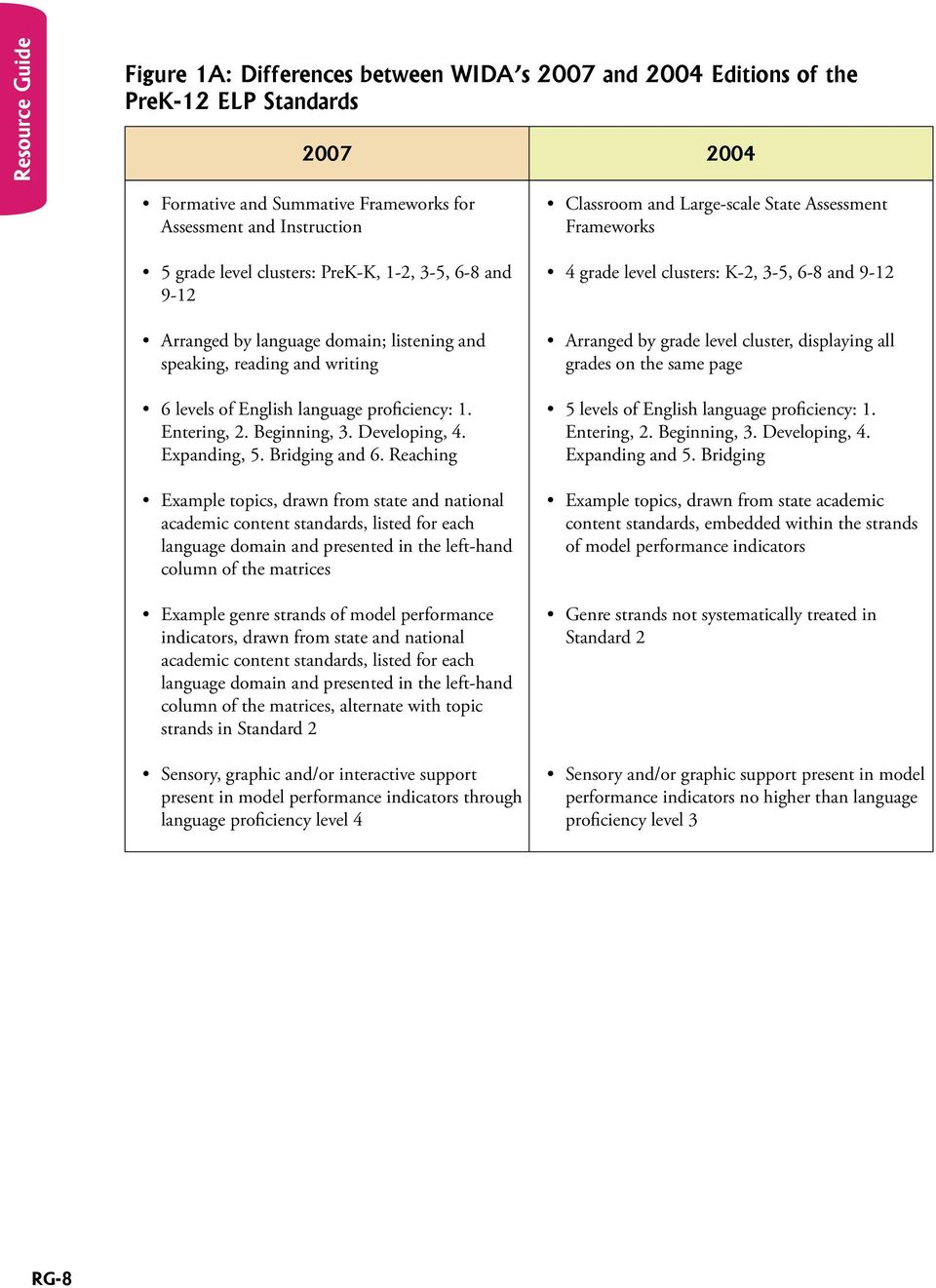
9 1.3 Changes and Clarifications from the 2004 to 2007 Editions of the WIDA ELP Standards The five English language proficiency standards are identical in both editions! While the standards remain fixed, there has been some updating; changes in the features of WIDA s ELP standards in this 2007 Edition are noted in Figure 1A. Resource Guide The most prominent difference between the two editions is the creation of the PreK-K grade level cluster. There were several reasons for this revision. Most significantly, Kindergarten ELLs function much differently than grade levels 1-2 on the ACCESS for ELLs test. As PreK-K children are developmentally and linguistically unique, especially in terms of literacy development, the member states of the Consortium agreed that establishing their own grade level cluster was warranted for both instructional and assessment purposes. The second most notable difference has been the expansion of our English language proficiency levels from five to six. Again, as a result of implementing ACCESS for ELLs, we realized that there was not a designation for those students who reached the far end of the second language continuum. Thus, we added Reaching to both our English language proficiency test and standards. Our Performance Definitions (see Section 5.2) have also expanded to include level 6, while our strands of model performance indicators (MPIs) remain descriptive through level 5. Some of the information within the standards matrices has been reformatted for ease of use. We have renamed the frameworks to specify how language proficiency information is to be used: on an ongoing, formative basis or a cumulative, summative basis. In the 2007 Edition, we provide some example topics, derived from state academic content standards, in a separate column to the left of the strand of MPIs to assist teachers in providing the context for their students language development. Strands of MPIs are now arranged by language domain rather than grade level cluster; in this way, teachers may more readily focus on grade-level appropriate ideas to plan instruction and assessment. By visiting it is also possible to Search the Standards for a particular framework, grade level cluster, language domain, example genre or topic or key word. In addition, we have expanded the number of strands of MPIs for Standard 2- the language of Language Arts. For each language domain and grade level cluster we offer an example genre and an example topic. Finally, we have extended the availability of supports within the MPIs through ELP level 4, Expanding. Interactive supports play a prominent role, especially within the Formative Framework, as ELLs need time to practice language with their peers within an instructional setting. Figure 1A highlights these changes in the features of the standards matrices between the 2004 and 2007 Editions. RG-7

10 Resource Guide Figure 1A: Differences between WIDA s 2007 and 2004 Editions of the PreK-12 ELP Standards Formative and Summative Frameworks for Assessment and Instruction 5 grade level clusters: PreK-K, 1-2, 3-5, 6-8 and 9-12 Arranged by language domain; listening and speaking, reading and writing 6 levels of English language proficiency: 1. Entering, 2. Beginning, 3. Developing, 4. Expanding, 5. Bridging and 6. Reaching Example topics, drawn from state and national academic content standards, listed for each language domain and presented in the left-hand column of the matrices Example genre strands of model performance indicators, drawn from state and national academic content standards, listed for each language domain and presented in the left-hand column of the matrices, alternate with topic strands in Standard 2 Sensory, graphic and/or interactive support present in model performance indicators through language proficiency level 4 Classroom and Large-scale State Assessment Frameworks 4 grade level clusters: K-2, 3-5, 6-8 and 9-12 Arranged by grade level cluster, displaying all grades on the same page 5 levels of English language proficiency: 1. Entering, 2. Beginning, 3. Developing, 4. Expanding and 5. Bridging Example topics, drawn from state academic content standards, embedded within the strands of model performance indicators Genre strands not systematically treated in Standard 2 Sensory and/or graphic support present in model performance indicators no higher than language proficiency level 3 RG-8
11 Section 2: The ELP Standards and their Components 2.1 Organization of the ELP Standards Resource Guide There are five WIDA English Language Proficiency (ELP) Standards, which appear in two frameworks: Summative and Formative. The two frameworks can be used for planning curriculum, instruction and assessment of English language learners (ELLs). The common elements of the two frameworks are the 1). ELP standards, 2). language domains, 3). grade level clusters and 4). language proficiency levels. Overlaying the standards are the Performance Definitions that describe each level of language proficiency (see Section 5.2). These definitions, by describing the stages of second language acquisition, provide a guide for developing original strands of model performance indicators (MPIs). 2.2 The Frameworks The primary focus of the Summative Framework for instruction and assessment is to identify the range of MPIs that describe the outcomes of learning. In addition, it is intended to provide students, teachers and test developers with ways for ELLs to demonstrate their developing English language proficiency over an extended period of time. The strands of MPIs in the Summative Framework, focusing on the products of learning, can be readily converted to ongoing, formative information on ELLs. For example, rather than relying on pictures or illustrations, as suggested in the Summative Framework, individual teachers may substitute real-life objects or manipulatives to use in both assessment and instruction. To learn more about transformations, see Section 4.1. The Formative Framework for instruction and assessment, on the other hand, is geared toward guiding student learning and teacher instruction on an ongoing basis. The Formative Framework is intended to capture those aspects of instruction that are less typically measured by a test but are important to teaching and learning. For example, interactive support within the Formative Framework gives students opportunities to work as partners or in small groups, receive immediate feedback from peers or teachers, engage in self-assessment during long-term projects, and integrate technology into their assignments. 2.3 The English Language Proficiency Standards The five ELP standards are identical for the Formative and Summative Frameworks. They reflect the social and academic language expectations of ELLs in grades PreK-12 attending schools in the United States. Each ELP standard addresses a specific context for language acquisition (Social and Instructional settings as well as Language Arts, Mathematics, Science and Social Studies) and is divided into five grade level clusters: PreK-K, 1-2, 3-5, 6-8 and Overall, the ELP standards center on the language needed and used by ELLs to succeed in school. So not to confuse these standards with academic content standards, the abbreviations shown in Figure 2A are used. RG-9

12 Resource Guide Figure 2A: The English Language Proficiency Standards and their Abbreviations English Language Proficiency Standard 1 Standard English language learners communicate for Social and Instructional purposes within the school setting Abbreviation Social and Instructional language English Language Proficiency Standard 2 English language learners communicate information, ideas and concepts necessary for academic success in the content area of Language Arts The language of Language Arts English Language Proficiency Standard 3 English language learners communicate information, ideas and concepts necessary for academic success in the content area of Mathematics The language of Mathematics English Language Proficiency Standard 4 English language learners communicate information, ideas and concepts necessary for academic success in the content area of Science The language of Science English Language Proficiency Standard 5 English language learners communicate information, ideas and concepts necessary for academic success in the content area of Social Studies The language of Social Studies RG-10

13 When thinking about how to represent the WIDA English language proficiency standards using the strands of model performance indicators, ask. Figure 2B: What is the language English language learners need to process or produce to...? Resource Guide Describe. Explain. Compare and contrast. Evaluate Identify Sequence Classify or categorize Predict. Question Match The language associated with the example functions listed above can become the language targets for assessment and instruction for ELLs. These language targets include vocabulary, multiple meanings, structures, and discourse. Furthermore, these targets should be differentiated by proficiency level and grade or grade level cluster. 2.4 The Language Domains Each of the five English language proficiency standards encompasses four language domains that define how ELLs process and use language: Listening- process, understand, interpret, and evaluate spoken language in a variety of situations Speaking- engage in oral communication in a variety of situations for a variety of purposes and audiences Reading- process, understand, interpret, and evaluate written language, symbols and text with understanding and fluency Writing- engage in written communication in a variety of situations for a variety of purposes and audiences The ELP standards are arranged by grade level cluster, by framework, by standard, and by language domain. The language domain is listed on the first left-hand column in the standards matrices. RG-11

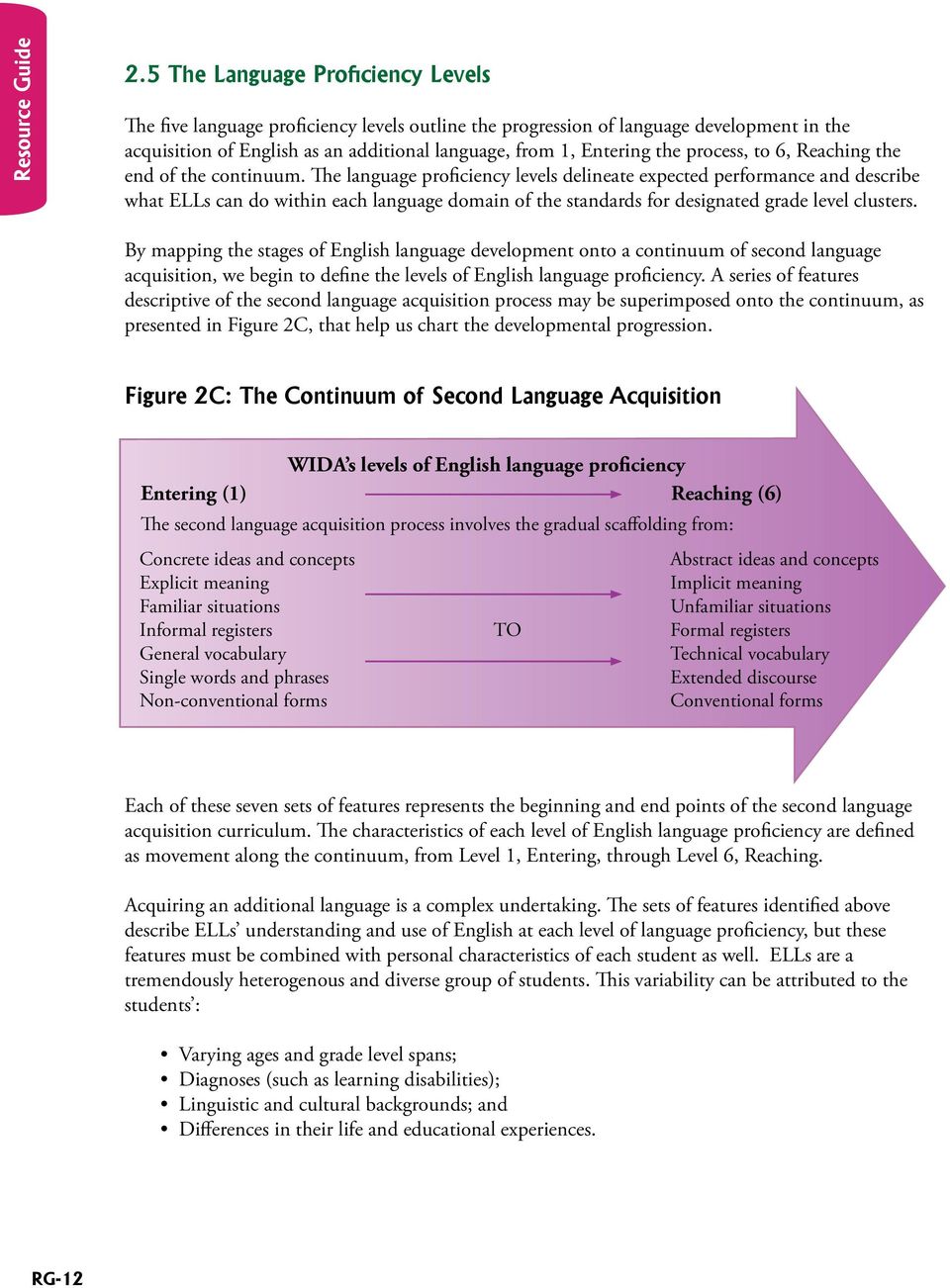
14 Resource Guide 2.5 The Language Proficiency Levels The five language proficiency levels outline the progression of language development in the acquisition of English as an additional language, from 1, Entering the process, to 6, Reaching the end of the continuum. The language proficiency levels delineate expected performance and describe what ELLs can do within each language domain of the standards for designated grade level clusters. By mapping the stages of English language development onto a continuum of second language acquisition, we begin to define the levels of English language proficiency. A series of features descriptive of the second language acquisition process may be superimposed onto the continuum, as presented in Figure 2C, that help us chart the developmental progression. Figure 2C: The Continuum of Second Language Acquisition WIDA s levels of English language proficiency Entering (1) Reaching (6) The second language acquisition process involves the gradual scaffolding from: Concrete ideas and concepts Abstract ideas and concepts Explicit meaning Implicit meaning Familiar situations Unfamiliar situations Informal registers TO Formal registers General vocabulary Technical vocabulary Single words and phrases Extended discourse Non-conventional forms Conventional forms Each of these seven sets of features represents the beginning and end points of the second language acquisition curriculum. The characteristics of each level of English language proficiency are defined as movement along the continuum, from Level 1, Entering, through Level 6, Reaching. Acquiring an additional language is a complex undertaking. The sets of features identified above describe ELLs understanding and use of English at each level of language proficiency, but these features must be combined with personal characteristics of each student as well. ELLs are a tremendously heterogenous and diverse group of students. This variability can be attributed to the students : Varying ages and grade level spans; Diagnoses (such as learning disabilities); Linguistic and cultural backgrounds; and Differences in their life and educational experiences. RG-12
15 Consider, for example, how maturational differences distinguish the academic language of PreK-K students from that of high school students. Similarly, the language development of a student with a strong educational background in his or her native language is different from that of a student who has been highly mobile or with limited formal schooling. Thus, student characteristics need to be considered when using the information presented in the components of the standards frameworks. Resource Guide This section has provided a brief overview of the ELP standards and their components for educators not familiar with their organization. It has also offered some necessary background information on the English language acquisition process which has informed the development of the MPIs across the ELP levels. RG-13

16 Resource Guide Section 3: Model Performance Indicators (MPIs) and their Elements A model performance indicator (MPI) is a single cell within the standards matrices that describes a specific level of English language proficiency (ELP) for a language domain. An MPI is the smallest unit of a topical strand. Figure 3A shows the three essential elements of an MPI, and an example ( e.g. ), which is not essential. Each of these elements is discussed in further detail starting with Section 3.2. The first word of an MPI is its language function; that is, how English language learners (ELLs) process or use language to communicate in a variety of situations. The example topic relates the context or backdrop for language interaction within school. The language focus for the content related to the topic may be social, instructional or academic, depending on the standard. Finally, there is some form of support (sensory, graphic or interactive) for ELLs through language proficiency level 4, as it provides a necessary avenue for ELLs to access meaning. You will learn more about the optional element of MPIs, the example ( e.g. ), in section 3.5. Figure 3A: Elements of a Model Performance Indicator (MPI) Language Function Example Topic Support Describe representations of basic operations from pictures of everyday objects and oral descriptions (e.g., There are seven dogs altogether. ) Example (e.g.) Standards Reference Framework: Summative Standard 3: The language of Mathematics Grade level cluster: 1-2 Language domain: Speaking English language proficiency level: 3- Developing Example Topic: Basic operations RG-14

17 3.1 Strands of MPIs A strand of MPIs consists of the five levels of English language proficiency for a given topic and language domain, from Entering (1) through Bridging (5). The horizontal strands of MPIs illustrate the progression of language development for a given grade level cluster. Strands of MPIs characteristically are: Resource Guide thematically connected through common example topics or genres that have been identified from state academic content standards scaffolded from one language proficiency level (or MPI) to the next, based on the criteria of the Performance Definitions; namely, linguistic complexity, vocabulary usage and language control developmentally appropriate, designed for ELLs at a specified grade level cluster academically rigorous, with the highest level of English language proficiency (Reaching) corresponding to language expectations of proficient English speakers at the highest grade level of the cluster An Example Topic Strand and an Example Genre Strand Strands of MPIs for Standard 2 the language of Language Arts are unique in that both example topics and example genres are identified for each language domain. ELLs need to have the language to access the content associated with the many types of discourse they encounter in Language Arts. In state academic content standards, topics and genres are addressed; subsequently, they are both included as strands. In Figure 3B, the example topic is introduced and scaffolded across the levels of English language proficiency. As the strand unfolds for writing, the MPIs illustrate expectations for ELLs in third through fifth grades in their use of editing and revising strategies. Figure 3B: A Strand of Model Performance Indicators with an Example Topic Level 1 Entering Level 2 Beginning Level 3 Developing Level 4 Expanding Level 5 Bridging Produce personal word/phrase lists from labeled pictures and check with a partner for edits and revision Create phrases/ short sentences from models and check with a partner for edits and revision Edit and revise guided writing (e.g., for conventions and structures) based on teacher feedback Edit and revise writing (e.g., using word processing or rubrics) based on class or peer reviews Self-assess to edit and revise writing to produce final drafts Standards Reference Framework: Formative Standard: 2- The language of Language Arts Grade level cluster: 3-5 Language domain: Writing Example topic: Editing and revising RG-15

18 Resource Guide The genres from both fictional and expository text provide the backdrop for the introduction of specific topics. Genre strands may be used independently or in conjunction with example topics for a given grade level cluster. The same genre strands appear in both the Formative and Summative Frameworks. The difference between the examples in the two frameworks is in the forms of supports. Whereas the Summative Framework relies exclusively on the types of sensory or graphic supports most commonly employed in large-scale assessment, the Formative Framework, being closest to dayto-day classroom practices, contains interactive supports including working with partners, using the native language (L1) or integrating technology to bolster English language development. In Figure 3C, we see how the type of discourse, as exemplified in the genre, Adventures, influences middle school students comprehension as they move through the levels of English language proficiency. Figure 3C: A Strand of Model Performance Indicators with an Example Genre Level 1 Entering Level 2 Beginning Level 3 Developing Level 4 Expanding Level 5 Bridging Identify words or phrases associated with adventures using visual support and word/phrase walls or banks Answer WHquestions related to adventures using visual support (e.g., Who is missing? ) and share with a peer Sequence plots of adventures using visual support and share with a peer Summarize plots of adventures using visual support and share with a peer Identify cause and effect of events on characters in adventure stories Standards Reference Framework: Formative Standard: 2- The language of Language Arts Grade level cluster: 6-8 Language domain: Reading Example genre: Adventures 3.2 Language Functions The following sections describe in more detail each element of an MPI: the language function, support and example topic (refer to Figure 3A). MPIs may also contain an example (e.g.); these individual elements can be applied in the design of curriculum, instruction and assessment for ELLs. Language functions describe how students communicate a message. They are not to be equated with the cognitive complexity involved in the communication. As shown in Figure 3D, support is built into the MPIs so that even ELLs at lower levels of English language proficiency can demonstrate their understanding of the language associated with content by engaging in higher levels of thinking. RG-16

19 Figure 3D: Understanding the Cognitive Complexity of Language Functions ELLs are expected to sort or classify, demanding a high level of cognitive engagement that requires students to analyze information. By having diagrams available as support for ELLs, students are able to exhibit this complex thinking even at the Beginning level of English language proficiency. Resource Guide Level 2 Beginning Sort or classify descriptive phrases and diagrams by cycles or processes Standards Reference Framework: Summative Standard: 4- The language of Science Grade level cluster: 6-8 Language domain: Reading Example Topic: Cycles/Processes The identical language functions can operate across levels of English language proficiency within a given grade level cluster. What differentiates a lower from higher level of proficiency is the amount and complexity of discourse and/or the expected vocabulary usage, as illustrated in the Performance Definitions (see Figure 5B). For instance, see the partial strand of MPIs in Figure 3E. Figure 3E: Repeating Language Functions within a Strand In the following strand of MPIs, two instances of the language function Produce in response appear. While the Entering or Level 1 ELL is to produce single words, the Beginning or Level 2 student is expected to produce phrases or short sentences, which is reflective of a higher level of language proficiency. Level 1 Entering Produce words in response to WHquestions about self from picture prompts and models Level 2 Beginning Produce phrases or short sentences in response to personal, openended questions from picture prompts Standards Reference Framework: Summative Standard: 1- Social and Instructional language Grade level cluster: 3-5 Language domain: Speaking Example Topic: Personal Information/Opinions Language functions always operate within the context of a standard and strand of MPIs. Although the identical language functions are used throughout the standards matrices, each function represents the language specified for the particular standard and topical strand. Charting the instances of language functions across standards gives teachers insight into how they might be used for assessment and instruction. RG-17

20 Resource Guide From the examples in Figure 3F below, we see that the language function describe in grade cluster 3-5 appears in: Formative and Summative Frameworks Productive language domains (speaking and writing) Primarily mid-range language proficiency levels (2- Beginning, 3- Developing, 4- Expanding) All 5 English language proficiency standards Figure 3F: Some Instances of the Language Function Describe in MPIs from Grades 3-5 Level 2 Beginning Describe health or safety practices around school, home or community from visuals (e.g., pedestrian safety) in L1 or L2 Framework: Formative Standard: 1- Social and Instructional language Language domain: Writing Example Topic: Health and Safety Framework: Formative Standard: 2- The language of Language Arts Language domain: Speaking Example Genre: Fantasies Level 2 Beginning Describe pictures of imaginary people, objects or situations to peers in L1 or L2 Level 2 Beginning Describe story elements of various genres supported by illustrations Framework: Summative Standard: 2- The language of Language Arts Language domain: Speaking Example Topic: Story elements and types of genres RG-18

21 Level 2 Beginning Describe what the fractional parts mean from diagrams or realia in phrases or short sentences Framework: Formative Standard: 3- The language of Mathematics Language domain: Writing Example Topic: Fractions Level 4 Expanding Describe strategies or tips for solving problems involving fractions from diagrams in paragraph form Resource Guide Level 3 Developing Describe attributes of three-dimensional shapes from labeled models Framework: Summative Standard: 3- The language of Mathematics Language domain: Writing Example Topic: Three-dimensional shapes Level 2 Beginning Describe natural phenomena from real-life examples using general vocabulary (e.g., This leaf has five points. ) in small groups Framework: Formative Standard: 4- The language of Science Language domain: Speaking Example Topic: Nature Level 2 Beginning Describe communities or regions depicted in pictures or maps Framework: Summative Standard: 5- The language of Social Studies Language domain: Writing Example Topic: Communities & regions RG-19
22 Resource Guide The language used to describe natural phenomena for Standard 4 is quite unlike that of Standard 3, where students describe fractional parts. Working with seashell collections as an example of Standard 4, the language target may be for students to describe tactile or visual qualities, such as the shell is rough, the shell is smooth. Working with pizzas as an example of Standard 3, on the other hand, the language target may be for students at the Beginning level to practice the phrase, X of Y (e.g., 3 of 5; 2 of 6; 4 of 8) to describe a fractional part. Likewise, although both within the writing domain, the language associated with describing Standard 1 s example topic, health or safety practices, is distinct from that for describing communities or regions, the example topic for Standard 5. Whereas in Standard 1, Beginning ELLs might be expressing commands, such as Go out. or Stay in., in Standard 5, the same level students might be using such expressions as near or far from here. In summary, to develop the academic language necessary for success in school, ELLs must have opportunities to use and apply language patterns or discourse associated with each subject or content area appropriate for their level of English language proficiency. The language functions are the entrée into that content-based discourse; teachers of ELLs must consider the language associated with the language function in conjunction with the standard as the backdrop for developing differentiated language objectives or lessons. 3.3 Supports Support is an instructional strategy or tool used to assist students in accessing content necessary for classroom understanding or communication. Support may include teaching techniques, such as modeling, feedback or questioning. Other types of support involve students using visuals or graphics, interacting with others or using their senses to help construct meaning of oral or written language (TESOL, 2006). We believe that support is important for all learners to gain access to meaning through multiple modalities, but it is absolutely essential for ELLs. For this reason, we incorporate support within the MPIs through English language proficiency level 4. We feel that support for ELLs needs to be present in both instruction and assessment on both a formative and summative basis. Supports within the MPIs may be sensory, graphic or interactive; examples of these different types of supports are found in Figures 3G and H. Although not extensive, these lists offer some suggestions for teachers to incorporate into instruction and assessment of ELLs. RG-20
23 Figure 3G: Examples of Sensory, Graphic and Interactive Supports Sensory Supports Graphic Supports Interactive Supports Real-life objects (realia) Manipulatives Pictures & photographs Illustrations, diagrams & drawings Magazines & newspapers Physical activities Videos & Films Broadcasts Models & figures Charts Graphic organizers Tables Graphs Timelines Number lines In pairs or partners In triads or small groups In a whole group Using cooperative group structures With the Internet (Web sites) or software programs In the native language (L1) With mentors Resource Guide Sensory Supports Some sensory supports are applicable across all ELP standards, as exemplified in Figure 3G. Others are specific to the language of a content area. Figure 3H expands the notion of the use of sensory support by giving specific examples for ELP standards 2 through 5. The use of these sensory supports in activities, tasks and projects helps promote the development of students academic language proficiency. Figure 3H: Specific Examples of Sensory Supports Supports related to the language of Language Arts Supports related to the language of Mathematics Supports related to the language of Science Supports related to the language of Social Studies Illustrated word/phrase walls Felt or magnetic figures of story elements Sequence blocks Environmental print Posters or displays Bulletin boards Photographs Cartoons Blocks/Cubes Clocks, sundials and other timekeepers Number lines Models of geometric figures Calculators Protractors Rulers, yard/meter sticks Geoboards Scientific instruments Measurement tools Physical models Natural materials Actual substances, organisms or objects of investigation Posters/Illustrations of processes or cycles Maps Globes Atlases Compasses Timelines Multicultural artifacts Arial & satellite photographs Video clips Audio books Counters Songs/Chants Compasses Calendars Coins Adopted from Gottlieb, M. (2006). Assessing English language learners: Bridges from language proficiency to academic achievement. Thousand Oaks, CA: Corwin Press. RG-21
24 Resource Guide Graphic Supports The most commonly used graphic support associated with social, instructional and academic language is the graphic organizer. Graphic organizers, such as semantic maps, venn diagrams or T charts, are useful tools for ELLs. These graphic supports allow students to demonstrate their understanding of ideas and concepts without having to depend on or produce complex and sustained discourse. It cannot be assumed, however, that ELLs understand the concept behind and automatically know how to use particular graphic organizers. Therefore, teachers must model examples of their use and give students time to practice with each one. Figure 3J provides specific ideas of how graphic organizers may be used with each language proficiency standard. As it does not delineate examples by grade level cluster, teachers knowledge of their students and the curriculum is important in translating these suggestions into instructional assessment activities. RG-22
25 Figure 3J: Examples of Use of Graphic Organizers across the ELP Standards ELP standard 1- Social and Instructional language 2- The language of Language Arts 3- The language of Mathematics 4- The language of Science 5- The language of Social Studies Venn Diagrams - Comparing and Contrasting Two Entities Two friends or family members Two traditions Two characters Two settings Two genres Two operations Two geometric figures Two forms of proportion Two body systems or organs Two animals or plants Two conflicts Two forms of government Two forms of transportation T-Charts - Sorting or Categorizing Objects or Concepts Colors Classroom objects Facts/Opinions Points of view Pros/Cons Area/Perimeter Fractions/ Decimals Addition/ Subtraction Forms of matter Forms of energy Senses Vertebrates/ Invertebrates Types of transportation Types of habitats Cycles - Producing a Series of Connected Events or a Process Conflict/ Resolution School or classroom routines Plot lines Steps in problemsolving Scientific inquiry Life cycles Water cycle Elections in a democracy Passage of a law Cause and Effect - Illustrating a Relationship Classroom or school rules Health and safety at home or in school Responses of characters to events Variables in algebraic equations Geometric theorems Chemical reactions Adaptation Weather events Political movements Economic trends Semantic Webs - Connecting Categories to Themes or Topics Personal interests Idiomatic expressions Multiple meanings of words and phrases Root words and affixes Main idea/ Details Types and features of polygons Types and characteristics of angles Foods and their nutritional ingredients Types and characteristics of rocks Types of human and civil rights Impact of economic policies Adopted from Gottlieb, M. (2006). Assessing English language learners: Bridges from language proficiency to academic achievement. Thousand Oaks, CA: Corwin Press. Resource Guide RG-23
26 Resource Guide Interactive Supports All students benefit from opportunities to discuss and confirm prior knowledge with each other in pairs or groups or by using interactive multimedia such as the Internet. These interactive supports are especially useful for ELLs. Their participation in interactive activities and tasks can promote comprehension and expose them to a variety of communication styles. We also know that instructional strategies that incorporate interactive supports facilitate the exchange of cultural values, norms and behaviors and challenge students at every level of English language proficiency to meet expectations in situations that they find meaningful. ELLs come to school with diverse languages and cultures. These resources should be recognized, preserved and strengthened even if they may not coincide with the language of instruction. Although not formally recognized within the frameworks, the Consortium acknowledges the students historical backgrounds and prior educational experiences as springboards for their English language development. We deem it important to honor the cultural perspectives of our ELLs and their contributions to our multicultural society within curriculum, instruction and assessment. Taking this into account, the student s native language (L1) has been included as a type of interactive support within the Formative Framework, especially at the first two stages of English language development. In doing so, we encourage students with a common language of origin to communicate with each other to clarify, recap or extend meaning of ideas and concepts presented in English. In this way, native language may serve to facilitate and enrich the students process of acquiring an additional language. Figure 3K illustrates how native language support is incorporated into the strands of MPIs. Figure 3K: Native Language Support The following partial strand of MPIs suggests the use of native language (L1) support. Level 1 Entering Level 2 Beginning Level 3 Developing Level 4 Expanding Identify environmental print related to hygiene or safety around school (e.g., boys/ girls washroom, fire extinguisher) in L1 or L2 Find real-life objects or pictures related to hygiene or safety that match environmental print around classroom or school (e.g., labels for soap, sink) in L1 or L2 Identify icons, symbols and words related to hygiene or safety found in environmental print or pictures around classroom or school in L1 or L2 Connect environmental print or pictures related to hygiene or safety to teacher reading of illustrated books in L1 or L2 Standards Reference Framework: Formative Standard: 1- Social and Instructional language Grade level cluster: PreK-K Language domain: Reading Example Topic: Hygiene & safety RG-24
27 3.4 Example Topics and Genres While supports assist ELLs in gaining the language and meaning of concepts embedded in the language proficiency standards, the acquisition of academic language rests on the integration of language and content. Resource Guide Content within a school setting is largely associated with subject matter topics (and genres within the area of Language Arts); in addition, ELLs must acquire the social and instructional language already familiar to their English-proficient peers. Thus, example topics and genres offer a backdrop within the ELP standards for ELLs English language development. Figure 3L further defines the example topics and genres. Figure 3L: Example Topics and Genres ARE anchored in state and national academic content standards ARE intended to illustrate how language lessons can be embedded in content lessons ARE flexible and dynamic elements, intended to be adapted or substituted (transformed) to meet curriculum objectives ARE combined with language objectives and supports to create effective performance objectives for ELLs ARE used in test development as potential themes for assessment items Adopted from TESOL (2006) ARE NOT academic content standards ARE NOT meant to imply that language learning is automatic when content topics are taught ARE NOT fixed or comprehensive lists of topics and genres that must be mastered for academic success ARE NOT accessible to ELLs without appropriate scaffolding and support ARE NOT the only topics and genres that appear as themes on WIDA assessments Example Topic and Genre Lists The example topics that follow are representative of state academic content standards and student standards of national organizations, including Teachers of English to Speakers of Other Languages, the National Council of Teachers of English, the International Reading Association, the National Council of Teachers of Mathematics, the National Research Council and the National Council for the Social Studies. The following lists are common topics for each grade level cluster and English language proficiency standard. While by no means exhaustive, these example genres and topics offer ideas for contextualizing the language development of ELLs. RG-25
28 Resource Guide PreK-K Example Topics and Genres: Content Related to WIDA s English Language Proficiency Standards These examples, representative of state academic content standards, provide context for the English language development described in the strands of Model Performance Indicators. Standard 1: Social and Instructional language Standard 2: The language of Language Arts Standard 3: The language of Mathematics Standard 4: The language of Science Standard 5: The language of Social Studies Example Topics Classrooms Colors Feelings Games Hygiene & safety Music & movement Recreational objects & activities Routines School Self & family Social behavior Spatial relations Example Genres & Topics Chants & songs Concepts about print Environmental print Fairy tales Forms of print Make-believe Nursery rhymes Picture books Rhyme Same & different Sounds & symbols (Phonemic awareness) Story elements Example Topics Attributes Equivalency Geometric shapes Measurement of time Non-standard measurement tools Number sense Numbers & operations Patterns Quantity Size Spatial relations Temperature Weight Example Topics Air Animals Body parts Change in self & environment Colors Forces in nature Living & non-living things Night/Day Rocks Safety practices Scientific process Seasons Senses Water Weather Example Topics Change from past to present Classroom/School Clothing Community workers Families Food Friends Historical stories & legends Homes in a community/ Habitats Location of objects & places Neighborhood Seasons Shelter Symbols & holidays Transportation RG-26
29 Grades 1-2 Example Topics and Genres: Content Related to WIDA s English Language Proficiency Standards These examples, representative of state academic content standards, provide context for the English language development described in the strands of Model Performance Indicators. Standard 1: Social and Instructional language Standard 2: The language of Language Arts Standard 3: The language of Mathematics Standard 4: The language of Science Standard 5: The language of Social Studies Example Topics Classroom & school rules Everyday objects Feelings & emotions Following directions Interests, opinions & preferences Leisure activities Likes, dislikes & needs Personal correspondence Personal information School areas, personnel & activities Sharing/Cooperation Example Genres Fiction (literary text) Folktales Non-fiction (expository text) Pattern books/ Predictable books Poetry Example Topics Compound words Elements of story Homophones Phonemic awareness Phonics Rhyming words Role play Sequence of story Spatial relations Story elements Story telling Word families Example Topics Basic operations (addition & subtraction) Capacity Estimation Graphs Interpretation of data Money Number sense Patterns Place value Quantity Shapes Size Standard & metric measurement tools Symmetry Time (digital & analog) Two- and threedimensional shapes Weight Whole numbers Example Topics Animals Astronomy Body parts Change Chemical & physical attributes Earth & sky Force & motion Gravity Life cycles Light Living & non-living things Magnetism Natural resources Organisms & environment Plants Renewable & nonrenewable resources Senses Sound Water cycle Weather Weathering & erosion Example Topics Artifacts of the past Celebrations/Customs Citizenship Community workers Cultural heritage Families & responsibilities Historical figures & leaders Homes & habitats Indigenous peoples & cultures Jobs & careers Land forms/bodies of water Money & banking Neighborhoods & communities Products in the marketplace Representations of the earth (maps & globes) Seasons Time & chronology Use of resources & land Resource Guide RG-27
30 Resource Guide Grades 3-5 Example Topics and Genres: Content Related to WIDA s English Language Proficiency Standards These examples, representative of state academic content standards, provide context for the English language development described in the strands of Model Performance Indicators. Standard 1: Social and Instructional language Standard 2: The language of Language Arts Standard 3: The language of Mathematics Standard 4: The language of Science Standard 5: The language of Social Studies Example Topics Assignments Classroom supplies/ Resources Following directions Health & safety Information gathering Leisure activities Opinions Personal experiences Personal information Rules & procedures Example Genres Biographies & autobiographies Fables Fairy tales Fantasies Folklore Informational texts Legends Mysteries Myths Narratives Prose Science fiction Tall tales Example Topics Affixes & root words Comprehension strategies Conventions & mechanics Editing & revising Explicit & inferential information Fact or opinion Fluency strategies Hyperbole Main ideas/details Organization of texts Phonemes/Phonology Points of view Story elements & types of genres Story grammar Text structure & organization Example Topics Angles Area Attributes of two- and threedimensional shapes Basic operations (multiplication & division) Cost/Money Data analysis Decimals Descriptive statistics Fractions Large whole numbers Metric system Patterns & relationships Percent Perimeter Place value Polygons Scale Sets Strategies for problem solving Example Topics Body systems Cells & organisms Earth history/materials Ecology & conservation Ecosystems Electricity Energy sources Foods & nutrition Forces of nature Fossils Geological forms Heat Living systems Magnetism Natural resources Nature Reproduction & heredity Scientific inquiry Simple machines Solar system States of matter Weather patterns Example Topics Ancient civilizations Branches of government Colonization Communities Cross-cultural experiences Explorers Goods & services Historical events, figures & leaders Immigration/Migration Legends & scales Maps & globes/locations Needs of groups, societies & cultures Neighbors North & South Prehistoric animals Resources & products Times long ago Tools & artifacts Topography: rivers, coasts, mountains, deserts, plains Trade routes U.S. documents U.S. regions RG-28
31 Grades 6-8 Example Topics and Genres: Content Related to WIDA s English Language Proficiency Standards These examples, representative of state academic content standards, provide context for the English language development described in the strands of Model Performance Indicators. Standard 1: Social and Instructional language Standard 2: The language of Language Arts Standard 3: The language of Mathematics Standard 4: The language of Science Standard 5: The language of Social Studies Example Topics Assignments/Research Character development Instructions/ Assignments Resources & supplies School behavior School life Social interaction Use of information Use of multiple resources Use of register Example Genres Adventures Ballads Editorials Historical documents Human interest Mythology Poetry/Free verse Science fiction Technical texts Example Topics Alliteration Author s purpose Biographies Comprehension strategies Dialogue Editing Figures of speech Literacy devices Metaphors & similes Multimedia Multiple meanings Personification Synonyms & antonyms Test-taking strategies Word origins Example Topics Algebraic equations Area, volume & circumference Complex two- & threedimensional figures Data interpretation & statistics Data sets & plots Decimals Estimation Factors Fractions Geometric relations Integers Line segments & angles Measures of central tendency (mean, median, mode, range) Metric & standard units of measurement Parallel lines Percent Perimeter Probability Ratio & proportion Square root Example Topics Atoms & molecules Bacteria to plants Body systems & organs Chemical building blocks Climate/Temperature change Climate zones Comets & meteorites Cycles Elements & compounds Forms of energy Light Motion & force Natural disasters Populations, resources & environments Processes Reproduction Scientific inventions or discoveries Scientific tools or instruments Solar system Sound Universe: Stars and planets Water Example Topics Agriculture America s story Ancient/Medieval civilizations Bill of Rights Civic rights & responsibilities Civil wars Colonization Countries & continents Cultural perspectives & frames of reference Economic trends Forms & organization of government Freedom & democracy Human resources Longitude/Latitude/Time zones Maps Revolution Slavery U.S. Constitution Resource Guide RG-29
32 Resource Guide Grades 9-12 Example Topics and Genres: Content Related to WIDA s English Language Proficiency Standards These examples, representative of state academic content standards, provide context for the English language development described in the strands of Model Performance Indicators. Standard 1: Social and Instructional language Standard 2: The language of Language Arts Standard 3: The language of Mathematics Standard 4: The language of Science Standard 5: The language of Social Studies Example Topics Classroom routines Personal & business communication Personal preferences Points of view Recommendations/ Suggestions School life Social & cultural traditions & values Study skills & strategies Information gathering Workplace readiness Example Genres Allusion Autobiographical & biographical narratives Comedies Critical commentary Epics Literary genres Monologues/soliloquy Multicultural/world literature Tragedies Example Topics Analogies Author s perspective/point of view Bias Character development Convention & mechanics Literal & figurative language Multiple meanings Note taking Parody Research Satire Symbolism Word derivations (etymology) Example Topics Congruence Coordinate planes, graphs & equations Data displays & interpretation Derived attributes Formulas & equations Mathematical relations & functions Multi-dimensional shapes Powers Problem solving Quadrilaterals Roots Scale & proportion Speed & acceleration Theoretic probability Trigonometric functions (sine, cosine, tangent) Example Topics Atoms & molecules/ Nuclear structures Chemical & physical change Conservation of energy & matter Constellations Ecology & adaptation Elements & compounds Food chains Forces & motion Genetics & heredity Life cycles Meteorology Nuclear change Scientific research & investigation Simple organisms Taxonomic systems Example Topics Banking and money Behaviors of individuals & groups Conflict resolution Cultural diversity & cohesion Federal, civil & individual rights Global economy Historical figures & times Human populations Individual responsibilities Interdependence among states & nations International & multinational organizations Production, consumption & distribution Social issues & inequities Supply & demand Supreme Court cases Survey research The story of the U.S. World histories/ Civilizations/Cultures RG-30
33 3.5 Examples (e.g.,) Within some MPIs there are examples, marked by (e.g.), to help clarify or extend the meaning of one or more of the elements. As each cell in the standards matrices has limited space, the full text is not often provided. The examples within the MPIs are used in five different ways. More than one type of example may appear in one strand. Resource Guide Teacher Talk: In presenting a big idea to students, a teacher might say, White is made up of all colors. This statement may serve as a stimulus for ELLs who could then meet the MPI s expectations by demonstrating or pointing to a picture of white light being refracted into a rainbow by a prism. Level 1 Entering Match oral statements about light or sound with illustrations (e.g., White is made up of all colors. ) Standards Reference Framework: Formative Standard: 4- The language of Science Grade level cluster: 6-8 Language domain: Listening Example Topic: Light/Sound Teacher Talk In the listening strands, ideas of what teachers might say to ELLs in either instructional or assessment contexts in the Formative or Summative Framework are occasionally interjected within an MPI. Examples of teacher talk are bounded by quotation marks. Student Speak In the strands that address speaking and writing, we hear the student voice. The examples represent what students at the assigned language proficiency level are expected to produce or some language patterns they may use orally or in writing. Examples of student talk are bounded by quotation marks. Student Speak: There are many possible explanations for places/ locations on maps or globes. A proficient ELL might give the answer noted in this MPI. Level 5 Bridging Give explanations for places/ locations on maps or globes (e.g. I know this city is the capital because there is a star. ) Standards Reference Framework: Formative Standard: 5- The language of Social Studies Grade level cluster: 3-5 Language domain: Speaking Example Topic: Maps & globes/locations RG-31
34 Resource Guide Text Talk: ELLs are able to identify a visually supported written message such as the ones shown in this MPI. Level 3 Developing Sort language associated with fact or opinion in fiction or non-fiction illustrated text (e.g., I think that..., We believe that, It could be... ) Standards Reference Framework: Formative Standard: 2- The language of Language Arts Grade level cluster: 3-5 Language domain: Reading Example Topic: Fact or opinion Text Talk Examples of text talk that ELLs are expected to process are associated with the reading domain. They, too, are marked by quotation marks because they are possible quotes from a text. Specific Supports Three main categories of supports are present within the strands of MPIs: sensory, graphic and interactive. Most sensory supports are visual, but they could also involve the use of other senses such as touch or smell. Specific Supports: First and second graders may classify living organisms by using pictures, icons and text with graphic organizers. This MPI specifies a type of graphic organizer that would be especially useful for this kind of task. Level 2 Beginning Sort living organisms according to descriptions of their attributes using pictures and phrases with graphic organizers (e.g., T charts) Standards Reference Framework: Summative Standard: 4- The language of Science Grade level cluster: 1-2 Language domain: Reading Example Topic: Living organisms RG-32
35 Subtopics: In the MPI below, the example gives a subtopic showing how the language of Percent or Decimals may be used to follow written instructions. Level 4 Expanding Follow written instructions to determine when and how to apply math in real-life situations involving percent or decimals (e.g., sales tax, interest rates or tips) with a partner Standards Reference Framework: Formative Standard: 3- The language of Mathematics Grade level cluster: 6-8 Language domain: Reading Example Topic: Percent/Decimals Subtopics The Example Genres and Topics, by being tied to academic content standards and representative of district and school curriculum, have broad applicability. The subset of topics are further ideas for teachers in designing lessons or units of instruction and assessing social or academic language. Subtopics, by often being specific to a language level, also help teachers differentiate instruction and assessment. Resource Guide This section has described the various elements which make up model performance indicators and how they relate to one another. Section 4 elaborates the usability of the elements of the MPIs and shows their adaptability through transformations in designing units of study and in mapping curriculum. RG-33
36 Resource Guide Section 4: Working with the Standards 4.1 Transformations: Strategies for Designing Assessment, Curriculum and Instruction As informative as model performance indicators (MPIs) are for practice, they do not completely capture the range of situations, supports and topics that classroom teachers experience. Transformations of the MPIs are intended to add flexibility to the use of the strands. Transformations entail changing one or more of the elements of an MPI (its language function, topic or support) to reflect local curricular or instructional targets (Gottlieb, Carnuccio, Ernst-Slavit, & Katz, 2006). Transformations are the mechanism that enables teachers to adapt the strands of MPIs to their specific teaching situation. Once teachers have gained familiarity with the format of the standards matrices, they will find that using transformations will be a tremendously helpful tool in assessment, curriculum and lesson design. Ultimately, transformations are the vehicle to increasing the viability and usefulness of the English language proficiency (ELP) standards. The role of transformations for each element of an MPI is unique. In the sections that follow, each element is treated independently, although, more than one transformation within a single MPI or strand of MPIs is possible. Examples illustrate how to transform or substitute the elements. Together, the transformations exemplify the potential power of the strands of MPIs as pathways for English language learners (ELLs) to attain the ELP standards. RG-34
37 Transformation of Language Functions The transformation of language functions, shown in the following two diagrams, enables teachers to substitute productive language domains (speaking and writing) for receptive language domains (listening and reading) or vice versa. This transformation also encourages teachers to introduce new language patterns or reinforce those previously learned for a particular level of English language proficiency. Thus, ELLs are able to enhance their repertoire of language within a specific level of English language proficiency. Resource Guide Figure 4A: Language Function Transformation from Listening to Speaking Identify specific geographic locations (e.g., time zones, latitude, longitude) on maps based on oral information and check with a partner Describe specific geographic locations (e.g., time zones, latitude, longitude) on maps based on given information to a partner Standards Reference Framework: Formative Standard: 5- The language of Social Studies Grade level cluster: 6-8 Language proficiency level: 3- Developing Example Topic: Maps Figure 4B: Language Function Transformation from Writing to Reading Make lists of real-world examples of three-dimensional shapes from labeled models Match descriptive phrases of real-world examples with labeled models of threedimensional shapes Standards Reference Framework: Summative Standard: 3- The language of Mathematics Grade level cluster: 3-5 Language proficiency level: 2- Beginning Example Topic: Three-dimensional shapes RG-35
38 Resource Guide Transformation of Supports Transformations of supports (sensory, graphic or interactive) allow teachers to easily move from the Summative to Formative Framework or the reverse. Whereas in summative contexts, students tend to rely on pictures or illustrations for support, in formative situations, students can actively engage in activities and tasks using real-life objects or manipulatives. Different types of support may also be exchanged or added to the MPIs, such as having students work in pairs to complete a graphic organizer (thus having both interactive and graphic supports present). The following two transformations show how supports within MPIs may be modified or added to enhance ELLs access to meaning. Figure 4C: Support Transformation from Summative to Formative Frameworks Find labeled pictures of food by initial sounds or consonants (e.g., pineapple, peas ) Find real-life examples of foods by initial sounds or consonants (e.g., pineapple, peas ) Standards Reference Standard: 5- The language of Social Studies Grade level cluster: PreK-K Language Domain: Reading Language proficiency level: 3- Developing Example Topic: Food Figure 4D: Support Transformation Outline steps of scientific inquiry involving elements or compounds with a partner Outline steps of scientific inquiry involving elements or compounds based on graphic support or pictures with a partner Addition of Graphic Support Standards Reference Framework: Formative Language proficiency level: 3- Developing Standard: 4- The language of Science Grade level cluster: 6-8 Language Domain: Speaking Example Topic: Elements & compounds RG-36
39 Transformation of Topics Transformations of topics can occur within a standard or from one standard to another. Substituting one topic for another allows teachers to develop units or lessons around a specific theme. Oftentimes, the topics can be selected directly from the example lists or from district curriculum. By exchanging the example topics with others, English as a second language or bilingual teachers can more readily synchronize instruction with general education or content teachers. Two ways of transforming topics are illustrated below. Resource Guide Figure 4E: Topic Transformation within an ELP Standard Analyze and identify reasons for genetic alterations based on visually supported text (e.g., mutation) with a partner Analyze and identify reasons for physical change based on visually supported text with a partner Standards Reference Framework: Formative Standard: 4- The language of Science Grade level cluster: 9-12 Language Domain: Reading Language proficiency level: 4- Expanding RG-37
40 Resource Guide Figure 4F: Topic Transformation across ELP Standards Name elements of stories depicted visually in real-life contexts (e.g. character in a setting) Name everyday objects depicted visually in real-life contexts (e.g. "paper" in a classroom scene) Name place value depicted visually in real-life contexts (e.g., tens in a large whole number) Name animals depicted visually in real-life contexts (e.g., monkey in a forest scene) Standards Reference Framework: Summative Grade level cluster: 1-2 Standards: 1- Social and Instructional language Language Domain: Speaking 2- The language of Language Arts Language proficiency level: 1- Entering 3- The language of Mathematics 4- The language of Science Once educators become familiar with the art of transformation, they can develop whole strands of MPIs pertaining to the topics they teach. In the next section, we offer a checklist to help ensure the quality of original strands of MPIs. RG-38
41 4.2 Reviewing Original Strands of MPIs Figure 4G: WIDA Checklist for Reviewing Strands of MPIs The following checklist has been devised to assist in selecting content topics and developing new strands of MPIs. It may be useful for teachers or teacher committees at grade, school or district levels who wish to transform strands of MPIs as a step in their differentiation of language for curriculum, instruction and assessment. Resource Guide Framework: Grade Level Cluster: Standard: Language Domain: Example Topics 1. Are aligned with or representative of those from state academic content standards? YES NO 2. Represent curricular and instructional emphases? YES NO Strands of Model Performance Indicators (MPIs) 1. Contain sensory, graphic or interactive supports through English language proficiency level 4, Expanding? YES NO 2. Are amenable to curricular big ideas? YES NO 3. Scaffold at equal intervals across the levels of English language proficiency? YES NO 4. Are uniform in regard to their level of specificity? YES NO 5. Are representations of the language demands contained in academic content standards? YES NO 4.3 Collaboration among Educators Serving English Language Learners (ELLs) The ELP standards are starting and ending points in the cycle of assessment, curriculum and instruction of ELLs. We suggest that all teachers and administrators who work with ELLs have opportunities to participate together as teams in sustained professional development activities. Educators with a mutual understanding of the expectations of ELLs are best able to serve the students individual and collective needs. RG-39
42 Resource Guide It is important for ELLs to have a consistent, continuous and challenging curriculum that addresses academic content and language development in English and, to the extent feasible, in their native or home language. Collaboration among teachers leads to maximum coordination of services for the students. Many teachers touch the lives of ELLs, including English as a second language, bilingual, dual language, content, resource, special education (if applicable) and general education teachers. Administrators should encourage, support and lead collaborative efforts on behalf of ELLs. Ideas for Collaboration in Planning Instructional Assessment To improve instructional cohesion and continuity of services for ELLs during the school year, teachers working with second language learners may choose to collaborate throughout the instructional assessment cycle. Likewise, administrators at the school and district levels may wish to coordinate activities and services for ELLs from year to year to ensure strong and consistent educational programming. Below are some ideas for teachers and administrators for working together in the planning, implementation and evaluation of instructional assessment for ELLs. Map the school, district or state curriculum, including the curriculum for English language education, onto the ELP standards Cross-reference, integrate or link ELP standards with state academic content standards Transform or create strands of MPIs to match or augment curriculum Co-develop thematic units of instruction and model lessons Select strands of MPIs to target instruction Formulate language objectives from the English language proficiency standards and content objectives from state academic content standards Plan common formative assessments at grade levels or grade level clusters Design or select common rubrics for performance assessment Differentiate language instruction according to the levels of English language proficiency Plan family involvement and community outreach about English language services Ideas for Collaboration in Implementing Instruction and Assessment of ELLs Co-teach activities, tasks and projects Collect exemplars of student work and interpret the samples with common rubrics Develop a common grading scheme based on students English language proficiency and academic performance RG-40
43 Ideas for Collaboration in Evaluating Student Results Create standards-based reporting forms or report cards Interpret results from ACCESS for ELLs and state assessments of academic achievement to improve services Resource Guide Share results from ELP assessments and assessments of academic achievement with parents and other stakeholders Participate in school and district committee activities Use a common set of criteria for grading ELLs Use information to develop and coordinate the language education program for ELLs RG-41
44 Resource Guide RG-42
45 Section 5: Standards-Based Resources The English language proficiency (ELP) standards do not operate in isolation but are part of a comprehensive educational system designed for English language learners (ELLs). This section provides resources to use in conjunction with the WIDA ELP Standards. Resource Guide 5.1 The Relationship among Performance Definitions, CAN DO Descriptors and the Levels of English Language Proficiency Performance Definitions, CAN DO Descriptors and the strands of model performance indicators (MPIs), each delineated by the ELP levels, are three ways of framing the ELP standards. Each of these resources build upon one another. As shown in Figure 5A, the Performance Definitions (Figure 5B) are the most global (representing the base of the pyramid) with criteria that reflect the general characteristics of ELLs from Kindergarten through grade 12 for each proficiency level. The CAN DO Descriptors (Figure 5M) build upon the Performance Definitions by describing what students can do at each proficiency level by domain but do not distinguish among students in different grade levels. While not part of the standards matrices, these two resources are essential foundations to understanding and using the five proficiency levels exemplified in the MPIs. The MPIs are the building blocks of the standards matrices. Like the Performance Definitions, their strands are assembled according to the progressive levels of English language proficiency. Along with the CAN DO Descriptors, they are divided into the four domains, but they are also structured around example topics and genres by grade level cluster. Thus, they are the most detailed representations of the ELP standards. Figure 5A shows the relationship between the Performance Definitions, the CAN DO Descriptors, the ELP standards and the strands of MPIs. The resources in the lowest levels of the pyramid contain the broadest definitions of the levels of English language proficiency, narrowing to their most specific representation at the top. RG-43
46 Resource Guide Figure 5A: The Relationship among WIDA s Strands of Model Performance Indicators, ELP Standards, CAN DO Descriptors and Performance Definitions Strands of Model Performance Indicators ELP Standards CAN DO Descriptors Performance Definitions 5.2 Performance Definitions for the Levels of English Language Proficiency The Performance Definitions, presented in Figure 5B and at the start of the standards matrices, frame the ELP standards. They provide criteria that shape each of the six levels of English language proficiency. The three bullets within each proficiency level in the Performance Definitions also correspond to the categories or components of the Speaking and Writing Rubrics (see Section 5.3); namely, Linguistic Complexity- the amount and quality of speech or writing for a given situation Vocabulary Usage- the specificity of words or phrases for a given context Language Control- the comprehensibility of the communication based on the amount and types of errors RG-44
47 Figure 5B: Performance Definitions At the given level of English language proficiency, English language learners will process, understand, produce or use: 6- Reaching specialized or technical language reflective of the content areas at grade level a variety of sentence lengths of varying linguistic complexity in extended oral or written discourse as required by the specified grade level oral or written communication in English comparable to English-proficient peers Resource Guide 5- Bridging 4- Expanding 3- Developing 2- Beginning 1- Entering specialized or technical language of the content areas a variety of sentence lengths of varying linguistic complexity in extended oral or written discourse, including stories, essays or reports oral or written language approaching comparability to that of Englishproficient peers when presented with grade level material specific and some technical language of the content areas a variety of sentence lengths of varying linguistic complexity in oral discourse or multiple, related sentences or paragraphs oral or written language with minimal phonological, syntactic or semantic errors that do not impede the overall meaning of the communication when presented with oral or written connected discourse with sensory, graphic or interactive support general and some specific language of the content areas expanded sentences in oral interaction or written paragraphs oral or written language with phonological, syntactic or semantic errors that may impede the communication, but retain much of its meaning, when presented with oral or written, narrative or expository descriptions with sensory, graphic or interactive support general language related to the content areas phrases or short sentences oral or written language with phonological, syntactic, or semantic errors that often impede the meaning of the communication when presented with one- to multiple-step commands, directions, questions, or a series of statements with sensory, graphic or interactive support pictorial or graphic representation of the language of the content areas words, phrases or chunks of language when presented with one-step commands, directions, WH-, choice or yes/no questions, or statements with sensory, graphic or interactive support oral language with phonological, syntactic, or semantic errors that often impede meaning when presented with basic oral commands, direct questions, or simple statements with sensory, graphic or interactive support RG-45
48 Resource Guide Linguistic Complexity Linguistic complexity refers to the amount of discourse (oral or written), the types and variety of grammatical structures, the organization and cohesion of ideas and, at the higher levels of language proficiency, the use of text structures in specific genres. For example, expository essays often include the use of language to foreshadow, argue and summarize (Schleppegrell, 2004). As ELLs gain proficiency in English, their processing abilities and use of complex structures increase accordingly. Vocabulary Usage The role of vocabulary, in particular, the use of academic language associated with content-based instruction, has been documented as critical in the literacy development of second language learners. In fact, mastery of academic language is arguably the single most important determinant of academic success; to be successful academically, students need to develop the specialized language of academic discourse that is distinct from conversational language (Francis, Rivera, Lesaux, & Rivera, 2006, p.7). In the Performance Definitions, as students progress from the Entering to Reaching levels of proficiency, we witness change in vocabulary use from general language to specific language to specialized or technical language that is required in processing or responding to a task. Figure 5C gives example sets of general, specific and technical terms associated with ELP standards 2-5 for a given grade level cluster. These examples illustrate ELLs second language acquisition; they are not to be confused with the three tiers of general vocabulary development described by McKeown, Beck, & Kucan (2002) as high frequency words, rich words and low-frequency words. There are many high-frequency words in English, for example, that have multiple meanings used in a variety of contexts which make them difficult for ELLs. Figure 5C: Examples of General, Specific and Technical Language across the Grade Level Clusters and ELP Standards Standard Sample Grade Level Cluster General Language Specific Language Technical Language The language of Mathematics The language of Language Arts The language of Science The language of Social Studies 1-2 in all total sum 3-5 person character protagonist 6-8 knee kneecap patella 9-12 people population demographics RG-46
49 Language Control Language control reflects the extent to which a communication is comprehensible. Comprehensibility is measured by the number and types of errors committed in oral or written discourse that affect the meaning or intent of the message. These errors involve lapses in fluency, grammatical usage, phonology (the sounds used by a particular language), and semantic choice (the selection of words to convey meaning). Resource Guide In the examples that follow, we analyze writing samples of students who took the ACCESS for ELLs Writing Test referred to here as Emile, Maxine, Tazak and Felipe. Their writing is scrutinized according to each criterion of the Performance Definitions: linguistic complexity, vocabulary usage and language control. In Figures 5E and F, note the drastic advances in all three criteria from level 2 to level 6 in sample student writing from the 3-5 grade level cluster. RG-47
50 Resource Guide Figure 5D: Grade Level Cluster 3-5 Example Writing Prompt Tiers B and C of the ACCESS for ELLs Writing assessment include an integrated task which covers Standards 2 and 5, the language of Language Arts and the language of Social Studies. Students are faced with a short story such as the one shown below to provoke their ideas. Here, students were given guidance in preparing their thoughts and structuring their writing into multiple paragraphs. RG-48
51 Figure 5E: Emile s Writing Sample from Grades 3-5: Language Proficiency Level Score of 2 Linguistic Complexity Resource Guide Figure 5F: Maxine s Writing Sample from Grades 3-5: Language Proficiency Level Score of 6 Emile s sample is too brief to exhibit cohesive organization or a range of sentence structures, but Maxine s accomplishes both. Her use of dialogue makes her sample worthy of its high score. Also, note that Figure 5F contains only a portion of Maxine s response. The entire essay is organized around three anecdotes from her life which relate to the prompt. The use of transitions is appropriate for her age and the conclusion clearly summarizes her point of view. Vocabulary Usage Emile uses only general vocabulary, most of which is provided in the prompt. However, Maxine is able to produce specific language such as guilty, and even uses idiomatic expressions such as silly goose and look before you leap. Note: A portion of Maxine s writing was omitted here. RG-49
52 Resource Guide Language Control Comprehension of Emile s sample is impeded by a complete lack of punctuation and capitalization. Other mistakes include incorrect pronoun usage as in those stuff and are instead of our. Maxine also makes occasional minor grammatical errors, such as do a hard work, but nothing beyond what is typical of her English proficient peers. Next, compare the student writing samples in Figures 5H and J for students in the 6-8 grade level cluster whom we name Tazak and Felipe. Note the progression in linguistic complexity, vocabulary usage and language control from a level 2 to a level 5 sample for middle school ELLs. RG-50
53 Figure 5G: Grade Level Cluster 6-8 Example Writing Prompt Resource Guide At this point, students are given further direction on preparing their ideas for writing by creating an organizational plan such as an outline or a web. RG-51
54 Resource Guide Figure 5H: Tazak s Writing Sample from Grades 6-8: Language Proficiency Level Score of 2 Linguistic Complexity Tazak s sample relies almost completely on the simple phrases I like, I use and I do. However, a transition is used to start the fourth paragraph with finally,, which shows some variety of sentence structure. However, many of the thoughts are random and disjointed. Felipe, on the other hand, produces a greater quantity of language with a much more cohesive progression of ideas throughout the essay. Vocabulary Usage Both writers copied the word accomplishments from the prompt, but only the level 5 student, Felipe, is able to consistently produce vocabulary at that level of specificity. Other examples of specific vocabulary used to meet expectations at level 5 are represent, unity, divide, and pride. RG-52
55 Figure 5J: Felipe s Writing Sample from Grades 6-8: Language Proficiency Level Score of 5 Language Control Resource Guide Tazak s misuse of tense as in, my idea is taked, and phonemic slips such as these for this could impede comprehension, particularly if spoken. It is also difficult to derive the intended meaning from phrases like because is of the only ones in my school and where do I solve it from my school. Felipe s sample exhibits greater command of syntax and tenses with far fewer mechanical errors in general. Felipe has not altogether mastered language control, as evidenced in his atypical use of the word aspects and possible L1 interference causing him to stray from the correct order of verbs, nouns and adjectives in the phrase make unhappy all the people. Nonetheless, his sentences are much more fluid than Tazak s. RG-53
56 Resource Guide The three criteria or components that comprise the Performance Definitions (linguistic complexity, vocabulary usage and language control) are developmental in nature; that is, as students become more proficient in English, there is a natural and predictive progression across the levels of language proficiency. Instruction and assessment should be targeted and differentiated according to the placement of students on the language proficiency scale. 5.3 Speaking and Writing Rubrics for Classroom Assessment The analyses of student writing samples in the previous section are an example of how student performance can be evaluated using several criteria organized along a proficiency continuum known as a rubric. Rubrics are scoring guides in which a uniform set of criteria are used to interpret student work or samples. The Speaking and Writing Rubrics were originally created to score the productive tasks in ACCESS for ELLs and also for its screener, the WIDA-ACCESS Placement Test (W-APT). The test administrator scores the adaptive Speaking section of ACCESS for ELLs as well as the W-APT ; in addition, the test administrator is responsible for scoring the Writing section of the W-APT. These scoring rubrics are equally useful for classroom use. These rubrics, shown in Figures 5K and L, reflect and elaborate the Performance Definitions for the levels of English language proficiency. The three criteria represented, linguistic complexity, vocabulary usage and language control, are described in the previous section dealing with Performance Definitions (5.2). The Speaking and Writing Rubrics in this guide are intended to be used by teachers on a formative basis to interpret ELLs production in English on classroom or program level tasks. The Speaking Rubric does not include level 6 but note that it is reserved for students whose oral English is comparable to that of their English-proficient peers. These rubrics may be used in conjunction with the Performance Definitions and also the speaking and writing domains of the CAN DO Descriptors. Teachers are welcome to incorporate these rubrics into their classroom assessment throughout the school year. We also encourage teachers to gather and discuss student samples of speaking and writing for the varying grade levels or grade level clusters to share with one another. These anchor papers may then serve to help teachers become more consistent raters for writing samples on both a formative and summative basis. RG-54
57 Figure 5K: Summary Chart of Speaking Performance Expectations Speaking Rubric of the WIDA Consortium* Resource Guide Task Level Linguistic Complexity Vocabulary Usage Language Control 1 Entering Single words, set phrases or chunks of memorized oral language Highest frequency vocabulary from school setting and content areas When using memorized language, is generally comprehensible; communication may be significantly impeded when going beyond the highly familiar 2 Beginning Phrases, short oral sentences General language related to the content area; groping for vocabulary when going beyond the highly familiar is evident When using simple discourse, is generally comprehensible and fluent; communication may be impeded by groping for language structures or by phonological, syntactic or semantic errors when going beyond phrases and short, simple sentences 3 Developing Simple and expanded oral sentences; responses show emerging complexity used to add detail General and some specific language related to the content area; may grope for needed vocabulary at times When communicating in sentences, is generally comprehensible and fluent; communication may from time to time be impeded by groping for language structures or by phonological, syntactic or semantic errors, especially when attempting more complex oral discourse 4 Expanding A variety of oral sentence lengths of varying linguistic complexity; responses show emerging cohesion used to provide detail and clarity Specific and some technical language related to the content area; groping for needed vocabulary may be occasionally evident At all times generally comprehensible and fluent, though phonological, syntactic or semantic errors that don t impede the overall meaning of the communication may appear at times; such errors may reflect first language interference 5 Bridging A variety of sentence lengths of varying linguistic complexity in extended oral discourse; responses show cohesion and organization used to support main ideas Technical language related to the content area; facility with needed vocabulary is evident Approaching comparability to that of English proficient peers in terms of comprehensibility and fluency; errors don t impede communication and may be typical of those an English proficient peer might make Adapted from ACCESS for ELLs Training Toolkit and Test Administration Manuals, Series 103 ( ) *English proficiency level 6 is not included in the Speaking Rubric as it is reserved for students whose oral English is comparable to that of their English-proficient peers. RG-55
58 Resource Guide Figure 5L: Summary Chart of Writing Performance Expectations Writing Rubric of the WIDA Consortium Grades 1-12 Level Linguistic Complexity Vocabulary Usage Language Control 6 Reaching* A variety of sentence lengths of varying linguistic complexity in a single tightly organized paragraph or in well-organized extended text; tight cohesion and organization Consistent use of just the right word in just the right place; precise Vocabulary Usage in general, specific or technical language. Has reached comparability to that of English proficient peers functioning at the proficient level in state-wide assessments. 5 Bridging A variety of sentence lengths of varying linguistic complexity in a single organized paragraph or in extended text; cohesion and organization Usage of technical language related to the content area; evident facility with needed vocabulary. Approaching comparability to that of English proficient peers; errors don t impede comprehensibility. 4 Expanding A variety of sentence lengths of varying linguistic complexity; emerging cohesion used to provide detail and clarity. Usage of specific and some technical language related to the content area; lack of needed vocabulary may be occasionally evident. Generally comprehensible at all times, errors don t impede the overall meaning; such errors may reflect first language interference. 3 Developing Simple and expanded sentences that show emerging complexity used to provide detail. Usage of general and some specific language related to the content area; lack of needed vocabulary may be evident. Generally comprehensible when writing in sentences; comprehensibility may from time to time be impeded by errors when attempting to produce more complex text. 2 Beginning Phrases and short sentences; varying amount of text may be copied or adapted; some attempt at organization may be evidenced. Usage of general language related to the content area; lack of vocabulary may be evident. Generally comprehensible when text is adapted from model or source text, or when original text is limited to simple text; comprehensibility may be often impeded by errors. 1 Entering Single words, set phrases or chunks of simple language; varying amounts of text may be copied or adapted; adapted text contains original language. Usage of highest frequency vocabulary from school setting and content areas. Generally comprehensible when text is copied or adapted from model or source text; comprehensibility may be significantly impeded in original text. Adapted from ACCESS for ELLs Training Toolkit and Test Administration Manuals, Series 103 ( ) *Level 6 is reserved for students whose written English is comparable to that of their English-proficient peers. RG-56
59 5.4 The CAN DO Descriptors for WIDA s Levels of English Language Proficiency For teachers unfamiliar with the ELP standards, the CAN DO Descriptors provide a starting point for working with ELLs and a collaborative tool for planning. As teachers become comfortable with the Descriptors, the standards matrices can be introduced. The CAN DO Descriptors are also general enough to be appropriate to share with students family members to help them understand the continuum of English language development. Resource Guide The CAN DO Descriptors expand the Performance Definitions for the ELP standards by giving suggested indicators (not a definitive set) in each language domain: listening, speaking, reading and writing. More targeted than the Performance Definitions, the Descriptors have greater instructional implications; that is, the information may be used to plan differentiated lessons or unit plans. The Descriptors may also apply to ACCESS for ELLs scores and may assist teachers and administrators in interpreting the meaning of the score reports. In addition, the Descriptors may help explain the Speaking and Writing Rubrics associated with the ELP test. A distinguishing feature of these Descriptors, although not explicitly mentioned, is the presence of sensory, graphic or interactive support, through ELP level 4, to facilitate ELLs access to content in order to succeed in school. The CAN DO Descriptors offer teachers and administrators working with ELLs a range of expectations for student performance within a designated ELP level of the WIDA ELP Standards. The Descriptors are not instructional or assessment strategies, per se. They are exemplars of what ELLs may do to demonstrate comprehension in listening and reading as well as production in speaking and writing within a school setting. Unlike the strands of MPIs, the Descriptors do not scaffold from one ELP level to the next. Rather, each ELP level is to be viewed independently. The CAN DO Descriptors included in this Resource Guide are written for the entire prek-12 spectrum. Given that they are generalized across grade spans, it is important to acknowledge the variability of students cognitive development due to age, grade level spans, diagnosed learning disabilities (if applicable) and their diversity of educational experiences. Due to maturation, expectations of young ELLs differ substantially from those of older students. These differences must be taken into account when using the Descriptors. In 2009, WIDA released new grade level clusterspecific CAN DO Descriptors at Presented as an oral language and literacy matrix, similar to the format of the ELP standards, the Descriptors should facilitate educators examination of the language domains for the five levels of English language proficiency. ELP level 6, Reaching, is reserved for those students whose oral and written English is comparable to their English-proficient peers. Figure 5M presents the CAN DO Descriptors of English oral language and literacy development across the levels of English language proficiency. In Figure 5N, the CAN DO Descriptors for English language proficiency have been translated into Spanish. This version may be shared with parents literate in Spanish, perhaps at parent-teacher conferences, or to set goals for an individual student s English language development. RG-57
60 Resource Guide Figure 5M: CAN DO Descriptors for the Levels of English Language Proficiency, PreK-12 For the given level of English language proficiency, with support, English language learners can: Level 5 Bridging Level 4 Expanding Level 3 Developing Level 2 Beginning Level 1 Entering Draw conclusions from oral information Construct models based on oral discourse Make connections from oral discourse Compare/contrast functions, relationships from oral information Analyze and apply oral information Identify cause and effect from oral discourse Locate, select, order information from oral descriptions Follow multi-step oral directions Categorize or sequence oral information using pictures, objects Sort pictures, objects according to oral instructions Follow two-step oral directions Match information from oral descriptions to objects, illustrations Point to stated pictures, words, phrases Follow one-step oral directions Match oral statements to objects, figures or illustrations LISTENING Level 6 Reaching Engage in debates Explain phenomena, give examples and justify responses Express and defend points of view Discuss stories, issues, concepts Give speeches, oral reports Offer creative solutions to issues, problems Formulate hypotheses, make predictions Describe processes, procedures Retell stories or events Ask WH- questions Describe pictures, events, objects, people Restate facts Name objects, people, pictures Answer WH- (who, what, when, where, which) questions SPEAKING Conduct research to glean information from multiple sources Draw conclusions from explicit and implicit text Interpret information or data Find details that support main ideas Identify word families, figures of speech Sequence pictures, events, processes Identify main ideas Use context clues to determine meaning of words Locate and classify information Identify facts and explicit messages Select language patterns associated with facts Match icons and symbols to words, phrases or environmental print Identify concepts about print and text features READING Apply information to new contexts React to multiple genres and discourses Author multiple forms/ genres of writing Summarize information from graphics or notes Edit and revise writing Create original ideas or detailed responses Produce bare-bones expository or narrative texts Compare/contrast information Describe events, people, processes, procedures Make lists Produce drawings, phrases, short sentences, notes Give information requested from oral or written directions Label objects, pictures, diagrams Draw in response to a prompt Produce icons, symbols, words, phrases to convey messages WRITING Variability of students cognitive development due to age, grade level spans, their diversity of educational experiences and diagnosed learning disabilities (if applicable) are to be considered in using this information. RG-58
61 Figure 5N: Descripción de las Habilidades en los Niveles del Lenguaje Académico del Inglés, PreK-12 En cada nivel de capacidad en el lenguaje inglés, con apoyo, un estudiante de inglés puede hacer lo siguiente: Nivel 5 Conectando Nivel 4 Extendiendo Nivel 3 Desarrollando Nivel 2 Empezando Nivel 1 Entrando Sacar una conclusión de información oral Construir modelos basados en discurso oral Hacer conexiones en información oral Comparar y contrastar funciones y relaciones de acuerdo a información oral Analizar y aplicar información oral Identificar causa y efecto en discurso oral Localizar, seleccionar y ordenar información que proviene de descripciones orales Seguir instrucciones verbales de paso múltiples Clasificar o secuenciar información oral usando dibujos u objetos Clasificar dibujos u objetos siguiendo las instrucciones verbales Seguir instrucciones verbales de dos pasos Emparejar declaraciones verbales con objetos, figuras o ilustraciones Señalar dibujos, palabras o frases indicados Seguir instrucciones orales de un paso Emparejar declaraciones orales con objetos, figuras o ilustraciones ESCUCHAR Nivel 6 Alcanzando Participar en debates Explicar fenómenos, dar ejemplos y justificar respuestas Expresar y defender puntos de vista Discutir cuentos, cuestiones, y conceptos Hacer presentaciones orales Ofrecer soluciones creativas a cuestiones o problemas Formular hipótesis y hacer predicciones Describir procesos Recontar cuentos o eventos Preguntar Describir dibujos, eventos, objetos y personas Reformular y decir hechos Nombrar objetos, personas y dibujos Contestar preguntas (quién, qué, cuándo, dónde, cuál) HABLAR Realizar investigaciones para reunir información de fuentes múltiples Sacar una conclusión de texto explícito e implícito Interpretar información o datos Encontrar detalles que apoyan las ideas principales Identificar figuras retóricas y relaciones entre palabras Secuenciar dibujos, eventos y procesos Identificar ideas principales Usar pistas del contexto para determinar el significado de palabras Localizar y clasificar información Identificar hechos y mensajes directos Seleccionar patrones de lenguaje asociados con hechos Emparejar símbolos y dibujos con palabras, frases o letras en la escritura en el medioambiente Identificar conceptos de la organización de letras y elementos de textos LEER Aplicar información a contextos nuevos Reaccionar a múltiples géneros y discursos Redactar varias formas/géneros de composiciones Resumir información de representaciones gráficas o apuntes Corregir y revisar escritura Crear ideas originales o respuestas detalladas Producir textos básicos de estilo narrativo o informativo Comparar y contrastar información Describir eventos, personas, procesos Hacer listas Producir dibujos, frases, oraciones cortas y apuntes Dar información pedida por instrucciones orales o escritas Etiquetar objetos, dibujos, diagramas Dibujar respuestas a instrucciones Producir íconos, símbolos, palabras y frases para comunicar un mensaje ESCRIBIR Translated by (Traducido por) Elizabeth J. Hartung, Monona Grove, WI; revised by (revisado por) Andrea Cammilleri, Mariana Castro and Stephanie Herrera, WIDA, Wisconsin Center for Education Research El desarrollo cognoscitivo de los estudiantes puede variar según edad, grado, diversidad de las experiencias educacionales, y discapacidades de aprendizaje (si existen). Esto se debe considerar al usar ésta información. Resource Guide RG-59
62 Appendices Appendix 1: Frequently Asked Questions (FAQs) 1. Does the 2007 Edition of WIDA s English Language Proficiency (ELP) standards supersede that of 2004? The information in this edition updates that of the original document. The standards remain the same. There are minor changes to the format of the frameworks. The strands of model performance indicators (MPIs) are all new and they are intended to supplement, not supplant, those of What do we do if we have already aligned the 2004 strands of MPIs to our academic content standards? First of all, good for you! Don t fret. Care was taken in ensuring a representative sample of academic content topics as examples in every strand of MPIs; some MPIs are the same as those in the first edition, others are new. In the 2007 Edition, the example topics are explicit, rather than implicit and the range of topics from state academic content standards and national organizations is listed in section 3.4. In addition, example genre strands are interspersed with example topics in Standard 2, the language of Language Arts. Combining strands of MPIs from both editions serve to strengthen the breadth and depth of coverage. 3. Should we plan curriculum and instruction for our English language learners (ELLs) with these additional strands of MPIs? Absolutely! Remember, however, the ELP standards and the strands of MPIs do not constitute a de facto curriculum, nor should they be used exclusively. The strands of MPIs are merely suggestions, examples and ideas of how to begin to differentiate assessment, curriculum and instruction for ELLs. We emphasize that although our standards remain constant, strands of MPIs are not restrictive; they are intended to be fluid and flexible. The transformations of the different elements within the MPIs show the adaptability of these strands for use by local programs, school districts or states. Furthermore, all standards come under cyclical review by WIDA and its partner organizations and member states. Analyses of ACCESS for ELLs scores have helped inform the revisions of the standards document. In this way, we are able to make ongoing improvements to both our standards and assessments. 4. Should we combine both sets of strands of MPIs or use only one? The sets of strands in both the 2004 and 2007 Editions are available to teachers and administrators as resources. The WIDA ELP Standards served as the prototype for Teachers of English to Speakers of Other Languages (TESOL s) 2006 Prek-12 English language proficiency standards, so that is another helpful source to draw upon for classroom assessment, curriculum and instruction. 68
63 If thematic units have been designed around the strands of MPIs presented in the 2004 Edition, don t abandon them! You may want to consider revisiting them, as graphic, sensory and/or interactive support is now present through English language proficiency level 4. The new strands of MPIs offer additional opportunities for ELLs to gain access to content through language. Appendices 5. What suggestions should we make to classroom teachers working with ELLs in regard to the use of the ELP standards? Those teachers who have gained familiarity with using the ELP standards should welcome additional strands of MPIs to expand their potential repertoire for differentiation of language. Teachers and administrators who have not worked with the standards or who have had little opportunity for professional development should begin with the 2007 Edition as it is most up-todate. 6. Should we concentrate our efforts on the Summative Framework as it most likely will be the source for ACCESS for ELLs questions? No! While each framework serves a distinct purpose, the strands of MPIs from one framework can be readily converted to the other and vice versa through transformations. Initially, ACCESS for ELLs was grounded in the 2004 Large-scale Assessment Framework. As approximately one-third of the test items are replenished each year, the test developers now draw from both frameworks. 69
64 Appendices Appendix 2: References and Further Readings August, D. L., & Shanahan, T. (2006). Synthesis: Instruction and professional development. In D. L. August & T. Shanahan (Eds.), Developing literacy in a second language: Report of the National Literacy Panel. Mahwah, NJ: Lawrence Erlbaum Associates. Francis, D. J., Rivera, M., Lesaux, N., Rivera, H. (2006). Practical guidelines for the education of English language learners: Research-based recommendations for instruction and academic interventions. Houston, TX: Texas Institute for Measurement, Evaluation, and Statistics at the University of Houston for the Center on Instruction. Garcia, G. G. (Ed.). (2003). English learners: Reaching the highest level of English literacy. Newark, DE: International Reading Association. Gibbons, P. (2002). Scaffolding language, scaffolding learning: Teaching second language learners in the mainstream classroom. Portsmouth, NH: Heinemann. Gottlieb, M. (2006). Assessing English language learners: Bridges from language proficiency to academic achievement. Thousand Oaks, CA: Corwin Press. Gottlieb, M., Carnuccio, L., Ernst-Slavit, G., & Katz, A. (2006). PreK-K English language proficiency standards. Alexandria, VA: Teachers of English to Speakers of Other Languages. Gottlieb, M., & Nguyen, D. (2007). Assessment and accountability in language education programs: A guide for teachers and administrators. Philadelphia, PA: Caslon. Kagan, S., Kagan, L., & Kagan, M. (2000). Reaching standards through cooperative learning: Providing for all learners in general education classrooms. Port Chester, NY: National Professional Resources. McKeown, M. G, Beck, I. L., & Kucan, L. (2002). Bringing words to life: Robust vocabulary instruction. New York, NY: Guilford Press. Rothenberg, C., & Fisher, D. (2007). Teaching English language learners: A differentiated approach. Upper Saddle River, NJ: Pearson Education. Schleppegrell, M. J. (2004). The language of schooling: A functional linguistics perspective. Mahwah, NJ: Lawrence Erlbaum Associates. For a complete list of references that contributed to the theoretical foundation and development of WIDA s English Language Proficiency Standards prior to the 2007 Edition, please see the 2004 Overview Document available in the ELP Standards section of 70
65 Appendix 3: Glossary Academic content standards- statements that define the knowledge and skills students need to know and be able to demonstrate as proof of competency in the core content areas associated with schooling Appendices Academic language proficiency- the use of language in acquiring academic content in formal schooling contexts, including specialized or technical language and discourse related to each content area Analytic rubrics- scoring guides that consist of designated levels with specified components consisting of defined criteria, such as the ACCESS for ELLs Speaking and Writing Rubrics CAN DO Descriptors- general performance indicators that describe typical behaviors of ELLs in each language domain at each level of English language proficiency Discourse- extended, connected language that may include explanations, descriptions and propositions Domains- see Language domains English language learners- linguistically and culturally diverse students who have been identified (by the W-APT screener and other measures) as having levels of English language proficiency that preclude them from accessing, processing and acquiring unmodified grade-level content in English English language proficiency standards- criteria that express the language expectations of ELLs at the end of their English language acquisition journey across the language domains Formative Framework- strands of model performance indicators descriptive of ELLs language development that help inform ongoing instruction and classroom assessment; that is, the process of learning General vocabulary- words or phrases not generally associated with a specific content area (e.g., describe, book) Genre- category used to classify discourse and literary works, usually by form, technique or content; an element of the strands of model performance indicators for Standard 2- the language of Language Arts Holistic rubrics- scoring guides or documentation forms that have a set of general criteria for designated levels, such as the Performance Definitions Interactive Supports- a type of scaffold to help students communicate and facilitate their access to content, such as by working in pairs or groups to confirm prior knowledge, using their native language to clarify, or incorporating technology into classroom activities 71
66 Appendices Language control- the comprehensibility of the communication based on the amount and types of errors Language domains- the four main subdivisions of language: listening, speaking, reading and writing Language functions- the first of the three elements in model performance indicators that indicates how ELLs are to process or use language to demonstrate their English language proficiency Levels of English language proficiency- the arbitrary division of the second language acquisition continuum into stages of language development; the WIDA ELP Standards have 6 levels of language proficiency: 1- Entering, 2- Beginning, 3- Developing, 4- Expanding, 5- Bridging and 6- Reaching Linguistic complexity- the amount and quality of speech or writing for a given situation Listening- the ability to process, understand, interpret and evaluate spoken language in a variety of situations Model performance indicator (MPI)- a single cell within the English language proficiency standards matrices that is descriptive of a specific level of English language proficiency for a language domain Performance Definitions- criteria that shape each of the six levels of English language proficiency; namely, linguistic complexity, vocabulary usage and language control Productive language- language that is communicated; includes the language domains of speaking and writing Reading- the ability to process, understand, interpret and evaluate written language, symbols and text with understanding and fluency Realia- real-life objects used for supporting language development Receptive language- language that is processed and interpreted; includes the language domains of listening and reading Rubric- see Analytic or Holistic rubrics Scaffolding- building on already acquired skills and knowledge from level to level of language proficiency based on increased linguistic complexity, vocabulary usage and language control through the use of supports Sensory Supports- a type of scaffold that facilitates students deeper understanding of language or access to meaning through the senses (seeing, hearing, touching, smelling, or tasting) 72
67 Social language proficiency- the use of language for daily interaction and communication Speaking- oral communication used in a variety of situations for a variety of purposes and audiences Specialized vocabulary- academic terms or phrases associated with the content areas of Language Arts, Mathematics, Science and Social Studies Appendices Strand of model performance indicators (MPIs)- the five sequential or scaffolded levels of English language proficiency for a given topic or genre and language domain Summative Framework- strands of model performance indicators descriptive of English language learners cumulative language development or outcomes of acquiring English; that is, the products of learning Supports- instructional strategies or tools used to assist students in accessing content necessary for classroom understanding or communication; may include teachers employing techniques (such as modeling, feedback or questioning), or students using visuals or graphics, interacting with others, or using their senses to help construct meaning of oral or written language Technical vocabulary- the most scientific or precise terminology associated with topics within the content areas of Language Arts, Mathematics, Science and Social Studies Topic- a particular theme or concept derived from state and national content standards that provides a social or academic content-related context for language development; an element of model performance indicators Transformations- manipulations of the elements of model performance indicators, such as changing the example topics or types of support, to personalize the representation of the English language proficiency standards for teachers and classrooms Visually Supported- print or text that is accompanied by pictures, illustrations, photographs, charts, tables, graphs, graphic organizers, or reproductions thereby offering English language learners opportunities to access meaning from multiple sources Vocabulary usage- the specificity of words or phrases for a given context Writing- written communication used in a variety of forms for a variety of purposes and audiences 73
68 Appendices Appendix 4: Acknowledgments WIDA would like to extend its appreciation to the 2007 Standards Review Committee for analyzing the proposed new strands of model performance indicators and providing excellent feedback for this edition. Members included: Jennifer Christenson, Center for Applied Linguistics, Washington, DC Dr. M. Elizabeth Cranley, WIDA, Wisconsin Center for Education Research, Madison, WI Robin M. Lisboa, Illinois State Board of Education, Chicago, IL Mark Nigolian, Burlington Public Schools, Burlington, VT Lori Ramella, New Jersey Department of Education, Trenton, NJ Robin Rivas, Milwaukee Public Schools, Milwaukee, WI Many thanks to the following individuals for: Contributions, Reviews and Editing Dr. Jim Bauman, Center for Applied Linguistics Andrea Cammilleri, WIDA, Wisconsin Center for Education Research Mariana Castro, WIDA, Wisconsin Center for Education Research Jennifer Christenson, Center for Applied Linguistics Dr. M. Elizabeth Cranley, WIDA, Wisconsin Center for Education Research David Gabel, Center for Applied Linguistics Dr. Margo Gottlieb, WIDA, Arlington Heights, IL Robert F. Kohl, WIDA, Wisconsin Center for Education Research Production Beth Atkinson, Wisconsin Center for Education Research (design and layout) Andrea Cammilleri, WIDA, Wisconsin Center for Education Research (coordination) Laura DeZeeuw, WIDA, Wisconsin Center for Education Research (draft formatting) The Authors Contributions Dr. Margo Gottlieb, WIDA s Lead Developer, deserves full credit for providing the vision for this project as well as authoring the standards matrices and much of the Resource Guide. The insight and work of Dr. M. Elizabeth Cranley, Associate Director of WIDA, has been invaluable in shaping this Guide, the new strands of model performance indicators and this project. Andrea Cammilleri, WIDA s Public Relations Manager, coordinated editing, revisions and the production process as well as designed and authored portions of the Resource Guide. For a complete list of individuals who contributed to the development of the WIDA English Language Proficiency Standards, 2004 Edition, please see the 2004 Overview Document available in the ELP Standards section of 74
English Language Proficiency Standards and Resource Guide. 2007 Edition SEVENTH PRINTING. PreKindergarten through Grade 12
 WORLD-CLASS INSTRUCTIONAL DESIGN AND ASSESSMENT English Language Proficiency Standards and Resource Guide 2007 Edition SEVENTH PRINTING PreKindergarten through Grade 12 Copyright Notice The WIDA English
How To Write The English Language Learner Can Do Booklet
 WORLD-CLASS INSTRUCTIONAL DESIGN AND ASSESSMENT The English Language Learner CAN DO Booklet Grades 9-12 Includes: Performance Definitions CAN DO Descriptors For use in conjunction with the WIDA English
The English Language Learner CAN DO Booklet
 WORLD-CLASS INSTRUCTIONAL DESIGN AND ASSESSMENT The English Language Learner CAN DO Booklet Grades 1-2 Includes: Performance Definitions CAN DO Descriptors For use in conjunction with the WIDA English
TOP 10 RESOURCES FOR TEACHERS OF ENGLISH LANGUAGE LEARNERS. Melissa McGavock Director of Bilingual Education
 TOP 10 RESOURCES FOR TEACHERS OF ENGLISH LANGUAGE LEARNERS Melissa McGavock Director of Bilingual Education Reading, Writing, and Learning in ESL: A Resource Book for K-12 Teachers Making Content Comprehensible
The English Language Development Standards
 2012 AMPLIFICATION OF The English Language Development Standards KINDERGARTEN GRADE 12 INCLUDING Features and examples of academic language Connections to state content standards, including the Common
ACRONYMS & TERMS RELATED TO ENGLISH LANGUAGE LEARNERS
 ACRONYMS & TERMS RELATED TO ENGLISH LANGUAGE LEARNERS Academic Language ACCESS for ELLs Accommodations Additive Bilingualism Language used in the learning of academic subject matter in formal schooling
Help! My Student Doesn t Speak English. 10 Tips To Help Your English Language Learners Succeed Today
 Help! My Student Doesn t Speak English. 10 Tips To Help Your English Language Learners Succeed Today 1. Use your test data. Examine the teacher reports for each student who has been assessed with the Assessing
ELL Considerations for Common Core-Aligned Tasks in English Language Arts
 ELL Considerations for Common Core-Aligned Tasks in English Language Arts A substantial body of research clearly indicates that utilizing specific instructional modifications as well as targeted pedagogical
Lesson Title: Argumentative Writing (Writing a Critical Review)
 Lesson Title: Argumentative Writing (Writing a Critical Review) Author: Carl Myers, DeeAnne Simonson Subject Area(s): Type an X in the box to the left of the subject area(s) addressed in this lesson: Subject
Little Falls K-8 ESL Curriculum
 Little Falls K-8 ESL Curriculum Little Falls Township Public Schools Little Falls, NJ Adopted by the Little Falls Board of Education On December 17, 2013 Preface The purpose of this guide is to enhance
ESL I English as a Second Language I Curriculum
 ESL I English as a Second Language I Curriculum ESL Curriculum alignment with NJ English Language Proficiency Standards (Incorporating NJCCCS and WIDA Standards) Revised November, 2011 The ESL program
TESOL Standards for P-12 ESOL Teacher Education 2010. 1 = Unacceptable 2 = Acceptable 3 = Target
 TESOL Standards for P-12 ESOL Teacher Education 2010 1 = Unacceptable 2 = Acceptable 3 = Target Standard 1. Language: Candidates know, understand, and use the major theories and research related to the
assessment report ... Academic & Social English for ELL Students: Assessing Both with the Stanford English Language Proficiency Test
 . assessment report Academic & Social English for ELL Students: Assessing Both with the Stanford English Language Proficiency Test.......... Diane F. Johnson September 2003 (Revision 1, November 2003)
Reading Competencies
 Reading Competencies The Third Grade Reading Guarantee legislation within Senate Bill 21 requires reading competencies to be adopted by the State Board no later than January 31, 2014. Reading competencies
INDIVIDUAL LANGUAGE LEARNER PLAN (ILLP)
 INDIVIDUAL LANGUAGE LEARNER PLAN (ILLP) Schools with 20 or fewer ELLs within a three grade span (including kindergarten), may provide instruction through the development of Individual Language Learner
Available in English and Spanish
 Grades K 8+ Content Literacy Supports Common Core Available in English and Spanish Literacy Development and Grade-Level Content Language, Literacy, & Vocabulary builds a strong foundation for literacy
Standards of Quality and Effectiveness for Professional Teacher Preparation Programs APPENDIX A
 APPENDIX A Teaching Performance Expectations A. MAKING SUBJECT MATTER COMPREHENSIBLE TO STUDENTS TPE 1: Specific Pedagogical Skills for Subject Matter Instruction Background Information: TPE 1. TPE 1 is
Alignment of the Hawaii Preschool Content Standards With HighScope s Preschool Child Observation Record (COR), 2nd edition
 Alignment of the Hawaii Preschool Content Standards With HighScope s Preschool Child Observation Record (COR), 2nd edition The following chart shows how items from the Hawaii Preschool Content Standards
SCAFFOLD: an educator s intentional act of building upon students already acquired skills and knowledge to teach new skills
 WIDA FOCUS ON Differentiation part 1 In This Issue Introduction 1 Differentiation through scaffolding and support 1 The differentiated assignment/ assessment template 2 Planning the lesson 3-4 Selecting
CALIFORNIA S TEACHING PERFORMANCE EXPECTATIONS (TPE)
 CALIFORNIA S TEACHING PERFORMANCE EXPECTATIONS (TPE) The Teaching Performance Expectations describe the set of knowledge, skills, and abilities that California expects of each candidate for a Multiple
Bilingual Education and Biliteracy Leadership for Change
 Bilingual Education and Biliteracy Leadership for Change Rebecca Field [email protected] Caslon Publishing and Consulting University of Pennsylvania Based on Escamilla et al (2014). Biliteracy from
Standards for Certification in Early Childhood Education [26.110-26.270]
![Standards for Certification in Early Childhood Education [26.110-26.270]](/thumbs/24/3436110.jpg "Standards for Certification in Early Childhood Education [26.110-26.270]") I.B. SPECIFIC TEACHING FIELDS Standards for Certification in Early Childhood Education [26.110-26.270] STANDARD 1 Curriculum The competent early childhood teacher understands and demonstrates the central
I.B. SPECIFIC TEACHING FIELDS Standards for Certification in Early Childhood Education [26.110-26.270] STANDARD 1 Curriculum The competent early childhood teacher understands and demonstrates the central
TELPAS. Texas English Language Proficiency Assessment System. grades K 12 Revised July 2011. texas Education agency student assessment division
 Educator guide to telpas TELPAS Texas English Language Proficiency Assessment System grades K 12 Revised July 2011 texas Education agency student assessment division Copyright 2011, Texas Education Agency.
Cartooning and Animation MS. Middle School
 Cartooning and Animation Middle School Course Title Cartooning and Animation MS Course Abbreviation CART/ANIM MS Course Code Number 200603 Special Notes General Art is a prerequisite, or department permission
STANDARDS FOR ENGLISH-AS-A-SECOND LANGUAGE TEACHERS
 STANDARDS FOR ENGLISH-AS-A-SECOND LANGUAGE TEACHERS Introduction The English as a Second Language standards describe the knowledge and skills that beginning teachers must have to meet expectations for
Program Overview. This guide discusses Language Central for Math s program components, instructional design, and lesson features.
 Program Overview Introduction This guide discusses Language Central for Math s program components, instructional design, and lesson features. What is Language Central for Math? Program Components Language
Language Arts Literacy Areas of Focus: Grade 6
 Language Arts Literacy : Grade 6 Mission: Learning to read, write, speak, listen, and view critically, strategically and creatively enables students to discover personal and shared meaning throughout their
Alignment of the National Standards for Learning Languages with the Common Core State Standards
 Alignment of the National with the Common Core State Standards Performance Expectations The Common Core State Standards for English Language Arts (ELA) and Literacy in History/Social Studies, Science,
Science Notebooks. a tool for increasing student understanding of inquiry and science content a tool for enhancing literacy skills
 Science Notebooks a tool for increasing student understanding of inquiry and science content a tool for enhancing literacy skills s Table of Contents Investigation/Activity Page Advantages of Science Notebooks
The Early English Language Development Standards 2.5 5.5 YEARS
 RESOURCE GUIDE The Early English Language Development Standards 2.5 5.5 YEARS 2014 EDITION INCLUDING Descriptions of the language dual language learners need to process and produce at three distinct and
TExES English as a Second Language Supplemental (154) Test at a Glance
 TExES English as a Second Language Supplemental (154) Test at a Glance See the test preparation manual for complete information about the test along with sample questions, study tips and preparation resources.
Principles of Data-Driven Instruction
 Education in our times must try to find whatever there is in students that might yearn for completion, and to reconstruct the learning that would enable them autonomously to seek that completion. Allan
Whitnall School District Report Card Content Area Domains
 Whitnall School District Report Card Content Area Domains In order to align curricula kindergarten through twelfth grade, Whitnall teachers have designed a system of reporting to reflect a seamless K 12
New Hampshire Department of Education Special Education Program Approval and Improvement Process
 New Hampshire Department of Education Special Education Program Approval and Improvement Process The mission of NHDOE Special Education Program Approval is to improve education results for all learners.
BILINGUAL/ESL EDUCATION PROGRAM
 GOOSE CREEK CONSOLIDATED INDEPENDENT SCHOOL DISTRICT BILINGUAL/ESL EDUCATION PROGRAM PK 12th Unity through Language Mission Statement The mission of the Goose Creek CISD Bilingual/ESL Education Program
THE FRAMEWORK FOR SPECIAL EDUCATION GRADES PRE K- 8 & 7-12 PROGRAM GUIDELINES PENNSYLVANIA DEPARTMENT OF EDUCATION
 THE FRAMEWORK FOR SPECIAL EDUCATION GRADES PRE K- 8 & 7-12 PROGRAM GUIDELINES PENNSYLVANIA DEPARTMENT OF EDUCATION TABLE OF CONTENTS Why Quality Teacher Preparation Programs Are Important...3 Philosophy
Grade 5. Ontario Provincial Curriculum-based Expectations Guideline Walking with Miskwaadesi and Walking with A`nó:wara By Subject/Strand
 Ontario Provincial Curriculum-based Expectations Guideline Walking with Miskwaadesi and Walking with A`nó:wara By Subject/Strand Turtle Island Conservation Ontario Teachers Resource Bundle 1 The Arts 1.1
G R A D E S K - I N S T R U C T I O N A N D A S S E S S M E N T
 There are approximately six million English Language Learners, ELLs, in our country today. Exemplary Strategies has been designed for all teachers. Whether the students native language is English, Spanish
Differentiated Instruction
 Differentiated Instruction In any classroom, students will have a range of abilities, needs and interests. Differentiated instruction is any instructional strategy that recognizes and supports individual
Language Arts Literacy Areas of Focus: Grade 5
 Language Arts Literacy : Grade 5 Mission: Learning to read, write, speak, listen, and view critically, strategically and creatively enables students to discover personal and shared meaning throughout their
WiggleWorks Aligns to Title I, Part A
 WiggleWorks Aligns to Title I, Part A The purpose of Title I, Part A Improving Basic Programs is to ensure that children in high-poverty schools meet challenging State academic content and student achievement
PORTFOLIO PLANNING AND IMPLEMENTATION
 PORTFOLIO PLANNING AND IMPLEMENTATION Learning for LIFE: An ESL Literacy Curriculum Framework outlines a process for curriculum development in five stages: Stage 1: Understand Needs Stage 2: Determine
TExES Pedagogy and Professional Responsibilities (PPR) EC 12 (160) Test at a Glance
 TExES Pedagogy and Professional Responsibilities (PPR) EC 12 (160) Test at a Glance See the test preparation manual for complete information about the test along with sample questions, study tips and preparation
THE SCHOOL DISTRICT OF PALM BEACH COUNTY. Add on Certification Program English for Speakers of Other Languages (ESOL) Endorsement
 THE SCHOOL DISTRICT OF PALM BEACH COUNTY Add on Certification Program English for Speakers of Other Languages (ESOL) Endorsement 2011 2016 William F. Malone, Acting Superintendent Constance Tuman Rugg,
Previous Letterland at Tweetsie Railroad Motivation and reward Letterland at Tweetsie Curriculum Guides
 Previous Letterland at Tweetsie Railroad Each May since 2007, children from all over North Carolina (and Texas and Georgia) have come to Letterland at Tweetsie Railroad, where we have transformed our theme
THE NORTH CAROLINA TESTING PROGRAM 2014 2015 ELEMENTARY AND MIDDLE SCHOOL GRADES 3 8
 THE NORTH CAROLINA TESTING PROGRAM 2014 2015 For additional information about the North Carolina Testing Program, visit the Accountability Services Division website at http://www.ncpublicschools.org/accountability/.
Narrative Literature Response Letters Grade Three
 Ohio Standards Connection Writing Applications Benchmark A Write narrative accounts that develop character, setting and plot. Indicator: 1 Write stories that sequence events and include descriptive details
Grade 1. Ontario Provincial Curriculum-based Expectations Guideline Walking with Miskwaadesi and Walking with A`nó:wara By Subject/Strand
 Grade 1 Ontario Provincial Curriculum-based Expectations Guideline Walking with Miskwaadesi and Walking with A`nó:wara By Subject/Strand Turtle Island Conservation Ontario Teacher Resource Bundle 1 The
Testing Accommodations For English Learners In New Jersey
 New Jersey Department of Education Partnership for Assessment of Readiness for College and Careers (PARCC) Testing Accommodations for English Learners (EL) Revised December 2014 Overview Accommodations
Reading Specialist (151)
 Purpose Reading Specialist (151) The purpose of the Reading Specialist test is to measure the requisite knowledge and skills that an entry-level educator in this field in Texas public schools must possess.
Muhammad Ali Presents Go the Distance! Aligns to Title I, Part A. June 2007 1
 11 Muhammad Ali Presents Go the Distance! Aligns to Title I, Part A The purpose of Title I, Part A Improving Basic Programs is to ensure that children in high-poverty schools meet challenging State academic
Criteria for Evaluating Instructional Materials in Science, Kindergarten Through Grade Eight
 Criteria for Evaluating Instructional Materials in Science, Kindergarten Through Grade Eight Instructional materials are adopted by the state for the purpose of helping teachers present the content set
CURRICULUM MAP. Elementary and Early Childhood Program: Alignment of Student Learning Outcomes, Standards, and Assessments
 CURRICULUM MAP Elementary and Early Childhood Program: Alignment of Student Learning Outcomes, Standards, and Assessments ACEI = Association for Childhood Education International Standards (see below for
Build a Bridge. Based on the book
 Fifth Grade English Design Brief Build a Bridge Based on the book Bridge to Terabithia by Katherine Paterson Background: You have just completed reading the book Bridge to Terabithia. Jess has asked for
ESOL Endorsement Program
 NORTHWEST GEORGIA REGIONAL EDUCATIONAL SERVICE AGENCY ESOL Endorsement Program Methods and Materials NWGA RESA 6/1/2007 Instructor: Lynn Lewis Office: Griffin RESA Conceptual Framework Endorsement and
Expository Reading and Writing By Grade Level
 Expository and Writing By Grade Level Kindergarten TEKS identify the topic of an informational text heard identify the topic and details in expository text heard or read, referring to the words and/or
Standard-Setting Study for Exit Criteria on South Dakota s WIDA ACCESS for ELLs Assessment. Final Report
 Standard-Setting Study for Exit Criteria on South Dakota s WIDA ACCESS for ELLs Assessment Final Report Anja Römhild, M.A., Elaine Rodeck, Ph.D, Betty-Jean Usher-Tate, M.A, Tzu-yun Chin, M.S., Carina McCormick,
READING WITH. Reading with Pennsylvania Reading Specialist Certificate
 READING WITH PENNSYLVANIA READING SPECIALIST CERTIFICATE Reading with Pennsylvania Reading Specialist Certificate Program Coordinator: Ms. Anne Butler The Master of Science degree in Education with a concentration
Helping English Language Learners Understand Content Area Texts
 Helping English Language Learners Understand Content Area Texts English language learners (ELLs) experience intense problems in content area learning because they have not yet acquired the language proficiency
ELPS TELPAS. Proficiency Level Descriptors
 ELPS TELPAS Proficiency Level Descriptors Permission to copy the ELPS TELPAS Proficiency Level Descriptors is hereby extended to Texas school officials and their agents for their exclusive use in determining
Reading Street and English Language Learners
 Reading Street and English Language Learners How do you identify English language proficiency levels on Reading Street? How do English language learners (ELLs) differ from other learners? ELLs have varying
Two steps are necessary to implement this process. 1. Administer the Home Language survey to all students enrolled in the school corporation.
 INDIANA DEPARTMENT OF EDUCATION Office of English Language Learning & Migrant Education Guidelines to Satisfy Legal Requirements of Title VI of the Civil Rights Act of 1964 (42 USCS, 2000d) Lau v. Nichols
Effective Sheltered Instruction Strategies
 Effective Sheltered Instruction Strategies Presented by: Campos Language Education Network, LLC Adelita Campos Acosta Alicia Parra www.camposlanguageeducationnetwork.com [email protected]
I. School- Wide DL Components
 AISD Guidelines for Implementation of the Gómez and Gómez Dual Language Enrichment Model These PK 5 guidelines are designed to promote fidelity in the implementation of the Gómez and Gómez Dual Language
Catering for students with special needs
 Catering for students with special needs In preparing students for the assessment tasks, teachers need to be aware of the specific learning needs of individual students in their classes. These could include
Table of Contents. What is STEP?... 3 The Purpose of STEP... 3 Initial Assessment Ongoing Assessment Background... 4
 Table of Contents Context for STEP What is STEP?... 3 The Purpose of STEP... 3 Initial Assessment Ongoing Assessment Background... 4 2005 Annual Report of the Auditor General of Ontario The ELL Policy
Key Principles for ELL Instruction (v6)
 Key Principles for ELL Instruction (v6) The Common Core State Standards (CCSS) in English Language Arts and Mathematics as well as the soon-to-be released Next Generation Science Standards (NGSS) require
Biography-Driven Culturally Responsive Teaching
 Selected Instructional Aids from Biography-Driven Culturally Responsive Teaching SOCORRO HERRERA Teachers College, Columbia University New York and London This material appears in Biography-Driven Culturally
Requirements & Guidelines for the Preparation of the New Mexico Online Portfolio for Alternative Licensure
 Requirements & Guidelines for the Preparation of the New Mexico Online Portfolio for Alternative Licensure Prepared for the New Mexico Public Education Department Educator Quality Division http://www.ped.state.nm.us/
Learning Today Smart Tutor Supports English Language Learners
 Learning Today Smart Tutor Supports English Language Learners By Paolo Martin M.A. Ed Literacy Specialist UC Berkley 1 Introduction Across the nation, the numbers of students with limited English proficiency
Focus: Reading Unit of Study: Fiction/Expository/Persuasive/Research/Media Literacy
 4 th Grade Reading and Writing TEKS 4th Nine Weeks Focus: Reading Unit of Study: Fiction/Expository/Persuasive/Research/Media Literacy Figure 19: Reading/Comprehension Skills. Students use a flexible range
Rubrics for Assessing Student Writing, Listening, and Speaking High School
 Rubrics for Assessing Student Writing, Listening, and Speaking High School Copyright by the McGraw-Hill Companies, Inc. All rights reserved. Permission is granted to reproduce the material contained herein
Pre-Requisites EDAM-5001 Early Literacy Guiding Principles and Language
 . EDAM EDAM-5001. EARLY LITERACY: GUIDING PRINCIPLES AND LANGUAGE DEVELOPMENT This course is the prerequisite for all other courses in the Early Childhood Literacy program. It outlines the philosophical
Third Grade Science Curriculum
 Third Grade Science Curriculum Approved July 12, 2004 The Georgia Performance Standards are designed to provide students with the knowledge and skills for proficiency in science at the third grade level.
The. Languages Ladder. Steps to Success. The
 The Languages Ladder Steps to Success The What is it? The development of a national recognition scheme for languages the Languages Ladder is one of three overarching aims of the National Languages Strategy.
FIELD 002: EARLY CHILDHOOD TEST OBJECTIVES
 FIELD 002: EARLY CHILDHOOD TEST OBJECTIVES Subarea Multiple-Choice Range of Objectives Approximate Test Weighting I. Knowledge of Child Development 01 02 25% II. Knowledge of Children's Literature and
English Learner Program Description White Bear Lake Area Schools
 English Learner Program Description White Bear Lake Area Schools March, 2012 Please direct questions to: Kathleen Daniels Director of Special Services [email protected] 1 The purpose of this
Dr. Seuss and Read Across America
 Published on AASL Learning4Life Lesson Plan Database Dr. Seuss and Read Across America Created by: Honor Zalewski Title/Role: Teacher-Librarian Organization/School Name: Cumberland County Public Schools
Brazos School for Inquiry and Creativity
 English as a Second Language (ESL) January 2013 It is the policy of the Brazos School for Inquiry and Creativity not to discriminate on the basis of race, color, national origin, sex or handicap in its
NYS Bilingual Common Core Initiative Teacher s Guide to Implement the Bilingual Common Core Progressions
 NYS Bilingual Common Core Initiative Teacher s Guide to Implement the Bilingual Common Core Progressions EngageNY.org Introduction to the New York State Bilingual Common Core Initiative The Bilingual Common
AK + ASD Writing Grade Level Expectations For Grades 3-6
 Revised ASD June 2004 AK + ASD Writing For Grades 3-6 The first row of each table includes a heading that summarizes the performance standards, and the second row includes the complete performance standards.
Minnesota Academic Standards
 A Correlation of to the Minnesota Academic Standards Grades K-6 G/M-204 Introduction This document demonstrates the high degree of success students will achieve when using Scott Foresman Addison Wesley
NW COLORADO BOCES ALTERNATIVE LICENSURE PROGRAM
 NW COLORADO BOCES ALTERNATIVE LICENSURE PROGRAM 1 *For specific online course requirements, please refer to the attached course handout entitled Comprehensive Online Teacher Induction Program and Alternative
English Language Proficiency Standards: At A Glance February 19, 2014
 English Language Proficiency Standards: At A Glance February 19, 2014 These English Language Proficiency (ELP) Standards were collaboratively developed with CCSSO, West Ed, Stanford University Understanding
Words Their Way TM. Word Study in Action. Correlated to: North Carolina STANDARD COURSE OF STUDY Language Arts for Third Grade
 TM Word Study in Action Correlated to: North Carolina STANDARD COURSE OF STUDY Language Arts for Third Grade For More Information Contact Debbie Owens, Sales Representative 1-800-435-3499 Ext. 8092 www.pearsonlearning.com
English Language Learners Title III, Part A: Requirements and Allowability
 English Language Learners Title III, Part A: Requirements and Allowability Bethany Nickerson, State Director for English Language Learners Office of the State Superintendent of Education (OSSE) 1 Topics
How To Prepare For The Test For Field 160
 TExES Texas Examinations of Educator Standards Preparation Manual 160 Pedagogy and Professional Responsibilities EC 12 Copyright 2011 by Texas Education Agency (TEA). All rights reserved. The Texas Education
English Language Proficiency (ELP) Standards
 English Language Proficiency (ELP) Standards with Correspondences to K 12 English Language Arts (ELA), Mathematics, and Science Practices, K 12 ELA Standards, and 6-12 Literacy Standards April 2014 English
Supporting English Language Learners Through Technology
 Supporting English Language Learners Through Technology SUMMARY English language learners benefit from the reinforcement of vocabulary and concepts through pictures, graphics and video. They also benefit
FLORIDA TEACHER STANDARDS for ESOL ENDORSEMENT 2010
 FLORIDA TEACHER STANDARDS for ESOL ENDORSEMENT 2010 Domain 1: Culture (Cross-Cultural Communications) Standard 1: Culture as a Factor in ELLs Learning Teachers will know and apply understanding of theories
Planning Commentary Respond to the prompts below (no more than 9 single-spaced pages, including prompts).
 Planning Commentary Respond to the prompts below (no more than 9 single-spaced pages, including prompts). 1. Central Focus a. Describe the central focus and purpose for the content you will teach in this
Requirements EDAM-5002. WORD STUDY K-3: PRINT AWARENESS, LETTER KNOWLEDGE, PHONICS, AND HIGH FREQUENCY WORDS
 LETTER OF ENDORSEMENT: TEACHER LEADERSHIP AND INSTRUCTIONAL COACHING Requirements Dr. Grace Surdovel, Director of Master's Programs/Faculty of Practice The Letter of Endorsement in Teacher Leadership and
Plot Connections Grade Five
 Ohio Standards Connection Reading Applications: Literary Text Benchmark C Identify the elements of plot and establish a connection between an element and a future event. Indicator 3 Identify the main incidents
Information and Technology Literacy Framework. PreK-12
 Information and Technology Literacy Framework PreK-12 Approved January 2006 Introduction to the Information and Technology Literacy Framework Background Information In 1998, the State Department of Education
Kindergarten Math Curriculum Course Description and Philosophy Text Reference:
 Kindergarten Math Curriculum Course Description and Philosophy How do numbers and math affect our daily lives? What types of problems can be solved by understanding numbers and math concepts? Through inquiry,
2012 VISUAL ART STANDARDS GRADES K-1-2
 COGNITIVE & K Critical and Creative Thinking: Students combine and apply artistic and reasoning skills to imagine, create, realize and refine artworks in conventional and innovative ways. The student will
Monroe Public Schools English Language Learner Program Description and Guidelines Revised, Fall 2012
 Monroe Public Schools Language Learner Program Description and Guidelines Revised, Fall 2012 It is the policy of Monroe Public Schools not to discriminate on the basis of race, color, national origin,
Delaware English Language Arts
 Delaware English Language Arts DOCUMENTS REVIEWED 1 English Language Arts Content Standards. August 2006. Accessed from: http://www.doe.k12.de.us/infosuites/staff/ci/content_areas/ela.shtml Overview This
Webb s Depth of Knowledge Guide
 Webb Webb s Depth of Knowledge Guide Career and Technical Education Definitions 2009 1 H T T P : / / WWW. MDE. K 12.MS. US H T T P : / / R E D E S I G N. R C U. M S S T A T E. EDU 2 TABLE OF CONTENTS Overview...