
Act 1, Scene 1. Act 1, Scene 2. No Fear Shakespeare Macbeth (by SparkNotes) -1-
|
|
|
- Ralph Victor Lang
- 9 years ago
- Views:
Transcription
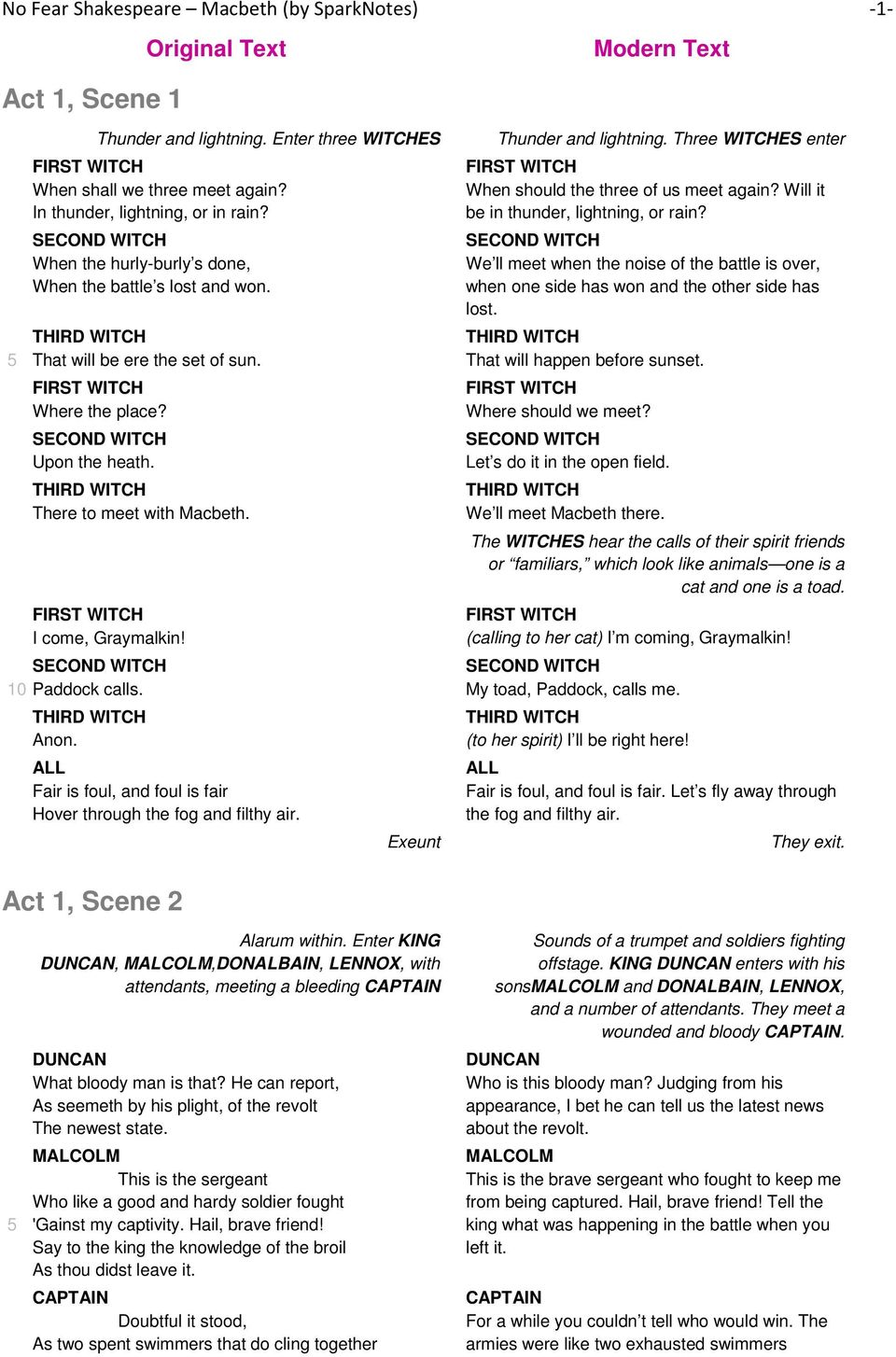
1 No Fear Shakespeare Macbeth (by SparkNotes) -1- Act 1, Scene Thunder and lightning. Enter three WITCHES When shall we three meet again? In thunder, lightning, or in rain? SECOND WITCH When the hurly-burly s done, When the battle s lost and won. THIRD WITCH That will be ere the set of sun. Where the place? SECOND WITCH Upon the heath. THIRD WITCH There to meet with Macbeth. I come, Graymalkin! SECOND WITCH Paddock calls. THIRD WITCH Anon. ALL Fair is foul, and foul is fair Hover through the fog and filthy air. Exeunt Thunder and lightning. Three WITCHES enter When should the three of us meet again? Will it be in thunder, lightning, or rain? SECOND WITCH We ll meet when the noise of the battle is over, when one side has won and the other side has lost. THIRD WITCH That will happen before sunset. Where should we meet? SECOND WITCH Let s do it in the open field. THIRD WITCH We ll meet Macbeth there. The WITCHES hear the calls of their spirit friends or familiars, which look like animals one is a cat and one is a toad. (calling to her cat) I m coming, Graymalkin! SECOND WITCH My toad, Paddock, calls me. THIRD WITCH (to her spirit) I ll be right here! ALL Fair is foul, and foul is fair. Let s fly away through the fog and filthy air. They exit. Act 1, Scene 2 5 Alarum within. Enter KING DUNCAN,,DONALBAIN,, with attendants, meeting a bleeding CAPTAIN DUNCAN What bloody man is that? He can report, As seemeth by his plight, of the revolt The newest state. This is the sergeant Who like a good and hardy soldier fought 'Gainst my captivity. Hail, brave friend! Say to the king the knowledge of the broil As thou didst leave it. CAPTAIN Doubtful it stood, As two spent swimmers that do cling together Sounds of a trumpet and soldiers fighting offstage. KING DUNCAN enters with his sons and DONALBAIN,, and a number of attendants. They meet a wounded and bloody CAPTAIN. DUNCAN Who is this bloody man? Judging from his appearance, I bet he can tell us the latest news about the revolt. This is the brave sergeant who fought to keep me from being captured. Hail, brave friend! Tell the king what was happening in the battle when you left it. CAPTAIN For a while you couldn t tell who would win. The armies were like two exhausted swimmers
2 No Fear Shakespeare Macbeth (by SparkNotes) And choke their art. The merciless Macdonwald Worthy to be a rebel, for to that The multiplying villanies of nature Do swarm upon him from the Western Isles Of kerns and gallowglasses is supplied, And fortune, on his damnèd quarrel smiling, Showed like a rebel s whore. But all s too weak, For brave Macbeth well he deserves that name Disdaining fortune, with his brandished steel, Which smoked with bloody execution, Like valor s minion carved out his passage Till he faced the slave; Which ne'er shook hands, nor bade farewell to him, Till he unseamed him from the nave to th' chops, And fixed his head upon our battlements. DUNCAN O valiant cousin! Worthy gentleman! clinging to each other and struggling in the water, unable to move. The villainous rebel Macdonwald was supported by foot soldiers and horsemen from Ireland and the Hebrides, and Lady Luck was with him, smiling cruelly at his enemies as if she were his whore. But Luck and Macdonwald together weren t strong enough. Brave Macbeth, laughing at Luck, chopped his way through to Macdonwald, who didn t even have time to say good-bye or shake hands before Macbeth split him open from his navel to his jawbone and stuck his head on our castle walls. DUNCAN My brave relative! What a worthy man! Act 1, Scene 2, Page CAPTAIN As whence the sun 'gins his reflection Shipwracking storms and direful thunders break, So from that spring whence comfort seemed to come Discomfort swells. Mark, King of Scotland, mark: No sooner justice had, with valor armed, Compelled these skipping kerns to trust their heels, But the Norweyan lord, surveying vantage, With furbished arms and new supplies of men, Began a fresh assault. DUNCAN Dismayed not this our captains, Macbeth and Banquo? CAPTAIN Yes, as sparrows eagles, or the hare the lion. If I say sooth, I must report they were As cannons overcharged with double cracks, So they doubly redoubled strokes upon the foe. Except they meant to bathe in reeking wounds, Or memorize another Golgotha, I cannot tell But I am faint, my gashes cry for help. DUNCAN So well thy words become thee as thy wounds; They smack of honor both. Go get him surgeons. Exit CAPTAIN with attendants Enter and ANGUS 45 Who comes here? Who is this? The worthy thane of Ross. CAPTAIN But in the same way that violent storms always come just as spring appears, our success against Macdonwald created new problems for us. Listen to this, King: as soon as we sent those Irish soldiers running for cover, the Norwegian king saw his chance to attack us with fresh troops and shiny weapons. DUNCAN Didn t this frighten our captains, Macbeth and Banquo? CAPTAIN The new challenge scared them about as much as sparrows frighten eagles, or rabbits frighten a lion. To tell you the truth, they fought the new enemy with twice as much force as before; they were like cannons loaded with double ammunition. Maybe they wanted to take a bath in their enemies' blood, or make that battlefield as infamous as Golgotha, where Christ was crucified, I don t know. But I feel weak. My wounds must be tended to. DUNCAN Your words, like your wounds, bring you honor. Take him to the surgeons. The CAPTAIN exits, helped by attendants. The worthy Thane of Ross. and ANGUS enter.

3 No Fear Shakespeare Macbeth (by SparkNotes) -3- What a haste looks through his eyes! So should he look That seems to speak things strange. His eyes seem frantic! He looks like someone with a strange tale to tell. Act 1, Scene 2, Page 3 God save the king. DUNCAN Whence cam st thou, worthy thane? From Fife, great king, Where the Norweyan banners flout the sky 50 And fan our people cold. Norway himself, with terrible numbers, Assisted by that most disloyal traitor, The thane of Cawdor, began a dismal conflict, Till that Bellona s bridegroom, lapped in proof, 55 Confronted him with self-comparisons, Point against point, rebellious arm 'gainst arm, Curbing his lavish spirit; and to conclude, The victory fell on us. DUNCAN Great happiness! That now Sweno, the Norways' king, craves composition. 60 Nor would we deign him burial of his men Till he disbursed at Saint Colme s Inch Ten thousand dollars to our general use. 65 DUNCAN No more that thane of Cawdor shall deceive Our bosom interest: go pronounce his present death, And with his former title greet Macbeth. I ll see it done. DUNCAN What he hath lost, noble Macbeth hath won. Exeunt God save the king! DUNCAN Where have you come from, worthy thane? Great king, I ve come from Fife, where the Norwegian flag flies, mocking our country and frightening our people. Leading an enormous army and assisted by that disloyal traitor, the thane of Cawdor, the king of Norway began a bloody battle. But outfitted in his battle-weathered armor, Macbeth met the Norwegian attacks shot for shot, as if he were the goddess of war s husband. Finally he broke the enemy s spirit, and we were victorious. DUNCAN Great happiness! So now Sweno, the Norwegian king, wants a treaty. We told him we wouldn t even let him bury his men until he retreated to Saint Colme s Inch and paid us ten thousand dollars. DUNCAN The thane of Cawdor will never again betray me. Go announce that he will be executed, and tell Macbeth that Cawdor s titles will be given to him. I ll get it done right away. DUNCAN The thane of Cawdor has lost what the noble Macbeth has won. They all exit. Act 1, Scene 3 Where hast thou been, sister? SECOND WITCH Killing swine. THIRD WITCH Sister, where thou? Thunder. Enter the three WITCHES A sailor s wife had chestnuts in her lap, Thunder. The three WITCHES enter. Where have you been, sister? SECOND WITCH Killing pigs. THIRD WITCH And you, sister? A sailor s wife had chestnuts in her lap and

4 No Fear Shakespeare Macbeth (by SparkNotes) And munched, and munched, and munched. Give me, quoth I. Aroint thee, witch! the rump-fed runnion cries. Her husband s to Aleppo gone, master o' th' Tiger; But in a sieve I ll thither sail, And like a rat without a tail, I ll do, I ll do, and I ll do. SECOND WITCH I ll give thee a wind. Thou 'rt kind. THIRD WITCH And I another. I myself have all the other, And the very ports they blow, All the quarters that they know I' th' shipman s card. I ll drain him dry as hay. Sleep shall neither night nor day Hang upon his penthouse lid. He shall live a man forbid. Weary sev'nnights nine times nine Shall he dwindle, peak and pine. munched away at them. Give me one, I said. Get away from me, witch! the fat woman cried. Her husband has sailed off to Aleppo as master of a ship called the Tiger. I ll sail there in a kitchen strainer, turn myself into a tailless rat, and do things to him SECOND WITCH I ll give you some wind to sail there. How nice of you! THIRD WITCH And I will give you some more. I already have control of all the other winds, along with the ports from which they blow and every direction on the sailor s compass in which they can go. I ll drain the life out of him. He won t catch a wink of sleep, either at night or during the day. He will live as a cursed man. For eighty-one weeks he will waste away in agony. Act 1, Scene 3, Page Though his bark cannot be lost, Yet it shall be tempest-tossed. Look what I have. SECOND WITCH Show me, show me. Here I have a pilot s thumb, Wrecked as homeward he did come. THIRD WITCH A drum, a drum! Macbeth doth come. Drum within ALL (dancing together in a circle) The weird sisters, hand in hand, Posters of the sea and land, Thus do go about, about, Thrice to thine and thrice to mine And thrice again, to make up nine. Peace! The charm s wound up. Enter and So foul and fair a day I have not seen. Although I can t make his ship disappear, I can still make his journey miserable. Look what I have here. SECOND WITCH Show me, show me. Here I have the thumb of a pilot who was drowned while trying to return home. THIRD WITCH A drum, a drum! Macbeth has come. A drum sounds offstage. ALL (dancing together in a circle) We weird sisters, hand in hand, swift travelers over the sea and land, dance around and around like so. Three times to yours, and three times to mine, and three times again, to add up to nine. Enough! The charm is ready. and enter. (to ) I have never seen a day that was so good and bad at the same time.

5 No Fear Shakespeare Macbeth (by SparkNotes) How far is t called to Forres? What are these So withered and so wild in their attire, That look not like th' inhabitants o' th' Earth, And yet are on t? Live you? Or are you aught That man may question? You seem to understand me, By each at once her choppy finger laying Upon her skinny lips. You should be women, And yet your beards forbid me to interpret That you are so. How far is it supposed to be to Forres? (he sees the WITCHES) What are these creatures? They re so withered-looking and crazily dressed. They don t look like they belong on this planet, but I see them standing here on Earth. (to thewitches) Are you alive? Can you answer questions? You seem to understand me, because each of you has put a gruesome finger to her skinny lips. You look like women, but your beards keep me from believing that you really are. Act 1, Scene 3, Page Speak, if you can: what are you? All hail, Macbeth! Hail to thee, thane of Glamis! SECOND WITCH All hail, Macbeth! Hail to thee, thane of Cawdor! THIRD WITCH All hail, Macbeth, that shalt be king hereafter! Good sir, why do you start and seem to fear Things that do sound so fair? (to the WITCHES) I' th' name of truth, Are ye fantastical, or that indeed Which outwardly ye show? My noble partner You greet with present grace and great prediction Of noble having and of royal hope, That he seems rapt withal. To me you speak not. If you can look into the seeds of time And say which grain will grow and which will not, Speak, then, to me, who neither beg nor fear Your favors nor your hate. Hail! SECOND WITCH Hail! THIRD WITCH Hail! Lesser than Macbeth and greater. SECOND WITCH Not so happy, yet much happier. THIRD WITCH Thou shalt get kings, though thou be none. So all hail, Macbeth and Banquo! Speak, if you can. What kind of creatures are you? All hail, Macbeth! Hail to you, thane of Glamis! SECOND WITCH All hail, Macbeth! Hail to you, thane of Cawdor! THIRD WITCH All hail, Macbeth, the future king! My dear Macbeth, why do you look so startled and afraid of these nice things they re saying?(to the WITCHES) Tell me honestly, are you illusions, or are you really what you seem to be? You ve greeted my noble friend with honors and talk of a future so glorious that you ve made him speechless. But you don t say anything to me. If you can see the future and say how things will turn out, tell me. I don t want your favors and I m not afraid of your hatred. Hail! SECOND WITCH Hail! THIRD WITCH Hail! You are lesser than Macbeth but also greater. SECOND WITCH You are not as happy as Macbeth, yet much happier. THIRD WITCH Your descendants will be kings, even though you will not be one. So all hail, Macbeth and Banquo! Act 1, Scene 3, Page 4

6 No Fear Shakespeare Macbeth (by SparkNotes) Banquo and Macbeth, all hail! Stay, you imperfect speakers, tell me more. By Sinel s death I know I am thane of Glamis. But how of Cawdor? The thane of Cawdor lives, A prosperous gentleman, and to be king Stands not within the prospect of belief, No more than to be Cawdor. Say from whence You owe this strange intelligence, or why Upon this blasted heath you stop our way With such prophetic greeting. Speak, I charge you. WITCHES vanish The earth hath bubbles, as the water has, And these are of them. Whither are they vanished? Into the air, and what seemed corporal Melted, as breath into the wind. Would they had stayed. Were such things here as we do speak about? Or have we eaten on the insane root That takes the reason prisoner? Your children shall be kings. You shall be king. And thane of Cawdor too: went it not so? To the selfsame tune and words. Who s here? Enter and ANGUS Banquo and Macbeth, all hail! Wait! You only told me part of what I want to know. Stay and tell me more. I already know I am the thane of Glamis because I inherited the position when my father, Sinel, died. But how can you call me the thane of Cawdor? The thane of Cawdor is alive, and he s a rich and powerful man. And for me to be the king is completely impossible, just as it s impossible for me to be thane of Cawdor. Tell me where you learned these strange things, and why you stop us at this desolate place with this prophetic greeting? Speak, I command you. The WITCHESvanish. The earth has bubbles, just like the water, and these creatures must have come from a bubble in the earth. Where did they disappear to? Into thin air. Their bodies melted like breath in the wind. I wish they had stayed! Were these things we re talking about really here? Or are we both on drugs? Your children will be kings. You will be the king. And thane of Cawdor too. Isn t that what they said? That s exactly what they said. Who s this? and ANGUS enter. Act 1, Scene 3, Page The king hath happily received, Macbeth, The news of thy success, and when he reads Thy personal venture in the rebels' fight, His wonders and his praises do contend Which should be thine or his. Silenced with that, In viewing o'er the rest o' the selfsame day, He finds thee in the stout Norweyan ranks, Nothing afeard of what thyself didst make, Strange images of death. As thick as tale Can post with post, and every one did bear Thy praises in his kingdom s great defense, The king was happy to hear of your success, Macbeth. Whenever he hears the story of your exploits in the fight against the rebels, he becomes so amazed it makes him speechless. He was also shocked to learn that on the same day you fought the rebels you also fought against the army of Norway, and that you weren t the least bit afraid of death, even as you killed everyone around you. Messenger after messenger delivered news of your bravery to the king with praise for how you defended his

7 No Fear Shakespeare Macbeth (by SparkNotes) And poured them down before him. ANGUS We are sent To give thee from our royal master thanks, Only to herald thee into his sight, Not pay thee. And, for an earnest of a greater honor, He bade me, from him, call thee thane of Cawdor: In which addition, hail, most worthy thane, For it is thine. What, can the devil speak true? The thane of Cawdor lives. Why do you dress me In borrowed robes? ANGUS Who was the thane lives yet, But under heavy judgment bears that life Which he deserves to lose. Whether he was combined With those of Norway, or did line the rebel 115 With hidden help and vantage, or that with both He labored in his country s wrack, I know not; But treasons capital, confessed and proved, Have overthrown him. country. ANGUS The king sent us to give you his thanks and to bring you to him. Your real reward won t come from us. And to give you a taste of what s in store for you, he told me to call you the thane of Cawdor. So hail, thane of Cawdor! That title belongs to you now. (shocked) Can the devil tell the truth? The thane of Cawdor is still alive. Why are you putting his clothes on me? ANGUS The man who was the thane of Cawdor is still alive, but he s been sentenced to death, and he deserves to die. I don t know whether he fought on Norway s side, or if he secretly aided the rebels, or if he fought with both of our enemies. But his treason, which has been proven, and to which he s confessed, means he s finished. Act 1, Scene 3, Page 6 (aside) Glamis, and thane of Cawdor! The greatest is 120 behind. (to and ANGUS)Thanks for your pains. (aside to ) Do you not hope your children shall be kings, When those that gave the thane of Cawdor to me Promised no less to them? That, trusted home, Might yet enkindle you unto the crown, Besides the thane of Cawdor. But tis strange. 125 And oftentimes, to win us to our harm, The instruments of darkness tell us truths, Win us with honest trifles, to betray s In deepest consequence. (to and ANGUS) Cousins, a word, I pray you. 130,, and ANGUS move to one side (aside) Two truths are told, (to himself) It s just like they said now I m the thane of Glamis and the thane of Cawdor. And the best part of what they predicted is still to come. (to and ANGUS) Thank you for the news. (speaking so that only can hear) Aren t you beginning to hope your children will be kings? After all, the witches who said I was thane of Cawdor promised them nothing less. If you trust what they say, you might be on your way to becoming king, as well as thane of Cawdor. But this whole thing is strange. The agents of evil often tell us part of the truth in order to lead us to our destruction. They earn our trust by telling us the truth about little things, but then they betray us when it will damage us the most. (to and ANGUS) Gentlemen, I d like to have a word with you, please., ANGUS, and move to one side. (to himself) So far the witches have told me two

8 No Fear Shakespeare Macbeth (by SparkNotes) As happy prologues to the swelling act Of the imperial theme. (to and ANGUS) I thank you, gentlemen. (aside) This supernatural soliciting Cannot be ill, cannot be good. If ill, Why hath it given me earnest of success, Commencing in a truth? I am thane of Cawdor. If good, why do I yield to that suggestion Whose horrid image doth unfix my hair And make my seated heart knock at my ribs, Against the use of nature? Present fears Are less than horrible imaginings. things that came true, so it seems like this will culminate in my becoming king. (to andangus) Thank you, gentlemen. (to himself)this supernatural temptation doesn t seem like it can be a bad thing, but it can t be good either. If it s a bad thing, why was I promised a promotion that turned out to be true? Now I m the thane of Cawdor, just like they said I would be. But if this is a good thing, why do I find myself thinking about murdering King Duncan, a thought so horrifying that it makes my hair stand on end and my heart pound inside my chest? The dangers that actually threaten me here and now frighten me less than the horrible things I m imagining. Act 1, Scene 3, Page My thought, whose murder yet is but fantastical, Shakes so my single state of man That function is smothered in surmise, And nothing is but what is not. Look how our partner s rapt. (aside) If chance will have me king, why, chance may crown me Without my stir. New honors come upon him, 150 Like our strange garments, cleave not to their mold But with the aid of use (aside) Come what come may, Time and the hour runs through the roughest day. Worthy Macbeth, we stay upon your leisure. Give me your favor. My dull brain was wrought With things forgotten. Kind gentlemen, your pains Are registered where every day I turn The leaf to read them. Let us toward the king. (aside to ) Think upon what hath chanced, and, at more time, The interim having weighed it, let us speak Our free hearts each to other. Very gladly. Till then, enough. (to and ANGUS) Come, friends. Even though it s just a fantasy so far, the mere thought of committing murder shakes me up so much that I hardly know who I am anymore. My ability to act is stifled by my thoughts and speculations, and the only things that matter to me are things that don t really exist. Look at Macbeth he s in a daze. (to himself) If fate wants me to be king, perhaps fate will just make it happen and I won t have to do anything. (to and ANGUS) Macbeth is not used to his new titles. They re like new clothes: they don t fit until you break them in over time. (to himself) One way or another, what s going to happen is going to happen. Good Macbeth, we re ready when you are. I beg your pardon; I was distracted. Kind gentlemen, I won t forget the trouble you ve taken for me whenever I think of this day. Let s go to the king. (speaking so that only can hear) Think about what happened today, and when we ve both had time to consider things, let s talk. Absolutely. Until then, we ve said enough. (to andangus) Let s go, my

9 No Fear Shakespeare Macbeth (by SparkNotes) -9- Exeunt friends. They all exit. Act 1, Scene Flourish. Enter KING DUNCAN,,, DONALBAIN, and attendants DUNCAN Is execution done on Cawdor? Are not Those in commission yet returned? My liege, They are not yet come back. But I have spoke With one that saw him die, who did report That very frankly he confessed his treasons, Implored your highness' pardon, and set forth A deep repentance. Nothing in his life Became him like the leaving it. He died As one that had been studied in his death To throw away the dearest thing he owed As twere a careless trifle. DUNCAN There s no art To find the mind s construction in the face. He was a gentleman on whom I built An absolute trust. Enter,,, and ANGUS (to ) O worthiest cousin, The sin of my ingratitude even now Was heavy on me. Thou art so far before That swiftest wing of recompense is slow To overtake thee. Would thou hadst less deserved, That the proportion both of thanks and payment Might have been mine! Only I have left to say, More is thy due than more than all can pay. A trumpet fanfare sounds. KING DUNCAN,,, DONALBAIN, and their attendants enter. DUNCAN Has the former thane of Cawdor been executed yet? Haven t the people in charge of that come back? My king, they haven t come back yet. But I spoke with someone who saw Cawdor die, and he said that Cawdor openly confessed his treasons, begged your highness s forgiveness, and repented deeply. He never did anything in his whole life that looked as good as the way he died. He died like someone who had practiced how to toss away his most cherished possession as if it were a worthless a piece of garbage. DUNCAN There s no way to read a man s mind by looking at his face. I trusted Cawdor completely.,,, and ANGUSenter. (to ) My worthiest kinsman! Just this moment I was feeling guilty for not having thanked you enough. You have done so much for me so fast that it has been impossible to reward you properly. If you deserved less, then perhaps my payment would have matched your deeds! All I can say is that I owe you more than I can ever repay. Act 1, Scene 4, Page 2 25 The service and the loyalty I owe In doing it pays itself. Your highness' part Is to receive our duties, and our duties Are to your throne and state children and servants, Which do but what they should, by doing everything Safe toward your love and honor. DUNCAN Welcome hither. I have begun to plant thee, and will labor 30 To make thee full of growing. (to ) Noble Banquo, That hast no less deserved, nor must be known The opportunity to serve you is its own reward. Your only duty, your highness, is to accept what we owe you. Our duty to you and your state is like the duty of children to their father or servants to their master. By doing everything we can to protect you, we re only doing what we should. DUNCAN You are welcome here. By making you thane of Cawdor, I have planted the seeds of a great career for you, and I will make sure they grow. (to) Noble Banquo, you deserve no less than Macbeth, and everyone should know

10 No Fear Shakespeare Macbeth (by SparkNotes) -10- No less to have done so, let me infold thee And hold thee to my heart. There, if I grow, The harvest is your own. DUNCAN My plenteous joys, 35 Wanton in fullness, seek to hide themselves In drops of sorrow. Sons, kinsmen, thanes, And you whose places are the nearest, know We will establish our estate upon Our eldest, Malcolm, whom we name hereafter 40 The prince of Cumberland; which honor must Not unaccompanied invest him only, But signs of nobleness, like stars, shall shine On all deservers. (to ) From hence to Inverness, And bind us further to you. 45 The rest is labor which is not used for you: I ll be myself the harbinger and make joyful The hearing of my wife with your approach. So humbly take my leave. DUNCAN My worthy Cawdor! it. Let me bring you close to me and give you the benefit of my love and good will. Then if I accomplish anything great, it will be a credit to you. DUNCAN My joy is so overwhelming it brings tears to my eyes. My sons, relatives, lords, and all those closest to me, I want you to witness that I will bestow my kingdom on my eldest son, Malcolm. Today I name him the prince of Cumberland. But Malcolm isn t going to be alone in receiving honors titles of nobility will shine like stars on all of you who deserve them. (to ) And now, let s go to your castle at Inverness, where I will become even more obliged to you because of your hospitality. I m not happy unless I can be working for you. I will go ahead and bring my wife the good news that you are coming. With that, I ll be off. DUNCAN My worthy Cawdor! Act 1, Scene 4, Page (aside) The prince of Cumberland! That is a step On which I must fall down, or else o'erleap, For in my way it lies. Stars, hide your fires; Let not light see my black and deep desires. The eye wink at the hand, yet let that be Which the eye fears, when it is done, to see. DUNCAN True, worthy Banquo. He is full so valiant, And in his commendations I am fed; It is a banquet to me. Let s after him, Whose care is gone before to bid us welcome: It is a peerless kinsman. Exit Flourish. Exeunt (to himself) Malcolm is now the prince of Cumberland! To become king myself, I m either going to have to step over him or give up, because he s in my way. Stars, hide your light so no one can see the terrible desires within me. I won t let my eye look at what my hand is doing, but in the end I m still going to do that thing I d be horrified to see. exits. DUNCAN (to, in the middle of a conversation we haven t heard) You re right, Banquo. Macbeth is every bit as valiant as you say, and I am satisfied with these praises of him. Let s follow after him, now that he has gone ahead to prepare our welcome. He is a man without equal. Trumpet fanfare. They exit. Act 1, Scene 5 Enter LADY, alone, with a letter LADY (reading) They met me in the day of success, and I have learned by the perfectest report they have more LADY enters, reading a letter. LADY The witches met me on the day of my victory in battle, and I have since learned that they have

11 No Fear Shakespeare Macbeth (by SparkNotes) in them than mortal knowledge. When I burned in desire to question them further, they made themselves air, into which they vanished. Whiles I stood rapt in the wonder of it came missives from the king, who all-hailed me 'Thane of Cawdor,' by which title, before, these weird sisters saluted me, and referred me to the coming on of time with 'Hail, king that shalt be!' This have I thought good to deliver thee, my dearest partner of greatness, that thou might st not lose the dues of rejoicing, by being ignorant of what greatness is promised thee. Lay it to thy heart, and farewell. Glamis thou art, and Cawdor; and shalt be What thou art promised. Yet do I fear thy nature; It is too full o' th' milk of human kindness To catch the nearest way: thou wouldst be great, Art not without ambition, but without The illness should attend it. What thou wouldst highly, That wouldst thou holily; wouldst not play false, And yet wouldst wrongly win. Thou'ld st have, great Glamis, That which cries, Thus thou must do, if thou have it, And that which rather thou dost fear to do, Than wishest should be undone. Hie thee hither, That I may pour my spirits in thine ear And chastise with the valor of my tongue All that impedes thee from the golden round, Which fate and metaphysical aid doth seem To have thee crowned withal. Enter SERVANT supernatural knowledge. When I tried desperately to question them further, they vanished into thin air. While I stood spellbound, messengers from the king arrived and greeted me as the thane of Cawdor, which is precisely how the weird sisters had saluted me before calling me the future king!' I thought I should tell you this news, my dearest partner in greatness, so that you could rejoice along with me about the greatness that is promised to us. Keep it secret, and farewell. (she looks up from the letter) You are thane of Glamis and Cawdor, and you re going to be king, just like you were promised. But I worry about whether or not you have what it takes to seize the crown. You are too full of the milk of human kindness to strike aggressively at your first opportunity. You want to be powerful, and you don t lack ambition, but you don t have the mean streak that these things call for. The things you want to do, you want to do like a good man. You don t want to cheat, yet you want what doesn t belong to you. There s something you want, but you re afraid to do what you need to do to get it. You want it to be done for you. Hurry home so I can persuade you and talk you out of whatever s keeping you from going after the crown. After all, fate and witchcraft both seem to want you to be king. A SERVANT enters. Act 1, Scene 5, Page What is your tidings? SERVANT The king comes here tonight. LADY Thou 'rt mad to say it. Is not thy master with him, who, were t so, Would have informed for preparation? SERVANT So please you, it is true: our thane is coming. One of my fellows had the speed of him, Who, almost dead for breath, had scarcely more Than would make up his message. LADY Give him tending. He brings great news. The raven himself is hoarse That croaks the fatal entrance of Duncan Exit SERVANT What news do you bring? SERVANT The king is coming here tonight. LADY You must be crazy to say that! Isn t Macbeth with the king, and wouldn t Macbeth have told me in advance so I could prepare, if the king were really coming? SERVANT I m sorry, but it s the truth. Macbeth is coming. He sent a messenger ahead of him who arrived here so out of breath that he could barely speak his message. LADY Take good care of him. He brings great news. The SERVANT exits. So the messenger is short of breath, like a hoarse raven, as he announces Duncan s entrance into
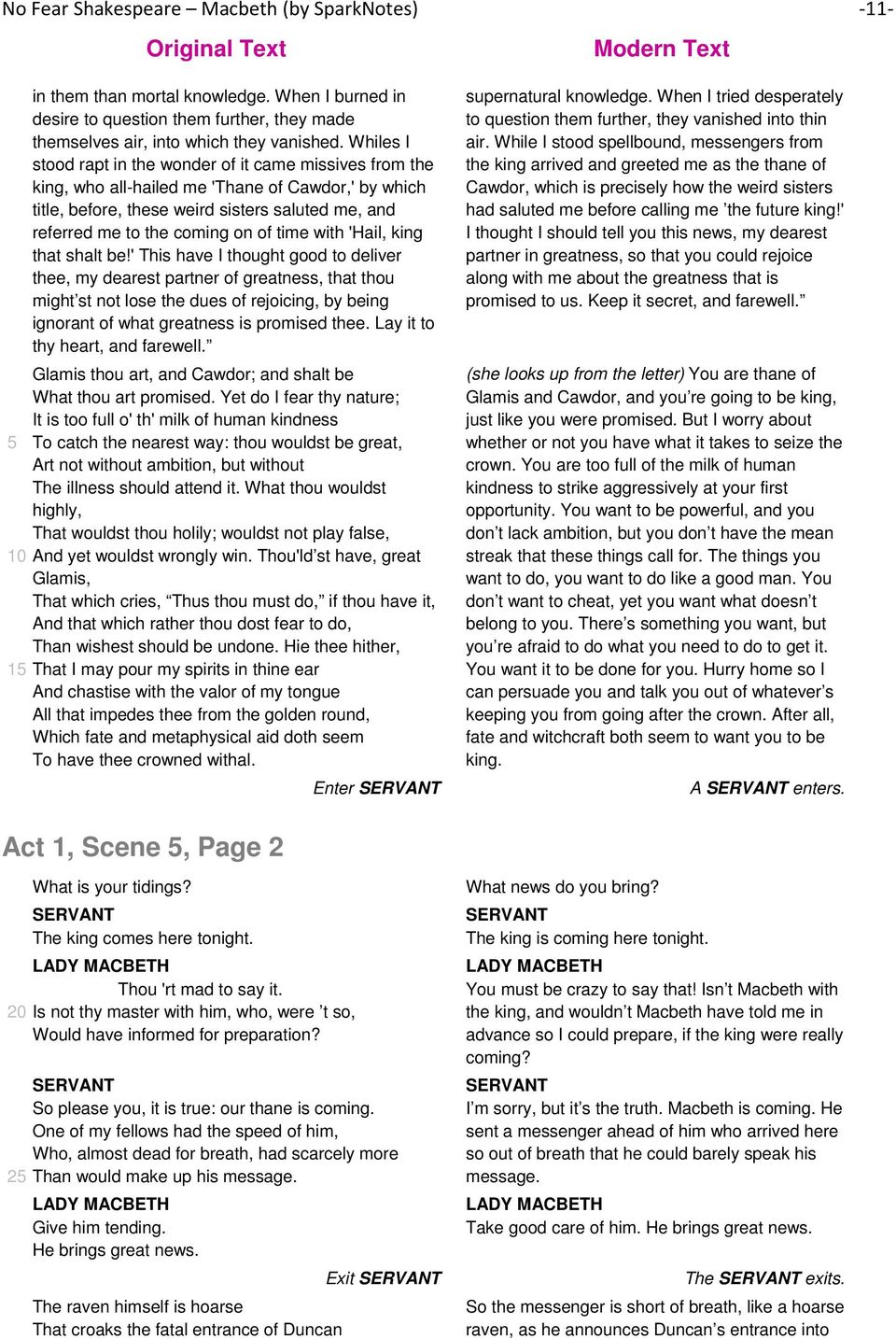
12 No Fear Shakespeare Macbeth (by SparkNotes) Under my battlements. Come, you spirits That tend on mortal thoughts, unsex me here, And fill me from the crown to the toe top-full Of direst cruelty. Make thick my blood. Stop up the access and passage to remorse, That no compunctious visitings of nature Shake my fell purpose, nor keep peace between The effect and it! Come to my woman s breasts, And take my milk for gall, you murd'ring ministers, Wherever in your sightless substances You wait on nature s mischief. Come, thick night, And pall thee in the dunnest smoke of hell, That my keen knife see not the wound it makes, Nor heaven peep through the blanket of the dark To cry Hold, hold! my fortress, where he will die. Come, you spirits that asist murderous thoughts, make me less like a woman and more like a man, and fill me from head to toe with deadly cruelty! Thicken my blood and clog up my veins so I won t feel remorse, so that no human compassion can stop my evil plan or prevent me from accomplishing it! Come to my female breast and turn my mother s milk into poisonous acid, you murdering demons, wherever you hide, invisible and waiting to do evil! Come, thick night, and cover the world in the darkest smoke of hell, so that my sharp knife can t see the wound it cuts open, and so heaven can t peep through the darkness and cry, No! Stop! Act 1, Scene 5, Page 3 45 Great Glamis, worthy Cawdor, Greater than both, by the all-hail hereafter, Thy letters have transported me beyond This ignorant present, and I feel now The future in the instant My dearest love, Duncan comes here tonight. LADY And when goes hence? Tomorrow, as he purposes. Enter LADY O, never Shall sun that morrow see! Your face, my thane, is as a book where men May read strange matters. To beguile the time, Look like the time. Bear welcome in your eye, Your hand, your tongue. Look like th' innocent flower, But be the serpent under t. He that s coming Must be provided for; and you shall put This night s great business into my dispatch, Which shall to all our nights and days to come Give solely sovereign sway and masterdom. We will speak further. LADY Only look up clear. To alter favor ever is to fear. Leave all the rest to me. Exeunt enters. Great thane of Glamis! Worthy thane of Cawdor! You ll soon be greater than both those titles, once you become king! Your letter has transported me from the present moment, when who knows what will happen, and has made me feel like the future is already here. My dearest love, Duncan is coming here tonight. LADY And when is he leaving? He plans to leave tomorrow. LADY That day will never come. Your face betrays strange feelings, my lord, and people will be able to read it like a book. In order to deceive them, you must appear the way they expect you to look. Greet the king with a welcoming expression in your eyes, your hands, and your words. You should look like an innocent flower, but be like the snake that hides underneath the flower. The king is coming, and he s got to be taken care of. Let me handle tonight s preparations, because tonight will change every night and day for the rest of our lives. We will speak about this further. LADY You should project a peaceful mood, because if you look troubled, you will arouse suspicion. Leave all the rest to me. They exit.
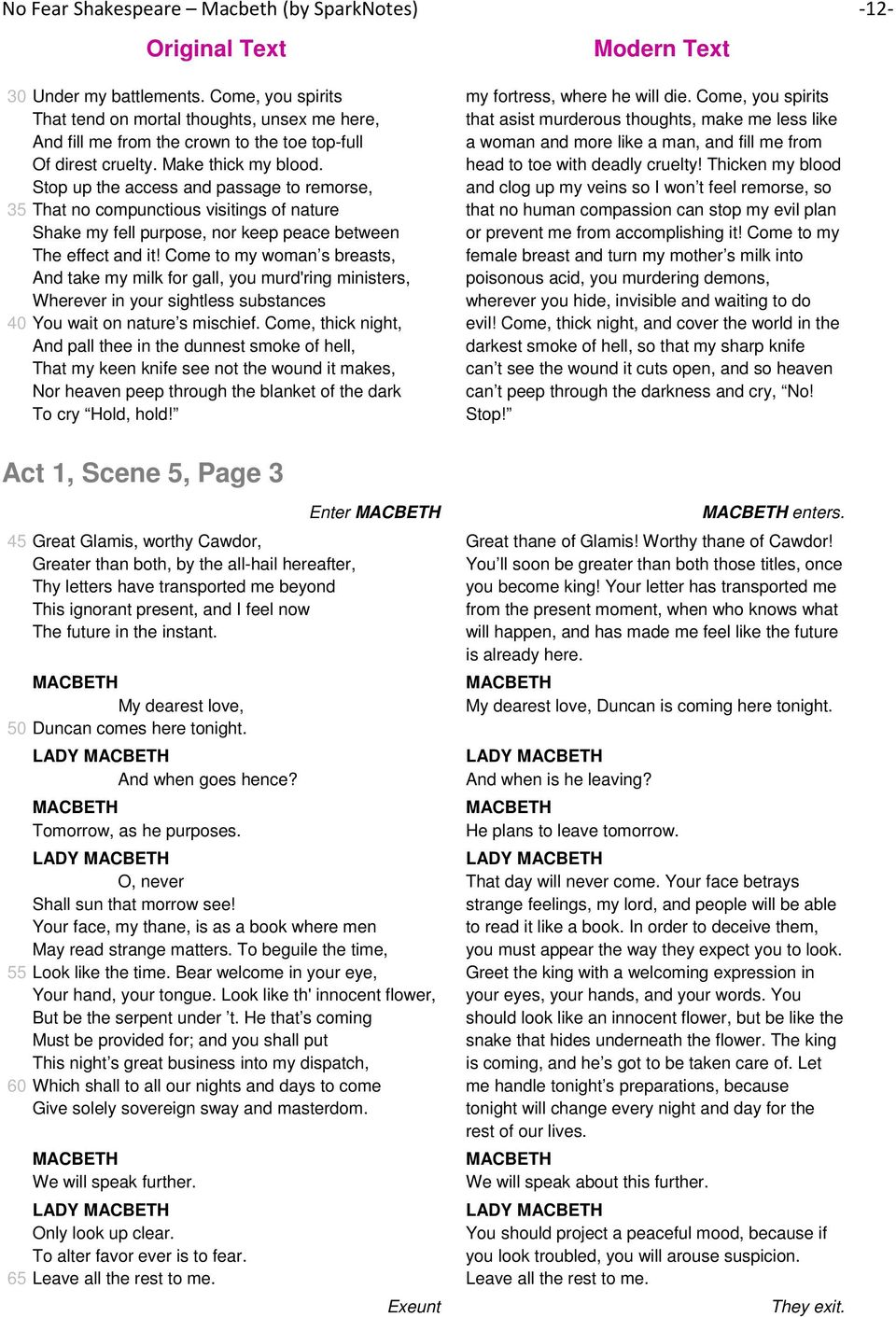
13 No Fear Shakespeare Macbeth (by SparkNotes) -13- Act 1, Scene hautboys and torches. Enter KING DUNCAN,, DONALBAIN,, LENN OX,,, ANGUS, and attendants DUNCAN This castle hath a pleasant seat. The air Nimbly and sweetly recommends itself Unto our gentle senses. This guest of summer, The temple-haunting martlet, does approve, By his loved mansionry, that the heaven s breath Smells wooingly here. No jutty, frieze, Buttress, nor coign of vantage, but this bird Hath made his pendant bed and procreant cradle. Where they most breed and haunt, I have observed, The air is delicate. Enter LADY DUNCAN See, see, our honored hostess! The love that follows us sometime is our trouble, Which still we thank as love. Herein I teach you How you shall bid God 'ild us for your pains, And thank us for your trouble. LADY All our service, In every point twice done and then done double, Were poor and single business to contend Against those honors deep and broad wherewith Your majesty loads our house. For those of old, And the late dignities heaped up to them, We rest your hermits. The stage is lit by torches. Hautboys play.duncan enters, together with,donalbain,, LENNO X,,, ANGUS, and their attendants. DUNCAN This castle is in a pleasant place. The air is sweet and appeals to my refined senses. The fact that this summer bird, the house martin, builds his nests here proves how inviting the breezes are. There isn t a single protrusion in the castle walls where these birds haven t built their hanging nests to sleep and breed. I ve noticed that they always like to settle and mate where the air is the nicest. LADY enters. DUNCAN Look, here comes our honored hostess! Sometimes the love my subjects bring me is inconvenient, but I still accept it as love. In doing so, I m teaching you to thank me for the incovenience I m causing you by being here, because it comes from my love to you. LADY Everything we re doing for you, even if it were doubled and then doubled again, is nothing compared to the honors you have brought to our family. We gladly welcome you as our guests, with gratitude for both the honors you ve given us before and the new honors you ve just given us. Act 1, Scene 6, Page 2 DUNCAN Where s the thane of Cawdor? We coursed him at the heels and had a purpose To be his purveyor; but he rides well, And his great love, sharp as his spur, hath holp him To his home before us. Fair and noble hostess, 25 We are your guest tonight. LADY Your servants ever Have theirs, themselves, and what is theirs in compt, To make their audit at your highness' pleasure, Still to return your own. DUNCAN DUNCAN Where is Macbeth, the thane of Cawdor? We followed closely after him. I hoped to arrive here before him, but he rides swiftly. And his great love, which is as sharp as his spur, helped him beat us here. Fair and noble hostess, we are your guests tonight. LADY We are your servants, your highness, and as always our house and everything in it is at your disposal, for after all, we keep it in your trust and we re glad to give you back what s yours. DUNCAN

14 No Fear Shakespeare Macbeth (by SparkNotes) Give me your hand. Conduct me to mine host. We love him highly And shall continue our graces towards him. By your leave, hostess. Exeunt Give me your hand. Bring me to my host, Macbeth. I love him dearly, and I shall continue to favor him. Whenever you re ready, hostess. They all exit. Act 1, Scene Hautboys. Torches. Enter a sewer and divers servants with dishes and service over the stage. Then enter If it were done when tis done, then twere well It were done quickly. If the assassination Could trammel up the consequence, and catch With his surcease success; that but this blow Might be the be-all and the end-all here, But here, upon this bank and shoal of time, We d jump the life to come. But in these cases We still have judgment here, that we but teach Bloody instructions, which, being taught, return To plague th' inventor: this even-handed justice Commends the ingredients of our poisoned chalice To our own lips. He s here in double trust: First, as I am his kinsman and his subject, Strong both against the deed; then, as his host, Who should against his murderer shut the door, Not bear the knife myself. Besides, this Duncan Hath borne his faculties so meek, hath been So clear in his great office, that his virtues Will plead like angels, trumpet-tongued, against The deep damnation of his taking-off; And pity, like a naked newborn babe, Striding the blast, or heaven s cherubim, horsed Upon the sightless couriers of the air, Shall blow the horrid deed in every eye, That tears shall drown the wind. I have no spur To prick the sides of my intent, but only Vaulting ambition, which o'erleaps itself And falls on th' other. Hautboys play. The stage is lit by torches. A butler enters, and various servants carry utensils and dishes of food across the stage. Then enters. If this business would really be finished when I did the deed, then it would be best to get it over with quickly. If the assassination of the king could work like a net, sweeping up everything and preventing any consequences, then the murder would be the be-all and end-all of the whole affair, and I would gladly put my soul and the afterlife at risk to do it. But for crimes like these there are still punishments in this world. By committing violent crimes we only teach other people to commit violence, and the violence of our students will come back to plague us teachers. Justice, being equal to everyone, forces us to drink from the poisoned cup that we serve to others. The king trusts me in two ways. First of all, I am his kinsman and his subject, so I should always try to protect him. Second, I am his host, so I should be closing the door in his murderer s face, not trying to murder him myself. Besides, Duncan has been such a humble leader, so free of corruption, that his virtuous legacy will speak for him when he dies, as if angels were playing trumpets against the injustice of his murder. Pity, like an innocent newborn baby, will ride the wind with winged angels on invisible horses through the air to spread news of the horrible deed to everyone everywhere. People will shed a flood of tears that will drown the wind like a horrible downpour of rain. I can t spur myself to action. The only thing motivating me is ambition, which makes people rush ahead of themselves toward disaster. Act 1, Scene 7, Page 2 30 How now! What news? Enter LADY LADY He has almost supped. Why have you left the chamber? Hath he asked for me? What news do you have? LADY enters. LADY He has almost finished dinner. Why did you leave the dining room? Has he asked for me?
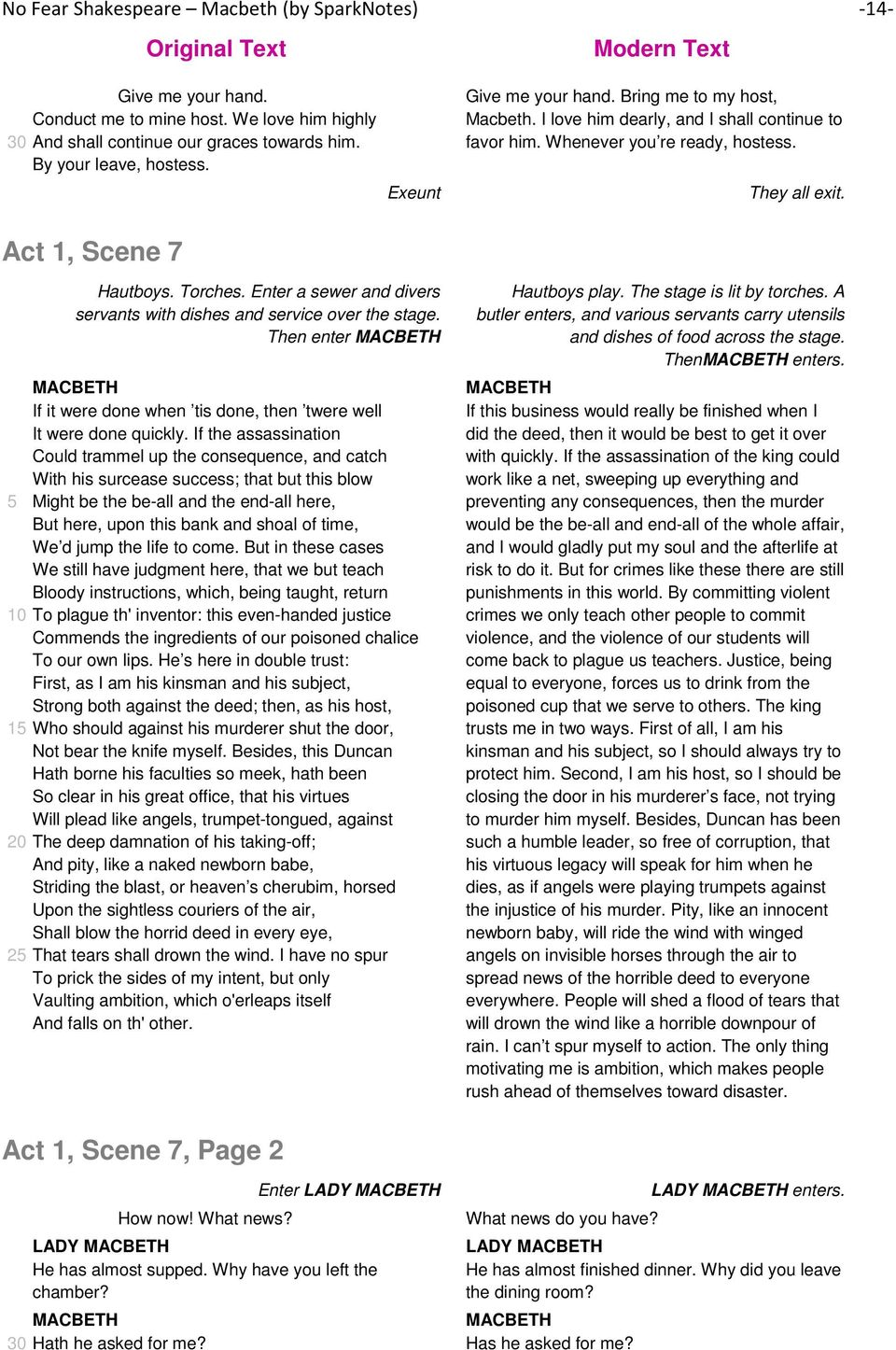
15 No Fear Shakespeare Macbeth (by SparkNotes) LADY Know you not he has? We will proceed no further in this business. He hath honored me of late, and I have bought Golden opinions from all sorts of people, Which would be worn now in their newest gloss, Not cast aside so soon. LADY Was the hope drunk Wherein you dressed yourself? Hath it slept since? And wakes it now, to look so green and pale At what it did so freely? From this time Such I account thy love. Art thou afeard To be the same in thine own act and valor As thou art in desire? Wouldst thou have that Which thou esteem st the ornament of life, And live a coward in thine own esteem, Letting I dare not wait upon I would, Like the poor cat i' th' adage? Prithee, peace: I dare do all that may become a man; Who dares do more is none. LADY What beast was t, then, That made you break this enterprise to me? When you durst do it, then you were a man; And to be more than what you were, you would Be so much more the man. Nor time nor place Did then adhere, and yet you would make both. They have made themselves, and that their fitness now Does unmake you. I have given suck, and know How tender tis to love the babe that milks me. I would, while it was smiling in my face, Have plucked my nipple from his boneless gums And dashed the brains out, had I so sworn as you Have done to this. LADY Don t you know he has? We can t go on with this plan. The king has just honored me, and I have earned the good opinion of all sorts of people. I want to enjoy these honors while the feeling is fresh and not throw them away so soon. LADY Were you drunk when you seemed so hopeful before? Have you gone to sleep and woken up green and pale in fear of this idea? From now on this is what I ll think of your love. Are you afraid to act the way you desire? Will you take the crown you want so badly, or will you live as a coward, always saying I can t after you say I want to? You re like the poor cat in the old story. Please, stop! I dare to do only what is proper for a man to do. He who dares to do more is not a man at all. LADY If you weren t a man, then what kind of animal were you when you first told me you wanted to do this? When you dared to do it, that s when you were a man. And if you go one step further by doing what you dared to do before, you ll be that much more the man. The time and place weren t right before, but you would have gone ahead with the murder anyhow. Now the time and place are just right, but they re almost too good for you. I have suckled a baby, and I know how sweet it is to love the baby at my breast. But even as the baby was smiling up at me, I would have plucked my nipple out of its mouth and smashed its brains out against a wall if I had sworn to do that the same way you have sworn to do this. Act 1, Scene 7, Page If we should fail? LADY We fail? But screw your courage to the sticking-place, And we ll not fail. When Duncan is asleep Whereto the rather shall his day s hard journey Soundly invite him his two chamberlains Will I with wine and wassail so convince That memory, the warder of the brain, Shall be a fume, and the receipt of reason But if we fail LADY We, fail? If you get your courage up, we can t fail. When Duncan is asleep the day s hard journey has definitely made him tired I ll get his two servants so drunk that their memory will go up in smoke through the chimneys of their brains. When they lie asleep like pigs, so drunk they ll be dead to the world, what won t you and I be able to do to the unguarded Duncan? And whatever we

16 No Fear Shakespeare Macbeth (by SparkNotes) A limbeck only: when in swinish sleep Their drenchèd natures lie as in a death, What cannot you and I perform upon The unguarded Duncan? What not put upon His spongy officers, who shall bear the guilt Of our great quell? Bring forth men-children only, For thy undaunted mettle should compose Nothing but males. Will it not be received, When we have marked with blood those sleepy two Of his own chamber and used their very daggers, That they have done t? do, we can lay all the blame on the drunken servants. May you only give birth to male children, because your fearless spirit should create nothing that isn t masculine. Once we have covered the two servants with blood, and used their daggers to kill, won t people believe that they were the culprits? Act 1, Scene 7, Page 4 80 LADY Who dares receive it other, As we shall make our griefs and clamor roar Upon his death? I am settled, and bend up Each corporal agent to this terrible feat. Away, and mock the time with fairest show. False face must hide what the false heart doth know. Exeunt LADY Who could think it happened any other way? We ll be grieving loudly when we hear that Duncan has died. Now I m decided, and I will exert every muscle in my body to commit this crime. Go now, and pretend to be a friendly hostess. Hide with a false pleasant face what you know in your false, evil heart. They exit. Act 2, Scene Enter, and FLEANCE, with a torch before him How goes the night, boy? FLEANCE The moon is down. I have not heard the clock. And she goes down at twelve. FLEANCE I take t tis later, sir. Hold, take my sword. There s husbandry in heaven; Their candles are all out. Take thee that too. A heavy summons lies like lead upon me, And yet I would not sleep. Merciful powers, Restrain in me the cursèd thoughts that nature Gives way to in repose. A friend. Enter and a SERVANT with a torch Give me my sword. Who s there? enters with FLEANCE, who lights the way with a torch. How s the night going, boy? FLEANCE The moon has set. The clock hasn t struck yet. The moon sets at twelve, right? FLEANCE I think it s later than that, sir. Here, take my sword. The heavens are being stingy with their light. Take this, too. I m tired and feeling heavy, but I can t sleep. Merciful powers, keep away the nightmares that plague me when I rest! enters with a SERVANT, who carries a torch. Give me my sword. Who s there? A friend.

17 No Fear Shakespeare Macbeth (by SparkNotes) What, sir, not yet at rest? The king s a-bed. He hath been in unusual pleasure, and Sent forth great largess to your offices. This diamond he greets your wife withal, By the name of most kind hostess, and shut up In measureless content. Being unprepared, Our will became the servant to defect, Which else should free have wrought. You re not asleep yet, sir? The king s in bed. He s been in an unusually good mood and has granted many gifts to your household and servants. This diamond is a present from him to your wife for her boundless hospitality. (he hands a diamond) Because we were unprepared for the king s visit, we weren t able to entertain him as well as we would have wanted to. Act 2, Scene 1, Page 2 All s well. I dreamt last night of the three weird sisters: 20 To you they have showed some truth I think not of them. Yet, when we can entreat an hour to serve, We would spend it in some words upon that business, If you would grant the time. At your kind st leisure. If you shall cleave to my consent, when tis, It shall make honor for you. So I lose none In seeking to augment it, but still keep My bosom franchised and allegiance clear, I shall be counselled. Good repose the while! Thanks, sir: the like to you! Exeunt and FLEANCE (to the SERVANT) Go bid thy mistress, when my drink is ready, She strike upon the bell. Get thee to bed. Exit SERVANT Is this a dagger which I see before me, The handle toward my hand? Come, let me clutch thee. I have thee not, and yet I see thee still. Art thou not, fatal vision, sensible To feeling as to sight? Or art thou but A dagger of the mind, a false creation, Proceeding from the heat-oppressèd brain? I see thee yet, in form as palpable Everything s OK. I had a dream last night about the three witches. At least part of what they said about you was true. I don t think about them now. But when we have an hour to spare we can talk more about it, if you re willing. Whenever you like. If you stick with me, when the time comes, there will be something in it for you. I ll do whatever you say, as long as I can do it with a clear conscience. Rest easy in the meantime. Thank you, sir. You do the same. and FLEANCE exit. (to the SERVANT) Go and tell your mistress to strike the bell when my drink is ready. Get yourself to bed. The SERVANT exits. Is this a dagger I see in front of me, with its handle pointing toward my hand? (to the dagger)come, let me hold you. (he grabs at the air in front of him without touching anything) I don t have you but I can still see you. Fateful apparition, isn t it possible to touch you as well as see you? Or are you nothing more than a dagger created by the mind, a hallucination from my fevered brain? I can still see you, and you look as

18 No Fear Shakespeare Macbeth (by SparkNotes) As this which now I draw. Thou marshall st me the way that I was going, And such an instrument I was to use. Mine eyes are made the fools o' th' other senses, Or else worth all the rest. I see thee still, And on thy blade and dudgeon gouts of blood, Which was not so before. There s no such thing. It is the bloody business which informs Thus to mine eyes. Now o'er the one half-world Nature seems dead, and wicked dreams abuse The curtained sleep. Witchcraft celebrates Pale Hecate s offerings, and withered murder, Alarumed by his sentinel, the wolf, Whose howl s his watch, thus with his stealthy pace, With Tarquin s ravishing strides, towards his design Moves like a ghost. Thou sure and firm-set earth, Hear not my steps, which way they walk, for fear Thy very stones prate of my whereabout, And take the present horror from the time, Which now suits with it. Whiles I threat, he lives. Words to the heat of deeds too cold breath gives. real as this other dagger that I m pulling out now. (he draws a dagger) You re leading me toward the place I was going already, and I was planning to use a weapon just like you. My eyesight must either be the one sense that s not working, or else it s the only one that s working right. I can still see you, and I see blood splotches on your blade and handle that weren t there before. (to himself) There s no dagger here. It s the murder I m about to do that s making me think I see one. Now half the world is asleep and being deceived by evil nightmares. Witches are offering sacrifices to their goddess Hecate. Old man murder, having been roused by the howls of his wolf, walks silently to his destination, moving like Tarquin, as quiet as a ghost. (speaking to the ground) Hard ground, don t listen to the direction of my steps. I don t want you to echo back where I am and break the terrible stillness of this moment, a silence that is so appropriate for what I m about to do. While I stay here talking, Duncan lives. The more I talk, the more my courage cools. Act 2, Scene 1, Page 3 I go, and it is done. The bell invites me. Hear it not, Duncan, for it is a knell That summons thee to heaven or to hell. A bell rings Exit A bell rings. I m going now. The murder is as good as done. The bell is telling me to do it. Don t listen to the bell, Duncan, because it summons you either to heaven or to hell. exits. Act 2, Scene Enter LADY LADY That which hath made them drunk hath made me bold. What hath quenched them hath given me fire. Hark! Peace! It was the owl that shrieked, the fatal bellman, Which gives the stern st good-night. He is about it. The doors are open, and the surfeited grooms Do mock their charge with snores. I have drugged their possets, That death and nature do contend about them, Whether they live or die. (within) Who s there? What, ho! LADY Alack, I am afraid they have awaked, And tis not done. Th' attempt and not the deed Confounds us. Hark! I laid their daggers ready; LADY enters. LADY The alcohol that got the servants drunk has made me bold. The same liquor that quenched their thirst has fired me up. Listen! Quiet! That was the owl that shrieked, with a scary good night like the bells they ring before they execute people. Macbeth must be killing the king right now. The doors to Duncan s chamber are open, and the drunk servants make a mockery of their jobs by snoring instead of protecting the king. I put so many drugs in their drinks that you can t tell if they re alive or dead. (from offstage) Who s there? What is it? LADY Oh no, I m afraid the servants woke up, and the murder didn t happen. For us to attempt murder and not succeed would ruin us. (She hears a
19 No Fear Shakespeare Macbeth (by SparkNotes) He could not miss 'em. Had he not resembled My father as he slept, I had done t. Enter, with bloody daggers My husband! I have done the deed. Didst thou not hear a noise? LADY I heard the owl scream and the crickets cry. Did not you speak? When? noise.) Listen to that! I put the servants' daggers where Macbeth would find them. He couldn t have missed them. If Duncan hadn t reminded me of my father when I saw him sleeping, I would have killed him myself. enters carrying bloody daggers. My husband! I have done the deed. Did you hear a noise? LADY I heard the owl scream and the crickets cry. Didn t you say something? When? Act 2, Scene 2, Page LADY Now. As I descended? LADY Ay. Hark! Who lies i' th' second chamber? LADY Donalbain. (looking at his hands) This is a sorry sight. LADY A foolish thought, to say a sorry sight. There s one did laugh in s sleep, and one cried. Murder! That they did wake each other. I stood and heard them. But they did say their prayers, and addressed them Again to sleep. LADY There are two lodged together. One cried, God bless us! and Amen the other, As they had seen me with these hangman s hands. List'ning their fear I could not say Amen, When they did say God bless us! LADY Consider it not so deeply. But wherefore could not I pronounce Amen? LADY Just now. As I came down? LADY Yes. Listen! Who s sleeping in the second chamber? LADY Donalbain. (looking at his bloody hands) This is a sorry sight. LADY That s a stupid thing to say. One of the servants laughed in his sleep, and one cried, Murder! and they woke each other up. I stood and listened to them, but then they said their prayers and went back to sleep. LADY Malcolm and Donalbain are asleep in the same room. One servant cried, God bless us! and the other replied, Amen, as if they had seen my bloody hands. Listening to their frightened voices, I couldn t reply Amen when they said God bless us! LADY Don t think about it so much. But why couldn t I say Amen? I desperately

20 No Fear Shakespeare Macbeth (by SparkNotes) -20- I had most need of blessing, and Amen Stuck in my throat. LADY These deeds must not be thought After these ways. So, it will make us mad. needed God s blessing, but the word Amen stuck in my throat. LADY We can t think that way about what we did. If we do, it ll drive us crazy. Act 2, Scene 2, Page Methought I heard a voice cry, Sleep no more! Macbeth does murder sleep the innocent sleep, Sleep that knits up the raveled sleave of care, The death of each day s life, sore labor s bath, Balm of hurt minds, great nature s second course, Chief nourisher in life s feast. LADY What do you mean? Still it cried, Sleep no more! to all the house. Glamis hath murdered sleep, and therefore Cawdor Shall sleep no more. Macbeth shall sleep no more. LADY Who was it that thus cried? Why, worthy thane, You do unbend your noble strength to think So brainsickly of things. Go get some water, And wash this filthy witness from your hand. Why did you bring these daggers from the place? They must lie there. Go carry them and smear The sleepy grooms with blood. I ll go no more: I am afraid to think what I have done; Look on t again I dare not. LADY Infirm of purpose! Give me the daggers. The sleeping and the dead Are but as pictures. 'Tis the eye of childhood That fears a painted devil. If he do bleed, I ll gild the faces of the grooms withal, For it must seem their guilt. Exit Knock within I thought I heard a voice cry, Sleep no more! Macbeth is murdering sleep. Innocent sleep. Sleep that soothes away all our worries. Sleep that puts each day to rest. Sleep that relieves the weary laborer and heals hurt minds. Sleep, the main course in life s feast, and the most nourishing. LADY What are you talking about? The voice kept crying, Sleep no more! to everyone in the house. Macbeth has murdered sleep, and therefore Macbeth will sleep no more. LADY Who said that? Why, my worthy lord, you let yourself become weak when you think about things in this cowardly way. Go get some water and wash this bloody evidence from your hands. Why did you carry these daggers out of the room? They have to stay there. Go take them back and smear the sleeping guards with the blood. I can t go back. I m afraid even to think about what I ve done. I can t stand to look at it again. LADY Coward! Give me the daggers. Dead and sleeping people can t hurt you any more than pictures can. Only children are afraid of scary pictures. If Duncan bleeds I ll paint the servants' faces with his blood. We must make it seem like they re guilty. LADY exits. A sound of knocking from offstage. Act 2, Scene 2, Page 4 60 Whence is that knocking? How is t with me when every noise appals me? What hands are here? Ha! They pluck out mine eyes. Will all great Neptune s ocean wash this blood Clean from my hand? No, this my hand will rather Where is that knocking coming from? What s happening to me, that I m frightened of every noise? (looking at his hands) Whose hands are these? Ha! They re plucking out my eyes. Will all the water in the ocean wash this blood from my

21 No Fear Shakespeare Macbeth (by SparkNotes) The multitudinous seas incarnadine, Making the green one red. LADY My hands are of your color, but I shame To wear a heart so white. Enter LADY I hear a knocking At the south entry. Retire we to our chamber. A little water clears us of this deed. How easy is it, then! Your constancy Hath left you unattended. 70 Hark! More knocking. Get on your nightgown, lest occasion call us And show us to be watchers. Be not lost So poorly in your thoughts. Knock within Knock within To know my deed, twere best not know myself. 75 Wake Duncan with thy knocking. I would thou couldst. Knock within Exeunt hands? No, instead my hands will stain the seas scarlet, turning the green waters red. LADY enters. LADY My hands are as red as yours, but I would be ashamed if my heart were as pale and weak. A sound of knocking from offstage. I hear someone knocking at the south entry. Let s go back to our bedroom. A little water will wash away the evidence of our guilt. It s so simple! You ve lost your resolve. A sound of knocking from offstage. Listen! There s more knocking. Put on your nightgown, in case someone comes and sees that we re awake. Snap out of your daze. Rather than have to think about my crime, I d prefer to be completely unconscious. A sound of knocking from offstage. Wake Duncan with your knocking. I wish you could! They exit. Act 2, Scene 3 Enter a PORTER. Knocking within A sound of knocking from offstage. A PORTER, who is obviously drunk, enters. PORTER Here s a knocking indeed! If a man were porter of hell-gate, he should have old turning the key. Knock within Knock, knock, knock! Who s there, i' th' name of Beelzebub? Here s a farmer that hanged himself on the expectation of plenty. Come in time, have napkins enough about you, here you ll sweat for t. Knock within Knock, knock! Who s there, in th' other devil s name? Faith, here s an equivocator that could swear in both the scales against either scale, who committed treason enough for God s sake, yet could not equivocate to heaven. O, come in, equivocator. Knock within 5 Knock, knock, knock! Who s there? Faith, here s an English tailor come hither for stealing out of a French hose. Come in, tailor. Here you may roast your goose. PORTER This is a lot of knocking! Come to think of it, if a man were in charge of opening the gates of hell to let people in, he would have to turn the key a lot. A sound of knocking from offstage. Knock, knock, knock! (pretending he s the gatekeeper in hell) Who s there, in the devil s name? Maybe it s a farmer who killed himself because grain was cheap. (talking to the imaginary farmer) You re here just in time! I hope you brought some handkerchiefs; you re going to sweat a lot here. A sound of knocking from offstage. Knock, knock! Who s there, in the other devil s name? Maybe it s some slick, two-faced con man who lied under oath. But he found out that you can t lie to God, and now he s going to hell for perjury. Come on in, con man. A sound of knocking from offstage. Knock, knock, knock! Who s there? Maybe it s an English tailor who liked to skimp on the fabric for people s clothes. But now that tight pants are in
22 No Fear Shakespeare Macbeth (by SparkNotes) -22- Knock within fashion he can t get away with it. Come on in, tailor. You can heat your iron up in here. A sound of knocking from offstage. Act 2, Scene 3, Page 2 10 Knock, knock! Never at quiet. What are you? But this place is too cold for hell. I ll devil-porter it no further. I had thought to have let in some of all professions that go the primrose way to the everlasting bonfire. Anon, anon! I pray you, remember the porter. Knock within Opens the gate Enter and Was it so late, friend, ere you went to bed, That you do lie so late? PORTER 'Faith sir, we were carousing till the second cock. And drink, sir, is a great provoker of three things. What three things does drink especially provoke? PORTER Marry, sir, nose-painting, sleep, and urine. Lechery, sir, it provokes and unprovokes. It provokes the desire, but it takes away the performance. Therefore, much drink may be said to be an equivocator with lechery. It makes him, and it mars him; it sets him on, and it takes him off; it persuades him, and disheartens him; makes him stand to and not stand to; in conclusion, equivocates him in a sleep, and, giving him the lie, leaves him. I believe drink gave thee the lie last night. Knock, knock! Never a moment of peace! Who are you? Ah, this place is too cold to be hell. I won t pretend to be the devil s porter anymore. I was going to let someone from every profession into hell. A sound of knocking from offstage. I m coming, I m coming! Please, don t forget to leave me a tip. The PORTER opens the gate. and enter. Did you go to bed so late, my friend, that you re having a hard time getting up now? PORTER That s right sir, we were drinking until 3 A.M., and drink, sir, makes a man do three things. What three things does drink make a man do? PORTER Drinking turns your nose red, it puts you to sleep, and it makes you urinate. Lust it turns on but also turns off. What I mean is, drinking stimulates desire but hinders performance. Therefore, too much drink is like a con artist when it comes to your sex drive. It sets you up for a fall. It gets you up but it keeps you from getting off. It persuades you and discourages you. It gives you an erection but doesn t let you keep it, if you see what I m saying. It makes you dream about erotic experiences, but then it leaves you asleep and needing to pee. I believe drink did all of this to you last night. Act 2, Scene 3, Page 3 15 PORTER That it did, sir, i' th' very throat on me; but I requited him for his lie, and, I think, being too strong for him, though he took up my legs sometime, yet I made a shift to cast him. Is thy master stirring? Enter Our knocking has awaked him. Here he comes. PORTER It did, sir. It got me right in the throat. But I got even with drink. I was too strong for it. Although it weakened my legs and made me unsteady, I managed to vomit it out and laid it flat on the ground. Is your master awake? enters. Our knocking woke him up. Here he comes.
23 No Fear Shakespeare Macbeth (by SparkNotes) Good morrow, noble sir. Good morrow, both. Is the king stirring, worthy thane? Not yet. He did command me to call timely on him. I have almost slipped the hour. I ll bring you to him. I know this is a joyful trouble to you, But yet tis one. The labor we delight in physics pain. This is the door. I ll make so bold to call, For tis my limited service. Goes the king hence today? Exit Good morning, noble sir. Good morning to both of you. Is the king awake, worthy thane? Not yet. He commanded me to wake him up early. I ve almost missed the time he requested. I ll bring you to him. I know the burden of hosting him is both an honor and a trouble, but that doesn t mean it s not a trouble just the same. The work we enjoy is not really work. This is the door. I ll wake him, because that s my job. Is the king leaving here today? exits. Act 2, Scene 3, Page He does. He did appoint so. The night has been unruly. Where we lay, Our chimneys were blown down and, as they say, Lamentings heard i' th' air, strange screams of death, And prophesying with accents terrible Of dire combustion and confused events New hatched to the woeful time. The obscure bird Clamored the livelong night. Some say the Earth Was feverous and did shake. 'Twas a rough night. My young remembrance cannot parallel A fellow to it. Enter O horror, horror, horror! Tongue nor heart cannot conceive nor name thee! & What s the matter? He is. He told us to arrange it. The night has been chaotic. The wind blew down through the chimneys where we were sleeping. People are saying they heard cries of grief in the air, strange screams of death, and terrible voices predicting catastrophes that will usher in a woeful new age. The owl made noise all night. Some people say that the earth shook as if it had a fever. It was a rough night. I m too young to remember anything like it. enters, upset. Oh, horror, horror, horror! This is beyond words and beyond belief! & What s the matter?
24 No Fear Shakespeare Macbeth (by SparkNotes) Confusion now hath made his masterpiece. Most sacrilegious murder hath broke ope The Lord s anointed temple, and stole thence The life o' th' building! What is t you say? The life? Mean you his majesty? The worst thing imaginable has happened. A murderer has broken into God s temple and stolen the life out of it. What are you talking about? The life? Do you mean the king? Act 2, Scene 3, Page Approach the chamber, and destroy your sight With a new Gorgon. Do not bid me speak. See, and then speak yourselves. Exeunt and Awake, awake! Ring the alarum bell. Murder and treason! Banquo and Donalbain! Malcolm! Awake! Shake off this downy sleep, death s counterfeit, And look on death itself! Up, up, and see The great doom s image! Malcolm! Banquo! As from your graves rise up, and walk like sprites, To countenance this horror! Ring the bell Bell rings. Enter LADY LADY What s the business, That such a hideous trumpet calls to parley The sleepers of the house? Speak, speak! O gentle lady, 'Tis not for you to hear what I can speak: The repetition, in a woman s ear, Would murder as it fell. O Banquo, Banquo, Our royal master s murdered! LADY Woe, alas! What, in our house? Enter Go into the bedroom and see for yourself. What s in there will make you freeze with horror. Don t ask me to talk about it. Go look and then do the talking yourselves. and exit. Wake up, wake up! Ring the alarm bell. Murder and treason! Banquo and Donalbain, Malcolm! Wake up! Shake off sleep, which looks like death, and look at death itself! Get up, get up, and look at this image of doomsday! Malcolm! Banquo! Get up from your beds as if you were rising out of your own graves, and walk like ghosts to come witness this horror. Ring the bell. A bell rings. LADY enters. LADY What s going on? Why is that terrifying trumpet calling together everyone who s sleeping in the house? Speak up and tell me! Oh gentle lady, my news isn t fit for your ears. If I repeated it to you, it would kill you as soon as you heard it. Oh Banquo, Banquo, the king has been murdered! LADY How horrible! What, in our own house? enters. Act 2, Scene 3, Page 6 65 Too cruel any where. Dear Duff, I prithee, contradict thyself, And say it is not so. Enter,, and Had I but died an hour before this chance, It would be a terrible event no matter where it happened. Dear Macduff, I beg you, tell us you were lying and say it isn t so. and reenter, with. If I had only died an hour before this event I could
25 No Fear Shakespeare Macbeth (by SparkNotes) I had lived a blessèd time, for from this instant There s nothing serious in mortality. All is but toys. Renown and grace is dead. The wine of life is drawn, and the mere lees Is left this vault to brag of. DONALBAIN What is amiss? Enter and DONALBAIN You are, and do not know t. The spring, the head, the fountain of your blood Is stopped; the very source of it is stopped. Your royal father s murdered. Oh, by whom? Those of his chamber, as it seemed, had done t. Their hands and faces were all badged with blood. So were their daggers, which unwiped we found Upon their pillows. They stared, and were distracted. No man s life was to be trusted with them. Oh, yet I do repent me of my fury, That I did kill them. say I had lived a blessed life. Because from this moment on, there is nothing worth living for. Everything is a sick joke. The graceful and renowned king is dead. The wine of life has been poured out, and only the dregs remain. DONALBAIN What s wrong? and DONALBAIN enter. You are, but you don t know it yet. The source from which your royal blood comes has been stopped. Your royal father is murdered. Who did it? It seems that the guards who were supposed to be protecting his chamber did it. Their hands and faces were all covered with blood. So were their daggers, which we found on their pillows, unwiped. They stared at us in confusion. No one s life should have been entrusted to them. And yet I still regret the anger that drove me to kill them. Act 2, Scene 3, Page Wherefore did you so? Who can be wise, amazed, temp'rate, and furious, Loyal and neutral, in a moment? No man. Th' expedition of my violent love Outrun the pauser, reason. Here lay Duncan, His silver skin laced with his golden blood, And his gashed stabs looked like a breach in nature For ruin s wasteful entrance; there, the murderers, Steeped in the colors of their trade, their daggers Unmannerly breeched with gore. Who could refrain, That had a heart to love, and in that heart Courage to make s love known? LADY Help me hence, ho! Look to the lady. (aside to DONALBAIN ) Why do we hold our tongues, That most may claim this argument for ours? What did you do that for? Is it possible to be wise, bewildered, calm, furious, loyal, and neutral all at once? Nobody can do that. The violent rage inspired by my love for Duncan caused me to act before I could think rationally and tell myself to pause. There was Duncan, his white skin all splattered with his precious blood. The gashes where the knives had cut him looked like wounds to nature itself. Then right next to him I saw the murderers, dripping with blood, their daggers rudely covered in gore. Who could have restrained himself, who loved Duncan and had the courage to act on it? LADY Help me out of here, quickly! Take care of the lady. (speaking so that only DONALBAIN can hear)why are we keeping quiet? The two of us have the most to say in this matter.
26 No Fear Shakespeare Macbeth (by SparkNotes) DONALBAIN (aside to ) What should be spoken here, where our fate, Hid in an auger-hole, may rush and seize us? Let s away. Our tears are not yet brewed. (aside to DONALBAIN) Nor our strong sorrow Upon the foot of motion. Look to the lady. Exit LADY, attended DONALBAIN (speaking so that only can hear)what are we going to say here, where danger may be waiting to strike at us from anywhere? Let s get out of here. We haven t even begun to weep yet but there will be time for that later. (speaking so that only DONALBAIN can hear)and the time hasn t come yet for us to turn our deep grief into action. Take care of the lady. LADY is carried out. Act 2, Scene 3, Page And when we have our naked frailties hid, That suffer in exposure, let us meet And question this most bloody piece of work, To know it further. Fears and scruples shake us. In the great hand of God I stand, and thence Against the undivulged pretense I fight Of treasonous malice. And so do I. ALL So all. Let s briefly put on manly readiness, And meet i' th' hall together. ALL Well contented. Exeunt all but and DONALBAIN What will you do? Let s not consort with them. To show an unfelt sorrow is an office Which the false man does easy. I ll to England. DONALBAIN To Ireland, I. Our separated fortune Shall keep us both the safer. Where we are, There s daggers in men s smiles. The near in blood, The nearer bloody. This murderous shaft that s shot Hath not yet lighted, and our safest way Is to avoid the aim. Therefore, to horse, And let us not be dainty of leave-taking, But shift away. There s warrant in that theft Which steals itself when there s no mercy left. When we re properly dressed for the cold, let s meet and discuss this bloody crime to see if we can figure anything out. Right now we re shaken up by fears and doubts. I m putting myself in God s hands, and with his help I plan to fight against the secret plot that caused this treasonous murder. So will I. ALL So will we all. Let s get dressed quickly and then meet in the hall. ALL Agreed. Everyone exits except anddonalbain. What are you going to do? Let s not stay here with them. It s easy for a liar to pretend to feel sorrow when he actually feels none. I m going to England. DONALBAIN I ll go to Ireland. We ll both be safer if we go separate ways. Wherever we go, men will smile at us while hiding daggers. Our closest relatives are the ones most likely to murder us. We haven t yet encountered that danger, and the best thing to do is avoid it entirely. With that in mind, let s get on our horses. We d better not worry about saying polite good-byes; we should just get away quickly. There s good reason to escape when there s no mercy to be found anymore.
27 No Fear Shakespeare Macbeth (by SparkNotes) -27- Exeunt They exit. Act 2, Scene 4 Enter with an OLD MAN OLD MAN Threescore and ten I can remember well, Within the volume of which time I have seen Hours dreadful and things strange, but this sore night Hath trifled former knowings. Ha, good father, 5 Thou seest the heavens, as troubled with man s act, Threatens his bloody stage. By th' clock tis day, And yet dark night strangles the travelling lamp. Is t night s predominance or the day s shame That darkness does the face of Earth entomb 10 When living light should kiss it? OLD MAN 'Tis unnatural, Even like the deed that s done. On Tuesday last, A falcon, tow'ring in her pride of place, Was by a mousing owl hawked at and killed. And Duncan s horses a thing most strange and certain Beauteous and swift, the minions of their race, Turned wild in nature, broke their stalls, flung out, Contending 'gainst obedience, as they would Make war with mankind. OLD MAN 'Tis said they eat each other. They did so, to th' amazement of mine eyes That looked upon t. Here comes the good Macduff. Enter and an OLD MAN enter. OLD MAN I can remember the past seventy years pretty well, and in all that time I have seen dreadful hours and strange things. But last night s horrors make everything that came before seem like a joke. Ah yes, old man. You can see the skies. They look like they re upset about what mankind has been doing, and they re threatening the Earth with storms. The clock says it s daytime, but dark night is strangling the sun. Is it because night is so strong, or because day is so weak, that darkness covers the earth when it s supposed to be light? OLD MAN It s unnatural, just like the murder that has been committed. Last Tuesday a falcon was circling high in the sky, and it was caught and killed by an ordinary owl that usually goes after mice. And something else strange happened. Duncan s horses, which are beautiful and swift and the best of their breed, suddenly turned wild and broke out of their stalls. Refusing to be obedient as usual, they acted like they were at war with mankind. OLD MAN They say the horses ate each other. I saw it with my own eyes. It was an amazing sight. Here comes the good Macduff. enters. Act 2, Scene 4, Page 2 How goes the world, sir, now? Why, see you not? Is t known who did this more than bloody deed? Those that Macbeth hath slain. Alas, the day! What good could they pretend? How are things going now? Can t you see for yourself? Does anyone know who committed this horrible crime? The servants Macbeth killed. It s too bad he killed them. What good would it have done those men to kill Duncan?
28 No Fear Shakespeare Macbeth (by SparkNotes) They were suborned. Malcolm and Donalbain, the king s two sons, Are stol'n away and fled, which puts upon them Suspicion of the deed. 'Gainst nature still! Thriftless ambition, that will raven up Thine own lives' means! Then tis most like The sovereignty will fall upon Macbeth. He is already named and gone to Scone To be invested. Where is Duncan s body? Carried to Colmekill, The sacred storehouse of his predecessors, And guardian of their bones. Will you to Scone? No, cousin, I ll to Fife. Well, I will thither. They were paid to betray their master. Malcolm and Donalbain, the king s two sons, have run away and fled, which makes them the prime suspects. Everything about this is unnatural! What a stupid ambition, causing a son to kill the father who supports him. Then it looks like Macbeth will become king. He has already been named king and has left for Scone to be crowned. Where is Duncan s body? It was carried to Colmekill to be placed in the tomb of his ancestors, where their bones are kept safe. Are you going to Scone? No, cousin, I m going to Fife. Well, I ll go to Scone. Act 2, Scene 4, Page 3 40 Well, may you see things well done there. Adieu, Lest our old robes sit easier than our new! Farewell, father. OLD MAN God s benison go with you and with those That would make good of bad and friends of foes. Exeunt I hope things go well there. Good-bye! And let s hope things don t get worse. Farewell, old man. OLD MAN May God s blessing go with you and with all who turn bad into good, and enemies into friends! They all exit. Act 3, Scene Enter Thou hast it now: king, Cawdor, Glamis, all, As the weird women promised, and I fear Thou played st most foully for t. Yet it was said It should not stand in thy posterity, But that myself should be the root and father Of many kings. If there come truth from them As upon thee, Macbeth, their speeches shine Why, by the verities on thee made good, May they not be my oracles as well, And set me up in hope? But hush, no more. enters. Now you have it all: you re the king, the thane of Cawdor, and the thane of Glamis, just like the weird women promised you. And I suspect you cheated to win these titles. But it was also prophesied that the crown would not go to your descendants, and that my sons and grandsons would be kings instead. If the witches tell the truth which they did about you maybe what they said about me will come true too. But shhh! I ll shut up now.
29 No Fear Shakespeare Macbeth (by SparkNotes) Sennet sounded. Enter, as king, LADY, as queen,,, LORDS,LADIES, and attendants Here s our chief guest. LADY If he had been forgotten, It had been as a gap in our great feast, And all-thing unbecoming. Tonight we hold a solemn supper, sir, And I ll request your presence. Let your highness Command upon me, to the which my duties Are with a most indissoluble tie Forever knit. A trumpet plays. enters dressed as king, and LADY enters dressed as queen, together with,, LORDS,LADIES, and their attendants (indicating ) Here s our most important guest. LADY If we forgot him, our big celebration wouldn t be complete, and that wouldn t be any good. (to ) Tonight we re having a ceremonial banquet, and I want you to be there. Whatever your highness commands me to do, it is always my duty to do it. Act 3, Scene 1, Page Ride you this afternoon? Ay, my good lord. We should have else desired your good advice Which still hath been both grave and prosperous In this day s council, but we ll take tomorrow. Is t far you ride? As far, my lord, as will fill up the time 'Twixt this and supper. Go not my horse the better, I must become a borrower of the night For a dark hour or twain. Fail not our feast. My lord, I will not. We hear our bloody cousins are bestowed In England and in Ireland, not confessing Their cruel parricide, filling their hearers With strange invention. But of that tomorrow, When therewithal we shall have cause of state Craving us jointly. Hie you to horse. Adieu, Till your return at night. Goes Fleance with you? Ay, my good lord. Our time does call upon s. Are you going riding this afternoon? Yes, my good lord. We would have liked to have heard your good advice, which has always been serious and helpful, at the council today, but we ll wait until tomorrow. Are you riding far? I m going far enough that I ll be riding from now until dinner. Unless my horse goes faster than expected, I will be back an hour or two after sunset. Don t miss our feast. My lord, I won t miss it. We hear that the princes, those murderers, have hidden in England and Ireland. They haven t confessed to cruelly murdering their own father, and they ve been making up strange lies to tell their hosts. But we can talk more about that tomorrow, when we ll discuss matters of state that concern us both. Hurry up and get to your horse. Good-bye, until you return tonight. Is Fleance going with you? Yes, my good lord. It s time we hit the road.
30 No Fear Shakespeare Macbeth (by SparkNotes) I wish your horses swift and sure of foot, And so I do commend you to their backs. Farewell. Exit Let every man be master of his time Till seven at night. To make society The sweeter welcome, we will keep ourself Till suppertime alone. While then, God be with you! I hope your horses are fast and surefooted. And with that, I send you to them. Farewell. exits. Everybody may do as they please until seven o'clock tonight. In order to make your company even more enjoyable, I m going to keep to myself until suppertime. Until then, God be with you! Act 3, Scene 1, Page Exeunt all except and a SERVANT Sirrah, a word with you. Attend those men Our pleasure? SERVANT They are, my lord, without the palace gate. Bring them before us. Exit SERVANT To be thus is nothing, But to be safely thus. Our fears in Banquo Stick deep, and in his royalty of nature Reigns that which would be feared. 'Tis much he dares, And to that dauntless temper of his mind He hath a wisdom that doth guide his valor To act in safety. There is none but he Whose being I do fear, and under him My genius is rebuked, as it is said Mark Antony s was by Caesar. He chid the sisters When first they put the name of king upon me And bade them speak to him. Then, prophetlike, They hailed him father to a line of kings. Upon my head they placed a fruitless crown And put a barren scepter in my grip, Thence to be wrenched with an unlineal hand, No son of mine succeeding. If t be so, For Banquo s issue have I filed my mind; For them the gracious Duncan have I murdered; Put rancors in the vessel of my peace Only for them; and mine eternal jewel Given to the common enemy of man, To make them kings, the seed of Banquo kings! Rather than so, come fate into the list, And champion me to th' utterance. Who s there? Enter SERVANT and two MURDERERS Everyone exits except and aservant (to the SERVANT) You there, let me have a word with you. Are those men waiting for me? SERVANT They re waiting outside the palace gate, my lord. Bring them to me. The SERVANT exits. To be the king is nothing if I m not safe as the king. I m very afraid of Banquo. There s something noble about him that makes me fear him. He s willing to take risks, and his mind never stops working. He has the wisdom to act bravely but also safely. I m not afraid of anyone but him. Around him, my guardian angel is frightened, just as Mark Antony s angel supposedly feared Octavius Caesar. Banquo chided the witches when they first called me king, asking them to tell him his own future. Then, like prophets, they named him the father to a line of kings. They gave me a crown and a scepter that I can t pass on. Someone outside my family will take these things away from me, since no son of mine will take my place as king. If this is true, then I ve tortured my conscience and murdered the gracious Duncan for Banquo s sons. I ve ruined my own peace for their benefit. I ve handed over my everlasting soul to the devil so that they could be kings. Banquo s sons, kings! Instead of watching that happen, I will challenge fate to battle and fight to the death. Who s there! The SERVANT comes back in with twomurderers Act 3, Scene 1, Page 4 75 Now go to the door and stay there till we call. Now go to the door and stay there until I call for
31 No Fear Shakespeare Macbeth (by SparkNotes) Was it not yesterday we spoke together? It was, so please your highness. Exit SERVANT Well then, now Have you considered of my speeches? Know That it was he, in the times past, which held you So under fortune, which you thought had been Our innocent self. This I made good to you In our last conference, passed in probation with you, How you were borne in hand, how crossed, the instruments, Who wrought with them, and all things else that might To half a soul and to a notion crazed Say, Thus did Banquo. You made it known to us. I did so, and went further, which is now Our point of second meeting. Do you find Your patience so predominant in your nature That you can let this go? Are you so gospeled To pray for this good man and for his issue, Whose heavy hand hath bowed you to the grave And beggared yours forever? We are men, my liege. Ay, in the catalogue ye go for men, As hounds and greyhounds, mongrels, spaniels, curs, Shoughs, water-rugs, and demi-wolves are clept All by the name of dogs. The valued file Distinguishes the swift, the slow, the subtle, The housekeeper, the hunter, every one According to the gift which bounteous nature Hath in him closed, whereby he does receive Particular addition, from the bill That writes them all alike. And so of men. Now, if you have a station in the file, Not i' th' worst rank of manhood, say t, And I will put that business in your bosoms, Whose execution takes your enemy off, Grapples you to the heart and love of us, Who wear our health but sickly in his life, Which in his death were perfect. you. The SERVANT exits. Wasn t it just yesterday that we spoke to each other? It was yesterday, your highness. Well, did you think about what I said? You should know that it was Banquo who made your lives hell for so long, which you always thought was my fault. But I was innocent. I showed you the proof at our last meeting. I explained how you were deceived, how you were thwarted, the things that were used against you, who was working against you, and a lot of other things that would convince even a half-wit or a crazy person to say, Banquo did it! You explained it all. I did that and more, which brings me to the point of this second meeting. Are you so patient and forgiving that you re going to let him off the hook? Are you so pious that you would pray for this man and his children, a man who has pushed you toward an early grave and put your family in poverty forever? We are men, my lord. Yes, you re part of the species called men. Just as hounds and greyhounds, mongrels, spaniels, mutts, shaggy lapdogs, swimming dogs, and wolf-dog crossbreeds are all dogs. But if you list the different kinds of dogs according to their qualities, you can distinguish which breeds are fast or slow, which ones are clever, which ones are watchdogs, and which ones hunters. You can classify each dog according to the natural gifts that separate it from all other dogs. It s the same with men. Now, if you occupy some place in the list of men that isn t down at the very bottom, tell me. Because if that s the case, I will tell you a plan that will get rid of your enemy and bring you closer to me. As long as Banquo lives, I am sick. I ll be healthy when he is dead. Act 3, Scene 1, Page 5
32 No Fear Shakespeare Macbeth (by SparkNotes) SECOND MURDERER I am one, my liege, Whom the vile blows and buffets of the world Have so incensed that I am reckless what I do to spite the world. And I another So weary with disasters, tugged with fortune, That I would set my life on any chance, To mend it or be rid on t. Both of you Know Banquo was your enemy. BOTH MURDERERS True, my lord. So is he mine; and in such bloody distance That every minute of his being thrusts Against my near st of life. And though I could With barefaced power sweep him from my sight And bid my will avouch it, yet I must not, For certain friends that are both his and mine, Whose loves I may not drop, but wail his fall Who I myself struck down. And thence it is, That I to your assistance do make love, Masking the business from the common eye For sundry weighty reasons. SECOND MURDERER My lord, I ve been so kicked around by the world, and I m so angry, that I don t even care what I do. I m the same. I m so sick of bad luck and trouble that I d risk my life on any bet, as long as it would either fix my life or end it once and for all. You both know Banquo was your enemy. BOTH MURDERERS It s true, my lord. He s my enemy too, and I hate him so much that every minute he s alive it eats away at my heart. Since I m king, I could simply use my power to get rid of him. But I can t do that, because he and I have friends in common whom I need, so I have to be able to moan and cry over his death in public even though I ll be the one who had him killed. That s why I need your help right now. I have to hide my real plans from the public eye for many important reasons. Act 3, Scene 1, Page SECOND MURDERER We shall, my lord, Perform what you command us. Though our lives Your spirits shine through you. Within this hour at most I will advise you where to plant yourselves, Acquaint you with the perfect spy o' th' time, The moment on t; for t must be done tonight, And something from the palace; always thought That I require a clearness. And with him To leave no rubs nor botches in the work Fleance, his son, that keeps him company, Whose absence is no less material to me Than is his father s, must embrace the fate Of that dark hour. Resolve yourselves apart. I ll come to you anon. BOTH MURDERERS We are resolved, my lord. I ll call upon you straight. Abide within. SECOND MURDERER We ll do what you want us to, my lord. Though our lives (interrupts him) I can see the determination in your eyes. Within the next hour I ll tell you where to go and exactly when to strike. It must be done tonight, away from the palace. Always remember that I must be free from suspicion. For the plan to work perfectly, you must kill both Banquo and his son, Fleance, who keeps him company. Getting rid of Fleance is as important to me as knocking off Banquo. Each of you should make up your own mind about whether you re going to do this. I ll come to you soon. BOTH MURDERERS We have decided, my lord. We re in. I ll call for you soon. Stay inside.
33 No Fear Shakespeare Macbeth (by SparkNotes) -33- It is concluded. Banquo, thy soul s flight, If it find heaven, must find it out tonight. Exeunt MURDERERS Exit The MURDERERS exit. The deal is closed. Banquo, if your soul is going to make it to heaven, tonight s the night. He exits. Act 3, Scene 2 5 Enter LADY and a SERVANT LADY Is Banquo gone from court? SERVANT Ay, madam, but returns again tonight. LADY Say to the king I would attend his leisure For a few words. SERVANT Madam, I will. LADY Naught s had, all s spent, Where our desire is got without content. 'Tis safer to be that which we destroy Than by destruction dwell in doubtful joy. Exit SERVANT Enter 10 How now, my lord! Why do you keep alone, Of sorriest fancies your companions making, Using those thoughts which should indeed have died With them they think on? Things without all remedy Should be without regard. What s done is done We have scorched the snake, not killed it. She ll close and be herself whilst our poor malice Remains in danger of her former tooth. But let the frame of things disjoint, both the worlds suffer, Ere we will eat our meal in fear, and sleep In the affliction of these terrible dreams That shake us nightly. Better be with the dead, Whom we, to gain our peace, have sent to peace, Than on the torture of the mind to lie In restless ecstasy. Duncan is in his grave. After life s fitful fever he sleeps well. Treason has done his worst; nor steel nor poison, Malice domestic, foreign levy, nothing Can touch him further. LADY and a SERVANT enter. LADY Has Banquo left the court? SERVANT Yes, madam, but he ll be back tonight. LADY Go tell the king I want to talk to him for a few minutes. SERVANT No problem, madam. The SERVANT exits. LADY If you get what you want and you re still not happy, you ve spent everything and gained nothing. It s better to be the person who gets murdered than to be the killer and be tormented with anxiety. enters. What s going on, my lord? Why are you keeping to yourself, with only your sad thoughts to keep you company? Those thoughts should have died when you killed the men you re thinking about. If you can t fix it, you shouldn t give it a second thought. What s done is done. We have slashed the snake but not killed it. It will heal and be as good as new, and we ll be threatened by its fangs once again. But the universe can fall apart, and heaven and earth crumble, before I ll eat my meals in fear and spend my nights tossing and turning with these nightmares I ve been having. I d rather be dead than endure this endless mental torture and harrowing sleep deprivation. We killed those men and sent them to rest in peace so that we could gain our own peace. Duncan lies in his grave, through with life s troubles, and he s sleeping well. We have already done the worst we can do to him with our treason. After that, nothing can hurt him further not weapons, poison, rebellion, invasion, or anything else. Act 3, Scene 2, Page 2 LADY LADY
34 No Fear Shakespeare Macbeth (by SparkNotes) Come on, gentle my lord, Sleek o'er your rugged looks. Be bright and jovial Among your guests tonight. So shall I, love, And so, I pray, be you. Let your remembrance Apply to Banquo; present him eminence, Both with eye and tongue: unsafe the while that we Must lave our honors in these flattering streams, And make our faces vizards to our hearts, Disguising what they are. LADY You must leave this. Oh, full of scorpions is my mind, dear wife! Thou know st that Banquo, and his Fleance, lives. LADY But in them nature s copy s not eterne. There s comfort yet; they are assailable. Then be thou jocund. Ere the bat hath flown His cloistered flight, ere to black Hecate s summons The shard-borne beetle with his drowsy hums Hath rung night s yawning peal, there shall be done A deed of dreadful note. LADY What s to be done? Come on, relax, dear. Put on a happy face and look cheerful and agreeable for your guests tonight. That s exactly what I ll do, my love, and I hope you ll do the same. Give Banquo your special attention. Talk to him and look at him in a way that will make him feel important. We re in a dangerous situation, where we have to flatter him and hide our true feelings. LADY You have to stop talking like this. Argh! I feel like my mind is full of scorpions, my dear wife. You know that Banquo and his son Fleance are still alive. LADY But they can t live forever. That s comforting. They can be killed, it s true. So be cheerful. Before the bat flies through the castle, and before the dung beetle makes his little humming noise to tell us it s nighttime, a dreadful deed will be done. LADY What are you going to do? Act 3, Scene 2, Page Be innocent of the knowledge, dearest chuck, Till thou applaud the deed. Come, seeling night, Scarf up the tender eye of pitiful day And with thy bloody and invisible hand Cancel and tear to pieces that great bond Which keeps me pale. Light thickens, and the crow Makes wing to th' rooky wood. Good things of day begin to droop and drowse; Whiles night s black agents to their preys do rouse. Thou marvel st at my words: but hold thee still. Things bad begun make strong themselves by ill. So, prithee, go with me. Exeunt It s better you don t know about it until after it s done, when you can applaud it. (to the night)come, night, and blindfold the kindhearted day. Use your bloody and invisible hand to tear up Banquo s lease on life, which keeps me in fear.(to himself) The sky s getting dark, and the crow is returning home to the woods. The gentle creatures of the day are falling asleep, while night s predators are waking up to look for their prey. (to LADY ) You seem surprised at my words, but don t question me yet. Bad deeds force you to commit more bad deeds. So please, come with me. They exit. Act 3, Scene 3 But who did bid thee join with us? Enter three MURDERERS The two MURDERERS enter with a thirdmurderer. But who told you to come here and join us?
35 No Fear Shakespeare Macbeth (by SparkNotes) THIRD MURDERER Macbeth. SECOND MURDERER He needs not our mistrust, since he delivers Our offices and what we have to do To the direction just. Then stand with us. The west yet glimmers with some streaks of day. Now spurs the lated traveler apace To gain the timely inn, and near approaches The subject of our watch. THIRD MURDERER Hark, I hear horses. (within) Give us a light there, ho! SECOND MURDERER Then tis he: the rest That are within the note of expectation Already are i' th' court. His horses go about. THIRD MURDERER Almost a mile; but he does usually So all men do from hence to the palace gate Make it their walk. Enter and FLEANCE with a torch THIRD MURDERER Macbeth. SECOND MURDERER We can trust this guy. He was given exactly the same orders we were. Then stay with us. There s still a bit of daylight in the sky. Now all the late travellers are hurrying to reach their inns. Banquo is almost here. THIRD MURDERER Listen! I hear horses. (from offstage) Hey, give us some light here! SECOND MURDERER That must be him. The rest of the king s guests are already inside. You can hear his horses moving around as the servants take them to the stables. THIRD MURDERER It s almost a mile to the palace gate, but Banquo, like everybody else, usually walks from here to the palace. and FLEANCE enter with a torch. Act 3, Scene 3, Page 2 20 SECOND MURDERER A light, a light! THIRD MURDERER 'Tis he. Stand to t. It will be rain tonight. Let it come down. The MURDERERS attack O treachery! Fly, good Fleance, fly, fly, fly! Thou may st revenge O slave! THIRD MURDERER Who did strike out the light? FIRSTMURDERER Was t not the way? dies. Exit FLEANCE SECOND MURDERER Here comes a light! Here comes a light! THIRD MURDERER That s him. Prepare yourselves. It will rain tonight. Then let the rain come down. The MURDERERS attack. Oh, this is treachery! Get out of here, good Fleance, run, run, run! Someday you can get revenge. Oh, you bastard! THIRD MURDERER Who put out the light? dies. FLEANCE escapes. Wasn t that the best thing to do?
36 No Fear Shakespeare Macbeth (by SparkNotes) -36- THIRD MURDERER There s but one down. The son is fled. SECOND MURDERER We have lost best half of our affair. Well, let s away and say how much is done. Exeunt THIRD MURDERER There s only one body here. The son ran away. SECOND MURDERER We failed in half of our mission. Well, let s get out of here and tell Macbeth what we did accomplish. They exit. Act 3, Scene Banquet prepared. Enter, LADY,,, LORDS, and attendants. You know your own degrees; sit down. At first And last, the hearty welcome. LORDS Thanks to your majesty. Ourself will mingle with society And play the humble host. Our hostess keeps her state, but in best time We will require her welcome. LADY Pronounce it for me, sir, to all our friends, For my heart speaks they are welcome. The LORDS sit Enter at the door See, they encounter thee with their hearts' thanks. Both sides are even. Here I ll sit i' th' midst. Be large in mirth. Anon we ll drink a measure The table round. (aside to ) There s blood upon thy face. 'Tis Banquo s then. 'Tis better thee without than he within. Is he dispatched? The stage is set for a banquet. enters with LADY,,,LORDS, and their attendants. You know your own ranks, so you know where to sit. Sit down. From the highest to the lowest of you, I bid you a hearty welcome. LORDS Thanks to your majesty. The LORDS sit down. I will walk around and mingle with all of you, playing the humble host. My wife will stay in her royal chair, but at the appropriate time I will have her welcome you all. LADY Say welcome to all of our friends for me, sir, for in my heart they are all welcome. The appears at the door. And they respond to you with their hearts as well. The table is full on both sides. I will sit here in the middle. Be free and happy. Soon we will toast around the table. (approaching the door and speaking to themurderer) There s blood on your face. Then it must be Banquo s. I d rather see his blood splattered on your face than flowing through his veins. Did you finish him off? Act 3, Scene 4, Page 2 My lord, his throat is cut. That I did for him. Thou art the best o' th' cutthroats: Yet he s good that did the like for Fleance. My lord, his throat is cut. I did that to him. You are the best of the cutthroats. But whoever did the same to Fleance must also be good. If
37 No Fear Shakespeare Macbeth (by SparkNotes) If thou didst it, thou art the nonpareil. you cut both their throats, then you are the absolute best Most royal sir, Fleance is scaped. Then comes my fit again. I had else been perfect, Whole as the marble, founded as the rock, As broad and general as the casing air. But now I am cabined, cribbed, confined, bound in To saucy doubts and fears. But Banquo s safe? Ay, my good lord. Safe in a ditch he bides, With twenty trenchèd gashes on his head, The least a death to nature. Thanks for that. There the grown serpent lies. The worm that s fled Hath nature that in time will venom breed; No teeth for th' present. Get thee gone. Tomorrow We ll hear ourselves again. Exit LADY My royal lord, You do not give the cheer. The feast is sold That is not often vouched, while tis a-making, 'Tis given with welcome. To feed were best at home; From thence, the sauce to meat is ceremony; Meeting were bare without it. Most royal sir, Fleance has escaped. Now I m scared again. Otherwise I would have been perfect, as solid as a piece of marble, as firm as a rock, as free as the air itself. But now I m all tangled up with doubts and fears. But Banquo s been taken care of? Yes, my good lord. He s lying dead in a ditch, with twenty deep gashes in his head, any one of which would have been enough to kill him. Thanks for that. The adult snake lies in the ditch. The young snake that escaped will in time become poisonous and threatening, but for now he has no fangs. Get out of here. I ll talk to you again tomorrow. The exits. LADY My royal lord, you re not entertaining the guests. If you don t make your guests know they re welcome, they ll feel like they re paying for their meal. When you just want to eat, it s better to do that at home. When you re eating out with people, you need to have a little more ceremony. Otherwise dinner parties would be boring. Act 3, Scene 4, Page Sweet remembrancer! Now, good digestion wait on appetite, And health on both! May t please your highness sit. Enter the GHOST OF, and sits in s place Here had we now our country s honor roofed, Were the graced person of our Banquo present, Who may I rather challenge for unkindness Than pity for mischance. His absence, sir, Lays blame upon his promise. Please t your highness To grace us with your royal company? It s nice of you to remind me. (raising a glass to toast his guests) Since good digestion requires a good appetite, and good health requires both of those, here s to good appetites, good digestion, and good health! Why don t you have a seat, your highness? The GHOST OF enters and sits in s place. We would have all the nobility of Scotland gathered under one roof, if only Banquo were here. I hope it turns out that he s late out of rudeness, and not because something bad has happened to him. His absence means he s broken his promise, sir. If it pleases you, your highness, why don t you sit with us and grace us with your royal company?
38 No Fear Shakespeare Macbeth (by SparkNotes) The table s full. Here is a place reserved, sir. Where? Here, my good lord. What is t that moves your highness? Which of you have done this? LORDS What, my good lord? (to GHOST) Thou canst not say I did it. Never shake Thy gory locks at me. The table s full. Here s an empty seat, sir. Where? (pointing to where the GHOST sits) Here, my good lord. What s wrong, your highness? (seeing the GHOST) Which one of you did this? LORDS What, my good lord? (to the GHOST) You can t say I did it. Don t shake your bloody head at me. Act 3, Scene 4, Page Gentlemen, rise. His highness is not well. LADY Sit, worthy friends. My lord is often thus And hath been from his youth. Pray you, keep seat. The fit is momentary; upon a thought He will again be well. If much you note him, You shall offend him and extend his passion. Feed and regard him not. (aside to ) Are you a man? Ay, and a bold one, that dare look on that Which might appall the devil. LADY O proper stuff! This is the very painting of your fear. This is the air-drawn dagger which you said Led you to Duncan. Oh, these flaws and starts, Impostors to true fear, would well become A woman s story at a winter s fire, Authorized by her grandam. Shame itself! Why do you make such faces? When all s done, You look but on a stool. Prithee, see there! Behold! Look! Lo! How say you? Why, what care I? If thou canst nod, speak too. If charnel houses and our graves must send Those that we bury back, our monuments Shall be the maws of kites. Exit GHOST Gentlemen, stand up. His highness is not well. LADY Sit down, worthy friends. My husband is often like this, and he has been since he was a child. Please stay seated. This is just a brief fit. In a moment he ll be well again. If you pay too much attention to him you ll make him angry, and that will make his convulsions go on longer. Eat your dinner and pay no attention to him. (speaking so that only can hear) Are you a man? Yes, and a brave one, who dares to look at something that would frighten the devil. LADY Oh, that s nonsense! This is just another one of the hallucinations you always get when you re afraid. This is like that floating dagger you said was leading you toward Duncan. These outbursts of yours don t even look like real fear. They re more like how you would act if you were a woman telling a scary story by the fireside in front of her grandmother. Shame on you! Why are you making these faces? When the vision passes, you ll see that you re just looking at a stool. Please, just look over there. Look! Look! See! (to the GHOST) What do you have to say? What do I care? If you can nod, then speak too. If the dead are going to return from their graves, then there s nothing to stop the birds from eating the bodies. So there s no point in our burying people. The GHOST vanishes.
39 No Fear Shakespeare Macbeth (by SparkNotes) -39- LADY What, quite unmanned in folly? LADY What, has your foolishness paralyzed you completely? Act 3, Scene 4, Page If I stand here, I saw him. LADY Fie, for shame! Blood hath been shed ere now, i' th' olden time, Ere humane statute purged the gentle weal; Ay, and since too, murders have been performed Too terrible for the ear. The time has been That, when the brains were out, the man would die, And there an end. But now they rise again With twenty mortal murders on their crowns And push us from our stools. This is more strange Than such a murder is. LADY My worthy lord, Your noble friends do lack you. I do forget. Do not muse at me, my most worthy friends. I have a strange infirmity, which is nothing To those that know me. Come, love and health to all. Then I ll sit down. Give me some wine. Fill full. Enter the GHOST OF I drink to the general joy o' th' whole table, And to our dear friend Banquo, whom we miss; Would he were here! To all and him we thirst, And all to all. LORDS Our duties, and the pledge. They drink As sure as I m standing here, I saw him. LADY Nonsense! In ancient times, before there were laws to make the land safe and peaceful, a lot of blood was spilled. Yes, and since then murders have been committed that are too awful to talk about. It used to be that when you knocked a man s brains out he would just die, and that would be it. But now they rise from the dead with twenty fatal head wounds and push us off our stools. This haunting business is even stranger than murder. LADY My worthy lord, your noble friends miss your company. I forgot about them. (to the guests) Don t be alarmed on my account, my most worthy friends. I have a strange disorder, which no longer shocks those who know me well. (raising his glass to toast the company) Come, let s drink a toast: love and health to you all. Now I ll sit down. Give me some wine. Fill up my cup. The GHOST OF reappears in s seat. I drink to the happiness of everyone at the table, and to our dear friend Banquo, whom we miss. I wish he were here! Let s drink to everyone here, and to Banquo. Now, everybody, drink LORDS Hear, hear. They drink. Act 3, Scene 4, Page (seeing the GHOST) Avaunt, and quit my sight! Let the earth hide thee. Thy bones are marrowless, thy blood is cold. Thou hast no speculation in those eyes Which thou dost glare with! LADY Think of this, good peers, But as a thing of custom. 'Tis no other; Only it spoils the pleasure of the time. (to the GHOST) Go! And get out of my sight! Stay in your grave. There s no marrow in your bones, and your blood is cold. You re staring at me with eyes that have no power to see. LADY Good friends, think of this as nothing more than a strange habit. It s nothing else. Too bad it s spoiling our pleasure tonight.
40 No Fear Shakespeare Macbeth (by SparkNotes) What man dare, I dare. Approach thou like the rugged Russian bear, The armed rhinoceros, or th' Hyrcan tiger; Take any shape but that, and my firm nerves Shall never tremble. Or be alive again, And dare me to the desert with thy sword. If trembling I inhabit then, protest me The baby of a girl. Hence, horrible shadow! Unreal mockery, hence! Why so, being gone, Why so, being gone, I am a man again. Pray you sit still. LADY You have displaced the mirth, broke the good meeting, With most admired disorder. Exit GHOST Can such things be, And overcome us like a summer s cloud, Without our special wonder? You make me strange Even to the disposition that I owe, When now I think you can behold such sights, And keep the natural ruby of your cheeks, When mine is blanched with fear. What sights, my lord? I am as brave as any other man. Come at me in the form of a rugged Russian bear, an armorplated rhinoceros, or a tiger from Iran. Take any shape other than the one you have now and I will never tremble in fear. Or come back to life again and challenge me to a duel in some deserted place. If I tremble then, you can call me a little girl. Get out of here, you horrible ghost, you hallucination. Get out! I am a man again. Pray you sit still. The GHOST vanishes. Look, now that it s gone, I m a man again. Please, remain seated. LADY You have ruined our good cheer and disrupted the gathering by making a spectacle of yourself. (to the guests) Can things like this happen so suddenly without making us all astonished? You make me feel like I don t know myself, when I see you looking at these terrible things and keeping a straight face, while my face has gone white with fear. What things, my lord? Act 3, Scene 4, Page LADY I pray you, speak not. He grows worse and worse. Question enrages him. At once, good night. Stand not upon the order of your going, But go at once. Good night, and better health Attend his majesty! LADY A kind good night to all! Exeunt all but and LADY It will have blood, they say. Blood will have blood. Stones have been known to move, and trees to speak. Augurs and understood relations have By magot pies and choughs and rooks brought forth The secret st man of blood. What is the night? LADY Almost at odds with morning, which is which. LADY Please, don t speak to him. He s getting worse and worse. Talk makes him crazy. Everybody, please leave right now. Don t bother exiting in the order of your rank, but just leave right away. Good night. I hope the king recovers soon! LADY A kind good night to all! Everyone leaves except and LADY. There s an old saying: the dead will have their revenge. Gravestones have been known to move, and trees to speak, to bring guilty men to justice. The craftiest murderers have been exposed by the mystical signs made by crows and magpies. How late at night is it? LADY It s almost morning. You can t tell whether it s day or night.
41 No Fear Shakespeare Macbeth (by SparkNotes) How say st thou that Macduff denies his person At our great bidding? LADY Did you send to him, sir? I hear it by the way; but I will send. There s not a one of them but in his house I keep a servant fee d. I will tomorrow And betimes I will to the weird sisters. More shall they speak, for now I am bent to know, By the worst means, the worst. For mine own good, All causes shall give way. I am in blood Stepped in so far that, should I wade no more, Returning were as tedious as go o'er. Strange things I have in head, that will to hand, Which must be acted ere they may be scanned. What do you think about the fact that Macduff refuses to come to me when I command him? LADY Did you send for him, sir? I ve heard about this indirectly, but I will send for him. In every one of the lords' households I have a servant paid to spy for me. Tomorrow, while it s still early, I will go see the witches. They will tell me more, because I m determined to know the worst about what s going to happen. My own safety is the only important thing now. I have walked so far into this river of blood that even if I stopped now, it would be as hard to go back to being good as it is to keep killing people. I have some schemes in my head that I m planning to put into action. I have to do these things before I have a chance to think about them. Act 3, Scene 4, Page LADY You lack the season of all natures, sleep. Come, we ll to sleep. My strange and self-abuse Is the initiate fear that wants hard use. We are yet but young in deed. Exeunt LADY You haven t slept. Yes, let s go to sleep. My strange self-delusions just come from inexperience. We re still just beginners when it comes to crime. They exit. Act 3, Scene Thunder. Enter the three WITCHES meetinghecate Why, how now, Hecate! You look angerly. HECATE Have I not reason, beldams as you are? Saucy and overbold, how did you dare To trade and traffic with Macbeth In riddles and affairs of death, And I, the mistress of your charms, The close contriver of all harms, Was never called to bear my part, Or show the glory of our art? And, which is worse, all you have done Hath been but for a wayward son, Spiteful and wrathful, who, as others do, Loves for his own ends, not for you. But make amends now. Get you gone, And at the pit of Acheron Meet me i' th' morning. Thither he Will come to know his destiny. Your vessels and your spells provide, Thunder. The three WITCHES enter, meetinghecate. What s wrong, Hecate? You look angry. HECATE Don t I have a reason to be angry, you disobedient hags? How dare you give Macbeth riddles and prophecies about his future without telling me? I am your boss and the source of your powers. I am the one who secretly decides what evil things happen, but you never called me to join in and show off my own powers. And what s worse, you ve done all this for a man who behaves like a spoiled brat, angry and hateful. Like all spoiled sons, he chases after what he wants and doesn t care about you. But you can make it up to me. Go away now and in the morning meet me in the pit by the river in hell. Macbeth will go there to learn his destiny. You bring your cauldrons, your spells, your charms, and everything else. I m about to fly away. I ll spend tonight working to make something horrible
42 No Fear Shakespeare Macbeth (by SparkNotes) Your charms and everything beside. I am for the air. This night I ll spend Unto a dismal and a fatal end. Great business must be wrought ere noon. Upon the corner of the moon There hangs a vap'rous drop profound. I ll catch it ere it come to ground. And that distilled by magic sleights Shall raise such artificial sprites As by the strength of their illusion Shall draw him on to his confusion. happen. I have a lot to do before noon. An important droplet is hanging from the corner of the moon. I ll catch it before it falls to the ground. When I work it over with magic spells, the drop will produce magical spirits that will trick Macbeth with illusions. Act 3, Scene 5, Page 2 30 He shall spurn fate, scorn death, and bear His hopes 'bove wisdom, grace, and fear. And you all know, security Is mortals' chiefest enemy. 35 Music and a song within: 'Come away, come away,' &c Hark! I am called. My little spirit, see, Sits in a foggy cloud and stays for me. Come, let s make haste; she ll soon be back again. Exit Exeunt He will be fooled into thinking he is greater than fate, he will mock death, and he will think he is above wisdom, grace, and fear. As you all know, overconfidence is man s greatest enemy. Music plays offstage, and voices sing a song with the words Come away, come away. Listen! I m being called. Look, my little spirit is sitting in a foggy cloud waiting for me. HECATE exits. Come on, let s hurry. She ll be back again soon. They all exit. Act 3, Scene Enter and another LORD My former speeches have but hit your thoughts, Which can interpret farther. Only I say Things have been strangely borne. The gracious Duncan Was pitied of Macbeth. Marry, he was dead. And the right-valiant Banquo walked too late, Whom, you may say, if t please you, Fleance killed, For Fleance fled. Men must not walk too late. Who cannot want the thought how monstrous It was for Malcolm and for Donalbain To kill their gracious father? Damnèd fact! How it did grieve Macbeth! Did he not straight In pious rage the two delinquents tear That were the slaves of drink and thralls of sleep? Was not that nobly done? Ay, and wisely too, For twould have angered any heart alive To hear the men deny t. So that, I say, He has borne all things well. And I do think That had he Duncan s sons under his key As, an t please heaven, he shall not they should find What twere to kill a father. So should Fleance. But, peace! For from broad words, and 'cause he and another LORD enter. What I ve already said shows you we think alike, so you can draw your own conclusions. All I m saying is that strange things have been going on. Macbeth pitied Duncan after Duncan was dead. And Banquo went out walking too late at night. If you like, we can say that Fleance must have killed him, because Fleance fled the scene of the crime. Clearly, men should not go out walking too late! And who can help thinking how monstrous it was for Malcolm and Donalbain to kill their gracious father? Such a heinous crime how it saddened Macbeth! Wasn t it loyal of him to kill those two servants right away, while they were still drunk and asleep? That was the right thing to do, wasn t it? Yes, and it was the wise thing, too, because we all would have been outraged to hear those two deny their crime. Considering all this, I think Macbeth has handled things well. If he had Duncan s sons in prison which I hope won t happen they would find out how awful the punishment is for those who kill their fathers, and so would Fleance. But enough of that. I hear that Macduff is out of favor with the king because he
43 No Fear Shakespeare Macbeth (by SparkNotes) -43- failed His presence at the tyrant s feast, I hear Macduff lives in disgrace. Sir, can you tell Where he bestows himself? LORD The son of Duncan 25 From whom this tyrant holds the due of birth Lives in the English court and is received Of the most pious Edward with such grace That the malevolence of fortune nothing Takes from his high respect. Thither Macduff 30 Is gone to pray the holy king upon his aid To wake Northumberland and warlike Siward, That by the help of these with Him above To ratify the work we may again Give to our tables meat, sleep to our nights, 35 Free from our feasts and banquets bloody knives, Do faithful homage and receive free honors. All which we pine for now. And this report Hath so exasperated the king that he Prepares for some attempt of war. speaks his mind too plainly, and because he failed to show up at Macbeth s feast. Can you tell me where he s hiding himself? LORD Duncan s son Malcolm, whose birthright and throne Macbeth has stolen, lives in the English court. There, the saintly King Edward treats Malcolm so well that despite Malcolm s misfortunes, he s not deprived of respect. Macduff went there to ask King Edward for help. He wants Edward to help him form an alliance with the people of Northumberland and their lord, Siward. Macduff hopes that with their help and with the help of God above he may once again put food on our tables, bring peace back to our nights, free our feasts and banquets from violent murders, allow us to pay proper homage to our king, and receive honors freely. Those are the things we pine for now. Macbeth has heard this news and he is so angry that he s preparing for war. Act 3, Scene 6, Page 2 40 Sent he to Macduff? LORD He did, and with an absolute Sir, not I, The cloudy messenger turns me his back, And hums, as who should say You ll rue the time That clogs me with this answer. And that well might 45 Advise him to a caution, t' hold what distance His wisdom can provide. Some holy angel Fly to the court of England and unfold His message ere he come, that a swift blessing May soon return to this our suffering country 50 Under a hand accursed! LORD I ll send my prayers with him. Exeunt Did he tell Macduff to return to Scotland? LORD He did, but Macduff told the messenger, No way. The messenger scowled and rudely turned his back on Macduff, as if to say, You ll regret the day you gave me this answer. That might well keep Macduff away from Scotland. Some holy angel should go to the court of England and give Macduff a message. He should return quickly to free our country, which is suffering under a tyrant! LORD I ll send my prayers with him. They exit. Act 4, Scene 1 A cavern. In the middle, a boiling cauldron. Thunder. Enter the three WITCHES. Thrice the brinded cat hath mewed. SECOND WITCH Thrice, and once the hedge-pig whined. THIRD WITCH A cavern. In the middle, a boiling cauldron. Thunder. The three WITCHES enter. The tawny cat has meowed three times. SECOND WITCH Three times. And the hedgehog has whined once. THIRD WITCH
44 No Fear Shakespeare Macbeth (by SparkNotes) Harpier cries, 'Tis time, tis time. Round about the cauldron go, In the poisoned entrails throw. Toad, that under cold stone Days and nights has thirty-one Sweltered venom sleeping got, Boil thou first i' th' charmèd pot. ALL Double, double toil and trouble, Fire burn, and cauldron bubble. SECOND WITCH Fillet of a fenny snake, In the cauldron boil and bake. Eye of newt and toe of frog, Wool of bat and tongue of dog, Adder s fork and blind-worm s sting, Lizard s leg and owlet s wing, For a charm of powerful trouble, Like a hell-broth boil and bubble. ALL Double, double toil and trouble, Fire burn and cauldron bubble. My spirit friend, Harpier, is yelling, It s time, it s time! Dance around the cauldron and throw in the poisoned entrails. (holding up a toad) You ll go in first a toad that sat under a cold rock for a month, oozing poison from its pores. ALL Double, double toil and trouble, Fire burn, and cauldron bubble. SECOND WITCH (holding something up) We ll boil you in the cauldron next a slice of swamp snake. All the rest of you in too: a newt s eye, a frog s tongue, fur from a bat, a dog s tongue, the forked tongue of an adder, the stinger of a burrowing worm, a lizard s leg, an owl s wing. (speaking to the ingredients) Make a charm to cause powerful trouble, and boil and bubble like a broth of hell. ALL Double, double toil and trouble, Fire burn and cauldron bubble. Act 4, Scene 1, Page THIRD WITCH Scale of dragon, tooth of wolf, Witches' mummy, maw and gulf Of the ravined salt-sea shark, Root of hemlock digged i' th' dark, Liver of blaspheming Jew, Gall of goat and slips of yew Slivered in the moon s eclipse, Nose of Turk and Tartar s lips, Finger of birth-strangled babe Ditch-delivered by a drab, Make the gruel thick and slab. Add thereto a tiger s chaudron, For the ingredients of our cauldron. ALL Double, double toil and trouble, Fire burn and cauldron bubble. SECOND WITCH Cool it with a baboon s blood, Then the charm is firm and good. Enter HECATE and the other three WITCHES HECATE Oh well done! I commend your pains, And every one shall share i' th' gains. And now about the cauldron sing, Like elves and fairies in a ring, THIRD WITCH Here come some more ingredients: the scale of a dragon, a wolf s tooth, a witch s mummified flesh, the gullet and stomach of a ravenous shark, a root of hemlock that was dug up in the dark, a Jew s liver, a goat s bile, some twigs of yew that were broken off during a lunar eclipse, a Turk s nose, a Tartar s lips, the finger of a baby that was strangled as a prostitute gave birth to it in a ditch. (to the ingredients) Make this potion thick and gluey. (to the other WITCHES) Now let s add a tiger s entrails to the mix. ALL Double, double toil and trouble, Fire burn and cauldron bubble. SECOND WITCH We ll cool the mixture with baboon blood. After that the charm is finished. HECATE enters with three other WITCHES. HECATE Well done! I admire your efforts, and all of you will share the rewards. Now come sing around the cauldron like a ring of elves and fairies, enchanting everything you put in.
45 No Fear Shakespeare Macbeth (by SparkNotes) Enchanting all that you put in. Music and a song: Black spirits, &c. HECATEretires SECOND WITCH By the pricking of my thumbs, Something wicked this way comes. Open, locks, Whoever knocks. Music plays and the six WITCHES sing a song called Black Spirits. HECATE leaves. SECOND WITCH I can tell that something wicked is coming by the tingling in my thumbs. Doors, open up for whoever is knocking! Act 4, Scene 1, Page Enter How now, you secret, black, and midnight hags? What is t you do? ALL A deed without a name. I conjure you by that which you profess Howe'er you come to know it answer me. Though you untie the winds and let them fight Against the churches, though the yeasty waves Confound and swallow navigation up, Though bladed corn be lodged and trees blown down, Though castles topple on their warders' heads, Though palaces and pyramids do slope Their heads to their foundations, though the treasure Of nature s germens tumble all together, Even till destruction sicken, answer me To what I ask you. Speak. SECOND WITCH Demand. THIRD WITCH We ll answer. Say, if th' hadst rather hear it from our mouths, Or from our masters'. Call 'em. Let me see 'em. Pour in sow s blood, that hath eaten Her nine farrow; grease that s sweaten From the murderer s gibbet throw Into the flame. enters. What s going on here, you secret, evil, midnight hags? What are you doing? ALL Something there isn t a word for. I don t know how you know the things you do, but I insist that you answer my questions. I command you in the name of whatever dark powers you serve. I don t care if you unleash violent winds that tear down churches, make the foamy waves overwhelm ships and send sailors to their deaths, flatten crops and trees, make castles fall down on their inhabitants' heads, make palaces and pyramids collapse, and mix up everything in nature. Tell me what I want to know. Speak. SECOND WITCH Demand. THIRD WITCH We ll answer. Would you rather hear these things from our mouths or from our master s? Call them. Let me see them. Pour in the blood of a sow who has eaten her nine offspring. Take the sweat of a murderer on the gallows and throw it into the flame. Act 4, Scene 1, Page 4 ALL Come, high or low; ALL Come, high or low spirits. Show yourself and
46 No Fear Shakespeare Macbeth (by SparkNotes) Thyself and office deftly show! what you do Thunder. FIRST APPARITION : an armed head Tell me, thou unknown power He knows thy thought. Hear his speech but say thou nought. FIRST APPARITION Macbeth! Macbeth! Macbeth! Beware Macduff. Beware the thane of Fife. Dismiss me. Enough. Whate'er thou art, for thy good caution, thanks. Thou hast harped my fear aright. But one word more He will not be commanded. Here s another More potent than the first. Descends Thunder. SECOND APPARITION : a bloody child SECOND APPARITION Macbeth! Macbeth! Macbeth! Had I three ears, I d hear thee. SECOND APPARITION Be bloody, bold, and resolute. Laugh to scorn The power of man, for none of woman born Shall harm Macbeth. Descends Thunder. The FIRST APPARITION appears, looking like a head with an armored helmet. Tell me, you unknown power He can read your thoughts. Listen, but don t speak. FIRST APPARITION Macbeth! Macbeth! Macbeth! Beware Macduff. Beware the thane of Fife. Let me go. Enough. The FIRST APPARITION descends. Whatever you are, thanks for your advice. You have guessed exactly what I feared. But one word more He will not be commanded by you. Here s another, stronger than the first. Thunder. The SECOND APPARITION appears, looking like a bloody child. SECOND APPARITION Macbeth! Macbeth! Macbeth! If I had three ears I d listen with all three. SECOND APPARITION Be violent, bold, and firm. Laugh at the power of other men, because nobody born from a woman will ever harm Macbeth. The SECOND APPARITION descends. Act 4, Scene 1, Page 5 85 Then live, Macduff. What need I fear of thee? But yet I ll make assurance double sure, And take a bond of fate. Thou shalt not live, That I may tell pale-hearted fear it lies, And sleep in spite of thunder. Thunder. THIRD APPARITION : a child crowned, with a tree in his hand 90 What is this That rises like the issue of a king, And wears upon his baby-brow the round And top of sovereignty? 95 ALL Listen but speak not to t. THIRD APPARITION Be lion-mettled, proud, and take no care Who chafes, who frets, or where conspirers are. Then I don t need to kill Macduff. I have no reason to fear him. But even so, I ll make doubly sure. I ll guarantee my own fate by having you killed, Macduff. That way I can conquer my own fear and sleep easy at night. Thunder. The THIRD APPARITION appears, in the form of a child with a crown on his head and a tree in his hand. What is this spirit that looks like the son of a king and wears a crown on his young head? ALL Listen but don t speak to it. THIRD APPARITION Be brave like the lion and proud. Don t even worry about who hates you, who resents you,
47 No Fear Shakespeare Macbeth (by SparkNotes) Macbeth shall never vanquished be until Great Birnam Wood to high Dunsinane Hill Shall come against him. Descends That will never be. Who can impress the forest, bid the tree Unfix his earthbound root? Sweet bodements! Good! Rebellious dead, rise never till the wood Of Birnam rise, and our high-placed Macbeth Shall live the lease of nature, pay his breath To time and mortal custom. Yet my heart Throbs to know one thing. Tell me, if your art Can tell so much: shall Banquo s issue ever Reign in this kingdom? and who conspires against you. Macbeth will never be defeated until Birnam Wood marches to fight you at Dunsinane Hill. The THIRD APPARITION descends. That will never happen. Who can command the forest and make the trees pull their roots out of the earth? These were sweet omens! Good! My murders will never come back to threaten me until the forest of Birnam gets up and moves, and I will be king for my entire natural life. But my heart is still throbbing to know one thing. Tell me, if your dark powers can see this far: will Banquo s sons ever reign in this kingdom? Act 4, Scene 1, Page ALL Seek to know no more. I will be satisfied. Deny me this, And an eternal curse fall on you! Let me know. Why sinks that cauldron? And what noise is this? Show. SECOND WITCH Show. THIRD WITCH Show. ALL Show his eyes and grieve his heart. Come like shadows; so depart! Hautboys A show of eight kings, the last with a glass in his hand, followed by Thou art too like the spirit of Banquo. Down! Thy crown does sear mine eyeballs. And thy hair, Thou other gold-bound brow, is like the first. A third is like the former. Filthy hags! Why do you show me this? A fourth? Start, eyes! What, will the line stretch out to th' crack of doom? Another yet? A seventh? I ll see no more. And yet the eighth appears, who bears a glass Which shows me many more, and some I see That twofold balls and treble scepters carry. Horrible sight! Now I see tis true; For the blood-boltered Banquo smiles upon me And points at them for his. ALL Don t try to find out more. I demand to be satisfied. If you refuse, let an eternal curse fall on you. Let me know. Why is that cauldron sinking? And what is that music? Show. SECOND WITCH Show. THIRD WITCH Show. Hautboys play music for a ceremonial procession. ALL Show him and make him grieve. Come like shadows and depart in the same way! Eight kings march across the stage, the last one with a mirror in his hand, followed by the GHOST OF. You look too much like the ghost of Banquo. Go away! (to the first) Your crown hurts my eyes. (to the second) Your blond hair, which looks like another crown underneath the one you re wearing, looks just like the first king s hair. Now I see a third king who looks just like the second. Filthy hags! Why are you showing me this? A fourth! My eyes are bulging out of their sockets! Will this line stretch on forever? Another one! And a seventh! I don t want to see any more. And yet an eighth appears, holding a mirror in which I see many more men. And some are carrying double balls and triple scepters, meaning they re kings of more than one country!
48 No Fear Shakespeare Macbeth (by SparkNotes) -48- Horrible sight! Now I see it is true, they are Banquo s descendants. Banquo, with his bloodclotted hair, is smiling at me and pointing to them as his. Act 4, Scene 1, Page What, is this so? Ay, sir, all this is so. But why Stands Macbeth thus amazedly? Come, sisters, cheer we up his sprites, And show the best of our delights. I ll charm th' air to give a sound, While you perform your antic round. That this great king may kindly say, Our duties did his welcome pay. Apparitions vanish Music. The WITCHES dance and then vanish Where are they? Gone? Let this pernicious hour Stand aye accursèd in the calendar! Come in, without there. What s your grace s will? Saw you the weird sisters? No, my lord. Came they not by you? No, indeed, my lord. Enter Infected be the air whereon they ride, And damned all those that trust them! I did hear The galloping of horse. Who was t came by? The spirits of the kings and the GHOST OF vanish. What? Is this true? Yes, this is true, but why do you stand there so dumbfounded? Come, sisters, let s cheer him up and show him our talents. I will charm the air to produce music while you all dance around like crazy, so this king will say we did our duty and entertained him. Music plays. The WITCHES dance and then vanish. Where are they? Gone? Let this evil hour be marked forever in the calendar as cursed. (calls to someone offstage) You outside, come in! What does your grace want? Did you see the weird sisters? No, my lord. Didn t they pass by you? No, indeed, my lord. enters. The air on which they ride is infected. Damn all those who trust them! I heard the galloping of horses. Who was it that came here? Act 4, Scene 1, Page 'Tis two or three, my lord, that bring you word Macduff is fled to England. Fled to England? Ay, my good lord. Time, thou anticipat st my dread exploits. Two or three men, my lord, who brought the message that Macduff has fled to England. Fled to England? Yes, my good lord. Time, you thwart my dreadful plans. Unless a
49 No Fear Shakespeare Macbeth (by SparkNotes) The flighty purpose never is o'ertook Unless the deed go with it. From this moment The very firstlings of my heart shall be The firstlings of my hand. And even now, To crown my thoughts with acts, be it thought and done: The castle of Macduff I will surprise, Seize upon Fife, give to th' edge o' th' sword His wife, his babes, and all unfortunate souls That trace him in his line. No boasting like a fool. This deed I ll do before this purpose cool. But no more sights! Where are these gentlemen? Come, bring me where they are. Exeunt person does something the second he thinks of it, he ll never get a chance to do it. From now on, as soon as I decide to do something I m going to act immediately. In fact, I ll start following up my thoughts with actions right now. I ll raid Macduff s castle, seize the town of Fife, and kill his wife, his children, and anyone else unfortunate enough to stand in line for his inheritance. No more foolish talk. I will do this deed before I lose my sense of purpose. But no more spooky visions! Where are the messengers? Come, bring me to them. They exit. Act 4, Scene Enter LADY, her SON, and LADY What had he done to make him fly the land? You must have patience, madam. LADY He had none. His flight was madness. When our actions do not, Our fears do make us traitors. You know not Whether it was his wisdom or his fear. LADY Wisdom! To leave his wife, to leave his babes, His mansion and his titles in a place From whence himself does fly? He loves us not; He wants the natural touch. For the poor wren, The most diminutive of birds, will fight, Her young ones in her nest, against the owl. All is the fear and nothing is the love, As little is the wisdom, where the flight So runs against all reason. My dearest coz, 15 I pray you school yourself. But for your husband, He is noble, wise, judicious, and best knows The fits o' th' season. I dare not speak much further; But cruel are the times when we are traitors And do not know ourselves; when we hold rumor 20 From what we fear, yet know not what we fear, But float upon a wild and violent sea Each way and none. I take my leave of you. Shall not be long but I ll be here again. Things at the worst will cease, or else climb upward 25 To what they were before. My pretty cousin, Blessing upon you. LADY, her SON, and enter. LADY What did he do that made him flee this land? You have to be patient, madam. LADY He had no patience. He was crazy to run away. Even if you re not a traitor, you re going to look like one if you run away. You don t know whether it was wisdom or fear that made him flee. LADY How could it be wisdom! To leave his wife, his children, his house, and his titles in a place so unsafe that he himself flees it! He doesn t love us. He lacks the natural instinct to protect his family. Even the fragile wren, the smallest of birds, will fight against the owl when it threatens her young ones in the nest. His running away has everything to do with fear and nothing to do with love. And since it s so unreasonable for him to run away, it has nothing to do with wisdom either. My dearest relative, I m begging you, pull yourself together. As for your husband, he is noble, wise, and judicious, and he understands what the times require. It s not safe for me to say much more than this, but times are bad when people get denounced as traitors and don t even know why. In times like these, we believe frightening rumors but we don t even know what we re afraid of. It s like being tossed around on the ocean in every direction, and finally getting nowhere. I ll say good-bye now. It won t be long before I m back. When things are at their worst they have to stop, or else improve to the way things were before. My
50 No Fear Shakespeare Macbeth (by SparkNotes) -50- young cousin, I put my blessing upon you. Act 4, Scene 2, Page LADY Fathered he is, and yet he s fatherless. I am so much a fool, should I stay longer It would be my disgrace and your discomfort. I take my leave at once. LADY Sirrah, your father s dead. And what will you do now? How will you live? SON As birds do, Mother. LADY What, with worms and flies? SON With what I get, I mean, and so do they. LADY Poor bird! Thou dst never fear the net nor lime, The pitfall nor the gin. Exit SON Why should I, mother? Poor birds they are not set for. My father is not dead, for all your saying. LADY Yes, he is dead. How wilt thou do for a father? SON Nay, how will you do for a husband? LADY Why, I can buy me twenty at any market. LADY He has a father, and yet he is fatherless. I have to go. If I stay longer, I ll embarrass you and disgrace myself by crying. I m leaving now. exits. LADY Young man, your father s dead. What are you going to do now? How are you going to live? SON I will live the way birds do, Mother. LADY What? Are you going to start eating worms and flies? SON I mean I will live on whatever I get, like birds do. LADY You d be a pitiful bird. You wouldn t know enough to be afraid of traps. SON Why should I be afraid of them, Mother? If I m a pitiful bird, like you say, hunters won t want me. No matter what you say, my father is not dead. LADY Yes, he is dead. What are you going to do for a father? SON Maybe you should ask, what will you do for a husband? LADY Oh, I can buy twenty husbands at any market. Act 4, Scene 2, Page 3 45 SON Then you ll buy 'em to sell again. LADY Thou speak st with all thy wit; and yet, i' faith, With wit enough for thee. SON Was my father a traitor, Mother? LADY Ay, that he was. SON What is a traitor? LADY SON If so, you d be buying them to sell again. LADY You talk like a child, but you re very smart anyway. SON Was my father a traitor, Mother? LADY Yes, he was. SON What is a traitor? LADY
51 No Fear Shakespeare Macbeth (by SparkNotes) Why, one that swears and lies. SON And be all traitors that do so? LADY Every one that does so is a traitor and must be hanged. SON And must they all be hanged that swear and lie? LADY Every one. SON Who must hang them? LADY Why, the honest men. SON Then the liars and swearers are fools, for there are liars and swearers enough to beat the honest men and hang up them. LADY Now, God help thee, poor monkey! But how wilt thou do for a father? SON If he were dead, you d weep for him. If you would not, it were a good sign that I should quickly have a new father. LADY Poor prattler, how thou talk st! Someone who makes a promise and breaks it. SON And is everyone who swears and lies a traitor? LADY Everyone who does so is a traitor and should be hanged. SON And should everyone who makes promises and breaks them be hanged? LADY Everyone. SON Who should hang them? LADY The honest men. SON Then the liars are fools, for there are enough liars in the world to beat up the honest men and hang them. LADY (laughing) Heaven help you for saying that, boy!(sad again) But what will you do without a father? SON If he were dead, you d be weeping for him. If you aren t weeping, it s a good sign that I ll soon have a new father. LADY Silly babbler, how you talk! Act 4, Scene 2, Page Enter a MESSENGER MESSENGER Bless you, fair dame! I am not to you known, Though in your state of honor I am perfect. I doubt some danger does approach you nearly. If you will take a homely man s advice, Be not found here. Hence with your little ones. To fright you thus methinks I am too savage; To do worse to you were fell cruelty, Which is too nigh your person. Heaven preserve you! I dare abide no longer. LADY Whither should I fly? I have done no harm. But I remember now I am in this earthly world, where to do harm Is often laudable, to do good sometime Accounted dangerous folly. Why then, alas, Do I put up that womanly defense, To say I have done no harm? Exit A MESSENGER enters. MESSENGER Bless you, fair lady! You don t know me, but I know you re an important person. I m afraid something dangerous is coming toward you. If you ll take a simple man s advice, don t be here when it arrives. Go away and take your children. I feel bad for scaring you like this, but it would be much worse for me to let you come to harm. And harm is getting close! Heaven keep you safe! The MESSENGER exits. LADY Where should I go? I haven t done anything wrong. But I have to remember that I m here on Earth, where doing evil is often praised, and doing good is sometimes a stupid and dangerous mistake. So then why should I offer this womanish defense that I m innocent?
52 No Fear Shakespeare Macbeth (by SparkNotes) What are these faces? Where is your husband? LADY I hope, in no place so unsanctified Where such as thou mayst find him. He s a traitor. SON Thou liest, thou shag-haired villain! Enter MURDERERS Who are these men? Where is your husband? The MURDERERS enter. LADY I hope he s not anywhere so disreputable that thugs like you can find him. He s a traitor. SON You re lying, you shaggy-haired villain! Act 4, Scene 2, Page 5 80 (Stabbing him) Young fry of treachery! SON He has killed me, mother. Run away, I pray you! What, you egg? He dies. Exit LADY, crying Murder! followed by MURDERERS What s that, you runt? (stabbing him) Young son of a traitor! SON He has killed me, Mother. Run away, I beg you! The SON dies. LADY exits, crying Murder! The MURDERERS exit, following her. Act 4, Scene Enter and Let us seek out some desolate shade and there Weep our sad bosoms empty. Let us rather Hold fast the mortal sword and, like good men, Bestride our downfall'n birthdom. Each new morn New widows howl, new orphans cry, new sorrows Strike heaven on the face, that it resounds As if it felt with Scotland and yelled out Like syllable of dolor. What I believe I ll wail; What know believe, and what I can redress, As I shall find the time to friend, I will. What you have spoke, it may be so perchance. This tyrant, whose sole name blisters our tongues, Was once thought honest. You have loved him well. He hath not touched you yet. I am young, but something You may deserve of him through me, and wisdom To offer up a weak, poor, innocent lamb T' appease an angry god. I am not treacherous. and enter. Let s seek out some shady place where we can sit down alone and cry our hearts out. Instead of crying, let s keep hold of our swords and defend our fallen homeland like honorable men. Each day new widows howl, new orphans cry, and new sorrows slap heaven in the face, until it sounds like heaven itself feels Scotland s anguish and screams in pain. I will avenge whatever I believe is wrong. And I ll believe whatever I m sure is true. And I ll put right whatever I can when the time comes. What you just said may perhaps be true. This tyrant, whose mere name is so awful it hurts us to say it, was once considered an honest man. You were one of his favorites. He hasn t done anything to harm you yet. I m inexperienced, but maybe you re planning to win Macbeth s favor by betraying me to him. It would be smart to offer someone poor and innocent like me as a sacrificial lamb to satisfy an angry god like Macbeth. I am not treacherous.
53 No Fear Shakespeare Macbeth (by SparkNotes) But Macbeth is. A good and virtuous nature may recoil In an imperial charge. But I shall crave your pardon. That which you are, my thoughts cannot transpose. Angels are bright still, though the brightest fell. Though all things foul would wear the brows of grace, Yet grace must still look so. But Macbeth is. Even someone with a good and virtuous nature might give way to a royal command. But I beg your pardon. My fears can t actually make you evil. Angels are still bright even though Lucifer, the brightest angel, fell from heaven. Even though everything evil wants to look good, good still has to look good too. Act 4, Scene 3, Page I have lost my hopes. Perchance even there where I did find my doubts. Why in that rawness left you wife and child, Those precious motives, those strong knots of love, Without leave-taking? I pray you, Let not my jealousies be your dishonors, But mine own safeties. You may be rightly just, Whatever I shall think. Bleed, bleed, poor country! Great tyranny, lay thou thy basis sure, For goodness dare not check thee. Wear thou thy wrongs; The title is affeered. Fare thee well, lord. I would not be the villain that thou think st For the whole space that s in the tyrant s grasp, And the rich East to boot. Be not offended. I speak not as in absolute fear of you. I think our country sinks beneath the yoke. It weeps, it bleeds, and each new day a gash Is added to her wounds. I think withal There would be hands uplifted in my right; And here from gracious England have I offer Of goodly thousands. But, for all this, When I shall tread upon the tyrant s head, Or wear it on my sword, yet my poor country Shall have more vices than it had before, More suffer, and more sundry ways than ever, By him that shall succeed. What should he be? I have lost my hope of convincing you to fight against Macbeth. Maybe you lost your hopes about me where I found my doubts about you. Why did you leave your wife and child vulnerable the most precious things in your life, those strong bonds of love? How could you leave them behind? But I beg you, don t interpret my suspicions as slander against you. You must understand that I want to protect myself. You may really be honest, no matter what I think. Bleed, bleed, poor country! Great tyrant, go ahead and build yourself up, because good people are afraid to stand up to you. Enjoy everything you stole, because your title is safe! Farewell, lord. I wouldn t be the villain you think I am even if I were offered all of Macbeth s kingdom and the riches of the East too. Don t be offended. I don t completely distrust you. I do think Scotland is sinking under Macbeth s oppression. Our country weeps, it bleeds, and each day a fresh cut is added to her wounds. I also think there would be many people willing to fight for me. The English have promised me thousands of troops. But even so, when I have Macbeth s head under my foot, or stuck on the end of my sword, then my poor country will be plagued by worse evil than it was before. It will suffer worse and in more ways than ever under the reign of the king who follows Macbeth. Who are you talking about? Act 4, Scene 3, Page 3 It is myself I mean, in whom I know I m talking about myself. I know I have so many
54 No Fear Shakespeare Macbeth (by SparkNotes) All the particulars of vice so grafted That, when they shall be opened, black Macbeth Will seem as pure as snow, and the poor state Esteem him as a lamb, being compared With my confineless harms. Not in the legions Of horrid hell can come a devil more damned In evils to top Macbeth. I grant him bloody, Luxurious, avaricious, false, deceitful, Sudden, malicious, smacking of every sin That has a name. But there s no bottom, none, In my voluptuousness. Your wives, your daughters, Your matrons, and your maids could not fill up The cistern of my lust, and my desire All continent impediments would o'erbear That did oppose my will. Better Macbeth Than such an one to reign. Boundless intemperance In nature is a tyranny. It hath been The untimely emptying of the happy throne And fall of many kings. But fear not yet To take upon you what is yours. You may Convey your pleasures in a spacious plenty And yet seem cold; the time you may so hoodwink. We have willing dames enough. There cannot be That vulture in you to devour so many As will to greatness dedicate themselves, Finding it so inclined. vices that when people see all of them exposed, evil Macbeth will seem as pure as snow in comparison, and poor Scotland will call him a sweet lamb when they compare him to me and my infinite evils. Even in hell you couldn t find a devil worse than Macbeth. I admit that he s murderous, lecherous, greedy, lying, deceitful, violent, malicious, and guilty of every sin that has a name. But there is no end, absolutely none, to my sexual desires. Your wives, your daughters, your old women, and your young maids together could not satisfy my lust. My desire would overpower all restraints and anyone who stood in my way. It would be better for Macbeth to rule than someone like me. Endless greed and lust in a man s nature is a kind of tyranny. It has caused the downfall of many kings. But don t be afraid to take the crown that belongs to you. You can find a way to satisfy your desires in secret, while still appearing virtuous. You can deceive everyone. There are more than enough willing women around. Your lust can t possibly be so strong that you d use up all the women willing to give themselves to the king once they find out he wants them. Act 4, Scene 3, Page With this there grows In my most ill-composed affection such A stanchless avarice that, were I king, I should cut off the nobles for their lands, Desire his jewels and this other s house. And my more-having would be as a sauce To make me hunger more, that I should forge Quarrels unjust against the good and loyal, Destroying them for wealth. This avarice Sticks deeper, grows with more pernicious root Than summer-seeming lust, and it hath been The sword of our slain kings. Yet do not fear; Scotland hath foisons to fill up your will, Of your mere own. All these are portable, With other graces weighed. Along with being full of lust, I m also incredibly greedy. If I became king, I would steal the nobles' lands, taking jewels from one guy and houses from another. The more I had, the greedier I would grow, until I d invent false quarrels with my good and loyal subjects, destroying them so I could get my hands on their wealth. The greed you re talking about is worse than lust because you won t outgrow it. Greed has been the downfall of many kings. But don t be afraid. Scotland has enough treasures to satisfy you out of your own royal coffers. These bad qualities are bearable when balanced against your good sides.
55 No Fear Shakespeare Macbeth (by SparkNotes) But I have none. The king-becoming graces, As justice, verity, temperance, stableness, Bounty, perseverance, mercy, lowliness, Devotion, patience, courage, fortitude, I have no relish of them but abound In the division of each several crime, Acting it many ways. Nay, had I power, I should Pour the sweet milk of concord into hell, Uproar the universal peace, confound All unity on earth. O Scotland, Scotland! If such a one be fit to govern, speak. I am as I have spoken. But I don t have any good sides. I don t have a trace of the qualities a king needs, such as justice, truth, moderation, stability, generosity, perseverance, mercy, humility, devotion, patience, courage, and bravery. Instead, I overflow with every variation of all the different vices. No, if I had power I would take world peace and throw it down to hell. Oh Scotland, Scotland! If someone like me is fit to be king, let me know. I really am exactly as I have described myself to you. Act 4, Scene 3, Page Fit to govern? No, not to live. O nation miserable, With an untitled tyrant bloody-sceptered, When shalt thou see thy wholesome days again, Since that the truest issue of thy throne By his own interdiction stands accursed, And does blaspheme his breed? Thy royal father Was a most sainted king. The queen that bore thee, Oftener upon her knees than on her feet, Died every day she lived. Fare thee well! These evils thou repeat st upon thyself Have banished me from Scotland. O my breast, Thy hope ends here! Macduff, this noble passion, Child of integrity, hath from my soul Wiped the black scruples, reconciled my thoughts To thy good truth and honor. Devilish Macbeth By many of these trains hath sought to win me Into his power, and modest wisdom plucks me From overcredulous haste. But God above Deal between thee and me, for even now I put myself to thy direction and Unspeak mine own detraction, here abjure The taints and blames I laid upon myself, For strangers to my nature. I am yet Unknown to woman, never was forsworn, Scarcely have coveted what was mine own, At no time broke my faith, would not betray The devil to his fellow, and delight No less in truth than life. My first false speaking Was this upon myself. What I am truly, Is thine and my poor country s to command. (to ) Fit to be king? You re not fit to live! Oh miserable nation, ruled by a usurping, murderous tyrant, when will you see peaceful days again? The man who has a legal right to the throne is, by his own admission, a cursed man and a disgrace to the royal family. Your royal father Duncan was a virtuous king. Your mother spent more time on her knees in prayer than she did standing up, and she lived a life of absolute piety. Good-bye. The evils you have described inside yourself have driven me out of Scotland forever. Oh my heart, your hope is dead! Macduff, this passionate outburst, which proves your integrity, has removed my doubts about you and made me realize that you really are trustworthy and honorable. That devil Macbeth has tried many times to trick me and lure me into his power, and prudence prevents me from believing people too quickly. But with God as my witness, I will let myself be guided by you, and I take back my confession. I take back all the bad things I said about myself, because none of those flaws are really part of my character. I m still a virgin. I have never told a lie. I barely care about what I already own, let alone feel jealous of another s possessions. I have never broken a promise. I wouldn t betray the devil himself. I love truth as much as I love life. The lies I told about my character are actually the first false words I have ever spoken. The person who I really am is ready to serve you and our poor country.
56 No Fear Shakespeare Macbeth (by SparkNotes) -56- Act 4, Scene 3, Page Whither indeed, before thy here-approach, Old Siward, with ten thousand warlike men, Already at a point, was setting forth. Now we ll together, and the chance of goodness Be like our warranted quarrel! Why are you silent? Such welcome and unwelcome things at once 'Tis hard to reconcile. Enter a Well, more anon. Comes the king forth, I pray you? Ay, sir; there are a crew of wretched souls That stay his cure. Their malady convinces The great assay of art, but at his touch Such sanctity hath heaven given his hand They presently amend. I thank you, doctor. What s the disease he means? Exit 'Tis called the evil. A most miraculous work in this good king, Which often since my here-remain in England I have seen him do. How he solicits heaven, Himself best knows, but strangely visited people, All swoll'n and ulcerous, pitiful to the eye, The mere despair of surgery, he cures, Hanging a golden stamp about their necks, Put on with holy prayers. And, tis spoken, Indeed, before you arrived here, old Siward, with ten thousand soldiers already prepared for battle, was making his way here. Now we will fight Macbeth together, and may the chances of our success be as great as the justice of our cause! Why are you silent? It s hard to make sense of such different stories. A enters. Well, we ll speak more soon. (to the )Is King Edward coming out? Yes, sir. A crowd of sick people is waiting for him to heal them. Their illness confounds the most advanced techniques of modern medicine, but when he touches them, they heal immediately because of the power granted to him by heaven. Thank you, doctor. What disease is he talking about? The exits. It s called the evil. Edward s healing touch is a miracle that I have seen him perform many times during my stay in England. How he receives these gifts from heaven, only he can say. But he cures people with strange conditions all swollen, plagued by ulcers, and pitiful to look at, patients who are beyond the help of surgery by placing a gold coin around their necks and saying holy prayers over them. Act 4, Scene 3, Page To the succeeding royalty he leaves The healing benediction. With this strange virtue, He hath a heavenly gift of prophecy, And sundry blessings hang about his throne, That speak him full of grace. See, who comes here? My countryman, but yet I know him not. My ever-gentle cousin, welcome hither. Enter They say that he bequeaths this ability to heal to his royal descendants. Along with this strange power, he also has the gift of prophecy and various other abilities. All of these signs mark him as a man graced by God. Who s that coming over here? enters. By his dress I can tell he s my countryman, but I don t recognize him. My noble kinsman, welcome.
57 No Fear Shakespeare Macbeth (by SparkNotes) I know him now. Good God, betimes remove The means that makes us strangers! Sir, amen. Stands Scotland where it did? Alas, poor country! Almost afraid to know itself. It cannot Be called our mother, but our grave, where nothing, But who knows nothing, is once seen to smile; 170 Where sighs and groans and shrieks that rend the air Are made, not marked; where violent sorrow seems A modern ecstasy. The dead man s knell Is there scarce asked for who, and good men s lives 175 Expire before the flowers in their caps, Dying or ere they sicken. Oh, relation Too nice and yet too true! I recognize him now. May God alter the circumstances that keep us apart! Hello, sir. Is Scotland the same as when I left it? Alas, our poor country! It s too frightened to look at itself. Scotland is no longer the land where we were born; it s the land where we ll die. Where no one ever smiles except for the fool who knows nothing. Where sighs, groans, and shrieks rip through the air but no one notices. Where violent sorrow is a common emotion. When the funeral bells ring, people no longer ask who died. Good men die before the flowers in their caps wilt. They die before they even fall sick. Oh, your report is too poetic, but it sounds so true! Act 4, Scene 3, Page What s the newest grief? That of an hour s age doth hiss the speaker. Each minute teems a new one. How does my wife? Why, well. And all my children? Well too. The tyrant has not battered at their peace? No, they were well at peace when I did leave 'em. Be not a niggard of your speech. How goes t? When I came hither to transport the tidings, Which I have heavily borne, there ran a rumor Of many worthy fellows that were out; Which was to my belief witnessed the rather For that I saw the tyrant s power afoot. Now is the time of help. Your eye in Scotland What is the most recent news? Even news an hour old is old news. Every minute another awful thing happens. How is my wife? She s well. And all my children? They re well too. Macbeth hasn t attacked them? They were at peace when I left them. Don t be stingy with your words. What s the news? While I was coming here to tell you my sad news, I heard rumors that many good men are arming themselves to rebel against Macbeth. When I saw Macbeth s army on the move, I knew the rumors must be true. Now is the time when we need your help. Your presence in Scotland
58 No Fear Shakespeare Macbeth (by SparkNotes) Would create soldiers, make our women fight, To doff their dire distresses. Be t their comfort We are coming thither. Gracious England hath Lent us good Siward and ten thousand men; An older and a better soldier none That Christendom gives out. would inspire people to fight. Even the women would fight to rid themselves of Macbeth s oppression. Let them be comforted I m returning to Scotland. Gracious King Edward has sent us noble Siward and ten thousand soldiers. There is no soldier more experienced or successful than Siward in the entire Christian world. Act 4, Scene 3, Page 9 Would I could answer 195 This comfort with the like. But I have words That would be howled out in the desert air, Where hearing should not latch them. What concern they? The general cause, or is it a fee-grief Due to some single breast? No mind that s honest 200 But in it shares some woe, though the main part Pertains to you alone If it be mine, Keep it not from me. Quickly let me have it. Let not your ears despise my tongue forever, Which shall possess them with the heaviest sound That ever yet they heard. Hum! I guess at it. Your castle is surprised, your wife and babes Savagely slaughtered. To relate the manner, Were, on the quarry of these murdered deer To add the death of you. Merciful heaven! What, man! Ne'er pull your hat upon your brows. Give sorrow words. The grief that does not speak Whispers the o'erfraught heart and bids it break. My children too? Wife, children, servants, all that could be found. I wish I could repay this happy news with good news of my own. But I have some news that should be howled in a barren desert where nobody can hear it. What is this news about? Does it affect all of us? Or just one of us? No decent man can keep from sharing in the sorrow, but my news affects you alone. If it s for me, don t keep it from me. Let me have it now. I hope you won t hate me forever after I say these things, because I will soon fill your ears with the most dreadful news you have ever heard. I think I can guess what you re about to say. Your castle was attacked. Your wife and children were savagely slaughtered. If I told you how they were killed, it would cause you so much pain that it would kill you too, and add your body to the pile of murdered corpses. Merciful heaven! (to ) Come on, man, don t keep your grief hidden. Put your sorrow into words. The grief you keep inside you will whisper in your heart until it breaks. They killed my children too? They killed your wife, your children, your servants, anyone they could find.
59 No Fear Shakespeare Macbeth (by SparkNotes) -59- Act 4, Scene 3, Page And I must be from thence! My wife killed too? I have said. Be comforted. Let s make us med'cines of our great revenge, To cure this deadly grief. He has no children. All my pretty ones? Did you say all? O hell-kite! All? What, all my pretty chickens and their dam At one fell swoop? Dispute it like a man. I shall do so, But I must also feel it as a man. I cannot but remember such things were That were most precious to me. Did heaven look on, And would not take their part? Sinful Macduff, They were all struck for thee! Naught that I am, Not for their own demerits, but for mine, Fell slaughter on their souls. Heaven rest them now. Be this the whetstone of your sword. Let grief Convert to anger. Blunt not the heart, enrage it. Oh, I could play the woman with mine eyes And braggart with my tongue! But, gentle heavens, Cut short all intermission. Front to front Bring thou this fiend of Scotland and myself. Within my sword s length set him; if he scape, Heaven forgive him too. And I had to be away! My wife was killed too? I said she was. Take comfort. Let s cure this awful grief by taking revenge on Macbeth. He doesn t have children. All my pretty little children? Did you say all? Oh, that bird from hell! All of them? What, all my children and their mother dead in one fell swoop? Fight it like a man. I will. But I also have to feel it like a man. I can t help remembering the things that were most precious to me. Did heaven watch the slaughter and not send down any help? Sinful Macduff, they were killed because of you! As wicked as I am, they were slaughtered because of me, not because of anything they did. May God give their souls rest. Let this anger sharpen your sword. Transform your grief into anger. Don t block the feelings in your heart; let them loose as rage. I could go on weeping like a woman and bragging about how I will avenge them! But gentle heavens, don t keep me waiting. Bring me face to face with Macbeth, that devil of Scotland. Put him within the reach of my sword, and if he escapes, may heaven forgive him as well! Act 4, Scene 3, Page This tune goes manly. Come, go we to the king. Our power is ready; Our lack is nothing but our leave. Macbeth Is ripe for shaking, and the powers above Put on their instruments. Receive what cheer you may. The night is long that never finds the day. Exeunt Now you sound like a man. Come on, let s go see King Edward. The army is ready. All we have to do now is say goodbye to the king. Macbeth is ripe for the picking. We ll be acting as God s agents. Cheer up as much as you can. A new day will come at last. They exit. Act 5, Scene 1
60 No Fear Shakespeare Macbeth (by SparkNotes) Enter a of physic and a waiting- GENTLEWOMAN I have two nights watched with you but can perceive no truth in your report. When was it she last walked? GENTLEWOMAN Since his majesty went into the field, I have seen her rise from her bed, throw her nightgown upon her, unlock her closet, take forth paper, fold it, write upon t, read it, afterwards seal it, and again return to bed; yet all this while in a most fast sleep. A great perturbation in nature, to receive at once the benefit of sleep, and do the line>effects of watching. In this slumbery agitation, besides her walking and other actual performances, what, at any time, have you heard her say? GENTLEWOMAN That, sir, which I will not report after her. You may to me, and tis most meet you should. GENTLEWOMAN Neither to you nor any one, having no witness to confirm my speech. Enter LADY with a taper Lo you, here she comes. This is her very guise; and, upon my life, fast asleep. Observe her, stand close. How came she by that light? A and a waiting- GENTLEWOMANenter. I ve stayed up with you for two nights now, and I haven t seen any evidence of what you were talking about. When was the last time you saw her sleepwalking? GENTLEWOMAN Since Macbeth went to war, I have seen her rise from her bed, put on her nightgown, unlock her closet, take out some paper, fold it, write on it, read it, seal it up, and then return to bed, remaining asleep the entire time. It s unnatural to be asleep and act as if you re awake. When she is like this, besides walking and performing various activities, have you heard her say anything? GENTLEWOMAN She says something, sir, but I will not repeat it to you. You can tell me. You really should. GENTLEWOMAN I will not confess it to you nor to anyone else, because there was no one else to witness her speech. LADY enters, holding a candle. Look, here she comes! This is exactly how she always looks, and I swear it she is fast asleep. Watch her. Keep hidden. How did she get that candle? Act 5, Scene 1, Page 2 20 GENTLEWOMAN Why, it stood by her. She has light by her continually. 'Tis her command. You see her eyes are open. GENTLEWOMAN Ay, but their sense is shut. What is it she does now? Look, how she rubs her hands. GENTLEWOMAN It is an accustomed action with her to seem thus washing her hands. I have known her continue in this a quarter of an hour. LADY GENTLEWOMAN It stands by her bedside. She always has to have a light next to her. Those are her orders. You see, her eyes are open. GENTLEWOMAN Yes, but they don t see anything. What s she doing now? Look how she rubs her hands. GENTLEWOMAN She often does that. She looks like she s washing her hands. I ve seen her do that before for as long as fifteen minutes. LADY
61 No Fear Shakespeare Macbeth (by SparkNotes) Yet here s a spot. Hark! She speaks. I will set down what comes from her, to satisfy my remembrance the more strongly. LADY Out, damned spot! Out, I say! One, two. Why, then, tis time to do t. Hell is murky! Fie, my lord, fie! A soldier, and afeard? What need we fear who knows it, when none can call our power to account? Yet who would have thought the old man to have had so much blood in him. Do you mark that? LADY The thane of Fife had a wife. Where is she now? What, will these hands ne'er be clean? No more o' that, my lord, no more o' that. You mar all with this starting. Go to, go to. You have known what you should not. There s still a spot here. Listen! She s talking. I ll write down what she says, so I ll remember it better. LADY (rubbing her hands) Come out, damned spot! Out, I command you! One, two. OK, it s time to do it now. Hell is murky! Nonsense, my lord, nonsense! You are a soldier, and yet you are afraid? Why should we be scared, when no one can lay the guilt upon us? But who would have thought the old man would have had so much blood in him? Did you hear that? LADY The thane of Fife had a wife. Where is she now? What, will my hands never be clean? No more of that, my lord, no more of that. You ll ruin everything by acting startled like this. Now look what you ve done. You ve heard something you shouldn t have. Act 5, Scene 1, Page 3 40 GENTLEWOMAN She has spoke what she should not, I am sure of that. Heaven knows what she has known. LADY Here s the smell of the blood still. All the perfumes of Arabia will not sweeten this little hand. Oh, Oh, Oh! What a sigh is there! The heart is sorely charged. GENTLEWOMAN I would not have such a heart in my bosom for the dignity of the whole body. Well, well, well. GENTLEWOMAN Pray God it be, sir. This disease is beyond my practice. Yet I have known those which have walked in their sleep who have died holily in their beds. LADY Wash your hands. Put on your nightgown. Look not so pale. I tell you yet again, Banquo s buried; he cannot come out on s grave. GENTLEWOMAN She said something she shouldn t have said, I m sure of that. Heaven knows what secrets she s keeping. LADY I still have the smell of blood on my hand. All the perfumes of Arabia couldn t make my little hand smell better. Oh, oh, oh! What a heavy sigh! Her heart is carrying a heavy weight. GENTLEWOMAN I wouldn t want a heart like hers even if you made me queen. Well, well, well. GENTLEWOMAN I hope what she s saying is well, sir! This disease is beyond my medical skills. But I have known people who sleepwalked and weren t guilty of anything. LADY Wash your hands. Put on your nightgown. Don t look so frightened. I tell you again, Banquo is buried. He cannot come out of his grave.
62 No Fear Shakespeare Macbeth (by SparkNotes) Even so? LADY To bed, to bed. There s knocking at the gate. Come, come, come, come. Give me your hand. What s done cannot be undone. To bed, to bed, to bed! Will she go now to bed? Exit Is this true? LADY To bed, to bed! There s a knocking at the gate. Come, come, come, come, give me your hand. What s done cannot be undone. To bed, to bed, to bed! Will she go to bed now? LADY exits. Act 5, Scene 1, Page GENTLEWOMAN Directly. Foul whisp'rings are abroad. Unnatural deeds Do breed unnatural troubles. Infected minds To their deaf pillows will discharge their secrets. More needs she the divine than the physician. God, God forgive us all! Look after her, Remove from her the means of all annoyance, And still keep eyes upon her. So, good night. My mind she has mated, and amazed my sight. I think, but dare not speak. GENTLEWOMAN Good night, good doctor. Exeunt GENTLEWOMAN Yes, right away. Evil rumors are going around. Unnatural acts will cause supernatural things to happen. People with guilty and deranged minds will confess their secrets to their pillows as they sleep. This woman needs a priest more than a doctor. God forgive us all! (to the waiting- GENTLEWOMAN)Look after her. Remove anything she might hurt herself with. Watch her constantly. And now, good-night. She has bewildered my mind and amazed my eyes. I have an opinion, but I don t dare to say it out loud. GENTLEWOMAN Good night, good doctor. They exit. Act 5, Scene Drum and colors. Enter MENTEITH, CAITHNESS,ANGUS,, and soldiers MENTEITH The English power is near, led on by Malcolm, His uncle Siward and the good Macduff. Revenges burn in them, for their dear causes Would to the bleeding and the grim alarm Excite the mortified man. ANGUS Near Birnam Wood Shall we well meet them; that way are they coming. CAITHNESS Who knows if Donalbain be with his brother? For certain, sir, he is not. I have a file Of all the gentry. There is Siward s son, And many unrough youths that even now Protest their first of manhood. MENTEITH, CAITHNESS, ANGUS,, and soldiers enter with a drummer and flag. MENTEITH The English army is near, led by Malcolm, his uncle Siward, and the good Macduff. They burn for revenge. The wrongs they have suffered would make dead men rise up and fight. ANGUS We ll meet them near Birnam Wood. They are coming that way. CAITHNESS Does anyone know if Donalbain is with his brother? He is definitely not there, sir. I have a list of all the important men. Siward s son is there, as well as many boys too young to have beards who will become men by joining in this battle.
63 No Fear Shakespeare Macbeth (by SparkNotes) MENTEITH What does the tyrant? CAITHNESS Great Dunsinane he strongly fortifies. Some say he s mad, others that lesser hate him Do call it valiant fury. But, for certain, He cannot buckle his distempered cause Within the belt of rule. ANGUS Now does he feel His secret murders sticking on his hands. Now minutely revolts upbraid his faith-breach. Those he commands move only in command, 20 Nothing in love. Now does he feel his title Hang loose about him, like a giant s robe Upon a dwarfish thief. MENTEITH What is the tyrant Macbeth doing? CAITHNESS He is fortifying his castle at Dunsinane with heavy defenses. Some say he s insane. Those who hate him less call it brave anger. One thing is certain: he s out of control. ANGUS Now Macbeth feels the blood of his murdered enemies sticking to his hands. Now, rebel armies punish him every minute for his treachery. The soldiers he commands are only following orders. They don t fight because they love Macbeth. Now he seems too small to be a great king, like a midget trying to wear the robes of a giant. Act 5, Scene 2, Page 2 25 MENTEITH Who then shall blame His pestered senses to recoil and start, When all that is within him does condemn Itself for being there? CAITHNESS Well, march we on, To give obedience where tis truly owed. Meet we the medicine of the sickly weal, And with him pour we in our country s purge Each drop of us. Or so much as it needs, 30 To dew the sovereign flower and drown the weeds. Make we our march towards Birnam. Exeunt, marching MENTEITH Who can blame him for acting crazy, when inside he condemns himself for everything he s done? CAITHNESS Well, let s keep marching and give our loyalty to someone who truly deserves it. We re going to meet Malcolm, the doctor who will cure our sick country. We ll pour out our own blood to help him. However much blood we need to give to water the royal flower and drown the weeds to make Malcolm king and get rid of Macbeth. Let s proceed on our march to Birnam. They exit, marching. Act 5, Scene Enter,, and attendants Bring me no more reports. Let them fly all. Till Birnam Wood remove to Dunsinane I cannot taint with fear. What s the boy Malcolm? Was he not born of woman? The spirits that know All mortal consequences have pronounced me thus: Fear not, Macbeth. No man that s born of woman Shall e'er have power upon thee. Then fly, false thanes, And mingle with the English epicures. The mind I sway by and the heart I bear Shall never sag with doubt nor shake with fear. Enter a SERVANT, a, and attendants enter. Don t bring me any more reports. I don t care if all the thanes desert me. Until Birnam Wood gets up and moves to Dunsinane, I won t be affected by fear. What s the boy Malcolm? Wasn t he born from a woman? The spirits that know the future have told me this: Don t be afraid, Macbeth. No man born from a woman will ever defeat you. So get out of here, disloyal thanes, and join the weak and decadent English! My mind and courage will never falter with doubt or shake with fear. A SERVANT enters.
64 No Fear Shakespeare Macbeth (by SparkNotes) The devil damn thee black, thou cream-faced loon! Where got st thou that goose look? SERVANT There is ten thousand Geese, villain? SERVANT Soldiers, sir. Go, prick thy face and over-red thy fear, Thou lily-livered boy. What soldiers, patch? Death of thy soul! Those linen cheeks of thine Are counselors to fear. What soldiers, whey-face? SERVANT The English force, so please you. Take thy face hence. Exit SERVANT May the devil turn you black, you white-faced fool! Why do you look like a frightened goose? SERVANT There are ten thousand Geese, you idiot? SERVANT Soldiers, sir. Go pinch your cheeks and bring some color back into your face, you cowardly boy. What soldiers, fool? Curse you! That pale face of yours will frighten the others as well. What soldiers, milkface? SERVANT The English army, sir. Get out of my sight. The SERVANT exits. Act 5, Scene 3, Page Seyton! I am sick at heart, When I behold Seyton, I say! This push Will cheer me ever, or disseat me now. I have lived long enough. My way of life Is fall'n into the sere, the yellow leaf, And that which should accompany old age, As honor, love, obedience, troops of friends, I must not look to have, but, in their stead, Curses, not loud but deep, mouth-honor, breath Which the poor heart would fain deny and dare not. Seyton! SEYTON What s your gracious pleasure? What news more? SEYTON All is confirmed, my lord, which was reported. Enter SEYTON I ll fight till from my bones my flesh be hacked. Give me my armor. SEYTON 'Tis not needed yet. I ll put it on. Send out more horses. Skirr the country round. Hang those that talk of fear. Give me mine armor. How does your patient, doctor? Seyton! I m sick at heart when I see Seyton, come here! This battle will either secure my reign forever or else topple me from the throne. I have lived long enough. The course of my life is beginning to wither and fall away, like a yellowing leaf in autumn. The things that should go along with old age, like honor, love, obedience, and loyal friends, I cannot hope to have. Instead, I have passionate but quietly whispered curses, people who honor me with their words but not in their hearts, and lingering life, which my heart would gladly end, though I can t bring myself to do it. Seyton! SEYTON What do you want? Is there more news? SEYTON All the rumors have been confirmed. SEYTON enters. I ll fight until they hack the flesh off my bones. Give me my armor. SEYTON You don t need it yet. I ll put it on anyway. Send out more cavalry. Scour the whole country and hang anyone spreading fear. Give me my armor. (to the ) How is my wife, doctor?
65 No Fear Shakespeare Macbeth (by SparkNotes) -65- Not so sick, my lord, 40 As she is troubled with thick-coming fancies That keep her from her rest. She is not sick, my lord, but she is troubled with endless visions that keep her from sleeping. Act 5, Scene 3, Page Cure her of that. Canst thou not minister to a mind diseased, Pluck from the memory a rooted sorrow, Raze out the written troubles of the brain And with some sweet oblivious antidote Cleanse the stuffed bosom of that perilous stuff Which weighs upon the heart? Therein the patient Must minister to himself. Throw physic to the dogs; I ll none of it. Come, put mine armor on. Give me my staff. Seyton, send out. Doctor, the thanes fly from me. Come, sir, dispatch. If thou couldst, doctor, cast The water of my land, find her disease, And purge it to a sound and pristine health, I would applaud thee to the very echo, That should applaud again. Pull t off, I say. What rhubarb, senna, or what purgative drug, Would scour these English hence? Hear st thou of them? Ay, my good lord. Your royal preparation Makes us hear something. Bring it after me. I will not be afraid of death and bane, Till Birnam Forest come to Dunsinane. (aside) Were I from Dunsinane away and clear, Profit again should hardly draw me here. Exeunt Cure her of that. Can t you treat a diseased mind? Take away her memory of sorrow? Use some drug to erase the troubling thoughts from her brain and ease her heart? For that kind of relief, the patient must heal herself. Medicine is for the dogs. I won t have anything to do with it. (to SEYTON) Come, put my armor on me. Give me my lance. Seyton, send out the soldiers. (to the ) Doctor, the thanes are running away from me. (to SEYTON) Come on, sir, hurry. (to the ) Can you figure out what s wrong with my country? If you can diagnose its disease by examining its urine, and bring it back to health, I will praise you to the ends of the Earth, where the sound will echo back so you can hear the applause again. (toseyton) Pull it off, I tell you. (to the )What drug would purge the English from this country? Have you heard of any? Yes, my good lord. Your preparation for war sounds like something. (to SEYTON) Bring the armor and follow me. I will not be afraid of death and destruction until Birnam forest picks itself up and moves to Dunsinane. (to himself) I wish I were far away from Dunsinane. You couldn t pay me to come back here. They exit. Act 5, Scene 4 Drum and colors. Enter, SIWARD,, Siward s SON, MENTEITH,CAITHNESS, ANGUS,,, andsoldiers, marching, old SIWARD and his SON,, MENTEITH, CAITHNESS, ANGU S,,, and SOLDIERS enter marching, with a drummer and flag.
66 No Fear Shakespeare Macbeth (by SparkNotes) Cousins, I hope the days are near at hand That chambers will be safe. MENTEITH We doubt it nothing. SIWARD What wood is this before us? MENTEITH The wood of Birnam. Let every soldier hew him down a bough And bear t before him. Thereby shall we shadow The numbers of our host and make discovery Err in report of us. SOLDIERS It shall be done. SIWARD We learn no other but the confident tyrant Keeps still in Dunsinane and will endure Our setting down before t. 'Tis his main hope: For, where there is advantage to be given, Both more and less have given him the revolt, And none serve with him but constrainèd things Whose hearts are absent too. Let our just censures Attend the true event, and put we on Industrious soldiership. Kinsmen, I hope the time is coming when people will be safe in their own bedrooms. MENTEITH We don t doubt it. SIWARD What s the name of this forest behind us? MENTEITH Birnam Wood. Tell every soldier to break off a branch and hold it in front of him. That way we can conceal how many of us there are, and Macbeth s spies will give him inaccurate reports. SOLDIERS We ll do it. SIWARD We have no news except that the overconfident Macbeth is still in Dunsinane and will allow us to lay siege to the castle. He wants us to lay siege. Wherever his soldiers have an opportunity to leave him, they do, whatever rank they are. No one fights with him except men who are forced to, and their hearts aren t in it. We shouldn t make any judgments until we achieve our goal. Let s go fight like hardworking soldiers. Act 5, Scene 4, Page 2 SIWARD The time approaches That will with due decision make us know What we shall say we have and what we owe. Thoughts speculative their unsure hopes relate, 20 But certain issue strokes must arbitrate. Towards which, advance the war. Exeunt, marching SIWARD Soon we ll find out what s really ours and what isn t. It s easy for us to get our hopes up just sitting around thinking about it, but the only way this is really going to be settled is by violence. So let s move our armies forward. They exit, marching. Act 5, Scene 5 5 Enter, SEYTON, and SOLDIERS, with drum and colors Hang out our banners on the outward walls. The cry is still They come! Our castle s strength Will laugh a siege to scorn. Here let them lie Till famine and the ague eat them up. Were they not forced with those that should be ours,, SEYTON, and SOLDIERS enter with a drummer and flag. Hang our flags on the outer walls. Everyone keeps yelling, Here they come! Our castle is strong enough to laugh off their seige. They can sit out there until they die of hunger and disease. If it weren t for the fact that so many of our
67 No Fear Shakespeare Macbeth (by SparkNotes) We might have met them dareful, beard to beard, And beat them backward home. What is that noise? SEYTON It is the cry of women, my good lord. A cry within of women I have almost forgot the taste of fears. The time has been my senses would have cooled To hear a night-shriek, and my fell of hair Would at a dismal treatise rouse and stir As life were in t. I have supped full with horrors. Direness, familiar to my slaughterous thoughts Cannot once start me. Wherefore was that cry? SEYTON The queen, my lord, is dead. Exit Enter SEYTON soldiers revolted and joined them, we could have met them out in front of the castle, man to man, and beaten them back to England. What s that noise? A sound of women crying offstage. SEYTON It s women crying, my good lord. SEYTON exits. I ve almost forgotten what fear feels like. There was a time when I would have been terrified by a shriek in the night, and the hair on my skin would have stood up when I heard a ghost story. But now I ve had my fill of real horrors. Horrible things are so familiar that they can t startle me. What was that cry for? SEYTON The queen is dead, my lord. SEYTON comes back in. Act 5, Scene 5, Page She should have died hereafter. There would have been a time for such a word. Tomorrow, and tomorrow, and tomorrow, Creeps in this petty pace from day to day To the last syllable of recorded time, And all our yesterdays have lighted fools The way to dusty death. Out, out, brief candle! Life s but a walking shadow, a poor player That struts and frets his hour upon the stage And then is heard no more. It is a tale Told by an idiot, full of sound and fury, Signifying nothing. Thou comest to use Thy tongue; thy story quickly. MESSENGER Gracious my lord, I should report that which I say I saw, But know not how to do t. Well, say, sir. Enter a MESSENGER MESSENGER As I did stand my watch upon the hill, I looked toward Birnam, and anon methought The wood began to move. Liar and slave! MESSENGER She would have died later anyway. That news was bound to come someday. Tomorrow, and tomorrow, and tomorrow. The days creep slowly along until the end of time. And every day that s already happened has taken fools that much closer to their deaths. Out, out, brief candle. Life is nothing more than an illusion. It s like a poor actor who struts and worries for his hour on the stage and then is never heard from again. Life is a story told by an idiot, full of noise and emotional disturbance but devoid of meaning. A MESSENGER enters. You ve come to tell me something. Tell me quickly. MESSENGER My gracious lord, I should tell you what I saw, but I don t know how to say it. Just say it. MESSENGER As I was standing watch on the hill, I looked toward Birnam, and I thought I saw the forest begin to move. Liar and slave! MESSENGER
68 No Fear Shakespeare Macbeth (by SparkNotes) Let me endure your wrath, if t be not so. Within this three mile may you see it coming; I say, a moving grove. Punish me if it s not true. Three miles from here you can see it coming, a moving forest. Act 5, Scene 5, Page If thou speak st false, Upon the next tree shall thou hang alive Till famine cling thee. If thy speech be sooth, I care not if thou dost for me as much. I pull in resolution and begin To doubt th' equivocation of the fiend That lies like truth. Fear not, till Birnam wood Do come to Dunsinane ; and now a wood Comes toward Dunsinane. Arm, arm, and out! If this which he avouches does appear, There is nor flying hence nor tarrying here. I 'gin to be aweary of the sun, And wish th' estate o' th' world were now undone. Ring the alarum-bell! Blow, wind! Come, wrack! At least we ll die with harness on our back. Exeunt If you re lying, I ll hang you alive from the nearest tree until you die of hunger. If what you say is true, you can do the same to me. (to himself) My confidence is failing. I m starting to doubt the lies the devil told me, which sounded like truth. Don t worry until Birnam Wood comes to Dunsinane. And now a wood is coming to Dunsinane. Prepare for battle, and go! If what this messenger says is true, it s no use running away or staying here. I m starting to grow tired of living, and I d like to see the world plunged into chaos. Ring the alarms! Blow, wind! Come, ruin! At least we ll die with our armor on. They exit. Act 5, Scene Drum and colors. Enter, SIWARD,, and their army, with boughs Now near enough. Your leafy screens throw down, And show like those you are. You, worthy uncle, Shall, with my cousin, your right-noble son, Lead our first battle. Worthy Macduff and we Shall take upon s what else remains to do, According to our order. SIWARD Fare you well. Do we but find the tyrant s power tonight, Let us be beaten if we cannot fight. Make all our trumpets speak; give them all breath, Those clamorous harbingers of blood and death. Exeunt, old SIWARD,, and their army enter carrying branches, with a drummer and flag. We re close enough now. Throw down these branches and show them who you really are. Uncle Siward, you and your son will lead the first battle. Brave Macduff and I will do the rest, according to our battle plan. SIWARD Good luck. If we meet Macbeth s army tonight, let us be beaten if we cannot fight. Blow all the trumpets. They loudly announce the news of blood and death. They exit. Act 5, Scene 7 Alarums. Enter They have tied me to a stake. I cannot fly, But, bearlike, I must fight the course. What s he That was not born of woman? Such a one Trumpets and the noise of battle. enters. They have me tied to a stake. I can t run away. I have to stand and fight, like a bear.where s the man who wasn t born from a woman? He s the
69 No Fear Shakespeare Macbeth (by SparkNotes) Am I to fear, or none. YOUNG SIWARD What is thy name? Thou 'lt be afraid to hear it. Enter YOUNG SIWARD YOUNG SIWARD No, though thou call st thyself a hotter name Than any is in hell. My name s Macbeth. YOUNG SIWARD The devil himself could not pronounce a title More hateful to mine ear. No, nor more fearful. YOUNG SIWARD Thou liest, abhorrèd tyrant. With my sword I ll prove the lie thou speak st. They fight and YOUNG SIWARD is slain Thou wast born of woman. But swords I smile at, weapons laugh to scorn, Brandished by man that s of a woman born. only one I m afraid of, nobody else. YOUNG SIWARD What s your name? You ll be afraid to hear it. YOUNG SIWARD enters. YOUNG SIWARD No I won t, even if you were one of the worst demons in hell. My name s Macbeth. YOUNG SIWARD The devil himself couldn t say a name I hate more. No, nor could the devil s name be more frightening. YOUNG SIWARD You lie, you disgusting tyrant. I ll prove with my sword that I m not scared of you. They fight and YOUNG SIWARD is killed. You were born from a woman. Swords don t frighten me. I laugh at any weapon used by a man who was born from a woman. Act 5, Scene 7, Page Exit Alarums. Enter That way the noise is. Tyrant, show thy face! If thou beest slain, and with no stroke of mine, My wife and children s ghosts will haunt me still. I cannot strike at wretched kerns, whose arms Are hired to bear their staves. Either thou, Macbeth, Or else my sword with an unbattered edge I sheathe again undeeded. There thou shouldst be; By this great clatter, one of the greatest note Seems bruited. Let me find him, Fortune, And more I beg not. Exit. Alarums Enter and SIWARD SIWARD This way, my lord. The castle s gently rendered. The tyrant s people on both sides do fight, The noble thanes do bravely in the war, The day almost itself professes yours, And little is to do. We have met with foes exits. Trumpets and battle sounds. enters. The noise is coming from over there. Tyrant, show your face! If someone other than me kills you, the ghosts of my wife and children will haunt me forever. I can t be bothered to fight these lame soldiers who only fight for money. I ll either fight you, Macbeth, or else I ll put down my sword unused. You must be over there. By the great noise, it sounds like one of the highest-ranking men is being announced. I hope I find him! I ask for nothing more than that. exits. More battle noises. and old SIWARD enter. SIWARD Come this way, my lord. The castle has been surrendered without a fight. Macbeth s soldiers are fighting on both sides. Our noblemen are battling bravely. The victory is almost yours, and it seems like there s not much left to do. Our enemies fight as if they re trying not to hurt
70 No Fear Shakespeare Macbeth (by SparkNotes) -70- That strike beside us. SIWARD Enter, sir, the castle. Exeunt. Alarums us. SIWARD Sir, enter the castle. They exit. Battle noises continue. Act 5, Scene Enter Why should I play the Roman fool and die On mine own sword? Whiles I see lives, the gashes Do better upon them. Turn, hellhound, turn! Enter Of all men else I have avoided thee. But get thee back. My soul is too much charged With blood of thine already. I have no words. My voice is in my sword. Thou bloodier villain Than terms can give thee out! They fight Thou losest labor. As easy mayst thou the intrenchant air With thy keen sword impress as make me bleed. Let fall thy blade on vulnerable crests; I bear a charmèd life, which must not yield To one of woman born. Despair thy charm, And let the angel whom thou still hast served Tell thee, Macduff was from his mother s womb Untimely ripped. enters. Why should I commit suicide like one of the ancient Romans? As long as I see enemies of mine alive, I would rather see my sword wound them than me. enters. Turn around, you dog from hell, turn around! You are the only man I have avoided. But go away now. I m already guilty of killing your whole family. I have nothing to say to you. My sword will talk for me. You are too evil for words! They fight. You re wasting your time trying to wound me. You might as well try to stab the air with your sword. Go fight someone who can be harmed. I lead a charmed life, which can t be ended by anyone born from a woman. You can forget about your charm. The evil spirit you serve can tell you that I was not born. They cut me out of my mother s womb before she could bear me naturally. Act 5, Scene 8, Page Accursèd be that tongue that tells me so, For it hath cowed my better part of man! And be these juggling fiends no more believed, That palter with us in a double sense, That keep the word of promise to our ear, And break it to our hope. I ll not fight with thee. Then yield thee, coward, And live to be the show and gaze o' th' time. We ll have thee, as our rarer monsters are, Painted on a pole, and underwrit, Curse you for telling me this. You ve fightened away my courage. I don t believe those evil creatures anymore. They tricked me with their wordgames, raising my hopes and then destroying them. I won t fight you. Then surrender, coward, and we ll put you in a freakshow, just like they do with deformed animals. We ll put a picture of you on a sign, right above the words Come see the tyrant!
71 No Fear Shakespeare Macbeth (by SparkNotes) Here may you see the tyrant. I will not yield, To kiss the ground before young Malcolm s feet, And to be baited with the rabble s curse. Though Birnam Wood be come to Dunsinane, And thou opposed, being of no woman born, Yet I will try the last. Before my body I throw my warlike shield. Lay on, Macduff, And damned be him that first cries, Hold, enough! Exeunt, fighting. Alarums. They enter fighting, and slain. Retreat. Flourish. Enter, with drum and colors, SIWARD,, THANES, and SOLDIERS I would the friends we miss were safe arrived. SIWARD Some must go off. And yet, by these I see, So great a day as this is cheaply bought. Macduff is missing, and your noble son. Your son, my lord, has paid a soldier s debt. He only lived but till he was a man, The which no sooner had his prowess confirmed In the unshrinking station where he fought, But like a man he died. I m not going to surrender and have to kiss the ground in front of Malcolm, or be taunted by the common people. Even though Birnam Wood really did come to Dunsinane, and I m fighting a man not of woman born, I ll fight to the end. I ll put up my shield and battle you. Come on, let s go at it, Macduff, and damn the first man who cries, 'Stop! Enough!' They exit fighting. Trumpets and battle noises. The trumpet of one army sounds a call to retreat. The other army s trumpet sounds a call of victory. The victorious army enters, led by, old SIWARD,, the other THANES, and soldiers, with a drummer and flag. I wish all of our friends could have survived this battle. SIWARD In every battle, some people will always be killed, but judging from the men I see around us, our great victory didn t cost us very much. Macduff is missing, and so is your noble son. My lord, your son has paid the soldier s price: death. He only lived long enough to become a man, and as soon as he proved that he was a man by fighting like one, he died. Act 5, Scene 8, Page 3 45 SIWARD Then he is dead? Ay, and brought off the field. Your cause of sorrow Must not be measured by his worth, for then It hath no end. SIWARD Ay, on the front. Had he his hurts before? SIWARD Why then, God s soldier be he! Had I as many sons as I have hairs, I would not wish them to a fairer death. 50 And so, his knell is knolled. He s worth more sorrow, And that I ll spend for him. SIWARD So he s dead? Yes, and he s been carried off the field. Your grief should not be equal to his worth, because then your sorrow would never end. SIWARD Were his wounds on his front side? Yes, on his front. SIWARD Well then, he s God s soldier now! If I had as many sons as I have hairs on my head, I couldn t hope that any of them would die more honorably than he did. And that s all there is to it. He is worth more mourning than that, and I will mourn for him.
72 No Fear Shakespeare Macbeth (by SparkNotes) SIWARD He s worth no more. They say he parted well and paid his score. And so, God be with him! Here comes newer comfort. Enter with s head Hail, king! For so thou art. Behold where stands The usurper s cursèd head. The time is free. I see thee compassed with thy kingdom s pearl, That speak my salutation in their minds, Whose voices I desire aloud with mine. Hail, King of Scotland! SIWARD He is worth no more than that. They tell me he died well, and settled his scores. With that, I hope God is with him! Here comes better news. enters, carrying s head. Hail, king! Because that s what you are now. Look, here I have Macbeth s cursed head. We are free from his tyranny. I see that you have the kingdom s noblemen around you, and they re thinking the same thing as me. I want them to join me in this loud cheer, Hail, King of Scotland! Act 5, Scene 8, Page ALL Hail, King of Scotland! Flourish We shall not spend a large expense of time Before we reckon with your several loves And make us even with you. My thanes and kinsmen, Henceforth be earls, the first that ever Scotland In such an honor named. What s more to do, Which would be planted newly with the time, As calling home our exiled friends abroad That fled the snares of watchful tyranny, Producing forth the cruel ministers Of this dead butcher and his fiendlike queen, Who, as tis thought, by self and violent hands Took off her life; this, and what needful else That calls upon us, by the grace of Grace, We will perform in measure, time, and place. So, thanks to all at once and to each one, Whom we invite to see us crowned at Scone. Flourish. Exeunt ALL Hail, King of Scotland! Trumpets play. It won t be long before I reward each of you as he deserves. My thanes and kinsmen, I name you all earls, the first earls that Scotland has ever had. We have a lot to do at the dawn of this new era. We must call home all of our exiled friends who fled from the grip of Macbeth s tyranny, and we must bring to justice all the evil ministers of this dead butcher and his demon-like queen, who, rumor has it, committed suicide. This, and whatever else we are called to do by God, we will do at the right time and in the right place. So I thank you all, and I invite each and every one of you to come watch me be crowned king of Scotland at Scone. Trumpets play. They all exit.
Macbeth. William Shakespeare. Act 1, Scene 7
 Macbeth By William Shakespeare Act 1, Scene 7 SCENE. Macbeth's castle. (Hautboys and torches. Enter a Sewer, and divers Servants with dishes and service, and pass over the stage. Then enter ) If it were
Shakespeare paper: Macbeth
 English test En KEY STAGE 3 LEVELS 4 7 2003 Shakespeare paper: Macbeth Please read this page, but do not open the booklet until your teacher tells you to start. Write your name, the name of your school
Macbeth. by William Shakespeare -1-
 Macbeth by William Shakespeare witches also told Banquo that he would be the father of kings. Macbeth, who was already Thane of Glamis, asked the witches why they called him Thane of Cawdor and king; but
Macbeth. by William Shakespeare -1-
 Macbeth by William Shakespeare witches also told Banquo that he would be the father of kings. Macbeth, who was already Thane of Glamis, asked the witches why they called him Thane of Cawdor and king; but
Macbeth Act IV. FIRST WITCH Round about the cauldron go; In the poisoned entrails throw.
 Macbeth Act IV ACT IV SCENE I. A cavern. In the middle, a boiling cauldron.[thunder. Enter the witches, putting horrible things in their soup cauldron] FIRST WITCH Round about the cauldron go; In the poisoned
Act 1 Scene 7. (Enter Macbeth)
 (Enter Macbeth) Act 1 Scene 7 If it were done when tis done, then twere well It were done quickly: if th assassination Could trammel up the consequence and catch With his surcease success: that but this
Macbeth By William Shakespeare A collaborative activity for KS4 Teachers notes
 Macbeth By William Shakespeare A collaborative activity for KS4 Teachers notes William Shakespeare s Macbeth: Judith Longstreth Bristol & South Gloucestershire Consortium EMAS: June 2010 Website editors:
Macbeth: Timeline. 3 witches plan to meet Macbeth: he is doomed from the start. Purpose: to show evil will influence events from the start.
 Macbeth: Timeline (Macbeth s journey from good to evil) Act I, Scene i 3 witches plan to meet Macbeth: he is doomed from the start. Purpose: to show evil will influence events from the start. Act I, Scene
Macbeth Act Summaries
 Macbeth Act Summaries Act 1: The play takes place in Scotland. Duncan, the king of Scotland, is at war with the king of Norway, and as the play opens, he learns of Macbeth's bravery in battle against a
The sleep-walking scene Act 5 scene 1
 The sleep-walking scene Act 5 scene 1 Macbeth Whilst she is asleep, Lady Macbeth speaks aloud, and the audience (along with the doctor and gentlewoman) get a glimpse of her real fears and feelings. Find
6. After Banquo s murder, who shows up at Macbeth s palace and ruins the banquet? a. Fleance b. Macduff c. Banquo s ghost d.
 Macbeth Final Test Fill in the best answer on your scantron sheet. 1. Why does Macbeth become Thane of Cawdor? a. He is the son of the last Thane of Cawdor. b. He kills the last Thane of Cawdor. c. Duncan
Shakespeare paper: Macbeth
 En KEY STAGE 3 LEVELS 4 7 2006 English test Shakespeare paper: Macbeth Please read this page, but do not open the booklet until your teacher tells you to start. Write your name, the name of your school
BREWS AND HYMNS SET 5/01/16. 1. I Saw the Light. 2. 10,000 Reasons. 3. Great Is Thy Faithfulness. 4. All Creatures of our God and King
 BREWS AND HYMNS SET 5/01/16 1. I Saw the Light 2. 10,000 Reasons 3. Great Is Thy Faithfulness 4. All Creatures of our God and King 5. Amazing Grace 6. Tis So Sweet To Trust in Jesus 7. Great are You Lord
WELCOME TO GOD S FAMILY
 WELCOME TO GOD S FAMILY To all who received him, to those who believed in his name, he gave the right to become children of God children born not of natural descent, nor of human decision or a husband
THEME: We should take every opportunity to tell others about Jesus.
 Devotion NT307 CHILDREN S DEVOTIONS FOR THE WEEK OF: LESSON TITLE: Paul Goes Before Agrippa THEME: We should take every opportunity to tell others about Jesus. SCRIPTURE: Acts 25:13 26:32 Dear Parents
Macbeth Study Questions
 Act I Macbeth Study Questions In the first three scenes of Act One, rather than meeting Macbeth immediately, we are presented with others' reactions to him. Scene one begins with the witches, accepted
Leaving Certificate. English. Ordinary Level
 Leaving Certificate English Ordinary Level Leaving Certificate English is made up of two examination papers. Paper One is a language paper and Paper Two is a literature paper. General Tips: Always make
Macbeth. William Shakespeare
 Macbeth William Shakespeare Macbeth - Composed in late 1606 early 1607 - Last of Shakespeare s s 4 tragedies - Considered his darkest work - Macbeth s s rise to power Research Assignment Group 1 Research
THEME: Jesus sent the Holy Spirit to indwell and empower us.
 Devotion NT285 CHILDREN S DEVOTIONS FOR THE WEEK OF: LESSON TITLE: The Day of Pentecost THEME: Jesus sent the Holy Spirit to indwell and empower us. Dear Parents SCRIPTURE: Acts 2:1-41 Dear Parents, Welcome
Devotion NT267 CHILDREN S DEVOTIONS FOR THE WEEK OF: LESSON TITLE: The Second Coming. THEME: Jesus is coming again. SCRIPTURE: Matthew 24:27-31
 Devotion NT267 CHILDREN S DEVOTIONS FOR THE WEEK OF: LESSON TITLE: The Second Coming THEME: Jesus is coming again. SCRIPTURE: Matthew 24:27-31 Dear Parents Welcome to Bible Time for Kids. Bible Time for
Macbeth Act Two, Scene One
 Macbeth Act Two, Scene One As scene one begins, we are given images of light and dark. Banquo and Fleance, his son, are wandering late at night because he cannot sleep. Fleance says the moon is down and
Macbeth Study Guide Questions
 Macbeth Study Guide Questions Act I 1. The first scene in the play is brief, but rich in its hints about the kind of world we shall encounter as the play unfolds. What effect would the initial setting
Macbeth Study Guide Questions
 Macbeth Study Guide Questions Act I 1. The first scene in the play is brief, but rich in its hints about the kind of world we shall encounter as the play unfolds. What effect would the initial setting
LESSON TITLE: Jesus Heals Blind Bartimaeus
 Devotion NT257 CHILDREN S DEVOTIONS FOR THE WEEK OF: LESSON TITLE: Jesus Heals Blind Bartimaeus THEME: Jesus always has time for us! SCRIPTURE: Mark 10:46-52 Dear Parents Welcome to Bible Time for Kids!
WILL WE BE MARRIED IN THE LIFE AFTER DEATH?
 Explanatory Notes: WILL WE BE MARRIED IN THE LIFE AFTER DEATH? Series title: Topic: Marriage in heaven / heaven as a marriage Table of Contents: Message 1: What is the Life after Death Like? p. 1 Message
DRAMA CLUB SCRIPT. Term: Summer 2014 Day: Tuesday Age group: 8-10. Title: Macbeth
 DRAMA CLUB SCRIPT Term: Summer 2014 Day: Tuesday Age group: 8-10 Title: Macbeth All: When shall we three meet again, in thunder lightning or in rain All: When the Hurley burley s don, when the battles
LINA AND HER NURSE. SUNDAY-SCHOOL UNI0 N, 200 MULBERRY-STREET, N. Y.
 LINA AND HER NURSE. SUNDAY-SCHOOL UNI0 N, 200 MULBERRY-STREET, N. Y. LINA AND HER NURSE. SUNDAY-SCHOOL UNION, 200 MULBERRY-STREET, NEW YORK. LINA AND HER NURSE. L INA lived away in that land of the East
Parenting. Coping with DEATH. For children aged 6 to 12
 Parenting Positively Coping with DEATH For children aged 6 to 12 This booklet will help you to understand more about death and the feelings we all have when someone we care about, like a parent, a brother
Parable of The Prodigal Son
 Parable of The Prodigal Son Teacher Pep Talk: Children need to know that they are loved unconditionally. In fact, we all need to know it! In the Parable of the Prodigal Son, Jesus assures us that God will
Romeo and Juliet. William Shakespeare. Act 1, Scene 3
 Romeo and Juliet By William Shakespeare Act 1, Scene 3 SCENE. A room in Capulet's house. (Enter and ), where's my daughter? call her forth to me. Now, by my maidenhead, at twelve year old, I bade her come.
IN A SMALL PART OF THE CITY WEST OF
 p T h e L a s t L e a f IN A SMALL PART OF THE CITY WEST OF Washington Square, the streets have gone wild. They turn in different directions. They are broken into small pieces called places. One street
THE FORGIVING FATHER
 BOOK 1, PART 3, LESSON 4 THE FORGIVING FATHER THE BIBLE: Luke 15:11-32 THEME: We can discover what Jesus wants us to do and be by hearing the parables Jesus told. PREPARING FOR THE LESSON MAIN IDEA: Jesus
Introduction. Slowly, this strange fear grew into horror. Yes, horror. If I tell you why, you will not believe me. You will think I am mad.
 Introduction Slowly, this strange fear grew into horror. Yes, horror. If I tell you why, you will not believe me. You will think I am mad. The Black Cat is one of Edgar Allan Poe s most famous horror stories.
A PRAYER IN THE GARDEN
 BOOK 3, PART I, LESSON 4 A PRAYER IN THE GARDEN THE BIBLE: Luke 22:39-53, Mark 14:32-50 THEME: We remember that Jesus taught about love and showed love in everything he did. During Lent and Easter we remember
Fry Phrases Set 1. TeacherHelpForParents.com help for all areas of your child s education
 Set 1 The people Write it down By the water Who will make it? You and I What will they do? He called me. We had their dog. What did they say? When would you go? No way A number of people One or two How
THEME: God desires for us to demonstrate His love!
 Devotion NT320 CHILDREN S DEVOTIONS FOR THE WEEK OF: LESSON TITLE: The Gift of Love THEME: God desires for us to demonstrate His love! SCRIPTURE: 1 Corinthians 13:1-13 Dear Parents Welcome to Bible Time
PUSD High Frequency Word List
 PUSD High Frequency Word List For Reading and Spelling Grades K-5 High Frequency or instant words are important because: 1. You can t read a sentence or a paragraph without knowing at least the most common.
SECRET LOVE. Wonderful Illusion
 SECRET LOVE Wonderful Illusion Waiting for the moment to be right All I m asking for is a ray of light Wait and see Somewhere down the road You never know I don t wanna say goodbye It s hard to leave this
Kino, Juana and Coyotito
 1 Kino, Juana and Coyotito K ino woke up early in the morning. The stars were still shining in the sky. The cockerels were beginning to crow 1 and the pigs were looking for something to eat. Outside the
Macbeth Study Guide Questions Act I and II
 Macbeth Study Guide Questions Act I and II Act I Scene i 1. When the witches planned on meeting next, they planned to meet with whom? 2. Looking at the last two lines of scene 1, what is the theme expressed
1. BODY AND SOUL 2. ATOMIC BOMB 3. GOOD NAME
 1. BODY AND SOUL When I play my kind of music I m playing for your Body and Soul When I sing my kind of song I m singing for your Body and Soul If you find yourself feeling happy Better come and dance
S OAPY MOVED RESTLESSLY ON HIS SEAT
 T h e C o p a n d t h e A n t h e m p The Cop and the Anthem S OAPY MOVED RESTLESSLY ON HIS SEAT in Madison Square. There are certain signs to show that winter is coming. Birds begin to fly south. Women
Theme: The deliverance of the Israelites from Egypt demonstrates God s power
 Title: THE LIBERATING POWER AND LOVE OF GOD Theme: The deliverance of the Israelites from Egypt demonstrates God s power Bible Basis: Genesis 15:13-15 CEV; Exodus 1-12* Introduction: We have been learning
Macbeth Study Guide Questions: Act 3
 Macbeth Study Guide Questions: Act 3 3.1 1. What are Banquo s specific suspicions and fears? 2. What does Macbeth call Banquo? 3. What series of questions does Macbeth ask Banquo? Significance? 4. What
Shakespeare paper: The Tempest
 En KEY STAGE 3 English test LEVELS 4 7 Shakespeare paper: The Tempest Please read this page, but do not open the booklet until your teacher tells you to start. 2009 Write your name, the name of your school
The Parables: Wheat & Tares
 t The Parables: Wheat & Tares Matthew 13: 24-30 and Matthew 13: 37-43 Items Needed! Bible with marked scripture! Crayons/Pencils/Markers! Illustration Photos in order of use for lesson.! Copies of Coloring
LORD S PRAYER WRITERS: REBA RAMBO-MCGUIRE, DONY MCGUIRE
 LORD S PRAYER OUR FATHER WHICH ART IN HEAVEN THY KINGDOM COME THY WILL BE DONE ON EARTH AS IT IS IN HEAVEN AND FORGIVE US OUR DEBTS AS WE FORGIVE OUR DEBTORS BUT DELIVER US FROM EVIL FOR THINE IS THE KINGDOM
The Tragedy of Macbeth Drama by William Shakespeare
 READING 2B Compare and contrast the similarities and differences in classical plays with their modern day novel, play, or film versions. 4 Evaluate how the structure and elements of drama change in the
Macbeth Act 1 Scene 3 Teaching Ideas
 Macbeth Act 1 Scene 3 Teaching Ideas Lesson 1 Starter idea 1 - Active story telling This is a way of introducing the scene and telling the story so far which can involve the whole class. Choose 3 pupils
Devotion NT347 CHILDREN S DEVOTIONS FOR THE WEEK OF: LESSON TITLE: The Hall of Faith. THEME: God wants us to trust Him. SCRIPTURE: Hebrews 11:1-40
 Devotion NT347 CHILDREN S DEVOTIONS FOR THE WEEK OF: LESSON TITLE: The Hall of Faith THEME: God wants us to trust Him. SCRIPTURE: Hebrews 11:1-40 Dear Parents Welcome to Bible Time for Kids! This is a
LESSON TITLE: Jesus is the Way, the Truth, and the Life
 Devotion NT271 CHILDREN S DEVOTIONS FOR THE WEEK OF: LESSON TITLE: Jesus is the Way, the Truth, and the Life THEME: We can always trust Jesus. SCRIPTURE: John 14:1-6 Dear Parents Welcome to Bible Time
Macbeth. Sample Analytical Paper Topics
 Macbeth Sample Analytical Paper Topics These analytical papers are designed to review your knowledge of the drama and apply that knowledge to a critical paper. The topics may request that you examine the
PRAYING FOR OTHER PEOPLE
 PRAYING FOR OTHER PEOPLE SESSION ONE HOW TO PRAY FOR OTHER PEOPLE When friends get together, they talk about their problems. Sometimes your friends will share with you about their own personal difficulties
BASIC CATHOLIC PRAYERS
 BASIC CATHOLIC PRAYERS Sign of the Cross In the name of the Father, and of the Son, and of the Holy Spirit. Amen. The Apostles Creed I believe in God, the Father almighty, creator of heaven and earth.
01 - The minister is dead. The minister is dead Did you see it on the TV Did you hear it on the radio And do you care what so ever
 01 - The minister is dead The minister is dead Did you see it on the TV Did you hear it on the radio And do you care what so ever Did he attack our society Or did he just kill one person Did he just raise
WIZARD OF OZ. I m the Munchkin mayor. We d like to thank you for killing the Wicked Witch.
 WIZARD OF OZ Once there was a girl named Dorothy. She lived with her parents in the heart of the great Kansas prairies. One day Dorothy and her dog, Toto, were playing inside the house. Suddenly, there
That spring, the sun shone every day. I was lonely at first in
 1 Tom and Daisy That spring, the sun shone every day. I was lonely at first in the East. But I felt that this was the real beginning of my life. I walked in the fresh air. I bought books. I worked hard.
Grace to you and peace, from God our Father and from our Lord Jesus Christ.
 Whiplash 1 Matthew 16:21-28 (NRSV) From that time on, Jesus began to show his disciples that he must go to Jerusalem and undergo great suffering at the hands of the elders and chief priests and scribes,
What are you. worried about? Looking Deeper
 What are you worried about? Looking Deeper Looking Deeper What are you worried about? Some of us lie awake at night worrying about family members, health, finances or a thousand other things. Worry can
Glory be to the Father, and to the Son, and to the Holy Spirit: As it was in the beginning, is now, and ever shall be, world without end. Amen.
 Traditional Prayers The Sign of the Cross. In the name of the Father, and of the Son, and of the Holy Ghost. Amen The Lord's Prayer, or Our Father. Our Father, Who art in heaven, hallowed be Thy name.
THE REQUIREMENTS OF COMMITTED MEMBERS Part 2
 THE REQUIREMENTS OF COMMITTED MEMBERS Part 2 We need to give strong support. We cannot give strong support unless we become mighty men. None of us should fail because this is God s plan. God wants us to
KJV King James Bible Study Correspondence Course An Outreach of Highway Evangelistic Ministries 5311 Windridge lane ~ Lockhart, Florida 32810 ~ USA
 1 THE LOVE OF GOD Lesson 9 return pages 6 & 7 It is a marvelous thing to know that we have a God who is holy, righteous, true, just, and pure in everything that He does. We have seen that His every word,
Home Is Where The Heart Is
 Home Is Where The Heart Is Where is your heart? Is it where you are, or is it out searching for a relationship to fulfill you? Is your heart into making a home for yourself and your children, or is it
ONE DOLLAR AND EIGHTY-SEVEN CENTS.
 T h e G i f t o f t h e M a g i p T h e G i f t o f t h e M a g i ONE DOLLAR AND EIGHTY-SEVEN CENTS. That was all. She had put it aside, one cent and then another and then another, in her careful buying
TeachingEnglish Lesson plans. Much Ado About Nothing: Worksheet A
 TeachingEnglish Lesson plans Much Ado About Nothing: Worksheet A Hero is jilted at the alter by Claudio. Benedick and Beatrice get married. Hero reveals her true identity. Hero s father, Leonato, pretends
JESUS STOOD STILL MARK 10:46-52
 Text: Mark 10:49 JESUS STOOD STILL MARK 10:46-52 Mark 10:49 49 And Jesus stood still, and commanded him to be called. And they call the blind man, saying unto him, Be of good comfort, rise; he calleth
SERVICE. Funeral Program Information Form
 Page 1 of 6 This form is designed to assist in gathering obituary information. Funeral Program Information Form Program Title Choose one Farwell to Celebrating the life of In Loving Memory of In Remembrance
Jesus Calms the Storm
 Jesus Calms the Storm Teacher Pep Talk: Sometimes in life, we feel as if we are on a little boat out in the middle of a great BIG storm. During those times it is important for us to remember that we serve
You was the polite form used to strangers or social superiors. As with other European languages, this was also the plural form of the verb.
 Most languages have a familiar form and a polite form of you. In Shakespeare s time that was also true of English. Thou was the familiar form of you and had its own verb part, e.g. Thou art = you are Thou
Our Lady Invites Us To Wake Up From Our Spiritual Coma - Medjugorje.com
 Medjugorje visionary, Ivan, speaking to several thousand pilgrims today, August 18, 2010. Ivan was given special instructions from Our Lady concerning the youth and family. Being married to an American
Today Shalt Thou be with Me in Paradise (2 of 7) Luke 23: 39-43
 Today Shalt Thou be with Me in Paradise (2 of 7) Luke 23: 39-43 Last week we began our study of the seven sayings of Jesus upon the cross with the first of those, a prayer of forgiveness offered to God
God Sends the Holy Spirit (Pentecost)
 God Sends the Holy Spirit (Pentecost) Teacher Pep Talk: It had been 10 days since Jesus ascended into Heaven. He had promised to send the Holy Spirit to be with His disciples forever. On Pentecost, when
Greetings, Blessings, Scott DeWitt Director of Spiritual Outreach Casas por Cristo
 Team Devotional Greetings, Welcome to Casas por Cristo! If you are reading this, then more than likely you are embarking on a week-long adventure serving our Lord and Savior along the U.S. / México border
Macbeth. Cast. Macbeth Lady Macbeth Queen Duncan Malcolm Donalbain Lennox Ross Banquo Fleance Macduff. A Doctor A Lady A Captain A Messenger Soldiers
 By William Shakespeare Edited to bits by Farrar Williams Macbeth Cast Macbeth Lady Macbeth Queen Duncan Malcolm Donalbain Lennox Ross Banquo Fleance Macduff A Doctor A Lady A Captain A Messenger Soldiers
Aunt Em, Aunt Em, that mean old Mrs. Gulch wants to take Toto away. We ve got to save him.
 THE 15-MINUTE WIZARD OF OZ PLK Chan Yat Primary School PM Dorothy s Home Aunt Em: Aunt Em, Aunt Em, that mean old Mrs. Gulch wants to take Toto away. We ve got to save him. Don t bother me now, Dorothy.
LESSON TITLE: Parable of the Workers in the Vineyard
 Devotion NT255 CHILDREN S DEVOTIONS FOR THE WEEK OF: LESSON TITLE: Parable of the Workers in the Vineyard THEME: God is more concerned with our heart s attitude than our service. SCRIPTURE: Matthew 20:1-16
Macbeth Rap - Lyrics
 Name: Date: Macbeth Rap - Lyrics Summary of the Play Intro Allow myself to introduce myself: The name's Macbeth, during labor I induced myself. Macbeth, I'll rap death until my last breath, "Scotland!"
Father, forgive them; for they do not know what they are doing Sermon on Good Friday 2011
 Father, forgive them; for they do not know what they are doing Sermon on Good Friday 2011 Every year in Holy Week, every year on Good Friday the Christian Community around the world gathers to remember
MACBETH A friend. MACBETH BANQUO
 Court of Macbeth's castle. Enter, and FLEANCE bearing a torch before him How goes the night, boy? FLEANCE The moon is down; I have not heard the clock. And she goes down at twelve. FLEANCE I take't, 'tis
Macbeth act V practice test
 Macbeth act V practice test Multiple Choice Identify the letter of the choice that best completes the statement or answers the question. Recalling and Interpreting (The Tragedy of Macbeth, Act 5 ) 1. During
Christmas in black and white it s plain as day and night Look through God s Word and you ll see Christmas in black and white.
 Song: Christmas in Black & White Your favorite Christmas colors may be red and green Or you may be someone who likes a different scheme But once you realize what Christmas really means You ll see the colors
First Station: Jesus is Condemned to Death
 STATIONS OF THE CROSS At the beginning of each station say: We adore you, O Christ, and we bless you, because by your holy cross you have redeemed the world. First Station: Jesus is Condemned to Death
A Commentary on William Shakespeare's Macbeth. MACBETH Act I
 MACBETH Act I Scene 1 Purpose of the witches A supernatural element entering the story. (Shakespeare introduced the witches to flatter James I, who was an expert in witchcraft, and because they are in
The Golden Calf. Pre-Session Warm Up. Opening Prayer. Memory Verse. Lesson. Moses Lesson #13 Page 69
 Pre-Session Warm Up The Golden Calf (Exodus 19-32) Imagine being invited to visit a king in his palace. How would you act? Would you run into the throne room, laughing and talking? Would you ignore the
SAMSON, GOD S STRONG MAN
 Bible for Children presents SAMSON, GOD S STRONG MAN Written by: Edward Hughes Illustrated by: Janie Forest Adapted by: Lyn Doerksen Produced by: Bible for Children www.m1914.org 2008 Bible for Children,
The Fruit of the Spirit is Joy
 The Fruit of the Spirit is Joy Pre-Session Warm Up (Galatians 5:22-23) Today we are going to learn more about the fruit of the Spirit called, Joy. What do you think of when you hear the word joy? A lot
Macbeth Basics Lesson Plan
 Lesson Plan Video: 15 minutes Lesson: 35 minutes Pre-viewing :00 Warm-up: Have the students think of any scary stories or ghost stories they know. What are their main story elements? Prompt them with categories
What Good Things Can We Do With the Tongue?
 TONGUE What Good Things Can We Do With the Tongue? 1 What Good Things Can We Do With the Tongue? 2 Timothy 1:13 INTRODUCTION: A. Lesson Texts: 1. 2 Timothy 1:13 Hold fast the pattern of sound words which
THE ORDER OF THE MASS
 THE ORDER OF THE MASS The first part of the Mass is about getting to know everyone and welcoming everyone to God s house. It s called the INTRODUCTORY RITES. Entrance Song We sing to celebrate that we
Francisco: Barnardo: Francisco: Barnardo: Marcellus: Horatio: Barnardo: Marcellus: Horatio: Barnardo: Horatio: Marcellus: Barnardo: Horatio:
 Act 1, Scene 1 [The battlements 9 of the King s castle, Elsinore, Denmark. It is night. A soldier, Francisco, is on guard duty 10. Enter another soldier, Barnardo] Francisco: Stop! Who s there? Stop and
God, the Great Creator
 Pre-Session Warm Up God, the Great Creator (Genesis 1: 2:3) Today we re going to start a new series of lessons all about God s attributes. An attribute is a character trait or quality about someone. For
The Heavenly Express By Sharon Kay Chatwell
 Skit The Heavenly Express The Heavenly Express By Sharon Kay Chatwell SKIT: Evangelical outreach skit written for 10 12 students. Youth (ages 10-18 years). LENGTH: 12-15 minutes SYNOPSIS: Newman comes
Sermon Promise in Unexpected Places Genesis 39:1-23, September 21, 2014
 1 How many of you have your Be a Blessing stones with you from last week? For those of you who weren t here, these stones are to remind us of the promise that God made to Abraham when he was called to
Mammon and the Archer
 O. H e n r y p Mammon and the Archer OLD ANTHONY ROCKWALL, WHO HAD MADE millions of dollars by making and selling Rockwall s soap, stood at a window of his large Fifth Avenue house. He was looking out
LESSON TITLE: Jesus Visits Mary and Martha THEME: Jesus wants us to spend time with \ Him. SCRIPTURE: Luke 10:38-42
 Devotion NT249 CHILDREN S DEVOTIONS FOR THE WEEK OF: LESSON TITLE: Jesus Visits Mary and Martha THEME: Jesus wants us to spend time with \ Him. SCRIPTURE: Luke 10:38-42 Dear Parents Welcome to Bible Time
CONFIRMATION VERSE SUGGESTIONS
 Joshua 1:9b Psalm 23:1 Psalm 25:4-5 Psalm 27:1 Psalm 46:1 Psalm 46:10a Psalm 100:2 Psalm 100:1-3 Psalm 100:5 Psalm 118:1 Psalm 119:105 Psalm 121:1-2 OLD TESTAMENT READINGS Be strong and courageous. Do
C-14: God Created the World and People Spoiled It
 Title: GOD CREATED THE WORLD AND PEOPLE SPOILED IT Theme / Bible Basis: Review of Genesis 1-11 Bible Reading: Psalm 148, NLT Introduction: In our recent messages, we have read together from several stories
Dua No. 1 Praise of Allah Famous as "Dua-e-Yastasheer"
 Dua No. 1 Praise of Allah Famous as "Dua-e-Yastasheer" In the Name of Allah, the All-merciful, the All-compassionate All praise is due to Allah. There is no god but He, the Living, the Just, the Manifest.
GCSE (9-1) English Literature EXEMPLARS
 GCSE (9-1) English Literature EXEMPLARS Paper 1 Shakespeare SECTiOn a Shakespeare answer the question on OnE text from this section. You should spend about 55 minutes on this section. You should divide