
Workshop 6 Conversations Among Writing Peers
|
|
|
- Camilla Shelton
- 9 years ago
- Views:
Transcription
1 Workshop 6 Conversations Among Writing Peers Video 11: Conversations Among Writing Peers Video 12: Peer Conferences How can peer conferences help students in grades 3 5 become better writers? In this workshop, you will examine the various forms peer response might take in a writing workshop, the importance of an authentic audience for written work, and how peer conferencing can enhance writing skills in grades 3 5. You will also explore teaching strategies for structuring peer conferences and helping students respond to each other appropriately and meaningfully. What students value even more than the teacher s perspective on their writing is their peer s. Jack Wilde, retired teacher and author of A Door Opens: Writing in Fifth Grade Learning Goals In this workshop, you will explore how to: provide models, protocols, and guidelines for peer conferences help students give constructive feedback to one another during peer conferences enhance students writing skills through peer conferencing and communication Materials Needed Examine the Literature Response Chart (included at the end of this chapter and available as a PDF on the Inside Writing Communities Web site at Lesson descriptions and classroom handouts listed in Teachers and Lessons Featured in Workshop 6 (included in the Appendix and available as PDFs on the Web site) Peer Conferences: Strategies and Consequences, an article by Jack Wilde commissioned for Inside Writing Communities (available as a PDF on the Web site) Key Practices To Observe (included the section Analyze the Videos and available as a PDF on the Web site) Journal or notebook Facilitators: You may want to have several copies of the article available for participants without Internet access, as well as copies of Key Practices To Observe, Examine the Literature Response Chart, and the lesson descriptions and classroom handouts. Inside Writing Communities Workshop 6
2 Prepare for the Workshop To prepare for this workshop, you will examine strategies you already use and read an article about peer conferencing. Facilitators: Have participants complete these activities before arriving for the workshop. What Do You Do? Karen Smith, one of the experts featured in Conversations Among Writing Peers, says that it is validating for student writers to have peers listen with all their heart and soul. Think about a time that another person a peer or perhaps a teacher read and evaluated your writing. Answer the following questions, jotting down your answers in your notebook: How did you feel about the experience? What, if anything, did the other person do that validated you as a writer? Did it seem to you that this person was really listening to you? How did you know? What have you observed among student writers that might support Karen s idea that it is validating for students to have their peers listen to them? How would you correlate this validation with students becoming better writers? Think about your teaching practice, specifically about ways in which you provide opportunities for students to read their written work aloud, receive feedback, and make revisions based on peer responses. Then answer the following questions, jotting down your answers in your notebook: Describe a lesson or practice you use in which students either work together with a peer on a writing assignment or read their written work aloud and receive feedback. What are the benefits and challenges of peer responses? What questions do you have about peer conferencing and response? Examine the Literature To complete this activity, use the Examine the Literature Response Chart found at the end of this chapter. Read the article listed below, recording your ideas on the chart during and after reading. When you have finished, save your chart to submit as an assignment. You can download a PDF of this article on the Inside Writing Communities, Grades 3 5 Web site at Peer Conferences: Strategies and Consequences This article examines the benefits of peer conferences and one educator s approach to teaching students to become effective peer conference partners. Wilde, Jack. Peer Conferences: Strategies and Consequences. This article was commissioned specifically for Workshop 6 of Inside Writing Communities, Grades 3 5, Workshop Inside Writing Communities
3 Analyze the Videos Facilitators: When the workshop begins, you may want to spend a few minutes discussing the group s responses to What Do You Do? and the reading. You also may want to direct the participants attention to the Key Practices listed below. Key Practices To Observe Conversations Among Writing Peers and Peer Conferences explore how teachers help students learn how to respond effectively to each other s writing. They feature commentary from experts on teaching writing at the elementary level as well as classroom illustrations highlighting the practices of several teachers. As you watch, look for the following key practices: Teachers model meaningful conference structures that students can follow and adapt. The fishbowl demonstration allows students to see peer conferences in action. Teachers give students time to practice peer conferences. Teachers communicate reasonable expectations and recognize that conferring skills develop and improve over time. Peer conferences help students develop critical listening skills. Student writers receive sincere compliments and respectful feedback from their peers without relinquishing control over writing choices. Teachers quietly listen to student writing conversations and use these opportunities to assess progress. Teachers sometimes coach students during peer conferences, keeping their focus on strategies that help students improve their writing skills. During peer conferences, students refer to specific writing strategies taught and modeled in a writing workshop. Classroom charts or other visual reminders of writing strategies help facilitate their conversations. Teachers and Lessons Featured in Workshop 6 Descriptions of the featured lessons, along with related handouts, are included in the Appendix. Video 11: Conversations Among Writing Peers Jeanne Boiarsky, Third Grade: Teaching a Peer Conference Protocol: Receiving the Piece Lindsay Dibert, Fifth Grade Silvia Edgerton, Fifth Grade Video 12: Peer Conferences Jeanne Boiarsky, Third Grade: Teaching a Peer Conference Protocol: Receiving the Piece Lindsay Dibert, Fifth Grade: Talking Revision Inside Writing Communities Workshop 6
4 Analyze the Videos, cont d. Guide to Video 11: Conversations Among Writing Peers Use this chart to help identify the pause points in Video 11. Zero your counter at the Annenberg logo at the very beginning of the tape. The entry points below are approximate. Segment 1 (0:00-13:19) Opening Segment (beginning at 00:51) Excerpts from multiple peer conferences Interview (beginning at 01:48) Benefits of peer conferences Introduction (beginning at 02:31) Interview (beginning at 03:43) Value of students listening to each other In the Classroom (beginning at 05:22) Introduction to Receiving the Piece Interview (beginning at 08:35) Benefits of providing a structure for peer conferences Interview (beginning at 09:43) Having high expectations In the Classroom (beginning at 10:13) Two students practicing Receiving the Piece Interview (beginning at 12:11) Allowing time to practice conferring Segment 2 (13:19-19:01) In the Classroom (beginning at 13:19) Two students conferring Interview (beginning at 18:20) Moving students toward independence Segment 3 (19:09-end) In the Classroom (beginning at 19:09) Excerpts from two peer conferences Jack Wilde Karen Smith Jeanne Boiarsky Jack Wilde Jeanne Boiarsky Jeanne Boiarsky Jack Wilde Lindsay Dibert Jack Wilde Silvia Edgerton Workshop Inside Writing Communities

5 Analyze the Videos, cont d. Video 11: Conversations Among Writing Peers Watch the 30-minute video Conversations Among Writing Peers. If you prefer to watch the video in segments, you can stop at the times suggested below or use the detailed Video Guide outline on the previous page to help you determine places to stop for discussion. The Video Guide is also available as a PDF at Answer the questions that accompany each segment below, jotting down your responses in a notebook or using them as discussion starters. Modeling a New Strategy (approximate times: 00:50-13:20) In the first segment, Jeanne Boiarsky has introduced her third-grade students to Receiving the Piece, a peer response strategy from Donald Graves s Writing: Teachers and Children at Work. She uses former students to model the strategy. Then her students practice Receiving the Piece in pairs. (Stop the video after Jack Wilde s interview.) In what ways does Receiving the Piece validate student writers? How does the fishbowl demonstration clarify Receiving the Piece for the students? In what other instances might you use a fishbowl in your classroom? During the sample peer conference, how does Jeanne coach her students to move beyond their initial retelling of each other s pieces? Think of other ways you might help students learn to become more independent with Receiving the Piece or some other conferencing strategy. Taking the Next Step (approximate times: 13:20-19:00) In this segment, Lindsay Dibert s fifth-grade students have been talking with peers about their personal narratives and receiving feedback in the form of questions. After two students finish this initial conversation, they spontaneously begin to confer about the leads they have written for their pieces. (Stop after Jack s interview about students becoming more independent.) What specific behaviors did you observe in Stephan and Emily s conference? What do they reveal about the quality of the students interaction? How does Stephan and Emily s conference compare to the two third graders conference in Jeanne s classroom? How would you account for the differences? Lindsay checks in with Stephan and Emily to see what they have accomplished during their conference. What other ways could you evaluate the success of peer conferences in your classroom? Observing an Independent Peer Conference (approximate times: 19:00-end of video) In the final segment, three of Silvia Edgerton s fifth graders engage in a conference during writing workshop, with two of the students responding to the third student s personal narrative. (Play to the end of the program.) Earlier in the school year, Silvia used her own writing to model peer conferencing. What benefits do you see in this teaching practice? During their conference, the students refer to revision strategies displayed on a chart on the classroom wall. Describe resources that you already have in your classroom or resources you could add that would help students confer. (cont d. next page) Inside Writing Communities Workshop 6

6 Analyze the Videos, cont d. Silvia s students use strategies specific to bilingual writers, such as Spanglish (a mixture of Spanish and English that has evolved in the Hispanic population of the U.S.) and code switching (mixing English and a second language) to write more authentic dialogue. How could you apply similar strategies with students who speak only English, keeping in mind the dialects and colloquialisms your students use? Video 12: Peer Conferences Watch the 30-minute video Peer Conferences. Apply what you have learned in Conversations Among Peer Writers as you observe the classroom examples. Answer the questions that follow each segment, jotting down your answers in your notebook or using them as discussion starters. Jeanne Boiarsky s Class (approximate times: 00:30-16:00) After describing Receiving the Piece to her third graders, Jeanne Boiarsky answers students questions. Next, she uses the fishbowl technique to model the strategy before students practice in pairs. Think about the questions Jeanne s students ask about Receiving the Piece. What do these questions reveal about thinking and learning among eight- and nine-year-olds? How does the fishbowl help clarify Receiving the Piece? How does it complement Jeanne s directions? What strategy does Jeanne use for pairing her students after the initial peer conference? What are some possible advantages and/or disadvantages of her strategy? What other strategies might you use to set up peer conferences in pairs or groups? Lindsay Dibert s Class (approximate times: 16:00-end of video) The second half of the video features Lindsay Dibert and her fifth-grade students. Lindsay introduces a new revision strategy in which the students listen to each other talk about their stories, take notes, and ask questions. The video concludes with a look at students engaging in peer conferences using the new strategy. What are the benefits of talking about a piece of writing with a peer rather than reading it aloud? At what point(s) in the writing process do you think this strategy would be effective? Lindsay gives her students autonomy by allowing them to choose the location for their conferences. Evaluate how well you think this strategy would work in your classroom and with your students. Looking Closer Rain gutters the ones found on buildings are mounted on walls throughout Zaharis Elementary School to hold books so that they face forward and are more inviting to students. Workshop Inside Writing Communities

7 Extend Your Learning Examine Your Practice The teachers and experts appearing in Conversations Among Writing Peers have found that even young students can respond helpfully to each other s writing when they are provided clear expectations and support, especially in their first attempts at conferencing. Read the following quotation, consider your own students, and answer the questions below. I think you get different results in peer conferences, depending upon whether you structure the response or not. Just as with anything else, some kind of structure is helpful, especially in the beginning, with students who are just learning how to respond. The structure in peer conferencing can act like training wheels. The first thing it can do, just as training wheels do, is make it safe. It makes it safe for the writer to share if he or she knows that the first response is going to be a positive response, and then that there are going to be questions, and then they are going to have an opportunity to ask questions. But I would view it as exactly that as a type of training wheels. And when you feel that students get it, that they feel safe in the conferencing and they feel good about the kind of feedback they re getting and they re able to receive it, then you can remove the training wheels. And once the training wheels are removed, the structure of the conferences can be negotiated based on what the writer feels he or she needs to hear to take the next steps with a paper and what the students listening to the writing feel is important. Jack Wilde Guiding Questions Reflect on the quotation from Jack Wilde and consider your own students. Then write your answers to the questions below in your notebook. If you are working in a group, share your responses. What are your expectations for peer conferences? As student writers become more confident using a prescriptive strategy for peer conferencing, how can you help them learn to seek responses from their peers more spontaneously and independently? How do you measure whether or not a peer conference has been successful? Do all students necessarily move forward at the same rate, and if not, how do you negotiate that some students may be ready and able to work spontaneously and independently while others still need additional scaffolding or skill-building? Try an Activity Assess a Peer Conference Go to the Inside Writing Communities, Grades 3 5 Web site at In this interactive, you will a watch video of two authentic peer conferences, answer the questions provided to help you assess the effectiveness of each conference, and compare your evaluation to another teacher s. Inside Writing Communities Workshop 6

8 Put It Into Practice The videos, activities, and readings in this workshop illustrate effective practices for helping students respond to one another as writers. Now apply what you have learned to modify or develop your own peer conference protocol. Create a Lesson Plan Create a lesson plan introducing a peer conferencing strategy to your students. Use one of the strategies featured in the workshop, or you can modify one of the strategies. Be sure to include the following: how you will introduce peer conferencing strategies for grouping peers specific guidelines and structure for conferences how you will assess the lesson and the strategy you implemented After experimenting with the strategy in your classroom, describe what worked and what didn t work, any changes you would make to the strategy or to teaching the strategy to your students, and whether you plan to use the strategy again. Reflect on Your Learning What Did You Learn? Summarize what you have learned about peer conferencing from the experts statements, classroom examples, and the readings and activities in this workshop. Use the questions below to guide your thinking. When you have finished, save your written summary to submit as an assignment. Which classroom practices from the video reflect what you currently do? Which practices or ideas are new to you? What changes do you plan to make? What support and/or resources will you need to implement these ideas? Workshop Inside Writing Communities
9 Assignments If you are taking this workshop for graduate credit, submit the following assignments for Workshop 6: Conversations Among Writing Peers: 1. Examine the Literature Read an article about peer conferencing and complete the Examine the Literature Response Chart. 2. Create a Lesson Plan Design a lesson based on the peer conferencing strategies you have learned in this workshop. 3. What Did You Learn? Write a summary of the ideas and strategies you explored in this workshop. Related Resources Print Resources Calkins, Lucy McCormick. The Art of Teaching Writing. Rev. ed. Portsmouth, NH: Heinemann, ISBN: This classic addresses every aspect of the writing workshop, including topic choice; teacher conferences; peer response; writing across the curriculum; and revision, editing, and publication. Calkins, Lucy McCormick. Lessons From a Child. Portsmouth, NH: Heinemann, ISBN: X A long section on peer conferencing and response in the writing classroom is included in this book. Graves, Donald. Writing: Teachers and Children at Work. Twentieth-Anniversary Edition. Portsmouth, NH: Heinemann, ISBN: One of the seminal works in writing instruction, this inspirational text includes the Receiving the Piece protocol. Morgan, Bruce, and Deb Odom. Writing Through the Tween Years: Supporting Writers, Grades 3-6. Portland, ME: Stenhouse Publishers, ISBN: This case study explores how the authors (both teachers at the same school) returned to their roots as writing workshop teachers and re-inspired their students to write. Inside Writing Communities Workshop 6

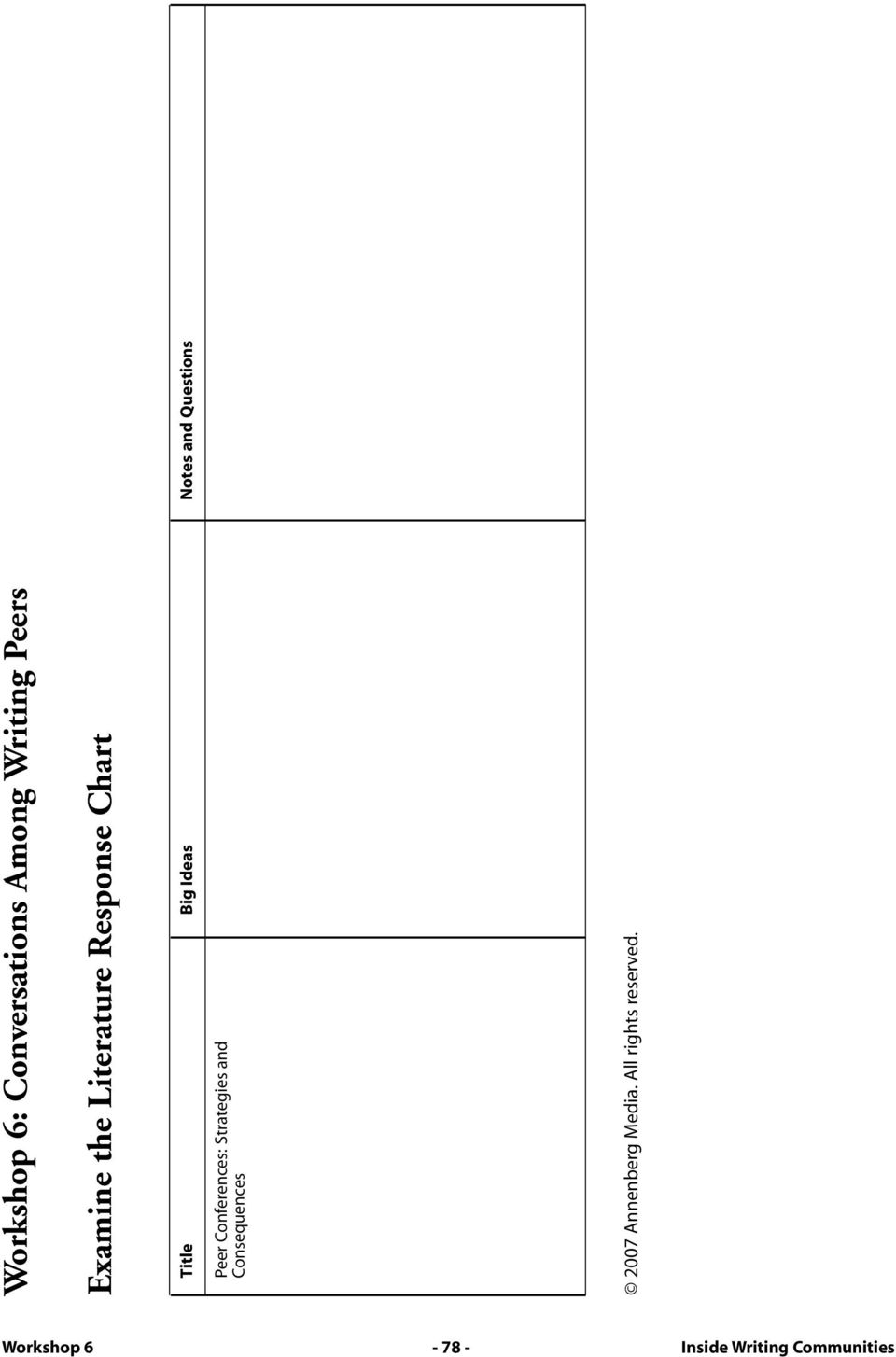
10 Workshop 6: Conversations Among Writing Peers Examine the Literature Response Chart Title Big Ideas Notes and Questions Peer Conferences: Strategies and Consequences 2007 Annenberg Media. All rights reserved. Workshop Inside Writing Communities
Workshop 5 Conversations With Student Writers
 Workshop 5 Conversations With Student Writers Video 9: Conversations With Student Writers Video 10: Teacher-Student Conferences All teachers understand the value of responding personally to student work.
An Overview of Conferring
 An Overview of Conferring You may have several important questions about writing conferences: ª What are the goals of a writing conference? ª When should I confer with students about their writing? ª What
Balanced Literacy in Seattle Public Schools
 Introduction Balanced Literacy in Seattle Public Schools The goal for literacy instruction in Seattle Public Schools is to ensure that all pre- Kindergarten through twelfth grade students become proficient
Form: Filled in table. Method: Peer assessment. Tool: Checklist. Form: Completed table. Method: Peer assessment. Tool: Checklist
 Lesson Plan English First Additional Language Grade 5 Content in context: Text from other Learning Area - Whether Los and ASs Learning Activities Details of Assessment Barriers to Learning LO 1 Listening
Grade 3: Module 1: Unit 1: Lesson 8 Paragraph Writing Instruction
 Grade 3: Module 1: Unit 1: Lesson 8 This work is licensed under a Creative Commons Attribution-NonCommercial-ShareAlike 3.0 Unported License. Exempt third-party content is indicated by the footer: (name
MStM Reading/Language Arts Curriculum Lesson Plan Template
 Grade Level: 6 th grade Standard 1: Students will use multiple strategies to read a variety of texts. Grade Level Objective: 1. A.6.1: compare/contrast the differences in fiction and non-fiction text.
Days. Day 1. Reflection Teacher Responsibilities. Lesson Plans
 Days Day 1 Lesson Plans Call the students to the carpet by the number of letters in their names. If your name has less than 5 letters, come to the carpet. If your name has more than 5 letters, come to
Requirements & Guidelines for the Preparation of the New Mexico Online Portfolio for Alternative Licensure
 Requirements & Guidelines for the Preparation of the New Mexico Online Portfolio for Alternative Licensure Prepared for the New Mexico Public Education Department Educator Quality Division http://www.ped.state.nm.us/
Guided Reading with Emergent Readers by Jeanne Clidas, Ph.D.
 Bebop Books Guided Reading with Emergent Readers by Jeanne Clidas, Ph.D. What Is Guided Reading? Guided reading involves a small group of children thinking, talking, and reading through a new text with
A Writer s Workshop: Working in the Middle from Jennifer Alex, NNWP Consultant
 Structure of a Workshop: A Writer s Workshop: Working in the Middle from Jennifer Alex, NNWP Consultant For the last four years, writing and reading workshops have been the foundation of my classroom practice.
xxx Lesson 11 1. Comprehend the writing process 2. Respond positively to the writing process
 xxx Lesson 11 The Writing Process Overview: This lesson will focus on the writing process and how it relates to communication. Learners will be taught what the writing process is, its parts, and how they
Workshop 7 Responding to Writing: Peer to Peer
 Workshop 7 Responding to Writing: Peer to Peer Overview Peer response provides a tremendous learning opportunity for young writers. These interactions help students with topic generation and idea development,
Using Adult Education Principles to Provide Professional Development for the Foundations of Inclusion
 Using Adult Education Principles to Provide Professional Development for the Foundations of Inclusion Based on principles and research on adult learning and inclusion, this professional development (PD)
Key Components of Literacy Instruction
 Key Components of Literacy Instruction The longer I write and read, the more I learn; writing and reading are lifelong apprenticeships --Donald M. Murray W e, in MPS, believe that effort creates ability.
Local Government and Leaders Grade Three
 Ohio Standards Connection: Government Benchmark A Identify the responsibilities of the branches of the U.S. government and explain why they are necessary. Indicator 2 Explain the structure of local governments
Unit Map 2011-2012 Columbia University Teachers College Collaboration / Writing* / Kindergarten (Elementary School)
 Unit Map 2011-2012 Columbia University Teachers College Collaboration / Writing* / Kindergarten (Elementary School) June 21, 2011, 9:13AM Unit 01 Launching The Writing Workshop (Week 1, 4 Weeks) Unit Rationale
Muhammad Ali Presents Go the Distance! Aligns to Title I, Part A. June 2007 1
 11 Muhammad Ali Presents Go the Distance! Aligns to Title I, Part A The purpose of Title I, Part A Improving Basic Programs is to ensure that children in high-poverty schools meet challenging State academic
Falling in Love with Close Reading Study Guide
 T E X T: Fic t i o n / N on f i c t i o n / O p i n i o n / A r g u ment M E D I A : I n t e r n e t s o n g s l a r / P o p u Read through lenses Use lenses to find patterns Use patterns to develop new
Program Overview. This guide discusses Language Central for Math s program components, instructional design, and lesson features.
 Program Overview Introduction This guide discusses Language Central for Math s program components, instructional design, and lesson features. What is Language Central for Math? Program Components Language
Assessment Techniques and Tools for Documentation
 Assessment Techniques and Tools for Documentation 47 Assessing the Kindergarten Student s Learning Assessment and evaluation are fundamental components of teaching and learning. Assessment is the process
Building Positive Teacher-Child Relationships
 Building Positive Teacher-Child Relationships Project funded by the Child Care and Head Start Bureaus in the U.S. Department of Health and Human Services What Works Brief Training Kit #12 www.vanderbilt.edu/csefel/
Crafting an Argument. Students need to know how to state facts and express their opinions. Organized, Well-Supported, Convincing
 Crafting an Argument Organized, Well-Supported, Convincing Students need to know how to state facts and express their opinions effectively so that they can positively contribute to classroom conversations
Lesson plan: Group Discussion
 Lesson plan: Group Discussion About Audio Notetaker Speaking and listening is one of the main activities in a classroom. Assessment is difficult apart from playing back hours of mp3 files or relying on
Grade 5: Module 3A: Unit 2: Lesson 13 Developing an Opinion Based on the Textual Evidence:
 Grade 5: Module 3A: Unit 2: Lesson 13 Developing an Opinion Based on the Textual Evidence: Jackie Robinson s Role in the Civil Rights Movement This work is licensed under a Creative Commons Attribution-NonCommercial-ShareAlike
FACILITATION WORKSHOP RESOURCE KIT
 PROJECT OVERSEAS Teachers Teaching Teachers FACILITATION WORKSHOP RESOURCE KIT Canadian Teachers Federation International Cooperation Programs 2490 Don Reid Drive Ottawa, Ontario K1H 1E1 613-232-1505 www.ctf-fce.ca
Literacy. Work Stations. Source: Diller, D.(2003) Literacy Work Stations, Making Centers Work
 Literacy Work Stations Source: Diller, D.(2003) Literacy Work Stations, Making Centers Work Kyrene Reading Instruction Focus: Improve student achievement through implementation of curriculum and adopted
Communication Process
 Welcome and Introductions Lesson 7 Communication Process Overview: This lesson teaches learners to define the elements of effective communication and its process. It will focus on communication as the
Strategies to Support Literacy Development in Second-Language Learners through Project Work
 Strategies to Support Literacy Development in through Project Work Rebecca A. Wilson Introduction The purpose of this article is to provide teachers of young second-language learners with strategies to
Animals that move slowly, animals that move quickly
 Unit Three Time 74 Animals that move slowly, animals that move quickly Unit 3: Time Image courtesy of: Microsoft clipart Focus: Animals that move slowly and quickly linked with time Whole class activity
Literature Discussion Strategies
 1 Kathy G. Short From Creating Classrooms for Authors and Inquirers, Kathy G. Short and Jerome Harste, Heinemann, 1996. FREE WRITES (Connection) After reading the book, set a timer for anywhere from 5-15minutes.
Handouts for teachers
 ASKING QUESTIONS THAT ENCOURAGE INQUIRY- BASED LEARNING How do we ask questions to develop scientific thinking and reasoning? Handouts for teachers Contents 1. Thinking about why we ask questions... 1
StudyGuide. Irene C. Fountas Gay Su Pinnell
 Irene C. Fountas Gay Su Pinnell StudyGuide for The Continuum of Literacy Learning, PreK 8: A Guide to Teaching SECOND EDITION 2011 INTRODUCTION..................................................... 2 Orientation
Correlation Map of LEARNING-FOCUSED to Marzano s Evaluation Model
 Correlation Map of LEARNING-FOCUSED to Marzano s Evaluation Model Correlation Map of LEARNING-FOCUSED to Marzano s Evaluation Model LEARNING-FOCUSED provides schools and districts with the best solutions
What Is a Portfolio? Why develop a professional portfolio?
 01-Forde-Ch-01:01-Forde-Ch-01 8/1/2008 7:36 PM Page 1 1 What Is a Portfolio? In this introductory chapter we discuss what we mean by a professional portfolio. We explore different models of portfolios
Title: The Fight to End Separate but Equal in American Schools
 Background: From the time the 14th Amendment was ratified in 1868, it was challenged. The Plessy v. Ferguson decision introduced the separate but equal standard that legalized segregation until the Brown
Understanding Types of Assessment Within an RTI Framework
 Understanding Types of Assessment Within an RTI Framework Slide 1: Welcome to the webinar Understanding Types of Assessment Within an RTI Framework. This is one of 11 webinars that we have developed at
DynEd International, Inc.
 General Description: Proficiency Level: Course Description: Computer-based Tools: Teacher Tools: Assessment: Teacher Materials: is a multimedia course for beginning through advanced-level students of spoken
Grade 6: Module 1: Unit 2: Lesson 19 Peer Critique and Pronoun Mini-Lesson: Revising Draft Literary Analysis
 Grade 6: Module 1: Unit 2: Lesson 19 Revising Draft Literary Analysis This work is licensed under a Creative Commons Attribution-NonCommercial-ShareAlike 3.0 Unported License. Exempt third-party content
Lesson Effective Communication Skills
 Lesson Effective Communication Skills Lesson Overview In this lesson, participants will learn about various types of communication and how important effective communication is in the workplace. Lesson
(MIRP) Monitoring Independent Reading Practice
 (MIRP) Monitoring Independent Reading Practice ~ A Returning Developer ~ For further information contact Kathy Robinson Lake Country Elem. School 516 County Road 29 Lake Placid, Florida 33852 863.699.5050
Grade 7: Module 3A: Unit 2: Lesson 1 Introducing the Narrative Arc: The Last Day of Slavery
 Grade 7: Module 3A: Unit 2: Lesson 1 The Last Day of Slavery This work is licensed under a Creative Commons Attribution-NonCommercial-ShareAlike 3.0 Unported License. Exempt third-party content is indicated
Elements of a Novel and Narrative Writing Grade 10
 Ohio Standards Connection Literary Text Benchmark B Explain and analyze how the context of setting and the author s choice of point of view impact a literary text. Indicator 2 Analyze the features of setting
What qualities are employers looking for in teen workers? How can you prove your own skills?
 Sell Yourself 4 Finding a job The BIG Idea What qualities are employers looking for in teen workers? How can you prove your own skills? AGENDA Approx. 45 minutes I. Warm Up: Employer Survey Review (15
Grade 4: Module 1B: Unit 3: Lesson 11 Writing the Essay: Body Paragraph
 Grade 4: Module 1B: Unit 3: Lesson 11 This work is licensed under a Creative Commons Attribution-NonCommercial-ShareAlike 3.0 Unported License. Exempt third-party content is indicated by the footer: (name
Unit 1 Title: Reading Grade Level: Second (2 nd ) Timeframe: 5 Weeks
 Unit 1 Title: ing Grade Level: Second (2 nd ) Timeframe: 5 Weeks Unit Overview: In Unit 1 students will gain an understanding of the overall structure of a story and its components. also be able to identify
Counting Money and Making Change Grade Two
 Ohio Standards Connection Number, Number Sense and Operations Benchmark D Determine the value of a collection of coins and dollar bills. Indicator 4 Represent and write the value of money using the sign
Monitoring for Meaning
 Monitoring for Meaning Grades 3-5 eeee Wwh Monitoring comprehension is above all engagement. When readers monitor their thinking, they have an inner conversation with the text. They listen to the voice
Creative Ideas: Enhanced to Meet Special Needs of Students
 Creative Ideas: Enhanced to Meet Special Needs of Students INTRODUCTION The Curriculum Center for Family and Consumer Sciences has produced instructional guides for all Family and Consumer Sciences courses.
Chapter 13: Team coaching
 tool Purpose 13.1 Help groups Use this protocol when a team wants to support an individual member facing a challenge. 13.2 Here s the situation Try this tool as an alternative protocol for teams wanting
Private talk, public conversation Mike Askew King s College London
 Private talk, public conversation Mike Askew King s College London Introduction There is much emphasis on the importance of talk in mathematics education. In this article I explore what sort of talk we
Compiled By: Pat Elliott, Resource Teacher & Dale Mays, Grade 4 Teacher Simcoe County District School Board Ontario Canada
 Compiled By: Pat Elliott, Resource Teacher & Dale Mays, Grade 4 Teacher Simcoe County District School Board Ontario Canada Literacy Circles There is no one right way to conduct literacy circles. The manner
Force and Motion: Ramp It Up
 Force and Motion: Grade Level: 4-5 Time: 3 class periods By: Carrie D. Perry (Bedford County Public Schools) Overview After watching an engaging video on Olympic alpine skiers, students then participate
ELL Considerations for Common Core-Aligned Tasks in English Language Arts
 ELL Considerations for Common Core-Aligned Tasks in English Language Arts A substantial body of research clearly indicates that utilizing specific instructional modifications as well as targeted pedagogical
Teacher Name : J. Pigg Class/Grade Level: 6 th Reading 2 nd Six Weeks Unit Title: Unit 02: Exploring Fiction and Drama
 TeacherName:J.Pigg Class/GradeLevel:6 th Reading 2 nd SixWeeks UnitTitle:Unit02:ExploringFictionandDrama TEKS:06NELA02 Reading/Vocabulary Development. Students understand new vocabulary and use it when
Active Listening Guide: Helping Your Students Engage With Music
 Active Listening Guide: Helping Your Students Engage With Music The Listener s Job Description 1 Music can seem intimidating. It seems like you have to know a lot. What if you don t understand the music?
Unit 2 Module 3: Generating Examples and Nonexamples
 Unit 2 Module 3: Generating Examples and Nonexamples Section 1 Slide 1 Title Slide Welcome to the third module in the Vocabulary Instructional Routines unit, Generating Examples and Nonexamples. Slide
Teacher Evaluation Using the Danielson Framework 6. A Professional Portfolio: Artifact Party A. Using Artifacts to Help Determine Performance Levels
 Teacher Evaluation Using the Danielson Framework 6. A Professional Portfolio: Artifact Party A. Using Artifacts to Help Determine Performance Levels Artifact Party Guidelines CHARLOTTE DANIELSON: Of course,
A STUDY GUIDE. Nonfiction Matters. Stephanie Harvey
 A STUDY GUIDE Nonfiction Matters Reading,Writing, and Research in Grades 3 8 Stephanie Harvey Nonfiction Matters is divided into three parts: Conditions for Successful Inquiry, The Nitty-Gritty, and Getting
COMPUTER TECHNOLOGY IN TEACHING READING
 Лю Пэн COMPUTER TECHNOLOGY IN TEACHING READING Effective Elementary Reading Program Effective approach must contain the following five components: 1. Phonemic awareness instruction to help children learn
Best Practices for Displaying Print in My Classroom
 Best Practices for Displaying Print in My Classroom It was a difficult day when I removed all of the commercial print from my classroom. I didn t want it to look plain or boring. Anchor charts were fairly
Behavior Impedes Learning
 Behavior Impedes Learning ARSD 24:05:27:01.02. (1) In the case of a student whose behavior impedes his or her learning or that of others, consider the use of positive behavioral interventions and supports
Grade 3: Module 4: Unit 1: Lesson 3 Language Workshop: Simple, Compound, and Complex Sentences
 Grade 3: Module 4: Unit 1: Lesson 3 Language Workshop: Simple, Compound, and Complex Sentences This work is licensed under a Creative Commons Attribution-NonCommercial-ShareAlike 3.0 Unported License.
PROGRAM 6 The Role of Assessment in Curriculum Design
 PROGRAM 6 The Role of Assessment in Curriculum Design Overview Having laid foundations for their own unit of study in Program 5, the Learner Teams discovered how to build formative and summative assessments
ROLES AND RESPONSIBILITIES The roles and responsibilities expected of teachers at each classification level are specified in the Victorian Government
 ROLES AND RESPONSIBILITIES The roles and responsibilities expected of teachers at each classification level are specified in the Victorian Government Schools Agreement 2004: Leading teacher Leading teachers
Primrose Hill Primary School Literacy Policy: A baseline for outstanding practice
 .. Primrose Hill Primary School Literacy Policy: A baseline for outstanding practice January 2012 Review date: January 2013 KEY PRINCIPLES Teaching at Primrose Hill is Learning Centred, meaning that each
How to Plan and Guide In Class Peer Review Sessions
 How to Plan and Guide In Class Peer Review Sessions Incorporating peer review into your course can help your students become better writers, readers, and collaborators. However, peer review must be planned
Facilitation 101: Roles of Effective Facilitators
 Facilitation 101: Roles of Effective Facilitators Bonner Curriculum Overview: Category: Level: Recommended Bonner Seuence: This workshop provides a basic introduction to techniues and tips for facilitation,
Bullying Awareness Lesson Plan Grades 4-6
 Bullying Awareness Lesson Plan Grades 4-6 1 Estimated Time of Completion: Two to three classroom periods, or stretched out throughout the school year. Each activity will take between 15-30 minutes. Bullying
THANK YOU for downloading Retelling Station that I created FREE for you.
 THANK YOU for downloading Retelling Station that I created FREE for you. In return, I ask that you (1) Have fun! (2) Give me credit for my work if you share. (3) Refer others to my websites www.liketoread.com,
Chapter 3: Teaching Learning Strategies in the Learner- Centered Classroom
 Chapter 3: Teaching Learning Strategies in the Learner- Centered Classroom In this chapter, we demonstrate how you can teach your students to make their learning more efficient and effective by thinking
The Three-Part Lesson in Mathematics
 The Literacy and Numeracy Secretariat Webcast Professional Learning Series Viewer s Guide The Three-Part Lesson in Mathematics Co-planning, Co-teaching and Supporting Student Learning Multi-media resource
Lesson 2: How to Give Compliments to Tutees
 Kids As Reading Helpers: A Peer Tutor Training Manual Copyright 2002 by Jim Wright www.interventioncentral.org L2-1 Lesson 2: How to Give Compliments to Tutees Introduction When correctly used, compliments
3 days Lifting the Qualities of Effective Fiction Writing. 3 4 days Stretching Out the Problem and Imagining Creative Solutions to Stories
 Grade 1, Unit 3 Realistic Fiction Adapted from Realistic Fiction (Unit 3) in A Curricular Plan for the Writing Workshop, Grade 1 by Calkins Section of the Unit of Study Minilesson Focus Points Time (approximate)
Coach Tool. Lesson Planning/Lesson Observation/Lesson Debriefing
 Purpose Coach Tool Lesson Planning/Lesson Observation/Lesson Debriefing By Krista Jiampetti, Reading Specialist, South Colonie Central Schools, Albany, NY For Literacy or Instructional Coaches, K-12 This
Lesson 4 What Is a Plant s Life Cycle? The Seasons of a Tree
 Lesson 4 What Is a Plant s Life Cycle? The Seasons of a Tree STUDENT SKILLS: predicting, communicating prior observations and knowledge, listening, cooperating, observing, sequencing, communicating, reasoning,
Mini-Lessons for FLUENCY
 Mini-Lessons for FLUENCY Rate 1. Fast finger: Guided Reading levels A-D) Prompt the child to Read it with a fast finger. Demonstrate this by having the students read it with their finger while you read
Guided Reading: Constructivism in Action. Donna Kester Phillips, Niagara University. Abstract
 Guided Reading: Constructivism in Action Donna Kester Phillips, Niagara University Abstract Guided Reading is currently considered one of the most important components of balanced literacy instruction.
Grade 5. Ontario Provincial Curriculum-based Expectations Guideline Walking with Miskwaadesi and Walking with A`nó:wara By Subject/Strand
 Ontario Provincial Curriculum-based Expectations Guideline Walking with Miskwaadesi and Walking with A`nó:wara By Subject/Strand Turtle Island Conservation Ontario Teachers Resource Bundle 1 The Arts 1.1
Introduction to Teacher s Domain Worksheet
 Updated September 2010 Introduction to Teacher s Domain Worksheet Teachers Domain is an online library of more than 2,500 free media resources from the best in public television. These classroom resources,
Cartooning and Animation MS. Middle School
 Cartooning and Animation Middle School Course Title Cartooning and Animation MS Course Abbreviation CART/ANIM MS Course Code Number 200603 Special Notes General Art is a prerequisite, or department permission
Can you answer Milly s question and tell her why? Jot down your answers on a note pad, then check the answer key below.
 When you have to write a lesson plan is it sometimes difficult to write down your aims? This lesson will give you ideas on how to write better aims when you need to. Task 1 Milly s dilemma. Milly is asking
Me, Myself, and I. Subject: Language Arts: Writing. Level: Grade 3
 Grade 3 Lesson Plan Subject: Language Arts: Writing Level: Grade 3 Me, Myself, and I Abstract: In this lesson, students will write their life story. Reflecting on a series of key questions, students will
Reading Strategies by Level. Early Emergent Readers
 The charts below were created as a common language for teachers and students in the Wallingford Public Schools in kindergarten through eighth grade. The level of the chart selected for use in the classroom
Writing Simple Stories Grade One
 Ohio Standards Connections Writing Applications Benchmark A Compose writings that convey a clear message and include well-chosen details. Indicator 1 Write simple stories with a beginning, middle and end
Launching the Reading Workshop
 Launching the Reading Workshop Grades 2-5 (can be scaffolded) Outline Week 1 1a First Day of School Activities: (Ideas) Decorate Reader s Notebook Tour of Classroom Library (brief) 3 Things Reading survey
Principles of Data-Driven Instruction
 Education in our times must try to find whatever there is in students that might yearn for completion, and to reconstruct the learning that would enable them autonomously to seek that completion. Allan
Main Idea in Informational Text Grade Three
 Ohio Standards Connection Informational, Technical and Persuasive Text Benchmark C Identify the central ideas and supporting details of informational text. Indicator 3 Identify and list the important central
Language Arts Core, First Grade, Standard 8 Writing-Students write daily to communicate effectively for a variety of purposes and audiences.
 Genre Unit Reading and Writing Fables by Amy Kinney Language Arts Core, First Grade, Standard 7 Comprehension-Students understand, interpret, and analyze narrative and informational grade level text. Objective
A Guide for Using Big Books in the Classroom
 Why Big Books? A Guide for Using Big Books in the Classroom There s something spectacular about Big Book versions of good children s books. Neither adults nor children can resist the urge to touch and
Literacy Policy. Status: Advisory. Member of Staff responsible: Principal. Associated Policies and documentation: SEND, Teaching of English
 Literacy Policy Status: Advisory Member of Staff responsible: Principal Associated Policies and documentation: SEND, Teaching of English Implementation Date: September 2014 Review Date: September 2015
micro lessons in writing big ideas for getting started Jim Vopat HEINEMANN Portsmouth, NH
 micro lessons in writing big ideas for getting started Jim Vopat HEINEMANN Portsmouth, NH Heinemann A division of Reed Elsevier Inc. 361 Hanover Street Portsmouth, NH 03801 3912 www.heinemann.com Offices
Reading Assessment BTSD. Topic: Reading Assessment Teaching Skill: Understanding formal and informal assessment
 Reading Assessment BTSD Topic: Reading Assessment Teaching Skill: Understanding formal and informal assessment Learning Outcome 1: Identify the key principles of reading assessment. Standard 3: Assessment,
Interactive Whiteboards, Productive Pedagogies and Literacy Teaching in a Primary Context.
 Interactive Whiteboards, Productive Pedagogies and Literacy Teaching in a Primary Context. Authors: Peter Kent, Assistant Manager Centre for Teaching and Learning, ACT Department of Education. And Matthew
Tools to Use in Assessment
 Tools to Use in Assessment II. Observations and Checklists Teachers have always watched and observed students in the classroom and they have made instructional decisions based on these observations. Too
WEB DESIGN BASICS WITH ADOBE MUSE Cordei Clottey, IT-Trainer
 1 Cordei Clottey, IT-Trainer BACKGROUND AND GOAL Adobe Muse is an application which allows us to design and publish websites without having to write any programming code. This course is the first in a
P-3: Create objective-driven lesson plans
 Decide on Lesson Plan Model While the five step lesson cycle will often efficiently and effectively lead students to mastery of a given objective, successful teachers recognize that other common lesson
Starting a Booktalk Club: Success in Just 12 Weeks!
 Starting a Booktalk Club: Success in Just 12 Weeks! It s wonderful that you re interested in starting a booktalk club at your school! Before you even begin, you may want to familiarize yourself with some
Refining Informational Writing: Grade 5 Writing Unit 3
 Unit Title: Refining Informational Writing Concepts: 1. Writers read mentor texts to study informational writing. 2. Writers generate ideas and experiment with notebook entries. 3. Writers learn strategies