
LICENSED VOCATIONAL NURSE ON CALL PILOT PROGRAM FINAL REPORT. As required by SB 1857, 82 nd Legislature, Regular Session, 2011
|
|
|
- Garry Campbell
- 9 years ago
- Views:
Transcription


1 LICENSED VOCATIONAL NURSE ON CALL PILOT PROGRAM FINAL REPORT As required by SB 1857, 82 nd Legislature, Regular Session, 2011 Center for Policy and Innovation December
2 DECEMBER 2015 TABLE OF CONTENTS Executive Summary 1 Introduction 3 Scope of Report 3 Background 3 Advisory Committee 4 Training/Protocol Development 4 Pilot Participation 4 Data Collection and Evaluation 5 Challenges 8 Lessons Learned 9 Recommendations 9 Appendix A MOU 11 Appendix B Training 14 Appendix C Advisory Committee Composition 15 Appendix D Documents associated with pilot 16 Appendix E Participating and Non-participating Provider Survey Questions 37 Appendix F Random sample/deaths chart review evaluation questions 46 2

3 Executive Summary Senate Bill (S.B.) 1857, 82nd Legislature, Regular Session, 2011, amended the Texas Human Resources Code relating to the administration of medications for persons with intellectual and developmental disabilities (IDD). It directed the Texas Department of Aging and Disability Services (DADS) and the Texas Board of Nursing (BON) to develop and conduct a pilot program to evaluate licensed vocational nurses (LVNs) providing on-call services by telephone to individuals receiving services in the Home and Community-based Services (HCS) and Texas Home Living (TxHmL) Medicaid waivers and in intermediate care facilities for individuals with an intellectual disability or related condition (ICFs/IID) with 13 or fewer beds. This report covers the time period following the interim report on the pilot published in December 2012 and offers a final evaluation of the pilot which ended August 31, Milestones Achieved DADS conducted advisory committee meetings on a regular basis to keep the committee apprised of findings and issues. DADS and BON conducted surveys of participating and non-participating providers in the pilot. DADS and BON developed a system to evaluate the pilot with input from the advisory committee based on a random sample of chart reviews and reviews of all deaths. In response to input from the advisory committee, DADS and BON modified operational and communication protocols. DADS provided training in response to issues identified during evaluation of the pilot, in partnership with BON. BON and DADS increased communication among staff regarding nursing practice in pilot settings. DADS led development of an LVN Educator Toolkit aimed to assist in preparing new LVNs for practice in community and long term care settings. For a list of milestones achieved prior to December 2012, see the interim report. Challenges Providers were often non-responsive to DADS requests for records. The lack of documentation by both nursing and direct care staff when an incident occurred made it difficult to evaluate if a nurse followed communication and operational protocols correctly. Processes for DADS to obtain and review records and for DADS and BON to conduct mortality reviews are labor intensive. Turnover of personnel at DADS and BON led to gaps in pilot management. 1
4 Turnover of personnel at provider organizations led to potential gaps in training in pilot protocols. Understanding of the LVN s scope of practice varied among providers LVNs who participated in the pilot may be unaware the pilot ended. Providers have difficulty recruiting, hiring and retaining RNs as reported by advisory committee provider members. Training in management of a critical incident or death varied from provider to provider. No funding was appropriated to administer the pilot. Lessons Learned Nurses and providers were unaware of continuing education and certification for nurses who care for individuals with IDD is available through the Developmental Disabilities Nurses Association. Direct and frequent communication among direct care providers and the nurse on-call is essential for safe care of individuals. Providers employing nurses must understand scope of practice for RNs and LVNs. Based on a survey of providers, the most frequently cited reason for not participating in the pilot was the need to have an RN available to the LVN for consultation while taking calls. Recommendations BON does not recommend expansion of the LVN scope of practice in the community setting of HCS/TxHmL and ICF/IID, including the provision of on-call services by telephone. The state should convene a workgroup consisting of DADS, BON, and IDD stakeholders to identify and resolve issues involving nursing scope of practice in community settings. The state should develop training to improve the ability of direct care staff to recognize deterioration in status in individuals who have chronic medical diagnosis. Direct care staff should contact nursing staff directly to communicate client health care needs and status changes as opposed to through a third party such as a house administrator. Nursing orientation at a provider level should include training on documentation in the IDD care setting. BON should continue educational offerings aimed to teach LVN scope of practice. 2
5 Introduction S.B. 1857, 82nd Legislature, Regular Session, 2011, required the Texas Board of Nursing (BON) and the Texas Department of Aging and Disability Services (DADS) to conduct a pilot program to evaluate an expansion of licensed vocational nurses (LVNs) scope of practice to include oncall services by telephone to individuals receiving services in the Home and Community-based Services (HCS) and Texas Home Living (TxHmL) Medicaid waiver programs and in intermediate care facilities for individuals with an intellectual disability or related conditions (ICFs/IID) with 13 or fewer beds. The provision of on-call telephone services means: providing telephone services any time of the day or night, to handle non-urgent, urgent, and emergent conditions an individual may experience; making a telephone assessment; providing instructions to an unlicensed person over the phone regarding that condition; and reporting those instructions to a registered nurse (RN) clinical supervisor. The LVN On-Call Pilot Program was developed to determine the impact of allowing LVNs to function with an expanded scope of practice on the quality of care provided to individuals served in the designated intellectual and developmental disability (IDD) programs. The pilot began September 1, 2011, and concluded August 31, Scope of Report This report, in addition to the interim report issued December 2012, outlines findings of the pilot and provides recommendations based on those findings. It focuses on the time period after the interim report was published up to the conclusion of the pilot. The report describes details of the pilot (e.g., data collection) and evaluation, challenges encountered and lessons learned. Background BON rules in Title 22, Texas Administrative Code (TAC) Section (2) and (3) indicate that on-call services provided by telephone are within the scope of practice of the RN but not within the scope of practice of the LVN. The RN scope of practice and the LVN scope of practice, while different, are based upon the educational preparation in the RN or LVN programs of study. The Texas Occupations Code, Chapter 301 (Nursing Practice Act), Section (Supervision of Vocational Nurse) and 22 TAC, (2) states that the LVN practice is a directed scope of practice and must be supervised by an RN, physician, physician assistant, dentist or podiatrist. There is a growing need for nursing services to individuals with IDD who are living in the community and an insufficient number of RNs who choose to work in this setting. Because of the difficulty in employing RNs, some LVNs informally began performing certain functions outside their legal scope of practice, including telephone on-call services. The purpose of this pilot was to formally test the concept of allowing LVNs to perform on-call services provided by telephone without negatively affecting quality of care. 3
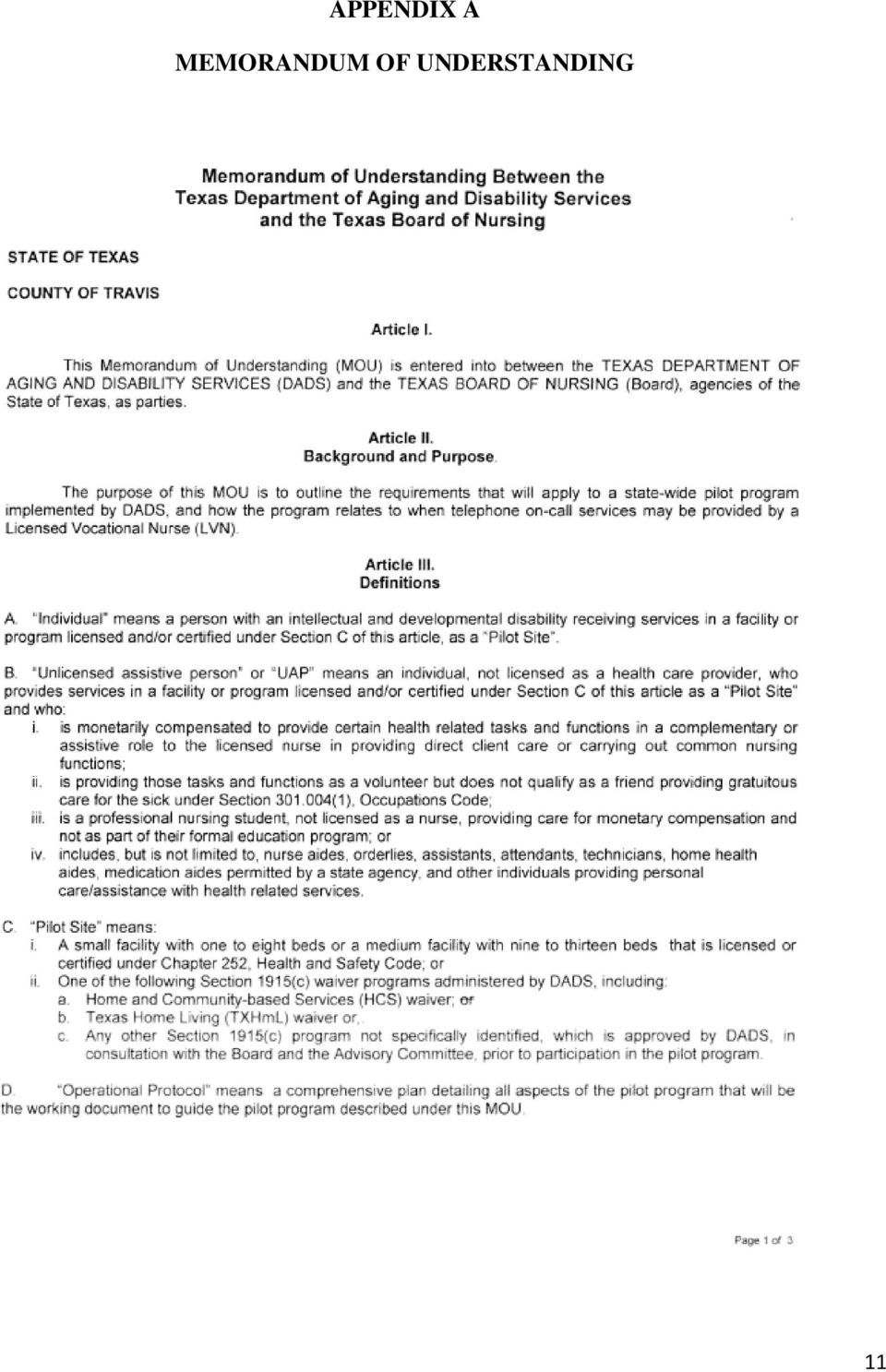
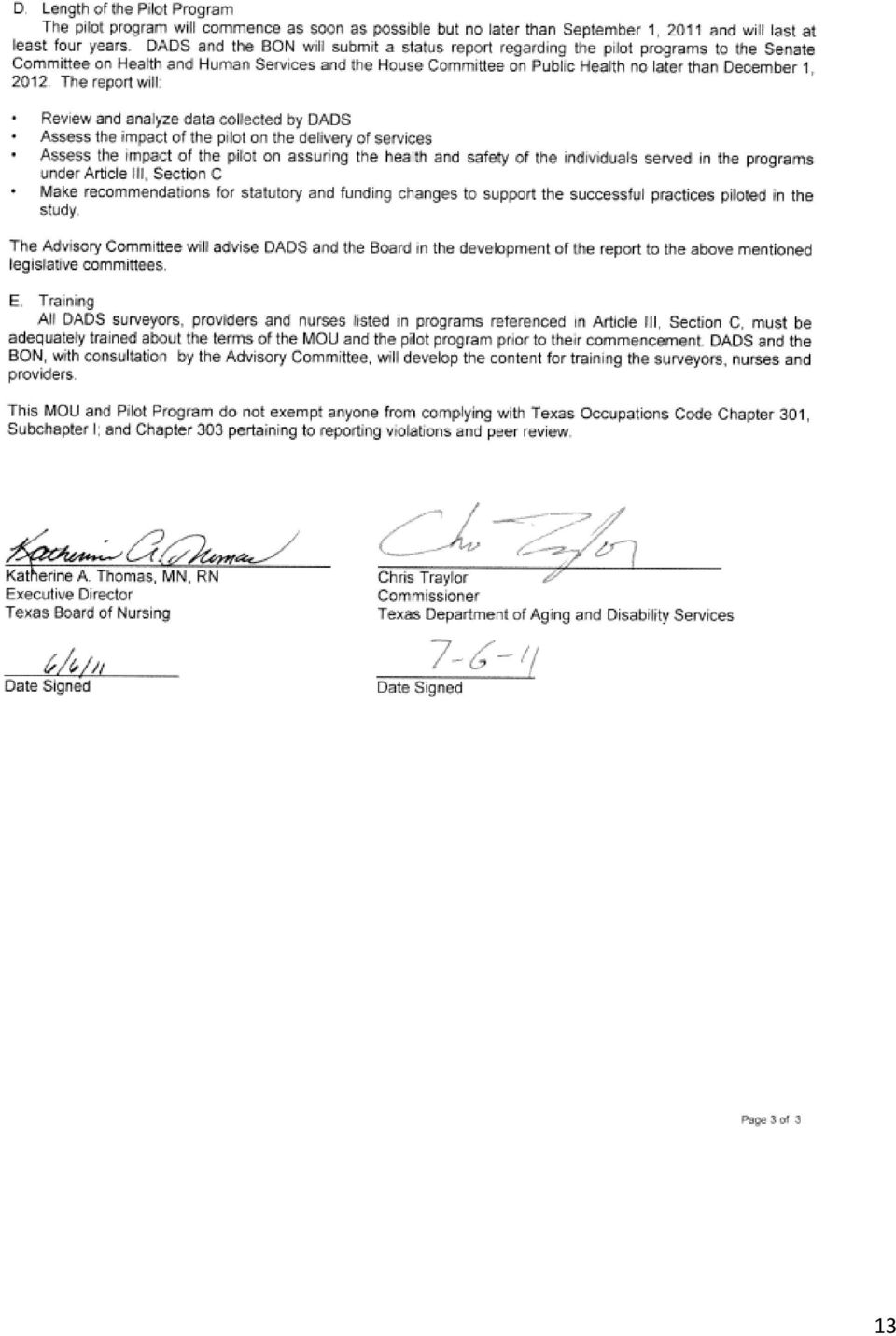
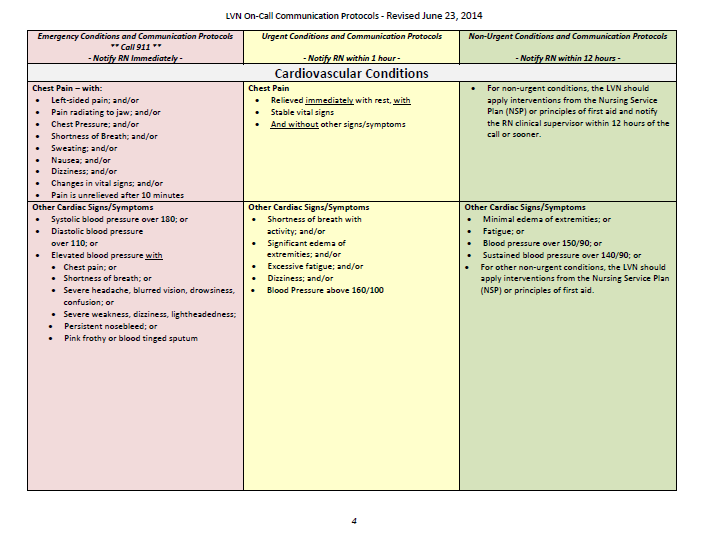
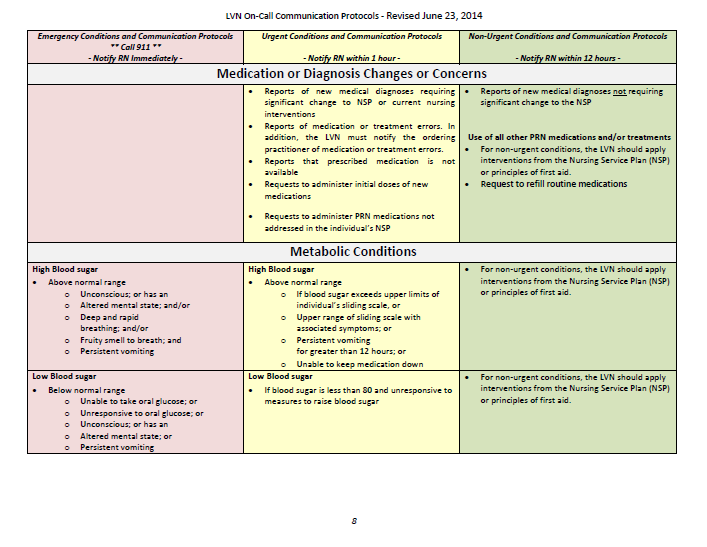
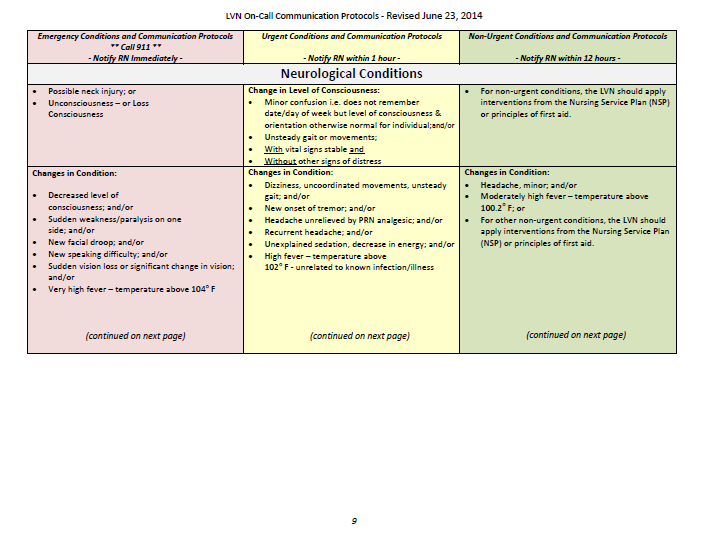
6 S.B required BON and DADS to conduct the pilot. Both agencies entered into a memorandum of understanding establishing the pilot on July 6, 2011 (See Appendix A). Advisory Committee S.B required that the pilot be developed in coordination with public and private providers and RNs and LVNs employed by ICFs/IID with 13 or fewer beds and HCS/TxHmL waiver program providers. BON and DADS formed an advisory committee to function in this capacity (see Appendix C for Advisory Committee membership). Regular meetings were held to keep the advisory committee informed of the results of evaluations of the pilot and challenges encountered. Adjustments to the operational and communication protocols were discussed in the meetings. The advisory committee was given opportunity to review and to provide input on DADS communications to the provider community regarding the pilot. Training/Protocol Development Initial training was conducted in the fall of 2011 based on the operational and communications protocol. Additional training was then conducted during the pilot to educate participants on issues that surfaced during the evaluation (See Appendix B). An operational protocol was developed as a framework for the pilot to include essential requirements necessary to provide support and safety to individuals receiving services. The operational protocol described the goal, purpose, data collection, documentation, outcome measures, participation requirements and evaluation criteria that were used in the pilot program. The operational protocol was revised throughout the pilot to accommodate feedback from the advisory committee and providers (See Appendix D). The communication protocol described how the LVN would provide on-call telephone services and when to communicate with the RN clinical supervisor. In the absence of any existing standardized and validated protocols for LVNs providing on-call services in these care settings, the communication protocol was developed using current standards of practice and evidencebased references with input from the advisory committee. The communication protocol identified a new model to define the collaborative relationship between the LVN and the RN. This new model was intended to maximize communication between the LVN and the RN to develop a team approach for meeting the ongoing and emergent needs of individuals in these programs (See Appendix D). Pilot Participation Requirements Providers who utilized LVNs for telephone on-call services were required to participate in the statewide pilot; those who chose not to participate in the statewide pilot were required to use RNs to provide on-call services. Each participating provider and its nursing staff (RNs and LVNs) were required to sign an agreement with DADS that indicated full understanding and 4
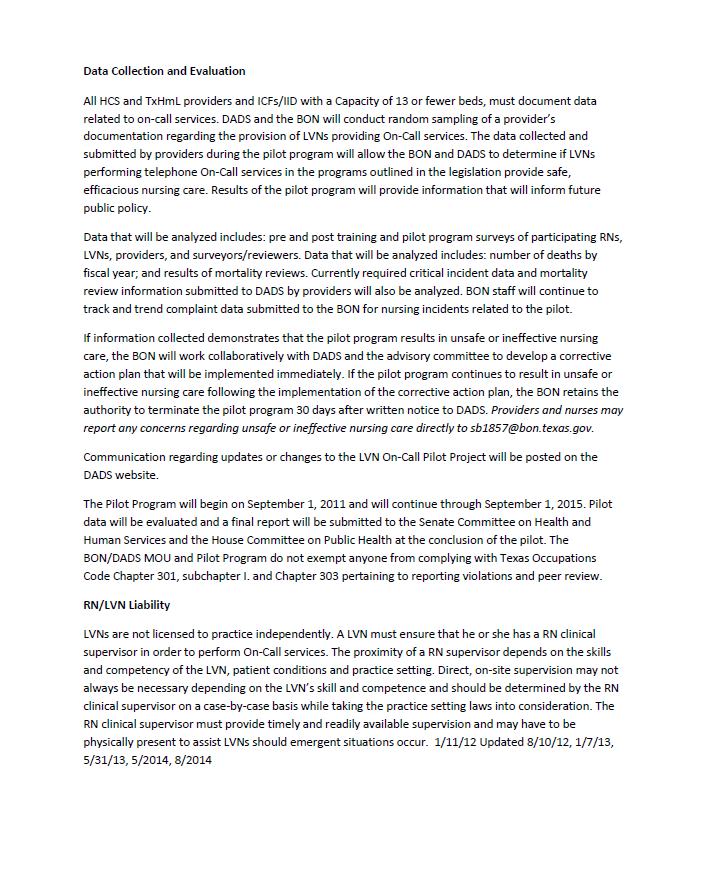
7 intent to comply with the terms of the pilot. Participating providers were required to attend a DADS-sponsored training or complete the computer based training posted on the DADS website. Because of nursing personnel turnover, it was difficult to track the number of nurses participating in the pilot at a given time. The contracts listed refer to a single provider location rather than a corporate entity, which could hold multiple contracts. Total number of contracts participating as of December 2012 Total number of contracts participating as of August 2015 ICF/IID Contracts HCS Contracts TxHmL Contracts Total ,050 Total number of contracts with DADS as of June 2015 (active billing) In August and September 2013, DADS asked both non-participating providers and participating providers to complete a survey of their reasons for not participating or their experiences with the pilot, respectively (See Appendix E). Of the 35 nurse participants who responded: 43% reported that communication between LVN and RN improved when the required communication protocol was followed; 74% of nurses worked between 8-40 hours per week on-call and 50% of those did not receive compensation; 78% reported they have not completed the required training (i.e., annual face to face or computer-based training); 9% reported they did not meet the minimum number of years of experience required to participate in pilot; and Respondents offered comments that were both positive (e.g., I believe everyone feels we are more of a team because we are more knowledgeable about our clients ) and negative (e.g., The pilot is cumbersome and time consuming and has not improved the quality of care that I provide ). Responses to the non-participating provider and nurse version of the survey indicated more than half of the 100 respondents reported it was more cost-effective to hire RNs for on-call telephone services than to participate in the pilot study. Data Collection and Evaluation The December 2012 interim report discussed the data collection method used to gather information about each on-call encounter and subsequent evaluation that was completed by an LVN. Due to limitations in DADS automated reporting infrastructure and stakeholder input about the process, the decision was made to discontinue this aspect of the pilot. DADS notified providers through an alert dated June 10,

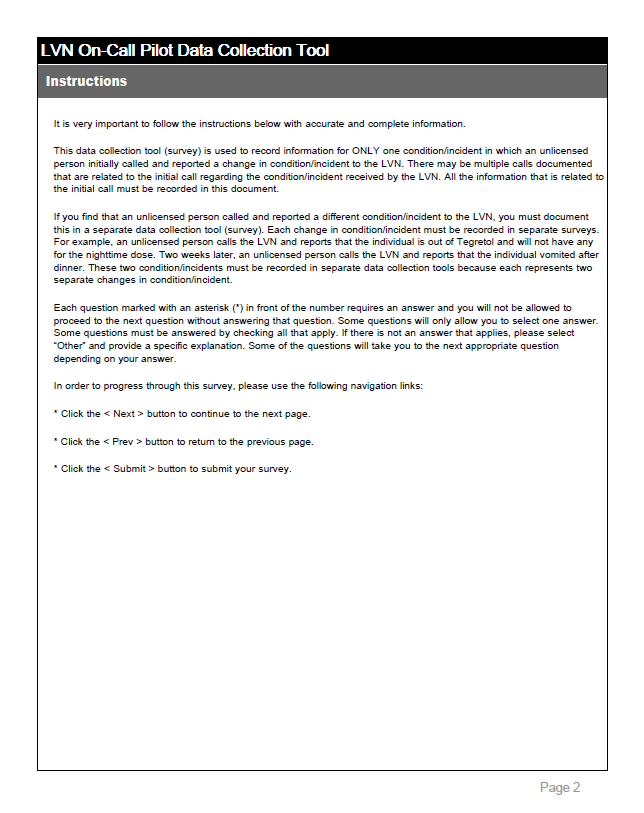
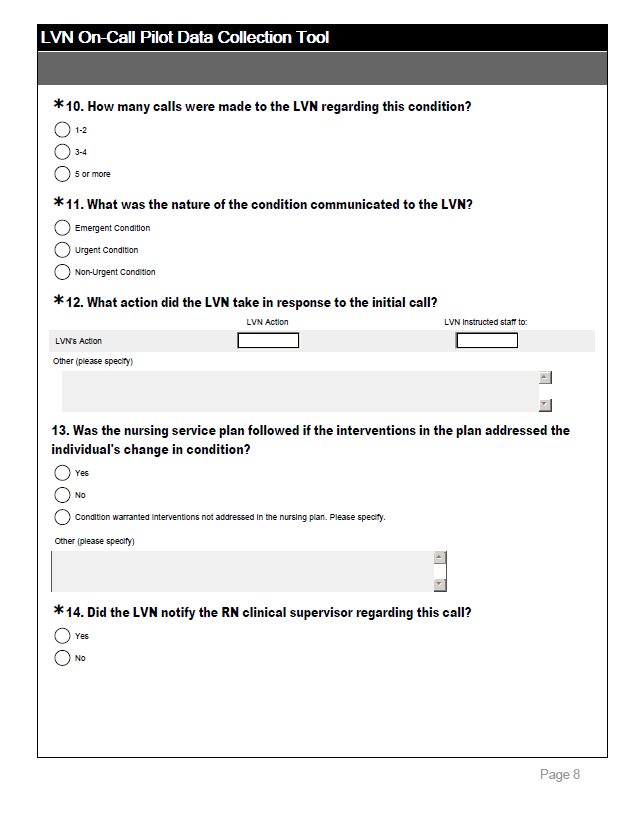
8 DADS subsequently issued Provider Letter Random Sampling and Deceased Individual Information Needed for the Licensed Vocational Nurse (LVN) On-Call Pilot Program and Information Letter Random Sampling for the Licensed Vocational Nurse (LVN) On- Call Pilot Program, in August These were used to inform providers participating in the pilot of the new method of evaluation. Form letters with the required documents for review were created and reviewed by the advisory committee. Using the list of participating providers and the individuals under their care, a random sample was generated for each month and the records for those individuals were requested. After the records were received, they were sent to registered nurses in the DADS Quality Monitoring Program to review and enter into a database. BON was responsible for collection and analysis of the data. Data was collected from October 2013 to June In addition, the charts for all individuals under the care of participating providers who died while in their care were reviewed using the same data collection elements (See Appendix F). The following table depicts the ongoing cumulative results of the mortality and random record reviews. Noteworthy trends of both samples include: Ongoing noncompliance with following the operational and communication protocols; and Lack of documentation to reflect care provided, notification of, and follow-up with the RN as required in the pilot protocols. 6

9 7

10 Challenges Encountered Difficulty obtaining records from providers for random sample: DADS administrative staff was responsible for obtaining records from providers. The providers did not always send records in a timely manner which delayed completion of record review by DADS nursing staff. Lack of documentation by both nursing and direct care staff: When an incident occurred, it was difficult to evaluate if a nurse acted correctly. Early in the record review process, it was identified by DADS nurses that, although all the records had been sent as requested, it was difficult to evaluate the incident with the client. Direct staff did not always complete a note when they called a nurse. The nurse did not always document the telephonic evaluation. The LVN infrequently charted when or if a call was placed to the RN to report an incident and whether the incident was resolved as required by the communication protocol. Labor intensive for DADS staff to obtain records: After the gap in time with providers sending back records was identified, a process was put into place to send follow-up letters and to terminate the provider contract from the pilot if the provider did not submit the requested information. Turnover of personnel at DADS and BON: The project manager for the pilot implementation changed once, and key personnel at DADS and BON who implemented the training and initiated the pilot resigned from their positions. This left both new and remaining staff without historical information to make the most informed adjustments to achieve optimal implementation. Understanding of the LVN scope of practice varied between providers: Despite training during the pilot, BON and DADS continued to receive inquiries from nurses and providers as to what an LVN could or could not do. Turnover at provider organizations: Nursing and administrative personnel turnover in the provider organizations similarly challenged implementation. While the computer based training on the DADS website provides useful and detailed information, that forum can never replace face-to-face training which offers the opportunity for in-person discussion. As a result, it was difficult to ensure that all providers and nursing staff have received the same level of information and understanding. LVNs who participated in the pilot may be unaware the pilot ended. Although DADS has sent communications to the distribution lists of all potential providers, it is uncertain if that information has been passed from provider to staff because DADS does not have a way to communicate directly with nursing staff. Providers have difficulty recruiting, hiring and retaining RNs as reported by advisory committee provider members. In the quarterly advisory committee meetings, the provider associations brought up the issue of difficulty with RN hiring. The inability to hire RNs to supervise the LVNs on staff was a limiting factor in participation in the pilot. 8

11 Training in management of a critical incident or death varied from provider to provider. Review of submitted patient documentation showed variation in what steps the direct care staff and nursing staff took in critical incident. No funding was appropriated to administer the pilot. Lessons Learned Need for improved training in management of a critical incident or death: Record reviews revealed inconsistency among providers in documentation of a critical incident, including a death. In some cases, an incident form was filled out; in others, direct care or nursing staff, or both, filled out a progress note. In some instances, staff was empowered to call emergency services prior to supervisors, but in other documentation stated that the supervisor was called first and then instructed staff to call. The survey of providers not participating in the pilot indicated the most common reason was the need to have an RN available to the LVN for consultation while taking calls: At the time of legislative approval, it was thought by some stakeholders that the pilot would enable LVNs to take telephone calls unsupervised by RNs. When the operational and communication protocols were established that emphasized the RN supervisory relationship with the LVN, the interest in participating in the pilot decreased. There is a need for providers employing nurses to understand LVN and RN scope of practice. At the onset of the pilot, there was a lack of understanding of the differences between what an LVN and an RN could do in their clinical practice among some of the participating providers. The BON and DADS collaborated to provide educational resources to clarify the distinction. Increase information sharing about existing educational materials: DADS and BON in partnership with provider associations should increase efforts to inform nurses and providers about continuing education and certification for nurses who care for individuals with IDD that is available through the Developmental Disabilities Nurses Association. Direct and frequent communication among direct care providers and the nurse on-call is essential for safe care of individuals. The review of patient documentation from the providers had instances where the staff noted an issue but did not communicate with the nurse on-call in a timely manner. Recommendations BON does not recommend expansion of the LVN scope of practice in the community setting of HCS, TxHmL and ICFs/IID to include providing on-call services by telephone. o Results of chart reviews do not support the safety or efficiency of expanding the LVN scope of practice to provide on-call telephone services in this setting. o Reviews demonstrated the need for continued training in documentation of nurses in community settings. 9

12 The state should establish a workgroup composed of DADS, BON and IDD stakeholders to identify and resolve issues involving nursing scope of practice in community settings. Training should be developed to improve the ability of direct care staff to recognize deterioration in status in individuals who have chronic medical diagnosis. Providers should require direct care staff to contact nursing staff directly to communicate client health care needs and status changes as opposed to a third party such as a house administrator. Provider nursing orientation should include training for nurses on appropriate documentation in the IDD care setting. BON should continue educational offerings aimed to teach LVN scope of practice. 10

13 APPENDIX A MEMORANDUM OF UNDERSTANDING 11
14 12

15 13
16 APPENDIX B TRAINING Texas Board of Nursing Sponsored: BON: LVN Scope of Practice Workshop Houston April 30, 2014 BON: LVN Scope of Practice Workshop Arlington September 10, 2014 BON: LVN Scope of Practice Workshop Austin November 13, 2014 BON: Documentation Webinar June 18, 2014* BON: LVN Scope of Practice Webinar December 18, 2014 BON: LVN Scope of Practice Webinar May 21, 2015 BON Presentation to Providers Alliance for Community Services in Texas on Nursing Scope of Practice and the LVN On-Call Pilot Program September 18, 2014 San Marcos BON Presentation to Texas Association of Vocational Nurse Educators on LVN On-Call Pilot Update October 30, 2014 BON Presentation to Private Providers Association of Texas on Nursing Scope of Practice and the LVN On-Call Pilot Program November 13, 2014 Austin BON maintained LVN On-Call Pilot Program resource address Texas Department of Aging and Disability Services Sponsored: BON Presentation at DADS Webinar Series Part I Nursing in Community IDD Programs - Texas Board of Nursing: Requirements for Documentation and BON rules January 28, 2015 BON Presentation at DADS Webinar Series, Part II Nursing in Community IDD Programs, Part II - Texas Board of Nursing: Requirements for Delegation and BON rules February 26, 2015 BON Participation in DADS Webinar Series, Part III Nursing Practice related to ICF/IID Policies and Regulations April 22, 2015 BON Participation in DADS Webinar Series, Part IV Nursing and HCS and TxHmL Policies and Regulations April 27, 2015 *A recording of this webinar has been made available to pilot participants asynchronously since August

17 APPENDIX C ADVISORY COMMITTEE COMPOSITION The advisory committee included staff from: Private Providers Association of Texas (PPAT) Texas Board of Nursing (BON) Texas Nurses Association (TNA) The Arc of Texas Texas Department of Aging and Disability Services (DADS) Texas Council of Community Centers Texas Council for Developmental Disabilities (TCDD) Provider Alliance for Community Services of Texas (PACSTX) Vocational Nursing Education 15

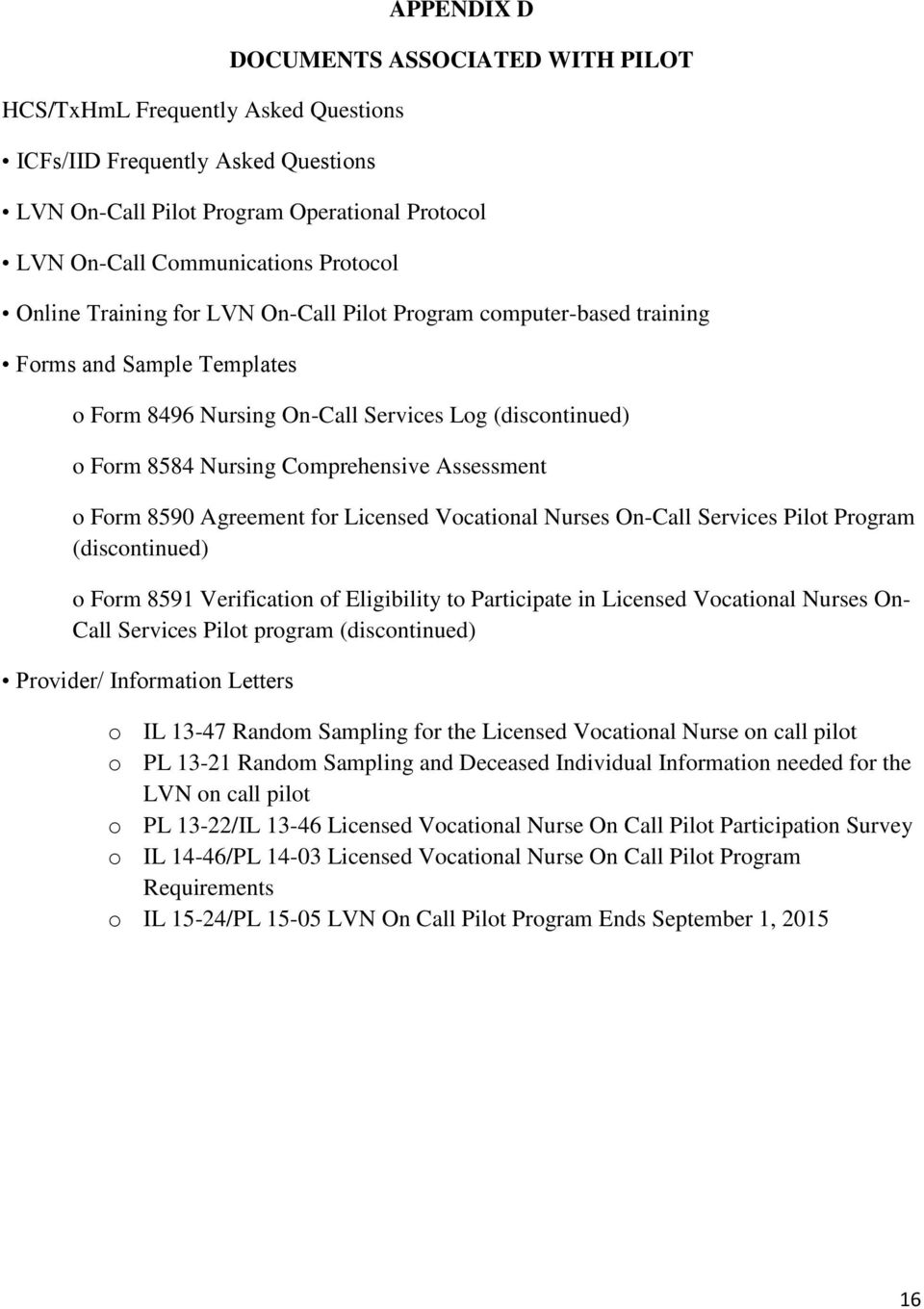
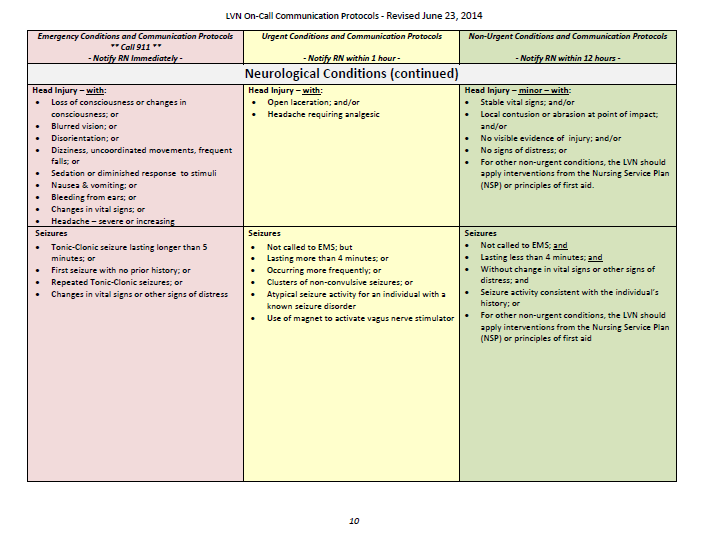
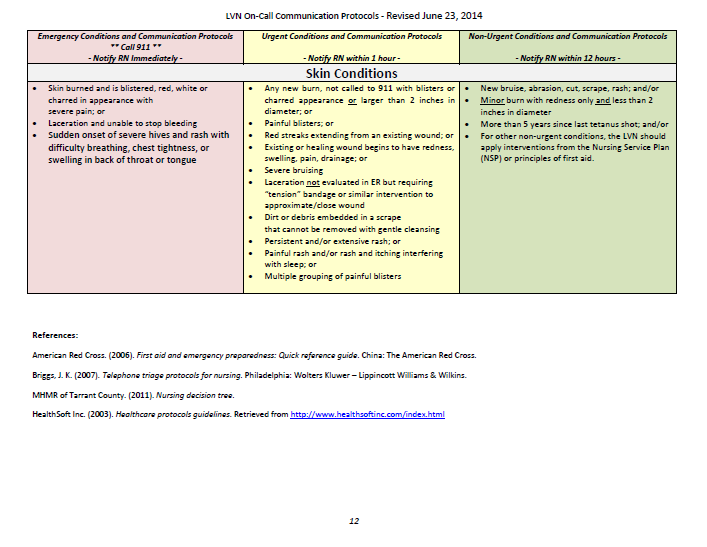
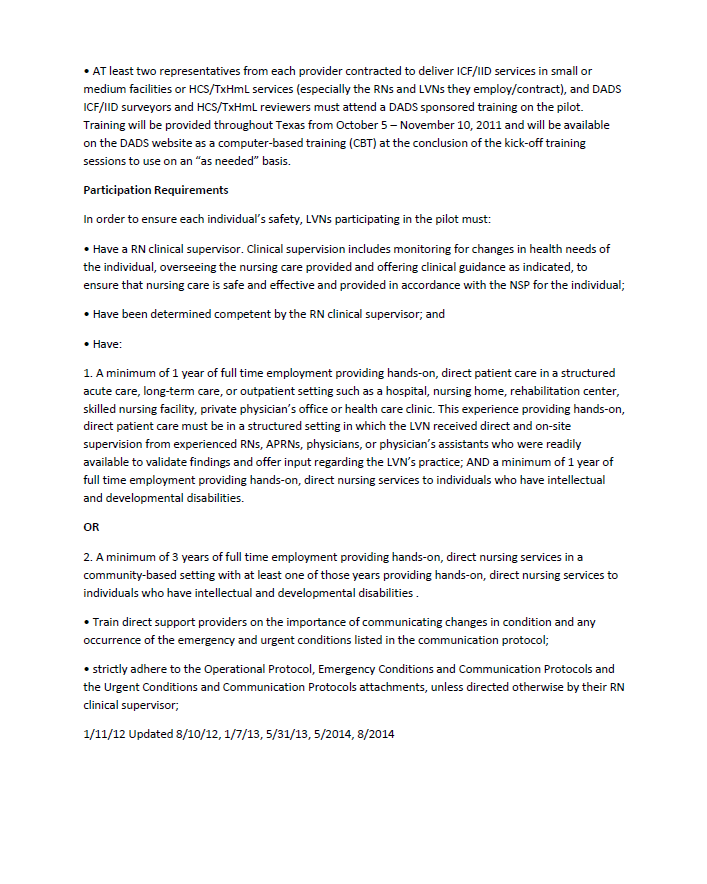
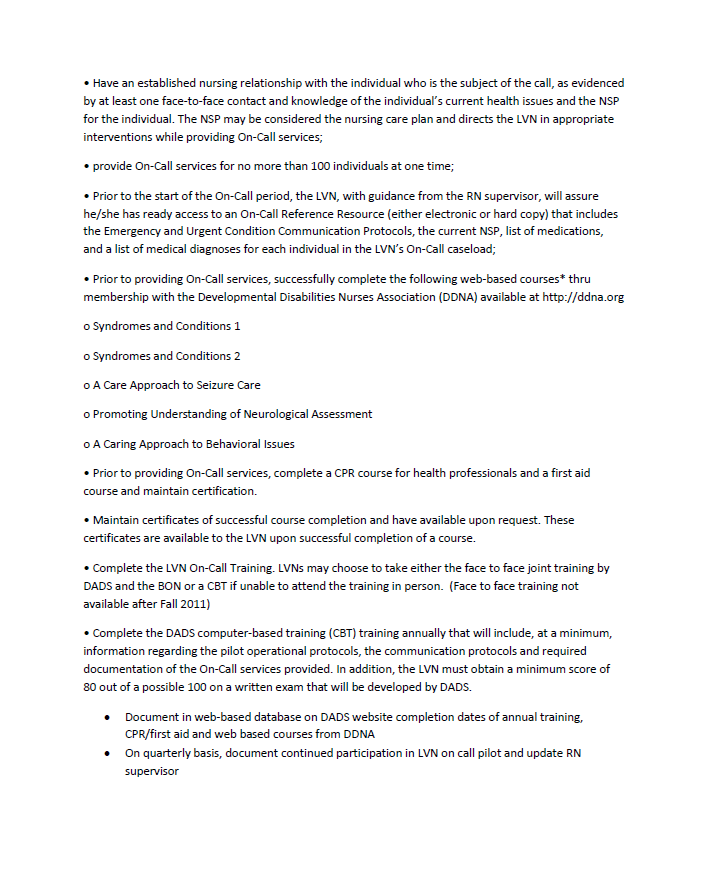
18 HCS/TxHmL Frequently Asked Questions ICFs/IID Frequently Asked Questions APPENDIX D DOCUMENTS ASSOCIATED WITH PILOT LVN On-Call Pilot Program Operational Protocol LVN On-Call Communications Protocol Online Training for LVN On-Call Pilot Program computer-based training Forms and Sample Templates o Form 8496 Nursing On-Call Services Log (discontinued) o Form 8584 Nursing Comprehensive Assessment o Form 8590 Agreement for Licensed Vocational Nurses On-Call Services Pilot Program (discontinued) o Form 8591 Verification of Eligibility to Participate in Licensed Vocational Nurses On- Call Services Pilot program (discontinued) Provider/ Information Letters o IL Random Sampling for the Licensed Vocational Nurse on call pilot o PL Random Sampling and Deceased Individual Information needed for the LVN on call pilot o PL 13-22/IL Licensed Vocational Nurse On Call Pilot Participation Survey o IL 14-46/PL Licensed Vocational Nurse On Call Pilot Program Requirements o IL 15-24/PL LVN On Call Pilot Program Ends September 1,
19 17


20 18


21 19

22 20
23 21

24 22
25 23

26 24
27 25
28 26
29 27

30 28
31 29

32 30

33 31
34 32

35 33
36 34
37 35
38 36
39 APPENDIX E PARTICIPATING AND NON-PARTICIPATING SURVEY QUESTIONS 37
40 38
41 39
42 40
43 41
44 42
45 43
46 44
47 45
48 APPENDIX F RANDOM SAMPLE/DEATH CHART REVIEW EVALUATION QUESTIONS 46
49 47
50 48
51 49
52 50
53 51
54 52
55 53

56 54
57 55
58 56
LICENSED VOCATIONAL NURSE ON- CALL PILOT PROGRAM
 LICENSED VOCATIONAL NURSE ON- CALL PILOT PROGRAM Report to the Legislature As Required by S.B. 1857, 82 nd Legislature, Regular Session, 2011 December 2012 Table of Contents Executive Summary... 1 Introduction...
SB 7 Redesign of IDD Services and Supports 5.27.13 Brief
 SB 7 Redesign of IDD Services and Supports 5.27.13 Brief Article 1. Delivery System Redesign for Provision of Acute Care Services and Long-term Services and Supports to Individuals with Intellectual and
Frequently Asked Questions and Answers: Managed Care Organizations and HCS/TxHmL Program Providers
 Frequently Asked Questions and Answers: Managed Care Organizations and HCS/TxHmL Program Providers Pharmacy/Medication Related Questions: 1) Question: After the initial transition pre-authorization period,
Sec. 531.0216. PARTICIPATION AND REIMBURSEMENT OF TELEMEDICINE MEDICAL SERVICE PROVIDERS UNDER MEDICAID. (a) The commission by rule shall develop and
 Sec. 531.0216. PARTICIPATION AND REIMBURSEMENT OF TELEMEDICINE MEDICAL SERVICE PROVIDERS UNDER MEDICAID. (a) The commission by rule shall develop and implement a system to reimburse providers of services
Chapter 3 Office of Human Resources Absenteeism Management
 Office of Human Resources Absenteeism Management Contents Section A - Background, Objective and Scope............................ 24 Section B - Criterion 1 - Communicating Expectations.......................
July 2012 Report No. 12-045. An Audit Report on The ReHabWorks System at the Department of Assistive and Rehabilitative Services
 John Keel, CPA State Auditor The ReHabWorks System at the Department of Assistive and Rehabilitative Services Report No. 12-045 The ReHabWorks System at the Department of Assistive and Rehabilitative Services
The Arc of Texas 84th Legislature Priorities
 The Arc of Texas 84th Legislature Priorities Long Term Services and Supports (LTSS): Ensure that all state funding and policies for LTSS for persons with intellectual and developmental disabilities (I/DD)
November 2009 Report No. 10-014. An Audit Report on The Department of Aging and Disability Services Home and Community-based Services Program
 John Keel, CPA State Auditor An Audit Report on The Department of Aging and Disability Services Home and Community-based Services Program Report No. 10-014 An Audit Report on The Department of Aging and
Contractor. Management
 Contractor Environment Health and Safety Management Best Practice (2007) A. INTRODUCTION Many construction Owners employ contract personnel for a wide range of activities, from administrative support to
Tennessee Health Care Innovation Initiative. Provider Stakeholder Group Meeting
 Tennessee Health Care Innovation Initiative Provider Stakeholder Group Meeting May 21, 2014 Agenda Update on the episodes of care reporting Payment and delivery reform for LTSS 1 Update on the episodes
HCS BILLING GUIDELINES
 HCS BILLING GUIDELINES You can find the newest version on the DADS website: http://www.dads.state.tx.us/handbooks/hcsbg/ 1 General Information Department of Aging and Disability Services (DADS) rules at
Chapter 16: Performance Based Contracts and Memoranda of Agreement
 Chapter 16: Performance Based Contracts and Memoranda of Agreement Introduction The following standards support activities that are: designated in statute and rule, necessary to accomplish implementation
Instructions for the Revised In-Home Aide Monitoring Tool For DAAS In-Home Aide Services
 Instructions for the Revised In-Home Aide Monitoring Tool For DAAS In-Home Aide Services Purpose: DAAS has made revisions to the In-Home Aide monitoring tool and process. (http://www.ncdhhs.gov/aging/contents.htm)
Provider Handbooks. Telecommunication Services Handbook
 Provider Handbooks January 2016 Telecommunication Services Handbook The Texas Medicaid & Healthcare Partnership (TMHP) is the claims administrator for Texas Medicaid under contract with the Texas Health
Illinois Disability Employment Initiative Local Innovation Projects Request for Application October 2014
 Illinois Disability Employment Initiative Local Innovation Projects Request for Application October 2014 Illinois Department of Commerce and Economic Opportunity Pat Quinn Governor Adam Pollet Director
New Hampshire Department of Health and Human Services. Medicaid Care Management Program Step 2 Design Concept
 New Hampshire Department of Health and Human Services Medicaid Care Management Program Step 2 Design Concept Redesign of New Hampshire s Long Term Services and Supports Delivery System: A Concept Paper
Health and Safety Activity Checklist
 Health and Safety Activity Checklist Workplace Health, Safety and Compensation Commission of New Brunswick WHSCC CSSIAT Commission de la santé, de la sécurité et de l indemnisation des accidents au travail
SHORTAGE OF HEALTH CARE WORKERS
 NEVADA LEGISLATIVE COUNSEL BUREAU RESEARCH BRIEF ON SHORTAGE OF HEALTH CARE WORKERS APRIL 2008 INSIDE THIS BRIEF OVERVIEW OF THE HEALTH CARE WORKFORCE SHORTAGE IN NEVADA EFFORTS TO ADDRESS THE HEALTH CARE
Texas Board of Nursing Fiscal Year 2015-2019 Workforce Plan
 Texas Board of Nursing Fiscal Year 2015-2019 Workforce Plan I. AGENCY OVERVIEW The Board of Nursing (BON), has one of the largest licensee database in the State of Texas. We regulate over 360,000 nurses
Los Angeles County Metropolitan Transportation Authority Office of the Inspector General Medicare Part B Reimbursements to Retirees
 Los Angeles County Metropolitan Transportation Authority Medicare Part B Reimbursements to Retirees Several procedural refinements are needed to ensure that reimbursements are discontinued for deceased
Community Living Exchange Collaborative: A National Technical Assistance Program. Funded by Centers for Medicare and Medicaid Services (CMS)
 Community Living Exchange Collaborative: A National Technical Assistance Program Funded by Centers for Medicare and Medicaid Services (CMS) Susan Reinhard, RN, PhD Robert Mollica, EdD Policy Brief Money
Medical Care Advisory Committee. David Auzenne Department of State Health Services
 TO: Medical Care Advisory Committee DATE: November 8, 2013 FROM: David Auzenne Department of State Health Services Agenda Item No.: 9 SUBJECT: Amendments to Title 25. Health Services, Part 1. Department
Tennessee Strategy for Suicide Prevention Sixth Edition Effective July 1, 2013
 Tennessee Strategy for Suicide Prevention Sixth Edition Effective July 1, 2013 1. Develop broad-based support for suicide prevention. A. Form and sustain public-private partnerships with the widest variety
Mentorship Program Information Package
 Mentorship Program Information Package Page 1 of 14 Table of Contents Introduction... 3 Mentor Role and Responsibilities... 4 Member Roles and Responsibilities... 6 Learning Plan Development, Implementation
Major IT Projects: Continue Expanding Oversight and Strengthen Accountability
 Secretary of State Audit Report Jeanne P. Atkins, Secretary of State Gary Blackmer, Director, Audits Division Major IT Projects: Continue Expanding Oversight and Strengthen Accountability Summary Information
NYSAN PROGRAM QUALITY SELF-ASSESSMENT (QSA) TOOL, 2 ND EDITION QUALITY INDICATOR DEFINITIONS
 NYSAN PROGRAM QUALITY SELF-ASSESSMENT (QSA) TOOL, 2 ND EDITION QUALITY INDICATOR DEFINITIONS ELEMENT 4: STAFFING AND PROFESSIONAL DEVELOPMENT A quality program recruits, hires, and develops diverse staff
Why a 5% rate increase is critical in 2016
 bit.ly/bestlifemn @BestLifeMN BestLifeAlliance Pinterest YouTube Why a 5% rate increase is critical in 2016 Alliance Description: The Best Life Alliance is a nonpartisan coalition of more than 130 Minnesota
BON Update. Katherine Thomas Executive Director Texas Board of Nursing February 21, 2013
 BON Update Katherine Thomas Executive Director Texas Board of Nursing February 21, 2013 Changes on the Board Kristin Benton resigned as President of the Board; accepted Director of Nursing Position Kathy
GAO EMERGENCY CARE. EMTALA Implementation and Enforcement Issues. Report to Congressional Committees. United States General Accounting Office
 GAO United States General Accounting Office Report to Congressional Committees June 2001 EMERGENCY CARE EMTALA Implementation and Enforcement Issues GAO-01-747 Contents Letter 1 Results in Brief 2 Background
Project Management Framework
 Information Services Project Management Framework October 2003 Document ID No. Page 1 of 1 Contents 1. Introduction Page 3 2. Use of Framework Page 3 3. Project Register and Monitoring Page 4 4. Project
California Provider Reference Manual Introduction and Overview of Medical Provider Networks (CA MPNs)
 California Provider Reference Manual Introduction and Overview of Medical Provider Networks (CA MPNs) Coventry/First Health has designed this manual for The Coventry/First Health Network providers participating
Guide to: Successful Customer Onboarding
 Guide to: Successful Customer Onboarding Getting Started The first 90 days will decide the fate of most implementations. While the complexity of your product could shift the timeline, if a customer feels
Position Classification Standard for Medical Records Administration Series, GS-0669
 Position Classification Standard for Medical Records Administration Series, GS-0669 Table of Contents SERIES DEFINITION... 2 SERIES COVERAGE... 2 EXCLUSIONS... 2 OCCUPATIONAL INFORMATION... 3 TITLES...
TELEMEDICINE, TELEHEALTH, AND HOME TELEMONITORING TEXAS MEDICAID SERVICES. Biennial Report to the Texas Legislature
 TELEMEDICINE, TELEHEALTH, AND HOME TELEMONITORING TEXAS MEDICAID SERVICES Biennial Report to the Texas Legislature As Required by Texas Government Code 531.0216 Texas Health and Human Services Commission
STATE OF MONTANA MONTANA DEPARTMENT OF TRANSPORTATION JOB PROFILE Update Formal Review
 STATE OF MONTANA MONTANA DEPARTMENT OF TRANSPORTATION JOB PROFILE Update Formal Review 6/3/2013 Date Submitted SECTION I - Identification Working Title: Multimodal Planning Bureau Chief Department: Transportation
Timeline for Developing a Managed Long Term Services and Supports (MLTSS) Program
 Timeline for Developing a Managed Long Term Services and Supports (MLTSS) Program May 2013 Prepared by Truven Health Analytics for the Centers for Medicare & Medicaid Services (CMS), Disabled and Elderly
Best Practices For Assigning First Call Responsibilities For Healthcare Networking Issues
 Best Practices For Assigning First Call Responsibilities For Healthcare Networking Issues Background In recent years, medical devices have become increasingly more computerized. As part of this trend,
There are some specific guidelines provided in the rules and regulations for these lists:
 Health Care Provider Panels List Defined The PA Workers' Compensation Act gives employers the right to establish a list of designated health care providers. When the list is properly posted, injured workers
A Master Plan for Nursing Education In Washington State
 A Master Plan for Nursing Education In Washington State Implementation Recommendations Washington Center for Nursing www.wacenterfornursing.org December 2009 This work was funded by Grant N14191 from the
Independent Medical Examination Audit Report
 "Our mission is our passion.. " Our passion To us, it's per~onal:.... Is North Dakota's workforce. WS I Workforce Safety & Insurance Independent Medical Examination Audit Report Conducted by DA Dronen
Kaiser Permanente Southern California Depression Care Program
 Kaiser Permanente Southern California Depression Care Program Abstract In 2001, Kaiser Permanente of Southern California (KPSC) adopted the IMPACT model of collaborative care for depression, developed
School to Work Transition Guidelines and Best Practices
 School to Work Transition Guidelines and Best Practices June 2014 Florida Department of Education The Division of Vocational Rehabilitation Table of Contents The Role of the Division of Vocational Rehabilitation
Stanislaus County Supervisor Training Academy Training Catalog 2016
 Stanislaus County Supervisor Training Academy Training Catalog 2016 Training Courses Budgeting/Financial Overview Compliance/Payroll Regulations Conducting a Recruitment Disability Management Employee
NEW YORK STATE MEDICAID PROGRAM OFFICE OF PERSONS WITH DEVELOPMENTAL DISABILITIES HOME AND COMMUNITY BASED SERVICES WAIVER MANUAL
 NEW YORK STATE MEDICAID PROGRAM OFFICE OF PERSONS WITH DEVELOPMENTAL DISABILITIES HOME AND COMMUNITY BASED SERVICES WAIVER MANUAL POLICY GUIDELINES Table of Contents SECTION I - DESCRIPTION OF THE OPWDD
Student Achievement and School Accountability Programs (SASA) Monitoring Plan for School Improvement Grants October 1, 2010 to September 30, 2011
 Student Achievement and School Accountability Programs (SASA) Monitoring Plan for School Improvement Grants October 1, 2010 to September 30, 2011 January 12, 2011 Table of Contents I. INTRODUCTION...
QUALITY AND INTEGRATED GOVERNANCE BUSINESS UNIT. Clinical Effectiveness Strategy (Clinical Audit/Research) 2013-2015
 Southport and Ormskirk Hospital NHS Trust QUALITY AND INTEGRATED GOVERNANCE BUSINESS UNIT Clinical Effectiveness Strategy (Clinical Audit/Research) 2013-2015 Any practitioner who is using research-based
TEXAS BOARD OF NURSING
 Agenda Item #: 5.1.2 Prepared by: Mark Majek Meeting Date: April, 2015 TEXAS BOARD OF NURSING Quarterly Statistical Report Second Quarter Fiscal Year 2015 Second Quarter Status GOAL 1: To manage cost effective,
Children, Families, and Elder Affairs Committee
 The Florida Senate BILL ANALYSIS AND FISCAL IMPACT STATEMENT (This document is based on the provisions contained in the legislation as of the latest date listed below.) Prepared By: The Professional Staff
CMCS Informational Bulletin
 DEPARTMENT OF HEALTH & HUMAN SERVICES Centers for Medicare & Medicaid Services 7500 Security Boulevard, Mail Stop S2-26-12 Baltimore, Maryland 21244-1850 Center for Medicaid, CHIP and Survey & Certification
Texas Nursing: Our Future Depends on It
 Texas Nursing: Our Future Depends on It A Strategic Plan for the State of Texas To Meet Nursing Workforce Needs of 2013 Attachment A Detailed Action Plan Developed by: Addressing Nursing Education Capacity
Creating a Customer Advisory Board Overview and Checklist by Clearworks
 Creating a Customer Advisory Board Overview and Checklist by Clearworks Customer insight programs play an important role for both B2B and B2C companies. The programs advise everything from new product
Interim Policy Guide to Support Coordination
 Interim Policy Guide to Support Coordination 1 Contents 1 INTRODUCTION... 5 1.1 Development/Revision of Policies and Procedures... 5 2 OVERVIEW OF INTERIM PHASE OF SYSTEM TRANSFORMATION... 5 3 DIVISION
EXTENDED CARE PERMIT SPONSORING DENTIST
 EXTENDED CARE PERMIT The role of the sponsoring dentist is fundamental to the Extended Care Permit. This section of the toolkit contains the following: Overview: Role of the Sponsoring Dentist Questions
Aging and Disability Resource Centers: Five Year Plan for Expanding ADRCs Statewide
 Aging and Disability Resource Centers: Five Year Plan for Expanding ADRCs Statewide Florida Department of Elder Affairs Charles T. Corley, Interim Secretary April 1, 2011 FLORIDA DEPARTMENT OF ELDER AFFAIRS
POLICY & PROCEDURE DEFINITIONS:
 POLICY & PROCEDURE TITLE: Medical Record Completion (eclinicalworks) Scope/Purpose: To ensure timeliness in the completion of documentation for a patient encounter in order to protect integrity of the
Chapter 8a Public Education Human Resource Management Act. Part 1 General Provisions
 Chapter 8a Public Education Human Resource Management Act Part 1 General Provisions 53A-8a-101 Title. This chapter is known as the "Public Education Human Resource Management Act." 53A-8a-102 Definitions.
SUBJECT: Audit Report Compliance with Occupational Safety and Health Administration Recordkeeping Requirements (Report Number HR-AR-11-004)
 May 27, 2011 DEBORAH M. GIANNONI-JACKSON VICE PRESIDENT, EMPLOYEE RESOURCE MANAGEMENT SUBJECT: Audit Report Compliance with Occupational Safety and Health (Report Number ) This report presents the results
Supports Coordination
 Supports Coordination Information from: A. Application for a 1915(c) Home and Community-Based Services Waiver (Consolidated) Appendix D, section 2a: Service Plan Implementation and Monitoring, p. 49-53
Restructure, Redeployment and Redundancy
 Restructure, Redeployment and Redundancy Purpose and Scope From time to time the Lake District National Park Authority will need to reorganise its services and staffing to meet changes that arise in future
GUIDANCE NOTE DECISION-MAKING PROCESS
 GUIDANCE NOTE DECISION-MAKING PROCESS This document is intended as a general guide to the way in which the Jersey Financial Services Commission (the Commission ), normally approaches the exercise of its
CLASS TITLE: EQUAL EMPLOYMENT OPPORTUNITY SPECIALIST 1
 OCCUPATIONAL GROUP: Human Resources CLASS FAMILY: Agency Human Resources CLASS FAMILY DESCRIPTION: These positions are located in State Agencies and provide leadership roles in the management and implementation
Enhancing Law Enforcement Response to Victims:
 Enhancing Law Enforcement Response to Victims: Strategy Implementation Checklist Enhancing Law Enforcement Response to Victims is a new professional standard developed by the International Association
Workflow and Process Analysis for CCC
 Section 3.6 Design Workflow and Process Analysis for CCC This tool introduces the importance of workflow and process improvement in a community-based care coordination (CCC) program, describes the value
California Workers Compensation Medical Provider Network Employee Notification & Guide
 California Workers Compensation Medical Provider Network Employee Notification & Guide In partnership with We are pleased to introduce the California workers compensation medical provider network (MPN)
NEW YORK STATE REHABILITATION COUNCIL GUIDING PRINCIPLES
 NEW YORK STATE REHABILITATION COUNCIL GUIDING PRINCIPLES Article I. SHORT TITLE A. The name of this body shall be the New York State Rehabilitation Council (SRC). B. This document may be cited as the Guiding
BEACON HEALTH STRATEGIES, LLC TELEHEALTH PROGRAM SPECIFICATION
 BEACON HEALTH STRATEGIES, LLC TELEHEALTH PROGRAM SPECIFICATION Providers contracted for the telehealth service will be expected to comply with all requirements of the performance specifications. Additionally,
PHYSICIAN ORDER POLICY
 PURPOSE: To clarify requirements and assure all physician orders are complete and valid for safe patient care SUPPORTIVE DATA: Medication: Prescribing and Ordering Procedure #790.25 RCW 18.164.011 and
i. Reflect the diversity of the community Represent stakeholder groups (where appropriate) Represent specific groups of service users, and
 Public Appointment Policy Governing citizen appointments to HRM Agencies, Boards, Committees and Commissions and to External Bodies 1 GUIDING PRINCIPLES 1.1 Introduction A commitment to community participation
Evaluation Plan: Process Evaluation for Hypothetical AmeriCorps Program
 Evaluation Plan: Process Evaluation for Hypothetical AmeriCorps Program Introduction: This evaluation plan describes a process evaluation for Financial Empowerment Corps (FEC), an AmeriCorps State and
Texas Board of Nursing Update
 Texas Board of Nursing Update Texas Organization of Nurse Executives Annual Conference April 4, 2014 Kristin Benton, MSN, RN Director of Nursing Texas Board of Nursing Objectives 1. Discuss national changes
Motorola Solutions, Inc. Board Governance Guidelines (as amended October 17, 2013)
 Motorola Solutions, Inc. Board Governance Guidelines (as amended October 17, 2013) These Board Governance Guidelines, adopted by the Board of Directors (the Board ) of Motorola Solutions, Inc. (the Company