
NOTICE OF 2012 ANNUAL MEETING AND PROXY STATEMENT
|
|
|
- Luke Gibbs
- 9 years ago
- Views:
Transcription
1 NOTICE OF 2012 ANNUAL MEETING AND PROXY STATEMENT
2

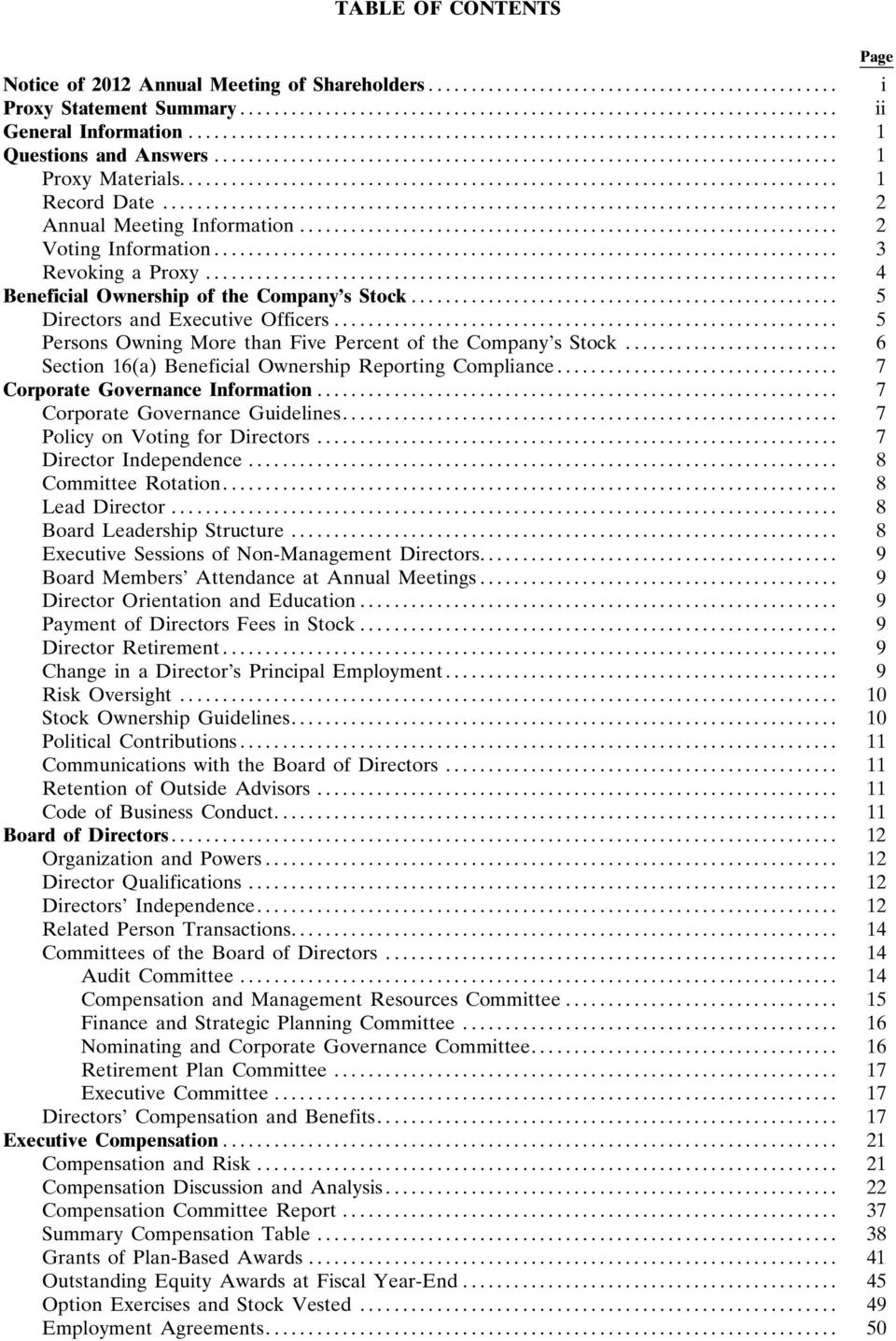
3 TABLE OF CONTENTS Notice of 2012 Annual Meeting of Shareholders... i Proxy Statement Summary... ii General Information... 1 Questions and Answers... 1 Proxy Materials Record Date Annual Meeting Information Voting Information Revoking a Proxy Beneficial Ownership of the Company s Stock... 5 Directors and Executive Officers Persons Owning More than Five Percent of the Company s Stock Section 16(a) Beneficial Ownership Reporting Compliance Corporate Governance Information... 7 Corporate Governance Guidelines Policy on Voting for Directors Director Independence Committee Rotation Lead Director Board Leadership Structure Executive Sessions of Non-Management Directors Board Members Attendance at Annual Meetings Director Orientation and Education Payment of Directors Fees in Stock Director Retirement Change in a Director s Principal Employment Risk Oversight Stock Ownership Guidelines Political Contributions Communications with the Board of Directors Retention of Outside Advisors Code of Business Conduct Board of Directors Organization and Powers Director Qualifications Directors Independence Related Person Transactions Committees of the Board of Directors Audit Committee Compensation and Management Resources Committee Finance and Strategic Planning Committee Nominating and Corporate Governance Committee Retirement Plan Committee Executive Committee Directors Compensation and Benefits Executive Compensation Compensation and Risk Compensation Discussion and Analysis Compensation Committee Report Summary Compensation Table Grants of Plan-Based Awards Outstanding Equity Awards at Fiscal Year-End Option Exercises and Stock Vested Employment Agreements Page
4 Page 2011 Nonqualified Deferred Compensation Potential Payments upon Termination or Change in Control Retirement Plans Pension Benefits Trust Agreement for Certain Benefit Plans Equity Compensation Plan Information Items to be Voted on by Shareholders Proposal 1: Election of Directors Nominees for Directors Directors Continuing in Office Proposal 2: Ratification of the Appointment of Independent Registered Public Accounting Firm 81 Audit and Non-Audit Fees Audit Committee Pre-Approval Policies and Procedures Audit Committee Report Proposal 3: Reapproval of the Performance Goals under the Annual Incentive Compensation Plan, as Amended and Restated Proposal 4: Advisory Approval of Executive Compensation Deadlines and Procedures for Nominations and Shareholder Proposals Location of 2012 Annual Shareholders Meeting... 88

5 112 West 34th Street New York, New York NOTICE OF 2012 ANNUAL MEETING OF SHAREHOLDERS DATE: May 16, 2012 TIME: 9:00 A.M., local time PLACE: Foot Locker, Inc., 112 West 34th Street, New York, New York RECORD DATE: ITEMS OF BUSINESS: Shareholders of record on March 19, 2012 can vote at this meeting. Elect three members to the Board of Directors to serve for three-year terms. Ratify the appointment of KPMG LLP as our independent registered public accounting firm for the 2012 fiscal year. Reapprove the Performance Goals under the Foot Locker Annual Incentive Compensation Plan, as amended and restated. Advisory approval of the compensation of our named executive officers. Transact such other business as may properly come before the meeting and at any adjournment or postponement. PROXY VOTING: YOUR VOTE IS IMPORTANT TO US. Please vote as soon as possible in one of these ways: Use the toll-free telephone number shown on the Notice of Internet Availability of Proxy Materials for the 2012 Annual Meeting of Foot Locker, Inc. (your Foot Locker Notice ) or on your proxy card; Visit the web site shown on your Foot Locker Notice or on your proxy card to vote via the Internet; If you received a printed copy of the proxy card, you may mark, sign and return the enclosed proxy card using the postage-paid envelope provided; or Follow the instructions on your proxy materials if your shares are held in the name of your bank, broker, or other holder of record. Even if you plan to attend the annual meeting, we encourage you to vote in advance using one of these methods. GARY M. BAHLER Secretary April 5, 2012 i

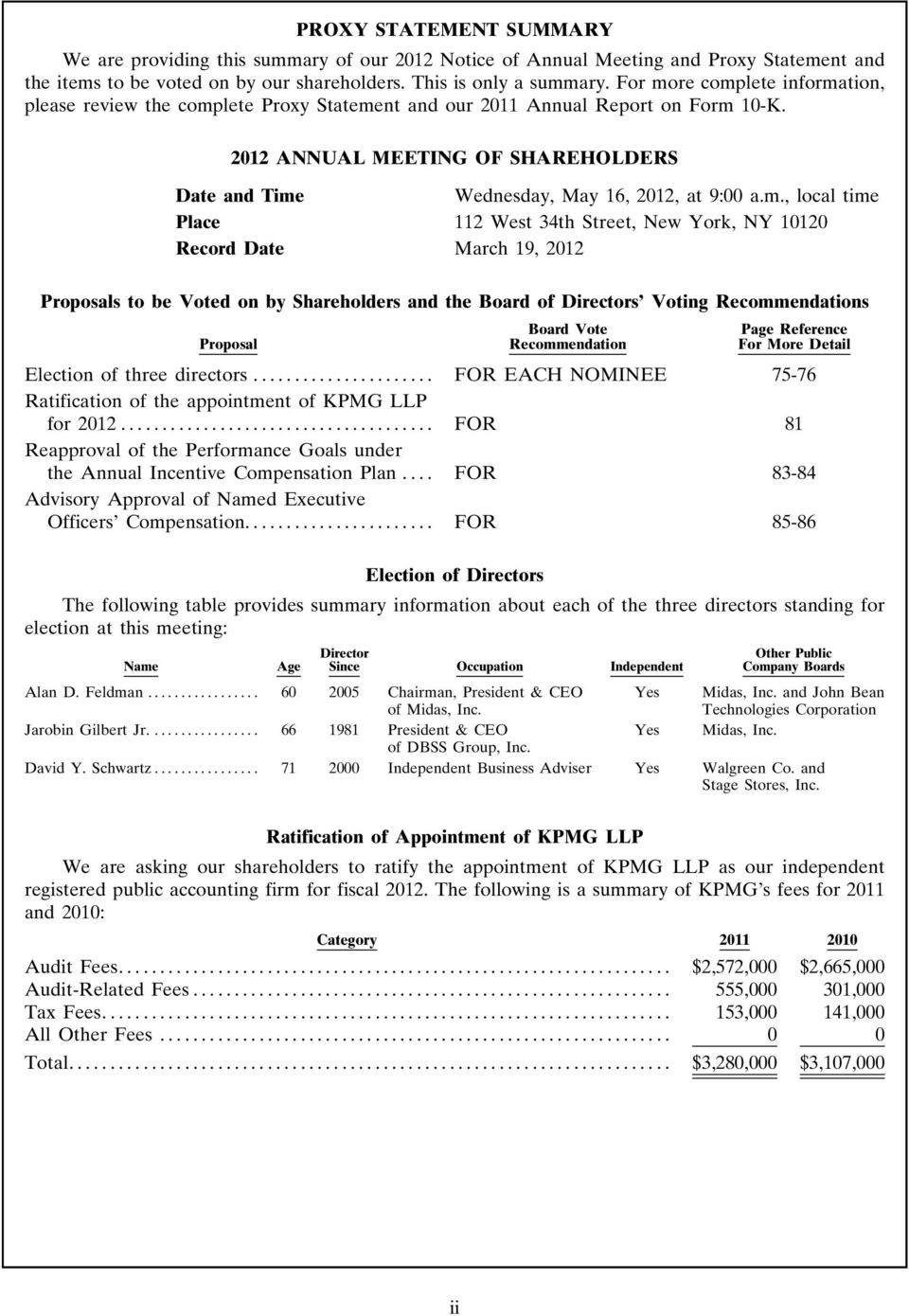
6 PROXY STATEMENT SUMMARY We are providing this summary of our 2012 Notice of Annual Meeting and Proxy Statement and the items to be voted on by our shareholders. This is only a summary. For more complete information, please review the complete Proxy Statement and our 2011 Annual Report on Form 10-K ANNUAL MEETING OF SHAREHOLDERS Date and Time Wednesday, May 16, 2012, at 9:00 a.m., local time Place 112 West 34th Street, New York, NY Record Date March 19, 2012 Proposals to be Voted on by Shareholders and the Board of Directors Voting Recommendations Proposal Board Vote Recommendation Page Reference For More Detail Election of three directors FOR EACH NOMINEE Ratification of the appointment of KPMG LLP for FOR 81 Reapproval of the Performance Goals under the Annual Incentive Compensation Plan.... FOR Advisory Approval of Named Executive Officers Compensation FOR Election of Directors The following table provides summary information about each of the three directors standing for election at this meeting: Name Age Director Since Occupation Independent Other Public Company Boards Alan D. Feldman Chairman, President & CEO of Midas, Inc. Yes Midas, Inc. and John Bean Technologies Corporation Jarobin Gilbert Jr President & CEO Yes Midas, Inc. of DBSS Group, Inc. David Y. Schwartz Independent Business Adviser Yes Walgreen Co. and Stage Stores, Inc. Ratification of Appointment of KPMG LLP We are asking our shareholders to ratify the appointment of KPMG LLP as our independent registered public accounting firm for fiscal The following is a summary of KPMG s fees for 2011 and 2010: Category Audit Fees $2,572,000 $2,665,000 Audit-Related Fees , ,000 Tax Fees , ,000 All Other Fees Total $3,280,000 $3,107,000 ii
7 Reapproval of the Performance Goals under the Annual Incentive Compensation Plan The Foot Locker Annual Incentive Compensation Plan, as amended and restated (the Annual Bonus Plan ), is designed to comply with the requirements of Section 162(m) of the Internal Revenue Code. Under this section of the tax code, certain compensation in excess of $1 million paid to the CEO and the three other most highly paid executive officers (other than the CFO) is not deductible. Compensation paid based on the achievement of pre-established performance goals is excluded from this deduction limit if the performance goals to be used are approved by shareholders. Our shareholders last approved the performance goals for this plan at the 2008 annual meeting of shareholders, and Section 162(m) of the tax code requires that shareholders approve the performance goals under the plan at least every five years. A summary of the material features of the Annual Bonus Plan is provided beginning on Page 83. Advisory Approval of the Named Executive Officers Compensation We are asking shareholders to approve, on a nonbinding, advisory basis, the 2011 compensation of our named executive officers, as described in this proxy statement on Pages 22 through 73. Last year, our shareholders overwhelmingly approved our executive compensation program. Given this support, the Company decided to retain the overall program, which ties the executives pay closely with Foot Locker s performance, so that total compensation in any year will vary sometimes significantly based on our performance. In 2011 we had the financial and operating results shown in the following table. These results represent continued progress toward the goals contained in our long-range plan. Financial Metric Percent Increase 2011 over 2010 Sales $5,623 million $5,049 million 11.4% Comparable Store Sales 9.8% 5.8% Net Income $278 million $169 million 64% Earnings per Share $1.80 $ % Return on Invested Capital 11.8% 8.3% End-of-Year Market Capitalization $4.01 billion $2.75 billion 46% ROIC is a non-gaap financial measure. There is a reconciliation to GAAP on Page 16 of our 2011 Form 10-K. Based upon the Company s performance, payments were made to the named executive officers under the Annual Bonus Plan for 2011 and the Long-Term Bonus Plan for Although longterm incentive payouts were earned for the performance measurement period, they will not be paid out until As described in the Compensation Discussion and Analysis section of this proxy statement, fiscal 2011 was a transition year under our long-term incentive program, reflecting the change we made two years ago to move to a two-year performance measurement period with an additional one-year holding period, payable one-half in cash and one-half in equity, rather than having a three-year performance measurement period payable all in cash at the end of the performance period, provided, in both cases, that the performance goals are achieved. As a result of this change, two longterm performance measurement periods ended in 2011 and were earned by the named executives based on the Company s performance. Only one long-term performance award ( ) was paid out, while the payout for the performance measurement period will not be paid until Going forward, only one long-term performance measurement period will end each year. iii

8 [THIS PAGE INTENTIONALLY LEFT BLANK]

9 112 West 34th Street New York, New York PROXY STATEMENT GENERAL INFORMATION We are providing these proxy materials to you for the solicitation of proxies by the Board of Directors of Foot Locker, Inc. for the 2012 Annual Meeting of Shareholders and for any adjournments or postponements of this meeting. We are holding this annual meeting on May 16, 2012 at 9:00 A.M., local time, at our corporate headquarters located at 112 West 34th Street, New York, New York In this proxy statement we refer to Foot Locker, Inc. as Foot Locker, the Company, we, our, or us. We are pleased this year once again to take advantage of the Securities and Exchange Commission rule that allows companies to furnish their proxy materials to shareholders over the Internet instead of mailing full sets of the printed materials. We believe that this procedure reduces costs, provides greater flexibility to our shareholders, and lessens the environmental impact of our Annual Meeting. On or about April 5, 2012 we started mailing to most of our shareholders in the United States a Notice of Internet Availability of Proxy Materials (the Foot Locker Notice ). The Foot Locker Notice contains instructions on how to access and read our 2012 Proxy Statement and our 2011 Annual Report to Shareholders on the Internet and to vote online. If you received a Foot Locker Notice by mail, you will not receive paper copies of the proxy materials in the mail unless you request them. Instead, the Foot Locker Notice instructs you on how to access and read the Proxy Statement and Annual Report and how you may submit your proxy over the Internet. If you received a Foot Locker Notice by mail and would like to receive a printed copy of the materials, please follow the instructions on the Foot Locker Notice for requesting the materials, and we will promptly mail the materials to you. We are mailing to shareholders, or making available to shareholders via the Internet, this Proxy Statement, form of proxy card, and our 2011 Annual Report/Form10-K on or about April 5, Important Notice Regarding the Availability of Proxy Materials for the Shareholder Meeting To Be Held on May 16, 2012 The Company s Proxy Statement and 2011 Annual Report/Form 10-K are available at QUESTIONS AND ANSWERS ABOUT THIS ANNUAL MEETING AND VOTING What is included in these proxy materials? The proxy materials include our 2012 Proxy Statement and 2011 Annual Report and Form 10-K. If you received printed copies of these materials by mail, these materials also include the proxy card for this annual meeting. May I obtain an additional copy of the Form 10-K? You may obtain an additional copy of our 2011 Form 10-K without charge by writing to our Investor Relations Department at Foot Locker, Inc., 112 West 34th Street, New York, New York It is also available free of charge through our corporate web site at investors.cfm?page=corporate-governance.
10 What constitutes a quorum for the Annual Meeting? We will have a quorum and will be able to conduct the business of the Annual Meeting if the holders of a majority of the shares outstanding are present at the meeting, either in person or by proxy. We will count abstentions and broker non-votes, if any, as present and entitled to vote in determining whether we have a quorum. What is the record date for this meeting? The record date for this meeting is March 19, If you were a Foot Locker shareholder on this date, you are entitled to vote on the items of business described in this proxy statement. Do I need a ticket to attend the Annual Meeting? You will need an admission ticket to attend the Annual Meeting. Attendance at the meeting will be limited to shareholders on March 19, 2012 (or their authorized representatives) having an admission ticket or proof of their share ownership, and guests of the Company. If you plan to attend the meeting, please indicate this when you are voting by telephone or Internet or check the box on your proxy card, and we will promptly mail an admission ticket to you. If your shares are held in the name of a bank, broker, or other holder of record and you plan to attend the meeting, you can obtain an admission ticket in advance by providing proof of your ownership, such as a bank or brokerage account statement, to the Corporate Secretary at Foot Locker, Inc., 112 West 34th Street, New York, New York If you do not have an admission ticket, you must show proof of your ownership of the Company s Common Stock at the registration table at the door. What are shareholders voting on at this meeting? You are being asked to vote on the following four items: Proposal 1: Proposal 2: Proposal 3: Proposal 4: Election of three directors in Class III; Ratification of the appointment of KPMG LLP as our independent registered public accounting firm for 2012; Reapproval of the performance goals under the Foot Locker Annual Incentive Compensation Plan, as amended and restated; and Advisory approval of executive compensation. How does the Board of Directors recommend that I vote on the proposals? The Board recommends that you vote FOR Proposals 1, 2, 3 and 4. Could other matters be voted on at the Annual Meeting? We do not know of any other business that will be presented at the 2012 annual meeting. If any other matters are properly brought before the meeting for consideration, then the persons named as proxies will have the discretion to vote on those matters for you using their best judgment. Who may vote at the Annual Meeting? The only voting securities of Foot Locker are our shares of Common Stock. Only shareholders of record on the books of the Company on March 19, 2012 are entitled to vote at the annual meeting and any adjournments or postponements. Each share is entitled to one vote. There were 151,895,099 shares of Common Stock outstanding on March 19, What are the voting requirements to elect directors and to approve the other proposals? Proposal 1 (Election of Directors). Directors must be elected by a plurality of the votes cast by shareholders. (Please see our policy described on Page 7 regarding resignations by directors who do not receive more for votes than withheld votes.) 2
11 Proposal 2 (Ratification of the Appointment of Independent Registered Public Accounting Firm). This proposal requires the favorable vote of a majority of the votes cast by shareholders to be approved. Proposal 3 (Reapproval of the performance goals under the Annual Incentive Compensation Plan). This proposal requires the favorable vote of a majority of the votes cast by shareholders to be approved. Proposal 4 (Advisory approval of executive compensation). The favorable vote of a majority of the votes cast by shareholders will constitute shareholder approval of our named executive officers compensation. What happens if I do not vote my shares? This depends on how you hold your shares and the type of proposal. If you hold your shares in street name, such as through a bank or brokerage account, it is important that you cast your vote if you want it to count for Proposals 1, 3, and 4. If you do not instruct your bank or broker how to vote your shares on these proposals, no votes will be cast on your behalf. With regard to Proposal 2, your bank or broker will have discretion to vote any uninstructed shares for this proposal. If your stock ownership is reflected directly on the books and records of the Company s transfer agent, you are a shareholder of record. If you do not cast your vote, then no votes will be cast on your behalf on any of the proposals. How will the votes be counted? Votes will be counted and certified by representatives of our transfer agent, Computershare, as inspectors of election. The inspectors of election are independent and are not employees of Foot Locker. Votes withheld for the election of one or more of the nominees for director will not be counted as votes cast for them. We do not count abstentions and broker non-votes, if any, in determining the votes cast for any proposal. With respect to Proposals 2, 3, and 4, if you abstain from voting, this will have no effect on the vote since an abstention is not considered a vote cast. The Company s Certificate of Incorporation and By-laws do not contain any provisions on the effect of abstentions or broker non-votes. Will my vote be confidential? We maintain the confidentiality of our shareholders votes. All proxy cards, electronic voting, voting instructions, ballots and voting tabulations identifying shareholders are kept confidential from the Company, except: as necessary to meet any applicable legal requirements, when a shareholder requests disclosure or writes a comment on a proxy card, in a contested proxy solicitation, and to allow independent inspectors of election to tabulate and certify the vote. How do I vote my shares? You may vote using any of the following methods: Telephone If you are located within the United States or Canada, you can vote your shares by telephone by calling the toll-free telephone number printed on your Notice of Internet Availability of Proxy Materials ( Notice ), on your proxy card, or in the instructions that accompany your proxy materials, as applicable, and following the recorded instructions. You will need the control number printed on your Notice, on your proxy card, or in the instructions that accompany your proxy materials, as applicable. Telephone voting is available 24 hours a day and will be accessible until 11:59 P.M. Eastern Time on May 15, The telephone voting system has easy to follow instructions and allows you to confirm that the system has properly recorded your vote. If you vote by telephone, you do NOT need to return 3

12 a proxy card or voting instruction form. If you are an owner in street name, please follow the instructions that accompany your proxy materials. Internet You can also choose to vote your shares by the Internet. You will need the control number printed on your Notice, on your proxy card, or in the instructions that accompany your proxy materials, as applicable. The web site for Internet voting is listed on your Notice, proxy card, or in the instructions that accompany your proxy materials. Internet voting is available 24 hours a day and will be accessible until 11:59 P.M. Eastern Time on May 15, As with telephone voting, you will be able to confirm that the system has properly recorded your vote. If you vote via the Internet, you do NOT need to return a proxy card or voting instruction form. Mail If you are a holder of record and received printed copies of the materials by mail, you may choose to vote by mail. Simply mark your proxy card, date and sign it, and return it in the postage-paid envelope that we included with your materials. If you hold your shares through a bank or brokerage account, please complete and mail the voting instruction form in the envelope provided. Ballot at the Annual Meeting You may also vote by ballot at the Annual Meeting if you decide to attend in person. If your shares are held in the name of a bank, broker or other holder of record, you must obtain a proxy, executed in your favor, from the holder of record to be able to vote at the meeting. All shares that have been properly voted and not revoked will be voted at the Annual Meeting. If you sign and return a proxy card but do not give voting instructions, the shares represented by that proxy card will be voted as recommended by the Board of Directors. Can I change my mind after voting my shares? You may revoke your proxy at any time before it is used by (i) sending a written notice to the Company at its corporate headquarters, (ii) delivering a valid proxy card with a later date, (iii) providing a later dated vote by telephone or Internet, or (iv) voting by ballot at the Annual Meeting. Can I vote shares held in employee plans? If you hold shares of Foot Locker Common Stock through the Foot Locker 401(k) Plan or the Foot Locker Puerto Rico 1165(e) Plan, your proxy card includes the number of shares allocated to your plan account. Your proxy card will serve as a voting instruction card for these shares for the plan trustee to vote the shares. The trustee will vote only those shares for which voting instructions have been given. To allow sufficient time for voting by the trustees of these plans, your voting instructions must be received by May 12, Who pays the cost of this proxy solicitation? We will pay for the cost of the solicitation of proxies, including the preparation, printing and mailing of the proxy materials. Proxies may be solicited, without additional compensation, by our directors, officers, or employees by mail, telephone, fax, in person, or otherwise. We will request banks, brokers and other custodians, nominees and fiduciaries to deliver proxy materials to the beneficial owners of Foot Locker s Common Stock and obtain their voting instructions, and we will reimburse those firms for their expenses under the rules of the Securities and Exchange Commission and The New York Stock Exchange. In addition, we have retained Innisfree M&A Incorporated to assist us in the solicitation of proxies for a fee of $12,500 plus out-of-pocket expenses. 4

13 BENEFICIAL OWNERSHIP OF THE COMPANY S STOCK Directors and Executive Officers The following table shows the number of shares of Common Stock reported to us as beneficially owned by each of our directors and named executive officers as of March 19, The table also shows beneficial ownership by all directors, named executive officers, and executive officers as a group on that date, including shares of Common Stock that they have a right to acquire within 60 days after March 19, 2012 by the exercise of stock options. No director, named executive officer, or executive officer beneficially owned one percent or more of the total number of outstanding shares as of March 19, Each person has sole voting and investment power for the number of shares shown unless otherwise noted. Name Amount and Nature of Beneficial Ownership Common Stock Beneficially Owned Excluding Stock Options(a) Stock Options Exercisable Within 60 Days After 3/19/2012 RSUs and Deferred Stock Units(b) Gary M. Bahler , , ,861 Jeffrey L. Berk , , ,470 Nicholas DiPaolo ,150(c) 13,185 2,223 62,558 Alan D. Feldman ,439 6,314 17,740 67,493 Jarobin Gilbert Jr ,096 13,185 2,223 52,504 Ronald J. Halls , , ,752 Ken C. Hicks , ,666 1,369,716 Robert W. McHugh , , ,581 Matthew M. McKenna ,264 4,287 2,223 74,774 Richard A. Johnson , ,999 25, ,977 Guillermo G. Marmol ,704 2,223 13,927 Lauren B. Peters , , ,250 James E. Preston ,574 8,336 2, ,133 Allen Questrom ,104 2,223 4,327 David Y. Schwartz ,844 13,185 31,237 83,266 Cheryl Nido Turpin ,828 13,185 36,363 77,376 Dona D. Young ,207 13,185 46,361 82,753 All 21 directors and executive officers as a group, including the named executive officers ,894,374 2,639, ,038 4,704,032(d) Total Notes to Beneficial Ownership Table (a) This column includes shares held in the Company s 401(k) Plan, as well as the executives unvested shares of restricted stock listed below over which they have sole voting power but no investment power: 5

14 Name Number of Unvested Shares of Restricted Stock K. Hicks 350,000 R. McHugh 45,000 L. Peters 45,000 R. Johnson 120,000 G. Bahler 25,000 J. Berk 25,000 (b) This column includes (i) the number of deferred stock units credited as of March 19, 2012 to the account of the directors who elected to defer all or part of their annual retainer fee and (ii) time vested restricted stock units ( RSUs ). The deferred stock units and RSUs do not have current voting or investment power. (c) Includes 1,050 shares held by his spouse. (d) This number represents approximately 3.1 percent of the shares of Common Stock outstanding at the close of business on March 19, Persons Owning More Than Five Percent of the Company s Stock The following table provides information on shareholders who beneficially own more than five percent of our Common Stock according to reports filed with the Securities and Exchange Commission ( SEC ). To the best of our knowledge, there are no other shareholders who beneficially own more than five percent of a class of the Company s voting securities. Name and Address of Beneficial Owner Amount and Nature of Beneficial Ownership Percent of Class Ameriprise Financial, Inc ,908,546(a) 5.23%(a) 145 Ameriprise Financial Center Minneapolis, MN Columbia Management Investment Advisers, LLC 225 Franklin Street Boston, MA BlackRock, Inc ,921,631(b) 7.88%(b) 40 East 52nd Street New York, NY The Vanguard Group, Inc ,245,479(c) 5.45%(c) 100 Vanguard Blvd. Malvern, PA Notes to Table on Persons Owning More than Five Percent of the Company s Stock (a) Reflects shares beneficially owned as of December 31, 2011 according to Amendment No. 1 to Schedule 13G filed with the SEC jointly by Ameriprise Financial, Inc. ( AFI ) and Columbia Management Investment Advisers, LLC ( CMIA ). AFI is the parent holding company of CMIA, an investment adviser. As reported in this schedule, CMIA holds shared voting power with respect to 861,927 shares and shared dispositive power with respect to 7,908,546 shares. AFI, as the parent company of CMIA, may be deemed to beneficially own the shares reported by CMIA. (b) Reflects shares beneficially owned as of December 31, 2011 according to Amendment No. 2 to Schedule 13G filed with the SEC. As reported in this schedule, BlackRock, Inc., a parent holding company, holds sole voting and dispositive power with respect to 11,921,631 shares. 6

15 (c) Reflects shares beneficially owned as of December 31, 2011 according to Schedule 13G filed with the SEC. As reported in this schedule, The Vanguard Group, Inc. ( Vanguard Group ), an investment adviser, holds sole voting power with respect to 108,147 shares, shared dispositive power with respect to 108,147 shares, and sole dispositive power with respect to 8,137,332 shares. Vanguard Fiduciary Trust Company, a wholly owned subsidiary of Vanguard Group, is the beneficial owner of 108,147 shares and directs the voting of these shares. Section 16(a) Beneficial Ownership Reporting Compliance Section 16(a) of the Securities Exchange Act of 1934 requires that our directors and executive officers file with the Securities and Exchange Commission reports of ownership and changes in ownership of Foot Locker s Common Stock. Based on our records and other information, we believe that during the 2011 fiscal year, the directors and executive officers complied with all applicable SEC filing requirements except as follows: Ken Hicks filed one late Form 4 report with regard to an inadvertent intra-plan transfer of shares held through the Foot Locker 401(k) Plan. This intraplan transfer was executed on May 23, 2011 on Mr. Hicks behalf by the plan s record keeper in connection with an automatic quarterly rebalancing of Mr. Hicks 401(k) Plan account. Since Mr. Hicks was not aware of this transaction at the time of its execution, he did not timely report it on Form 4. Promptly upon being informed in February 2012 of the intra-plan transfer, Mr. Hicks reported it on a Form 4. CORPORATE GOVERNANCE INFORMATION The Board of Directors is committed to good corporate governance and has adopted Corporate Governance Guidelines and other policies and practices to guide the Board and senior management in this area. This section of the proxy statement summarizes our key corporate governance policies and practices. Corporate Governance Guidelines The Board of Directors has adopted Corporate Governance Guidelines. The Board periodically reviews the guidelines and may revise them when appropriate. The Corporate Governance Guidelines are available on the corporate governance section of the Company s corporate web site at You may also obtain a printed copy of the guidelines by writing to the Corporate Secretary at the Company s headquarters. Committee Charters The Board of Directors has adopted charters for the Audit Committee, the Compensation and Management Resources Committee, the Finance and Strategic Planning Committee, the Nominating and Corporate Governance Committee, and the Retirement Plan Committee. Copies of the charters for these committees are available on the corporate governance section of the Company s corporate web site at You may also obtain printed copies of these charters by writing to the Corporate Secretary at the Company s headquarters. Policy on Voting for Directors Our Corporate Governance Guidelines provide that if a nominee for director in an uncontested election receives more votes withheld from his or her election than votes for election (a Majority Withheld Vote ), then the director must offer his or her resignation for consideration by the Nominating and Corporate Governance Committee (the Nominating Committee ). The Nominating Committee will evaluate the resignation, weighing the best interests of the Company and its shareholders, and make a recommendation to the Board of Directors on the action to be taken. For example, the Nominating Committee may recommend (i) accepting the resignation, (ii) maintaining the director but addressing what the Nominating Committee believes to be the underlying cause of the withheld votes, (iii) resolving that the director will not be re-nominated in the future for election, or (iv) rejecting the resignation. When making its determination, the Nominating Committee will consider all factors that it deems relevant, including (i) any stated reasons why shareholders withheld votes from the 7

16 director, (ii) any alternatives for curing the underlying cause of the withheld votes, (iii) the director s tenure, (iv) the director s qualifications, (v) the director s past and expected future contributions to the Board and to the Company, and (vi) the overall composition of the Board, including whether accepting the resignation would cause the Company to fall below the minimum number of directors required under the Company s By-laws or fail to meet any applicable Securities and Exchange Commission or New York Stock Exchange requirements. We will promptly disclose the Board s decision on whether or not to accept the director s resignation, including, if applicable, the reasons for rejecting the offered resignation. Director Independence The Board believes that a significant majority of the members of the Board should be independent, as determined by the Board based on the criteria established by The New York Stock Exchange. Each year, the Nominating Committee reviews any relationships between outside directors and the Company that may affect independence. Currently, one of the current eleven members of the Board of Directors serves as an officer of the Company, and the remaining ten directors are independent under the criteria established by The New York Stock Exchange. Committee Rotation As a general principle, the Board believes that the periodic rotation of committee assignments on a staggered basis is desired and provides an opportunity to foster diverse perspective and develop breadth of knowledge within the Board. Lead Director We have had a lead director since The lead director s responsibilities include reviewing and approving Board agendas; chairing executive sessions of the Board and meetings of the independent directors, both of which are held in conjunction with each quarterly Board meeting; leading the annual review of the Chief Executive Officer s performance; attending meetings of Board committees; and serving as a liaison between the independent directors and the Chief Executive Officer. The Board of Directors considers the periodic rotation of the lead director from time to time, taking into account experience, continuity of leadership, and the best interests of the Company. James E. Preston currently serves as the lead director. Mr. Preston s term as a director expires at the annual meeting of shareholders in In considering rotation of this leadership position, the Board has appointed Nicholas DiPaolo as lead director to succeed Mr. Preston in this position, effective at the end of the 2012 annual shareholders meeting. The Board believes that Mr. DiPaolo is well-suited to serve as lead director, given his business and financial background and ten years of service on our Board. The Board believes that the rotation of the lead director position at this time will provide for an orderly transition period and allow Mr. DiPaolo to benefit from Mr. Preston s expertise. Board Leadership Structure The Board of Directors evaluates, from time to time as appropriate, whether the same person should serve as Chairman of the Board and Chief Executive Officer, or whether the positions should be split, in light of all relevant factors and circumstances, and what it considers to be in the best interests of the Company and its shareholders. In recent years, the Board has utilized various leadership structures. For example, from 2001 to 2004, the positions were separated, with a previously independent director serving as Chairman of the Board. From 2004 to August 2009, the positions of Chairman of the Board and Chief Executive Officer were held by the same person, with the former Chairman of the Board serving as lead director until his death. Subsequently, James E. Preston, an independent director, was appointed as lead director. From August 2009 to January 2010, the positions were again separated, with the former Chairman and Chief Executive Officer serving as Chairman of the Board and Mr. Preston, as independent lead director, continuing to serve in that capacity. Since January 31, 2010, Mr. Hicks has served as Chairman of the Board and Chief Executive Officer, and Mr. Preston continues to serve as the independent lead director 8
17 until the close of the 2012 annual shareholders meeting when Nicholas DiPaolo, an independent director, will succeed him as lead director. The Board believes that the current leadership structure is appropriate for the Company in light of the Company s and the Board s history of operating effectively when these positions have been combined; the availability of directors such as Mr. Preston and Mr. DiPaolo to serve as a strong, independent lead director; the size of the Board, which allows a free flow of communication among its members and between the independent members and the Chairman; the important role played by our committee chairs; the independence of our directors; and Mr. Hicks background and experience. Executive Sessions of Non-Management Directors The Board of Directors holds regularly scheduled executive sessions of non-management directors in conjunction with each quarterly Board meeting. The lead director presides at these executive sessions. Board Members Attendance at Annual Meetings Although we do not have a policy on our Board members attendance at annual shareholders meetings, we encourage each director to attend these important meetings. The annual meeting is normally scheduled on the same day as a quarterly Board of Directors meeting. In 2011, all of the directors attended the annual shareholders meeting. Director Orientation and Education We have an orientation program for new directors that is intended to educate a new director on the Company and the Board s practices. At the orientation, the newly elected director generally meets with the Company s Chief Executive Officer, the Chief Financial Officer, other senior financial officers of the Company, and the General Counsel and Secretary to review the business operations, financial matters, investor relations, corporate governance policies, and the composition of the Board and its committees. Additionally, he or she has the opportunity to visit our stores at the Company s New York headquarters, or elsewhere, with a senior division officer for an introduction to store operations. We also provide the Board of Directors with educational training from time to time on subjects applicable to the Board and the Company, including with regard to retailing, accounting, financial reporting, and corporate governance, using both internal and external resources. Payment of Directors Fees in Stock The non-employee directors receive one-half of their annual retainer fees, including committee chair and lead director retainer fees, in shares of the Company s Common Stock, with the balance payable in cash. Directors may elect to receive up to 100 percent of their fees in stock. Director Retirement The Board has established a policy in its Corporate Governance Guidelines that directors retire from the Board at the annual meeting of shareholders following the director s 72nd birthday. As part of the Nominating Committee s regular evaluation of the Company s directors and the overall needs of the Board, the Nominating Committee may ask a director to remain on the Board for an additional period of time beyond age 72, or to stand for re-election after reaching age 72. For any director over age 72, the Nominating and Corporate Governance Committee evaluates that director each year in light of the retirement policy to determine his or her continued service on the Board. As described on Page 74, the Nominating and Corporate Governance Committee has asked James E. Preston, age 78, to continue to serve on the Board through the end of his term in Change in a Director s Principal Employment The Board has established a policy that any director whose principal employment changes is required to advise the Chair of the Nominating and Corporate Governance Committee of this change. 9
18 If requested by the Chair of the Committee, after consultation with the members of the Committee, the director will submit a letter of resignation to the Chair of the Committee, and the Committee would then meet to consider whether to accept or reject the letter of resignation. Risk Oversight The Board of Directors has oversight responsibilities regarding risks that could affect the Company. This oversight is conducted primarily through the Audit Committee. The Audit Committee has established procedures for reviewing the Company s risks. These procedures include regular risk monitoring by Foot Locker management to update current risks and identify potential new and emerging risks, quarterly risk reviews by management with the Audit Committee, and an annual risk report to the full Board of Directors. The Audit Committee Chair reports on the committee s meetings, considerations, and actions to the full Board at the next Board meeting following each committee meeting. In addition, the Compensation and Management Resources Committee considers risk in relation to the Company s compensation policies and practices. The committee s independent compensation consultant provides an annual report to the committee on risk relative to the Company s compensation programs. The Company believes that this process for risk oversight is appropriate in light of the nature of the Company s business, its size, and the active participation of senior members of management, including the Chief Executive Officer, in managing risk and holding regular discussions on risk with the Audit Committee, the Compensation and Management Resources Committee, and the Board. Stock Ownership Guidelines The Board of Directors has adopted Stock Ownership Guidelines. The Guidelines were initially adopted in 2006 and were most recently amended as of the start of the 2012 fiscal year. These guidelines cover the Board of Directors, the Chief Executive Officer, and Other Principal Officers. The Guidelines both current and prior to the 2012 amendment are as follows: Covered Position Ownership Guideline As of 2012 Ownership Guideline Prior to 2012 Non-Employee Directors 4 x Annual Retainer Fee 3 x Annual Retainer Fee Chief Executive Officer 6 x Annual Base Salary 5 x Annual Base Salary Executive Vice Presidents 3 x Annual Base Salary 2 x Annual Base Salary Senior Vice Presidents and CEOs of Operating Divisions 2 x Annual Base Salary 2 x Annual Base Salary Managing Directors of Operating Divisions and Corporate Vice Presidents 0.5 x Annual Base Salary N/A Shares of unvested restricted stock, unvested restricted stock units, and deferred stock units are counted towards beneficial ownership. Performance-based restricted stock units are counted once earned. Stock options and shares held through the Foot Locker 401(k) Plan are disregarded in calculating beneficial ownership. Non-employee directors and executives who were serving in covered positions when the guidelines were originally adopted in February 2006 were required to be in compliance by February Nonemployee directors who are elected to the Board after February 2006, as well as executives who are elected or appointed after this date to positions covered by the ownership guidelines or who serve in positions that are newly-covered by these guidelines, must be in compliance within five years after the effective date of becoming subject to these guidelines. In the event of any later increase in the required ownership level, whether as a result of an increase in the annual retainer fee or base salary or an increase in the required ownership multiple, then the target date for compliance with the increased ownership guideline will be five years after the effective date of such increase. All non-employee directors and executives who were required to be in compliance as of the end of the 2011 fiscal year are in compliance. The Company measures compliance with the guidelines at the 10

19 end of each fiscal year based on the market value of the Company s stock, with the compliance determination at that point in time applying for the next fiscal year, regardless of fluctuations in the Company s stock price. If a director or covered executive fails to be in compliance by the required compliance date, then he or she must hold the net shares obtained through future stock option exercises and the vesting of restricted stock and restricted stock units, after payment of applicable taxes, until coming into compliance with the guidelines. In order to take into consideration fluctuations in the Company s stock price, any person who has been in compliance with the guidelines as of the end of at least one of the two preceding fiscal years and who has not subsequently sold shares will not be subject to this holding requirement. For non-employee directors, the Nominating and Corporate Governance Committee will consider a director s failure to comply with the Guidelines when considering that director for re-election to the Board of Directors. Political Contributions Our Code of Business Conduct prohibits making contributions on behalf of the Company to political parties, political action committees, political candidates, or holders of public office. The Company is a member of several trade associations which, as part of their overall activities, may engage in advocacy activities with regard to issues important to the retail industry. Communications with the Board of Directors The Board has established a procedure for shareholders and other interested parties to send communications to the non-management members of the Board of Directors. Shareholders and other interested parties who wish to communicate directly with the non-management directors of the Company should send a letter to: Board of Directors c/o Secretary, Foot Locker, Inc. 112 West 34th Street New York, NY The Secretary will promptly send a copy of the communication to the lead director, who may direct the Secretary to send a copy of the communication to the other non-management directors and may determine whether a meeting of the non-management directors should be called to review the communication. A copy of the Procedures for Communications with the Board of Directors is available on the corporate governance section of the Company s corporate web site at investors.cfm?page=corporate-governance. You may obtain a printed copy of the procedures by writing to the Corporate Secretary at the Company s headquarters. Retention of Outside Advisors The Board of Directors and all of its committees have authority to retain outside advisors and consultants that they consider necessary or appropriate in carrying out their respective responsibilities. The independent accountants are retained by the Audit Committee and report directly to the Audit Committee. In addition, the Committee is responsible for the selection, assessment, and termination of the internal auditors to which the Company has outsourced a portion of its internal audit function, which is ultimately accountable to the Audit Committee. Similarly, the consultant retained by the Compensation and Management Resources Committee to assist it in the evaluation of senior executive compensation reports directly to that committee. Code of Business Conduct The Company has adopted a Code of Business Conduct for directors, officers and employees, including our Chief Executive Officer, Chief Financial Officer, and Chief Accounting Officer. A copy of the Code of Business Conduct is available on the corporate governance section of the Company s 11

20 corporate web site at You may obtain a printed copy of the Code of Business Conduct by writing to the Corporate Secretary at the Company s headquarters. Any waivers of the Code of Business Conduct for directors and executive officers must be approved by the Audit Committee. We promptly disclose amendments to the Code of Business Conduct and any waivers of the Code for directors and executive officers on the corporate governance section of the Company s corporate website at BOARD OF DIRECTORS Organization and Powers The Board of Directors has responsibility for establishing broad corporate policies, reviewing significant developments affecting Foot Locker, and monitoring the general performance of the Company. Our By-laws provide for a Board of Directors consisting of between 7 and 13 directors. The exact number of directors is determined from time to time by the entire Board. Our Board currently has 11 members. The Board of Directors held five meetings during All of our directors attended at least 75 percent of the meetings of the Board and committees on which they served in Director Qualifications The Board of Directors, acting through the Nominating and Corporate Governance Committee, considers its members, including those directors being nominated for reelection to the Board at the 2012 annual meeting, to be qualified for service on the Board due to a variety of factors reflected in each director s experience, education, areas of expertise, and experience serving on the boards of directors of other organizations. Generally, the Board seeks individuals of broad-based experience who have the background, judgment, independence, and integrity to represent the shareholders in overseeing the Company s management in their operation of the business rather than specific, niche areas of expertise. Within this framework, specific items relevant to the Board s determination for each director are listed in each director s biographical information beginning on Page 75. Directors Independence A director is considered independent under the rules of the The New York Stock Exchange if he or she has no material or immaterial relationship to the Company that would impair his or her independence. In addition to the independence criteria established by The New York Stock Exchange, the Board of Directors has adopted categorical standards to assist it in making its independence determinations regarding individual members of the Board. These categorical standards are contained in the Corporate Governance Guidelines, which are posted on the Company s corporate web site at The Board of Directors has determined that the following categories of relationships are immaterial for purposes of determining whether a director is independent under the listing standards adopted by The New York Stock Exchange. 12

21 Categorical Relationship Investment Relationships with the Company Relationships with Other Business Entities Relationships with Not-for-Profit Entities Description A director and any family member may own equities or other securities of the Company. A director and any family member may be a director, employee (other than an executive officer), or beneficial owner of less than 10 percent of the shares of a business entity with which the Company does business, provided that the aggregate amount involved in a fiscal year does not exceed the greater of $1,000,000 or 2 percent of either that entity s or the Company s annual consolidated gross revenue. A director and any family member may be a director or employee (other than an executive officer or the equivalent) of a not-for-profit organization to which the Company (including the Foot Locker Foundation) makes contributions, provided that the aggregate amount of the Company s contributions in any fiscal year do not exceed the greater of $1,000,000 or 2 percent of the not-for-profit entity s total annual receipts. The Board of Directors, upon the recommendation of the Nominating and Corporate Governance Committee, has determined that the following directors are independent under the rules of The New York Stock Exchange because they have no material or immaterial relationship to the Company that would impair their independence: Nicholas DiPaolo Alan D. Feldman Jarobin Gilbert Jr. Guillermo G. Marmol Matthew M. McKenna James E. Preston Allen Questrom David Y. Schwartz Cheryl Nido Turpin Dona D. Young In making its decisions on independence, the Board of Directors reviewed recommendations from the Nominating and Corporate Governance Committee and considered the following relationships between the Company and organizations with which the current members of our Board are affiliated: David Y. Schwartz and Cheryl Nido Turpin are non-employee directors of companies with which Foot Locker does business. The Board has determined that each of these relationships meets the categorical standard for Relationships with Other Business Entities and are immaterial for determining independence. Matthew M. McKenna is President and Chief Executive Officer of Keep America Beautiful, Inc., a not-for-profit organization to which the Company s charitable foundation made a contribution of $15,000 in The Board has determined that Mr. McKenna s relationship with Keep America Beautiful, Inc. is immaterial for determining independence. The Board of Directors has determined that Ken C. Hicks is not independent because Mr. Hicks is an executive officer of the Company. The Board of Directors has determined that all members of the Audit Committee, the Compensation and Management Resources Committee, and the Nominating and Corporate Governance Committee are independent as defined under the listing standards of The New York Stock Exchange and the director independence standards adopted by the Board. 13
22 Related Person Transactions We individually inquire of each of our directors and executive officers about any transactions in which Foot Locker and any of these related persons or their immediate family members are participants. We also make inquiries within the Company s records for information on any of these kinds of transactions. Once we gather the information, we then review all relationships and transactions in which Foot Locker and any of our directors, executive officers or their immediate family members are participants to determine, based on the facts and circumstances, whether the Company or the related persons have a direct or indirect material interest. The General Counsel s office coordinates the related person review process. The Nominating and Corporate Governance Committee reviews any reported transactions involving directors and their immediate families in making its recommendation to the Board of Directors on the independence of the directors. The Company s written policies and procedures for related person transactions are included within the Corporate Governance Guidelines and Foot Locker s Code of Business Conduct. Committees of the Board of Directors The Board has delegated certain duties to committees, which assist the Board in carrying out its responsibilities. There are six standing committees of the Board. Each director serves on at least two committees. The current committee memberships, the number of meetings held during 2011, and the functions of the committees are described below. Audit Committee Compensation and Management Resources Committee Finance and Strategic Planning Committee Nominating and Corporate Governance Committee Retirement Plan Committee Executive Committee N. DiPaolo, Chair A. Feldman, Chair D. Schwartz, Chair D. Young, Chair J. Gilbert Jr., Chair K. Hicks, Chair J. Gilbert Jr. J. Preston N. DiPaolo J. Gilbert Jr. N. DiPaolo N. DiPaolo G. Marmol A. Questrom A. Feldman J. Preston K. Hicks* A. Feldman M. McKenna C. Turpin G. Marmol A. Questrom L. Peters* J. Gilbert Jr. D. Schwartz D. Young M. McKenna C. Turpin L. Petrucci* J. Preston D. Schwartz *Executive officer of the Company D. Young Audit Committee The committee held eight meetings in The Audit Committee has a charter, which is available on the corporate governance section of our corporate web site at The report of the Audit Committee appears on Page 82. This committee appoints the independent accountants and is responsible for approving the independent accountants compensation. This committee also assists the Board in fulfilling its oversight responsibilities in the following areas: accounting policies and practices, the integrity of the Company s financial statements, compliance with legal and regulatory requirements, risk oversight, the qualifications, independence, and performance of the independent accountants, and the qualifications, performance and compensation of the internal auditors. The Audit Committee has established procedures for the receipt, retention and treatment of complaints regarding accounting, internal accounting controls or auditing matters. 14
23 The Board of Directors has determined that the Company has at least one audit committee financial expert, as defined under the rules of the Securities Exchange Act of 1934, serving on the Audit Committee. David Y. Schwartz has been designated as the audit committee financial expert. Mr. Schwartz is independent under the rules of The New York Stock Exchange and the Securities Exchange Act of Compensation and Management Resources Committee The Compensation and Management Resources Committee (the Compensation Committee ) held four meetings in The committee has a charter, which is available on the corporate governance section of the Company s corporate web site at The Compensation Committee determines the compensation of the Chief Executive Officer, reviews and approves all compensation for the Company s executive management group, which consists of the executive officers and corporate officers, and determines significant elements of the compensation of the chief executive officers of our operating divisions. Decisions regarding equity compensation for other employees are also the Compensation Committee s responsibility. Decisions regarding non-equity compensation of the Company s other associates are made by the Company s management. The committee also considers risk in relation to the Company s compensation policies and practices. The Compensation Committee also administers Foot Locker s various compensation plans, including the incentive plans, the equity-based compensation plans, and the employees stock purchase plan. Other than the 2007 Stock Incentive Plan, Committee members are not eligible to participate in these compensation plans. This committee also reviews and makes recommendations to the Board of Directors concerning executive development and succession, including for the position of Chief Executive Officer. The Compensation Committee normally holds two meetings each year to review and approve the executive compensation program, the Chief Executive Officer s compensation, annual salaries and bonuses for the executive management group and division CEOs, and to grant equity awards. In addition, at another meeting during the year, the committee jointly reviews directors compensation with the Nominating and Corporate Governance Committee concerning the form and amount of directors compensation. Additional meetings of the Compensation Committee may be called during the year as necessary. The Compensation Committee has directly retained Compensation Advisory Partners ( CAP ) as its independent consultant on executive compensation matters, and CAP reports directly to the Compensation Committee and meets with the committee privately, without management present, and regularly communicates privately with the Chair of the committee. CAP performs no other work for the Company. CAP provides a pay-for-performance analysis of executive compensation to the committee and a review of CEO compensation. The committee s consultant advises the committee on risk in relation to Foot Locker s compensation policies and practices, and advises the committee on nonemployee director compensation matters, including payment levels and trends. The Company utilizes the services of a different compensation consultant to provide advice on the executive compensation program and plan design and provide information on general executive compensation trends and trends in the retail industry. The Senior Vice President Human Resources, working with the Chairman and Chief Executive Officer, prepares compensation recommendations covering all elements of compensation for all corporate officers and heads of the Company s operating divisions, other than the Chief Executive Officer himself, which are forwarded to the Chair of the Compensation Committee for his review. The Chair of the Compensation Committee also discusses these recommendations with the Chief Executive Officer. Based on input from the Chair of the Committee, the Senior Vice President-Human Resources then finalizes the compensation recommendations to review with the full committee. Our Senior Vice President and General Counsel also attends meetings of the Compensation Committee and participates in some of these discussions and preparations. The committee meets privately with its consultant, CAP, to discuss compensation for the Chairman and Chief Executive Officer. Compensation Committee 15
24 meeting agendas are developed by the committee chair in consultation with the Chief Executive Officer and the Corporate Secretary. Committee members may suggest agenda items by communicating with one of these individuals. Agendas and related materials are circulated to Committee members prior to meetings. The committee chair regularly reports on the committee s meetings to the full Board. The Company s CEO, Senior Vice President and General Counsel, Senior Vice President Human Resources, Vice President Human Resources, and Vice President and Associate General Counsel generally attend all meetings of the committee. The committee s consultant generally attends meetings at which the committee reviews the executive compensation program and non-employee director compensation. The Compensation Committee has the authority to delegate authority and responsibilities as it considers appropriate. The committee has delegated to the Committee Chair the authority to approve stock option grants between meetings of the committee. This authority is limited to option awards of 25,000 shares or less made to employees who are not executive officers of the Company. The Company s Corporate Human Resources Department and the Corporate Secretary s staff support the Compensation Committee in performing its duties. Compensation Committee Interlocks and Insider Participation Alan D. Feldman, Matthew M. McKenna, James E. Preston, Allen Questrom, Cheryl Nido Turpin, and Dona D. Young served on the Compensation and Management Resources Committee during None of the committee members was an officer or employee of the Company or any of its subsidiaries, and there were no interlocks with other companies within the meaning of the SEC s proxy rules. Finance and Strategic Planning Committee The Finance and Strategic Planning Committee held three meetings in This committee reviews the overall strategic and financial plans of the Company, including capital expenditure plans, proposed debt or equity issues of the Company, and the Company s capital structure. The committee also considers and makes recommendations to the Board of Directors concerning dividend payments and share repurchases, and reviews acquisition and divestiture proposals. Nominating and Corporate Governance Committee The Nominating and Corporate Governance Committee held four meetings in This committee has responsibility for overseeing corporate governance matters affecting the Company, including developing and recommending criteria and policies relating to service and tenure of directors. The committee is responsible for collecting the names of potential nominees to the Board, reviewing the background and qualifications of potential candidates for Board membership, and making recommendations to the Board for the nomination and election of directors. The committee reviews membership on the Board committees and, after consultation with the lead director and the Chief Executive Officer, makes recommendations to the Board regarding committee members and committee chair assignments annually. In addition, the committee meets jointly with the Compensation and Management Resources Committee to review directors compensation and make recommendations to the Board concerning the form and amount of directors compensation. The Nominating and Corporate Governance Committee does not have a formal policy regarding board diversity. In selecting new directors and considering the re-nomination of existing directors, the Committee considers a variety of factors that it believes contribute to an individual s ability to be an effective director, as well as the overall effectiveness of the Board. These include independence, integrity, high personal and professional ethics, sound business judgment, and the ability and willingness to devote sufficient time to Board responsibilities. The Committee also considers an individual s understanding of business, finance, corporate governance, marketing, and other disciplines relevant to the oversight of a large publicly traded company; understanding of our industry; educational and professional background; international experience; personal accomplishment; community involvement; and geographic, gender, age, and ethnic diversity. The Nominating and Corporate Governance Committee may establish criteria for candidates for Board membership. These criteria may include area 16
25 of expertise, diversity of experience, independence, commitment to representing the long-term interests of the Company s stakeholders, and other relevant factors, taking into consideration the needs of the Board and the Company and the mix of expertise and experience among current directors. From time to time the committee may retain the services of a third party search firm to identify potential director candidates. The committee will consider nominees to the Board of Directors recommended by shareholders that comply with the provisions of the Company s By-Laws and relevant law, regulation, and stock exchange rules. The procedures for shareholders to follow to propose a potential director candidate are described on Page 87. After a potential nominee is identified, the Committee Chair will review his or her biographical information and discuss with the other members of the committee whether to request additional information about the individual or to schedule a meeting with the potential candidate. The committee s screening process for director candidates is the same regardless of the source who identified the potential candidate. The committee s determination on whether to proceed with a formal evaluation of a potential candidate is based on the person s experience and qualifications, as well as the current composition of the Board and its anticipated future needs. Retirement Plan Committee The Retirement Plan Committee held four meetings in This committee is responsible for overseeing the investment of the assets of the Company s United States retirement plan and appointing, reviewing the performance of and, if appropriate, replacing the trustee of the Company s pension trust and the investment manager responsible for managing the funds of the U.S. pension trust. The committee also oversees the Company s 401(k) Plan and Puerto Rico 1165(e) Plan and has certain administrative responsibilities for our United States retirement plans. Executive Committee The Executive Committee did not meet in Except for certain matters reserved to the Board, this committee has all of the powers of the Board in the management of the business of the Company during intervals between Board meetings. DIRECTORS COMPENSATION AND BENEFITS Non-employee directors are paid an annual retainer fee and meeting fees for attendance at each Board and committee meeting. The lead director and the committee chairs are paid an additional retainer fee for service in these capacities. We do not pay additional compensation to any director who is also an employee of the Company for service on the Board or any committee. Effective January 1, 2012, the Board of Directors approved an increase in the directors annual retainer fee, committee chair retainer fees for the Finance and Strategic Planning Committee, the Nominating and Corporate Governance Committee and the Retirement Plan Committee, and the meeting attendance fees. The increased fees were recommended jointly to the Board by the Nominating and Corporate Governance Committee and the Compensation and Management Resources Committee and were based on recommendations contained in a review of Board and committee fees conducted by the Compensation Committee s independent compensation consultant. The directors annual retainer fee and the retainer fees for these committee chairs were last increased in 2007, while the last increase in the meeting attendance fee was in The table below summarizes the fees paid to the non-employee directors in 2011 and the increases approved for
26 Summary of Directors Compensation Annual Retainer $100,000 (increased to $110,000 beginning January 2012) The annual retainer is payable 50 percent in cash and 50 percent in shares of our Common Stock. Directors may elect to receive up to 100 percent of their annual retainer, including committee chair retainer, in stock. We calculate the number of shares paid to the directors for their annual retainer by dividing their retainer fee by the closing price of a share of our stock on the last business day preceding the July 1 payment date. Committee Chair Retainers Lead Director Retainer Meeting Fees $25,000: Audit Committee $25,000: Compensation and Management Resources Committee $10,000: Finance and Strategic Planning Committee (increased to $15,000 beginning January 2012) $10,000: Nominating and Corporate Governance Committee (increased to $15,000 beginning January 2012) $10,000: Retirement Plan Committee (increased to $15,000 beginning January 2012) N/A: Executive Committee The committee chair retainers are paid in the same form as the annual retainer. $50,000 payable in the same form as the annual retainer. $1,500 for attendance at each Board and committee meeting (increased to $2,000 beginning January 2012). Restricted Stock Units In fiscal 2011, the directors received a grant of 2,223 restricted stock units ( RSUs ). The number of RSUs granted was calculated by dividing $50,000 by the closing price of a share of our stock on the date of grant. The RSUs will vest one year following the date of grant in May Each RSU represents the right to receive one share of the Company s common stock on the vesting date. Deferral Election Non-employee directors may elect to receive all or a portion of the cash component of their annual retainer fee, including committee chair retainers, in the form of deferred stock units or to have these amounts placed in an interest account. Directors may also elect to receive all or part of the stock component of their annual retainer fee in the form of deferred stock units. The interest account is a hypothetical investment account bearing interest at the rate of 120 percent of the applicable federal long-term rate, compounded annually, and set as of the first day of each plan year. A stock unit is an accounting equivalent of one share of the Company s Common Stock. Miscellaneous Directors and their immediate families are eligible to receive the same discount on purchases of merchandise from our stores, catalogs and Internet sites that is available to Company employees. The Company reimburses non-employee directors for their reasonable expenses in attending meetings of the Board and committees, including their transportation expenses to and from meetings, hotel accommodations, and meals. 18
27 Fiscal 2011 Director Compensation The amounts paid to each non-employee director for fiscal 2011, including amounts deferred under the Company s stock plan, and the RSUs granted to each director are reported in the tables below. DIRECTOR COMPENSATION (a) (b) (c) (d) (e) Name Fees Earned or Paid in Cash ($) Stock Awards ($)(1)(2) Change in Pension Value and Nonqualified Deferred Compensation Earnings Total ($) N. DiPaolo , , ,934 A. Feldman , ,356(3)(4) 201,356 J. Gilbert Jr , ,998 3, ,273 G. Marmol , , ,935 M. McKenna , , ,018 J. Preston , , ,434 A. Questrom , , ,351 D. Schwartz , ,458(4) 209,583 C. Turpin , ,355(3)(4) 191,438 D. Young , ,730(4) 209,272 Notes to Director Compensation Table (1) Column (c) reflects the following three items: Retainer fees paid in stock or deferred by the director. The fiscal 2011 grant date fair value for the portion of the annual retainer fees, including committee chair retainer fees and the lead director retainer fee, paid in shares of the Company s common stock or deferred by the director, as shown in the following table. - Stock portion of retainer fee: In 2011, we made the annual stock payment to each director on July 1. Under the terms of the 2007 Stock Incentive Plan, the stock payment was valued at the closing price of a share of the Company s common stock on June 30, which was $ The 2011 grant date fair value is equal to the number of shares received or deferred by the director multiplied by $23.76, calculated in accordance with stock-based compensation accounting rules (ASC Topic 718). Directors who deferred the stock portion of their annual retainer were credited with deferred stock units on the annual payment date valued at $23.76 per unit. - Cash portion of retainer fee: For fiscal 2011, two directors deferred all or part of the cash portion of their annual retainer fees and were credited during the fiscal year with deferred stock units on the quarterly cash retainer payment dates, valued at the fair market value on the payment dates, as follows: January 3, 2011 ($19.75; pro rated for 2 months of fiscal year), April 1, 2011 ($19.80), July 1, 2011 ($24.10), October 3, 2011 ($19.34), and January 3, 2012 ($23.99; pro rated for 1 month of fiscal year). The 2011 grant date fair value is equal to the number of deferred stock units received multiplied by the fair market value on the payment dates, calculated in accordance with stock-based compensation accounting rules (ASC Topic 718). 19
28 Retainer Fees Paid in Stock or Deferred into Deferred Stock Units Name Number of Shares Number of Deferred Stock Units Grant Date Fair Value ($) N. DiPaolo ,630 62,489 A. Feldman , ,417 J. Gilbert Jr ,314 54,981 G. Marmol ,104 49,991 M. McKenna ,208 99,982 J. Preston ,156 74,987 A. Questrom ,104 49,991 D. Schwartz , ,000 C. Turpin , ,833 D. Young , ,500 Dividend equivalents. The fiscal 2011 grant date fair value for dividend equivalents credited in the form of additional stock units to four directors during the year on the quarterly dividend payment dates, valued at the fair market value of the Company s common stock on the dividend payment dates, as shown in the following table. The total number of deferred stock units credited to directors accounts in fiscal 2011, including the dividend equivalents and the units credited representing 2011 retainer fees, and the total number of units held at the end of fiscal 2011 are reported in the following table: Name 04/29/11 FMV: $ /29/11 FMV: $ /28/11 FMV: $ /27/12 FMV: $26.44 Total # of Units Credited in 2011 Total # of Units Held at 01/28/12 A. Feldman , , D. Schwartz , , C. Turpin , , D. Young , , Restricted Stock Units ( RSUs ). The fiscal 2011 grant date fair value for the RSUs granted to the nonemployee directors in 2011 is shown in the following table. The number of RSUs granted was calculated by dividing $50,000 by $22.50, which was the closing price of a share of our stock on the date of grant. The RSUs will vest in May As provided under the SEC s rules, the amounts shown exclude the impact of estimated forfeitures related to service-based vesting conditions. For additional information on the valuation assumptions, please refer to Note 21 to the Company s financial statements in our 2011 Form 10-K. The following table shows the aggregate number of RSUs granted in 2011 and the number of RSUs outstanding at the end of the 2011 fiscal year: Restricted Stock Units Name Number of RSUs Granted in 2011 Grant Date Fair Value ($) Number of RSUs Outstanding on 1/28/2012 N. DiPaolo ,223 50,018 2,223 A. Feldman ,223 50,018 2,223 J. Gilbert Jr ,223 50,018 2,223 G. Marmol ,223 50,018 2,223 M. McKenna ,223 50,018 2,223 J. Preston ,223 50,018 2,223 A. Questrom ,223 50,018 2,223 D. Schwartz ,223 50,018 2,223 C. Turpin ,223 50,018 2,223 D. Young ,223 50,018 2,223 20
29 (2) No stock options were granted to the nonemployee directors in The table below provides information on the number of stock options outstanding for each of the nonemployee directors at the end of the 2011 fiscal year: Name Number of Stock Options Outstanding on 1/28/2012 N. DiPaolo ,185 A. Feldman ,314 J. Gilbert Jr ,185 G. Marmol M. McKenna ,287 J. Preston ,336 A. Questrom D. Schwartz ,185 C. Turpin ,185 D. Young ,185 (3) Quarterly cash payments for fiscal 2011 deferred in the form of stock units under Foot Locker s stock plan. (4) Stock payment deferred in the form of stock units under Foot Locker s stock plan. Directors Retirement Plan The Directors Retirement Plan was frozen as of December 31, Consequently, only Jarobin Gilbert Jr. and James E. Preston are entitled to receive a benefit under this plan when their service as directors ends because they had completed at least five years of service as directors on December 31, Messrs. Gilbert and Preston will receive an annual retirement benefit of $24,000 for a period of 10 years after they leave the Board or until their death, if sooner. Directors and Officers Indemnification and Insurance We have purchased directors and officers liability and corporation reimbursement insurance from a group of insurers comprising ACE American Insurance Co., Zurich American Insurance Co., Arch Insurance Co., Federal Insurance Co.., Navigators Insurance Co., and XL Insurance Bermuda Ltd. These policies insure the Company and all of the Company s wholly owned subsidiaries. They also insure all of the directors and officers of the Company and the covered subsidiaries. The policies were written for a term of 12 months, from October 12, 2011 until October 12, The total annual premium for these policies, including fees and taxes, is $976,100. Directors and officers of the Company, as well as all other employees with fiduciary responsibilities under the Employee Retirement Income Security Act of 1974, as amended, are insured under policies issued by a group of insurers comprising Arch Insurance Co., St. Paul Mercury Insurance Co., Federal Insurance Co., and Continental Casualty Co., which have a total premium, including fees and taxes, of $308,750 for the 12-month period ending October 12, The Company has entered into indemnification agreements with its directors and officers, as approved by shareholders at the 1987 annual meeting. EXECUTIVE COMPENSATION Compensation and Risk The Company has completed a risk-related review and assessment of our compensation program and considered whether our executive compensation is reasonably likely to result in a material adverse effect on the Company. As part of this review, the independent compensation consultant to the Compensation and Management Resources Committee reviewed risk in relation to the Company s compensation policies and practices with the Company s human resources executives directly involved in compensation matters. The consultant reviewed the compensation policies and practices in effect for 21
30 corporate and division employees through the manager level, store managers, and store associates and reviewed the features we have built into the compensation programs to discourage excessive risk taking by employees, including a balance between different elements of compensation, differing time periods for different elements, consistent Company-wide programs, plan performance targets based on the corporate budgeting process, and stock ownership guidelines for senior management. Compensation Discussion and Analysis This section explains our executive compensation program as it relates to the following named executive officers whose compensation information is presented in the tables following this discussion and analysis: Ken C. Hicks Richard A. Johnson Robert W. McHugh Lauren B. Peters Gary M. Bahler Jeffrey L. Berk Ronald J. Halls Chairman of the Board, President and Chief Executive Officer Executive Vice President and Group President Retail Stores Executive Vice President Operations Support and former Executive Vice President and Chief Financial Officer Executive Vice President and Chief Financial Officer Senior Vice President, General Counsel and Secretary Senior Vice President Real Estate Retired President and Chief Executive Officer Foot Locker International 2011 Summary Our executive compensation program is designed to attract, motivate, and retain talented retail company executives in order to maintain and enhance the Company s performance and its return to shareholders. In order to accomplish this, we have a compensation program for our executives that ties pay closely to performance. A significant portion of the compensation of each of the named executive officers shown in this year s Summary Compensation Table on page 38 is based on the Company s performance and the performance of our share price. The more senior an executive s position, the greater the portion of his or her compensation that is tied to performance. The Compensation and Management Resources Committee (the Compensation Committee ), composed of five independent directors, oversees the compensation program. Our 2011 Results. In 2011 we had the financial and operating results shown in the following table. These results represent continued progress toward the goals contained in our long-range plan. Financial Metric Percent Increase 2011 over 2010 Sales $5,623 million $5,049 million 11.4% Comparable Store Sales 9.8% 5.8% Net Income $278 million $169 million 64% Earnings per Share $1.80 $ % Return on Invested Capital 11.8% 8.3% End-of-Year Market Capitalization $4.01 billion $2.75 billion 46% Our total shareholder return (stock price appreciation plus reinvested dividends) in 2011 was 53 percent. During the year we transferred $104 million to our shareholders through share repurchases and paid quarterly dividends to shareholders totaling $101 million. Our market capitalization during the year increased by 46 percent, from $2.75 billion to $4.01 billion. ROIC is a non-gaap financial measure. There is a reconciliation to GAAP on Page 16 of our 2011 Form 10-K. Base Salaries. The Chief Executive Officer s base salary was unchanged in 2011 from As part of the Compensation Committee s normal annual compensation review, the other named executive 22
31 officers received base salary increases ranging from 1.3 to 6.4 percent, which were based on the executive s performance and a position-oriented analysis of peer group salaries. In July 2011, Mr. Johnson was promoted to the position of Executive Vice President and Group President Retail Stores, and received an additional base salary increase of 7.4 percent, and Ms. Peters was promoted to the position of Executive Vice President and Chief Financial Officer and received an additional base salary increase of 20 percent. Mr. Halls retired from the Company in July 2011 in connection with a management reorganization that eliminated his position. The compensation shown for Mr. Halls in the Summary Compensation Table includes his base salary, annual bonus, and long-term incentive compensation for 2011, all prorated as of his retirement date. Annual Bonus. Both our annual and long-term bonus programs are formula-driven, with targets established by the Compensation Committee based upon financial targets included in the business plan approved each year by our Finance and Strategic Planning Committee and Board of Directors. Our annual and long-term bonus programs for the named executive officers pay out based upon the Company s results, without individual performance adjustments. At the beginning of 2011, the Compensation Committee established a performance target under the Annual Incentive Compensation Plan (the Annual Bonus Plan ) based on the Company achieving pre-tax income of $308.4 million, a 6 percent increase over 2010 pre-tax income. In 2011, the Company achieved pre-tax income of $431.3 million, a 68 percent increase over 2010 and 40 percent greater than the target, which resulted in maximum annual cash bonuses of percent of base salary for the Chief Executive Officer and 87.5 percent of base salary for the other named executive officers. Long-Term Incentive Programs. In 2010, we made a change to our long-term incentive program. For years prior to 2010, the long-term bonus is determined based upon performance over a three-year performance measurement period and is paid in cash. Beginning in 2010, the bonus is determined based upon performance over a two-year performance measurement period, with an additional one-year holding period, and the award is denominated one-half in cash and one-half in restricted stock units (RSUs). Consequently, two long-term performance measurement periods ended in 2011 the three-year performance measurement period under the old program and the performance measurement period under the new program. The pay-out for the three-year performance measurement period was based upon a performance target established by the Compensation Committee under the Long-Term Incentive Compensation Plan (the Long-Term Bonus Plan ) in This target was based on the Company achieving annual average return-on-invested-capital ( ROIC ) of 5.91 percent for the three-year period. For the period, the Company achieved average annual ROIC of 8.22 percent, significantly in excess of the target, which resulted in maximum long-term cash bonuses of 180 percent of initial base salary being paid to the named executive officers. The amount earned for the two-year performance measurement period (which will not actually be paid to participants until 2013, following the completion of the additional one-year holding period) was based upon performance targets established by the Compensation Committee in The targets were based on the Company achieving average annual net income of $104.8 million (which accounts for 70% of the pay-out) and ROIC of 6.54 percent (which accounts for 30% of the pay-out). For the period, the Company achieved average annual net income of $225.7 million and ROIC of percent, both significantly in excess of target. As a result, the named executive officers earned a maximum pay-out for the performance period for Mr. Hicks, 350 percent of initial base salary and for the other named executive officers, 150 percent of initial base salary. Pay-outs will be calculated and made one-half in cash and one-half in RSUs. The pay-out to Mr. Hicks for the performance measurement period was prorated for the portion of the performance period he was employed by the Company, and the pay-out to Mr. Johnson for a portion of the period was based on a lower target applicable to him as a division executive. For both performance measurement periods, the pay-out to Mr. Halls was pro-rated as of his retirement date in The base salaries used to calculate the pay-outs to Mr. Johnson and Ms. Peters were adjusted to account for the promotion increases they received in
32 In 2011, the Compensation Committee established long-term incentive performance targets for the performance measurement period based upon net income (70%) and ROIC (30%). The Committee will determine whether pay-outs have been earned for that performance period at the end of If pay-outs are earned, they will be calculated one-half in cash and one-half in RSUs, and actual payment will be made to participating executives following an additional one-year holding period, that is, in In addition, the Compensation Committee established a performance gate so that no pay-outs will be made for the performance measurement period unless average annual after-tax income for the performance period equals or exceeds actual 2010 after-tax income. As a consequence of the change in performance period, for compensation reporting purposes, two long-term bonus payments are shown in the Summary Compensation Table the three-year performance measurement period under the old program and the cash portion of the pay-out under the two-year performance measurement period under the new program. The long-term incentive compensation shown as having been earned by the named executive officers in 2011 for the two-year performance measurement period will not actually be paid to them until Going forward, only one long-term incentive performance measurement period will end each year. A breakdown of the incentive compensation payments for each of the named executive officers is shown in the table below: Cash Portion of Long-Term Bonus Total as Shown in Summary Compensation Table Executive Officer 2011 Annual Bonus Long-Term Bonus Cash Payout in 2012 for 2011 Ken C. Hicks $2,406,250 $1,622,802 $4,029,052 $1,925,000 $5,954,052 Lauren B. Peters 384, ,726 1,085, ,932 1,393,837 Robert W. McHugh 538,125 1,035,000 1,573, ,000 2,023,125 Richard A. Johnson 670,104 1,049,272 1,719, ,841 2,266,217 Gary M. Bahler 470, ,000 1,415, ,638 1,815,574 Jeffrey L. Berk 426, ,513 1,277, ,893 1,639,552 Ronald J. Halls 342,891 1,126,236 1,469, ,327 1,904,454 Our annual and long-term incentive programs are performance-based. When we meet or exceed our targets, as we did in 2011, payments are made to participants, including the named executive officers. When we do not, as was the case in 2009, no payments are made. Following is a three-year history of bonus payments to our named executive officers: Annual Bonus Plan Payout Long-Term Bonus Plan Payout 2011 Maximum : Maximum : Maximum 2010 Maximum Between Threshold and Target Stock Options. The Compensation Committee made stock option awards to each of the named executive officers in As part of its normal annual compensation review, the Committee awarded options to purchase 500,000 shares of common stock to Mr. Hicks; 80,000 shares to Messrs. Halls, Johnson, and McHugh, 50,000 shares to Mr. Bahler, and 40,000 shares to Ms. Peters and Mr. Berk. These stock options have a three-year vesting schedule, with one-third of the award vesting each year, conditioned on continued employment through the applicable vesting dates. The option price is $18.84 per share, the closing price on the date of grant. Of the 500,000 shares granted to Mr. Hicks, the Compensation Committee viewed 300,000 shares as his normal annual grant and 200,000 shares as a special grant in recognition of his performance in 2010 and for retention purposes. The Compensation Committee also awarded 50,000 shares of time-based restricted stock to Mr. Hicks. This award cliff vests in three years, conditioned on continued employment through the vesting date, and was made in recognition of Mr. Hicks performance in 2010 and for retention purposes. 24
33 July 2011 Management Reorganization. In connection with the management reorganization that took place in July 2011, the Compensation Committee took additional action with regard to certain of the named executive officers, as follows: In connection with Mr. Johnson s promotion to Executive Vice President and Group President Retail Stores, his annual base salary was increased from $745,000 to $800,000 and he was awarded 20,000 shares of restricted stock, cliff vesting in three years, conditioned on continued employment through the vesting date. In connection with Mr. McHugh s promotion to Executive Vice President Operations Support, he was awarded 20,000 shares of restricted stock, cliff vesting in three years, conditioned on continued employment through the vesting date. In connection with Ms. Peters promotion to Executive Vice President and Chief Financial Officer, her annual base salary was increased from $395,707 to $475,000; she was awarded 40,000 options at an option price of $24.75 (the closing price on the date of grant). This grant was in addition to the 40,000 options awarded to her as part of the normal annual compensation review, in order to bring Ms. Peters total option grant to a level consistent with option grants made to the other executive vice presidents. The options vest in three equal annual installments in the three-year period following the grant date, conditioned on continued employment through the vesting date. Additionally, she was awarded 20,000 shares of restricted stock, cliff vesting in three years, conditioned on continued employment through the vesting date. Key Compensation Policies. In addition to the specific compensation programs outlined above, the Company has adopted a number of other policies related to executive compensation: With regard to executive compensation matters, our Compensation Committee directly retains, and is advised by, an independent compensation consultant who performs no other work for the Company. Other than with regard to our executive relocation program applicable to all executives, we do not provide a tax gross-up with regard to any compensation, benefit, or perquisite paid by the Company. This also encompasses any amount paid to an executive upon termination of employment or a change-in-control. We have stock ownership guidelines for our senior executives. In 2011, we required the Chief Executive Officer to hold shares having a value equal to or exceeding five times his base salary, and other senior executives, including the other named executive officers, of two times base salary. All of the named executive officers met these stock ownership requirements as of the end of As of the beginning of 2012, we increased the stock ownership requirement for the Chief Executive Officer to six times base salary and for the executive vice presidents, to three times base salary. With regard to the long-term incentive program, the Compensation Committee has established a performance gate so that no amounts can be paid-out under the program unless the Company s average annual after-tax income for the performance period exceeds the Company s after-tax income in the year prior to the commencement of the performance period Say-on-Pay Vote. At our 2011 annual meeting, 99 percent of shareholders voting on the advisory vote on executive compensation supported the executive compensation program. The Compensation Committee considered the results of the 2011 say-on-pay vote and shareholders strong support of our executive compensation program. In light of this, in reviewing the executive compensation program for 2012, the Compensation Committee decided to retain the general overall program design implemented in 2010, which ties executives pay closely with Company performance. In the future, the Compensation Committee will continue to consider the executive compensation program in light of changing circumstances and shareholder feedback. In the balance of this Compensation Discussion and Analysis, we provide greater detail about our compensation program for the named executive officers. *** 25
34 What are the objectives of our compensation program? The objectives of our compensation program are to attract, motivate, and retain talented retail industry executives in order to maintain and enhance the Company s performance and its return to shareholders. What is our compensation program designed to reward? We have designed our compensation program to align the financial interests of our executives, including the named executive officers, with those of our shareholders. For that reason, it is designed to reward the overall effort and contribution of our executives as measured by the Company s performance in relation to targets established by the Compensation Committee, more than individual performance. Key concepts underlying our program are: Executive compensation should be balanced between annual and long-term compensation and between cash and equity-based compensation (stock options and RSUs). The compensation program should align the interests of executives with those of the Company s shareholders by rewarding both efforts to increase the Company s share price and the achievement of performance goals that contribute to the Company s long-term health and growth. A substantial portion of the compensation of our executives, whether paid out currently or on a long-term basis, should be dependent on the Company s performance. More-senior executives should have a greater portion of their compensation at risk, whether through performance-based bonus programs or through stock price appreciation. What are our elements of compensation? The elements of compensation for the named executive officers are: base salary performance-based annual cash bonus performance-based long-term incentive, payable in a combination of cash and RSUs long-term equity-based compensation (stock options and, in special situations, restricted stock) retirement and other benefits perquisites Why do we pay each element of compensation and how do we determine the amount for each element of compensation, or the formula that determines the amount? In 2011, as in prior years, we established benchmarks for base salary and total compensation for each named executive officer based upon a study conducted by ClearBridge Compensation Group, a nationally recognized compensation consultant. These benchmarks are based upon compensation for comparable positions at a peer group consisting of 21 national retail companies with annual sales of $1 billion to $10 billion. The Compensation Committee determined that these companies were the appropriate peer group for executive compensation purposes based upon the nature of their business, their revenues, and the pool from which they recruit their executives. The peer group used in 2011 was unchanged from that used in The 21 companies included in the peer group were: 26
35 Abercrombie & Fitch American Eagle Outfitters Inc. Borders Group, Inc. Charming Shoppes Dick s Sporting Goods Inc. Family Dollar Stores Genesco Inc. Pacific Sunwear California Inc. Quiksilver Inc. Saks Inc. Timberland Co. Aeropostale, Inc. ANN INC. Brown Shoe Company, Inc. Collective Brands Inc. Dillards Inc. Finish Line Inc. Limited Brands Inc. Radioshack Corp. Ross Stores Inc. Talbots Inc. Since the date of our 2011 compensation review, two of the companies included in the peer group Borders Group, Inc. and Timberland Co. are no longer publicly traded and will not be included in the peer group in future years. The goal of the Compensation Committee is to provide competitive total compensation opportunities for the named executive officers that vary with Company performance. The Committee uses the peer group benchmark information as a reference point in evaluating executive compensation, but does not attempt to match the compensation of each executive position in the Company precisely with that of an equivalent position in the peer group. The Committee also takes into consideration factors such as performance, responsibility, experience, and length of time an executive has served in a position. Base Salaries We pay base salaries to provide our named executive officers with current, regular compensation that is appropriate to their position, experience, and responsibilities. We pay higher base salaries to those named executive officers with greater overall responsibility. Other than Mr. Hicks (whose rate of base pay did not change in 2011 from 2010), the other named executive officers received base salary increases in 2011 that ranged from 1.3 percent to 6.4 percent. These increases were determined based principally upon the executive s performance and his or her base salary as compared to salaries for comparable positions in the peer group. In addition, in connection with their promotions in July 2011, Mr. Johnson received an additional base salary increase of 7.4 percent and Ms. Peters, of 20 percent. Performance-Based Annual Cash Bonus We pay performance-based annual cash bonuses to our named executive officers under the Annual Bonus Plan in order to provide incentive for them to work toward the Company s achievement of annual performance goals established by the Compensation Committee. Payments are calculated as a percentage of actual base salary earned by the executive during the year. Our Annual Bonus Plan allows the Compensation Committee, in establishing performance targets under the plan, to choose one or more performance measures from a list of ten factors that have been approved by our shareholders. For 2011, for the named executive officers, the Compensation Committee established a performance target under the Annual Bonus Plan based upon the Company s achievement of a prescribed level of pre-tax income. All bonus targets and calculations are based on the results of continuing operations. The performance targets established by the Compensation Committee are based upon the business plan and budget reviewed and approved each year by the Finance and Strategic Planning Committee and the Board of Directors. The Annual Bonus Plan targets and the actual amount of pre-tax income achieved for 2011 were as follows: 27
36 Threshold Target Maximum Actual Pre-tax income $277.6 million $308.4 million $370.1 million $437.1 million Bonus pay-outs are calculated on the basis of straight-line interpolation between the threshold, target, and maximum points. Target payments under the Annual Bonus Plan for the named executive officers and actual payments for 2011 based upon the Company s performance were as follows: Target Range Actual 2011 Pay-out Mr. Hicks Messrs. McHugh, Johnson, Bahler, Berk, and Halls and Ms. Peters 125% of Base Salary 50% of Base Salary % to % of Base Salary 12.5% to 87.5% of Base Salary % of Base Salary 87.5% of Base Salary Mr. Halls annual bonus payment for 2011 was prorated as of his retirement date. If the Company does not achieve threshold performance, as was the case in 2009, then no annual bonus would be paid. Executives who do not receive a meets expectations rating or higher in their annual performance review are normally ineligible to receive an annual bonus payment. Performance-Based Long-Term Incentive Program We pay performance-based long-term bonuses to our named executive officers in order to provide incentive for them to work toward the Company s achievement of performance goals established by the Compensation Committee for each performance period. In 2010, the Compensation Committee modified the way in which long-term bonuses are calculated and paid, and moved from a three-year performance measurement period to a two-year performance measurement period with an additional one-year holding period. As a result of this, for one year only 2011 two separate long-term incentive performance measurement periods ended. We separately discuss below the long-term bonus for the performance measurement period and the long-term bonus for the performance measurement period Performance Measurement Period In 2009, the Compensation Committee established a target for the performance measurement period under the Long-Term Bonus Plan based on the achievement of a target level of ROIC. This performance target was based upon the business plan and budget for the three-year period reviewed and approved by the Finance and Strategic Planning Committee and the Board of Directors. The Company must achieve 80 percent of target after-tax income on its planned invested capital base before a threshold-level bonus is paid; the maximum pay-out level is reached if after-tax income reaches 120 percent of target. The actual invested capital base will also fluctuate, and the final pay-out for the performance period will also depend upon the invested capital base achieved during the period. The target, along with the actual average three-year ROIC for the period, are shown in the table below: Threshold Target Maximum Actual Three-year average ROIC 5.3% 5.9% 6.5% 8.25% Target long-term bonus payments for senior corporate officers for the performance measurement period were established by the Compensation Committee in 2009 at the 90 percent level for all named executive officers, which was consistent with the Committee s practice in prior years. The target payment level, possible range of payments, and actual pay-out, based on the three-year average ROIC, were as follows: 28
37 Target Range Actual 90% of Initial Base Salary 22.5% to 180% of Initial Base Salary 180% of Initial Base Salary If the Company does not achieve threshold performance, then no long-term bonus would be paid. Mr. Hicks participated for a pro-rated portion of the performance period, beginning with the commencement of his employment by the Company in August Mr. Johnson participated in the Plan for the entire performance period; however, his target pay-out for 2009, when he was a divisional executive, was 50 percent of initial base salary, moving to 90 percent when he assumed a new position in Pay-out levels are based on an executive s rate of base salary payable in the first year of the threeyear performance measurement period. In addition, we adjust on a pro rata basis as applicable the rate of base salary on which pay-out levels are based and target bonus levels for promotions that occur during a performance measurement period Performance Measurement Period In 2010, the Compensation Committee made certain changes to the compensation program for executives, which were more fully described in our 2011 Compensation Discussion and Analysis. One of the changes was to the long-term incentive program, with regard to which the Committee decided that: Awards would be denominated 50 percent in cash, payable under the Long-Term Bonus Plan, and 50 percent in RSUs, payable under the Stock Incentive Plan. The same performance target is established for both the cash and RSU portions of the award. The performance measurement period would be two, rather than three years. While award pay-outs are calculated following the end of the two-year performance measurement period, payments would not be made to participants for another year that is, until the end of a three-year period. The performance target would be based on net income (70 percent) and ROIC (30 percent). The target awards for all of the named executive officers other than Mr. Hicks would be 75 percent of initial base salary, with a range from percent at threshold to 150 percent at maximum performance. Given his greater responsibility for developing and implementing the Company s long-term strategic plan, the Compensation Committee determined that Mr. Hicks target award would be 175 percent of initial base salary, with a range from percent at threshold to 350 percent at maximum performance. In 2010, the Compensation Committee established the net income and ROIC targets for the performance measurement period. These performance targets were based upon the business plan and budget for the two-year period reviewed and approved by the Finance and Strategic Planning Committee and the Board of Directors. The targets, along with the actual performance for the period, are shown in the table below: Threshold Target Maximum Actual Average Annual Net Income $83.8 million $104.8 million $125.7 million $225.9 million Two-year Average ROIC 5.9% 6.5% 7.2% 10.3% The target payment level, possible range of payments, and actual pay-out, based on the Company s actual performance measured against these performance goals was as follows: 29
38 Target Range Actual Mr. Hicks Other Named Executive Officers 175% of Initial Base Salary 75% of Initial Base Salary 43.75% to 350% of Initial Base Salary 18.75% to 150% of Initial Base Salary 350% of Initial Base Salary 150% of Initial Base Salary As noted above, the awards are denominated one-half in cash and one-half in RSUs. There is a one-year holding period, so that the payouts will not actually be made to executives until The RSUs allocated to each executive were valued at the closing price on the date of grant. The actual cash and RSU awards for each of the named executive officers for the performance period were as follows: Cash RSUs Mr. Hicks $1,925, ,484 Ms. Peters 307,932 19,882 Mr. McHugh 450,000 29,802 Mr. Johnson 546,841 35,652 Mr. Bahler 399,638 26,467 Mr. Berk 361,893 23,967 Mr. Halls 435,327 28,778 The amount shown for Mr. Halls was prorated as of his retirement date in In addition, the base salaries on which the awards were calculated were adjusted, on a pro rata basis, for the promotional base salary increases received by Mr. Johnson and Ms. Peters in July The amounts included in the non-equity incentive plan compensation column of the Summary Compensation Table are composed of three elements: the 2011 annual bonus, the long-term bonus for the performance measurement period, and the cash portion of the long-term bonus for the performance measurement period. While the cash portion of the long-term bonus will not actually be paid to the executives until 2013, under SEC rules, we are showing it in the Summary Compensation Table this year. The table on page 39 summarizes the amounts that are included in the incentive plan compensation column of the Summary Compensation Table. 30
39 Provisions Applicable to All Performance Periods ROIC is a non-gaap financial measure. For purposes of calculating the long-term bonus, we define ROIC as follows: ROIC = Operating Profit after Taxes Average Invested Capital Operating Profit after Taxes (Numerator)= Average Invested Capital (Denominator)= Pre-tax income Average total assets +/- interest expense/income - average cash, cash equivalents, and shortterm investments + implied interest portion of operating lease - average year-end inventory payments +/- Unusual/non-recurring items - non-interest-bearing current liabilities + Long-term bonus expense + 13-month average inventory = Earnings before long-term bonus expense, interest and taxes - Estimated income tax expense + average estimated asset base of capitalized operating leases = Operating Profit after Taxes = Average Invested Capital Certain items used in the calculation of ROIC for bonus purposes, such as the implied interest portion of operating lease payments, certain unusual or non-recurring items, average estimated asset base of capitalized operating leases, and 13-month average inventory, while calculated from our financial records, cannot be calculated from our audited financial statements. Prior to the Compensation Committee s determining whether bonus targets have been achieved, the Company s independent registered public accounting firm, at the request, and for the restricted use, of the Compensation Committee, reviews the bonus calculations. There is a calculation of basic ROIC, which is not precisely the same as the calculation used for incentive compensation purposes because of the exclusion of certain extraordinary items (see discussion below of disregarded items), and a reconciliation to GAAP, on Page 16 of our 2011 Form 10-K. Clawback Policy We do not have a formal policy with regard to the adjustment or recovery of incentive payments if it is determined, at a future date, that the relevant performance measures upon which the payments are based are restated or adjusted. We have not had this situation arise, and if it were to arise, we would expect to make an evaluation at that time based upon the circumstances and the role of each individual executive in the events that gave rise to the restatement or adjustment. We expect to review this and establish a formal policy once the Securities and Exchange Commission has issued final clawback rules. Items Disregarded for Annual Bonus and Long-Term Incentive Calculations Under normal circumstances, the Compensation Committee has no discretion to increase annual bonus or long-term incentive payments, which are formula-driven based upon Company performance, and our program for the named executive officers does not provide for discretionary adjustments based upon individual performance. The Compensation Committee has not adjusted, either upward or downward, any of the annual bonus or long-term incentive payments to the named executive officers shown in the Summary Compensation Table from pay-outs calculated based upon the applicable formula. When determining bonus and incentive payments, consistent with Section 162(m) of the Internal Revenue Code, the Committee is required to disregard certain events that it determines to be unusual or non-recurring. When establishing the targets, the Committee normally specifies certain items that it considers to be unusual or non-recurring, and these events, if they occur, are automatically excluded when calculating payments. All of the references in this Compensation Discussion and Analysis to target and actual performance levels refer to amounts after taking into consideration these adjustments. 31
40 Long-Term Equity-Based Awards A. Stock Options We make stock option awards to our named executive officers in order to more closely align their interests with those of our shareholders. Equity-based awards are the responsibility of the Compensation Committee, which is composed entirely of independent directors. The Committee awards stock options with exercise prices equal to the fair market value of our stock on the date of grant. Therefore, executives who receive stock options will only realize value if there is appreciation in the share price. Stock option awards of the same size are normally made each year to executives holding comparable positions, with larger awards being made to those with greater responsibility. Under the 2007 Stock Incentive Plan, fair market value is defined as the closing price on the grant date. The Compensation Committee has not granted options with an exercise price of less than the fair market value on the grant date. Options normally vest at the rate of one-third of the total grant per year over the first three years of the ten-year option term, subject to accelerated vesting in certain circumstances. The Compensation Committee does not normally consider an executive s gains from prior stock awards in making new awards. B. Restricted Stock Units As noted above in our discussion of the Performance-Based Long-Term Bonus Incentives, beginning with the performance measurement period, one-half of the long-term bonus award is denominated in RSUs. C. Restricted Stock We normally make restricted stock awards only in special circumstances, such as related to promotions, special performance, or retention, rather than as part of an executive s normal compensation package. In 2011, in accordance with this policy, the Compensation Committee made the following restricted stock awards, all of which cliff vest on the third anniversary of the award: Executive No. of Shares Reason for Award Mr. Hicks 50,000 In recognition of the Company s performance in 2010 and for retention Mr. Johnson 20,000 In connection with his promotion to Executive Vice President and Group President Retail Stores Mr. McHugh 20,000 In connection with his promotion to Executive Vice President Operations Support Ms. Peters 20,000 In connection with her promotion to Executive Vice President and Chief Financial Officer D. Stock Ownership Guidelines We have adopted stock ownership guidelines for our directors and senior executives, including the named executive officers, in order to encourage a meaningful financial investment in the Company and thus further align the interests of our senior executives with those of our shareholders. In 2011, the guidelines required that the Chief Executive Officer own shares having a value at least equal to five times his base salary and that the other named executive officers own shares having a value at least equal to two times base salary. In determining whether an executive meets the guidelines, we consider owned shares, restricted stock, and restricted stock units, but we do not consider stock options. As of the end of 2011, all of the named executive officers met these stock ownership guidelines. As of 2012, we have increased the stock ownership guideline for the Chief Executive Officer to six times base salary and for the executive vice presidents to three times base salary. 32
41 We do not permit our executive officers to take short or long positions in our shares or to hedge their economic interest in their shares. Retirement and Other Benefits A. Retirement Plan and Excess Cash Balance Plan All United States-based associates of the Company who meet the eligibility requirements are participants in the Foot Locker Retirement Plan. The Retirement Plan and the method of calculating benefits payable under it are described on page 70. All of the named executive officers are participants in the Retirement Plan. The Internal Revenue Code limits the amount of compensation that may be taken into consideration in determining an individual s retirement benefits. Therefore, those participants in the Retirement Plan, including the named executive officers, whose compensation exceeds the Internal Revenue Code limit are also participants in the Excess Cash Balance Plan, described on page 70, which provides a benefit equal to the difference between the amount a participant receives from the Retirement Plan and the amount the participant would have received were it not for the Internal Revenue Code limits. B. 401(k) Plan The Company maintains a 401(k) Plan for its eligible U.S. associates, and all of the named executive officers other than Mr. Berk participate in it. The 401(k) Plan permits participants to contribute the lesser of 40 percent of eligible compensation or the limit prescribed by the Internal Revenue Code to the 401(k) Plan on a before-tax basis. The Company will match 25 percent of the first 4 percent of pay that is contributed to the 401(k) Plan, and the Summary Compensation Table includes, in All Other Compensation, the amount of the Company match for each of the named executive officers. The Company match is made in shares of Company stock, valued on the last trading day of the plan year. Participants in the 401(k) Plan may diversify their matching contributions at any time into any of the other investment options available under the plan at any time. C. Supplemental Executive Retirement Plan The Company maintains a Supplemental Executive Retirement Plan ( SERP ), described on page 71, for certain senior officers of the Company and other key employees, including the named executive officers. The SERP is an unfunded plan administered by the Compensation Committee, which sets an annual target incentive award for each participant consisting of a percentage of base salary and annual bonus based on the Company s performance against target. Contributions range from 4 percent to 12 percent of base salary and annual bonus, depending on the Company s performance against the established target, with an 8 percent contribution being made for target performance. The target established by the Compensation Committee under the SERP is normally the same as the target performance under the Annual Bonus Plan. Participant accounts accrue simple interest at the rate of 6 percent annually. The SERP also provides for the continuation of medical and dental insurance benefits to vested participants following their retirement. Based upon the Company s performance in 2011, a credit of 12 percent of 2011 base salary and annual bonus was made to the SERP for each of the named executive officers. As of the end of 2011, the account balances of the named executive officers ranged from $450,933 for Mr. McHugh to $1,095,191 for Mr. Bahler. Under the terms of the SERP, executives are vested in their account balances based upon a combination of age and service. As of the end of 2011, Mr. Johnson, Mr. McHugh, Mr. Berk, and Mr. Bahler were vested in the SERP and Mr. Hicks and Ms. Peters had not met the plan s age plus service vesting requirements. Mr. Halls was vested in the SERP at the time of his retirement in The Retirement Plan takes into account only base salary and annual bonus in determining pension benefits. Credits to our SERP are based only on base salary and annual bonus. Therefore, stock awards have no effect on the calculation of benefits or payments under these plans. 33
42 Perquisites We provide the named executive officers with certain perquisites, which the Compensation Committee believes are reasonable and consistent with its overall objective of attracting and retaining talented retail industry executives. The Company provides the named executive officers with an automobile allowance, financial planning, medical expense reimbursement, annual physical, supplemental long-term disability insurance, and life insurance. In addition, the Company reimburses Mr. Hicks for the reasonable expenses of using a car service for transportation in the New York metropolitan area. We also reimbursed Mr. Halls for a limited amount of travel expenses for his spouse when she accompanied him on business trips in Given the responsibility that Mr. Halls had for our international businesses, and the amount of time he spent traveling outside the United States on Company business, we considered this to be a reasonable perquisite uniquely applicable to his situation and responsibilities. We do not provide a gross-up to executives for the income tax liability they incur due to the perquisites they receive. The only exception to this is that, pursuant to our relocation policy applicable to all executives, we provide a tax gross-up to executives for moving and other relocation expenses that we reimburse. How does each element of compensation fit into our overall compensation objectives? How does each element affect our decisions regarding other elements? As stated at the beginning of this discussion and analysis, the objectives of our compensation program are to attract, motivate, and retain talented retail industry executives in order to maintain and enhance the Company s performance and its return to shareholders. Base salaries fit into these compensation objectives by attracting and retaining talented retail company executives by paying them base salaries commensurate with their position, experience and responsibilities. The performance-based annual and long-term incentive plans are designed to reward executives for enhancing the Company s performance through the achievement of performance targets. Long-term equity-based awards are designed to reward executives for increasing our return to our shareholders through increases in our stock price. Restricted stock awards may, in addition, serve to help retain key executives. Base salaries of named executive officers rarely change materially from year-to-year unless there has been a change in responsibility or other special factors apply. Bonus target pay-outs, both annual and long-term, are established by level of position. Mr. Hicks annual bonus target is specified in his employment agreement. In determining total compensation, stock options are valued by the Committee s outside compensation consultant using the Black-Scholes model. Awards of RSUs and restricted stock awards are valued based upon the share price at the time of grant. The goal of the Compensation Committee is to balance annual, mid-term, and long-term compensation opportunities, as well as balance the mix of cash and equity in the executive compensation program. Compensation Plans and Risk We believe that our compensation program encourages our named executive officers to take energetic action to improve the Company s performance without encouraging them to take undue risk. The annual and long-term incentive elements of the program are paid based upon performance as compared to the Company s annual and two-year business plans, which are prepared each year by the Company s management and reviewed and approved by the Finance and Strategic Planning Committee and the Board of Directors. While in some years these business plans have proven to be aggressive as shown in hindsight when the plans are not achieved and bonuses are not paid our history suggests that, on balance, they are reasonably achievable under normal business conditions. This encourages our executives to manage the business well without pressuring them to take undue risks in order to obtain a bonus payment. 34
43 Our equity-based compensation for the named executive officers is designed with a similar goal in mind. Equity grants are reasonable in relation to overall compensation. Stock options normally vest ratably over a three-year period and have a 10-year term, reducing the risk that an executive will take short-term action to inflate the price of the Company s stock for a brief period. Beginning with the performance measurement period, long-term incentive pay-outs are calculated at the conclusion of the two-year performance measurement period, but not actually paid to the participant until an additional year has passed. In addition to serving as a retention vehicle, this also requires that the executive continue to have the value of the stock portion of his or her award at risk, dependent on fluctuations in stock price, for an additional year. It also allows a year to pass in which any issues concerning the Company s operating or financial performance may surface before payments are made. In addition, there are certain other factors related to our compensation programs for the named executive officers that we believe help reduce the likelihood that our compensation programs will encourage our executives to take undue risk: As the bonus targets are based on the business plan, any significant deviation from the plan undertaken by management during the course of the year must be reviewed and approved by the Board of Directors. As a retail company, we believe that one of the more significant risks we run is to encourage management to achieve profit without taking into account the capital used, particularly working capital invested in inventory. We have therefore designed our long-term incentive plan for senior management, including the named executive officers, to take into account ROIC as well as net income in determining whether a bonus will be paid. We have designed our plans so that executives who receive a Not Meeting Expectations or Unsatisfactory rating under the Company s annual performance appraisal process are not eligible to receive an annual bonus payment. This helps prevent an individual executive from taking any action inconsistent with the business plan or otherwise exposing the Company to undue risk. Cash incentive payments and equity grants are not outsized in relation to base salary. At target, the Chief Executive Officer has the opportunity to earn 125 percent of his base salary in annual bonus and 175 percent of his base salary in long-term bonus. Comparable percentages for the other named executive officers are 50 percent and 75 percent. Annual cash bonus and the cash portion of the long-term bonus awards to executives are capped and do not include excessive leverage. Bonus pay-outs are calculated on the basis of straight-line interpolation between the threshold, target, and maximum points. There is a balance between annual, mid-term, and long-term compensation plans for executives, as well as a balance between the use of cash and equity. Please see Page 21 of the proxy statement for a discussion of compensation and risk in our compensation plans more generally, and the procedures we followed to evaluate this. Compensation Committee Procedure The Compensation Committee normally holds two scheduled meetings for the purpose of considering executive compensation. In 2011, the Committee followed this procedure and, in addition, held two additional meetings one in May to consider compensation changes for those executives, including three of the named executive officers, whose responsibilities changed during the course of the year, and one in November to consider certain possible changes to the executive compensation program for The Compensation Committee has retained as its advisor an executive compensation consultant Compensation Advisory Partners that is independent and performs no other work for the Company. Compensation Advisory Partners is retained directly by the Compensation Committee, reports to it directly and meets with the Committee privately, without management present, and regularly communicates privately with the Chair of the Committee. Management utilizes the services of a 35
44 different compensation consultant to provide advice on the executive compensation program and plan design. At its first scheduled meeting, held in February, the Committee reviewed a report from the Company s outside compensation consultant on the Company s executive compensation program, general executive compensation trends, trends in the retail industry, and specific background information on each senior management position. The Committee s compensation consultant reviewed a report on risk in relation to the Company s compensation policies and practices. The Committee also reviewed a report from its compensation consultant providing a pay-for-performance analysis of our executive compensation program and a separate report providing a review of the Chief Executive Officer s compensation. The Committee held a private meeting with its consultant, without management present. Based upon the material reviewed and the discussion of the Committee at this meeting, our Senior Vice President Human Resources and the Human Resources Department, working with our Chairman of the Board and Chief Executive Officer, prepared compensation recommendations, covering all elements of compensation, for all corporate officers and heads of our operating divisions, other than the Chief Executive Officer himself. These were then forwarded to the Chair of the Compensation Committee for his review. There were also discussions between the Chairman of the Board and Chief Executive Officer and the Chair of the Compensation Committee with regard to these proposals. Based upon input from the Chair of the Compensation Committee, the Human Resources Department then finalized these recommendations and prepared material for review by the Compensation Committee. Our Senior Vice President and General Counsel also attended meetings of the Compensation Committee and participated in some of these discussions and preparations. The Compensation Committee held a second regularly scheduled meeting in March to consider these recommendations and set compensation for the Company s executives. At this meeting, the Committee reviewed a spreadsheet that set out all elements of proposed compensation for each of the Company s senior executives, including the named executive officers, in order to assist in its evaluation of the compensation proposals for At this meeting the Committee also discussed privately, without management being present, compensation for the Chairman of the Board and Chief Executive Officer for 2011, established his target awards under the Annual Bonus Plan and long-term incentive program, and made the stock awards to him shown in the table on Page 41. Except in the case of promotions or other unusual circumstances, the Compensation Committee considers stock awards only at this meeting, which is normally held within a few weeks following the issuance of the Company s full-year earnings release for the prior year. It is also at this meeting that the Compensation Committee determined whether performance targets under the Annual Bonus Plan for the prior year and under the long-term incentive program for the performance period that ended in the prior year had been achieved, determined the amount of annual and long-term bonus pay-outs, and established annual bonus targets for the upcoming year and long-term bonus targets for the upcoming two-year performance period. In 2011, in addition to the stock option awards to the named executive officers made at the Compensation Committee s regularly scheduled meeting in March, at a special meeting in May the Committee also made restricted stock and, in the case of Ms. Peters, stock option, awards to the three named executive officers (Mr. Johnson, Mr. McHugh, and Ms. Peters) who moved to new positions on July 1. At this meeting, the Committee also approved increases in base salary for Mr. Johnson and Ms. Peters. In 2011, the Compensation Committee also met in November to consider certain possible changes to the executive compensation program for The Compensation Committee has delegated authority to its Chair to approve stock option awards of up to 25,000 shares to any single individual other than a corporate officer. The Chair generally uses this authority to approve stock option grants made during the course of the year in connection with promotions or new hires. In 2011, the Chair used this authority to approve grants of options to two executives, who were not named executive officers, to purchase a total of 11,500 shares. Those options are priced at fair market value on the date the Chair signs the approval. Neither the Compensation 36
45 Committee nor its Chair has delegated authority to management to make stock option, restricted stock, or RSU awards. Executive Employment Agreements As more fully described on pages 50 to 53, we have employment agreements with each of our named executive officers. Other than the agreement with Mr. Hicks, which was separately negotiated when he joined the Company in 2009, the agreements with the named executive officers are in the same form. Our employment agreements with the named executive officers provide for severance payments to the executive if we terminate the executive s employment without cause or if we give the executive good reason to terminate employment. These payments to the named executive officers, calculated as if termination of employment occurred at the end of our last fiscal year, are set out in the tables on pages 55 to 69. The named executive officers receive an enhanced severance payment if the executive s employment is terminated without cause or if the executive terminates employment for good reason within two years following a change-in-control. For an executive to receive the enhanced severance payment, two events must occur: first, employment must be terminated for one of the specified reasons, and second, this termination must occur within two years following a change-in-control. We believe that these provisions, which we have had in place for a number of years, provide appropriate protection to our executives, comparable to that available at other publicly traded companies, and, with regard to the enhanced severance following a change-in-control, protect us from losing key executives during a period when a change-in-control may be threatened or pending. None of the named executive officers is entitled to a gross-up payment upon a change-in-control. All of the named executive officers have agreed in their employment contracts not to compete with the Company for two years following the termination of employment and not to hire Company employees during that same period. This restriction does not apply following a change-in-control. Accounting and Tax Considerations While we review both the accounting and tax effects of various components of compensation, these effects are not a significant factor in the Compensation Committee s allocation of compensation among the different components. In general, it is our position that compensation paid to executive officers should be fully deductible for U.S. tax purposes, and we have structured our bonus and option programs so that payments made under them are deductible. In certain instances, however, we believe that it is in the Company s best interests, and that of its shareholders, to have the flexibility to pay compensation that is not deductible under the limitations of Section 162(m) of the Internal Revenue Code in order to provide a compensation package consistent with our program and objectives. The portion of base salary paid to Mr. Hicks that exceeds $1,000,000, the value of time-based restricted stock awards made to him, and potentially a portion of the value of time-based restricted stock awards made to one or more of the other named executive officers, are not expected to be deductible. Compensation Committee Report The Compensation and Management Resources Committee of the Board of Directors has reviewed and discussed the Compensation Discussion and Analysis required by Item 402(b) of Regulation S-K with management and, based on that review and discussion, has recommended to the Board of Directors that the Compensation Discussion and Analysis be included in this proxy statement. Alan D. Feldman, Chair James E. Preston Allen Questrom Cheryl Nido Turpin Dona D. Young 37
46 SUMMARY COMPENSATION TABLE (a) (b) (c) (d) (e) (f) (g) (h) (i) (j) Name and Principal Position (1) Year Salary ($) Bonus ($)(2) Stock Awards ($)(3)(4) Option Awards ($)(3) Non-Equity Incentive Plan Compensation($)(5) Change in Pension Value and Nonqualified Deferred Compensation Earnings($)(6) All Other Compensation($)(7) Ken C. Hicks ,100, ,000 2,867,015 2,878,750 5,954, , ,856 14,059,147 Chairman, President ,100, ,000 1,741,431 1,339,500 2,776, , ,648 8,060,791 and CEO ,349 1,000,000 5,050,000 1,753,860 19, ,601 8,595,665 Lauren B. Peters , , ,216 1,393, , ,996 3,685,325 Executive VP and , , , , , ,980 1,746,317 CFO , ,250 71,730 95, ,041 1,000,256 Robert W. McHugh , , ,600 2,023, , ,093 4,481,674 Executive VP , , , , , ,132 2,683,720 Operations Support , ,250 71,730 87, ,683 1,463,160 Richard A. Johnson ,833 1,078, ,600 2,266, , ,136 5,054,785 Executive VP and ,000 1,878, , , , ,436 4,377,394 Group President , ,250 71, ,822 85, ,791 2,126,894 Retail Stores Gary M. Bahler , , ,875 1,815, , ,642 3,507,906 Senior VP, General , , , , ,847 50,820 2,190,033 Counsel and , ,250 71, , ,785 1,228,292 Secretary Jeffrey L. Berk , , ,300 1,639, , ,377 3,093,155 Senior VP Real , , , , , ,820 2,025,876 Estate , ,250 71, , ,131 1,058,456 Ronald J. Halls , , ,344 1,904,454 22, ,020 3,910,687 Retired President , , ,200 1,156, , ,144 3,142,698 and CEO ,000 1,020, , , ,524 2,388,652 Foot Locker, Inc. International Total ($) Notes to Summary Compensation Table (1) Ken C. Hicks has served as Chairman of the Board since January 31, 2010 and as President and Chief Executive Officer since August 17, Lauren B. Peters has served as Executive Vice President and Chief Financial Officer since July 1, Prior to this, she served as Senior Vice President Strategic Planning. Robert W. McHugh has served as Executive Vice President Operations Support since July 1, He previously served as Executive Vice President and Chief Financial Officer from May 1, 2009 to June 30, 2011 and as Senior Vice President and Chief Financial Officer prior to May 1, Richard A. Johnson has served as Executive Vice President and Group President Retail Stores since July 1, He served as President and Chief Executive Officer of Foot Locker U.S., Lady Foot Locker, Kids Foot Locker, and Footaction from January 8, 2010 to June 30, 2011 and as President and Chief Executive Officer of Foot Locker Europe prior to January 8, Ronald J. Halls served as President and Chief Executive Officer of Foot Locker, Inc. International through May 26, He retired from the Company on July 31, (2) This column reflects the sign-on bonus Mr. Hicks received in connection with the commencement of his employment in August 2009, a portion of which was paid on his employment commencement date in 2009, with the balance paid to him over a two-year period on the first and second anniversaries of his employment date. (3) The amounts in these columns reflect the stock and option awards granted in the designated years. The amounts represent the aggregate grant date fair value of the awards granted in each respective year calculated in accordance with stock-based compensation accounting rules (ASC Topic 718). A discussion of the assumptions used in computing the award values may be found in Note 21 to our financial statements in our Form 10-K for As provided under the SEC s rules, the amounts 38
47 shown exclude the impact of estimated forfeitures related to service-based vesting conditions and include for restricted stock awards expected dividend payments at the same rate as paid on our shares of Common Stock. Please see the Grants of Plan-Based Awards table on Page 41 for additional information on awards granted in The amounts shown in the table do not necessarily reflect the actual value that may be recognized by the named executives. (4) The amounts in column (e) include for all of the named executives the grant date fair value of performance-based restricted stock units (RSUs) granted in 2011 for the long-term performance measurement period of and in 2010 for the long-term performance measurement period of , valued at grant date based upon the probable outcome of meeting the performance conditions. The amounts shown reflect the achievement of the maximum level performance, are consistent with the estimate of the aggregate compensation cost to be recognized over the service period determined at the grant date under FASB ASC Topic 718, and exclude the effect of estimated forfeitures. The value shown for Mr. Halls for 2011 is pro rated to his retirement date. For 2011, column (e) also includes for Messrs. Hicks, Johnson and McHugh and Ms. Peters, their 2011 restricted stock awards and, for 2010, Mr. Johnson s restricted stock award. Please see the Grants of Plan-Based Awards table on Page 41 for additional information on the awards granted in (5) For 2011, this column reflects the sum of the cash incentive payments made in 2012 under the Annual Incentive Compensation Plan ( Annual Bonus Plan ) for 2011 and the Long-Term Incentive program ( LTI ) for the performance measurement period, and the cash portion of the earned LTI incentive for the performance measurement period that is payable in 2013 if the executive continues to be employed by us on the payment date, as shown in the following table. For 2009, this column reflects the payment made to Mr. Johnson under the Foot Locker Europe annual bonus plan; none of the other executives received an annual bonus for Payouts in 2012 Payout in 2013 LTI LTI Performance Period Performance (Cash Payout Period Earned (Cash Payout) Payable in 2013) Total as Shown in Summary Compensation Table Name Annual Bonus Plan Cash Payment for 2011 Total Cash Bonus Payments Received in 2012 K. Hicks $2,406,250 $1,622,802 $4,029,052 $1,925,000 $5,954,052 L. Peters 384, ,726 1,085, ,932 1,393,837 R. McHugh 538,125 1,035,000 1,573, ,000 2,023,125 R. Johnson 670,104 1,049,272 1,719, ,841 2,266,217 G. Bahler 470, ,000 1,415, ,638 1,815,574 J. Berk 426, ,513 1,277, ,893 1,639,552 R. Halls 342,891 1,126,236 1,469, ,327 1,904,454 (6) Amounts shown in column (h) represent the annual change in pension value during each of our last three fiscal years for each of the executives. Please see Page 72 for more information on 2011 pension benefits. (7) This column includes perquisites and other compensation, and the amounts attributable to the executives for 2011 are shown in the tables below. We valued these perquisites at the incremental cost to the Company of providing the personal benefits to the executives, which represents the actual cost attributable to providing these personal benefits. Please note: The amounts shown for financial planning and medical expense reimbursement reflect amounts reimbursed in 2011, which may also include reimbursement of amounts submitted in 2011 for expenses incurred in The amounts shown in the table under the 401(k) Match column represent the dollar value of the Company s matching contribution under the Foot Locker 401(k) Plan made to the named executive s account in shares of Common Stock. The shares of stock for the 2011 matching contribution were valued at $ per share. 39
48 The amounts shown under the column Accrual for Post-Termination Medical reflect the amounts accrued in 2011 for the actuarial present value of the future cost of providing this benefit to these individuals. For Mr. Halls, the relocation expense reimbursement and related tax gross-up relates to his relocation from the United States to New Zealand following his retirement in July 2011 in accordance with the terms of the Company s agreement with Mr. Halls and the Company s executive relocation policy. Name Auto Allowance Car Service Expense Reimbursement Financial Planning Medical Expense Reimbursement Executive Physical Supp. LTD Insurance Premiums Accrual for Post- Termination Medical Universal Life Insurance Premium K. Hicks ,915 11,440 8,270 9, , ,209 6,745 2, ,856 L. Peters ,970 2, ,190 1,878 2, ,996 R. McHugh.. 13,750 5, ,275 2, ,093 R. Johnson... 14,215 4, , ,275 3,924 2, ,136 G. Bahler ,932 8,270 4,056 5, ,239 2,130 2, ,642 J. Berk , , , (k) Match Total Medical Expense Reimbursement Spousal Travel Reimbursement Relocation Expense Reimbursement Tax Gross-Up on Relocation Auto Lease Cancellation Reimbursement Auto Severance Name Allowance Benefit Total R. Halls ,614 5,000 29,452 69,637 56, ,000 19, ,020 40
49 The following Grants of Plan-Based Awards Table shows the awards made to the named executive officers in 2011 under the Annual Bonus Plan and the Long-Term Bonus Plan, as well as the restricted stock, restricted stock unit, and stock option awards under the Company s Stock Incentive Plan. GRANTS OF PLAN-BASED AWARDS Estimated Future Payouts Under Non-Equity Incentive Plan Awards Estimated Future Payouts Under Equity Incentive Plan Awards (a) (b) (c) (d) (e) (f) (g) (h) (i) (j) (k) (l) Name Grant Date Threshold ($) Target ($) Maximum ($) Threshold (#) Target (#) Maximum (#) All Other Stock Awards: Number of Shares of Stock or Units (#) All Other Option Awards: Number of Securities Underlying Options (#) Exercise or Base Price of Option Awards ($/Sh) Grant Date Fair Value of Stock and Option Awards(5) K. Hicks /23/11(1) 343,750 1,375,000 2,406,250 03/23/11(2) 240, ,500 1,925,000 03/23/11(2) 12,773 51, ,177 1,925,015 03/23/11(3) 500, ,878,750 03/23/11(4) 50, ,000 L. Peters /23/11(1) 49, , ,244 03/23/11(2) 37, , ,780 03/23/11(2) 1,970 7,877 15, ,787 05/26/11(2) 5,896 23,586 47,171 05/26/11(2) ,906 47,174 03/23/11(3) 40, ,300 05/26/11(3) 40, ,912 05/26/11(4) 20, ,000 R. McHugh /23/11(1) 77, , ,500 03/23/11(2) 58, , ,000 03/23/11(2) 3,086 12,341 24, ,009 03/23/11(3) 80, ,600 05/26/11(4) 20, ,000 R. Johnson /23/11(1) 93, , ,875 03/23/11(2) 69, , ,750 03/23/11(2) 3,708 14,829 29, ,757 05/26/11(2) 4,090 16,360 32,720 05/26/11(2) ,322 32,720 03/23/11(3) 80, ,600 05/26/11(4) 20, ,000 G. Bahler /23/11(1) 67, , ,500 03/23/11(2) 50, , ,000 03/23/11(2) 2,688 10,749 21, ,003 03/23/11(3) 50, ,875 J. Berk /23/11(1) 61, , ,459 03/23/11(2) 45, , ,393 03/23/11(2) 2,431 9,724 19, ,400 03/23/11(3) 40, ,300 R. Halls /23/11(1) 99, , ,625 03/23/11(2) 74, , ,250 03/23/11(2) 3,957 15,825 31, ,267 03/23/11(3) 80, ,344 Notes to Grants of Plan-Based Awards Table (1) Annual Incentive Awards Amounts shown reflect the payment levels at threshold, target, and maximum performance for the 2011 fiscal year under the Annual Bonus Plan and reflect the potential amounts that would be paid at the end of the period if the applicable performance goals were achieved. The estimated bonus payouts are based on a percentage of the executive s base salary. For Mr. Hicks, the threshold, target, and maximum amounts represent percent, 125 percent, and percent, respectively, of his annual base salary. For the other named executives, the threshold, target, and maximum amounts represent 12.5 percent, 50 percent, and 87.5 percent, respectively, of each executive s annual base salary. Due to Mr. Halls retirement in 2011, he was eligible to receive a pro 41
50 rata portion of the amounts shown in the table. The annual bonus payments actually made to the named executives for 2011 are shown in Note 5 to the Summary Compensation Table on Page 39. (2) Long-Term Incentive Awards Provided the performance goals for the long-term performance measurement period are achieved, the payout structure of the executives awards is as follows: (a) 50 percent of the award would be payable in cash under the Long-Term Bonus Plan, (b) 50 percent of the award would be payable in restricted stock units under the 2007 Stock Incentive Plan, and (c) both the cash portion and the stock portion of the payout would be subject to a time-based, one-year holding period following the end of the performance measurement period before payout to the executives. The amounts shown in the table reflect the estimated payment levels in cash and number of restricted stock units at threshold, target, and maximum performance for the performance measurement period. Columns (c), (d), and (e) show the estimated cash payments and columns (f), (g), and (h) show the number of restricted stock units that would be paid out at threshold, target and maximum performance if the applicable performance goals are achieved. The amounts shown for Mr. Halls would be pro rated to his retirement date. The threshold, target and maximum number of restricted stock units for each executive was calculated on the date of grant on the basis of that day s closing stock price of a share of the Company s Common Stock. The closing prices on the grant dates of March 23, 2011 and May 26, 2011 were $18.84 and $24.75, respectively. Similarly, the grant date fair values of the restricted stock unit awards are based on the closing stock prices on the grant dates. The actual number of restricted stock units paid out will be based on the Company s performance compared to targets. The value of the restricted stock units received by an executive will depend upon the Company s stock price on the payment date in No dividends are paid or accrued for the restricted stock units. Mr. Johnson and Ms. Peters each received an additional grant of restricted stock units with regard to the performance measurement period due to their promotions during 2011 and related salary increases. For Mr. Hicks, the aggregate payout in cash and stock at threshold, target and maximum performance would be percent, 175 percent and 350 percent, respectively, of his base salary in the first year of the performance period. For the other named executives, the aggregate payout at threshold, target and maximum performance would be percent, 75 percent and 150 percent, respectively, of their base salaries in the first year of the performance period. No amounts would be paid to the executives under the long-term incentive awards unless the performance goals for the performance measurement period are achieved. (3) Stock Option Grants The amounts in column (j) reflect the number of stock options granted in 2011 under the 2007 Stock Incentive Plan. The exercise price reflected in column (k) is equal to the closing price of a share of the Company s Common Stock on the grant date. In general, no portion of any stock option may be exercised until the first anniversary of its date of grant. Vested options may be exercised for ten years following the date of grant, unless the option is cancelled or exercised sooner than this. If the executive retires, becomes disabled, or dies while employed by the Company or one of its subsidiaries, all unexercised options that are then exercisable, plus those options that would have become exercisable on the next anniversary of the grant date, will remain (or become) exercisable as of that date. Moreover, upon the occurrence of a Change in Control, all outstanding options will become immediately exercisable as of that date. In general, options may remain exercisable for up to three years following a participant s retirement or termination due to disability, and for up to one year for any other termination of employment for reasons other than cause. The vesting schedule for options granted to the executives in 2011 is shown below. 42
51 Name Date of Grant Number of Shares Vesting Schedule K. Hicks 03/23/11 500,000 03/23/12: 166,666 shares 03/23/13: 166,667 shares 03/23/14: 166,667 shares L. Peters 03/23/11 40,000 03/23/12: 13,333 shares 03/23/13: 13,333 shares 03/23/14: 13,334 shares 05/26/11 40,000 05/26/12: 13,333 shares 05/26/13: 13,333 shares 05/26/14: 13,334 shares R. McHugh 03/23/11 80,000 03/23/12: 26,666 shares 03/23/13: 26,667 shares 03/23/14: 26,667 shares R. Johnson 03/23/11 80,000 03/23/12: 26,666 shares 03/23/13: 26,667 shares 03/23/14: 26,667 shares G. Bahler 03/23/11 50,000 03/23/12: 16,666 shares 03/23/13: 16,667 shares 03/23/14: 16,667 shares J. Berk 03/23/11 40,000 03/23/12: 13,333 shares 03/23/13: 13,333 shares 03/23/14: 13,334 shares R. Halls 03/23/11 80,000 03/23/12: 26,666 shares* 03/23/13: 26,667 shares* 03/23/14: 26,667 shares* * The first tranche of this grant became exercisable on his retirement date July 31, 2011 and the balance of the grant was cancelled. (4) Restricted Stock Awards The amount shown in the table under column (i) represents the number of shares of restricted stock granted to the named executives in 2011 under the 2007 Stock Incentive Plan. For Mr. Hicks, the award will fully vest on March 23, 2014, provided he remains employed as Chief Executive Officer of the Company through the vesting date. For Ms. Peters and Messrs. Johnson and McHugh, the awards will fully vest on June 30, 2014, provided they remain employed by the Company through the vesting date. Each of these executives has the right to receive all regular cash dividends payable after the date of grant to all record holders of our Common Stock. The grant date fair value of the restricted stock award shown in column (l) includes expected dividend payments on the shares. (5) Grant Date Fair Value The amounts shown in column (l) reflect the aggregate grant date fair value of the restricted stock, restricted stock unit, and stock option awards granted in 2011, calculated in accordance with stockbased compensation accounting rules (FASB ASC Topic 718). A discussion of the assumptions used in computing the award values may be found in Note 21 to our financial statements in our Form 10-K for As provided under the SEC s rules, the amounts shown exclude the impact of estimated forfeitures related to service-based vesting conditions and include, where applicable, expected dividend payments at the same rate as paid on our shares of Common Stock. For option awards, the value is calculated by multiplying the Black-Scholes value by the number of options granted. For restricted stock, the fair value is calculated by multiplying the closing price of our Common Stock on The New York Stock Exchange on the award date by the number of shares granted. For the performance-based restricted stock units awarded under the 2007 Stock Incentive Plan in connection with the long-term performance measurement period, the fair value is calculated based upon the probable outcome of meeting the performance conditions at the maximum performance level and multiplying the number of units that would be received at that level by the closing price of a share of our Common Stock on the grant date. This is consistent with the estimate of the aggregate compensation cost to be recognized over the service period 43
52 determined at the grant date under FASB ASC Topic 718. All of these values are shown in the table below. Name Black-Scholes Value for Stock Options Granted On March 23, 2011 Black-Scholes Value for Stock Option Granted On May 26, 2011 Restricted Stock Award Granted on March 23, 2011 Restricted Stock Awards Granted on May 26, 2011 Performance-Based Restricted Stock Unit Awards Granted on March 23, 2011 Performance-Based Restricted Stock Unit Awards Granted on May 26, 2011 K. Hicks $ $18.84 $18.84 L. Peters $ $ $24.75 $18.84 $24.75 R. McHugh $ $24.75 $18.84 R. Johnson $ $24.75 $18.84 $24.75 G. Bahler $ $18.84 J. Berk $ $18.84 R. Halls $ $18.84 Salary. The annual base salaries and cash bonuses earned by our named executives for 2011 are set forth in the Summary Compensation Table. Including the cash long-term incentive earned for the performance period that is payable in 2013, these amounts represented the following percentages of the named executives total compensation for 2011: Mr. Hicks (53.7%), Ms. Peters (49.7%), Mr. McHugh (58.9%), Mr. Johnson (60%), Mr. Bahler (67.1%), Mr. Berk (68.8%), and Mr. Halls (58.7%). Information on the named executives employment agreements appears beginning on Page
53 The following table, Outstanding Equity Awards at Fiscal Year-End shows the number of outstanding stock options, both vested and unvested, and the number of unvested shares of restricted stock or restricted stock units held by the named executives at the end of the 2011 fiscal year. OUTSTANDING EQUITY AWARDS AT FISCAL YEAR-END Option Awards Stock Awards (a) (b) (c) (d) (e) (f) (g) (h) (i) (j) Name Number of Securities Underlying Unexercised Options (#) Exercisable(1) Number of Securities Underlying Unexercised Options (#) Unexercisable(1) Equity Incentive Plan Awards: Number of Securities Underlying Unexercised Unearned Options (#) Option Exercise Price ($) Option Expiration Date Number of Shares or Units of Stock That Have Not Vested (#)(2) Market Value of Shares or Units of Stock That Have Not Vested ($)(3) Equity Incentive Plan Awards: Number of Unearned Shares, Units or Other Rights That Have Not Vested (#)(2) Equity Incentive Plan Awards: Market or Payout Value of Unearned Shares, Units or Other Rights That Have Not Vested ($)(3) K. Hicks , , /25/ , , /23/ , /23/ ,000 11,898, ,484 3,370,677 12, ,718 L. Peters , /18/ , /16/ , /01/ , /23/ , /22/ , /28/ , /26/ ,666 8, /25/ ,333 26, /23/ , /23/ , /26/ ,000 1,189,800 19, ,680 2,209 58,406 R. McHugh , /16/ , /01/ , /23/ , /21/ , /28/ , /26/ ,666 8, /25/ ,666 53, /23/ , /23/ ,000 1,189,800 29, ,965 3,086 81,594 R. Johnson , /16/ , /01/ , /23/ , /22/ , /28/ , /30/ , /26/ ,666 8, /25/ ,666 53, /23/ , /23/ , , ,000 3,172,800 35, ,639 3, ,429 G. Bahler , /01/ , /23/ , /22/ , /28/ , /26/ ,666 8, /25/ ,333 26, /23/ , /23/ , ,000 26, ,787 2,688 71,071 Table Continued on Next Page 45
54 OUTSTANDING EQUITY AWARDS AT FISCAL YEAR-END (cont.) Option Awards Stock Awards (a) (b) (c) (d) (e) (f) (g) (h) (i) (j) Name Number of Securities Underlying Unexercised Options (#) Exercisable(1) Number of Securities Underlying Unexercised Options (#) Unexercisable(1) Equity Incentive Plan Awards: Number of Securities Underlying Unexercised Unearned Options (#) Option Exercise Price ($) Option Expiration Date Number of Shares or Units of Stock That Have Not Vested (#)(2) Market Value of Shares or Units of Stock That Have Not Vested ($)(3) Equity Incentive Plan Awards: Number of Unearned Shares, Units or Other Rights That Have Not Vested (#)(2) Equity Incentive Plan Awards: Market or Payout Value of Unearned Shares, Units or Other Rights That Have Not Vested ($)(3) J. Berk , /16/ , /01/ , /23/ , /22/ , /28/ , /26/ ,666 8, /25/ ,333 26, /23/ , /23/ , ,000 23, ,687 2,431 64,276 R. Halls , /01/ , /31/ , /31/ , /31/ , /31/ , /31/ , , ,176 Notes to Table on Outstanding Equity Awards at Fiscal Year-End (1) The Vesting Schedules for the options shown in columns (b) and (c) are as follows: Name Total Number of Securities Underlying Unexercised Options Date of Grant Vesting Date for 1/3 of Total Grant Vesting Date for 1/3 of Total Grant Vesting Date for 1/3 of Total Grant K. Hicks ,000 08/25/ /25/ /25/ /25/ ,000 08/25/ /25/2010* 08/25/2010* 300,000 03/23/ /23/ /23/ /23/ ,000 03/23/ /23/ /23/ /23/2014 1,400,000 L. Peters ,500 04/18/ /18/ /18/ /18/ ,000 04/16/ /16/ /16/ /16/ ,000 04/01/ /01/ /01/ /01/ ,000 03/23/ /23/ /23/ /23/ ,000 03/22/ /22/ /22/ /22/ ,000 03/28/ /28/ /28/ /28/ ,000 03/26/ /26/ /26/ /26/ ,000 03/25/ /25/ /25/ /25/ ,000 03/23/ /23/ /23/ /23/ ,000 03/23/ /23/ /23/ /23/ ,000 05/26/ /26/ /26/ /26/ ,500 R. McHugh ,000 04/16/ /16/ /16/ /16/ ,000 04/01/ /01/ /01/ /01/ ,000 03/23/ /23/ /23/ /23/ ,000 11/21/ /21/ /21/ /21/ ,000 03/28/ /28/ /28/ /28/ ,000 03/26/ /26/ /26/ /26/ ,000 03/25/ /25/ /25/ /25/ ,000 03/23/ /23/ /23/ /23/ ,000 03/23/ /23/ /23/ /23/ ,000 * 50 percent of grant vested six months following grant date and 50 percent vested one year following grant date. Table Continued on Next Page 46
55 Notes to Table on Outstanding Equity Awards at Fiscal Year-End (cont.) Name Total Number of Securities Underlying Unexercised Options Date of Grant Vesting Date for 1/3 of Total Grant Vesting Date for 1/3 of Total Grant Vesting Date for 1/3 of Total Grant R. Johnson ,000 04/16/ /16/ /16/ /16/ ,000 04/01/ /01/ /01/ /01/ ,000 03/23/ /23/ /23/ /23/ ,000 03/22/ /22/ /22/ /22/ ,000 03/28/ /28/ /28/ /28/ ,000 07/30/ /30/ /30/ /30/ ,000 03/26/ /26/ /26/ /26/ ,000 03/25/ /25/ /25/ /25/ ,000 03/23/ /23/ /23/ /23/ ,000 03/23/ /23/ /23/ /23/ ,000 G. Bahler ,000 04/01/ /01/ /01/ /01/ ,000 03/23/ /23/ /23/ /23/ ,000 03/22/ /22/ /22/ /22/ ,000 03/28/ /28/ /28/ /28/ ,000 03/26/ /26/ /26/ /26/ ,000 03/25/ /25/ /25/ /25/ ,000 03/23/ /23/ /23/ /23/ ,000 03/23/ /23/ /23/ /23/ ,000 J. Berk ,000 04/16/ /16/ /16/ /16/ ,000 04/01/ /01/ /01/ /01/ ,000 03/23/ /23/ /23/ /23/ ,000 03/22/ /22/ /22/ /22/ ,000 03/28/ /28/ /28/ /28/ ,000 03/26/ /26/ /26/ /26/ ,000 03/25/ /25/ /25/ /25/ ,000 03/23/ /23/ /23/ /23/ ,000 03/23/ /23/ /23/ /23/ ,000 R. Halls ,000 04/01/ /01/ /01/ /01/ ,000 03/23/ /23/ /23/ /23/ ,000 03/22/ /22/ /22/ /22/ ,000 10/12/ /12/ /12/ /12/ ,000 03/28/ /28/ /28/ /28/ ,666 03/23/ /31/2011 * * 166,666 * Unvested portion of option grant cancelled upon retirement. (2) The vesting dates for the restricted stock and restricted stock unit awards shown in column (g) and (i) are set forth in the following table. The awards shown in column (i) granted in 2010 were earned following the end of the fiscal year when the Compensation and Management Resources Committee certified the achievement of the performance goals at the maximum level for the long-term performance measurement period and will vest in 2013; the awards granted in 2011 will be earned only if the threshold performance goals for the performance measurement period are achieved and, if earned, will vest in The amounts shown for Mr. Halls are pro rated to his retirement date. 47
56 Name Date of Grant Number of Shares/Units Vesting Date K. Hicks /25/ ,000 01/31/ /25/ ,000 01/31/ /25/ ,000 01/31/ /23/ ,000 03/23/ /23/ ,484 03/23/ /23/ ,773 03/23/2014 L. Peters /25/ ,000 03/25/ /26/ ,000 06/30/ /23/ ,079 03/23/ /26/ /23/ /23/2011 1,970 03/23/ /26/ /23/2014 R. McHugh /25/ ,000 03/25/ /26/ ,000 06/30/ /23/ ,802 03/23/ /23/2011 3,086 03/23/2014 R. Johnson /25/ ,000 03/25/ /25/ ,000 05/25/ /26/ ,000 06/30/ /23/ ,769 03/23/ /26/ /23/ /23/2011 3,708 03/23/ /26/ /23/2014 G. Bahler /25/ ,000 03/25/ /23/ ,467 03/23/ /23/2011 2,688 03/23/2014 J. Berk /25/ ,000 03/25/ /23/ ,967 03/23/ /23/2011 2,431 03/23/2014 R. Halls /25/ ,778 03/25/ /23/ /23/2014 (3) Value calculated by multiplying the number of unvested shares or units by the closing price of $26.44 on January 27, 2012, which was the last business day of the 2011 fiscal year. The values shown in column (j) are based on: the number of restricted stock units at maximum performance earned for the performance period, which will vest in March 2013, and the number of restricted stock units that would be earned at threshold performance for the long-term performance period. If target or maximum performance is achieved for this performance period, the respective number of units earned and their value, based on the $26.44 closing price, would be: Target Maximum Name Number of Units $ Value Number of Units $ Value K. Hicks ,089 1,350, ,177 2,701,560 L. Peters , ,465 17, ,904 R. McHugh , ,296 24, ,592 R. Johnson , ,556 30, ,111 G. Bahler , ,204 21, ,381 J. Berk , ,103 19, ,205 R. Halls , ,623 7, ,220 48
57 The following table, Option Exercises and Stock Vested, provides information on the stock options exercised by the named executives during 2011 and restricted stock awards that vested during the year. OPTION EXERCISES AND STOCK VESTED Option Awards Stock Awards (a) (b) (c) (d) (e) Name Number of Shares Acquired on Exercise(#) Value Realized on Exercise($) Number of Shares Acquired on Vesting(#) Value Realized on Vesting($) K. Hicks ,000 1,786,000 L. Peters , ,600 R. McHugh , ,050 10, ,600 R. Johnson , ,400 G. Bahler , ,630 10, ,600 J. Berk , ,988 10, ,600 R. Halls (1) ,000 2,630,935 20, ,200 (1) All of the stock options exercised by Mr. Halls during 2011 were exercised following his retirement; the restricted stock award shown in the table vested prior to his retirement. 49
58 EMPLOYMENT AGREEMENTS We have employment agreements with each of the named executive officers, and we describe the material terms of each of these agreements below. We had an employment agreement with Mr. Halls prior to his retirement. Information on potential payments and benefits on termination of the agreements is described under the section Potential Payments upon Termination or Change in Control, beginning on Page 55. Ken C. Hicks Position. We entered into an employment agreement with Mr. Hicks in June 2009 in connection with our recruiting and hiring him to serve as our Chief Executive Officer. Term. The term of this agreement began on August 17, 2009 and ends on January 31, The agreement contains an evergreen renewal provision that provides for additional one-year renewals of the employment term unless either party gives notice of non-renewal one year prior to the end of the then-current term. Base Salary and Bonus. We pay Mr. Hicks an annual base salary of not less than $1.1 million during the term of the agreement. For fiscal years after 2009, Mr. Hicks annual bonus at target is 125 percent of his base salary. Mr. Hicks participates in the long-term bonus plan and, for the and performance periods, he participates on a pro rata basis with an annual bonus at target of 90 percent of his base salary at the time he began employment with the Company. For the and performance periods, his bonus at target is 175 percent of his base salary. Sign-on Bonus. Mr. Hicks agreement provided for a sign-on bonus payment of $2 million, payable as follows: (a) $1 million within 30 days of August 17, 2009 and (b) $500,000 each on August 17, 2010 and August 17, 2011, provided he continued to be employed by the Company as our Chief Executive Officer through theses dates. Stock Awards. (i) Mr. Hicks agreement provided for the following stock awards to be made within 30 days of his employment commencement date: Type of Award Number of Shares Vesting Restricted Stock 100,000 January 31, 2013 Vesting is subject to continued employment as CEO Stock Option 300,000 Three equal annual installments, beginning on the first anniversary of the date of grant Vesting is subject to continued employment as CEO (ii) In addition, as a bonus in connection with executing his employment agreement and as an inducement to commence employment, the agreement provided for the following stock awards to be made within 30 days of his employment commencement date: Type of Award Number of Shares Vesting Restricted Stock 400,000 January 31, 2011: 100,000 January 31, 2012: 100,000 January 31, 2013: 200,000 Vesting is subject to continued employment as CEO Stock Option 300,000 Six months following date of grant: 150,000 One year following date of grant: 150,000 Vesting is subject to continued employment as CEO Relocation. The agreement provided for reimbursement of relocation expenses for Mr. Hicks to relocate to the New York metropolitan area. 50
59 Benefit Plans and Perquisites. Mr. Hicks is entitled to participate in all bonus, incentive, and equity plans offered to senior executives. He is also eligible to participate in all pension, welfare, and fringe benefit plans and perquisites offered to senior executives. The benefits and perquisites available to Mr. Hicks include: Company-paid life insurance in the amount of his annual base salary; Long-term disability insurance coverage of $25,000 per month; Annual out-of-pocket medical expense reimbursement of up to $7,500; Financial planning expenses of up to $15,000 during the first year of employment and $7,500 annually thereafter; Reimbursement of up to $15,000 for legal fees in connection with his employment agreement; and Automobile expense reimbursement for up to $40,000 annually and reimbursement of reasonable expenses for car service for transportation within the New York metropolitan area. Non-Compete Provision. Mr. Hicks agreement provides that he may not compete with Foot Locker or solicit our employees for two years following the termination of his employment agreement. Certain Defined Terms in the Agreement: Cause means with regard to Mr. Hicks: his refusal or willful failure to substantially perform his duties; his dishonesty, willful misconduct, misappropriation, breach of fiduciary duty or fraud with regard to the Company, its business or assets; his willful breach of any material provision of the agreement, which is not cured; his conviction of a felony (other than a traffic violation) or any other crime involving moral turpitude; or his willful failure to take lawful and reasonable directions from the Board. Change in Control means any of the following: the Company merges with another company or sells all (or substantially all) of its assets. This event would exclude, for example, mergers (or similar transactions) in which no one becomes the beneficial owner of more than 50 percent of the stock outstanding; the acquisition of 35 percent or more of the outstanding stock; or during any period of not more than 12 months, the directors at the start of the period, plus any new director whose election or nomination for election was approved by at least two-thirds of the directors then remaining on the Board who either were directors at the beginning of the period or whose election or nomination was approved in this manner, do not comprise at least a majority of the Board. Good Reason means, following a Change in Control, a material demotion or reduction in Mr. Hicks authority or responsibility (except in connection with a termination for Cause or disability or temporarily because of illness or other absence); a reduction in his base salary rate; a reduction in his annual bonus classification level; failure to continue the benefit plans and programs that apply to him, or the reduction of his benefits, without providing substitute comparable plans, programs and benefits; failure by a successor company to assume in writing the Company s obligations under the agreement; or the Company breaches a material provision of the agreement and does not correct the breach. 51
60 Lauren B. Peters, Robert W. McHugh, Richard A. Johnson, Gary M. Bahler and Jeffrey L. Berk Position/Term/Base Salary. We have substantially identical employment agreements with these executives in their current positions, as follows: Name Position Term of Agreement 2011 Base Salary Rate L. Peters Executive VP and CFO 1/1/2009 1/31/2013 $475,000 R. McHugh Executive VP 1/1/2009 1/31/2013 $620,000 Operations Support R. Johnson Executive VP and Group 1/8/2010 1/31/2013 $800,000 President Retail Stores G. Bahler Senior VP, General 1/1/2009 1/31/2013 $540,000 Counsel and Secretary J. Berk Senior VP Real Estate 1/1/2009 1/31/2013 $488,524 Term. The terms of the agreements will automatically be extended for another year unless notice of non-renewal is given by the October 31 prior to the expiration of the term. Base Salary. We pay these executives annual base salaries at rates not less than their salaries at the start of their agreements. The executives base salaries for 2011 are shown in the table. Benefit Plans and Perquisites. These executives are entitled to participate in all benefit plans and arrangements in effect at the start of the agreement, including retirement plans, annual and long-term bonus plans, medical, dental, and disability plans, and any other plans subsequently offered to our senior executives. Non-Compete Provision. The executives agreements provide that they may not compete with Foot Locker or solicit our employees for two years following the termination of their employment agreements. Certain Defined Terms in the Agreement: Cause means the executive s: refusal or willful failure to substantially perform his or her duties; dishonesty, willful misconduct, or fraud with regard to the Company s business or assets; willful breach of his or her employment agreement and the executive does not correct the breach; or conviction of a felony (other than a traffic violation) or any other crime involving moral turpitude. Change in Control means any of the following: the Company merges with another company or sells all (or substantially all) of its assets. This event excludes, for example, mergers (or similar transactions) in which no one becomes the beneficial owner of more than 50 percent of the stock outstanding; the acquisition of 35 percent or more of the outstanding stock; or during any period of not more than 12 months, the directors at the start of the period, plus any new director whose election or nomination for election was approved by at least two-thirds of the directors then remaining on the Board who either were directors at the beginning of the period or whose election or nomination was approved in this manner, do not comprise at least a majority of the Board. Disability means: The executive is incapacitated due to physical or mental illness and, as a result, has not performed his or her duties on a full-time basis for six months, and does not return to perform his or her duties after the Company gives notice. 52
61 Good Reason means: Prior to a Change in Control, a reduction in base salary, other than an across-the-board reduction in senior executive salaries over a three-year period and the reduction is less than 20% of the executive s salary from the beginning of the three-year period; material change in the executive s authority or responsibilities, except temporarily as a result of illness or other absence; Following a Change in Control, any reduction in base salary; failure to continue the benefit plans and programs that apply to the executive, or the reduction of his or her benefits, without providing substitute comparable plans and benefits; a material demotion or reduction in executive s authority or responsibility (except temporarily because of illness or other absence); At any time, a reduction in the executive s annual bonus classification level, other than in connection with a redesign that affects all other employees in the executive s bonus level; failure by a successor to the Company to confirm in writing that it will assume the Company s obligations under the agreement; failure by the Company to renew the agreement. Ronald J. Halls Prior to his retirement and employment termination, we had an employment agreement with Mr. Halls substantially the same as the agreements described above with Ms. Peters and Messrs. McHugh, Johnson, Bahler, and Berk. In connection with a management reorganization in 2011, the position held by Mr. Halls was eliminated, and we entered into an agreement with him regarding the termination of his employment and retirement from the Company. This agreement provided for: severance payment of $795,000, reflecting the amount of severance provided for under his employment agreement; payment under the Supplemental Executive Retirement Plan totaling $582,335; reimbursement of his relocation expenses; continued medical and dental insurance coverage; eligibility to receive a pro-rata payment under the Annual Bonus Plan for 2011 and pro rata payments under the Long-Term Incentive program for the , and performance periods, if any; forfeiture of unvested restricted stock; and continuation of the non-competition provision provided for under his employment agreement. Mr. Halls payments and benefits in connection his retirement from the Company are described on Page
62 2011 NONQUALIFIED DEFERRED COMPENSATION (1) (a) (b) (c) (d) (e) (f) Name Executive Contributions in Last FY ($) Registrant Contributions in Last FY ($) Aggregate Earnings in Last FY ($) Aggregate Withdrawals/ Distributions ($) Aggregate Balance at Last FY ($) K. Hicks 1,925,000 1,925,000 L. Peters 307, ,932 R. McHugh 450, ,000 R. Johnson 546, ,841 G. Bahler 399, ,638 J. Berk 361, ,893 R. Halls 435, ,327 (1) The amounts shown in the table above are reported as 2011 compensation in the Summary Compensation Table and reflect the cash portion of the earned long-term incentive award for the performance measurement period. The payout of these amounts to the named executives is automatically deferred under the terms of the award and will be paid in March 2013, provided the executives, other than Mr. Halls, remain employed by the Company on the payout date. Due to Mr. Halls retirement in 2011, he earned the pro rata portion of his long-term incentive award for the performance measurement period shown in the table, and this amount will be paid to him at the same time as the payouts to the other named executive officers in No earnings are accrued on these amounts. 54
63 POTENTIAL PAYMENTS UPON TERMINATION OR CHANGE IN CONTROL The executives employment agreements and certain of the plans and programs that executives participate in require the Company to pay compensation to the executives if their employment terminates in certain circumstances. The estimated amount of compensation, benefits, and vesting of restricted stock ( RS ), restricted stock units ( RSUs ), and stock options ( Options ) that may be payable to the named executives following termination of their employment, including amounts already vested, is stated in the tables below. Other than with regard to Ronald Halls who retired on July 31, 2011, the information in the tables assumes a termination date of January 28, KEN C. HICKS Reason for Termination By Company Without Cause or Severance Payment Vesting of RS, RSUs and Options $8,179,053 RSUs: $3,370,677 Long-Term Incentive Payout Eligibility SERP Benefit Excess Cash Balance Plan Benefit Senior Executive Life Insurance Total $11,549,730 By Executive if Company Breaches Employment Agreement Executive Resigns Before End of Term Following Change in Control: By Executive for Good Reason or By Company Without Cause (1) (2) $4,975,000 RS: $11,898,000 RSUs: $2,360,748 Options: $7,702,000 (3) (4)(5) (6)(7) (8) $2,406,250 $29,341,998 Disability RS: $11,898,000 $2,406,250 $889,502 $23,274,501 RSUs: $4,046,087 Options: $4,034,662 (7)(9)(10) (11) (12) Death RS: $11,898,000 $2,406,250 $889,502 $1,100,000 $24,374,501 RSUs: $4,046,087 Options: $4,034,662 (7)(9)(10) (11) (12) (13) Retirement RSUs: $4,046,087 Options: $4,034,662 (14) (7)(10) $8,080,749 Cause Notes to Table on Ken C. Hicks (1) This severance amount includes the following items provided for under Mr. Hicks employment agreement: 55
64 - Salary continuation for 24 months. Payment of the first six months of salary continuation would be made six months following termination, and the remaining payments would then be made on a monthly basis. - Annual bonus for 2011 and long-term incentive for the performance period. Payment of these bonus amounts would be made at the same time as payments are made to other participants in the plans and within two and one-half months following the end of the 2011 fiscal year. - Cash portion of the long-term incentive earned for the performance period. The longterm incentive earned for this performance period is payable one-half in cash and one-half in restricted stock units ( RSUs ) and is based on the achievement of the performance goals at the maximum payout level. The cash portion of the earned long-term incentive for this period would be paid out in March 2013 at the same time as the payouts are made to the other participants. - Outplacement. The approximate cost of one year of outplacement services ($25,000). (2) Represents the value of the 127,484 RSUs earned at the maximum performance level for the long-term incentive performance period, valued at the closing price ($26.44) of the Company s Common Stock on January 27, This stock portion of the earned long-term incentive for this period would be paid out in March 2013 at the same time as the payouts are made to the other participants. The actual value of the stock portion of the long-term incentive payable to the executive in March 2013 will depend upon the Company s stock price at that time. (3) This covers termination by the Company without Cause or by the executive for Good Reason during the two-year period following a Change in Control. (4) The severance amount equals two times the sum of executive s annual base salary plus annual bonus at target. Payment would be made in a lump sum six months following termination. The severance amount also includes the approximate cost of one year of outplacement services ($25,000). (5) If the payments or benefits received by the executive following a Change in Control are subject to the excise tax under Section 4999 of the Internal Revenue Code, then the Company would automatically reduce the executive s payments and benefits to an amount equal to $1 less than the amount that would subject him to the excise tax, as long as the reduced amount would result in a greater benefit to him compared to the unreduced amount on a net after-tax basis. (6) The amount for restricted stock is the value of 450,000 shares of restricted stock that would vest. The amount for the RSUs is the value of the RSUs that the executive would have been entitled to receive under the long-term incentive program based on target level of achievement of the performance goals for the performance period (63,742 RSUs) and the performance period, pro rated to his termination date (25,545 RSUs). The RSUs would become immediately vested and payable. The restricted stock and RSUs were valued at $ (7) The options amount represents the intrinsic value of the stock options on January 28, (8) Upon a Change in Control, the Compensation and Management Resources Committee may, but is not required to, approve a pro rata payment to a participant under the Long-Term Incentive Compensation Plan. The amount shown in the table assumes approval of a payout under the plan and represents the cash portion of the long-term incentive for the performance period at the maximum payout level ($1,925,000) and the pro-rated performance period at the target payout level ($481,250). The amounts would be payable to the executive on the date of the Change in Control, or as soon as practicable thereafter. (9) The Compensation and Management Resources Committee may, but is not obligated to, accelerate the vesting of some or all of executive s restricted stock. The number shown in the table assumes approval of the accelerated vesting of 450,000 shares of restricted stock, valued at $ (10) The amount for the RSUs is the value of the RSUs that the executive would have been entitled to receive under the long-term incentive program based on the maximum level of achievement of the performance goals for the performance period (127,484 RSUs) and a target level achievement of the performance goals for the performance period, pro rated to the 56
65 termination date (25,545 RSUs). The RSUs would be paid out at the same time as the payouts are made to the other participants in the plan for these performance periods in 2013 and 2014, as applicable. The RSUs were valued at $ The actual value of the RSUs to the executive would depend upon the Company s stock price on the payout dates in 2013 and (11) The Compensation and Management Resources Committee may, but is not obligated to, approve a pro rata payment under the Long-Term Incentive Compensation Plan following the end of the applicable performance period, provided the performance goals for the period are met. The amount shown assumes the approval of a payout to the executive and represents the cash portion of the long-term incentive for the performance period based on the maximum level of achievement of the performance goals ($1,925,000) and for the performance period, pro rated to his termination date, based on a target level of achievement of the performance goals ($481,250). The amounts would be payable to the executive at the same time as the payouts are made for these performance periods to the other participants in 2013 and 2014, as applicable. (12) Benefit under the Supplemental Executive Retirement Plan payable in a lump sum following the determination of disability or the date of death. (13) Senior executive life insurance is payable following death in a lump sum to the executive s beneficiary. (14) Executive had not met the service requirements as of January 28, 2012 in order to receive benefits under the retirement plans. 57
66 LAUREN B. PETERS Reason for Termination By Company Without Cause By Executive for Good Reason Executive Resigns Before End of Term Severance Payment Vesting of RS, RSUs and Options Long- Term Incentive Payout Eligibility SERP Benefit Excess Cash Balance Plan Benefit Continuation of Health Benefits Senior Executive Life Insurance $475,000 $89,179 $3,705 $567,884 (1) (2) (3) $475,000 Options: $412,654 Total $89,179 $3,705 $980,538 (1) (4) (2) (3) $89,179 $89,179 (2) Following Change in Control: By Executive for Good Reason or By Company Without Cause $1,425,000 RS: $1,189,800 RSUs: $379,599 Options: $811,598 $393,920 $89,179 $3,705 $4,292,801 (5) (6) (4)(7) (8) (2) (3) Disability RS: $1,189,800 $393,920 $555,059 $89,179 $3,705 $3,285,730 RSUs: $642,413 Options: $412,654 (4)(9)(10) (11) (12) (2) (3) Death RS: $1,189,800 $393,920 $555,059 $89,179 $475,000 $3,758,025 RSUs: $642,413 Options: $412,654 (6)(9)(10) (11) (12) (2) (13) Retirement (14) Cause $89,179 $89,179 Notes to Table on Lauren B. Peters (1) The severance amount equals 52 weeks salary and would be payable six months following termination. (2) Benefit payable as of January 28, 2012 in a lump sum under the Foot Locker Excess Cash Balance Plan six months following the executive s termination date. No information is provided with respect to the benefit under the Foot Locker Retirement Plan because that plan is available generally to all salaried employees and does not discriminate in terms of scope, terms, or operation in favor of the executive officers. (3) The amount in the table reflects the estimated cost to the Company of payments to Ms. Peters to reimburse her for the difference between the cost of the COBRA continuation coverage premium and the amount she would have paid for medical and dental coverage as an active associate for 18 months following her termination. (4) The options amount represents the intrinsic value of the stock options on January 28,
67 (5) This covers termination by the Company without Cause or by the executive for Good Reason within 24 months following a Change in Control. (6) The severance amount equals three times the executive s annual salary. If the payments or benefits received by the executive following a Change in Control are subject to the excise tax under Section 4999 of the Internal Revenue Code, then the Company would automatically reduce the executive s payments and benefits to an amount equal to $1 less than the amount that would subject her to the excise tax, as long as the reduced amount would result in a greater benefit to her compared to the unreduced amount on a net after-tax basis. (7) The RS amount is the value of 45,000 shares of restricted stock that would immediately vest. The RSUs amount is the value of the restricted stock units that the executive would have been entitled to receive under the long-term incentive program based on a target level of achievement of the performance goals for the performance period (9,942 RSUs) and the performance period, pro rated to her termination date (4,415 RSUs). The RSUs would become immediately vested and payable. The RS and RSUs were valued at $ (8) Upon a Change in Control, the Compensation and Management Resources Committee may, but is not required to, approve a pro rata payment to a participant under the Long-Term Incentive Compensation Plan. The amount shown in the table assumes approval of a payout under the plan and represents the cash portion of the long-term incentive for the performance period at the maximum payout level ($307,932) and the pro-rated performance period at the target payout level ($85,988). The amounts would be payable to the executive on the date of the Change in Control, or as soon as practicable thereafter. (9) The Compensation and Management Resources Committee may, but is not obligated to, accelerate the vesting of some or all of executive s restricted stock. The number shown in the table assumes approval of the accelerated vesting of 45,000 shares of restricted stock, valued at $ (10) The RSUs amount is the value of the restricted stock units that the executive would have been entitled to receive under the long-term incentive program based on the maximum level of achievement of the performance goals for the performance period (19,882 RSUs) and a target level achievement of the performance goals for the performance period, pro rated to her termination date (4,415 RSUs). The RSUs would be paid out at the same time as the payouts are made to the other participants in the plan for these performance periods in 2013 and 2014, as applicable. The RSUs were valued at $ The actual value of the RSUs to the executive would depend upon the Company s stock price on the payout dates in 2013 and (11) The Compensation and Management Resources Committee may, but is not obligated to, approve a pro rata payment under the Long-Term Incentive Compensation Plan following the end of the applicable performance period, provided the performance goals for the period are met. The amount shown assumes the approval of a payout to the executive and represents the cash portion of the long-term incentive for the performance period based on the maximum level of achievement of the performance goals ($307,932) and for the performance period, pro rated to her termination date, based on a target level of achievement of the performance goals ($85,988). The amounts would be payable to the executive at the same time as the payouts are made for these performance periods to the other participants in 2013 and 2014, as applicable. (12) Benefit under the Supplemental Executive Retirement Plan payable in a lump sum following the determination of disability or the date of death. (13) Senior executive life insurance benefit is payable following death in a lump sum to the executive s beneficiary. (14) Executive was not eligible for retirement as of January 28,
68 Reason for Termination By Company Without Cause By Executive for Good Reason Executive Resigns Before End of Term Following Change in Control: By Executive for Good Reason or By Company Without Cause Severance Payment Vesting of RS, RSUs and Options ROBERT W. MCHUGH Long- Term Incentive Payout Eligibility SERP Benefit Excess Cash Balance Plan Benefit Continuation of Health Benefits Senior Executive Life Insurance $620,000 $450,933 $139,074 $858,034 $2,068,041 (1) (2) (3) (4) $620,000 Options: $642,660 Total $450,933 $139,074 $858,034 $2,710,701 (1) (5) (2) (3) (4) $450,933 $139,074 $858,034 $1,448,041 $1,860,000 RS: $1,189,800 RSUs: $557,144 Options: $1,350,402 (2) (3) (4) $566,750 $450,933 $139,074 $858,034 $6,972,137 (6) (7) (5)(8) (9) (2) (3) (4) Disability RS: $566,250 $450,933 $139,074 $858,034 $4,797,877 $1,189,800 RSUs: $951,126 Options: $642,660 (5)(10)(11) (12) (13) (3) (4)(14) Death RS: $1,189,800 $566,250 $450,933 $139,074 $3,939,843 RSUs: $951,126 Options: $642,660 (5)(10)(11) (12) (13) (3) Retirement (15) Cause $139,074 $139,074 Notes to Table on Robert W. McHugh (1) The severance amount equals 52 weeks salary and would be payable six months following termination. (2) This amount is the total benefit payable under the Supplemental Executive Retirement Plan ( SERP ). The payments would be made quarterly over a three-year period. The first two quarterly payments would be made on the first day of the calendar quarter that occurs six months following the executive s termination date, with the remaining payments made quarterly during the remainder of the three-year period. (3) Benefit payable as of January 28, 2012 in a lump sum under the Foot Locker Excess Cash Balance Plan six months following the executive s termination date. No information is provided with respect to the benefit under the Foot Locker Retirement Plan because that plan is available generally to all salaried employees and does not discriminate in terms of scope, terms, or operation in favor of the executive officers. (4) Executive would be entitled under the SERP to the continuation of medical and dental insurance benefits following termination. The benefits would be substantially the same as those benefits to 60
69 which senior executives are entitled under Foot Locker s medical and dental plans for active employees. Executive would be required to pay the insurance premium applicable to actively employed senior executives, including any subsequent increases in the premiums. The amount shown in the table represents the actuarial present value of all future expected post-termination medical and dental benefits. (5) The options amount represents the intrinsic value of the stock options on January 28, (6) This covers termination by the Company without Cause or by the executive for Good Reason within 24 months following a Change in Control. (7) The severance amount equals three times the executive s annual salary. If the payments or benefits received by the executive following a Change in Control are subject to the excise tax under Section 4999 of the Internal Revenue Code, then the Company would automatically reduce the executive s payments and benefits to an amount equal to $1 less than the amount that would subject him to the excise tax, as long as the reduced amount would result in a greater benefit to him compared to the unreduced amount on a net after-tax basis. (8) The RS amount is the value of 45,000 shares of restricted stock that would immediately vest. The RSUs amount is the value of the restricted stock units that the executive would have been entitled to receive under the long-term incentive program based on a target level of achievement of the performance goals for the performance period (14,901 RSUs) and the performance period, pro rated to his termination date (6,171 RSUs). The RSUs would become immediately vested and payable. The RS and RSUs were valued at $ (9) Upon a Change in Control, the Compensation and Management Resources Committee may, but is not required to, approve a pro rata payment to a participant under the Long-Term Incentive Compensation Plan. The amount shown in the table assumes approval of a payout under the plan and represents the cash portion of the long-term incentive for the performance period at the maximum payout level ($450,000) and the pro-rated performance period at the target payout level ($116,250). The amounts would be payable to the executive on the date of the Change in Control, or as soon as practicable thereafter. (10) The Compensation and Management Resources Committee may, but is not obligated to, accelerate the vesting of some or all of executive s restricted stock. The number shown in the table assumes approval of the accelerated vesting of 45,000 shares of restricted stock, valued at $ (11) The RSUs amount is the value of the restricted stock units that the executive would have been entitled to receive under the long-term incentive program based on the maximum level of achievement of the performance goals for the performance period (29,802 RSUs) and a target level achievement of the performance goals for the performance period, pro rated to his termination date (6,171 RSUs). The RSUs would be paid out at the same time as the payouts are made to the other participants in the plan for these performance periods in 2013 and 2014, as applicable. The RSUs were valued at $ The actual value of the RSUs to the executive would depend upon the Company s stock price on the payout dates in 2013 and (12) The Compensation and Management Resources Committee may, but is not obligated to, approve a pro rata payment under the Long-Term Incentive Compensation Plan following the end of the applicable performance period, provided the performance goals for the period are met. The amount shown assumes the approval of a payout to the executive and represents the cash portion of the long-term incentive for the performance period based on the maximum level of achievement of the performance goals ($450,000) and for the performance period, pro rated to his termination date, based on a target level of achievement of the performance goals ($116,250). The amounts would be payable to the executive at the same time as the payouts are made for these performance periods to the other participants in 2013 and 2014, as applicable. (13) SERP benefit payable in a lump sum following the determination of disability or the date of death. (14) The benefit amount assumes the executive does not qualify for disability benefits under Medicare. (15) Executive was not eligible for retirement as of January 28,
70 Reason for Termination By Company Without Cause By Executive for Good Reason Executive Resigns Before End of Term Following Change in Control: By Executive for Good Reason or By Company Without Cause Severance Payment Vesting of RS, RSUs and Options RICHARD A. JOHNSON Long- Term Incentive Payout Eligibility SERP Benefit Excess Cash Balance Plan Benefit Continuation of Health Benefits Senior Executive Life Insurance $800,000 $637,332 $149,182 $858,034 $2,444,548 (1) (2) (3) (4) $800,000 Options: $642,660 Total $637,332 $149,182 $858,034 $3,087,208 (1) (5) (2) (3) (4) $637,332 $149,142 $858,034 $1,644,508 $2,400,000 RS: $3,833,800 RSUs: $676,124 Options: $1,350,402 (2) (3) (4) $694,708 $637,332 $149,182 $858,034 $10,599,582 (6) (7) (5)(8) (9) (2) (3) (4) Disability RS: $694,708 $637,332 $149,182 $858,034 $7,963,133 $3,833,800 RSUs: $1,147,417 Options: $642,660 (5)(10)(11) (12) (13) (3) (4)(14) Death RS: $3,833,800 $694,708 $637,332 $149,182 $800,000 $7,708,808 RSUs: $951,126 Options: $642,660 (5)(10)(11) (12) (13) (3) (15) Retirement (16) Cause $149,182 $149,182 Notes to Table on Richard A. Johnson (1) The severance amount equals 52 weeks salary and would be payable six months following termination. (2) This amount is the total benefit payable under the Supplemental Executive Retirement Plan ( SERP ). The payments would be made quarterly over a three-year period. The first two quarterly payments would be made on the first day of the calendar quarter that occurs six months following the executive s termination date, with the remaining payments made quarterly during the remainder of the three-year period. (3) Benefit payable as of January 28, 2012 in a lump sum under the Foot Locker Excess Cash Balance Plan six months following the executive s termination date. No information is provided with respect to the benefit under the Foot Locker Retirement Plan because that plan is available generally to all salaried employees and does not discriminate in terms of scope, terms, or operation in favor of the executive officers. (4) Executive would be entitled under the SERP to the continuation of medical and dental insurance benefits following termination. The benefits would be substantially the same as those benefits to which senior executives are entitled under Foot Locker s medical and dental plans for active 62
71 employees. Executive would be required to pay the insurance premium applicable to actively employed senior executives, including any subsequent increases in the premiums. The amount shown in the table represents the actuarial present value of all future expected post-termination medical and dental benefits. (5) The options amount represents the intrinsic value of the stock options on January 28, (6) This covers termination by the Company without Cause or by the executive for Good Reason within 24 months following a Change in Control. (7) The severance amount equals three times the executive s annual salary. If the payments or benefits received by the executive following a Change in Control are subject to the excise tax under Section 4999 of the Internal Revenue Code, then the Company would automatically reduce the executive s payments and benefits to an amount equal to $1 less than the amount that would subject him to the excise tax, as long as the reduced amount would result in a greater benefit to him compared to the unreduced amount on a net after-tax basis. (8) The RS amount is the value of 145,000 shares of restricted stock and time-based restricted stock units that would immediately vest. The RSUs amount is the value of the restricted stock units that the executive would have been entitled to receive under the long-term incentive program based on a target level of achievement of the performance goals for the performance period (17,827 RSUs) and the performance period, pro rated to his termination date (7,745 RSUs). The RSUs would become immediately vested and payable. The RS and RSUs were valued at $ (9) Upon a Change in Control, the Compensation and Management Resources Committee may, but is not required to, approve a pro rata payment to a participant under the Long-Term Incentive Compensation Plan. The amount shown in the table assumes approval of a payout under the plan and represents the cash portion of the long-term incentive for the performance period at the maximum payout level ($546,841) and the pro-rated performance period at the target payout level ($147,867). The amounts would be payable to the executive on the date of the Change in Control, or as soon as practicable thereafter. (10) The Compensation and Management Resources Committee may, but is not obligated to, accelerate the vesting of some or all of executive s restricted stock. The number shown in the table assumes approval of the accelerated vesting of 145,000 shares of restricted stock and time-based restricted stock units, valued at $ (11) The RSUs amount is the value of the restricted stock units that the executive would have been entitled to receive under the long-term incentive program based on the maximum level of achievement of the performance goals for the performance period (35,652 RSUs) and a target level achievement of the performance goals for the performance period, pro rated to his termination date (7,745 RSUs). The RSUs would be paid out at the same time as the payouts are made to the other participants in the plan for these performance periods in 2013 and 2014, as applicable. The RSUs were valued at $ The actual value of the RSUs to the executive would depend upon the Company s stock price on the payout dates in 2013 and (12) The Compensation and Management Resources Committee may, but is not obligated to, approve a pro rata payment under the Long-Term Incentive Compensation Plan following the end of the applicable performance period, provided the performance goals for the period are met. The amount shown assumes the approval of a payout to the executive and represents the cash portion of the long-term incentive for the performance period based on the maximum level of achievement of the performance goals ($546,841) and for the performance period, pro rated to his termination date, based on a target level of achievement of the performance goals ($147,867). The amounts would be payable to the executive at the same time as the payouts are made for these performance periods to the other participants in 2013 and 2014, as applicable. (13) SERP benefit payable in a lump sum following the determination of disability or the date of death. (14) The benefit amount assumes the executive does not qualify for disability benefits under Medicare. (15) Senior executive life insurance benefit is payable following death in a lump sum to the executive s beneficiary. (16) Executive was not eligible for retirement as of January 28,
72 Reason for Termination By Company Without Cause By Executive for Good Reason Executive Resigns Before End of Term Following Change in Control: By Executive for Good Reason or By Company Without Cause Severance Payment Vesting of RS, RSUs and Options Long- Term Incentive Payout Eligibility GARY M. BAHLER SERP Benefit Excess Cash Balance Plan Benefit Continuation of Health Benefits Senior Executive Life Insurance $969,769 $1,095,191 $474,610 $513,342 $3,052,912 (1) (2) (3) (4) $969,769 Options: $415,452 Total $1,095,191 $474,610 $513,342 $3,468,364 (1) (5) (2) (3) (4) $1,095,191 $474,610 $513,342 $2,083,143 $1,620,000 RS: $661,000 RSUs: $492,022 Options: $819,998 (2) (3) (4) $500,888 $1,095,191 $474,610 $513,342 $6,177,051 (6) (7) (5)(8) (9) (2) (3) (4) Disability RS: $500,888 $1,095,191 $474,610 $513,342 $4,502,385 $661,000 RSUs: $841,902 Options: $415,452 (5)(10)(11) (12) (13) (3) (4)(14) Death RS: $661,000 $500,888 $1,095,191 $474,610 $540,000 $4,179,163 RSUs: $492,022 Options: $415,452 (5)(10)(11) (12) (13) (3) (15) Retirement RSUs: $500,888 $1,095,191 $474,610 $513,342 $3,841,372 $841,889 Options: $415,452 (5)(11) (12) (2) (3) (4) Cause $474,610 $474,610 Notes to Table on Gary M. Bahler (1) The severance amount equals three times the executive s weekly salary multiplied by his 31 years of service and would be payable six months following termination. (2) This amount is the total benefit payable under the Supplemental Executive Retirement Plan ( SERP ). The payments would be made quarterly over a three-year period. The first two quarterly payments would be made on the first day of the calendar quarter that occurs six months following the executive s termination date, with the remaining payments made quarterly during the remainder of the three-year period. (3) Benefit payable as of January 28, 2012 in a lump sum under the Foot Locker Excess Cash Balance Plan six months following the executive s termination date. No information is provided with respect to the benefit under the Foot Locker Retirement Plan because that plan is available generally to all salaried employees and does not discriminate in terms of scope, terms, or operation in favor of the executive officers. 64
73 (4) Executive would be entitled under the SERP to the continuation of medical and dental insurance benefits following termination. The benefits would be substantially the same as those benefits to which senior executives are entitled under Foot Locker s medical and dental plans for active employees. Executive would be required to pay the insurance premium applicable to actively employed senior executives, including any subsequent increases in the premiums. The amount shown in the table represents the actuarial present value of all future expected post-termination medical and dental benefits. (5) The options amount represents the intrinsic value of the stock options on January 28, (6) This covers termination by the Company without Cause or by the executive for Good Reason within 24 months following a Change in Control. (7) The severance amount equals three times the executive s annual salary. If the payments or benefits received by the executive following a Change in Control are subject to the excise tax under Section 4999 of the Internal Revenue Code, then the Company would automatically reduce the executive s payments and benefits to an amount equal to $1 less than the amount that would subject him to the excise tax, as long as the reduced amount would result in a greater benefit to him compared to the unreduced amount on a net after-tax basis. (8) The RS amount is the value of 25,000 shares of restricted stock that would immediately vest. The RSUs amount is the value of the restricted stock units that the executive would have been entitled to receive under the long-term incentive program based on a target level of achievement of the performance goals for the performance period (13,234 RSUs) and the performance period, pro rated to his termination date (5,375 RSUs). The RSUs would become immediately vested and payable. The RS and RSUs were valued at $ (9) Upon a Change in Control, the Compensation and Management Resources Committee may, but is not required to, approve a pro rata payment to a participant under the Long-Term Incentive Compensation Plan. The amount shown in the table assumes approval of a payout under the plan and represents the cash portion of the long-term incentive for the performance period at the maximum payout level ($399,638) and the pro-rated performance period at the target payout level ($101,250). The amounts would be payable to the executive on the date of the Change in Control, or as soon as practicable thereafter. (10) The Compensation and Management Resources Committee may, but is not obligated to, accelerate the vesting of some or all of executive s restricted stock. The number shown in the table assumes approval of the accelerated vesting of 25,000 shares of restricted stock, valued at $ (11) The RSUs amount is the value of the restricted stock units that the executive would have been entitled to receive under the long-term incentive program based on the maximum level of achievement of the performance goals for the performance period (26,467 RSUs) and a target level achievement of the performance goals for the performance period, pro rated to his termination date (5,375 RSUs). The RSUs would be paid out at the same time as the payouts are made to the other participants in the plan for these performance periods in 2013 and 2014, as applicable. The RSUs were valued at $ The actual value of the RSUs to the executive would depend upon the Company s stock price on the payout dates in 2013 and (12) The Compensation and Management Resources Committee may, but is not obligated to, approve a pro rata payment under the Long-Term Incentive Compensation Plan following the end of the applicable performance period, provided the performance goals for the period are met. The amount shown assumes the approval of a payout to the executive and represents the cash portion of the long-term incentive for the performance period based on the maximum level of achievement of the performance goals ($399,638) and for the performance period, pro rated to his termination date, based on a target level of achievement of the performance goals ($101,250). The amounts would be payable to the executive at the same time as the payouts are made for these performance periods to the other participants in 2013 and 2014, as applicable. (13) SERP benefit payable in a lump sum following the determination of disability or the date of death. (14) The benefit amount assumes the executive does not qualify for disability benefits under Medicare. (15) Senior executive life insurance benefit is payable following death in a lump sum to the executive s beneficiary. 65
74 Reason for Termination By Company Without Cause By Executive for Good Reason Executive Resigns Before End of Term Following Change in Control: By Executive for Good Reason or By Company Without Cause Severance Payment Vesting of RS, RSUs and Options Long- Term Incentive Payout Eligibility JEFFREY L. BERK SERP Benefit Excess Cash Balance Plan Benefit Continuation of Health Benefits Senior Executive Life Insurance $488,524 $1,041,695 $185,059 $687,541 $2,402,819 (1) (2) (3) (4) $488,524 Options: $390,121 Total $1,041,695 $185,059 $687,541 $2,792,940 (1) (5) (2) (3) (4) $1,041,695 $185,059 $687,541 $1,914,295 $1,465,572 RS: $661,000 RSUs: $445,408 Options: $743,998 (2) (3) (4) $453,492 $1,041,695 $185,059 $687,541 $5,683,765 (6) (7) (5)(8) (9) (2) (3) (4) Disability RS: $453,492 $1,041,695 $185,059 $687,541 $4,181,147 $661,000 RSUs: $762,239 Options: $390,121 (5)(10)(11) (12) (13) (3) (4)(14) Death RS: $661,000 $453,492 $1,041,695 $185,059 $3,493,606 RSUs: $762,239 Options: $390,121 (5)(10)(11) (12) (13) (3) Retirement RSUs: $453,492 $1,041,695 $185,059 $687,541 $3,520,146 $762,238 Options: $390,121 (5)(11) (12) (2) (3) (4) Cause $185,059 $185,059 Notes to Table on Jeffrey L. Berk (1) The severance amount equals 52 weeks salary and would be payable six months following termination. (2) This amount is the total benefit payable under the Supplemental Executive Retirement Plan ( SERP ). The payments would be made quarterly over a three-year period. The first two quarterly payments would be made on the first day of the calendar quarter that occurs six months following the executive s termination date, with the remaining payments made quarterly during the remainder of the three-year period. (3) Benefit payable as of January 28, 2012 in a lump sum under the Foot Locker Excess Cash Balance Plan six months following the executive s termination date. No information is provided with respect to the benefit under the Foot Locker Retirement Plan because that plan is available generally to all salaried employees and does not discriminate in terms of scope, terms, or operation in favor of the executive officers. 66
75 (4) Executive would be entitled under the SERP to the continuation of medical and dental insurance benefits following termination. The benefits would be substantially the same as those benefits to which senior executives are entitled under Foot Locker s medical and dental plans for active employees. Executive would be required to pay the insurance premium applicable to actively employed senior executives, including any subsequent increases in the premiums. The amount shown in the table represents the actuarial present value of all future expected post-termination medical and dental benefits. (5) The options amount represents the intrinsic value of the stock options on January 28, (6) This covers termination by the Company without Cause or by the executive for Good Reason within 24 months following a Change in Control. (7) The severance amount equals three times the executive s annual salary. If the payments or benefits received by the executive following a Change in Control are subject to the excise tax under Section 4999 of the Internal Revenue Code, then the Company would automatically reduce the executive s payments and benefits to an amount equal to $1 less than the amount that would subject him to the excise tax, as long as the reduced amount would result in a greater benefit to him compared to the unreduced amount on a net after-tax basis. (8) The RS amount is the value of 25,000 shares of restricted stock that would immediately vest. The RSUs amount is the value of the restricted stock units that the executive would have been entitled to receive under the long-term incentive program based on a target level of achievement of the performance goals for the performance period (11,984 RSUs) and the performance period, pro rated to his termination date (4,862 RSUs). The RSUs would become immediately vested and payable. The RS and RSUs were valued at $ (9) Upon a Change in Control, the Compensation and Management Resources Committee may, but is not required to, approve a pro rata payment to a participant under the Long-Term Incentive Compensation Plan. The amount shown in the table assumes approval of a payout under the plan and represents the cash portion of the long-term incentive for the performance period at the maximum payout level ($361,893) and the pro-rated performance period at the target payout level ($91,599). The amounts would be payable to the executive on the date of the Change in Control, or as soon as practicable thereafter. (10) The Compensation and Management Resources Committee may, but is not obligated to, accelerate the vesting of some or all of executive s restricted stock. The number shown in the table assumes approval of the accelerated vesting of 25,000 shares of restricted stock, valued at $ (11) The RSUs amount is the value of the restricted stock units that the executive would have been entitled to receive under the long-term incentive program based on the maximum level of achievement of the performance goals for the performance period (23,967 RSUs) and a target level achievement of the performance goals for the performance period, pro rated to his termination date (4,862 RSUs). The RSUs would be paid out at the same time as the payouts are made to the other participants in the plan for these performance periods in 2013 and 2014, as applicable. The RSUs were valued at $ The actual value of the RSUs to the executive would depend upon the Company s stock price on the payout dates in 2013 and (12) The Compensation and Management Resources Committee may, but is not obligated to, approve a pro rata payment under the Long-Term Incentive Compensation Plan following the end of the applicable performance period, provided the performance goals for the period are met. The amount shown assumes the approval of a payout to the executive and represents the cash portion of the long-term incentive for the performance period based on the maximum level of achievement of the performance goals ($361,893) and for the performance period, pro rated to his termination date, based on a target level of achievement of the performance goals ($91,599). The amounts would be payable to the executive at the same time as the payouts are made for these performance periods to the other participants in 2013 and 2014, as applicable. (13) SERP benefit payable in a lump sum following the determination of disability or the date of death. (14) The benefit amount assumes the executive does not qualify for disability benefits under Medicare. 67
76 Severance Payment Vesting of RSUs and Options $795,000 RSUs: $711,332 Options: $450,538 Cash Incentive Payout Eligibility 2011 Annual Bonus: $342,891 LTI : $1,126,237 LTI : $435,327 RONALD J. HALLS (1) SERP Benefit Excess Cash Balance Plan Benefit Continuation of Health Benefits Relocation Reimbursement and Other Benefits Total $582,335 $156,161 $12,950 $144,154 $4,831,456 LTI : $74,531 (1) (2)(3) (1)(4) (5) (6) (7) (8) Notes to Table on Ronald J. Halls (1) In connection with a management reorganization in 2011, the position held by Mr. Halls was eliminated, and we entered into an agreement with him in June 2011 regarding the termination of his employment and retirement on July 31, 2011 from the Company. This agreement provided for (a) a severance payment of $795,000, reflecting the amount of severance provided for under his employment agreement; (b) payment of his benefit under the Supplemental Executive Retirement Plan ( SERP ) totaling $582,335; (c) reimbursement of his relocation expenses; (d) continued medical and dental insurance coverage; (e) eligibility to receive a pro-rata payment under the Annual Bonus Plan for 2011 and pro rata payments under the Long-Term Incentive program for the , and performance measurement periods; (f) forfeiture of his unvested restricted stock; and (g) the continuation of the non-competition provision provided for under his employment agreement. The information in the table above reflects actual amounts paid, payable or, where applicable, estimates of future payments to Mr. Halls as a result of his retirement on July 31, The amounts shown above for the severance payment, cash incentive payment under the Annual Bonus Plan for 2011, the cash incentive payments for the and long-term performance measurement periods, and relocation reimbursement and other benefits are also reflected for Mr. Halls in the Summary Compensation Table on Page 38. (2) The RSUs amount is the value of the restricted stock units that Mr. Halls is entitled to receive under the long-term incentive program based on the maximum level of achievement of the performance goals for the performance period, pro rated to his termination date (28,778 RSUs) and a target level achievement of the performance goals for the performance period, pro rated to his termination date (3,957 RSUs). The RSUs are payable at the same time as the payouts are made to the other participants in the plan for these performance periods in 2013 and 2014, as applicable. The RSUs were valued at $21.73, which was the last business day prior to Mr. Halls retirement. The actual value of the RSUs to Mr. Halls will depend upon the Company s stock price on the payout dates in 2013 and (3) The options amount represents the intrinsic value of the stock options on July 31, (4) The amounts for the LTI and represent the cash portion of the pro rated longterm incentives for these performance periods based on the maximum level of achievement of the performance goals and a target level achievement for the performance period, payable at the same time as the payouts are made for these performance periods to the other participants in 2013 and 2014, as applicable. (5) Payment of the SERP benefit will be made quarterly over a three-year period. The first two quarterly payments will be made on the first day of the calendar quarter that occurs six months following the executive s retirement date (April 1, 2012), with the remaining payments made quarterly during the remainder of the three-year period. (6) Benefit payable as of July 31, 2011 in a lump sum under the Foot Locker Excess Cash Balance Plan six months following the executive s termination date (February 1, 2012). No information is provided with respect to the benefit under the Foot Locker Retirement Plan because that plan is 68
77 available generally to all salaried employees and does not discriminate in terms of scope, terms, or operation in favor of the executive officers. (7) Mr. Halls is entitled to the continuation of medical and dental insurance benefits following termination under the terms of the SERP. The benefits would be substantially the same as those benefits to which senior executives are entitled under Foot Locker s medical and dental plans for active employees. As Mr. Halls resides outside of the United States, he is responsible for the cost to obtain the insurance coverage and, to the extent his annual cost exceeds the amount paid by actively employed senior executives, the Company will reimburse him for the difference. The Company will reimburse Mr. Halls for any medical expense that is not covered during the first three years following enrollment due to a pre-existing condition exclusion to the extent that the expense would be covered under the medical plan then-applicable to senior executives of the Company. The amount shown in the table reflects the Company s estimated expense for COBRA continuation medical and dental coverage for 18 months following Mr. Halls retirement. (8) Reflects reimbursement following retirement of relocation expenses and related gross-up ($126,214) and reimbursement of automobile lease termination payment ($17,940). 69
78 Foot Locker Retirement Plan RETIREMENT PLANS The Foot Locker Retirement Plan (the Retirement Plan ) is a defined benefit plan with a cash balance formula, which covers eligible employees of the Company and substantially all of our United States subsidiaries. All qualified employees who are at least 21 years old with one year of service are covered by the Retirement Plan. Plan participants become fully vested in their benefits under this plan generally upon completion of three years of service or upon reaching normal retirement age (age 65) while actively employed. Under the cash balance formula, each participant has an account, for record keeping purposes only, to which credits are allocated annually based upon a percentage of the participant s W-2 Compensation, as defined in the Retirement Plan. This percentage is determined by the participant s years of service with the Company as of the beginning of each calendar year. The following table shows the percentage used to determine credits at the years of service indicated. Years of Service Percent of All W-2 Compensation + Percent of W-2 Compensation Over $22,000 Less than More than In addition, all balances in the participants accounts earn interest at the fixed rate of 6 percent, which is credited annually. At retirement or other termination of employment, an amount equal to the vested balance then credited to the account under the Retirement Plan is payable to the participant in the form of a qualified joint and survivor annuity (if the participant is married) or a life annuity (if the participant is not married). The participant may elect to waive the annuity form of benefit and receive benefits under the plan upon retirement in an optional annuity form or an immediate or deferred lump sum, or, upon other termination of employment, in a lump sum. Additional optional forms of payment are available to participants who were participating in the Retirement Plan as of December 31, Foot Locker Excess Cash Balance Plan The Internal Revenue Code limits annual retirement benefits that may be paid to, and the compensation that may be taken into account in calculating benefits for, any person under a qualified retirement plan such as the Foot Locker Retirement Plan. Accordingly, for any person covered by the Retirement Plan whose annual retirement benefit, calculated in accordance with the terms of the Retirement Plan, exceeds the limitations of the Internal Revenue Code, the Company has adopted the Foot Locker Excess Cash Balance Plan (the Excess Plan ). The Excess Plan is an unfunded, nonqualified benefit plan, under which the individual is paid the difference between the Internal Revenue Code limitations and the retirement benefit to which he or she would otherwise be entitled under the Retirement Plan. Early Retirement Eligibility The Foot Locker Retirement Plan provides for a reduced benefit payment to a participant who retires after reaching early retirement age but prior to normal retirement age. Early retirement age is defined under the Retirement Plan and Excess Plan as age 55 with at least 5 years of vesting service. Mr. Bahler and Mr. Berk are the only named executive officers currently eligible for early retirement under these plans. Mr. Halls was eligible for early retirement under the plans and elected early retirement in
79 Foot Locker Supplemental Executive Retirement Plan In addition, the Foot Locker Supplemental Executive Retirement Plan (the SERP ), which is an unfunded, nonqualified benefit plan, provides for payment by the Company of supplemental retirement, death and disability benefits to certain executive officers and certain other key employees of the Company and its subsidiaries who participate in this plan. The Compensation and Management Resources Committee sets an annual targeted incentive award under the SERP for each participant consisting of a percentage of salary and bonus based on the Company s performance against target. Achievement of the target causes an 8 percent credit to a participant s account for that year. The applicable percentage for the year increases or decreases proportionately to the percentage of the Company s performance in relation to the target, but may not be less than 4 percent or more than 12 percent in any year. Participants accounts accrue simple interest at the rate of 6 percent annually. The named executive officers, other than Ronald J. Halls, and three other executive officers of the Company currently participate in the SERP. Participants in the SERP prior to May 26, 2011 are eligible to receive a benefit only if their age plus years of service at retirement equals at least 65. For persons who become participants in the SERP on or after this date, they would be eligible to receive a benefit only if they are at least age 55 at retirement with 10 years of service. Each of the named executive officers participated in the SERP on May 26, 2011 and, other than Mr. Hicks and Ms. Peters, has age plus years of service totaling at least 65. Mr. Halls met the age and service requirement at the time of his retirement and has begun receiving a benefit under the plan. If a participant s employment terminates due to death or disability, he (or his estate) would be entitled to payment of his SERP balance. A participant s SERP benefit is paid in 12 quarterly installments following retirement, with the first two quarters payable no earlier than six months following retirement. Upon death or disability, a participant s SERP benefit is paid in a lump sum. The SERP provides for the continuation of medical and dental insurance benefits if an executive meets the applicable age and service requirements when his employment terminates. The benefits would be substantially the same as those benefits to which senior executives are entitled under Foot Locker s medical and dental plans for active employees. The terminated executive would be required to pay the insurance premium applicable to actively employed senior executives, including any increases in the premiums, and the Company would pay the difference between the actual premium rate and the active employee rate. Payment of Retirement Benefits The table below provides the present value of the accumulated benefit payable to each of the named executives and the years of service credited to each of them under the Foot Locker Retirement Plan, the Excess Plan, and the SERP determined using interest rate and mortality rate assumptions consistent with those used in our 2011 financial statements. 71
80 PENSION BENEFITS (a) (b) (c) (d) (e) Plan Number of Years Credited Service Present Value of Accumulated Benefit Payments During Last Fiscal Year Name Name (#)(1) ($)(1) ($)(2) K. Hicks Retirement Plan 2 5,881 0 Excess Plan 2 80,265 SERP 3 882, ,660 L. Peters Retirement Plan ,225 0 Excess Plan ,717 SERP , ,902 R. McHugh Retirement Plan 13 93,692 0 Excess Plan ,126 SERP 7 429, ,547 R. Johnson Retirement Plan 13 96,891 0 Excess Plan ,347 SERP 9 607, ,601 G. Bahler Retirement Plan ,936 0 Excess Plan ,576 SERP 14 1,043,693 1,935,205 J. Berk Retirement Plan 14 98,700 0 Excess Plan ,195 SERP ,713 1,315,608 R. Halls Retirement Plan 10 63,390 0 Excess Plan ,161 SERP 8 549, ,141 Notes to Pension Benefits Table (1) In general, the present value of accumulated benefits was determined using the same measurement date (January 28, 2012) and assumptions used for financial reporting purposes. Expected retirement age for the Retirement Plan and the Excess Plan is equal to normal retirement age as defined by the plans. For the SERP, the age at which participants become eligible for retirement under the plan is used as the expected retirement age. The following are the key assumptions that were used in calculating the values in the table: ASC 715 discount rate of 4.2 percent for the Retirement Plan; ASC 715 discount rate of 3.6 percent for the Excess Plan and the SERP. Retirement age is assumed to be 65 for the Retirement Plan and the Excess Plan; for the SERP the retirement age is assumed to be when age plus years of service equals 65 for participants in the plan on May 26, 2011 and, for participants in the SERP after this date, when the participant reaches age 55 with 10 years of service. 72
81 Form of payment for the Retirement Plan and the Excess Plan is a lump sum; the form of payment for the SERP is 12 quarterly installments. The years of service for the SERP reflect the number of years that the executive has been approved by the Compensation Committee as a participant in that plan. Mr. Hicks years of service under the Retirement Plan and the Excess Plan are less than the number of years of credited service under the SERP because of the requirement that an employee must complete a year of eligibility service before becoming eligible for participation in these plans. (2) Mr. Halls retired from the Company on July 31, His assumed benefit commencement dates are at age 65 under the Retirement Plan, February 1, 2012 under the Excess Plan, and April 1, 2012 under the SERP. Trust Agreement for Certain Benefit Plans The Company has established a trust for certain benefit plans, arrangements, and agreements, including the Supplemental Executive Retirement Plan, the Foot Locker Excess Cash Balance Plan, the executive employment agreements, and other benefit plans, agreements or arrangements that may be covered at a later date (collectively, the Benefit Obligations ). Under the trust agreement, if there is a Change in Control of the Company (as defined in the Trust agreement), the trustee would pay to the persons entitled to the Benefit Obligations the amounts to which they may become entitled under the Benefit Obligations. Upon the occurrence of a Potential Change in Control of the Company as defined in the trust agreement, the Company is required to fund the trust with an amount sufficient to pay the total amount of the Benefit Obligations. Following the occurrence, and during the pendency, of a Potential Change in Control, the trustee would be required to make payments of Benefit Obligations to the extent these payments are not made by the Company. EQUITY COMPENSATION PLAN INFORMATION The following table provides information as of January 28, 2012 for compensation plans under which equity securities may be issued. Plan Category (a) (b) (c) Number of Securities to be Issued Upon Exercise of Outstanding Options, Warrants and Rights Weighted-Average Exercise Price of Outstanding Options, Warrants and Rights Number of Securities Remaining Available For Future Issuance Under Equity Compensation Plans (Excluding Securities Reflected in Column(a)) Equity Compensation Plans Approved by Security Holders ,226,599 $ ,877,306(1)(2) Equity Compensation Plans Not Approved by Security Holders Total ,226,599 $ ,877,306 Notes to Equity Compensation Plan Table (1) Includes 1,721,955 shares available for future issuance under the 2003 Employees Stock Purchase Plan (the 2003 Purchase Plan ) other than upon the exercise of an option, warrant or right. Participating employees under the 2003 Purchase Plan may contribute up to 10 percent of their annual compensation to acquire shares of the Company s Common Stock at 85 percent of the lower market price on one of two specified dates in each plan year. (2) The 2007 Stock Incentive Plan (the 2007 Plan ) currently is the only plan under which stock awards may be granted to directors, officers and other employees of Foot Locker. Payouts under the Long-Term Incentive Compensation Plan may be made in cash or shares of Common Stock. If shares are used, they would be issued as Other Stock-Based Awards under the 2007 Plan. 73
82 ITEMS TO BE VOTED ON BY SHAREHOLDERS PROPOSAL 1: ELECTION OF DIRECTORS General Our Certificate of Incorporation provides that the Board of Directors be divided into three classes serving staggered three-year terms, each class to be as nearly equal in number as the other two. The terms of the three directors constituting Class III expire at the 2012 annual meeting. Nominees Alan D. Feldman, Jarobin Gilbert Jr., and David Y. Schwartz will be considered for election as directors in Class III, to serve for three-year terms expiring at the annual meeting in Each nominee has been nominated by the Board of Directors for election and has consented to serve. Messrs. Feldman, Gilbert and Schwartz were elected to serve for their present terms at the 2009 annual meeting of shareholders. The eight remaining directors will continue in office until the expiration of their terms at the 2013 or 2014 annual meeting. If, prior to the annual meeting, any nominee is not able to serve, then the persons designated as proxies for this meeting (Gary M. Bahler, Ken C. Hicks and Lauren B. Peters) will have full discretion to vote for another person to serve as a director in place of that nominee. James E. Preston, age 78, was elected to a term expiring at the annual meeting of shareholders in Under the retirement policy for directors, which is described on Page 9, the Nominating and Corporate Governance Committee has reviewed Mr. Preston s continued service for the forthcoming year of his term and has asked that Mr. Preston continue to serve as a director. Mr. Preston currently serves as lead director. Mr. Preston did not participate in the deliberations of the Nominating and Corporate Governance Committee on this matter. The biographies of each of the nominees and the continuing directors contain information regarding the person s service as a director, business experience, director positions held currently and at any time during the last five years, and the experience, qualifications, attributes or skills that caused the Nominating and Corporate Governance Committee and the Board to determine that the person should serve as a director of your company. The ages shown are as of April 5, There are no family relationships among the directors or executive officers of the Company. 74
83 The Board of Directors recommends that shareholders vote FOR the election of the three identified nominees to the Board of Directors. Nominees for Director Terms Expiring in 2015 Alan D. Feldman. Age 60. Chairman of the Board, President and Chief Executive Officer of Midas, Inc. Director of the Company since Mr. Feldman has served as Chairman, President and Chief Executive Officer of Midas, Inc. (automotive repair and maintenance services) since May 1, He was President and Chief Executive Officer of Midas from January 13, 2003 to April 30, He was an independent consultant from March 2002 to January Mr. Feldman is a director of Midas, Inc. and John Bean Technologies Corporation. Mr. Feldman is a recognized business leader with a broad base of experience in independent, franchised retail operations, brand management and customer relations. He currently serves as Chairman, President and Chief Executive Officer of Midas, Inc., and on the board of one other publicly traded company. Prior to joining Midas, his business experience included management positions at PepsiCo, Pizza Hut, and McDonald s. Jarobin Gilbert Jr. Age 66. President and Chief Executive Officer of DBSS Group, Inc. Director of the Company since Mr. Gilbert has served as President and Chief Executive Officer of DBSS Group, Inc. (management, planning, and trade consulting services) since He is a director of Midas, Inc. He served as non-executive Chairman of the Board of Directors of the Atlantic Mutual Companies to He was a director of PepsiAmericas, Inc. from 1994 to Mr. Gilbert is a director of Harlem Partnership, Inc. and a permanent member of the Council on Foreign Relations. Mr. Gilbert has long experience in international business matters. He works as a business consultant, with particular emphasis on international business arrangements. He has served on our board for many years, during which time he has developed an extensive knowledge of our business and our company history. He has also served on the boards of other publicly traded companies and chaired the Audit Committee of PepsiAmericas, Inc. Mr. Gilbert also served as lead director and nonexecutive Chairman of the Board of a mutual insurance company and is affiliated with several non-profit organizations, including as a director of the Harlem Partnership, Inc., a member of the American Council on Germany, and a permanent member of the Council on Foreign Relations. 75
84 Directors Continuing in Office Terms Expiring in 2013 David Y. Schwartz. Age 71. Independent Business Adviser and Consultant. Director of the Company since Mr. Schwartz has been an independent business adviser and consultant, principally in the retail, distribution and service industries, since July He was a partner with Arthur Andersen LLP from 1972 until he retired from that public accounting firm in Mr. Schwartz is a director of Walgreen Co. and Stage Stores, Inc. He was a director of True Value Company, a private company, until April Mr. Schwartz has great depth in the areas of audit, accounting, and finance, having spent his career as a partner at the accounting firm Arthur Andersen, retiring in He is, therefore, particularly well qualified to serve on our Audit Committee, as the Audit Committee s designated financial expert, and as Chair of the Finance and Strategic Planning Committee. He also has experience as a business consultant, and as a director of two other publicly traded retail companies. His experience serving on the audit committees of those public companies, which he chairs, adds to the level of expertise that he brings to service on our Board, Audit Committee, and Finance and Strategic Planning Committee. Ken C. Hicks. Age 59. The Company s Chairman of the Board, President and Chief Executive Officer. Director of the Company since Mr. Hicks has served as the Company s Chairman of the Board since January 31, 2010, and President and Chief Executive Officer since August 17, He was President and Chief Merchandising Officer of J.C. Penney Company, Inc. ( JC Penney ), a national retail company, from 2005 to July He was President and Chief Operating Officer of Stores and Merchandise Operations of JC Penney from 2002 through 2004, and he served as President of Payless ShoeSource, Inc. (now known as Collective Brands, Inc.), from 1999 to Mr. Hicks is currently a director of Avery Dennison Corporation. He was a director of JC Penney from 2008 to July Mr. Hicks has extensive experience as a retail company executive, including with JCPenney, Payless ShoeSource, Inc., Home Shopping Network, Inc., and May Department Stores Company, Inc. He serves as our Chairman of the Board, President and Chief Executive Officer. Prior to joining us in August 2009, Mr. Hicks was the President and Chief Merchandising Officer of J. C. Penney Co., Inc. He also serves on the board of another publicly traded company, Avery Dennison Corporation. 76
85 Guillermo G. Marmol. Age 58. President of Marmol & Associates. Director of the Company since Mr. Marmol has served as President of Marmol & Associates, a consulting firm that provides advisory services and investment capital to early stage technology companies, since March 2007 and, prior to that, from October 2000 to He served as Division Vice President and a member of the Executive Committee of Electronic Data Systems Corporation, a global technology services company, from 2003 to 2007, and as a director and Chief Executive Officer of Luminant Worldwide Corporation, an internet professional services company, from 1998 to He served as Vice President and Chair of the Operating Committee of Perot Systems Corporation, an information technology and business solutions company, from 1995 to He began his career at McKinsey & Company, a management consulting firm, rising to increasingly senior positions with the firm, including the positions of Director and Senior Partner from 1990 to 1995, and was a leader of the organization and business process redesign practices. Mr. Marmol is a director of Information Services Group, Inc. and KERA/KXT North Texas Public Broadcasting Inc., and he is a member of the Board of Trustees of the Center for a Free Cuba in Arlington, Virginia. Mr. Marmol has a significant background in information technology and systems, which is an area that is increasingly important as the marketplace becomes more heavily dependent on technology systems, including Internet and mobile device methods of purchasing by our customers. This background is particularly valuable for his service on our Audit Committee. Through his long tenure as a management consultant focusing on strategic analysis and business processes, he brings valuable knowledge and expertise to his service on the Board and on the Finance and Strategic Planning Committee, particularly as the Company implements its strategic plan over the coming years. James E. Preston. Age 78. Retired Chairman of the Board and Chief Executive Officer of Avon Products, Inc. Director of the Company since Mr. Preston served as Chairman of the Board of Avon Products, Inc. (manufacture and sale of beauty and related products) from 1989 to May 6, 1999, and Chief Executive Officer of Avon Products, Inc. from 1989 to June He was a director of ARAMARK Corporation and Reader s Digest Association. Mr. Preston has a long and broad base of experience in the consumer products sector, marketing, and international business, having served for many years as the Chairman of the Board and Chief Executive Officer of Avon Products, Inc. He also has many years of experience on our Board, as well as service on the boards of other public companies, including The Readers Digest Association, ARAMARK Corporation, and Avon Products, Inc. This broad base of experience, combined with his knowledge of Foot Locker and its operations, provide the Board with significant insight and an enhanced level of expertise, particularly in Mr. Preston s role as lead director. 77
86 Dona D. Young. Age 58. Retired Chairman, President and Chief Executive Officer of The Phoenix Companies, Inc. Director of the Company since Mrs. Young served as Chairman of the Board (from April 1, 2003 to April 15, 2009), President (from 2000 to April 15, 2009), and Chief Executive Officer (from January 2003 to April 15, 2009) of The Phoenix Companies, Inc. (provider of wealth management products and services to individuals and institutions). Following her retirement, she served as Consultant and Advisor of The Phoenix Companies from April 15, 2009 to April 15, Mrs. Young served as Chairman of the Board and Chief Executive Officer of Phoenix Life Insurance Company from 2003 to April 15, She is a director of Wittenberg University in Springfield, Ohio, a trustee emeritus of the Goodspeed Opera House, and trustee of Saint James School in Saint James, Maryland. She has previously served as a director of The Phoenix Companies, Inc., Wachovia Corporation, and Sonoco Corporation. Mrs. Young has a broad base of financial, business, and legal experience that she brings to our Board. Prior to her retirement, she spent her business career at The Phoenix Companies, Inc., most recently as its Chairman of the Board, President and Chief Executive Officer. Earlier in her career, Mrs. Young served for many years as Phoenix s General Counsel. Her long experience in the financial services sector, including service as both a General Counsel and Chief Executive Officer, have given Mrs. Young extensive background in a number of areas, including financial reporting, corporate governance, talent development, and processes for analyzing and controlling risk. In addition, Mrs. Young has had experience serving as an independent director on the boards of two other publicly traded companies, and on the boards of non-profit organizations. She is currently participating in a year-long fellowship in advanced leadership at Harvard University. Directors Continuing in Office Terms Expiring in 2014 Nicholas DiPaolo. Age 70. Retired Vice Chairman of Bernard Chaus, Inc. Director of the Company since Mr. DiPaolo served as Vice Chairman of Bernard Chaus, Inc. (apparel designer and manufacturer) from November 1, 2000 to June 23, 2005 and as Chief Operating Officer of Bernard Chaus from November 1, 2000 to October 18, Mr. DiPaolo is a director of JPS Industries and R.G. Barry Corporation. He previously was a director of Bernard Chaus, Inc. Mr. DiPaolo has extensive experience as a senior executive of companies involved in the design and production of apparel, product development, and related financial matters. He served for four years as the Vice Chairman and Chief Operating Officer of Bernard Chaus, Inc., an apparel designer and manufacturer, and earlier in his career, as Chairman, President and Chief Executive Officer of Salant Corporation, a diversified apparel company. Mr. DiPaolo also serves on the boards of two other publicly traded companies, JPS Industries and R.G. Barry Corporation, and chairs the audit committees of both of those companies, which provides particularly useful background for his service as Chair of our Audit Committee. Mr. DiPaolo s broad base of business experience, as well as his depth of knowledge and experience with regard to financial matters, the retail industry, and Foot Locker s business, make him particularly suitable to assume the lead director position in 2012 following this annual meeting. 78
87 Matthew M. McKenna. Age 61. President and Chief Executive Officer of Keep America Beautiful, Inc. Director of the Company since Mr. McKenna has served as President and Chief Executive Officer of Keep America Beautiful, Inc. (non-profit community improvement and educational organization) since January 1, He was Senior Vice President of Finance of PepsiCo, Inc. (global snack and beverage company) from August 6, 2001 through December 31, Mr. McKenna serves on the board of the MTC Productions, Inc., a not-forprofit affiliate of Manhattan Theater Club, and Ignatian Volunteer Corps. He is also an adjunct professor at Fordham University School of Law in New York. He was a director of PepsiAmericas, Inc. from 2001 to Mr. McKenna has had extensive experience in the areas of corporate taxation and finance, having served as a partner in a New York corporate law firm and as a senior financial officer of PepsiCo, Inc. In addition, he brings the perspective of the nonprofit sector in his current position as President and Chief Executive Officer of Keep America Beautiful, Inc. and through his service as an adjunct professor at Fordham University s School of Law. Allen Questrom. Age 70. Senior Advisor to Lee Equity Partners. Director of the Company since Mr. Questrom has been a senior advisor to Lee Equity Partners, a private equity firm, since He served as non-executive Chairman of Deb Shops, a specialty retailer, from 2007 to He was Chairman and Chief Executive Officer of J.C. Penney Company, Inc. from 2000 to He served as Chairman and Chief Executive Officer of Barneys New York, Inc. from 1999 to He served for many years as a senior executive of Federated Department Stores, now known as Macy s Inc., serving as its Chairman and Chief Executive Officer from 1990 to 1997, and he served as President and Chief Executive Officer of Neiman Marcus Group, Inc. from 1988 to Mr. Questrom is a director of Sotheby s Holdings, Inc. and of the privately-held Glazer Family of Companies in Dallas, Texas. He was a director of Wal-Mart Stores, Inc. from 2007 to Mr. Questrom brings to our Board over 40 years of retail experience, including serving as the Chief Executive Officer and a director of some of the largest and best known publicly held retail companies. He is on the Board of Advisors of the Robin Report, a knowledge-based information and consulting business providing insight into various consumer products industries. His valuable knowledge and expertise in areas such as marketing, merchandising, customer service and the overall retail marketplace strongly contribute to the expertise of our Board. 79
88 Cheryl Nido Turpin. Age 64. Retired President and Chief Executive Officer of the Limited Stores. Director of the Company since Ms. Turpin served as President and Chief Executive Officer of the Limited Stores (retail merchants), a division of Limited Brands, Inc., from June 1994 to August Prior to that, she served as President and Chief Executive Officer of Lane Bryant, a subsidiary of The Limited Stores, Inc., from January 1990 to June Ms. Turpin is a director of The Warnaco Group, Inc. She was a director of Stage Stores, Inc. from 2010 to Ms. Turpin brings to our Board long experience as a retail company executive, most recently as President and Chief Executive Officer of Limited Stores, where she worked in a multi-divisional retail structure such as that of our Company. She currently serves as a director of another publicly traded company, The Warnaco Group, Inc., and previously served as a director of Stage Stores, Inc., a publicly traded retail company. Her retail background strongly complements the expertise of the Board, and her service as Chair of the Compensation Committee of Warnaco and, previously of the Compensation Committee of Stage Stores, provides particularly useful background for her service on our Compensation and Management Resources Committee. 80
89 PROPOSAL 2: RATIFICATION OF THE APPOINTMENT OF INDEPENDENT REGISTERED PUBLIC ACCOUNTING FIRM The Audit Committee of the Board of Directors has appointed KPMG LLP as our independent registered public accounting firm for the 2012 fiscal year. We are asking shareholders at this meeting to ratify this appointment of KPMG LLP for Representatives of KPMG are expected to be present at the annual meeting and will have an opportunity to make a statement and respond to appropriate questions. The Board of Directors recommends that shareholders vote FOR Proposal 2. Audit and Non-Audit Fees The following table shows the fees we paid to KPMG for the audit of Foot Locker s annual financial statements for 2011 and 2010, as well as the fees billed for other services KPMG provided during these two fiscal years. Category Audit Fees (1) $2,572,000 $2,665,000 Audit-Related Fees (2) , ,000 Tax Fees (3) , ,000 All Other Fees Total $3,280,000 $3,107,000 Notes to Audit and Non-Audit Fees Table (1) Audit fees consisted of professional services provided in connection with the audit of our annual financial statements, reviews of financial statements included in our Form 10-Qs, reviews of registration statements and issuances of consents, as well as work generally only the independent auditor can reasonably be expected to provide, such as statutory audits. (2) Audit-related fees consisted principally of audits of financial statements of certain employee benefit plans. (3) Tax fees consisted principally of assistance with matters related to tax compliance. Audit Committee Pre-Approval Policies and Procedures The Audit Committee has a policy that all audit and non-audit services to be provided by our independent accountants, including services for our subsidiaries and affiliates, are to be approved in advance by the Audit Committee, regardless of the estimated cost for providing such services. Between meetings of the Committee, the Audit Committee has delegated this authority to the Chair of the Committee. In practice, these fees are normally approved by the Committee Chair and reviewed with the Audit Committee at a subsequent meeting. Management reviews with the Audit Committee at regularly scheduled meetings the total amount and nature of the audit and non-audit services provided by the independent accountants, including services for our subsidiaries and affiliates, since the Committee s last meeting. None of the services pre-approved by the Audit Committee or the Chair of the Committee during 2011 utilized the de minimis exception to pre-approval contained in the applicable rules of the Securities and Exchange Commission. 81
90 Audit Committee Report In accordance with the charter adopted by the Board of Directors, the Audit Committee assists the Board in fulfilling its oversight responsibilities in the areas of the Company s accounting policies and practices and financial reporting. The Committee has responsibility for appointing the independent accountants. The Company s management is responsible for establishing and maintaining adequate internal control over financial reporting. The Audit Committee consists of five independent directors, as independence is defined under the rules of The New York Stock Exchange. All of the Committee members meet the expertise requirements under the rules of The New York Stock Exchange. The Audit Committee held eight meetings in At its meetings during 2011, the Committee discussed with management, KPMG LLP, the Company s independent registered public accountants, and the Company s internal auditors the assessment of the Company s internal control over financial reporting. The Committee also discussed with KPMG its attestation report and opinion on the Company s internal control over financial reporting contained in the Company s 2011 Annual Report on Form 10-K. The Audit Committee reviewed and discussed with management and KPMG the audited financial statements for the 2011 fiscal year, which ended January 28, The Committee also discussed with KPMG the matters required to be discussed by Statement on Auditing Standards No. 61, as amended (AICPA, Professional Standards, Vol. 1, AU Section 380), as adopted by the Public Company Accounting Oversight Board in Rule 3200T. The Audit Committee, both with and without management present, discussed and reviewed the results of KPMG s examination of the financial statements and the overall quality of the Company s financial reporting. The Audit Committee obtained from KPMG the written disclosures and the letter required by applicable requirements of the Public Company Accounting Oversight Board regarding the independent accountant s communications with the Audit Committee concerning independence, and has discussed with KPMG its independence and any relationships that may affect its objectivity. The Audit Committee also considered whether the non-audit services provided by KPMG to the Company are compatible with maintaining KPMG s independence. The Committee has satisfied itself that KPMG is independent. Based on the review and discussions referred to above, the Audit Committee recommended to the Board of Directors that the audited financial statements be included in Foot Locker s Annual Report on Form 10-K for the 2011 fiscal year. Nicholas DiPaolo, Chair Jarobin Gilbert Jr. Guillermo G. Marmol Matthew M. McKenna David Y. Schwartz 82
91 PROPOSAL 3: REAPPROVAL OF THE PERFORMANCE GOALS UNDER THE FOOT LOCKER ANNUAL INCENTIVE COMPENSATION PLAN, AS AMENDED AND RESTATED The Foot Locker Annual Incentive Compensation Plan, as amended and restated in 2008 (the Annual Bonus Plan ) is designed to comply with the requirements of Section 162(m) of the Internal Revenue Code of 1986, as amended ( Section 162(m) ). Under Section 162(m), the Company cannot deduct certain compensation in excess of $1 million paid to each of the chief executive officer and the three other most highly paid executive officers (other than the chief financial officer) of the Company (each, a Covered Employee ). Certain compensation, including compensation paid based on the achievement of pre-established performance goals, is excluded from this deduction limit if the material terms under which the compensation is to be paid, including the performance goals to be used, are approved by shareholders. Shareholders approved the Annual Bonus Plan and the performance goals thereunder at the 2008 annual shareholders meeting. Section 162(m) requires that shareholders reapprove the performance goals under the plan at least every five years. We are asking shareholders at this meeting to reapprove the performance goals under the Annual Bonus Plan. Material Features of the Annual Bonus Plan The following is only a summary of the principal features of the Annual Bonus Plan. This summary is qualified in its entirety by the complete text of the plan. Capitalized terms used in this summary but that are not defined here have the meanings contained in the Annual Bonus Plan. Purpose of the Plan. The purposes of the Annual Bonus Plan are to reinforce corporate, organizational, and business development goals; to promote the achievement of year-to-year financial and other business objectives; to reward the performance of individual officers and other employees in fulfilling their personal responsibilities for year-to-year achievements; and to serve as a qualified performance-based compensation program under Section 162(m) of the Internal Revenue Code with regard to the Company s Covered Employees. Administration. The Annual Bonus Plan is administered by the Compensation and Management Resources Committee ( Compensation Committee ). Each member of this committee is an outside director under Section 162(m) of the Internal Revenue Code. The Committee has the authority to grant awards, determine performance criteria, certify attainment of performance goals, construe and interpret the Annual Bonus Plan and make all other determinations deemed necessary or advisable for the administration of this plan. Participation. Participation in the Annual Bonus Plan is limited to those officers and other key employees of the Company, its subsidiaries and divisions, as selected by the Compensation Committee. In determining the persons to whom awards shall be granted, the Compensation Committee takes into account such factors as it considers appropriate to accomplish the purposes of the Annual Bonus Plan. Awards and Payment. Awards under the Annual Bonus Plan relate to a period coinciding with the Company s fiscal year (the Performance Period ). The individual target award for each participant is expressed as a percentage of Annual Base Salary. Payment for the awards is made only if the performance goals for the Performance Period are achieved and certified by the Compensation Committee and generally only if the participant remains employed by the Company through the Payment Date. Any payments under the plan must be made within two and one-half months following the end of the applicable Performance Period. Limit on Payment. Payment to a Covered Employee may not exceed $3 million for any Performance Period. Performance Goals. The Annual Bonus Plan provides that the Compensation Committee generally has the authority to determine the performance goals that will be in effect for a Performance Period. The Committee also has the authority to incorporate provisions in the performance goals allowing for adjustments in recognition of unusual or non-recurring events affecting the Company or our financial statements or in response to changes in applicable laws, regulations or accounting principles. The 83
92 committee has the authority to determine the performance goals for the Covered Employees solely to the extent permitted by Section 162(m) of the Internal Revenue Code. The performance goals for the Covered Employees will be determined by the Compensation Committee based on one or more of the following criteria: attaining certain target levels of, or percentage increase in, (a) pre-tax profit; (b) division profit; (c) after-tax profits of Foot Locker (or a subsidiary, division, or other operational unit of Foot Locker); (d) after-tax or pre-tax return on shareholders equity of Foot Locker (or any subsidiary, division or other operational unit of Foot Locker); attaining certain target levels of, or a specified increase in, (a) operational cash flow of Foot Locker (or a subsidiary, division, or other operational unit of Foot Locker); (b) return on invested capital or return on investment; achieving a certain level of, a reduction of, or other specified objectives with regard to limiting the level of increase in, Foot Locker s bank debt, other long-term or short-term public or private debt, or other similar financial obligations of Foot Locker, if any, which may be calculated net of any cash balances and/or other offsets and adjustments as may be established by the Committee; attaining a specified percentage increase in earnings per share or earnings per share from continuing operations of Foot Locker (or a subsidiary, division or other operational unit of Foot Locker); attaining certain target levels of, or a specified percentage increase in, revenues, net income, or earnings before interest, taxes, depreciation and/or amortization, of Foot Locker (or a subsidiary, division, or other operational unit of Foot Locker); and attaining a certain target level of, or reduction in, selling, general and administrative expense as a percentage of revenue of Foot Locker (or any subsidiary, division or other operational unit of Foot Locker). Amendment or Termination of Plan. The Committee may amend, suspend, or terminate the Annual Bonus Plan, or any part of it, but no amendment that requires shareholder approval in order for the plan to continue to comply with Section 162(m) of the Internal Revenue Code will be effective unless it is approved by the required vote of our shareholders. Also, no amendment may adversely affect the rights of any participant without the participant s consent under any awards previously granted under the plan. Benefits Not Determinable. Because performance goal criteria may vary from year to year, benefits under the Annual Bonus Plan are not determinable. The Annual Bonus Plan is designed to provide payments only if the performance goals established by the Compensation Committee have been met and the attainment of the goals has been certified by the Committee. The payments made to the named executive officers under this plan for the 2011 fiscal year are set out in Note 5 to the Summary Compensation Table on Page 39. The Board of Directors recommends a vote FOR Proposal 3. 84
93 PROPOSAL 4: ADVISORY APPROVAL OF EXECUTIVE COMPENSATION The Board of Directors is asking you to approve, on a nonbinding, advisory basis, the compensation of our named executive officers, as described in this proxy statement on Pages 22 through 73. This advisory vote is required under Section 14A of the Securities Exchange Act of 1934, as amended. Consistent with the preference expressed by a majority of our shareholders last year, the Company s Board of Directors has determined to include an annual advisory vote of shareholders to approve the named executive officers compensation. As described in detail under the heading Compensation Discussion and Analysis beginning on Page 22, our compensation program is designed to attract, motivate and retain talented retail executives in order to maintain and enhance the Company s performance and its return to shareholders. A significant portion of the compensation provided to the named executive officers is based upon the Company s performance and the performance of our share price, and we believe this compensation structure closely aligns the interests of our named executive officers with the interests of our shareholders. Our compensation program is designed so that total compensation in any year will vary, sometimes significantly, based upon Company performance. We believe you should read the Compensation Discussion and Analysis and the compensation tables beginning on Page 22 and also consider the following factors in determining whether to approve this proposal: In 2011 we had the financial and operating results shown in the following table. These results represent continued progress toward the goals contained in our long-range plan. Financial Metric Percent Increase 2011 over 2010 Sales $5,623 million $5,049 million 11.4% Comparable Store Sales 9.8% 5.8% Net Income $278 million $169 million 64% Earnings per Share $1.80 $ % Return on Invested Capital 11.8% 8.3% End-of-Year Market Capitalization $4.01 billion $2.75 billion 46% We increased the amount of the Company s Common Stock that the CEO and the Executive Vice Presidents are required to hold under our Stock Ownership Guidelines. Our executive compensation program is designed to reinforce our pay-for-performance culture. Payouts under our annual bonus and long-term bonus plans are earned only if the Company performs. Based upon the Company s performance, payments were made to the named executive officers under the Annual Bonus Plan for 2011 and the Long-Term Bonus Plan for Long-term incentive payouts were earned for the performance measurement period, and will be paid out in As described on Page 23 of the Compensation Discussion and Analysis, fiscal 2011 was a transition year under our long-term incentive program, reflecting the change we made two years ago to move to a two-year performance measurement period with an additional oneyear holding period, payable one-half in cash and one-half in equity, rather than having a threeyear performance measurement period payable all in cash at the end of the performance period under the old program, if the goals are achieved. As a result of this change, two performance measurement periods ended in 2011 and were earned by the named executives based on the Company s performance. Only one long-term performance measurement period ( ) was paid out, while the payout for the performance measurement period will not be paid out until Going forward, only one long-term performance measurement period will end each year. ROIC is a non-gaap financial measure. There is a reconciliation to GAAP on Page 16 of our 2011 Form 10-K. 85
94 The vote on this resolution is not intended to address any specific element of compensation; rather, the vote relates to the compensation of our named executive officers, as described in this proxy statement in accordance with the compensation disclosure rules of the Securities and Exchange Commission. The vote is advisory, which means that the vote is not binding on the Company, our Board of Directors or the Compensation and Management Resources Committee of the Board of Directors. The Compensation and Management Resources Committee will review and consider the results of this advisory vote. The Board of Directors recommends approval of the following resolution: RESOLVED, that the Company s shareholders approve, on an advisory basis, the compensation of our named executive officers, as disclosed in the Company s Proxy Statement for the 2012 Annual Meeting of Shareholders pursuant to the compensation disclosure rules of the Securities and Exchange Commission, including the Compensation Discussion and Analysis, the 2011 Summary Compensation Table, and the other related tables and disclosures. The Board of Directors recommends a vote FOR Proposal 4. 86
95 DEADLINES AND PROCEDURES FOR NOMINATIONS AND SHAREHOLDER PROPOSALS SEC Rule 14a-8 Under SEC Rule 14a-8, if a shareholder would like us to include a proposal in our proxy statement and form of proxy for the 2013 Annual Meeting of Shareholders, our Corporate Secretary must receive the proposal at our corporate headquarters at 112 West 34th Street, New York, New York by December 6, 2012 in order to be considered for inclusion in the 2013 proxy statement. Other Proposals For any shareholder proposal that is not submitted under SEC Rule 14a-8, including nominations for directors, our By-laws describe the procedures that must be followed. Under these procedures, we must receive notice of a shareholder s intention to introduce a nomination or proposed item of business for an annual meeting not less than 90 days nor more than 120 days before the first anniversary of the prior year s annual meeting. For 2013, we must receive this notice no earlier than January 16, 2013 and no later than February 15, 2013, assuming that our 2013 annual meeting is held on schedule. However, if we hold the annual meeting on a date that is not within 30 days before or after the first anniversary of the prior year s annual meeting, then we must receive the notice no later than ten days after the earlier of the date we first provide notice of the meeting to shareholders or announce it publicly. Proposals for nomination for directors and other items of business should be addressed to the Corporate Secretary, 112 West 34th Street, New York, New York and must contain the information specified in the Company s By-Laws, which are available on the corporate governance section of our corporate website at or from the Corporate Secretary. April 5, 2012 By Order of the Board of Directors GARY M. BAHLER Secretary 87
96 LOCATION OF THE 2012 ANNUAL MEETING OF SHAREHOLDERS OF FOOT LOCKER, INC. Our corporate headquarters is the site of the 2012 Annual Meeting of Shareholders. We are located at 112 West 34th Street, New York City, New York BY SUBWAY Take any of these subway lines: the A, B, C, D, E, F, M, N, Q, R, or the Number 1, 2, or 3 trains to 34th Street. The A, C, E, 1, 2, and 3 trains stop at 34th Street Penn Station. The B, D, F, M, N, Q, and R, trains stop at 34th Street Herald Square. Our building is on the south side of 34th Street between 7th Avenue and Broadway. BY CAR OR TAXI Take the Lincoln Tunnel into New York City, following the signs for 34th Street. Turn left onto West 34th Street. Our building is on the south side of 34th Street between 7th Avenue and Broadway. 88
97 [THIS PAGE INTENTIONALLY LEFT BLANK]
98 [THIS PAGE INTENTIONALLY LEFT BLANK]
99
100 YOUR VOTE IS IMPORTANT PLEASE VOTE YOUR PROXY
Motorola Solutions, Inc. Board Governance Guidelines (as amended October 17, 2013)
 Motorola Solutions, Inc. Board Governance Guidelines (as amended October 17, 2013) These Board Governance Guidelines, adopted by the Board of Directors (the Board ) of Motorola Solutions, Inc. (the Company
Governance Principles
 Governance Principles COPYRIGHT 2016 GENERAL ELECTRIC COMPANY GOVERNANCE PRINCIPLES Governance Principles The following principles have been approved by the board of directors and, along with the charters
UPDATE ON THE SEC S NEW PROXY DISCLOSURE ENHANCEMENTS HOLME ROBERTS & OWEN LLP
 UPDATE ON THE SEC S NEW PROXY DISCLOSURE ENHANCEMENTS HOLME ROBERTS & OWEN LLP February 18, 2010 Examples Broker Non-Votes And Vote Counting Air Products and Chemicals, Inc. Proxy Statement (Dec. 10, 2009)
EXHIBIT A THE TIMKEN COMPANY BOARD OF DIRECTORS GENERAL POLICIES AND PROCEDURES
 2014 EXHIBIT A THE TIMKEN COMPANY BOARD OF DIRECTORS GENERAL POLICIES AND PROCEDURES The primary duty of the Board of Directors (the Board ) is to promote the best interests of the Company through overseeing
CORPORATE GOVERNANCE GUIDELINES OF THE HOME DEPOT, INC. BOARD OF DIRECTORS. (Effective February 28, 2013)
 CORPORATE GOVERNANCE GUIDELINES OF THE HOME DEPOT, INC. BOARD OF DIRECTORS (Effective February 28, 2013) 1. MISSION STATEMENT The Board of Directors (the Board ) of The Home Depot, Inc. (the Company )
CIBER, INC. CORPORATE GOVERNANCE PRINCIPLES DOCUMENT
 CIBER, INC. CORPORATE GOVERNANCE PRINCIPLES DOCUMENT Introduction Effective corporate governance practices support the fiduciary duties of care and loyalty that a company's management and directors owe
STRATEGIC STORAGE TRUST II, INC.
 STRATEGIC STORAGE TRUST II, INC. 111 Corporate Drive, Suite 120 Ladera Ranch, California 92694 PROXY STATEMENT AND NOTICE OF ANNUAL MEETING OF STOCKHOLDERS To Be Held June 9, 2016 To the Stockholders of
AVON PRODUCTS, INC. CORPORATE GOVERNANCE GUIDELINES. As amended by the Board of Directors as of December 9, 2013
 I. Purpose of Guidelines AVON PRODUCTS, INC. CORPORATE GOVERNANCE GUIDELINES As amended by the Board of Directors as of December 9, 2013 These corporate governance guidelines are intended to set a proper
Corporate Governance Guidelines
 Corporate Governance Guidelines The Board of Directors (the Board ) of Och-Ziff Capital Management Group LLC (the Company ) has adopted the following Corporate Governance Guidelines as a framework for
CATAMARAN CORPORATION CORPORATE GOVERNANCE GUIDELINES
 CATAMARAN CORPORATION CORPORATE GOVERNANCE GUIDELINES Approved by the Board on December 12, 2012, as amended on March 6, 2013 and September 3, 2014 The following Corporate Governance Guidelines have been
PARSONS CORPORATION CORPORATE GOVERNANCE GUIDELINES
 PARSONS CORPORATION CORPORATE GOVERNANCE GUIDELINES I. Board of Directors The business and affairs of the Corporation are managed under the direction of the Board of Directors. The Board represents the
Immune Therapeutics. Corporate Governance Guidelines.
 Immune Therapeutics Corporate Governance Guidelines The Board of Directors has adopted these Guidelines in order to reflect the Company s commitment to good corporate governance. The Board believes that
BRANDYWINE REALTY TRUST BOARD OF TRUSTEES CORPORATE GOVERNANCE PRINCIPLES
 BRANDYWINE REALTY TRUST BOARD OF TRUSTEES CORPORATE GOVERNANCE PRINCIPLES The following are the corporate governance principles and practices of the Board of Trustees of Brandywine Realty Trust (the Company
HEALTH CARE REIT, INC. CORPORATE GOVERNANCE GUIDELINES
 HEALTH CARE REIT, INC. CORPORATE GOVERNANCE GUIDELINES The Board of Directors (the Board ) of Health Care REIT, Inc. ( HCN ) has adopted these guidelines to promote the effective functioning of the Board
January 29, 2015 1. Role of the Board of Directors ( The Board ) and Director Responsibilities 2. Selection of Chairman 3.
 January 29, 2015 1. Role of the Board of Directors ( The Board ) and Director Responsibilities The role of the Board is to oversee the management of the Corporation and to represent the interests of all
LEUCADIA NATIONAL CORPORATION CORPORATE GOVERNANCE GUIDELINES
 LEUCADIA NATIONAL CORPORATION CORPORATE GOVERNANCE GUIDELINES 1. The Board of Directors The Board of Directors of Leucadia National Corporation (the Company ) shall at all times represent the interests
IMMUNOGEN, INC. CORPORATE GOVERNANCE GUIDELINES OF THE BOARD OF DIRECTORS
 IMMUNOGEN, INC. CORPORATE GOVERNANCE GUIDELINES OF THE BOARD OF DIRECTORS Introduction As part of the corporate governance policies, processes and procedures of ImmunoGen, Inc. ( ImmunoGen or the Company
CHESAPEAKE ENERGY CORPORATION CORPORATE GOVERNANCE PRINCIPLES. (Amended as of June 13, 2014)
 CHESAPEAKE ENERGY CORPORATION CORPORATE GOVERNANCE PRINCIPLES (Amended as of June 13, 2014) 1. The Role of the Board of Directors The Board of Directors is responsible for the oversight of the Corporation
Oceaneering International, Inc. Corporate Governance Guidelines
 Oceaneering International, Inc. Corporate Governance Guidelines 1. Director Qualifications The Company s Bylaws provide that the Board of Directors (the Board ) will not be less than three nor more than
How To Be Successful
 MICROCHIP TECHNOLOGY INCORPORATED 2355 West Chandler Boulevard, Chandler, Arizona 85224-6199 NOTICE OF ANNUAL MEETING OF STOCKHOLDERS August 16, 2013 TIME: PLACE: 9:00 a.m. Mountain Standard Time Microchip
AMERICAN EXPRESS COMPANY CORPORATE GOVERNANCE PRINCIPLES (as amended and restated as of February 23, 2015)
 AMERICAN EXPRESS COMPANY CORPORATE GOVERNANCE PRINCIPLES (as amended and restated as of February 23, 2015) 1) Director Qualifications A significant majority of the Board of Directors shall consist of independent,
ORACLE CORPORATION CORPORATE GOVERNANCE GUIDELINES (January 10, 2014)
 ORACLE CORPORATION CORPORATE GOVERNANCE GUIDELINES (January 10, 2014) 1. Director Qualifications A majority of the members of the Board of Directors (the Board ) of Oracle Corporation ( Oracle ) must qualify
Corporate Governance Principles. February 23, 2015
 Corporate Governance Principles February 23, 2015 The Board of Directors (the Board ) of The Boeing Company ( Boeing or the Company ) has adopted the following corporate governance principles (the Principles
The Kroger Co. Board of Directors. Guidelines on Issues of Corporate Governance. (Rev. 5/11/15)
 The Kroger Co. Board of Directors Guidelines on Issues of Corporate Governance (Rev. 5/11/15) THE KROGER CO. BOARD OF DIRECTORS GUIDELINES ON ISSUES OF CORPORATE GOVERNANCE The Kroger Co. Board of Directors
MADISON STRATEGIC SECTOR PREMIUM FUND 550 SCIENCE DRIVE MADISON, WI 53711 NOTICE OF ANNUAL MEETING OF SHAREHOLDERS TO BE HELD ON JULY 31, 2015
 MADISON STRATEGIC SECTOR PREMIUM FUND 550 SCIENCE DRIVE MADISON, WI 53711 NOTICE OF ANNUAL MEETING OF SHAREHOLDERS TO BE HELD ON JULY 31, 2015 Notice is hereby given to shareholders of the Madison Strategic
GREAT PLAINS ENERGY INCORPORATED BOARD OF DIRECTORS CORPORATE GOVERNANCE GUIDELINES. Amended: December 9, 2014
 GREAT PLAINS ENERGY INCORPORATED BOARD OF DIRECTORS CORPORATE GOVERNANCE GUIDELINES Amended: December 9, 2014 Introduction The Board of Directors (the Board ) of Great Plains Energy Incorporated (the Company
FIVE STAR QUALITY CARE, INC. GOVERNANCE GUIDELINES
 FIVE STAR QUALITY CARE, INC. GOVERNANCE GUIDELINES Adopted March 1, 2016 The following Governance Guidelines (the Guidelines ) have been adopted by the Board of Directors (the Board ) of Five Star Quality
2500 Windy Ridge Parkway Atlanta, Georgia 30339 March 4, 2013
 2500 Windy Ridge Parkway Atlanta, Georgia 30339 March 4, 2013 Dear Fellow Shareowner: You are cordially invited to attend the annual meeting of shareowners of Coca-Cola Enterprises, Inc., to be held at:
H. Michael Schwartz Chairman of the Board of Directors, President and Chief Executive Officer. Ladera Ranch, California September 22, 2014
 SMARTSTOP SELF STORAGE, INC. 111 Corporate Drive, Suite 120 Ladera Ranch, California 92694 PROXY STATEMENT AND NOTICE OF ANNUAL MEETING OF STOCKHOLDERS To Be Held November 10, 2014 To the Stockholders
STARBUCKS CORPORATION CORPORATE GOVERNANCE PRINCIPLES AND PRACTICES FOR THE BOARD OF DIRECTORS
 STARBUCKS CORPORATION CORPORATE GOVERNANCE PRINCIPLES AND PRACTICES FOR THE BOARD OF DIRECTORS Revised June 7, 2011 Purpose The Board of Directors (the Board ) of Starbucks Corporation (the Company ) is
PDC Energy, Inc. Corporate Governance Guidelines
 PDC Energy, Inc. Corporate Governance Guidelines As Amended June 4, 2015 The Board of Directors (the "Board") of PDC Energy, Inc. ( PDC or the Company ) has adopted these guidelines to promote the effective
WOODWARD INC. DIRECTOR GUIDELINES
 WOODWARD INC. DIRECTOR GUIDELINES The Board of Directors (the Board ) of Woodward Governor Company (the Company ) has adopted the following Director Guidelines. These Guidelines should be interpreted in
CSX CORPORATION. Board of Directors. Corporate Governance Guidelines
 CSX CORPORATION Board of Directors Corporate Governance Guidelines The following guidelines have been adopted by the Board of Directors and, together with the charters of the standing Board committees,
MERCK & CO., INC. POLICIES OF THE BOARD. Specifically, the Board, as a body or through its committees or members, should
 MERCK & CO., INC. POLICIES OF THE BOARD (1) Philosophy and functions of the Board The primary mission of the Board is to represent and protect the interests of the Company s shareholders. In so doing,
The size and composition of the Board is to be determined from time to time by the Board itself in an effort to balance the following goals:
 AMERICAN INTERNATIONAL GROUP, INC. CORPORATE GOVERNANCE GUIDELINES (Effective March 11, 2015) I. INTRODUCTION The Board of Directors (the Board ) of American International Group, Inc. ( AIG ), acting on
NCR Corporation Board of Directors Corporate Governance Guidelines Revised January 20, 2016
 NCR Corporation Board of Directors Corporate Governance Guidelines Revised January 20, 2016 NCR s Board of Directors is elected by the stockholders to govern the affairs of the Company. The Board selects
INTREPID POTASH, INC. CORPORATE GOVERNANCE GUIDELINES
 INTREPID POTASH, INC. CORPORATE GOVERNANCE GUIDELINES The Board of Directors (the Board ) of Intrepid Potash, Inc. (the Corporation ) has adopted these Corporate Governance Guidelines as a framework to
JACOBS ENGINEERING GROUP INC. CORPORATE GOVERNANCE GUIDELINES
 JACOBS ENGINEERING GROUP INC. CORPORATE GOVERNANCE GUIDELINES Role of the Board of Directors The primary responsibilities of the Board of Directors of the Company (the Board ) are oversight, counseling
Corporate Governance Guidelines Altria Group, Inc.
 Corporate Governance Guidelines Altria Group, Inc. Table of Contents A. ROLE AND RESPONSIBILITY OF THE BOARD B. BOARD COMPOSITION, STRUCTURE AND POLICIES 1. Board Size 2. Independence of Directors 3. Annual
T-MOBILE US, INC. CORPORATE GOVERNANCE GUIDELINES
 T-MOBILE US, INC. CORPORATE GOVERNANCE GUIDELINES Purpose. The Board of Directors (the Board ) of T-Mobile US, Inc. (the Company ) has developed these corporate governance guidelines (the Guidelines )
Corning Incorporated Corporate Governance Guidelines
 Corning Incorporated Corporate Governance Guidelines The Board of Directors of Corning Incorporated, acting on the recommendation of its Nominating and Corporate Governance Committee, has adopted these
MONDELĒZ INTERNATIONAL, INC. Corporate Governance Guidelines
 MONDELĒZ INTERNATIONAL, INC. Corporate Governance Guidelines A. ROLE AND RESPONSIBILITY OF THE BOARD The Board of Directors (the "Board") primary responsibility is to foster Mondelēz International Inc.
FANNIE MAE CORPORATE GOVERNANCE GUIDELINES
 FANNIE MAE CORPORATE GOVERNANCE GUIDELINES 1. The Roles and Responsibilities of the Board and Management On September 6, 2008, the Director of the Federal Housing Finance Authority, or FHFA, our safety
CORPORATE GOVERNANCE GUIDELINES
 CORPORATE GOVERNANCE GUIDELINES The Role of the Board and Management The Board of Directors (the Board ) of Host Hotels & Resorts, Inc. ( Host or the Company ) oversees the management of Host and its business.
HCA HOLDINGS, INC. CORPORATE GOVERNANCE GUIDELINES BOARD OF DIRECTORS
 HCA HOLDINGS, INC. CORPORATE GOVERNANCE GUIDELINES As amended and approved on March 9, 2011 The Board of Directors (the Board ) of HCA Holdings, Inc. (the Company or HCA ) has adopted corporate governance
N oti c e o f Ann ual Mee ting & Corporate Headquarters
 E x p e d i to r s I n t e r n at i o n a l o f Wa s h i n g to n, I n c. N oti c e o f Ann ual Mee ting & P r o x y S tat e m e n t Corporate Headquarters S e a t t l e, WA 2014 NOTICE OF ANNUAL MEETING
KAISER ALUMINUM CORPORATION CORPORATE GOVERNANCE GUIDELINES
 Responsibility of the Board KAISER ALUMINUM CORPORATION CORPORATE GOVERNANCE GUIDELINES The primary mission of the Board of Directors of the Company is to advance the interests of the Company s stockholders
AMR Corporation Board of Directors Governance Policies
 AMR Corporation Board of Directors Governance Policies The basic responsibilities of a Director of AMR Corporation (the Company ) are to exercise the Director s business judgment to act in what the Director
El Paso Electric Company A Texas corporation (the Company ) Corporate Governance Guidelines. 1. Composition of the Board and Board Membership Criteria
 El Paso Electric Company A Texas corporation (the Company ) Corporate Governance Guidelines As Amended September 28, 2015, November 20, 2014, November 18, 2010, March 2, 2007 and September 15, 2005 Originally
JASON INDUSTRIES, INC. CORPORATE GOVERNANCE GUIDELINES
 JASON INDUSTRIES, INC. CORPORATE GOVERNANCE GUIDELINES Jason Industries, Inc. (the Company ) is committed to developing effective, transparent and accountable corporate governance practices. These Corporate
FAIRCHILD SEMICONDUCTOR INTERNATIONAL, INC. CORPORATE GOVERNANCE GUIDELINES (As Amended Through December 10, 2014)
 FAIRCHILD SEMICONDUCTOR INTERNATIONAL, INC. CORPORATE GOVERNANCE GUIDELINES (As Amended Through December 10, 2014) 1. Responsibilities and Conduct of the Board of Directors The basic responsibility of
CORPORATE GOVERNANCE GUIDELINES. 1. Direct the Affairs of Caspian Services, Inc. (the Company ) for the benefit of the stockholders
 CORPORATE GOVERNANCE GUIDELINES A. THE ROLE OF THE BOARD OF DIRECTORS 1. Direct the Affairs of Caspian Services, Inc. (the Company ) for the benefit of the stockholders The primary responsibility of directors
WAL-MART STORES, INC. CORPORATE GOVERNANCE GUIDELINES
 WAL-MART STORES, INC. CORPORATE GOVERNANCE GUIDELINES The following Corporate Governance Guidelines have been adopted by the Board of Directors (the Board ) of Wal-Mart Stores, Inc. (the Company ) to assist
VIRTUS TOTAL RETURN FUND 101 Munson Street Greenfield, MA 01301-9668 NOTICE OF ANNUAL MEETING OF SHAREHOLDERS
 VIRTUS TOTAL RETURN FUND 101 Munson Street Greenfield, MA 01301-9668 NOTICE OF ANNUAL MEETING OF SHAREHOLDERS To be held on June 2, 2016 Notice is hereby given to the shareholders of Virtus Total Return
REYNOLDS AMERICAN INC. CORPORATE GOVERNANCE GUIDELINES Preamble
 REYNOLDS AMERICAN INC. CORPORATE GOVERNANCE GUIDELINES Preamble These Corporate Governance Guidelines have been adopted by the Board of Directors (the Board ) of Reynolds American Inc. (the Company ),
PRUDENTIAL FINANCIAL, INC. CORPORATE GOVERNANCE PRINCIPLES AND PRACTICES
 PRUDENTIAL FINANCIAL, INC. CORPORATE GOVERNANCE PRINCIPLES AND PRACTICES A. THE ROLE OF THE BOARD OF DIRECTORS 1. Direct the Affairs of the Corporation for the Benefit of Shareholders The Prudential board
AGREE REALTY CORP FORM PRE 14A. (Proxy Statement - Notice of Shareholders Meeting (preliminary)) Filed 03/12/15 for the Period Ending 03/12/15
 AGREE REALTY CORP FORM PRE 14A (Proxy Statement - Notice of Shareholders Meeting (preliminary)) Filed 03/12/15 for the Period Ending 03/12/15 Address 70 E. LONG LAKE ROAD BLOOMFIELD HILLS, MI 48034 Telephone
TIM HORTONS INC. Board of Directors Governance Guidelines Adopted September 28, 2009 (Most Recently Revised: August 7, 2013) BOARD STRUCTURE
 TIM HORTONS INC. Board of Directors Governance Guidelines Adopted September 28, 2009 (Most Recently Revised: August 7, 2013) The Board of Directors (the Board ), as elected by the shareholders and, except
ADVANCED DRAINAGE SYSTEMS, INC. CORPORATE GOVERNANCE GUIDELINES
 ADVANCED DRAINAGE SYSTEMS, INC. CORPORATE GOVERNANCE GUIDELINES These Corporate Governance Guidelines have been adopted by the Board of Directors (the Board ) of Advanced Drainage Systems, Inc. (the Company
PEPSICO, INC. CORPORATE GOVERNANCE GUIDELINES. As of November 20, 2014
 PEPSICO, INC. CORPORATE GOVERNANCE GUIDELINES As of November 20, 2014 The Board of Directors (the Board ) of PepsiCo, Inc. (the Corporation ), acting on the recommendation of its Nominating and Corporate
1844 Ferry Road Naperville, Illinois 60563 April 29, 2011. Ten Peachtree Place, NE Atlanta, Georgia 30309
 Ten Peachtree Place, NE Atlanta, Georgia 30309 Dear AGL Resources Inc. and Nicor Inc. Shareholders: 1844 Ferry Road Naperville, Illinois 60563 April 29, 2011 On behalf of the boards of directors and management
Coach, Inc. Corporate Governance Principles
 Coach, Inc. Corporate Governance Principles The following principles have been approved by the Board of Directors and, along with the charters and protocols of the Board committees, provide the framework
AMENDED AND RESTATED BYLAWS OF WAL-MART STORES, INC. (EFFECTIVE AS OF FEBRUARY 7, 2014)
 AMENDED AND RESTATED BYLAWS OF WAL-MART STORES, INC. (EFFECTIVE AS OF FEBRUARY 7, 2014) ARTICLE I OFFICES Section 1. Registered Office. The registered office of Wal-Mart Stores, Inc. (the Corporation )
Corporate Governance Guidelines
 Corporate Governance Guidelines A. Introduction The Board of Directors (the Board ) of (the Company ) has adopted these corporate governance guidelines to provide a framework within which the Board may
GUIDELINES FOR CORPORATE GOVERNANCE
 JANUARY 15, 2015 GUIDELINES FOR CORPORATE GOVERNANCE These, as amended, have been adopted by the Board of Directors (the Board ) of Marsh & McLennan Companies, Inc. (the Company ). They summarize certain
Governance Principles
 Governance Principles copyright 2013 general electric company Governance Principles The following principles have been approved by the board of directors and, along with the charters and key practices
CORPORATE GOVERNANCE GUIDELINES
 CORPORATE GOVERNANCE GUIDELINES INTRODUCTION The Nominating and Corporate Governance Committee (the Governance Committee ) of the Board of Directors (the Board ) of Hilton Worldwide Holdings Inc. (the
ILLUMINA INC (ILMN) DEF 14A
 ILLUMINA INC (ILMN) DEF 14A Definitive proxy statements Filed on 03/24/2011 Filed Period 05/10/2011 Filed by the Registrant x Filed by a Party other than the Registrant o UNITED STATES SECURITIES AND EXCHANGE
Governance Principles
 Governance Principles copyright 201 general electric company Governance Principles The following principles have been approved by the board of directors and, along with the charters and key practices of
26MAR200819043390 26MAR200821055382 26MAR200821061041
 26MAR200819043390 April 2, 2008 Dear Stockholder: We are pleased to invite you to attend NRG Energy, Inc. s Annual Meeting of Stockholders, which will be held on Wednesday, May 14, 2008, at 9:30 a.m. Eastern
Notice of Annual Meeting of Shareholders To Be Held June 30, 2010
 Escalon Medical Corp. 435 Devon Park Drive, Building 100 Wayne, PA 19087 Tel.610-688-6830 Fax. 610-688-3641 Notice of Annual Meeting of Shareholders To Be Held June 30, 2010 To the Shareholders of Escalon
Corporate Governance Principles
 Corporate Governance Principles I. Purpose These Corporate Governance Principles, adopted by the Board of Directors of the Company, together with the charters of the Audit Committee, the Compensation Committee,
DENTSPLY INTERNATIONAL INC. CORPORATE GOVERNANCE GUIDELINES/POLICIES
 DENTSPLY INTERNATIONAL INC. CORPORATE GOVERNANCE GUIDELINES/POLICIES TABLE OF CONTENTS I. Functions/Responsibilities of the Board of Directors...1 II. Selection/Service of Board Members...2 A. Identification...2
SPEED COMMERCE, INC. Corporate Governance Guidelines
 SPEED COMMERCE, INC. Corporate Governance Guidelines The Board of Directors (the Board ) of Speed Commerce, Inc. (the Company ), acting on the recommendation of the Governance and Nominating Committee,
WAL-MART STORES, INC. CORPORATE GOVERNANCE GUIDELINES
 WAL-MART STORES, INC. CORPORATE GOVERNANCE GUIDELINES The following Corporate Governance Guidelines have been adopted by the Board of Directors (the Board ) of Wal-Mart Stores, Inc. (the Company ) to assist
NEWMARKET CORPORATION 330 South Fourth Street Richmond, Virginia 23219
 NEWMARKET CORPORATION 33 South Fourth Street Richmond, Virginia 23219 NOTICE OF ANNUAL MEETING OF SHAREHOLDERS NOTICE IS HEREBY GIVEN that the annual meeting of shareholders of NewMarket Corporation will