
WORKERS COMPENSATION HANDBOOK. University of California, Santa Cruz
|
|
|
- Charleen Campbell
- 10 years ago
- Views:
Transcription
1 WORKERS COMPENSATION HANDBOOK University of California, Santa Cruz
2 Copyright The Regents of the University of California. All rights reserved. Produced by the Office of Risk Services, University of California, Santa Cruz. 03/05/2010 Workers Compensation Handbook

3 Workers Compensation Handbook Table of Contents Chapter 1: Overview Introduction Goals Workers Compensation Defined Covered Workers Workers Not Covered Coverage of Illnesses & Injuries Types of Injuries and Illnesses Types of Claims Benefits & Limits Program Funding Contact Info Chapter 2: Information for Injured & Ill Workers Introduction Obtaining Benefits Medical Care Replacing Lost Wages Permanent Disability Survivor Benefits Taxes on Payments Disability Management Services Dispute Resolution Other Benefits California Law Chapter 3: Medical Treatment Emergency Treatment Procedures Treatment in Santa Cruz County Benefits of Medical Treatment at SC Occupational Med Center 3-3 Treatment Outside Santa Cruz County Additional Off-Campus Treatment Locations Follow-up Medical Cares /05/2010 TOC-1 Workers Compensation Handbook
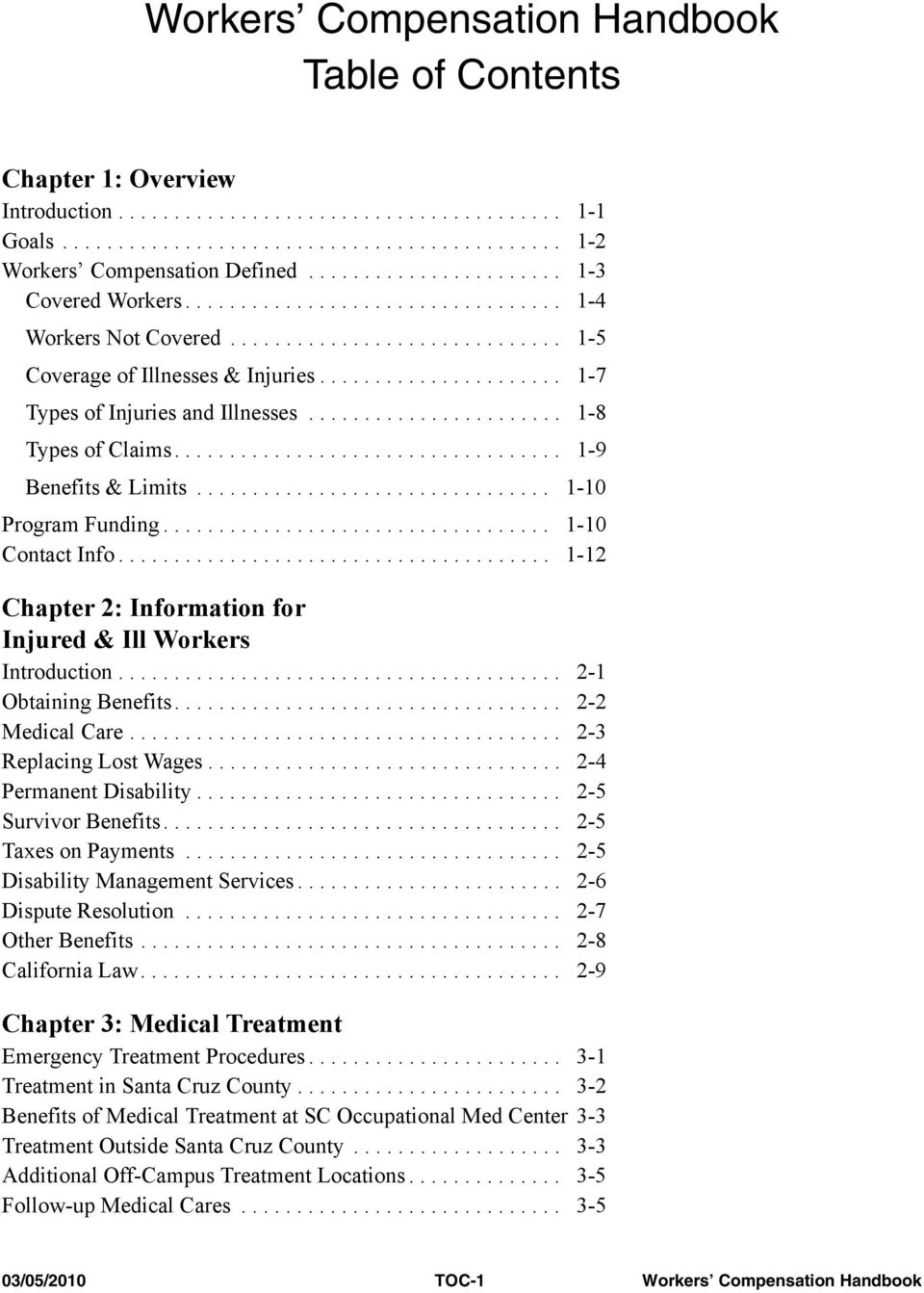
4 Predesignation of Physician Changing Treating Physician Chapter 4: Claim Processing Introduction Reporting Job-related Injuries and Illnesses Forms Claim Process Possible Claim Outcomes Chapter 5: Disabled Workers Benefits Introduction Temporary Disability Benefits Options for Supplementing TD Option One Option Two Option Three Family Medical Leave (FMLA) Eligibility Extended Sick Leave Benefits UC Retirement Benefits Summary UCSC s Pay Process Coordination of Benefits Chapter 6: Returning to Work Introduction Contact During Injury or Illness Stay at Work/Return to Work Process Permanent Disability Disability Management Services The Process Additional UC Services Special Selection Services Chapter 7: Injured Volunteers Introduction Requirements of Departments Utilizing Volunteer Services Contact During Injury or Illness Return to Work Process Workers Compensation Handbook TOC-2 03/05/2010

5 Chapter 8: Responsibilities Introduction Employee Responsibilities Supervisor Responsibilities Santa Cruz Occupational Medical Center (SCOMC) Dominican Hospital Emergency Department Cowell Student Health Center Personal Physician/Health Care Provider Risk Services Environmental Health and Safety Office Sedgwick Claims Management Services Staff/Academic Human Resources Payroll Office Fire and Police Departments Disability Management Services Benefits Office Employee Assistance Program (EAP) Equal Employment Opportunity Office Labor Relations Office Ombudsman Glossary G-1 Index I-1 03/05/2010 TOC-3 Workers Compensation Handbook

6 This page available for your notes. Workers Compensation Handbook TOC-4 03/05/2010

7 CHAPTER 1 Overview

8 Chapter 1 Overview Introduction California's workers compensation law, passed by the state Legislature more than 90 years ago, guarantees prompt, automatic benefits to workers injured on the job. This handbook describes the Workers Compensation process, providing information needed to handle Workers Compensation cases. The material has been divided into the following chapters: 1. Chapter 1 contains an overview of what workers compensation is, who is covered and who is not covered, as well as a listing of types of injuries and types of claims. Additionally, the source of UCSC s workers compensation program funding is described and contact information for the administration of workers compensation claims is provided. 2. Chapter 2 is written to injured and ill workers - to describe the process of obtaining care. Available workers compensation services are described in detail, as well as the processes to use to obtain these services. 3. Chapter 3 provides the locations for obtaining both initial and follow-up medical care, along with information about physician choices. 4. Chapter 4 describes to supervisors how to process a claim, and provides information about possible outcomes of claims. 5. Chapter 5 describes benefits available for injured or ill employees who lose more than three days from work. 6. Chapter 6 describes considerations to be made for an employee returning to work after a work-related illness or injury. 7. Chapter 7 describes the process of providing care and benefits for covered volunteers who become ill or injured while volunteering on campus. 8. Chapter 8 describes the roles and responsibilities of various members of the campus community with regard to workers compensation. Additionally the Glossary includes acronyms and an Index can help readers find specific topics of interest. Workers Compensation Handbook /05/2010

9 Goals Goals Gaining knowledge about the workers compensation process will encourage the following outcomes: assurance that an employee who is injured or becomes ill as a result of a work-related injury or illness receives all of his or her benefits, and has the best possible chance of a prompt return to his or her job; a more complete understanding of the role and responsibilities of supervisors as they relate to the Workers Compensation process; more complete University compliance with all applicable State Workers Compensation laws. 03/05/ Workers Compensation Handbook

10 Chapter 1 Overview Workers Compensation Defined If an employee suffers an occupational injury or illness, workers' compensation pays their medical bills and if necessary provides compensation to help replace lost income until they can return to work. An occupational injury (or industrial injury - the terms are used interchangeably) is any injury, illness, or disease that results from work or working conditions, and that occurs during the employee's service to the employer. Even first-aid type injuries are covered by workers compensation. An example of an occupational injury is an arm broken from falling off a ladder while on the job. An example of an occupational illness is a skin inflammation that results from exposure to chemicals or solvents on the job. Workers compensation is a no-fault system with benefits paid no matter who is at fault. Benefits guaranteed under workers' compensation include the following: Medical care to cure or relieve the effects of the occupational injury; Compensation payments to help replace lost wages; Permanent disability payments to compensate for diminished earning capacity; Supplemental Job Displacement Benefits for help in returning to work; Death benefits paid to surviving dependents. Generally, a claim for workers compensation benefits must be filed within one year of either the date of injury, or for a cumulative injury, within one year from the date the employee suffered a disability or injury and knew, or should have known, the disability or injury was work-related. Workers Compensation Handbook /05/2010

11 Workers Compensation Defined Covered Workers UCSC s Workers Compensation Program provides coverage to the following four groups of people on campus: Employees: Anyone working in California who is paid on the University payroll is covered by the Workers Compensation Program. This includes faculty, staff and student employees; full-time, part-time, and temporary employees; and student research assistants (SRAs) and teaching assistants (TAs) if they are paid with University funds. Qualified out-of-state employees: Employees temporarily working outside of California, and receiving their paycheck from the University of California are covered. For out-of-state employees whose permanent residence and long-term employment are outside of California, the University Unit/Department must complete a Request for Out of State Workers Compensation Coverage form and forward the form to UCSC Risk Services no later than 30 calendar days prior to the employee s start date. The employee s unit will be billed by the Office of the President, Risk Services (OPRS) for the insurance premium. Contracted coverage: any person for whom the University has assumed a contractual obligation to provide workers compensation coverage. All such contracts must have the approval of UCSC Risk Services for coverage to be effective. Qualified university volunteers: a person providing service for the primary benefit of the University may be covered by the Workers Compensation Program if the following conditions are met: Election form: the volunteer has completed a UCSC Volunteer Election of Workers Compensation Coverage form prior to the injury. It is the responsibility of the supervisor to ensure that the election form is signed by the volunteer before they provide any volunteer service for the University. University Supervision: the volunteer must be supervised by a University of California employee whose job duties include volunteer supervision. Volunteer Records: the University Unit/Department for which the volunteer is providing service must have maintained a written record of the dates and times when volunteer services were provided and the duties assigned to the volunteer. These records must be provided to Risk Services upon request. 03/05/ Workers Compensation Handbook
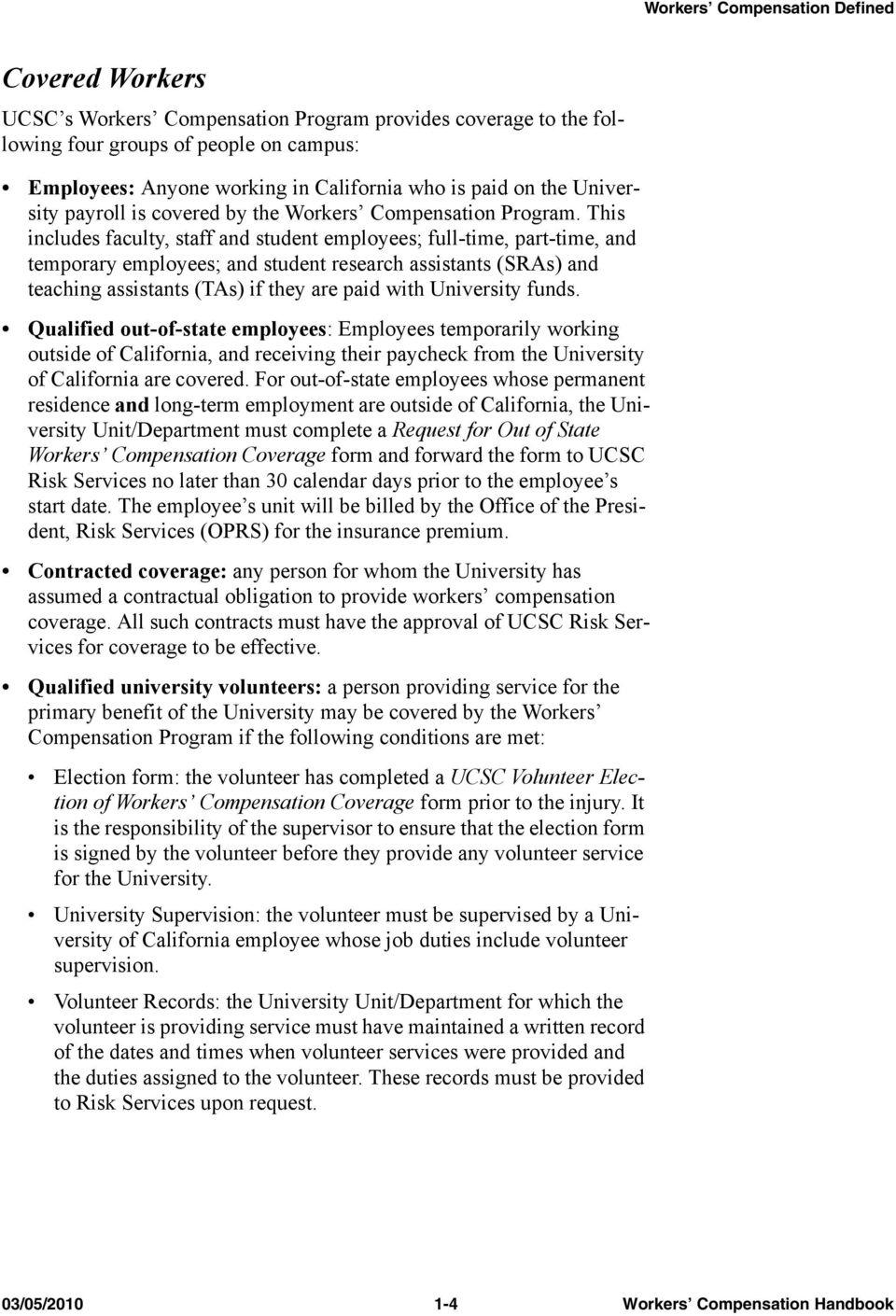
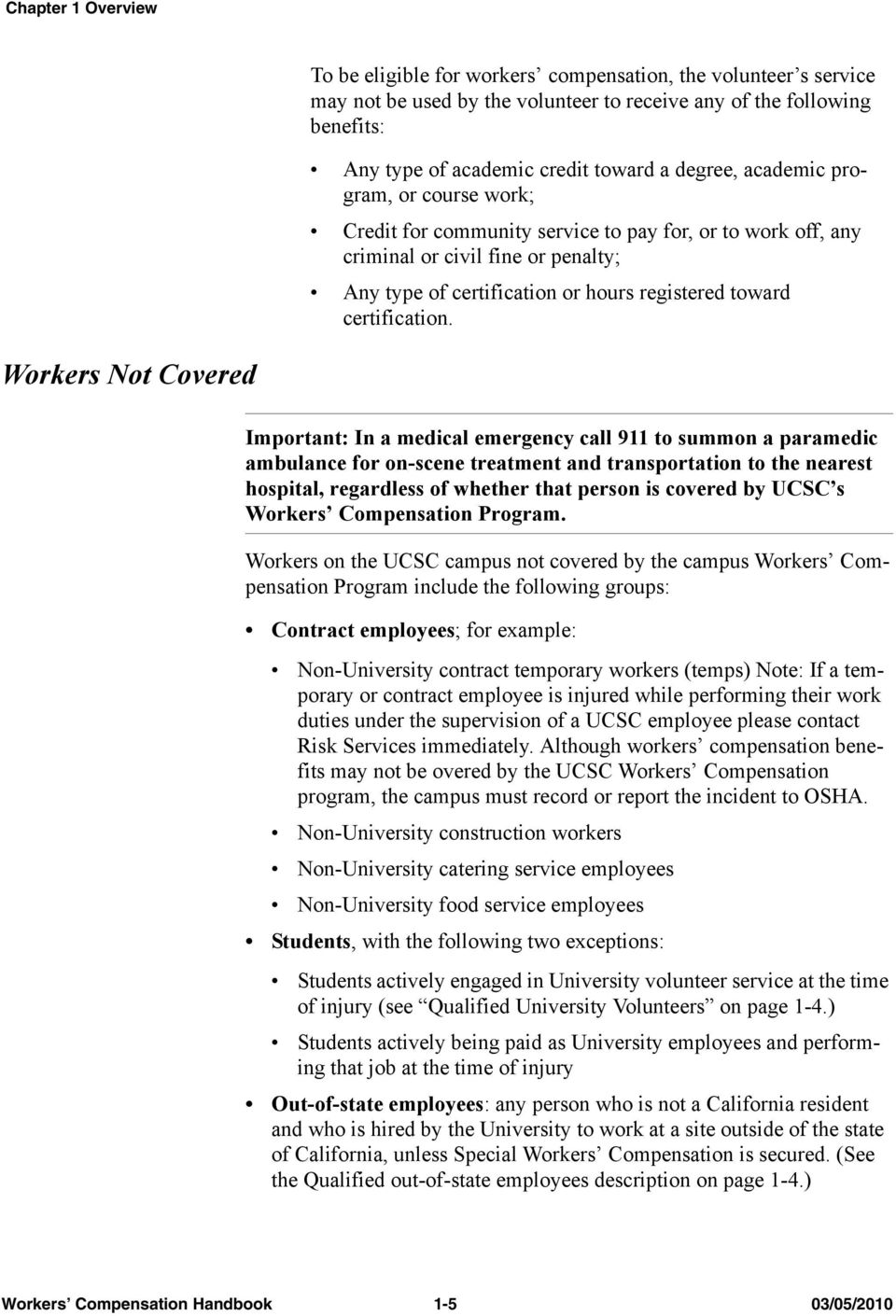
12 Chapter 1 Overview To be eligible for workers compensation, the volunteer s service may not be used by the volunteer to receive any of the following benefits: Any type of academic credit toward a degree, academic program, or course work; Credit for community service to pay for, or to work off, any criminal or civil fine or penalty; Any type of certification or hours registered toward certification. Workers Not Covered Important: In a medical emergency call 911 to summon a paramedic ambulance for on-scene treatment and transportation to the nearest hospital, regardless of whether that person is covered by UCSC s Workers Compensation Program. Workers on the UCSC campus not covered by the campus Workers Compensation Program include the following groups: Contract employees; for example: Non-University contract temporary workers (temps) Note: If a temporary or contract employee is injured while performing their work duties under the supervision of a UCSC employee please contact Risk Services immediately. Although workers compensation benefits may not be overed by the UCSC Workers Compensation program, the campus must record or report the incident to OSHA. Non-University construction workers Non-University catering service employees Non-University food service employees Students, with the following two exceptions: Students actively engaged in University volunteer service at the time of injury (see Qualified University Volunteers on page 1-4.) Students actively being paid as University employees and performing that job at the time of injury Out-of-state employees: any person who is not a California resident and who is hired by the University to work at a site outside of the state of California, unless Special Workers Compensation is secured. (See the Qualified out-of-state employees description on page 1-4.) Workers Compensation Handbook /05/2010
13 Workers Compensation Defined Any other person, such as a campus visitor, who is not included in the list of Covered Workers on page 1-4. If a person who is not covered by the campus workers compensation is injured on the job, they need to contact their supervisor to obtain directions for medical care. 03/05/ Workers Compensation Handbook
14 Chapter 1 Overview Coverage of Illnesses & Injuries To be covered by workers compensation, an employee must have incurred some injury or illness that is job related, as opposed to a mere exposure. For example, incidental contact with asbestos is not an injury for the purposes of a workers compensation claim. The injury or illness must arise out of employment (AOE) and occur during the course of employment (COE) to be covered under Workers' Compensation. For example, if a warehouse employee injures himself while stacking boxes, s/he would meet the test for both AOE and COE. The injury would have arisen out of his employment (stacking boxes) and would have occurred during the course of his employment (while working as a warehouse clerk.) Note: If a work injury causes a second injury, that second injury will also be covered under workers' compensation. A claim will likely be accepted if the service being performed by the employee or eligible volunteer at the time the injury occurred meets all of the following criteria: For the benefit of UCSC Within work hours On UCSC's premises or out of town or off-campus conducting University business During reasonable time and space margins (Employees are covered during a reasonable period of time immediately before and after their shift. For example, if an employee who works from 8 am to 5 pm comes in at 7:45 am to make coffee for the office and burns their arm, s/he would likely be covered.) Workers Compensation Handbook /05/2010
15 Workers Compensation Defined A claim will most likely be denied if injuries occurred in one or more of the following situations: Normal commute Recreational activity that is not required by employer Horseplay Intoxication Self-inflicted injury Initial physical aggressor - The injuries of the person who starts a fight are not covered. Non-industrial medical conditions - such as the flu, seizures or injuries caused by non-work activities. Types of Injuries and Illnesses Injuries can be categorized in the following four ways: 1. Specific incident: a single injury to one or more parts of the body resulting from a specific incident. Examples are injuries resulting from a slip and fall, from breaking a glass beaker, or from lifting several heavy boxes. 2. Cumulative injury: an injury resulting from repetitive traumatic activities over a period of time. Examples are loss of hearing from repetitive loud work-related noises or overuse syndrome from repetitive use of a computer keyboard. 3. Occupational disease: a disease that is directly related to a person's work and develops over time, such as asbestosis, which results from an employee's long term exposure to asbestos. 4. Aggravation of a pre-existing condition: if employment aggravates a pre-existing condition, the employer could be liable for the portion of treatment due to the aggravation. The employer provides medical treatment until the employee returns to their pre-aggravation status. 03/05/ Workers Compensation Handbook

16 Chapter 1 Overview Types of Claims Workers Compensation claims are divided into the following four types:. 1. Incidents: no medical treatment is required. The UCSC Report of Injury to Employee form is retained in UCSC Risk Services. 2. First Aid: a situation where the employee only requires one-time first-aid treatment for the injury. The injury must be minor in nature, such as scratches, cuts, burns, splinters, or other minor work-related injuries. No time is lost beyond the day of the injury. If the attention of a medical professional is needed, these cases should be seen at the Santa Cruz Occupational Medical Center. See Treatment in Santa Cruz County on page 3-2 for contact info for SCOMC. 3. Medical Only: these claims involve only medical payments for examinations and/or treatment rendered. The injured employee has not lost more than three calendar days from work and is not receiving any other Workers Compensation benefits as a result of the injury or illness. If the employee eventually misses more than three calendar days from work due to the work-related injury or illness, the claim converts to an indemnity claim. These workers also need to go to Santa Cruz Occupational Health Center. See Treatment in Santa Cruz County on page 3-2 for contact info for SCOMC. 4. Indemnity Claim (Lost Time): these claims involve Temporary Disability payments because an employee has lost more than three calendar days from work as a result of the occupational injury or illness. Time lost is confirmed by a medical disability slip. Medical reports from various physicians may need to be interpreted so that all applicable benefits are coordinated. Workers Compensation Handbook /05/2010
17 Workers Compensation Defined Benefits & Limits The California Labor Code requires that employers carry Workers Compensation Insurance and sets limits and benefits as outlined below: 1. Medical Treatment: An ill or injured employee is entitled to reasonable treatment to cure or relieve the effects of the work-related injury or illness. 2. Temporary Disability (TD): Money may be paid to an employee who is temporarily unable to work because of an industrial injury/illness. Temporary disability is paid until the employee s medical condition is resolved or is determined to be Permanent and Stationary (P&S). 3. Permanent Disability (PD): Once the injured worker is permanent and stationary, any remaining disability which reduces the employee s ability may entitle the employee to a Permanent Disability rating, which results in a monetary payment as compensation. 4. Vocational Rehabilitation (VR) (for injuries incurred prior to ): When the employee is unable to return to regular job duties as a result of his/her job injury, the employee will be contacted by the Vocational Rehabilitation Counselor. The VRC will assist the employee in possible work modification, or a formal training program and placement assistance into a new, more appropriate line of work. The VR contact number is or [email protected]. 5. Supplemental Job Displacement Benefit: (for injuries incurred on or after ) When an employee has sustained a work injury resulting in permanent disability and the employee is unable to return to work as a result of their disability, the employee may be entitled to a non-transferable voucher for education-related training or retraining. 6. Survivor Benefits: Money is payable to the qualified dependents of an employee who dies as a result of an industrial injury. 03/05/ Workers Compensation Handbook

18 Chapter 1 Overview Program Funding The University pays its own Workers' Compensation benefits. There is no insurance carrier. Costs associated with claims and the management of the program are paid through Sedgwick CMS out of a trust fund into which each campus contributes premiums. Premium payments made into the trust fund are based on the payroll, loss experience, and future loss projections associated with each campus. Within the UCSC campus, cost centers are assessed a certain amount per $100 of salary for each employee in the department. Funding for this program is a departmental expense. Department managers and supervisors play a key role in controlling departmental costs by providing a safe work environment for employees and responding promptly when injuries occur. Workers Compensation Handbook /05/2010
19 Contact Info Contact Info Sedgwick Claims Management Services (Sedgwick CMS) is the UCSC Workers' Compensation Claims Administrator. They will provide any medical or compensation benefits an injured worker is entitled to receive. If you have any questions, contact Sedgwick CMS or the UCSC Risk Services. Sedgwick CMS P.O. Box 2063 Oakland, CA Tel. (510) Fax (510) UCSC Risk Services 1156 High Street - Barn H Santa Cruz, CA (831) (831) (Fax) 03/05/ Workers Compensation Handbook
20 Chapter 1 Overview This page available for your notes. Workers Compensation Handbook /05/2010

21 CHAPTER 2 Information for Injured & Ill Workers
22 Chapter 2 Information for Injured & Ill Workers Introduction You in this chapter refers to an employee who has a work-related injury or illness. The following topics are covered in this chapter: How to obtain benefits Available medical care Temporary disability to replace lost wages Permanent disability benefits Death benefits payable to surviving dependents Taxes on payments Disability Management Services Dispute resolution options Other benefits, such as SDI and UPD California law regarding fraudulent Workers' Compensation claims Workers Compensation Handbook /05/2010
23 Obtaining Benefits Obtaining Benefits You must report your injury or illness to your supervisor or employer immediately. You will be given a form titled Employee's Claim for Workers' Compensation Benefits (DWC-1) if your injury or illness requires medical treatment beyond first aid or it results in lost wages beyond the date of injury or illness. ( First aid means any one-time treatment of minor scratches, cuts, burns, splinters or other minor work injury.) The claim form will be provided by the UCSC Office of Risk Services (for the address and phone number see Contact Info on page 1-12). The claim form will ask what, where, when and how the injury or illness happened. The key to ensuring your rights is prompt reporting of the injury. Your department or UCSC Risk Services, along with Sedgwick CMS, will see that you get medical help if needed, and make sure the necessary reports are filed. Remember, prompt reporting is the key. Benefits are automatic, but nothing can happen until your employer knows about the injury, no matter how slight. 03/05/ Workers Compensation Handbook
24 Chapter 2 Information for Injured & Ill Workers Medical Care Good medical care is important - and quality medical treatment can support your quick recovery. Benefits include not only payment of doctor's bills, but also prescriptions, hospital costs, fees for lab tests, x-rays and even travel expenses. There is no deductible, so an injured or ill worker should never see a bill. If you become injured at work and believe you need treatment, GET MED- ICAL CARE IMMEDIATELY. See Chapter 3 "Medical Treatment" for details about locations that provide care. If you have a special medical problem, you may be referred to a local medical specialist, who has expert knowledge of your specific injury. In addition, UCSC designated physicians will be familiar with workers' compensation requirements and will report promptly so your benefits are not delayed. You are entitled to be treated by your own personal physician if you've notified the University of the doctor's name and address in writing before the injury. (Your personal physician is one who has treated you in the past and maintains your medical records.) You may contact UCSC Risk Services for details on pre-injury physician designation. See Predesignation of Physician on page 3-6. If you haven't predesignated a physician prior to the injury, you may switch to your own doctor after the employer's medical control expires (following the first 30 days of treatment). If you want to change doctors for any reason, ask UCSC Risk Services or contact Sedgwick CMS, who will provide you with a choice of other doctors. (See Contact Info on page 1-12.) You should report any desire for change of physician immediately so that your bills can be properly considered for payment. Workers Compensation Handbook /05/2010
25 Replacing Lost Wages Replacing Lost Wages Temporary disability benefits are paid to you if your physician certifies that your illness or injury causes you to lose time from your regular job and suffer a loss of wages because no temporary alternative assignment was available. These benefits are not paid the first three days you're unable to work unless you're hospitalized as an in-patient or are unable to work for more than 14 days. In these two instances, even the three-day waiting period will be paid. Temporary disability payments are generally two-thirds of your actual wages subject to a minimum and maximum set by the state Legislature. For injuries occurring on of after January 1, 2008, the maximum payment is $ per week. Your first temporary disability check should be mailed within 14 days of disability. These payments will be sent every two weeks until the doctor releases you to return to work. The University may have supplemental benefits available to you contingent upon receipt of temporary disability benefits. Contact UCSC Risk Services for additional information. Also, see Options for Supplementing TD on page 5-2 for calculations of supplemental benefits. In an effort to facilitate your recovery and return you to full duties, your doctor may return you to a part-time work schedule. In that case, partial temporary disability or wage loss benefits may be payable to you - subject to the same minimum and maximum limits. Your doctor may also return you to work with temporary restrictions on your work activities. Take any written instructions from your doctor to your supervisor so that you can assure the modified work meets the doctor's specifications. Sedgwick CMS and UCSC Risk Services will work closely with the doctor and supervisor to accommodate any restrictions. 03/05/ Workers Compensation Handbook
26 Chapter 2 Information for Injured & Ill Workers Permanent Disability Survivor Benefits Taxes on Payments After you recover to the fullest extent possible, the doctor who treated you will determine if there are any permanent or lasting effects of your injury. You and the University may agree to rely on your treating doctor's report to establish if there are any permanent disability benefits due. If you have questions about the report, you may contact Campus Risk Services for assistance. If you don't agree with your doctor s report and are not represented by an attorney, you may choose an evaluating doctor from a panel list of three independent doctors provided by the state. If you are represented by an attorney, and you don't agree with your doctor's report, the attorney will arrange the medical evaluation. Your permanent disability benefits will be based on the results of the doctor's evaluation and such factors as your age and pre-injury occupation. The limits vary according to the date of injury and level of disability and are set by the State legislature. If you have any permanent disability, the benefits calculation will be fully explained in a letter from Sedgwick CMS. Death benefit payments to survivors are set by state law according to the number of dependents. Payments are made at the same rate as temporary disability benefits. Burial expenses are also included, not to exceed $5,000. Workers' compensation payments are tax free. There are not deductions for state or federal taxes, Social Security, union or retirement contributions, etc. Workers Compensation Handbook /05/2010
27 Disability Management Services Disability Management Services If the injury keeps you from returning to your regular work permanently, the University will advise you if your regular job can be modified or another position can be provided to accommodate your permanent limitations. Many employers are subject to the Americans with Disabilities Act or the Fair Employment and Housing Act. An employer subject to these laws must provide reasonable accommodations to qualified disabled individuals who would then be able to perform all the essential job functions. If you are not able to return to your regular job because of a disability, you may have rights under these laws. For more information call the Disability Management Coordinator at or [email protected]. You may also call the Equal Employment Opportunity Commission at If you can't return to your work with the University because of your disability, you may qualify for vocational rehabilitation benefits or a supplemental job displacement benefit. The Disability Management Coordinator will work with you to assist you in obtaining any needed services. Contact Sedgwick CMS to discuss benefits to which you may be entitled if you are unable to return to your regular work as a result of your injury. 03/05/ Workers Compensation Handbook
28 Chapter 2 Information for Injured & Ill Workers Dispute Resolution If you have additional questions regarding your workers' compensation benefits, contact Sedgwick CMS or UCSC Risk Services. Both resources are here to help you obtain all the benefits you are legally entitled to under the Workers' Compensation system.if you still have questions, you may phone the nearest office of the state Information and Assistance Officer. They will inform you of your rights and, if necessary, will provide you with a full review of your claim for compensation. The information and assistance service is free. For the nearest office check the State Government Offices section of the phone book under Industrial Relations Department or call Occasionally an issue may need to be resolved by the Workers' Compensation Appeals Board, the state agency responsible for handling disputes. The Appeals Board is a court of law. You can represent yourself or you may want to hire a lawyer. If you hire an attorney, his or her professional fees will be deducted from any benefits awarded to you by the Appeals Board. Please be aware that to pursue your claim further, you have five years from the date of injury or one year from the last provision of benefits, whichever is longer. California law prohibits discrimination against employees who file, intend to file, or settle a workers' compensation claim, or because they testify for a co-worker who was injured. The California Fair Employment and Housing Act (FEHA) prohibits discrimination or harassment based on a person's physical or mental disability. The federal Americans with Disabilities Act (ADA) prohibits discrimination against qualified individuals with disabilities. Additional information on the ADA and the FEHA is available from the campus Disability Management Coordinator as well as from the Information and Assistance Office. Workers Compensation Handbook /05/2010
29 Other Benefits Other Benefits In addition to workers' compensation benefits, you may be eligible for Social Security benefits. For information, contact the nearest office of the Social Security Administration. You can locate the number in the phone book under United States Government Offices. Workers' compensation sometimes is confused with another state program, State Disability Insurance (SDI). They seem similar, but there are important differences. Workers' compensation takes care of on-the-job injuries and illnesses, and is paid for by your employer. SDI covers off-the-job injuries or sicknesses and is paid for by employees. University of California employees are not eligible for SDI due to their UC employment. However, SDI may be applicable in the first eighteen months of UC employment and would be based on your previous employment. However, if you have a second job not connected with the University, you may also be covered under SDI. The University of California provides a University-Paid Disability insurance plan (UPD) to eligible employees for non-industrial disabilities. The University also makes available an Employee-Paid Disability insurance plan (EPD) which supplements both UPD and Workers' Compensation benefits for temporary and long-term total disability. In the event your workers' compensation disability benefits are delayed for information gathering or medical clarification purposes, you may be eligible for one of these programs during the period of delay. This period should not exceed 90 days. If you need assistance with your University benefits and related procedures arising from your Workers' Compensation claim, contact UCSC Risk Services - Barn H at (831) /05/ Workers Compensation Handbook
30 Chapter 2 Information for Injured & Ill Workers California Law Important: WORKERS' COMPENSATION FRAUD IS A FELONY. Anyone who knowingly files or assists in the filing of a false workers' compensation claim may be fined up to $50,000 and sent to prison for up to five years (LC ). Workers Compensation Handbook /05/2010
31 CHAPTER 3 Medical Treatment
32 Chapter 3 Medical Treatment Emergency Treatment Procedures Important: For a significant or life-threatening emergency, dial 911 and provide initial first aid until rescuers arrive. Do not be concerned with immediately providing the usually required workers' compensation forms to a severely injured employee - speedy medical treatment for severe injuries is the University's primary goal. Prompt medical care is essential to a quick recovery from an injury or illness. Quality medical care and medical follow up can often mean the difference between complete recovery from an injury or illness or lasting physical disability. If an employee is severely injured at work, he or she needs to receive medical care immediately. It is the responsibility of the employee's supervisor to ensure proper medical treatment is obtained. Once a supervisor become aware that an employee has experienced an industrial injury or illness and wishes to be treated by a physician, they must send him or her for medical treatment. In the case of a serious occupational injury requiring 911 response for emergency medical treatment, the supervisor must immediately notify campus Environmental Health & Safety and UCSC Risk Services at , or if no answer then Workers Compensation Handbook /05/2010
33 Treatment in Santa Cruz County Treatment in Santa Cruz County Important: For a significant or life-threatening emergency, dial 911 and provide initial first aid until rescuers arrive. If the injury or illness is not life threatening, the employee should go to the following location for examination and treatment: Santa Cruz Occupational Medical Center (SCOMC) 610 Frederick Street Santa Cruz, CA :30 a.m. to 5:30 p.m. Monday through Friday, except holidays If SCOMC is closed, and an employee needs immediate medical attention, the employee should be directed to the following location: Dominican Hospital Emergency Department 1550 Soquel Drive Santa Cruz, CA (831) Employees treated at the Dominican Emergency Department should obtain any follow-up care at SCOMC. Important: If an injured or ill employee prefers not to seek medical care, they may inform their supervisor of this choice. The supervisor can then assure them of their right to see a doctor for this injury or illness at a later time and be eligible for workers compensation, if they determine that a medical examination is needed. The supervisor is responsible to report the incident. To assure timely reporting you may report the incident by telephone at However you must also complete and submit both the UCSC Incident Report, and a Supervisor s Incident Investigation Form even if reporting the incident by telephone. Cowell Student Health Center no longer provides medical or first aid treatment for occupational work injuries (including work injuries involving student employees). If an employee has a predesignated personal physician for treatment of occupational injuries, he or she may be treated by their own physician (M.D. - Medical Doctor or D.O.- Doctor of Osteopathic Medicine) only. The completed physician pre-designation form must be on file in the Risk Services Office prior to the date of injury. If the employee has designated a chiropractor as their predesignated medical provider for industrial injury, 03/05/ Workers Compensation Handbook
34 Chapter 3 Medical Treatment the employee must first be seen at Santa Cruz Occupational Medical Center or other UCSC designated medical treatment facility for the initial visit. If after the initial visit, the employee wishes to be seen by their predesignated chiropractor, they must then request a change of physician via their claims administrator at Sedgwick CMS. This is in accordance with California Labor Code Section Note: Not all predesignated physicians will provide treatment under the workers compensation system. If the employee encounters this situation, refer him or her to SCOMC. Benefits of Medical Treatment at Santa Cruz Occupational Medical Center (SCOMC) Several benefits are available to workers who obtain treatment at Santa Cruz Occupational Medical Center (SCOMC). These include the following: Doctors experienced in treating work-related injuries Easy access to quality medical specialists (including chiropractic care) if required Familiarity with UCSC workplaces and job requirements Better coordination of return to work plans Doctors who understand reporting standards required by the Workers Compensation system Benefit payments are not delayed due to inadequate or lack of reporting by the physician The doctors are willing to treat Workers Compensation (WC) claims (some doctors refuse to treat WC patients). Workers Compensation Handbook /05/2010
35 Treatment Outside Santa Cruz County Treatment Outside Santa Cruz County Important: For a significant or life-threatening emergency, dial 911 and provide initial first aid until rescuers arrive. For non-emergency injuries, the employee should notify their supervisor who can then authorize treatment at SCOMC or a local clinic or urgent care facility if distance is a significant factor. Employees who reside in Santa Cruz County, should have any follow-up care at SCOMC. 03/05/ Workers Compensation Handbook
36 Chapter 3 Medical Treatment Additional Off-Campus Treatment Locations UCSC employees who do not work in Santa Cruz County may receive treatment at the following locations: Santa Clara US Health Works Medical Group 988 Walsh Avenue Santa Clara, CA Hours: 7 am - 7 pm Monday through Friday Cupertino Santa Clara Kaiser Department of Occupational Health North Wolf Road Suite SW1-190 Cupertino, CA Hours: 8 am - 8 pm Monday & Wednesday, 8 am - 6 pm Tuesday and Thursday, 8 am - 5 pm Friday Monterey County Follow-up Medical Cares Workwell Health Services 680 East Romie Lane Salinas, CA Hours: 8 am to 6 pm Monday through Friday An employee may continue treatment with SCOMC or with the employee's predesignated physician during the entire course of medical care. If the employee has a special medical problem, SCOMC or the employee's predesignated physician will refer the employee to a medical specialist with prior authorization from Sedgwick CMS. Sedgwick CMS will pay for all medical care necessary to cure or relieve the effects of the work-related injury or illness, including physician s visits, hospital costs, and supplies. There is no deductible under Workers Compensation. Payments are made directly to the health care provider, avoiding out of pocket costs to the employee. Workers Compensation Handbook /05/2010
37 Predesignation of Physician Predesignation of Physician For those employees who want to be treated by their own physician for a work related injury, a Designation of Physician form must be on file in UCSC Risk Services before the injury or illness occurs. If an employee does not file a designation, the University will designate the provider of his/her medical care for at least the first thirty days after the reported injury. An employee who chooses to predesignate a physician, must designate a physician who has treated him/her in the past, has agreed in advance by signature to treat the employee for a work-related injury or illness, and has the employee s medical records. The Designation form allows treatment for the entire period of the injury or illness, including the 30 day period immediately after the injury or illness is reported. However, if the employee has designated a chiropractor as their predesignated medical provider for workers compensation, the employee must first be seen at Santa Cruz Occupational Medical Center or other UCSC-designated medical treatment facility for the initial visit. The employee must then request a change of treating physician to their predesignated chiropractor. Note: Not all physicians will provide treatment for work-related injuries. It is incumbent upon the employee to have their physician of choice agree by signature on the predesignation form that they will agree to treat the employee for a work-related injury or illness. Designation forms may be obtained from UCSC Risk Services. Changing Treating Physician If the employee did not formally predesignate a physician, they may choose their own treating physician thirty (30) days after reporting the injury or illness to the University. Employees should report any request to change in treating physician to Sedgwick CMS as soon as possible so that medical bills can be properly considered for payment. A workers compensation legal provision specifies a single change of treating physician during the course of one claim. 03/05/ Workers Compensation Handbook
38 Chapter 3 Medical Treatment Workers Compensation Handbook /05/2010
39 CHAPTER 4 Claim Processing
40 Chapter 4 Claim Processing Introduction This chapter provides information for supervisors about the processes and expectations for filing claims for injured and ill workers. It includes a description of the claim forms and filing process. The different claim outcome possibilities are also described in detail. Reporting Job-related Injuries and Illnesses A worker s supervisor must complete a UCSC Incident Report Form for any of the following occurrences: An employee is examined or treated by a physician for an industrial injury or illness An employee returns to work with a temporary medical restriction due to an industrial injury or illness An industrial injury or illness results in time off after the date of injury An employee requests that an incident report be filed An employee tells you that he or she has been injured or incurred an illness as a result of the job. A State of California workers compensation claim form (DWC-1) will be provided to the employee by the treating physician or by UCSC Risk Services and filed if it is determined by a physician that medical treatment for the injury or illness will extend beyond First Aid Treatment (see Glossary.) The law requires the University to report every such injury or illness to its third party administrator, Sedgwick CMS, so that a determination can be made as to whether or not the injury or illness is compensable under workers' compensation law. The employee's supervisor must report the injury or illness by faxing the completed UCSC Incident Report Form to UCSC Risk Services within 24 hours of the time the employee communicates to their supervisor that he or she has an injury or illness as a result of their University job. Medical treatment must also be offered within the same time period. To assure timely reporting you may report the incident by telephone at However, completion and submission of both the Incident Report Form and Supervisor Incident Investigation Form is necessary when the incident is reported by telephone. Workers Compensation Handbook /05/2010
41 Forms Forms Three forms are necessary for reporting a workers compensation claim: 1. UCSC Incident Report Form 2. UCSC Employee Authorization for Medical Treatment (The Medical Authorization) 3. Supervisor s Incident Investigation and Report of Occupational Injury To assure timely reporting you may report the incident by telephone at However, completion and submission of both the Incident Report Form and Supervisor Incident Investigation Form is necessary even when the incident is reported by telephone. A Worker s Compensation Claim Form will be immediately provided to the employee by the treating physician or Risk Services upon notification by a physician that medical treatment for the injury or illness will extend beyond the definition of First Aid (see Glossary.) 03/05/ Workers Compensation Handbook
42 Chapter 4 Claim Processing Claim Process Within ONE working day of knowledge of injury, FAX the UCSC Incident Report Form to UCSC Risk Services at FAX: Sedgwick CMS manages all University workers' compensation claims. They will investigate the injury and determine compensability of a claim. Reporting an injury or submission of a claim form does not mean automatic approval. Sedgwick CMS will notify the injured employee of the status of the claim within 14 days after they receive it for processing. Some claims require extended investigation to verify compensability. For example, stress claims and cumulative trauma claims such as carpal tunnel syndrome may or may not meet California legal requirements for compensability. Sedgwick CMS may use any of the following procedures to determine compensability when it investigates claims: Interview the employee and supervisor(s) Review relevant sections of the employee s personnel file Talk to coworkers Visit the worksite Obtain and review prior and current medical records to determine whether non-work-related causes exist related to the injury or illness Arrange for expert medical examinations to determine proper diagnosis and care. Workers Compensation Handbook /05/2010
43 Possible Claim Outcomes Possible Claim Outcomes Three distinct responses are possible for each claim filed: 1. The claim is accepted 2. The claim's acceptance or denial is delayed for up to 90 days if more information is required 3. The claim is denied. Process for Accepted Claims Once a claim is accepted, Sedgwick CMS authorizes medical treatment and issues any temporary or permanent disability payments and/or medical payments related to the claim. The funding for these payments is provided by the University's self-insurance program. When an employee is losing time from work for an accepted claim, Sedgwick CMS will begin payment of temporary disability. The check pays two-thirds of the employee's weekly salary up to a maximum amount determined by the State of California. A letter confirming that the claim has been approved will be sent to the employee. The temporary disability check will be mailed to the employee's home. Since the employee's weekly salary is likely to be more than the maximum temporary disability wage, the remainder of the employee's salary may be paid through the UCSC payroll system using accrued sick leave and, if the employee so chooses, vacation. The Payroll Office will issue a check minus the amount already paid to your employee by Sedgwick CMS. There is a 3-day waiting period before the Workers' Compensation temporary disability payments begin. The employee's sick leave and other selected leave balances can be used to cover any lost-time during the first three days after the date of the injury. If the employee does not have sick leave to cover the first three days, the University will pay extended sick leave which equals 80% of the employee's normal wage. 03/05/ Workers Compensation Handbook
44 Chapter 4 Claim Processing Process for Delayed Claims If more time is needed to make a decision regarding acceptance of the claim, Sedgwick CMS will mail a letter to the employee's home stating the date a decision will be made. If the employee is losing time from work while the case is on delay, he or she should apply for other Disability Benefits. Employees should call the Benefits Dept. ( ) to apply for Non- Industrial Disability (paid by Liberty Mutual Insurance Company) during this interim period. Faculty who do not accrue sick leave should request a leave with pay from their department chair, during the delay process. Necessary medical treatment will continue to be provided during the delay period, up to a maximum of $10,000. Once a decision is made on a claim, Sedgwick CMS will inform the employee by mailing a letter to his or her home. The decision on a claim can be delayed for a maximum of 90 days. Process for Denied Claims If a claim is denied, Sedgwick CMS will mail a letter to the employee's home explaining why the claim has been denied. A copy of this letter will also be mailed to UCSC Risk Services. The employee's supervisor may call UCSC Risk Services at at any time regarding the status of a Workers' Compensation claim. An employee has appeal rights in the event that the claim is denied. Specific information on these rights is provided to the employee at the time the claim is denied. Workers Compensation Handbook /05/2010
45 CHAPTER 5 Disabled Workers Benefits
46 Chapter 5 Disabled Workers Benefits Introduction Benefits available for injured or ill employees who lose more than three days from work are described in this chapter. These benefits include the following possibilities: Temporary Disability (TD) Family Medical Leave (FMLA) Extended Sick Leave Benefit (ESL) UC Retirement Additionally, the UCSC Payment Process is described. Workers Compensation Handbook /05/2010
47 Temporary Disability Benefits Temporary Disability Benefits Workers Compensation Temporary Disability (TD) is a cash salary replacement used to assist the temporarily disabled employee in meeting life expenses. The payments normally begin on the fourth day after the injury or illness occurs. If the disability lasts beyond the 14th day, or the employee is hospitalized as an in-patient, the three-day waiting period is waived. Temporary Disability payments are never made for the day of the injury. An employee is eligible for two-thirds of his/her average salary, to a maximum of $ per week. These Workers Compensation benefits will continue until the employee is able to return to work or the medical condition stabilizes. The benefit is tax exempt. Options for Supplementing TD When an injured or ill employee files a workers compensation claim, UCSC Risk Services sends a Claim and Benefits Letter and an Option Form to the employee's address on file with the university. This letter describes the claim process, the benefits available while an injured employee is off work due to the work-related injury, and the employee's options for supplementing their pay up to 100%. See Replacing Lost Wages on page 2-4 for more information about TD payments provided to disabled workers. Two options for supplementing workers compensation payments are available for employees: Vacation and sick leave (Option One) Sick leave only (Option Two) Alternatively a disabled worker may decide not to supplement their TD or may not be eligible to accrue sick leave (e.g., Faculty) (Option Three.) Option Two is the default. To select Option One, the Option Form must be completed and returned to UCSC Risk Services within ten (10) business days. If the employee does not return the Option Form within ten days, the use of sick leave only (Option Two) is automatically selected. Selection of Option One or Option Two will result in the employee receiving two checks for the same period of disability (one from Sedgwick CMS in the amount of 66 2/3% pay and one from UCSC Payroll in the amount of 100% or 80% pay.) An overpayment results from the employee's receipt of both checks, which is reconciled by Risk Services in the form of reimbursement to the employee's sick leave balance for the full amount and value of the temporary disability check. Once sick leave is reimbursed to 03/05/ Workers Compensation Handbook
48 Chapter 5 Disabled Workers Benefits the employee's sick leave balance, Payroll will then deduct the full amount of the temporary disability check from the employee's next UCSC payroll check. Therefore, employees are advised to save (not spend) their temporary disability check from Sedgwick CMS until the affected employee sees the workers' compensation deduction on their UCSC pay stub. Workers Compensation Handbook /05/2010
49 Options for Supplementing TD Option One The injured employee elects to use sick leave and vacation to supplement Workers Compensation benefits. Option One allows a worker to be paid 100% of their regular earnings by using sick leave and vacation to supplement Workers Compensation Temporary Disability benefits. After sick leave and vacation accruals are exhausted, the employee will receive Supplemental Disability benefits from the University for up to 26 weeks, which combined with Workers Compensation Temporary Disability payments, will equal 80% of their regular salary. Supplemental Disability Benefits are also known as Extended Sick Leave Benefits (ESL). Option Two The employee elects to use only accrued sick leave to supplement Workers Compensation benefits. This is the default option. Option Two allows a worker to be paid 100% of their regular earnings by using only sick leave to supplement Workers Compensation Temporary Disability benefits. After sick leave is exhausted, the employee will receive Supplemental Disability Benefits from the University for up to 26 weeks, which combined with Workers Compensation Temporary Disability payments, will equal 80% of their regular salary. Option Three The employee elects not to use sick leave or vacation to supplement Workers Compensation benefits or is not eligible to accrue sick leave (e.g., Faculty). Sick leave or vacation will not be used to supplement temporary disability paid by Sedgwick CMS. The employee will only receive temporary disability checks from Sedgwick CMS with NO Supplemental Disability benefits. For this option, if the employee wants to continue his/her personal health insurance coverage during her/his time off from work, the employee must contact UCSC Employee Benefits at (831) and arrange to pay the full cost of their health care premium directly. No University contributions for medical insurance coverage will be made. For the exception, see the FMLA Leave of Absence Guidelines and Procedures (pdf) (provided by Staff Human Resources). 03/05/ Workers Compensation Handbook
50 Chapter 5 Disabled Workers Benefits Workers Compensation TD compensation is payable to a maximum of $ a week or up to two-thirds of the employee s salary, whichever is less. Workers Compensation Handbook /05/2010
51 Family Medical Leave (FMLA) Eligibility Family Medical Leave (FMLA) Eligibility It is the policy of the University of California to provide family and medical leave to eligible employees in accordance with the federal Family and Medical Leave Act of 1993 (FMLA). Departments are required to place their eligible employees on Family Medical Leave (FMLA). As soon as an employee misses more than three days of work due to an industrial injury, supervisors should contact the injured employee s HR Service Team ( to begin the process of placing the injured employee on FMLA. 03/05/ Workers Compensation Handbook
52 Chapter 5 Disabled Workers Benefits Extended Sick Leave Benefits UC Retirement (Supplemental Workers Compensation Benefits) Because workers compensation temporary disability (TD) provides compensation for only a portion of an injured employee s lost wages, the University provides an Extended Sick Leave Benefit program (ESL; also called a Supplemental Benefit.) For qualified employees (e.g. full or part time employees in classifications which earn sick leave and vacation, if the employee selected either Option One or Option Two and has exhausted all sick leave and/or vacation, the employee automatically receives ESL. The ESL benefit is paid for a maximum of 26 weeks for each injury. (See Options for Supplementing TD on page 5-2.) The ESL benefit supplements the injured employee s workers compensation TD benefits to 80% of regular earnings for up to 26 weeks after the sick (or sick and vacation) accruals are exhausted. Employees electing not to use their sick leave accruals (Option Three) and employees who do not earn sick leave, are not eligible for Extended Sick Leave (ESL) Benefits. If the employee is still disabled after the 26 weeks at 80% salary, he/she is eligible for Employee-Paid Disability (EPD) benefits (paid by Liberty Mutual) if enrolled. This benefit will supplement the Workers Compensation payments to a maximum of 70% of the employee s regular salary (to a maximum of $10,000 per month). One month prior to the ending of the ESL benefit, UCSC Risk Services will send a letter notifying the employee, Staff Human Resources, and the employee s home department, of the exact date that the ESL benefit will end. The letter advises the employee to contact the Benefits department to arrange payment for the employee s benefit plans. The Benefits department will assist employees in continuing coverage for all employee benefit plans available to them. Note: ESL is not provided to classifications of employees who do not earn sick leave and vacation or for Firefighters and Police (who have an alternate benefit. See Fire and Police Departments on page 8-14.) Full UC retirement service credit will be earned while receiving 100% pay. Service credit will be earned at 80% while on ESL. No retirement service credit is earned while on leave-without-pay and receiving TD and PD benefits. If an employee goes on leave-without-pay, they are responsible for direct payments to the Benefits Office for all benefits premiums (except Medical) after the 80% ESL is exhausted. Workers Compensation Handbook /05/2010
53 Benefits Summary Benefits Summary Table 1. Benefits Summary Option 1 Option 2 Option 3 Description Employee chooses to use accrued sick leave (SL) and vacation leave (VL) to supplement TD payments. Employee chooses to use only accrued sick leave (SL) to supplement TD payments. Employee chooses not to use accrued sick leave (SL) or vacation leave (VL) or does not accrue either. (Casual employees may not receive all benefits listed.) Compensation (TD = 66 2/3% gross salary to a maximum of $ per week.) 100% gross salary: TD+ SL/VL = 100% (2 checks) 80% gross salary: After SL/VL is exhausted, TD+UC salary check = 80% gross salary. UC check for Extended Sick Leave (ESL) continues up to 26 weeks (2 checks). TD+ SL = 100% (2 checks). 80% gross salary: After SL is exhausted, TD+UC salary check =80% gross salary. UC check for Extended Sick Leave (ESL) continues up to 26 weeks (2 checks). 66 2/3% gross salary: TD check only. (Any UC check received for the same time period is an OVERPAYMENT and must be returned.) 66 2/3% gross salary: TD check only after ESL (80%) benefit ends. The employee is now on Leave Without Pay (LWOP) from department. 66 2/3% gross salary: TD check only after ESL (80%) benefit ends. The employee is now on Leave Without Pay (LWOP) from department. Employee-Paid Disability Benefit (EPD) (If Enrolled) After 80% gross salary ends, EPD + TD = 70% gross salary up to a $10,000 maximum per month. After 80% gross salary ends, EPD + TD = 70% gross salary up to a $10,000 maximum per month. Not eligible. Health Insurance (LWOP - Medical Plan) Both the employee s + UC s contribution continue while on 100% and 80% pay. Both the employee s + UC s contribution continue while on 100% and 80% pay. Must pay full premium to continue coverage. When 80% ends, UC continues contribution provided employee is on Leave Without Pay and receiving TD/VR maintenance allowance. When 80% ends, UC continues contribution provided employee is on Leave Without Pay and receiving TD/VR maintenance allowance. 03/05/ Workers Compensation Handbook
54 Chapter 5 Disabled Workers Benefits Option 1 Option 2 Option 3 Credit for Sick and Vacation Leave At 100% pay, SL/VL is accrued at the normal rate and may be used as earned. At 80% pay, SL/VL is accrued at the normal rate but may not be used until the employee returns to work. If employee terminates, employee will be paid for earned VL. At 100% pay, SL/VL is accrued at the normal rate and may be used as earned. At 80% pay, SL/VL is accrued at the normal rate but may not be used until the employee returns to work. If employee terminates, employee will be paid for earned VL. SL/VL is accrued at the normal rate but may not be used until the employee returns to work. If the employee terminates, employee will not be paid for earned VL. Retirement Benefits (UCRS, PERS) At 100% pay, deduction and service credit continue at the normal rate. At 80% pay, deduction and service credit continue at 80% the normal rate. At 100% pay, deduction and service credit continue at the normal rate. At 80% pay, deduction and service credit continue at 80% the normal rate. The employee must pay both the employee and the UC contribution to continue membership. Voluntary Deductions (Life, Credit Union, etc.) At 100% or 80% pay, deductions continue at normal rate. At 100% or 80% pay, deductions continue at normal rate. Employee must make arrangements to pay directly. After 80% pay ends, employee must make arrangements to pay directly. After 80% pay ends, employee must make arrangements to pay directly. Taxability Sedgwick CMS checks are tax free. Sedgwick CMS checks are tax free. Sedgwick CMS checks are tax free. Workers Compensation Handbook /05/2010
55 UCSC s Pay Process UCSC s Pay Process TD checks are mailed directly from Sedgwick CMS to an injured worker s home address. The employee s department will provide normal salary checks to an employee who is using sick and/or vacation leave. If both the TD & UC checks are cashed, the employee will be OVERPAID. UCSC Risk Services will send paperwork to instruct Payroll to deduct the employee s TD amount from the employee s paycheck. To reconcile, the employee needs to contact UCSC Risk Services at within a week of receiving the first TD check to discuss pay options. Coordination of Benefits Every two weeks, beginning with the first payment of Temporary Disability (TD) benefits by Sedgwick CMS, the employee s Staff/Academic Human Resources Team will receive a Supplemental Workers Compensation Benefits Calculation Instruction Sheet (Instruction Sheet) from Risk Services on how to process the employee pay and the sick leave/vacation used while the employee is on Workers Compensation. These instruction sheets are based on the employee s option choice. 03/05/ Workers Compensation Handbook
56 Chapter 5 Disabled Workers Benefits This page available for your notes. Workers Compensation Handbook /05/2010
57 CHAPTER 6 Returning to Work
58 Chapter 6 Returning to Work Introduction Considerations to be made for an employee staying at work/returning to work after a work-related illness or injury are discussed in this chapter. The topics covered include the following subjects: Guidelines for supervisor contact during a workers lost work time; The process of returning to work, including the time of transition; Permanent disability considerations; Supplemental Job Displacement vouchers. Workers Compensation Handbook /05/2010
59 Contact During Injury or Illness Contact During Injury or Illness Contact between a supervisor and their injured employee is an important part of the injured worker's recovery. The supervisor needs to maintain contact with an employee whose injury or illness results in time away from work. Employees often are concerned about their finances or job security if forced to sit at home. These concerns can interfere with recovery. Employees may also worry that their injury might interfere with their ability to do the job well upon their return. The type, frequency, and content of the contact will vary depending upon many factors, including the type of claim and the prior relationship between the supervisor and the employee. Supervisors can consult with Risk Services personnel regarding the appropriateness of contacting an injured employee. The supervisor plays an important role in the employee s recovery and return to work. Supervisors can help the employee feel respected and needed during their recovery period, in the following ways: Answer employee s questions as quickly and accurately as possible. Keep the employee up-to-date on any departmental and organizational changes in which the employee might be interested. Show interest in the welfare of the employee. Let the employee know that you are interested in his or her recovery and successful return to work. Show your willingness to return the employee to work even though they may still have some work restrictions. EXCEPTION: Contact UCSC Risk Services ( ) prior to any contact with an injured employee who has filed a psychological or stress claim. 03/05/ Workers Compensation Handbook
60 Chapter 6 Returning to Work Stay at Work/Return to Work Process In most cases, the supervisor should know when an employee is expected back to work by keeping in contact with her/him. After missing more than three days of work, the employee must provide the unit with a Release to Return to Work form from the treating physician. This form will indicate whether the employee s medical condition has returned back to normal or identify any restrictions associated with the employee s return to work. The department cannot allow an employee to return to work without first reviewing the Release to Return to Work form. If the employee has been released with temporary restrictions, the supervisor should meet with the employee to determine if a transitional return to work assignment can be provided. The supervisor must inform UCSC Risk Services (X 92850) as soon as the employee returns to work to avoid overpayment of Workers Compensation benefits. Employee s Transition Back to Work Often an employee may be recovered enough to stay/return to work and perform modified duties before full duties can be performed. The employee s supervisor has the responsibility to assist employees in making this transition back to work, even if it means that work assignments must be temporarily adjusted. The employee s treating physician may determine that the employee can remain/return to work with specific restrictions. The physician should give these restrictions to the employee in writing. These written work restrictions must be provided to the department before the employee is allowed to return to work. Typical work restrictions may include: no lifting or bending 25 pound weight limitation limited standing. Workers Compensation Handbook /05/2010
61 Stay at Work/Return to Work Process Supervisors should review the temporary work restrictions with the Transitional Return to Work Coordinator and the employee to avoid any misunderstandings and to decide how the restrictions can best be accommodated. The supervisor and employee should not, however, modify the physician s written work restrictions without consulting the Transitional Return to Work Coordinator who will contact the physician (and/or others) regarding what modifications, if any, can be made. It is important that job assignments stay within the employee s abilities as stated in the restrictions. Sometimes portions of a job can be omitted or assigned to another worker temporarily with lighter modified duties given to the injured worker. At other times, it may be appropriate to assign an injured worker to different duties temporarily. Another option to consider is a simple modification to the work site. A different chair height or rearrangement of a work surface may enable the employee to return to work. The Disability Management Coordinator can provide assistance with temporary work site accommodations. Important: A supervisor can help speed complete recovery by providing the needed modifications, and a quicker return to normal duties is frequently the result. Temporary transitional assignments should be encouraged and allowed where possible. Furthermore, Federal law and personnel policies and collective bargaining agreements all require that efforts be made to provide reasonable accommodation for work restrictions that are considered permanent in nature. 03/05/ Workers Compensation Handbook
62 Chapter 6 Returning to Work Permanent Disability When the effects of an industrial injury or illness cause a permanent loss of earning power, impairment of the normal use of a body member, or a handicap in activities of normal living, there is some permanent disability. Even if an employee is considered to have a permanent disability, he or she may still be eligible to continue University employment at full salary, depending on the type of disability, their restrictions, and occupation. Disability Management Services Disability Management Services assists employees with permanent disabilities to remain functional and employable, return to work, and avoid a long-term disability. Disability Management Services provides a wide range of services designed to assist employees with an effective disability intervention plan, job retention strategies and with job placement assistance. The Disability Management Coordinator creates and coordinates a plan that returns the employee to productive status as soon as possible. The plan may include one or more of the following aspects: Reasonable Accommodation Transitional Employment Procedure Permanent Modified or Alternative Work Analysis Job Analysis: Functional Capacity Evaluation Essential and Marginal Job Duties Work Site Evaluation Coordination Work Adjustment/Work Conditioning Program Coordination Disability Management Services help employees remain at work or return to work in the following instances: Work-incurred injuries covered under Workers' Compensation. Non-work related injuries covered under Employee Paid Disability and University Paid Disability. Long term disability covered under disability retirement University of California Retirement Program (UCRP) Workers Compensation Handbook /05/2010
63 Disability Management Services The Process After 90 days of aggregate Workers Compensation disability, a Job Analysis will often be requested by the Workers Compensation Third Party Administrator. The Disability Management Coordinator will meet with the employee and supervisor to determine the physical demands of the employee s usual and customary job. If the employee is permanently precluded from returning to his or her usual and customary occupation, the employee may be eligible for Supplemental Job Displacement benefits. The benefit provides a voucher for education-related retraining or skill enhancement for injuries that occur on or after January 1, The Disability Management Coordinator will determine the availability of alternative or modified work within 30 days of notification of permanent and stationary status. If the University is able to offer modified or alternative work, it will not be required to provide the Supplemental Job Displacement Benefit. 03/05/ Workers Compensation Handbook
64 Chapter 6 Returning to Work Additional UC Services The following services are also offered in consultation with Human Resources and Disability Management Services: Re-Employment or Re-Appointment (placement assistance) to facilitate rehire; Potential provision of Special Selection services for qualified employees with a disability when the employee is permanently precluded from returning to their work; Provision of Special Re-Employment services for employees who have been medically separated. Special Selection Services Special Selection Services provides a mechanism for eligible employees to be considered for job openings before they are offered to the at-large community. These special selection services are offered to qualified employees with a disability when the treating physician has made the determination that the employee is permanently precluded from their work. This service is offered for a period of 90 days. Emphasis will be placed on the rehabilitation options which are the most cost-effective and least time-consuming (e.g., Retention and Re- Employment). Workers Compensation Handbook /05/2010
65 CHAPTER 7 Injured Volunteers
66 Chapter 7 Injured Volunteers Introduction Covered Workers on page 1-4 describes which University volunteers are eligible for Workers Compensation. Considerations for a volunteer who is injured or becomes ill while working at UCSC are discussed in this chapter. The topics covered include the following subjects: The responsibilities of a supervisor when a volunteer needs medical treatment; Guidelines for supervisor contact during a volunteer s lost work time; The process of returning to volunteering, including the time of transition. Workers Compensation Handbook /05/2010
67 Requirements of Departments Utilizing Volunteer Services Requirements of Departments Utilizing Volunteer Services Election Form on File: A UCSC Volunteer Election of Workers Compensation Coverage form must have been completed and sent to UCSC Risk Services ( ) prior to the injury. It is the responsibility of the supervisor to ensure that the election form is signed by the volunteer before they provide any volunteer service for the University. Report the Injury: In the event a volunteer is injured while performing volunteer service, it is the responsibility of the volunteer s department to perform the following functions: Complete a UCSC Incident Report Form and Supervisor s Incident Investigation Form. Fax these two forms and a copy of the signed UCSC Volunteer Election of Workers Compensation Coverage form to UCSC Risk Services ( ) within two (2) working days of knowledge of the injury. Obtain Required Medical Care: It is the responsibility of the volunteer s University supervisor to direct or transport (as may be required) the volunteer to required medical care. In the event of a serious on-campus injury, call 911 for emergency medical care. All other cases should normally sent to Santa Cruz Occupational Medical Center. After business hours, injured volunteers should be sent or transported (as required) to the Dominican Hospital Emergency Department. All required follow-up medical care will be provided by the Santa Cruz Occupational Medical Center. See Follow-up Medical Cares on page 3-5.s Provide Safety Training & Maintain A Safe Work Environment: It is the responsibility of the volunteer s University supervisor and the volunteer s department or unit to provide the volunteer with all required safety training and protective equipment needed to perform the volunteer s duties. The volunteer s supervisor and department/unit must assure that the volunteer s work area is free of hazardous conditions, and that all volunteers comply with required safety precautions. Contact Info: Any question regarding UCSC s Volunteer Workers Compensation Coverage Program should be directed to UCSC Risk Services ( ). 03/05/ Workers Compensation Handbook
68 Chapter 7 Injured Volunteers Contact During Injury or Illness Contact between a supervisor and their injured volunteer worker is an important part of the injured volunteer s recovery. The supervisor needs to maintain contact with a volunteer whose injury or illness results in time away from work. Volunteers may also worry that their injury might interfere with their ability to do the job well upon their return. The type, frequency, and content of the contact will vary depending upon many factors, including the type of claim and the prior relationship between the supervisor and the volunteer. Supervisors can consult with Risk Services personnel regarding the appropriateness of contacting an injured volunteer. The supervisor plays an important role in the volunteer s recovery and return to work. Supervisors can help the volunteer feel respected and needed during their recovery period, in the following ways: Answer volunteer s questions as quickly and accurately as possible. Keep the volunteer up-to-date on any departmental and organizational changes in which the volunteer might be interested. Show interest in the welfare of the volunteer. Let the volunteer know that you are interested in his or her recovery and successful return to work. Show your willingness to return the volunteer to work even though they may still have some work restrictions. EXCEPTION: Contact UCSC Risk Services (x 92850) prior to any contact with an injured volunteer who has filed a psychological or stress claim. Workers Compensation Handbook /05/2010
69 Return to Work Process Return to Work Process In most cases, the supervisor should know when a volunteer is expected back to work by keeping in contact with her/him. After missing more than three days of work, the volunteer must provide the unit with a Release to Return to Work form from the treating physician before being allowed back to volunteer work. This form will indicate whether the volunteer s medical condition has returned back to normal or identify any restrictions associated with the volunteer s return to work. The department cannot allow any volunteer to return to work without first reviewing the Release to Return to Work form. If the volunteer has been released with restrictions, the supervisor should contact the Transitional Return to Work Coordinator at (831) The Coordinator will review the restrictions and speak with the supervisor to determine if a transitional work assignment can be provided. The supervisor must inform UCSC Risk Services (X ) as soon as the volunteer returns to work. 03/05/ Workers Compensation Handbook
70 Chapter 7 Injured Volunteers Volunteer s Transition Back to Work Often an volunteer may be recovered enough to return to work and perform modified duties before full duties can be performed. The volunteer s supervisor has the responsibility to assist volunteers in making this transition back to work, even if it means that work assignments must be temporarily adjusted. The volunteer s treating physician may determine that the volunteer can return to work with specific restrictions. The physician should give these restrictions to the volunteer in writing. These written work restrictions must be provided to the department before the volunteer is allowed to return to work. Typical work restrictions may include: no lifting or bending 25 pound weight limitation limited standing. Supervisors should review the work restrictions with the Transitional Return to Work Coordinator and the volunteer to avoid any misunderstandings and to decide how the restrictions can best be accommodated. The supervisor and volunteer should not, however, modify the physician s written work restrictions without consulting the Transitional Return to Work Coordinator who will contact the physician (and/or others) regarding what modifications, if any, can be made. It is important that job assignments stay within the volunteer s abilities as stated in the restrictions. Sometimes portions of a job can be omitted or assigned to another worker temporarily with lighter modified duties given to the injured worker. At other times, it may be appropriate to assign an injured worker to a different position temporarily. Another option to consider is a simple modification to the work site. A different chair height or rearrangement of a work surface may enable the employee to return to work. The Disability Management Coordinator can provide assistance with minor work site adjustments. Important: A supervisor can help speed complete recovery by providing the needed accommodations, and a quicker return to normal duties is frequently the result. Temporary transitional assignments should be encouraged and allowed where possible. Furthermore, Federal law and personnel policies and collective bargaining agreements all require that efforts be made to provide reasonable accommodation. Workers Compensation Handbook /05/2010
71 CHAPTER 8 Responsibilities
72 Chapter 8 Responsibilities Introduction The responsibilities of various members of the campus community with regard to occupational injuries are described in this chapter. These lists include both preventive behaviors and process steps for recovery. The responsibilities of individual employees, supervisors, and campus units are provided below. Responsibilities are listed for the following groups of people: Injured or ill employees Supervisors Santa Cruz Occupational Medical Center (SCOMC) Dominican Hospital Emergency Department Cowell Student Health Center Physician/Health Care Provider Risk Services Environmental Health and Safety Office Sedgwick Claims Management Services (Sedgwick CMS) Staff/Academic Human Resources Offices Payroll Office Fire and Police Departments Disability Management Services Benefits Office Employee Assistance Program (EAP) Equal Employment Opportunity Office (EEO) Labor Relations Office Ombudsman Workers Compensation Handbook /05/2010
73 Employee Responsibilities Employee Responsibilities An employee with a work-related injury or illness is responsible for taking the actions described in this section. Also, all employees need to follow the preventative measures described below. Report work-related injuries and illnesses promptly to the supervisor. Note: the employee may also report their incident to the Office of Risk Services if their Supervisor is unavailable. To assure timely reporting the incident may also be reported by telephone at However, completion and submission of both the Incident Report Form and Supervisor Incident Investigation Form is necessary even when the incident is reported by telephone. Cooperate with UCSC s efforts to provide timely, fair, and equitable benefits pursuant to state laws and UC procedures. Comply with all Occupational Safety and Health Standards (OSHA) and campus safety rules, regulations, and orders, which are applicable to your own actions and conduct. Take every reasonable precaution to work in a safe manner and not put yourself or others at risk. Do not remove, displace, damage, destroy, or carry off any safety device, notice, or warning furnished for use in any place of employment or interfere in any way with the use by any other person. Use safety gear provided to you to perform work tasks in a safe manner. Learn about potential job hazards and observe potential warning signs. Immediately provide a doctor s Work Status report and inform your department about any work restrictions and/or capabilities as outlined by your physician when you return to work. Provide your supervisor with a doctor s release to return to work if absent from work more than three (3) days. Participate in modified transitional work assignments. Comply with policy or bargaining agreement terms regarding workers compensation. Maintain and retain a copy of accurate time and attendance records regarding time off work for workers compensation-related absences. 03/05/ Workers Compensation Handbook
74 Chapter 8 Responsibilities Supervisor Responsibilities Supervisors are expected to assure safe work conditions and safe work practices in the workplace. A list of specific responsibilities is provided below. Obtain immediate emergency medical care for serious injuries. Direct injured employees to Santa Cruz Occupational Medical Center (SCOMC), for less than life or limb-threatening injuries (see Treatment in Santa Cruz County on page 3-2.) Provide an injured or ill employee with a UCSC Medical Authorization form immediately if the employee wishes to seek medical treatment for their work-related injury or illness. Formally report the incident to UCSC Risk Services within 24 hours of knowledge of the employee s injury or illness by completing the UCSC Incident Report form. To assure timely reporting the incident may be reported by telephone at However, completion and submission of both the Incident Report form and Supervisor Incident Investigation form is necessary even when the incident is reported by telephone. Note: if an employee, contract worker or volunteer is seriously injured, Risk Services & Environmental Health and Safety must be notified within 8 hours of knowledge so that the University is in compliance with OSHA Reporting Requirements. Examples of serious injuries include: death, dismemberment, loss or partial loss of body parts (including fingers and ears) and hospitalization overnight other than for observation. Request a copy of the doctor s Work Status report from every employee who has been to see the doctor for an occupational injury. This note documents the employee s ability to work and must be provided to the employee by the doctor after every visit. Notify the Academic or Staff Human Resources representative when an employee is off work or returns to work. (The workers supervisor is responsible to ensure that Risk Services, Benefits, Payroll, and Sedgwick CMS are notified. Notify Staff/Academic Human Resources, Risk Services, and Sedgwick CMS when the employee s illness or injury is Permanent and Stationary (P&S). Forward signed time sheets to the employee s Staff/Academic Human Resources Representative. Coordinate personnel actions involving industrially injured employees with Staff/Academic Human Resources, and Labor Relations. Workers Compensation Handbook /05/2010
75 Supervisor Responsibilities Secure appropriate return to work certification from an employee prior to or at the beginning of the shift on date of the employee s return to work. Become knowledgeable about appropriate safety practices and personal protective equipment required by subordinates to safely perform job duties, and reinforce compliance with safety practices and use of personal protective equipment. Attend Workers Compensation training. Review available Safety information. 03/05/ Workers Compensation Handbook
76 Chapter 8 Responsibilities Santa Cruz Occupational Medical Center (SCOMC) Santa Cruz Occupational Medical Center (SCOMC) 610 Frederick Street Santa Cruz, CA :30 a.m. to 5:30 p.m. Monday through Friday, except holidays Santa Cruz Occupational Medical Center agrees to provide the following services for occupationally injured and ill UCSC workers: Provide occupational medical management and treatment; Prescribe occupational therapy and physical therapy when needed; Order on-site ergonomic workstation/workstyle assessments when indicated. Provide specialty referrals for injured and ill employees on an asneeded basis: Medical Specialty consultants Pain Management Program for injections Chiropractic assessment and adjustments Transitional strengthening and conditioning at the UCSC Wellness Center Acupuncture treatments Work with UCSC and Sedgwick CMS to help the injured employee be able to safely return to work as quickly as possible; Review medical status bi-monthly with Sedgwick CMS, Disability Management Coordinator and Risk Services of injured employees being treated by SCOMC; Complete the Doctor s First Report and subsequent work status reports and fax them to Risk Services at and to Sedgwick CMS. Workers Compensation Handbook /05/2010
77 Dominican Hospital Emergency Department Dominican Hospital Emergency Department Dominican Hospital Emergency Department 1550 Soquel Drive Santa Cruz, CA (831) Dominican Hospital Emergency Department agrees to provide care for injured and ill UCSC workers when SCOMC is not open. Their care provider(s) will then complete the Doctor s First Report and identified work restrictions and fax it to Risk Services at and to Sedgwick CMS. Patients will be referred to SCOMC for follow-up visits.s 03/05/ Workers Compensation Handbook
78 Chapter 8 Responsibilities Cowell Student Health Center Cowell Student Health Center no longer provides medical or first aid treatment for occupational work injuries (including work injuries involving student employees). Employees who report to the Cowell Student Health Center with an occupational injury or illness will be referred to Santa Cruz Occupational Medical Center, 610 Frederick Street, Santa Cruz, CA. Under no circumstances should a request for emergency ambulance transport to Dominican Hospital be delayed in order to move a life or limbthreatened employee to the Student Health Center. Cowell Student Health Center may provide only limited emergency interaction to assist in stabilizing an employee with a life or limb threatening work injury while arranging emergency transportation to Dominican Hospital Emergency Department.s Workers Compensation Handbook /05/2010
79 Personal Physician/Health Care Provider Personal Physician/Health Care Provider A health care provider examining and/or treating an employee for a workrelated illness or injury has the following responsibilities: Complete the Doctor s First Report and fax it to Risk Services at and to Sedgwick CMS. Provide information regarding the employee s medical status, physical limitations, anticipated return-to-work date, and prognosis for 100% capacity to perform the essential functions of the job. Participate in the evaluation of physical restrictions. Complete documents verifying date of injury, treatment(s), and anticipated return to work date. Comply with all provisions of the California Labor Code for employeeselected physicians. 03/05/ Workers Compensation Handbook
80 Chapter 8 Responsibilities Risk Services UCSC Risk Services manages the UCSC workers compensation program. Specific responsibilities include coordination, facilitation, analysis, reporting, advising, and providing consultations and training. Specific descriptions are listed below. Coordinate UCSC Workers Compensation Program activities. Process and submit the Employer s Report of Occupational Injury and Illness to Sedgwick CMS. Process sick leave and vacation Extended Sick Leave (ESL) supplement forms. Develop and interpret workers compensation policy and procedures and facilitate understanding of them. Provide interpretation of workers compensation laws, benefits, and regulations. Facilitate program communication flow and solicit input and feedback from other areas involved. Act as campus liaison with workers compensation third-party claims administrator (Sedgwick CMS) and legal counsel. Coordinate information for cases that have concurrent personnel actions occurring or in which multi-forum claims have been filed. Facilitate multi-forum claim settlements in conjunction with Labor Relations. Coordinate workers compensation claim litigation with campus personnel and the Office of General Counsel. Recommend allocation of workers compensation costs and negotiate unit contributions to multi-forum settlements involving workers compensation claims with involved units. Recommend appropriate measures for use of rate additive funds to reduce workers compensation program costs. Identify departments warranting special injury prevention efforts. Collect and analyze data regarding the program and recommend changes to departments. Prepare reports of workers compensation loss experience. Counsel department representatives and employees regarding Workers Compensation principles, practices, and procedures. Workers Compensation Handbook /05/2010
81 Risk Services Recommend loss prevention and loss control programs. Answer employee and department questions about coverage. Provide training to departments on ways to reduce Workers Compensation costs. Advise and consult regarding communication with injured employees. Advise departments of sick leave buy back, the start of extended sick leave, and related ESL benefits questions. Maintain completed Physician Designation forms. Authorize temporary disability and wage loss payments using the Temporary Disability Register and fax it to payroll. Coordinate Transitional Return to Work activities for employees with temporary work restrictions, resulting from their work-related injury or illness. 03/05/ Workers Compensation Handbook
82 Chapter 8 Responsibilities Environmental Health and Safety Office The Environmental Health and Safety Office (EH&S) provides services designed to protect the health and safety of staff, academics, and students and prevent injuries. These services are listed here: Interpret health and safety regulations and helps departments meet these requirements. Assist departments in developing training, monitoring compliance, and delivering accident prevention programs to prevent injuries and workrelated illnesses. Inspect campus facilities to evaluate health and safety concerns and makes recommendations for reducing or eliminating hazards. Investigate employee and student complaints regarding hazardous campus conditions, evaluate the hazard, and recommend and facilitates hazard abatement. Provide training for supervisors in occupational safety and employee injury prevention. Perform on-site investigations of employee injuries, reporting to injured employee s supervisor, Staff/Academic Human Resource designees, and Risk Services the cause of the injury, any hazardous situation found, and recommendations for correction of any hazard or prevention of further or additional injuries. Report injuries and illnesses to Cal-OSHA., when deemed necessary due to one or more of the following situations: hospitalization for more than 24 hours for reasons other than observation amputation death Workers Compensation Handbook /05/2010
83 Sedgwick Claims Management Services Sedgwick Claims Management Services Sedgwick CMS is the UCSC Workers' Compensation Claims Administrator. See Contact Info on page Sedgwick CMS is an independent claims management firm contracted to service the University of California Workers Compensation Program statewide. Known as the Third Party Administrator (TPA), Sedgwick CMS contracts with UC to administer workers compensation claims filed by UC employees and provide workers compensation benefits to eligible UC employees. Specific responsibilities include the following functions: Provide 24/7 support of telephonic incident reporting program at Notify UCSC Risk Services by when an incident is reported telephonically. Promptly investigate all reported claims, obtaining employee medical and personnel records as needed. Determine the liability associated with occupational injury or illness claims. Determine the compensability of claims, promptly accepting compensable claims and denying non-compensable claims in strict accordance with California law. Authorize medical treatment. Determine eligibility for Workers Compensation benefits (e.g., Temporary Disability, payment of medical expenses, and Permanent Disability). Retrieve medical information regarding an occupational injury/illness from the treating doctor or facility. Ensure that an employee receives legally mandated Workers Compensation notices. Ensure prompt payment of benefits due to injured employees in accordance with the California Labor Code. Advise UCSC of injured worker medical status, physical restrictions, and potential ability for employee to return to work. Coordinate employee return-to-work with UCSC Transitional Return to Work Coordinator. Arrange for UCSC defense of litigated compensation claims and coordinates such defense through Risk Services. 03/05/ Workers Compensation Handbook
84 Chapter 8 Responsibilities Staff/Academic Human Resources Staff/Academic Human Resources Representatives responsibilities may include the following jobs: Notify UCSC Risk Services when an employee is off work or just returning to work. Notify Risk Services, Payroll, and Sedgwick CMS when employee is off work or just back to work - under direction of the worker s supervisor. Determine employee eligibility and process forms needed to place injured employee on Family and Medical Leave. Perform OEU (online entry update in PPS) to reflect appropriate leave status. Provide accurate vacation and sick leave totals to Risk Services. Work with units to ensure continuity of staffing levels while injured employee is off work, unable to perform the full range of job duties, or working a reduced schedule. Complete the workers compensation insurance application for all outof-state employees and forward application to Risk Services. Advise Risk Services of termination of out-of-state employees. Process and maintain time and attendance records which reflect reinstatement of sick leave, extended sick leave, reduced work schedules, disability leaves, etc., related to worker s compensation claims. Process payroll which reflects extended sick leave, reduced work schedules, etc. related to workers compensation. Process medical separations in consultation with Disability Management Services. Provide consultation, HR policy interpretation and procedural information in conjunction with other departments on the following topics: Compensation Leaves of Absence Performance Management Employee Relations Attend Workers Compensation training. Workers Compensation Handbook /05/2010
85 Payroll Office Payroll Office The responsibilities of the Payroll Office are listed below: Provide guidance to Staff Human Resource in calculating and reporting time for employees during various stages of the workers compensation process. In conjunction with the Benefits office, process insurance continuation payments from employees who are either ineligible for or who have exhausted all extended sick leave benefits and have subsequently been placed on leave without pay. Obtain recovery of temporary disability advances and wage loss payments, either through the payroll system or through Series Z if the employee terminates, crediting appropriate departmental FOAPAL (fund-organization-account-program-activity-location code). Obtain recovery of unit advance payments of outstanding temporary disability payments from employee workers compensation claim settlements when possible. Ensure proper tax treatment/reporting. Provide detailed listing to Risk Services of recovery of temporary disability advance or wage loss payments processed through the payroll system. Respond to employee inquiries regarding workers compensation deductions from paychecks. Fire and Police Departments Fire and Police departments are expected to inform Risk Services when their department(s) receives a reimbursement from Sedgwick CMS by forwarding a copy of the check to Risk Services. 03/05/ Workers Compensation Handbook
86 Chapter 8 Responsibilities Disability Management Services The following services may be provided or recommended by either the oncampus Disability Management Coordinator or by an external professional: Determination of disability status and coordination of employment accommodations Counseling Job analysis Medical separation (processed by campus Vocational Rehabilitation Coordinator only) Job modification assistance On-the-job training or formal training for alternative employment Job placement assistance Consultation to departments and employees in returning injured workers to the job with permanent disabilities. Workers Compensation Handbook /05/2010
87 Benefits Office Benefits Office The Benefits Office provides the following services. Administers comprehensive UC benefits programs and provide information and counseling for staff, faculty, and eligible dependents regarding health and assistance plans, including disability insurance. Provides consultation and information regarding the University of California Retirement and Disability Income Plan (UCRP). Processes direct premium payments from employees to continue University sponsored health and welfare benefits. Assists industrially injured employees in applying for non-industrial disability benefits while Sedgwick CMS is investigating the employee s compensation claim. Authorize medical premium payment from system-wide contingency fund for employees on approved leave without pay and receiving payments from Sedgwick CMS. Employee Assistance Program (EAP) The EAP is an employee assistance program that provides confidential consultation and referral services for UCSC staff and academics for personal and work-related problems. United Behavioral Health provides UCSC employees with EAP services. Their staff is available 24 hours a day, seven days a week at or Equal Employment Opportunity Office The Equal Employment Opportunity Office provides consultation on ADA rights and responsibilities for employees who have active workers compensation claims. 03/05/ Workers Compensation Handbook
88 Chapter 8 Responsibilities Labor Relations Office The Labor Relations Office provides consultation and contract and policy interpretations when an employee who has an active workers compensation claim also files a grievance with Labor Relations. Ombudsman Additionally the Labor Relations Office participate in the resolution of multi-forum claims including global settlements in conjunction with Risk Services for workers with a workers compensation claim. The Ombudsman's Office assists students, staff, and faculty in achieving informal resolution of complaints and conflicts which stem from UCSC policies, procedures, practices, and intracampus relationships. They are responsible to do this in a confidential, impartial, and neutral manner. Workers Compensation Handbook /05/2010
89 GLOSSARY Table 2. Workers Compensation Terms & Definitions Term ADA AHR AOE Break-in time Definition Americans with Disabilities Act academic human resources Arising Out of Employment. An injury, disease or medical condition must meet the test of both Arising Out of Employment and occurring during the Course Of Employment to be compensable (covered) under Workers Compensation law. For an injury to be eligible for Workers Compensation benefits, the injured party must be an employee/volunteer; the employee/volunteer must be engaged in job activities at the time of injury and job activities must be a proximate cause of the injury. the time frame allowed for a new or returning worker to adjust to the job's workload; also referred to as work hardening
90 Table 2. Workers Compensation Terms & Definitions Term claim form COE death benefit delay in decision disability Definition The Employees Claim for Workers Compensation Benefits form (DWC-FORM 1) is a State of California document used by employees to file for Workers Compensation benefits. A claim form is provided to an employee by the treating physician or Risk Services if medical treatment beyond First Aid is required, or by or Risk Services upon request. Occurring during Course of Employment. An injury, disease or medical condition must meet the test of both arising out of employment and occurring during the Course Of Employment to be compensable (covered) under Workers Compensation law. For an injury to be eligible for Workers Compensation benefits, the injured party must be an employee/volunteer; the employee/volunteer must be engaged in job activities at the time of injury and job activities must be a proximate cause of the injury. Money payable to financial dependents of an employee who dies as a result of a work-related injury. A notice to the employee advising that a decision to accept or deny liability for the claim will be delayed for 90 days or less. This allows adequate time to investigate claims and gather medical records to support the claim without risking a penalty for failure to provide benefits within a reasonable time. The ADA defines disability as follows: a. a physical or mental impairment that substantially limits one or more of the major life activities (such as caring for one s self, performing manual tasks, walking, seeing, hearing, speaking, breathing, learning, and working); b. anyone having a record of such an impairment; or c. anyone regarded as having such an impairment Workers Compensation Handbook G-2 03/05/2010
91 Table 2. Workers Compensation Terms & Definitions Term EAP EEO EH&S emergency medical condition EPD ergonomics extended sick leave - ESL FEHA FMLA injury medical only (MO) claim Definition employee assistance program equal employment opportunity Environmental Health & Safety A medical condition manifesting itself by an acute symptom of sufficient severity, including severe pain, such that the absence of immediate medical attention could reasonably be expected to result in placing the health of the individual in serious jeopardy, serious impairment to bodily functions, or serious dysfunction of any bodily organ or part. employee-paid disability The science of fitting work or workplace to the human body, to help avoid injury or illness due to occupational stressors. A University benefit that provides the injured employee with up to 26 weeks of 80% salary after sick leave credits are exhausted. The department pays the difference between temporary disability rate and the 80% salary. Fair Employment and Housing Act Family Medical Leave Act For Workers Compensation purposes, any injury or disease arising out of employment. There are three types of injuries: a. specific incident; b. repetitive or cumulative over time; c. an aggravation of a medical condition which is either pre-existing to employment or not directly related to employment. A work related injury case, which there is no lost time away from work. 03/05/2010 G-3 Workers Compensation Handbook
92 Table 2. Workers Compensation Terms & Definitions Term medical separation medical treatment multi-forum claim no-fault occupational injury OPRS Definition Medical Separation is an action the University takes to separate an employee from University employment when that employee is unable to perform essential, assigned functions fully due to medically disabling conditions. Medical separation may only be considered, after all employee leave benefits have been exhausted and there is no way to reasonably accommodate the employee. Medical separation should not be used as a way to separate a disabled or injured employee with job performance problems, unless the identified medical condition is the primary cause of the individual s job performance difficulties or inability to work and negatively impacts the performance of essential job functions. The injured or ill employee is entitled to reasonable treatment to cure or relieve the effects of the work-related injury or illness. This also includes prescriptions or prescribed items such as heating pads, wrist rests, etc. A term used in University claim administration to describe an employee s filing for relief in two or more legal venues for a single medical or injury condition (example: wrongful termination plus a workers compensation stress claim plus a grievance.) Neither the employee nor the employer needs to be proven negligent for a Workers Compensation claim to be accepted. Any injury, such as a cut, fracture, sprain, amputation, etc., that results from a workrelated event or from a single instantaneous exposure in the work environment. UC Office of the President's Office of Risk Services Workers Compensation Handbook G-4 03/05/2010
93 Table 2. Workers Compensation Terms & Definitions Term permanent and stationary - P&S permanent disability - PD reasonable accommodation (under the ADA) SDI Sedgwick CMS SHR suitable gainful employment Definition The condition that exists when an injured employee has reached the maximum point of recovery as determined by the treating physician. When the injury is found to be permanent and stationary, the employee may be entitled to a permanent disability rating. The extent of the work preclusion is determined by a physician. The physician s report is rated and given a dollar value based on state guidelines and the injured worker receives a cash award. When evaluating whether or not an employee with a disability is able to perform essential job functions, consideration must be given to attempting to provide a job accommodation. This accommodation must be reasonable and would allow the individual to continue to perform the job in an effective and safe manner. Reasonable accommodation may include the following: (1) Making the job facility accessible to the employee with a disability; (2) job restructuring; (3) part-time or modified work schedules; or (4) providing adaptive equipment, services or aids. State Disability Insurance Sedgwick Claims Management Services staff human resources Employment that is reasonably attainable and offers an opportunity to restore the employee as soon as is practical and as near as possible to maximum self-support. Considerations are given to the employee s qualifications, likely permanent disability, vocational interest and aptitudes, pre-injury earnings and future earning capacity, and the present and projected labor market. 03/05/2010 G-5 Workers Compensation Handbook
94 Table 2. Workers Compensation Terms & Definitions Term temporary disability - TD TPA temporary total disability (TTD) benefits UPD vocational rehabilitation - VR (for injuries prior to 1/1/04) VRC Vocational Rehabilitation Plan (for injuries prior to 1/1/04) WCAB Definition Money paid to an employee who is temporarily unable to work because of a work-related injury or illness. The Labor Code mandates a payment of two thirds of the average weekly salary up to the maximum amount established by the Labor Code. third party administrator TTD is the condition of being medically incapacitated from doing work because of a work injury. TTD benefits are paid to an individual who is unable to work due to a workrelated injury. The amount is calculated at 2/3rds of the average weekly wage up to a maximum amount established by the Labor Code. University-Paid Disability Efforts on behalf of an employee who cannot return to his/her customary job. These services may include, but are not limited to, vocational and medical evaluation, counseling, job analysis, job modification assistance, modification of the worksite to accommodate the disability, job placement assistance or a formal training program, and placement assistance into a new, more appropriate line of work. vocational rehabilitation counselor The written description that proposes the method for a qualified injured worker to be returned to suitable gainful employment. The plan typically specifies the anticipated completion date of vocational rehabilitation services and the amount and source of payments to be made to the qualified injured worker during the period of the plan. Workers Compensation Appeals Board Workers Compensation Handbook G-6 03/05/2010
95 Table 2. Workers Compensation Terms & Definitions Term WCO WCU Definition workers compensation office workers compensation unit 03/05/2010 G-7 Workers Compensation Handbook
96 Workers Compensation Handbook G-8 03/05/2010
97 INDEX A B C D E F Academic Human Resources accommodation, reasonable G-5 ADA G-1 AOE - arising out of employment... G-1 benefit coordination Benefits Office claim form G-2 claim outcomes, possible claim process claim types COE - occurring during course of employment G-2 contract worker coverage coverage cumulative injury death benefit G-2 delayed claim process , G-2 denied claim process disability G-2 disability insurance, employee-paid disability insurance, university-paid displacement benefit dispute resolution EAP - employee assistance program 8-16, G-3 Election Form, for volunteers extended sick leave, ESL family medical leave, FMLA first aid follow-up medical care forms G I M N O P R funding glossary G-1 goals, handbook incidents indemnity claims injury & illness types injury, defined for WC G-3 medical care, obtaining medical only (MO) claim , G-3 medical separation G-4 medical treatment G-4 no-fault G-4 obtaining benefits occupational disease occupational injury G-4 Octagon Risk Services - ORS off-campus treatment OPRS - Office of Pres, Risk Services G-4 options & benefits summary out-of-state employees , 1-5 permanent and stationary - P&S..... G-5 permanent disability - PD..1-10, 2-5, G-5 physician changes pre-designation of physician pre-existing conditions program funding reasonable accommodation G-5 replacing lost wages reporting Workers Compensation Handbook I-1 03/05/2010
98 S T V W responsibilities AHR Benefits Office Cowell Student Health Center DOHC Dominican Hospital ER EAP EEOC EH&S employees Fire & Police Depts Labor Relations Office Octagon Risk Services Ombudsman Payroll Office physician/health care provider Risk Services SHR supervisors retirement, disability Risk Services contact info social security benefits specific incident Staff Human Resources state disability insurance student coverage suitable gainful employment G-5 suppl job displacement benefit supplementing TD survivor benefits , 2-5 taxes on payments temporary disability , 5-2 temporary total disability (TTD).... G-6 treatment outside Santa Cruz treatment, Santa Cruz vocational rehabilitation - VR. 1-10, G-6 Vocational Rehabilitation Plan G-6 volunteer s supervisor requirements volunteers return to work supervisor contact workers compensation benefit limits benefits list defined supplemental WC benefits who is covered Workers Compensation Handbook I-2 03/05/2010
STANISLAUS COUNTY OFFICE OF EDUCATION. Safety Department. Employee Workers Compensation Manual
 STANISLAUS COUNTY OFFICE OF EDUCATION Safety Department Employee Workers Compensation Manual T A B L E O F C O N T E N T S S E P T E M B E R 2 0 1 4 Introduction 3 Workers Compensation Defined 3 Workers
How To Get A Workers Compensation Check In The United States
 New Hire Notice -- Injuries Caused By Work What does workers compensation cover? You may be entitled to workers' compensation benefits if you are injured or become ill because of your job. Workers' compensation
WORKERS COMPENSATION POLICY
 Revised: 08/03/06 THE CITY OF POMONA SAFETY POLICIES AND PROCEDURES WORKERS COMPENSATION POLICY City Manager: I. PURPOSE This Policy describes the procedures for the City of Pomona s self-insured workers
FACTS ABOUT WORKERS COMPENSATION
 FACTS ABOUT WORKERS COMPENSATION What Is It Since 1913, California Workers' Compensation law has guaranteed prompt, automatic benefits to workers who become injured or ill because of their jobs. It is
THE EMPLOYEE S ROLE: When an Employee is Injured on the Job. Human Resources Management Workers Compensation Program
 THE EMPLOYEE S ROLE: When an Employee is Injured on the Job Human Resources Management Workers Compensation Program August 16, 2010 This guidebook gives an overview of the California workers compensation
Time of hire pamphlet
 This pamphlet, or a similar one that has been approved by the Administrative Director, must be given to all newly hired employees in the State of California. Employers and claims administrators may use
Workers Compensation Information & Guidelines. Table of Contents
 Workers Compensation Information & Guidelines Table of Contents Purpose Page 2 Summary Page 2 Coverage Page 2 Eligibility Page 2 Injury Defined Page 3 Benefits Available Page 3 Temporary Disability Page
If you get hurt on the job, your employer is required by law to pay for workers compensation benefits. You could get hurt by:
 UNIVERSITY CORPORATION, SAN FRANCISCO STATE TIME OF HIRE PAMPHLET WHAT IS WORKERS COMPENSATION? If you get hurt on the job, your employer is required by law to pay for workers compensation benefits. You
TABLE OF CONTENTS FACTORS THAT MAY AFFECT THE EMPLOYEE S RETURN TO WORK...16 INTRODUCTION...1 WHAT IS WORKERS COMPENSATION?...2
 TABLE OF CONTENTS INTRODUCTION...1 WHAT IS WORKERS COMPENSATION?...2 What is an Injury...2 California Workers Compensation Benefits...2 Types of Workers Compensation Claims...3 THE DEPARTMENTS INVOLVED
WORKERS COMPENSATION HANDBOOK
 WORKERS COMPENSATION HANDBOOK WHAT IS WORKERS COMPENSATION? If you get hurt on the job, your employer is required by law to pay for workers compensation benefits. You could get hurt by: One event at work.
workers compensation?
 This pamphlet may be given to all newly hired employees in the State of California. Employers and claims administrators may use the content of this document and put their logos and additional information
FACTS FOR INJURED WORKERS
 FACTS FOR INJURED WORKERS Hurt On the Job? That can be a terrible experience. But fortunately, the California workers compensation system takes away a lot of the worry about job injuries and illnesses.
INDUSTRIAL COMMISSION OF ARIZONA
 INDUSTRIAL COMMISSION OF ARIZONA WORKERS COMPENSATION INFORMATION FOR THE INJURED WORKER Phoenix Office: Industrial Commission of Arizona 800 W. Washington Street Phoenix, Arizona 85007-2922 Claims Phone:
HUMAN RESOURCES POLICY Fauquier County, Virginia
 HUMAN RESOURCES POLICY Fauquier County, Virginia Policy Title: Workers Compensation Effective Date: 05/17/04 36 Supersedes Policy: 09/04/90 I. PURPOSE It is the objective of the Board of Supervisors that
Revised May 2015. What Is Workers Compensation?
 This pamphlet provides an overview of the workers compensation system in the State of New Hampshire, including what is covered by workers compensation, what benefits are available, and what you should
AIG Primary Medical Provider Network Implementation Notice. Aviso de Implementación de la Red Primaria de Proveedores Médicos de AIG
 AIG Primary Medical Provider Network Implementation Notice Unless you pre-designate a physician or medical group, a new work injury arising on or after 10/8/10_ will be treated by providers in the AIG
Guide. to Recovery Under The Illinois Workers Compensation Act. The Injured Employee s
 The Injured Employee s Guide to Recovery Under The Illinois Workers Compensation Act Prepared By: Romanucci & Blandin, LLC 33 North LaSalle Street, 20th Floor Chicago, Illinois 60602 Toll Free: 888.458.1145
Workers Compensation in California. A Guidebook for Injured Workers
 Workers Compensation in California A Guidebook for Injured Workers Fifth Edition July 2014 Publishing Information This guidebook was designed and produced by the Office of the Director, Department of Industrial
An Employee s Guide to the Missouri Workers Compensation System
 An Employee s Guide to the Missouri Workers Compensation System Missouri Department of Labor and Industrial Relations Division of Workers Compensation Important Information You may want to put names and
7-48 (a) PERSONNEL COMPENSATION REGULATION. 7-48 Workers' Compensation. A. Purpose
 (a) 7-48 Workers' Compensation A. Purpose 1. The purpose of the Virginia Workers' Compensation Act is to provide compensation to employees for the loss of their opportunity to engage in work when their
Rights & Obligations under the Nebraska Workers Compensation Law
 Nebraska Workers Compensation Court Information Sheet: Rights & Obligations under the Nebraska Workers Compensation Law NEBRASKA WORKERS COMPENSATION COURT OFFICIAL SEAL What is workers compensation? Workers
Workers Compensation Program Review and Approval Authority
 July 2003 Workers Compensation Program Review and Approval Authority Prepared and Edited by: Assistant Director Date UM Workers Compensation Manager Date Reviewed and Approved by: Chair - UM E, H & S Operations
Your Workers Compensation Benefits
 Your Workers Compensation Benefits CALIFORNIA This form should be given to all newly hired employees in the State of California. Its content applies to industrial injuries on or after January 1, 2013.
DISABILITY PLAN. Table of Contents
 July 2004 Table of Contents Overview...2 Summary of Disability Insurance Benefits...3 Glossary of Terms...4 Employees Eligible for Disability Insurance Coverage...9 Disability Coverage... 10 Effective
The ACCG Claims Office staff is here to help you. Please feel free to call us with your questions and concerns.
 1 WELCOME This handbook contains information prepared by the Association County Commissioners of Georgia - Group Self-Insurance Workers Compensation Fund (ACCG - GSIWCF) to assist employees and management
North Carolina State Government
 North Carolina State Government W O R K E R S C O M P E N S A T I O N E M P L O Y E E H A N D B O O K PURPOSE The contents in this handbook are designed to provide employees of the State of North Carolina
THE INJURED WORKER. The first step is to report the injury or illness to your employer.
 THE INJURED WORKER Who is entitled to workers compensation benefits? If you have an injury or illness caused by your job you may be entitle to workers compensation benefits, which are provided for you
Step by Step Procedure in Processing a Workers Compensation Claim and Working with Injured Workers and Managers
 Step by Step Procedure in Processing a Workers Compensation Claim and Working with Injured Workers and Managers Step I: Initial Knowledge of Injured Employee If you know of or are informed about an employee
University Policy Number 200.23 POLICY ON WORKERS COMPENSATION
 University Policy Number 200.23 POLICY ON WORKERS COMPENSATION Responsible Administrator: Executive Vice President Responsible Office: Office of Human Resources Originally Issued: March 2009 Revision Date:
Guide for Injured Workers
 Guide for Injured Workers This is a guide to Oklahoma workers' compensation law and rules. It is based on laws and rules in effect in 2015. Laws and rules can change by acts of the Legislature, rulemaking
Workers' Compensation: A Timekeeper's Handbook
 Workers' Compensation: A Timekeeper's Handbook c o n t e n t s Introduction Procedures For All Claims Procedures for Accepted Claims 80% Extended Sick Leave Procedures for Pending Claims Procedures for
Employee Injury/Illness Reporting and Managed Return to Work. April 15, 2011 HR 23. Human Resources Responsible Key Business
 Managed Return to Work Date Effective April 15, 2011 City Manager Revision Date Effective Code Number HR 23 Human Resources Responsible Key Business Objective: The City of Charlotte seeks to ensure the
LEAVES CITY OF PORTLAND HUMAN RESOURCES ADMINISTRATIVE RULES 6.13 SUPPLEMENTAL WORKERS COMPENSATION BENEFITS
 CITY OF PORTLAND HUMAN RESOURCES ADMINISTRATIVE RULES LEAVES Purpose The purpose of this Administrative Rule is to provide additional benefits to eligible employees with accepted workers compensation claims.
GEORGIA STATE BOARD OF WORKERS COMPENSATION EMPLOYEE HANDBOOK
 GEORGIA STATE BOARD OF WORKERS COMPENSATION EMPLOYEE HANDBOOK Please be aware that the Workers Compensation Law, Rules and Regulations are subject to change on July 1st of each year. If you have any questions
How To Get Paid For An Accident On The Job In South Carolina
 SOUTH CAROLINA BAR Workers Compensation and the Law WORKERS COMPENSATION The South Carolina Workers Compensation Act provides a system for workers injured on the on the job to receive medical care and
BASICS FOR INJURED WORKER: NAVIGATING CALIFORNIA WORKERS COMPENSATION
 BASICS FOR INJURED WORKER: NAVIGATING CALIFORNIA WORKERS COMPENSATION Q. What is workers' compensation? A. If you get hurt or sick because of work, your employer is required by law to pay for workers'
YOUTH CONSULTATION SERVICE (YCS) WORKERS COMPENSATION POLICY AND PROCEDURES
 YOUTH CONSULTATION SERVICE (YCS) WORKERS COMPENSATION POLICY AND PROCEDURES - 1 -Revised 02/05 PHILOSOPHY STATEMENT It shall be the philosophy of Youth Consultation Service to value its employees as important
WORKERS COMPENSATION, ASSAULT LEAVE, DISABILITY LEAVE BENEFITS
 WORKERS COMPENSATION, ASSAULT LEAVE, DISABILITY LEAVE BENEFITS FOR MEMBERS OF THE Chicago Teachers Union 111 East Wacker Drive, Suite 2600, Chicago, Illinois 60601 312-861-1800; fax, 312-861-3009 www.potterlaw.org
Important Information
 16 An Employee s Guide to the South Dakota Workers Compensation System Division of Labor and Management Phone: (605) 773-3681 www.sdjobs.org Department of Labor and Regulation 700 Governors Drive Pierre,
ADMINISTRATIVE PROCEDURE
 NO: 5170 PAGE: 1 OF 8 ADMINISTRATIVE PROCEDURE CATEGORY: SUBJECT: Support Services, Safety Program Mandatory Reports for Employee Injury or Illness on the Job A. PURPOSE AND SCOPE 1. To outline administrative
Risk Management JPA Fringe Benefits Consortium SAN DIEGO COUNTY AND IMPERIAL COUNTY SCHOOLS EMPLOYEE NOTICE WORKERS COMPENSATION BENEFITS
 JPA Risk Management JPA Fringe Benefits Consortium SAN DIEGO COUNTY AND IMPERIAL COUNTY SCHOOLS EMPLOYEE NOTICE WORKERS COMPENSATION BENEFITS This is to notify you of benefits, available to you through
Personal Physician Predesignation and March 2006 Change of Physician Rules Approved
 Briefing Personal Physician Predesignation and March 2006 Change of Physician Rules Approved On March 14, 2006, The California Office of Administrative Law Department approved new rules and regulations
CITY OF NEWPORT NEWS PERSONNEL ADMINISTRATIVE MANUAL Effective: 4/01/08
 This section establishes policies and procedures pertaining to work-related injuries and diseases. I. PROCEDURES A. Any employee who sustains or witnesses a work-related injury or any employee who is diagnosed
Short-Term Disability Program
 Short-Term Disability Program April 1, 2015 THE CBS SHORT-TERM DISABILITY (STD) PROGRAM The CBS Short -Term Disability (STD) Program is a salary continuance program designed to provide eligible employees
Workers Compensation Overview
 Workers Compensation Overview YOUR LEGAL RIGHTS Workers compensation provides benefits to workers who are injured on the job or who have an illness, disease, or disability caused or made worse by workplace
California Workers Compensation Medical Provider Network Employee Notification & Guide
 California Workers Compensation Medical Provider Network Employee Notification & Guide In partnership with We are pleased to introduce the California workers compensation medical provider network (MPN)
Idaho Workers Compensation
 Idaho Workers Compensation Facts for Injured Workers Workers' Compensation Benefits How to Obtain Them Your Rights and Responsibilities Additional information is available online at: http://www.iic.idaho.gov
WORKER S COMPENSATION, ACCIDENT REPORTING AND OSHA RECORDKEEPING
 Authority: WORKER S COMPENSATION, ACCIDENT REPORTING AND OSHA RECORDKEEPING Chancellor History: Revised January 22, 2007; supersedes former Policy No. HR 5.10 effective July 24, 1995 Source of Authority:
Chapter 6. Working for Your Employer After Injury
 Chapter 6. Working for Your Employer After Injury After a job injury, staying at work or returning to work safely and promptly can help in your recovery. It can also help you avoid financial losses from
FACTS ABOUT WORKERS COMPENSATION
 FACTS ABOUT WORKERS COMPENSATION The Way It Was In the early 20th century, a worker injured on the job had to sue his employer to recover medical expenses and lost wages. Lawsuits took months and sometimes
Workers' Compensation in Oklahoma Employer s Rights & Responsibilities
 Workers' Compensation in Oklahoma Employer s Rights & Responsibilities Workers Compensation Court Counselor Program 1915 N. Stiles Avenue, Oklahoma City, OK 73105 210 Kerr State Office Bldg, 440 S. Houston,
Workers' Compensation in Oklahoma Employer s Rights & Responsibilities
 Workers' Compensation in Oklahoma Employer s Rights & Responsibilities The information provided in this pamphlet is general in nature and for informational purposes only. It is not intended to be a legal
An Injured Workers Guide to the Workers Compensation Process Table of Contents
 An Injured Workers Guide to the Workers Compensation Process Table of Contents I. Claim Information A. General Information 1. What is workers compensation? 2. How do I know if I qualify for Workers Compensation?
Long Term Disability Income Plan
 Long Term Disability Income Plan THIS BOOKLET SUMMARIZES THE PLAN; ARIZONA LAW GOVERNS This booklet is a summary description of the Long Term Disability Income Plan. Changes to or interpretation of Arizona
Office of Human Resources Standard Operating Procedure HR SOP #021
 Office of Human Resources Standard Operating Procedure HR SOP #021 Subject: Workers Compensation Effective Date: April 1, 2014 Policy Statement: The Department of Natural Resources (DNR) will coordinate
Who Is Covered by the WC Law?
 Who Is Covered by the WC Law? More than 98% of Wisconsin workers are covered from the day they start employment. You are covered if your employer usually has three or more fulltime or part-time employees.
Workers Compensation Policy and Procedure
 EL PASO COUNTY DEPARTMENT OF HUMAN RESOURCES Workers Compensation Policy and Procedure Revised Date: March 21, 2016 I. Purpose The County of El Paso provides workers compensation benefits for incidental
Arkansas Workers Compensation Questions & Answers
 Arkansas Workers Compensation Questions & Answers What is Workers' Compensation? Arkansas' no-fault com pensation law was created by an initiated act in 1939 to guarantee prom pt, automatic benefits to
2. Employees will receive regular pay for the hours scheduled on the day of injury.
 SECTION 10.5 WORKERS COMPENSATION POLICY A. Statement of Purpose Jefferson County provides Workers' Compensation benefits for injuries or illnesses sustained in the course and scope of employment in accordance
Your Guide to Workers Compensation
 What isworkers compensation? Your Guide to Workers Compensation Workers compensation is insurance that the law requires your employer to have to cover on the jobinjuries.ifyou become injuredon the jobor
Who Administers the Workers Compensation Program and Related Responsibilities?
 What is Workers Compensation? Who Administers the Workers Compensation Program and Related Responsibilities? Who is Eligible for Workers Compensation? What Coverage is Provided? What is a Compensable Injury?
LACCD Workers Compensation Procedures Version 1
 LACCD Workers Compensation Procedures Version 1 Workers Compensation Procedure Owner: Risk Management Effective Date: 7/1/2012 WORKERS COMPENSATION ADMINISTRATION: A. RISK MANAGEMENT: The Risk Management
WORKERS COMPENSATION IN RHODE ISLAND A SUMMARY OF THE LAW
 WORKERS COMPENSATION IN RHODE ISLAND A SUMMARY OF THE LAW PREPARED BY ATTORNEY GARY J. LEVINE 369 SOUTH MAIN STREET PROVIDENCE, RI 09203 401-521-3100 www.workerscompri.com TABLE OF CONTENTS INJURIES COVERED
Disability Training. University of California San Francisco
 Disability Training University of California San Francisco 1 Who is eligible? Employee must be a member of a Defined Benefit Retirement Plan to which the University contributes (UCRP/PERS). Employee must
Workers Compensation Guide for Managers and Supervisors
 Student Administration Bldg SA 4701 25800 Carlos Bee Blvd., Hayward, CA 94542 (510) 885-4227 FAX (510) 885-4908 Workers Compensation Guide for Managers and Supervisors 11/10 TABLE OF CONTENTS Page Introduction
Workers' Compensation in Oklahoma Employee s Rights & Responsibilities
 Workers' Compensation in Oklahoma Employee s Rights & Responsibilities Workers Compensation Court Counselor Program 1915 N. Stiles Avenue, Oklahoma City, OK 73105 210 Kerr State Office Bldg., 440 S. Houston,
Workers' Compensation in Oklahoma Employee s Rights & Responsibilities
 Workers' Compensation in Oklahoma Employee s Rights & Responsibilities The information provided in this pamphlet is general in nature and for informational purposes only. It is not intended to be a legal
How To Get A Job Back On The Job In California
 Workers Compensation in California A Guidebook for Injured Workers prepared for the California Commission on Health and Safety and Workers' Compensation Third Edition, November 2006 2 Acknowledgments This
Workers Compensation Insurance Procedures
 A. General Policy Workers Compensation Insurance Procedures Title 42, of the South Carolina Code of Laws contains the South Carolina Workers Compensation Act. The Rules and Regulations of the South Carolina
Guide to. For Connecticut Private Sector Employees
 Guide to Workers Compensation For Connecticut Private Sector Employees NEW ENGLAND HEALTH CARE EMPLOYEES UNION DISTRICT 1199, SEIU 77 Huyshope Avenue, Hartford, CT 06106 860-549-1199 September 2009 Workers
Disability. Guidelines for Disability Leave. Lawrence Livermore National Security, LLC
 Lawrence Livermore National Security, LLC This checklist explains how your benefits are affected when you are on disability. You may wish to review this information with the Benefits Office to be sure
County of Los Angeles. MegaFlex Short-Term Disability Plan
 County of Los Angeles MegaFlex Short-Term Disability Plan County of Los Angeles Board of Supervisors Gloria Molina First District Mark Ridley-Thomas Second District Zev Yaroslavsky Third District Don Knabe
PREDESIGNATION OF PERSONAL PHYSICIANS AND REPORTING DUTIES OF THE PRIMARY TREATING PHYSICIAN REGULATIONS
 PREDESIGNATION OF PERSONAL PHYSICIANS AND REPORTING DUTIES OF THE PRIMARY TREATING PHYSICIAN REGULATIONS Title 8, California Code of Regulations Chapter 4.5. Division of Workers Compensation Subchapter
Policy: Worker s Compensation/ On the Job Injury
 Worker s Compensation Policy Policy: Worker s Compensation/ On the Job Injury Policy Statement CITATION REFERENCE Official Title: Worker s Compensation / On the Job Injury Policy Abbreviated Title: Worker
Workers' Compensation in California: Questions & Answers
 Workers' Compensation in California: Questions & Answers prepared for the California Commission on Health and Safety and Workers' Compensation October 2006 Page 2 Introduction. How To Use This Booklet.....................................
Workers Compensation Resource Guide
 Workers Compensation Resource Guide TABLE OF CONTENTS I. Definition of Workers Compensation 3 II. Reporting an Injury 3 III. Seeking Medical Treatment 4 IV. Covering the Cost of Medical Treatment 5 V.
University of Chicago Long-Term Disability Summary Plan Description
 University of Chicago Long-Term Disability Summary Plan Description June 2007 University of Chicago Long-Term Disability Plan Page 1 Table of Contents Your LTD Benefits... 3 Participating in LTD... 3 Eligibility...
Long Term Disability Insurance Benefits Guide
 THE STANDARD LIFE INSURANCE COMPANY OF NEW YORK Long Term Disability Insurance Benefits Guide For The Employees of The State University of New York Answers to your questions about coverage from The Standard
Information for the New Claimant WORKER S COMPENSATION
 Information for the New Claimant WORKER S COMPENSATION Published by: Employee Compensation and Benefits Services University of Wisconsin Madison 21 N Park Street, Suite 5101 Madison, WI 53715 Daim ntawv