
Land Bank Strategies For Brightmoor
|
|
|
- Earl Hall
- 9 years ago
- Views:
Transcription
1 Land Bank Strategies For Brightmoor Peter Bratt UP 656 Center City Planning and Community Development Professor Thomas October 22, 2007

2 Central cities across the United States have struggled mightily with the abandonment of property since the late 1940s. In the decades that followed, cities that once held thousands of housing units for millions of working-class residents, and provide locations of manufacturing employment saw both of these places abandoned by residents and employers alike. This paper first explores the many factors that triggered property abandonment within central cities, and how the various levels of government responded to this crisis. Of particular note is the development of land banks by local and state governments to combat property abandonment within urban communities. The essay next examines the State of Michigan s response to property abandonment that changed the foreclosure process and authorized the creation of land banks. Finally, this paper looks at possible benefits that land banks offer to the Brightmoor Neighborhood of Detroit in fighting property abandonment. Property abandonment occurs for numerous reasons. Historically, economic and locational factors played a major role in causing abandonment. The declining economic growth in central cities after the 1940s resulted from many manufacturing firms relocating from obsolete industrial sites to the new developments often located outside urban centers and the traditional industrial heartland of the Midwest and Northeast. 1 As manufacturing firms left their former establishments, employees often followed, leaving old neighborhoods such as Brightmoor and the South Bronx via the new interstate highways to new suburban developments that were subsidized by an array of federal programs that were a hallmark of New Deal Liberalism. 2 Many neighborhoods in cities like Detroit, New York, and Flint were left housing increasingly diverse and poor populations that were denied economic opportunities that had previously existed in 1 Patricia W. Murphy & James V. Cunningham, Organizing for Community Controlled Development: Renewing Civil Society (Thousand Oaks, CA: Sage Publications, 2003), Paul Grogran & Tony Proscio, Comeback Cities: A Blueprint for Neighborhood Revival (Boulder, CO: Westview, 2000),

3 central cities and were increasingly located in suburbs. As detailed by Jordan Rappioct, the economic decline of central cities spread throughout many metropolitan regions, and declining regional economies hurt the aging housing stock of inner city neighborhoods much harder than the newer housing stock located in the surrounding suburbs. 3 As economic growth stagnated in many regions of the United States by the late 1970s and early 1980s, many residents abandoned their property, concluding that the costs of continued ownership of their property outweighed any benefits. 4 Physical and market obsolescence also caused property abandonment. As detailed by Alan Mallach, many properties were abandoned when the costs of maintaining the physical condition of the property exceeded the market value of the property. 5 Many structures were obsolescence by the 1960s, as the layout and size of these buildings were built without the amenities such as green space and detached single-family housing that new postwar housing developments provided. When coupled with environmental contamination, locational, physical, and market disadvantages, properties in neighborhoods such as Brightmoor were abandoned. 6 Abandoned property quickly became a monstrous problem within urban communities. Vacant buildings often served as locations of crime and drug abuse, scarring the surrounding properties by becoming blighted eyesores that devalued nearby property values and destabilized neighborhoods. Brightmoor and many other neighborhoods experienced population loss and declining property values, which caused more residents to abandon their properties, furthering neighborhood decline. Abandonment of property became a common feature of many urban 3 Jordan Rappaport, U.S. Urban Decline and Growth, Economic Review 3 (2003), Alan Mallach, Bringing Buildings Back: From Abandoned Properties to Community Assets (Montclair, NJ: National Housing Institute, 2006), Mallach, Bringing Buildings Back, 5. 6 June M. Thomas, Redevelopment and Race: Planning a Finer City in Postwar Detroit (Baltimore, MD: John Hopkins University Press, 1997),

4 landscapes, and required a coherent approach by every level of government in order to provide a long-term strategy to fighting abandonment. 7 The absence of a federal leadership in shaping urban policy after the failure of Great Society programs in the late 1960s placed the burden of creating a long-term coherent strategy for urban issues for state and local governments. After years of inaction, many local and state governments began using new strategies to combat property abandonment. These governments began to chart their own strategies to combat abandoned properties in the early 1970s that focused heavily on partnerships with neighborhoods and community development corporations. 8 One of the more popular strategies in the past thirty years pursued by state and localities has been the establishment of land banks. 9 According to Frank Alexander, St. Louis, Cleveland, Louisville, and Atlanta were among the first municipalities to create effective land banks that helped addressed each community s high number of vacant parcels, and at the same time provide a long-term strategy for restoring various communities within each metropolitan region. 10 These land banks were created over a thirty year period, with St. Louis being the first in 1971, followed by Cleveland in 1976, Louisville in 1989, and Atlanta in Differences and similarities exist with each community s land banking strategy. While all land banks seek to return abandoned or tax delinquent property to productive use, each land bank was placed under a different set of legal structure and priorities. As creations of state government, land banks are established by state laws that set guidelines and create different powers for each organization Mallach, Bringing Buildings Back, Murphy & Cunningham, Organizing for Community Controlled Development, Frank Alexander, Land Bank Authorities: A Guide for the Creation and Operation of Local Land Banks (2005), ( (Retrieved October 21, 2007). 10 Alexander, Land Bank Authorities, Alexander, Land Bank Authorities, Alexander, Land Bank Authorities, 7. 3

5 The Michigan legislature began actively pursuing innovative strategies to combat property abandonment in the late 1990s. In 1999, the Legislature changed the state s existing tax foreclosure law. Under the existing law, abandoned properties were often transferred to private owners through the sale of tax liens or were left in the hands of the state. This process that often took over five years and generally failed to provide a clear title that further discouraged reinvestment. 13 The new state law accelerated the tax foreclosure process, reducing the foreclosure timeline to a two year window, and allowed for abandoned properties to be taken by the state in a year. 14 This streamlining of the foreclosure process also allowed for the transferring of clean titles to parties interested in purchasing foreclosed properties, which legislative sponsors hoped would encourage reinvestment within urban communities. 15 Four years after the passage of PA 123, the State Legislature approved the authorization of the Michigan Land Bank Fast Track Act. This legislation, known as PA 258 of 2003, allowed for the establishment of county level or multi-jurisdictional land bank authorities, and gave these organizations the power to initiate expedited quiet title clearance on abandoned properties to speed up the sale process. 16 The legislation also allowed for land banks to use state Brownfield credits to fund the clearing of titles and the sale of lands, invested land banks with the power to issue bonds, and exempted properties owned by land bands from property taxes for five years from the date of the sale. 17 This legislation gave Michigan a powerful new tool to combat 13 Daniel T. Kildee, Rethinking Urban Land (Genesee County Land Bank Press Release, May 24, 2006), (Retrieved October 21, 2007). 14 Mallach, Bringing Buildings Back, Michigan House Legislative Analysis Section, Michigan Land Bank & Community Development Act, Authority, & Fund: House Bills & 4488 Analysis (July 1, 2003), (Retrieved October 21, 2007), Charles S. Mott Foundation, Genesee County Land Bank: putting property back into productive use, (Mott Mosaic, April 26, 2006), Michigan House Legislative Analysis Section, Michigan Land Bank & Community Development Act, Authority, & Fund: House Bills & 4488 Summary (June 13, 2003), (Retrieved October 21, 2007), 4. 4

6 property abandonment, and made the state a leader in innovative redevelopment strategies of urban space. The Genesee County Land Bank (GCLB) is considered Michigan s most innovative land bank. Created in 2002, the GCLB uses effective strategies to combat property abandonment, and provides an array of services to county residents, which include demolition, foreclosure prevention counseling, rental management, housing renovation, and property maintenance. 18 As of 2006, the GCLB has sold over 1,000 properties, demolished 531 structures, and currently holds title to over 2,500 properties. 19 The land bank works with local legal aid workers in Flint to provide foreclosure counseling and advice to homeowners faced with losing their homes, and also seeks to encourage home ownership by offering rehabilitated homes to tenants residing in foreclosed properties. Most importantly, the GCLB works with neighborhood organizations and existing community development corporations to create long-term collaborative strategies for the redevelopment of abandoned properties within the county. 20 Existing efforts are underway within the Brightmoor Neighborhood of Detroit to address the problem of abandoned properties. Developed in the 1920s, Brightmoor has experienced extensive property abandonment since the late 1950s, and the population of the neighborhood declining from its zenith in the early 1950s to 25,000 people in Like much of Detroit, Brightmoor is pocketed with vacant lots and residential structures in various stages of disrepair, and like many neighborhoods in Detroit, was largely ignored by city officials after the 1950s. 22 More than 15% of residential structures were vacant in 2000, a percentage that has likely gone 18 Mott Foundation, Genesee County Land Bank, Mott Foundation, Genesee County Land Bank, Mallach, Bringing Buildings Back, Bradford et al., Towards a Brighter Future: A Plan for Southeast Brightmoor, land_use e_/da.data/ /reportfile/towards_a _brighter_future_-_a_plan_for_southeast_brightmoor.pdf (Retrieved October 21, 2007), Thomas, Redevelopment and Race,

7 up in the past decade due to the poor economy of metropolitan Detroit. 23 In 2007 the Brightmoor Neighborhood was named on of the six neighborhoods in Detroit targeted for over $100 million in city funding to fight decay and property abandonment. 24 The city s efforts are largely based on a successful neighborhood targeting program in Richmond, Virginia that used a mixture of city and private dollars to restore residential sections of the city. 25 Detroit s efforts will focus on improving salvageable housing structures, demolishing buildings that are nuisances, and will work closely with local community development corporations such as Northwest Detroit Neighborhood Development to ensure that efforts by the city led by citizen participation. The Brightmoor Neighborhood might consider to some of the strategies developed by the GCLB to further redevelopment of residential housing. Existing community development corporations operating in Brightmoor, as well as the city of Detroit, have limited fiscal and physical resources to develop a sustained approach to combating property abandonment. The goals outline in the 2007 plan for Brightmoor that seek to promote redevelopment within the neighborhood would be aided greatly by a county-wide land bank such as the GCLB. As land banks in Michigan have special powers that allow for a speedy and effective taking of abandoned property titles, the Brightmoor Neighborhood might consider working with the recently created Wayne County Land Bank (WCLB) to begin identifying parcels that are in tax-delinquency to claim and maintain these properties. Working with the WCLB would also allow the Brightmoor Neighborhood to create a long-term redevelopment strategy for the community. Neighborhood organizations in the Brightmoor Neighborhood already have a vision for redevelopment within 23 Bradford et al., Towards a Brighter Future, Amy Lee and David Josar, Neighborhood Fix-It Plan: Mayor Wants $225M to Clean Up Six Areas, Detroit News, May 16, George Galster et al., Targeting Investments for Neighborhood Preservation, Journal of the American Planning Association 72 (4),

8 the community, as the 2007 redevelopment plan shows. A partnership with the WCLB will ensure that the redevelopment of abandoned properties will conform to hopes expressed by concerned parties. An effective land bank would also provide assistance for current neighborhood residents. The GCLB provides financial counseling for residents within Genesee County that are faced with the possibility of home foreclosure. The WCLB could provide this same service to residents in the Brightmoor Neighborhood and other neighborhoods in Detroit. The WCLB should also serve as an information clearinghouse for residents interested in purchasing side parcels or existing vacant properties or lots. A land bank could also work with community development corporations such as Northwest Detroit Neighborhood Development to redevelop vacant properties. As shown by the GCLB s work, such an authority may provide smaller neighborhood level organizations with a management system and expertise to conduct complex redevelopment efforts that previously might not have been possible for these organizations. Finally, a land bank could allow for closer collaboration between community development corporations and municipal organizations that might have not had the resources to work together on various redevelopment projects. A partnership with a land bank provides many effective tools for fighting property abandonment in the Brightmoor Neighborhood. The large number of vacant properties within Brightmoor may be quickly processed by a land bank, and be effectively redeveloped to promote the restoration of residential housing in the neighborhood. Michigan s statues allow for land banks to assume expansive powers to promote the redevelopment of abandoned properties within struggling neighborhoods such as Brightmoor. The Brightmoor Neighborhood should not miss 7

9 the opportunity to work with a land bank to further the redevelopment and rehabilitation of its residential housing stock. 8

10 Bibliography Frank Alexander, Land Bank Authorities: A Guide for the Creation and Operation of Local Land Banks (2005), ( (Retrieved October 21, 2007). Bradford et al., Towards a Brighter Future: A Plan for Southeast Brightmoor, land_use e_/da.data/ /r eportfile/towards_a_brighter_future_-_a_plan_for_southeast_brightmoor.pdf (Retrieved October 21, 2007). George Galster et al., Targeting Investments for Neighborhood Preservation, Journal of the American Planning Association 72 (4), Paul Grogran & Tony Proscio, Comeback Cities: A Blueprint for Neighborhood Revival (Boulder, CO: Westview, 2000). Daniel T. Kildee, Rethinking Urban Land (Genesee County Land Bank Press Release, May 24, 2006), (Retrieved October 21, 2007). Amy Lee and David Josar, Neighborhood Fix-It Plan: Mayor Wants $225M to Clean Up Six Areas, Detroit News, May 16, Alan Mallach, Bringing Buildings Back: From Abandoned Properties to Community Assets (Montclair, NJ: National Housing Institute, 2006). Michigan House Legislative Analysis Section, Michigan Land Bank & Community Development Act, Authority, & Fund: House Bills & 4488 Summary (June 13, 2003), s.pdf (Retrieved October 21, 2007). Michigan House Legislative Analysis Section, Michigan Land Bank & Community Development Act, Authority, & Fund: House Bills & 4488 Analysis (July 1, 2003), a.pdf (Retrieved October 21, 2007). State of Michigan, 2003 PA 258, MCL to Charles S. Mott Foundation, Genesee County Land Bank: putting property back into productive use, (Mott Mosaic, April 26, 2006), l% aspx (Retrieved October 21, 2007). Patricia W. Murphy & James V. Cunningham, Organizing for Community Controlled Development: Renewing Civil Society (Thousand Oaks, CA: Sage Publications, 2003). 9

11 Jordan Rappaport, U.S. Urban Decline and Growth, Economic Review 3 (2003), June M. Thomas, Redevelopment and Race: Planning a Finer City in Postwar Detroit (Baltimore, MD: John Hopkins University Press, 1997). 10

Land Banks as Revitalization Tools: The example of Genesee County and the City of Flint, Michigan
 Land Banks as Revitalization Tools: The example of Genesee County and the City of Flint, Michigan Teresa Gillotti, Genesee Institute 1 Research Fellow & Daniel Kildee, Genesee County Treasurer Genesee
Land Banks and Affordable Housing
 September 2008 Volume 7 Issue 5 Land Banks and Affordable Housing You can hardly turn on the news today without hearing a report that the number of foreclosed properties continues to rise nationwide. In
The City of Syracuse and the Greater Syracuse Property Development Corporation (GSPDC) A Strategic Partnership:
 A Strategic Partnership: The City of Syracuse and the Greater Syracuse Property Development Corporation (GSPDC) A land bank formed by the City of Syracuse and Onondaga County Objectives when forming a
Senate Bill 640 (S-2) would amend Section 78m of the General Property Tax Act to:
 SALES OF TAX-DELINQUENT PROPERTY S.B. 295 (S-4) & S.B. 640 (S-2): ANALYSIS AS REPORTED FROM COMMITTEE Senate Bill 295 (Substitute S-4 as reported) Senate Bill 640 (Substitute S-2 as reported) Sponsor:
Revitalizing Foreclosed Properties with Land Banks
 Revitalizing Foreclosed Properties with Land Banks U.S. Department of Housing and Urban Development Office of Policy Development and Research 1 Visit PD&R s website www.huduser.org to find this report
Financing Options for the Ford Highland Park Project
 Financing Options for the Ford Highland Park Project Prepared for: Woodward Heritage 5401 Woodward Avenue Detroit, Michigan 48202 Prepared by: 76 East Forest Avenue Detroit, Michigan 48201 December 2005
- 1 - Neighborhood Stabilization Program Information Summary Sheet
 - 1 - Neighborhood Stabilization Program Information Summary Sheet Eligible Uses: Purchase and rehab abandoned or foreclosed homes and residential properties. Establishing financing mechanisms for purchase
NEIGHBORHOOD LAND BANK
 NEIGHBORHOOD LAND BANK Purpose: Contribute to the community stabilization, revitalization and preservation of San Diego County s communities, particularly San Diego s low and moderate income communities,
Assistance for the Redevelopment of Abandoned and Foreclosed Properties City of Atlanta, Georgia
 Community Development Block Grant Neighborhood Stabilization Program Title III, Section 2301 of the Housing and Economic Recovery Act of 2008 (HR 3221) Assistance for the Redevelopment of Abandoned and
Philadelphia County. Land Use and Growth Management Profile
 Philadelphia County is located in the southeastern corner of Pennsylvania and is bordered by the Pennsylvania counties of Delaware, Montgomery, and Bucks, and the New Jersey counties of Burlington, Camden,
Community Engagement for Preservation Rental Housing: Preservation and Rehabilitation
 Rhode Island Housing Page 1 of 3 Opting Out is Not an Option The preservation of our scarce inventory of affordable apartments has always been a priority for Rhode Island Housing. Faced with record-high
How To Improve Housing In Seminole County
 ELEMENT Introduction Issues and Concerns Goals, Objectives and Policies Exhibits 2020 ELEMENT INTRODUCTION Since populations group themselves into households, the socioeconomic makeup of those households
Why does TBI matter?
 Why does TBI matter? The Troubled Buildings Initiative has opened the door to a wide range of new or previously underutilized techniques for saving at-risk buildings: buying notes and mortgages, then completing
City of Elkhart Neighborhood Revitalization Strategy Area Plan
 City of Elkhart Neighborhood Revitalization Strategy Area Plan 2015-2020 NRSA This plan provides information regarding the establishment and amendments to the City of Elkhart s Neighborhood Revitalization
THE AMERICAN JOBS ACT SMALL BUSINESSES AND ENTREPRENEURS LEADING THE RECOVERY
 THE AMERICAN JOBS ACT SMALL BUSINESSES AND ENTREPRENEURS LEADING THE RECOVERY The American Jobs Act reflects a commitment to strengthen the recovery and help increase access to jobs for all Americans.
COMPREHENSIVE PLAN HOUSING ELEMENT
 COMPREHENSIVE PLAN HOUSING ELEMENT Policy Document CHAPTER 3: HOUSING ELEMENT TABLE OF CONTENTS Chapter 3: HOUSING ELEMENT... 1 INTRODUCTION... 2 GOALS, OBJECTIVES AND POLICIES... 3 Goal: Housing... 3
Reforming Buffalo s Tax Foreclosure Process Jonathan Baird
 POLICY BRIEF September 30, 2011 Reforming Buffalo s Tax Foreclosure Process Jonathan Baird The Need for Reform The City of Buffalo holds an annual foreclosure auction to collect on delinquent taxes and
What Can We Learn about the Low-Income Housing Tax Credit Program by Looking at the Tenants?
 MOELIS INSTITUTE FOR AFFORDABLE HOUSING POLICY BRIEF OCTOBER 2012 What Can We Learn about the Low-Income Housing Tax Credit Program by Looking at the Tenants? WWW.FURMANCENTER.ORG I. Introduction While
EVERY NEIGHBORHOOD HAS A FUTURE MIKE DUGGAN S NEIGHBORHOOD PLAN
 EVERY NEIGHBORHOOD HAS A FUTURE MIKE DUGGAN S NEIGHBORHOOD PLAN EVERY NEIGHBORHOOD HAS A FUTURE For the last six months, Mike Duggan has had more than 200 meetings with neighborhood and block club leaders,
Milwaukee s Housing Crisis: Housing Affordability and Mortgage Lending Practices
 Milwaukee s Housing Crisis: Housing Affordability and Mortgage Lending Practices by John Pawasarat and Lois M. Quinn, Employment and Training Institute, University of Wisconsin-Milwaukee, 2007 This report
Empire State Housing Investment Fund Proposal
 Empire State Housing Investment Fund Proposal Goals: To expand the resources dedicated to addressing the affordable housing needs of low income New Yorkers; To establish a fund flexible enough to be responsive
How To Understand Land Bank In A City
 HARNESSING COMMUNITY ASSETS: A Detroit Land Bank Authority Amy Brooks Demetria Collins Barbara Eichmuller Melisa Tintocalis Simon van Leeuwen Taubman College of Architecture & Urban Planning University
Spotlight on the Housing Market in the Las Vegas-Henderson-Paradise, NV MSA
 Spotlight on the in the Las Vegas-Henderson-Paradise, NV MSA The Las Vegas-Henderson-Paradise, NV Metropolitan Statistical Area (Las Vegas MSA) is located at the southern tip of Nevada and contains the
New Jersey Department of Community Affairs Division of Codes and Standards Landlord-Tenant Information Service
 New Jersey Department of Community Affairs Division of Codes and Standards Landlord-Tenant Information Service GROUNDS FOR AN EVICTION BULLETIN Updated February 2008 An eviction is an actual expulsion
SURVEY OF ECONOMIC DEVELOPMENT PROGRAMS IN MICHIGAN
 Citizens Research Council of Michigan SURVEY OF ECONOMIC DEVELOPMENT PROGRAMS IN MICHIGAN 2ND EDITION June 2007 Repor ort 347 CITIZENS RESEARCH COUNCIL OF MICHIGAN MAIN OFFICE 38777 West Six Mile Road,
III. Focused Issues. 1. Economic Development C I T Y OF P E T E R S B U R G, V I R G I N I A - C O M P R E H E N S I V E P L A N 2 011
 III. Focused Issues 1. Economic Development Economic development efforts require a multi-faceted approach to best serve the current workforce, train the next generation, and position the City to adapt
Mayor s Strike-Off Blight Program. Fast Tracking Tax Foreclosed Dangerous Buildings Budget and Fiscal Affairs Committee, Tuesday, April 8th 2014
 Mayor s Strike-Off Blight Program Fast Tracking Tax Foreclosed Dangerous Buildings Budget and Fiscal Affairs Committee, Tuesday, April 8th 2014 What is a Strike-Off? Tax Foreclosed Properties that do not
Olmsted County Regional Housing Needs Forum. Stacie Kvilvang Ehlers
 Olmsted County Regional Housing Needs Forum Stacie Kvilvang Ehlers July 23, 2014 1 Housing Finance Tools and Strategies Tax Increment Financing Tax Abatement HRA Levy Creative uses of local funds Public
Government Deal Funding
 $97 00 Government Deal Funding for Real Estate Investors and Developers with Sean Carpenter -- -- Program Guide to Profits The US Government Has Set Aside Literally BILLIONS For Savvy Real Estate Investors.
The Neighborhood Stabilization Program
 The Neighborhood Stabilization Program The Neighborhood Stabilization Program Timothy C. Raffa, Esquire Weissman, Nowack, Curry & Wilco, P.C. [email protected] 404-926-4667 Fax 404-926-4867 www.wncwlaw.com
The Coordinated Plan. to Address Foreclosures in Minnesota
 The Coordinated Plan to Address Foreclosures in Minnesota A review of and as summarized by the Minnesota Foreclosure Partners Council March 2009 The Problem The number of mortgage foreclosures in Minnesota
ORDINANCE NO. 15- Page 1
 ORDINANCE NO. 15- AN ORDINANCE OF THE CITY OF GALVESTON, TEXAS, APPROVING A FINANCIAL INCENTIVES PROGRAM FOR HISTORIC PROPERTIES PURSUANT TO SECTION 11.24 OF THE TEXAS PROPERTY TAX CODE; ADOPTING CRITERIA
Nonprofit Strategies for Returning REO Properties to Effective Use 1
 Nonprofit Strategies for Returning REO Properties to Effective Use 1 by Daniel Fleischman Real-estate-owned (REO) and vacant homes resulting from the economic crisis continue to destabilize low- and moderate-income
Spotlight on the Housing Market in the Detroit-WarrenLivonia, Michigan MSA
 U.S. Department of Treasury Spotlight on Housing Market in DetroitWarrenLivonia, Michigan MSA The DetroitWarrenLivonia, Metropolitan Statistical Area (Detroit) is located in souast Michigan and includes
County Code Enforcement and the Foreclosure Crisis
 FLORIDA ASSOCIATION OF COUNTIES County Code Enforcement and the Foreclosure Crisis The Experience of Florida s Counties Diana Ferguson, Legislative Staff Attorney 2009 100 S O U T H M O N R O E S T R E
CBOs and Affordable Housing
 CBOs and Affordable Housing BY ROBERT MARK SILVERMAN Since the late 1960s, community-based organizations (CBOs) have become increasingly responsible for implementing affordable housing policy. Scholars
Homeowner s Equity Recovery Opportunity Loan Program (HERO) Expansion Program
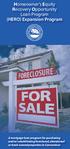 Homeowner s Equity Recovery Opportunity Loan Program (HERO) Expansion Program A mortgage loan program for purchasing and/or rehabilitating foreclosed, abandoned or bank-owned properties in Connecticut
Taking Control: Effective Property Acquisition Strategies
 Taking Control: Effective Property Acquisition Strategies NJ Cities Initiative 2012 Community Leadership Institute September 27, 2012 Moderator: Barbara George Johnson, John S. Watson Institute for Public
2. Inventory available public property within the site area. Include publiclyheld property, tax-foreclosures, and donated property.
 Land Assembly and Redevelopment What is it? Land is location, and location is the most valuable asset in successful real estate development. The right land transaction is crucial to each of the twin objectives
Southwest Light Rail Transit Minneapolis-St. Paul, Minnesota New Starts Project Development (Rating Assigned November 2014)
 Southwest Light Rail Transit Minneapolis-St. Paul, Minnesota New Starts Project Development (Rating Assigned November 2014) Summary Description Proposed Project: Light Rail Transit 15.7 Miles, 17 Stations
Land Banking: Pathways Towards Sustainable Urban, Suburban and Rural Land Reclamation
 Land Banking: Pathways Towards Sustainable Urban, Suburban and Rural Land Reclamation 12 TH ANNUAL NEW PARTNERS FOR SMART GROWTH CONFERENCE FEBRUARY 7, 2013 PRESENTED BY CHRISTOPHER NORMAN, EXECUTIVE DIRECTOR
REAL ESTATE TAX CERTIFICATE LIENS (House Bill 371)
 REAL ESTATE TAX CERTIFICATE LIENS (House Bill 371) SUMMIT COUNTY FISCAL OFFICE BEGAN IMPLEMENTING THE NEW DELINQUENT PROPERTY TAX COLLECTION METHOD IN 1998 The information contained within will help explain
Guidance on NSP-Eligible Acquisition & Rehabilitation Activities
 Guidance on NSP-Eligible Acquisition & Rehabilitation Activities This NSP Policy Guidance describes how to determine whether or not a property is eligible for acquisition and or rehabilitation with NSP
Equitable Development & Mixed-Income Communities. Understanding Best Practices & Scenarios
 Equitable Development & Mixed-Income Communities Understanding Best Practices & Scenarios Agenda I. TRF Approach to Community Development II. Philadelphia & Neighborhood Transformation Initiative III.
The primary focus of state and local government is to provide basic services,
 Tax Relief and Local Government The primary focus of state and local government is to provide basic services, such as public safety, education, a safety net of health care and human services, transportation,
HARRIS COUNTY, TEXAS NEIGHBORHOOD STABILIZATION PROGRAM
 HARRIS COUNTY, TEXAS NEIGHBORHOOD STABILIZATION PROGRAM SUBSTANTIAL AMENDMENT TO THE 2008-2012 CONSOLIDATED PLAN FY 2008 ANNUAL ACTION PLAN AMENDMENT APPLICATION Prepared by the Community Services Department
January 1, 2015 thru March 31, 2015 Performance Report
 Grantee: Grant: Gary IN B-11-MN-18-0005 January 1 2015 thru March 31 2015 Performance Report 1 Grant Number: B-11-MN-18-0005 Grantee Name: Gary IN Grant Award Amount: $2717859.00 LOCCS Authorized Amount:
ALLOCATION OF MORTGAGE SERVICING SETTLEMENT FUNDS
 ALLOCATION OF MORTGAGE SERVICING SETTLEMENT FUNDS This Office along with 48 other Attorneys General, the United States Department of Justice, the United States Department of Housing and Urban Development
OBSOLETE PROPERTY REHABILITATION ACT Act 146 of 2000. The People of the State of Michigan enact:
 OBSOLETE PROPERTY REHABILITATION ACT Act 146 of 2000 AN ACT to provide for the establishment of obsolete property rehabilitation districts in certain local governmental units; to provide for the exemption
GREATER SYRACUSE PROPERTY DEVELOPMENT CORPORATION DISPOSITION OF REAL AND PERSONAL PROPERTY POLICY
 GREATER SYRACUSE PROPERTY DEVELOPMENT CORPORATION DISPOSITION OF REAL AND PERSONAL PROPERTY POLICY SECTION 1. PURPOSE. This policy (the "Policy") sets forth guidelines for the Land Bank's disposal of real
Stabilizing Rural Communities Through Housing Partnerships
 Stabilizing Rural Communities Through Housing Partnerships SOUTHWEST MINNESOTA HOUSING PARTNERSHIP SLAYTON, MINNESOTA CASE STUDY Program Overview When municipalities in 30 southwest and southcentral Minnesota
COMMUNITY ECONOMIC DEVELOPMENT LAW PROJECT
 COMMUNITY ECONOMIC DEVELOPMENT LAW PROJECT OBTAINING 501(C)(3) STATUS FOR ECONOMIC DEVELOPMENT ORGANIZATIONS A GUIDE FOR ATTORNEYS NOVEMBER 2008 This booklet is published by the Community Economic Development
COMMUNITY DEVELOPMENT TOOLS AND TRENDS BRIDGING THE FINANCING GAP APRIL 2, 2015
 COMMUNITY DEVELOPMENT TOOLS AND TRENDS BRIDGING THE APRIL 2, 2015 FINANCING GAP Economic Development Finance Leveraging public resources through proactive approaches that solve the needs of industry, business,
CITY OF FLORENCE NEIGHBORHOOD REVITALIZATION STRATEGY SECOND PUBLIC MEETING
 CITY OF FLORENCE NEIGHBORHOOD REVITALIZATION STRATEGY SECOND PUBLIC MEETING Prepared for: City of Florence July 7th, 2014 AGENDA Review Feedback from First Community Meeting Present Catalytic Project Areas
Investment Incentives and Tax Savings Group HONIGMAN MILLER SCHWARTZ AND COHN LLP
 Investment Incentives and Tax Savings Group HONIGMAN MILLER SCHWARTZ AND COHN LLP Investment Incentives and Tax Savings Group As competition between, and among, states and nations increases for economic
ORDINANCE NO. 4002 Adopted 11/13/2008 AMENDED BY ORDINANCE NO. 4175 Adopted 01/26/2011 AMENDED BY ORDINANCE NO. 4322 Adopted 08/28/2012
 ORDINANCE NO. 4002 Adopted 11/13/2008 AMENDED BY ORDINANCE NO. 4175 Adopted 01/26/2011 AMENDED BY ORDINANCE NO. 4322 Adopted 08/28/2012 AN ORDINANCE CREATING CHAPTER 8.80 OF THE CODE OF THE CITY OF ELIZABETH
Commonwealth of Massachusetts HOUSING STABILIZATION FUND (HSF) Rental Application Guidelines
 Commonwealth of Massachusetts HOUSING STABILIZATION FUND (HSF) Rental Application Guidelines A. Overview Thousands of residential properties requiring moderate or substantial rehabilitation are located
City of Champaign Neighborhood Services Department Neighborhood Programs Division 102 N. Neil St. Champaign, Illinois 61820 (217) 403-7070
 City of Champaign Neighborhood Services Department Neighborhood Programs Division 102 N. Neil St. Champaign, Illinois 61820 (217) 403-7070 Acquisition-Rehabilitation Program SCOPE INCOME LIMIT The program
Texas Problem Properties Toolkit
 Texas Problem Properties Toolkit A RESOURCE TO HELP TEXAS COMMUNITIES ADDRESS PROBLEMS CREATED BY VACANT AND ABANDONED PROPERTIES 2010 Edition Created by: The Community Development Clinic at the University
7.0 GOALS, OBJECTIVES & POLICIES
 7.0 GOALS, OBJECTIVES & POLICIES The following Goals, Objectives and Policies specific to Housing are organized into broad categories including: 7.1: Housing Availability 7.2: Protection of Existing Neighborhoods
Land Banks and Tax Sales under the Municipal Claims and Tax Lien Law. Prepared by Irene McLaughlin, Attorney at Law
 Land Banks and Tax Sales under the Municipal Claims and Tax Lien Law Prepared by Irene McLaughlin, Attorney at Law Summary Pennsylvania s Land Bank Act, Act 153 of 2012, (the Land Bank Act) was enacted
IV. Market Analysis. A. Executive Summary. The Economy. The Site
 IV. Market Analysis A. Executive Summary The Economy The St. Louis metropolitan area population has grown at the moderate annual rate of 4.4% over the last eight years while employment (the best measure
B-11-MN-18-0005. April 1, 2015 thru June 30, 2015 Performance Report. Community Development Systems Disaster Recovery Grant Reporting System (DRGR)
 Grantee: Grant: Gary IN B-11-MN-18-0005 April 1 2015 thru June 30 2015 Performance Report 1 Grant Number: B-11-MN-18-0005 Grantee Name: Gary IN Grant Award Amount: $2717859.00 LOCCS Authorized Amount:
Carona, et al. ORGANIZATION bill analysis 5/20/2013 (D. Miller) Revising provisions that govern property tax lending
 HOUSE SB 247 RESEARCH Carona, et al. ORGANIZATION bill analysis 5/20/2013 (D. Miller) SUBJECT: COMMITTEE: VOTE: Revising provisions that govern property tax lending Business and Industry favorable, without
Clagett Agricultural Area (78-000, 79-000, 82A-000)
 Clagett Agricultural Area (78-000, 79-000, 82A-000) The Clagett Agricultural Area, consisting of approximately 2,700 acres west of Upper Marlboro was named for the Clagett family who owned most of the
BIRMINGHAM LAND BANK AUTHORITY
 Birmingham Land Bank Authority Administrative Policies and Procedures As approved and adopted by the Board of Directors On October 8, 2014 and amended August 6, 2015 Section 1. Role as a Public Authority