
Allergen Immunotherapy Extract Preparation Manual
|
|
|
- Mae Cain
- 9 years ago
- Views:
Transcription
1 CHAPTER 9 Allergen Immunotherapy Extract Preparation Manual Michael R. Nelson, MD, PhD, FAAAAI Linda Cox, MD, FAAAAI TABLE OF CONTENTS 1. Introduction 2. Practitioner Qualifications 3. Allergen Extracts 4. Allergen Extract Mixing Conditions 5. Allergen Immunotherapy Prescriptions 6. Color Coding, Labels and Expiration Dates 7. Mixing Individual Patient Allergen Extract Treatment Sets 8. Stinging Insect Allergen Extract Preparation 9. Allergen Extract Stability and Storage 10. Summary 11. References 12. Appendices INTRODUCTION Allergen immunotherapy was first introduced by Leonard Noon in Dr. Noon originally hypothesized that patients suffering from hay fever were sensitive to a toxin" contained in grass pollen. He proposed that patients would benefit by stimulating the immune system against the toxin by use of inoculations of pollen extract. These inoculations involve giving increasing amounts of allergen extracts to reduce symptoms on re-exposure to those particular allergens. The procedure has been widely used since its inception to treat immediate hypersensitivity disorders mediated by allergen-specific IgE antibodies. These same principles hold true today, more than100 years later, for current allergen immunotherapy. 1

2 There is good evidence that allergen immunotherapy is effective for the treatment of 2-25 : Allergic rhinitis Allergic conjunctivitis Asthma Atopic dermatitis Insect allergy (Hymenoptera) Multiple studies have demonstrated the effectiveness of allergen immunotherapy in these conditions for both children and adults The degree of effectiveness may vary for the individual patient. Clinical improvement should occur within or soon after the first year of treatment, and this benefit may improve with continued treatment. The Allergen Immunotherapy Practice Parameters 26 suggest that, If clinical improvement is not apparent after 1 year of maintenance therapy, possible reasons for lack of efficacy should be evaluated. If none are found, discontinuation of immunotherapy should be considered, and other treatment options should be pursued. It has been observed that some patients may experience a worsening of their asthma, atopic dermatitis and allergic rhinitis or conjunctivitis symptoms during treatment, especially during the first few months of therapy. There is no consensus on when to discontinue aeroallergen immunotherapy, but benefits are often maintained for years after stopping therapy in some individuals, and indefinitely in others. In grass-pollen allergy, a three-year course of subcutaneous immunotherapy gave prolonged relief of symptoms. 25 For many patients with stinging insect allergy, 3-5 years of treatment may be sufficient for sustained effectiveness after discontinuing therapy. Patients experiencing more severe reactions to stings may be considered for longer durations of treatment, given the risk of the recurrence of a life-threatening reaction over time. Subcutaneous allergen immunotherapy is not used for patients with food allergies. Although studies have demonstrated an increased tolerance to peanut challenge in patients who received subcutaneous peanut immunotherapy, 27, 28 there was an unacceptably high incidence of systemic reactions (e.g., anaphylaxis) in most of the patients during treatment. 28 2

3 Adverse reactions to allergen immunotherapy do occur, including death from severe systemic allergic reactions. Although very rare, deaths associated with immunotherapy may be due to clerical and medical errors by healthcare personnel. Examples include administering a wrong dose or wrong extract to the wrong patient. Other factors that may contribute to immunotherapy fatalities include symptomatic asthma and delay in the administration of epinephrine during a systemic reaction. Nonetheless, allergen immunotherapy extracts are relatively easy to prepare and administer, and are usually well tolerated. Initial and ongoing training will improve the expertise of healthcare workers responsible for administering immunotherapy and, ultimately, the safety of their patients. PRACTITIONER QUALIFICATIONS Allergen immunotherapy is an effective therapy and is indicated for the treatment of patients with allergic rhinitis, allergic conjunctivitis, asthma and stinging insect allergy (Hymenoptera). Each patient s immunotherapy prescription is unique, and the administration schedule (buildup or maintenance) may also vary. Each patient should be evaluated prior to the immunotherapy administration visit to determine whether any recent health changes might require modifying or withholding the immunotherapy treatment. Risk factors for severe immunotherapy reactions include symptomatic asthma and injections administered during periods of symptom exacerbations. Clinical judgment is required when altering the dose or schedule of administration. State laws may differ with regard to personnel who may give injections. Allergen immunotherapy carries a significant risk for life-threatening anaphylaxis and therefore requires even more competency training for both nursing personnel and physician supervisors. The responsibility for supervision and competency of the staff preparing and administering allergen immunotherapy falls to the supervising physician. Documentation of training and competency in allergen immunotherapy as well as diagnosis, treatment and prevention of anaphylaxis are critical quality management issues for all clinics involved in the delivery of allergen immunotherapy. Until recent recommendations from specialty societies are uniformly adopted, many facilities that provide immunotherapy are forced to deal with a variety of allergen immunotherapy extracts in a variety of packaging and labeling formats that further increase the risk for incorrect dosing during administration. Although efforts to standardize labeling and documentation are underway, training in what to look for and how to ensure extract prescriptions are administered safely and effectively is crucial to safe delivery of immunotherapy. 3

4 Training Opportunities There are a variety of ways to receive training in allergen immunotherapy preparation and administration. Formats may vary from lectures to hands-on training to meet the needs of each learner and include the following: On-the-job training from a qualified co-worker or supervisor AAAAI and ACAAI workshops and seminars Manuals from allergen extract manufacturers Journal articles (i.e., Cox 26 ) Online course at Click on Project Immune Readiness, password = paper. Two modules (anaphylaxis and allergen immunotherapy overview) are currently available. Allergen extract preparation manual and exam are currently in development. The most current and widely adopted recommendations in the United States for all aspects of allergen immunotherapy are embodied in Allergen immunotherapy: A practice parameter third update. 26 This joint effort by experts from AAAAI, ACAAI, and JCAAI focuses on evidence-based recommendations that will optimize immunotherapy efficacy and safety. All healthcare providers involved in immunotherapy preparation and administration should be oriented to the contents of this practice parameter, which contains practical clinical information and sample forms. The sample forms can be downloaded from (members-only section). Some suggested qualifications of extract preparation personnel from Practice Parameters 26 : Pass a written test on aseptic technique and extract preparation Be trained in preparation of allergenic products Annually pass a media-fill test, as described in Addendum A in Table 9.1. Demonstrate understanding of antiseptic hand cleaning and surface disinfection Correctly identify, measure and mix ingredients Should be appropriately trained health professionals, including, but not limited to, registered nurses, licensed practical nurses, medical technicians, medical assistants, physicians assistants, advanced practice nurses and physicians 4

5 TABLE 9.1. Allergen Immunotherapy Extract Preparation Guidelines Qualifications of extract preparation personnel: Compounding personnel must pass a written test on aseptic technique and extract preparation. Compounding personnel must be trained in preparation of allergenic products. Compounding personnel must annually pass a media-fill test, as described in Addendum A. Compounding personnel who fail written or media-fill tests would be reinstructed and re-evaluated. Compounding personnel must be able to demonstrate understanding of antiseptic hand cleaning and disinfection of mixing surfaces. Compounding personnel must be able to correctly identify, measure and mix ingredients. Compounding personnel should be appropriately trained health professionals, including, but not limited to, registered nurses, licensed practical nurses, medical technicians, medical assistants, physicians assistants, advanced practice nurses and physicians. Physician responsibility: A physician with training and expertise in allergen immunotherapy is responsible for ensuring that compounding personnel are instructed and trained in preparation of immunotherapy with aseptic techniques as defined below and that they meet the requirements of these guidelines. Evidence of such compliance shall be documented and maintained in personnel files. The physician is responsible for providing general oversight and supervision of compounding. Bacteriostasis: Allergen extract dilutions must be bacteriostatic, meaning that they must contain phenol concentrations of at least 0.25%, or if the phenol concentration is <0.25%, the extract must have a glycerin concentration of at least 20%. Dilutions prepared in accordance with manufacturer s instructions: Allergen extracts must be diluted in accordance with the antigen manufacturer s instructions. Potency: The manufacturer s expiration dates must be followed. Beyond-use dates for allergy extract dilutions should be based on the best available clinical data. Mixing of extracts with high and low proteolytic enzymes: Cross-reactivity of antigens: Separation of aqueous extracts with high proteolytic enzyme activities from other extracts is recommended. Storage: Extracts should be stored at 4 C to reduce the rate of potency loss or according to the manufacturer s directions. Extracts beyond the expiration date of the manufacturer are to be discarded. Storage must be in a designated refrigerator for medications and not used for food or specimens. Subcutaneous injection: Allergen extracts can only be administered intradermally or through subcutaneous injection unless FDA-approved package inserts or accepted standards of clinical practice permit another route of administration. Aseptic technique: Preparation of allergy immunotherapy shall follow aseptic manipulations defined as follows: The physician must designate a specific site, such as a countertop, in an area of the practice facility where personnel traffic is restricted and activities that might contribute to microbial contamination (e.g., eating, food preparation and placement of used diagnostic devices and materials and soiled linens) are prohibited. The extract preparation area must be sanitized with 70% isopropanol that does not contain added ingredients, such as dyes and glycerin. Extract preparation personnel must thoroughly wash hands to wrists with detergent or soap and potable water. Substitution of hand washing by mean of treatment with sanitizing agents containing alcohol, 70% isopropanol or both is acceptable. Necks of ampules to be opened and stoppers of vials to be needle punctured must be sanitized with isopropanol. Direct contact contamination of sterile needles, syringes and other drug-administration devices and sites on containers of manufactured sterile drug products from which drugs are administered must be avoided. Sources of direct contact contamination include but are not limited to touch by personnel and nonsterile objects, human secretions and blood, and exposure to other nonsterile materials. After mixing is complete, visual inspection is to be performed for physical integrity of the vial. Labeling: Immunotherapy vials are to be clearly labeled with the patient s name and the beyond-use date of the vial. Mixing log: A mixing log is to be kept with information on the patient s name, extract used for mixing, mixing and expiration dates and lot numbers. 5

6 Policy and procedure manual: Practices preparing allergy extracts must maintain a policy and procedure manual for the procedures to be followed in mixing, diluting or reconstituting of sterile products, and in the training of personnel in the standards described above. Addendum A: Example of a media-fill test procedure This or an equivalent test is performed at least annually by each person authorized to compound allergen immunotherapy extracts under conditions that closely simulate the most challenging or stressful conditions encountered during compounding of allergen immunotherapy extracts. Once begun, this test is completed without interruption. A double-concentrated medium, such as from Valiteq, is transferred in ten 0.5-mL increments with a sterile syringe to a sterile 10-mL vial. Five milliliters of sterile water (preservative free) is added. This is the concentrate. The vial is incubated within a range of 208 C to 358 C for 14 days. Failure is indicated by visible turbidity in the medium on or before the 14th day. Adapted from Allergen immunotherapy: A practice parameter third update. 26 Competency Assessment and Documentation Training of personnel involved in the administration of allergen immunotherapy is widely recognized as a critical requirement for safety and efficacy. Content should include core cognitive knowledge as well as demonstration of procedure performance competency. Appendix 9.1 contains a sample document for assessing and documenting competency of personnel in the preparation of allergen immunotherapy treatment sets. It is adapted from competency elements for allergy technicians/nursing personnel at the U.S. Army Centralized Allergen Extract Laboratory. These competency elements are based on recommendations of the Joint Commission on Accreditation of Hospital Organizations, or JCAHO, requirements. As with all sample forms, this form is merely an example. Because different practice settings will have site-specific standard operating procedures, competency standards and forms should be developed to meet the needs of each practice and practitioner. For example, a practice may have an extra focus on sterility by adding a sterile glove test that involves hand preparation, donning of sterile gloves, cutting off the tip and culturing for sterility. ALLERGEN EXTRACTS Allergen extracts used for immunotherapy are made from collections of raw material (i.e., pollens, danders, dust mites, insects, molds, and cockroach) and a complex series of manufacturing steps. These extracts should be clinically relevant for patients undergoing treatment; in other words, allergens selected for treatment should be present locally and cause symptoms when the patient is exposed. Allergen extract used for treatment and testing are liquid solutions containing dissolved allergenic proteins from pollens, dust mites, animal dander, molds, and insects. The manufacturing process usually 6

7 includes crushing raw materials and extracting allergenic proteins by adding solvents that release them from the solid raw material into the liquid solvent. This is followed by a variety of purification steps, resulting in a liquid solution that is stable under normal storage conditions (4 C) without precipitation that can change the concentration of allergens in the mixture. Each allergen extract can contain a number of allergenic proteins that can induce allergic symptoms with exposure. However, it is important to realize that the end product is a complex mixture of the diluents or solvents, additives, preservatives, allergenic proteins and other components of the raw material that survive the manufacturing process. Stock allergen extracts are licensed by the Center for Biologics Evaluation and Research (CBER) within the Food and Drug Administration (FDA) in the United States. Commercially available stock extracts are supplied by a handful of manufacturers throughout the country, and are used to mix individual treatment sets and to prepare test panels. Concentrated stock extracts are available in only a few forms: Aqueous Glycerinated Lyophilized (freeze dried) Acetone precipitated Alum precipitated Glycerinated stock extracts contain 50% glycerin by definition. Other liquid-based extracts (i.e., saline, buffers, liquid diluents) are referred to as aqueous extracts. Lyophilized extracts are aqueous extracts that have been freeze-dried to increase stability during storage and shipping. When they are reconstituted in accordance with package insert instructions with an appropriate diluent just prior to use, they become aqueous extracts. Hymenoptera venom extracts are typically available in lyophilized form. Acetone-precipitated extracts are liquid extracts that include a processing step of acetone precipitation to create a high concentration stock solution. The acetone squeezes proteins of interest out of liquid into a solid form that is then re-dissolved in a diluent to make the final highly concentrated stock solution. 7

8 Alum-precipitated extracts are liquid extracts that include a processing step involving the addition of aluminum hydroxide, or alum. Allergenic proteins attach to the alum and form complexes that serve as depot when injected into skin, slowing the release of allergens on injection. Because of this slow release, they are less effective in skin testing and are thus used for treatment only. The slow-release alum-allergen complexes may allow for larger doses of extract to be given at less-frequent intervals and a more rapid buildup to higher maintenance doses with reduced incidence of systemic reactions. Local reactions at the site of alum-precipitated extract injections may be immediate or delayed. Delayed reactions may start several hours later, with local edema, erythema (redness), itching and pain. The cloudy appearance of the extract, which may contain visible precipitate, is normal and significantly different than typical aqueous extracts. These extracts require shaking before use. Furthermore, only certain diluents can be used to dilute these extracts. The package insert from stock antigens must be consulted to identify the appropriate diluents for use with alum-precipitated extracts. For example, one manufacturer requires the use of phenol saline diluent for all 10-fold dilution vials. Ten percent glycerol-saline and human serum albumin (HSA) diluent usually cannot be used for alum-precipitated prescriptions because of interference with the aluminum hydroxide-antigen absorbed complex. Diluents are solutions used to keep the allergens in suspension, and they form the liquid backbone of allergen extracts. Diluents are used to reconstitute lyophilized extracts, to dilute extracts for diagnostic use, to dilute vials in treatment sets and to fill maintenance vials to final volume after addition of stock allergen quantities. Commonly used diluents: Glycerin (e.g., 50% glycerin ± phenol) Phenol saline (e.g., 0.4% phenol, saline) HSA (e.g., 0.03% HSA, 0.4% phenol, saline) Each diluent has advantages and disadvantages related to preservation of extract potency and sterility. For example, glycerin is both a preservative and stabilizer. Meanwhile, HSA is a stabilizer, and phenol is a preservative. These additives are discussed in further detail in this chapter s discussion of extract stability. 8

9 Standardized Allergen Extracts Several commonly used extracts have been standardized such that allergen content is consistent between manufacturers and between lots made from the same manufacturer. Extracts are standardized based on intradermal skin test responses in allergic individuals. Specifically, reference standards from the FDA CBER are obtained for standardized allergen extracts by identifying concentrations that reproducibly produce erythema with a sum of perpendicular long axes of 50 mm, or ID50EAL. 29 These reference standards are then used by manufacturers to ensure that the allergen content of each new lot falls within specified ranges for potency labeling. Blood tests (immunoassays) have been developed that correlate allergenic protein content to skin test reactions and, in some cases, treatment results. These include measurement of major allergen content (cat hair Fel d 1 and ragweed Amb a 1), total protein/hyaluronidase/phospholipase content (Hymenoptera venom) and other assays (pooled sera immunoassay inhibition activity). Units of potency applied to standardized extracts vary and include bioequivalent allergy unit/ml (BAU/mL), allergy unit/ml (AU/mL), microgram protein/ml (µg/ml) or, in the case of some standardized short ragweed stock extracts, in weight per volume (wt/vol). Some allergen extract labels also include the concentration of major allergenic proteins in µg/ml. Since the standardization is based on allergen content falling within a range, it is possible that actual allergenic protein content can vary several-fold for the same potency label. Only a few allergen extracts have been standardized to date (see Appendix 9.2 for probable effective dose range, as cited in Cox 26 ): Standardized allergen extracts in the United States are as follows: Cat hair and pelt (BAU/mL potency labeling based on Fel d 1 content) Dust mite (Dermatophagoides pteronyssinus and D. farinae; potency in AU/mL ) Short ragweed (potency in AU/mL or wt/vol with lot-specific Amb a 1 concentration) Grass (Bermuda, Kentucky bluegrass, perennial rye, orchard, timothy, meadow fescue, red top and sweet vernal; potency in BAU/mL) Hymenoptera venoms (yellow jacket, honey bee, wasp, yellow hornet, white-faced hornet, and mixed vespids; potency in µg/ml) 9

10 ALLERGEN EXTRACT MIXING CONDITIONS In addition to standardization of allergen stock extract manufacturing, there are new requirements for conditions under which allergen extracts should be prepared. Mixing condition recommendations are designed to decrease the risk of bacterial contamination during the preparation of allergen extract treatment and diagnostic sets. Recommended measures include good personal hygiene, hand washing and the use of antiseptics to clean working surfaces and vial tops prior to transfers. Two sets of guidelines can be referenced in the preparation of clinic specific standard operating procedures. The first is the Allergen Immunotherapy Practice Parameters prepared by the Joint Task Force on Practice Parameters, representing the AAAAI, ACAAI and JCAAI (Table 9.1). 26 The second set of guidelines is outlined in a 2008 revised bulletin from the U.S. Pharmacopeia, 30 with an effective date of June 2008 (USP <797>). 26, 28 It should be noted that these standards are less rigorous than standards required for typical sterile drug compounding in pharmacies. The bulletin recommends that mixers be aware of the greater potential risk of contamination and adhere to recommendations listed. USP created scaled-back recommendations for allergen extracts under the assumption that mixing of allergen extracts involves simple transfer of sterile substances in the presence of preservatives. Therefore, allergen extracts as compounded sterile preparations (CSPs) are not subject to the personnel, environmental and storage requirements for all CSP Microbial Contamination Risk Levels in this chapter when all criteria are met (Table 9.2).30 USP emphasizes that unless appropriate measures are taken, full compliance with the much more stringent low risk compounding requirements are indicated. This includes laminar flow hood use and testing with buffer area, media-fill testing, ISO class 5 air quality, training, garb, and so on, for clinics/facilities requiring compliance with USP 797. In addition to these measures, work surfaces should be sanitized with a cleaning solution, hot water or a chemical disinfectant. The surface area for preparing allergen extracts should be sanitized using a waterbased disinfectant followed by the application of 70% isopropanol (alcohol). The alcohol should be allowed to dry because alcohol kills organisms by dehydration. Sanitizers are used to prevent bacterial contamination and are less effective against other types of living organisms. 10

11 Ideally, sites where allergen extract patient treatment sets are prepared should be compliant with the recommendations contained in both of these allergen immunotherapy extract preparation guidelines. However, these conditions and practices may not be required for all clinics or offices. Some hospitalbased clinics may be required to be fully compliant with USP recommendations. Clinic and facility supervisors can help determine the applicability of these two sets of guidelines. Regardless, preparers and supervisors should have in place appropriate measures that focus on proper mixing technique, minimizing the risk of contamination, and appropriate vial labeling in accordance with the recommendations cited by Cox. 26 TABLE 9.2. USP 797 Sterile Compounding Standards for Allergen Extracts Allergen extracts as CSPs are single- and multiple-dose intradermal or subcutaneous injections that are prepared by specially trained physicians and personnel under their direct supervision. Allergen extracts as CSPs are not subject to the personnel, environmental and storage requirements for all CSP Microbial Contamination Risk Levels in this chapter only when all of the following criteria are met: Before beginning compounding activities, personnel perform a thorough hand-cleansing procedure by removing debris from under fingernails (using a nail cleaner under running warm water), followed by vigorous hand and arm washing to the elbows for at least 30 seconds with either non-antimicrobial or antimicrobial soap and water. Compounding personnel wear hair covers, facial hair covers, gowns and face masks. Compounding personnel perform antiseptic hand cleansing with an alcohol-based surgical hand scrub with persistent activity. Compounding personnel wear powder-free sterile gloves that are compatible with sterile 70% isopropyl alcohol before beginning compounding manipulations. Compounding personnel disinfect their gloves intermittently with sterile 70% isopropyl alcohol when preparing multiple allergenic extract as CSPs. Ampule necks and vial stoppers on packages of manufactured sterile ingredients are disinfected by careful wiping with sterile 70% isopropyl alcohol swabs to ensure that the critical sites are wet for at least 10 seconds and allowed to dry before they are used to compound allergen extract as CSPs. The label of each multidose vial of allergen extract as CSPs lists the name of one specific patient, a beyond-use date and a storage temperature range that is assigned based on the manufacturer s recommendations or peer-reviewed publications. Single-dose allergen extract as CSPs shall not be stored for subsequent additional use. Adapted from Allergen immunotherapy: A practice parameter third update

12 ALLERGEN IMMUNOTHERAPY PRESCRIPTIONS Allergen immunotherapy prescriptions specify the precise contents of individual treatment sets for patients receiving immunotherapy. They may be written or electronic, but should contain several essential elements. Standardization of content will promote proper preparation, minimize risk for errors in allergy shot administration and facilitate patient transfers of care. Each prescription should contain: Two patient identifiers (consider a picture for the file or electronic record) Patient contact information Name of prescriber Date of prescription Name, concentration and volume for each allergen Name and volume of diluents Schedule for administration (including adjustments for interruptions and reactions) Special measures such as pre-shot peak flow criteria for asthma patients All prescriptions should be reviewed for accuracy prior to preparation. Even though some of these elements may be routine for a clinic, it is important to review them for each and every patient. Optimal mixing of allergens to create an individual patient treatment set should be based on: Use of relevant allergens for each patient Dosing of allergen extracts within minimum effective dose ranges (Appendix 9.2) Avoidance of combinations that could affect overall potency or are unproven (Table 9.1) 26 o Separate high protease extracts (mold, cockroach) from pollens 32 o Do not mix venom extracts with aeroallergen extracts 26 Selection of allergens and adjustment of doses using knowledge of cross-reactivity 12

13 Figure 9.1 contains formulas for calculating stock extract volumes to be added to maintenance vials for any desired dose, such as those listed in the probable effective dose range table in the Practice Parameters. 26 Figure 9.2 is an example of a completed allergen immunotherapy prescription. In this example, the desired maintenance dose for cat was 2000 BAU for a 0.5-mL injected dose from a 5-mL maintenance vial. Using the formula in Figure 9.1, 2 ml of standardized cat extract (10,000 BAU/mL) is needed to achieve a final maintenance vial concentration of 4000 BAU/mL and an injection dose of 2000 BAU. Step-by-step calculations are as follows: Maintenance vial concentration = injection dose/injection volume = 2000 BAU/0.5mL = 4000 BAU/mL V1 C1 = V2 C2 (maintenance vial volume maintenance vial concentration = stock volume stock concentration) 5mL 4000 BAU/mL = V2 10,000 BAU/mL [V2 = stock volume = (5 4K)/10K = 2 ml] Repeat for each antigen in vial Total antigen volume = cat 2 ml + D. farinae 0.5 ml + D. pteronyssinus 0.5 ml + timothy 0.4 ml + short ragweed 0.2 ml] Diluent volume = (maintenance vial volume) - (sum antigen volumes) = 5 ml 3.6 ml = 1.4 ml Final maintenance vial contents: Antigen Concentration 0.5-mL injection dose Cat 4000 BAU/mL 2000 BAU Short ragweed 17.5 µg/ml 8.75 µg Amb a 1 Timothy grass 4000 BAU/mL 2000 BAU D. farinae 1000 AU/mL 500 AU D. pteronyssinus 1000 AU/mL 500 AU In summary, use of these prescribing principles will result in a product that is safe and effective, and that can ensure maintenance of expected potency through the expiration date. Mixing highprotease extracts with most other aeroallergens will result in a loss of potency that can affect immunotherapy efficacy. Aeroallergens with known high cross-reactivity allow prescribers to 13

14 treat with fewer allergens while providing coverage for a large number of related allergens. For example, treatment with one or two northern pasture grass allergen extracts should be sufficient to provide benefit for the more than 10 cross-reactive northern grass species. 34 Finally, the use of standardized allergen extract prescription forms will remind clinicians and extract preparers to focus on these elements during the prescribing and extract preparation process. FIGURE 9.1. Allergen Immunotherapy Extract Dilution Calculations 26 14

15 FIGURE 9.2. Allergen Immunotherapy Extract Prescription Example (from AAAAI web site) 15

16 COLOR CODING, LABELS AND EXPIRATION DATES The Allergen Immunotherapy Practice Parameters and Joint Commission National Patient Safety Goals emphasize the need for clear and consistent labeling. Standardizing allergen immunotherapy label contents and vial coding will improve communication between care providers and patients, and likely prevent errors in extract administration. Each patient s treatment vial label should contain at a minimum: Two patient identifiers (e.g., name and date of birth) Concentration in vol/vol Color code or alphanumeric code ( 1 for highest concentration if numbered) Expiration or beyond use date Immunotherapy treatment vial concentrations are now labeled in vol/vol, with 1:1 vol/vol representing the maintenance concentrate. Alternatively, the vial concentration can be labeled in actual units (e.g., 1000 BAU, 100 BAU), but this system may be complicated if allergens with different potency units are used (e.g., wt/vol, BAU, AU or PNU) and these differences make it difficult to interpret the vial label. All the vials in the treatment set are numbered and/or color coded in the following manner: 26 RED Maintenance concentrate 1:1 vol/vol #1 YELLOW 10-fold dilution 1:10 vol/vol #2 BLUE 100-fold dilution 1:100 vol/vol #3 GREEN 1000-fold dilution 1:1000 vol/vol #4 SILVER 10,000 fold dilution 1:10,000 vol/vol #5 16

17 If a numbering system is used, the highest concentration should be labeled #1 and the next 10- fold dilution (i.e., yellow vial) would be labeled #2, and so forth. Variation from patient to patient occurs when labeling vials of higher concentrations with larger numbers. This practice resulted in patients often having a different number on their maintenance vial that was based on the total number of dilutions prepared. Expiration dates should follow the manufacturer s recommendations. The rule of thumb is that the expiration date for a treatment or skin testing vial is the earliest expiration date recommended for any extract in the mix. Less-concentrated extracts are more sensitive to temperature and might not maintain potency until the listed expiration date; 1:10 to 1:200 dilutions of stock extracts are generally stable for at least 12 months. This usually includes at least the patient s red maintenance treatment vial and the 1:10 vol/vol, or yellow, vial. Expiration dates for venom extracts are sometimes shorter; perhaps this is due to the use of diluents with low levels of glycerin. The venom extract package inserts provide guidelines for expiration dates for the different dilutions. Expiration dating periods for allergen extract products are regulated by the FDA. Even under ideal refrigerated conditions, some loss of potency occurs over time. The potency and stability of these products are not guaranteed beyond their labeled expiration date. Nonstandard extract products are assigned expiration dating in accordance with FDA regulations (21 CFR, Section ) with regard to whether products are glycerinated or nonglycerinated. A total of six years 17

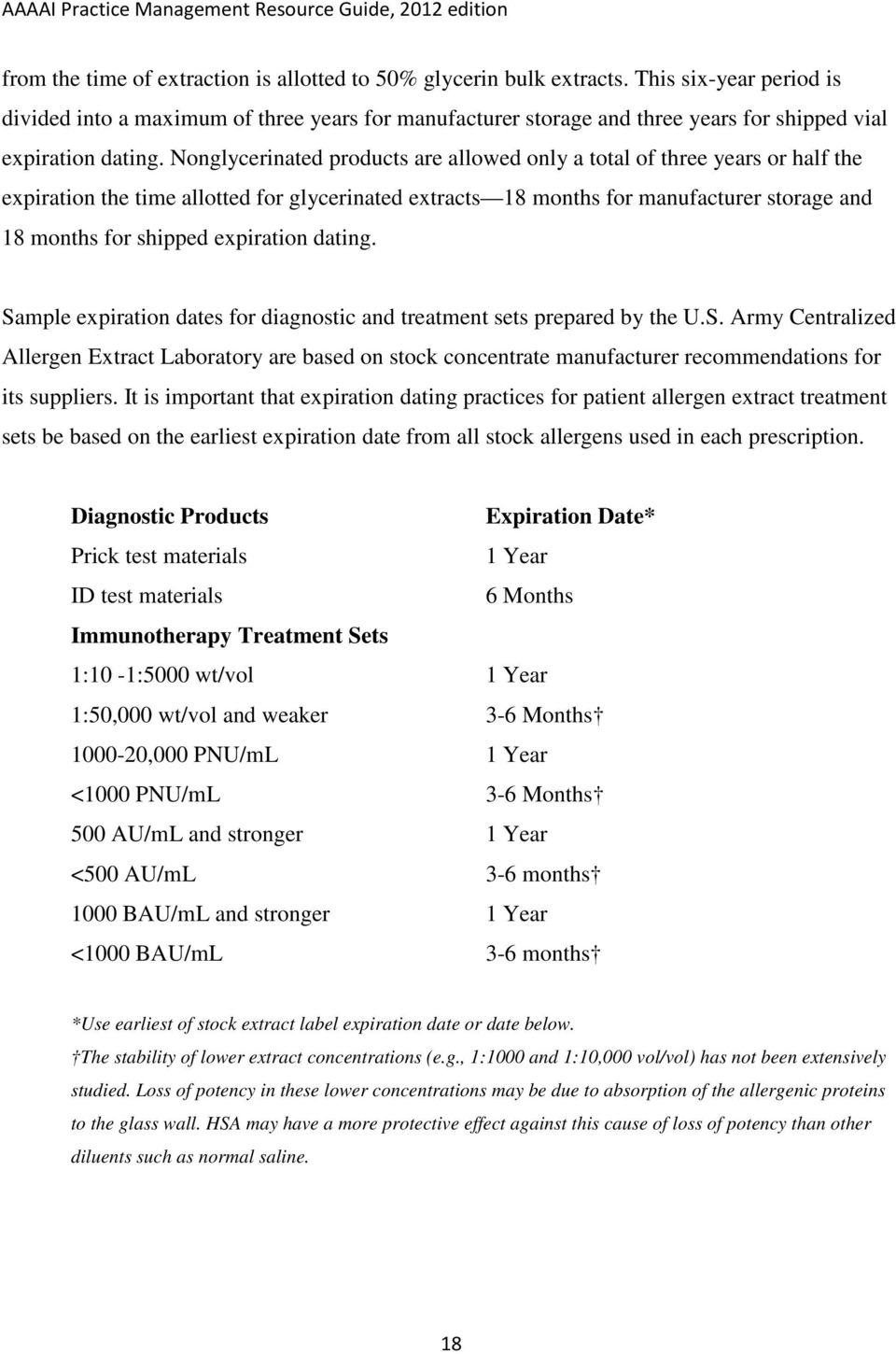
18 from the time of extraction is allotted to 50% glycerin bulk extracts. This six-year period is divided into a maximum of three years for manufacturer storage and three years for shipped vial expiration dating. Nonglycerinated products are allowed only a total of three years or half the expiration the time allotted for glycerinated extracts 18 months for manufacturer storage and 18 months for shipped expiration dating. Sample expiration dates for diagnostic and treatment sets prepared by the U.S. Army Centralized Allergen Extract Laboratory are based on stock concentrate manufacturer recommendations for its suppliers. It is important that expiration dating practices for patient allergen extract treatment sets be based on the earliest expiration date from all stock allergens used in each prescription. Diagnostic Products Expiration Date* Prick test materials 1 Year ID test materials 6 Months Immunotherapy Treatment Sets 1:10-1:5000 wt/vol 1 Year 1:50,000 wt/vol and weaker 3-6 Months ,000 PNU/mL 1 Year <1000 PNU/mL 3-6 Months 500 AU/mL and stronger 1 Year <500 AU/mL 3-6 months 1000 BAU/mL and stronger 1 Year <1000 BAU/mL 3-6 months *Use earliest of stock extract label expiration date or date below. The stability of lower extract concentrations (e.g., 1:1000 and 1:10,000 vol/vol) has not been extensively studied. Loss of potency in these lower concentrations may be due to absorption of the allergenic proteins to the glass wall. HSA may have a more protective effect against this cause of loss of potency than other diluents such as normal saline. 18
19 Reconstituted Venom Freeze-Dried Preparations 100 µg/ml 6 or 12 Months* 1-10 µg/ml 1 Month 0.1 µg/ml 14 Days <0.1 µg/ml 24 Hours *Varies with manufacturer. Guidelines for dilution expiration dating are in the extract package inserts. MIXING INDIVIDUAL PATIENT ALLERGEN EXTRACT TREATMENT SETS Every clinic should develop a specific standard operating procedure document or manual to ensure standardization and safe practices of allergen extract mixing. Responsible providers developing the procedures should consult stock extract manufacturer recommendations and the most recent Allergen Immunotherapy Practice Parameter Update to incorporate the most up-todate recommendations. USP 797 requirements should also be reviewed if relevant for your clinic. These procedures should emphasize the importance of individual treatment vials and vial sets, especially when mixing of allergens is required. The mixing of antigens in a syringe is not recommended because of the potential for cross-contamination of extracts. Here are a few guiding principles for mixing allergen extracts: Optimal dosing should be within defined minimal effective-dose ranges. Avoid incompatible mixtures when possible. o Stinging insect and aeroallergen extracts should not be mixed. o High-protease extracts (molds and cockroach) should not be mixed with pollens. Selection of allergens should factor in known cross-reactivity for like antigens. Initial treatment sets consist of a maintenance vial and a series of 10-fold dilutions. Contamination is prevented by use of aseptic techniques and adequate training. Accurate prescriptions, labels and color coding are required to prevent errors. 19

20 Use of quality assurance checks throughout the mixing process is highly recommended. Initial Preparation 1) Develop clinic specific standard operating procedures. 2) Designate an allergen extract mixing location. a) Location should be an area of the clinic where personnel traffic is restricted and exposure to potential contaminants is minimized. b) The same location(s) should be used each time extracts are prepared. c) Location can be used for other purposes outside of mixing, but should be cleansed and prepared before every mixing session. d) Minimize contamination by limiting high-risk activities during mixing such as eating, food preparation, use or placement of diagnostic devices (used specula, skin test or biopsy devices, endoscopes, used absorbent pads, and so forth) or soiled linen storage in the designated area. 3) Identify expiration dating standards for your clinic. a) More dilute vials usually will have an earlier expiration date. b) Dates should not exceed expiration date of earliest expiring antigen or diluents used in each prescription. 4) Become familiar with stock allergen extract ordering and storage procedures. 5) Orient personnel to stock allergen extracts, refrigerator storage designated mixing location, mixing equipment, prescriptions, documentation and packaging. 6) Undergo training on standard operation procedures and safety measures. Pre-Mixing Preparation 1) Verify that a supervising physician is present in the same building as the mixing location(s). 2) Prepare specific mixing location(s). 3) Cleanse and maintain an aseptic work environment using an approved disinfectant solution (i.e., 70% isopropanol) without additives like dyes and glycerin. 4) Prepare vial labels in accordance with prescription and verify accuracy of a) Name and second identifier. 20

21 b) Concentration. c) Antigens on label match those that are to be added from the prescription. d) Expiration date is consistent with clinic procedures and source antigens. 5) Apply label to treatment set vials. 6) If using color-coded vials, verify color and concentration match. 7) Alternatively, labels may be applied after mixing. For example, the label for the empty maintenance concentrate (red) vial (or all vials) can be left off until all contents are injected into the vial to improve visibility during checks for impurities, final volume and color comparison of dilution series. Examples of Allergen Extract Mixing Step-By-Step Procedures This sample set of procedures does not constitute recommended procedures, but can be used as a starting point to develop procedures that best fit a specific clinic/facility needs. Mixing the Maintenance (Red) Vial 1) Pull new empty sterile vials (usually 5, 8 or 10 ml) for each vial in the patient s treatment set, and put in order from strongest (maintenance/red) to most dilute. 2) Pull the stock extract vial for each antigen on the prescription, and stock diluents from refrigerator. a) Check stock antigens for turbidity/particulate matter. If present, consult package insert or manufacturer guidelines, including possible recommendations for re-suspension or filtering. b) For prolonged mixing sessions, return unused stock extracts to refrigerator or cooling tray (2-8 C) between prescriptions or during extended breaks. 3) Place a new syringe by each stock antigen vial and the diluent. a) A separate syringe is used for each antigen and diluent. b) Label each syringe (i.e., abbreviation for antigen or diluents). c) For immediate use only, stock extracts should not be pre-drawn for extended periods because of the risk of potency loss and misidentification. 4) Document lot number and manufacturer for each antigen (preferably one per antigen). 21
22 5) Note expiration dates of stock extracts and that label expiration date do not exceed earliest stock vial extract. 6) Wear appropriate personal protective equipment. a) Wash hands/nails to elbows for at least 30 seconds with soap and water. b) Don hair and facial hair covers, gowns and face masks (if following USP 797 guidelines). c) Use alcohol-based surgical hand scrub prior to gloving. d) Don powder-free sterile gloves compatible with 70% isopropyl alcohol. 7) Disinfect gloves with isopropyl alcohol before mixing (and intermittently for lengthy mixing). 8) Wipe vials and/or ampules with 70% isopropyl alcohol for at least 10 seconds. 9) Maintain aseptic technique by minimizing contact with secretions, skin, glove fingertips and the like during mixing. 10) Draw the correct amount of each antigen and the diluent into the syringe, and place each syringe by the respective stock antigen vial. 11) Verify drawn doses are correct volume and antigen. (Quality checkpoint opportunity: have a co-worker verify, if available.) 12) Inject contents of all drawn antigens one by one into the maintenance concentrate (red) vial. a) The empty syringes should be discarded immediately into an appropriate Sharps disposal container. b) If the sterile maintenance vial is not a vacuum (air filled), an equal volume of air may need to be withdrawn prior to injecting stock extract volumes. 13) If there is precipitate present in the stock antigen vials, a) Particulates and precipitates suspended in an extract solution are not uncommon. b) These particulates and precipitates often do not cause any significant loss in potency. Consult manufacturer recommendations in package insert or bulletins for additional information. c) Attempted re-suspension by agitation (shaking or rolling) may be indicated in accordance with the package insert and your clinic operating procedures. 14) After mixing is complete, conduct final quality assurance check (preferably by mixer and trained co-worker), including: a) Solution color check. 22
23 b) Label check. c) Vial color-code check. d) Liquid turbidity, precipitate and consistency check. e) Vial physical integrity (leaks, cracks and so on) check. 15) If applicable, package treatment set for transport or shipping. 16) Document preparation details according to clinic-specific procedures on prescription or preparation form and in mixing log (see Practice Parameter appendices for sample forms), as follows: a) Name of preparer and date prepared. b) Stock allergen extract manufacturer, lot number and beyond-use or expiration date. c) Mixing log, to be maintained in the unlikely event of a stock antigen recall or for extract or adverse-event troubleshooting. Special Procedure Notes Concerning Alum-Precipitated Extracts Diluent: Alum-precipitated extracts generally require phenol saline diluent for all 10-fold dilution vials. Ten percent glycerol-saline or HSA diluent cannot be used for alumprecipitated prescriptions as it interferes with the aluminum hydroxide-antigen absorbed complex. For alum-precipitated extract treatment vials, consider applying a small shake well label, as the alum-precipitated antigens are very viscous in nature. Precipitated alumantigen complex will settle to the bottom of the vial. Unlike aqueous and glycerinated extracts that generally do not lose potency with filtering, large antigen-alum complexes may be lost during the filtering process, with the result being a result in loss of potency. Therefore, do not filter alum-precipitated extracts. Preparing Serial 10-Fold Dilutions of the Maintenance (Red) Vial Serial 10-fold dilutions are prepared to complete a patient s initial allergen immunotherapy treatment vial set. Dilutions are made by serial dilution (taking from a parent vial and placing into a new vial prefilled with diluent to create a 10-fold dilution (1/10 the amount of allergen 23
24 contained in the parent vial). This newly diluted vial becomes the parent vial, and dilutions are repeated until the desired number of 10-fold dilutions is achieved. Diluted allergen immunotherapy vials (yellow, blue, green, and the like) should not made by pulling directly from a manufacturer s concentrated stock vial extract. The primary reason for this is the potential for error that increases with each dilution. For dilute vials, a very small amount of allergen would need to be pulled from the stock extract vial, and this is virtually impossible to do with the precision needed for the most dilute vials. Thus, a dilution vial prepared by this method may contain less or more than expected and potentially increase the risk of adverse events during vial transitions within the buildup phase. The volume used to make serial dilutions from parent vials depends on both the desired dilution (10-fold in this case) and the final volume. Typical treatment set vials are 2, 5, 8 or 10 ml. Treatment set vials are now available with original or snap-on colored caps to create sets according to the recommended color scheme. Vials also are available empty or prefilled with diluents suitable for intradermal or subcutaneous administration. Prefilled volumes correspond to the amount of diluent needed to make a 10-fold dilution. For example, a prefilled 5-mL yellow vial will contain 4.5 ml of diluent and have a yellow cap. To make the yellow 10-fold dilution vial, 0.5 ml would be taken from the parent red maintenance vial (1:1 vol/vol) and added to yellow vial, for a total final volume of 5 ml (0.5 = 1/10 of 5 ml, a 10-fold dilution or 1:10 vol/vol). To make the same 10-fold diluted yellow vial using one that was not prefilled, 0.5 ml is added from the red maintenance vial and 4.5 ml is added from a stock diluent vial. Preparing of 5-mL Serial 10-fold Dilution Vials for Patient Treatment Sets 1) Verify that the labeling and order (color coded, label concentration) for vials are correct. 2) Ensure the maintenance vial is mixed by inverting or rolling. 3) Using a fresh syringe and aseptic technique, remove 0.5 ml from the mixed 5-mL maintenance concentrate red or 1:1 vol/vol vial. 4) Using aseptic technique, inject this 0.5 ml from the maintenance vial into the 4.5-mL prefilled (10% glycerol-saline or HSA) yellow or 1:10 vol/vol vial. This vial will be a 10-fold dilution of the maintenance concentration vial. 5) Ensure this newly made 10-fold diluted (yellow) vial is mixed by inverting or rolling. 24
25 6) Subsequent 10-fold dilutions are done in the same manner for the rest of the vials in the treatment set (0.5 ml into 4.5 ml of the 10-fold weaker, labeled 10% glycerol-saline prefilled vial): a) 0.5 ml from yellow 1:10 vol/vol into 4.5 ml diluent-filled blue 1:100 vol/vol vial b) 0.5 ml from blue 1:100 vol/vol into 4.5 ml diluent-filled green 1:1000 vol/vol vial c) 0.5 ml from green 1:1000 vol/vol into 4.5 ml diluent-filled silver 1:10,000 vol/vol vial d) And so on for additional more dilute (silver) vials 7) Whereas using a fresh syringe for each dilution transfer is often preferred, use of the same syringe for serial dilution transfers is an alternative if a mix/rinse step is included. A mix/rinse step consists of pulling up a full syringe volume (1 ml for a 1-mL syringe) from the vial just injected and re-injecting into the same vial without removing the syringe. This is often repeated (i.e., for a total of three times) prior to pulling up the final volume for the transfer to the next dilute vial. (Reminder: Do not reuse syringes or mix/rinse between different stock solutions when mixing the initial maintenance vial.) Allergen Extract Treatment Set Preparation Hints 1) Do not mix prescriptions for more than one patient at a time. 2) Train multiple qualified personnel in allergen extract preparation in case of absences and for participation in quality checks. 3) Avoid putting hand lotion on before the compounding of allergen extract vaccines and skin test antigens. Lotion tends to harbor bacteria. 4) Regularly review operating procedures for opportunities to make the process safer and more efficient. 5) Establish a regular inventory check. a) Identify stock allergen extracts, diluents and mixing supplies in need of reordering b) Check for expiring stock allergen extracts, diluents and mixing supplies 6) Return antigen stock trays to the refrigerator when away from the compounding area for an extended period of time. 7) Minimize diversions during extract preparation. 8) Stock refrigerators are not to be used for food or drink storage. 25
26 Additional Quality Assurance Checks Additional quality assurance checks before allergen extract shipping and use ideally are confirmed by a co-worker. Vials should be inspected for: Label accuracy five rights as described below Vial serial color dilution that matches label concentration and vial color coding Vial integrity (no cracks, leaks, and so on) Vial content (particulate matter, fill volume, and so on) Verify that the label contains the right name, right content (allergens), right concentration, right alphanumeric number in the right order with lowest = 1 (if numbers used), right expiration date (dilute vials may have earlier expiration dates than more concentrated vials). Additionally, a solution color check for each vial should be conducted. The solution in the maintenance concentrate vial should be the darkest in color, and vials should be lighter in color with each 10- fold dilution. The weakest strength vial should contain the lightest-colored solution. When using color-coded vials, a vial color code check should be performed. Vials in the treatment set should be arranged in order (red/maintenance, yellow, blue, green and silver). For each color-coded vial, the label concentration, in vol/vol, or number should match what is recommended in the Practice Parameters for that color code (see Tables XI and XII from Practice Parameters 26 ). Additionally, the color of the solution should be a shade consistent for that dilution (lighter if not the red maintenance vial). All vials should also undergo a content check. Vials should be filled to the expected volume. Solutions within each vial should be inspected for the presence of particulate or solid materials and cloudiness. If found, vials may be contaminated or contain precipitated raw allergen extract contents. Contamination may be bacterial or other microbial source, but may also be a result of introduced solid materials like the rare occurrence of vial stopper fragments from manufacturing or repeated puncturing. All vials should also undergo a vial integrity check by inspecting the vial for any cracks, leaks or stopper disruptions. Any abnormal finding during any of these checks should be followed by an investigation for the cause and, in most instances, starting over and remixing that patient s vial set. 26
27 STINGING INSECT ALLERGEN EXTRACT PREPARATION Extracts are available for five winged Hymenoptera species at a concentration of 100 µg/ml: honey bee, wasp, yellow jacket, yellow hornet and white-faced hornet. The last three (yellow jacket, yellow hornet and white-faced hornet) are closely related members of the Vespidae family and have also been combined in a single mixed vespid extract at a reconstituted concentration of 300 µg/ml. Lyophilized or freeze-dried stinging insect venom extracts are available commercially for diagnostic testing and patient treatment. These extracts are composed of venom isolated directly from dissected venom sacs. Previously manufactured extracts using whole insect body as opposed to concentrated venom proved not to be as effective as extracts made from venom. 35 Accordingly, handling of these extracts is limited to reconstitution and dilution. The same principles and requirements for labeling apply with the exception of number/color coding and use of vol/vol concentration. The concentration of these extracts and all dilutions is expressed in µg/ml. Reconstitution and dilution of all insect venom extracts is most commonly performed with HSA (HSA/phenol) diluent. Extracts are also available for imported fire ant Hymenoptera species. Two fire ant species, Solenopsis richteri and S. invicta, are commercially available as individual extracts for testing or treatment, or as a fire ant mix containing both species. Fire ant extracts are made from whole fire ant bodies. Fire ant venom extracts are being investigated for clinical use, but require a significant amount of time and resources for mass production. Fire ant stock concentrate extracts typically are available as glycerinated extracts in wt/vol concentrations (i.e., 1:20 wt/vol). The Practice Parameters for Insect Allergy contains survey data on common fire ant maintenance doses ranging from 0.5 ml of 1:100 wt/vol to 0.5 ml of 1:10 wt/vol maintenance concentrate, with most using 0.5 ml of a 1:100 wt/vol maintenance concentrate. 36 Insect venom (and fire ant) extracts generally should not to be mixed with other venom or aeroallergen extracts for either testing or treatment because of the lack of sufficient stability, safety and efficacy studies to support mixing. The only FDA-approved mixture is commercially available mixed vespid extract containing 100 µg/ml of each of the three common vespids. 27
28 ALLERGEN EXTRACT STABILITY AND STORAGE The stability and potency of allergen extracts can be compromised by elevated temperatures, contamination and protease degradation of key allergenic proteins responsible for the efficacy of immunotherapy , 37 Several measures are taken by stock extract manufacturers and healthcare personnel to minimize the risk of loss of potency of extracts during normal storage and use. Dilution of extracts alone can affect the long-term potency of extracts. For example, diluted extracts have lower concentrations of important preservatives and stabilizers. Furthermore, lower concentrations of proteins decrease three-dimensional protein structure stabilization achieved through protein-protein interactions that are facilitated at higher protein concentrations. Finally, dilutions may also magnify the effect of allergenic protein loss as a result of binding to sites on glass vials that is essentially insignificant at higher protein concentrations. There are several routine operating procedures that when performed consistently should promote extract stability and reduce errors associated with the use of outdated materials: Routinely check expiration dates on all products. Ensure that the stock inventory in refrigerators is routinely rotated such that expiring products are placed in the front and used first. Verify that expiration dates on labels for treatment and diagnostic sets are no later than the stock extract used with the earliest expiration date. Immediately discard or separate products that have expired. Ensure that personal allergen extract storage trays are stored at recommended temperatures. Ensure that extracts are kept cool during extended periods of mixing. Manufacturer processing steps include additives that stabilize the allergenic proteins and preservatives that prevent contamination of the stock extract and individual patient treatment sets derived from them. Preservatives are added to allergen extract solutions to prevent microbial growth in the event that bacteria or fungi are introduced into the solution during the preparation process or when needles are inserted into vials for administration of immunotherapy. All allergen 28
29 extracts must contain preservatives that are bacteriostatic. Bacteriostatic agents prevent the growth of microbial contaminants like bacteria, but do not necessarily kill microorganisms. Sterilization and pasteurization processes that kill microorganisms are less commonly used. Phenol is a common bacteriostatic preservative added to allergen extracts and is used at a final concentration of approximately 0.4%. One possible ill effect of using phenol is that it may denature (unfold or breakdown) allergenic proteins even if in 50 % glycerin. 31, 33 HSA may protect against phenol s adverse effects on allergenic proteins. 31 Other recognized preservatives such as thimerosal and methylparaben are not generally used in allergen extract preparation. Seventy percent isopropanol is a disinfectant but not a preservative. Disinfectants are antimicrobial agents applied to nonliving objects (e.g., countertops). Thus, they are not preserving viability, potency or purity. Disinfectants should also be distinguished from antibiotics that kill microorganisms within the body. Sanitizers are high-level disinfectants that kill more than 99.9% of a target microorganism. Sterilization refers to the complete elimination of all microorganisms. Stabilizers are added to diluents to maintain the structure of allergens in solution and prevent sticking or adherence to the glass vials in which they are contained. Common stabilizers include glycerin and HSA. Fifty percent glycerin is often considered the best stabilizer alternative and is also considered a preservative, whereas HSA is not a preservative. Glycerin potently stabilizes proteins in solution and inhibits proteases found in some allergen extracts, and is bacteriostatic at concentrations 20%. 37 It should be noted that these preservative and stabilizing properties are diminished as the concentration of glycerin is decreased. One drawback of glycerin is that it is irritating to the skin in higher concentrations. Although most extracts used for prick or percutaneous skin testing have 50% glycerin, extracts used for intradermal testing contain considerably less, often 100- to fold dilutions of those used for percutaneous skin testing. 29
30 The manufacturers and practice parameters recommend that care is advised when administering a volume >0.2 ml of an extract in 50% glycerin because of the potential for discomfort and pain. This is equivalent to 0.1 ml of straight 100% glycerin. For example, if a 5-mL maintenance vial contains 5 ml of a mixture of all stock extracts in 50% glycerin with no additional diluent, the final concentration of glycerin this vial is 50%. A typical 0.5-mL maintenance dose would exceed 0.2 ml, providing an explanation for a patient experiencing increased pain during treatment. For this same reason, the preferred diluent for preparing extracts for intradermal diagnostic testing is HSA to limit skin irritation and the possibilities of pain and false positive skin test results. The rule of thumb is that the more dilute the extract, the less likely it will cause an irritant reaction. However, testing more dilute extracts may also result in lower sensitivity, resulting in missing the identification of relevant allergens that could have been identified at a higher concentration (higher false negative test result). Allergen extracts are stored in refrigerators at a temperature of 4 C or in accordance with manufacturer recommendations. A temperature range of 2-8 C is considered acceptable by most experts. Given the expense and temperature sensitivity of stock allergen extract concentrates and mixed patient treatment sets, it is also reasonable to conduct some form of temperature monitoring to ensure that extracts are not exposed to temperature extremes. For example, a log of daily temperatures can be maintained or an automated continuous temperature monitoring device can be installed. Facilities might also consider installing temperature alarms. Many allergen extracts are heat sensitive. The loss in potency when allergen extracts are exposed to high temperatures (i.e., >78 F or 26 C) may be due to the heat-labile (-sensitive) proteins that unfold or degrade at these temperatures. Loss of potency can also occur at lower temperatures, including room temperature (i.e., F and 22 C). This is possibly due to proteases in the extract that are activated at these temperatures and degrade relevant allergen proteins in the extract. Allergen extracts exposed to room temperature over time may thus lose potency, such as extracts frequently left out of the refrigerator for long periods during testing or treatment. For example, skin testing trays with extracts that are taken out of the refrigerator in the morning every day and not replaced until the clinic closes in the evening may suffer from reductions in potency unless the trays are cooled while out of the refrigerator. Short intervals for testing or treatment rarely result in clinically significant losses of potency. Fifty percent glycerin may help protect against 30
31 the effects of prolonged exposure to room temperature, possibly due to its effect on proteolytic enzymes. Less is known about the effects of freezing (<0 C) on allergen extract potency, but at least one study found a moderate loss of potency when an extract was stored frozen and thawed for use. 15 An increase in the number of multiple freeze-thaw cycles increases the observed loss in potency of extracts. Thus, extracts that are accidentally frozen should be replaced with new extract prior to use. Some extracts contain proteolytic enzymes or proteases that can degrade proteins needed for allergen extract effectiveness. Tree, grass and weed pollens and some pet danders are particularly susceptible to these proteases. For this reason, the most recent Practice Parameters recommend the separation of extracts with high proteolytic enzyme activities, such as mold and cockroach, from other extracts, such as pollens. Also of note, dust mite extracts do not appear to significantly degrade pollen or animal dander extracts and can be mixed together with these extracts. Investigations have shown that extracts stored in vials only partially filled with solution are less stable. In other words, 1 ml of extract in a 10-mL vial will lose potency more rapidly than 10 ml of extract in a 10-mL vial. This volume effect is more pronounced with higher dilutions. For this reason, it is reasonable to consider reordering and preparing treatment and diagnostic materials as the extract volume in current vials diminishes. SUMMARY The preparation of allergen immunotherapy extracts is a technical skill that requires training and a high level of attention to detail. Errors may cause life-threatening allergic reactions in patients receiving immunotherapy. Using a team approach to develop clinic/facility-specific policies and procedures and verify ongoing competency will ultimately improve the quality and precision of allergen immunotherapy preparation. Ongoing review of these procedures will lead to increased knowledge of and adherence by individuals preparing allergen extracts. These steps will ensure the end product is accurately prepared according to the most recent standards and manufacturer 31
32 recommendations. Thorough knowledge and training will promote the safety of the patients entrusted to our care and of those performing allergen extract preparation. There are several major themes that new personnel assigned to prepare allergen extracts should become familiar with. These include, but are not limited to, the following: Contamination is prevented by use of aseptic techniques and adequate training. Accurate labels and color coding are highly recommended to prevent errors. Use of quality assurance checks throughout the mixing process is highly recommended. Initial treatment sets consist of a maintenance vial and a series of 10-fold dilutions. Stinging insect and aeroallergen extracts should not be mixed. All personnel involved in allergen extract preparation should be familiar with the contents of the most recent Practice Parameters. A companion examination has been developed based on this training document to assist in satisfying competency assessment and documentation requirements. It will be available along with this document on the JCAAI web site ( ) as a joint collaboration of AAAAI, ACAAI and JCAAI. ACKNOWLEDGEMENTS Ms. Susan Kosisky, Ms. Anita Bienlein, Dr. Cecilia Mikita, Dr. Margaret Yacovone, Dr. Bruce McClenathan, Mr. Eric Riddock of the U.S. Army Centralized Allergen Extract Laboratory and Walter Reed National Military Medical Center at Bethesda, Dr. Renata Engler of the Walter Reed Vaccine Healthcare Centers Network, Dr. Bryan Martin of Ohio State University, Dr. Gary Gross and Dr. Don Aaronson of the JCAAI. Colleagues of the AAAAI Immunotherapy and Allergy Diagnostics Committee and ACAAI Immunotherapy and Diagnostics Committee and the members of AAAAI/ACAAI/JCAAI Task Force on Practice Parameters. 32
33 REFERENCES 1. Noon, L. (1911). Prophylactic inoculation against hay fever. Lancet, 1, Ross, R. N., Nelson, H. S., Finegold, I. (2000). Effectiveness of specific immunotherapy in the treatment of asthma: A meta-analysis of prospective, randomized, double-blind, placebocontrolled studies. Clin Ther, 22, Ross, R. N., Nelson, H. S., Finegold, I. (2000). Effectiveness of specific immunotherapy in the treatment of allergic rhinitis: An analysis of randomized, prospective, single- or doubleblind, placebo-controlled studies. Clin Ther, 22, Ross, R. N., Nelson, H. S., Finegold, I. (2000). Effectiveness of specific immunotherapy in the treatment of hymenoptera venom hypersensitivity: A meta-analysis. Clin Ther, 22, Calderon, M. A., Alves, B., Jacobson, M., Hurwitz, B., Sheikh, A., Durham, S. (2007). Allergen injection immunotherapy for seasonal allergic rhinitis. The Cochrane Database of Systematic Reviews, Jan 24(1). CD Abramson, M. J., Puy, R. M., Weiner, J. M. (2003). Allergen immunotherapy for asthma. The Cochrane Database of Systematic Reviews. (4). CD Lockey, R., Bukantz, S., Bousquet, J. (Eds.) (2004). Allergens and allergen immunotherapy. (3rd Ed). New York & Basel: Marcel-Decker, Inc. 8. Ewan, P. W., Alexander, M. M., Snape, C., Ind, P. W., Agrell, B., Dreborg, S. (1988). Effective hyposensitization in allergic rhinitis using a potent partially purified extract of house dust mite. Clin Allergy, 18, Olsen, O. T., Larsen, K. R., Jacobsan, L., Svendsen, U. G. (1997). A 1-year, placebocontrolled, double-blind house dust-mite immunotherapy study in asthmatic adults. Allergy, 52, Haugaard, L., Dahl, R., Jacobsen, L. (1993). A controlled dose-response study of immunotherapy with standardized, partially purified extract of house dust mite: Clinical efficacy and side effects. J Allergy Clin Immunol, 91, Ohman, J. L., Jr., Sundin, B. (1987). Standardized allergenic extracts derived from mammals. Clin Rev Allergy, 5,
34 12. Lombardero, M., Carreira, J., Duffort, O. (1988). Monoclonal antibody based radioimmunoassay for the quantitation of the main cat allergen (Fel d I or Cat-1). J Immunol Methods, 108, American Academy of Allergy, Asthma and Immunology (AAAAI) (1977). The use of standardized allergen extracts. J Allergy Clin Immunol, 99, Van Metre, T. E., Jr., Marsh, D. G., Adkinson, N. F., Jr., et al. (1989). Immunotherapy decreases skin sensitivity to cat extract. J Allergy Clin Immunol, 83, Van Metre, T. E., Jr., Marsh, D. G., Adkinson, N. F., Jr., et al. (1988). Immunotherapy for cat asthma. J Allergy Clin Immunol, 82, Ewbank, P. A., Murray, J., Sanders, K., Curran-Everett, D., Dreskin, S., Nelson, H. S. (2003). A double-blind, placebo-controlled immunotherapy dose-response study with standardized cat extract. J Allergy Clin Immunol, 111, Dolz, I., Martinez-Cocera, C., Bartolome, J. M., Cimarra, M. (1996). A double-blind, placebo-controlled study of immunotherapy with grass-pollen extract Alutard SQ during a 3- year period with initial rush immunotherapy. Allergy, 51, Walker, S. M., Pajno, G. B., Lima, M. T., Wilson, D. R., Durham, S. R. (2001). Grass pollen immunotherapy for seasonal rhinitis and asthma: A randomized, controlled trial. J Allergy Clin Immunol, 107, Frew, A. J., Powell, R. J., Corrigan C. J., Durham, S. R. (2006). Efficacy and safety of specific immunotherapy with SQ allergen extract in treatment-resistant seasonal allergic rhinoconjunctivitis. J Allergy Clin Immunol, 117, Leynadier, F., Banoun, L., Dollois, B., et al. (2001). Immunotherapy with a calcium phosphate-adsorbed five-grass pollen extract in seasonal rhinoconjunctivitis: A double-blind, placebo-controlled study. Clin Exp Allergy, 31, Lockey, R., Slater, J., Esch, E. Preparation of standardization of allergen extracts. In F. Adkinson, J. Yunginger, W. Busse, B. Bochner, S. Holgate, & E. Simmons (Eds.). (2003). Middleton's allergy principles and practice (6th ed.). St. Louis: Mosby. 22. Creticos, P., Adkinson, N. F., Jr., Kagey-Sobotka, A., et al. (1985). Nasal challenge with ragweed pollen in hay fever patients: Effect of immunotherapy. J Clin Invest, 76, Creticos, P. S., Marsh, D. G,. Proud, D., et al. (1989). Responses to ragweed-pollen nasal challenge before and after immunotherapy. J Allergy Clin Immunol, 84,
35 24. Lent, A. M., Harbeck, R., Strand, M., et al. (2006). Immunologic response to administration of standardized dog allergen extract at differing doses. J Allergy Clin Immunol, 118, Durham, S. R., Walker, S. M., Varga, E. M, et al. (1999). Long-term clinical efficacy of grass-pollen immunotherapy. N Engl J Med, 341, Cox, L., Nelson, H., Lockey, R., et al. (2011), Allergen immunotherapy: A practice parameter third update. J Allergy Clin Immunol, 127(1 Suppl), S1-S55. Erratum. (2011). J Allergy Clin Immunol, 127, Oppenheimer, J. J., Nelson, H. S., Bock, S. A., Christensen, F., Leung, D. Y. (1992). Treatment of peanut allergy with rush immunotherapy. J Allergy Clin Immunol, 90, Nelson, H. S., Lahr, J., Rule, R., Bock, A., Leung, D. (1997). Treatment of anaphylactic sensitivity to peanuts by immunotherapy with injections of aqueous peanut extract. J Allergy Clin Immunol, 99, Turkeltaub, P. Allergenic extracts. II. In vivo standardization. In E. Middleton, Jr., E. F. Ellis, N. F. Adkinson, Jr., & J. W. Yunginger (Eds.). (1988). Allergy: Principles and practice (3rd ed.). St. Louis: Mosby. 30. USP Sterile Compounding Committee (2008, June). USP <797> Guidebook to Pharmaceutical Compounding Sterile Preparations. U.S. Pharmacopeia 31. Vijay, H. M., Young, N. M., Bernstein, I. L. (1987). Studies on Alternaria allergens. VI. Stability of the allergen components of Alternaria tenuis extracts under a variety of storage conditions. Int Arch Allergy Appl Immunol, 83, Grier, T. J., LeFevre, D. M., Duncan, E. A., Esch, R. E. (2007). Stability of standardized grass, dust mite, cat, and short ragweed allergens after mixing with mold or cockroach extracts. Ann Allergy Asthma Immunol, 99, Niemeijer, N. R., Kauffman, H. F., van Hove, W., Dubois, A. E., de Monchy, J. G. (1996). Effect of dilution, temperature, and preservatives on the long-term stability of standardized inhalant allergen extracts. Ann Allergy Asthma Immunol, 76, Weber, R. W. (2008). Guidelines for using pollen cross-reactivity in formulating allergen immunotherapy. J Allergy Clin Immunol, 122, Hunt, K. J., Valentine, M. D., Sobotka, A. K., et al. (1978, July 27). A controlled trial of immunotherapy in insect hypersensitivity. N Engl J Med, 299(4),
36 36. Golden, B. K., Moffitt, J., Nicklas, R. A., et al. (2011). Stinging insect hypersensitivity: A practice parameter update J Allergy Clin Immunol, 127, Soldatova, L. N., Paupore, E. J., Burk, S. H., Pastor, R. W., Slater, J. E. (2000). The stability of house dust mite allergens in glycerinated extracts. J Allergy Clin Immunol, 105,
37 APPENDIX 9.1. Initial and Ongoing Competency Assessment Allergen Extract Mixing 37
38 APPENDIX 9.2. Probable Effective Dose Range for Allergen Extracts, U.S. Standardized Units from Allergen immunotherapy: A practice parameter third update 26 38
39 APPENDIX 9.3. Sample Mixing Stock Extract Volumes for 5- or 10-mL Vials Based on Probable Effective Maintenance Dose Ranges Allergen Probable effective 0.5-ml maintenance dose range Typical volume range for 10-ml vial (stock concentrate) Typical volume range for 5-ml vial (stock concentrate) Grass 7-20 µg (e.g., Phl p5) ( BAU) ml (100K) (100K) Short ragweed* (Amb a 1, Ag E) 6-12 µg or AU (1:10,100 µg/ml) or (100K AU/ml) (1:10,100 µg/ml) or (100K AU/ml) Cat µg (Fel d1) ( BAU) 2-8 (10KG) 1-4 (10K) D. pteronyssinus 7-9 µg (Der p 1) ( AU) 1-4 (10K) (10K) D. farinae 10 µg (Der f 1) ( AU) 1-4 (10K) (10K) Nonstandardized 1:10 1:40 wt/vol or extracts 10K 40K pnu/ml 1 (1:10-1:20) 0.5 (1:10-1:20) *Standardized short ragweed stock available in wt/vol with Amb a 1 (or Ag E; 1 U = 1 µg) concentration on label, or in AU/mL. Thus, volumes to be added will vary based on major antigen concentration in each lot. 39
Allergenic Extracts: How it s Made
 Allergenic Extracts: How it s Made How to get from this: To this: Greg Plunkett, Ph.D. Allergy Lab Director ALK-Abello, Inc Round Rock, TX 1 November, 2011 Greg Plunkett, PhD Allergen Extracts for IT Topics
ALLERGENIC EXTRACT. Prescription Set of Serial Dilutions (or Maintenance Vial (s)) INSTRUCTIONS FOR USE. U.S. Government License No.
 ALLERGENIC EXTRACT Prescription Set of Serial Dilutions (or Maintenance Vial (s)) INSTRUCTIONS FOR USE U.S. Government License No. 308 Revised 07/04 PO Box 800 Lenoir, NC 28645 USA DESCRIPTION This set
The Manitoba Pharmaceutical Association 200 TACHE AVENUE WINNIPEG, MANITOBA R2H 1A7 PHONE (204) 233-1411 FAX (204) 237-3468 E-Mail [email protected].
 The Manitoba Pharmaceutical Association 200 TACHE AVENUE WINNIPEG, MANITOBA R2H 1A7 PHONE (204) 233-1411 FAX (204) 237-3468 E-Mail [email protected] Guidelines for the Pre-filling of Insulin Syringes Pharmacists
Promoting safer use of injectable medicines
 Promoting safer use of injectable medicines A template standard operating procedure for: prescribing, preparing and administering injectable medicines in clinical areas Introduction The use of injectable
Yoon Nofsinger, M.D. Tampa ENT Associates, 3450 East Fletcher Avenue, Tampa, FL 33613 Phone (813) 972-3353, Fax (813) 978 3667
 Yoon Nofsinger, M.D. Tampa ENT Associates, 3450 East Fletcher Avenue, Tampa, FL 33613 Phone (813) 972-3353, Fax (813) 978 3667 General Information: Allergies and Injection Therapy 1. General: You have
1-800-862-2731 Administration of Meropenem For Child
 1 Drug Name: _Meropenem 1-800-862-2731 Administration of Meropenem For Child Dosage: milligrams every hours over 5 minutes Key Points: FLUSHING: Meropenem Heparin flush 1. Always wash your hands with an
Allergies: ENT and Allergy Center of Missouri YOUR GUIDE TO TESTING AND TREATMENT. University of Missouri Health Care
 Allergies: YOUR GUIDE TO TESTING AND TREATMENT ENT and Allergy Center of Missouri University of Missouri Health Care 812 N. Keene St., Columbia, MO 65201 (573) 817-3000 www.muhealth.org WHAT CAUSES ALLERGIES
Insect and Animal Allergens. Stinging Insect Allergy. A Patient s Guide
 Insect and Animal Allergens Stinging Insect Allergy A Patient s Guide Stinging insect allergy can cause severe and sometimes life-threatening reactions. Each year, many people are stung by insects such
DEPARTMENT OF HEALTH PO BOX 358 TRENTON, N.J. 08625-0358. www.nj.gov/health
 CHRIS CHRISTIE Governor KIM GUADAGNO Lt. Governor Dear Administrator: DEPARTMENT OF HEALTH PO BOX 358 TRENTON, N.J. 08625-0358 www.nj.gov/health January, 2013 MARY E. O DOWD, M.P.H. Commissioner Since
NIH Clinical Center Patient Education Materials Giving a subcutaneous injection
 NIH Clinical Center Patient Education Materials What is a subcutaenous injection? A subcutaneous injection is given in the fatty layer of tissue just under the skin. A subcutaneous injection into the fatty
How To Store An Acam2000 Vaccine
 ACAM2000 Smallpox (Vaccinia) Vaccine, Live Deployment Guidance - Acambis Inc. Revision: October 2008 Information contained in this guidance will also be available through Acambis, in the event that questions,
Reconstitution of Solutions
 Chapter 12 Reconstitution of Solutions Reconstitution Process of mixing and diluting solutions Some medications supplied in powder form and must be mixed with liquid before administration Parts of Solutions
UW School of Dentistry Comprehensive Medication Policy
 UNIVERSITY OF WASHINGTON SCHOOL OF DENTISTRY Subject: UW School of Dentistry Comprehensive Medication Policy Policy Number: Effective Date: December 2014 Revision Dates: June 2015 PURPOSE This policy provides
EMERGENCY TREATMENT OF ANAPHYLAXIS EPINEPHRINE AUTO-INJECTOR
 I. GENERAL GUIDELINES EMERGENCY TREATMENT OF ANAPHYLAXIS EPINEPHRINE AUTO-INJECTOR A. PURPOSE To counteract a severe allergic reaction (anaphylaxis) to a foreign substance as prescribed by the licensed
HUMULIN 70/30 KwikPen
 1 Instructions for Use HUMULIN 70/30 KwikPen (70% human insulin isophane suspension 30% human insulin injection [rdna origin]) Read the Instructions for Use before you start taking HUMULIN 70/30 and each
8/6/2010. Name of medication Concentration (1:1,000 or 1mg/1ml) Expiration date
 Learning Objectives: Anaphylaxis & Epinephrine Administration by the EMT Adapted with permission from the Pilot Project for the Administration of Epinephrine by Washington EMTs With successful completion
Healthcare workers report that various factors contribute to poor compliance with hand hygiene. These include:
 RISKTOPICS Hand hygiene in the healthcare setting January 2013 Proper hand hygiene is the best way to keep from getting sick and prevent germs from being spread to others. For hospitals, nursing homes
Understanding USP 797
 DDK Scientific, Corp. Raul Duarte June 2008 Copyright DDK Scientific, Corp. 2008, 2009 DDK Scientific, Corp. Proprietary The purpose of USP 797 is to prevent harm and fatality to patients that could result
Instructions for Use
 1 Instructions for Use HUMULIN R U-500 KwikPen insulin human injection U-500 (500 units/ml, 3 ml pen) Important: Know your dose of HUMULIN R U-500 insulin. The Pen delivers your dose in insulin units.
Within the Scope of Practice/Role of APRN RN _ X_LPN CNA
 Wyoming State Board of Nursing 130 Hobbs Avenue, Suite B Cheyenne, WY 82002 Phone (307) 777-7601 Fax (307) 777-3519 E-Mail: [email protected] Home Page: https://nursing-online.state.wy.us/ OPINION:
Corporate Medical Policy Allergy Immunotherapy (Desensitization)
 Corporate Medical Policy Allergy Immunotherapy (Desensitization) File Name: Origination: Last CAP Review: Next CAP Review: Last Review: allergy_immunotherapy 7/1979 11/2014 11/2015 10/2015 Description
1. Dosing Schedule: your customized schedule of your weekly injections as provided by the center.
 Home Immunotherapy Raza Pasha, MD Congratulations. You are now on the path to better control of your allergies. The following is your instruction guide to allow you to become more familiar with proper
Instructions for Use PROCRIT (PRO KRIT) (epoetin alfa)
 Instructions for Use PROCRIT (PROKRIT) (epoetin alfa) Use these Instructions for Use if you or your caregiver has been trained to give PROCRIT injections at home. Do not give yourself the injection unless
Giving safe injections
 Giving safe injections A guide for nurses and others who give injections World Health Organization International Council of Nurses The World Health Organization (WHO) defines a safe injection to be one
INJECTION TECHNIQUE. IVF NURSING OFFICE: (301) 400-2151 Darshana (301) 400-2146 Nicole
 IVF NURSING OFFICE: (301) 400-2151 Darshana (301) 400-2146 Nicole PLEASE NOTE: If you do not have medications for the next day s dose, you MUST go to the clinic that morning at 6:30 AM for more medications.
Ward 29 guide to the safe preparation and administration of intravenous (IV) antibiotics at home
 Ward 29 guide to the safe preparation and administration of intravenous (IV) antibiotics at home Contents Page Important contact numbers 1 General information on preparing and administering IV antibiotics
Allergy Shots and Allergy Drops for Adults and Children. A Review of the Research
 Allergy Shots and Allergy Drops for Adults and Children A Review of the Research Is This Information Right for Me? This information may be helpful to you if: Your doctor* has said that you or your child
Infection Control Checklist
 CHAPTER 9 Infection Control Checklist The Joint Commission, in its prevention and control of infection (IC) standards, requires organizations to take precautions to reduce the risk of acquiring and transmitting
Cold Agglutination Titer detecting Cold Reacting Antibodies
 Objectives: Cold Agglutination Titer detecting Cold Reacting Antibodies 1. Perform a serial dilution to determine the amount of cold reacting antibody present in a patient specimen with the results obtained
Use and Disposal of Sharps
 From Infection Prevention: A Reference Booklet for Health Care Providers 2001 EngenderHealth Use and Disposal of Sharps In health care settings, injuries from needles and other sharp items are the number-one
Richard L. Barnes, D.O., F.O.C.O.O
 SAFETY OF HOME-BASED IMMUNOTHERAPY Richard L. Barnes, D.O., F.O.C.O.O Introduction Taking immunotherapy injections at home presents a greater risk from a medico legal standpoint than receiving injections
Your Guide to Peritoneal Dialysis Module 3: Doing Peritoneal Dialysis at Home
 Your Guide to Peritoneal Dialysis Module 3: 6.0959 in Preparing to do PD One of the most important things about PD is to keep the dialysis area and anything that comes in contact with the PD equipment
Anaphylaxis and Epinephrine Auto-Injector
 Lesson Guide Anaphylaxis and Epinephrine Auto-Injector Lesson Length: 45 minutes Guidance for the Instructor To complete this lesson and meet the lesson objectives, you must: Welcome participants and explain
Good practice for the preparation of injectable medicines in clinical areas
 Further reading Dougherty L and Lister S (Eds). The Royal Marsden Hospital Manual of Clinical Nursing Procedures (th edition), Blackwell Publishing, Oxford, 00. NMC standards for medicines management (008).
CHAPTER 21 QUIZ. Handout 21-1. Write the letter of the best answer in the space provided.
 Handout 21-1 QUIZ Write the letter of the best answer in the space provided. 1. A severe form of allergic reaction is called A. an allergen. C. epinephrine. B. anaphylaxis. D. an immune reaction. 2. Harmless
I-140 Venipuncture for Blood Specimen Collection
 I-140 Venipuncture for Blood Specimen Collection Purpose Obtain a blood specimen by venipuncture for laboratory analysis using aseptic technique. Applies To Registered Nurses Licensed Practical/Vocational
Instructions for Use HUMALOG KwikPen insulin lispro injection (rdna origin)
 1 Instructions for Use HUMALOG KwikPen insulin lispro injection (rdna origin) Read the Instructions for Use before you start taking HUMALOG and each time you get a refill. There may be new information.
RECONSTITUTING MEDICATIONS: HOW TO FLUFF UP MEDICATIONS
 RECONSTITUTING MEDICATIONS: HOW TO FLUFF UP MEDICATIONS After the completion of this module you will be able to: Define medication reconstitution. Read a medication label. Reconstitute a medication. Calculate
Conjunctivitis - Pink Eye
 Conjunctivitis - Pink Eye Introduction Conjunctivitis is often called pink eye. It causes inflammation of the thin, clear lining inside the eyelid and on the white of the eye. The inflammation gives the
Arizona State University Institutional Animal Care and Use Committee STANDARD INSTITUTIONAL GUIDELINE RODENT SURGERY
 Arizona State University Institutional Animal Care and Use Committee STANDARD INSTITUTIONAL GUIDELINE RODENT SURGERY It is the policy of the IACUC that all survival surgeries involving rodents be conducted
Inc. Wuhan. Quantity Pre-coated, ready to use 96-well strip plate 1 Plate sealer for 96 wells 4 Standard (liquid) 2
 Uscn Life Science Inc. Wuhan Website: www.uscnk.com Phone: +86 27 84259552 Fax: +86 27 84259551 E-mail: [email protected] ELISA Kit for Human Prostaglandin E1(PG-E1) Instruction manual Cat. No.: E0904Hu
FDA and the Compounding Pharmacy
 FDA and the Compounding Pharmacy Scott Sutton, Ph.D. [email protected] 41 Overview of Presentation The Recent Events GCP and GMP Basics the 483 Review H.R. 3204 Outsourcing Facility Preparation
How To Prepare and Give a Prefilled Syringe Injection
 Diablo Valley Onc&Hem Med Grp, Inc Phone Number: (925)6775041 How To Prepare and Give a Prefilled Syringe Injection Patient Education Quick Reference Guide The following are instructions for use of prefilled
Position Classification Standard for Pharmacy Technician Series, GS-0661
 Position Classification Standard for Pharmacy Technician Series, GS-0661 Table of Contents SERIES DEFINITION... 2 SERIES COVERAGE... 2 EXCLUSIONS... 4 TITLES... 4 NOTES TO USERS OF THIS STANDARD... 5 CLASSIFICATION
OBJECTIVE: To provide safe storage and handling for vaccines and medications that require refrigeration.
 Refrigerator / Freezer Temperature Policy #: ADM 134 APPROVED BY: Anthony Dallas, MD, CMO SUPERCEDES POLICY: ADOPTED: 05/2011 REVISED: REVIEWED: 12/2014 OBJECTIVE: To provide safe storage and handling
INSTRUCTIONS FOR USE HUMIRA 40 MG/0.8 ML, 20 MG/0.4 ML AND 10 MG/0.2 ML SINGLE-USE PREFILLED SYRINGE
 INSTRUCTIONS FOR USE HUMIRA (Hu-MARE-ah) (adalimumab) 40 MG/0.8 ML, 20 MG/0.4 ML AND 10 MG/0.2 ML SINGLE-USE PREFILLED SYRINGE Do not try to inject HUMIRA yourself until you have been shown the right way
Anaphylaxis: a severe, life threatening allergic reaction usually involving swelling, trouble breathing, and can progress to shock
 Allergy is a condition in which the immune system causes sneezing, itching, rashes, and wheezing, or sometimes even life-threatening allergic reactions. The more you know about allergies, the better prepared
Supplement Questions asked in the 1st International Basic Allergy Course
 Supplement Questions asked in the 1st International Basic Allergy Course 1. CLINICAL MANIFESTATION What is the percentage of people who have both combined food and inhalant? What is the difference between
Recommendations for the Safe Use of Handling of Cytotoxic Drugs
 Recommendations for the Safe Use of Handling of Cytotoxic Drugs Introduction Cytotoxic drugs are toxic compounds and are known to have carcinogenic, mutagenic and/or teratogenic potential. With direct
IVF CLASS. IVF NURSE CONTACT INFORMATION: Darshana 301-400-2151, [email protected] Nicole 301-400-2146, nicole.l.sobers.ctr@health.
 IVF CLASS IVF NURSE CONTACT INFORMATION: Darshana 301-400-2151, [email protected] Nicole 301-400-2146, [email protected] PLEASE NOTE: If you do not have medications for the next
INSTRUCTIONS FOR USE HUMIRA 40 MG/0.8 ML SINGLE-USE PEN
 INSTRUCTIONS FOR USE HUMIRA (Hu-MARE-ah) (adalimumab) 40 MG/0.8 ML SINGLE-USE PEN Do not try to inject HUMIRA yourself until you have been shown the right way to give the injections and have read and understand
Tell your doctor about all the medicines you take, including prescription and nonprescription medicines, vitamins, and herbal supplements.
 SOMAVERT pegvisomant for injection PATIENT INFORMATION SOMAVERT (SOM-ah-vert) (pegvisomant for injection) Read the patient information that comes with SOMAVERT before you start using it and each time you
EVERYTHING YOU WANTED TO KNOW ABOUT ALLERGIES
 EVERYTHING YOU WANTED TO KNOW ABOUT ALLERGIES I. ABOUT ALLERGIES A. What is an allergy? Allergies are hypersensitivity reactions of the body s immune system to specific substances we come in contact with
How to safely collect blood samples from persons suspected to be infected with highly infectious blood-borne pathogens (e.g.
 How to safely collect blood samples from persons suspected to be infected with highly infectious blood-borne pathogens (e.g. Ebola) Step 1: Before entering patient room, assemble all equipment (1 st part)
Allergy Testing Clinical Coverage Policy No: 1N-1 Amended Date: October 1, 2015. Table of Contents
 Table of Contents 1.0 Description of the Procedure, Product, or Service... 1 1.1 Definitions... 1 2.0 Eligible Beneficiaries... 2 2.1 Provisions... 2 2.1.1 General... 2 2.1.2 Specific... 2 2.2 Special
NEW YORK STATE DEPARTMENT OF HEALTH BUREAU OF EMERGENCY MEDICAL SERVICES
 NEW YORK STATE DEPARTMENT OF HEALTH BUREAU OF EMERGENCY MEDICAL SERVICES TRAINING PROGRAM OUTLINE FOR UNLICENSED OR UNCERTIFIED PERSONNEL TO ADMINISTER EPINEPHRINE BY AUTO-INJECTOR IN LIFE-THREATENING
Standards of Practice for Pharmacists and Pharmacy Technicians
 Standards of Practice for Pharmacists and Pharmacy Technicians Introduction These standards are made under the authority of Section 133 of the Health Professions Act. They are one component of the law
Health Professions Act BYLAWS SCHEDULE F. PART 2 Hospital Pharmacy Standards of Practice. Table of Contents
 Health Professions Act BYLAWS SCHEDULE F PART 2 Hospital Pharmacy Standards of Practice Table of Contents 1. Application 2. Definitions 3. Drug Distribution 4. Drug Label 5. Returned Drugs 6. Drug Transfer
MARYLAND STATE SCHOOL HEALTH SERVICES GUIDELINES
 Department of Health and Mental Hygiene Maryland State Department of Education Maryland State School Health Council MARYLAND STATE SCHOOL HEALTH SERVICES GUIDELINES Emergency Management Guidelines for
Objectives At the completion of this module, unlicensed assistive personnel (UAP) should be able to:
 Objectives At the completion of this module, unlicensed assistive personnel (UAP) should be able to: 1. administer medications by subcutaneous injections. 2. document medication administration in the client
Brewton City Schools Anaphylaxis Preparedness Guidelines
 Brewton City Schools Anaphylaxis Preparedness Guidelines Background In response to Act#2014-405 by the Alabama Legislature, the Brewton City School System recognizes the growing concern with severe life-threatening
YOUR GUIDE TO THE LANTUS SOLOSTAR INSULIN PEN
 Important Safety Information for Lantus You must test your blood sugar levels while using insulin, such as Lantus. Do not make any changes to your dose or type of insulin without talking to your healthcare
HUMULIN (HU-mu-lin) N
 Instructions for Use HUMULIN (HU-mu-lin) N (human insulin [rdna origin] isophane suspension) vial (100 Units/mL, U-100) Read the Instructions for Use before you start taking HUMULIN N and each time you
BROCKTON AREA MULTI-SERVICES, INC. MEDICAL PROCEDURE GUIDE. Date(s) Reviewed/Revised:
 Page 1 of 5 PROCEDURE FOR: MAP-certified staff and RN/LPN MAP-certified staff are to be trained in the use of epinephrine administration via pre-filled autoinjector devices(s) annually. Certified staff
For Educational Use Only - Not for Detailing or Distribution
 This document is intended for healthcare professionals practicing in the United States and may contain information that has not been approved by the FDA. It is supplied to you as a professional courtesy
PACKAGE LEAFLET: INFORMATION FOR THE USER. PARACETAMOL MACOPHARMA 10 mg/ml, solution for infusion. Paracetamol
 PACKAGE LEAFLET: INFORMATION FOR THE USER PARACETAMOL MACOPHARMA 10 mg/ml, solution for infusion Paracetamol Read all of this leaflet carefully before you start using this medicine. Keep this leaflet.
The Proper Treatment Of Asthma
 The Proper Treatment Of Asthma Southwest Allergy & Asthma Foundation Page 1 of 10 INTRODUCTION The purpose of this pamphlet is to supply information which will give patients suffering with asthma, an intelligent
A ragweed pollen as a treatment for a ragweed allergy? It s called immunotherapy.
 A ragweed pollen as a treatment for a ragweed allergy? It s called immunotherapy. RAGWITEK is a prescription medicine used for sublingual (under the tongue) immunotherapy to treat ragweed pollen allergies
GUIDELINES FOR NUCLEAR PHARMACY TECHNICIAN TRAINING PROGRAMS
 GUIDELINES FOR NUCLEAR PHARMACY TECHNICIAN TRAINING PROGRAMS Prepared by Ad Hoc Committee on Nuclear Pharmacy Technicians Nuclear Pharmacy Section Academy of Pharmacy Practice and Management American Pharmaceutical
PATIENT INFORMATION. Medicine To Treat: D iabetes. What You Need to Know About. Insulin
 PATIENT INFORMATION Medicine To Treat: D iabetes What You Need to Know About Insulin INTRODUCTION The insulin preparations currently available in Singapore are mostly from human origin; pork or bovine
INFECTION CONTROL SURVEYOR WORKSHEET
 Exhibit 351 Ambulatory Surgical Center (ASC) INFECTION CONTROL SURVEYOR WORKSHEET (Rev: 142, Issued: 07-17-15, Effective: 07-17-15, Implementation: 07-17-15) Name of State Agency or AO (please specify)
2.3. The management in each HCF shall be responsible for ensuring good waste management practices in their premises.
 1. PURPOSE Health-care activities lead to production of medical waste that may lead to adverse health effects. Most of this waste is not more dangerous than regular household waste. However, some types
UW MEDICINE PATIENT EDUCATION. Using Insulin. Basic facts about insulin and self-injection. What is insulin? How does diabetes affect the body?
 UW MEDICINE PATIENT EDUCATION Using Insulin Basic facts about insulin and self-injection This handout explains what insulin is, the different types of insulin, how to store it, how to give an injection
Guideline for the Administration of Insulin by Nursing Staff
 Guideline for the Administration of Insulin by Nursing Staff Aims and objectives In Lanarkshire the number of people with Diabetes on insulin treatment is growing, as both the population ages and people
Cleaning validation of cleanrooms and preparation equipments
 Cleaning validation of cleanrooms and preparation equipments Head of production Central Pharmacy, Geneva University Hospitals EAHP Foundation Seminar: Patient Safety; More About Compounding" 23-25 May,
Pharmacy Technician A. Interpersonal Skills Physical Effort Concentration Complexity
 Job Class Profile: Pharmacy Technician A Pay Level: CG-28 Point Band: 578-621 Accountability & Decision Making Development and Leadership Environmental Working Conditions Factor Knowledge Interpersonal
This guide is prepared by the Occupational Safety and Health Branch, Labour Department. This edition March 2010
 This guide is prepared by the Occupational Safety and Health Branch, Labour Department This edition March 2010 This guide is issued free of charge and can be obtained from offices of the Occupational Safety
Policy and Procedure Flushing and / or Blood withdrawal Aspiration Procedure For PICC Line and Midline Catheters
 Policy and Procedure Flushing and / or Blood withdrawal Aspiration Procedure For PICC Line and Midline Catheters Purpose: Blood Withdrawal: To obtain blood samples for laboratory evaluation, eliminating
OPTIONAL LESSON Anaphylaxis and Epinephrine Auto-Injector
 OPTIONAL LESSON Anaphylaxis and Epinephrine Auto-Injector Lesson Length: 54 minutes GUIDANCE FOR THE INSTRUCTOR To complete this lesson and meet the lesson objectives, you must: Discuss all points in the
IgM ELISA. For the quantitative determination of IgM in human serum and plasma. For Research Use Only. Not For Use In Diagnostic Procedures.
 IgM ELISA For the quantitative determination of IgM in human serum and plasma For Research Use Only. Not For Use In Diagnostic Procedures. Please read carefully due to Critical Changes, e.g., Calibrator
USP <797> A Road to Compliance The New Mexico Board of Pharmacy
 USP A Road to Compliance The New Mexico Board of Pharmacy What is the USP? The United States Pharmacopeia and The National Formulary (USP-NF) is a compilation of drug monographs, biologics, medical
Blood, Plasma, and Cellular Blood Components INTRODUCTION
 Blood, Plasma, and Cellular Blood Components INTRODUCTION This chapter of the Guideline provides recommendations to Sponsors of Requests for Revision for new monographs for blood, plasma, and cellular
Regulation of the Chancellor
 Regulation of the Chancellor Category: STUDENTS Issued: Number: A-715 Subject: ADMINISTRATION OF EPINEPHRINE TO STUDENTS WITH SEVERE Page: 1 of 1 SUMMARY OF CHANGES This regulation supersedes Chancellor
EDUCATOR S LESSON PLAN
 EDUCATOR S LESSON PLAN Pharmacy Technician Training Program Student Version Orientation Orientation introduces the student to basic terms and definitions. An introduction to the Pharmacy Technician Certification
HSE Guidelines for maintaining the vaccine cold-chain including maintenance of vaccine fridges and management of vaccines
 HSE Guidelines for maintaining the vaccine cold-chain including maintenance of vaccine fridges and management of vaccines Document reference number Revision number Approval date NIO01 Document developed
Draft guidance for registered pharmacies preparing unlicensed medicines
 Draft guidance for registered pharmacies preparing unlicensed medicines January 2014 1 The General Pharmaceutical Council is the regulator for pharmacists, pharmacy technicians and registered pharmacies
USP Chapter <797> Update on Recent Revisions
 USP Chapter Update on Recent Revisions Claudia C. Okeke, Ph.D., R.Ph. Scientific Fellow United States Pharmacopeia NABP Annual Meeting Tuesday, May 20, 2008 Members of the SCC Committee Chair - David
Infectious Waste Management Plan
 Infectious Waste Management Plan Infectious Waste Management Plan USC Health & Safety Programs Unit 777-5269 POLICY: A. In keeping with the University of South Carolina's policy of providing protection
PACKAGE LEAFLET: INFORMATION FOR THE USER. VITAMINE B12 STEROP 1mg/1ml Solution for injection / oral solution. Cyanocobalamin
 PACKAGE LEAFLET: INFORMATION FOR THE USER VITAMINE B12 STEROP 1mg/1ml Solution for injection / oral solution Cyanocobalamin Read all of this leaflet carefully before you start using this medicine because
HED\ED:NS-BL 037-3rd
 HED\ED:NS-BL 037-3rd Insulin Insulin is produced by the beta cells in the islets of Langerhans in the pancreas. When glucose enters our blood, the pancreas should automatically excrete the right amount
VACUETTE RNAgard Blood Tubes BioMaxi Blood RNA Purification Kit. For the collection, preservation and purification of RNA from whole blood
 RNAgard Blood System VACUETTE RNAgard Blood Tubes BioMaxi Blood RNA Purification Kit For the collection, preservation and purification of RNA from whole blood Instructions For Use Protocol blood collection,
INSULIN INJECTION KNOW-HOW
 0-0- 0 INSULIN INJECTION KNOW-HOW pro tips (and tricks) for easier and better Insulin Injections ABDOMEN THIGHS BUTTOCKS ARMS recommended injection sites WHERE IS THE BEST PLACE TO GIVE INJECTIONS? 0-
INSTITUTIONAL POLICY AND PROCEDURE (IPP) Department: Manual: Section:
 HOSPITAL NAME INSTITUTIONAL POLICY AND PROCEDURE (IPP) Department: Manual: Section: TITLE/DESCRIPTION POLICY NUMBER HANDLING OF H AZARDOUS DRUGS EFFECTIVE DATE REVIEW DUE REPLACES NUMBER NO. OF PAGES APPROVED
PICCs and Midline Catheters
 Patient Education PICCs and Midline Catheters Patient s guide to PICC (peripherally inserted central catheter) and midline catheters What are PICCs and midline catheters used for? Any medicine given over
EAST CAROLINA UNIVERSITY INFECTION CONTROL POLICY. Methicillin-resistant Staph aureus: Management in the Outpatient Setting
 EAST CAROLINA UNIVERSITY INFECTION CONTROL POLICY Methicillin-resistant Staph aureus: Management in the Outpatient Setting Date Originated: Date Reviewed: Date Approved: Page 1 of Approved by: Department
BLOODBORNE PATHOGENS EXPOSURE CONTROL PROGRAM
 BLOODBORNE PATHOGENS EXPOSURE CONTROL PROGRAM Purpose: The purpose of this program is to eliminate or minimize employee and student exposure to blood and other potentially infectious materials. This exposure
The Microbial Bioburden of USP 797 Compliance. Simplifying Environmental Quality and Control Practices for Pharmaceutical Compounding
 The Microbial Bioburden of USP 797 Compliance Simplifying Environmental Quality and Control Practices for Pharmaceutical Compounding PathCon Laboratories Fall 2009 Table of Contents Introduction a primer
Washington University Environmental Health and Safety Clinical Inspection Comment Sheet
 Washington University Environmental Health and Safety Clinical Inspection Comment Sheet Signs and Labels: Appropriate hazard warnings including any words, pictures, symbols or combination that convey health