
SOUTHWEST VIRGINIA COMMUNITY COLLEGE RECORDS MANAGEMENT PROGRAM. Revised January 15, 2014
|
|
|
- Marjorie Watson
- 10 years ago
- Views:
Transcription
1 SOUTHWEST VIRGINIA COMMUNITY COLLEGE RECORDS MANAGEMENT PROGRAM Revised January 15, 2014 Page 1

2 Introduction In compliance with the Code of Virginia, Section , Southwest Virginia Community College (SWCC) has established a records retention program to ensure the proper scheduling, storage and disposal of College records. The Virginia Public Records Act (Sections et. Seq.) of the Code of Virginia establishes a single body of law applicable to all public officers and employees to ensure that the procedures used to manage and preserve public records will be uniform through out the Commonwealth. In addition to being mandated by the Code, following sound records management practices is good business. Public officials are legally responsible for creating and maintaining records that document the transactions of government as it conducts business. These records provide evidence of the operations of government and accountability to its citizens. Public officials must maintain this information according to established retention requirements regardless of the format in which they are kept (i.e., paper, microforms, electronic records, magnetic tapes, or digital optical disks). Importance of Program The Virginia Public Records Act was established to ensure that state and local public records are protected throughout their life cycle. The Library of Virginia is responsible for the overall development of retention and disposition schedules. The list of schedules is available at: The SWCC Records Management Program will assist the college by: o Aiding and assisting government officials in making informed policy and program judgments. o Maintaining good business practices proper records management saves money by: Space savings resulting from freeing valuable office space from the storage of records that can by destroyed. Staff savings resulting from relieving staff of the time-wasting burden of managing valueless records. Equipment savings resulting from freeing up filing equipment by removing records that can be destroyed. o Improving access to valuable information; thereby, making it easier to retrieve current information. o Eliminate unnecessary duplication of records. o Consistency of records destruction by providing for the systematic destruction of records in accord with College, VCCS, and State policies, and ensuring that records are not prematurely destroyed. o Enabling citizens to judge the conduct of the college by providing administrative, fiscal and legal accountability and documenting rights and responsibilities. Page 2

3 o Allowing information to be open for observation and access, while safeguarding privacy and confidentiality. o Assuring the fullest possible historical documentation of the college s actions. o Legal compliance ensuring that the College complies with laws governing college records. o Protection during litigation, government investigation or audit by ensuring that designated records exist and that other non-designated records do not exist. o Protecting the records information in order to ensure a smooth reconstruction of vital information following any disaster. This includes the safeguarding of records and information media from records disasters; i.e. fire, water, power failures, light, dust, insects, rodents and acids. Definition of a Public Record The Virginia Public Records Act defines a public record as: Information that documents a transaction or activity by or with any public officer, institution, or employee of state government or its political subdivisions. Regardless of physical form or characteristic, the recorded information is a public record if it is produced, collected, received or retained in pursuance of law or in connection with the transaction of public business. Formats can include paper, microforms, electronic records, magnet tapes, maps, disks, photographs, film and sound recordings. Remember that public record means that it is a government record; however, it does not mean that these records must always be available to the public. Public records must be available for appropriate access throughout their retention period. The Virginia Freedom of Information Act of the Code of Virginia (Sections et. seq.) governs access to public records. Designation of Records Retention Manager The college president is required to designate a Records Retention Manager, who is responsible for the following: o Develop and implement SWCC s records management program based on records management policies and procedures set by the Records Management and Imaging Services Division of the Library of Virginia. o Provide training in records management procedures, policies and use of appropriate forms, as necessary. Work with departmental records coordinators in maintaining the college s records management program. o Distribute Library of Virginia-approved records retention and disposition schedules throughout the college. Assist staff in surveying records that are unique to the college in order to compile and implement accurate and current records retention and disposition schedules. o Assist in identifying records that can be destroyed in accordance with retention guidelines, which includes federal, state and VCCS guidelines. Approve the accurate and timely destruction of records by completing or reviewing Certificate(s) of Records Destruction (RM-3 form), pursuant to Library of Virginia policy and procedures for the destruction of records. Page 3

4 o Identify all vital, archival and permanent records. Ensure records are properly maintained, protected and accessible for the length of time cited in applicable records retention and disposition schedule. o Participate in decisions concerning the reformatting and storage of records. o Coordinate the development of a Records Disaster/Emergency Preparedness Plan to ensure the appropriate preparation for and protection of institution or locality records in the event of a disaster. Statutes Related to Records In addition to the Virginia Public Records Act, there are other statutes in the Code of Virginia that relate to public records management: Freedom of Information Act (Sections et. seq.) Privacy Protection Act (Sections et. seq.) Copies of Originals as Evidence (Section ) Government Data Collection and Dissemination Practices Act (Section ) Commonwealth of Virginia Information Technology Resource Management (Section SEC ) Institutional Crisis and Emergency Management Plan (Section :9) Virginia Uniform Electronic Transactions Act (Code of Virginia, ) Virginia Civil Remedies and Procedure (Code of Virginia, 8.01) Program Objectives SWCC s Record Management Program is designed to provide the correct information at the appropriate time to the correct person in the most efficient and economical manner. It also includes a process of maintaining information in a format that allows for its timely access through the following activities: o Developing policies and procedures for managing records and information. o Conducting a survey or inventory of records (in all formats). o Following LVA s Retention Schedules available at: o o Identifying and using technology appropriately to create, store and retrieve materials. o Destroying obsolete records in a timely and systematic manner and document their destruction. o Storing inactive records in a cost-effective and secure location. Page 4

5 o Identifying and preserving vital records. o Identifying and preserving archival records. o o Conducting a risk assessment utilizing an all hazards approach. o Developing an Emergency Plan to protect and recover records in the event of a disaster. o Appendix A What is a Record details how to identify your documents as to whether the documents are official, non-official, or personal documents. Official Records 1. Any documentation related to the department s official duties or activities. Examples may include: o Decision papers o Correspondence: Memoranda Letters E-messages o Data files o Reports o Official Publications o Supporting materials sufficient to document and/or explain the document trail/decision making process for administrative, legal, fiscal, programmatic, and historical purposes. 2. Official records may be original materials or copies of original materials regardless of media or format. These records must be maintained for the period specified on the State s Records Retention Schedule. Non-Record Materials 1. Materials that do not contribute to an understanding of the department s operations or decision-making process. 2. Materials that have no substantial administrative or operational value 3. Extra copies of official records retained elsewhere that serve as: o Convenience copies kept solely for ease of access and reference o Information/Reference copies of records sent to individuals or departments that are interested in, but not acting upon, the information o Technical reference documents needed for general information YOU MAY DISPOSE OF NON-RECORD MATERIALS WHEN YOU NO LONGER NEED THEM. Page 5

6 Personal Papers 1. Diaries and journals not prepared for transaction official business 2. Papers accumulated by an employee prior to employment with the department 3. Privately purchased books and publications that do not relate to official business TREAT PERSONAL PAPERS IN THE SAME MANNER AS NON-RECORD MATERIALS. ELECTRONIC RECORDS MANAGEMENT messages both sent and received that provide evidence of a government transaction are considered public records. Agency and locality Records Officers must ensure that is organized for convenient retrieval, maintained, and disposed of in accordance with an approved Records Retention and Disposition Schedule, and accessible as technology is upgraded or changed. The effort to develop and implement an management policy is the responsibility of each agency or locality and involves a cooperative effort between records management staff, administration, legal counsel, and information technology departments. While IT is necessarily involved in many aspects of records management, such as server maintenance and destruction of backup tapes, creation and dissemination of management policy is the responsibility of the Records Manager. Some examples of public record s include policies and directives, correspondence or memos pertaining to the organization's business, work schedules and assignments, documents circulated for approval or comment, and any message that initiates, authorizes, or completes a business transaction, final report, or recommendation. Not all messages, however, are considered public records. Personal messages or announcements, courtesy or reference copies, routine chat on listservs, and announcements of social events are all examples of nonrecord correspondence. These lists are by no means inclusive. messages are subject to the same retention requirements as all other records. This means that there are no set retention periods for s as a format type. Instead, retention periods for vary according to the information contained within the message as well as the function the message performs. As mentioned above, the Code of Virginia defines records by their content, not their format. , like paper, is a format. The life cycle of a record is determined by its Records Retention and Disposition Schedule. Often is considered correspondence, which is covered under General Records Retention and Disposition Schedule (101) for state agencies. For records that are not classified as correspondence, review the appropriate retention schedule to determine the applicable retention and disposition period. records are also subject to the same legal requirements regarding access as other government records. In addition, records are subject to the same accessibility requirements as any other public record, unless they fall within the exemptions provided under FOIA. Requests from the public for records must be honored in the same manner as other public records. records, like all other public records, must remain accessible during their entire retention period and should be maintained in a manner that permits efficient and timely retrieval. Developing a standardized system of document naming and filing, along with planning for indexing and retrieval points, will assist an agency or locality in maintaining the accessibility of all messages throughout the required retention period. Page 6
7 Practical tips for managing 1. Clean up your College personnel are responsible for managing s, including sent and received messages. The following are suggestions for managing your Delete s that do not need to be retained as public records, such as out-of-office responses, meeting announcements, and listserv correspondence. Start by performing a search for the following words or phrases: accepted, declined, tentative, out of office, FYI, or meeting. It is not always necessary to retain s in which you are not the primary recipient. If an is internally generated and sent to a primary recipient within the agency, the should be maintained by the primary recipient. The secondary recipients, that are those in the CC line, may filter out and delete the . If an is sent from a source external to the agency and an individual within the agency is copied, that may be the only copy within the agency and it should therefore be retained. Sort messages by sender for easy identification and purge personal correspondence. Retain only the final in a thread, as long as the entire thread is contained in the final . Be sure any attachments are also saved. Permanently delete items in your Deleted Items folder on a regular basis. You may also bypass the Deleted Items folder and delete items permanently in Outlook by highlighting the appropriate messages and holding down the Shift and Delete keys simultaneously. File your regularly. Once you ve read and responded to an , place it in one of your folders, or delete it according to the appropriate retention and disposition schedule. Remember to file or delete sent items as well as received items. Page 7

8 Page 8
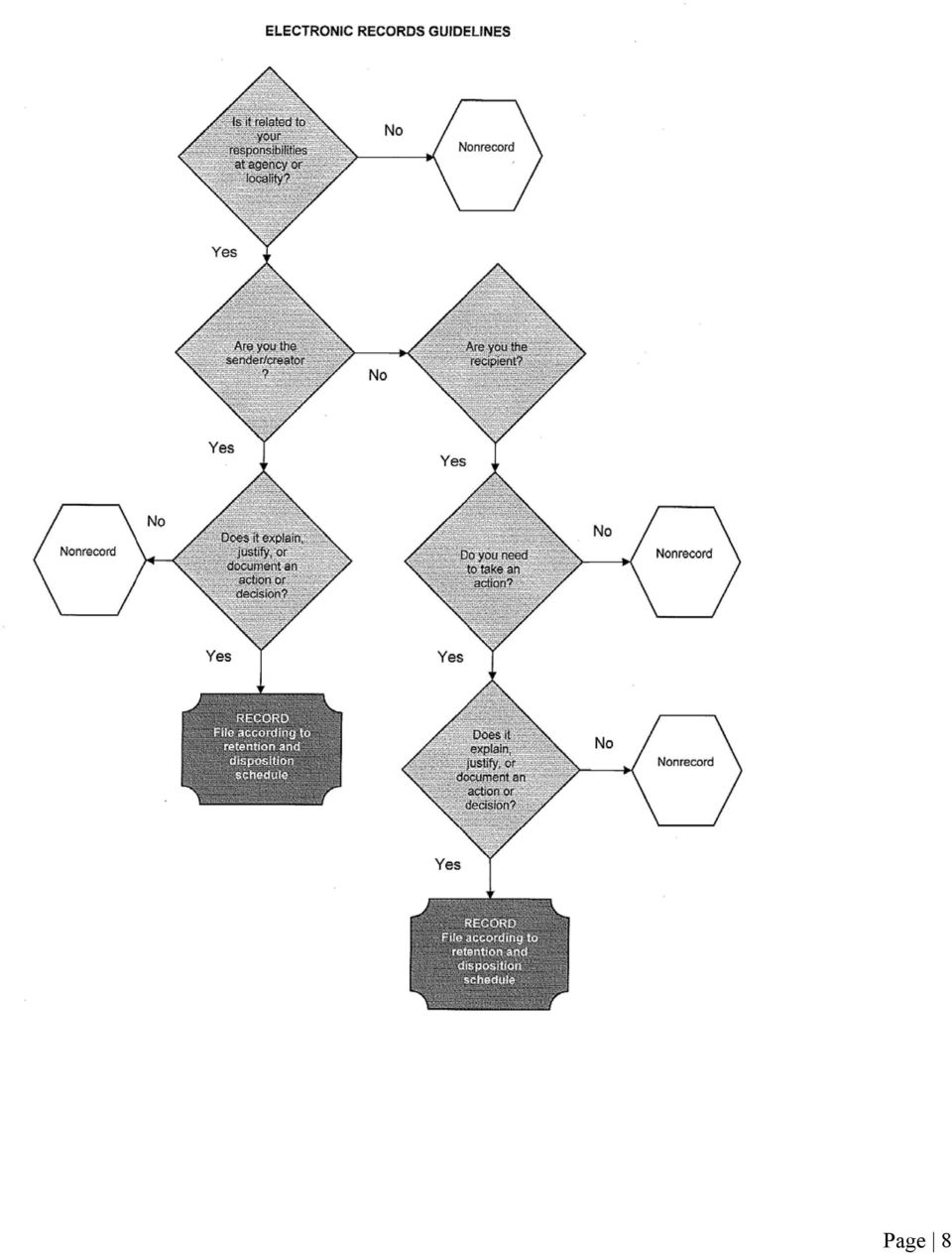
9 2. Set up an archiving system Because of mailbox size limitations in most organizations, s should only be stored within electronic mail systems temporarily. In addition, if this method is in use, accounts must not be deleted until a supervisor certifies that all public records in the accounts have been transferred to another record-keeping system or that any retention periods have passed and there is no litigation, audit, investigation, or request for records pursuant to the Virginia Freedom of Information Act ( et seq.). There are three methods of archiving communications outside of the system: Create personal folders that are stored outside of your mailbox but can be viewed using your client. If you store on a shared drive, make sure drives are backed up properly on a regular basis. Store, access, and manage messages and other electronic records using an Electronic Content Management system (ECM), such as IBM FileNet. Print s and maintain them in a manual system. Include names and addresses of recipients and sender; time and date sent; subject line that describes the content of the ; text; and attachments, if applicable. If an is sent to a distribution list, include names and addresses of all members of the list. Regardless of the chosen approach, make sure folders are named and arranged logically, just as they would be in a paper filing system. Organizing archived in folders according to records series and fiscal or calendar year facilitates the monitoring of records retention and disposition. In addition, never password-protect an e- mail archive, as doing so may result in retrieval issues in the future. Keep in mind that there is a difference between archiving and AutoArchiving within Microsoft Outlook. Archiving involves a manual transfer by the user and AutoArchiving is an automatic process that, if turned on within Outlook, takes place at regular intervals. Rather than using the AutoArchiving function, users should set aside time to clean up mailboxes and archive appropriate folders manually. 3. Dispose of appropriately , like all other records, may be disposed of in one of two ways: destruction or transfer to the Archives, Library of Virginia. that does not contain confidential or privacy-protected information may be disposed of by deleting it from the system. For s containing confidential or privacy-protected information, be sure that you electronically shred the or wipe clean the media on which it resides. destruction should be reported on a Certificate of Records Destruction (RM-3 Form). Work with your IT department to ensure all duplicate copies, which may reside on servers or backup tapes, are also destroyed. may be transferred to the Archives, Library of Virginia on a case-by-case basis by completing the For additional information regarding SWCC s policies refer to Retention Schedules A retention schedule lists records series and provides instructions and special guidelines for their care-how long to maintain them, and procedures for disposing of them. Retention schedules reflect the length of time that records have administrative, legal, fiscal or historical value. Page 9

10 Records cannot be destroyed before the stated period, nor should they be retained longer than the stated period (unless they are needed for an investigation, litigation or audit). There are two types of schedules general and specific. General Schedules apply to records that state agencies have in common (e.g., fiscal, administrative and personnel records). A complete list of these schedules can be located on the web at Specific Schedules apply to records that are unique to a state institution s operations and mission. The schedules identify records that the institution produces, collects, receives or retains in carrying out its special functions. Records Surveys A records survey or records inventory, is the process of identifying all records series, their functions and the extent of their use. It is a data collection tool. Record series: A group or unit of related documents or information that is normally files or kept together because it relates to a particular subject or function, results from the same activity, or documents a particular transaction or activity. Examples: correspondence, time sheets, contracts, ordinances, fiscal vouchers, project files and minutes. A records survey requires cooperation, persistence, patience, curiosity and a big picture perspective. SWCC will conduct an annual records survey utilizing RM-19, which is located on the web at The Records Manager and the Records Retention Committee form an ad hoc records management committee to become familiar with the survey forms and procedure, and then conduct surveys within their areas. Forms are submitted to the Records Manager. Records Destruction The Virginia Public Records Act requires that you have a valid retention schedule before destroying public records. The destruction of records is documented on the Certificate of Records Destruction (RM-3 form). The form is found on the web at: Destruction Procedure The following steps document compliance with legal requirements for destroying public records: o Refer to a LVA approved Records Retention and Disposition Schedule. o Ensure that the retention period stated on the schedule has passed. o Ensure that all known audits, investigations or litigation are resolved. o Complete a Certificate of Records Destruction. Page 10

11 o Obtain signatures of the Records Manager and the person requesting destruction of the records. The Records Manager must approve all dispositions. Dr. Betsy Summerfield serves as the SWCC Records Manager. These signatures constitute approval to destroy. o Identify the person who can verify the records were destroyed. o Once the records have been destroyed, the original RM-3 form with signatures will be forwarded by the Records Manager to LVA. Methods of Destruction The nature of the information in the records, as well as its format, dictates the method by which they should be destroyed. Frequently, disposition by recycling or daily waste pick up is appropriate. However, when records contain personal, private or confidential information, they must be destroyed so as to prevent unauthorized access to them. o Trash. Many records may be destroyed by simply placing them in a trash receptacle. Records disposed of in this manner must not contain private, sensitive or confidential information. o Electronic Data. To protect individuals who may have private or confidential information stored in an electronic format, you must be certain that the data is obliterated-the data must be wiped, not merely deleted. Special software programs will wipe data and make it permanently irretrievable and inaccessible. o Recycling (also known as pulping). This is an acceptable method of destruction for paper records with no special disposition requirements. o Private or confidential records can by recycled if the recycling company and its personnel are bonded, and will certify that the information has been protected. o Shredding. This is the most popular method of destroying private or confidential information. Records Reformatting Records should not be converted or reformatted solely for space-saving purposes. The following analysis is to be followed when evaluating the necessity and practically of reformatting. o Historical or otherwise valuable records that are in bad physical condition. o Records that have a long retention period are permanent, vital or historical. o Records that have a high retrieval rate. o Records that are needed by multiple users simultaneously. o Records needed at multiple locations. o Records that have important research value. o Records that are oversized and bulky and meet one or more other criteria for reformatting. Page 11
12 o Records that need to be stored separately for security reasons. o Records that incorporate workflow. Legality of Reformatted Records Laws of evidence. Both Virginia and federal laws recognize the legal status of copies made from various sources; including electronic data stored on optical media (refer to Code of Virginia, Section , Copies of Originals as Evidence). The law of evidence allows copies produced from originals to be admissible as evidence as long as the final reproduced image: o Accurately reproduces the original. o Was made or received during the performance of the institution s official business. o Is satisfactorily identified and authenticated by a custodian of the original record. However, when an image can be easily manipulated or changed, the burden of proving the information is acceptable as evidence increases. Page 12

13 Appendix A - What is a Record? Page 13
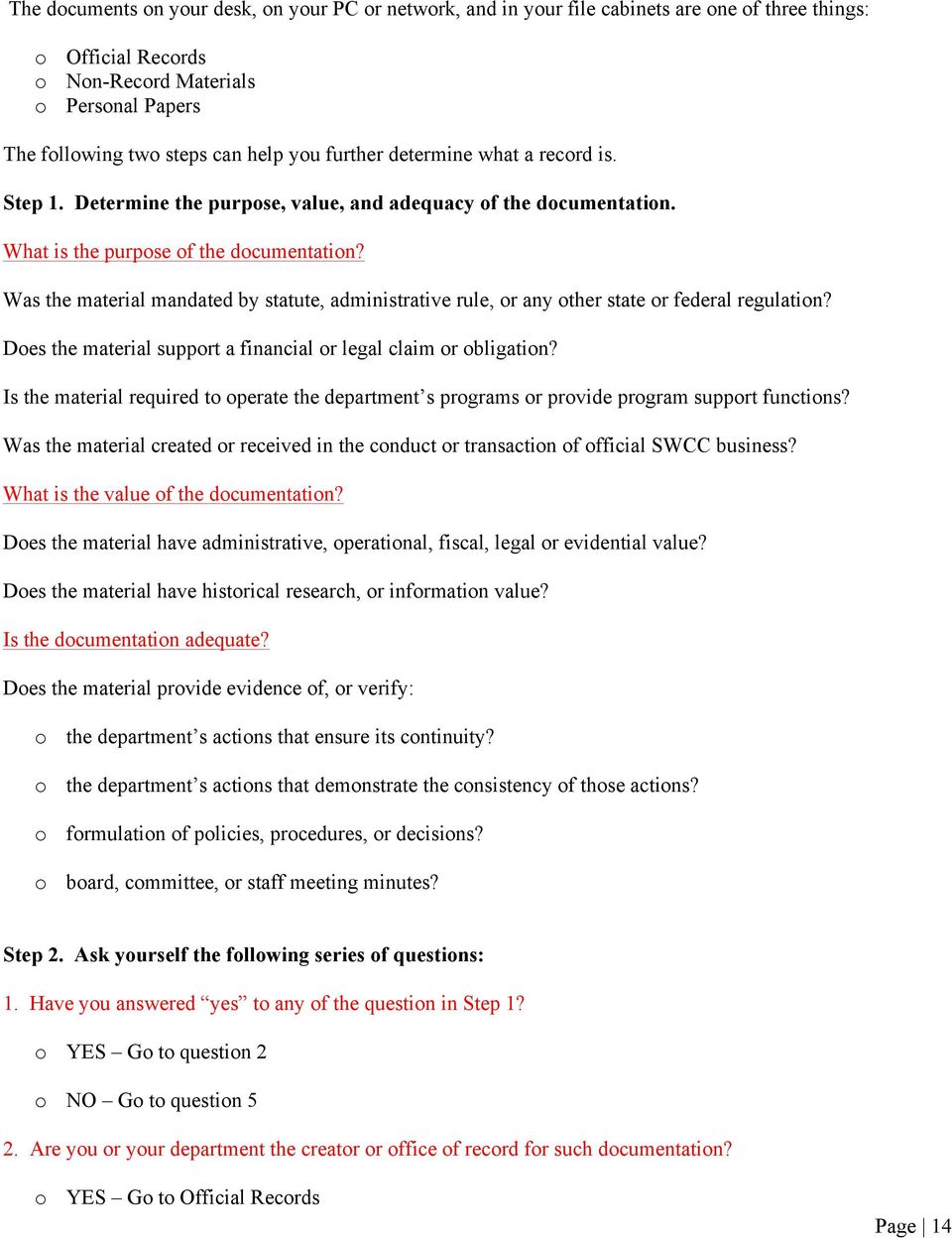
14 The documents on your desk, on your PC or network, and in your file cabinets are one of three things: o Official Records o Non-Record Materials o Personal Papers The following two steps can help you further determine what a record is. Step 1. Determine the purpose, value, and adequacy of the documentation. What is the purpose of the documentation? Was the material mandated by statute, administrative rule, or any other state or federal regulation? Does the material support a financial or legal claim or obligation? Is the material required to operate the department s programs or provide program support functions? Was the material created or received in the conduct or transaction of official SWCC business? What is the value of the documentation? Does the material have administrative, operational, fiscal, legal or evidential value? Does the material have historical research, or information value? Is the documentation adequate? Does the material provide evidence of, or verify: o the department s actions that ensure its continuity? o the department s actions that demonstrate the consistency of those actions? o formulation of policies, procedures, or decisions? o board, committee, or staff meeting minutes? Step 2. Ask yourself the following series of questions: 1. Have you answered yes to any of the question in Step 1? o YES Go to question 2 o NO Go to question 5 2. Are you or your department the creator or office of record for such documentation? o YES Go to Official Records Page 14
15 o NO Go to question 3 3. Did you comment or take action on the document? o YES Go to question 4 o NO Go to Non-Record Materials 4. Is the retention of the document necessary to support the decision trail of your comment or action? o YES Go to Official Records o NO Go no Non-Record Materials 5. Have you answered no to all the questions in Step 1? o YES Go to question 6 o NO Go to question 2 6. Does the material consist of non-official or private information which pertains solely to an individual s own affairs and does not relate to or have an effect upon the conduct of the institution s business? o YES Go to Personal Papers o NO Go to Non-Record Materials Page 15

16 APPENDIX B LVA RECORDS MANAGEMENT TIPS Page 16

17 Non- record You received it Record Next step: Use schedule to determine length of retention This is a copy of a record another department/agency keeps

18 You created it It s from someone inside your agency Your 18

19 19

20 20
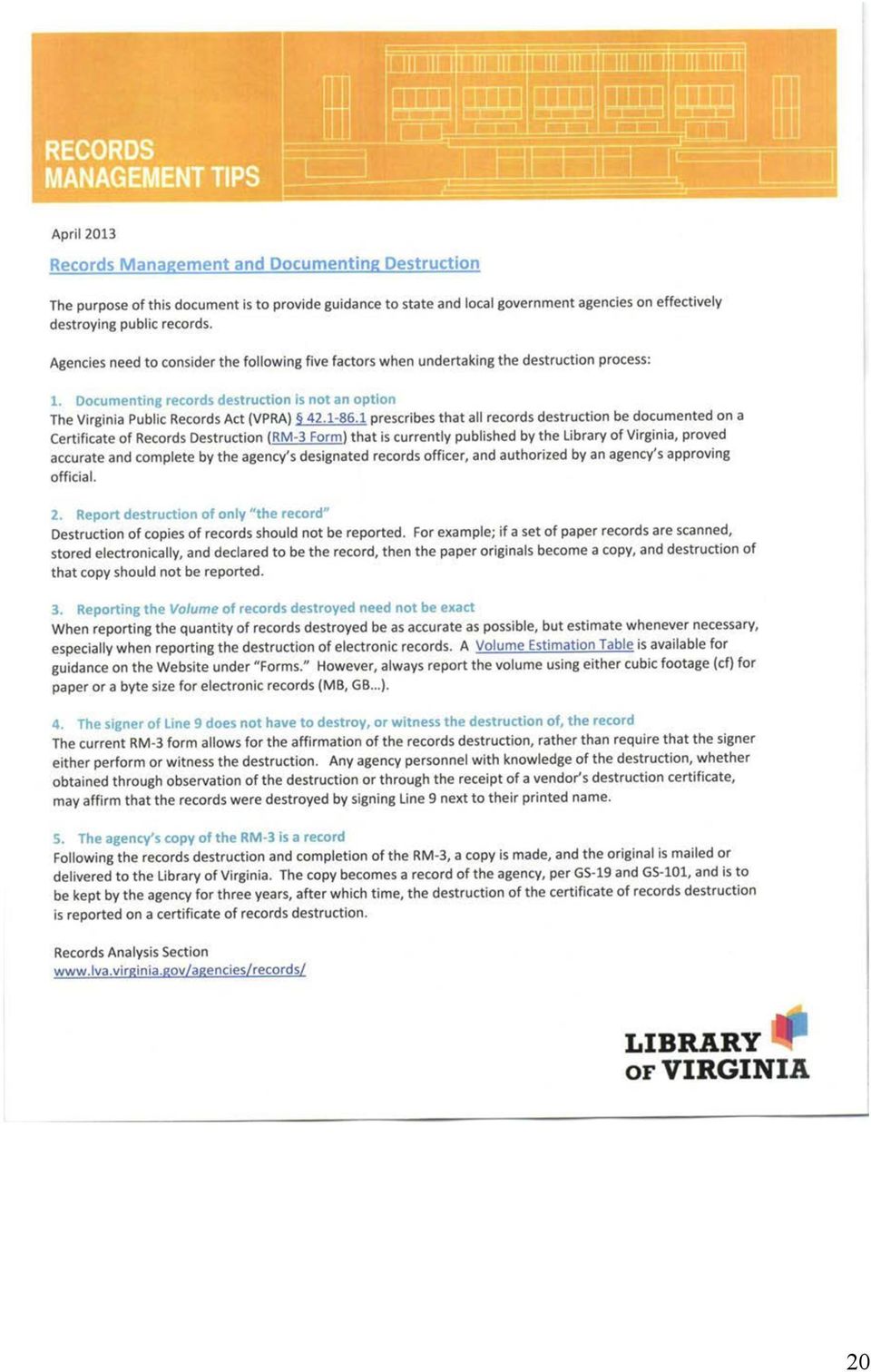
21 21
Practical tips for managing e mail
 E MAIL MANAGEMENT E mail messages both sent and received that provide evidence of a government transaction are considered public records. Agencies and locality Records Officers must ensure that e mail
RECORDS AND INFORMATION MANAGEMENT AND RETENTION
 RECORDS AND INFORMATION MANAGEMENT AND RETENTION Policy The Health Science Center recognizes the need for orderly management and retrieval of all official records and a documented records retention and
SOUTHWEST VIRGINIA COMMUNITY COLLEGE RECORDS MANAGEMENT POLICY
 SOUTHWEST VIRGINIA COMMUNITY COLLEGE RECORDS MANAGEMENT POLICY Statement of Intent This policy establishes the general responsibilities for management, retention, and disposition of SOUTHWEST VIRGINIA
Presentation Topics. What is a record? Hawaii State Archives Presentation December 14, 2010 ABC S OF RECORDS MANAGEMENT ACHIEVING BASIC CONTROL
 ABC S OF RECORDS MANAGEMENT ACHIEVING BASIC CONTROL Presented by: Adam Jansen [email protected] December 2010 Presentation Topics What is a Record What is Records Management Your Responsibilities Conducting
E-MAIL RETENTION BEST PRACTICE. Issue Date: April 20, 2011. Intent and Purpose:
 E-MAIL RETENTION BEST PRACTICE Issue Date: April 20, 2011 Intent and Purpose: The intent of this best practice is for county officials to have an educational mechanism to explain requirements for maintaining
DELAWARE PUBLIC ARCHIVES POLICY STATEMENT AND GUIDELINES ELECTRONIC MAIL
 COMMUNICATIONS AND RECORDS DELAWARE PUBLIC ARCHIVES POLICY STATEMENT AND GUIDELINES ELECTRONIC MAIL Electronic mail systems, commonly called email, are becoming the communications method of choice for
Presented by Vickie Swam, Director of University Compliance. Records Management is one of the functions supported by the University Compliance Office.
 Presented by Vickie Swam, Director of University Compliance. Records Management is one of the functions supported by the University Compliance Office. 1 Texas Government Code (TAC), Section 441 requires
POLICY AND GUIDELINES FOR THE MANAGEMENT OF ELECTRONIC RECORDS INCLUDING ELECTRONIC MAIL (E-MAIL) SYSTEMS
 POLICY AND GUIDELINES FOR THE MANAGEMENT OF ELECTRONIC RECORDS INCLUDING ELECTRONIC MAIL (E-MAIL) SYSTEMS 1. Purpose Establish and clarify a records management policy for municipal officers with respect
EFFECTIVE DATE: JULY 1, 2010
 Town of Florence POLICY TITLE: EMAIL RETENTION POLICY RESPONSIBLE DEPARTMENT: Town Clerk Office APPROVAL: EFFECTIVE DATE: JULY 1, 2010 AP / RESOLUTION NO.: 2010-02 REFERENCES: TOWN MANAGER SIGNATURE: TOWN
How To Preserve Email Records In Mississippi
 EMAIL MANAGEMENT GUIDELINES FOR COUNTIES AND MUNICIPALITIES 1. Purpose The purpose of these guidelines is to ensure that the electronic mail records of county and municipal government officials and employees
State of Michigan Records Management Services. Frequently Asked Questions About E mail Retention
 State of Michigan Records Management Services Frequently Asked Questions About E mail Retention It is essential that government agencies manage their electronic mail (e mail) appropriately. Like all other
Glossary of Records Management Terms
 Glossary of Records Management Terms Active record: A record referenced often in the conduct of current departmental business. Administrative record: Records documenting the day to day operation and administration
Records Management Basic Information For Local Government Agencies
 Records Management Basic Information For Local Government Agencies Title 5: ADMINISTRATIVE PROCEDURES AND SERVICES Part 1: STATE DEPARTMENTS Chapter 6: STATE ARCHIVIST (HEADING: PL 1973, c. 625, @16 (new))
Montana Local Government Records Management Guidelines
 Montana Local Government Records Management Guidelines Prepared and Published by the Montana Local Government Records Committee Rev 3.0 Sep 2010 TABLE OF CONTENTS Introduction i Authority...ii Definitions...
Developing a Records Retention Program
 Developing a Records Retention Program This site is intended to help you design and implement a records retention program for your organization. Here you will find a basic explanation of a records retention
Electronic Records Management Guidelines
 Electronic Records Management Guidelines Contents Section 1: Authority... 1 Section 2: Purpose and Scope... 1 Section 3: Records Custodian Responsibilities... 2 Section 4: Information Systems that produce,
State of Montana E-Mail Guidelines
 State of Montana E-Mail Guidelines A Management Guide for the Retention of E-Mail Records for Montana State Government Published by the: Montana State Records Committee Helena, Montana September 2006 Based,
RUTGERS POLICY. Approval Authority: Executive Vice President for Academic Affairs and Senior Vice President for Administration
 RUTGERS POLICY Section: 30.4.5 Section Title: Business Services Policy Name: Records Management Formerly Book: Formerly Policy 50.3.10 Approval Authority: Executive Vice President for Academic Affairs
Records Management Services We re not just paper. We are compliance.
 Information compliance is everyone s responsibility. But for us it s a job. Records Management Services We re not just paper. We are compliance. Call Records Management Services for assistance if you have
Chapter 2.82 - RECORDS MANAGEMENT Sections:
 Chapter 82 - RECORDS MANAGEMENT Sections: 8010 - Government records findings Recognition of public policy. The council of Salt Lake County finds the following: A. It is in the best interests of Salt Lake
COLORADO COMMUNITY COLLEGE SYSTEM SYSTEM PRESIDENT S PROCEDURE ELECTRONIC COMMUNICATIONS MANAGEMENT AND RETENTION PROCEDURES
 Page 1 of 6 SP 3-125d COLORADO COMMUNITY COLLEGE SYSTEM SYSTEM PRESIDENT S PROCEDURE ELECTRONIC COMMUNICATIONS MANAGEMENT AND RETENTION PROCEDURES EFFECTIVE: June 14, 2009 REFERENCE: BP 3-125; Electronic
University of Louisiana System
 Policy Number: M-17 University of Louisiana System Title: RECORDS RETENTION & Effective Date: OCTOBER 10, 2012 Cancellation: None Chapter: Miscellaneous Policy and Procedures Memorandum Each institution
BASIC STEPS IN A RECORDS MANAGEMENT PROGRAM. The basic steps in implementing a records management program are: Inventory Appraisal Scheduling
 INTRODUCTION Records are indispensable in the efficient and economical operation of state government. They serve as the memory; they are the evidence of past events and the basis for future actions. When
8/28/2015. How to Manage Records. Overview. Learning Objectives. Do you have? Does your office look like this?
 How to Manage Records Records Management Services State of Michigan Overview Common Recordkeeping Problems Risk Management Keeping Records Storing Records Destroying Records Getting Organized Learning
UNIVERSITY OF NAIROBI POLICY ON RECORDS MANAGEMENT
 UNIVERSITY OF NAIROBI POLICY ON RECORDS MANAGEMENT APRIL 2011 POLICY ON RECORDS MANAGEMENT TABLE OF CONTENTS DEFINITION OF TERMS AND ACRONYMS... 5 1.0 BACKGROUND... 5 1.1 RATIONALE... 5 1.2 VISION... 5
September 28 2011. Tsawwassen First Nation Policy for Records and Information Management
 Tsawwassen First Nation Policy for Records and Information Management September 28 2011 Tsawwassen First Nation Policy for Records and Information Management Table of Contents 1. RECORDS AND INFORMATION
2.82.010 Government records findings--recognition of public policy.
 Chapter 2.82 RECORDS MANAGEMENT 2.82.010 Government records findings--recognition of public policy. The council of Salt Lake County finds the following: A. It is in the best interests of Salt Lake County
West Chester University Records Management Policy
 1. Introduction West Chester University is committed to effective records management to preserve its history, meet legal standards, optimize the use of space, minimize the cost of record retention, and
RECORDS DESTRUCTION PROCEDURE
 RECORDS DESTRUCTION PROCEDURE The District School Board of Collier County Prepared by Donna Woods Records Management Liaison Officer [email protected] RECORDS DESTRUCTION PROCEDURE Table of Contents
How To Manage Records And Information Management In Alberta
 8. RECORDS AND INFORMATION MANAGEMENT Overview This chapter is intended to help public bodies understand how good records and information management practices assist in the effective administration of
Electronic Records Management Guidelines
 Electronic Records Management Guidelines I. Objectives The employees of the Fort Bend Independent School District (the District ) routinely create, use, and manage information electronically in their daily
Records Management. Training 101
 Records Management Training 101 Learning Objectives This training is designed to help you: Understand the importance of Records Management and why records are maintained Understand your RM responsibilities
DELAWARE PUBLIC ARCHIVES POLICY STATEMENT AND GUIDELINES MODEL GUIDELINES FOR ELECTRONIC RECORDS
 DELAWARE PUBLIC ARCHIVES POLICY STATEMENT AND GUIDELINES MODEL GUIDELINES FOR ELECTRONIC RECORDS STATEMENT OF PURPOSE The Delaware Public Archives (DPA) has issued "Model Guidelines for Electronic Records"
UNIVERSITY OF MASSACHUSETTS RECORD MANAGEMENT, RETENTION AND DISPOSITION POLICY
 DOC. T99-061 Passed by the BoT 8/4/99 UNIVERSITY OF MASSACHUSETTS RECORD MANAGEMENT, RETENTION AND DISPOSITION POLICY The President of the University shall adopt guidelines to require that each campus
Table of Contents. Chapter No. 1. Introduction 1. 2. Objective 1. 3. E-mail Use Compliance 1. 4. Definitions 2. 5. Roles and Responsibilities 2
 Table of Contents Chapter Subject Page No. 1. Introduction 1 2. Objective 1 3. E-mail Use Compliance 1 4. Definitions 2 5. Roles and Responsibilities 2 6. Creation and Use of E-mails 3 7. Managing E-mails
SOUTHERN ILLINOIS UNIVERSITY EDWARDSVILLE RECORDS MANAGEMENT MANUAL
 SOUTHERN ILLINOIS UNIVERSITY EDWARDSVILLE RECORDS MANAGEMENT MANUAL Updated 03/2015 1 INTRODUCTION A Records Management program s chief function is the systematic control of the creation, maintenance,
Institute for Advanced Study Shelby White and Leon Levy Archives Center
 Institute for Advanced Study Shelby White and Leon Levy Archives Center Managing Electronic Records - Recommendations for Institute Staff File Management: Guidelines & Policies Which files are considered
E-mail Management: A Guide For Harvard Administrators
 E-mail Management: A Guide For Harvard Administrators E-mail is information transmitted or exchanged between a sender and a recipient by way of a system of connected computers. Although e-mail is considered
Arizona State Library, Archives and Public Records
 Arizona State Library, Archives and Public Records RECORDS MANAGEMENT DIVISION 1919 West Jefferson Phoenix, Arizona 85009 (602) 542-3741 Managing Public Records Sent and Received Via Electronic Mail These
INSTITUTE OF TECHNOLOGY TALLAGHT RECORD MANAGEMENT & RETENTION POLICY
 INSTITUTE OF TECHNOLOGY TALLAGHT RECORD MANAGEMENT & RETENTION POLICY INTRODUCTION Under the Freedom of Information Acts, 1997 and 2003 the Institute is obliged to comply with legislation and publish a
HCAOG Records Retention Policies & Procedures
 HCAOG Records Retention Policies & Procedures Draft September 2015 HUMBOLDT COUNTY ASSOCIATION OF GOVERNMENTS 611 I Street, Suite B Eureka, CA 95501 www.hcaog.net RECORDS MANAGEMENT These procedures are
Non-Profit Records Management Tool Kit
 Non-Profit Records Management Tool Kit January 2013 Contents Introduction.... 3 Generally Accepted Record Keeping Principles.... 4 What is a Record?.... 5 File Maintenance.... 6 Classifying a Record.....8
Basic Records Management Practices for Saskatchewan Government*
 Provincial Saskatchewan Archives R of Saskatchewan Basic Records Management Practices for Saskatchewan Government* Provincial Archives of Saskatchewan (306) 787-0734 [email protected] www.saskarchives.com
FDU - Records Retention policy Final.docx
 Records and Information Management Program Policy and Procedure Responsible Office Office of the General Counsel Effective Date 04/01/2012 Responsible Official General Counsel Last Revision I. Rationale
Guidelines and Best Practices for Implementing Revised DEO Policy 4.09, Records Management Procedures
 Introduction The DEO Policy 4.09, Management Procedures, aligns DEO records management with the state laws and Department of State (DOS) rules on records management that apply to all state agencies. Besides
39C-1 Records Management Program 39C-3
 39C-1 Records Management Program 39C-3 Sec. 39C-1. Sec. 39C-2. Sec. 39C-3. Sec. 39C-4. Sec. 39C-5. Sec. 39C-6. Sec. 39C-7. Sec. 39C-8. Sec. 39C-9. Sec. 39C-10. Sec. 39C-11. Sec. 39C-12. Sec. 39C-13. Sec.
State of Florida ELECTRONIC RECORDKEEPING STRATEGIC PLAN. January 2010 December 2012 DECEMBER 31, 2009
 State of Florida ELECTRONIC RECORDKEEPING STRATEGIC PLAN January 2010 December 2012 DECEMBER 31, 2009 Florida Department of State State Library and Archives of Florida 850.245.6750 http://dlis.dos.state.fl.us/recordsmanagers
RECORDS MANAGEMENT MANUAL
 RECORDS MANAGEMENT MANUAL Date: September, 2007 Authored By: University Archives Contents 1. Records Management at UBC 3 A) Purpose of The Records Manual 3 B) Benefits of Records Management 3 C) Some Records
PSAB Supplement 21 Records Retention and Disposition
 PSAB Supplement 21 Records Retention and Disposition KEY WORDS INDEX... I TABLE OF AUTHORITIES... II PSAB Supplement 21 Records, Retention and Disposition MANUAL OF PROCEDURES PSAB SUPPLEMENT 21 RECORDS,
ACCESS, PRODUCTION AND RETENTION OF CITY RECORDS
 1.05-3 1 of 6 I. PURPOSE This directive prescribes the rules regarding access, production, and retention of City records. II. POLICY A. All records and other matters in City offices are presumed to be
Applicability: All Employees Effective Date: December 6, 2005; revised January 27, 2009 Source(s):
 Title: Category: Administration Information Management Policy No.: B5010 Replaces: B5010 Applicability: All Employees Effective Date: December 6, 2005; revised January 27, 2009 Source(s): Approval: (President
Guidelines. Managing E-mail Records. Office of the Secretary of State. Approved and Recommended by the State Records Commission February 22, 2001
 Guidelines Managing E-mail Records Approved and Recommended by the State Records Commission February 22, 2001 Office of the Secretary of State Introduction Most everyone would agree that e-mail has changed
Records Management Policy
 Records Management Policy Business Records exist in a variety of forms, including physical and electronic form. The foundation produces, receives, stores and destroys a large number of Business Records
RECORDS MANAGEMENT POLICY
 RECORDS MANAGEMENT POLICY PURPOSE The purpose of this policy is to: Assist departments in effective utilization of space and efficient information retrieval; Establish guidelines for disposal of records;
General Records Management Training
 General Records Management Training 1 Objectives Upon completion of this training, you will understand how to: Determine Federal records from non-records Manage Federal records throughout their lifecycle
Records Management Manual of the University of Nevada Las Vegas Table of Contents
 Records Management Manual of the University of Nevada Las Vegas Table of Contents Part 1: Overview of Records Management at the University of Nevada Las Vegas... 2 1.1 PROGRAM RATIONALE, RESPONSIBILITIES
File Management : Guidelines & Policies
 File Management : Guidelines & Policies Which files are considered records? Files created or received pursuant to the transaction of University business or in the fulfillment of its educational, administrative,
Guidelines for Managing E-Mail in Kentucky Government 1
 Guidelines for Managing E-Mail in Kentucky Government 1 I. Introduction Electronic Mail (e-mail) is an important communication tool for conducting government business in the Commonwealth of Kentucky. Increasingly,
5 FAM 440 ELECTRONIC RECORDS, FACSIMILE RECORDS, AND ELECTRONIC MAIL RECORDS
 5 FAM 440 ELECTRONIC RECORDS, FACSIMILE RECORDS, AND ELECTRONIC MAIL RECORDS (CT:IM-158; 12-29-2014) (Office of Origin: A/GIS/IPS) NOTE: In October, 2014, the Department issued an interim directive superseding
Information Management Advice 27 Managing Email
 Introduction Email is a critical communication mechanism for Tasmanian Government Agencies and a fundamental tool for conducting business. Emails, like State records in other formats, should be captured
RECORDS MANAGEMENT MANUAL FOR STATE EMPLOYEES
 STATE OF MICHIGAN RECORDS MANAGEMENT MANUAL FOR STATE EMPLOYEES Records Management Services February 12, 2015 0 I. INTRODUCTION This manual has been prepared for employees of the State of Michigan. It
California State University, Sacramento INFORMATION SECURITY PROGRAM
 California State University, Sacramento INFORMATION SECURITY PROGRAM 1 I. Preamble... 3 II. Scope... 3 III. Definitions... 4 IV. Roles and Responsibilities... 5 A. Vice President for Academic Affairs...
State of New Jersey Circular Letter 03-10-ST: Managing Electronic Mail: Guidelines and Best Practices
 CIRCULAR LETTER NO: 03-10-ST ORIGINATING AGENCY: DIVISION OF ARCHIVES AND RECORDS MANAGEMENT, DEPARTMENT OF STATE EFF DATE: 7/11/02 EXP DATE: INDEFINITE SUPERSEDES: NONE SUBJECT: MANAGING ELECTRONIC MAIL:
Record Retention and Digital Asset Management Tim Shinkle Perpetual Logic, LLC
 Record Retention and Digital Asset Management Tim Shinkle Perpetual Logic, LLC 1 Agenda Definitions Electronic Records Management EDMS and ERM ECM Objectives Benefits Legal and Regulatory Requirements
Union County. Electronic Records and Document Imaging Policy
 Union County Electronic Records and Document Imaging Policy Adopted by the Union County Board of Commissioners December 2, 2013 1 Table of Contents 1. Purpose... 3 2. Responsible Parties... 3 3. Availability
SOUTH EASTERN SCHOOL DISTRICT
 No. 800 SECTION: OPERATIONS SOUTH EASTERN SCHOOL DISTRICT TITLE: RECORDS RETENTION AND MANAGEMENT ADOPTED: April 18, 2013 REVISED: 800. RECORDS RETENTION AND MANAGEMENT 1. Purpose It shall be the policy
United Cerebral Palsy of Greater Chicago Records and Information Management Policy and Procedures Manual, December 12, 2008
 United Cerebral Palsy of Greater Chicago Records and Information Management Policy and Procedures Manual, December 12, 2008 I. Introduction United Cerebral Palsy of Greater Chicago ( UCP ) recognizes that
NCI-Frederick Safety and Environmental Compliance Manual 03/2013
 E-1. Records Management I. Scope The Records Management Office maintains a comprehensive records management system meeting regulatory and contractual requirements ensuring documentation is readily accessible.
Fundamentals. of Records & Information. Management
 Fundamentals of Records & Information Management Records & Information Management Two Major Objectives: To manage the creation, growth, duplication, maintenance, retention and disposition of records. (Records
COMMISSION OF PUBLIC RECORDS NEW MEXICO STATE RECORDS CENTER AND ARCHIVES
 COMMISSION OF PUBLIC RECORDS NEW MEXICO STATE RECORDS CENTER AND ARCHIVES IMPLEMENTATION GUIDE FOR 1.13.4 NMAC: RECORDS MANAGEMENT REQUIREMENTS FOR ELECTRONIC MESSAGING July 1, 2007 1205 Camino Carlos
CREATIVE SOLUTIONS IN HEALTHCARE, INC. Privacy Policy
 CREATIVE SOLUTIONS IN HEALTHCARE, INC. Privacy Policy Amended as of February 12, 2010 on the authority of the HIPAA Privacy Officer for Creative Solutions in Healthcare, Inc. TABLE OF CONTENTS ARTICLE
City of Minneapolis Policy for Enterprise Information Management
 City of Minneapolis Policy for Enterprise Information Management Origin: Developed by the City Clerk s Office and Business Information Services. Based on requirements set forth in Federal and State regulations
Saskatchewan Records Management Guidelines
 Saskatchewan Archives Board Saskatchewan Records Management Guidelines NOTE: These Records Management Guidelines are intended to guide the development of specific policies and procedures that recognize
TERRITORY RECORDS OFFICE BUSINESS SYSTEMS AND DIGITAL RECORDKEEPING FUNCTIONALITY ASSESSMENT TOOL
 TERRITORY RECORDS OFFICE BUSINESS SYSTEMS AND DIGITAL RECORDKEEPING FUNCTIONALITY ASSESSMENT TOOL INTRODUCTION WHAT IS A RECORD? AS ISO 15489-2002 Records Management defines a record as information created,
E-Mail Management & Retention
 E-Mail Management & Retention Maine State Archives Records Management Division Basic Information What is e-mail? Formally, it is a document created or received on an electronic mail system including brief