
restoring trees after a hurricane
|
|
|
- Jennifer Bennett
- 9 years ago
- Views:
Transcription
1 CHAPTER restoring trees after a hurricane PUBLICATION Nº ENH 1054 edward f. gilman t r a c i pa r t i n Introduction Contents The step-by-step outline provided in this document summarizes the process for restoring trees so that they will bring shade and beauty back to the community with reduced risk. Restoration typically requires more than one to develop strong tree structure, so remember that patience is a virtue when dealing with storm-damaged trees. Various factors determine the period of time necessary for recovery: age and health of tree, size, species, and extent of damage. These factors are interrelated, and together determine the amount of care a tree will need after a storm. A restoration program typically lasts from two to five years and perhaps much longer for large and severely damaged mature trees. I II III IV V Response Plan for Immediately after a Storm Allow Time for Recovery Restoration Pruning Program Restoration of Palms Start a Tree Management Program p. 2 p. 6 p. 6 p. 8 p. 10 Know what trees can be restored. The structure of the tree should be intact, without any visible cracks or large wounds on the main trunk, limbs, or main roots. Trees can recover from complete leaf loss or significant damage to the canopy, including several broken limbs, but major trunk damage is often irreparable. The Urban Forest Hurricane Recovery Program

2 I. Response Plan for Immediately after a Storm After a storm, removing hazards and cleaning tree canopies of broken limbs and dead stubs should be the focus of treatment. Major to alter the tree s structure should not be done at this time. Trees use energy stored in the wood to recover from damage and produce new growth; therefore, during the clean up process, the least amount of live wood possible should be removed. (Think of the stored energy in trees as the limited funds in a bank account. After paying for repairs on the house due to hurricane damage, homeowners usually do not rush out to buy a new sailboat. Similarly, this is not the time to further reduce the already limited funds of the tree by removing live wood.) Be very careful not to cause additional stress to the tree by injuring trunk, branches, or roots. Do not top your trees or cut the entire canopy back to stubs (Figure 1). Many communities in Florida outlaw or discourage topping because it leads to decay and reduces its vigor. be treated as new plantings and staked with the help of a professional. Staking methods Research and experience on the effectiveness of different staking methods show that some systems work better than others. Root ball anchorage systems work very well to stabilize trees in the soil (Figure 2). Rigid systems can work, but they need to be adjusted or removed within six months (Figure 3). Figure q Topping is detrimental to tree health. Step 1 Get help with removing potential hazards. If a limb has fallen near power lines, make sure that a qualified line-clearance arborist treats the situation. Working near electricity is highly dangerous, and may result in a fatality for workers who do not follow proper safety procedures. Other hazardous situations include large hanging limbs or leaning trees that could fall on a person, hit a house, or damage other potential targets if they go down. These situations should be taken care of by a professional before anything else. Step 2 Stand up and stake small fallen trees, and provide irrigation as needed for stressed trees. Standing up small fallen trees is a priority because the roots dry out quickly. Experienced professionals have observed from past hurricanes that staked trees with a trunk diameter greater than about 4 inches tend to blow down again in later storms, and may not be worth the time and expense for restanding. The reason for this appears to be that severed roots on bigger trees do not regenerate new roots as well as small (one inch diameter or less) roots do. Also, large severed roots can decay or rot, making the tree unstable. The exception is recently planted trees, which can be restaked at any size because they do not have large broken roots. These trees should q w e Figure w Root ball anchorage systems work nicely. Figure e Rigid staking systems may cause significant trunk damage. This system is less problematic for palm trees because their trunks expand very little at the point where the stakes are secured. CHAPTER Restoring Trees after a Hurricane p. 2

3 Steps for standing up trees that have fallen 1. Keep roots moist. 2. Excavate a hole to accommodate roots. 3. Use sharp tools to make clean cuts on jagged or torn roots. 4. Pull the tree up as straight as possible, taking care to not damage the trunk or roots. 5. Fill the hole with soil from the site, but avoid burying the area where the trunk meets the top main root (Figure 4). 6. Irrigate the tree with the same frequency as for newly planted trees, approximately three times/week for the first several months. Also, apply water during dry periods. Do not fertilize for one year. 7. Install staking system. Remove or adjust stakes after six months to one year. Irrigation for stressed trees Root growth is necessary for tree recovery after the storm, and keeping the soil moist will encourage formation of new roots. During the dry period of October through mid-may in Florida, trees should be irrigated as needed to help them recover from storm damage. When irrigating staked trees, two to three gallons per inch of trunk diameter should be sufficient. Efficient irrigation systems apply water directly to the root ball, rather than spraying overhead. Irrigation is not needed if the root ball is already saturated or wet from heavy rains. Significant tree dieback due to salt damage can occur in coastal areas that receive storm surge from hurricanes. These trees may require irrigation treatments to remove salts from the soil by flushing with water. Irrigation device Root flare 5 to 10% above landscape soil Mulch covering edge of root ball, and not piled on top Mulch Root ball r Figure r Drawing of correct technique for tree planting. Step 3 Clean tree canopies. The purpose of canopy cleaning is to remove potential hazards like dead and cracked branches and broken limbs. Canopy cleaning also includes making smooth cuts behind broken branch stubs to allow the proper development of new tissue to close over wounds (Figure 5). Remember that stressed trees need to access energy stored in their limbs in order to recover. The stored food is necessary for the tree to sprout, produce new leaves, and defend itself against organisms that cause decay. It is better to leave the tree looking unbalanced and misshapen than to remove large portions of the live canopy at this time. Shaping can be done later as part of the restoration process. Heading cut Reduction cut back to lateral t Figure tt Cleaning the canopy on a storm-damaged tree. Lines indicate where to make cuts. CHAPTER Restoring Trees after a Hurricane p. 3

4 Removal cut A removal cut removes a branch back to the trunk or parent branch (Figures 6 and 7). After a hurricane, this type of cut is used to remove broken, cracked, and hanging limbs. Hanging and detached limbs should be removed first so that branches do not fall and cause injury. Be sure there are no cracks along the large, main branches; use binoculars to get a closer look if needed. Arborists can climb trees to check for cracks and other structural defects. A branch with a crack can be a hazard, and should be removed if there is a target nearby. Figure y Drawing of a removal cut. After a hurricane, removal cuts are used to remove broken, cracked, and hanging limbs back to parent stems. Reduction cut A reduction cut shortens the length of a stem by back to a smaller limb, called a lateral branch (Figures 8 and 9). Ideally, the lateral should be at least 1/3 the diameter of the stem being cut. This type of cut is used for making clean cuts behind jagged tips of broken branches. Figure i Drawing of a reduction cut. This type of cut is used for making clean cuts behind jagged tips of broken stems and branches. y i i u Figure u Photograph of a removal cut. Branch is pruned back to the trunk, leaving the branch collar intact. A good cut is round. Cuts that are too close to the trunk are ovalshaped. o Figure o Photograph of a reduction cut. Branch is correctly pruned back to a lateral that is at least 1/3 the diameter of the broken stem. CHAPTER Restoring Trees after a Hurricane p. 4

5 Heading cut A heading cut is made at a node along the stem and leaves a stub (Figures 10 and 11). A node is the bud area from which branches arise, sometimes visible as a line around a stem or a slight swelling. When there is not a live lateral branch present for making a reduction cut, a heading cut could be a better choice than removing a large limb back to the trunk during canopy cleaning. Removal of large limbs can take away too much live wood, causing decay and disrupting canopy balance. This can result in poor health or tree failure in the years to come. a s Figure a Drawing of a topped tree with several heading cuts. A heading cut may be used instead of a reduction cut if there is not a live lateral branch to reduce back to. Heading cuts should be used only as a last resort. Figure s This branch was pruned back to a node, and sprouts are emerging. Over time, one of these sprouts can be trained to replace the broken tip on branches 4 inches or less in diameter. Heading cuts are allowed in the American National Standards Institute s national standard [1] as part of restoration. A heading cut used to clean the canopy could look like topping, which is a harmful method of trees, but the practice is dramatically different. Topping severely reduces the entire canopy of a tree (Figure 10, top), whereas heading cuts used in restoration are made only when necessary. Otherwise, heading cuts should not be used as a standard practice on healthy, undamaged trees. Summary of Actions after a Storm Contact the power company if a tree is down near power lines. Determine whether the tree is personal or municipal property to avoid unnecessary expenses. Protect roots of fallen trees from drying out by watering them and covering them with a tarp, not clear plastic. Hire a professional to help with staking fallen trees to avoid causing trunk damage. Before, assess damage and make sure the tree is restorable. Hire an ISA-certified arborist for restoration. Be familiar with the steps of restoration so that you know what to expect. Look up! Use binoculars to check for broken branches in the upper canopy, and look for cracks along limbs. Broken, hanging limbs are removed first. Jagged tips of broken branches should be removed with a smooth cut. Unless limbs are cracked and pose a hazard, excessive amounts of live wood should not be removed. Reduction cuts are preferable on broken limbs, but if there is not a lateral to reduce back to, heading cuts are sometimes appropriate. CHAPTER Restoring Trees after a Hurricane p. 5

6 II. Allow Time for Recovery Wind damage from hurricanes often strips the leaves from a tree. This interrupts the tree s ability to photosynthesize and store energy. In response to the damage, the tree sends out epicormic shoots, typically referred to as sprouts, found mostly along the top and at the tips of branches. To produce the sprouts, the tree uses energy (starch) stored in the living wood, which temporarily weakens the tree. Allowing sprouts to grow will rebuild the starch reserves and other energy-storing compounds, increasing strength of the tree over time. broadleaf evergreen and deciduous trees Wait until spring of the following year before determining if a tree is dead. If it does not sprout by the spring or early summer following the hurricane, it is not likely to recover. p i n e s Pines sprout very little or not at all. When all of the needles are brown, or if there are no needles, the pine is dead. pa l m s All leaves come from one bud located near the top of the palm. On palms with multiple trunks, each stem has a bud near the top. After a storm, it is difficult to determine whether the bud was damaged unless some obvious injury has occurred, like the trunk snapping in half. Allow at least six months to see whether new growth emerges from the bud. New fronds could be stunted or yellow leaves may be smaller and abnormally shaped and it may take 2 years or more before the palm regains its full set of leaves [2]. Factors Affecting Recovery Several factors determine the recovery period needed before initiating restoration. Tree Age This is an important factor young trees have a higher ratio of live to dead wood, which allows a faster recovery. This means you can begin restoring young trees sooner after the storm, within one to two years. Older trees may need two years or longer for sprouts to grow before you remove live branches. Tree Size Small maturing trees (less than 30 feet tall at maturity) take fewer visits because structural defects are not as critical. A falling crapemyrtle limb will not inflict as much damage as a falling live oak limb, for example. Large trees take priority during hurricane recovery. However, small trees still need time to recover properly. Trying to prune too much live wood at one visit will be just as problematic for the health of a small tree as it would be for a large one. Tree Species Knowing the species of a tree is particularly important in forming a plan. Some species are short-lived because they are prone to decay. Therefore, it may be more efficient to focus restoration efforts on trees that resist decay and are more likely to live longer. Common examples in Florida are live oak and buttonwood, which resist decay and recover from damage much better than laurel oaks, which often have severe internal decay. Tree Health Health of the tree prior to the hurricane will affect its ability to recover. Healthy trees recover faster than those in poor health. Old trees with decayed root systems, stem decay, and large dead branches are more likely to decline or die than recover. These preexisting conditions might make it more appropriate to remove the tree instead of restoring it. Extent of Damage The extent of damage to the tree will also determine the length of time to wait before live branches. The more damage to the tree, the longer you should wait before. Severely damaged trees should be monitored to determine whether they are recovering or declining. Recovering trees will sprout aggressively, while declining trees have fewer, slow-growing sprouts and few leaves. for more information» o n fa c t o r s a f f e c t i n g tree recovery c h Assessing Hurricane-Damaged Trees and Deciding What to Do III. Restoration Pruning Program: Sprout management Once a tree has been determined to be worth restoring, its canopy cleaned, and the appropriate length of time has passed for recovery, it is time to begin sprout management. Sprout management is the training of sprouts so that they will grow into strong branches and build structure back into the tree. CHAPTER Restoring Trees after a Hurricane p. 6

7 First visit Two or more years after storm Dead portions of branches that did not sprout and any other dead branches and stubs in the canopy should first be removed. Sprouts on recovering trees grow aggressively, and competition for light and space can lead to long, weak sprouts. Therefore, the goal for the first visit is reduce some sprouts, remove some, and leave some (Figures 12 and 13). The most vigorous sprouts often develop side branches, and these are the ones that should be left. Leave all lower side branches on developing sprouts that will remain in order to encourage strength. Remove sprouts located near the selected sprouts to allow space for growth. Ideally, the selected sprouts should be spaced approximately 12 inches or more apart. Some sprouts should be reduced rather than removed because they will continue to build energy reserves and increase the strength of the damaged branch. The reduced sprouts will be removed at a later visit, or they may be shaded out and die naturally. Keep in mind that if the first visit is several years after the storm, there may be touching and crossing sprouts. Restoration should remove or reduce these sprouts to ensure none are touching. Space them apart so each develops properly. Second and third visits Allow about a year between visits. The objective for the second and third visits is to continue sprout management, keeping the most vigorous sprouts to be the new branches, and reducing or removing competing sprouts. Large and severely damaged trees may need more visits, while young or moderately damaged trees may only need a second visit to complete sprout management. Again, patience is important in this process. If sprouts are removed too soon and enough time is not allowed for building starch back into the wood, the tree will resprout, causing a decline in health. If cuts made during the canopy-cleaning process left stubs that are sprouting poorly, consider removing these. Also, remove any dead branches at this time. Before restoration Reduce Remove New leader After restoration Before restoration After restoration d f Figure d Illustration showing sprout management. Reduce some: Shorten (reduce) 1/3 of the sprouts (dotted). They will continue to store energy, but will eventually be removed. Remove some: Remove 1/3 of the sprouts (dashed) to allow space for the most vigorous ones to grow. Leave some: These will develop into the new branches. Figure f Sprout management on a damaged horizontal branch. Reduced sprouts are indicated by dotted lines, and removed sprouts by dashed lines. The arrow in the illustration on the left points to a dead stub that was removed back to a live branch. CHAPTER Restoring Trees after a Hurricane p. 7

8 The goal of sprout management is for a sprout to become the new branch leader and close over the cut at the branch tip. Large (4 or more inches in diameter) branches are less likely to close over than smaller branches. A new branch leader can be established within a year or two when the diameter of the broken tip is 1 2 inches (Figure 14). For larger branches, it could take many years for a sprout to grow over the cut, with more visits needed for reducing and removing sprouts. Later visits Four or more years after storm Once the canopy has been pruned several times and new leaders and branches have been reestablished on broken branches, it is time for structural. The priority of structural is to reduce limbs that are larger than half the diameter of the main trunk. Trees fail in storms at areas in the canopy where there are structural weaknesses like codominant stems, bark inclusions, and unbalanced and overextended canopies. Figure g Young magnolia tree after the top broke in a hurricane (top). The broken stub was removed with a reduction cut back to a lateral branch (middle). A sprout emerged from just behind the cut and is now closing over the cut after one year of restoration (bottom). The lateral branch was removed once the sprout grew larger. IV. Restoration of Palms As with hardwood trees, the priority when restoring palms is to eliminate hazards and minimize removal of live tissue. Irrigation two to three times per week can also help palms recover if rainfall is lacking. Step 1 Remove dead fronds that could fall and hit a target. As with canopy cleaning on trees, the priority when cleaning palms is to remove potential hazards. The palm in the foreground of Figure 15 has brown, hanging fronds that should be removed. However, not all hanging fronds need to be pruned (see Step 3). g Figure h Remove dead fronds. Leave green fronds, even those that are bent, unless they pose a hazard. h CHAPTER Restoring Trees after a Hurricane p. 8

9 Step 2 Remove fronds that are smothering the bud. When broken fronds cross over the top of the palm, they may suppress new growth from the bud (Figure 16). These fronds should be removed. Step 3 Leave bent green fronds attached to palm until new fronds emerge. Fronds become bent and will droop down along the trunk in a hurricane. Many of these remain green and are still well connected to the palm (Figure 17). These fronds should be kept until new foliage fully emerges because they photosynthesize and help the palm regain energy reserves and aid recovery. Step 4 Leave fronds that are yellowing or have brown tips. Establish a fertilization program to correct nutrient deficiencies, but wait until palms begin growing new leaves before applying fertilizer. This may mean waiting up to six months after storm damage. The palm pictured in Figure 18 is showing severe yellowing or chlorosis on the lower fronds because it lacks nutrients like potassium and magnesium. Yellowing or browning fronds still provide energy for growth, and removing too much of this foliage reduces the palm s vigor, possibly even killing it. Avoid over palms. The two most common mistakes made with palms are using the wrong fertilizer and over (Figure 19). In fact, using the wrong fertilizer often leads to over because j k l Figure j Remove fronds crossing over the bud. Figure k Leave bent green fronds. Figure l Leave yellowing fronds. Prevent further yellowing by starting a fertilizer program specially designed for palms. CHAPTER Restoring Trees after a Hurricane p. 9

10 typical palm maintenance (though potentially harmful) removes all leaves that are yellowing or have brown tips. Arborists report that overpruned palms suffered more damage in hurricanes than palms that were not pruned. This points to the importance of appropriately. Removing too many fronds exposes the delicate bud to more wind and more potential damage. Remember, palms need older fronds to protect the bud and provide nutrients for growth. Before Figure ; llustration showing proper of palms vs. over V. Start a Tree Management Program With a team of professionally trained commercial and municipal arborists who provide routine tree maintenance, including appropriate, communities recover much faster after a hurricane. The continued growth of the profession is encouraging, as more communities recognize the need for allocating resources for the care of trees. Proper Over for more information» o n t r e e management plans c h Developing an Urban Forest Management Plan for Hurricane-Prone Communities ; Bibliography [1] American National Standards Institute American National Standard for tree care operations Tree, Shrub, and Other Woody Plant Maintenance Standards practices (Pruning). ANSI A300 (part 1). New York: American National Standards Institute. [2] Broschat, T. and M. Elliott, Hurricane-Damaged Palms in the Landscape: Care after the Storm, 30 May 2006, Palm Production and Culture Resources at the Fort Lauderdale Research and Education Center, University of Florida/Institute of Food and Agricultural Sciences. Additional Resources Trees and Hurricanes American National Standards Institute (a n s i) This document is ENH 1054, one of the Urban Forest Hurricane Recovery Program series of the School of Forest Resources and Conservation and the Environmental Horticulture Department, Florida Cooperative Extension Service, Institute of Food and Agricultural Sciences, University of Florida. Original publication date September Visit the EDIS Web site at and Edward F. Gilman, Professor and Traci Partin, Horticultural Information Specialist, Department of Environmental Horticulture; University of Florida, Institute of Food and Agricultural Sciences, Gainesville, FL Design and layout: Mariana Wallig & Julie Walters The Institute of Food and Agricultural Sciences (i fa s) is an Equal Employment Opportunity-Affirmative Action Employer authorized to provide research, educational information and other services only to individuals and institutions that function without regard to race, creed, color, religion, age, disability, sex, sexual orientation, marital status, national origin, political opinions or affiliations. For information on obtaining other extension publications, contact your county Cooperative Extension Service office. Florida Cooperative Extension Service / Institute of Food and Agricultural Sciences / University of Florida / Larry R. Arrington, Dean. CHAPTER Restoring Trees after a Hurricane p. 10

Urban and Community Forestry Agriculture & Natural Resources TIMELY INFORMATION Post Storm Tree Assessment; Guide to evaluating trees
 Urban and Community Forestry Agriculture & Natural Resources TIMELY INFORMATION Post Storm Tree Assessment; Guide to evaluating trees Post Storm Assessment: To assess trees in the aftermath of storms it
The Basics of Tree Pruning
 The Basics of Tree Pruning By John Ball, Forest Health Specialist and Aaron Kiesz, Urban and Community Forestry Specialist Until the end of the 19 th century, trees were not a common sight in many parts
Caring for StormDamaged Trees
 QUICK GUIDES UCF 2010-1 Caring for StormDamaged Trees Information provided by the National Arbor Day Foundation and the International Society of Arboriculture In the Storm s Wake After a major storm, a
There are several consequences of not conducting a regular pruning program. These include:
 Pruning is a double-edged sword, either helping or hurting according to if, where, when, how, and why it is applied. When properly executed, a variety of benefits can occur. Benefits include reducing risk
After the Storm: Caring for Your Trees
 Montana State University Extension Service Peter Kolb (PhD) MSU Extension Forestry Specialist School of Forestry, University of Montana,Missoula, MT 59812 Tel. (406) 243-4705; e-mail: [email protected]
Pruning Mature Trees. Reasons for Pruning
 Pruning Mature Trees Pruning is the most common tree maintenance procedure. Although forest trees grow quite well with only nature's pruning, landscape trees require a higher level of care to maintain
Tree Trimming Tips and Tricks
 Tree Trimming Tips and Tricks Start with Professionals Mistakes can be costly for you and your tree. Professionals who know about trees can help you get started with the right tree in the right place.
Can These Trees Be Saved?
 Can These Trees Be Saved? In cooperation with the USDA Forest Service and the International Society of Arboriculture. A storm can leave trees looking like there's no tomorrow. Major limbs may be broken
Introduction. Figure q
 CHAPTER DEvelopinG A PREVENTIVE PRUNING PROGRAM in your community: mature TREES PUBLICATION Nº ENH 1063 edward f. gilman amanda bisson Introduction A preventive pruning program should be designed to create
Proper Pruning Basic Techniques and Tips. 2012 ECCFC Rocky Ford, CO
 Proper Pruning Basic Techniques and Tips 2012 ECCFC Rocky Ford, CO 1 The Pro-Active Pruner! Plan BEFORE Planting Select the Right Tree For the Right Place Begin pruning trees while they are young Common
DO's and DON'Ts in Pruning
 DO's and DON'Ts in Pruning Introduction "Pruning is one of the best things an arborist can do for a tree but one of the worst things we can do to a tree" -Alex Shigo Pruning is the most common tree maintenance
Why hire an arborist?
 Why hire an arborist? Spring is fast approaching and that means gardens to attend and flowers to plant, but what about your trees? Now is the best time to hire an arborist to maintain your trees before
Two Main Precautions Before You Begin Working
 Pruning Mango Trees Roy Beckford, Ag/Natural Resources Agent, UF/IFAS Lee County Two Main Precautions Before You Begin Working 1. Mango peel and sap contain urushiol, the chemical in poison ivy and poison
H-GAC Debris Workshop 2: Mitigating Your Hazards Handout 1 Public Outreach Debris Mitigation Strategies
 H-GAC Debris Workshop 2: Mitigating Your Hazards Handout 1 Public Outreach Debris Mitigation Strategies This handout provides examples of debris mitigation initiatives for the public that communities have
Ten Easy Ways to Kill a Tree
 DIVISION OF AGRICULTURE RESEARCH & EXTENSION University of Arkansas System Agriculture and Natural Resources FSA5011 Ten Easy Ways to Kill a Tree (And How to Avoid Them) H. Christoph Stuhlinger University
Construction Damage to Trees
 Construction Damage to Trees When a building site is cleared, several large, well-established trees are often left to enhance the aesthetic value of the property. However, within about 2-8 years after
Pruning Fruit Trees. Develop strong tree structure. This should begin when trees are planted and continue each year thereafter.
 Agriculture and Natural Resources Pruning Fruit Trees Extension Horticulture Arkansas Is Our Campus Visit our web site at: http://www.uaex.edu Fruit trees should be pruned every year to maintain their
When you buy a high-quality tree, plant it correctly, and treat it properly, you and your tree will benefit greatly in many ways for many years.
 Buying High-Quality Trees When you buy a high-quality tree, plant it correctly, and treat it properly, you and your tree will benefit greatly in many ways for many years. When you buy a low-quality tree,
Care of Mature Backyard Apple Trees
 Education Center and Info Line practical solutions to everyday questions Toll free Info Line 1-877-398-4769 M-F 9 AM - 2 PM Care of Mature Backyard Apple Trees Introduction Backyard apple trees can be
Pruning Deciduous Trees
 Pruning Deciduous Trees By Robert S. Logan, Extension Forestry Specialist, and Steven B. Laursen, former Natural Resources Specialist MontGuide Nearly any question the homeowner may have about trees, especially
Tree Maintenance Practices
 OUTLINE. I. Pruning Methods a. Crown Raising.3 b. Structural Pruning...3 c. Thinning 4 d. Crown Reduction (drop crotch).4 e. Restoration...5 II. Pruning Cuts a. Types of Pruning Cuts.5-8 b. Principles,
University of Central Florida Campus Tree Care Plan Adopted October 2010
 University of Central Florida Campus Tree Care Plan Adopted October 2010 Prepared by: Dr. Patrick Bohlen, Director Timothy Newman, Landscape Superintendent Alaina Bernard, Land Manager Jennifer Pudewell,
Tree Talk. Customer Care. www.lipower.org
 Customer Care Tree Talk Did you know that trees can help improve your safety and electric reliability? This booklet will help you select the best trees for your home, and provide tips about their maintenance
Tree Care. after storms
 Tree Care after storms Snow, ice, tornadoes, hail and high-velocity winds are just a few of the natural perils Missouri s trees experience. When storms damage trees, cleanup and recovery can be bewildering.
Tree Removal Application
 Tree Removal Application PROPERTY INFORMATION Name of Property Owner(s): Site Address: Tax Parcel Number: Property Square Footage: Location of trees to be removed: Front Side Rear SUBMITTAL REQUIREMENTS
City of Bellingham Tree Planting Guide
 City of Bellingham Tree Planting Guide This guide provides you with resources for planting trees in the city. Using the right tree in the right place, and maintaining it correctly will provide healthy,
Pruning Urban Trees How much, and how often is it really Necessary?
 Pruning Urban Trees How much, and how often is it really Necessary? Deborah Ellis, Rev. 4/2/2013 I have good news for you, the tree owner/manager! Urban trees do not need to pruned nearly as often and
General Guidelines on Tree Pruning
 1 General Guidelines on Tree Pruning Tree pruning is the removal of unwanted branches from a tree such as those shown on Fig. (1) either for reducing risk and inconvenience to the public, maintaining or
agrees to replace at no charge any tree that dies and subsequent inspection shows that the wire basket was not properly removed.
 Adopted 12/5/00; revised as of 1/2/07 Marietta Tree Commission Rules and Regulations I. Tree Planting A. Planting Specifications 1. Trees must be: A) of a minimum 1¼ inches caliper; B) single stem, straight,
Are My. Pine Trees. Ready To Thin?
 Are My Pine Trees Ready To Thin? ARE MY PINE TREES READY TO THIN? One question private forest landowners ask most frequently is, Are my pine trees ready to thin? There is no definite answer to this question,
CITRUS PRUNING. control, fruit production and size control
 CITRUS PRUNING Pruning techniques for tree health pest Pruning techniques for tree health, pest control, fruit production and size control Tree Shapes Citrus trees are generally pruned to a central leader
Post-Wildfire Clean-Up and Response in Houston Toad Habitat Best Management Practices
 Post-Wildfire Clean-Up and Response in Houston Toad Habitat Best Management Practices Purpose The purpose of this document is to provide guidance and recommendations for minimizing potential impacts to
Pruning Trees. Center for Landscape and Urban Horticulture. University of California Cooperative Extension Central Coast & South Region
 University of California Cooperative Extension Central Coast & South Region Center for Landscape and Urban Horticulture Pruning Trees Pruning Trees at Planting Landscape trees should not be pruned at planting
Tree Care Guide. W.A. Industries: 3655 N. Southport Ave., Chicago, IL 60613 (888) 333-9352 www.megagro.com
 Tree Care Guide Think of the tree you just purchased as a lifetime investment and considering many tree species live for many decades, they are a wonderful legacy. How well your tree, and investment, grows
Identification and Prevention of Frost or Freeze Damage By Linda Reddick, Kingman Area Master Gardener
 KINGMAN IS GROWING! COLUMN Identification and Prevention of Frost or Freeze Damage By Linda Reddick, Kingman Area Master Gardener Again this year we have been experiencing some very cold weather, with
Avoiding Tree & Utility Conflicts
 Avoiding Tree & Utility Conflicts Determining where to plant a tree is a decision that should not be taken lightly. Many factors should be considered prior to planting. When planning what type of tree
III. Hazard Tree Summary
 III. Hazard Tree Summary Methodology The sheer numbers of trees as well as the difficulty in determining precise tree ownerships has hampered hazard tree identification on the SVCA property. We did identify
DEVELOPMENT GUIDELINES OAK TREES CARE AND MAINTENANCE
 DEVELOPMENT GUIDELINES OAK TREES CARE AND MAINTENANCE This guide will offer basic information for the preservation and maintenance of oak trees as a part of an overall landscape use. Unfortunately, oak
Tree Trimming Practices. For transmission and distribution power lines. TREE TRIMMING PRACTICES h 1
 Tree Trimming Practices For transmission and distribution power lines TREE TRIMMING PRACTICES h 1 RiGht Tree. RiGht Place. CenterPoint Energy encourages you to plant the Right Tree in the Right Place by
Guide to Healthy Trees
 Guide to Healthy Trees Al and Bri Seaton Front cover image: This magnifi cent tree is located on our property in Mansfi eld, Victoria. A few years ago it was suffering severely from drought, erosion and
Proper Pruning For Tree Health and Defensible Space
 Proper Pruning For Tree Health and Defensible Space NFP Training for Lone Peak Conservation Center, May 4, 2005 Maggie Shao, Community Forestry Program Coordinator Reasons for Pruning Safety - involves
Virginia State University Tree Care Plan
 Virginia State University Tree Care Plan Justification and Introduction: Trees and shrubs are an extraordinarily valuable asset to the Virginia State University community. Benefits include energy efficiency
Q. Why does OG&E clear vegetation away from power lines? A. Trees that grow into power lines can cause problems in multiple ways:
 Q. Why does OG&E clear vegetation away from power lines? A. Trees that grow into power lines can cause problems in multiple ways: Outages Tree limbs contacting power lines are one of the most common causes
Planting and Tree Care for Roxborough Park. Keith Worley, Forester ISA Certified Arborist
 Planting and Tree Care for Roxborough Park Keith Worley, Forester ISA Certified Arborist Where We Live: High elevation at the edge of Mountains and Plains. Harsh climates with: High winds. Drought periods
Guidance Notes on Tree Pruning
 Guidance Notes on Tree Pruning This information refers only to deciduous broadleaf trees in general, as evergreens and conifers often have different requirements. Also, it should be noted that even the
Public Utility District #1 of Jefferson County Vegetation Clearance Policy And Specifications
 Jefferson County PUD Company Policy Policy No. Date: Public Utility District #1 of Jefferson County Vegetation Clearance Policy And Specifications Purpose The purpose of this policy statement and these
Pruning and Care of Young and Mature Trees
 Pruning and Care of Young and Mature Trees How to Make a Proper Pruning Cut Safety & Visibility Tips for Hiring An Arborist Common Tree Diseases Portland Parks & Recreation City Nature Urban Forestry 10910
GENERAL WATERING & CARE GUIDE
 GENERAL WATERING & CARE GUIDE Between 30-60 percent of water applied to lawns and gardens is never absorbed by the plants. Water is often wasted because it is applied too quickly and runs off, evaporates
KINGMAN IS GROWING! Column
 KINGMAN IS GROWING! Column Protect Plants When Temperatures Drop By Charlee Ware, Kingman Area Master Gardener Fortunately for us, we had three extra weeks of warm fall weather. In most years, that 32-degree
How To Plan A Buffer Zone
 Backyard Buffers Protecting Habitat and Water Quality What is a buffer? A buffer (also called a riparian buffer area or zone) is the strip of natural vegetation along the bank of a stream, lake or other
Maintaining a Healthy Lawn
 Maintaining a Healthy Lawn in Western Oregon A.M. VanDerZanden and T. Cook EC 1521 Reprinted February 2001 $1.50 The typical home lawn is an evolving ecosystem that gets more complex each year. At first,
1 SEEDLING QUALITY. Seedling quality
 Seedling quality Quality versus quantity A nursery manager s most important goal is to produce quality trees. Quality is more important than quantity. It is a common mistake in nurseries to concentrate
Oak Trees BASIC GROWING REQUIREMENTS FOR YOUR
 They are beautiful in their peace, They are wise in their silence. They will stand after we are dust. They teach us, and we tend them. G.A. MacDunelmor BASIC GROWING REQUIREMENTS FOR YOUR Oak Trees The
runing & Orchard Renewal
 P runing & Orchard Renewal Richard G. St-Pierre, Ph.D. (January 2006) The Basics Of Pruning & Orchard Renewal Pruning is defined as the art and science of cutting away a portion of a plant to improve its
City of Bellevue. Pruning Guidelines
 City of Bellevue Pruning Guidelines November 2009 Table of Contents Introduction.............................................. 1 Why Prune Trees?......................................... 2 Pruning Goals............................................
Keep these few simple principles in mind before pruning a tree:
 Pruning Young Trees Proper pruning is essential in developing a tree with a strong structure and desirable form. Trees that receive the appropriate pruning measures while they are young will require little
Guidelines for. Urban Tree Canopy
 Guidelines for Rushern L. Baker, III County Executive Urban Tree Canopy What is an urban tree canopy? The canopy of a tree or group of trees is the area of leaves and branches that create shade under the
Section 01562 TREE AND PLANT PROTECTION
 Section 01562 PART 1 G E N E R A L 1.01 SECTION INCLUDES A. Tree and plant protection. B. Minimum qualifications of Arborist and Urban Forester. 1.02 MEASUREMENT AND PAYMENT A. Payment for Tree Protection,
What you need to know about the management of. the Emerald Ash. Borer (EAB) Guidelines for hiring tree care services to manage urban trees
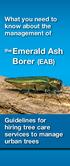 What you need to know about the management of the Emerald Ash Borer (EAB) Guidelines for hiring tree care services to manage urban trees What is an Emerald Ash Borer? This booklet has been designed for
Trees and Reliable Electric Service. Answers to Questions About Tree Pruning and Electric Power. We re connected to you by more than power lines.
 Trees and Reliable Electric Service Answers to Questions About Tree Pruning and Electric Power We re connected to you by more than power lines. How is Line Clearance Done? Pepco s tree contractor will
A DISCOVERY REGARDING THE DEATH OF ASH TREES IN THE PLYMOUTH AREA
 A DISCOVERY REGARDING THE DEATH OF ASH TREES IN THE PLYMOUTH AREA As you are probably aware, we have seen a significant amount of dying ash trees in the Plymouth, Canton, Northville area. This prompted
How To Diagnose Plant Problems
 FS-10-72 PALM PROBLEMS THAT AREN T M. L. Robinson, Area Extension Specialist, Environmental Horticulture Angela O Callaghan, Area Extension Specialist, Social Horticulture When trying to diagnose problems
Trees after the Storm
 Trees after the Storm STORM DAMAGE & YOUR TREE Helping homeowners lessen the effects of storm damage to their trees WRITTEN BY Veronica Keithley Trees After the Storm Storm Damage and Your Tree Helping
Helping Trees Recover From Stress
 Helping Trees Recover From Stress INTRODUCTION Trees are the dominant component in the natural and managed landscape in New England. For the most part, trees in forests thrive and, typically, live more
Tree Integrated Pest Management. Dan Nortman Virginia Cooperative Extension, York County
 Tree Integrated Pest Management Dan Nortman Virginia Cooperative Extension, York County IPM Refresher Definition: The use of a combination of appropriate pest control tactics to reduce pest population
Tree Pruning Guide. Five Key Steps for Pruning Young Trees. Reasons to Prune/Train Young Trees Source: Training Young Trees for Structure & Form
 Tree Pruning Guide This guide is a combination of work by: the California Department of Forestry and Fire Protection, the National Arbor Day Association, and the University of California, Agriculture &
KUB Tree Pruning: A Customer Guide
 KUB Tree Pruning: A Customer Guide . KUB Tree Pruning: A Customer Guide Table of Contents Introduction....2 Plant Smart....4 Why Prune?....6 Before We Prune....8 Meet the Crew... 10 How We Prune... 12
Portland State University. Campus Tree Care Plan
 Portland State University Campus Tree Care Plan 1. Purpose Portland State University (PSU) resides in a densely populated urban setting in downtown Portland, Oregon. With green space in short supply, maintaining
DIRECT TESTIMONY OF RONALD MATRANGA SAN DIEGO GAS & ELECTRIC COMPANY (RICE FIRE)
 Proceeding No.: Exhibit No.: Witness: I.0--00 Ronald Matranga DIRECT TESTIMONY OF RONALD MATRANGA SAN DIEGO GAS & ELECTRIC COMPANY (RICE FIRE) BEFORE THE PUBLIC UTILITIES COMMISSION OF THE STATE OF CALIFORNIA
Tree and forest restoration following wildfire
 Peter F. Kolb (PhD) MSU Extension Forestry Specialist Adj. Assistant Professor Forest Ecology School of Forestry, University of Montana, Missoula, MT 59808 Tel. (406) 243-4705, e-mail: [email protected]
Pruning to restore. R.L. Stebbins and J. Olsen. EC 1005 Reprinted October 1999 $1.50
 EC 1005 Reprinted October 1999 $1.50 Pruning to restore an old, neglected apple tree R.L. Stebbins and J. Olsen This neglected apple tree is 24 feet tall and has a spread of 24 feet (only half the tree
Bradgate Park Landscape Tree Survey. Tree Schedule, Group Schedule, Woodland Schedule & Key to Schedule
 Bradgate Park Landscape Tree Survey Tree Schedule, Group Schedule, Woodland Schedule & Key to Schedule Appendix A of the Landscape Tree Survey Report On Behalf of The Bradgate Park Trust Bradgate Park
GLOSSARY OF TREE TERMS
 GLOSSARY OF TREE TERMS Aeration providing air to the soil to alleviate compaction and improve structure. Arboriculture the practice and study of the care of trees and other woody plants. Arborist a professional
Fertilizer, Weed Control, Grubs, and General Application Questions
 Lawn Care FAQ s Fertilizer, Weed Control, Grubs, and General Application Questions Why do we have so many weeds? Dandelions in particular, weeds in general, do not seem concerned about how long lawn has
Tree Guidance Notes. Guidance Note 1: Guidance for Works to Trees
 Guidance Note 1: Guidance for Works to Trees Guidance Note 1: Guidance for Works to Trees A TREE STRATEGY FOR HUNTINGDONSHIRE 1 Purpose of the guide The aim of this guide is to provide information and
STREET TREE PLANTING APPLICATION
 STREET TREE PLANTING APPLICATION Property owners are welcome to plant trees on the terrace in front of their homes in Kendallville. There is no permit required. However, you do need to advise the City
The City of Request For Proposals Pruning and Hazardous Tree Removal on Public Grounds
 Urban and Community Program The City of Request For Proposals Pruning and Hazardous Tree Removal on Public Grounds The goal of the program is to achieve a healthy sustainable forest and improve natural
A GUIDE: DEVELOPING A STREET AND PARK TREE MANAGEMENT PLAN
 A GUIDE: DEVELOPING A STREET AND PARK TREE MANAGEMENT PLAN An introduction to the preparation of a strategic approach to the care and maintenance of your community forest USDA Forest Service Northeastern
Community Tree Plans: A Guide for Tree Commissions and Environmental Advisory Councils
 Community Tree Plans: A Guide for Tree Commissions and Environmental Advisory Councils... Community Tree Plans: A Guide for Tree Commissions and Environmental Advisory Councils College of Agricultural
12.16.070 - Forestry Division: Regulations and Specifications.
 12.16.070 - Forestry Division: Regulations and Specifications. A. Regulations and specifications known as the "Forestry Division: Regulations and Specifications" are set forth within the following subsections.
College of Agriculture, P.O. Box 210036 Tucson, Arizona 85721-0036
 Irrigating Citrus Trees ISSUED FEBRUARY 2000 BY: Glenn C. Wright Associate Specialist ag.arizona.edu/pubs/ crops/az1151.pdf This information has been reviewed by university faculty. COOPERATIVE EXTENSION
Tree Strategy. Good Practice Guide 1 Tree Work
 Tree Strategy Good Practice Guide 1 Tree Work July 2009 Good Practice Guide 1 Tree Work 1. Purpose the guide 2. Introduction 3. Protected trees 4. Wildlife 5. Timing of pruning 6. Pruning Specifications
CITY OF UKIAH TREE MANAGEMENT GUIDELINES TREE MANAGEMENT POLICIES FOR THE PROTECTION, OPERATION AND MAINTENANCE OF CITY PROPERTY
 CITY OF UKIAH TREE MANAGEMENT GUIDELINES TREE MANAGEMENT POLICIES FOR THE PROTECTION, OPERATION AND MAINTENANCE OF CITY PROPERTY FINAL DRAFT November 2010 1.0 PURPOSE STATEMENT The purpose of this document
MAKING PALM TREES-1 Materials and Tools Dollar Store Fern Pine Tree Branches: Acrylic Hobby/Craft Paints: Paint Brushes: Scissors:
 MAKING PALM TREES-1 Materials and Tools Dollar Store Fern: This plastic fern was called came wrapped with brown paper around a cheap Styrofoam base. The plant was stuck into the foam and green flock was
Why Fruit Trees Die D. B. Meador, Extension Specialist (retired) University of Illinois
 Why Fruit Trees Die D. B. Meador, Extension Specialist (retired) University of Illinois Occasionally, fruit trees decline and often die. Diseases affecting the leaves, fruit, and twigs of fruit trees usually
Maintaining Cactus and Succulents
 Maintaining Cactus and Succulents Master Gardener Education February 22, 2011 Jack Kelly University of Arizona College of Agriculture and Life Sciences Pima County Cooperative Extension Tucson, Arizona
It was my assignment to physically inspect the 8 trees on site near the proposed construction,
 July 11, 2013 Tariton Properties 2555 Park Blvd Palo Alto, CA 94306 Re: Tree Survey To Whom It May Concern: Assignment It was my assignment to physically inspect the 8 trees on site near the proposed construction,
Community Tree Planting and Care Guide
 Community Tree Planting and Care Guide Jeff Iles Extension Horticulturist Community Tree Planting and Care Guide Introduction Sixty-one percent of the 2.9 million Iowans live in urban or community settings,
FORMATIVE PRUNING OF BUSH TREES WINTER PRUNING OF ESTABLISHED BUSH TREES AIMS SPUR BEARERS & TIP BEARERS PRUNING OF SPUR BEARERS
 FORMATIVE PRUNING OF BUSH TREES Formative pruning is essential and should be carried out in the dormant season, November- March. Its purpose is to produce a well-balanced tree with a strong branch framework