
Accrual Accounting and Valuation: Pricing Earnings
|
|
|
- Calvin Bruce
- 9 years ago
- Views:
Transcription
1 Security, Third Chapter Six LINKS Accrual Accounting and : Pricing Earnings Link to previous chapter Chapter 5 showed how to price book values in the balance sheet and calculate intrinsic price-to-book ratios. This chapter This chapter shows how to price earnings in the income statement and calculate intrinsic price-earnings ratio. Link to next chapter Chapter 7 begins the financial statement analysis that is necessary to carry out the price-to-book and price-earnings valuations discussed in Chapters 5 and 6. How are are price-earnings returns calculated? ratios determined? How is a firm valued from forecasts of earnings growth? When should an investor not pay for growth? How do valuation methods protect the investor from paying too much for earnings growth? How does the analyst infer the market's forecast of earnings growth? The last chapter showed how to anchor valuations on the book value, the bottom line of the balance sheet. This chapter shows how to anchor valuations on earnings, the bottom line of the income statement. By anchoring on book value, the analyst develops the price-to-book ratio (P/B). By anchoring on earnings, the analyst develops the price-earnings ratio (P/E). So, while the last chapter asked how much one should pay per dollar of book value, this chapter asks how much one should pay per dollar of earnings. Link to Web page The Web page supplement has more applications of the techniques in this chapter.

2 Security, Third Chapter 6 Accrual Accounting and 199 The Analyst s Checklist After reading this chapter you should understand: What abnormal earnings growth is. How forecasting abnormal earnings growth yields the intrinsic P/E ratio. What is meant by a normal P/E ratio. The difference between ex-dividend earnings growth and cum-dividend earnings growth. The difference between a Case 1 and Case 2 abnormal earnings growth valuation. The advantages and disadvantages of using an abnormal earnings growth valuation and how the valuation compares with residual earnings valuation. How dividends, share issues, and share repurchases affect abnormal earnings growth. How abnormal earnings growth valuation protects the investor from paying too much for earnings growth. How abnormal earnings growth valuation protects the investor from paying for earnings that are created by accounting methods. How to use the abnormal earnings growth model in reverse engineering. What a PEG ratio is. After reading this chapter you should be able to: Calculate cum-dividend earnings. Calculate abnormal earnings growth. Calculate the value of equities from forecasts of earnings and dividends. Calculate intrinsic forward P/E and trailing P/E ratios. Calculate continuing values for the abnormal earnings growth model. Convert an analyst s EPS forecast to a valuation. Calculate implied earnings growth rates from the market price of a stock. Evaluate a PEG ratio. THE CONCEPT BEHIND THE PRICE-EARNINGS RATIO P/B ratios differ from 1.0 because accountants do not measure the full value of the equity in the balance sheet. However, the missing value is ultimately realized in the future earnings that assets produce, and these earnings can be forecasted: A price-to-book ratio is determined by expected earnings that have not yet been booked to book value, and the higher the future earnings relative to book value, the higher the P/B ratio. A parallel idea lies behind the P/E ratio. Whereas book value is a measure of the stock of value, earnings is a measure of the change in value. In Chapter 2 we appreciated that, just as book value is an imperfect measure of the stock of value, earnings is also an imperfect measure of the value added for shareholders. Current earnings measure value added from current sales, whereas share prices change in anticipation of value to be added in earnings from future sales as well. So the P/E ratio compares the value of expected future earnings (in the numerator) to current earnings (in the denominator). Therein lies the concept of the P/E ratio. Just as the P/B ratio is based on expected earnings that have not yet been booked to book value, the P/E ratio is based on expected earnings that have not yet been recognized. So P/E ratios are high when one forecasts considerably higher future earnings than current earnings, and P/E ratios are low when future earnings are forecasted to be lower than current earnings. In short, the P/E ratio prices earnings growth.
3 Security, Third 200 Part One Financial Statements and PROTOTYPE VALUATION This chapter supplies the formal valuation model to implement this concept of the P/E ratio rigorously, as well as the mechanics to apply the model faithfully. The formality is warranted, for one can pay too much for earnings growth if one is not careful. Beware of Paying Too Much for Earnings Growth Historically, high P/E stocks so-called growth stocks have been rewarding investments during bubble periods: Investors, excited about growth, push up prices and momentum trading takes over to yield yet higher prices and yet higher P/E ratios. But history shows that, overall, growth expectations are not realized: High P/E stocks have earned lower returns than low P/E stocks, and lower returns than broad indexes. Chapter 5 came with a warning: Beware of earnings growth and use valuation methods that build in protection from paying too much for earnings growth. This warning sets the stage for this chapter: A sound P/E valuation prices earnings growth but does not price growth that does not add value. In anchoring a valuation on earnings rather than book values, you need to appreciate that earnings is a measure of change in value a flow rather than a stock. To convert flows to stocks, we simply capitalize the flow. The stock of value implied by earnings is: Stock of value Earnings = Required return This earnings capitalization was explained in Box 3.6 in Chapter 3. The way to think about anchoring value on earnings is as follows: Value = Capitalized earnings + Extra value for forecasted earnings growth To value earnings we always start with the anchor of capitalized earnings, and then ask what extra value must be added for anticipated earnings growth. A savings account is easy to value, so we will begin with this simple asset as a prototype for valuing equities. Exhibit 6.1 presents the same savings account as in Exhibit 5.1 in Chapter 5 (and Box 2.2 in Chapter 2). The account involves $100 invested in 2005 to earn a 5 percent rate each year, from 2006 and thereafter. Two dividend payout scenarios are presented, full payout and no payout. In both cases, expected residual earnings are zero, so the asset is valued at its book value of $100 in 2005 using the residual earnings model. However, the asset also can be valued by capitalizing forward 2006 earnings of $5: Forward Earnings Value of savings account = Required return = $ 5. = $ Thus the savings account can be valued not only from its book value, but also by capitalizing forward earnings. For the savings account, there is no extra value for anticipated earnings growth. However, you will notice that, while the earnings growth rate in the full-payout scenario is zero, it is 5 percent per year in the no-payout scenario. Yet the value of the account is the same in both cases. According to our calculations, we will not pay for the 5 percent growth. The growth of 5 percent comes from reinvesting earnings, but the reinvested earnings earn only the required return. The equivalent valuations for the two accounts demonstrate the principle that one does not pay for growth that comes from an investment that earns only the required return, for such an investment does not add value.

4 Security, Third Chapter 6 Accrual Accounting and 201 EXHIBIT 6.1 Forecasts for a Savings Account with $100 Invested at the End of 2005, Earning 5% per Year Forecast Year Earnings withdrawn each year (full payout) Earnings Dividends Book value Residual earnings Earnings growth rate Cum-dividend earnings Cum-dividend earnings growth rate 5% 5% 5% 5% No withdrawals (zero payout) Earnings Dividends Book value Residual earnings Earnings growth rate 5% 5% 5% 5% Cum-dividend earnings Cum-dividend earnings growth rate 5% 5% 5% 5% A little more formalism captures this idea and protects us from paying too much for growth. The earnings growth rates in the two scenarios look different, but in fact they are not. The earnings from the full-payout account are actually understated, for the dividends from the account can be reinvested in an identical account to earn 5 percent. So, for example, the $5 withdrawn in 2006 can be reinvested to earn 5 percent, or $0.25 in 2007, so that the total expected earnings for 2007 are $5.25, the same as the zero-payout account. Earnings from an asset arise from two sources, earnings earned by the asset and earnings earned from reinvesting dividends in another asset. So, by reinvesting dividends for all years, the earnings in the two payout scenarios here are the same; in the no-payout case, earnings are reinvested in the same account that is, earnings are retained and in the full-payout case, earnings can be reinvested in a different account, in both cases earning 5 percent. The total earnings from an investment are referred to as cum-dividend earnings, that is, earnings with the dividend. Earnings without the reinvestment of dividends are called ex-dividend earnings. Value is always based on expected cum-dividend earnings and the P/E ratio is always based on cum-dividend earnings growth, for we must keep track of all sources of earnings from the investment. For any period, t Cum-dividend earnings t = Earnings t + (ρ 1)dividend t 1 where ρ is (as before) 1 plus the required return. So, for the full-payout savings account, cum-dividend earnings for 2007 are Earnings (0.05 Dividend 2006 ) = $5 + (0.05 $5) = $5.25. On a cum-dividend basis, earnings growth in the two scenarios is the same, 5 percent per year, as you can see from Exhibit 6.1. However, in both cases, the earnings growth is not growth that we will pay for. We only pay for earnings growth that is greater than the required return. Earnings that are due to growth at the required return are called normal earnings. For any period, t Normal earnings t =ρearnings t 1

5 Security, Third A Riddle 6.1 P/E RATIOS AND EARNINGS GROWTH FOR THE S&P 500 The historical average forward P/E ratio for the S&P 500 is about 13 (and the average trailing P/E ratio is about 14). The historical average earnings per share growth rate is about 8.5 percent per year. If the required return for stocks in general is 10 percent, the normal forward P/E ratio is 10. These numbers present a riddle: If the growth rate is 8.5 percent, less than the required return of 10 percent, the forward P/E should be below the normal of 10, not above it at 13. The riddle is solved as follows. Firms in the S&P 500 pay dividends; indeed, the historical dividend payout ratio has been about 45 percent of earnings (though it has been declining over the last 20 years). The 8.5 percent growth rate is an ex-dividend growth rate. The cum-dividend growth rate with 45 percent payout is about 13 percent. So, historically, earnings have really grown 13 percent per year, cum-dividend, above the assumed required return of 10 percent. That puts the forward P/E ratio above the normal of 10, which indeed it has been. So, for the savings account, normal earnings in 2007 = 1.05 $5 = $5.25, that is, the prior year s earnings growing at 5 percent. The part of cum-dividend earnings for which we will pay is the cum-dividend earnings growth over these normal earnings, that is, the abnormal earnings growth: Abnormal earnings growth t = Cum-dividend earnings t Normal earnings t = [Earnings t + (ρ 1)dividend t 1 ] ρearnings t 1 As cum-dividend earnings for the savings account in 2007 are $5.25, and as normal earnings also are $5.25, abnormal earnings growth is zero. And so for years 2008 and beyond. We will not pay for growth because, while we forecast growth, we do not forecast abnormal growth. With these basic concepts in place, we now can move from the simple prototype to the valuation of equities. Here is a summary of the concepts we carry with us: 1. An asset is worth more than its capitalized earnings only if it can grow cum-dividend earnings at a rate greater than the required return. This recognizes that one pays only for growth that adds value. 2. When forecasting earnings growth, one must focus on cum-dividend growth. Ex-dividend growth ignores the value that comes from reinvesting dividends. 3. Dividend payout is irrelevant to valuation, for cum-dividend earnings growth is the same irrespective of dividends. Box 6.1 solves a riddle about earnings growth. The Normal Forward P/E Ratio You will remember from Chapter 3 that the forward or leading P/E is price relative to the forecast of next year s earnings. For the savings account, the forward P/E ratio in 2005 is $100/$5 = 20. This is a particularly special P/E, referred to as the normal forward P/E: Normal forward P/E 1 = Required return That is, the normal forward P/E is just $1 capitalized at the required return. For the savings account, the forward P/E is 1/0.05 = 20. The normal P/E embeds a principle that applies to all assets, including equities. If one forecasts no abnormal earnings growth (as with the savings account), the forward P/E ratio must be 1/required return. That is, a normal P/E implies that normal earnings growth is expected. For a required (normal) return of 10 percent, the normal forward P/E is 1/0.10, or 10. For a required return of 12 percent, the normal forward P/E is 1/0.12 = If one 202
6 Security, Third Chapter 6 Accrual Accounting and 203 forecasts cum-dividend earnings to grow at a rate greater than the required return, the P/E must be above normal: One pays extra for growth. If one forecasts cum-dividend earnings to grow at a rate lower than the required return, the P/E ratio must be lower than normal: One discounts for low growth. The Normal Trailing P/E Ratio Chapter 3 distinguished the trailing P/E the multiple of current earnings from the forward or leading P/E the multiple of earnings forecasted one year ahead. Having calculated the value of the savings account from forecasts of forward earnings and earnings growth, it is, of course, straightforward to calculate the trailing P/E: Just divide the calculated value by the earnings reported in the last income statement. But there is an adjustment to make. For the savings account in Exhibit 6.1, suppose that $100 were invested in the account at the beginning of 2005 to earn 5 percent. Earnings for 2005 would be $5 and, if these earnings were paid out as dividends, the value of the account at the end of 2005 would still be $100. So it would appear that the trailing P/E is $100/$5 = 20, the same as the forward P/E. However, this is incorrect. How could the value of one more year of earnings be the same? Suppose the $5 earnings for 2005 were not paid out, so that the value in the account was $105. The P/E ratio then becomes $105/$5 = 21. The latter is the correct trailing P/E. The amount that $1 of earnings is worth the P/E multiple should not depend on dividends. The $5 of earnings for a savings account produces $105 in value for the owner of the account the $100 at the beginning of the period that produced the earnings, plus the $5 of earnings. If she leaves the earnings in the account, the owner has $105; if she withdraws the earnings, she still has $105, with $100 in the account and $5 in her wallet. The trailing P/E is 21. Thus the trailing P/E must always be based on cum-dividend prices: Trailing P/E = Price + Dividend Earnings This measure is the dividend-adjusted P/E introduced in Chapter 3. The adjustment is necessary because dividends reduce the price (in the numerator) but do not affect earnings (in the denominator). The adjustment is not necessary for the forward P/E because both prices and forward earnings are reduced by the current dividend. P/E ratios published in the financial press do not make this adjustment. If the dividend is small, it matters little, but for high-payout firms, published P/E ratios depend on dividends as well as the ability of the firm to grow earnings. Whereas the normal forward P/E is 1/Required return, the normal trailing P/E is: Normal trailing P/E = (1 + Required return) Required return For the savings account, the normal trailing P/E is $1.05/$0.05 = 21 (compared with 20 for the forward P/E). For a required return of 10 percent, the normal trailing P/E is $1.10/$0.10 = 11 (compared with 10 for the forward P/E), and for a required return of 12 percent, it is $1.12/$0.12 = 9.33 (compared with 8.33 for the forward P/E). The normal forward P/E and the normal trailing P/E always differ by 1.0, representing one current dollar earning at the required return for an extra year. Just as a normal forward P/E implies that forward earnings are expected to grow, cumdividend, at the required rate of return after the forward year, so a normal trailing P/E implies that current earnings are expected to grow, cum-dividend, at the required rate of return after the current year. So the trailing P/E for the savings account is 21 because the expected cum-dividend earnings growth rate is the required rate of 5 percent.

7 Security, Third 204 Part One Financial Statements and A Poor P/E Model The following model for valuing equities from forward earnings is quite common: Value of equity = Earn 1 g where g is (1 plus) the forecasted earnings growth rate. (You perhaps have seen this model with the letter r used to indicate the required return rather than ρ.) The model looks as if it should value earnings growth. The formula modifies the capitalized earnings formula (which worked for a savings account) for growth; indeed, the model is simply the formula for a perpetuity with growth that was introduced in Chapter 3. With this model, the forward P/E ratio is 1/(ρ g). This model is simple, but it is wrong. First, it is applied with forecasts of ex-dividend growth rates rather than cum-dividend growth rates. Ex-dividend growth rates ignore value from reinvesting dividends. Therefore, the higher the dividend payout, the higher the omitted value calculated by the formula; the lower the ex-dividend growth rate, the lower the value calculated by the formula. Second, the formula clearly does not work when the earnings growth rate is greater than the required return, for then the denominator is negative. You could apply the formula with cum-dividend growth rates rather than ex-dividend growth rates, but then you would be likely to have a negative denominator. For the savings account, the required return is 5 percent, but the expected cum-dividend growth rate is also 5 percent, so the denominator of this formula is zero (and the value of a savings account is infinite!). For equities, the cum-dividend growth rate is often higher than the required return, resulting in a negative denominator: This is the case for the S&P 500 in Box 6.1, for example. A growth rate slightly lower than the required return would have you paying a very high price and overpaying for growth. This is a poor model; it leads you into errors. The denominator problem is a mathematical problem, but behind this mathematical problem lurks a conceptual problem. We need a valuation model that protects us from paying too much for growth. A MODEL FOR ANCHORING VALUE ON EARNINGS The model for valuing earnings growth anchors the valuation on capitalized earnings and then adds value from anticipated growth: Value of equity = Capitalized forward earnings + Extra value for abnormal cum-dividend earnings growth V E Earn = E + AEG AEG AEG L 2 3 ρ 1 ρe 1 ρe ρe ρe 1 AEG2 AEG3 AEG4 = Earn L (6.1) 2 3 ρe 1 ρe ρe ρe where AEG is abnormal (cum-dividend) earnings growth. (The ellipses indicate that forecasts continue on into the future, for equities are going concerns.) You see from the first version of the formula here that the discounted value of abnormal earnings growth supplies the extra value over that from forward earnings. The discounting calculates the value at the end of Year 1 of growth from Year 2 onward, and the value is then capitalized (to convert the value of flows to a stock of value). As both the value of growth and forward earnings are capitalized, the second version of the formula simplifies the calculation. So, to value a ρ E
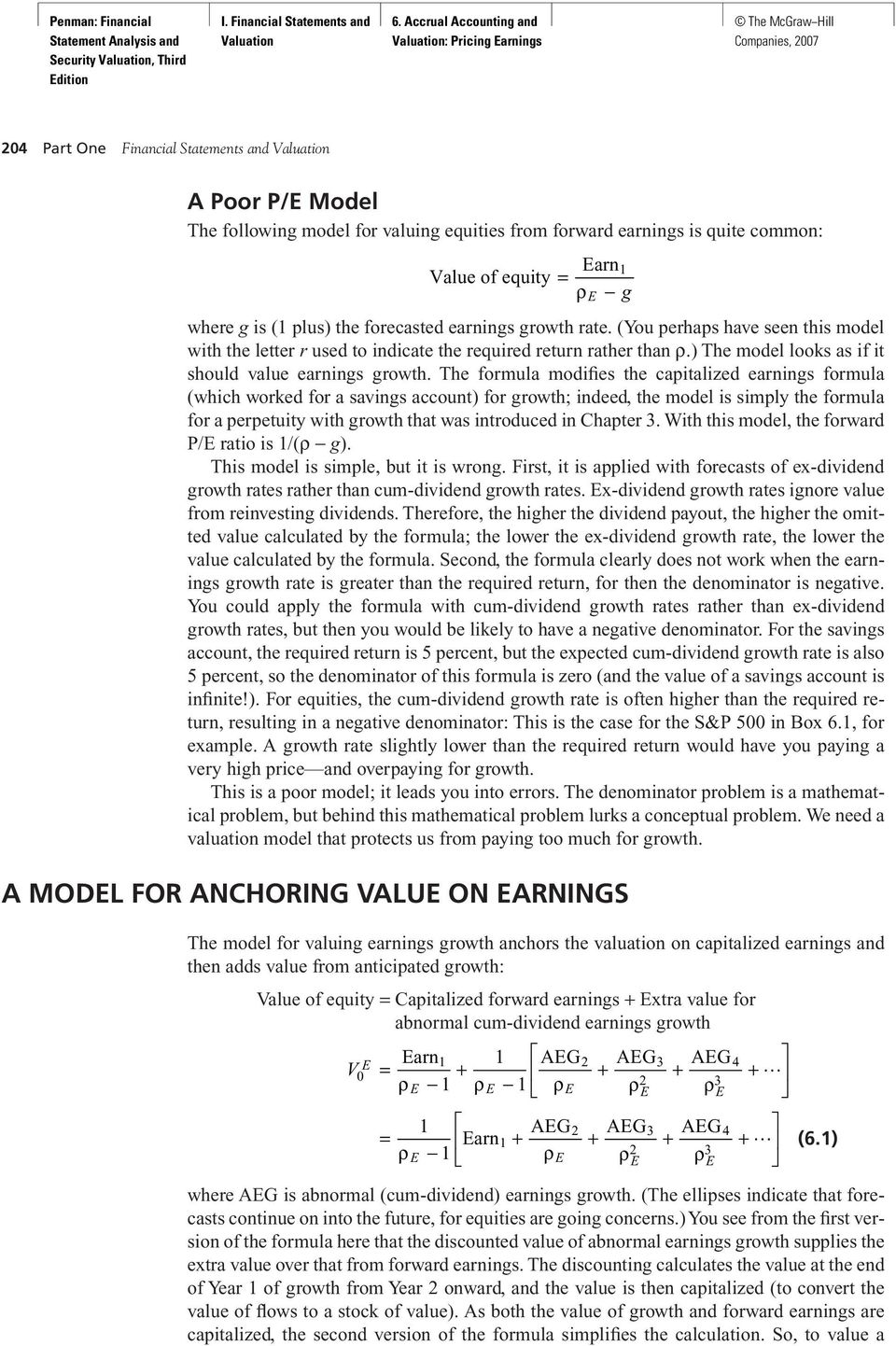
8 Security, Third Chapter 6 Accrual Accounting and 205 FIGURE 6.1 Calculation of Equity Value Using the Abnormal Earnings Growth Model Abnormal earnings growth is the difference between cum-dividend earnings and normal earnings. The present value of abnormal earnings growth for Year 2 and beyond is added to forward earnings for Year 1, and the total is then capitalized to calculate equity value. Abnormal earnings growth t = Cum-dividend earnings t Normal earnings t Cum-dividend earnings t = Earnings t + (ρ E 1) dividend t 1 Normal earnings t = ρ E Earnings t 1 Forecasts Year 1 ahead Year 2 ahead Year 3 ahead Year 4 ahead Forward earnings 1 Cumdividend earnings 2 Normal earnings 2 Cumdividend earnings 3 Normal earnings 3 Cumdividend earnings 4 Normal earnings 4 + Abnormal earnings 2 Abnormal earnings 3 Abnormal earnings 4 PV of AEG 2 Discount by + PV of AEG 3 Discount by 2 + PV of AEG 4 Discount by Current value Capitalize Total earnings plus growth share, proceed through the following steps: 1. Forecast one-year-ahead earnings. 2. Add the present value (at the end of Year 1) of expected abnormal earnings growth for Year 2 ahead and onward. 3. Capitalize the total of forward earnings and the value of abnormal earnings growth. Figure 6.1 directs you through these three steps. As with residual earnings valuation, earnings must be comprehensive earnings, otherwise value is lost in the calculation. Simply stated, the model says that value is based on future earnings, but with earnings from normal growth subtracted. The forward P/E is obtained by dividing through by forward earnings, Earn 1 : V0 E 1 1 AEG2 AEG3 AEG4 = E 1 + ρ ρe 1 ρe ρe ρe Earn L / Earn 1 (6.2)
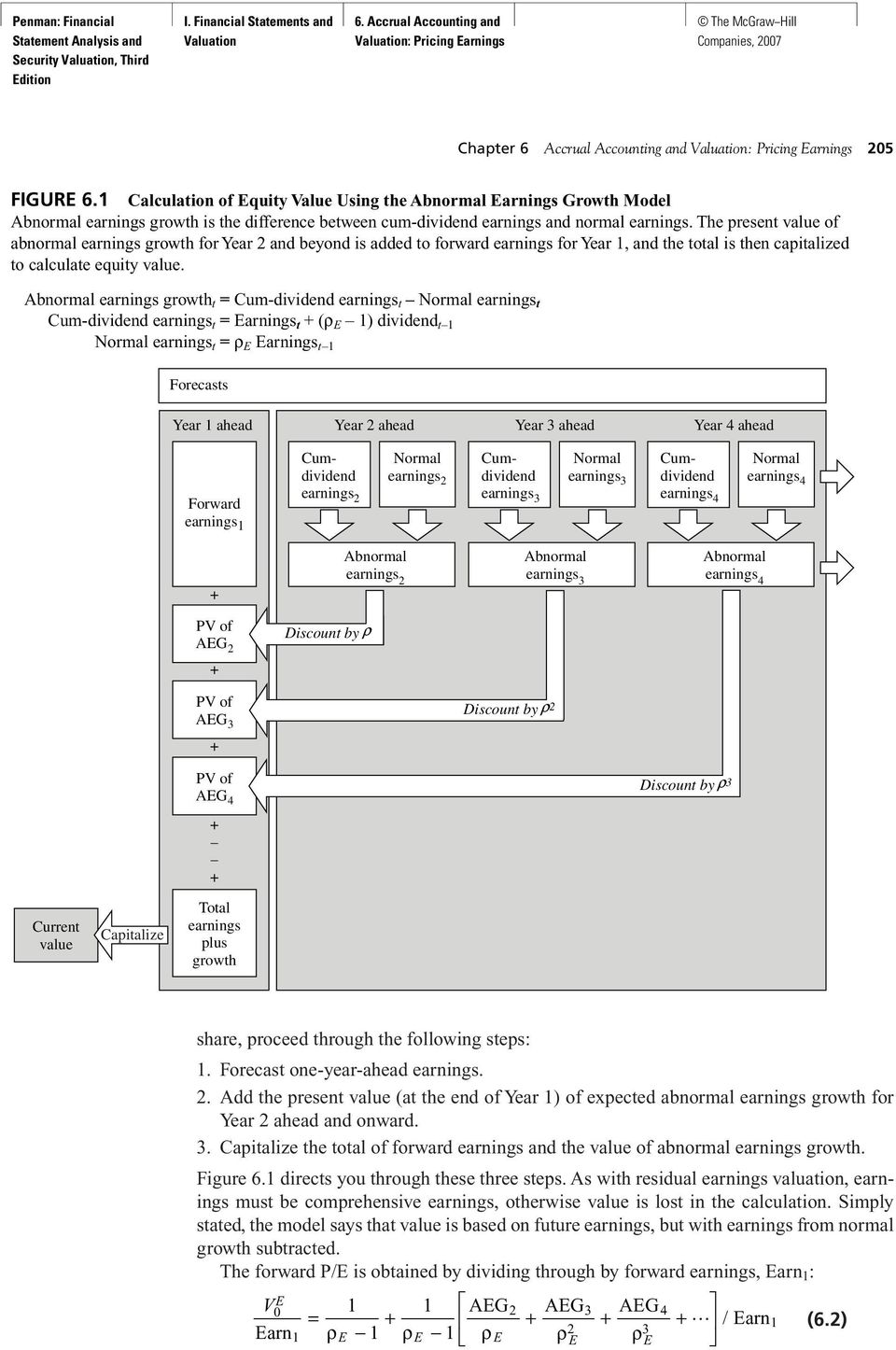
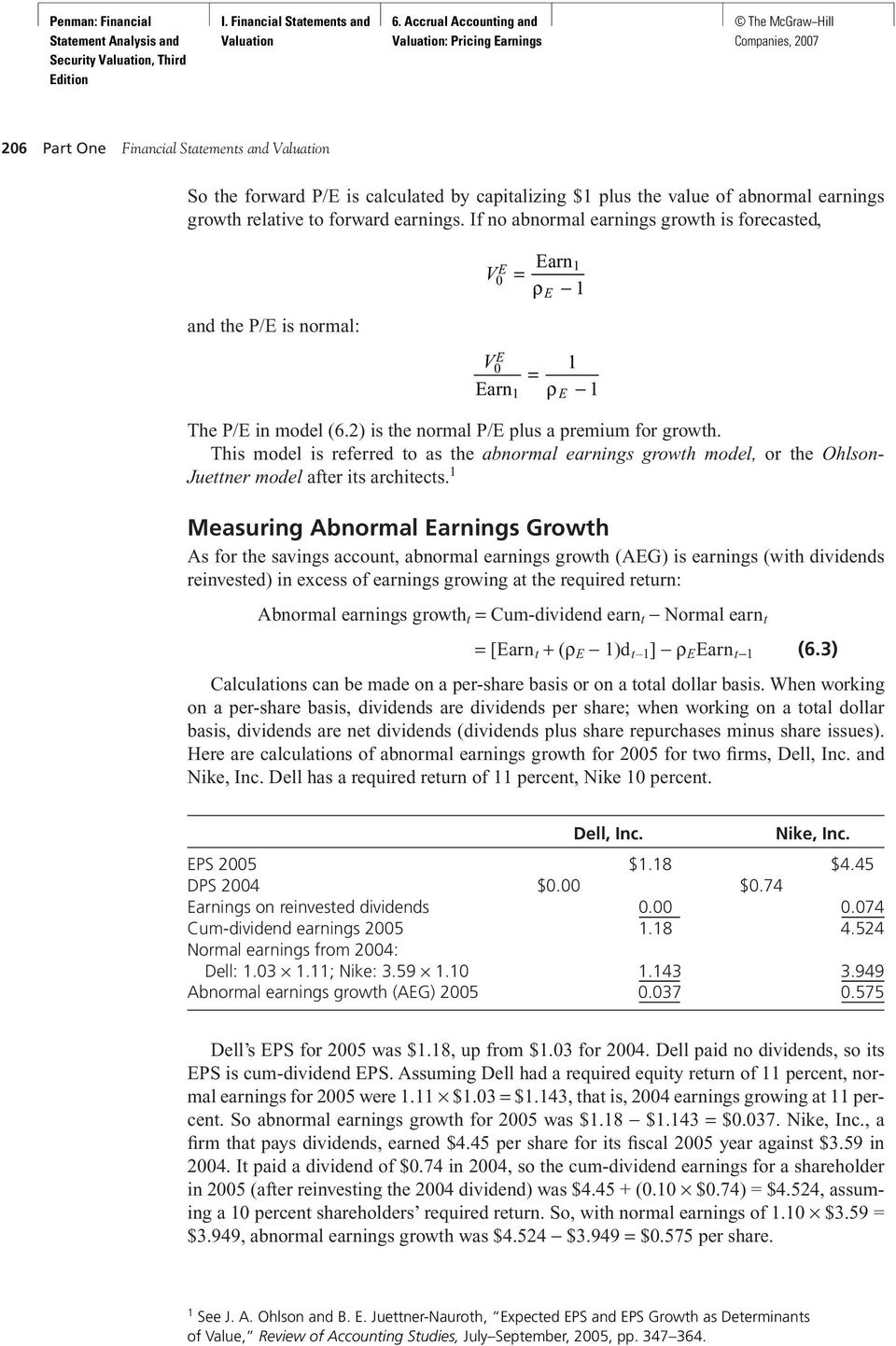
9 Security, Third 206 Part One Financial Statements and So the forward P/E is calculated by capitalizing $1 plus the value of abnormal earnings growth relative to forward earnings. If no abnormal earnings growth is forecasted, and the P/E is normal: V0 E Earn = 1 ρ 1 E V0 E 1 = Earn 1 ρ E 1 The P/E in model (6.2) is the normal P/E plus a premium for growth. This model is referred to as the abnormal earnings growth model, or the Ohlson- Juettner model after its architects. 1 Measuring Abnormal Earnings Growth As for the savings account, abnormal earnings growth (AEG) is earnings (with dividends reinvested) in excess of earnings growing at the required return: Abnormal earnings growth t = Cum-dividend earn t Normal earn t = [Earn t + (ρ E 1)d t 1 ] ρ E Earn t 1 (6.3) Calculations can be made on a per-share basis or on a total dollar basis. When working on a per-share basis, dividends are dividends per share; when working on a total dollar basis, dividends are net dividends (dividends plus share repurchases minus share issues). Here are calculations of abnormal earnings growth for 2005 for two firms, Dell, Inc. and Nike, Inc. Dell has a required return of 11 percent, Nike 10 percent. Dell, Inc. Nike, Inc. EPS 2005 $1.18 $4.45 DPS 2004 $0.00 $0.74 Earnings on reinvested dividends Cum-dividend earnings Normal earnings from 2004: Dell: ; Nike: Abnormal earnings growth (AEG) Dell s EPS for 2005 was $1.18, up from $1.03 for Dell paid no dividends, so its EPS is cum-dividend EPS. Assuming Dell had a required equity return of 11 percent, normal earnings for 2005 were 1.11 $1.03 = $1.143, that is, 2004 earnings growing at 11 percent. So abnormal earnings growth for 2005 was $1.18 $1.143 = $ Nike, Inc., a firm that pays dividends, earned $4.45 per share for its fiscal 2005 year against $3.59 in It paid a dividend of $0.74 in 2004, so the cum-dividend earnings for a shareholder in 2005 (after reinvesting the 2004 dividend) was $ (0.10 $0.74) = $4.524, assuming a 10 percent shareholders required return. So, with normal earnings of 1.10 $3.59 = $3.949, abnormal earnings growth was $4.524 $3.949 = $0.575 per share. 1 See J. A. Ohlson and B. E. Juettner-Nauroth, Expected EPS and EPS Growth as Determinants of Value, Review of Accounting Studies, July September, 2005, pp
10 Security, Third Chapter 6 Accrual Accounting and 207 Abnormal earnings growth can be expressed in terms of growth rates relative to required rates: Abnormal earnings growth t = [G t ρ E ] Earnings t 1 (6.3a) where G t is 1 plus the cum-dividend earnings growth rate for the period. That is, AEG is the dollar amount by which a prior year s earnings grow, cum-dividend, relative to the required rate. If G t is equal to the required rate, there is no abnormal earnings growth. With EPS of $1.18 for 2005 (and no dividends), Dell s cum-dividend earnings growth rate was $1.18/1.03 = percent (plus 1). So, with a required return of 11 percent, Dell s AEG for 2005 was $1.03 ( ) = $0.037 per share, as before. With cum-dividend EPS of $4.524 in 2005, a growth rate of percent over 2004 EPS of $3.59, Nike s AEG for 2005 was $3.59 ( ) = $0.575 per share, as before. You can see from these calculations that the higher the expected abnormal earnings growth is after the forward year, the higher the forward P/E ratio will be. The calculation in equation 6.3a shows that AEG is determined by expected cum-dividend earnings growth rates, G t. Figure 6.2 plots forward P/E ratios for the S&P 500 firms at the end of 2000 price at the end of 2000 divided by earnings forecasts for 2001 on cum-dividend earnings growth rates for 2002 (two years ahead), using analysts consensus forecasts at the time. You see indeed that forward P/E ratios are related to forecasts of subsequent earnings growth. But there is considerable variation around the regression line representing the average relationship. The analyst tries to explain this variation. FIGURE 6.2 The Relationship between Forward P/E Ratios and Subsequent Earnings Growth Rates The figure plots forward P/E ratios for S&P 500 firms at the end of 2000 on cum-dividend earnings growth rates for Forward P/E is price per share at the end of 2000 divided by analysts consensus EPS forecast for Cum-dividend growth rates are those based on analysts forecasts for The regression line gives the relationship between forward P/E ratios and two-year-ahead earnings growth. Source: Prices are from Standard & Poor s COMPUSTAT. Analysts earnings forecasts are from Thomson Financial I/B/E/S database Earnings Growth Rate on Forward P/E Ratio Earnings Growth Rate (2002) Forward P/E Ratio (2000)

11 Security, Third 208 Part One Financial Statements and A Simple Demonstration Exhibit 6.2 applies the abnormal earnings growth model to the simple prototype firm used in Chapter 5. This firm has a required return of 10 percent and its earnings are expected to grow at 3 percent a year. A 3 percent growth rate looks low, but looks can be deceiving because the firm has a high payout ratio (76 percent of earnings). Based on the earnings and dividend forecasts and the future book values they imply, residual earnings for the firm are forecasted to grow at a 3 percent rate, as indicated in the exhibit. So the firm can be valued with a Case 3 residual earnings valuation by capitalizing Year 1 residual earnings at this growth rate, as in Chapter 5: = = million V E EXHIBIT 6.2 Forecasts for a Firm with Expected Earnings Growth of 3 Percent per Year In millions of dollars. Required return is 10 percent per year. Forecast Year Residual earnings forecasts: Earnings Dividends Book value Residual earnings (RE) RE growth rate 3% 3% 3% 3% Abnormal earnings growth forecasts: Earnings Dividends Earnings on reinvested dividends Cum-dividend earnings Normal earnings Abnormal earnings growth (AEG) Abnormal earnings growth rate 3% 3% 3% 3% Cum-dividend earnings growth rate 10.57% 10.57% 10.57% 10.57% 10.57% Normal earnings growth rate 10.0% 10.0% 10.0% 10.0% 10.0% The Calculations: Earnings on reinvested dividends refers to the prior year s dividend earning at the required return. So, for Year 2, earnings on reinvested dividends = Cum-dividend earnings adds earnings on reinvested dividends to the ex-dividend earnings forecasted. So, cum-dividend earnings for Year 2 are ( ) = Normal earnings is the prior year s earnings growing at the required return. So, for Year 2, normal earnings are = Abnormal earnings growth is cum-dividend earnings normal earnings. So, for Year 2, AEG = = Abnormal earnings growth is also the prior year s earnings multiplied by the spread between the cum-dividend growth rate and the required rate. So, for Year 2, AEG is ( ) = Allow for rounding errors.

12 Security, Third Chapter 6 Accrual Accounting and 209 The exhibit also forecasts abnormal earnings growth (AEG), in order to apply the abnormal earnings growth model. Abnormal earnings growth each year is cum-dividend earnings less normal earnings. Calculations are described at the bottom of the exhibit using both the equation (6.3) and (6.3a) methods. You see that AEG is growing at 3 percent after Year 1. So, the AEG for Year 2 can be capitalized with this growth rate: V E 0 1 million =. + = (Allow for rounding errors.) The forward P/E ratio is /12.36 = 10.82, higher than the normal P/E of 10. You will notice at the bottom of the exhibit that the cum-dividend earnings growth rate is percent, higher than the required return of 10 percent, and accordingly the P/E ratio is greater than the normal P/E. You also will notice that the cumdividend earnings growth rate is considerably higher than the 3 percent rate forecasted for (ex-dividend) earnings. 2 And you will notice that the RE model and the AEG model give us the same valuation. Anchoring on Current Earnings The valuation in this example prices forward earnings so, strictly speaking, it anchors on forecasted earnings rather than the current earnings in the financial statements. The value can be calculated by anchoring on current earnings: Capitalize current earnings, and then add the value of forecasted AEG from Year 1 onward. That is, shift the application of the model one period back in time. So, for the example in Exhibit 6.2, 110. VE 0 d =. +. =. + = million The value obtained is the cum-dividend value (price plus dividend) appropriate for valuing current earnings. The trailing P/E is $142.80/$12.00 = 11.90, higher than the normal trailing P/E of 11 (for a required return of 10 percent). The $12.00 here is earnings for Year 0 and the $0.069 is forecasted AEG for Year 1, which is expected to grow at a 3 percent rate. The capitalization rate is 1.10/0.10, the normal trailing P/E, rather than 1/0.10, the normal forward P/E. The formal model for the calculation is: VE ρe AEG1 AEG2 AEG3 0 + d0 = Earn L (6.4) 2 3 ρe 1 ρe ρe ρe Clearly, with no AEG after the current year, the trailing P/E is normal. Anchoring valuation on current earnings anchors on actual earnings in the financial statements rather than a forecast of earnings. However, there is a good reason to apply the model to forward earnings rather than current earnings. As we will see when we come to analyze financial statements, current earnings often contain nonsustainable components unusual events and one-time charges, for example that do not bear on the future. By focusing on forward earnings and using current earnings as a base for the forecast, we 2 Strictly, cum-dividend earnings for any year ahead are earnings for that year plus earnings from all dividends paid and reinvested from Year 1 up to that year. So, for Year 3, cum-dividend earnings are the $13.11 EPS for that year, plus the Year 2 dividend invested for one year, plus the earnings from the reinvested Year 1 dividend. However, as dividends earn at the required return and earnings at the required return are subtracted in the AEG calculation, it makes no difference to the valuation and is certainly simpler if we just include the earnings on the prior year s dividends in cum-dividend earnings.

13 Security, Third 210 Part One Financial Statements and effectively focus on the sustainable portion of current earnings that can grow. Indeed, the financial statement analysis of Part Two of the book aims to identify sustainable earnings that are a sound anchor for forecasting forward earnings. The Web page for this chapter provides a spreadsheet to help you develop abnormal earnings growth pro formas. APPLYING THE MODEL TO EQUITIES The example in Exhibit 6.2 is similar to our prototype savings account example, except that this firm has some abnormal earnings growth whereas the savings account had none. The firm is somewhat special because AEG is forecasted to grow at a constant rate. The model (6.1) requires infinite forecasting horizons, so, to value equities, we need continuing values to truncate the forecast horizon. In the simple example, this occurs just one year ahead. There are two types of continuing value calculations. Case 1 applies when one expects subsequent abnormal earnings growth to be zero. Case 2 applies when one expects subsequent abnormal earnings to grow at a constant rate. Case 1 is illustrated using General Electric Company with a required return of 10 percent. The EPS and DPS numbers in Case 1 are GE s actual numbers for , the same numbers used to value GE using residual earnings methods in the last chapter. As in the last chapter, we treat the numbers as forecasts and value GE s shares at the end of Recall that we attempted to value GE using discounted cash flow techniques in Chapter 4 but ran into difficulties. However, we found we could value it with residual earnings methods. The AEG valuation here produces the same $13.07 per share value as the RE valuation in Chapter 5. The Case 1 valuation is based on a forecast that AEG will be zero after While the analyst forecasts positive AEG for 2004, he notes that the average AEG is close to zero over and so forecasts zero AEG subsequently. Zero AEG implies, of course, that cum-dividend earnings are expected to grow after 2004 at the required rate of return, just like the savings account. The total AEG over , discounted to the end of 2000, is $0.017 per share. Added to forward earnings for 2000 of $1.29 yields $1.307, which when capitalized at the 10 percent rate, yields the valuation of $13.07 per share. CASE 1 General Electric Co. (GE) In this case, abnormal earnings growth is expected to be zero after Required rate of return is 10 percent. Forecast Year DPS EPS DPS reinvested (0.10 DPS t 1 ) Cum-dividend earnings (EPS + DPS reinvested) Normal earnings (1.10 EPS t 1 ) Abnormal earnings growth (AEG) Discount rate (1.10 t ) Present value of AEG Total PV of AEG Total earnings to be capitalized Capitalization rate Value per share Note: Allow for rounding errors.

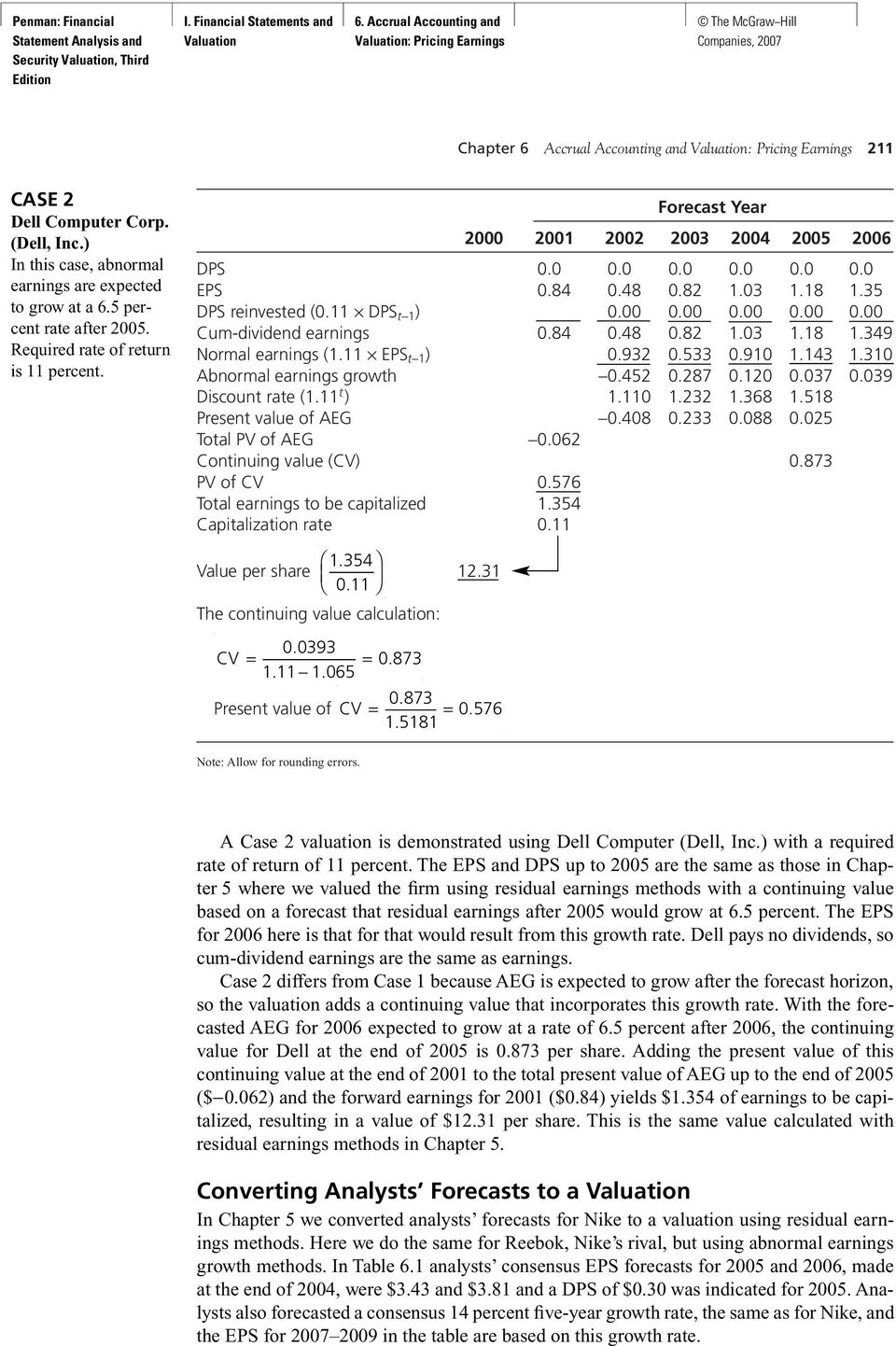
14 Security, Third Chapter 6 Accrual Accounting and 211 CASE 2 Dell Computer Corp. (Dell, Inc.) In this case, abnormal earnings are expected to grow at a 6.5 percent rate after Required rate of return is 11 percent. Forecast Year DPS EPS DPS reinvested (0.11 DPS t 1 ) Cum-dividend earnings Normal earnings (1.11 EPS t 1 ) Abnormal earnings growth Discount rate (1.11 t ) Present value of AEG Total PV of AEG Continuing value (CV) PV of CV Total earnings to be capitalized Capitalization rate Value per share The continuing value calculation: CV = = Present value of CV = = Note: Allow for rounding errors. A Case 2 valuation is demonstrated using Dell Computer (Dell, Inc.) with a required rate of return of 11 percent. The EPS and DPS up to 2005 are the same as those in Chapter 5 where we valued the firm using residual earnings methods with a continuing value based on a forecast that residual earnings after 2005 would grow at 6.5 percent. The EPS for 2006 here is that for that would result from this growth rate. Dell pays no dividends, so cum-dividend earnings are the same as earnings. Case 2 differs from Case 1 because AEG is expected to grow after the forecast horizon, so the valuation adds a continuing value that incorporates this growth rate. With the forecasted AEG for 2006 expected to grow at a rate of 6.5 percent after 2006, the continuing value for Dell at the end of 2005 is per share. Adding the present value of this continuing value at the end of 2001 to the total present value of AEG up to the end of 2005 ($ 0.062) and the forward earnings for 2001 ($0.84) yields $1.354 of earnings to be capitalized, resulting in a value of $12.31 per share. This is the same value calculated with residual earnings methods in Chapter 5. Converting Analysts Forecasts to a In Chapter 5 we converted analysts forecasts for Nike to a valuation using residual earnings methods. Here we do the same for Reebok, Nike s rival, but using abnormal earnings growth methods. In Table 6.1 analysts consensus EPS forecasts for 2005 and 2006, made at the end of 2004, were $3.43 and $3.81 and a DPS of $0.30 was indicated for Analysts also forecasted a consensus 14 percent five-year growth rate, the same as for Nike, and the EPS for in the table are based on this growth rate.
15 Security, Third 212 Part One Financial Statements and TABLE 6.1 Converting Analysts Forecasts to a : Reebok International Ltd. (RBK) Analysts forecast EPS two years ahead ($3.43 for 2005 and $3.81 for 2006) and also give a five-year EPS growth rate of 14 percent. Forecasts for apply this consensus growth rate to the 2006 estimate. Dividends per share (DPS) are set at the 2005 indicated payout rate of 8.7 percent of earnings. Required rate of return is 10 percent. 2004A 2005E 2006E 2007E 2008E 2009E DPS EPS DPS reinvested (0.10 DPS t 1 ) Cum-dividend earnings Normal earnings (1.10 EPS t 1 ) Abnormal earnings growth Cum-div EPS growth rate 11.95% 14.78% 14.93% 15.00% Discount rate (1.10 t ) Present value of AEG Total PV of AEG 0.54 Continuing value (CV) PV of CV 2.94 Total earnings to be capitalized 6.91 Capitalization rate Value per share 010. $69.10 The continuing value calculation: CV = = Present value of CV = = Note: Allow for rounding errors. The calculations in the table show that analysts are forecasting abnormal earnings growth after the forward year, 2005, apparent also from cum-dividend earnings growth rates that are greater than the required return on 10 percent. Analysts do not provide forecasts more than five years ahead, so the continuing value here is based on a 4 percent longterm growth rate, the typical GDP growth rate. The calculated value is $69.10 per share. Reebok traded at $41 at the time, so this value is well in excess of the market s valuation. Analysts five-year growth rates are typically optimistic. This could be so here; alternatively, the market price is cheap. We will return to the issue when we reverse engineer the market price at the end of the chapter. FEATURES OF THE ABNORMAL EARNINGS GROWTH MODEL Box 6.2 lists the advantages and disadvantages of the abnormal earnings growth model. Compare it to similar summaries for the dividend discount model (in Chapter 4), the discounted cash flow model (in Chapter 4), and the residual earnings model (in Chapter 5). We have emphasized that AEG valuation, like the residual earnings valuation, protects us from paying too much for earnings growth. In this section we will discuss some other features of the model. Buy Earnings The abnormal earnings growth model adopts the perspective of buying earnings. It embodies the idea that the value of a firm is based on what it can earn. As earnings represent

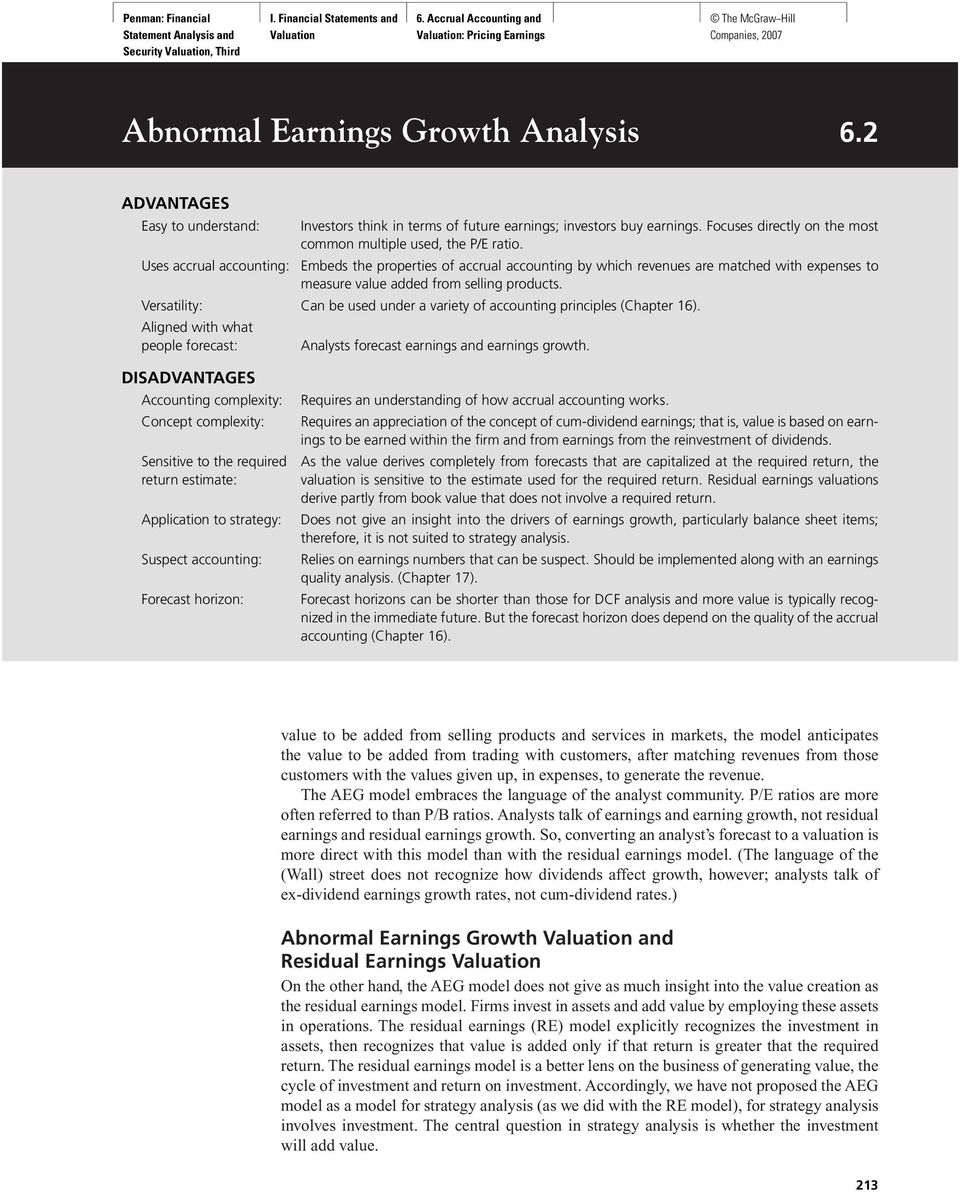
16 Security, Third Abnormal Earnings Growth Analysis 6.2 ADVANTAGES Easy to understand: Uses accrual accounting: Investors think in terms of future earnings; investors buy earnings. Focuses directly on the most common multiple used, the P/E ratio. Embeds the properties of accrual accounting by which revenues are matched with expenses to measure value added from selling products. Versatility: Can be used under a variety of accounting principles (Chapter 16). Aligned with what people forecast: Analysts forecast earnings and earnings growth. DISADVANTAGES Accounting complexity: Concept complexity: Sensitive to the required return estimate: Application to strategy: Suspect accounting: Forecast horizon: Requires an understanding of how accrual accounting works. Requires an appreciation of the concept of cum-dividend earnings; that is, value is based on earnings to be earned within the firm and from earnings from the reinvestment of dividends. As the value derives completely from forecasts that are capitalized at the required return, the valuation is sensitive to the estimate used for the required return. Residual earnings valuations derive partly from book value that does not involve a required return. Does not give an insight into the drivers of earnings growth, particularly balance sheet items; therefore, it is not suited to strategy analysis. Relies on earnings numbers that can be suspect. Should be implemented along with an earnings quality analysis. (Chapter 17). Forecast horizons can be shorter than those for DCF analysis and more value is typically recognized in the immediate future. But the forecast horizon does depend on the quality of the accrual accounting (Chapter 16). value to be added from selling products and services in markets, the model anticipates the value to be added from trading with customers, after matching revenues from those customers with the values given up, in expenses, to generate the revenue. The AEG model embraces the language of the analyst community. P/E ratios are more often referred to than P/B ratios. Analysts talk of earnings and earning growth, not residual earnings and residual earnings growth. So, converting an analyst s forecast to a valuation is more direct with this model than with the residual earnings model. (The language of the (Wall) street does not recognize how dividends affect growth, however; analysts talk of ex-dividend earnings growth rates, not cum-dividend rates.) Abnormal Earnings Growth and Residual Earnings On the other hand, the AEG model does not give as much insight into the value creation as the residual earnings model. Firms invest in assets and add value by employing these assets in operations. The residual earnings (RE) model explicitly recognizes the investment in assets, then recognizes that value is added only if that return is greater that the required return. The residual earnings model is a better lens on the business of generating value, the cycle of investment and return on investment. Accordingly, we have not proposed the AEG model as a model for strategy analysis (as we did with the RE model), for strategy analysis involves investment. The central question in strategy analysis is whether the investment will add value. 213
17 Security, Third Comparing the Abnormal Earnings Growth Model with the Residual Earnings Model 6.3 The AEG model and the RE model look different but are really quite similar. Both require forecasts of earnings and dividends, although the RE model adds the extra mechanical step of calculating book value forecasts from these forecasts. So the two models have the same forecasts as inputs. Structurally, the two models are similar. The RE starts with book value as an anchor and then adds value by charging forecasted earnings by the required return applied to book value. The AEG model starts with capitalized earnings as an anchor and then adds value by charging forecasted (cumdividend) earnings by the required return applied to prior earnings, rather than book value. This structural difference is just a different arrangement of the inputs. A little algebra underscores the point. Abnormal earnings growth can be written in a different form: AEG t = [Earn t + (ρ E 1)d t 1 ] ρ E Earn t 1 = Earn t Earn t 1 (ρ E 1)(Earn t 1 d t 1 ) Using the stocks and flows equation for accounting for the book value of equity (Chapter 2), B t 1 = B t 2 + Earn t 1 d t 1, so Earn t 1 d t 1 = B t 1 B t 2. Thus, AEG t = Earn t Earn t 1 (ρ E 1)(B t 1 B t 2 ) = [Earn t (ρ E 1)B t 1 ] [Earn t 1 (ρ E 1)B t 2 ] = RE t RE t 1 So, abnormal earnings growth is always equal to the change in residual earnings. You can see this by comparing the changes in residual earnings with the AEG for the prototype firm in Exhibit 6.2: Residual earnings Change in residual earnings Abnormal earnings growth You can also test this relationship by comparing the abnormal earnings growth for General Electric and Dell Computer (Dell, Inc.) in this chapter with the residual earnings for the two firms in Chapter 5. For example, GE s residual earnings for 2003 are $0.855, an increase of $0.011 over the $0.844 for 2002, and that increase is equal to its abnormal earnings growth for So, forecasting that there will be no abnormal earnings growth is the same as forecasting that residual earnings will not change. Or, as abnormal earnings growth of zero means that (cum-dividend) earnings are growing at the required rate of return, forecasting this normal growth rate is the same as forecasting that residual earnings will not change. Correspondingly, forecasting cum-dividend earnings growth above normal is the same as forecasting growth in residual earnings. Accordingly, one set of forecasts give us both measures. The rearrangement of the inputs leads to the different anchors and different definitions of adding value to the anchors. Yet the underlying concepts are similar. AEG valuation enforces the point that a firm cannot add value from growing earnings unless it grows earnings at a rate greater than the required rate of return. Only then does it increase its P/E ratio. But that is the same as saying that the firm must grow residual earnings to increase its P/B ratio. That is, added value comes from investing to earn a return greater than the required return, and that added value has its manifestation in both growth in residual earnings and growth in cum-dividend earnings over a normal growth rate. If abnormal earnings growth is always equal to the change in residual earnings, then the abnormal earnings growth model 6.1 can be restated as 1 RE RE RE L V E = Earn1 ρ 2 3 E 1 ρe ρe ρe where RE is the change in residual earnings. So, to value equities, one forecasts residual earnings. For residual earnings valuation (to determine intrinsic P/B ratios), one uses these residual earnings forecasts in the calculation. For abnormal earnings growth valuation (to determine intrinsic P/E ratios), one uses changes in residual earnings. So the same pro forma is used for both valuations, as we will see. The RE model and AEG model always yield the same valuation. Box 6.3 shows, indeed, that the concepts underlying the two models are not very different: Abnormal earnings growth is always equal to the change in residual earnings. Abnormal Earnings Growth Is Not Affected by Dividends, Share Issues, or Share Repurchases We saw in Chapter 5 that residual earnings valuation is not sensitive to expected dividend payout or share issues and share repurchases. Such is also the case with the AEG model. 214

18 Security, Third Chapter 6 Accrual Accounting and 215 With respect to dividends, you can prove this to yourself using the simple example in Exhibit 6.2. Rather than paying a dividend, reinvest the dividends in the firm at the 10 percent rate. Subsequent earnings within the firm will increase by the amount of the reinvested dividends. Cum-dividend earnings the amount of earnings earned in the firm plus that earned by reinvesting the dividends outside the firm will be exactly the same as if the shareholder reinvested the dividends in a personal account (as in the exhibit). AEG will not change, nor will the valuation. This simulates the earnings for an investor who receives the dividend but uses the cash to buy the stock, which is priced to yield a 10 percent required return. He effectively undoes the dividend, with no effect on value. The same logic applies if the payouts in Exhibit 6.2 are from stock repurchases rather than dividends. Accounting Methods and The residual earnings model accommodates different accounting principles. As we saw in Chapter 5, this is because book values and earnings work together. Firms may create higher future earnings by the accounting they choose, but to do so they must write down book values. When the higher earnings are combined with the lower book values (in a residual earnings valuation), value is unaffected. The AEG model, at first glance, looks as if it might not have this feature. A manager can create higher future earnings by writing down book values, and the AEG model values future earnings without carrying book values as a correcting mechanism. We do not want to pay for growth that does not add value, and accounting methods can create growth in earnings that we do not want to pay for. As it happens, the AEG model, like the residual earnings model, provides protection against paying for growth that is created by accounting. Box 6.4 explains. Make sure you read the section titled A Lesson for the Analyst in Box 6.4. The trailing P/E indicates expected earnings from sales in the future relative to the earnings recognized from current sales. To measure the value added from sales, accounting methods match expenses with revenues. If that matching underestimates current expenses (by underestimating bad debts, for example), current earnings are higher. However, future earnings are lower earnings are borrowed from the future. Because more current earnings are recognized and less future earnings are expected (and value is not affected), the trailing P/E is lower. With lower future earnings, the forward P/E is higher. The converse is true if a firm recognizes more expenses in current earnings. REVERSE ENGINEERING THE MODEL FOR ACTIVE INVESTING Like the residual earnings model, the AEG model can be reverse engineered. Consider the simple example in Exhibit 6.2, where a value of $ million was calculated. Suppose that the equity for this firm were trading at $ million and you forecast one-yearahead earnings of $12.36 million, and two-year-ahead earnings of $12.73 million. With a 10 percent required return, these forecasts imply AEG of $0.071 for two years ahead, as in the exhibit. Reverse engineering sets up the following problem and solves for g: 1 P = $. million = g With a value of $ million, g = You have converted the market price into a forecast: the market s implied abnormal earnings growth rate is 3 percent. You have done so by reverse engineering the AEG model. Rather than forecasting a growth rate and
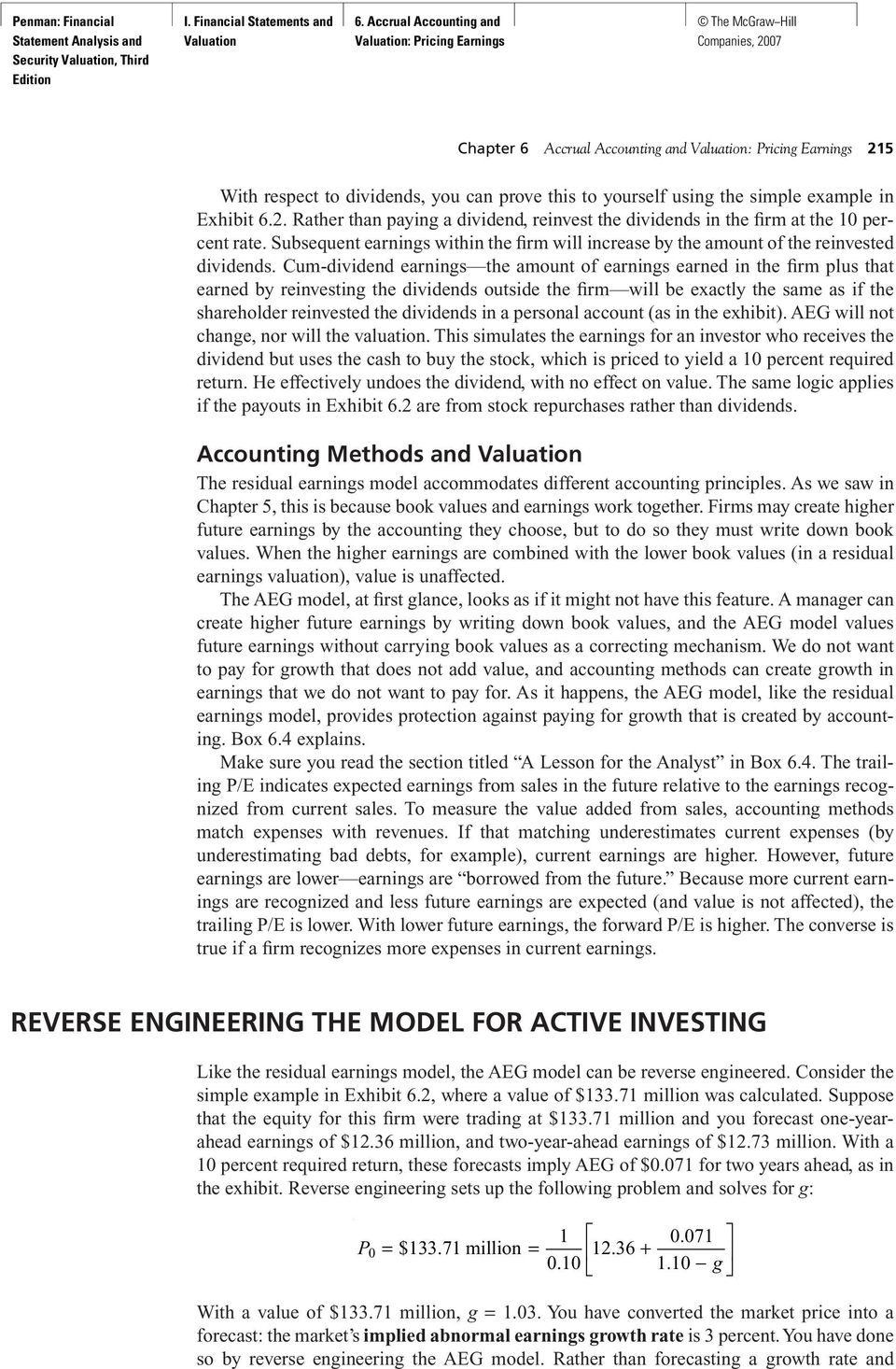
19 Security, Third Abnormal Earnings Growth s When Earnings Are Created by Accounting 6.4 Exhibit 6.2 presented pro forma earnings and earnings growth for valuing the equity of a prototype firm. Suppose the manager of this firm has decided to create more earnings for Year 1 by writing down inventory by $8 in Year 0. This accounting adjustment changes the accounting numbers, but it should not affect the value. Here is the revised pro forma: Creating Earnings with Accounting: Modifying Exhibit 6.2 for a Write-Down Forecast Year Earnings Dividends Book value Earnings on reinvested dividends Cum-dividend earnings Normal earnings Abnormal earnings growth (8.729) Abnormal earnings growth rate 3% 3% EFFECT ON VALUATION As a result of the $8 write-down, the $12 reported for Year 0 earnings is now $4 (and the book value is $92 instead of $100). Correspondingly, Year 1 forward earnings increase by $8 to $20.36 because cost of goods sold is lower by $8. Cumdividend earnings for Year 2 are not affected but, because those earnings are now compared to normal earnings of $22.396, on the high base of $20.36 for Year 1, abnormal earnings growth for Year 2 is (a decline of) $ Subsequent years are unaffected. The AEG valuation at the end of Year 0 is V E = =. This is the same as the value before the accounting change. While forward Year 1 earnings have increased, the higher earnings of $20.36 mean higher normal earnings for Year 2 and consequently lower earnings growth of $ The net effect is to leave the value unchanged. EFFECT ON P/E RATIOS While valuations are not affected by accounting methods, P/E ratios certainly are. The forward P/E for this firm is now $133.71/$20.36 = 6.57, down from The trailing (dividend-adjusted) P/E is now ($ $9.09)/$4.00 = 35.70, up from Shifting income from current earnings to forward earnings increases the trailing P/E; there is now more anticipated earnings growth next year and the P/E prices growth. However, shifting income to the future decreases the forward P/E there is now less anticipated growth after the forward year, and the value of the earnings (in the numerator) does not change. A LESSON FOR THE ANALYST There is a lesson here. The diligent analyst distinguishes growth that comes from accounting from growth that comes from real business factors. If growth is induced by the accounting, he changes the P/E ratio, but he does not change the valuation. Applying the AEG model (or indeed the residual earnings model) protects him from making the mistake of pricing earnings that are due to accounting methods. We opened this chapter with the caveat that we do not want to pay for growth that does not add value. We do not want to pay for earnings growth from added investment that earns only the required return. But we also do not want to pay for growth that is created by accounting methods. Using the residual earnings model or the abnormal earnings growth model protects us from both dangers. converting that forecast to a valuation, you have converted the market s valuation into a forecast of the growth rate. Suppose now that the equity were trading at $147.2 million. We would then calculate g = 1.07 (rounded). You have reverse engineered the residual earnings model to conclude that the market is forecasting an abnormal earnings growth rate of 7 percent per year. If, as a result of an analysis of the firm, you conclude that the growth rate can be no higher than 3 percent, you would conclude that the market price of $147.2 million is too high: sell. But you might also turn the analysis on yourself: Is there something the market knows that I don t know? 216

20 Security, Third Chapter 6 Accrual Accounting and 217 Reverse engineering can also extract the implied expected return. Suppose you were very firm in your belief that the growth rate can be no higher than 3 percent. Then you can set up the following problem and solve for ρ: AEG $. million. ρ ρ P 0 = = + AEG 2 involves the required return for reinvesting dividends, so set AEG 2 = [ (ρ 1) 9.36] (ρ 12.36). The reverse-engineered amount for ρ is ; that is, the market is forecasting a 9.36 percent rate of return from buying this stock. This is the market s implied expected return. If you require 10 percent, you would say the stock is too expensive. The formula for reverse engineering the expected return looks a little complicated, but there are just a few numbers to plug in: ρ= Earn1 Earn2 Earn1 A A + ( g 1) P Earn 0 1 (6.5) 1 Div1 where A = g P0 Rather than screening stocks on the too-simple P/E ratio, the active investor might screen stocks on these implied expected returns: Buy stocks with high expected returns and sell those with low expected returns. This requires some analysis, of course, for we must have some sense of the AEG growth rate. Part Two of the book builds the analysis. Reverse Engineering the S&P 500 At the end of 2003, the S&P 500 index stood at The chief economist of a leading Wall Street investment bank was forecasting 2004 earnings for the S&P stocks of $53.00 and $58.20 for These earnings estimates are in the same units as the index, so the economist s forward P/E ratio for the index was $1,000/$53 = The payout ratio for the S&P 500 was 31 percent at the time and the economist estimated a market risk premium of 5 percent over the 10-year Treasury rate of 4 percent. With a beta of 1.0 for this market portfolio, these rates imply a CAPM required return of 9 percent. The normal forward P/E for a 9 percent required return is 1/0.09 = 11.11, so the market, with a P/E of 18.87, is expecting some abnormal earnings growth. The payout ratio implies expected dividends of $ = $16.43 in 2004, and with the reinvestment of this dividend at the 9 percent rate, expected abnormal earnings growth for 2005 is $1.909, as follows: Earnings $53.00 $58.20 Dividends (31% payout) Reinvested dividends at 9% Cum-dividend earnings $ Normal earnings ($ ) AEG $ With these ingredients, we are ready to reverse engineer: 1 P =, = g
![2 P 0 = 147 2 = + AEG 2 involves the required return for reinvesting dividends, so set AEG 2 = [12.73 + (ρ 1) 9.36] (ρ 12.36). The reverse-engineered amount for ρ is 1.](/docs-images/47/20041508/images/page_20.jpg "0936; that is, the market is forecasting a 9.36 percent rate of return from buying this stock. This is the market s implied expected return.")
21 Security, Third 218 Part One Financial Statements and The solution for g is 1.039, that is, a 3.9 percent growth rate. This is close to the typical GDP growth rate so, if we accept that the long-term growth rate for this market portfolio should be about the same as the GDP growth rate, we would conclude the S&P 500 stocks were reasonably priced at an index level of 1000 at the end of Using Analysts Forecasts in Reverse Engineering In Table 6.1 we converted analysts consensus EPS forecasts for Reebok into a valuation. We were unsure as to what growth rate to use in the continuing value, so we just used the GDP growth rate. Reverse engineering allows us to assess what growth rate the market is using. As analysts five-year growth rates are unreliable, we use only the forecasts for two years ahead in this exercise. EPS forecasts were $3.43 for 2005 and $3.81 for 2006, and the AEG for 2006, calculated in Table 6.1, is $ Reebok s shares traded at $41 at the end of The reverse engineering problem (with a required return of 10 percent) runs as follows: P = $ = g The solution for g is 1.0; that is, the market is forecasting zero growth after You will remember that, using analysts five-year growth rate in Table 6.1, we obtained a value of $69.10 per share. Clearly the market is forecasting less growth than analysts. Implied Earnings Forecasts and Earning Growth Rates AEG growth rates are a little difficult to conceptualize, but can be converted into earnings and earning growth forecasts by reverse engineering the AEG calculation: Earnings forecast = Normal earnings forecast + AEG forecast Forecast of earnings from prior year s dividends (6.6) For Reebok, we calculated the market s implied AEG growth rate of zero. So the market s forecast of AEG for 2007 is $0.067, the same as in Normal earnings for 2007 are $4.191 and reinvested dividends for 2007 are $0.033, both from Table 6.1. Accordingly, the market s implied EPS forecast for 2007 is $ = $ The implied EPS growth rate for 2007 is $4.225/$3.81 = percent. (Note that the implied cumdividend growth rate that includes earnings on reinvested dividends in the numerator is $4.258/$3.81 = percent.) Continuing the calculations for subsequent years, one gets the sequence of the implied EPS growth rates in Figure 6.3. If, as a result of an analysis, you forecast growth rates above those here, you are in the buy zone. If you forecast lower growth rates, you are in the sell zone. The Building Blocks of an Abnormal Earnings Growth Just as we deconstructed residual earnings valuation into a set of building blocks (in Chapter 5), so can we deconstruct abnormal earnings growth valuation. Figure 6.4 depicts the building blocks. The first component is capitalized forward earnings constituting $3.43/0.10 = $34.30 of Reebok s value. We are usually relatively sure about this part of the valuation, unless short-term forecasting is particularly uncertain. The second component is the added value from AEG for two years ahead, capitalized as a perpetuity. For Reebok, this is the $0.067 of forecasted AEG valued as a perpetuity. This block adds $6.70 to Reebok s value, giving a total for blocks 1 and 2 of $41.
22 Security, Third Chapter 6 Accrual Accounting and 219 FIGURE 6.3 Plotting the Market s Implied EPS Growth Rates: Reebok International, Ltd. The market s implied forecast of EPS growth rates, obtained by reverse engineering, are plotted for The growth rate for 2006 is analysts two-year-ahead growth rate from their EPS estimates for 2006 and Growth rates forecasted above the line imply buying the stock. Growth rates forecasted below the line imply selling % 11.25% 11.00% 11.08% 10.89% BUY EPS Growth Rate 10.75% 10.50% 10.25% SELL 10.72% 10.56% 10.42% 10.30% 10.19% 10.00% 9.75% FIGURE 6.4 Building Blocks of an Abnormal Earnings Growth : Reebok International, Ltd. The building blocks distinguish components of a valuation about which the analyst is reasonably sure from more speculative components: (1) value from capitalized forward earnings, about which one is reasonably certain; (2) value from capitalizing two-year-ahead abnormal earnings growth; and (3) value from forecasts of long-term growth, the most speculative part of the valuation. Value per Share $41.00 $34.30 Current market value Capitalized forward earnings $6.70 (1) Value from forward earnings (2) Value from short-term forecasts (3) Value from long-term forecasts The third component captures value from speculation about long-term growth in AEG, a component we are usually less sure about. Analysts forecast in Table 6.1 added considerable value for this component, but we saw that the market (with a price of $41) actually assigned zero value. It is speculation about this component that good analysis (that follows in subsequent chapters) challenges: Is the market correct in assigning zero growth to Reebok and thus zero value for the third building block?
23 Security, Third The Greenspan Model 6.5 From an article in Barron s in Fed Chairman Alan Greenspan hasn t said much about the stock market this year, but his favorite valuation model is just about screaming a sell signal. The so-called Greenspan model was brought to our attention last summer by Edward Yardeni, economist at Deutsche Morgan Grenfell, who found it buried in the back pages of a Fed report. The model s very presence in such a report was noteworthy because the Fed officials normally don t tip their hand about their views on the stock market. The model surfaced at a particularly interesting time: Stocks were near a high point, and the Greenspan model indicated that the market was about 20 percent higher than it should have been. That turned out to be a pretty good call. By October 1998, stocks had fallen as much as 15 percent from their summer high point. By year-end, of course, the Dow had recovered to around 7900, but it still remained about 5 percent below its peak for the year. Now that the Dow has climbed above 8600, Greenspan s model is again flashing a warning signal. To be exact, the Greenspan model now indicates that stocks are 18 percent overvalued. The Fed s model arrives at its conclusions by comparing the yield on the 10-year Treasury note to the price-to-earnings ratio of the S&P 500 based on expected operating earnings in the coming 12 months. To put stocks and bonds on the same footing, the model uses the earnings yield on stocks, which is the inverse of the (forward) P/E ratio. So while the yield on the 10-year Treasury is now 5.60 percent, the earnings yield on the S&P 500, based on a (forward) P/E ratio of 21, is 4.75 percent. In essence, the Fed s model asks, Why would anyone buy stocks with a 4.75 percent earnings return, when they could get a bond with a 5.60 percent yield? The Fed s model suggests the S&P should be trading around 900, well under its current level of Source: Is Alan Addled? Greenspan Model Indicates Stocks Today Are Overvalued by About 18%, Barron s, March 16, 1998, p. 21. Screening on Earnings Yield Alan Greenspan, chairman of the Federal Reserve Bank during the 1990s, was known for his statements regarding the irrational exuberance of the stock market. According to Barron s, he used an earnings yield screen. See Box 6.5. The Greenspan model or the Fed Model compares the expected earnings yield with the 10-year Treasury yield to assess whether stocks are overpriced. The expected earnings yield, measured as forward earnings/price, is just the inverse of the forward P/E ratio, so an earnings yield of 4.75 percent (at the time of the newspaper report) implies a forward P/E of A Treasury yield of 5.60 percent implies a forward P/E of The Greenspan model says that stocks are likely to be overpriced when the forward P/E for stocks rises above the P/E for Treasury notes. Is this a good screen? The Greenspan model is not well calibrated. First, one expects the forward P/E for stocks to be different than that for bonds because stocks and bonds have different risk and thus different required returns. The forward P/E of for a bond is the normal P/E for a required return of 5.60 percent. Stocks are more risky; if the required return is 10 percent, the normal P/E is 10, considerably less than the P/E for a riskless government bond. Second, the Greenspan model does not explicitly build in growth after the forward year. A bond has no abnormal earnings growth (it is similar to a savings account), so the normal P/E is the appropriate P/E. But stocks with a normal P/E of 10 could be worth a P/E of 21 if abnormal earnings growth is anticipated after the forward year. Without forecasts of subsequent earnings, the P/E of 21 cannot be challenged effectively. The Greenspan model asks: Why would anyone buy stocks with a 4.75 percent earnings return, when they could get a bond with a 5.60 percent yield? Well, they would do so if they saw growth that they were willing to pay for. An earnings yield screen is too simplistic. The two errors in applying the Greenspan model ignoring differences in risk and expected growth work in the opposite direction. Stocks should have a lower P/E because they are more risky, but they should have a higher P/E if they can deliver growth. By 220
24 Security, Third P/E Ratios and Interest Rates 6.6 As P/E ratios involve the capitalization of earnings by the required return, and as the required return varies as interest rates change, P/E ratios should be lower in periods of high interest rates and higher in times of low interest rates. Correspondingly, earnings yields should be higher in times of high interest rates and lower in times of low interest rates. The figure below indicates that P/E ratios and interest rates have moved in the opposite directions in recent history. When interest rates on government obligations were high in the late 1970s and early 1980s, P/Es were low; when interest rates were relatively low in the 1990s, P/Es were relatively high. But the relationship between P/E and interest rates is not strong. This is because expectations of future earnings growth are more important in determining the P/E than changes in interest rates. Of course we must be cautious in our interpretations because the market may have been inefficient at times in pricing earnings. Were P/E ratios too low in the 1970s? Too high in the 1990s? Was the market underestimating future earnings growth in the 1970s and overestimating it in the 1990s? Median P/E Ratios and Interest Rates (in Percentages) on One-Year Treasury Bills 20 Interest rate P/E ratio 18 Price-to-Earnings Ratio and Interest Rates Source: P/E ratios were calculated from Standard & Poor s COMPUSTAT data. Interest rates are from the Federal Reserve Statistics Release ( demanding that stocks have an earnings yield no less than the yield on Treasury notes, the model is saying that growth can never be high enough to compensate for the error of treating stocks as riskless securities like Treasury notes. Is that a good screen? The comparison of earnings yields to Treasury rates does remind us that earnings yields and P/E ratios should change as interest rates change. See Box 6.6. Screening on PEG Ratios In recent years, the PEG ratio has come into prominence. The PEG (P/E-to-earningsgrowth) ratio compares the P/E ratio to a forecast of percentage earnings growth rate in the following year: PEG ratio P/E = 1-yr ahead percentage earnings growth 221
25 Security, Third 222 Part One Financial Statements and The P/E in the numerator is usually the forward P/E, but sometimes the trailing P/E is used. If the forward P/E is used, the appropriate measure of growth in the denominator of the PEG ratio is the forecasted one-year growth after the forward year, that is, growth for two years ahead. The ratio compares the traded P/E, the market s assessment of earnings growth after the forward year, with actual growth forecasts. Analysts growth forecasts are typically used. If the ratio is less than 1.0, the screener concludes that the market is underestimating earnings growth. If it is greater than 1.0, the screener concludes that the market is too optimistic about growth. The benchmark PEG ratio of 1.0 is consistent with the analysis in this chapter. If the required return for a stock is 10 percent (and thus the forward P/E is 10), the market is pricing the stock correctly if earnings are expected to grow (cum-dividend) at the required rate of 10 percent. If an analyst indeed forecasts a growth rate of 10 percent after the forward year, the PEG ratio is 10/10 = 1.0. (Note that the growth rate is in percentage terms.) If, however, an analyst forecasts a growth rate of 15 percent, the PEG ratio is 10/15 = 0.67 and the analyst questions whether, at a P/E of 10, the market is underpricing expected growth. Caution is called for in screening on PEG ratios. First, the benchmark of 1.0 applies only for a required return of 10 percent. If the required return is 12 percent, the normal P/E is 8.33 which, when divided by normal growth of 12 percent, yields a PEG of Second, standard calculations (incorrectly) use the forecasted growth rate in ex-dividend earnings rather than the cum-dividend rate. Third, screening on just one year of anticipated growth ignores information about subsequent growth. For this reason, some calculations of the PEG ratio use annualized five-year growth rates in the denominator. In October 2002, Ford Motor Company s shares traded at $7.20 each on analysts consensus forecast of EPS for its December 2002 fiscal year of $0.43, giving a P/E of Analysts were forecasting $0.65 in per-share earnings for As the firm indicated 40 cents per-share dividends in 2002, the cum-dividend forecast for 2003 was $0.69, assuming a required return of 10 percent. Thus the anticipated cum-dividend growth rate for 2003 was 60.5 percent and Ford s PEG ratio was 16.7/60.5 = The PEG ratio indicates that Ford was underpriced. But the 2003 growth rate is probably due to the fact that the base year, 2002, was a particularly bad year for Ford. Ford would not be able to maintain a 60 percent growth rate into the future; the 2003 growth rate is not indicative of the long term. Indeed, analysts at the time were forecasting only an average 5 percent annual growth rate over the next five years. Using this growth rate in the denominator of the PEG ratio yields a ratio of 3.3. Summary The valuation methods in this chapter complement those in Chapter 5. They yield intrinsic P/E ratios rather than P/B ratios. Rather than anchoring valuation on book value, the methods here anchor valuation on earnings. However, the form of the valuation is similar. With P/B valuation, one adds value to book value for earnings in excess of normal earnings (at the required return) on book value; with P/E valuation, one adds value to capitalized earnings for earnings in excess of normal earnings (at the required return) on prior earnings. Abnormal earnings growth earnings growth in excess of normal earnings growth is the central concept for the valuation. This concept, in turn, requires an appreciation that, when the analyst focuses on earnings growth, she must focus on cum-dividend earnings growth because future earnings involve not only earnings earned in the firm but also earnings from reinvesting any dividends to be received. As with residual earnings valuation, the application of the methods in this chapter protects the investor from paying too much for earnings. These methods also protect the investor from paying for earnings created by accounting methods. And, as with residual earnings, the abnormal earnings growth model facilitates reverse engineering: The analyst can deduce earnings forecasts and expected returns implicit in stock market prices.
26 Security, Third Chapter 6 Accrual Accounting and 223 The Web Connection Find the following on the Web page for this chapter: Further applications of abnormal earnings growth valuation. A spreadsheet program to help you develop abnormal earnings growth pro formas and valuations. Further examples of reverse engineering. A demonstration that AEG valuation and residual earnings valuation yield the same value. Key Concepts abnormal earnings growth is earnings growth in excess of growth at a rate equal to the required return. Compare with normal earnings growth 202 ex-dividend earnings are earnings without consideration to the earnings that can be earned on dividends. Compare with cum-dividend earnings. 201 cum-dividend earnings are earnings that include earnings on prior dividends paid. Compare with ex-dividend earnings. 201 implied abnormal earnings growth rate is the growth rate for abnormal earnings implied by the current market price. 215 implied expected return is the expected rate of return from investing at the current market price. 217 implied earnings forecast is a forecast that is implicit in the market price of a stock. 218 normal earnings growth is earnings growth at a rate equal to the required return. 201 normal forward P/E is a price-earnings ratio that is appropriate when earnings are expected to grow (cum-dividend) after the forward year at a rate equal to the required return; that is, normal earnings growth is expected. 202 normal trailing P/E is a price-earnings ratio that is appropriate when earnings are expected to grow (cum-dividend) after the current year at a rate equal to the required return 203 The Analyst s Toolkit Analysis Tools Page Key Measures Page Acronyms to Remember Abnormal earnings growth model (6.1) 204 Case Case Forward P/E calculation (6.2) 205 Abnormal earnings growth (6.3), (6.3a) 206 Trailing P/E model (6.4) 209 Converting an analyst s forecast to a valuation 211 Abnormal earnings growth 202 Continuing value Case Case Cum-dividend earnings 201 Earnings yield 220 Ex-dividend earnings 201 Forward P/E ratio 202 Implied abnormal earnings growth rate 215 AEG EPS DPS GDP PEG RE abnormal earnings growth earnings per share dividends per share gross domestic product price-to-earnings growth residual earnings
27 Security, Third 224 Part One Financial Statements and The Analyst s Toolkit (concluded) Analysis Tools Page Key Measures Page Acronyms to Remember Reverse engineering the abnormal earnings valuation model 215 for implicit growth rates 215 for expected returns 217 building blocks 218 PEG ratio 221 Normal earnings 201 Normal forward P/E ratio 202 Normal trailing P/E ratio 203 Implied earnings growth rate 218 Implied expected returns 217 PEG ratio 221 A Continuing Case: Kimberly-Clark Corporation A Self-Study Exercise CONVERTING ANALYSTS FORECASTS TO A VALUATION In the Kimberly-Clark case for Chapter 5, you were asked to convert analysts earnings forecasts into a valuation using residual earnings methods. You can now do the same using abnormal earnings growth methods. Exhibit 1.1 in Chapter 1 gives consensus analysts forecasts made in March 2005 when the stock price stood at $64.81 per share. These earnings forecasts are in the form of point estimates for 2005 and 2006 and an estimated fiveyear growth rate. KMB paid an annual dividend per share of $1.60 in 2004 and a dividend of $1.80 per share was indicated for 2005 at the time. Calculate the forward P/E ratio. Also, using information in the 2004 financial statements in Exhibit 2.2 in Chapter 2, calculate the trailing P/E in March With a five-year growth rate, you can forecast analysts EPS estimates for the years Do this and, from these forecasts, pro forma the corresponding abnormal earnings growth. Use a required return for equity of 8.9% for the calculations. Now go ahead and value KMB s shares from this pro forma. You might adapt the spreadsheet engine on the Web page for this chapter to make this valuation. Assume a long-term growth rate after the five-year forecast period of 4%, roughly equal to the average GDP growth rate. What is your intrinsic forward P/E ratio? What is your intrinsic trailing P/E ratio? Did you get the same value as in the residual earnings application in the last chapter? Reverse Engineering Working only from the analysts forecasts for 2005 and 2006, find out what is the market s implied rate for abnormal earnings growth after What are the earnings per share and EPS growth rates that the market is forecasting for the years ? You might plot those growth rates, just as in Figure 6.3. If you are handy with spreadsheets, you might build a program to do this. Understanding Your Uncertainty Assemble a building block diagram like that in Figure 6.4. What part of the valuation are you most uncertain about?
28 Security, Third Chapter 6 Accrual Accounting and 225 Using Spreadsheet Tools As in the continuing case for Chapter 5, you can experiment with spreadsheet tools that carry out a valuation. Look at the engine on the Web page supplement for this chapter. Concept Questions Exercises E6.1. C6.1. Explain why analysts forecasts of earnings-per-share growth typically underestimate the growth that an investor values if a firm pays dividends. C6.2. The historical earnings growth rate for the S&P 500 companies has been about 8.5 percent. Yet the required growth rate for equity investors is considered to be about 12 percent. Can you explain the inconsistency? C6.3. The following formula is often used to value shares, where Earn 1 is forward earnings, r is the cost of capital, and g is the expected earnings growth rate. Earn1 Value of equity = r g Explain why this formula can lead to errors. C6.4. A firm s earnings are expected to grow at a rate equal to the required rate of return for its equity, 12 percent. What is the trailing P/E ratio? What is the forward P/E ratio? C6.5. The normal forward P/E and the normal trailing P/E always differ by 1.0. Explain the difference. C6.6. Explain why, for purposes of equity valuation, earnings growth forecasts must be for cum-dividend earnings growth, yet neither cum-dividend growth rates nor valuation are affected by expected dividends. C6.7. Abnormal earnings growth is always equal to growth of (change in) residual earnings. Correct? C6.8. A P/E ratio for a bond is always less than that for a stock. Correct? C6.9. In an equity research report, an analyst calculates a forward earnings yield of 12 percent. Noting that this yield is considerably higher than the 7 percent yield on a 10-year Treasury, she heads her report with a buy recommendation. Could she be making a mistake? C6.10. How do you interpret a PEG ratio? C6.11. Look at Figure 2.3 in Chapter 2, which tracks median P/E ratios from 1963 to Explain why P/E ratios were low in the 1970s and high in the 1960s and 1990s. C6.12. The earnings-to-price ratio for the S&P 500 stocks declined significantly from the late 1970s to the late 1990s. As this ratio is a return per dollar of price, some claimed that the decline indicated that the required return for equity investing had declined, and they attributed the increase in stock prices over the period to the decline in the required return. Why is this reasoning suspect? C6.13. Why might an analyst refer to a leading (forward) P/E ratio rather than a trailing P/E ratio? C6.14. Can a firm increase its earnings growth yet not affect the value of its equity? Drill Exercises Forecasting Earnings Growth and Abnormal Earnings Growth (Easy) The following are earnings and dividend forecasts made at the end of The firm has a required equity return of 10 percent per year.
29 Security, Third 226 Part One Financial Statements and EPS DPS E6.2. E6.3. a. Forecast the ex-dividend earnings growth rate and the cum-dividend earnings growth rate for 2008 and b. Forecast abnormal earnings growth for 2008 and c. Calculate the normal forward P/E for this firm. d. Based on your forecasts, do you think this firm will have a forward P/E greater than its normal P/E? Why? P/E Ratios for a Savings Account (Easy) Suppose you own a savings account that earned $10 over the past year. Your only transaction in the account has been to withdraw $3 on the last day of this 12-month period. The account bears an interest rate of 4 percent per year. a. What is the value of the account after the $3 withdrawal? b. What is the trailing P/E and forward P/E for this account? From Forecasting Abnormal Earnings Growth (Easy) An analyst presents you with the following pro forma (in millions of dollars). The pro forma gives her forecasts of earnings and dividends for She asks you to value the 1,380 million shares outstanding at the end of Use a required return for equity of 10 percent in your calculations. (This is the same pro forma that was used for a residual earnings valuation in Exercise E5.3.) 2007E 2008E 2009E 2010E 2011E Earnings Dividends E6.4. a. Forecast growth rates for earnings and cum-dividend earnings for each year, b. Forecast abnormal earnings growth for each of the years, c. Calculate the per-share value of the equity at the end of 2006 from this pro forma. Would you call this a Case 1 or Case 2 abnormal earnings growth valuation? d. What is the forward P/E ratio for this firm? What is the normal forward P/E? Abnormal Earnings Growth and Target Prices (Medium) The following forecasts of earnings per share (EPS) and dividend per share (DPS) were made at the end of 2006: 2007E 2008E 2009E 2010E 2011E EPS DPS The firm has an equity cost of capital of 12 percent per annum. (This is the same pro forma used in the residual earnings valuation in Exercise E5.4.) a. Calculate the abnormal earnings growth that is forecast for each year, 2008 to b. What is the per-share value of the equity at the end of 2006 based on the abnormal earnings growth valuation model?
30 Security, Third Chapter 6 Accrual Accounting and 227 c. What is the expected trailing P/E for 2011? d. What is the forecasted per-share value of the equity at the end of the year 2011? E6.5. E6.6. Dividend Displacement and Value (Medium) Two firms, A and B, which have very similar operations, have the same book value of 100 at the end of 2005 and their cost of capital is 11 percent. Both are forecast to have earnings of $16.60 in Firm A, which has 60 percent dividend payout, is forecast to have earnings of $17.80 in Firm B has zero payout. a. What is your best estimate of firm B s earnings for 2007? b. Would you pay more, less, or the same for firm B relative to firm A in 2005? Applications Calculating Cum-Dividend Earnings Growth Rates Nike (Easy) In early 2003, analysts were forecasting $2.77 for Nike s earnings per share for the fiscal year ending May 2003, and $3.13 for 2004, with a dividend per share of 56 cents expected for Compare the cum-dividend earnings growth rate forecasted for 2004 with exdividend earnings growth rate, using a required rate of return of 10 percent. Real World Connection See Exercises E2.13, E8.8, E8.11, E13.16, E14.11, E15.10 and E18.5 on Nike. Minicases that deal with Nike are M2.1, M7.1, and M11.2. E6.7. Calculating Cum-Dividend Earnings: General Motors (Easy) General Motors reported earnings and paid dividends from 1994 to 1998 as follows: Basic EPS DPS Calculate cum-dividend earnings for General Motors for each years, Assume a reinvestment rate for dividends of 10 percent. Real World Connection Exercises E5.10, and E6.9 also deal with General Motors. E6.8. Plotting Earnings Implied Growth Rates for the S&P 500 (Medium) This exercise extends the reverse engineering example for the S&P 500 in this chapter. At the end of 2003, the S&P 500 index stood at The chief economist of a leading Wall Street investment bank was forecasting 2004 earnings for the S&P stocks of $53.00 and $58.20 for These earnings estimates are in the same units as the index, so the economist s forward P/E ratio for the index was $1,000/$53 = The payout ratio for the S&P 500 was 31 percent at the time and the economist estimated a market risk premium of 5 percent over the 10-year Treasury rate of 4 percent. From the text, you will understand that, given the economist s forecasts, the stock market was forecasting an AEG growth rate for the S&P 500 of 3.9 percent after What were the (ex-dividend) earnings growth rates for the years 2006, 2007, and 2008 forecasted by the stock market at the end of 2003? What were the cum-dividend earnings growth rates? Assume that the 31 percent payout will be maintained in the future.
31 Security, Third 228 Part One Financial Statements and E6.9. E6.10. E6.11. Using Analysts Forecasts to Calculate PEG Ratios and Evaluate Stock Prices: General Motors (Medium) In early 2003, analysts were forecasting earnings for General Motors Corporation (GM) of $4.62 per share for 2003 and $6.77 for GM was expected to pay a dividend of $2 per share in Use a required return for the equity of 12 percent in the calculations below. a. Calculate cum-dividend earnings and the cum-dividend earnings growth rate forecasted for b. Calculate forecasted abnormal earnings growth for c. GM was trading at $39 in early Calculate the forward P/E that the market was giving this stock. Also calculate a PEG ratio that evaluates this forward P/E. What does this PEG ratio suggest to you? d. Would you conclude that the market price of $39 per share implies that abnormal earnings growth in 2004 will subsequently increase, decrease, or remain about the same? Real World Connection Exercises E5.10 and E6.7 also deal with General Motors. Forward P/E Ratios and Implied Earnings Growth: Hewlett-Packard (Medium) Hewlett-Packard Corporation, the computer services and printer manufacturer, traded at $12 per share in September 2002, down considerably from $67 per share in Commentators were concerned about the effects of the acquisition of the then-unprofitable Compaq Computer, the personal computer and computer services firm. However, analysts were indicating that the Compaq operation would return to profitability in 2003 and were forecasting per-share earnings of $1.19 for Hewlett-Packard for the fiscal year ending October a. Calculate the forward P/E ratio at which the market was pricing the firm in October b. What growth rate is this forward P/E ratio implicitly forecasting for cum-dividend earnings for years after 2003? Use an equity cost of capital of 10 percent in your calculations. c. What abnormal earnings growth is this P/E ratio forecasting? d. Hewlett-Packard was forecasted to pay a dividend of 32 cents per share in What growth rate in ex-dividend earnings is the P/E in October 2002 forecasting? Real World Connection See Exercises E1.5, E5.15, and E9.9 for more coverage of Hewlett-Packard. Using Earnings Growth Forecasts to Challenge a Stock Price: Toro Company (Medium) Toro Company, a lawn products maker based in Minnesota, traded at $55 per share in October The firm had maintained a 20 percent annual EPS growth rate over the previous five years, and analysts were forecasting $5.30 per share earnings for the fiscal year ending October 2003, with a 12 percent growth rate for the five years thereafter. Use a required return of 10 percent in answering the following questions. a. How much is a share of Toro worth based on the forward earnings of $5.30 only (ignoring any subsequent earnings growth)? b. Toro maintains a dividend payout of 10 percent of earnings. Based on the forecasted EPS growth rate of 12 percent, forecast cum-dividend earnings for the five years,
32 Security, Third Chapter 6 Accrual Accounting and 229 E6.12. E6.13. E6.14. E6.15. c. Forecast abnormal earnings growth for the years, d. Do your calculations indicate whether or not Toro is appropriately priced? Abnormal Earnings Growth and Accounting Methods (Hard) Refer back to the valuation in Exercise 6.3. In the pro forma there, an analyst forecasted earnings of $388 million for The forecast was made at the end of 2006 based on preliminary reports from the firm. When the final report was published, however, the analyst discovered that the firm had decided to write down its inventory at the end of 2006 by $114 million (following the lowerof-cost-or-market rule). As this was inventory that the analyst had forecasted would be sold in 2007 (and thus the impairment affects cost of goods sold for that year), the analyst revised her earnings forecast for For questions (a) and (b), ignore any effect of taxes. a. What is the revised earnings forecast for 2007 as a result of the inventory impairment? b. Show that the revision in the forecast of 2007 earnings does not change the valuation of the equity. c. Now assume that the firm s income tax rate is 35 percent. Do your answers to questions (a) and (b) change? Normal Trailing and Forward P/E Ratios: Whirlpool Corporation (Medium) After Whirlpool Corporation had reported EPS of $4.43 for 1994, analysts were forecasting EPS of $4.75 for 1995, $5.08 for 1996, and $5.48 for The firm paid DPS of $1.22 in 1994 and a DPS of $1.28 was indicated for 1995 and Whirlpool Corporation, an appliance manufacturer, traded at $47 per share at the time. Whirlpool s required equity return is 10 percent. a. Show that the analyst s forecast implies that Whirlpool should trade at a normal P/E multiple of the forward earnings of $4.75 per share. b. Show that the analyst s forecast implies that Whirlpool should trade at a normal P/E multiple of the trailing earnings of $4.43. Is a Normal Forward P/E Ratio Appropriate? Maytag Corporation (Easy) A share of Maytag Corp., another appliance manufacturer, traded at $28.80 in January Analysts were forecasting earnings per share of $2.94 for 2003 and $3.03 for 2004, with dividends per share of 72 cents indicated for Analysts 3 5 year growth rate for earnings per share after 2004 was 3.1 percent. a. Calculate the normal forward P/E ratio for Maytag if its equity cost of capital is 10 percent. Compare the normal P/E to the actual traded P/E at the time. b. Do the forecasts of earnings after 2003 indicate that the traded P/E is the appropriate pricing for the firm s shares? Real World Connection Minicase M15.2 deals with the takeover of Maytag by Whirlpool. Exercise E19.5 deals with Maytag also. Residual Earnings and Abnormal Earnings Growth: IBM (Medium) Consider the following pro forma for International Business Machines (IBM) based on analysts forecasts in early E 2004E Next Three Years Earnings per share Growth at 11% Dividends per share Growth at 11%
33 Security, Third 230 Part One Financial Statements and E6.16. The book value of IBM s common equity at the end of 2002 was $23.4 billion, or $13.85 per share. Use a required return for equity of 12 percent in calculations. a. Forecast residual earnings for each of the years, b. Forecast abnormal earnings growth for each of the years, c. Show that abnormal earnings growth is equal to the growth in residual earnings for every year. Real World Connection Exercises E3.9 and E14.8 deal with IBM, as does Minicase M12.3. Normal P/E Ratios (Easy) Prepare a schedule that gives the normal trailing and forward P/E ratios for the following levels of the cost of equity capital: 8, 9, 10, 11, 12, 13, 14, 15, and 16 percent.
34 Security, Third Chapter 6 Accrual Accounting and 231 Minicases M6.1 Forecasting from Traded Price-Earnings Ratios: Cisco Systems Inc. Cisco Systems, Inc. (CSCO) manufactures and sells networking and communications equipment for transporting data, voice, and video and provides services related to that equipment. Its products include routing and switching devices; home and office networking equipment; and Internet protocol, telephony, security, network management, and software services. The firm has grown organically but also through acquisition of other networking and software firms. Cisco s Web site is Cisco was a darling of the Internet boom, one of the few firms with concrete products. Indeed its products were important to the development of the infrastructure for the Internet age and the expansion in telecommunications. At one point, in early 2000, the firm traded with a total market capitalization of over half a trillion dollars, exceeding that of Microsoft, and its shares traded at a P/E of over 130. With the bursting of the Internet bubble and the overcapacity in telecommunications resulting from overinvestment by telecommunications firms, Cisco s growth slowed, but it certainly was a strong survivor. By 2004 its revenue had recovered to the $22.0 billion level reported for In September 2004, just after its reports for fiscal year ended July 2004 had been published, Cisco s 6,735 million shares traded at $21 each on book value of $25,826 billion and a basic earnings per share for 2004 of $0.64. The firm pays no dividend. Analysts were forecasting consensus basic earnings per share of $0.89 for 2005 and $1.02 for Most analysts had buy recommendations of the stock, some had holds, but none was issuing a sell recommendation. With a beta close to 2.0, investment analysts were using a 12 percent required return for Cisco s equity at the time. A. Bring all the tools in this chapter to an evaluation of whether Cisco s forward priceearnings ratio in September 2004 is appropriate. You will not be able to resolve the issue without some detailed forecasting of Cisco s future profitability (which you should not attempt at this stage). Rather, quantify the forecasts implicit in Cisco s $21 price that could be challenged with further analysis. Identify the speculative components of Cisco s price using the building block approach. To start, you should calculate abnormal earnings growth for 2006 that is implied by the analysts forecasts and take the analysis from there. Figures 6.3 and 6.4 should be helpful to you. B. Analysts were forecasting an average target price of $24 for the end of fiscal year Is the target price consistent with a buy recommendation on the stock? Analysts were also forecasting a 14.5 percent five-year earnings growth rate. Is the buy recommendation consistent with the forecasts that analysts were making? Real World Connection See Minicase 5.1 in Chapter 5 for a parallel investigation using P/B ratios. Minicase M14.1 also deals with the valuation of Cisco, as does Exercise E14.10.
35 Security, Third 232 Part One Financial Statements and M6.2 Analysts Forecasts and : PepsiCo and Coca-Cola PepsiCo, Inc. (PEP) is a global snack and beverage company operating in nearly 200 countries. It is organized into four divisions: Frito-Lay North America, PepsiCo Beverage North America, PepsiCo International, and Quaker foods. Products include convenience snacks, sweet and grain-based snacks, carbonated and noncarbonated drinks, and foods. On October 1, 2004, PepsiCo traded at $49.80 per share, with a forward P/E of Analysts were forecasting per-share earnings of $2.31 for fiscal year ending December 31, 2004, and $2.56 for The indicated dividend for 2004 was 0.98 per share. The street was using 9 percent as a required rate of return for PepsiCo s equity. The Coca-Cola Company (KO) also operates in over 200 countries worldwide and competes intensively with PepsiCo in the market for carbonated and noncarbonated beverages. On October 1, Coke traded at $40.70 with a forward P/E of Analysts were forecasting $1.99 in earnings per share for fiscal year ending December 31, 2004, and $2.10 for The indicated dividend per share was $1.00. The equity is considered to have the same required return as PepsiCo. A. For both PepsiCo and Coke, calculate the earnings per share that the market was implicitly forecasting for 2006, 2007, and B. Analysts were forecasting a five-year annual growth rate in earnings per share of 11 percent for PepsiCo and 8 percent for Coke. Compare these growth rates with those that were implied by the market prices for the firm s shares at the time. C. If the forecast is that both firms will maintain their percentage current net profit margins (Earnings/Sales) in the future, what is the forecast of the sales growth rates for 2006, 2007, and 2008 that was implicit in the current share prices for the two firms? D. Calculate the PEG ratio for both of the firms. What do you make of this ratio? For your calculations, assume that the payout ratio indicated for 2004 will be maintained in the future. Real World Connection See Minicase M5.2 in Chapter 5 for a parallel investigation using P/B ratios. Also see Minicase M4.2 in Chapter 4 for an application of discounted cash flow analysis to Coca-Cola. Exercises E4.6, E4.7, E14.9, E14.14, E15.9, and E16.7 also deal with Coca-Cola, and Exercises E4.13 and E9.7 deal with PepsiCo. M6.3 Borders Group: Reverse Engineering with Earnings Forecasts Borders Group, Inc. (BGP), is a U.S. bookseller with subsidiaries in the United Kingdom and Australia and additional stores in Singapore and New Zealand. Borders operates superstores in competition with Barnes and Noble in the United States as well as smaller
36 Security, Third Chapter 6 Accrual Accounting and 233 mall-based stores, most under the name of Waldenbooks. In 2001 it had 380 superstores, 821 mall stores, and 35 bookstores under the name of Books etc. in the United Kingdom. After launching its superstore strategy in 1995, Borders came under increasing competition from Internet booksellers, notably Amazon.com. It was slow to adapt, but eventually launched its own e-commerce site in May 1998 under the Borders Online banner. The market greeted the change in strategy favorably, with its stock price increasing to $40 per share from $30 just six months earlier. The online operation was unsuccessful, however, and by April 2001, the price was down to $17. For its fiscal year ended January 2001, Borders reported earnings per share of 56 cents (down from $1.21 a year earlier) and 92 cents before a loss from discontinued operations. Borders pays no dividends. In April 2001, analysts saw that Borders was taking steps to deal with its problems, including a thorough review of its strategic options. The consensus estimate of EPS for the fiscal year ending January 2002 was $1.28, and $1.44 for fiscal With the little information you have here, show how you would develop an analysis that addresses the question of whether the market price on $17 per share in April 2001 was a reasonable one. Use a cost of capital of 10 percent for Borders s equity. M6.4 Should Cendant Corporation Buy Back Its Own Shares? Cendant Corporation has wide-ranging businesses in travel and real estate services. Its hotel brands include Ramada Inn, Days Inn, Travelodge, Super 8 Motel, and Howard Johnson. It operates and franchises Avis, the car rental company, and in 2002 it bought the Budget car rental group out of bankruptcy. Cendant s real estate operations include Century 21, Coldwell Banker, and ERA. The firm also operates the travel-reservation platform, Galileo Services. Cendant acquired many of these businesses through a series of acquisitions during the 1990s. In October 2002, Cendant was trading at $10 per share, a multiple of 7.9 times analysts consensus earnings-per-share forecast of $1.27 for 2002, and a multiple of 6.3 times the $1.59 forecasted for With a book value per share of $8.61 at the beginning of 2002, the shares traded at a price-to-book ratio of Cendant paid no dividends. Cendant reported $0.42 earnings per share for An accounting scandal had enveloped Cendant in 1998, requiring payments totaling $2.9 billion over the subsequent years to fund the settlement of shareholder litigation arising from the scandal. In 2002, Cendant s share price, beaten down by the accounting scandal, was seen as cheap by some commentators. Most analysts had buy recommendations on the stock. Some institutional investors were calling on Cendant to repurchase its own stock. Rather than making more acquisitions buying the stock of other firms Cendant should, they argued, use its considerable cash flow from existing businesses to buy its own stock. A. Why would commentators be calling for a stock repurchase? Do stock repurchases add value for shareholders? B. Use the information here to evaluate whether Cendant s price of $10 per share was indeed cheap. C. Calculate a PEG ratio for Cendant. Does this ratio indicate that Cendant s share price is cheap or expensive?
M5.1 Forecasting from Traded Price-to-Book Ratios: Cisco Systems Inc.
 M5.1 Forecasting from Traded Price-to-Book Ratios: Cisco Systems Inc. Price = $21 Required equity return = 12% Forward P/E = $21/$0.89 = 23.60 Book value per share = $25,826/6,735 = $3.835 P/B = $21/3.835
CHAPTER FOUR Cash Accounting, Accrual Accounting, and Discounted Cash Flow Valuation
 CHAPTER FOUR Cash Accounting, Accrual Accounting, and Discounted Cash Flow Valuation Concept Questions C4.1. There are difficulties in comparing multiples of earnings and book values - the old techniques
M7.1 Challenging the Market Price: Cisco Systems, Inc.
 M7.1 Challenging the Market Price: Cisco Systems, Inc. Price = $24 per share Forward P/E = $24/$1.42 = 16.9 Book value per share = $6.68 P/B = $24/6.68 = 3.59 B/P = 0.278 Introduction Part A of this case
CHAPTER FOURTEEN. Simple Forecasting and Simple Valuation
 CHAPTER FOURTEEN Simple Forecasting and Simple Valuation Concept Questions C14.1 Book values give a good forecast when they are reviewed at their fair value: applying the required return to book value
PERPETUITIES NARRATIVE SCRIPT 2004 SOUTH-WESTERN, A THOMSON BUSINESS
 NARRATIVE SCRIPT 2004 SOUTH-WESTERN, A THOMSON BUSINESS NARRATIVE SCRIPT: SLIDE 2 A good understanding of the time value of money is crucial for anybody who wants to deal in financial markets. It does
FNCE 301, Financial Management H Guy Williams, 2006
 Stock Valuation Stock characteristics Stocks are the other major traded security (stocks & bonds). Options are another traded security but not as big as these two. - Ownership Stockholders are the owner
Primary Market - Place where the sale of new stock first occurs. Initial Public Offering (IPO) - First offering of stock to the general public.
 Stock Valuation Primary Market - Place where the sale of new stock first occurs. Initial Public Offering (IPO) - First offering of stock to the general public. Seasoned Issue - Sale of new shares by a
Stock valuation. Price of a First period's dividends Second period's dividends Third period's dividends = + + +... share of stock
 Stock valuation A reading prepared by Pamela Peterson Drake O U T L I N E. Valuation of common stock. Returns on stock. Summary. Valuation of common stock "[A] stock is worth the present value of all the
Forecasting and Valuation of Enterprise Cash Flows 1. Dan Gode and James Ohlson
 Forecasting and Valuation of Enterprise Cash Flows 1 1. Overview FORECASTING AND VALUATION OF ENTERPRISE CASH FLOWS Dan Gode and James Ohlson A decision to invest in a stock proceeds in two major steps
CHAPTER 8 INTEREST RATES AND BOND VALUATION
 CHAPTER 8 INTEREST RATES AND BOND VALUATION Solutions to Questions and Problems 1. The price of a pure discount (zero coupon) bond is the present value of the par value. Remember, even though there are
CHAPTER 17. Payout Policy. Chapter Synopsis
 CHAPTER 17 Payout Policy Chapter Synopsis 17.1 Distributions to Shareholders A corporation s payout policy determines if and when it will distribute cash to its shareholders by issuing a dividend or undertaking
TIP If you do not understand something,
 Valuing common stocks Application of the DCF approach TIP If you do not understand something, ask me! The plan of the lecture Review what we have accomplished in the last lecture Some terms about stocks
Dividend valuation models Prepared by Pamela Peterson Drake, Ph.D., CFA
 Dividend valuation models Prepared by Pamela Peterson Drake, Ph.D., CFA Contents 1. Overview... 1 2. The basic model... 1 3. Non-constant growth in dividends... 5 A. Two-stage dividend growth... 5 B. Three-stage
How To Calculate Financial Leverage Ratio
 What Do Short-Term Liquidity Ratios Measure? What Is Working Capital? HOCK international - 2004 1 HOCK international - 2004 2 How Is the Current Ratio Calculated? How Is the Quick Ratio Calculated? HOCK
Lecture Notes 11. Equity Valuation. VI. DDM, Investment Opportunities, and Payout Policy
 Prof. Alex Shapiro Lecture Notes Equity aluation I. Readings and Suggested Practice Problems II. aluation and its Uses III. Present alue Models I. Approaches to Expected Return etermination. Constant Growth
DUKE UNIVERSITY Fuqua School of Business. FINANCE 351 - CORPORATE FINANCE Problem Set #8 Prof. Simon Gervais Fall 2011 Term 2
 DUKE UNIVERSITY Fuqua School of Business FINANCE 351 - CORPORATE FINANCE Problem Set #8 Prof. Simon Gervais Fall 2011 Term 2 Questions 1. Hors d Age Cheeseworks has been paying a regular cash dividend
140 SU 3: Profitability Analysis and Analytical Issues
 140 SU 3: Profitability Analysis and Analytical Issues QUESTIONS 3.1 Profitability Ratios Questions 1 and 2 are based on the following information. The financial statements for Dividendosaurus, Inc., for
Stock Valuation: Gordon Growth Model. Week 2
 Stock Valuation: Gordon Growth Model Week 2 Approaches to Valuation 1. Discounted Cash Flow Valuation The value of an asset is the sum of the discounted cash flows. 2. Contingent Claim Valuation A contingent
Chapter 8. Stock Valuation Process. Stock Valuation
 Stock Valuation Process Chapter 8 Stock Valuation: Investors use risk and return concept to determine the worth of a security. In the valuation process: The intrinsic value of any investment equals the
CHAPTER 8 STOCK VALUATION
 CHAPTER 8 STOCK VALUATION Answers to Concepts Review and Critical Thinking Questions 5. The common stock probably has a higher price because the dividend can grow, whereas it is fixed on the preferred.
A Primer on Valuing Common Stock per IRS 409A and the Impact of FAS 157
 A Primer on Valuing Common Stock per IRS 409A and the Impact of FAS 157 By Stanley Jay Feldman, Ph.D. Chairman and Chief Valuation Officer Axiom Valuation Solutions 201 Edgewater Drive, Suite 255 Wakefield,
Key Concepts and Skills Chapter 8 Stock Valuation
 Key Concepts and Skills Chapter 8 Stock Valuation Konan Chan Financial Management, Spring 2016 Understand how stock prices depend on future dividends and dividend growth Be able to compute stock prices
Introduction to Real Estate Investment Appraisal
 Introduction to Real Estate Investment Appraisal Maths of Finance Present and Future Values Pat McAllister INVESTMENT APPRAISAL: INTEREST Interest is a reward or rent paid to a lender or investor who has
VALUATION: MARKET-BASED APPROACHES. Learning Objectives
 Chapter 13 VALUATION: MARKET-BASED APPROACHES Learning Objectives 1. Understand the practical advantages and disadvantages of using market multiples in valuation. 2. Apply a version of the residual income
Section 9 Firm valuation: Price multiples
 Section 9 Firm valuation: Price multiples A little inaccurancy sometimes saves tons of explanation. --H.H. Munro 1 Learning objectives After studying this chapter, you will understand How to use price
P r. Notes on the Intrinsic Valuation Models and B-K-M Chapter 18. Roger Craine 9/2005. Overview on Intrinsic Asset Valuation
 Notes on the Intrinsic Valuation Models and B-K-M Chapter 8 Roger Craine 9/5 Overview on Intrinsic Asset Valuation An asset is a promise to a stream of future payoffs. Unlike a commodity that you consume,
Interpretation of Financial Statements
 Interpretation of Financial Statements Author Noel O Brien, Formation 2 Accounting Framework Examiner. An important component of most introductory financial accounting programmes is the analysis and interpretation
FINANCIAL ANALYSIS GUIDE
 MAN 4720 POLICY ANALYSIS AND FORMULATION FINANCIAL ANALYSIS GUIDE Revised -August 22, 2010 FINANCIAL ANALYSIS USING STRATEGIC PROFIT MODEL RATIOS Introduction Your policy course integrates information
April 2016. The Value Reversion
 April 2016 The Value Reversion In the past two years, value stocks, along with cyclicals and higher-volatility equities, have underperformed broader markets while higher-momentum stocks have outperformed.
Financial ratio analysis
 Financial ratio analysis A reading prepared by Pamela Peterson Drake O U T L I N E 1. Introduction 2. Liquidity ratios 3. Profitability ratios and activity ratios 4. Financial leverage ratios 5. Shareholder
APPENDIX. Interest Concepts of Future and Present Value. Concept of Interest TIME VALUE OF MONEY BASIC INTEREST CONCEPTS
 CHAPTER 8 Current Monetary Balances 395 APPENDIX Interest Concepts of Future and Present Value TIME VALUE OF MONEY In general business terms, interest is defined as the cost of using money over time. Economists
CHAPTER 12 RISK, COST OF CAPITAL, AND CAPITAL BUDGETING
 CHAPTER 12 RISK, COST OF CAPITAL, AND CAPITAL BUDGETING Answers to Concepts Review and Critical Thinking Questions 1. No. The cost of capital depends on the risk of the project, not the source of the money.
The Mathematics 11 Competency Test Percent Increase or Decrease
 The Mathematics 11 Competency Test Percent Increase or Decrease The language of percent is frequently used to indicate the relative degree to which some quantity changes. So, we often speak of percent
CHAPTER FIFTEEN. Full-Information Forecasting, Valuation, and Business Strategy Analysis
 CHAPTER FIFTEEN Full-Information Forecasting, Valuation, and Business Strategy Analysis Concept Questions C15.1 To forecast future financial statements, the analyst must know where the business is going.
Chapter 5 Financial Forwards and Futures
 Chapter 5 Financial Forwards and Futures Question 5.1. Four different ways to sell a share of stock that has a price S(0) at time 0. Question 5.2. Description Get Paid at Lose Ownership of Receive Payment
CENTRE FOR INVESTMENT EDUCATION AND LEARNING. Author 1 & Author 2. Location - Date
 CENTRE FOR INVESTMENT EDUCATION AND LEARNING Equity Valuation and Analysis Author 1 & Author 2 Location - Date Basic Approaches to Valuation Price of an equity share in secondary market is dynamic Investors
Chapter 9. The Valuation of Common Stock. 1.The Expected Return (Copied from Unit02, slide 36)
 Readings Chapters 9 and 10 Chapter 9. The Valuation of Common Stock 1. The investor s expected return 2. Valuation as the Present Value (PV) of dividends and the growth of dividends 3. The investor s required
Time Value of Money. Critical Equation #10 for Business Leaders. (1+R) N et al. Overview
 Time Value of Money Critical Equation #10 for Business Leaders (1+R) N et al. Overview The time value of money is fundamental to all aspects of business decision-making. Consider the following: Would you
How To Value A Stock
 1. Overview Module 8 Investing in stocks Prepared by Pamela Peterson Drake, Ph.D., CFA When an investor buys a share of common stock, it is reasonable to expect that what an investor is willing to pay
Davis New York Venture Fund
 Davis New York Venture Fund Price Is What You Pay, Value Is What You Get Over 40 Years of Reliable Investing Price Is What You Pay, Value Is What You Get Over 60 years investing in the equity markets has
Accounting Income, Residual Income and Valuation
 Accounting Income, Residual Income and Valuation Ray Donnelly PhD, MSc, BComm, ACMA Examiner in Strategic Corporate Finance 1. Introduction The residual income (RI) for a firm for any year t is its accounting
A Basic Introduction to the Methodology Used to Determine a Discount Rate
 A Basic Introduction to the Methodology Used to Determine a Discount Rate By Dubravka Tosic, Ph.D. The term discount rate is one of the most fundamental, widely used terms in finance and economics. Whether
Corporate Finance & Options: MGT 891 Homework #6 Answers
 Corporate Finance & Options: MGT 891 Homework #6 Answers Question 1 A. The APV rule states that the present value of the firm equals it all equity value plus the present value of the tax shield. In this
CHAPTER 5 HOW TO VALUE STOCKS AND BONDS
 CHAPTER 5 HOW TO VALUE STOCKS AND BONDS Answers to Concepts Review and Critical Thinking Questions 1. Bond issuers look at outstanding bonds of similar maturity and risk. The yields on such bonds are used
Fundamental Analysis Ratios
 Fundamental Analysis Ratios Fundamental analysis ratios are used to both measure the performance of a company relative to other companies in the same market sector and to value a company. There are three
Bond Valuation. What is a bond?
 Lecture: III 1 What is a bond? Bond Valuation When a corporation wishes to borrow money from the public on a long-term basis, it usually does so by issuing or selling debt securities called bonds. A bond
CHAPTER 16. Dilutive Securities and Earnings Per Share ASSIGNMENT CLASSIFICATION TABLE (BY TOPIC) Concepts for Analysis
 CHAPTER 16 Dilutive Securities and Earnings Per Share ASSIGNMENT CLASSIFICATION TABLE (BY TOPIC) Topics Questions Brief Exercises Exercises Problems Concepts for Analysis 1. Convertible debt and preferred
Examiner s report F9 Financial Management June 2011
 Examiner s report F9 Financial Management June 2011 General Comments Congratulations to candidates who passed Paper F9 in June 2011! The examination paper looked at many areas of the syllabus and a consideration
MANAGEMENT OPTIONS AND VALUE PER SHARE
 1 MANAGEMENT OPTIONS AND VALUE PER SHARE Once you have valued the equity in a firm, it may appear to be a relatively simple exercise to estimate the value per share. All it seems you need to do is divide
April 27, 2016. Dear Client:
 Dear Client: 565 Fifth Avenue Suite 2101 New York, NY 10017 212 557 2445 Fax 212 557 4898 3001 Tamiami Trail North Suite 206 Naples, FL 34103 239 261 3555 Fax 239 261 5512 www.dghm.com Our January letter
Preparing cash budgets
 3 Preparing cash budgets this chapter covers... In this chapter we will examine in detail how a cash budget is prepared. This is an important part of your studies, and you will need to be able to prepare
Chapter 4 Common Stocks
 Chapter 4 Common Stocks Road Map Part A Introduction to finance. Part B Valuation of assets, given discount rates. Fixed-Income securities. Stocks. Real asset (capital budgeting). Part C Determination
Running head: THE VALUATION OF WAL-MART 1
 Running head: THE VALUATION OF WAL-MART 1 The Valuation of Wal-Mart CPT Becky Lux, CPT Ino Ruiz, and ENS Jujuane Hairston Army-Baylor MHA/MBA Graduate Program THE VALUATION OF WAL-MART 2 In fiscal year
Financing Costs of Additional Funds Needed: A Modified Equation Approach
 Financing Costs of Additional Funds Needed: A Modified Equation Approach By: Daniel T. Winkler Winkler, D. T. "Financing Costs of Additional Funds Needed: A Modified Equation Approach," Financial Education
Time Value of Money 1
 Time Value of Money 1 This topic introduces you to the analysis of trade-offs over time. Financial decisions involve costs and benefits that are spread over time. Financial decision makers in households
ENTREPRENEURIAL FINANCE: Strategy Valuation and Deal Structure
 ENTREPRENEURIAL FINANCE: Strategy Valuation and Deal Structure Chapter 9 Valuation Questions and Problems 1. You are considering purchasing shares of DeltaCad Inc. for $40/share. Your analysis of the company
Untangling F9 terminology
 Untangling F9 terminology Welcome! This is not a textbook and we are certainly not trying to replace yours! However, we do know that some students find some of the terminology used in F9 difficult to understand.
Lesson 1. Key Financial Concepts INTRODUCTION
 Key Financial Concepts INTRODUCTION Welcome to Financial Management! One of the most important components of every business operation is financial decision making. Business decisions at all levels have
CHAPTER 16: MANAGING BOND PORTFOLIOS
 CHAPTER 16: MANAGING BOND PORTFOLIOS PROBLEM SETS 1. While it is true that short-term rates are more volatile than long-term rates, the longer duration of the longer-term bonds makes their prices and their
Determining the cost of equity
 Determining the cost of equity Macroeconomic factors and the discount rate Baring Asset Management Limited 155 Bishopsgate London EC2M 3XY Tel: +44 (0)20 7628 6000 Fax: +44 (0)20 7638 7928 www.barings.com
Chapter 11 The Cost of Capital ANSWERS TO SELECTED END-OF-CHAPTER QUESTIONS
 Chapter 11 The Cost of Capital ANSWERS TO SELECTED END-OF-CHAPTER QUESTIONS 11-1 a. The weighted average cost of capital, WACC, is the weighted average of the after-tax component costs of capital -debt,
Financial Statement and Cash Flow Analysis
 Chapter 2 Financial Statement and Cash Flow Analysis Answers to Concept Review Questions 1. What role do the FASB and SEC play with regard to GAAP? The FASB is a nongovernmental, professional standards
Review for Exam 2. Instructions: Please read carefully
 Review for Exam Instructions: Please read carefully The exam will have 1 multiple choice questions and 5 work problems. Questions in the multiple choice section will be either concept or calculation questions.
CHAPTER 4. FINANCIAL STATEMENTS
 CHAPTER 4. FINANCIAL STATEMENTS Accounting standards require statements that show the financial position, earnings, cash flows, and investment (distribution) by (to) owners. These measurements are reported,
Estimating Risk free Rates. Aswath Damodaran. Stern School of Business. 44 West Fourth Street. New York, NY 10012. [email protected].
 Estimating Risk free Rates Aswath Damodaran Stern School of Business 44 West Fourth Street New York, NY 10012 [email protected] Estimating Risk free Rates Models of risk and return in finance start
Shares Mutual funds Structured bonds Bonds Cash money, deposits
 FINANCIAL INSTRUMENTS AND RELATED RISKS This description of investment risks is intended for you. The professionals of AB bank Finasta have strived to understandably introduce you the main financial instruments
3. Time value of money. We will review some tools for discounting cash flows.
 1 3. Time value of money We will review some tools for discounting cash flows. Simple interest 2 With simple interest, the amount earned each period is always the same: i = rp o where i = interest earned
Relative valuation and Technical Analysis
 Relative valuation and Technical Analysis Relative vs. fundamental valuation The DCF model is a method of fundamental valuation. Value of equity is the present value of future cash flows. Ignores the current
CHAPTER 18 Dividend and Other Payouts
 CHAPTER 18 Dividend and Other Payouts Multiple Choice Questions: I. DEFINITIONS DIVIDENDS a 1. Payments made out of a firm s earnings to its owners in the form of cash or stock are called: a. dividends.
Equity Risk Premium Article Michael Annin, CFA and Dominic Falaschetti, CFA
 Equity Risk Premium Article Michael Annin, CFA and Dominic Falaschetti, CFA This article appears in the January/February 1998 issue of Valuation Strategies. Executive Summary This article explores one
multiples are easy to use and intuitive, they are also easy to misuse. Consequently, a
 1 RELATIVE VALUATION CHAPTER 8 In discounted cash flow valuation, the objective is to find the value of assets, given their cash flow, growth and risk characteristics. In relative valuation, the objective
6. Debt Valuation and the Cost of Capital
 6. Debt Valuation and the Cost of Capital Introduction Firms rarely finance capital projects by equity alone. They utilise long and short term funds from a variety of sources at a variety of costs. No
Modified dividend payout ratio =
 15 Modifying the model to include stock buybacks In recent years, firms in the United States have increasingly turned to stock buybacks as a way of returning cash to stockholders. Figure 13.3 presents
Understanding Cash Flow Statements
 Understanding Cash Flow Statements 2014 Level I Financial Reporting and Analysis IFT Notes for the CFA exam Contents 1. Introduction... 3 2. Components and Format of the Cash Flow Statement... 3 3. The
Re-evaluating Valuations: Exceptional Companies Deserve Exceptional Multiples
 Lindsell Train April 2016 Re-evaluating Valuations: Exceptional Companies Deserve Exceptional Multiples Those familiar with Lindsell Train s approach will recognise a key tenet of our philosophy; that
Capital Structure: Informational and Agency Considerations
 Capital Structure: Informational and Agency Considerations The Big Picture: Part I - Financing A. Identifying Funding Needs Feb 6 Feb 11 Case: Wilson Lumber 1 Case: Wilson Lumber 2 B. Optimal Capital Structure:
MARKET COMMENTARY. Canadian Real Estate Companies and REITs December 2013. 2013 Horizon Kinetics LLC
 Canadian Real Estate Companies and REITs 2013 Horizon Kinetics LLC In their continued search for yield, many investors have turned to Real Estate Investment Trusts ( REITs ). These companies pay out a
Return on Equity has three ratio components. The three ratios that make up Return on Equity are:
 Evaluating Financial Performance Chapter 1 Return on Equity Why Use Ratios? It has been said that you must measure what you expect to manage and accomplish. Without measurement, you have no reference to
Fundamental analysis. Course 10
 Course 10 Fundamental analysis Topic 1: Fundamental analysis - an introduction... 3 Analysing individual companies... 3 What are you trying to learn about a company?... 4 Topic 2: Annual Report... 6 Sourcing
Discounted Cash Flow. Alessandro Macrì. Legal Counsel, GMAC Financial Services
 Discounted Cash Flow Alessandro Macrì Legal Counsel, GMAC Financial Services History The idea that the value of an asset is the present value of the cash flows that you expect to generate by holding it
CHAPTER 3 LONG-TERM FINANCIAL PLANNING AND GROWTH
 CHAPTER 3 LONG-TERM FINANCIAL PLANNING AND GROWTH Answers to Concepts Review and Critical Thinking Questions 1. Time trend analysis gives a picture of changes in the company s financial situation over
CHAPTER 2 FINANCIAL STATEMENTS AND CASH FLOW
 CHAPTER 2 FINANCIAL STATEMENTS AND CASH FLOW Solutions to Questions and Problems NOTE: All end-of-chapter problems were solved using a spreadsheet. Many problems require multiple steps. Due to space and
the determinants of p/e ratio in telecommunication sector: developed vs emerging markets
 the determinants of p/e ratio in telecommunication sector: developed vs emerging markets Author : NICULCEA SIMONA Coordinator: Conf. Univ. Dr. CIOBANU ANAMARIA THE DETERMINANTS OF P/E RATIO IN TELECOMMUNICATION
Example 1. Consider the following two portfolios: 2. Buy one c(s(t), 20, τ, r) and sell one c(s(t), 10, τ, r).
 Chapter 4 Put-Call Parity 1 Bull and Bear Financial analysts use words such as bull and bear to describe the trend in stock markets. Generally speaking, a bull market is characterized by rising prices.
Introduction to Real Estate Investment Appraisal
 Introduction to Real Estate Investment Appraisal NPV and IRR Pat McAllister INVESTMENT APPRAISAL DISCOUNTED CASFLOW ANALYSIS Investment Mathematics Discounted cash flow to calculate Gross present value
Investment Appraisal INTRODUCTION
 8 Investment Appraisal INTRODUCTION After reading the chapter, you should: understand what is meant by the time value of money; be able to carry out a discounted cash flow analysis to assess the viability
CHAPTER 21: OPTION VALUATION
 CHAPTER 21: OPTION VALUATION 1. Put values also must increase as the volatility of the underlying stock increases. We see this from the parity relation as follows: P = C + PV(X) S 0 + PV(Dividends). Given
On Black-Scholes Equation, Black- Scholes Formula and Binary Option Price
 On Black-Scholes Equation, Black- Scholes Formula and Binary Option Price Abstract: Chi Gao 12/15/2013 I. Black-Scholes Equation is derived using two methods: (1) risk-neutral measure; (2) - hedge. II.
By Tim Berry President, Palo Alto Software Copyright September, 2004. The Business Plan Pro Financial Model
 By Tim Berry President, Palo Alto Software Copyright September, 2004 The Business Plan Pro Financial Model Table Of Contents Table Of Contents Introduction... 2 Accounting Principals... 3 Simplifying Assumptions...
COST OF CAPITAL Compute the cost of debt. Compute the cost of preferred stock.
 OBJECTIVE 1 Compute the cost of debt. The method of computing the yield to maturity for bonds will be used how to compute the cost of debt. Because interest payments are tax deductible, only after-tax
The Analysis of the Cash Flow Statement
 Chapter Ten LINKS Link to previous chapter Chapter 9 reformulated the balance sheet and income statement to capture the operating and financing activities. The Analysis of the This chapter This chapter
Pre-Algebra Lecture 6
 Pre-Algebra Lecture 6 Today we will discuss Decimals and Percentages. Outline: 1. Decimals 2. Ordering Decimals 3. Rounding Decimals 4. Adding and subtracting Decimals 5. Multiplying and Dividing Decimals
VALUATIONS I Financial Metrics, Ratios, & Comparables Analysis. Fall 2015 Comp Week 6
 VALUATIONS I Financial Metrics, Ratios, & Comparables Analysis Fall 2015 Comp Week 6 CODE: COMPS Timeline Date Topic 9/10/15 Introduction to Finance 9/17/15 Qualitative Analysis: SWOT and Porter s Five
CHAPTER 21: OPTION VALUATION
 CHAPTER 21: OPTION VALUATION PROBLEM SETS 1. The value of a put option also increases with the volatility of the stock. We see this from the put-call parity theorem as follows: P = C S + PV(X) + PV(Dividends)
Fundamentals Level Skills Module, Paper F9. Section A. Monetary value of return = $3 10 x 1 197 = $3 71 Current share price = $3 71 $0 21 = $3 50
 Answers Fundamentals Level Skills Module, Paper F9 Financial Management December 2014 Answers Section A 1 A Monetary value of return = $3 10 x 1 197 = $3 71 Current share price = $3 71 $0 21 = $3 50 2
Nature and Purpose of the Valuation of Business and Financial Assets
 G. BUSINESS VALUATIONS 1. Nature and Purpose of the Valuation of Business and Financial Assets 2. Models for the Valuation of Shares 3. The Valuation of Debt and Other Financial Assets 4. Efficient Market