
CAPITAL MARKET, INSURANCE AND SAVINGS DIVISION
|
|
|
- Baldwin Hines
- 9 years ago
- Views:
Transcription
1 CAPITAL MARKET, INSURANCE AND SAVINGS DIVISION

2 Table of Contents 1. Introduction Industry analysis... A. Premiums and distribution of insurance types... B. Life Insurance Assets Portfolio General Portfolio of participating insurance plans Yields of the insurance companies Insurance policies with several investment tracks Comparison of yields - insurance and provident funds General review of the life insurance industry in Israel as of... A. Events that occurred during in the insurance areas Changes in life insurance plans Approval of new polices Life insurance for army reservists Publication and illustration in life and health insurance policies General subjects... A. Comparison of pension coefficients over the years... B. Assured yield life insurance policies Indexed life bonds Assured yield pension policies Termination of indexed life bonds issue by the state Pension saving... A. Background... B. Work disability Appendix... Appendix A: publication and illustration in life and health insurance policies... Tables: Table G-1: Gross premiums by insurance types in Table G-2: Distribution of gross premiums by insurance groups in Table G-3: Distribution of gross premiums by quarters in
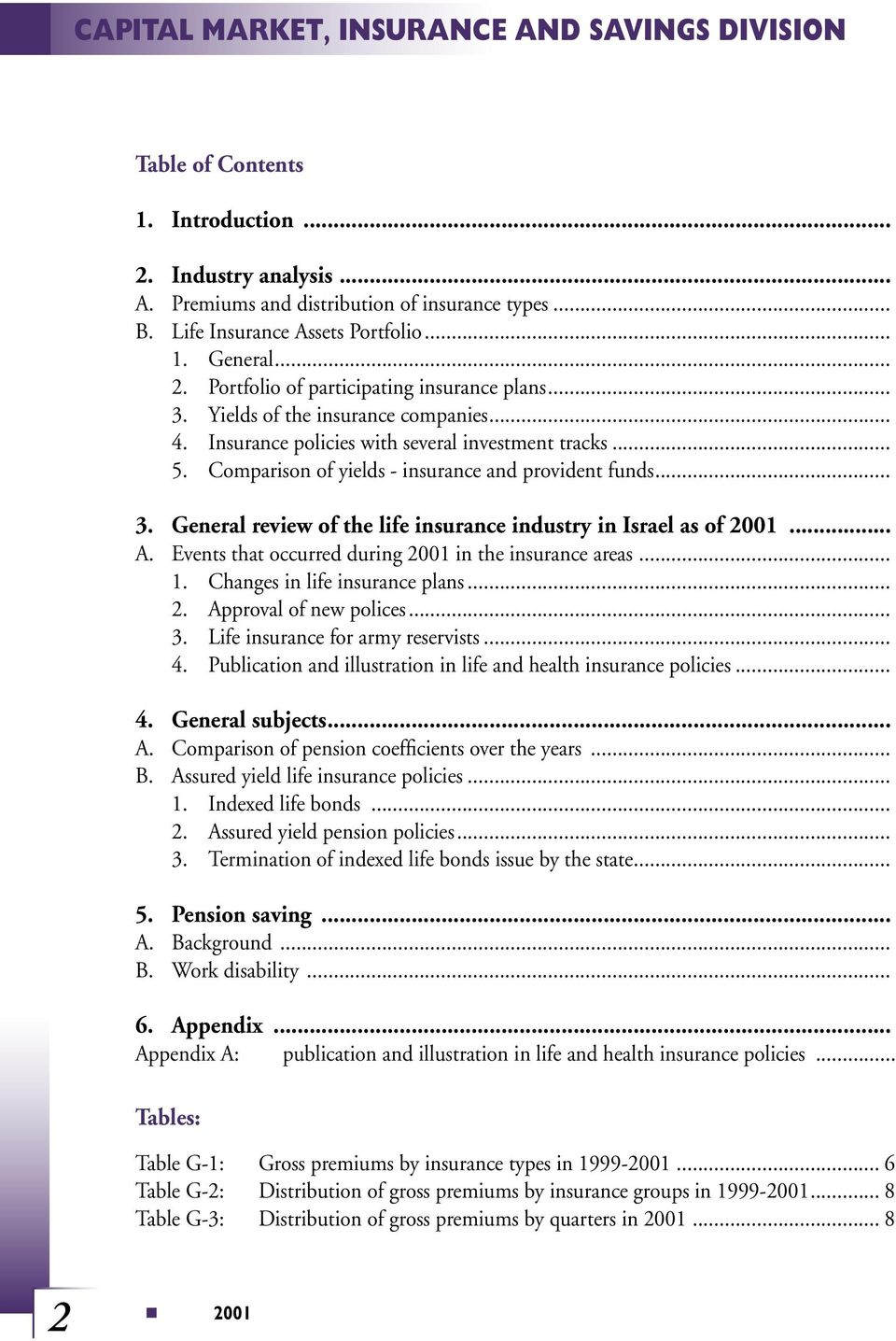
3 Table G-4: Distribution of total life insurance assets portfolio in Table G-5: Distribution of assets in the participating portfolio in Table G-6: Centralization index for Table G-7: Participating portfolio (individual fund) - gross and net real weighted yield and management fees in Table G-8: Gross and net yields in by insurance groups Table G-9: Direct Insurance Ltd. - gross and net yields in by investment tracks Table G-10: Clal Insurance Company - gross and net yields in by investment tracks Table G-11: Highest and lowest gross yields in Table G-12: Comparison of gross accumulated yield in between provident funds and participating life insurance plans Table G-13: Pension coefficients for each NIS 10,000 of saving accrual Table G-14: Main characteristics of indexed life bonds series Table G-15: Assets of assured yield policies Table G-16: Table G-17: Figures Contributions of the employer and employee (As per regulation 19 of the Income Tax Regulations) Main differences between new pension funds, executive insurance and provident funds Figure G-1: Gross premiums by main types of life insurance for... 7 Figure G-2: Distribution of assets portfolio in the life insurance industry in Figure G-3: Rate of shares out of investments in at end of quarter Figure G-4: Distribution of assets in a participating portfolio in Figure G-5: Rate of assets in a participating portfolio by groups for Figure G-6: Participating portfolio (personal fund) - net yield and management fees Figure G-7: in the insurance company in Participating portfolio (personal fund) - net average yield and average management fees for Figure G-8: Gross yield by quarters in the insurance companies in Figure G-9: Gross yield in the insurance groups in Figure G-10: Percentage of stock investment out of a participating portfolio for by quarters Figure G-11: Accumulated yield per insured on current depositing Figure G-12: Rates of indexed life bonds

4 1. Introduction The Life Insurance Department in the Capital Market, Insurance and Savings Division regulates and applies enforcement vis-à-vis insurance companies in respect to life insurance. The department is responsible, among other things, for reviewing life insurance plans submitted to the Commissioner of Insurance for approval, regulating the life insurance industry in various respects, and handling professional inquiries from the public in the life insurance area, while increasing the transparency toward the insured in this field. The influence of long-term demographic changes on the life expectancy, amendments to the tax benefit legislation for pension saving tracks that have generated a certain preference to the pensionary track and a rise in the awareness of insured of the need for retirement insurance and the importance of the way of managing the saving money has lead during to a broad update in life insurance plans offered to the public of insured. Starting from June, new life insurance plans are marketed to the public of insured. The new plans benefit the insured. They provide them a high surrender value after a shorter period in a way that enables higher mobility of the saving accrual between various insurers, they adjust the insurance rates to changes in the life expectancy, provide more specified and clearer information to the insured and improve the competition conditions in the insurance markets. In addition, in the course of year a circular regarding the publication and illustration rules for insured and insurance agents dealing with life and health insurance policies was published. The purpose of this circular was setting disclosure requirements for insurance companies and insurance agents in order to protect the interests of the insured. Moreover, the trend of new life insurance plans that enable the insured flexibility in choosing the mix of investment has continued. Nevertheless, the scope of assets accumulated in these plans is still relatively small. In addition, a group life insurance plan was approved for army reservists. In the insurance companies reached an average gross yield on investments on assets of a life insurance participating portfolio of 6.67%. 4

5 2. Industry analysis This section analyzes the life insurance industry while considering the following aspects: premium distribution, types of marketed insurances, assets portfolio in general and a participating portfolio in particular and the yields achieved by the insurance companies in. A. Premiums and distribution of insurance types Life insurance plans are offered to the insured in the following marketing frameworks: 1. Individual plans (for individual insured). 2. Executive plans (by means of employer) for salaried employees, indexed to the Consumer Price Index or to wage; 3. Group plans (employers, corporations and service providers). Table G-1: Gross premiums by insurance types in (NIS million, December prices) Insurance type Rate of change between 1999 and 2000 (%) Rate of change between 2000 and (%) Increase in premiums between Personal endowment 1,920 1,989 1, % 0.3% 76 Personal "Adif" 1,212 1,260 1, % -10.9% -89 Executive endowment % -6.8% -29 Executive "Adif" 5,681 6,527 7, % 18.9% 2,079 Group insurance % 2.8% 5 Subtotal 10,649 11,632 12,691 2,042 Work disability 962 1,023 1, % 15.6% 221 Other (*) % -18.0% 21 Total 11,881 13,010 14,165 2,283.2 Source: annual reports of the insurance companies, processing of the Market Capital, Insurance and Savings Division (*) Note: Other includes health insurance and nursing-care insurance. Premium revenues in were about NIS 14 billion. Less the work disability insurances, health insurances and care-insurance (which in some companies are classified differently) the premium revenues were about NIS 12.7 billion. The premium rate of increase was about 9% in the years and it characterizes the trend in life insurances over the last years. As table G-1 shows, the premium revenues (less work disability premiums and other) climbed 5

6 between the years in a real increase of NIS 2 billion whereas the rate of increase was about 19%. In, life insurance plans of the Adif type were about 70% of all gross premiums (less work disability premiums and other), insurances of the endowment type were about 23% and group insurance were about 7%, see figure G-1. In plans of the Adif type, one can see on the one hand the continued uptrend in the executive insurance segment (an increase of about 19% from 2000 to ) and on the other hand a decline of about 11% in the personal insurance segment of this type from 2000 to (about NIS 138 million). The reasons for the increase in the segment of the executive Adif type are related to the relatively high insurance flexibility of this plan compared with other alternatives and the higher return they give to the insured. In addition, starting from June the insurance companies have no marketing permit for executive endowment insurance plans. Regarding the personal Adif policies, it is required to review in the next years whether or not the decline in this segment of insurance continues. Figure G-1 Gross premiums by main types of insurance for Percent Group insurance 7.1% Personal endowment type 15.7% Persnal Adif type 8.8% Executive Adif type 61.1% Executive endowment type 7.2% Source: annual report data of the insurance companies, processing of the Capital Market, Insurance and Savings Division. 6

7 Table G-2: Distribution of gross premiums by Insurance groups in (Percent) Group name Migdal Clal Phoenix Harel Menorah Other (*) Total Source: annual reports of the insurance company, processing of the Capital Market, Insurance and Savings Division (*) The section Other includes the insurance companies: Ayalon, Eliahu, ILDC, AIG, Direct Insurance IDI According to the data of Table G-2 one can see that there were no significant changes in the market structure. In the share of the Migdal group increased and the share of the Clal and Phoenix groups declined, unlike in previous years. Table G-3: Distribution of gross premiums by quarters in (Percent) Quarter 1 Quarter 2 Quarter 3 Quarter 4 Total sum 24.9% 24.8% 24.5% 25.8% 100% Source: annual reports of the insurance company, processing of the Capital Market, Insurance and Savings Division Table G-3 shows that the distribution of premiums by quarters is approximately equally divided, about NIS 3.5 billion in a quarter. The increase in premiums in the 4th quarter results from the fact that in part of the provident funds (self-employed, severance pay) the contributions are high in relation to contributions in previous quarters due to seasonal factors, like the contributions of self-employed and employers at end of year in order to enjoy tax benefits. B. Life insurance assets portfolio 1. General The total of public assets at the end of was NIS 1,187 billion. The balance of assets in life insurance plans at the end of aggregated some NIS 78 billion (6.5% of the total of public assets). 7

8 In comparison, the balance of assets in pension funds is 10.1% of the total of public assets and in provident funds and advanced training funds the balance of assets is 14.4% (in provident funds only about 10.4%). Figure G-2: Distribution of life insurance assets portfolio in (NIS million) Percent Other assets Prticipating in profits Between the portfolio grew in real terms from about NIS 57 billion in 1997 to about NIS 78.6 billion in, a real growth rate of 37%. In the assets portfolio grew in real terms grew in about NIS 4.34 billion (an increase of 5.8%) compared with the years where the portfolio rose in real terms in NIS 5.7 billion (increase of 8.6%). The moderation in the rate of increase in the assets portfolio that persisted for two years in a row, was the result, among other things, of the gap in gross yields achieved by the companies in 1999 (13.06% on average) compared with the years 2000 (4.31% on average) and (6.67% on average). This shows the importance of the way the assets portfolio is run by the companies. Over the years there has been an uptrend in the rate of the participating portfolio out of total assets portfolio, in light of the fact that starting from 1991 the plans marketed to the public are participating plans only. In, the rate of participating portfolios out of total assets was about 46%, approximately half of the total assets that year. 8

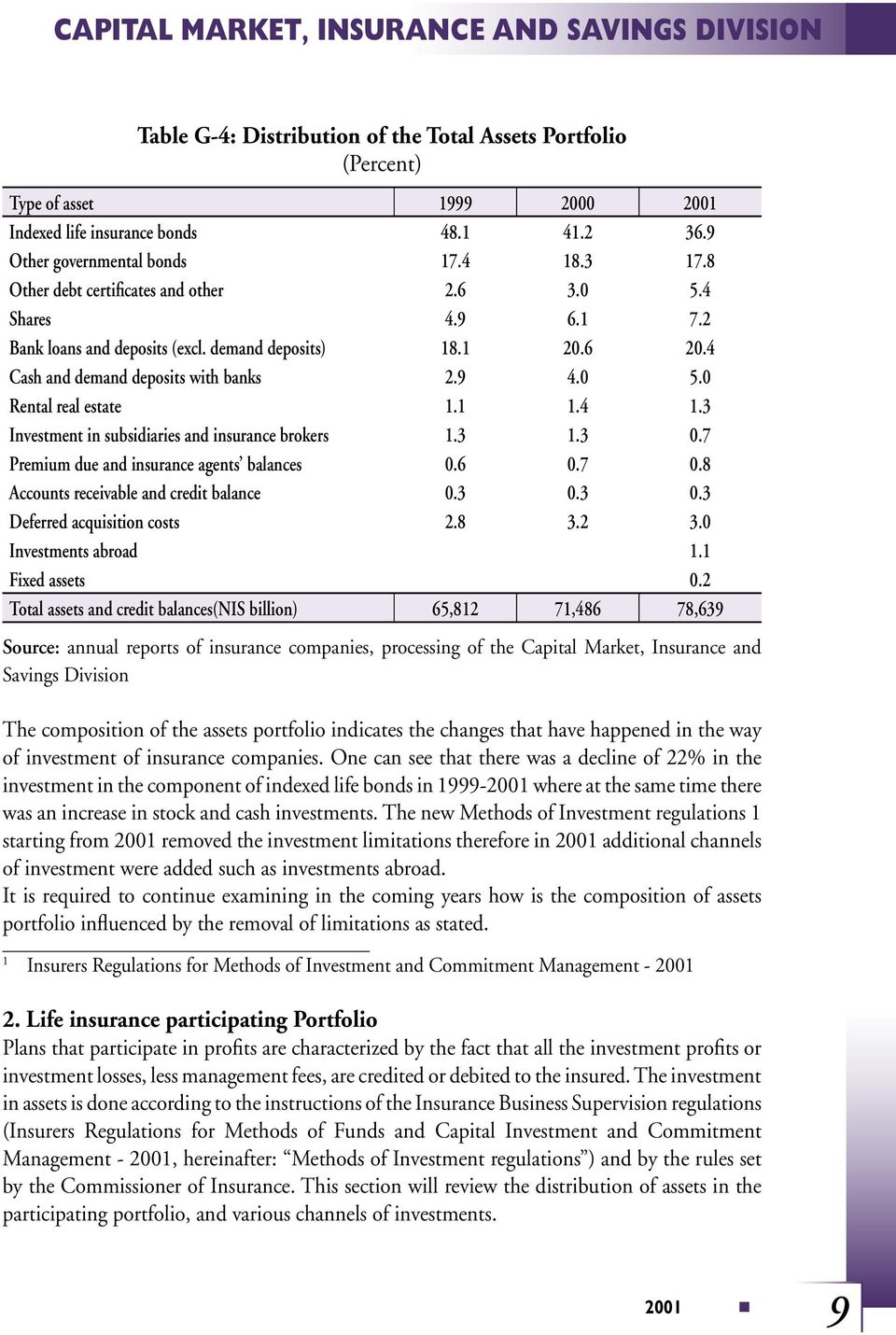
9 Table G-4: Distribution of the Total Assets Portfolio (Percent) Type of asset Indexed life insurance bonds Other governmental bonds Other debt certificates and other Shares Bank loans and deposits (excl. demand deposits) Cash and demand deposits with banks Rental real estate Investment in subsidiaries and insurance brokers Premium due and insurance agents balances Accounts receivable and credit balance Deferred acquisition costs Investments abroad 1.1 Fixed assets 0.2 Total assets and credit balances(nis billion) 65,812 71,486 78,639 Source: annual reports of insurance companies, processing of the Capital Market, Insurance and Savings Division The composition of the assets portfolio indicates the changes that have happened in the way of investment of insurance companies. One can see that there was a decline of 22% in the investment in the component of indexed life bonds in where at the same time there was an increase in stock and cash investments. The new Methods of Investment regulations 1 starting from removed the investment limitations therefore in additional channels of investment were added such as investments abroad. It is required to continue examining in the coming years how is the composition of assets portfolio influenced by the removal of limitations as stated. 1 Insurers Regulations for Methods of Investment and Commitment Management - 2. Life insurance participating Portfolio Plans that participate in profits are characterized by the fact that all the investment profits or investment losses, less management fees, are credited or debited to the insured. The investment in assets is done according to the instructions of the Insurance Business Supervision regulations (Insurers Regulations for Methods of Funds and Capital Investment and Commitment Management -, hereinafter: Methods of Investment regulations ) and by the rules set by the Commissioner of Insurance. This section will review the distribution of assets in the participating portfolio, and various channels of investments. 9
10 Table G-5: Distribution of assets in a participating portfolio in (NIS million) Type of asset 1999 Share in total for 1999 (%) 2000 Share in total assets for 2000 (%) Share in total assets for (%) Indexed life government bonds Other governmental bonds 10, , , Other debt certificates and other 1, , , Shares 3, , , Bank loans and deposits (excl. demand deposits) 4, , , Cash and demand deposits with banks 1, , , Rental real estate Investment in subsidiaries and insurance brokers Premium due and agents balances Accounts receivable and credit balances Deferred acquisition costs , , , Investments abroad Total assets and credit balance 24, , ,665.6 Source: annual reports of insurance companies, processing of the Capital Market, Insurance and Savings Division In there was an increase in the total of assets in the participating portfolio at the rate of about 23%, compared with an increase of about 21% in Governmental bonds are the largest components in the participating portfolio (about 35%). Then comes the component of bank loans and deposits (about 20%) and shares (15%). The rate of increase in stock investment between is lower than the rate of increase in stock investment between This may be explained in light of the lower yields in the share index in most of, except for the last quarter (See detailing below). 10

11 In the section "other debt certificates and other" there was an increase of 55% in the rate of investment out of the total of assets in the participating portfolio compared with 2000 (from 5.6% to 8.7%). The increase may be credited to the increase in the rate of investment in nongovernmental negotiable and non-negotiable bonds due to the new Methods of Investment regulations (). Up to the insurance companies were limited regarding the investment in securities issued abroad. In consequence of the new Methods of Investment regulations coming into force, in about NIS 800 million were invested in this investment channel. Figure G-3: Rate of shares out of the investments in at end of quarter (Percent) Percent /12/00 31/3/01 30/6/01 30/9/01 31/12/01 Source: annual reports of the insurance companies, processing of the Capital Market, Insurance and Savings Division. Figure G-3 shows that there was a decline in the value of stock investment during the 1st and 3rd quarters of. On the other hand, in the 2nd and 4th quarters there was an increase in investment and in the annual calculation there was almost no change in the rate of stock investment. The changes in the stock investments during the quarters may be explained by the trends in the general stock index in the course of the year (see the section that deals with the yields of insurance companies, Figure G-8). 11

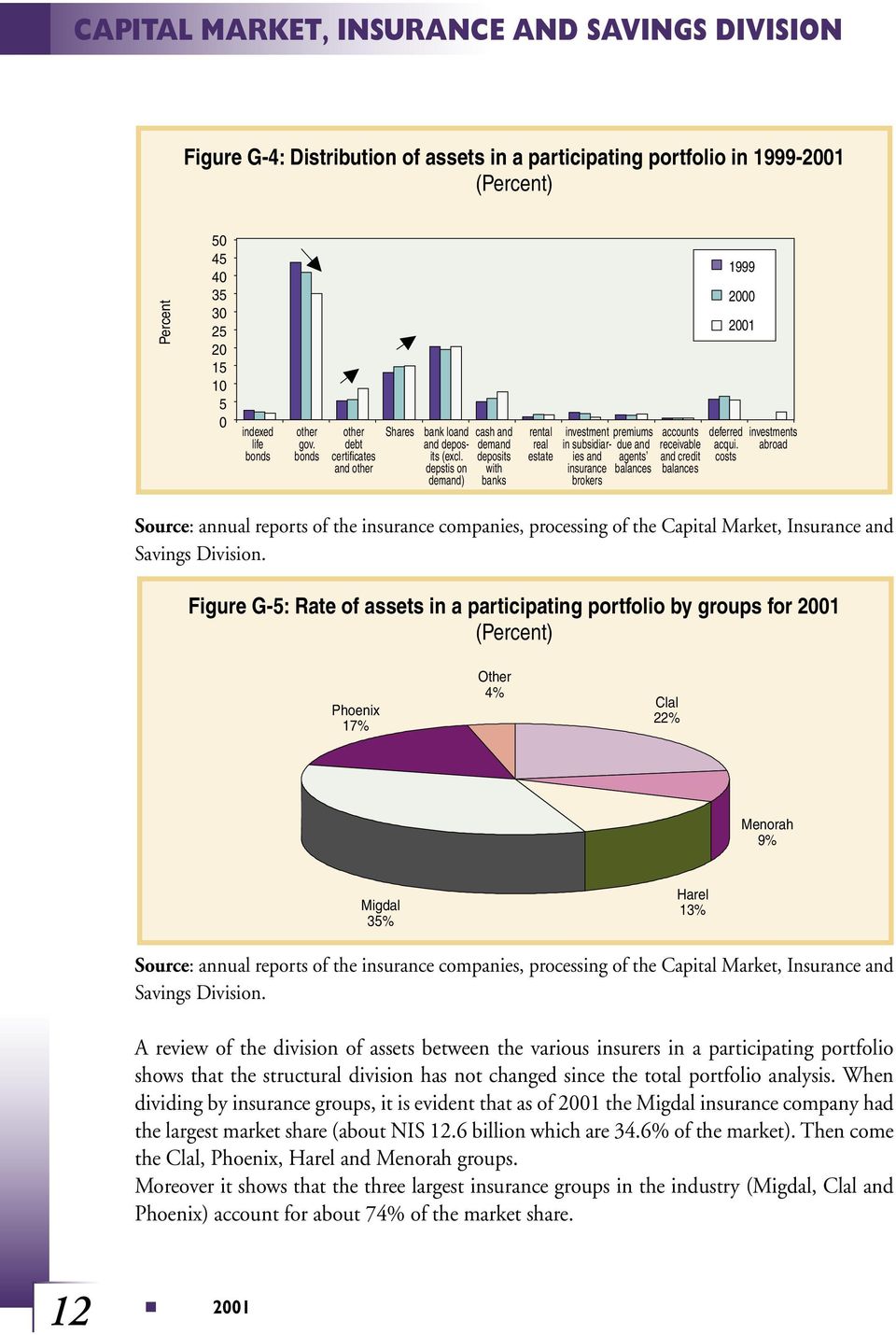
12 Figure G-4: Distribution of assets in a participating portfolio in (Percent) Percent indexed life bonds other gov. bonds other debt certificates and other Shares bank loand and deposits (excl. depstis on demand) cash and demand deposits with banks rental real estate investment in subsidiaries and insurance brokers premiums due and agents balances accounts receivable and credit balances deferred acqui. costs investments abroad Source: annual reports of the insurance companies, processing of the Capital Market, Insurance and Savings Division. Figure G-5: Rate of assets in a participating portfolio by groups for (Percent) Phoenix 17% Other 4% Clal 22% Menorah 9% Migdal 35% Harel 13% Source: annual reports of the insurance companies, processing of the Capital Market, Insurance and Savings Division. A review of the division of assets between the various insurers in a participating portfolio shows that the structural division has not changed since the total portfolio analysis. When dividing by insurance groups, it is evident that as of the Migdal insurance company had the largest market share (about NIS 12.6 billion which are 34.6% of the market). Then come the Clal, Phoenix, Harel and Menorah groups. Moreover it shows that the three largest insurance groups in the industry (Migdal, Clal and Phoenix) account for about 74% of the market share. 12
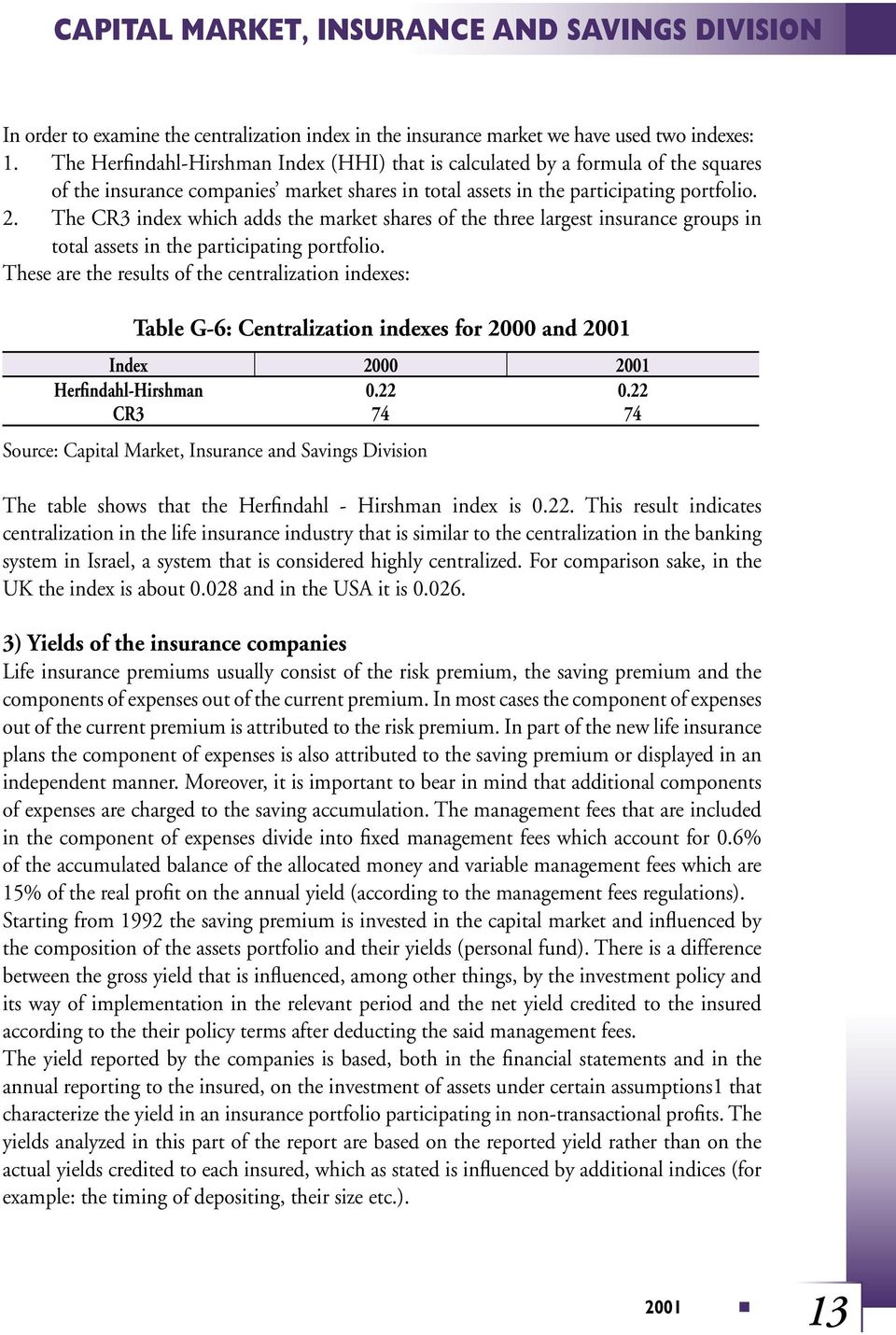
13 In order to examine the centralization index in the insurance market we have used two indexes: 1. The Herfindahl-Hirshman Index (HHI) that is calculated by a formula of the squares of the insurance companies market shares in total assets in the participating portfolio. 2. The CR3 index which adds the market shares of the three largest insurance groups in total assets in the participating portfolio. These are the results of the centralization indexes: Table G-6: Centralization indexes for 2000 and Index 2000 Herfindahl-Hirshman CR Source: Capital Market, Insurance and Savings Division The table shows that the Herfindahl - Hirshman index is This result indicates centralization in the life insurance industry that is similar to the centralization in the banking system in Israel, a system that is considered highly centralized. For comparison sake, in the UK the index is about and in the USA it is ) Yields of the insurance companies Life insurance premiums usually consist of the risk premium, the saving premium and the components of expenses out of the current premium. In most cases the component of expenses out of the current premium is attributed to the risk premium. In part of the new life insurance plans the component of expenses is also attributed to the saving premium or displayed in an independent manner. Moreover, it is important to bear in mind that additional components of expenses are charged to the saving accumulation. The management fees that are included in the component of expenses divide into fixed management fees which account for 0.6% of the accumulated balance of the allocated money and variable management fees which are 15% of the real profit on the annual yield (according to the management fees regulations). Starting from 1992 the saving premium is invested in the capital market and influenced by the composition of the assets portfolio and their yields (personal fund). There is a difference between the gross yield that is influenced, among other things, by the investment policy and its way of implementation in the relevant period and the net yield credited to the insured according to the their policy terms after deducting the said management fees. The yield reported by the companies is based, both in the financial statements and in the annual reporting to the insured, on the investment of assets under certain assumptions1 that characterize the yield in an insurance portfolio participating in non-transactional profits. The yields analyzed in this part of the report are based on the reported yield rather than on the actual yields credited to each insured, which as stated is influenced by additional indices (for example: the timing of depositing, their size etc.). 13
14 Table G-7: Participating portfolio (individual fund) - Gross and Net Real Weighted Yield and Management Fees in (Percent) Year Gross weighted yield Net weighted yield Management fees (Fixed & variable) Source: Capital Market, Insurance and Savings Division Note to the table: the weighted yield is calculated by multiplying each company s yield values by the share of its assets in the total for all companies. 1 Like monthly deposit at the beginning of each month. In higher yields than the yields of 2000 were achieved. The increase mainly stems from the high yields in index and foreign currency linked investment channels that were mainly influenced by the scope of interest reduction by the Bank of Israel at the end of the year and the sharp depreciation at that time of the shekel rate with respect to the dollar. In addition the yields were also influenced by the sharp rise in the general stock index at the end of the year, which compensated for the drop in this index up to the appreciations as stated (See figure G-8). Table G-8: Gross and net yields in by insurance groups (Percent) Group name Migdal Clal Phoenix Hare Other Company Gross yield Net yield Gross average yield Net average yield name in last 5 years in last 5 years Migdal Hamagen Clal Aryeh Phoenix Hadar Shiloah Sahar-Zion (1) Menorah (2) Ayalon Eliahu ILDC

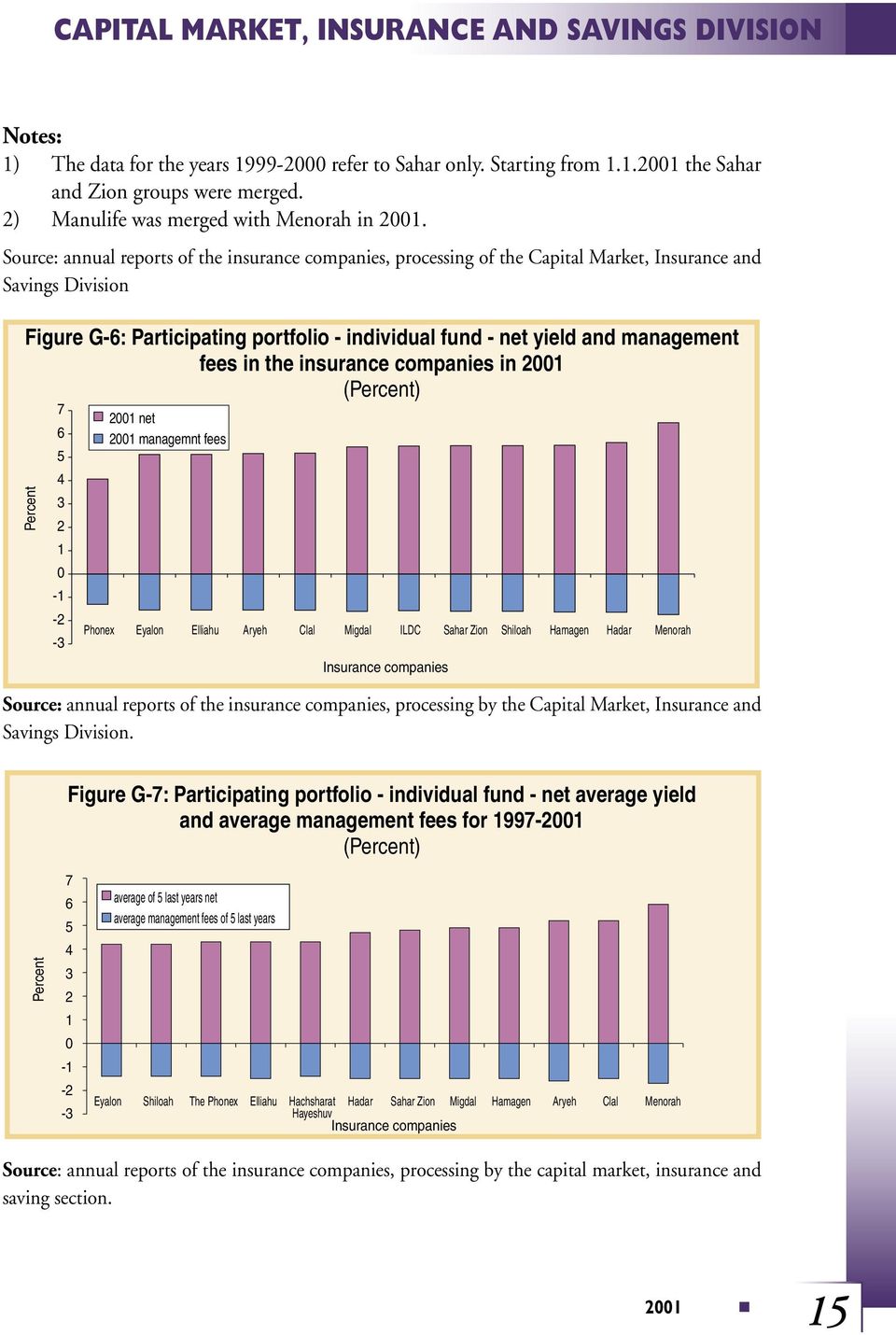
15 Notes: 1) The data for the years refer to Sahar only. Starting from 1.1. the Sahar and Zion groups were merged. 2) Manulife was merged with Menorah in. Source: annual reports of the insurance companies, processing of the Capital Market, Insurance and Savings Division Figure G-6: Participating portfolio - individual fund - net yield and management fees in the insurance companies in (Percent) Percent Phonex net managemnt fees Eyalon Elliahu Aryeh Clal Migdal ILDC Sahar Zion Shiloah Hamagen Hadar Menorah Insurance companies Source: annual reports of the insurance companies, processing by the Capital Market, Insurance and Savings Division. Figure G-7: Participating portfolio - individual fund - net average yield and average management fees for (Percent) Percent Eyalon average of 5 last years net average management fees of 5 last years Shiloah The Phonex Elliahu Hachsharat Hadar Sahar Zion Migdal Hamagen Aryeh Clal Menorah Hayeshuv Insurance companies Source: annual reports of the insurance companies, processing by the capital market, insurance and saving section. 15
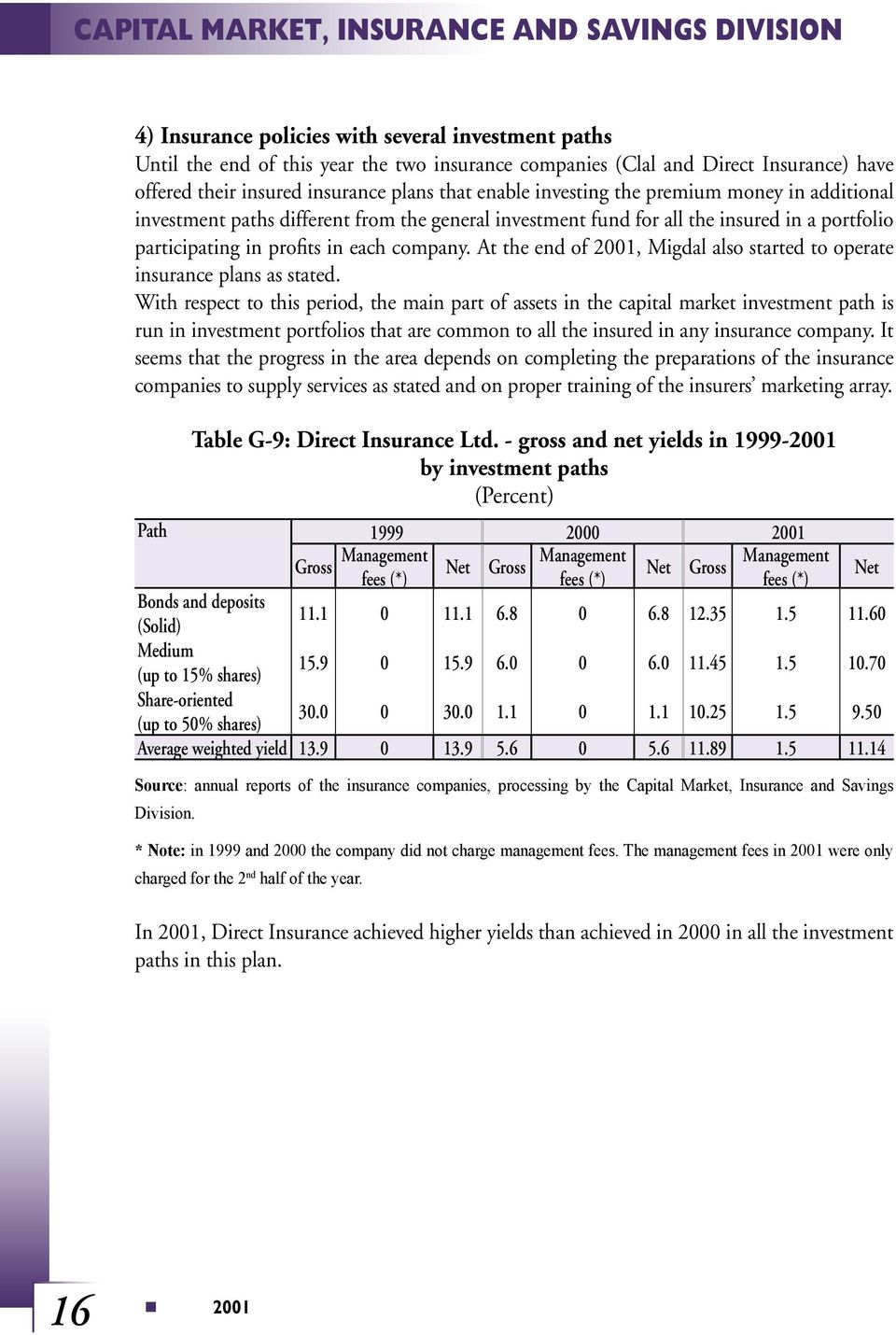
16 4) Insurance policies with several investment paths Until the end of this year the two insurance companies (Clal and Direct Insurance) have offered their insured insurance plans that enable investing the premium money in additional investment paths different from the general investment fund for all the insured in a portfolio participating in profits in each company. At the end of, Migdal also started to operate insurance plans as stated. With respect to this period, the main part of assets in the capital market investment path is run in investment portfolios that are common to all the insured in any insurance company. It seems that the progress in the area depends on completing the preparations of the insurance companies to supply services as stated and on proper training of the insurers marketing array. Table G-9: Direct Insurance Ltd. - gross and net yields in by investment paths (Percent) Path Gross Management Management Management Net Gross Net Gross fees (*) fees (*) fees (*) Net Bonds and deposits (Solid) Medium (up to 15% shares) Share-oriented (up to 50% shares) Average weighted yield Source: annual reports of the insurance companies, processing by the Capital Market, Insurance and Savings Division. * Note: in 1999 and 2000 the company did not charge management fees. The management fees in were only charged for the 2 nd half of the year. In, Direct Insurance achieved higher yields than achieved in 2000 in all the investment paths in this plan. 16
17 Table G-10: Clal Insurance Company - gross and net yields in by investment paths (Percent) Path Gross Management Net Gross Management Net Gross Management fees (*) fees (*) fees (*) Net Shares (at least 85% shares) Bonds (bonds and deposits Foreign currency (at least 75% indexed to exchange rates) Solid/mixed (up to 15% shares) Flexible/mixed (15%-50% shares) Speculative/mixed (50%-75% shares) Average weighted yield Source: annual reports of the insurance companies. * Note: yields for 1999 pertain to the 4th quarter only. The increase in the importance of the investment management area in insurance companies over the last years has lead to increased competition between the insurers. The gap between the different companies is mainly explained by the difference in the investment policies of the companies, which is mostly expressed in the way of dividing the investments between the various assets. Table G-11: Highest and lowest gross yields in (Percent) Highest gross yield max Lowest gross yield min Standardized standard deviation Source: annual reports of the insurance companies, processing by the Capital Market, Insurance and Savings Division. The standard deviation of the yields is an indicator that enables to assess the scatter of yields for the insured. When reviewing the standard deviation on a multi-annual basis, it appears that in 1998 the standard deviation was 2.66%. This standard deviation attests to a high 17
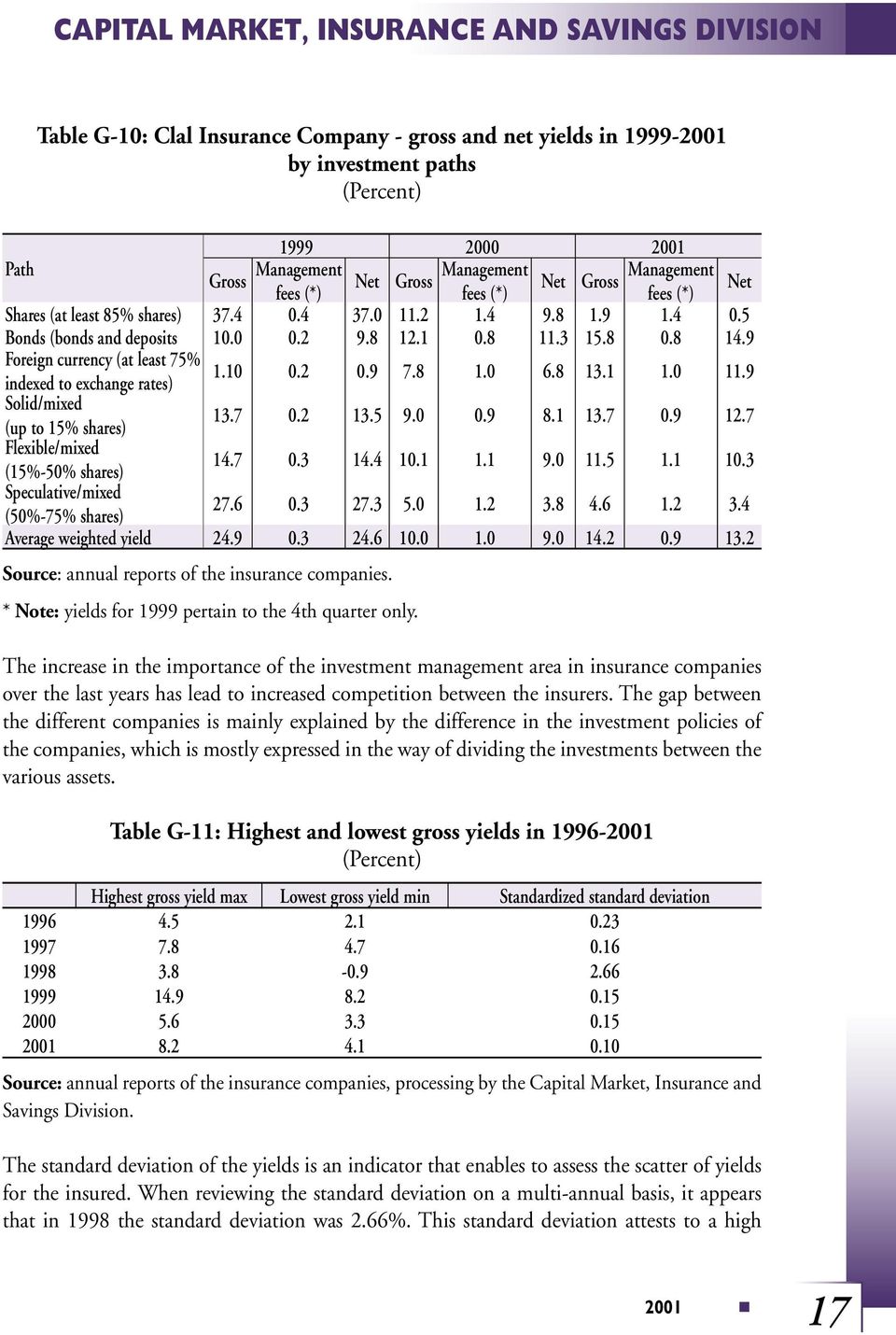
18 degree of scatter in yields for the insured. The yields in this year were low, and the standard deviation is explained by the fact that there were companies that achieved a positive yield of about 3% compared with other companies that achieved a negative yield. On the other hand, in 2000 and, the standard deviation declined significantly and was 0.10% in (the lowest in the described years). Meaning, in these years there were no significant differences between the yields achieved by the insurance companies. Figure G-8: Gross yield by quarters in the insurance companies in Percent st quarter 2nd quarter 3rd quarter 4th quarter Insurance companies gross yields General share index Non-index linkedbonds Index linked bonds Dollar bonds Source: Capital Market, Insurance and Savings Division The year was characterized by high volatility of the stock market on the one hand and relative stability of the inflation level on the other. The insurance companies have had a weighted annual yield of 6.67% gross as seen in Table G-7. Most of the annual yield was achieved due to the last quarter where the insurance companies had a weighted yield of 6.3%. In comparison, the yields of the insurance companies in, the general bonds index was 13.2% whereas the linked bond index and the unlinked bond index were 15.4% and 10% correspondingly in that year. 18

19 Figure G-9: Gross yield in insurance groups in (Percent, by quarters) Migdal Clal Phoenix Harel Menorah Other 1st quarter 2nd quarter 3rd quarter 4th quarter Source: annual reports of the insurance companies, processing of the Capital Market, Insurance and Savings Division. Before assessing the development of yield along the entire year, it should be clarified that the yields of insurance companies and their investments are supposed to be measured in the course of time and conclusions may not be drawn based on a single annual yield. By visual inspection of Figure G-9 one can see that in the 1st and 3rd quarters the large insurance companies achieved negative yield whereas the group of small companies ("Other") achieved a positive yield. This trend changed in the 2nd and 4th quarters where the group of small companies achieved lower yields than the large groups. This may be explained in light of the different exposure the insurance companies have in stock investment. The large groups are characterized by a higher rate of stock investment than the small companies (See figure G-10). Figure G-10: Percentage of stock investment in a participating portfolio for by quarters st quarter 2nd quarter 3rd quarter 4th quarter Migdal Clal Harel Phoenix Other Source: annual reports of the insurance companies, processing of the Capital Market, Insurance and Savings Division. 19

20 5. Comparison of yields - insurance and provident funds The yields achieved by the insurance companies may be compared to other alternatives in the market. Table G-12 compares between the accumulated yield (gross) in provident funds and participating life insurance plans in the years The comparison was based on an investment of NIS 100 at the beginning of 1996 in a provident fund vs. an identical investment in a participating insurance plan. Table G-12: Comparison of gross accumulated yield in Between provident funds and participating life insurance plans (NIS, 1/1996 = NIS 100) Year Provident fund Gross Life insurance Gross Source: Capital Market, Insurance and Savings Division. The table shows that the provident funds have achieved an accumulated yield similar to the yield achieved by the insurance companies, and the differences only aggregates about 0.44%. The liberalization process of the investment rules will eventually lead to equalization of the investment rules in the various channels, and the differences in yields will be mainly a function of the management qualities. 20

21 3. General review of the life insurance industry in Israel in A. Events that have happened during in the life insurance industry (1) Changes in life insurance plans Background In recent years there has been many changes in the conditions of the pensionary saving market in general and in the insurance companies in particular. Since 1992 the insurance companies have started to market participating policies with no assured yield, and in 1998 the direct insurance companies entered the industry. The fact that they have joined the market has increased the competition in the pure risk area. Then the investment options were made more flexible and during 2000 the maximum permissible rate for an insurer s investment in negotiable shares against participating policies was increased from 15% to 25%. At the beginning of the investment options were extended and made more flexible and starting from April the investment limitations were totally removed except for stability limitations (see the chapter Stability). In addition, on December , the Knesset passed the Economic Arrangements Bill into law, designated to correct distortions with respect to tax benefits regarding pension funds and provident funds when making provisions and withdrawals. Moreover, new rules regarding the pension funds were set. All of these and the increase in the life expectancy and in the insured needs have served as a basis for the improvement and adjustment of insurance plans according to the new market conditions. Mortality tables One of the most prominent changes is related to the mortality tables that are used to set the mortality probability by ages. In the old plans the mortality tables have failed to reflect the increase in life expectancy that has happened over the recent years and the change in the risk insurance companies are taking upon themselves. Due to the increase in life expectancy the mortality probability has declined therefore the mortality risk tariffs are supposed to be cheaper (see detailing in the annual report of the Division for 2000). On the other hand, in pension type policies (where the insured gets monthly payments at the end of the insurance period until their death) the period of pension payments is longer and the risk taken by the insurance companies is higher. In the new plans the mortality tables were changed in a way that reduces the death risk premium and enables routing more money to saving. In the new plans of the pension type the price of pension was raised (by reducing the pension 21
22 advances) and due to the increase in life expectancy the monthly pension an insured gets at the age of retirement will be smaller. Nevertheless, there has been a reduction in the death risk premium in plans where a component of death risk is purchased until starting to get the pension, thus more money may be directed to saving and a higher accrual may be achieved. In addition the minimal fundamental term of payment assurance (default) for pension payments, in case an insured dies after starting to receive the pension, was extended from 120 monthly payments to 180 and 240 payments (according to the terms of plans in the various companies). Moreover, the matter of assuring or not assuring pension advances in pension policy has risen. In the old plans the pension coefficients are assured so that an insured knows in advance how is the rate of pension he will get is set (their rate changes due to the influences of yields in the capital market after starting the pension payment), unlike the new pensions where the rate of pension coefficients might change and be updated in the course of years before starting getting the pension payments. In the new plans the insurance companies can choose between a track of pension coefficient assurance and a track where at the time of buying the insurance, the insured does not know for sure what are the coefficients to be used to set his pension (like in pension funds). This track where the insured doesn t know for sure what are the pension coefficients for setting his pension, clear rules were set due to its complexity, especially in the matter of proper disclosure to the insured (for example, the way of publishing the update of coefficients, the option of fixing the coefficients by the insured etc. See detailing in the Commissioners report for 2000). It should be noted that the changes in legislation have changed the tax arrangements. They have set, inter alia, that money that was earmarked, at the time of depositing, for pension and that will be paid in a way other than as a pension, will be considered an unlawful payment and tax at the rate of 35% shall apply to them or according to the insured s marginal tax rate, the higher of the two. These changes have increased the probability of pension payments, therefore have brought up the need of the companies to update the pension plans. Mobility of saving money Surrender values At the time of selling the insurance policies, the insurance companies incur selling and marketing expenses. An insured who cancels the policy before the end of the insurance term is required to return part of these expenses by setting a surrender value lower than the full amount of saving accrual for that term. The surrender values in traditional plans are very low in a way that the impact on the insured s capability to mobilize the saving component has damaged the competition in this market. In the new plans, the surrender values were considerably raised in the first years, and the term that credits full surrender was shortened to five years instead of ten to thirty. This update enables higher mobility of savings between the insurers, and enables withdrawing 22
23 the money from the insurers to other investment channels (in lump-sum individual plans). This update is supposed to improve the capital management method used by the insurers and to increase the competition. This allows proper solution to individual insured and to the entire public of insured. Remaining under an insurance coverage when transferring saving money In addition to allowing higher mobility of the saving component, the need to consider the risk component in plans of the "Adif" type is part of the plan conditions. When transferring the saving/surrender value, the insurance plan is cancelled, consequently the insured remains with no risk coverage. This is particularly true in case that the insured s medical condition gets worse, consequently he may be unable to buy an insurance coverage with the company to which the saving was transferred or that he may be required to pay a considerable additional premium. Therefore, in order to prevent a situation where a change in the health condition may be a consideration for not transferring the savings between the companies, a new section was added to the new plans that enables the insured to continue enjoying the insurance cover (death risk) in the company after redeeming or mobilizing the money in an individual policy, without having to prove their health condition and up to a certain percentage of the amount of insurance in which they were insured for a death case (usually 70%). Termination values As stated above, an insured who elects to cancel the policy prior to the end of the insurance term is entitled to a lower surrender value than the saving accrual. In traditional plans, an insured who elects to cancel the insurance plan yet leaves the accumulated savings with the company is entitled to that surrender value even if choosing to leave the accumulated savings with the company for an additional term (cleared policy). In order to improve the insured s state, the companies were demanded to add a section that adds a rider to the accumulated savings for an insured who leaves his money with the company. Increasing the saving component In addition to reducing the risk costs as stated and improving the surrender values, that are designated, among other things, to increase the accumulated savings in insurance plans for the insured, the basic mix between risk and savings in plans of the "Adif" type was changed. In traditional plans of the "Gimla" type the percent of premium routed to savings in the basic insurance was set to 72% whereas in the new plans this percentage is 80%. It is hereby clarified that an insured may choose a different mix of risk and saving. 2) New policies that were approved Besides the update of insurance plans as stated and within the framework of the actions taken 23
24 to improve the insurance market and respond to the needs of the insured, the Commissioner of Insurance has approved additional policies having new features. "Adif" type policies with investment tracks for executives, self-employed and individuals Besides the approval of Unit Linked type policies for executives, self employed-and individuals, that enable the insured or policyholder to choose the investment tracks where the savings will be invested, additional policies that allow investment tracks by the pattern of the "Adif" policy for executives, self-employed and individuals were approved. Hereinafter are some of the features of the above policy for executive: 1. The policy enables the insured/policy-holder to invest the savings at their discretion and by their personal preferences. 2. The plan combines a pension track and a lump-sum track (regarding the saving) and additional insurance covers. 3. The insured is entitled to divide the contributions to benefit and severance pay that he and his employer deposit between the various plans (pension and lump-sum) and change from time to time the mix of plans with respect to future deposits. 4. When the pension payments begin, the money will be transferred to the general investment track of all the insured (individual fund). 3) Life insurance for army reservists The issue of insurance cover for army reservists during their army service has been brought up lately on the background of the need to find an insurance arrangement for paying them and their families insurance amounts in case of death or for a case of work disability due to their service. The reasons for that, among other things, are the exceptionalizations to paying the insurance amount in case of death and work disability in insurance plans in the insurance companies and pension funds if the said case happens during the reserve service. In the insurance companies there are no exceptionalization to paying the amount of insurance in case of death, if the insurance case happens during the reserve service, yet in work disability plans there are exceptionalization to paying the amount of insurance in such case. Nevertheless in the last two years, the cover for the time of reserve service was extended and there are work disability plans that under certain conditions do not exceptionalize the payment of the insurance amount in case of a work disability due to a reserve service. In the pension funds there is a division regarding the exceptionalization between the traditional funds and new funds. In the traditional funds there is an exceptionalization both for a fatality and for a work disability case and in the new funds a fatality case is not exceptionalized and the work disability case is exceptionalized. Due to the problematic nature described above and the desire to assure paying the insurance payment to an army reservist who is injured during service, an intermediate solution has been started and a group life insurance plan for army reservists to cover a fatality case for the 24
25 beneficiaries was approved. According to this plan, in case that an army reservist dies, the beneficiaries in the policy will get the amount of insurance for a fatality at the amount of NIS 282,000 (linked to the index of June ). Moreover, pension will be given to relatives: to a widow (40% of the determining income) and to the children of an army reservist (15% for the first child and 10% for any additional child) according to the conditions set in the plan. In order to offer a complete final solution both for a fatality cover and for a work disability cover, the Knesset has discussed the final stages of passing a draft bill that is supposed to handle the issue in a different manner. According to the draft bill, there will be public cover to provide answer both for the exceptionalization of a fatality and for a work disability case and for paying the insurance amount to army reservists and their relatives in case that the insurance case as stated happens. 4) Publication and illustration in life and medical insurance policies In recent years there has been many changes in life insurance plans that provide the insured flexibility and allow them, more than ever, to combine risk and saving components. In the area of pensionary savings there has been additional changes that enable numerous pensionary combinations. These changes have emphasized the need to improve the proper disclosure rules to insured in a way that the information is extended and presented in a clear manner to the insured in life and medical insurance plans, staring from the stage of entering the insurance contract up to the current reporting to the insured. Hence, in a circular of the Commissioner of Insurance was published regarding the way of publication and illustration in life and medical insurance policies. The purpose of the circular was proper disclosure by insurance companies and insurance agents in order to protect the interests of the insured. For example, as part of the process of selling life insurance plans with a saving component, insurers are required to attach an illustration of the insurance plan when issuing it to the insured. In this illustration the insurer will present to the insured and emphasize data and calculations including the saving accrual as a function of time, the expected amount of pension and the factors that may influence its size. The illustration will emphasize the discrimination between elements that the insurer assures to the insured and elements that are not assured but depend on external factors, such as the rate of return in the capital market. At the same time the insurers have given the insured the right to cancel the insurance plan within 60 days since its acceptance. This right will allow the insured to consider and analyze the insurance product that is designated for a long saving period. Moreover, rules were specified regarding the way of publishing life insurance plans, while emphasizing components that are very important in the insurance plans, like the coefficients by which the monthly pension at retirement age is calculated. In addition, uniform rules were set for the insurance plans regarding the way of performing the illustration, like the rate of return for the purpose of calculating the saving accrual (the circular is attached as appendix A). 25
26 4. General subjects A. Comparison of pension coefficients along the years One of the most important changes in the new plans is related to the mortality tables therefore to the pension coefficients by which the rate of monthly pension at retirement age is calculated. Here is a summary and analysis of the comparison of coefficients between life insurance plans of different periods that are different with respect to the plan terms: Table G-13: Pension coefficients for each NIS 10,000 of saving accrual For women Age of starting the pension payment For men Age of starting the pension payment Policies of the years (that assure yield) Policies of the years / New polices from 6/ Capital Market, Insurance and Savings Division The comparison shows that there are considerable differences in the rate of the pension coefficients for each NIS 10,000 of saving accrual between the different plans. The plans of the years bear an assured yield (see the next section) therefore the interest by which the pension coefficients were calculated is the highest (about 5.2%). Therefore the pension coefficients in these plans are the highest and in fact they are independent of the results of the investment portfolio. These plans assure a minimum of 120 pension payments to beneficiaries in case that the insured dies after beginning the pension payment. The plans from 1992 until 6/ participate in the investment profits, therefore the interest by which the pensions are calculated is lower (2.5%), and the coefficients are lower in the rate of 10% to 20% for men and women compared with the coefficients in plans of These plans also assure a minimum of 120 pension payments as stated. The monthly pension in these plans is index-linked and influenced by the index of the investment portfolio less the interest by which the coefficients are calculated. The management fees when retiring are usually 0.6% (fixed management fees) out of the balance of assets plus 15% of the real profit. The new plans since 6/ participate in the investment profits, and the interest by which the pension coefficients are calculated is 3.5% (according to the management fees mechanism offered by the insurers, as specified below). As stated, in these plans the mortality tables were updated, therefore the level of coefficients is lower (5%-10% for women and 15%-20% 26
27 for men) compared with the plans of 1992 (the gaps are larger compared with the plans of 1985). Nevertheless another parameter that should be taken into consideration is the period of assuring minimum pension payments of 240 monthly payments rather than 120 monthly payments in other plans. This fact raises the value of pension coefficients in these plans. It should be noted that in these plans there is a mechanism that reduces the value of pension coefficients for each year after 2000 or (according to the type of insured). Unlike the plans of 1992, up to a real yield of 3.5%, no management fees are collected when retiring. For a yield of 3.5%-4.1% fixed management fees at the rate of 0.6% are collected and for a yield of more than 4.1% management fees at the rate of 15% are collected. In summary, the pension coefficients in plans of 1985 are the highest based on the old mortality tables and a higher rate of assured interest. In 1992 the pension coefficients were reduced due to canceling the yield assurance, and in they were again reduced according to the changes in the mortality tables. Yet the minimum fundamental period of assured payment (default) for pension payments in case the insured dies after beginning to receive the pension was extended from 120 monthly payments to 180 and 240 payments (according to the terms of plans in the different companies) and they have a preferable management fees mechanism for the insured. Therefore it is impossible to determine in an unambiguous manner which of the plans is better to this matter - the plans of 1992 or the new plans. B. Assured yield life insurance plans Even before the establishment of the State of Israel, the significance of insurance for the age of retirement was acknowledged therefore professional unions and various organizations have established corporate provident funds. After the establishment of the State, the importance of private insurance companies in retirement arrangements was also acknowledged and this was manifested in various ways, including various aspects of recognition for tax purposes. Another aspect in the State s support of insurance for retirement was arranged at the end of the 50 s and at the beginning of the 60 s as the Israel Electric Corporation, and then the State, committed to issue special bonds for the insurance companies that will assure financing of insurance for the age of retirement, index-linked insurance plans that bears a regular annual yield. These bonds, known as Indexed-Life insurance bonds, have several unique features that will be reviewed below. The nature of indexed life insurance bonds stems from the assurance given by the State for a yield on saving for retirement with the insurance companies and linking it to the index so that the long-term saving will not loose too much of its value as a result of erosion over many years in its purchasing power. The issue of index linkage was innovative at the time and has set a problematic challenge for the insurance companies, though the reasons for protecting the real value of savings for such a long term are numerous. Due to the innovative nature and the said problems in index linkage and the desire to protect the real value of savings, the State 27
28 was asked to intervene and has issued the indexed life bonds. It should be noted that at the first years, since 1957 until 1964, the IEC issued the linked bonds and later on the State has undertaken to recycle these series with indexed life bonds issued by it. At the beginning of the 90 s, the issue of indexed life bonds was gradually stopped hence the marketing of new assured-yield policies has been also stopped in order to reduce the State s involvement in the capital market and improve it by routing the reserve money to the capital market. For policies issued before the termination of these arrangements, the State continues issuing bonds as agreed between the State and the insurance companies and according to the terms of the bought policies. 1) Indexed life bonds The characteristics of indexed life bonds are specified below: 1) The bond is non-negotiable. It is issued to the insurance companies against a commitment to the insured in index Indexed life insurance plans. 2) The State issues the bonds in series. 3) The bond is fully linked to the Consumer Price Index. 4) The yield is assured and predetermined. 5) The interest paid to the insurance company varies according to the year of issue and ranges between 6.2% and 4% a year. 6) The ranges of surrender are long and range between 10 and 25 years. For each reserve of a policy the company sells, a bond recycling is assured also after it is redeemed. 7) The interest cycle for the bond is partially done under the original bond terms. 8) The issue of bonds is regulated in an agreement between the State and the Association of Life Insurance Companies and Insurance Companies. 9) Starting from 1975 the rate of indexed life bonds is limited to a certain percentage of the company s investments. 10) Post factum, one can see that the yield is high with respect to the one achieved on average in the capital market. 28
29 Principal Table G-14: Main characteristics of indexed life bonds series For policies sold starting from For policies sold until Rate of interest for insurers Rate of interest for insured Maximum rate of Indexed life bonds out of the investment Fund A 1962 / / 1 6.2% 5.0%-4.0% 100% Fund B 1975 / / % 5.00% 86% Fund C 1976 / / % 4.25% 86% Fund D 1978 / / 5 5.2% 4.25% 86% Fund E 1979 / / % 4.25% 86% Fund F Fund G 1983 / 1 3/1988 (Individual) 12/1989 (Executive) Source: Capital Market, Insurance and Savings Division 3/1988 (Individual) 5.2% 4.25% 86% 12/1989 (Executive) 1990 / % 3.0%- 3.5% 86% The table shows that whereas the first series, series A, assured a very high yield to the insured, which was completely assured by the State, the following series give partial cover for the insurance assurance, so that the insured are required to invest 14% of the money according to the proper Methods of Investment regulations. In order to illustrate the burden laid on the State due to these assured yield policies, we have to consider that the range of holding life insurance policies is long and when calculating the accumulated yield along the entire period, very considerable differences are found (see table G-13) also with respect to the yield that can be achieved in the capital market. Figure G-11: Accumulated yield for insured on current deposit Percent No of years of current depositi Fund B (5%) Fund D (4.25%) Fund G (3.5%) Comparison 2.5% Source: Capital Market, Insurance and Savings Division 29
30 2) Assured yield Gimla policies Assured yield insurance plans are insurance plans for retirement age. The amount of insurance is derived from the worker s wage. Moreover, assured yield insurance plans were also marketed to self-employed. These policies were sold until the end of 1990 and their financing was mainly based on indexed life bonds as explained above. It is important to note that whereas new policies of this type are not sold since 1991, the insured still hold many of these policies. The basic insurance consists of 72% of the contributions to saving and 28%1 of the contributions to death risk insurance. The pension is calculated according to the accumulated saving and by the insured s age and is paid after the worker s retirement, yet in any case not before the age of 60 for women and the age of 65 for men. Therefore the surrender value of the basic insurance is 72% of the total amount of paid2 premiums plus annual accumulated interest that depends on the series of the indexed life bonds and the year where the policy was issued. Moreover, in case of stopping the premium payments within 5 years since the insurance begins, the surrender value of the basic insurance will be reduced to 80% of its value. 1 In certain policies, which is the minority of the said policies, the division was 75% for saving and 25% for a death risk. 2 Or 75%, see note 3. In case that within the policy framework, a special insurance in addition to the basic insurance is bought (also called "pure savings"), its surrender value equals the total sum of amounts paid for it plus annual accumulated interest according to the series of the indexed life bond. The amount of insurance or monthly pension are offered to the insured in several alternatives: Basic pension that is paid to the insured along their entire life, index-linked and yield bearing. In case that the insured dies after the beginning of pension payment and before been paid 120 monthly pensions, the pension payment will continue to be paid to their beneficiary until the end of 120 monthly payments. In addition, the insured may choose one of the following options: A) A monthly pension payment for life, index-linked and yield bearing as only 60 pensions are assured in case that the insured dies. B) A monthly pension payment for life, index-linked and yield bearing, with no obligation to pay a minimum amount of pensions. C) A monthly pension payment for life, index-linked and yield bearing, as in case that the insured dies the insurer will pay a lump-sum that equals 25 pensions. D) A monthly pension payment for life, index-linked and yield bearing, as in case that the insured dies after the beginning of the pension payment, the beneficiary will get pension for life at the rate set in advance out of the insured s pension and according to the beneficiary s age. 30
31 The amount of pension varies according to the insured s selection of one of the options mentioned above. In the two first alternatives, the pension is higher than the basic pension, in the third option the pension is smaller than the basic pension yet in the forth option the pension depends on the insured s age, the age of their spouse and the rate of pension paid to the spouse. 3) Termination of Indexed life bonds issue by the state The cover due to yield assurance to the insured by the issue of earmarked bonds has many drawbacks. The main drawbacks are listed below: 1) High involvement of the state where it is unnecessary and a market solution may be found. 2) A heavy financing burden laid on the public debt due to the fact that the assured yield is relatively high as explained above. 3) Damage to the local capital market and to the efficiency of resource allocation. In consequence of the stated above, at the end of the 80 s and at the beginning of the 90 s the State tried to reduce its involvement in the capital market, for example by terminating the issue of earmarked bonds for provident funds in A supplementary step was gradual termination of the issue of indexed life bonds for new life insurance plans at the beginning of the 90 s. From that day on, new life insurance plans were acted by the pattern of participating plans, and ever since then, the investment of this money has been made directly into the capital market3. Due to the assured yield life insurance plans that were bought before 1991, the insurance companies have continued buying indexed life bonds on account of the reserve accumulated until that time, as well as on the account of additional contributions to the same plans after the said date. In consequence of these steps, the rate of capital increase due to assured yield policies has declined, yet until, positive growth in accrual was observed. The slowdown in the uptrend of accrual of indexed life bonds stems, to a certain extent, from the initiated activity of the Division in early withdrawal of indexed life bonds. Since the beginning of the move for early withdrawal, in 1997, NIS 4,116 millions were withdrawn (prices of 12/) out of the assets of indexed life yield-assuring bonds (for detailing on the early withdrawal of indexed life bonds, see the Stability chapter in this booklet and previous annual reports). Since the marketing of assured yield policies by this pattern was ceased, substantial changes have occurred in the strength of assets in life insurance as shown in table G-15: 3 See detailing in the annual report for 2000, page
32 Table G-15: Assets of assured yield policies NIS million, 12/ prices Year Indexed life bonds Total of investment Total assets (in a non-participating portfolio, life insurance) (Life insurance) ,882 22,714 23, ,086 32,788 41,435 28,351 41,027 78,639 Source: Capital Market, Insurance and Savings Division In addition it should be noted that the accrual trend is not identical among the various funds of indexed life bonds. In the older funds the accrual is currently negative - the redemptions there exceed the premium on them and the bonds issued for them. In the newer funds, like Fund F and Fund G, the redemptions constitute a relatively small part with respect to the premiums and the accrual is positive. The relative rate of assets due to assured yield policies in the assets portfolio of life insurance is in a downside trend, as appears by the following data: Figure G-12: Rates of Indexed life bonds rate of indexed life Year Source: Capital Market, Insurance and Savings Division rate of indexed life bonds out of investment (not participating) rate of indexed life bonds out of the total of asset This analysis proves that the rate of increase of the participating portfolio is higher than the rate of increase of the assured yield portfolio, which rate in the total of assets is declining. The analysis of the commitment development due to assured yield plans shows that plans of the said type will remain in the companies stock for about two more decades, yet their rate will gradually decline in a considerable manner due to the reasons described above. 32
33 A. Background 5. Pension saving There are three players in the market of pension insurance: provident funds (banking, sectorial and private), pension funds and the insurance companies. The pensionary arrangements offered by these bodies are subject to the regulation stipulated by virtue of the Income Tax regulations 4. Like with pension funds, the executive insurance in insurance companies is also designated to answer several main problems in the area of the worker s economic security: taking care of relatives in case of death, providing a monthly income in case of a prolonged work disability due to a disease or accident, principal accrual for retirement and allowing the option to continue the insurance in case of changing the place of work or if the worker becomes self-employed. It should be noted that the pensionary insurance answers the needs of both self-employed and hired workers. Self-employed can make provisions at a rate similar to the provisions of a hired worker and their employer together, and there are specific tax arrangements for them. The pensionary arrangement is based on employee-employer relations and the provisions made by the employer and employee (benefit and severance pay for premium coverage). The premium is designated to cover death and work disability cases. The main component is the component of saving for retirement age. It should be noted that in contrary to the pension funds and executive insurances, with provident funds it is possible to buy cover for death risks in a very limited manner. Executive insurance plans allow the worker to select in advance the division of the severance pay he and his employer contribute, and the selection is between pension plans and lumpsum plans. With pension funds there is a pension track only and with provident funds there is a lump-sum track only. 4 The Income Tax regulations (rules for provident funds approval and management) Table G-16: Contributions of the employee and employer (according to regulation 19 of the income tax regulations) Pension fund Executive insurance Provident fund Employer - on account of benefits 6% 5% 5% Employer - on account of severance pay 6% (*) 8.33% 8.33% Total employer s contribution 12% 13.33% 13.33% Employer - on account of benefits 5.5% 5% 5% Total contributions 17.5% 18.33% 18.33% (*) The employer may contribute up to 8 1/3 % yet usually the employer contributes the balance at the rate of 2.33% in a separate severance pay fund. 33
34 B. Work disability In executive insurance the provision does not include work disability insurance and in order to buy such insurance the employer (in most cases) or the employee will make another provision (that ranges between 0.5% and 2.5%). On the other hand, the provisions to the pension fund include a work disability insurance cover whereas in provident funds it is impossible to buy the stated insurance cover. Yields Figure G-17: The main differences between new pension funds, executive insurance and provident funds Executive insurance New pension fund Provident fund In executive insurance, starting from Pension funds enjoy The assets are invested 1992 the plans participate in the investment an assured yield of in the capital market profits. The insurance companies earmarked bonds and the yield is set ac- invest the insured s money in the capital on 70% of the assets cording to the achievements market. The yields achieved by the insurance portfolio at fixed inter- of the fund s companies are influenced by the est of about 5%. The investment like with yields of assets and the composition of other part is invested the insurance companies. the assets portfolio. Therefore in prosperity in the capital market years the companies will have rela- like with the insurance tively high yields whereas on the other companies. hand in depression years they may have low and even negative yields. 34
35 Management fees Tax benefits in a lump-sum track Fixed management fees: in an executive insurance policy, at the rate of 0.6% a year out of the accumulated balance of all the provided amounts. Variable management fees: the insurance companies charge 15% of the real profit on the annual yield. It should be mentioned that in years where a negative yield is achieved, insurance companies do not compensate the insured for their losses. Surrender values: if the insured redeems/ clears the policy prior to its end in case of leaving a place of work or a wage reduction, there are surrender values. At the first year these are 85% -91% that increasingly grow up to 100% at the end of the fifth year (in new policies). The expense components: part of the monthly premium is earmarked to buying risk insurance. In fact not all of the above amount is used for buying risk, but a large portion of it is used for covering the expenses on the entire policy. The rates of provision/collection: lately insurance plans are marketed with a structure that is similar to the pension funds in two ways: A. Different rates (high at first and low later on). B. Uniform rate along the entire period. At the time of depositing - the employer s provision for severance pay imparts a tax benefit of 25% (limited in a crediting wage ceiling of NIS 9,400). The employer s provision for severance pay is tax exempt, and also limited to a wage ceiling of NIS 9,400. At the time of withdrawal - full exempt on the severance pay payments of the employer and employee. Management fees are collected in each deposit. The division is 6% management fees and 2% are provided for reserve. Surrender values: the money received in case of early withdrawal will not bear an assured interest but a lower interest as specified below: 1-5 years: no interest years: 1.5% starting from the 15th year: 2%. None The management fees are up to 2% of the assets per year. Identical to executive insurance 35
36 Tax benefitsina pension track The contract status Selection of beneficiaries Risk costs At the time of depositing - the employee s provision for severance pay provides a tax benefit of 25% up to a wage ceiling of NIS 9,400. The employer s provision for severance pay is tax exempt (limited to a crediting wage ceiling of four times the average wage in the market). At the time of withdrawal - a tax exempt of 35% on the amount of pension up to the amount of crediting pension (currently NIS 6,480) or full tax exempt on the part of pension originated in contributions already taxed before, the higher of the two. Unlawful withdrawal - tax at the rate of 35% will be deducted from the amount or per the marginal income tax rate, the higher of the two. Executive insurance is a contract between the insurer and the insured, subject to the legislative arrangement. The ability to change the contract terms is limited. In executive insurance there is flexibility in selecting the beneficiaries and setting their parts. Relatively expensive, set for each plan in separate. At the time of depositing - the employee s provision for severance pay provides a tax exempt of 35% up to a wage ceiling of NIS 9,400. The employer s provision for severance pay is tax exempt (limited to a crediting wage ceiling of twice the average wage in the market). At the time of withdrawal - as a pension - ditto like the executive insurance. As a lump-sum tax at the rate of 35% will be deducted from the amount or according to the marginal tax rate, the higher of the two. The pension funds act by virtue of a set of rules. The changing ability is flexible. The pension fund does not allow flexibility in selecting the beneficiaries but it defines who are the beneficiaries and what is their part (dependents pension - spouse or children) Due to the collective and reciprocity nature of the pension fund, the risk component is cheaper. None Ditto like in the pension. In a provident fund there is flexibility in the selection of beneficiaries and the insured may select who are the beneficiaries and what is the part of each beneficiary in the accumulated savings. None 36
37 Flexibility of covers The amount of risk that can be bought in each of the covers may be selected by the insured. There is not much flexibility in selecting the desired amount of insurance, and usually the amount of cover is uniform. None 37
Contents. List of Tables. Life Insurance
 Contents 1. Introduction... 3 2. Industry Analysis... 5 A. Premiums and Distribution of Insurance Types... 5 B. Life Insurance Assets Portfolio... 7 (1) General... 7 (2) Participating Life Insurance Programs
Table C-6 Insurance company market share insurance reserves in the
 Life Insurance The Capital Market, Insurance and Saving Division Contents Introduction... 4 1. Structure of the life insurance sector... 6 2. Operational characteristics... 8 Profit from life insurance
LIFE INSURANCE. Annual Report 2000
 LIFE INSURANCE Annual Report 2000 C CONTENTS Introduction.....................................................................5 Analysis of the Life-Insurance Industry.............................................6
Contents. List of Tables. The Capital Market, Insurance and Saving Division Annual Report 2004
 Life Insurance The Capital Market, Insurance and Saving Division Contents Introduction... 4 1. Life insurance sector structure... 5 2. Operational characteristics... 7 Profit from life insurance business...
PROVIDENT FUNDS PROVIDENT FUNDS
 PROVIDENT FUNDS 1 2 Table of contents 1. Introduction and general review...3 A) Composition of membership in benefit and severance pay provident funds...6 B) High Centralization in banks...6 2. Summary
Stability of Insurance Companies
 Stability of Insurance Companies The Capital Market, Insurance and Saving Division Contents 1. Introduction...4 2. The Structure of the Insurance Sector...5 3. Characteristics of the Activity...10 4. Risks
NON-LIFE INSURANCE NON-LIFE INSURANCE
 NON-LIFE INSURANCE 1 Table of contents 1. Introduction... 4 2. Analysis of business results in the non-life insurance lines... 7 A. Profitability... 7 B. Concentration in the line... 8 C. Seasonality...
Non-life and Health Insurance
 Non-life and Health Insurance The Capital Market, Insurance and Saving Division Contents 1. Introduction... 5 2. General Review of the Industry... 6 A. General 6 B. Market concentration... 13 3. Characteristics
Basic Plus II. Both Flexible Savings and Life Protection under One Single Policy
 Basic Plus II Both Flexible Savings and Life Protection under One Single Policy Basic Plus II ( the product ) gives you the opportunity to earn interest returns while acquiring comprehensive life protection,
BRIEFING NOTE. With-Profits Policies
 BRIEFING NOTE With-Profits Policies This paper has been prepared by The Actuarial Profession to explain how withprofits policies work. It considers traditional non-pensions endowment policies in some detail
5. Defined Benefit and Defined Contribution Plans: Understanding the Differences
 5. Defined Benefit and Defined Contribution Plans: Understanding the Differences Introduction Both defined benefit and defined contribution pension plans offer various advantages to employers and employees.
Table of Contents. 1. Company description 1-1 1.1 Organization structure 1-1
 Clal Insurance Enterprises Holdings Ltd Financial Statements As At September 30,, 2014 Board of Directors' Report..11 Condensed consolidated interim financial statements....21 Financial data from the consolidated
APPENDIX. Interest Concepts of Future and Present Value. Concept of Interest TIME VALUE OF MONEY BASIC INTEREST CONCEPTS
 CHAPTER 8 Current Monetary Balances 395 APPENDIX Interest Concepts of Future and Present Value TIME VALUE OF MONEY In general business terms, interest is defined as the cost of using money over time. Economists
Non-Life Insurance 1645645 2400.000 13500000 3435800 78789.77 7897.078 234.234 6867 56764 5666 4554.784 455.345 90787865 896545
 1645645 2400.000 13500000 3435800 78789.77 7897.078 234.234 6867 56764 5666 4554.784 455.345 90787865 896545 456664 6262.65 336 679976 56437 13412.44 Ministry of Finance The Capital Market, Insurance &
1 YOUR GUIDE TO INVESTMENT-LINKED INSURANCE PLANS. Contents. Introduction to Investment-Linked Insurance Plans (ILPs) How ILPs Work
 Contents 02 Introduction to Investment-Linked Insurance Plans (ILPs) 07 How ILPs Work 11 Insurance Protection 12 Investment Returns 14 Fees and Charges 15 Key Questions to Ask & Documents to Note 18 Dispute
Types of Life Insurance Products
 Types of Life Insurance Products Page 1 of 16, see disclaimer on final page Table of Contents Term Life Insurance...3 Who should buy term life insurance?...3 Advantages of term life insurance... 3 Disadvantages
Shares Mutual funds Structured bonds Bonds Cash money, deposits
 FINANCIAL INSTRUMENTS AND RELATED RISKS This description of investment risks is intended for you. The professionals of AB bank Finasta have strived to understandably introduce you the main financial instruments
Q2 2003 Sales volume insurance (weighted*) Total 7,298 6,261 5,741 4,517 5,393 8,254 Q1 2003 Q4 2002 Q1 2002 Q3 2002
 Appendix 1 SEB Trygg Liv SEB Trygg Liv represents the SEB Group s life insurance business according to a bank-assurance concept, i.e. an integrated banking and insurance business. The purpose of the concept
MACQUARIE LIFETIME INCOME GUARANTEE POLICY
 MACQUARIE LIFETIME INCOME GUARANTEE POLICY series 1: Product disclosure statement issued 8 march 2010 Important NOTICE This Product Disclosure Statement ( PDS ) is dated 8 March 2010 and together with
GUIDANCE NOTE 253 - DETERMINATION OF LIFE INSURANCE POLICY LIABILITIES
 THE INSTITUTE OF ACTUARIES OF AUSTRALIA A.C.N. 000 423 656 GUIDANCE NOTE 253 - DETERMINATION OF LIFE INSURANCE POLICY LIABILITIES APPLICATION Appointed Actuaries of Life Insurance Companies. LEGISLATION
LIA Guidelines on Benefit Illustrations
 LIA Guidelines on Benefit Illustrations CONTENTS 1 Purpose 2 Basis for illustrating policy benefits 3 Basis for illustrating policy charges 4 Format of main benefit illustrations 5 Other requirements on
Life Insurance Buyer's Guide
 Life Insurance Buyer's Guide This guide can help you when you shop for life insurance. It discusses how to: Find a Policy That Meets Your Needs and Fits Your Budget Decide How Much Insurance You Need Make
Synergy Global Advantage Gold. Fixed Indexed Universal Life Insurance Consumer Brochure. Distributed by:
 Synergy Global Advantage Gold Fixed Indexed Universal Life Insurance Consumer Brochure Distributed by: ADV 1188 (12-2011) Fidelity & Guaranty Life Insurance Company Rev. 09-2014 14-680 Synergy Global Advantage
International Accounting Standard 36 Impairment of Assets
 International Accounting Standard 36 Impairment of Assets Objective 1 The objective of this Standard is to prescribe the procedures that an entity applies to ensure that its assets are carried at no more
Contents. List of Tables. List of Charts. Non-Life Insurance
 Contents 1. Introduction... 3 2. Analysis of Business Outcomes in the Non-Life Insurance Lines... 4 A. General... 4 B. Profitability... 5 C. Concentration... 9 D. Outcomes in the Property Vehicle Insurance
Voya GoldenSelect Guarantee Annuity
 Voya Insurance and Annuity Company Deferred Modified Guaranteed Annuity Prospectus Voya GoldenSelect Guarantee Annuity May 1, 2015 This prospectus describes Voya GoldenSelect Guarantee Annuity, a group
Accessing the Cash Values in Your RBC Insurance Universal Life Plan
 Accessing the Cash Values in Your RBC Insurance Universal Life Plan Learn the advantages and disadvantages of the three ways you can access your money Contents: Three ways to access your Cash Values...............................
NATIONAL FINANCIAL SERVICES LLC STATEMENT OF FINANCIAL CONDITION AS OF DECEMBER 31, 2015 AND REPORT OF INDEPENDENT REGISTERED PUBLIC ACCOUNTING FIRM
 STATEMENT OF FINANCIAL CONDITION AS OF DECEMBER 31, 2015 AND REPORT OF INDEPENDENT REGISTERED PUBLIC ACCOUNTING FIRM Report of Independent Registered Public Accounting Firm To the Board of Directors of
CITY OF AVENTURA POLICE OFFICERS RETIREMENT PLAN FINANCIAL STATEMENTS SEPTEMBER 30, 2014, AND 2013
 CITY OF AVENTURA POLICE OFFICERS RETIREMENT PLAN FINANCIAL STATEMENTS SEPTEMBER 30, 2014, AND 2013 CITY OF AVENTURA POLICE OFFICERS RETIREMENT PLAN FINANCIAL STATEMENTS SEPTEMBER 30, 2014, AND 2013 TABLE
Macquarie Longevity Solutions. Macquarie Lifetime Income Guarantee
 Macquarie Longevity Solutions Macquarie Lifetime Income Guarantee How can Macquarie help? The Macquarie Lifetime Income Guarantee Policy provides you with a flexible, low cost investment which guarantees
Overview of Canadian taxation of life insurance policies. New tax legislation for life insurance policies. January 2015
 January 2015 Overview of Canadian taxation of life insurance policies Life insurance plays an increasingly important role in financial planning due to the growing wealth of Canadians. Besides the traditional
Strengthening Capital Requirements for Insurance Companies Preparation for Solvency II
 Strengthening Capital Requirements for Insurance Companies Preparation for Solvency II Executive summary A company s capital is intended to serve as a pillow to absorb losses resulting from the realization
Bank of Japan Review. Japanese Life Insurance Companies' Balance-Sheet Structure and Japanese Government Bond Investment. February 2013.
 Bank of Japan Review 213-E-2 Japanese Life Insurance Companies' Balance-Sheet Structure and Japanese Government Bond Investment Financial System and Bank Examination Department Kazutoshi Kan, Yoshiyuki
Untangling F9 terminology
 Untangling F9 terminology Welcome! This is not a textbook and we are certainly not trying to replace yours! However, we do know that some students find some of the terminology used in F9 difficult to understand.
POLICY CONDITIONS Conductor Personal Pension Plan (PC CPPP 06/11)
 POLICY CONDITIONS Conductor Personal Pension Plan (PC CPPP 06/11) Section 1 Section 2 Section 3 Section 4 Section 5 Section 6 Contract and definitions Contributions The funds Unit linking Benefits General
The accompanying notes constitute an integral part of the Financial Statements.
 Consolidated Statement of Financial Position Assets Note As at December 31 1022 1020 Intangible assets 4 797,997 785,585 Deferred tax assets 78 9,357 5,565 Deferred acquisition costs 5 8,535,538 949,585
Section B Developments in the Domestic Government Bond Market and in Global Bond Markets in 2005
 Section B Developments in the Domestic Government Bond Market and in Global Bond Markets in 2005 Section B Developments in the Domestic Government Bond Market and in Global Bond Markets in 2005 1. Macro-Economic
Income Plus Variable Annuity
 Just the facts about New York Life... Income Plus Variable Annuity What is the New York Life Income Plus Variable Annuity? 1 Why should I consider Income Plus with the Guaranteed Future Income Benefit
Functions of the Chief Actuary and the Chief Risk Officer of an Insurer, and the Set of Relations Between Them and Other Position Holders
 Functions of the Chief Actuary and the Chief Risk Officer of an Insurer, and the Set of Relations Between Them and Other Position Holders By virtue of my authority pursuant to sections 2(b) and 41d of
plus rewarding savings more options for your future
 plus rewarding savings more options for your future bonussave plus Aim Risk Capital Protected Funds Available Time Period Jargon Free 4 Rewarding you for saving regularly Moderate to high depending on
11. Workers Rights in Bankruptcy and Corporation Liquidation
 Chapter 4: Benefits: Activities Trends - Bankruptcy Corporation Liquidation Insurance 11. Workers Rights in Bankruptcy Corporation Liquidation A. General The Workers Rights in Bankruptcy Corporation Liquidation
CONTROL OF FINANCIAL SERVICES (PROVIDENT FUNDS) LAW -2005 UP-TO-DATE FULL TEXT ENGLISH TRANSLATION
 CONTROL OF FINANCIAL SERVICES (PROVIDENT FUNDS) LAW -2005 UP-TO-DATE FULL TEXT ENGLISH TRANSLATION CONTROL OF FINANCIAL SERVICES (PROVIDENT FUNDS) LAW 5765-2005 2 CONTENTS CONTROL OF FINANCIAL SERVICES
SOLVENCY OF INSURANCE COMPANIES
 SOLVENCY OF INSURANCE COMPANIES B CONTENTS Main Findings..................................................................6 Life Insurance...................................................................6
GAZIT-GLOBE (1982) LTD. FINANCIAL STATEMENTS AS OF DECEMBER 31, 2002 ADJUSTED TO THE NIS OF DECEMBER 2002 INDEX. Auditors' Report 2
 FINANCIAL STATEMENTS AS OF DECEMBER 31, 2002 ADJUSTED TO THE NIS OF DECEMBER 2002 INDEX Page Auditors' Report 2 Balance Sheets - Consolidated and the Company 3-6 Statements of Income - Consolidated and
BUYER S GUIDE TO FIXED DEFERRED ANNUITIES. Prepared by the National Association of Insurance Commissioners
 BUYER S GUIDE TO FIXED DEFERRED ANNUITIES Prepared by the National Association of Insurance Commissioners OAR 836-051-0915 EXHIBIT 1 The National Association of Insurance Commissioners is an association
Minimum Entry Age Maximum Entry Age. The minimum and maximum sum assured are $50,000 and $200,000* respectively.
 PRODUCT SUMMARY DIRECT Whole Life (DWRA) 1. Policy Description DIRECT Whole Life is a participating, regular premium whole life insurance plan that provides financial protection against Death, Total &
Financial Review. 16 Selected Financial Data 18 Management s Discussion and Analysis of Financial Condition and Results of Operations
 2011 Financial Review 16 Selected Financial Data 18 Management s Discussion and Analysis of Financial Condition and Results of Operations 82 Quantitative and Qualitative Disclosures About Market Risk 90
COLLEGE RETIREMENT EQUITIES FUND RULES OF THE FUND
 COLLEGE RETIREMENT EQUITIES FUND RULES OF THE FUND Effective as of April 24, 2015 Attached to and made part of the CREF Contract or Certificate at its Date of Issue Note to participants: CREF's rules of
Comment on the Exposure Draft Insurance Contracts
 30 November 2010 International Accounting Standards Board 30 Cannon Street London EC4M 6XH United Kingdom Dear Sir or Madame, Comment on the Exposure Draft Insurance Contracts We appreciate the longstanding
FINANCIAL REVIEW. 18 Selected Financial Data 20 Management s Discussion and Analysis of Financial Condition and Results of Operations
 2012 FINANCIAL REVIEW 18 Selected Financial Data 20 Management s Discussion and Analysis of Financial Condition and Results of Operations 82 Quantitative and Qualitative Disclosures About Market Risk 88
Your guide to the Universities Superannuation Scheme
 Your guide to the Universities Superannuation Scheme February 2016 02 Contents The document contains the following sections: Contents 02 About this guide 03 Your USS at a glance 04 Joining the scheme 05
Nationwide New Heights Fixed Indexed Annuity
 Fixed Indexed Annuity Fixed Indexed Annuity Hypothetical Illustration Report Prepared for: Prepared on: Valued Client 6/24/2015 Prepared by: Sample NC The purpose of this hypothetical illustration is to
NC General Statutes - Chapter 58 Article 60 1
 Article 60. Standards of Disclosure for Annuities and Life Insurance. Part 1. Regulation of Life Insurance Solicitation. 58-60-1. Short title; purpose. (a) This Part may be cited as the "Life Insurance
Life Insurance Buyer's Guide
 Life Insurance Buyer's Guide This guide can help you when you shop for life insurance. It discusses how to: Find a Policy That Meets Your Needs and Fits Your Budget Decide How Much Insurance You Need Make
Funds in Court Information Guide INVESTMENT RISKS
 Funds in Court Information Guide INVESTMENT RISKS NOTE: The information in this document is for information purposes only. The information is not intended to be and does not constitute financial advice
Actuarial Speak 101 Terms and Definitions
 Actuarial Speak 101 Terms and Definitions Introduction and Caveat: It is intended that all definitions and explanations are accurate. However, for purposes of understanding and clarity of key points, the
Life Insurance Review
 Supplemental Illustration Prepared by: MetLife Agent Financial Services Representative 200 Park Ave. New York, NY 10166 Insurance Products: Not A Deposit Not FDIC-Insured Not Insured By Any Federal Government
How Does Money Grow Over Time?
 How Does Money Grow Over Time? Suggested Grade & Mastery Level High School all levels Suggested Time 45-50 minutes Teacher Background Interest refers to the amount you earn on the money you put to work
White Paper Tax Planning with Life Insurance
 White Paper www.selectportfolio.com Toll Free 800.445.9822 Tel 949.975.7900 Fax 949.900.8181 Securities offered through Securities Equity Group Member FINRA, SIPC, MSRB Page 2 Table of Contents... 3 What
National Margin Lending. Make your investment portfolio work for you
 National Margin Lending Make your investment portfolio work for you Contents What is Margin Lending? 3 Why choose National Margin lending? 5 Why gear? 6 How much can you borrow with National Margin Lending?
VERMONT DEPARTMENT OF BANKING AND INSURANCE REVISED REGULATION 77-2 VERMONT LIFE INSURANCE SOLICITATION REGULATION
 VERMONT DEPARTMENT OF BANKING AND INSURANCE REVISED REGULATION 77-2 VERMONT LIFE INSURANCE SOLICITATION REGULATION Section 1. AUTHORITY This rule is adopted and promulgated by the Commissioner of Banking
Introduction. Coverage. Principle 1: Embedded Value (EV) is a measure of the consolidated value of shareholders interests in the covered business.
 Introduction Principle 1: Embedded Value (EV) is a measure of the consolidated value of shareholders interests in the covered business. G1.1 The EV Methodology ( EVM ) described here is applied to the
PROTECTION PROTECTION VUL. Taking the right steps in planning for the future CONSUMER GUIDE
 CONSUMER GUIDE PROTECTION PROTECTION VUL Taking the right steps in planning for the future JOHN HANCOCK LIFE INSURANCE COMPANY (U.S.A.) JOHN HANCOCK LIFE INSURANCE COMPANY OF NEW YORK IM5237CG There are
Part F. Reforms in Pensions and in the Taxation of the Capital Market. 1. The Pension Reform
 Part F 1. The Pension Reform Reforms in Pensions and in the Taxation of the Capital Market In May 2003, the Knesset approved a comprehensive reform in pension funds, under which their investment terms
ANSWERS TO END-OF-CHAPTER QUESTIONS
 ANSWERS TO END-OF-CHAPTER QUESTIONS 7-1 In what ways are national income statistics useful? National income accounting does for the economy as a whole what private accounting does for businesses. Firms
Cash Balance Plan Overview
 Cash Balance Plan Overview A Cash Balance Plan is a type of qualified retirement plan that is a hybrid between a traditional Defined Contribution Plan and a traditional Defined Benefit Plan. Like traditional
Flexible Premium Universal Life Insurance with an Indexed Feature A Life Insurance Illustration
 Initial Base Face Amount = $ Total Initial Annual Premium = $ About the Universal Life Insurance Policy Phoenix Simplicity Index Life is a single life flexible premium universal life insurance policy with
ACCUMULATION ACCUMULATION VUL. Opportunity for today. Planning for the future. CONSUMER GUIDE
 CONSUMER GUIDE ACCUMULATION ACCUMULATION VUL Opportunity for today. Planning for the future. LIFE-5211 12/15 JOHN HANCOCK LIFE INSURANCE COMPANY (U.S.A.) JOHN HANCOCK LIFE INSURANCE COMPANY OF NEW YORK
Variable Universal Life (VUL)
 Variable Universal Life (VUL) What is it? Permanent (cash value) life insurance with maximum flexibility Variable universal life (VUL) is considered the most flexible type of permanent (cash value) life
UNDERSTANDING PARTICIPATING WHOLE LIFE INSURANCE
 UNDERSTANDING PARTICIPATING WHOLE LIFE INSURANCE equimax CLIENT GUIDE ABOUT EQUITABLE LIFE OF CANADA Equitable Life is one of Canada s largest mutual life insurance companies. For generations we ve provided
Where you hold your investments matters. Mutual funds or ETFs? Why life insurance still plays an important estate planning role
 spring 2016 Where you hold your investments matters Mutual funds or ETFs? Why life insurance still plays an important estate planning role Should you undo a Roth IRA conversion? Taxable vs. tax-advantaged
TAX GUIDE 2014-15 INDEX
 TAX GUIDE 2014-15 INDEX Why Do You Need Tax Planning? Tax & investment tips for financial year 2014-15 * Income-tax file for one and all * Investments for Hindu Undivided Family tax file in your kitty
Information. Canada s Life and Health Insurers. Canada s Financial Services Sector. Overview
 Information Canada s Life and Health Insurers Canada s Financial Services Sector September 2002 Overview Canada s life and health insurance industry comprises 120 firms, down from 163 companies in 1990,
LEGAL & GENERAL (UNIT TRUST MANAGERS) LIMITED A GUIDE TO INVESTING IN A JUNIOR ISA WITH US.
 LEGAL & GENERAL (UNIT TRUST MANAGERS) LIMITED A GUIDE TO INVESTING IN A JUNIOR ISA WITH US. The complete picture This document gives you general information about investing in a Junior ISA with us. You
Rating Methodology for Domestic Life Insurance Companies
 Rating Methodology for Domestic Life Insurance Companies Introduction ICRA Lanka s Claim Paying Ability Ratings (CPRs) are opinions on the ability of life insurance companies to pay claims and policyholder
VIII. Parent company financial statements Credit Suisse (Bank) 339 Report of the Statutory Auditors. 340 Financial review. 341 Statements of income
 VIII Parent company financial statements Credit Suisse (Bank) 339 Report of the Statutory Auditors 340 Financial review 341 Statements of income 342 Balance sheets 343 Off-balance sheet business 344 Notes
Key features of the Aviva Self Invested Personal Pension
 Key features of the Aviva Self Invested Personal Pension Retirement Investments Insurance Health Key features of the Aviva Self Invested Personal Pension The Financial Conduct Authority is a financial
EUROPEAN UNION ACCOUNTING RULE 12 EMPLOYEE BENEFITS
 EUROPEAN UNION ACCOUNTING RULE 12 EMPLOYEE BENEFITS Page 2 of 18 I N D E X 1. Introduction... 3 2. Objective... 3 3. Scope... 4 4. Definitions... 5 5. Short-term employee benefits... 7 5.1 Recognition
NCC Pension Fund Cash Flow and Strategic Asset Allocation
 Background NCC Pension Fund Cash Flow and Strategic Asset Allocation At recent Sub Committee meetings there has been some discussion of, and some concern expressed at, the possible evolution of contributions
Announcement to the Copenhagen Stock Exchange 11/2005 12 August 2005 HALF-YEAR REPORT 2005
 Announcement to the Copenhagen Stock Exchange 11/2005 12 August 2005 HALF-YEAR REPORT 2005 The BANK of Greenland Half-Year Report 2005 1/11 FINANCIAL HIGHLIGHTS and KEY FIGURES half-year half-year 2nd
Sri Lanka Accounting Standard-LKAS 19. Employee Benefits
 Sri Lanka Accounting Standard-LKAS 19 Employee Benefits CONTENTS paragraphs SRI LANKA ACCOUNTING STANDARD-LKAS 19 EMPLOYEE BENEFITS OBJECTIVE SCOPE 1 6 DEFINITIONS 7 SHORT-TERM EMPLOYEE BENEFITS 8 23 Recognition
What is an annuity? The basics Part 1 of 8
 What is an annuity? The basics Part 1 of 8 You may be considering an annuity, and, if that s the case, it is important that know what an annuity is and isn t. Basically, an annuity is a contract with an
PHL Variable Insurance Company PO Box 8027, Boston, MA 02266-8027
 PHL Variable Insurance Company PO Box 8027, Boston, MA 02266-8027 Phoenix Personal Income Annuity and Phoenix Personal Protection Choice Indexed Annuity Disclosure Document A Single Premium Deferred Modified