
Clarification of Public Housing Authority Reporting Requirements and OMB Circular A-133 Implications (Accounting Issue # 10)
|
|
|
- Irma Crawford
- 9 years ago
- Views:
Transcription
1 Clarification of Public Housing Authority Reporting Requirements and OMB Circular A-133 Implications (Accounting Issue # 10) Background Financial Data Schedule (FDS) submissions are reviewed by HUD s Real Estate Assessment Center (REAC) in order to obtain a level of confidence that the information submitted by Public Housing Authorities (PHAs) is complete and presented in conformity with Generally Accepted Accounting Principles (GAAP). The FDS data submitted to REAC, with the exception of Section 8 only PHAs, is used as the basis for the development of thresholds for the financial scoring of PHAs. In the performance of the review process, certain recurring questions have arisen with an emphasis on what information is required to be included within an FDS submission and what funding revenue source should be considered in the determination of federally expended amounts. To address these and other related issues, the following document was prepared to provide guidance to PHAs and industry professionals. Issues 1. Are PHAs required to report all programs and activities, which it administers, during any given fiscal year within the FDS? 2. Should the Comprehensive Grant Program (CGP)/Comprehensive Improvement Assistance Program (CIAP) be reported separately within the FDS, or can they be closed into the Low Rent Program? 3. Are Section 8 only entities required to report? If so, can they report only their Section 8 program or should they report all of their activities on an entity wide basis? 4. What is the correlation between the financial information reported within the FDS and the programmatic information presented within the Data Collection Form (DCF)? 5. How are federally expended amounts determined under OMB Circular A-133? 6. Should tenant rental income be considered program income? Analysis Financial Data Schedule Reporting The FDS reporting format was developed based upon the classification format outlined within the Government Finance Officers Association (GFOA) Governmental Accounting, Auditing and Financial Reporting (GAAFR) guide with adaptations made to take into consideration the intricacies of PHA reporting. The columns of the FDS have been designed to present financial information by federal program with additional columns included for reporting other PHA activities (i.e. state and local government programs, business activities, and component units). The Public Housing Assessment System (PHAS) Final Rule issued on January 11, 2000 [24 CFR Part 902 Subpart C, Section ], states that HUD wants a PHA financial assessment performed on an entity-wide basis. Entity wide as interpreted by HUD and defined by Government Accounting Standards Board (GASB) 1
2 Statement No. 14 The Financial Reporting Entity 131 encompasses a primary government, organizations for which the primary government is financially accountable, and other organizations for which the nature and significance of their relationship with the primary government are such that exclusion would cause the reporting entity's financial statements to be misleading or incomplete. Consistent with this Statement, for FDS presentation purposes, HUD REAC interprets the primary government as the PHA. Accordingly, all organizations determined to be component units of the PHA must be included within the FDS of the reporting entity. When reporting PHA activities and its component units, it is important to note that the FDS columns are structured such that similar activities may be reported in the aggregate. All open and/or on going programs with the same Catalogue of Federal Domestic Assistance (CFDA) number should be combined and reported within one column. State and local government programs, business type activities and component units should be aggregated and reported within their respective columns. Exceptions to these rules exist for the Section 8 Moderate Rehabilitation (Mod Rehab) programs and federal pass-through programs. Mod Rehab programs should be broken out individually and reported separately within the FDS. In addition, when taking into consideration the proper reporting of state and local government programs, the programs identified, as a federal pass-through should be broken out separately by CFDA number as well. All state and locally funded government programs may be aggregated and reported within the State & Local column. CIAP/CGP program reporting within the FDS Many questions have arisen regarding the reporting of programs within the FDS, particularly with the CGP/CIAP programs. Historically, when a CGP/CIAP program is closed, all account balances are transferred to the Low Rent Program. As there have been no changes to the CFR, a PHA may continue closing these programs to the Low Rent Program. However, for FDS reporting purposes, if a PHA closes a CIAP/CGP program during the current fiscal year being reported upon, the PHA should report the activity associated with that program, inclusive of activities carried over from prior year(s) for the open CIAP/CGP programs, in the separate CIAP/CGP column. The activity and related account balances should not be closed to the Low Rent program until the subsequent fiscal year. Section 8 only entities For Section 8 only entities, the Uniform Financial Reporting Standards (UFRS) for HUD Housing Programs, Final Rule specifically requires these entities to submit financial information, electronically, to HUD. However, for Section 8 only entities, there is currently no provision under the regulations for scoring financial performance. REAC s preference is that these submissions also be prepared on an entity wide basis. While there are no regulatory requirements to submit on an entity wide basis for Section 8 only projects, PHAs submitting in such a manner provide a better picture of the financial health of the entity and facilitates comparison between the audited financial statements and FDS submission. 2
3 HUD REACs Data Collection Form Reporting In accordance with OMB Circular A-133, OMB s DCF is a required component of the reporting package which must be submitted to the Federal Clearinghouse by all entities which fall under the Single Audit Act requirements. Additionally, OMB s DCF is currently the only approved document which can be included as part of the reporting package submission to the Federal Clearinghouse. REAC is working closely with OMB in order to address any necessary changes to its DCF in order to develop a document, which would be accepted by OMB for submission with the reporting package. REAC anticipates these changes to be incorporated in a future release of the FASS electronic submission software. Note that in either form, the funding source is the primary point of consideration in determining whether a program or activity is to be identified as a federal program/activity. For all programs/activities determined to be federally funded, identification of the CFDA number is essential for proper classification. The importance of determining each federal CFDA number is that all programs with that same number may be aggregated within one column when reported within the FDS (see exceptions above). In addition, the same group of programs within that CFDA program number can be aggregated within HUD REAC s DCF (i.e. if 3 CIAPs are grouped within one FDS column, REAC s DCF would report the combined federal expenditures of those 3 programs under one total amount for that CFDA program number). Similarly, OMB s DCF will also report federal awards expended by CFDA number. When determination is made by the reporting entity s management that non federally supported activities exist which are not material enough to warrant being reported within a separate column of the FDS, then those activities may be grouped and reported in the business activities or State & Local column. For FDS reporting purposes, the CFDA number identifies the primary funding source of the individual program. For both HUD REACs and OMB s DCF reporting purposes, the CFDA number identifies only the federal award amounts expended, under the specific federal program. Federal Awards Expended are defined within OMB Circular A-133 Sections.205(a) through.205(d) as follows; (a) Determining Federal awards expended. The determination of when an award is expended should be based on when the activity related to the award occurs. Generally, the activity pertains to events that require the non-federal entity to comply with laws, regulations, and the provisions of contracts or grant agreements, such as: expenditure/expense transactions associated with grants, cost-reimbursement contracts, cooperative agreements, and direct appropriations; the disbursement of funds passed through to subrecipients; the use of loan proceeds under loan and loan guarantee programs; the receipt of property; the receipt of surplus property; the receipt or use of program income; the distribution or consumption of food commodities; the disbursement of amounts entitling the non-federal entity to an interest subsidy; and, the period when insurance is in force. 3

4 (b) Loan and loan guarantees (loans). Since the Federal Government is at risk for loans until the debt is repaid, the following guidelines shall be used to calculate the value of Federal awards expended under loan programs, except as noted in paragraphs (c) and (d) of this section: (1) Value of new loans made or received during the fiscal year; plus (2) Balance of loans from previous years for which the Federal Government imposes continuing compliance requirements; plus (3) Any interest subsidy, cash, or administrative cost allowance received. (c) Loan and loan guarantees (loans) at institutions of higher education. When loans are made to students of an institution of higher education but the institution does not make the loans, then only the value of loans made during the year shall be considered Federal awards expended in that year. The balance of loans for previous years is not included as Federal awards expended because the lender accounts for the prior balances. (d) Prior loan and loan guarantees (loans). Loans, the proceeds of which were received and expended in prior-years, are not considered Federal awards expended under this part when the laws, regulations, and the provisions of contracts or grant agreements pertaining to such loans impose no continuing compliance requirements other than to repay the loans. Based upon the Sections of the Circular referred to above, REAC has interpreted federal awards expended for Single Audit determination purposes as follows: (1) For subsidy programs (Low Rent and Section 8), federal awards expended would equal the net ACC subsidy for the PHA s fiscal period under audit. Specifically, the net Low Rent operating subsidy received and the net Section 8 (Voucher or Certificate) dollars received, net of year-end adjustments, by the PHA would be the federal awards expended for the fiscal period under audit. (2) For grant programs, federal awards expended would equal the PHA disbursements for allowable costs for that specific grant made within the fiscal period under audit (this would include disbursements charged against the grant award and program income), and (3) For debt guaranteed by a federal agency, regardless of whether the debt has been reclassified or not, the outstanding principal at year-end would be utilized in the determination of federal awards expended. This will only apply if ongoing compliance requirements exist over the administration of the guaranteed debt. Based on the foregoing, it is HUDs position that all HUD guaranteed debt will have continuing compliance requirements. Accordingly, the principal balance at fiscal year end will be used in determining the $500,000 threshold for Single Audit determination purposes. Note that when determining federal awards expended, special consideration must be given to CGP/CIAP Programs when the draw down provision has been utilized by the PHA (See Accounting Brief number 9 for further discussion on the draw down provision). 4
5 Program Income Considerations As part of the determination of federal awards expended, costs associated with activities funded by program income are included in the calculation. OMB has defined program income as gross income earned by a recipient from activities, which have been either partially or fully supported by the direct costs of an award. Accordingly, questions have arisen as to why tenant rental income generated within the Low Rent Program is not considered program income. 24CFR85 Grants Management Common Rule Subpart C Section (c) states Costs of generating program income. If authorized by Federal regulations or the grant agreement, costs incident to the generation of program income may be deducted from gross income to determine program income. Upon consideration of the nature of the operations of the Low Rent Program, determination was made that, tenant rent is not a fee for a service being provided under a program but instead an amount being charged for the costs associated with the management, maintenance, and administration of the Housing Program. Additionally, when these costs are deducted from the tenant rent, there would be no net balance and therefore no program income. Accordingly, tenant rent is not considered to be program income. Program income determination for non-hud federal programs and non-federal programs would have to be made based upon the prevailing laws and regulations established by those agencies. Single Audit Determination Scenarios The following Scenarios provide examples based on REAC s interpretation of OMB Circular A-133. The method utilized in determining federal awards expended should be discussed with the PHA s auditor. Scenario number 1: PHA rental income and other internal revenue $500,000 ACC subsidy (net) 145,000 Total revenue $645,000 Disbursements (exclusive of depreciation) $650,000 Is an OMB Circular A-133 audit required given that the PHA disbursed more than $500,000? No, the PHA would not be subject to an OMB Circular A-133 audit because only $145,000 would be considered as expended for Federal purposes. The $500,000 generated in rental income is not considered program income and as such is excluded from determination of federally expended amounts. Note that the HUD REAC DCF included within the FDS submission will still have to be completed and in this example, $145,000 would be reflected as the total amounts expended. 5
6 Scenario number 2: PHA rental income and other internal revenue $ 50,000 ACC subsidy 550,000 Total revenue $600,000 Disbursements (exclusive of depreciation) $575,000 Is an OMB Circular A-133 audit required given that the PHA disbursed more than $500,000? Yes, the PHA would be subject to an OMB Circular A-133 audit because for determination of federal awards expended, the ACC subsidy exceeded the $500,000 threshold. The $50,000 generated in rental income is not considered program income and as such is excluded from determination of federally expended amounts. Note that within the HUD REAC DCF included within the FDS submission, $550,000 would be reflected as the total amounts expended. Scenario number 3: PHA rental income and other internal revenue $300,000 DOJ (Dept. of Justice) policing grant 55,000 ACC subsidy 450,000 Total revenue $805,000 Low Rent Program disbursements 700,000 DOJ disbursements 55,000 Disbursements (exclusive of depreciation) $755,000 Would the PHA be subject to an OMB Circular A-133 audit given that it disbursed over $500,000 in the current fiscal year and if so, what amount would be utilized in determining expended amounts for OMB Circular A-133 purposes? Yes, the PHA would be subject to an OMB Circular A-133 audit since for determination of federal awards expended, federal awards exceeded the $500,000 threshold. The total amount expended for Single Audit determination would be $505,000 ($55,000 in DOJ funds and $450,000 in ACC subsidy). The $300,000 generated in rental income is not considered program income and as such is excluded from determination of federally expended amounts. Note that within the HUD REAC DCF included within the FDS submission, $505,000 would be reflected as the total amounts expended. 6

7 Scenario number 4: PHA rental income and other internal revenue $300,000 CIAP/CGP soft costs 65,000 ACC subsidy 50,000 Total revenue $415,000 Low Rent Program disbursements 350,000 CIAP/CGP disbursements 65,000 Disbursements (exclusive of depreciation) $415,000 Other Information: CIAP/CGP capitalized assets (building) $450,000 Would the PHA be subject to an OMB Circular A-133 audit given that it disbursed over $500,000 in the current fiscal year and if so, what amount would be utilized in determining expended amounts for OMB Circular A-133 purposes? Yes, the PHA would be subject to an OMB Circular A-133 audit since for determination of federal awards expended, federal awards exceeded the $500,000 threshold. The total amount expended for Single Audit determination would be $565,000 ($65,000 in CIAP/CGP soft costs, $50,000 in ACC subsidy, and $450,000 in CIAP/CGP capitalized costs). The $300,000 generated in rental income is not considered program income and as such is excluded from determination of federally expended amounts. Note that within the HUD REAC DCF included within the FDS submission, $565,000 would be reflected as the total amounts expended. 7

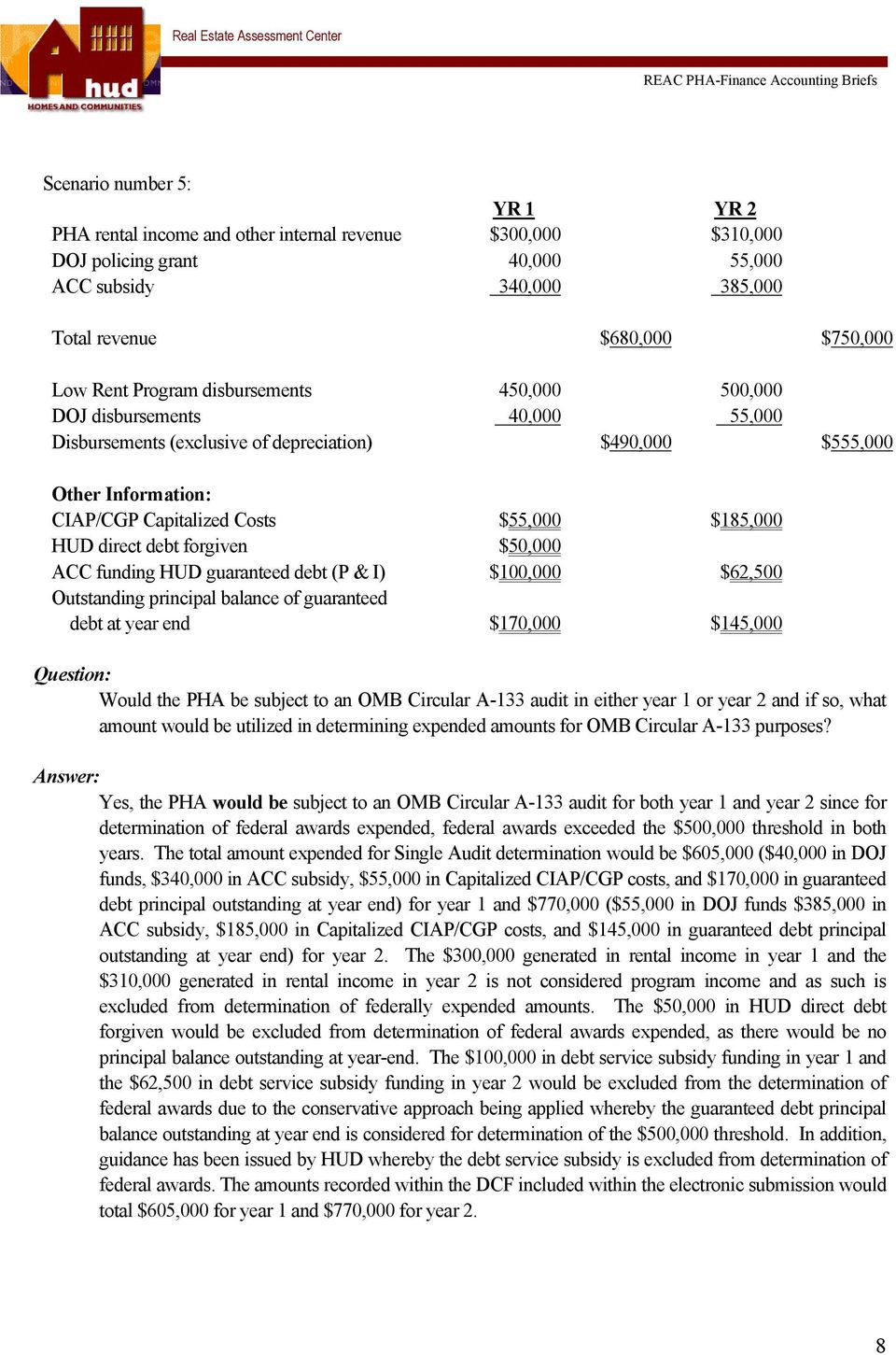
8 Scenario number 5: YR 1 YR 2 PHA rental income and other internal revenue $300,000 $310,000 DOJ policing grant 40,000 55,000 ACC subsidy 340, ,000 Total revenue $680,000 $750,000 Low Rent Program disbursements 450, ,000 DOJ disbursements 40,000 55,000 Disbursements (exclusive of depreciation) $490,000 $555,000 Other Information: CIAP/CGP Capitalized Costs $55,000 $185,000 HUD direct debt forgiven $50,000 ACC funding HUD guaranteed debt (P & I) $100,000 $62,500 Outstanding principal balance of guaranteed debt at year end $170,000 $145,000 Would the PHA be subject to an OMB Circular A-133 audit in either year 1 or year 2 and if so, what amount would be utilized in determining expended amounts for OMB Circular A-133 purposes? Yes, the PHA would be subject to an OMB Circular A-133 audit for both year 1 and year 2 since for determination of federal awards expended, federal awards exceeded the $500,000 threshold in both years. The total amount expended for Single Audit determination would be $605,000 ($40,000 in DOJ funds, $340,000 in ACC subsidy, $55,000 in Capitalized CIAP/CGP costs, and $170,000 in guaranteed debt principal outstanding at year end) for year 1 and $770,000 ($55,000 in DOJ funds $385,000 in ACC subsidy, $185,000 in Capitalized CIAP/CGP costs, and $145,000 in guaranteed debt principal outstanding at year end) for year 2. The $300,000 generated in rental income in year 1 and the $310,000 generated in rental income in year 2 is not considered program income and as such is excluded from determination of federally expended amounts. The $50,000 in HUD direct debt forgiven would be excluded from determination of federal awards expended, as there would be no principal balance outstanding at year-end. The $100,000 in debt service subsidy funding in year 1 and the $62,500 in debt service subsidy funding in year 2 would be excluded from the determination of federal awards due to the conservative approach being applied whereby the guaranteed debt principal balance outstanding at year end is considered for determination of the $500,000 threshold. In addition, guidance has been issued by HUD whereby the debt service subsidy is excluded from determination of federal awards. The amounts recorded within the DCF included within the electronic submission would total $605,000 for year 1 and $770,000 for year 2. 8
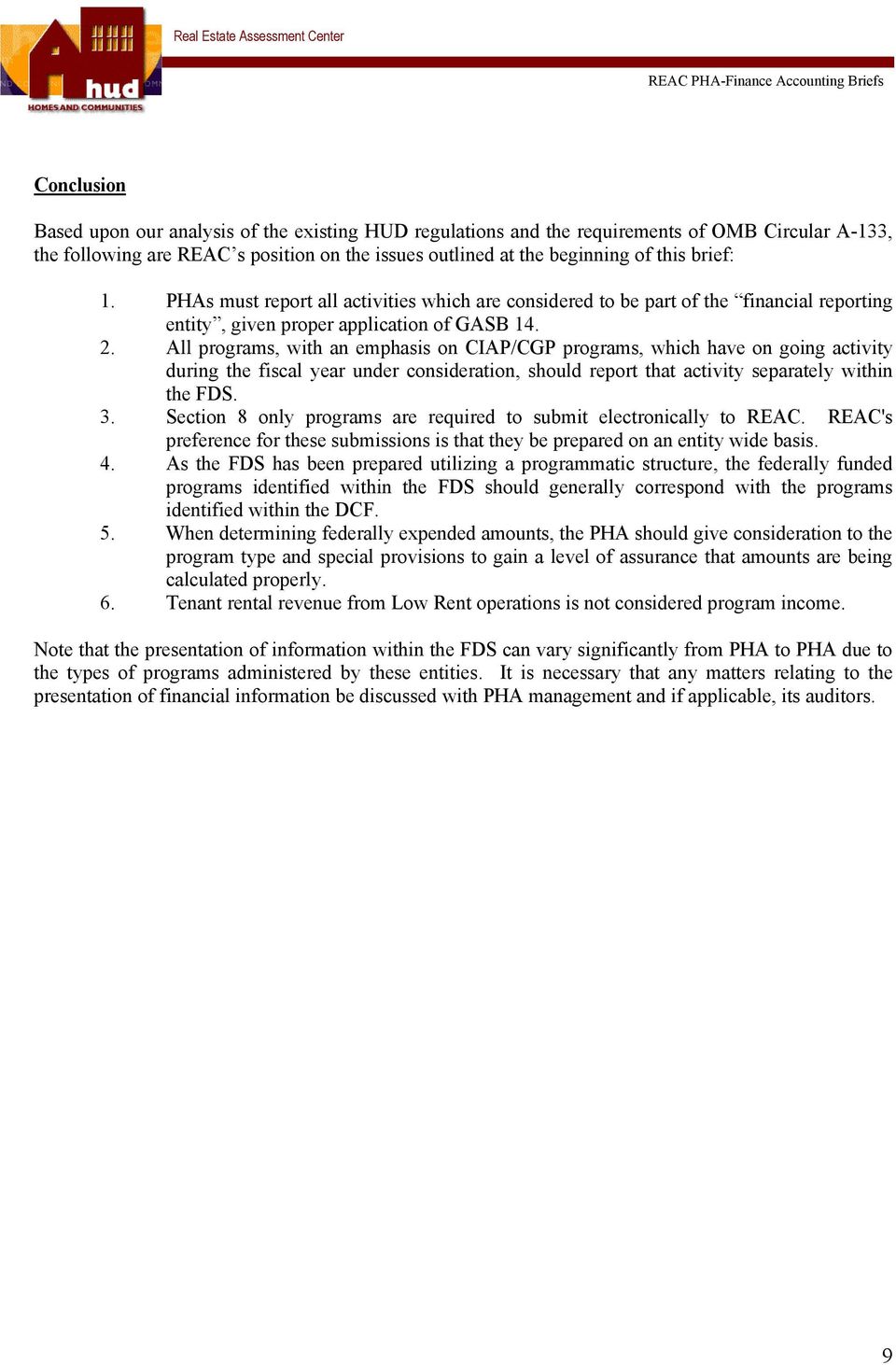
9 Conclusion Based upon our analysis of the existing HUD regulations and the requirements of OMB Circular A-133, the following are REAC s position on the issues outlined at the beginning of this brief: 1. PHAs must report all activities which are considered to be part of the financial reporting entity, given proper application of GASB All programs, with an emphasis on CIAP/CGP programs, which have on going activity during the fiscal year under consideration, should report that activity separately within the FDS. 3. Section 8 only programs are required to submit electronically to REAC. REAC's preference for these submissions is that they be prepared on an entity wide basis. 4. As the FDS has been prepared utilizing a programmatic structure, the federally funded programs identified within the FDS should generally correspond with the programs identified within the DCF. 5. When determining federally expended amounts, the PHA should give consideration to the program type and special provisions to gain a level of assurance that amounts are being calculated properly. 6. Tenant rental revenue from Low Rent operations is not considered program income. Note that the presentation of information within the FDS can vary significantly from PHA to PHA due to the types of programs administered by these entities. It is necessary that any matters relating to the presentation of financial information be discussed with PHA management and if applicable, its auditors. 9
Office of Public and Indian Housing, Real Estate Assessment Center. Capital Fund Program Reporting ACCOUNTING BRIEF #15
 Office of Public and Indian Housing, Real Estate Assessment Center PIH-REAC: PHA-Finance Accounting Briefs Issued Date: August 2011 Capital Fund Program Reporting ACCOUNTING BRIEF #15 GOVERNING REGULATIONS
RULES OF THE AUDITOR GENERAL
 RULES OF THE AUDITOR GENERAL CHAPTER 10.550 LOCAL GOVERNMENTAL ENTITY AUDITS EFFECTIVE 9-30-15 RULES OF THE AUDITOR GENERAL CHAPTER 10.550 TABLE OF CONTENTS Rule Description Page Section No. PREFACE TO
RULES OF THE AUDITOR GENERAL
 RULES OF THE AUDITOR GENERAL CHAPTER 10.650 FLORIDA SINGLE AUDIT ACT AUDITS NONPROFIT AND FOR-PROFIT ORGANIZATIONS EFFECTIVE 9-30-15 RULES OF THE AUDITOR GENERAL CHAPTER 10.650 TABLE OF CONTENTS Rule Description
Thompson Publishing Group, Inc. Audio Conference June 6, 2006 Troubleshooting Subrecipient Monitoring: Review of Pass-Through Entity Responsibilities
 What is Monitoring? A definition from the Department of Health and Human Services Grants Policy Directive: Monitoring - A process whereby the programmatic and business management performance aspects of
GENEVA HOUSE, INC. PROJECT NO. 034-44815NP FINANCIAL REPORT WITH SUPPLEMENTARY INFORMATION AND INDEPENDENT AUDITOR S REPORT DECEMBER 31, 2009 AND
 FINANCIAL REPORT WITH SUPPLEMENTARY INFORMATION AND INDEPENDENT AUDITOR S REPORT DECEMBER 31, 2009 AND 2008 FINANCIAL REPORT WITH SUPPLEMENTARY INFORMATION AND INDEPENDENT AUDITOR S REPORT DECEMBER 31,
RULES OF THE AUDITOR GENERAL
 RULES OF THE AUDITOR GENERAL CHAPTER 10.850 AUDITS OF CHARTER SCHOOLS AND SIMILAR ENTITIES, FLORIDA VIRTUAL SCHOOL, AND VIRTUAL INSTRUCTION PROGRAM PROVIDERS EFFECTIVE 06-30-15 RULES OF THE AUDITOR GENERAL
Bulletin 2009-002. Reporting Federal Student Loans Adult Education
 Date Issued: February 2, 2009 Bulletin 2009-002 TO: FROM: SUBJECT: School District Treasurers Independent Public Accountants Mary Taylor, CPA Auditor of State Reporting Federal Student Loans Adult Education
ATSU Financial Management Plan for Administration of Grants and Contracts
 ATSU Financial Management Plan for Administration of Grants and Contracts Overview ATSU is committed to maintaining a financial management system that provides accurate, current, and full disclosure of
Academy of Flint Flint, Michigan Single Audit Report June 30, 2011
 Flint, Michigan Single Audit Report June 30, 2011 Table of Contents Page SINGLE AUDIT REPORT Independent Auditors Report on Internal Control Over Financial Reporting and on Compliance and Other Matters
Changes in Financial Management and Reporting for Public Housing Agencies Under the New Operating Fund Rule (24 CFR part 990)
 Changes in Financial Management and Reporting for Public Housing Agencies Under the New Operating Fund Rule (24 CFR part 990) Supplement to HUD Handbook 7475.1 REV., CHG-1, Financial Management Handbook
Environmental Protection Agency Clean Water and Drinking Water State Revolving Funds ARRA Program Audit
 Environmental Protection Agency Clean Water and Drinking Water State Revolving Funds ARRA Program Audit Audit Period: December 1, 2009 to February 12, 2010 Report number Issuance date: March 9, 2010 Contents
The following document was not prepared by the Office of the State Auditor, but was prepared by and submitted to the Office of the State Auditor by a
 The following document was not prepared by the Office of the State Auditor, but was prepared by and submitted to the Office of the State Auditor by a private CPA firm. The document was placed on this web
ADMINISTRATIVE PRACTICE LETTER
 Page 1 of 9 Index Purpose of Guidelines Policy Who is Responsible Definitions and Terms Responsibilities and Procedures o Audit Requirements o For-profit Recipients and Audit Requirements o Roles and Responsibilities
CITY OF BEVERLY HILLS SINGLE AUDIT OF FEDERALLY ASSISTED GRANT PROGRAMS JUNE 30, 2014
 SINGLE AUDIT OF FEDERALLY ASSISTED GRANT PROGRAMS JUNE 30, 2014 TABLE OF CONTENTS June 30, 2014 Page Number Independent Auditors Report on Internal Control Over Financial Reporting and on Compliance and
Statewide Accounting Policy & Procedure
 Statewide Accounting Policy & Procedure Accounting Manual Reference: Section: Revenues & Receivables Sub-section: Revenues, Receivables, Unearned Revenues and Unavailable Revenues - General Effective Date:
Financial Statements and Independent Auditor s Report. DDC Foothills Home (A Colorado Nonprofit Corporation) FHA Project No. 101 HD023 NP PD DD
 Financial Statements and Independent Auditor s Report DDC Foothills Home June 30, 2014 TABLE OF CONTENTS INDEPENDENT AUDITOR S REPORT 4 FINANCIAL STATEMENTS STATEMENT OF FINANCIAL POSITION 6 STATEMENT
U.S. DEPARTMENT OF HOUSING AND URBAN DEVELOPMENT WASHINGTON, DC 20410-8000 ASSISTANT SECRETARY FOR HOUSING- FEDERAL HOUSING COMMISSIONER
 U.S. DEPARTMENT OF HOUSING AND URBAN DEVELOPMENT WASHINGTON, DC 20410-8000 ASSISTANT SECRETARY FOR HOUSING- FEDERAL HOUSING COMMISSIONER Special Attention of All Multifamily Hub Directors Notice H 2011-05
AUDIT GUIDELINES. Substance Abuse Prevention and Treatment (SAPT) Program. Michigan Department of Community Health
 AUDIT GUIDELINES Substance Abuse Prevention and Treatment (SAPT) Program Michigan Department of Community Health October 2005 TABLE OF CONTENTS INTRODUCTION... 1 AUDIT REQUIREMENTS...... 2 Single Audit...
Objectives. Single Audit: Recent Changes and Preparation Tips. Overview. Overview 1/20/2016
 Objectives Single Audit: Recent Changes and Preparation Tips January 21, 2016 Discuss and review recently issued Uniform Administrative Requirements, Cost Principles, and Audit Requirements for Federal
FHA Section 542(c) Risk-Sharing Program for Multifamily Housing Program Rules
 FHA Section 542(c) Risk-Sharing Program for Multifamily Housing Program Rules Purpose Kentucky Housing Corporation (KHC) has partnered with HOPE of Kentucky, LLC, and the Community Reinvestment Fund, USA
Real Estate Assessment Center. Summary of Financial Reporting and Auditing Guidance for HUD Multifamily Program Participants and Independent Auditors
 Real Estate Assessment Center Summary of Financial Reporting and Auditing Guidance for HUD Multifamily Program Participants and Independent Auditors Table of Contents Real Estate Assessment Center... 1
Charter Township of Shelby Macomb County, Michigan. Federal Awards Supplemental Information December 31, 2010
 Macomb County, Michigan Federal Awards Supplemental Information December 31, 2010 Contents Independent Auditor's Report 1 Report on Internal Control Over Financial Reporting and on Compliance and Other
Consolidated Audit Guide for Audits of HUD Programs
 Handbook 2000.04 REV-2 CHG-1 U.S. Department of Housing and Urban Development Office of Inspector General Independent Auditors December 2001 Consolidated Audit Guide for Audits of HUD Programs GA: Distribution:
GUAM HOUSING AND URBAN RENEWAL AUTHORITY. SINGLE AUDIT AND HUD REPORTS And SUPPLEMENTARY INFORMTION
 GUAM HOUSING AND URBAN RENEWAL AUTHORITY SINGLE AUDIT AND HUD REPORTS And SUPPLEMENTARY INFORMTION FOR THE YEAR ENDED SEPTEMBER 30, 2014 SAIPAN Family Building, Suite 201 PMB 297 Box 10000 Saipan, MP 96950
Audit Unit Policy 16 th Revision April 2006. Floyd Blodgett, Education Accounting and Auditing Analyst
 Audit Unit Policy 16 th Revision April 2006 Floyd Blodgett, Education Accounting and Auditing Analyst This document describes the process by which the Vermont Department of Education (VTDOE) conducts its
HUD. Ginnie Mae. Fair. Housing. Housing. Inspector General. Public and Indian. Housing. Center for Faith-Based Partnerships
 U.S. Department of Housing and Urban Development (HUD) 2 Ginnie Mae Public and Indian Housing Center for Faith-Based Partnerships Community Planning and Development HUD Inspector General Departmental Enforcement
HUD Property Audits: A Property Manager s Perspective
 HUD Property Audits: A Property Manager s Perspective How Best to Prepare / Common Findings in an Audit Objective This session will discuss HUD Property audits from a site manager s perspective covering:
PRATT COMMUNITY COLLEGE SINGLE AUDIT REPORT YEAR ENDED JUNE 30, 2015 WITH INDEPENDENT AUDITOR S REPORT
 SINGLE AUDIT REPORT YEAR ENDED JUNE 30, 2015 WITH INDEPENDENT AUDITOR S REPORT SINGLE AUDIT REPORT YEAR ENDED JUNE 30, 2015 WITH INDEPENDENT AUDITOR S REPORT SINGLE AUDIT REPORT Year Ended June 30, 2015
OMB. Uniform Guidance
 2014 OMB Uniform Guidance Assessing the OMB Uniform Guidance: Major Changes and Impacts The Office of Management and Budget (OMB) consolidated the federal government s guidance on Uniform Administrative
DEVELOPMENT COST CERTIFICATION AUDIT GUIDANCE
 CHAPTER 5. DEVELOPMENT COST CERTIFICATION AUDIT GUIDANCE 5-1 Program Objective. Multifamily projects are an integral part of the U.S. Department of Housing and Urban Development s (HUD) housing programs,
AN INTRODUCTION TO FINANCIAL MANAGEMENT FOR GRANT RECIPIENTS
 AN INTRODUCTION TO FINANCIAL MANAGEMENT FOR GRANT RECIPIENTS National Historical Publications and Records Commission National Archives www.archives.gov/nhprc June 17, 2015 Table of Contents USE OF THE
City of Miami, Florida Management Letter in Accordance With Chapter 10.550, Rules of the Florida Auditor General
 Management Letter in Accordance With Chapter 10.550, Rules of the Florida Auditor General For the Year Ended September 30, 2014 Contents Management Letter in Accordance with Chapter 10.550 of the Rules
Conference Call #1-888-494-4032 Access Code #9786079493 A Training Session Given to DHS Providers October, 2014
 DHS Mission: To assist our customers to achieve maximum self-sufficiency, independence and health through the provision of seamless, integrated services for individuals, families and communities. Conference
CITY OF ARCADIA, FLORIDA ANNUAL FINANCIAL REPORT. For the Fiscal Year Ended September 30, 2015
 ANNUAL FINANCIAL REPORT For the Fiscal Year Ended September 30, 2015 ANNUAL FINANCIAL REPORT FOR THE FISCAL YEAR ENDED SEPTEMBER 30, 2015 TABLE OF CONTENTS Page INDEPENDENT AUDITOR'S REPORT... 1 MANAGEMENT'S
FINANCIAL MANAGEMENT GUIDE FOR NON-PROFIT ORGANIZATIONS
 FINANCIAL MANAGEMENT GUIDE FOR NON-PROFIT ORGANIZATIONS NATIONAL ENDOWMENT FOR THE ARTS OFFICE OF INSPECTOR GENERAL SEPTEMBER 2008 Questions about this guide may be directed to the National Endowment for
The following document was not prepared by the Office of the State Auditor, but was prepared by and submitted to the Office of the State Auditor by a
 The following document was not prepared by the Office of the State Auditor, but was prepared by and submitted to the Office of the State Auditor by a private CPA firm. The document was placed on this web
Basic Accounting. Course Objective. General Budgetary Terms 12/8/2015. Presented by: Local Government Services
 Basic Accounting Presented by: Local Government Services Course Objective To give an overview of the different requirements, processes, transactions, and forms relating to your job as clerk General Budgetary
CHAPTER 5: MEASURING GDP AND ECONOMIC GROWTH
 CHAPTER 5: MEASURING GDP AND ECONOMIC GROWTH Learning Goals for this Chapter: To know what we mean by GDP and to use the circular flow model to explain why GDP equals aggregate expenditure and aggregate
U.S. Department of Housing and Urban Development Office of Community Planning and Development
 Hud-40096 Homebuyer/Homeowner Rehab Completion Report HOME Program U.S. Department of Housing and Urban Development Office of Community Planning and Development OMB Approval No. 2506-0171 (Exp. 05/31/2007)
LASALLE COUNTY EMERGENCY TELEPHONE SYSTEM BOARD OTTAWA, ILLINOIS
 OTTAWA, ILLINOIS Financial Report CONTENTS Page Number Independent Auditor's Report Management's Discussion and Analysis (Unaudited) Statement of Net Assets - Business-Type Activities Statement of Revenues,
GRANTS MANAGEMENT. After completing the module, you will have a working knowledge of the:
 MODULE 4 LEARNING OBJECTIVES: GRANTS MANAGEMENT After completing the module, you will have a working knowledge of the: Components of grants management Reporting requirements Financial regulations Administrative
H:\Cost\OMB\OMB completed templates\subpart F-Audit Requirements\Subpart F Audit Req Word Docs\Uniform-Guidance-Section_200.
 H:\Cost\OMB\OMB completed templates\subpart F-Audit Requirements\Subpart F Audit Req Word Docs\Uniform-Guidance-Section_200.512 - Fund Accounting.docx 200.512 Report submission. (a) General. (1) The audit
Arkansas Development Finance Authority, a Component Unit of the State of Arkansas
 Arkansas Development Finance Authority, a Component Unit of the State of Arkansas Combined Financial Statements and Additional Information for the Year Ended June 30, 2000, and Independent Auditors Report
How To Account For Money In The European System Of Accounting
 80.20.10 80.20 Generally Accepted Accounting Principles 80.20.10 July 1, 2001 This state adopts Generally Accepted Accounting Principles (GAAP) Generally accepted accounting principles (GAAP) are uniform
DoD Financial Management Regulation Volume 12, Chapter 5 September 1996 CHAPTER 5 GRANTS AND COOPERATIVE AGREEMENTS
 CHAPTER 5 GRANTS AND COOPERATIVE AGREEMENTS 0501 OVERVIEW 050101. Purpose. This chapter prescribes the guidance to be followed by DoD Components to account for and control grants and cooperative agreements.
HOME Investment Partnerships Program FAQs
 HOME Investment Partnerships Program FAQs Last Updated: April 25, 2016 Description: This document contains the HOME Investment Partnerships Program FAQs posted on the HUD Exchange website (https://www.hudexchange.info/home/).
RULES OF THE AUDITOR GENERAL
 RULES OF THE AUDITOR GENERAL CHAPTER 10.800 AUDITS OF DISTRICT SCHOOL BOARDS EFFECTIVE 06-30-12 RULES OF THE AUDITOR GENERAL CHAPTER 10.800 TABLE OF CONTENTS Rule Description Page Section No. PREFACE TO
If a Not-for-profit organization has an organizational audit, it should be submitted with the property audit.
 AUDIT REQUIREMENTS All WHEDA-financed & ARRA developments, unless notified previously, are required to submit an annual audited financial statement within 60 days of fiscal year end. If a Not-for-profit
H.R. 3965 Mark-to-Market Extension and Enhancement Act of 2007
 CONGRESSIONAL BUDGET OFFICE COST ESTIMATE November 30, 2007 H.R. 3965 Mark-to-Market Extension and Enhancement Act of 2007 As ordered reported by the House Committee on Financial Services on October 31,
Supportive Housing Program (SHP) Self-Monitoring Tools
 Supportive Housing Program (SHP) Self-Monitoring Tools U.S. Department of Housing and Urban Development Office of Community Planning and Development Table of Contents INTRODUCTION...1 TOOL 1 MEASURING
Audited Financial Statements Handbook For Multifamily Rental Housing
 Audited Financial Statements Handbook For Multifamily Rental Housing California Department of Housing and Community Development California Housing Finance Agency Last Revised: March 2015 Foreword Hcd CalHFA
Preparing for a Single Audit Under the Uniform Guidance: An Auditee Perspective
 Preparing for a Single Audit Under the Uniform Guidance: An Auditee Perspective A Web Event Administrative Notes Please ensure your pop-up blocker is disabled. Note the interactive toolbar at the bottom
AUDIT OF THE MACOMB COUNTY SHERIFF S OFFICE EQUITABLE SHARING PROGRAM ACTIVITIES MOUNT CLEMENS, MICHIGAN EXECUTIVE SUMMARY*
 AUDIT OF THE MACOMB COUNTY SHERIFF S OFFICE EQUITABLE SHARING PROGRAM ACTIVITIES MOUNT CLEMENS, MICHIGAN EXECUTIVE SUMMARY* The Department of Justice (DOJ) Office of the Inspector General (OIG) conducted
Notice PIH 99-14 (HA)
 U.S. Department of Housing and Urban Development Office of Public and Indian Housing Special Attention: State and Area Office Directors of Public Housing; Director, Section 8 Financial Management Center;
Strategic Government Contracting. Hydeh Ghaffari, CPA Ghaffari Zaragoza LLP Certified Public Accountants
 Strategic Government Contracting Hydeh Ghaffari, CPA Ghaffari Zaragoza LLP Certified Public Accountants Objectives Understand the added risk for managing programs and activities Evaluate whether your organization
PENNSYLVANIA HOUSING FINANCE AGENCY. FINANCIAL REPORTING MANUAL for Agency Financed Properties and Tax Credit Only Properties (no Agency Financing)
 PENNSYLVANIA HOUSING FINANCE AGENCY FINANCIAL REPORTING MANUAL for Agency Financed Properties and Tax Credit Only Properties (no Agency Financing) Housing Management Division 211 North Front Street P.O.
DEPARTMENT OF FINANCE AND ADMINISTRATION-POLICY 03
 DEPARTMENT OF FINANCE AND ADMINISTRATION-POLICY 03 Policy 3-Uniform Reporting Requirements and Cost Allocation Plans for Subrecipients of Federal and State Grant Monies (Revised 12/97) Introduction to
Federal Single Audit Act Update
 Federal Single Audit Act Update Presented By: James Halleran, CPA Partner June 16, 2015 What We Will Cover Background and Effective Dates Key Points of the Uniform Guidance for Federal Awards Key Points
GREENUP COUNTY SCHOOL DISTRICT FINANCIAL STATEMENTS AND SUPPLEMENTAL INFORMATION
 FINANCIAL STATEMENTS AND SUPPLEMENTAL INFORMATION TABLE OF CONTENTS Page Independent Auditors' Report 1 Management s Discussion and Analysis 4 Basic Financial Statements: Statement of Net Position 8 Statement