
COST OF BORROWING INDICATORS: METHODOLOGICAL NOTE 1
|
|
|
- Judith Walker
- 9 years ago
- Views:
Transcription
1 DIRECTORATE GENERAL STATISTICS DIVISION MONETARY & FINANCIAL STATISTICS ECB-PUBLIC COST OF BORROWING INDICATORS: METHODOLOGICAL NOTE 1 Introduction Starting from reference month January 2003, euro area countries report harmonised MFI interest rate (MIR) statistics to the ECB. Currently, these statistics are widely used in economic and monetary analysis and in official publications. In order to assess the effectiveness of the monetary policy pass-through across the euro area countries, it is necessary to use an accurate and comparable measure of the borrowing costs for firms and households in those countries. Four basic categories of lending rates per country are used in the calculations: short-term and long-term lending rates both to non-financial corporations and to households for house purchase. Long-term lending rates to non-financial corporations and short and longterm rates on loans to households for house purchase are obtained directly from the MFI interest rate statistics. The compilation of short-term lending rates to non-financial corporations, by contrast, needs to account for two additional technical factors: the importance of overdrafts as a main source of financing for firms in some large euro area economies and the computation of an estimate of the share of long-term loans issued at floating rates, which are similar to short-term loans. This methodological note explains how detailed MFI interest rate statistics are used to compute the indicator of the cost of borrowing for non-financial corporations that takes into account differences in the financing of firms. This measure enhances cross-country comparability, which until now has been limited owing to the differing impact of overdrafts by non-financial corporations on short-term lending rates. The four cost of borrowing indicators, which are available in the ECB Statistical Data Warehouse (SDW) at euro area and national level for euro area countries, are the following: 1. Cost of borrowing indicator for households.. ^^ Cost of borrowing indicator for non-financial corporations..^^ Cost of borrowing indicator for short-term loans to households and non-financial corporations..^^ Cost of borrowing indicator for long-term loans to households and non-financial corporations.. ^^ Further information on the usage of the cost of borrowing indicators can be found in the August 2013 Monthly Bulletin Article entitled: Assessing the retail bank interest rate pass-through in the euro area at times of financial fragmentation

2 The calculation of the cost of borrowing indicators is based on MIR data, where short-term refers to loans with initial period of interest rate fixation up to one year regardless of maturity. Accordingly, longterm refers to loans with initial period of interest rate fixation over one year. The dimensional structure of the cost of borrowing time series is the same as the MIR key family structure. However, to distinguish the cost of borrowing indicators from other MIR time series, two new item codes and three new original maturity / interest rate fixation codes are introduced. They are described in the Annex with detailed calculation methods for each indicator. For most countries, the data are available as of January 2003, although for certain countries, due to lack of back data, the cost of borrowing indicators have only been calculated for a shorter period of time. The indicators are derived according to the methodology analysed in the current note and may thus diverge from similar indicators published by NCBs. Cost of borrowing indicator for households For each euro area country and for the euro area as a whole, the cost of borrowing indicator for households is calculated as a weighted average of MIR rates on short-term and long-term loans to households for house purchase 2, where the MIR new business volumes used as weights are smoothed with a moving average of previous 24 months observations. See Annex for a detailed description of the calculation method. Cost of borrowing indicator for non-financial corporations As regards loans to non-financial corporations, the MIR data on new business does not include overdrafts. For companies in some euro area countries, overdrafts are however a significant source of short-term finance. Thus, since interest rates on overdrafts are on average higher than other short-term bank lending rates, their exclusion tends to lower average short-term rates. To improve comparability across countries, for cost of borrowing purposes overdrafts are incorporated in the calculation of short-term lending rates by deriving their weights from MFI balance sheet items (BSI) data. Unlike MIR statistics, BSI data does not offer breakdowns by initial period of interest rate fixation. Thus, BSI data on outstanding loans with remaining maturity over one year and interest rate reset in the next 12 months (including overdrafts) is used to derive a proxy for the amount of over one year maturity loans that need to be reallocated to short-term lending keeping in mind that short-term refers to loans with period of interest rate fixation up to one year. The aggregated short-term interest rate for loans to non-financial corporations is the weighted average of the rate on overdrafts and the rate on other shortterm loans, where the weights are the shares of overdrafts and other short-term loans over all short-term loans, derived from BSI statistics. 2 Loans for consumption and other purposes are not included in the cost of borrowing indicator as they are too volatile and less relevant for macroeconomic projections.

3 The aggregated cost of borrowing indicators for non-financial corporations is calculated as the one for households above, i.e. as a weighted average of rates on short-term and long-term loans, the short-term weights again including also overdrafts. See the Annex for a more detailed description. Cost of borrowing indicator for short-term loans to households and non-financial corporations The short-term composite cost of borrowing indicator for households and non-financial corporations is calculated as a weighted average of the short-term rates for households and non-financial corporations. For households the weights are derived from the 24 months moving average of MIR new business volumes. For non-financial corporations, overdrafts are included in the weights as described above. The calculations are presented in the Annex. 3 Cost of borrowing indicator for long-term loans to households and non-financial corporations For the long-term composite indicator for households and non-financial corporations, the weights are calculated as moving averages of previous 24 months MIR new business volumes. For Malta and Slovenia, the cost of borrowing indicator for households is used as a proxy for the composite long-term indicator, since long-term rates for non-financial corporations are very volatile, mostly due to small volumes. Their inclusion in the calculation of the long-term indicators would also increase the volatility of the composite indicator. 4 See the Annex for details on the calculations. 3 For Greece the indicator should be interpreted with caution due to small volumes. 4 It should be noted that this can be the case also for other countries where it has been decided not to exclude long-term rates for non-financial corporations; this could explain the volatility of this indicator in some cases.

4 Annex 1. Cost of borrowing indicator for households.. ^^ ^^ ^^ The original maturity code F refers to loans with initial period of interest rate fixation up to one year and K to loans with initial period of interest rate fixation over one year. The code AM refers to the sum of F and K, i.e. total loans, calculated by weighting the underlying rates with a moving average of new business volumes. MAVE (*, 24) refers to the moving average of a particular series for the previous 24 months. To derive the series keys for all euro area countries and euro area as a whole, the ^^ in the third dimension needs to be replaced with the relevant country code. 5 5 For Estonia, the data is only available from January 2005 onwards. For Cyprus, Malta and Slovakia, the data is available from January 2008 onwards.
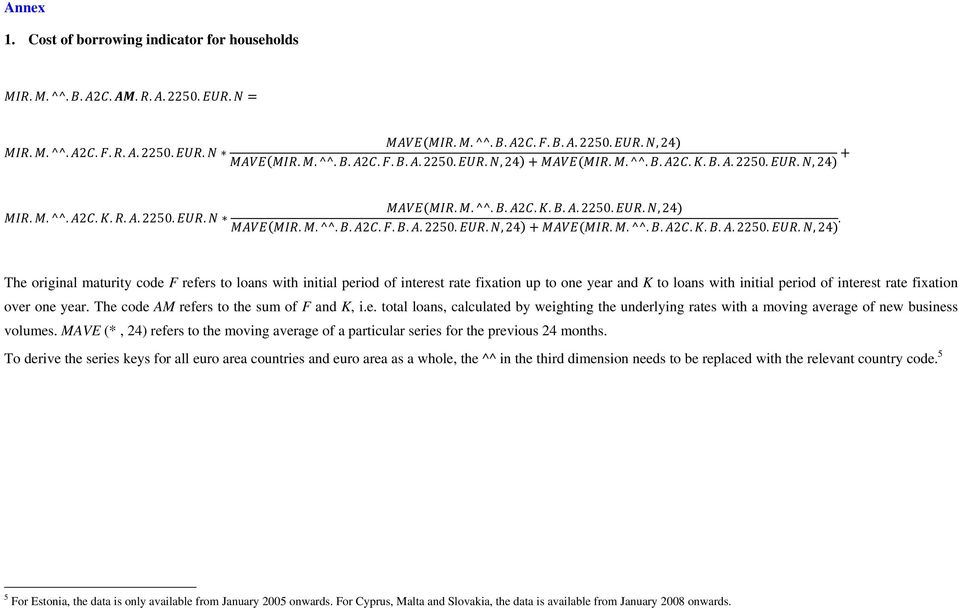
5 2. Cost of borrowing indicator for non-financial corporations.. ^^ ^^ ^^ ^^ , 24.. ^^ ^^ , 24.. ^^ ^^ , 24.. ^^ The BSI item code A2I refers to loans with initial period of interest rate fixation up to one year plus a proxy for the amount of overdrafts, derived from MIR and BSI statistics. The original maturity code F refers to loans with initial period of interest rate fixation up to one year and K to loans with initial period of interest rate fixation over one year. The code AM refers to the sum of F and K, i.e. total loans, calculated by weighting the underlying rates with a moving average of new business volumes. MAVE (*, 24) refers to the moving average of a particular series for the previous 24 months. The series key MIR.M.^^.B.A2I.F.B.A.2240.EUR.O refers to the amount of short-term loans to non-financial corporations, including also a proxy for the amount of overdrafts. It is calculated by multiplying the MIR new business volumes by the factor 1 + share of overdrafts over all short-term loans:.. ^^ ^^ , ^^ ^^ , Where MIR.M.^^.B.A20.K.B.A.2240.EUR.O.AUX refers to the 12-month average of the share of loans with remaining maturity over one year and interest rate reset within a year over all loans with original maturity over one year. To derive the series keys for all euro area countries and euro area as a whole, the ^^ in the third dimension needs to be replaced with the relevant country code. 6 6 For Estonia, the data is only available from January 2005 onwards. For Cyprus, Malta and Slovakia, the data is available from January 2008 onwards.

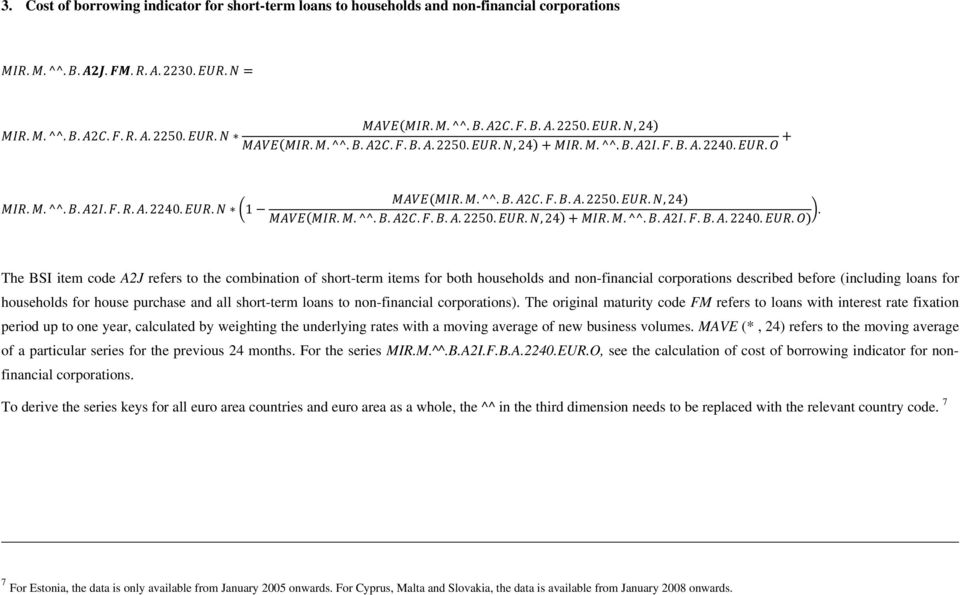
6 3. Cost of borrowing indicator for short-term loans to households and non-financial corporations.. ^^ ^^ ^^ ^^ ^^ The BSI item code A2J refers to the combination of short-term items for both households and non-financial corporations described before (including loans for households for house purchase and all short-term loans to non-financial corporations). The original maturity code FM refers to loans with interest rate fixation period up to one year, calculated by weighting the underlying rates with a moving average of new business volumes. MAVE (*, 24) refers to the moving average of a particular series for the previous 24 months. For the series MIR.M.^^.B.A2I.F.B.A.2240.EUR.O, see the calculation of cost of borrowing indicator for nonfinancial corporations. To derive the series keys for all euro area countries and euro area as a whole, the ^^ in the third dimension needs to be replaced with the relevant country code. 7 7 For Estonia, the data is only available from January 2005 onwards. For Cyprus, Malta and Slovakia, the data is available from January 2008 onwards.
7 4. Cost of borrowing indicator for long-term loans to households and non-financial corporations.. ^^ ^^ ^^ , 24.. ^^ , 24.. ^^ ^^ , 24. The BSI item code A2J refers to the combination of long-term items for both households and non-financial corporations, including loans for households for house purchase and loans other than revolving loans, overdrafts and credit card credit to non-financial corporations. The original maturity code KM refers to loans with interest rate fixation period over one year, calculated by weighting the underlying rates with a moving average of new business volumes. MAVE (*, 24) refers to the moving average of a particular series for the previous 24 months. To derive the series keys for all euro area countries and euro area as a whole, the ^^ in the third dimension needs to be replaced with the relevant country code. 8 For Malta and Slovenia, the long-term rate for households is used as a proxy for the composite long-term indicator, i.e.:.. ^^ ^^ ^^ , For Estonia, the data is only available from January 2005 onwards. For Cyprus, Malta and Slovakia, the data is available from January 2008 onwards.

8 5. MFI Interest rate raw series used in the calculations.. ^^ ^^ ^^ ^^ ^^ ^^ ^^ ^^ ^^ Interest rates on new business on loans to households for house purchase with a floating rate or an initial rate fixation up to 1 year for country ^^. Interest rates on new business on loans to households for house purchase with a floating rate or an initial rate fixation over 1 year for country ^^. Interest rates of new business on total loans to non financial corporations with a floating rate or an initial rate fixation over 1 year for country ^^. Interest rates on new business on loans and overdrafts, convenience and extended credit card debt to non financial corporations for country ^^. Interest rates on new business on total loans floating rate and up to one year initial rate fixation to non financial corporations for country ^^. Volumes of new business on loans to households for house purchase with a floating rate or an initial rate fixation up to 1 year for country ^^. Volumes of new business on loans to households for house purchase with a floating rate or an initial rate fixation over 1 year for country ^^. Volumes of new business on total loans to non financial corporations with a floating rate or an initial rate fixation over 1 year for country ^^. Volumes of new business on loans and overdrafts, convenience and extended credit card debt to non financial corporations for country ^^.

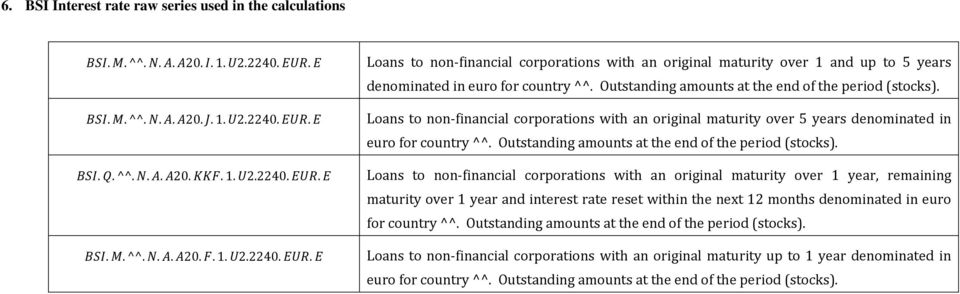
9 6. BSI Interest rate raw series used in the calculations.. ^^ ^^ ^^ ^^ Loans to non financial corporations with an original maturity over 1 and up to 5 years denominated in euro for country ^^. Outstanding amounts at the end of the period (stocks). Loans to non financial corporations with an original maturity over 5 years denominated in euro for country ^^. Outstanding amounts at the end of the period (stocks). Loans to non financial corporations with an original maturity over 1 year, remaining maturity over 1 year and interest rate reset within the next 12 months denominated in euro for country ^^. Outstanding amounts at the end of the period (stocks). Loans to non financial corporations with an original maturity up to 1 year denominated in euro for country ^^. Outstanding amounts at the end of the period (stocks).
10 7. Derived series..^^ , 24 Moving average for the previous 24 months of volumes of new business on loans to households for house purchase with a floating rate or an initial rate fixation up to 1 year for country ^^. 1.. ^^ ^^ , 24 Moving average for the previous 24 months of volumes of new business on loans to households for house purchase with a floating rate or an initial rate fixation over 1 year for country ^^. 1.. ^^ ^^ , 24 Moving average for the previous 24 months of volumes of new business on loans to non financial corporations with a floating rate or an initial rate fixation up to 1 year for country ^^. 1.. ^^ ^^ , 24 Moving average for the previous 24 months of volumes of new business on loans to non financial corporations with a floating rate or an initial rate fixation over 1 year for country ^^. 1.. ^^ ^^ Interest rates on new business to non financial corporations weighted by the fraction of loans with initial period of interest rate fixation up to one year and by a proxy for the amount of overdrafts, derived from both MIR and BSI statistics for country ^^. 1.. ^^ ^^
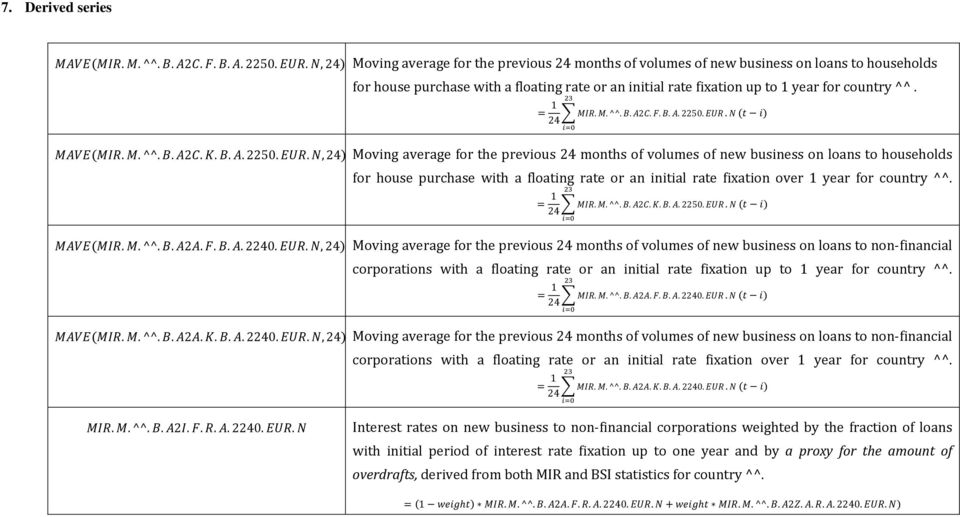
11 .. ^^ /.. ^^ ^^ ^^ ^^ ^^ ^^ ^^ ^^ /.. ^^ ^^ ^^ , 24 Moving average for the previous 24 months of volumes of new business on total loans to nonfinancial corporations with a floating rate or an initial rate fixation up to 1 year for country ^^. 1.. ^^ ^^ Amounts of short term loans to non financial corporations, including also a proxy for the amount of overdrafts for country ^^...^^ ^^ , ^^ ^^

CROSS-COUNTRY HETEROGENEITY IN MFI INTEREST RATES ON LOANS TO NON-FINANCIAL CORPORATIONS IN THE EURO AREA
 Box 2 CROSS-COUNTRY HETEROGENEITY IN MFI INTEREST RATES ON LOANS TO NON-FINANCIAL CORPORATIONS IN THE EURO AREA The dynamics of bank lending rates on loans to non- corporations (NFCs) have been highly
Rapport S 1.5 «Interest rates in EUR» Banque centrale du Luxembourg
 In case of discrepancies between the French and the English text, the French text shall prevail Rapport S 1.5 «Interest rates in EUR» Banque centrale du Luxembourg Contents 1 Introduction...4 1.1 Introductory
PRESS RELEASE REFINANCING OPERATIONS
 PRESS RELEASE ECB PUBLISHES LEGAL ACT RELATING TO TARGETED LONGER-TERM REFINANCING OPERATIONS The European Central Bank (ECB) is publishing a legal act that has been adopted today relating to the targeted
Banking statistics guidelines and customer classification, Section MFI interest rate statistics. Final version: January 2015.
 This English translation of parts of the Banking statistics guidelines and customer classification has been prepared by the Deutsche Bundesbank for the convenience of English-speaking readers. The sole
BIS database for debt service ratios for the private nonfinancial
 BIS database for debt service ratios for the private nonfinancial sector Data documentation The debt service ratio (DSR) is defined as the ratio of interest payments plus amortisations to income. As such,
MODALITIES OF THE TARGETED LONGER-TERM REFINANCING OPERATIONS
 MODALITIES OF THE TARGETED LONGER-TERM REFINANCING OPERATIONS Following a decision by the ECB s Governing Council, the Eurosystem will conduct eight targeted longer-term refinancing operations (TLTROs)
Main Indicators for the Finnish Economy
 BANK OF FINLAND Monetary Policy and Research - Financial Markets and Statistics Main Indicators for the Finnish Economy 1/11 January 1 January 11 Monetary Policy and Research - Financial Markets and Statistics
THE EURO AREA BANK LENDING SURVEY 1ST QUARTER OF 2014
 THE EURO AREA BANK LENDING SURVEY 1ST QUARTER OF 214 APRIL 214 European Central Bank, 214 Address Kaiserstrasse 29, 6311 Frankfurt am Main, Germany Postal address Postfach 16 3 19, 666 Frankfurt am Main,
Main Indicators for the Finnish Economy
 BANK OF FINLAND Monetary Policy and Research - Financial Markets and Statistics Main Indicators for the Finnish Economy 3/11 17 March 11 Main Indicators for the Finnish Economy is produced jointly by the
Main Indicators for the Finnish Economy
 BANK OF FINLAND Monetary Policy and Research - Financial Markets and Statistics Main Indicators for the Finnish Economy /1 13 April 1 13 April 1 Monetary Policy and Research - Financial Markets and Statistics
The Eurosystem Household Finance and Consumption Survey. Statistical Tables APRIL 2013
 The Eurosystem Household Finance and Consumption Survey Statistical Tables APRIL This set of tables has been prepared by the members of the Eurosystem Household Finance and Consumption Network. You can
Prepared by Pierre Sola and Carlos Sánchez Muñoz Directorate General Statistics European Central Bank
 UPDATE OF THE 1993 SNA - ISSUE No. 44a ISSUES PAPER FOR THE JULY 2005 AEG MEETING SNA/M1.05/10.2 THE DISTINCTION BETWEEN DEPOSITS AND LOANS IN MACRO-ECONOMIC STATISTICS Prepared by Pierre Sola and Carlos
The Impact of Interest Rate Shocks on the Performance of the Banking Sector
 The Impact of Interest Rate Shocks on the Performance of the Banking Sector by Wensheng Peng, Kitty Lai, Frank Leung and Chang Shu of the Research Department A rise in the Hong Kong dollar risk premium,
Interest Rate Return (MR1) Notes on Compilation
 Interest Rate Return (MR1) Notes on Compilation Version 1.3 7 th January 2015 For further information: Email: [email protected] Website: www.centralbank.ie Contents 1. Introduction... 4 1.1 Reporting
Consolidated and non-consolidated debt measures of non-financial corporations
 Consolidated and non-consolidated debt measures of non-financial corporations Andreas Hertkorn 1, ECB 2 Abstract: There is a broad consensus to use comprehensive debt measures for the analysis of non-financial
Each month, the Office for National
 Economic & Labour Market Review Vol 3 No 7 July 2009 FEATURE Jim O Donoghue The public sector balance sheet SUMMARY This article addresses the issues raised by banking groups, including Northern Rock,
5. Principles of Compilation of Monetary Statistics for Armenia
 5. Principles of Compilation of Monetary Statistics for Armenia T he framework for the monetary statistics involves analytical presentation of balance sheets of financial sector s depository and nondepository
F.A.Q. Differences between statistical and supervisory reporting
 F.A.Q. Differences between statistical and supervisory reporting 1) Which group consolidation approach should banks use for statistical, supervisory and financial reporting purposes? For statistical purposes,
External debt statistics of the euro area
 External debt statistics of the euro area Jorge Diz Dias 1 Directorate General Statistics European Central Bank Final version 12 October 2010 IFC Conference on Initiatives to address data gaps revealed
Deutsche Bundesbank Interest rate statistics 01.12.2015
 01.12.2015 period SUD113 7 SUD114 7 SUD115 7 SUD116 7 SUD117 7 SUD118 7 SUD119 7 SUD120 7 SUD121 7 SUD122 7 2015 June 4.83 4.98 7.33 2.11 1.81 1.72 1.92 1.69 2.74 2.05 July 5.09 5.01 7.47 2.17 1.91 1.86
ACCESS TO FINANCE. of SMEs in the euro area, European Commission and European Central Bank (ECB), November 2013.
 ACCESS TO FINANCE Improving access to finance is essential to restoring growth and enhancing competitiveness. Investment and innovation are not possible without adequate financing. Difficulties in accessing
- 168 - Chapter Seven. Specification of Financial Soundness Indicators for Other Sectors
 - 168 - Chapter Seven Specification of Financial Soundness Indicators for Other Sectors Introduction 7.1 Drawing on the definitions and concepts set out in Part I of the Guide, this chapter explains how
Public Sector Debt - Instructions
 Public Sector Debt - Instructions Under the auspices of the Task Force on Finance Statistics 1 the World Bank has developed a new database to disseminate quarterly data on government, and more broadly,
Valuation of debt instruments
 Valuation of debt instruments Csaba Ilyés 1 and László Lakatos 2 Last decade in Hungary the securities market developed very rapidly. During this period the amount of securities increased by more than
month year Please enter your report on the main and/or continuation sheet. Claims on foreign banks (excluding securities)
 Annex Z5 BPM6 (Version 07/2013) Claims and liabilities arising from financial operations with foreign banks Template for electronic reports pursuant to section 66 (1, 2 and 5) of the Foreign Trade and
Bank Liabilities Survey. Survey results 2013 Q3
 Bank Liabilities Survey Survey results 13 Q3 Bank Liabilities Survey 13 Q3 Developments in banks balance sheets are of key interest to the Bank of England in its assessment of economic conditions. Changes
Outstanding Loans Received From Abroad by Private Sector. Definitions and Explanations. Statistics Department Balance of Payments Division
 Outstanding Loans Received From Abroad by Private Sector Definitions and Explanations Statistics Department Balance of Payments Division Contents I- Definitions... 3 II- Compilation Of The External Debt
REPORTING INSTRUCTIONS FOR INVESTMENT FUNDS
 REPORTING INSTRUCTIONS FOR INVESTMENT FUNDS 1. Reporting policies & procedures 1.1 The Excel file Investment Funds Returns (FORM STAT 001) - contains three sheets (Assets, Liabilities and Memorandum Items).
SMALL AND MEDIUM-SIZED ENTERPRISES' ACCESS TO FINANCE
 EUROPEAN SEMESTER THEMATIC FICHE SMALL AND MEDIUM-SIZED ENTERPRISES' ACCESS TO FINANCE Thematic fiches are supporting background documents prepared by the services of the Commission in the context of the
Retail Interest Rates in Denmark and the Euro Area
 73 Retail Interest Rates in Denmark and the Euro Area Sabina Persson, Statistics INTRODUCTION AND SUMMARY In January 003 the euro area member states and Denmark introduced harmonised interest-rate statistics
Deutsche Bundesbank Interest rate statistics 02.06.2016
 02.06.2016 period SUD113 7 SUD114 7 SUD115 7 SUD116 7 SUD117 7 SUD118 7 SUD119 7 SUD120 7 SUD121 7 SUD122 7 2015 June 4.83 4.98 7.33 2.11 1.81 1.72 1.92 1.69 2.74 2.05 July 5.09 5.01 7.47 2.17 1.91 1.86
18 ECB STYLISED FACTS OF MONEY AND CREDIT OVER THE BUSINESS CYCLE
 Box 1 STYLISED FACTS OF MONEY AND CREDIT OVER THE BUSINESS CYCLE Over the past three decades, the growth rates of MFI loans to the private sector and the narrow monetary aggregate M1 have displayed relatively
Taxation trends in the European Union EU27 tax ratio fell to 39.3% of GDP in 2008 Steady decline in top corporate income tax rate since 2000
 DG TAXUD 95/2010-28 June 2010 Taxation trends in the European Union EU27 tax ratio fell to 39.3% of GDP in 2008 Steady decline in top corporate income tax rate since 2000 The overall tax-to-gdp ratio 1
Guidelines For Compiling Sectoral Accounts
 Guidelines For Compiling Sectoral Accounts Venkat Josyula Developing and Improving Sectoral Financial Accounts Algiers, January 20-21, 2016 The views expressed herein are those of the author and should
Experimental HICP-based estimates of administered prices in the euro area
 Experimental HICP-based estimates of administered prices in the euro area 1. Introduction The ECB compiles and publishes, on an experimental basis, monthly HICP-based estimates of administered prices for
BORDERLINE BETWEEN LOANS AND DEBT SECURITIES
 IMF Committee on Balance of Payments Statistics Balance of Payments Technical Expert Group (BOPTEG) BACKGROUND PAPER BOPTEG ISSUES # 12 and 13 BORDERLINE BETWEEN LOANS AND DEBT SECURITIES Prepared by Pierre
7. CURRENCY AND BALANCE OF PAYMENTS
 The source of the data presented in this chapter is the Czech National Bank. All tables where the titles of reports are given are exhaustive investigations. Otherwise, qualified estimates and calculations
Form LN Lending to UK Businesses
 Form LN Lending to UK Businesses Introduction Form LN is designed to capture further detail of monetary financial institutions lending to UK businesses. It is completed on a legal entity basis and provides
Templates for External Debt Data
 v1.7 Templates for External Debt Data (Important note: In order to protect the integrity of the tables, please do not insert or delete columns or rows) SDDS Tables: Prescribed and Encouraged Items Table
Centrale Bank van Curaçao en Sint Maarten. Manual International Investment Position Survey. Prepared by: Project group IIP
 Centrale Bank van Curaçao en Sint Maarten Manual International Investment Position Survey Prepared by: Project group IIP December 1, 2014 Contents Introduction 3 General reporting and instruction notes
occasional paper on economic statistics SINGAPORE HOUSEHOLD BALANCE SHEET: 2005 UPDATE AND RECENT TRENDS
 occasional paper on economic statistics SINGAPORE HOUSEHOLD BALANCE SHEET: 2005 UPDATE AND RECENT TRENDS Singapore Department of Statistics June 2006 Papers in this Occasional Paper Series provide an informal
Renegotiated loans in the Czech Republic
 Renegotiated loans in the Czech Republic IFC Biennial Basel Conference September 2014 Irena Zykanová 30.6.2014 Contents Introduction... 2 Reasons for introducing collection of data on renegotiated loans...
Credit Conditions Review 2016 Q2
 Credit Conditions Review 216 Q2 BANK OF ENGLAND Credit Conditions Review 216 Q2 This quarterly publication presents the Bank of England s assessment of the latest developments in bank funding and household
Public Sector and it s Functions. The framework. Why we need public sector? What is the public sector?
 Public Sector and it s Functions The framework What is the public sector? Roles of the public sector, and its main functions Distribution of functions Why we need public sector? The market mechanism cannot
Strategy and Developement In Austrian Bank-reporting
 Strategy and Developement In Austrian Bank-reporting Johannes Turner Director Statistics Department Erich Hille Senior Advisor Statistics Department Budapest, 29.11.2012 OeNB Statistics Data model Agenda
Tables. Standard symbols:. Category not applicable.. Data not available... Data not yet available Nil 0 Less than half the 0.0 final digit shown
 Tables 1. Norges Bank. Balance sheet. In millions of NOK 2. Norges Bank. Investments for Government Pension Fund - Global. In millions of NOK 3. Banks. Balance sheet. In millions of NOK 4. Banks. Loans
General guidelines for the completion of the bank lending survey questionnaire
 General guidelines for the completion of the bank lending survey questionnaire This document includes the general guidelines for the completion of the questionnaire and the terminology used in the survey.
Annex I to the ESRB risk dashboard. Methodological Annex. 1. Interlinkages and composite measures of systemic risk. Last update: June 2016
 1. Interlinkages and composite measures of systemic risk 1.1 Composite indicator of systemic stress Sources: Thomson Reuters, ECB, and ECB calculations Annex I to the ESRB risk dashboard Last update: June
Measuring Credit 1. Introduction. What Is Credit?
 Measuring Credit 1 Introduction Central banks put significant emphasis on credit aggregates for understanding financial conditions in the economy. Measuring credit outstanding, however, is not straightforward,
MULTIPLE CHOICE. Choose the one alternative that best completes the statement or answers the question.
 Survey of Macroeconomics, MBA 641 Fall 2006, Quiz 4 Name MULTIPLE CHOICE. Choose the one alternative that best completes the statement or answers the question. 1) The central bank for the United States
Central Bank Survey. General Provisions
 Summary Methodology Central Bank Survey, Credit Institutions Survey, Banking System Survey, Other Financial Institutions Survey, Financial Sector Survey Central Bank Survey, Credit Institutions Survey,
Inflation. Credit. Coincident indicator (Ita-coin) and Italian GDP (1) (percentage changes)
 NUMBER 16 FEBRUARY 216 Economic activity and employment Foreign trade and competitiveness Inflation Credit The Public Finances Macroeconomic projections 1 7 8 11 12 Directorate general for economics, statistics
Locational Banking Statistics in Ireland: Introducing the Enhanced Quarterly Statistics
 73 Introducing the Enhanced Quarterly Statistics Dermot Coates and Aoife Moloney 1 Abstract This article introduces the recently expanded Locational Banking Statistics published by the Central Bank of
NERI Quarterly Economic Facts Summer 2012. 4 Distribution of Income and Wealth
 4 Distribution of Income and Wealth 53 54 Indicator 4.1 Income per capita in the EU Indicator defined National income (GDP) in per capita (per head of population) terms expressed in Euro and adjusted for
European Reporting Framework (ERF) - a possible solution to reporting challenges for banks
 European Reporting Framework (ERF) - a possible solution to reporting challenges for banks STS 010 "Micro data for multipurpose data provision 60th World Statistics Congress ISI2015 Rio de Janeiro, Brazil
April 2016. Online Payday Loan Payments
 April 2016 Online Payday Loan Payments Table of contents Table of contents... 1 1. Introduction... 2 2. Data... 5 3. Re-presentments... 8 3.1 Payment Request Patterns... 10 3.2 Time between Payment Requests...15
THE UPDATE OF THE EURO EFFECTIVE EXCHANGE RATE INDICES
 September 2004 THE UPDATE OF THE EURO EFFECTIVE EXCHANGE RATE INDICES Executive summary In September 2004, the European Central Bank (ECB) has updated the overall trade weights underlying the ECB nominal
First estimate for 2014 Euro area international trade in goods surplus 194.8 bn 24.2 bn surplus for EU28
 30/2015-16 February 2015 First estimate for 2014 Euro area international trade in goods surplus 194.8 bn 24.2 bn surplus for EU28 The first estimate for the euro area 1 (EA18) trade in goods balance with
It Is In Your Interest
 STUDENT MODULE 7.2 BORROWING MONEY PAGE 1 Standard 7: The student will identify the procedures and analyze the responsibilities of borrowing money. It Is In Your Interest Jason did not understand how it
Short-term investments (also known as marketable securities) are easily convertible to cash that a company plans to hold for a year or less.
 Accounting Fundamentals Lesson 5 5.0 Receivables & Investments Short-term investments (also known as marketable securities) are easily convertible to cash that a company plans to hold for a year or less.
ECONOMIC ACTIVITY AND EMPLOYMENT FOREIGN TRADE AND COMPETITIVENESS INFLATION CREDIT THE PUBLIC FINANCES
 NUMBER 99 JULY 21 ECONOMIC ACTIVITY AND EMPLOYMENT FOREIGN TRADE AND COMPETITIVENESS INFLATION CREDIT THE PUBLIC FINANCES MACROECONOMIC PROJECTIONS 1 7 8 11 12 Directorate general for economics, statistics
Consolidated balance sheet
 Consolidated balance sheet Non current assets 31/12/2009 31/12/2008 (*) 01/01/2008 (*) Property, plant and equipment 1,352 1,350 1,144 Investment property 7 11 11 Fixed assets held under concessions 13,089
Money & Credit: Private Sector Lending by Eurozone MFIs
 Money & Credit: Private Sector Lending by Eurozone MFIs July 27, 216 Dr. Edward Yardeni 516-972-7683 eyardeni@ Debbie Johnson 48-664-1333 djohnson@ Mali Quintana 48-664-1333 aquintana@ Please visit our
Methodological Information on Foreign Exchange Assets and Liabilities of Non-Financial Companies Statistics Department
 Methodological Information on Foreign Exchange Assets and Liabilities of Non-Financial Companies Statistics Department Monetary and Financial Statistics Division Contents I- Purpose... 3 II- Definitions...