
CHAPTER 1 STUDY OF PERFORMANCE OF ERP SYSTEM IN SELECT INDIAN MANUFACTURING FIRMS: INTRODUCTION
|
|
|
- Abner Hampton
- 9 years ago
- Views:
Transcription
1 CHAPTER 1 STUDY OF PERFORMANCE OF ERP SYSTEM IN SELECT INDIAN MANUFACTURING FIRMS: INTRODUCTION 1.1 Introduction Today s global business environment has brought in new competitions with new opportunities and new challenges. This has resulted in decreasing product life cycles and reducing profit margins. To anticipate and respond quickly to the changing business conditions, the organization need solid information system that supports all aspects of business with power and flexibility. Business houses always find great difficulty in quickly making out the required information because of the voluminous data, improper segregation, departmental arrangements and unprecedented delays. Organizations were constantly searching for some means or mode to overcome this debacle. The inconvenience was not only pinching on monetary profits but also antagonized customers who were made to wait for a long time for a small piece of data. They needed a system based on a common database and a modular software design. The common database can allow every department of a business to store and retrieve information in real-time. The information should be reliable, accessible, and easily shared. The modular software design should mean a business can select the modules they need, mix and match modules from different vendors and add new modules of their own to improve business performance. Enterprise Resource Planning or ERP as it is shortly referred has come to overcome this menace. It is a boon to organizations that were in need of this kind of facility for ever 1. Though, there is a time lag in the adoption of ERP systems among firms in the developed and developing markets, ERP system implementations in these markets show remarkably similar trends. In both these markets, early ERP system deployments comprised mostly of module and sub-module implementation of module categories such as financials, logistics, and human resources that streamlined and integrated key functional areas. Once 1

2 these early ERP system implementations stabilized, firms in these markets then turned their attention to expanding their implementation scope by adding more value chain activities through deployment of modules such as supply chain management (SCM) and customer relationship management (CRM) 2. Global ERP market has registered tremendous growth in the past decade. The market witnessed a double digit growth rate in the past few years. Mabert et al. 3 (2003b) indicate that over 30,000 firms worldwide have implemented ERP systems and the vast majority of these deployments have taken place in the period between mid 1990s and Research firm Gartner recently released a report saying companies will spend 14.9 per cent more on enterprise social software in the year 2010 than in 2009, with the total reaching $664.4 million (about Rs Cr.). According to the report in the year 2011, that figure will jump 15.7 per cent to $769.2 million (about Rs.3461 Cr.) 4. The ERP Market Sizing Report, , presented by AMR Research states that the ERP market had a spectacular year, with total revenue growing by 14 per cent and license revenue up by 18 per cent from Also the sale of traditional applications was very healthy in Many ERP vendors saw substantial revenue growth from acquisition of other software companies. The ERP application revenue estimates from 2006 to 2011, as per the report are as follows: for the year 2006 the estimated revenue was 28.8 Billion US $ which was expected to rise to 32.3 Billion US $ in 2007, 35.8 Billion US $ in 2008, 39.4 Billion US $ in 2009, 43.4 Billion US $ in 2010 and for the year 2011 the estimated revenue was 47.7 Billion US $. Globalization, centralization and regulatory compliance are the key drivers for the growing ERP investments among large corporations. These companies buy ERP system in response to their requirements and desire to participate in global markets. 2

3 1.1.1 Overview of ERP Enterprise Resource Planning (ERP) is a firm wide information system that re-engineers and integrates key business processes like Manufacturing, Logistics, Supply Chain Management, Financials, Accounting, Projects, Human Resources and Customer Relationship Management etc. to improve its efficiency, agility, and profitability. ERP is thus a cross-functional enterprise system that enables free flow of information from different functional units of the firm helping in achieving a dynamic business environment 6. An organization has to do meticulous planning, devise strategies before going ahead with ERP. ERP can cut down costs; improve the quality of working time, and thus helps in making the maximum use of technological advancements. For instance the executive in the Sales Department will be able to respond to a customer query immediately by making out the status of the product's delivery which would not have otherwise been possible but for the intervention of ERP in the organization. ERP has enabled organizations to do away with laborious and time consuming process Performance Measurement of ERP System in Manufacturing Firms It is difficult to calculate the Return on Investment (ROI) for ERP decisions, though several successful installations of ERP had dramatic returns on investment. It must be realized that ERP is only an enabler. ERP gives agility to organization which can be exploited to improve profitability, market share or customer service. Without ERP, the organization may not be in a position to handle a larger business or provide faster response to customers. The result from enlarged business or faster customer response should pay back for the ERP investment. It is predicted on the fact that the organization would leverage the agility towards such corporate goals. ERP helps in pursuing such goals often successfully. But mere ERP implementation does not necessarily translate the benefits. Better health enables a human being to do things which would have been difficult, if not impossible without such sound health. But if the individual does not make use of his/her improved status towards the pursuits of any goal he/ she are not 3
4 capitalizing on the improved health. ERP must also be viewed as a way of providing better health to an organization 8. The benefits from ERP come in three different forms i.e. in the short term, medium term and long term. When initially implemented in a year of organization going live with ERP, it helps in streamlining the operational areas such as purchase, production, inventory control, finance and accounts, maintenance, quality control, sale and distribution etc. This benefit is the form of automating the transactions which promises accuracy, reliability, availability and consistency of data. The next level of benefits accrues in the medium term after the data in the above area are in place. At this stage, the organization not only gets data but can use it for more meaningful analysis and plan for major resources (material, machine capacity, manpower, and money). At this stage, the organization realizes benefits in terms of reduced working capital (inventory and receivables), better financial forecasts, reduced cycle time for order fulfillment, improved co-ordination between various related processes in the organization etc 9. The real benefits of ERP comes in the long-term when the organization is in a position to apply the experience of the best business process involved over years of implementing the ERP for other organizations. At this stage the organization adopts the best business practices such as Total Quality Management (TQM), Just-In-Time (JIT) and Computer - Integrated Manufacturing (CIM). In the long-term ERP also enhances the organization s competitive edge by providing it the ability to change easily. An ERP package provides various ways of performing a business activity, and an organization can adopt a different way of performing the same activity by re-configuring the ERP and testing the changes 10. Al-Mashari et al. 11 (2003) classifies changes in performance measures due to ERP system implementations into five categories. The operational category concerns improvements in functional areas leading to cost reductions, cycle time reductions, and productivity improvements. Benefits such as better resource management, improved decision-making, planning, and performance improvements fall into the managerial group. Strategic benefits help firms to innovate, build cost leadership, generate product differentiation, 4

5 and build external links in the supply chain. The firm s IT infrastructure benefits through IT cost reductions and increased IT capacity. Organizational benefits such as business learning and successful organizational changes also accrue to firms General Model of ERP System Performance Galbraith 13 (2002) and Madapusi 14 (2008) made empirical study of Post Implementation Evaluation of Enterprise Resource Planning (ERP) Systems based on conceptual model that evaluated the varying performance benefits flowing from different ERP system implementations as well as investigating the impact of critical success factors (CSFs) on the ERP system deployment process. ERP systems comprise of a number of modules. The systemic concept that underlies ERP systems suggests that increasing changes in performance accrue to firms as they implement more and more modules of the ERP system. Firms enhance their performance benefits by fine-tuning their ERP systems through effective integration of modules over a number of years. Studies further show that CSFs play a crucial role in facilitating ERP system deployments 15. A general model of ERP system performance is given in the following figure. Figure 1.1 General Model of ERP System Performance ERP System Implementation Status Change in Performance Critical Success Factors Source: Madapusi (2008); Post-Implementation Evaluation of Enterprise Resource Planning (ERP) Systems 2008, Published Doctoral Thesis 5
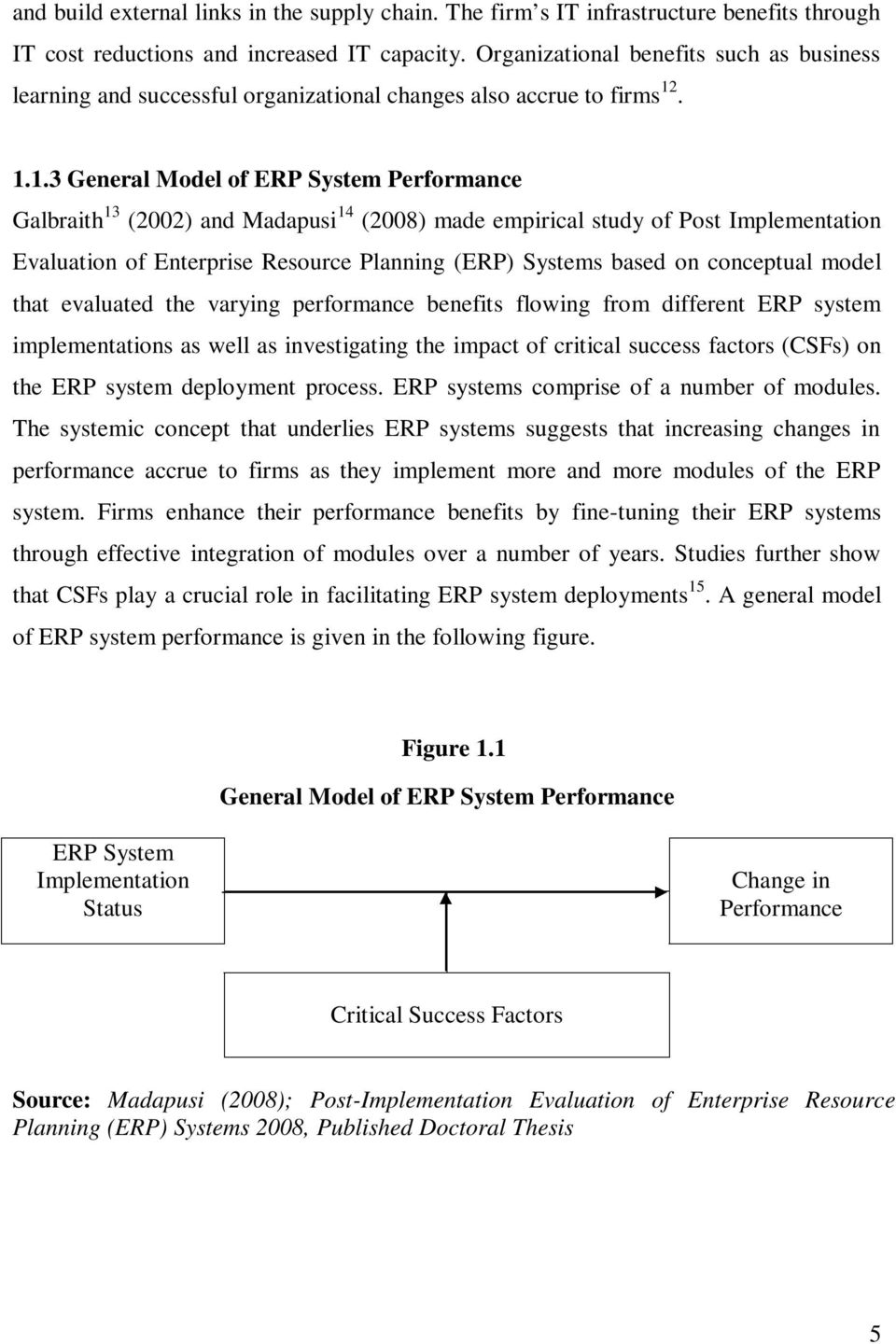
6 The model in the figure 1.1 relates the ERP system implementation status to changes in performance with the moderation of this relationship by CSFs. The theoretical underpinnings of this model are based on the use of Galbraith s information processing theory 16. Madapusi (2008) identified 14 ERP modules, 14 CSFs and 10 areas of performance on the basis of literature review. His study is based on 14 modules comprising the ERP system, affecting 10 measures of change with moderating effect of 14 critical success factors. 1.2 Brief outline of Review of Literature Over the past decade and a half, ERP has come to mean many things Information Systems (IS), Enterprise Resource Management (ERM), and Enterprise Systems (ES) to-many people academicians, practitioners, and vendors. The ambiguity surrounding the term ERP allowed the confusing proliferation of research in alternate fields of study 17. There are two broad streams of research that has emerged over the years ERP as IT system and ERP as a management system. The ERP as an IT system research stream focuses on implementation and maintenance issues. The challenges involved in getting the system up and running dominate this research area. The ERP as a management system research stream focuses on operational and usage issues. Recently, the strategic use of the ERP system and its impact on business performance also has become research area 18. The well publicized failures and delays associated with ERP deployments has directed most research efforts at systems issues such as configuration, design/redesign of business processes, maintenance, customization, and upgrades (in ERP as IT system). The bulk of research in this area is dominated by descriptive and case studies, with empirical and modeling studies gaining prominence in the past few years only. There is a paucity of research in the managerial use of ERP systems to improve business performance 19. 6

7 Relevant Research Studies Few researchers have discussed the impact and success of such systems (ERP) for adopting firms especially at post implementation stage. (E.g. Sedara et al. 2002, Gable et al. 2003, Sedara et al. 2004, Madapusi 2008 etc) 1.3 Need For Research Research Problem ERP system has become inevitable for organizations and its effective utilization is of utmost importance. There are very few studies (e.g. Sedara et al. 2002, Gable et al. 2003, Sedara et al. 2004, Madapusi 2008) which evaluate the varying performance benefits flowing from different ERP system implementations as well as investigating the impact of CSFs on the ERP system deployment process. Therefore need for research in the Indian context was felt in this area. Accordingly the present study is embodied as Study of Performance of Enterprise Resource Planning (ERP) System in Select Indian Manufacturing Firms Research Objectives Prior research on ERP system performance by Madapusi (2008) addressed following research questions for Indian firms: (1) What are the modules that comprise an ERP system? (2) What are the CSFs that impact ERP system implementations? (3) What are the changes in performance that result from ERP system implementations? (4) Does a relationship exist between the implementation status of the ERP system and changes in performance? (5) Does a holistic ERP system provide changes in performance? (6) Do CSFs influence the relationship between the implementation status of the ERP system and changes in performance? This study addresses the same questions for recent period. 7

8 1.3.3 Outline of Research Work Carried To seek answers to the above referred research questions the research work is divided into two phases. In the first phase of the research study detailed review of literature of ERP system has been carried out. It helped to identify the research gap for the study. Once this has been done the available ERP studies has been evaluated to identify ERP modules, critical success factors (CSFs) and change in performance to use in next phase of empirical study. In summary, the following three questions are addressed in the first phase of the research: 1. What are the modules that comprise an ERP system? 2. What are the CSFs that impact ERP system implementations? 3. What are the changes in performance that result from ERP system implementations? The second phase of the study consists of empirical study of ERP system performance in Select Indian manufacturing firms. The data were collected through structured questionnaire which was analysed and results are presented to test the hypotheses. The following research questions are addressed in the second phase of the research: 4. Does a relationship exist between the implementation status of the ERP system and changes in performance? 5. Does a holistic ERP system provide changes in performance? 6. Do CSFs influence the relationship between the implementation status of the ERP system and changes in performance? 1.4 Chapter Scheme The study is presented as per following chapter scheme: CHAPTER 1 Study of Performance of ERP system in Select Indian Manufacturing Firms: Introduction - This chapter gives an overall view of the purpose of the study. It tries to find the research gap stating the need of research. It further defines the research problem, derives research questions, and provides a foundation for the study. Chapter scheme designed for the study is presented. 8

9 CHAPTER 2 CHAPTER 3 CHAPTER 4 Overview of Enterprise Resource Planning (ERP) System: This chapter describes the need, evolution, meaning, definition, characteristics and benefits of ERP systems. It gives an overview of ERP system identifying the modules of ERP system, lists the measures of performance of ERP system implementation and states the importance of critical success factors. It further describes the phases of ERP system implementation. In the last part of the chapter evaluation of the ERP system performance is done, based on which the general model of ERP system performance is adopted. Study of Performance of ERP system in Select Indian Manufacturing Firms: Review of Literature - This chapter reviews literature pertinent to the identified research issues in this study. A synthesis of descriptive studies, case studies and survey studies identifies the modules that comprise the ERP system, the critical success factors (CSFs) associated with ERP system implementations, and measures of change in performance resulting from ERP system deployments. The findings from the review of literature are linked to the present study for conceptualizing the ERP system performance model which is traced by literature. Based on this, framing of the hypotheses is done in the last section of the chapter. Study of Performance of ERP system in Select Indian Manufacturing Firms: Research Methodology - This chapter reports the research problem, research objectives and methodology adopted in the present research study. It discusses the hypotheses framed for searching answers for the various research problems. Limitations of the study are mentioned in the last section of the chapter. 9

10 CHAPTER 5 CHAPTER 6 Study of Performance of ERP system in Select Indian Manufacturing Firms: Findings - This chapter discusses the demographic profile of the sample units. It further explains the frequency analysis of the modules that form the ERP system, the CSFs that moderate the performance of the ERP system and the measures of change in performance. The chapter further discusses the results of factor analysis, multiple regression analyses and univariate ANOVA applied for testing postulated hypotheses and searching answers for the relevant research questions. Study of Performance of ERP system in Select Indian Manufacturing Firms: Discussion, Analysis and Suggestions for further study - This chapter provides an overall summary of the findings of the study. It discussed and analyses the findings of the study. Further the implications and contribution of the study are discussed. The chapter also makes some suggestions for future study and discusses the limitations of this research study. 1.5 Chapter Concluding Notes This chapter explained the context of study of ERP system performance, research problem and objectives and outline of the thesis. The next chapter gives overview of ERP theory in the backdrop to help develop theoretical framework of the present study. 10

11 END NOTES 1 2 Madapusi (2008); Post-Implementation Evaluation of Enterprise Resource Planning (ERP) Systems 2008 Published Doctoral Thesis 3 Mabert, V.A., Soni, A., & Venkatramanan, M.A. (2003b). The Impact of Organization size in Enterprise Resource Planning (ERP) Implementations in the US Manufacturing Sector, Omega, 31(3), ERP Market Sizing Report , by AMR Research. Available on Downloaded on ERPwire.com ERP Fundamentals Available online at: articles/erp-fundamentals.html ERPwire.com ERP Fundamentals Available online at: articles/erp-fundamentals.html 7 Ibid 8 S. Sadagopan ERP : A Managerial Perspective 1 st Edn Tata McGraw-Hill Publishing Company Limited, New Delhi. 9 Rajani R L Going the ERP way: Important Issues, in S. Sadagopan (ed.) ERP : A Managerial Perspective 1 st Edn Tata McGraw-Hill Publishing Company Limited, New Delhi. 10 Ibid 11 Al-Mashari, M., Al-Mudimigh, A., & Zairi, M. (2003). Enterprise Resource Planning: A Taxonomy of Critical Factors. European Journal of Operational Research, 146(2), pp Madapusi (2008), op. cit., Pg Galbraith, J.R. (2000). Designing the Global Corporation. Jossey-Bass Inc.: San Francisco 14 Madapusi (2008); op. cit. 15 Ibid 16 Ibid 17 Rajani, op cit. 18 Madapusi (2008);op cit. 19 Ibid 11

POST-IMPLEMENTATION EVALUATION OF ENTERPRISE RESOURCE PLANNING (ERP) SYSTEMS. ArunKumar Madapusi, B.E., M.B.A. Dissertation Prepared for the Degree of
 POST-IMPLEMENTATION EVALUATION OF ENTERPRISE RESOURCE PLANNING (ERP) SYSTEMS ArunKumar Madapusi, B.E., M.B.A. Dissertation Prepared for the Degree of DOCTOR OF PHILOSOPHY UNIVERSITY OF NORTH TEXAS May
Agile Manufacturing for ALUMINIUM SMELTERS
 Agile Manufacturing for ALUMINIUM SMELTERS White Paper This White Paper describes how Advanced Information Management and Planning & Scheduling solutions for Aluminium Smelters can transform production
METHODOLOGY OF ERP SYSTEM IMPLEMENTATION A CASE STUDY OF PROJECT-DRIVEN ENTERPRISE Slawomir Klos 1, Irene Krebs 2
 International Conference 20th EURO Mini Conference Continuous Optimization and Knowledge-Based Technologies (EurOPT-2008) May 20 23, 2008, Neringa, LITHUANIA ISBN 978-9955-28-283-9 L. Sakalauskas, G.W.
Building Relationships by Leveraging your Supply Chain. An Oracle White Paper December 2001
 Building Relationships by Leveraging your Supply Chain An Oracle White Paper December 2001 Building Relationships by Leveraging your Supply Chain EXECUTIVE OVERVIEW This white paper illustrates why a fusion
Supply Chain Management Build Connections
 Build Connections Enabling a business in manufacturing Building High-Value Connections with Partners and Suppliers Build Connections Is your supply chain responsive, adaptive, agile, and efficient? How
Benefits of extend On-Demand (SaaS Model) for Equipment Dealers and Rental Firms
 extend On-Demand WHITEPAPER Benefits of extend On-Demand (SaaS Model) for Equipment Dealers and Rental Firms A Journey to Competitive Advantage and Business Excellence Abstract Competitive Advantage through
Evolution of Information System
 Information Systems Classification Evolution of Information System The first business application of computers (in the mid- 1950s) performed repetitive, high-volume, transaction-computing tasks. The computers
Sage 300 Distribution
 Sage 300 Distribution Win new markets, satisfy your customers, deliver high-quality products and services and steer your business in the right direction with Sage 300 Distribution! In this ever increasing
Speeding Time to Market, Increasing Time in Market & Maintaining Market Velocity
 Speeding Time to Market, Increasing Time in Market & Maintaining Market Velocity Best Practices in Driving Top-Line Growth Through Innovation & Collaboration Table of Contents 1 Introduction: The Need
CHAPTER 2 OVERVIEW OF ENTERPRISE RESOURCE PLANNING (ERP) SYSTEM
 CHAPTER 2 OVERVIEW OF ENTERPRISE RESOURCE PLANNING (ERP) SYSTEM 2.1 Introduction This chapter gives overview of Enterprise Resource Planning (ERP) system. Section 2.2 explains the need for ERP system by
To Build or Buy: Key Decision Points for Choosing the Best Billing Solution. Cloud Based Billing & Subscription Management Expert Series WHITEPAPER
 Cloud Based Billing & Subscription Management Expert Series To Build or Buy: Key Decision Points for Choosing the Best Billing Solution www.ariasystems.com Executive summary This white paper is intended
POINT OF VIEW. The Critical Role of Networking in Enterprise Resource Planning. Introduction
 The Critical Role of Networking in Enterprise Resource Planning Introduction Achieving and maintaining competitive advantage is the raison d etre for every business around the world. Doing so requires
Enterprise Resource Planning Analysis of Business Intelligence & Emergence of Mining Objects
 Enterprise Resource Planning Analysis of Business Intelligence & Emergence of Mining Objects Abstract: Build a model to investigate system and discovering relations that connect variables in a database
Increase Revenues with Channel Sales Management
 Increase Revenues with Channel Sales Management Executive Summary Why is it so difficult to grow revenue, identify emerging customers and partners, and expand into new markets through the indirect sales
The Change Management Handbook
 1 ebook The Change Management Handbook Getting Your Organization to Adapt to a New Technology By Christopher Smith, WalkMe 2 Table of Contents Introduction The Challenges of Software Changes in the Fast-Moving
Microsoft Dynamics Food and Beverage Distribution Telesales Guide
 Microsoft Dynamics Food and Beverage Distribution Telesales Guide This telesales guide provides an overview of the information you will need to drive demand for Microsoft Dynamics ERP or CRM solutions
perspective Progressive Organization
 perspective Progressive Organization Progressive organization Owing to rapid changes in today s digital world, the data landscape is constantly shifting and creating new complexities. Today, organizations
Transformation in Commercial Operations : Today s Life Sciences and Pharmaceutical Industry
 LIFE SCIENCES Transformation in Commercial Operations : Today s Life Sciences and Pharmaceutical Industry Balkrishan Kalra, Senior Vice President, Genpact Genpact commissioned a study through Pilgrim Partners
Analytics in the Finance Organization
 Analytics in the Finance Organization Kathleen Wilhide Industry Analyst - GRC & Performance Management, Better-Insight Background In an era of new economic challenges, how companies manage the quality
The expression better, faster, cheaper THE BUSINESS CASE FOR PROJECT PORTFOLIO MANAGEMENT
 Cloud Solutions for IT Management WHITE PAPER THE BUSINESS CASE FOR PROJECT PORTFOLIO MANAGEMENT How Progressive IT Organizations Are Using Hosted Solutions To Deliver On Time, On Budget, On Quota and
Transportation Solutions Built on Oracle Transportation Management. Enterprise Solutions
 Transportation Solutions Built on Oracle Transportation Management Enterprise Solutions Optimizing transportation operations and ensuring improved customer service Today s complex and challenging business
AN ALTERNATIVE MODEL OF ERP MAINTENANCE STRATEGY
 AN ALTERNATIVE MODEL OF ERP MAINTENANCE STRATEGY Muhammad Rofi IMTIHAN 1, Mohd. Salihin NGADIMAN, Habibollah HARON Department of Modelling and Industrial Computing Faculty of Computer Science and Information
The Travel and Expense Management Guide for 2014
 The Travel and Expense Management Guide for 2014 Trends for the Future March 2014 Louis Berard The Travel and Expense Management Guide for 2014: Trends for the Future In December 2013 and January 2014,
Enterprise Resource Planning: Literature Review
 Enterprise Resource Planning: Literature Review Galin Zhelyazkov (201084439) Design, Manufacture & Engineering Management; Strathclyde University Glasgow email: [email protected] Nowadays one
Training Construction Workers for Sustainable Environment
 International Journal of Environmental Research and Development. ISSN 2249-3131 Volume 4, Number 1 (2014), pp. 21-26 Research India Publications http://www.ripublication.com/ijerd.htm Training Construction
Business Process Management The Must Have Enterprise Solution for the New Century
 Business Process Management The Must Have Enterprise Solution for the New Century 15200 Weston Parkway, Suite 106 Cary, NC 27513 Phone: (919) 678-0900 Fax: (919) 678-0901 E-Mail: [email protected] WWW:
Center for Effective Organizations
 Center for Effective Organizations HR METRICS AND ANALYTICS USES AND IMPACTS CEO PUBLICATION G 04-8 (460) EDWARD E. LAWLER III ALEC LEVENSON JOHN BOUDREAU Center for Effective Organizations Marshall School
Accenture and Oracle: Leading the IoT Revolution
 Accenture and Oracle: Leading the IoT Revolution ACCENTURE AND ORACLE The Internet of Things (IoT) is rapidly moving from concept to reality, as companies see the value of connecting a range of sensors,
Productivity Gains for SMBs with OnCloud ERP PestBusters takes 1st mover advantage
 2012 Productivity Gains for SMBs with OnCloud ERP PestBusters takes 1st mover advantage GreeneStep OnCloud ERP enables SMBs to take advantage of an agile business automation and processes integration system
SALES AND OPERATIONS PLANNING BLUEPRINT BUSINESS VALUE GUIDE
 Business Value Guide SALES AND OPERATIONS PLANNING BLUEPRINT BUSINESS VALUE GUIDE INTRODUCTION What if it were possible to tightly link sales, marketing, supply chain, manufacturing and finance, so that
Integration of B2B E-commerce and ERP in Manufacturing Enterprise and. its Application. Cai Ting 1 ; Liu Lei 2
 3rd International Conference on Management, Education, Information and Control (MEICI 2015) Integration of B2B E-commerce and ERP in Manufacturing Enterprise and its Application Cai Ting 1 ; Liu Lei 2
7 ways to know you re choosing the right fashion ERP solution
 Fashion 7 ways to know you re choosing the right fashion ERP solution Growing pains. When kids have them, it s because they re about to move into a new stage of development. You see these kinds of growing
7 things to ask when upgrading your ERP solution
 Industrial Manufacturing 7 things to ask when upgrading your ERP solution The capabilities gap between older versions of ERP designs and current designs can create a problem that many organizations are
COM-18-5018 J. Woods, A. White, K. Peterson, M. Jimenez
 J. Woods, A. White, K. Peterson, M. Jimenez Research Note 28 October 2002 Commentary Demand Chain Management Synchronizes CRM and SCM Pursued separately, supply chain management and customer relationship
Implement Business Process Management to realize Cost Savings and High Return on Investments
 Implement Business Process Management to realize Cost Savings and High Return on Investments Business Process Management (BPM) was unheard of just a few years ago, but it has burst onto the global scene
A Foundation for Understanding Enterprise Resource Planning Systems
 A Foundation for Understanding Enterprise Resource Planning Systems Develop an understanding of how ERP systems can improve the effectiveness of information systems in organizations Understand the business
Creating a supply chain control tower in the high-tech industry
 Creating a supply chain control tower in the high-tech industry Creating a supply chain control tower in the high-tech industry A supply chain control tower gives high-tech leaders the ability to create
Turn Your Business Vision into Reality with Microsoft Dynamics NAV. icepts Technology Group, Inc. Dynamics NAV Gold ERP Partner www.icepts.
 Turn Your Business Vision into Reality with Microsoft Dynamics NAV icepts Technology Group, Inc. Dynamics NAV Gold ERP Partner www.icepts.com You have worked hard to build a vision for your business. With
The Real ROI from Cognos Business Intelligence
 RESEARCH NOTE C61 ROI ANALYSIS YOU CAN TRUST TM The Real ROI from Cognos Business Intelligence THE BOTTOM LINE Nucleus Research independently assessed the ROI from Cognos deployments and found that business
AC 2009-803: ENTERPRISE RESOURCE PLANNING: A STUDY OF USER SATISFACTION WITH REFERENCE TO THE CONSTRUCTION INDUSTRY
 AC 2009-803: ENTERPRISE RESOURCE PLANNING: A STUDY OF USER SATISFACTION WITH REFERENCE TO THE CONSTRUCTION INDUSTRY I. Choudhury, Texas A&M University American Society for Engineering Education, 2009 Page
How B2B Customer Self-Service Impacts the Customer and Your Bottom Line. zedsuite
 How B2B Customer Self-Service Impacts the Customer and Your Bottom Line Introduction For small to mid-sized businesses trying to grow and compete with their larger counterparts, having close relationships
4 Key Tools for Managing Shortened Customer Lead Times & Demand Volatility
 ebook 4 Key Tools for Managing Shortened Customer Lead Times & Demand Volatility 4 Key Tools for Managing Shortened Customer Lead Times & Demand Volatility S U P P L Y C H A I N Content Introduction Tool
Multi Channel Invoice Processing the way forward
 Multi Channel Invoice Processing the way forward eflow GUIDE: ONE PLATFORM. MULTIPLE SOLUTIONS Top Image Systems A Guide to: Multi Channel Invoice Processing Money makes the world go round, or so they
BUSINESS TO MANUFACTURING (B2M) COLLABORATION BETWEEN BUSINESS AND MANUFACTURING USING ISA-95 ABSTRACT
 BUSINESS TO MANUFACTURING (B2M) COLLABORATION BETWEEN BUSINESS AND MANUFACTURING USING ISA-95 Dennis Brandl [email protected] Sequencia Corporation ABSTRACT Integrating business and manufacturing
Customer-Focused Innovation in High Tech Industries. Benchmark best practices and performances for next-generation success
 Customer-Focused Innovation in High Tech Industries Benchmark best practices and performances for next-generation success Executive Summary are struggling today to stay competitive in a difficult economy,
The changing role of the IT department in a cloud-based world. Vodafone Power to you
 The changing role of the IT department in a cloud-based world Vodafone Power to you 02 Introduction With competitive pressures intensifying and the pace of innovation accelerating, recognising key trends,
The Talent on Demand Approach. Talent management is the process through which employers anticipate and meet
 The Talent on Demand Approach Talent management is the process through which employers anticipate and meet their needs for human capital. Getting the right people with the right skills into the right jobs
Case Study. We are growing quickly, and Saba is key to that successful growth.
 Case Study In the dynamic energy industry, Mansfield Oil one of Forbes 50 Largest Private Companies fuels its employee engagement and retention with a new talent management strategy powered by Saba Software.
Contents WHITE PAPER. Introduction
 Contents Introduction... 2 Focus Areas for Digital Transformation of Your Business Systems... 3 User Experience Transformation - Re-Design for modern user experience... 4 Cloud enablement Augment Digital
Executive Summary... 2. Understanding The Private Cloud Concept... 2. Conclusions And Best Practices... 7
 Executive Summary... 2 Understanding The Private Cloud Concept... 2 Conclusions And Best Practices... 7 Appendix A: Survey Methodology And Demographics... 9 Appendix B: Supplemental Material And Endnotes...
Enterprise Resource Planning Implementation in Indian SMEs: Issues and Challenges
 Enterprise Resource Planning Implementation in Indian SMEs: Issues and Challenges P. T. Kale 1 *, S. S. Banwait 2 and S. C. Laroiya 1 ABSTRACT To improve productivity and overall business performance,
A Work Breakdown Structure for Implementing and Costing an ERP Project
 94 Aisha Momoh, Decision Engineering Centre, Cranfield University, Bedford, UK,[email protected] Rajkumar Roy, Decision Engineering Centre, Cranfield University, Bedford, UK, [email protected]
Next Generation Electric Utilities Gear up Using Cloud Based Services
 A Point of View Next Generation Electric Utilities Gear up Using Cloud Based Services Abstract Globally, liberalization of the electricity sector has driven a paradigm shift in the ownership structure,
Cloud Computing: An enabler of IT in Indian Healthcare Sector. Media Briefing September 29, 2010
 Cloud Computing: An enabler of IT in Indian Healthcare Sector Media Briefing September 29, 2010 Executive Summary Indian healthcare spending is about 4.1 percent of its GDP. The Indian healthcare industry
E TE T R E PR P IS I E S E R ES E O S URCE E P L P A L NNIN I G
 االله الرحمن الرحيم بسم ENTERPRISE RESOURCE PLANNING SYSTEMS OVERVIEW Omer Omarabi January 2010 Agenda IT Planning & Challenges In Sudan What is an ERP System? Why You Need an ERP System? How to get your
Creating the Right Spend Management Toolkit to Survive the Current Economic Crisis. Doug MacCallum Director BMO Spend & Payments Solutions
 Creating the Right Spend Management Toolkit to Survive the Current Economic Crisis Doug MacCallum Director BMO Spend & Payments Solutions 1 Welcome to your world! Revenue is dropping. Executive pressure
Module 1: Supply Chain Design
 Module 1: Supply Chain Design Module 1 Introduction Section A: Develop the Supply Chain Strategy Chapter 1: Inputs to Supply Chain Strategy o Topic 1: Business Model o Topic 2: External Inputs to Supply
WHAT DO YOU MEAN END-TO-END FIELD SERVICE MANAGEMENT?
 WHAT DO YOU MEAN END-TO-END FIELD SERVICE MANAGEMENT? TABLE OF CONTENTS WHAT DOES IT MEAN?... 03 HOW DO WE DEFINE END-TO-END FSM?... 04 THE FIELD SERVICE MANAGEMENT DELIVERY PROCESS... 05 AUTOMATING &
Business Process Management for Insurance
 Insurance the way we see it Business Process Management for Insurance Maintain Market Share and Profitability With a Staged Approach to BPM Contents 1 Introduction 3 2 Business Process Management: Trends
Applied Business Intelligence. Iakovos Motakis, Ph.D. Director, DW & Decision Support Systems Intrasoft SA
 Applied Business Intelligence Iakovos Motakis, Ph.D. Director, DW & Decision Support Systems Intrasoft SA Agenda Business Drivers and Perspectives Technology & Analytical Applications Trends Challenges
PDM VS. PLM: IT ALL STARTS WITH PDM
 W H I T E P A P E R PDM VS. PLM: IT ALL STARTS WITH PDM Overview Product data management (PDM) or product lifecycle management (PLM) which system best fits the needs of your manufacturing organization?
Product Lifecycle Management for the Pharmaceutical Industry
 Product Lifecycle Management for the Pharmaceutical Industry An Oracle White Paper Author: Todd Hein, Oracle Life Sciences Key Contributors: i. Arvindh Balakrishnan, Oracle Life Sciences ii. Hardeep Gulati,
INVESTIGATION OF EFFECTIVE FACTORS IN USING MOBILE ADVERTISING IN ANDIMESHK. Abstract
 INVESTIGATION OF EFFECTIVE FACTORS IN USING MOBILE ADVERTISING IN ANDIMESHK Mohammad Ali Enayati Shiraz 1, Elham Ramezani 2 1-2 Department of Industrial Management, Islamic Azad University, Andimeshk Branch,
Impact of ERP Implementation on Supply Chain Management
 International Journal of Computer Applications in Engineering Sciences [VOL I, ISSUE IV, DECEMBER 2011] [ISSN: 2231-4946] Impact of ERP Implementation on Supply Chain Management Aditya Kashyap Ramco Systems
The 5 Questions You Need to Ask Before Selecting a Business Intelligence Vendor. www.halobi.com. Share With Us!
 The 5 Questions You Need to Ask Before Selecting a Business Intelligence Vendor www.halobi.com Share With Us! Overview Over the last decade, Business Intelligence (BI) has been at or near the top of the
Retail Analytics The perfect business enhancement. Gain profit, control margin abrasion & grow customer loyalty
 Retail Analytics The perfect business enhancement Gain profit, control margin abrasion & grow customer loyalty Retail Analytics are an absolute necessity for modern retailers, it empowers decision makers
Financial Management Software as a Service
 White Paper Financial Management Software as a Service Overview 3 Financial Management Software as a Service 5 What to Look for? 7 Conclusions and Summary 9 About Efima 10 Overview Technology continues
Digital Business Services Topic Area Theaters May 17-19, 2016 Orlando, FL
 Digital Topic Area Theaters May 17-19, 2016 Orlando, FL Session ID Title Abstract Time and Location DB34027 Exploit Business Benefit Cases to Accelerate and Improve Processes DB34011* DB34008 DB34051*
SEVEN WAYS THAT BUSINESS PROCESS MANAGEMENT CAN IMPROVE YOUR ERP IMPLEMENTATION SPECIAL REPORT SERIES ERP IN 2014 AND BEYOND
 SEVEN WAYS THAT BUSINESS PROCESS MANAGEMENT CAN IMPROVE YOUR ERP IMPLEMENTATION SPECIAL REPORT SERIES ERP IN 2014 AND BEYOND CONTENTS INTRODUCTION 3 EFFECTIVELY MANAGE THE SCOPE OF YOUR IMPLEMENTATION
DERIVATIVES IN INDIAN STOCK MARKET
 DERIVATIVES IN INDIAN STOCK MARKET Dr. Rashmi Rathi Assistant Professor Onkarmal Somani College of Commerce, Jodhpur ABSTRACT The past decade has witnessed multiple growths in the volume of international
PH.D THESIS ON A STUDY ON THE STRATEGIC ROLE OF HR IN IT INDUSTRY WITH SPECIAL REFERENCE TO SELECT IT / ITES ORGANIZATIONS IN PUNE CITY
 ABSTRACT OF PH.D THESIS ON A STUDY ON THE STRATEGIC ROLE OF HR IN IT INDUSTRY WITH SPECIAL REFERENCE TO SELECT IT / ITES ORGANIZATIONS IN PUNE CITY SUBMITTED TO THE UNIVERSITY OF PUNE FOR THE AWARD OF
Four trends in financial consolidation for global enterprises
 2016 Four trends in financial consolidation for global enterprises Issues with spreadsheets Prone to hidden errors that could lead to damaging restatements Lack an audit trail, making them increasingly
Simplify Software as a Service (SaaS) Integration
 Simplify Software as a Service (SaaS) Integration By Simon Peel December 2008 Introduction Fuelled by a fiercely competitive business environment that requires the pace of business and technology to accelerate,
The Impact of Human Resource Information Systems: An Exploratory Study in the Public Sector
 The Impact of Human Resource Information Systems: An Exploratory Study in the Public Sector Nicholas Aston Beadles II Georgia College and State University, Milledgeville, GA 31061 Phone: 478-445-2575,
International Management Journals
 International Management Journals www.managementjournals.com International Journal of Applied Strategic Management Volume 2 Issue 2 Special Edition Driving Strategy with Quality: A Useful Insight Strategic
PRINCIPLES OF MANAGEMENT
 MODULE - 1 Principles of Management 4 PRINCIPLES OF MANAGEMENT 4.0 INTRODUCTION In earlier chapters you have studied how the insurance sector is developing in Indian economy and in the present scenario
A Winning Supply Chain Vision. Razat Gaurav Senior Vice President, International
 A Winning Supply Chain Vision Razat Gaurav Senior Vice President, International Global Trends Variability, Uncertainty, Complexity, Ambiguity Emerging Markets Growing at 2 4X Volatility in commodity prices
The Case for Business Process Management
 Jeremy Westerman, Senior Product Marketing Manager for BPM Business process management (BPM) has dramatic business and technology effects. It provides organizations with the ability to save money, save
Enterprise resource planning
 Enterprise resource planning Air Force Journal of Logistics, Summer, 2007 by Glenn Dredden, Jeffrey C. Bergdolt Enterprise resource planning (ERP) systems are information systems that integrate processes
T r a n s f o r m i ng Manufacturing w ith the I n t e r n e t o f Things
 M A R K E T S P O T L I G H T T r a n s f o r m i ng Manufacturing w ith the I n t e r n e t o f Things May 2015 Adapted from Perspective: The Internet of Things Gains Momentum in Manufacturing in 2015,
How to Build a Service Management Hub for Digital Service Innovation
 solution white paper How to Build a Service Management Hub for Digital Service Innovation Empower IT and business agility by taking ITSM to the cloud Table of Contents 1 EXECUTIVE SUMMARY The Mission:
Improving production and operation systems with RFID. Taking manufacturing to the next level: RFID Work-in-Process solutions from IBM
 Improving production and operation systems with RFID Taking manufacturing to the next level: RFID Work-in-Process solutions from IBM RFID: A proven technology changing the factory floor Today the most
A Guide for a Successful ERP Strategy in the Midmarket: Selection, Services, and Integration
 May 2012 A Guide for a Successful ERP Strategy in the Midmarket: Selection, Services, and Integration Enterprise Resource Planning (ERP) has been defined as an operational and transactional system of record.
UNDERSTAND YOUR CLIENTS BETTER WITH DATA How Data-Driven Decision Making Improves the Way Advisors Do Business
 UNDERSTAND YOUR CLIENTS BETTER WITH DATA How Data-Driven Decision Making Improves the Way Advisors Do Business Executive Summary Financial advisors have long been charged with knowing the investors they
Welcome to today s training on how to Effectively Sell SAP ERP! In this training, you will learn how SAP ERP addresses market trends and
 Welcome to today s training on how to Effectively Sell SAP ERP! In this training, you will learn how SAP ERP addresses market trends and organizations business needs. 1 After completing this lesson, you
CHAPTER III RESEARCH METHODOLOGY. between market leaders and followers, successful companies and sick industries, is the way in
 CHAPTER III RESEARCH METHODOLOGY 3.1 Statement of the Problem To survive, thrive and beat the competition in today s brutally competitive world one has to manage the future. Managing the future means managing