
CHAPTER 53A HOSPICE SERVICES
|
|
|
- Ilene Goodwin
- 9 years ago
- Views:
Transcription
1 CHAPTER 53A HOSPICE SERVICES 1

2 TABLE OF CONTENTS SUBCHAPTER 1. GENERAL PROVISIONS 10:53A-1.1 Introduction 10:53A-1.2 Definitions SUBCHAPTER 2. PROVIDER REQUIREMENTS 10:53A-2.1 Hospice enrollment requirements and billing processes 10:53A-2.2 Changing from one hospice to another 10:53A-2.3 Physician certification and recertification 10:53A-2.4 Standards for staffing 10:53A-2.5 Administrative policy for admission and discharge from room and board services in a nursing facility 10:53A-2.6 Recordkeeping 10:53A-2.7 Monitoring 10:53A-2.8 Provision for provider fair hearings 10:53A-2.9 Advance directives SUBCHAPTER 3. RECIPIENT REQUIREMENTS 10:53A-3.1 Eligibility for covered hospice services 10:53A-3.2 Application procedure for medical and financial eligibility for hospice services 10:53A-3.3 Benefit periods 10:53A-3.4 Covered hospice services 10:53A-3.5 Services unrelated to the terminal illness 10:53A-3.6 Plan of care 10:53A-3.7 Provision for recipient fair hearings SUBCHAPTER 4. BASIS OF PAYMENT 10:53A-4.1 Post-eligibility treatment of income 2

3 SUBCHAPTER 1. GENERAL PROVISIONS 10:53A-1.1 Introduction (a) Reimbursement for hospice services provided by Medicaid was authorized pursuant to 1905(o) of the Social Security Act, codified as 42 U.S.C. 1396d(o). N.J.S.A. 30:4D-6b(20) authorizes the New Jersey to develop a program of hospice services. This chapter,, Hospice Services, sets forth the rules for the provision of hospice services to the terminally ill who are eligible for Medicaid/NJ FamilyCare fee-for-service (FFS) program. Room and board services are also available for those Medicaid/NJ FamilyCare FFS beneficiaries residing in a nursing facility who are also eligible for hospice services. The Home Care Services Manual (N.J.A.C. 10:60), is applicable to hospice care as a waiver service provided under the AIDS Community Care Alternatives Program (ACCAP). (b) This chapter provides the rules for hospice services for Medicaid/NJ FamilyCare FFS beneficiaries who are not enrolled in, and receiving services through, a health maintenance organization (HMO). Hospice services provided to a beneficiary who is enrolled with an HMO are governed by the policies of the HMO and are not within the purview of these rules. 10:53A-1.2 Definitions The following words and terms, as used in this chapter, shall have the following meanings, unless the context clearly indicates otherwise. "Benefit period" means a period of time when an individual is eligible to receive hospice services. Hospice benefit periods are for the following periods of time: 90 days; 90 days and an unlimited number of subsequent 60-day periods. "CAP" means a limitation on the payment amount or aggregate days of inpatient care as imposed by Medicaid/NJ FamilyCare FFS program on the hospice provider. The "CAP" year begins on November 1st of one year and ends on October 31st of the next year. "Comprehensive hospice benefits" means the covered services provided by hospices and physicians for hospice care, room and board services provided to Medicare/Medicaid/NJ FamilyCare FFS beneficiaries residing in a nursing facility, and services unrelated to the terminal illness that may be provided by Medicaid/NJ FamilyCare FFS as part of the hospice plan of care. The comprehensive hospice benefit does not include hospice services under ACCAP or any other waiver program. "Dietician" or "dietary consultant" means a person who: 1. Is registered or eligible for registration by the Commission on Dietetic Registration of the American Dietetic Association; or 2. Has a bachelor's degree from a college or university with a major in foods, nutrition, food service or institution management, or the equivalent course work for a major in the subject 3

4 area; and has completed a dietetic internship accredited by the American Dietetic Association or a dietetic traineeship approved by the American Dietetic Association or has one year of full-time, or full-time equivalent, experience in nutrition and/or food service management in a health care setting; or 3. Has a master's degree plus six months of full-time, or full-time equivalent, experience in nutrition and/or food service management in a health care setting. "Division" means the within the New Jersey Department of Human Services. "Election of Hospice Benefits Statement" means a written document signed by a Medicaid/NJ FamilyCare FFS eligible individual for hospice services, indicating the following: the identification of the particular hospice that will provide care to the individual; the scope of services and conditions under which hospice services are provided; which other Medicaid/NJ FamilyCare FFS services are forfeited when choosing hospice services; the individual or his or her representative's acknowledgment that he or she has been given a full understanding of hospice care; and the effective date of the signing of the Election of Hospice Benefits Statement (FD-378) (incorporated herein by reference as Form #1 in the Appendix). "Hospice," for the purposes of the New Jersey Medicaid/NJ FamilyCare FFS program (hereafter referred to as the Program), means a public agency or private organization (or subdivision of such organization) which is licensed by the Department of Health and Senior Services as a provider of hospice services consistent with P.L. 1997, c.78; is Medicarecertified for hospice care; and has a valid provider agreement with the Division to provide hospice services. A hospice is primarily engaged in providing supportive or palliative care and services, as well as any other item or service, as specified in the beneficiary's plan of care, which is reimbursed by the Medicaid/NJ FamilyCare FFS program. Hospice providers in New Jersey may be hospital-based or home health agencies, or hospice agencies. "Hospice indicator" means a unique date specific identifier in the Medicaid/NJ FamilyCare FFS eligibility record which is used in the processing of hospice claims for eligible beneficiaries. "Hospice services," for the purposes of the Program, means services which support a philosophy and method for caring for the terminally ill emphasizing supportive and palliative rather than curative care, and includes services, such as home care, bereavement counseling, and pain control. "Interdisciplinary group" means a group of professionals who are employed by or under contract with the hospice, that provide and/or supervise hospice services. The interdisciplinary group, at a minimum, must be composed of a physician, a registered professional nurse, a medical social worker and a pastoral or other counselor. 4

5 "Medical Director" means a physician (M.D. or D.O.) who assumes overall responsibility for the medical component of the hospice services and who is employed by or under contract with the hospice. "Medicare-certified hospice program" means a public/private organization which provides hospice care, as described in 42 U.S.C. 1395x(dd), in individual homes, on an outpatient basis and on a short-term inpatient basis. "Room and board services," as referred to in this chapter, means the performance of personal care services, assistance in activities of daily living, provision of patient social activities, the administration of medications, the maintenance of the cleanliness of a resident's room, and supervision and assistance in the use of durable equipment and prescribed therapies provided to hospice beneficiaries in a nursing facility (identical to those provided to non-hospice beneficiaries in a nursing facility). "Terminal illness," as referred to in this chapter, means having a medical prognosis of a life expectancy of six months or less as certified or recertified, in writing, by a licensed physician (M.D. or D.O.). "Unrelated services" means services provided that are necessary for the diagnosis and treatment of diseases or illnesses that are not in and of themselves related to or are not caused primarily by the terminal condition for which hospice services are provided. 10:53A-1.3 Contracting with physicians Effective August 5, 1997, hospice providers are no longer required to routinely provide all physician services directly. Medical directors and physician members of the interdisciplinary group (IDG) are no longer required to be employed by the hospice. These physicians can now be under contract with the hospice. END OF SUBCHAPTER 1 5

6 SUBCHAPTER 2. PROVIDER REQUIREMENTS 10:53A-2.1 Hospice enrollment requirements and billing processes (a) To be approved by the Division as a hospice provider, a hospice must: 1. Be licensed by the Department of Health and Senior Services as a provider of hospice services in accordance with N.J.A.C. 8:42C. A copy of the license must be submitted to the ; 2. Be enrolled as a Medicare (Title XVIII) hospice provider. A copy of the Medicare provider enrollment agreement must be submitted to the Division of Medical Assistance and Health Services; i. As stated in the Social Security Act, Section 1861(d)(d)(2)(A)(ii) (42 U.S.C. 1395x(dd)) on Medicare certification, the term "hospice program" means a public or private organization which provides for such care in individuals' homes, on an outpatient basis, and on a short-term inpatient basis. Thus, a Medicare certified hospice shall not limit or market hospice services exclusively to a long term care facility population; and 3. Complete and submit the Medicaid "Provider Application" (FD-20); "Ownership and Controlling Interest Statement" (HCFA-1513); and the "Medicaid Provider Agreement" (FD- 62). i. Documents specific to provider enrollment, referenced in (a)3 above, are located as Forms #8, #9, and #10 in the Appendix of the Administration chapter (N.J.A.C. 10:49--- Appendix), and may be obtained from and submitted to: Unisys Corporation Provider Enrollment PO Box 4804 Trenton, New Jersey ii. Hospice provider agreements are approved by the: Unisys Corporation Provider Enrollment PO Box 4804 Trenton, New Jersey iii. A change in the ownership of a hospice is not considered a change in the individual's designation of a hospice and requires no action on the Medicaid/NJ FamilyCare FFS hospice beneficiary's part. The hospice shall notify the Division in writing of a change in ownership and shall submit a new application package. (b) If the hospice is providing hospice services to a Medicaid/NJ FamilyCare FFS beneficiary residing in a nursing facility (NF), the nursing facility must be a Medicaid/NJ FamilyCare FFS - approved nursing facility. The hospice must also have a written contract with the nursing facility under which the hospice takes full responsibility for the professional management of the individual's hospice services and the nursing facility agrees to provide 6

7 room and board services to the individual. 1. Room and board services include the performance of personal care services, assistance in activities of daily living, provision of patient social activities, the administration of medications, the maintenance of the cleanliness of a resident's room, and supervision and assistance in the use of durable equipment and prescribed therapies provided to hospice beneficiaries in an NF (identical to those provided to non-hospice beneficiaries in an NF). (c) If the hospice is already a Medicaid ACCAP hospice provider, in lieu of the process listed in (a) above, the hospice shall send a letter citing its ACCAP provider status to the Provider Enrollment Unit of the Division whose address is listed in (a)2ii above, requesting approval as a hospice provider of room and board services and/or as a provider of the comprehensive hospice benefit. (d) Upon approval as a hospice provider, the hospice shall be assigned a provider number. In the event the hospice provider is also an ACCAP hospice provider, the hospice provider number will be the same for both programs. (e) For the purposes of reimbursement, if a physician provides direct patient care services to a hospice beneficiary he or she must be an approved Medicaid/NJ FamilyCare FFS physician provider (see Physician Services chapter, N.J.A.C. 10:54). (f) The fiscal agent shall furnish a provider manual to the hospice enrolled as a Medicaid/NJ FamilyCare FFS provider. 10:53A-2.2 Changing from one hospice to another (a) In order for a hospice beneficiary to change hospices, the hospice policies and procedures listed below shall be followed: 1. An individual may change hospices once in each benefit period. The change of the hospice is not considered a revocation of the election of hospice services. 2. In order to change the designation of the hospice, an individual shall file a signed statement, the Change of Hospice, FD-384 form incorporated herein by reference as Form # 7 in the Appendix, with the hospice where the individual was initially enrolled and also with the newly designated hospice. The statement shall include the following information: i. The name of the hospice from which the individual received hospice services; and ii. The name of the hospice from which the individual will receive hospice services and the date the change is effective. 3. The original hospice of enrollment and the new hospice must send the Hospice Eligibility Form, FD-383 (6/92) to the Medical Assistance Customer Center (MACC), County Board of Social Services (CBOSS) or Division of Youth and Family Services (DYFS), as applicable, in order to change providers. (See Form #6, the Hospice Eligibility Form, FD-383 (5/01), in the Appendix in this chapter, incorporated herein by reference and -3.2 for the policy for medical and financial eligibility for Medicaid/NJ FamilyCare FFS. 10:53A-2.3 Physician certification and recertification 7

8 (a) The hospice shall follow these policies and procedures to obtain physician certification of the applicant's terminal illness and to certify that hospice services are reasonable and necessary for the palliation and management of the terminal illness or related conditions. 1. The attending physician, who must be a doctor of medicine (M.D.) or osteopathy (D.O.), is the one identified by the Medicaid/NJ FamilyCare FFS beneficiary at the time the beneficiary elects to receive hospice services as the primary physician in the determination and the delivery of the beneficiary's medical care. 2. The written Physician Certification/Recertification for Hospice Benefits Form, FD-385 (Form # 8 in the Appendix incorporated herein by reference) shall be obtained within two calendar days after hospice care is initiated for the first period of hospice coverage. i. If the hospice does not obtain written certification within two days after the initiation of hospice care, a verbal certification may be obtained within these two days and a written certification no later than eight calendar days after care is initiated. If these requirements are not met, no payment can be made for any days prior to the certification. ii. The signing of the written form shall be done by the hospice Medical Director, or physician of the interdisciplinary team and the attending physician (if the applicant has an attending physician), and shall include the statement that the applicant's medical prognosis is such that the life expectancy is six months or less. 3. If the hospice beneficiary revokes the hospice benefit package and then reenters the hospice in any subsequent period, the hospice shall obtain, no later than seven calendar days after the beginning of that period, a written Physician Certification/Recertification for Hospice Benefits Form, FD-385 prepared by the Medical Director of the hospice or the physician member of the hospice's interdisciplinary group. 4. For subsequent recertifications, a written recertification must be obtained no later than two business days after the period begins (after the first 90-day benefit period, after the next 90-day benefit period, and after each subsequent 60-day period). The Medical Director of the hospice or physician member of the interdisciplinary team shall recertify that the individual is terminally ill and that hospice services are reasonable and necessary for the palliation and management of the terminal illness or related condition, and, in addition, recertify the necessity of the continuing need for hospice services. 5. In addition, the individual's attending physician is required to recertify the terminal illness for each subsequent 60-day benefit period, as described below: i. An additional Physician Certification/Recertification for Hospice Benefits Form, FD-385 must be obtained prior to each subsequent 60-day period but no later than two days after the period begins. 6. The hospice must retain the Physician Certification/Recertification for Hospice Benefits Form(s), FD-385 on file for review by the Division in the beneficiary's medical record. 10:53A-2.4 Standards for staffing (a) The Medical Director of the hospice shall assume overall responsibility for the medical component of the hospice services. (b) The hospice shall designate an interdisciplinary group or groups composed of, at a 8

9 minimum, the following individuals who are employed by or under contract with the hospice and who provide and/or supervise the services offered by the hospice: 1. A physician (doctor of medicine or osteopathy); 2. A registered professional nurse; 3. A medical social worker (see -3.4 for qualifications); and 4. A pastoral or other counselor. (c) The interdisciplinary group shall be responsible for the following: 1. Participation in the establishment of the plan of care; 2. Provision or supervision of hospice services in coordination with the beneficiary's attending physician; 3. Periodic review and updating of the plan of care for each beneficiary receiving hospice services with the attending physician; 4. Establishment of policies governing the day-to-day provision of hospice services; and 5. In-service education for volunteer staff before he or she begins providing care for a hospice beneficiary. (d) A hospice beneficiary, family members, and/or significant others shall participate in the formulation of the final plan of care. (e) The hospice has more than one interdisciplinary group, it shall designate, in advance, the group it chooses to execute the functions described above. (f) The Medical Director or Director of Nursing of the hospice shall designate a registered professional nurse to coordinate the implementation of the plan of care for each beneficiary. (g) Volunteer assistance is an integral part of hospice services. The hospice shall document and maintain a volunteer staff sufficient to provide administrative and patient care in an amount that, at a minimum, equals five percent of the total compensated patient care hours provided by all paid hospice employees and contracted staff regardless of the payment source. 10:53A-2.5 Administrative policy for admission and discharge from room and board services in a nursing facility (a) If a beneficiary of hospice services is admitted to a nursing facility (NF) from any location, or is changed from nursing facility status to hospice status (while residing in a nursing facility), or is discharged from the hospice or dies, the NF shall submit to the CBOSS and the DHSS field office, a completed Notification from Long-Term Care Facility of Admission or Termination of a Medicaid Patient (MCNH-33) (Form #9 in the Appendix, incorporated herein by reference) to prompt a change in the beneficiary's status. For SSI beneficiaries, the hospice shall be responsible for notifying the MACC of the beneficiary's death or discharge from the NF by completing FD-383 (5/01) (Appendix Form #6). The MACC will be responsible for notifying the Social Security Administration of the beneficiary's change in status. 9

10 (b) If the beneficiary residing in an NF chooses hospice benefits, the NF shall submit to the fiscal agent, a completed Long Term Care Turnaround Document (TAD) (MCNH-117) (Form #11 in the Appendix herein incorporated by reference) to remove the patient from the Long Term Care Facility billing system. The following information shall be placed on the MCNH- 117 in the REMARKS column (Field #38 on the bottom): "DISCHARGED FROM NURSING FACILITY TO HOSPICE" 1. The hospice beneficiary is removed from the Long Term Care Facility billing system effective on the date the Election of Hospice Benefits Statement, FD- 378 (Appendix Form #1) is signed. On that date and thereafter, the Medicaid/NJ FamilyCare fiscal agent will directly reimburse the hospice for services rendered to the hospice beneficiary and the NF will no longer be reimbursed for care beginning this date. The hospice shall be responsible for reimbursing the NF for room and board services provided under contract with the hospice. 2. If the beneficiary revokes hospice and returns to NF care, the NF shall complete and submit the Long Term Care Turnaround Document (TAD)(MCNH-117) form to the fiscal agent. The following information shall be placed on the MCNH-117 in the REMARKS column (Field #38 on the bottom): "ADMITTED TO NURSING FACILITY AND DISCHARGED FROM HOSPICE" 3. The effective date of the change from hospice care to NF care is the date the Revocation of Hospice Benefits, FD-381 (Form #4 in the Appendix incorporated herein by reference) is signed. The NF will be reimbursed for care provided on this date and thereafter, and the hospice will no longer be reimbursed for care beginning on this date. 10:53A-2.6 Recordkeeping (a) The medical record of the hospice beneficiary maintained by the hospice shall be complete and accurate and reflect the services provided. The medical record shall include, at a minimum, the following information: 1. Identification information; 2. Certification/recertification documents; 3. Informed consent documents; 4. Election forms; 5. Hospice eligibility forms; 6. Pertinent medical history and physical examination data; 7. Test results; 8. Initial and subsequent assessments; 9. Plan of care and updates; and 10. Complete documentation of all services and events (including evaluations, treatments, and progress notes). 10

11 (b) All medical records shall be signed and dated by the professional staff person providing the service. (c) The medical record shall be maintained and made available, as necessary, to the or its agent for audit and review purposes in accordance with State law (see N.J.S.A. 30:4D- 12 and (N.J.A.C. 10: ). 10:53A-2.7 Monitoring (a) On a random selection basis, the Division shall conduct post-payment quality assurance reviews based on Surveillance and Utilization Review System (SURS) reports and other sources to assure compliance with program, personnel, recordkeeping and service delivery requirements. Provisions shall be made to recover funds, when reviews by the Division reveal that overpayments to the hospice have been made. At the specific request of the Division, the hospice shall submit a plan of care and other documentation for those Medicaid/NJ FamilyCare FFS beneficiaries selected for a quality assurance review. 1. The review shall involve contact with the hospice and the beneficiary and will focus on the following areas: i. Number of beneficiaries; ii. Cost per beneficiary, including the "cap" requirements; iii. Number of days of service per beneficiary and the quality of services; iv. Comparative analysis between claim payments and the plan of care: and v. Completion of forms necessary for eligibility for hospice services. (b) On-site monitoring visits shall be made by the Division staff for the purpose of determining compliance with the provisions of the Medicaid/NJ FamilyCare FFS hospice rules and for quality assurance purposes. The results of the on-site monitoring shall be reported to the hospice with a copy for the Division. When indicated, a plan of correction will be required. Continued non-compliance with requirements may result in such sanctions as: the curtailment of accepting new beneficiaries for services; termination of the hospice's provider contract; and/or the suspension, debarment or disqualification of the hospice or hospice-related parties from participation in the Medicaid/NJ FamilyCare FFS program. 10:53A-2.8 Provision for provider fair hearings Pursuant to the N.J.A.C. 10:49-10, Notices, Appeals and Fair Hearings, providers with the New Jersey Medicaid/NJ FamilyCare FFS program have the right to file for fair hearings. 10:53A-2.9 Advance directives All hospices participating in the New Jersey Medicaid/NJ FamilyCare FFS program are subject to the provisions of State and Federal statutes regarding advance directives, including, but not limited to, appropriate notification to patients of their rights, development of policies and practices, and communication to and education of staff, community and interested parties. Detailed information may be located at N.J.A.C. 10: , and sections 1902(a)(58), and 1902(w)(1) of the Social Security Act (42 U.S.C. 1396a(a)(58) and 11

12 1396a(w)). END OF SUBCHAPTER 2 12

13 SUBCHAPTER 3 BENEFICIARY REQUIREMENTS 10:53A-3.1 Eligibility for covered hospice services (a) For the purposes of this subchapter only, the term "applicant" refers to an individual applying for hospice eligibility who may or may not be Medicaid/NJ FamilyCare FFS eligible at the time of application. (b) In order to receive hospice services, an applicant must be eligible for Medicaid/NJ FamilyCare FFS either in the community or in an institution. Additionally, an applicant is eligible for hospice services in the community if he or she would be eligible for Medicaid if he or she were institutionalized. Eligibility rules are found at N.J.A.C. 10:71, 10:72, and 10:78, incorporated herein by reference. Applicants eligible only for the Medically Needy component of the New Jersey Medicaid program are not eligible for hospice services under the Medicaid State Plan benefit. 1. The transfer of resource provisions of N.J.A.C. 10: apply to applicants seeking hospice services while residing in a nursing facility as well as to applicants seeking eligibility for hospice services in the community but whose income disqualifies them from New Jersey Care... Special Medicaid Programs. 2. Applicants not already eligible for Medicaid/NJ FamilyCare FFS but who express interest in hospice services should be referred to the county board of social services for a determination of eligibility. Applicants already residing in a nursing facility should be referred to the county board of social services in which the facility is located. Applicants in the community or waiting for placement in a nursing home should be referred to the county board of social services in their county of residence. 3. The providers of hospice services to Medicaid/NJ FamilyCare beneficiaries enrolled in a managed care organization or HMO shall comply with the procedures of that managed care organization or HMO, including, but not limited to, any prior authorization or other utilization control procedure required. (c) In addition to financial eligibility, the individual applying for Medicaid/NJ FamilyCare FFS hospice eligibility shall meet the following conditions: 1. He or she shall voluntarily elect the hospice services (see -3.2); 2. If eligible for Medicare, he or she shall elect his or her Medicare Part A benefits for hospice care. For dually eligible Medicare and Medicaid hospice beneficiaries, the hospice benefits election applies simultaneously under both the Medicare and Medicaid programs. Thus, Medicare is responsible for the payment of claims for services provided, as first payer of the hospice benefit. Medicaid is responsible for payment for services not covered under the Medicare hospice benefit when those services are Medicaid covered services, such as any co-payment, co-insurance deductibles, if applicable, and those Medicaid covered services listed in -3.4(g). 3. He or she shall be certified or recertified as terminally ill by the attending physician (see -2.3) and be certified by the attending physician that hospice services are reasonable and necessary for the palliation or management of the terminal illness or related 13

14 conditions by the completion of the Physician Certification/Recertification for Hospice Benefits Form FD-385 (6/92). A copy of this form shall be part of the medical record at the hospice agency; 4. He or she shall have a plan of care for hospice services established prior to and consistent with the provision of hospice services. (For information on the plan of care, see -3.6); and 5. He or she shall waive all rights to the following: i. Those hospice services provided by a hospice other than the one designated by the beneficiary (unless provided under written arrangements made by the designated hospice); and ii. Any Medicaid/NJ FamilyCare FFS services that are related to the treatment of the terminal condition for which hospice services were elected, or for a related condition, or for services equivalent to hospice care, except for the following services: (1) Those provided (either directly or under arrangement) by the designated hospice; and (2) Those provided by the beneficiary's physician or consulting physician in treatment of the terminal condition, if that physician is not an employee of the designated hospice receiving compensation from the hospice for those services. (d) Applicants in eligibility categories listed in N.J.A.C. 10:71 and 10:72, incorporated herein by reference, may be eligible for hospice if the applicant meets the criteria listed in (b) and (c) above. 10:53A-3.2 Application procedure for medical and financial eligibility for hospice services (a) The application procedure for completion of the medical criteria for receiving hospice services is as follows: 1. Individuals requesting or initiating hospice eligibility should be referred to a Medicaid approved hospice to complete the hospice medical eligibility requirements for hospice services through the completion of the Physician Certification/Recertification for Hospice Benefits Form, FD-385 and the Election of Hospice Benefits Statement, FD-378. The hospice agency shall be responsible for confirming Medicaid/NJ FamilyCare FFS eligibility and monitoring on-going eligibility including transition into managed care organizations. 2. The hospice shall notify the agency (that is, the county board of social services (CBOSS), the Division of Youth and Family Services (DYFS), or the Medical Assistance Customer Center (MACC) (for SSI beneficiaries), as applicable), that is responsible for maintaining the hospice "indicator" (Special Program Number 15) of the completion of the medical eligibility requirements in (a)1 above. The notification shall be done through the use of the Hospice Eligibility Form, FD-383 (5/01). The form shall also be sent to the address listed below to indicate to the Division the completion of, and/or change in, the medical eligibility: Hospice Program PO Box 712, Mail Code #35 14

15 Trenton, New Jersey i. The date of the signing of the Election of Hospice Benefits Statement, FD-378 determines the date of eligibility for hospice services if the applicant is eligible for Medicaid/NJ FamilyCare FFS. 3. For those cases in which the disability determination for Medicaid eligibility is within the jurisdiction of the Disability Review Section, Division of Medical Assistance and Health Services, the determination of disability for the first six months of hospice services will be based solely on the physician's certification of terminal illness. (See also N.J.A.C. 10: through 3.13). i. To ensure the continuity of hospice services after six months, the agency responsible for the eligibility determination (that is, the county board of social services (CBOSS')), shall inform the Disability Review Section of the beneficiary's eligibility for hospice services based upon the physician's certification of terminal illness and the determination of financial eligibility. ii. After the initial six-month period, if it appears that such a beneficiary will require and elects to continue to receive hospice services, the Disability Review Section of the Division shall require medical documentation to validate the disability status based on terminal illness as part of the medical recertification. This documentation is in addition to the Physician's Certification/Recertification for Hospice Benefits Form (FD-385) required under (1) The required additional documentation consists of the following: (A) A statement from the attending physician of the diagnosis(es), prognosis and the stage of illness; (B) Copies of laboratory test results, biopsy and/or pathology reports, Magnetic Resonance Imaging (MRI) and Computerized Axial Tomography (CAT) results; and (C) Copies of any other objective medical documentation which supports the diagnosis(es). (2) Individuals who are over 65 years of age, or receiving Medicare, or receiving Social Security Disability Insurance Benefits under Title II or Supplemental Security Income (SSI) under Title XVI or who could have met the eligibility criteria for Aid to Children with Dependent Children (AFDC) that were in place on July 16, 1996, as set forth in N.J.A.C. 10:81 and 10:82, are not required to be evaluated by the Medicaid Disability Review Section. (3) The Disability Review Section will identify and track individuals who are required to be evaluated for continuing disability and will contact the provider to initiate the enhanced recertification process. (b) The application procedure for financial eligibility is as follows: 1. After medical eligibility has been determined, all applicants (whether previously eligible for Medicaid/NJ FamilyCare FFS or not) should be referred to the CBOSS, DYFS or the MACC, as applicable, for hospice financial eligibility processing. If the applicant's Medicaid/NJ FamilyCare FFS eligibility status has not been established, is not known, or is uncertain, the hospice agency shall contact the MACC to determine where to refer the 15

16 potential applicant. 2. For the beneficiary who had been eligible for regular Medicaid/NJ FamilyCare FFS benefits (such as the Medicaid expansion under NJ FamilyCare as set forth in N.J.A.C. 10:69, Medicaid Only or New Jersey Care... Special Medicaid Programs), the CBOSS is responsible for assigning the hospice "indicator" and to notify the hospice, in writing, of the date of Medicaid/NJ FamilyCare FFS eligibility for hospice by returning the Hospice Eligibility Form (FD-383). 3. Exceptions: The instructions in (b)1 and 2 above do not apply if the applicant is eligible through DYFS or SSI. For instructions for those eligible through DYFS or SSI, see (b)4 or 5 below, respectively: 4. If the applicant for hospice services is under the supervision of DYFS, DYFS shall be responsible for assigning the hospice "indicator" and to notify the hospice, in writing, of the date of the Medicaid eligibility for hospice by returning the Hospice Eligibility Form (FD-383) (5/01). 5. If the applicant for Medicaid hospice services is SSI eligible, the MACC is responsible for assigning the hospice "indicator" and to notify the hospice, in writing, of the date of the Medicaid eligibility for hospice by returning the Hospice Eligibility Form (FD-383) (5/01). (See N.J.A.C. 10:49, Administration, (Appendix Form # 14), for the list of Medical Assistance Customer Centers.) 6. The medical eligibility materials (copies of the Physician Certification/Recertification for Hospice Benefits, FD-385 form and the Election of Hospice Benefits Statement, FD-378, shall be forwarded by the hospice to the MACC, CBOSS or DYFS, as applicable. 7. All other applicants for room and board services, including those who would lose SSI because of monthly income shall be referred to the CBOSS. For individuals determined eligible, see (b)2 above for processing responsibilities. (c) Rules for retroactive Medicaid/NJ FamilyCare FFS eligibility in N.J.A.C. 10:49, Administration, apply to those beneficiaries eligible for Medicaid/NJ FamilyCare FFS prior to their Medicaid/NJ FamilyCare FFS application for hospice. In addition, the following retroactive eligibility rule applies: 1. No retroactive eligibility payment will be authorized for hospice services prior to the date the Election of Hospice Benefit Statement, FD-378 is signed. Retroactive eligibility for hospice services may be established for up to three months prior to Medicaid eligibility provided the Election of Benefit Statement, FD-378 had been signed. Such cases shall be referred to the following address for determination of retroactive eligibility: Retroactive Eligibility Unit PO Box 712, Mail Code #10 Trenton, New Jersey For an applicant who becomes initially eligible for Medicaid, solely because of his or her hospice status, Medicaid eligibility begins with the date the Election of Hospice Benefits Statement, FD-378 was signed by the applicant, or his or her representative. In these cases, retroactive eligibility is not available prior to the date on the Election of Hospice Benefits Statement, FD

17 (d) The hospice shall notify the agency determining eligibility MACC, CBOSS or DYFS) through a copy of the Hospice Eligibility Form, FD-383 of a change in the beneficiary's status which could affect the eligibility for Medicaid/NJ FamilyCare and/or for hospice services, a change in the hospice provider status, or a change in a beneficiary's address. The CBOSS, DYFS, or MACC will be responsible for notifying the Social Security Administration of the beneficiary's change in status, if applicable. (e) A limited access Medicaid Eligibility Identification Card (MEI) with the statement "Except for hospice and physician services, CHECK WITH HOSPICE PROVIDER for other services" shall be issued to a fee-for-service Medicaid beneficiary who is eligible for hospice services. The hospice shall provide the name and telephone number of the contact person within the hospice so that other providers may obtain approval from the hospice for other than hospice and physician services. (f) For Medicaid/NJ FamilyCare beneficiaries who are also enrolled in a commercial managed care organization or HMO, the hospice provider shall coordinate services and obtain approval from the private HMO as the primary payer. (g) For Medicaid/NJ FamilyCare beneficiaries enrolled in managed care plans, hospice services are provided by their HMO. The HMO procedures of the beneficiary's particular HMO shall apply to hospice services. 10:53A-3.3 Benefit periods (a) There are two 90-day benefit periods and an unlimited number of subsequent 60-day periods. The benefit periods shall be recorded on a Hospice Benefits Statement, FD-379 (Form # 2 in the Appendix, incorporated herein by reference) and filed in the beneficiary's medical record. (b) Contents of the Election of Hospice Benefits Statement, FD-378 (Appendix Form # 1) shall include the following: 1. The identification of the particular hospice that will provide the care to the applicant; 2. The applicant's or his or her representative's acknowledgment, that he or she has been given a full understanding of hospice services; 3. The applicant's or his or her representative's acknowledgment that he or she understands that the regular Medicaid/NJ FamilyCare FFS services other than hospice services are waived by the signing of the Election of Hospice Benefits Statement, FD-378 and/or the Representative Statement for the Election of Hospice Benefits, FD-380 (Form #3 in the Appendix, incorporated herein by reference), unless the services are prior authorized; 4. The effective date of the election statement; and 5. The signature of the applicant or the applicant's representative. (c) If the applicant or his or her representative files an Election of Hospice Benefits Statement, FD-378, the hospice applicant is eligible for two 90-day benefit periods of 17

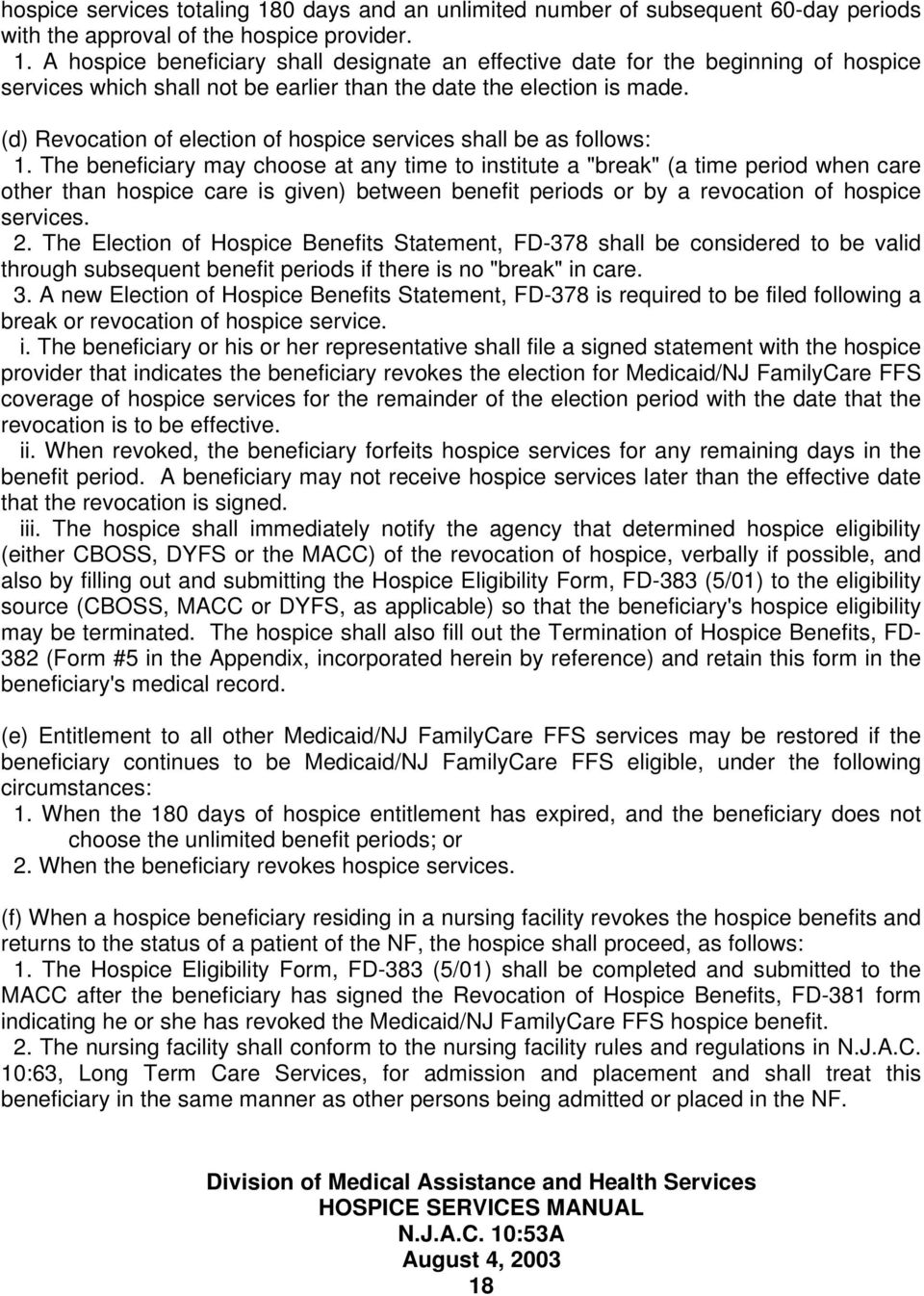
18 hospice services totaling 180 days and an unlimited number of subsequent 60-day periods with the approval of the hospice provider. 1. A hospice beneficiary shall designate an effective date for the beginning of hospice services which shall not be earlier than the date the election is made. (d) Revocation of election of hospice services shall be as follows: 1. The beneficiary may choose at any time to institute a "break" (a time period when care other than hospice care is given) between benefit periods or by a revocation of hospice services. 2. The Election of Hospice Benefits Statement, FD-378 shall be considered to be valid through subsequent benefit periods if there is no "break" in care. 3. A new Election of Hospice Benefits Statement, FD-378 is required to be filed following a break or revocation of hospice service. i. The beneficiary or his or her representative shall file a signed statement with the hospice provider that indicates the beneficiary revokes the election for Medicaid/NJ FamilyCare FFS coverage of hospice services for the remainder of the election period with the date that the revocation is to be effective. ii. When revoked, the beneficiary forfeits hospice services for any remaining days in the benefit period. A beneficiary may not receive hospice services later than the effective date that the revocation is signed. iii. The hospice shall immediately notify the agency that determined hospice eligibility (either CBOSS, DYFS or the MACC) of the revocation of hospice, verbally if possible, and also by filling out and submitting the Hospice Eligibility Form, FD-383 (5/01) to the eligibility source (CBOSS, MACC or DYFS, as applicable) so that the beneficiary's hospice eligibility may be terminated. The hospice shall also fill out the Termination of Hospice Benefits, FD- 382 (Form #5 in the Appendix, incorporated herein by reference) and retain this form in the beneficiary's medical record. (e) Entitlement to all other Medicaid/NJ FamilyCare FFS services may be restored if the beneficiary continues to be Medicaid/NJ FamilyCare FFS eligible, under the following circumstances: 1. When the 180 days of hospice entitlement has expired, and the beneficiary does not choose the unlimited benefit periods; or 2. When the beneficiary revokes hospice services. (f) When a hospice beneficiary residing in a nursing facility revokes the hospice benefits and returns to the status of a patient of the NF, the hospice shall proceed, as follows: 1. The Hospice Eligibility Form, FD-383 (5/01) shall be completed and submitted to the MACC after the beneficiary has signed the Revocation of Hospice Benefits, FD-381 form indicating he or she has revoked the Medicaid/NJ FamilyCare FFS hospice benefit. 2. The nursing facility shall conform to the nursing facility rules and regulations in N.J.A.C. 10:63, Long Term Care Services, for admission and placement and shall treat this beneficiary in the same manner as other persons being admitted or placed in the NF. 18
19 10:53A-3.4 Covered hospice services (a) The amount, character, and scope of New Jersey Medicaid/NJ FamilyCare FFS hospice services shall be the same for all hospice beneficiaries and shall not be less than the hospice services provided under Medicare (Title XVIII) (Section 1861(dd) et seq. of the Social Security Act, codified as 42 U.S.C. Section 1395x(dd)1). (b) The Division reimburses for covered hospice services that are reasonable and necessary for the palliation and management of the terminal illness, and which are provided to a hospice beneficiary consistent with the beneficiary's individualized plan of care. 1. Required hospice services which shall be available to the hospice beneficiary include nursing care, medical social services, supervisory physician services, counseling services, durable medical equipment and supplies including drugs and biologicals, homemaker/home health aide services, physical therapy, occupational therapy and speech-language pathology services. i. The following services are considered "core" hospice services: nursing care, medical social services, physician services and counseling services. (A) A hospice provider shall ensure that substantially all core services are routinely provided directly by hospice employees. (1) A hospice may use contracted staff, if necessary, to supplement hospice employees in order to meet the needs of hospice beneficiaries during periods of peak patient loads or under extraordinary circumstances or to obtain physician specialty services. (2) If contracted staff is used, the hospice shall maintain professional, financial and administrative responsibility for the services and shall assure the qualifications of the staff and that services meet all requirements under each level of care. 2. Effective on, any other item or service which is specified in the patient s plan of care and for which payment may otherwise be made under Medicaid shall be a covered service under the Medicaid/NJ FamilyCare hospice benefit. For example, a hospice determines that a patient s condition has worsened and has become medically unstable and that an inpatient stay will be necessary for proper palliation and management of the condition. The hospice adds this inpatient stay to the plan of care and decides that, due to the patient s fragile condition, the patient will need to be transported to the hospital by ambulance. In this case, the ambulance service becomes a covered hospice service. (c) Covered hospice services are reimbursed at predetermined, prospective, inclusive rates corresponding to one of four levels of care. Two of the levels of care are reimbursed for services provided in the home: Routine Home Care and Continuous Home Care; and two levels of care are reimbursed for services provided on an inpatient basis: Inpatient Respite Care and General Inpatient Care in either a hospital or nursing facility (see also, N.J.A.C. 10:53A-4.1). The provisions at (c)1 through 4 below apply to the levels of care provided by the hospice. 1. The routine home care rate is reimbursed if less skill than professional registered nursing, or licensed practical nursing, or less intensity than continuous home care is needed to enable the person to remain at home. i. The routine home care rate includes the following services: routine nursing services, 19

20 social work, counseling services, durable medical equipment, supplies, drugs, home health aide/homemakers, physical therapy, occupational therapy, and speech-language pathology services. The routine home care rate includes respite care delivered in the home that is not predominately nursing care. ii. The routine home care rate is reimbursed when the beneficiary is not receiving continuous home care, regardless of the volume and intensity of routine home care services. 2. The continuous home care rate is reimbursed only during a period of medical crisis to maintain the beneficiary at home where most of care is skilled nursing care on a continuous basis to achieve palliation or management of the beneficiary's acute medical symptoms and only as necessary to maintain the beneficiary at home. i. A minimum of eight hours of nursing care must be provided during a 24- hour day which begins and ends at midnight before the Continuous Home Care rate can be paid. The nursing care need not be sequential, that is, four hours may be provided in the morning and four hours in the evening of the same day. ii. The nursing care must be provided either by a registered professional nurse, or a licensed practical nurse under the supervision of a registered professional nurse. More than half (four hours or more) of the period of care must be nursing care provided by licensed nurses. iii. The Continuous Home Care rate includes homemaker/home health aide services which may be provided to supplement the nursing care, but not to substitute for the minimal amount of nursing care provided by the licensed nurses. 3. Inpatient respite care is short-term, occasional, inpatient care provided to the beneficiary in a hospital or nursing facility only when necessary to relieve the family members or other persons caring for the beneficiary at home. i. The inpatient respite care rate is not reimbursed for more than five consecutive days. ii. Inpatient respite care is provided by a hospice to a Medicaid hospice beneficiary in either a hospital or a nursing facility. The inpatient respite care rate or the payment of room and board services under hospice is not provided when a beneficiary is considered a nursing facility patient and not a hospice patient. 4. The general inpatient care rate is reimbursed when provided in a hospital or nursing facility during periods of acute medical crisis, for palliative care, for pain control, or management of acute and severe clinical problems which cannot be managed in another setting. 5. Concerning the limitation on the aggregate payments to hospice providers for inpatient respite care and general inpatient care, see (d) Specific services provided by a hospice within each level of care related to the terminal illness and paid under the per diem rate schedule, are listed as follows: 1. Nursing care provided by or under the supervision of a registered professional nurse; 2. Physical therapy, occupational therapy, and speech-language pathology provided by a qualified therapist for the purpose of symptom control or to enable the beneficiary to maintain activities of daily living and basic functional skills; 20

21 3. Medicaid social services provided by a social worker who has met the Medicare certification requirements for education (See 42 U.S.C. 1395x) and is working under the direction of a physician and with the interdisciplinary team; 4. Homemaker/home health aide services shall be provided by a homemaker/home health aide. i. Homemaker/ home health aide services may be provided on a 24-hour, continuous basis but only during periods of a beneficiary's crisis, not a family crisis, and only as necessary to maintain the terminally ill beneficiary at home; ii. A registered professional nurse shall visit the home of the hospice beneficiary at least every two weeks when homemaker/home health aide services are provided for the purpose of assessing the homemaker/home health aide services and provide education and supervision to the aide, as needed; 5. Durable medical equipment and supplies included in the plan of care, as well as selfhelp and personal comfort items which are reasonable and necessary for palliation and management of the beneficiary's terminal illness; 6. Drugs and biologicals included in the plan of care primarily for the relief of pain and symptom control for a beneficiary's terminal illness; and 7. Counseling, provided with respect to care of the terminally ill beneficiary, for family members or other persons caring for the beneficiary at home and provided by members of the interdisciplinary group, as well as by other qualified professionals as determined by the hospice provider. i. Counseling, including dietary counseling, shall be provided both for the purpose of training the beneficiary's family or other caregiver to provide care, and for the purpose of helping the beneficiary and those caring for him or her to adjust to the nature of the beneficiary's illness. ii. Bereavement counseling consists of counseling services provided to the beneficiary's family after the beneficiary's death under the supervision of a qualified professional. Bereavement counseling is a required inclusive component of hospice service and is not separately reimbursed by Medicaid/NJ FamilyCare. (1) The plan of care shall clearly delineate the type of counseling services to be provided and the frequency of the delivery of the service which shall be offered up to one year following the death of the beneficiary. iii. Dietary counseling, when necessary, provided by a qualified professional dietitian or dietary consultant. iv. Spiritual counseling including notice to the beneficiary as to the availability of appropriate clergy. (e) Room and board services identical to those provided to non-hospice Medicaid/NJ FamilyCare FFS beneficiaries shall be provided for hospice beneficiaries residing in a nursing facility. The beneficiary eligible for hospice services who is residing in a Medicaid/NJ FamilyCare FFS participating nursing facility is considered a hospice beneficiary not a patient of a nursing facility. 1. Room and board services include the performance of personal care services, assistance in activities of daily living, provision of patient social activities, the administration of 21
22 medications, the maintenance of the cleanliness of a resident's room, and supervision and assistance in the use of durable equipment and prescribed therapies. 2. The Pre-admission Screening (PAS) rules do not apply to a hospice patient admitted directly to a nursing facility or changed from nursing facility care to hospice care. This individual would be considered a hospice patient not an NF patient. If the hospice patient revokes the hospice benefits and returns to that NF's care or the care of another NF, the PAS rules apply which are in N.J.A.C. 10:63, Long Term Care Services. (f) Physician services for administration, interdisciplinary group activities, and general supervisory activities of the medical director, his or her designated representative, or other physician employees of the hospice provider, or those working under arrangements with the hospice, are considered "core services" and are included in the hospice per diem rate. These services shall not be billed separately to the fiscal agent. 1. The cost of physician services for direct personal care shall be covered as a separate service only for physician employees of the hospice who do not volunteer for these services. In such instances, the physician may receive separate reimbursement above the hospice per diem rate when physician services are billed by this employee. The hospice shall not bill on behalf of the physician for these direct personal care services. For the procedures for the reimbursement of these services, see (g) Regarding other covered services, some Medicaid/NJ FamilyCare FFS services which are not duplicative of hospice services may be covered by Medicaid/NJ FamilyCare FFS for the hospice beneficiary. These services include optometric and optical services, prosthetic and orthotic services, medical day care services, and personal care assistant services. These services must be approved by the interdisciplinary team, be consistent with the plan of care and be determined to be medically necessary. 1. The personal care assistant (PCA) services shall be provided to a hospice beneficiary by Medicaid/NJ FamilyCare FFS approved PCA providers. (See N.J.A.C. 10:60-1.7, 1.8 and 1.9, concerning Home Care Services). Personal care assistant services shall be included in the plan of care, and must not be duplicate services covered and reimbursed under the hospice per diem. 2. Personal care assistant services for hospice beneficiaries shall be used only to replace the live-in primary adult caregiver as defined in N.J.A.C. 10:60-1.2, and provided under the limitations of N.J.A.C. 10: :53A-3.5 Services unrelated to the terminal illness (a) The hospice beneficiary, by signing the Election of Hospice Benefits Statement, FD-378 (6/92) agrees to waive most regular Medicaid/NJ FamilyCare FFS services. However, Medicaid/NJ FamilyCare FFS covered services unrelated to the terminal illness, included in the plan of care, may be provided by approved Medicaid/NJ FamilyCare FFS providers upon approval of the interdisciplinary team of the hospice. 1. The reasons for providing unrelated services and the verification that the unrelated services are not, in any way, related to the terminal illness shall be documented in the plan of care by a member of the interdisciplinary team. 22
23 i. Documentation shall clearly specify those services that are related to and those services that are unrelated to the terminal illness. ii. Services unrelated to the terminal illness are subject to the same coverage provisions, limitations, prior authorization requirements, and conditions applied to services available to other general non-hospice Medicaid/NJ FamilyCare FFS beneficiaries. iii. All payments for services (except for physician's services) that are unrelated to the terminal illness may be denied if not approved by the interdisciplinary team, documented in the plan of care and on file in the patient's medical record. (b) The unlimited number of subsequent 60-day periods beyond 180 days of hospice care must also be approved by the interdisciplinary team of the hospice as an integral part of the plan of care. 1. If an unlimited number of 60-day periods of hospice services is anticipated, the hospice shall document in the beneficiary's medical record, the approval of this period by the interdisciplinary team at the beginning of the first 60-day benefit period. Approval by the interdisciplinary team prior to the delivery of hospice services is required for payment for services. 2. A new Physician Certification/Recertification for Hospice Benefits Form, FD-385 (6/92) is required for the approval by the interdisciplinary team for each benefit period. (c) The documentation of the approval of unrelated services and each subsequent 60-day period shall be filed in the beneficiary's medical record with the copy of the claim form and be made available upon request for post-payment review purposes. 10:53A-3.6 Plan of care (a) Requirements for the initial plan of care for beneficiaries of hospice services are listed below: 1. At least one of the persons involved in developing the initial plan of care shall be a registered professional nurse or physician. 2. In establishing the initial plan of care, the member of the basic interdisciplinary group (a physician, a registered professional nurse, a medical social worker, or a counselor) who assesses the beneficiary's needs shall contact at least one other group member before writing the initial plan of care. 3. The initial plan of care shall be established on the same day as the assessment if the day of assessment is to be considered a covered day for hospice services. 4. At a minimum, the other two members of the basic interdisciplinary group shall review the initial plan of care and provide their input to the plan of care within two calendar days of the day of assessment. 5. The initial plan of care shall be approved by the Medical Director of the hospice by his or her signature on the plan of care in the medical record, thereby assuming professional medical responsibility for the hospice care. (b) Requirements for the continuing plan of care for beneficiaries of hospice services are listed below: 23
24 1. All services provided to each hospice beneficiary must be approved by the interdisciplinary team of the hospice as an integral part of the plan of care. The medical necessity for emergent/urgent services shall be justified by the attending physician and documented in the plan of care in the medical record. 2. The plan of care shall be signed by the attending physician, the Medical Director or his or her physician designee and the interdisciplinary group prior to the complete implementation of the plan of care, thereby assuming the professional medical responsibility for the hospice care. 3. The plan of care shall be reviewed and updated in a timely manner as specified by the plan of care, but at least once a month, by the attending physician, the Medical Director or physician designee, and the interdisciplinary team. These reviews shall be documented in the hospice beneficiary's medical record. 4. The plan shall include the assessment of the beneficiary's needs and identification of the services, including the management of discomfort and symptom relief. The scope and frequency of hospice services and other services needed to meet the needs of the hospice beneficiary and the family shall be stated in detail in the plan of care and appropriately documented in the medical record. 10:53A-3.7 Provision for beneficiary fair hearings Pursuant to N.J.A.C. 10:49-10, Notices, Appeals and Fair Hearings, Medicaid/NJ FamilyCare FFS beneficiaries have the right to file for fair hearings. END OF SUBCHAPTER 3 24
25 SUBCHAPTER 4. BASIS OF PAYMENT 10:53A-4.1 Post-eligibility treatment of income (a) For a hospice beneficiary residing at home, who is eligible only for hospice services, the policy for handling the post-eligibility treatment of income is the same as that of the Division's home and community-based waivers, for example ACCAP. For these beneficiaries, there is no available income to be applied to the cost of care because the maintenance standard in the home and community based waiver programs has been determined to be equal to the income eligibility standards for Title XIX approved facilities (see N.J.A.C. 10:71-5). (b) For a beneficiary who is residing in a nursing facility and receiving hospice under Medicaid/NJ FamilyCare FFS, payment to the hospice for room and board services shall be reduced by the beneficiary's available income. Available income is that amount which remains after deducting certain amounts from the beneficiary's gross income, as determined in accordance with the N.J.A.C. 10: Instructions for the use of the Statement of Available Income for Medicaid Payment PR- 1 Form #10 in the Appendix, incorporated herein by reference, are as follows: i. The hospice is responsible for ensuring that the amount of the beneficiary's available income is reported and that the amount corresponds to that attributed to the beneficiary's account on the Statement of Available Income for Medicaid Payment PR-1. The available income must be deducted by the hospice from the amount billed the fiscal agent. The hospice shall be liable to the Division for any available income not reported to the fiscal agent by the hospice. ii. The Statement of Available Income for Medicaid Payment PR-1 is completed by the CBOSS on each non-ssi Medicaid/NJ FamilyCare FFS beneficiary that receives hospice services who is a hospice beneficiary residing in the NF. (1) The PR-1 form reflects the beneficiary's available income that remains after deducting certain amounts for the maintenance of a community spouse, the maintenance of other dependent relatives, health insurance premiums, and the personal needs allowance (PNA). A PR-1 form must be attached to a copy of the HCFA 1500 claim, and be kept in the beneficiary's billing record when requesting payment from Medicaid/NJ FamilyCare FFS for the cost of hospice care, as specified in (b)1ii(2) through (5) below. (2) The hospice is responsible for maintaining a personal needs allowance (PNA) account and making these monies available for use by the beneficiary. (3) It is the responsibility of the hospice to deduct the applicable amount of the available income (which corresponds to that attributed to the beneficiary on the PR-1 form) from the total per diem charges for the payment of room and board services on the HCFA 1500 claim. (4) The PR-1 form shall be obtained by the hospice from the NF for each beneficiary of hospice services who has been on the Long Term Care Facility billing system. The hospice shall negotiate the change in the collection of this income with the nursing facility, if applicable, or collect it from the beneficiary and/or family. 25
26 (5) For the hospice applicant who has not previously been on the Long Term Care Facility billing system as an NF patient, the CBOSS shall generate the PR-1form for the use of the hospice. (6) For individuals with no income, or income below $60.00 per month, who continue to qualify for Supplemental Security Income (SSI) payments and Medicaid, no PR-1 form is required upon admission to hospice care status. (A) For these hospice beneficiaries, confirmation of the SSI status should be obtained from the MACC and documented in the hospice billing record. (B) When submitting the HCFA 1500 claim, the hospice shall note in the beneficiary's billing record and state in the "REMARKS" area of the claim, the wording "SSI Eligible." (c) Regarding adjustments to the PR-1, the CBOSS is required to report all changes of income on an amended PR-1 to the hospice. 1. When special exceptions apply (for example, in the month of admission, for verified living expenses, and for the first two months of Medicare premium deductions), the PA-3L form will reflect those changes for the applicable month(s). 2. The beneficiary and/or the family are required to report all changes of available income to the CBOSS. Additionally, the hospice should report any changes in financial circumstances to the CBOSS. For those changes which impact on available income, a new PR-1 form must be generated by the CBOSS, indicating the month for which the change is effective. 3. When an amended PR-1 form affects the periods of service that have already been billed by the hospice, a "RETROACTIVE ADJUSTMENT" shall be submitted to the fiscal agent. The reason for the adjustment shall be recorded in the "REMARKS" area of the HCFA 1500 claim and also in the beneficiary billing record at the hospice. 4. On post-payment quality assurance review, the hospice is liable to the Division for any of the beneficiary's available income not deducted appropriately from the claim forms. (d) The hospice shall receive the PR-1 completed by the CBOSS according to the following instructions for when the available income is applied: For any full or part of a calendar month in hospice care status, all available income shown on the PR-1 form shall be applied to the cost of the care and subtracted from the per diem charge on the HCFA 1500 claim, except as indicated in (d)1 through 4 below. 1. The instructions in this paragraph apply on admission from a nursing facility. For the beneficiary who is admitted to hospice care status from an NF during a given calendar month, the available income may have already been utilized by the NF to offset the cost of care in the same month of admission to hospice care status. Thus, no income is applicable to the hospice for the first calendar month. This applies only if it is a partial calendar month of hospice room and board services. No new PR-1form is generated by the CBOSS but a copy of the PR-1 form must be obtained from the NF and kept in the patient's record. The hospice must certify to this fact in the beneficiary's billing record and in the "REMARKS" area of the claim form with the following statement: "INCOME APPLIED TO THE NF COST OF CARE FOR (ADD THE MONTH AND YEAR TO 26
27 WHICH THE COST IS APPLIED)" 2. The instructions in this paragraph apply on admission from the community. For a hospice beneficiary admitted from the community, an exemption for verified living expenses is permitted in computing available income. An amended PR-1 form shall be generated from the CBOSS indicating the adjusted amount to be deducted from the hospice per diem charge for that month. Under no circumstances must the requested exemption exceed the verified living expenses. (This deduction is not applicable for hospice beneficiaries who are returning to hospice care from the hospital.) 3. In reviewing the PR-1 form to determine what income should be applied to a billing month, the effective date in each of the numbered columns (PR-1 # 1, # 2, and # 3) shall be carefully checked. This is particularly significant for hospice beneficiaries admitted from the community or the hospital, as income may change within the first three months due to changes in income deductions, specifically Medicare premium payments. 4. The instructions for completing the PR-1 form when the beneficiary has been discharged or has died, are as follows: i. For the discharge month or that partial part of the month in the hospice care, the available income amount shown on the PR-1 form shall be applied to the cost of care. If the income exceeds the charge for that month, the balance of income not applied to the cost of care shall be returned to the beneficiary. Exceptions to this general policy are indicated in (d)4ii through v below. ii. For the hospice beneficiary who is discharged to the community, the amount of available income may be reduced by an amount to cover anticipated living expenses. However, this must be reflected on the PR-1 form by the CBOSS. When the PR-1 form does not reflect the reduction, contact the CBOSS to effect the change. iii. For the hospice beneficiary who dies on the first, second, or third day of the month, and income is not available because the check could not be endorsed and was returned, the HCFA 1500 claim shall be so annotated in the "REMARKS" area stating "Beneficiary expired on (date)--income not available for use." A notation on the billing record shall be made that the hospice provider returned the check to the hospice recipient's estate. iv. For the hospice beneficiary who dies after the third day of the month and the income is not available because the check was returned, the HCFA 1500 claim should be so annotated and documentation (that is, SSA transmittal receipt) retained in the hospice billing files. The HCFA 1500 claim shall be annotated in the "REMARKS" area--"check returned-- SSA transmittal receipts available--income not available for use." v. For the hospice beneficiary who is admitted to nursing facility care (in the same or in a different NF) after being discharged from the hospice, the hospice shall provide the NF with a copy of the HCFA 1500 claim indicating the amount of the patient's available income that was applied to the hospice's room and board bill in the discharge month, so that the NF may accurately reflect the balance amount of the NF admission month billing. The following is directed to the hospice for informational purposes only: The nursing facility will also complete an LTC-2 form and attach a copy of the HCFA 1500 claim (copy only to CBOSS) to notify the CBOSS, MACC, and the Department of Health and Senior Services, Long Term Care Field Office of the admission of the hospice patient from hospice care to NF care. The 27
28 amount of the patient's available income that was applied to the hospice room and board care should be calculated on the HCFA 1500 claim form so that a new PA-3L form can be issued for the month of admission to the NF. 10:53A-4.2 Basis of payment--hospice providers (a) The Division reimburses an approved hospice provider for those hospice services related to the terminal illness and included in the beneficiary's plan of care according to the methodology and indices in section 1814(i)(1)(C)(ii), 1814(i)(2)(B) and 1814(i)(2)(D) of the Social Security Act. 1. One of the four predetermined, cost-related prospective payment rates subject to the "cap" amounts (see -1.2 for definition of "cap") is reimbursed for each day the beneficiary is receiving hospice services (see -4.4 for calculations). The rates vary depending on the level of care which is based on the type and intensity of services furnished on that day and are consistent with the plan of care. The levels of care are, as follows: i. Routine home care; ii. Continuous home care; iii. Inpatient respite care; and iv. General inpatient care. (b) The rules regarding the reimbursement for each level of care related to the per diem are described below: 1. The hospice is reimbursed at the routine home care rate for routine nursing services, social work, counseling services, durable medical equipment, medical supplies and equipment, drugs, biologicals, home health aide/homemaker services, physical therapy, occupational therapy, and speech-language pathology services. The "routine home care rate" is also reimbursed to the hospice for home care provided continuously that is not predominately nursing care and includes respite care delivered in the home. i. The "routine home care rate" is reimbursed when the beneficiary is not receiving "continuous home care rate" regardless of the volume and intensity of routine home care services. 2. The hospice is reimbursed at the continuous home care rate for services provided in periods of acute medical crisis, where the predominance of care is skilled nursing care on a continuous basis, to achieve palliation or management of the beneficiary's acute medical symptoms and only as necessary to maintain the beneficiary at home. i. At least eight hours of nursing care in a 24-hour period has to be provided before the continuous home care rate may be paid. Continuous home care is reimbursed at the continuous home care daily rate divided by 24 to determine the hourly rate. For every hour of continuous care furnished, the hourly rate is reimbursed up to 24 hours furnished in a day, as applicable. ii. Up to 24 hours of nursing care in a 24-hour period in the home may be provided primarily by the registered professional nurse, or a licensed practical nurse together with and under the supervision of a registered professional nurse, with the support of the homemaker/home health aide staff. 28
29 3. The hospice is reimbursed at the inpatient respite care rate for care provided on an intermittent, non-routine, and/or occasional need basis for each day a hospice eligible beneficiary is in an approved inpatient facility (nursing facility or general hospital) receiving respite care. The beneficiary is not in need of general inpatient care. i. Payment for inpatient respite care is made for a maximum of five consecutive days at a time, including the date of admission but not counting the date of discharge. Payment of the sixth day and any subsequent day is reimbursed at the routine home care rate. (1) The hospice may be paid the appropriate home care rate (either the routine or continuous home care rate) for the discharge day unless the beneficiary dies as an inpatient. When the beneficiary dies as an inpatient, the inpatient respite care is reimbursed for the day of death. ii. Payments to a hospice for inpatient respite care are also limited according to the aggregate number of days of inpatient respite care furnished to Medicaid/NJ FamilyCare FFS patients per year for that particular hospice. (See -4.4 for further description relating to the calculation of this limitation.) iii. The hospice "inpatient respite care rate" is not reimbursed to the nursing facility for care provided to nursing facility patients that are not Medicaid/NJ FamilyCare FFS hospice patients of a Medicaid/NJ FamilyCare participating hospice. Thus, even though the hospice patients are residing in a nursing facility, the provider shall consider the beneficiary, for reimbursement purposes, a hospice patient, not a nursing facility patient. 4. The general inpatient care rate is reimbursed for services provided in a hospital or nursing facility in periods of acute medical crisis, for hospitalized beneficiaries for palliative care for pain control or management of acute and severe clinical problems which cannot be managed in other settings. For example, reimbursement at the general inpatient care rate is made during situations when the beneficiary's condition is such that it is no longer possible to maintain the beneficiary at home, as determined and specified in the plan of care. i. None of the other fixed payment rates, such as routine home care, are applicable for the day on which the patient receives hospice general inpatient care, except as stated below for the day of discharge. (1) For the day of discharge from an inpatient unit, the appropriate home care rate (either the routine or continuous home care rate) is reimbursed unless the beneficiary dies as an inpatient. In this situation, when the beneficiary dies, the general inpatient care rate is reimbursed for the day of death. ii. Payments to a hospice for general inpatient care are limited according to the aggregate number of days of inpatient care furnished to Medicaid/NJ FamilyCare FFS patients per year for that particular hospice. (See -4.4 for information on calculating this limitation.) (c) In addition to the per diem rates listed in (a) above, the following rates may be reimbursed according to the special circumstances listed below: 1. The room and board rate is reimbursed on a per diem basis for hospice services provided to Medicaid/NJ FamilyCare FFS hospice beneficiaries at the specific Medicaid participating NF where the hospice beneficiary is residing. This rate may be reimbursed to the hospice in addition to the rate for routine home care or continuous home care. (Note: 29
30 The Medicaid/NJ FamilyCare FFS hospice beneficiary residing in a NF is not a beneficiary of the nursing facility (NF) but a hospice beneficiary.) i. The room and board rate is calculated at 95 percent of the approved Medicaid NF per diem rate (institutionally specific) effective at the time services are provided, and excluding retroactive rate adjustments, retroactive add-ons and special program rates for private and county nursing facilities. After the NF's room and board rate is calculated, the patient's total available income shall be deducted to determine the rate billed to the Medicaid program. The NF contracts with the hospice to accept the beneficiary based on actual room and board components provided to the beneficiary by the NF. The provider number and name of the nursing facility where the beneficiary resides and with whom the hospice contracts must be placed in the "REMARKS" area of the HCFA 1500 claim. (1) The calculated rate used by the hospice as the per diem room and board rate may be obtained from: Department of Health and Senior Services Division of Senior Benefits and Utilization Office of Nursing Facility Rate Setting and Reimbursement P.O. Box 715 Trenton, New Jersey ii. The Division shall continue to pay the hospice the room and board rate for the purpose of retaining the bed for therapeutic leave or during a period of hospitalization, if indicated. The hospice is responsible through its contract with the NF to reimburse the NF to retain the bed. (1) Nursing facility bed reservation days rate (for therapeutic leave from the NF to home): The hospice is reimbursed the room and board rate for reserving an NF bed for hospice beneficiaries residing in an NF who return to a home setting temporarily for therapeutic leave. The bed reservation days rate (not to exceed 24 days per calendar year) is paid to the hospice provider in addition to the rate of routine home care or continuous home care. (2) Nursing facility bed reservation days rate is reimbursed during a period of hospitalization (commonly known as "bed hold days"): The hospice is reimbursed the room and board rate for reserving a nursing facility bed for hospice beneficiaries residing in a nursing facility who require inpatient hospitalization. Bed reservation days (not to exceed 10 consecutive days per period of hospitalization) are paid to the hospice in addition to the rate for general inpatient care. (3) The responsibility for the bed reservation policy, listed in (c)1ii(1) and (2) above, and the submission of claims for these days rests with the hospice. (d) Payment of the four "level of care" rates will be made to hospice providers at the predetermined minimum prospective Medicaid payment rates revised annually by the Federal Centers for Medicare and Medicaid Services (CMS) (see -5 for the references for the methodology). The payment rates will be adjusted by the Division for regional differences in wages, using indices and methodology determined by CMS. 1. A hospice program shall submit claims for payment for hospice routine home care and 30
31 continuous home care furnished in an individual s home based on the geographic location at which the service is furnished, that is, the county in which the beneficiary's home is located, rather than the location of the service provider's business office. 2. The regional designation of a provider for wage adjustment purposes will be determined by the location of the main business office of the hospice provider. 3. Since the four level of care rates are prospective rates, there shall be no retroactive adjustments other than the application of the cap on overall payments and the limitation on payments for inpatient care, if applicable. The rate paid for any particular day may vary depending on the level of care furnished to the beneficiary. The cap and limitation on payment for inpatient care are described in (e) No deductible shall be imposed for services furnished by hospices to Medicaid/NJ FamilyCare FFS beneficiaries during the period of election, regardless of the setting in which the services are provided. 1. Hospices shall not charge Medicaid/NJ FamilyCare beneficiaries directly for Medicare coinsurance amounts. (f) For beneficiaries at home who are dually eligible for both Medicare and Medicaid, and who are receiving Medicare hospice benefits, the hospice may bill the Medicaid fiscal agent for the five percent co-payment for outpatient drugs and biologicals on the HCFA 1500 claim. 1. The co-payment reimbursement shall be a maximum of five percent per prescription cost of each outpatient drug and/or biologicals but shall not exceed $5.00 for each prescription. 2. Copies of the Explanation of Medicare Benefits (EOMB), or other health, or insurance carriers' denial, or Explanation of Benefits (EOB) statements, or other third party liability statements shall be attached to the copy of the HCFA 1500 claim filed in the beneficiary's billing record, as well as an invoice for the outpatient drugs and/or biologicals to which the five percent co-payment is applied for post payment review. The pharmacy attachment or EOMB (EOB, etc.) shall not be attached to the HCFA 1500 claim submitted to the Medicaid fiscal agent. (g) For beneficiaries who are dually eligible for Medicare and Medicaid and who are receiving Medicare hospice benefits, the hospice may bill the Medicaid fiscal agent for the Medicare co-payment for each inpatient respite care day equal to five percent of the payment made for each respite care day by Medicare. 1. Copies of the EOMB, or other health or life insurance carriers' denial, or EOB statements, or other third party liability statements shall be attached to a copy of the HCFA 1500 claim filed in the beneficiary's medical record, as well as an invoice for inpatient respite care to which the five percent co-payment is applied. The invoice for inpatient respite care or the EOMB (EOB, etc.) shall not be attached when submitting the HCFA 1500 claim to the fiscal agent. (h) In addition, for dually eligible Medicare and Medicaid hospice beneficiaries, the hospice 31
32 shall submit claims first to Medicare. Payment by Medicaid for unrelated services or for coinsurance requires an EOMB or EOB to be attached to the claim submitted to the Medicaid Fiscal Agent. (i) The hospice shall not overlap from one calendar month to another in the billing process or bill for more than one calendar month's hospice benefit and/or room and board charges on each claim form. (j) The amount of the Medicare coinsurance payment to be reimbursed to the hospice by Medicaid shall be submitted on a separate HCFA 1500 claim from the other per diem charges. 10:53A-4.3 Basis of payment--physician services (a) The method of calculation of the basic per diem rates for hospice services listed in -4.1 includes the costs of the administrative and general supervisory activities performed by physicians who are employees of the hospice provider or those working under financial arrangements with the hospice provider. 1. The administrative and supervisory activities are generally performed by the physician serving as the Medical Director and/or the physician member of the hospice interdisciplinary group. i. Interdisciplinary group activities include participation in the establishment of plans of care, supervision of care and services, periodic review and updating of plans of care, and the establishment of governing policies. (b) The Division shall pay the physician for only direct patient care services furnished to Medicaid/NJ FamilyCare FFS hospice beneficiaries by hospice physician employees, and for physician services furnished under arrangements made by the hospice, unless the services were provided on a volunteer basis. The cost of the direct patient care services of the physician who is employed by or under contract with the hospice agency shall be submitted on the HCFA 1500 claim by the physician to the fiscal agent. 1. Physician services furnished on a volunteer basis are excluded from Medicaid/NJ FamilyCare FFS reimbursement. 2. The physician may bill for services which are not provided on a volunteer basis. However, the physician shall treat Medicaid and NJ FamilyCare FFS beneficiaries on the same basis as other beneficiaries in the hospice. For instance, a physician may not designate all physician services rendered to non-medicaid patients as volunteered and at the same time seek payment from the hospice for all physician services rendered to Medicaid and NJ FamilyCare FFS beneficiaries. (c) The attending physician shall bill only for direct personal care services and not for other costs such as laboratory or X-rays, which are to be included in the hospice per diem rate. 1. The costs of attending physician's direct personal care services shall not be included in the hospice cap determinations. 32
33 (d) Attending physician services and other specialty physician services, including consultation services provided by physicians who are not employees of the hospice, are reimbursed as covered services on a fee-for-service basis under N.J.A.C. 10:54, Physician Services, separate from the method of calculation of the hospice per diem rates listed in The hospice shall state the name of the physician who has been designated the attending physician (whenever the attending physician is not a hospice employee) in the plan of care and on the Election of Hospice Benefits Statement, FD-378 (2/02); and specify whether the attending physician services are either related or unrelated to the beneficiary's terminal illness. 10:53A-4.4 Limitations on reimbursement for hospice services (a) The Division limits aggregate payments to a hospice during a hospice "cap" period to the same degree, amount, and methodology as Medicare except the room and board per diem amounts reimbursed to hospice providers for services provided in a nursing facility are not subject to the "cap limitations" on the overall reimbursement to hospice providers. 1. Any payments in excess of the "cap" must be refunded by the hospice to the Division. (b) The Division also limits payment for inpatient care according to the number of days of inpatient care furnished to hospice beneficiaries in the aggregate for that provider. The computation of the limitation is as follows: 1. During the 12-month period beginning November 1 of each year and ending October 31 of the following year, the aggregate number of inpatient days (both for general inpatient care and inpatient respite care) shall not exceed 20 percent of the aggregate total number of days of hospice care provided to all Medicaid and NJ FamilyCare FFS beneficiaries during that same period. i. The maximum allowable number of inpatient days shall be calculated by multiplying the total number of days of Medicaid/NJ FamilyCare hospice care by 20 percent. ii. If the total number of days of inpatient care furnished to Medicaid and NJ FamilyCare FFS hospice beneficiaries is less than or equal to the maximum, no adjustment shall be made. iii. If the total number of days of inpatient care exceeds the maximum allowable number, the amount of the limitation will be determined by: calculating a ratio of the maximum allowable days to the number of actual days of inpatient care, and multiplying this ratio by the total reimbursed for inpatient care (general and respite reimbursement); multiplying the excess inpatient care days by the routine home care rate; adding the amounts determined in the calculations of (b)1iii(1) and (2) above; and comparing the amount in (b)1iii(3) above with interim payments made to the hospice for inpatient care during the "cap period." (1) The aggregate number of inpatient days (both for inpatient general and inpatient respite care) shall not exceed 20 percent of the aggregate total number of days of hospice care provided to all Medicaid/NJ FamilyCare beneficiaries during that same period. (2) Any payments in excess of the "cap" must be refunded by the hospice to the Division. 10:53A-4.5 Submitting claims for payment 33
34 (a) The hospice shall submit claims in accordance with policies and procedures set forth in N.J.A.C. 10:49-7.1, 7.2 and 7.3, incorporated herein by reference, regarding the timely filing of claims and the timeliness of claims submission and inquiry. (b) Documents needed specifically for the administration of the Hospice Care Program are Forms #1 through #10 located in the Appendix at the end of this chapter and may be obtained by writing to the following address: General Services Attention: Forms PO Box 712, Mail Code #50 Trenton, New Jersey (Fax: ) END OF SUBCHAPTER 4 34
35 SUBCHAPTER 5. HEALTHCARE COMMON PROCEDURE CODING SYSTEM (HCPCS) 10:53A-5.1 Introduction (a) The New Jersey Medicaid/NJ FamilyCare program adopted the Health Care Financing Administration's (HCFA) Common Procedure Coding System (HCPCS). The HCPCS procedure codes as listed in this subchapter are relevant to certain Medicaid/NJ FamilyCare hospice services. (b) For a complete description of the basis of payment for the HCPCS codes listed below, refer to -4.2, Basis of payment-hospice providers in this chapter. Section 1814(i)(1)(C)(ii) of the Social Security Act authorizes the rates and provides for annual increases in payment rates for hospice services. The Federally predetermined prospective annual rates are calculated based on the annual hospice rates established by Medicare. Section 1814(i)(2)(B) of the Act provides for an annual increase in the hospice cap amounts. Hospice payment rates for care and services are in effect from October 1 of one year to September 30 of the following year. For the "cap" amounts, the fiscal year ends on October 31 of the calendar year. In addition, Section 1814(i)(2)(D) of the Act requires that providers submit their claim for hospice services provided at an individual's home only on the basis of the geographic location at which the services are furnished. (c) States have the flexibility to establish hospice rates at amounts no lower than the Medicare allowable hospice rate. The New Jersey Medicaid/NJ FamilyCare program is setting hospice rates for the four "levels of care" at the prospective predetermined levels which are determined by CMS. (d) The rates marked with an asterisk are adjusted for regional differences in wages, in accordance with 42 CFR , using indices based on regions listed initially in the Federal statute as referenced in (b) above. Specific directions for calculating individual hospice rates for the four levels of hospice care (routine, continuous, inpatient respite and general inpatient care); for the copayment for inpatient respite care; and for the annual update of the rates and the wage indices, can be found in the Federal Register, published annually, in accordance with 42 CFR , or by contacting the United States Department of Health and Human Services, Centers for Medicare & Medicaid Administration. 10:53A-5.2 HCPCS procedure codes for hospice services Note: The rates of the procedure codes marked with an asterisk (*) are subject to an adjustment based on regional differences in wages as set by Federal statute and current annual Federal Register updates as referenced in - 5.1(b) and (d). *Y6333 ROUTINE HOME CARE RATE Per diem rate, calculated as referenced in -5.1(d) and -4.2(b)1 and (d)1. *Y6334 CONTINUOUS HOME CARE RATE Per diem rate, calculated as referenced in -5.1(d) and in -4.2(b)2 and (d)1.
36 *Y6335 INPATIENT RESPITE CARE RATE Per diem rate, calculated and adjusted annually in N.J.A.C. 10:53A-4.2(d) and 4.4. *Y6336 GENERAL INPATIENT CARE RATE Per diem rate, calculated and adjusted annually and limited according to -4.2(b)3 and (d). Z2015 ROOM AND BOARD RATE Per diem rate, calculated and adjusted annually as referenced in -4.2 (c) and (d). Y6337 THERAPEUTIC LEAVE DAYS Per diem rate, calculated, and annually adjusted, as referenced in -4.2(c)1ii and (d). Y6338 BED RESERVATION DAYS RATE Per diem rate, calculated and adjusted annually as referenced in -4.2(c)1ii and (d). Y6339 HOSPICE RESPITE CO-PAYMENT Per diem rate, as referenced in -4.2(g). Y6343 DRUG AND BIOLOGICALS CO-PAYMENT Reimbursed as referenced in -4.2(f). END OF SUBCHAPTER 5
4. Program Regulations
 Table of Contents iv 437.401: Introduction... 4-1 437.402: Definitions... 4-1 437.403: Eligible Members... 4-2 437.404: Provider Eligibility... 4-3 437.405: Out-of-State Hospice Services... 4-3 437.406:
Administrative Code. Title 23: Medicaid Part 205 Hospice Services
 Title 23: Medicaid Administrative Code Title 23: Medicaid Part 205 Hospice Services Table of Contents Table of Contents Title 23: Division of Medicaid... 1 Part 205: Hospice Services... 1 Part 205 Chapter
Ch. 1130 HOSPICE SERVICES 55 CHAPTER 1130. HOSPICE SERVICES GENERAL PROVISIONS RECIPIENT ELIGIBILITY AND DURATION OF COVERAGE
 Ch. 1130 HOSPICE SERVICES 55 CHAPTER 1130. HOSPICE SERVICES Sec. 1130.1. Statutory basis. 1130.2. Policy. 1130.3. Definitions. GENERAL PROVISIONS RECIPIENT ELIGIBILITY AND DURATION OF COVERAGE 1130.21.
HOSPICE SERVICES. This document is subject to change. Please check our web site for updates.
 HOSPICE SERVICES This document is subject to change. Please check our web site for updates. This provider manual outlines policy and claims submission guidelines for claims submitted to the North Dakota
Hospice care services
 Hospice care services Summary of change: Effective February 1, 2015, hospice services will be a covered benefit covered by Amerigroup Louisiana, Inc. Amerigroup Louisiana, Inc. recognizes the importance
Utah Medicaid Hospice Care Provider Training
 Utah Medicaid Hospice Care Provider Training Presented By: The Division of Medicaid and Health Financing Bureau of Authorization and Community Based Services October 2012 1 Hospice Training Topics Client
HOSPICE CARE. and the Medicare Hospice Benefit
 For more information, or to locate a hospice in your area, contact Caring Connections: www.caringinfo.org [email protected] HelpLine 800.658.8898 Multilingual Line 877.658.8896 Item #: 810002 Hospice
Medicare Benefit Policy Manual
 Medicare Benefit Policy Manual Chapter 9 - Coverage of Hospice Services Under Hospital Insurance Transmittals for Chapter 9 10 - Requirements - General 20 - Certification and Election Requirements Table
HOSPICE PROVIDER MANUAL Chapter twenty-four of the Medicaid Services Manual
 HOSPICE PROVIDER MANUAL Chapter twenty-four of the Medicaid Services Manual Issued April 15, 2012 Claims/authorizations for dates of service on or after October 1, 2015 must use the applicable ICD-10 diagnosis
HOSPICE INFORMED CONSENT
 HOSPICE INFORMED CONSENT PATIENT NAME: INSTRUCTIONS: This form is used to acknowledge receipt of our Orientation Booklet and confirm your understanding and agreement with its contents. Your signature below
5160-56-01 Hospice services: definitions.
 ACTION: Final DATE: 03/12/2015 8:56 AM 5160-56-01 Hospice services: definitions. Hospice care is end-of-life care provided by health professionals and volunteers. Hospice care is an approach to caring
Residential Care Facility Agreement
 The owner and Chaplain of Treasure Valley Hospice, Clark E. Limb, has graciously agreed to make the contract his team developed for working with RALFs available to the RALF industry to use as a reference
CMS Manual System Pub. 100-07 State Operations Provider Certification
 CMS Manual System Pub. 100-07 State Operations Provider Certification Department of Health & Human Services (DHHS) Centers for Medicare & Medicaid Services (CMS) Transmittal 65 Date: October 1, 2010 SUBJECT:
Introduction to Hospice
 Introduction to Hospice Objectives The learner will be able to: Understand general hospice services Discuss ways that hospice services can be accessed Discuss Medicare regulations for hospice services
Hospice Services Provided in a Long Term Care Facility. Companion Regulations for Hospices and Long Term Care Facilities
 Hospice Services Provided in a Long Term Care Facility Companion Regulations for Hospices and Long Term Changes to the Medicare Hospice Conditions of Participation were published as a final rule on June
NEW JERSEY ADMINISTRATIVE CODE TITLE 8, CHAPTER 7 LICENSURE OF PERSONS FOR PUBLIC HEALTH POSITIONS. Authority. N.J.S.A. 26:1A-38 et seq.
 NEW JERSEY ADMINISTRATIVE CODE TITLE 8, CHAPTER 7 LICENSURE OF PERSONS FOR PUBLIC HEALTH POSITIONS Authority N.J.S.A. 26:1A-38 et seq. Amendments in bold adopted December 7, 1998 SUBCHAPTER 1. GENERAL
Moving Through Care Settings (Don t Send Me to a Nursing Home)
 Moving Through Care Settings (Don t Send Me to a Nursing Home) NCCNHR Annual Meeting October 23, 2009 Eric Carlson Alfred J. Chiplin, Jr. Gene Coffey 1 At-Home Care Getting More Attention Many federal
CHAPTER 77A ADULT MENTAL HEALTH REHABILITATION SERVICES PROVIDED IN/BY COMMUNITY RESIDENCE PROGRAMS
 CHAPTER 77A 1 TABLE OF CONTENTS SUBCHAPTER 1. GENERAL PROVISIONS 10:77A-1.1 Scope and purpose 10:77A-1.2 Definitions 10:77A-1.3 Provider participation 10:77A-1.4 Beneficiary eligibility SUBCHAPTER 2. PROGRAM
Florida Medicaid. Nursing Facility Services Coverage Policy
 Florida Medicaid Agency for Health Care Administration May 2016 Table of Contents Florida Medicaid 1.0 Introduction... 1 1.1 Description... 1 1.2 Legal Authority... 1 1.3 Definitions... 1 2.0 Eligible
Hospice Manual for Facility
 Hospice Manual for Facility Home Health & Hospice Hospice in the Facility Objectives 1. Identify the mechanism for providing government regulated care in the facility. 2. Identify the Hospice policy and
Compliance Audit Tool
 CMS FY 2011 Top 10 Hospice Survey Deficiencies Compliance Audit Tool National Hospice and Palliative Care Organization www.nhpco.org/regulatory This audit tool is based on CMS s national aggregated analysis
MEMO. Questions and Answers Related to the New Hospice Conditions of Participation {Effective 12/2/08}
 MEMO Questions and Answers Related to the New Hospice Conditions of Participation {Effective 12/2/08} PATIENT RIGHTS 1) Is there any problem with agencies incorporating their agency grievance procedures
Medicare Hospice Benefits
 CENTERS FOR MEDICARE & MEDICAID SERVICES Medicare Hospice Benefits This official government booklet includes information about Medicare hospice benefits: Who is eligible for hospice care What services
130 CMR: DIVISION OF MEDICAL ASSISTANCE
 130 CMR 414.000: INDEPENDENT NURSE Section 414.401: Introduction 414.402: Definitions 414.403: Eligible Members 414.404: Provider Eligibility 414.408: Continuous Skilled Nursing Services 414.409: Conditions
Title 10 DEPARTMENT OF HEALTH AND MENTAL HYGIENE
 10.09.79.00 Title 10 DEPARTMENT OF HEALTH AND MENTAL HYGIENE Subtitle 09 MEDICAL CARE PROGRAMS Chapter 79 Psychiatric Residential Treatment Facility (PRTF) Demonstration Waiver Authority: Health-General
Frequently Asked Questions about Fee-for-Service Medicare For People with Alzheimer s Disease
 Frequently Asked Questions about Fee-for-Service Medicare For People with Alzheimer s Disease This brochure answers questions Medicare beneficiaries with Alzheimer s disease, and their families, may have
OFFICE OF INSPECTOR GENERAL
 DEPARTMENT OF HEALT H AND HUMA.l~ SERVIC ES OFFICE OF INSPECTOR GENERAL WASHI NGTON, DC 2020 1 MAY 0 3 2013 TO: Marilyn Tavenner Acting Administrator Centers for Medicare & Medicaid Services FROM: Stuart
Level of Care Tip Sheet MANAGING CONTINUOUS HOME CARE FOR SYMPTOM MANAGEMENT TIPS FOR PROVIDERS WHAT IS CONTINUOUS HOME CARE?
 Level of Care Tip Sheet National Hospice and Palliative Care Organization www.nhpco.org/regulatory MANAGING CONTINUOUS HOME CARE FOR SYMPTOM MANAGEMENT WHAT IS CONTINUOUS HOME CARE? TIPS FOR PROVIDERS
HOSPICE FACE-TO-FACE QUESTIONS & ANSWERS
 HOSPICE FACE-TO-FACE QUESTIONS & ANSWERS Please note: The responses provided to the questions below were developed with use of the final regulation governing hospice face-to-face/attestation requirements,
Hospice Care in the Nursing Home
 Lesson 7 Hospice Care in the Nursing Home Basic Hospice 7-1 Learning Objectives Explain Hospice Professional Management responsibilities for nursing home (NH) residents Discuss the requirements for the
Third-Party Liability (TPL); Reimbursement for Third-Party Claims; Medicare/Medicaid
 HUMAN SERVICES 45 NJR 1(2) January 22, 2013 Filed January 3, 2013 DIVISION OF MEDICAL ASSISTANCE AND HEALTH SERVICES Administration Manual and Hospital Services Manual Third-Party Liability (TPL); Reimbursement
Title 10 DEPARTMENT OF HEALTH AND MENTAL HYGIENE
 Title 10 DEPARTMENT OF HEALTH AND MENTAL HYGIENE Subtitle 09 MEDICAL CARE PROGRAMS Chapter 61 Medical Day Care Services Waiver Authority: Health-General Article, 2-104(b), 15-103, and 15-111, Annotated
This information is provided by SRC for Medicare Information. (The costs that are used in these examples are from 2006.)
 Medicare Information Source This information is provided by SRC for Medicare Information. (The costs that are used in these examples are from 2006.) The Senior Resource Center for Medicare Information
Department of Veterans Affairs VHA HANDBOOK 1140.3. Washington, DC 20420 August 16, 2004 HOME HEALTH AND HOSPICE CARE REIMBURSEMENT HANDBOOK
 Department of Veterans Affairs VHA HANDBOOK 1140.3 Veterans Health Administration Transmittal Sheet Washington, DC 20420 August 16, 2004 HOME HEALTH AND HOSPICE CARE REIMBURSEMENT HANDBOOK 1. REASON FOR
907 KAR 9:005. Level I and II psychiatric residential treatment facility service and coverage policies.
 907 KAR 9:005. Level I and II psychiatric residential treatment facility service and coverage policies. RELATES TO: KRS 205.520, 216B.450, 216B.455, 216B.459 STATUTORY AUTHORITY: KRS 194A.030(2), 194A.050(1),
The Federal Employees Health Benefits Program and Medicare
 The Federal Employees Health Benefits Program and Medicare This booklet answers questions about how the Federal Employees Health Benefits (FEHB) Program and Medicare work together to provide health benefits
NJ Department of Human Services Dual Diagnosis Task Force Clinical Workgroup Service Design Recommendations
 NJ Department of Human Services Dual Diagnosis Task Force Clinical Workgroup Service Design Recommendations For Discussion Only 4/23/10 Purpose The purpose of this document is to present the service design
Compliance Tip Sheet CMS FY 2010 TOP TEN HOSPICE SURVEY DEFICIENCIES COMPLIANCE RECOMMENDATIONS CMS TOP TEN HOSPICE SURVEY DEFICIENCIES
 Compliance Tip Sheet National Hospice and Palliative Care Organization www.nhpco.org/regulatory CMS FY 2010 TOP TEN HOSPICE SURVEY DEFICIENCIES COMPLIANCE RECOMMENDATIONS INTRODUCTION The Centers for Medicare
CASE MANAGEMENT SERVICES MANUAL
 CHAPTER 73 1 TABLE OF CONTENTS SUBCHAPTER 1 GENERAL PROVISIONS 10:73-1.1 Purpose and scope 10:73-1.2 Definitions SUBCHAPTER 2. CASE MANAGEMENT PROGRAM/MENTAL HEALTH (CMP/MH) 10:73-2.1 Definitions 10:73-2.2
UnitedHealthcare Insurance Company of the River Valley Attachment D - Schedule of Benefits
 UnitedHealthcare Insurance Company of the River Valley Attachment D - Schedule of Benefits Please refer to your Provider Directory for listings of Participating Physicians, Hospitals, and other Providers.
CHAPTER 75 INDIVIDUALS UNDER AGE 21. Division of Medical Assistance and Health Services
 CHAPTER 75 1 SUBCHAPTER 1. GENERAL PROVISIONS 10:75-1.1 Purpose and scope 10:75-1.2 Definitions 10:75-1.3 Program participation criteria 10:75-1.4 Beneficiary eligibility 10:75-1.5 Recordkeeping 10:75-1.6
Understanding Hospice Care. A Guide for Patients and Families
 Understanding Hospice Care A Guide for Patients and Families CONTACT AND REFERRALS 24-hour phone 630.665.7000 Physician referrals 630.665.7006 Fax 630.665.7371 TTY for the hearing impaired 630.933.4833
Guidelines for the Provision of Hospice Services in Mainstream Medicaid Managed Care
 NEW YORK STATE DEPARTMENT OF HEALTH OFFICE OF HEALTH INSURANCE PROGRAMS Guidelines for the Provision of Hospice Services in Mainstream Medicaid Managed Care Overview Effective October 1, 2013, the provision
RULES AND REGULATIONS FOR UTILIZATION REVIEW IN ARKANSAS ARKANSAS DEPARTMENT OF HEALTH
 RULES AND REGULATIONS FOR UTILIZATION REVIEW IN ARKANSAS 2003 ARKANSAS DEPARTMENT OF HEALTH TABLE OF CONTENTS SECTION 1 Authority and Purpose.. 1 SECTION 2 Definitions...2 SECTION 3 Private Review Agents
REHABILITATION HOSPITAL CRITERIA WORK SHEET
 DEPARTMENT OF HEALTH AND HUMAN SERVICES CENTERS FOR MEDICARE & MEDICAID SERVICES FORM APPROVED OMB NO. 0938-0986 REHABILITATION HOSPITAL CRITERIA WORK SHEET RELATED MEDICARE PROVIDER NUMBER ROOM NUMBERS
Circle of Life: Cancer Education and Wellness for American Indian and Alaska Native Communities. Group Discussion True False Not Sure
 Hospice Care Group Discussion True False Not Sure 1. There is no difference between palliative care and hospice care. Palliative care is different from hospice care. Both palliative and hospice care share
Coverage Basics. Your Guide to Understanding Medicare and Medicaid
 Coverage Basics Your Guide to Understanding Medicare and Medicaid Understanding your Medicare or Medicaid coverage can be one of the most challenging and sometimes confusing aspects of planning your stay
ALABAMA BOARD OF MEDICAL EXAMINERS ADMINISTRATIVE CODE CHAPTER 540-X-8 ADVANCED PRACTICE NURSES: COLLABORATIVE PRACTICE TABLE OF CONTENTS
 Medical Examiners Chapter 540-X-8 ALABAMA BOARD OF MEDICAL EXAMINERS ADMINISTRATIVE CODE CHAPTER 540-X-8 ADVANCED PRACTICE NURSES: COLLABORATIVE PRACTICE TABLE OF CONTENTS 540-X-8-.01 540-X-8-.02 540-X-8-.03
Overview of the Florida Medicaid Therapy Services Coverage and Limitations Handbook
 Overview of the Florida Medicaid Therapy Services Coverage and Limitations Handbook 2 Introduction Medicaid reimburses for physical therapy (PT), occupational therapy (OT), respiratory therapy (RT), and
410-127-0020 Definitions... 1. 410-127-0040 Coverage... 5. 410-127-0050 Client Copayments... 6. 410-127-0060 Reimbursement and Limitations...
 Home Health Services Administrative Rulebook Division of Medical Assistance Programs Policy and Planning Section Table of Contents Chapter 410, Division 127 Effective January 1, 2014 410-127-0020 Definitions...
Medicare Claims Processing Manual
 Medicare Claims Processing Manual Chapter 11 - Processing Hospice Claims Transmittals for Chapter 11 Crosswalk to Source Material 10 - Overview Table of Contents (Rev. 1673, 01-30-09) (Rev. 1708, 04-03-09)
Article 1. Definitions
 Article 1. Definitions Administrator. Administrator means a person who is appointed in writing by the governing body of the program to organize and direct the services and functions of the hospice. Attending
ABCDEFGHIJKLMABCDEFGHI
 Colonial Penn Life Insurance Company A Stock Company Home Office: 399 Market Street Philadelphia, PA 19181 Administrative Office: 11825 North Pennsylvania Street Carmel, IN 46032 (800) 800-2254 NAME OF
*The Medicare Hospice Conditions of Participation (2008) (CoPs) contain the federal regulations that govern all Medicare-certified hospice programs.
 Compliance Tip Sheet National Hospice and Palliative Care Organization www.nhpco.org/regulatory CMS TOP TEN HOSPICE SURVEY DEFICIENCIES COMPLIANCE RECOMMENDATIONS INTRODUCTION The Centers for Medicare
02 SB476/CSFA/3 BE IT ENACTED BY THE GENERAL ASSEMBLY OF GEORGIA:
 Senate Bill By: Senators Thompson of the rd, Stokes of the rd, Tanksley of the nd and Hecht of the th AS PASSED SENATE A BILL TO BE ENTITLED AN ACT To provide a short title; to amend Title of the Official
CARE AT HOME (CAH) I/II MEDICAID WAIVER PALLIATIVE CARE PROVIDER APPLICATION
 CARE AT HOME (CAH) I/II MEDICAID WAIVER PALLIATIVE CARE PROVIDER APPLICATION The New York State Department of Health (DOH) invites interested Hospices and Certified Home Health Agencies (CHHA) meeting
FY2015 Hospice Wage Index Proposed Rule
 FY2015 Hospice Wage Index Proposed Rule To: NHPCO Members From: NHPCO Health Policy Team Date: May 6, 2014 Summary of FY2015 Hospice Wage Index Proposed Rule On Friday, May 2 2014, CMS released the FY2015
OUTLINE OF MEDICARE SUPPLEMENT COVERAGE
 OUTLINE OF MEDICARE SUPPLEMENT COVERAGE Tufts Medicare Preferred Supplement Core Tufts Medicare Preferred Supplement One Outline of Medicare Supplement Coverage Cover Page: Benefit Plans Medicare Supplement
Division of Medical Services
 Division of Medical Services Program Planning & Development P.O. Box 1437, Slot S-295 Little Rock, AR 72203-1437 501-682-8368 Fax: 501-682-2480 TO: Arkansas Medicaid Health Care Providers Alternatives
Willamette University Long-Term Care Insurance Outline of Coverage
 JOHN HANCOCK LIFE INSURANCE COMPANY Group Long-Term Care PO Box 111, Boston, MA 02117 Tel. No. 1-800-711-9407 (from within the United States) TTY 1-800-255-1808 for hearing impaired 1-617-572-0048 (from
Your Long-Term Care Insurance Benefits
 Long-Term Care Long-Term Care Insurance can help you or an eligible family member pay for costly Long-Term Care assistance when you can no longer function independently. For more information on See Page
State Operations Manual Appendix M - Guidance to Surveyors: Hospice -
 State Operations Manual Appendix M - Guidance to Surveyors: Hospice - Transmittals for Appendix M (Rev. 149, 10-09-15) Part I Investigative Procedures I - Introduction C - Post Survey Revisit Part II Interpretive
Medicare Since early in this century, health care issues have continued to escalate in importance for our Nation. Beginning in 1915, various efforts
 Medicare Since early in this century, health care issues have continued to escalate in importance for our Nation. Beginning in 1915, various efforts to establish government health insurance programs have
Proposed Amendments: N.J.A.C. 11:4-23A.2, 23A.6 and 23A.12. Authorized By: Holly C. Bakke, Commissioner, Department of Banking and Insurance
 INSURANCE DEPARTMENT OF BANKING AND INSURANCE DIVISION OF INSURANCE Medicare Supplement--Under 50 Coverage Proposed Amendments: N.J.A.C. 11:4-23A.2, 23A.6 and 23A.12 Authorized By: Holly C. Bakke, Commissioner,
Title 32: PROFESSIONS AND OCCUPATIONS
 Title 32: PROFESSIONS AND OCCUPATIONS Chapter 81: ALCOHOL AND DRUG COUNSELORS HEADING: RR 1997, c. 2, 55 (cor) Table of Contents Subchapter 1. GENERAL PROVISIONS... 3 Section 6201. STATE BOARD OF ALCOHOL
Outline of Medicare Supplement Coverage TUFTS MEDICARE PREFERRED SUPPLEMENT PLANS 2015
 TUFTS MEDICARE PREFERRED SUPPLEMENT PLANS 2015 Outline of Medicare Supplement Coverage Tufts Medicare Preferred Supplement Core Tufts Medicare Preferred Supplement One Effective January 1, 2015 December
How To Make A Hospice Care Plan
 TOPIC PROPOSED RULE SUMMARY COMMENT Rates and Estimated hospital market basket update: 2.7 percent Aggregate Cap PROPOSAL Impact of ACA Reductions: minus 0.7 percentage points Impact of Wage Index Changes
Administration Manual; AFDC-Related Medicaid; Medically Needy Program; Proposed Amendments: N.J.A.C. 10:49-10.3 and 10:49 Appendix, 10:69-2.
 HUMAN SERVICES 45 NJR 4(1) April 1, 2013 Filed March 5, 2013 DIVISION OF MEDICAL ASSISTANCE AND HEALTH SERVICES Administration Manual; AFDC-Related Medicaid; Medically Needy Program; Medicaid Only; New
RULES OF TENNESSEE DEPARTMENT OF FINANCE AND ADMINISTRATION BUREAU OF TENNCARE
 RULES OF TENNESSEE DEPARTMENT OF FINANCE AND ADMINISTRATION BUREAU OF TENNCARE CHAPTER 1200-13-17 TENNCARE CROSSOVER PAYMENTS FOR MEDICARE TABLE OF CONTENTS 1200-13-17-.01 Definitions 1200-13-17-.04 Medicare
New Jersey Department of Children and Families Policy Manual. Date: Chapter: A Health Services Subchapter: 1 Health Services
 New Jersey Department of Children and Families Policy Manual Manual: CP&P Child Protection and Permanency Effective Volume: V Health Services Date: Chapter: A Health Services Subchapter: 1 Health Services
Hospice Update. Annette T. Carron, D.O., CMD, FAAHPM, FACOI Director Geriatrics and Palliative Care Botsford Hospital Farmington Hills, MI
 Hospice Update Annette T. Carron, D.O., CMD, FAAHPM, FACOI Director Geriatrics and Palliative Care Botsford Hospital Farmington Hills, MI Sudden death, unexpected cause < 10%, MI, accident, etc Health
AETNA MEDICARE OPEN SM PLAN PROVIDER TERMS AND CONDITIONS OF PAYMENT
 AETNA MEDICARE OPEN SM PLAN PROVIDER TERMS AND CONDITIONS OF PAYMENT Table of Contents 1. Introduction 2. When a provider is deemed to accept Aetna Medicare Open Plan s terms and conditions 3. Provider
Date Completed: 3-5-02 RATIONALE
 MEDICARE SUPPLEMENT POLICY S.B. 748 (S-1) & 749 (S-1): FIRST ANALYSIS Senate Bill 748 (Substitute S-1 as passed by the Senate) Senate Bill 749 (Substitute S-1 as passed by the Senate) Sponsor: Senator
Florida Medicaid THERAPY SERVICES COVERAGE AND LIMITATIONS HANDBOOK
 Florida Medicaid THERAPY SERVICES COVERAGE AND LIMITATIONS HANDBOOK Agency for Health Care Administration August 2013 How to Use the Update Log UPDATE LOG THERAPY SERVICES COVERAGE AND LIMITATIONS HANDBOOK
What is Home Care? Printed in USA Arcadia Home Care & Staffing www.arcadiahomecare.com
 Printed in USA Arcadia Home Care & Staffing www.arcadiahomecare.com Home Care: What does it mean to you? For some people it may mean having only occasional help with the laundry, grocery shopping, or simple
WITNESSETH: 2.1 NAME (Print Provider Name)
 AGREEMENT between OKLAHOMA HEALTH CARE AUTHORITY and CERTIFIED NURSE MIDWIFE WITNESSETH: Based upon the following recitals, the Oklahoma Health Care Authority (OHCA hereafter) and (PROVIDER hereafter)
CERTIFICATE OF NEED AND ACUTE CARE LICENSURE PROGRAM. Hospital Licensing Standards: Emergency Department and Trauma Services:
 HEALTH AND SENIOR SERVICES HEALTH CARE QUALITY AND OVERSIGHT BRANCH HEALTH CARE QUALITY AND OVERSIGHT DIVISION ACUTE CARE FACILITY OVERSIGHT CERTIFICATE OF NEED AND ACUTE CARE LICENSURE PROGRAM Hospital
Family Caregiver s Guide to Hospice and Palliative Care
 Family Caregiver Guide Family Caregiver s Guide to Hospice and Palliative Care Even though you have been through transitions before, this one may be harder. If you have been a family caregiver for a while,
Frequently Asked Questions Regarding At Home and Inpatient Hospice Care
 Frequently Asked Questions Regarding At Home and Inpatient Hospice Care Contents Page: Topic Overview Assistance in Consideration Process Locations in Which VNA Provides Hospice Care Determination of Type
MEDICAL ASSISTANCE BULLETIN COMMONWEALTH OF PENNSYLVANIA * DEPARTMENT OF PUBLIC WELFARE
 MEDICAL ASSISTANCE BULLETIN COMMONWEALTH OF PENNSYLVANIA * DEPARTMENT OF PUBLIC WELFARE SUBJECT BY Update - JCAHO-Accredited RTF Services Darlene C. Collins, M.Ed., M.P.H. Deputy Secretary for Medical
NJ FamilyCare B. Covered by Horizon NJ Health for spontaneous abortions/miscarriages. Abortions & Related Services
 NJ FamilyCare B BENEFIT Abortions & Related Services COVERAGE by Horizon NJ Health for spontaneous abortions/miscarriages. by Fee-for-Service for elective/induced abortions. Acupuncture Audiology (see
Chapter 1815 Hospice and Nursing Home Relationships
 No. 145 Chapter 1815 Hospice and Nursing Home Relationships 1815.10 Law and Regulatory Summary -.10 In General --.10 The Medicare Hospice Benefit --.20 Hospice Care Provided in Nursing Homes -.20 Anti-Kickback
Treatment Facilities Amended Date: October 1, 2015. Table of Contents
 Table of Contents 1.0 Description of the Procedure, Product, or Service... 1 1.1 Definitions... 1 2.0 Eligibility Requirements... 1 2.1 Provisions... 1 2.1.1 General... 1 2.1.2 Specific... 1 2.2 Special