
San Diego County Office of Education
|
|
|
- Gavin Walton
- 10 years ago
- Views:
Transcription
1 San Diego County Office of Education Juvenile Court and County Community Schools Review January 7, 2013 Joel D. Montero Chief Executive Officer

2 Fiscal Crisis & Management Assistance Team

3 January 7, 2013 Randolph E. Ward, Ed.D., Superintendent San Diego County Office of Education 6401 Linda Vista Road San Diego, CA Dear Superintendent Ward, In September 2012, the San Diego County Office of Education (SDCOE) and the Fiscal Crisis and Management Assistance Team (FCMAT) entered into an agreement for a review of the county office Juvenile Court and County Community School programs. Specifically, the agreement stated that FCMAT would perform the following: 1. Conduct an analysis of the Juvenile Court and County Community School programs to assess operational efficiency. a. Earned apportionment (enrollment levels, attendance rates, teacher loads, and associated policies). b. Fiscal efficiency of sites and programs (cost/income comparison) c. High/low revenue limits assessment for County Community School. d. Operational oversight (structure and practice). e. Fiscal screen strategy (affordability criteria). 2. Review the organizational structure of the Juvenile Court and County Community School programs to assess both fiscal efficiency and programmatic value. a. A centralized versus decentralized (regional) structure for administration of the program. b. Level of integration/support from other divisions within the County Office of Education (Assessment and pupil services department {student management system}, Instructional Technology department, ELD management options, Title I, etc.). c. Year-round operation of schools. FCMAT Joel D. Montero, Chief Executive Officer th Street - CITY CENTRE, Bakersfield, CA Telephone Fax Petaluma Blvd North, Suite. C, Petaluma, CA Telephone: Fax: Administrative Agent: Christine L. Frazier - Office of Kern County Superintendent of Schools

4 3. Review the staffing structure within the Juvenile Court and County Community School programs, with special attention to the implications of a regional approach. When possible, make comparisons to like programs. a. Number of administrators and method of deployment (levels of administrative support). b. Levels of student support positions (student support specialists, parent liaisons, counselors, etc.). c. Teacher staffing levels. d. Other positions (custodians, registrars, admission clerks, work readiness staff, school clerk typists, etc.). 4. Identify threats to budget integrity and develop possible strategies to address those threats. This final report contains the study team s findings and recommendations in the above areas of review. FCMAT appreciates the opportunity to serve the San Diego County Office of Education, and extends thanks to all the staff for their assistance during fieldwork. Sincerely, Joel D. Montero Chief Executive Officer
5 Table of contents Table of contents i About FCMAT... iii Introduction... 1 Background... 1 Study Guidelines... 1 Study Team... 2 Executive Summary... 3 Findings and Recommendations... 7 Enrollment and Attendance... 7 Fiscal Efficiency of Sites and Programs County Community School Funding & Student Classifications Operational Oversight Organizational Structure Year-Round Operations...23 Staffing Budget Integrity Appendices...37 San Diego County Office of Education

6 ii Table of contents Fiscal Crisis & Management Assistance Team
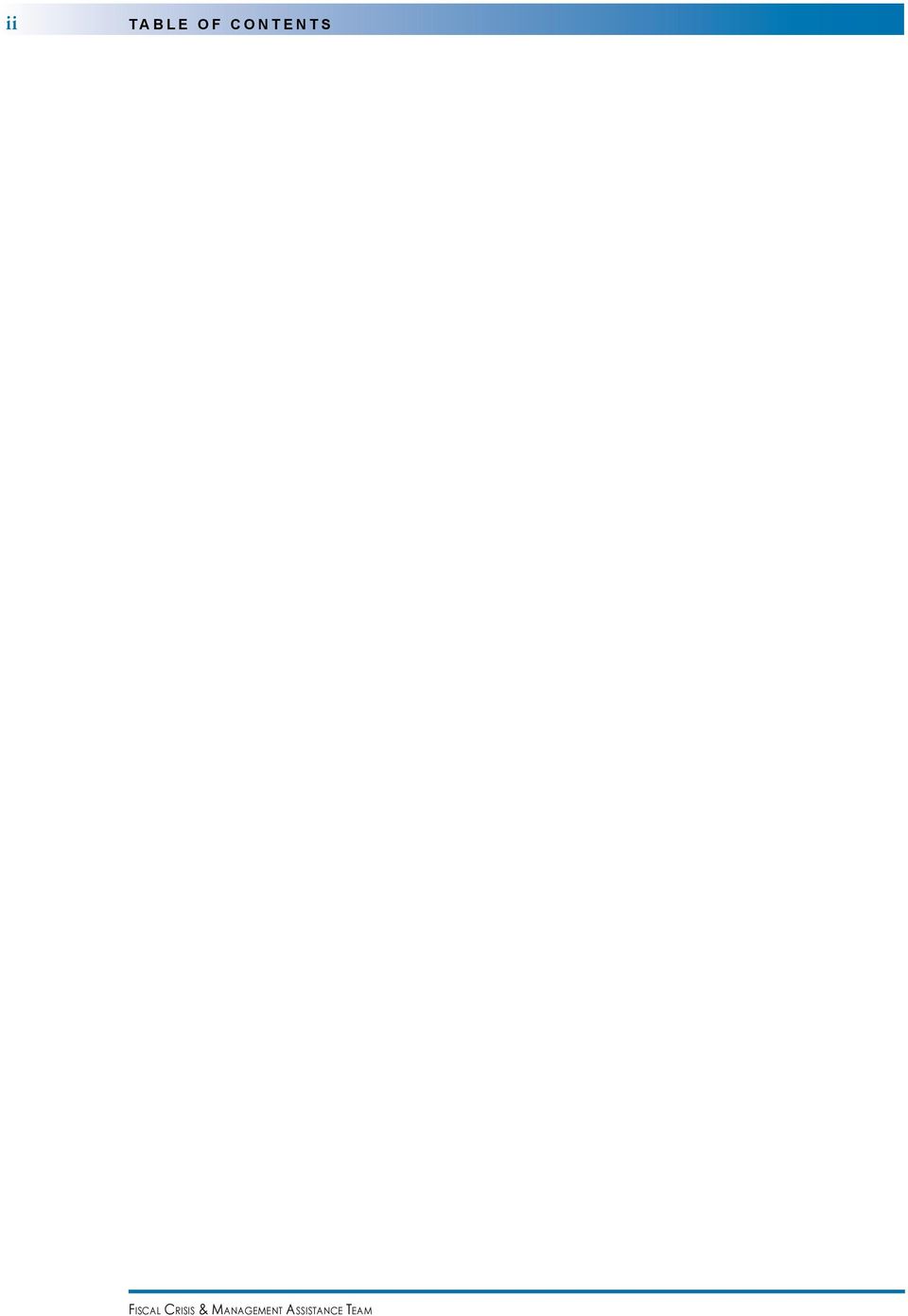
7 about FCMAT About FCMAT FCMAT s primary mission is to assist California s local K-14 educational agencies to identify, prevent, and resolve financial and data management challenges. FCMAT provides fiscal and data management assistance, professional development training, product development and other related school business and data services. FCMAT s fiscal and management assistance services are used not just to help avert fiscal crisis, but to promote sound financial practices and efficient operations. FCMAT s data management services are used to help local educational agencies (LEAs) meet state reporting responsibilities, improve data quality, and share information. FCMAT may be requested to provide fiscal crisis or management assistance by a school district, charter school, community college, county office of education, the state Superintendent of Public Instruction, or the Legislature. When a request or assignment is received, FCMAT assembles a study team that works closely with the local education agency to define the scope of work, conduct on-site fieldwork and provide a written report with findings and recommendations to help resolve issues, overcome challenges and plan for the future. iii Studies by Fiscal Year Number of Studies /93 93/94 94/95 95/96 96/97 97/98 98/99 99/00 00/01 01/02 02/03 03/04 04/05 05/06 06/07 07/08 08/09 09/10 10/11 11/12 FCMAT also develops and provides numerous publications, software tools, workshops and professional development opportunities to help local educational agencies operate more effectively and fulfill their fiscal oversight and data management responsibilities. The California School Information Services (CSIS) arm of FCMAT assists the California Department of Education with the implementation of the California Longitudinal Pupil Achievement Data System (CALPADS) and also maintains DataGate, the FCMAT/CSIS software LEAs use for CSIS services. FCMAT was created by Assembly Bill 1200 in 1992 to assist LEAs to meet and sustain their financial obligations. Assembly Bill 107 in 1997 charged FCMAT with responsibility for CSIS and its statewide data management work. Assembly Bill 1115 in 1999 codified CSIS mission. AB 1200 is also a statewide plan for county office of education and school districts to work together locally to improve fiscal procedures and accountability standards. Assembly Bill 2756 (2004) provides specific responsibilities to FCMAT with regard to districts that have received emergency state loans. In January 2006, SB 430 (charter schools) and AB 1366 (community colleges) became law and expanded FCMAT s services to those types of LEAs. San Diego County Office of Education
8 iv about fcmat Since 1992, FCMAT has been engaged to perform nearly 850 reviews for LEAs, including school districts, county offices of education, charter schools and community colleges. The Kern County Superintendent of Schools is the administrative agent for FCMAT. The team is led by Joel D. Montero, Chief Executive Officer, with funding derived through appropriations in the state budget and a modest fee schedule for charges to requesting agencies. Fiscal Crisis & Management Assistance Team
9 introduction 1 Introduction Background The San Diego County Office of Education encompasses 4,300 square miles and oversees 42 school districts that serve 498,263 students in grades K-12, which is 8.02% of California s students (Source: California Longitudinal Pupil Achievement Data System [CALPADS] ). California has 10 Class II county offices of education, each of which serves 140,000 to 749,999 students. They are Alameda, Contra Costa, Fresno, Kern, Orange, Riverside, Sacramento, San Bernardino, San Diego, and Santa Clara. The Juvenile Court and Community Schools (JCCS) staff is committed to high expectations of all students. Their priority is to raise the achievement of all students while eliminating the achievement gap between students of color and white students. The JCCS accomplishes this through the delivery of culturally and linguistically responsive standards-driven instruction, advocacy-oriented leadership, and relevant professional development. With a student enrollment of nearly 3,000, the San Diego COE JCCS is the third largest county-operated alternative education program in the state and provides programs and services to a very mobile population of students through 19 schools using a regional approach. Study Guidelines FCMAT visited the district on October 2-4, 2012, to conduct interviews, collect data and review documents. This report is the result of those activities and is divided into the following sections: Executive Summary Enrollment and Attendance Fiscal Efficiency of Sites and Programs County Community School Funding and Student Classifications Operational Oversight Organizational Structure Year-Round Operations Staffing Budget Integrity San Diego County Office of Education
10 2 introduction Study Team The study team was composed of the following members: William P. Gillaspie, Ed.D. FCMAT Deputy Administrative Officer Sacramento, California Kenneth Taylor, Ed.D. FCMAT Consultant Bakersfield, California Anne Stone FCMAT Consultant Mission Viejo, California Terry McLaughlin FCMAT Consultant Dana Point, California Laura Haywood FCMAT Technical Writer Bakersfield, California Gerald Riley FCMAT Consultant Crescent City, California Fiscal Crisis & Management Assistance Team

11 Executive Summary executive summary The San Diego County Office of Education operates the state s third largest county office alternative education program through its juvenile court school and county community school programs. According to Ed-Data, 83 juvenile court schools and 75 county community schools operated in California in , serving 27,390 students. Working closely with the San Diego County Probation Department and the juvenile courts, the county office provides juvenile court school programs inside the juvenile detention facilities to incarcerated students. Through its nonresidential juvenile court and county community school programs, the county office provides educational services to students who are referred by the probation department, expelled from school district programs, homeless, or are otherwise eligible under the California Education Code or California Welfare and Institutions Code. Juvenile court schools, per Education Code Sections and 48646, are the only instructional programs county offices of education are mandated to provide. While the county office must provide a juvenile court school program, the county community school program is optional. California Education Code Sections 1980 through 1986 and (c) detail the structure for county community schools. The county office has historically provided year-round instruction in both its juvenile court and county community schools, but a full-year program is only mandated for juvenile court schools. As with other county offices throughout the state, the San Diego COE has experienced significant changes in program funding, the number of incarcerated youth served, the severity of offenses of juvenile court school students, and a greater challenge than ever before in budget management. Over the past decade, California s most serious juvenile offenders have been shifted from state-operated California Youth Authority/Department of Juvenile Justice programs to county-operated juvenile court schools. The magnitude of this shift, its programmatic/fiscal implications, and the lack of related funding increases have placed enormous pressures on juvenile court school programs. Juvenile court schools in California had a declining enrollment of 1.9% per year for the seven years prior to , but in the most recent two years enrollment has decreased by 4.6% per year. Decreases in juvenile court school enrollments can take place suddenly, and can place serious short-term pressures on the budget. County community schools statewide have also experienced decreased enrollments for each of the past three years. Maintaining the integrity of these budgets requires great focus and efficiency. 3 Historical Perspective Juvenile court schools historically have received a higher base revenue limit per average daily attendance (ADA) than the average funding for regular K-12 school districts. This funding differential was intended to address the unique challenges faced by county offices to educate students in detention facilities and mitigate factors such as mobility, facility limitations, grouping restrictions associated with security/safety/facility, attendance changes resulting from court actions/disciplinary actions/security/safety, and higher rates of special needs students. While the total enrollment of most schools is reasonably close to their CBEDS count, the average juvenile court school statewide will enroll more than 12 students during the year for each student on the CBEDS count. The youth in these county-operated juvenile detention facilities have been incarcerated for committing adult crimes, and for the past 30 years have not included populations that are San Diego County Office of Education

12 4 executive summary referred to as status offenders (running away, truancy, and being out of control). The status offenders have generally been handled through alternatives to detention. The statutory foundation for special education funding in juvenile court and county community schools has been clearly identified at the state level as a serious problem that results in inadequate funding for these programs, but it has not yet been addressed or corrected. The special education funding model assumes approximately 10% of a reasonably stable student population has special needs of a normal range. Approximately 20% of students in juvenile court and county community schools have special needs, have a mobility rate that is approximately 900% of that of regular district programs and have higher concentrations of more severe disabilities. Enrollment and Attendance FCMAT examined student enrollment and instructional staffing levels to obtain a teacher load calculation. The teacher load of 19.5 students in the county community school was in a reasonable range, but the teacher load of 12.9 students in the juvenile court school program was significantly below normal. Other Class II counties over the past four years averaged 14.2 students per teacher in juvenile court schools. FCMAT found no factors in San Diego that would justify a lower student to teacher ratio than in comparable programs. The attendance rate in the juvenile court school program was 98.4%, which is good for this type of program. The attendance rate in the county community school program was only 83.5%. While statewide comparison data is not readily available, 83.5% is significantly below what is expected for this program. FCMAT found several areas that would contribute to a substandard attendance rate, including monitoring, structure, drop process and consistency. An increase in attendance rate to 87% would produce a minimum annual increase in revenue of $756,232, with no increase in expenditures required. Fiscal Efficiency County community schools are unique in terms of the geographic area per student enrolled. The effort to provide the best possible service to a large geographic area often results in some school sites not generating enough income to cover operational costs. The program must determine, based on the value of the site and the budget limitations, how many of these sites can exist at any given time. Based on review of the budget and attendance data, FCMAT determined that at least three instructional sites could not support themselves. Additionally, FCMAT reviewed the list of facility leases and identified at least two leases that were dedicated solely to program support services. The county office should review all sites (instructional and support) to determine whether individual sites can no longer be supported by the juvenile court and county community school budget. The potential savings is significant at approximately $244,845 annually. Operational Oversight and Management The program has the necessary data, the personnel and the capability to oversee and monitor its fiscal aspects but does not utilize that capability. The county office should develop and implement an oversight structure, a clearly defined methodology for monitoring the program, and a system for changing program operations in response to budget issues. The county office does not appear to conduct affordability reviews regarding program development and maintenance. The decrease in enrollments and funding levels makes this essential. Fiscal Crisis & Management Assistance Team
13 executive summary 5 Organizational Structure The San Diego County juvenile court and county community school program is managed regionally, with eight regions for instructional programs. This structure is common in larger counties, and can operate efficiently. Generally, some functions are managed centrally, some are managed regionally and others are managed at the site. These regions differ significantly in size, and the smaller regions operate with less fiscal efficiency. Workloads also vary significantly among regions, with very challenging expectations for administrators of the larger regions. At least one region should be eliminated to increase efficiency. The San Diego COE juvenile court and county community school program has 19 schools. This compares to an average of 2.7 schools for the juvenile court and county community schools in the other Class II counties, and results in an average school size of students in the Class II counties and in San Diego County. The fiscal implications that may be associated with this approach should be reviewed by the county office. Integration and Support among Divisions The integration of juvenile court and county community schools and other divisions in a county office of education is a common concern, and is even greater in a larger county. The juvenile court and county community school programs are larger than many of the county s school districts, and their services and support needs are unique. The juvenile court and county community school program and the special education division have an excellent working relationship. While the services provided appear to be good, the balance between resources devoted to instruction and those devoted to support appear to be excessive on the support side. Increased efficiency of some technology and categorical activities could be realized through better coordination with other divisions. Year-Round Operation of Schools California Education Code Section requires the year-round operation of juvenile court schools, but the school year in county community schools can range from the minimum of 175 days up to the same year-round schedule as the juvenile court school. The San Diego program operates full-year programs for both school types and pays regular teaching staff the same daily rate for extended year instruction as they receive for regular year instruction. Teacher staffing for the summer months in the county community school program has been inefficient and costly. No strategies are employed to minimize the reduced attendance rate generally experienced in this type of program during the summer. Program income can t support the payment of full salaries and operation of full instructional days during the summer in county community schools, if they do not operate efficiently. Staffing Levels The administrator to student ratio is much higher in San Diego County (6.7 administrators per 1,000 students) compared to other Class II counties (5.4 administrators per 1,000 students). The balance between school site level administrators (nine) and central office/support level administrators (10) appears to overemphasize central office and support services. FCMAT recommends eliminating at least three administrative positions from the program. The estimated savings would be $436,075. Support staff levels in the San Diego County juvenile court and county community school program also are significantly higher than those in comparable counties. CALPADS information San Diego County Office of Education

14 6 executive summary indicates that the average Class II county has one clerical employee for every 74.3 students, but San Diego data shows that it has one clerical employee for every 51 students. This indicates that the San Diego staffing level is 45.7% greater than the average of other comparable counties. San Diego has a per student rate for counselors that is 350% greater than the comparable counties. FCMAT recommends that the county office consider eliminating 24 classified support positions, four counselor positions, and 11 teacher assistant positions, for a cost savings of $2,220,294. Some teachers in the juvenile court and county community school program are in noninstructional roles. All of these positions should be reviewed and a determination made regarding whether the program budget can continue to support them, given that they do not generate income to offset their cost. The savings for any reductions associated with non-instructional teachers would be approximately $111,545 per full-time equivalent (FTE) position. Fiscal Crisis & Management Assistance Team

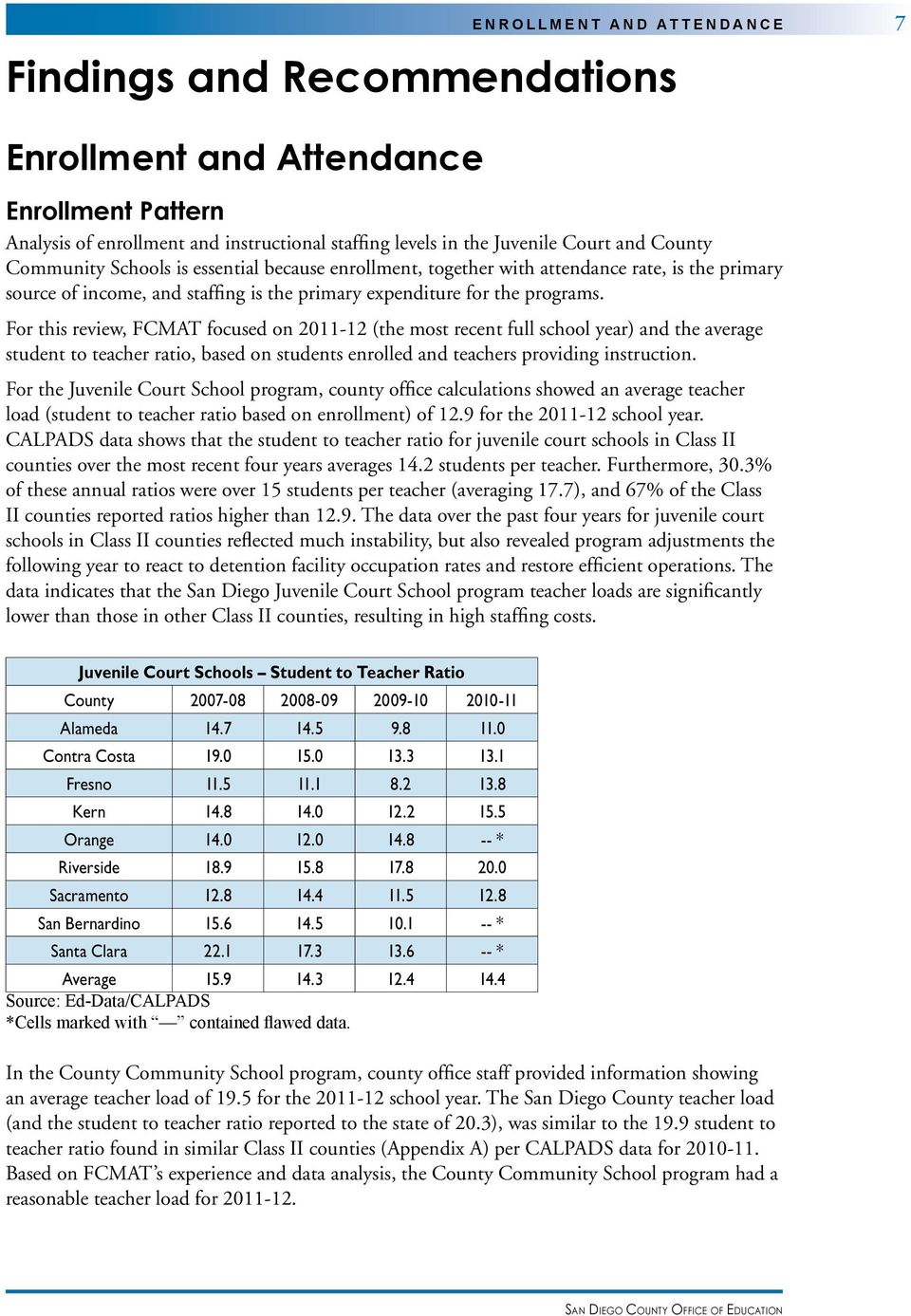
15 ENROLLMENT AND ATTENDANCE Findings and Recommendations 7 Enrollment and Attendance Enrollment Pattern Analysis of enrollment and instructional staffing levels in the Juvenile Court and County Community Schools is essential because enrollment, together with attendance rate, is the primary source of income, and staffing is the primary expenditure for the programs. For this review, FCMAT focused on (the most recent full school year) and the average student to teacher ratio, based on students enrolled and teachers providing instruction. For the Juvenile Court School program, county office calculations showed an average teacher load (student to teacher ratio based on enrollment) of 12.9 for the school year. CALPADS data shows that the student to teacher ratio for juvenile court schools in Class II counties over the most recent four years averages 14.2 students per teacher. Furthermore, 30.3% of these annual ratios were over 15 students per teacher (averaging 17.7), and 67% of the Class II counties reported ratios higher than The data over the past four years for juvenile court schools in Class II counties reflected much instability, but also revealed program adjustments the following year to react to detention facility occupation rates and restore efficient operations. The data indicates that the San Diego Juvenile Court School program teacher loads are significantly lower than those in other Class II counties, resulting in high staffing costs. Juvenile Court Schools Student to Teacher Ratio County Alameda Contra Costa Fresno Kern Orange * Riverside Sacramento San Bernardino * Santa Clara * Average Source: Ed-Data/CALPADS *Cells marked with contained flawed data. In the County Community School program, county office staff provided information showing an average teacher load of 19.5 for the school year. The San Diego County teacher load (and the student to teacher ratio reported to the state of 20.3), was similar to the 19.9 student to teacher ratio found in similar Class II counties (Appendix A) per CALPADS data for Based on FCMAT s experience and data analysis, the County Community School program had a reasonable teacher load for San Diego County Office of Education
16 8 ENROLLMENT AND ATTENDANCE Attendance Rates Attendance rates are the percentage of enrollment that translates into average daily attendance (ADA), the number of days a student attends school divided by the number of days school is in session. Attendance rate, together with enrollment pattern, is the primary source of income and plays a key role in the operational efficiency and program budgets. FCMAT reviewed the school year enrollment and attendance data provided by the county office staff. For the Juvenile Court School program, staff provided calculations that showed an average attendance rate of 98.4% for This data is not readily accessible through statewide reporting, making comparisons to like counties more difficult. Assessment of this rate is based largely on FCMAT s experience. A 98.4% attendance rate is good for residential juvenile court school programs. The rate should continue to be monitored and maintained to protect funding levels. In the County Community School program, county office staff provided calculations that reflected an average attendance rate for of 83.5%. While the student populations served in county community schools can be challenging relative to school attendance, strategies such as a student drop policy and an analysis to pinpoint and correct problem areas can increase attendance rates significantly. A viable student drop policy will be standardized throughout the program, clearly written and easy to implement, capable of being monitored by administration, consistent with the educational philosophy of the county office, and sustainable. These strategies will include, at a minimum, individual staff guidance/monitoring as well as structural changes to program operation. Additional strategies include weekly site-based monitoring of attendance rates by the principal and teachers, interventions by site staff, and monthly review of attendance rates by central office administrators with principals. Recommendations The county office should: 1. Analyze the enrollment and staffing patterns of the Juvenile Court School program for the and current school years, and identify an ideal class size, given budget limitations. Analyze all classes to determine what short-term and long-term strategies can be employed to increase the average class size for the total Juvenile Court School program to at least 15 students. Include the San Diego County Probation Department in the development of these strategies. 2. Analyze attendance rates in the County Community School program for the and current school years by region, school, site and individual teacher, with an additional breakdown by apportionment month and instructional strategy. Using this data, determine and implement strategies to address problem areas, with a target attendance rate of at least 87% by the school year. 3. Establish a student drop policy for the County Community Schools that includes monitoring. Align current forms, documents and policies with the new policy and implement as soon as possible. Fiscal Crisis & Management Assistance Team

17 ENROLLMENT AND ATTENDANCE 9 4. Assign specific administrators to monitor enrollment patterns and attendance rates. Give them the authority to identify problems, determine potential solutions and implement those solutions. San Diego County Office of Education

18 10 Fiscal Crisis & Management Assistance Team

19 FISCAL EFFICIENCY OF SITES AND PROGRAMS Fiscal Efficiency of Sites and Programs Non-Residential Sites County community schools throughout California must balance the pressures of providing a high-quality instructional program with the fiscal, geographic and operational realities involved. In San Diego County, the geographic area for the average County Community School student (one student per 2.38 square miles) is over 275 times greater than that of the average school district (116 students per square mile) in the county. It is easier to provide fiscally efficient services to students in the highly populated areas than in the rural, more sparsely populated areas. Therefore, it is common for County Community School sites to differ in fiscal efficiency and for some sites not to generate enough income to cover operational costs. The decisions associated with how many underfunded sites can be maintained, or the acceptable level of underfunding, generally are made by balancing the programmatic/operational benefit with the available budget. An analysis provided by county office staff (Appendix C) of all sites that included most incomes and expenditures showed that three non-residential instructional sites fell short of being able to support themselves, and a number of other sites likely could not cover all associated costs. Expenditures exceeded income at the Youth Day Center, Oceanside Community School and Rancho del Oro Community School. One of several that would fall short when applying all costs is Arcadia Community School. Based on information provided by staff, at least one of these sites was closed at the end of the school year. This closure, along with discussions with the county level Juvenile Court and County Community School administration, indicates the county office is conscious of the need to monitor and make necessary adjustments to improve site efficiency. However, FCMAT did not see evidence (such as calculations or interviews with administrators) that an ongoing comprehensive review has been done that would provide the necessary foundation to assess site efficiency. San Diego County is unique in the number of non-instructional sites, and square footage, that operate under the umbrella of Juvenile Court and County Community Schools. These sites include technology, assessment, and maintenance facilities, among others. There is no indication that the county office has reviewed the ability of the program to continue to support these sites. 11 Site and Program Leases Unlike most public schools operated in California, most non-residential juvenile court, county community and community day schools operate in leased facilities. The costs associated with those leases can become a significant part of the program s operational budgets. Once again, county office staff must balance facility characteristics and student benefits with budget capacity. Facility lease costs also can be a factor in determining whether a site can sustain itself. A review of the list of JCCS Current Leases for by Region as of August 2012 (Appendix D) showed that the annual lease costs for the program total $2,722,576. Of that amount, $546,050 (20%) is dedicated to Interprogram Lease Charges, Technology and JCCS M&O. The program leases 160,352 square feet at an average rate of $1.41 per square foot. The approximate square footage per unit of ADA for the County Community School program is 68.3 square feet. This is in a reasonable range for the program when factoring in the amount of independent study provided, but the balance between facility space dedicated to direct instruction and that available for instructional support is heavy in the area of instructional support. Data for comparison with other counties is not readily available. San Diego County Office of Education

20 12 FISCAL EFFICIENCY OF SITES AND PROGRAMS In interviews, FCMAT asked county office staff what costs they would eliminate, if necessary, in the Juvenile Court and Community School Division. One of the most common responses was facility leases in one form or another. While the details varied, there appeared to be a common concern associated with facilities that were not used for daily instructional services to students. Recommendations The county office should: 1. Analyze the income generated and expenditures incurred for each nonresidential school site in the Juvenile Court and County Community School program based on the most recent full year of operation. Determine whether income or expenditures are likely to change for the current or coming fiscal year. Review each site that is not self-supporting to determine whether its continued operation yields benefits that outweigh the negative budgetary effect. Schedule any site that does not meet the review criteria for closure in the school year. 2. Analyze the income generated, if any, and operational expenditures for each instructional support site in the Juvenile Court and County Community School program based on the most recent full year of operation. Determine whether income or expenditures are likely to change for the current or coming fiscal year. Based on this analysis and the budget, determine whether the program can support the site. Schedule any site that is unsustainable for closure in the school year, and restructure service delivery consistent with the available budget. 3. Include facility lease costs in any review of each site s fiscal sustainability. Fiscal Crisis & Management Assistance Team

21 COUNTY COMMUNITY SCHOOL FUNDING AND STUDENT CLASSIFICATIONS County Community School Funding and Student Classifications Average Daily Attendance Funding County community schools throughout California have a complex funding structure that is unlike any other in public education. The revenue limit (funding per unit of average daily attendance) can be the juvenile court school revenue limit for the county, the average juvenile court school revenue limit for the state, the revenue limit of the largest unified school district in the county, or the revenue limit of the student s school district of residence. Some of these revenue streams are paid to the county office of education based on the P-2 attendance report while others are paid based on the annual attendance report. The San Diego County Community School has 47 different funding levels, with significant variances in the amount of funding each school receives depending on which funding level applies to each unit of average daily attendance. Many students, based on their circumstances, can be legitimately enrolled in a county community school through more than one method, and the method of enrollment can result in significantly different funding levels. An eight-year study of county community school funding (Appendix E) between 1994 and 2004 showed an average of 65% of enrollments were at the higher rates, and there is no evidence that the percentage has increased significantly in recent years. A review of records and discussions with county office staff revealed that the County Community School receives the higher Juvenile Court School funding level for 100% of its students. Therefore, no students are eligible for a higher funding level. 13 Classification of Students Student funding levels are driven by a process of classification based on eligibility to enroll in a county community school. The details of that enrollment and classification process can be found in California Education Code Sections 1981 and (c) (Appendix B). Additionally, an example of the practical application of these statutory requirements can be found in Appendix F. The rate of 100% high funding used for the San Diego County Community School is found in many other counties. This is often driven by the position that the lower levels of funding are not adequate to provide a credible and safe school environment for the students. Therefore, the community school will not accept referrals that would be funded at the lower levels. When a high funding rate is significantly higher than the statewide average, it is important to determine that all students qualify for that funding level. A general review of student characteristics shows that the County Community School generated ADA for elementary students. A very small percentage of elementary-age students in California generally qualify for the higher funding rate. San Diego County Office of Education
22 14 COUNTY COMMUNITY SCHOOL FUNDING AND STUDENT CLASSIFICATIONS Recommendations The county office should: 1. Continue to ensure that all County Community School students are funded at the highest level for which they are qualified under the statutory guidelines. 2. Review the enrollment and classification process for all students in the County Community School program. Closely examine the enrollment and classification process for elementary students pursuant to California Education Code Sections 1981 and 1982(b). Immediately implement any changes resulting from this review and apply them retroactively to the current school year. Fiscal Crisis & Management Assistance Team
23 Operational Oversight OPERATIONAL OVERSIGHT Juvenile court and county community schools face unique operational challenges. Mobility rates result in 9.7 different students enrolling in a juvenile court school for every unit of average daily attendance that is generated by the school (Appendix G). County community schools have no stable base of students living within a geographic boundary, and all enrollment in these programs is based on referral by other districts or agencies. Juvenile court school enrollment is driven by the decisions of the county probation department or juvenile court relative to how many wards will be placed in a detention facility. These challenges demand a sophisticated structure designed to monitor enrollment, attendance, staffing and potential threats to budget integrity. Operational monitoring of the San Diego County Juvenile Court and County Community Schools is inadequate. A San Diego COE report titled JCCS ADA Comparison Prior Year was an excellent tool for monitoring attendance rates and completing an enrollment/attendance comparison to the prior year, but was very narrowly focused. The factors that can significantly affect budget integrity include: The alignment of staffing levels and enrollments, which may require timely staffing changes driven by unplanned enrollment shifts. Enrollment levels early in the fiscal year, which may necessitate review and amendment of the operational budget if numbers differ significantly from those used in budgeting. The fiscal viability of each site, which should be reviewed annually. The balance between resources devoted to instructional support and direct instruction. The Employee Groups and Classifications report (Appendix H) provided to FCMAT for shows only 145 of 268 positions in the Juvenile Court and County Community School program were teachers. Few structures exist for practices directly related to student enrollment and attendance. Those that do exist, such as a drop process, are unclear, are inconsistently applied, are not monitored and likely contribute to a lower attendance rate in the County Community School program. Proper monitoring of a Juvenile Court or County Community School program begins with efficient and regular review and assigned responsibility for monitoring. This provides the ability to take timely corrective action to offset negative budget and programmatic consequences. Samples of good monitoring structures can be obtained from other counties. Key aspects of the program that need monitoring include enrollment, staffing levels and attendance. The San Diego County Juvenile Court and County Community School program has the data, personnel and skills needed to monitor school programs but lacks a formal structure. As a result, aspects of the program that can significantly affect budget integrity are not systematically monitored, and when problems are identified, timely corrective actions are not taken. It is difficult to determine whether problem areas are a result of inadequate monitoring or insufficient action on identified problems, but the result is missed opportunities to minimize negative impacts on the Juvenile Court and County Community Schools program. Discussions with site level administrators led FCMAT to conclude that they were not responsible for monitoring the budgetary integrity of the program. They also did not feel they had the authority to take corrective action on identified problems. All management staff should be knowledgeable about the budget, take responsibility for monitoring it, and be comfortable with communicating concerns to the administrator with primary responsibility. 15 San Diego County Office of Education
24 16 OPERATIONAL OVERSIGHT Recommendations The county office should: 1. Identify factors that directly relate to budget integrity and need to be formally and consistently monitored. At a minimum, include assumptions on which the budget is based: enrollment, prior year enrollment, attendance rate, number of teachers, targeted enrollment based on number of teachers, percent special education, and percent high funded community school. Analyze the data by school site, region, instructional strategy and program. Identify which data to monitor weekly or monthly. 2. Identify which staff have primary responsibility for monitoring the Juvenile Court and County Community School programs. 3. Develop a structure and strategies for taking corrective actions when problems are identified. 4. Develop procedures for assessing site viability, levels of resources devoted to instructional support and a drop process for habitual truants who are nonresponsive to program interventions. Affordability Criteria Due to the state and federal budget crisis, funding for education has been severely reduced over the last four years and public schools throughout California are facing the difficult choices associated with eliminating or reducing programs that they have worked hard to implement. Nevertheless, these cuts must be made strategically and timely to minimize the negative effect on staff and maintain a quality instructional program. San Diego County Juvenile Court and Community School administration has struggled with making the necessary cuts. From the through the fiscal years the program has had reduced revenue, enrollment and attendance (4.1% reduction in ADA from 3,654 to 3,505). The budget was built on enrollment/ada growth (3,526), and a JCCS Multi-Year Projection Growth ADA Scenario was developed that projected 15.4% total growth over the current and fiscal years. No strategies were communicated to FCMAT to demonstrate that the growth was likely to occur. Early data shows a continuing decline in County Community School enrollment/attendance of -9.4%/-5.8% for the first two months of the school year that has continued, with Juvenile Court and County Community School enrollment 3.9% lower than the past year for the second week of September (one week into the regular school year). Building budgets on projected growth that is unlikely to occur postpones the inevitable actions necessary to balance the budget, amplifies the magnitude of the interventions, and results in missed opportunities to utilize less invasive interventions. Fiscal Crisis & Management Assistance Team
25 OPERATIONAL OVERSIGHT 17 Recommendations The county office should: 1. Re-evaluate the assumptions on which the Juvenile Court and County Community School budget is built. Based on current enrollment, attendance, funding level and related information, build a new budget with realistic assumptions that are likely to be attainable. 2. Following completion of a revised current year budget for the Juvenile Court and County Community Schools, build a budget using assumptions and changes that could not be implemented in the current year budget. 3. Implement procedures to document budget development assumptions with evidence that they are reasonably likely to be attainable. San Diego County Office of Education
26 18 Fiscal Crisis & Management Assistance Team
27 Organizational Structure ORGANIZATIONAL STRUCTURE The county office, like other large counties, uses a regionalized structure for some of its operational functions and services. Other management and budget functions are provided by the central office. Given the large geographic areas served by Juvenile Court and County Community School programs, this is a logical structure that balances programmatic and fiscal needs. Site administrators report that budgeting, staffing, and workload distribution are centralized, with limited site-based decision making for these functions. FCMAT noted a significant imbalance in the administrative and support staff to student ratio among the sites. Staff reported that the county office does not have a formula to guide staffing decisions at the central or regional level. Site administrative staff reported having no knowledge of the total budget process and its relationship to the operation of each site and region. Therefore, they lack essential information and the authority to plan for staffing and other expenditures. The Juvenile Court and County Community School program consists of eight regions that provide instructional services and another program (region) called Curriculum and Instruction/ Assessment. Given the enrollment levels and geographic characteristics of the county, the number of regions is greater than that found in similar counties. The size of the Curriculum and Instruction/Assessment program/region also is greater than that of comparable counties. In interviews with county office staff, concerns about the number of regions being too many or the size of the Curriculum and Instruction/Assessment program being excessive surfaced repeatedly. The number of schools in the Juvenile Court and County Community School program is very unusual. FCMAT s review of CALPADS data showed that San Diego County has 12 juvenile court and county community schools that generally align with its regional structure. More current information shows that the number of schools has increased from 12 in to 19 currently. This is significantly more than the average of 2.7 schools in other Class II counties. In addition to the Curriculum and Instruction/Assessment program, the San Diego County Juvenile Court and County Community School program maintains three assessment centers to conduct placement testing and other assessments. Sites are responsible for processing student registration and maintaining attendance data. 19 Recommendations The county office should: 1. Review the current organization of regions, particularly with regard to its fiscal implications. Reduce the number of regions by at least one while maintaining a balance between operational and educational benefit, and fiscal integrity. Assess the programmatic benefits and fiscal challenges associated with the current operation of 19 smaller schools. 2. Balance the teacher to site administrator ratio across the county as an integral part of the review of regions. 3. Implement site-based decision making so that each site can make essential budgetary and staffing decisions to deliver a quality educational program. San Diego County Office of Education
28 20 ORGANIZATIONAL STRUCTURE 4. Develop staffing level policies and guidelines for the sites that balance direct instructional services and instructional support services. 5. Review expenditures for the centralized assessment centers and consider transitioning responsibility for assessment to the regions and closing the three assessment centers, thus significantly reducing costs. Integration and Support from Other Divisions The county office has begun seeking the most efficient and cost effective methods for delivering support services to Juvenile Court, County Community and Community Day School educational programs by revisiting whether some services could be delivered by other divisions. Factors that should be considered in integrating support services by other divisions include funding, capacity and knowledge of services to high risk youth. The recently adopted student information system (PROMIS) meets the unique needs of Juvenile Court and County Community School programs including a year-round calendar and the ability to manage frequent student movement. Additionally, this program can provide reports and manage attendance accounting in the manner necessary for County Community School programs. According to staff, the vendor (the San Joaquin County Office of Education) provides support and system updates at a cost lower than commercial systems. Interviews with staff revealed no complaints about the system and universal praise for its performance. Technology services in JCCS are provided by division staff. These services meet site needs, but duplicate some services offered by the Technology Services division. Interviews with Technology Services administration revealed a lack of understanding of the unique structure and challenges associated with Juvenile Court and County Community School programs. This would limit the ability to provide quality service to the Juvenile Court and County Community Schools unless there were a concerted effort to better understand these programs and align service accordingly. However, the current opening for a network technician in the Technology Division provides an excellent opportunity to reduce total staff in this area and increase integration between the divisions by increasing the interface between Technology Division and the JCCS program. Regardless of who provides the services, total expenditures for technology support services should be reduced at least 25% as compared to other Class II counties. The Juvenile Court and County Community School program has an open position funded by Title I to coordinate services to English language learners (EL). Responsibility for coordinating these services has been given to another division. Therefore, this is an appropriate time to determine the level of need for this position and the best way for the service to be provided. The Juvenile Court and County Community School program does not accept Title III funds. Staff stated this decision is based on concerns about the level of effort necessary to comply with federal requirements. Other counties access these funds for similar programs. Recommendations The county office should: 1. Continue to use PROMIS as the student information system for the Juvenile Court and County Community School program, with support from the vendor. Continue to train staff to more fully utilize system tools. Fiscal Crisis & Management Assistance Team
29 ORGANIZATIONAL STRUCTURE Transfer responsibility for network services from JCCS to the Technology Services Division, particularly if it would be a cost savings for the Juvenile Court and County Community School program. 3. Form a work group with representatives from the Juvenile Court and County Community Schools and Technology Services to explore the integration of technology services to provide operational and fiscal efficiencies. This work group should include site administrators and teachers. Develop guaranteed service levels and a simple cost accounting for the services to be provided by Technology Services. 4. Examine the responsibilities of the unfilled position of coordinator of EL services to ascertain what percentage of a full-time position is needed to serve the needs of the Juvenile Court and County Community Schools. Use the data to determine the appropriate placement of that function. 5. Consult other Class II counties that accept Title III funds on the pros and cons of doing so and how they meet the federal compliance requirements. Based on this information, re-evaluate the decision to access this funding. Special Education Operations The level of integration with, and support between, the special education department and the JCCS district office, regions and classrooms was reported by staff as effective and efficient. Special education services are provided through a collaborative model, special education teachers and teaching assistants working directly in the Juvenile Court and County Community School classes. Staff reported that the Juvenile Court and County Community School teachers know who their special education students are and attend the student s Individualized Education Program (IEP) meetings. It was also reported that site administration do not attend all these meetings. When the site administrator is not available, other special education staff act as the administrative designee. However, it was also reported that there are times when this is not possible, and therefore there is neither a site administrator nor designee at the meeting. This was due to a number of reasons including some sites being geographically remote, making administrative attendance difficult. Education Code (b) (4) states that each IEP team is to include A representative of the local educational agency who meets all of the following: (A) Is qualified to provide, or supervise the provision of, specially designed instruction to meet the unique needs of individuals with exceptional needs. (B) Is knowledgeable about the general education curriculum. (C) Is knowledgeable about the availability of resources of the local educational agency. A review of special education resource specialist and special day class caseloads was completed. Education Code (c) states, Caseloads for resource specialists shall be stated in the local policies developed pursuant to Section and in accordance with regulations established by the board. No resource specialist shall have a caseload which exceeds 28 pupils. The code does not specify the minimum number of students that should be on a resource specialist case- San Diego County Office of Education
30 22 ORGANIZATIONAL STRUCTURE load; however, the typical range is between Therefore several factors are considered when determining if a caseload is either underutilized or overutilized for purposes of staffing. Some of these considerations are the number of sites a resource specialist is assigned, the entry and exit rates of identified students, and the level of student need. The code also does not specify the maximum or minimum number of students on a special day class teacher s caseload. It is reported by several entities such as School Services of California, Inc. and the Special Education Local Plan Area Administrators Organization that SDC caseloads are typically between 8-18 and that caseload numbers are dependent on age, disability, and instructional aide support. As indicated in the table below, the JCCS resource specialist numbers, if in a district program, would be below average and a recommendation for reducing the number of resource specialist would be considered. However, the specific circumstances of both the court and community school resource programs must be taken into account. The court school resource specialist caseloads include identified special education students and the staff therefore functions as both resource and special day class teachers. The community school resource specialists are almost all itinerant and serve between 5 and 12 sites. The special day class numbers are on the high end of the caseload range. Class type Average Caseload Maximum allowed or state-wide average range Resource in Court Programs Resource in Community Programs Special Day Class Recommendations The county office should: 1. Continue the level of integration and support between the Special Education Division and Juvenile Court and County Community Schools at the district, region and classroom levels. 2. Ensure that all IEPs have either the site administrator or the administrative designee in attendance. 3. Consider how technology such as Skype or FaceTime would enable administrators or administrator designees to attend IEPs meetings when they cannot be physically present at the meeting. 4. Continue monitoring both the resource specialist and special day class numbers to ensure that the staffing ratio meets the needs of the identified students and is cost efficient. Fiscal Crisis & Management Assistance Team
31 Year-Round Operations year-round operations Juvenile court schools are mandated pursuant to California Education Code Section (Appendix B) to provide instruction every weekday except for school holidays and staff development days. County community schools are required to provide instruction for a minimum of 175 days, though they may operate year-round (EC 1980 et seq). The school year for county community schools throughout California ranges from a regular district-type school year to year-round operation that is fully aligned with the full-year juvenile court school, or a variety of intermediate structures that generally involve some form of summer session. The operation of school during any period when district schools are not in session has unique characteristics and challenges that can have both positive and negative budget effects. Additionally, an extended year program has secondary budgetary effects on special education services. The San Diego County Office of Education operates its Juvenile Court and County Community schools 245 days a year. Staff reported that Juvenile Court School enrollments are not meeting the projections that were anticipated by the county Probation Department in the current year. County community schools have a more predictable enrollment pattern based on enrollment histories for that county. Enrollment drops off sharply as summer begins and continues to decline throughout the summer. New enrollments begin very slowly in September and increase as the school year progresses. Community schools that operate 246 days a year have predictable periods of lower attendance rates, especially when the comprehensive feeder schools in the area are not in session (e.g., Thanksgiving week, winter break and spring break). These periods of low attendance and low enrollment affect the County Community School budget. An even greater effect on the budget associated with extended year operation is the alignment of staffing levels with enrollment numbers during these periods of time. The documents provided to FCMAT did not allow the team to definitively identify the magnitude of the problem. However, interviews with staff made it clear that no process exists to determine appropriate staffing for the summer, and the data reviewed indicate that the lack of a process contributes to inefficient operations during the summer. Special education receives funding through a method referred to as the 602 funding model, which is based on 180 school days. Any additional days, generally referred to as extended school year (ESY), do not receive additional special education revenue. However, the total number of days a special education program operates is at least the number of days the district or program operates, including summer school/intersession programs. California Code of Regulations (CCR) Title 5, Section 3043 (g) states, In order to qualify for average daily attendance revenue for extended year pupils, all of the following conditions must be met: (1) Extended year special education shall be the same length of time as the school day for pupils of the same age level attending summer school in the district in which the extended year program is provided, but not less than the minimum school day for that age unless otherwise specified in the individualized education program to meet a pupil s unique needs. The special education program in the Juvenile Court and County Community School program has aligned with the general education program and has operated for 245 days each year. The Juvenile Court and County Community School program is considering an alternate school year calendar for County Community School of 190 days, with additional days of intersession and summer school. A change in the way the school year is defined would enable the special education program to also redefine the school year. The special education student s IEP could 23 San Diego County Office of Education
32 24 year-round operations then determine if a student qualifies for extended year based on the regression/recoupment requirements. CCR Title 5, Section 3043 states, Extended school year services shall be provided for each individual with exceptional needs who has unique needs and requires special education and related services in excess of the regular academic year. Such individuals shall have handicaps which are likely to continue indefinitely or for a prolonged period, and interruption of the pupil s educational programming may cause regression, when coupled with limited recoupment capacity, rendering it impossible or unlikely that the pupil will attain the level of self-sufficiency and independence that would otherwise be expected in view of his or her handicapping condition. Therefore, based on the special education students IEPs, the number of school days special education services are provided could be reduced from 245 to 210, along with the number of special education students attending the JCCS intersession and/or summer school program. This reduction would affect certificated staff. Computing this possible reduction at an average special education teacher s daily rate of $300 (including salaries and statutory benefits) would reduce the bill back in special education by approximately $175,000. This calculation does not include savings from a reduction in the number of days teaching assistants are employed, fewer classes that may be required during ESY or a reduction in the daily rate for ESY, as is being discussed by the county office. Recommendations The county office should: 1. Continue to work closely with the county Probation Department to better establish anticipated institution capacities for the next fiscal year to assist with enrollment projections and teacher staffing. Ensure that county probation administration understand the structural limitations, such as teacher layoffs, that need to be considered. 2. Establish a process to determine the number of students expected for summer sessions in community schools, calculate the number of teachers that enrollment projection can support, and limit the number of extended year teachers to only meet the expected enrollment. Include, at a minimum, review of the enrollment pattern for the previous three years, assessment of current year enrollment, and site characteristics. 3. Review the collective bargaining agreement regarding community school teachers to determine if the number of extended year teachers may be limited to the projected enrollment, and implement reductions if allowed and necessary. 4. Continue to analyze the practice of keeping the County Community Schools open during traditional school breaks, and implement a calendar that will balance budget integrity and student benefit. Consider closing schools during the traditional school calendars of local districts including Thanksgiving week, winter break and spring break. Fiscal Crisis & Management Assistance Team
33 year-round operations Consider aligning the special education program with the JCCS community school program if the County Community School calendar is determined to be 190 days with additional days through intersession and summer school. 6. Determine the need for extended school year at all IEPs for community school students, based on CCR Title 5, Section San Diego County Office of Education
34 26 Fiscal Crisis & Management Assistance Team
35 STAFFING 27 Staffing FCMAT reviewed staffing in the Juvenile Court and County Community School programs and how it is affected by the regional approach. Staffing in county offices of education for administration of juvenile court and county community schools varies greatly based on size of program, geographic characteristics, instructional strategies used and other factors. However, basic principles still apply, such as ratio of administrators to students/teachers, total operational budget devoted to administration, and balance between administrators responsible for instructional sites and instructional support. FCMAT s calculations include all administrators (site level and support) with a responsibility that was restricted to the Juvenile Court and County Community School program so that the ratio represents a valid and fair comparison between San Diego and four other comparable Class II county offices of education. The San Diego County Juvenile Court and County Community School program has a student to administrator ratio of students per administrator (6.7 administrators per 1,000), which is 24% greater than the ratio of students per administrator (5.4 administrators per 1,000 students) in the other Class II comparison counties. Administrative Structure in Four Class II Comparison Counties Site Admin COE Admin Total Admin Site to Total Admin Enrollment Ratio Kern % 2, Orange % 5, Riverside % 1, San Bernardino % 1, Average % 2, San Diego % 2, Administrator staffing at the instructional sites is close to that of comparable counties, but the central office administrator staffing is significantly higher. There also are significant inequities in the teacher to site administrator ratios among the eight regions. For example, at two sites the principals supervise only eight teachers, but at another the principal supervises 35 teachers. Recommendations The county office should: 1. Reduce administrative staffing by at least two central office administrator positions, i.e., closer to levels of comparable counties, for a cost savings of more than $350, As part of the regional restructuring, reduce site administration by one position for a savings of up to $150,000. Additionally, utilize the regional restructuring to balance workloads among school site administrators. San Diego County Office of Education
36 28 STAFFING Positions Other than Direct Instruction Educational program staff fall into three general categories: administration, direct instruction (teachers and aides working in the classroom), and instructional support. The latter category includes clerical staff, registrars/admissions staff, work readiness staff, counselors, student support specialists, nurses, parent liaisons, and all other staff not in a direct instructional role. The funding for these positions comes from various sources and needs to be considered in a staffing review. FCMAT found high levels of support staff at both the school sites and central office as compared to other Class II counties. The small school sizes in San Diego make it difficult to use CALPADS data to compare it with other Class II counties. The CALPADS data shows 76 positions in the support staff categories, but organizational charts show approximately 105. Based on site visits and personnel organization chart reviews, each region has multiple clerical positions, student support services personnel, counselors and work readiness staff. While this allows the office to deliver a very high level of services to students, it has a negative effect on the program budget even when positions are categorically funded. Compared with the average for Class II counties per the CBEDS reports, the county office had one clerical position per 51 students, which is 45.7% higher than the average ratio for class II counties of 74.3 students per clerical position. For Pupil Services the average ratio was one counselor per students, while San Diego County s Juvenile Court and County Community School had one per students, which is 350% higher. There are significant inconsistencies in the duties handled by classified employees in a number of clerical and student support classifications. The inconsistencies vary from position to position and from region to region. Generally, the positions appear to be used to perform utility duties at the discretion of administration. Recommendations The county office should: 1. Review current staffing practices and develop staffing formulas that will support each region in student services and operations while maintaining fiscal integrity. 2. Review the position of attendance clerk. With the use of PROMIS and teachers entering their attendance daily, this function could be consolidated and centralized for both fiscal and operational efficiency. 3. Review the duties of the records clerks responsible for grades and transcripts, and consider consolidating and centralizing that function since grades are now entered by teachers. 4. Examine job responsibilities for all classified positions in JCCS to balance workloads and eliminate redundancies in responsibilities among positions. 5. Analyze the clerical and classified student support positions to determine if the duties performed are consistent with the job description. Adjust job classifications and/or job descriptions accordingly, following applicable collective bargaining procedures. Fiscal Crisis & Management Assistance Team
37 STAFFING 29 Teacher Staffing Analyzing teacher staffing in a juvenile court or county community school can be challenging because of the unique characteristics of these school types that include extended year instruction, inconsistent enrollment cycles, and security levels in detention facilities. Practices in San Diego County associated with its use of California Education Code Section authority and the use of teachers on assignment further contribute to this challenge. To determine the appropriateness of the teacher staffing level, FCMAT analyzed the average student load, factoring in setting (residential detention or non-residential) and instructional strategy (classroom or independent study) and concluded that the community schools were staffed at approximately the correct level in That analysis also identified an average student load of 12.7, which was approximately 15% below the optimal level. The Juvenile Court School program was overstaffed by approximately 11 teachers based on the number of students served. The absence of a formal staffing calculation process, together with responses to FCMAT s interview questions, indicate that staffing in the summer months is not adjusted adequately to align with reduced County Community School enrollments. This has a negative effect on the budget that is amplified by the fact that attendance rates generally drop in those months. FCMAT noted that a number of JCCS teachers hold non-instructional roles such as head teacher, informal teacher on assignment, and specialized support teacher (four technology resource teachers and a work readiness head teacher). FCMAT made several inquiries regarding a policy or other guidelines relative to responsibilities, compensation, and instructional duties for the classification of head teacher, but none were communicated to the review team. Recommendations The county office should: 1. Implement strategies relative to teacher loads, and adjust Juvenile Court School teacher staffing consistent with increased student loads and current enrollments. 2. Establish a policy to be used to determine staffing levels during the summer months for the County Community School program. The policy should, at a minimum, include history, April/May enrollments, site analysis, staff volunteer/selection process, and a method for adjusting structure once the summer program begins. 3. Establish clear and consistent policies for the use of head teacher or teacher on assignment positions. These policies should cover student load, compensation and responsibilities. San Diego County Office of Education
38 30 Fiscal Crisis & Management Assistance Team
39 Budget Integrity BUDGET INTEGRITY 31 Enrollment Levels Fluctuating enrollment levels in juvenile court and county community schools present a challenge with regard to budget integrity. Juvenile court school enrollments vary relative to numbers of wards detained in juvenile detention facilities. County community school enrollments are driven by determinations made by probation officers and school districts as to whether the county community school is the most appropriate placement for at-risk students displaying problematic behaviors. Serious budget pressures such as what California has experienced in the last several years exacerbate the challenge. Enrollment and teacher staffing for the fiscal year placed the County Community School program in a reasonable range based on ratio data, but teacher staffing was excessive for the enrollment in the Juvenile Court School program. An increase in average student load from 12.9 to 15.0 would reduce the number of teachers for the Juvenile Court School by 10.3 FTE, or 14%. Using the average total compensation of $111,545 for Juvenile Court School teachers in the school year, the savings would be approximately $1,148,914. Corresponding reductions in teacher assistants and other support services could increase these potential savings significantly. Recommendations The county office should: 1. Continue to monitor enrollment and staffing in the County Community School to ensure that the student to teacher ratio does not drop below current levels. Examine staffing for the summer months and adjust it as necessary. 2. Increase the Juvenile Court School teacher load from 12.9 to 15.0 students per teacher. County Community School Attendance Rates Attendance rates in county community school programs are always a challenge and a threat to budget stability. Students referred to the County Community School have histories of serious attendance and/or behavior problems. A program that fully addresses this challenge has a positive component (student/parent support and guidance), a negative component (consequences for bad choices) and a structural component (enrollment, specialized placement and drop process). Records show that the attendance rate for the County Community School in San Diego for the school year was 83.5%. While this data is not readily available statewide, the FCMAT review team has experience in five other counties and agrees that an attendance rate of 87% or greater is a reasonable expectation. The program offers good student/parent support and guidance, but there are shortcomings associated with consequences for bad student choices such as nonattendance and behavior problems, and the drop process is not clear or monitored. Based on the part of the County Community School budget in that was revenue limit income based on average daily attendance, a 3.5% increase in the attendance rate would provide $756,232 of new income annually, with no increase in expenditures. San Diego County Office of Education
40 32 BUDGET INTEGRITY Recommendations The county office should: 1. Examine all policies and practices associated with habitual truancy for the County Community School. Identify available interventions and consequences for habitual truancy and how consistently the program uses them, the methodology for monitoring truancy activity, and where improvements should be made. 2. Develop and implement a drop process for the County Community School program that can be easily understood by students, parents and teachers and balances the best interest of the student with program funding limitations. Align the policy with the Countywide Plan for Expelled Students in San Diego. Monitor the consistent application of this policy among teachers, schools and regions. Fiscally Non Self-Supporting Sites It is fairly common for county community school programs to operate school sites that are not self-supporting. This usually results from a deliberate decision by county office administration that the benefit justifies the cost and that the budget can support site operations. As state funding decreases and budget integrity is compromised, this decision should be revisited annually. It is difficult to precisely calculate the full fiscal benefit to the budget when a site is eliminated through this process. However, based on review of district records, FCMAT determined that at least two additional instructional sites and two non-instructional sites should be analyzed and considered for closure. If after this analysis four sites were closed, the savings for facility leases would total $244,845 annually, and the program could expect other operational savings (maintenance, utilities, possible staffing) that would be at least equal to these facility savings for a total potential benefit to the Juvenile Court and County Community program budget of $500,000 or more. Recommendations The county office should: 1. Analyze each site (instructional and non-instructional) to determine if it generates adequate funding to support it. For sites that are not selfsupporting, determine which ones yield benefits that justify their cost and that the budget can support. Complete this process annually. Administrative Staffing The administrator to student ratio in San Diego County is much greater than in comparable counties. The higher level of administration largely stems from an imbalance between administration at school sites and those in support positions, and is too heavy in administrative support. If upper central office, general central office and principal staffing were reduced by one position each, based on average salaries in each of these ranges, the savings to the Juvenile Court and Fiscal Crisis & Management Assistance Team
41 BUDGET INTEGRITY 33 County Community School program would be approximately $500,000. These savings do not include the corresponding savings that would be realized by reduction of support positions and related costs directly aligned with these positions. Recommendations The county office should: 1. Assess the structure and magnitude of administration in the Juvenile Court and County Community School programs, and eliminate at least three administrative positions. Support Staff The San Diego County Juvenile Court and County Community School program has significantly more support staff than in similar programs in comparable counties, based on analysis of other Class II counties using CALPADS and San Diego COE data. This is because of the regional and smaller school size configuration, high levels of commitment to internal teacher support, a very strong focus on student assessment, and a philosophy regarding the balance between instructional site level and centralized management. An assessment of support staffing should include the funding sources used for positions, but funding sources should not prevent changes from being made that reduce staffing costs. Recommendations The county office should: 1. Reduce the number of classified support positions in the program by approximately 24 positions for the school year, and consider intermediate reductions in the current year. Of these 24 positions, there should be an approximately equal balance between reductions as a result of elimination of at least one region, reductions associated with fewer administrative positions, and general reductions to lower levels throughout the program. Based on an average level of total compensation of $65,242 for a group of classified support positions included in this recommendation, the potential savings would be $1,565, Reduce the number of counselors in the Juvenile Court and County Community School program from nine to five. Based on an average level of compensation for counselors of $94,870, the savings associated with this change would be approximately $379, Reduce the number of teacher s assistants by a number equal to the reduction in the number of teachers in the Juvenile Court School program. Based on a conservative estimate of $25,000 per position, this would produce a net savings to the program of $275,000 for 11 positions. San Diego County Office of Education
42 34 BUDGET INTEGRITY Teacher Staffing Teacher staffing levels in the Juvenile Court School program and the potential savings associated with those reductions was already addressed in the section on court school enrollment. FCMAT also determined there were a significant number of teachers in non-instructional roles working under the umbrella of the Juvenile Court and County Community School program. All of these positions cannot be justified and supported by the current budget. Recommendations The county office should: 1. Reduce the number of non-instructional teacher positions to a level that the Juvenile Court and County Community School budget can support. Based on a previously referenced calculation, the savings to the program would be approximately $111,545 for every non-instructional teacher position reduction. Full-Year Program Operation Full-year operation of the Juvenile Court School program is mandated by California Education Code. Due to enrollment declines and low teacher loads, the Juvenile Court School program has been negatively affected. Additionally, the provision of educational services in the County Community Schools during periods when district operated schools are not in session negatively affects the County Community School budget. The primary causes of this are inefficient alignment of the number of teachers with the number of students enrolled in the summer (teacher load), and lower attendance rates of students during this period of time. Recommendations The county office should (in the order recommendations are made): 1. Consider changing operational days in the County Community Schools to make them consistent with the surrounding districts, and implement intersessions. Factor in the significant benefits realized by a student population who have made bad choices in the past and face credit deficits. 2. Implement a screening process that requires a commitment to attendance by student and parent, and establishes criteria on historical attendance rates that would be prerequisite to acceptance into a summer intersession program. 3. Consider staffing structure changes (daily salary rate, school day length, selection process, etc.) for intersession days beyond the regular school year. Recognize the value of continuity of service to students, and long-term secondary benefits associated with compensation levels for qualified, experienced instructional staff. Fiscal Crisis & Management Assistance Team
43 BUDGET INTEGRITY Develop and implement a policy for staffing the County Community Schools that results in a teacher load that is greater than the regular 190-day school year. This could result in an decrease in expenditures for instructional staff. San Diego County Office of Education
44 36 Fiscal Crisis & Management Assistance Team
45 Appendices appendices draft 37 A. Staffing and Enrollment Data for Class II Counties B. California Education Code References C. Site Fiscal Analysis D. List of Leases for San Diego Juvenile Court and County Community School Program E. Eight Year Analysis of Juvenile Court and County Community School Programs F. Enrollment Process Example County Community School G. Mobility Rate and Enrollment Data Study H. Employee Groups and Classifications I. Study Agreement San Diego County Office of Education
46 38 DRAFT appendices Fiscal Crisis & Management Assistance Team
47 Appendix A appendices draft 39 Community Schools County Enrollment Administrators Pupil Services Teachers Paraprofessionals Office-Clerical Other CDS Number Number-Pupil Ratio Number-Pupil Ratio Number-Pupil Ratio Number-Pupil Ratio Number-Pupil Ratio Number-Pupil Ratio Alameda Contra Costa Fresno Kern 1, Orange 4, Riverside 1, Sacramento San Bernardino Santa Clara Class II Counties San Diego 1, CBEDS Data San Diego County Office of Education
48 40 DRAFT appendices Court Schools County Enrollment Administrators Pupil Services Teachers Paraprofessionals Office-Clerical Other CDS Number Number-Pupil Ratio Number-Pupil Ratio Number-Pupil Ratio Number-Pupil Ratio Number-Pupil Ratio Number-Pupil Ratio Alameda Contra Costa Fresno Kern Orange 1, Riverside Sacramento San Bernardino Santa Clara Class II Counties San Diego 1, CBEDS Data Fiscal Crisis & Management Assistance Team
49 appendices draft 41 Total Alternative Education County Enrollment Administrators Pupil Services Teachers Paraprofessionals Office-Clerical Other CDS Number Number-Pupil Ratio Number-Pupil Ratio Number-Pupil Ratio Number-Pupil Ratio Number-Pupil Ratio Number-Pupil Ratio Alameda Contra Costa Fresno Kern Orange Riverside Sacramento San Bernardino Santa Clara Class II Counties San Diego * * Note: Bottom row reflects data from SDCOE and shows contrast between CALPADS reported data and actual data CBEDS Data San Diego County Office of Education
50 42 DRAFT appendices Appendix B Community School California Education Code A county board of education may establish and maintain one or more community schools The county board of education may enroll in a community school pupils who are any of the following: (a) Expelled from a school district for any reason other than those specified in subdivision (a) or (c) of Section (b) Referred to county community schools by a school district as a result of the recommendation by a school attendance review board or pupils whose school districts of attendance have, at the request of the pupil s parent or guardian, approved the pupil s enrollment in a county community school. (c) (1) Probation-referred pursuant to Sections 300, 601, 602, and 654 of the Welfare and Institutions Code. (2) On probation or parole and not in attendance in any school. (3) Expelled for any of the reasons specified in subdivision (a) or (c) of Section (d) Homeless children For purposes of this chapter, the term homeless children means either of the following: (a) A schoolaged child who lacks a fixed, regular, and adequate nighttime residence. (b) A schoolaged child who has a primary nighttime residence that is any of the following: (1) A supervised publicly or privately operated shelter designed to provide temporary living accommodations. (2) An institution that provides a temporary residence for individuals intended to be institutionalized. (3) A temporary, makeshift arrangement in the accommodations of other persons. (4) A public or private place not designed for, or ordinarily used as, a regular sleeping accommodation for human beings (a) County community schools shall be administered by the county superintendent of schools. For purposes of making apportionments from the State School Fund and the levying of local taxes, any attendance generated by pupils in county community schools in kindergarten or any of grades 1 to 12, inclusive, who are enrolled pursuant to subdivisions (a), (b), and (d) of Section 1981 as well as any attendance generated by pupils in county community schools in kindergarten or any of grades 1 to 6, inclusive, who are enrolled pursuant to paragraph (1) or (2) of subdivision (c) of Section 1981 shall be credited to the district of residence. School districts shall pay to the county for the purposes of the community schools the entire revenue limit for each average daily attendance credited pursuant to this section. No funds generated by average daily attendance credited pursuant to this section shall be retained by the district of residence. The county superintendent of schools may use funds derived from existing tax revenues to provide additional funding per pupil enrolled in county Fiscal Crisis & Management Assistance Team
51 appendices draft 43 community schools but not to exceed the difference between the amount derived per pupil from the district and the amount available per pupil enrolled in juvenile court schools. (b) For the purposes of making apportionments from the State School Fund, pupils enrolled in county community schools pursuant to subdivision (c) of Section 1981 shall be deemed to be enrolled in a county juvenile hall or camp except pupils enrolled in kindergarten or any of grades 1 to 6, inclusive, who are enrolled pursuant to paragraph (1) or (2) of subdivision (c) of Section (c) For the purposes of this section, the county superintendent of schools providing educational services to homeless children shall be deemed to be the district of residence of those children Any amounts received by a county superintendent of schools for revenue limit purposes that are derived from the average daily attendance generated by pupils enrolled in a community school shall be expended only for the purposes specified in subdivision (b) of Section Notwithstanding subdivision (b) of Section 1982, for purposes of making apportionments from the State School Fund, pupils enrolled in juvenile court schools because they were expelled pursuant to subdivision (a) of Section shall be deemed the same as pupils enrolled in county community schools pursuant to subdivision (a), (b), or (d) of Section (a) Pupils enrolled in county community schools shall be assigned to classes or programs deemed most appropriate for reinforcing or reestablishing educational development. (b) Such classes or programs may include, but need not be limited to, basic educational skill development, on-the-job training, tutorial assistance, independent study requirements, and individual guidance activities. (c) An individually planned educational program based upon an educational assessment shall be prescribed for each pupil. (d) The course of study of a county community school shall be adopted by the county board of education and shall enable each pupil to continue academic work leading to the completion of a regular high school program Notwithstanding any other provision of law, apportionments claimed by a county office of education for units of average daily attendance for pupils enrolled pursuant to subdivision (c) of Section 1981 in excess of the number claimed by that county office in the fiscal year shall be funded at the statewide average revenue limit per unit of average daily attendance for that category of enrollment. This section does not apply to pupils enrolled in kindergarten or any of grades 1 to 6, inclusive, pursuant to paragraphs (1) or (2) of subdivision (c) of Section For the purposes of establishing and maintaining a county community school, a county board of education shall be deemed to be a school district. San Diego County Office of Education
52 44 DRAFT appendices (a) The Legislature hereby recognizes that community schools are a permissive educational program. (b) If a county superintendent of schools elects to operate a community school pursuant to this chapter, he or she shall do one or more of the following: (1) Utilize available school facilities that conform to the requirements of Part 2 (commencing with Section 2-101), Part 3 (commencing with Section ), Part 4 (commencing with Section 4-403), and Part 5 (commencing with Section 5-102), of Title 24 of the California Code of Regulations. (2) Apply for emergency portable classrooms pursuant to Section or Chapter 25 (commencing with Section 17785) of Part 10. (3) Enter into lease agreements provided that the facilities are limited to one of the following: (A) Single story, wood-framed structure. (B) Single story, light steel frame structure. (C) A structure where a structural engineer has submitted a report that determines substantial structural hazards do not exist. The county board of education shall review the report prior to approval of the lease and may reject the report if there is any evidence of fraud regarding the facts in the report. (c) Before entering into any lease pursuant to paragraph (3) of subdivision (b), the county superintendent of schools shall certify that all reasonable efforts have been made to locate community schools in facilities that conform to the structural safety standards listed in paragraph (1) of subdivision (b). (d) On or before September 1, 1993, and every three years thereafter, each county superintendent of schools shall report to the State Allocation Board on the facilities utilized for the operation of community schools and efforts to place community school programs in facilities that conform with the requirements of Part 2 (commencing with Section 2-101), Part 3 (commencing with Section ), Part 4 (commencing with Section 4-403), and Part 5 (commencing with Section 5-102), of Title 24 of the California Code of Regulations. (e) This section shall become operative on July 1, (c) Notwithstanding any other provision of law, pupils who are referred by the county probation department under Section 601 or 654 of the Welfare and Institutions Code, shall be enrolled and eligible for apportionments in county community schools only after an individualized review and certification of the appropriateness of enrollment in the county group home and institution s school or county community school. The individualized review shall include representatives of the court, the county department of education, the county probation department, and either the school district of residence or, in cases in which the pupil resides in a group home or institution, the school district in which the group home or institution is located, and, in each case, the school district representative shall agree to the appropriateness of the proposed placement and pupils so placed shall have a probation officer assigned to their case. Juvenile Court Schools The purpose of this article is to provide for the administration and operation Fiscal Crisis & Management Assistance Team
53 appendices draft 45 of public schools in juvenile halls, juvenile homes, day centers, juvenile ranches, juvenile camps, regional youth educational facilities, or Orange County youth correctional centers in existence and providing services prior to the effective date of the amendments to this section made by the Statutes of 1989, established pursuant to Article 23 (commencing with Section 850), Article 24 (commencing with Section 880), Article 24.5 (commencing with Section 894) of Chapter 2 of Division 2, or Article 9 (commencing with Section 1850) of Chapter 1 of Division 2.5, of the Welfare and Institutions Code or in any group home housing 25 or more children placed pursuant to Sections 362, 727, and 730, of the Welfare and Institutions Code or in any group home housing 25 or more children and operating one or more additional sites under a central administration for children placed pursuant to Section 362, 727, or 730 of the Welfare and Institutions Code, with acceptable school structures at one or more centrally located sites to serve the single or composite populations, and to provide the juvenile court school pupils therein detained with quality education and training. Nothing in this section shall be construed as indicating that it is the intent of the Legislature to prevent juvenile court school pupils who are housed in group homes from enrolling in regular public schools, or that it is the intent of the Legislature to transfer the responsibility for any costs associated with the operation of group homes to the counties. The Orange County Office of Education shall only provide educational services in youth correctional centers for individuals up to 19 years of age Public schools or classes in any juvenile hall, juvenile home, day center, juvenile ranch, juvenile camp, regional youth educational facility, or Orange County youth correctional center in existence and providing services prior to the effective date of the amendments to this section made by the Statutes of 1989, established in accordance with Article 23 (commencing with Section 850), Article 24 (commencing with Section 880), and Article 24.5 (commencing with Section 894) of Chapter 2 of Division 2, or Article 9 (commencing with Section 1850) of Chapter 1 of Division 2.5, of the Welfare and Institutions Code, or in any group home housing 25 or more children and operating one or more additional sites under a central administration, with acceptable school structures at one or more centrally located sites to serve the single or composite populations of juvenile court school pupils detained therein in accordance with the provisions of Section 362, 727, or 730 of the Welfare and Institutions Code, shall be known as juvenile court schools The county board of education shall provide for the administration and operation of juvenile court schools established pursuant to Section : (a) By the county superintendent of schools, provided that, in any county in which the board of supervisors is establishing or maintaining juvenile court schools on January 1, 1978, the county superintendent of schools may contract with the board of supervisors for the administration and operation of such schools if agreed upon between the board of education and the board of supervisors. In any event, the county superintendent of schools may contract with other educational agencies for supporting services to the same extent that school districts may contract with other such agencies. (b) By contract with the respective governing boards of the elementary, high school, San Diego County Office of Education
54 46 DRAFT appendices or unified school district in which the juvenile court school is located Juvenile court schools shall be conducted in a manner as shall be prescribed by the county board of education to best accomplish the provisions of Section The minimum schoolday shall be 240 minutes. Minimum schooldays shall be calculated on the basis of the average number of minutes of attendance during not more than 10 consecutive days in which classes are conducted. The minimum schoolday for pupils in attendance in approved vocational education programs, work programs prescribed by the probation department pursuant to Section 883 of the Welfare and Institutions Code, and work experience programs shall be 180 minutes, which shall be calculated on the basis of the average number of minutes of attendance during not more than 10 consecutive days in which classes are conducted. The county board of education shall adopt and enforce a course of study and evaluate its program in accordance with Sections 51040, 51041, 51050, and and the provisions of Article 3 (commencing with Section 51200) of Chapter 2 of Part 28, except subdivision (c) of Section Juvenile court schools shall not be closed on any weekday of the calendar year, except those weekdays adopted by the board of education as school holidays or set aside by the board of education for inservice purposes. However, the board of education may close juvenile court schools when it deems such closing is necessary to accommodate contingencies Each public school district and county office of education shall accept for credit full or partial coursework satisfactorily completed by a pupil while attending a public school, juvenile court school, or nonpublic, nonsectarian school or agency. The coursework shall be transferred by means of the standard state transcript. If a pupil completes the graduation requirements of his or her school district of residence while being detained, the school district of residence shall issue to the pupil a diploma from the school the pupil last attended before detention or in the alternative, the county superintendent of schools may issue the diploma Plans for any juvenile court school classrooms, offices, or any other school structures in any juvenile hall, juvenile home, day center, juvenile ranch, or juvenile camp shall be approved by the county board of education. Upon approval of the board of supervisors and the county board of education, the cost of such structures shall be a required charge against the funds of the county. The cost of constructing or otherwise providing classrooms, offices, or other onsite school structures in group homes or other agencies housing children described in Sections 362, 727, and 730 of the Welfare and Institutions Code shall be the responsibility of the private agency. This contruction shall not entitle private agencies to an increase in the foster care reimbursement rates available from the State Department of Social Services or any other state agency. It is the intent of the Legislature that nothing in this section shall be construed to preclude the county boards of education or the governing boards of school districts from entering into a contractual agreement providing compensation to group homes for the use of classrooms, offices, or other onsite school structures. Fiscal Crisis & Management Assistance Team
55 appendices draft (a) The Legislature encourages each county superintendent of schools or governing board of a school district, as determined by the county board of education pursuant to subdivision (b) of Section , and the county chief probation officer to enter into a memorandum of understanding or equivalent mutual agreement to support a collaborative process for meeting the needs of wards of the court who are receiving their education in juvenile court schools. The memorandum of understanding or equivalent mutual agreement may include, but is not limited to, a process for communication, decisionmaking, mutually established goals, and conflict resolution. The purpose of this memorandum of understanding or equivalent mutual agreement is to develop a collaborative model that will foster an educational and residential environment that nurtures the whole child and consistently supports services that will meet the educational needs of the pupils. (b) A memorandum of understanding or equivalent mutual agreement on providing educational and related services for juvenile court school pupils developed in accordance with this section may include, but is not limited to, the following provisions: (1) Mutually developed goals and objectives that are reviewed annually, including, but not limited to, the following: (A) Building resiliency and strengthening life skills. (B) Fostering prosocial attitudes and behaviors. (C) Assigning pupils to appropriate classrooms based on their educational needs. (D) Ensuring regular classroom attendance. (E) Providing clean, safe, and appropriate educational facilities. (F) Improving academic achievement and vocational preparation. (2) Clear delineation of responsibilities among the educational and residential or custodial service providers. (3) A process for communicating, collaborating, and resolving conflicts. Whenever possible, resolution of issues shall be reached by consensus through a collaborative process that would promote decisionmaking at the site where services are delivered. A working group charged with this responsibility may be appointed by the county superintendent of schools, or the superintendent of the school district with responsibility for providing juvenile court school services, and the county chief probation officer, or their designees. The working group is responsible for establishing and maintaining open communication, collaboration, and resolution of issues that arise. (4) A clearly identified mechanism for resolving conflicts. (5) A joint process for performing an intake evaluation for each ward to determine educational needs and ability to participate in all educational settings once the ward enters the local juvenile facility. The process shall recognize the limitations on academic evaluation and planning that can result from short-term placements. The evaluation team shall include staff from the responsible educational agency and the county probation department, and may include other participants as appropriate, and as mutually agreed upon by the education and probation members of the team. The evaluation process specified in the memorandum of understanding or equivalent mutual agreement may: (A) Include a timeline for evaluation once a ward is assigned to a local facility. (B) Result in an educational plan for a ward while assigned to a local juvenile facility that is integrated with other rehabilitative and behavioral management programs, San Diego County Office of Education
56 48 DRAFT appendices and that supports the educational needs of the pupil. It is the intent that this shared information about each ward placed in a juvenile court school shall assist both the county superintendent of schools and the county chief probation officer in meeting the needs of wards in their care and promoting a system of comprehensive services. (c) The memorandum of understanding or equivalent mutual agreement shall not cede responsibility or authority prescribed by statute or regulation from one party to another party unless mutually agreed upon by both parties. Special Education (b) The individualized education program team shall include all of the following: (4) A representative of the local educational agency who meets all of the following: (A) Is qualified to provide, or supervise the provision of, specially designed instruction to meet the unique needs of individuals with exceptional needs. (B) Is knowledgeable about the general education curriculum. (C) Is knowledgeable about the availability of resources of the local educational agency (c) Caseloads for resource specialists shall be stated in the local policies developed pursuant to Section and in accordance with regulations established by the board. No resource specialist shall have a caseload which exceeds 28 pupils. Fiscal Crisis & Management Assistance Team
57 Appendix C appendices draft 49 San Diego County Office of Education
58 50 DRAFT appendices Fiscal Crisis & Management Assistance Team
59 appendices draft 51 San Diego County Office of Education
60 52 DRAFT appendices Fiscal Crisis & Management Assistance Team
61 appendices draft 53 San Diego County Office of Education
62 54 DRAFT appendices Fiscal Crisis & Management Assistance Team
63 appendices draft 55 San Diego County Office of Education
64 56 DRAFT appendices Fiscal Crisis & Management Assistance Team
65 Appendix D appendices draft 57 San Diego County Office of Education
66 58 DRAFT appendices Appendix E Court/Community/Community Day School Enrollments Program Court Schools 18,196 21,318 19,790 19,327 19,427 17,455 16,912 16,649 Community Schools 18,955 23,422 21,890 22,004 21,436 23,203 22,444 22,281 Court/Community 37,151 44,740 41,680 41,331 40,863 40,658 39,356 38,930 Community Day Schools 607 2,060 2,850 3,821 4,519 4,896 Court/Comm/CDS 37,151 44,740 42,287 43,391 43,713 44,479 43,875 43, Community Schools Type C 14,156 14,413 12,143 14,578 14,466 15,041 14,200 15,181 (75%) (62%) (55%) (66%) (67%) (65%) (63%) (68%) Type ABD 4,799 9,009 9,747 7,426 6,970 8,162 8,245 7,100 (25%) (38%) (45%) (34%) (33%) (35%) (37%) (32%) Fiscal Crisis & Management Assistance Team
67 Appendix F appendices draft 59 Probation-referred pursuant to Sections 601 or 654 of the Welfare and Institutions Code E.C. SECTION 1981(c)(1) Enrollment Process Community School Students who are Probation Referred Pursuant to Sections 601 or 654 Of the Welfare and Institutions Code School staff reviews all pre-requisite material, schedules an orientation and assembles a review packet Individualized review and certification by representatives from KCSOS, DoR, KCPD, and Court DoR agrees to appropriateness PO Assignment Student and parent attend a mandatory individual orientation Development of an Individual Learning Plan Review other enrollment options for students who do not meet E.C. 1981(c)(1) criteria Referral back to district of residence Notification to referring probation officer OFFICE OF LARRY E. REIDER KERN COUNTY SUPERINTENDENT OF SCHOOLS advocates for children Enrollment in the Community School Program San Diego County Office of Education
68 60 DRAFT appendices Enrollment Process E.C. SECTION 1981(c)(1) 601/654 Probation Referred Pursuant to WIC 601 or 654 Background Any juvenile who is under the jurisdiction of Welfare and Institutions Code Sections 601 and 654 can be probation referred to a county community school pursuant for Section 1981(c)(1). Prerequisites to enrollment for these students include the individual review and certification, probation officer assignment, and agreement to appropriateness of placement by the district that is found in California Education Code Section (c). Program Guidelines If the community school program intends to enroll a student pursuant to California Education Code Section 1981(c)(1) based on probation referral pursuant to W.I.C. Sections 601 or 654, the following steps must be taken: 1) School staff shall verify the formal referral by a probation department representative. 2) School staff shall verify probation department identification of the student status (W.I.C. 601 or 654). 3) Upon verification of probation referral, W.I.C. status verification, and receipt of immunization records and transcripts (if applicable), an Individualized Review and Certification shall be conducted by representatives of the Kern County Office of Education, the Kern County Probation Department, the Kern County Courts and the District of Residence. The assigned probation officer shall be identified and the District of Residence shall agree to the appropriateness of the placement. If the student is not certified (approved), other educational/enrollment options shall be reviewed for the student/parent. Upon certification, an Individual Orientation Meeting for the student and parent/guardian is scheduled. 4) The student and parent/guardian shall review all materials that are included in the Enrollment Packet and sign in all required locations. 5) The student and parent/guardian shall participate in an Individual Orientation Meeting which will lead to the development of an Individual Learning Plan for the student and assignment to a class and/or teacher. 6) The student shall take the enrollment tests following the orientation meeting. 7) The student will be enrolled in the community school program and scheduled to begin attendance. Fiscal Crisis & Management Assistance Team
69 Appendix G appendices draft County Office of Education Enrollment Data Court Schools Community Schools Community Day Schools Total COE Alternatives COUNTY CBEDS ADA Served (a) Served (b) CBEDS ADA Served (a) Served (b) CBEDS ADA Served (a) Served (b) CBEDS ADA Served (a) Served (b) Alameda ,452 3, ,057 4,118 Alpine Amador Butte Calaveras Colusa Contra Costa ,565 2, ,149 3,157 Del Norte El Dorado ,343 1,455 Fresno ,636 6, ,556 2, ,706 8,944 Glenn Humboldt ,251 Imperial , , ,429 2,267 Inyo Kern ,194 7,858 1,488 2, ,918 10, ,731 9,112 18,435 Kings , ,518 Lake Lassen Los Angeles 3,388 4, ,048 51, ,088 2,585 2, ,837 6, ,360 20,818 58,622 Madera ,312 Marin ,176 Mariposa Mendocino ,025 Merced , , ,710 5, ,388 6,207 8,262 Modoc Mono Monterey , , ,632 2,817 Napa ,156 Nevada Orange 1,104 1, ,148 7,374 5,422 8, ,909 17, ,682 20,057 25,372 Placer ,506 Plumas Riverside ,497 5, , ,764 4, ,784 7,261 9,840 Sacramento ,438 6, ,069 7,654 San Benito San Bernardino ,713 8, ,496 5, ,494 7,425 14,196 San Diego 1,226 1, ,537 14,527 1,478 1, ,231 6, ,034 1, ,770 10,802 22,514 San Francisco , ,277 1,855 San Joaquin ,038 2,948 1, ,425 3, ,268 4,463 6,129 San Luis Obispo ,724 San Mateo ,180 1, ,667 2,428 Santa Barbara ,231 1, ,131 2,612 Santa Clara ,377 5, ,755 7,112 Santa Cruz ,184 1, ,524 2,308 Shasta , , ,451 6,634 Sierra Siskiyou Solano ,157 1, ,323 1,699 Sonoma ,100 1, ,751 2,401 Stanislaus ,051 1, ,409 3, ,460 4,727 Sutter Tehama Trinity Tulare ,389 4, ,863 4,733 Tuolumne Ventura , ,992 Yolo , ,167 Yuba TOTAL Percent of CBEDS 130% 579% 1255% 117% 301% 433% 119% 282% 387% 122% 395% 713% Percent of ADA 446% 968% 256% 369% 237% 325% 324% 585% San Diego County Office of Education
70 62 DRAFT appendices Appendix H Fiscal Crisis & Management Assistance Team
71 appendices draft 63 San Diego County Office of Education
72 64 DRAFT appendices Appendix I Fiscal Crisis & Management Assistance Team
73 appendices draft 65 San Diego County Office of Education
74 66 DRAFT appendices Fiscal Crisis & Management Assistance Team
75 appendices draft 67 San Diego County Office of Education
76 68 DRAFT appendices Fiscal Crisis & Management Assistance Team
Corona-Norco Unified School District
 Corona-Norco Unified School District Special Education Review February 14, 2012 Joel D. Montero Chief Executive Officer Fiscal Crisis & Management Assistance Team February 14, 2012 Kent L. Bechler, Ph.D.,
FCMAT Chief Executive Officer Joel D. Montero
 About FCMAT The Fiscal Crisis and Management Assistance Team (FCMAT) was created by legislation in 1992 as an independent and external state agency. FCMAT s mission is to provide proactive and preventive
Los Angeles County Office of Education
 Management Review December 6, 2011 Joel D. Montero Chief Executive Officer Fiscal Crisis & Management Assistance Team Table of Contents Table of contents i About FCMAT... v Background... 1 Executive Summary...13
Madera Unified School District
 Madera Unified School District Human Resources Review January 14, 2013 Joel D. Montero Chief Executive Officer Fiscal Crisis & Management Assistance Team January 14, 2013 Anthony Monreal, Ed.D., Deputy
Castro Valley Unified School District
 Castro Valley Unified School District Special Education Review May 11, 2015 Joel D. Montero Chief Executive Officer Fiscal Crisis & Management Assistance Team May 11, 2015 Jim Negri, Superintendent Castro
Steven K. Bordin, Chief Probation Officer
 Steven K. Bordin, Chief Probation Officer Probation Department Summary Mission Statement The mission of the Probation Department is prevention, intervention, education, and suppression service delivery
Los Angeles County Office of Education
 Los Angeles County Office of Education Fiscal Review of the Acton-Agua Dulce Unified School District September 10, 2014 Joel D. Montero Chief Executive Officer Fiscal Crisis & Management Assistance Team
Bellevue Union Elementary School District
 Bellevue Union Elementary School District Payroll Review March 4, 2014 Joel D. Montero Chief Executive Officer Fiscal Crisis & Management Assistance Team March 4, 2014 Alicia Henderson, Ph.D., Superintendent
Joel D. Montero, Chief Executive Officer Fiscal Crisis and Management Assistance Team
 January 25, 2007 Mr. Ray Proctor Assistant Superintendent, Business Services Fallbrook Union Elementary School District 321 North Iowa Street Fallbrook, California 92028-2108 Dear Mr. Proctor, In July
Sweetwater Union High School District
 Sweetwater Union High School District Special Education Review March 13, 2014 Joel D. Montero Chief Executive Officer Fiscal Crisis & Management Assistance Team March 13, 2014 Edward Brand, Ed.D., Superintendent
California Community Colleges Chancellor s Office
 California Community Colleges Chancellor s Office City College of San Francisco Fiscal Review September 14, 2012 Joel D. Montero Chief Executive Officer Fiscal Crisis & Management Assistance Team September
Tulare County Office of Education
 Tulare County Office of Education Technology Review March 23, 2015 Joel D. Montero Chief Executive Officer Fiscal Crisis & Management Assistance Team March 23, 2015 Jim Vidak, Superintendent of Schools
Santa Barbara Unified School District
 Santa Barbara Unified School District Technology Review July 2, 2012 Joel D. Montero Chief Executive Officer Fiscal Crisis & Management Assistance Team July 2, 2012 David E. Cash, Ed.D., Superintendent
TENNESSEE BASIC EDUCATION PROGRAM 2.0
 TENNESSEE BASIC EDUCATION PROGRAM 2.0 HANDBOOK FOR COMPUTATION Revised April 2014 TENNESSEE DEPARTMENT OF EDUCATION OFFICE OF LOCAL FINANCE 710 JAMES ROBERTSON PARKWAY NASHVILLE, TENNESSEE 37243-0381 FY
STATE BOARD OF EDUCATION Action Item February 25, 2015
 STATE BOARD OF EDUCATION Action Item February 25, 2015 SUBJECT: Approval of Amendment to Rule 6A-6.05281, Educational Programs for Students in Department of Juvenile Justice Detention, Prevention, Residential,
ADMINISTRATIVE PROCEDURE
 NO: 4400 PAGE: 1 OF 8 ADMINISTRATIVE PROCEDURE CATEGORY: SUBJECT: Instruction, Adult Education Adult Education Programs A. PURPOSE AND SCOPE 1. To delineate adult education programs offered by the San
September 2005 Report No. 06-009
 An Audit Report on The Health and Human Services Commission s Consolidation of Administrative Support Functions Report No. 06-009 John Keel, CPA State Auditor An Audit Report on The Health and Human Services
SAN BERNARDINO COUNTY PLAN FOR PROVIDING EDUCATIONAL SERVICES TO EXPELLED STUDENTS
 SAN BERNARDINO COUNTY PLAN FOR PROVIDING EDUCATIONAL SERVICES TO EXPELLED STUDENTS 2012 2015 Coordinated Plan for Providing Educational Services to All Expelled Students Amongst the San Bernardino County
Department of Legislative Services Maryland General Assembly 2015 Session
 Department of Legislative Services Maryland General Assembly 2015 Session SB 595 Senate Bill 595 Education, Health, and Environmental Affairs and Budget and Taxation FISCAL AND POLICY NOTE Revised (The
come Back Kids - Review
 April 23, 2013 1 Magic Johnson s Bridgescape 2 Come Back Kids Established in 2008 to re-engage student dropouts and offer an opportunity to complete high school. 3 R 3 ISE Come Back Kids Orientation Survey
LOCAL CONTROL FUNDING FORMULA
 LOCAL CONTROL FUNDING FORMULA Calculator Manual & Training Guide For use in conjunction with v15.2 Table of Contents How to Use This Manual... 3 Background... 4 Navigation... 5 Quick Start Guide... 7 School
Sanger Unified School District
 Sanger Unified School District Transportation Review April 15, 2011 Joel D. Montero Chief Executive Officer Fiscal Crisis & Management Assistance Team April 15, 2011 Marcus P. Johnson, Superintendent Sanger
Hacienda La Puente Unified School District
 Hacienda La Puente Unified School District Fiscal Review April 12, 27 Joel D. Montero Chief Executive Officer April 12, 27 Dr. Barbara Nakaoka, Superintendent 15959 East Gale Avenue City of Industry,
State of Rhode Island and Providence Plantations Budget. Fiscal Year 2016. Volume II Health and Human Services. Gina M. Raimondo, Governor
 State of Rhode Island and Providence Plantations Budget Fiscal Year 2016 Volume II Health and Human Services Gina M. Raimondo, Governor Agency Agency Mission The Rhode Island Department of Children, Youth
In-Home Supportive Services:
 In-Home Supportive Services: Since Recent Legislation Changes the Way Counties Will Administer the Program, The Department of Social Services Needs to Monitor Service Delivery September 1999 96036 The
STATE OF WEST VIRGINIA EXECUTIVE SUMMARY OF THE PUBLIC SCHOOL SUPPORT PROGRAM BASED ON THE FINAL COMPUTATIONS FOR THE 2014-15 YEAR
 STATE OF WEST VIRGINIA EXECUTIVE SUMMARY OF THE PUBLIC SCHOOL SUPPORT PROGRAM BASED ON THE FINAL COMPUTATIONS FOR THE 2014-15 YEAR The Public School Support Program (PSSP) is a plan of financial support
Clovis Unified School District
 Clovis Unified School District Special Education Review June 13, 2007 Joel D. Montero Chief Executive Officer Fiscal Crisis & Management Assistance Team June 13, 2007 Dr. Terry Bradley, Superintendent
State University of New York Charter Renewal Benchmarks Version 5.0, May 2012
 State University of New York Charter Renewal Benchmarks Version 5.0, May 2012 Introduction The State University of New York Charter Renewal Benchmarks 1 (the Benchmarks ) serve two primary functions at
ARKANSAS DEPARTMENT OF EDUCATION SPECIAL EDUCATION AND RELATED SERVICES 18.00 REGULATIONS GOVERNING RESIDENTIAL PLACEMENT. Rev.
 ARKANSAS DEPARTMENT OF EDUCATION SPECIAL EDUCATION AND RELATED SERVICES Rev. January 2013 2014 18.01 REGULATORY AUTHORITY 18.01.1 These regulations shall be known as Arkansas Department of Education regulations
Title 4 - Codification of Board Policy Statements. Chapter 9 NEVADA SYSTEM OF HIGHER EDUCATION INTERNAL AUDIT, FINANCE AND ADMINISTRATION POLICIES
 Title 4 - Codification of Board Policy Statements Chapter 9 NEVADA SYSTEM OF HIGHER EDUCATION INTERNAL AUDIT, FINANCE AND ADMINISTRATION POLICIES A. Internal Audit Department Charter... 2 Section 1. Nature...
CSBA Sample Board Policy
 CSBA Sample Board Policy Students BP 5113.1(a) CHRONIC ABSENCE AND TRUANCY Note: The following optional policy addresses both chronic absence, which refers to students missing an excessive number of school
STATE OF NEW YORK OFFICE OF THE STATE COMPTROLLER 110 STATE STREET ALBANY, NEW YORK 12236
 THOMAS P. DiNAPOLI COMPTROLLER STATE OF NEW YORK OFFICE OF THE STATE COMPTROLLER 110 STATE STREET ALBANY, NEW YORK 12236 STEVEN J. HANCOX DEPUTY COMPTROLLER DIVISION OF LOCAL GOVERNMENT AND SCHOOL ACCOUNTABILITY
(1) Bases the computations for steps 1, 2 and 5 on net enrollment only, eliminating the adjusted enrollment limits;
 STATE OF WEST VIRGINIA EXECUTIVE SUMMARY OF THE PUBLIC SCHOOL SUPPORT PROGRAM BASED ON THE FINAL COMPUTATIONS FOR THE 2011-12 YEAR The Public School Support Program (PSSP) is a plan of financial support
Mental Health Services for Students with Disabilities
 School District & County Mental Health State law assigns responsibility for providing services to individuals with psychiatric disabilities to more than one agency. Understanding each agency s responsibility
SUBCHAPTER 3. SPECIAL EDUCATION NEW JERSEY ADMINISTRATIVE CODE TITLE 6A EDUCATION
 CHAPTER 14 SPECIAL EDUCATION NEW JERSEY ADMINISTRATIVE CODE TITLE 6A EDUCATION CHAPTER 14. AUTHORITY: SPECIAL EDUCATION N.J.S.A. 18A:4-15, 18A:7A-1 et seq., 18A:7B-1 et seq., 18A:7C-1 et seq., 18A:40-4,
PC 1210 Process San Diego County
 Case Filed 30-Day Court 1 Progress Report del. by client Probation may request judge to move low-risk felons to summary probation 90-day review hearing set 90-Day Court 1 Progress Report del. by client.
Form I-924, Application for Regional Center under the Immigrant Investor Pilot Program. ARCG California Regional Center LLC
 U.S. Citizenship and Immigration Services Immigrant Investor Program Washington, DC 20529 May 9, 2014 Gonzalo Lopez-Jordan 1200 Brickell Avenue, Suite 1950 Miami FL 33131 Application: Applicant(s): Re:
San Diego Unified School District
 San Diego Unified School District Fiscal Review October 1, 2009 Joel D. Montero Chief Executive Officer October 1, 2009 Terry Grier, Superintendent San Diego Unified School District 4100 Normal Street
Cardiff Elementary School School Accountability Report Card Reported Using Data from the 2010 11 School Year
 Cardiff Elementary School School Accountability Report Card Reported Using Data from the 2010 11 School Year Published During 2011 12 Every school in California is required by state law to publish a School
Special Education & Student Services
 Special Education & Student Services PGCPS Board of Education FY 2016 Approved Annual Operating Budget Page 333 Associate Superintendent for Special Education & Student Services MISSION Mission: To provide
Orange County is located between Los Angeles and San Diego
 This document was peer reviewed through the NWI. Supporting Wraparound Implementation: Chapter 5d.3 The Wraparound Orange County Model Denise Churchill, Program Manager Orange County Children and Family
January 2010 Report No. 10-07
 January 2010 Report No. 10-07 Youth Entering the State s Juvenile Justice Programs Have Substantial Educational Deficits; Available Data Is Insufficient to Assess Learning Gains of Students at a glance
Agreement Number 5600001033 California Department of Corrections and Rehabilitation SCOPE OF WORK
 SURVEY DESIGN AND ANALYSIS, GRANT AND PROGRAM EVALUATION I. INTRODUCTION/STATEMENT OF WORK Purpose/Goal The CDCR has been given the responsibility by the California Legislature in assisting the California
How To Write A Charter School Application
 MODEL FLORIDA CHARTER SCHOOL APPLICATION APPLICATION COVER SHEET NAME OF PROPOSED CHARTER SCHOOL: NAME OF FLORIDA NONPROFIT CORPORATION THAT WILL HOLD THE CHARTER: The Corporation has applied for 501-C3
COLORADO DEPARTMENT OF EDUCATION. Colorado State Board of Education
 COLORADO DEPARTMENT OF EDUCATION Colorado State Board of Education 1CCR301-71 RULES FOR THE ADMINISTRATION, CERTIFICATION AND OVERSIGHT OF COLORADO ONLINE PROGRAMS 1.0 Statement of Basis and Purpose. 2.0
Apple Valley Unified School District
 Apple Valley Unified School District Maintenance, Operations and Grounds Review February 6, 2014 Joel D. Montero Chief Executive Officer Fiscal Crisis & Management Assistance Team February 6, 2014 Thomas
School Guidance and Counseling Services, Elementary, Middle, and High School
 School Guidance and Counseling Services, Elementary, Middle, and High School This regulation implements School Board Policy 651, School Guidance and Counseling Services, Elementary, Middle, and High School,
MINNETONKA PUBLIC SCHOOLS. Policy #502 ATTENDANCE AND TRUANCY
 MINNETONKA PUBLIC SCHOOLS Policy #502 ATTENDANCE AND TRUANCY I. PHILOSOPHY AND PURPOSE The School Board believes that regular attendance in school and punctuality in being at school and in class on time
Victor Valley Community College District
 Victor Valley Community College District Fiscal Review April 3, 2013 Joel D. Montero Chief Executive Officer FISCAL CRISIS & MANAGEMENT ASSISTANCE TEAM April 3, 2013 Christopher O Hearn, Ph.D., President
STATE OF NEVADA Department of Administration Division of Human Resource Management CLASS SPECIFICATION
 STATE OF NEVADA Department of Administration Division of Human Resource Management CLASS SPECIFICATION TITLE GRADE EEO-4 CODE YOUTH PAROLE COUNSELOR III 40* B 13.265 YOUTH PAROLE COUNSELOR II 39* B 13.266
N.J.A.C. 6A:14, SPECIAL EDUCATION TABLE OF CONTENTS
 N.J.A.C. 6A:14, SPECIAL EDUCATION TABLE OF CONTENTS SUBCHAPTER 1. GENERAL PROVISIONS 6A:14-1.1 General requirements 6A:14-1.2 District eligibility for assistance under IDEA Part B 6A:14-1.3 Definitions
Arkansas Department of Education Proposed Rules Governing Residential Placement
 Arkansas Department of Education Proposed Rules Governing Residential Placement 1.00 REGULATORY AUTHORITY 1.01 These regulations shall be known as Arkansas Department of Education regulations allocating
Governor Snyder s FY2016 Education & School Aid Budget Recommendations
 Governor Snyder s FY2016 Education & School Aid Budget Recommendations February 23, 2015 The annual budget is the single most powerful expression of the state s priorities. It is during the budget process
RULES FOR THE ADMINISTRATION, CERTIFICATION AND OVERSIGHT OF COLORADO ONLINE PROGRAMS
 DEPARTMENT OF EDUCATION Colorado State Board of Education RULES FOR THE ADMINISTRATION, CERTIFICATION AND OVERSIGHT OF COLORADO ONLINE PROGRAMS 1 CCR 301-71 [Editor s Notes follow the text of the rules
Job Description Lemon Grove School District DIRECTOR, SPECIAL EDUCATION
 Job Description Lemon Grove School District DIRECTOR, SPECIAL EDUCATION Basic Function Under the immediate supervision of the Superintendent, shall plan, administer and supervise all programs and activities
Understanding School Choice in Alachua County: Funding School Choice in Florida
 Understanding School Choice in Alachua County: Funding School Choice in Florida Florida has been a leader in developing both public and private school alternative programs to address the challenges of
SAN DIEGO NORTH COUNTY PROFESSIONAL DEVELOPMENT FEDERATION (NCPDF) CASE STUDY FRAMEWORK CONTEXT
 CALIFORNIA ALLIANCE OF PRE K 18 PARTNERSHIPS SAN DIEGO NORTH COUNTY PROFESSIONAL DEVELOPMENT FEDERATION (NCPDF) CASE STUDY FRAMEWORK CONTEXT Who are the participants from K-12, community college, higher
SENATE BILL No. 625 AMENDED IN SENATE APRIL 4, 2013. Introduced by Senator Beall. February 22, 2013
 AMENDED IN SENATE APRIL 4, 2013 SENATE BILL No. 625 Introduced by Senator Beall February 22, 2013 An act to amend Section 10601.2 of of, and to add Section 16521.6 to, the Welfare and Institutions Code,
MISSOURI SCHOOL ADMINISTRATORS COALITION
 MEMORANDUM TO: FROM: SUBJECT: DATE: MEMBERS MIKE LODEWEGEN SB 493 SUMMARY FEBRUARY 28, 2014 SB 493 was passed out of the State Senate this week by a vote of 27-5. The vote capped nearly 12 hours of debate
Caruthers Unified School District. Instructional Program For English Language Learners
 PO Box 127 Caruthers, California 9360 T: 559-495-6402 F: 559-864-4241 www.caruthers.k12.ca.us Caruthers Unified School District Instructional Program For English Language Learners District Office #1 Tiller
2006-2007 ORANGE COUNTY GRAND JURY
 OFFICES OF THE PUBLIC DEFENDER SUMMARY During the first part of 2006, the Public Defender s Office (PD) was experiencing a relatively large exodus of attorneys. Most of these attorneys were the more senior
Special Education / NY State Education Department Issues
 Cerebral Palsy Associations of New York State (CP of NYS) Perspective Paper on Special Education / NY State Education Department Issues 90 State Street, Suite 929, Albany, NY 12207 (518) 436-0178 CEREBRAL
REPORT TO THE LEGISLATURE ON SUBSTANCE ABUSE AND MENTAL HEALTH SERVICES UNDER THE CalWORKs PROGRAM
 REPORT TO THE LEGISLATURE ON SUBSTANCE ABUSE AND MENTAL HEALTH SERVICES UNDER THE CalWORKs PROGRAM MARCH 2003 STATE OF CALIFORNIA Gray Davis, Governor HEALTH AND HUMAN SERVICES AGENCY Grantland Johnson,
Instructional Materials in California. An Overview of Standards, Curriculum Frameworks, Instructional Materials Adoptions, and Funding
 APPENDIX M Instructional Materials in California - Curriculum and Instruction (CA Dept of Education) Instructional Materials in California An Overview of Standards, Curriculum Frameworks, Instructional
DATE. Mary Vixie Sandy, Executive Director California Commission on Teacher Credentialing 1900 Capitol Avenue Sacramento, CA 95811-4213
 DATE Mary Vixie Sandy, Executive Director California Commission on Teacher Credentialing 1900 Capitol Avenue Sacramento, CA 95811-4213 Dear Executive Director Sandy: By means of this letter, I wish to
9. Compensatory Education Guidelines, Financial Accounting Treatment, and an Auditing and Reporting System. Update 14
 9 Compensatory Education Guidelines, Financial Accounting Treatment, and an Auditing and Reporting System Update 14 A MODULE OF THE TEXAS EDUCATION AGENCY FINANCIAL ACCOUNTABILITY SYSTEM RESOURCE GUIDE
Who is Placed in the Supervised Independent Living Placement (SILP)?
 Who is Placed in the Supervised Independent Living Placement (SILP)? By Amy Lemley, Policy Director Background On January 1, 2012, the State of California implemented extended foster care, which increased
ARKANSAS DEPARTMENT OF EDUCATION SCHOOL - BASED DAY TREATMENT PROGRAMS GUIDELINES
 ARKANSAS DEPARTMENT OF EDUCATION SCHOOL - BASED DAY TREATMENT PROGRAMS GUIDELINES I. DESCRIPTION A. Day Treatment is the most intensive non-residential program that can be provided over an extended period
CLASS FAMILY: Business Operations and Administrative Management
 OCCUPATIONAL GROUP: Business Administration CLASS FAMILY: Business Operations and Administrative Management CLASS FAMILY DESCRIPTION: This family of positions includes those which perform administrative
Sky Mountain Charter Eric Schoffstall A o b u o t u t O u O r u r S c S h c o h o o l C n o t n a t c a t
 Sky Mountain Charter Eric Schoffstall Principal, Sky Mountain Charter About Our School About Our School Sky Mountain is an Independent Study Charter School that is managed by Innovative Education Management,
Cost Guidelines for State Virtual Schools
 Educational Technology Cooperative Cost Guidelines for State Virtual Schools Development, Implementation and Sustainability August 2006 Southern Regional Education Board 592 10th St. N.W. Atlanta, GA 30318
WHAT HAPPENS IF MY CHILD IS HAVING TROUBLE LEARNING IN SCHOOL?
 TABLE OF CONTENTS INTRODUCTION... 1 WHAT HAPPENS IF MY CHILD IS HAVING TROUBLE LEARNING IN SCHOOL?... 2 STEPS TO GETTING SERVICES... 3 ANSWERS TO FREQUENTLY ASKED QUESTIONS... 9 REQUEST FOR ASSISTANCE...
Services to At-Risk Youth (STAR) Program Evaluation
 Services to At-Risk Youth (STAR) Program Evaluation Criminal Justice Policy Council March 2003 Tony Fabelo, Ph.D. Executive Director Services to At-Risk Youth (STAR) Program Evaluation To view or download
SCHOOL PSYCHOLOGIST. Reasonable accommodation maybe made to enable a person with a disability to perform the essential functions of the job.
 ORANGE UNIFIED SCHOOL DISTRICT Orange, California CLASSIFICATION SPECIFICATION SCHOOL PSYCHOLOGIST DEFINITION Primary responsibility is to comply with federal, state and local regulations including civil
CONNECTICUT STATE BOARD OF EDUCATION Hartford
 CONNECTICUT STATE BOARD OF EDUCATION Hartford TO: FROM: State Board of Education Mark K. McQuillan, Commissioner of Education SUBJECT: Legislative Proposals for 2010 The following is a list of legislative
Re: California Virtual Academies Failure to Provide Adequate SPED Services
 June 18, 2015 Camilla Sutherland Compliance Officer Orange Center School District 3530 South Cherry Fresno, CA 93706 Re: California Virtual Academies Failure to Provide Adequate SPED Services Dear Superintendent