
Records Management - Risk Assessment Tool
|
|
|
- Gervais Douglas
- 9 years ago
- Views:
Transcription
1 Introduction This Risk Assessment Tool is designed to: - Provide business units with a quick reference to identify obvious risks to their records and recordkeeping systems - Assess additional risks within the business unit based on local knowledge and previous experiences of disasters affecting the area. This tool covers some aspects of records management included in the Records Management Program audit and self-assessment processes. Areas responsible for centralised recordkeeping should consider undertaking a more comprehensive risk assessment of their record practises and storage areas. The Records Management Office can provide assistance in such cases. For further information contact the RMO: [email protected] Note: external risk factors (e.g. earthquakes, fire, terrorism, etc) are not included in this assessment tool. Instructions 1. Complete the questionnaire The Risk Assessment Tool provides a series of questions: - Yes / No select YES or NO to answer whether you believe the identified risk may apply to your area - Likelihood select LOW, MEDIUM or HIGH to determine the likelihood of that risk; is this situation likely to continue or be an issue in the future? E.g. in Section 2.10, the question is: Have records been lost or never returned when borrowed by other staff? If staff who have borrowed records have lost them, answer YES. If you have not created processes to prevent this from re-occurring (e.g. not lending records out, tracking files, requesting files to be returned within a reasonable timeframe etc.), the likelihood may be HIGH. If you have put in place processes to prevent this from re-occurring, the likelihood may be LOW. 2. Refer to remedial actions Where you have indicated a risk through selecting YES, in particular where it is associated with a MEDIUM or HIGH level risk, refer to the proposed remedial actions and develop an action plan. 3. Undertake remedial actions 4. File documentation File the checklist and any associated action plans as evidence of activities undertaken. Area Details Date: Area Name: Faculty or sub unit (if applicable): Name of Staff member completing Risk Assessment Tool: Signature: Date: Ext: D10/ P age

2 No Risk YES / NO Likelihood Comments Possible Remedial Action 1 Environmental Conditions 1.1 Are your records High fluctuations in temperature and stored in areas humidity can deteriorate records. subjected to high Standards Specify: and/or fluctuating temperatures/humid ity levels? records retained for up to 30 years: paper: and 30-60% RH photo, magnetic and optical: C and % RH 1.2 Are your records stored in areas subjected to excessive dust levels? 1.3 Are your records stored in direct sunlight? 1.4 Is there evidence of infestation in your records storage areas? Over time dust can damage records. Excessive dust levels, caused through building works and poor storage areas etc. should be avoided, particularly for records kept for a longer period of time. See also 4.1. Records can deteriorate if exposed to too much light, in particular sunlight. Records should be stored away from direct sunlight. Pests and insects (e.g. silverfish) can damage records over time and infest other areas when records are moved. Store records in air-conditioned areas. Move records of long term retention to more suitable areas if temperature and humidity varies greatly beyond the standards. Transfer permanent records to RMO for storage until such time that they are sent to State Archives. Move records from storage areas that are identified as excessively dusty, or store the records in boxes to reduce the direct affect of dust. Implement a regular cleaning regime in dust prone areas. Move records away from direct sunlight. Check records storage areas for infestation on a regular basis. Where your records are infested, contact the Records Management Office for further advice. DO NOT move infested records to a new location until advised. D10/ P age

3 1.5 Is there evidence of mice and/or other vermin in your records storage areas? For example, chewed boxes or files, droppings etc. 1.6 If your storage area also stores electronic records, is the area subjected to magnetic fields? 1.7 Are your record storage areas damp or mouldy or subject to flooding? Mice and other vermin can damage records. Record areas should be vermin free. Electronic records on computer disks and tapes can be affected by magnetic fields. Magnetic fields may exist in laboratories and workshops. Metal storage cabinets may also be magnetised. Mould will usually affect areas where records are stored below ground level or within internal offices without air circulation. Mould is a health risk for staff and can damage records. Flooding can affect any areas as a result of broken pipes, overflowing sinks or toilets etc. Storing records well above floor level will reduce the affects of localised flooding. Standards for records storage recommend a height off the floor of mm. Check records storage areas for infestation on a regular basis. Where you records storage area is infested, lodge a Maintenance Request. Where your records are infested, contact the Records Management Office for further advice. Quarantine the records in a safe location until the records and your storage area are free of the infestation. Relocate computers disks and tapes from areas considered at risk from magnetic fields. Ensure storage cabinets are not magnetised. Where mould is identified in your storage area, move unaffected records to a new location. You should contact EH&S in this case. If records are already affected by mould, contact your Records Advisor for further advice. DO NOT move them to a new location until advised. Move records from areas prone to flooding. Move records off the ground by at least 85mm or into filing cabinets, compactus or shelving of some form. D10/ P age

4 No Risk YES / NO Likelihood Comments Possible Remedial Action 2 Human Error, Procedures and Policy 2.1 Our area does not Records held by areas without a formal have a formal records records management program are at a management system greater risk from loss, damage, theft in place. Note: tick yes if this statement is true. etc, as records are not identified or managed. 2.2 Are there staff within your area who do not use your formal record management program that should be using it? 2.3 Are official records stored in electronic or technology dependent formats, without being captured on official files? 2.4 Does you area keep original contracts or agreements locally instead of sending them to the Records Management Office? Note: this does not include staff contracts. A records management failure can occur if an existing records management program lapses. A lapse increases the risk of loss, damage, theft etc. as records are not identified or managed. The UoN Records Management policy requires official documents and s to be printed and filed in the absence of an approved electronic document management system. The UoN Vital Records guide is designed to mitigate against the risks associated with the loss of contracts, agreements and other vital records. Business Units are required to send the original contracts to RMO for storage, with a copy retained for local use. Contact the Records Management Office to discuss a possible implementation of a formal records management program. Delegate responsibility to staff within the business unit and organise training through the Records Management Office. Make all staff aware of their records management responsibilities. Contact the Records Management Office to discuss a possibility of implementing HP RECORDS MANAGER (Electronic Document and Record Management System). Send any outstanding original contracts and agreements to the Records Management Office. Comply on an ongoing basis with this procedure for dealing with contracts and agreements. 2.5 Is there evidence that Although against UoN policy, some Enforce no-smoking policies. D10/ P age

5 people have been smoking in or near your records storage areas? 2.6 Have official records within your area been accidentally destroyed or deleted through human error? 2.7 Have official records within your area been deliberately destroyed or deleted through human error? 2.8 Have records been lost when taken off-site? For example, taken people do smoke on-campus. This may pose a problem if it occurs near records storage areas as it increases the risk of fire. Proper procedures and controls should ensure that records are not destroyed or deleted by accident. For electronic records, appropriate access controls should be placed on directories and systems to ensure only authorised staff have deletion rights. Printing official records for file will also ensure they are captured officially. For paper records, awareness of destruction procedures for the appropriate storage and management of official files should reduce the risk. Records may be at risk of deliberate damage, unauthorised destruction or deletion. Records may also be at risk from deliberate deletion or destruction from a staff member who are not aware of correct procedures etc. (see also section 2.6). Records can be lost when taken home or on business trips. It is preferable that records are not taken off-site. If this All staff to be made aware of their responsibility to capture official records within the formal records management system. All staff to be made aware of their responsibilities in relation to destroying official records. Consult the IT Security Policy for advice on proper management of electronic systems. All staff to be made aware of their responsibility to capture official records within the formal records management system. All staff to be made aware of their responsibilities in relation to destroying official records using a Records Destruction Authorisation Form. Remove access to the records where a threat is identified. Institute a local policy that requires copies only to be taken off-site (if necessary). Institute a local policy of checking records back in D10/ P age

6 home, sent to a solicitor etc. 2.9 Have records been lost during office moves or staff relocations? unavoidable, or copies will not suffice, a protocol should be developed to ensure staff are aware of their responsibilities for managing records off-site, such as security, timeframes for return, ensuring file locations are recorded etc. When moving office, special care should be taken to ensure official files are not accidentally thrown out and that boxes do not go missing. within 24 hours if originals are taken off-site. Contact the UoN Legal Office for further advice in cases where records are subpoenaed. Keep a record of which boxes contain official files and check immediately upon relocation that boxes have not been lost. Update file location details before and after a move Have records been lost or never returned by staff that have left UoN s employ? Records can be lost or moved to other users without adequate file tracking in place. Locations of files must be recorded to ensure they can be located when required. A system should also be put in place to follow up on files that have not been returned within a reasonable timeframe (e.g. one month). Supervise movements of large numbers of files where possible. Update file location details when files are moved between staff. Check up with staff that have borrowed files and not returned them within an agreed timeframe. Check on location of files on a yearly basis to ensure locations are up to date. Mark any file that can t be located as Missing from X location, date. 3. Security D10/ P age

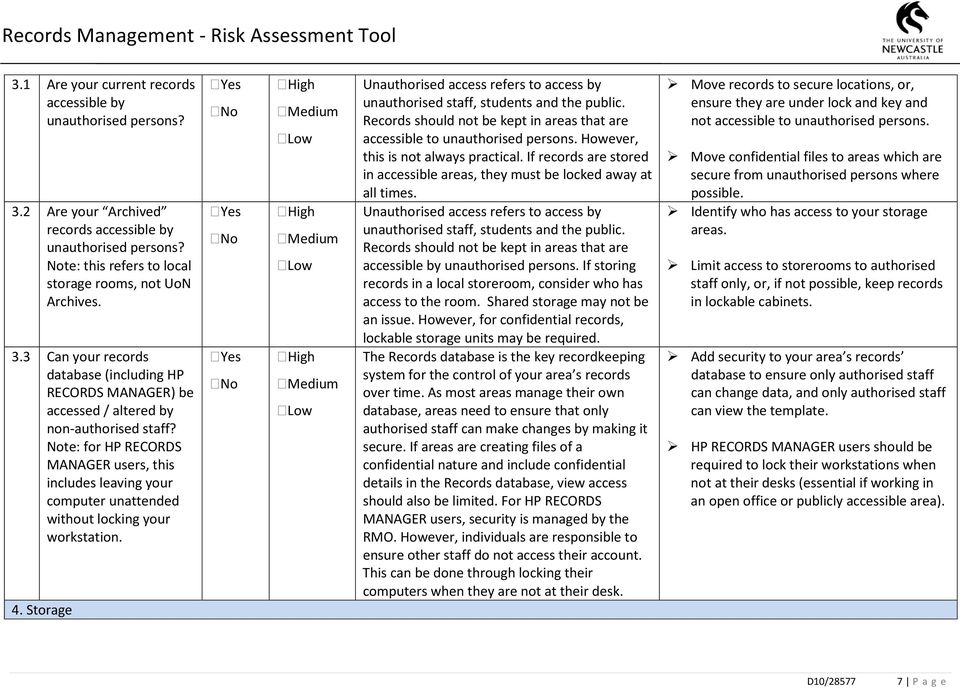
7 3.1 Are your current records accessible by unauthorised persons? 3.2 Are your Archived records accessible by unauthorised persons? Note: this refers to local storage rooms, not UoN Archives. 3.3 Can your records database (including HP RECORDS MANAGER) be accessed / altered by non-authorised staff? Note: for HP RECORDS MANAGER users, this includes leaving your computer unattended without locking your workstation. 4. Storage Unauthorised access refers to access by unauthorised staff, students and the public. Records should not be kept in areas that are accessible to unauthorised persons. However, this is not always practical. If records are stored in accessible areas, they must be locked away at all times. Unauthorised access refers to access by unauthorised staff, students and the public. Records should not be kept in areas that are accessible by unauthorised persons. If storing records in a local storeroom, consider who has access to the room. Shared storage may not be an issue. However, for confidential records, lockable storage units may be required. The Records database is the key recordkeeping system for the control of your area s records over time. As most areas manage their own database, areas need to ensure that only authorised staff can make changes by making it secure. If areas are creating files of a confidential nature and include confidential details in the Records database, view access should also be limited. For HP RECORDS MANAGER users, security is managed by the RMO. However, individuals are responsible to ensure other staff do not access their account. This can be done through locking their computers when they are not at their desk. Move records to secure locations, or, ensure they are under lock and key and not accessible to unauthorised persons. Move confidential files to areas which are secure from unauthorised persons where possible. Identify who has access to your storage areas. Limit access to storerooms to authorised staff only, or, if not possible, keep records in lockable cabinets. Add security to your area s records database to ensure only authorised staff can change data, and only authorised staff can view the template. HP RECORDS MANAGER users should be required to lock their workstations when not at their desks (essential if working in an open office or publicly accessible area). D10/ P age
8 4.1 Are your records stored in close proximity to building works? Note: close proximity includes next to or within storage areas. 4.2 Are your records stored in close proximity to a kitchen or toilet facilities? Building works directly affecting your area can cause several risks to records, including reduced security levels, dust, increased risk of fire or water damage, possible loss through staff movement etc. Building works indirectly affecting your areas may also cause risk to records, however, an individual area may be less likely to mitigate against the risks or be aware of them. See also 2.9 Water damage can be difficult and costly to recover from. Fire damage can be impossible to recover from. It is preferable that records are not stored in proximity to kitchens or toilets. Where this is so, strategies should be put in place to ensure the records are protected through appropriate storage. Workmen working directly within records storage areas must be made aware to report any incidents that may affect records immediately. Areas must be aware of building works in locations adjacent to record storage areas and monitor any affects on records during the works. Move records directly affected by building works to a temporary location. Relocate records to areas not directly adjacent to kitchens or toilets, or, if not practical, ensure records are stored in suitable cabinets to minimise any damage if a disaster occurs. 4.3 Are your records stored in close proximity to laboratories or workshops? Note: close proximity includes next to or within storage areas. Laboratories and workshops can experience overflowing sinks, fires and chemical spills. To minimise risks associated with possible damage to records, they should not be stored in or adjacent to laboratories or workshops. If storage in these areas is necessary, appropriate strategies should be in place to ensure records are protected through storing them in appropriate storage cabinets (e.g. if there is the possibility of fire within a laboratory, more so Relocate records to areas not directly within or adjacent to laboratories and workshops where there is an identified risk of fire, flooding or chemical spills, or, if not practical, ensure records are stored in suitable cabinets to minimise any damage if a disaster occurs. D10/ P age

9 4.4 Are there known cases of leaks (water or other) that may, or have already, affected records stored within your area? Note: includes leaks from pipes above or within walls. 4.5 Are there known cases of faulty wiring or damaged equipment within your records storage area? 4.6 Are your records stored in unstable storage units? than in any other areas, a fireproof cabinet should be used). See also 1.7. Water damage can be difficult and costly to recover from. Leaks in pipes, sprinkler systems etc., above or close to records storage areas need to be identified and fixed. If known to reoccur, records should be relocated. Apart from safety issues within faulty equipment, fire damage to records can be impossible to recover from. Rusty or damaged storage cabinets can result in damage to records and may also be a safety issue for staff. Check records storage areas for leaks on a regular basis. Relocate records from areas prone or currently affected by leaks. Where leaks are identified, lodge a Maintenance Request. Discard suspect/damaged equipment. Discard unsafe storage cabinets/units. 4.7 Do you store records on the floor? Storing records or boxes of records on the floor puts them at risk of flooding or water build up. It is also a safety issue for staff. Transfer records from floor areas to suitable storage cabinets or shelving units. 4.8 Are your records storage areas considered a dumping ground for all types of Dumping records or other items into the records storage area without proper management and appropriate disposal (i.e. archiving or destruction) practices in place can Implement a regular records disposal program. Delegate the management of record D10/ P age

10 material and equipment? 4.9 Does your area store unstable record formats such as combustible nitrate film? 5. Implementation of Disaster Planning 5.1 Our area does NOT have a Vital Record Recovery Priority List. Note: Tick yes if this statement is true. 5.2 Our area does NOT have a copy of its business lead to other risk factors, such as infestation and vermin, and may increase the effect of water or fire-based disasters. It is also good practice NOT to retain records beyond retention timeframes without good reason (note Destruction Authorisation Form requirements). See also 3.2. Nitrate film and other multimedia formats can be unstable. In extreme cases, they may combust. It is important for areas to know in advance where records are, and more importantly, which records are vital and prioritised for recovery in the case of a disaster. It is preferable that all records are recovered, but where this is not possible, a risk approach is required. A Records Recovery Priority List will: - make recovery operations more effective and reduce the risk of further damage or loss of more important records held by an area. - ensure resources are not wasted on recovering records of low or no importance over records of high importance, where priority decisions are required. In the case of a disaster you will need to access your business continuity plan. If it is your office storage to Records Contact and where possible limit access and the use of storage areas as dumping grounds. Box, and/or list all records held within records storage areas. Discuss storage requirements with RMO Assess all records within your area and develop a list of vital records for your area s business and that of the University. Place a copy of your area s business continuity plans, at a separate location to D10/ P age

11 continuity plan. Note: tick yes if this statement is true. 5.3 Our area does NOT have a business continuity plan. Note: tick yes if this statement is true. area you may not be able to enter and as such will need to store this information in a separate area. If your area is affected, are you able to continue your business from another location? The Business Continuity Plan will assist in identifying what resources you require for this. your office (ensure these are kept securely). Develop a Business Continuity Plan for your area. D10/ P age

COMPLIANCE WITH THIS DOCUMENT IS MANDATORY
 COVER SHEET NAME OF DOCUMENT TYPE OF DOCUMENT DOCUMENT NUMBER Procedure DATE OF PUBLICATION Published: October 2002 Revised: October 2004 Revised: September 2005 Revised: February 2011 Revised: November
Section 12 Setting up a Mission Records Storage Facility
 Section 12 Setting up a Mission Records Storage Facility Contents Main things to Remember about Setting up a Mission Records Storage Facility Introduction Minimum Standard for Semi-active Records Storage
This policy is not designed to use systems backup for the following purposes:
 Number: AC IT POL 003 Subject: Backup and Restore Policy 1. PURPOSE The backup and restore policy establishes the need and rules for performing periodic system backup to permit timely restoration of Africa
RECORDKEEPING MATURITY MODEL
 Introduction Maturity Rating Definitions 1 Level 1 Inadequate/Sub-standard Practice is not formalised or documented. Processes and practices are fragmented or non-existent. Where processes and practices
Titling, dating and marking up records
 Summary This factsheet intends to explain when you need paper records and how to look after them. You will discover: When you need to print records How to title and date paper records, and mark them with
Document Management Plan Preparation Guidelines
 Document Management Plan Preparation Guidelines TABLE OF CONTENTS 1. Purpose of Document 1 2. Definition of Document Management 1 3. Objectives of Document Management 1 4. Terms, Acronyms and Abbreviations
Digital Media Storage
 Summary State and local governments use computers to create, capture, or maintain public records. To be accountable to the citizens of Minnesota, government agencies are required by law to keep records
Policy Document RECORDS MANAGEMENT POLICY
 The District Council Of Elliston Policy Document RECORDS MANAGEMENT POLICY Date Adopted: 16 th December 2005 Review Date: Ongoing, as necessary Minute Number: 300. 2005 E:\WPData\Jodie\My Documents\policies
GUIDELINES FOR RETENTION OF CLINICAL TRIAL RECORDS AT INVESTIGATOR STUDY SITES
 1 GUIDELINES FOR RETENTION OF CLINICAL TRIAL RECORDS AT INVESTIGATOR STUDY SITES INTRODUCTION During the conduct of a clinical trial, large quantities of documentation are generated both by the sponsor
Records Management - Department of Health
 Policy Directive Records Management - Department of Health Document Number PD2009_057 Publication date 24-Sep-2009 Functional Sub group Corporate Administration - Records Ministry of Health, NSW 73 Miller
ICT Policy. Executive Summary. Date of ratification Executive Team Committee 22nd October 2013. Document Author(s) Collette McQueen
 ICT Policy THCCGIT20 Version: 01 Executive Summary This document defines the Network Infrastructure and File Server Security Policy for Tower Hamlets Clinical Commissioning Group (CCG). The Network Infrastructure
Records Management Policy
 Policy Approval Body: Records Management Policy Academic Board Date Created: 26th February 2010 Policy Custodian: Policy Contact: File Location: Location on EIT website: Review Period: Revision No: 5 Dean
ANNEXURE 07: CHECK-LIST FOR OFF-SITE STORAGE FACILITIES
 ANNEXURE 07: CHECK-LIST FOR OFF-SITE STORAGE FACILITIES NAME OF PRIVATE STORAGE FACILITY: DATE VISITED: 1. COMPANY PROFILE 1.1 What is the company's mission? 1.2 How does that mission compare with the
How To Manage Records In Virginia
 Public Record Office Victoria PROS 10/10 Strategic Management Guideline 6 Records & Risk Management Version Number: 1.0 Issue Date: 19/07/2010 Expiry Date: 19/07/2015 State of Victoria 2010 Version 1.0
Business System Recordkeeping Assessment - Digital Recordkeeping Compliance
 Introduction The following assessment will assist to identify whether the system complies with State Records Authority of NSW Standards on Records Management The broad Principles of this standard are as
COUNCIL POLICY R180 RECORDS MANAGEMENT
 1. Scope The City of Mount Gambier Records Management Policy provides the policy framework for Council to effectively fulfil its obligations and statutory requirements under the State Records Act 1997.
ICT NETWORK AND INFRASTRUCTURE FILE SERVER POLICY
 ICT NETWORK AND INFRASTRUCTURE FILE SERVER POLICY Version 1.0 Ratified By Date Ratified Author(s) Responsible Committee / Officers Issue Date Review Date Intended Audience Impact Assessed CCG Committee
IT NETWORK AND INFRASTRUCTURE FILE SERVER POLICY
 IT NETWORK AND INFRASTRUCTURE FILE SERVER POLICY Version 3.0 Ratified By Date Ratified April 2013 Author(s) Responsible Committee / Officers Issue Date January 2014 Review Date Intended Audience Impact
IT NETWORK AND INFRASTRUCTURE FILE SERVER POLICY (for Cheshire CCGs)
 IT NETWORK AND INFRASTRUCTURE FILE SERVER POLICY (for Cheshire CCGs) Version 3.2 Ratified By Date Ratified November 2014 Author(s) Responsible Committee / Officers Issue Date November 2014 Review Date
How To Protect Decd Information From Harm
 Policy ICT Security Please note this policy is mandatory and staff are required to adhere to the content Summary DECD is committed to ensuring its information is appropriately managed according to the
Information Security Policy
 Information Security Policy Author: Responsible Lead Executive Director: Endorsing Body: Governance or Assurance Committee Alan Ashforth Alan Lawrie ehealth Strategy Group Implementation Date: September
University of Liverpool
 University of Liverpool Information Security Policy Reference Number Title CSD-003 Information Security Policy Version Number 3.0 Document Status Document Classification Active Open Effective Date 01 October
Disaster Recovery Planning
 NASA IV & V ANNUAL WORKSHOP 202 The 4th International Workshop on Independent Verification & Validation of Software Disaster Recovery Planning Divya Krishnamoorthy Mailam Engineering College, Mailam. (Affiliated
Data Security Policy
 Policy Number: Revision Number: 0 QP1.44 Date of issue: March 2009 Status: Approved Date of approval: April 2009 Responsibility for policy: Responsibility for implementation: Responsibility for review:
Records Management - Council Policy Version 2-28 April 2014. Council Policy. Records Management. Table of Contents. Table of Contents... 1 Policy...
 Council Policy Records Management Table of Contents Table of Contents... 1 Policy... 2 Policy Objectives... 2 Policy Statement... 2 Records Management Program... 2 Accountability Requirements... 3 General
ISO IEC 27002 2005 (17799 2005) INFORMATION SECURITY AUDIT TOOL
 9.1 USE SECURITY AREAS TO PROTECT FACILITIES 1 GOAL Do you use physical methods to prevent unauthorized access to your organization s information and premises? 2 GOAL Do you use physical methods to prevent
PAPER RECORDS SECURE HANDLING AND TRANSIT POLICY
 PAPER RECORDS SECURE HANDLING AND TRANSIT POLICY CORPORATE POLICY Document Control Title Paper Records Secure Handling and Transit Policy Author Information Governance Manager ** Owner SIRO/CIARG Subject
Records Management Plan. April 2015
 Records Management Plan April 2015 Prepared in accordance with the Public Records (Scotland) Act 2011 and submitted to the Keeper of the Records of Scotland for their agreement on 28 April 2015 (Revised
Life Cycle of Records
 Discard Create Inactive Life Cycle of Records Current Retain Use Semi-current Records Management Policy April 2014 Document title Records Management Policy April 2014 Document author and department Responsible
CCG: IG06: Records Management Policy and Strategy
 Corporate CCG: IG06: Records Management Policy and Strategy Version Number Date Issued Review Date V3 08/01/2016 01/01/2018 Prepared By: Consultation Process: Senior Governance Manager, NECS CCG Head of
IS INFORMATION SECURITY POLICY
 IS INFORMATION SECURITY POLICY Version: Version 1.0 Ratified by: Trust Executive Committee Approved by responsible committee(s) IS Business Continuity and Security Group Name/title of originator/policy
Rotherham CCG Network Security Policy V2.0
 Title: Rotherham CCG Network Security Policy V2.0 Reference No: Owner: Author: Andrew Clayton - Head of IT Robin Carlisle Deputy - Chief Officer D Stowe ICT Security Manager First Issued On: 17 th October
State Records Guideline No 25. Managing Information Risk
 State Records Guideline No 25 Managing Information Risk Table of Contents 1 Introduction... 4 1.1 Purpose... 4 1.2 Authority... 4 2 Risk Management and Information... 5 2.1 Overview... 5 2.2 Risk management...
Records Management plan
 Records Management plan Prepared for 31 October 2013 Audit Scotland is a statutory body set up in April 2000 under the Finance and Accountability (Scotland) Act 2000. We help the Auditor General for Scotland
All staff at Ara, including full and part-time permanent, temporary and contracting staff
 Corporate Policies & Procedures General Administration Document CPP114 Records Management First Produced: Current Version: Past Revisions: Review Cycle: Applies From: 14/08/07 14/05/14 dd/mm/yy 3 year
RECORDS MANAGEMENT POLICY
 RECORDS MANAGEMENT POLICY ADOPTED BY COUNCIL 13 JUNE 2006 REVIEWED BY COUNCIL 6 NOVEMBER 2006 REVIEWED BY COUNCIL 10 MAY 2010 1. INTRODUCTION The State Records Act 1997 governs the obligations and responsibilities
BUSINESS CONTINUITY PLAN
 Business Logo or Name here BUSINESS CONTINUITY PLAN FOR RESIDENTIAL CARE HOMES PRODUCED BY DURHAM CIVIL CONTINGENCIES UNIT BUSINESS CONTINUITY PLAN LIST OF CONTENTS 1. DISCLAIMER...4 2. AIM...4 3. BUSINESS
Information Security Policy September 2009 Newman University IT Services. Information Security Policy
 Contents 1. Statement 1.1 Introduction 1.2 Objectives 1.3 Scope and Policy Structure 1.4 Risk Assessment and Management 1.5 Responsibilities for Information Security 2. Compliance 3. HR Security 3.1 Terms
Network Security Policy
 IGMT/15/036 Network Security Policy Date Approved: 24/02/15 Approved by: HSB Date of review: 20/02/16 Policy Ref: TSM.POL-07-12-0100 Issue: 2 Division/Department: Nottinghamshire Health Informatics Service
Information and Compliance Management Information Management Policy
 Aurora Energy Group Information Management Policy Information and Compliance Management Information Management Policy Version History REV NO. DATE REVISION DESCRIPTION APPROVAL 1 11/03/2011 Revision and
Auditing in an Automated Environment: Appendix C: Computer Operations
 Agency Prepared By Initials Date Reviewed By Audit Program - Computer Operations W/P Ref Page 1 of 1 Procedures Initials Date Reference/Comments OBJECTIVE - To document the review of the computer operations
Mike Casey Director of IT
 Network Security Developed in response to: Contributes to HCC Core Standard number: Type: Policy Register No: 09037 Status: Public IG Toolkit, Best Practice C7c Consulted With Post/Committee/Group Date
GLP Records Storage and Retrieval
 GLP Records Storage and Retrieval Cindy Green BBS UNITED, ALEX HAYDEN/GETTY IMAGES GLP Topics addresses topics associated with good laboratory practice requirements. We intend this column to be a useful
RECORDS MANAGEMENT POLICY
 [Type text] RECORDS MANAGEMENT POLICY POLICY TITLE Academic Year: 2013/14 onwards Target Audience: Governing Body All Staff and Students Stakeholders Final approval by: CMT - 1 October 2014 Governing Body
NHS Business Services Authority Records Management Audit Framework
 NHS Business Services Authority Records Management Audit Framework NHS Business Services Authority Corporate Secretariat NHSBSARM019 Issue Sheet Document Reference Document Location Title Author Issued
A CALL TO CONTENTS OFF-SITE RECORDS STORAGE: CONSIDERATIONS AND SELECTION CRITERIA
 A CALL TO Bulletin # 8 May 2003 It is the value of your records and data that should dictate the type of storage and protection you need for them. Off-Site storage is generally an efficient and economical
Cloud Computing and Records Management
 GPO Box 2343 Adelaide SA 5001 Tel (+61 8) 8204 8773 Fax (+61 8) 8204 8777 DX:336 [email protected] www.archives.sa.gov.au Cloud Computing and Records Management June 2015 Version 1 Version
HIPAA SECURITY RISK ASSESSMENT SMALL PHYSICIAN PRACTICE
 HIPAA SECURITY RISK ASSESSMENT SMALL PHYSICIAN PRACTICE How to Use this Assessment The following risk assessment provides you with a series of questions to help you prioritize the development and implementation
ULH-IM&T-ISP06. Information Governance Board
 Network Security Policy Policy number: Version: 2.0 New or Replacement: Approved by: ULH-IM&T-ISP06 Replacement Date approved: 30 th April 2007 Name of author: Name of Executive Sponsor: Name of responsible
INFORMATION TECHNOLOGY SECURITY STANDARDS
 INFORMATION TECHNOLOGY SECURITY STANDARDS Version 2.0 December 2013 Table of Contents 1 OVERVIEW 3 2 SCOPE 4 3 STRUCTURE 5 4 ASSET MANAGEMENT 6 5 HUMAN RESOURCES SECURITY 7 6 PHYSICAL AND ENVIRONMENTAL
Records Management Policy
 Records Management Policy Policy Reference Number Responsible Department Related Policies 34CP Corporate & Community Services Code of Conduct for Elected Members, Code of Conduct for Employees, Internet,
Human Resources Policy documents. Data Protection Policy
 Policy documents Aims of the Policy apetito is committed to meeting its obligations under data protection law. As a business, apetito handles a range of Personal Data relating to its customers, staff and
Definitions. Library Disasters. Disaster Management in Libraries involves Prevention Preparedness Response Recovery
 Library Disasters Disaster Management: Is your Library ready? By Fe Angela M. Verzosa PLAI-Southern Tagalog Regional Librarians Council, Puerto Princesa City, Palawan, 30 April 2010 95% of disasters result
Policy Document. IT Infrastructure Security Policy
 Policy Document IT Infrastructure Security Policy [23/08/2011] Page 1 of 10 Document Control Organisation Redditch Borough Council Title IT Infrastructure Security Policy Author Mark Hanwell Filename IT
ADRI. Advice on managing the recordkeeping risks associated with cloud computing. ADRI-2010-1-v1.0
 ADRI Advice on managing the recordkeeping risks associated with cloud computing ADRI-2010-1-v1.0 Version 1.0 29 July 2010 Advice on managing the recordkeeping risks associated with cloud computing 2 Copyright
INFORMATION SECURITY POLICY
 INFORMATION SECURITY POLICY Rev Date Purpose of Issue/ Description of Change Equality Impact Assessment Completed 1. June 2011 Initial Issue 2. 29 th March 2012 Second Version 3. 15 th April 2013 Third
Understanding Sage CRM Cloud
 Understanding Sage CRM Cloud Data centre and platform security whitepaper Document version 2016 Table of Contents 1.0 Introduction 3 2.0 Sage CRM Cloud Data centre Infrastructure 4 2.1 Site location 4
How To Protect School Data From Harm
 43: DATA SECURITY POLICY DATE OF POLICY: FEBRUARY 2013 STAFF RESPONSIBLE: HEAD/DEPUTY HEAD STATUS: STATUTORY LEGISLATION: THE DATA PROTECTION ACT 1998 REVIEWED BY GOVERNING BODY: FEBRUARY 2013 EDITED:
SOUTHWEST VIRGINIA COMMUNITY COLLEGE RECORDS MANAGEMENT POLICY
 SOUTHWEST VIRGINIA COMMUNITY COLLEGE RECORDS MANAGEMENT POLICY Statement of Intent This policy establishes the general responsibilities for management, retention, and disposition of SOUTHWEST VIRGINIA
IMS-ST-1.04 Document and Record Management. Prepared By: Jacqueline Raynes Print Date: 20/08/13 Version No: V01 Reviewed By: Jeff Innes
 Integrated Management Standard 1.04 Document and Record Management Contents 1 Purpose... 2 2 Scope... 2 3 Standard... 2 3.1 OTML Documentation Overview... 2 3.2 Integrated Management System Documentation...
Facility Safety and Emergency Management (FSE)
 Facility Safety and Emergency Management (FSE) Standard FSE.1 [Safety and security] The organization plans and implements a program to provide a safe and secure physical environment. Intent of FSE.1 The
Supplier Security Assessment Questionnaire
 HALKYN CONSULTING LTD Supplier Security Assessment Questionnaire Security Self-Assessment and Reporting This questionnaire is provided to assist organisations in conducting supplier security assessments.
Appendix 4-2: Sample HIPAA Security Risk Assessment For a Small Physician Practice
 Appendix 4-2: Administrative, Physical, and Technical Safeguards Breach Notification Rule How Use this Assessment The following sample risk assessment provides you with a series of sample questions help
BUSINESS CONTINUITY PLAN
 Business Logo Here BUSINESS CONTINUITY PLAN FOR SMALL TO MEDIUM SIZED BUSINESSES DATE :??? VERSION:?? PRODUCED BY DURHAM CIVIL CONTINGENCIES UNIT BUSINESS CONTINUITY PLAN LIST OF CONTENTS 1. DISCLAIMER...4
Information and records management. Purpose. Scope. Policy
 Information and records management NZQA Quality Management System Policy Purpose The purpose of this policy is to establish a framework for the management of corporate information and records within NZQA.
SUBJECT: SECURITY OF ELECTRONIC MEDICAL RECORDS COMPLIANCE WITH THE HEALTH INSURANCE PORTABILITY AND ACCOUNTABILITY ACT OF 1996 (HIPAA)
 UNIVERSITY OF PITTSBURGH POLICY SUBJECT: SECURITY OF ELECTRONIC MEDICAL RECORDS COMPLIANCE WITH THE HEALTH INSURANCE PORTABILITY AND ACCOUNTABILITY ACT OF 1996 (HIPAA) DATE: March 18, 2005 I. SCOPE This
VITAL RECORDS PROTECTION, DISASTER PREPAREDNESS AND
 Archives and Records Management VITAL RECORDS PROTECTION, DISASTER PREPAREDNESS AND RECOVERY Guidelines Archives and Records Management Unit Deputy Governor s Office June 2005 Contents 1 Vital Records
Activity risk assessment Assessment title: New Generic Office environment
 Activity risk assessment Assessment title: New Generic Office environment Assessment N o Location: CASS (Generic Assessments) 159838 Local Rules & Procedures for completing Risk Assessments I Confirm I
ESSENTIAL COMPONENTS OF AN EFFICIENT RECORDS STORAGE FACILITY
 ESSENTIAL COMPONENTS OF AN EFFICIENT RECORDS STORAGE FACILITY New York State Unified Court System Division of Court Operations Office of Records Management June 2003 TABLE OF CONTENTS PURPOSE OF THIS PAMPHLET...
BNA FEDERAL CREDIT UNION DISASTER RECOVERY PLAN
 BNA FEDERAL CREDIT UNION DISASTER RECOVERY PLAN INTRODUCTION The need for a contingency plan for business interruptions is vital to the operations of the BNA Federal Credit Union. Without such a plan,
Data Protection and Information Security. Data Security - Guidelines for the use of Personal Data
 Data Protection and Information Data - Guidelines for the use of Personal Data Page 1 of 10 Created on: 21/06/2013 Contents 1. Introduction... 3 2. Definitions... 3 4. Physical... 4 5 Electronic... 6 6
Home Working Policy Version Date Status Comments
 Home Working Policy Version Date Status Comments 1.0 June 2010 Draft 1.0 August 2010 Draft Policy sent out for consultation via JCC and Corporate Bulletin Board. 1.0 November 2010 Final Resources Portfolio
INFORMATION SECURITY MANAGEMENT SYSTEM. Version 1c
 INFORMATION SECURITY MANAGEMENT SYSTEM Version 1c Revised April 2011 CONTENTS Introduction... 5 1 Security Policy... 7 1.1 Information Security Policy... 7 1.2 Scope 2 Security Organisation... 8 2.1 Information
Information Security Team
 Title Document number Add document Document status number Draft Owner Approver(s) CISO Information Security Team Version Version history Version date 0.01-0.05 Initial drafts of handbook 26 Oct 2015 Preface
University of Brighton School and Departmental Information Security Policy
 University of Brighton School and Departmental Information Security Policy This Policy establishes and states the minimum standards expected. These policies define The University of Brighton business objectives
Written Information Security Plan (WISP) for. HR Knowledge, Inc. This document has been approved for general distribution.
 Written Information Security Plan (WISP) for HR Knowledge, Inc. This document has been approved for general distribution. Last modified January 01, 2014 Written Information Security Policy (WISP) for HR
SAFETY SELF-INSPECTION PROGRAM
 Palm Beach State College Florida s First Public Community College SAFETY SELF-INSPECTION PROGRAM PALM BEACH STATE COLLEGE SAFETY SELF-INSPECTION PROGRAM 1. INTRODUCTION An important element of any employee
Physical Security Policy
 Physical Security Policy Author: Policy & Strategy Team Version: 0.8 Date: January 2008 Version 0.8 Page 1 of 7 Document Control Information Document ID Document title Sefton Council Physical Security
National Archives and Records Administration (NARA) Facility Standards for Federal Records Storage Facilities
 National Archives and Records Administration (NARA) Facility Standards for Federal Records Storage Facilities A quick overview of what Federal Records Officers need to know about: What the Records Storage
Information Governance Policy (incorporating IM&T Security)
 (incorporating IM&T Security) ONCE PRINTED OFF, THIS IS AN UNCONTROLLED DOCUMENT. PLEASE CHECK THE INTRANET FOR THE MOST UP TO DATE COPY Target Audience: All staff employed or working on behalf of the
Records Management. 1. Introduction. 2. Strategic Plan Desired Outcomes
 Records Management Classification: Policy Name: First Issued / Approved: Last Reviewed: Council Policy Records Management 13/9/2011, CCS0036 12 August 2014, Cl9829 24 February 2015, C10054 Next Review: