
Public Health PBRN Monthly Virtual Mee6ng August 16, 2012
|
|
|
- Dominic Hamilton
- 10 years ago
- Views:
Transcription
1 Public Health PBRN Monthly Virtual Mee6ng August 16, 2012

2 Forecasting the Impact of the Economic Recession on the Financing of Local Public Health Departments in Wisconsin A Quick Strike research project supported through the Wisconsin Public Health Practice-Based Research Network Andrew Reschovsky, Ph.D. Susan Zahner, DrPH, RN Kohei Enami Senay Goitom University of Wisconsin-Madison
3 Quick Strike Project Goals Develop a model to forecast the revenues that will be available to Wisconsin LHDs over the next few years through 2014 Assist LHDs in planning how to maintain core services in a difficult fiscal environment Develop a tool that will allow individual LHDs to predict future resource availability under a set of different assumptions Develop revenue forecasting methodology that should assist analysts in other states in building their own LHD revenue forecasting capacity

4 Outline of Today s Presentation Discuss the economic and fiscal environment in the U.S. and its implication for the financing of local public health departments Describe our revenue forecasting methodology for LHDs in Wisconsin Disaggregated approach by revenue source When possible, forecasts based on LHD revenue data for the period 2002 to 2009 Spelling out a range of assumptions and developing a methodology to allow the assessment of different assumptions on future revenues Presentation of Wisconsin results Conclusions

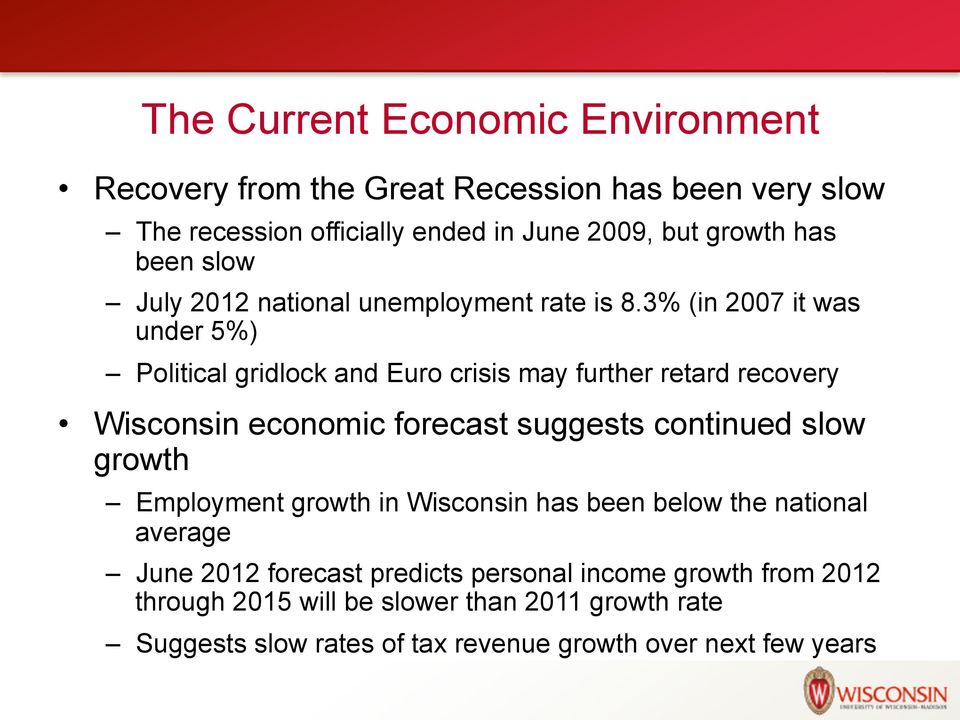
5 The Current Economic Environment Recovery from the Great Recession has been very slow The recession officially ended in June 2009, but growth has been slow July 2012 national unemployment rate is 8.3% (in 2007 it was under 5%) Political gridlock and Euro crisis may further retard recovery Wisconsin economic forecast suggests continued slow growth Employment growth in Wisconsin has been below the national average June 2012 forecast predicts personal income growth from 2012 through 2015 will be slower than 2011 growth rate Suggests slow rates of tax revenue growth over next few years
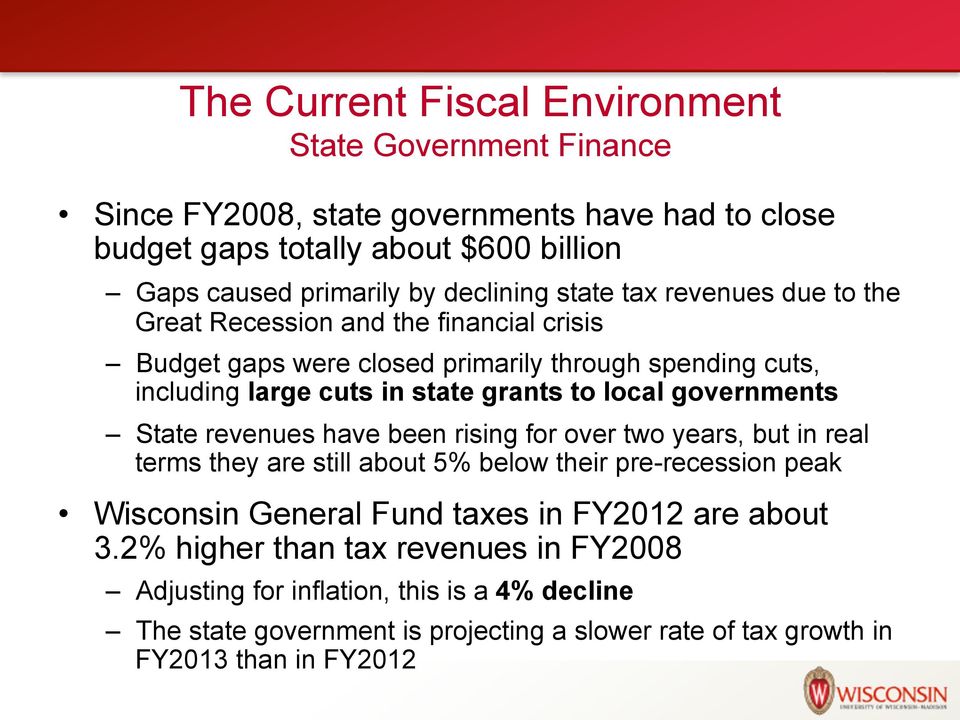
6 The Current Fiscal Environment State Government Finance Since FY2008, state governments have had to close budget gaps totally about $600 billion Gaps caused primarily by declining state tax revenues due to the Great Recession and the financial crisis Budget gaps were closed primarily through spending cuts, including large cuts in state grants to local governments State revenues have been rising for over two years, but in real terms they are still about 5% below their pre-recession peak Wisconsin General Fund taxes in FY2012 are about 3.2% higher than tax revenues in FY2008 Adjusting for inflation, this is a 4% decline The state government is projecting a slower rate of tax growth in FY2013 than in FY2012
7 The Current Fiscal Environment Local Government Finance In the U.S., general-purpose local governments (municipalities and county governments) get most of their tax revenues from the property tax Since 2007, housing prices in the U.S. have fallen dramatically, in some places by more than half Housing prices continue to fall and the rate of housing foreclosures continues to rise in some parts of the country Recent research has found a lag of about 3 years between declines in housing prices and declines in property tax revenues National data shows declines in property tax revenues starting in 2010 In Wisconsin in 2011 the market value of taxable property fell by 1.8% Largest drop was 6.4% (Juneau county) 16 out of 72 counties saw small property value increases

8 The Current Fiscal Environment Federal Government Finance Federal fiscal policy is being driven by the need to reduce the size of the nation s debt In the long run, the rising cost of entitlements will generate an unsustainable debt burden (debt relative to GDP) The Budget Control Act of 2011 (BCA) mandated spending cuts over the next 10 years Additional cuts are required through sequestration (or some alternative) The House (Ryan) budget calls for very large additional cuts in non-defense discretionary expenditures About one-third of this category of spending is for federal grants to state and local governments, including most federal grants going to finance LHDs Estimates suggest cuts of nearly 25% in FY2014 Regardless of the outcome of the November elections, federal grants are likely to be reduced, probably quite dramatically The Ryan budget also calls for the conversion of Medicaid into a block grant to states This would lead to cuts in Medicaid coverage and funding, especially during recessions

9 Local Public Health Departments in Wisconsin 92 LHDs 70 county public health departments Madison and Eau Clair have joint health department with their respective counties Beloit s city health department merged with its county health department 22 municipal public health department Representing 42 municipalities

10 Wisconsin LHD Revenue by Source, 2009 Total Amount Percent of Revenue Source (92 LHDs) Revenue Parent Jurisdiction $81,258, % Federal Grants 40,800, % State Grants 9,744, % Fees 27,698, % Donations 569, % Private Grants 2,547, % Total LHD Revenue $162,620, %

11 Forecasting Methodology Efforts concentrated on major revenue sources We relied on LHD data from fiscal surveys to develop baseline revenue estimates by source We use econometric techniques to forecast revenues where that was possible For other revenue sources, we rely on more ad hoc approaches For each revenue source developed a pessimistic and optimistic set of assumptions Our model is heavily parameterized, meaning that it is easy to quickly see the revenue implications of changing assumptions

12 Revenue from Parent (County or Municipal) Government Step 1: Forecast the General Fund (GF) revenue of parent governments from: Property taxes Sales taxes (in most counties) Shared Revenue grants Step 2: Forecast share of parent government GF revenue that is allocated to LHDs

13 Estimating LHD Revenue for Parent Governments

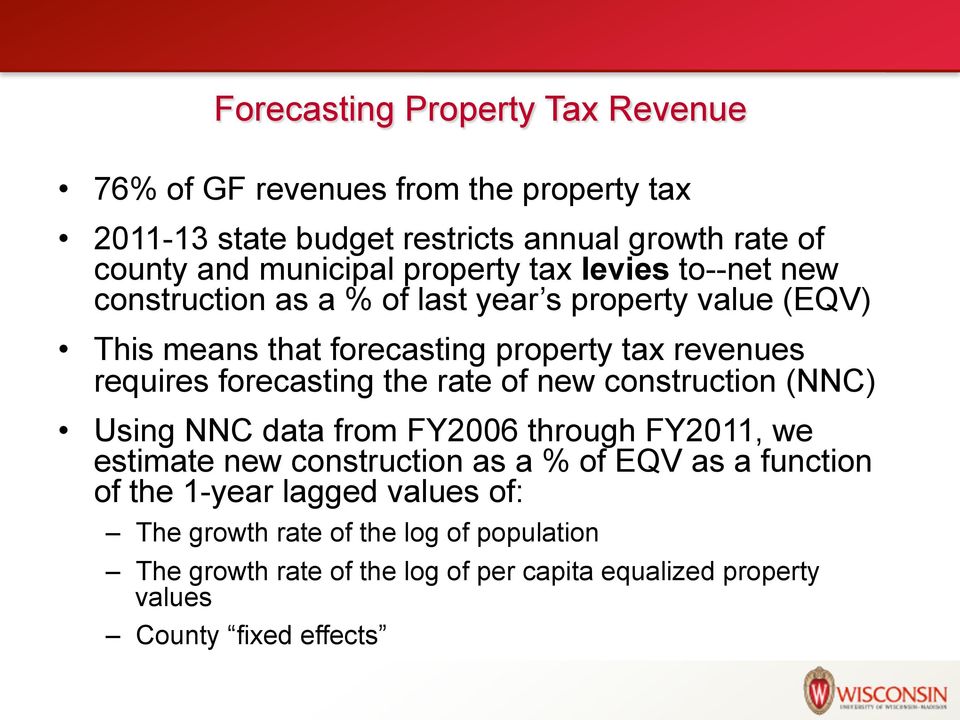
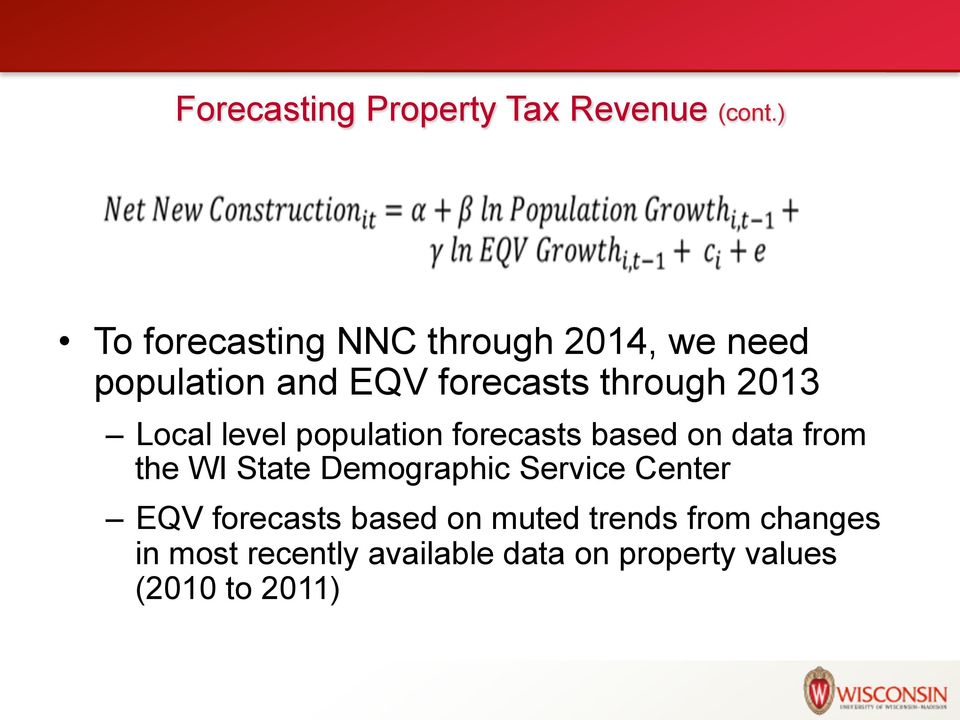
14 Forecasting Property Tax Revenue 76% of GF revenues from the property tax state budget restricts annual growth rate of county and municipal property tax levies to--net new construction as a % of last year s property value (EQV) This means that forecasting property tax revenues requires forecasting the rate of new construction (NNC) Using NNC data from FY2006 through FY2011, we estimate new construction as a % of EQV as a function of the 1-year lagged values of: The growth rate of the log of population The growth rate of the log of per capita equalized property values County fixed effects
15 Forecasting Property Tax Revenue (cont.) To forecasting NNC through 2014, we need population and EQV forecasts through 2013 Local level population forecasts based on data from the WI State Demographic Service Center EQV forecasts based on muted trends from changes in most recently available data on property values (2010 to 2011)
16 Forecasting Sales Tax Revenue Forecast based on county sales tax revenue data from 1998 through 2009 Regression includes County fixed effects State-level per capita sales tax revenue estimates

17 Forecasting Shared Revenue The formula used to allocate most of shared revenues has been frozen for a number of years The state budget mandates large cuts in Shared Revenues Aid allocated to county governments declines by 24.1% Aid reductions were made by a complex formula Dollar amount of each counties shared revenue allocation to remain unchanged in 2013 and in subsequent years Future budgets could change shared revenue allocations

18 Forecasting LHD Allocations from Parent Government GF Revenue Share of parent government general fund allocated to LHDs tends to be quite stable over time coefficient of variation = 0.2 Our attempts to statistically explain variation in shares was unsuccessful For each LHD, we assume that share of revenue from the GF in 2012 through 2014 will be equal to a weighted average of shares between 2002 and 2009 Most recent years given higher weight in calculating averages

19 Forecasting Federal Revenue Largest federal grants to LHDs WIC Maternal and Child Health Immunization Data problems prevent forecasting of specific grant programs We assume (base case) that federal revenue will equal weighted average federal grant between (2002 and 2009) increased by the rate of inflation (CPI) to 2011 Weights range from.04 (2002) to.21 (2009) Changes in federal grants for period reflect estimates of non-partisan agencies -4% in 2012; -8.8% in 2013; -7.4% in 2014

20 Forecasting Revenue from Fees, State Grants, Donations, and Private Grants Base case estimates of each of these revenue sources is based on a weighted average of revenue to each LHD from 2002 through 2009 Weights are higher for more recent years
21 Alternative Assumptions Pessimistic Case Optimistic Case Property tax Same as base case Levy limit raised to maximum of 2% or rate of net new construction Sales tax 95% of base case 105% of base case Shared revenues 90% of base case 110% of base case LHD share of parent government revenue 95% of base case 105% of base case Federal grants 20% cut (rel. to 2012) 5% cut (rel. to 2012) Other revenue sources Equal to minimum value in Equal to maximum value in 2002 to 2009 period, adjusted 2002 to 2009 period, adjusted for inflation for inflation and plus 5%
22 Wisconsin LHD Revenue, Nominal Dollars and Per Capita, Base Case Assumptions Total LHD Percentage Total LHD Percentage Revenue Change Per Capita Revenue Change 2012 $158,766,743 $ $158,968, % $ % 2014 $162,130, % $ %
23 Wisconsin LHD Revenue, Real Dollars and Per Capita, Base Case Assumptions Total LHD Percentage Total LHD Percentage Revenue Change Per Capita Revenue Change 2012 $151,562,637 $ $148,779, % $ % 2014 $148,472, % $ % Note: Inflation adjustments based on forecasted values of the Consumer Price Index. All revenuesare expressed in 2010 dollars.
24 Percentage Changes in LHD Revenues by 2010 Population of LHD Parent Governments Population Number Average Per Capita Percentage Change in LHD Revenue of LHDs LHD Revenue, to to to 2014 Under 25, $35 0.8% 0.1% 1.8% 25,000 to 100, $25 0.9% 0.3% 1.9% More than 100, $25-3.1% 0.3% 2.1% Total 92 $27-2.4% 0.1% 2.0% Note: Averages in the Total row are statewide averages. This implies that percentage changes are weighted by the population of the parent government.
25 Certification Level Percentage Changes in LHD Revenues by LHD Certification Level Number Average Per Capita Percentage Change in LHD Revenue of LHDs LHD Revenue, to to to 2014 Level 1 certification 8 $23-9.1% -0.3% 1.3% Level 2 certification 53 $27 2.8% 0.2% 2.0% Level 3 certification 31 $33-1.5% 0.4% 1.9% Total 92 $27-2.4% 0.1% 2.0% Note: Averages in the Total row are statewide averages. This implies that percentage changes are weighted by the population of the parent government. Certification levels established by the Wisconsin Department of Health Services, with higher levels requiring a broader range of service provision and reporting requirements.
26 Percentage Changes in LHD Revenues by LHD Organizational Structure Organizational Structure Number Average Per Capita Percentage Change in LHD Revenue of LHDs LHD Revenue, to to to 2014 LHD part of Human 24 $26 5.5% 0.0% 2.0% Services Dept. LHD an independent 68 $30-1.5% 0.3% 1.9% Department Total 92 $27-2.4% 0.1% 2.0% Note: Averages in the Total row are statewide averages. This implies that percentage changes are weighted by the population of the parent government.
27 Forecast 2014 Nominal LHD Revenue Under Three Sets of Assumptions Pessimistic Case Base Optimistic Case Amount Rel. to Base Case Amount Rel. to Base 2014 Total Forecast Revenue $144,368, % $162,130,266 $183,993, % By Source of Revenue: Parent Government $79,237, % $84,368,570 $91,058, % Federal Government $32,272, % $37,355,929 $38,324, % State Revenue $6,822, % $9,539,432 $13,728, % Fee Revenue $24,040, % $27,772,732 $35,818, % Donation Revenue $219, % $498,525 $893, % Private Grant Revenue $1,776, % $2,595,079 $4,170, %
28 Distributions of LHDs by Percentage Change in Per Capita Revenue , Under Three Sets of Assumptions Percentage Change in Per Capita Revenue, 2009 to 2014 Number of LHDs Pessimistic Base Optimistic Case Case Case Greater than 25% Reduction % to 25% Reduction Less than 10% Reduction Less than 10% Increase % to 25% Increase Greater than 25% Increase Total
29 Conclusions We are entering a period of extraordinary fiscal uncertainty How the Affordable Care Act will be implemented is unknown All three levels of government face long-term (structural) revenue problems Revenue forecasting will never be perfectly accurate, but it can reduce uncertainty and provide important information for budgetary planning for more than next year Revenue forecasting models must be state-specific, but the Wisconsin model can provide a roadmap for the design of LHD revenue forecasting models in other states
30 Other Mee6ng Agenda Items Updates Quick Strikes Funding Opportuni5es Update: PCORI and AHRQ Policy Transla5on: A View from OMB Dissemina5on: An Update on Fron5ers Items for Dissemina5on Linked- In Group: hkp://
31 Other Mee6ng Agenda Items Upcoming mee5ngs APHA, October 27-31, San Francisco, CA September events: Monthly Virtual Mee5ng: September 20, presenta5on by NY PBRN PBRN Updates Introduc5ons: The Public Health PBRN Na5onal Coordina5ng Center Research Staff Quarterly Network Calls Technical and Administra5ve Assistance from the Coordina5ng Center
32 Other Mee6ng Agenda Items Grant repor6ng reminders Send to copy to RWJF guidelines for annual, final narra5ve reports & bibliography: h>p:// RWJF guidelines for financial reports: h>p:// RWJF guidelines for electronic submission standards for products and reports 32
33 For more informa6on contact: Glen Mays PUBLIC HEALTH Practice-Based Research Networks National Coordinating Center 111 Washington Avenue Lexington, KY
Executive Summary. Model Structure. General Economic Environment and Assumptions
 Executive Summary The (LTFP) report is an update from the preliminary report presented in January 2009 and reflects the Mayor s Proposed Budget for Fiscal Year 2010 and Fiscal Year 2011. Details of the
Securing Social Security: Sensitivity to Economic Assumptions and Analysis of Policy Options
 GLOBAL DEVELOPMENT AND ENVIRONMENT INSTITUTE WORKING PAPER NO. 05-03 Securing Social Security: Sensitivity to Economic Assumptions and Analysis of Policy Options Brian Roach and Frank Ackerman May 2005
Local Public Health Funding
 Local Public Health Funding Sarah Grosshuesch, MPH Public Health Officer Adams County HHS Division of Public Health Overview Finance for local health departments (LHDs) Budgets Grants Program evaluation
United States Government Required Supplementary Information (Unaudited) For the Years Ended September 30, 2014, and 2013
 REQUIRED SUPPLEMENTARY INFORMATION (UNAUDITED) 151 United States Government Required Supplementary Information (Unaudited) For the Years Ended September 30, 2014, and 2013 Fiscal Projections for the U.S.
REPORT OF THE MAINE STATE REVENUE FORECASTING COMMITTEE
 REPORT OF THE MAINE STATE REVENUE FORECASTING COMMITTEE December 2013 Michael Allen, Chair Associate Commissioner for Tax Policy James Breece University of Maine System Melissa Gott State Budget Officer
STATE REVENUE FORECASTING PROJECT 2010 TECHNICAL MEMORANDUM December 2, 2010 By Paul Shinn, Consultant. Introduction
 STATE REVENUE FORECASTING PROJECT 2010 TECHNICAL MEMORANDUM December 2, 2010 By Paul Shinn, Consultant Introduction This memorandum provides technical details and historical background for Oklahoma Policy
The Role of Health Care Spending in Projecting Federal Elderly Entitlement Spending
 The Role of Health Care Spending in Projecting Federal Elderly Entitlement Spending Andrew J. Rettenmaier and Zijun Wang April 2009 Private Enterprise Research Center Texas A&M University College Station,
GAO PATIENT PROTECTION AND AFFORDABLE CARE ACT. Effect on Long-Term Federal Budget Outlook Largely Depends on Whether Cost Containment Sustained
 GAO United States Government Accountability Office Report to the Ranking Member, Committee on the Budget, U.S. Senate January 2013 PATIENT PROTECTION AND AFFORDABLE CARE ACT Effect on Long-Term Federal
The Recession of 2007 2009
 The Recession of 2007 2009 February 2012 A general slowdown in economic activity, a downturn in the business cycle, a reduction in the amount of goods and services produced and sold these are all characteristics
How To Calculate Health Care Spending As A Share Of Gdp
 california Health Care Almanac : Slow Growth: A New Trend? September 2013 Introduction The United States continues to spend a greater percentage of its wealth on health care than any other industrialized
Legislative Fiscal Bureau One East Main, Suite 301 Madison, WI 53703 (608) 266-3847 Fax: (608) 267-6873
 Legislative Fiscal Bureau One East Main, Suite 301 Madison, WI 53703 (608) 266-3847 Fax: (608) 267-6873 March 4, 2002 Joint Committee on Finance Paper #1238 Shared Revenue Modifications -- Payments for
Ten Year Financial Plan
 2013 2022 Ten Year Financial Plan Department of Finance and Performance Management September 2013 0 Ten Year Financial Plan 2013 2022 Table of Contents Executive Summary... 2 Building the Base Case...
Forecasts of Macroeconomic Developments, State Revenues from Taxes and Revenue from Other Sources, 2013-2014
 Ministry of Finance Chief Economist - Research, State Revenue and International Affairs June 2013 Forecasts of Macroeconomic Developments, State Revenues from Taxes and Revenue from Other Sources, 2013-2014
california Health Care Almanac
 california Health Care Almanac : Slow But Steady august 2012 Introduction In 2014, implementation of the Affordable Care Act (ACA) will cause a spike in US health spending; analysts project an increase
Tax Increment Financing in Polk County
 Tax Increment Financing in Polk County By Peter S. Fisher and Michael Lipsman As Tax Increment Financing (TIF) faces new scrutiny this year by taxpayers, local officials and state legislators, it is important
Jarle Bergo: Monetary policy and the outlook for the Norwegian economy
 Jarle Bergo: Monetary policy and the outlook for the Norwegian economy Speech by Mr Jarle Bergo, Deputy Governor of Norges Bank, at the Capital markets seminar, hosted by Terra-Gruppen AS, Gardermoen,
Salt Lake Housing Forecast
 2015 Salt Lake Housing Forecast A Sustainable Housing Market By James Wood Director of the Bureau of Economic and Business Research Commissioned by the Salt Lake Board of REALTORS By year-end 2013 home
Massachusetts Department of Revenue. Briefing Book FY2015 Consensus Revenue Estimate Hearing. December 11, 2013. Presented by: Amy Pitter COMMISSIONER
 Massachusetts Department of Revenue Briefing Book FY2015 Consensus Revenue Estimate Hearing December 11, 2013 Presented by: Amy Pitter COMMISSIONER Kazim P. Ozyurt DIRECTOR OFFICE OF TAX POLICY ANALYSIS
Why a Credible Budget Strategy Will Reduce Unemployment and Increase Economic Growth. John B. Taylor *
 Why a Credible Budget Strategy Will Reduce Unemployment and Increase Economic Growth John B. Taylor * Testimony Before the Joint Economic Committee of the Congress of the United States June 1, 011 Chairman
2015-2016 Preliminary Budget. 2015-2020 General Fund 6-Year Forecast Detail
 Executive Summary: The 2015-2020 forecast shows recovery, with growth back to the 15 percent fund balance level by 2019 at staffing levels based on the 2015-2016 Preliminary Budget. 2014 revenues continue
December 2014 Revenue Forecast Methodology
 STATE OF INDIANA STATE BUDGET AGENCY 212 State House Indianapolis, Indiana 46204-2796 317-232-5610 Michael R. Pence Governor Brian E. Bailey Director December 2014 Revenue Forecast Methodology Technical
THE ECONOMIC IMPACT OF CORPORATE TAX RATE REDUCTIONS
 THE ECONOMIC IMPACT OF CORPORATE TAX RATE REDUCTIONS Leadership makes the difference January 211 The Economic Impact of Corporate Tax Rate Reductions January 211 Canadian Manufacturers & Exporters Author:
Property Tax Reductions to Diminish as Housing Market Improves
 Property Tax Reductions to Diminish as Housing Market Improves MAC TAYLOR LEGISLATIVE ANALYST MAY 5, 2014 Executive Summary Property Tax Reductions for Millions of Properties Due to Real Estate Crisis.
X. INTERNATIONAL ECONOMIC DEVELOPMENT 1/
 1/ X. INTERNATIONAL ECONOMIC DEVELOPMENT 1/ 10.1 Overview of World Economy Latest indicators are increasingly suggesting that the significant contraction in economic activity has come to an end, notably
April 2015 Revenue Forecast. Methodology and Technical Documentation
 STATE OF INDIANA STATE BUDGET AGENCY 212 State House Indianapolis, Indiana 46204-2796 317-232-5610 Michael R. Pence Governor Brian E. Bailey Director April 2015 Revenue Forecast Methodology and Technical
The Affordable Care Act and Childhood Immunization Delivery in Rural Communities
 PHSSR Research-In-Progress Series: Bridging Health and Health Care Wednesday, July 1, 2015 12-1pm ET/ 9-10am PT The Affordable Care Act and Childhood Immunization Delivery in Rural Communities To download
The Causes of the Shortfall: Declining Revenue
 February 24, 2008 Moving From Surplus to Shortfall: The Critical State of Missouri s Revenue and Policy Options Tom Kruckemeyer, Chief Economist Amy Blouin, Executive Director With the 2008 Missouri Legislative
NORTH CAROLINA GENERAL ASSEMBLY LEGISLATIVE FISCAL NOTE
 NORTH CAROLINA GENERAL ASSEMBLY LEGISLATIVE FISCAL NOTE BILL NUMBER: SHORT TITLE: SPONSOR(S): House Bill 1429 (House Finance Committee Substitute, as amended) Financial Responsibility Act Representatives
LEE BUSI N ESS SCHOOL SOUTHERN NEVADA QUARTERLY ECONOMIC FORECAST. Southern Nevada Economy to Continue Growth in 2014 and 2015
 CENTER FOR BUSINESS & ECONOMIC RESEARCH LEE BUSI N ESS SCHOOL SOUTHERN NEVADA QUARTERLY ECONOMIC FORECAST Quarter 2 2014 Southern Nevada Economy to Continue Growth in 2014 and 2015 S ince the end of the
The Small Business Economy. Small and Medium Enterprises (SMEs)
 The Small Business Economy Small and Medium Enterprises (SMEs) Seung Bach, Ph.D., Professor, College of Business Administration, Sacramento State Sanjay Varshney, Ph.D., CFA, Dean, College of Business
An overview of Colorado s state and local tax structures. Daphne Greenwood and Tom Brown
 An overview of Colorado s state and local tax structures Daphne Greenwood and Tom Brown Colorado has a highly decentralized revenue-raising structure compared to many other states. Although combined state
Economic Snapshot for February 2013
 Economic Snapshot for February 2013 Christian E. Weller on the State of the Economy Christian E. Weller, associate professor, Department of Public Policy and Public Affairs, University of Massachusetts
The Cost of Doing Nothing: Maine s Pension Payments are Crowding-Out Other Spending. By J. Scott Moody
 Path to Prosperity Published by The Maine Heritage Policy Center The Cost of Doing Nothing: Maine s Pension s are Crowding-Out Other Spending By J. Scott Moody February 3, 2011 Maine s annual public pension
Mandatory Spending Since 1962
 Mindy R. Levit Specialist in Public Finance D. Andrew Austin Analyst in Economic Policy Jeffrey M. Stupak Research Assistant March 18, 2015 Congressional Research Service 7-5700 www.crs.gov RL33074 Summary
Pre-Test Chapter 11 ed17
 Pre-Test Chapter 11 ed17 Multiple Choice Questions 1. Built-in stability means that: A. an annually balanced budget will offset the procyclical tendencies created by state and local finance and thereby
FEDERAL GRANTS TO STATES AND LOCALITIES CUT DEEPLY IN FISCAL YEAR 2009 FEDERAL BUDGET By Iris J. Lav and Phillip Oliff
 820 First Street NE, Suite 510 Washington, DC 20002 Tel: 202-408-1080 Fax: 202-408-1056 [email protected] www.cbpp.org February 4, 2008 FEDERAL GRANTS TO STATES AND LOCALITIES CUT DEEPLY IN FISCAL YEAR 2009
The Factors Fueling Rising Health Care Costs 2008
 The Factors Fueling Rising Health Care Costs 2008 Prepared for America s Health Insurance Plans, December 2008 2008 America s Health Insurance Plans Table of Contents Executive Summary.............................................................2
THE CURRENT SERVICES BASELINE: A TOOL FOR UNDERSTANDING BUDGET CHOICES By Elizabeth McNichol and Dylan Grundman
 820 First Street NE, Suite 510 Washington, DC 20002 Tel: 202-408-1080 Fax: 202-408-1056 [email protected] www.cbpp.org Updated October 21, 2011 THE CURRENT SERVICES BASELINE: A TOOL FOR UNDERSTANDING BUDGET
Minnetonka Independent School District 276 Levy Adoption Taxes Payable in 2012
 Minnetonka Independent School District 276 Levy Adoption Taxes Payable in 2012 Public Schools Established by Minnesota Constitution ARTICLE XIII MISCELLANEOUS SUBJECTS Section 1. UNIFORM SYSTEM OF PUBLIC
COLLEGES AND UNIVERSITIES RAISE $30.30 BILLION IN 2011 8.2 PERCENT INCREASE FUELED BY GIFTS FOR CAPITAL PURPOSES
 Council for Aid to Education 215 Lexington Avenue Contact: Ann E. Kaplan New York, NY 10016 212-217-0875 www.cae.org [email protected] FOR IMMEDIATE RELEASE Wednesday, February 15, 2012 12:00 a.m., Eastern
CONGRESS OF THE UNITED STATES CONGRESSIONAL BUDGET OFFICE CBO. An Update to the Budget and Economic Outlook: 2015 to 2025. Defense 2.7 3.3 2.2 2.
 CONGRESS OF THE UNITED STATES CONGRESSIONAL BUDGET OFFICE An Update to the Budget and Economic Outlook: 2015 to 2025 Percentage of GDP Major Health Care Programs Mandatory Spending Social Security Other
Homestead Tax Credit
 Homestead Tax Credit Prepared by Al Runde Wisconsin Legislative Fiscal Bureau One East Main, Suite 301 Madison, WI 53703 Homestead Tax Credit Introduction The homestead tax credit program directs property
Composition of Federal Spending
 The Honorable David M. Walker Comptroller General of the United States U.S. Government Accountability Office February 10, 2005 2 Composition of Federal Spending 1964 1984 2004* Defense Net interest *Current
A BIPARTISAN PLAN TO REDUCE OUR NATION S DEFICITS EXECUTIVE SUMMARY
 A BIPARTISAN PLAN TO REDUCE OUR NATION S DEFICITS EXECUTIVE SUMMARY This bipartisan, comprehensive, and balanced plan consistent with the recommendations of the Bowles-Simpson fiscal commission that will:
LEGISLATIVE REVENUE OFFICE H-197 State Capitol Building Salem, Oregon 97310-1347 http://www.leg.state.or.us/comm/lrohome.htm
 STATE OF OREGON LEGISLATIVE REVENUE OFFICE H-197 State Capitol Building Salem, Oregon 97310-1347 http://www.leg.state.or.us/comm/lrohome.htm Research Report (503) 986-1266 Research Report #6-99 The New
FY 2017 EXECUTIVE SUPPLEMENTAL BUDGET MULTI-YEAR FINANCIAL PLAN
 28th Legislature 2016 A CASE OF INFLATED REVENUES AND UNDERESTIMATED EXPENDITURES This report provides a comprehensive review of the FY 2017 Executive Supplemental Budget: Multi-Year Financial Summary
Public Health PBRN Monthly Virtual Meeting November 20, 2014
 Public Health PBRN Monthly Virtual Meeting November 20, 2014 Research in Progress Presentation by the PHAST Team out of the WA PH PBRN: Advancing the standardization of measures depicting local public
Federal Budget in Pictures CUT SPENDING // FIX THE DEBT // REDUCE THE TAX BURDEN$
 2015 Federal Budget in Pictures CUT SPENDING // FIX THE DEBT // REDUCE THE TAX BURDEN$ 2015 Federal Budget in Pictures CUT SPENDING // FIX THE DEBT // REDUCE THE TAX BURDEN Thomas A. Roe Institute for
Legislative Fiscal Bureau
 Legislative Fiscal Bureau Robert Wm. Lang, Director One East Main, Suite 301 Madison, WI 53703 Email: [email protected] Telephone: (608) 266-3847 Fax: (608) 267-6873 State of Wisconsin
Project LINK Meeting New York, 20-22 October 2010. Country Report: Australia
 Project LINK Meeting New York, - October 1 Country Report: Australia Prepared by Peter Brain: National Institute of Economic and Industry Research, and Duncan Ironmonger: Department of Economics, University
April 5, 2011. Honorable Paul Ryan Chairman Committee on the Budget U.S. House of Representatives Washington, DC 20515. Dear Mr.
 CONGRESSIONAL BUDGET OFFICE U.S. Congress Washington, DC 20515 Douglas W. Elmendorf, Director April 5, 2011 Honorable Paul Ryan Chairman Committee on the Budget U.S. House of Representatives Washington,
Response on the financing of Employment Insurance and recent measures. Ottawa, Canada October 9, 2014 www.pbo-dpb.gc.ca
 Response on the financing of Employment Insurance and recent measures Ottawa, Canada October 9, 20 www.pbo-dpb.gc.ca The mandate of the Parliamentary Budget Officer (PBO) is to provide independent analysis
July 2013 King County Economic and Revenue Forecast
 July 2013 King County Economic and Revenue Forecast Briefing to the King County Forecast Council July 24 th, 2013 Dave Reich, Chief Economist Office of Economic and Financial Analysis Summary The U.S.
Issue Brief How Does Illinois Spending on Public Services Compare to Other States?
 Issue Brief How Does Illinois Spending on Public Services Compare to Other States? JANUARY, 2014 Recent projections show that the state of Illinois will run a deficit ranging from $7.59 to $7.96 billion
ANNEX 1 - MACROECONOMIC IMPLICATIONS FOR ITALY OF ACHIEVING COMPLIANCE WITH THE DEBT RULE UNDER TWO DIFFERENT SCENARIOS
 ANNEX 1 - MACROECONOMIC IMPLICATIONS FOR ITALY OF ACHIEVING COMPLIANCE WITH THE DEBT RULE UNDER TWO DIFFERENT SCENARIOS The aim of this note is first to illustrate the impact of a fiscal adjustment aimed
West Virginia Children and Families Funding Study
 West Virginia Children and Families Funding Study Update and Report on Nine Year Trends in Public Expenditures FY 1999 through FY 2007 June, 2009 Supported By: Division of Criminal Justice Services / Department
A Strong Housing Recovery Fuels Growth
 Chapman University A. Gary Anderson Center for Economic Research FOR RELEASE: ONLINE: June 12, 2013; 10:00 a.m. PRINT: June 13, 2013 CONTACT: James Doti, President and Donald Bren Distinguished Chair of
Adjusting to a Changing Economic World. Good afternoon, ladies and gentlemen. It s a pleasure to be with you here in Montréal today.
 Remarks by David Dodge Governor of the Bank of Canada to the Board of Trade of Metropolitan Montreal Montréal, Quebec 11 February 2004 Adjusting to a Changing Economic World Good afternoon, ladies and