
LIGHT DUTY COMMERCIAL ELECTRIC WATER HEATER INSTALLATION & OPERATING INSTRUCTION MANUAL
|
|
|
- Eustace Sydney Walters
- 9 years ago
- Views:
Transcription
1 LIGHT DUTY COMMERCIAL ELECTRIC WATER HEATER A Spanish language version of these instructions is available by contacting the company listed on the rating plate. La versión espãnola de estas instrucciones se puede obtener al escribirle a la fábrica cuyo nombre aparece en la placa de especificaciones. INSTALLATION & OPERATING INSTRUCTION MANUAL THE WARRANTY ON THIS WATER HEATER IS IN EFFECT ONLY WHEN THE WATER HEATER IS INSTALLED AND OPERATED IN ACCORDANCE WITH LOCAL CODES AND THESE INSTRUCTIONS. THE MANUFACTURER OF THIS HEATER WILL NOT BE LIABLE FOR ANY DAMAGE RESULTING FROM FAILURE TO COMPLY WITH THESE INSTRUCTIONS. READ THESE INSTRUCTIONS THOROUGHLY BEFORE STARTING. For safety and convenience, it is recommended that this water heater be installed and serviced by a plumbing professional R REV 8/10
2 TABLE OF CONTENTS General Information... 3 Installation... 4 Locating The Water Heater... 4 Water Connections... 5 Electrical Connections General Operation Thermostat Adjustment Maintenance CONGRATULATIONS! You have just purchased one of the finest water heaters on the market today! This installation, operation and instruction manual will explain in detail the installation and maintenance of your new Light Duty Commercial Electric Water Heater. We strongly recommend that you contact a plumbing professional for the installation of this water heater. We require that you carefully read this manual, as well as the enclosed warranty, and refer to it when questions arise. If you have any specific questions concerning your warranty, please consult the plumbing professional from whom your water heater was purchased. For your records we recommend that you write the model, serial number and installation date of your water heater in the maintenance section in the back of this manual. This manual should be kept with the water heater. 2
3 GENERAL INFORMATION This electric water heater s design is certified by Underwriters Laboratories (UL) and listed in accordance with UL 174. C-UL listed in accordance with Canadian National Standard C22.2, No. 110-M90. This water heater must be installed in accordance with local codes. In the absence of local codes, install this water heater in accordance with the N.E.C. Reference Book (latest edition). The warranty for this water heater is in effect only when the water heater is installed, adjusted, and operated in accordance with these Installation and Operating Instructions. The manufacturer will not be held liable for damage resulting from alteration and/or failure to comply with these instructions. To comply with NSF requirements this water heater is to be: a) Sealed to the floor with sealant, in a smooth and easily cleanable way, or b) Installed with an optional leg kit that includes legs and/or extensions that provide a minimum clearance of 6 beneath the water heater. This water heater has been designed and certified for the purpose of heating potable water. The installation and use of this water heater for any purpose other than the heating of potable water, may cause damage to the water heater and create a hazardous condition and nullify the warranty. CAUTION Incorrect operation of this appliance may create a hazard to life and property and will nullify the warranty. Do not use this appliance if any part has been submerged in water. The plumbing professional responsible for the installation of this water heater should be contacted to inspect the appliance and to replace any part of the control system, including thermostat, which has been submerged in water. Make sure that the rating plate on the water heater is referenced for certainty that the correct voltage is being supplied to the water heater. DANGER Do not store or use gasoline or other flammable, combustible, or corrosive vapors and liquids in the vicinity of this or any other appliance. A sacrificial anode is used to extend tank life. Removal of this anode for any reason will nullify the warranty. In areas where water is unusually active, an odor may occur at the hot water faucet due to a reaction between the sacrificial anode and impurities in the water. If this should happen, an alternative anode may be purchased from the supplier that installed this water heater. This will minimize the odor while protecting the tank. Additionally, the water heater should be flushed with appropriate dissolvers to eliminate any bacteria. 3
4 General Information continued- IMPORTANT Before proceeding, please inspect the water heater and it s components for possible damage. DO NOT install any damaged components. If damage is evident, please contact the supplier where the water heater was purchased or the manufacturer listed on the rating plate for replacement parts. Locating The Water Heater INSTALLATION Water heaters are heat producing appliances. To avoid damage or injury, there shall be no materials stored against the water heater and proper care shall be taken to avoid unnecessary contact (especially by children) with the water heater. UNDER NO CIRCUMSTANCES SHALL FLAMMABLE MATERIALS, SUCH AS GASOLINE OR PAINT THINNER BE USED OR STORED IN THE VICINITY OF THIS WATER HEATER OR ANY LOCATION FROM WHICH FUMES COULD REACH THE WATER HEATER. This water heater MUST be installed indoors out of the wind and weather. This water heater shall NOT be installed in any location where gasoline or flammable vapors are likely to be present, unless the installation is such to eliminate the probable ignition of gasoline or flammable vapors. The location this water heater is to be installed is of utmost importance. Before installing this water heater, consult the installation section of these instructions. After reading these installation and operating instructions, select a location for the water heater where the floor is level and is easily accessible to a power supply and water connections. It is recommended that the water heater be located near the center of greatest hot water usage to prevent heat loss through the pipes. DO NOT locate the water heater where water lines could be subjected to freezing temperatures. Locate the water heater so that access panels and drain valves are accessible. Some models are not equipped with a drain valve. For those models, install a drain tee in the cold water inlet as close as practical to the water heater. Water heater corrosion and component failure can be caused by the heating and breakdown of airborne chemical vapors. Examples of some typical compounds that are potentially corrosive are: spray can propellants, cleaning solvents, refrigerator and air conditioning refrigerants, swimming pool chemicals, calcium or sodium chloride, waxes and process chemicals. 4
5 Locating the Water Heater continued- These materials are corrosive at very low concentration levels with little or no odor to reveal their presence. NOTE: DAMAGE TO THE WATER HEATER CAUSED BY EXPOSURE TO CORROSIVE VAPORS IS NOT COVERED BY THE WARRANTY. DO NOT OPERATE THE WATER HEATER IF EXPOSURE HAS OR WILL OCCUR. DO NOT STORE ANY POTENTIALLY CORROSIVE COMPOUNDS IN THE VICINITY OF THE WATER HEATER. This water heater must be located in an area where leakage of the tank or water line connections and the combination temperature and pressure relief valve will not result in damage to the area adjacent to the water heater or to lower floors of the structure. When such locations cannot be avoided, a suitable drain pan must be installed under the water heater. The drain pan must have a minimum length and width of at least 4 in. (10.2 cm) greater than the diameter of the water heater. The drain pan, as described above, can be purchased from your plumbing professional. The drain pan must be piped to an adequate drain. The piping must be pitched for proper drainage. Note: For California installation this water heater must be braced, anchored, or strapped to avoid falling or moving during an earthquake. See instructions for correct installation procedures. Instructions may be obtained from the DSA Headquarters Office, 1102 Q Street, Suite 5100, Sacramento, CA Water Connections NOTE: BEFORE PROCEEDING WITH THE INSTALLATION, CLOSE THE MAIN WATER SUPPLY VALVE. After shutting the main water supply valve, open a faucet to relieve the water line pressure to prevent any water from leaking out of the pipes while making the water connections to the water heater. After the pressure has been relieved, close the faucet. The COLD water inlet and HOT water outlet are identified on top of the water heater. The fittings at the cold water inlet and hot water outlet are dielectric waterway fittings with 3/4 NPT tapered male threads. Make the proper plumbing connections between the water heater and the plumbing system in the house. Install a shut-off valve in the cold water supply line. CAUTION If sweat fittings are to be used, DO NOT apply heat to the nipples on top of the water heater. Sweat the tubing to the adapter before fitting the adapter to the water connections. It is imperative that heat is not applied to the nipples containing a plastic liner. 5

6 Water Connections continued- IMPORTANT FAILURE TO INSTALL AND MAINTAIN A NEW, LISTED 3/4 X 3/4 TEMPERATURE-PRESSURE RELIEF VALVE WILL RELEASE THE MANUFACTURER FROM ANY CLAIM WHICH MIGHT RESULT FROM EXCESSIVE TEMPERATURE AND PRESSURES. If this water heater is installed in a closed water supply system, such as the one having a back-flow preventer in the cold water supply, provisions shall be made to control thermal expansion. DO NOT operate this water heater in a closed system without provisions for controlling thermal expansion. Your water supplier or local plumbing inspector should be contacted on how to control this situation. After installation of the water lines, open the main water supply valve and fill the water heater. While the water heater is filling, open several hot water faucets to allow air to escape from the water system. When a steady stream of water flows through the faucets, close them and check all water connections for possible leaks. NEVER OPERATE THE WATER HEATER WITHOUT FIRST BEING CERTAIN IT IS FILLED WITH WATER. Hydrogen gas can be produced in a hot water system served by this water heater that has not been used for a long period of time (generally two weeks or more). Hydrogen gas is extremely flammable. To reduce the risk of injury under these conditions, it is recommended that the hot water faucet be opened for several minutes at the kitchen sink before using any electrical appliance connected to the hot water system. If hydrogen is present, there will probably be an unusual sound such as air escaping through the pipe as the water begins to flow. There should be no smoking or open flame near the faucet at the time it is open. 6

7 Water Connections continued- For protection against excessive temperatures and pressure, install temperature and pressure protective equipment required by local codes, but not less than a combination temperature and pressure relief valve certified by a nationally recognized testing laboratory that maintains periodic inspection of production of listed equipment or materials, as meeting the Requirements for Relief Valves and Automatic Gas Shutoff Devices for Hot Water Supply Systems, ANSI Z21.22, and the Standard CAN1-4.4 Temperature, Pressure, Temperature and Pressure Relief Valves and Vacuum Relief Valves. The combination temperature and pressure relief valve shall be marked with a maximum set pressure, not to exceed the maximum working pressure of the water heater. The combination temperature and pressure relief valve shall also have an hourly rated temperature steam BTU discharge capacity not less than the hourly input rating of the water heater. Install the combination temperature and pressure relief valve into the opening provided and marked for this purpose on the water heater Note: Some models may already be equipped or supplied with a combination temperature and pressure relief valve. Verify that the combination temperature and pressure relief valve complies with local codes. If the combination temperature and pressure relief valve does not comply with local codes, replace it with one that does. Follow the installation instructions above on this page. Install a discharge line so that water discharged from the combination temperature and pressure relief valve will exit within six (6) inches (15.3 cm) above, or any distance below the structural floor and cannot contact any live electrical part. The discharge line is to be installed to allow for complete drainage of both the temperature and pressure relief valve and the discharge line. The discharge opening must not be subjected to blockage or freezing. DO NOT thread, plug or cap the discharge line. It is recommended that a minimum of four (4) inches (10.2 cm) be provided on the side of the water heater for servicing and maintenance of the combination temperature and pressure relief valve. Do not place a valve between the combination temperature and pressure relief valve and the tank. 7

8 Water Connections continued- CAUTION INCREASING THE THERMOSTAT SETTING ABOVE THE PRESET TEMPERATURE MAY CAUSE SEVERE BURNS AND CONSUME EXCESSIVE ENERGY. HOTTER WATER INCREASES THE RISK OF SCALD INJURY. This water heater can deliver scalding temperature water at any faucet in the system. Be careful whenever using hot water to avoid scalding injury. Certain appliances, such as dishwashers and automatic clothes washers, may require increased temperature water. By setting the thermostat on this water heater to obtain increased temperature water required by these appliances, you may create the potential for scald injury. To protect against injury, you should install an ASSE approved mixing valve in the water system. This valve will reduce point of discharge temperature by mixing cold and hot water in branch supply lines. Such valves are available from the manufacturer listed on the rating plate or from your local plumbing supplier. Please consult with a plumbing professional. Water temperature over 125 F (52 C) can cause severe burns instantly or death from scalds. Children, disabled and elderly are at highest risk of being scalded. Review this instruction manual before setting temperature at water heater. Feel water before bathing or showering. Temperature limiting valves are available. APPROXIMATE TIME/TEMPERATURE RELATIONSHIPS IN SCALDS 120 F (49 C) More than 5 minutes 125 F (52 C) 1½ to 2 minutes 130 F (54 C) About 30 seconds 135 F (57 C) About 10 seconds 140 F (60 C) Less than 5 seconds 145 F (63 C) Less than 3 seconds 150 F (66 C) About 1½ seconds 155 F (68 C) About 1 second 8

9 Water Connections continued- Upright Models (See Figure 1) The hot and cold water connections are identified on the top of the water heater. Connect the hot and cold water lines to the installed nipples using unions. Install a listed temperature-pressure relief valve in the remaining fitting. Figure 1 Utility Models (See Figure 2) Utility models are supplied with inlet and outlet nipples located in a plastic bag attached to the side of the water heater. The hot and cold water connections are identified on the side of the water heater. Apply appropriate amount of thread sealant to the provided nipples and install them into the side of the tank. For 20 gallon utility models, install the supplied anode/nipple combination at the HOT outlet location. Connect the hot and cold water lines to the installed nipples using unions. Install a listed temperature-pressure relief valve in the opening on the side of the water heater. Install a vacuum relief anti-siphon device in the cold water inlet line. Figure 2 9

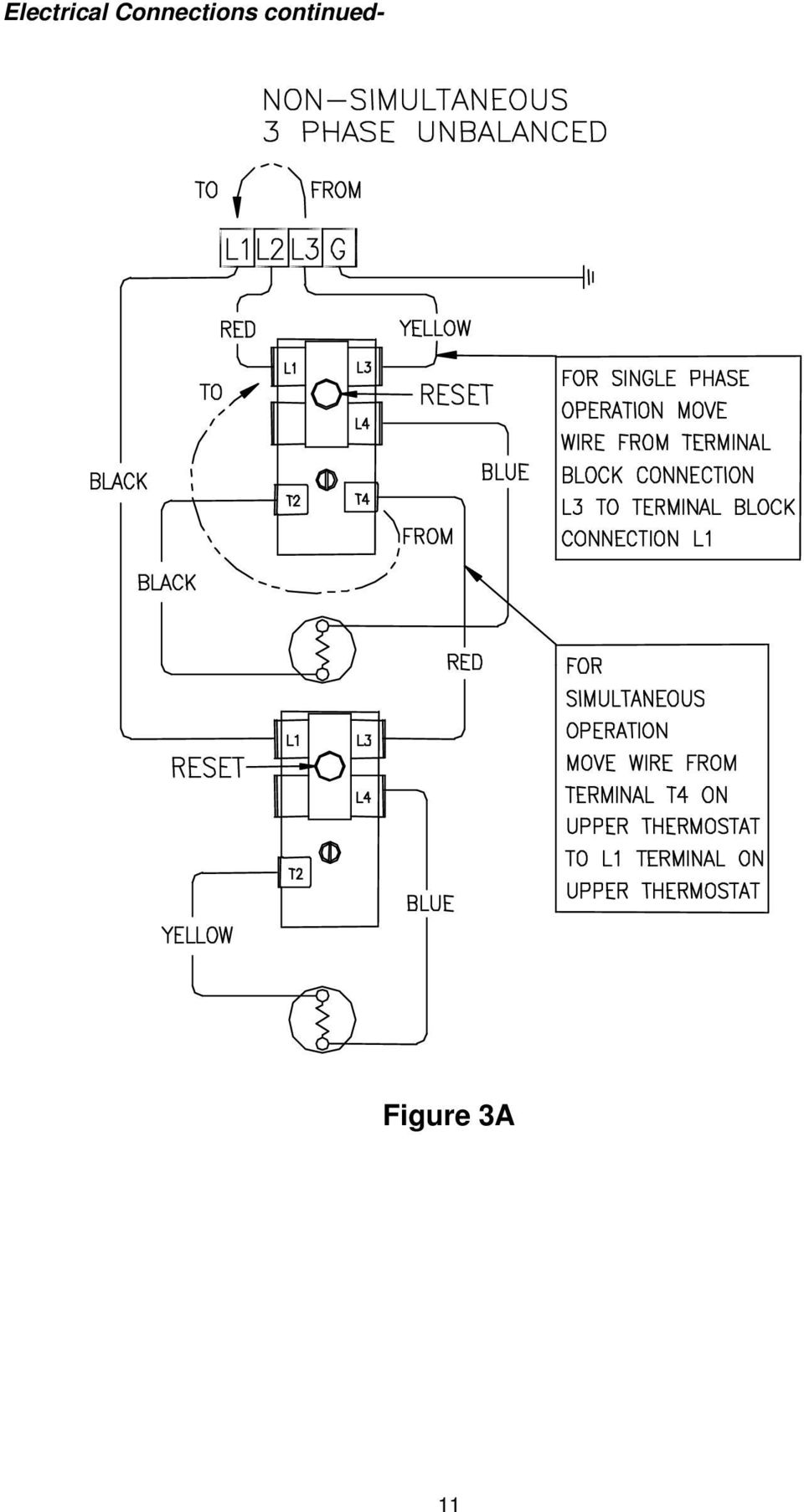
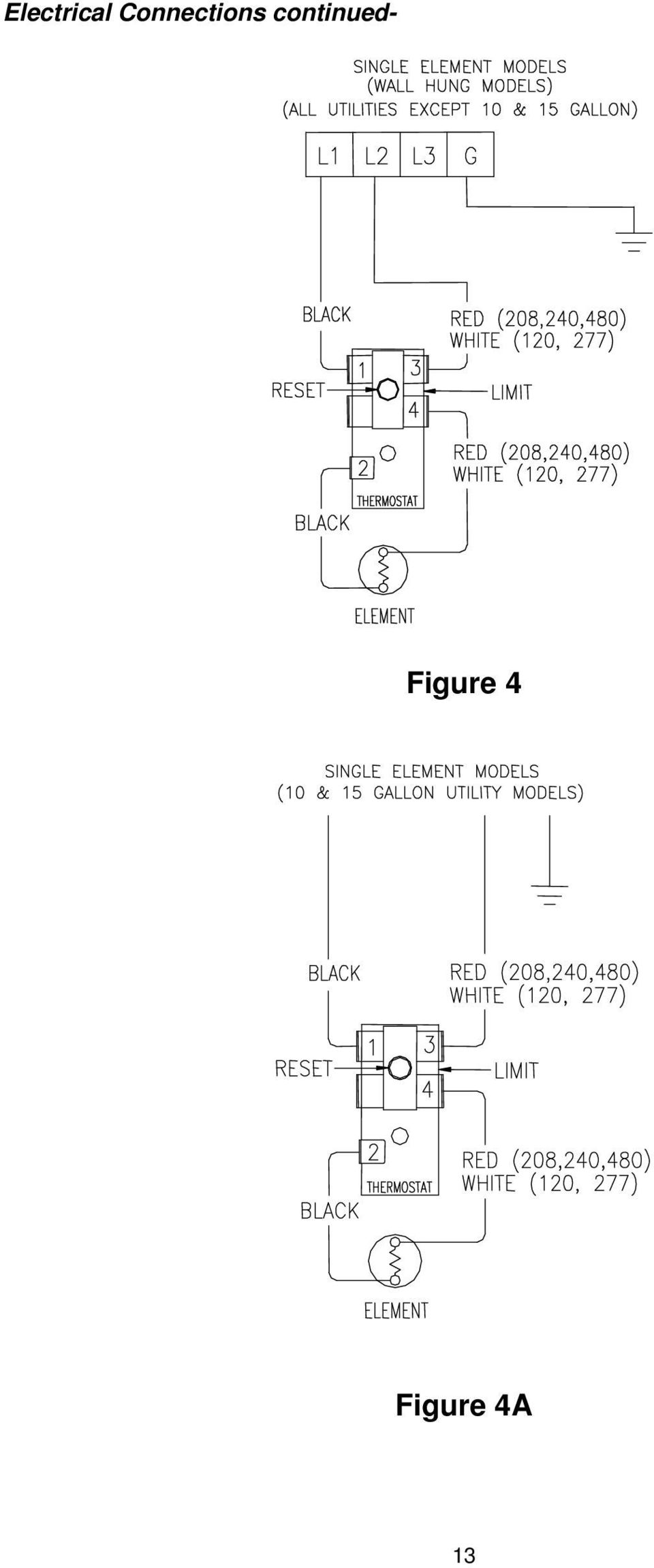
10 Electrical Connections Before any electrical connections are made, be sure that the water heater is full of water and that the manual shut-off valve in the cold water supply line is open. Check the rating plate and wiring diagram before proceeding. This electric water heater was built and wired in accordance with the Underwriters Laboratories testing approvals requirements. The temperature limiting device is of the manual reset, trip-free type and has been factory installed to interrupt all ungrounded power supply conductors in the event of thermostat failure. Thermostats are factory set and wired in accordance with the wiring diagram fastened to the inside of the top access panel. The plumbing supplier in your area ordered this heater wired at the factory to comply with existing area codes, but local utility codes may require or allow other circuitry. The thermostats are factory set and wired in accordance with the wiring diagram affixed to the water heater next to the thermostat/element access cover. Consult your local power company to determine the correct electrical hook-up in order to meet local utility and building codes and in order to obtain the most economical rates. Also check to find out if you are required to obtain a permit before starting the installation. The water heater must be well grounded. The green ground wire from the power supply shall be attached to the terminal marked for this purpose on the terminal block for all water heaters except 10 and 15 gallon utility models. For 10 and 15 gallon utility models, the ground wire shall be attached to the green ground screw located under the element access cover. Upright and lowboy models are wired for unbalanced three phase delta branch circuit operation. Upright and lowboy models (only) may be converted to single phase and/or simultaneous operation as shown on the wiring diagram (see figure 3A and 3B). To ensure proper electrical connection, check the voltage and wiring configuration on the rating plate located on the front of the water heater. Run the power leads from an adequately fused disconnect switch (not supplied) and connect the wires to the water heater according to the wiring diagram found in these installation and operation instructions (see figures 3A, 3B, 4 and 4A for correct wiring diagram) and located on the front of the water heater. Where longer runs are needed or local codes and ordinances require, an increase in wire size may be necessary. Consult local codes and/or your local power company for any specific requirements which may apply. In the absence of local codes and ordinances, refer to the National Electrical Code. 10

11 Electrical Connections continued- Figure 3A 11
12 Electrical Connections continued- Figure 3B 12

13 Electrical Connections continued- Figure 4 Figure 4A 13
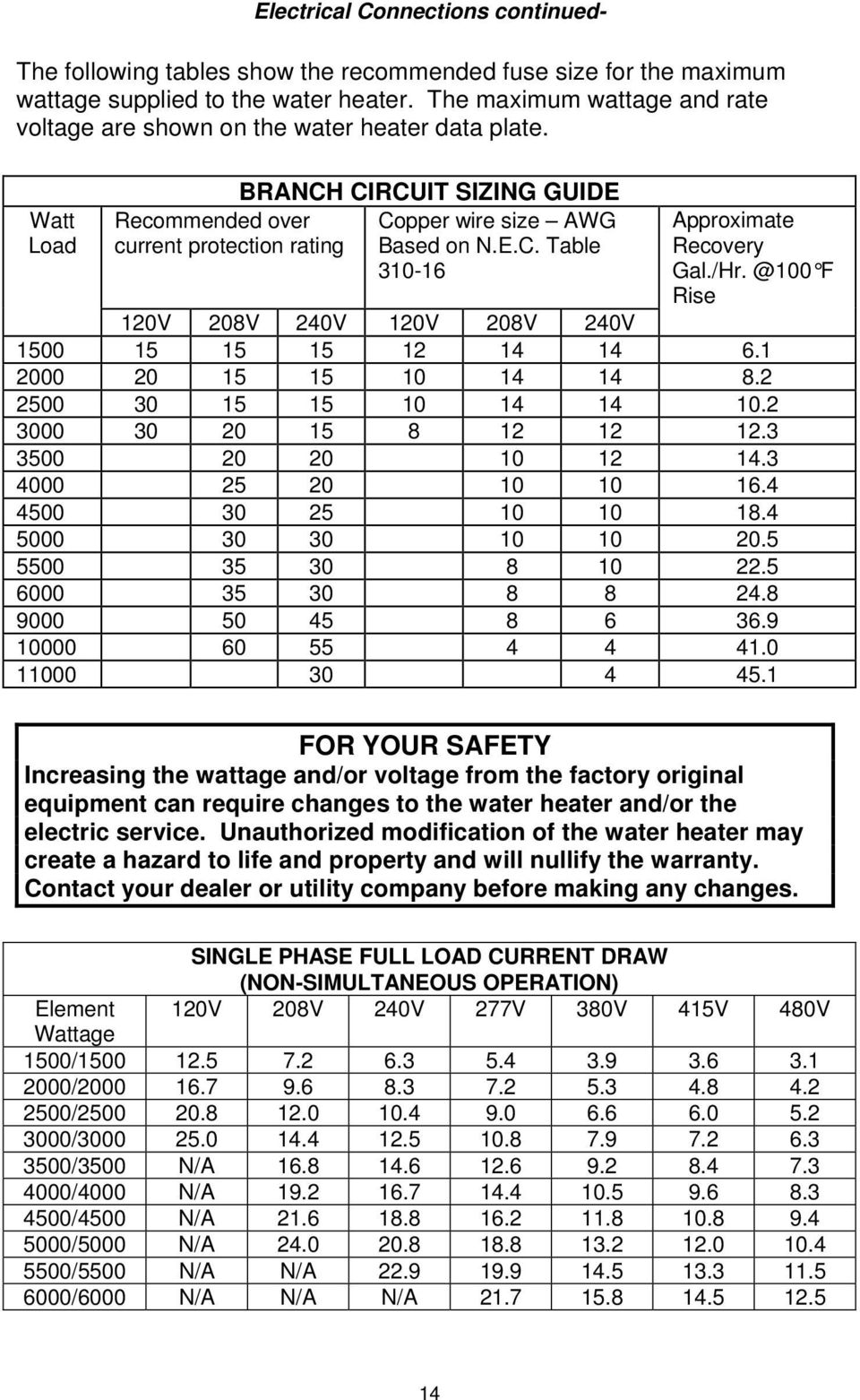
14 Electrical Connections continued- The following tables show the recommended fuse size for the maximum wattage supplied to the water heater. The maximum wattage and rate voltage are shown on the water heater data plate. Watt Load BRANCH CIRCUIT SIZING GUIDE Recommended over Copper wire size AWG current protection rating Based on N.E.C. Table Approximate Recovery F Rise 120V 208V 240V 120V 208V 240V FOR YOUR SAFETY Increasing the wattage and/or voltage from the factory original equipment can require changes to the water heater and/or the electric service. Unauthorized modification of the water heater may create a hazard to life and property and will nullify the warranty. Contact your dealer or utility company before making any changes. SINGLE PHASE FULL LOAD CURRENT DRAW (NON-SIMULTANEOUS OPERATION) Element 120V 208V 240V 277V 380V 415V 480V Wattage 1500/ / / / /3500 N/A /4000 N/A /4500 N/A /5000 N/A /5500 N/A N/A /6000 N/A N/A N/A
15 Electrical Connections continued- SINGLE PHASE FULL LOAD CURRENT DRAW (SIMULTANEOUS OPERATION) Element 120V 208V 240V 277V 380V 415V 480V Wattage 1500/ / / /3000 N/A /3500 N/A /4000 N/A /4500 N/A /5000 N/A /5500 N/A N/A /6000 N/A N/A N/A THREE PHASE (UNBALANCED DELTA) FULL LOAD CURRENT DRAW (NON-SIMULTANEOUS OPERATION: TERMINALS L1, L2 & L3) Element 208V 240V 380V 415V 480V Wattage 1500/ / / / / / / / /5500 N/A /6000 N/A N/A THREE PHASE (UNBALANCED DELTA) FULL LOAD CURRENT DRAW (SIMULTANEOUS OPERATION: TERMINAL L3 / TERMINALS L1 & L2) Element 208V 240V 380V 415V 480V Wattage 1500/ / / / / / / / / / / / / / / / / / / / / / / / / / / / / / / / / / / / / / / / / / / / / / / / /5500 N/A 39.6/ / / / /6000 N/A N/A 27.3/ / /

16 GENERAL OPERATION Before closing the switch to allow electric current to flow to the water heater, make certain that the water heater is full of water and that the cold water inlet valve is open. Complete failure of the heating element(s) will result if they are not totally immersed in water at all times. Failure of the element(s) due to dry-firing is not covered by warranty. When the switch is closed, the operation of this electric water heater is automatic. The thermostats are preset to the HOT setting to provide a water temperature of approximately 140 F (60 C) or below to reduce the risk of scald injury. CAUTION Scalding may occur within five (5) seconds at a temperature setting of 140 F (60 C). Care must be taken whenever using hot water to avoid scalding injury. Certain appliances require high temperature hot water (such as dishwashers and automatic clothes washers). TO FILL THE WATER HEATER 1. Close the water heater drain valve (if provided) by inserting a standard flat head screwdriver into the slot and turning clockwise. 2. Open the cold water supply shut-off valve. 3. Open several hot water faucets to allow air to escape from the system. 4. When a steady stream of water flows from the faucets, the water heater is filled. Close the faucets and check for water leaks at the water heater drain valve, combination temperature and pressure relief valve and the hot and cold water connections. TO DRAIN THE WATER HEATER Should it become necessary to completely drain the water heater, make sure you follow the steps below: 1. Disconnect the power supply to the water heater. Consult the plumbing professional or electric company in your area for service. 2. Close the cold water supply shut-off valve. 3. Open the drain valve (if provided) on the water heater by inserting a standard flat head screwdriver into the slot and turning counterclockwise. The drain valve has threads on the end that will allow connection of a standard hose coupling. For those models not equipped with a drain valve, disconnect cold water inlet piping at a convenient connection location as close to an adequate drain as possible. CAUTION! THIS WATER MAY BE HOT. 4. Open a hot water faucet to allow air to enter the system. To refill the water heater, refer to TO FILL THE WATER HEATER. 16
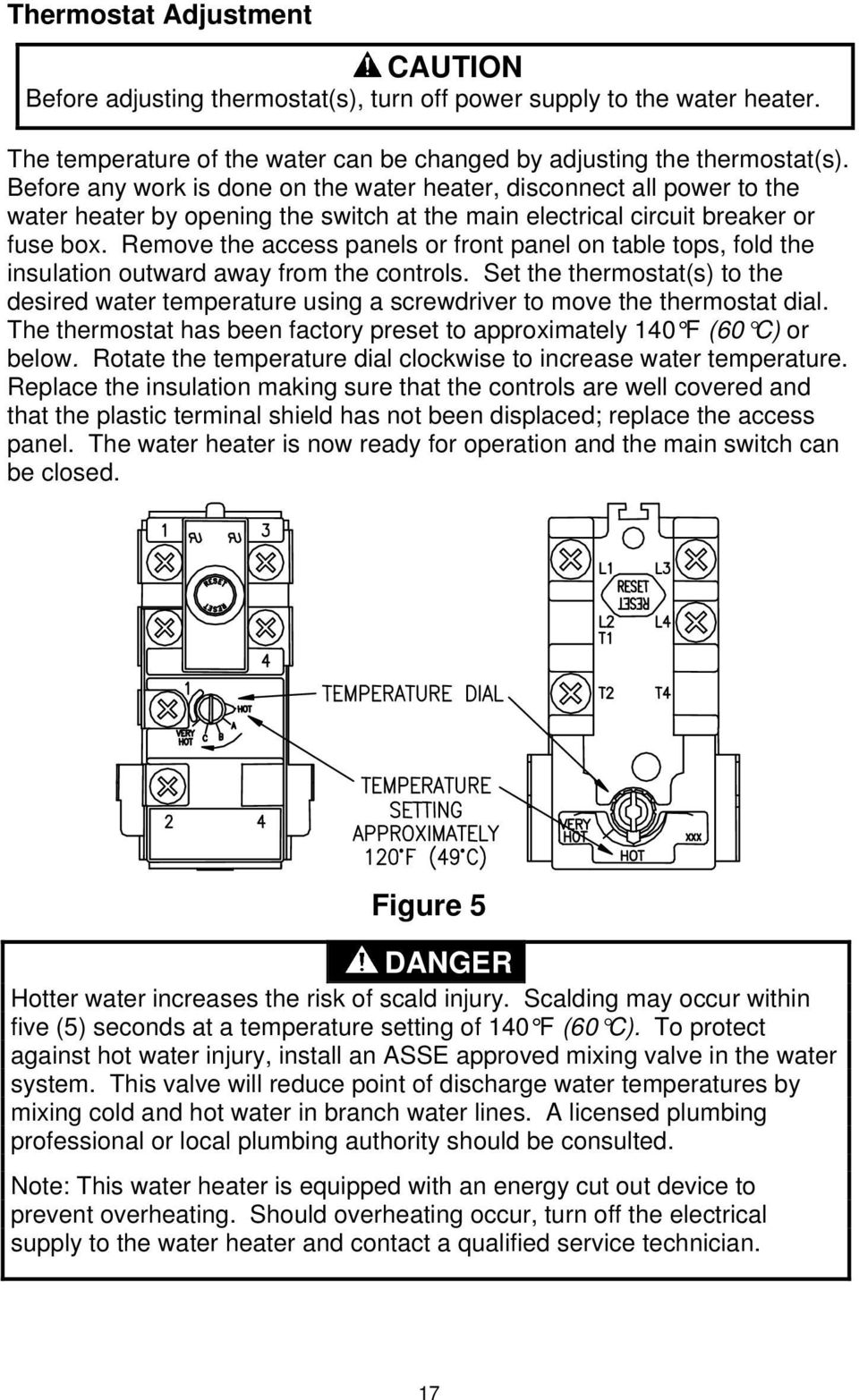
17 Thermostat Adjustment CAUTION Before adjusting thermostat(s), turn off power supply to the water heater. The temperature of the water can be changed by adjusting the thermostat(s). Before any work is done on the water heater, disconnect all power to the water heater by opening the switch at the main electrical circuit breaker or fuse box. Remove the access panels or front panel on table tops, fold the insulation outward away from the controls. Set the thermostat(s) to the desired water temperature using a screwdriver to move the thermostat dial. The thermostat has been factory preset to approximately 140 F (60 C) or below. Rotate the temperature dial clockwise to increase water temperature. Replace the insulation making sure that the controls are well covered and that the plastic terminal shield has not been displaced; replace the access panel. The water heater is now ready for operation and the main switch can be closed. Figure 5 DANGER Hotter water increases the risk of scald injury. Scalding may occur within five (5) seconds at a temperature setting of 140 F (60 C). To protect against hot water injury, install an ASSE approved mixing valve in the water system. This valve will reduce point of discharge water temperatures by mixing cold and hot water in branch water lines. A licensed plumbing professional or local plumbing authority should be consulted. Note: This water heater is equipped with an energy cut out device to prevent overheating. Should overheating occur, turn off the electrical supply to the water heater and contact a qualified service technician. 17
18 MAINTENANCE IMPORTANT The water heater should be inspected at a minimum of annually by a qualified service technician for damaged components. DO NOT operate this water heater if any part is found damaged. Shut off the electric power whenever the water supply to the water heater is off. Shut off the electric power and water supply, drain the heater completely to prevent freezing whenever the building is left unoccupied during the cold weather months. In order to insure efficient operation and long tank life, drain the water heater at least once a month through the drain valve until the water runs clear. Failure to do this may result in noisy operation and lime and sediment buildup in the bottom of the tank. Check the temperaturepressure relief valve to insure that the valve has not become encrusted with lime. Lift the lever at the top of the valve several times until the valve seats properly without leaking and operates freely. When lifting lever of temperature-pressure relief valve, hot water will be released under pressure. Be certain that any released water does not result in bodily injury or property damage. The magnesium anode rod should be inspected periodically and replaced when necessary to prolong tank life. The following maintenance should be performed by a qualified service technician at the minimum periodic intervals suggested below. In some installations, the maintenance interval may be more frequent depending on the amount of use and the operating conditions of the water heater. Regular inspection and maintenance of the water heater will help to insure safe and reliable operation. 1. Annually, check the operation of the thermostat(s). 2. Bi-annually, check the seal around the heating elements for leaks. If there is any sign of leaking, disconnect the power supply to the water heater and contact the plumbing professional who installed this water heater or a qualified service technician. 3. At least once a year, check the combination temperature and pressure relief valve to insure that the valve has not become encrusted with lime. Lift the lever at the top of the temperature-pressure relief valve several times until the valve seats properly without leaking and operates freely. 18

19 Maintenance continued- When lifting lever of temperature-pressure relief valve, hot water will be released under pressure. Be certain that any released water does not result in bodily injury or property damage. 4. If the combination temperature and pressure relief valve on the appliance discharges periodically, this may be due to thermal expansion in a closed water supply system. Contact the water supplier or local plumbing inspector on how to correct this situation. Do not plug the combination temperature and pressure relief valve outlet for any reason. 5. Monthly, drain off a gallon of water from the water heater to remove silt and sediment.! THIS WATER MAY BE HOT. 6. A combination sacrificial anode rod/hot water outlet nipple has been installed to extend tank life. The anode rod should be inspected periodically (every 2 years) and replaced when necessary to prolong tank life. Water conditions in your area will influence the time interval for inspection and replacement of the anode rod. Contact the plumbing professional who installed the water heater or the manufacturer listed on the rating plate for anode replacement information. The use of a water softener may increase the speed of anode consumption. More frequent inspection of the anode is needed when using softened (or phosphate treated) water. CAUTION FOR YOUR SAFETY, DO NOT ATTEMPT TO REPAIR THERMOSTAT(S), HEATING ELEMENTS, OR ELECTRICAL WIRING. REFER SUCH REPAIRS TO A QUALIFIED SERVICE TECHNICIAN. 19
20 Maintenance continued- Contact your local plumbing supplier or plumbing professional for replacement parts or contact the company at the address displayed on the rating plate of the water heater. For faster and better service, please provide the part name, model, and serial number(s) of the water heater(s) when ordering parts. READ THE WARRANTY FOR A FULL EXPLANATION OF THE LENGTH OF TIME THAT PARTS AND THE WATER HEATER ARE WARRANTED. Manufactured under one or more of the following U.S. Patents: RE.34,534; B1 5,341,770; 4,416,222; 4,628,184; 4,669,448; 4,672,919; 4,808,356; 4,829,983; 4,861,968; 4,904,428; 5,000,893; 5,023,031; 5,052,346; 5,081,696; 5,092,519; 5,115,767; 5,199,385; 5,277,171; 5,372,185; 5,485,879; 5,574,822; 5,596,952; 5,660,165; 5,682,666; 5,761,379; 5,943,984; 5,954,492; 5,988,117; 6,142,216; 6,684,821; 7,063,132; 7,007,748; Other U.S. and Foreign patent applications pending. Current Canadian Patents: 1,272,914; 1,280,043; 1,289,832; 2,045,862; 2,092,105; 2,107,012; 2,108,186; 2,112,515 Complete the following information and retain for future reference: Model No: Serial No: Service Phone Days: Nights: Address: Supplier: Supplier Phone No: 20

21 RESIDENTIAL ELECTRIC AND LIGHT DUTY COMMERCIAL ELECTRIC WATER HEATERS SERVICE MANUAL Troubleshooting Guide and Instructions for Service (To be performed ONLY by qualified service providers) Models Covered by This Manual: Residential Energy Saver: M1& M2(HE) UprightModels. M1& M2 Lowboy Models. M1& M2 UtilityModels. M1& M2 Wall HungModels. Light DutyEnergy Saver: LD Upright Models. LD Utility Models. LD Lowboy. LD WallHung. Photo is of M-2-50T6DS Dairy Barn Deluxe Energy Saver: DB Models. Manual A Save this manual for future reference
22 Residential and Light Duty Commercial Electric Water Heaters Table of Contents Introduction. 2 Tools 2 Page Service Procedure General Information Sequence of Operation Single Element Operation Double Element, Non-Simultaneous, Single Phase Double Element, Simultaneous, Single Phase, 4 wire Service Double Element, Non-Simultaneous, 3 Phase Double Element, Simultaneous, 3 Phase Double Element, Non-Simultaneous, Single Phase, Off Peak Troubleshooting Line Voltage and High Limit ECO Testing 14 RE-I Heating Element Testing RE-II Residential Thermostat Testing RE-III Single Element Double Element, 4 wire, Simultaneous, Single Phase Double Element, Non-Simultaneous, Single Phase Double Element, Non-Simultaneous, 3 Phase Double Element, Simultaneous, 3 Phase Double Element, Non-Simultaneous, Single Phase, Off Peak.. 23 Light Duty Commercial Thermostat Testing RE IV Double Element, Non-Simultaneous, Single Phase Double Element, Simultaneous, Single Phase Double Element, Non-Simultaneous, 3 Phase Double Element, Simultaneous, 3 Phase Thermostat Removal and Replacement. 33 RE-V Heating Element Removal and Replacement. 34 RE-VI Dip Tube and Anode Inspection and Replacement 35 RE-VII Generic Parts List Introduction This service manual is designed to aid service and maintenance professionals on the function, proper diagnosis and repair of Bradford White residential electric and light duty commercial electric water heaters. The text and illustrations in this manual provide step by step instructions to facilitate proper operation and troubleshooting procedures. Contact the Bradford White Technical Support Group immediately if diagnosis can not be made using the methods described in this service manual. Tools - Multi Meter. - Phillips Head Screw Driver. - 1-½ Deep Well Socket (element removal). - Thermometer. - ¼" Nut Driver. - Drain Hose. - Various Hand Tools: Pipe Wrench, Channel Locks, Pliers (common & needle nose), Wire cutters, Wire Strippers, Flash Light. Page 2 2
23 GENERAL INFORMATION Commonly Used Formulas Amps = Watts (for single phase units) Example 4500W/240V = 18.75A Volts Amps = Watts (for balanced 3 phase units) Example 4500W/240V x = 10.82A Volts x Watts = Amps x Volts Example 18.75A x 240V = 4500W Ohms = Volts Watts 2 2 Example (240V) / 4500W = 12.8 Ohms BLACK Ungrounded Common Service Wire Configurations 120 VOLT 240 VOLT WHITE Grounded (Neutral) GREEN Grounding BLACK RED GREEN Ungrounded Ungrounded Grounding Neutral 208 3Ph A B C Neutral 240 3Ph A B C 480 3Ph/277 1 Ph Neutral A B C RED BLACK RED RED BLACK RED Page 3 RED BLACK RED 3
24 GENERAL INFORMATION Wattage Limitations at Various Voltages Residential Electric Upright M1 & M2 Series (Non-Simultaneous operation) Residential High Efficiency Upright M2HE Series (Non-Simultaneous operation) Residential Electric Lowboy M1 & M2 Series (Non-Simultaneous Operation) Dairy Barn Deluxe DB Series (Non-Simultaneous Operation) Maximum Wattage Element Upper/Lower Voltage 3,000 3,000/3, ,000 6,000/6, , 240 6,000 6,000/6, , 480 Residential Electric Upright M1 & M2 Series (Simultaneous Operation) Residential High Efficiency Upright M2HE Series (Simultaneous Operation) Residential Electric Lowboy M1 & M2 Series (Simultaneous Operation) Light Duty Commercial Electric LD Series (Non-Simultaneous Operation) Light Duty Commercial Electric LD Series (Simultaneous Operation) Dairy Barn Deluxe DB Series (Simultaneous Operation) Maximum Wattage Element Upper/Lower Voltage 3,000 1,500/1, ,000 5,000/5, ,000 5,500/5, ,000 6,000/6, , 480 Residential Electric Utility Series (Single Element Operation) Light Duty Utility Series (Single Element Operation) Maximum Wattage Single Element Voltage 3,000 3, ,000 6, , 240 6,000 6, ,000 6, Page 4 4
25 GENERAL INFORMATION Surface Mounted Thermostats Surface mounted thermostats are mounted into a bracket which holds the thermostat against the side of the tank. Surface mounted thermostats respond to tank surface temperatures to sense a call for heat, set point temperature settings and high limit (ECO) activation. It is import that the entire back surface of the thermostat is in full contact or flush with the tank. Improperly mounted thermostat will lead to improper heater operation. Manual ECO (high limit) Reset button Temperature control Dial Temperature control Dial Surface Mount Combination Thermostat/ ECO (high limit) 89T Series Surface Mount Combination Thermostat/ ECO (high limit) 89T Series Direct Immersion Screw-in Type Heating Element Surface Mount Thermostat 59T Series 1-½ Hex Screw-in Flange Terminal Block Zinc Plated Copper or Incoloy Sheath Terminal Block Screw Element Rating Ink Stamped on side of Terminal Block. Page 5 5
26 SEQUENCE OF OPERATION Residential and light duty commercial electric water heaters are designed to operate using several different operating modes. The common modes and sequence of operation are as follows: 1. Single Element Operation. 2. Double Element Non-Simultaneous Operation (single phase). 3. Double Element Non-Simultaneous Operation (3 phase). 4. Double Element Simultaneous Operation (single phase). 5. Double Element Simultaneous Operation (3 phase). Sequence of Operation- Single Element Operation. 1 Line voltage is applied across terminals L1 &L3 of the thermostat. ECO is closed, so there is voltage at terminal L4 and to one side of the element. 1 ECO Closed 2 Tank is cold therefore thermostat is closed at terminal T2 (calling for heat). This completes the circuit and allows current to flow through the element. 2 Thermostat closed at terminal T2 3 When the thermostat is satisfied, it opens at terminal T2 interrupting current flow through the element. System is now in stand-by mode, waiting for the next call for heat. Thermostat opens at terminal T2 3 Page 6 6
27 SEQUENCE OF OPERATION Non-Simultaneous and Simultaneous Operation Double element electric water heaters are designed to operate in a Non-Simultaneous or Simultaneous mode. Non-Simultaneous Mode: Allows only one heating element to operate at a time. For example, when the tank is cold, the upper element is energized first, heating the top of the tank. Only when the upper thermostat is satisfied, the upper element is de-energized and power is directed to the lower thermostat, energizing the lower element and heating the bottom portion of the tank until the lower thermostat is satisfied. As hot water is drawn off the tank, it is replaced with cold water delivered through the dip tube to the bottom of the tank. The bottom of the tank cools, the lower thermostat will call for heat energizing the lower element. If enough hot water is drawn from the tank, the top portion of the tank cools and the upper thermostat will call for heat, de-energizing the lower element and allowing only the top element to energize until the upper thermostat is satisfied. Simultaneous mode: allows both heating elements to operate at the same time. That is, if either thermostat (upper or lower) is calling for heat, the corresponding heating element is energized independent of the other. Sequence of Operation- Double Element, Non-Simultaneous Operation, Single Phase Line voltage is applied across terminals L1 & L3 of the upper thermostat. ECO is closed, so there is voltage at terminal L4 and to one side of the upper and lower elements. Tank is cold therefore both thermostats are closed at terminal T2 & 2 (calling for heat). The circuit is complete through the upper thermostat only, allowing current to flow through upper element. When upper thermostat is satisfied, it opens at terminal T2 interrupting current flow through upper element, and closes at terminal T4 allowing voltage to pass to terminal 1 of lower thermostat. This completes the circuit through the lower thermostat and allows current flow through lower element. When the lower thermostat is satisfied, it opens at terminal 2 interrupting current flow through lower element. The system is now in stand-by mode waiting for the next call for heat 1 2 Upper T stat Upper Element Lower T stat Lower Element ECO Closed Thermostat closed at terminal T2 Thermostat closed at terminal 2 Upper T stat Upper Element Lower T stat Lower Element 5 The lower thermostat/element combination will generally cycle on and off more often then the upper. In some cases, such as a cold tank or in high demand periods, the upper thermostat will call for heat (opening at terminal T4 and closing at terminal T2) prior to the lower thermostat being satisfied. This will interrupt current flow through the lower thermostat and element and allow current to flow through the upper element only. When the upper thermostat is satisfied, it resumes operation as described in sequence #3 above. Thermostat closed at terminal T4 3 Upper T stat Upper Element Lower T stat Lower Element Thermostat open between terminals 1 and 2 4 Upper T stat Upper Element Lower T stat Lower Element Thermostat closed at terminal T2 Thermostat closed between terminals 1 and 2 5 Upper T stat Upper Element Lower T stat Lower Element Page 7 7
28 SEQUENCE OF OPERATION A 4 wire, double element heater wired for simultaneous operation is essentially two single element systems operating independently. The heaters are wired internally with two independent circuits, one circuit for each thermostat/element combination. When installed using a two wire service, the blue and red (or white) wires will be connected together, likewise black and yellow wires will be connected together. Sequence of Operation- Double Element, Simultaneous Operation, Single Phase, 4 wire service installation. 1 Line voltage from circuit one is applied across terminals L1 & L3 of the lower thermostat. Likewise, line voltage from circuit two is applied across terminals L1 & L3 of the upper thermostat. ECO in both upper and lower thermostat is closed, so there is voltage at terminal L4 of each thermostat and to one side of the upper and lower elements. Circuit one 1 Circuit two ECO Closed Circuit one 2 Thermostat closed at terminal T2 Circuit two 2 Tank is cold therefore both thermostats are closed at terminal T2 (calling for heat). This completes the circuit through the thermostats and allows current to flow through the elements. ECO Closed Thermostat closed at terminal T2 3 Circuit one When either thermostat is satisfied, it will open at terminal T2, interrupting current flow through the corresponding element. As both thermostats satisfy, the system will be in stand-by mode waiting for the next call for heat. Thermostats will operate independent of the other. 3 Thermostat open at terminal T2 Circuit two Thermostat open at terminal T2 Page 8 8
29 SEQUENCE OF OPERATION Sequence of Operation- Double Element, Non-Simultaneous Operation, 3 Phase Line voltage is applied across terminals L1 & L3 of upper thermostat. Likewise, Line voltage is applied to terminal L3 of lower thermostat. ECO in both upper & lower thermostat is closed, so there is voltage at terminal L4 of both thermostats and to one side of both upper & lower elements. ECO Closed Thermostat closed at terminal T2 2 Tank is cold therefore both thermostats are closed at terminal T2 (calling for heat). The circuit is complete through the upper thermostat only allowing current to flow through the upper element. ECO Closed Thermostat closed at terminal T2 3 When the upper thermostat is satisfied, it opens at terminal T2 interrupting current flow through upper element, and closes at terminal T4 allowing voltage to pass to terminal L1 of lower thermostat. This completes the circuit through the lower thermostat allowing current flow through lower element. Thermostat closed at terminal T4 3 Thermostat closed at terminal T4 4 4 When the lower thermostat is satisfied, it opens at terminal T2 interrupting the current flow through the lower element. The system is now in stand-by mode waiting for the next call for heat. 5 The lower thermostat/element combination will generally cycle on and off more often then the upper. In some cases, such as a cold tank or in high demand periods, the upper thermostat will call for heat (opening at terminal T4 and closing at terminal T2) prior to the lower thermostat being satisfied. This will interrupt current flow through the lower thermostat and element and allow current to flow through the upper element only. When the upper thermostat is satisfied, it resumes operation as described in sequence #3 above. Thermostat closed at terminal T2 Thermostat closed at terminal T2 5 Thermostat open at terminal T2 Thermostat closed at terminal T2 Page 9 9
30 SEQUENCE OF OPERATION Sequence of Operation- Double Element, Simultaneous Operation, 3 Phase. 1 Line voltage is applied across terminals L1 & L3 of upper thermostat. Line voltage also extends to terminal L1 of lower thermostat. Also, line voltage is applied to terminal L3 of lower thermostat. ECO in both upper & lower thermostat is closed, so there is voltage at terminal L4 of both thermostats and to one side of both upper & lower elements. 1 2 ECO Closed Thermostat closed at terminal T2 2 Tank is cold therefore both thermostats are closed at terminal T2 (calling for heat). This completes the circuit through the thermostats and allows current to flow through the elements. ECO Closed Thermostat closed at terminal T2 3 When either thermostat is satisfied, it will open at terminal T2, interrupting current flow through the corresponding element. As both thermostats satisfy, the system will be in stand-by mode waiting for the next call for heat. Thermostats will operate independent of the other. Thermostat open at terminal T2 3 Thermostat open at terminal T2 Page 10 10
31 SEQUENCE OF OPERATION Some electric utility companies will offer discounts for using electricity during Off Peak Times of the day. The system allows the use of an Off Peak meter, which interrupts power to the lower element during high power demand periods. Sequence of Operation- Double Element, Non-Simultaneous Operation, Single Phase, Off Peak. 1 2 Line voltage is applied across terminals L1 & L3 of the upper thermostat. Line voltage from off peak meter is supplied to terminal L1 of lower thermostat. ECO in the upper thermostat is closed, so there is voltage at terminal L4 of upper thermostat and to one side of the upper element. Tank is cold therefore both thermostats are closed at terminal T2 (calling for heat). The circuit is complete through the upper thermostat only, allowing current to flow through upper element. From Off Peak Meter 1 2 ECO Closed Thermostat closed at terminal T2 3 When upper thermostat is satisfied, it opens at terminal T2 interrupting current flow through upper element, and closes at terminal T4 allowing voltage to pass to one side of the lower element. This completes the circuit through the lower thermostat and off peak meter allowing current flow through lower element. Thermostat closed at terminal T2 4 When the lower thermostat is satisfied, it opens at terminal T2 interrupting current flow through lower element. The system is now in stand-by mode waiting for the next call for heat 5 During peak power demand periods as determined by the local utility, the off peak meter will interrupt power to terminal L1 of lower thermostat. Only the top thermostat/element combination is allowed to operate during this period. From Off Peak Meter Off Peak Power interrupted Thermostat closed at terminal T4 Thermostat closed at terminal T2 Thermostat closed at terminal T2 Thermostat open at terminal T2 Page 11 11
32 TROUBLESHOOTING Most common cause for improper electric water heater operation can be linked to heating element failure. When troubleshooting an electric water heater with the incidence of No Hot Water or Insufficient Amount of Hot Water Its always a good idea to check the heating elements first following the procedure on page 15. Common Heating Element Failures Are: 1. Dry Firing. Element may be partially submerged in water or most likely, completely exposed with no water in tank. In some cases sediment or lime build up around an element can eventually cause an air pocket, and within seconds, result in a dry fired element. At this point the element becomes inoperative. When element replacement is required, be sure tank is full of water prior to energizing the water heater. 2. Grounded Element. An element with a short circuit to ground will in most cases cause the circuit breaker in the service panel to open or shut off. In some cases there may not be enough current draw for the circuit breaker to open. This will allow the heating element to be in continuous operation resulting in over heated water, limited only by the ECO or Energy Cut Off located in the thermostat. Repeated actuation of the ECO reset button on the thermostat usually is the result of a grounded element. 3. Sediment build up. Slow hot water recovery can usually be traced back to sediment or lime build up around heating element. Sediment build up can also over time cause a dry fired element. Illustration 1, below shows a common Screw-In type heating element identifying certain features commonly referred to throughout this manual. 1-½ Hex Screw-in Flange Terminal Block Zinc Plated Copper or Incoloy Sheath W 240V RC Terminal Block Screw Element Rating Ink Stamped on side of Terminal Block. Illustration 1 Typical Direct Immersion Screw-In Type Heating Element Page 12 12
33 TROUBLESHOOTING Quick Step Plan to Hot Water 1. TURN OFF power to water heater and check all wire connections to insure they are tight and corrosion free. 2. Turn power ON and determine that service voltage is present, and the high limit (ECO) has not actuated (see procedure on page 14). High voltage exposure. Use caution when making voltage checks to avoid personal injury. 3. Check for inoperative heating element (see procedure on page 15). 4. Check for proper thermostat operation (see procedures beginning on page 16). NOTE: Thermostat testing procedures assume items 2 and 3 above are in working order. SYMPTOM PROBABLE CAUSE CORRECTIVE ACTION SERVICE PROCEDURE No Hot Water 1. No Power to heater. 2. Loose wire connections. 3. Inoperative upper heating element. 4. Inoperative upper thermostat. 5. Open ECO. 1. Check fuses or circuit breakers in service panel. 2. Check all wire connections. 3. Check heating element(s). Replace as needed. 4. Check thermostat(s) operation. Replace as needed. 5. Check ECO. Reset or replace thermostat(s) as needed. 3. See Service Procedure RE-II, Page See Service Procedure RE-III, Page See Service Procedure RE-I, Page 14. Not Enough Hot Water Slow Hot Water Recovery 1. Inoperative lower heating element. 2. Thermostat(s) set to low. 3. Inoperative thermostat(s). 4. Loose wire connection. 5. Sediment or lime build up on element(s). 6. High demand period. 7. Undersized heater. 8. Very cold inlet water to heater. 9. Plumbing connections reversed. 10. Damaged dip tube. 1. Sediment or lime build up on element(s). 2. Loose wire connections. 3. Inoperative thermostat(s). 4. Derated heating element installed. 1. Check heating element(s), replace as needed. 2. Increase thermostat setting. 3. Check thermostat(s), replace as needed. 4. Check all wire connection. 5. Remove heating element(s) and check for lime build up. 6. Reduce demand. 7. Replace with larger heater. 8. Temper water to heater. 9. Correct plumbing connections. 10. Check dip tube, replace as needed. 1. Remove heating element(s) and check for lime build up. 2. Check all wire connections. 3. Check thermostat(s), replace as needed. 4. Check terminal block of element for proper voltage and wattage rating. 1. See Service Procedure RE-II, Page See Service Procedure RE-III, Page See Service Procedure RE-VI, Page See Service Procedure RE-VII, Page See Service Procedure RE-VI, Page See Service Procedure RE-III, Page 16. Over Heated Water or Continues Operation 1. Thermostat not in contact with tank. 2. Grounded heating element(s). 3. Thermostat set to high. 4. Inoperative thermostat(s). 5. Inoperative ECO. 6. Undersized water heater. 1. Position thermostat flush with tank surface. 2. Check heating element(s). Replace as needed. 3. Adjust thermostat(s) to desired setting. 4. Check thermostat(s), replace as needed. 5. Check ECO, replace thermostat as needed. 6. Replace with larger heater. 1. See Service Procedure RE-V, Page See Service Procedure RE-II, Page See Service Procedure RE-III, Page See Service Procedure RE-I, Page 14. Noisy (singing or hissing) Elements 1. Lime formation on elements. 1. Remove and clean heating elements. Replace as needed. 1. See Service Procedure RE-VI, Page 34. Page 13 13
34 SERVICE PROCEDURE RE-I Line Voltage & High Limit (ECO) Testing Line Voltage Testing 1. Turn OFF power to water heater. 2. Remove access cover(s) from front of water heater. Remove insulation and plastic cover from thermostat. 3. Set multi-meter to volts AC. High voltage exposure. Use caution when making voltage checks to avoid personal injury. ECO reset button 4. Turn power ON to water heater. 5. Check voltage across terminals L1 & L3 of upper thermostat (see illustration 2). A) Rated voltage IS present, power to the water heater is okay. B) Rated voltage NOT present, Check circuit breaker at service panel. Illustration 2 Illustration 3 High Limit (ECO) Testing 1. Check voltage across terminals L1 & L4 upper thermostat (see illustration 3). A) Rated Voltage IS present, ECO is okay. B) Rated voltage NOT present, proceed to step Turn power OFF to water heater and firmly press ECO reset button on thermostat(s). Turn power ON and recheck voltage across terminals L1 & L4 of upper thermostat (see illustration 3). A) Rated voltage IS present, the ECO has opened indicating the water in the tank is or has over heater. Check the following: 1. Thermostat must be in full contact with tank. 2. Be sure heating element(s) is not shorted to ground (see page 15). 3. Proper thermostat operation (see procedures beginning on page 16). B) Rated voltage NOT present, water in tank may be over heated. 1. If water is hot, turn OFF power to water heater and flow water through tank to cool below set point of upper thermostat. Recheck voltage per step If water is cool, Replace upper thermostat. Page 14 14
35 SERVICE PROCEDURE RE-II Heating Element Testing Testing For Open Or Burned Out Element. Step 1. TURN OFF POWER TO WATER HEATER. Step 2. Remove access cover(s) from front of water heater. Remove insulation and plastic cover from thermostat. High voltage exposure. Be sure power is turned OFF to water heater prior to performing this procedure. Step 3. Disconnect wires from heating element. Step 4. Set multi-meter to ohms setting. Step 5. Touch probes of multi-meter to screw terminals of heating element (see illustration 4). Step 6. Reading should be 12.8 ohms (±6%) for a 240 volt, 4500 watt element: Ohms = Volts 2 Watts A reading outside the range using the formula above (±6%), indicates a bad element and the element must be replaced. Meter Probe Element Screw Terminals Illustration 4 Testing For Heating Element Short Circuit To Ground. Step 1. TURN OFF POWER TO WATER HEATER. Step 2. Remove access cover(s) from front of water heater. Remove insulation and plastic cover from thermostat. Step 3. Disconnect wires from heating element. Step 4. Set multi-meter to ohms setting. Step 5. Touch one probe of multi-meter to either screw terminal of heating element and the other on the element flange (see illustration 5). There should be no reading on the ohm meter. Any reading indicates a grounded element and the element must be replaced. Repeat this step for the other screw terminal. Element Screw Terminal Meter Probe Element Flange Illustration 5 Page 15 15
36 SERVICE PROCEDURE RE-III Residential Thermostat Testing Single Element Operation or Double Element, 4 Wire, Simultaneous, Single Phase Operation. High voltage exposure. Use caution to avoid personal injury during this procedure. Water In Tank Is Cold With Power ON. 1. This procedure assumes line voltage, ECO and elements are in working order. 2. Turn power ON to water heater. 3. Set multi-meter to Volts AC. 4. Check across terminals L4 and T2 of thermostat (see illustration 6). Recheck ECO. If ECO is okay, replace thermostat. B) Rated voltage IS present, proceed to next step. 5. Check across element terminals (see illustration 7). check wire connections from thermostat to element. B) Rated voltage IS present, Repeat element testing see page 15. Illustration 6 Illustration 7 Water Temperature In Tank Is Above Thermostat Setting. 1. This procedure assumes line voltage, ECO and elements are in working order. 2. Turn power ON to water heater. 3. Set multi-meter to Volts AC. 4. See illustration 6 above, check across terminals L4 and T2 of thermostat. A) Rated voltage IS present, replace thermostat. B) Rated voltage NOT present, thermostat is okay. C) Lower than rated voltage IS present, recheck for grounded element (see page 15). Reference 4 Wire, Simultaneous, Single Phase Wiring diagram. NOTE: Wiring consists of two single element configurations operating independently. Page 16 16
37 SERVICE PROCEDURE RE-III Residential Thermostat Testing Double Element, Non-Simultaneous, Single Phase Operation. High voltage exposure. Use caution to avoid personal injury during this procedure. Water In Tank Is Cold With Power ON. 1. This procedure assumes line voltage, ECO and elements are in working order. 2. Turn power ON to water heater. 3. Set multi-meter to Volts AC. 4. Check across terminals L4 and T2 of upper thermostat (see illustration 8). Recheck ECO. If ECO is okay, replace thermostat. B) Rated voltage IS present, proceed to next step. 5. Check across element terminals (see illustration 9). check wire connections from thermostat to element. B) Rated voltage IS present, Repeat element testing see page 15. Illustration 8 Illustration 9 Tank Does Not Deliver Enough Hot Water. 1. This procedure assumes line voltage, ECO and elements are in working order. 2. Turn power ON to water heater and set multi-meter to Volts AC. 3. Adjust temperature setting of upper thermostat to the highest setting. Water temperature in tank must be below thermostat setting for this test. 4. See illustration 8 above, check voltage across terminals L4 and T2 of upper thermostat. A) Rated voltage IS present, okay, upper thermostat is calling for heat. Go to step 5 below. B) Rated voltage NOT present, replace upper thermostat. 5. Adjust temperature setting of upper thermostat to the minimum setting. Water temperature in tank must be above thermostat setting for this test. 6. Check voltage across terminals L4 and T4 of upper thermostat (see illustration 10). replace upper thermostat. B) Rated voltage IS present, thermostat is okay. Go to step 7 on next page. Illustration 10 Page 17 17
38 SERVICE PROCEDURE RE-III Residential Thermostat Testing Double Element, Non-Simultaneous, Single Phase Operation (continued). High voltage exposure. Use caution to avoid personal injury during this procedure. Not Enough Hot Water (continued). 7. Check voltage across terminal L4 of upper thermostat and terminal 1 of lower thermostat (see illustration 11). - check wire connection between thermostats. B) Rated voltage IS present, okay, go to step Adjust lower thermostat to highest setting. Water temperature in tank must be below the lower thermostat setting for this test. 9. Check voltage across terminal L4 of upper thermostat and terminal 2 of lower thermostat (see illustration 12). replace lower thermostat. B) Rated voltage IS present, thermostat is ok. Be sure thermostats are reset to their original temperature settings as found prior to thermostat testing Illustration 11 Water Temperature In Tank Is Above Thermostat Setting. 1. This procedure assumes Line voltage, ECO and elements are in working order. 2. Adjust upper and lower thermostats to the lowest setting. 3. Turn power ON to water heater and set multi-meter to Volts AC. 4. Check across terminals L4 and T2 of upper thermostat (see illustration 8 on page 17). A) Rated voltage IS present, replace upper thermostat. B) Rated voltage NOT present, upper thermostat is okay. Go to step 5 below. C) Lower than rated voltage IS present, recheck for grounded upper element (see page 15). 5. Check across terminals L4 and 2 of lower thermostat (see illustration 12). A) Rated voltage IS present, replace lower thermostat. B) Rated voltage NOT present, lower thermostat is okay. Illustration 12 C) Lower than rated voltage IS present, recheck for grounded lower element (see page 15). Page 18 18
39 SERVICE PROCEDURE RE-III Residential Thermostat Testing Double Element, Non-Simultaneous, Three Phase Operation. Water In Tank Is Cold With Power ON. High voltage exposure. Use caution to avoid personal injury during this procedure. 1. This procedure assumes line voltage, ECO and elements are in working order. 2. Turn power ON to water heater. 3. Set multi-meter to Volts AC. 4. Check across terminals L4 and T2 of upper thermostat (see illustration 13). Recheck ECO. If ECO is okay, replace thermostat. B) Rated voltage IS present, proceed to next step. 5. Check across element terminals (see illustration 14). check wire connections from thermostat to element. B) Rated voltage IS present, Repeat element testing, see page 15. Illustration 13 Illustration 14 Tank Does Not Deliver Enough Hot Water. 1. This procedure assumes line voltage, ECO and elements are in working order. 2. Turn power ON to water heater and set multi-meter to Volts AC 3. Adjust temperature setting of upper thermostat to the highest setting. Water temperature in tank must be below thermostat setting for this test. 4. See illustration 13 above, check voltage across terminals L4 & T2 of upper thermostat. A) Rated voltage IS present, okay, upper thermostat is calling for heat. Go to step 5 below. B) Rated voltage NOT present, replace upper thermostat. 5. Adjust temperature setting of upper thermostat to the minimum setting. Water temperature in tank must be above thermostat setting for this test. 6. Check voltage across terminals T4 of upper thermostat & L3 of lower thermostat (see illustration 15). replace upper thermostat. B) Rated voltage IS present, upper thermostat is okay. Go to step 7 on next page. Illustration 15 Page 19 19
40 SERVICE PROCEDURE RE-III Residential Thermostat Testing Double Element, Non-Simultaneous, Three Phase Operation (continued). High voltage exposure. Use caution to avoid personal injury during this procedure. Tank Does Not Deliver Enough Hot Water (continued) 7. Check voltage across terminal L1 & L3 of lower thermostat (see illustration 16). check wire connection between thermostats. B) Rated voltage is present, okay, go to step Adjust lower thermostat to highest setting. Water temperature in tank must be below the lower thermostat setting for this test. 9. Check voltage across terminal L4 & T2 of lower thermostat (see illustration 17). recheck ECO (see page 14). If ECO okay, replace lower thermostat. B) Rated voltage IS present, thermostat is ok. Check wire connection to lower element. If connection okay, recheck lower element (see page 15). Be sure thermostats are reset to their original temperature settings as found prior to thermostat testing Illustration 16 Water Temperature In Tank Is Above Thermostat Setting. 1. This procedure assumes Line voltage, ECO and elements are in working order. 2. Adjust upper and lower thermostats to the lowest setting. 3. Turn power ON to water heater and set multi-meter to Volts AC. 4. Check across terminals L4 and T2 of upper thermostat (see illustration 13 on page 19). A) Rated voltage IS present, replace upper thermostat. B) Rated voltage NOT present, upper thermostat is okay. Go to step 5 below. C) Lower than rated voltage IS present, recheck for grounded upper element (see page 15). 5. Check across terminals L4 and T2 of lower thermostat (see illustration 17). A) Rated voltage IS present, replace lower thermostat. B) Rated voltage NOT present, lower thermostat is okay. C) Lower than rated voltage IS present, recheck for grounded lower element (see page 15). Page 20 Illustration 17 20
41 SERVICE PROCEDURE RE-III Residential Thermostat Testing Double Element, Simultaneous, Three Phase Operation. High voltage exposure. Use caution to avoid personal injury during this procedure. Water In Tank Is Cold Or Not Enough Hot Water With Power ON. 1. This procedure assumes line voltage, ECO and elements are in working order. 2. Adjust temperature setting for both thermostats to the highest setting. 2. Turn power ON to water heater. 3. Set multi-meter to Volts AC. 4. Check across terminals L4 and T2 of upper thermostat (see illustration 18). Recheck ECO (see page 14). If ECO is okay, replace thermostat. B) Rated voltage IS present, proceed to next step. 5. Check across upper element terminals (see illustration 19). check wire connections from thermostat to element. B) Rated voltage IS present, Repeat element testing see page Check across terminals L1 & L3 of lower thermostat (see illustration 20). check wire connections from upper to lower thermostats. B) Rated voltage IS present, okay, go to step Check across terminals L4 and T2 of lower thermostat (see illustration 21). Recheck ECO (see page 14). If ECO is okay, replace thermostat. B) Rated voltage IS present, proceed to next step. 8. Check across lower element terminals. check wire connections from thermostat to element. B) Rated voltage IS present, Repeat element testing see page 15. Illustration 18 Illustration 19 Illustration 20 Illustration 21 Be sure thermostats are reset to their original temperature settings as found prior to thermostat testing Page 21 21
42 SERVICE PROCEDURE RE-III Residential Thermostat Testing Double Element, Simultaneous, Three Phase Operation (continued). High voltage exposure. Use caution to avoid personal injury during this procedure. Water Temperature In Tank Is Above Thermostat Setting. 1. This procedure assumes Line voltage, ECO and elements are in working order. 2. Adjust upper and lower thermostat to the lowest setting. 3. Turn power ON to water heater. 4. Set multi-meter to Volts AC. 5. Check across terminals L4 and T2 of upper thermostat (see illustration 22). A) Rated voltage IS present, replace upper thermostat. B) Rated voltage NOT present, upper thermostat is okay. Go to step 6 below. C) Lower than rated voltage IS present, recheck for grounded upper element (see page 15). Illustration Check across terminals L4 and T2 of lower thermostat (see illustration 23). A) Rated voltage IS present, replace lower thermostat. B) Rated voltage NOT present, lower thermostat is okay. C) Lower than rated voltage IS present, recheck for grounded lower element (see page 15). Illustration 23 Page 22 22
43 SERVICE PROCEDURE RE-III Residential Thermostat Testing Double Element, Non-Simultaneous, Single Phase, Off Peak Operation. High voltage exposure. Use caution to avoid personal injury during this procedure. Water In Tank Is Cold With Power ON. 1. This procedure assumes line voltage, ECO and elements are in working order. 2. Turn power ON to water heater. 3. Set multi-meter to Volts AC. 4. Check across terminals L4 and T2 of upper thermostat (see illustration 24). Recheck ECO (see page 14). If ECO is okay, replace thermostat. B) Rated voltage IS present, proceed to next step. 5. Check across element terminals (see illustration 25). check wire connections from thermostat to element. B) Rated voltage IS present, Repeat element testing see page 15. Illustration 24 Illustration 25 Tank Does Not Deliver Enough Hot Water. 1. This procedure assumes line voltage, ECO and elements are in working order. Be sure OFF PEAK meter has not interrupted line voltage. 2. Turn power ON to water heater and set multi-meter to Volts AC. 3. Adjust temperature setting of upper & lower thermostat to the Highest setting. Water temperature in tank must be below thermostat setting for this test. 4. See illustration 24 above. Check voltage across terminals L4 & T2 of upper thermostat. A) Rated voltage IS present, okay, upper thermostat is calling for heat. Go to step 5 below. B) Rated voltage NOT present, replace upper thermostat. 5. Adjust temperature setting of upper thermostat to the minimum setting. Water temperature in tank must be above thermostat setting for this test. 6. Check voltage across terminals T4 of upper thermostat & L1 of lower thermostat (see illustration 26). replace upper thermostat. B) Rated voltage IS present, upper thermostat is okay. Go to step 7 on next page. Illustration 26 Page 23 23
44 SERVICE PROCEDURE RE-III Residential Thermostat Testing Double Element, Non-Simultaneous, Single Phase, Off Peak Operation. (continued) High voltage exposure. Use caution to avoid personal injury during this procedure. Not Enough Hot Water (continued). 7. Check voltage across terminal T4 of upper thermostat & T2 of lower Thermostat. (see illustration 27). Replace lower thermostat. B) Rated voltage is present, okay, go to step Check voltage across lower element (see illustration 28). Check wire connections between thermostats & element. B) Rated voltage IS present, Repeat element testing see page 15. Be sure thermostats are reset to their original temperature settings as found prior to thermostat testing Illustration 27 Illustration 28 Water Temperature In Tank Is Above Thermostat Setting. 1. This procedure assumes Line voltage, ECO and elements are in working order. 2. Adjust upper and lower thermostats to the lowest setting. 3. Turn power ON to water heater and set multi-meter to Volts AC. 4. Check across terminals L4 and T2 of upper thermostat (see illustration 24 on page 23). A) Rated voltage IS present, replace upper thermostat. B) Rated voltage NOT present, upper thermostat is okay. Go to step 5 below. C) Lower than rated voltage IS present, recheck for grounded upper element (see page 15). 5. Check across terminals T4 of upper thermostat and T2 of lower thermostat (see illustration 27 above). A) Rated voltage IS present, replace lower thermostat. B) Rated voltage NOT present, lower thermostat is okay. C) Lower than rated voltage IS present, recheck for grounded lower element (see page 15). Page 24 24
45 SERVICE PROCEDURE RE-IV Light Duty Commercial Thermostat Testing Double Element, Non-Simultaneous, Single Phase Operation. High voltage exposure. Use caution to avoid personal injury during this procedure. Water In Tank Is Cold With Power ON. 1. This procedure assumes line voltage, ECO and elements are in working order. 2. Turn power ON to water heater. 3. Set multi-meter to Volts AC. 4. Check across terminals L4 and T2 of upper thermostat (see illustration 29). Recheck ECO (see page 14). If ECO is okay, replace thermostat. B) Rated voltage IS present, proceed to next step. 5. Check across element terminals (see illustration 30). check wire connections from thermostat to element. B) Rated voltage IS present, Repeat element testing see page 15. Illustration 29 Illustration 30 Tank Does Not Deliver Enough Hot Water. 1. This procedure assumes line voltage, ECO and elements are in working order. 2. Turn power ON to water heater and set multi-meter to Volts AC 3. Adjust temperature setting of upper & lower thermostat to the Highest setting. Water temperature in tank must be below thermostat setting for this test. 4. See illustration 29 above. Check voltage across terminals L4 & T2 of upper thermostat. A) Rated voltage IS present, okay, upper thermostat is calling for heat. Go to step 5 below. B) Rated voltage NOT present, replace upper thermostat. 5. Adjust temperature setting of upper thermostat to the minimum setting. Water temperature in tank must be above thermostat setting for this test. 6. Check voltage across terminals L3 & T4 of upper thermostat (see illustration 31). replace upper thermostat. B) Rated voltage IS present, upper thermostat is okay. Go to step 7 on next page. Illustration 31 Page 25 25
46 SERVICE PROCEDURE RE-IV Light Duty Commercial Thermostat Testing Double Element, Non-Simultaneous, Single Phase Operation (continued) High voltage exposure. Use caution to avoid personal injury during this procedure. Tank Does Not Deliver Enough Hot Water (continued). 7. Check voltage across terminal L3 of upper thermostat & T2 of lower Thermostat. (see illustration 32). Replace lower thermostat. B) Rated voltage is present, okay, go to step Check voltage across lower element (see illustration 33). Check wire connections between thermostats & element. B) Rated voltage IS present, Repeat element testing see page 15. Be sure thermostats are reset to their original temperature settings as found prior to thermostat testing Illustration 32 Illustration 33 Water Temperature In Tank Is Above Thermostat Setting. 1. This procedure assumes line voltage, ECO and elements are in working order. 2, Adjust upper and lower thermostat to the lowest setting. 3. Turn power ON to water heater and Set multi-meter to Volts AC 4. See illustration 32 above. Check across terminal L3 of upper thermostat & T2 of lower thermostat. A) Rated voltage IS present, replace lower thermostat. B) Rated voltage NOT present, okay, go to step 5 below. C) Lower than rated voltage IS present, recheck for grounded lower element see page Check across terminal L4 & T2 of upper thermostat (see illustration 34). A) Rated voltage IS present, replace upper thermostat. B) Rated voltage NOT present, upper thermostat is okay. C) lower than rated voltage IS present, recheck for grounded upper element see page 15. Illustration 34 Page 26 26
47 SERVICE PROCEDURE RE-IV Light Duty Commercial Thermostat Testing Double Element, Simultaneous, Single Phase Operation. High voltage exposure. Use caution to avoid personal injury during this procedure. Water In Tank Is Cold Or Not Enough Hot Water With Power ON. 1. This procedure assumes line voltage, ECO and elements are in working order. 2. Adjust temperature setting for both thermostats to the highest setting. 3. Turn power ON to water heater. 4. Set multi-meter to Volts AC 5. Check across terminals L4 and T2 of upper thermostat (see illustration 35). Recheck upper ECO (see page 14). If ECO is okay, replace upper thermostat. B) Rated voltage IS present, proceed to next step. 6. Check across upper element terminals (see illustration 36). check wire connections from thermostat to upper element. B) Rated voltage IS present, Repeat element testing see page Check across terminal L3 of upper thermostat and T2 of lower thermostat (see illustration 37). Check ECO (see page 14) & wire connections at upper & lower thermostats. If okay, replace lower thermostat. B) Rated voltage IS present, proceed to next step. 8. Check across lower element terminals (see illustration 38). check lower element wire connections to the thermostats. B) Rated voltage IS present, Repeat lower element testing see page 15 Be sure thermostats are reset to their original temperature settings as found prior to thermostat testing Illustration 35 Illustration 36 Illustration 37 Illustration 38 Page 27 27
48 SERVICE PROCEDURE RE-IV Light Duty Commercial Thermostat Testing Double Element, Simultaneous, Single Phase Operation (continued) High voltage exposure. Use caution to avoid personal injury during this procedure. Water Temperature In Tank Is Above Thermostat Setting. 1. This procedure assumes line voltage, ECO and elements are in working order. 2. Adjust upper and lower thermostat to the lowest setting. 3. Turn power ON to water heater. 4. Set multi-meter to Volts AC 5. Check across terminals L4 and T2 of upper thermostat (see illustration 39). A) Rated voltage IS present, replace upper thermostat. B) Rated voltage NOT present, upper thermostat is okay. Go to step 6 below. C) lower than rated voltage IS present, recheck for grounded upper element see page Check across terminal L3 of upper thermostat and T2 of lower thermostat (see illustration 40). Illustration 39 A) Rated voltage IS present, replace lower thermostat. B) Rated voltage NOT present, lower thermostat is okay. C) lower than rated voltage IS present, recheck for grounded lower element see page 15. Illustration 40 Page 28 28
49 SERVICE PROCEDURE RE-IV Light Duty Commercial Thermostat Testing Double Element, Non-Simultaneous, Three Phase Operation. Water In Tank Is Cold With Power ON. 1. This procedure assumes line voltage, ECO and elements are in working order. 2. Turn power ON to water heater. 3. Set multi-meter to Volts AC 4. Check across terminals L4 and T2 of upper thermostat (see illustration 41). Recheck upper ECO. If ECO is okay, replace thermostat. B) Rated voltage IS present, proceed to next step. 5. Check across element terminals (see illustration 42). check wire connections from thermostat to element. B) Rated voltage IS present, Repeat element testing see page 15. High voltage exposure. Use caution to avoid personal injury during this procedure. Illustration 41 Illustration 42 Tank Does Not Deliver Enough Hot Water. 1. This procedure assumes line voltage, ECO and elements are in working order. 2. Turn power ON to water heater and set multi-meter to Volts AC 3. Adjust temperature setting of upper & lower thermostat to the Highest setting. Water temperature in tank must be below thermostat setting for this test. 4. See illustration 41 above. Check voltage across terminals L4 & T2 of upper thermostat. A) Rated voltage IS present, okay, upper thermostat is calling for heat. Go to step 5 below. B) Rated voltage NOT present, replace upper thermostat. 5. Adjust temperature setting of upper thermostat to the minimum setting. Water temperature in tank must be above thermostat setting for this test. 6. Check voltage across terminals L3 & T4 of upper thermostat (see illustration 43). replace upper thermostat. B) Rated voltage IS present, upper thermostat is okay. Go to step 7 on next page. Illustration 43 Page 29 29
50 SERVICE PROCEDURE RE-IV Light Duty Commercial Thermostat Testing Double Element, Non-Simultaneous, Three Phase Operation (continued). High voltage exposure. Use caution to avoid personal injury during this procedure. Tank Does Not Deliver Enough Hot Water (continued). 7. Check voltage across terminal L1 of upper thermostat & T2 of lower Thermostat. (see illustration 44). Replace lower thermostat. B) Rated voltage is present, okay, go to step Check voltage across lower element (see illustration 45). Check wire connections between thermostats & element. B) Rated voltage IS present, Repeat element testing see page 15. Be sure thermostats are reset to their original temperature settings as found prior to thermostat testing Illustration 44 Illustration 45 Water Temperature In Tank Is Above Thermostat Setting. 1. This procedure assumes line voltage, ECO and elements are in working order. 2. Adjust upper and lower thermostat to the lowest setting. 3. Turn power ON to water heater and Set multi-meter to Volts AC. 4. See illustration 44 above. Check across terminal L1 of upper thermostat & T2 of lower thermostat. A) Rated voltage IS present, replace lower thermostat. B) Rated voltage NOT present, okay, go to step 5 below. C) lower than rated voltage IS present, recheck for grounded lower element. 5. Check across terminal L4 & T2 of upper thermostat (see illustration 46). A) Rated voltage IS present, replace upper thermostat. B) Rated voltage NOT present, upper thermostat is okay. C) lower than rated voltage IS present, recheck for grounded upper element, see page 15. Page 30 Illustration 46 30
51 SERVICE PROCEDURE RE-IV Light Duty Commercial Thermostat Testing Double Element, Simultaneous, Three Phase Operation. Water In Tank Is Cold Or Not Enough Hot Water With Power ON. 1. This procedure assumes line voltage, ECO and elements are in working order. 2. Adjust temperature setting for both thermostats to the highest setting. 3. Turn power ON to water heater. 4. Set multi-meter to Volts AC 5. Check across terminals L4 and T2 of upper thermostat (see illustration 47). Recheck upper ECO (see page 14). If ECO is okay, replace upper thermostat. B) Rated voltage IS present, proceed to next step. 6. Check across upper element terminals (see illustration 48). check wire connections from thermostat to upper element. B) Rated voltage IS present, Repeat element testing see page Check across terminal L4 of upper thermostat and T2 of lower thermostat (see illustration 49). Check ECO (see page 14) & wire connections at upper & lower thermostats. If okay, replace lower thermostat. B) Rated voltage IS present, proceed to next step. 8. Check across lower element terminals (see illustration 50). check lower element wire connections to thermostat. B) Rated voltage IS present, Repeat lower element testing see page 15. High voltage exposure. Use caution to avoid personal injury during this procedure. Illustration 47 Illustration 48 Be sure thermostats are reset to their original temperature settings as found prior to thermostat testing Illustration 49 Page 31 Illustration 50 31
52 SERVICE PROCEDURE RE-IV Light Duty Commercial Thermostat Testing Double Element, Simultaneous, Three Phase Operation (continued). High voltage exposure. Use caution to avoid personal injury during this procedure. Water Temperature In Tank Is Above Thermostat Setting. 1. This procedure assumes line voltage, ECO and elements are in working order. 2. Adjust upper and lower thermostat to the lowest setting. 3. Turn power ON to water heater. 4. Set multi-meter to Volts AC 5. Check across terminals L4 and T2 of upper thermostat (see illustration 51). A) Rated voltage IS present, replace upper thermostat. B) Rated voltage NOT present, upper thermostat is okay. Go to step 6 below. C) lower than rated voltage IS present, recheck for grounded upper element see page Check across terminals L4 & T2 of lower thermostat (see illustration 52). Illustration 51 A) Rated voltage IS present, replace lower thermostat. B) Rated voltage NOT present, lower thermostat is okay. C) lower than rated voltage IS present, recheck for grounded lower element. Illustration 52 Page 32 32
53 SERVICE PROCEDURE RE-V Thermostat Removal and Replacement Thermostat Removal 1. Turn power OFF To water heater. 2. Remove access cover and insulation. 3. Remove plastic thermostat protector from thermostat. High voltage exposure. Be sure power is OFF when performing this procedure. 4. Disconnect wires from thermostat terminals. It may be necessary to label wires for proper re-connection to new thermostat. 5. Note thermostat temperature setting for proper setting of new thermostat. 6. Slide thermostat upwards and out of mounting bracket. Thermostat Replacement 1. Use a stiff brush to remove any debris or loose scale from tank surface where new thermostat will be installed. 2. Slide new thermostat down into thermostat bracket until it snaps into place. IMPORTANT! Thermostat must set completely flat or flush to tank surface. An improperly installed thermostat will cause improper water heater operation. 3. Refer to the wire diagram located on the inside of the access cover and re-connect wires to the thermostat. Be sure wire connections are snug and corrosion free. Do not over tighten, doing so may damage thermostat. 4. Set thermostat to the original thermostat setting found on the old thermostat. 5. Re-install plastic thermostat protector. 6. Re-install insulation and access cover. 7. Restore power to water heater and verify proper heater operation. Tank Surface Proper Thermostat mounting flush with tank surface Thermostat Improper Thermostat mounting. Thermostat not flush with tank surface Thermostat mounting bracket Front View Thermostat Mounting Side View Proper Thermostat Mounting Side View Improper Thermostat Mounting Page 33 33
54 SERVICE PROCEDURE RE-VI Heating Element Removal and Replacement Heating Element Removal 1. Turn power OFF To water heater. 2. Turn off cold water supply to heater. Connect hose to drain spigot of water heater and route to an open drain. Open a nearby hot water faucet to vent heater for draining. Open drain spigot of water heater and allow heater to drain to a point below the Element(s). 3. Close drain spigot and remove hose. 4. Remove access cover and insulation. 5. Remove plastic thermostat protector from thermostat. 6. Disconnect wires from element terminals. High voltage exposure. Be sure power is OFF when performing this procedure. Heater components and stored water may be HOT when performing the following steps in this procedure. Take necessary precaution to prevent personal injury. 7. Remove element from tank using 1-½ deep well socket or appropriate wrench. Unscrew element counter-clockwise to remove from tank. 8. Be sure to remove old element gasket from the tank. It is not recommended to be re-used. Heating Element Replacement 1. Check element terminal block for proper electrical rating. NOTE: Some elements have dual ratings, be sure to check all surfaces of the element terminal block (see illustration below). 2. Apply new element gasket to the new element. Be sure gasket is seated flat against element flange without rolls or gaps (see illustration below). 3. Clean any debris from element fitting on tank. Lubricate element threads as needed with thread lubricant. 4. Thread new element clockwise into tank. Tighten element using 1-½ deep well socket or appropriate wrench. Do not over tighten, over tightening may damage element gasket. 5. Reconnect wires to element, be sure wires are snug and corrosion free. Do not over tighten, doing so may damage terminal block. 6. Resume water supply to heater, be sure tank is full of water and check for leaks. 7. Re-install plastic thermostat protector. 8. Re-install insulation and access cover. 9. To resume operation, BE SURE TANK IS FULL OF WATER and restore power to water heater. Verify proper heater operation. Date Code Element Rating. Example: (4500 Watt, 240 Volt) Element Flange Element Gasket Seated Flat Against Element Flange Without Rolls or Gaps W 240V RC Terminal Block Manufacturer Identification Page 34 34
55 SERVICE PROCEDURE RE-VII Dip Tube and Anode Inspection and Replacement Dip Tube Inspection and Replacement Heater components and stored water may be HOT when performing the following steps in this procedure. Take necessary precaution to prevent personal injury. Step 1. Step 2. Step 3. Step 4. Step 5. Step 6. Turn power OFF to water heater. Turn off cold water supply to heater. Connect hose to drain spigot of water heater and route to an open drain. Open a nearby hot water faucet to vent heater for draining. Open drain spigot of water heater and allow heater to drain to a point below the inlet connection nipple. Close drain spigot and remove hose. Disconnect inlet nipple from plumbing system. With an appropriate wrench, remove inlet nipple/dip tube from the water heater. Use caution not to damage nipple threads. Visually Inspect inlet nipple/dip tube. Inlet nipple/dip tube should be free of cracks and any blockage. Hydro-jets located near the bottom of the dip tube should be open and free of any blockage. Anti-siphon hole located approximately 6" from the bottom of nipple, should be free of any blockage. Any damage such as cracks, restriction due to deformation or unintentional holes are not field repairable and the inlet nipple/dip tube must be replaced. Step 7. Step 8. Upon completion of inspection or subsequent replacement, reinstall inlet nipple/dip tube into heater. Connect nipple to plumbing system, close spigot and remove drain hose, resume water supply and refill heater with water. To resume operation, BE SURE TANK IS FULL OF WATER and turn power ON to water heater. Anode Inspection and Replacement Step 1. Turn power OFF to water heater. Step 2. Turn off cold water supply to heater. Connect hose to drain spigot of water heater and route to an open drain. Open a nearby hot water faucet to vent heater for draining. Open drain spigot of water heater and allow heater to drain to a point below the outlet connection nipple. Step 3. Close drain spigot and remove hose. Step 4. Step 5. Step 6. Step 7. Step 8. Disconnect outlet nipple from plumbing system. With an appropriate wrench, remove outlet nipple/anode from the water heater. Use caution not to damage nipple threads. Visually Inspect outlet nipple/anode. Outlet nipple/anode should show signs of depletion, this is normal. If depletion is ½ of the original anode diameter (original diameter approximately ¾ ), replacement is recommended. If any of the steel core of the anode is exposed, replacement is recommended. Upon completion of inspection or subsequent replacement, reinstall outlet nipple/anode into heater. Connect nipple to plumbing system, close spigot and remove drain hose, resume water supply and refill heater with water. To resume operation, BE SURE HEATER IS FULL OF WATER and turn power ON to water heater. Page 35 35
56 Generic Parts List 1. T&P Relief Valve 2. Heat Trap Insert (Outlet) 3. Hot Water Outlet/Anode 4. Cover Conduit/Ground 5. Junction Box Cover 6. Heat Trap Insert (Inlet) 7. Cold Water Inlet Dip Tube 8. Thermostat Protector (Large) 9. Thermostat w/high Limit (89T33) 10. Thermostat Mounting Bracket 11. Heating Element 12. Element Gasket 13. Access Cover 14. Lower Thermostat Protector (Small) 15. Thermostat (59T) 16. Brass Drain Valve 17. Thermostat w/high Limit (89T13) 18. ASSE Approved Mixing Device 19. Kit Heat Trap 20. Kit Dairy Barn Leg Page 36 36
57 NOTES 37
58 38 NOTES
59 NOTES 39
60
ELECTRIC WATER HEATER INSTALLATION & OPERATING INSTRUCTION MANUAL
 ELECTRIC WATER HEATER A Spanish language version of these instructions is available by contacting the manufacturer listed on the rating plate. La version espanola de estas instruccions se puede obtener
LIGHT DUTY COMMERCIAL ELECTRIC WATER HEATER INSTALLATION & OPERATING INSTRUCTION MANUAL
 LIGHT DUTY COMMERCIAL ELECTRIC WATER HEATER A Spanish language version of these instructions is available by contacting the company listed on the rating plate. La versión espãnola de estas instrucciones
SERVICE MANUAL RESIDENTIAL ELECTRIC AND LIGHT DUTY COMMERCIAL ELECTRIC WATER HEATERS. Troubleshooting Guide and Instructions for Service
 RESIDENTIAL ELECTRIC AND LIGHT DUTY COMMERCIAL ELECTRIC WATER HEATERS SERVICE MANUAL Troubleshooting Guide and Instructions for Service (To be performed ONLY by qualified service providers) Models Covered
INDIRECT WATER HEATER. Installation and Operating Instruction Manual
 INDIRECT WATER HEATER Installation and Operating Instruction Manual Maximum supply temperature to heat exchanger must not exceed 180 F (82 C). Safety Warning: Indirect water heaters are heat-producing
COMMERCIAL ELECTRIC WATER HEATER INSTALLATION & OPERATING INSTRUCTION MANUAL
 COMMERCIAL ELECTRIC WATER HEATER La A version Spanish espanola language de version estas of instrucciones these instructions se puede is available obtener al by escribirle contacting a la the fábrica company
Use & Care Manual. Electric Tankless Water Heaters. With Installation Instructions for the Installer AP15447 (10/10)
 Use & Care Manual With Installation Instructions for the Installer Electric Tankless Water Heaters The purpose of this manual is twofold: one, to provide the installer with the basic directions and recommendations
Sun Bandit Hybrid Water Heater Installation, Operation and Solar Hybrid Energy Systems Patent(s) Pending
 Solar Hybrid Energy Systems Patent(s) Pending Sun Bandit Hybrid Water Heater Installation, Operation and Solar Hybrid Energy Systems Patent(s) Pending Maintenance Manual Solar Hybrid Energy Systems Patent(s)
Sun Bandit Hybrid Water Heater Installation, Operation and Solar Hybrid Energy Systems Patent(s) Pending
 Solar Hybrid Energy Systems Patent(s) Pending Sun Bandit Hybrid Water Heater Installation, Operation and Solar Hybrid Energy Systems Patent(s) Pending Maintenance Manual Solar Hybrid Energy Systems Patent(s)
Water Heaters. Use & Care Manual. Electric Point of Use IMPORTANT SAFETY INSTRUCTIONS SAVE THESE INSTRUCTIONS
 Electric Point of Use Water Heaters LISTED 786H IMPORTANT SAFETY INSTRUCTIONS Printed in USA Use & Care Manual With Installation Instructions for the Installer The purpose of this manual is twofold: one,
INSTALLATION & SERVICE MANUAL
 SINGLE-WALL INDIRECT WATER HEATER To avoid damage or injury, there must be no materials stored against the indirect water heater and proper care shall be taken to avoid unnecessary contact (especially
Seaward Products OWNER S MANUAL WATER HEATERS. Serial Number:
 Seaward Products WATER HEATERS OWNER S MANUAL Serial Number: IMPORTANT SAFETY INSTRUCTIONS WARNING When using electrical appliances, basic safety precautions to reduce the risk of fire, electrical shock,
Electric Water Heater
 Electric Water Heater Operation and Installation Manual (LIMITED WARRANTY AND TANK REPLACEMENT POLICY) The following information should be noted at time of installation and retained for future reference.
CALIFORNIA PROPOSITION 65 WARNING:
 Residential Solar Water Heater USE & CARE MANUAL WITH INSTALLATION INSTRUCTIONS FOR THE CONTRACTOR LISTED 786H The purpose of this manual is twofold: one, for the installing contractor, to provide requirements
OWNER S MANUAL FORCE 10 MARINE COMPANY 23080 HAMILTON ROAD RICHMOND, BC CANADA V6V 1C9 TEL: (604) 522-0233 FAX: (604) 522-9608
 Electric Water Heater OWNER S MANUAL FORCE 10 MARINE COMPANY 23080 HAMILTON ROAD RICHMOND, BC CANADA V6V 1C9 TEL: (604) 522-0233 FAX: (604) 522-9608 If your water Heater is Damaged or you have questions
CARING FOR YOUR WATER HEATER
 http://waterheatertimer.org/troubleshoot-rheem-tankless-water-heater.html Water Heater Inspections CARING FOR YOUR WATER HEATER Venting System (Direct Vent Only) The venting system should be inspected
Mini Tank water heater Electric undersink Water heaters GL 2.5 - GL 4 - GL 6+
 Mini Tank water heater Electric undersink Water heaters GL 2.5 - GL 4 - GL 6+ IMPORTANT SAFETY INSTRUCTIONS WARNING When using electrical appliances, safety precautions to reduce the risk of fire, electric
SHC 2.5, SHC 4 MINI-TANK ELECTRIC WATER HEATERS INSTALLATION INSTRUCTIONS FOR THE LICENSED PLUMBER SHC 2.5 SHC 4. English. English
 SHC 2.5, SHC 4 MINI-TANK ELECTRIC WATER HEATERS INSTALLATION INSTRUCTIONS FOR THE LICENSED PLUMBER The SHC series is tested and certified by WQA against NSF/ANSI 372 for lead free compliance. SHC 2.5 Table
Installation and Operating Instruction Manual
 Electric Mini Tank Water Heaters CMT-1.3 CMT-2.5 CMT-4.0 CMT-ST70 Tempering valve Optionally available Installation and Operating Instruction Manual Table of Contents Important Safety Instructions 3 General
RESIDENTIAL ELECTRIC WATER HEATER OWNER S MANUAL INSTALLATION AND OPERATING INSTRUCTIONS
 RESIDENTIAL ELECTRIC WATER HEATER OWNER S MANUAL INSTALLATION AND OPERATING INSTRUCTIONS DANGER If the information in these instructions is not followed exactly, a fire or explosion may result causing
Mini Tank. Electric Mini Tank Water Heaters WM-1.0 WM-2.5 WM-4.0 WM-6.0. Installation and Operating Instruction Manual
 Mini Tank Electric Mini Tank Water Heaters WM-1.0 WM-2.5 WM-4.0 WM-6.0 Installation and Operating Instruction Manual Table of Contents Important Safety Instructions 3 General Information 3/6 Technical
Electric Mini Tank Water Heaters WM-2.5 & WM-4.0
 Electric Mini Tank Water Heaters WM-2.5 & WM-4.0 Installation and Operating Instruction Manual Table of Contents Important Safety Instructions 2 Technical Data 3-4 General Information 5 Technical Description
Techtanium Solar Indirect Water Heater Instruction Manual
 To the Installer: Please attach these instructions next to the water heater. To the Consumer: Please read these and all component instructions and keep for future reference. Techtanium Solar Indirect Water
Electric Mini Tank Water heaters GL 2.5 - GL 4 - GL 6+
 Electric Mini Tank Water heaters GL 2.5 - GL 4 - GL 6+ IMPORTANT SAFETY INSTRUCTIONS WARNING When using electrical appliances, safety precautions to reduce the risk of fire, electric shock or injury to
Residential Electric Water Heater
 Residential Electric Water Heater Installation Instructions and Use & Care Guide To obtain technical, warranty or service assistance during or after the installation of this water heater, call toll free
GAS-FIRED WATER HEATER
 GAS-FIRED WATER HEATER A Spanish language version of these instructions is available by contacting the company listed on the rating plate. La version espanola de estas instrucciones se puede obtener al
Tankless Water Heater
 Tankless Water Heater USER S INFORMATION MANUAL Models WGRTNG199 / WGRTLP199 WGRTCNG199 / WGRTCLP199 NOTICE: Westinghouse reserves the right to make product changes or updates without notice and will not
SOLAR WATER HEATER WITH ELECTRIC BACKUP
 SOLAR WATER HEATER WITH ELECTRIC BACKUP A Spanish language version of these instructions is available by contacting the manufacturer listed on the rating plate. La version espanola de estas instruccions
ELECTRIC RESIDENTIAL ELECTRIC WATER HEATER OWNER'S MANUAL GENERAL SAFETY INFORMATION TABLE OF CONTENTS EXTERNAL DAMAGE INSULATION BLANKETS
 RESIDENTIAL ELECTRIC WATER HEATER OWNER'S MANUAL Thank you for buying this water heater from A.O. Smith Water Products Company. We appreciate your confidence in our products. Please read through this informative
Installation Instructions and Use & Care Guide
 Residential Electric Water Heater Installation Instructions and Use & Care Guide To obtain technical, warranty or service assistance during or after the installation of this water heater, call toll free
Use & Care Manual. Electric Water Heaters. With Installation Instructions for the Installer. Single and Double Element Models, 15 105 Gallon
 Use & Care Manual With Installation Instructions for the Installer Electric Water Heaters Single and Double Element Models, 15 105 Gallon The purpose of this manual is twofold: one, to provide the installer
Everlast Electric Water Heater
 Everlast Electric Water Heater INSTALLATION START-UP MAINTENANCE PARTS Everlast Water Heater Models EV-6 / EV-12 / EV-20 / EV-30 EV-30LB / EV-45LB / EV-50 / EV-80 California Proposition 65 Warning: This
INSTALLATION, OPERATING, AND SERVICE INSTRUCTIONS
 INSTALLATION, OPERATING, AND SERVICE INSTRUCTIONS HEAT-FLO HOT WATER STORAGE/ BOOSTER TANKS MODELS 30-ST, 40-ST, 40L-ST, 60-ST, 60L-ST 80-ST, 115-ST, 80-ST-C, 115-ST-C Conforms to UL STD 174 and NSF/ANSI
RESIDENTIAL HUD SIDE PLUMBING ELECTRIC WATER HEATERS
 Instruction Manual RESIDENTIAL HUD SIDE PLUMBING ELECTRIC WATER HEATERS FOR POTABLE WATER HEATING ONLY NOT SUITABLE FOR SPACE HEATING LISTED GAMA certification applies to all residential electric water
Electric Mini Tank Water Heaters
 Electric Mini Tank Water Heaters EMT1 - EMT2.5 - EMT4 - EMT6 Installation and Operating Instruction Manual Table of Contents Important Safety Instructions 2 Technical Data 3-4 General Information 5 Technical
MODELS PCE 6-120 GALLONS
 MODELS PCE 6-120 GALLONS COMMERCIAL ELECTRIC WATER HEATERS Installation Electrical Wiring Diagrams Replacement Parts Operation Maintenance Leakage Checkpoints Limited Warranty 500 Tennessee Waltz Parkway,
INSTALLATION INSTRUCTIONS & HOME OWNERS MANUAL ECO 18 ECO 24 ECO 27 IMPORTANT SAFETY INFORMATION
 INSTALLATION INSTRUCTIONS & HOME OWNERS MANUAL ECO 18 ECO 24 ECO 27 IMPORTANT SAFETY INFORMATION As when installing or using any high voltage electrical appliance, basic safety precautions should always
Use & Care Manual. Electric Residential Water Heaters. With Installation Instructions for the Installer. with Electronic Control AP16697-1 (10/13)
 Use & Care Manual With Installation Instructions for the Installer Electric Residential Water Heaters with Electronic Control The purpose of this manual is twofold: one, to provide the installer with the
INSTALLATION INSTRUCTIONS & HOME OWNERS MANUAL EEMAX ELECTRIC TANKLESS WATER HEATERS IMPORTANT SAFETY INFORMATION
 INSTALLATION INSTRUCTIONS & HOME OWNERS MANUAL EEMAX ELECTRIC TANKLESS WATER HEATERS IMPORTANT SAFETY INFORMATION When installing or using any high voltage electrical appliance, basic safety precautions
Use & Care Manual. Electric Water Heaters. With Installation Instructions for the Installer. Single and Double Element Models, 15 50 Gallon
 Use & Care Manual With Installation Instructions for the Installer Electric Water Heaters Single and Double Element Models, 15 50 Gallon The purpose of this manual is twofold: one, to provide the installer
POWER MISER 6 ELECTRIC WATER HEATER
 Owner s Manual POWER MISER 6 ELECTRIC WATER HEATER FOR POTABLE WATER HEATING ONLY. NOT SUITABLE FOR SPACE HEATING. MODEL NO. 153.326362 30 Gal. 153.326363 30 Gal. 153.326462 40 Gal. 153.326463 40 Gal.
INSTALLATION AND SERVICE MANUAL EPJ SERIES INDIRECT WATER HEATERS
 INSTALLATION AND SERVICE MANUAL EPJ SERIES INDIRECT WATER HEATERS FOR MODELS EPJ-40 AND EPJ-56 SEE REAR COVER FOR INDEX Read this instruction manual before installation, operation, or service. Failure
POWER MISER TM 12 ELECTRIC WATER HEATER
 Owner s Manual POWER MISER TM 12 ELECTRIC WATER HEATER FOR POTABLE WATER HEATING ONLY. NOT SUITABLE FOR SPACE HEATING. MODEL NO. 153.321342 30 Gal. 153.321343 30 Gal. 153.321442 40 Gal. 153.321443 40 Gal.
AMX300 DirectConnect Mixing Valve Kits
 AMX300 DirectConnect Mixing Valve Kits INSTALLATION INSTRUCTIONS Tools needed (not supplied) 1. Wrench 2. Pliers Safety Definitions These safety terms identify information you must read. CAUTION Indicates
INDIRECT WATER HEATER
 INDIRECT WATER HEATER INSTALLATION AND OPERATING INSTRUCTIONS Read and understand these instructions thoroughly before starting TABLE OF CONTENTS I) Introduction............................2 II) Safety.................................2
TABLE 1. Rugged cast aluminum alloy casing,celcon waterways with nichrome parts White (unless stainless steel housing)
 CHRONOMITE INSTANT-FLOW MICRO WATER HEATER INSTALLATION AND OPERATION INSTRUCTIONS - (LOW FLOW MODELS) (Before installation, compare electrical needed for the model of heater selected) TABLE 1 Model No.
INSTALLATION & MAINTENANCE MANUAL TURBOPOWER GAS, OIL & GAS/OIL WATER HEATER
 INSTALLATION & MAINTENANCE MANUAL TURBOPOWER GAS, OIL & GAS/OIL WATER HEATER Installation and service must be performed by a qualified service installer, service agency or the gas supplier. Oil Gas/Oil
Air Conditioner Water Heater Model ACWH18
 Air Conditioner Water Heater Model ACWH18 Installation Guide IMPORTANT! READ THIS FIRST! Commissioning of this unit must be done by a licensed HVAC technician. Commissioning includes making the electrical
BUILT-IN DISHWASHER INSTALLATION INSTRUCTIONS
 BUILT-IN DISHWASHER INSTALLATION INSTRUCTIONS PLEASE READ COMPLETE INSTRUCTIONS BEFORE YOU BEGIN LEAVE INSTALLATION INSTRUCTIONS AND USER'S GUIDE WITH OWNER ALL ELECTRIC WIRING AND PLUMBING MUST BE DONE
INSTALLATION, OPERATING, AND SERVICE INSTRUCTIONS
 INSTALLATION, OPERATING, AND SERVICE INSTRUCTIONS HEAT-FLO INDIRECT-FIRED WATER HEATERS MODELS 30, 40, 40L, 50, 60, 60L, 80, 115 AND 60-HO, 80-HO, 80-HO-C, 115-HO, 115-HO-C 85-XHO, 115-XHO HIGH OUTPUT
Your safety and the safety of others are very important.
 NATURAL GAS TO PROPANE CONVERSION KIT 090 INSTALLATION INSTRUCTIONS FOR ALTITUDES 0 -,00 FT. ONLY PROPANE CONVERSION KIT SAFETY... INSTALLATION REQUIREMENTS... Tools and Parts... LP Gas Requirements...
I N S T ALLATION INSTRUCTIONS & HOME OWNERS MANUAL IMPORTANT SAFETY INFORMATION
 I N S T ALLATION INSTRUCTIONS & HOME OWNERS MANUAL MODELS: HA018240 HA024240 HA027240 HA036240 IMPORTANT SAFETY INFORMATION As when installing or using any high voltage electrical appliance, basic safety
USE & CARE MANUAL. Residential Solar Water Heater with Heat Exchanger WITH INSTALLATION INSTRUCTIONS FOR THE CONTRACTOR
 Residential Solar Water Heater with Heat Exchanger USE & CARE MANUAL WITH INSTALLATION INSTRUCTIONS FOR THE CONTRACTOR LISTED Solar Water Heater 96G1 The purpose of this manual is twofold: one, for the
INSTALLATION, OPERATING AND SERVICE INSTRUCTIONS
 INSTALLATION, OPERATING AND SERVICE INSTRUCTIONS HEAT-FLO HOT WATER STORAGE / BOOSTER TANKS MODELS 30-ST, 40-ST, 40L-ST, 60-ST, 60L-ST, 80-ST, 115-ST, 80-ST-C, 115-ST-C FOR SINGLE TANK INSTALLATIONS For
Light Duty Commercial Electric Water Heater
 Features Heavy Duty Construction Hydrastone cement lining provides longer tank life Copper-silicon tappings cannot rust or corrode High impact composite jacket eliminates damage during installation and
Installation and Troubleshooting Instructions for Electric Tankless Residential Water Heaters.
 Model Number: Serial Number: Information Manual Installation and Troubleshooting Instructions for Electric Tankless Residential Water Heaters. ATTENTION: IF YOU ARE NOT A LICENSED PLUMBER OR A LICENSED
36G22, 36G23, 36G24 & 36G52 36J22, 36J23, 36J24 & 36J52 DSI and HSI Single Stage Combination Gas Valve
 Operator: Save these instructions for future use! FAILURE TO READ AND FOLLOW ALL INSTRUCTIONS CAREFULLY BEFORE INSTALLING OR OPERATING THIS CONTROL COULD CAUSE PERSONAL INJURY AND/OR PROPERTY DAMAGE. DESCRIPTION
2010 Residential Water Heater Replacement Check List
 2010 Residential Water Heater Replacement Check List The intent of this check list is to provide installers a general reference for the enforcement of code requirements in the Greater San Diego Area. This
Indirect-Fired Storage Water Heater Models WH-30 through WH-80 INSTALLATION AND OPERATING INSTRUCTIONS
 Indirect-Fired Storage Water Heater Models WH-30 through WH-80 INSTALLATION AND OPERATING INSTRUCTIONS Contents Page Ratings and Specifications..................... 2 Installation Requirements......................
ELECTRIC WATER HEATER
 GSW WATER HEATING 599 Hill Street West Fergus, ON, Canada N1M 2X1 ELECTRIC WATER HEATER INSTALLATION AND OPERATING INSTRUCTIONS For Brands: GSW, John Wood, SpaceSaver, GSW Moffat TABLE OF CONTENTS I) Introduction.......................4
Aquamax Australia Pty Ltd ABN 17 138 189 689
 Aquamax Australia Pty Ltd ABN 17 138 189 689 AQUAMAX SERVICE MANUAL Stainless Steel Electric Water Heaters AQ0903010-A Revision: A Published: November 2012 E80 to E315 Series Contents Introduction... 3
INSTALLATION AND OPERATION INSTRUCTIONS - (LOW FLOW MODELS) (Before installation, compare electrical needed for the model of heater selected)
 CHRONOMITE INSTANT-FLOW WATER HEATER INSTALLATION AND OPERATION INSTRUCTIONS - (LOW FLOW MODELS) (Before installation, compare electrical needed for the model of heater selected) TABLE 1 Model No. Wattage
THERMOSTATIC MIXING VALVE TRIM K-T9493, K-T9494
 THERMOSTATIC MIXING VALVE TRIM K-T9493, K-T9494 1. BEFORE YOU BEGIN IMPORTANT INSTRUCTIONS READ AND SAVE FOR THE CONSUMER WARNING: Risk of scalding or other severe injury. Before completing installation,
3. SEISCO PARTS & SERVICE REMOVAL AND REPAIR GUIDE
 4 3. SEISCO PARTS & SERVICE REMOVAL AND REPAIR GUIDE A. Changing the Control Board B. Replacing a Heating Element C. Thermistor Replacement D. High Limit Switch Replacement E. Level Detector Replacement
Use & Care Manual. Electric Residential Heat Pump Water Heaters. With Installation Instructions for the Installer. Residential 50 Gallon - HB Series
 Electric Residential Heat Pump Water Heaters Use & Care Manual With Installation Instructions for the Installer Residential 50 Gallon - HB Series The purpose of this manual is twofold: one, to provide
Speedflow Undersink Unvented Water Heater. Models SF10K and SF15K. Instruction Manual
 Speedflow Undersink Unvented Water Heater Models SF10K and SF15K Instruction Manual Version 2.0 May 2009 Hyco SpeedFLOW UnVENTED WATER HEATER Models SF10K (10 Litres) and SF15K (15 Litres) 1. Introduction
Use & Care Manual. Electric Residential Heat Pump Water Heaters. With Installation Instructions for the Installer. Residential 50 Gallon - HB Series
 Electric Residential Heat Pump Water Heaters Use & Care Manual With Installation Instructions for the Installer Residential 50 Gallon - HB Series The purpose of this manual is twofold: one, to provide
Ducoterra Radiant Heating Panel Installation Manual
 Ducoterra Radiant Heating Panel Installation Manual 1. Introduction Your new radiant heating panels are designed to heat living and working spaces rapidly and efficiently by radiant heating. Like the sun,
EVANS ELECTRONIC TEMPERATURE CONTROL TROUBLESHOOTING GUIDE for systems equipped with electric coolant valve and external PC board.
 EVANS ELECTRONIC TEMPERATURE CONTROL TROUBLESHOOTING GUIDE for systems equipped with electric coolant valve and external PC board. This Troubleshooting Guide covers the electric coolant valve and control
Oil and Coolant Circulating Heating System. Model - OCSM
 Oil and Coolant Circulating Heating System Model - OCSM Installation & Operation Manual 216280-000 REV 2 Identifying Your System The HOTSTART heating system is designed to heat fluids for use in marine
Installation Instructions 4508 4508S
 SYMPHONY Spread Lavatory Faucet with Speed Connect Drain Congratulations on purchasing your American Standard faucet with Speed Connect drain, a feature found only on American Standard faucets. Speed Connect
Chromalox. Installation, Operation. Portable Industrial Unit Blower Air Heater Type DRA RENEWAL PARTS IDENTIFICATION
 Chromalox Installation, Operation RENEWAL PARTS IDENTIFICATION Portable Industrial Unit Blower Air Type DRA and DIVISION SALES REFERENCE DATE SECTION (Supersedes P-) PF-) NOVEMBER, 00 DRA PF- -0-00 Specifications
Name of Equipment Silver King Model SKMCD1P/C1. This equipment chapter is to be inserted in the appropriate section of the Equipment Manual.
 Name of Equipment Silver King Model SKMCD1P/C1 This equipment chapter is to be inserted in the appropriate section of the Equipment Manual. Manufactured exclusively for McDonald s By Silver King Refrigeration,
Air Conditioner Water Heater - A Product of HotSpot Energy LLC
 Air Conditioner Water Heater - A Product of HotSpot Energy LLC PLEASE READ THIS BEFORE YOU INSTALL THE UNIT 1. This air conditioner must be installed and/or repaired by a qualified technician. If you perform
SF15K SF05KSS, SF10KSS
 Product Instruction Manual Speedflow SF05K, SF10K & SF15K SF05KSS, SF10KSS & SF15KSS Undersink unvented water heater V15.6/6 Version 3.2 Jan 2015 Thank you for purchasing a Hyco Speedflow unvented water
Geyser-R Heat pump water heater Installation manual
 Geyser-R Heat pump water heater Installation manual 1 Version 2.9 SAFETY INFORMATION Please read carefully to prevent serious accidents or injury. The Geyser-R Heat Pump Water Heater must be installed
Operator: Save these instructions for future use!
 WHITE-RODGERS 36C01 Combination Gas Valves (24 Volt and 120 Volt Models) INSTALLATI INSTRUCTIS FAILURE TO READ AND FOLLOW ALL INSTRUCTIS CAREFULLY BEFORE INSTALLING OR OPERATING THIS CTROL COULD CAUSE
IMPORTANT SAFETY INSTRUCTIONS WARNING READ AND SAVE THESE OPERATING AND SAFETY INSTRUCTIONS BEFORE USING THIS HEATER.
 THERMAWAVE CERAMIC HEATER Model HZ-850 Series Model HZ-860 Series IMPORTANT SAFETY INSTRUCTIONS WARNING READ AND SAVE THESE OPERATING AND SAFETY INSTRUCTIONS BEFORE USING THIS HEATER. Warning Failure to
Instruction Manual. Thank you for buying this energy efficient water heater. We appreciate your confidence in our products.
 Instruction Manual COMMERCIAL ELECTRIC WATER HEATERS 500 Tennessee Waltz Parkway Ashland City, TN 37015 MODELS PCE-6/10/17/20 10MSA Series 102 PCE-30/40/50 2OLSA Series 110 & PCE-30/40/52/66/82/120 2ORTA
Cleaning Instructions, Pilot Replacement and Valve Change. Model No.: 233010 Natural Gas
 Cleaning Instructions, Pilot Replacement and Valve Change Model No.: 233010 Natural Gas 8mm open-end wrench 9mm open-end wrench 10mm open-end wrench 12mm open-end wrench 13mm open-end wrench Phillips screw
PARTS CATALOG RPPCR01111_Front_Backcx.indd 1 RPPCR01111_Front_Backcx.indd 1 11/21/11 1:41 PM 11/21/11 1:41 PM
 PARTS CATALOG RPPCR01111_Front_Backcx.indd 1 11/21/11 1:41 PM RELIANCE Has Everything Your Customers Need to Do the Job Right! Reliance Water Heater Company was founded in 1981 to provide a water heater
SERVICE MANUAL Order No.WH0911S001V0
 SERVICE MANUAL Order No.WH0911S001V0 Electrical Water Heater Model No. FCD-JTSA50-III FCD-JTSA60-III FCD-JTSA70-III FCD-JTSA80-III! WARNING This service information is designed for experienced repair technicians
Instruction Manual for Residential Manufactured Home Gas Water Heaters
 Instruction Manual for Residential Manufactured Home Gas Water Heaters FOR USE ONLY IN MANUFACTURED HOMES GAMA certification applies to all residential gas water heaters with capacities of 20 to 100 gallons
INSTALLATION INSTRUCTIONS Fan Coil Replacement Coil Kit EBX & EBXX
 Fan Coil Replacement Coil Kit EBX & EBXX These instructions must be read and understood completely before attempting installation. These instructions covers the installation of replacement coil kit into
Solar Skies Stainless Tank Series Water Heater
 Solar Skies Stainless Tank Series Water Heater Installation Operation Maintenance Solar Skies Stainless Tank CD1051A.doc Last Revision: 1/31/2011 1 CONTENTS Part 1 Product and Safety Information.....................................
12 Volt 30 Amp Digital Solar Charge Controller
 12 Volt 30 Amp Digital Solar Charge Controller User s Manual WARNING Read carefully and understand all INSTRUCTIONS before operating. Failure to follow the safety rules and other basic safety precautions
USE &CARE GUIDE. Remote Faucet Pump System. See Important Safeguards on page 2
 Remote Faucet Pump System USE &CARE GUIDE See Important Safeguards on page 2 An exclamation point within an equilateral triangle is intended to alert user to the presence of important operating and maintenance
http://waterheatertimer.org/how-to-troubleshoot-gas-water-heater.html
 http://waterheatertimer.org/how-to-troubleshoot-gas-water-heater.html TECHNICAL SERVICE DEPARTMENT Effective October 2007, we transitioned to the White Rodgers (Intelli-Vent TM )Thermostat Control for