
Insurance companies and pension funds as institutional investors: global investment patterns
|
|
|
- Derick Leonard
- 10 years ago
- Views:
Transcription
1 SPECIAL INTEREST PAPER Report prepared for the City of London Corporation by Trusted Sources Published November 2011 Insurance companies and pension funds as institutional investors: global investment patterns City of London Economic Development PO Box 270, Guildhall, London, EC2P 2EJ

2 SPECIAL INTEREST PAPER Report prepared for the City of London Corporation by Trusted Sources Published November 2011 Insurance companies and pension funds as institutional investors: global investment patterns City of London Economic Development PO Box 270, Guildhall, London, EC2P 2EJ

3 Insurance companies and pension funds as institutional investors: global investment patterns is published by the City of London. The author of this report is Trusted Sources. This report is intended as a basis for discussion only. Whilst every effort has been made to ensure the accuracy and completeness of the material in this report, the author, Trusted Sources and the City of London, give no warranty in that regard and accept no liability for any loss or damage incurred through the use of, or reliance upon, this report or the information contained herein. November 2011 City of London PO Box 270, Guildhall London EC2P 2EJ

4 Table of Contents Foreword... 1 Executive Summary Introduction Developed Markets The dynamic of institutional investors in continental Europe is following the path established by the industry in the UK and the US Growth of the insurance sector has moved in line with economic development Pension funds in continental Europe have lagged behind those of the US and the UK but are following suit Regulations in continental Europe have been stricter than those in the UK and the US Investment patterns vary widely among countries Investment patterns are driven by country-specific factors Regulations Asset-liability matching Supply of assets Macroeconomic conditions Competition Pension funds and insurance companies have shaped financial systems Institutional investors drove the divergence of the Anglo-Saxon and continental European financial systems Institutional investors established London as an international financial centre Insurance companies drove the development of the US corporate bond market Institutional investors will continue to facilitate financial diversification in continental Europe... 21

5 2.6. Conclusion India The insurance and pension sectors are underdeveloped, but there is huge potential for growth Insurance sector Pension system Regulations Insurance companies Pension funds Insurance companies increasingly invest in equities; pension funds are still focused mainly on government securities Insurance companies Pension funds Investment patterns are driven by regulations, liability structures and the supply of assets Regulations Asset-liability matching Supply of assets Macroeconomic conditions Insurance companies and pension funds can contribute significantly to capital market development Financial system Stock market Corporate bonds Recommendations China The insurance and pension sectors are underdeveloped, but they have huge potential for growth Insurance sector Pension system Regulations... 40
6 Insurance companies Pension funds Insurance companies investments still consist mainly of bank deposits and fixed income; the main pension funds leave money in their dedicated savings accounts Insurance companies Pension funds Investment patterns are driven by regulations, liability structures and the supply of assets Regulations Asset-liability matching Supply of assets Other factors Insurance companies and pension funds can contribute significantly to capital market development Financial system Contribution to the stock market Contribution to the corporate bond market Recommendations Conclusions Appendix Glossary... 57

7

8 Foreword Stuart Fraser Chairman, Policy and Resources City of London The City of London s position as a global financial centre makes it a natural partner for growing economies such as India and China as they develop their financial sectors. Building on and deepening our existing cooperation in financial services with India and China is a critical element of the City of London Corporation s international programme, guided by our Advisory Councils for India and China respectively, and delivered by the City of London s offices in Beijing, Mumbai and Shanghai. UK financial services firms are longstanding participants in both the Indian and Chinese financial sectors. Participation by foreign firms in the Indian and Chinese insurance sectors has helped to share international practices and to build knowledge and skills in these markets. In the insurance sector, there are six joint ventures between Indian and UK firms, and UK insurers are among the leading foreign players in China. Foreign firms are also investors in India as Foreign Institutional Investors (FIIs) and in China through the Qualified Foreign Institutional Investor (QFII) scheme. Greater depth and liquidity in domestic capital markets is needed in both India and China to support the growth of their companies. Capital markets play a vital role in raising debt and equity capital for businesses, offering alternatives to bank financing and channelling funds from savers into the financial sector. The experience of London demonstrates the valuable role that robust capital markets can play in supporting a sophisticated and liquid market, attractive to both international investors and companies wishing to raise money. This report provides an exploration of the role played by institutional investors in sophisticated financial markets, and demonstrates the ways in which greater investment freedom and more varied asset allocations have provided vital liquidity to debt and equity markets in the UK, US and continental Europe. The report then considers the role that insurers and pension funds play in India and China, and the contribution they could make to increasing liquidity and depth in debt and equity markets in both countries. In India, insurance companies have increased their involvement in both equities and corporate bonds but could develop this further, aided by a range of potential measures which would help to realise their contribution. These would include: lifting restrictions on equity investments; allowing investments in lower-rated corporate debt and derivatives; allowing the Employees Provident Fund Organisation to invest in equities; removing tax and regulatory constraints on the development of the corporate bond market; and increasing incentives to buy corporate bonds. 1

9 In China the role of both insurance companies and pension funds in the stock market is very small, with a somewhat greater presence in the corporate bond market. Measures that would help to realise the potential contribution of pension funds and insurance companies to China include: encouraging competition among insurance companies; providing tax incentives for Unit Linked Insurance Products; introducing effective dividend pay-out rules for listed companies; encouraging the development of expertise of fund managers in insurance companies; and relaxation of qualification rules for private companies allowed to issue bonds. Efficient financial intermediation is essential to provide depth to the Indian and Chinese debt and equity markets, which will in turn provide capital to Indian and Chinese businesses for their domestic and international expansion. This report draws out a number of important issues and recommendations as to how institutional investors can support the growth and success of the Indian and Chinese economies. We look forward to continuing to work with government officials, regulators and businesses in both countries to help to realise this potential. Stuart Fraser London November

10 Executive Summary Pension funds and insurance companies have shaped financial systems in the developed world. In China and India, their involvement in capital markets so far has been limited. This paper explores the role they could play in the deepening of equity and corporate bond markets by making comparisons with and drawing lessons from developed markets. In the UK and the US, pension funds and insurance companies grew very rapidly as the financial system became more sophisticated and people cared more about saving for their retirement as they grew richer. In the UK, pension assets grew from 20 per cent to 80 per cent of GDP and insurance company assets increased from 20 per cent to 100 per cent of GDP between 1980 and At the same time, pension funds and insurance companies started to invest more in equities and, in the US, in corporate bonds instead of government bonds. As a result, huge amounts of stable, long-term funds were channelled into capital markets. In the UK, these funds drove the development of the stock market into one of the most liquid and sophisticated financial centres in the world. Before foreign investors became significant shareholders, pension funds and insurance companies held over 60 per cent of issued shares. In the US, institutional investors not only contributed to the deepening of equity markets but were also central to the development of the corporate bond market, now the largest in the world at 140 per cent of GDP. In most of continental Europe, the role of institutional investors has historically been much smaller. Pension funds remained small because extensive pay-as-you-go (PAYG) systems were in place. Moreover, investments remained much more focused on government bonds, partly because regulations were much stricter than in the UK and the US. As a result, the financial system remained centred on bank lending. More recently, however, institutional investors have grown and have diversified their investments into equities and corporate bonds. This has facilitated a move towards market-based financing. In India, insurance companies have increased their involvement in both equities and corporate bonds. They currently hold the equivalent of 11 per cent of free-float market capitalisation. Compared to the US and the UK, however, their participation is still limited. Pension funds barely invest in equities and not in corporate bonds at all. The potential for an increased role is large: The pension and insurance sectors are still relatively underdeveloped, with assets at 7 per cent and 16 per cent of GDP respectively. High growth is expected as the economy matures, as happened in the UK and the US. If insurance companies grow to the size of those in the UK and retain the same asset allocation, they will hold six times as many shares equivalent to 60 per cent of current market capitalisation. Much room exists for insurance companies and pension funds to shift asset allocations from government bonds to equities and corporate bonds. India s high-growth, high-inflation environment makes equity investments attractive, especially because government bonds hardly yield a positive real return. This 3

11 explains the enormous growth of index-linked insurance products (ULIPs), a trend expected to continue. Nonetheless several major restrictions are still in place in India: Regulations are preventing insurance companies from investing more in equities and are blocking their investment in lower-rated corporate bonds, including infrastructure bonds, and derivatives. Pension funds are even more restricted: the Employees Provident Fund Organisation (EPFO), which accounts for two-thirds of the pension fund market, is not allowed to invest in equities at all. The supply of (long-term) corporate bonds is not sufficient to meet the demand from insurance companies. Some tax and regulatory issues are slowing the growth of the market. Some recommendations to realise the potential contribution of pension funds and insurance companies are: Further liberalising investment regulations for insurance companies. This would include lifting restrictions on equity investments and allowing investments in lower-rated corporate debt and derivatives. Insurance companies told us they feel that they have adequate resources to manage risk, particularly as the involvement of foreign companies has helped to build expertise. Allowing EPFO to invest in equities and further liberalising rules as the sector matures. Removing the remaining tax and regulatory constraints on the development of the corporate bond market and increasing incentives to buy corporate bonds. In China, the role of both insurance companies and pension funds in the stock market is very small: each holds only around 2 per cent of issued shares. Insurance companies play a bigger role in the corporate bond market, holding about onethird of total non-financial bonds outstanding. Pension funds holdings are negligible. However, insurance companies and pension funds are likely to start playing a larger role: As in India, the rapid growth of the pension and insurance sectors is expected to continue. If insurance companies keep growing at their current rate and increase their equity holdings to the maximum 25 per cent allowed, they will hold more than four times as many equities in three years' time. Asset allocations are still very conservative. Insurance companies invest only about 11 per cent in equities; they hold the rest in bank deposits and bonds. The Urban Basic Pension Fund (UBPF), the largest segment of the pension system, keeps almost all funds in dedicated savings accounts and does not invest in equities. If asset allocations became more similar to those in the UK and the US, this would constitute a major shift of funds into the stock and corporate bond markets. 4

12 Asset allocations in China have been conservative and could remain that way for three major reasons: Most insurance policies are participating or ordinary products that offer a guaranteed return of only 4 per cent and 2.5 per cent respectively. Government bonds and negotiated-term deposits provide these returns with very limited downside risk, giving little incentive to insurance companies to diversify their investment portfolios. ULIPs occupy only a marginal position. If they increase in popularity, as happened in the UK and the US when competition increased, a shift into equities is expected. The restrictions on equity and corporate bond investments by insurance companies are currently not truly constraints, but the limitations on private equity, real estate and derivatives are. The rules governing the Urban Basic Pension Fund prevent any investment in equities. Insurance companies find the stock market too volatile to invest in and complain that not enough dividends are paid out. The main constraint on more investment in corporate bonds is a lack of supply. Strict regulatory control over bond issuance is restricting growth. To stimulate the greater participation of pension funds and insurance companies in capital markets, some measures are recommended: Encouraging competition among insurance companies and/or providing tax incentives for ULIPs. Adopting effective dividend payout rules for listed companies, such as making only companies that pay dividends eligible for secondary offerings. Encouraging the development of expertise of fund managers in insurance companies (for example, through greater collaboration with foreign insurance companies) so as to increase their confidence to invest in riskier asset classes. Relaxation of qualification rules for private companies allowed to issue bonds. 5
13 1. Introduction Pension funds and insurance companies have been central to the development of capital markets in the UK and the US. By contrast, their role in India and China so far has been limited because of the evolving nature of the insurance and pension sectors and the restrictions put on their investments. In view of those countries desire to deepen and to diversify their financial markets, this paper explores how insurance companies and pension funds could contribute to this. It analyses the experience of developed markets, compares and contrasts this to China and India and derives implications and lessons for future progress. To do so we draw on data analysis as well as interviews with insurance companies, pension funds and regulators in China and India. Three major chapters analyse the experience of developed markets, India and China respectively. Each chapter consists of six sections. The first describes the dynamics of the pension and insurance sectors in the respective markets. It explains why institutional investors have grown so rapidly in the UK and the US, how this compares to the status quo in India and China and what it implies for future growth in these countries. The second section describes the regulatory frameworks, including how and why they differ. The next section compares the investment patterns in the UK, the US and continental Europe in order to highlight trends over time and differences among countries and investors. These developed market patterns are then used as a basis for comparison with China and India s asset allocations. The third section turns to the drivers of these investment patterns. It reviews factors such as the composition of liabilities, macroeconomic conditions, competition and risk aversion. Special attention is given to the effect regulations have had on asset allocations. Having pointed out why pension funds and insurance companies invest in the way they do, we draw implications for future investment patterns in India and China. Then we investigate how institutional investors have shaped the financial systems in the UK and the US and their more recent contribution in continental Europe. We compare this to the role pension funds and insurance companies play in India and China and examine what potential this implies for the future. In the final section, we discuss what policy action is required to realise this potential. 6
14 2. Developed Markets 2.1. The dynamic of institutional investors in continental Europe is following the path established by the industry in the UK and the US Growth of the insurance sector has moved in line with economic development As countries grow richer, they tend to develop more active insurance sectors. For example, insurance assets in the UK grew exponentially from 20 per cent of GDP in 1980 up to 100 per cent of GDP and have stabilised at around that level in the past decade (see Chart 1 below). France's insurance sector has seen an even more spectacular rise, and its size now rivals that of the UK. The trend of growing insurance sectors is universal, but other factors affect its size as well. In the US, the insurance sector seems to have stabilised at around 40 per cent of GDP and in Germany at 60 per cent. In the southern European countries, insurance penetration is still relatively low, but strong growth is expected over the next decade. In most countries life insurance dominates the sector. This includes policies that pay out a sum either at death or at a specified time in the future and annuities, regular payments that are made until death. In principle, these are simply long-term saving products and are therefore in some ways similar to, and compete with, pension savings (as well as other saving products). Chart 1: Insurance companies assets as share of GDP, Sources: OECD, TS calculations. 7

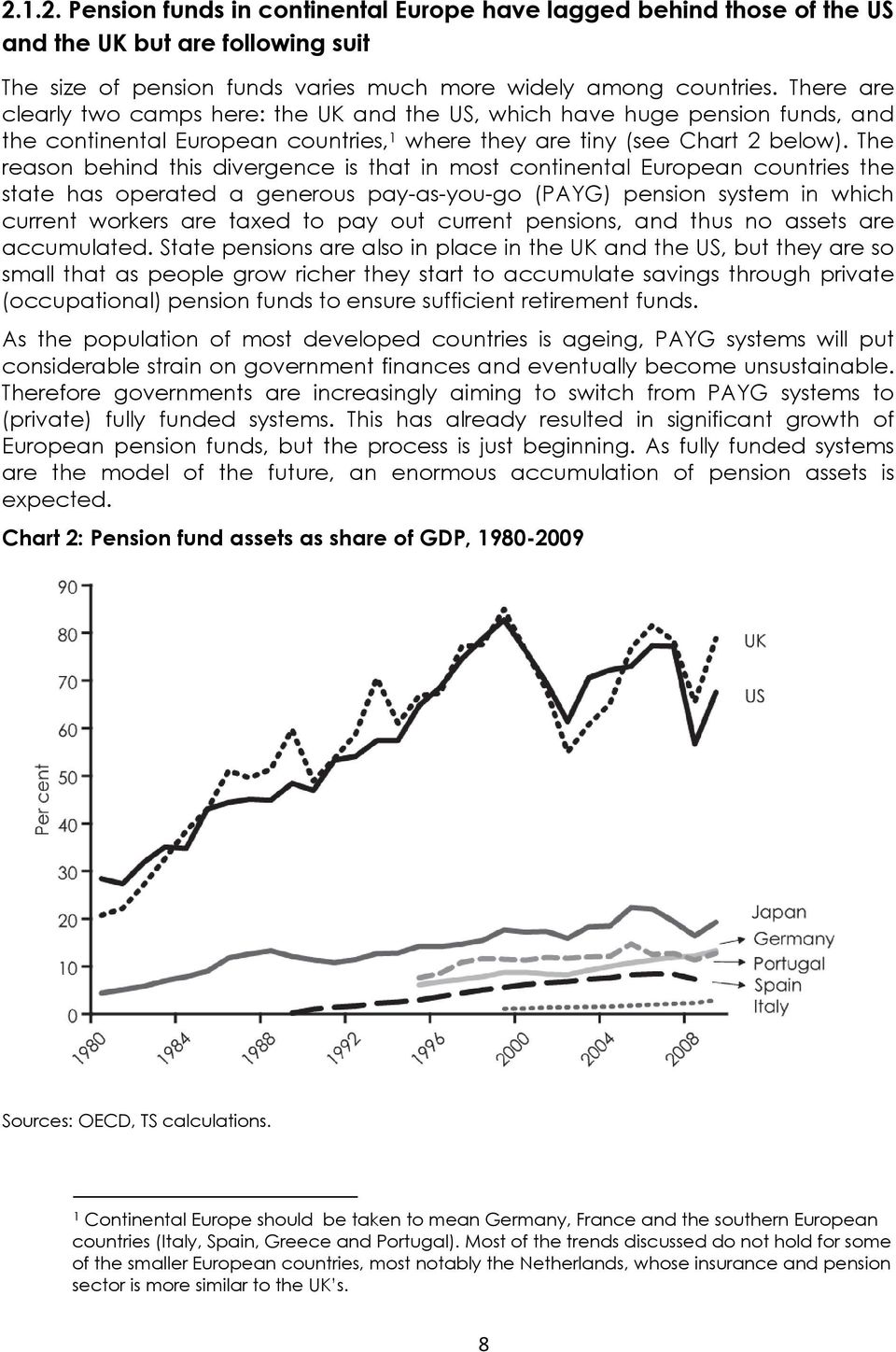
15 Pension funds in continental Europe have lagged behind those of the US and the UK but are following suit The size of pension funds varies much more widely among countries. There are clearly two camps here: the UK and the US, which have huge pension funds, and the continental European countries, 1 where they are tiny (see Chart 2 below). The reason behind this divergence is that in most continental European countries the state has operated a generous pay-as-you-go (PAYG) pension system in which current workers are taxed to pay out current pensions, and thus no assets are accumulated. State pensions are also in place in the UK and the US, but they are so small that as people grow richer they start to accumulate savings through private (occupational) pension funds to ensure sufficient retirement funds. As the population of most developed countries is ageing, PAYG systems will put considerable strain on government finances and eventually become unsustainable. Therefore governments are increasingly aiming to switch from PAYG systems to (private) fully funded systems. This has already resulted in significant growth of European pension funds, but the process is just beginning. As fully funded systems are the model of the future, an enormous accumulation of pension assets is expected. Chart 2: Pension fund assets as share of GDP, Sources: OECD, TS calculations. 1 Continental Europe should be taken to mean Germany, France and the southern European countries (Italy, Spain, Greece and Portugal). Most of the trends discussed do not hold for some of the smaller European countries, most notably the Netherlands, whose insurance and pension sector is more similar to the UK s. 8
16 2.2. Regulations in continental Europe have been stricter than those in the UK and the US Regulations governing what insurance companies and pension funds can invest in have historically also differed between continental Europe on the one hand, and the UK and the US on the other hand. In continental Europe s civil law tradition, in which rules are codified, quantitative restrictions were generally applied to institutional investors investments. By contrast, in the common law tradition of the Anglo-Saxon countries, "prudent person rules" were adopted early on. These require companies to make their investments prudently, i.e. to invest their assets in such a manner as to ensure the security, quality, liquidity and profitability of the portfolio as a whole. In principle, therefore, prudent person rules leave investors with much more freedom. However, early interpretations focused on the need to protect beneficiaries from speculative investments and allowed investments only in government securities. In the UK, legislation was made more flexible in 1961, and all investment restrictions were removed in In the US, the prudent person rule was made more flexible for pension funds in 1974, but restrictive standards prevailed for non-pension trusts until the late 1980s. The rationale for the very strict regulations was that the individual s funds needed to be protected. The focus was on capital preservation rather than achieving high returns on investment. But as the financial sophistication of both governments and individuals grew, it became realised that it was not in the individual s best interest to invest as conservatively as possible at the expense of returns. Pension funds and insurance companies were therefore increasingly allowed to take more risk. With the advance of modern portfolio theory, there was greater acknowledgement that it was important to take a full portfolio approach to risk management, in which the correlation between assets and liabilities is taken into account. This implies that the risk of an asset can be assessed only in the context of the full portfolio, and therefore restrictions on individual asset classes make less sense. Moreover, modern portfolio theory highlighted the need to diversify and hedge risk, and thus provided an argument to allow investment in more asset classes such as private equity, foreign assets and real estate as well as in derivatives to hedge risk. Over time, investment restrictions on such instruments have therefore been lifted. In most of continental Europe, restrictive quantitative restrictions stayed in place when rules were liberalised in the UK and the US. Governments in continental Europe were generally more risk-averse, giving priority to financial stability rather than higher returns. Moreover, the insurance and pension sectors were less developed than in the UK and the US, so that risk management and supervisory expertise were lacking. This made it more difficult to enforce prudent person rules. Over time, however, regulations have been liberalised in all countries. The European Commission s IORP Directive of 2003 required all member states to adopt prudent person rules for pension funds. Member states are still allowed to impose some quantitative restrictions, but these cannot restrict investments in equities to below 70 9

17 per cent or foreign investments to below 30 per cent, nor can they put any restrictions on investing in risk-capital markets. 2 Some European countries still have quantitative rules in place for insurance companies, but in general there is a move towards fewer restrictions. This includes the relaxation or lifting of restrictions on investing abroad, in derivatives, in real estate, in mutual funds and in private equity Investment patterns vary widely among countries The following trends are evident in the investment patterns of insurance companies and pension funds, as illustrated in charts 3 to 7 below: In continental Europe, insurance companies and pension funds have had a much more conservative asset allocation than their counterparts in the UK and the US (see Chart 3 for 2009 pension fund data). A large share of investment has gone into government bonds; generally, less than 20 per cent of assets were in equity. More recently the importance of equity and corporate bond investment has increased, but is still low compared to the UK and the US. Chart 3: Asset allocation of autonomous pension funds, 2009 Source: OECD In the UK, investments of both insurance companies and pension funds have been highly geared towards equities. The share of assets in corporate securities has increased since 1960 to around 60 per cent from 50 per cent for pension funds and to 70 per cent from 40 per cent for insurance companies. 2 Equity financing to a company during its early growth stages (start-up and development). 10
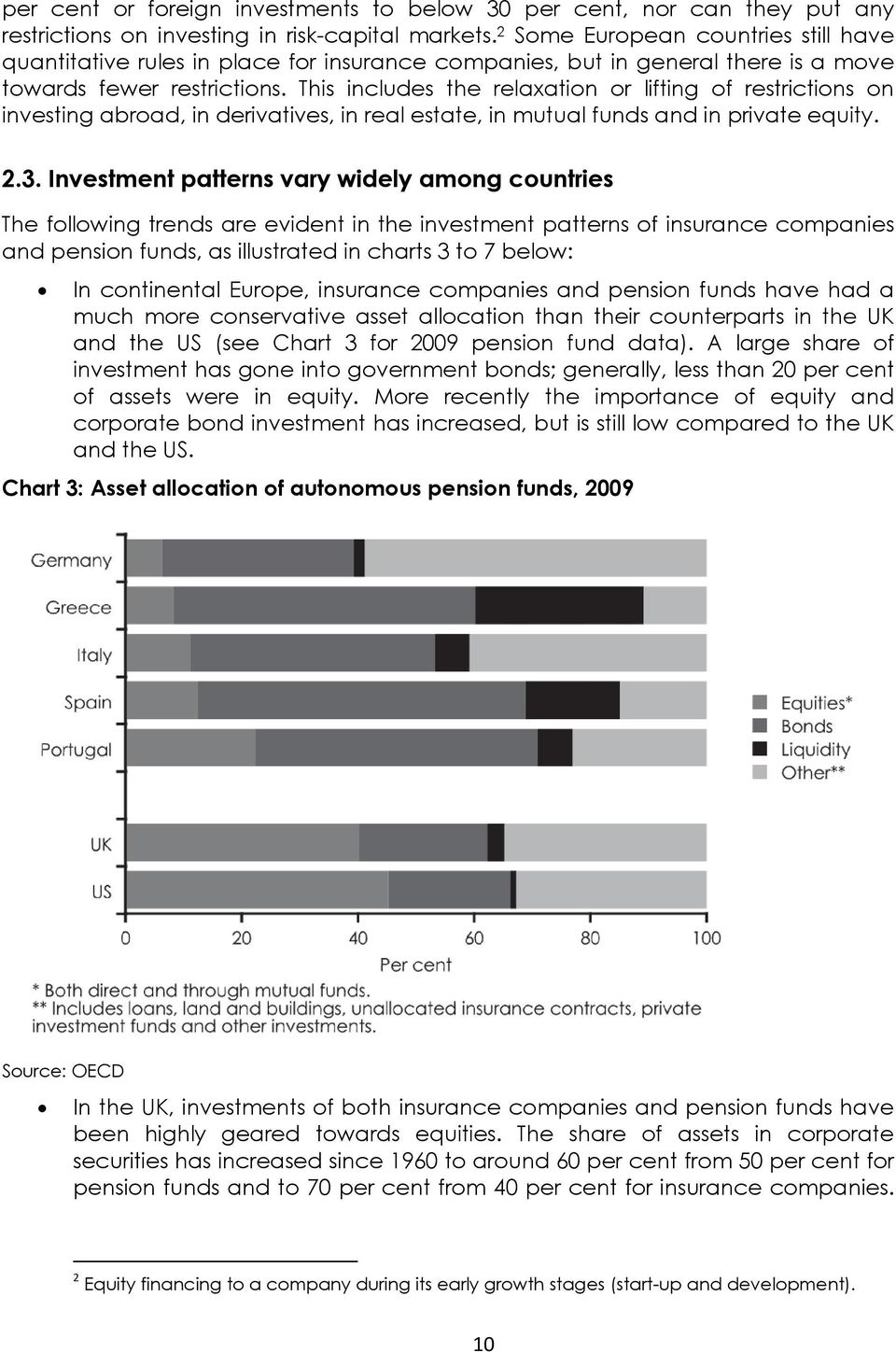
18 This has come at the expense of government securities, which currently only account for about 10 per cent for pension funds and 15 per cent for insurance companies (down from 35 per cent and 25 per cent in 1980 respectively). Investment in corporate bonds has increased but is still very limited at 10 per cent (see Chart 4). Overseas investment has grown significantly since the 1980s, now accounting for about one-third of total investments. Insurance companies have a higher allocation to fixed-income instruments and less investments abroad than pension funds (see charts 4 and 5). Chart 4: Allocation of corporate securities by UK pension funds, Source: UK National Statistics. 11
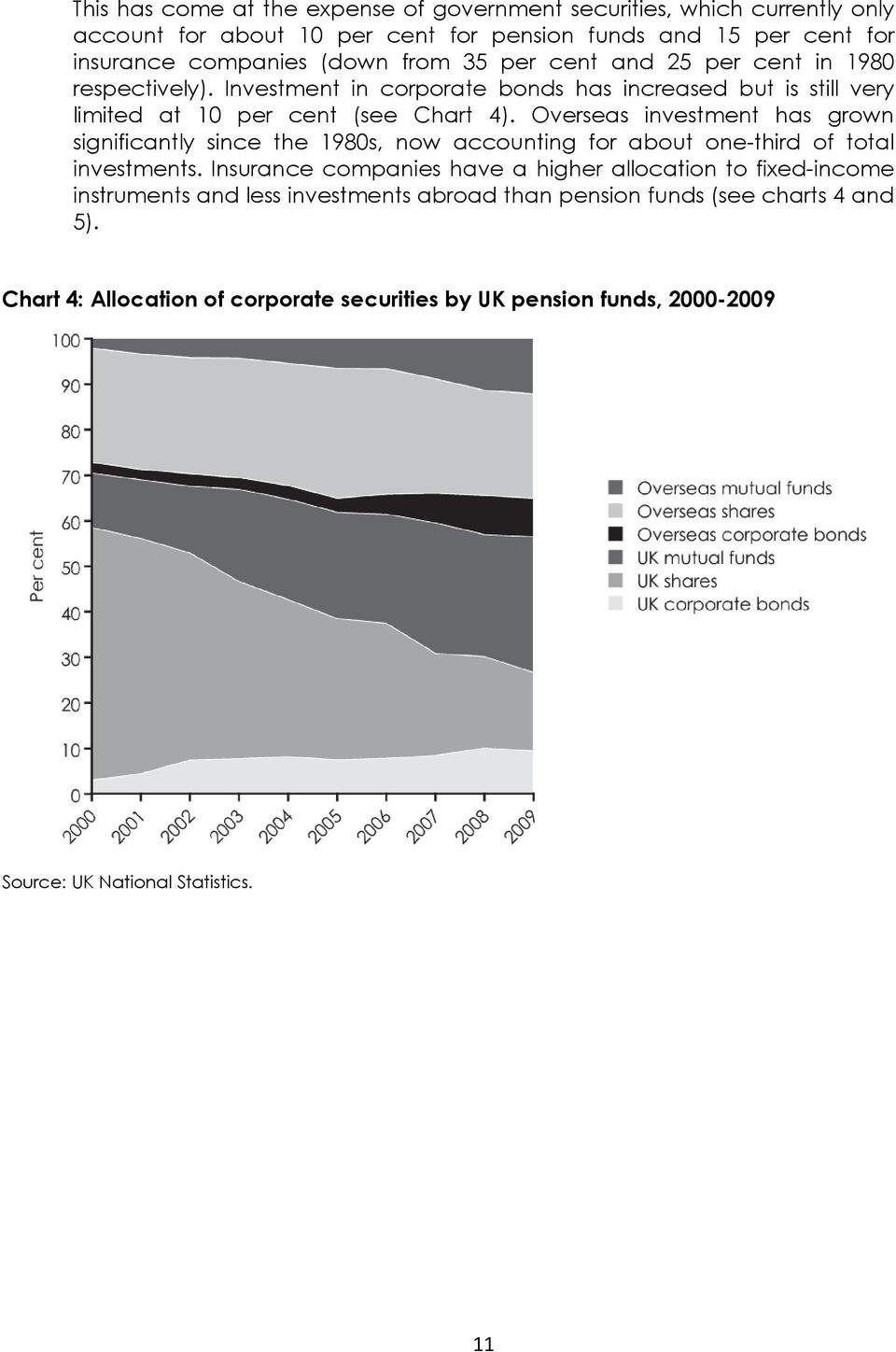
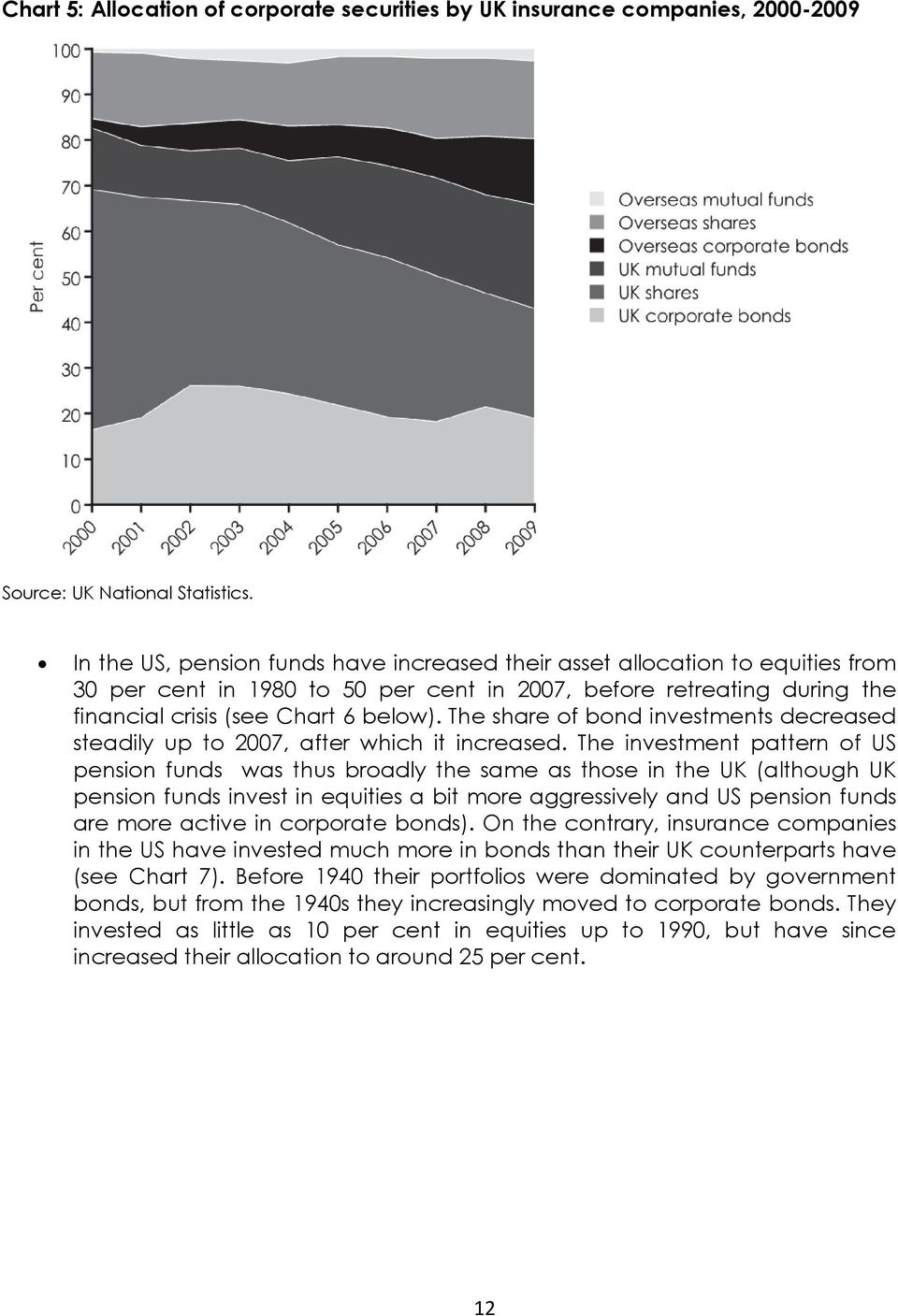
19 Chart 5: Allocation of corporate securities by UK insurance companies, Source: UK National Statistics. In the US, pension funds have increased their asset allocation to equities from 30 per cent in 1980 to 50 per cent in 2007, before retreating during the financial crisis (see Chart 6 below). The share of bond investments decreased steadily up to 2007, after which it increased. The investment pattern of US pension funds was thus broadly the same as those in the UK (although UK pension funds invest in equities a bit more aggressively and US pension funds are more active in corporate bonds). On the contrary, insurance companies in the US have invested much more in bonds than their UK counterparts have (see Chart 7). Before 1940 their portfolios were dominated by government bonds, but from the 1940s they increasingly moved to corporate bonds. They invested as little as 10 per cent in equities up to 1990, but have since increased their allocation to around 25 per cent. 12
20 Chart 6: Asset allocation by US pension funds, Source: The Conference Board. Chart 7: Asset allocation by US insurance companies, Source: The Conference Board 13

21 Although investments in Europe, the US and most other OECD countries have increasingly diversified and moved away from government bonds, there are exceptions to this trend. In Singapore, the Central Provident Fund (CPF) an extensive social security framework in which workers are obliged to contribute per cent of their salary invests almost exclusively in government bonds. Individuals are allowed to use some of their CPF savings to invest in equities, but the amount is limited and accounts for less than 2 per cent of stock market capitalisation Investment patterns are driven by country-specific factors The divergent investment patterns described above can be explained by many factors. This section discusses the most important ones Regulations Regulations have affected investments in the following ways: In the 1970s and 1980s regulations in the US were still relatively strict. This prevented insurance companies in particular from shifting investment into equities (which they wanted to do for reasons explained below). It was not until the 1990s, when regulations were relaxed, that a major shift into equities was made possible. One of the reasons why pension funds and insurance companies in continental European countries invested less in equities is that they were not allowed to do so. The relaxation of these restrictions has allowed them to invest more in this asset class. For most countries, however, restrictions were not binding, and other factors described in the next sections caused the conservative investment strategies. In the UK, the lifting of restrictions on investment abroad and in derivatives has allowed a significant part of assets to be invested abroad and for derivatives to become a major tool in controlling risk. Being able to hedge some elements of risk has made riskier assets such as corporate bonds more attractive. Lifting restrictions on specific asset classes, such as foreign assets, real estate, private equity and derivatives, has caused a shift into these assets in other countries as well Asset-liability matching The balance sheets of insurance companies and pension funds are exposed to risks both on the asset and the liability sides. For this reason, they will try to some degree to match assets and liabilities in terms of return, risk-profile and maturity in order to minimise their exposure. Naturally, the composition of liabilities will affect the optimal asset allocation. Historically most policies sold by life insurance companies had pay-offs defined in nominal terms. These long-term nominal liabilities were best matched by long-term bonds, which guarantee a fixed nominal return with limited downside risk. However, 14
22 policies have increasingly included variable-return or unit (mutual fund)-linked products. Such policies offer higher returns and risks to policyholders while decreasing the shortfall risk for insurers. They involve a larger investment of assets in equities so as to achieve higher returns and to allow for more risk. Many countries, including the US, provide tax incentives for such investments. The crucial difference between the liabilities of insurance companies and those of pension funds is that the latter are generally defined in real terms. For definedbenefit funds, pension payments are a fixed percentage of the wage earned at (or in the period before) retirement. Usually payments are also index-linked for the remainder of the retiree s life. This means that bonds are not an appropriate match for the liabilities, as they keep the pension fund exposed to inflation risk. Equities whose value can be argued to move in line with nominal wages over the long run (if the capital-labour ratio stays constant) are in this case a better asset class to match liabilities. Defined-contribution plans have less liability risk because pension payouts are not linked to any value: the contributors bear all the investment risk. However, pensioners will of course benchmark their pensions against their wage, so that the focus of these funds will generally be to match or preferably exceed the growth of average labour earnings, and a portfolio geared towards equities seems most appropriate. Increasingly individuals choose for themselves how they would like to see their pension savings invested. As a consequence, pension funds asset allocation will depend on the preferences and risk-aversion of its members (although in the UK the vast majority of people choose to stick with the default investment plan set by the pension fund). These considerations explain two trends in investment patterns: Insurance companies on average invest more in bonds and less in equities than pension funds do. A shift towards participating and unit-linked insurance policies has shifted insurance companies assets towards equities Supply of assets Even if pension funds and insurance companies would both like to and be allowed to hold certain assets, they may not hold them because they are not available in the market. In particular, finding high-quality securities with long maturities is often a challenge, even in the most developed markets. Although the demand for such securities could create the supply (as the supply might simply not be there because there was no demand), the right conditions have to be in place for a market to develop. In most continental European countries, bank loans historically dominated funding and companies had close relationships with banks. Moreover, companies tended to be small and family-owned. They therefore had little interest in raising funds through corporate bonds or shares. As a result, there was limited scope for insurance companies and pension funds to invest in these securities. A corporate bond market did not take off until the right 15
23 conditions were in place for both demand from institutional investors and supply from companies to increase, as described below Macroeconomic conditions Macroeconomic conditions have played a key role in shaping investment patterns in developed markets. In countries with high levels of inflation, fixed-income products are less attractive than equities (especially if liabilities are defined in real terms, as they are for most pension funds). UK pension funds and insurance companies have preferred equities over bonds because the country experienced high inflation in the 1970s and 1980s. But in Germany, where inflation was low, fixed-income products were more attractive. Large government deficits, mainly in southern Europe, sustained a large pool of government bonds with relatively high returns and provided a convenient and attractive investment avenue for pension funds and insurance companies. When government debt was reduced and interest rates decreased in the run-up to European unification, they were pushed to search for higher returns in other asset classes. The same is still the case in Brazil, where pension funds invest primarily in government bonds because these offer very high returns Competition In developed markets, insurance companies and pension funds face more competition, which is forcing them to seek higher returns by investing in riskier assets. Insurance companies in the US have historically invested heavily in fixedincome instruments. Before 1940 their portfolios were dominated by government bonds, but from the 1940s onwards they gradually moved to corporate bonds. Fixed-income instruments were a good match to liabilities, which were mainly whole-life policies. However, as market interest rates rose in the 1970s and money market mutual funds developed offering much higher returns than were available on life policies the competitiveness of the life insurance industry was much reduced. Insurance companies wanted to shift to equities and real estate in order to boost their returns, but regulations prevented them from doing so. Instead, they moved into riskier products such as junk bonds and doubtful commercial real estate loans. Moreover, they marketed more flexible types of policy such as mutual fund-linked insurance products. As regulations on the type of assets insurers were allowed to invest in were relaxed and the composition of liabilities changed, asset allocation shifted towards equities. Thirty per cent of investments were in equities by 1999 (from 10 per cent in 1980). European unification increased the competition insurers faced and pushed them into riskier assets so as to achieve higher returns. This illustrates the role that market liberalisation can play in deepening capital markets. 16
24 2.5. Pension funds and insurance companies have shaped financial systems Institutional investors drove the divergence of the Anglo-Saxon and continental European financial systems The Anglo-Saxon and continental European financial systems represent two different types. The first is market-based, meaning that much financing happens through the markets in the form of equity and corporate bonds. By contrast, continental Europe has a bank-based system: funding is dominated by bank loans. Historically companies often had close relationships with their banks and obtained their funding from them, limiting the development of the equity and corporate bond markets. Close relationships between companies and banks can promote stability and allow creditors to be well informed about borrowers actions, but a lack of market funding can seriously impede economic progress. A bank-based financial system tends to favour established companies and to limit competition between banks. Finding funding for new companies, innovative projects and mergers and acquisitions, often the drivers of economic growth, is thus restricted. Moreover static banks that face limited competition can bring about a sub-optimal allocation of capital, serving vested interests and leading to higher costs of funding. Many factors have contributed to the development of financial markets. For example, in Europe founding families played an important part in the ownership of many firms, limiting the role played by the equity market. Furthermore, in countries such as France, a high degree of regulation limited the development of securities markets. But arguably the most important factor has been the size of pension funds and insurance companies. While in continental Europe the bulk of household financial wealth was traditionally in bank deposits, much of the financial wealth of UK and US households was in insurance companies and pension funds (owing to the absence of an extensive public PAYG pension system). Because these institutions invested actively in equities and corporate bonds, savings were channelled into these products. By contrast, savings in continental Europe were directed into loans. The importance of institutional investors to the size of equity market is illustrated in Chart 8, which shows the very high correlation between the two in Since then, the correlation has decreased somewhat because institutional investors are increasingly investing abroad. 17
25 Chart 8: Institutional assets and market capitalisation, 1996 Sources: OECD, Bank for International Settlements (BIS) Institutional investors established London as an international financial centre A closer look at the UK indicates that as institutional investors grew and started investing more actively in equities, they drove a significant deepening of the stock market. The contribution of institutional investors to the stock market becomes clear from Chart 9. Insurance companies and pension funds by 1980 held more than half of all issued equities. As their assets increased sharply during the 1980s and 1990s (from 60 to 180 per cent of GDP), they caused market capitalisation to triple from 50 per cent to about 150 per cent of GDP. 18
26 Chart 9: UK institutional investor participation in the stock market, Sources: UK National Statistics, London Stock Exchange, Bloomberg, TS calculations. The importance of institutional investors has decreased steadily since the end of the 1990s as they shifted to investing abroad. This has not had a major impact on market capitalisation (the drops in 2001 and 2008 were caused mostly by financial turmoil) because by this time, London had established itself as a sophisticated and liquid market attractive for both international investors and companies wishing to raise money. Thus although institutional investors were key to the development of the stock market, foreign investors (many of whom are institutions) have now become major shareholders as well. Next to these quantitative contributions, institutional investors have also been active in promoting better corporate governance. As insurance companies and pension funds built up very large stakes in some companies, they had a key interest in assuring that these companies were well run. Faced with persistently poorly performing corporations, they voiced public criticism, often through formal associations of institutional investors (such as the Association of British Insurers and the National Association of Pension Funds). In the United States, the Council of Institutional Investors regularly publishes a list of the 50 worst-performing companies. Such public criticism exerts pressure to improve management without exposing individual institutional investors Insurance companies drove the development of the US corporate bond market Institutional investors have had a similar role in the development of the US equity market, with the difference that insurance companies invested less in equities. As a result, market capitalisation has stayed below that of the UK. However, insurance 19
27 companies (and pension funds to a lesser extent) have played a major role in the deepening of the corporate bond market in the US. Historically, the new-issue business was highly rigid and hierarchical. The large investment banks had close relationships with large corporate issuers, acted as sole manager for new issues and organised large syndicates for underwriting and distributing them. As a consequence, no competitive bidding took place and smaller companies were excluded from the bond market. This all changed when institutional investors became larger players in the 1970s (looking for higher returns, as described in section 2.4.5). New investment banks that specialised in trading rather than issuing and underwriting securities developed close relationships with institutional investors. The greater availability of financial resources encouraged corporations to place new issues directly with institutional investors and to allow for more competition in the issuing process, thereby decreasing new-issue and trading costs. Bonds could now also be issued by smaller players and by those with lower credit ratings. These new sources of funding facilitated the corporate restructuring that took place in the 1980s and 1990s. Since then, institutional investors channelling of funds has allowed for a further deepening of the corporate bond market, from 80 per cent to 130 per cent of GDP (see Chart 11). Over the period , pension funds and insurance companies acquired about one-quarter of net corporate bonds issued (see Chart 10 below). In some years they bought more than half of all bonds issued. Institutional investors have therefore clearly been crucial to developing the US corporate bond market into the most sophisticated in the world. Chart 10: US share of net corporate bonds issued bought by pension funds and insurance companies, Source: Federal Reserve, National Accounts, TS calculations. 20
28 Institutional investors will continue to facilitate financial diversification in continental Europe Although continental European financial markets are still broadly bank-based, market-based financing is gaining importance. Stock market capitalisation has increased and corporate bond markets have deepened significantly over the past decade in most countries (see Chart 11 below). Chart 11: Corporate bonds outstanding as share of GDP, Sources: Bank for International Settlements, OECD. Many factors have driven this transformation, but institutional investors have played an important role. In this period, pension funds and insurance companies increased in size and were allowed more freedom to invest in risky assets. But especially in southern Europe, this alone was not enough to jump-start a corporate bond market: companies were still used to relying on close relationships with banks in order to secure their funds and institutional investors were comfortable investing mostly in government bonds, which were in ample supply owing to high government debt. However, as part of European integration, government debt was reduced, interest rates decreased and insurance companies faced increasing competition, driving them to higher-yielding investments such as corporate bonds. On the supply side, the restructuring of the banking sector that followed financial integration reduced the close relationships between companies and banks and thus made it necessary for companies to look for alternative sources of funding. The right conditions were thus in place for the interaction between supply and demand to create a deeper corporate bond market. This was further facilitated by the introduction of the euro, which removed currency risk for foreign investors and removed most restrictions on insurance companies and 21
29 pension funds to invest abroad within the eurozone. The pool of institutional money looking for corporate bonds to invest in was greatly increased Conclusion Insurance companies and pension funds have been central to the development of capital markets in developed markets. In the UK and the US, where institutional investors are much larger than in most of continental Europe and have were historically been less restricted by regulations, they helped to establish liquid and sophisticated equity markets. Their deep and stable pools of capital have reduced volatility. In the US, they also have contributed significantly to the growth of the corporate bond market. In most of continental Europe, extensive PAYG pension systems limited the growth of pension funds. Moreover, the investments of pension funds and insurance companies were more heavily regulated, and tended to focus more on government bonds. Banks dominated the financial system while the equity and corporate bond markets were underdeveloped. However, the trend in continental Europe has followed that of the UK and the US. Pension funds are growing rapidly as governments aim to move away from a PAYG system. Also, regulations have become less restrictive and asset allocations more diverse. This has facilitated a move away from bank financing and towards funding through stocks and bonds. 22
30 3. India 3.1. The insurance and pension sectors are underdeveloped, but there is huge potential for growth Insurance sector The insurance sector has grown rapidly during the past decade. Its assets as a share of GDP increased from 9.6 per cent in 2001 to 16.1 per cent in 2010, driven by an expansion of life insurance, which dominates the market (see Chart 12 below). Since the passage in 1999 of the Insurance Regulatory and Development Authority Act, which permitted the entry of private and foreign firms into the insurance sector, the market share of the state-run firms has decreased to 65 per cent for life insurance and to 60 per cent for non-life insurance. Foreign companies have been active in this development, in spite of a 26 per cent cap on foreign participation: 20 of the 22 life insurance firms and 16 of the 18 non-life insurance companies that have set up shop since 2000 have been joint ventures with foreign partners. Chart 12: Insurance company assets as share of GDP*, Sources: Insurance Regulatory and Development Authority (IRDA), Ministry of Statistics. The past decade has witnessed the proliferation of insurance products and innovation in their marketing and distribution. Most notable has been the introduction and rapid growth of index-linked insurance products (ULIP), which made up nearly 30 per cent of the life-insurance market in the fiscal year ending March 2010 (see Chart 13). ULIPs are similar to mutual funds. They differ only in that they are bundled with insurance products and are regulated by the Insurance 23
31 Regulatory and Development Authority (IRDA) rather than the Securities and Exchange Board of India (SEBI), which regulates mutual funds. A shift is taking place away from ULIPs as a result of new regulations that cap administrative charges and also the risk aversion among investors that arose from the global financial crisis. Private insurance companies expect the proportion of business accounted for by ULIPs to fall from 90 per cent to per cent in the next 2-3 years, with the balance made up of traditional insurance products. The impact on overall business is stark: first-year premium collections by life insurance companies fell by 28 per cent in April- June 2011 year on year, and the share of ULIPs was only 12 per cent of the first-year total. Regulatory uncertainty has also slowed down growth in pensions and annuities (after the IRDA prescribed a guaranteed return for pension plans, which was withdrawn in August 2011), as has the emergence of the National Pension Scheme (described below) and the shortage of long-tenor securities required to offer an annuity scheme. The state-owned Life Insurance Corporation of India (LIC) accounts for more than 90 per cent of the pensions and annuities segment of traditional life insurance. Chart 13: Breakdown of life-insurance products, Source: IRDA. Although the insurance sector has grown significantly, it is still small compared to that of most developed countries, where assets are often close to 50 per cent of GDP (100 per cent in the UK) (see Chart 1 in section 2.1.1). The potential for growth in India is therefore huge, especially because India s household savings rate is high, at 24 per cent, and because 50 per cent of household savings are kept in non-financial assets. 24
32 Pension system India s pension system is still very immature. Pension funds assets are only about 7 per cent of GDP, compared to about 70 per cent in the UK and the US. The system has four segments: The National Social Assistance Programme (NSAP). As a limited first pillar, the central government has since 1995 offered a PAYG plan under the NSAP that transfers Rs200-1,000 (US$4-22) every month to each of 15.7 million poor citizens aged 65 and above. Some state governments make a matching contribution. This in no way suffices as a universal old-age income security plan. The Employees Provident Fund Organisation (EPFO). Government employees and organised workers in about 616,000 establishments in 186 industries are required to participate in provident funds and pension plans administered by the EPFO. These include a defined-contribution provident fund and a defined-benefit pension plan that cover only 14 per cent of the workforce (59 million workers as of March 2010). Included in this ambit are about 2,750 private trusts approved by the EPFO that offer similar programmes in private firms with 4.9 million members and assets of Rs1,005 billion (US$20.4 billion). Private pensions and annuities. These are plans run by life insurance companies that are regulated by the IRDA. Their growth slowed down following an IRDA order in 2010 requiring a guaranteed return indexed to interest rates for unit-linked pension plans (that are similar to ULIPs). This order was reversed in August 2011 but growth is expected to remain moderate. The National Pension Scheme (NPS). The NPS, a mandatory definedcontribution plan for government employees (optional for private sector workers), has so far accumulated 2.4 million members mostly central and state government employees and about Rs86 billion (US$1.9 billion) of assets. The goal is to offer a pension product that facilitates higher returns through lower costs and is simple for users to understand. A version called "NPS Lite" was introduced in 2010, aiming to include low-income individuals. In terms of assets under management, EPFO funds hold two-thirds of the market and private pensions and annuities one-third. The NPS is still very small but is expected to gain in importance. Pension funds are expected to grow vigorously as the population grows richer and seeks to secure sufficient old-age provisions because a generous PAYG system is absent. As discussed in section 2.1.2, the same happened in the UK and the US, where assets as a share of GDP have increased steadily to about 70 per cent from 20 per cent and 30 per cent respectively in
33 3.2. Regulations Insurance companies The insurance industry is subject to a complicated set of rules. Companies are required to invest minimum amounts in government securities; and restrictions are put on the amount invested in approved investments and other investments, a detailed list that includes specific equities and corporate bonds as well as bank deposits. Approved investments are in companies that have a strong, multi-year dividend payment record. Investments that do not fit these criteria are called other investments. The most important rules are summarised as follows: Life insurance. A minimum of 25 per cent is to be invested in central government securities. A minimum of 50 per cent is to be invested in central government and state government securities (and in securities guaranteed by those entities), and equity investments cannot exceed 35 per cent. Housing and infrastructure require a minimum 15 per cent investment. Pension and annuity plans offered by life insurance firms. A minimum of 20 per cent is to be invested in central government securities and a minimum of 40 per cent in central and state government securities (and in securities guaranteed by those entities). Equities have a cap of 60 per cent. General insurance. A minimum of 20 per cent is to be invested in central government securities. A minimum of 30 per cent is to be invested in central government and state government securities (and in securities guaranteed by those governments), and equity investments cannot exceed 55 per cent. Housing and loans to state governments for housing and fire-fighting equipment require a minimum of 5 per cent investment and infrastructure requires a minimum of 10 per cent investment. ULIPs face fewer restrictions. At least 75 per cent should go to approved investments, which tend to be very liquid stocks with a strong dividend payment record, and not more than 25 per cent to other investments. Unitlinked policies may be offered only where the units are linked to categories of asset that are both marketable and easily realisable. Insurance firms are not permitted to invest in derivatives or foreign assets. They can invest only in corporate bonds (including infrastructure bonds) rated AA or higher. At least 75 per cent of the debt held by life insurance and general insurance plans must have a sovereign rating or be rated AAA (for long-term securities) or P1 (for short-term securities). They also cannot own more than 10 per cent of the equity or debt of a single firm, group of firms or sector; the exceptions are ULIPs, in which the same cap is 25 per cent. Compared to most developed countries, where there are generally either no or high investment limits on equity and corporate bonds, India s regulations are still quite strict. However, the move to ULIPs in effect creates a more liberal investment climate. 26
34 Pension funds The regulations governing the Employees' Provident Fund Organisation are very strict. Funds have to be invested as follows: 25 per cent in central government securities 15 per cent in state government securities and government guaranteed securities 30 per cent in public sector securities and bank deposits 30 per cent in any of the above The exception is that private trusts may also invest up to 10 per cent in corporate bonds. The Ministry of Finance is keen to increase the programme s rate of return in order to close the current funding gap, and has therefore proposed to allow up to 15 per cent of assets to be invested in equities still very low compared to any regulation on pension funds in developed countries. However, the EPFO has resisted this. It has hired external fund managers to increase yields, and they have managed to earn returns of around 8.6 per cent (less than the current inflation rate of 9.2 per cent). But this is still not enough to close the funding gap. The EPFO remains very focused on protecting individuals funds at the expense of lower returns, as developed markets used to be (see section 2.2). The experience of developed markets suggests that more familiarity with the nature of financial markets and the need to achieve higher returns will gradually allow a shift into riskier assets. The National Pension Scheme (NPS) faces somewhat less strict regulations. Currently it is allowed to invest up to: 55 per cent in government securities 5 per cent in money markets 40 per cent in corporate bonds 15 per cent in equities via index funds However, a bill to grant strong independent powers to the Pension Fund Regulatory and Development Authority (PFRDA, at present part of the Ministry of Finance) is being discussed in parliament. If the bill is passed, subscribers will be allowed to choose their own asset allocation among equities, fixed-income securities and government securities with equities restricted to index funds and capped at 50 per cent of the portfolio. Alternatively, they can opt for an automatic investment plan in which 50 per cent goes to equities, 30 per cent to fixed income and 20 per cent to government securities for young people and in which more is gradually invested in government securities as people approach retirement. 27
35 3.3. Insurance companies increasingly invest in equities; pension funds are still focused mainly on government securities Insurance companies Insurance companies have shifted their equity allocation from 22 per cent of assets in FY06 to 34 per cent in FY11 (see Chart 14). The rest of their assets are invested almost entirely in debt instruments, most in government bonds. However, investment data from the state-run LIC, which accounts for 65 per cent of the market, indicate that there has been a shift into corporate bonds, which accounted for nearly 20 per cent of assets in FY10 up from 10 per cent in FY06. Chart 14: Life insurers asset allocation, FY06-FY11 Source: Life Insurance Council of India. Examining how assets from the different insurance products are invested, life insurance policies clearly follow the most conservative investment strategy (see Chart 15). Only 24 per cent go to approved investments (mostly liquid, quality stocks and highly rated corporate bonds). Pension product-related investments consist of 45 per cent of approved investments while ULIPs invest almost entirely in approved investments. For both life insurance and pension products, there has been a shift away from government securities into equities and corporate bonds. However, it is noteworthy that the holdings of government securities by life insurance funds have been consistently higher than the minimum 50 per cent threshold set by the regulator. This demonstrates the risk aversion of life insurance firms as well as the lack of supply of good-quality corporate bonds (described in section 3.4.3). The same holds true of pension and annuity funds and non-life insurance firms. 28
36 Chart 15: Asset allocation of different insurance funds, 2003 and 2010 Source: IRDA Pension funds Employees' Provident Fund investments consist entirely of fixed-income products and bank deposits (see Chart 16). The fund is currently not investing in equities. The National Pension Scheme does invest in equities, but the amount is limited to 15 per cent of total assets pending the parliamentary passage of the bill that will grant the PFRDA full regulatory powers. 29
37 Chart 16: Asset allocation of the Employees' Provident Fund, FY10 Source: EPFO annual report Investment patterns are driven by regulations, liability structures and the supply of assets Regulations Insurance companies From our interviews it became evident that insurance companies: Feel restricted by current regulations and would invest more in equities if they were allowed to do so. Life insurance is very close to the cap of 35 per cent for approved plus other investments. Feel restricted by rules on corporate bonds, but more important is the lack of supply, as discussed in section Several acknowledged that this is a chicken-and-egg problem to the extent that lack of demand also inhibits a supply response. However, all believe that the corporate bond market will deepen over time and provide increased investment opportunities. The evolution of longer-tenor debt will also allow the annuity industry to grow. Would like to be permitted to use derivatives (including futures, options and credit default swaps) to hedge investment risk, which in turn would allow them to invest in lower rated bonds with greater confidence. Concerning infrastructure investment, the IRDA requires infrastructure bonds bought by insurance firms to have a minimum credit rating of AA (A+ in exceptional 30
38 conditions with IRDA approval). Equity investments in infrastructure fall under the approved investments category, which means that investee companies need to have a strong, multi-year dividend payment record. Since infrastructure projects in their early years tend to have poor credit ratings and are unlikely to have a strong dividend payment record, these strict conditions eliminate a number of potential investments from consideration. As a result the investment by life insurance funds in infrastructure has been consistently below the 15 per cent minimum threshold: infrastructure holdings declined from 15 per cent in FY07 to less than 10 per cent in FY10. Non-life insurance firms have regularly exceeded their 10 per cent minimum requirement (e.g. 16 per cent in FY10), but the quantum of infrastructure investment by life insurance firms (Rs724 billion (US$14.7 billion) in FY10) far exceeds that of non-life insurance firms (Rs104 billion (US$2.1 billion) in FY10). Several of our insurance firm interviewees have told us that they are keen to invest in lower-rated debt instruments because they are confident of their risk management capabilities. But the IRDA has not so far accepted a 2006 recommendation by a Ministry of Finance committee to lower the infrastructure rating to BBB (investment grade) and to relax the dividend payment requirement for purchases of equity in infrastructure firms. As one interviewee stated with some frustration, If there is a single pressing need in India, it is infrastructure Pension funds Employee provident funds are very restricted by regulations, as they are not allowed to invest in equities and corporate bonds at all (except for private funds, which can invest 10 per cent in corporate bonds). This explains the extremely conservative investment strategy of the funds and their absence from the equity market. The NPS is restricted by current regulations to only 15 per cent equity investment. If the new bill is passed, a major shift into equities is expected. If most subscribers were to adopt the default investment plan (see section 3.2.2), asset equity allocations would be close to 50 per cent and corporate bond allocations close to 30 per cent Asset-liability matching The varying investment strategies of different segments of life-insurance policies become clear from Chart 19. Just as in developed countries, liabilities in the form of pension plans are better matched with equities than liabilities in the form of traditional term policies. The index-linked policies are tied to equity performance and are therefore matched by stock market investments. The shift to equity investment shown in Chart 16 from 22 per cent in FY06 to 34 per cent in FY11 is therefore caused to a large extent by the increasing popularity of ULIPs. The asset allocation of the life-insurance sector as a whole will for this reason depend on the growth of ULIPs. But, as discussed earlier, regulatory issues and risk aversion after the financial crisis have recently led to a decline of ULIPs, which could lead to allocation away from equities in the short term. Nonetheless we expect demand from the public for higher returns to drive the insurance sector to offer more higher-risk products linked to equity investments. 31
39 Regarding the EPFO-run pension plan, the focus on government bonds means that assets do not match liabilities well. The low investment return and high future payments pinned down in the defined-benefit plans have caused a deficit of Rs220 billion (US$4.9 billion) as of 2006 (the most recent data available), which is expected to further expand. Riskier asset allocations, especially in equities, which can provide a higher return, are thus required in order to reduce this deficit Supply of assets An insufficient supply of non-governmental debt instruments is the principal constraint on insurance companies bond investment strategies. Our interviews reveal that insurance companies would like to invest more in corporate bonds but that there is not enough paper to buy. There are also numerous complaints of a shortage of long-tenor securities. Most corporate debt has a maturity of 2-5 years, but insurance companies would like to invest in securities with a tenor of 10 years or more. One interviewee told us that the LIC has bond holdings that mature in the next year or two, and he is very keen on longer-term instruments. He added that many private pension trusts are investing in short-term paper owing to this shortage Macroeconomic conditions India s high-growth, high-inflation environment makes equities more attractive than fixed income securities. The optimal investment strategy is therefore more likely to be similar to that of the UK where equity has been institutional investors favourite because inflation has historically been high than that of, for example, Germany, where inflation has been low. This explains the enormous popularity of ULIPs and points to continued growth of demand for such instruments even if regulations depress their issuance in the short term. The yield on 10-year government bonds is currently 8.3 per cent, lower than the current inflation rate of 9.2 per cent. If insurance companies and pension funds want to offer a decent real return on savers money, they will have to venture into higher-yielding securities. If the NPS reform takes place as proposed, it is likely to gain enormously in popularity, as it is likely to offer higher returns than the EPFO s defined benefit plans, which have yielded per cent to subscribers. Moreover, it is being made available to lowincome individuals, who would otherwise have no access to financial saving products at all Insurance companies and pension funds can contribute significantly to capital market development Financial system India s financial system consists of a well-developed equity and derivatives market and a less developed debt market, which is still dominated by banks and private placements. The National Stock Exchange (NSE) and the Bombay Stock Exchange are ranked fourth and seventh in the world respectively in terms of trading volume. The NSE comes second or third in rankings of the number of futures and options contracts. However, Indian equity markets are volatile and only about 40 per cent of the listed stocks are actively traded. 32
40 In spite of a series of recent favourable regulatory changes such as easier listing norms, repos and a modern reporting and trading system, the corporate bond market remains illiquid and underinvested. Corporate funding still relies heavily on bank loans. The cost of capital is high, especially for small and medium enterprises. Moreover, India has huge financing needs: US$1 trillion of infrastructure projects is planned between 2012 and There is great potential for insurance companies and pension funds to contribute to meeting these funding needs and to reducing financing costs. India has a relatively high household savings rate, at 23.5 per cent of GDP in FY10. However, only about half went to financial assets; the other half was invested in physical assets such as precious metals and jewellery. As has happened in developed markets, a more mature insurance and pension system could channel more savings into productive investments through the stock and corporate bond markets Stock market Insurance companies growth and larger equity allocations have increased their role in the stock market. But compared to the UK and the US, the participation of insurance companies and pension funds in the stock market is tiny, at 5 per cent versus per cent (see Chart 17). However, more than half of these shares are held by promoters 3 most of which are government holdings of companies that are not traded. Looking at free-float market capitalisation whereby the shares held by promoters are excluded insurance companies hold a significant 11 per cent of shares. Pension funds involvement in the stock market is negligible. 3 Strategic shareholders, who are less likely to trade their shares. 33
41 Chart 17: Insurance companies stock market participation Source: National Stock Exchange. Insurance companies and pension funds have huge potential to play a bigger role and contribute to the sophistication and deepening of the stock market. First of all, the growth of the insurance sector could have a major impact: if insurance penetration were to increase to the level of the UK s, insurance companies would hold five times as many shares if asset allocation remained the same. This is equivalent to 60 per cent of current free-float market capitalisation. If more investment were to be directed into equities for example, if the popularity of ULIPs continues or insurance companies are allowed more investment freedom the impact would be even more pronounced. The potential for pension funds to become major equity investors is arguably even greater. The absence of an extensive state PAYG pension system means that private pensions will grow rapidly as a wealthier population plans for retirement, as has happened in the UK and the US, where pension assets increased from 20 per cent to 80 per cent of GDP between 1980 and 2009 (see Chart 2 in section 2.1.2). In view of the long-term nature of pension investments, India s young population and its highgrowth, high-inflation environment, optimal asset allocations would be highly geared towards equities, similar to the UK and the US, where about half of investment is in equity (see Chart 3 in section 2.3). The greater involvement of insurance companies and pension funds will contribute to reducing the volatility of the stock market. This is because they bring stable pools of capital interested in long-term positions instead of speculative trades, as happened in the UK and the US. 34
42 Corporate bonds Insurance companies and pension funds are increasingly active in corporate bonds. However, the corporate bond market is still very underdeveloped, at less than 6 per cent of GDP (see Chart 18), compared to 140 per cent of GDP in the US. A lack of supply is the main constraint and reason for underinvestment in corporate bonds. One reason is that Indian companies have a number of options for raising capital, such as bank loans and private placements, which are cheaper to execute than public bond issues even though the latter are often less expensive to service in the long run. For this reason, the SEBI and the government have made a number of changes to the regulation of corporate bonds in order to lower the cost of issuance and to add liquidity to the market, but there are still some outstanding tax and regulatory issues that prevent the market from developing more fully. Our interviewees had very clear ideas on the way forward. Many believed that the corporate bond market will deepen as the various measures taken so far to promote its growth take hold. One said that the imminent entry of foreign pension funds into rupee-denominated corporate bonds would stimulate its development. Another said that the corporate bond market, particularly in the context of infrasructure, would receive a boost once financial institutions focus on innovations such as takeout financing, securitisation and infrastructure debt funds. Such developments would go a long way towards securing financing for India s plan to build US$1 trillion of infrastructure between 2012 and As was historically the case in continental Europe, companies in India still rely heavily on bank financing. As described in section 2.5.4, institutional investors facilitated a move towards more debt financing when financial liberalisation eroded the close relationships companies had with banks and increased competition pushed insurance companies into higher-yielding assets. Over time a very similar thing could happen in India. 35
43 Chart 18: Corporate bonds outstanding as share of GDP, FY08-FY11 Sources: BIS, Reserve Bank of India 3.6. Recommendations Insurance companies and pension funds have significant potential to contribute to the deepening of capital markets. In order to realise this potential, the following measures and stimuli for participation are necessary: Further liberalisation of investment regulations for insurance companies, such as expanding or removing the limits on equity and corporate bond investments. Especially as the insurance industry builds up risk management expertise, more investment freedom will become appropriate, as happened in the US and the EU (see section 2.2) Lifting investment restrictions for the Employees' Provident Fund Organisation. Not allowing equity investment for defined-benefit plans is increasing risk instead of reducing it, and will cause the deficit to grow further. Allowing NPS subscribers to choose their investment strategy would be a welcome move. As the system matures, moving to a "prudent person" rule will eventually become appropriate, as has happened in Europe. Fostering development of the NPS. Much of the growth in the pension sector is likely to come from NPS subscriptions, especially as it is a way for poorer segments of society to participate. Removal of remaining tax and regulatory constraints on corporate bond market development such as uneven stamp duties on bond issuance. 36
44 Allowing investment in lower-grade debt instruments. Insurance companies told us they feel that they have adequate resources to quantify risk, particularly as the involvement of foreign companies has helped to build expertise. Allowing insurance companies and pension funds to invest in derivatives. This would allow them to hedge inflation risk, which makes bonds more attractive in a high-inflation environment. Facilitating measures to increase incentives to buy corporate bonds such as securitisation, credit enhancement and take-out financing of long-duration projects. 37
45 4. China 4.1. The insurance and pension sectors are underdeveloped, but they have huge potential for growth Insurance sector China has a rapidly growing insurance industry that currently ranks as the sixthlargest in the world. Assets under management (AUM) rose to Rmb4.6 trillion (US$720 billion) at the end of 2010 from Rmb1.4 trillion (US$171 billion) in However, compared with OECD countries, AUM as a share of GDP is low at 11.6 per cent in 2010 (see Chart 19 below). In the UK, insurance assets are close to 100 per cent of GDP. But as China grows richer, demand for more sophisticated savings products is likely to increase, driving a rapid expansion of the sector. The same happened in the UK, where in 1980 assets-to-gdp were only 20 per cent. Chart 19: Assets under management of insurance companies and their share of GDP, Source: China Insurance Regulatory Commission. 38
46 The four largest companies by assets, i.e. China Life, Ping An, China Pacific Insurance Corporation (CPIC) and People s Insurance Corporation of China (PICC), dominate the market, with 73 per cent of total assets in The market share of foreign insurance companies and joint ventures remained at a low level of around 5 per cent. More than 70 per cent of total premium income of China s insurance industry comes from life insurance companies Pension system China s pension sector is smaller than its insurance sector, and had total assets of Rmb2.72 trillion (US$425 billion) at the end of Various schemes are in place for different segments of the population: The Urban Basic Pension Fund system, for urban employees, is the largest pension scheme in the country (see Chart 20). It is a multi-pillar partially funded system (see Table A in the appendix for details). o o The social pool and individual accounts constitute the first pillar. Pillar II of the system is comprised of rapidly accumulating enterprise annuities (EA), i.e. supplementary occupational pension funds set up by individual firms. Many fund industry executives expect EA to grow very fast, as the state provision is not sufficient to provide retirement security. Moreover, Chinese companies are increasingly establishing occupational pension schemes to attract talented employees. More than 45 per cent of EA assets were entrusted to insurance companies at the end of Rural basic pension funds were reformed to become fully funded in 2009, but are still minimal. The National Social Security Fund (NSSF) is the fund of last resort for nationwide pension schemes, so its AUM will accumulate, with no near-term outflow anticipated. The NSSF is funded by the central government, supplemented by equity asset transfers from state share sales in the state-owned enterprises (SOEs), national lottery income and investment proceeds. Assets from the fully funded portion (individual accounts) of the urban basic funds in a few provinces are also pooled in the NSSF, which is supervised by the National Council of Social Security Funds (NCSSF) and promises a guaranteed return of 3.5 per cent to local authorities. Compared to the UK and the US where pension fund assets-to-gdp are around 70 per cent China s pension funds are still small at 7 per cent of GDP in 2010 (see Chart 20). However, assets have grown rapidly from 2 per cent of GDP in This trend is expected to continue as incomes rise and people are able to plan for retirement, matching the experience of developed countries without generous state-sponsored pensions. 39
47 Chart 20: Total assets of pension funds and share of GDP, Sources: Ministry of Human Resources and Social Security, National Council for Social Security Fund Regulations Insurance companies The China Insurance Regulatory Commission (CIRC) recognises the importance of broadening the investment scope for the insurance industry in improving investment returns and asset-liability matching capability, so it has been gradually lifting quantitative investment ceilings. Today Chinese insurance companies can invest in: Guaranteed corporate bonds rated A or above by domestic rating agencies (with no limits) Non-guaranteed corporate bonds rated AA or above (no more than 20 per cent of total assets) Stocks and Securities Investment Funds (SIFs), i.e. Chinese mutual funds) combined (no more than 25 per cent of total assets) Overseas stock markets (no more than 15 per cent of total assets) Private equity (no more than 5 per cent of total assets) Real estate, excluding residential properties (no more than 10 per cent of total assets) Infrastructure (no more than 10 per cent of total assets) 40
48 These rules are still considerably stricter than those of most developed nations. In many countries, including the UK and the Netherlands, no quantitative restrictions exist at all. In others, some quantitative restrictions are still in place, but are much higher than in China 50 per cent or more for equities, for example. Moreover, no investment in derivatives products is allowed, and investment in the Hong Kong Stock Exchange is restricted to only the Main Board. The CIRC also imposes limits on exposure to a single security and enforces more administrative controls on insurance companies with lower solvency margins Pension funds Regulations that govern pension fund investment have been rather static and remain quite restrictive (see Tables in the appendix for evolution of regulations and current status). The urban and rural basic pension funds are allowed to invest only in government bonds, negotiated term deposits and deposits in their dedicated savings accounts. Although many studies have been undertaken to explore possible expansion of investment avenues, little progress has been seen in practice. This is because asset management responsibilities of basic pension funds reside at provincial, municipal or county levels according to localities, making it extremely difficult for the central government to supervise and regulate the more than 2,000 funds that each manage a small amount of money. Regulations for enterprise annuities promulgated in 2004 were adjusted in 2011 to give asset managers more flexibility and allow up to 30 per cent of assets to be invested in equities and 95 per cent in fixed income without minimum requirements on government bonds. The NSSF enjoys a broader investment mandate and more relaxed quantitative controls than the other pension funds and insurance companies. It is allowed to invest in equities and fixed-income products in domestic markets plus fixed-income, money market products, equities and derivative instruments (such as swaps and futures) in overseas capital markets. The NSSF started investing in infrastructure and central government enterprises in 2005 as well as in venture capital and private equity industry funds registered with the NDRC in 2008, although these activities are not formally covered by regulations. Assets of the NSSF entrusted to qualified third-party managers can invest up to 40 per cent of AUM in domestic stocks and SIFs and a maximum of 20 per cent abroad. Compared to developed countries, China s investment rules for pension funds are very strict. In the US and the EU, "prudent person" rules apply for pension funds. Some quantitative restrictions might also apply but these are generally very liberal equities are not allowed to be restricted below 70 per cent in the EU. 41
49 4.3. Insurance companies investments still consist mainly of bank deposits and fixed income; the main pension funds leave money in their dedicated savings accounts Insurance companies Historical data show that insurance companies in China have diversified their investment mandates over time to include bonds, mutual funds, equities and infrastructure (see Chart 21 below). Bank deposits have gradually declined from 53 per cent of total invested assets in 2001 to 30 per cent in Bonds have become a much more important asset class, and comprised half of total investment in Equity investment has stabilised at around 11 per cent of total investment after shooting up to 18 per cent in the bull market of 2007 and subsequently collapsing in 2008 owing to the global financial crisis. Investment in SIFs has remained flat at around 6-7 per cent. Key central government infrastructure projects have attracted long-term life insurance funds, but the size of investment has been small. Chart 21: Asset allocation of insurance companies, Sources: China Financial Stability Report, Essence Securities. Compared with insurance companies in developed countries, what is most striking is the large amount of bank deposits held by Chinese insurers. In most countries, a maximum of 10 per cent of AUM will be held in bank deposits to ensure liquidity, but in China they obviously function as a major asset class. The allocation to equities is much smaller than in most countries, including India. 42
50 Pension funds Detailed asset allocation data for China s pension funds is not regularly published. The recently released 2010 statement on the Urban Basic Pension Funds shows that 83 per cent of assets were in savings accounts earning the basic fixed interest rate; very little went into investment (see Chart 22 below). Only 2 per cent was allocated to government bonds. Chart 22: Asset allocation by the Urban Basic Pension Funds, 2010 Source: MoHRSS The NSSF has a much broader investment mandate than the Urban Basic Pension Funds. The NSSF does not publicly disclose asset allocation details but a look at its balance sheet reveals some insights into its investment patterns. The share of bank deposits has consistently declined over the past few years to 2 per cent in Although fixed-income assets (usually government debt bought and held until maturity) represent the largest component, their share in the portfolio also fell, from 46 per cent in 2008 to 40 per cent in This was likely to have been reflected in increased holdings of equities. The NSSF investment has outperformed insurance funds, earning an average annual return of 15 per cent between 2005 and 2010 compared to 5.8 per cent. However, the annual return on NSSF investments has been far more volatile, suggesting a more aggressive investment strategy. 43
51 4.4. Investment patterns are driven by regulations, liability structures and the supply of assets Regulations Regulations governing insurance and pension funds investment have played an important part in shaping investment patterns Insurance companies Since liberalisation of regulations on insurance companies accelerated in 2003, asset allocations have diversified remarkably, as seen in Chart 21. New investment vehicles such as corporate bonds rated AA or above (June 2003), central bank notes (July 2003) and subordinated bonds of CBRC-approved banks (2004) expanded insurance companies holdings of bond products from 40 per cent in 2001 to 55 per cent in Permission for direct investment in the stock market in 2004 and the gradual upward revision of investment caps in 2005 and 2007 allowed equity holdings to increase from zero in 2003 to 11 per cent in The latest changes introduced in 2009 and 2010 have further lifted quantitative limits and allowed private equity and real estate investment. Our interviews with insurance companies revealed that the main constraints on investment are no longer quantitative regulations but the remaining restrictions on types of assets not allowed for investment. The current cap on equity and SIF investment of 25 per cent is not truly restrictive at this point as 2010 investment in these instruments was only 16.8 per cent. This is partly because it takes time to adjust asset allocations. However, important factors limit insurance companies interest in the stock market, such as the composition of liabilities, worries about market volatility and risk aversion, as discussed below. Insurance companies invest less in corporate bonds than the maximum allowed. Corporate bonds held by insurance companies at the end of July 2011 were only 9.3 per cent of their total assets, compared with the upper limit of 20 per cent set by the CIRC. The main restriction here is not regulation but the supply of high-quality corporate bonds (discussed in the next section). Some interviewees expressed a desire to be allowed to invest in bonds rated lower than AA. The move to allow investment in private equity and real estate is very much welcomed by insurance companies. But it takes time for these investments to take place because each company needs firstly to apply for the licences with the CIRC. Although the regulation was introduced one year ago, China Life and Ping An have only just received licences for private equity and only Ping An has so far obtained a licence for real estate investment. Insurance companies expressed a strong desire to be allowed to invest in derivatives. They could use these to hedge the risk of equities and corporate bonds, which would make these asset classes more attractive as well. 44
52 The interviewees would welcome further liberalisation of overseas investment but most did not consider this a priority for the moment. This is because the liability of life insurance companies is denominated in RMB, and having assets denominated in foreign currency would subject them to exchange rate risk. Moreover, foreign currency control means that insurance companies would not be able to bring investment proceeds back to China without the approval of the State Administration of Foreign Exchange Pension funds The following can be noted about the effects of regulations on asset allocation of pension funds: The rules governing the Urban Basic Pension Funds are extremely restrictive, allowing only investment in government bonds and deposits in the dedicated savings account. This has prevented any involvement by these funds in equities or corporate bonds. The NCSSF has increasingly allocated assets to external asset managers through open tendering on the market. The share of assets outsourced to third-party managers grew from 24 per cent in 2003 to 47 per cent in 2009, dropping to 42 per cent in 2010 owing to uncertainties in the capital market. Since external professional fund managers have more investment freedom, asset allocation was increasingly diversified. But with fewer than half of assets under external management and only 40 per cent of those allowed to be in equities, the scope for stock market investment remains limited (in effect less than 20 per cent of assets) Asset-liability matching The structure of the liability profile of Chinese insurance companies has determined their preference for avoiding downside risks over seeking high returns. The dominant insurance products in China are participating, ordinary and universal life insurance, which promise a minimum guaranteed rate of return to policyholders (usually a maximum of 2.5 per cent for ordinary products and around 4 per cent for participating and universal products). Unit-linked insurance products (ULIPs), which pay out returns according to investment performance, only occupy a marginal position in the total liability mix of China s insurance industry. Interviewees told us that this explains to a large extent why interest in the stock market is more limited in China than developed countries such as the UK and the US. Government bonds with annual yields of about 4 per cent and negotiated term-deposits that pay per cent are more attractive alternatives in China. China s Taikang Life sold the most ULIPs among the top insurers in per cent of total plans sold and has been the most aggressive in asset allocation. This suggests that an increase in ULIPs will lead to more investment in equities and corporate bonds. The experience of developed markets and India also points in this direction: as described in sections and 3.4.2, as ULIPs gained popularity, insurance companies investments shifted towards equities. 45
53 In some developed countries, such as the US, the government has encouraged the growth of ULIPs by providing tax incentives. Additionally, their expansion has been driven by a search for higher returns by savers and increased competition for funds. For example, when mutual funds started competing for saver s funds in the US, insurance companies had to offer higher returns through ULIPs to stay competitive Supply of assets Another key driver of current investment behaviour, according to managers of insurance companies we interviewed, is the immaturity of China s capital market, which greatly constrains the availability of investable instruments from which they can choose. First, there is a lack of long-term fixed-income products. Issuance of government bonds of longer than 10 years is irregular and unpredictable. The term of bonds is mostly less than five years, posing reinvestment risk. This has encouraged a preference for term deposits negotiated separately with the banks with a prevailing duration of five years and a return of per cent. This is one of the reasons why the share of bank deposits in total asset allocation is so much higher in China than in developed countries and India. Second, there are simply not enough domestic corporate bonds in China, since this is still a nascent market of very small size: it represented only 11.3 per cent of GDP at the end of H1/11, the majority issued by state-owned policy banks (see Chart 23 ). Non-financial corporate bonds amounted to only 2 per cent of GDP at the end of This is mainly because the regulators have established rigid industrial policy criteria for approving primary issues, so as to channel credits towards favoured sectors, while the state s very limited tolerance of default risk has resulted in a strict procedure that limits the corporate bond market to only a handful of companies. This produces a situation in which Chinese corporate bonds are short in supply but all have high ratings, making it increasingly difficult for insurance companies to select the best-quality companies to invest in. 46
54 Chart 23: Outstanding bonds as a share of GDP, 1997-H1/2011 Source: ADB Asian Bonds online. In addition, several interviewees expressed concern about the volatility of China s stock market and pointed out that it has a weak correlation with the overall economy. For example, although the impact of the global financial crisis on China s growth was short-lived, its stock market experienced a sustained slide, with the Shanghai Stock Exchange Composite Index falling from 3500 points in August 2009 to 2400 points in September Moreover, as listed companies on China s stock exchanges are mainly SOEs, their share prices do not provide a good signal of corporate performance, nor do stocks perform a disciplinary function for corporate management. They rarely pay out regular dividends and do not reward investors with much of a steady stream of cash income. Companies we interviewed said that they would like to implement risk-management techniques (such as short selling and derivatives) but this is still forbidden by the authorities, exposing them to higher systemic risks Other factors A final factor that has contributed to the conservative investment pattern and lower return is the risk-averse investment style common among insurance companies in China. This risk aversion is not purely cultural, but is also related to the short history of liberal regulation, a lack of investment management skills and past investment failures. Many life insurance companies lobbied the CIRC in 2007 to relax its controls over stock market investment and aggressively bought shares during the bull market, but they took a massive hit in the 2008 collapse. This experience helps to explain why no insurance company dramatically increased its equity position when regulations were loosened in
55 Very limited information could be gathered on the investment drivers of pension funds in China, particularly with regard to the NCSSF or external organisations managing mandates for the NSSF. Looking at investment by Urban Basic Pension Funds, although regulations are restrictive (as shown in the previous section), the actual investment made is far less than is allowed. This is due to fragmented institutional arrangements as well as legacy problems of the old pension system. As has been the case historically, the Urban Basic Pension Funds are handled by social insurance fund management bureaus at the provincial or county levels, so the ability to pool risk is very limited and most localities do not have the expertise to actively their manage investment. Moreover, even though the defined contribution portion of the plan is supposed to be fully funded, money often "leaks" out to fund deficits in the PAYG part of the system. If the pension system becomes fully funded and centralised as in the UK and the US, active investment is likely to increase Insurance companies and pension funds can contribute significantly to capital market development Financial system China s financial system is dominated by the government and as a result provides little opportunity for small and medium enterprises (SMEs) to fund themselves. Listed companies on the stock exchanges are mainly state-owned. About 80 per cent of bond issuance comes from the government and government-owned policy banks; even within the non-financial corporate bond market, SOEs or former SOEs are the dominant issuers. This, together with tighter credit standards adopted by banks, has left SMEs to rely on the booming informal lending market, where interest rates are very high, typically per cent. Liu Mingkang, Chairman of China s Banking Regulatory Commission, said at a national conference on 10 September 2011 that about Rmb3 trillion (US$469 billion) has flowed into informal lending markets in the coastal regions. At the 2011 Annual Securities Work Conference, Chairman Shang Fulin, of the China Securities Regulatory Commission (CSRC), clearly set the top priorities in the medium term as building a multi-tier capital market that would serve all sizes of enterprises; increasing the share of direct financing in the economy; expanding capital-raising opportunities for domestic enterprises (particularly in the high-tech innovative sectors); improving capital market efficiency; and developing more sophisticated investment products for savers and investors. Insurance companies and pension funds could play a major role in achieving those goals Contribution to the stock market The role of insurance companies and pension funds in the stock market has been very limited to date. Insurance companies held barely 2 per cent of total stock market capitalisation in 2010 (see Chart 24), and the NSSF a similar share. However, the potential for a bigger role for these institutions is high. The strong growth expected in the insurance sector and greater freedom to invest in equities is likely to lead to rapid accumulation of shares by insurance companies. If these firms keep 48
56 growing at their current rate and increase their equity holdings to the maximum 25 per cent allowed, they will hold more than four times as much equity in three years. If insurance companies were to grow to a similar size as those in the UK and adopt a similar investment strategy, equity holdings would be 30 times as high as they are now equivalent to 50 per cent of GDP providing substantial funds for stock market expansion. Likewise, a maturing pension sector especially if driven by enterprise annuity funds, which are allowed to invest up to 30 per cent in equities will increase the role of pension funds in the stock market. As happened in the UK and the US, the growth of equity holdings by insurance companies and pension funds could greatly contribute to increasing the liquidity and stability of the stock market. As shown in Chart 10 in section 2.5.1, there is a strong correlation between the size of institutional investors and stock market capitalisation. In the UK, when institutional investors assets increased from 60 to 180 per cent of GDP between 1980 and 2000, the massive channelling of savings into the stock market helped to triple market capitalisation from 50 to 150 per cent of GDP (see section 2.5.2). Moreover, the long-term nature of their investments increased stock market stability. Such increased liquidity and stability would make it easier for companies to raise money through shares issues. This could greatly reduce the cost of financing, especially for SMEs, and thus stimulate investment and innovation. In addition, reduced volatility could help to correct the prominent speculative feature of China s current stock market, boosting investor confidence and establishing a virtuous circle for market expansion and deepening. Although the potential is there, many obstacles are still in the way. As mentioned above, Chinese listed companies are paying little in the way of dividends, preventing investors from sharing in the proceeds of their growth and therefore reducing insurance companies willingness to participate in the stock market. Even though insurance companies could help to fund more enterprises capital-raising on the stock market, the approval system for IPOs in China is limiting the number of companies as well as the types of company that can raise capital. The liability structure of Chinese insurance companies limits their pursuit of high returns. This could change as happened in developed markets if insurance companies develop more ULIPs in the face of increasing competition from within the industry or from alternative savings and investment products. 49
57 Chart 24: Proportion of stock market investment by insurance funds to total market capitalisation, Sources: CEIC, TS calculations Contribution to the corporate bond market The significance of insurance companies in the corporate bond market is much bigger. They currently hold about one-third of total non-financial corporate bonds outstanding (see Chart 25). The increase of their relative holdings shows that they have played a major role in the growth of corporate bonds since 2004 from 1.3 per cent of GDP to 11.3 per cent of GDP at the end of H1/11. However, the corporate bond market remains underdeveloped, and a lack of supply is the main reason why insurance companies do not invest in them more. The experience of the US, as described in section 2.5.3, suggests that insurance companies can play a major role in the development of the corporate bond market. More competition was established there in the issuing process, and that allowed smaller companies, which were previously excluded from the market, to issue bonds as well. In China corporate bond issuance is dominated by state-owned policy banks; these bonds are generally bought by state-owned commercial banks and held to maturity. Greater involvement by the insurance sector could significantly increase liquidity and provide capital for smaller non-state companies to issue bonds. However, strict regulatory control over bond issuance is preventing this. As a result, the supply of bonds is limited and is the main reason why insurance companies do not hold more bonds. As the experience of continental European countries has shown discussed in section higher demand can lead to more supply if the right conditions are in place. For China, this means the liberalisation of the bond 50
58 market and interest rates, so that risk can be priced correctly (as discussed in the next section). Chart 25: Composition of non-financial corporate bonds held by investors, H1/11 Source: China Government Securities Depository Trust & Clearing Co., Ltd Recommendations In order to realise the potential insurance companies and pension funds have to contribute to expanding and deepening China s capital markets, the following measures and stimuli for participation would be necessary: Further relaxing controls over investment in non-guaranteed bonds and equities after domestic companies and fund managers develop more advanced portfolio and internal risk management capability. Adopting effective dividend payout rules for listed companies, such as linking it with eligibility for secondary offerings, so as to encourage participation of insurance companies and pension funds in the stock market. Adopting a registration system similar to those of developed countries, so as to expand the fundraising opportunities for SMEs and to provide more investment choices to investors. Strengthening of the defined contribution portion of the Urban Basic Pension Funds and centralisation of asset management so that capital market investment could be opened up to the largest pension funds in China, with risk pooled at a manageable level. 51
59 Continuing development of derivatives products and granting permission for insurance companies and pension funds to use margin trading and short selling so that systemic stock market risks can be hedged. Encouraging development of expertise of fund managers in insurance companies (for example, through greater collaboration with foreign insurance companies) to increase their confidence to invest in riskier asset classes). Promoting competition among insurance companies and/or providing tax incentives for ULIPs. Relaxing qualifications of private companies for corporate bond issuance and elimination of risk suppression among regulators it distorts the domestic credit ratings since at the moment there is little meaningful difference between the quality of companies rated AAA and AA. Liberalising interest rates so that risk can be priced more efficiently on the bond market and the cost of capital can be correctly reflected in the economy. Minimising inefficiencies within the financial system such as administrative lending controls so that companies are encouraged to seek alternative funding in the form of corporate bonds. 52
60 5. Conclusions The experience of developed markets illustrates the large and beneficial effect that pension funds and insurance companies can have on the development of capital markets. The rise of pension funds and insurance companies in the US and the UK drove the emergence of liquid and stable stock markets and a sophisticated corporate bond market. In most of continental Europe institutional investors historically played a smaller role, but recently they have grown in importance and have facilitated a shift away from bank financing. In India and China pension funds and insurance companies have so far been minor players in capital markets. But the potential for them to take up a larger role and contribute to the deepening and stabilisation of the stock and corporate bond markets is huge. Firstly, the pension and insurance systems are still underdeveloped. High growth is expected as people become wealthier and the financial system matures following the trend established in developed markets especially because no extensive PAYG pension systems are in place. Secondly, asset allocations are generally very conservative, being highly geared towards government bonds and, in the case of China, bank deposits. If asset allocations become more similar to those in the US and the UK, enormous amounts of stable funds will flow into equities and corporate bonds. This could provide liquidity to these markets and reduce their volatility, improve funding to SMEs, help to fund India s ambitious infrastructure plans and reduce the cost of capital. However, restrictions remain in place that prevent the realisation of this potential. Regulations often prevent adopting a more risky investment strategy, especially in the case of pension funds. Also, inadequate a lack of supply of assets, in particular corporate bonds, restricts investment in those products. Moreover, pension funds and insurance companies are often still more risk-averse than their developed market counterparts. This is partly because their liabilities do not require achieving high returns and competition is limited and because risk-management expertise is still limited. To encourage greater participation of pension funds and insurance companies in capital markets, regulations should be liberalised especially as the financial system becomes more sophisticated and fund managers gain expertise in line with the trend in developed markets. Furthermore, restrictions on corporate bond issuance should be removed in order to boost supply and the growth of the market should be promoted. These and other measures would encourage a continued shift away from government bonds and bank deposits, which, together with the continued exponential growth of the pension and insurance sectors, can drive a transformation of India and China s equity and corporate bond markets. 53
61 6. Appendix Table A: History of regulations on investment by insurance companies in China Year Quantitative limits on available investment vehicles (per cent of total assets) 1995 Only bank deposits, government bonds and policy bank bonds allowed 1998 Insurance funds allowed to invest in inter-bank money market 1999 No more than 10 per cent in corporate bonds issued by central SOEs rated AA+ or above; Securities Investment Funds subject to case-by-case approval by the CIRC 2003 No more than 15 per cent in Securities Investment Funds; no more than 20 per cent in corporate bonds rated AA or above 2004 No more than 8 per cent in subordinated bonds issued by domestic banks approved by the China Banking Regulatory Commission; equity investment allowed with no detailed guideline 2005 No more than 5 per cent in stock market except for unit-linked and universal life insurance products; no more than 30 per cent in commercial bank bonds rated A or above; no more than 30 per cent in corporate bonds rated AA or above 2006 No more than 3 per cent in equity of unlisted domestic banks 2007 No more than 15 per cent in developed overseas markets; no more than 10 per cent in stock market; no more than 15 per cent in overseas investments 2009 No more than 6 per cent in infrastructure for life insurance companies and no more than 4 per cent for non-life companies; no more than 15 per cent in non-guaranteed corporate bonds 2010 No less than 5 per cent in deposit, government bonds, central bank bills, policy bonds and money market funds combined; no more than 20 per cent in non-guaranteed corporate bonds rated AA or above; no more than 25 per cent in stocks and securities investment funds combined; no more than 20 per cent in stocks and stock funds combined; no more than 5 per cent in private equity; no more than 10 per cent in real estate; no more than 10 per cent in infrastructure; no more than 15 per cent in overseas investment 54
62 Table B: Regulatory changes in enterprise annuity funds investment China 2004 regulation 2011 regulation Liquid products Fixed income Overseas investment Investment in highly liquid products such as bank demand deposits, central bank bills, shortterm bonds or the money market should be a minimum of 20 per cent of net total assets. Investment in fixed-income products such as term deposits, negotiated deposits, government bonds, convertible bonds, bond funds and investment-linked insurance products should be no more than 50 per cent of net total assets, of which no less than 20 per cent of net total assets should be invested in government bonds. Investment in equity products such as stocks and equity funds and investment-linked insurance products is no higher than 30 per cent of net total assets; stock investment should not be higher than 20 per cent of net total assets. Investment in highly liquid products should be no less than 5 per cent of net total assets; liquidation reserves, securities settlement accounts and securities subscription proceeds in primary markets shall also be deemed as liquid assets; the proportion of bond repurchase investments shall not be higher than 40 per cent of the net total asset. Investment in fixed-income products should be no more than 95 per cent of net total assets. The proportion requirement on government bonds is cancelled. Investment in equity products is no higher than 30 per cent of net assets, with no more specific cap on stock market investments. EA fund is not allowed to directly invest in warrants, but the warrants derived from investment in stocks or convertible bonds must be sold within 10 trading days upon the first day of listing the warrants. 55
63 Table C: Regulations on investment of NSSF, 2001 and 2006 In-house asset management Asset management by third-party qualified managers Overseas investment Limited to bank deposits and the primary market for government bonds. A minimum of 50 per cent of the assets managed by thirdparty managers must be invested in bank deposits and government bonds while the proportion of bank deposits must be no lower than 10 per cent; investment in corporate and financial bonds must be no more than 10 per cent of AUM and investment in securities investment funds and stocks must be no more than 40 per cent. Overseas investment may comprise a maximum of 20 per cent of total assets. 56
64 Glossary AUM: Assets under management CIRC: China Insurance Regulatory Commission CPIC: China Pacific Insurance Corporation CPF: Central Provident Fund Singapore EA: Enterprise annuities EPFO: India Employees Provident Fund Organization IRDA: India Insurance Regulatory and Development Authority LIC: India Life Insurance Corporation MoHRSS: Ministry of Human Resources and Social Security NCSSF: China National Council of Social Security Fund NPS: India National Pension Scheme NSSF: China National Social Security Fund PAYG: Pay-as-you-go PFRDA: India Pension Fund Regulatory and Development Authority PICC: People s Insurance Company of China SEBI: Securities and Exchange Board of India SIF: China Securities Investment Funds, i.e. Chinese mutual funds SMEs: Small and medium enterprises SOEs: State-owned enterprises ULIP: Index-linked insurance product 57
65
BS2551 Money Banking and Finance. Institutional Investors
 BS2551 Money Banking and Finance Institutional Investors Institutional investors pension funds, mutual funds and life insurance companies are the main players in securities markets in both the USA and
How To Improve Profits At Bmoi
 Bank of America Merrill Lynch Banking and Insurance CEO Conference London, 29 September 2009 Good morning. I d like to thank Bank of America Merrill Lynch for letting us speak this morning. Before I talk
Mr Duisenberg discusses the role of capital markets and financing in the euro area Speech by Willem F Duisenberg, President of the European Central
 Mr Duisenberg discusses the role of capital markets and financing in the euro area Speech by Willem F Duisenberg, President of the European Central Bank, at the Waarborgfonds Sociale Woningbouw in Utrecht,
Development of consumer credit in China
 Development of consumer credit in China Shen Bingxi and Yan Lijuan 1 Summary Consumer credit particularly personal consumer loans such as home mortgages and loans financing purchases of automobiles and
Standard Life Assurance Limited OCTOBER 2013. Principles and Practices of Financial Management for the UK Smoothed Managed With Profits Fund
 Standard Life Assurance Limited OCTOBER 2013 Principles and Practices of Financial Management for the UK Smoothed Managed With Profits Fund Preface... 2 Background to the Principles and Practices of Financial
ENCOURAGING A DYNAMIC LIFE INSURANCE INDUSTRY: ECONOMIC BENEFITS AND POLICY ISSUES
 ENCOURAGING A DYNAMIC LIFE INSURANCE INDUSTRY: ECONOMIC BENEFITS AND POLICY ISSUES by Gerry Dickinson Professor and Director, Centre for Insurance & Investment Studies, City University Business School,
How credit analysts view and use the financial statements
 How credit analysts view and use the financial statements Introduction Traditionally it is viewed that equity investment is high risk and bond investment low risk. Bondholders look at companies for creditworthiness,
Rating Methodology for Domestic Life Insurance Companies
 Rating Methodology for Domestic Life Insurance Companies Introduction ICRA Lanka s Claim Paying Ability Ratings (CPRs) are opinions on the ability of life insurance companies to pay claims and policyholder
Importance of Credit Rating
 Importance of Credit Rating A credit rating estimates ability to repay debt. A credit rating is a formal assessment of a corporation, autonomous governments, individuals, conglomerates or even a country.
Principles and Trade-Offs when Making Issuance Choices in the UK
 Please cite this paper as: OECD (2011), Principles and Trade-Offs when Making Issuance Choices in the UK, OECD Working Papers on Sovereign Borrowing and Public Debt Management, No. 2, OECD Publishing.
Housing finance in Italy
 Housing finance in Italy Defining characteristics One of the salient features of the Italian housing market is the high rate of ownership. According to data from the 2001 census, 71% of Italian households
OECD GUIDELINES ON PENSION FUND ASSET MANAGEMENT. Recommendation of the Council
 DIRECTORATE FOR FINANCIAL AND ENTERPRISE AFFAIRS OECD GUIDELINES ON PENSION FUND ASSET MANAGEMENT Recommendation of the Council These guidelines, prepared by the OECD Insurance and Private Pensions Committee
Pension & Investment Options. A Guide to Irish Life Corporate Business Pension Funds
 Pension & Investment Options A Guide to Irish Life Corporate Business Pension s Your Click into Pensions Irish Life Corporate Business offers a wide range of online tools to keep you up to date with pension
Life Cycle Asset Allocation A Suitable Approach for Defined Contribution Pension Plans
 Life Cycle Asset Allocation A Suitable Approach for Defined Contribution Pension Plans Challenges for defined contribution plans While Eastern Europe is a prominent example of the importance of defined
Public Debt and Cash Management
 Federation of European Accountants Federation of European Accountants Fédération Fédération des Experts des Experts comptables comptables Européens Européens Public Sector Public Debt and Cash Management
A BETTER RETIREMENT PORTFOLIO FOR MEMBERS IN DC INVESTMENT DEFAULTS
 A BETTER RETIREMENT PORTFOLIO FOR MEMBERS IN DC INVESTMENT DEFAULTS JUNE 2014 TALENT HEALTH RETIREMENT INVESTMENTS EXECUTIVE SUMMARY The majority of defined contribution (DC) plan members typically end
Information. Canada s Life and Health Insurers. Canada s Financial Services Sector. Overview
 Information Canada s Life and Health Insurers Canada s Financial Services Sector September 2002 Overview Canada s life and health insurance industry comprises 120 firms, down from 163 companies in 1990,
Understanding Fixed Income
 Understanding Fixed Income 2014 AMP Capital Investors Limited ABN 59 001 777 591 AFSL 232497 Understanding Fixed Income About fixed income at AMP Capital Our global presence helps us deliver outstanding
I. Introduction. II. Financial Markets (Direct Finance) A. How the Financial Market Works. B. The Debt Market (Bond Market)
 University of California, Merced EC 121-Money and Banking Chapter 2 Lecture otes Professor Jason Lee I. Introduction In economics, investment is defined as an increase in the capital stock. This is important
for Analysing Listed Private Equity Companies
 8 Steps for Analysing Listed Private Equity Companies Important Notice This document is for information only and does not constitute a recommendation or solicitation to subscribe or purchase any products.
Investing Insurance Funds
 R. Vaidyanathan Management & Regulation Investing Insurance Funds < E X E C U T I V E S U M M A R Y > I nsurance companies are among the largest institutional investors in the world. Assets managed by
Insurance corporations and pension funds in OECD countries
 Insurance corporations and pension funds in OECD countries Massimo COLETTA (Bank of Italy) Belén ZINNI (OECD) UNECE, Expert Group on National Accounts, Geneva - 3 May 2012 Outline Motivations Insurance
Financial Markets and Institutions Abridged 10 th Edition
 Financial Markets and Institutions Abridged 10 th Edition by Jeff Madura 1 23 Mutual Fund Operations Chapter Objectives provide a background on mutual funds describe the various types of stock and bond
MassMutual Whole Life Insurance
 A Technical Overview for Clients and their Advisors MassMutual Whole Life Insurance The product design and pricing process Contents 1 Foreword 2 A Brief History of Whole Life Insurance 3 Whole Life Basics
Web. Chapter FINANCIAL INSTITUTIONS AND MARKETS
 FINANCIAL INSTITUTIONS AND MARKETS T Chapter Summary Chapter Web he Web Chapter provides an overview of the various financial institutions and markets that serve managers of firms and investors who invest
I know it s a busy day as HSBC are also reporting. and we re doing the same again today. with the equivalent period in 2008
 Barclays Interim Management Statement 10 November 2009 Chris Lucas Good morning and thanks for joining us I know it s a busy day as HSBC are also reporting so I m going to talk for about fifteen minutes
Elstree. Australian Super: Are SMSF s doing it better?
 Elstree Australian Super: Are SMSF s doing it better? 1 The tripling of superannuation assets means that superannuation is now larger than GDP and will probably surpass total bank assets within 4 years.
Mutual Fund Investing Exam Study Guide
 Mutual Fund Investing Exam Study Guide This document contains the questions that will be included in the final exam, in the order that they will be asked. When you have studied the course materials, reviewed
Fostering and Regulating Institutional Investors. by Stephen A. Lumpkin, OECD
 Fostering and Regulating Institutional Investors by Stephen A. Lumpkin, OECD 1 Role and Growth of Institutional Investment Four categories of investors in OECD capital markets! Fundamental investors: traditional
MAPFRE in 2014. Antonio Huertas. Presentation of Annual Results February 11, 2015. MAPFRE Chairman & CEO
 MAPFRE in 2014 Presentation of Annual Results February 11, 2015 Antonio Huertas MAPFRE Chairman & CEO 2014 Results MAPFRE's results are excellent: 845 million euros in profits 2013 2014 % Consolidated
MLC MasterKey Unit Trust Product Disclosure Statement (PDS)
 MLC MasterKey Unit Trust Product Disclosure Statement (PDS) Preparation date 1 July 2014 Issued by MLC Investments Limited (MLC) ABN 30 002 641 661 AFSL 230705 This information is general and doesn t take
Special Section: Profile of Mutual Funds
 Special Section: Profile of Mutual Funds In an environment where investors and savers lament the lack of investment options, financial savings in the economy do not show an encouraging growth pattern,
FROM GOVERNMENT DEFICIT TO DEBT: BRIDGING THE GAP
 FROM GOVERNMENT DEFICIT TO DEBT: BRIDGING THE GAP Government deficit and debt are the primary focus of fiscal surveillance in the euro area, and reliable data for these key indicators are essential for
Glossary of Investment Terms
 online report consulting group Glossary of Investment Terms glossary of terms actively managed investment Relies on the expertise of a portfolio manager to choose the investment s holdings in an attempt
Operative Account 2011. Collective life insurance.
 Operative Account 2011. Collective life insurance. 2 011 So simple. Just ask us. T 058 280 1000 (24 h), www.helvetia.ch 2011: A year marked by consolidation, expansion and innovation. for other reasons.
Rating Methodology by Sector. Life Insurance
 Last Updated: March 26, 2012 Rating Methodology by Sector Life Insurance *This rating methodology is a modification of the rating methodology made public on July 13, 2011, and modifications are made to
1 JULY 2015. Investment Guide INDUSTRY, CORPORATE AND PERSONAL DIVISIONS
 1 JULY 2015 Investment Guide INDUSTRY, CORPORATE AND PERSONAL DIVISIONS Your investment choice TWUSUPER was established in 1984 as the Industry SuperFund for people in transport and logistics. By understanding
Athens University of Economics and Business
 Athens University of Economics and Business MSc in International Shipping, Finance and Management Corporate Finance George Leledakis An Overview of Corporate Financing Topics Covered Corporate Structure
SURVEY OF INVESTMENT REGULATION OF PENSION FUNDS. OECD Secretariat
 SURVEY OF INVESTMENT REGULATION OF PENSION FUNDS OECD Secretariat Methodological issues The information collected concerns all forms of quantitative portfolio restrictions applied to pension funds in OECD
 The Credit Card Report May 4 The Credit Card Report May 4 Contents Visa makes no representations or warranties about the accuracy or suitability of the information or advice provided. You use the information
Ownership of Australian Equities and Corporate Bonds
 Ownership of Australian Equities and Corporate Bonds Susan Black and Joshua Kirkwood* Australian financial and non-financial companies tap capital markets particularly equity and bond markets to source
asset classes Understanding Equities Property Bonds Cash
 NEWSLETTER Understanding asset classes High return Property FIND OUT MORE Equities FIND OUT MORE Bonds FIND OUT MORE Cash FIND OUT MORE Low risk High risk Asset classes are building blocks of any investment.
Investment insight. Fixed income the what, when, where, why and how TABLE 1: DIFFERENT TYPES OF FIXED INCOME SECURITIES. What is fixed income?
 Fixed income investments make up a large proportion of the investment universe and can form a significant part of a diversified portfolio but investors are often much less familiar with how fixed income
Why Treasury Yields Are Projected to Remain Low in 2015 March 2015
 Why Treasury Yields Are Projected to Remain Low in 5 March 5 PERSPECTIVES Key Insights Monica Defend Head of Global Asset Allocation Research Gabriele Oriolo Analyst Global Asset Allocation Research While
Monetary policy assessment of 13 September 2007 SNB aiming to calm the money market
 Communications P.O. Box, CH-8022 Zurich Telephone +41 44 631 31 11 Fax +41 44 631 39 10 Zurich, 13 September 2007 Monetary policy assessment of 13 September 2007 SNB aiming to calm the money market The
Recommendations for Improving the Effectiveness of Mortgage Banking in Belarus The Refinance Side
 IPM Research Center German Economic Team in Belarus Recommendations for Improving the Effectiveness of Mortgage Banking in Belarus The Refinance Side PP/07/03 Summary Mortgage lending is of crucial importance
THE RETURN OF CAPITAL EXPENDITURE OR CAPEX CYCLE IN MALAYSIA
 PUBLIC BANK BERHAD ECONOMICS DIVISION MENARA PUBLIC BANK 146 JALAN AMPANG 50450 KUALA LUMPUR TEL : 03 2176 6000/666 FAX : 03 2163 9929 Public Bank Economic Review is published bi monthly by Economics Division,
Investment Company Institute and the Securities Industry Association. Equity Ownership
 Investment Company Institute and the Securities Industry Association Equity Ownership in America, 2005 Investment Company Institute and the Securities Industry Association Equity Ownership in America,
Certificate for Introduction to Securities & Investment (Cert.ISI) Unit 1
 14cis Certificate for Introduction to Securities & Investment (Cert.ISI) Unit 1 Lesson 14: Pension funds Insurance companies Who buys government bonds? Government bonds are bought in large quantities by
Please complete and sign this Application, along with any required supplemental forms identified through this application process.
 Retail Brokerage Account Application About this Application This is a. Please read it carefully, as you will select products and services, tell us how you want to communicate with us, and agree to certain
PowerShares Smart Beta Income Portfolio 2016-1 PowerShares Smart Beta Growth & Income Portfolio 2016-1 PowerShares Smart Beta Growth Portfolio 2016-1
 PowerShares Smart Beta Income Portfolio 2016-1 PowerShares Smart Beta Growth & Income Portfolio 2016-1 PowerShares Smart Beta Growth Portfolio 2016-1 The unit investment trusts named above (the Portfolios
SURVEY ON HOW COMMERCIAL BANKS DETERMINE LENDING INTEREST RATES IN ZAMBIA
 BANK Of ZAMBIA SURVEY ON HOW COMMERCIAL BANKS DETERMINE LENDING INTEREST RATES IN ZAMBIA September 10 1 1.0 Introduction 1.1 As Government has indicated its intention to shift monetary policy away from
SOA Annual Symposium Shanghai. November 5-6, 2012. Shanghai, China. Session 2a: Capital Market Drives Investment Strategy.
 SOA Annual Symposium Shanghai November 5-6, 2012 Shanghai, China Session 2a: Capital Market Drives Investment Strategy Genghui Wu Capital Market Drives Investment Strategy Genghui Wu FSA, CFA, FRM, MAAA
HSBC Mutual Funds. Simplified Prospectus June 15, 2016
 HSBC Mutual Funds Simplified Prospectus June 15, 2016 Offering Investor Series, Advisor Series, Premium Series, Manager Series and Institutional Series units of the following Funds: Cash and Money Market
PROTECTING YOUR PORTFOLIO WITH BONDS
 Your Global Investment Authority PROTECTING YOUR PORTFOLIO WITH BONDS Bond strategies for an evolving market Market uncertainty has left many investors wondering how to protect their portfolios during
QBE INSURANCE GROUP Annual General Meeting 2009. All amounts in Australian dollars unless otherwise stated.
 Annual General Meeting 2009 All amounts in Australian dollars unless otherwise stated. John Cloney Chairman 2 Results of proxy voting A total of 4,874 valid proxy forms were received. The respective votes
Bank of America Merrill Lynch Banking & Insurance CEO Conference Bob Diamond
 4 October 2011 Bank of America Merrill Lynch Banking & Insurance CEO Conference Bob Diamond Thank you and good morning. It s a pleasure to be here and I d like to thank our hosts for the opportunity to
Investment options and risk
 Investment options and risk Issued 1 November 2013 The information in this document forms part of the Product Disclosure Statement for the Commonwealth Superannuation Scheme (CSS), sixth edition, issued
Schroders Investment Trust ISA
 April 2016 Key Features of the Schroders Investment Trust ISA The Financial Conduct Authority is the independent financial services regulator. It requires us, Schroders, to give you this important information
ASIAN JOURNAL OF MANAGEMENT RESEARCH Online Open Access publishing platform for Management Research
 Online Open Access publishing platform for Management Research Copyright by the authors Licensee IPA Under Creative Commons license 3.0 Research Article ISSN 2229 3795 Indian life insurance industry changing
2. The European insurance sector 1
 2. The European insurance sector 1 As discussed in Chapter 1, the economic conditions in European countries are still fragile, despite some improvements in the first half of 2013. 2.1. Market growth The
With interest rates at historically low levels, and the U.S. economy showing continued strength,
 Managing Interest Rate Risk in Your Bond Holdings THE RIGHT STRATEGY MAY HELP FIXED INCOME PORTFOLIOS DURING PERIODS OF RISING INTEREST RATES. With interest rates at historically low levels, and the U.S.
Further Developments of Hong Kong s Offshore RMB Market: Opportunities and Challenges
 Further Developments of Hong Kong s Offshore RMB Market: Opportunities and Challenges Zhang Ying, Senior Economist In recent years, as the internationalization of the RMB has been steadily carrying out,
SSAP 24 STATEMENT OF STANDARD ACCOUNTING PRACTICE 24 ACCOUNTING FOR INVESTMENTS IN SECURITIES
 SSAP 24 STATEMENT OF STANDARD ACCOUNTING PRACTICE 24 ACCOUNTING FOR INVESTMENTS IN SECURITIES (Issued April 1999) The standards, which have been set in bold italic type, should be read in the context of
Investment options and risk
 Investment options and risk Issued 1 July 2015 The information in this document forms part of the Product Disclosure Statement for the Public Sector Superannuation accumulation plan (PSSap), eighth edition,
Taiwan Life Insurance Report 2011
 一 Business Overview of the Industry ( 一 )Business Overview Taiwan Life Insurance Report 2011 The Taiwan life insurance sector reported TWD 2,198.2 billion in premium income in 2011, down by 4.96% when
30 January 1998 FOR IMMEDIATE RELEASE
 Proposed acquisition of LGT Asset Management Division and Preliminary Results for the year ended ember 1997 30 January 1998 FOR IMMEDIATE RELEASE The Board of AMVESCAP PLC has entered into an agreement
For professional investors and advisors only. Not suitable for retail clients. Schroder Life Flexible Retirement Fund
 May 2016 For professional investors and advisors only. Not suitable for retail clients. Schroder Life Flexible Retirement Fund Improving the DC journey Members in a defined contribution (DC) pension scheme
The relationship of accounting ratios in balance sheets
 The relationship of accounting ratios in balance sheets Accounting Ratios are the ratios show the relationship between accounting data in a balance sheet, profit and loss account in a particular organization.
YOUR GUIDE TO GETTING STARTED
 George Mason University Cash Match Plan (#72170) Invest in your retirement and yourself today, with help from The George Mason 401(a) Match Plan and Fidelity. YOUR GUIDE TO GETTING STARTED Invest some
occasional paper on economic statistics SINGAPORE HOUSEHOLD BALANCE SHEET: 2005 UPDATE AND RECENT TRENDS
 occasional paper on economic statistics SINGAPORE HOUSEHOLD BALANCE SHEET: 2005 UPDATE AND RECENT TRENDS Singapore Department of Statistics June 2006 Papers in this Occasional Paper Series provide an informal
Overview of Your TIAA-CREF Investment Solutions SM Accounts
 Overview of Your TIAA-CREF Investment Solutions SM Accounts TIAA-CREF Investment Solutions SM now offers you nine mutual funds in addition to our fixed and variable annuity accounts. TIAA-CREF Investment
Claims Paying Ability Ratings for General Insurance Companies
 Claims Paying Ability Ratings for General Insurance Companies ICRA's Claims Paying Ability Ratings (CPRs) for general insurance companies are opinions on their ability to honour policy-holder claims and
Global Investment Trends Survey May 2015. A study into global investment trends and saver intentions in 2015
 May 2015 A study into global investment trends and saver intentions in 2015 Global highlights Schroders at a glance Schroders at a glance At Schroders, asset management is our only business and our goals
INDIAN LIFE INSURANCE INDUSTRY CHANGING SCENARIO AND NEED FOR INNOVATION
 Journal of Social and Economic Policy, Vol. 11, No. 1, June 2014, pp. 103-108 INDIAN LIFE INSURANCE INDUSTRY CHANGING SCENARIO AND NEED FOR INNOVATION ARVIND KUMAR SINGH * AND MAMTA SINGH ** In the last
Investment Bond. Funds key features. This is an important document. Please keep it safe for future reference.
 Investment Bond Funds key features. This is an important document. Please keep it safe for future reference. 2 WHAT ARE THE FUNDS KEY FEATURES? This document is part of the information we provide you to
INDUSTRY OVERVIEW SOURCE OF INFORMATION. Report prepared by Euromonitor
 The information that appears in this Industry Overview has been prepared by Euromonitor International Limited and reflects estimates of market conditions based on publicly available sources and trade opinion
RISK MANAGEMENt AND INtERNAL CONtROL
 RISK MANAGEMENt AND INtERNAL CONtROL Overview 02-09 Internal control the Board meets regularly throughout the year and has adopted a schedule of matters which are required to be brought to it for decision.
General Government debt: a quick way to improve comparability
 General Government debt: a quick way to improve comparability DEMBIERMONT Christian* BIS Bank for International Settlements, Basel, Switzerland [email protected] In simple words the General
MERCHANT NAVY OFFICERS PENSION FUND STATEMENT OF INVESTMENT PRINCIPLES
 MERCHANT NAVY OFFICERS PENSION FUND STATEMENT OF INVESTMENT PRINCIPLES Introduction The main purpose of the MNOPF is the provision of pensions for Officers in the British Merchant Navy on retirement at
Financial System Inquiry SocietyOne Submission
 Financial System Inquiry SocietyOne Submission SocietyOne is pleased to make the following submission to the Financial System Inquiry. SocietyOne is Australia s first fully compliant Peer-to-Peer (P2P)
Market Making for Exchange Traded Funds. Corporates & Markets
 Market Making for Exchange Traded Funds Corporates & Markets Commerzbank your trusted partner in the ETF market Since the start of the new millennium, exchange traded funds (ETFs) have experienced phenomenal
We also assign a D- bank financial strength rating (BFSR) to the bank. The rationale for this rating mirrors that for the BCA.
 Moody s Investors Service Ltd CREDIT OPINION MORTGAGE AND LAND BANK OF LATVIA Summary Rating Rationale In accordance with Moody s rating methodology for government-related issuers (GRIs), we assign A2/Prime-1
Demographics issues and Pension systems. Najat El Mekkaoui de Freitas [email protected]. Université Paris Dauphine.
 Demographics issues and Pension systems Najat El Mekkaoui de Freitas [email protected] Université Paris Dauphine May, 2009 The demographic and economic challenges Over the next decades many