
Course Mapping: Instructions and Template
|
|
|
- Kerry Lewis
- 10 years ago
- Views:
Transcription
1 Course Mapping: Instructions and Template Course Mapping: Instructions and Template Objectives After reading these instructions, you should be able to: Describe why you are being asked to map out your courses; List the program learning outcomes; Describe how to assess the level of your course objectives to program learning outcomes; Identify portfolio artifacts

2 I. Introduction Table of Contents II. III. IV. Program Learning Outcomes Determining Levels of Delivery Beyond the Course: Portfolio artifacts that show progress over time V. Course Mapping Template 2
3 Introduction Curriculum mapping is a means of connecting course level objectives to broader program level outcomes. It can help our program find curricular gaps, redundancies, and desired reinforcements, and empowers us with the tools to update our course offerings, and solidify overall program growth. The end result is a list of needed course changes or improvements, new course offerings, changes to program requirements, and portfolio artifacts that demonstrate evidence-based outcomes. Here are the steps to complete a curriculum mapping project in an academic program: 1. Create Program Learning Outcomes (PLOs) 2. Map courses to PLOs 3. Map program 4. Create report indicating course updates and changes and list of portfolio artifacts On March 14, 2013, the Instructional Design program reached a milestone when the faculty approved a list of PLOs, and thereby completing the first step in the curriculum mapping project. The next step, which is the focus of this set of materials, is to map individual courses to those PLOs. You will find the full list of PLOs in the next section. On the course mapping template, there is a cover page and a work page for each of the PLO categories with individual columns for each outcome. Below that is space for you to document relevant course learning objectives, content, activities, and assessments. This is very similar to the mapping you may have completed a couple of years ago for the AQUAD (Academic Quality Assessment and Development) review. However, this template includes one other category where you will document the level of delivery in your course be it Introduced, Emphasized, Reinforced, or Advanced. Section three of this document provides guidance on how to assess your course for level of content delivery. Once you ve mapped your course to the PLOs, it is time to think about a portfolio artifact that a student can create and provide written reflection on that can show progress throughout the program. Section four contains more information on the creation of portfolio artifacts. On the course mapping template, there is space for you to document an artifact assignment. After reading through the information in this packet, you will be able to complete and submit the course mapping template. Please submit the completed course template by Thursday, October 17 th, 2013 to Judith Erdman at [email protected]. NOTE: The ID Program wishes to acknowledge Betzi Bateman, former ID Program Director, whose work laid the foundation of these instructions and work template. 3

4 Program Learning Outcomes 1 1. Theory into Practice Rather than relying on intuition and guesswork, instructional design professionals base their instructional solutions on theoretical bases and practical implications from research in the field. In order to do this, graduates of the Instructional Design program will be able to: 1.1 Complete scholarly research including searching, locating, and analyzing literature in the field; 1.2 Interpret practical learning principles and their applications from various landmark learning theories; 1.3 Apply interdisciplinary research findings to the solution of performance problems; 1.4 Critically assess reliable publications, literature, trends, theories, data, and tools used in the field of instructional design. 2. Analysis Instructional design professionals seek solutions, both instructional and systemic, which lead to performance goals. Understanding that, as with all design fields, instructional designers continually seek input and feedback from learners and systems to discover and meet needs and continually improve. In order to do this, graduates of the Instructional Design program will be able to: 2.1 Seek multiple data and information points when conducting analysis; 2.2 Apply tools of analysis including task and needs analysis; 2.3 Analyze performance gaps; 2.4 Identify causes of performance gaps; 2.5 Use analysis to recommend instructional and non-instructional solutions; 2.6 Report analysis and proposed solutions in a clear, concise manner so that others can understand and evaluate proposed solutions. 1 Approved by a committee of INSDSG faculty members March 14,

5 3. Design Instructional design professionals create effective interventions, choosing and using methods that meet the needs of the organization, while balancing ROI and usefulness of the selected methods. Throughout their careers, they continually seek to stay current in emerging methods so that they may be a resource for thoughtful and considered innovation. In order to do this, graduates of the Instructional Design program will be able to: 3.1 Develop performance outcomes that are measurable, have a specific action, and have specific conditions stated; 3.2 Use evidence-based instructional strategies to maximize learning; 3.3 Design appropriate multimodal instructional delivery, including face-to-face, online, blended, and emerging modes; 3.4 Develop formative and summative learner assessments; 3.5 Draw on a range of instructional design models to craft effective instructional interventions; 3.6 Design effective formal and informal learning solutions. 4. Develop In the development phase, instructional design professionals select and create learning materials, oftentimes in collaboration with other professionals. In order to do this, graduates of the Instructional Design program will be able to: 4.1 Evaluate the relevancy and effectiveness of the instructional materials to help learners attain learning objectives; 4.2 Demonstrate competency using a range of current and emerging technologies to build learning solutions; 4.3 Develop learning materials that are accessible to diverse audiences; 4.4 Apply visual literacy concepts and principles in the planning, layout, and design of learning materials; 4.5 Create rapid prototypes and mock-ups that developers can use to create learning products; 4.6 Develop learning materials based on sound cognitive research findings. 5

6 5. Implement Instructional design professionals successfully implement learning solutions using multiple modalities. In order to do this, graduates of the Instructional Design program will be able to: 5.1 Develop implementation plans, taking into consideration social, organizational, and technical implications; 5.2 Facilitate instruction using multiple delivery modes including face-to-face and distance learning; 5.3 Apply effective practices that encourage learner interaction, engagement, and learning; 5.4 Stay current with emerging trends in delivery modes and their related technologies; 5.5 Manage the implementation process. 6. Evaluate Instructional designers artfully incorporate formative and summative evaluation for continual improvement of instruction, learning, and program effectiveness. In order to do this, graduates of the Instructional Design program will be able to: 6.1 Evaluate instructional materials for usability and effectiveness; 6.2 Use learner assessment data to improve instructional solutions; 6.3 Accurately measure targeted performance outcomes identified by stakeholders; 6.4 Produce a comprehensive report of evaluation findings to aid in future program improvement. 7. Reflective Practice Instructional designers apply basic principles of reflective practice, that is, the capacity to reflect on and learn from professional experience and action, to develop personal insight and continuous professional improvement. In order to do this, graduates of the Instructional Design program will be able to: 7.1 Act in ethically sound ways while executing all duties; 6

7 7.2 Act mindfully and advocate on behalf of the learner; 7.3 Distinguish process from content issues and determine how process can block or enhance group effectiveness; 7.4 Communicate clearly, collegially, and credibly in written and verbal discourse; 7.5 Engage respectfully, fairly, and cooperatively as part of a team; 7.6 Consider connections between instructional design and other disciplines to inform the instructional design process. 8. Leadership Instructional designers that work at the graduate level provide leadership in their professional positions and in the field. In order to do this, graduates of the Instructional Design program will be able to: 8.1 Justify the need for specific educational and training programs; 8.2 Practice collaborative and team work strategies that build rapport and trust, mediate and resolve conflicts, and influence people; 8.3 Implement processes to effectively manage people and projects; 8.4 Manage change initiatives in an effective and supportive way; 8.5 Document all phases of the instructional design process in a professional manner; 8.6 Provide leadership throughout different functions and levels of an organization. 7

8 Determining Levels of Delivery 2 Once you have mapped your course objectives to the PLOs, the next step is determine the level of delivery in your course. This is a subjective exercise. However, below is a rubric to help you determine the level in which your course addresses specific PLOs. Level of Delivery Introduced (I) Emphasized (E) Relation to Bloom s Taxonomy Remembering. Retrieve relevant knowledge from long-term memory by: Recognizing Recalling Understanding. Construct meaning from instructional messages, including oral, written, and graphic communication by: Interpreting Exemplifying Classifying Comparing Inferring Applying. Carry out or use a procedure in a given situation by: Executing Implementing Reinforced (R) Advanced (A) Analyzing. Break material into its constituent parts and determine how the parts relate to one another and to an overall structure or purpose by: Differentiating Organizing Attributing Evaluating. Make judgments based on criteria and standards by: Checking Critiquing 2 This rubric is modified from one shared at Southern Connecticut State University available at: 8

9 Beyond the Course: Portfolio artifacts that show progress over time One of the many strengths of the Instructional Design program is the fact that it is practical and authentic in nature. During their time with us, students complete several real-world projects. Turning these projects into planned portfolio artifacts will highlight students progress over time. The documentation of student academic and project work will provide a way for students to share their work with current and prospective employers, and will provide a means for students to engage in reflective practice an important category in the program learning outcomes. According to Zubizarreta (2009), the core aims of portfolio development are: Engaging students in a process of inquiry into what they have learned Providing students with a model for demonstrating the outcomes of learning Establishing a reflective learning environment that helps students go beyond accumulating knowledge to analyzing how, when, and why they have learned Promoting thinking about what lies ahead for improvement and future learning 3 Some examples of portfolio artifacts are: Research papers Reflective essays Multimedia projects Instructional Design projects Concept or Mind Maps Interviews More than a mere collection of materials, learning portfolios can show growth and progress over time. Along with the artifacts themselves, reflection is a main component of a learning portfolio. Some students will have better reflection skills than others, which makes good reflection prompts very important. Though details on systems to house the portfolio or eportfolio will be discussed and decided on by the faculty, including the Faculty Advisory Committee, a good start is to take this time to create possible portfolio artifacts as we map our courses to PLOs. On the course mapping template, the last page provides a way you can plan and communicate a portfolio artifact tied to your course. In addition to the benefits of being able to reflect on the learning process and highlight and share program achievements, a program learning portfolio could become a good marketing tool for the program. And, as students begin building their portfolios, it may also aid in retention. Looking at a students portfolio can provide more information to academic advisors when 3 From page 41 of The Learning Portfolio, Second Edition by John Zubizarreta, San Francisco: Jossey Bass. Copyright

10 advising students on courses to take in the program. Also, as non-degree students taking a class to test-drive the program, they will have begun building a portfolio that might provide the motivation to go on in the program. Another possible benefit of a program learning portfolio may be an improvement in student capstone projects. Rather than seeing it as another project to complete, having documented and reflected on previous course work may help a student remember what improvements they had planned. For example, after completing 618, the student will have completed one large needs assessment project. They will most likely complete the same activity in the capstone, but with a portfolio, they will have documentation of that initial project, will have reflected on what went well and what could have been improved, and will have the tools to grow in the area rather than repeating the same steps. Finally, a list of portfolio artifacts can provide the means of building out a badge program if we decide that would be good for the program. Badges for credentials offered by organizations like the Smithsonian and educational institutions like the University of Southern California grew in popularity in Badges, represented electronically, can be easily shared with others on social networking sites like LinkedIn. It would provide visibility for the program and may possibly motivate students to continue in their academic program. Instead of waiting until they complete the program to receive their diploma, they would achieve awards along the way. More information on digital badges can be found at the following websites: Mozilla Open Badges Credly 10

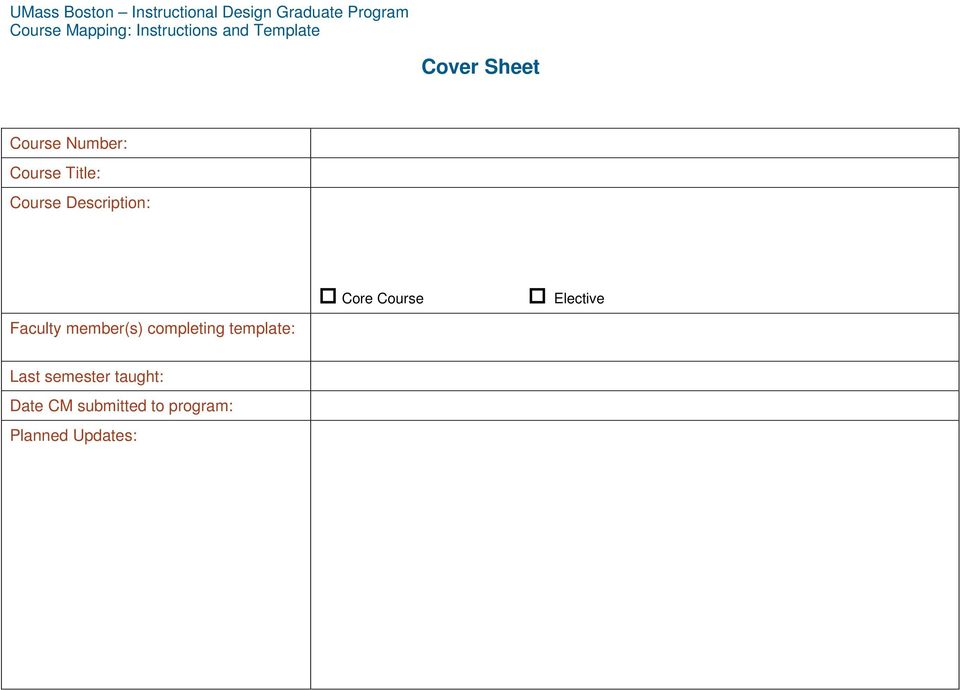
11 Course Mapping: Instructions and Template Cover Sheet Course Number: Course Title: Course Description: Faculty member(s) completing template: Core Course Elective Last semester taught: Date CM submitted to program: Planned Updates:
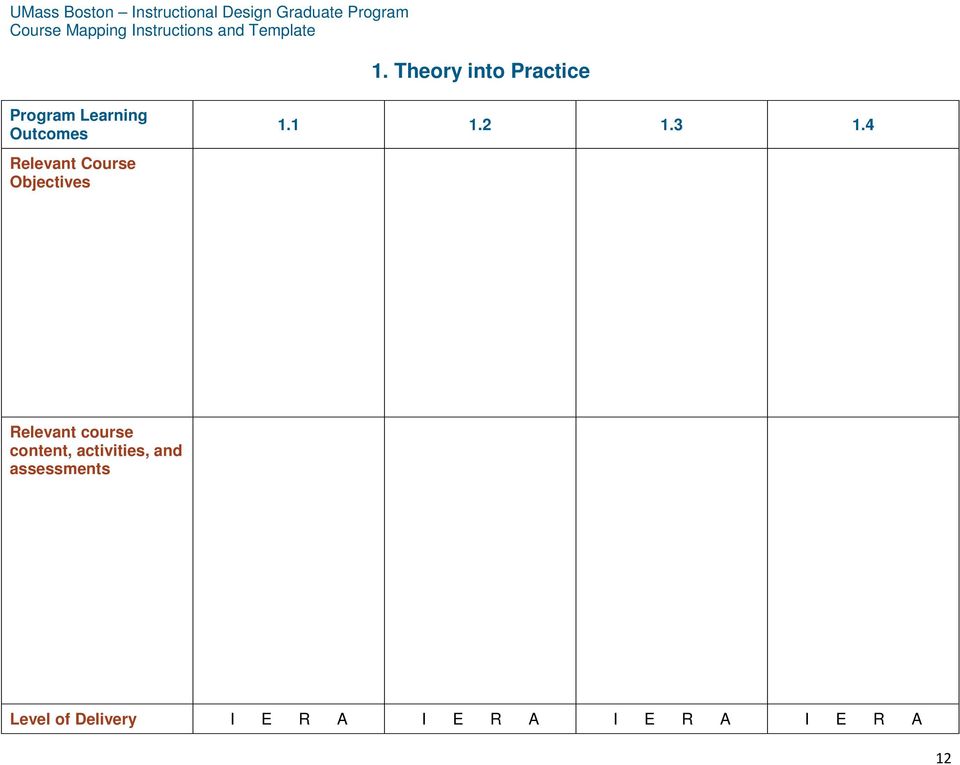
12 1. Theory into Practice Program Learning Outcomes Relevant Course Objectives Relevant course content, activities, and assessments Level of Delivery I E R A I E R A I E R A I E R A 12
13 2. Analysis Program Learning Outcomes Relevant Course Objectives Relevant course content, activities, and assessments Level of Delivery I E R A I E R A I E R A I E R A I E R A I E R A 13

14 3. Design Program Learning Outcomes Relevant Course Objectives Relevant course content, activities, and assessments Level of Delivery I E R A I E R A I E R A I E R A I E R A I E R A 14

15 4. Develop Program Learning Outcomes Relevant Course Objectives Relevant course content, activities, and assessments Level of Delivery I E R A I E R A I E R A I E R A I E R A I E R A 15

16 5. Implement Program Learning Outcomes Relevant Course Objectives Relevant course content, activities, and assessments Level of Delivery I E R A I E R A I E R A I E R A I E R A 16

17 6. Evaluate Program Learning Outcomes Relevant Course Objectives Relevant course content, activities, and assessments Level of Delivery I E R A I E R A I E R A I E R A 17

18 7. Reflective Practice Program Learning Outcomes Relevant Course Objectives Relevant course content, activities, and assessments Level of Delivery I E R A I E R A I E R A I E R A I E R A I E R A 18
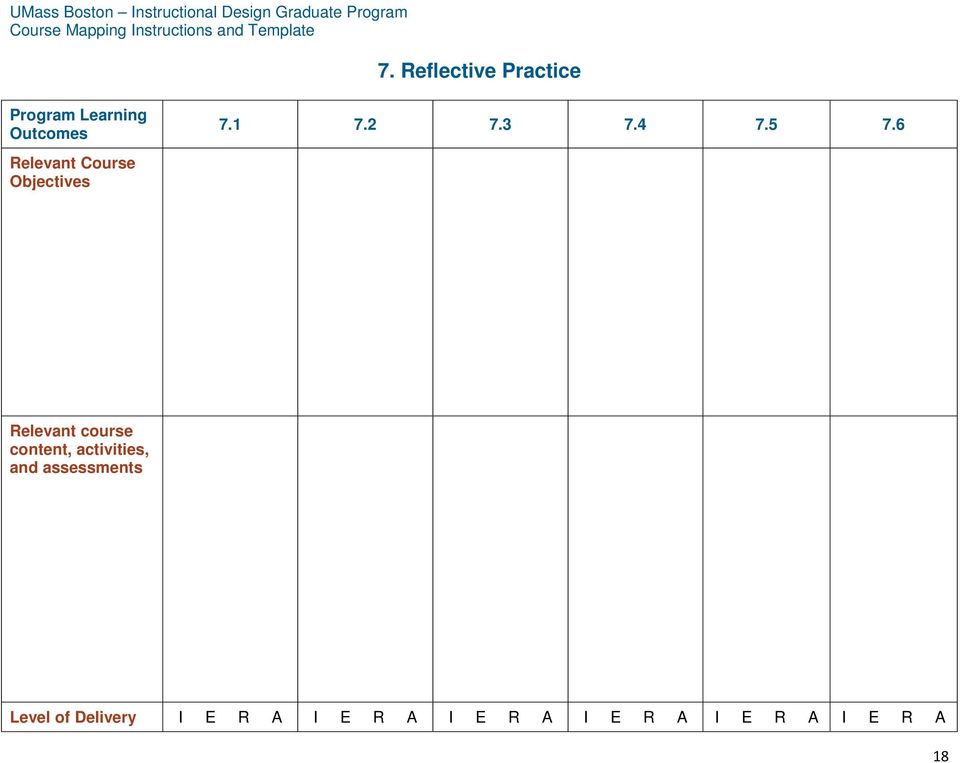
19 8. Leadership Program Learning Outcomes Relevant Course Objectives Relevant course content, activities, and assessments Level of Delivery I E R A I E R A I E R A I E R A I E R A I E R A 19

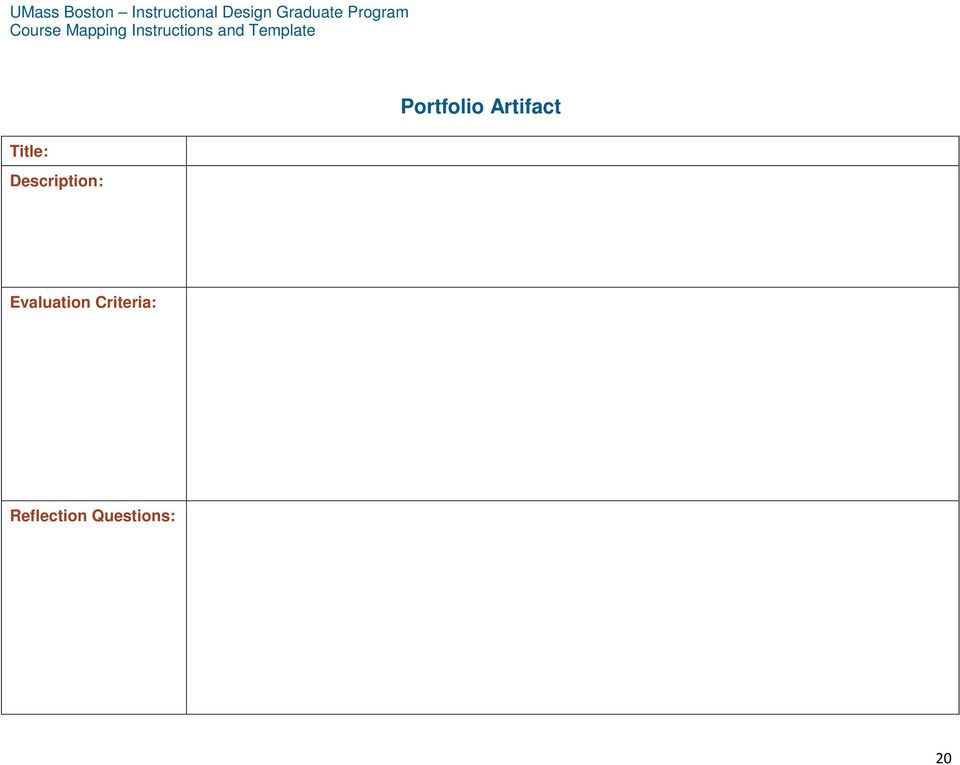
20 Title: Description: Portfolio Artifact Evaluation Criteria: Reflection Questions: 20
American Jewish University Curriculum Map Mapping Courses to Program Learning Outcomes (PLOs)
 Program: Master s Administration (MBA) American Jewish University Curriculum Map Mapping to Program Learning Outcomes (PLOs) A course to program curriculum map is a graphic that illustrates how courses
EDTC Program Assessment Framework
 EDTC Program Assessment Framework The University of Delaware s Master of Education in Educational Technology (EDTC) program aligns with both of the international standards bodies that inform the design
ESSENTIAL DUTIES AND RESPONSIBILITIES. Program Duties and Responsibilities:
 An Invitation to Apply: Simmons College School of Nursing and Health Sciences: Department of Nursing Director of the Doctor of Nursing Practice (DNP) Program THE SEARCH Simmons College School of Nursing
Common Sense Curriculum Mapping and Program Evaluation for Online Programs
 Common Sense Curriculum Mapping and Program Evaluation for Online Programs Colleen Halupa, Ed.D - Overview Curriculum Mapping Basics Linkage to Program Outcomes and Strategic Plan Related SACS standards
Framework and Guidelines for Principal Preparation Programs
 THE FRAMEWORK FOR PRINCIPAL PREPARATION PROGRAM GUIDELINES PENNSYLVANIA DEPARTMENT OF EDUCATION 1 Purpose Of all the educational research conducted over the last 30 years in the search to improve student
PROCEDURES MANUAL. retained in the Professor s personnel file in Human Resources.
 PA-12 CANADORE COLLEGE PROCEDURES MANUAL FACULTY PERFORMANCE REVIEW Procedures 1. Introduction 1.1. The Vice President Academic implements the Faculty Performance Review process by providing leadership,
TABLE OF CONTENTS. Accreditation and Educational Outcomes 1. Curriculum of the Post-Master s DNP Program 1-2. Program of Study 2-3
 DNP 2015 2016 TABLE OF CONTENTS Accreditation and Educational Outcomes 1 Curriculum of the Post-Master s DNP Program 1-2 Program of Study 2-3 Course Descriptions for Core Courses 4-6 The E-Portfolio 6-7
Assessing Learning Outcomes in Online Graduate Education
 Assessing Learning Outcomes in Online Graduate Education Charles McClintock Fielding Graduate University Michael A. Barr The Chicago School of Professional Psychology Session Purpose Graduate deans often
Instructional Designer Standards: Competencies & Performance Statements
 Standards Set 2012 ibstpi Instructional Designer Standards: Competencies & Performance Statements The 2012 ibstpi Instructional Designer Competencies and Performance statements are copyrighted by the International
Master of Fine Arts (MFA) in Design with a Concentration in Innovation Studies (formerly known as the MFA in Communication Design)
 Master of Fine Arts (MFA) in Design with a Concentration in Innovation Studies (formerly known as the MFA in Communication Design) This document exists to provide prospective applicants to this graduate-level
EXECUTIVE SUMMARY. List all of the program s learning outcomes: (regardless of whether or not they are being assessed this year)
 STUDENT LEARNING ASSESSMENT REPORT SUBMITTED BY: C.KOPAC AND M. VENZKE DATE: JUNE 26, 2014 REVISED JANUARY 2015 TO MEET UAC RECOMMENDATIONS SEE BELOW- HEADING HIGHLIGHTED IN GREY BRIEFLY DESCRIBE WHERE
California State University, Stanislaus Doctor of Education (Ed.D.), Educational Leadership Assessment Plan
 California State University, Stanislaus Doctor of Education (Ed.D.), Educational Leadership Assessment Plan (excerpt of the WASC Substantive Change Proposal submitted to WASC August 25, 2007) A. Annual
Standards of Quality and Effectiveness for Professional Teacher Preparation Programs APPENDIX A
 APPENDIX A Teaching Performance Expectations A. MAKING SUBJECT MATTER COMPREHENSIBLE TO STUDENTS TPE 1: Specific Pedagogical Skills for Subject Matter Instruction Background Information: TPE 1. TPE 1 is
BS Environmental Science (2013-2014)
 BS Environmental Science (2013-2014) Program Information Point of Contact Brian M. Morgan ([email protected]) Support for University and College Missions Marshall University is a multi-campus public
ASSESSMENT OF STUDENT LEARNING OUTCOMES EASTERN WASHINGTON UNIVERSITY MASTERS OF SOCIAL WORK PROGRAM ACADEMIC YEAR 2013-2014
 ASSESSMENT OF STUDENT LEARNING OUTCOMES EASTERN WASHINGTON UNIVERSITY MASTERS OF SOCIAL WORK PROGRAM ACADEMIC YEAR 2013-2014 This form is used to assist the Commission On Accreditation (COA) in the evaluation
Doctor of Nursing Practice Capstone Handbook
 college of nursing Doctor of Nursing Practice Capstone Handbook Revised 11.17.2015 Page 1 of 26 Table of Contents Introduction... 3 Overview of Capstone Project... 3 DNP Residency (Practicum)... 4 Capstone
School of Advanced Studies Doctor Of Education In Educational Leadership With A Specialization In Educational Technology. EDD/ET 003 Requirements
 School of Advanced Studies Doctor Of Education In Educational Leadership With A Specialization In Educational Technology The mission of the Doctor of Education in Educational Leadership degree program
TOOL KIT for RESIDENT EDUCATOR and MENT OR MOVES
 Get to Know My RE Observe Collect Evidence Mentor Moments Reflect Review Respond Tailor Support Provide Provide specific feedback specific Feedback What does my RE need? Practice Habits Of Mind Share Data
Social Work Program Outcomes
 1 Social Work Program Outcomes 2009 2010 2 The 2008 Educational Policy and Accreditation Standards (EPAS) identified by the Council on Social Work Education (CSWE) include a provision for assessment of
ELCC e Learning Diploma
 ELCC e Learning Diploma ELCC e learning Diploma is designed and developed by a consortium of e Learning experts to introduce certification in e Learning and provide e Learning professionals and practitioners
Conversion Program Curriculum & Instruction Certification
 Conversion Program Curriculum & Instruction Certification Individuals wishing to acquire certification in Curriculum and Instruction based upon previously completed Curriculum and Instruction (or equivalent)
CALIFORNIA S TEACHING PERFORMANCE EXPECTATIONS (TPE)
 CALIFORNIA S TEACHING PERFORMANCE EXPECTATIONS (TPE) The Teaching Performance Expectations describe the set of knowledge, skills, and abilities that California expects of each candidate for a Multiple
9. ACADEMIC QUALITY PLANNING PROCESS AND OUTCOME ASSESSMENT
 Page 1 of 32 STANDARDS AND CRITERIA FOR ACCREDITATION OF POSTSECONDARY CONSTRUCTION EDUCATION DEGREE PROGRAMS TABLE OF CONTENTS 1. INTRODUCTION 2. GOVERNANCE AND ADMINISTRATION 3. CURRICULUM 4. FACULTY
B. Public School Partners Involvement in the Revisioning of the Program and Continued Involvement in the Delivery and Evaluation of the Program
 Re-Visioning Graduate Teacher Education in North Carolina MA in History, Secondary Education with Licensure in History and Social Studies Appalachian State University A. Description of how the Proposed
Master Technology Teacher Standards
 Master Technology Teacher Standards FINAL Approved on January 4, 2002 Texas State Board for Educator Certification MASTER TECHNOLOGY TEACHER STANDARDS Standard I. Standard II. Standard III. Standard IV.
Finding the Right People for Your Program Evaluation Team: Evaluator and Planning Team Job Descriptions
 : Evaluator and Planning Team Job Descriptions I. Overview II. Sample Evaluator Job Description III. Evaluator Competencies IV. Recruiting members of your strategic evaluation planning team V. Recruiting
Master of Health Administration
 Master of Health Administration TABLE OF CONTENTS Online Master of Health Administration...3 Master of Health Administration Curriculum...4 Management Intensives Develop Your Leadership Competencies...5
Charting Your Course: Instructional Design, Course Planning, and Developing the Syllabus
 Charting Your Course: Instructional Design, Course Planning, and Developing the Syllabus Danielle Mihram, Ph.D. Faculty Fellow and Director USC Center for Excellence in Teaching [email protected] Originally
2015-16 Rubric for Evaluating Colorado s Specialized Service Professionals: Speech-Language Pathologists
 2015-16 Rubric for Evaluating Colorado s Specialized Service Professionals: Speech-Language Pathologists Definition of an Effective Speech-Language Pathologist Effective speech-language pathologists are
Graduation Requirements
 Graduation Requirements PROGRAMS OF INSTRUCTION The Lone Star College System offers courses and programs to suit the needs of individual students. In keeping with the mission of a community college, the
Standard 2: The program shall have an explicit philosophical statement and clearly defined knowledge base.
 Council for Standards in Human Service Education National Standards MASTER S DEGREE IN HUMAN SERVICES http://www.cshse.org 2013 (2010, 2009) I. GENERALPROGRAM CHARACTERISTICS A. Institutional Requirements
Track 3 E-Learning Diploma
 Track 3 E-Learning Diploma The e-learning Diploma is designed and developed by a consortium of e-learning specialists to introduce certification in e-learning that provides e-learning professionals and
How To Learn To Be A Successful Teacher
 5-Year Program Assessment Plan PRELIMINARY ADMINISTRATIVE SERVICES CREDENTIAL MASTER OF ARTS IN SCHOOL ADMINISTRATION PROGRAM 2012-2017 Judith Kell, Interim Program Director School of Education and Leadership
Arkansas Teaching Standards
 Arkansas Teaching Standards The Arkansas Department of Education has adopted the 2011 Model Core Teaching Standards developed by Interstate Teacher Assessment and Support Consortium (InTASC) to replace
IPP Learning Outcomes Report. Faculty member completing template: Rachel August and Greg Hurtz Date: 1/25/12
 Page 1 IPP Learning Outcomes Report Program: Department: Psychology MA Program, Industrial Organizational (I O) Option Psychology Number of students enrolled in the program in Fall, 2011: 15 (Appendix
GRAPHIC DESIGN 2013-2014 ANNUAL ASSESSMENT REPORT
 GRAPHIC DESIGN 2013-2014 ANNUAL ASSESSMENT REPORT Part 1: Background Information B1. Program name: [ Graphic Desgin ] B2. Report author(s): [ Richard Pratt, coordinator ] B3. Fall 2012 enrollment: [ 98
Guidelines for Massachusetts Early Educator Preparation Programs Participating in the Early Childhood Educator Scholarships Program.
 Guidelines for Massachusetts Early Educator Preparation Programs Participating in the Early Childhood Educator Scholarships Program Background The Departments of Higher Education and Early Education and
Construction Management Program LYLES COLLEGE OF ENGINEERING
 Construction Management Program LYLES COLLEGE OF ENGINEERING Student Outcomes Assessment Plan (Soap) CTRL + CLICK TO VIEW EXAMPLE I. Mission Statement During the 2010-2011 Academic Year, the Construction
Upon completion of the First Year Navigation Competency, students will be able to: Understand the physical and virtual WCSU campus;
 FIRST YEAR NAVIGATION (FY) COMPETENCY First Year Experience programs take a variety of forms to provide academic and cocurricular support as students begin university life. This competency allows first
National Standards. Council for Standards in Human Service Education. http://www.cshse.org 2013 (2010, 1980, 2005, 2009)
 Council for Standards in Human Service Education National Standards ASSOCIATE DEGREE IN HUMAN SERVICES http://www.cshse.org 2013 (2010, 1980, 2005, 2009) I. GENERAL PROGRAM CHARACTERISTICS A. Institutional
FOUNDATION YEAR Student Evaluation
 FOUNDATION YEAR Student Evaluation I. Cover Sheet Student Name Home Phone Work Phone Cell Phone Email (Please Check) Full-time Part-time Field Instructor Work Phone Email Agency Cell Phone Site Address
INSTRUCTIONAL TECHNOLOGY
 INSTRUCTIONAL TECHNOLOGY Department of Computer Science and Information Technology Program Contact Information Yefim Kats, Ph.D., Department Chair and Graduate Program Coordinator Program Offerings Master
School of Advanced Studies Doctor Of Management In Organizational Leadership. DM 004 Requirements
 School of Advanced Studies Doctor Of Management In Organizational Leadership The mission of the Doctor of Management in Organizational Leadership degree program is to develop the critical and creative
Instructional Technology Capstone Project Standards and Guidelines
 Instructional Technology Capstone Project Standards and Guidelines The Committee recognizes the fact that each EdD program is likely to articulate some requirements that are unique. What follows are a
General Approaches to evaluating student learning Qatar University, 2010
 General Approaches to evaluating student learning Qatar University, 2010 1 N U H A D Y A Z B I K D U M I T, R N, M A, P H D A M E R I C A N U N I V E R S I T Y O F B E I R U T Evaluation Types: Levels
Department of Health Sciences Moss School of Nursing. Master of Science Degree in Nursing (MSN)
 Department of Health Sciences Moss School of Nursing Master of Science Degree in Nursing (MSN) MSN Program Information Packet The Master of Science in Nursing degree will provide graduates with a foundation
Revisioning Graduate Teacher Education in North Carolina Master of Arts in Elementary Education Appalachian State University
 Revisioning Graduate Teacher Education in North Carolina Master of Arts in Elementary Education Appalachian State University A. A description of how the proposed program has been revisioned to reflect
Psychology Senior Exit Interview Spring, 20XX
 Psychology Senior Exit Interview Spring, 20XX We value your input as to how well we are meeting the goals for the psychology major at Wells. Given your experience as a graduating senior, please look over
Department of Communication Studies M.A. Program Annual Report 2010-2011
 Department of Communication Studies M.A. Program Annual Report 2010-2011 This report documents the Department of Communication Studies efforts in assessing student learning outcomes in its graduate Masters
DESCRIPTION OF THE PROGRAM
 California State University, Fresno School of Nursing College of Health and Human Services Doctor of Nursing Practice Student Outcomes Assessment Plan (SOAP) DESCRIPTION OF THE PROGRAM The purpose of the
Instructional Design and Technology Professional Core Courses Instructional Design and Technology Core Courses & Descriptions
 Search Home Instructional Design and Technology Professional Core Courses Instructional Design and Technology Core Courses & Descriptions Note: The degree is usually completed entirely online, unless other
Health Education Program Undergraduate Program Course of Study. Mission and Philosophy
 Health Education Program Undergraduate Program Course of Study Mission and Philosophy The Health Education Program strives to ensure a quality course of study that prepares students to address the health
Best Practices for Online Courses. 100 Quality Indicators for Online Course Design
 Best Practices for Online Courses 100 Quality Indicators for Online Course Design The following criteria are meant to act as guidelines for the course development process. Some of these guidelines would
University of Northern Iowa College of Business Administration Master of Business Administration Learning Assurance Program Last updated April 2009
 University of Northern Iowa College of Business Administration Master of Business Administration Learning Assurance Program Last updated April 2009 1. Philosophy and Program Goals The MBA program s Learning
CSU Chico Educational Leadership and Administration Program Summary
 CSU Chico Educational Leadership and Administration Program Summary Program Design The Educational Leadership and Administration Program is located in the School of Education under the leadership of the
Graduate Programs in Education and Human Development
 Graduate Programs in Education and Human Development Department of Curriculum and Instruction Two master s degree options and a doctorate degree are offered in Curriculum and Instruction. The Master of
Support and Process for Developing Online and Blended Courses
 CONTINUING AND DISTANCE STUDIES FACULTY OF ARTS AND SCIENCE www.queensu.ca/artsci_online Support and Process for Developing Online and Blended Courses A. Introduction to Continuing and Distance Studies......
By the end of the MPH program, students in the Health Promotion and Community Health concentration program should be able to:
 Faculty of Health Sciences Graduate Public Health Program Master of Public Health (MPH) Health Promotion and Community Health () Learning Objectives mapped to Competencies May 2012 Each MPH concentration
Part I Program SLO Assessment Report for Academic Year 2013-2014
 Degree/Certificate: Master of Social Work (MSW) Submitted by: Blake Beecher Date: 1-2-2015 Part I Program SLO Assessment Report for Academic Year 2013-2014 The EWU Masters of Social Work program is accredited
Table 1: Number of students enrolled in the program in Fall, 2011 (approximate numbers)
 Program: Department: MBA Human Resource Management CBA Table 1: Number of students enrolled in the program in Fall, 2011 (approximate numbers) MBA Concentration (Program) # students Human Resource Management
Curriculum Evaluation
 MSN Assessment Plan 2013/2014 Program Goals and Student Learning Outcomes How the Program Goals fit with the Program Mission The IU Kokomo School of Nursing Mission intends to provide educational opportunities
Niagara College of Applied Arts and Technology. Program Quality Assurance Process Audit. 18 Month Follow-up Report. Submitted by: Niagara College
 Niagara College of Applied Arts and Technology Program Quality Assurance Process Audit 18 Month Follow-up Report Submitted by: Niagara College Report Submitted September 2013 INTRODUCTION Niagara College
Southern Arkansas University Gifted & Talented Preparation Program Handbook Dr. Carla Bryant, Director
 Southern Arkansas University Gifted & Talented Preparation Program Handbook Dr. Carla Bryant, Director I. Admission: a. Apply to Graduate School: (www.saumag.edu/graduate/admissions). i. Admission to the
Oregon Framework for Teacher and Administrator Evaluation and Support Systems
 Oregon Framework for Teacher and Administrator Evaluation and Support Systems Revised for 2014 2015 State Guidelines for ESEA Waiver & SB 290 OREGON DEPARTMENT OF EDUCATION 255 Capitol St, NE, Salem, OR
Academic Program Review Handbook
 Handbook Continuously Improving Programs and Student Learning Revised July 2014 Original Issue: December 6, 2010 Approved: Derry Connolly, President Current Issue: July 3, 2014 Effective: July 3, 2014
IDOL Outcomes and Competencies (ibstpi) 2
 Instructional Design for Online Learning (IDOL) Specialization Outcomes and Specialization Competencies Updated January 2008 Table of Contents Outcomes-based curricula at Capella University...3 IDOL MS
REGULATIONS FOR THE DEGREE OF BACHELOR OF SCIENCE IN INFORMATION MANAGEMENT (BSc[IM])
![REGULATIONS FOR THE DEGREE OF BACHELOR OF SCIENCE IN INFORMATION MANAGEMENT (BSc[IM])](/thumbs/31/15048046.jpg "REGULATIONS FOR THE DEGREE OF BACHELOR OF SCIENCE IN INFORMATION MANAGEMENT (BSc[IM])") REGULATIONS FOR THE DEGREE OF BACHELOR OF SCIENCE IN INFORMATION MANAGEMENT (BSc[IM]) These regulations apply to students admitted to the Bachelor of Science in Information Management (BSc[IM]) 2012 curriculum
REGULATIONS FOR THE DEGREE OF BACHELOR OF SCIENCE IN INFORMATION MANAGEMENT (BSc[IM]) These regulations apply to students admitted to the Bachelor of Science in Information Management (BSc[IM]) 2012 curriculum
Master of Arts in Instructional Technology Program. Policies and Procedures Manual 2014-2015
 Master of Arts in Instructional Technology Program Policies and Procedures Manual 01-015 Master of Arts in Instructional Technology Program School of Education The Richard Stockton College of New Jersey
DOCTOR OF EDUCATION (ED.D.) DEGREE EDUCATIONAL TECHNOLOGY LEADERSHIP PROGRAM OVERVIEW. Program Objectives
 DOCTOR OF EDUCATION (ED.D.) DEGREE IN EDUCATIONAL TECHNOLOGY LEADERSHIP PROGRAM OVERVIEW The Ed.D. in Educational Technology Leadership is designed to develop educational technology leaders and innovators
REGULATIONS FOR THE DEGREE OF MASTER OF SCIENCE IN LIBRARY AND INFORMATION MANAGEMANT (MSc[LIM])
![REGULATIONS FOR THE DEGREE OF MASTER OF SCIENCE IN LIBRARY AND INFORMATION MANAGEMANT (MSc[LIM])](/thumbs/39/18121628.jpg "REGULATIONS FOR THE DEGREE OF MASTER OF SCIENCE IN LIBRARY AND INFORMATION MANAGEMANT (MSc[LIM])") 268 REGULATIONS FOR THE DEGREE OF MASTER OF SCIENCE IN LIBRARY AND INFORMATION MANAGEMANT (MSc[LIM]) (See also General Regulations) Any publication based on work approved for a higher degree should contain
268 REGULATIONS FOR THE DEGREE OF MASTER OF SCIENCE IN LIBRARY AND INFORMATION MANAGEMANT (MSc[LIM]) (See also General Regulations) Any publication based on work approved for a higher degree should contain
Cognition, Instruction, & Learning. University of Connecticut. Technology Graduate Program. Department of Educational Psychology.
 University of Connecticut Cognition, Instruction, & Learning The Neag School of Education Department of Educational Psychology Technology Graduate Program Doctoral Handbook 2014-15 1 P a g e TABLE OF CONTENTS
Teacher Education Portfolio Guidelines and Rubric
 Teacher Education Portfolio Guidelines and Rubric The Teacher Education Portfolio is developed throughout a s program. Most Teacher Education courses have a capstone project designed to meet the InTASC
COURSE TITLE: PHOTOGRAPHY 2 GRADES 9-12 LENGTH: ONE SEMESTER SCHOOLS: RUTHERFORD HIGH SCHOOL RUTHERFORD, NEW JERSEY DATE:
 COURSE TITLE: PHOTOGRAPHY 2 GRADES 9-12 LENGTH: ONE SEMESTER SCHOOLS: RUTHERFORD HIGH SCHOOL RUTHERFORD, NEW JERSEY DATE: SPRING 2015 PHOTOGRAPHY 2 2 Rutherford High School Rutherford, NJ Photography 2
LEARNING, DESIGN AND TECHNOLOGY CAPSTONE PROJECT GUIDELINES
 LEARNING, DESIGN AND TECHNOLOGY CAPSTONE PROJECT GUIDELINES For CUIN LDT Master s Students PURPOSE OF THE LDT CAPSTONE PROJECT As part of the program requirements for the Learning, Design & Technology
Draft Policy on Graduate Education
 Draft Policy on Graduate Education Preface/Introduction Over the past two decades, the number and types of graduate programs have increased dramatically. In particular, the development of clinical master
California State University San Marcos: College of Education. EDUC 422 - Technology Tools for Teaching and Learning
 California State University San Marcos: College of Education EDUC 422 - Technology Tools for Teaching and Learning Instructor: Dr. Kathy Hayden Office Phone: 70-84 Office: UH 218 Lab: UH 271 Office Hours:
ACADEMIC DIRECTOR: Carla Marquez-Lewis Email Contact: THE PROGRAM Career and Advanced Study Prospects Program Requirements
 Psychology (BA) ACADEMIC DIRECTOR: Carla Marquez-Lewis CUNY School of Professional Studies 101 West 31 st Street, 7 th Floor New York, NY 10001 Email Contact: Carla Marquez-Lewis, [email protected]
CRITICAL AND CREATIVE THINKING RUBRIC GRADUATE PROGRAMS
 CRITICAL AND CREATIVE THINKING RUBRIC GRADUATE PROGRAMS Adapted from the AACU LEAP rubrics, the Bases of Competence skills, Ontario Council of Academic Vice-Presidents Graduate Degree Level Expectations,
ST. JOHN FISHER COLLEGE
 ST. JOHN FISHER COLLEGE WEGMANS SCHOOL OF NURSING MASTERS OF NURSING MASTERS CAPSTONE HANDBOOK 2014-2015 The purpose of this handbook is to offer guidance to graduate students as they develop their masters
New Hampshire Department of Education Special Education Program Approval and Improvement Process
 New Hampshire Department of Education Special Education Program Approval and Improvement Process The mission of NHDOE Special Education Program Approval is to improve education results for all learners.
DEPARTMENT OF JOURNALISM, COMMUNICATION, AND NEW MEDIA
 DEPARTMENT OF JOURNALISM, COMMUNICATION, AND NEW MEDIA Bachelor of Journalism Degree Program Brenda Thompson, BA (Honours), MA Department Chair and Program Advisor Faculty Alan Bass, BA, MA Charles Hays,
How To Become A Doctor Of Nursing Practice
 Department of Health Sciences Moss School of Nursing Doctor of Nursing Practice: Family Nurse Practitioner (DNP) DNP Program Information Packet The Doctor of Nursing Practice (DNP) degree is designed for
Approaches to learning (ATL) across the IB continuum
 Approaches to learning (ATL) across the IB continuum Through approaches to learning in IB programmes, students develop skills that have relevance across the curriculum that help them learn how to learn.
Electronic Portfolio Implementation in the Metro Academies Program at San Francisco State University and City College of San Francisco
 Electronic Portfolio Implementation in the Metro Academies Program at San Francisco State University and City College of San Francisco Prepared for Community Health Works at San Francisco State University
CREATING LEARNING OUTCOMES
 CREATING LEARNING OUTCOMES What Are Student Learning Outcomes? Learning outcomes are statements of the knowledge, skills and abilities individual students should possess and can demonstrate upon completion