
PAY-AS-YOU-DRIVE INSURANCE: IT S IMPACTS ON HOUSEHOLD DRIVING AND WELFARE
|
|
|
- Berenice Brown
- 10 years ago
- Views:
Transcription
1 Nichols and Kockelman 1 PAY-AS-YOU-DRIVE INSURANCE: IT S IMPACTS ON HOUSEHOLD DRIVING AND WELFARE (TRB ) Brice G. Nichols Associate Planner Puget Sound Regional Council [email protected] Kara M. Kockelman (Corresponding Author) Professor and William J. Murray Jr. Fellow Department of Civil, Architectural and Environmental Engineering The University of Texas at Austin 6.9 E. Cockrell Jr. Hall Austin, TX [email protected] Phone: & FAX: Presented at the 93rd Annual Meeting of the TRB, January 2014 and forthcoming in Transportation Research Record, March 2014 Word Count = Tables/Figures (1750) =

2 Nichols and Kockelman 2 ABSTRACT Vehicle-miles traveled (VMT) can greatly impact crash risk, and therefore insurance costs, but accurately assessing VMT has been challenging for insurance agencies. Affordable technology now allows insurance companies to better track VMT, and has prompted pilot programs and further research of mileage-based, or pay-as-you-drive (PAYD) insurance. Existing research agrees that PAYD programs can discourage extraneous driving, thereby directly saving drivers money (but reducing consumer welfare, although by less than consumer cost savings), reducing crash risks, insurers costs, and externalities. Past studies consider aggregate, national or state-wide impacts of PAYD policies, with some focus on equity impacts, but much heterogeneity is ignored. This study bolsters existing work by predicting PAYD impacts using NHTS data to model driver response to driving cost changes and an insurance pricing model (per vehicle) based on actual loss data and risk factors by vehicle type. This study anticipates PAYD impact variations across a sample of NHTS households and vehicle types, and finds that on average, households save enough on reduced insurance and travel costs to cover lost welfare from VMT reductions. Results suggest that the average (light-duty) vehicle will be driven 2.7% less (237 fewer annual miles per year), with average consumer benefits of only $2.00 per vehicle with a premium that is partially fixed and partially mileage-based. Drivers with the lowest annual VMT needs are expected to receive the largest welfare benefits, thanks to a convex relationship between VMT and crash losses. This analysis provides support to existing literature that PAYD policies can reduce VMT and insurance pricing equity without harming driver welfare. Key Words: Insurance, pay-as-you-drive, PAYD, pricing, welfare, equity, VMT 2

3 Nichols and Kockelman 3 INTRODUCTION Current automobile insurance pricing considers individual driver and vehicle risk factors to determine appropriate policy pricing, but relies on often inaccurate estimates of actual vehicle miles travelled (VMT). Without sophisticated technology or a national requirement for annual odometer readings, insurance companies usually rely on driver estimates of how much they actually drive their vehicle, leading to frequent underreporting of VMT (1, 2), and subsequently risk, as driver exposure to potential crashes increases with each additional mile travelled. This comes at a cost to insurance companies, but also harms low-vmt drivers who implicitly pay for increased crash rates of high-vmt drivers within the same risk class. An alternative to lump-sum based insurance pricing (paid annually or bi-annually) is a per-mile premium approach, often called pay-as-you-drive (PAYD) insurance. Insurance companies, policy makers, and some drivers have shown growing interest in PAYD in recent years, especially as technology advances have made it more feasible. Over the past decade, several pilot studies (e.g., 3, 4) and policy evaluations have considered impacts of PAYD policy implementation and reported reduced mileage and fuel use, alongside savings to drivers and insurance firms. While results are promising, more detailed analyses should anticipate how PAYD policies might impact insurance costs and driving behaviors on a larger scale. This study expands existing PAYD analyses by estimating welfare impacts across households and accounting for heterogeneity in price elasticity of their demand for VMT and fuel-use. Driver response and insurance pricing are modeled as a function of vehicle and household characteristics using ordinary least squares (OLS) regression with the 2008 National Household Travel Survey (5) and insurance loss models from Massachusetts (6). Welfare estimates from reduced driving and insurance loss changes are then considered for each vehicle and household, and compared across households. This study expands previous work on PAYD by including more heterogeneous responses to driving costs, and disaggregated insurance costs that vary across individual vehicles and households. LITERATURE REVIEW Over 40 years ago, William Vickrey proposed a number of insurance pricing policy reforms, including premiums that vary much more in proportion to the actual mileage traveled (7). He argued that lump-sum pricing improperly prices insurance as a fixed cost, when crash risks depend heavily on actual miles traveled. Vickrey noted that, although drivers were assigned to risk classes based on vehicle and demographic characteristics, VMT was almost an entirely independent consideration. Risk assignment has changed little since Vickrey s original critique. Initially, accurate and affordable mile-tracking technology and data infrastructure were a limitation. When VMT is used to calculate individual premiums, it is usually classified broadly, and reported without verification, leading to frequent underestimation (1, 2). Therefore, within a given risk class, very few drivers are paying close to their actual risk, as proxied by miles driven (the marginal cost), and actually pay an average cost (to insurers). Litman (8) notes how this promotes inequity and results in wasteful driving. Drivers paying lump-sum annual insurance costs are not likely to consider the costs they impose on other drivers each time they travel and may only be concerned with gasoline and vehicle maintenance costs when evaluating the 3
4 Nichols and Kockelman 4 marginal costs of their driving. In general, insurance costs are often hidden to drivers, but generally comprise 10 to 15% of annual vehicle costs (9). 1 Vickrey s (7) central premise is that incorporating marginal crash risk into vehicle operating costs provides more efficient pricing while perhaps reducing driving and insurance costs overall. Edlin (10) was one of the first to apply Vickery s thoughts, by calculating PAYD pricing impacts on crash counts and costs. Parry (11) followed this research with more detailed estimates of VMT and fuel-use reductions. Bordoff and Noel (12) extended Edlin s and Parry s work to the household level, modeling welfare impacts across individual households. Ferreria and Minikel (6) considered crash and welfare impacts in Massachusetts using a rich data set on actual losses to insurance firms alongside U.S. Census data. Together these studies represent a comprehensive analysis of PAYD impacts on individuals, the road network, the environment, and the economy. Each estimated significant levels of savings and reduced VMT and fuel use, but made assumptions that ignore much heterogeneity across households. Modeling PAYD Impacts Edlin (10) created one of the earliest economic models to anticipate driver response to PAYD insurance policies, and benefits gained from reduced congestion and crash risks. In applying his model to all vehicles in the U.S., he predicted just over 9% VMT reduction, yielding insurance accident cost savings of around $17 billion. His model contained numerous equations to define vehicle and road network parameters (e.g., miles driven per vehicle, lane miles, traffic density, congestion, and damages per crash), along with driving costs and consumer surplus. Permile insurance costs were defined as a driver s total accident costs (modeled as function of crash likelihood given roadway attributes) divided by total miles driven. Edlin (10) used a linear VMTdemand curve and computed surplus based on changes in VMT demand and marginal total accident costs from driving an extra mile. Edlin s marginal accident costs for individual drivers took the following linear form: (1) = +2 where is expected crash costs from driving one more mile alone, and the second term reflects increased costs from having other drivers on the road, as a function of density (D). Edlin (10) considered changes in accident costs (A) over miles driven (M) as a cost savings, which was considered alongside VMT demand to form the following consumer surplus (CS) equation: (2) = ( ) 0.5 ( ) where is initial VMT and is VMT with PAYD pricing ( ). Bordoff and Noel (12) subsequently considered a similar calculation for individual driver savings using reduced permile insurance costs, along with crash-reduction benefits calculations. Both Edlin (10) and Bordoff and Noel (12) computed VMT response and insurance pricing using state-level traffic and network information and average statewide insurance costs. Edlin (10) also estimated marginal accident costs per mile driven, which provides the majority of social benefits. He 1 This assumes full coverage insurance for an average sedan in the U.S. in 2012, driving between 10,000 and 15,000 miles each year. 4

5 Nichols and Kockelman 5 estimated that PAYD crash cost savings are about $20 B per year, and congestion savings contribute another $4 to $9 billion annually. Bordoff and Noel (12) obtained similar results in their more recent study ($21 B in crash cost savings and $13 B in reduced congestion). While crash cost savings are significant for an aggregate, national PAYD implementation, this study focuses on insurance (loss) savings for individual driver settings. Bordoff and Noel (12) estimated a total (annual) insurance cost savings (to U.S. customers) of $7.7 B, or about $34 per vehicle-year, based on average statewide insurance rates. This constitutes about 13% of total PAYD savings, and varies across households. Parry (11) estimated that PAYD returned U.S. welfare gains of nearly $20 B with a 9% VMT reduction, using per-mile costs for VMT- and fuel-related externalities of crashes, congestion, local pollution, carbon emissions, and oil dependency. Parry (11) did not compare savings across households and only considered PAYD impacts relative to welfare impacts of increased fuel taxes. However, Bordoff and Noel (12) followed Parry s earlier methods to estimate VMT reduction as a function of fuel prices, fuel economy, and the price elasticity of gasoline (assuming drivers responded similarly to a per-mile price increase from insurance). Parry (11) and Bordoff and Noel (12) used the following approach to calculate individual (vehicle) response to PAYD policies: (3) = where is fuel price, is fuel economy, is gasoline price elasticity, and and are fractions of gasoline demand reduction from reduced VMT and from increased fuel economy, respectively. Equation 1 allowed Bordoff and Noel (12) to estimate VMT responses and insurance savings across households. Despite heterogeneity in each household, this equation assumed a constant gasoline demand elasticity ( = -0.55), which limited estimation of true household impacts. Bordoff and Noel (12) applied the equation to 2001 NHTS data to evaluate impacts across households. Overall, they found that about two-thirds of households saved money from reduced insurance premium costs, while the remaining third paid more. Bordoff and Noel (12) anticipated greatest savings for low-income households and losses beginning for households with about $50,000 or more annual income. Despite the concentration of losses among higherincome households, Bordoff and Noel (12) noted that the losses and benefits as a percent of income became trivial as income increased beyond very-low income levels (of less than $10,000 per year). Additionally, they noted that not every household gained or lost in each income bracket, but the share of households saving money was greater for lower-income households (nearly 80% in the lowest bracket) than for higher-income households (about 55% at its lowest). Predicting Insurance Costs Ferreria and Minkel (6) evaluated PAYD impacts using Massachusetts insurance claims and VMT information. Part of their study analyzed the relationship between claim frequency and VMT, as a means to optimize PAYD pricing. Generalized linear regressions of their insurance losses (versus each vehicle s annual VMT) provided an empirical equation to estimate the ideal premium that should be charged, based on vehicle VMT. Ferreria and Minikel (6) then modified their equation by controlling for general location within the state (6 territories) and providing a relative crash risk across driver classes (e.g., those over age 25, business travelers, those with less than three years driving experience, and the elderly). In summary, several studies provide meaningful starting points for evaluating PAYD policies, but rigorous evaluation of PAYD policies has been limited. While Edlin (10) and Parry 5

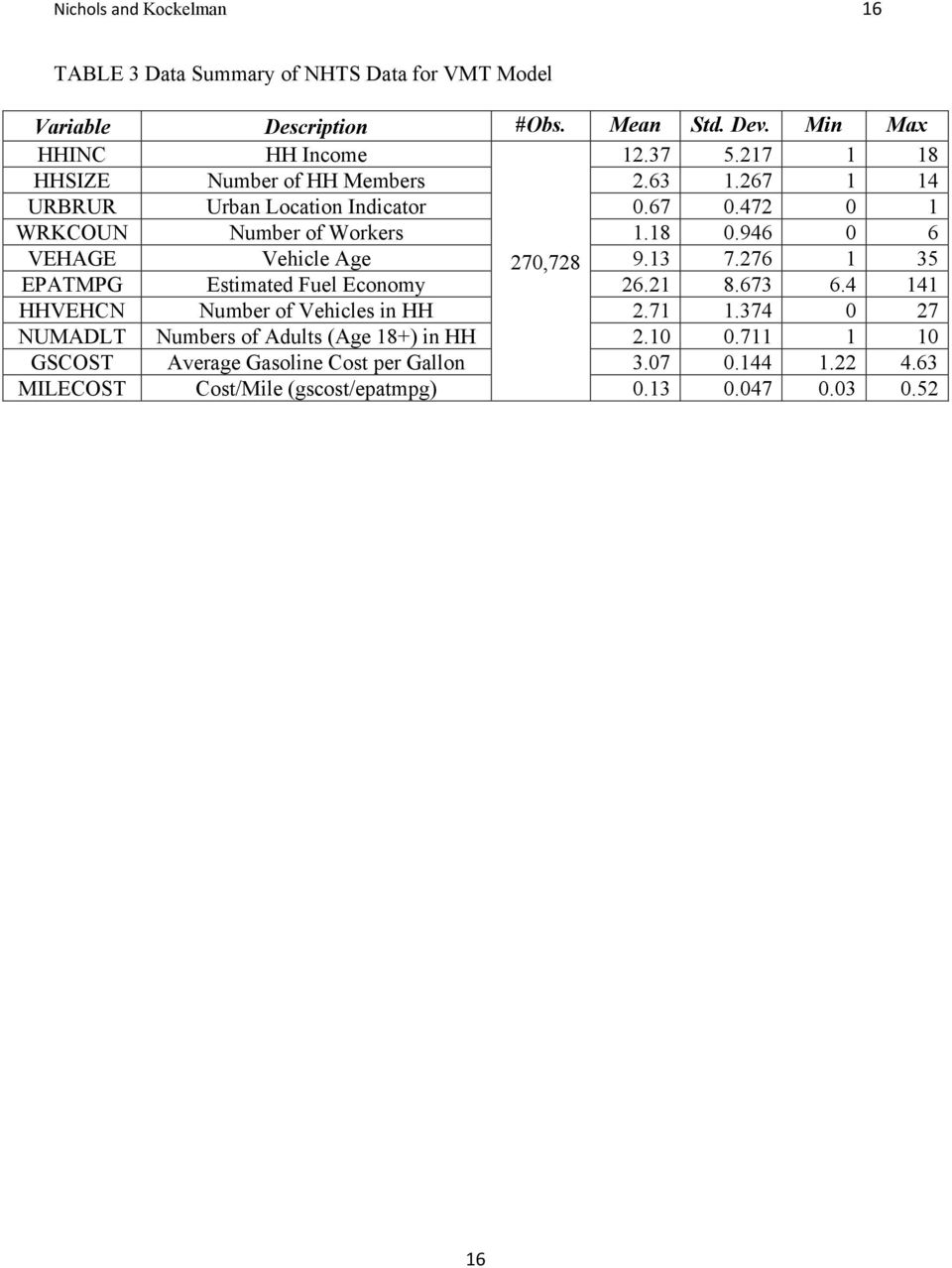
6 Nichols and Kockelman 6 (11) developed extensive analytical methods to predict driver behavior and estimate externality impacts, the resulting models are applied to aggregate data. Bordoff and Noel (12) evaluated household impacts in some depth, but their model did not allow for heterogeneity in individual response to price increases. Ferreria and Minikel (6) provided some empirical data and applications with variable insurance costs, but their underlying model also assumes homogeneity in gasoline price response. These studies can be improved upon by allowing for more flexibility into driver response and more accurate insurance cost estimation (on a vehicle or driver basis). METHODOLOGY This study uses household-level data from the 2008 NHTS to model response to increased travel costs. An OLS model predicts annual VMT for each vehicle in the survey, based on household and driver characteristics, and VMT changes are estimated based on each vehicle s per-mile insurance cost estimates. Consumer surplus changes are calculated for each vehicle based on VMT and insurance loss changes (which are considered costs to the vehicle owner). Results are analyzed across households, and aggregate benefits tallied, following related work by Parry (11) and Bordoff and Noel (12). The model is applied to the entire NHTS sample, and to samples only in Massachusetts, which was the geographical focus of Fererria and Minikel s (6) insurance loss model. VMT Forecasting NHTS data provide a predictive equation for VMT, based on vehicle and household characteristics. The 2008 NHTS data contain information on household travel behaviors, demographics, vehicle ownership, and vehicle use. Here, data were evaluated at the vehicle level, and linked to all household details. The 2008 NHTS refers to nearly 300,000 unique vehicles, and most (270,728) contained sufficient data for estimation. Every surveyed vehicle has a userreported annual VMT and a best estimate, developed using a number of techniques, depending on which independent variables are available (13). The best-estimate variable was used in this analysis to provide the largest sample size, since many self-reported odometer values were unavailable and are often underreported anyway (14). Table 3 summarizes the NHTS data used in the model. The model includes independent variables of vehicle age, fuel economy, number of drivers (for the vehicle of interest), household income and size, numbers of workers and adults (over age 18), and an indicator for urban location. 2 Unfortunately, NHTS data do not include insurance cost information, so some homogeneity in insurance pricing must be assumed. In reality, each vehicle and driver are placed in unique risk classes, based on demographics characteristics and owner s driving records. An additional covariate, driving costs per mile, considers average vehicle gasoline costs (per gallon) divided by fuel economy (miles per gallon). This metric allows the model to directly consider an added PAYD marginal cost to estimate a new VMT. If the NHTS included insurance costs (and other risk metrics like crash history), researchers could more directly account for insurance costs, which as the study and others on the subject suggest is an important factor in evaluating travel costs and behavior. 2 Urban location is based on 2000 Census Cartographic Boundary Files with minimum population density of 1,000 persons per square mile. 6

7 Nichols and Kockelman 7 Insurance Pricing Insurance loss estimates are based on Ferreria and Minikel s (6) empirically derived equations and modification factors from the Insurance Institute for Highway Safety (16). Though insurance costs vary significantly with demographics and accident history, there are few predictive equations or methodologies to anticipate costs by vehicle and driver characteristics. This difficulty likely explains why previous studies (15, 11, 12) assumed average statewide premium costs reported by the National Association of Insurance Commissioners, ignoring the heterogeneity across households. Though still limited by assumptions, this study considers individual insurance losses from actual claims (not premiums paid) based on model-predicted VMT and vehicle type. Total insurance losses (per vehicle) are based on Ferreria and Minikel s (6) examination of 2006 Massachusetts insurance claims versus each vehicle s (i) annual VMT (xvmt, i), specified as follows: (4) = 6.53(, ). Per-mile insurance losses are computed by dividing annual insurance cost (per vehicle) (Ii) by annual VMT (xvmt). Equation 4 exhibits strong returns to scale, with per-mile costs falling to 22 and 17 cents at 10,000 and 20,000 VMT per year, respectively. Since crash risk (and therefore, estimated insurance losses) increase with every mile driven (for drivers of any risk class), lower-vmt drivers are paying more per mile for insurance than higher-vmt drivers, ceteris paribus. Ferreria and Minikel s (6) insurance cost estimates are modified using the IIHS s (16) relative losses across vehicle types (car, van, pickup truck, & SUV). The IIHS (16) provides collision losses by vehicle make, model, and year, relative to average annual losses (e.g., the average Chevrolet Malibu sedan might experience 10% lower average collision losses for all vehicles with similar coverage policies). Relative losses were averaged for each of the four passenger vehicle types, yielding factors of 1.2, 0.88, 0.88, and 0.66 for cars, trucks, vans, and SUVs, respectively. Higher relative loss factors for cars could stem from their generally lighter weight and smaller physical footprint (which can increase crash severity and associated damages relative to heavier vans, SUVs, and trucks [17]). Car owners may also be more likely to report and collect on damages sustained, because they prefer to have fewer visual flaws on their vehicles than owners of bigger and more rugged, off-road-capable vehicles. Ferreria and Minikel s model is specific to Massachusetts drivers, so extrapolating across other states directly would lead to both over- and under-estimation. This inaccuracy can be reduced some by multiplying Eq. 4 by normalized state average collision expenditures (relative to the Massachusetts average). Such data is available from the Insurance Information Institute (18) for 2006 (the year from which the insurance loss model was estimated) for each state. This data indicates that average annual maximum collision losses come from Washington D.C., at $ per year, and minimum losses from South Dakota at $ per year. Massachusetts comes in above average ($288.29), at $ These costs (s), normalized versus the Massachusetts average, are multiplied by Eq. 4, based on each vehicle i s state j, as well loss factors (f) by vehicle type k to compute state- and vehicle-adjusted insurance loss (Ii,j,k) as follows: (5),, = 6.53(, ). Estimating VMT Response to PAYD Insurance 7

8 Nichols and Kockelman 8 Here, VMT and fuel-use changes were estimated by using NHTS VMT model results in conjunction with estimated per-mile insurance losses, added to the fuel cost term (as a function of fuel economy). Therefore, VMT under a PAYD policy was re-computed for each vehicle in the data set, with a new per-mile operating cost. This approach assumes that driver response to PAYD pricing is identical to reactions of fuel prices, since per mile driving costs are based solely on gas costs and fuel economy. This assumption is valid only for a short term analysis, since individuals may reduce their total per-mile costs by acquiring a more fuel-efficient vehicle. Elasticity response to driving costs (η) is represented by the OLS coefficient for VMT response to change in per-mile driving costs. At a given driving cost and VMT, the elasticity can be computed as follows: (6) = Welfare Calculations Changes in consumer surplus are computed as follows, thanks to a linear VMT function: (7) = 0.5, +, + where, and, are initial (pre-payd) VMT and final VMT, respectively, and and are initial and final travel costs (per-mile), 3 respectively (where the difference is equal to the estimated per-mile insurance costs), and is initial (estimated) annual insurance loss. This insurance cost is considered saved since insurance payments are transferred as a per-mile cost in final per-mile costs ( ). RESULTS VMT regression model results (Table 4) suggest lower VMT and fuel use as operating costs rise, as expected. Coefficients for vehicle age, fuel economy, vehicles per household, number of adults, and per-mile driving cost (based on fuel economy and fuel cost) are all negative, implying that VMT falls as these variables rise in value. Reduced VMT is to be expected from higher per-mile costs and from older vehicles (as they become more mechanically unreliable, more worn and thus less desirable). Additionally, an indicator variable for urban location is negative, suggesting that average urban VMT is lower than in rural settings, where lower density likely translates to longer trip lengths. Intriguingly, VMT is lower, on average, for those vehicles with higher fuel economy, which is somewhat counter to expectations but is probably due to fuel economy acting as a proxy for density and accessibility (since smaller vehicles are relatively more popular in high-density locations, where travel distances are shorter and parking more difficult to find). VMT is predicted to rise with household size, number of workers, and income as expected, based on income effects observed by Puller and Greening (19), Kayser (20), Small and Van Dender (21), and others. The average estimated price elasticity of VMT is -0.14, which is very similar to Fererria and Minikel s (6), Parry s (11), and Bordoff and Noel s (12) model values, as well as modified values used by Parry (11) and Bordoff and Noel (12). 4 This approach provides a range of 3 Initial per-mile costs ( ) correspond to fuel costs as a function of vehicle fuel economy (from NHTS). Final permile costs include the per-mile insurance costs. 4 From Eq. (3), both Parry (11) and Bordoff and Noel (12) used an effective VMT elasticity of -0.15, assuming β and β parameters of 0.4 and

9 Nichols and Kockelman 9 elasticities by vehicle and household characteristics, varying between the highly elastic (-1.13) and the highly inelastic (-0.04). Despite these extreme values, elasticity estimates over the sampled households are tightly distributed about the mean (with a standard deviation of just 0.065). Applying Eq. (7) to VMT estimates across all NHTS vehicles (sample size of 219,137) suggests that PAYD pricing would decrease driving by an average of 2.7%, ranging between 1 and 52% 5, with a standard deviation of 2.6% across the household sample. Utility losses associated with that decrease were nearly equal to modeled insurance costs, with the average vehicle owner benefiting a net $2.04 per year per vehicle, with these benefits ranging between $0.19 to $26 per year, per vehicle (with a standard deviation of $1.80). Comparing results across vehicle classes suggests that owners of vehicles with higher average loss rates (cars, primarily) may be more responsive to PAYD policies, reducing their VMT at twice the rate of van owners, 4 times the rate of SUV owners, and nearly twice that of truck owners, on average, as shown in Table 1. A similar analysis is performed, but for NHTS vehicles registered only in Massachusetts (a sample size of 13,351). This estimation provides a more focused approach using samples that better match the insurance loss model, estimated by Fererria and Minikel (6) using Massachusetts insurance data. These results are similar, but of slightly higher magnitude than results from all samples. Table 2 indicates that the average net welfare increase is $3.18 per driver per year (weighted by vehicle type distribution). Average VMT response for Massachusetts drivers appears slightly more dramatic than the average across all states, at 3.6% decrease, equal to around a 315 mile per vehicle per year reduction. VMT and welfare impacts exhibit a convex relationship, with benefits rising rapidly as VMT drops beyond 5,000 miles per year, as shown in Figure 3. This form reflects the insurance cost model, which assumes an inverse relationship between VMT and insurance cost, and also shows the results of insurance cost scaling by vehicle class. This result suggests that low-vmt drivers are compensated more for reduced miles when switching to PAYD. Extrapolating annual savings across each passenger vehicle in the United States, 6 insurance savings to vehicle owners would be on the order of $405 M (using national-level results). This calculation only considers insurance loss savings though, and does not count externalities, which are expected to offer additional benefits to society under PAYD policy (11, 12). Assuming Parry s (11) externality costs of 12 cents per mile 7, total VMT-related benefits are computed to be nearly $5.6 B per year (or about $30 per vehicle-year). Average annual (non-externality) welfare benefits of less than $5 per vehicle are considerably lower than Bordoff and Noel s (12) $34 per vehicle per year average, but these estimates correspond to much lower insurance costs since they are based on a loss model, and not actual premia (which are likely higher to reflect various administrative costs, profit, risk factors or more comprehensive coverage beyond basic collision). 8 The approach used here considers the welfare impacts of transitioning from an idealized annual insurance policy based 5 Results were trimmed to include vehicles with annual VMT no less than 1,000 miles. Prior to excluding these outliers, VMT reduction and elasticity values were unreasonably high. 6 The Bureau of Transportation Statistics (22) estimates that M light-duty, short-wheelbase vehicles were registered in the United States in year Of these, 58% are assumed to be cars, 8% vans, 17% SUVs, and 17% pickup trucks (5). 7 Externalities considered here include reduced congestion costs, accident costs, and local pollution, valued at 6.5, 4.0, and 1.5 cents per mile, respectively (11). 8 Bordoff and Noel (12) assumed average nationwide PAYD costs of 6.6 cents per mile. 9

10 Nichols and Kockelman 10 on loss and VMT, to an incremental PAYD policy, with a portion of premium charges remaining fixed, following the approach of Ferreira and Minikel. These results are useful to show that although transferring fixed costs to variable costs may reduce VMT (and decrease consumer surplus), vehicles with ideally priced insurance policies will be compensated through per-mile insurance savings. However, this approach is limited and many not reflect actual premium costs since many drivers are likely paying beyond the marginal cost of coverage (based purely on anticipated losses for a certain vehicle type and annual VMT) because of previous crashes or other risk factors like age, experience, and location. Additionally, this framework excludes the administrative costs of implementing PAYD, and any premium taxes and commissions, which may erode some driver savings from PAYD. Further work should consider the implementation cost of PAYD as transferred to the driver to better understand long-term impacts. CONCLUSIONS This analysis considered the welfare effects of translating idealized annual insurance costs (equal to losses) into a per-mile, PAYD pricing structure. Shifting insurance costs from a fixed to partially variable structure suggests that the average vehicle may be driven about 2-4% fewer miles per year, with cars seeing the largest drops in VMT, followed by trucks, vans, and finally SUVs. Using idealized insurance losses to assign annual and per-mile PAYD costs results in small, but consistently positive net welfare benefits for all vehicles considered in the NHTS data. Though individual vehicle insurance savings from switching to PAYD appear small, at around $2.00 per year per vehicle, this equates to around $405 B in consumer savings nationwide, and as much as $15.6 B when including externality impacts of reduced driving. These impacts are considerably less than previous estimates by Bordoff and Noel (12), Parry (11), and Edlin (15), but all previous PAYD cost estimates have been based off statewide insurance averages, which are much higher than the loss-based policies estimated here. This study builds on existing PAYD analyses by introducing more heterogeneity across vehicles and drivers with respect to VMT response and insurance losses. Though the insurance loss model applied here is rather limited, it establishes a precedent for more sophisticated approaches. A deficiency of the model used is that it predicts all vehicles to experience positive net changes in welfare by changing to a PAYD policy, which is quite unlikely. A high-mileage driver in the same risk class as a low-mileage driver, paying equal premiums, for instance, may well pay more under PAYD pricing. Bordoff and Noel (12) did capture this result, estimating that about a third of drivers would pay more for PAYD, using average state insurance prices, though drivers saved money on average. Since the analysis pursued here considers optimal pricing based on VMT, losses, and vehicle type only, such heterogeneity in insurance pricing is not reflected. Estimating insurance premiums from vehicle and driver attributes is challenging, due to the proprietary nature of the insurance industry; but a more realistic (non-ideal) insurance cost model is critical for anticipating welfare variations across a diverse set of risky and safe drivers and their vehicles. Additionally, externalities were not fully quantified here, since congestion, crash, and emissions and other impacts can vary significantly across regions (based on road network densities, existing congestion, and climate). Though back-of-the-envelope calculations offer results very similar to those from Parry (11) and Bordoff and Noel (12), a more comprehensive model of behavioral adjustments, benefits and costs would provide more detailed impact estimates and a more comprehensive view of PAYD insurance impacts. 10

11 Nichols and Kockelman 11 Even without a highly sophisticated insurance loss estimation model, this work provides many valuable insights regarding VMT changes and welfare impacts of PAYD policies. The literature on this subject is somewhat sparse, despite growing interest and technological feasibility, so continuing to develop rigorous analyses on the topic is critical for evaluating PAYD policies. This study contributes further evidence that PAYD policies/programs could resolve insurance pricing inefficiencies and reduce aggregate VMT without harming social welfare. REFERENCES 1. Finnegan, D. How to Control Premium Leakage. Quality Planning Corporation, McNeil, D. Errors in Self-reported Mileage for California Vehicles. California Department of Insurance, Policy Research Division, studies-reports/0600-research-studies/auto-policystudies/upload/draft_mileage_study_report_ pdf. 3. NCTCOG Pay As You Drive (PAYD) Insurance Pilot Program. Phase 2 Final Project Report. Prepared by Progressive County Mutual Insurance Company and the North Central Texas Council of Governments, Buckeye, K., J. Buxbaum, M. Abou-Zeid, K. Tierney. Minnesota Pay-As-You-Drive Market Research. Proceedings of the 86th Annual Meeting of the Transportation Research Board, NHTS. Traffic Safety Facts. U.S. Department of Transportation, National Highway Traffic Safety Administration, Ferreria, J. and E. Minikel. Pay-As-You-Drive Auto Insurance in Massachusetts: A Risk Assessment and Report on Consumer, Industry, and Environmental Benefits, Available at 7. Vickrey, W. Automobile Accidents, Tort Law, Externalities, and Insurance: An Economist s Critique. Law and Contemporary Problems, 33: , 1968, at 8. Litman, T. TDM (Travel Demand Management) Encyclopedia. Victoria Transport Policy Institute. Victoria, British Columbia, Available at 9. AAA.Your Driving Costs, Driving-Costs-2013.pdf. 11

12 Nichols and Kockelman Edlin, A. Per-Mile Premiums for Auto Insurance. Department of Economics. The University of California Berkeley, Parry, I. Is Pay-as-You-Drive Insurance a Better Way to Reduce Gasoline than Gasoline Taxes? The American Economic Review, Vol. 95, No. 2, Papers and Proceedings of the One Hundred Seventeenth Annual Meeting of the American Economic Association, Philadelphia, PA, January/May 2005, pp , Bordoff, J. and P. Noel. Pay-As-You-Drive Auto Insurance: A Simple Way to Reduce Driving-Related Harms and Increase Equity ORNL. Developing a Best Estimate of Annual Vehicle Mileage for 2009 NHTS Vehicles. Prepared by the Oak Ridge National Laboratory for the Federal Highway Administration, National Household Travel Survey, Available at Wolf, J., M. Oliveira, M. Thompson. Impact of Underreporting on Mileage and Travel Time Estimates: Results from Global Positioning System-Enhanced Household Travel Survey. Transportation Research Record 1854: , Edlin, A. The Accident Externality from Driving. J of Political Economy 114 (5): , IIHS. Loss Facts. Insurance Institute of Highway Safety. Highway Loss Data Institute. September Available at Chen, D. and K. Kockelman. Roles of Vehicle Footprint, Height, and Weight in Crash Outcomes: Application of Heteroscedastic Ordered Probit Model. Transportation Research Record 2280: 89-99, Insurance Information Institute. Auto Insurance: Costs and Expenditures, by State, Puller, S. and L. Greening. Household adjustment to gasoline price change: an analysis using 9 years of US survey data. Energy Economics 21: 37-52, Available at Kayser, H. Gasoline demand and car choice: estimating gasoline demand using household information. Energy Economics 22: , Available at /1112.pdf. 21. Small, K. and K. Van Dender. Fuel Efficiency and Motor Vehicle Travel: The Declining Rebound Effect. The Energy Journal 0 (1): 25-52,

13 Nichols and Kockelman BTS. Table 1-11: Number of U.S. Aircraft, Vehicles, Vessels, and Other Conveyances. Bureau of Transportation Statistics, U.S. Department of Transportation, Accessed December 7, Available at List of Tables and Figures Table 1. Average Vehicle Insurance Costs and VMT Impact Estimates, by Vehicle Type (all Records). Table 2. Average Vehicle Insurance Costs and VMT Impact Estimates (Massachusetts). Table 3. Data Summary of NHTS Data for VMT Model. Table 4. VMT Regression Results, using OLS. Figure 1. Model Specification for Predicting VMT and Welfare Impacts for Each Vehicle. Figure 2. Frequency Distribution of Consumer Surplus. Figure 3. Estimated Consumer Surplus Changes vs. Annual VMT (per vehicle), by Vehicle Type. 13

14 Nichols and Kockelman 14 TABLE 1 Average Vehicle Insurance Costs and VMT Impact Estimates, by Vehicle Type (all Records) Car Van SUV Truck Weighted Avg. Number of Samples 112,066 18,039 44,365 44, Estimated PAYD Premium (cents/mile) Estimated Annual Insurance Losses $185 $142 $107 $137 $156 Average Percentage Change in VMT -3.4% -2.1% -1.4% -2.3% -2.66% Average Change in Annual VMT (mi/yr) Average Net Welfare Increase ($/year/vehicle) $2.94 $1.33 $0.70 $1.52 $

15 Nichols and Kockelman 15 TABLE 2 Average Vehicle Insurance Costs and VMT Impact Estimates (Massachusetts) Car Van SUV Truck Weighted Avg. Number of Samples 3, ,480 1, Estimated PAYD Premium (cents/mile traveled) Estimated Annual Insurance Losses $228 $172 $131 $171 $165 Average Percentage Change in VMT -5.6% -3.6% -2.5% -4.4% -3.64% Average Change in Annual VMT (mi/yr) Average Net Welfare Increase ($/year/vehicle) $6.22 $2.95 $1.55 $3.71 $

16 Nichols and Kockelman 16 TABLE 3 Data Summary of NHTS Data for VMT Model Variable Description #Obs. Mean Std. Dev. Min Max HHINC HH Income HHSIZE Number of HH Members URBRUR Urban Location Indicator WRKCOUN Number of Workers VEHAGE Vehicle Age 270, EPATMPG Estimated Fuel Economy HHVEHCN Number of Vehicles in HH NUMADLT Numbers of Adults (Age 18+) in HH GSCOST Average Gasoline Cost per Gallon MILECOST Cost/Mile (gscost/epatmpg)
17 Nichols and Kockelman 17 TABLE 4 VMT Regression Results, using OLS Variable Coefficient Standard Eror t 17, HHINC HHSIZE URBRUR WRKCOUNT VEHAGE EPATMPG HHVEHCNT NUMADLT MILECOST -15, R-squared 0.07 Standard Error of Estimate Sum of Squares - Regression 1.895E+12 Sum of Squares - Residual 2.498E+13 Sum of Squares - Total 2.688E+13 17

18 Nichols and Kockelman 18 NHTS Vehicle Data: Annual VMT Fuel Cost Fuel Economy Driving Costs (per mile) OLS (Predicted) VMT for each Per-mile Insurance Costs: Annual VMT Vehicle Type HH Inc. Veh. Age # Adults per HH # Workers per HH Change in (predicted) VMT # Vehicles per HH # Drivers per Urban Locator Predicted Welfare Changes (per vehicle i) FIGURE 1 Model Specification for Predicting VMT and Welfare Impacts for Each Vehicle. 18

19 Nichols and Kockelman 19 FIGURE 2 Frequency Distribution of Consumer Surplus. 19

20 Nichols and Kockelman Anticpated Change in Consumer Surplus ($/vehicle/year) Car Truck Van SUV Annual VMT (per Vehicle) FIGURE 3 Estimated Consumer Surplus Changes vs. Annual VMT (per vehicle), by Vehicle Type. 20

Measuring per-mile risk for pay-as-youdrive automobile insurance. Eric Minikel CAS Ratemaking & Product Management Seminar March 20, 2012
 Measuring per-mile risk for pay-as-youdrive automobile insurance Eric Minikel CAS Ratemaking & Product Management Seminar March 20, 2012 Professor Joseph Ferreira, Jr. and Eric Minikel Measuring per-mile
PAY AS YOU DRIVE AUTO INSURANCE
 Page 0 PAY AS YOU DRIVE AUTO INSURANCE IN MASSACHUSETTS A RISK ASSESSMENT AND REPORT ON CONSUMER, INDUSTRY AND ENVIRONMENTAL BENEFITS NOVEMBER 2010 AUTHORED BY: MIT Professor Joseph Ferreira, Jr. & Eric
The Impact of Pay-As-You-Drive Auto Insurance in California
 The Impact of Pay-As-You-Drive Auto Insurance in California Jason E. Bordoff and Pascal J. Noel 1 The Hamilton Project, The Brookings Institution July 2008 The current lump-sum pricing of auto insurance
Motor Vehicle Crashes, Injuries, and Deaths in Relation to Driver Age: United States, 1995 2010
 Car crashes rank among the leading causes of death in the United States. Motor Vehicle Crashes, Injuries, and Deaths in Relation to Driver Age: United States, 1995 2010 November 2012 607 14th Street, NW,
How To Price Out Of The Market
 www.vtpi.org [email protected] Phone & Fax: 250-360-1560 Pay-As-You-Drive Pricing In British Columbia Backgrounder 8 June 2011 Todd Litman Summary Pay-As-You-Drive (PAYD) pricing means that a vehicle s insurance
VEHICLE SURVIVABILITY AND TRAVEL MILEAGE SCHEDULES
 DOT HS 809 952 January 2006 Technical Report VEHICLE SURVIVABILITY AND TRAVEL MILEAGE SCHEDULES Published By: NHTSA s National Center for Statistics and Analysis This document is available to the public
Distance-Based Charges; A Practical Strategy for More Optimal Vehicle Pricing
 Victoria Transport Policy Institute Website: www.vtpi.org Email: [email protected] 1250 Rudlin Street, Victoria, BC, V8V 3R7, CANADA Phone & Fax (250) 360-1560 Efficiency - Equity - Clarity Distance-Based
Transportation Cost and Benefit Analysis Vehicle Costs Victoria Transport Policy Institute (www.vtpi.org)
 5.1 Vehicle Costs This chapter examines direct financial costs of vehicle use. These are divided into fixed costs, which are unaffected by mileage, and variable costs, which increase with mileage. This
What is PAYDAYS Pricing and its Relationship to Usage- Based Insurance (UBI)?
 Integrating Telematics into Your Business and Rating Plans: Governmental Perspective Allen Greenberg U.S. Department of Transportation Federal Highway Administration Before the Casualty Actuarial Society
Vision Fleet: Fleet Assessment Overview Alternative fuel vehicles for fleets: Low Cost, Low Carbon, Low Hassle
 Vision Fleet: Fleet Assessment Overview Alternative fuel vehicles for fleets: Low Cost, Low Carbon, Low Hassle Overview: A Vision Fleet Opportunity Assessment is both quantitative and qualitative and will
Pay-As-You-Drive Pricing and Insurance Regulatory Objectives
 Pay-As-You-Drive Pricing and Insurance Regulatory Objectives Summary Todd Litman This article evaluates Pay-As-You-Drive (PAYD) vehicle insurance pricing with regard to insurance regulatory objectives.
PROJECT. p o l i c y B R I E F N O. 2 0 0 8-0 6 j U L Y 2 0 0 8
 THE HAMILTON PROJECT Advancing Opportunity, Prosperity and Growth p o l i c y B R I E F N O. 2 0 0 8-0 6 j U L Y 2 0 0 8 Pay-As-You-Drive Auto Insurance: A Simple Way to Reduce Driving-Related Harms and
Pay-As-You-Drive Vehicle Insurance in British Columbia. Todd Litman Victoria Transport Policy Institute
 Pay-As-You-Drive Vehicle Insurance in British Columbia Todd Litman Victoria Transport Policy Institute May 2011 The Pacific Institute for Climate Solutions gratefully acknowledges the generous endowment
Distance-Based Vehicle Insurance As A TDM Strategy
 www.vtpi.org [email protected] 250-360-1560 Distance-Based Vehicle Insurance As A TDM Strategy By Todd Litman 21 May 2010 Abstract Vehicle insurance is generally considered a fixed cost with respect to vehicle
Review of Varshney/Tootelian Report Cost Of AB 32 On California Small Businesses Summary Report Of Findings
 Review of Varshney/Tootelian Report Cost Of AB 32 On California Small Businesses Summary Report Of Findings James L Sweeney 1 Draft 2 : February 16, 2010 In June 2009. Sanjay B. Varshney and Dennis H.
Upon closer analysis, however, there are circumstances when renting a car instead of driving your own may indeed be the economically wise choice.
 Summary The decision to rent a vehicle vs. using the one in your garage for a weekend getaway is often shaped by such factors as the need for a different size or a more attractive appearance. But when
TECHNICAL APPENDIX ESTIMATING THE OPTIMUM MILEAGE FOR VEHICLE RETIREMENT
 TECHNICAL APPENDIX ESTIMATING THE OPTIMUM MILEAGE FOR VEHICLE RETIREMENT Regression analysis calculus provide convenient tools for estimating the optimum point for retiring vehicles from a large fleet.
A Behavioral Economics Critique of Usage- Based Insurance Programs
 A Behavioral Economics Critique of Usage- Based Insurance Programs Allen Greenberg U.S. Department of Transportation Federal Highway Administration Before the 2011 Behavior, Energy & Climate Change Conference
Distance-Based Vehicle Insurance Feasibility, Costs and Benefits
 www.vtpi.org [email protected] 250-360-1560 Distance-Based Vehicle Insurance Feasibility, Costs and Benefits Comprehensive Technical Report 8 June 2011 By Todd Litman Abstract. Vehicle insurance is a significant
Percent change. Rank Most expensive states Average expenditure Rank Least expensive states Average expenditure
 Page 1 of 7 Auto Insurance AAA s 2010 Your Driving Costs study found that the average cost to own and operate a sedan rose by 4.8 percent to $8,487 per year, compared with the previous year. Rising fuel,
The Relative Safety of Large and Small Passenger Vehicles
 The Relative Safety of Large and Small Passenger Vehicles NHTSA Mass-Size Safety Symposium Washington, DC February 25, 2011 Adrian Lund, Ph.D. Overview What is the history of motor vehicle crash safety
Young teen crash risk by vehicle type
 Bulletin Vol. 31, No. 4 : April 214 teen crash risk by vehicle type Previous HLDI studies have shown that collision claim frequencies are highest for young drivers. The purpose of this analysis is to explore
Designing Pay-Per-Mile Auto Insurance Regulatory Incentives Using the NHTSA Light Truck CAFE Rule as a Model
 Designing Pay-Per-Mile Auto Insurance Regulatory Incentives Using the NHTSA Light Truck CAFE Rule as a Model Allen Greenberg, AICP Federal Highway Administration, Office of Operations 1 Congestion Management
Pay-As-You-Drive Pricing For Insurance Affordability 8 June 2011
 www.vtpi.org [email protected] 250-360-1560 Pay-As-You-Drive Pricing For Insurance Affordability 8 June 2011 By Todd Alexander Litman Summary This paper describes how Pay-As-You-Drive (PAYD) pricing can increase
NAVAL POSTGRADUATE SCHOOL
 NAVAL POSTGRADUATE SCHOOL MONTEREY, CALIFORNIA MBA PROFESSIONAL REPORT Two Essays in Applied Economics: Pay-As-You-Go Auto Insurance and Privatized Military Housing By: Keith T. Adkins June 2004 Advisors:
Analysis of the Relationship Between Vehicle Weight/Size and Safety, and Implications for Federal Fuel Economy Regulation
 LBNL-3143E Analysis of the Relationship Between Vehicle Weight/Size and Safety, and Implications for Federal Fuel Economy Regulation Final Report prepared for the Office of Energy Efficiency and Renewable
The Elasticity of Taxable Income: A Non-Technical Summary
 The Elasticity of Taxable Income: A Non-Technical Summary John Creedy The University of Melbourne Abstract This paper provides a non-technical summary of the concept of the elasticity of taxable income,
UCTC Final Report. Why Do Inner City Residents Pay Higher Premiums? The Determinants of Automobile Insurance Premiums
 UCTC Final Report Why Do Inner City Residents Pay Higher Premiums? The Determinants of Automobile Insurance Premiums Paul M. Ong and Michael A. Stoll School of Public Affairs UCLA 3250 Public Policy Bldg.,
Access Spacing and Accidents
 Access Spacing and Accidents A Conceptual Analysis HERBERT S. LEVINSON Transportation Consultant 40 Hemlock Road New Haven, CT 06515 ABSTRACT This paper develops a method for predicting the safety of arterial
Implementing Pay-As-You-Drive Vehicle Insurance
 Policy Options July 2002 By Todd Alexander Litman Victoria Transport Policy Institute For The Institute for Public Policy Research London Abstract Vehicle insurance is generally considered a fixed cost
Developments in the Pricing of Auto Insurance Based Upon Driving Behavior. Amanda Roberts. Risk Management & Insurance Program
 Developments in the Pricing of Auto Insurance Based Upon Driving Behavior By Amanda Roberts Risk Management & Insurance Program Eastern Kentucky University March 2014 The idea of insurance pricing based
Pay-As-You-Drive Insurance Product Rating System
 www.vtpi.org [email protected] 250-360-1560 Pay-As-You-Drive Insurance Product Rating System Technical Report 9 December 2009 By Todd Litman Abstract This paper provides background information for the development
ITSMR Research Note. Cell Phone Use and Other Driver Distractions: A Status Report KEY FINDINGS ABSTRACT INTRODUCTION.
 September 2012 KEY FINDINGS Observational Surveys 15% of the drivers observed in 2012 were engaged in some type of distracted driving behavior, down from in 2007. 4. of the drivers observed in the 2012
Gas Tax Talk Leads Down the Right Road
 Advancing progressive policy change since 1997 FEBRUARY 2008 Gas Tax Talk Leads Down the Right Road By Mary E. Forsberg RESEARCH DIRECTOR In the wake of restructuring proposals made by Governor Corzine,
Marketing Mix Modelling and Big Data P. M Cain
 1) Introduction Marketing Mix Modelling and Big Data P. M Cain Big data is generally defined in terms of the volume and variety of structured and unstructured information. Whereas structured data is stored
Compressed Natural Gas Study for Westport Light Duty, Inc. Kelley Blue Book Irvine, California April 3, 2012
 Compressed Natural Gas Study for Westport Light Duty, Inc. Kelley Blue Book Irvine, California April 3, 2012 2 Overview Westport Light Duty is part of the Westport Innovations company, a leader in the
Affordable Auto Insurance
 To: Nat l Ass n of Insurance Commissioners, April 30, 2009 Hearing on Credit Score Rating From: Nat l Organization for Women, Patrick Butler, Insurance Project Director Affordable Auto Insurance How it's
NCHRP 8-84/Report 735: Long-Distance and Rural Transferable Parameters for Statewide Travel Forecasting Models
 NCHRP 8-84/Report 735: Long-Distance and Rural Transferable Parameters for Statewide Travel Forecasting Models presented to Atlanta Regional Commission Model Users Group Presented by Robert G. Schiffer,
PAY AS YOU DRIVE (PAYD) INSURANCE PILOT PROGRAM PHASE 2 MID-COURSE PROJECT REPORT. Prepared by Progressive County Mutual Insurance Company.
 PAY AS YOU DRIVE (PAYD) INSURANCE PILOT PROGRAM PHASE 2 MID-COURSE PROJECT REPORT Prepared by Progressive County Mutual Insurance Company March 2007 This report was prepared in cooperation with the Texas
Massachusetts $ Savings and Job Gains from Energy Efficiency in Buildings & Transportation
 Massachusetts $ Savings and Job Gains from Energy Efficiency in Buildings & Transportation Marc Breslow, Ph.D. Director of Transportation & Buildings Policy Executive Office of Energy & Environmental Affairs
Environmental Defense Fund NAFA Fleet Management Association
 August 2009 Introduction About Our Organizations Highway Emissions Carbon Dioxide Methane and Nitrous Oxide Refrigerants (HFCs) Non-highway Emissions Sample Calculations Private light-duty fleet Private
The Economic Cost of Traffic Congestion in Florida. Final Document Contract FDOT BDK75 977-19 (UF # 00072256)
 August 2010 The Economic Cost of Traffic Congestion in Florida Final Document Contract FDOT BDK75 977-19 (UF # 00072256) Prepared for: Florida Department of Transportation Project Manager J. Darryll Dockstader
HAMILTON. Pay-As-You-Drive Auto Insurance: A Simple Way to Reduce Driving-Related Harms and Increase Equity PROJECT. The Brookings Institution
 THE HAMILTON PROJECT Advancing Opportunity, Prosperity and Growth D I S C U S S I O N P A P E R 2 0 0 8-0 9 J U LY 2 0 0 8 Jason E. Bordoff Pascal J. Noel Pay-As-You-Drive Auto Insurance: A Simple Way
Highway Loss Data Institute Bulletin
 Highway Loss Data Institute Bulletin Injury Odds and Vehicle Weight Comparison of Hybrids and Conventional Counterparts VOL. 28, NO. 10 SEPTEMBER 2011 INTRODUCTION There is a strong relationship between
ECO-DRIVING: STRATEGIC, TACTICAL, AND OPERATIONAL DECISIONS OF THE DRIVER THAT IMPROVE VEHICLE FUEL ECONOMY
 UMTRI-2011-34 AUGUST 2011 ECO-DRIVING: STRATEGIC, TACTICAL, AND OPERATIONAL DECISIONS OF THE DRIVER THAT IMPROVE VEHICLE FUEL ECONOMY MICHAEL SIVAK BRANDON SCHOETTLE ECO-DRIVING: STRATEGIC, TACTICAL, AND
THE MOBILITY AND SAFETY OF OLDER DRIVERS IN BRITAIN. Mitchell, Christopher (Kit)
 THE MOBILITY AND SAFETY OF OLDER DRIVERS IN BRITAIN Mitchell, Christopher (Kit) Retired: 17 Tavistock Road, Fleet, Hampshire GU51 4EH, UK Email: [email protected] Abstract Most journeys by older
Road User Fee Task Force (RUFTF) RUFTF Pilot Project
 OFFICE OF INNOVATIVE PARTNERSHIPS and ALTERNATIVE FUNDING Road User Fee Task Force (RUFTF) RUFTF Pilot Project THE OREGON MILEAGE FEE CONCEPT: DISCOVERIES 2003-2004 Page 2 of 9 INTRODUCTION Since the 2003
Falling Oil Prices and US Economic Activity: Implications for the Future
 Date Issue Brief # I S S U E B R I E F Falling Oil Prices and US Economic Activity: Implications for the Future Stephen P.A. Brown December 2014 Issue Brief 14-06 Resources for the Future Resources for
Characteristics of Motorcycle Crashes in the U.S.
 Characteristics of Motorcycle Crashes in the U.S. Jeya Padmanaban, M.S. JP Research Inc., USA. 7 West El Camino Real, Suite 2 Mountain View, CA, 944 [email protected] Vitaly Eyges, PhD., JP Research,
Motorcycle ABS and time to claim
 Bulletin Vol. 29, No. 4 : April 2012 Motorcycle ABS and time to claim Antilock braking systems (ABS) have previously been shown to reduce motorcycle collision claim frequencies. The current study examines
LINKING DRIVING BEHAVIOR TO AUTOMOBILE ACCIDENTS AND INSURANCE RATES AN ANALYSIS OF FIVE BILLION MILES DRIVEN
 LINKING DRIVING BEHAVIOR TO AUTOMOBILE ACCIDENTS AND INSURANCE RATES AN ANALYSIS OF FIVE BILLION MILES DRIVEN JULY 2012 1 2 3 4 5 EXECUTIVE SUMMARY USAGE BASED INSURANCE OVERVIEW DATA METHODOLOGY KEY FINDINGS
Executive Summary. 204 N. First St., Suite C PO Box 7 Silverton, OR 97381 www.ocpp.org 503-873-1201 fax 503-873-1947
 Executive Summary 204 N. First St., Suite C PO Box 7 Silverton, OR 97381 www.ocpp.org 503-873-1201 fax 503-873-1947 On Whose Backs? Tax Distribution, Income Inequality, and Plans for Raising Revenue By
DOT HS 812 101 December 2014. 2013 Motor Vehicle Crashes: Overview 6.00 50,000. Fatality Rate per 100M VMT
 TRAFFIC SAFETY FACTS Research Note DOT HS 812 101 December 2014 2013 Motor Vehicle Crashes: Overview After an increase in motor vehicle crash fatalities in 2012, fatalities on U.S. roadways in 2013 resumed
Reducing America s Dependence on Foreign Oil Supplies. Martin Feldstein *
 Reducing America s Dependence on Foreign Oil Supplies Martin Feldstein * The United States now imports nearly 60 percent of the oil that we consume. This dependence on foreign supplies makes us vulnerable
The Effects of Regulatory Reforms in The South Carolina Auto Insurance Market. Martin F. Grace Georgia State University
 The Effects of Regulatory Reforms in The South Carolina Auto Insurance Market Martin F. Grace Georgia State University Robert W. Klein Georgia State University Sharon Tennyson Cornell University Paper
A Review of Cost of AB 32 on California Small Businesses Summary Report of Findings by Varshney & Associates
 A Review of Cost of AB 32 on California Small Businesses Summary Report of Findings by Varshney & Associates Matthew E. Kahn UCLA and NBER Professor, Institute of the Environment Department of Economics
CHAPTER 2 Land Use and Transportation
 GREENSBORO URBAN AREA 24 Metropolitan Transportation Plan CHAPTER 2 Land Use and Transportation Introduction The Land Use and Transportation connection is an important consideration for the 24 MTP. Federal
5 Performance Measures
 5 Performance Measures This page left blank intentionally. 5 2 Moving Forward Monterey Bay 2035 Introduction The investments identified in the 2035 MTP/SCS are expected to result in significant benefits
Analysis of Fleet Replacement Lifecycle
 Analysis of Fleet Replacement Lifecycle Project #12-14 Prepared by Office of the Inspector General J. Timothy Beirnes, CPA, Inspector General TABLE OF CONTENTS BACKGROUND... 1 OBJECTIVE, SCOPE, AND METHODOLOGY...
BEST PRACTICES & RECOMMENDATIONS FOR OPTIMIZING YOUR FUEL MANAGEMENT PROGRAM
 WHITE PAPER WINTER 2015 BEST PRACTICES & RECOMMENDATIONS FOR OPTIMIZING YOUR FUEL MANAGEMENT PROGRAM WWW.MERCHANTSFLEETMANAGEMENT.COM 1.866.6LEASES 1.866.653.2737 OVERVIEW In our ever-evolving landscape,
Quantity of trips supplied (millions)
 Taxes chapter: 7 1. The United tates imposes an excise tax on the sale of domestic airline tickets. Let s assume that in 2010 the total excise tax was $6.10 per airline ticket (consisting of the $3.60
HOW WILL PROGRESS BE MONITORED? POLICY AREA. 1. Implement the 2040 Growth Concept and local adopted land use and transportation plans
 PERFORMANCE MONITORING APPROACH OAR 660-044-0040(3)(e) directs Metro to identify performance measures and targets to monitor and guide implementation of the Climate Smart Strategy. The purpose of performance
DISCUSSION PAPER. Do Market Shares or Technology Explain Rising New Vehicle Fuel Economy? S h e f a l i Kh a n n a a n d J o s h u a L i n n
 DISCUSSION PAPER September 2013 RFF DP 13-29 Do Market Shares or Technology Explain Rising New Vehicle Fuel Economy? S h e f a l i Kh a n n a a n d J o s h u a L i n n 1616 P St. NW Washington, DC 20036
top issues An annual report
 top issues An annual report Volume 5 2013 Strategy: Reshaping auto insurance The insurance industry in 2013 FPO Strategy: Reshaping auto insurance Several factors aimed at road and vehicle safety are increasingly
Two-Way Street Networks: More Efficient than Previously Thought?
 Two-Way Street Networks: More Efficient than Previously Thought? V I K A S H V. G A Y A H N E - WAY S T R E E T S I N D W N T W N A R E A S A R E R E C E I V I N G A critical look. City officials and urban
The Use of Credit Scores by Auto Insurers: Adverse Impacts on Low- and Moderate-Income Drivers
 The Use of Credit Scores by Auto Insurers: Adverse Impacts on Low- and Moderate-Income Drivers December 2013 Stephen Brobeck Executive Director J. Robert Hunter Director of Insurance Tom Feltner Director