
Accounting and Auditing
|
|
|
- Irene Lang
- 9 years ago
- Views:
Transcription
1 REPORTS ON THE OBSERVANCE OF STANDARDS AND CODES (ROSC) Accounting and Auditing DIAGNOSTIC TOOL - PART 1 Review of the Accounting and Auditing Environment June 2008

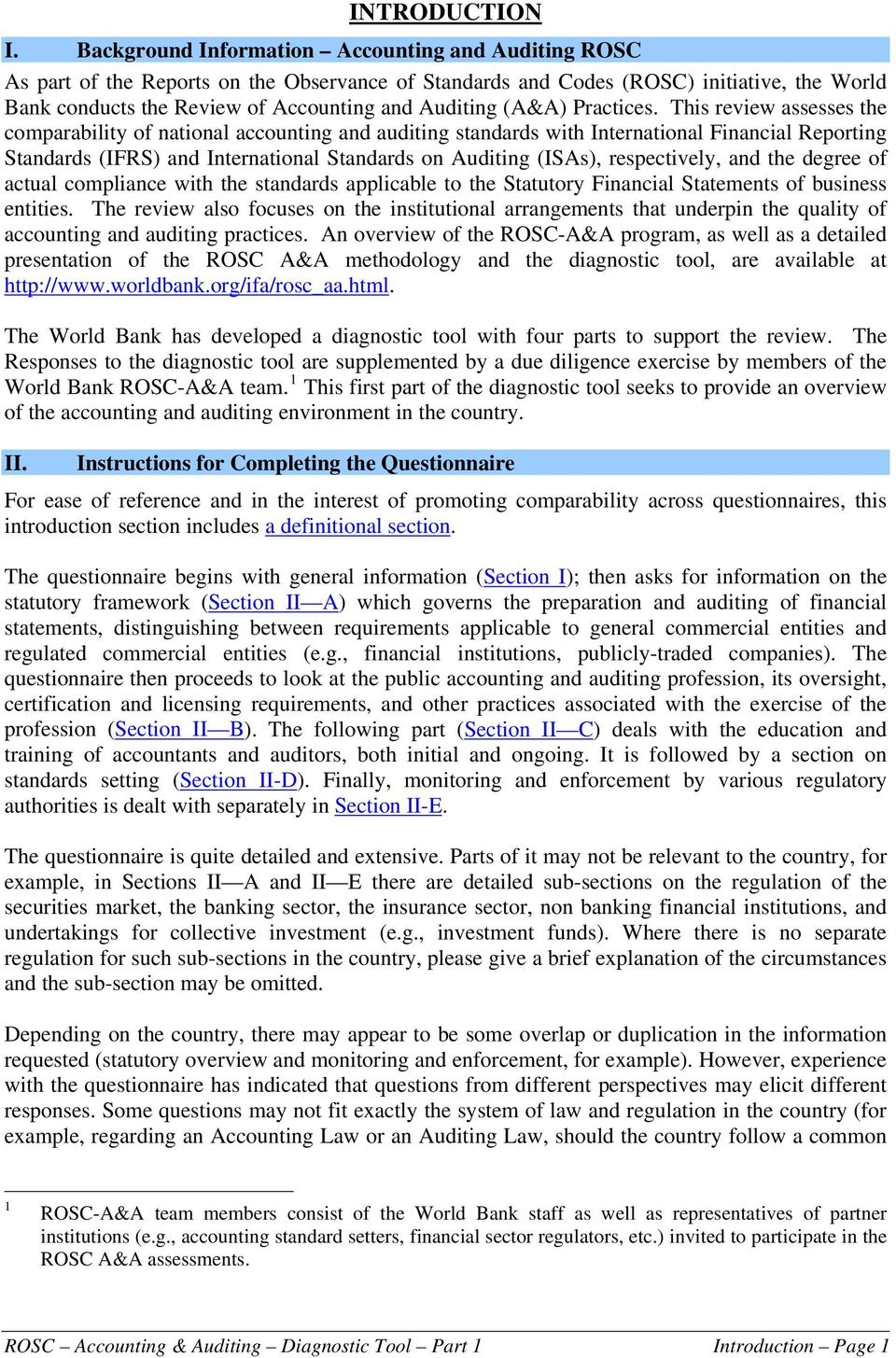
2 INTRODUCTION I. Background Information Accounting and Auditing ROSC As part of the Reports on the Observance of Standards and Codes (ROSC) initiative, the World Bank conducts the Review of Accounting and Auditing (A&A) Practices. This review assesses the comparability of national accounting and auditing standards with International Financial Reporting Standards (IFRS) and International Standards on Auditing (ISAs), respectively, and the degree of actual compliance with the standards applicable to the Statutory Financial Statements of business entities. The review also focuses on the institutional arrangements that underpin the quality of accounting and auditing practices. An overview of the ROSC-A&A program, as well as a detailed presentation of the ROSC A&A methodology and the diagnostic tool, are available at The World Bank has developed a diagnostic tool with four parts to support the review. The Responses to the diagnostic tool are supplemented by a due diligence exercise by members of the World Bank ROSC-A&A team. 1 This first part of the diagnostic tool seeks to provide an overview of the accounting and auditing environment in the country. II. Instructions for Completing the Questionnaire For ease of reference and in the interest of promoting comparability across questionnaires, this introduction section includes a definitional section. The questionnaire begins with general information (Section I); then asks for information on the statutory framework (Section II A) which governs the preparation and auditing of financial statements, distinguishing between requirements applicable to general commercial entities and regulated commercial entities (e.g., financial institutions, publicly-traded companies). The questionnaire then proceeds to look at the public accounting and auditing profession, its oversight, certification and licensing requirements, and other practices associated with the exercise of the profession (Section II B). The following part (Section II C) deals with the education and training of accountants and auditors, both initial and ongoing. It is followed by a section on standards setting (Section II-D). Finally, monitoring and enforcement by various regulatory authorities is dealt with separately in Section II-E. The questionnaire is quite detailed and extensive. Parts of it may not be relevant to the country, for example, in Sections II A and II E there are detailed sub-sections on the regulation of the securities market, the banking sector, the insurance sector, non banking financial institutions, and undertakings for collective investment (e.g., investment funds). Where there is no separate regulation for such sub-sections in the country, please give a brief explanation of the circumstances and the sub-section may be omitted. Depending on the country, there may appear to be some overlap or duplication in the information requested (statutory overview and monitoring and enforcement, for example). However, experience with the questionnaire has indicated that questions from different perspectives may elicit different responses. Some questions may not fit exactly the system of law and regulation in the country (for example, regarding an Accounting Law or an Auditing Law, should the country follow a common 1 ROSC-A&A team members consist of the World Bank staff as well as representatives of partner institutions (e.g., accounting standard setters, financial sector regulators, etc.) invited to participate in the ROSC A&A assessments. ROSC Accounting & Auditing Diagnostic Tool Part 1 Introduction Page 1
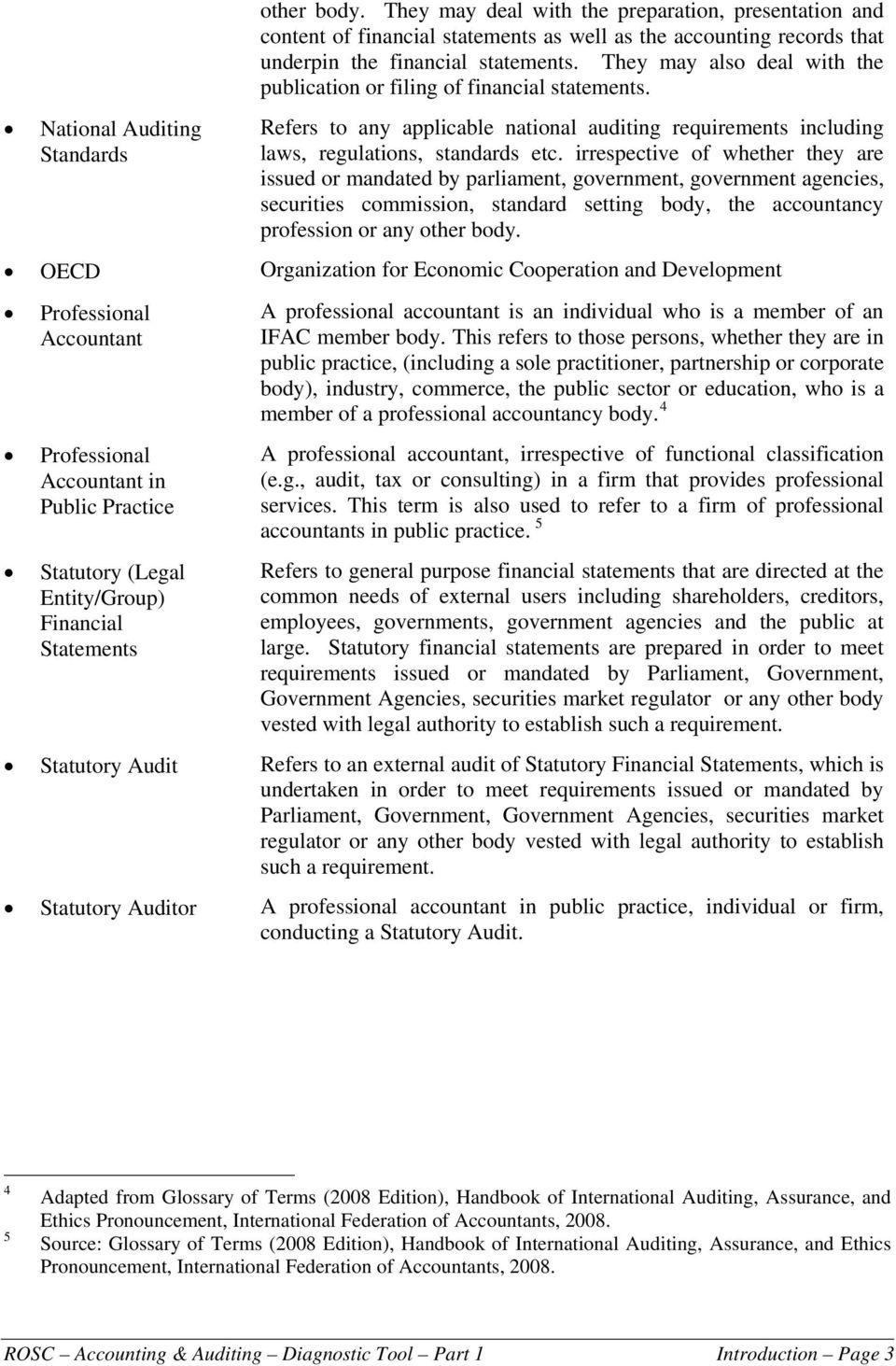
3 law system). Please try to give information relevant to the question area where any such mismatch occurs. Please provide your responses by keying information into the blank spaces provided, identifying the article/section of the legislation your response is based on. The blue lines are formatted so that your responses will appear in blue lettering. Also, please provide a complete copy of legislation, regulations, stock exchange listing rules, standards, rules of professional bodies/associations, and codes of corporate governance dealing with the issues covered in this questionnaire (electronic or paper version in the country s official language and in English, if available). III. Definitions Employed Professional Accountant Government Business Enterprises Group Financial Statements A professional accountant employed in industry, commerce, the public sector or education. A professional accountant is an individual who is a member of an IFAC member body. 2 Refers to business enterprises, which operate within the public sector ordinarily to meet a political or social interest objective. They are ordinarily required to operate commercially, that is, to make profits or to recoup through user charges a substantial proportion of their operating costs. 3 Refers to the financial statements of a group, i.e. a parent and all its subsidiaries, presented as those of a single combined economic entity (also known as consolidated financial statements ). IFRS Within the ROSC A&A diagnostic tool, IFRS refers to all standards and related interpretations issued by the International Accounting Standards Board (IASB) and its predecessor, the International Accounting Standards Committee (IASC). IASC- issued standards are known as International Accounting Standards (IAS). In line with IASB s pronouncements, it is a common practice, reference to IFRS also includes IAS. Legal Entity Financial Statements Refers to the separate financial statements of an entity (also known as individual financial statements ). Listed Company Refers to companies whose equity or debt securities are admitted to trading on a regulated market (also known as publicly traded companies ). National Accounting Standards Refers to any applicable national accounting and financial reporting requirements including laws, regulations, charts of accounts, standards etc. irrespective of whether they are issued or mandated by parliament, government, government agencies, securities commission, standard setting body, the accountancy profession or any 2 3 Adapted from Glossary of Terms (2008 Edition), Handbook of International Auditing, Assurance, and Ethics Pronouncement, International Federation of Accountants, Source: Glossary of Terms (2008 Edition), Handbook of International Auditing, Assurance, and Ethics Pronouncement, International Federation of Accountants, ROSC Accounting & Auditing Diagnostic Tool Part 1 Introduction Page 2

4 National Auditing Standards other body. They may deal with the preparation, presentation and content of financial statements as well as the accounting records that underpin the financial statements. They may also deal with the publication or filing of financial statements. Refers to any applicable national auditing requirements including laws, regulations, standards etc. irrespective of whether they are issued or mandated by parliament, government, government agencies, securities commission, standard setting body, the accountancy profession or any other body. OECD Organization for Economic Cooperation and Development Professional Accountant Professional Accountant in Public Practice Statutory (Legal Entity/Group) Financial Statements A professional accountant is an individual who is a member of an IFAC member body. This refers to those persons, whether they are in public practice, (including a sole practitioner, partnership or corporate body), industry, commerce, the public sector or education, who is a member of a professional accountancy body. 4 A professional accountant, irrespective of functional classification (e.g., audit, tax or consulting) in a firm that provides professional services. This term is also used to refer to a firm of professional accountants in public practice. 5 Refers to general purpose financial statements that are directed at the common needs of external users including shareholders, creditors, employees, governments, government agencies and the public at large. Statutory financial statements are prepared in order to meet requirements issued or mandated by Parliament, Government, Government Agencies, securities market regulator or any other body vested with legal authority to establish such a requirement. Statutory Audit Refers to an external audit of Statutory Financial Statements, which is undertaken in order to meet requirements issued or mandated by Parliament, Government, Government Agencies, securities market regulator or any other body vested with legal authority to establish such a requirement. Statutory Auditor A professional accountant in public practice, individual or firm, conducting a Statutory Audit. 4 5 Adapted from Glossary of Terms (2008 Edition), Handbook of International Auditing, Assurance, and Ethics Pronouncement, International Federation of Accountants, Source: Glossary of Terms (2008 Edition), Handbook of International Auditing, Assurance, and Ethics Pronouncement, International Federation of Accountants, ROSC Accounting & Auditing Diagnostic Tool Part 1 Introduction Page 3
5 I. General Information Please fill out the column to the right: Country: Date of Preparation: Individual(s) Responsible for Preparation: Organizational Affiliation(s): Job Title/Qualifications Address: Telephone Number: Fax Number: Address: QUESTIONNAIRE II. Statutory and Institutional Frameworks II. A. Statutory Framework II.A.1. Overview of the Statutory Framework 1. How would you generally describe the main influences on your legal system (Commonwealth, French civil law, German civil law, Roman-Dutch law, Japanese law, a combination of these, or other influences)? 2. Has your legislative and regulatory regime applicable to commercial entities, financial institutions, undertakings for collective investment, capital markets, financial reporting, accounting or Statutory Audit been subject to significant changes of any kind in recent years (e.g., in the last 10 years)? 3. If so, what were the main sources for the changes (e.g., introduction of market principles, internationally comparable securities laws)? 4. Does your legal system have a specific Accounting Law? Statutory Audit Law? Are financial reporting requirements set out in corporate legislation or securities markets regulation? 5. Does your country have a Code of Corporate Governance? 6. If yes, is compliance with the Code of Corporate Governance voluntary or mandatory? 7. Whether the corporate accountants and/or auditors have any specific obligation under the Code of Corporate Governance? ROSC Accounting & Auditing Diagnostic Tool Part 1 Questionnaire Page 4

6 II.A.2. Commercial Entity Legislation 6 8. Please provide the following data regarding the different kinds of commercial entities: Type of commercial entity/legal form (e.g., joint stock company, limited liability company) Number of registered entities Comments on the economic significance of this type of commercial entity (e.g., contribution to GDP) 9. What legislation governs the creation and internal affairs of entities engaged in commercial activities (e.g., Commercial Code, Civil Code, Corporations Law, Partnership Act, Companies Act, etc)? 10. What is the enacting body, the enactment date and date of most recent significant amendments of the legislation in Question 9? 11. What legislation governs the creation and internal affairs of entities engaged in non-commercial activities, such as foundations, not-for-profit associations? 12. What is the enacting body, the enactment date and date of most recent significant amendments of the legislation in Question 11? 13. What legislation governs the creation and internal affairs of Government Business Enterprises? 14. What is the enacting body, the enactment date and date of most recent significant amendments of the legislation in Question 13? 15. What are the financial reporting requirements established by the commercial entity legislation? For each kind of commercial entity and Government Business Enterprises please specify: (a) the type of Statutory Financial Statements to be prepared (e.g., balance sheet and income statement, Legal Entity and/or Group Financial Statements), (b) the information contained therein (e.g., specific format imposed by the legislation), (c) the publication and filing requirements (e.g., whether the Statutory Financial Statements must be published in a newspaper or filed with a business registry, and (d) the deadline(s) for publication and/or filing. 6 This Section should not be restricted to Companies Act and/or Commercial Code but should extend to legislation pertaining to commercial entities which would include partnerships, associations of various kinds (for profit and not-for-profit), and Government Business Enterprises. ROSC Accounting & Auditing Diagnostic Tool Part 1 Questionnaire Page 5

7 16. What are the Statutory Audit requirements established by the commercial entity legislation? Please distinguish among the various types of entities, if applicable. Also, please distinguish between Legal Entity and Group Financial Statements, if applicable. 17. What are the conditions established by the commercial entity legislation to be met to act as Statutory Auditor of a commercial entity? Please distinguish among the various types of entities, if applicable. 18. What are the mechanisms governing Statutory Auditor appointment and termination set out in the commercial entity legislation? Specifically, how does the commercial entity legislation regulate the following matters? Who nominates and who appoints the Statutory Auditor? How long is the Statutory Auditor appointed for? Is this period renewable? Are joint Statutory Audits required? If so, please describe. Is there a requirement for rotation of the Statutory Auditor (or audit partner)? If so, please describe. 19. Does the commercial entity legislation include provisions regarding the establishment of monitoring mechanisms to ensure compliance with the accounting, reporting, and auditing requirements? If yes, please describe the mechanisms as set out in the legislation. 20. Does the commercial entity legislation require that the Statutory Auditor attends the annual shareholders meeting and be available for questions by the shareholders? If yes, please describe. 21. What are the potential consequences in the event of noncompliance with the accounting, reporting, and auditing requirements (e.g., fines, loss of limited liability status, loss of licenses, prison sentences for managers, claims for reparation by shareholders or others)? Specifically, please describe: How these consequences apply to management, the directors, the company, and its Statutory Auditor? Where are the consequences found (e.g., in the Acts or Codes, in a civil code, criminal code, capital markets legislation, stock exchange listing rules, etc)? ROSC Accounting & Auditing Diagnostic Tool Part 1 Questionnaire Page 6

8 What persons or agencies can take action in the event of noncompliance with the accounting, reporting, or auditing requirements? Please describe all major cases where these persons or agencies have taken such action in recent years (e.g., last five years) Does the commercial entity legislation relating to accounting, financial reporting, and auditing pose any difficulty to commercial entities or their Statutory Auditors? About what would the entities or their auditors typically complain? Specifically, please describe whether: There are areas where commercial entities would like to see changes in accounting, financial reporting, or auditing requirements? There are areas where Statutory Auditors would like to see changes in accounting, financial reporting, or auditing requirements? II.A.3. Securities Market Regulations 23. Please provide the following data regarding the country s securities market: Number of stock exchanges a Total market capitalization b Number of Listed Companies c Number of newly Listed Companies within the last 12 months Listed bond volume d a b c d Number/Amount as of: Comments Please list in Comments all stock exchanges. Please specify in Comments for each stock exchange, if applicable. Also provide breakdown among different listing tiers, if applicable. Please provide breakdown among different listing tiers, if applicable. Please specify in Comments the volume for government and corporate bonds, if applicable. 24. With regard to the securities market regulator and the stock exchange(s), what are the name(s) of the related laws, decrees, circulars, other regulations, and listing rules with the enacting bodies and the enactment date? Please provide a copy where such regulations relate to financial reporting. 7 Please describe all major cases against management, the directors, the company, or its Statutory Auditors. ROSC Accounting & Auditing Diagnostic Tool Part 1 Questionnaire Page 7

9 25. What are the accounting requirements and interim and annual financial reporting requirements applicable to Listed Companies set forth in listing rules emanating from a stock exchange as well as legislation and regulation administered by a securities market authority? Specifically, please indicate: The type of reports/financial statements to be prepared The publication and filing requirements The deadlines for publication and filing 26. Are there any differences between the rules and regulations of the securities market authority relating to financial reporting and stock exchange rules/listing requirements? If there are differences, indicate in tabular form what they are, and what Listed Companies comply with in practice? Securities market authority Rules Stock Exchange Rules 27. What are the Statutory Audit requirements applicable to Listed Companies set forth in listing rules emanating from a stock exchange as well as legislation and regulation administered by a securities market authority? 28. What conditions are required to be met to act as Statutory Auditor of a Listed Company set forth in listing rules emanating from a stock exchange as well as legislation and regulation administered by a securities market authority? 29. What are the mechanisms governing Statutory Auditor appointment and termination set forth in listing rules emanating from a stock exchange as well as legislation and regulation administered by a securities market authority? Specifically, please indicate: Who appoints the Statutory Auditor? How long is the Statutory Auditor appointed for? Are joint Statutory Audits required? If so, please describe. Is there a requirement for rotation of the Statutory Auditor (or audit partner)? If so, please describe. 30. Does the resignation or termination of a Statutory Audit engagement need to be reported to the securities market authority and/or the stock exchange(s)? If so, please describe the procedure. ROSC Accounting & Auditing Diagnostic Tool Part 1 Questionnaire Page 8

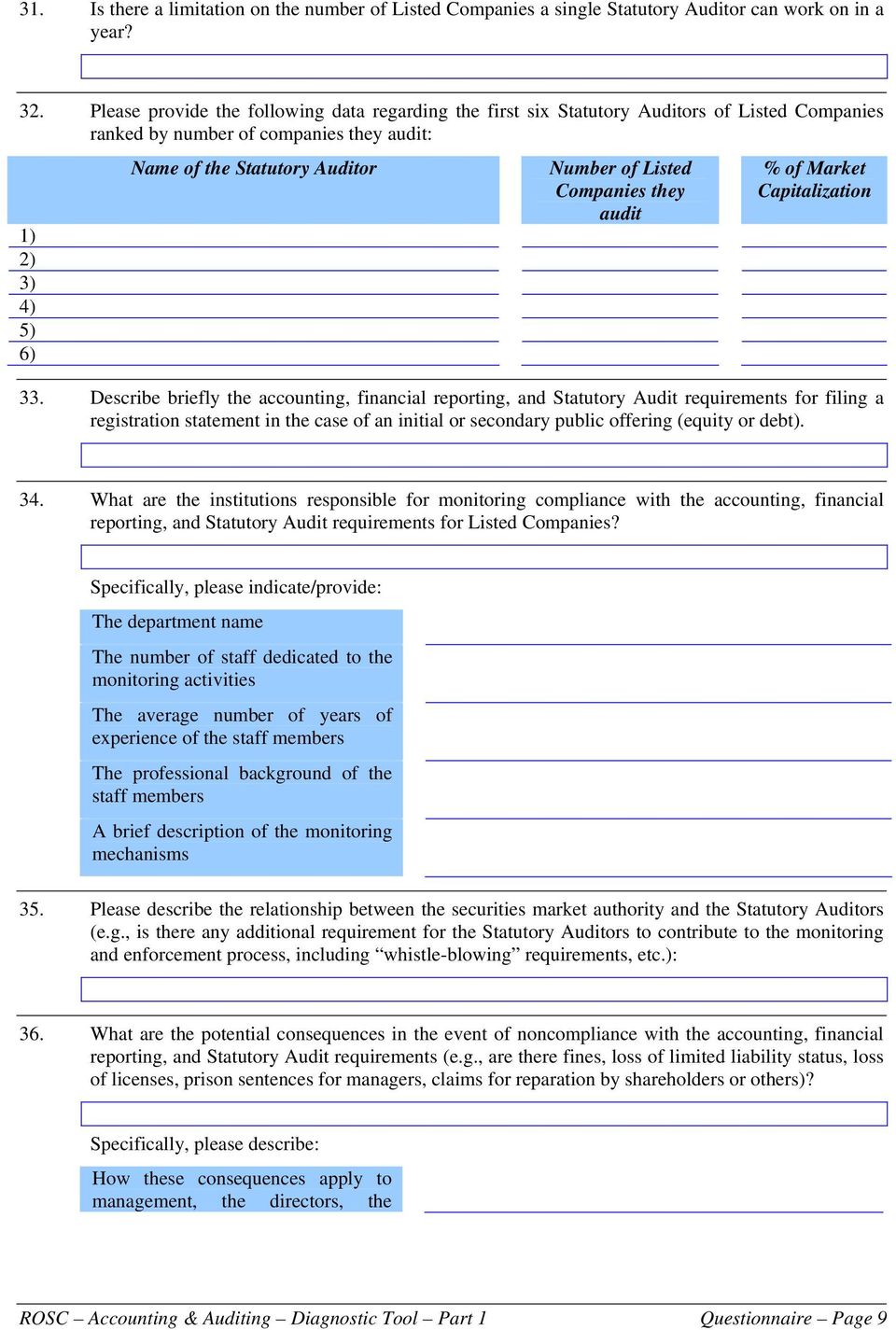
10 31. Is there a limitation on the number of Listed Companies a single Statutory Auditor can work on in a year? 32. Please provide the following data regarding the first six Statutory Auditors of Listed Companies ranked by number of companies they audit: 1) 2) 3) 4) 5) 6) Name of the Statutory Auditor Number of Listed Companies they audit % of Market Capitalization 33. Describe briefly the accounting, financial reporting, and Statutory Audit requirements for filing a registration statement in the case of an initial or secondary public offering (equity or debt). 34. What are the institutions responsible for monitoring compliance with the accounting, financial reporting, and Statutory Audit requirements for Listed Companies? Specifically, please indicate/provide: The department name The number of staff dedicated to the monitoring activities The average number of years of experience of the staff members The professional background of the staff members A brief description of the monitoring mechanisms 35. Please describe the relationship between the securities market authority and the Statutory Auditors (e.g., is there any additional requirement for the Statutory Auditors to contribute to the monitoring and enforcement process, including whistle-blowing requirements, etc.): 36. What are the potential consequences in the event of noncompliance with the accounting, financial reporting, and Statutory Audit requirements (e.g., are there fines, loss of limited liability status, loss of licenses, prison sentences for managers, claims for reparation by shareholders or others)? Specifically, please describe: How these consequences apply to management, the directors, the ROSC Accounting & Auditing Diagnostic Tool Part 1 Questionnaire Page 9
11 company, and its Statutory Auditor? Where are the consequences found (e.g., in the Act or Code, in a civil code, criminal code, capital markets legislation, stock exchange listing rules, etc)? What persons or agencies can take action in the event of noncompliance with the accounting, reporting, or auditing requirements? Please describe all major cases where these persons or agencies have taken such action in recent years (e.g., last five years) Do listing rules emanating from a stock exchange or the legislation and regulation administered by a securities market authority relating to accounting, financial reporting, and Statutory Audit pose any difficulty to commercial entities or their auditors? About what would the entities or their auditors typically complain? Specifically, please describe whether: There are areas where commercial entities would like to see changes in accounting, financial reporting, or auditing requirements? There are areas where Statutory Auditors would like to see changes in accounting, financial reporting, or auditing requirements? 38. Are there any inconsistencies between securities markets regulations covering accounting, financial reporting and Statutory Audit requirements, and the provisions of other laws and regulations in the country? Describe the inconsistencies. II.A.4. Regulations Applicable to Banks Please provide the following data regarding the country s banking sector: Number of banks Total banking assets Number/Amount as of: Comments Provide a general description of the banking sector s ownership (e.g., state-owned, foreign-owned): 8 9 Please describe all major cases against management, the directors, the company, or its Statutory Auditors. For the purpose of this questionnaire, the term bank includes all financial institutions, one of whose principal activities is to take deposits and borrow with the objective of lending and investing. ROSC Accounting & Auditing Diagnostic Tool Part 1 Questionnaire Page 10

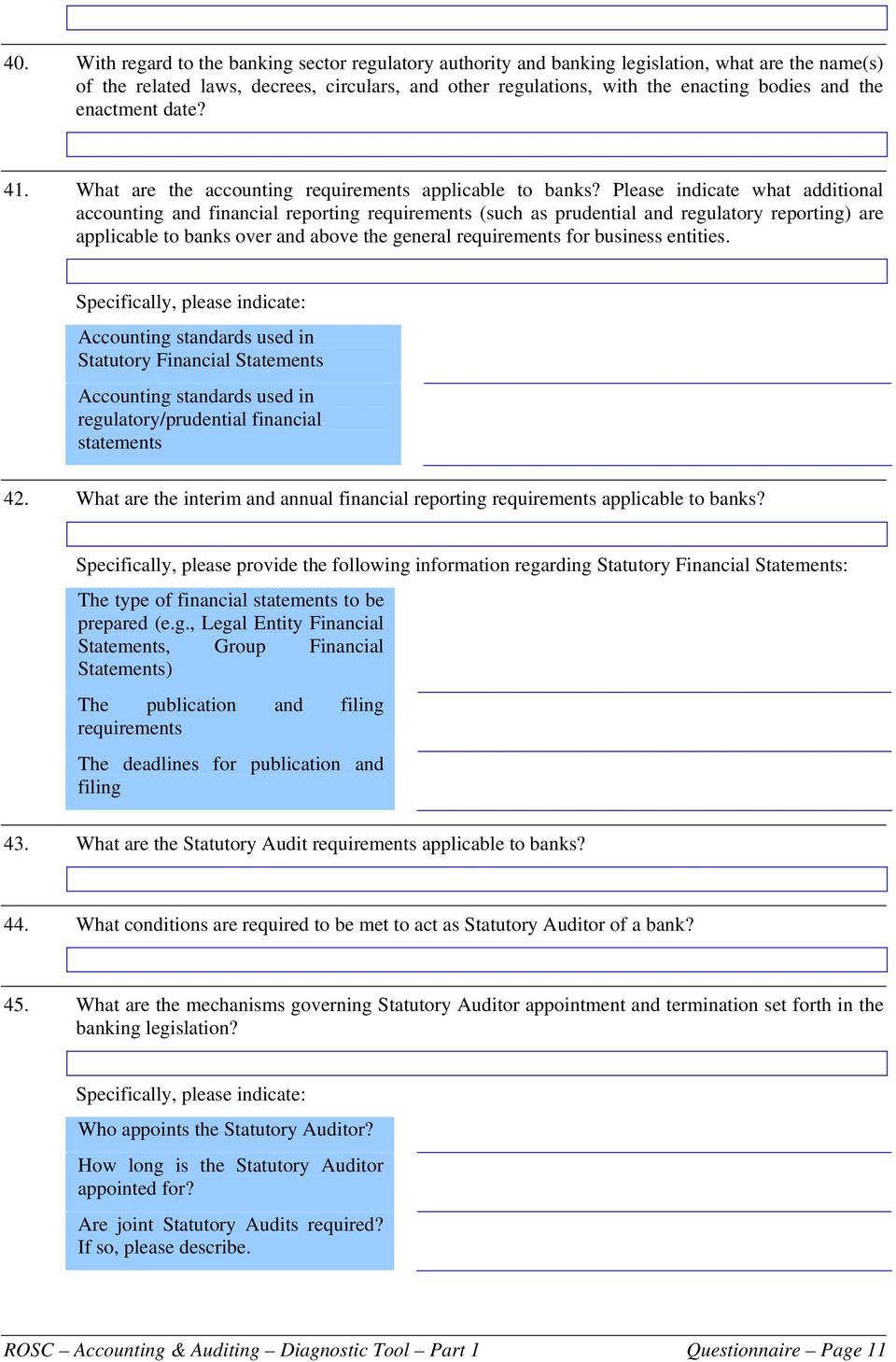
12 40. With regard to the banking sector regulatory authority and banking legislation, what are the name(s) of the related laws, decrees, circulars, and other regulations, with the enacting bodies and the enactment date? 41. What are the accounting requirements applicable to banks? Please indicate what additional accounting and financial reporting requirements (such as prudential and regulatory reporting) are applicable to banks over and above the general requirements for business entities. Specifically, please indicate: Accounting standards used in Statutory Financial Statements Accounting standards used in regulatory/prudential financial statements 42. What are the interim and annual financial reporting requirements applicable to banks? Specifically, please provide the following information regarding Statutory Financial Statements: The type of financial statements to be prepared (e.g., Legal Entity Financial Statements, Group Financial Statements) The publication and filing requirements The deadlines for publication and filing 43. What are the Statutory Audit requirements applicable to banks? 44. What conditions are required to be met to act as Statutory Auditor of a bank? 45. What are the mechanisms governing Statutory Auditor appointment and termination set forth in the banking legislation? Specifically, please indicate: Who appoints the Statutory Auditor? How long is the Statutory Auditor appointed for? Are joint Statutory Audits required? If so, please describe. ROSC Accounting & Auditing Diagnostic Tool Part 1 Questionnaire Page 11
13 Is there a requirement for rotation of the Statutory Auditor? If so, please describe. 46. Does the resignation or termination of a Statutory Auditor engagement need to be reported to the banking sector regulatory authority? If so, please describe the procedure. 47. Is there a limitation on the number of banks a single Statutory Auditor can work on in a year? 48. Please provide the following data regarding the six major Statutory Auditors of banks ranked by number of banks they audit: 1) 2) 3) 4) 5) 6) Name of the Statutory Auditor Number of banks they audit % of total banking assets 49. What are the institutions responsible for monitoring compliance with the accounting, financial reporting, and Statutory Audit requirements for banks? Specifically, please indicate/provide: The department name The number of staff dedicated to the monitoring activities The average number of years of experience of the staff members The professional background of the staff members A brief description of the monitoring mechanisms 50. Please describe the relationship between the banking sector regulatory authority and the Statutory Auditors (e.g., is there any additional requirement for the Statutory Auditors to contribute to the monitoring and enforcement process, including whistle-blowing requirements, etc.): 51. What are the potential consequences in the event of noncompliance with the accounting, financial reporting, and Statutory Audit requirements (e.g., are there fines, loss of limited liability status, loss of licenses, prison sentences for managers, claims for reparation by shareholders or others)? Specifically, please describe: ROSC Accounting & Auditing Diagnostic Tool Part 1 Questionnaire Page 12

14 How these consequences apply to management, the directors, the company, and its Statutory Auditor? Where are the consequences found (e.g. in the Act or Code, in a civil code, criminal code, capital markets legislation, stock exchange listing rules, etc)? What persons or agencies can take action in the event of noncompliance with the accounting, reporting, or auditing requirements? Please describe all major cases where these persons or agencies have taken such action in recent years (e.g., last five years) Does banking legislation relating to accounting, financial reporting, and Statutory Audit pose any difficulty to banks or their Statutory Auditors? About what would the banks or their auditors typically complain? Specifically, please describe whether: There are areas where banks would like to see changes in accounting, financial reporting, or auditing requirements? There are areas where Statutory Auditors would like to see changes in accounting, financial reporting, or auditing requirements? 53. Are there any inconsistencies between regulations pertaining to banks covering accounting, financial reporting and Statutory Audit requirements, and the provisions of other laws and regulations in the country (e.g., inconsistencies between the commercial entity and the banking legislation)? 54. Are there any conflicts between the banking sector regulatory authority s and the securities market authority s requirements relating to financial statements of listed banks? What are they? How are they resolved in practice? II.A.5. Regulations Applicable to Insurance Undertakings Please provide the following data regarding the country s insurance sector: Please describe all major cases against management, the directors, the company, or its Statutory Auditors. For the purpose of this questionnaire, the term insurance undertaking includes all life and non-life insurance undertakings, as well as reinsurance undertakings. ROSC Accounting & Auditing Diagnostic Tool Part 1 Questionnaire Page 13

15 Number of insurance undertakings Of which: Life insurance Non-life insurance Number/Amount as of: Provide a general description of the insurance sector as follows: Ownership (e.g., state-owned, foreign-owned) Insurance penetration (e.g., insurance sector growth, insurance premiums as compared with GDP) Comments 56. With regard to the insurance sector regulatory authority and insurance legislation, what are the name(s) of the related laws, decrees, circulars, and other regulations, with the enacting bodies and the enactment date? 57. What are the accounting requirements applicable to insurance undertakings? Please indicate what additional accounting and financial reporting requirements (such as prudential and regulatory reporting) are applicable to insurance undertakings over and above the general requirements for business entities. Specifically, please indicate: Accounting standards used in Statutory Financial Statements Accounting standards used in regulatory/prudential financial statements 58. What are the interim and annual financial reporting requirements applicable to insurance undertakings? Specifically, please provide the following information regarding Statutory Financial Statements: The type of financial statements to be prepared (e.g., Legal Entity Financial Statements, Group Financial Statements) The publication and filing requirements The deadlines for publication and filing 59. What are the Statutory Audit requirements applicable to insurance undertakings? ROSC Accounting & Auditing Diagnostic Tool Part 1 Questionnaire Page 14

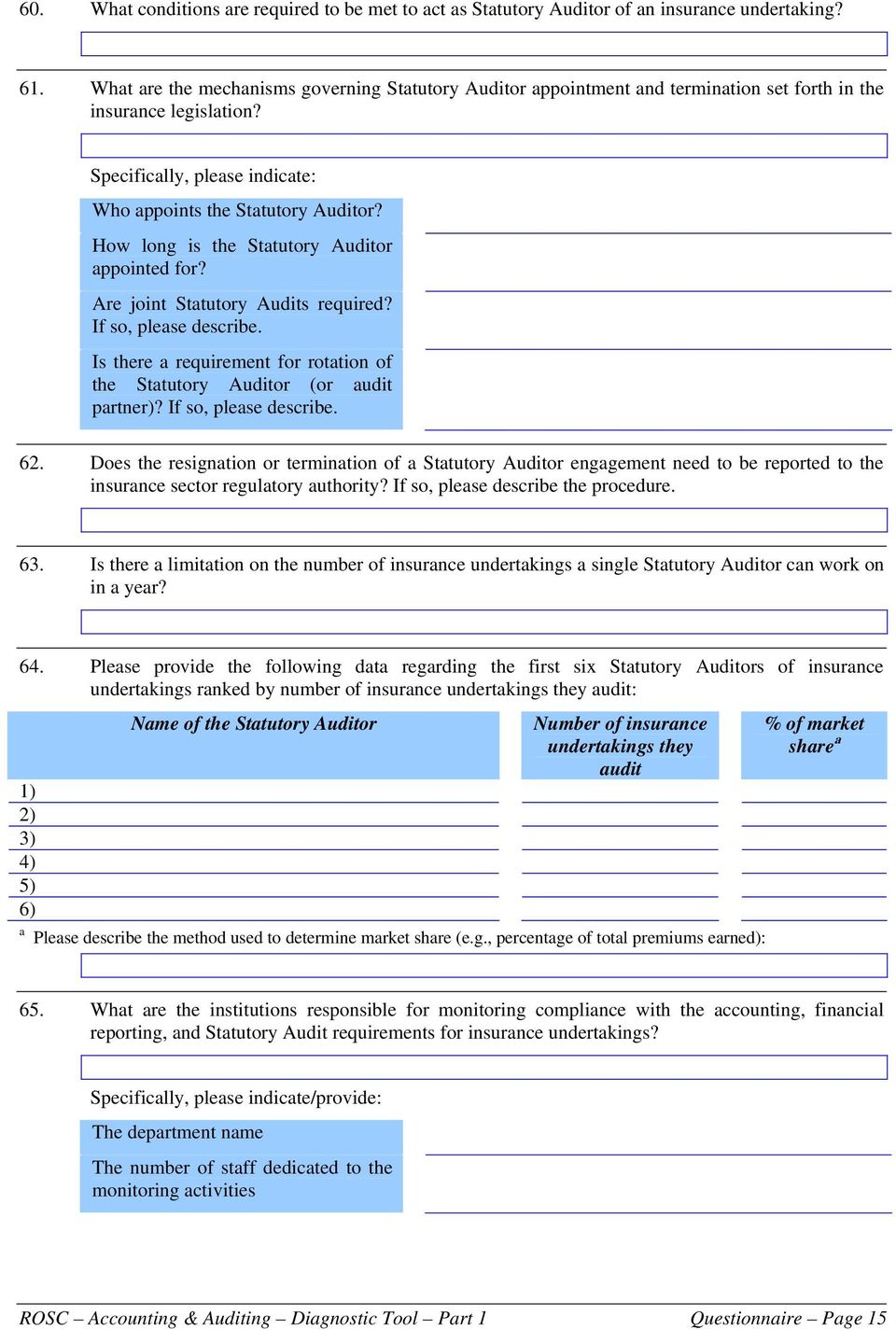
16 60. What conditions are required to be met to act as Statutory Auditor of an insurance undertaking? 61. What are the mechanisms governing Statutory Auditor appointment and termination set forth in the insurance legislation? Specifically, please indicate: Who appoints the Statutory Auditor? How long is the Statutory Auditor appointed for? Are joint Statutory Audits required? If so, please describe. Is there a requirement for rotation of the Statutory Auditor (or audit partner)? If so, please describe. 62. Does the resignation or termination of a Statutory Auditor engagement need to be reported to the insurance sector regulatory authority? If so, please describe the procedure. 63. Is there a limitation on the number of insurance undertakings a single Statutory Auditor can work on in a year? 64. Please provide the following data regarding the first six Statutory Auditors of insurance undertakings ranked by number of insurance undertakings they audit: 1) 2) 3) 4) 5) 6) a Name of the Statutory Auditor Number of insurance undertakings they audit Please describe the method used to determine market share (e.g., percentage of total premiums earned): % of market share a 65. What are the institutions responsible for monitoring compliance with the accounting, financial reporting, and Statutory Audit requirements for insurance undertakings? Specifically, please indicate/provide: The department name The number of staff dedicated to the monitoring activities ROSC Accounting & Auditing Diagnostic Tool Part 1 Questionnaire Page 15
17 The average number of years of experience of the staff members The professional background of the staff members A brief description of the monitoring mechanisms 66. Please describe the relationship between the insurance sector regulatory authority and the Statutory Auditors (e.g., is there any additional requirement for the Statutory Auditors to contribute to the monitoring and enforcement process, including whistle-blowing requirements, etc.): 67. What are the potential consequences in the event of noncompliance with the accounting, financial reporting, and Statutory Audit requirements (e.g., are there fines, loss of limited liability status, loss of licenses, prison sentences for managers, claims for reparation by shareholders or others)? Specifically, please describe: How these consequences apply to management, the directors, the company, and its Statutory Auditor? Where are the consequences found (e.g. in the Act or Code, in a civil code, criminal code, capital markets legislation, stock exchange listing rules, etc)? What persons or agencies can take action in the event of noncompliance with the accounting, reporting, or auditing requirements? Please describe all major cases where these persons or agencies have taken such action in recent years (e.g., last five years) Does insurance legislation relating to accounting, financial reporting, and Statutory Audit pose any difficulty to insurance undertakings or their Statutory Auditors? About what would the insurance undertakings or their auditors typically complain? Specifically, please describe whether: There are areas where insurance undertakings would like to see changes in accounting, financial reporting, or auditing requirements? 12 Please describe all major cases against management, the directors, the company, or its Statutory Auditors. ROSC Accounting & Auditing Diagnostic Tool Part 1 Questionnaire Page 16

18 There are areas where Statutory Auditors would like to see changes in accounting, financial reporting, or auditing requirements? 69. Are there any inconsistencies between regulations pertaining to insurance undertakings covering accounting, financial reporting and Statutory Audit requirements, and the provisions of other laws and regulations in the country (e.g., inconsistencies between the commercial entity and the insurance legislation)? 70. Are there any conflicts between the insurance sector regulatory authority s and the securities market authority s requirements relating to financial statements of listed insurance undertakings? What are they? How are they resolved in practice? II.A.6. Regulations Applicable to Non-Bank Financial Institutions (NBFIs) What are the NBFIs be included in this section? What are their respective size (e.g., number of companies, total assets, etc.): Types of NBFIs to be covered in this Section (e.g., leasing companies) Number as of: Size of the Sector 72. With regard to the NBFI regulatory authority(ies) and the legislation to NBFIs, what are the name(s) of the related laws, decrees, circulars, and other regulations, with the enacting bodies and the enactment date? 73. What are the accounting requirements applicable to NBFIs? Please indicate what additional accounting and financial reporting requirements (such as prudential and regulatory reporting) are applicable to NBFIs over and above the general requirements for business entities. Specifically, please indicate: Accounting standards used in Statutory Financial Statements Accounting standards used in regulatory/prudential financial statements 13 For the purpose of this questionnaire, the term non-bank financial institution includes all financial institutions other than banks, insurance undertakings, and undertakings for collective investments. For example, finance companies, leasing companies, and securities firms. ROSC Accounting & Auditing Diagnostic Tool Part 1 Questionnaire Page 17

19 74. What are the interim and annual financial reporting requirements applicable to NBFIs? Specifically, please provide the following information regarding Statutory Financial Statements: The type of financial statements to be prepared (e.g., Legal Entity Financial Statements, Group Financial Statements) The publication and filing requirements The deadlines for publication and filing 75. What are the Statutory Audit requirements applicable to NBFIs? 76. What conditions are required to be met to act as Statutory Auditor of an NBFI? 77. What are the mechanisms governing Statutory Auditor appointment and termination set forth in the legislation applicable to NBFIs? Specifically, please indicate: Who appoints the Statutory Auditor? How long is the Statutory Auditor appointed for? Are joint Statutory Audits required? If so, please describe. Is there a requirement for rotation of the Statutory Auditor? If so, please describe. 78. Does the resignation or termination of a Statutory Auditor engagement need to be reported to the NBFI regulatory authority(ies)? If so, please describe the procedure. 79. Is there a limitation on the number of insurance undertakings a single Statutory Auditor can work on in a year? 80. Please provide the following data regarding the first six Statutory Auditors of NBFIs ranked by number of NBFIs they audit: 1) 2) Name of the Statutory Auditor Number of UCIs they audit % of market share a ROSC Accounting & Auditing Diagnostic Tool Part 1 Questionnaire Page 18
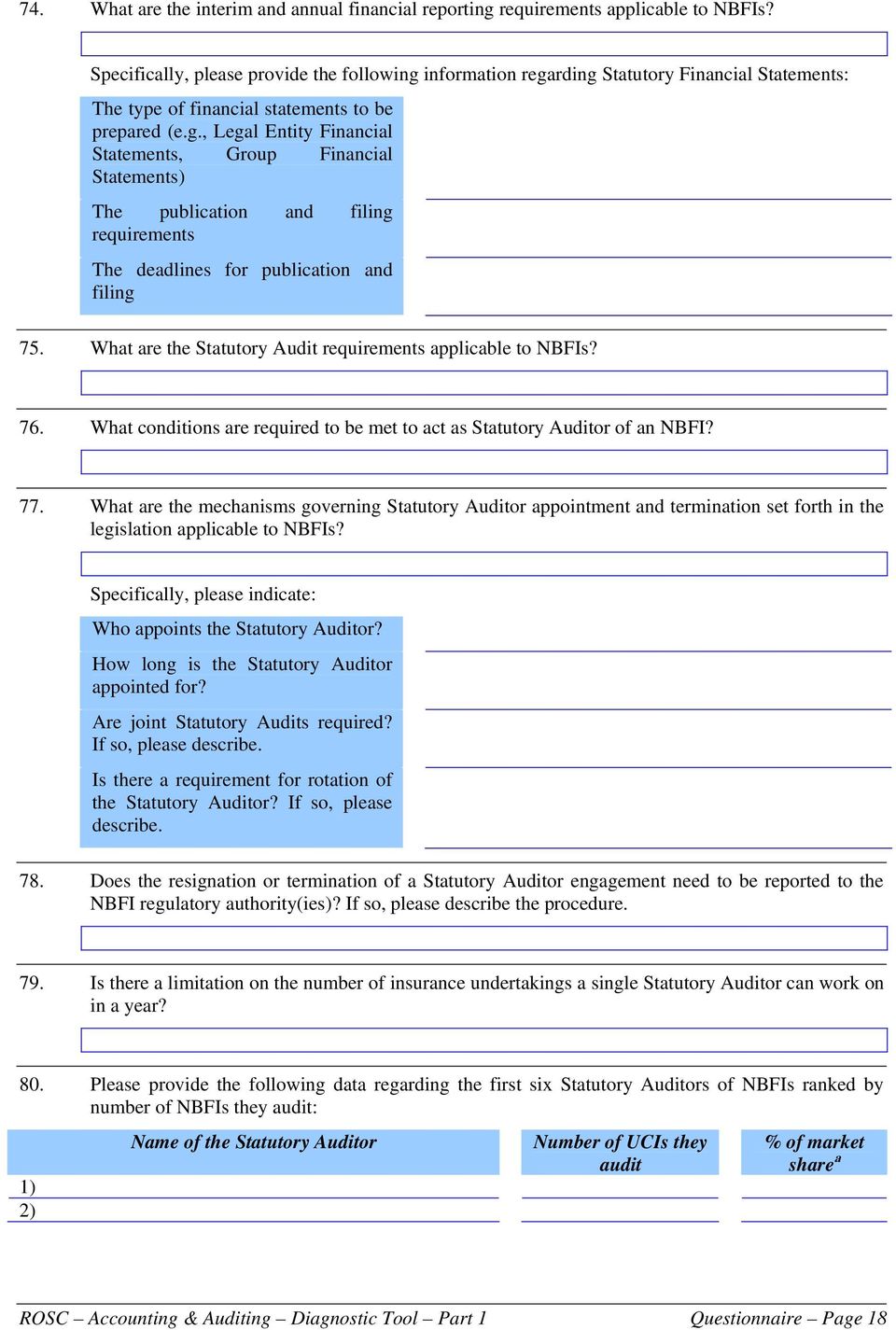
20 3) 4) 5) 6) a Please describe the method used to determine market share (e.g., percentage of total net assets). 81. What are the institutions responsible for monitoring compliance with the accounting, financial reporting, and Statutory Audit requirements for NBFIs? Specifically, please indicate/provide: The department name The number of staff dedicated to the monitoring activities The average number of years of experience of the staff members The professional background of the staff members A brief description of the monitoring mechanisms 82. Please describe the relationship between the NBFI regulatory authority(ies) and the Statutory Auditors (e.g., is there any additional requirement for the Statutory Auditors to contribute to the monitoring and enforcement process, including whistle-blowing requirements, etc.): 83. What are the potential consequences in the event of noncompliance with the accounting, financial reporting, and Statutory Audit requirements (e.g., are there fines, loss of limited liability status, loss of licenses, prison sentences for managers, claims for reparation by shareholders or others)? Specifically, please describe: How these consequences apply to management, the directors, the company, and its Statutory Auditor? Where are the consequences found (e.g. in the Act or Code, in a civil code, criminal code, capital markets legislation, stock exchange listing rules, etc)? What persons or agencies can take action in the event of noncompliance with the accounting, reporting, or auditing requirements? Please describe all major cases where these persons or agencies have taken ROSC Accounting & Auditing Diagnostic Tool Part 1 Questionnaire Page 19

21 such action in recent years (e.g., last five years) Does the legislation applicable to NBFIs relating to accounting, financial reporting, and Statutory Audit pose any difficulty to NBFIs or their Statutory Auditors? About what would the NBFIs or their auditors typically complain? Specifically, please describe whether: There are areas where NBFIs would like to see changes in accounting, financial reporting, or auditing requirements? There are areas where Statutory Auditors would like to see changes in accounting, financial reporting, or auditing requirements? 85. Are there any inconsistencies between regulations pertaining to NBFIs covering accounting, financial reporting and Statutory Audit requirements, and the provisions of other laws and regulations in the country (e.g., inconsistencies between the commercial entity and the legislation applicable to NBFIs)? 86. Are there any conflicts between the NBFI regulatory authority s(ies ) and the securities market authority s requirements relating to financial statements of listed NBFIs? What are they? How are they resolved in practice? II.A.7. Regulations Applicable to Undertakings for Collective Investment (UCIs) What are the types of UCIs to be included in this Section? What is their respective size (e.g., number of companies, total assets, etc.): Types of UCIs to be covered in this Section Number as of: Total net assets 88. With regard to the UCI regulatory authority(ies) and the legislation applicable to UCIs, what are the name(s) of the related laws, decrees, circulars, and other regulations, with the enacting bodies and the enactment date? Please describe all major cases against management, the directors, the company, or its Statutory Auditors. For the purpose of this questionnaire, the term undertaking for collective investment includes all collective investment vehicles such as mutual funds, investment funds, and private pension funds. ROSC Accounting & Auditing Diagnostic Tool Part 1 Questionnaire Page 20
22 89. What are the accounting requirements applicable to UCIs? Please indicate what additional accounting and financial reporting requirements (such as prudential and regulatory reporting) are applicable to UCIs over and above the general requirements for business entities. Specifically, please indicate: Accounting standards used in Statutory Financial Statements Accounting standards used in regulatory/prudential financial statements 90. What are the interim and annual financial reporting requirements applicable to UCIs? Specifically, please provide the following information regarding Statutory Financial Statements: The type of financial statements to be prepared The publication and filing requirements The deadlines for publication and filing 91. What are the Statutory Audit requirements applicable to UCIs? 92. What conditions are required to be met to act as Statutory Auditor of a UCI? 93. What are the mechanisms governing Statutory Auditor appointment and termination set forth in the legislation? Specifically, please indicate: Who appoints the Statutory Auditor? How long is the Statutory Auditor appointed for? Are joint Statutory Audits required? If so, please describe. Is there a requirement for rotation of the Statutory Auditor? If so, please describe. 94. Does the resignation or termination of a Statutory Auditor engagement need to be reported to the UCI regulatory authority(ies)? If so, please describe the procedure. ROSC Accounting & Auditing Diagnostic Tool Part 1 Questionnaire Page 21
23 95. Is there a limitation on the number of UCIs a single Statutory Auditor can work on in a year? 96. Please provide the following data regarding the first six Statutory Auditors of UCIs ranked by number of UCIs they audit: 7) 8) 9) 10) 11) 12) a Name of the Statutory Auditor Number of UCIs they audit Please describe the method used to determine market share (e.g., percentage of total net assets): % of market share a 97. What are the institutions responsible for monitoring compliance with the accounting, financial reporting, and Statutory Audit requirements for UCIs? Specifically, please indicate/provide: The department name The number of staff dedicated to the monitoring activities The average number of years of experience of the staff members The professional background of the staff members A brief description of the monitoring mechanisms 98. Please describe the relationship between the UCI regulatory authority(ies) and the Statutory Auditors (e.g., is there any additional requirement for the Statutory Auditors to contribute to the monitoring and enforcement process, including whistle-blowing requirements, etc.): 99. What are the potential consequences in the event of noncompliance with the accounting, financial reporting, and Statutory Audit requirements (e.g., are there fines, loss of limited liability status, loss of licenses, prison sentences for managers, claims for reparation by share- or unit-holders or others)? Specifically, please describe: How these consequences apply to management, the directors, the company, and its Statutory Auditor? Where are the consequences found (e.g. in the Act or Code, in a civil code, criminal code, capital markets ROSC Accounting & Auditing Diagnostic Tool Part 1 Questionnaire Page 22
24 legislation, stock exchange listing rules, etc)? What persons or agencies can take action in the event of noncompliance with the accounting, reporting, or auditing requirements? Please describe all major cases where these persons or agencies have taken such action in recent years (e.g., last five years) Does the legislation relating to accounting, financial reporting, and Statutory Audit pose any difficulty to UCIs or their Statutory Auditors? About what would the UCIs or their auditors typically complain? Specifically, please describe whether: There are areas where UCIs would like to see changes in accounting, financial reporting, or auditing requirements? There are areas where Statutory Auditors would like to see changes in accounting, financial reporting, or auditing requirements? 101. Are there any inconsistencies between regulations pertaining to UCIs covering accounting, financial reporting and Statutory Audit requirements, and the provisions of other laws and regulations in the country (e.g., inconsistencies between the commercial entity and the legislation applicable to UCIs)? 102. Are there any conflicts between the UCI regulatory authority s(ies ) and the securities market authority s requirements relating to financial statements of listed UCI? What are they? How are they resolved in practice? II.A.8. The Law on Accounting and Financial Reporting (if applicable) 103. What is the main Law on Accounting and Financial Reporting ( Accounting Law ), its enacting body, enactment date, and latest amendment date? 104. What are the types of commercial entities (e.g. legal forms, large, medium small enterprises) covered by the Accounting Law? 16 Please describe all major cases against management, the directors, the company, or its Statutory Auditors. ROSC Accounting & Auditing Diagnostic Tool Part 1 Questionnaire Page 23
25 105. Please provide a bullet point form summary of the Accounting Law, covering reporting and filing requirements, applicable standards, accounting records, required formats etc.: 106. Does the Accounting Law require compliance with IFRS (distinguish among commercial entities, and distinguish between Legal Entity and Group Financial Statements, if applicable)? 107. Does the Accounting Law allow compliance with IFRS (distinguish among commercial entities, and distinguish between Legal Entity and Group Financial Statements, if applicable), even if compliance is not mandated? 108. Other than under regulations for listed and financial sector entities detailed above, are there any specific accounting or financial reporting requirements for public interest entities, i.e. entities which due to their nature, size or function have public accountability? 109. Which version of IFRS must be used by entities that are required/allowed to present IFRS Statutory Financial Statements? Specifically, please indicate: the date of issuance of the version of IFRS, their language and the name of body, which issued the version used Please describe the relationship between financial reporting requirements under the Accounting Law and entity reporting for taxation purposes? Are there any links between the Accounting and the Taxation Law? 111. Are there any inconsistencies between regulations pertaining to commercial entities covering accounting and financial reporting, and the provisions of other laws and regulations in the country applicable to commercial entities? 112. What impediments exist in practice to the implementation of the Accounting Law and its requirements? What practical problems exist in implementation (such as capacity constraints, need to use Statutory Financial Statements for tax purposes etc.)? 113. Does the Accounting Law pose any difficulty to commercial entities or their Statutory Auditors? About what would entities or their auditors typically complain? Specifically, please describe whether: There are areas where commercial entities would like to see changes in accounting, financial reporting, or ROSC Accounting & Auditing Diagnostic Tool Part 1 Questionnaire Page 24
26 auditing requirements? There are areas where Statutory Auditors would like to see changes in accounting, financial reporting, or auditing requirements? II.A.9. The Law on Auditing (if applicable) 114. What is the main law covering a requirement for Statutory Audit ( Audit Law ), its enacting body, enactment date, and latest amendment date? 115. Please provide a bullet point form summary of the contents of the Audit Law, covering the auditing requirements, licensing and qualification requirements for auditors, applicable standards, etc.: 116. Does the Audit Law require compliance with International Standards on Auditing? 117. Does the Audit Law allow compliance with International Standards on Auditing, even if compliance is not mandated? 118. Which version of ISA, if required, must be used by Statutory Auditors in conducting their Statutory Audits? If ISA are not required, are any other standards applicable? Specifically, please indicate: the date of issuance of the version of ISA, their language and the name of body, which issued the version used Does the Audit Law require compliance with the Code of Ethics for Professional Accountants issued by the International Federation of Accountants? 120. Does the Audit Law allow compliance with Code of Ethics for Professional Accountants issued by the International Federation of Accountants, even if compliance is not mandated? 121. Which version, if any, of the Code of Ethics for Professional Accountants issued by the International Federation of Accountants must be used by Statutory Auditors in conducting their Statutory Audits? If the Code is not required, is any other Code of Ethics required to be used? Specifically, please indicate: the date of issuance of the version of the Code, its language and the name of body, which issued the version ROSC Accounting & Auditing Diagnostic Tool Part 1 Questionnaire Page 25
27 used Does the Audit Law require any further attestation with respect to the opinion of the Statutory Auditor (e.g., on the entity s system of internal controls)? 123. Please describe the relationship between auditing requirements under the Audit Law and auditing of entity reporting for taxation purposes? Are there any links between the Audit Law and the Taxation Law? 124. Are there any inconsistencies between regulations pertaining to commercial entities covering auditing, and the provisions of other laws and regulations in the country applicable to commercial entities? 125. What impediments exist in practice to the implementation of the Audit Law and its requirements? What practical problems exist in implementation (such as capacity constraints, provision of nonaudit services, independence issues, etc.)? 126. Does the Audit Law pose any difficulty to commercial entities or their Statutory Auditors? About what would entities or their auditors typically complain? Specifically, please describe whether: There are areas where commercial entities would like to see changes in auditing requirements? There are areas where Statutory Auditors would like to see changes in auditing requirements? II.A.10. Availability of Financial Reporting 127. Please describe the specific reporting channels mandated by laws/regulations (for example, filing with a business registry, publication in the official gazette, etc.) for each type of commercial entity (e.g., small, medium and large companies) Please describe precisely what needs to be filed or published (e.g., full or partial Legal Entity and/or Group Financial Statements, Statutory Auditor s report, etc.) Please describe the applicable reporting deadlines. Specifically, please describe: whether these deadlines are generally ROSC Accounting & Auditing Diagnostic Tool Part 1 Questionnaire Page 26
28 complied with? 130. Does the public have access to the Statutory Financial Statements? If so, Is there a central registrar where Statutory Financial Statements are available? How long may it take and how much might it cost to obtain Statutory Financial Statements? Are the Statutory Financial Statements available electronically to any interested party (for example, a prospective investor or lender)? If not available electronically, why not and how could an interested party obtain these financial statements? 131. What are the sanctions for non-compliance with publication/filing requirements? If so, Are the sanctions generally imposed? 132. Please critically evaluate the readiness and timely availability of full sets of Statutory Financial Statements to the external interested parties (distinguish among types of companies and standalone/consolidated financial statements, if applicable) For which types of companies is there typically a demand for Statutory Financial Statements, and by whom? (e.g., do banks use small company Statutory Financial Statements in lending decisions; do many small investors, foreign investors and/or analysts access Listed Company Statutory Financial Statements and use them in investment decisions?) II.B. The Accounting Profession II.B.1. Regulatory Framework 134. What are the name(s) of the related laws, decrees, circulars, other regulations, and self-regulatory rules that regulate the accounting profession with the enacting bodies and the enactment date? Specifically, please indicate whether access to the following is regulated and how (e.g., accreditation, licensing or registration requirements): Professional Accountant ROSC Accounting & Auditing Diagnostic Tool Part 1 Questionnaire Page 27
29 Employed Professional Accountant (e.g., chief accountant, controller) Professional Accountant in Public Practice Statutory Auditor Please indicate whether the holders of the titles have reserved functions whereby they are the only professionals entitled to perform certain activities? If so, please indicate what reserved functions they have. Professional Accountant Employed Professional Accountant Professional Accountant in Public Practice (e.g., preparation of tax returns) Statutory Auditor besides the Statutory Audit (e.g. limited reviews, compilations, agreed-upon procedures) 135. If accountants can provide other services, which are regulated (such as tax advice, financial advice, etc.) please give a description and detail of how these services are regulated Please list and give details of the institutions involved in the regulation and/or oversight of the accounting and auditing professions (e.g., ministry, public oversight body, professional body, etc.) 137. Please give details of any other oversight mechanisms of the professions other than institutions mentioned above, such as peer review, commercial quality assurance organizations, etc. II.B.2. Professional Body(ies) 138. Please list and give details of professional accounting/auditing body(ies) that are active in the country? Please provide the following information for each existing body: Name Year of establishment Requirements to become a member Official title(s) of members Number of registered members in the country, by category if applicable (please indicate date in your ROSC Accounting & Auditing Diagnostic Tool Part 1 Questionnaire Page 28
30 response) Number of registered members in public practice in the country (please indicate date in your response) Status of Membership of the International Federation of Accountants (IFAC) (e.g., associate, full) and date of accession) 139. Please describe whether the/each professional body is a delegated self-regulatory authority by law and/or where any authority has been delegated to the body (such as power to license Statutory Auditors). II.B.3. Certification and Licensing Arrangements for Statutory Auditors 140. Describe the certification and/or licensing requirements for Statutory Auditors (e.g., public indemnity insurance, requirement to submit to quality monitoring, license renewal period, education, examination, experience, and citizenship) What is/are the body(ies) responsible for certifying and/or licensing Statutory Auditors? 142. Has the body responsible for certifying and/or licensing Statutory Auditors ever used any grandfathering provisions, where individuals qualify on the basis of existing experience as new requirements are brought in? If so, what proportion of the total licensed auditors are grandfathered in? 143. Have professional accounting/auditing bodies and regulatory/licensing authorities made arrangements for recognition of foreign accountancy qualifications? If foreign accountancy qualifications are recognized, complete the following items. Give the number of professionals with foreign accountancy qualifications recognized in the country Indicate the foreign accountancy qualifications recognized in the country Describe the education, experience, examination, or residence requirements of an applicant holding a foreign accountancy qualification should satisfy 144. Is local qualification recognized in any other country? If yes, what are the arrangements for local qualification in another country? ROSC Accounting & Auditing Diagnostic Tool Part 1 Questionnaire Page 29
31 II.B.4. Statutory Audit Market 145. Provide a brief review of the number of Professional Accountants in Public Practice who are licensed to conduct Statutory Audits. Number of Professional Accountants in Public Practice licensed to conduct Statutory Audits (including those employed by audit firms) Number of audit firms Number of sole practitioners Number of commercial entities subject to Statutory Audit requirements. Please provide detailed analysis in Comments (e.g., breakdown between banks, Listed Companies, etc.) Number Comments II.B.5. Liability and Professional Indemnity Insurance 146. Are there any statutory provisions or other legal principle(s) imposing liability or other consequences (e.g., under a civil code, criminal code, capital markets legislation, etc.) on a Statutory Auditor for actions taken while acting in a professional capacity? If yes, please summarize the provisions, highlighting the range of consequences is the Statutory Auditor held responsible in his or her individual capacity only, or is there a form of shared responsibility with others, such as their clients? Can the Statutory Auditor be held responsible or liable to the third parties such as shareholders of an audit client? 147. Are Statutory Auditors allowed to cap or restrict their contractual liability and/or civil responsibility in their engagement letters or is there a legal cap on the auditors contractual liability or civil responsibility? 148. Is the liability borne by the individual (Statutory Auditor), the audit firm, or both? 149. What is (are) the legal form(s) of audit firms operating in the country (distinguish between local audit firms and those associated with international networks, if applicable)? ROSC Accounting & Auditing Diagnostic Tool Part 1 Questionnaire Page 30
32 Please specify: whether the legal form(s) provides for limited or unlimited liability of the owners whether audit firms must meet a minimum capital requirement and, if so, how much 150. In the event of a joint audit, are the joint Statutory Auditors or audit firms severally and jointly liable? Please elaborate on this point Is auditor s professional indemnity insurance compulsory? If yes, describe briefly the minimum insurance requirements Have there been any sanctions by regulators or an oversight body of Statutory Auditors in the last five years? If so, please describe the nature of the offence and the sanction imposed. II.B.6. Internal Quality Review in Audit Firms 153. Is second/concurring partner review mandated by National Auditing Standards and/or typically implemented on audit engagements? Briefly describe these arrangements, if applicable Do major audit firms have a professional practice director (technical director) or department? If yes, give a critical evaluation of the effectiveness of such an individual/department in ensuring quality of audit work. If yes, Is the director or department located in or out of the country? Under what circumstances is consultation mandated with the director or department? Is the engagement audit team under obligation to follow the advice of the professional practice director/department? 155. Is there any requirement for rotation of the audit firm or the audit partner having primary responsibility for the audit (excluding in the case of sole practitioners)? If so, are any such requirements only applicable to the audits of public interest entities (e.g. listed entities etc) ROSC Accounting & Auditing Diagnostic Tool Part 1 Questionnaire Page 31
33 II.B.7. Audit Firms 156. Provide a description of the following matters for each of the six largest audit firms operating in the country: the legal structure and ownership if any of these audit firms belongs to a network, a description of the network and the legal and structural arrangements in the network a description of the internal quality control system of the audit firm financial information showing the importance of the audit firm such as the total turnover divided into fees from the Statutory Audit of financial statements, and fees charged for other assurance services, tax advisory services and other non-audit services information about the basis for the partner remuneration. II.C. Academic Education, Professional Education, and Training II.C.1. Academic Education 157. Provide a brief account of the quality of accounting educational and training arrangements in the country s colleges, universities, and business/accounting schools (with emphasis on the quality of curriculum and teaching, including availability of skilled instructors and teaching materials, and the number of years/semesters of the curriculum) Do the national curriculum requirements extend to IFRS and ISA? If yes, briefly describe how this is done. Is particular emphasis given on teaching practical application of international accounting and auditing standards? 159. Is particular emphasis given on teaching business ethics in business schools or equivalent higher educational institutions? If yes, briefly describe how this is done Are exemptions from any of the early stage examinations of professional accountancy qualifications available to graduates of any of the country s university accounting degrees or programs? II.C.2. Professional Education 161. Are there minimum academic education requirements for an individual seeking to begin a study program leading to membership of an accountancy body and/or qualification as a Statutory Auditor and/or obtaining the license to practice as Statutory Auditor in the country? If yes, what are those requirements? ROSC Accounting & Auditing Diagnostic Tool Part 1 Questionnaire Page 32
34 162. Are there professional education requirements (such as completion of a set study course or professional body sponsored lecturing course) for an individual in the study program leading to membership of an accountancy body and/or qualification as a Statutory Auditor and/or obtaining the license to practice as Statutory Auditor in the country? If yes, what are the requirements? 163. Does the content of the professional education cover all areas set forth in International Education Standard (IES) for Professional Accountants No. 2, Content of professional accounting education programs? II.C.3. Professional Examination 164. Is there a professional examination requirement for an individual in the study program leading to membership of an accountancy body and/or qualification as a Statutory Auditor and/or obtaining the license to practice as Statutory Auditor in the country? If yes, elaborate on the following questions. Who administers the examination(s)? What is the governance structure under which the examination is administered? What is the structure of the examination (i.e. number of stages, number of separate papers, restrictions on number of attempts etc)? What is the main emphasis of the examination system (e.g., testing candidates critical thinking skills, testing candidates technical knowledge, testing candidates ability to apply knowledge)? Does the process of assessing professional competence of the candidates involve oral examination or written examination, or both? If both, what percentage of final result is based on oral examination, and what percentage on written examination? Does the examination have a required syllabus which it must cover (such as covering IFRS, ISAs, subjects indicated by IFAC s IESs 2, 3, 4, and 6)? If so, please provide a copy or give details. How often is the syllabus updated? Is there a required level of attainment (such as equivalence to degree level)? If so, please give details. ROSC Accounting & Auditing Diagnostic Tool Part 1 Questionnaire Page 33
35 Please give current statistics regarding the examinations/qualification including numbers of students (by stage where applicable) average pass rates, average length to complete study, number qualifying annually and other relevant statistics. II.C.4. Practical Experience Requirements 165. Is there any practical experience requirement for taking the professional examination and/or obtaining a license? If yes, elaborate on the following questions. How many years are required? Who can act as practical training provider to the prospective Statutory Auditor? Are there any requirements of, or guidance provided, to training providers by the professional body? How and by whom is the requirement monitored and enforced? 166. What types of activities are deemed appropriate under legal or other requirements for prospective Statutory Auditors to gain relevant practical experience? Is there a required minimum period (e.g., number of hours) of relevant experience in Statutory Audit? 167. Has a mechanism been established for assuring the suitability as practical training providers (employers) for providing the appropriate experience for the prospective Statutory Auditor? If yes, describe the mechanism Has a mechanism for assessing the experience gained by the prospective Statutory Auditor been established? If yes, describe the mechanism. II.C.5. Continuing Professional Development 169. Is there any continuing professional development (CPD) requirement for accountants and Statutory Auditors in the country? If yes, elaborate on the following questions. What are the norms for the scope of CPD that members should obtain through structured learning activities? What individuals or institutions are entitled to deliver structured learning? How and by whom is the requirement monitored and enforced? ROSC Accounting & Auditing Diagnostic Tool Part 1 Questionnaire Page 34
36 What are the mechanisms to respond to instances of noncompliance with CPE requirements? II.D. Setting Accounting and Auditing Standards II.D.1. Accounting Standards 170. Are there any National Accounting Standards? If yes, please specify: what the legal backing for these standards is? whether these National Accounting Standards are mandatory for Statutory (Legal Entity and/or Group) Financial Statements? 171. What is the national professional body or standard-setting body responsible for setting accounting standards? Please specify: The source of legal authority of this body to set National Accounting Standards Its composition/membership The qualification of its members The process for appointing members are there any public interest members? Whether any regulators such as the securities, banking or insurance regulator are represented on the body Its budget Its funding mechanisms To whom the standard-setting body is accountable (e.g., Government, etc.) 172. Please provide a description on the standard-setting process (e.g., issuance of an exposure draft, comment period, etc.): Please specify: Whether the proceedings of the standard setting body are public ROSC Accounting & Auditing Diagnostic Tool Part 1 Questionnaire Page 35
37 records? 173. Are unique standards established for specialized industries (e.g., insurance, oil and gas)? 174. Do National Accounting Standards generally endorse the substance over form principle? 175. Do the National Accounting Standards/regulations require that Statutory Financial Statements show a true and fair view of the financial position, financial performance and cash flows of an enterprise? Please specify: Whether a commercial entity is required or allowed to override the requirements of applicable National Accounting Standards in order to ensure compliance with the true and fair rule? 176. Is there any arrangement for issuance of practical implementation guidelines on the applicable National Accounting Standards? If yes, how is this arrangement accomplished? 177. Have efforts been made to narrow any gap between National Accounting Standards and the accounting standards and related interpretations issued by the International Accounting Standards Board (IASB)? If yes, how was/is this done? 178. Provide an overview of the main differences between National Accounting Standards/requirements and IASB-issued standards and interpretations, if any. 17 II.D.2. Auditing Standards 179. Are there any National Auditing Standards? If so, is there any legal backing for these standards. Briefly describe any National Auditing Standards What is the national professional body or standard-setting body responsible for setting auditing standards? Please specify: The source of legal authority of this body to set National Auditing 17 You may refer the A&A ROSC team to Part II of the Diagnostic Tool if it was completed. ROSC Accounting & Auditing Diagnostic Tool Part 1 Questionnaire Page 36
38 Standards Its composition/membership The qualification of its members The process for appointing members are there any public interest members? Its budget Its funding mechanisms To whom the standard-setting body is accountable (e.g., Government, etc.) 181. Is a due process of standard setting followed? What is that process? 182. Is there any arrangement for issuance of practical implementation guidelines on the National Auditing Standards? If yes, how is this arrangement accomplished? 183. If national professional accountancy organizations or regulatory/licensing authorities have decided to adopt International Standards on Auditing (ISA) as national standards, answer the following questions. ISA became effectively used as national standards as of what date (year)? Are the national standards in FULL compliance with the international standards? Have additional standards been developed on matters of relevance in the country not covered by ISA? If yes, describe these standards Provide an overview of the main differences between National Accounting Standards and ISA, if any. 18 II.D.3. Code of Ethics and Independence 185. Are the Professional Accountants required to adhere to a code of ethics? If yes, is the code legally enforceable? Who developed the code and when? 186. Provide an analysis of the main differences between the national code and the June 2005 (Paragraphs were issued in July 2006 and apply to assurance engagements when the 18 You may refer the A&A ROSC team to Part IV of the Diagnostic Tool if it was completed. ROSC Accounting & Auditing Diagnostic Tool Part 1 Questionnaire Page 37
39 assurance report is dated on or after 31 December 2008) version of the IFAC Code of Ethics for Professional Accountants Indicate in the table whether a Statutory Auditor is entitled to perform any of the following services for a client contemporaneously with the Statutory Audit of the Statutory Financial Statements of a company. Note: In the event of an audit of Statutory Group Financial Statements, please specify if the bar extends to all subsidiaries. In your comments, indicate if services require approval from the audit committee, the corporate board, or any other body. Services Allowed Prohibited Comments Bookkeeping or other services related to the accounting records or financial statements Financial information systems design and implementation Appraisal or valuation services, including contribution-in-kind reports Actuarial services Internal audit outsourcing services Management functions or human resources, including executive recruiting Broker or dealer, investment adviser, or investment banking services Legal services and expert services unrelated to the audit Tax services 188. Are contingent fee arrangements allowed for any services provided by the Statutory Auditor to their clients? 189. Is there any restriction on the hiring of the audit engagement team members by the audited company? ROSC Accounting & Auditing Diagnostic Tool Part 1 Questionnaire Page 38
40 II.E. Monitoring and Enforcement II.E.1. Securities Market Regulatory Authority 190. Name the securities market regulatory authority. Does this organization have any responsibility for monitoring and enforcing compliance with accounting, financial reporting and auditing requirements? If yes, discuss briefly the legal requirements in this regard Briefly describe the role of the securities market regulatory authority as it relates to the following. (Please analyze actual practices with reference to the relevant regulations) Regulation of the audit profession. Accounting and auditing standard setting. Review of Statutory Financial Statements prepared by the issuers, and monitoring of compliance with the accounting and disclosure requirements. Enforcement of accounting, reporting and auditing requirements Briefly describe each department(s) responsible for reviewing compliance with accounting, reporting, and auditing requirements within the securities market regulatory authority. Name(s) and role(s). Staffing (personnel), average age of the staff, professional background. Work procedure including number of Statutory Financial Statements reviewed annually, method of sampling, scope and depth of review. How is the outcome communicated to the relevant company, audit firm and other regulators as necessary (e.g. audit licensing body)? Outcome of the review work for the last three years, including details of any actions resulting from the review Briefly describe the department(s) responsible for enforcing accounting, reporting, and auditing requirements, i.e. acting on findings from the review process, within the securities market regulatory authority. Name(s) and role(s). Staffing (personnel), average age of the staff, professional background. Work procedure. ROSC Accounting & Auditing Diagnostic Tool Part 1 Questionnaire Page 39
41 Significant accomplishments within the last three years (for example, litigation, administrative proceedings and settlements, etc.) Provide a brief evaluation of the number of mandatory and voluntary financial statement restatements or additional disclosures made resulting from reviews by the regulator over the last three years, if any. Include the main reasons for these restatements Are any actions from the securities market regulatory authority triggered by (a) a qualified audit report, (b) a disclaimer of opinion, and (c) an adverse opinion? 196. Does the securities market regulatory authority have the power to require the disclosure of any document from the audited entity and/or the Statutory Auditor? 197. What type of sanctions and for what types of offences does the securities market regulatory authority impose for violation of accounting and auditing requirements? 198. Are these sanctions imposed on the reporting entity, its management and directors and/or the Statutory Auditor? 199. Briefly describe the type of offences (e.g., late filing, fraud, etc.), the resultant sanctions imposed and the persons on whom the sanctions were imposed (entity, management and directors, auditor) during the past three years, including reasons for the imposition of such sanctions 200. Does the securities market regulatory authority have the power to bring criminal charges (which could result in a fine or imprisonment) against wrongdoers and/or impose civil penalties (such as mandatory fines)? 201. Does the securities market regulatory authority have the option or the obligation to refer potential criminal violations to the public prosecutor, and if so, does the regulator work with the prosecutor to help build the case? II.E.2. Stock Exchange 202. Name the stock exchange(s) and whether it is organized as a profit or not-for-profit organization If there is any mechanism at the stock exchange(s) for monitoring and enforcing financial reporting, accounting and auditing of Listed Companies, elaborate on the following questions. ROSC Accounting & Auditing Diagnostic Tool Part 1 Questionnaire Page 40
42 How are the monitoring and enforcement activities conducted (specify the name and number of staff of the responsible unit)? What are the actions against noncompliance with the financial reporting requirements? How are these actions administered? Give examples of any such punitive actions in last three years. Is there adequate capacity and resources at the stock exchange(s) for monitoring and enforcing the rules? II.E.3. Banks Regulatory Authority 204. Name the banks regulatory authority. Discuss whether this organization differentiates between accounting requirements for prudential regulatory reporting and general purpose external financial reporting Discuss briefly the legal requirements with regard to monitoring and enforcement of accounting and auditing standards/rules applicable to the banks and similar financial institutions Provide brief description of the role of the banks regulatory authority as it relates to the following. (Analyze actual practices with reference to the relevant regulations) Regulation of the audit profession. Accounting and auditing standard setting. Review of Statutory Financial Statements prepared by the issuers, and monitoring of compliance with the accounting and disclosure requirements. Enforcement of accounting, reporting and auditing requirements Briefly describe each department(s) responsible for reviewing and enforcing compliance with accounting, reporting, and auditing requirements within the banks regulatory authority. Name(s) and role(s). Staffing (personnel), average age of the staff, professional background. Work procedure including number of Statutory Financial Statements reviewed annually, method of sampling, scope and depth of review. ROSC Accounting & Auditing Diagnostic Tool Part 1 Questionnaire Page 41
43 How is the outcome communicated to the relevant company, audit firm and other regulators as necessary (e.g. audit licensing body)? Outcome of the review work for the last three years, including details of any actions resulting from the review What actions are triggered from the banks regulatory authority by (a) a qualified audit report, (b) a disclaimer of opinion, and (c) an adverse opinion? 209. Does the banks regulatory authority have the power to require production of any document from the audited bank and/or the Statutory Auditor? 210. What type of sanctions does the banks regulatory authority impose for non-compliance with accounting and auditing requirements? Briefly describe sanctions imposed during the past three years, and reasons for such sanctions Does the banks regulatory authority have the power to bring criminal charges against wrongdoers and/or impose civil penalties? II.E.4. Insurance Regulatory Authority 212. Name the insurance regulatory authority. Discuss whether this organization differentiates between accounting requirements for prudential regulatory reporting and general purpose external financial reporting Discuss briefly the legal requirements with regard to monitoring and enforcement of accounting and auditing standards/rules applicable to the insurance undertakings Provide brief description of the role of the insurance regulatory authority as it relates to the following. (Analyze actual practices with reference to the relevant regulations) Regulation of the audit profession. Accounting and auditing standard setting. Review of Statutory Financial Statements prepared by the issuers, and monitoring of compliance with the accounting and disclosure requirements. Enforcement of accounting, reporting and auditing requirements. ROSC Accounting & Auditing Diagnostic Tool Part 1 Questionnaire Page 42
44 215. Briefly describe each department(s) responsible for reviewing and enforcing compliance with accounting, reporting, and auditing requirements within the securities insurance regulatory authority. Name(s) and role(s). Staffing (personnel), average age of the staff, professional background. Work procedure including number of Statutory Financial Statements reviewed annually, method of sampling, scope and depth of review. How is the outcome communicated to the relevant company, audit firm and other regulators as necessary (e.g. audit licensing body)? Outcome of the review work for the last three years, including details of any actions resulting from the review What actions are triggered from the insurance regulatory authority by (a) a qualified audit report, (b) a disclaimer of opinion, and (c) an adverse opinion? 217. Does the insurance regulatory authority have the power to require production of any document from the audited insurance and/or the Statutory Auditor? 218. What type of sanctions does the insurance regulatory authority impose for non-compliance with accounting and auditing requirements? Briefly describe sanctions imposed during the past three years, and reasons for such sanctions Does the insurance regulatory authority have the power to bring criminal charges against wrongdoers and/or impose civil penalties? II.E.5. Auditing Profession Regulatory Authority 220. Is there a public body which directly enforces minimum standards of auditor performance and behavior? 221. Is a program of external quality review of audit practices imposed under the legislation/regulations? If so, is it carried out by a public body and/or organized by the national organization(s) of Professional Accountants in Public Practice / Statutory Auditors or by any other body? Is greater focus placed on those audit practices which audit public interest entities? For any such program: ROSC Accounting & Auditing Diagnostic Tool Part 1 Questionnaire Page 43
45 Describe the basis for selection of Professional Accountants in Public Practice / Statutory Auditors for review (for example, random, systematic, based on an annual return, etc.). Is there a referral mechanism to the review process (for example, can the disciplinary function refer issues for review)? Who performs the review (e.g., firm on firm, staff from the national professional organization, regulators, or some combination thereof)? Describe the review i.e. whether it is primarily a desktop review, an on-site visit, or a combination of both. What is the average duration of the review? Distinguish between sole practitioner, average audit firm, and a large audit firm. Describe the primary focus of the review (for example, a review of the effectiveness of a firm s internal quality control systems, individual audit engagement reviews, etc.). What is the basis for the selection of the audit engagements under review? Describe the number of engagements that are reviewed, and whether the reviewee or the reviewer (inspector) selects the engagements. Briefly describe the availability and quality of necessary resources to carry out this activity. How long has the program been running in its current form? Briefly describe (with actual examples) the problems generally encountered in carrying out the quality review work and how this is overcome. Is there a facility for the external quality control function to refer issues to the disciplinary function? Do the results of the review directly feed into the licensing process for the auditor reviewed? Can the review result in an auditor losing their license, or having restrictions imposed? ROSC Accounting & Auditing Diagnostic Tool Part 1 Questionnaire Page 44
46 Are the results of the review published or otherwise made available to the public? 222. Has an audit profession oversight body/system been established (for example, to oversee the external quality review process, etc.)? If yes, briefly describe the scope and objectives of the oversight body/system. Please specify: What are the duties of the oversight body/system? What is the composition (membership) of the oversight body/system? What are the powers of the oversight body/system? Describe if the oversight body conducts a program of inspections to assess the degree of compliance of each Statutory Auditor (individual and/or firm) with applicable auditing standards and regulations. What are the sanctions the oversight body/system may impose in the event of noncompliance? Describe how the audit profession oversight body/system is accountable to any public institution or body Do(es) the national organization(s) of Professional Accountants / Statutory Auditors or any other body investigate cases involving Professional Accountants / Statutory Auditors to enforce minimum standards of performance and behavior? Please specify: Briefly describe the monitoring, investigation and enforcement mechanism, including adequacy of capacity to carry out this activity. Describe the powers the body has in conducting its investigations (e.g. can it require production of relevant documentation). Describe the range of sanctions available to the body (e.g., exclusion from the professional body, civil or criminal penalties or referrals). ROSC Accounting & Auditing Diagnostic Tool Part 1 Questionnaire Page 45
47 Provide examples of major enforcement actions implemented in the last three years. ROSC Accounting & Auditing Diagnostic Tool Part 1 Questionnaire Page 46
CONTENT OF THE AUDIT LAW
 CONTENT OF THE AUDIT LAW I. GENERAL PROVISIONS Article 1 This Law shall regulate the conditions for conducting an audit of legal entities which perform activities, seated in the Republic of Macedonia.
PROVISION OF AUDIT AND OTHER SERVICES BY THE EXTERNAL AUDITOR
 PROVISION OF AUDIT AND OTHER SERVICES BY THE Brief description Defines the circumstances within which an External Auditor may provide audit and other services. BHP Billiton Group Level Document 1. Intent
Article 1. Article 2. The legislation shall mean this Law and the by-laws relating to the compliance with this Law.
 ACCOUNTING AND AUDITING LAW I BASIC PROVISIONS Article 1 This Law shall govern the requirements for and manner of keeping books of account, preparing, presenting, submitting and disclosing financial statements,
APES 320 Quality Control for Firms
 APES 320 Quality Control for Firms APES 320 Quality Control for Firms is based on International Standard on Quality Control (ISQC 1) (as published in the Handbook of International Auditing, Assurance,
ACCOUNTING AND AUDITING
 REPORT ON THE OBSERVANCE OF STANDARDS AND CODES (ROSC) Colombia ACCOUNTING AND AUDITING July 25, 2003 Contents Executive Summary I. Introduction II. Institutional Framework III. Accounting Standards as
(Effective as of December 15, 2009) CONTENTS
 INTERNATIONAL STANDARD ON QUALITY CONTROL 1 QUALITY CONTROL FOR FIRMS THAT PERFORM AUDITS AND REVIEWS OF FINANCIAL STATEMENTS, AND OTHER ASSURANCE AND RELATED SERVICES ENGAGEMENTS (Effective as of December
BROOKFIELD INFRASTRUCTURE PARTNERS LIMITED AUDIT COMMITTEE CHARTER. Revised February 2015
 BROOKFIELD INFRASTRUCTURE PARTNERS LIMITED AUDIT COMMITTEE CHARTER Revised February 2015 A committee of the board of directors (the Board ) of Brookfield Infrastructure Partners Limited (the Managing General
The World Bank Reports on the Observance of Standards and Codes (ROSC) Overview of the ROSC Accounting and Auditing Program
 The World Bank Reports on the Observance of Standards and Codes (ROSC) Overview of the ROSC Accounting and Auditing Program January 2004 OVERVIEW OF THE ROSC ACCOUNTING AND AUDITING PROGRAM CONTENTS I.
DRAFT TEMPLATE FOR DISCUSSION CORPORATE GOVERNANCE COMPLIANCE STATEMENT
 DRAFT TEMPLATE FOR DISCUSSION CORPORATE GOVERNANCE COMPLIANCE STATEMENT This template is designed for those companies wishing to report on their compliance with the Code of Corporate Governance of the
Bulletin 4: Financial Reporting Council
 Guidance Audit and Assurance Financial Reporting Council April 2014 Bulletin 4: Recent Developments in Company Law, The Listing Rules and Auditing Standards that affect United Kingdom Auditor s Reports
Professional Development for Engagement Partners Responsible for Audits of Financial Statements (Revised)
 IFAC Board Exposure Draft August 2012 Comments due: December 11, 2012 Proposed International Education Standard (IES) 8 Professional Development for Engagement Partners Responsible for Audits of Financial
Act on the Supervision of Financial Institutions etc. (Financial Supervision Act)
 FINANSTILSYNET Norway Translation update January 2013 This translation is for information purposes only. Legal authenticity remains with the official Norwegian version as published in Norsk Lovtidend.
Competence Requirements for Audit Professionals
 Education Committee Exposure Draft April 2005 Comments are requested by July 15, 2005 Proposed International Education Standard for Professional Accountants Competence Requirements for Audit Professionals
IFRS APPLICATION AROUND THE WORLD JURISDICTIONAL PROFILE: Brazil
 IFRS APPLICATION AROUND THE WORLD JURISDICTIONAL PROFILE: Brazil Disclaimer: The information in this Profile is for general guidance only and may change from time to time. You should not act on the information
Act on Insurance. The National Council of the Slovak Republic has adopted the following Act: SECTION I PART ONE GENERAL PROVISIONS
 Act on Insurance Full wording of Act No 8/2008 Coll. of 28 November 2007 on Insurance and on amendments and supplements to certain laws, as amended by Act No 270/2008 Coll., Act No 552/2008 Coll., Act
Content. About GFPAA IFRS Implementation ISA Implementation Proposed Regulation Future prospects Annex Translated IFRS and ISA by GFPAA
 IFRS IMPLEMENTATION IN POST SOVIET COUNTRIES: THE GEORGIAN EXPERIENCE May 19, 2011 Zurab Lalazashvili, GPFAA Chairman Content About GFPAA IFRS Implementation ISA Implementation Proposed Regulation Future
INTERNATIONAL STANDARD ON AUDITING 260 COMMUNICATION WITH THOSE CHARGED WITH GOVERNANCE CONTENTS
 INTERNATIONAL STANDARD ON AUDITING 260 COMMUNICATION WITH THOSE CHARGED WITH GOVERNANCE (Effective for audits of financial statements for periods beginning on or after December 15, 2009) CONTENTS Paragraph
ESTABLISHING AND DEVELOPING A PROFESSIONAL ACCOUNTANCY BODY
 ESTABLISHING AND DEVELOPING A PROFESSIONAL ACCOUNTANCY BODY The mission of the International Federation of Accountants (IFAC) is to serve the public interest, strengthen the accountancy profession worldwide
Guidance on Section 90 of the Companies Act, 2008
 1 Important notice: 1. Every effort is made to ensure that the information in this guide is correct. Nevertheless, that information is given purely as guidance to assist with particular problems relating
Directors and Officers Liability Insurance
 Directors and Officers Liability Insurance New Zealand Proposal form Completing the Proposal form 1. This application must be completed in full including all required attachments. 2. If more space is needed
Corporate Governance Code for Banks
 Corporate Governance Code for Banks Foreword Further to issuing the Bank Director s Handbook of Corporate Governance in 2004, the Central Bank of Jordan is continuing in its efforts to enhance corporate
How To Ensure That A Quality Control System Is Working Properly
 HKSQC 1 Issued June 2009; revised July 2010, May 2013, February 2015 Effective as of 15 December 2009 Hong Kong Standard on Quality Control 1 Quality Control for Firms that Perform Audits and Reviews of
Guidance Notes on Setting up an International Insurance Company in Saint Lucia
 St. Lucia entered the international financial services industry in mid-2001. Since the launch, there has emerged a niche area for this new model jurisdiction in international insurance. The legislation
Guide to Licensing Application Process for Deposit Taking Entities
 Introduction Section 4 of the Banking Act and the Financial Institutions Act grants the Bank of Jamaica the responsibility for assessing all applications for a deposit-taking license to inform its recommendation
THE CROATIAN PARLIAMENT DECISION PROMULGATING THE ACT ON INVESTMENT FUNDS WITH A PUBLIC OFFERING
 THE CROATIAN PARLIAMENT Pursuant to Article 89 of the Constitution of the Republic of Croatia, I hereby pass the DECISION PROMULGATING THE ACT ON INVESTMENT FUNDS WITH A PUBLIC OFFERING I hereby promulgate
COMPANY LAW OF MONGOLIA CHAPTER 1 GENERAL PROVISIONS
 COMPANY LAW OF MONGOLIA CHAPTER 1 GENERAL PROVISIONS Article 1. Purpose of the Law 97.1. The purpose of this Law is to regulate the establishment, registration and reorganization of a company, its management
PRUDENTIAL FINANCIAL, INC. CORPORATE GOVERNANCE PRINCIPLES AND PRACTICES
 PRUDENTIAL FINANCIAL, INC. CORPORATE GOVERNANCE PRINCIPLES AND PRACTICES A. THE ROLE OF THE BOARD OF DIRECTORS 1. Direct the Affairs of the Corporation for the Benefit of Shareholders The Prudential board
REGULATION ON ESTABLISHMENT AND WORKING PRINCIPLES OF INSURANCE COMPANIES AND REINSURANCE COMPANIES
 REGULATION ON ESTABLISHMENT AND WORKING PRINCIPLES OF INSURANCE COMPANIES AND REINSURANCE COMPANIES Official Gazette of Publication:.08.007 66 Issued By: Prime Ministry (Undersecretariat of Treasury) PART
Changes to Consumer Credit Regulation
 A Guide for Motor Dealers Introduction Motor Dealers are invariably also credit brokers and are currently required to be licensed by the Office of Fair Trading (OFT) for (at least) their credit broking
Understanding Corporate Governance
 Understanding Corporate Governance Canadian Corporate Counsel Association National Conference April 19, 2015 Matthew Merkley, Partner Blake, Cassels & Graydon LLP Corporate Governance Topics of Discussion
Law On Supervision of Cooperative Insurance Companies
 Law On Supervision of Cooperative Insurance Companies Article 1 Insurance in the Kingdom shall be undertaken through registered insurance companies operating in a cooperative manner as it is provided within
CHAPTER 267. BE IT ENACTED by the Senate and General Assembly of the State of New Jersey:
 CHAPTER 267 AN ACT concerning third party administrators of health benefits plans and third party billing services and supplementing Title 17B of the New Jersey Statutes. BE IT ENACTED by the Senate and
Action Plan Developed by. Association of Accounting Technicians of Sri Lanka (AAT Sri Lanka) BACKGROUND NOTE ON ACTION PLANS
 BACKGROUND NOTE ON ACTION PLANS Action Plans are developed by IFAC members and associates to address policy matters identified through their responses to the IFAC Compliance Self-Assessment questionnaire.
 SCHEDULE TO INSURANCE GROUP SUPERVISION AMENDMENT RULES 2015 SCHEDULE 3 (Paragraph 30) SCHEDULE OF FINANCIAL CONDITION REPORT OF INSURANCE GROUP [blank] name of Parent The schedule of Financial Condition
Definition of Public Interest Entities (PIEs) in Europe
 Definition of Public Interest Entities (PIEs) in Europe FEE Survey October 2014 This document has been prepared by FEE to the best of its knowledge and ability to ensure that it is accurate and complete.
Law on the Deposit Insurance Agency (Official Gazette of the Republic of Serbia, No. 14/2015) (Unofficial Translation)
 Law on the Deposit Insurance Agency (Official Gazette of the Republic of Serbia, No. 14/2015) (Unofficial Translation) I. GENERAL PROVISIONS Article 1 This Law governs the status, organization, powers
Kesa Risk Universe Compliance Risks
 Page 1 POLICY CHANGE MANAGEMENT Amendments made Edition Date Original version 00 09/2003 New original version all pages amended 01 06/2009 Pages 5, 7, 8, 9 amended 02 12/2010 Page 2 KESA AUDIT COMMITTEE
PACIFIC ISLANDS FORUM SECRETARIAT FEMM BIENNIAL STOCKTAKE 2012
 PACIFIC ISLANDS FORUM SECRETARIAT PIFS(12)FEMK.05 FORUM ECONOMIC MINISTERS MEETING Tarawa, Kiribati 2-4 July 2012 SESSION 2 FEMM BIENNIAL STOCKTAKE 2012 The attached paper, prepared by the Forum Secretariat,
APES 325 Risk Management for Firms
 APES 325 Risk Management for Firms Prepared and issued by Accounting Professional & Ethical Standards Board Limited ISSUED: December 2011 Copyright 2011 Accounting Professional & Ethical Standards Board
Background. Audit Quality and Public Interest vs. Cost
 Basis for Conclusions: ISA 600 (Revised and Redrafted), Special Considerations Audits of Group Financial Statements (Including the Work of Component Auditors) Prepared by the Staff of the International
RESERVE BANK OF ZIMBABWE
 RESERVE BANK OF ZIMBABWE BANK SUPERVISION DIVISION LICENSING REQUIREMENTS FOR MONEYLENDING INSTITUTIONS MINIMUM REQUIREMENTS FOR MONEYLENDING INSTITUTIONS 1. Completed Application Form accompanied by proof
Action Plan Developed by Kammer der Wirtschaftstreuhänder (KWT) / Institut Österreichischer Wirtschaftsprüfer (iwp) BACKGROUND NOTE ON ACTION PLANS
 BACKGROUND NOTE ON ACTION PLANS Action Plans are developed by IFAC members and associates to address policy matters identified through their responses to the IFAC Compliance Self- Assessment Questionnaires.
A Guide to Corporate Governance for QFC Authorised Firms
 A Guide to Corporate Governance for QFC Authorised Firms January 2012 Disclaimer The goal of the Qatar Financial Centre Regulatory Authority ( Regulatory Authority ) in producing this document is to provide
Assist Members in developing their own national arrangements through being able to draw on and hence benefit from the experience of other members;
 Introduction IFIAR is an organization of independent audit regulators (hereinafter, audit regulators ). The organization s primary aim is to enable its Members to share information regarding the audit
Frequently asked questions: Open-ended Fund Companies ( OFCs )
 Frequently asked questions: Open-ended Fund Companies ( OFCs ) Q1 What is an open-ended fund company ( OFC)? A1 An OFC is an open-ended collective investment scheme which is structured in corporate form
Revised May 2007. Corporate Governance Guideline
 Revised May 2007 Corporate Governance Guideline Table of Contents 1. INTRODUCTION 1 2. PURPOSES OF GUIDELINE 1 3. APPLICATION AND SCOPE 2 4. DEFINITIONS OF KEY TERMS 2 5. FRAMEWORK USED BY CENTRAL BANK
REPORT ON THE OBSERVANCE OF STANDARDS AND CODES (ROSC) Republic of the Philippines
 REPORT ON THE OBSERVANCE OF STANDARDS AND CODES (ROSC) Republic of the Philippines ACCOUNTING AND AUDITING UPDATE March 15, 2006 Contents Executive Summary I. Introduction II. Institutional Framework III.
ON ACCOUNTING, FINANCIAL REPORTING AND AUDIT LAW ON ACCOUNTING, FINANCIAL REPORTING AND AUDIT CHAPTER I GENERAL PROVISIONS
 Republika e Kosovës Republika Kosovo-Republic of Kosovo Kuvendi - Skupština Assembly Law No.04/L 014 ON ACCOUNTING, FINANCIAL REPORTING AND AUDIT The Assembly of Republic of Kosovo, Based on Article 65
INTERNATIONAL COLLECTIVE INVESTMENT SCHEMES LAW
 REPUBLIC OF CYPRUS INTERNATIONAL COLLECTIVE INVESTMENT SCHEMES LAW (No 47(I) of 1999) English translation prepared by The Central Bank of Cyprus ARRANGEMENT OF SECTIONS PART I PRELIMINARY AND GENERAL Section
IFRS APPLICATION AROUND THE WORLD JURISDICTIONAL PROFILE: Argentina
 IFRS APPLICATION AROUND THE WORLD JURISDICTIONAL PROFILE: Argentina Disclaimer: The information in this Profile is for general guidance only and may change from time to time. You should not act on the
LONDON STOCK EXCHANGE HIGH GROWTH SEGMENT RULEBOOK 27 March 2013
 LONDON STOCK EXCHANGE HIGH GROWTH SEGMENT RULEBOOK 27 March 2013 Contents INTRODUCTION... 2 SECTION A ADMISSION... 3 A1: Eligibility for admission... 3 A2: Procedure for admission... 4 SECTION B CONTINUING
Companies (Consolidated Accounts) 1999-28
 Companies (Consolidated Accounts) 1999-28 COMPANIES (CONSOLIDATED ACCOUNTS) ACT by Act. 2014-19 as from 1.11.2014 Principal Act Act. No. 1999-28 Commencement 1.4.2000 Assent 28.10.1999 Amending enactments
CELESTICA INC. AUDIT COMMITTEE MANDATE
 CELESTICA INC. AUDIT COMMITTEE MANDATE By appropriate resolution of the Board of Directors (the Board ) of Celestica Inc. ( Celestica, or the corporation ), the Audit Committee (the Committee ) has been
ACCOUNTING AND AUDITING LAW OF REPUBLIKA SRPSKA. Article 1
 ACCOUNTING AND AUDITING LAW OF REPUBLIKA SRPSKA I BASIC PROVISIONS Article 1 This Law regulates the field of accounting and auditing including issues of importance for organisation and functioning of the
APB ETHICAL STANDARDS GLOSSARY OF TERMS
 APB ETHICAL STANDARDS GLOSSARY OF TERMS (Revised December 2010) accounting services The provision of services that involve the maintenance of accounting records or the preparation of financial statements
SOUTH AUSTRALIA STATE GOVERNMENT INSURANCE COMMISSION ACT, 1970
 (Reprint No. 1) SOUTH AUSTRALIA STATE GOVERNMENT INSURANCE COMMISSION ACT, 1970 This Act is reprinted pursuant to the Acts Republication Act, 1967, incorporates all amendments in force as at 15 January
Audit and Risk Committee Charter. Knosys Limited ACN 604 777 862 (Company)
 Audit and Risk Committee Charter Knosys Limited ACN 604 777 862 (Company) Audit and Risk Committee Charter 1. Introduction 1.1 The Audit and Risk Committee is a committee established by the board of directors
Chapter 3 Financial Year
 [PART 6 FINANCIAL STATEMENTS, ANNUAL RETURN AND AUDIT Chapter 1 Preliminary 269. What this Part contains and use of prefixes - Companies Act and IFRS. 270. Overall limitation on discretions with respect
Legal Guide to Forming a Corporation in Luxembourg
 Legal Guide to Forming a Corporation in Luxembourg March 2008 Business in the Grand-Duchy of Luxembourg (the GDL ) may be carried out by individual trader(s) or by way of forming a corporate entity, whereby
Action Plan Developed by. KHT-yhdistys Finnish Institute of Authorised Public Accountants BACKGROUND NOTE ON ACTION PLANS
 Kht-Yhdistys - Finnish of Authorised Public Accountants BACKGROUND NOTE ON ACTION PLANS Action Plans are developed by IFAC members and associates to address policy matters identified through their responses
A E. 03 The full syllabus operational level continued. The full syllabus operational level F1 A. PRINCIPLES OF BUSINESS TAXATION (25%)
 A E B D C 03 continued PAPER F1 FINANCIAL OPERATIONS Syllabus overview The core objectives of Paper F1 are the preparation of the full financial statements for a single company and the principal consolidated
APB ETHICAL STANDARD 5 (REVISED) NON-AUDIT SERVICES PROVIDED TO AUDITED ENTITIES
 APB ETHICAL STANDARD 5 (REVISED) NON-AUDIT SERVICES PROVIDED TO AUDITED ENTITIES (Revised December 2010, updated December 2011) Contents paragraph Introduction 1 4 General approach to non-audit services
The Companies Act Audit requirement and other matters related to the audit
 The Companies Act Audit requirement and other matters related to the audit 1 Next The Act provides the Minister of Trade and Industry with As stated above, the Act requires public companies and state owned
www.pwc.com Corporate Governance Developments (GIFA/GSCCA Presentation) Nov 2013 John Roche
 www.pwc.com Corporate Governance Developments (GIFA/GSCCA Presentation) Nov 2013 John Roche Proposed to cover Recent UK corporate governance changes for listed companies/funds Challenges and questions
REPUBLIC OF ARMENIA LAW ON CREDIT ORGANIZATIONS CHAPTER 1 GENERAL PROVISIONS
 REPUBLIC OF ARMENIA LAW ON CREDIT ORGANIZATIONS CHAPTER 1 GENERAL PROVISIONS ARTICLE 1. Subject Matter of the Law This Law shall govern the licensing procedure, regulation and supervision of activities
Setting Up a Business in Dubai International Financial Centre. Facts Sheet
 Setting Up a Business in Dubai International Financial Centre Facts Sheet Financial activities that may be carried out within the DIFC Accepting deposits Providing Credit Dealing in Investments as Principal
CHAPTER I. GENERAL PROVISIONS
 Disclaimer: The following English version of the Trade Insurance Act is for reference purposes only. The Korean language version shall be binding and enforceable on all parties at all times. In no event
BANCO COOPERATIVO ESPAÑOL, S.A. AND SUBSIDIARIES. Consolidated Annual Accounts and Directors Report. 31 December 2010. (With Auditors Report Thereon)
 BANCO COOPERATIVO ESPAÑOL, S.A. AND SUBSIDIARIES Consolidated Annual Accounts and Directors Report 31 December 2010 (With Auditors Report Thereon) (Free translation from the original in Spanish. In the
Audit, Risk and Compliance Committee Charter
 1. Background Audit, Risk and Compliance Committee Charter The Audit, Risk and Compliance Committee is a Committee of the Board of Directors ( Board ) of Syrah Resources Limited (ACN 125 242 284) ( Syrah
JACOBS ENGINEERING GROUP INC. CORPORATE GOVERNANCE GUIDELINES
 JACOBS ENGINEERING GROUP INC. CORPORATE GOVERNANCE GUIDELINES Role of the Board of Directors The primary responsibilities of the Board of Directors of the Company (the Board ) are oversight, counseling
SPIN MASTER CORP. CHARTER OF THE AUDIT COMMITTEE
 SPIN MASTER CORP. CHARTER OF THE AUDIT COMMITTEE 1. Introduction This charter (the Charter ) sets forth the purpose, composition, duties and responsibilities of the Audit Committee (the Committee ) of
INTERNATIONAL STANDARD ON AUDITING (UK AND IRELAND) 700 THE AUDITOR S REPORT ON FINANCIAL STATEMENTS CONTENTS
 INTERNATIONAL STANDARD ON AUDITING (UK AND IRELAND) 700 THE AUDITOR S REPORT ON FINANCIAL STATEMENTS CONTENTS Paragraphs Introduction... 1-4 Basic Elements of the Auditor s Report... 5-26-1 The Auditor
PLEASE NOTE. For more information concerning the history of this Act, please see the Table of Public Acts.
 PLEASE NOTE This document, prepared by the Legislative Counsel Office, is an office consolidation of this Act, current to December 2, 2015. It is intended for information and reference purposes only. This
2013 Edition. The Annual Accounts in the Netherlands A guide to Title 9 of the Netherlands Civil Code
 2013 Edition The Annual Accounts in the Netherlands A guide to Title 9 of the Netherlands Civil Code Deloitte The Annual Accounts in the Netherlands A guide to Title 9 of the Netherlands Civil Code Editorial
Amended and Restated. Charter of the Audit Committee. of the Board of Directors of. Tribune Publishing Company. (As Amended November 11, 2014)
 Amended and Restated Charter of the Audit Committee of the Board of Directors of Tribune Publishing Company (As Amended November 11, 2014) This Charter sets forth, among other things, the purpose, membership
PLEASE NOTE. For more information concerning the history of this Act, please see the Table of Public Acts.
 PLEASE NOTE This document, prepared by the Legislative Counsel Office, is an office consolidation of this Act, current to January 1, 2009. It is intended for information and reference purposes only. This
Supervisory Policy Manual
 This module should be read in conjunction with the Introduction and with the Glossary, which contains an explanation of abbreviations and other terms used in this Manual. If reading on-line, click on blue
GAO. Government Auditing Standards: Implementation Tool
 United States Government Accountability Office GAO By the Comptroller General of the United States December 2007 Government Auditing Standards: Implementation Tool Professional Requirements Tool for Use
Swiss Federal Banking Commission Circular: Audit Reports of Banks and Securities Firms. 29 June 2005 (Latest amendment: 24 November 2005)
 SFBC Circular 05/2 Audit Reports Page 1 Swiss Federal Banking Commission Circular: Audit Reports of Banks and Securities Firms (Audit Reports) 29 June 2005 (Latest amendment: 24 November 2005) Contents
Law of the Republic of Azerbaijan on Non-Banking Credit Institutions
 Law of the Republic of Azerbaijan on Non-Banking Credit Institutions This Law regulates establishment, management and activities of non-bank credit institutions with purpose of more thoroughly meeting
CORPORATE LEGAL FRAMEWORK IN JORDAN. Legal reference: The Companies Law No. 27 of 2002 and its amendments
 CORPORATE LEGAL FRAMEWORK IN JORDAN Legal reference: The Companies Law No. 27 of 2002 and its amendments Under the Jordanian different types of companies offer different advantages and have different requirements
PUBLIC FINANCE MANAGEMENT ACT
 LAWS OF KENYA PUBLIC FINANCE MANAGEMENT ACT CHAPTER 412C Revised Edition 2014 [2013] Published by the National Council for Law Reporting with the Authority of the Attorney-General www.kenyalaw.org [Rev.
Federal Deposit Insurance Corporation Improvement Act 1
 Federal Deposit Insurance Corporation Improvement Act 1 Appendix F SEC. 112. INDEPENDENT ANNUAL AUDITS OF INSURED DEPOSITORY INSTITUTIONS. (a) IN GENERAL. The Federal Deposit Insurance Act (12 U.S.C. 1811
Option Table - Directive on Statutory Audits of Annual and Consolidated Accounts
 Option Table - Directive on Statutory Audits of Annual and Consolidated Accounts The purpose of this document is to highlight the changes in the options available to Member States and Competent Authorities
July 2014. Handbook of Prudential Requirements for Investment Intermediaries. Page 0 of 12 Page 0 of 12
 July 2014 Handbook of Prudential Requirements for Investment Intermediaries Page 0 of 12 Page 0 of 12 Handbook of Prudential Requirements for Investment Intermediaries Contents Table of Contents Introduction
Access to Information by Succeeding Auditors
 AA Access to Information by Succeeding Auditors September 2011 The Institute of Certified Public Accountants in Ireland Disclaimer This document has been developed by the Consultative Committee of Accountancy
ISRE 2400 (Revised), Engagements to Review Historical Financial Statements
 International Auditing and Assurance Standards Board Exposure Draft January 2011 Comments requested by May 20, 2011 Proposed International Standard on Review Engagements ISRE 2400 (Revised), Engagements
Shareholders rights pursuant to Sections 122 (2), 126 (1), 127, 131 (1) of the German Stock Corporation Act (AktG)
 Annual General Meeting Münchener Rückversicherungs-Gesellschaft Aktiengesellschaft in München at 10 a.m. on Wednesday, 27 April 2016, ICM International Congress Center Munich, Am Messesee 6, 81829 München,
MEMBERS' HANDBOOK PART V ACCOUNTING THE INSTITUTE OF CHARTERED ACCOUNTANTS OF PAKISTAN
 MEMBERS' HANDBOOK PART V ACCOUNTING THE INSTITUTE OF CHARTERED ACCOUNTANTS OF PAKISTAN MEMBERS HANDBOOK INDEX PART V ACCOUNTING CONTENTS SECTION A SECTION B SECTION C STATEMENTS OF STANDARD ACCOUNTING
Objective and key requirements of this Prudential Standard
 Prudential Standard GPS 001 Definitions Objective and key requirements of this Prudential Standard The purpose of this Prudential Standard is to define key terms referred to in other Prudential Standards
INTERNATIONAL STANDARD ON REVIEW ENGAGEMENTS 2410 REVIEW OF INTERIM FINANCIAL INFORMATION PERFORMED BY THE INDEPENDENT AUDITOR OF THE ENTITY CONTENTS
 INTERNATIONAL STANDARD ON ENGAGEMENTS 2410 OF INTERIM FINANCIAL INFORMATION PERFORMED BY THE INDEPENDENT AUDITOR OF THE ENTITY (Effective for reviews of interim financial information for periods beginning
IFRS APPLICATION AROUND THE WORLD JURISDICTIONAL PROFILE: Thailand
 IFRS APPLICATION AROUND THE WORLD JURISDICTIONAL PROFILE: Thailand Disclaimer: The information in this Profile is for general guidance only and may change from time to time. You should not act on the information
IFRS APPLICATION AROUND THE WORLD JURISDICTIONAL PROFILE: Australia
 IFRS APPLICATION AROUND THE WORLD JURISDICTIONAL PROFILE: Australia Disclaimer: The information in this Profile is for general guidance only and may change from time to time. You should not act on the