
FY 2012 Statistical Year Book
|
|
|
- Brett Norman
- 10 years ago
- Views:
Transcription

1 U.S. Department of Justice FY 2012 Statistical Year Book Prepared by the Office of Planning, Analysis, & Technology February 2013 (Revised March 2013) Contact Information Office of Legislative and Public Affairs 5107 Leesburg Pike, Suite 1902 Falls Church, VA (703) (703) (fax) DISCLAIMER The Statistical Year Book has been prepared as a public service by the (EOIR) and is strictly informational in nature. In no way should any information in the Year Book, in whole or in part, be regarded as legal advice or authority, or be understood in any way to enlarge upon, or otherwise modify or interpret, any existing legal authority, including, but not limited to, the Immigration and Nationality Act and Title 8 of the Code of Federal Regulations.

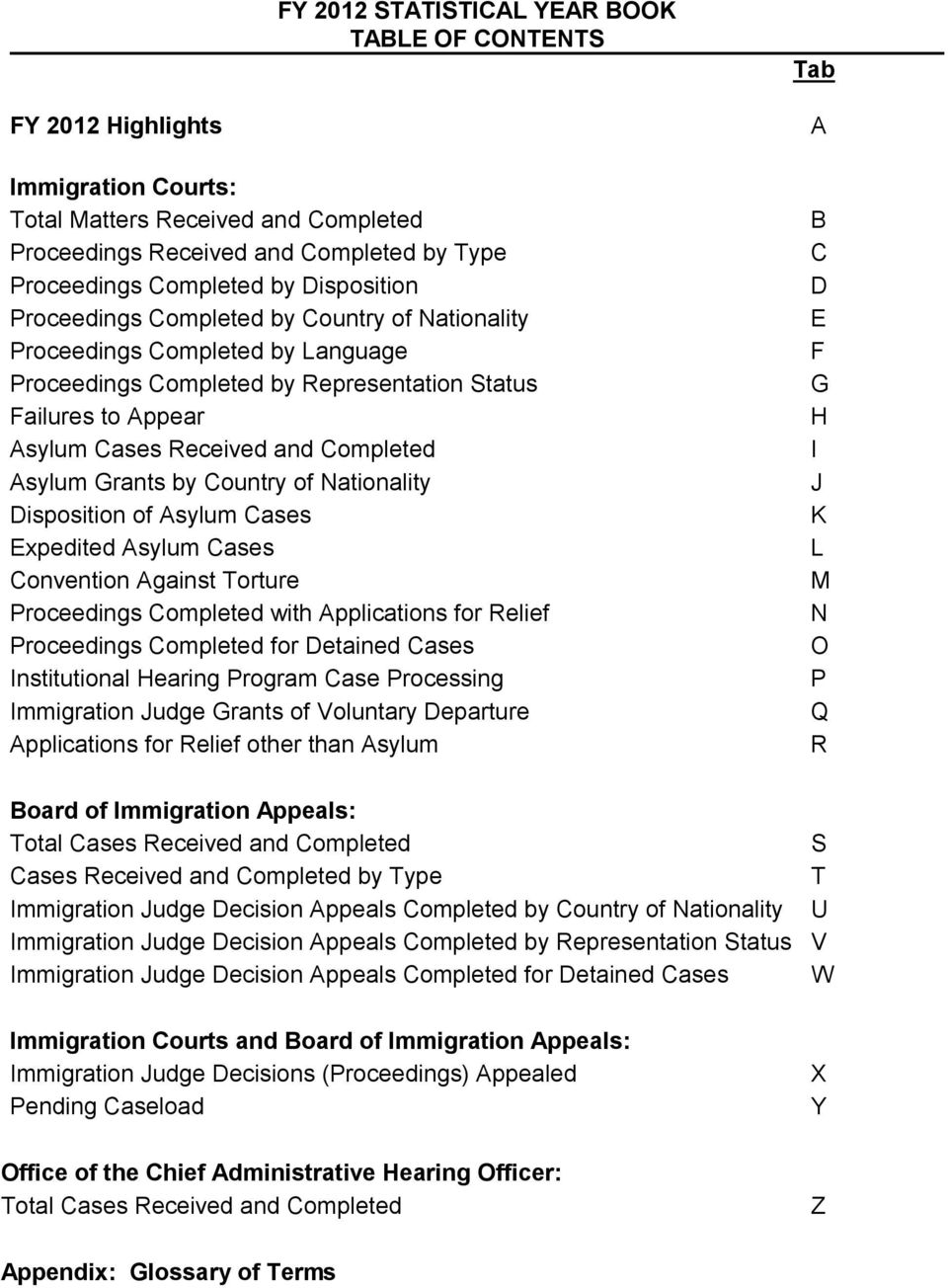
2 FY 2012 STATISTICAL YEAR BOOK TABLE OF CONTENTS Tab FY 2012 Highlights Immigration Courts: Total Matters Received and Completed Proceedings Received and Completed by Type Proceedings Completed by Disposition Proceedings Completed by Country of Nationality Proceedings Completed by Language Proceedings Completed by Representation Status Failures to Appear Asylum Cases Received and Completed Asylum Grants by Country of Nationality Disposition of Asylum Cases Expedited Asylum Cases Convention Against Torture Proceedings Completed with Applications for Relief Proceedings Completed for Detained Cases Institutional Hearing Program Case Processing Immigration Judge Grants of Voluntary Departure Applications for Relief other than Asylum A B C D E F G H I J K L M N O P Q R Board of Immigration Appeals: Total Cases Received and Completed S Cases Received and Completed by Type T Immigration Judge Decision Appeals Completed by Country of Nationality U Immigration Judge Decision Appeals Completed by Representation Status V Immigration Judge Decision Appeals Completed for Detained Cases W Immigration Courts and Board of Immigration Appeals: Immigration Judge Decisions (Proceedings) Appealed Pending Caseload Office of the Chief Administrative Hearing Officer: Total Cases Received and Completed X Y Z Appendix: Glossary of Terms
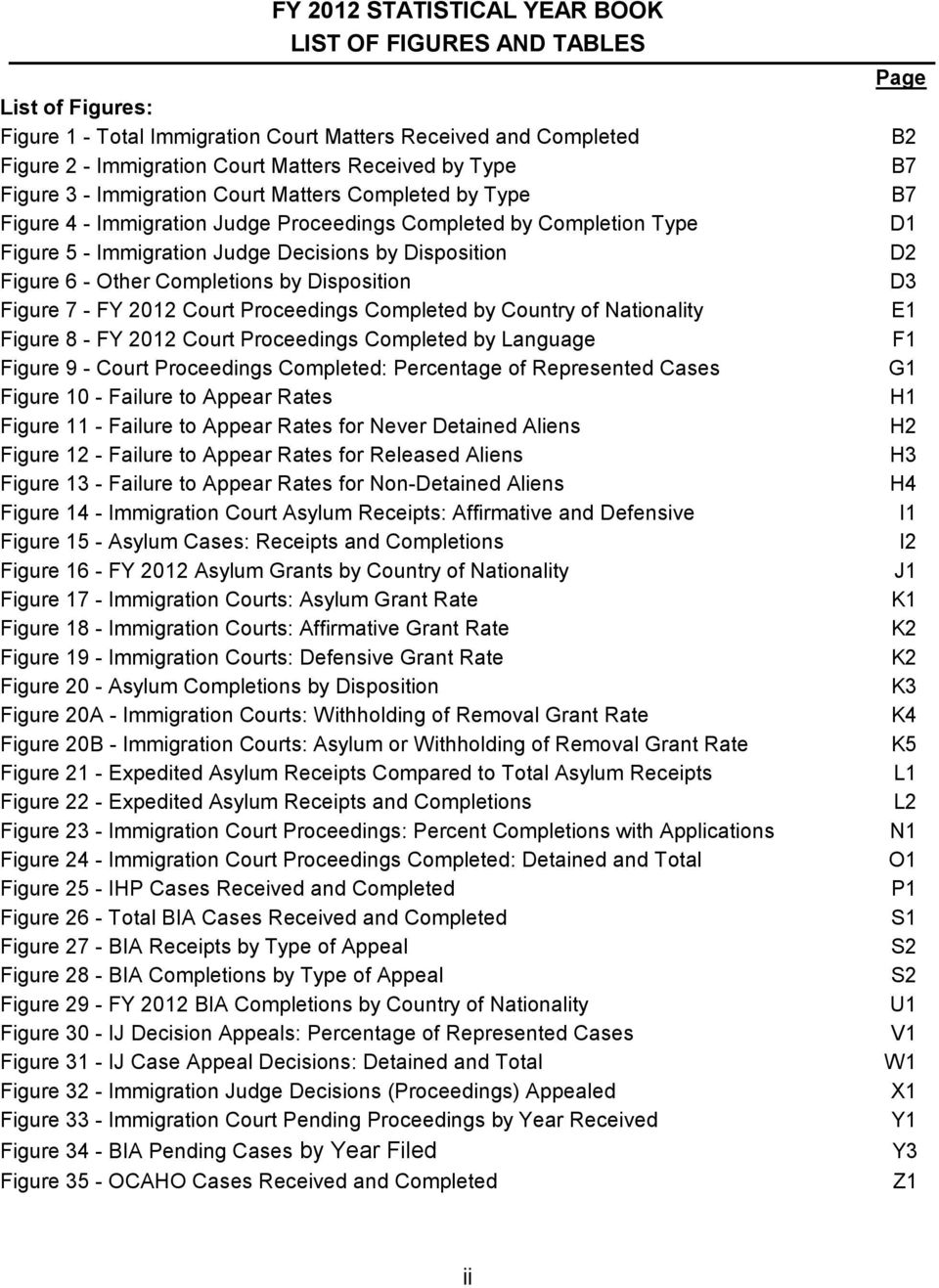
3 FY 2012 STATISTICAL YEAR BOOK LIST OF FIGURES AND TABLES List of Figures: Figure 1 - Total Immigration Court Matters Received and Completed Figure 2 - Immigration Court Matters Received by Type Figure 3 - Immigration Court Matters Completed by Type Figure 4 - Immigration Judge Proceedings Completed by Completion Type Figure 5 - Immigration Judge Decisions by Disposition Figure 6 - Other Completions by Disposition Figure 7 - FY 2012 Court Proceedings Completed by Country of Nationality Figure 8 - FY 2012 Court Proceedings Completed by Language Figure 9 - Court Proceedings Completed: Percentage of Represented Cases Figure 10 - Failure to Appear Rates Figure 11 - Failure to Appear Rates for Never Detained Aliens Figure 12 - Failure to Appear Rates for Released Aliens Figure 13 - Failure to Appear Rates for Non-Detained Aliens Figure 14 - Immigration Court Asylum Receipts: Affirmative and Defensive Figure 15 - Asylum Cases: Receipts and Completions Figure 16 - FY 2012 Asylum Grants by Country of Nationality Figure 17 - Immigration Courts: Asylum Grant Rate Figure 18 - Immigration Courts: Affirmative Grant Rate Figure 19 - Immigration Courts: Defensive Grant Rate Figure 20 - Asylum Completions by Disposition Figure 20A - Immigration Courts: Withholding of Removal Grant Rate Figure 20B - Immigration Courts: Asylum or Withholding of Removal Grant Rate Figure 21 - Expedited Asylum Receipts Compared to Total Asylum Receipts Figure 22 - Expedited Asylum Receipts and Completions Figure 23 - Immigration Court Proceedings: Percent Completions with Applications Figure 24 - Immigration Court Proceedings Completed: Detained and Total Figure 25 - IHP Cases Received and Completed Figure 26 - Total BIA Cases Received and Completed Figure 27 - BIA Receipts by Type of Appeal Figure 28 - BIA Completions by Type of Appeal Figure 29 - FY 2012 BIA Completions by Country of Nationality Figure 30 - IJ Decision Appeals: Percentage of Represented Cases Figure 31 - IJ Case Appeal Decisions: Detained and Total Figure 32 - Immigration Judge Decisions (Proceedings) Appealed Figure 33 - Immigration Court Pending Proceedings by Year Received Figure 34 - BIA Pending Cases by Year Filed Figure 35 - OCAHO Cases Received and Completed Page B2 B7 B7 D1 D2 D3 E1 F1 G1 H1 H2 H3 H4 I1 I2 J1 K1 K2 K2 K3 K4 K5 L1 L2 N1 O1 P1 S1 S2 S2 U1 V1 W1 X1 Y1 Y3 Z1 ii
4 FY 2012 STATISTICAL YEAR BOOK LIST OF FIGURES AND TABLES List of Tables: Table 1 - Total Immigration Court Matters Received by Court for FY 2011 and FY 2012 Table 1A - Total Immigration Court Receipts by Court and Type of Matter for FY 2012 Table 2 - Total Immigration Court Matters Completed by Court for FY 2011 and FY 2012 Table 2A - Total Immigration Court Completions by Court and Type of Matter for FY 2012 Table 3 - Immigration Court Proceedings Received by Case Type Table 4 - Immigration Court Proceedings Completed by Case Type Table 5 - Court Proceedings Completed by Country of Nationality: Top 25 Nationalities for FY 2008 B FY 2012 Table 6 - Court Proceedings Completed by Language: Top 25 Languages for FY 2008 B FY 2012 Table 7 - Asylum Receipts and Completions by Court for FY 2012 Table 8 - Asylum Grants By Country of Nationality: Top 25 Nationalities for FY 2008 B FY 2012 Table 9 - FY 2012 Asylum Grant Rate by Immigration Court Table 10 - FY 2012 Convention Against Torture Cases by Disposition Table 11 - FY 2012 Convention Against Torture Completions by Court Table 12 - FY 2012 Immigration Court Completions (Proceedings) With Applications for Relief Table 13 - FY 2012 Immigration Court Completions (Proceedings) for Detained Cases Table 14 - IHP Completions by Disposition Table 15 - IJ Removal Decisions Compared to Voluntary Departure Decisions Table 16 - Grants of Relief Table 17 - BIA Receipts by Type Table 18 - BIA Completions by Type Table 19 - IJ Decision Appeals Completed by Country of Nationality: Top 25 Nationalities for FY 2008 B FY 2012 Table 20 - Breakdown of BIA Detained Completions Table 21 - Immigration Court Pending Proceedings by Immigration Court Page B3 B4 B5 B6 C3 C4 E2 F2 I3 J2 K6 M1 M2 N2 O3 P2 Q1 R3 T2 T2 U2 W2 Y2 iii

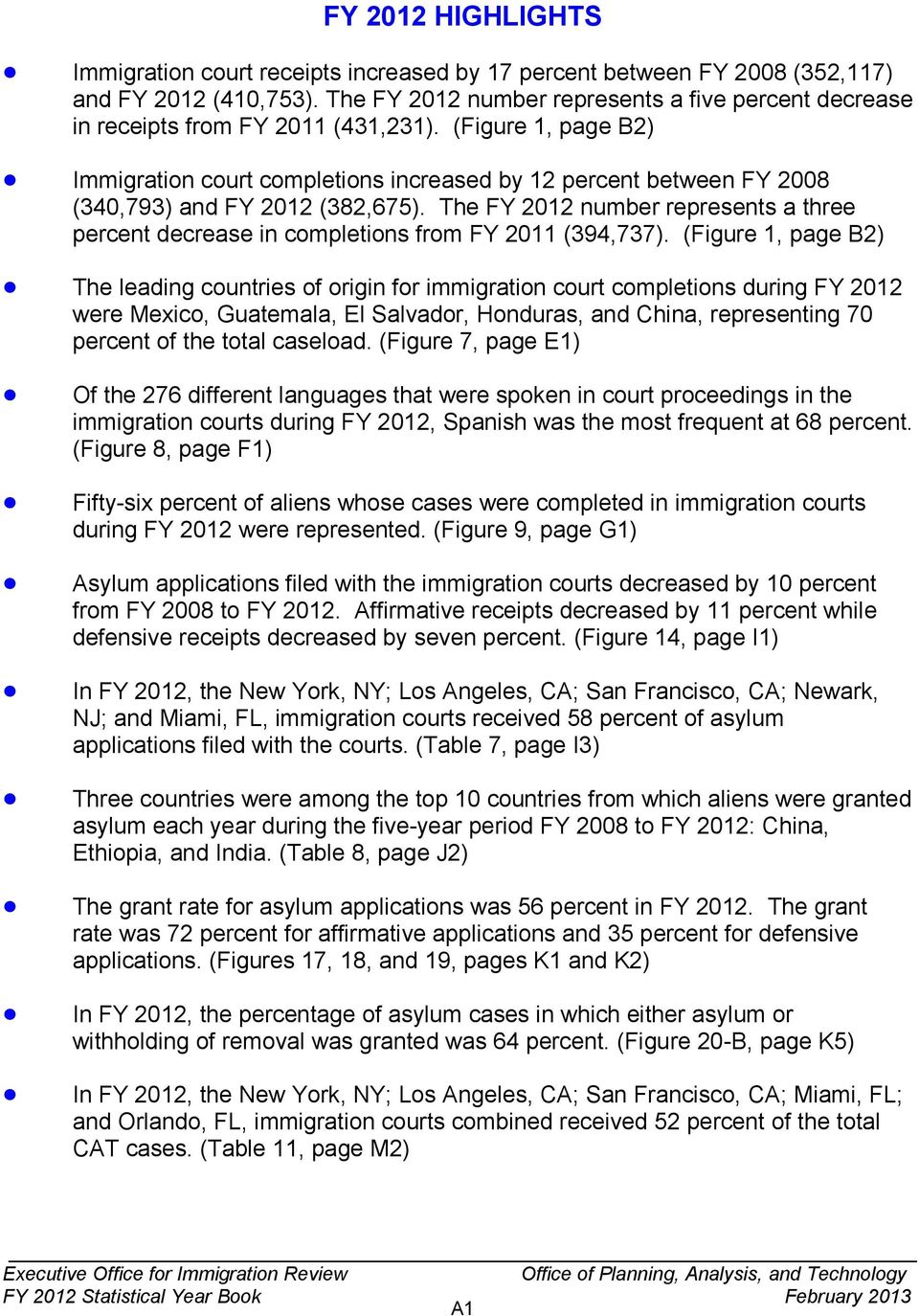
5 FY 2012 HIGHLIGHTS! Immigration court receipts increased by 17 percent between FY 2008 (352,117) and FY 2012 (410,753). The FY 2012 number represents a five percent decrease in receipts from FY 2011 (431,231). (Figure 1, page B2)! Immigration court completions increased by 12 percent between FY 2008 (340,793) and FY 2012 (382,675). The FY 2012 number represents a three percent decrease in completions from FY 2011 (394,737). (Figure 1, page B2)! The leading countries of origin for immigration court completions during FY 2012 were Mexico, Guatemala, El Salvador, Honduras, and China, representing 70 percent of the total caseload. (Figure 7, page E1)! Of the 276 different languages that were spoken in court proceedings in the immigration courts during FY 2012, Spanish was the most frequent at 68 percent. (Figure 8, page F1)! Fifty-six percent of aliens whose cases were completed in immigration courts during FY 2012 were represented. (Figure 9, page G1)! Asylum applications filed with the immigration courts decreased by 10 percent from FY 2008 to FY Affirmative receipts decreased by 11 percent while defensive receipts decreased by seven percent. (Figure 14, page I1)! In FY 2012, the New York, NY; Los Angeles, CA; San Francisco, CA; Newark, NJ; and Miami, FL, immigration courts received 58 percent of asylum applications filed with the courts. (Table 7, page I3)! Three countries were among the top 10 countries from which aliens were granted asylum each year during the five-year period FY 2008 to FY 2012: China, Ethiopia, and India. (Table 8, page J2)! The grant rate for asylum applications was 56 percent in FY The grant rate was 72 percent for affirmative applications and 35 percent for defensive applications. (Figures 17, 18, and 19, pages K1 and K2)! In FY 2012, the percentage of asylum cases in which either asylum or withholding of removal was granted was 64 percent. (Figure 20-B, page K5)! In FY 2012, the New York, NY; Los Angeles, CA; San Francisco, CA; Miami, FL; and Orlando, FL, immigration courts combined received 52 percent of the total CAT cases. (Table 11, page M2) FY 2012 Statistical Year Book A1 February 2013
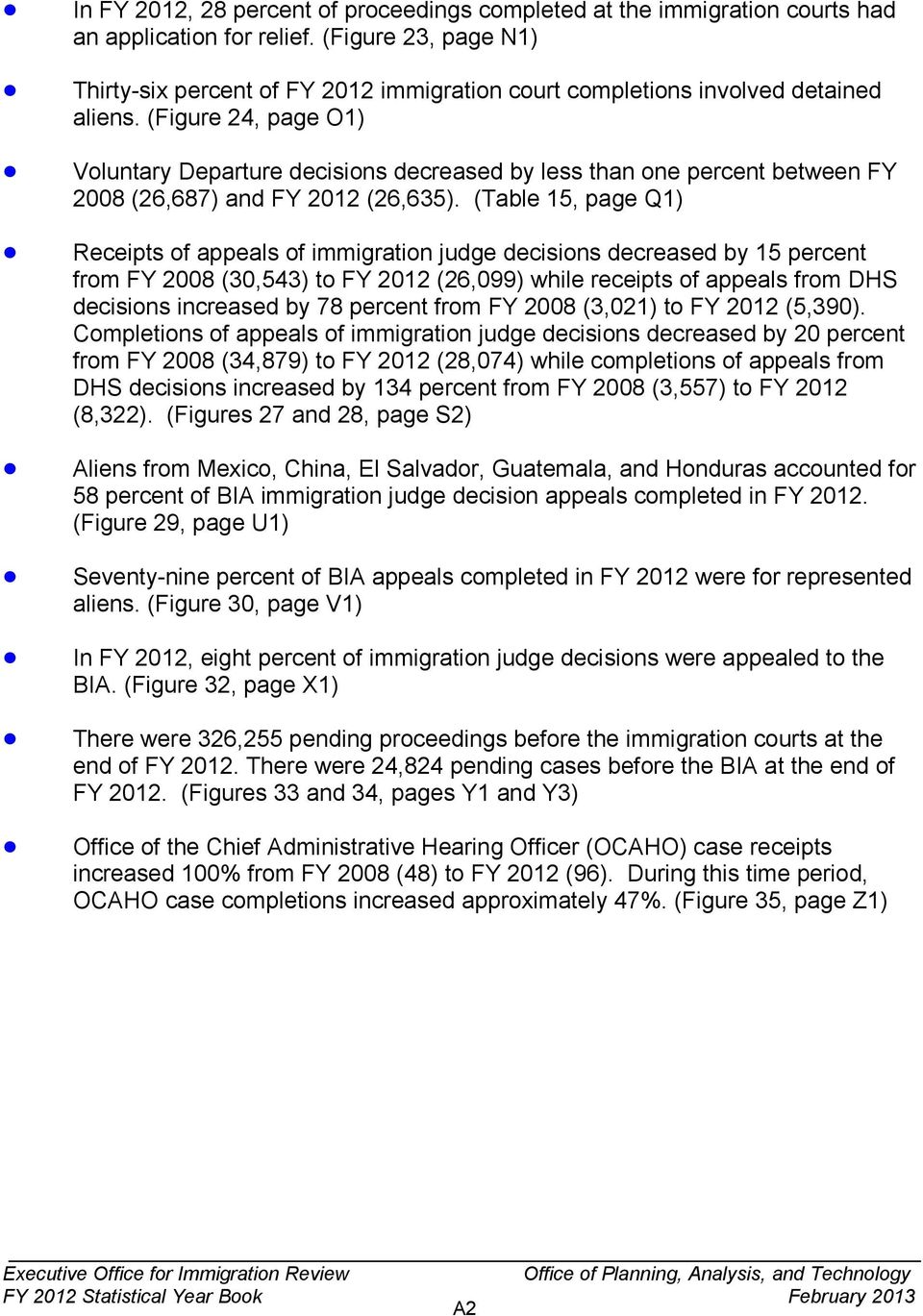
6 ! In FY 2012, 28 percent of proceedings completed at the immigration courts had an application for relief. (Figure 23, page N1)! Thirty-six percent of FY 2012 immigration court completions involved detained aliens. (Figure 24, page O1)! Voluntary Departure decisions decreased by less than one percent between FY 2008 (26,687) and FY 2012 (26,635). (Table 15, page Q1)! Receipts of appeals of immigration judge decisions decreased by 15 percent from FY 2008 (30,543) to FY 2012 (26,099) while receipts of appeals from DHS decisions increased by 78 percent from FY 2008 (3,021) to FY 2012 (5,390). Completions of appeals of immigration judge decisions decreased by 20 percent from FY 2008 (34,879) to FY 2012 (28,074) while completions of appeals from DHS decisions increased by 134 percent from FY 2008 (3,557) to FY 2012 (8,322). (Figures 27 and 28, page S2)! Aliens from Mexico, China, El Salvador, Guatemala, and Honduras accounted for 58 percent of BIA immigration judge decision appeals completed in FY (Figure 29, page U1)! Seventy-nine percent of BIA appeals completed in FY 2012 were for represented aliens. (Figure 30, page V1)! In FY 2012, eight percent of immigration judge decisions were appealed to the BIA. (Figure 32, page X1)! There were 326,255 pending proceedings before the immigration courts at the end of FY There were 24,824 pending cases before the BIA at the end of FY (Figures 33 and 34, pages Y1 and Y3)! Office of the Chief Administrative Hearing Officer (OCAHO) case receipts increased 100% from FY 2008 (48) to FY 2012 (96). During this time period, OCAHO case completions increased approximately 47%. (Figure 35, page Z1) FY 2012 Statistical Year Book A2 February 2013
7 Immigration Courts: Total Matters Received and Completed An alien charged by the Department of Homeland Security (DHS) with a violation of immigration law is issued a charging document. The most common charging documents are the Notice to Appear (NTA) and the Notice of Referral to Immigration Judge. When the charging document is filed by DHS with the immigration court, jurisdiction over the case transfers from DHS to the Executive Office for Immigration Review (EOIR), which has oversight over the immigration courts located throughout the United States. Once an alien has been ordered removed by EOIR, DHS is responsible for his or her removal. EOIR does not maintain statistics on alien removals from the United States. During court proceedings, aliens appear before an immigration judge and either contest or concede the charges against them. In some instances, the immigration judge adjourns the case and sets a continuance date; for example, the judge may allow the alien time to obtain representation or to file an application for relief. After hearing a case, the immigration judge renders a decision. The immigration judge may order the alien removed, or may grant relief such as cancellation of removal, asylum, adjustment of status, etc. If the immigration judge decides that removability has not been established by DHS, he or she may terminate the proceedings. In addition to proceedings, immigration judges consider other matters such as bonds and motions. Bond redetermination hearings are held when an alien in custody seeks release on his or her own recognizance, or seeks a reduction in the amount of bond. In some cases, bond redetermination hearings are held before EOIR receives the charging document from DHS. During bond redetermination hearings, the judge may decide to lower, raise, maintain, or eliminate the bond amount set by DHS, or to change bond conditions. Either the alien or DHS may request by motion that a case previously heard by an immigration judge be reopened or reconsidered. Generally, aliens or DHS file motions to reopen or reconsider because of changed circumstances. For the purposes of this Year Book, the term immigration court matters includes proceedings (deportation, exclusion, removal, credible fear, reasonable fear, claimed status, asylum only, rescission, continued detention review, Nicaraguan Adjustment and Central American Relief Act (NACARA), and withholding only), bond redeterminations, and motions to reopen or reconsider. Receipts are defined as the total number of proceedings, bond redeterminations, and motions to reopen or reconsider received by the immigration courts during the reporting period. Completions include immigration judge decisions on proceedings, bond redeterminations, motions, and other completions such as administrative closings, transfers, and changes of venue. B1 FY 2012 Statistical Year Book February 2013
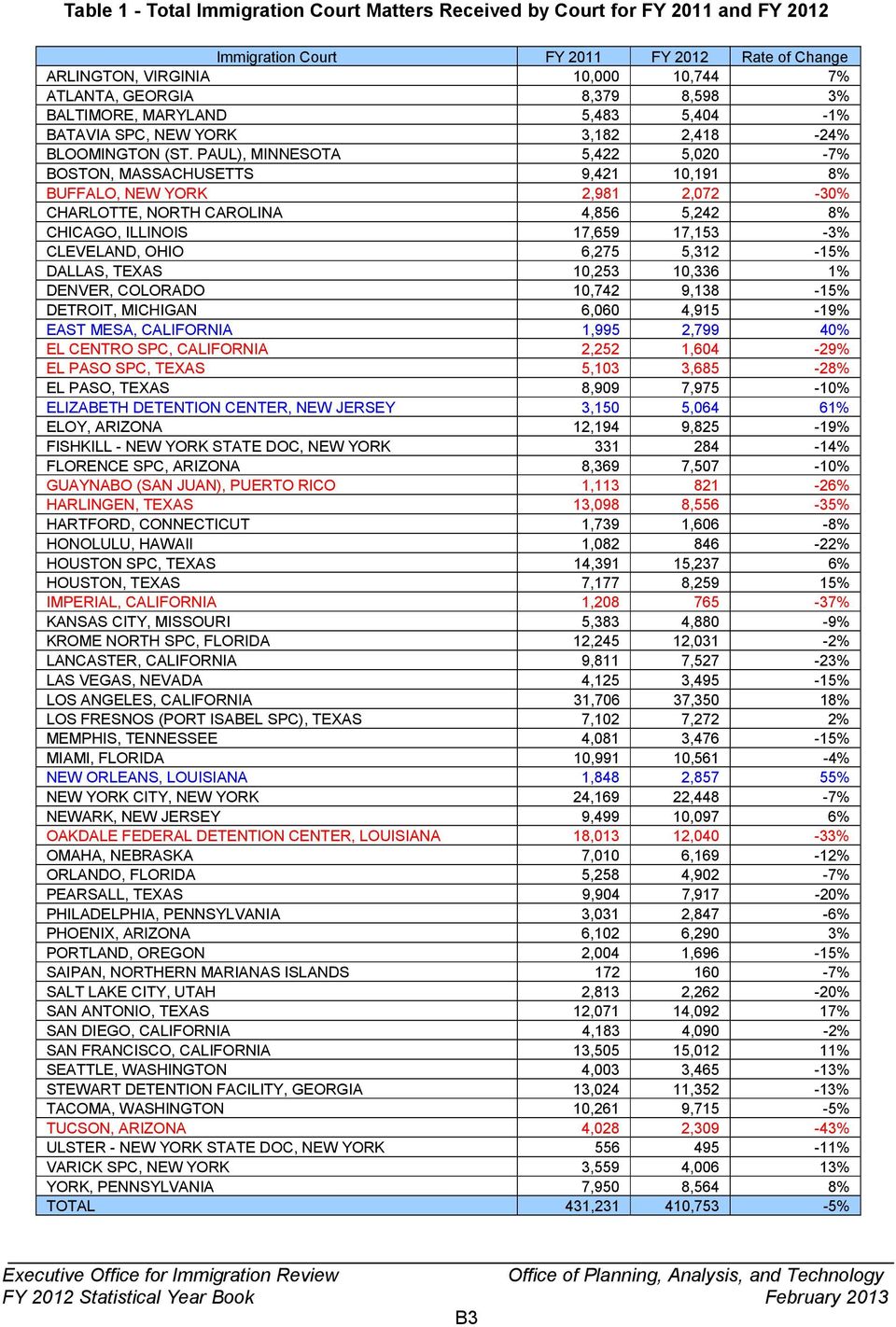
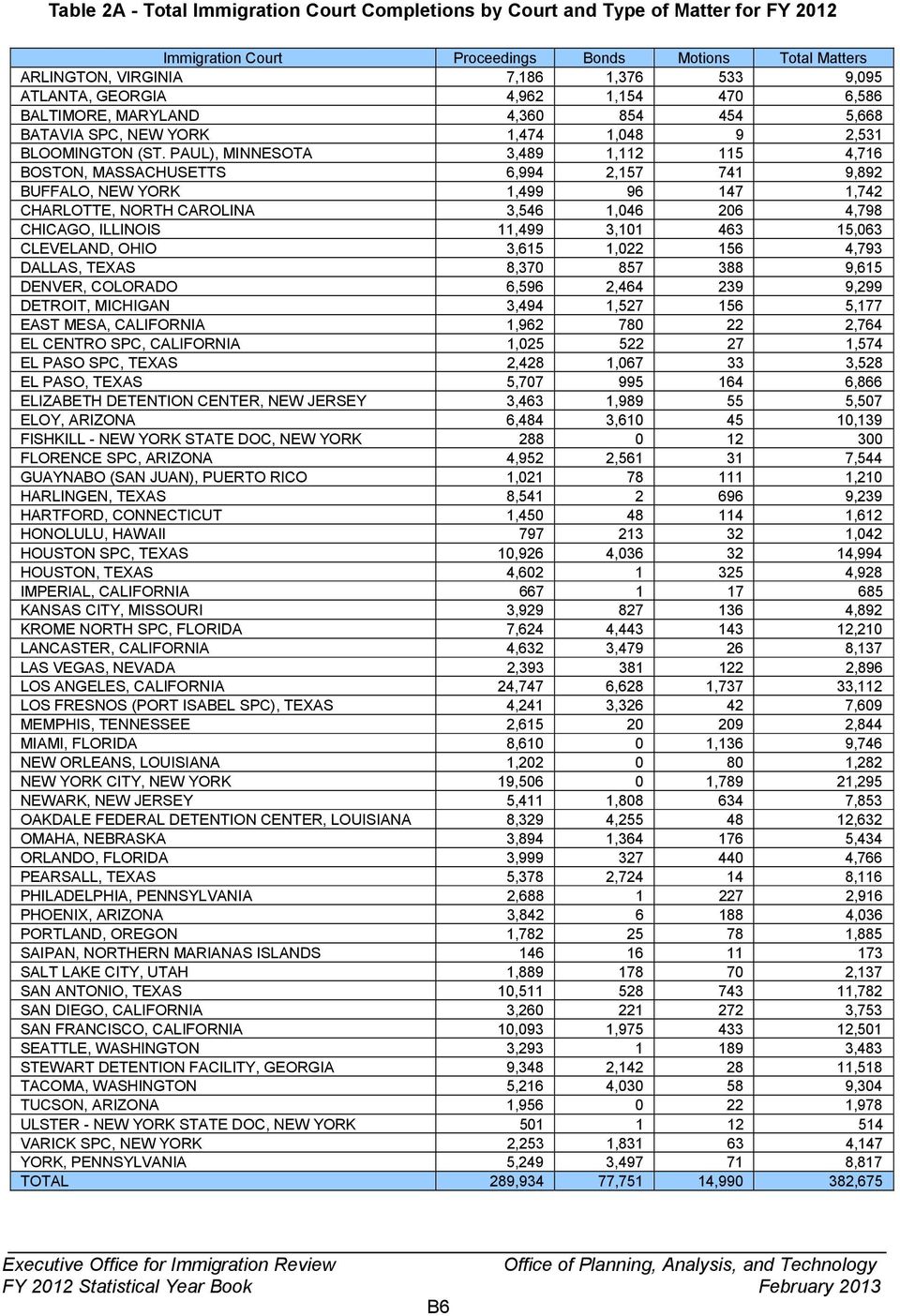
8 Figure 1 440, , , , , , ,000 Total Immigration Court Matters Received and Completed FY 08 FY 09 FY 10 FY 11 FY 12 Total Immigration Court Matters Receipts Completions FY , ,793 FY , ,482 FY , ,363 FY , ,737 FY , ,675 Receipts Completions As shown in Figure 1 above, the number of matters received by the immigration courts increased by 17 percent between FY 2008 and FY Immigration court matters completed increased by 12 percent from FY 2008 to FY While some courts showed increases in receipts over FY 2011 levels, others showed decreases. In Table 1, on the following page, courts with increases of 25 percent or more are highlighted in blue and courts with decreases of 25 percent or more are highlighted in red. The immigration court in Elizabeth, NJ, showed the largest percentage increase in receipts at 61 percent. The immigration court in Tucson, AZ, showed the largest percentage decrease, down 43 percent. Table 1A identifies receipts for FY 2012 by type of matter. Table 2 provides a comparison of FY 2011 and FY 2012 completions by immigration court. Courts with increases in completions of 25 percent or more are highlighted in blue, and those with decreases of 25 percent or more are highlighted in red. Elizabeth, NJ, showed the largest percentage increase at 90 percent. Tucson, AZ, showed the largest percentage decrease at 47 percent. Table 2A identifies completions for FY 2012 by type of matter. FY 2012 Statistical Year Book February 2013 B2

9 Table 1 - Total Immigration Court Matters Received by Court for FY 2011 and FY 2012 Immigration Court FY 2011 FY 2012 Rate of Change ARLINGTON, VIRGINIA 10,000 10,744 7% ATLANTA, GEORGIA 8,379 8,598 3% BALTIMORE, MARYLAND 5,483 5,404-1% BATAVIA SPC, NEW YORK 3,182 2,418-24% BLOOMINGTON (ST. PAUL), MINNESOTA 5,422 5,020-7% BOSTON, MASSACHUSETTS 9,421 10,191 8% BUFFALO, NEW YORK 2,981 2,072-30% CHARLOTTE, NORTH CAROLINA 4,856 5,242 8% CHICAGO, ILLINOIS 17,659 17,153-3% CLEVELAND, OHIO 6,275 5,312-15% DALLAS, TEXAS 10,253 10,336 1% DENVER, COLORADO 10,742 9,138-15% DETROIT, MICHIGAN 6,060 4,915-19% EAST MESA, CALIFORNIA 1,995 2,799 40% EL CENTRO SPC, CALIFORNIA 2,252 1,604-29% EL PASO SPC, TEXAS 5,103 3,685-28% EL PASO, TEXAS 8,909 7,975-10% ELIZABETH DETENTION CENTER, NEW JERSEY 3,150 5,064 61% ELOY, ARIZONA 12,194 9,825-19% FISHKILL - NEW YORK STATE DOC, NEW YORK % FLORENCE SPC, ARIZONA 8,369 7,507-10% GUAYNABO (SAN JUAN), PUERTO RICO 1, % HARLINGEN, TEXAS 13,098 8,556-35% HARTFORD, CONNECTICUT 1,739 1,606-8% HONOLULU, HAWAII 1, % HOUSTON SPC, TEXAS 14,391 15,237 6% HOUSTON, TEXAS 7,177 8,259 15% IMPERIAL, CALIFORNIA 1, % KANSAS CITY, MISSOURI 5,383 4,880-9% KROME NORTH SPC, FLORIDA 12,245 12,031-2% LANCASTER, CALIFORNIA 9,811 7,527-23% LAS VEGAS, NEVADA 4,125 3,495-15% LOS ANGELES, CALIFORNIA 31,706 37,350 18% LOS FRESNOS (PORT ISABEL SPC), TEXAS 7,102 7,272 2% MEMPHIS, TENNESSEE 4,081 3,476-15% MIAMI, FLORIDA 10,991 10,561-4% NEW ORLEANS, LOUISIANA 1,848 2,857 55% NEW YORK CITY, NEW YORK 24,169 22,448-7% NEWARK, NEW JERSEY 9,499 10,097 6% OAKDALE FEDERAL DETENTION CENTER, LOUISIANA 18,013 12,040-33% OMAHA, NEBRASKA 7,010 6,169-12% ORLANDO, FLORIDA 5,258 4,902-7% PEARSALL, TEXAS 9,904 7,917-20% PHILADELPHIA, PENNSYLVANIA 3,031 2,847-6% PHOENIX, ARIZONA 6,102 6,290 3% PORTLAND, OREGON 2,004 1,696-15% SAIPAN, NORTHERN MARIANAS ISLANDS % SALT LAKE CITY, UTAH 2,813 2,262-20% SAN ANTONIO, TEXAS 12,071 14,092 17% SAN DIEGO, CALIFORNIA 4,183 4,090-2% SAN FRANCISCO, CALIFORNIA 13,505 15,012 11% SEATTLE, WASHINGTON 4,003 3,465-13% STEWART DETENTION FACILITY, GEORGIA 13,024 11,352-13% TACOMA, WASHINGTON 10,261 9,715-5% TUCSON, ARIZONA 4,028 2,309-43% ULSTER - NEW YORK STATE DOC, NEW YORK % VARICK SPC, NEW YORK 3,559 4,006 13% YORK, PENNSYLVANIA 7,950 8,564 8% TOTAL 431, ,753-5% FY 2012 Statistical Year Book February 2013 B3
10 Table 1A - Total Immigration Court Receipts by Court and Type of Matter for FY 2012 Immigration Court Proceedings Bonds Motions Total Matters ARLINGTON, VIRGINIA 8,717 1, ,744 ATLANTA, GEORGIA 6,987 1, ,598 BALTIMORE, MARYLAND 4, ,404 BATAVIA SPC, NEW YORK 1,395 1, ,418 BLOOMINGTON (ST. PAUL), MINNESOTA 3,744 1, ,020 BOSTON, MASSACHUSETTS 7,288 2, ,191 BUFFALO, NEW YORK 1, ,072 CHARLOTTE, NORTH CAROLINA 3,996 1, ,242 CHICAGO, ILLINOIS 13,584 3, ,153 CLEVELAND, OHIO 4,105 1, ,312 DALLAS, TEXAS 9, ,336 DENVER, COLORADO 6,424 2, ,138 DETROIT, MICHIGAN 3,270 1, ,915 EAST MESA, CALIFORNIA 1, ,799 EL CENTRO SPC, CALIFORNIA 1, ,604 EL PASO SPC, TEXAS 2,539 1, ,685 EL PASO, TEXAS 6,798 1, ,975 ELIZABETH DETENTION CENTER, NEW JERSEY 2,963 2, ,064 ELOY, ARIZONA 6,312 3, ,825 FISHKILL - NEW YORK STATE DOC, NEW YORK FLORENCE SPC, ARIZONA 4,900 2, ,507 GUAYNABO (SAN JUAN), PUERTO RICO HARLINGEN, TEXAS 7, ,556 HARTFORD, CONNECTICUT 1, ,606 HONOLULU, HAWAII HOUSTON SPC, TEXAS 11,093 4, ,237 HOUSTON, TEXAS 7, ,259 IMPERIAL, CALIFORNIA KANSAS CITY, MISSOURI 3, ,880 KROME NORTH SPC, FLORIDA 7,403 4, ,031 LANCASTER, CALIFORNIA 4,195 3, ,527 LAS VEGAS, NEVADA 2, ,495 LOS ANGELES, CALIFORNIA 28,997 6,641 1,712 37,350 LOS FRESNOS (PORT ISABEL SPC), TEXAS 3,983 3, ,272 MEMPHIS, TENNESSEE 3, ,476 MIAMI, FLORIDA 9, ,108 10,561 NEW ORLEANS, LOUISIANA 2, ,857 NEW YORK CITY, NEW YORK 20, ,744 22,448 NEWARK, NEW JERSEY 7,650 1, ,097 OAKDALE FEDERAL DETENTION CENTER, LOUISIANA 7,744 4, ,040 OMAHA, NEBRASKA 4,555 1, ,169 ORLANDO, FLORIDA 4, ,902 PEARSALL, TEXAS 5,179 2, ,917 PHILADELPHIA, PENNSYLVANIA 2, ,847 PHOENIX, ARIZONA 6, ,290 PORTLAND, OREGON 1, ,696 SAIPAN, NORTHERN MARIANAS ISLANDS SALT LAKE CITY, UTAH 2, ,262 SAN ANTONIO, TEXAS 12, ,092 SAN DIEGO, CALIFORNIA 3, ,090 SAN FRANCISCO, CALIFORNIA 12,563 2, ,012 SEATTLE, WASHINGTON 3, ,465 STEWART DETENTION FACILITY, GEORGIA 9,169 2, ,352 TACOMA, WASHINGTON 5,440 4, ,715 TUCSON, ARIZONA 2, ,309 ULSTER - NEW YORK STATE DOC, NEW YORK VARICK SPC, NEW YORK 2,150 1, ,006 YORK, PENNSYLVANIA 5,129 3, ,564 TOTAL 317,930 78,065 14, ,753 FY 2012 Statistical Year Book February 2013 B4

11 Table 2 - Total Immigration Court Matters Completed by Court for FY 2011 and FY 2012 Immigration Court FY 2011 FY 2012 Rate of Change ARLINGTON, VIRGINIA 9,398 9,095-3% ATLANTA, GEORGIA 7,811 6,586-16% BALTIMORE, MARYLAND 5,960 5,668-5% BATAVIA SPC, NEW YORK 3,191 2,531-21% BLOOMINGTON (ST. PAUL), MINNESOTA 5,003 4,716-6% BOSTON, MASSACHUSETTS 8,873 9,892 11% BUFFALO, NEW YORK 2,634 1,742-34% CHARLOTTE, NORTH CAROLINA 4,626 4,798 4% CHICAGO, ILLINOIS 14,207 15,063 6% CLEVELAND, OHIO 6,097 4,793-21% DALLAS, TEXAS9,563 9,615 1% DENVER, COLORADO 9,917 9,299-6% DETROIT, MICHIGAN 5,712 5,177-9% EAST MESA, CALIFORNIA 1,846 2,764 50% EL CENTRO SPC, CALIFORNIA 2,310 1,574-32% EL PASO SPC, TEXAS 5,590 3,528-37% EL PASO, TEXAS 7,396 6,866-7% ELIZABETH SPC, NEW JERSEY 2,895 5,507 90% ELOY, ARIZONA 11,988 10,139-15% FISHKILL - NEW YORK STATE DOC, NEW YORK % FLORENCE SPC, ARIZONA 8,175 7,544-8% GUAYNABO (SAN JUAN), PUERTO RICO 1,380 1,210-12% HARLINGEN, TEXAS 12,955 9,239-29% HARTFORD, CONNECTICUT 1,719 1,612-6% HONOLULU, HAWAII 1,283 1,042-19% HOUSTON SPC, TEXAS 14,421 14,994 4% HOUSTON, TEXAS 4,502 4,928 9% IMPERIAL, CALIFORNIA % KANSAS CITY, MISSOURI 5,343 4,892-8% KROME NORTH SPC, FLORIDA 11,937 12,210 2% LANCASTER, CALIFORNIA 9,634 8,137-16% LAS VEGAS, NEVADA 3,310 2,896-13% LOS ANGELES, CALIFORNIA 26,458 33,112 25% LOS FRESNOS (PORT ISABEL SPC), TEXAS 6,750 7,609 13% MEMPHIS, TENNESSEE 3,113 2,844-9% MIAMI, FLORIDA 11,242 9,746-13% NEW ORLEANS, LOUISIANA 956 1,282 34% NEW YORK CITY, NEW YORK 20,305 21,295 5% NEWARK, NEW JERSEY 7,873 7,853 0% OAKDALE FEDERAL DETENTION CENTER, LOUISIANA 18,030 12,632-30% OMAHA, NEBRASKA 5,815 5,434-7% ORLANDO, FLORIDA 5,294 4,766-10% PEARSALL, TEXAS 10,085 8,116-20% PHILADELPHIA, PENNSYLVANIA 2,861 2,916 2% PHOENIX, ARIZONA 3,548 4,036 14% PORTLAND, OREGON 1,348 1,885 40% SAIPAN, NORTHERN MARIANAS ISLANDS % SALT LAKE CITY, UTAH 2,877 2,137-26% SAN ANTONIO, TEXAS 9,757 11,782 21% SAN DIEGO, CALIFORNIA 3,400 3,753 10% SAN FRANCISCO, CALIFORNIA 11,592 12,501 8% SEATTLE, WASHINGTON 3,259 3,483 7% STEWART DETENTION FACILITY, GEORGIA 13,086 11,518-12% TACOMA, WASHINGTON 10,013 9,304-7% TUCSON, ARIZONA 3,708 1,978-47% ULSTER - NEW YORK STATE DOC, NEW YORK % VARICK SPC, NEW YORK 3,757 4,147 10% YORK, PENNSYLVANIA 7,969 8,817 11% TOTAL 394, ,675-3% FY 2012 Statistical Year Book February 2013 B5

12 Table 2A - Total Immigration Court Completions by Court and Type of Matter for FY 2012 Immigration Court Proceedings Bonds Motions Total Matters ARLINGTON, VIRGINIA 7,186 1, ,095 ATLANTA, GEORGIA 4,962 1, ,586 BALTIMORE, MARYLAND 4, ,668 BATAVIA SPC, NEW YORK 1,474 1, ,531 BLOOMINGTON (ST. PAUL), MINNESOTA 3,489 1, ,716 BOSTON, MASSACHUSETTS 6,994 2, ,892 BUFFALO, NEW YORK 1, ,742 CHARLOTTE, NORTH CAROLINA 3,546 1, ,798 CHICAGO, ILLINOIS 11,499 3, ,063 CLEVELAND, OHIO 3,615 1, ,793 DALLAS, TEXAS 8, ,615 DENVER, COLORADO 6,596 2, ,299 DETROIT, MICHIGAN 3,494 1, ,177 EAST MESA, CALIFORNIA 1, ,764 EL CENTRO SPC, CALIFORNIA 1, ,574 EL PASO SPC, TEXAS 2,428 1, ,528 EL PASO, TEXAS 5, ,866 ELIZABETH DETENTION CENTER, NEW JERSEY 3,463 1, ,507 ELOY, ARIZONA 6,484 3, ,139 FISHKILL - NEW YORK STATE DOC, NEW YORK FLORENCE SPC, ARIZONA 4,952 2, ,544 GUAYNABO (SAN JUAN), PUERTO RICO 1, ,210 HARLINGEN, TEXAS 8, ,239 HARTFORD, CONNECTICUT 1, ,612 HONOLULU, HAWAII ,042 HOUSTON SPC, TEXAS 10,926 4, ,994 HOUSTON, TEXAS 4, ,928 IMPERIAL, CALIFORNIA KANSAS CITY, MISSOURI 3, ,892 KROME NORTH SPC, FLORIDA 7,624 4, ,210 LANCASTER, CALIFORNIA 4,632 3, ,137 LAS VEGAS, NEVADA 2, ,896 LOS ANGELES, CALIFORNIA 24,747 6,628 1,737 33,112 LOS FRESNOS (PORT ISABEL SPC), TEXAS 4,241 3, ,609 MEMPHIS, TENNESSEE 2, ,844 MIAMI, FLORIDA 8, ,136 9,746 NEW ORLEANS, LOUISIANA 1, ,282 NEW YORK CITY, NEW YORK 19, ,789 21,295 NEWARK, NEW JERSEY 5,411 1, ,853 OAKDALE FEDERAL DETENTION CENTER, LOUISIANA 8,329 4, ,632 OMAHA, NEBRASKA 3,894 1, ,434 ORLANDO, FLORIDA 3, ,766 PEARSALL, TEXAS 5,378 2, ,116 PHILADELPHIA, PENNSYLVANIA 2, ,916 PHOENIX, ARIZONA 3, ,036 PORTLAND, OREGON 1, ,885 SAIPAN, NORTHERN MARIANAS ISLANDS SALT LAKE CITY, UTAH 1, ,137 SAN ANTONIO, TEXAS 10, ,782 SAN DIEGO, CALIFORNIA 3, ,753 SAN FRANCISCO, CALIFORNIA 10,093 1, ,501 SEATTLE, WASHINGTON 3, ,483 STEWART DETENTION FACILITY, GEORGIA 9,348 2, ,518 TACOMA, WASHINGTON 5,216 4, ,304 TUCSON, ARIZONA 1, ,978 ULSTER - NEW YORK STATE DOC, NEW YORK VARICK SPC, NEW YORK 2,253 1, ,147 YORK, PENNSYLVANIA 5,249 3, ,817 TOTAL 289,934 77,751 14, ,675 FY 2012 Statistical Year Book February 2013 B6
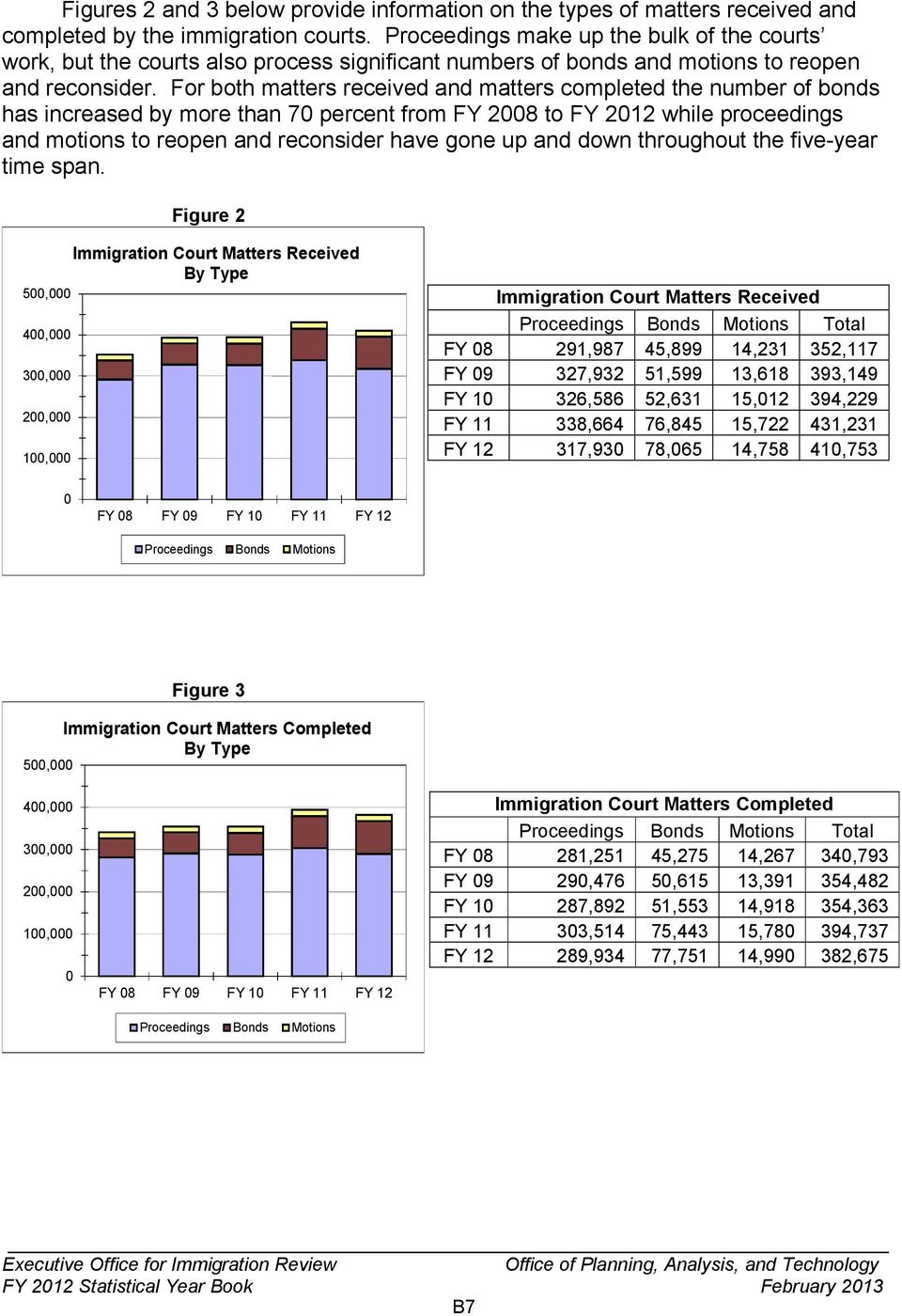
13 Figures 2 and 3 below provide information on the types of matters received and completed by the immigration courts. Proceedings make up the bulk of the courts work, but the courts also process significant numbers of bonds and motions to reopen and reconsider. For both matters received and matters completed the number of bonds has increased by more than 70 percent from FY 2008 to FY 2012 while proceedings and motions to reopen and reconsider have gone up and down throughout the five-year time span. Figure 2 500, , , , ,000 Immigration Court Matters Received By Type Immigration Court Matters Received Proceedings Bonds Motions Total FY ,987 45,899 14, ,117 FY ,932 51,599 13, ,149 FY ,586 52,631 15, ,229 FY ,664 76,845 15, ,231 FY ,930 78,065 14, ,753 0 FY 08 FY 09 FY 10 FY 11 FY 12 Proceedings Bonds Motions Figure 3 Immigration Court Matters Completed By Type 500, , , , ,000 0 FY 08 FY 09 FY 10 FY 11 FY 12 Proceedings Bonds Motions Immigration Court Matters Completed Proceedings Bonds Motions Total FY ,251 45,275 14, ,793 FY ,476 50,615 13, ,482 FY ,892 51,553 14, ,363 FY ,514 75,443 15, ,737 FY ,934 77,751 14, ,675 FY 2012 Statistical Year Book February 2013 B7
14 Immigration Courts: Proceedings Received and Completed by Type This section of the Statistical Year Book provides further details on proceedings by type. As noted in Tab B, proceedings, motions, and bond redeterminations make up the various types of matters considered by the immigration courts. Until April 1, 1997, the two major types of proceedings conducted by immigration courts were exclusion proceedings and deportation proceedings. Individuals charged by the former Immigration and Naturalization Service (INS) (now reorganized under DHS) as excludable were placed in exclusion proceedings. Exclusion cases generally involved a person who tried to enter the United States, but was stopped at the point of entry because INS found the person to be inadmissible. Deportation cases usually arose when INS alleged that an alien had entered the country illegally, or had entered legally, but then violated one or more conditions of his or her visa. Provisions of the Illegal Immigration Reform and Immigrant Responsibility Act of 1996 (IIRIRA), which became effective on April 1, 1997, established five new types of proceedings: $ Removal Proceedings. Removal proceedings replaced the formerly separate deportation and exclusion proceedings. $ Credible Fear Review. Arriving aliens with no documents or fraudulent documents are subject to expedited removal by DHS. If an arriving alien who is subject to the expedited removal provisions expresses either an intention to apply for asylum or a fear of returning to the country of removal, the alien is referred for a credible fear interview by a DHS asylum officer. Aliens found by the asylum officer not to have a credible fear of persecution may request a review by an immigration judge. If the judge determines there is credible fear, the judge will vacate the DHS order of expedited removal, and the alien will be placed in removal proceedings. $ Reasonable Fear Review. DHS has the authority to order the administrative removal of certain aggravated felons, and to reinstate orders of removal for aliens previously removed. If an alien who has been ordered administratively removed, or whose prior order of removal has been reinstated expresses a fear of returning to the country of removal, a DHS asylum officer makes a reasonable fear determination. Aliens found by the asylum officer not to have a reasonable fear of persecution may request a review by an immigration judge. If the judge determines there is reasonable fear, the alien will be placed in withholding only proceedings. FY 2012 Statistical Year Book C1 February 2013

15 Claimed Status Review. If an alien in expedited removal proceedings before DHS claims to be a U.S. citizen, to have been lawfully admitted for permanent residence, to have been admitted as a refugee, or to have been granted asylum, and DHS determines that the alien has no such claim, he or she can obtain a review of that claim by an immigration judge. $ Asylum Only. An asylum only case is initiated when an arriving crewman or stowaway is not eligible to apply for admission into the United States, but wants to request asylum. These proceedings also cover Visa Waiver Program beneficiaries, witness informants referred for proceedings, and individuals ordered removed from the United States on security grounds. Additional types of proceedings include: $ Rescission. DHS issues a Notice of Intent to Rescind an individual s permanent resident status, and the individual has the right to contest the charge before an immigration judge. $ Continued Detention Review. In response to a United States Supreme Court decision in Zadvydas v. Davis, a new type of proceeding was established regarding the continued detention of aliens who are subject to final orders of removal. In these cases the alien has already been ordered removed, but DHS is unable to effect the removal (e.g., lack of a travel document, no diplomatic relations with the receiving country, etc.). The only issue for the immigration judge to decide in continued detention review cases is whether or not the alien should remain in custody. $ NACARA. Certain aliens may apply for suspension of deportation or cancellation of removal under section 203 of the Nicaraguan Adjustment and Central American Relief Act (NACARA). $ Withholding Only. A withholding only hearing is initiated when the following conditions have been met: A previous removal/deportation/exclusion order has been reinstated by DHS or the alien has been ordered removed (administratively) by DHS (based upon a conviction for an aggravated felony) and the alien expresses a fear of persecution or torture if returned to the country of removal and that claim is reviewed by an asylum officer, and An asylum officer has concluded that the alien has a reasonable fear of persecution or torture or an immigration judge conducted a reasonable fear review proceeding and found that reasonable fear of persecution or torture exists, or An alien who is an applicant for admission to Guam or the Commonwealth of the Northern Mariana Islands (CNMI) under the FY 2012 Statistical Year Book February 2013 C2

16 Guam-CNMI Visa Waiver Program under section 212(i) of the Immigration and Nationality Act or who was admitted to Guam or the CNMI under the Guam-CNMI Visa Waiver Program and has violated their conditions of admission is subject to withholding only proceedings prior to January 1, Table 3 shows all types of proceedings received by the immigration courts between FY 2008 and FY Table 3 - Immigration Court Proceedings Received by Case Type Type of Proceeding FY 2008 FY 2009 FY 2010 FY 2011 FY 2012 Deportation 4,180 3,585 3,591 3,589 3,305 Exclusion Removal 285, , , , ,455 Credible Fear , Reasonable Fear Claimed Status Asylum Only Rescission Continued Detention Review NACARA Withholding Only ,454 1,763 Total 291, , , , ,930 FY 2012 Statistical Year Book February 2013 C3

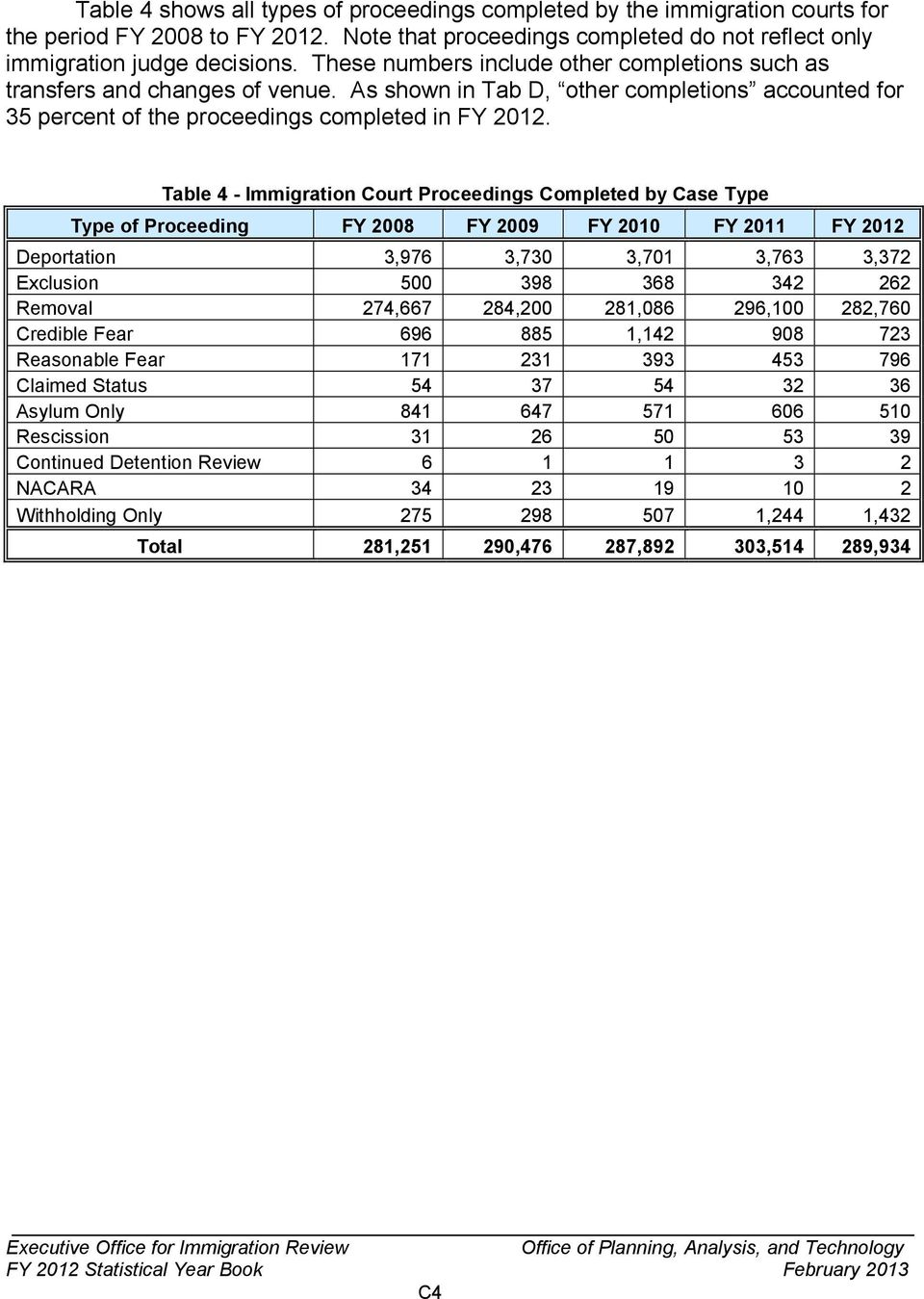
17 Table 4 shows all types of proceedings completed by the immigration courts for the period FY 2008 to FY Note that proceedings completed do not reflect only immigration judge decisions. These numbers include other completions such as transfers and changes of venue. As shown in Tab D, other completions accounted for 35 percent of the proceedings completed in FY Table 4 - Immigration Court Proceedings Completed by Case Type Type of Proceeding FY 2008 FY 2009 FY 2010 FY 2011 FY 2012 Deportation 3,976 3,730 3,701 3,763 3,372 Exclusion Removal 274, , , , ,760 Credible Fear , Reasonable Fear Claimed Status Asylum Only Rescission Continued Detention Review NACARA Withholding Only ,244 1,432 Total 281, , , , ,934 FY 2012 Statistical Year Book February 2013 C4
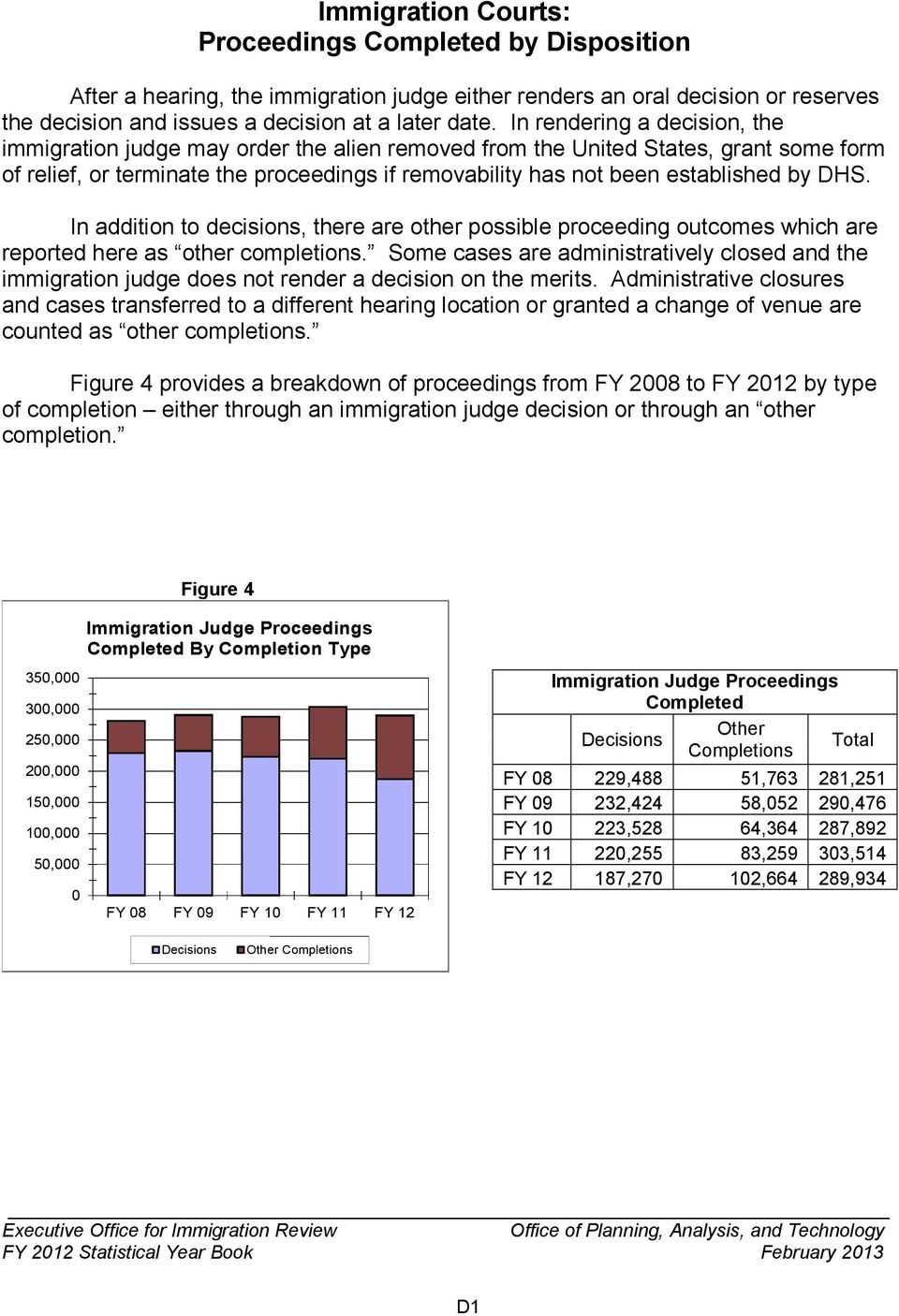
18 Immigration Courts: Proceedings Completed by Disposition After a hearing, the immigration judge either renders an oral decision or reserves the decision and issues a decision at a later date. In rendering a decision, the immigration judge may order the alien removed from the United States, grant some form of relief, or terminate the proceedings if removability has not been established by DHS. In addition to decisions, there are other possible proceeding outcomes which are reported here as other completions. Some cases are administratively closed and the immigration judge does not render a decision on the merits. Administrative closures and cases transferred to a different hearing location or granted a change of venue are counted as other completions. Figure 4 provides a breakdown of proceedings from FY 2008 to FY 2012 by type of completion either through an immigration judge decision or through an other completion. Figure 4 350, , , , , ,000 50,000 0 Immigration Judge Proceedings Completed By Completion Type FY 08 FY 09 FY 10 FY 11 FY 12 Immigration Judge Proceedings Completed Other Decisions Total Completions FY ,488 51, ,251 FY ,424 58, ,476 FY ,528 64, ,892 FY ,255 83, ,514 FY , , ,934 Decisions Other Completions FY 2012 Statistical Year Book February 2013 D1
19 Figure 5 provides a breakout of decisions by disposition. Immigration judges first decide whether or not the charges against an alien should be sustained. If the charges are not sustained or if the alien has established eligibility for naturalization, the judge terminates the case. If the charges are sustained, the judge decides whether to order the alien removed from the United States or to grant relief. In some cases, the immigration judge may permit the alien to depart the United States voluntarily. Orders of voluntary departure are included as removals. Figure 5 250,000 Immigration Judge Decisions By Disposition 200, , ,000 50,000 0 FY 08 FY 09 FY 10 FY 11 FY 12 Termination Relief Other Removal IJ Decisions by Disposition Termination Relief Removal Other Total Number % of Total Number % of Total Number % of Total Number % of Total Number % of Total FY 08 17, , , , , FY 09 17, , , , , FY 10 24, , , , , FY 11 25, , , , , FY 12 24, , , , , FY 2012 Statistical Year Book February 2013 D2

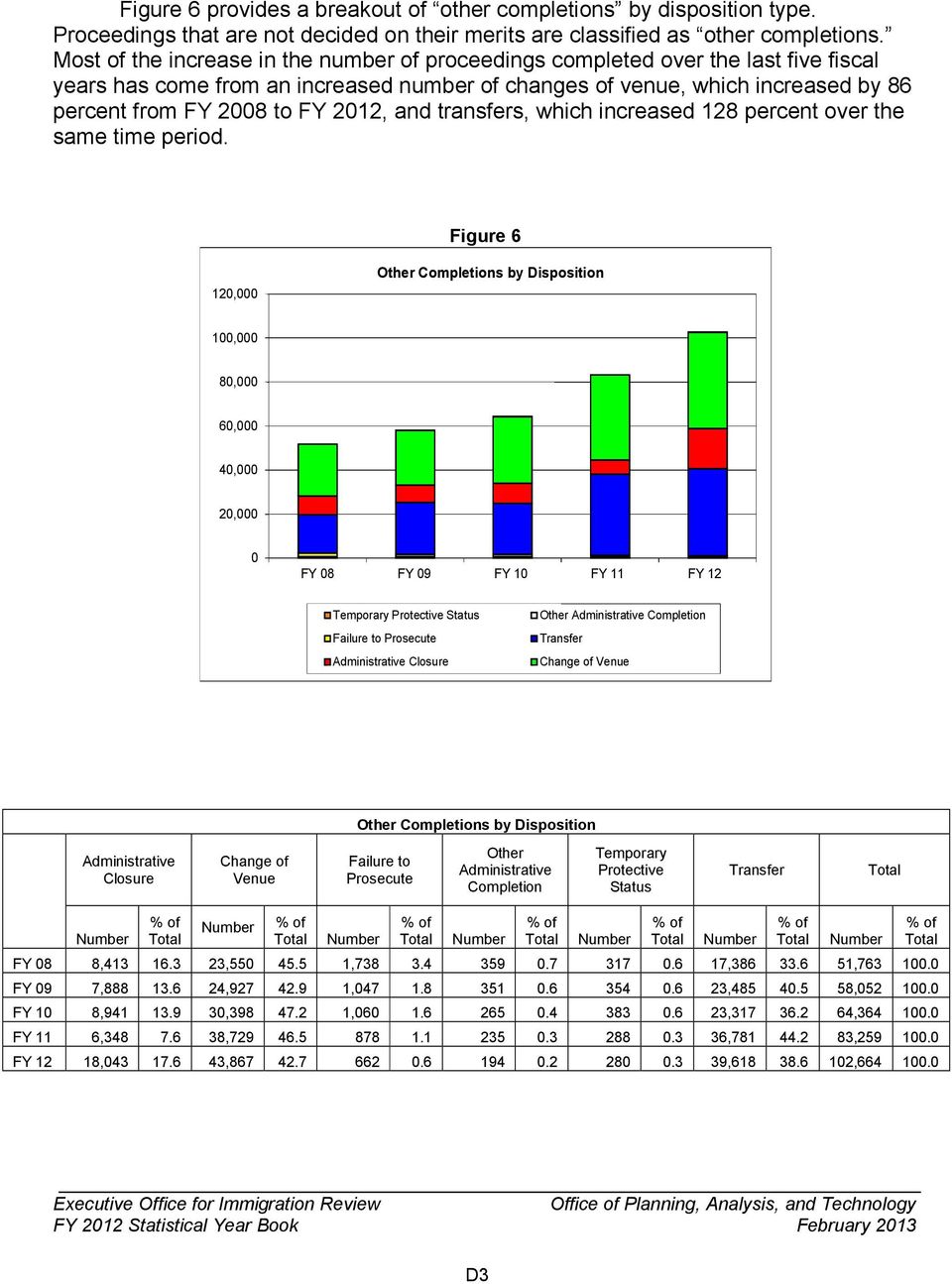
20 Figure 6 provides a breakout of other completions by disposition type. Proceedings that are not decided on their merits are classified as other completions. Most of the increase in the number of proceedings completed over the last five fiscal years has come from an increased number of changes of venue, which increased by 86 percent from FY 2008 to FY 2012, and transfers, which increased 128 percent over the same time period. Figure 6 120,000 Other Completions by Disposition 100,000 80,000 60,000 40,000 20,000 0 FY 08 FY 09 FY 10 FY 11 FY 12 Temporary Protective Status Failure to Prosecute Administrative Closure Other Administrative Completion Transfer Change of Venue Other Completions by Disposition Administrative Closure Change of Venue Failure to Prosecute Other Administrative Completion Temporary Protective Status Transfer Total Number % of Total Number % of Total Number % of Total Number % of Total Number % of Total Number % of Total Number FY 08 8, , , , , FY 09 7, , , , , FY 10 8, , , , , FY 11 6, , , , FY 12 18, , , , % of Total FY 2012 Statistical Year Book February 2013 D3
21 Immigration Courts: Proceedings Completed by Country of Nationality Immigration court staff record in EOIR s data system the nationality of aliens who appear before immigration judges. Data in this section provide information on the predominant nationalities for completed proceedings. Figure 7 FY 2012 Court Proceedings Completed by Country of Nationality All Others 22.43% Mexico 42.08% Jamaica 1.26% Cuba 1.40% Ecuador 1.45% Dominican Republic 1.71% India 1.84% China 4.49% Guatemala 8.94% El Salvador 8.50% Honduras 5.90% FY 2012 Court Proceedings Completed by Country of Nationality Country of Nationality Completions % of Total Mexico 122, % Guatemala 25, % El Salvador 24, % Honduras 17, % China 13, % India 5, % Dominican Republic 4, % Ecuador 4, % Cuba 4, % Jamaica 3, % All Others 65, % Total 289, % In FY 2012, the top 10 nationalities accounted for approximately 77 percent of all proceedings completed as shown in Figure 7. A total of 224 nationalities were represented in the FY 2012 immigration judge completions. Mexico and Central American countries are consistently among the predominant nationalities of immigration court completions. Table 5, on the following page, provides information on the top 25 nationalities each year for the period FY 2008 through FY For the five-year period, seven of the top 10 nationalities remained the same: Mexico, Guatemala, El Salvador, Honduras, China, Dominican Republic, and Cuba. FY 2012 Statistical Year Book February 2013 E1
22 Table 5 - Court Proceedings Completed by Country of Nationality Top 25 Nationalities: FY FY 2012 Rank FY 2008 FY 2009 FY 2010 FY 2011 FY Mexico Mexico Mexico Mexico Mexico 2 El Salvador Guatemala Guatemala Guatemala Guatemala 3 Guatemala El Salvador El Salvador El Salvador El Salvador 4 Honduras Honduras Honduras Honduras Honduras 5 China China China China China 6 Haiti Haiti Haiti India India 7 Cuba Colombia Dominican Republic Dominican Republic Dominican Republic 8 Colombia Dominican Republic Colombia Cuba Ecuador 9 Dominican Republic Cuba Cuba Jamaica Cuba 10 Brazil Jamaica Jamaica Colombia Jamaica 11 Jamaica Ecuador India Haiti Colombia 12 Ecuador Brazil Ecuador Ecuador Haiti 13 India India Brazil Brazil Brazil 14 Nicaragua Peru Philippines Philippines Peru 15 Philippines Philippines Peru Peru Philippines 16 Peru Nicaragua Nicaragua Nicaragua Nicaragua 17 Venezuela Venezuela Venezuela Pakistan Nigeria 18 Pakistan Pakistan Pakistan Venezuela Pakistan 19 Indonesia Russia Russia Nigeria Ghana 20 Canada Nigeria Canada Russia Russia 21 Nigeria Indonesia Nigeria Ghana Venezuela 22 Russia Canada Kenya South Korea Romania 23 Vietnam Ethiopia Ghana Trinidad and Tobago Kenya 24 Ghana Ghana Vietnam Ethiopia South Korea 25 Trinidad and Tobago Vietnam South Korea Kenya Trinidad and Tobago FY 2012 Statistical Year Book February 2013 E2
23 Immigration Courts: Proceedings Completed by Language Figure 8 below shows a breakdown of FY 2012 immigration court proceedings completed by language. A total of 276 different languages were spoken in court proceedings in the immigration courts during FY The top five languages, which were Spanish, English, Mandarin, Punjabi, and Russian, accounted for 90 percent of the proceedings completed in FY Spanish language cases were 68 percent of the total caseload and represent no change since FY The number of different languages used in court proceedings also did not change from FY Other 9.59% Mandarin 3.56% Russian 0.80% Punjabi 0.82% Figure 8 FY 2012 Court Proceedings Completed By Language Spanish 67.71% English 17.52% FY 2012 Proceedings Completed by Language Language Completions % of Total Spanish 196, % English 50, % Mandarin 10, % Punjabi 2, % Russian 2, % Other 27, % Total 289, % Table 6, on the following page, provides information on the top 25 languages each year for the period FY 2008 through FY For the five-year period, eight of the top 10 languages remained the same: Spanish, English, Mandarin, Russian, Creole, Arabic, Portuguese, and French. FY 2012 Statistical Year Book February 2013 F1
24 Table 6 Court Proceedings Completed by Language Top 25 Languages: FY 2008 FY 2012 Rank FY 2008 FY 2009 FY 2010 FY 2011 FY Spanish Spanish Spanish Spanish Spanish 2 English English English English English 3 Mandarin Mandarin Mandarin Mandarin Mandarin 4 Creole Creole Creole Punjabi Punjabi 5 Russian Russian Russian Creole Russian 6 Foo Chow Arabic Portuguese Russian Creole 7 Portuguese Portuguese Arabic Portuguese Arabic 8 Arabic Foo Chow Foo Chow Arabic Portuguese 9 French French Punjabi Gujarati Gujarati 10 Indonesian Indonesian French French French 11 Albanian Punjabi Korean Foo Chow Foo Chow 12 Punjabi Albanian Indonesian Tigrina - Eritrean Korean 13 Korean Amharic Tigrina - Eritrean Korean Nepali Romanian- 14 Armenian Korean Armenian Amharic Moldovan 15 Amharic Armenian Amharic Nepali Indonesian 16 Urdu Tigrina - Eritrean Albanian Indonesian Amharic 17 Vietnamese Vietnamese Vietnamese Tamil Tamil 18 Chaldean Urdu Somali Armenian Vietnamese 19 Tigrina - Eritrean Tagalog Tagalog Vietnamese Urdu 20 Polish Polish Nepali Albanian Tagalog 21 Tagalog Chaldean Urdu Tagalog Albanian 22 Somali Somali Polish Polish Tigrina - Eritrean 23 Bengali Nepali Bengali Urdu Armenian 24 Tibetan Bengali Gujarati Somali Bengali 25 Nepali Fulani Tamil Bengali Polish FY 2012 Statistical Year Book February 2013 F2
25 Immigration Courts: Proceedings Completed by Representation Status The Immigration and Nationality Act states that individuals in removal proceedings before an immigration judge may be represented by counsel, but at no expense to the government. Prior to representing an alien before the immigration court, a representative must file a Notice of Entry of Appearance with the court. Many individuals in removal proceedings are indigent and cannot afford a private attorney. Some seek free or pro bono representation, while others proceed without counsel on their own, or pro se. In order to ensure that pro se individuals understand the nature of the proceedings, as well as their rights and responsibilities, immigration judges take extra care and spend additional time explaining this information. An individual may ask for a continuance of a proceeding to obtain counsel. As shown in Figure 9, the percentage of represented aliens increased from FY 2008 (45%) to FY 2012 (56%). Figure 9 100% Court Proceedings Completed Percentage of Represented Cases 80% 60% 40% 20% 45% 45% 50% 53% 56% Court Proceedings Completed Representation in Immigration Courts Represented Unrepresented Total FY , , ,251 FY , , ,476 FY , , ,892 FY , , ,514 FY , , ,934 0% FY 08 FY 09 FY 10 FY 11 FY 12 FY 2012 Statistical Year Book G1 February 2013
26 Immigration Courts: Failures to Appear When an alien fails to appear for a hearing, the immigration judge may conduct an in absentia (in absence of) hearing and order the alien removed from the United States. Before the immigration judge orders the alien removed in absentia, the DHS Assistant Chief Counsel must establish by clear, unequivocal, and convincing evidence that the alien is removable. Further, the immigration judge must be satisfied that notice of time and place of the hearing were provided to the alien or the alien s representative. Figure 10 compares immigration judge decisions and failures to appear. Of the immigration judge decisions rendered in FY 2012, 11 percent involved aliens who failed to appear. The number of aliens who failed to appear decreased by 31 percent from FY 2008 to FY 2012 while the number of immigration judge decisions decreased by 18 percent in the same time period. The failure to appear rate has remained fairly consistent from FY 2009 to FY Figure % Failure to Appear* Rates 80% 60% 40% 20% 13% 11% 12% 11% 11% 0% FY 08 FY 09 FY 10 FY 11 FY 12 Failure to Appear* Rates In Absentia Orders IJ Decisions Failure to Appear Rate FY 08 29, ,488 13% FY 09 25, ,424 11% FY 10 26, ,528 12% FY 11 24, ,255 11% FY 12 20, ,270 11% *Prior to FY 2009, administrative closures were included to calculate the failure to appear rate. However, due to a larger percentage of administrative closures not relating directly to failure to appear, the failure to appear rate is calculated using immigration judge decisions and in absentia orders only. FY 2012 Statistical Year Book February 2013 H1
27 The following figures show EOIR data on failures to appear by detention status: never detained aliens, aliens released on bond or recognizance, and aliens not currently detained. Failures to appear for detained cases occur infrequently, generally only because of illness or transportation problems, and are not broken out in the following figures. Figure 11 shows a comparison of the number of failures to appear with the number of immigration judge decisions for aliens that have never been detained. From FY 2008 to FY 2012 the number of in absentia orders for never detained aliens decreased by 49 percent while the number of immigration judge decisions for those aliens decreased by 19 percent in the same time period. The failure to appear rate for aliens that have never been detained has decreased during this time period. Figure % Failure to Appear Rates for Never Detained Aliens 80% 60% 40% 29% 27% 26% 21% 18% 20% 0% FY 08 FY 09 FY 10 FY 11 FY 12 Failure to Appear Rates for Never Detained Aliens In Absentia Orders IJ Decisions Failure to Appear Rate FY 08 24,426 83,081 29% FY 09 20,354 76,318 27% FY 10 21,741 84,649 26% FY 11 16,785 79,262 21% FY 12 12,503 67,695 18% FY 2012 Statistical Year Book February 2013 H2
28 Failures to appear for aliens released on bond or on their own recognizance are shown in Figure 12. From FY 2008 to FY 2012 the number of in absentia orders for aliens released on bond or on their own recognizance increased by 66 percent while the number of immigration judge decisions for those aliens increased by 33 percent. The failure to appear rate for released aliens was higher in FY 2012 than in FY Figure % Failure to Appear Rates for Released Aliens 80% 60% 40% 20% 23% 22% 21% 26% 29% 0% FY 08 FY 09 FY 10 FY 11 FY 12 Failure to Appear Rates for Released Aliens In Absentia Orders IJ Decisions Failure to Appear Rate FY 08 4,892 21,290 23% FY 09 4,578 20,731 22% FY 10 4,644 22,646 21% FY 11 6,927 26,594 26% FY 12 8,103 28,367 29% FY 2012 Statistical Year Book February 2013 H3
29 Failures to appear for non-detained aliens (both those who were never detained and those who were released) are shown in Figure 13. From FY 2008 to FY 2012 the number of in absentia orders for aliens that are not currently detained decreased by 30 percent while the number of immigration judge decisions for those aliens decreased by eight percent. The failure to appear rate for non-detained aliens has decreased during this time period. Figure % Failure to Appear Rates for Non-Detained Aliens 80% 60% 40% 28% 26% 25% 22% 21% 20% 0% FY 08 FY 09 FY 10 FY 11 FY 12 Failure to Appear Rates for Non-Detained Aliens In Absentia Orders IJ Decisions Failure to Appear Rate FY 08 29, ,371 28% FY 09 24,932 97,049 26% FY 10 26, ,295 25% FY 11 23, ,856 22% FY 12 20,606 96,062 21% FY 2012 Statistical Year Book February 2013 H4
30 Immigration Courts: Asylum Cases Received and Completed An important form of relief that aliens may request is asylum. Aliens request asylum if they fear harm if returned to their native country or if they have suffered harm in the past. To be granted asylum, an alien must demonstrate past persecution or a well-founded fear of persecution based on the alien s race, religion, nationality, political beliefs, and/or membership in a particular social group. There are two ways that aliens may request asylum: affirmatively, by completing an asylum application and filing it with a DHS Asylum Office; or defensively, by requesting asylum before an immigration judge. Aliens who file affirmatively with DHS, but whose requests for asylum are not granted, may be placed in removal proceedings and referred to the appropriate immigration court for further review of the case. 60,000 Figure 14 Immigration Court Asylum Receipts Affirmative and Defensive 40,000 20,000 0 FY 08 FY 09 FY 10 FY 11 FY 12 Affirmative Defensive Immigration Court Asylum Receipts Affirmative Defensive Total FY 08 33,168 15,652 48,820 FY 09 30,507 17,001 47,508 FY 10 25,357 17,503 42,860 FY 11 28,007 20,219 48,226 FY 12 29,626 14,544 44,170 FY 2012 Statistical Year Book February 2013 I1
31 As shown in Figure 15 below, asylum receipts declined by 10 percent and asylum completions declined by four percent from FY 2008 to FY Figure 15 65,000 Asylum Cases Receipts and Completions 60,000 55,000 50,000 45,000 40,000 35,000 30,000 FY 08 FY 09 FY 10 FY 11 FY 12 Receipts Completions Asylum Receipts and Completions Receipts Completions FY 08 48,820 46,208 FY 09 47,508 44,677 FY 10 42,860 40,658 FY 11 48,226 40,564 FY 12 44,170 44,282 Table 7, shown on page I3, provides information on FY 2012 asylum receipts and completions by immigration court. In FY 2012, the New York, NY; Los Angeles, CA; San Francisco, CA; Newark, NJ; and Miami, FL, immigration courts received 58 percent of asylum filings. In FY 2012, 15 of the 58 immigration courts had more asylum receipts than completions. FY 2012 Statistical Year Book February 2013 I2
32 Table 7 - Asylum Receipts and Completions by Court for FY 2012 Immigration Court Receipts Completions ARLINGTON, VIRGINIA 1,236 1,433 ATLANTA, GEORGIA BALTIMORE, MARYLAND 784 1,040 BATAVIA SPC, NEW YORK BLOOMINGTON (ST. PAUL), MINNESOTA BOSTON, MASSACHUSETTS 1,252 1,266 BUFFALO, NEW YORK CHARLOTTE, NORTH CAROLINA CHICAGO, ILLINOIS 1, CLEVELAND, OHIO DALLAS, TEXAS DENVER, COLORADO DETROIT, MICHIGAN EAST MESA, CALIFORNIA EL CENTRO SPC, CALIFORNIA EL PASO SPC, TEXAS EL PASO, TEXAS ELIZABETH DETENTION CENTER, NEW JERSEY ELOY, ARIZONA FISHKILL - NEW YORK STATE DOC, NEW YORK 3 5 FLORENCE SPC, ARIZONA GUAYNABO (SAN JUAN), PUERTO RICO HARLINGEN, TEXAS HARTFORD, CONNECTICUT HONOLULU, HAWAII HOUSTON SPC, TEXAS HOUSTON, TEXAS IMPERIAL, CALIFORNIA KANSAS CITY, MISSOURI KROME NORTH SPC, FLORIDA LANCASTER, CALIFORNIA LAS VEGAS, NEVADA LOS ANGELES, CALIFORNIA 7,373 8,010 LOS FRESNOS (PORT ISABEL SPC), TEXAS MEMPHIS, TENNESSEE MIAMI, FLORIDA 1,584 1,558 NEW ORLEANS, LOUISIANA NEW YORK CITY, NEW YORK 12,380 10,530 NEWARK, NEW JERSEY 1, OAKDALE FEDERAL DETENTION CENTER, LOUISIANA OMAHA, NEBRASKA ORLANDO, FLORIDA 1,128 1,310 PEARSALL, TEXAS PHILADELPHIA, PENNSYLVANIA PHOENIX, ARIZONA PORTLAND, OREGON SAIPAN, NORTHERN MARIANAS ISLANDS 3 5 SALT LAKE CITY, UTAH SAN ANTONIO, TEXAS SAN DIEGO, CALIFORNIA SAN FRANCISCO, CALIFORNIA 2,718 2,903 SEATTLE, WASHINGTON STEWART DETENTION FACILITY, GEORGIA TACOMA, WASHINGTON TUCSON, ARIZONA ULSTER - NEW YORK STATE DOC, NEW YORK 9 14 VARICK SPC, NEW YORK YORK, PENNSYLVANIA TOTAL 44,170 44,282 FY 2012 Statistical Year Book February 2013 I3
33 Immigration Courts: Asylum Grants by Country of Nationality This section provides information on asylum grants by nationality. Figure 16 displays the top 10 nationalities granted asylum in FY In FY 2012 the top 10 nationalities accounted for 67 percent of all asylum grants. China accounted for 45 percent of all asylum grants. A total of 149 nationalities were represented among individuals granted asylum in FY Table 8, on the following page, provides information for comparative purposes on the top nationalities granted asylum for the period FY 2008 to FY Three countries were represented among the top 10 countries from which aliens were granted asylum each year during the five-year period: China, Ethiopia, and India. Figure 16 FY 2012 Asylum Grants by Country of Nationality All Others 32.64% Pakistan 1.59% El Salvador 1.59% China 44.94% Guatemala 1.85% Soviet Union 2.35% India 2.35% Egypt 2.55% Eritrea 2.93% Nepal 3.36% Ethiopia 3.82% FY 2012 Asylum Grants by Country of Nationality Country of Nationality Completions % of Total China 5, % Ethiopia % Nepal % Eritrea % Egypt % India % Soviet Union % Guatemala % El Salvador % Pakistan % All Others 3, % Total 11, % FY 2012 Statistical Year Book J1 February 2013
34 Table 8 - Asylum Grants by Country of Nationality Top 25 Nationalities: FY FY 2012 Rank FY 2008 FY 2009 FY 2010 FY 2011 FY China China China China China 2 Colombia Haiti Ethiopia Ethiopia Ethiopia 3 Haiti Ethiopia India Eritrea Nepal 4 Iraq Colombia Colombia Nepal Eritrea 5 Albania Iraq Nepal Egypt Egypt 6 Ethiopia India Egypt India India 7 Venezuela Albania Somalia Soviet Union Soviet Union 8 India Cameroon Armenia Colombia Guatemala 9 Guinea Armenia Cameroon Somalia Pakistan 10 Russia Eritrea Guinea Venezuela El Salvador 11 Indonesia Guinea Venezuela Guatemala Cameroon 12 Egypt Venezuela Eritrea Cameroon Russia 13 Soviet Union Egypt Soviet Union Russia Guinea 14 El Salvador Nepal Haiti Guinea Colombia 15 Guatemala Somalia Guatemala El Salvador Venezuela 16 Cameroon Guatemala Russia Pakistan Indonesia 17 Nepal Indonesia Iraq Armenia Mexico 18 Armenia Soviet Union Albania Albania Iraq 19 Pakistan Russia El Salvador Iraq Iran 20 Yugoslavia El Salvador Indonesia Indonesia Sri Lanka 21 Burma (Myanmar) Sri Lanka Pakistan Iran Armenia 22 Eritrea Burma (Myanmar) Sri Lanka Mexico Somalia 23 Somalia Pakistan Kenya Sri Lanka Albania 24 Mauritania Yugoslavia Yugoslavia Kenya Moldavia (Moldova) 25 Ivory Coast Kenya Iran Mali Honduras FY 2012 Statistical Year Book February 2013 J2
35 Immigration Courts: Disposition of Asylum Cases During removal proceedings an alien may request asylum as relief from removal. The immigration judge must then decide whether to deny or grant an alien s application for asylum. If the asylum applicant fails to appear for a scheduled court hearing, the application is considered abandoned. In other instances, the asylum applicant chooses to withdraw his or her application for asylum. EOIR tracks each of these possible outcomes as completed cases: grants, denials, withdrawals, and abandoned applications for asylum. A substantial number of closed cases do not fall into one of the four categories listed above, and are counted as other asylum completions, e.g., change of venue to another court. Further, in some instances, an alien with a pending asylum claim may apply for and be granted another type of relief besides asylum, and this is also recorded as an other asylum completion. Figure 17 provides the asylum grant rate for the past five years. The grant rate is calculated as a percentage of asylum claims decided on the merits, i.e., grants and denials. The grant rate has increased from FY 2008 (45%) to FY 2012 (56%). Figure % 80% 60% 40% 45% Immigration Courts Asylum Grant Rate 48% 51% 52% 56% Asylum Grant Rate Grants Denials Grant Rate FY 08 10,892 13,169 45% FY 09 10,300 11,337 48% FY 10 9,904 9,574 51% FY 11 11,528 10,573 52% FY 12 11,978 9,574 56% 20% 0% FY 08 FY 09 FY 10 FY 11 FY 12 FY 2012 Statistical Year Book February 2013 K1
36 There are two ways that aliens may request asylum: affirmatively, by completing an asylum application and filing it with a DHS Asylum Office; or defensively, by requesting asylum before an immigration judge. There is some difference in the grant rates depending on whether the asylum application was filed affirmatively or defensively. From FY 2008 to FY 2012, grant rates for affirmative asylum claims were higher than grant rates for defensive claims. The grant rate for affirmative asylum claims has significantly increased from FY 2008 to FY 2012, where the grant rate for defensive claims has decreased over the same time period. The number of asylum claims decided on the merits has decreased from FY 2008 to FY 2012 for both types of claims. Figures 18 and 19 show the grant rates for affirmative and defensive asylum claims. Figure 18 Immigration Courts Affirmative Grant Rate 100% 80% 60% 40% 20% 0% 66% 72% 61% 51% 55% FY 08 FY 09 FY 10 FY 11 FY 12 Immigration Court Affirmative Grant Rate Grants Denials Grant Rate FY 08 7,369 7,052 51% FY 09 7,268 5,937 55% FY 10 7,113 4,512 61% FY 11 8,195 4,153 66% FY 12 8,635 3,401 72% Figure % 80% 60% 40% 20% 0% Immigration Courts Defensive Grant Rate 37% 36% 36% 34% 35% FY 08 FY 09 FY 10 FY 11 FY 12 Immigration Court Defensive Grant Rate Grants Denials Grant Rate FY 08 3,523 6,117 37% FY 09 3,032 5,400 36% FY 10 2,791 5,062 36% FY 11 3,333 6,420 34% FY 12 3,343 6,173 35% FY 2012 Statistical Year Book February 2013 K2
37 Figure 20 illustrates graphically all asylum case completions broken out by disposition. There has been a significant decrease in the number of denials from FY 2008 to FY 2012 (27%). The number of asylum grants increased from FY 2008 to FY 2012 (10%). The number of withdrawn decisions decreased by 21 percent from FY 2008 to FY 2012 while the number of abandoned decisions decreased by 59 percent in the same time period. Figure 20 17,500 Asylum Completions By Disposition 15,000 12,500 10,000 7,500 5,000 2,500 0 FY 08 FY 09 FY 10 FY 11 FY 12 Grants Denials Withdrawn Abandoned Other Asylum Completions by Disposition Grants Denials Withdrawn Abandoned Other Total FY 08 10,892 13,169 7,675 3,451 11,021 46,208 FY 09 10,300 11,337 7,268 3,405 12,367 44,677 FY 10 9,904 9,574 7,215 1,798 12,167 40,658 FY 11 11,528 10,573 5,920 1,577 10,966 40,564 FY 12 11,978 9,574 6,053 1,402 15,275 44,282 FY 2012 Statistical Year Book February 2013 K3
38 An applicant for asylum also is an applicant for withholding of removal under section 241(b)(3) of the Immigration and Nationality Act. Whereas asylum is a discretionary form of relief, withholding of removal is a mandatory form of protection that the immigration judge must grant if the applicant is found to have a clear probability of persecution in his or her country of origin, based on race, religion, nationality, membership in a particular social group, or political opinion, provided no mandatory bars apply. This form of protection fulfills the United States treaty obligations as signatory to the 1967 United Nations Protocol Relating to the Status of Refugees (1967 Protocol). The 1951 United Nations Convention Relating to the Status of Refugees (Refugee Convention) and the 1967 Protocol require contracting states to ensure that no refugee is returned to a country where his or her life would be threatened due to one of the five protected grounds for refugee status. Asylum seekers can only apply for withholding of removal in an immigration court. Applicants granted this protection may not be returned to the country of feared persecution. However, they may be sent to a third country provided that country will allow their entry. Figure 20-A below depicts the withholding of removal grant rate. Cases that had grants for both asylum and withholding were omitted from withholding of removal because they have previously been counted as an asylum grant. Figure 20-A 100% 90% 80% 70% 60% 50% 40% 30% 20% 10% 0% Immigration Courts Withholding of Removal Grant Rate 13% 15% 16% 15% 16% FY 08 FY 09 FY 10 FY 11 FY 12 Immigration Court Withholding of Removal Grant Rate Grants Denials Grant Rate FY 08 2,055 14,016 13% FY 09 1,985 11,680 15% FY 10 1,881 9,919 16% FY 11 2,041 11,199 15% FY 12 1,910 10,269 16% FY 2012 Statistical Year Book February 2013 K4
39 Figure 20-B shows the percentage of cases in which asylum or withholding of removal was granted. The number of grants for these cases has decreased by 12 percent from FY 2008 to FY 2012, although the number of cases decided on their merits has decreased by 10 percent over the same time period. Due to the fact that the total number of asylum grants has increased and the number of denials of both asylum and withholding of removal applications has decreased significantly, the grant rate has increased during this period. Figure 20-B 100% 90% 80% Immigration Courts Asylum or Withholding of Removal Grant Rate 70% 60% 53% 56% 60% 61% 64% 50% 40% 30% 20% 10% 0% FY 08 FY 09 FY 10 FY 11 FY 12 Immigration Court Asylum or Withholding of Removal Grant Rate Asylum Grants Withholding of Removal Grants Denials of Both Asylum and Withholding of Removal Grant Rate FY 08 10,892 2,055 11,632 53% FY 09 10,300 1,985 9,626 56% FY 10 9,904 1,881 7,922 60% FY 11 11,528 2,041 8,690 61% FY 12 11,978 1,910 7,850 64% Table 9 provides information on the FY 2012 asylum grant rate for each individual immigration court. FY 2012 Statistical Year Book February 2013 K5
40 Table 9 FY 2012 Asylum Grant Rate by Immigration Court Immigration Court Grants Denials Grant Rate ARLINGTON, VIRGINIA % ATLANTA, GEORGIA % BALTIMORE, MARYLAND % BATAVIA SPC, NEW YORK % BLOOMINGTON (ST. PAUL), MINNESOTA % BOSTON, MASSACHUSETTS % BUFFALO, NEW YORK % CHARLOTTE, NORTH CAROLINA % CHICAGO, ILLINOIS % CLEVELAND, OHIO % DALLAS, TEXAS % DENVER, COLORADO % DETROIT, MICHIGAN % EAST MESA, CALIFORNIA % EL CENTRO SPC, CALIFORNIA % EL PASO SPC, TEXAS % EL PASO, TEXAS % ELIZABETH DETENTION CENTER, NEW JERSEY % ELOY, ARIZONA % FISHKILL - NEW YORK STATE DOC, NEW YORK 0 4 0% FLORENCE SPC, ARIZONA % GUAYNABO (SAN JUAN), PUERTO RICO % HARLINGEN, TEXAS % HARTFORD, CONNECTICUT % HONOLULU, HAWAII % HOUSTON SPC, TEXAS % HOUSTON, TEXAS % IMPERIAL, CALIFORNIA % KANSAS CITY, MISSOURI % KROME NORTH SPC, FLORIDA % LANCASTER, CALIFORNIA % LAS VEGAS, NEVADA % LOS ANGELES, CALIFORNIA 929 1,572 37% LOS FRESNOS (PORT ISABEL SPC), TEXAS % MEMPHIS, TENNESSEE % MIAMI, FLORIDA % NEW ORLEANS, LOUISIANA % NEW YORK CITY, NEW YORK 6,179 1,333 82% NEWARK, NEW JERSEY % OAKDALE FEDERAL DETENTION CENTER, LOUISIANA % OMAHA, NEBRASKA % ORLANDO, FLORIDA % PEARSALL, TEXAS % PHILADELPHIA, PENNSYLVANIA % PHOENIX, ARIZONA % PORTLAND, OREGON % SAIPAN, NORTHERN MARIANAS ISLANDS 0 0 0% SALT LAKE CITY, UTAH % SAN ANTONIO, TEXAS % SAN DIEGO, CALIFORNIA % SAN FRANCISCO, CALIFORNIA % SEATTLE, WASHINGTON % STEWART DETENTION FACILITY, GEORGIA % TACOMA, WASHINGTON % TUCSON, ARIZONA % ULSTER - NEW YORK STATE DOC, NEW YORK % VARICK SPC, NEW YORK % YORK, PENNSYLVANIA % TOTAL 11,978 9,574 56% FY 2012 Statistical Year Book February 2013 K6
41 Immigration Courts: Expedited Asylum Cases Aliens who file an affirmative asylum application with DHS, but whose requests for asylum are not granted, are placed in removal proceedings and referred to the appropriate immigration court for a hearing. Asylum regulations implemented in 1995 called for asylum applications to be processed within 180 days after filing. The Illegal Immigration Reform and Immigrant Responsibility Act (IIRIRA) of 1996 reiterated that time frame and calls for the administrative adjudication of an asylum application within 180 days of the application filing date, absent exceptional circumstances. This process is time sensitive because the asylum applicant may not apply for employment authorization until 150 days after filing, and DHS then has 30 days to grant or deny employment authorization. The applicant can only be granted employment authorization if the asylum application has not been decided within 180 days of filing, provided there are no delays caused by the alien. Consequently, expedited processing of asylum applications occurs when (1) an alien files affirmatively at a DHS Asylum Office and the application is referred to EOIR within 75 days of filing; or (2) an alien files an asylum application defensively with EOIR. As shown in Figure 21 below, the number of expedited asylum cases that have been received is largely unchanged from FY 2008 to FY 2012, although total asylum receipts have decreased by 10 percent for the same time period. Figure 21 Expedited Asylum Receipts Compared to Total Asylum Receipts FY 08 FY 09 FY 10 FY 11 FY 12 Expedited Asylum Receipts Number of Expedited Asylum Receipts Total Asylum Receipts FY 08 32,676 48,820 FY 09 34,294 47,508 FY 10 34,868 42,860 FY 11 38,667 48,226 FY 12 33,881 44, ,000 20,000 30,000 40,000 50,000 60,000 70,000 Number of Expedited Asylum Receipts Total Asylum Receipts FY 2012 Statistical Year Book February 2013 L1
42 Depicted in Figure 22 below are the number of receipts and completions for expedited asylum cases between FY 2008 and FY Figure 22 Expedited Asylum Receipts and Completions 40,000 35,000 30,000 25,000 FY 08 FY 09 FY 10 FY 11 FY 12 Receipts Completions Expedited Asylum Receipts and Completions Receipts Completions FY 08 32,676 29,289 FY 09 34,294 28,335 FY 10 34,868 27,926 FY 11 38,667 30,978 FY 12 33,881 33,968 FY 2012 Statistical Year Book February 2013 L2
43 Immigration Courts: Convention Against Torture In 1999, the Department of Justice implemented regulations regarding the United Nations Convention Against Torture and other Cruel, Inhuman or Degrading Treatment or Punishment (Convention Against Torture or CAT). Under these regulations, aliens in removal, deportation, or exclusion proceedings may claim that they more likely than not will be tortured if removed from the United States. The regulation provides jurisdiction to the immigration courts to hear these claims, and provides jurisdiction to the BIA to hear appeals from the immigration courts decisions regarding CAT claims. There are two forms of protection under the 1999 regulations: The regulation established a new form of withholding of removal which is granted to an alien who establishes that he or she would be tortured in the proposed country of removal. The second protection concerns aliens who would be tortured in the country of removal, but who are barred from withholding of removal. These aliens may be granted deferral of removal, a form of protection that is more easily and quickly terminated if it becomes possible to remove the alien. As shown in Table 10 below, the immigration courts adjudicated 29,796 CAT applications during FY Of those, 643 CAT cases were granted, the majority of which were granted withholding. Table 10 - FY 2012 Convention Against Torture Cases by Disposition Granted Withholding Deferral Total Denied Other Withdrawn Abandoned Total ,710 12,380 6, ,796 Table 11 on the following page shows a breakdown of CAT completions by immigration courts. The New York City, NY; Los Angeles, CA; San Francisco, CA; Miami, FL; and Orlando, FL, immigration courts combined completed approximately 52 percent of the total FY 2012 CAT cases. FY 2012 Statistical Year Book February 2013 M1
44 Table 11 - FY 2012 Convention Against Torture Completions by Court Immigration Court Completions ARLINGTON, VIRGINIA 502 ATLANTA, GEORGIA 302 BALTIMORE, MARYLAND 699 BATAVIA SPC, NEW YORK 100 BLOOMINGTON (ST. PAUL), MINNESOTA 285 BOSTON, MASSACHUSETTS 655 BUFFALO, NEW YORK 78 CHARLOTTE, NORTH CAROLINA 450 CHICAGO, ILLINOIS 502 CLEVELAND, OHIO 402 DALLAS, TEXAS 260 DENVER, COLORADO 168 DETROIT, MICHIGAN 518 EAST MESA, CALIFORNIA 278 EL CENTRO SPC, CALIFORNIA 119 EL PASO SPC, TEXAS 58 EL PASO, TEXAS 30 ELIZABETH DETENTION CENTER, NEW JERSEY 289 ELOY, ARIZONA 250 FISHKILL - NEW YORK STATE DOC, NEW YORK 35 FLORENCE SPC, ARIZONA 186 GUAYNABO (SAN JUAN), PUERTO RICO 169 HARLINGEN, TEXAS 368 HARTFORD, CONNECTICUT 120 HONOLULU, HAWAII 113 HOUSTON SPC, TEXAS 156 HOUSTON, TEXAS 272 IMPERIAL, CALIFORNIA 2 KANSAS CITY, MISSOURI 134 KROME NORTH SPC, FLORIDA 688 LANCASTER, CALIFORNIA 172 LAS VEGAS, NEVADA 182 LOS ANGELES, CALIFORNIA 4,573 LOS FRESNOS (PORT ISABEL SPC), TEXAS 570 MEMPHIS, TENNESSEE 306 MIAMI, FLORIDA 1,255 NEW ORLEANS, LOUISIANA 101 NEW YORK CITY, NEW YORK 6,440 NEWARK, NEW JERSEY 699 OAKDALE FEDERAL DETENTION CENTER, LOUISIANA 180 OMAHA, NEBRASKA 170 ORLANDO, FLORIDA 1,053 PEARSALL, TEXAS 220 PHILADELPHIA, PENNSYLVANIA 399 PHOENIX, ARIZONA 69 PORTLAND, OREGON 327 SAIPAN, NORTHERN MARIANAS ISLANDS 12 SALT LAKE CITY, UTAH 32 SAN ANTONIO, TEXAS 358 SAN DIEGO, CALIFORNIA 315 SAN FRANCISCO, CALIFORNIA 2,226 SEATTLE, WASHINGTON 852 STEWART DETENTION FACILITY, GEORGIA 33 TACOMA, WASHINGTON 312 TUCSON, ARIZONA 5 ULSTER - NEW YORK STATE DOC, NEW YORK 66 VARICK SPC, NEW YORK 334 YORK, PENNSYLVANIA 347 TOTAL 29,796 FY 2012 Statistical Year Book February 2013 M2
45 Immigration Courts: Proceedings Completed with Applications for Relief Some aliens who are found deportable may be eligible for relief from removal. Aliens apply for various forms of relief by completing the appropriate application. Specific types of relief for aliens in proceedings are discussed in other sections of this Year Book. Asylum is addressed in more detail in Tabs I, J, K, and L. Other applications for relief are addressed in Tab R. Tab M provides information about protection afforded certain aliens under the United Nations Convention Against Torture. For the purpose of this Year Book, voluntary departure (discussed in Tab Q) is not considered an application for relief. Figure 23 provides information on the percent of cases where the alien filed an application for relief. Figure % 90% 80% 70% 60% 50% 40% 30% 20% 10% 0% Immigration Court Proceedings Percent Completions with Applications 25% 25% 25% 24% 28% FY 08 FY 09 FY 10 FY 11 FY 12 Court Completions (Proceedings) with and without Applications for Relief With Applications Percent with Applications Without Applications Percent Without Applications Total FY 08 69,870 25% 211,381 75% 281,251 FY 09 71,446 25% 219,030 75% 290,476 FY 10 72,102 25% 215,790 75% 287,892 FY 11 73,553 24% 229,961 76% 303,514 FY 12 80,613 28% 209,321 72% 289,934 Table 12 on page N2 shows the number and percentage of proceedings completed with applications for relief at each immigration court in FY Typically, courts along the United States border, courts co-located with DHS detention facilities, and courts which handle Institutional Hearing Program cases involving criminal aliens receive fewer applications for relief. Courts with a low percentage of applications for relief (10 percent or less) are shown in red. Courts where 50 percent or more of the completions involved applications for relief are shown in blue. FY 2012 Statistical Year Book February 2013 N1
46 Table 12 - FY 2012 Immigration Court Completions (Proceedings) With Applications for Relief Immigration Court Total # of Completions With Percent With Completions Applications Applications ARLINGTON, VIRGINIA 7,186 2,228 31% ATLANTA, GEORGIA 4,962 1,773 36% BALTIMORE, MARYLAND 4,360 1,932 44% BATAVIA SPC, NEW YORK 1, % BLOOMINGTON (ST. PAUL), MINNESOTA 3, % BOSTON, MASSACHUSETTS 6,994 3,062 44% BUFFALO, NEW YORK 1, % CHARLOTTE, NORTH CAROLINA 3,546 1,339 38% CHICAGO, ILLINOIS 11,499 2,314 20% CLEVELAND, OHIO 3, % DALLAS, TEXAS 8,370 1,411 17% DENVER, COLORADO 6,596 1,658 25% DETROIT, MICHIGAN 3,494 1,127 32% EAST MESA, CALIFORNIA 1, % EL CENTRO SPC, CALIFORNIA 1, % EL PASO SPC, TEXAS 2, % EL PASO, TEXAS 5, % ELIZABETH DETENTION CENTER, NEW JERSEY 3, % ELOY, ARIZONA 6, % FISHKILL - NEW YORK STATE DOC, NEW YORK % FLORENCE SPC, ARIZONA 4, % GUAYNABO (SAN JUAN), PUERTO RICO 1, % HARLINGEN, TEXAS 8, % HARTFORD, CONNECTICUT 1, % HONOLULU, HAWAII % HOUSTON SPC, TEXAS 10, % HOUSTON, TEXAS 4,602 1,671 36% IMPERIAL, CALIFORNIA % KANSAS CITY, MISSOURI 3, % KROME NORTH SPC, FLORIDA 7,624 1,542 20% LANCASTER, CALIFORNIA 4, % LAS VEGAS, NEVADA 2, % LOS ANGELES, CALIFORNIA 24,747 11,318 46% LOS FRESNOS (PORT ISABEL SPC), TEXAS 4, % MEMPHIS, TENNESSEE 2, % MIAMI, FLORIDA 8,610 3,447 40% NEW ORLEANS, LOUISIANA 1, % NEW YORK CITY, NEW YORK 19,506 13,000 67% NEWARK, NEW JERSEY 5,411 1,771 33% OAKDALE FEDERAL DETENTION CENTER, LOUISIANA 8, % OMAHA, NEBRASKA 3,894 1,009 26% ORLANDO, FLORIDA 3,999 2,098 52% PEARSALL, TEXAS 5, % PHILADELPHIA, PENNSYLVANIA 2,688 1,184 44% PHOENIX, ARIZONA 3,842 1,045 27% PORTLAND, OREGON 1, % SAIPAN, NORTHERN MARIANAS ISLANDS % SALT LAKE CITY, UTAH 1, % SAN ANTONIO, TEXAS 10,511 1,103 10% SAN DIEGO, CALIFORNIA 3, % SAN FRANCISCO, CALIFORNIA 10,093 4,869 48% SEATTLE, WASHINGTON 3,293 1,572 48% STEWART DETENTION FACILITY, GEORGIA 9, % TACOMA, WASHINGTON 5, % TUCSON, ARIZONA 1, % ULSTER - NEW YORK STATE DOC, NEW YORK % VARICK SPC, NEW YORK 2, % YORK, PENNSYLVANIA 5, % TOTAL 289,934 80,613 28% FY 2012 Statistical Year Book February 2013 N2
47 Immigration Courts: Proceedings Completed for Detained Cases Under the Immigration and Nationality Act, DHS has authority to detain an alien pending a decision on whether or not the alien is removable. Immigration courts conduct hearings for both detained and non-detained aliens, and EOIR maintains data on the custody status of aliens in proceedings. Detention locations include DHS Service Processing Centers, DHS contract detention facilities, state and local government jails, and Bureau of Prisons institutions. For the purpose of this Year Book, Institutional Hearing Program (IHP) cases are considered detained cases (IHP is discussed further in Tab P). Figure 24 below provides a comparison of detained completions to total proceedings completed. The number of proceedings completed for detained aliens has decreased 23 percent from FY 2008 to FY In FY 2012, the percentage of detained completions was lower than any year in the reported five year period. Figure 24 Immigration Court Proceedings Completed: Detained and Total FY 08 FY 09 FY 10 FY 11 FY , , , , , , ,000 Total Proceedings Completed Proceedings for Detained Aliens Immigration Court Proceedings Completed for Detained Aliens (Including IHP) Proceedings Completed for Detained Aliens Total Proceedings Completed Percent Detained FY , ,251 48% FY , ,476 50% FY , ,892 44% FY , ,514 42% FY , ,934 36% FY 2012 Statistical Year Book February 2013 O1
48 Table 13 on the following page provides information, by immigration court, on FY 2012 detained completions. The following immigration courts each completed more than 5,000 detained proceedings in FY 2012: Stewart Detention Facility, Oakdale Federal Detention Center, Houston SPC, Los Angeles, and Krome North SPC. Overall, immigration courts located in three border states Texas, Arizona, and California accounted for 45 percent of the detained completions in FY Courts in those three states are highlighted in blue in Table 13. FY 2012 Statistical Year Book February 2013 O2
49 Table 13 - FY 2012 Immigration Court Completions (Proceedings) for Detained Cases Immigration Court Completions ARLINGTON, VIRGINIA 2,160 ATLANTA, GEORGIA 1,329 BALTIMORE, MARYLAND 764 BATAVIA SPC, NEW YORK 968 BLOOMINGTON (ST. PAUL), MINNESOTA 1,492 BOSTON, MASSACHUSETTS 1,875 BUFFALO, NEW YORK 113 CHARLOTTE, NORTH CAROLINA 3 CHICAGO, ILLINOIS 3,742 CLEVELAND, OHIO 2,058 DALLAS, TEXAS 4,845 DENVER, COLORADO 1,958 DETROIT, MICHIGAN 1,491 EAST MESA, CALIFORNIA 1,276 EL CENTRO SPC, CALIFORNIA 834 EL PASO SPC, TEXAS 1,460 EL PASO, TEXAS 2,626 ELIZABETH DETENTION CENTER, NEW JERSEY 1,661 ELOY, ARIZONA 3,807 FISHKILL - NEW YORK STATE DOC, NEW YORK 287 FLORENCE SPC, ARIZONA 2,670 GUAYNABO (SAN JUAN), PUERTO RICO 95 HARLINGEN, TEXAS 827 HARTFORD, CONNECTICUT 445 HONOLULU, HAWAII 252 HOUSTON SPC, TEXAS 8,110 HOUSTON, TEXAS 261 IMPERIAL, CALIFORNIA 427 KANSAS CITY, MISSOURI 1,203 KROME NORTH SPC, FLORIDA 5,202 LANCASTER, CALIFORNIA 2,832 LAS VEGAS, NEVADA 1,067 LOS ANGELES, CALIFORNIA 5,916 LOS FRESNOS (PORT ISABEL SPC), TEXAS 2,205 MIAMI, FLORIDA 624 NEW ORLEANS, LOUISIANA 46 NEW YORK CITY, NEW YORK 167 NEWARK, NEW JERSEY 1,611 OAKDALE FEDERAL DETENTION CENTER, LOUISIANA 6,542 OMAHA, NEBRASKA 1,292 ORLANDO, FLORIDA 488 PEARSALL, TEXAS 2,674 PHILADELPHIA, PENNSYLVANIA 69 PHOENIX, ARIZONA 471 PORTLAND, OREGON 118 SAIPAN, NORTHERN MARIANAS ISLANDS 26 SALT LAKE CITY, UTAH 1,314 SAN ANTONIO, TEXAS 1,564 SAN DIEGO, CALIFORNIA 364 SAN FRANCISCO, CALIFORNIA 1,834 SEATTLE, WASHINGTON61 STEWART DETENTION FACILITY, GEORGIA 8,241 TACOMA, WASHINGTON 2,973 TUCSON, ARIZONA 1,585 ULSTER - NEW YORK STATE DOC, NEW YORK 498 VARICK SPC, NEW YORK 1,394 YORK, PENNSYLVANIA 3,834 TOTAL 104,051 Immigration Courts in U.S./Mexico Border States FY 2012 Statistical Year Book February 2013 O3
50 Immigration Courts: Institutional Hearing Program Case Processing The Institutional Hearing Program (IHP) is a cooperative effort between EOIR; DHS; and various federal, state, and municipal corrections agencies. The goal of the IHP is to complete proceedings for incarcerated criminal aliens serving federal or state sentences prior to their release from prison or jail. This allows DHS to remove aliens with final removal orders expeditiously at the time of their release from incarceration. In FY 2012, DHS filed charging documents with the immigration courts for incarcerated aliens in 73 different institutions. Immigration judges and court staff traveled to these institutions to conduct IHP hearings. Figure 25 provides information on IHP receipts and completions for FY FY IHP receipts declined by 30 percent from FY 2008 to FY IHP completions decreased by 29 percent for the same time period. Figure 25 8,000 IHP Cases Received and Completed 7,500 7,000 6,500 6,000 5,500 5,000 4,500 IHP Cases Receipts Completions FY 08 7,150 7,262 FY 09 6,428 6,451 FY 10 5,808 5,798 FY 11 6,004 5,786 FY 12 4,999 5,177 4,000 FY 08 FY 09 FY 10 FY 11 FY 12 Receipts Completions FY 2012 Statistical Year Book February 2013 P1
51 Table 14 provides a breakdown of IHP completions by disposition either through an immigration judge decision or through an other completion, such as an administrative closure or change of venue. Table 14 - IHP Completions by Disposition FY 08 FY 09 FY 10 FY 11 FY 12 Total Decisions in IHP Cases 5,612 4,929 4,419 4,424 3,945 Removal 5,373 4,713 4,289 4,266 3,796 Termination Relief Other Other Completions 1,650 1,522 1,379 1,362 1,232 Total Completions 7,262 6,451 5,798 5,786 5,177 FY 2012 Statistical Year Book February 2013 P2
52 Immigration Courts: Immigration Judge Grants of Voluntary Departure Under certain circumstances, an immigration judge may allow an alien to depart the United States voluntarily. An alien allowed to depart voluntarily concedes removability, but is not barred from future re-entry. Failure to depart within the time granted subjects the alien to a fine, and makes the alien ineligible for voluntary departure and several forms of relief for a 10-year period. Prior to the completion of proceedings, aliens may request voluntary departure in lieu of removal. The immigration judge has discretion to grant up to 120 days for the alien to depart voluntarily if the alien is able to pay for his or her removal, requests no other relief, concedes removability, waives appeal, and if he or she is not removable as an aggravated felon or under security and related grounds or terrorist activities. Immigration judges also have discretion in certain cases to grant voluntary departure in lieu of removal at the conclusion of proceedings. If the judge finds that the alien has been present in the United States for one year immediately preceding the issuance of the Notice to Appear, has been a person of good moral character for the past five years, is not removable under aggravated felony or terrorist grounds, and has the means to depart the United States and intends to do so, the immigration judge may grant up to 60 days for the alien to depart voluntarily. Aliens allowed to depart voluntarily are not barred from re-entry. Voluntary departure is considered a form of removal, not a type of relief. Immigration judge decisions on proceedings (as discussed in Tab D) include grants of voluntary departure under removal. Table 15 shows the percentage of removal orders that are grants of voluntary departure. Table 15 - IJ Removal Decisions Compared to Voluntary Departure Decisions Total Removal Decisions Voluntary Departure Decisions Percent Voluntary Departure Decisions FY ,727 26,687 15% FY ,423 26,880 14% FY ,869 27,583 17% FY ,489 30,395 19% FY ,050 26,635 20% FY 2012 Statistical Year Book February 2013 Q1
53 Immigration Courts: Applications for Relief other than Asylum Although asylum is the most common form of relief requested before an immigration judge, other forms of relief are also granted to eligible aliens. (See Tabs I-L for information on asylum, and Tab M for information on protection granted under the Convention Against Torture.) This tab describes other forms of relief such as adjustment of status; suspension and cancellation; and section 212(c) relief. The Illegal Immigration Reform and Immigrant Responsibility Act of 1996 (IIRIRA) provided a new form of relief called cancellation of removal. Cancellation of removal was intended to replace the former Immigration and Nationality Act section 212(c) waiver and suspension of deportation. Table 15 on page R3 provides information on relief granted under the following provisions. $ Adjustment of Status is a type of relief from deportation, removal, or exclusion, for an alien who is eligible for lawful permanent resident status based on a visa petition approved by DHS. Normally, the visa petition has been filed by a United States citizen spouse. $ Prior to the passage of IIRIRA, section 212(c) of the Immigration and Nationality Act provided relief from deportation for long-term lawful permanent residents who had committed a crime. In order to be eligible to apply for 212(c) relief, an applicant had to show that he or she had been a lawful permanent resident for at least seven years, had served less than five years of a sentence if the underlying crime was classified as an aggravated felony, had been rehabilitated, and had no other criminal record. If an applicant in exclusion or deportation proceedings is able to establish these factors, the immigration judge has discretion to grant relief under 212(c). $ Suspension of Deportation is another pre-iirira form of discretionary relief. Certain aliens in deportation proceedings who have maintained continuous physical presence in the United States for specific periods of time, and have met the other statutory requirements may be granted suspension of deportation and adjustment of status to that of lawful permanent resident. The total number of adjustments to lawful permanent resident status under suspension of deportation or cancellation of removal is limited to a 4,000 annual cap under IIRIRA. Applicants for suspension of deportation who applied for this relief prior to the implementation of IIRIRA, or who meet certain conditions of the Nicaraguan Adjustment and Central American Relief Act (NACARA) are not subject to the cap. FY 2012 Statistical Year Book February 2013 R1
54 As noted above, Cancellation of Removal is a form of relief provided by IIRIRA. There are two IIRIRA provisions addressing cancellation of removal: Permanent Residents. Under the first provision, a lawful permanent resident facing removal on criminal grounds who has been lawfully admitted for permanent residence for at least five years, and who has resided continuously in the United States for seven years after a lawful admission may request cancellation, provided he or she has no aggravated felony convictions. Non-Permanent Residents. Under the second provision, applicants physically present in the United States for a continuous period of 10 years who have not been convicted of a criminal offense may seek cancellation of removal and adjustment of status to permanent resident alien. The applicant must demonstrate exceptional and extremely unusual hardship to a citizen or lawful permanent resident spouse, parent, or child. IIRIRA limits to 4,000 annually the total number of adjustments to lawful permanent resident status under suspension of deportation or cancellation of removal. Applicants for cancellation of removal who meet certain conditions are not subject to the cap. Table 16 reflects grants of relief under the various provisions described above during the period FY FY FY 2012 Statistical Year Book February 2013 R2
55 Table 16 Grants of Relief: Adjustment of Status; 212(c) Waivers; Suspension of Deportation; and Cancellation of Removal Relief Granted to Lawful Permanent Residents Relief Granted Under Section 212(c) Cancellation of Removal Relief Granted to Non-Lawful Permanent Residents Not Subject to Annual Cap of 4,000 Grants Adjustment of Status to LPR Suspension of Deportation Cancellation of Removal Subject to Annual Cap of 4,000 Grants Suspension of Cancellation Deportation of Removal FY ,049 3,029 7, ,027 FY ,928 7, ,480 FY ,722 8, ,982 FY ,002 7, ,937 FY ,919 6, ,993 FY 2012 Statistical Year Book FebruaryR3 2013
56 Board of Immigration Appeals: Total Cases Received and Completed The Board of Immigration Appeals (BIA) has nationwide jurisdiction to hear appeals from certain decisions rendered by immigration judges and certain DHS officials. Published BIA decisions are binding on all DHS officers and immigration judges unless modified or overruled by the Attorney General or a federal court. Unpublished decisions of the BIA are binding on the immigration judge or DHS with regard to the individual case at issue unless overruled or modified by the Attorney General or a federal court. The majority of cases reviewed by the BIA involve decisions made by immigration judges in removal, deportation, or exclusion proceedings, and for the purposes of this Statistical Year Book are referred to as immigration judge appeals. These appeals are filed directly with the BIA in Falls Church, VA, and must be filed within 30 days of the immigration judge s decision. Other types of cases over which the BIA has jurisdiction include appeals of certain DHS decisions involving (1) family-based visa petitions adjudicated by DHS officials; (2) fines and penalties imposed upon carriers for violations of immigration laws; and (3) waivers of inadmissibility for non-immigrants under 212(d)(3)(A) of the Immigration and Nationality Act. For the purposes of this Statistical Year Book, appeals from these DHS decisions are referred to as DHS decision appeals. Figure 26 Total BIA Cases Received and Completed 50,000 45,000 40,000 35,000 30,000 25,000 FY 08 FY 09 FY 10 FY 11 FY 12 Total BIA Cases Receipts Completions FY 08 33,564 38,436 FY 09 33,015 33,202 FY 10 35,985 33,418 FY 11 36,035 35,386 FY 12 31,489 36,396 Receipts Completions FY 2012 Statistical Year Book February 2013 S1
57 As noted earlier, the BIA handles two types of cases: those generated from an immigration judge decision, and those generated from a DHS decision. Figures 27 and 28 below provide information on the types of cases received and completed by the BIA. Appeals of immigration judge decisions make up the bulk of the BIA s work. Receipts of appeals of immigration judge decisions decreased by 15 percent from FY 2008 to FY 2012 while receipts of appeals from DHS decisions increased by 78 percent. Completions of appeals of immigration judge decisions decreased by 20 percent from FY 2008 to FY 2012 while completions of appeals from DHS decisions increased by 134 percent for the same time period. Figure 27 BIA Receipts By Type of Appeal 50,000 40,000 30,000 20,000 10,000 0 FY 08 FY 09 FY 10 FY 11 FY 12 Appeals from DHS Decisions BIA Receipts Appeals from IJ Decisions Total Appeals FY 08 3,021 30,543 33,564 FY 09 4,314 28,701 33,015 FY 10 8,605 27,380 35,985 FY 11 8,721 27,314 36,035 FY 12 5,390 26,099 31,489 Appeals from DHS Decisions Appeals from IJ Decisions 40,000 35,000 30,000 25,000 20,000 15,000 10,000 5,000 0 Figure 28 BIA Completions By Type of Appeal FY 08 FY 09 FY 10 FY 11 FY 12 BIA Completions Appeals Appeals from DHS from IJ Decisions Decisions Total Appeals FY 08 3,557 34,879 38,436 FY 09 3,707 29,495 33,202 FY 10 5,877 27,541 33,418 FY 11 8,300 27,086 35,386 FY 12 8,322 28,074 36,396 Appeals from DHS Decisions Appeals from IJ Decisions FY 2012 Statistical Year Book February 2013 S2
58 Board of Immigration Appeals: Cases Received and Completed by Type The BIA has nationwide jurisdiction to hear appeals from certain decisions rendered by immigration judges and certain DHS officials. The BIA has jurisdiction over the following types of cases arising from immigration judge decisions: Case appeals from the decisions of immigration judges in removal, deportation, and exclusion proceedings at the court level; Appeals filed from the decisions of immigration judges on motions to reopen; Motions to reopen and/or reconsider cases already decided by the BIA; Appeals pertaining to bond, parole, or detention; and Interlocutory appeals relating to important jurisdictional questions regarding the administration of the immigration laws or recurring problems in the handling of cases by immigration judges. The BIA also has jurisdiction to review appeals arising from certain decisions rendered by DHS officials. These types of appeals are listed below. Family-based visa petitions adjudicated by DHS district directors or regional service center directors; Waivers of inadmissibility for non-immigrants under 212(d)(3)(A) of the Immigration and Nationality Act; and Fines and penalties imposed upon carriers for violations of immigration laws. As shown in Table 17, on the following page, appeals received from immigration judge decisions have declined each year from FY 2008 to FY Appeals received from DHS decisions have increased by 78 percent from FY 2008 to FY The majority of appeals from DHS decisions, and the source of this increase in appeals received, is from decisions on visa petitions. The data in Table 18 shows that from FY 2008 to FY 2012 there has been an overall decrease in the number of completions of appeals from immigration judge decisions. The increase in completions of appeals from DHS decisions is coincidental to the increase of receipts of appeals on decisions on visa petitions. FY 2012 Statistical Year Book February 2013 T1
59 Table 17 provides a breakdown of the types of cases received by the BIA between FY 2008 and FY Table 17 - BIA Receipts by Type FY 2008 FY 2009 FY 2010 FY 2011 FY 2012 Total Appeals from IJ Decisions 30,543 28,701 27,380 27,314 26,099 Case Appeal 17,812 16,709 15,651 15,535 14,670 Appeal of IJ Motion to Reopen 1,947 1,834 1,904 1,934 1,829 Motion to Reopen/Reconsider-BIA 8,405 7,874 7,601 7,557 7,090 Bond Appeal 729 1,063 1,109 1,303 1,592 Bond Motion to Reopen/Reconsider Interlocutory Appeal Federal Court Remand 1,464 1, Continued Detention Review Total Appeals from DHS Decisions 3,021 4,314 8,605 8,721 5,390 Decisions on Visa Petitions 2,851 3,986 8,583 8,701 5, Waiver Decisions Decisions on Fines and Penalties Grand Total 33,564 33,015 35,985 36,035 31,489 Table 18 provides a breakdown of the types of cases completed by the BIA between FY 2008 and FY Table 18 - BIA Completions by Type FY 2008 FY 2009 FY 2010 FY 2011 FY 2012 Total Appeals from IJ Decisions 34,879 29,495 27,541 27,086 28,074 Case Appeal 21,969 17,935 16,122 14,977 15,882 Appeal of IJ Motion to Reopen 1,936 1,531 2,004 1,910 1,889 Motion to Reopen/Reconsider-BIA 8,336 7,661 7,414 7,776 7,864 Bond Appeal 725 1,040 1,024 1,239 1,554 Bond Motion to Reopen/Reconsider Interlocutory Appeal Federal Court Remand 1,700 1, Continued Detention Review Total Appeals from DHS Decisions 3,557 3,707 5,877 8,300 8,322 Decisions on Visa Petitions 3,199 3,377 5,857 8,280 8, Waiver Decisions Decisions on Fines and Penalties Grand Total 38,436 33,202 33,418 35,386 36,396 FY 2012 Statistical Year Book February 2013 T2
60 Board of Immigration Appeals: Immigration Judge Decision Appeals Completed by Country of Nationality This section provides information on appeal completions by nationality. Only completions of immigration judge decision appeals are included in these data; appeals of DHS decisions are not included. In FY 2012, the top 10 nationalities accounted for 69 percent of all completions as shown in Figure 29. A total of 189 nationalities were represented in the FY 2012 completions. Data in Table 19, on the following page, compares the predominant countries for completed immigration judge appeals in FY 2008 FY For the five-year period, seven countries ranked among the top 10 each year: Mexico, China, El Salvador, Guatemala, Honduras, India, and Colombia. Figure 29 All Other 31.18% FY 2012 BIA Completions by Country of Nationality Mexico 24.26% Haiti 1.48% Dominican Republic 2.12% Colombia 2.15% Jamaica 2.46% India 2.48% Honduras 3.51% Guatemala 7.67% China 14.07% El Salvador 8.62% FY 2012 IJ Appeals Completed by Country of Nationality Country of Nationality Completions % of Total Mexico 6, % China 3, % El Salvador 2, % Guatemala 2, % Honduras % India % Jamaica % Colombia % Dominican Republic % Haiti % All Other 8, % Total 28, % FY 2012 Statistical Year Book February 2013 U1
61 Table 19 - BIA - IJ Decision Appeals Completed by Country of Nationality Top 25 Nationalities: FY FY 2012 Rank FY 2008 FY 2009 FY 2010 FY 2011 FY Mexico Mexico Mexico Mexico Mexico 2 China China China China China 3 Haiti Haiti El Salvador El Salvador El Salvador 4 El Salvador El Salvador Guatemala Guatemala Guatemala 5 Guatemala Guatemala Haiti Honduras Honduras 6 Colombia Colombia Honduras Jamaica India 7 India Honduras Colombia India Jamaica 8 Indonesia India India Colombia Colombia 9 Honduras Indonesia Jamaica Dominican Republic Dominican Republic 10 Dominican Republic Jamaica Indonesia Indonesia Haiti 11 Jamaica Dominican Republic Dominican Republic Peru Indonesia 12 Venezuela Venezuela Venezuela Haiti Nigeria 13 Pakistan Pakistan Nigeria Venezuela Ecuador 14 Albania Nigeria Pakistan Nigeria Peru 15 Nigeria Philippines Philippines Pakistan Philippines 16 Philippines Albania Nicaragua Philippines Pakistan 17 Peru Peru Peru Ecuador Brazil 18 Armenia Nicaragua Ecuador Nicaragua Nicaragua 19 Nicaragua Ecuador Albania Brazil Ghana 20 Cameroon Cameroon Brazil Armenia Kenya 21 Bangladesh Ethiopia Armenia Cuba Venezuela 22 Ethiopia Guinea Cameroon Ghana Albania 23 Ecuador Mauritania Russia Albania Ethiopia 24 Guinea Armenia Cuba Kenya Russia 25 Brazil Russia Ethiopia Russia Armenia FY 2012 Statistical Year Book February 2013 U2
62 Board of Immigration Appeals: Immigration Judge Decision Appeals Completed by Representation Status The Immigration and Nationality Act states that individuals who have appealed the decision in their removal proceedings may be represented by counsel, but at no expense to the government. Before representing an alien before the BIA, a representative must file a Notice of Entry of Appearance with the BIA. Many individuals who file appeals with the BIA are indigent and cannot afford a private attorney. Some seek free or pro bono representation, while others proceed without counsel on their own, or pro se. The percentage of represented appellate cases completed is higher than the percentage of represented cases at the immigration court level. As shown in Figure 30, the representation rate increased from FY 2008 to FY FY 2011 had the highest representation rate of the five years where 80 percent of appellate cases completed by the BIA involved a represented alien. Only appeals of immigration judge decisions are included in these data. Figure 30 IJ Decision Appeals Percentage of Represented Cases 100% 80% 78% 78% 79% 80% 79% 60% 40% 20% 0% FY 08 FY 09 FY 10 FY 11 FY 12 Represented Before the BIA Represented Unrepresented Total FY 08 27,152 7,727 34,879 FY 09 23,040 6,455 29,495 FY 10 21,794 5,747 27,541 FY 11 21,549 5,537 27,086 FY 12 22,275 5,799 28,074 FY 2012 Statistical Year Book February 2013 V1
63 Board of Immigration Appeals: Immigration Judge Decision Appeals Completed for Detained Cases Under the Immigration and Nationality Act, DHS has authority to detain an alien pending a decision on whether or not the alien is removable. EOIR maintains data on the custody status of aliens in proceedings. The BIA handles detained cases (including aliens in the Institutional Hearing Program (IHP)) as priority cases. Depicted in Figure 31 is the number of immigration judge case appeal decisions between FY 2008 and FY 2012 along with the number of immigration judge case appeal decisions that involved detainees. The figures for detained appeal decisions also include IHP cases. Detained case appeal decisions have increased by 39 percent from FY 2008 to FY 2012 while the number of IJ case appeal decisions has decreased by 27 percent for the same time period. The rate of detained IJ case appeal decisions has increased during this time period. Figure 31 IJ Case Appeal Decisions Detained and Total FY 08 FY 09 FY 10 FY 11 FY ,000 10,000 15,000 20,000 25,000 Detained Case Appeal Decisions Total IJ Case Appeal Decisions Detained IJ Case Appeal Decisions (Including IHP) Detained Case Total IJ Case Percent Appeal Decisions Appeal Decisions Detained (Including IHP) FY 08 3,458 21,969 16% FY 09 3,360 17,935 19% FY 10 3,336 16,122 21% FY 11 4,333 14,977 29% FY 12 4,801 15,882 30% FY 2012 Statistical Year Book February 2013 W1
64 Table 20 shows a breakdown of total detained case appeals completed by the BIA, and of those, the number who were serving sentences at an IHP location. In FY 2012, seven percent of detained BIA completions involved aliens whose removal orders had been issued prior to their release from a federal, state, or municipal corrections facility. The number of IHP completions declined by 26 percent from FY 2008 to FY 2012 while the number of detained completions has increased by 39 percent for the same time period. Table 20 Breakdown of BIA Detained Completions Total Detained Completions IHP Completions FY , % FY , % FY , % FY , % FY , % Percent IHP Completions FY 2012 Statistical Year Book February 2013 W2
65 Immigration Courts and Board of Immigration Appeals: Immigration Judge Decisions (Proceedings) Appealed The majority of cases reviewed by the BIA involve decisions made by immigration judges in removal, deportation, or exclusion proceedings. Either DHS or the alien may file an appeal. Appeals must be filed within 30 days of the immigration judge s decision. Only a relatively small percentage of immigration judge decisions are appealed to the BIA. Figure 32 below compares immigration judge decisions with the number of case appeals received (aliens) at the BIA for FY 2008 through FY All other figures and tables in Tabs S-W reflect cases (which can involve multiple aliens). In this instance, reporting on aliens who appealed is a more accurate representation of the appeal rate. 250, , , ,000 50,000 Figure 32 Immigration Judge Decisions (Proceedings) Appealed 0 FY 08 FY 09 FY 10 FY 11 FY 12 IJ Decisions Case Appeals Received (Aliens) IJ Decisions (Proceedings) Appealed IJ Decisions Case Appeals Percent Received Appealed (Aliens) FY ,488 20,691 9% FY ,424 19,052 8% FY ,528 17,604 8% FY ,255 17,094 8% FY ,270 15,841 8% FY 2012 Statistical Year Book February 2013 X1
66 Immigration Courts and Board of Immigration Appeals: Pending Caseload As in any court system, EOIR s workload depends on the number of matters filed before it. DHS determines EOIR s initial caseload by filing charging documents alleging aliens illegal presence in the United States. The nature and number of the proceedings and the number of appeals from immigration court decisions are determined by the parties themselves. In addition, changes to the immigration laws or regulations, and DHS policies and budgeting, have a dramatic impact on EOIR s workload. Figure 33 presents information on the pending proceedings at the immigration courts based on the year the proceeding was received at the court. Proceedings received prior to FY 2011 account for 27 percent of the total number of pending proceedings. 160, , , ,000 80,000 60,000 40,000 20,000 0 Figure 33 Immigration Courts Pending Proceedings By Year Received Pre FY 08 FY 08 FY 09 FY 10 FY 11 FY 12 Immigration Courts Pending Proceedings Year Received Pending 09/30/12 Pre FY 08 6,230 FY 08 11,061 FY 09 24,389 FY 10 46,948 FY 11 85,312 FY ,315 Total 326,255 Table 21, on the following page, presents information on the number of pending proceedings as of the end of FY 2012 by immigration court. FY 2012 Statistical Year Book February 2013 Y1
67 Table 21 - Immigration Court Pending Proceedings by Immigration Court as of September 30, 2012 Immigration Court Pending Proceedings as of 9/30/2012 ARLINGTON, VIRGINIA 10,006 ATLANTA, GEORGIA 8,714 BALTIMORE, MARYLAND 5,062 BATAVIA SPC, NEW YORK 123 BLOOMINGTON (ST. PAUL), MINNESOTA 3,190 BOSTON, MASSACHUSETTS 9,543 BUFFALO, NEW YORK 2,348 CHARLOTTE, NORTH CAROLINA 4,388 CHICAGO, ILLINOIS 18,261 CLEVELAND, OHIO 4,302 DALLAS, TEXAS 5,943 DENVER, COLORADO 7,679 DETROIT, MICHIGAN 2,729 EAST MESA, CALIFORNIA 307 EL CENTRO SPC, CALIFORNIA 213 EL PASO SPC, TEXAS 441 EL PASO, TEXAS 6,427 ELIZABETH DETENTION CENTER, NEW JERSEY 298 ELOY, ARIZONA 896 FISHKILL - NEW YORK STATE DOC, NEW YORK 154 FLORENCE SPC, ARIZONA 680 GUAYNABO (SAN JUAN), PUERTO RICO 416 HARLINGEN, TEXAS 3,575 HARTFORD, CONNECTICUT 1,417 HONOLULU, HAWAII 238 HOUSTON SPC, TEXAS 1,236 HOUSTON, TEXAS 12,397 IMPERIAL, CALIFORNIA 828 KANSAS CITY, MISSOURI 3,619 KROME NORTH SPC, FLORIDA 933 LANCASTER, CALIFORNIA 356 LAS VEGAS, NEVADA 3,475 LOS ANGELES, CALIFORNIA 52,865 LOS FRESNOS (PORT ISABEL SPC), TEXAS 287 MEMPHIS, TENNESSEE 5,883 MIAMI, FLORIDA 11,362 NEW ORLEANS, LOUISIANA 3,577 NEW YORK CITY, NEW YORK 44,415 NEWARK, NEW JERSEY 11,539 OAKDALE FEDERAL DETENTION CENTER, LOUISIANA 433 OMAHA, NEBRASKA 5,712 ORLANDO, FLORIDA 5,396 PEARSALL, TEXAS 319 PHILADELPHIA, PENNSYLVANIA 4,741 PHOENIX, ARIZONA 11,785 PORTLAND, OREGON 2,951 SAIPAN, NORTHERN MARIANAS ISLANDS 65 SALT LAKE CITY, UTAH 1,293 SAN ANTONIO, TEXAS 9,767 SAN DIEGO, CALIFORNIA 4,336 SAN FRANCISCO, CALIFORNIA 19,883 SEATTLE, WASHINGTON 5,205 STEWART DETENTION FACILITY, GEORGIA 715 TACOMA, WASHINGTON 832 TUCSON, ARIZONA 1,449 ULSTER - NEW YORK STATE DOC, NEW YORK 173 VARICK SPC, NEW YORK 675 YORK, PENNSYLVANIA 403 TOTAL 326,255 FY 2012 Statistical Year Book February 2013 Y2
68 Figure 34 below depicts the age of the BIA s pending caseload. Cases received before FY 2011 account for three percent of the pending caseload. Figure 34 BIA Pending Cases By Year Filed 24,000 20,000 16,000 12,000 8,000 4,000 0 Pre FY 08 FY 08 FY 09 FY 10 FY 11 FY 12 BIA Pending Cases Year Filed Pending 09/30/12 Pre FY FY FY FY FY 11 6,878 FY 12 17,176 Total 24,824 FY 2012 Statistical Year Book February 2013 Y3
69 Office of the Chief Administrative Hearing Officer: Total Cases Received and Completed The Office of the Chief Administrative Hearing Officer (OCAHO) is headed by the Chief Administrative Hearing Officer, who is responsible for the general supervision of administrative law judges and review of administrative law judge decisions relating to illegal hiring and employment eligibility verification. OCAHO s administrative law judges hear cases and adjudicate issues arising under provisions of the Immigration and Nationality Act (INA) relating to: Knowingly hiring, recruiting or referring for a fee unauthorized aliens, or the continued employment of unauthorized aliens and failure to comply with employment eligibility verification requirements in violation of section 274A of the INA (employer sanctions); Unfair immigration-related employment practices in violation of section 274B of the INA; Immigration-related document fraud in violation of section 274C of the INA; and The Immigration Reform and Control Act s prohibition of indemnity bonds. Complaints may be brought by DHS, the Department of Justice Office of Special Counsel for Immigration-Related Unfair Employment Practices, or private litigants. All final decisions may be appealed to the appropriate federal circuit court of appeals. Figure 35 provides the case receipts and completions for the past five years. The number of case receipts increased by 100 percent from FY 2008 to FY 2012 and the number of case completions increased by 47 percent during the same time period. However, these numbers do not reflect cases OCAHO adjudicated for the Bureau of Prisons and the Bureau of Alcohol, Tobacco, Firearms and Explosives during this time period. Figure 35 OCAHO Cases Received and Completed FY 08 FY 09 FY 10 FY 11 FY 12 OCAHO Cases Receipts Completions FY FY FY FY FY Receipts Completions FY 2012 Statistical Year Book Z1 February 2013
70 GLOSSARY OF TERMS Disclaimer This Glossary has been compiled as an addendum to the FY 2012 Statistical Year Book of the (EOIR). Its intent is to define terms as they are used in the Year Book, and is strictly informational in nature. These terms may have further meaning in the context of other immigration matters. This Glossary is not intended, in any way, to be a substitute for a careful study of the pertinent laws and regulations. This Glossary does not carry the weight of law or regulation. This Glossary is not intended, nor should it be construed in any way, as legal advice, nor does it extend or limit the jurisdiction of EOIR as established by law and regulation.
71 Abandoned If an applicant for relief fails to appear for a court hearing, or fails to provide any required information within the time frame allowed without good cause, the application is considered abandoned. In addition, if an applicant fails to timely file an application for relief, the immigration judge may deem that application waived. A Accredited Representative A non-attorney who is authorized to practice before the immigration courts, the Board of Immigration Appeals (BIA), and/or the Department of Homeland Security. Accredited representatives are granted accreditation by the BIA. To be granted BIA accreditation, accredited representatives must be affiliated with an organization that has been recognized by the BIA. See Recognized Organization. Adjustment of Status A type of relief from deportation, removal, or exclusion for an alien who is eligible for lawful permanent resident status based on a visa petition approved by the Department of Homeland Security. The status of an alien may be adjusted by the Attorney General, in his discretion, to that of a lawful permanent resident if a visa petition on behalf of the alien has been approved, an immigrant visa is immediately available at the time of the alien=s application for adjustment of status, and the alien is not otherwise inadmissible to the United States. Administrative Closure Administrative closure of a case is used to temporarily remove the case from an immigration judge=s calendar or from the Board of Immigration Appeals= docket. Administrative closure of a case does not result in a final order. It is merely an administrative convenience which allows the removal of cases from the calendar in appropriate situations. Administrative Law Judges Administrative Law Judges (ALJs) in the Office of the Chief Administrative Hearing Officer (OCAHO) hear cases and adjudicate issues arising under the provisions of the Immigration and Nationality Act (INA) relating to: (1) knowingly hiring, recruiting or referring for a fee unauthorized aliens, or the continued employment of unauthorized aliens and failure to comply with employment eligibility verification requirements in violation of section 274A of the INA (employer sanctions); (2) unfair immigration-related employment practices in violation of section 274B of the INA; (3) immigration-related document fraud in violation of section 274C of the INA; and (4) Immigration Reform and Control Act s (IRCA) prohibition of indemnity bonds. FY 2012 Statistical Year Book Appendix A - Glossary of Terms February
72 Affirmative Asylum Application An asylum application initially filed with the Department of Homeland Security, U.S. Citizenship and Immigration Services (USCIS). Contrast Defensive Asylum Application. Aggravated Felony As defined by section 101(a)(43) of the Immigration and Nationality Act, aggravated felony includes, but is not limited to, murder; rape or sexual abuse of a minor; drug trafficking; firearms or explosive materials trafficking or offenses; money laundering; crimes of violence for which the term of imprisonment, even if suspended, is at least one year or more; theft or burglary; demands for ransom; child pornography; racketeering or gambling; tax fraud or evasion; prostitution related offenses or human trafficking, slavery, peonage, or involuntary servitude; offenses involving the disclosure of classified information, sabotage, treason, or the disclosure of undercover or intelligence agents; commercial bribery; counterfeiting; forgery; stolen vehicle trafficking; obstruction of justice; perjury; bribery of a witness; and failure to appear to answer for a criminal offense. Appeal from Decision of an Immigration Judge In an appeal from a decision of an immigration judge, the appealing party, which could be an alien, the Department of Homeland Security, or both, states why he or she disagrees with the immigration judge=s decision. By filing an appeal, the appealing party asks the Board of Immigration Appeals to review the immigration judge=s decision. Appeal from Decision of a Department of Homeland Security (DHS) District Director In an appeal from a decision of a DHS U.S. Citizenship and Immigration Services= District Director, the appellant states why he or she disagrees with a District Director=s decision. By filing an appeal, the appellant asks the Board of Immigration Appeals to review the District Director=s decision. Application for Relief Aliens may request a number of forms of relief or protection from removal such as asylum, withholding of removal, protection under the Convention Against Torture, adjustment of status, suspension of deportation or cancellation of removal. Many forms of relief require the alien to fill out an appropriate application. Asylum An alien, who is physically present in the United States or who arrives in the United States irrespective of such alien status, may be eligible for asylum if he or she can show that he or she is a Arefugee@ and is not subject to any statutory prohibitions. The Immigration and Nationality Act generally defines a refugee as any person who is outside his or her country of nationality or, in the case of a person having no nationality, is outside any country in which such person last habitually resided, and who is unable FY 2012 Statistical Year Book Appendix A - Glossary of Terms February
73 or unwilling to return to, and is unable or unwilling to avail himself or herself of the protection of that country, because of persecution or a well-founded fear of persecution on account of race, religion, nationality, membership in a particular social group, or political opinion. Aliens generally must apply for asylum within one year of arrival in the United States. In the absence of exceptional circumstances, final administrative adjudication of the asylum application, not including administrative appeal, must be completed within 180 days after the date the application is filed. Asylum Grants An asylum grant allows the alien to remain in the United States and provides certain benefits and derivative asylum status for any spouse or child. An asylee can apply to the Department of Homeland Security for lawful permanent resident status under Immigration and Nationality Act section 209(b) after he or she has been physically present in the United States for a period of one year after the date of the asylum grant. Asylum Only Proceedings Certain aliens are not entitled to a removal hearing under section 240 of the Immigration and Nationality Act, yet these aliens are entitled to an asylum only hearing before an immigration judge. If an alien who is not entitled to a removal hearing under section 240 of the Immigration and Nationality Act requests asylum (and has not been granted asylum by the Department of Homeland Security (DHS), if eligible), DHS will file a Form I-863, Notice of Referral to an Immigration Judge, with the immigration court. The immigration judge may not consider forms of relief other than asylum, withholding of removal, and withholding of removal under the Convention Against Torture (CAT). Aliens eligible for asylum only hearings include crewmen, stowaways, Visa Waiver Program beneficiaries, and those ordered removed from the United States on security grounds. Asylum only cases will be heard, to the maximum extent practical, within the same time frame as asylum claims in removal cases, i.e., within 180 days. The Board of Immigration Appeals has jurisdiction over appeals from immigration judge decisions in asylum only cases. See Withholding Only Proceedings. B Board of Immigration Appeals The Board of Immigration Appeals (BIA) is the highest administrative body for interpreting and applying immigration laws. The BIA has been given nationwide jurisdiction to hear appeals from certain decisions rendered by immigration judges and by Department of Homeland Security (DHS), U.S. Citizenship and Immigration Services= District Directors in a wide variety of proceedings in which the U.S. government is one party and the other party is either an alien, a citizen, or a business firm. In addition, the BIA is responsible for the recognition of organizations and accreditation of representatives requesting permission to practice before the BIA, the immigration courts, and/or DHS. BIA decisions are binding on all DHS officers and FY 2012 Statistical Year Book Appendix A - Glossary of Terms February
74 immigration judges unless modified or overruled by the Attorney General or a federal court. Bond The Department of Homeland Security (DHS) may detain a respondent who is in removal or deportation proceedings and may condition his or her release from custody upon the posting of a bond to ensure the respondent's appearance at the hearing. The amount of money set by DHS as a condition of release is known as a bond. A bond may also be set by an immigration judge as a condition for allowing a respondent to voluntarily leave the country. Bond Redetermination Hearing When the Department of Homeland Security (DHS) has set a bond amount as a condition for release from custody, or has determined not to release the alien on bond, the respondent has the right to ask an immigration judge to redetermine the bond. In a bond redetermination hearing, the judge can raise, lower, or maintain the amount of the bond, however, the Immigration and Nationality Act provides that bond of at least $1,500 is required before an alien may be released. In addition, the immigration judge can eliminate the bond; or change any of the conditions over which the immigration court has authority. The bond redetermination hearing is completely separate from the removal or deportation hearing. It is not recorded and has no bearing on the subsequent removal or deportation proceeding. The respondent and/or DHS may appeal the immigration judge=s bond redetermination decision to the Board of Immigration Appeals. Cancellation of Removal There are two different forms of cancellation of removal: C (A) Cancellation of removal for certain lawful permanent residents who were admitted more than five years ago, have resided in the United States for seven or more years, and have not been convicted of an aggravated felony. See section 240A(a) of the Immigration and Nationality Act. Application for this form of discretionary relief is made during the course of a hearing before an immigration judge. (B) Cancellation of removal and adjustment of status for certain non-permanent resident aliens who have maintained continuous physical presence in the United States for 10 years and have met all the other statutory requirements for such relief. See section 240A(b) of the Immigration and Nationality Act. Application for this form of discretionary relief is made during the course of a hearing before an immigration judge. The status of an alien who is granted cancellation of removal for certain non- FY 2012 Statistical Year Book Appendix A - Glossary of Terms February
75 permanent resident aliens is adjusted to that of an alien lawfully admitted for permanent residence. Case In an immigration proceeding before an immigration judge, a Acase@ involves one alien. In an appeal before the Board of Immigration Appeals, a Acase@ involves one lead alien and may also include other family members. In a proceeding before an Administrative Law Judge in the Office of the Chief Administrative Hearing Officer, a Acase@ involves a complainant and a respondent. In cases brought under Immigration and Nationality Act section 274A and section 274C, the complainant is the Department of Homeland Security, and the respondent is an employer. In Immigration and Nationality Act section 274B cases, the complainant is either the Office of Special Counsel for Immigration-Related Unfair Employment Practices or certain private individuals or entities, and the respondent is an employer, as prescribed by statute. Change of Venue Immigration judges, for good cause shown, may change venue (move the proceeding to another immigration court) only upon motion by one of the parties, after the charging document has been filed with the immigration court. The regulation provides that venue may be changed only after one of the parties has filed a motion to change venue and the other party has been given notice and an opportunity to respond. Claimed Status Review If an alien in expedited removal proceedings claims under oath to be a U.S. citizen, to have been lawfully admitted for permanent residence, to have been admitted as a refugee, or to have been granted asylum, and the Department of Homeland Security determines that the alien has no such claim, he or she can obtain a review of that claim by an immigration judge. Coercive Population Control Government programs or policies that seek to forcibly limit the number of children born in the country and can include mandate abortions and involuntary sterilizations. The Illegal Immigration Reform and Immigrant Responsibility Act of 1996 changed the definition of Arefugee@ to include, as a form of political opinion, those who have a wellfounded fear of persecution or have suffered persecution on account of Coercive Population Control (CPC) policies. Previously, up to a total of 1,000 refugee admissions and asylum grants were made each fiscal year to applicants who raised claims based on CPC. If applicants for asylum met the criteria for a CPC grant, they were given conditional asylum and were given a final grant of asylum when a number FY 2012 Statistical Year Book Appendix A - Glossary of Terms February
76 became available. Effective May 11, 2005, under the REAL ID Act, the annual cap was lifted on asylum grants based on CPC. Completions Within the context of the Office of the Chief Immigration Judge, a matter is considered completed once an immigration judge renders a decision. Proceedings may also be completed for other reasons, such as administrative closures, changes of venue, and transfers. For matters before the Board of Immigration Appeals, a case is considered completed once the Board renders a decision. For matters before the Office of the Chief Administrative Hearing Officer, a case is completed when the Administrative Law Judge issues a final decision disposing of all remaining issues. Continuance The adjournment of a proceeding to a subsequent day or time. Continued Detention Review A proceeding established in response to the 2001 Supreme Court=s decision in Zadvydas v. Davis, in which the immigration judge decides whether or not the alien should remain in custody. Convention Against Torture An international human rights agreement drafted by the United Nations to combat torture around the world. The United States signed the Convention Against Torture in 1988 and ratified it in On March 22, 1999, the Department of Justice implemented regulations regarding the United Nations= Convention Against Torture and Other Cruel, Inhuman or Degrading Treatment or Punishment (Convention Against Torture or CAT). Under this regulation, aliens in removal, deportation, or exclusion proceedings may claim that they Amore likely than not@ will be tortured if removed from the United States and may apply for withholding of removal under CAT. Among other things, the regulation provides jurisdiction to the immigration courts and the Board of Immigration Appeals for reviewing these claims. See Deferral of Removal, Withholding of Removal, and Withholding-only Proceedings. Credible Fear Review If an alien seeking to enter the United States has no documents or no valid documents to enter, but expresses a fear of persecution or torture, or an intention to apply for asylum, that alien will be referred to a Department of Homeland Security asylum officer for a credible fear determination. If the asylum officer determines that the alien has not established a credible fear of persecution or torture and a supervisory asylum officer FY 2012 Statistical Year Book Appendix A - Glossary of Terms February
77 concurs, the alien may request review of that determination by an immigration judge. That review must be concluded as expeditiously as possible, to the maximum extent practicable within 24 hours, but in no event later than seven days after the date of the determination by the supervisory asylum officer. No appeal to the Board of Immigration Appeals may be taken from the immigration judge=s decision finding no credible fear of persecution or torture. If the immigration judge determines that the alien has a credible fear of persecution or torture, the alien will be placed in removal proceedings to apply for asylum. Custody Status Whether an alien is in actual custody (detained) or is at liberty. This Year Book describes three custody categories: detained, never detained (EOIR has no record of the alien having been detained), and released (detained, then released on bond, recognizance, or some other condition). Decision A determination and order arrived at after consideration of facts and law, by either an immigration judge, the Board of Immigration Appeals, or the Office of the Chief Administrative Hearing Officer. D Defensive Asylum Application An asylum application initially filed with the immigration court after the alien has been put into proceedings to remove him or her from the United States. Contrast Affirmative Asylum Application. Deferral of Removal If an immigration judge concludes that it is more likely than not that a removable alien will be tortured in a country, but the alien is ineligible for withholding of removal under the Convention Against Torture (CAT), the alien=s removal will be deferred. The alien=s removal is deferred only to the country in which it has been determined that the alien is likely to be tortured. However, the alien may be removed at any time to another country where he or she is not likely to be tortured. In addition, deferral of removal is effective only until it is terminated. The major difference between deferral of removal and withholding of removal is that there is a streamlined termination process for deferral of removal. Denials When an immigration judge denies an alien=s application for relief from removal. FY 2012 Statistical Year Book Appendix A - Glossary of Terms February
78 Department of Homeland Security (DHS) Agency created effective March 1, 2003, which absorbed the functions of the former Immigration and Naturalization Service (INS), among other agencies. Three major components of DHS have functions which relate closely to the Executive Office for Immigration Review. U.S. Citizenship and Immigration Services (USCIS) processes all immigrant and non-immigrant benefits, incorporating the adjudication and naturalization functions of the former INS. U.S. Immigration and Customs Enforcement (ICE) is charged with the enforcement of federal immigration laws, and includes functions of the former investigations, detention, and removal components of INS. U.S. Customs and Border Protection (CBP) absorbed the border patrol and inspections functions of the former INS. See Immigration and Naturalization Service. Deportation Proceedings Prior to April 1, 1997, a deportation case usually arose when the former Immigration and Naturalization Service (INS) (now Department of Homeland Security) alleged that a respondent entered the country illegally by crossing the border without being inspected by an immigration officer. Deportation cases also occurred when INS alleged that a respondent entered the country legally with a visa but then violated one or more conditions of the visa. Prior to April 1, 1997, when INS became aware of a respondent believed to be deportable, they issued a charging document called an Order to Show Cause (OSC). A deportation proceeding actually began when the OSC was filed with an immigration court. In such proceedings, the government, represented by INS, had to prove that a respondent was deportable for the reasons stated in the OSC. As of April 1, 1997, deportation and exclusion proceedings were replaced by removal proceedings. Contrast Exclusion and Removal Proceedings. Detained Detained aliens are those in the custody of the Department of Homeland Security (DHS) or other entities. The (EOIR) maintains data on the custody status of aliens in proceedings. For the purpose of this Year Book, EOIR also includes in its statistical data on detained aliens, the number of incarcerated aliens in the Institutional Hearing Program. Immigration court hearings for detained aliens are conducted in DHS Service Processing Centers, contract detention facilities, state and local government jails, and Bureau of Prisons institutions. See Custody Status. Detention of an Alien The confinement of an alien by the Department of Homeland Security or other entities. Disposition In immigration proceedings, the latest ruling on an alien=s removability. FY 2012 Statistical Year Book Appendix A - Glossary of Terms February
79 District Director (DD) Under the former Immigration and Naturalization Service (INS), the District Director (DD) was the highest ranking immigration official in each of the INS=s 30+ districts. The INS was transferred out of the Department of Justice to the Department of Homeland Security on March 1, The DDs are located organizationally under the U.S. Citizenship and Immigration Services. The DD has the delegated authority to grant or deny most applications and petitions, except those that are specifically delegated to asylum officers. E Exclusion Proceedings Prior to April 1, 1997, an exclusion case involved a person who tried to enter the United States but was stopped at the port of entry because the former Immigration and Naturalization Service (INS) (now Department of Homeland Security) found the person to be inadmissible. The INS District Director could either detain the applicant or "parole" the applicant into the country; i.e., release from detention and allow to remain free until completion of the hearing. In either case, the applicant technically had not entered the country as a matter of law. Beginning April 1, 1997, deportation and exclusion proceedings were replaced by removal proceedings. Contrast Deportation and Removal Proceedings. (EOIR) The (EOIR) was created on January 9, 1983, through an internal Department of Justice (DOJ) reorganization which combined the Board of Immigration Appeals with the immigration judge function, which was previously performed by Special Inquiry Officers of the former Immigration and Naturalization Service (INS) (now Department of Homeland Security). The Office of the Chief Administrative Hearing Officer (OCAHO) was added in EOIR is responsible for adjudicating immigration cases. Specifically, under delegated authority from the Attorney General, EOIR interprets and administers federal immigration laws by conducting immigration court proceedings, appellate reviews, and administrative hearings. EOIR includes three adjudicatory components that adjudicate immigration proceedings: the Office of the Chief Immigration Judge, which is responsible for managing the numerous immigration courts located throughout the United States where immigration judges adjudicate individual cases; the Board of Immigration Appeals, which primarily conducts appellate reviews of immigration judge decisions; and OCAHO, which adjudicates certain cases involving alleged immigration-related illegal hiring and employment eligibility verification violations, employment discrimination and document fraud. EOIR is committed to providing fair, expeditious, and uniform application of the nation's immigration laws in all cases. FY 2012 Statistical Year Book Appendix A - Glossary of Terms February
80 Expedited Asylum Asylum regulations implemented in 1995 mandated that asylum applications be processed within 180 days after filing either at a Department of Homeland Security (DHS) Asylum Office or at an immigration court. The Illegal Immigration Reform and Immigrant Responsibility Act of 1996 (IIRIRA) reiterated the 180-day rule. Consequently, expedited processing of asylum applications occurs when (1) an alien files Aaffirmatively@ at an Asylum Office on or after January 4, 1995, and the application is referred to the (EOIR) by DHS within 75 days of the filing; or (2) an alien files an application Adefensively@ with EOIR on or after January 4, Failure to Appear A failure to appear is when either party to a proceeding does not arrive or make an appearance at a court proceeding. Failure to appear by the respondent may result in an in absentia order of removal. See In Absentia. F Failure to Prosecute On occasion, an initial hearing is scheduled before the Department of Homeland Security (DHS) has filed a Notice to Appear (NTA) with the Immigration Court. For example, DHS may serve an NTA, which contains a hearing date, on an alien, but not file the NTA with the court until some time later. Where DHS has not filed the NTA with the court by the time of the first hearing, this is known as a failure to prosecute. If there is a failure to prosecute, the respondent and counsel may be excused until DHS files the NTA with the court, at which time a hearing is scheduled. Alternatively, at the discretion of the immigration judge, the hearing may go forward if both parties are present in court and DHS files the NTA in court at the hearing. Filing The official acceptance of a document submitted by a party by the appropriate immigration court, the Board of Immigration Appeals, or the Office of the Chief Administrative Hearing Officer. Fines and Penalties Certain provisions of the Immigration and Nationality Act render individuals and carriers liable for transporting unauthorized aliens into the United States. Fines may be assessed by Department of Homeland Security officials. The respondent is notified in writing of the decision and, if adverse, of the reasons for the decision. The respondent may appeal this decision to the Board of Immigration Appeals. FY 2012 Statistical Year Book Appendix A - Glossary of Terms February
81 Fiscal Year A 12-month period for which an organization plans the use of its funds. In the U.S. government, the fiscal year runs from October 1 through September 30. G Grant of Relief When an immigration judge or the Board of Immigration Appeals awards a form of relief for which the alien has applied. Grant of Motion There are many types of motions in immigration proceedings. However, only two types are tracked in the Statistical Year Book: motions to reopen and motions to reconsider. A motion to reconsider is granted when an immigration judge or the Board of Immigration Appeals (BIA) allows a reconsideration of the decision based on a possible error in law or fact, or a change in the law. A motion to reopen is granted when an immigration judge or the BIA allows a proceeding to be reopened because of new facts or evidence in a case. Illegal Immigration Reform and Immigrant Responsibility Act of 1996 (IIRIRA) A law passed by Congress, which among other things, focused on enforcement of immigration laws by streamlining the procedures that were previously required to remove aliens from the United States. IIRIRA made extensive and significant changes to the immigration laws of the United States. Immigration and Nationality Act The Immigration and Nationality Act (INA) consolidated previous immigration laws into one coordinated statute. As amended, the INA provides the foundation for immigration law in effect today. The INA deals with the immigration, temporary admission, naturalization, and removal of aliens. Immigration and Naturalization Service (INS) Until its transition to the Department of Homeland Security (DHS) on March 1, 2003, INS was the agency responsible for administering immigration and nationality laws relating to the temporary admission, immigration, naturalization, and removal of aliens. Specifically, INS inspected aliens to determine their admissibility into the United States, adjudicated requests of aliens for benefits under the law, guarded against illegal entry into the United States, removed aliens in this country who were in violation of the law, examined alien applicants seeking to become citizens, and enforced immigrationrelated illegal hiring, employment eligibility verification and document fraud laws. See Department of Homeland Security. I FY 2012 Statistical Year Book Appendix A - Glossary of Terms February
82 Immigration Court A tribunal that conducts immigration proceedings. The immigration courts are part of the s Office of the Chief Immigration Judge. Each immigration court is staffed with one or more immigration judges who conduct immigration hearings. An administrative control immigration court is one that creates and maintains Records of Proceedings for immigration courts within an assigned geographical area. Management functions of the immigration court are supervised by a Court Administrator. Immigration Judge The term immigration judge means an attorney whom the Attorney General appoints as an administrative judge within the, Office of the Chief Immigration Judge, qualified to conduct specified classes of proceedings, including exclusion, deportation, removal, asylum, bond redetermination, rescission, withholding, credible fear, reasonable fear, and claimed status review. Immigration judges act as the Attorney General=s delegates in deciding the matters before them and exercise the powers and duties delegated to them by the Immigration and Nationality Act and by the Attorney General through regulation. Immigration judge decisions are administratively final unless appealed or certified to the Board of Immigration Appeals. Immigration Reform and Control Act of 1986 (IRCA) Among other things, IRCA addressed the problem of undocumented aliens by imposing sanctions on employers who hired or continued to employ them, and legalizing the status of certain undocumented entrants who had arrived prior to January 1, The Immigration and Naturalization Service (now Department of Homeland Security) also was provided with significant new resources to enforce the immigration laws through IRCA. IRCA also created protections for authorized workers against discrimination based on citizenship status or national origin. In Absentia A Latin phrase meaning Ain the absence of.@ An in absentia hearing occurs when an alien fails to appear for a hearing and the immigration judge conducts the hearing without the alien present. The DHS must establish by clear, unequivocal, and convincing evidence that the written notice was provided and that the alien is removable. An immigration judge shall order removed in absentia any alien who, after written notice of the time and place of proceedings and the consequences of failing to appear, fails to appear at his or her removal proceeding. See Failure to Appear. Inadmissible The Illegal Immigration Reform and Immigrant Responsibility Act of 1996 (IIRIRA) replaced the term Aexcludable@ with the term Ainadmissible.@ Section 212 of the Immigration and Nationality Act defines classes of aliens ineligible to receive visas and FY 2012 Statistical Year Book Appendix A - Glossary of Terms February
83 ineligible for admission. Aliens who, at the time of entry, are within one of these classes of inadmissible aliens are removable. Institutional Hearing Program (IHP) The Immigration Reform and Control Act of 1986 requires the Attorney General to expeditiously commence immigration proceedings for alien inmates convicted of crimes in the United States. To meet this requirement, the Department of Justice established the IHP where removal hearings are held inside correctional institutions prior to the alien completing his or her criminal sentence. The IHP is a collaborative effort between the and the Department of Homeland Security and various federal, state, and local corrections agencies throughout the country. Interlocutory Appeal An interlocutory appeal is an appeal taken to the Board of Immigration Appeals from a preliminary ruling of an immigration judge before the judge renders a final decision in the case. Common examples include rulings on the admissibility of evidence or requests to change venue. Lawful Permanent Resident (LPR) An alien who has been conferred permanent resident status, entitling the alien to remain in the United States indefinitely with certain rights and benefits. L M Matters Matters before the immigration courts and the Board of Immigration Appeals include all proceedings, bond redeterminations, and motions to reopen or reconsider. Motion A motion is a formal request from either party (the alien or the Department of Homeland Security) in proceedings before the immigration court, or the Board of Immigration Appeals, to carry out an action or make a decision. Motions include, for example, motions for change of venue, motions for continuance, motions to terminate proceedings, etc. Only motions to reopen or reconsider are reported in this Statistical Year Book. FY 2012 Statistical Year Book Appendix A - Glossary of Terms February
84 N Nationality For purposes of the EOIR Statistical Yearbook, nationality indicates the country that the alien is from. Nicaraguan Adjustment and Central American Relief Act of 1997 (NACARA) Under section 202 of NACARA, certain nationals of Nicaragua and Cuba in the United States were eligible to adjust their immigration status to become lawful permanent residents. In addition, section 203 of NACARA provides special rules regarding applications for suspension of deportation and cancellation of removal by certain Guatemalan, Salvadoran, and former Soviet bloc nationals. Non-detained The status of an alien who is not in the custody of the Department of Homeland Security or the Institutional Hearing Program. See Released. Notice to Appear (NTA) The document (Form I-862) used by the Department of Homeland Security (DHS) to charge an alien with being removable from the United States. Jurisdiction vests and proceedings commence when an NTA is filed with an immigration court by DHS. Prior to the enactment of the Illegal Immigration Reform and Immigrant Responsibility Act of 1996, the charging document was known as an Order to Show Cause. Notice of Intent To Rescind A document in which the Department of Homeland Security notifies an individual that it intends to revoke his or her permanent resident status. An individual receiving such a notice has the right to contest the charge in rescission proceedings. See Rescission Proceedings. O Office of the Chief Administrative Hearing Officer (OCAHO) An adjudicating component within the. OCAHO=s jurisdiction includes cases involving allegations of: (1) knowingly hiring, recruiting or referring for a fee unauthorized aliens, or the continued employment of unauthorized aliens and failure to comply with employment eligibility verification requirements of section 274A of the INA (employer sanctions); (2) unfair immigrationrelated employment practices in violation of section 274B of the INA; (3) immigrationrelated document fraud in violation of section 274C of the INA; and (4) violating IRCA=s prohibition of indemnity bonds. OCAHO is headed by a Chief Administrative Hearing Officer (CAHO) who provides overall program direction, articulates policies and procedures, establishes priorities and administers the hearing process presided over by FY 2012 Statistical Year Book Appendix A - Glossary of Terms February
85 Administrative Law Judges (ALJs). The CAHO conducts administrative review of ALJs' decisions in the areas of employer sanctions and document fraud, and may modify or vacate those ALJ decisions. Complaints are brought by the Department of Homeland Security, the Office of Special Counsel for Immigration-Related Unfair Employment Practices, or private individuals or entities as prescribed by statute. Office of the Chief Immigration Judge (OCIJ) An adjudicating component within the, which includes the immigration courts and the immigration judges. OCIJ provides overall program direction, articulates policies and procedures, and establishes priorities for immigration judges. The Chief Immigration Judge carries out these responsibilities with the assistance and support of a Deputy Chief Immigration Judge, numerous Assistant Chief Immigration Judges, a Chief Clerk=s Office, a Language Services Unit, and other personnel that coordinate the management and operation of the immigration courts. See Immigration Judge. Pro Bono A Latin phrase meaning Afor the public good.@ In a legal context, this phrase means legal representation done or performed free of charge. Because aliens in removal proceedings are not entitled to publicly-funded legal assistance, some attorneys offer their services on a pro bono basis. Pro Se A Latin phrase meaning that the party represents him or herself in legal proceedings without an attorney or representative. Proceeding The legal process conducted before the immigration court and Board of Immigration Appeals. P R Reasonable Fear Review Reasonable Fear Review proceedings are available to aliens who have been ordered removed by the Department of Homeland Security (DHS) under section 238 of the Immigration and Nationality Act (covering aliens who are not lawful permanent residents and have been convicted of an aggravated felony) and under section 241(a)(5) of the Immigration and Nationality Act (covering aliens who are the subjects of previously issued final orders of removal). Under this process, an alien who has been ordered removed by DHS and expresses a fear of persecution or torture will have his or her claim screened by an asylum officer. If the asylum officer determines that the alien has FY 2012 Statistical Year Book Appendix A - Glossary of Terms February
86 not established a reasonable fear of persecution or torture, the alien may request a review of that determination by an immigration judge. That review must be concluded within 10 days after the asylum officer refers the case to the immigration court, unless there are exceptional circumstances. No appeal to the Board of Immigration Appeals may be taken from the immigration judge=s finding that an alien does not have a reasonable fear of persecution or torture. If an immigration judge determines that the alien has a reasonable fear of persecution or torture, the alien will be placed in withholding only proceedings. Receipts The number of judicial filings received by the. For the immigration courts, receipts include bond redetermination hearings, proceedings, and motions. For the Board of Immigration Appeals, receipts include case, bond, motion, and interlocutory appeals, as well as certain appeals of Department of Homeland Security decisions. For the Office of the Chief Administrative Hearing Officer, receipts represent the number of new complaints filed. Recognized Organization A non-profit religious, charitable, social service, or similar organization formally recognized by the Board of Immigration Appeals as such under the provisions of 8 C.F.R. section See Accredited Representative. Reconsider, Motion to Aliens may request, by motion, the reconsideration of a case previously heard by an immigration judge or the Board of Immigration Appeals (BIA). A motion to reconsider either identifies an error in law or fact in a prior proceeding or identifies a change in law and asks the immigration judge or BIA to re-examine its ruling. A motion to reconsider is based on the existing record and does not seek to introduce new facts or evidence. Released A released alien is an individual who was detained at some point during proceedings and subsequently was released on bond or on their own recognizance. Relief from Removal In hearings before an immigration judge, an alien may be able to seek relief from removal. Various types of relief may be sought, including asylum, withholding of removal, protection under the Convention Against Torture, cancellation of removal, suspension of deportation, or adjustment of status. Many forms of relief require the alien to fill out an appropriate application. Removable The Illegal Immigration Reform and Immigrant Responsibility Act of 1996 (IIRIRA) replaced the terms Aexcludable@ and Adeportable@ with the umbrella term Aremovable.@ FY 2012 Statistical Year Book Appendix A - Glossary of Terms February
87 An alien may be found to be removable from the United States by an immigration judge or the Board of Immigration Appeals. Additionally, some aliens are determined to be removable by the Department of Homeland Security, e.g., in expedited removal or administrative removal proceedings. Only aliens found removable by the Executive Office for Immigration Review are reported in this Year Book. Removal Proceedings An immigration court proceeding begun on or after April 1, 1997, seeking to either stop certain aliens from being admitted to the United States or to remove them from the United States. A removal case usually arises when the Department of Homeland Security (DHS) alleges that a respondent is inadmissible to the United States, has entered the country illegally by crossing the border without being inspected by an immigration officer, or has violated the terms of his or her admission. The DHS issues a charging document called a Notice to Appear (Form I-862) and files it with an immigration court to begin a removal proceeding. Reopen, Motion to Aliens may request, by motion, the reopening of a case previously heard by an immigration judge or the Board of Immigration Appeals (BIA). A motion to reopen asks an immigration judge or the BIA to consider new and previously unavailable facts or evidence in a case. Represented A represented individual has an attorney or accredited representative act as his agent in proceedings before the immigration courts or the Board of Immigration Appeals. Rescission Proceedings A less common type of proceeding that is related to revoking the lawful permanent resident status of an alien. If, within five years of granting adjustment of status, the Department of Homeland Security (DHS) discovers that the respondent/applicant was not entitled to lawful permanent resident (LPR) status when it was granted, DHS issues a Notice of Intent to Rescind. If the respondent/applicant requests a hearing before an immigration court, DHS will file the Notice with the immigration court, and the proceeding to rescind the individual's LPR status commences. As with deportation cases, the government has the burden of proof to show that rescission is warranted. If an individual loses LPR status, he or she then is usually subject to removal proceedings. Although rescission proceedings still exist after April 1, 1997, DHS may also place an LPR into removal proceedings. An order of removal is sufficient to rescind the alien's status. See Notice of Intent to Rescind. Respondent A party to an immigration proceeding against whom charges have been lodged and findings may be made. FY 2012 Statistical Year Book Appendix A - Glossary of Terms February
88 S Suspension of Deportation Suspension of Deportation was a discretionary form of relief for certain aliens in deportation proceedings who had maintained continuous physical presence in the United States for seven years and had met the other statutory requirements for such relief. See former section 244 of the Immigration and Nationality Act. Application for this relief was made during the course of a hearing before an immigration judge. The status of an alien who was granted this relief was adjusted to that of an alien lawfully admitted for permanent residence. In 1997, the Illegal Immigration Reform and Immigrant Responsibility Act of 1996 replaced suspension of deportation with cancellation of removal. See Cancellation of Removal, Illegal Immigration Reform and Immigrant Responsibility Act of 1996 (IIRIRA). T Temporary Protected Status (TPS) Temporary Protected Status (TPS) is a temporary immigration status granted to eligible nationals of a country (or to persons without nationality who last habitually resided in the designated country) that the Secretary of Homeland Security has designated for TPS because the country is experiencing an ongoing armed conflict, an environmental disaster, or extraordinary and temporary conditions. During the period for which the Secretary has designated a country for TPS, TPS beneficiaries are eligible to remain in the United States and may obtain work authorization, so long as they continue to meet the terms and conditions of their TPS. The granting of TPS is available only to persons who were continuously physically present in the U.S. as of the effective date of that designation and does not lead to permanent resident status. When the Secretary terminates a country's TPS designation, beneficiaries return to the same immigration status they maintained before TPS (unless that status has since expired or terminated) or to any other status they may have obtained while registered for TPS. Transfer The Department of Homeland Security (DHS) sometimes moves detained aliens between detention facilities. DHS is obligated to notify the immigration court when an alien is moved between detention locations. See 8 C.F.R (g). If an alien has been transferred while proceedings are pending, the immigration judge with original jurisdiction over the case retains jurisdiction until that immigration judge grants a motion to change venue. If DHS brings the alien before an immigration judge in another immigration court and a motion to change venue has not been granted, the second immigration judge does not have jurisdiction over the case, except for bond redeterminations. FY 2012 Statistical Year Book Appendix A - Glossary of Terms February
89 Termination A termination is a type of completion in which a case is closed by an immigration judge or the Board of Immigration Appeals without a final order of removal or deportation. A case is terminated when the respondent is found not removable as DHS charged. Unrepresented An individual in proceedings may represent himself or herself before an immigration court or the Board of Immigration Appeals instead of being represented by an attorney or accredited representative. See Pro Se. U V Visa Petition A visa petition is the first step toward obtaining lawful permanent residence for a foreign-born individual or family. It is usually filed by a U.S. citizen, lawful permanent resident, or employer on behalf of an alien. Visa petitions filed by individuals present in the United States are adjudicated by the Department of Homeland Security (DHS), United States Citizenship and Immigration Services (USCIS) and, once approved, may be revoked or revalidated by DHS under certain circumstances. (Visa petitions filed by individuals outside the United States are adjudicated by the Department of State.) In some instances, if a visa petition that was filed with USCIS is denied or revoked, or the revalidation of a visa petition is denied, an appeal may be taken to the Board of Immigration Appeals (BIA). For visa petition appeals within the BIA=s jurisdiction, USCIS is initially responsible for management of the appeal, including the briefing process. The BIA=s role in the appeal process does not begin until the completed record is received from USCIS. Voluntary Departure Voluntary departure is the departure of an alien from the United States without an order of removal. The departure may or may not have been preceded by a hearing before an immigration judge. An alien allowed to voluntarily depart concedes removability but is not barred from seeking admission at a port of entry in the future. Failure to depart within the time granted results in a fine and a 10-year bar against the alien applying for several forms of relief from removal. FY 2012 Statistical Year Book Appendix A - Glossary of Terms February
90 W Withdrawal of an Appeal An appealing party may, at any time prior to the entry of a decision by the Board of Immigration Appeals, voluntarily withdraw his or her appeal. The decision made in the case is final to the same extent as if no appeal had been taken. Withdrawal of an Application for Relief An alien in proceedings may, at any time prior to a decision in his or her case, voluntarily withdraw any application for relief filed on his or her behalf. Withholding of Removal Pursuant to section 241(b)(3) of the Immigration and Nationality Act, an alien may not be removed to a particular country if the alien can establish that his or her life or freedom would be threatened in that country because of the alien=s race, religion, nationality, membership in a particular social group, or political opinion. A request for asylum is deemed to include a request for withholding of removal under the applicable regulations. Withholding Only Proceedings A form of relief from being removed from the United States. An alien in administrative removal proceedings under section 238 of the Immigration and Nationality Act (covering aliens who are not lawful permanent residents and have been convicted of an aggravated felony) and aliens subject to reinstatement of removal under section 241(a)(5) of the Immigration and Nationality Act are now able to apply for withholding of removal under section 241(b)(3) of the Immigration and Nationality Act, as well as under Article 3 of the Convention Against Torture, after a screening process by a Department of Homeland Security asylum officer. In a withholding only proceeding, an immigration judge may only consider the alien=s application for withholding of removal under section 241(b)(3) of the Immigration and Nationality Act and the Convention Against Torture pursuant to 8 C.F.R. sections and The Board of Immigration Appeals has jurisdiction over appeals from immigration judge decisions in withholding only cases. See Asylum Only Proceedings. FY 2012 Statistical Year Book Appendix A - Glossary of Terms February
91 U.S. Department of Justice Immigration Courts FY 2012 Asylum Statistics NATIONALITY RECEIVED GRANTED DENIED ABANDONED WITHDRAWN OTHER AFGHANISTAN ALBANIA ALGERIA ANDORRA ANGOLA ANGUILLA ANTIGUA AND BARBUDA ARGENTINA ARMENIA ARUBA AUSTRALIA AZERBAIJAN BAHAMAS BAHRAIN BANGLADESH BARBADOS BELARUS BELGIUM BELIZE BENIN BERMUDA BHUTAN BOLIVIA BOSNIA-HERZEGOVINA BOTSWANA BRAZIL BRITISH VIRGIN ISLANDS BRUNEI BULGARIA BURKINA FASO BURMA (MYANMAR) Page 1 of 7 February 2013 (SYB)
92 U.S. Department of Justice Immigration Courts FY 2012 Asylum Statistics NATIONALITY RECEIVED GRANTED DENIED ABANDONED WITHDRAWN OTHER BURUNDI BYELORUSSIA (BELARUS) CAMBODIA CAMEROON CANADA CAPE VERDE CAYMAN ISLANDS CENTRAL AFRICAN REPUBLIC CHAD CHILE CHINA COCOS ISLAND COLOMBIA COMORO ISLANDS CONGO COSTA RICA CROATIA CUBA CZECH REPUBLIC CZECHOSLOVAKIA DEMOCRATIC REPUBLIC OF CONGO DENMARK DJIBOUTI DOMINICA DOMINICAN REPUBLIC EAST GERMANY ECUADOR EGYPT EL SALVADOR EQUATORIAL GUINEA ERITREA ,985 5,383 1, , , , , Page 2 of 7 February 2013 (SYB)
93 U.S. Department of Justice Immigration Courts FY 2012 Asylum Statistics NATIONALITY RECEIVED GRANTED DENIED ABANDONED WITHDRAWN OTHER ESTONIA ETHIOPIA FEDERATED STATES OF MICRONESA FIJI FRANCE GABON GAMBIA GEORGIA GERMANY GHANA GIBRALTAR GREECE GRENADA GUADELOUPE GUATEMALA GUINEA GUINEA BISSAU GUYANA HAITI HOLLAND HONDURAS HONG KONG HUNGARY INDIA INDONESIA IRAN IRAQ IRELAND ISRAEL ITALY IVORY COAST (COTE D'IVOIRE) , , , , Page 3 of 7 February 2013 (SYB)
94 U.S. Department of Justice Immigration Courts FY 2012 Asylum Statistics NATIONALITY RECEIVED GRANTED DENIED ABANDONED WITHDRAWN OTHER JAMAICA JAPAN JORDAN KAMPUCHEA KAZAKHSTAN KENYA KIRGHIZIA (KYRGYZSTAN) KOSOVO KUWAIT LAOS LATVIA LEBANON LESOTHO LIBERIA LIBYA LITHUANIA MACAU MACEDONIA MADAGASCAR MALAWI MALAYSIA MALDIVES MALI MALTA MAURITANIA MAURITIUS MEXICO MOLDAVIA (MOLDOVA) MONACO MONGOLIA MONTENEGRO , , ,906 2, Page 4 of 7 February 2013 (SYB)
95 U.S. Department of Justice Immigration Courts FY 2012 Asylum Statistics NATIONALITY RECEIVED GRANTED DENIED ABANDONED WITHDRAWN OTHER MOROCCO MOZAMBIQUE NAMIBIA NEPAL NETHERLANDS NETHERLANDS ANTILLES NEW CALEDONIA NEW ZEALAND NICARAGUA NIGER NIGERIA NIUE NO NATIONALITY NORFOLK ISLAND NORTH KOREA NORWAY PAKISTAN PALESTINE PANAMA PARAGUAY PEOPLE'S REPUBLIC OF BENIN PERU PHILIPPINES POLAND PORTUGAL ROMANIA RUSSIA RWANDA SAMOA SAN MARINO SAUDI ARABIA Page 5 of 7 February 2013 (SYB)
96 U.S. Department of Justice Immigration Courts FY 2012 Asylum Statistics NATIONALITY RECEIVED GRANTED DENIED ABANDONED WITHDRAWN OTHER SENEGAL SERBIA MONTENEGRO SEYCHELLES SIERRA LEONE SINGAPORE SLOVAK REPUBLIC SLOVENIA SOMALIA SOUTH AFRICA SOUTH KOREA SOUTH SUDAN SOVIET UNION SPAIN SRI LANKA ST. KITTS, WEST INDIES ST. LUCIA ST. VINCENT AND THE GRENADINES STATELESS - ALIEN UNABLE TO NAME A COUNTRY SUDAN SURINAME SWAZILAND SWEDEN SYRIA TAIWAN TAJIKISTAN (TADZHIK) TANZANIA THAILAND THE REPUBLIC OF THE MARSHALL ISLANDS TOGO TONGA TRINIDAD AND TOBAGO Page 6 of 7 February 2013 (SYB)
97 U.S. Department of Justice Immigration Courts FY 2012 Asylum Statistics NATIONALITY RECEIVED GRANTED DENIED ABANDONED WITHDRAWN OTHER TUNISIA TURKEY TURKMENISTAN TURKS AND CAICOS ISLANDS UGANDA UKRAINE UNITED ARAB EMIRATES UNITED KINGDOM UNKNOWN NATIONALITY UPPER VOLTA URUGUAY UZEBEKISTAN VENEZUELA VIETNAM WESTERN SAHARA YEMEN YUGOSLAVIA ZAIRE ZAMBIA ZIMBABWE TOTAL ,170 11,978 9,574 1,402 6,053 15,275 Page 7 of 7 February 2013 (SYB)
98 U.S. Department of Justice Immigration Courts FY 2011 Asylum Statistics NATIONALITY RECEIVED GRANTED DENIED ABANDONED WITHDRAWN OTHER AFGHANISTAN ALBANIA ALGERIA ANGOLA ANTIGUA AND BARBUDA ARGENTINA ARMENIA AUSTRALIA AUSTRIA AZERBAIJAN BAHAMAS BAHRAIN BANGLADESH BARBADOS BE REMOVED FROM THE UNITED STATES BELARUS BELGIUM BELIZE BENIN BERMUDA BHUTAN BOLIVIA BOSNIA-HERZEGOVINA BOTSWANA BRAZIL BRITISH INDIAN OCEAN TERRITORY BRITISH VIRGIN ISLANDS BRUNEI BULGARIA BURKINA FASO BURMA (MYANMAR) Page 1 of 7 February 2013 (SYB)
99 U.S. Department of Justice Immigration Courts FY 2011 Asylum Statistics NATIONALITY RECEIVED GRANTED DENIED ABANDONED WITHDRAWN OTHER BURUNDI BYELORUSSIA (BELARUS) CAMBODIA CAMEROON CANADA CAPE VERDE CAYMAN ISLANDS CENTRAL AFRICAN REPUBLIC CHAD CHILE CHINA COCOS ISLAND COLOMBIA COMORO ISLANDS CONGO COSTA RICA CROATIA CUBA CYPRUS CZECH REPUBLIC CZECHOSLOVAKIA DEMOCRATIC REPUBLIC OF CONGO DENMARK DJIBOUTI DOMINICA DOMINICAN REPUBLIC EAST GERMANY ECUADOR EGYPT EL SALVADOR EQUATORIAL GUINEA ,197 4,705 1, , , , , Page 2 of 7 February 2013 (SYB)
100 U.S. Department of Justice Immigration Courts FY 2011 Asylum Statistics NATIONALITY RECEIVED GRANTED DENIED ABANDONED WITHDRAWN OTHER ERITREA ESTONIA ETHIOPIA FEDERATED STATES OF MICRONESA FIJI FRANCE FRENCH GUIANA GABON GAMBIA GAZA STRIP GEORGIA GERMANY GHANA GIBRALTAR GREECE GRENADA GUADELOUPE GUATEMALA GUINEA GUINEA BISSAU GUYANA HAITI HOLLAND HONDURAS HONG KONG HUNGARY ICELAND INDIA INDONESIA IRAN IRAQ , , , , , Page 3 of 7 February 2013 (SYB)
101 U.S. Department of Justice Immigration Courts FY 2011 Asylum Statistics NATIONALITY RECEIVED GRANTED DENIED ABANDONED WITHDRAWN OTHER IRELAND ISRAEL ITALY IVORY COAST (COTE D'IVOIRE) JAMAICA JAPAN JORDAN KAMPUCHEA KAZAKHSTAN KENYA KIRGHIZIA (KYRGYZSTAN) KOSOVO KUWAIT LAOS LATVIA LEBANON LESOTHO LIBERIA LIBYA LITHUANIA MACAU MACEDONIA MADAGASCAR MALAWI MALAYSIA MALI MARTINIQUE MAURITANIA MAURITIUS MEXICO MIDWAY ISLANDS , , , Page 4 of 7 February 2013 (SYB)
102 U.S. Department of Justice Immigration Courts FY 2011 Asylum Statistics NATIONALITY RECEIVED GRANTED DENIED ABANDONED WITHDRAWN OTHER MOLDAVIA (MOLDOVA) MONACO MONGOLIA MONTENEGRO MOROCCO NAMIBIA NAURU NEPAL NETHERLANDS NEW CALEDONIA NEW ZEALAND NICARAGUA NIGER NIGERIA NIUE NO NATIONALITY NORTH KOREA OMAN PAKISTAN PALESTINE PANAMA PAPUA NEW GUINEA PARAGUAY PERU PHILIPPINES POLAND PORTUGAL QATAR ROMANIA RUSSIA RWANDA Page 5 of 7 February 2013 (SYB)
103 U.S. Department of Justice Immigration Courts FY 2011 Asylum Statistics NATIONALITY RECEIVED GRANTED DENIED ABANDONED WITHDRAWN OTHER SAMOA SAUDI ARABIA SENEGAL SERBIA MONTENEGRO SEYCHELLES SIERRA LEONE SINGAPORE SLOVAK REPUBLIC SLOVENIA SOLOMON ISLANDS SOMALIA SOUTH AFRICA SOUTH KOREA SOVIET UNION SPAIN SRI LANKA ST. CHRISTOPHER-NEVIS ST. KITTS, WEST INDIES ST. LUCIA ST. VINCENT AND THE GRENADINES STATELESS - ALIEN UNABLE TO NAME A COUNTRY SUDAN SURINAME SWAZILAND SWEDEN SWITZERLAND SYRIA TAIWAN TAJIKISTAN (TADZHIK) TANZANIA THAILAND Page 6 of 7 February 2013 (SYB)
104 U.S. Department of Justice Immigration Courts FY 2011 Asylum Statistics NATIONALITY RECEIVED GRANTED DENIED ABANDONED WITHDRAWN OTHER THE REPUBLIC OF PALAU THE REPUBLIC OF THE MARSHALL ISLANDS TOGO TONGA TRINIDAD AND TOBAGO TUNISIA TURKEY TURKMENISTAN TURKS AND CAICOS ISLANDS UGANDA UKRAINE UNITED ARAB EMIRATES UNITED KINGDOM UNKNOWN NATIONALITY URUGUAY UZEBEKISTAN VENEZUELA VIETNAM WESTERN SAHARA YEMEN YUGOSLAVIA ZAIRE ZAMBIA ZIMBABWE TOTAL ,226 11,528 10,573 1,577 5,920 10,966 Page 7 of 7 February 2013 (SYB)
105 U.S. Department of Justice Immigration Courts FY 2010 Asylum Statistics NATIONALITY RECEIVED GRANTED DENIED ABANDONED WITHDRAWN OTHER AFGHANISTAN ALBANIA ALGERIA ANDORRA ANGOLA ANTIGUA AND BARBUDA ARGENTINA ARMENIA AUSTRALIA AUSTRIA AZERBAIJAN BAHAMAS BAHRAIN BANGLADESH BARBADOS BE REMOVED FROM THE UNITED STATES BELARUS BELGIUM BELIZE BENIN BERMUDA BHUTAN BOLIVIA BOSNIA-HERZEGOVINA BOTSWANA BRAZIL BRITISH INDIAN OCEAN TERRITORY BRITISH VIRGIN ISLANDS BULGARIA BURKINA FASO BURMA (MYANMAR) Page 1 of 7 February 2013 (SYB)
106 U.S. Department of Justice Immigration Courts FY 2010 Asylum Statistics NATIONALITY RECEIVED GRANTED DENIED ABANDONED WITHDRAWN OTHER BURUNDI BYELORUSSIA (BELARUS) CAMBODIA CAMEROON CANADA CAPE VERDE CAYMAN ISLANDS CENTRAL AFRICAN REPUBLIC CHAD CHILE CHINA COCOS ISLAND COLOMBIA COMORO ISLANDS CONGO COSTA RICA CROATIA CUBA CYPRUS CZECH REPUBLIC CZECHOSLOVAKIA DEMOCRATIC REPUBLIC OF CONGO DENMARK DJIBOUTI DOMINICA DOMINICAN REPUBLIC EAST GERMANY ECUADOR EGYPT EL SALVADOR EQUATORIAL GUINEA ,002 3,802 1, , , , ,087 1, Page 2 of 7 February 2013 (SYB)
107 U.S. Department of Justice Immigration Courts FY 2010 Asylum Statistics NATIONALITY RECEIVED GRANTED DENIED ABANDONED WITHDRAWN OTHER ERITREA ESTONIA ETHIOPIA FALKLAND ISLANDS FEDERATED STATES OF MICRONESA FIJI FINLAND FRANCE FRENCH GUIANA GABON GAMBIA GAZA STRIP GEORGIA GERMANY GHANA GIBRALTAR GREECE GRENADA GUADELOUPE GUATEMALA GUINEA GUINEA BISSAU GUYANA HAITI HOLLAND HONDURAS HONG KONG HUNGARY INDIA INDONESIA IRAN , , ,195 1, , , , Page 3 of 7 February 2013 (SYB)
108 U.S. Department of Justice Immigration Courts FY 2010 Asylum Statistics NATIONALITY RECEIVED GRANTED DENIED ABANDONED WITHDRAWN OTHER IRAQ IRELAND ISRAEL ITALY IVORY COAST (COTE D'IVOIRE) JAMAICA JAPAN JORDAN KAMPUCHEA KAZAKHSTAN KENYA KIRGHIZIA (KYRGYZSTAN) KOSOVO KUWAIT LAOS LATVIA LEBANON LESOTHO LIBERIA LIBYA LITHUANIA MACAU MACEDONIA MADAGASCAR MALAWI MALAYSIA MALI MALTA MAURITANIA MAURITIUS MEXICO , , Page 4 of 7 February 2013 (SYB)
109 U.S. Department of Justice Immigration Courts FY 2010 Asylum Statistics NATIONALITY RECEIVED GRANTED DENIED ABANDONED WITHDRAWN OTHER MOLDAVIA (MOLDOVA) MONACO MONGOLIA MONTENEGRO MOROCCO NAMIBIA NEPAL NETHERLANDS NETHERLANDS ANTILLES NEW ZEALAND NICARAGUA NIGER NIGERIA NIUE NO NATIONALITY NORTH KOREA NORWAY PAKISTAN PALESTINE PANAMA PARAGUAY PEOPLE'S REPUBLIC OF BENIN PERU PHILIPPINES POLAND PORTUGAL QATAR ROMANIA RUSSIA RWANDA SAMOA Page 5 of 7 February 2013 (SYB)
110 U.S. Department of Justice Immigration Courts FY 2010 Asylum Statistics NATIONALITY RECEIVED GRANTED DENIED ABANDONED WITHDRAWN OTHER SAN MARINO SAUDI ARABIA SENEGAL SERBIA MONTENEGRO SEYCHELLES SIERRA LEONE SINGAPORE SLOVAK REPUBLIC SLOVENIA SOMALIA SOUTH AFRICA SOUTH KOREA SOVIET UNION SPAIN SRI LANKA ST. KITTS, WEST INDIES ST. LUCIA ST. VINCENT AND THE GRENADINES STATELESS - ALIEN UNABLE TO NAME A COUNTRY SUDAN SURINAME SWAZILAND SWEDEN SWITZERLAND SYRIA TAIWAN TAJIKISTAN (TADZHIK) TANZANIA THAILAND THE REPUBLIC OF THE MARSHALL ISLANDS TOGO Page 6 of 7 February 2013 (SYB)
111 U.S. Department of Justice Immigration Courts FY 2010 Asylum Statistics NATIONALITY RECEIVED GRANTED DENIED ABANDONED WITHDRAWN OTHER TONGA TRINIDAD AND TOBAGO TUNISIA TURKEY TURKMENISTAN TURKS AND CAICOS ISLANDS UGANDA UKRAINE UNITED ARAB EMIRATES UNITED KINGDOM UNKNOWN NATIONALITY URUGUAY UZEBEKISTAN VENEZUELA VIETNAM YEMEN YUGOSLAVIA ZAIRE ZAMBIA ZIMBABWE TOTAL ,860 9,904 9,574 1,798 7,215 12,167 Page 7 of 7 February 2013 (SYB)
112 U.S. Department of Justice Immigration Courts FY 2009 Asylum Statistics NATIONALITY RECEIVED GRANTED DENIED ABANDONED WITHDRAWN OTHER AFGHANISTAN ALBANIA ALGERIA ANGOLA ANTIGUA AND BARBUDA ARGENTINA ARMENIA ARUBA AUSTRALIA AUSTRIA AZERBAIJAN BAHAMAS BAHRAIN BANGLADESH BARBADOS BE REMOVED FROM THE UNITED STATES BELARUS BELGIUM BELIZE BENIN BERMUDA BHUTAN BOLIVIA BOSNIA-HERZEGOVINA BOTSWANA BRAZIL BRUNEI BULGARIA BURKINA FASO BURMA (MYANMAR) BURUNDI Page 1 of 7 February 2013 (SYB)
113 U.S. Department of Justice Immigration Courts FY 2009 Asylum Statistics NATIONALITY RECEIVED GRANTED DENIED ABANDONED WITHDRAWN OTHER BYELORUSSIA (BELARUS) CAMBODIA CAMEROON CANADA CAPE VERDE CENTRAL AFRICAN REPUBLIC CHAD CHILE CHINA COCOS ISLAND COLOMBIA CONGO COSTA RICA CROATIA CUBA CYPRUS CZECH REPUBLIC CZECHOSLOVAKIA DEMOCRATIC REPUBLIC OF CONGO DJIBOUTI DOMINICA DOMINICAN REPUBLIC EAST GERMANY ECUADOR EGYPT EL SALVADOR EQUATORIAL GUINEA ERITREA ESTONIA ETHIOPIA FIJI ,300 3,449 1, , , , , ,091 2, Page 2 of 7 February 2013 (SYB)
114 U.S. Department of Justice Immigration Courts FY 2009 Asylum Statistics NATIONALITY RECEIVED GRANTED DENIED ABANDONED WITHDRAWN OTHER FINLAND FRANCE GABON GAMBIA GEORGIA GERMANY GHANA GIBRALTAR GREECE GRENADA GUATEMALA GUINEA GUINEA BISSAU GUYANA HAITI HOLLAND HONDURAS HONG KONG HUNGARY ICELAND INDIA INDONESIA IRAN IRAQ IRELAND ISRAEL ITALY IVORY COAST (COTE D'IVOIRE) JAMAICA JAPAN JORDAN , , ,334 1, , , , , Page 3 of 7 February 2013 (SYB)
115 U.S. Department of Justice Immigration Courts FY 2009 Asylum Statistics NATIONALITY RECEIVED GRANTED DENIED ABANDONED WITHDRAWN OTHER KAMPUCHEA KAZAKHSTAN KENYA KIRGHIZIA (KYRGYZSTAN) KIRIBATI KOSOVO KUWAIT LAOS LATVIA LEBANON LESOTHO LIBERIA LIBYA LITHUANIA MACAU MACEDONIA MADAGASCAR MALAWI MALAYSIA MALDIVES MALI MALTA MAURITANIA MAURITIUS MEXICO MOLDAVIA (MOLDOVA) MONACO MONGOLIA MONTENEGRO MOROCCO NAMIBIA , , Page 4 of 7 February 2013 (SYB)
116 U.S. Department of Justice Immigration Courts FY 2009 Asylum Statistics NATIONALITY RECEIVED GRANTED DENIED ABANDONED WITHDRAWN OTHER NAURU NEPAL NETHERLANDS NETHERLANDS ANTILLES NEW CALEDONIA NEW ZEALAND NICARAGUA NIGER NIGERIA NIUE NORFOLK ISLAND NORTH KOREA NORWAY OMAN PAKISTAN PALESTINE PANAMA PARAGUAY PEOPLE'S REPUBLIC OF BENIN PERU PHILIPPINES PITCAIRN ISLANDS POLAND PORTUGAL QATAR ROMANIA RUSSIA RWANDA SAMOA SAUDI ARABIA SENEGAL Page 5 of 7 February 2013 (SYB)
117 U.S. Department of Justice Immigration Courts FY 2009 Asylum Statistics NATIONALITY RECEIVED GRANTED DENIED ABANDONED WITHDRAWN OTHER SERBIA MONTENEGRO SEYCHELLES SIERRA LEONE SINGAPORE SLOVAK REPUBLIC SLOVENIA SOLOMON ISLANDS SOMALIA SOUTH AFRICA SOUTH KOREA SOVIET UNION SPAIN SRI LANKA ST. KITTS, WEST INDIES ST. LUCIA ST. VINCENT AND THE GRENADINES STATELESS - ALIEN UNABLE TO NAME A COUNTRY SUDAN SURINAME SWAZILAND SWEDEN SWITZERLAND SYRIA TAIWAN TAJIKISTAN (TADZHIK) TANZANIA THAILAND THE REPUBLIC OF THE MARSHALL ISLANDS TOGO TONGA TRINIDAD AND TOBAGO Page 6 of 7 February 2013 (SYB)
118 U.S. Department of Justice Immigration Courts FY 2009 Asylum Statistics NATIONALITY RECEIVED GRANTED DENIED ABANDONED WITHDRAWN OTHER TUNISIA TURKEY TURKMENISTAN TURKS AND CAICOS ISLANDS UGANDA UKRAINE UNITED ARAB EMIRATES UNITED KINGDOM UNKNOWN NATIONALITY URUGUAY UZEBEKISTAN VENEZUELA VIETNAM WESTERN SAHARA YEMEN YUGOSLAVIA ZAIRE ZAMBIA ZIMBABWE TOTAL ,508 10,300 11,337 3,405 7,268 12,367 Page 7 of 7 February 2013 (SYB)
119 U.S. Department of Justice Immigration Courts FY 2008 Asylum Statistics NATIONALITY RECEIVED GRANTED DENIED ABANDONED WITHDRAWN OTHER AFGHANISTAN ALBANIA ALGERIA ANGOLA ANTIGUA AND BARBUDA ARGENTINA ARMENIA ARUBA AUSTRALIA AUSTRIA AZERBAIJAN BAHAMAS BAHRAIN BANGLADESH BARBADOS BE REMOVED FROM THE UNITED STATES BELARUS BELGIUM BELIZE BENIN BERMUDA BHUTAN BOLIVIA BOSNIA-HERZEGOVINA BOTSWANA BRAZIL BRITISH INDIAN OCEAN TERRITORY BULGARIA BURKINA FASO BURMA (MYANMAR) BURUNDI Page 1 of 7 February 2013 (SYB)
120 U.S. Department of Justice Immigration Courts FY 2008 Asylum Statistics NATIONALITY RECEIVED GRANTED DENIED ABANDONED WITHDRAWN OTHER BYELORUSSIA (BELARUS) CAMBODIA CAMEROON CANADA CAPE VERDE CENTRAL AFRICAN REPUBLIC CHAD CHILE CHINA COCOS ISLAND COLOMBIA COMORO ISLANDS CONGO COSTA RICA CROATIA CUBA CYPRUS CZECH REPUBLIC CZECHOSLOVAKIA DEMOCRATIC REPUBLIC OF CONGO DENMARK DJIBOUTI DOMINICA DOMINICAN REPUBLIC EAST GERMANY ECUADOR EGYPT EL SALVADOR EQUATORIAL GUINEA ERITREA ESTONIA ,413 3,457 1, , , , , ,106 2, Page 2 of 7 February 2013 (SYB)
121 U.S. Department of Justice Immigration Courts FY 2008 Asylum Statistics NATIONALITY RECEIVED GRANTED DENIED ABANDONED WITHDRAWN OTHER ETHIOPIA FEDERATED STATES OF MICRONESA FIJI FINLAND FRANCE GABON GAMBIA GAZA STRIP GEORGIA GERMANY GHANA GIBRALTAR GREECE GRENADA GUADELOUPE GUATEMALA GUINEA GUINEA BISSAU GUYANA HAITI HOLLAND HONDURAS HONG KONG HUNGARY ICELAND INDIA INDONESIA IRAN IRAQ IRELAND ISRAEL , , ,208 1, , , , , , Page 3 of 7 February 2013 (SYB)
122 U.S. Department of Justice Immigration Courts FY 2008 Asylum Statistics NATIONALITY RECEIVED GRANTED DENIED ABANDONED WITHDRAWN OTHER ITALY IVORY COAST (COTE D'IVOIRE) JAMAICA JAPAN JORDAN KAMPUCHEA KAZAKHSTAN KENYA KIRGHIZIA (KYRGYZSTAN) KIRIBATI KOSOVO KUWAIT LAOS LATVIA LEBANON LESOTHO LIBERIA LIBYA LITHUANIA MACAU MACEDONIA MADAGASCAR MALAWI MALAYSIA MALDIVES MALI MALTA MARTINIQUE MAURITANIA MAURITIUS MEXICO , , Page 4 of 7 February 2013 (SYB)
123 U.S. Department of Justice Immigration Courts FY 2008 Asylum Statistics NATIONALITY RECEIVED GRANTED DENIED ABANDONED WITHDRAWN OTHER MOLDAVIA (MOLDOVA) MONACO MONGOLIA MONTSERRAT MOROCCO MOZAMBIQUE NAMIBIA NEPAL NETHERLANDS NEW CALEDONIA NEW ZEALAND NICARAGUA NIGER NIGERIA NIUE NO NATIONALITY NORTH KOREA NORWAY OMAN PAKISTAN PALESTINE PANAMA PAPUA NEW GUINEA PARAGUAY PEOPLE'S REPUBLIC OF BENIN PERU PHILIPPINES POLAND PORTUGAL QATAR ROMANIA Page 5 of 7 February 2013 (SYB)
124 U.S. Department of Justice Immigration Courts FY 2008 Asylum Statistics NATIONALITY RECEIVED GRANTED DENIED ABANDONED WITHDRAWN OTHER RUSSIA RWANDA SAMOA SAN MARINO SAUDI ARABIA SENEGAL SERBIA MONTENEGRO SEYCHELLES SIERRA LEONE SINGAPORE SLOVAK REPUBLIC SLOVENIA SOLOMON ISLANDS SOMALIA SOUTH AFRICA SOUTH KOREA SOVIET UNION SPAIN SRI LANKA ST. KITTS, WEST INDIES ST. LUCIA ST. VINCENT AND THE GRENADINES STATELESS - ALIEN UNABLE TO NAME A COUNTRY SUDAN SURINAME SWEDEN SWITZERLAND SYRIA TAIWAN TAJIKISTAN (TADZHIK) TANZANIA Page 6 of 7 February 2013 (SYB)
125 U.S. Department of Justice Immigration Courts FY 2008 Asylum Statistics NATIONALITY RECEIVED GRANTED DENIED ABANDONED WITHDRAWN OTHER THAILAND THE REPUBLIC OF THE MARSHALL ISLANDS TOGO TONGA TRINIDAD AND TOBAGO TUNISIA TURKEY TURKMENISTAN TURKS AND CAICOS ISLANDS UGANDA UKRAINE UNITED ARAB EMIRATES UNITED KINGDOM UNKNOWN NATIONALITY URUGUAY UZEBEKISTAN VANUATU VENEZUELA VIETNAM WESTERN SAHARA YEMEN YUGOSLAVIA ZAIRE ZAMBIA ZIMBABWE TOTAL ,820 10,892 13,169 3,451 7,675 11,021 Page 7 of 7 February 2013 (SYB)
FY 2014 Statistics Yearbook
 U.S. Department of Justice FY 2014 Statistics Yearbook Prepared by the Office of Planning, Analysis, & Technology March 2015 Contact Information Office of Legislative and Public Affairs 5107 Leesburg Pike,
ANNUAL REPORT. Legal Immigration, Fiscal Year 1999
 U.S. Department of Justice Immigration and Naturalization Service Office of Policy and Planning Statistics Division ANNUAL REPORT Number 5 January 2002 Legal Immigration, Fiscal Year 1999 This report provides
How to Change Your Address with the Immigration Court and Government Attorneys
 How to Change Your Address with the Immigration Court and Government Attorneys In this guide, we will review step-by-step how to prepare the forms you need to change your address with the Immigration Court
WWW.IMMIGRANTJUSTICE.ORG/KIDS
 On the following pages you will find addresses for: Dept. of Justice Immigration Courts AND Dept. of Homeland Security Offices of Chief Counsel (OCC) DISCLAIMER: The most current addresses for DOJ Immigration
OPLA S FIELD OFFICE DIRECTORY
 OPLA S FIELD OFFICE DIRECTORY ARLINGTON, VIRGINIA (WAS) 901 North Stuart Street, Suite 708 Arlington, Virginia 22203 Telephone: 703-235-2700 Facsimile: 703-235-2777 (7th Floor Main Fax) 703-235-2799 (13th
Information About Filing a Case in the United States Tax Court. Attached are the forms to use in filing your case in the United States Tax Court.
 Information About Filing a Case in the United States Tax Court Attached are the forms to use in filing your case in the United States Tax Court. It is very important that you take time to carefully read
STATEMENT OF JUAN P. OSUNA DIRECTOR EXECUTIVE OFFICE FOR IMMIGRATION REVIEW BEFORE THE
 STATEMENT OF JUAN P. OSUNA DIRECTOR EXECUTIVE OFFICE FOR IMMIGRATION REVIEW BEFORE THE UNITED STATES HOUSE OF REPRESENTATIVES COMMITTEE ON OVERSIGHT & GOVERNMENT REFORM SUBCOMMITTEE ON NATIONAL SECURITY
2010 Allocations to States of Volume Cap for Qualified School Construction Bonds
 2010 Allocations to States of Volume Cap for Qualified School Construction Bonds Total Dollar Allocation by State/ State/Territory Territory Alabama 140,453,000 Alaska 28,163,000 Arizona 171,115,000 Arkansas
Construction Initiative: Distribution of $24.8 Billion In Bonding Authority Initial Estimates for H.R. 4094
 Alabama Alaska Arizona Arkansas California SEA Allocation 208,207 Birmingham City 33,463 Mobile County 51,654 Montgomery County 21,960 QZABS 39,638 Total 354,922 SEA Allocation 47,418 Total 53,398 SEA
IMMIGRANTS IN WASHINGTON STATE
 IMMIGRANTS IN WASHINGTON STATE MARK ELLIS PROFESSOR OF GEOGRAPHY AND CENTER FOR STUDIES IN DEMOGRAPHY AND ECOLOGY UNIVERSITY OF WASHINGTON QUESTIONS: [email protected] TABLES AND CHARTS AVAILABLE
District of Columbia State Data Center Quarterly Report Summer 2007
 District of Columbia State Data Center Quarterly Report Summer 2007 Commuting to Work: Bike? Walk? Drive? Introduction by Joy Phillips Robert Beasley In 2005, 45 percent of District residents drove to
Illegal Alien Resident Population
 Illegal Alien Resident Population Summary About 5.0 million undocumented immigrants were residing in the United States in October 1996, with a range of about 4.6 to 5.4 million (See Table 1). The population
Job Market Intelligence:
 March 2014 Job Market Intelligence: Report on the Growth of Cybersecurity Jobs Matching People & Jobs Reemployment & Education Pathways Resume Parsing & Management Real-Time Jobs Intelligence Average #
NIH 2009* Total $ Awarded. NIH 2009 Rank
 Organization Name (Schools of Nursing) 2009* Total $ Awarded 2009 2008 Total $ Awarded 2008 2007 UNIVERSITY OF PENNSYLVANIA $10,908,657 1 $7,721,221 2 4 5 UNIVERSITY OF CALIFORNIA SAN FRANCISCO $8,780,469
United States EB-5 Visa Category Immigrant Investor Program. Where Federal Immigration Policy Meets Local Economic Development Initiatives
 United States EB-5 Visa Category Immigrant Investor Program Where Federal Immigration Policy Meets Local Economic Development Initiatives 1 2 What is an EB-5 Visa? Created by Congress in 1990, an EB-5
Chapter 4. Table of Contents
 Immigration Court Table of Contents Chapter 4 Table of Contents Chapter 4 4.1 Types of Proceedings... 55 4.2 Commencement of Removal Proceedings... 55 4.3 References to Parties and the Immigration Judge...
FACT SHEET. Language Assistance to Persons with Limited English Proficiency (LEP).
 FACT SHEET Office of Civil Rights Washington, D.C. 20201 (202) 619-0403 Language Assistance to Persons with Limited English Proficiency (LEP). To ensure that persons with limited English skills can effectively
National Price Rankings
 National Price Rankings The links below provide the latest available electric service price data from a July 1, 2010 survey of more than 150 investor-owned utilities. Data source: Edison Electric Institute.
UW Madison Massive Open Online Courses (MOOCs): Preliminary Participant Demographics
 UW Madison Massive Open Online Courses (MOOCs): Preliminary Participant Demographics Clare Huhn, UW Madison MOOC Data Coordinator Starting in Fall 2013, UW Madison will offer four MOOCs using the Coursera
US Department of Health and Human Services Exclusion Program. Thomas Sowinski Special Agent in Charge/ Reviewing Official
 US Department of Health and Human Services Exclusion Program Thomas Sowinski Special Agent in Charge/ Reviewing Official Overview Authority to exclude individuals and entities from Federal Health Care
RECONNECTING OPPORTUNITY YOUTH
 RECONNECTING OPPORTUNITY YOUTH Data Reference Guide March 2015 Patrick Sims Opportunity Youth Opportunity youth are young adults aged 16-24 years who are neither connected to school nor work. These young
ABT Claim Form This claim form is for individual ABT
 As part of a settlement of the class action lawsuit, ABT, et al., v. U.S. Citizenship and Immigration Services, et al., 11-cv-02108 (W.D. Wash.), U.S. Citizenship and Immigration Services (USCIS) and the
Overview: FY 2007 Homeland Security Grant Program
 U.S. D EPARTMENT OF H OMELAND S ECURITY Overview: FY 2007 Homeland Security Grant Program January 5, 2007 Office of Grants and Training Homeland Security Grant Program Overview A core mission of the Department
University of Massachusetts School of Law: Career Services Office State-By-State Online Job Search Resources
 University of Massachusetts School of Law: Career Services Office State-By-State Online Job Search Resources Alabama http://www.alabar.org - Alabama Bar Association http://www.judicial.state.al.us - Alabama
TITLE. Consulate General of Brazil in Miami, FL Florida, Puerto Rico, US Virgin Islands, and the Commonwealth of the Bahamas
 The following pages are a guide to completing the Brazil visa application online. Page 2 has a summary of the Trip Information for this group. Pages 3-8 provide step by step instructions, including screenshots,
Tuition and Fees. & Room and Board. Costs 2011-12
 National and Regional Comparisons of Tuition and Fees & Room and Board Costs 2011-12 Table of Contents Table of Contents... 1 Comparator Institutions... 3 University of Wyoming Comparator Institutions...
Braceros Class Action Settlement CLAIM FORM INFORMATION
 OVERVIEW: The Mexican Farm Labor Program (popularly known as the bracero program) was a temporary contract labor program initiated by an exchange of diplomatic notes between the USA and Mexico. Braceros
Additional information >>> HERE <<< Check divorce lawyers in san diego california Product Details
 Additional information >>> HERE
U.S. Department of Justice
 U.S. Department of Justice Chief Immigration Judge 5107 Leesburg Pike, Suite 2500 Falls Church, Virginia 22041 Executive Office for Immigration Review Office of the Chief Immigration Judge August 18, 2004
The Most Affordable Cities For Individuals to Buy Health Insurance
 The Most Affordable Cities For Individuals to Buy Health Insurance Focusing on Health Insurance Solutions for Millions of Americans Copyright 2005, ehealthinsurance. All rights reserved. Introduction:
Impacts of Sequestration on the States
 Impacts of Sequestration on the States Alabama Alabama will lose about $230,000 in Justice Assistance Grants that support law STOP Violence Against Women Program: Alabama could lose up to $102,000 in funds
Public School Teacher Experience Distribution. Public School Teacher Experience Distribution
 Public School Teacher Experience Distribution Lower Quartile Median Upper Quartile Mode Alabama Percent of Teachers FY Public School Teacher Experience Distribution Lower Quartile Median Upper Quartile
Online Labor Demand Shows Strong Increases, up 217,900 in December
 News Release Follow The Conference Board For further information: Peter Tulupman 212-339-0231 / [email protected] Release #5640 Jonathan Liu 212-339-0257 / [email protected]
List of newspapers in the United States by circulation - Wikipedia, the free encyclopedia
 List of newspapers in the United States by circulation From Wikipedia, the free encyclopedia This is a list of the top 100 newspapers in the United States by daily circulation for the six month period
GW Law Alumni Elective Courses Survey
 GW Law Alumni Elective Courses Survey About You 1. Year of graduation (if you hold multiple degrees from GW Law, please select your most recent graduation year) [drop-down list included 1925-2010] 2. Practice
NASPAA s Research Universities Report 3/4/16
 NASPAA s Research Universities Report 3/4/16 Data Source: 2014-2015 NASPAA Annual Data Report N= 109 schools, 120 programs 70% of Research Universities Fall 2015 Current Enrollment 15552 students Average
Center for Immigration Studies
 Center for Immigration Studies Immigrants in the United States A Profile of America s Foreign-Born Population By Steven A. Camarota i About the Center The Center for Immigration Studies, founded in 1985,
Chex Systems, Inc. does not currently charge a fee to place, lift or remove a freeze; however, we reserve the right to apply the following fees:
 Chex Systems, Inc. does not currently charge a fee to place, lift or remove a freeze; however, we reserve the right to apply the following fees: Security Freeze Table AA, AP and AE Military addresses*
A/B MAC Jurisdiction 1 Original Medicare Claims Processor
 A/B MAC Jurisdiction 1 Jurisdiction 1 - American Samoa, California, Guam, Hawaii, Nevada and Northern Mariana Islands Total Number of Fee-For-Service Beneficiaries: 3,141,183 (as of Total Number of Beneficiaries
SCHOOL SCHOOL S WEB ADDRESS. HOURS Tempe Arizona Ph.D. 4-5 54-84 January 15 $60 Not given 550/213
 SCHOOL SCHOOL S WEB ADDRESS 1 Arizona State University http://wpcarey.asu.edu/acc/doctoral.cfm 2 Baruch College CUNY http://zicklin.baruch.cuny.edu/programs/doctoral/areas-of-study/accounting 3 Bentley
Physical Therapy Marketing Success :: physical therapy assistant schools usa
 Physical Therapy Marketing Success :: physical therapy assistant schools usa Physical Therapy Marketing Success :: physical therapy assistant schools usa Downloading From Original Website --> http://f-ebook.esy.es/ptsuccess/pdx/fph1
U.S. Legal Permanent Residents: 2012
 U.S. Legal Permanent Residents: 2012 RANDALL MONGER AND JAMES YANKAY A legal permanent resident (LPR) or green card recipient is defined by immigration law as a person who has been granted lawful permanent
F-1 STUDENT: 17- MONTH STEM EXTENSION OPTIONAL PRACTICAL TRAINING (OPT)
 INTERNATIONAL PROGRAMS OFFICE 9388 Lightwave Ave. #185A, San Diego, CA 92123, U.S.A. (858) 541-7960, fax (858) 541-7995, email: [email protected] F-1 STUDENT: 17- MONTH STEM EXTENSION OPTIONAL PRACTICAL TRAINING
Additional information >>> HERE <<< Check divorce lawyers in san diego california Product Details
 Additional information >>> HERE
For help in completing your claim form or gathering required documents, please call toll free: 1 (877) 436 9359.
 If you need help in completing your claim form or gathering required documents, please call 1 (877) Braceros Class Action Settlement CLAIM FORM INFORMATION OVERVIEW: The Mexican Farm Labor Program (popularly
Multijurisdictional Practice of Law for In-House Counsel
 Multijurisdictional Practice of Law for In-House Counsel Presentation for Association of Corporate Counsel - Charlotte March 2010 Robinson, Bradshaw & Hinson, P.A. Robert E. Harrington and Peter C. Buck
Qualified School Construction Bond Allocations for 2010. This Notice sets forth the maximum face amount of qualified school
 Part III - Administrative, Procedural, and Miscellaneous Qualified School Construction Bond Allocations for 2010 Notice 2010-17 SECTION 1. PURPOSE This Notice sets forth the maximum face amount of qualified
Dental School Additional Required Courses Job Shadowing/ # of hours Alabama
 Dental Schools with Math and/or Advanced Science Requirements for the 2015 Application Cycle For nearly all U.S. dental schools, the minimum required science courses for admission include one year each
Additional information >>> HERE <<< Getting Free Instant Access freight broker training and job placement - Review
 Additional information >>> HERE
********************
 THE SURETY & FIDELITY ASSOCIATION OF AMERICA 1101 Connecticut Avenue, N.W., Suite 800 Washington, D. C. 20036 Phone: (202) 463-0600 Fax: (202) 463-0606 Web page: www.surety.org APPLICATION Application
NON-RESIDENT INDEPENDENT, PUBLIC, AND COMPANY ADJUSTER LICENSING CHECKLIST
 NON-RESIDENT INDEPENDENT, PUBLIC, AND COMPANY ADJUSTER LICENSING CHECKLIST ** Utilize this list to determine whether or not a non-resident applicant may waive the Oklahoma examination or become licensed
Real Progress in Food Code Adoption
 Real Progress in Food Code Adoption The Association of Food and Drug Officials (AFDO), under contract to the Food and Drug Administration, is gathering data on the progress of FDA Food Code adoptions by
THE FEDERAL BUREAU OF INVESTIGATION FINANCIAL INSTITUTION FRAUD AND FAILURE REPORT
 U.S. Department of Justice Federal Bureau of Investigation FINANCIAL INSTITUTION FRAUD UNIT FINANCIAL CRIMES SECTION FINANCIAL INSTITUTION FRAUD AND FAILURE REPORT FISCAL YEAR 2002 THE FEDERAL BUREAU OF
IN THE UNITED STATES COURT OF APPEALS FOR THE ELEVENTH CIRCUIT. No. 10-14232. Agency No. A099-704-895. versus
 [DO NOT PUBLISH] IN THE UNITED STATES COURT OF APPEALS FOR THE ELEVENTH CIRCUIT No. 10-14232 Agency No. A099-704-895 FILED U.S. COURT OF APPEALS ELEVENTH CIRCUIT DECEMBER 16, 2011 JOHN LEY CLERK WEI BIAO
TRAVEL VISA PRO ORDER FORM. For Concierge INDIA VISA APPLICATION SERVICE* go to the pages #2-4
 ORDER FORM Call us for assistance 866-378-1722 Fax 866-511-7599 [email protected] How to fill out India Visa application form online: For Concierge INDIA VISA APPLICATION SERVICE* go to the pages
Vertical Market Selling Guide. Security Systems Services
 Vertical Market Selling Guide Security Systems Services Purpose This guide is provided to you at no charge to create awareness for the needs of a payment terminal solution within a specific vertical market
University Your selection: 169 universities
 University Your selection: 169 universities Level of study: bachelor, master Regions: United States, compareuni T eaching & Learning Research Knowledge T ransf er International Orientation Regional Engagement
State Tax Information
 State Tax Information The information contained in this document is not intended or written as specific legal or tax advice and may not be relied on for purposes of avoiding any state tax penalties. Neither
AN EXTRAORDINARY MEDIA BUY.
 AN EXTRAORDINARY MEDIA BUY. EXECUTIVE SUMMARY One-order, one-buy simplicity. 71 local business publications. 3.3 million readership by top business professionals. 75% discount. If it seems too good to
High Risk Health Pools and Plans by State
 High Risk Health Pools and Plans by State State Program Contact Alabama Alabama Health 1-866-833-3375 Insurance Plan 1-334-263-8311 http://www.alseib.org/healthinsurance/ahip/ Alaska Alaska Comprehensive
VOLUNTEER INCOME TAX ASSISTANCE (VITA) A Reminder and Update About Potential CRA and Business Opportunities
 Federal Deposit Insurance Corporation 550 17th Street NW, Washington, D.C. 20429-9990 Financial Institution Letter FIL-5-2007 January 16, 2007 VOLUNTEER INCOME TAX ASSISTANCE (VITA) A Reminder and Update
FALLING THROUGH THE CRACKS. By Joan Friedland HOW GAPS IN ICE S PROSECUTORIAL DISCRETION POLICIES AFFECT IMMIGRANTS WITHOUT LEGAL REPRESENTATION
 IMMIGRATION POLICY CENTER A M E R I C A N I M M I G R AT I O N CO U N C I L PERSPECTIVES FALLING THROUGH THE CRACKS HOW GAPS IN ICE S PROSECUTORIAL DISCRETION POLICIES AFFECT IMMIGRANTS WITHOUT LEGAL REPRESENTATION
Additional information >>> HERE <<< Check divorce lawyers in san diego california Product Details
 Additional information >>> HERE
NAAB-Accredited Architecture Programs in the United States
 NAAB-Accredited Architecture Programs in the United States ALABAMA Auburn University College of Architecture, Design & Construction Auburn University, AL www.cadc.auburn.edu/soa/ Tuskegee University College
TABLE OF CONTENTS 1.00 ORGANIZATION AND AUTHORITY 1.01 TAX DIVISION AUTHORITY... 1-1 1.02 CRIMINAL ENFORCEMENT SECTIONS ORGANIZATION CHART...
 TABLE OF CONTENTS 1.00 ORGANIZATION AND AUTHORITY 1.01 TAX DIVISION AUTHORITY... 1-1 1.02 CRIMINAL ENFORCEMENT SECTIONS ORGANIZATION CHART... 1-3 1.03 CRIMINAL ENFORCEMENT SECTIONS -- DELEGATION OF AUTHORITY...
Summary of Laws Regarding International Adoptions Finalized Abroad 50 States and 6 U.S. Territories
 Summary of Laws Regarding International Adoptions Finalized Abroad 50 States and 6 U.S. Territories (7/01) Effect of Foreign Adoption Decree Twenty-five States and one territory (Commonwealth of the Northern
Universities classified as "very high research activity"
 Universities classified as "very high research activity" 108 institutions classified as "RU/VH: Research Universities (very high research activity)" in the 2010 Carnegie Classification of Institutions
Licensure Resources by State
 Licensure Resources by State Alabama Alabama State Board of Social Work Examiners http://socialwork.alabama.gov/ Alaska Alaska Board of Social Work Examiners http://commerce.state.ak.us/dnn/cbpl/professionallicensing/socialworkexaminers.as
Kari Ann Fonte, Esq.
 Kari Ann Fonte, Esq. Board Certified by the Florida Bar as a Specialist in Immigration and Nationality Law Montiel Davis & Fonte, P.L. Kendall Branch: 111 N.E. 1 st Street, 5 th Floor 11980 S.W. 144 th
Findings from the 2014 CGS International Graduate Admissions Survey Phase III: Final Offers of Admission and Enrollment
 Findings from the 2014 CGS International Graduate Admissions Survey Phase III: Final and Enrollment Jeff Allum Director, Research and Policy Analysis Council of Graduate Schools November 2014 Overview
Additional information >>> HERE <<<
 Additional information >>> HERE http://f-ebook.esy.es/custody05/pdx/fph1
89% 96% 94% 100% 54% Williams 93% financial aid at Williams. completion statistics $44,753 76% class of 2013 average four-year debt: $12,749
 financial aid at Average - $, financial aid is comprehensive, covering books, health insurance, study abroad costs, travel, and personal expenses % % % % cost met by average % of with demonstrated need
$7.5 appropriation $6.5 2011 2012 2013 2014 2015 2016. Preschool Development Grants
 School Readiness: High-Quality Early Learning Head Start $10.5 $9.5 $10.1 +$1.5 +17.7% $8.5 $7.5 +$2.1 +27.0% $6.5 for fiscal year 2010 Included in the budget is $1.078 billion to ensure that every Head
Kari Ann Fonte, Esq.
 Kari Ann Fonte, Esq. Board Certified by the Florida Bar as a Specialist in Immigration and Nationality Law Montiel Davis & Fonte, P.L. Kendall Branch: 111 N.E. 1 st Street, 5 th Floor 11980 S.W. 144 th
Physical Therapy Marketing Success :: physical therapy assistant schools usa
 Physical Therapy Marketing Success :: physical therapy assistant schools usa Physical Therapy Marketing Success :: physical therapy assistant schools usa Downloading From Original Website --> http://f-ebook.esy.es/ptsuccess/pdx/fph1
Marriage Equality Relationships in the States
 Marriage Equality Relationships in the States January 7, 2015 The legal recognition of same-sex relationships has been a divisive issue across the United States, particularly during the past two decades.
Additional information >>> HERE <<< Check divorce lawyers in san diego california Product Details
 Additional information >>> HERE
APPENDIX 1: SURVEY. Copyright 2010 Major, Lindsey & Africa, LLC. All rights reserved.
 APPENDIX 1: SURVEY Major, Lindsey & Africa Partner Compensation Survey (2010) Dear : Major, Lindsey & Africa invites you to participate in our 2010 MLA Partner Compensation Survey. This Survey, which is
Three-Year Moving Averages by States % Home Internet Access
 Three-Year Moving Averages by States % Home Internet Access Alabama Alaska Arizona Arkansas California Colorado Connecticut Delaware Florida Georgia Hawaii Idaho Illinois Indiana Iowa Kansas Kentucky Louisiana
Additional information >>> HERE <<< Check divorce lawyers in san diego california Product Details
 Additional information >>> HERE
MAINE (Augusta) Maryland (Annapolis) MICHIGAN (Lansing) MINNESOTA (St. Paul) MISSISSIPPI (Jackson) MISSOURI (Jefferson City) MONTANA (Helena)
 HAWAII () IDAHO () Illinois () MAINE () Maryland () MASSACHUSETTS () NEBRASKA () NEVADA (Carson ) NEW HAMPSHIRE () OHIO () OKLAHOMA ( ) OREGON () TEXAS () UTAH ( ) VERMONT () ALABAMA () COLORADO () INDIANA
Median, all 176 cities 21.1%
 with no Internet access Median, all 176 cities 21.1% Laredo city Texas 65,685 26,376 40.2% 1 Detroit city Michigan 255,322 101,923 39.9% 2 Hialeah city Florida 70,280 27,648 39.3% 3 Birmingham city Alabama
22 States do not provide access to Chapter 9 Bankruptcy
 22 States do not provide access to Chapter 9 Bankruptcy -Georgia explicitly denies access to municipal bankruptcy. (GA Code 36 80-5) States with No Statutes: Alaska Delaware Hawaii Indiana Kansas Maine
Local chapter Corporate partnership opportunities
 2014 Local chapter Corporate partnership opportunities Making the American Dream a Reality for Those Who Have Served Us www.varep.net 2014 About VAREP Many real estate and financial service professionals
Centers of Excellence
 Centers of Excellence A program of the NMSDC to enhance corporate minority supplier development through knowledge sharing and excellence in implementing NMSDC best practices. Centers of Excellence enhances
State Charitable Registration
 State Charitable Registration Alabama: AL08-183 Alabama Office of the Attorney General Consumer Affairs Division 11 S. Union St., Montgomery, Alabama 36130 Alaska: TID# 042433182 Alaska Department of Law
Medical School Math Requirements and Recommendations
 Medical School Math Requirements and Recommendations All information in this document comes from the 2010-2011 Medical School Admission Requirements book (commonly known as the MSAR). Students should check
KEROSKY PURVES & BOGUE ATTORNEYS AT LAW
 SANTA ROSA OFFICE 131 A STONY CIRCLE SUITE 500 SANTA ROSA, CA. 95401 TELEPHONE: (707) 433-2060 [email protected] www.youradvocate.net KEROSKY PURVES & BOGUE ATTORNEYS AT LAW AN ASSOCIATION OF ATTORNEYS
Additional information >>> HERE <<< Check divorce lawyers in san diego california Product Details
 Additional information >>> HERE
Exploring the Impact of the RAC Program on Hospitals Nationwide
 Exploring the Impact of the RAC Program on Hospitals Nationwide Overview of AHA RACTrac Survey Results, 4 th Quarter 2010 For complete report go to: http://www.aha.org/aha/issues/rac/ractrac.html Agenda
Dr. Prasad Thotakura Dallas, TX, USA
 The process of Getting F-1 (Student Visa) to study in the USA By Dr. Prasad Thotakura Dallas, TX, USA (817) 300-4747 (M) [email protected] Page 1 of 7 The process of Getting F-1 (Student Visa)
Current State of English-Language Learners in the U.S. K-12 Student Population. Rose M. Payán and Michael T. Nettles
 Current State of English-Language Learners in the U.S. K-12 Student Population Rose M. Payán and Michael T. Nettles Introduction ETS research and assessment of English-language learners (ELLs) has been