
EVOLUTION AND CHARACTERISTICS OF TERRITORIAL ECONOMIC, DISPARITIES IN ROMANIA
|
|
|
- Veronica Gilbert
- 9 years ago
- Views:
Transcription
1 EVOLUTION AND CHARACTERISTICS OF TERRITORIAL ECONOMIC, DISPARITIES IN ROMANIA Prof. dr. Benedek József 1, dr. Kurkó Ibolya 2 1 dékánhelyettes, professzor; 2 egyetemi adjunktus Babes-Bolyai Tudományegyetem, Földrajz Kar 1 [email protected]; 2 [email protected] Introduction The territorial disparities of Romania, as well as of other states, are a fundamental characteristic of the society s spatiality, the changes thereof being conditional upon multiple factors. The economy and the society are unequally distributed spatially, this phenomenon being also accentuated by the regional and local specificities, by the different spatial way of manifestation of the natural, cultural economic and social factors. The unequal spatial distribution of the economic activities, transport infrastructures, settlements and population imprints paths of territorial development, sometimes strongly locally and regionally differentiated. Further on, we shall subject to attention focus on the analysis of the territorial disparities in Romania, from the geographic and economic perspectives. Keywords: Romania, Territorial disparities, spatial economics. JEL classification: P25

2 Theoretical Background The classic or hard production factors (capital, workforce and technological progress) lie at the base of the neoclassic, post Keynesian theories of the economic growth, as well as of the polarization theory, and of the export base theory. These consider that the demand and supply in the relation to the production factors cause the economic rise or decline of a region. The invested (local or foreign) capital is an important development factor, by the creation of new jobs, the multiplicative effects generated by the newly established horizontal economic relationships, the generation of local or regional markets. That is why various local, regional or national players (the government, for example) often focus on the preparation and enforcement of certain economic strategies which allow the granting of tax or other incentives, with a view to attracting capital for the underdeveloped regions. In any case, we have to retain, as basic idea, that the neoclassic vision of an economic system promoting the harmonious, balanced and rational distribution of the resources and locations is no longer current, statement valid as well with reference to those theories which place at core the idea of economic equilibrium (including certain evolutionary historical theories), for the mere reason that a situation of absolute equilibrium, likely to concurrently maximize all the interests of all the economic players, cannot exist (Plummer, 2000). The development and growth cannot be uniform in all the regions, the equilibrium situations being relative and instable. The equilibrium theories, especially the neoclassic theories, presume the achievement of a long term convergence of the growth rate recorded by states and regions, a prediction not fulfilled actually (Benedek, 2004). The new growth theories, the evolutionary historical theories, the adjustment theory, the dynamic theories or the new regionalism also take into account other development factors, sometimes even extra-economic factors, known as weak factors of the development: the development level of services, housing quality, accessibility of settlements, existence of research units, regional structure, that is to say, the cultural, social or political conditions of the economic development, the local or regional markets (the consummation characteristics, income level, savings rate), the local administration role, price level, standard of living, workforce quality, local or regional development policy, etc. These theoretical evolutions are therefore related to the incomplete explanatory nature of the hard development factors, and of the quantity models. The contemporary economic geography is dominated by the evolutionary economy perspective, which considers that the development trajectories are determined by the institutions selected by the market (Sunley, 2000). In accordance with this core idea, the current trend is to complete the analysis models based on the measurement of certain parameters (for example, output) by the analysis of the forms of regional growth and development, of the characteristics of those economic activities underlying the growth and the development, of the local or regional particulars which stimulate or inhibit the growth. Therefore, unlike the macrostructural transition theories (such as the adjustment theory, the evolutionary historical or dynamic

3 theories), which develop various evolutive spatial models of growth and development, the major contemporary trend is focused on the analysis of the particular regional (and local) contexts of the growth and development. This trend is based on the acknowledgement of the singularity and accidentality of the regional development, which confers this approach a historicist feature, according to which the events cannot happen twice, cannot be modeled, but possibly certain types of accidents, groupings of situations in various local or regional contexts. From a methodological perspective, two different outlooks on the region and regional development can be evidenced (also see table 1): - the structuralist theories tackle the regions from global perspective, the macroeconomic and macropolitical structures, the position of a region within a hierarchical system of center-periphery type determining the regional development. This last one is thus imprinted a path dependence, structurally and historically conditioned. Thus, the cause of the underdevelopment of some regions determines the development of the others. The development path of a region aspiring to a higher economic status is blocked by the global competition, and the dominance of some developed regions. Thus follows an international division of labor of center-periphery type, with difference accumulation rates. This class includes the polarization or dependence theories; - the regionalist theories offer a local perspective to the regional evolution, where the region is presented as an entity with its own personality, with sufficient endogenous capacity to imprint a certain development trajectory. Thus, the internal structure of the regions, the international relationships constitute the sources of the regional development. This class includes the dynamic theories, the adjustment theory (the version adapted at the regional level), the evolutionary historical theories (Rostow, Friedmann, etc.), and the new regionalism. As we have already seen, these consider that each region, each state goes through the same multiphase (or multicycle) historical development process (from the preindustrial to the postindustrial society). Thus, a process of convergence towarda a similar internal regional structure occurs. However, deviations are possible, and are even present to a large extent. These deviations are: structural (these are the result of the interregionally differentiated internal structure), historical (these are the result of a historical accident, or of some various adjustment ways), or are the result of the different regional capacities of adaptation and innovation. Table 1: Regional Development Theories Source: Benedek, 2004 Theory Interregional Differences Regional Development Mechanism

4 New economic geography Neoclassic growth theories New theories of the endogenous economic growth Post Keynesian theories Export base theory Polarization (dependence) theories Evolutionary historical theories Adjustment theory Dynamic development Increase and persist Diminish; trend toward the regional homogenization Are maintained or increase, to the concentration of the tacit knowledge in certain regions Diminish as a consequence of the multiple spatial effects generated by investments Diminish as a consequence of the export oriented activities Increase, the obtained development advantages are cumulated, the range of the differences is contingent upon the position of the states within the current global economic system Diminish, tend toward an equilibrium state, linearprogressive evolution Persist, path dependence Increase, new inequalities emerge - agglomeration of industrial activities, determined by: the economy of scale, costs of transportation, and demand; - mobility of workforce in the industry - mobility of hard production factors (capital, technology, labor) - technological progress; - investments in human capital; - learning effects; - investments and their multiplicative (income, capacity and complementarity) effect - investments in export activities; - increase in the external demand - polarization effects, relationship between absorption and dispersion effects; - state interventions - investments; - reverse polarization, integration - accumulation regime (compromise between the state and various institutions); - adjustment way - cyclical technological innovations in the driving

5 theories New regionalism Diminish by the innovation capacity of the regions industries - adaptation - vertical disintegration and spatial agglomeration of companies; - setting up of local and regional production industries; - innovation, learning A number of new outlooks must also be considered in order to understand the mechanisms of occurrence of the significant territorial disparities, which have in common the basic idea according to which the economic activities and the population tend to cluster sectorally and geographically, the resulted spatial concentration representing more than the sum of the component parts. This concentration allows the companies to achieve some economies of scale (Krugman, 2000), or of competitive advantages (Porter, 2000). The proximity to markets and the input factors minimize the production costs allow the achievement of externalities beneficial for the entire network. The dynamics of spatial concentrations, irrespective of their type, is determined by their innovation potential, the development trajectory imposed by the used technologies, the capacity to occupy new market segments. The spatial concentrations of the economy and population bear different names: spatial agglomerations or agglomeration economies (Krugman), clusters (Porter), or industrial districts (new regionalism), presented in detail in this subchapter. Further on, I will synthetically present the common denominators and the differences between these outlooks. A first difference between the agglomeration economies (spatial agglomerations), clusters and industrial districts consists in the reference spatial classes uses. Thus, while the agglomeration economies are based on the concentration of the consumers (households and companies located downstream), in the large urban regions with a diversified economy the clusters may also develop in rural regions or other region types, and the industrial districts comprise urban regions of medium or small size, with specialized economies. A second major difference is of sectoral economic nature: the economy of spatial agglomerations is based on services and industrial branches of intensive technology, the industrial districts are based on the consumer goods manufacturing industries (textile industry, wood processing, etc.), and the clusters are the most flexible, being present in all the economic sectors. Another major difference results from the organization of the economic activities: while the industrial districts are based solely on local or regional networks of small and mediumsized enterprises, globally competitive, both the agglomeration economies and the clusters comprise both small and medium-sized enterprises, and large-sized companies, transnational corporations. Henceforth the different perspectives offered for the regional development and political region: the industrial districts offer the development a strictly regional perspective, offering a strategic foundation to the
6 endogenous regional development strategy, while the spatial agglomerations support a neoliberal agenda, based on the supporting of innovative regions, competitive worldwide. The clusters are the most flexible and, from this viewpoint, notwithstanding the fact the M. Porter recommends the application of the cluster theory to the advanced economies, the building of clusters requires a developed business environment. Transformation of the Economic Space in Romania. Chracteristics of Employed Population An important role in the emergence and evolution of the territorial disparities is played by the unequal allocation of the economic factors. The transformation of the economic structure of the country, and the technology evolution entailed a higher flexibility of the territorial allocation of the economic factors. The quantity, but especially the quality of the workforce represents one of the most important resources for the development of a country. Even if the statistical regions of Romania have an almost uniform population, their development level, the education and urbanization level, as well as the population structure by age groups indicate a high differentiation, and these contribute in a different manner to the optimal operation of the workforce market. A general trend of ongoing increase in the rate of occupation of the age group between 55 and 64 years, and beyond 65 years old, was seen over the past years. Thus, after the wave of early retirements within a rather short time -, these age classes increased their share of the total occupied population, from 13.8% (2004) to 16.3% in 2008 (in absolute value, this increase is of 80,000 individuals). This evolution of the occupied population may be explained by the worsening of the living standard and, especially, by constant decline in the money revenues of a significant number of the rural inhabitants, who are forced to practice subsistence agriculture. All these trends are also very well illustrated by the fact that the rate of occupation of the population beyond 65 years old is much higher among the rural population (10.8% in 2008), than among the urban population (0.5% in 2008). In 2008, the highest occupational rate can be found in the North-Eastern, South, South-Western and Bucharest regions (over 60%); in the remaining regions, this share stays much below 60%. Outside the capital region, where the higher rates of the occupied population can also be explained by the wider palette of job offers, in the other regions of the country, and especially in the underdeveloped regions, the higher occupational rates are given by the high share of the population occupied in agriculture. To these there is also added the higher proportion of occupied population both from the youth segment (between 15 and 24 years old), and form the elderly group (beyond 54 years old). The lower occupational rate of the central region can be explained by the massive workforce layoffs, due to the restructuring of the heavy and extractive industries (especially in Brașov, Harghita and Covasna counties), whose population contributed significantly not only to the increase in the unemployment, but also to the increased number of retired persons. To these there are also added the higher values of the life hope at birth, which favored the extension of
7 the structure by population ages, thus contributing to increase in the inactive population. These evolutions of the occupied population are very well illustrated in the light of the population occupied in the two environments in other words, even the underdeveloped regions may be characterized by a high share of the occupied rural population, while in the more developed regions, similarly to the trends in the Western countries, higher rates of the occupied urban population are characteristic. As regards the education level, a higher rate of the occupied population with average studies can be ascertained; as a positive trend, one can notice the increase in the number of population with higher education, which even exceeds the number of those having only primary education. The regional analysis of the education level of the occupied population reveals even more the differences between the regions: the number of the population with higher education is much higher in the Western and Central parts of the country than in the Southern or Eastern parts thereof. In this context, it is very important to review the rate of occupancy of the younger age groups (15 to 25 years old), because the higher their number, the lower the education level and, implicitly the higher the school abandonment. At the same time, these changes emphasize the most the attention given by the households or the national economy to the need to ensure a highly qualified workforce. Nationwide, the rate of occupation of these age groups is 8.3%, however the Southern (9.4%) and North-Eastern (9.2%) regions exceed by far this value. The only exception is Iași County, which is a university center of tradition, and has a rather high percentage of population with higher education. The smallest values of the rates of occupation of the young population can be found besides the capital zone (6.1%) in the Western region (7.4%), which is in close connection with the existence of a more trained population, with a higher education level. The evolution in time and the changes occurred in relation to the number of the occupied population are the best represented by the unemployment evolution, and the evolution of the workforce occupied in the main branches of the national economy. The evolution of the occupancy rates in the three sectors reflects, at the same time, the degree of modernization of the economy. During the transition period, the proportion of the population occupied in industry decreased from 34% in 1990 to 27% in 2000, the remaining active population being rather oriented toward the subsistence agriculture, on the one hand, or certain branches of the secondary sector. As a consequence, the share of the population occupied in agriculture increased from 28% (1992) to 41% (2001), and thereafter recorded a significant diminution (27.6% in 2008), without reaching the values recorded in the beginning of the 90s. At regional level, the highest values of the population occupied in the primary sector can be found in the South-Western, South and North-Eastern regions (over 35%). These inequalities are much more accentuated if we analyze this index territorially, since in certain counties in Walachia and Moldavia (Giurgiu, Teleorman, Botoșani) the population occupied in the primary sector may reach even up to 50% (figure 1). In contrast with these counties, the Northern part of Walachia, with a much more diversified economic profile, attracted a series of direct foreign investments (Renault
8 Pitești, Holcim Câmpulung-Muscel, Samsung COS Târgoviște). In a less favorable situation are the rural localities of this area, characterized by a negative migratory balance, and a reduced territorial infrastructure development. Higher proportions of the population occupied in agriculture can be found as well in Olt (45%), Vaslui (46.9%) and Călărași (47.1%) counties. The lowest proportion of the population occupied in the primary sector can be found in the Central, Western and North-Western regions (between 20% and 30%), to which the Bucharest-Ilfov region (below 5%) is added. At county level, the most heterogeneous is the North-Western region, where significant differences exist between the tow more developed counties, Cluj and Bihor, with high levels of industrialization and urbanization, and the other counties, Maramureș, Satu Mare, Sălaj and Bistrița-Năsăud, where we find a high share of population occupied in agriculture (over 30%). The population occupied in industry followed a top-down path, decreasing from 43.1% (1990) to 29.7% (2008). This decrease was more marked in Hunedoara, Gorj, Prahova, Brașov, Sibiu, Caraș-Severin counties (between 20% and 30%). Figure 1: Share of Occupied Population in the three sectors of the National Economy, in 2008 Source: the author, based on the date in the Annual Statistical Bulletin of Romania, 2010 (time series ), INS, Bucharest A review of the Hirschman-Herfindahl index in the beginning of the 90s indicates an increase trend of the territorial distribution of the population occupied in agriculture, followed by stabilization, especially at the beginning of the new millennium.

9 If during the socialist period the agriculture was concentrated only in certain territories, today the share of the population occupied in the primary sector balanced out, a more or less intense increase in this respect being recorded in the most counties. Even if the territorial leveling of the population occupied in agriculture entailed the diminution of the disparities existing for several decades, in the global context that indicates even a deepening of the inequalities. The decrease in the Hirschman- Herfindahl index of the population occupied in industry is closely connected with the decline of the large industrial enterprises concentrated in a single place, whist mostly affected Brașov, Gorj, Hunedoara, Prahova, Galați counties. The increase in this index at the beginning of the new millennium can be explained by the development of the civil engineering industry, unequally allocated, which again contributed to the deepening of the territorial disparities. The fact must be noticed that the civil engineering industry underwent a powerful boost (increasing between 25% and 30%), especially in Iași, Cluj, Sibiu, Bucharest, Bistrița-Năsăud and Satu-Mare counties. Table 2: Spatial Concentration of Population Employed in the Main Branches of National Economy Source: authors, based on the Tempo Online data Agriculture Industry Services At the same time, an increase trend can also be noticed as regards the index of concentration of the population occupied in services, especially as of Besides the positive effects of the direct foreign investments, an important role in the growth of the services in Romania was played by the small and medium-sized enterprises, which absorbed a large part of the population laid off from industry. As we have already seen, the tertiarization trend is much higher in the Transylvanian regions than in the Eastern or South-Western zones of the country, but the strong differentiation within the same region is determined by the population's characteristics, the infrastructure development level, and the network of localities. If the share of the population occupied in the tertiary sector is rather homogenous in the Western region (in each county this sector comprises 30-40% of the active population), in the North- Western region one can notice a strong differentiation between Satu Mare county, dominated by the primary sector (more than 35% of the population is occupied in this sector; 30% of the remaining population is occupied in industry, and other 30% in services) and Cluj county, where the tertiary sector seems to play the biggest role (according to the last statistical data, 47.6% of the county population is occupied in

10 this sector). Such a differentiation also occurs in Harghita and Brașov counties, the first one absorbing a large part of the population laid off from industry, and creating an intensely agrarian society, while the last one has a significant tertiary sector. Thus, the diminution of the population occupied in various branches of the national economy did not occur uniformly; in certain sectors, such as the extractive and processing industry, the hotels and restaurants (due to the taking out of service of certain hotel chains inconsistent with the measures provided for by the international offices), transports, a significant diminution was recorded, while the number of the population occupied in the trade, financial intermediation, public administration, education and, last but not least, agriculture domains increased considerably. Territorial Inequalities of Unemployment Besides the differentiations occurred in the structure of the occupied population, the marked increase in the unemployment entailed the speeding up of the regional disparities, at the same time creating a new dimension of the territorial inequalities. The unemployment rate reached its climax in 1999, when the registered number of unemployed people was of over 1 million. The highest unemployment rates are recorded in the North-Eastern, South and South-Western regions (over 6%). There is a backward correlation between the unemployment rate and the population occupied in the tertiary sector (r = ), while the correlation with the share of the population occupied in agriculture is direct and weaker (0.337). The lowest values of the unemployment rate are recorded in Bucharest (1.6%), North- Western (3.3%) and Western (3.8%) regions, especially in the border counties, with a much more diversified economic structure (figure 2).

11 Figure 2: Territorial Unemployment Differences Source: authors, based on the Tempo Online data (2008) Starting from the fact that there is a rather close correlation (r = 0.506) between the unemployment rate and the GDP/capita, it is important to verify the situation of the counties contingent upon the unemployment rate, and their positions in the spatial development Table 3: Allocation of Counties Based On the GDP/Capita and the Unemployment Rate Source: authors, based on the Tempo Online and Eurostat data, 2007 GDP/Capita (PPC) In 2007 Unemployment Rate (%) In 2008 very low low High Medium Low Very Low Bucharest, Ilfov, Cluj, Bihor, Timiş, Arad, Constanţa, Sibiu Braşov Bistriţa- Năsăud Vâlcea, Mureş Satu Mare Prahova, Tulcea, Brăila, Maramureş Vrancea, Suceava, Neamţ, Botoşani

12 medium high Argeş, Alba Caraş- Severin, Sălaj Gorj, Covasna, Harghita Dâmboviţa, Buzău, Iaşi, Bacău Hunedoara, Mehedinţi, Dolj, Galaţi Olt, Ialomiţa, Giurgiu, Călăraşi Vaslui, Teleorman structure. As also follows from table 3, Bucharest, llfov, Cluj, Bihor, Timiș and Arad counties are the dynamic regions of Romania, and the last ones in this hierarchy are the weakest developed counties of the country, both socially and economically, that is to say, Vaslui and Teleorman counties. Teleorman County has a multiple unprivileged situation, since both the demographic, and the economic and social indices (illiteracy rate, population occupied in agriculture) record low values. In Vaslui County, the population structure by age groups is still favorable, however the education level is very low, and the territorial infrastructure is underdeveloped. All these reviews indicate that, actually, the unemployment generalization entailed the emergence of the long term unemployment, which affects the most the male urban population (in 2008, the unemployment rate referring to this class of individuals was 2.9%), but the most vulnerable group remains the young population, between 15 and 24 years old, in relation to which the unemployment rate was 18.6%. If we perform a regression analysis, where the population unemployment rate is the dependant variable, and the annual GDP growth the independent variable, it follows that the GDP growth by 1 percentage point contributes to the decrease in the unemployment rate related to the population with higher education, by 0.21 percentage points. Development level of Romanian Regions based on the Gross Domestic Product (GDP) A particular feature of the regional development in Romania is the mosaic spatial structure of the countries the relatively developed regions coexisting with the underdeveloped ones, a fact explained as well by the localization of the natural, human, infrastructural resources, their share varying from one region to another. The changes occurred during the transition period led to the increased inequalities, and changes in the spatial structure. In the mid-90s, the GDP growth by inhabitant was much affected by the economic decline of the whole country. Toward the end of the same decade, the stabilization of the macroeconomic processes, the consolidation of the direct foreign investments and, last but not least, the inflation reduction by 16% contribution to a large extent to the growth of the GPD per capita, in 2001 a growth rate of even 5.7% being reached. Even in these conditions of positive changes, the GDP per capita remains much below the average EU values, and only the capital, Bucharest, shows a higher economic performance, occupying a distinct place in the spatial economic structure of the country: its economic contribution exceeds two times

13 the national average, being 23% in 2007, where the population concentration represents only 9%. At the same time, here are also located the largest number of small and medium-sized enterprises (21.5% from the total SMEs), the country's capital standing out both in terms of the high number of the employees in the R&D sector, as well as of the high concentration of the direct foreign investments. This special evolution of the country's capital contributed even more to the accentuation of the existing economic inequalities. If we analyze the Romanian counties from the perspective of their share from the average country value, the territorial disparities become even more conspicuous: the differences between the privileged and unprivileged counties deepened. If in 1998 this difference was 3 : 1, in 2007 the inequalities increased to almost 5 : 1. Thus, if until the beginning of the new millennium the existing inequalities remained the same as one can see from the review of the Hoover index and weighted relative average deviation -, after this period, instead of a territorial leveling we witness an even more marked phenomenon of spatial polarization phenomenon (figure 3). All these processes were influenced to a great extent by the restructuring of the industry in the second part of the 90s, when the counties with significant extractive industry, as well as the counties mostly agrarian and intensely ruralized in the Southern and Eastern parts of the country entered a decline, and the localities with a more diversified structure, and more developed territorial infrastructure consolidated their positions occupied in the economic area of the country. All these changes are well expressed as well by the annual GDP growth, which evidences a higher increase I the Western regions, as well as in the counties located North of the capital, and a slower one in the counties from the Southern and Eastern parts of the country. Figure 3: Territorial Inequalities Based On GDP/Capita Source: authors, based on the Eurostat data If we take into account the ratio between the maximum and minimum GDP values, we can state that the last years contributed greatly to the change in the position of the

14 counties in the development hierarchy, however the general trend in the context of the development level remained the same: the peripheral regions did not manage to strengthen their positions in the spatial economic structure, while the regions with a higher development level ever since the past decades strengthened their position within the new economic context. The least developed counties are further on those in Moldavia, followed by Oltenia, and partially by Walachia, while the winners of the transition period may be generally considered the Transylvanian counties. The development of the Moldavia counties is strongly influenced by their dependency on the agriculture, situation aggravated as well by their localization in the proximity of the borders with Ukraine and Moldavia. At the same time, in the case of the counties from the Southern part of the country, the agriculture is the main economic activity. All these actually illustrate that, in the long run, the territorial development differences seem to remain stable: the positional changes emerge rather in the case of the more developed regions. A higher level of the GDP/capita is recorded in the Bucharest municipality, and in the majority of the Transylvanian counties (figure 4). Higher GDP/capita rates can also be noticed in the case of Gorj, Vâlcea, Argeș, Prahova and Constanța counties, which strengthened their position within the spatial economic structure of Romania after 1989 as well. As a matter of fact, Oltenia and Walachia are characterized by a dual spatial structure: the counties located to the North of these regions have a more diversified economic structure, as opposed to the weaker development of the counties in the Southern part. Figure 4: Territorial Allocation of Counties by GDP/Capita Source: authors, based on the Eurostat data

15 If we take into account the annual GDP/capita growth rate and the value of the economic performance of each county, several county groups can be distinguished (figure 5). The first group includes besides the country's capital Ilfov, Timiș and Cluj counties as a matter of fact, those counties which stand out by a higher development, also doubled by a GDP growth. These counties managed to adapt themselves the best to the changed economic social conditions, and better integrate the new elements of the territorial restructuring forces. These territories constitute the most dynamic poles of Romania, where the accumulated human capital, high urbanization, high rate of population occupied in the tertiary sector will manage to support a medium and long term territorial development. The second class includes those counties where, although the GDP rate is high, its increase during the reviewed period was smaller. This class includes Constanța, Brașov and Gorj counties, where the social conflicts occurred pursuant to the deindustrialization and the slow privatization processes entailed a more moderate growth of the territorial GDP. A rapid convergence process can be noticed in the case of the third group (Alba and Hunedora counties), since over the last years the development of these counties was much influenced by a high increase in the GDP rate. Having in view that the economic growth of the afore-mentioned counties left from a lower level, this fact entailed a much more visible shift of position. Figure 5: Correlation between GDP and the Annual Growth Rate Source: authors, based on the Eurostat data The most unprivileged counties are included in the fourth group, being unable to place themselves on an ascending development path, and thus remaining the most

16 underdeveloped areas of the country ever since the last decades. In question are Botoșani, Vaslui and Giurgiu counties. Direct Foreign Investments Currently, the direct foreign investments (DFI) represent one the driving forces of Romania's development, since the invested capital significantly contributes to the economic growth of the country. The role of the foreign investment does not require too many explanations; besides the provision of capital, these contribute not only to the increased technological performance, but also to the high qualification of the workforce. At the same time, the direct foreign investments represent the main form of expression of the globalization (Guran, 2002). The DFI evolution underwent high oscillations, and one of the factors which adversely influenced the attraction of direct foreign investments during the 90s was the very general state of the national economy: high inflation, with adverse effects on the economic growth, that being supplemented as well by a very slow pace of the privatization process and industry restructuring. Later on, the economic growth entailed increased DFIs. Thus, if at the beginning of the new millennium the cumulated value of DFI hardly reached Euro 100 million, this value increased to Euro 5.2 billion in This evolution is closely connected with the improvement of the business environment, the stabilization of the economic social sphere, and the upcoming accession to the European Union. While Romania is ranked in the last places in Europe as regards the DFI value, nevertheless ranks first out of the seven South-Eastern European countries in this respect. The territorial allocation of the DFI evidences significant variations between counties and regions. In this respect, the GDP/capita and DFI/capita ratios remain eloquent, these variables expressing in a conclusive manner the development of each individual county (figure 6). Out of the Euro 12.8 billion subscribed share capital until the end of 2005, more than half (7.6 Euro billion) is concentrated in the Bucharest-Ilfov region, followed by the South and South-Eastern development regions. Oltenia and Moldavia rank in the last places, as well as in relation to other development indices.

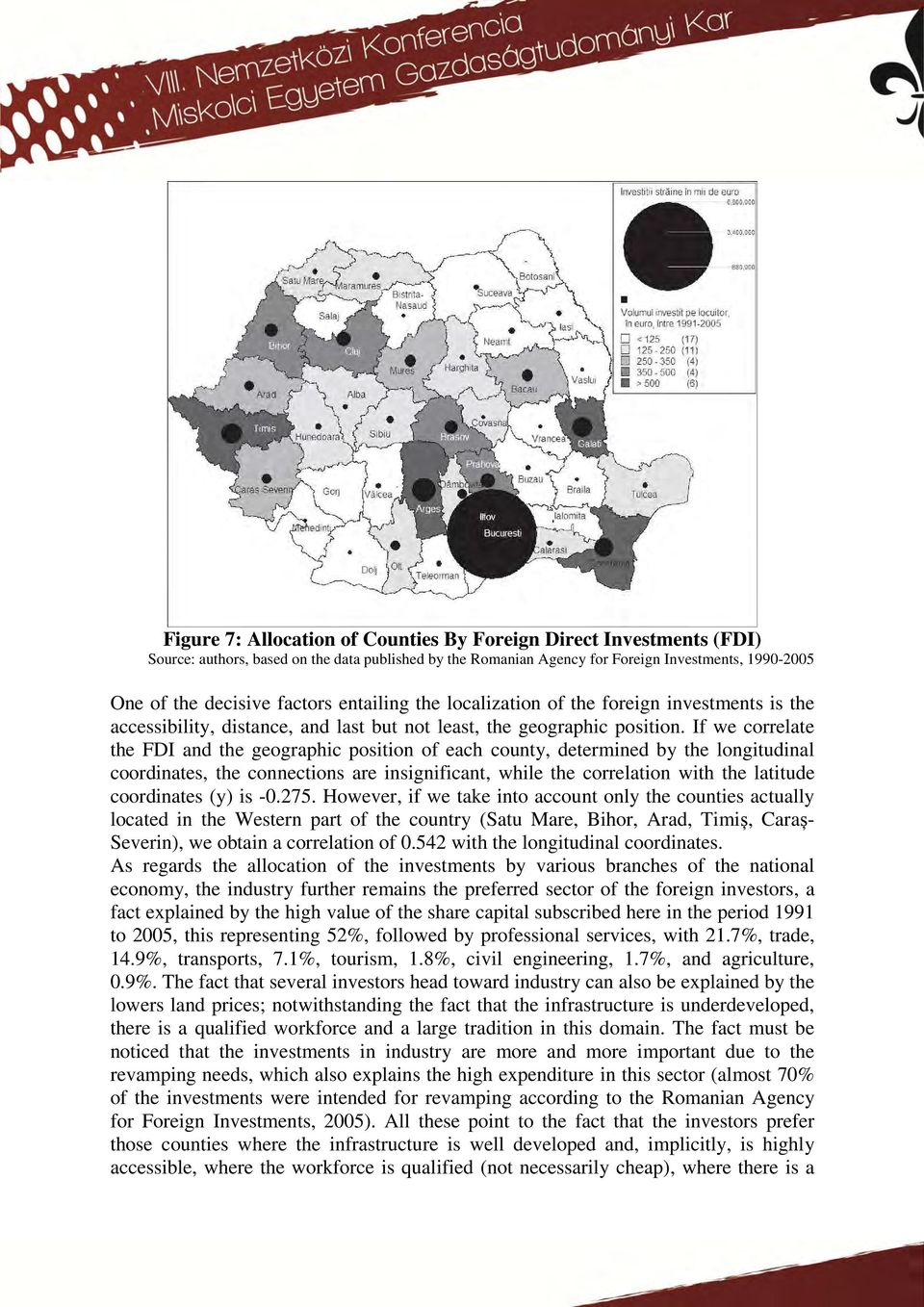
17 Figure 6: Correlation between DFI/Capita and GDP/Capita, in 2006 Source: authors, based on the data published by the Romanian Agency for Foreign Investments, Eurostat The territorial allocation of the trading companies indicates an even more marked differentiation. 119,120 trading companies were established between 1990 and 2005, of which more than half (64,507) are in Bucharest-Ilfov, followed by the Western, North-Western and Central regions, and in this respect the last in this hierarchy are the South-Western, South and North-Eastern regions. The types of investors are also different, from one region to another: if the Western and Norh-Western regions attracted a very large number of companies with foreign participation (especially European), the country's capital, as well as the Southern and South-Eastern regions attracted several investments for greenfield initiatives, especially from non-european investors. The territorial allocation of the FDI per capita at the county level indicates highly marked differences between the Western and Eastern parts of the country (figure 7). Similarly to the GDP allocation per capita, several counties with higher FDI values can be distinguished: these are the Western counties, as well as the Eastern Transylvanian ones, continuing toward South with Argeș, Prahova and Ilfov counties, as well as Bucharest municipality. In the Eastern part of the country, only Constanța and Galați were attractive for a significant volume of FDIs. As one can see, the FDIs have a high concentration in the counties having a higher development potential; the counties in the Northern half of Moldavia, those in Oltenia and Eastern Walachia recording very low FDI values/capita (below Euro Bucharest is the preferred target of the investors: more than 50% of the foreign investments, and over 20% of the registered small and medium-sized enterprises, are concentrated here.

18 Figure 7: Allocation of Counties By Foreign Direct Investments (FDI) Source: authors, based on the data published by the Romanian Agency for Foreign Investments, One of the decisive factors entailing the localization of the foreign investments is the accessibility, distance, and last but not least, the geographic position. If we correlate the FDI and the geographic position of each county, determined by the longitudinal coordinates, the connections are insignificant, while the correlation with the latitude coordinates (y) is However, if we take into account only the counties actually located in the Western part of the country (Satu Mare, Bihor, Arad, Timiș, Caraș- Severin), we obtain a correlation of with the longitudinal coordinates. As regards the allocation of the investments by various branches of the national economy, the industry further remains the preferred sector of the foreign investors, a fact explained by the high value of the share capital subscribed here in the period 1991 to 2005, this representing 52%, followed by professional services, with 21.7%, trade, 14.9%, transports, 7.1%, tourism, 1.8%, civil engineering, 1.7%, and agriculture, 0.9%. The fact that several investors head toward industry can also be explained by the lowers land prices; notwithstanding the fact that the infrastructure is underdeveloped, there is a qualified workforce and a large tradition in this domain. The fact must be noticed that the investments in industry are more and more important due to the revamping needs, which also explains the high expenditure in this sector (almost 70% of the investments were intended for revamping according to the Romanian Agency for Foreign Investments, 2005). All these point to the fact that the investors prefer those counties where the infrastructure is well developed and, implicitly, is highly accessible, where the workforce is qualified (not necessarily cheap), where there is a
19 large tradition in the domain of the industrial products, and the social environment is favorable to the foreign investors. Conclusions In conclusion, we may state that the development policy of the last fifty years have the positive effect of re-leveling the regional hierarchy, without bringing any spectacular reversals in the hierarchy of the regions. Thus, the territorial structure is currently marked by the clear dominance by Bucharest (logically, the capital also having the largest agglomeration economy in Romania), and certain industrial regions which stood out ever since the first industrialization phases: Banat (first of all Timiș county, Arad and Caraș-Severin being under comparative regress), the Hunedoara Sibiu Brașov Prahova Valley axis, the Lower Danube region (Galați Brăila), and the Bacău Neamț grouping. The Dâmbovița Argeș axis, as well as Constanța, were gradually added to those, in the aftermath of the World War II. At the opposite pole, the same as 100 years ago, is Oltenia (notwithstanding the fact that on the whole it went ahead of Moldavia, but not as well the Western part of the latter!), Moldavia (its Eastern and Nothern part), the Northern part of Dobrogea (Tulcea county), and certain areas of Transylvania (Sălaj and Bistrița-Năsăud counties). Certainly, it is hard to see whether, and who much, was the interregional difference amplitude reduced. However, it is a certain fact that the development regions reproduce the regional differences established in time, statistically evidenced at the county level as well. Thus, each table indicator reveals the existence of certain development differences, which overlap over the borders of the cultural historical regions. Moldavia remains further on the underdevelopment pole (North-Eastern Development Region). Dobrogea, Walachia and Olteia (South-Eastern, South and South-Western Development Regions) have an intermediary position, while Transylvania, Banat and Crișana (Central, Western and North-Western Development Regions), together with Bucharest, make up the development pole. The rather lower values of the indicators in the North-Western region are explained by the traditionally lower development level of Sălaj and Bistrița-Năsăud counties. The analysis of the changes occurred in relation to the demographic and economic potential of Romania leads to the conclusion that, instead of a diminution of the existing disparities, lately we are confronted with an ongoing increase in these. In a number of peripheral zones, the secular migration of the population entailed the emergence of multiple disadvantages, evidence both by the change in the structure by age groups, as well as by the decline of certain regions, in the absence of a coherent development. The birth rate diminution and the gradual aging of the population changed to a large extent the population structure by age groups, and have a major impact both on the organization of the economic and social system (education, pension system), and on the territorial disparities. The evolution of the economic area in the transition period reveals no major changes as regards the spatial structure of Romania; the polarized regional development model
20 strengthens more and more, dominated by the country's capital, with the highest level of economic and social development, to which there are added those counties having rather large urban centers, and a more diversified economic structure (Cluj-Napoca, Timișoara, Constanța); the weaker harnessing of the economic and human potential is characteristic for the peripheral counties, with a low urbanization level. In these areas, the accumulated social and economic dysfunctions were even more accentuated by the demographic ones especially in the Southern Walachia counties the youth migration contributing, for several decades, to the increased demographic aging, which together with the lower education of the inhabitants, entailed the delineation of some zones with multiple dysfunctions. From among the new factors which led to a more marked differentiation of the regional development over the last 20 years, we remind here the increase in the direct foreign investments, the strengthening of the position of the small and medium-sized enterprises, and the research-development activities. All these factors had territorially selective effects, being especially concentrated in the developed regions. The analysis of Romania's position within the spatial structure of the European Union emphasizes the peripheral position of the Romanian regions, as well as the existence of certain development gaps still significant, especially as compared to the Central and Western Europe. On the whole, the analysis of the disparities with the aid of several mathematical statistical indices allowed the highlighting, at the European regions level, of a process of diminution of the territorial inequalities. Therefore, in the future we can expect to see a gradual diminution of the existing development differences in relation to the Romanian regions. Bibliography Romanian Agency for Foreign Investment, Activity Report Benedek, J Amenajarea teritoriului si dezvoltarea regionalã. Cluj-Napoca: Presa Universitarã Clujeanã Publishing House. Benedek, J Urban policy and urbanisation in the transititon Romania. Romanian Review of Regional Studies, 2 (1): Borzán, A Románia népességének alakulása, (Evolutia populatiei României, ). Területi Statisztika, 7 (2): Fischer, M.; Stirböck, C Pan-European Regional Income Growth and Clubconvergence. Annals of Regional Science, 40 (4): Guran, N. Liliana Investitiile strãine directe si dezvoltarea sistemului de asezãri din România. Bucharest: Tehnicã Publishing House. Heller, W.; Ianos, I Spatial patterns of economy and migration in post-socialist Romania. Europa Regional, 12 (1): Ianos, I Demographic Disparities in Romania. Romanian Journal of Sociology, VIII (1): National Statistics Institute Anuarul Statistic al României (serii de timp ).

21 National Statistics Institute Population and Dwelling Census, March Krugman, P Where in the World is the «New Economic Geography»?, in: Clark G.L., Feldmann M.P., Gertler M.S. (eds.), The Oxford Handbook of Economic Geography. Oxford: Oxford University Press. Niebuhr, A.; Stiller, S Territorial Disparities in Europe. Intereconomics, 38 (3): Plummer, P.S The Modeling Tradition, in Sheppard E., Barnes T.J. (eds.): A Companion to Economic Geography, Oxford, Blackwell Porter, M.E Locations, Clusters, and Company Strategy, in: Clark G.L., Feldmann M.P., Gertler M.S. (eds.): The Oxford Handbook of Economic Geography. Oxford: Oxford University Press Sunley, P Urban and Regional Growth, in Sheppard E., Barnes T.J. (eds.): A Companion to Economic Geography. Oxford: Blackwell:
22 TRANSFORMATION OF KNOWLEDGE CREATION IN ENTERPRISE RESOURCE MANAGEMENT SOFTWARE DEVELOPMENT Abstract Heere, Dominik PhD SAP Consulting The paradigm of service-oriented architecture will enable end users of business process platforms to develop vertical composite applications as "own practices" in comparison to best practices which are typically delivered by the platform vendors. The growing standardization and the decoupling of these software applications from the underlying backend application will allow enterprises to exchange complex digital goods across company boundaries. This will lead to innovative business models for enterprises: They will be empowered to expand their traditional core business by trading their knowledge through new complex digital goods, which they have developed to solve their own business problems. Today s end-user will turn into an innovative software vendor in the future. Keywords: knowledge trading, electronic marketplace JEL Classification:
23 1. Introduction The paradigm of service-oriented architecture enables enterprises to orchestrate and compose reusable web services into new composite applications. These innovative applications can be easily integrated in existing business applications and lead to higher flexibility and cost efficiency. At the same time standards such as web services, WSDL, XML and SOAP have accelerated the adoption of service-oriented architecture [1]. The big five software vendors of business process platforms transform their products toward the new paradigm of service-oriented architecture. The new service-oriented business process platforms enable the usage of data and functions in the way of standardized web services and provide flexibility and adaptability by enabling the orchestration of loosely coupled components and services in order to build new business processes and adapt them very efficiently based on existing applications. The service-oriented business processes platforms are provided by the platform vendors to their eco-system, which consists of customers and partners in order to enable them to design, adapt and implement business processes in a more simplified technique than before. Members of the eco-system of a platform vendor will be empowered to design and implement innovative composite applications as own practices to solve their specific business problems without touching the underlying backend system. Platform vendors of business process platforms will utilize their eco-system as coinnovators to speed up the development of innovative software components und extend the reach of the customer base of the business process platform. Niche products such as very specific industry solutions can be developed by the eco-system instead of the platform vendor itself. The eco-system can be more knowledgeable in that specific area than the platform vendor. Should a software vendor of a business process platform run and operate an electronic marketplace for composite applications in order to enable the eco-system to trade new digital goods and services such as composite applications and related services provided by a service contractor? This paper proposes a novel model of electronic marketplace for complex digital goods such as composite applications, which empowers all market participants to generate new and innovative business models and to trade their specific knowledge. The importance of a new model of an electronic marketplace for complex digital goods is a consequence of the challenges that large enterprises are threaten in the global market: The continuous development of goods and services are not entirely sufficient to compete in the global environment. At the time platform vendors of a business process platform are confronted with low adoption of service-oriented architecture. Previous research in electronic marketplaces focused primarily on the investigation of the behavior of the marketplace participants, the transactions itself or the business processes of the involved organizations [3].
24 Market participants in the role of a service provider (seller) can easily access the customer base of the software vendor of the business process platform and can offer their digital goods and services on the marketplace. End-users (buyer) of a service-oriented business process platform will be enabled to create new application on top of their existing business applications. They can use existing composite applications on the marketplace and adapt them to their specific business problem needs. 3 rd party service provider can offer new services like implementation services in order to integrated the composite application into the buyers system landscape or support services in case of problems with the composite application on the marketplace. Trading of new complex digital applications and related services requires a new model of electronic marketplace, which supports the specific requirements of these complex digital products and services. A next generation electronic marketplace model is required [8]. 2. Next generation marketplaces The paradigm of service oriented architecture will enable end users of business process platforms to develop vertical composite applications as "own practices" in comparison to best practices which are typically delivered by the software platform vendors. The growing standardization and the decoupling of these software applications from the associated backend applications will allow organizations to exchange these new digital goods across company boundaries with a reduced effort The advent of a new web based service industry With the new archetype of composite applications it is possible to develop and adapt business applications that are highly decoupled from the underlying business applications. A composite application utilizes similar to a distributed application remote components and services. The composite application communicates with the services in comparison to a distributed application via open standards. Composite applications are based on open standards like WDSL and SOAP and therefore facilitate the exchange of these new complex digital products in a more seamless way as before. The architectural concepts of composite applications comprise non-invasiveness, which allows existing services to build new business processes or to adapt them without touching the backend systems. Composites are loosely coupled and have an individual lifecycle in order to keep them independent from the underlying backend systems. The implementation of a new release is highly independent from the lifecycle of the underlying backend systems. These characteristics facilitate the exchange of the new digital products over company boundaries.
25 Figure 1. Anatomy of a composite application [Plattner, 2008] 2.2. Collaboration in future software development A new group of co-innovators will facilitate the business process platform vendors to extend their reach of their service enabled business process platforms and help to extend their market share. Roles in software development will therefore change significantly and will impact the market of future software development in the enterprise business software area. Today s standard business application systems are often highly modified due to the requirements of the individual business processes of the end users. These modifications and adaptations of the standards software are implemented inside the applications. This leads to highly modified business application systems, which are difficult to upgrade and to maintain. in. The modifications are often made in a proprietary programming langue, which results in new challenges if the business application needs to be upgraded. A business process, which is implemented as composite application, provides noncoupling and an independent lifecycle and helps to overcome the invasiveness, loose above-mentioned limitations. New digital products are developed as composite applications by enterprises in order to solve their specific business problems. Due to similar requirements of enterprises in the same industry the business application can solve the business problems of other enterprises as well. A business process for example, which is implemented at an oil & gas company to support their core business, can be used most likely by another company in the same industry. At least the existing composite application can be used as a starting point to build a new application. This will lead to innovative business models for enterprises running a business process platform based on a service-oriented riented architecture: enterprises will be empowered to
26 expand their traditional core business through trading new digital goods, which they have developed to resolve their industry specific business needs. Today s end-users will turn into innovative software vendors of the future A new trading platform for complex digital goods To enable the exchange of these new complex digital goods over enterprise boundaries a new generation of electronic marketplaces is required. A flexible multi-level model only can cover the entire lifecycle of these new complex digital goods as well as the requirements of the various participants and will foster to turn their intellectual property into new business models [4]. The existing 4-phased model of Schmid [5] does not meet the requirements of an electronic marketplace for composite applications and consequently cannot be used in the well-known form. The model does not consider the new requirements of a marketplace of the next generation: The four phases (Knowledge, intention, contract and settlement) do not support the agile requirements of this new good. The level of digitalization is due to the complexity of the products still at a lower level. This requires additional services to get implemented in a new system landscape and services for the operations as well. The existing model of Schmid [5] should be enhanced in a way that the long-term relationship of buyers and sellers are incorporated due to the lifecycle of the new complex digital products. The process does not end with the settlement phase as before. It is required that an ongoing support of the sustainable relationship is provided. Therefore an additional phase support is proposed. In addition it must be achievable to execute the phases in any order due to the fact, that there is no strict sequence from knowledge to settlement any longer. The model has to be more agile in that way. Figure 2. Electronic marketplace [Schmid 1999] 2.4. Core processes and functions of the trading platform What are the functional and procedural requirements that must be fulfilled for the realization of an electronic marketplace for Composite Applications? What core
27 processes must be supported due to the distinctiveness of a marketplace for digital goods like composite applications? The marketplace provides human and machine based services, which support the complete lifecycle of a complex digital product and related services from the analysis of market requirements to the ongoing support and upgrade of a composite application [8]. From a provider perspective the core process starts with the analysis of market requirements. The marketplace provides a requirement management service that offers consolidated information on the demand for new products and services. The marketplace has the capability to find human resources to design and build the new product if needed. An on demand system landscape allows to test the new application and to receive a quality certificate from the business platform vendor. The electronic marketplace handles the publishing process and matches providers and consumers. Search capabilities using catalogs, price discovery tools, and the composition of new applications based on existing software components, an on demand business process management system as well as rating mechanisms, are services of the electronic marketplace. The provisioning process is supported by transactions like software logistics, billing and other value added services. The core process of a seller includes ongoing support and upgrade of the composite application. The software vendor itself or a 3 rd party service contractor provides support for the product using the marketplace. A consumer can define requirements and can search for existing solutions and services on the marketplace. After choosing a product or an implementation service the composite application is consumed and integrated into the consumer s system landscape. The electronic marketplace represents a new type of collaboration platform, which enables agile development techniques in order to speed up the collaborative development process with the participants. A coalition of companies can combine their industry specific requirements and put this as a demand request on the marketplace. Another marketplace participant can investigate this request and offer to build the application in cooperation with other partners in a cooperative way. Due to the complexity of the digital products the electronic marketplace combines additional human services such as consulting services during the implementation process. Companies, which are in the role of a software vendor, are required to provide adequate support for their products. A service contractor can provide support services via the marketplace for the software vendor of the composite application. 3. Benefits and barriers The benefit for a business process platform vendor, which is at the same time an intermediary of an electronic marketplace for composite applications, is obvious: In addition to the rapid adoption of the business process platform in the market due to the availability of additional applications, such as industry-specific applications, the
28 attractiveness of the business process platform will increase substantially. Coinnovators help the intermediary to develop these innovative products. In Addition, the intermediary can collect transactional fees and provide value added services on the electronic marketplace (e.g. quality certification). From a consumer perspective, the electronic marketplace offers access to all products and services. The product portfolio can be investigated and compared through a single access point, which simplifies the complex search for a suitable provider if necessary. Price transparency can be increased. Since buyers can post their specific requirements on the electronic marketplace, providers recognize early on current market trends and can adjust their products and services from it. A group of buyers can combine their requirements to request a new product. Consumers can switch their role into a provider role and offer their products and knowledge on the electronic marketplace. They transform context business into a new core business [6]. A provider can approach the complete customer base of a business process platform vendor. This reduces distribution costs for the provider. Existing and future market demands can be researched easily. Potential barriers are the description of services and composite applications. They must be described consistently in order to make them tradable. The intermediary has to provide trust and needs to establish mechanisms to guarantee reliance. Integration of composite applications into a new complex landscape could also result in unforeseeable challenges. 4. Conclusion The mentioned barriers are dropping rapidly. The blueprint of a new model of an electronic marketplace for composite applications can be implemented in next to no time and will accelerate the adoption of service oriented composite applications. This will lead to innovative business models for enterprises using a business process platform based on service oriented architecture: enterprises will be empowered to expand their core business by trading their knowledge through complex digital products which they have developed as own practices: previous end-users will become innovative software vendors. Roles in software development and the market of future software development will change significantly: An army of co-innovators will encourage the business process platform vendors to extend their reach of the business process platforms and extend their market-share. References Erl, Thomas 2006, Service-Oriented Architecture. Concepts, Technology and Design, Prentice Hall.
29 Gartner 2007, Dataquest Insight: Worldwide Software Market for SOA, Web Services and Web 2.0, , Publication Date: 1 June 2007, ID Number: G Bakos, Yannis 1998, The emerging role of electronic marketplaces on the Internet, August 1998/Vol. 41, No. 8, Communications of the ACM. Giaglis, George M.; Klein, Stefan; O Keefe, Robert M. o.j., The Role of Intermediaries in Electronic Marketplaces: Assessing Alternative Hypotheses for the Future. Schmid, Beat F. 1999, Elektronische Märkte Merkmale, Organisation und Potentiale, in: Hermanns, Arnold; Sauter, Michael (Hrsg.), Management-Handbuch Electronic Commerce Grundlagen, Strategien, Praxisbeispiele. Moore, Geoffrey A. 2005, Dealing with Darwin: How Great Companies Innovate at Every Phase of Their Evolution. Plattner, Hasso 2008, Trends and Concepts, Lecture, Hasso Plattner Institut für Softwaresystemtechnik. Heere, Dominik 2009, Logistic processes on electronic trading platforms, Verlagsgruppe Georg von Holzbrinck.
30 MEASURING TRADE-OFFS AMONG CRITERIA IN A BALANCED SCORECARD FRAMEWORK: POSSIBLE CONTRIBUTIONS FROM THE MCDA RESEARCH FIELD Fernando Alberto Freitas Ferreira PhD, adjunct professor School of Management and Technology, Polytechnic Institute of Santarém, Portugal CASEE, University of Algarve, Portugal and Fogelman College of Business and Economics, University of Memphis, USA [email protected] or [email protected] Abstract Claimed by the Harvard Business Review as one of the main innovations of recent decades in management systems, the Balanced Scorecard (BSC) has been widely studied and applied in different management contexts. However, despite recent progress and its undeniable merit, the BSC has its own shortcomings. As reported in the literature, it seems generally agreed that the way compensations between criteria within a BSC framework are calculated remains an open issue. Thus, one of the contributions of this study is to augment the theoretical discussion on the potentialities of the multiple criteria decision analysis (MCDA) approach to bring simplicity and transparency to the calculation of compensations (i.e. trade-offs) among evaluation criteria within a BSC framework. It seems important to underscore, however, that this paper builds on previous work and is not empirical research. However, it aims to extend the discussion to other (new) measurement contexts. We believe that the development and promotion of the integrated use of the BSC and MCDA tools to measure trade-offs among evaluation criteria are a key issue in their successful application. Keywords: Balanced Scorecard, Trade-Offs, MCDA. JEL Classification: C14, C18, M21.
31 1. Introduction Present-day economic thinking assumes that performance evaluation is a key element for the promotion of improvement initiatives. As stated by Santos et al. (2008), formal or informal performance measurement is common practice in most organizations and it is well established that this plays a critical role in signalling the level of success in achieving objectives and identifying where improvement efforts are required. From this assumption, remarkable progress has occurred in recent years in the development of performance measurement frameworks, where the Balanced Scorecard (BSC) (Kaplan and Norton, 1992) is one of the best known examples. In fact, as claimed by the Harvard Business Review, the BSC is one of the major innovations of recent decades in management systems. However, notwithstanding the progress achieved, the BSC is not without its own shortcomings. As reported in the literature (e.g. Ittner et al., 1997; Ferreira et al., 2010), it seems generally agreed that the way compensations between criteria within a BSC framework are calculated remains an open issue. Following this, and considering the versatility and great potential of the multiple criteria decision analysis (MCDA) techniques (e.g. MACBETH) in dealing with trade-offs among evaluation criteria, this paper aims to analyze possible contributions of the MCDA approach to overcome the measurement shortcomings of the BSC. It must be highlighted, however, that the idea of combining the BSC and the MACBETH technique is not new. Zorzi and Ensslin (2006) reported the integrated use of both methodologies in the construction of a performance measurement system in an accounting context. Therefore, this paper builds on previous work, but aims to apply the interest of the MCDA approach to other measurement contexts in order to broaden the generalizability of the results. The paper is organized as follows. Section 2 presents the BSC as a generic method of performance evaluation, and highlights its major shortcomings. Section 3 presents concepts related to MCDA, respective background and potential in the cardinal measurement of trade-offs among evaluation criteria. In section 4 a numerical example is illustrated. Section 5 discusses the pros and cons associated with the integrated use of BSC and MACBETH, and concludes the paper. 2. The Balanced Scorecard The Balanced Scorecard (BSC) as a generic method of performance evaluation was created and developed by Robert Kaplan and David Norton in the early 1990s (cf. Kaplan and Norton, 1992). One of the main reasons for its creation is directly related to the fact that all classic financial indicators are insufficient to measure the creation of value by the intangible assets of an organization. However, according to Kaplan and Norton (1996a: 75), the scorecard wasn t a replacement for financial measures; it was their complement. Following this, the BSC has been emphasized in several studies as a tool to assess performance, because it articulates several indicators, while considering the organization s strategy.
32 The structure of the model is focused on the initial strategic options defined by the organization. From this point of view, the evaluation is done according to a complex set of causes and effects desired to define the so-called indicators of occurrence (with desirable well-defined goals, and well-measured end-points). The modeling system is then initiated by defining key performance variables in the financial area, such as: return on invested capital and sales growth. Indexed to these types of indicators, different trend indicators (i.e. factors that influence the performance of the indicators of occurrence) are identified and defined which determine the performance of the central variables, which are, again, consistent with the strategic goals of the organization. Thus, the BSC emerges from a conceptual basis upon which nonfinancial aspects can be lead indicators of future financial performance (Kaplan and Norton, 2001a: 87). That is, the process is deployed in sequence for the dimensions of innovation and learning, internal processes, and customers, determining the financial perspective (i.e. innovation and learning influences internal processes, which influence the customers' perspective; finally, the customer s perspective influences the financial perspective). Despite the fact that the BSC has been criticized on the grounds of being too linear in the analysis of the causal relationships among evaluation criteria, the model has considerable merit, depending on its contribution to the systematization of the dynamic action of organizations. As a result, one may catalog the BSC as a tool for strategic management integration (Kaplan and Norton, 1996a; 1996b) Explanation and Scope of the Method As previously stated, the BSC is a tool that provides a dynamic view of the organization, targeting the financial, customer, internal processes, and learning and growth perspectives, all aligned with the organization s strategy, which must be clearly known and correct. Figure 1 presents the conceptual scheme of the BSC.
33 Strategy Figure 1. Conceptual Scheme of the BSC Source: Adapted from Kaplan and Norton, 1996a In practical terms, the model reflects an organization's vision and strategy, seeking a balance between the various external indicators (i.e. shareholders-oriented or customers-oriented) and internal measures of critical business processes (such as innovation, learning and growth). Consequently, the BSC seeks to obtain information on the segment in which the organization competes, conquers clients, creates value, etc. That is, the method aims to offer a future vision and a way to achieve it (Kaplan and Norton, 2001b). Nevertheless, it is noted that the BSC was not designed as a tool of quantification, although it could (or should) be used by executives who need to make decisions regarding operations, production processes, objectives, products and customers. Thus, the BSC is based on four perspectives, which when integrated and analyzed together, provide a balanced view of the current and future positions of business performance, producing a balance between: (1) short-term objectives and long-term financial and non-financial indicators; (2) assessments externally oriented (shareholders or customers) and evaluations internally oriented (internal business processes, innovation and learning); and, (3) evaluations of past efforts and drivers of future performance. Furthermore, as stated by Kaplan and Norton (1996a), the BSC is also useful for communicating the mission that exists throughout the organization Financial Perspective As pointed out by Fleisher and Mahaffi (1997: 128), no company survives without ensuring its ongoing financial viability. Sharing this view, the BSC aims to evaluate the financial results of a strategy. That is, the method aims to evaluate business growth
34 and development, as well as the shareholders satisfaction. Among the diversified financial indicators that can be considered, it is typical to include: return on investment, economic added value, profitability, growth revenues, costs reduction and other financial goals that should be aligned with the strategy Customer Perspective From the customer perspective, the method aims to target market segments and identify measures of success to evaluate those same segments. In broad terms, customers concerns are usually supported on four variables: time, quality, service performance, and cost. In terms of indicators considered essential, one may highlight: market share, customer s capability of acquisition, customer retention, profitability and customer s level of satisfaction, among others (Kaplan and Norton, 1992 and 2001a) Internal Process Perspective The internal process perspective is analyzed according to guidelines provided by the financial and customer s perspectives. The internal processes are the various activities undertaken within the organization, ranging from identification of needs to the customers satisfaction. This view encompasses the innovation process (creation of products and services), operations (production and marketing), and after-sales services (customer support after the sale). The improvement of internal processes is a key indicator of future financial success. For the indicators, it is typical to consider: number of innovations and number of operations after the sale Learning and Growth Perspective The learning and growth perspective offers the basis for achieving the objectives of the other three perspectives. To this end, it identifies the infrastructure needed to promote growth and long-term improvements, which comes from three main sources: people, systems and organizational procedures. At this stage, it also identifies the capabilities that a company should have in terms of internal processes to be able to create value for customers and shareholders. As indicators, it is typical to consider: the level of employee satisfaction, employee turnover, profitability per employee and employee engagement with suggestions that facilitate improvements General and Specific Limitations of the BSC Applications Following the earlier discussion, it seems clear that the BSC is a robust method that adds value to organizations by providing relevant information, creating environmental conditions conducive to individual and collective (through learning and participation) improvement, and eliminating the need to apply a specific control system for each
35 situation. In fact, as stated by Kaplan and Norton (1992: 79), the scorecard puts strategy and vision, not control, at the center. In this sense, the adoption of an evaluation system based on the BSC requires a clear definition of the strategy, as well as a team willing to invest efforts in an initiative that is often difficult to quantify. Moreover, according Ottoboni et al. (2002), this method still lacks understanding and simplification to be properly applied to many potential scenarios. Consequently, some authors (e.g. Fleisher and Mahaffi, 1997; Ottoboni et al., 2002) have been pointing out various limitations to the BSC, such as: (1) it preserves the emphasis on financial results by submitting all measures to financial objectives; (2) its practical implementation takes a considerable amount of time (up to 30 months) to design and implement as a strategic management system (Fleisher and Mahaffi, 1997: 125); (3) its formulation may depend on the relative negotiation power of different groups; (4) other stakeholders, not previously considered in the four perspectives, may arise; (5) it does not explore the interrelationships between partial indicators and the organization's overall performance, being possible to observe, simultaneously, a set of values presenting satisfaction and other set of values presenting dissatisfaction; (6) the analysis may be limited by "interpretation effects"; and, (7) raises doubts on the way that relative weights are chosen to balance the evaluation criteria. Despite the relative specificity of these limitations, it seems clear that from their combination two main lines of criticism directed toward the BSC emerge. On the one hand, and according to Fleisher and Mahaffi (1997: 138), the biggest problem practitioners will face in adopting a balanced scorecard approach ( ) will be in developing measures and installing the information systems needed to capture the data underlying the measures. However, Kaplan and Norton (2000) propose the use of strategic maps to overcome this particular limitation. On the other hand, and despite recent progress, it seems generally agreed that the way compensations between criteria within a BSC framework are calculated remains an open issue (Ittner et al., 1997: 9). Following this, one of the contributions of this study is, precisely, to propose the use of multiple criteria decision analysis (MCDA) methods to bring simplicity and transparency to the calculation of compensations (i.e. trade-offs) among evaluation criteria within a BSC framework. In the next section the MCDA background is briefly presented. 3. Brief Presentation of the MCDA Background As far as the treatment of complex problems is concerned, MCDA can be seen as a new Operational Research (OR) branch. As defended by Bana e Costa et al. (1997: 30) in contrast to the more classical OR approaches, the multicriteria decision aid framework facilitates learning about the problem and the alternative courses of action, by enabling people to think about their values and preferences from several points of view. Thus, by recognizing the limits of the objective approaches and by considering that decision makers should shape and/or transform their own preferences based on to their own judgments of value, multicriteria methods aim to construct something that
36 does not pre-exist. Keeney (1992: 154) strengthens this line of thinking, affirming that values are subjective, but they undeniably are part of decision situations. Not modeling them does not make them go away. As depicted in Figure 2, in dealing with complex problems, the need to consider subjective aspects becomes evident. Objective Aspects Subjective Aspects Decision Process Optimization MCDA Qualitative Tools Figure 2. MCDA Conceptual Approach As it can be seen through the conceptual scheme presented in Figure 2, MCDA highlights the existing inseparability between the objective aspects and the subjective aspects of a decision-making process. Moreover, through an interactive and constructive supporting decision process, MCDA provides decision makers with arguments that enable them to reflect, to readjust and/or to validate their own convictions and judgments of value. Quoting Bana e Costa et al. (1997: 36), the theory of MCDA is thus an open theoretical field and not a closed mathematical theory solving a specific class of problems. Roy and Vanderpooten (1997) discuss some of the features that characterize the MCDA approach (Table 1.). Table 1. Main Features of the MCDA Approach Source: Adapted from Roy and Vanderpooten (1997: 27)
37 Depending on the variables defined, the boundary between what is feasible and what is not feasible is vague and frequently changes. In many real-life problems, the decision maker is either difficult to identify or simply does not exist. Rather, s/he is the person (or group of people) on behalf of whom the support should be provided. Information is often vague, ill-determined or uncertain. The study itself serves to resolve conflicts and/or contradictions among the actors involved in the decision-making process. Usually, it seems unreasonable to say if a decision is good or bad by purely referring to a mathematical model. Often the issues that matter involve dimensions of different nature, which also contribute to the quality/success of the final decision. The features included in Table 1. show that objective factors and alternatives characteristics interact with factors of a subjective nature. Therefore, to omit the importance of subjective factors or simply putting them aside in the decision-making process seems to be a negligent thing to do. As it is widely discussed in the MCDA literature, the main gap of any single criterion approach is related to the nonrecognition that objectivity has limits. In fact, the search for optimization is emphasized even when the existence of multiple objectives is considered. In line with Belton and Stewart (2002: 3), the concept of an optimum does not exist in a multicriteria framework and thus multicriteria analysis cannot be justified within the optimisation paradigm frequently adopted in traditional OR [ ]. MCDA is an aid to decision-making, a process which seeks to: integrate objective measurement with value judgments; make explicit and manage subjectivity. As it can be observed, this criticism to the single criterion methodologies seems to be supported on the basis that subjectivity is inherent in all decision-making processes and, therefore, one of the major aims of the MCDA approach is to make individuals preferences explicit, while ensuring transparency in the decision-making process. As defended by Belton and Stewart (2002: 1) [ ] every decision [...] requires the balancing of multiple factors [ ] sometimes explicitly, sometimes without conscious thought. In this regard, based on a constructivist approach, MCDA recognizes the limits of the mathematical optimum, and defends a guiding principle that, without preconditions, models are supported on the observation of working hypotheses and/or on a set of key elements Measuring Trade-Offs Among Criteria As it has been discussed herein, the way compensations between criteria within a BSC framework are calculated remains an open issue (Ittner et al., 1997: 9). Nonetheless, due to their remarkable heuristic elasticity that provides decision makers with a bigger capacity to support decisions and to adapt strategies to a permanent changing environment, MCDA methodologies seem to be suitable to overcome this
38 shortcoming of the BSC. In fact, the assessment of weights to evaluation criteria has been discussed in the MCDA literature for a long time (cf. Goodwin and Wright, 1991; Junior, 2008). In the next sub-section, one of the most well-known MCDA techniques is presented, in order to exemplify the way trade-offs between criteria can be obtained The MACBETH Technique MACBETH stands for Measuring Attractiveness by a Categorical Based Evaluation Technique. It was created during the 1990s by Carlos Bana e Costa and Jean Claude Vansnick (cf. Bana e Costa and Vansnick, 1994; 1997; 1999) and, in broad terms, is an interactive technical procedure designed for supporting the construction of numerical scales of intervals, which aim to quantify the difference of attractiveness between elements of a certain set, throughout a learning process and supported by visual interactive software. The technique uses a simple question-answer procedure, which consists of asking decision makers to pair-wise compare options by giving a qualitative judgment of the difference in attractiveness between them. Following a constructivist approach, the procedure also tests the consistency of the answers, offers suggestions to bypass inconsistent situations, and provides the analysis for aiding the decision maker to enter the domain of cardinal measurement (for a general overview and some practical applications, see Bana e Costa and Vansnick, 1994; 1997; 1999; Bana e Costa et al., 2005). Thus, it seems to be an extremely useful technique not only in the construction of cardinal value functions, but also in supporting the definition of trade-offs between evaluation criteria (Figure 3). Figure 3. The MACBETH Approach (Matrix of Judgments, Weights and Cardinal Value Scale)
39 Unlike the technical procedure used in the direct rating and bisection, in which decision maker/s is/are subject to a cognitive effort that involves more than two actions (e.g. is the difference of attractiveness between a and b greater, smaller or equal to the difference of attractiveness between c and d?), in the MACBETH methodology, the process involves only two actions at a time. Therefore, Bana e Costa and Vasnick (1994) emphasize that, as in the Analytical Hierarchic Process (AHP) of Saaty (1980), the process should be simple and natural, involving only the drafting of judgments between each pair of actions. The novelty lies, however, in the introduction of a semantic scale formed by categories of difference of attractiveness. In practice, as it is acknowledged by the authors, this type of approach has been previously advanced by Freeling and Belton (cf. Bana e Costa and Vasnick, 1994) in the context of criticisms made to the AHP (see Boucher and MacStravic, 1991; Weber, 1993; Davies, 1994; Bana e Costa et al., 1997; Belton and Stewart, 2002; Dubois, 2003; Bana e Costa and Vansnick, 2008). However, the authors argue that the MACBETH approach addresses the issue of cardinal value scales in a more innovative way because, unlike the AHP, which uses scales of ratio of priority or importance, the MACBETH methodology makes use of scales of differences of attractiveness, which are nothing more than interval scales (Bana e Costa and Vansnick, 1994; 2008). As such, it seems clear that the concept of attractiveness takes a different meaning from the concepts of priority or importance, since it allows negative values representing repulsive feelings, while the latter two (importance and priority) do not fall below the zero level. Following this, we can assume that the main disadvantage of working with mono-polar concepts occurs precisely because zero does not translate to a neutral level, but at a clearly negative level. In addition, there might be barriers related to lack of substantive significance, particularly if the answers to the questions are interpreted in terms of intensity of preference. In line with Bana e Costa and Vansnick (1994), the initial framework of the MACBETH methodology is anchored to the problem of numerical representation of semi-orders for multiple thresholds, resolved by Doignon. According to the authors, in a problem where there is a structure of m binary relations [P (1),..., P (k),..., P (m) ], where P (k) reflects a preference as stronger as k is greater, based on a certain point of view PV j, the conversion of these relationships of preference in numbers becomes possible. In fact, the numerical codification procedure proposed by the MACBETH methodology consists in associating to each action of X (with X ={a, b,..., n} being a finite set of n actions), a real number v(x) such that differences as v(a) v(b) (with a more attractive than b (i.e. a P b)), are as compatible as possible with the value judgments made by the decision maker/s. In other words, for all pairs (a, b) assigned to a certain category of difference of attractiveness C, the differences v(a) v(b) will belong to the same interval (without overlaps) (Bana e Costa and Vansnick, 1994)). Whereas two contiguous ranges correspond to two consecutive categories, the technical procedure is to associate asymmetric partitions of the ray of positive reals to partition classes of ordered pairs (a, b) (with a P b) (Figure 4).
40 Figure 4. Allocation of v(a) v(b) to a Category C k Following this, and in order to define the intervals, we just need to set the limits, which can be understood as transition thresholds between categories of consecutive differences of attractiveness. In this sequence, semi-multiple orders are naturally introduced as long as we wish to represent preferences through a value function v and thresholds of functions s k, such as: a P ( k ) b : sk < v( a) v( b) < sk + 1 (1) It is worth recalling that the thresholds s k are positive real constants, which permit definition of the intervals corresponding to the semantic differences of attractiveness. Accordingly, a range of differences of attractiveness have to be limited on its left by "its" zero, but are not limited on its right. As stated by Bana e Costa and Vansnick (1994), being a P (m) b, it is always theoretically possible to find a level of impact by setting an actual or fictitious action c, such that c is more attractive than b, more than a is more attractive than b. Following this logic, the final semantic category C m cannot be limited on the right, and, between the origin s 1 = 0 and s m, an infinite number of categories and thresholds can be defined. Figure 5 illustrates an example of a range of categories of difference of attractiveness. Figure 5. Scale of categories of difference of attractiveness As defended by Bana e Costa et al. (2005: 413), the basic idea underlying the initial development of MACBETH was that limits of these intervals should not be arbitrarily fixed a priori, but determined simultaneously with numerical value scores for the elements of X. Therefore, and from a practical point of view, the methodology starts by asking the decision-maker/s to allocate the difference of attractiveness between each pair of actions (a, b) X to one of the following semantic categories: C 0 =Null (or
41 indifference (i.e. a I b)); C 1 =Very weak; C 2 =Weak; C 3 =Moderate; C 4 =Strong; C 5 =Very strong; and C 6 =Extreme (cf. Bana e Costa et al., 2005). For example, if the decision maker considers a more attractive than b and the difference between both actions is strong, then (a, b) C 4. Based on the value judgments of the decisionmaker/s, the methodology will propose, if possible, an initial scale that satisfies the following conditions (cf. Junior, 2008): k, k * and ( c, d) C a, b X : v( a) > v( b) apb { 1, 2,3, 4,5,6}, k* : k k a, b, c, d X with ( a, b) C * + 1 v( a) v( b) v( c) v( d ) k (2) (3) Satisfying these conditions, linear programming is applied as follows (cf. Junior, 2008): Minv( n) S. T.: a, b X : apb v( a) v( b) + 1 v( a ) = 0 where : a a, b X : aib v( a) = v( b) ( a, b),( c, d) P, if the difference of attractiveness between nis anelement of is an element of a and bisbigger thanbetweenc and d, then : v( a) v( b) v( c) v( d) + 1+ δ ( a, b, c, d) X so that a, b, c,... X : n ( P I ) a, b, c,... X so that a, b, c,... X : a, b, c,...( P I) a δ ( a, b, c, d) is the min imal number of categories of difference of attractiveness between the difference of attractiveness between a and b and the difference of attractiveness between c and d. (4) Among other developments, recent progress on the MACBETH framework allowed for implementation of an automatic procedure for detecting inconsistencies, even in contexts of incomplete arrays of value judgments. From a practical standpoint, substantial improvements in the development of this approach were also achieved by increasing the capabilities of this innovative methodology for decision support. Nonetheless, following Bana e Costa et al. (2003: 1), its essential characteristics, however, have never changed; in fact MACBETH has always remained consistent with the ideas that led to its creation as an humanistic, interactive and constructive approach to the problem of how to build a quantitative model of values based on qualitative (verbal) difference judgements, that facilitates the path from ordinal to cardinal preference modelling. It is precisely by bringing together the humanistic,
42 interactive, and constructivist strands that the MACBETH approach is characterized as a MCDA technique with great potential in the context of measurement. 4. A Numerical Example In order to provide a numerical example of MCDA potential in the context of cardinal measurement of trade-offs, let us consider two hypothetical criteria CRT1 and CRT2, which could be two of the variables included (or to be included) in one of the four scorecards (i.e. perspectives) presented in Figure 1. From a simplistic and merely exemplificative point of view, the process may start by asking the decision maker (or group of decision makers within a negotiation process) to rank criteria according to their degree of attractiveness (i.e. if the decision maker considers CRT1 more attractive than CRT2, then CRT1 should be ranked in first place). The next step consists in eliciting from the decision maker qualitative judgments regarding the difference of attractiveness between criteria. This is made based on the semantic categories of value judgments presented in sub-section 3.2. As each judgment is given, the M-MACBETH software automatically verified the matrix s consistency and suggested modifications in case of any detected inconsistency. Figure 6 depicts an example of a consistent matrix, where CRT1 and CRT2 are evaluated based on the difference of attractiveness between them. Figure 6. Matrix of Qualitative Judgments As can be observed in Figure 6, a numerical scale is calculated from the complete and consistent matrix of judgments. In this merely exemplificative case, 54.55% and 45.45% are, respectively, the weights of CRT1 and CRT2 (Figure 7).

43 Figure 7. Scale and Weights The scale should always be discussed to ensure that it adequately represents the magnitude of the decision maker s judgments. In case of disagreement, the weights should be adjusted, respecting the limits proposed, to maintain the consistency of the previously given answers. Obviously, sensitive, robustness, and dominance analyses should be carried out in order to allow the decision maker to see how a change in any of the weights would affect the overall results. Following this, one may state that MACBETH offers a very good mathematical basis, and its friendliness in obtaining trade-offs among evaluation criteria should be highlighted. 5. Conclusions and Future Research As previously stated, the present-day economic thinking assumes that performance evaluation is a crucial element for the promotion of improvement initiatives. From this perspective, remarkable progress has occurred over the past two decades in the development of performance measurement frameworks. Among the most well known examples of those frameworks, the BSC should be highlighted. However, despite the progress achieved by the BSC, the framework is not without its own limitations. Different types of criticism have been directed toward the BSC, but it should be underscored that there appears to be little concern about the use of structured approaches to guide managers in explicitly dealing with trade-offs, helping them to prioritize performance objectives. As such, possible contributions from the MCDA research field have been discussed in this paper, namely the use of the MACBETH technique in the calculation of compensations among evaluation criteria. As clearly indicated (see the Introduction again), this paper is not empirical research, and the idea of combining the BSC and the MACBETH technique is not new. Nonetheless, this paper aimed to amplify the interest of the MCDA approach to other measurement frameworks in order to increase the generalizability of the results achieved by Zorzi and Ensslin (2006) in an accounting context. Therefore, by highlighting the good mathematical basis and friendliness of the MACBETH approach, we propose that the development and promotion of the integrated use of the BSC and MCDA tools to measure trade-offs among criteria are a key issue in their successful application and dissemination. Eventual improvements resulting from different case studies in
44 different contexts will contribute to strengthen the robustness, generalizability, reliability and potential of the approach discussed in this paper. Acknowledgements This paper is part of the invited speech presented at the 8 th International Conference of the Faculty of Economics of the University of Miscolk, Hungary. The author is grateful to Professors Gyula Fülöp and Ildikó Pelcz Gáll for their kind invitation. References Bana e Costa, C. and Vansnick, J. (1994), Uma Nova Abordagem ao Problema da Construção de uma Função de Valor Cardinal: MACBETH, Avaliação de Projectos e Decisão Pública, Fascículo VI, AEIST/UTL. Bana e Costa, C. and Vansnick, J. (1997), Applications of the MACBETH Approach in the Framework of an Additive Aggregation Model, Journal of Multi-Criteria Decision Analysis, 6, pp Bana e Costa, C. and Vansnick, J. (1999), The MACBETH Approach: Basic Ideas, Software and an Application, in Meskens, N. and Roubens, M. (Eds.), Advances in Decision Analysis, Kluwer Academic Publishers: Dordrecht, Book Series: Mathematical Modelling: Theory and Applications, Vol. 4, pp Bana e Costa, C. and Vansnick, J. (2008), A Critical Analysis of the Eigenvalue Method Used to Derive Priorities in the AHP, European Journal of Operational Research, 187, Bana e Costa, C.; De Corte, J. and Vansnick, J. (2003), MACBETH, Working Paper LSE OR 03.56, London School of Economics, London. Bana e Costa, C.; De Corte, J. and Vansnick, J. (2005), On the Mathematical Foundations of MACBETH, in Figueira, J.; Greco, S. and Ehrgott, M. (Eds.) Multiple Criteria Decision Analysis: The State of the Art Surveys, New York, Springer, pp Bana e Costa, C.; Stewart, T. and Vansnick, J. (1997), Multicriteria Decision Analysis: Some Thoughts based on the Tutorial and Discussion Sessions of ESIGMA Meetings, European Journal of Operational Research, 99, Belton, V. and Stewart, T. (2002), Multiple Criteria Decision Analysis: An Integrated Approach, Dordrecht, Kluwer Academic Publishers.
45 Boucher, T. and MacStravic, E. (1991), Multiattribute Evaluation Within a Present Value Framework and its Relation to the Analytic Hierarchy Process, The Engineering Economist, Vol. 37(1), pp Davies, M. (1994), A Multicriteria Decision Model Application for Managing Group Decisions, Journal of the Operational Research Society, Vol. 45(1), pp Dubois, D. (2003), Evaluation and Decision Models: A Critical Perspective (Book Review), Fuzzy Sets and Systems, 139, pp Ferreira, F.; Santos, S. and Rodrigues, P. (2010), Adding Value to Bank Branch Performance Evaluation Using Cognitive Maps and MCDA: A Case Study, Journal of the Operational Research Society, AOP 28 July. doi: /jors Fleisher, C. and Mahaffi, D. (1997), A Balanced Scorecard Approach to Public Relations Management Assessment, Public Relations Review, Vol. 23(2), pp Goodwin, P. and Wright, G. (1991), Decision Analysis for Management Judgment, John Wiley. Ittner, C.; Larcker, D. and Meyer, M. (1997), Performance, Compensation, and the Balanced Scorecard, The Wharton School, The University of Pennsylvania. Junior, H. (2008), Multicriteria Approach to Data Envelopment Analysis, Pesquisa Operacional, Vol. 28(2), pp Kaplan, R. and Norton, D. (1992), The Balanced Scorecard: Measures that Drive Performance, Harvard Business Review, Vol. 70(1), pp Kaplan, R. and Norton, D. (1996a), Using the Balanced Scorecard as a Strategic Management System, Harvard Business Review, Jan/Feb, pp Kaplan, R. and Norton, D. (1996b), Strategic Learning and the Balanced Scorecard, Strategy & Leadership, Vol. 24(5), pp Kaplan, R. and Norton, D. (2000), Having Trouble with Your Strategy? Then Map It, Harvard Business Review, Vol. 78(5), pp Kaplan, R. and Norton, D. (2001a), Transforming the Balanced Scorecard from Performance Measurement to Strategic Management: Part I, Accounting Horizons, Vol. 15(1), pp
46 Kaplan, R. and Norton, D. (2001b), Transforming the Balanced Scorecard from Performance Measurement to Strategic Management: Part II, Accounting Horizons, Vol. 15(2), pp Keeney, R. (1992), Value-Focused Thinking: A Path to Creative Decisionmaking, Harvard, Harvard University Press. Ottoboni, C.; Fernandes, C.; Pamplona, E. and Pagni, T. (2002), Algumas Razões para a Ocorrência de Falhas na Implementação do Balanced Scorecard (BSC), Proceedings of the XXII ENEGEP, Curitiba, Brazil. Roy, B. and Vanderpooten, D. (1997), An Overview on The European School of MCDA: Emergence, Basic Features and Current Works, European Journal of Operational Research, 99, pp Saaty, T. (1980), The Analytic Hierarchy Process, New York, McGraw-Hill. Santos, S.; Belton, V. and Howick, S. (2008), Enhanced Performance Measuring Using OR: A Case Study, Journal of the Operational Research Society, 59, pp Weber, S. (1993), A Modified Analytic Hierarchy Process for Automated Manufacturing Decisions, Interfaces, 23, pp Zorzi, A. and Ensslin, S. (2006), Interação entre o BSC e a Metodologia MCDA-C: Construção de um Modelo de Gestão para o Setor de Contabilidade de uma Entidade Fechada de Previdência Complementar, Proceedings of the XIII SIMPEP, Bauru/São Paulo, Brazil.
47 TRANSLATING SINGLE PROJECT MANAGEMENT KNOWLEDGE TO PROJECT PROGRAMS Mihály Görög DL, CSc, Professor of Project Management, Head of Department Corvinus University of Budapest, Department of Strategy and Project Management Abstract Over the past decade the efficient implementation of project portfolios became of great importance from the point of view of organizational success. Many authors are concerned with improving the professionalism of implementing project portfolios and project programs, and most of them identify so-called context-related factors that are considered to be the bases of successful portfolio and program implementation. However, little is written on how to use the project management toolkit in the case of project programs. In mid 2007 a research program was initiated in order to highlight the role of the single project management toolkit in the process of managing the implementation of project programs. During the research both case-based and interview-based qualitative research methods were used. The primary question addressed in this paper is how to translate single project management knowledge to program management. However, to achieve this end the author needs to clearly differentiate between project programs and project portfolios. Ultimately the paper demonstrates how single project management tools could be applied in a program management context in order to increase the efficiency of program implementation. Keywords: program management, scope-related interdependence, resource-related interdependence, translating single PM knowledge to program management
48 Introduction Nowadays big organizations both profit oriented companies or public service organizations are more and more concerned with project programs in order to realize their strategic objectives in an efficient manner. The fundamental reason behind this phenomenon is the innovative effort to renew the product portfolio and to reduce the time to market (Aubry et al., 2007). These circumstances have led to a growing number of projects on the one hand, while on the other hand, such groups of projects, i.e. project programs have emerged that consist of projects that are strongly interrelated during their implementation process. Managing the implementation of a project program clearly goes beyond managing the implementation of single projects (Maylor et al., 2006). Nevertheless, the successful implementation of a project program presumes the successful implementation of those projects that belong to the program. However, studying the efficiency and the associated success rate of implementing project programs have thus far been a rare topic in the literature (Martinsuo and Lehtonen, 2007a). Martinsuo and Lehtonen (2007a) analyze this phenomenon in a very general way, therefore the primary outcome of their research does not go further than highlighting the need for efficient management of those projects that belong to a program. The above authors introduce the outcomes of earlier research (e.g. Artto and Dietrich, 2004; Ditrich and Lehtonen, 2005; Elonen and Artto, 2003; Payne and Turner, 1999). The latter authors also emphasize that factors such as clear project goals, systematic decisionmaking, top management support etc, which contribute to achieving success on single projects, could undoubtedly contribute to achieving success on project programs too. Indeed, these are decisive success factors for program implementation as well. However, the associated solutions e.g. how to define clear goals in a program context are not explored by these authors. At the same time, the reviewed literature does not report on any empirical research (unlike in the case of single projects) that reveals the success or failure rate of implementing project programs. Most of the literature reviewed during our research takes a general approach, therefore the authors emphasize the importance of a program office which is considered to be the primary success factor in the course of implementing project programs. As we can see later, the need for a program office is indisputable, although the program office alone is not sufficient for program management. Currently there is no agreement on how to translate single project management knowledge to efficient program management (Thiry and Deguire, 2007). Improving the product and service portfolio and reducing the time to market are of great importance for organizations, and this effort requires efficient implementation of the associated project programs (Aubry et al., 2007). The efficiency of program implementation might be improved by means of translating single project management knowledge to managing programs. In order to satisfy this need, a research program was initiated in mid 2007 in order to reveal the applicability of the
49 single project management toolkit in a program context in order to improve the efficiency of managing project programs. The research used qualitative research methods, i.e. multi-phase case analysis. Information for the analyses was gained from both interviews and from studying available program documents and associated project documents. The aim of this paper based on the outcomes of the above research is to highlight potential solutions by means of single project management knowledge, which could be translated to program management. By means of this translation the potential for more efficient program management could be increased. The paper is organized as follows: The first main section provides a literature review that summarizes the most decisive features of the present status of managing programs. The following section outlines the research and the research methods and defines two hypotheses and two propositions. The third section introduces the research outcomes, which is followed by a discussion of the outcomes in the light of the propositions and the hypotheses. This latter section is followed by an introduction to the way in which single project management tools can be applied in a program context, i.e. translating single PM knowledge to program management. The last main section of the paper is devoted to research conclusions. Literature review Project programs and their management: understanding the concepts Although neither the phenomenon of project portfolios nor the phenomenon of project programs is new amongst academics and practitioners, there are still many ambiguities in terms of definitions. Turner and Müller (2003) approached these phenomena from the perspective of single projects. They state that project programs are frameworks that provide strategic direction for a group of projects, while a project portfolio aims at providing efficient resource utilization across the projects that the program encompasses. Lycett et al. (2004) provide a critical review of earlier approaches to programs and their management, and they state that program management suffers from two flawed assumptions, namely they are: a) program management is considered to be scaled-up project management, and b) there is a single form for managing programs. According to the approach of Gareis (2004) a project program is a temporary organization but contrary to a project (which is also a temporary organization according to Gareis) a program implies a unique and long-term process of large scope. Indeed, these are very important characteristics of programs. Partington et al. (2005) studied the different attributes of program management competence and their manifestation at four different levels, though they were concerned mainly with human related aspects of the problem. Morris and Jamieson (2005) provide a comprehensive picture regarding projects, project programs, and project portfolios
50 based on the approach of the authors of previously published papers. Morris and Jamieson (2005) themselves do not provide new definitions but they emphasize the extremely important role of projects, project programs, and project portfolios in forming and implementing organizational strategic objectives. Blomquist and Müller (2006) with reference to Cooper et al. (2000) stress that project portfolios are management decision frameworks, and they are used to identify those projects that should be implemented to achieve strategic objectives. These authors also emphasize that project portfolio management is a governance method for selecting and prioritizing resource-interrelated projects in organizations. They point out that program management is different from portfolio management, though they are connected with each other. Program management in their view focuses on defining the desired goals of the individual projects in a specific manner. Project management is then used to complete these projects in an efficient way. Pellegrinelli et al. (2007) highlight the strategic role of project programs, and program management is considered by them to be the means that brings about planned changes (strategic objectives) in an organization. In their view program management is first of all an inter-project co-ordination mechanism for achieving desired change. From the point of view of the potential co-ordination benefits, the authors differentiate three archetypical programs, such as: portfolio, goal-oriented, and heartbeat. However, the authors do not give an explanation of these program types. Martinsuo and Lehtonen (2007a; 2007b) do not differentiate clearly between project portfolio and project program, i.e. the phenomenon of a project program is considered to be identical to the phenomenon of project portfolio. These authors emphasize that project portfolio (or multi-project) management is concerned with a group of projects which are competing with each other for the same resources in order to maximize strategic benefit under the supervision of top management. According to Aubry at al. (2007) both portfolio and program management are considered to be organizational project management with the aim of achieving organizational strategic objectives. Thiry (2004a; 2004b; 2006), like Blomquist and Müller (2006), emphasizes that program management is not just scaled up project management, instead it is the governance of a number of interrelated projects. Thiry (2004a; 2004b; 2006) also states at the same time that project portfolio management is a process that aims at both analyzing and allocating organizational resources to projects and project programs in order to achieve organizational objectives and create value for the stakeholders. Maylor et al. (2006), making reference to Andersen and Jessen (2003), highlight the definite distinction between the terms project management, project program management, and project portfolio management. In this way, project management involves managing single projects, while project program management is concerned with a group of projects that have a common objective. Project portfolio management implies the management of a collection of projects and project programs that do not necessarily have a common objective but they are undertaken simultaneously.
51 Milosevic et al. (2007) emphasize that program management is the coordinated management of interdependent projects. The PMBok (2009) also states clearly that a program is a group of related projects that are managed in a coordinated manner. However, this book fails to reveal the way in which the projects in a program are related to each other. Concluding summary of the literature review One of the outcomes of the literature review is that there is some ambiguity as to what specifically differentiates a project program from a portfolio of projects. However, as another outcome of studying the literature published in the last few years, it might be stated that most of the authors quote basically the same concepts regarding both project portfolio management and project program management and their role in organizations. Thus, project portfolio management is an organizationwide strategic issue that encompasses all those projects that are considered to be building blocks in the process of realizing organizational strategic objectives. In this way, a certain project portfolio is a means of achieving planned change in an organization. Project program management at the same time akin to project management is concerned with implementing the project portfolio. This relationship between these two phenomena does not imply that the concept of project program is identical to the concept of project portfolio. We need to bear in mind that the projects of a program are interrelated in some way while the projects of an entire portfolio could encompass individual projects as well. In order to understand what makes a project program, we need to make clear what defines the interrelationship between the projects of a program. The previously cited authors have not given a comprehensive answer to this question. If the common strategic objective is considered to be the only link that connects a group of projects as one program, we can not differentiate the phenomenon of project portfolio from the phenomenon of project program, since at a higher level of the hierarchic structure of organizational strategy (see e.g. Johnson and Scholes, 1993) the aim of each project is to realize the same final strategic goals. In other words, in this way, a certain project portfolio of an organization would be a single project program. According to most of the authors cited earlier, project program management contrary to project portfolio management implies an implementation oriented approach. The PMBok (2008) outlines clearly that a program is a group of related projects that are managed in a coordinated manner, while Milosevic et al. (2007) also emphasize that program management is the coordinated management of interdependent projects. Based on the reviewed literature, the following concluding summary has been drawn: There is a lack of clear and unambiguous definitions as to what project programs are.
52 Project program management implies an implementation oriented approach to a group of interrelated projects. The projects of a program are interrelated because of the common strategic objective thus they need to be managed in a coordinated manner. (However, in this way we can not differentiate project programs from project portfolios.) There is a failure to translate single project management knowledge to program management. Considering all of the above assertions, one could say that efficient program management relies on those interrelationships beside the potential common strategic objective that exist between the projects of a program in the course of their implementation. It therefore seems to be logical to search for those specific interrelationships between the projects of a program that are linked during implementation. Identifying these interrelationships makes it possible to differentiate the phenomenon of project program from the phenomenon of project portfolio. At the same time, it can also make it possible to operationalize translating single project management knowledge to program management which is central to this paper. The research and the research method The ultimate aim of the research was to highlight potential solutions by translating single project management knowledge to program management. In this way the research work focused as the unit of analysis on completed project programs and their associated projects. Our assumption was that translating this knowledge relies on those interrelationships (interdependences) that occur in the course of implementation, and which connect a group of projects as one project program during their implementation. We also relied on the presumption that identifying the main problem areas that were characteristic of program implementation and the reasons for the problems would make it possible to identify these interdependences. During the research program six different project programs were analyzed, and different industries were considered. Table 1 shows the analyzed programs by industry. Industry Transport Construction Table 1 Programs by industry Programs Developing operational competences (Program A) Increasing efficiency of resource utilization (Program D)
53 Health Higher education Increasing operational efficiency (Program C) Developing and introducing diploma programs (Program F) Oil Business reengineering (Program B) Trading Market penetration (Program E) In the course of the research work qualitative research methods were used, especially an interview-based case analysis. Both interviews with different informants and a joint multi-phase case analysis with key informants were implemented. Amongst the informants there were managers in a key role (5 top managers), and both project and program managers (managers of each program and project), and sponsors (3 sponsors in client organizations) and key team members (18 professionals). The duration time of an interview ranged from 40 minutes (generally in the case of top managers and sponsors) to 100 minutes (program managers and key team members). The epistemological position adopted by the researcher was both constructivism (i.e. generating ideas) and critical realism (i.e. people learning together). The literature review aimed at establishing an understanding of previous program management related research outcomes from the point of view of the previously mentioned research assumption and presumption. At the same time, the outcomes of the literature review served as a basis for identifying a focus area for the analysis and for outlining research hypotheses and research propositions. According to earlier literature (Fortune and White, 2006 provide an excellent overview of them) there are a few aspects of managing projects that include the most significant failure factors and the associated reasons for the failure (problem areas). The six programs were further analyzed from the point of view of: the organizational frame of the programs (regardless of the organizational arrangement of the projects that belong to the program), the scope definition of the project results that belong to the program, and the scope definition of the program result as a whole, the implementation plans (time schedule, resource allocation, and cost estimation) of the programs and their projects, the control used in the course of implementation at both project and program level. Obviously, other researchers, based on different aims and approaches, have identified different problem areas. For example, Blomquist and Müller (2006) analyzed the roles and responsibilities of middle managers in both program and portfolio management, thus they emphasized the associated problem areas.
54 Pellegrinelli et al. (2007) highlighted the importance of the organizational context of program implementation, consequently central to their interest was the contextrelated approach and the implied problems. Martinsuo and Lehtonen (2007a) analyzed the role of single project management from the point of view of achieving efficiency in program or portfolio management. Since the latter authors were not concerned with the role of single project management toolkit in detail, they emphasized the need for efficient single project management in general, in order to achieve program or portfolio management efficiency. However, these latter authors stressed (among others) the importance of the clear scope definition of those projects that belong to a program or portfolio, and they point out the potential problems that are associated with weak project scope definition. Based on the literature review (and taking into consideration the previously mentioned research assumption and presumption) we formulated the following research hypotheses and research propositions that provided foci for the research as a whole: H1: Besides the common underlying strategic objective there should be other interrelationships as well, that connect a group of projects within the boundaries of a program during their implementation. H2: These potential interrelationships clearly explain the differences between the phenomenon of a project program and the phenomenon of project portfolio. P1: Identifying the most decisive problem areas experienced in program management leads to identifying those interrelationships that connect a group of projects as one project program during their implementation. P2: The way in which single project management knowledge could be translated into program management knowledge rests on those interrelationships that connect a group of projects as one program during their implementation. These research hypotheses and propositions do not reject the previously mentioned assertions, i.e. the efficiency of program management relies on the efficiency of managing the projects of the program (Martinsuo and Lehtonen, 2007a). However, our research aimed to go into further detail. Ultimately the research aimed to demonstrate how single project management tools could be applied in a program management context in order to increase the efficiency of program implementation. After having completed the literature review and having formulated the hypotheses and propositions, first an open-ended exploratory interview was initiated with the program managers in order to identify the most significant features of the programs. It was followed by studying the available program documents and the associated project documents. Then, based on the outcomes of these phases, an in-depth interview was designed and implemented with top managers and sponsors, and program and project managers and key team members. It was followed by the joint case analysis with the key informants (all program managers and 7 of the project managers). In order to corroborate findings, so-called closing interviews were
55 organized with selected informants, mainly with program managers. Then the applicability of the resulting findings was tested by students from our postgraduate diploma program in project management. Though the research work itself was based on qualitative research methods, especially multi-phase case analysis, the appropriateness of this method to achieve the specified aim of the research seems to be justified since other researchers (e.g. Morris and Jamieson, 2005; Blomquist and Müller, 2006) also used similar types of research method successfully in the field of project portfolios and project programs. However, the aim of their research was different. The research outcomes Introduction of the six programs As the researcher needs to consider the request for confidential handling of information, a short introduction of the programs is necessary to provide a basis for the industrial context of the programs. Program A belonged to a transporting company. The strategic objective behind the program was increasing the market share of the company. In order to realize this strategic objective there was a need to develop the operational competences of the company. That is, creating new competences so that the company would become a forwarding agent who is able to organize forwarding goods by truck, by train, and by ship. In this way, the program encompasses the following projects: business process development, and the associated organizational structure and information system development, establishing strategic partnerships with such transporting companies who have alternative transporting capacities, setting up a logistics center. Program B that of a company who operates in the oil industry. The underlying strategic objective of the program aimed at cutting back operational costs in the head-quarters to increase efficiency of the overall operation of the company. In order to achieve this objective, the company developed a business reengineering program that encompassed the following projects: business process and organizational structure development project, Enterprise Resource Planning (ERP) project, Management Information System (MIS) project. Program C was a program of a health institution (engaged in research, and special treatment of patients, and education), and the underlying strategic objective of the program was increasing efficiency regarding the highly qualified human resources employed by the company. This program involved the following projects: widening the scope of research activity (identifying and initiating new research opportunities), developing and launching a bachelor diploma program,
56 initiating and implementing new treatment programs. Program D belonged to a construction company, i.e. a project-based company that operated in the real-estate development industry. Partly because of the industry in which this program client operated, partly due to the project-based nature of the program client, the primary basis of creating project programs was the geographical area. That is, those construction projects that were implemented in the same geographical area were organized into one program. The underlying strategic objective of utilizing project programs was increasing efficiency of resource utilization in order to increase profit earned by the company on projects. Program E was a market penetration program aiming at penetrating the market of a neighboring country. The client organization, operating at national level, is a textile trading company, and their main products are carpets and curtains. The underlying strategic objective is increasing the market share, and the encompassed projects are: introducing the products to the targeted market segment, setting up 5 shops in the target country. Program F was a faculty program of a university, aiming at developing and introducing both BSc and MSc teaching programs according to the Bologna principles. The strategic objective behind the program was increasing awareness and recognition of foreign students in order to make the university more attractive for them. The program included two program development projects, such as: BSc program development project, MSc program development project. Main features of the six programs The main features of the six programs are considered from the point of view of the specified focus areas, and they are conceptualized in Table 2 while they are also outlined briefly within this section. Table 2 The main features of the programs
57 Programs Organizational Scope definition frame A PMO Only project level scope definition B PMO Only project level scope definition C D E F CEO acts as program manager Project director supervised the program CEO acts as program manager Faculty Dean co-ordinates the program Only project level scope definition Only project level scope definition Only project level scope definition Program level scope definition Implementation plans Time schedule Resource allocation Cost estimation Time schedule Resource allocation Cost estimation Time schedule Quasi-resource allocation Cost estimation Time schedule Resource allocation Cost estimation Time schedule Quasi-resource allocation Quasi-cost estimation Time schedule Quasi-resource allocation Control No scope control Accurate process control (EVA) No scope control Accurate process control (EVA) No scope control Inappropriate process control (guess) No scope control Inappropriate process control No scope Quasi-process control Accurate scope control No process control As to the organizational frame of the programs, both in the case of Program A and Program B a program management office (PMO) was set up, and it operates more or less according to those principles that are know from the literature (e.g. Letavec, 2006; Aubry et al., 2007; Hobbs and Aubry, 2007) while neither in the case of the Program C nor in the case of Program D were PMOs dedicated to the programs. That was characteristic of Program F as well, though the faculty dean exercised an intensive co-ordination effort. In the case of Program C and Program E the chief executive officer also tried to act as a program manager while in Program D the project director supervised all the programs and projects. There was a project manager for each project (this position was referred to as construction manager in Program D) of the programs. They enjoyed the strongest position in Program A, while they had the weakest position in Program C and Program F.
58 Scope definition of the expected project result, apart from Program F, was undertaken only at the level of each project that belonged to a certain program. Therefore the unified scope of these projects was considered to be the scope of the program. This approach implies that there was originally no program level scope definition of the expected program result. However, in Program F the expected program result was defined first, from which the achievable result of those projects that belonged to the program was developed. The implementation plans first of all encompassed a time schedule and a cost estimation for the programs. However, there were significant differences in this respect between the programs in terms of quality and content. Practically, there was no cost estimation in the real sense of the word in the case of Program C and Program F, though the team members had a clear understanding as to which activities had to be completed by which team member, and in which project of the program. At the same time, both Program B and Program D prepared a clear resource allocation in connection with all projects of their programs. As to the control, the research identified the lack of scope (result) control in the case of each program and their projects, apart from Program F. However the process control (timely completion and cost status analysis) was in use, apart from Program F again, during the implementation process of the programs. Even so, there were significant differences between the programs in this respect. In the case of Program C only words were used in the written progress report to reveal the timely completion of the projects that belong to the program while Program A and Program B utilized the earned value analysis (EVA) to evaluate both timely completion and cost status of the projects belonging to the program. In the case of Program D, also at project level, both the cost status and the timely completion were controlled, though the latter was carried out by means of natural measurements and metrics. In Program E, the product introduction project evaluated the timely completion in terms of percentage however they did not exercise process control when setting up the five shops as this project was contracted out. Main problem areas in the six programs The main problem areas identified and the reasons for them are conceptualized in Table 3 and they are also outlined briefly within this section.
59 Table 3 Summary of the main problem areas Programs The main problem areas Reasons for the main problems A Change management Unclear project boundaries within the program Managing the impact of changes in the underlying strategy Lack of scope control Lack of program level scope definition B Change management Unclear project boundaries within the program Managing the impact of changes in the underlying strategy Lack of scope control Lack of program level scope definition C Time consuming decision-making Unclear project boundaries within the program Lack of PMO Lack of program level scope definition D Deviation from the schedule Inappropriate process control E F No serious problem found No serious problem found The time consuming decision-making process in the course of program implementation has impeded the progress of implementation. It was particularly characteristic of Program C because of the lack of the dedicated program organizational frame (PMO). The impact of change on other projects of the program that were initiated in a certain project was not taken into consideration in an appropriate manner. This phenomenon was characteristic mainly of Program A, and Program B, first of all due to the lack of scope control regarding the program and its projects. It led to certain disintegration in the program result and involved much rework in the projects, and caused both time and cost overrun. The impact of deviation from the schedule on other projects of the program occurring in a certain project was not managed properly. This phenomenon
60 occurred mainly in the course of implementing Program D. In this way, the timely completion of the program and its projects were threatened. The reason behind this phenomenon was the natural measurements and metrics that were used to evaluate timely completion of the project activities. It made it impossible to compare the completion rate of the different activities. The scope of the project results of the program, or in other words, the boundaries of the projects within the program were not always clear. Consequently, a few activities that were needed from the point of view of achieving the program goal were not considered in any of the projects of the program. The time needed, and resources and cost were also not considered. This problem area was observed mainly in the case of Program A, and Program B and Program C because of the lack of the program level scope definition. The impact of change in the initiated organizational strategy on the program, and consequently on the projects of the program was not considered properly or it was considered too late. This problem area was observed, first of all, in the case of Program A and Program B, and it also led to considerable time and cost overrun. This phenomenon is rooted in the lack of the program level scope definition and the lack of scope control. The author notes in connection with the last two problem areas (scope definition and scope control) that apart from the misuse of the relevant toolkit the lack of a strategy-oriented approach toward program management is also in evidence. Discussion Taking into consideration the main problem areas of the analyzed programs and the reasons for these problems, the researcher then aimed to reveal why these reasons led to those problem areas. In the course of the further analysis we focused on based on P1 and in accordance with H1 the potential interrelationships between the projects of each program. We were searching for those interrelationships that occur between the projects that are encompassed by a program in the course of implementing the program. In this way our research identified the following two significant interrelationships regarding the projects encompassed by a program: resource-related interdependence, i.e. common resources are needed by the projects of a program to implement the program itself, scope-related interdependence, i.e. a certain outcome of a project in the program depends on the actual outcomes of other projects in the program, and vice versa. The revealed interrelationships make it possible according to H2 to differentiate project programs from single projects within a portfolio of projects. Thus, a project portfolio encompasses all those projects that need to be implemented in an organization in order to achieve the actual set of strategic objectives. Projects in a project portfolio implemented without considering the resource use of other projects
61 and/or without considering the actual status of other project results which are being implemented are referred to as individual or single projects. On the other hand, those projects in a portfolio that are connected by means of a common resource pool (resource-related interdependence) and/or by means of scope-related interdependence are considered to be one program. Generally, an organizational project portfolio consists of both single projects and project programs, even though the two extremes only single projects or only one single program may also occur. Since contrary to program management project portfolio management is a strategic issue, in the course of identifying the interdependences that make a project program, we have not considered time and money, the two special types of resources, that should be taken into account in the case of project portfolio management. It implies that from the point view of project program management, especially in the course of identifying project programs, the project portfolio has already been elaborated. In this way the research outcomes reinforce the operability of P1 and justify both H1 and H2. That is, there could be resource-related and/or scope-related interdependences between projects, and those projects within a portfolio of projects that are connected by means of resource-related and/or by means of scope-related interdependence are considered to be one project program. A joint multi-phase case analysis with key informants has matched the identified problem areas and the identified interdependence characteristic to the projects that belong to a certain program, and has reinforced the above findings. The outcomes of this analysis are summarized in Table 4, and are further discussed in this section.
62 Table 4 Program characteristics Project interdependence in the Programs Reasons for the main problem areas program A B C Lack of scope control Lack of program level scope definition Lack of scope control Lack of program level scope definition Lack of PMO Lack of program level scope definition Scope-related interdependence Scope-related interdependence Resource-related interdependence Scope related interdependence D Inappropriate process control Resource-related interdependence E No serious problem found Neither scope-related nor resource-related interdependence F No serious problem found Scope-related interdependence Program A: The most serious problem area characteristic of this program was considered to be change management that occurred mainly because of the deviations from the original project results of the program. At the same time, strong scope-related interdependence was characteristic of the projects of the program, e.g. the existing competences of the potential strategic partners or the geographical features of the feasible logistics center have a considerable impact on developing the future business process and the associated organizational structure, and so on. Since there was no program level scope definition of the expected program result and the associated program level scope (result) control was also neglected, the program as a whole disintegrated to a certain extent while the project boundaries also become unclear. Program B: The most serious problem area experienced in this program was also change management. However, changes were initiated in this program due to the changing organizational strategy. Strong scope-related interdependence was also characteristic of the projects of this program, e.g. the management information system depends on the business process to be developed and the associated organizational structure, while the two latter mutually depend on each other, and so forth. This program also suffered from a lack of program level scope definition of the expected program result and the associated program level scope (result) control. Similarly, this program disintegrated to a certain extent, and the project boundaries become unclear. Program C: The long decision-making process and the unclear project boundaries were characteristic of this program as well as the weak process control, especially regarding the timely completion. At the same time, both resources-related and scope-related interrelationships were characteristic of the projects encompassed by
63 the program. That is, each project in this program required the same pool of human resources in the course of implementation. However, developing the expected project result of these projects mutually affected each other to a certain extent. Since there was no PMO nor an independent program manager, co-ordination of the program implementation required a time consuming effort. Program D: The outstanding problem area characteristic of this program was the inefficient management of the impact of deviations from the schedule on other projects of the program occurring in a certain project, and, at the same time, the inadequate process control. Because of the philosophy behind creating the program, the interdependence characteristic of the projects belonging to the program is clearly resource related by nature, i.e. the projects of the program required the same pool of resources. The resulting impact was the late completion of certain projects within the program. Program E: Surprisingly, there were no serious problems occurring in the course of implementing the program, however there was no program level scope definition of the expected program result, and there was no program level scope (result) control in use in the program. Therefore, the research has identified neither scope related nor resource related interdependence characteristic of the encompassed projects. The projects of the program were implemented independently from each other, however there was some time-related relationship between them. Project F: This program was considered to be the least problematic program. Program level definition of the expected program result was undertaken, while program level scope (result) control was also in use in the course of implementing the program. At the same time, strong scope-related interdependence was characteristic of the projects of the program, e.g. because of the content of those courses that are taught both at BSc and MSc level, the entrance requirements at Masters level depend on the required competences at BSc level, and so on. Applying single project management tools to remedy the problem areas Translating single PM knowledge into program management knowledge Most of the authors probably the most explicitly Thiry (2004b; 2006) stress that a program is an interrelated group of projects. The interrelationship of projects is considered to be the differentia specificum of the project programs, however the authors of the previous papers did not go into further detail. Our research has further investigated the above mentioned interrelationship of projects in the case of project programs, and has identified two program specific interrelationships, those being resources-related and scope-related interdependence which make a group of projects into one program. Taking into consideration the implications of P2, this section of the paper outlines a way in which single project management knowledge may be translated to program management. In order to achieve this end, it seems practical to interpret the identified problem areas as the following project and program management problems:
64 decision-making problems, co-ordination problems, scope definition and change management problems, project control problems, planning (scheduling, resource allocation, cost estimation) problems. These problems also occur in single project management and they frequently manifest themselves jointly. Project management tools for managing these problems at single project level Managing decision-making and co-ordination problems As well as the basic tools, there are different project organizational arrangements (functional based, project based, matrix based) that are well known from the literature. At the same time, coordination is supported by time planning, resource allocation, and cost estimation since the plans themselves are considered to be a certain kind of standard, and standards improve co-ordination (Mintzberg, 1983). Project control either scope control or process control has an outstanding role in managing decision-making problems since the project control itself is an information system that supports making decisions regarding the project implementation process. Project scope definition and change management and the associated problems could be managed by means of so-called structure plans (e.g. Görög, 2000; Thiry, 2002; Görög, 2003; Andersen et al., 2004). The capability breakdown structure supports the strategy-oriented scope definition by means of identifying the required functional and non-functional capabilities of the desired project result. The product breakdown structure (Bonnal et al., 2002) reveals the means (technical solution, built-in materials, and so on) by means of which the required capabilities could be realized. From the point of view of successful scope definition and change management besides the previous tools there is need for a strategy-oriented approach to projects and project management in order to ensure conformity of the expected project result with the underlying strategic objective. At the same time, the scope control also supports solving change management-related problems and the associated decision-making problems. As to the project control-related problems, we need to differentiate process control from scope control. In order to undertake effective process control, there is a need for a control mechanism (e.g. EVA) that allows comparison of the completion rate of those project activities that are different by nature. The result or scope control requires defining such parts of the desired project result that could be evaluated by means of predefined parameters in a reliable manner at the milestone events of the project implementation process. Planning the project implementation has its cornerstone, i.e. resource allocation. The duration time of the project activities depends on the resources allocated to the activities, while the implementation costs are partly time related, and are partly related to the use rate of the resources. At single project level, when only human
65 resources are required the primary tool for resource allocation is the taskresponsibility matrix. When there is a need for other resources (plant, materials etc.) the activity-resource matrix is used to allocate all kinds of resources to project activities. Translating single PM knowledge to program management Martinsuo and Lehtonen (2007a) point out that efficiency of program or portfolio management relies on the efficiency of managing the projects of the program. However, we need to bear in mind according to most of the cited authors that a project program is more than a group of projects. The specific interrelationships characteristic of the projects in a program whether they are scope-related or resource-related imply a new quality and complexity of the programs and their management. Bearing in mind the above considerations, we are going to focus on how to translate the use of single project management tools to program level use. In the case of single projects the problem areas (and the associated management problems) identified in the course of our research are managed by means of the following project management tools: project organizational arrangements: decision-making and co-ordination; project implementation plans, especially the task-responsibility matrix: coordination and resource allocation; project control, i.e. both scope and process control: decision-making, change management, monitoring; structure plans, i.e. capability breakdown structure and the product breakdown structure: scope definition and change management. Bearing in mind the implications of P2, we need to translate the use of the above tools to program level. The appropriate organizational arrangement for a project program is a program management office (PMO). It is not a new phenomenon, and there is a considerable amount of literature devoted to the role of program management offices. There is no ambiguity amongst professionals as to the need for PMOs. Probably due to some meta-level approach to program management, the authors of the cited publications and the writers of the papers reviewed by these authors presume that a PMO in itself is the primary tool needed to achieve success on programs. The role and the importance of PMOs have been analyzed and introduced by many researchers, and several publications appeared over the last few years. One of the latest publications written by Hobbs and Aubry (2007) provides a general overview of the earlier publications on PMO. The reviewed authors draw attention to avoiding the implementation and operation of a PMO under naive assumptions. Aubry et al. (2007) also give an overview of the earlier PMO-related literature while they suggest that PMO-related research should be based on innovative organizational theories. Thiry and Deguire (2007) consider that project programs should realize organizational strategic objectives when analyzing the role of PMOs, and they
66 specify the most decisive requirements in connection with them. These authors point out the need for such an office that is able to cope with emergence and enactment, thus it should allow considerable autonomy to a program manager. Based on the book written by Letavec (2006) the basic function of a PMO are as follows: Consulting function, i.e. giving advice to the program team regarding the right use of the appropriate project management tools. Knowledge management function, i.e. accumulating and disseminating experiences and knowledge to the program team. Standard setting function, i.e. providing a uniform and controlled process for managing the program and its projects. Those PMOs that can provide the above functions could be considered to be appropriate for providing solutions to the most complex decision-making related and co-ordination related problem areas occurring in program management. A PMO functions as an umbrella that spans the scope of the entire program, while the program manager should possess the previously emphasized strategic-oriented approach towards the program itself and managing the program as well. Planning the program implementation, especially the resource allocation is one of the most decisive aspects of planning since it determines both duration time and implementation cost to a considerable extent. When a project program requires only human resources, e.g. Program A, the primary tool to allocate resources to activities is the task-responsibility matrix. Since now a program is in the forefront, instead of using this tool at project level, we need to use it at program level, taking into consideration the projects of the program in a joint manner. Taking into account the professional competence needed to complete the activities, the appropriate team member (or more than one) could be marked by R (responsible) for each activity. At the same time, the time period during which the team member is needed, and the average workload of the team member should be indicated in the same cell of the matrix. Those who contribute to completing a certain activity should also be marked by the capital letter C (contributor). When the matrix is completed, a double scheduling is started. The first step is scheduling each project based on its own precedence relationships characteristic of the project in question. Then the projects of the program should be scheduled in order to avoid congestion of the resource demand in the course of program implementation. The second scheduling effort could result in overlaps between the projects of the program. The extent of overlaps between the projects is determined by the capacity of those resources that are needed for the majority of the projects belonging to the program. Turner and Speiser (1992) suggest a planning process and the associated information system for program and portfolio management. The previously mentioned matrix and its program level use (double scheduling) could further operationalize the planning process of program implementation. Nevertheless, Heumann et al. (2007) from a different point of view draw attention to the
67 potential multitasking. Very intensive use of the multiple roles could result in conflict since the role of a person could vary from project to project within the program. When a project program besides the human resources requires technical resources (plant, machines etc.) and built-in materials as well, instead of the previously introduced task-responsibility matrix there is a need for the activity-resource matrix. The structure and the use of this are similar to the task-responsibility matrix, although, in accordance with the three main resource groups it consists of three blocks. One of them is devoted to human resources, the second one is devoted to technical resources, while the third one is used to consider the built-in materials. As to the control, we need to differentiate process control from scope control. The process control aims at evaluating timely completion of the activities, and the cost status of the completion. In the course of implementing project programs especially when the projects are connected by means of resource-related interdependence the question of timely completion is of outstanding importance. An efficient and reliable process control forms the basis for reallocating resources in order to keep the entire program implementation process in accordance with the schedule. In this way, there is a need for such a process control tool (e.g. EVA) that allows comparison of the completion rate of those activities that are different by nature. From the point of view of identifying potential for reallocation of resources, there is a need for such detailed information regarding the implementation process that provides the possibility even for an activity/time unit-based evaluation regarding the status of each project of the program. The bases of the scope control should be set up in the course of the program scope definition. It is especially important in the case of programs in which the projects are connected by means of scope-related interdependence. For each desired project result, which is derived from the entire achievable program result, those parts should be identified that are evaluated by means of predefined parameters at the milestone events in the implementation process. When deviations occur from a certain part of a desired project result, it could lead to corrections that might have an impact on other projects (results) of the program. These corrections regarding the achievable result could imply reallocating resources and rescheduling the implementation process of the entire program. In this way the outcomes of the scope control should meet the outcomes of the process control since the potential for reallocating resources and rescheduling the implementation process depends on the actual status of implementation to a great extent. Once again, we should emphasize the need for a strategy-oriented approach to the scope control. Defining the scope of the expected program result and the associated scope of the project results that belong to the program is one of the most difficult program management tasks. From a strategic point of view the scope definition is of great importance. The degree of accuracy in this respect will determine the degree of accuracy when preparing the implementation plans especially the resource allocation, which could become uncertain because of the vague scope. Finally, the
68 weak scope definition of the expected program (and its projects) could impede achieving the underlying strategic objective of the program. In this way, the need for clear scope definition of the program and its projects is a doubly justified need. Otherwise, the potential for achieving the underlying strategic objective is limited on the one hand while there is no potential for preparing reliable implementation plans, on the other hand. Thiry (2004a; 2004b) argues that program definition should be based on a less formal and cognitive process. However, the required cognitive nature depends on the clarity of the underlying strategic objective. When this strategy is ambiguous (e.g. emergent strategy), and there is potential for alternatives, a less formal and more cognitive process of program definition is justified. In such a case, strategy formulation and both portfolio and program definition will be as one process (see Grundy and Brown, 2002). In the case of firm strategy (e.g. deliberate strategy), when the strategic objectives are the outcomes of analysis and planning, and the associated project portfolio is identified, the program definition process becomes a more formal and less cognitive process. Recently published books (e.g. Moore, 2009; Morris and Pinto, 2007; Rad and Levin, 2006) provide practical insights into how to ensure the right organizational project portfolio, and to complete the associated projects and programs in order to achieve their goals. Regardless of the nature of the process that brings about the strategic objectives, sooner or later we need to define those projects and programs that should be implemented in order to achieve organizational strategic objectives. The strategic role of projects has led to developing a strategy-oriented approach to scope definition of the expected project result (Görög, 1996; Görög and Smith, 1999; Görög, 2000). First this approach was applied in a single project context. However, this approach is also applicable in a program context in order to define the scope of the entire program result. The approach relies on revealing the functional (e. g. an operational process of a product) and the non-functional (e. g. design of the product) capabilities of the desired project result that are needed to achieve the underlying objective. By means of a capability breakdown structure (Görög, 1996; Görög and Smith, 1999; Görög, 2000; Thiry, 2002) we can visualize the required capabilities of the desired program result. Figure 1 shows the capability breakdown structure of Program A.
69 Developing the operational competences of the company Good-forwarding capability Transporting capability Logistics related capabilities Organization related Process related IT support related Motorway Railroad Water Storing in Storing out Internal traffic Figure 1 Program level capability breakdown structure The above figure is an illustration, and it does not aim to reveal the scope of the entire program result in a detailed manner. It focuses on the main functional capabilities of the expected program result. Revealing the required capabilities of the expected program result makes it possible to specify both quality and capacity (or dimension) requirements for each capability, though this task requires a more detailed structure elaboration. Based on the identified capabilities and the specified quality and capacity (or dimension) requirements, and also based on the features that are characteristic of the operational environment of the program result, we can identify those means (capability providers) that physically create the desired program result. The program level capability breakdown structure, and the associated structure of capability providers (product breakdown structure) make it possible to evaluate the feasibility of the program. At the same time, these structures also make it possible to mark off the boundaries of the projects within the program and define responsibilities, and also to identify those activities (by means of the WBS technique) that bring about both project and program results in a reliable manner. A clear and reliable work breakdown structure is the basis for preparing the implementation plans. At the same time, the structure of the capability providers makes it possible to define those parts of both the program result and the implied project results that are used as norms in the course of the scope control.
70 The introduced program level use of the single project management tools demonstrates the way in which translating single project management knowledge to program management is possible. The program level use of these tools is also interrelated to a great extent. It is easy to realize that scope definition provides the bases for elaborating the control system, and for planning the implementation process. In addition, the outcomes of the control could have an impact on both rescheduling implementation (e.g. reallocation of resources) and redefining the scope of the program result (e.g. change management). Conclusions The primary aim of this paper and the underlying research was to highlight the potential for translating single project management knowledge to program management. In order to achieve this aim, the following proposition was formulated P1: Identifying the most decisive problem areas experienced in program management leads to identifying those interrelationships that connect a group of projects as one project program during their implementation. This has proved operable since this proposition made it possible to identify the decisive interrelationships characteristic of implementing project programs. The identified interrelationships were the scope-related and the resource-related interdependence that are characteristic of project programs during their implementation. In this way the hypothesis H1: Besides the common underlying strategic objective there should be other interrelationships as well, that connect a group of projects within the boundaries of a program during the implementation has been also justified. The hypothesis H2: These potential interrelationships clearly explain the differences between the phenomenon of a project program and the phenomenon of project portfolio is justified too. These revealed interrelationships (scope-related and resource-related interdependence) made it possible to differentiate project programs from single projects within a portfolio of projects. The proposition P2: The way in which single project management knowledge could be translated into program management knowledge rests on those interrelationships that connect a group of projects as one program during their implementation has proved to be operable. The identified interrelationships both scope-related and resource-related made it possible to consider and apply those single project management tools at program level that have a decisive role in overcoming the main problem areas revealed by the research. Program level scope definition of the expected result, the program level resource allocation and the associated double scheduling have considerable importance from the point of view of knowledge translation. It was our intention to involve in the research a project program that belongs to a project-based company as this type of company is also portfolio related to a great extent. Our research found that project-based companies have to cope with the same
71 problem areas (e.g. process control, resources allocation, co-ordination) as client organizations in the course of managing the implementation of project programs. However, project-based companies need to use a project portfolio score card (see e.g. Gareis, 2004) in order to identify their best available portfolio of projects. Then they can organize the projects into different programs if it seems necessary. In line with Thiry and Deguire (2007), the author considers that program management is not scaled up project management, although the programs consist of projects. In this way, as Martinsuo and Lehtonen (2007a) stated, the way in which these projects are managed has a great impact on the success achieved in programs. This is a certain kind of pseudo-dichotomy, however, this point was the moment to initiate the research work that aimed at translating certain kinds of project management knowledge into program management knowledge. From the point of view of translating single project management knowledge to program management, it was important to reveal those links (apart from the common strategic objective) that make a group of projects one program. In this way, the final conclusions are as follows: When the projects of a program are connected by resource-related interdependence (interrelationships), the program level use of the resource allocation tools and the so-called double scheduling become of great importance. When the projects of a program are connected by scope-related interdependence (interrelationships), the strategy-oriented capability based scope definition of the program result will become of great importance. The outcome of the program level scope definition provides a reliable basis for defining the scope of the implied project results in accordance with the entire program result. Of course, the projects of a program could imply both resource-related and scoperelated interrelationships at the same time. Nevertheless, regardless of the nature of the interdependence characteristic of the projects of a program, both the program level control process and scope (result) control and a properly established PMO are required. While scope definition and planning the implementation are decisive at the outset of the program, both control and the use of PMO are decisive throughout the course of implementing the program. The research aimed at translating single project management knowledge to program management knowledge, however the importance of a strategy-oriented approach adopted by the program manager and the managers of the associated projects should be emphasized. It is also extremely important from the point of view of achieving the underlying strategic objective by means of the program. Limitations and further research The applied qualitative research methods proved to be sufficient during the research however limitations in connection with the research work should be mentioned. One
72 of them is the number of programs involved in the research. The six programs that were analyzed in detail seemed to be a rather small sample from which generally acceptable and applicable conclusions may be drawn in a reliable manner regarding how to translate single project management knowledge to program management. At the same time, the name of the organizations is marked by a capital letter to protect confidentiality. Therefore, the organizational context of the analyzed programs is limited to a certain extent for those who read the research. Although six programs seem to be a small sample, the different research aims and the associated propositions and hypotheses resulted in such outcomes that could contribute to a better understanding of project programs and their management. The research has revealed a potential way of utilizing project management knowledge in program management, and it might provide a starting point for other research activities aiming at further improving the ideas introduced in this paper. Further research based on a different sample of programs that are implemented in different industries would be useful in order to reinforce or challenge the outcomes of our research. References Andersen, E. S. Grude, K. V. Haug, T. (2004) Goal Directed Project Management. Kogan Page, London, 4 th edn. Aubry, M. Hobbs, B. Thuillier, D. (2007) A new framework for understanding organisational project management through the PMO. in: International Journal of Project Management, 25, Blomquist, T. Müller, R. (2006) Practices, Roles, and Responsibilities of Middle Managers in Program and Portfolio Management. in: Project Management Journal, 37, 1, Bonnal, P. Gourc, D. Lacoste, G. (2002) The Life Cycle of Technical Projects. in: Project Management Journal, 33, 1, Fortune, J., White, D., (2006) Framing of project critical success factors by a systems model. In: International Journal of Project Management, 24, Gareis, R. (2004) Happy Projects! Manz, Wienna Görög, M. (1996) Általános projektmenedzsment. Aula Kiadó, Budapest Görög, M. Smith, N. J. (1999) Project Management for Managers. PMI Publication, Sylva, NC Görög, M. (2000) Providing a Link between Strategic Objectives and Projects. in: Journal of European Business Education, 10, 1, Görög, M. (2003) A projektvezetés mestersége. Aula Kiadó, Budapest Grundy, T. Brown, L. (2002) Strategic Project Management. Thomson Learning, London Heumann, M. Keegan, A Turner, J. R. (2007) Human resource management in the project-oriented company: A review. in: International Journal of Project Management, 25,
73 Hobbs, B. Aubry, M. (2007) A Multi-Phase Research Program Investing Project Management Offices (PMO): The Results of Phase 1. in: Project Management Journal, 38, 1, Johnson, G. Scholes, K. (1993) Exploring Corporate Strategy. Text and Cases. Prentice Hall, New York-London, 3 rd edn. Letavec, C. J. (2006) The Program Management Office: Establishing, Managing and Growing the Value of a PMO. Ross Publishing, Fort Lauderdale Lycett, M. Rassau, A. Danson, J. (2004) Programme management : a critical review. in: International Journal of Project Management, 22, Maylor, H. et al (2006) From projectification to programmification. in: International Journal of Project Management, 24, Martinsuo, M. Lehtonen, P. (2007a) Role of single-project management in achieving portfolio management efficiency. in: International Journal of Project Management, 25, Martinsuo, M. Lehtonen, P. (2007b) Program and its initiation in practice: Development program initiation in a public consortium. in: International Journal of Project Management, 25, Milosevic, D. Z. Martinelli, R. J. Waddell, J. M. (2007) Program Management for Improved Business. John Wiley & Sons, Hoboken Mintzberg, H. (1983) Structure in fives. Designing Effective Organizations. Prentice Hall, Englewood Cliffs/New Jersey Moor, S. (2009) Strategic Project Portfolio Management: Enabling a Productive Organization. John Wiley & Sons, Hoboken Morris, P. W. G. Jamieson, A. (2005) Moving from Corporate Strategy to Project Strategy. in: Project Management Journal, 36, 4, 5-18 Morris, P. W. G. Pinto, J. K. (2007) The Wiley Guide to Project, Program, and Portfolio Management. John Wiley & Sons, Hoboken Partington, D. Pellegrinelli, S. Young, M. (2005) Attributes and levels of programme management competence: an interpretive study. in: International Journal of Project Management, 23, Pellegrinelli, S. et al (2007) The importance of context in programme management: An empirical review of programme practices. in: International Journal of Project Management, 25, Project Management Institute (2008) A Guide to the Project Management Body of Knowledge (PMBok Guide), PMI, Sylva Rad, P. F. Levin, G. (2006) Project Portfolio Management: Tools and Techniques. IIL Publishing, New York Thiry, M. (2002) Combining value and project management into an effective programme management model. in: International Journal of Project Management, 20, Thiry, M. (2004a) For DAD: a programme management life-cycle process. in: International Journal of Project Management, 22,
74 Thiry, M. (2004b) Programme management: a strategic decision management process. in: Morris P. W. G. Pinto, J. K., editors. The Wiley guide to project management. Wiley and Sons, New York Thiry, M. (2006) Managing portfolios of projects. in: Turner J. R., editor. Gower handbook of project management. Gower Publishing, Aldershot Thiry, M. Deguire, M. (2007) Recent developments in project based organisations. in: International Journal of Project Management, 25, Turner, J. R. Speiser, A. (1992) Programme management and its information systems requirements. in: International Journal of Project Management, 10, Turner, J. R. Müller, R. (2003) On the nature of the project as a temporary organization. in: International Journal of Project Management, 21, 1-8
75 DIE TRANSFORMATION IN DIE ZUKÜNFTIGE GESELLSCHAFT Die Problematik Helmut Polzer Im Rahmen der öffentlichen Debatten über die Zuwanderungspolitik werden in der Bundesrepublik im gleichen Atemzug mehrere Fragestellungen, nämlich der Bevölkerungsrückgang und die Notwendigkeit der Zuwanderung, die seit vielen Jahren steigende Arbeitslosenzahl, die Verlagerung von Arbeitsplätzen ins billigere Ausland im Rahmen der Globalisierung in ein und denselben Diskussionstopf geworfen. Wie ist der Zusammenhang zwischen diesen Problemkreisen denn nun wirklich? Anmerkung: Diese Veröffentlichung beruht auf einer Ausarbeitung von Herrn Dr. Gerhard Lang, Regensburg.
76 1 Kritische Betrachtung der Ausgangslage 1.1 Die Bevölkerungsentwicklung Zum ersten Mal in der demoskopischen Weltentwicklung wird es in den kommenden Jahren eine nicht mehr fortpflanzungsfähige Altersgruppe geben, die in der Gesellschaft eine Mehrheit bilden wird indem, die Zahl der Älteren größer sein wird als die der Kinder, argumentiert der Passauer Professor für Soziologie und Referatsleiter beim Bundesamt für Migration und Flüchtlinge Peter Schimany (1). Diese Entwicklung ist nicht nur auf Deutschland oder gar die EU beschränkt. Nein - im Jahr 2050 werden z.b. auch in China so viele 65-Jährige leben wie heute auf der ganzen Welt (2). Bei einem solchen erwarteten rasanten Wachstum werden nur jene Gesellschaften wirtschaftlich erfolgreich überleben können, die aus religiösen, kulturellen oder nicht zuletzt aus ökonomischen Überzeugungen, das Alter auch wirtschaftlich nutzen werden. Früher - im Mittelalter - konnten im Gegensatz zu der heutigen Entwicklung nur solche Gesellschaften überleben, die straff organisiert und streng geführt wurden. Entscheidend war nicht das Alter oder die Kultur, sondern die straffe leistungsfähige Organisation. Deshalb ist es durchaus vorstellbar, dass heute ein neuer existentieller Konflikt der Kulturen entstehen kann, wie z.b. zwischen dem fundamentalistischen Islam und dem technologisch säkularen Westen. Nach Schätzungen der UN (Abbildung 1) wird Deutschland im Jahre 2050 wesentlich älter werden: das Durchschnittsalter wird auf ca. 50 Jahre ansteigen, die Gesamtbevölkerung in der Bundesrepublik wird um ca. 12 bis 17 Millionen Bürger abnehmen (3). Der Philosoph Ernst Bloch ( ) prägte einmal die folgende Aussage: Wir werden nicht sein ein Volk von Großvätern und Großmüttern. Wie sehr er sich geirrt hat!
77 Abbildung 1: Bevölkerungsentwicklung in Deutschland (4) Im Jahr 1840 hatten die Schwedinnen mit 45 Jahren die größte Lebenserwartung aller Frauen dieser Welt. Heute liegen die Japanerinnen mit 85 Jahren an der Spitze, mit steigender Tendenz. Die heute 12-Jährigen werden einmal die stärkste Gruppe der 60-Jährigen stellen. In der dann entstandenen Gesellschaftsstruktur werden nicht mehr wie heute ca. 4%, nämlich 3,2 Millionen Menschen 80-jährig und älter sein, sondern 12 %, d.h. 9,1 Millionen. Im Jahr 2050 wird die Hälfte der heute in der Bundesrepublik lebenden Menschen ein Alter zwischen 48 und 52 Jahren erreicht haben - heute ist diese Altersgruppe ca. 40 Jahre alt. Durch diese Entwicklung entsteht eine ganz andere Gesellschaft, die nur schwer mit der heutigen zu vergleichen sein wird - und dies ganz besonders in den Beziehungen zwischen den Generationen und ihrer sozialen Infrastruktur. Die Anzahl der 85-Jährigen wird sich gegenüber heute von 26 Millionen auf 175 Millionen etwa versechsfachen. Die 100-Jährigen werden zunehmen von heute 135 Tausend auf 2,2 Millionen (1, S. 288).
78 Obwohl diese Entwicklungen jedem verantwortlichen Politiker bekannt sein müssten, wurde in keinem der Parteiprogramme in irgendeiner Form darauf Bezug genommen, oder gar die Bevölkerung auf diesen Gesellschaftswechsel vorbereitet, oder für die Verschiebung der Alterspyramide finanziell oder politisch etwas getan. In keinem der vergangenen und auch nicht im jetzigen Haushaltsentwurf sind Budgets zu finden, die diesem Umstand Rechnung tragen Zahlen und Fakten zur Weltbevölkerung Betrachtet man die Bevölkerungsentwicklung weltweit, so zeichnet sich ein ganz anderes Bild ab: Die Weltbevölkerung betrug im Jahre 2003 ca. 6,4 Milliarden Menschen und wird sich bis zum Jahr 2030 auf 8,5 Milliarden erhöhen, also um ca. 30% ansteigen. Im Jahr 2000 zählte man ca. 606 Millionen ältere Menschen; bis zum Jahr 2050 wird sich die Zahl etwa verdreifachen, also auf ca. 1,97 Milliarden. 4,5 Mrd. Weltbevölkerung 6,4 Mrd. 77% 8,5 Mrd. 81% Entwicklungsund Schwellenländer Industrieländer Weltenergieverbrauch in Mrd. t SKE* (1t SKE = 29,3 Gigajoule) 26% 10,4 15,2 38% 47% 24,0 72% 28% 23% 19% 74% 62% 53% Abbildung 2: Bevölkerungsentwicklung und Energiebedarf weltweit (5)
79 Abbildung 2 zeigt in beeindruckender Weise drei Dinge: 1. dass der Bevölkerungszuwachs fast ausschließlich durch die unterentwickelten bzw. Schwellenländer veranlasst wird, 2. dass die wenigen Menschen der Industriestaaten über 50% des Energiebedarfs benötigen, 3. dass weltweit in den Industriestaaten ebenfalls ein Bevölkerungsrückgang zu verzeichnen ist Bevölkerungsentwicklung in der EU und in der Bundesrepublik In der EU-Bevölkerung sind derzeit noch ca. 66% im erwerbsfähigen Alter zwischen 15 und 64 Jahren. Die Geburtenrate sinkt aber europaweit. In Deutschland werden heute ca. 1,4 Kinder anstatt der notwendigen 2,1 Kinder pro Familie geboren. Die Generation der Enkel ist nur halb so groß wie die der Großeltern, die Bevölkerung in vier Generationen schrumpft um drei Viertel und die Hälfte ist immer älter als 50 Jahre (17). Das hat zur Folge, dass das Heer der Berufstätigen und somit der Steuerzahler in der EU von derzeit ca. 306 Millionen Menschen nach Schätzungen auf nur noch ca. 255 Millionen im Jahr 2050 abnehmen wird. Das bedeutet eine Abnahme von 16,7% bei einer gleichzeitigen Zunahme von älteren Menschen um ca. 184%. dass der Altenquotient, der durch das Verhältnis von Ernährern zu Ernährten, bzw. von Erwerbstätigen zu Rentnern, bzw. der Summe der über 60-Jährigen zur Summe der Menschen im Alter von 20 bis 60 Jahren definiert wird, sich dramatisch ändern wird. Der Altenquotient wird im Jahr 2010 auf 0,44, 2020 auf 0,52, 2030 auf 0,66, 2050 auf 0,77
80 ansteigen. Das bedeutet, dass im Jahr 2050 ein im Arbeitsprozess befindlicher Mensch 0,78 ältere Menschen sozial gerecht, wie es heute gern definiert wird, durch seine Arbeitsleistung versorgen muss. Bereits dann wird der Kampf der Generationen beginnen. In jede Berechnung, die der Wirklichkeit standhalten soll, ist aber einzubeziehen, dass es nichts gibt, dessen der Mensch nicht fähig wäre (6). Wenn man davon ausgeht, dass nach den demografischen Berechnungen das Jahr 2035 für uns dem Börsencrashjahr 1987 entspricht, kann man sich den Kampf, der zwischen den Generationen ausbrechen wird, durchaus wie folgt vorstellen. Basierend auf der Frage des Kulturhistorikers Wolfgang Schivelbusch, Kann es eine Pflicht zum Tod im Alter nach dem Vorbild der beiden Weltkriege geben?, also Tod fürs Vaterland, hätte sich für diese Doktrin lediglich der Zweck geändert: Früher war es der Lebensraum, heute ist es die Lebenszeit. Deshalb muss die Frage aus heutiger Sicht uneingeschränkt mit ja beantwortet werden. Wir - denn es kann sich ja nur um uns Heutige handeln - werden die Gesellschaft von der Last unseres Lebens dadurch befreien, dass wir freiwillig und blumenschwenkend für Volk und Vaterland in den Tod gehen (16). Man kann sich auch eine pädagogische Formel vorstellen, die da heißt: Die heroische Selbstaufopferung zum Wohle des Ganzen. Daniel Callahan, Vorstandsmitglied der Harvard Medical School, schreibt darüber Ende der 80-ziger Jahre in seinem Buch Grenzen setzen, medizinische Ziele in der alternden Gesellschaft : Die Grenzen, die er setzt sind ausschließlich zeitliche und biologische Grenzen und er begründet seine Thesen mit der Unfinanzierbarkeit des Alterns in einer alternden Gesellschaft. In der biologischen Betrachtung geht er von einer beschränkten Reparierbarkeit der Menschen im Alter ohne großes Ersatzteillager aus.
81 Das kann man sich z.b. wie folgt vorstellen: Man hat einen Gast, der nicht gehen will. Er bleibt, obwohl sein Weggang überfällig wäre. Man stolpert über ihn, er steht im Weg, man hält ihn für einen aufdringlichen Zeitfresser. Er weiß, dass er stört. Ein altes lateinisches Sprichwort sagt: Si vis pacem, para bellum (wenn du den Frieden erhalten willst, so rüste zum Krieg). Man könnte es abändern in: Si vis vitam, para mortem (wenn du das Leben erhalten willst, richte dich rechtzeitig auf den Tod ein) (7). Abbildung 3: Altersaufbau der Bevölkerung in Deutschland (3) Die heutige politische Antwort auf diese gesellschaftliche Entwicklung ist die derzeitige Zuwanderungspolitik. Nach Schätzungen des Max-Plank-Instituts müssten bis zum Jahr 2050 mindestens ca. 23 Millionen Menschen in Deutschland einwandern und in die deutsche Gesellschaft integriert werden, um eine konstante Bevölkerung in der Bundesrepublik zu gewährleisten (Abbildung 3).
82 Dabei geht es nicht nur um 23 Millionen beliebiger Menschen mit beliebiger Kultur, sondern um Menschen, die sich integrieren lassen, die eine Integration überhaupt wollen. Gleichzeitig müssen sie die erforderlichen beruflichen Qualifikationen mitbringen, die unsere Gesellschaft benötigt, um unser Gemeinwesen zu erhalten. Bis heute aber ignoriert die Politik alle genannten Fakten und baut lediglich auf den liberalen Zuzug von Ausländern, ein Weg, der Deutschland gesellschaftlich weiter ins Abseits drängen wird. 1.2 Die Einwanderungspolitik der Bundesrepublik Ausländer ist nach 1 Abs. 2 des Ausländergesetzes (BGBI 1990 I, S.1354) jeder, der nicht Deutscher im Sinne des Art.116 Abs. 1 des Grundgesetzes ist. In Deutschland lebten 1996 ca. 7,2 Millionen Ausländer, das waren knapp 8,8% der Bevölkerung. Nach dem Fall der DDR 1989 hat sich die Zahl um ca. 2,1 Millionen erhöht und ist seitdem relativ stabil Die Entwicklung der Ausländer in der Bundesrepublik In der Bundesrepublik begann der wirtschaftliche Aufschwung im Jahre 1950 und hatte einen zusätzlichen Bedarf an Arbeitskräften zu Folge. Zunächst wurde dieser Arbeitskräftebedarf durch Flüchtlinge aus dem Osten und Bürger aus der damaligen Deutschen Demokratischen Republik gedeckt. Nach dem Mauerbau am 13. August 1961 versiegte diese Möglichkeit der Arbeitskräftebeschaffung. Die Wirtschaft versuchte nun, den Arbeitskräftemangel über andere europäische Staaten auszugleichen. So entstanden 1955 Verträge mit Italien, es folgten Spanien und Griechenland im Jahre 1960 sowie eine Anzahl weiter Staaten. Im Jahr 1974 hatte die Bundesrepublik bereits 4,1 Millionen Gastarbeiter (Ausländer). Die Idee dieser zwischenstaatlichen Vereinbarungen war das Rotationsprinzip, d.h. nach einer bestimmten Zeit sollte der Gastarbeiter wieder in sein Heimatland zurückkehren und bei weiterem oder erneutem Bedarf durch neue Gastarbeiter ersetzt werden. Die Bezeichnung Gastarbeiter beinhaltet also eine Rückkehr und keinen Verbleib im Gastland. Als schwerwiegendster Fehler erwies sich im Nachhinein, dass dieses Rotationsprinzip nicht konsequent - genauer gesagt überhaupt nicht eingehalten wurde. In der Rezession 1973 wurde der Zuzug neuer Gastarbeiter zwar erheblich erschwert, aber durch die liberale Haltung der Bundesrepublik der Familiennachzug erleichtert, so dass die Zahl der Ausländer stetig anstieg. Zu diesem Anstieg haben jedoch auch
83 eine hohe Kinderrate der Ausländer sowie der enorme Anstieg von Asylanträgen beigetragen. Auf Grund dieser Politik und der damit verbundenen Entwicklung lebten 1996 bereits 49% der Gastarbeiter seit mindestens 10 Jahren in unserem Land, davon 29% mindestens schon 20 Jahre. Durch die veränderte politische Strategie, aus kurzfristig in der Bundesrepublik lebenden Gastarbeitern Einwanderer zu machen und damit in Kauf zu nehmen, dass ein verstärkter Zuzug von Familienangehörigen zu erwarten war, führte dies zu erheblichen Veränderungen des soziodemographischen Zusammenhangs. Dieses lässt sich durch die Erwerbsquotenveränderung eindrucksvoll darstellen. Die Erwerbsquote der Italiener lag 1961 bei 90,30%, 1992 nur noch bei 42,01%. Die deutsche Erwerbsquote lag 1992 zum Vergleich dagegen bei ca. 50,5% kamen ca. 2 Millionen Migranten aus der Türkei und ca. 1,35 Millionen aus dem ehemaligen Jugoslawien. Damit entstanden erhebliche zusätzliche Aufwendungen im gesamten Sozialbereich der Bundesrepublik, die letztlich die Bundesbürger zu bezahlen haben. Von staatlichen Transferleistungen leben ca. 8% der Einheimischen, aber ca. 10% bis 13% der Aussiedler und der Migranten aus Südeuropa und dem fernen Osten, 16% der Türken, 18% der ehemaligen Jugoslawen sowie 24% der Afrikaner (17). Die Integrationsprobleme der Einwanderer (jetzt nicht mehr Gastarbeiter!) verstärkten sich mit dem kontinuierlichen Zuzug von Türken und Menschen aus dem moslemischen Kulturkreis. Sie stellen derzeit die größte Ausländergruppe von ca. 4 Millionen in Deutschland dar. 17% der Bevölkerung haben einen Migrationshintergrund, bei den unter 15-jährigen bereits etwa 30% (17). Die Türken sind als Nicht-EU-Bürger, Nicht-Europäer und Angehörige eines fremden Kulturkreises in hohem Maße auf persönlicher und gesellschaftlicher Ebene von sozialer Distanz betroffen und stellen somit ein erhebliches spezielles Konfliktpotential mit stark ausgeprägten Integrationsbarrieren dar. Die meisten von ihnen führen ein Leben zwischen zwei Kulturen. Die täglichen Negativ-Schlagzeilen sind zahlreich und betreffen z.b.: Ehrenmorde, Islamismus, Zwangsheiraten,
84 Volksverhetzung in deutschen Moscheen, etc. Die Frage ist, ob sich Menschen mit solch andersartiger Kultur überhaupt in eine christlich geprägte Welt mit einer grundverschiedenen Werteskala integrieren lassen? Noch bejahen Politiker und Migrationsforscher wie Friedrich Heckmann, Professor für Soziologie an der Universität Bamberg, mit Schwerpunkt Ethnische Beziehungen und Migration, diese Frage. An sozialen Brennpunkten der Großstädte türmen sich immer größere Probleme auf. Der Berlin-Neuköllner Bezirksbürgermeister Heinz Büschkowsky (SPD) sieht bereits "unregierbare Elendsviertel drohen, wenn die Gesellschaft den sich dort entwickelnden Isolationstendenzen nicht entgegentreten würde. Schon 2004 äußerte er die Auffassung Multikulti ist gescheitert. Unter jungen Deutschtürken findet man derzeit zwei Richtungen: Die einen wollen sich integrieren und begreifen die westliche Kultur und Lebensweise als Freiheit und fühlen sich in Deutschland heimisch. Die anderen - und das ist die Mehrheit-, die wenig oder keine beruflichen und sozialen Perspektiven haben, wenden sich islamischen Ideologien und archaischen Traditionen zu. Diese Mehrheit will sich nicht integrieren, erwartet aber ständig neue Zugeständnisse von den in der EU ansässigen Kulturkreisen. Ein Beispiel aus Berlin: Innerhalb von vier Monaten geschahen dort sechs sogenannte Ehrenmorde an Frauen. Diese hatten es gewagt, ihre Familien zu verlassen, sich gegen eine Zwangsheirat zu wehren oder sich wie Deutsche zu verhalten (Focus 12, 2005) wurden in Deutschland 30 Ehrenmorde registriert, 2010 waren es 20. Es gibt keine offizielle Statistik, zudem werden viele Morde als Unfälle getarnt (Spiegel.de) Zukünftige Arbeitsmöglichkeiten der Einwanderer (Gastarbeiter?) In den 60er und 70er Jahren wurden die Ausländer der ersten Generation gezielt für Tätigkeiten mit niedriger Qualifikation angeworben, die nicht oder nur schwer mit Deutschen zu besetzen waren. Es war aber eine Fehlentscheidung, dadurch sterbende Industrien am Leben zu erhalten und den fälligen Strukturwandel zu behindern. Heute hat sich der Bedarf, wenn es überhaupt noch einen gibt, komplett verändert. Deshalb sind Wirtschaft und Politik gefordert, folgendes festzulegen:
85 Welche Qualifikationen, d.h. welche Berufe, Ausbildungen, welche Kulturen müssen die Menschen (Einwanderer), die zu uns kommen, haben, um eine leistungsfähige Gesellschaftsform aufrecht zu erhalten (jedenfalls nicht mehr der Zuzug einer Oma aus Anatolien)? Grundsätzlich können es nur Menschen sein, die wir als Arbeitskräfte in allen Ebenen unserer Gesellschaft benötigen. Ihre Ausbildung und ihr beruflicher Status müssen gewährleisten, dass sie nicht zu einer weiteren Erhöhung der Arbeitslosenquoten beitragen werden, und die Sozialsysteme nicht noch mehr wie bisher belasten. Von diesem Grundprinzip sind wir derzeit jedoch meilenweit entfernt. Ein Blick in die Statistik zeigt, dass die Einwanderung nicht nach der oben festgelegten Definition erfolgt, sondern man drei Gruppen von Einwanderern findet: 1. Gruppe: Akademiker und Manager, die sich innerhalb der EU bewegen (Abbildung 4). Geringe Mobilität 6,0 5,0 In Prozent 5,4 Anteil der EU - Ausländer an der Bevölkerung 1) 4,0 3,0 2,0 1,0 0,0 0,6 1,9 2,3 Belgien Dänemark Deutschland Frankreich Italien Niederlanden Spanien Vereinigtes Königreich 0,3 1, ) 0,5 1,3 1) Neuere Zahlen und Daten für andere Länder liegen nicht vor; 2) Frankreich 1990 Quelle: OECD: SOPEMI- Statistik; eigene Berechnunggen; Handelsblatt-Grafik Abbildung 4: Mobilität von Akademikern und Managern in der EU (8) Abbildung 4 zeigt eindrucksvoll die geringe Zahl von Akademikern, in Anbetracht von derzeit fast 10 Millionen Ausländern in Deutschland, die von der gesetzlichen Freizügigkeit Gebrauch machen.
86 Das bedeutet, dass leicht zu integrierende Arbeitnehmer, also Europäer aus der EU nur in geringer Zahl zur Multikulti-Gesellschaft beitragen. Dies trifft vor allem für Manager und leitende Angestellte zu, für die vor allem die Sprache eine nicht zu unterschätzende Mobilitätsbarriere darstellt, zumal die Arbeitssituation in ihren Heimatländern meist ähnlich gut ist, wie in Deutschland. Selbst der Versuch der Bundesregierung mit der GREEN-CARD -Verordnung vom ausländische Akademiker und IT-Spezialisten nach Deutschland zu holen, wurde zum Flop. Von 2000 bis 2004, dem Ende der Aktion, zog es nur ca IT- Experten nach Deutschland. 2. Gruppe: Arbeiter mit deren Familiennachzug Auf Grund der liberalen Haltung der Bundesrepublik kamen im Zeitraum von 1996 bis 2003 ca Kinder und Ehegatten nach Deutschland. Sie alle haben nicht dazu beigetragen, dass unsere Sozialsysteme sich erholen konnten. Der Abbau von Arbeitsplätzen in den traditionellen Wirtschaftszweigen Stahl- und Bergbau und Automobilzulieferer hat besonders die türkischen Ausländer hart getroffen waren 21,6% erwerbslos waren noch 91% der in Deutschland lebenden Türken in einer sozialversicherungsfähigen Arbeit beschäftigt waren es nur noch 29%. Hierbei ist zu berücksichtigen, dass der Zuzug vieler Familienangehöriger diese Zahl verzerrt, aber auch sie nahmen unsere Sozialsysteme in gehörigem Maße in Anspruch. Heutzutage machen etwa Dönerbuden einen Umsatz von immerhin ca. 2 Milliarden Euro, andererseits findet man die heutigen türkischen Selbstständigen in über 130 Branchen. Die türkischen Unternehmer investierten 2002 insgesamt 6,5 Milliarden Euro, machten mit ihren sozialversicherten Beschäftigten gemäß Berechnungen des Zentrums für Türkeistudien einen Gesamtumsatz von 26 Milliarden Euro. Etwa mithelfende und mitfinanzierende Familienmitglieder sorgen für eine Eigenkapitalquote von insgesamt 80%, da die Banken bei Krediten zurückhaltend sind (Welt-online, ). Bei den schulischen Leistungen sieht es folgendermaßen aus:
87 1998 erreichten 80% mindestens den Hautschulabschluss. Von ca türkischen Jugendlichen gingen d.h. 3,3% aufs Gymnasium und ca , also etwa 2,6% studierten an Hochschulen. Nach neuen Studien wünschen sich inzwischen über 50% der türkischen Eltern für ihre Kinder einen Realschul- oder Hochschulabschluss lebten ca. 1,9 Millionen Türken mit türkischem Pass in Deutschland. Mehr als 30% wurde schon hier geboren, etwa türkische Kinder besuchen deutsche Schulen (alle Zahlen aus 20). 12% aller Türken haben keine abgeschlossene Schulausbildung. Von den übrigen besuchten ca. 7% eine Sonderschule, 39% eine Grundschule, 23% eine Hauptschule, 9% auf eine Gesamtschule, 10% auf eine Realschule, 5% auf ein Gymnasium. Den etwa türkischen Auszubildenden stehen etwa türkische Studenten gegenüber, die an deutschen Universitäten und Hochschulen eingeschrieben sind Türken mit deutschem Pass sind in diesen Zahlen nicht enthalten. Nach einer UNESCO-Statistik sind rund 27% der Frauen in der Türkei Analphabeten. Durch die liberale Zuwanderungspolitik in Deutschland entstehen somit Familien, deren Kinder als zweisprachige Analphabeten aufwachsen. Rund 40% der im Jahr 2000 in Berlin eingeschulten Kinder sprachen kein Deutsch, denn in etwa einem Drittel aller türkischen Migrantenfamilien wird heute noch ausschließlich türkisch gesprochen. Viele türkische Familien sind der Ansicht, dass sie dadurch ihre Identität erhalten können. Der daraus entstehende gesellschaftliche Schaden ist erheblich. Das auf diese Weise früh geschaffene Bildungsdefizit kann kaum aufgeholt werden. An dieser Situation würde auch eine von allen besuchte Ganztagsschule nicht viel ändern. Die Folge dieser Entwicklung und des politischen Versagens ist, dass viele Jugendliche als un- bzw. angelernte Hilfskräfte versuchen, ihren Unterhalt zu
88 verdienen, in einem Land, in dem diese Art von Arbeit ständig in Billiglohnländer verlagert wird. Aus dieser Tatsache ergibt sich ein hohes Potential an Arbeitslosen. 3. Gruppe: Asylbewerber Zuflucht Europa Asylbewerber* 2003 nach Hauptherkunfsländer Serbien und Montenegro Türkei Afganistan Nigeria Indien Georgien *Basis: registrierte Ersanträge in 24 europäischen Industrieländern Abbildung 5. Asylbewerber in Europa 2003 (9) Abbildung 5 zeigt deutlich, was sich auf der europäischen Ebene abspielt. Der Schluss mit Blick auf die Herkunftsländer daraus ist, dass in diesem Zusammenhang auch keinerlei qualifiziertes Arbeitspotential nach Deutschland kommt.
89 Abbildung 6: Asylantragsteller nach Herkunftskontinenten (18) Auf die Bundesrepublik entfallen dabei im Jahr 2003 insgesamt Asylbewerber (Abbildung 6), einschließlich ca Türken, von denen der größte Teil unserem Sozialstaat zur Last gefallen ist und davon ein großer Teil uns weiter zur Last fallen wird. Dabei trägt diese Gruppe nichts, aber auch gar nichts zum Wirtschaftswachstum bei.
90 Abbildung 7: Asylantragstellerin Deutschland nach Herkunft 2009 (18) Von 1990 bis Ende 2009 haben in Deutschland mehr als 2,9 Millionen Menschen erstmals um politisches Asyl nachgesucht. Von 1993 bis 2007 ließ sich ein fast kontinuierliches Absinken der Asylerstantragstellerzahlen feststellen. Seit dem Jahr 2008 steigt die Zahl der Asylbewerber wieder deutlich an. Im Jahr 2009 wurden Asylerstanträge registriert (Abbildung 7). Dies entspricht einem Anstieg um 25% im Vergleich zum Vorjahr (18) wurden beim Bundesamt für Migration und Flüchtlinge Erstanträge gestellt, hauptsächlich aus Afghanistan, Serbien, Iran, Mazedonien und Somalia, das waren knapp oder 49,5 Prozent mehr als 2009, wurde als Flüchtlinge anerkannt, erhielten einen Abschiebungsschutz, wurden abgelehnt (18). Die Asylanerkennungsquote in den Jahren 1990 bis 2009, also das Verhältnis der Anerkennungen zu sämtlichen Entscheidungen des Bundesamtes über Asylanträge, lag dabei durchgängig unter 10%, seit 1997 unter 6%. Im Jahr 2006 wurde mit 0,8% die bis dahin niedrigste Quote für die Anerkennung von Asylberechtigten registriert lag die Anerkennungsquote bei 1,6%, das sind ca. 440 Fälle. Von 1990 bis 2009 wurden Asylantragsteller als anerkannt Personen erhielten Abschiebungsschutz bzw. wurde die Flüchtlingseigenschaft zuerkannt. Dazu kamen Asylbewerber, bei denen Abschiebungsverbote festgestellt wurden. Das Bundesamt hat seit 1990 also bei Personen auf zwingenden rechtlichen Schutz
91 entschieden, zuzüglich der vor dem Zeitpunkt der statistischen Erfassung positiv entschiedenen Fälle. Insgesamt wurden zwischen 1990 und 2009 circa 1,89 Millionen Anträge auf Asyl abgelehnt, zusätzlich ca aus Erledigungen aus formalen Gründen Bundesinnenminister de Maizière (CDU) erklärte, Flüchtlingsschutz und Asyl hätten in Deutschland einen hohen Stellenwert. "Politisch Verfolgte können daher darauf vertrauen, in Deutschland eine sichere Aufnahme zu finden, wenn sie als Asylberechtigte oder Flüchtlinge im Sinne der Genfer Konvention anerkannt werden." (Zeit-online, ). Die meisten sind ohnehin Wirtschaftsflüchtlinge, die ein besseres Leben suchen. Deutschland ist heute nicht mehr in der Lage, alle diese Menschen in seine Sozialsysteme zu integrieren, denn der finanzielle Bankrott steht bereits vor der Tür. Auch die deutsche Bevölkerung steht mit immer mehr Ablehnung den Ausländern gegenüber, weil viele nicht mehr einsehen wollen und auch können, dass sie die Zeche einer miserablen Ausländerpolitik zahlen sollen. Zusammenfassend kann konstatiert werden, dass mit dieser Politik weder die Arbeitslosenzahlen reduziert werden, noch die Sozialsysteme sich erholen können, und last not least kann auch der Bevölkerungsrückgang mit dieser Politik nicht gestoppt werden. Vielmehr besteht die Gefahr, dass andere Kulturen mit viel weniger Toleranz und viel mehr Engagement (wie z.b. die moslemische) sich durchsetzen werden und wir Verhältnisse wie im Libanon bekommen. Anzeichen dafür gibt es viele! Der politische Aspekt der Zuwanderung Seit 1996 bekamen ca Türken einen deutschen Pass und sind damit wahlberechtigt. Leider liegen bis heute keine verlässliche Untersuchungen vor, wie weit sie sich bis heute wirklich integriert haben. Die sich dazu ergebenden Fragen lauten: Auf welchem Niveau beherrschen sie die deutsche Sprache? Akzeptieren sie westliche Werte und Freiheiten? Können die Schulkinder (vor allem Mädchen) am Schwimmunterricht oder an Fahrten in das Schullandheim teilnehmen? Dürfen Mädchen sich wie Deutsche benehmen?
92 Trennen sie die Religion von der staatlichen Macht? Haben sie dem Ehrencodex abgeschworen? Alle politischen Parteien kämpfen um ihre Wählerstimmen. Der christliche Parteiname ist nicht der einzige Grund, warum die meisten Muslime der CDU/CSU ihre Stimme verweigern. Die Rot-Grüne Bundesregierung lag in der Gunst der Deutschtürken weit vorn. Mit Lale Akün (SPD) und Ekin Deligötz (Grüne) stellen sie auch die einzigen türkischstämmigen Bundestagsabgeordneten. CDU und FDP haben es dagegen weitaus schwerer. Mit harten Tönen zur Ausländerpolitik hat die CDU vielen Deutschtürken vor den Kopf gestoßen. Bei der Europawahl 2004 stimmten eingebürgerte Türken wie folgt: SPD 57%, CDU/CSU 18%, Grüne 17%, FDP 5%, PDS 3% (Quelle : Focus 12, 2005). Unter diesem parteipolitischen Gesichtspunkt lässt sich manche Diskussion im Deutschen Bundestag über ein liberaleres Ausländerzuzugsrecht erklären. Trotz allem - mit dieser Politik ist weder eine Wende bezüglich der Arbeitslosenentwicklung noch der Sanierung der Sozialsysteme zu erwarten, und sie wird auch nicht den Bevölkerungsrückgang aufhalten können. 1.3 Die Familienpolitik Gegenwärtig wird in Deutschland heftig über das Problem des Kinderschwundes debattiert, Ursachenforschung betrieben und politische Konzepte in die Welt gesetzt, deren Leitgedanke wie folgt aussieht: Die Geburtenrate in der Bundesrepublik nimmt ab, weil junge dynamische Frauen zuerst an ihre Karriere und vielleicht später an eine Familiengründung denken, weil wir keine Möglichkeiten schaffen, um gerade diesen Frauen Kind und Beruf zu ermöglichen, weil wir fast keine Betreuungsmöglichkeiten anbieten. Eine junge Mutter sollte ihr Kind ganztägig in die Kindertagesstätte oder in eine Ganztagsschule bringen können.
93 Der ehemalige Bundeskanzler Schröder hielt auf einer Konferenz der deutschen Wirtschaftsverbände eine Grundsatzrede über das Thema Familie Erfolgsfaktor für die Wirtschaft, mit dem Tenor: Junge Paare in Deutschland würden sich gerne zwei Kinder wünschen, aber die Mehrzahl von ihnen bleibt kinderlos. Die Ursache liegt darin, dass zu viele Frauen nicht mehr Karriere machen können, wenn sie Kinder hätten. Deshalb wäre es eine der wichtigsten Aufgaben, die frühe und flächendeckende, externe Ganztagsbetreuung für Klein- und Schulkinder voranzutreiben. Diese Thematisierung wird leider von den Medien und den Parteien weiter vorangetrieben, weil sich das Thema als guter Wählerstimmenfangmotor erweist. Bedauerlicherweise gibt es nur wenige, die diesen Weg als falsch und in die Sackgasse führend erkennen. Genau an diesem Punkt werden die unterschiedlichen strategischen, politischen und kulturellen Ansätze deutlich erkennbar. Denn alle verfolgen, wie eingangs erwähnt, die gleichen Ziele: den Bevölkerungsrückgang zu stoppen, mehr Beitragszahler für die Sozialsicherungssysteme zu gewinnen, um damit den Erhalt der derzeitigen Sozialsysteme zu gewährleisten. Strategien zum Erhalt der Sozialsysteme Einwanderungspolitik Multi Kulti Grüne Strategie Familien-Politik Ganztagsbetreuung: Strategie der derzeitigen Volksparteien Mentales Umdenken in der Familienpolitik nach dem Motto: Mehr Kinder Mehr Zukunft Mehr Wohlstand Abbildung 8: Strategien zum Erhalt der Sozialsysteme
94 Die gesellschaftliche Strategie der Ganztagsbetreuung (Abbildung 8) hat grundsätzlich zu klären, ob die Erziehungsarbeit der Eltern einfach delegierbar ist? Sowohl die Behauptung des früheren Bundeskanzlers Schröder als auch die Annahme, dass Erziehungsarbeit von Vätern und Müttern an Dritte delegiert werden kann, ist falsch (10). 1 Argument: Für den Kinderschwund sind die vielen kinderlosen Ehepaare verantwortlich, und dabei wird vor allem auf Akademikerinnen hingewiesen. Betrachtet man Länder mit höherer Geburtenrate, so zeigt die Statistik, dass für den allgemeinen Geburtenschwund der Rückgang der Kinderzahl pro einzelner Familie verantwortlich ist. In den USA oder in Finnland liegt die Rate der Kinderlosen vergleichsweise unter dem deutschen Niveau. Dagegen gibt es dort 30% Mütter mit drei und mehr Kindern, in Deutschland aber nur 18%. 2 Argument: Die Frauen müssten sich in Deutschland zwischen Kinder und Karriere entscheiden. Überall wo Frauen sich in der Erwerbswelt engagieren, ist die Geburtenrate höher. Analysiert man andere europäische Staaten, wie z.b. das sozialgerechteste Musterland Schweden, wo mindestens 80% der Mütter erwerbstätig sind und vergleicht dies mit Frankreich, wo es lediglich 59% erwerbstätige Mütter gibt, stellt man fest, dass hier die Geburtenrate wesentlich höher ist als in Schweden. Französinnen haben durchschnittlich 1,9 Kinder, Schwedinnen hingegen nur knapp 1,7. 3 Argument: Die fehlende externe Ganztagsbetreuung ist die entscheidende Kinderbremse. Bei dieser Argumentation haben wir nichts von den kommunistischen Staaten vor der Perestroika gelernt. Z.B. war die Krippenversorgung in der DDR extrem gut organisiert und viel besser als im Westen. Trotz allem hat sich die Geburtenrate nach der Wende in den neuen Bundesländern halbiert und liegt heute noch immer hinter Baden-Württemberg und Bayern. Vergleicht man z.b. die Niederlande mit Schweden, so stellt man fest, dass in den Niederlanden die Geburtenrate höher ist als in Schweden, obwohl das Angebot der Krippenplätze in den Niederlanden weit unter dem Niveau der Bundesrepublik liegt.
95 Eine weitere Frage ist, was sich die jungen Paare wünschen. Die Allensbacher Studie vom Herbst 2004 über das Thema, Kinderwunsch hat folgendes Ergebnis gebracht: ca. 25% der potentiellen Eltern machen ihre Entscheidung für ein Kind vom Vorhandensein gesicherter Betreuungsmöglichkeiten abhängig, ca. 65% würden sich für den Nachwuchs entscheiden, wenn sie in wirtschaftlich stabilen Verhältnissen leben würden, auch wenn nur ein Familienmitglied das Einkommen erwirtschaftet. ca. 90% wünschen sich, die Kinderbetreuung in den ersten 3 Jahren in der Familie zu belassen, auch wenn die Mutter dabei eventuelle berufliche Abstriche hinnehmen müsste. Die Annahme, dass allein der Staat bei Erziehungs- und Bildungsfragen entscheidende Veränderungen bewirken kann, lässt einen weiteren Konflikt entstehen, denn unsere Verfassung gesteht den Eltern die Hauptverantwortung für die Erziehung und Bildung der Kinder zu. Der Staat habe sie dabei lediglich zu unterstützen, jedoch nicht zu ersetzen. Was heute eine Mutter nach Ansicht von Rot-Grün auszeichnet, lässt sich deutlich an folgendem nachvollziehen: Kinder, Küche, Kirche war gestern, heute ist die High- Tech-Arbeitswelt auch für Mütter angesagt (FAZ, , Nr. 21). Auch zur Bundestagswahl 2005 war die Abwertung der Familie auf den Überschriften der Plakate zu lesen: Kinder kriegen mehr Betreuung Dazu wurden drei Glaubenssätze verbreitet: gute Betreuung und Förderung der Kinder von Anfang an, d.h. ab Geburt, ist nur in Kindertagesstätten, Krippen und bei Tagesmüttern gewährleistet, nur dort bekommen sie die Chance, schon früh für das Leben zu lernen, Eltern sollen sich daher wirklich nützlich machen, indem sie von Anfang an mehr Zeit für den Beruf aufwenden. Zusammengefasst bedeutet dies: Die Familie ist der falsche Ort für Kinder! Anders ausgedrückt: Die Eltern sind nur noch Kinderproduzenten! Selbst wenn man die Grundidee akzeptieren würde, bliebe zu klären, mit welcher Qualität die Ganztagsbetreuung im Hinblick auf die Erziehung und Bildung unserer Kinder agieren könnte. Angesichts leerer Kassen in der Bundesrepublik sieht die praktische Realisierung der Ganztagsbetreuung z. Zt. wie folgt aus:
96 1. Größere Gruppen, weniger Betreuer bzw. Betreuerinnen. Deutschland erreicht derzeit im internationalen Vergleich beim Verhältnis Kinder pro Betreuer einen unterdurchschnittlich schlechten Wert. 2. Beispiel Berlin: Dort beschloss der Senat 2003 aus Kostengründen die Stellen von Erzieherinnen zu streichen. 3. Beispiel Nordrhein-Westfalen: Dort setzt man nicht auf Bildung, sondern auf Betreuung wo bleibt das Ziel der Erziehung? 4. Milliarden Zuschüsse aus Berlin werden ausschließlich für den Bau von Mensen, Cafeterias und Aufenthaltsräumen ausgegeben. 5. etc. Mehr Lehrer, Betreuer, Förderprogramme? Fehlanzeige! Allein diese Tatsachen und Argumente zeigen, dass die Vereinbarkeit von Beruf und Familie durch mehr Ganztagsbetreuung kein Rezept gegen den Kinderschwund darstellt. Mit dieser Strategie führt der Weg weiterhin direkt ins Altersheim Deutschland! Was wir brauchen, ist ein neuer Aufbruch, ein neues Verständnis von Familie. Wir haben zwar vieles modernisiert, aber für die Hausfrauen und Mütter haben wir nichts geändert. Ganz im Gegenteil haben wir keine Möglichkeit ausgelassen, um ihre Minderwertigkeit zu demonstrieren. Wie wäre es mit Familienmanagerin oder Manager eines Kleinbetriebs? Immerhin gibt es in Deutschland ca Betriebe die weniger als vier Angestellte haben. Darüber hinaus muss sich die Einstellung zur Beschäftigung mit Kindern ändern. Heute wird den Eltern glaubhaft vermittelt, dass Selbstentfaltung nur in der Erwerbsfähigkeit möglich ist. Die Beschäftigung mit den eigenen Kindern ist nichts, was einen als Persönlichkeit emotional oder intellektuell herausfordern kann ja sogar Quelle von Glück und Zufriedenheit sein könnte. Wir müssen Schluss machen mit dem faktischen Ideal von Frauenerwerbsbiographien nach dem getreuen Vorbild der Männer und mit der weltfremden Parole:
97 Kinder und Karriere sind kein Widerspruch! Berufserfolg in Top-Positionen, Partnerschaft und Familiengründung sind gleichzeitig eben nicht zu haben. Wir brauchen einen radikalen Umbau der Familienpolitik. Erst Kinder, dann Karriere hat die Präsidentin der Europäischen Universität Viadrina, Gesine Schwan, gefordert. Männer wie Frauen sollen die Möglichkeit haben, in jungen Jahren Familien zu gründen und gemeinsam ausreichend Zeit für ihre Kinder zu haben. Gekoppelt mit Teilzeitstudium und oder qualifizierter Teilzeitarbeit (das ist das bis heute am meisten vermisste Gesellschaftselement) könnte so eine Basis für ihre spätere berufliche Karriere gelegt werden (FAZ , Nr. 21). Die gesicherte wirtschaftliche Basis dazu muss ein Konzept der Kinderrente und des Erziehungsgehalts bilden. Auch mit dem Märchen, dass jeder, der ein Kind hat, dieses auch erziehen kann, muss aufgeräumt werden. In dieses Konzept gehören Elternschulen und bedürfnisgerechte Kinderbetreuung, um den Eltern die Möglichkeit zu geben, die anspruchsvollen Erziehungsaufgaben zu meistern. Nur so ermutigen wir die jungen Paare, ihre Kinderwünsche zu verwirklichen und vielleicht auf diese Weise den Erhalt unserer Gesellschaft zu sichern. Dieses Konzept stärkt darüber hinaus unseren freiheitlichen Staat. Dieser lebt nämlich von der Stärke seiner kleinsten Einheit, der Familie! Abschließend muss festgestellt werden, dass das Verwerfliche an der derzeitigen Politik darin besteht, dass in einer Gesellschaft, in der die Arbeitsplätze kontinuierlich abgebaut werden, zum gleichen Zeitpunkt eine Politik Einzug hält, die einerseits gesellschaftsfeindlich ist und andererseits vor allem den Frauen die Hoffnung auf Verwirklichung in der Arbeitswelt verspricht, in der es aber auf Dauer für sie keine Arbeit geben wird. 2 Die Arbeitslosigkeit in Deutschland 2.1 Die Entwicklung der Zahl der Arbeitslosen Arbeitslosigkeit in der Bundesrepublik ist einerseits strukturell bedingt, andererseits wurde sie durch eine seit Jahren falsche Sozial- und Tarifpolitik, wie auch durch eine zu liberale Asyl- und Einwanderungspolitik ausgelöst. Von 1991 bis 2005 kann man eigentlich nur von einer stetig ansteigenden Tendenz sprechen (Abbildung 9).
98 Abbildung 9: Erwerbspersonen, Erwerbstätige und Erwerbslose (19) Die Zahl der Erwerbslosen geht seit 2005 zwar leicht zurück, ist aber seit fast 20 Jahren auf einem ungebrochen hohen Niveau. Trotz aller Beteuerungen unsere Arbeitsminister nimmt die Zahl der Arbeitslosen nicht nachhaltig ab, wie bereits von Helmut Polzer prognostiziert wurde (1996, S. 12). Weitere Fakten und Daten sollen diese Prognose erhärten. Stand der öffentlichen Schulden Der Staat ist nicht mehr in der Lage, seine Ausgaben solide zu finanzieren und er vernachlässigt daher die Investitionen (Abbildung 10). Dieses Verhalten hat erhebliche Auswirkungen auf die Wirtschaft sowie die Steuereinnahmen.
99 Abbildung 10: Gesamtschuldenstand von Bund, Ländern und Gemeinden (23) Betrachtet man die Mitgliedstaaten der Europäischen Union insgesamt, ist die Situation keinesfalls beruhigender (Abbildung 11). Im unteren Teil der Grafik erkannt man, dass die 60%-Marke erstmals 2008 im Durchschnitt von allen überschritten wird.
100 Abbildung 11: Schuldenstand in der Europäischen Union (23) Es ist in Abbildung 12 zu erkennen, dass auch in den nächsten 20 Jahren das Maastricht-Kriterium der maximalen Staatsverschuldung von 60% des Bruttoinlandsprodukts deutlich überschritten wird. In 40 Jahren wird sich ein Schuldenstand von über 300 % einstellen, falls die grundsätzliche Systematik nicht geändert wird.
101 Abbildung 12: Prognostizierter Schuldenverlauf für die nächsten 50 Jahre (12,13,14) Das zweite wichtige Konvergenzkriterium von Maastricht ist die Defizitquote, welche 3% des jährlichen Bruttoinlandsprodukts nicht übersteigen soll (Abbildung 13). Das Defizit ergibt sich aus dem jährlichen Finanzierungsfehlbetrag der öffentlichen Haushalte. Abbildung 13: Entwicklung der Defizitquote (12, 13, 14) Wie man weiß, wurde bereits im Jahr 2003 dieses Kriterium überschritten. Auch in den Jahren 2004 und 2005 waren die Werte kaum besser.
102 Abbildung 14: Defizitquote von 2003 bis 2009 Die Defizitquote für 2009 lag bei 3,3 Prozent bei einem Minus bei 79,3 Milliarden Euro. Damit überschritt Deutschland erstmals seit 2006 wieder die Maastricht-Grenze (Abbildung 14). Die Deutsche Bundesbank geht davon aus, dass die staatliche Defizitquote 2010 auf 5,0 Prozent steigen dürfte. Abbildung 13 zeigt, dass die 5% Marke allerdings nur bis etwa zu den Jahren 2015 bis 2020 gehalten werden kann. Danach sieht es düster aus, denn in den darauffolgenden Jahren wird die Defizitquote auf 10% bis 15% steigen. Im Jahr 2050 sogar einen Wert zwischen 20% und 30% erreichen, falls kein genereller Systemwechsel eintritt. Arbeit und Wachstum Die Arbeitslosenquote dauerhaft zu drücken, ist das Ziel der Politik seit nunmehr vielen Jahren. Das bis heute erzielte Ergebnis kann nur das Prädikat gescheitert erhalten. Die Frage, die sich hieraus ergibt, heißt: Kann die Politik solche Ziele überhaupt realisieren? Letztendlich kann nur die Wirtschaft Arbeitsplätze schaffen! Aber das Wachstum der Wirtschaft ist in den letzten Jahren erheblich zurückgegangen, und man fragt sich, warum? Eine Tatsache ist unbestritten: Wirtschaftswachstum gibt es nur, wenn eine Gesellschaft genügend Unternehmer aufweisen kann und es einen Markt für die Produkte gibt. Im Boomjahr 2006 betrug das Wachstum 3,0 %, 2007 war die Wirtschaft um 2,5 % gewachsen (Abbildung 15). Im Jahr 2008 stieg das Bruttoinlandsprodukt real nur noch
103 um 1,3 %. Während das Wachstum im Jahre 2009 bei tiefer Rezession um 4,7% schrumpfte, wuchs es 2010 um 3,6%, der höchste Wert seit der Wiedervereinigung. Abbildung 15: An- und Abstieg des BIP in Deutschland in % (Quelle: Destatis) Die Regierung geht auch für 2011 von einem Wachstum von 2,25% aus, für 2012 von 1,75% und sieht sich auf einem stabilen Wachstumspfad (Focus , Nr. 3, 11). Anfang Februar 2011 veröffentlichte der Deutsche Industrie- und Handelskammertag folgende positive Informationen: 90% der befragten Unternehmen schätzen die aktuelle Geschäftslage als gut oder befriedigend ein. Es sei das drittbeste Ergebnis seit der Wiedervereinigung. Der DIHK prognostizierte ein
104 Wachstum von 3,0% für Die Investitionsabsichten seien auf Rekordniveau. Man rechne 2011 mit zusätzlichen Beschäftigten und mit nur 2,9 Millionen Arbeitslosen. 22% der Unternehmen wollen einstellen, 68% beibehalten, nur 10% planen einen Stellenabbau. Abbildung 16: Bevölkerungsalterung und Wirtschaftswachstum (14) Bewertet man jedoch die die Tendenz zur Überalterung der Bevölkerung, lässt sich in Abbildung 16 klar erkennen, dass der Bevölkerungsrückgang erheblich auf das Wachstum drücken wird. Gepaart mit einer negativen Zuwanderungspolitik wird dieser Prozess noch wesentlich beschleunigt. Stand des Sozialstaates Ein stetiger Ausbau der Sozialleistungen birgt bei nicht genügend Steuer- und Beitragsaufkommen die Gefahr der Nicht-Finanzierbarkeit der Systeme. Fast alle Sozialsysteme der Bundesrepublik sind daher in einem finanziell unerfreulichen Zustand. Selbst das jüngste Kind, die bei ihrer Einführung 1995 umstrittene Pflegeversicherung mit einem Finanzvolumen von jährlich rund 17 Milliarden Euro als weitere Säule neben Arbeitslosen-, Kranken-, Unfall- und Rentenversicherung, steht wegen der demografischen Risiken nicht ohne Probleme dar. Von der propagierten Nachhaltigkeit der Regierenden ist nicht mehr viel zu erkennen. Die ständigen Eingriffe in das Gesundheitswesen haben wenig positive Ergebnisse gebracht, erstmals wurde nun nach 30 Jahren mit dem Kostendämpfungsgesetz versucht, durch Zuzahlungen der Versicherten die Leistungen zu kontrollieren. Dies ist aber relativ unbedeutend für die Betrachtung des gesamten Sozialsystems.
105 Abbildung 17: Sozialleistungsquote und Bruttoinlandsprodukt (24) Die Sozialleistungsquote ist eine Kennziffer, die das Ausmaß der Einkommensumverteilung beschreibt und spiegelt daher die Belastung der Einkommen mit Sozialabgaben wider (Abbildung 17). Nach dem Fall der Mauer errechnete sich für Deutschland 1991 eine Sozialleistungsquote von 27,6 %, die bis 1996 um 3,6 Punkte auf 31,2 % anstieg. Dies ergab sich in erster Linie aus dem Integrationsprozess der neuen Länder und der Einführung der sozialen Pflegeversicherung. Dann fiel die Quote wegen der guten Wirtschaftsentwicklung und der 1996 beschlossenen Leistungskürzungen auf 30,7 %. Es folgte ein zunächst kontinuierlicher Anstieg, zu dem die Erhöhung des Kindergeldes und der Kinderfreibeträge beigetragen hat. Ab 2001 beschleunigte sich die Zunahme wegen der ungünstigen Wirtschaftsentwicklung und erreichte 2003 den bisherigen Höchststand von 32,3 %. Danach sank die Quote deutlich aufgrund von Konsolidierungen in Kombination mit einem von 2003 bis 2008 anhaltenden Wirtschaftswachstum auf 29,0 % und damit auf ihren niedrigsten Stand seit Das Jahr 2009 ist gekennzeichnet durch die weltweite Rezession, die Sozialleistungen steigen um 4,5 %, das Bruttoinlandsprodukt fällt um 5,3 %. Die Prognose des Sozialberichts sagt für 2010 eine erneute Zunahme voraus. Bis 2012 wird die Sozialleistungsquote jedoch wohl wieder auf 31,0 % zurückgehen.
106 Um einen Vergleich der Sozialleistungen in der Europäischen Union zu ermöglichen, werden die Leistungen der einzelnen Mitgliedsstaaten vom Statistischen Amt der Europäischen Gemeinschaften Eurostat im Europäischen System der Integrierten Sozialschutzstatistik erfasst (Abbildung 18). Es enthält im Unterschied zur nationalen Abgrenzung aber nur die Bereiche Krankheit, Invalidität, Alter, Hinterbliebene, Familie, Arbeitslosigkeit, Wohnen und soziale Ausgrenzung. Im Jahre 2006 liegt Deutschland einige Punkte über dem Durchschnitt, während Schweden erstmals vom ersten Platz verdrängt wurde. Abbildung 18: Europäische Sozialleistungsquoten 2006 (24) Speziell die Gesundheitsausgaben (Abbildung 19) lassen eine eindeutige steigende Tendenz erkennen. Träger sind die öffentlichen Haushalte, die gesetzliche Krankenversicherung, die soziale Pflegeversicherung, die gesetzliche Rentenversicherung, die gesetzliche Unfallversicherung, die private Kranken- und Pflegepflichtversicherung, die Arbeitgeber, private Haushalte und Organisationen. Im Jahre 2008 wurden insgesamt etwa 264 Milliarden Euro ausgegeben, was bei ca. 80 Millionen Einwohnern rund Euro je Einwohner bedeutet.
107 Abbildung 19: Gesundheitsausgaben je Einwohner (19) Zusammenfassend lässt sich feststellen, dass in der Vergangenheit mit allen als erfolgsversprechend propagierten Rezepten, Meinungen und politischen Strategien in der Bundesrepublik keine wesentlichen Verbesserungen der wirtschaftlichen Situation, weder im Falle der Arbeitslosen, noch beim Wachstum erreicht wurden. Ohne einen wissenschaftlichen Anspruch ableiten zu wollen, ist es kein allzu große Vereinfachung, eine Gesellschaft in drei Interessensblöcken darzustellen: der politische Block, der wirtschaftliche Block, der sozialpolitische Block, einschließlich der Gewerkschaften. Diese Interessensvertreter müssten doch ein schlüssiges Konzept vertreten, um den deutschen "Sozialpatienten nicht noch länger im "Krankenbett liegen zu lassen. Politischer Block Horst Köhler, Bundespräsident von 2004 bis 2010: Der aktuelle Schuldenstand (1,4 Billionen ) und die Anwartschaften in den Sozialversicherungen (5,7 Billionen ) belaufen sich auf 7,1 Billionen. Das entspricht 330% des BIP. Machen wir uns wirklich klar, welche Erblast das für unsere Kinder und Enkel bedeutet?
108 Beatrice Weder di Mauro, seit 2004 Mitglied im Sachverständigenrat zur Begutachtung der gesamtwirtschaftlichen Entwicklung" (die Fünf Weisen) der Bundesregierung: Die Versprechungen, die in den sozialen Sicherungssystemen enthalten sind, insbesondere in den Rentensystemen, können so nicht finanziert werden. Das ist etwas, was nach und nach in das Bewusstsein der Menschen dringt und sich damit auch in geringerem Konsum und in höherem Sparen niederschlägt. Wirtschaftlicher Block Norbert Walter, Chefvolkswirt der Deutschen Bank Gruppe von 1987 bis 2009: Die Wichtigste Ursache unseres geringen Wachstums liegt darin, dass zu wenige arbeiten und zu wenig pro Kopf gearbeitet wird. Die demographisch bedingte Schrumpfung und Alterung der Bevölkerung setzt das Wachstumspotential in den nächsten 5 Jahrzehnten weiter unter Abwärtsdruck. Dieter Hundt, Chef der Bundesvereinigung der Deutschen Arbeitgeberverbände seit 1996: Für Sozialleistungen wird sechsmal so viel Geld wie für die Bildung ausgegeben. Die Politik setzt falsche Prioritäten, wenn sie unhaltbare Versprechungen aus der Vergangenheit subventioniert und Gegenwartskonsum finanziert, statt in die Zukunft zu investieren. Sozialpolitischer Block und Gewerkschaften Friedhelm Hengsbach, emeritierter Professor für christliche Gesellschaftsethik an der Philosophisch-Theologischen Hochschule Sankt Georgen und Jesuit: Es gibt keine demografische Katastrophe. Familiäre Verhältnisse lassen sich nicht auf die heutige Gesellschaft übertragen. Gerechtigkeit ist kein biologisches Problem. Es ist vielmehr - auch wenn das schrecklich unmodern klingt das uralte Problem der gerechten Verteilung zwischen arm und reich. Ursula Engelen-Kiefer, stellvertretende Vorsitzende des Deutschen Gewerkschaftsbundes von 1990 bis 2006:
109 Wer heute nicht weiß, wovon er morgen leben soll, wer in permanenter Angst um seinen Arbeitsplatz ist, wer durch Arbeit sich und seine Familie nicht ernähren kann - wer also Angst vor der Zukunft hat -, dem fehlt auch die nötige Kraft. Im Großen heißt dies: Angst macht keinen Aufschwung. Nach der Analyse dieser Aussagen liegt der Schluss nahe, dass wir in Deutschland lediglich das Nachhaltigkeitsproblem, ein illusionäres Versprechungsproblem, ein Mehrarbeitsproblem, ein Verteilungs- und Prioritätenproblem sowie ein Angstproblem zu lösen haben, um ein Wirtschaftwachstum deutlich größer als 1% zu garantieren und damit nicht zuletzt die Arbeitslosigkeit zu überwinden. Der Autor ist jedoch der Ansicht, dass mit diesen Einstellungen kein Aufschwung erreicht und schon gar kein einziger Arbeitsplatz geschaffen bzw. erhalten werden kann. 2.2 Die Zahl der Arbeitslosen sinkt nicht nachhaltig Tatsache ist, dass Arbeit immer wertvoller wird, da es heute und in naher Zukunft immer weniger Arbeit geben wird. Namhafte Wirtschaftswissenschaftler wie u.a. der amerikanische Ökonom und Soziologe Jeremy Rifkin vertreten die Ansicht, dass es im Jahr 2050 fast keine Arbeit mehr geben wird Der politische Aspekt: Zerfall des Arbeitswillens und der Leistungsbereitschaft Jeder Einzelne, jede Gesellschaftsform, ob klein, wie z.b. eine Familie oder groß, wie eine Kommune, ein Land oder gar eine Nation lebt von dem eisernen Willen in seinem Leben, in seiner Gestaltungsperiode etwas zu leisten, etwas zu erreichen nach seinen persönlichen Bedürfnissen, Vorstellungen und Möglichkeiten. Dieser Wert Leistungswille ist oftmals verbunden mit Arbeit und allzu oft mit persönlichen Entbehrungen, aber die Einstellung zu dem Wert war in Deutschland bis weit in die 80er Jahre Weltspitze. Es hat noch niemand etwas Ordentliches geleistet, der nicht etwas Außerordentliches leisten wollte (Marie von Ebner-Eschenbach). In den Chroniken von Bosch, Siemens oder Daimler kann man nachlesen, wie die damaligen Menschen stolz waren, bei diesen Unternehmen zu arbeiten und etwas zu
110 leisten. Seit über 15 Jahren hat die Politik, nicht zuletzt durch den gestiegenen Einfluss der Gewerkschaften versucht, diesen bedeutenden Wert unserer Gesellschaft zu sabotieren und durch andere Wertvorstellungen zu ersetzen: weniger Arbeiten mehr Zeit für die Familie (aber kein einziges Kind wurde deswegen mehr geboren), Arbeit und Leistung werden als notwendiges Übel angesehen, den Unternehmern wird mehr und mehr die Rolle des Ausbeuters zugeschrieben, die 35-Stunden Woche bei vollem Lohnausgleich wurde 1995 eingeführt, das war letztlich das Ende des Aufschwungs, die Spaß- und Neidgesellschaft beginnt sich immer mehr zu etablieren. Zu all dem gesellen sich vor jeder Bundestagswahl immer neue Leistungsversprechen der Politiker im Sozialbereich, welche die Staatschulden nach oben treiben, die Unternehmen immer mehr belasten und damit auch die Herstellkosten unserer Produkte (Abbildung 20). Durchschnittliche Steuerbelastung von Unternehmen in Europa (in Prozent) Irland Schweiz (Kanton Zürich) Sweden 14,4 21,8 23,4 Großbritanien 28,9 Österreich Italien Frankreich 31,4 32,8 33,1 Deutschland 36,1 Litauen 12,8 Slowakei 16,7 Polen Ungarn 18,0 18,1 Tschechien 24,7 Stand:2004 ( Westeoropa: 2003) Quelle: ZEW Abbildung 20: Steuerbelastung der Unternehmen in Europa Die Arbeitslosenzahl wird auf Grund der dargestellten Fakten und verfehlter Gesellschafts- und Arbeitsmarktpolitik kaum dauerhaft abnehmen, falls keine nachhaltige Korrektur vorgenommen wird. Eine Konsum- und Spaßgesellschaft ist eben nur bedingt leistungsfähig!
111 2.2.2 Verfehlte Gesellschaftspolitik und soziale Gerechtigkeit In Anbetracht der sich immer weiter verknappenden Arbeit ist die derzeit eingeschlagene Familienpolitik als Augenwischerei zu verurteilen, weil die damit verbundene Hoffnung, nach dem Outsourcen der Kinderbetreuung noch einen Arbeitsplätze zu finden, Jahr für Jahr weiter schwindet. Weltweit waren 2005 ca. 190 Millionen Menschen arbeitslos, rund 205 Millionen Menschen auf der Welt sind derzeit ohne Arbeit, kaum weniger als im Krisenjahr 2009, berichtet die Internationale Arbeitsorganisation (ILO) in ihren kürzlich erschienenen "Globalen Beschäftigungstrends" (ILO Global Employment Trends 2011, S. 12). Die durchschnittliche Arbeitslosenquote lag 2010 weltweit bei 6,2%. Stark betroffen von der Krise waren die Industrieländer. Zwischen 2007 und 2010 stieg hier die durchschnittliche Arbeitslosenrate von 5,8% auf 8,8%. Für 2011 sagt die ILO eine leichte Erholung voraus. Eine Ausnahme stellt Deutschland dar, wo besonders die Kurzarbeit den Anstieg der Arbeitslosigkeit erfolgreich abwehrte. Die Zahl der Arbeitslosen sinkt zwar seit Monaten, allerdings nicht in der Industrie. Sie schafft trotz des Booms keine neuen Stellen, diese entstehen vor allem im Dienstleistungssektor. Die deutsche Industrie hat in der Krise massiv Arbeitsplätze abgebaut, seit 2009 ging die Zahl der Stellen um zurück (Destatis). Jobvernichtungswellen rollen durch das Land: mit immer weniger arbeitenden Menschen und einer immer geringeren Fertigungstiefe: Siemens strich seit 2003 bereits Arbeitsplätze, 2008 sollten weitere ca abgebaut werden. BASF hat nach der Übernahme von Ciba einen harten Sparkurs angekündigt, im Zuge der Verschmelzung sollen bis Ende 2013 rund Arbeitsplätze abgebaut werden. Zwischen 1991 und 2006 fielen im öffentlichen Dienst mehr als 2,1 Millionen Arbeitsplätze weg. Von 1994 bis 2007 baute die Telekom im Inland Jobs ab. Von 1989 bis 1998 gingen bei der deutschen Post rund Stellen verloren. Bei den Wettbewerbern entstanden von 1999 bis 2006 nur etwa neue Arbeitsplätze. etc. Die Liste der in naher Zukunft wegfallenden Arbeitsplätze oder der Verlagerungen ins Ausland kann fast beliebig fortgesetzt werden.
112 Was ist die politische Antwort auf diesen Prozess? In den letzten Wahlkämpfen waren von namhaften Politikern verschiedener Parteien immer wieder drei Argumente zu hören: Wir verlieren immer mehr Jobs, weil die gewinnsüchtigen Unternehmer immer mehr Arbeitsplätze ins Ausland verlagern! Wir hätten genug Jobs, aber die Menschen sind nicht richtig ausgebildet. Wir haben zu wenig Jobs für die Aufrechterhaltung der sozialen Sicherungssysteme und deshalb brauchen wir die Zuwanderung ausländischer Arbeitskräfte. Was ist der gewerkschaftliche Ansatz, um diese Entwicklung auf eine ökonomische Basis zu stellen? Beschäftigungsgarantie heißt das Zauberwort (wie z.b. bei VW, Telekom, SAP, Bayer, Audi, etc.), mit dem versucht wird, die kapazitätsmäßige Arbeitskräfteanpassung der Unternehmen an die industrielle IT-Revolution des 21. Jahrhunderts aufzuhalten. Im Umkehrschluss bedeutet diese Strategie, dass der Markt sich so zu verhalten hat, wie wir die Arbeitskräfte bereitstellen wollen, um jedem eine Arbeit anzubieten. Tatsache ist aber, dass die Arbeitslosenquote in Deutschland nach wie vor nicht nachhaltig sinkt. Würde man die Menschen hinzuzählen, die z.zt. Umschulungsmaßnahmen (zeitlich befristete Arbeitsbeschaffungsmaßnahmen) in Anspruch nehmen, hätten wir fast 10 Millionen Arbeitslose in der Bundesrepublik. Die Frage lautet also: was sind die Gründe für die hohen Arbeitslosenzahlen in vielen Ländern. Oder führen wir nur eine Scheindebatte, um die Menschen zu beruhigen? Hier hilft ein Blick in einige andere Länder von Bedeutung: USA: US-Ökonomen sind sich in der Analyse über den Wirtschaftsboom in den 90er Jahren weitgehend einig. Zugpferd war die Binnennachfrage mit einer enormen Verschuldung der öffentlichen Hand und der privaten Haushalte. Die Verbraucherkredite nahmen jährlich um 9% zu. Die Mehrzahl der Amerikaner hatte so gut wie keine Rücklagen. Heute werden aus den USA wieder Wachstumsraten von über 3 % gemeldet. Die Arbeitslosigkeit ist mit über 9 % nach wie vor sehr hoch, die Zinsen mit rund 3 % tief, ebenso die Inflationsrate mit 1,5 %. Die Wirtschaft scheint nicht ausgelastet. Dagegen setzt die USA wie gewohnt und erfolgreich eine expansive Geld- und Fiskalpolitik: Steuererleichterungen und den Kauf von 600 Milliarden Staatsanleihen durch die
113 Zentralbank (quantitative easing) zur Versorgung der Wirtschaft mit noch mehr Geld. Das Wachstum beweist die Wirkung. Großbritannien: Nicht nur die Bürger sind überschuldet, auch der Staat hat kaum noch Spielraum. Labour hatte versäumt, in guten Jahren zu sparen. Milliarden für Bankrettungen und sinkende Steuereinnahmen lassen das Land nun unter einer Schuldenlast ächzen. Ökonomen warnten bereits, die Schuldenquote würde bald 100 Prozent übersteigen, und damit der Schuldenstand des Landes größer wäre, als das Bruttoinlandsprodukt. Insgesamt haben 2,26 Mio. keine Arbeit. So hoch lag die Arbeitslosenzahl zuletzt Ende Die Arbeitslosenquote betrug Ende April ,2 Prozent. Das waren 0,7 Prozentpunkte höher als drei Monate zuvor bzw. 2,0 Prozentpunkte mehr als vor einem Jahr. Anfang 2009 haben britische Arbeiter landesweit gegen die Beschäftigung von Ausländern protestiert. Britische Arbeitsplätze für britische Arbeiter, ist das Motto der Demonstranten hatte Premier Brown den englischen Arbeitern dieses Versprechen gegeben. Damit dürfte es der britischen Regierung nun schwer fallen, das EU-Grundrecht auf freie Arbeit innerhalb der Staatengemeinschaft zu beachten (Handelsblatt , Welt-online , Focus-online ). China: In den letzten 15 Jahren sind in China ca. 15% bis 20% aller alten chinesischen Jobs verschwunden. Das wirtschaftlich enorm aufsteigende Land China konnte diesen Jobabbau aufgrund des technischen Fortschritts im eigenen Land ebenfalls nicht verhindern. Dennoch ist China einer der größten Hoffnungsträger der Weltwirtschaft, allerdings mit Problemen, die zu sozialen Spannungen führen können. Ohne staatlichen Eingriff werden die Lebenshaltungskosten weiter steigen. Andererseits würde eine restriktivere Geldpolitik einschließlich einer Aufwertung der Währung zu Schließungen und steigender Arbeitslosigkeit führen. Heute gibt China eine Arbeitslosenquote von ca. 4% an. Die Mentalität der Deutschen ist mehr am Sparen orientiert, und somit ergeben sich wenige Anstöße für ein Wirtschaftswachstum über die Binnennachfrage. Die gesellschaftlichen Strukturveränderungen Seit Jahrtausenden haben wir Menschen als Sklaven gehalten. Die Art der Sklavenhaltung hat sich aber im Laufe der Jahre verändert. Heute haben wir die modernste und humanste Art der Sklaverei: wir lassen andere für uns billig produzieren, um unseren Wohlstand aufrecht erhalten zu können.
114 Bei jeder früheren Mechanisierungswelle haben Millionen von Menschen ihren Job verloren und sind in die Städte abgewandert, um gemeinsam mit den Maschinen zu arbeiten. In einer Zeit der Roboter, Computer und Informationstechnik werden Menschen heute jedoch immer überflüssiger, denn die billigste menschliche Arbeitskraft wird auf Dauer stets teurer sein, als die der Maschine. Von der Jahrzehnte lang gesetzten Hoffnung, dass die neuen Technologien genau so viele Arbeitsplätze schaffen, wie durch sie wegfallen, müssen wir uns bedauerlicherweise verabschieden. Der sich derzeit vollziehende Strukturwandel geht hin zu einem Markt, der weitgehend ohne menschliche Arbeitskraft auskommt. Der US-Ökonom Jeremy Rifkin geht sogar von der pessimistischen Vorstellung aus, dass im Jahr 2011 nur noch 12% der in einer Fabrik arbeitenden Menschen benötigt werden und bis 2020 weltweit nur noch ca. 2% bis 4%. Fazit: Die Produktivität wächst, die Produktion steigt, aber die Zahl der Arbeitsplätze nimmt stetig ab. In dieses Szenario fügen sich die schon erwähnten Jobvernichtungswellen nahtlos ein. In den 20 größten Volkswirtschaften der Erde sind zwischen 1995 und 2003 ca. 30 Millionen Arbeitsplätze abgebaut worden. Zusammenfassung Die Arbeitslosenquote kann wegen des sich derzeit vollziehenden wirtschaftlichen Strukturwandels, der verfehlten Familienpolitik sowie der falschen Einwanderungspolitik nicht mehr nachhaltig gesenkt werden! Wir benötigen deshalb ein anderes Wirtschaftsverständnis und ein der technischen Entwicklung angepasstes Wirtschafts- und Steuersystem. Über Jahrhunderte haben wir Kapital und Lohn besteuert, in der jetzigen Industriellen Revolution ist zu klären, ob andere Besteuerungsgrößen nicht besser geeignet sind, als die derzeitigen. 3 Literaturverzeichnis 1 Peter Schimany, Die Alterung der Gesellschaft; Ursachen und Folgen des demografischen Umbruchs, Frankfurt 2003.
115 2 Zeng Yi/ Linda George, Family Dynamics of 63 Millions (in 1990) to More Than 330 Million (in 2050) Elders in China, in Demographic Research, Vol. 2, Art Statistisches Bundesamt, Erklärung zur Bevölkerungsentwicklung in Deutschland, 6. Juni Statistisches Bundesamt, Bevölkerungsentwicklung Deutschland bis zum Jahr 2050: Ergebnisse der 10.Koordinierten Bevölkerungsvorausberechnung, Wiesbaden Internationale Energieagentur. 6 Ernst Jünger, Der Arbeiter, Gesamtausgabe Band 8, Stuttgart Sigmund Freund, Gesammelte Werke, Band 10, Frankfurt am Main Helmut Polzer, Innovation der Information, 1996, S Spiegel, Nr.33, 2004, S Kostas Petropulos, Mehr Kinder, mehr Zukunft, mehr Wohlstand, SWR2 vom Welt am Sonntag Nr.9, Bernd Raffelhüschen, Soziale Grundsicherung in der Zukunft. Eine Blaupause. Erschienen in: B. Genser (Hrsg.) Finanzpolitik und Arbeitsmärkte, Schriften des Vereins für Sozialpolitik, N.F. Band 289, Berlin 2002, S Bernd Raffelhüschen, Ein Plädoyer für ein flexibles Instrument zur Analyse nachhaltiger Finanzpolitik, Wirtschaftsdienst, Nr.82/2, S.73-76, (2002). 14 Ulrich Benz/ Stefan Fetzer, Was sind Nachhaltigkeitsindikatoren? C, Juli Bert Rürup (2000), S Frank Schirrmacher, Das Methusalem-Komplott, Karl Blessing Verlag (2004). 17 Thilo Sarrazin, Deutschland schafft sich ab. Wie wir unser Land aufs Spiel setzen, 8. Auflage, Deutsche Verlagsanstalt 2010.
116 18 Bundesministerium des Innern, Bundesamt für Migration und Flüchtlinge, Migrationsbericht Statistisches Bundesamt, Statistisches Jahrbuch für die Bundesrepublik Deutschland 2010 mit internationalen Übersichten, Wiesbaden Statistisches Bundesamt, Strukturdaten und Integrationsindikatoren über die ausländische Bevölkerung in Deutschland 2003, Wiesbaden Statistisches Bundesamt, Finanzen und Steuern, Schulden der öffentlichen Haushalte, Fachserie 14 Reihe 5, Wiesbaden Statistisches Bundesamt, Mikrozensus, Bevölkerung und Erwerbstätigkeit, Stand und Entwicklung der Erwerbstätigkeit in Deutschland Statistisches Bundesamt, Finanzen und Steuern, Linda Gauss/ Simone Scharfe, Schulden des öffentlichen Gesamthaushaltes 2009 im Zeichen der Finanzmarktund Wirtschaftskrise, Wiesbaden Bundesministerium für Arbeit und Soziales, Sozialbericht 2009 der Bundesregierung, Bonn, Juli 2009.
117 OPEN SERVICES INNOVATION, CREATING SHARED VALUES AND SOME EUROPEAN APPROACHES Abstract Imre Hronszky PhD, Professor Emeritus BME Decisive strategic importance of innovation capability in the global economic competition is generally accepted. But different innovation dynamics emerge. Developing open innovation is one of the most important recent changes in reorganizing innovation dynamic. User participation becomes more and more its integrated part. Henry Chesbrough recently developed a scheme in which open service innovation is emphasized to meeting the challenge in overcoming the commodity trap for the most developed countries in the global competition. Consumer participation is essential in open services innovation. The development of the Living Lab (LL) approach in the EU aims at realising co-creation with consumers in a collaborative working environment. The late C.K. Prahalad and his colleagues emphasise co-creation of the personalised consumer experience. They prognosticise a coming of a consumer revolution. Firms become enablers in this dynamic. Michael Porter and Mark Kramer identify creating shared value not just profit per se as emerging global strategic turn, as a phase change of capitalism itself. A main opportunity may be in realising a shared value based operation mode for firms to learn to collaborate with concerned groups in setting corporate purposes. The EU offers an appropriate milieu to this experiment. Keywords: open service innovation, user co-creation, Living Lab, cooperation in upstream phase of innovation with concerned groups
118 Introduction After Open Innovation (Chesbrough 2003) and Open Business Models (Chesbrough 2006) Henry Chesbrough repeatedly wrote a pioneering book, the Open Services Innovation, published in January While his perspective was earlier to conceptually articulate what was about happening in the reorganization of innovation dynamics of numerous firms in his new book he puts the problem of reorganizing innovation in a wider economic and political context. His framing concern is the possibility of loosing the global competition race by the recently most developed countries. He looks for microeconomics constituents of and solutions to the problem. The main trouble he identifies is the commodity trap, the constraint to continue realising an ever growing differentiation of products in a global race where preconditions are getting more and more unfavourable to this strategy for the recently most developed countries. His suggested solution is the turn to open services innovation. To be able to assess his ideas we have to make a short historical roundtrip first. Chesbrough gave a general definition to open innovation as the use of purposive inflows and outflows of knowledge to accelerate internal innovation, and expand the markets for external use of innovation, respectively. H. Chesbrough et al. 2006, p.1.) (NB! open innovation as Chesbrough fixes the term is subjection of organizing innovation to a fullfledged global market of innovation efforts.) His focus was the change from closed innovation to an open approach. Closed innovation was described by him as the tendency of integration of R&D&I in the vertical value chain of the firm in the trial to bring them under control by the firm. Realising R&D&I by the firm itself and buying up patents even when their fate was only waiting on the shelf belong to closed innovation. The two types of action intended to have a double effect. On the one side it was to reach comparative advantage by realising something inside, on the other side to prevent the competitors to utilise something available on the IP market. With this, in ideal case, pure rivalry was realised as competition. Cum grano salis, development of innovation in the second half of the 20th century by the biggest firms can be seen as the realisation of closed innovation. Practice of IBM in the 80s can be seen as a best model of it. But history is always much more complicated than any rational reconstruction, of course. Horizontal co-operation in innovation is to be tracked back at least in the 18th century. In these cases we have collective innovation (Allen 1983), that diverse producers or even users collaborate in realising several times nonincremental innovations, too. They needed this either to make the existing innovation workable or working with higher efficiency, or making it workable for a partly purpose different from the original. Many times these innovations were made free. Horizontal, mostly contract-based, but in some way accidental co-operations, accidental because these co-operations were less exposed to rivaly on the market, were systematically realised in the second half of the 20th century. In contrast to
119 this, by the early 21st century, horizontal innovation co-operation becomes global, rather easy, in comparison to earlier times, and not only unavoidable as it was with supplementing innovations, but essential as part of the core competence. Innovating for profit, is getting essentially regulated by the global market of open innovations. Another part of horizontal co-operation in innovation is also quickly developing that mobilises social capital without market drivenness and mixed forms emerge too. Two tendencies were identified by Chesbrough. The first is the outside-in process, realised by a reguliar outsourcing of the innovation tasks or acquiring existing ready-made patents to solve the innovation problems of the firm. This is overcoming the not invited here syndrom. The second is the inside-out process to finish with the not sold here syndrom and looking for advantages from selling or donating innovations (in most different state of ripeness) which are not utilised by the firm itself. Chesbrough was mostly descriptive and analytical in speaking of open innovation. Arguing for the importance of open services innovation Chesbrough provides for a deeper, explanatory layer by embedding the process of re-organizing innovation in the economy. He identifies some vicious circle dynamic in the economy, moving into a trap. While products are becoming a smaller and smaller share of the economic pie a commodity trap emerges, created by the disruptive economic forces. He concentrates on three constituents: 1/ Manufacturing and business process knowledge and insights are widely distributed. 2/ Manufacturing of products is moving to areas of the world with very low wages. 3/ There is a shrinking in time a product lasts in the market before a new and improved one takes its place. (Chesbrough 2011, pp. 9-10) While it is itself a paradox that services innovation is neglected in comparison to product innovation the combination of these factors makes the competition in continuing product differentiation hopeless in the global race. As he writes, the commodity trap leads to the realisation of the impossibility written down in Alice in Wonderland. When captured by the commodity trap, you insist on trying to raise diversification of commodities as solution the impossibility emerges that you learn that one must run as fast as one can simply to stay in place. (Chesbrough 2022, p. 10) The metaphor is interesting but misleading, as he himself demonstrates it by the message of his book. Namely, the case he argues for is that you have to run faster if you want to win but in a changing direction. This changing direction, the suggested microeconomic change, is to turn away from product-focused innovations and concentration to services innovation. In Chesbrough s assessment this change of direction would decisively help renewing the still existing advantage of recently most developed countries in economic growth. Profiting from service innovation needs a different value chain than commodity production. Chesbrough clearly recognises this. Instead of the linear value chain of Michael Porter that was quite appropriate and so useful for managing
120 massproduction of commodities he outlines a circular, iterative value chain model that expresses the steady interactive processual nature of the dialogue with the consumers. Figure 1. Iterative value creation and capture (After Chesbrough 2010) (Compare with Chesbrough 2011 p. 35., too.)) Chesbrough outlines a basic strategy for renewing management. The four points of it are 1/ thinking of the business (whether a product or a service) as an open services business, 2/ inviting customers to co-create innovation in order to generate the experiences they will value and reward, 3/ using open innovation to accelerate and deepen services innovation, and 4/ turning the business into a platform for others to build on. (Chesbrough 2011, p. 17.) Among the forcefully emerging new trends in organizing innovation in the 21st century Chesbrough concentrated first on open innovation in production process and product innovation in which possible supplying firms take part. Consumers became steady partners too but he did not originally make attention to participative processes with the consumers/users. Neither did he make attention to services innovation nor to such non-market based innovation cooperations as the commons based peer production type is, nor open source type innovations. Concerning the last two, he excludes those processes from his interest in which business model, value creation and capture is not included. But there is some sort of hybridization of these different issues with open innovation processes, as Chesbrough defines the use of the term. In Open Services Innovation he speaks about openness generally, too and differentiates two classes. In the first you have all those things that are merely a good thing for society, in the other subclass, in open innovation, a business intention and business model is also realised as differentia specifica. (Chesbrough
121 2011 p.83.) This is misleading because they are simply contrasted but openness generally may become most important for the economy too. The different approaches are several times already in complicated, hibrid relations to business directed issues in economy. On Living Labs It is a commonplace already that a main obstacle to make products that satisfy the quickly differentiating, individualising needs of consumers is the artificiality of the recent trials to make appropriate products. Traditional development work, based on isolated laboratory conditions is not enough already on an enduring consumers market, neither any of its improved variants with overbridging the gap between producers and users by mediating information, based on involving marketing specialists, notwithstanding all the immense developments in learning from the consumers. Two elements are essentially missing in research and development works realised in these laboratories. They are their difference from the complexity of the real life milieus and that the R&D&I works are realised without the full integration of users/customers as producers. Living Labs (LLs), actually collaborative working environments integrating the users are approaches to realise R&D&I experiments in real life milieus working together with users/consumers. There are different definitions what an LL is. One of them is: Living Labs are open innovation environments in real-life settings, in which user-driven innovation is fully integrated within the cocreation process of new services, products and societal infrastructures. (EC INFSO 2009, p. 9.) This is an ambitious, prospective definition. In reality most LLs realise much less, only a partial co-production with users. You find below a demonstration that combines phases of the innovation chain and different types of users.
122 Figure 2. EC INFSO (January 2009, p.8.) The linear/ised/ representation of the iterative innovation dynamic above illustrates that every stage is a possible place for user involvement and enumerates different types of users with their different intervention capabilities at different stages of innovation. We said that the definition above is prospective because it may be interpreted so that the whole process is user driven, but this is not a real case recently. You can be less ambitious, still and require only that some phases of the dynamics should be at least user driven. The least possibility would be some interaction when turning to checquing in real life milieus with consumers to bring the product/service to the market. Co-opting customer competence in testing in this last phase is still something very important as interactive testing in the expected real life environment. But co-working with users communities can be especially decisive in recent practice when overbridging the precommercial gap is at stake. Esteve Almirall and Jonathan Vareham (Almirall, Vareham, 2011) insist on a (recently?) more realistic view of LLs best role in the innovation dynamic. Utilising the differentiation between levels of innovation made by Amar Bhidé (Bhidé 2008) they say that LLs are arbiters between Mid- and Low-level innovation.
123 LL is context based experimentation equally applicable to products and services innovation. Unfortunately, product orientation is often in really working LLs even when services innovation, tourism or medical services are at stake. (Chesbrough s first management suggestion is well in place!) Bhidé brings in focus venturesome consumption to solve the technical challenges of commercialisation of new products. (On his interpretion, venturesome consumption and innovation on Midlevel are the decisive microeconomic factors in meeting the global challenge with economic growth for the recently most developed countries.) Involving social capital and democratization of innovation Exploring and exploiting social capital became most important for the economy. I term issues as social capital accumulation when resources accumulate through setting, keeping, renewing relationships among people. Users/consumers just as citizens by building most different communities in political issues are able to have very strong effects by now. Civic engagement often drives or results in social networking and with participatory social networking a mighty actor starts to participate in the governance of the dynamics in the arena of economy too. With quick development of internet communities who are ready to systematically evaluate firms or service providers such as hospitals, there is first an epochmaking change evolving. This is the end of that information asymmetry that decisively defined market in modernity in different aspects. Internet based communities, both enthusiasts and concerned groups, may realise easy, earlier unbelievable infosharing, coordination of their activities and may develop different sorts of collective decisionmaking and realise power. The issues revolve around the changing roles of and the changing activities of the different user communities in relation to the innovation dynamics. Consumer evaluations are multiplying and there is no principial basic barrier to realise consumer juries (CJ) to assess innovation activities via Internet.) Open services innovation is factually impossible without the steady interaction with the consumers. There are different possibilities to construct and utilise social capital in this interaction. First it may be realised as involving the consumer with some rest of domination by the firm. But, as indicated, the revolutionary possibilities of social networking via Internet may quickly help annihilate the information asymmetry on which domination can be based. And with this the customer can move from the position of selectors to variation makers. There are many possible steps in the transition from a pure selector /buy or not to buy some readymade product!/ through including different levels of mediations realised by marketing experts to immediate participation in the creation processes, at different stages of the innovation chain. There are fine ways of preserving the dominance of firms in the interaction, in co-realisation of services, too. In terms of philosophy all this revolves around emancipation, the change of the consumer from a reified object of some type of action into its autonomous subject. In the fully developed co-operation
124 aiming at emancipation firms and consumers (and the other actors like regulators) mutually provide for an enabling environment of each other in which autonomy of every actor is purposefully realised in the interactions and the ecosystem itself as a whole becomes the sustainable driver. Among its analysts Eric von Hippel is especially sensible to democratisation of the innovation dynamic. (Compare for example Hippel 2005) He helps to recognize and disseminate the roles lead users can play in creation of products and I guess even more in services. He even envisions two things. First that a general consumer dominated innovation will be soon realised. The second is, that those recently rare exemplars will multiply in production processes too when the whole process is realised without any intervention of producers but consumers act as innovative selfacting producers. There is no place to go into any detail but as starting point to assess these visions one has to see that there is a production revolution running already based on the general dissemination of simulation methods and computer simulations can be made routinized. This is a revolution comparable to the first industrial revolution, the turn to machine based production. Nevertheless I think that von Hippel mistakes for two things. He correctly argues for the raising democratization of the production process but requires too much when he envisions a general turn in idea creation of products. That may remain special, but widespread exception, and consumers self-acting producers may remain even less widespread exception. I return to this issue below. Creating personalised experiences I make a short excursion to the results C. K. Prahalad got with different co-authors and the vision they develop. It is about the time when decisive competitive advantage can only be constructed from enabling and deploying skills and competences of consumers to produce the greatest possible personalised consumer experience. Prahalad and Ramaswamy are very concise when they assess the deepness of their suggestion, explained at length in their pretty book (Prahalad and Ramaswhamy 2004), and the emerging new practice: The transition from a firmcentric view to a cocreation view is not about minor changes to the traditional system. Note what co-creation is not. It is neither the transfer or outsourcing of activities to customers nor a customization of products and services. Nor is it a scripting or staging of customer events around the firm s various offerings. (Prahalad and Ramaswhamy, 2004b) C. K. Prahalad and M. S. Krishnan write in The new age of innovation in 2008: This firm and product-centric view of value is being rapidly replaced by a personalised experience and co-creation view of value. (Prahalad, Krisnan2008, p.3.) We have to add to the factors working in this direction consumer activism that is so strongly enabled by social networking on Internet. This means that putting the centre of managing the innovation process by firms to provide for enabling milieu for co-creation of personalised costumer experience may turn soon to be not only a possibility but a must. In contrast to most
125 analysts, including Chesbrough I guess, there is a well-established suspicion that poor people are on the same level as rich people in creativity. A platform providing firm enables the demanding consumer to develop his personalised experiences whether rich or poor people in commodity or service creation and can make its value capture based on answering the personalised experiences. I come back to Chesbrough s conception of interaction with consumers. It seems he made the turn from the production centric view but could not get rid of the firm centric. Chesbrough looks at the customer in role of selector, only: At each of these experience points, customers select path from sets of choices constructed by suppliers, and the exchanges branch into different eras depending on the customer s choice. They can be thought of as moments of truth, where customers see what the service is really like for them at that moment. (Chesbrough 2011, p. 207.) Paradoxically keeping that firm centric view may keep him away from recognizing the path, the path of co-creating personalised consumer experience, that will bring the highest revenue, perhaps soon. The two emerging pillars of innovation in all business are N=1 and G=R, in the vision of Prahalads. (Compare for example Prahalad and Ramashwimy 2004a.) Playing a little bit with this formulas we can say that we find a turn from closed innovation to its opposite, from N= and G=1 to N=1 and G=R. (The possibly strongest realised model of closed innovation is the Ford car factory in the first half of the last century where product innovation efforts approached zero but there was a very strong realisation of vertical integration of the firm.) Looking at history through reconstructions, and adding to them some vision on the future, we may guess that there is a profound change evolving. This includes a turn from exclusivity of proprietary relations, command and control approaches, based on production of things in mass production, rivarly, realising looser-winner relations to access to resources, to co-evolutionary possibilities to enable to develop personalised experiences, governance and mutual modulation efforts realising winwin possibilities. Since no one can predict the experience a consumer will have at any point in time, the task of the firm is providing for a robust interactive experience environment, especially with experiences in consuming services. Its decisive task is to provide for consumer experience environments to be able to experiment in. Products and services of a firm will have their most important meaning by their contribution to providing for a rich and robust experimetal environment to raise personalised experience. Having lost the last possibilities of command and control with the coming dominance of services diversification, co-created with the customers, a possibility of a deeper paradimatic turn than the open services innovation in microeconomics emerges to contribute to the solution of the global competitivity problem.
126 Creating shared values In interpretion of Michael Porter and Mark Kramer creating shared values is the main possibility to avoid some menacing global trap that is realising by a vicious circle dynamic. This is the dynamic of narrow value creation, the concentration on short-term financial perfomance while missing the most important customer needs. (Porter, Kramer 2011,p.4.) Shared value creations are policies and practicies that enhance competitiveness while enhancing economic and social conditions (Porter,Kramer, 2011) In a wrong dynamic the answer by government and civil society is defined by trying to realise a zero-sum game, reproducing with this the wrong dynamic. The solution they suggest is to change the basic attitude of corporations, make the purpose of the corporation creating shared value not just profit per se. They identify three ways. These are reconceiving products and markets, redefining productivity in the value chain, and concentrating on development of local clusters. We can get a rather simple view below what does it mean aiming at shared value construction. When looking for shared values the actors are Motivated by: Seeking competitive advantages and sustainable solutions to social problems Measured by: Value created (economic and social benefits relative to cost) Managed by: Cross departmental teams from senior management, operating units and CSR Viewed as: Integral to competitive advantage and profit maximization Business benefit: Innovations that provide new business opportunities and extend core strategy Social Benefit: Large scale and sustainable social benefits that can transform communities (After Porter, Kramer 2011 p.) What about integration of dialogue with concerned groups in innovation strategy of firms? One of the needed essential capabilities to realise shared values is to collaborate across profit and nonprofit boundaries, states Porter and Kramer (2011). The message seems evident when it is about including communities of enthusiasts into the upstream innovation dynamic. But it is time to call attention to a still rather abandoned invaluable source of innovation that is still often seen with hostility by the firms. This is knowledge and participation of different concerned groups in the whole upwards process of innovation. The critical attitude of environmentalists, privacy defenders, concerned groups trying to protect cultural heritage, women associations, etc is a real obstacle for firms if speed (and price) are the only decisive
127 or at least dominating factors to be successful on the market. But it is most valuable when the direction (social value creation) the innovation realises is the decisive factor and speed (and price) count when comparing those who are involved in the same direction. It is more and more typical that the relation between producers and concerned groups and movements is lesss a two track approach, because existing on the two opposite sides of the barricades and concerned groups can provide for growing social robustness and sustainability of new innovations whether in commodity production or in services. Europe is leading in this respect and better utilising that social capital capacity is to change it into constructed advantage on the global market. Conclusion Open innovation in its original perspective is providing for a developed global market of innovation efforts. Open services innovation is turning innovation to services and with this involving customers as co-creators. These are changes in which the supply side retains some dominance at least. Providing for experimentation field for consumers to develop their individualised experiences and Living Labs by providing for collaborative working environments with users changes the role supply side has to realise: it serves as enabler for developing individualised needs by consumers. Turning to shared value production is about changing the role and place of economy in the societal totality. It requires that economy gets back its lost immediate functioning for social purposes. But this can be fully realised only when concerned groups get fully integrated in upstream innovation too. Literature Allen, R.C.: Collective Invention, Journal of Economic Behaviour and Organization, 4 (1), 1-24 (1983) Almirall, E,; J. Wareham: Living Labs: Arbiters of Mid-and Ground-Level Innovation, Technology Analysis and Strategic Management, 23(1), 2011, pp Bhidé, A.: The Venturesome Economy, Princeton University Press, 2008 Chesbrough, H.: Open Innovation, Harvard Business School Press, Boston 2003 Chesbrough, H, W. Vanhaverbeke, and J. West, Open Innovation: Researching a New Paradigm (New York, OxfordUniversity Press, 2006), Chesbrough, H: Bringing Innovation to Services, MIT Sloan Management Review, Winter 2011 Chesbrough, H: Open Services Innovation, Rethinking Your Business to Grow and Compete in a New Era, Jossey-Bass, San Francisco 2011
128 EC INFSO (January 2009): Living Labs for user-driven open innovation, An overwiew of the Living Labs methodology, activities, achievements Felt, U.; B. Wynne, (2007): Taking European knowledge society seriously. Directorate-General for Research, European Commission, Luxembourg. Von Hippel, E.: Democratizing Innovation, MIT Press, Boston, 2005 Porter, M; M Kramer: Creating Shared Value, Harvard Business Revue, Januar- February 2011, Prahalad, C. K.; V. K. Ramaswamy (2004a): The Future of Competition, Cocreating unique value with the customers, Harvard Business School Publishing, Boston Prahalad, C.K.; V. K. Ramaswamy(2004b): Cocreating unique value with customers, Strategy and Leadership, Vol 32. No 3, pp 4-9 C.K. Prahalad and M.S. Krishnan: The new age of innovation, driving cocreated value through global networks, McGraw-Hill, NewYork, 2008
129 EXAMINING THE MODERATING EFFECT OF AMIBVALENCE IN COMMUNITY PARTICIPATION: A CASE OF PENGHU, TAIWAN Abstract I-yin Yen PhD, assistant professor I-Shou University, Taiwan [email protected] In order for the success of sustainable tourism, community participation in tourism development is necessary. To realize residents attitudes toward tourism development is one of the steps of community participation. Adopted from social exchange theory, it is suggested that when benefits perceived by residents outweigh negative impacts, they tend to have favourite attitude toward tourism and which enhance the sustainability of tourism development. Community residents, however, tend to have conflicting attitudes toward tourism and it is hypothesized to influence degrees of cognition-attitude-behavioral intention consistency. The current study was designed to explore the moderating effect of attitudinal ambivalence on relationships among community residents cognition, attitude and behavioral intention. With a combination of stratified and snowball sampling methods, a total of 965 valid questionnaires were obtained on Penghu, Taiwan, which is selected as one of the best ten secret islands worldwide by the Lonely Planet in its 2011 issue. Results suggest a moderating effect of ambivalence on attitude-behavioral intention relationships and it calls for the consideration of attitude valence as well as attitude quality, e.g., ambivalence in related research. Implications of these findings are discussed. Keywords: sustainable tourism, community participation, tourism attitude, attitudinal ambivalence JEL Classification: M39
130 1. Introduction There are debates about the definition of sustainable tourism (Swarbrooke, 1999; Wilkinson, 1997). However, Ascher and Healy (1990) suggested some goals to obtain the sustainable status such as distributional equity, environmental protection, and the involvement of all sectors in the decision-making process (as cited in Wilkinson, 1997). In short, one of the principles of sustainable tourism is to maximize positive benefits and minimize the negative costs on environmental, economic, social, and cultural aspects. In addition, compared to traditional tourism development, sustainable tourism is often considered a fair redistribution of positive tourism benefits and negative tourism costs among tourists, the government, private tourism suppliers, and local residents. According to the principles of sustainable tourism, all sectors (e.g., local residents, tourism suppliers) must be consulted and empowered in tourism decision-making (Swarbrooke, 1999). Among the principles, local residents involvement, especially, is an important consideration for the achievement of fair redistribution and an essential principle of sustainable tourism (Hatton, 1999). It has been argued that without the consultation of local residents, the potential effectiveness of plans for tourism development may be diminished (Stott, 1996, p. 283). Residents support/opposition to local tourism influences the success or failure of the development. Although they may not be good at tourism research, marketing strategies, etc., residents are familiar with strengths and weaknesses of local resources and can offer good tourism suggestions. Also, their suggestions based on different perspectives facilitate the richness of tourism development plans. However, local residents frequently have little voice in decision making, especially in developing countries (Simpson & Wall, 1999). Compounding the issue is the fact that local residents rarely reach consensus on an issue because even though there is one population, [there are] many different interest groups (Swarbrooke, 1999, p. 125). Another reason is that tourism impacts on residents tend to be less considered in tourism policy. Borrowed from Acerenza, the three important elements of tourism policy are visitor satisfaction, environmental protection, and adequate rewards for developers and investors (as cited in Wilkinson, 1997) and as it reveals, residents voices in this case are excluded. The first step in getting the various groups of local residents involved in tourism development is to document their attitudes toward local tourism development. Researchers have done this by assessing residents perceptions and attitudes toward tourism development. For example, Ap (1992), Lankford (1994), and Yoon, Chen and Gursoy (1999) documented that residents positive perception of tourism impacts facilitates the success of local tourism development, whereas negative perceptions may cause the failure of tourism projects and programs. Social exchange theory has also been used to describe residents perceptions of tourism development. According to Yoon et al. (1999), local residents are likely to participate in the exchange as long as the perceived benefits of tourism exceed the perceived costs of tourism (p ). The term exchange is based upon two premises, i.e., the impacts are valued, and the
131 exchange may cause valued influence (Jurowski, Uysla, & Williams, 1997). Namely, when perceived benefits exceed perceived costs, residents are likely to participate in tourism planning, development, and be hospitable towards tourists (Andereck, Valentine, Knopf, & Vogt, 2005; Choi & Murray, 2010). To date, virtually nearly all of this work assumes community residents have univalent attitude (either positive or negative or neutral attitude). However, attitude researchers have found that attitudes vary in other ways as well. For example, attitudes vary in degrees of conflicts between positivity and negativity. The conflicting attitude is more often called attitudinal ambivalence or ambivalence. Ambivalence refers to a conflicting or mixed feeling and/or thoughts on certain object, which result from the co-existence of positive and negative dispositions toward an attitude object/event/policy/group (Ajzen, 2001; Maio, Esses, & Bell, 2000). The nature of ambivalence is common in reality and gradually become important in attitude research across disciplines (Baek, 2010; Priester, Petty, & Kiwan, 2007). Previous research has shown that attitudinal ambivalence influences attitude-behavioural consistency and information processing in contexts of consumer behaviours, political sciences, social welfares, etc. (Costa-Font & Mossialos, 2005; Lavine, 2001; Rudolph & Popp, 2007). The present paper explores how attitudinal ambivalence can be used in understanding community residents attitudes toward tourism development. More specifically, three hypotheses were tested in the current study. Hypothesis 1 (H1): There are differences in terms of degrees of attitudinal ambivalence in this sample. Hypothesis 2 (H2): For residents who face higher ambivalence, the degree of their attitude influenced by tourism benefits and costs are both greater than those who have lower ambivalence toward tourism. Hypothesis 3 (H3): The relationship between attitude and behavioural intention differ depending up levels of ambivalence. For residents facing greater degree of ambivalence, their attitude has lower predictive power to behavioural intention than residents having lower ambivalence. 2. Literature review The purpose of this section is to address the background of the study setting. Literature in terms of belief-attitude-behavioural intention relationships and ambivalence were also reviewed Study setting: Penghu, Taiwan Consisting of 90 small isles, the Penghu archipelago, also known as the Pescadores, is seated off the western coast of Taiwan in the Taiwan Strait. It is famous for its beautiful beaches, temples, unique coral limestone architecture, flat-topped basalt formations, endangered green sea turtles, water-based activities, and tranquil lives.
132 Given that traditional industries i.e., fishery and agriculture are in decline and the population is aging, the local government has begun to regard tourism development as the main strategy for local economic development. Tourist arrivals, mostly domestic to Penghu first started in the 1970s and it gradually increases to 550,000 per year, approximately five times the size of the local population. In order to attract large-scale development and foreign investment, the government has been soliciting proposals for developers and foreigners. In addition, casino development has been suggested for decades but not until 2009 did casino gaming become legal in Taiwan. According to the regulation, the establishment of tourist casinos can only be legalized with two conditions, i.e., it should be built on offshore islands of Taiwan (instead of the mainland of Taiwan) and a local referendum should be held with the majority of the voters support it. Estimated by the cabinet-level Council for Economic Planning and Development, casinos could bring 5 million visitors, including 500,000 foreigners to Penghu per year, generate US$1.5 billion, and create at least 10,000 jobs (Wang, 2009). While many local business leaders and politicians promoted the casino plan actively, many others opposed the proposal out of concern about damage to the ecological systems, unfair distribution of benefits, and contradictions of social mores and as a result, they established the Penghu Anti Casino Alliance (Loa, 2009). In the second half of 2009, Penghu voters went to the pools to decide whether they supported the casino proposal. The referendum happened to be the first local referendum in Taiwan s history and the result surprised all. Almost 60% of the voters opposed the proposal and was regarded as a victory of local residents over the local government, politicians and corporations (David, 2009). The casino referendum and related public hearings raised local residents awareness of the public issue. As a result, Penghu is regarded as a suitable site to study residents tourism attitudes and especially attitudinal ambivalence Belief, Attitude and Behavioural Intention Relationship Attitudes are developed from a process of cognitive learning and are influenced by beliefs (Eagly & Chaiken, 1993). Beliefs refer to the attributes, properties, and characteristics of the object or the consequences of an action (Ajzen & Fishbein, 2000). Only beliefs that are accessible in memory influence attitude; it, on the other hand, implies that once an attitude is formed, an object may be evaluated spontaneously without conscious effort (Ajzen, 2001). In a tourism context beliefs are represented as perceived and/or expected outcomes or, more commonly, tourism impacts. In a recreation context, Bright, Barro, and Burtz (2002) documented that perceived outcomes of ecological restoration affected attitudes toward ecological restoration. Based on theories of reasoned action and planned behaviour, attitude is suggested to be a strong predictor of behavioural intention (Ajzen, 2001; Ajzen & Fishbein, 1980). Individuals who have a positive attitude (i.e., evaluation) may have the intention to act or actually carry out this intention when expressing their favourable evaluation (Eagly
133 & Chaiken, 1993). The hypothesis has been tested and proved in various studies (Ajzen & Driver, 1992; Vogt, Winter, & Fried, 2005) Attitudinal Ambivalence Attitudinal ambivalence is defined as the co-existence of positive and negative dispositions toward an attitude object (Ajzen, 2001). Past attentions have been paid to identify reasons for ambivalence, including reference group, conflicting value systems, dual attitude effect, and co-activation of positivity and negativity, information processing (see detailed reviews in Baek, 2010; Jonas, Broemer, & Diehl, 2000). Ambivalence may cause negative attitude, less stability of attitudes over time, and less accessibility of the attitude; it might influences degrees of resistance to persuasion, and impacts its predictive power of intention and behaviour as well (Ajzen, 2001; Jonas, et al., 2000). However, whether ambivalence weakens or enhances the attitude-behavioural intention relationship gets inconsistent results (Eagly & Chaiken, 1993; Jonas, et al., 2000). 3. Research Methods A self-administered questionnaire written in traditional Chinese was used to address the study purpose. Beliefs (operationally defined as perceived tourism benefits and costs), behavioural intention, and attitudinal ambivalence were measured on five-point Likert scale. To measure beliefs, a total of 19 items were borrowed from previous studies conducted in the study setting, including Chang (2009) and Yen and Kerstetter (2008). Attitude was measured by seven items on five point semantic scale to capture the evaluative terms, e.g., appropriate/inappropriate, good/bad, harmful/beneficial, necessary/unnecessary (Bright, et al., 2002; Visser & Mirabile, 2004; Yen & Kerstetter, 2008). For ambivalence, four items concerning the conflicting and being torn apart status were adopted (Lavine, Thomsen, Zanna, & Borgida, 1998; Visser & Mirabile, 2004). To measure behavioural intention, a time frame for the intention items was suggested (Ajzen & Driver, 1992) and in total, six five-point items elicited intention to support local tourism development in the next three years were included. This study used a survey approach based on self-administered questionnaires, which were delivered by the interviewers and collected a few days later. With a few cases, participants cannot read due to illiteracy or farsightedness and questions were read to them. The target population include those who live in Penghu age 18 and above. A pilot study was conducted to test questionnaire wordings, font sizes and other format. Participants in the pilot test were 17 local residents. Revisions incorporating with those residents suggestions and the study purposes were made. A pre-test was then followed and 149 valid responses were obtained in November of Another run of data collection was conducted during December 2010 to January In total, 965 valid questionnaires were returned. For the pilot study, the 17 residents were selected with snowball sampling. In both the pre-test and the main test, a combination of stratified
134 and snowball sampling were used. Questionnaires were distributed to Makung city and five townships according to proportion of each area to the total population. The survey data were analyzed using several analysis techniques, but can briefly be described as a three-stage process. First, in order for data reduction, each construct was examined by principal component analysis and reliability test based on the data collected from the pre-test. The factor structure was then examined by confirmatory factor analysis based on the data of 965 cases collected in the main test. Third, to test H1, a cluster analysis was performed to segments residents based on the ambivalent items. To test H2 and H3, structural equation modelling was used. 4. Results The sample of 965 valid cases is composed of 53% female, with an average age of 45 (SD=18), have lived in Penghu for 40 years (SD=20). About one third of the residents rarely have chance to contact tourists, and another one third sometimes do. About 80% of them (and/or their family) do not make a living on local tourism. The average personal income is about NTD28,000 per month (around US$950). Using data collected in the pre-test, exploratory factor analysis and reliability test were performed for each construct, including tourism impact, attitude, behavioural intention, and attitudinal ambivalence. Results suggest tourism impacts were classified into economic benefits, island specific benefit (e.g., improvement of transportation), self benefit (i.e., benefits for themselves and/or family), and tourism costs. Others are all single constructs. Reliability values range from 0.65 to 0.91, suggesting adequate reliability. The factor results were examined with confirmatory factor analysis based on the 965 valid cases. The measurement model indicates a good fit (χ2= , df=278, RMSEA=0.064, CFI=.913). A hierarchic cluster analysis was performed to get an indication of the proper number of clusters. It indicated a two-cluster solution as the most appropriate. A K-means procedure was conducted with the two-cluster solution. For validation purposes, a discriminant analysis indicated 98% of original grouped cases correctly classified. Two clusters were named low and high ambivalence (55% and 45%, respectively). Results of the cluster analysis suggest that H1 is supported, i.e., there are differences in terms of attitudinal ambivalence. One interesting finding is that residents (self and/or their family) who make a living on tourism tended to have a low ambivalent tourism attitude and residents who do not make a living on tourism tend to have high ambivalent attitude (χ2=13.104, df=1, p<0.0001). Further, MANOVA were performed on the four sets of tourism impact items. Results show that both groups of residents perceive the same level of island specific benefits and economic benefits but the low ambivalence group perceived significant higher self benefits from tourism and lower tourism costs. Except for that, both groups are not different on gender, age, and income.
135 Results of structural models for low and high ambivalence groups were presented in Figures 1 and 2. It suggests that no matter high or low ambivalence groups, their attitudes were not influenced by island specific benefits and self benefits but were influenced by their perceived economic benefits and tourism costs. In addition, both economic benefits and tourism costs in high ambivalence group have stronger effects on attitude than low ambivalence group. However, the differences are not statistically different. H2, therefore, is not supported. For high ambivalence group, the predictive power of attitude on behavioural intention is significantly greater than the low ambivalence group and indicates the attitude-behavioural intention is moderated by ambivalence. The result supports H3. The current study examines the role of residents attitudinal ambivalence toward tourism development, a theme that might be common in reality but gains little empirical research to examine. It tests whether the sample of Penghu residents has ambivalent attitudes toward local tourism development and how the ambivalence moderates the cognition-attitude-behavioural intention relationships. 5. Discussions, Conclusions and Recommendation Results identifies that on average, residents attitudes toward local tourism development are at the neutral degree of ambivalence. But when examining further by cluster analysis, it suggests that the sample of residents is not homogeneous in terms of the degree of attitudinal ambivalence toward tourism development in their community. It implies an alternative approach to classify different interest groups in the same community. The result consists with previous studies that ambivalence is resulted from both positivity and negativity independently and moreover, it tends to cause low attitude-behavioural intention consistency (Jonas, et al., 2000). It is explained that ambivalence does not decrease residents confidence in their attitudes toward tourism development in their community because they are familiar with tourism related issues. As their tourism attitudes are formed, their attitudes are automatically activated. In the case of Penghu, residents tend to have a favourite attitude toward tourism in general. Although they perceived negative tourism impacts (in addition to tourism benefits), their favourite attitude toward tourism in general is activated when they were asked. Once their attitudes toward tourism in general turn sour someday because their expectations are not met, it might be possible that the moderating effect of ambivalence goes up. A longitudinal monitor should be implemented. On the other hand, if there is a new tourism project going on, ambivalence might instead, increase attitude-behavioural consistency because residents are stimulated to look for more information (Jonas, Diehl, & Bromer, 1997). Whether it is true in the tourism context remains unknown. When incorporating new tourism projects, the effect of ambivalence should be taken into consideration.
136 Island specific benefits Self benefits Economi c benefits β=.455* β= -.153** Attitude toward tourism R 2 =0.445 R 2 =0.674 β=.821*** Behavioura l intention Tourism costs Figure 1. Results of structural model: Low ambivalence group (Note. χ 2 = , df=198, RMSEA=0.078, CFI=.907) Island specific benefits Self benefits R 2 =0.442 R 2 =0.435 Economic benefits β=.675** Attitude toward tourism β=.659*** Behavioural intention β= -.246*** Tourism costs Figure 2. Results of structural model: High ambivalence group (Note. χ 2 = , df=198, RMSEA=0.053, CFI=.904)
137 References Ajzen, I. 2001: Nature and operation of attitudes. Annual Review of Psychology, Vol. 52. pp Ajzen, I., & Driver, B.L. 1992: Application of the theory of planned behavior to leisure choice. Journal of Leisure Research, Vol. 24, No. 3. pp Ajzen, I., & Fishbein, M. 1980: Understanding attitudes and predicting social behavior. Englewood Cliffs, NJ: Prentice-Hall. Ajzen, I., & Fishbein, M. 2000: Attitudes and the attitude-behavior relation: Reasoned and automatic processes. In W. Stroebe & M. Hewstone (Eds.), European Review of Social Psychology. Chichester, England: Wiley. Andereck, K.L., Valentine, K.M., Knopf, R.C., & Vogt, C.A. 2005: Residents' perceptions of community tourism impacts. Annals of Tourism Research, Vol. 32, No. 4. pp Ap, J. 1992: Residents' perceptions on tourism impacts. Annals of Tourism Research, Vol. 19, No. 4. pp Baek, Y. M. 2010: An integrative model of ambivalence. Social Science Journal, Vol. 47, No. 3. pp Bright, A.D., Barro, S.C., & Burtz, R.T. 2002: Public attitudes toward ecological restoration in the Chicago metropolitan region. Society and Natural Resources, Vol. 15. pp Chang, S.-C. 2009: 觀 光 衝 擊 與 觀 光 發 展 支 持 度 的 關 係 - 馬 公 居 民 職 業 別 之 干 擾 效 果 [The relationship between tourism impacts and tourism development support: Moderating effects of Makung residents' occupation classification]. 觀 光 旅 遊 研 究 學 刊 [Journal of Tourism and Travel Research], Vol. 4, No. 1. pp Choi, H.C., & Murray, I. 2010: Resident attitudes toward sustainable community tourism. Journal of Sustainable Tourism, Vol. 18, No. 4. pp Costa-Font, J., & Mossialos, E. 2005: Ambivalent individual preferences towards biotechnology in the European Union: Products or processes? Journal of Risk Research, Vol. 8, No. 4. pp David. 2009: Observations of the Penghu referendum. on 2011/3/24. Eagly, A., & Chaiken, S. 1993: The psychology of attitudes. Mahwah, NJ: Lawrence Erlbaum Associates. Hatton, M.J. 1999: Community-based tourism in the Asia-Pacific. Toronto, Canada: School of Media Studies at Humber College. Jonas, K., Broemer, P., & Diehl, M. 2000: Attitudinal ambivalence. European Review of Social Psychology, Vol. 11, No. 35. pp
138 Jonas, K., Diehl, M., & Bromer, P. 1997: Effects of attitudinal ambivalence on information processing and attitude-intention consistency. Journal of Experimental Social Psychology, Vol. 33. pp Jurowski, C., Uysla, M., & Williams, R. 1997: A theoretical analysis of host community resident reactions to tourism. Annals of Tourism Research, Vol. 36, No. 2. pp Lankford, S.V. 1994: Attitudes and perceptions toward tourism and rural regional development. Journal of Travel Research, Vol. 32, No. 3. pp Lavine, H. 2001: The electoral consequences of ambivalence toward presidential candidates. American Journal of Political Science, Vol. 4, No. (4). pp Lavine, H., Thomsen, C.J., Zanna, M.P., & Borgida, E. 1998: On the primacy of affect in the determination of attitudes and behavior: The moderating role of affective-cognitive ambivalence. Journal of Experiemental Social Psychology, Vol. 34. pp Loa, L.-S. 2009: Residents of Penghu reject casino resort plan. Taipei Times. Retrieved from on 2011/3/24 Maio, G.R., Esses, V.M., & Bell, D.W. 2000: Examining conflict between components of attitudes: Ambivalence and inconsistency are distinct constructs. Canadian Journal of Behavioural Science, Vol. 32, No. 2. pp Priester, J.R., Petty, R.E., & Kiwan, P. 2007: Whence univalent ambivalence? From the anticipation of conflicting reactions. Journal of Consumer Research, Vol. 34, No. 1. pp Rudolph, T.J., & Popp, E. 2007: An information processing theory of ambivalence. Political Psychology, Vol. 28, No. 5. pp Simpson, P., & Wall, G. 1999: Environmental impact assessment for tourism: A discussion and an Indonasian xample. In D. G. Pearce & R. Butler (Eds.), Contemporary issues in tourism development (pp ). New York: Routledge. Stott, M.A. 1996: Tourism development and the need for comunity action in Mykonos, Greece. In L. Briguglio, R. Butler, D. Harrison & W. L. Filho (Eds.), Sustainable tourism in islands and small states: Case studies (pp ). London: Pinter. Swarbrooke, J. 1999: Sustainable tourism management. London: CABI. Visser, P.S., & Mirabile, R.R. 2004: Attitudes in the social context: The impact of social network composition on individual-level attitude strength. Journal of Personality and Social Psychology, Vol. 87, No. 6. pp
139 Vogt, C., Winter, G., & Fried, J. 2005: Predicting homeowners' approval of fuel management at the wildland-urban interface using the theory of reasoned action. Society and Natural Resources, Vol. 18, No. 4. pp Wang, F. 2009: Penghu facing uncertain future over casino plan. Taiwan News. Retrieved from g=49.jpg&cate_rss=news_society_taiwan on 2011/3/24 Wilkinson, P. F. 1997: Tourism policy and planning: Case studies from the Commonwealth Caribbean. New York: Cognizant Communication. Yen, I.-Y., & Kerstetter, D.L. 2008: Residents' view of expected tourism impact, attitude, and behavioral intention. Tourism Analysis, Vol. 13, No pp Yoon, J., Chen, J.S., & Gursoy, D. 1999: An investigation of the relationship between tourism impacts and host communities' characteristics. Anatolia: An International Journal of Tourism and Hospitality Research, Vol. 10. No. 1. pp
140 Knowledge Need in Logistics Zoltán Kovács 1, Beáta Pató 2, CsC, Professor, PhD,Associate Professor University of Pannonia, University of Pannonia) Abstract: Technological development in supply chains, diversity of European labour market and longer transformation routes in the extended European Union faced managers with new challenges in logistics especially in transport. Recent crisis enforces the unfavourable effects and urged appropriate answers. Factors mentioned above raised the need the harmonisation or at least learning each others experiences. This paper presents three projects from the past focusing on improvements in environmental and human issues of logistics systems. Keywords: job, competency, best practice JEL classification: L90, J24
141 1. Introduction Logistics is one of the areas where global challenges demand European respond. Long distances, the usage of high tech solutions, increasing customer expectances are together in this field. Extension of European Union also raised questions about jobs. Figure 1. shows the transport performance by country in Figure 1. There is a large ratio of international relation in transport (Source: Eurostat, 2010) We present three related projects and learnings from them. 2. Novalog project The NOVALOG project combined several goals: - connect national and European initiatives in terms of logistics employment and training, - facilitate the emergence of a common and shared representation of the most representative logistics jobs, - promote and deploy innovative practices, - contribute to the development of training opportunities taking account of qualitative changes, Novalog project s results on jobs and competencies were presented numerous publications (Kovács et al. 2007, Pató et al. 2006) before. Now we focus only the other activities: logistics innovation case studies and training database. Innovation case collection Innovations we discovered are:
142 1. Organisational innovation. This category refers to organisations facilitating the execution of a job / function studied, specific structures of training supplied or to specific conditions relating to its development. 2. Political innovation. Political innovations refer to policy initiatives in the field of employment and training by social partners, national, regional or local policymakers or other public bodies. These policies facilitate the execution of the jobs/functions studied or support or create training provision. 3. Technical innovation. These are distinguished on the basis of the tools used for training purposes. 4. Training contents and / or pedagogical approach. Training contents refers to the subjects and area covered by the training. By the pedagogical approach we refer to the way the educational process is organised. 5. Other types of innovation. Training database The training database shows what types of training programmes are available for the identified logistics jobs. For each programme, the available information is: Country Title of programme Brief listing of subjects Job/Function Type of training: Target group Conditions for entry Objectives of course Duration/length Conditions of issue of diploma/certification Standing of qualification Language of delivery Format of course Company placement Course fee Contacts Training database operates on internet at 3. ITS-IT project There are many reasons to develop intermodal transport. From the business pint of view long transportation lines and large volume transportation needs require effi-
143 cient solutions. Standardised technical solutions, subvention systems, government and EU regulations are used to promote and to make acceptable for users the socially required solutions. Figure 2 shows the latest development of transport modes in Europe. Figure 2. Transport sector increased the greenhouse gas emission (Source: Eurostat 2010) The ITS-IT (Intermodal Transport Services - Information Tool) project objectives: Targeted and reliable information for the development of an efficient and sustain-able transport system. Presents intermodal transport services supply. Development of planning and decision making tools for transport operators and shippers. Support training (trainers database, curricula development. In the frame of ITS-IT we presented cases for intermodal transportation. Training modules dedicated to intermodal transport are designed for the dispatchers on one hand, and the logistics and transport managers on the other hand in relation with training organisations and universities. Innovative cases and good practices of European shippers and carriers experiences already have been described. Outcomes of this work are: Best practice collection Trainers database Training modules The structure of best practices: Identification of the best practice Alternative all road solution Technical aspects Economic aspects Environmental aspects
144 Lessons learnt We worked out best practices in Hungary about: Baja Harbour Gönyü Harbour Budapest Intermodal Logistics Center Kombisztár Szeged European network of intermodal terminals based on data gathered during the project can be seen in Figure 3. Routing and navigation of intermodal transport is more difficult then traditional site road routing problems. Policy and contract conditions of terminal operators, service providers, infrastructure have to be taken into consideration during planning among environmental (e.g. CO2 emission) and cost factors. Figure 3. Intermodal terminals in Europe.
145 More about ITS-IT project can be seen at Further cases from other projects at: 4. Central project Central project can be seen as a kind of continuation of Novalog project. Although only two of the original partners the coordinator AFT and University of Pannonia participate this consortium is also based on wide European cooperation. It is true not only for the countries but the nature of participants. Consulting firms, research institutes, trainers, universities participate. Transport and logistics companies, most of which are small to medium-sized companies, are present in every European country and employ more than 4% of the active population. Most European countries have an integrated concept of logistics and are considering transport and logistics as a sector in its own right, whose scope needs to be defined. The changes occurring in this sector give rise to increased demand for new skills. The existing certifications and training Programmes do not always provide a satisfactory response to the needs of employers and training bodies. Under AFT s coordination we wishes to respond to these issues within the framework of the CENTRAL project, in co-operation with European and multi-actor partners: ITL in Italy, DEKRA in Germany, the University of Pannonia in Hungary, FOREM in Belgium, Economic High School Ion Ghica in Romania, and Skills for Logistics in the UK. Overall objectives: Draw up an inventory of logistics and transport jobs in Europe Prepare common job definitions Extend the NOVALOG approach, the result of a previous LEONARDO project, to all transport and logistics Better define the skills required for the most representative jobs Set up a European certification reference for the selected jobs Develop a training course design based on the above skills certification process which is linked to the ECVET system Operational objectives: 1. Update the existing NOVALOG nomenclature for the representative logistics jobs 2. Extend the nomenclature to the representative transport jobs 3. Convert the nomenclature into an online database 4. Certify skills for a series of jobs by trying out the ECVET system and thereby provide a better response to the needs of employees and employers 5. Develop European training modules to increase skills in key jobs where the existing training offer has gaps
146 6. Transfer these innovations to the whole of the transport and logistics sector and to new countries Expected results: NOVALOG nomenclature to be perfected, extended to transport jobs, and converted into an online database A European certification reference, testing the ECVET system European training modules using transferrable credit points Expected impact: Structuring of logistics and transport jobs in Europe Establishing the correspondences between jobs in the various countries Harmonising the definitions of trades in Europe Improving the training offer in our sector Cooperation, sharing of experiences and best practice between professionals Europe-wide Thanks to the harmonisation of definitions of jobs and skills and European certification, the transnational mobility of professionals can be facilitated 5. Conclusion EU projects play important role in Europe to find proper answer for recent challenges. They can be seen as important part of European level knowledge management. They create and share knowledge. International and local companies can benefit from job definitions which are valid and applicable all over Europe. There were additional benefits especially for us from European projects. They inspired us to do further research in Hungary which resulted more publications and conference papers some of them were presentenced at Lillafüred conference and a PhD dissertation. Sources Europe in figures, Eurostat yearbook 2010, Eurostat Kovács Z. (1998), Logisztika, Veszprém: Veszprémi Egyetemi Kiadó. Kovács Z. Pató G. Sz. B. Lasserre, J-A.(2007): Harmonisation of Jobs in The European Union a Logistics Case, 6th International Conference "Economic integrations, competition and cooperation ", Rijeka, Croatia, April
147 Pató Gáborné Szűcs B. - Kovács, Z. Pató G. (2006) : Competencies: Required and Non-required. Studia Universitatis Babes-Bolyai, Oeconomica, LI, 1, 2006, pp
148 Abstract LEARNING PARTNERSHIPS FOR LOCAL ECONOMIC DEVELOPMENT Michael Alderson BA (Hons), PGCE, MSc, PhD, FHEA, Head of Outreach Szent István University, Szarvas Over the past two decades Central and Eastern Europe has experienced unprecedented economic, social and political change. The process of transition has required significant adaptations at all levels of the economy and society. In parallel, the region has witnessed changing shares of employment in agriculture, manufacturing and the service sector. This in combination with occupational changes has given rise to the need for new or adapted skills in the labour market. This paper explores the experience of the Higher Education Learning Partnerships project (HELP) in establishing learning partnerships between higher education and business to promote dialogue on the regional skills training agenda. Results from two surveys undertaken of training needs and partnership working are presented. These highlight the need for universities to show greater leadership in working with the business sector, and in particular, through partnerships to increase the relevance of education and training. It is argued that increasing the flexibility and responsiveness of adult learning will contribute significantly to the knowledge economy. This will offer a more coherent and integrated response to economic concerns of competitiveness and employability and, social issues of poverty and social exclusion within Central and Eastern Europe. Keywords: learning partnerships, skills, competitiveness
149 1. Europe 2020 The Lisbon Strategy launched in March 2000 aimed to make the European Union (EU) the most competitive economy in the world and achieve full employment by The strategy was based around the need to promote: innovation as the motor for economic change the "learning economy" social and environmental renewal During the decade steps were made towards the Lisbon objectives but overall progress was disappointing and varied between countries. Furthermore, it can be argued that the strategy was designed more to address long-term supply-side issues (such as skills and innovation) rather than the problems associated with the current economic and financial crisis. Today, the European Union faces serious challenges with public finances in poor shape, weak long-term growth prospects and an unemployment level close to 10%. In almost one-fifth of EU regions, more than one in eight workers is unemployed and inequalities affect youth access to jobs. Collectively, these have negative implications for cohesion, be it economic, social or territorial. Despite limited success, the Lisbon process has been accelerated as part of the EU s response to the crisis. The Lisbon Strategy has re-emerged in the shape of Europe 2020 with five familiar targets to be achieved by 2020: employment - 75% of the year-olds to be employed R&D and innovation - 3% of the EU's GDP to be invested in R&D/innovation climate change/energy - greenhouse gas emissions at least 20% lower than 1990 with 20% of energy from renewable and a 20% increase in energy efficiency education - reducing school drop-out rates below 10% and at least 40% of year-olds completing third level education poverty/social exclusion - at least 20 million fewer people in or at risk of poverty and social exclusion These targets have been selected ostensibly since they are interrelated and mutually reinforcing. It is anticipated that a stronger economy will create employment which together with more inclusive social and environmental policies will encourage and sustain economic growth. It seeks to create a new model for growth that is both innovative and green. Such a growth model needs to harness all endogenous growth assets most of them being regionally-based. Propping up underperforming or inefficient economic sectors with fiscal support can no longer be a policy goal. EU regional policies must now focus on harnessing regional assets to generate strong and sustainable economic growth. As shown by the experience of countries like Spain robust economic convergence must come primarily from better integration into EU and world markets. Regional policy is crucial as a catalyst to unleash growth potential. At different levels, but perhaps most significantly locally and regionally, higher education remains a key driver in realising the objectives of the Europe 2020 Strategy. Higher education produces the human capital and technological development essential
150 for economic growth. However, the current structure and orientation of higher education across Europe, and in Central and Eastern Europe in particular, continue to undermine the dynamism of this sector. Much of the problem relates to the capacity of universities to create, disseminate and apply knowledge the knowledge triangle. The three poles of the knowledge triangle are education, research and innovation and Europe needs to improve its performance in each area. The main problems faced by the higher education in improving performance are that: the European higher education area is fragmented and lacks effective links with other sectors for the generation and sharing of information; the higher education sector has a limited ability to apply new knowledge in raising productivity due to their general disconnectedness from the economy and the world of work; access to all levels of higher education is lower in Europe in comparison to other regions of the world, especially for adult learners. over regulation of the sector diminishes the ability of universities to respond to the changing learning and research requirements of society and the economy. The main interest of this paper is to examine the experience of an EU funded project to promote links between higher education and enterprise around the regional skills training agenda. Further, it will explore one approach to address the first three points above seeking to increase the relevance of higher education in the achievement of the EU s socioeconomic goals. 2. HELP for Regional Skills Training Higher Education Learning Partnerships (HELP) is a three year project ( ) funded by EU Tempus. Tempus supports the modernisation of higher education between the European Union and surrounding countries in the Western Balkans, Eastern Europe and Central Asia, North Africa and the Middle East. Adult learning continues to be a neglected area of education reform in Central and Eastern Europe. Concerted reorganisation is required to increase access to education and training that is relevant not just to the developmental needs of individuals but also to society and the economy as a whole. While improving skills and raising the quality of human capital alone will not solve unemployment or reverse economic decline, investment in the skills base of society needs to form a main component of an integrated strategy for economic growth. A main objective of the HELP project is to establish learning partnerships between higher education and enterprise to promote dialogue on the regional skills training agenda. It brings together universities and social partners from Croatia (J J Strossmayer University), Serbia (University of Novi Sad), Hungary (Szent Istvan University), Romania (Polytechnic University of Timisoara) and the United Kingdom (Telford College of Arts and Technology) The geographical area covered by the project corresponds to those regions of Croatia, Hungary, Romania and Serbia located within the Great Plain region. This common
151 geography was an important factor in the identification of the project since the region as a whole faces similar problems associated with economic and social transition. The traditional agro-based economy of the Great Plain continues to suffer from agricultural decline, skill shortages and associated unemployment. The quality of human capital can be improved through education and training in schools, universities and adult education. In this respect, the preparation and delivery of relevant education and training coupled with widening access to opportunities for skills development to facilitate lifelong learning represent key challenges for the higher education and the Europe 2020 Strategy. Work-based training predates formal education. Its importance in the passing on of skills and knowledge has been recognised since the earliest of times. Training is a learning process that involves the acquisition of knowledge, sharpening of skills, concepts, rules or changing of attitudes and behaviours to enhance the performance of people in work and life. In a world where change is more regular and dramatic, training is critical to instil the skills and knowledge to perform competently in the workplace. A general rule of thumb is that the amount of training required is at least as much as the amount of change that has occurred. Untrained or poorly trained workers cost significantly more to support than well trained workers. This is true from the perspective of individuals and the competitiveness of the companies in which they are employed. Generally, people without adequate skills will not progress as fast as those with proper training in their careers. Similarly, companies with better trained workforces will be more profitable and grow more rapidly. Skill constraints undermine productivity and prolong economic and social adjustment processes. Negative effects on the general population in Central and Eastern Europe have been structural unemployment, low rates of economic growth and the emergence of poverty and social exclusion. However, participation in relevant skills training and adult education throughout the region continues to lag behind European Union averages (Table1). Data for Serbia are not included in this table but adult education and training are particularly underdeveloped in this country. Additionally, high unemployment rates do not provide incentives to employers to develop employees and public resources are scarce for labour market training. The first year of the project focused on establishing a learning partnership in each country. HELP stakeholders include representatives from the private sector, central and local government, training organisations, communities and civil society. The project brought these diverse groups together within each partner country to generate a shared vision of new opportunities in education and training. Around this vision the work of HELP is to extend positive support for local economic development by improving the match between skills requirements and training provision at the local and regional levels. The dialogue with stakeholders has been informed and supported by a training needs analysis (TNA) undertaken in each of the HELP countries. The purpose of this analysis is to provide insights into the nature and extent of the skills training requirements within the region.
152 Specifically, the TNA surveyed the: general satisfaction of business with the knowledge and skills of existing graduates perception of business concerning the nature and extent of skill shortages practice and attitude of business towards training training needs of business and the preferred means of organisation Table 1. Lifelong Learning - Percentage of the population aged 25 to 64 participating in education and training 3. Training Needs Analysis - Results
153 An overall conclusion of the TNA is that training is an important part of business practice. It tends to be offered primarily to middle management to improve business planning and organisation. However, training plans are not always structured and integrated formally into business and human resource development. This needs to be addressed if productivity and competitiveness at the local and regional levels are to converge with EU averages. In this respect, training should be extended to employees at all levels to increase their effectiveness in the workplace. The general satisfaction of businesses with the different skills of university graduates is illustrated in Figure 1. In all countries business were least satisfied with the practical skills of graduates. This is perhaps an indictment of the preoccupation of higher education with the preparation of study programmes that are abstract and disconnected from the world of work. Equally, in all survey areas the potential contribution of training to business competitiveness by increasing innovation and efficiency appears not always to be fully appreciated. Many businesses view training as a cost to be reduced (especially during the current recession) rather than an investment in human capital that would yield positive benefits in the longer term Organisational 2 Communicational Theoratical 1 Serbia Croatia Hungary Romania Practical Willingness to learn Figure 1. Employer satisfaction with the skills of university graduates The main reasons identified for not providing training were the cost and the difficulty in finding suitable training courses. The process of transition continues across Central and Eastern Europe, the negative effects of which have been compounded by the recent global financial crisis. This has encouraged businesses to become more cautious with many expenditures and investments reduced or postponed. However, rather than cutting training expenditure businesses should seek to obtain better value from their
154 training budgets. There are some general principles to ensure that training impacts positively in the workplace. First, training needs to be planned and integrated with other management systems. Training decisions need to be made in reference to performance targets, strategic planning processes and career development initiatives. Training must be structured and managed so that it is clearly linked to specific workplace outcomes. In addition to planning, following-up on training is essential to reinforce and implement what has been learned. There must be opportunities to use new skills and practices in the workplace. Finally, infrastructure must be in place to support the application of what has been learned. The required tools and systems must exist if the skills developed by the training are to be combined and applied effectively. Obtaining better value from training should be a shared responsibility between businesses and training providers. Businesses need to identify the specific changes expected in the workplace so that an appropriate training plan can be prepared with the provider. A training plan focused on the skill development needs of a particular business strategy will enable a company to be more innovative (and hence more competitive) through the improved orientation and motivation of their employees. Thus, training plans will be more able to support business development strategies if they are prepared in cooperation with training providers. This was identified by the TNA as a point for initial engagement between the business and higher education sectors. Additionally, such engagement should be mediated through a One Stop Shop (Figure 2). One Stop Shops facilitate cooperation by providing a single point of contact for businesses seeking specialist knowledge and skills training from education institutions. One Stop Shops can also be used to showcase the different capacities of a university in research, outreach and training and so function as a tool marketing the institution as a partner in business development.
155 Serbia Croatia Hungary Romania Figure 2. Business response to establishment One Stop Shops (5 highest)
156 4. Partnership Working Within the European Union, partnership working has become systematically embedded into policies, programmes and projects as the dominant way of working. Partnerships are decentralised structures that empower stakeholders by moving governance and decision-making closer to the local level. In this way, location-specific approaches can be encouraged to match more accurately local skills development to the specific requirements of businesses. Mutually beneficial partnerships between the education and business sectors based around training can lead to other positive outcomes. Businesses can increase access to the specialist knowledge and facilities of education institutions for marketing, technology and product development. This can be especially advantageous in the SME sector where most small firms have limited resources for business development. Education institutions can grow capacity for market-oriented work and increase the relevance of the courses offered to meet better the needs of businesses and their employees. Together with opportunities for practical placements this can increase the employability of students. Business links can also create new sources of income through privately funded research and the development of new technologies. The role of training in successful business and as a component of lifelong learning needs greater emphasis and support at the policy-making level. The overall objective of an adult learning strategy must be to improve competitiveness in the economy and the labour force by raising average skill levels. This can increase people s capacity to adapt to and benefit from economic and social change. At the social level, adult education seeks to encourage equity and participation but this remains one of the most neglected elements of education systems in the TNA survey countries. As noted, participation rates in adult education remain below the EU15 and EU27 averages. Partnerships should emerge progressively and be built on developing mutuallybeneficial relationships. More importantly, they need to be formed around a common agenda based on shared interests if they are to be effective and sustained. There must be a general acceptance and understanding of the objectives of the partnership, the ways by which these will be achieved and the distribution of benefits between individual partners. In order to secure commitment and ownership within the partnership, responsibility needs to be devolved at the operational level. It is at this level that plans are realised. Commitment to such plans can be increased where the partnership is led by cooperation between members rather than by entrenched or vested interests. The emergence of this latter aspect can be discouraged by devolving responsibility for specific areas of the collective work to individuals or sub-groups of partners. Equally, partnerships that encourage the sharing of experience and knowledge in the achievement of common goals can create a dynamic, learning environment. Higher education institutions must take a leading role in seeking to nurture linkages between the education and enterprise sectors. A recent communication from the Commission of the European Communities (European Commission, 2006) makes
157 specific reference to the need for higher education institutions to recognise the strategic importance of relationships with the business community. Further, that structured partnerships can increase the relevance of education and training programmes in stimulating innovation at the regional level. Through such linkages the training capacity of higher education institutions can be focused more effectively on the specific development requirements of local enterprise. Cooperation between stakeholders in a spirit of mutual trust can challenge established practices, and generate renewal and the exchange of ideas in the development of education and training. This requires new forms of governance and management to accommodate more open participation and local variation. Thus, the challenge for higher education is to play a leadership role in stimulating partnerships for local collaboration between educational, economic and social actors. 5. HELP Experience The Central and Eastern European region has limited experience of partnership working although evidence from the HELP project suggests that the practice is growing. To assess the nature and extent of partnership working the project conducted a further survey implemented in each HELP country. The target group was the local business sector and surveys were completed through a mixture of interview and remotely by . It has been stressed that trust between the individual members is a precondition for the successful functioning of a partnership. To this end, respondents were asked to indicate which groups were considered as partners. The results are included in figure 3 which indicated government as the least likely partner. Figure 3. Business perception of partners
158 The survey confirmed (100% of respondents) that universities need to lead in building partnerships with business. Partnerships were seen as a more effective way to achieve common goals since collective capacity was increased through cooperation. Cooperation provided the structure and opportunity for knowledge sharing through the pooling of expertise. Partnerships with universities and other education providers enabled businesses, especially SMEs, to access specialist assistance and support. The most important areas for cooperation were identified as technical/product development, training, research and improving soft skills. However, the impression from all countries surveyed was that the notion of partnership was not fully understood or appreciated. Any working relationship could be conceived as a partnership. In the broadest sense this is true but disregards the structured organisation of individuals around the achievement of common goals which is an essential component of any partnership. Partnerships vary enormously in both size and scope. At one end of the spectrum, large strategic partnerships can involve many tens of members and address major issues affecting a region or big city. Conversely, smaller, community-based partnerships can deal with problems within a specific locality. Given their varying size and scope, there is no single model in the formation of successful formal partnerships. The inherent flexibility of partnerships can result in a variety of opportunities for universities to link with business including: work-based learning with responsibility for supervision shared between education institutions and enterprise assessment of prior experiential learning increasing access for individual learners to university education university teachers and researchers into enterprises to teach, mentor, coach and train working professionals from enterprises into universities to teach, assess and to advise on and contribute to new skills training development joint research between universities and enterprises sharing resources, facilities and equipment With regard to the development of appropriate skills training in Central and Eastern Europe certain general principles in the formation, operation and achievement of the planned outcomes of learning partnerships need to be considered. In this respect, the importance of offering flexible approaches to the development of skills training is highlighted. This relates to the need by individuals and enterprises to be involved in the design and mode of delivery of skill training programmes. To this end, qualifications must be relevant both practically and operationally by linking the supply of training courses to the demands expressed by individuals and enterprises for skills development. Learning and skills training that leads to recognised qualifications are attractive to individuals and employers. Flexible qualification frameworks and systems of credit accumulation and transfer can enable individuals to consolidate learning and gain formal recognition through the award of higher education qualifications. Many areas
159 of business activity require specific competences and skills for individuals to not only function effectively but in some cases as a legal obligation in the workplace. This is an area of traditional strength for universities where a range of professional and vocational qualifications can be offered below degree level for individual career development and in meeting specific skill shortages. This is a further strength of universities in that they can offer qualifications to high and consistent standards of quality. This aspect of higher education qualifications is linked to formal academic systems for quality assurance and accreditation. The accreditation of prior learning (APL) which gives formal recognition to a range of learning in the workplace can motivate individuals by accelerating their entry into formal courses of training and skills development. On the contrary, not all learning to be offered by universities to enterprise needs to be formal or linked to accreditation or the acquisition of qualifications. This is particularly the situation in the SME sector which often lacks the resources to commit to formal training programmes. Informal learning such as mentoring and coaching, developing business plans and skills development such as problem solving, decisionmaking and encouraging autonomy among the workforce are also valued. This is one area where universities may lack the relevant experience and skills to deliver successfully. However, through dialogue facilitated through learning partnerships universities can develop capacity in this type of skills training in cooperation with stakeholders. 6. The Way Forward Meeting the changing skill requirements of the Central and Eastern European region is a significant challenge. This is not simply because of the wide scope of the adult learning required or the numbers involved but also because current levels of participation in adult education are low and unequal. Additionally, there are gaps and weaknesses in the adult education infrastructure. General misconceptions by individuals and enterprises as to the role of adult education in knowledge-based society need to be addressed through improved information. More open access to adult education must be encouraged in terms of the involvement of stakeholders in the design and delivery of skills training, increasing the supply of appropriate vocational courses and raising participation by under-represented groups. Hence, there is an explicit need for the widespread development of learning partnerships, strategically and operationally to build capacity in preparing and delivering skills training. Partnerships must recognise the need for a long-term commitment to addressing skills constraints within their locality with plans to be achieved progressively over the short, medium and longer term. By recognising the diversity of needs at the local level partnerships can ensure diversity in the provision and so widen participation in adult education. To foster diversity, partnerships need to be built on consensus coupled with a common vision determined through dialogue between key stakeholders.
160 Higher education institutions have a leading role in highlighting the need for wider participation at all levels of adult education. The process needs to be initiated and driven at the senior management level within higher education institutions in recognition of the more wide-ranging roles to be played by universities in a knowledge-based society. Finally, learning partnerships should place firmly the objective of satisfying local economic and social development at the centre of their work. The broad participation of stakeholders will increase the capacity of learning partnerships to improve the match between local skill requirements and training provision. Increasing the flexibility and responsiveness of adult learning provided by higher education institutions will make significant contributions to developing the regional knowledge-based economy. Moreover, this will offer a more coherent and integrated response to economic concerns of competitiveness and employability, and social issues of poverty and social exclusion within Central and Eastern Europe. Bibliography Connor, H. (2007). Workforce Development What works and why. The Council for Industry and Development, London, June 2007 European Commission (2005). Mobilising the Brainpower of Europe: enabling universities to make their full contribution to the Lisbon Strategy. Communication from the Commission, Brussels, European Commission (2006). Delivering on the Modernisation Agenda for Universities: Education, Research and Innovation. Communication from the Commission to the Council and the European Parliament, Brussels, European Commission (2010). Europe A European strategy for smart, sustainable and inclusive growth. Communication from the Commission March European Training Foundation (2006). Designing Adult Learning Strategies The Case of South Eastern Europe. European Training Foundation, Torino, Eurostat. Rudiger, K. and McVerry, A (2007). Exploiting Europe s Knowledge Potential: Good Work or Could do Better. Knowledge Work and Knowledge Workers in Europe. The Work Foundation, London, November The Council for Industry and Development (2003). Diversity and Cooperation in Higher Education a contribution to the debate. The Council for Industry and Development, London, September 2003.
161 PRODUCTION STRUCTURES OF THE FUTURE CHALLENGES FOR FACTORIES OVER TIME Abstract Michael Schenk 1, Holger Seidel 2 1 Prof. Dr.-Ing. habil. Prof. E. h. Dr. h. c. mult. Fraunhofer Institute for Factory Operation and Automation IFF Magdeburg 2 Dipl.-Ing. Fraunhofer Institute for Factory Operation and Automation IFF Magdeburg Keywords: JEL Classification:
162 1. Industry Challenges Periods of economic stability characterized by consistent product portfolios, clearly delineated markets and stable customer needs are a thing of the past. Instead, companies are facing increasing turbulence in their environment and the markets they serve. Among other things, change is being driven by: ongoing globalization of markets in conjunction with intensified demands for "local" production, customization and growing diversity of variants and complexity with a high level of service and high quality standards and the shortening of product life cycles as new technologies and systems and innovating operations are being developed simultaneously, the scarcity of resources in conjunction with the issues of energy and resource efficiency, the development of new types of purchasing and delivery partnerships in global networks and the advancing spread of information and communication technologies, which interconnect manufacturing and logistics systems [1]. Manufacturing companies are additionally demanding operationally optimal manufacturing operations and production processes, which are oriented toward both labor requirements (demography) and demands for a green corporate environment (resource efficiency). In order to withstand the resultant conflicts among complexity, cost, quality and time, companies are being compelled to adapt their previously static strategies to the dynamic changes in the corporate environment and to continually rethink, plan and (further) develop their products and manufacturing (operations and systems). This is the only way that innovation and technical progress will remain German industry's unique selling point. An integral element of any innovative and technologically excellent production system, the factory will need to intensify the mobilization of all its performance potentials in the future, which will have to be factored into factory planning and (proactively) identified and exploited in factory operation. 2. Factory Change Paradigms In response to the aforementioned changes, in addition to (purely) functionally oriented factories, segmented factories have been and are being designed and operated. Segmenting has generated a multitude of factory types, which are oriented specifically toward a particular priority [3] [4] [5]: The high tech factory manufactures highly innovative products and frequently relies on innovative technologies and advanced production processes (e.g. chip, electronic or bio technologies).
163 The low cost factory aims to minimize manufacturing costs in order to enter the market as the price leader. However, delivery reliability and quality are factors of lower priorities. Design and planning entails strict target costing and product focusing (e.g. low cost products). The distinctive feature of the factory flexibly producing variants is its capability to manufacture a product range characterized by high variety at low prime costs. They are frequently the final stage of production for modular product structures (e.g. cars, control cabinets). The living factory is oriented toward fluctuating market demand and products not manufactured for stock and it adapts the production process to demand trends. It has high resource mobility, which can be increased and reduced cost effectively (e.g. refrigerators and washing machines). Despite having the requisite more responsive delivery capability, the rapid factory manufactures orders while keeping costs of tied up capital and storage lower. It is margin and market driven and requires efficient logistics services (e.g. supplier products). The know-how factory is characterized by employees with pertinent resources, who have specific skills to produce specific technologies and products. The customer event factory focuses on the customer's experience when manufacturing (luxury) products. Logistics centers control delivery of assemblies and system modules based on customers' needs. In addition to involving customers in the manufacturing process, it also offers them special cultural and recreational programs (e.g. the Transparent Factory). The motivated factory is shaped by its staff's emotionality toward attracting and fulfilling customer demand (and orders). Customer-supplier relationships based on a partnership with mutual learning effects and pronounced staff participation under attractive work conditions play a dominant role (e.g. products under development, trial products and one-of-a-kind products). From the perspective of organizational methodology, past segmenting of factories additionally produced such approaches as the fractal factory, a fractal being defined as an independently operating corporate unit with clearly definable goals and work [6] [7]. For companies, segmenting was and is connected with concentration on core competencies. This ultimately reduces the depth of value added, effectively increasing the networking offactories and the related services [2]. Ultimately, networked (or even virtual) factories are spoken of [8] [9] [10]. The following factory types are distinguishable when the company's/partner's position in such a network is considered a distinguishing feature [4]: A supplier factory is describable by a classic customer-supplier relationship with little responsibility for the final product.
164 The factory as systems supplier is characterized by the manufacture of complex products with responsibility for the system and intense customer relationships. The factory as operator model is characterized by supervision of complex manufacturing facilities with responsibility for processes and long-term customer relationships. The cooperative factory is characterized by the supervision of complete business processes while process flows vary with vertical and horizontal cooperation. Figure 1, based on [4], depicts the evolution of the factory types on the corporate and operative level.
165 Figure 1. Factory types corporate and operative level 3. Factory Planning: The Mirror Image of a Factory Since factory planning means "predetermining factory design", it must not only follow but also anticipate the aforementioned developments. Hence, factory planning takes up the challenge of designing such factories and already minimizing expenditures during project planning so that cost effectiveness is assured when operating the factory. Dependent on company size and the capacity required in the project, the effectiveness of the factory planning is determined by either internal and external work or a combination of the two. Increasingly dynamic corporate cooperation and concentration and international corporate ties continuously influence and change the objects of planning such as dimension, structure, logistics and location. On average, a production plant must be modified for new market requirements or products and remodeled accordingly every two years. Thus, originally purely "stochastic" project-oriented factory planning is increasingly becoming an ongoing and end-to-end process. Currently, implementation times are six months for planning and approximately twelve months for the construction of a factory. Frequently, the steadily mounting demands on professional designers and engineers ultimately cause planning errors (especially in the domain of technical building systems planning). Hence, proper factory planning is characterized by: much planning work caused by continually shortening product life cycles and continually changing market conditions, high planning complexity, great diversity of methods and tools in the planning process, high planning uncertainly caused by an increasingly shifting corporate environment (policies, technologies, etc.) substantial specialized knowledge and increasingly greater discrepancy between a factory's and a product's useful life, thus requiring great adaptability. Consequently, the depth of factory planning services is steadily growing and increasingly includes jobs that go beyond the conventional steps of traditional factory planning and functions of factory operation include conversion and subsequent use concepts and thus are oriented toward the life cycle. In this complex and time-critical planning process with diverse interdependencies, planners from the widest variety of domains and fields must collaborate in a highly networked process based on the division of labor. A multitude of partly conflicting restrictions and goals, which can only be vaguely formulated at the time of planning and ensue from the product range and the process desired by the customer, must be combined with concrete regionally specific laws, regulations and statutes in very short time. Since only the effective use of information and communication technologies can handle the increasing complexity of planning activities and the continuous shortening of
166 the time actually available for planning, their implementation in companies is increasingly taking on importance. In this context, the increasing capability of supporting factory planning with the digital factory is a key development trend. 4. Digital Factory: The Mirror Image of Factory Planning The concept of digitizing a factory is based on the idea of generating end-to-end planning support (among other things by improved visualization, simulation, communication and documentation of products, processes and resources) throughout the value added chain and the life cycle phases of a factory's development, construction, startup, operation and dismantlement that closely approximates reality. Products, processes, resources and production facilities are the focus of analysis and can be digitally planned, simulated and integrated and, using computerized methods, altered and corrected and their interactions optimized throughout the entire factory life cycle. Ideally, a product is released to be physically manufactured once it has been digitally validated and has successfully run through the model of the digital factory. Above all, this cuts time and cost while elevating quality and levels of maturity.[15]. The digital factory is intended to validate products, manufacturing processes and production flows in an early phase of development and to support and expedite production development and planning with digital models and tools and, subsequently, to monitor and improve real production continually with virtual instruments. Intent on standardizing the thoroughly divergent definitions and notions of the digital factory, a VDI working group composed of representatives from industry and research formulated an integrated definition according to which digital factory is "the generic term for a comprehensive network of digital models, methods, and tools - including simulation and 3D visualization -integrated by a continuous data management system. Its aim is the holistic planning, evaluation and ongoing improvement of all the main structures, processes and resources of the real factory in conjunction with the product." [11] Current digital factory tools are comprised of a multitude of specialized software applications, which, however, solely perform functions that support planning. In every system, information must be reliably managed, processed to be user-friendly and transmitted between individual process steps in many different ways or converted. Networked planning units at major corporations have fewer and fewer data generators and more and more data managers. At present, the digital factory uses only approximately ten to twenty percent of all available software functionalities to execute all the basic technical planning processes. Nearly eighty percent of the budget goes to IT system structure, e.g. data conversion of interface maintenance. Thus, simple linking of different software tools is thwarted not only by the tremendous complexity of the models but above all also by the insufficient interfaces. This is exacerbated by the capability to describe only approximately twenty to thirty percent of all functions and processes in a factory consisting of machinery and systems by conventional approaches.
167 The others cannot be mapped by formal models and necessitate the use of mixed reality as an environment for development, testing and experimentation. While the digital factory has chiefly been used to support planning until the start of production (SOP), the feedback from real operating data acquisition (ODA) and manufacturing execution systems (MES) to production planning is assuming ever greater importance. Another trend is the future use of digital factory models as the bases for planning und change. From this, key requirements for virtual models used in the digital factory can be inferred [12]: Interaction compatible, intuitively comprehensible models of augmented mixed reality scenarios with integrated process-process, human-process and human-human interactions produce a new quality for the integration of humans. The creation of such assistance systems requires forms and methods of description that integrate non-formalizable processes and correlations. The central challenge will be to interface heterogeneous real and virtual systems to interoperate and thus facilitate distributed collaborative work. Here, semantic interoperability means (understandably) interconnecting information from diverse technical disciplines. Experts must understand what information is being displayed and what effects it has on their respective discipline without needing detailed knowledge about unfamiliar disciplines. The aim is to map solution spaces that support interdisciplinary work "in real time" (e.g. what happens to the hydraulics when the electrical system changes). Introducing virtual data from the "world of pure planning" to a networked experienceable world is the challenge, which will ultimately define the characteristics of the factory of the future. 5. Outlook and Vision The Fraunhofer Institute for Factory Operation and Automation IFF Magdeburg considers the future fields of work discussed below to be important to meet the aforementioned requirements of future production structures both in the domain of factory planning and factory operation [1]: Digital engineering will be of strategic importance for Germany as an enabler and producer. It is essential to develop innovative practicable solutions, which provide new forms and types of organizational, semantic and technical interoperability for interdisciplinary collaboration. A qualitative leap will only be attainable when all of a future product's physical, functional and organizational features are completely describable and its properties are interactively verifiable throughout the complete factory life cycle in combination with processes and resources. In particular, users are still unable to interface the digital factory's various individual distributed systems and retain interoperability when parameters change. The R&D work required to eliminate such problems is application-specific and will constitute a competitive edge and a leap in knowledge for each company. It necessitates identifying
168 new forms of partnership with industry. The Fraunhofer IFF's Virtual Development and Training Centre (VDTC) is a worldwide one-of-a-kind research infrastructure with a 360 degree lab that generates unique forms and types of mixed reality environments. Bidirectional interfacing, e.g. of real physical plant components with virtual plant models, creates development and testing environments that allow substantially enhancing the efficiency of engineering processes and developing forms of interaction with real equipment (e.g. tools and control panels), which are essential to acceptance. Thus, real workplaces can be combined with virtual plant components. Plant and human-machine communication can be optimized in tests of interactions between real and virtual environments. German manufacturing is intimately tied with new production systems and the automated solutions integrated in them. New forms of workplace design and I&C infrastructure have to designed and implemented in order to be able to gain competitive edges continually. Digital engineering will furnish new development, testing and educational platforms for this. Digitization will supply all logistical assets (products, load carriers, means of transport, etc.) with dynamic information, thus facilitating automatic control both in and between production and logistics systems. Thus, future systems will be planned and operated proactively rather than reactively. Future automated solutions will have to be adapted to the demographic conditions in Germany and will require new forms of human-machine interfaces. An "interoperability gap" still exists among the different individual systems and through human interaction [13]. However, before the vision of a fully integrated mixed reality production and information landscape can become reality, the so-called "mechatronic challenge" must be met: Objects' mechanical and physical data have to be combined with their electrical and software functions - in dynamic virtual prototypes operating in real time. To this end, mechanical engineering, electrical engineering and software engineering, each of which has developed as an independent discipline with its own tools, will have to be united with one another [14]. Engineering will be able to generate domain-specific knowledge to map digital models and thus simultaneously supply the requirements and characteristics for interoperability, i.e. to establish the technical prerequisites by computer science. In point of fact, the following fundamental issues must be resolved: How can the semantic correspondence of model data necessary for interfacing be described and automatically validated? How can simulation models with different levels of detail be transposed? How can the need for greater model parallelism with simultaneously distributed user interaction be met? How can models with different time advance mechanisms interact with one another correctly? How must processes be reorganized so that findings from early validation phases of virtual models can be incorporated?
169 These issues will be resolvable and such interoperable environments will be developable only in an interdisciplinary team with established expertise in the fields of virtual engineering, simulation and virtual reality. The combination of aforementioned disciplines has the potential to evolve into a discipline in its own right - digital engineering or digineering. [13] Literature Schenk, M. (2011): Fabrikplanung und -betrieb: Bilanz und Blick in die Zukunft, in: Produktion und Logistik im 21.Jahrhundert, Ehrenkolloquium anlásslich des 75.Geburtstages von Prof. Dr. Dr.-Ing. prof. E.h. Eberhard Gottschalk. Fraunhofer IFF, Magdeburg. Schenk, M.; Wirth, S. (2004): Fabrikplanung und Fabrikbetrieb: Methoden für die wandlungsfáhige und vernetzte Fabrik, Springer, Berlin, Heidelberg. Schulte, H. (1997): Marktanforderungen verándern Fabrikstrukturen, in: Zeitschrift für wissenschaftlichen Fabrikbetrieb (ZWF) 1-2, p Wiendahl, H.-P.; Harms, T. (2001): Betriebermodelle - Ein Ansatz zur Verfügbarkeitssteigerung komplexer Produktionsanlagen, in: Zeitschrift für wirtschaftlichen Fabrikbetrieb (ZWF), 96/6, Hanser, Munich. Schenk, M.; Schulte, H. (2003): Typologisierung von Fabriken - Ein Element der strategischen Zielplanung, IRB, Stuttgart. Warnecke, H.J. (1992): Die fraktale Fabrik, Springer, Heidelberg, Berlin. Warnecke, H.J. (1995): Aufbruch zum Fraktalen Unternehmen - Praxisbeispiele für neues Denken und Handeln, Springer, Heidelberg, Berlin. Davidow, W.H.; Malone, M.S. (1993): Das virtuelle Unternehmen - der Kunde als Co-Produzent, Campus, Frankfurt, New York. Schuh, G.; Millarg, K.; Göransson, A. (1998): Virtuelle Fabrik - Neue Marktchancen durch dynamische Netzwerke, Hanser-Verlag, Munich. Wirth, S. (2000): Von hierarchischen Unternehmensnetzen zu hierarchielosen kompetenzzellenbasierten Produktionsnetzen, in: Wojda, F.: Innovative Organisationsformen - Neue Entwicklungen in der Unternehmensorganisation (Ed.), Scháffer-Poeschel-Verlag, Stuttgart.
170 VDI-Richtlinie (2008): Digitale Fabrik - Grundlagen, Blatt 1, Verein Deutscher Ingenieure-Verlag, Düsseldorf. Schenk, M.; Seidel, H.; Ebert, R. (2009): Digitale Fabrik - Realisierungsstand und Chancen, Wissenschaftliche Schriften des Institutes für Produktionstechnik, Tagungsband Symposium des Innovationsformums Digitale Fabrik, Westsáchsiche Hochschule Zwickau. Schenk, M.; Schumann, M. (2009): Interoperable Testumgebung für verteilte dománenübergreifende Anwendungen, Beitrag zum 21. HAB-Forschungsseminar: Technologiegetriebene Veránderungen der Arbeitswelt, Bremen. Nottbeck, B. (2007): Pictures of the Future, Fall 2007, p.14. Schenk, M.; Wirth, S.; Müller, E. (2010): Factory planning manual - situation-driven production facility planning, Springer Verlag, Berlin u.a.
171 BRANCH AND TERRITORIAL DIVERSIFICATION OF THE INNOVATIVE DEVELOPMENT OF INDUSTRY Olga Maslak professor, head of the economic department Kremenchug National University named after Mihailo Ostrogradskyy Nowadays the actual task is not only to find the ways of survival under the conditions of the financial and economic crisis but also to determine the ways to increase the competitiveness of the industrial enterprises in general. One of the ways of these problems solving is the diversification of the innovative development of industry. In the crisis the strategy of the economic activity diversification can solve some problems faced by the enterprises. Before, the main orientation of the industry reforming was to change the external environment of the enterprises functioning but now the issue of the enterprises reforming is in the limelight. The crisis forces the entrepreneurs to offer to the customers the new kinds of high-quality products which will have lower cost price, to provide them with distinctive features, to improve their consumer quality in comparison with the competitors products, to expand the markets and to satisfy the consumers requirements.
172 The diversification of the innovative development of industry will give an opportunity to overcome its orientation on the raw material export, to modernize the technological base of the production, to form an effective model of the national industrial system that will promote the increase of the domestic economy competitiveness. Due to the diversification it is possible to solve these three tasks of the interests: of the society growing competition and therefore the increase of the market system efficiency; of the business entities decrease of risk and increase of the financial stability; of the consumers increase in number of the purchase alternatives and expanding of the range of satisfied needs. Indeed, in general the diversification is a process that includes organizational, economic and legal changes at enterprises and aims to increase the production efficiency, to reduce the number of bankruptcies, to respond promptly to the changes of the economic market conditions for providing the profitability through the use of the market opportunities and establishment of the competitive advantages, to strengthen the position of the enterprise in a market segment. The main principle of the diversification of the industry innovative activity is a search for new ways to satisfy the customers demands. The key prerequisites of their implementation are the innovative scientific and technical development and its manufacturing application. The production diversification provides the increase of the efficiency of the industrial enterprises functioning not only now or in the near future, but for the long term, risk decreasing that will stabilize the financial situation, expand the range of activity, particularly using the synergy and flexibility of the response to the changes in a market demand. Efficiency of the diversification directly depends on timely orientation on the types of goods, works that have demand and are competitive. That s why more and more Ukrainian enterprises should choose the diversification as the main strategic direction of their development. The basic prerequisites of the development of the process of economic diversification include: the competition development and growing of the consumers demands; increase of the intensification of the use of production and financial resources; an aspiration for smoothing of the market fluctuations; increase of an inequality of the investments distribution between branches of industry and attracting of the foreign investments; the harmonization of the state regulators of the industry development. The priority of the diversification of the innovative development is caused not only by the internal factors but also by the global ones by the expansion of the international competition in the markets of industrial products, by the differentiation of the consumer preferences and demands under the conditions of dynamic scientific and technical development, by the innovative character of the modern reproductive process, by the recurrence of the process of the global market conditions development. For fixing the problem of the innovative activity activation in industry at first it is
173 possible to form large scientific and innovative structures with the decentralized administrative systems of the innovative activity management in the sphere of industrial capital. The success of the innovation introduction in the enterprise depends on the latest scientific achievements first of all in Ukraine, on the development of its scientific potential and determination of the national strategic priorities in the innovative activity using the experience of the industrialized countries. So, the successful introduction of the new idea into the economic practice requires five categories of the resources: scientific development, material base, financial capital, regulatory system and information. The perspective aims of the diversification of the innovative development of industry first of all are the organizational and technological priorities: technological modernization of the branches of industry by attracting the investment resources for innovations introduction; formation of new innovation centers; upgrade of the production potential and reduce of the level of its physical and moral deterioration; providing the necessary level of the industrial products quality; modernization of the infrastructure, etc. Thus, the diversification of the innovative development of industry is oriented on that a considerable part of its structure belongs to the high-tech competitive industries due to: an increase of the efficiency and competitiveness of economy without a substantial increase of the production resources. The focus should be on the increase of the productivity and energy efficiency; high innovative activity of the enterprises connected with updating of the products range, mastering of new technologies, creation of new forms of business management, new markets development. The share of the industrial enterprises which introduce the technological innovations and new production should be increased; activation of the fundamental and applied researches and developments at the cardinal increase of their effectiveness. The internal costs for researches and developments should be increased; an improvement of human capital and an increase of its efficiency that is characterized by the advanced increase of a wage of the skilled workers. The reasons that induce the enterprises to the decision-making about the diversification can be: technical and technological upgrade of the production capabilities, increase of the level of the productive capacity use, determination of the most progressive way to use the resources, introduction of new scientific and technical achievements; economic transfer of the capital between industries, search for new ways of investments, expansion and new markets penetration, increase of the economic feasibility in the use of resources;
174 financial distribution of risks between the fields of the production activity and production volume, financial stabilization at the enterprises; social saving and creation of new workplaces, training and retraining of highly-skilled personnel. In its turn the diversification of the innovative development of industry will contribute to optimize the structure of industrial production with strengthening of the internal market role and accelerated development of science intensive and high-technological kinds of industrial activity; to innovative technological production modernization with an increase of a share of industrial productions of the newest technological modes with the deep processing and production output of the final consumption; to realization of energy-saving model of development with extended use of alternative and renewable energy sources; to the diversification of energy supply and development of the efficient structure of power generating facilities; to introduction of the environmentally safe technological processes. The necessity of the diversification of innovative development of industry is caused by that nowadays the technological structure of industry does not meet modern requirements that s why its simple reconstruction can t provide Ukraine with economic growth and increase of the production competitiveness. Structural deformations are caused first of all by the considerable share of power-intensive industries, in particular metallurgy, fuel and chemical industries. There is also the tendency of high level of costs in industrial production and low level of its innovation. Structural changes in industry should focus on improving of the proportions of the industrial production and forming of the structure of industrial output that will meet the needs of the domestic market and balance of the production capacities of industry. They should be done due to stimulation of the innovative development of industries not below the fourth technological mode, forming of innovation-oriented industries for production of new and substantially improved industrial products based on the energy efficient technologies and equipment, expansion of the industrial products ranges, especially in the industries that form the proposal of the consumer market [1]. The basis of the improvement of technological condition of industry is the intensification of technological and product innovations in the process of the production diversification. Development of the most important basic integrated technologies (macrotechnologies) is also of great importance as they have a significant impact on increase of the production efficiency, product quality, increase of export potential and provide a transition to a new technological mode (products designing from the composites, highly efficient separation of the mixtures, the technologies of the substances with special and anomalous properties, nanotechnologies). One of the priorities of the diversification of the innovative development is a decrease of the role of energy-intensive industries through the development of knowledgeintensive branches of industry and productions with low energy intensity and material capacity. So the factor of energy saving is one of the most important as it influences on the efficiency of functioning and competitiveness of industry.
175 The most efficient and scale ways of energy-saving are: introduction of new energysaving technologies and equipment; improvement of existing technologies and equipment; reduction of energy losses; increase of product quality, improvement and loss reduction of raw materials; replacement and selection of the most efficient energy carriers. As a result there are important questions connected with introduction of the energy efficient technologies and equipment in all branches of national economy (the total number of energy-saving projects applied in industry is very insignificant). Increasing of the prices for energy carriers makes it impossible to function efficiently and to develop many enterprises without significant efforts which would aim at reducing of the energy costs in the cost price and providing of the efficient use of energy resources. The basis for reducing of product energy-intensity in all sectors of the economy is formation of the efficient system of the state power-saving management. This will give an opportunity to improve the structure of the final energy consumption by replacement of the scare kinds of fuel with simultaneous increase of the production efficiency. At the same time it is necessary to step up the introduction of energy efficient technologies that will help to decrease the needs in energy carriers per a unit of output. For this purpose it is necessary to audit the development of the domestic scientists and take the decisions at the state level toward their support and widespread introduction, and to systematically for the most efficient foreign developments. Special attention should be paid to the involvement of the secondary resources and local sources of energy to the energy balance. Solving of this problem can be based on use of the economic mechanism of stimulation cheap credits, benefits from paying the VAT, exemption from taxation of the profit that was got thanks to introduction of the energy efficient and energy saving technologies, exemption from payment of the import duty for materials, equipment and components imported into Ukraine and used for production of the equipment running on the alternative energy sources. As nowadays there is unfavorable situation in the fuel, chemical and petrochemical industries caused by the reduction in demand for their products first of all in the foreign market, it is important to overcome the technological backwardness of the productions compared to the foreign enterprises of these industries. Development of engineering is important for technical re-equipment of all industries, so it is necessary to increase its share in the total structure of industry. But it is necessary to carry out mainly by increasing its innovation level. If the decrease of the share of high-technological products in the engineering structure is not stopped, so in the near future it will be necessary to solve domestic problems through the purchase of equipment and technologies that causes a long-term technological dependence on external sources. The strategic ways of the development of engineering should be a production of the complex home appliances and equipment for providing the innovative update of all
176 other sectors of economy, especially agricultural production, metallurgy, fuel energy and petrochemical industries. The priority industries that determine the level of technological engineering, are: rocket-space and aviation industry, shipbuilding, automotive, agricultural engineering, production of the means implementing resource and energy saving technologies, production of the technological equipment for modernization of industry [1]. Taking into account aforesaid, it should be noted that the development of aviation industry is the prospect for a country and further progress in the aviation industry is possible if to reform the structure of the aviation industry management, to attract the investors and modernize the enterprises of this industry [2]. The attention should be paid on those machine-building enterprises that are focused on the products exports. State Research and Production Enterprise Elektronmash should provide the creation and introduction a number of intelligent parallel computers based on the modern multicore microprocessors for solving the most difficult tasks; a number of educational information systems of new generation for the educational institutions; a number of protected computers, workstations on their base and protected workplaces with guarding; control systems for modern wind power plants with the capacity up to 2 5 MW; power electronic equipment for electrical transport, high-voltage converters for railway carriages with the centralized power supply; multifunctional computer-based system of energy resource (gas, electricity, cold and hot water, heat carriers); multifunctional security system and management of elevators [3]. Experts consider that the listed ways of research and production activities of this company are extremely important for Ukraine because their realization will help to use efficiently the energy resources and money appropriated by the state to create the newest, highly intellectual developments in all sectors of economy of Ukraine [3]. The basis for the diversification of the innovative development of industry is also increase of the production efficiency of metallurgy, chemical industry and their active policy of the import substitution. The development of mining and metallurgical industry should be realized by its technical and technological re-equipment based on resource saving environmentally appropriate technologies. Much attention should be paid on mastering of a production of new kinds of metallurgical products. It is necessary to provide the metallurgy with the opportunity for the intensive development of powder and non-ferrous metallurgy, in particular smelting of aluminum and titanium alloys, introduction of the processes of continuous casting of steel, adjustment of the production of an automotive high quality sheet and corrosion-resistant steel for gas pipelines, production of extremely strong oil and gas pipe grades. The priority of its development is the technological upgrading of the basic processes of metallurgical processing based on the resource saving environmentally appropriate technologies. It is necessary to create the conditions for the diversification of production and optimization of its structure by increasing the range of new products, including: electrical casting steel production, production of special steel and alloys, titanium
177 alloys and rolling, aluminum foil, creation of new kinds of zirconium products of high demand, particularly, for the power plants with direct conversion of fuel energy into electricity, expansion of production of the economic kinds of rolling and pipes with anticorrosion coating, drawn steel, flexible profiles etc. The focus in the development of heavy industries has to be not on increasing amounts, but on the products quality on the basis of the innovative technologies [4, p. 779]. So it is necessary to restructure coal, chemical industries and power system only on the basis of the innovative diversification. The transformations in petrochemical industry should be aimed at increasing of the share of high technology and chemical productions and technological renovation of production of the basic kinds of chemicals. In the food industry it is necessary to increase the use of high-biotechnologies. The strategic priority of the development of light industry should become a significant production growth with a focus on the domestic consumers by ordering raw material base and enhance of the protection of domestic producers. In the fields of wood industry it is necessary to take steps to ensure their competitiveness due to the replacement of the fixed production assets and implementation of new organizational forms of business [5]. The priority of the development of the furniture industry is the accelerated development of production of advanced structural materials and finished products, improving of the export and import structures. At the same time a number of negative tendencies connected with the diversification can be noticed. Among them there are: low innovative activity of the industrial enterprises; exhausted volume of the science-intensive technologies, developed in times of the administrative-command system of management; undeveloped innovation market; substantial investments of resources in short-term low-risk investment projects; increase of the lag from developed countries because of low technological level of production, which prevents the increase of competitiveness of the domestic enterprises. The task of the improving the structure of production remains a priority of reforming the economy. For providing the diversification of the innovative development of industry the process of the innovation diffusion has to be changed from the central to the local one, when certain regions due to the local innovative processes grown into the points of the innovation growth of the national economy. However, the international practice shows that any successful example of the regional innovations is impossible without state support on local, regional and national level. The state support of the priority industries under the principle of equal competitive environment for all market participants is necessary for successful diversification of the innovative development of industry. The need in development and conducting of the organizational innovative strategies has appeared for activation of the innovative activity, using of the internal organizational potential of the industrial enterprises in the diversification of their activity, creation of the conditions for the development of all industries based on distribution and realization of innovations.
178 The diversification of the innovative development of industry demands the organized infrastructure (technology parks, incubators of business, regional innovation funds and venture enterprises) that should combine science-technology-production, developed mechanisms of commercialization of the results of new scientific and technological developments and their introduction into the production sphere. The main purpose of the infrastructure should be the promotion of the innovation technologies formation and their efficient use. The regional authorities should be the initiators for creation of the innovative infrastructure that will facilitate the commercialization of technologies. But they don t have enough resources and skilled administrative personnel to implement the mechanisms of the innovation activity stimulation, commercialization and technological development. Regional authorities have neither the experience nor the appropriate power concerning management and efficient cooperation with the scientific institution located on their territory. The innovative infrastructure in Ukraine is functionally incomplete and underdeveloped as it doesn t have all components of the innovative process. A mechanism to stimulate its creation is not defined yet. The disadvantages of the modern infrastructure concerning the support of the innovation development include: in most cases lack of the organizational structures for the innovation management at the regional level; the low quality of their services; uneven distribution of available objects of the infrastructure of the entrepreneurial innovation activity outside the regions of Ukraine; underdeveloped infrastructure of the financial market; imperfection of the institutions for the intellectual property protection; unresolved issues about attracting of additional investments to modernize on the innovation basis the export-oriented and structural types of the economic activities in the regions; insufficient level of information and consulting support, etc. The basis of the innovative development of the industry is scientific, research and educational sectors if the economy that have to make a significant contribution in creation of new knowledge, development of science and applied areas. Science plays important role in the formation of new innovative technologies, but this requires further expansion and efficient use of the scientific potential. That s why it is necessary to create the appropriate conditions and financial support of the efficient work of the research and production units for support of new innovative ideas and projects, to patent new inventions, to improve the system of the intellectual property system, to improve the information services and its providing and to get antimonopoly regulation. A clear program of actions on the infrastructure providing of the innovative development is not developed yet at the state level. Till recently not all regions of Ukraine had regional centers of the innovations which form the innovative infrastructure. Thus they are created on the initiative of the local authorities and perform different functions without taking into account the regional differences. With the purpose to support the innovative enterprises it is necessary to create the conditions for formation of new innovative centers that will attract skilled personnel. It is also
179 important to provide an enabling environment for stimulation and encouraging of the technology transfer from laboratories to the industrial sphere of the economy. The functions of the regional innovative center should include the analysis and estimation of possible competitive advantages of the economy of the region as a result of the innovative activity by the entities. Based on the received data it is important to develop the programs and plans of the industrial restructuring concerning development of the competitive advantages by providing a development priority to the high technological activities. For the last decades the most popular and the most efficient mechanisms of the support of the innovative development have become the centers of promoting of knowledge transfer and commercialization in the form of the technology parks, business incubators and more. The state support of the development of the technological parks should be renewed in full because today they are almost the only efficiently functioning innovative structures that provide the connection of science with production and give the complex of the infrastructural services through a special regime of innovation projects realization. It is important to intensify the process of creating of the technology parks in different regions of Ukraine where it is in an initial stage. Further development of the technological parks should be aimed at solving the main task in formation of the industry competitiveness based on strengthening of the connections of science with production, introduction of modern technologies, increase of the productivity in industry and, consequently, production of high technological and competitive products. Modern business incubators are one of the most potentially powerful economic tools of acceleration of technical and economic development. The main emphasis in the activity of the business incubators should be done on stimulation of the economic development and job creation. Important role for the diversification of the innovative development have also the innovative clusters. However, not every region of Ukraine can create the efficient model of the development of the industrial production, able to generate new technologies, know-how, inventions and also to be able to adapt to new processes, technologies and good developed in other countries. Difficulties of the innovative industrial clusters in the regions depend on the level of the development of the production factors, strategy, competitive advantages, demand and human capital. Most clusters belong to the type generators of new technologies as their activity is characterized by the radical innovation process in other words by creation of the global innovations. Creation of clusters promotes the innovative processes and created the competitive advantages in the world markets. Unfortunately, their number increases very slowly. The development of the information technologies, bioengineering, production of new materials that are in the basis of the clusters create the conditions for innovations and changes almost in every industry. Nowadays clusters exist objectively all over the world. They have the obvious advantages in costs while settlement of transaction in comparison with other integrated
180 territorial production systems. They can improve the solution of many problems because not the individual enterprises compete in the market but whole complexes that reduce the costs for production due to joint technological cooperation of the enterprises. Within the clusters the innovative capacities are created and also close connections are established between the enterprises and organizations that belong to them. The cluster models in the new conditions of globalization and rapid development of new technologies give an opportunity to use diversification of the industries to accelerate the development of the industry and to restore its ability to produce competitive products. The important role for providing the innovative activity plays the providing of the information services which give the information component to the innovation infrastructure. The information network of innovations as an information retrieval system is aimed at providing of the innovative activity. It concentrates the scientific, technical, patent, economic and regulatory information and is the mediator between the production of innovative product and its consumption. One of the conditions of providing and promoting the diversification of the innovative development is formation of the production ties between the enterprises, country and between the enterprises from different countries. This will give an opportunity to increase the efficiency and to provide the appropriate level of the innovative development of domestic production, to respond more flexibly to changes in demands of the times and to enter into new markets. Feasibility of production and financial ties explain the importance of the technological providing of production sphere of the region. The production technologies of the Ukrainian enterprises in most cases lag behind those used by the advanced countries. For increasing of the level of innovative production of the region it is important to create the transnational corporations, as they are the main carriers of the product and technological innovations. The activity of the corporations is basically based on a wide implementation of new technologies with improved performance characteristics, reduced power and resources capacity of production, all-round automation, mechanization and information of the production processes, significant increase in productivity and social welfare for workers. In general, the diversification of the innovative development of industry will give the opportunity: to provide the transition of the regional economy to the innovative model of development; to reconstruct and improve the competitiveness of the industrial production; to increase the share of high technology products; to create jobs and to activate the innovation enterprise; to provide the flow of investments into the sphere of implementation of the scientific developments and development of the market of innovative products; to provide free access of the business to science information in the latest scientific developments. Thus, in view of the integration aspirations of Ukraine, the further development of industry is of great importance. The main engine in industry is information, knowledge, research and development. All this gives an opportunity to achieve high
181 socioeconomic results. It is necessary to emphasize that diversification in a competitive environment is one of the factors of survival or achieving of competitive advantages and can contribute to successful economic development of industry. References 1.Концепція загальнодержавної цільової програми розвитку промисловості України на період до 2017 року [Електронний ресурс]. Режим доступу: 2.Іщенко Г. Крилата перспектива [Електронний ресурс] / Г. Іщенко // Урядовий кур єр Режим доступу : 3.Державне науково виробниче підприємство «Електронмаш» [Електронний ресурс]. Режим доступу : 4.Кемічаджи Т.І. Напрями оптимізації державної інноваційно-інвестиційної політики України / Т.І. Кемічаджи // Проблемы и перспективы развития сотрудничества между странами Юго-Восточной Европы в рамках Черноморского экономического сотрудничества и ГУАМ : сб. науч. трудов. Одеса Донецк : ДонНУ, С Новицький В. Промисловість: стратегія перетворень [Електронний ресурс] / В. Новицький. Режим доступу :
182 QUALITY MANAGEMENT SYSTEM IMPLEMENTATION AT SHARED SERVICE CENTRES AS A BASIS FOR LEAN OFFICE DEVELOPMENT Tibor Péhl Managing director Inflexio Management Consulting Ltd. [email protected] Abstract: The paper investigates how a comprehensive Quality Management System (QMS) applying ISO 9001 standard requirements shall contribute to fulfil strategic objectives of Shared Service Centres (SSC). Then it gathers specific SSC characteristics and focus areas which should be taken into account in planning and implementation of quality systems at SSCs. Finally it explains some considerations regarding the interaction between quality system and lean office development. Key words: Shared Service Centre, quality management, lean management JEL classification: L84
183 Introduction Shared Service Centres\Business Process Outsourcing industry is still one of the fastest growing service sectors. Offshoring of administration functions has become an obvious way of improving cost efficiency at multinational companies. On the other hand new Shared Service Centres are very attractive type of investments from the point of view of the target countries and locations because beyond other advantages - they create high number of new workplaces in short time employ mainly qualified people with higher level of compensation require relatively low capital investment why the average governmental subsidy is lower comparing to other industries are instrumental in local penetration of recent IT solutions and business processes. Considering the above mentioned characteristics of SSCs it is understandable that there is intensive competition among the potential service locations. For some reasons as in other industrial sectors Far East economies are the most successful places in this competition as shown by the A.T. Kearney Global Services Location Index (A.T. Kearney, 2011, Figure 1).
184 Rank Country Financial attractiveness People skills and availability Business environment Total score 1 India 3,11 2,76 1,14 7,01 2 China 2,62 2,55 1,31 6,48 3 Malaysia 2,78 1,38 1,83 5,99 4 Egypt 3,1 1,36 1,35 5,81 5 Indonesia 3,24 1,53 1,01 5,78 6 Mexico 2,68 1,6 1,44 5,72 7 Thailand 3,05 1,38 1,29 5,72 8 Vietnam 3,27 1,19 1,24 5,70 9 Philippines 3,18 1,31 1,16 5,65 10 Chile 2,44 1,27 1,82 5,53 11 Estonia 2,31 0,95 2,24 5,50 12 Brasil 2,02 2,07 1,38 5,47 13 Latvia 2,56 0,93 1,96 5,45 14 Lithuania 2,48 0,93 2,02 5,43 15 United Arab Emirates 2,41 0,94 2,05 5,40 16 United Kingdom 0,91 2,26 2,23 5,40 17 Bulgaria 2,82 0,88 1,67 5,37 18 United States 0,45 2,88 2,01 5,34 19 Costa Rica 2,84 0,94 1,56 5,34 20 Russia 2,48 1,79 1,07 5,34 23 Tunisia 3,05 0,95 1,37 5,37 24 Poland 2,14 0,77 1,81 4,72 25 Romania 2,54 0,81 1,65 5,00 26 Germany 0,76 1,27 2,27 4,30 31 Hungary 2,05 1,24 1,82 5,11 35 Czech Republic 1,81 1,14 2,03 4,98 38 Ukraine 2,86 1,07 1,02 4,95 40 Slovakia 2,33 0,93 1,65 4,91 Figure 1: Global Services Location Index, 2011 Source: A.T Kearney A.T. Kearney uses 3 complex criteria for ranking (financial attractiveness, people skills and availability, business environment) but it is worthwhile to compile a more complete list of considerations taken into account by companies looking to offshore. These considerations below help us to learn expectations relative to operating SSCs as well. Labour cost level Cost of office infrastructure Availability of labour Skills (finance, administration, language) of labour force Education Cultural compatibility Telecommunication, technical and transportation infrastructure Time zone
185 Business security In the following parts we investigate the direct requirements to operating SSCs and analyse how a Quality Management System can contribute to meet them. Quality Management System impact on long term performance of SSCs Considering level of development criteria (PCW, 2010), general performance objectives (F.Ulbrich-R. Bergström-A. Löfstrand Ianni, 2003), service location selection criteria, strategic initiatives of SSC managers (Accenture, 2010) and several other reviews and articles the major strategic requirements to operating SSCs can be determined as follows. Cost efficiency The most frequently mentioned objective of SSC establishment is cost reduction. The customers for shared services irrespective of the type of the provider, captive or BPO expect lower total cost of the service functions. In the early stage of the life-cycle of the SSC organizations it is realized via economy of scale and/or labour and infrastructural cost advantageous of the location. Low transaction failure rate Especially at the beginning of the transformation companies outsource transactionbased activities where they require continuous reduction of the failure rate. On time service delivery The most common shared services like procurement-to-pay and financial accounting (Brown, Wilson, 2008) are seriously time dependent activities. That is why on time delivery is an SSC key performance indicator from the beginning. Short process throughput time Beyond on time delivery customers of the SSC prefer fast respond services in order to better control core businesses. Transparency and traceability SSC customers and partners require transparency of costs (prices), processes and performance measures and expect from the service providers to ensure traceability of individual cases and tasks. Customer orientation
186 In later stage of the SSC life-cycle strong customer orientation adaptive and flexible service approach, proactive mindset is expected with regular survey on customer/partner satisfaction. Process control SSC partners want to have in place effective process control practices like maintained documentation, grant of authorities, other regulations, control points and preventive actions to make service processes robust. Standardization In case of more mature captive SSCs it is expected to standardize service processes provided for different partners using best practices and standard tools and systems. Automation For the sake of further quality and productivity improvement it is required to automate transaction-based activities using standard system and softwares. Risk management As a consequence of the centralization SSCs could become a single point of failure and often they provide business critical services (e.g. database management) exclusively. This situation makes proper business continuity management indispensable in later stage of the SSC life-cycle. Continuous improvement Beyond standardization and automation application of a Continuous Improvement model and 6 Sigma and Lean Management methodology is expected. Centre of competence capabilities In the mature stage of life-cycle (often named 2 nd generation SSC) the organization should be able to define its core high added value services where it can apply best practices based on effective knowledge management and also should be able to further outsource services where long term competitiveness can not be ensured. Reviewing the literature we should draw the conclusion that setting up a comprehensive Quality Management System is almost never considered as a management ap-
187 proach to meet objectives listed above in spite of the fact that achievement of several strategic objectives can be supported by a Quality Management System (see Figure 2). QMS impact on SSC objectives Indirect impact Partial direct impact Significant direct impact Centre of competence capabilities Continuous improvement Risk management Automation Standardization Process control Customer orientation Transparency and traceability Short process throughput time On time service delivery Low transaction failure rate Cost efficiency Figure 2: QMS impact on achievement of SSC strategic objectives We shall explain the significant direct impacts in this article only. The Quality Management System impact on transaction failure rate is obvious. With clear documentation of processes, internal audits, systematic measuring and monitoring and corrective and preventive actions QMS should reduce number of failures. Documentation of customer/partner specific processes and responsibilities, clear written description of agreed service specifications (often called Service Level Agreement) should improve transparency from customer point of view. Further documented process steps and control of records should ensure traceability as well. A comprehensive Quality Management System requires control points, measures, interactions of processes and documented rules in term of responsibilities and authorities. In this way effective process control shall be guaranteed. It is a quality system requirement to document and control the existing processes relative to different customers/partners in the same service area. This is a good opportunity
188 to compare different processes with the same basic function and design future common standardized solution. The base logic of the Business Continuity Management contains the major steps of risk assessment of the business processes, business continuity strategy determination for critical processes and training and testing of strategies. The documented, mapped processes by QMS provides basis for Business Continuity then its strategies and instructions can be integrated into the quality documentation system. The specialities of QMS implementation at Shared Service Centres Above we explained the strategic advantages of Quality Management System implementation at Shared Service Centres in the light of their general long term objectives. Obviously these advantages should be also realized with the application of the most common general quality management system standard, ISO In the followings we will gather relevant SSC characteristics which alter the customary application of the standard. Then show the key specific focus areas of implementation. QMS relevant Shared Service Centre characteristics Contrary to other service sectors where only the front line is directly connected to the customers in the case of SSC industry almost all the small teams serve directly customers and partners. Consequently the customer relationship is more comprehensive and complex. The transfers of the same service functions from different locations result in simultaneous processes with the same basic function. In the first stage SSCs do not develop services and processes but they mainly rely on the practice at the original location of the processes. In this way they could copy inconsistent methods. Due to the fact that this kind of service transfers do not require considerable investment (apart from IT) the average project time is shorter than in other sectors which limits the time for training, documentation and ramp-up. The nature of the service results in the extensive use of IT systems, but in many cases wide range of softwares inherited from the original locations. Most SSCs have to operate in compliance with different laws, acts and regulations of different countries. Most SSCs should provide services and compile documents in several different languages. For some reasons the labour attrition is relatively high and consequently the average service time of employees is low at SSCs. Focus areas for QMS implementation
189 Due to the complex customer relationship it is necessary to put special stress on planning, training and control of customer communication and partner management. The governance and the organisation structure should be carefully designed considering several aspects and dimensions like customer groups, languages, end-to-end processes. Many cases the organizational design is driven by a mix of aspects which makes the definition of responsibilities difficult. In the planning of hierarchy of documentation it should be decided in advance which level of documents shall be kept general (e.g. describing an end-to-end basic service independently from the customer group) and which level shall be customer, language, IT system specific. It is important to define which details should be included in the lower level of documents (work instructions) to manage frequent staff changes, reduce quality risks and productivity losses. In case of SSCs the design of new service from scratch is rare. They extend the service range via transfers. That is why the planning and control of transfers and project management is more important than design control. We have already discussed the extensive use of IT systems. Consequently particular attention should be paid to regulation and validation of IT system set up. SSCs are moving forward on the road to paperless office. So planning, approval and control of electronic documents and work flows should be a focus area. Regulation regarding language of documentation should be thought through to fulfil the requirement of usefulness and transparency. SSC service processes usually start at the customer and end up there too. That is why the root causes of non-conformities often are at the customer side which makes control of non-conforming services complex. It is worthwhile to implement a proper system with features to register and follow up non-conformities, corrective and preventive actions. Quality Management System as a basis for Lean Office development Lean Management basically is nothing else just elimination of all types of waste. Lean principles are originated from production environment where traditionally 7 types of waste have been defined. Lean Office professionals intend to adopt these 7 wastes and apply them for office environment. For example Venegas defines 4 major groups of office wastes (Venegas, 2008): information, process, physical environment and people waste with several subgroups. Other authors (Tapping-Dunn-Fertuck-Baban, 2010) define 10 types of office waste: overproduction, waiting, motion, transport, overprocessing, inventory, defects, people s skills, office politics, unevenness. Independently from the office waste classification common lean concepts are used in office environment as follows.
190 5S Value stream map Visual control Continuous flow Mistake proofing Standard operations Just-in-time Takt time Pitch Workload levelling Pull Work cell How can Quality Management System be conductive to application of these concepts? In 4 cases the interaction is direct and strong. 5S can be adopted relative to desktops, databases. The registration and traceability of records by the quality system makes less time consuming and more effective of 5S to computers. The description of processes in particular high level end-to-end process documents often with flow charts is a good basis for value stream map preparation. The control of these quality documents can guarantee proper change management for value stream maps too. Process documentation and systematic control of non-conformities provide effective foundation for mistake proofing. Finally the detailed process descriptions point out clearly the differences between the processes with the same functions identifying the opportunities for standardization. Summing up we can draw the conclusion that Quality Management Systems with as is documentation, control of non-conformities and control of operations creates a solid basis for Lean Office development. References Accenture 2010: Sustaining high performance in shared services: An Irish perspective, Executive Management Survey A.T.Kearney 2011: Offshoring Opportunities Amid Economic Turbulence, The A.T. Kearney Global Sevices Location Index Brown, D.-Wilson, S. (2008): The Black Book of Outsourcing: How to Manage the Changes, Challenges and Opportunities, State of Industry Report PriceWaterhouseCoopers 2010: Shared Service Centres: The 2 nd generation, Market survey for the Hungarian Shared Service sector Tapping, D.-Dunn, A.-Fertuck, D.-Baban, V. 2010: Lean office demystified II, MCS Media Inc.
191 Ulbrich, F.-Bergström, R.-Löfstrand Ianni, A. 2003: Transforming General Performance Objectives into Specific Measurements for Shared Service Centres Venegas, C. 2007: Flow in the office Implementing and Sustaining Lean Improvement, PRC Press
192 ECONOMIC ESSENCE AND METHODICAL BASES OF DETERMINATION OF LEVEL OF POTENTIAL OF PRODUCTION SYSTEM Pererva Petro 1, Schimpf Karin 2 1 professor, dean Economic Faculty National Technical University, "Kharkov Polytechnic Institute" 2 PhD Faculty of Economics and Management, Otto-von-Guericke University of Magdeburg Summary The methodical going is offered near determination of production and innovative potential of industrial enterprise. The features of forming of potential of the production system are considered on the different levels of management. Keywords: production potential, innovative potential, production system, market, demand, innovation JEL Classification:
193 Raising of problem is in a general view. The decision condition of growth of economy of our country after a heavy and protracted economic crisis in modern terms is become by development of scitech. Actuality of research of problems, related both to introduction of present achievements of scitech and with the increase of efficiency of the use of all aggregate of facilities and terms, which provide permanent creation of new technique, new materials, flowsheets and other innovations which determine the scientific and technical level of production in an eventual account, grows in this connection, him production potential. Analysis of the last researches and publications. To the theoretical and organizational problems of management by a production and, in particular, innovative potential of industrial production is devote quite a bit works [2,5,6,8,14,15]. However to domestic works on this subject, as a rule, peculiar two substantial failings. At first, they in the majority behave to the period of the planned economy, when control system on all levels served totalitarian mode and command control system by an economy already a long ago went out into the pas [4,9,16]. Secondly, among this works complex researches which remove innovative possibilities of the production system absent practically (industry, region or concrete subject which is in charge). The problems of scientific and technical potential [1,11,14,15]are thoroughly enough described in one works, in other - resource or skilled providing and others like that [6,7,8,16] Concept of витобничого potential considerably wider, includes for itself and scientific, and economic, and resource, feasibilities. Raising of task. A research purpose is creation of the scientifically grounded mechanism of determination of level of production potential of the production system (country, region, industry, enterprise). On the basis of study of economic categories as potential, production process, and also on the basis of study of experience of market reforms in our country and after its limits, the methodical going is offered near determination of level of production potential. Methodology. Methodological basis of the conducted research was become by scientific labours of leading domestic and foreign scientists-economists from the problems of estimation of production potential of the production systems. For achievement of the put purpose the system of scientific and special methods of research is used. In particular for theoretical and methodological generalizations, determination of essence and constituents of innovative potential and instruments of his estimation, used dialectical, abstractly logical and system type of analysis. Research results. A concept potential already firmly enough entered in scientific terminology and successfully used scientists in the different areas of scitech. At the same time, the concept production potential probed in the article, without regard to all his evidence, importance and perspective of the use, did not yet find the proper reflection in scientific labours of domestic and oversea researchers and shows by itself one of white spots in the category vehicle of production relations. In our view, failing in researches of this economic category is investigation of row of difficulties of methodological and applied character.
194 An analysis is conducted by us rotined that most researchers, interpret a concept «production potential» like a concept «economic potential», namely as a size of resources which provide production activity, beginning from the stage of research works and concluding the transmission of products in the sphere of the practical use [4,9,12,14,16]. However, such approach, at first, allows to remove one of sides of production potential only him resource providing which is not fully acceptable and does not remove setting and essence of production potential; secondly, the stage of research works is not included in production activity, but is the structural element of scientific and technical activity, and it, accordingly, brings «scientific and technical» potential over to mixing of concepts «production». In-process [11] production potential is interpreted as a key concept in the analysis of production process, because a process of socio-economic development is not that other, as a process of forming within the framework of existent technology of production potential and process of his realization. Especially meaningful is an output on understanding of production potential as to the mechanism of development. In the same plan, in our view, it is costed to examine determination of this category, given Yu.m.kaniginim, what production potential examines as a system, which includes science, education and technical potential of production; in other words, it is all aggregate of factors (intellectual and material), which determine a level, terms of creation and scales of distribution of the new technological systems, in a public production [6]. This determination is complemented by the concept of production potential, offered P.G.Oldakom: Category of production potential removes major high-quality descriptions, attained level of development of public production and can be presented three high-quality by different parameters: and) education; би) science; in) management [13,ñ.9]. The last determination, in our view, it can examine preeminently as adding to other, because resource and production systems in this determination in general відсутні and in such kind it can in the best case characterize scientific, but not production potential. In a robot A.Luzina [10] will postulate dependence of level of production potential on the degree of flexibility and adaptation ability of elements of organization, on the basis of what the necessity of changes is examined in a number of subsystems organizations to the number of which оргструктура behave, technology, organization of labour, style of management and other [10, p.121]. An author considers that the level of production potential of organization in a great deal depends on that, what phase of production process is executed this organization. Production potential of organization, which will realize only the finishing stage of production process undoubtedly differs (that substantially less) from potential of enterprise, which undertakes all functions for realization of complete production cycle [10, p.124]. This postulate of author looks obviously debatable, because times of complete самозабезпечення went out into a long-ago and now there is not a necessity on one enterprise to have all component production cycle, efficiency of which, as practice shows, will be uttery heterogeneous. Development of venture enterprise leads to the fallaciousness of postulates of A.Luzina evidently.
195 Non-trivial determination of production potential is given V.I.Gromekoy: Production potential is unity and co-operation of scientific, educational, administrative and the modernized part of technical potentials. It and major part of economic potential which provides development of scitech and next increase of their achievements in an economy, playing the same a decision role at its growth [1, p.17]. An author gives it a shot, which deserves approval, to enter in determination of production potential such him major aspect, as an optimum of functioning, effectiveness of influence on socioeconomic development of society. The same approach is characteristic and for works of G.M.Dobrova with coauthors [15]. Especially in this plan it should be noted determination, given M.S.Il'inim, that under this category understands the system, which provides creation and introduction in production and social practice of scientific and technical information, necessary for the increase of economic and social efficiency of all spheres of human activity... in concrete socio-economic and organizational terms [4, ñ.12]. An author first emphasizes on the real terms of functioning of the innovative system, not proposing the certain terms of efficiency of its work preliminary. Incomprehensible only, why an author as accepts basic description of production potential scientific and technical information, what erects the role of production process to scientific and technical education, to propaganda of achievements of scientific and technical progress. Original determination production potential does G.Y.Zhits, that interprets this category as ability of production or any other system to adapt oneself to the changes of environment in the most expedient term in the conditions of present resource limitations, that provides approaching of level of its development to the analogical index of other systems, accepted as a standard of comparison [2, ñ.19]. Will notice that at such approach production potential shows by itself a that limit, to which the system aspires in the development, that allows it is comparatively simple to determine his size and other parameters. In many researches [1,2,4,5,8,15] authors concentrate the efforts on research of separate sides of production potential, that is why in literature presented him specific determinations which are poorly correlated between itself. As correctly specifies D.I.Kokurin (7, p.109), in economic literature of concept production potential more frequent all equate with the concepts of economic, innovative, scientific, intellectual, creative and scientific and technical potentials. At the same time, D.I.Kokurin, in our view, supporter of other extreme - he presents production potential as superfluously general category, practically including all elements of economic potential of country for it (7, ñ.121). Most near to the concept of production potential in domestic science it is possible to count the concept of scientific and technical potential, as a result of practical realization of which the results of production, which are a «feedstock» for practical realization of production potential, appear. Under scientific and technical potential it is suggested to understand the «aggregate of factors which determine possibilities of continuous increase of economic efficiency of production due to the acceleration of scientific and technical progress» [9, p.8, 2, p.28]. The concept of scientific and technical potential is used for description of ability of the system to create an
196 innovation in general, at that time as production potential removes possibilities of the use of present innovations inwardly and outside the system, that created them. An important moment in determination of concept of scientific and technical potential is consider the proportion of his correlation with scientific and technical potential. Each of these concepts, from one side, narrow, and from other side, wider than concept of scientific and technical potential. Under scientific potential the row of researchers suggests to count the «complex of parameters which characterize ability of the system to settle the future problems of scientific and technical progress» [2,14,15]. Scientific potential, including for itself all industries of scientific knowledge, does not enter fully in the complement of scientific and technical potential, as a rule, in the area of separate humanitarian sciences. Technical potential, characterizing the level of the state of public production and combining all his elements in the composition, also not fully enters in the complement of scientific and technical potential, in part already applied техніко-технологічні facilities, that includes for itself. Thus, it is costed to consider potential of the production system not only and not so much its possibilities on the production of goods, creation of innovations, to realization of innovations but also willingness of public production to perceive these innovations for the effective use. Consequently, concept «production potential of the production system» in relation to the expounded material, in our view, it is needed to perceive how to create maximum ability of the system, to circulate and use an innovation in the conditions of the existent resource providing. In our understanding production potential is maximum ability to create products, perceive the already created products and in time to renounce already ramshackle products. The resulted determination allows to assert that production potential of the system is formed not only under act of factors, which characterize the amount of прподуктових innovations, created into the system, but also as a result of influence of such factors which beat back: number of innovations which acted through the limits of the system; number of innovations, out of dependence on the place of their creation, passed in the sphere of the practical use; number of innovations, in-use users in the process of their functioning. In this connection it should be noted that level and, accordingly, potential of production in considerable mayor will be certain being of present in the scientific and technical segment of production potential of innovations (innovations) which market demand is on [2,3]. On the basis of generalization all раніше the conducted researches, by an author the offered method of determination of quantitative values of parameters of production potential. Our suggestions in this plan are mainly taken to next positions. The production system can be considered the proprietor of considerable production potential, if certain descriptions have its parameters [3]. Determination of level of production potential is conducted with the use of next sequence. 1. Demand on the products of the production system is guilty to be not less its production volumes. This parcel can be described inequality of the following type:
197 m П рi i = 1 i = 1 m where О ві - level of production in this production system of products of і kind volume, i = 1,2 m; m - is an amount of new types of products, mine-out in the system; П рі value of market service on the products of і kind which is produced in this production system. Observance of inequality (1) which reflects conjuncture correlations, that correlation of demand and supply, we consider a major factor, what degree of newness of products, what degree of newness of this products at the beginning of its making. 2. In our view, the size of production potential of the production system substantially depends on two followings factors: amounts of innovations which is used for providing of the normal functioning of the system; amounts of mine-out in the system innovations which behave to the eventual basic products. At such approach production potential of the system shows by itself resultant two adopted factors and can be described the following formula: О вi (1) П и пс = f(п в пс, П ввс ), (2) where П и пс - size of production potential of the production system; П в пс level of innovative receptivity of the production system which is analysed; П ввс - level of innovative return of this production system. 3. The size of innovative receptivity of П в пс of the system can be appraised for the amounts of resources which are used, regardless of their kind, which can be considered innovations. Accordingly the index of innovative receptivity of the system can be defined as part of innovations in general sizes it resource providing, that it is possible to beat back dependence of the following kind: П в пс = С рв / С рσ, (3) where С рв - amount (cost) of resources which are used in this production system and which can be considered innovations; С рσ - general amount (cost) of resources which are at disposal of this production system for providing of the виробничо-комерційної activity. 4. A major size which estimates the return of the functioning production system is an amount of products which can be considered innovations (by innovations). This parameter is estimated from point of scales of production of new goods, size of demand, on it from the side of users and accordance of it техніко-економічних indexes the best standards. In a general view this parcel can be written down as equalization of functional kind:
198 П ввс = f ( А ср, J н, J в ), (4) where А ср - parameters of analogical products, competition consumer the level of which answers a world level presently (the best analogue); J н - index of scale of novelty of products, which is produced in the production system which is analysed; J в - index of market demand on industrial wares which are produced in the system. Determination of indexes which are included in dependence (4) it is suggested to do after a next method. Production of new goods of Jн scaled as a relation of amount (costs) of the made new products, which is determined as an innovation, to the general amount (costs) of products, which is produced in the system. This assertion can be described equalization of the following kind: Jн = Ni / N, (5) where N i - production of new goods volume (it is more frequent all determined in a value term for the receipt of possibility of comparison of different types of products in one expression); N Σ - general volume of products which is produced in this production system. An index of value of market service is on innovations (new products, works, services) which are produced in the system it is determined by attributing of amount (costs) of the sold (realized) innovations to the general amount of mine-out the system innovations: J в = N iр / N i (6) where N iр - volume of the new products, which is made in the production system which is analysed, realized at the market. Degree of accordance of innovations which are mine-out this system, modern world level it is suggested to determine as a value of service on them after the scopes of the system, that shows by itself an index, which characterizes the level of export of innovations, mine-out in this system in relation to the general volume of their realization which can be described dependence of the following kind: А ср = N iе / N iр (7) where N iе - amount (cost) of innovations which were sold at the oversea market (exported for a border).
199 5. The final size of production potential can be certain by multiplying of all вищерозглянутих of constituents. As a result of leadthrough of the noted procedure get the following dependence: П и пс = П в пс А ср J н J в = ( С ри / С рσ ) ( N i / N Σ ) ( N iр / N i ) ( N iе / N iр ) = = ( С ри N i N iр N iэ ) / (С рσ N Σ N i N iр ) = (С ри N iэ ) / (С рσ N Σ ) = ( С ри / С рσ ) (N iе / N Σ ) = П в пс (N iе / N Σ ) (8) Going is set forth above near the estimation of production potential allows sufficiently simple to define him for any production system, regardless of level of its complication. Literature Громека В.И. США: научно-технический потенциал М.: Мысль, с. Жиц Г.И. Инновационный потенциал высшей школы: параметры : Монография.- Саратов : Сарат.гос.техн.ун-т, с. Жиц Г.И. Методология управления формированием и эффективным использованием инновационного потенциала экономических систем. Автореф. дисс. на соиск. уч.ст. доктора эконом.наук - Саратов : СГТУ, с. Ильин М.С. Научно-технические потенциалы стран СЭВ: состояние, взаимодействие. - М.: Экономика, с. Ильяшенко С.Н.та ін. Менеджмент та маркетинг інновацій.- Суми : Мрія, с. Каныгин Ю.М. Научно-технический потенциал (Проблемы накопления и использования).- Новосибирск.: Наука, с. Кокурин Д.И. Инновационная деятельность.- М.: Экзамен, с. Лапин Е.В. Экономический потенциал предприятия: Моногрфия.- Сумы: ИТД Университетская книга, с. Лещинер Р.Е.Научно-технический потенциал современого производства.- М.: Знание, с. Лузин А.Е. Повышение восприимчивости к нововведениям // ЭКО С
200 Марушкина М.А., Тамбовцев В.Л. Уровневая модель в анализе инновационного процесса // Проблемы интенсификации и диагностики нововведений М.: ВНИИСИ, С Научно-технический потенциал отрасли.-м.: Экономика, с. Олдак П.Г. Принципы программного подхода // Материалы научного симпозиума по проблемам долгосрочного экономического прогнозирования развития народного хозяйства Сибири и Дального Востока.- Новосибирск, с. Перерва П.Г., Гончарова Н.П., Яковлев А.И. Маркетинг инновационного процесса: Учебное пособие К.: Вира-М, с. Прогнозирование и оценки научно-технических нововедений / Г.М.Добров, А.А.Коренной, В.Б.Мусиенко и др.- К.: Наукова думка, с. Хейнман С.А. Производственный и научно-технический потенциал СССР // Вопросы экономики С
201 ENTEPRENEURIAL MANAGEMENT ÉS A NEMZETKÖZIESEDÉS SEBESSÉGE ELŐZETES EREDMÉNYEK A NÉMET GAZELLÁK TELJESÍTMÉNYÉRŐL Rainer Harms 1, Erős Adrienn 2 1 PhD, assistant professor Dutch Institute for Knowledge Intensive Entrepreneurship (NIKOS), School of Management & Governance, University of Twente, The Netherlands [email protected]; 2 PhD, egyetemi adjunktus Miskolci Egyetem, Gazdaságtudományi Kar, Gazdaságelméleti Intézet [email protected] Absztrakt: Míg a nemzetköziesedés mind a született globális, mind pedig megállapodott vállalkozói cégek szempontjából kulcsfontosságú jelenség, mindeddig csak korlátozott kutatások folytak a gyors nemzetköziesedést befolyásoló tényezőket illetően. Ezen tanulmány célja a vállalkozói menedzsment (entrepreneurial management - EM) különböző dimenzióinak a nemzetköziesedés gyorsaságára gyakorolt hatásának elemzése. 340 német gazella adatain alapuló kvantitatív tanulmányunk eredményei szerint a vállalkozói jutalmazási filozófia pozitívan befolyásolja a nemzetköziesedés sebességét, míg a vállalkozói menedzsment más dimenzióinak nincs, vagy csak korlátozott hatása van a nemzetköziesedésre. Az eredmények arra utalnak, hogy érdemes megkülönböztetett figyelmet fordítani a nemzetközi teljesítmény előzményeire. Kulcsszavak: vállalkozói menedzsment, gazellák, nemzetközi vállalkozás, nemzetköziesedés sebessége
202 1. Bevezetés A vállalkozások szakirodalma hosszú ideje foglalkozik már a cégek növekedésének okaival és mechanizmusaival. (McDougall and Robinson 1990) A növekedés mozgatórugóit vizsgálták a személy, a vállalkozás, valamint a környezet szintjén is. (Davidsson 2005) Autio et al. (2000) szerint gyakran az értékesítés növekedését használják a vállalkozói- és nem vállalkozói céhek megkülönböztetésére. A vállalkozói, növekedés-orientált cégek úgy találhatják, hogy származási országukban a piaci potenciál korlátozott, vagy teljes mértékben lefedett. Ezen körülmények között további növekedés csak úgy érhető el, ha a cég piacra lép más országokban és ott is bővíti üzleti tevékenységét. Különösen a kis országokból származó, illetve alacsony piaci potenciállal bíró speciális termékeket nyújtó vállalkozások szembesülnek azzal a szükségszerűséggel, hogy nemzetközi piacra kell lépniük növekedési ütemük fenntartása érdekében. Míg ezen cégek egy része a kezdetektől folytat nemzetközi tevékenységet, mások csak évekkel az alapítást követően vágnak bele a nemzetköziesedés folyamatába. (Moen and Servais 2002) A nemzetközi értékesítés növekedése mindkét csoport számára releváns teljesítmény indikátor. A nemzetközi értékesítés növekedése kutatásának az elemzés minden szintjén van előzménye. Például a vállalkozó szintjén, Yli-Renko et al. (2002) megmutatta, hogy a külföldi piac ismeretének magasabb szintje gyorsítja a nemzetköziesedés folyamatát. A vállalkozás szintjén Autio et al. (2000) bizonyította, hogy a vállalkozás életében minél korábbi nemzetközi piacra lépés, valamint a magasabb tudás-intenzitás növeli a nemzetköziesedés sebességét. A hálózat szintjén Yli- Renko et al. (2002) kimutatta a társadalmi tőke közvetett, pozitív hatását a nemzetköziesedés gyorsaságára. Mindezen elemek, a külföldi piac ismerete, a vállalkozás tudás-intenzív volta, a társadalmi tőke szerepe azt támasztják alá, hogy témánk elméleti alapjait a vállalkozások tudás-alapú elméletében és a társadalmi tőke elméletben kell keresnünk. (Nahapiet & Ghoshal, 1998, cited by Yli-Renko et al.). Bár a tudás alapú erőforrások és a társadalmi tőke kétségkívül fontosak, menedzsment tevékenységekre van szükség ezen inputok nemzetközi értékesítés növekedésre való transzformálásához. Ebben a tekintetben a menedzsment személete hatást gyakorolhat arra, hogy ezen erőforrásokat hogyan használják fel, és ezen keresztül befolyásolhatja a nemzetközi teljesítményt. Jantunen et al. (2005) elemezte a stratégiai teljesítmény hatását a nemzetközi teljesítményre. Megállapította, hogy a vállalkozói irányultság (Entrepreneurial Orientation-EO) pozitívan befolyásolja a nemzetközi teljesítményt. (Lumpkin and Dess 1996) Mivel a vállalkozói irányultság (EO) inkább szándékra, mint tevékenységre utal, nem lehet tökéletesen alkalmas indikátor a menedzsment gyakorlat számára. A vállalkozói szemlélet egy másik konceptualizációja, a vállalkozói menedzsment (Entrepreneurial Management-EM) alkalmas lehet ezen hiányosság áthidalására.
203 Jelen tanulmány célja, hogy az EM (vállalkozói menedzsment), illetve annak bizonyos elemei nemzetközi növekedésre gyakorolt hatását elemezze egy 340 gazellára kiterjedő felmérés, a német az év vállalkozója verseny adatai alapján. Az eredmények fényt derítenek arra, hogy mely menedzsment eszközök alkalmazhatók hatékonyan a nemzetköziesedés elősegítésére. 2. EM (vállalkozói menedzsment) és a nemzetközi értékesítés gyors növekedés A vállalkozói cég menedzsment személetében [ ] [hangsúlyozza] a lehetőségek kihasználását, tekintet nélkül a jelenleg rendelkezésére álló erőforrásokra. (Stevenson 1999, p. 10) A lehetőség olyan szituáció, amelyben új termékek, szolgáltatások, nyersanyagok és szervezési módszerek vezethetők be, új erőforrások, eszközök, célok vagy erőforrás-célok létrehozása által (Eckhardt and Shane 2003, p. 336) piaci igények kielégítése érdekében kiváló érték átadásával (Ardichvili, Cardozo et al. 2003) egy kívánatos jövőbeli cél elérése érdekében (Stevenson and Jarillo-Mossi 1986). A lehetőség fogalmának fontossága Kirznerig (1979) vezethető vissza, aki szerint a vállalkozók, így a vállalkozói cégek is, felismerik és kihasználják a lehetőségeket, amelyeket mások nem. (Lumpkin, Hills et al. 2001) A menedzsment vállalkozói szemlélete az üzleti gyakorlat nyolc kritikus dimenzióját összegzi. (Stevenson 1999, p. 10) Ezek elősegítik a lehetőségek felismerését és kihasználását: 1) stratégiai orientáció, amely felismeri a lehetőségeket, mint a stratégia-alkotás kiinduló pontját; 2) a lehetőség iránti elhivatottságot, amely a lehetőségekre adott gyors választ hangsúlyozza; 3) az erőforrások többlépcsős lekötését, amely nagyobb rugalmasságot tesz lehetővé; 4) az erőforrások ellenőrzésének szerepét, amely szerint fontosabb, hogy képesek legyünk használni az erőforrásokat, mint hogy birtokoljuk azokat; 5) a gyors és rugalmas választ elősegítő szerves menedzsment struktúrát; 6) teljesítmény alapú és csapat-orientált jutalmazási filozófiát; 7) növekedés-orientáltságot, amely előmozdítja a gyors növekedést, mint a vállalat számára kulcsfontosságú célt; 8) a kreativitást ösztönző vállalkozói kultúrát. Ezen üzleti gyakorlatok alapján fejlesztették ki a lehetőség-alapú cég-szintű vállalkozás fogalmát, amelyet vállalkozói menedzsmentként (entrepreneurial management-em) definiáltak. (Brown, Davidsson et al. 2001) Az EM ezen dimenziói olyan üzleti gyakorlatokat látszanak összegezni, amelyek egymástól függetlenül is alkalmazhatók. (Brown, Davidsson et al. 2001; Harms and Ehrmann 2009) Attól függően, hogy egy vállalkozás hogyan teljesít ezen dimenziók egyike, vagy mindegyike mentén, elhelyezhető egy skálán amely a konzervatívtól a vállalkozóig terjed. (Brown 1998). A konzervatív cégek a rendelkezésükre álló erőforrások optimális kihasználására törekszenek, míg a vállalkozói cégek a lehetőségek kiaknázását hangsúlyozzák, tekintet nélkül erőforrásaik rendelkezésre állásától.
204 A vállalkozói stratégiai orientáció a stratégia-alkotás mozgatórugóira utal. A vállalkozói cégek esetében a felismert lehetőségek, míg az adminisztratív cégek esetében a rendelkezésre álló erőforrások vezérlik a stratégiát. (Stevenson and Jarillo 1990) Míg a lehetőségek számtalan formában és helyen felmerülhetnek, addig azok a lehetőségek, amelyek szorosan kötődnek az adott cég rendelkezésére álló erőforrásokhoz, az összes elképzelhető lehetőségnek csak egy részhalmazát teszik ki. A cég rendelkezésére álló erőforrások kihasználása nem gyorsítja a nemzetköziesedés folyamatát, mert a nemzetközi lehetőségek kiaknázásához a másik országban is szükség van erőforrásokra. (Johanson and Vahlne 2009) H1: Minél vállalkozóibb a stratégiai orientáció, annál gyorsabban nemzetköziesedik a cég tevékenysége. A vállalakozói menedzsment struktúra fogalma arra vonatkozik, hogy mennyire lapos és organikus, vagy hierarchikus a vállalkozás szervezeti felépítése. (Stevenson and Jarillo 1990) A lapos, decentralizált struktúra (Sathe 1989) és a kevéssé formalizált eljárásrend (Moon 1999) vállalkozói viselkedésre ösztönözheti az alkalmazottakat hogy késlekedés nélkül, önállóan tevékenykedjenek és ez gyorsabb döntéshozatalt tesz lehetővé. A nemzetköziesedés során, ha egyszer az alapvető döntés megszületett, számos taktikai és operatív ügyet kell megoldani. Minél gyorsabban történhet mindez, annál több országban lehet képes a vállalkozás egyidejűleg piacra lépni. Ráadásul minél önállóbbak a nemzetközi egységek, annál gyorsabban bővíthetik üzleti tevékenységüket: H2: Minél vállalkozóibb a menedzsment struktúra, annál gyorsabban nemzetköziesedik a cég tevékenysége. Az erőforrás orientáció fogalma arra vonatkozik, hogy a cég mennyiben birtokolja az erőforrásokat, amelyekre a lehetőségek kihasználásakor támaszkodik, illetve mennyiben alkalmaz bérelt, vagy más módon rendelkezésére bocsátott erőforrásokat (Stevenson and Jarillo 1990). Ha a cég rugalmasabb a tulajdonlás tekintetében, több lehetőség egyidejű kiaknázására lehet képes. A hálózati együttműködések és a nemzetközi partnerek erőforrásainak kihasználása közkeletű jelenség, különösen a nemzetközi piacra lépés esetén. (Johanson and Vahlne 2009) Minél vállalkozóibb az erőforrás orientáció, annál valószínűbb, hogy a cég együttműködik másokkal. Ez segít a külső kötelezettségek ( liabilities of foreignness ) leküzdésében (Johanson and Vahlne 2009) és a nemzetközi piacokon való bevételszerzésben. H3: minél vállalkozóibb az erőforrás orientáció, annál gyorsabb a nemzetköziesedés folyamata. A vállalkozói jutalmazási filozófia összehangolja az alkalmazottak önérdekét a vállalkozás növekedési céljaival. (Stevenson and Jarillo-Mossi 1986). Azáltal, hogy
205 szabadságot ad alkalmazottjainak a lehetőségek kiaknázására saját maguk és a vállalkozás számára, a cég aktivitása nő és gyorsabban reagál a lehetőségekre más vállalkozásoknál. (Brown, Davidsson et al. 2001) Azáltal, hogy az alkalmazottakat ösztönzik arra, hogy olyan vállalásokat tegyenek, amelyek általánosságban növelik a cég értékét és hozzájárulnak a nemzetköziesedéshez, növekedhet a nemzetköziesedés sebessége. H4: Minél vállalkozóibb a jutalmazási filozófia, annál gyorsabb a cég nemzetköziesedése. A növekedés-orientáltság egy olyan explicit módon kommunikált vízió, amely a növekedést, mint mindent felölelő célt hangsúlyozza. (Stevenson and Jarillo 1990) Azon elképzelés alapján, miszerint egy ambiciózus stratégia képes az alkalmazottak motiválására (Collins and Porras 2000), a növekedés-orientáció képes lehet az alkalmazottakat arra ösztönözni, hogy felkutassák és kiaknázzák azokat a lehetőségeket, amelyek hozzájárulhatnak a növekedéshez. A menedzsment maga is ambiciózusabb stratégiát alkot, mihelyst az explicit növekedés-orientáltságot kifejlesztették. Amennyiben a gazella egy kisebb, niche piacon végzi tevékenységét, a származási ország piaci potenciálja korlátozott lehet. Ezért az ambiciózus növekedési célok automatikusan a nemzetközi forgalom növekedéséhet vezetnek. H5: Minél vállalkozóibb a növekedés-orientáció, annál gyorsabban nemzetköziesedik a vállalkozás. A vállalkozói kultúra olyan kultúrára utal, amelyben ötletek sokaságát generálják, míg az adminisztratív kultúrában éppen csak elég ötlet lelhető fel a jelenleg rendelkezésre álló erőforrások kihasználásához. (Stevenson and Jarillo 1990). Az ötletekben bővelkedő kultúrában mind a menedzsment, mind az alkalmazottak valószínűbb, hogy el tudják képzelni a nemzetközi tevékenység beindítását és fokozását. H6: Minél vállalkozóibb a szervezeti kultúra, annál gyorsabb a nemzetköziesedés folyamata. 3 Módszertan 3.1 A minta Mivel a gyorsan nemzetköziesedő KKV-k ritkák, az adatokat az év vállalkozója versenyből származtattuk, annak biztosítása érdekében, hogy megfelelő számú nemzetköziesedő céget tartalmazó felmérést végezhessünk. A tanulmány a német az év vállalkozója verseny finalistáinak adatain alapul, 2002 és 2008 között, a 2007 es év kivételével, amikor bizonyos számunkra kulcsfontosságú változókat
206 nem vettek figyelembe. Ez a verseny nyitott minden olyan független vállalkozás számára, amely bizonyíthatóan szerves növekedésen esett át és Németországban van bejegyezve. Van egy alap kérdéscsoport, amelyet minden évben válaszolnak a versenyben résztvevők. A kulcs informátorok a tulajdonosok, illetve a menedzserek (Huber and Power 1985) és postai úton kiküldött kérdőívek valamint strukturált interjúk során történt az adatgyűjtés. Amikor csak lehetséges, az általuk szolgáltatott információt tüzetesen felülvizsgálták nyilvánosan hozzáférhető másodlagos adatforrások felhasználásával. Egyetlen esetben sem tapasztaltak eltérést a jelentett adatok és a hivatalos adatforrások között. Tisztában vagyunk vele, hogy a növekedés-orientált vállalkozások mintája esetleg nem reprezentatív, mivel figyelemreméltó erőfeszítések ellenére (Birley, Muzyka et al. 1995), a populáció még mindig ismeretlen. Ezt a problémát úgy kezeltük, hogy egy jól ismert összefüggést használtunk az adatok forrásaként. A gyorsan növekedő vállalkozások (Rapid growth firms RGFs) ismerik ezt a versenyt és erősen motiváltak a részvételre, mivel a verseny presztízse igen magas. Komoly médiafigyelmet kap a verseny. Mind az általános, mind pedig az üzleti média sokat foglalkozik a témával és a verseny több, mint egy évtizedes múltra tekint vissza. Az egyes évek mintái nem különböztek jelentősen a vizsgálatunkba bevont változók tekintetében (az egyes évek mintáinak paraméteres és nem-paraméteres tesztjei alapján). A növekedés ráták sem tértek el szignifikánsan az egyes évek versenyei között. Ezért az egyes évek mintáit egy egységes adatbázisba integráltuk. A folyamat végén egy 340 esetet tartalmazó adatbázis állt rendelkezésre az elemzések lefolytatásához. Mivel hiányzó válaszokat tartalmazott adatbázisunk, ezeket az EM algoritmus segítségével számítottuk ki. Az 1. számú táblázat tartalmazza a leíró statisztikákat. 3.2 Operacionalizáció Az EM a Brown et al. (2001) munkájából származó elemek alapján operacionalizáltuk. Míg Brown et al. (2001) az EM 6 dimenzióját különítette el EM, az ezen adatbázis lefutatott exploratív faktor elemzés főkomponens elemzéssel, Varimax rotációval nem vezetett tiszta faktorok elkülönítéséhez (vö. Harms and Ehrmann 2009 hasonló eredményeivel). Ez az empirikus eredmény arra utal, hogy az EM talán mégsem egy stratégiai orientáció, amely bizonyos menedzsment aspektusokat egy irányba formál. Így az EM talán nem operacionalizálható elméleti (reflektív) fogalomként, amelyben az egyes elemek egy mögöttes ok tükröződései. Sokkal inkább, formatív, alakító fogalomként kezelendő amennyiben a szint, amin az egyes menedzsment gyakorlatok állnak összesítve kiadja a vállalkozás EM szintjét. Mivel a vállalkozói orientáció (Lumpkin and Dess 1996) és az EM reflektív, illetve formatív természetére irányuló vita még nem zárult le, jelen tanulmányban mi az EM 6 al-dimenziót tartalmazó formatív fogalma alkalmazása mellett döntöttünk.
207 A nemzetköziesedés sebességét a külföldön generált forgalom százalékos növekedésével mértük. Az időtávot a felmérés éve, és azt hárommal megelőző év adja. Más szóval, a sebességet a nemzetköziesedés terjedelmével mértük, ami nem keverendő össze a korérettséggel. A következő kontrol változókat vontuk be a vizsgálatba: a vállalkozás korát, az iparág dummyt és az innovativitást, amit az olyan termékek által generált bevétellel mértünk, amelyekkel a vállalkozás nem rendelkezett három évvel korábban. 4. Eredmények Az OLS regresszió eredménye azt mutatja, hogy a nemzetközi forgalom észarányának növekedését szisztematikusan befolyásolják (F=2.937**) a kontrol változók és a független változók. 1. táblázat: A nemzetközi forgalom észarányának növekedése Beta gyártó = 0; szolgáltató = * IT = 0 ; kereskedelem = A vállalkozás kora -.100# Az új termékek részaránya a forgalomban.252*** EM: Stratégiai orientáció EM: Menedzsment struktúra -.095# EM: Erőforrás orientáció.099# EM: Jutalmazási filozófia.155** EM: Növekedés orientáció.027 EM: Vállalkozói kultúra.014 R 2 =.166, # p<.1; * p <.05; **, p <.01; *** p <.001; n = 340 Az eredmények azt mutatják, hogy a szolgáltató vállalkozások lassabban nemzetköziesedtek, mint a gyártó cégek, I, és a kereskedelmi cégek. (b = -.107, p <.05). Ezen túl, az idősebb vállalkozások lassabban nemzetköziesedtek fiatalabb társaiknál, (b = -.100, p <. 10). A nemzetköziesedés sebességére a legerősebb hatást az innovativitás gyakorolta. (b =.252, p<.001). Az EM dimenzióit tekintve úgy tűnik, hogy azok a vállalkozások nemzetköziesedtek gyorsabban, amelyeknek kevésbé vállalkozói a struktúrája (b = -.095, p <.10), és amelyeknek erősebb a vállalkozói erőforrás orientációja (b =.099, p <.10), illetve amelyek vállalkozóibb jutalmazási filozófiát követtek (b =.155, p <.01). Ez utóbbi három megállapítás ugyanakkor csak 10 százalék alatti szignifikancia szinten érvényes. 5 Összegzés
208 Jelen tanulmány célja az EM egyes dimenzióinak a nemzetköziesedés sebességére gyakorolt hatásának elemzése volt. Az eredményeinket felhasználhatják azok a vállalkozók, akik gyors nemzetköziesedésre törekszenek, és ehhez megfelelő menedzsment módszereket kívánnak kiválasztani, melyek elősegítik céljaik elérését. Az alkalmazott menedzsment módszerektől függetlenül, az innovatív vállalkozások gyorsabban nemzetköziesednek. Ennek egyik oka lehet, hogy a technológiaorientált termékek számára a nemzeti piacok korlátozott potenciállal bírnak, és így ezen vállalkozások forgalmuk nagyobb hányadát bonyolítják külföldön. Az ilyen vállalkozásokra példa a rejtett bajnokok csoportja ( hidden champions ), amelyek olyan KKV-k, amik szűk, speciális piacokon működnek, nemzetközi szinten (Simon 2009); a gazellák jelentős része is ebbe a kategóriába esik. A menedzsment eszközök tekintetében megállapítható, hogy a szigorúbb, magasabb fokon formalizált ellenőrzés valójában növeli a külföldi forgalmat. Nemzetközi összefüggésben, úgy tűnik, a formalizált ellenőrzés kétélű kard. Egyrészt az alkalmazottaknak szükségük van bizonyos fokú szabadságra a nemzetközi piacok felfedezéséhez, másrészt a nemzetközi tevékenység növeli a komplexitást, és a belföldi és a nemzetközi tevékenységek közötti szinergiák kihasználása talán nem hagyható pusztán önszerveződésre. A szervezeti tanulás irodalma az együttműködéssel kapcsolatban alulértékeli a formális és informális koordináció fontosságát. (Janowicz-Panjaitan and Noorderhaven 2008) Azok a menedzsment eszközök, amelyek a menedzsment által felfedezett lehetőségek számát növelik, azaz a stratégiai orientáció és a vállalkozói kultúra, úgy tűnik, nincsenek jelentős hatással a nemzetköziesedésre. Ennek egy lehetséges magyarázata az, hogy a nemzetközi piacokon így is rengeteg lehetőség kínálkozik, így a cégeknek nincs szükségük különösebb eszköztárra a lehetőségek feltárásához. Ezt az érvet Covin and Slevin (1989) vetette fel további kutatásra a EO (vállalkozói orientáció) nemzetköziesedésre gyakorolt hatását illetően, de az érvelés logikája az EM (vállalkozói menedzsment) esetében is helytálló. A gyakorló szakemberek szempontjából eredményeink azt sugallják, hogy azon cégek számára, amelyek gyors nemzetköziesedést tűztek ki célul, kívánatos lehet egy olyan jutalmazási rendszer kialakítása, amely a vállalkozás céljait összeköti az alkalmazottak egyéni céljaival. A pénzügyi ösztönzők mellett nem pénzügyi ösztönzők bevezetése is célszerű lehet, például a nemzetközi vállalkozás magasabb szintű elismerése. A jutalmazási rendszer kéz a kézben kellene, hogy haladjon az ellenőrzésnek egy olyan szintjével, amely biztosítja, hogy az ösztönzőket megfelelően koordinálják és a szinergiákat kihasználják. A tanulmány legfőbb korlátja a kutatási terv keresztmetszeti jellegi, amely akadályozza az oksági összefüggések feltárását. Ráadásul az EM dimenzióinak mérése formatív módon történt. Új operacionalizációval és más menedzsment eszközök elemzésével, például a nemzetközi vállalkozói orientáció bevezetésével (Kuivalainen, Sundqvist et al. 2007) még inkább fény deríthető a nemzetköziesedés sebességére.
209 A jövőbeli kutatásokban ezek a korlátok felszámolhatók és komplexebb modellek is elemezhetők. Úgy hisszük, hogy a nemzetköziesedés tényezőinek kutatása egy olyan irány, amely potenciális értékkel bír a gyakorló szakemberek számára, akik a globális piacon üzletelnek. Irodalomjegyzék Ardichvili, A., R. Cardozo, et al. (2003). "A Theory of Entrepreneurial Opportunity Identification and Development." Journal of Business Venturing 18(1): Autio, E., H. Sapienza, et al. (2000). "Effects of age at entry, knowledge intensity, and imitability on international growth." Academy of Management Journal 43(5): Birley, S., D. Muzyka, et al. (1995). "Finding the High-Flying Entrepreneurs: A Cautionary Tale." Entrepreneurship Theory and Practice 20(2): Brown, T. E. (1998). Operationalizing Stevenson's Conceptualization of Entrepreneurial Management: Defining the Opportunity-Based Firm. JIBS Working Paper Series. Jönköping. Brown, T. E., P. Davidsson, et al. (2001). "An Operationalization of Stevenson's Conceptualization of Entrepreneurship as Opportunity-Based Firm Behaviour." Strategic Management Journal 22(10): Collins, J. C. and J. I. Porras (2000). Built to Last: Successful Habits of Visionary Companies. London, Random House Business Books. Covin, J. G. and D. P. Slevin (1989). "Strategic Management of Small Firms in Hostile and Benign Environments." Strategic Management Journal 10(1): Davidsson, P. (2005). Researching Entrepreneurship. New York, Springer. Eckhardt, J. T. and S. A. Shane (2003). "Opportunities and Entrepreneurship." Journal of Management 29(3):
210 Harms, R. and T. Ehrmann (2009). "Firm Level Entrepreneurship and Performance for German Gazelles." International Journal of Entrepreneurial Venturing 1(2): Huber, G. P. and D. J. Power (1985). "Retrospective Reports of Strategic-Level Managers: Guidelines for Increasing Their Accuracy." Strategic Management Journal 6(2): Janowicz-Panjaitan, M. and N. G. Noorderhaven (2008). "Formal and informal interorganizational learning within strategic alliances." Research Policy 37: Jantunen, A., K. Puumalainen, et al. (2005). "Entrepreneurial Orientation, Dynamic Capabilities and International Performance." Journal of International Entrepreneurship 3: Johanson, J. and J.-E. Vahlne (2009). "The Uppsala internationalization process model revisited: From liability of foreignness to liability of outsidership." Journal of International Business Studies 40(9): Kirzner, I. (1979). Perception, Opportunity and Profit. Chicago, Ill., University of Chicago Press. Kuivalainen, O., S. Sundqvist, et al. (2007). "Firms's degree of born-globalness, international entrepreneurial orientatin and export performance." Journal of World Business 42: Lumpkin, G. T. and G. G. Dess (1996). "Clarifying the Entrepreneurial Orientation Construct and Linking It to Performance." Academy of Management Review 21(1): Lumpkin, G. T., G. E. Hills, et al. (2001). "Opportunity Recognition." Institute for Entrepreneurial Studies CEAE White Paper. McDougall, P. and R. B. Robinson (1990). "New Venture Strategies: An empirical identification of eight "Archetypes" of competitive strategies for entry." Strategic Management Journal 11(6): Moen, O. and P. Servais (2002). "Born Global or Gradual Global? Examining the Behavior of Small and Medium-Sized Enterprises." Journal of International Marketing 10(3):
211 Moon, M. J. (1999). "The pursuit of managerial entrepreneurship: does organization matter?" Public Administration Review 59(1): Sathe, V. (1989). "Fostering entrepreneurship in the large, diversified firm." Organizational Dynamics 18(1): Simon, H. (2009). Hidden champions of the 21st century. Dordrecht, Springer. Stevenson, H. H. (1999). A Perspective on Entrepreneurship. The Entrepreneurial Venture. W. A. Sahlmann, H. H. Stevenson, M. L. Roberts and A. V. Bhidé. Boston, Mass., Harvard Business School Press: Stevenson, H. H. and J. C. Jarillo-Mossi (1986). "Preserving Entrepreneurship as Companies Grow." The Journal of Business Strategy 7(5): Stevenson, H. H. and J. C. Jarillo (1990). "A Paradigm of Entrepreneurship: Entrepreneurial Management." Strategic Management Journal 11: Yli-Renko, H., E. Autio, et al. (2002). "Social capital, knowledge, and the international growth of technology-based new firms." International Business Review 11:
212 GLOBAL TRENDS SHAPING THE FUTURE OF BUSINESS Dr. Gábor Rekettye and Gábor Rekettye, Jr. Professor Adjunct Professor University of Pécs Budapest College of Business Communication Abstract The environment of economic activity of the twenty first century has been rather turbulent so far. In this fast altering situation there is a growing interest from the side of the economy and the society as a whole to find some solid forecasts, which may give directions to the future activities. Due to the high turbulence the forecasts made by anybody are however rather uncertain. In spite of this uncertainty, the paper tries to summarize those major trends, seen from an emerging country of the CEE area, which will characterize the environment of the business activity in the next decades and which will have an important impact on the marketing activity in the coming years. The study lists these striking trends as follows: 1. The global warming: the emergence of social and societal marketing 2. The after-effects of the global recession: the changing buying behaviour 3. Power-shift in the world economy: the rise of the cultural side of international marketing 4. Demographic trends effecting the marketing of the coming years 5. The trend of proliferation (brand and media proliferation) 6. Speeding up of the technological development (open innovation, digital convergence), and its effects on marketing. Key words: future trends, climate change, crisis, global power-shift, demographic changes, proliferation, technological changes, marketing in the future JEL Classification: M10, M20
213 1. Introduction The environment of economic activity of the twenty first century has been rather turbulent so far. In this fast altering situation, there is a growing interest from the side of the economy and the society as a whole to find some solid forecasts, which may give directions to the future activities. Due to the high turbulence the forecast made by anybody are however rather uncertain. In spite of this uncertainty, the paper tries to summarize those major trends, which will characterize the environment of the business activity in the next decades and which will have an important impact on the marketing activity in the coming years. The paper discusses these trends in the followings. 2. The Global Warming: The Emergence of Social and Societal Marketing The worries about the climate change have started already more than three decades ago with natural scientist reporting about the global warming and its consequences on the humanity. Even politicians have already driven the attention to this contingency. It is enough to refer to the famous Bruntland Report, which was on the agenda of the 42 nd Assembly of the UNO under the title Our Common Future in On the 19 th page the report writes: There are also environmental trends that threaten to radically alter the planet, that threaten the lives of many species upon it, including the human species.. The burning of fossil fuels puts into the atmosphere carbon dioxide, which is causing gradual global warming. This greenhouse effect may by early next century have increased average global temperature enough to shift agricultural production areas, raise see level to flood coastal cities, and disrupt national economies. In the second half of the nineties the president of the European Commission Jacques Delors appointed the Forward Studies Unit of the European Commission under the coordination of three experts Bertrand, Michalski, and Pench (1999) to elaborate on the possible future scenarios of the world and Europe. In the sixth volume of the Scenarios Europe 2010 the authors state that according to their knowledge the biggest danger lies in the strong correlation between the economic activity and the deterioration of the natural environment that is the possibility of an ecological danger. The extreme climate events of the last years drew even more attention to this process. In spite of the overall awareness of the danger supranational bodies failed to come to an agreement, which would be able to slow down or reverse the climate change. The uncertain future of our world immediately raises the question: what can be done and who should do that? It seems worthwhile to list the participants of this very serious game. With a certain level of generalization, three parties can be listed: Firstly, the consumers: People who have been socialized to measure and demonstrate personal and family success and happiness in increased consumption of material goods. In marketing literature however the expression and definition of sustainable consumption has emerged and a discussion and dispute has started about it (Schaefer and Cane, 2005; Webb et al., 2007). The socially responsible consumer was defined
214 already in mid seventies first by Webster (1975, p. 188): a consumer who takes into account the public consequences of his or her private consumption or who attempts to use his or her purchasing power to bring about social change. Secondly, the profit oriented organizations. Their first and most important goal is to produce more and more income fort their owners and this objective is in strong correlation with the increase of sales and increase of consumption. Since the danger of ecological changes has emerged and as it has become the concern of civil organizations, the social responsibility has started to appear in the strategy of companies (CSR) as well. The third type participants of this game are the elected leaders of the population (governments and other bodies of regulation). Their role is twofold: regulation and persuasion. Looking at the environmental and ecological dangers it looks almost sure that traditional marketing will undergo radical changes. The most striking future trends are the following: 3. Social marketing will gain in importance Government, NGOs, civil organizations will have the obligation to influence consumption, to promote a change for sustainability i.e. they have to make a kind of social marketing. The share of social marketing both in academic research and in the practice is rather small compared to business marketing. The evolution of social marketing has been somewhat hindered by a lack of definitional clarity and consensus. It has often been confused with related - but quite distinct - marketing concepts such as societal marketing, socially responsible marketing and non-profit marketing. The emergence of social marketing means a sort of paradigm shift in marketing theory and practice. The essence of marketing has been so far to create, deliver and promote more and more tangible and intangible goods to satisfy customers needs. Any kind of marketing effort to reduce consumption seems contradictory for marketing experts. Besides, the need to clarify the objectives of social marketing urgent necessity of retooling of this new type of marketing has emerged. The traditional four Ps need a rather new and different approach (Paettie & Paettie, 2008): - The first P is not a product but a proposal or offer (use bike instead of cars, the new is not always better than then the existing one, etc.). - The second P the price cannot be regarded as customers monetary cost, rather a kind of energy, or psychological cost of changing existing behavior patterns. - The third P is in this new concept is not the availability of goods, but the way how to access the socially more beneficial alternatives. - In addition, the fourth P is not promotion but a very comprehensive social communication. Summarizing it can be stated that the marketing of the future will pay greater attention to social marketing.
215 4. Bigger attention of the research of sustainable consumption The ecological sustainability of our planet requires radical changes in the consumption patterns. There is not enough convincing results in the research about what type of consumption should be avoided and what type the population should prefer. Research has started and partial results have already been published (Schaefer and Crane, 2005; Webb et al., 2008, and others), but the picture is not clear, yet. The marketing of the future will pay more attention to the research of sustainable consumption and to the methods of its measurement. These researches by their nature should be interdisciplinary involving the co-operation of other human sciences and even natural sciences. The responsibility of these researches will be very high: the arguments of social marketing and even the direct regulations and rules of governments will be based on the results of these researches. 5. The change of business marketing the revolution of societal marketing It is also easy to forecast that in the corporate strategy of the big multinational companies sustainable development and socially responsible marketing (CSR) will have a dominant role. They do not have other choices since anti globalization movements, the pressure of governments, consumer movements, green organizations enforce this change. An Internet survey including respondents from 175 countries showed that 71% of them were not satisfied with the present state of the environment, and 67% is expecting further deteriorating (Amin, 2003, p. 374.). After the UNO summit about the sustainable development ( in 2002 (under the title: 3P people, planet, prosperity) the global companies regard obligatory to deal with environmental problems. Their efforts and results are usually published as an appendix of their financial statements. Some of these companies can even make a competitive advantage by focusing on sustainability. An article of Business Week (January 2, 2008) cites Toyota, GE, and Wal-mart as positive examples. These companies require sustainability also from their suppliers. As a result a virtuous business cycle starts: companies seeking sustainability look for sustainable products and services, which provides further opportunities for sustainable companies. And at the end of the day, when companies compete on sustainability, the planet will be the big winner states the article (Douglas, 2008) very optimistically. The matter of fact is that the real situation is not so optimistic. It is really true that social responsibility has appeared in the marketing communication of the big companies and philosophy of CSR is diffusing into the strategy of many corporations, but few companies has reached the point when they are ready to say that the customer is not always right. Just have a look at the most environment polluting car industry! Toyota or Honda (which got in 2007 the title of the greenest car manufacturer of the year ) can rightly boast of their hybrid cars, but they do not want to stay out of the
216 business to satisfy the increased demand of the gasoline eating SUVs (Like Toyota Land Cruiser V, or Honda Pilot). The positive picture is spoiled by the fact that lots of these big companies have outsourced their most polluting activities to less developed countries, which decrease their own ecological footprint but the total footprint remained the same (or even worsened) globally. In the future, we have to count with the activity of global companies coming from the emerging countries. They have or will have to adapt their activities according to the norms of Corporate Social Responsibility, it is sure however that they also do not want to stay out of those business possibilities should they be polluting or not which were used by the Western companies earlier. Summarizing, it is almost sure that the idea of sustainable development and social responsibility is diffusing and this is the trend, which will shape the marketing of the future. The change is not revolutionary but scientist and politicians have to welcome every incremental change. To research and manage this field is their responsibility and they should not leave it as the private hobby of a few natural scientists. The change has started all over Europe: we can find centers of sustainability at the major Universities in France, England and Germany or even in Hungary. If governments, consumer movements and companies act in the global interest of the earth then there is a chance that by the end of the next decade CSR will not be an extreme strategy rather it will be an organic part of the organizations DNA. 6. The After-Effects of the Global Recession: The Changing Buying Behaviour The global economic recession started in 2008 seems to come to its end in the second half of Macroeconomic indicators show certain recovery even in those countries, which were hardest hit by the recession. It is too early to say that the recession is completely over; pessimistic scenarios predict a possible second downturn wave. Even if it is not happening regional and local problems like the Greek, Portugal and Spanish budget problems, the hectic fluctuations of the exchange rates, etc., bode well that the world economy in the coming decade will not be as prosperous and smooth going as it was before the recession. During the recession, manufacturing companies of consumer goods and services reported about a radical change of consumer buying behaviour even in the markets of the most advanced countries. Radical decline of the per capita consumption expenditures across the demographic segments, postponing of certain consumer investments, trading down i.e. in a considerable switch from specialties to commodities, and in an increased market share of lower priced private labels characterized the changes. During the recession a new value consciousness has emerged as the dominant buying behaviour, i.e. consumers have continuously made trade-offs in price, brands and convenience. Companies waiting the consumer behaviour to get back to normal may be disappointed: consumer surveys (Egol et al. 2010, Cetelem, 2010) show that
217 consumers do not want to return to the old habits of the hedonistic consumerism. According to the Cetelem consumer survey made in 12 European countries 64% of the respondents shared the opinion, that the crisis brought long lasting changes is the consumer buying habits. Majority of the consumer prefer saving over spending, they prefer low prices over convenience. The trade-off in price and convenience opened the room for the hard discount stores. While in Italy 36 thousand retail shops were close in 2008 the discount chains like Shop Prezzofisso, Eurocity and others were flourishing. In UK more than 1500 discount store are operating, in Germany 40% of groceries are bought in discount stores, which enjoy an annual growth of more than 10%. Besides, the discount shopping is undergoing a democratization process: earlier their target segment contained students and housewives, now even high ranking managers or free lancers are not ashamed to visit them. Everybody wants to save as one of the manager of a discount store said. It is not accidental, for example, that the below 1 Ł chains start to open stores in the elite residential areas of Cambridge or Oxford. If we accept that consumer behaviour has changed in an enduring way, companies seeking for success are compelled to adapt their marketing strategies to these new trends. Firstly, they have to identify new consumer segments according to their differences in price-sensitivity, in shopping behaviour across product categories; secondly, they have to adjust their product and service offers and pricing strategies and thirdly, they have to address their differentiated marketing messages and promotional offers accordingly (Quelch and Jotz, 2009; McPartlin et al, 2010). Summarizing this new trend Philip Kotler talks about even a new marketing paradigm, a new value centric era called Marketing 3.0. Marketing 3.0 is the era where marketing practices are very much influenced by changes in consumer behaviour and attitude. It is the more sophisticated form of the consumer-centric era where the consumer demands more collaborative, cultural, and spiritual marketing approaches (Kotler et al., 2010). 7. Power-Shift in the World Economy: The Rise of The Cultural Side of International Marketing The last decades witnessed the rise of the big emerging countries giving lots of work to the international economics. Chindia (China and India), BRIC or BRICS (Brazil, Russia, India, China and South Africa) are abbreviations to be found in every analysis about the world economy. The global crisis started in 2008 has even accelerated the process of their escalation, since their annual economic growth rate stayed in the positive range even in the hardest times outperforming the advanced world. Forecast for the next decade are shocking. According to the BMI (Business Monitor International) estimation by 2018 (BMI, 2010), the emerging countries GDP will be equal with the developed world GDP, and therefore will equate to around 50% of global GDP, up from roughly 35% of today, with BRIC countries all ranked in the top 6 countries of the world on a US$ GDP basis (Table 1).
218 Country GDP, % of World GDP GDP Global Rank GDP Per Capita United States , China ,214 10,413 Japan ,602 40,729 India ,500 Russia ,327 33,323 Brazil ,194 19,244 Germany ,555 47,937 United Kingdom ,620 54,440 France ,829 48,976 Italy ,198 42,753 Table 1. The top 10 countries by share of global GDP in 2008 and in 2018 Source: Business Monitor International Ltd. The result will be a major rise in levels of GDP per capita in the developing world. Although they still remain the main destination of outsourcing and manufacturing investments the emerging world with a steep increase of the population s income and purchasing power will become more and more a very attractive market opportunity not only for the multinational but also for small and medium sized enterprises from all around the world. To be successful on these markets companies planning to enter must change their marketing proved to be efficient in the Western world. If they want to depart from their today practice i.e. targeting only the affluent top end of the emerging markets, and want to reach larger segments they have to understand the local conditions. Globalizations in this respect, requires radical localization, localization of the product or service, the pricing, the distribution and the communication. Moreover, this localization needs lots of learning about the new cultural, political, geographical, etc aspects of the environment. (Dawar and Chattopadhyay, 2000, Khanna, et al, 2005, Tse, 2010). Khanna et al. give a good example for the need of understanding, for example, the thorny relationships between ethnic, regional, and linguistic groups in emerging markets. In Malaysia, for instance, foreign companies should enter into joint ventures only after checking if their potential partners belong to the majority Malay community or the economically dominant Chinese community, so as not to conflict with the government's long-standing policy of transferring some assets from Chinese to Malays. This policy arose because of a perception that the race riots of 1969 were caused by the tension between the Chinese haves and the Malay have-nots. Although the rhetoric has changed somewhat in the past few years, the pro-malay policy remains in place.
219 This necessity to understand the emerging world in details will give a rise to the cultural aspect of international marketing and to the international marketing research techniques both in the academia and in the practice. 8. Demographic Trends Effecting the Future Marketing When focusing to environmental issues, focusing to the power shift going on between the advanced and emerging world we tend overlook some very important demographic issues, which will top the political and business agenda in the near future. According to the optimistic scenarios due to the decreasing birth rate of the advanced world and to the birth regulations in the developing countries the growth of the earth s population going to slow down and will stabilize and peak approximately at the level of 9-10 billion around the mid of this century (UN, 2004). Looking into the details of this general forecast we can recognize some striking trends that have started already and that will have (or already have) their effects on the business and marketing activity even within the coming years. Due to the lack of place, the study will deal with only two of the several demographic trends The aging population in the Western world The first issue is the ageing demographic structure of the advanced world. In the mid the twentieth century the share of people above 60 in the globe was around 8%. According to the forecasts within 100 years, it will go up to 20-25%. In addition, many countries notably almost all European countries and Japan have already reached this share (UN, 2009); just to show some examples: Japan 30%, Italy 26%, Germany 25%, Croatia 23% Hungary 22%, etc. In spite of this fact, the majority of the companies with some extreme exceptions declare the young (15-45) generations as their main target market. They somehow ignore the fact that one quarter of the populations is already an attractive market. Why? Maybe because as Bill Virgin (2005) writes marketing to young people is fun, marketing to old people, by contrast, is boring too boring to bother with, except for three inconvenient facts: There are a lot of old people out there. The number of old people is growing. And they're the ones with the money. In the United States (where the share of the 60+ customers is lower), some companies have already recognized this fact and started to implement marketing strategies to target this growing segment (Byron, 2009). The demographic issues are where the climate issues were 5-10 years ago: everybody heard about it, but nobody cared (Hori et al., 2010) The demographic forecasts suggest that it has a fairly high possibility the senior consumers, because of the growing life expectancy even divided into sub segments of 50+, 60+, 70+ or 80+, will become one of the new targets of many consumer goods companies marketing activity during the coming decade The growing share of the economically active women
220 When talking about demography it is worthwhile to mention another tendency highly ignored by the policy makers and business leaders. This is the appearance of the third billion as Augirre and Sabbagh puts it (Augirre and Sabbagh, 2010). The analogy of the billion is taken from the two billion new Chines and Indian participants of the world economy. The third billion are women. According to a new study by the Boston Consulting Group, women are now poised to drive the post-recession world economy, thanks to an estimated $5 trillion in new female-earned income that will be coming on line over the next five years (Foroohar and Greenberg, 2009). According to the analysis of Booz & Co., based on ILO statistics, by the end of the next decade one billion of women between the age of 20 and 65, who are today either not prepared or not enabled or both will enter the mainstream of the economy and with their purchasing power will become a dominant part of the market. This movement, besides giving a special impetus to the economy, will provide huge challenges to the marketing activity of almost every company. 9. The Trend of Proliferation Analyzing the markets across the different product categories, it looks evident that the marketing environment is undergoing tremendous change. The new world order of digitalization has brought about the fragmentation of the markets, the appearance of new market segments, the clutter of new products, new brands, new channels, new pricing points and new communication vehicles. The process is called proliferation. It started already some years ago and most probably, it will be one of the major trends influencing marketing in the coming decade(s). Proliferation is there on every front (Webb, 2006; Court et. al, 2007) Brand proliferation Due to the increased competition and the affluent information availability, consumer needs are getting more and more divers. Companies across many product categories try to react to these trends by constantly launching new products, by adding new varieties to their product lines. This product proliferation strategy from the side of the firms has certain logic: broader product lines may increase demand faced by the firm, it can affect costs; it can deter new entries (Bayus and Putsis, 1999). Although the clutter of new, developed, or altered products may have company logic, it has unfavourable consequences overall markets. Gerzema and Lebar (2009) reports, for example, that according to Datamonitor statistics near 60 thousand new products were introduced worldwide in 2006, more than double than some years ago. An average supermarket holds around brands threefold than some year ago. This phenomenon causes three problems: first consumers have hard time to assess the brands and find noticeable differences among them. Second consumers do not find any
221 creativity in the majority of the new brand and (third) consequently they are losing trust in these brands. The movement of brands in the market used to have exact directions. Shapiro (2002) in a Harvard teaching note explains these movements. According to Shapiro there are three kinds of goods: commodities, specialties and the great in-between. Specialties constitute the high end of the market: they offer great customer value and they have competitive differentiation. While specialties usually provide higher margin the natural endeavour should be to move from commodities to specialties (which is called sometimes as premiumization ). Due to the brand proliferation, the real movement is however opposite. Every new product starts (or want to start) as a specialty. In the struggle to gain competitive advantage competing firms operating in the same business area will imitate the new products rather fast making it more and more difficult to find the important points of differentiation. From the consumers point of view, many times it becomes difficult to distinguish functionally their offers from each other. This process is discussed in the literature under the notion of commoditization (Karmarker 2004; Davenport 2005). The two opposite movements is ending up in a rapid polarization of the market structure. This process is well demonstrated in Figure 1, which was made by McKinsey & Company surveying 25 industries worldwide (Knudsen et al., 2005). High end Middle No frills/value 4.2 Figure 1: The Disappearing Act Notes: 1. Nominal growth rate of products and services in tier relative to market average for these products and services, , CAGR (Compounded Average Growth Rate), % industries or product categories 10 in Europe, 9 in North America, and 6 at global level; growth rate for each tier represent weighted average of industries and product categories studied. Taking into account the changing and enduring consumer behaviour during and after the recession adding up with the growing markets of the emerging countries with their
222 lower per capita purchasing power it is without say evident that downward will be the dominant movement in the coming decade Proliferation of the communication vehicles The proliferation in the communication channels means that during the last 5 to 10 years beside the traditional channels the new digital media has stepped forward with different means offered for companies to communicate with their customers. There is a revolution going on within the marketing and advertising ecosystem. The metaphor of ecosystem was used by Vollmer (2009: 3), who writes that this ecosystem is a dynamic, interconnected community of marketers, advertising ageneses and media, which is at the same time a brutal competitive arena, where a kind of digital Darwinism, or survival of the fittest, hold sway, rapidly distinguishing winners from losers. In the coming decade the revolutionary new channels will become mainstream. According to the Marketing and Media Ecosystem survey the media offering two- way communication will outperform those of the traditional one-way channels (Figure 2). Figure 2. Marketers Interest in the Two-way way Media Here is a good example presented in 2010 in the article of Emory titled Marketing s New World Order: Consumers Talk Back and and Everyone Hears: Pepsi always outspent Coke on the Super Bowl, says Tim Halloran, a Goizueta adjunct marketing instructor tor and brand management consultant. That was their big deal. That is, until this year. For the first time in 23 years, Pepsi ran no ads during this (2010) year. Instead of investing in a flashy 30-second spot, the company poured money into creating a new
223 online social media campaign, the Pepsi Refresh Project, through which it promises to hand out millions of dollars in support of ideas that will have a positive impact. This is a huge departure, says Halloran. For Pepsi to walk away from the Super Bowl, it really gives you an overarching idea of where the trends are today. In other words, Halloran says, it s a whole new marketing ballgame. And Pepsi is not alone on the playing field. As social media networks and developments in high technology continue to break down traditional barriers between companies and consumers, and as those customers become increasingly sophisticated and discerning about the products they buy and use, companies are being confronted with enormous changes in marketing and brand management, Goizueta experts say. Gone are the days of the marketing one-way conversation, with a company telling its customers what to think about its products and services. Today marketing has truly become, for the first time ever, a two-way conversation. 10. Speeding up of the Technological Development The paper tried to list those important global trends, which will have a strong impact on the business and marketing activity all over the world. So far one important field has not been touched directly: this is the ever growing speed of the technological development. This field is so comprehensive and so important that it is hard to incorporate, even its main trends, into the framework of this study. One thing is sure: all the trends mentioned before are affected by the technology; and vice versa, directions of technological development are and will be affected by the social, economic and marketing trends. The interrelation between the social and economic trend and the technology is shown is Figure 3. Let us just consider the climate change: the roots of the whole problem lie in the carbon dominated industry. To change it may give a strong impetus to the research and development of the carbon free energy resources, and may open era of a new technological development as suggested by Nobel Prize laureate Krugman, and others (Makhijani, 2007).
224 Technological possibilities New opportu nities trends Social and economic New Possibilities Figure 3. The Interrelation of Social and Economic Trends and Technology Talking about the trends in technology it is not viable to list all the possible inventions and innovations which will determine the technologies over the different product groups, instead this study emphasizes two forthcoming phenomenon having strong effect also on the marketing of the future The emergence of the open innovation The notion of open innovation has been introduced in the literature by Henry Chesbrough (2003) who argued that involving external partners of the company (external research laboratories, suppliers, universities, customers and even competitors) into the firm s R&D activity will give better results than the traditional way named by him as closed innovation. Open innovation is the way how successful IT companies work already. Chesbrough argues in his writings that this mindset can increase the return of R&D even in traditional industries like carmakers or chemical goods producers. The notion innovation is not limited however only to products or technologies. Innovation also o implies to marketing (Rekettye, 2003). Open innovation in the field of marketing means to involve external partners into the process of inventing and implementing new marketing actions, using new marketing means and creating new forms for deciding how and to what the marketing budget should be spent. In this respect the voice of the companies existing and potential customers is of utmost importance. In addition, the IT revolution creates the methods how customer oriented companies can uphold a continuous conversation with their customers. Have a look at the Web Site of Lego! The use of Lego Mindstorms NXT software ( helps to develop from their young customers successful product designers. Another example is the campaign of Pepsi already mention in this paper. Instead of spending millions on the super bowl
225 they ask their customer communities to help to decide how this budget should be spend ( American Express made very similar project under the name American Express Members Project ( In addition, IBM s A Smarter Planet program can be listed among these initiatives ( asmarterplanet) The above-mentioned experiments can be considered as the use of open innovation in the field of marketing. The success of these projects will accelerate the distribution of this kind of two-way marketing communication is the future The issue of the digital convergence Parallel with the appearance of the digital technology and its separate use the notion of digital convergence has emerged both in literature and practice. The concept says that all industries where digital technology has certain role will eventually come close to each other and when the convergence will be strong enough these industries may merge into one. This was the case with information technology (IT) and communication technology (CT): they are already called ICT. From marketing perspective, the convergence of information technology, telecommunication, consumer electronics, and entertainment has special meaning. In other words, it has a high probability that technologies will evolve in a new innovative network, which may change the lifestyle of people, households and even companies. One thing is not clear yet: what will be the dominant platform of this new network. Will it be the TV or the PC? Nobody can decide it now. Anyhow, marketers have to prepare to the necessary changes of their communication activity. 11. Summary Summarizing the trends, it is easy to state that the next decades will force companies to change radically their marketing strategies and tactics. They have to prepare themselves to survive in completely new world order characterized with dramatic climate changes, with radical demographic trends, with the economic power shifts, and with hyper competition and hyper innovation. To cope with these trends will need a new mindset from marketers and from the other participants of the society. 12. References: Amine L.S. (2003): An integrated micro- and macro level discussion of global green issues: It isn t easy being green, Journal of International Management
226 Augirre, DA., and Sabbagh, K. (2010): The Third Billion, strategy+business, Issue 59, Summer 2010, Reprint Bayus, B.,L., and Putsis Jr., W.,P. (1999): Product Proliferation, Marketing Science, Vol. 18, No.2, pp Bertrand, Gilles (Coord.), Michalski, Anna and Pench, Lucio R (1999): Scenarios Europe 2010, Working Paper, July, European Commission, Forward Studies Unit Business Monitor International (2010): Emerging markets take centre stage: a dramatic shift in purchasing power, Published February 4, 2010, pp 1-58 ( _lead_the_way/) Byron, E. (2009) Seeing Store Shelves Through Seniors Eyes, The Wall Street Journal, September 14, s Chesbrough, H. (2003): Open Innovation: The New Imperative for Creating and Profiting from Technology Harvard Business School Press, Boston, MA Court, D., French, Th., D. and Knudsen, T., R. (2007) Confronting Proliferation, The McKinsey Quarterly, 2007, No, 3, pp Davenport, Th,H. (2005); The Coming Commoditization of Processes, Harvard Business Review, June Dawar, N., and Chattopadhyay, A. (2000): Rethinking Marketing Programs for Emerging Markets, (Working paper, 320) William Davidson Institute, pp Douglas Dave (2008): Carbon Advantage, Competitive Advantage - Considering carbon offsets? Companies can get a better return by offering products and services that improve sustainability for others, Business Week, Egol, M., Clyde, A., Rangan, K., and Sanderson, R. (2010) The New Consumer Frugality Adapting to the Enduring Shift in U.S. Consumer Spending and Behavior, Booz & Company, pp 1-12 Foroohar, R. and Greenberg, S., H.(2009): Woman -The Real Emerging Market! Newsweek, Published Sep 12, 2009 Genzema, J., and Lebar, E. (2009) The Trouble with Brands, strategy + business, Issue 55, Summer 2009, Reprint Hori, Y., Lehman, J-P., Wah, T., M., K. and Wang, V. (2010) Facing Up to the Demographic Dilemma, strategy + business, Issue 58 Spring Reprint Karmarker, U. (2004); Will you survive the service revolution? Harvard Business Review, June 2004, Reprint: RO4O6G Khanna T., Palepu K., Sinha, G., J. (2005) Strategies That Fit Emerging Markets," Harvard Business Review, Vol. 83, No. 6, June Knudsen, T.,R. Randel, A. and Rugholm, J. (2005) The vanishing middle market, The McKinsey Quarterly, 2005 Number 4 Kotler, Ph., Kartajaya, H. and Setiawan, I. (2010) Marketing 3.0. Wiley, Emory (2010): Marketing s New World Order: Consumers Talk Back and Everyone Hears, (
227 Makhijani, A. (2007): Carbon-free and Nuclear-free, IEER Press and RDR Books McPartin, S., Dugal, L., F., and Whitfield, M., B., (2010) The New Consumer Behavior Paradigm: Permanent or Fleeting? PriceWaterhouseCoopers, pp 1-8 Peattie K, Peattie S, (2008): Social marketing: A pathway to consumption reduction? J Bus Res, doi: /j. jbusres Quelch, J., A. and Jocz, K., E. (2009) How to Market in Downturn, Harvard Business Review, April, 2009, Reprint R0904D Rekettye, G. (2003): The Regularities of Innovation a Marketing Perspective, Acta Oeconomica, Vol. 53 (1) pp Schaefer, Anja and Crane, Andrew (2005): Addressing Sustainability and Consumption, Journal of Macromarketing, Vol. 25 No. 1, June Tse, E. (2010): The China Challenge, Strategy+Business, Issue 58, Spring 2010, pp 1-12 Reprint Number: United Nations: Department of Economic and Social Affairs, Population Division: WORLD POPULATION TO 2300, (UN, New York, 2004) United Nations: Department of Economic and Social Affairs, Population Division: Population Ageing and Development, 2009 ( Virgin, B., (2005) Marketing to elderly has its rewards, Seattle Post, August 2, 2005 ( Vollmer, C. (2009) Digital Darwinism, strategy + business, issue 54, spring 2009, reprint number Webb, A., P. (ed.) (2006): Profiting from Proliferation, McKinsey & Company, New York Webb, Deborah J.,. Mohr, Lois A, E., Harris, Katherine (2008): A re-examination of socially responsible consumption and its measurement, Journal of Business Research Webster Jr Frederick E. (1975): Determining the characteristics of the socially conscious consumer. J Consum Res;2: [December]. World Commission on Environment and Development, Our Common Future. Oxford University Press, Oxford.
228 Abstract THE DEVELOPMENT OF THE ELECTRICITY MARKET IN HUNGARY INFLUENCED BY THE EUROPEAN ENERGY REGULATION Hauck, Torsten PhD student Since the political and economic radical change end of the 1980er the Hungarian electricity economy changed strongly. On the basis of the monopoly structure the electricity market was fundamentally converted with privatization and liberalisation. A crucial change arose as a result of the European Union entry of Hungary and the acceptance of the European Union energy policy and conversion of the individual European Union electricity market guidelines. Today Hungary has a liberalized electricity competition market after European Union understanding. Even if still another national protection of the private households from high electricity tariffs in form of a regular market exists. Finally also the electricity bill for Hungarian citizens, based on the available income, is substantially higher than in Western European countries. But the process of the renewal and the change continues, on the one hand by the European climatic strategy and the CO2 trade and on the other hand by efforts of developing of an integrated European Union electricity domestic market [1]. At the end of 2010 the government of Hungary gave a view on its energy strategy for the next years. The strategy stands in conformity with the European energy goals supply safety, competitive ability and sustainability. In addition, it means a fundamental change of the energy production
229 1. The phase of the privatization Up to the privatization the Hungarian electricity economy was summarized under the line of the national energy company MVM (Magyar Villamos Müvek ZRt). Center of the 90's far parts of the Hungarian electricity market were privatized. In 1995 the electricity distributers and individual power stations were sold to foreign investors, a little later then also further parts of the energy industry, e.g. gas distributer. The transmission network (high-voltage transmission system), the nuclear power station Paks as well as further power stations remain under the line of the MVM and thus in the national possession. Hungary was thereby the first European country, which sold its energy sector to private investors. Background of the privatization was beside the privatization earnings surely also the necessity for the urgent modernization of the energy industry with the pertinent high investments and the necessary know-how transfer. The privatization was accompanied argumentatively also with the creation of a competition market and with lower energy prices for the consumers. At the time of the privatization the Hungarian energy market was not liberalized. For the power suppliers there was still another complete national final customer price determination and a firm order for supply, i.e. the electricity customers (household customers and industrial customers) were supplied by the regional servicer, which was responsible for their supply area. A free servicer choice and/or possibilities to change were not existed. The sold power stations were equipped with a long period contract, a so called PPA (Power Purchase Agreement). Thus the whole produced electricity was sold to guaranteed prices to MVM. The Hungarian supply area is divided on six classical regional servicers. The activity of the servicers covers the supply of the final customers (private customers, trades and industry) with electricity as well as the managing and maintenance of the associated distributed network within their supply area. The German energy enterprise E.ON acquired with the privatization the regional servicers EDASZ, TITASZ and EDASZ, the French energy enterprise EDF took over the servicer DEMASZ and the German consortium RWE/EnBW the capital servicer ELMÜ as well as the northeast Hungarian servicer EMASZ. The owner structure is unchanged essentially since the privatization (Figure 1).
230 Figure 1. Regional distributors in Hungary after privatization The total sales of the six regional servicers at final customers (household, trade and industrial customer) in the year 2009 amounted to altogether 35.3 TWh. Of it 13.9 TWh at private customer (household customer) and 21.4 TWh were supplied at trade and industrial customers [2]. On the generation side of electricity 950 MW brown coal power station with an annual production achievement of about 6.0 TWh were sold to the German consortium RWE/EnBW, the 1740 MW gas and steam power plant Dunamenti to the French group of investors of GDF Suez, the 900 MW gas-fired power station TISZA as well as the 250 MW coal-fired power station Borsod to the American energy company AES and the 400 MW gas-fired power station Csepel to the Swiss Atel (today Alpiq group). The remaining Hungarian power stations, under it the 1940 MW nuclear power station Paks remain in the property of the national group MVM. With an installed total output of about 9,200 MW the Hungarian power stations produced for about 36 TWh in 2009 [2]. 2. The phase of the liberalisation Up to the first liberalisation stage 2003 the principle of the servicer was valid after regions on the Hungarian electricity market. That is, each electricity customer was supplied too by the state determined prices by the respective servicer of his region obligating with electricity. In the year 2003 large industrial enterprises could select their power supplier and/or electricity dealer for the first time freely. Since however on the free market no or only
231 little electricity for the free dealers was available, the electricity tariffs rose strongly, so that the industrial enterprises made use by the majority from their return right into the obligating supply by their regional servicer with state determined and lower prices. With the entry of Hungary into European Union in 2005 the acceptance and conversion of the European Union electricity market internal guideline 2003/54/EG took place. In accordance with implementing rules a further stage of the liberalisation took place. Therefore electricity customers with an annual consumption more than 6.5 GWh became free supply entitled to vote and could lock a supply contract with an authorized electricity dealer. The right to vote of the free supply was valid now beside the industrial customers also for small Industrial customer. Thus approx. 35% and/or 9 TWh for the free market were opened [3]. To learn from the experiences of the electricity liquidity lacking the national electricity company MVM was obligated certain quantities of electricity on auctions to the free electricity dealer. Nevertheless the auction prices were over the state determined prices, so the market was not liberalized yet and no substantial competition were partly formed. To then the unbundling of the integrated servicers, the Unbundling so called took place. After the European Union decartelization guideline the regional servicers had to split their compound enterprise up into particulars legally and functionally separated enterprises (figure 2). Therefore the transmission networks were transferred into legally independent enterprises, in order to make a discrimination free entrance possible for third electricity supplier. Figure 2. Effects of unbundling on the organisational structure of the regional servicers
232 Since 1 January 2008 the electricity market in Hungary is completely liberalized. Thus Hungary fulfilled the defaults of the European Union concerning the electricity market liberalisation [4]. Each electricity customer now can select theoretically its supplier to market prices. However in order to protect private customers against an excessive electricity tariff rise, a second electricity market, so called USP market (universal Service Provider) were formed. Here the regional servicers have a supply obligation for the private customers to state determined electricity tariffs. As a further step for market opening since the privatization 1995 the long period contracts of the privatized generators with the MVM were defined by the European commission as state-aid. In consequence, the PPAs were dissolved end of 2008, partly against compensation. However some electricity generators negotiate new competitive contracts, along to EU competition rules. The competition commissioner at that time, Neelie Kroes explained to the long period contracts: The closing of the long-term agreements is a substantial step to the liberalisation of the electricity market in Hungary [5]. 3. The today's electricity market model in Hungary The today's electricity economy in Hungary shows i.e. a separate structure independent in the individual value stages. In comparison to the Western European states like e.g. Germany, in which predominating the system of the integrated servicers is embodied, was this independent structure in Central and Eastern European energy industry before 1989 present. Property-legally individual stages of the energetic creation of value were to a national upper company bound and intertwined functionally with one another, however separate share and/or under company law. In accordance with definition the value chain means a succession and a combining of activities from an enterprise in order to sell, to deliver and care for its products or services. In the electricity market the creation of a value chain are the individual stages from generation of electricity up to the selling and billing the electricity. Within the European Union the individual value stages, in particular the network group has to be separate i.e. property legal and functionally according to European Union unbundling guideline. However a electricity enterprise can be active in several or all value stages. Condition that the individual fields of activity are regarding the legal form and the organization and power of decision is independent. Larger European electricity companies such as z: B.E.ON, RWE, EDF or MVM are active in all value stages. At these companies the individual fields of activity (production, net, distribution and selling) are outsourced into independent subsidiary companies. These are organizational summarized under a holding construction. In Hungary different market participants are active within the individual stages of the value chain, which can be seen as an functioning competition market in the individual stages (figure 3). Likewise individual market participants with their subsidiaries are
233 active in several value stages. This corresponds so far to the structure in most other European countries. Figure 3. The value chain of the electricity market in Hungary The electricity produced in Hungary is made by different types of power station. The energy-mix enfolded mainly nuclear energy, coal and gas (figure 3). Renewable energy in the form of wind power, water power and biomass covered 2009 with about 2.7 TWh only a rather small portion.
234 Figure 4: Energy-mix in Hungary In 2009 in Hungary altogether 36 TWh were produced. From this the nuclear power station Paks produced 15.5 TWh. That means it covers thereby more than 40% of Hungarian requirements of electricity. Second largest power station is the lignite power station Mátra with an annual production of about 5.5 TWh, which is 15% market share. Together the two power stations cover the entire basic load range and parts of the mid load. The remainder of the mid load and the peak load are covered by less efficient and more expensive power stations such as hard coal and gas-fired power stations. Apart from the domestic energy production the import, predominantly from Ukraine, Romania, Austria and Slovakia, plays an increasingly role for the electricity supply. In 2009 the net import, i.e. the balance from in and export amounted to 5.5 TWh which means 15% at the total value of electricity need. Beside further, usually smaller power stations (e.g. Vertesz) the nuclear power station Paks belongs to 100% to the national electricity company MVM. In addition the production capacities of other power stations, e.g. Mátra belongs also indirectly to MVM over competitive long period contracts, power so called Purchase Agreements, access (PPA). Therefore it is obvious that directly and indirectly about 70% of annual Hungarian electricity production belongs to MVM and MVM has the dominating market position. MVM market the electricity over own commercial companies to its customers. In addition, parts of the produced electricity have to be auctioned to free electricity dealer and also MVM has to supply the regional distributors with the state determined prices for supplying the households and/or private customers. The power stations which are not standing under the influence of the MVM must market their produced electricity on
235 the free market, over direct contracts with electricity dealer or over Hungarian electricity stock exchange which were set in force in August The electricity supply and - distribution covers the supply with electricity to the final customers (private customers, trades and industry), as well as the associated distributed network enterprise (down and medium voltage net) within the respective supply area. Contrary to most other European electricity markets the Hungarian electricity market divides into two markets. On the one hand the regular market for household customers and on the other hand the free market for industrial customers. In the regular market household customers, small Industrial customers with a connected load of smaller 3 x 63 ampere and public institutions were supplied. The individual regional servicers have an order for supplying these customers in their net area. This service function is the so-called Universal Service Provider (USP). In this range the USP is obligated to close a contract and for electricity supply. In this market area the needed electricity is guaranteed by MVM with the so called VEASZ contracts. The prices for this supply of electricity are specified and controlled by the regulating office (MEH). Likewise the specified price to the final customers is passed through. Only a firm USP margin is entitled to the regional servicer. She is as fee for the completion to understand service and account. The free market or also sales market (Wholesale market) is for customers with a connected load > 3x63 ampere, thus industrial customers intended. The free customer selects itself the power supplier, usually an electricity dealer, most favorable for itself, and closes with him a supply contract. In principle the customer can select freely the electricity supplier who submit the best offer. The electricity supplier itself have the possibility to purchase the electricity over the auctions, which has to be made by MVM every autumn, by procuring over direct contracts with power stations or over the Hungarian electricity stock exchange. Usually the customer and the electricity dealer annual contracts with firm quantities and prices close, so that both sides have a better plan ability. The market functions similarly as in other countries of the European Union. By the cooperation of supply and demand a market price forms.

236 Figure 5. Model of the Hungarian electricity market 4. The Hungarian energy strategy On basis of the European Union guideline 2009/28/EC and the European energy strategy 2020 each member country should submit its national energy strategy to 30 June 2010 to the European Union. The fundamental long-term goals of the European Union orient themselves at the security of the power supply, the increase of the competitive ability as well as the sustainability of the power supply. Hungary submitted its national action plan for the reaching of the goals at the European Union in December 2010 and gave thus an outlook on its future strategy. Regarding the electricity sector Hungary wants to increase its portion of renewable energies from 6.6% to 14.65% in Thus Hungary exceeds its minimum objective of 13%, prescribed obligatorily by the European Union, in accordance with European Union burden sharing on basis of the Kyoto protocol. To achieve this objective all the electricity generation from biomass and wind should increase. A further contribution is expected by an increase generation of electricity by biogas and photovoltaic. To further CO2-reduction the nuclear power station Paks should be extended. Altogether the nuclear energy is outlined to provide price stability and competitive ability. Besides this it is an objective to reduce the import dependence, in particular from the Russian natural gas. In the area energy efficiency and energy saving the efficiency should to be increased as much as possible by replacing old inefficient power plants with new, small and middle electricity production units after BAT (Best Available Technology). Generally the
237 Hungarian power station park is considered as outdated and no longer competitive. Also the net losses from about 10% should be reduced to a level of approximately 4%. For conversion of the goals on the one hand the permission surrounding field within the range of the energy production should be revised, simplified and decentralized until On the other hand extensive supporting measures as the comprehensive revision of the aid system of the obligation decrease (KAT) and investment aids should be installed. Altogether the Hungarian national action plan is very ambitious, in particular the obligation of the renewable energies beyond the measure demanded by the European Union. This is feasible only with an appropriate subsidization, which leads to rising electricity tariffs. Here also the social aspects have to be considered. Up-to-date Hungarian households turn 10-20% of their household income for expenditures for energy while the Western European average is around 5% in average. References Conference of the European advice 4 February MEH, MAVIR 2009, Structural data of the Hungarian power system 2009 Holos, Bela M. 2004, Ungarn Privatisierung und Liberalisierung öffentlicher Dienstleistungen in der EU neue Mitgliedsstaaten, Österreichische Gesellschaft für Politikberatung und Politikentwicklung, Wien Juli 2004 IHK Aachen 2008, Info Service Ungarn, Publication date: 1 March 2008 European Commission 2008, IP/08/ June 2008 Literature: Bedenik, Katja 2008: Analyse der Energiewirtschaft von Slowenien, Ungarn und Kroatien mit besonderer Berücksichtigung des Elektrizitätssektors, July 2008 Büdenbender, Martin 2009: Auswirkungen des europäischen CO2-Handelssystems auf Stromerzeugungsinvestitionen; Energiewirtschaft und Technik Verlagsgesellschaft mbh 2009 Holos, Bela M. 2004, Ungarn Privatisierung und Liberalisierung öffentlicher Dienstleistungen in der EU neue Mitgliedsstaaten, Österreichische Gesellschaft für Politikberatung und Politikentwicklung, Wien Juli 2004 Bognar, Peter 2008: Liberalisierung: Strom dürfte teurer werden, Published in DiePresse.com, Januar 2008
238 IHK Aachen 2008, Info Service Ungarn, Ausgabe 1, März 2008 Verfasser, 2008, Staatliche Beihilfe: Kommission fordert Ungarn zur Beendigung langfristiger Stromabnahmevereinbarungen und Rückforderung staatlicher Beihilfen von Stromerzeugern auf, Pressrelation Europäische Kommission IP/078/850, Juni 2008
239 HOW TO MEASURE MIDDLE MANAGERS MATURITY OF KNOWLEDGE SHARING Anikó Csepregi Ph.D. Candidate, Assistent Lecturer University of Pannonia, Departement of Management Abstract: Since nowadays knowledge is becoming an increasingly important factor of organizational competitiveness, it appears as an irreplaceable capital of organizations. The way knowledge is shared within the organization is essential and central not only to the success of the organization but also among those who share it, because those who take part in the knowledge sharing process also benefit from it. Since no scientific research has been carried out especially in Hungary which measured how mature middle managers knowledge sharing is who work at medium- and large-sized enterprises, this paper presents a measure with which the maturity of knowledge sharing can be determined. As a result a new method is proposed in this paper. Between 2007 and 2010 an empirical survey was conducted, during which 400 middle managers working at medium- and large-sized enterprises in Hungary were investigated by a questionnaire. The answers of this survey have been analysed using Principal Component Analysis and four different components regarding middle managers maturity of knowledge sharing have been identified. Besides these components, the interpretation of the results is also presented in this paper. Keywords: middle managers, knowledge sharing JEL osztályozás: D83, M12
240 Introduction Middle managers play a key role in the knowledge sharing process since during the process of knowledge sharing their role has to change from control to mentor and facilitate others (Pommier et al., 2000). However they often resist the realization of such changes. After building their careers and lives around the hierarchical pathways that exist within the organization, the appearance of a non-hierarchical work flow which does not require management behaviours concerning commandand-control may threaten them (Pommier et al., 2000). The fact regarding the poor knowledge sharing and the resistance towards the middle managers knowledge sharing should not be neglected since it may cause serious damages within the organization. Being aware of the important position of middle managers within the organization and the resistance that may appear because of knowledge sharing show how difficult the role of middle managers is. Theoretical Background In order to maintain market position, to develop new products or technologies in the knowledge economy, organizations need to exploit, develop, collect and share organizational knowledge effectively and efficiently (Gaál et al., 2008). Knowledge sharing has an important feature: it stays in the organizations long after the employees leave it. Thus the leaders of organizations should be aware of this and should find ways to motivate, encourage colleagues to share knowledge. Knowledge sharing represents the key knowledge management process in organizations and is fundamental for generating new ideas and developing new business opportunities (Lin, 2007). Géró (2000) emphasises the significance of knowledge sharing besides other activities as well by mentioning that nowadays one of the biggest challenges includes the mapping, using and also the sharing of available knowledge. Hardly any scholars (for example Géró) emphasise the importance and use of knowledge regarding knowledge sharing. In my opinion knowledge can be considered important and valuable when it is used and shared. Furthermore since my research focuses on middle managers knowledge sharing I find it also important to have a definition of knowledge that contains the knowledge sharing aspect as well. Therefore my research defines knowledge as the whole of information, experience, insights, routines, practices that can be connected with people, can be found in the mind of a person or in electronic or paper documents, databases and can be broadened during sharing that occurs between the knowledge sender(s) and the knowledge receiver(s). None of the knowledge sharing definitions deal with middle managers and they also lack in certain elements that are important regarding middle managers knowledge sharing. This has inspired me to create my own definition of knowledge sharing which in this research is defined as a two-way process (giving
241 and receiving knowledge) between the knowledge giver(s) and the knowledge receiver(s) who as participants of knowledge sharing exchange the knowledge found in their minds or the knowledge found in electronic or paper documents furthermore knowledge sharing can occur at the same time when the participants are present or at different times when they make their knowledge explicit. Empirical Study The Purpose of the Research and the Research Question The purpose of this research has been to reveal the role of Hungarian middle managers, who work at medium- and large-sized enterprises, in the maturity of knowledge sharing and how their role can be characterised. Regarding this the following research question needs to be answered: Question: Which influencing factors affect middle managers maturity of knowledge sharing who work at medium-and large-sized enterprises? Since no scientific research has been carried out especially in Hungary which measured how mature middle managers knowledge sharing is, a measure has been developed with which it can be determined. Using prior interviews and literature reviews the elements defining middle managers maturity of knowledge sharing are examined by categories called availability and the usefulness of knowledge. Availability is measured from the following directions: A1: the investigated middle manager s availability to other middle managers working on the same organizational level when the investigated middle manager is asked for help, A2: other middle managers availability working on the same organizational level to the investigated middle manager when to the investigated middle manager asks for help, A3: the investigated middle manager s availability to his/her subordinates when the investigated middle manager is asked for help, A4: the availability of the investigated middle managers subordinates to the investigated middle manager when the investigated middle manager asks for help. The usefulness of knowledge is measured from the following directions: U1: usefulness of the knowledge given by the investigated middle manager to other middle managers working on the same organizational level, U2: usefulness of the knowledge given by other middle managers working on the same organizational level to the investigated middle manager, U3: usefulness of the knowledge given by the investigated middle manager to his/her subordinates, U4: usefulness of the knowledge given by the investigated middle manager s subordinates to the investigated middle manager. Hypothesis and Method Chosen for Testing the Hypothesis In order to answer the research question regarding the middle managers maturity of knowledge sharing the following Hypothesis has been stated:
242 Hypothesis: Middle managers maturity of knowledge sharing who work at medium- and large-sized enterprises can be characterised by the availability among the middle managers, the availability among the middle manager and his/her subordinates, the usefulness of knowledge among the middle managers, as well as the usefulness of knowledge among the middle manager and his/her subordinates. The arrows in Figure 1 represent the elements examined regarding this Hypothesis. Figure 1.: Elements of maturity of knowledge sharing under investigation The initial assumption regarding middle managers maturity of knowledge sharing was that it could be described by four elements. Furthermore these elements could retain as much of the information of the original variables as possible. Therefor principal component analysis has been chosen, since the requirements of retaining large amount of information of the original variables by four components can be tested and proved by the usage of principal component analysis. Furthermore as a result of principal component analysis the number of principal components is also less then the number of variables, since this method chosen for testing the hypothesis reduces the number of variables (Myatt, Johnson 2009). Data Collection, Results and Discussion The primer data collection was supported by the Department of Management, University of Pannonia between 2007 and medium- and large-sized enterprises in Hungary have been selected randomly from the average number of 5780 medium- and large-sized enterprises and 4000 questionnaires have been sent to these enterprises by post and via . The printable version of the questionnaire was attached to the letter and the Microsoft Office Word 2003 version of the questionnaire was attached to the . Besides the Hungarian and the English Microsoft Office Word 2003 versions of the questionnaire, the electronic version of the Hungarian and the English questionnaire by LimeSurvey (an online survey tool) was also created. A Hungarian and an English homepage were established for the research thus the participants could receive information about the research. On these homepages the electronic and the printable Microsoft Office Word 2003 versions of the questionnaires, brief information about the research, and contact information can be found. For further information about the research the s and letters contained the link of the homepage of the research as well. The 4000 enterprises have
243 been asked to have the questionnaire filled in by at least one of their middle managers. 400 questionnaires have been returned by post, via and via the electronic version of the questionnaire between the years of 2007 and At least one questionnaire has been sent back from the enterprises who have taken part in the survey. Thereinafter the results using principal component analysis will be presented. To determine the appropriateness of the data set for principal component analysis Kaiser-Meyer-Olkin (KMO) measure of sampling adequacy and Bartlett s test of sphericity is used. By using correlations and partial correlations for testing whether the variables used are adequate to correlate the KMO statistic is calculated, while Bartlett s test is used for revealing the relationship between the variables by testing the null hypothesis that the variables are uncorrelated in the population (Hinton et al., 2004; Székelyi, Barna, 2002; Sajtos, Mitev, 2007). Although the values of KMO statistic can vary from 0 to 1, Kaiser (1974) recommended values greater than 0.5 to be accepted (0.5<miserable<0.6, 0.6<mediocre<0.7, 0.7<middling<0.8, 0.8< meritorious<0.9, 0.9<marvellous). Regarding Bartlett s test, when in the null hypothesis the statement that the original correlation matrix is an identity matrix is tested, the significance value less then 0.05 shows that the test is significant and thus the analysis is appropriate (Field, 2005, Székelyi, Barna, 2002). Table 1 shows that the KMO measure of sampling adequacy with the value of has been above the accepted limit of 0.5, which is held as a critical value, and has been regarded as middling. In addition, the Bartlett test of sphericity statistic yields a high Chi-square value of , and a significance level of 0,000 which is also under the accepted limit of Thus both tests have verified that the data are appropriate for principal component analysis. Table 1.: The KMO and Bartlett values of maturity of knowledge sharing KMO and Bartlett's Test Kaiser-Meyer-Olkin Measure of Sampling Adequacy.740 Bartlett's Test of Sphericity Approx. Chi-Square df 28 Sig.000 The table of Total Variance Explained lists the eigenvalues associated with each component before extraction, after extraction and after rotation. Initial Eigenvalues Total columns show the eigenvalues which are taken into account during the analysis. The % of Variance columns present the variance each individual component explains. Finally, the amount of variance added together by each consecutive component is shown in the Cumulative % column (Hinton et al., 2004). In social science the total cumulative variance explained above 60 % is considered acceptable (Sajtos, Mitev, 2007). Table 2 shows the result of Total Variance Explained.
244 The principal component analysis shows that the eigenvalues of the first three principal components have represented up to % of the total variance (PC %; PC %; PC %) of the observations. Thus three components would have fulfilled the requirements of exceeding the 60 % limit but it would have been difficult to interpret the components. The percentage of the cumulative eigenvalues has risen up to % when taking into account four components which thus on the one hand would have fulfilled the aim of my initial assumption regarding the number of components and on the other hand would have helped the interpretation of the final component. Therefore four components have been retained in the final analysis. Table 2.: Total Variance Explained for maturity of knowledge sharing Component Total Initial Eigenvalues % of Variance Cumulative % Total Variance Explained Extraction Sums of Squared Loadings Total % of Variance Cumulative % Rotation Sums of Squared Loadings Total % of Variance Cumulative % Extraction Method: Principal Component Analysis The table of Communalities represents the proportion of variance that is explained by the underlying components. The communality of a variable in this case is the variance the given variable shares with all the other variables and the value of which ranges between 0 and 1. The communalities are all 1 in the Initial column, since principal component analysis uses the initial assumption that all variance is common. After extraction some of the information is lost and the communalities in the Extraction column shows the amount of variance in every variable that the retained components explain (Field, 2005; Spicer, 2005). If the communalities after extraction exceed the value of 0.25 the variable can be considered as a part of the principal component (Székelyi, Barna, 2002). The results of Communalities are in Table 3. All communalities of the variables for maturity of knowledge sharing ranging in value between and have been above the accepted limit of 0.25 thus all variables can be regarded as a part of the principal component. Table 3.: Communalities of maturity of knowledge sharing variables Communalities Initial Extraction Availability of other MAN to MAN
245 Availability of MAN to other MAN Availability of SUB to MAN Availability of MAN to SUB Usefulness of other MAN Knowledge to MAN Usefulness of MAN Knowledge to other MAN Usefulness of SUB Knowledge to MAN Usefulness of MAN Knowledge to SUB Extraction Method: Principal Component Analysis Since the interpretation of the Component Matrix is rather difficult the rotation of the components was needed. By using rotation the output of the principal component analysis is more understandable and the interpretation of the component is much easier. The rotation does not affect the sum of eigenvalues, but it changes the eigenvalues and the percent of variance explained of certain components by making them well-proportioned and in addition change occurs in the component loadings value as well. Component loadings are correlation coefficients between the variables and the components and inform about the relationship of the variable and the component. If the variable has a loading value above 0.25 on the component and is loaded only on one component then that variable is considered to belong only to that component (Sajtos, Mitev, 2007; Székelyi, Barna, 2002). Rotation has two major types: orthogonal rotation (Varimax, Equimax and Quartimax) and oblique rotation (Direct Oblimin, Promax) (Loehlin, 1998; Sajtos, Mitev, 2007). Regarding the analysis the use of Varimax rotation method has been chosen, since it finds the angles that can maximize the variance of the squared loadings and it also splits the variables into disjoint sets and thus each variable has been associated with one of the components and this has simplified the interpretation. Table 4 presents the principal component loadings for each remaining variable on the components after rotation. The eight variables have been listed in the order of the size of their component loadings. For each variable the strongest (above 0.25) loadings are highlighted indicating which variables load most strongly on which component. Table 4.: Rotated Component Matrix of maturity of knowledge sharing Rotated Component Matrix a Component Usefulness of other MAN Knowledge to MAN Usefulness of MAN Knowledge to other MAN Availability of SUB to MAN Availability of MAN to SUB Availability of other MAN to MAN Availability of MAN to other MAN
246 Usefulness of MAN Knowledge to SUB Usefulness of SUB Knowledge to MAN Extraction Method: Principal Component Analysis. Rotation Method: Varimax with Kaiser Normalization. As the result of the principal component analysis four different components have been identified. Table 5 contains the component and the variables loaded on them Table 5.: Components of maturity of knowledge sharing and their variables Name of the Component Availability among middle managers Availability among the middle manager and subordinates Usefulness of knowledge among middle managers Usefulness of knowledge among the middle manager and subordinates Name of the Variable other middle mangers availability towards the investigated middle manager investigated middle manager s availability towards other middle mangers availability of the investigated middle manger s subordinates towards the middle manager investigated middle manager s availability towards his/her subordinates usefulness of other middle managers knowledge to the investigated middle manager usefulness of the investigated middle manager s knowledge to other middle managers usefulness of knowledge of the investigated middle manager s subordinates to the investigated middle manager usefulness of the investigated middle manager s knowledge to his/her subordinates The first component, the availability among middle managers, includes other middle mangers availability towards the investigated manager and the investigated manager s availability towards other middle mangers. The availability among the middle manager and subordinates component contains the availability of the investigated middle manger s subordinates towards the middle manager and the investigated manager s availability towards his/her subordinates. The third component, usefulness of knowledge among middle managers, comprises the usefulness of other middle managers knowledge to the investigated middle manager and usefulness of the investigated middle manager s knowledge to other middle managers. The last component, usefulness of knowledge among the middle manager and subordinates, consists of the usefulness of knowledge of the investigated middle manager s subordinates to the investigated middle manager and usefulness of the investigated middle manager s knowledge to his/her subordinates. Based on the above mentioned results the following Thesis can be determined: Thesis: Middle managers maturity of knowledge sharing who work at medium- and large-sized enterprises is characterized by the availability among middle managers, the availability among the middle manager and his/her subordinates, the usefulness of knowledge among middle managers, and the usefulness of knowledge among the middle manager and his/her subordinates. Interpretation of the Results
247 The maturity of knowledge sharing is examined by the indices of availability and the usefulness of knowledge, which are presented in the followings. Availability among Middle Managers: The higher the index of availability is the more the investigated middle managers are available to each other, the lower this index is the less the middle managers try to find time for each other. Accordingly the more time the middle manager is willing to find from his work time to help other middle managers, the more the knowledge of these middle managers will enlarge and the more it promotes the growth of the organizational knowledge base as well. Influencing factor for being available originates from the appreciation, understanding and identification with the organizational goals. Middle managers can be more open to be available to other middle managers if their goals and tasks are mutual or if their career depends on the knowledge sharing behaviour. The willingness to be available exposes the sign of co-operativeness within the organization which plays a significant role in these middle managers availability to each other. Thus the more they are willing to co-operate, the more they will be available, the less they are willing to co-operate, the lower their availability will be. Those areas in the organization can also be revealed where middle managers rather compete than cooperate that should lead to the revision of personal differences and also the perception and understanding of goals of the given organization. The sign of competition can also draw attention to the knowledge is power attitude that can exist within the organization that is against the fulfilment of organizational goals or at least makes it harder to fulfil. Availability among the Middle Manager and his/her Subordinates: The higher the index of availability is the more the investigated middle manager and his/her subordinates are available to each other, the lower this index is the less they are available for each other. Furthermore the more the middle manager is characterised by having a participative leadership style (Tannenbaum, Schmidt, 1958, Hersey, Blanchard, 1969) the more they are available to each other, thus the extent of availability shows the extent of participation as well. If the level of availability is higher between the middle manager and his/her subordinates, it results in better communication and the goals for the manager and his/her subordinates can be fulfilled together. By being available to each other the participants can get into win-win situation. Other pairing (win-lose, lose-lose, lose-win) can only lead to low level of availability, which raises the question whether the knowledge is power behaviour occurs again. This attitude can cause damage in the communication, and can undermine the fulfilment of organizational and operational goals. In addition problems may also appear if the organizational goals of the manager and the subordinates differ. The higher the power distance of a country is, the more the authority, power differences and status privileges are accepted in that country and the stronger the hierarchical power practices are, and the higher the organizational power distance is, the more the selfinterest is dominant within the group (Carl et al., 2004). Thus these features result in
248 a low level of availability among the middle manager and his/her subordinates. Hungary according to Bakacsi and Takács (1998) is characterized by higher power distance and as a result it is understandable that the availability between the middle manager and his/her subordinates is lower. Usefulness of Knowledge among Middle Managers: The higher the index of usefulness of knowledge is, the more valuable the shared knowledge is for the middle managers, the lower this index is the less valuable this knowledge is for the middle managers. Co-operation also plays a significant role in the usefulness of knowledge since the more they are willing to co-operate, the more they will know what kind of knowledge is useful for the others, the less they are willing to co-operate the lower the usefulness of their knowledge will be. If common organizational knowledge, language and jargon emerge in the organization, it can foster the usefulness of knowledge. If middle managers are loyal to their organization they know what kind of knowledge is needed by other middle managers. However if they are not loyal, they will not put effort in sharing useful knowledge with others. When the level of usefulness of knowledge is low, not only the time and effort for sharing but also the intention and the knowledge of the transmitter are queried. The presence of competition leading to the failure of communication can also appear in case of low usefulness. On the other hand, the knowledge itself that is shared by one middle manager can be misleading since it can be found useful for the transmitter while it is less useful for the recipient(s). The difference in the knowledge base, the existing jargon can result in knowledge that is less useful for others. By sharing knowledge that is useful for other middle managers the knowledge base of not only other middle managers but also the knowledge base of the organization will grow. Usefulness of Knowledge among the Middle Manager and his/her Subordinates: The higher the index of usefulness of knowledge is, the more valuable the knowledge shared by the parties is for each other, the lower this index is, the less valuable the knowledge shared is. In this case the shared knowledge is in connection with day-to-day work. The low level of usefulness queries not only the competence of the person in that given scope of activities but also the intention of knowledge sharing. Besides the characteristics of the person can also have an affect on how his/her colleagues perceive the quality of the shared knowledge. Middle managers have mainly long term goals, while the subordinates have short term goals which may lead to less usefulness of knowledge for each other. Sharing a part of the needed knowledge can lead to the lack of fulfilment of the tasks. However the usefulness of knowledge probably can be improved by the use of coaching, mentoring, reporting or feedback. Conclusion This paper presents the results of an empirical research conducted between the years of 2007 and 2010 among 400 Hungarian middle managers working at medium- and large-sized enterprises. The paper focuses on the research methodology and the re-
249 sults of data analysis. The findings indicate that four principal components can be considered by middle managers during knowledge sharing. Two of them relate to availability and the remaining two relate to usefulness of knowledge. Finally, this paper presents the interpretation of the results as well. References Bakacsi, Gy., Takács, S. 1998: Honnan Hová? A Nemzeti és Szervezeti Kultúra Változásai a Kilencvenes Évek Közepének Magyarországán. Vezetéstudomány. 29. évf, 2. sz, o. Carl, D., Gupta, V., Javidan, M. 2004: Power Distance. In Hous, R.J., Hanges, P.J., Javidan, M., Dorfman, P.W., Gupta, V. (eds.) Culture, Leadership, and Organizations: the GLOBE Study of 62 Societies. pp Field, A. 2005: Discovering Statistics Using SPSS, Sage, London. Gaál, Z., Szabó, L., Kovács, Z., Obermayer-Kovács, N., Csepregi, A. 2008: The Challenge: Facilitating Powerful Knowledge Sharing. In Proceedings of Knowledge Management in Organization, pp Géró, K. 2000: Knowledge Management Múló Háború Avagy a Jövőnk? Könyvtári Figyelő, 46. évf., 1-2. sz, o. Hersey, P., Blanchard, K.H. 1969: Management of Organizational Behavior. Englewood Cliffs. NJ: Printice Hall, pp Hinton, P.R., Brownlow, C., McMurray, I., Cozens, B. 2004: SPSS Explained. London: Routledge. Kaiser, H.F. 1974: An Index of Factorial Simplicity.Psychometrica,Vol 39, pp Lin, H.F. 2007: Effects of Extrinsic and Intrinsic Motivation on Employee Knowledge Sharing Intentions. Journal of Information Science, Vol 33, No 2, pp Loehlin, J.C. 1998: Latent Variable Models: An Introduction to Factor, Path, and Structural Analysis. NJ: Lawrence Erlbaum. Myatt, G.J., Johnson, W.P. 2009: Making Sense of Data II: A Practical Guide to Data Visualization, Advanced Data Mining Methods, and Applications. Wiley-Blackwell. Pommier, M., Shneier, L. Denning, S. 2000: The Springboard: How Storytelling Ignites Action in Knowledge-Era Organizations. London: Butterworth Heinemann. Sajtos, L. Mitev, A. 2007: SPSS Kutatási és Adatelemzési Kézikönyv. Budapest: Alinea. Spicer, J. 2005: Making Sense of Multivariate Data Analysis, California: Sage. Székelyi, M., Barna, I. 2002: Túlélőkészlet az SPSS-hez: Többváltozós Elemzési Technikákról Társadalomkutatók Számára, Budapest: Typotex.
250 Tannenbaum, A.S., Schmidt, W.H. 1958: How to Choose a Leadership Pattern. Harvard Business Review. Vol 36, March/April, pp
251 AZ ÜZLETI FOLYAMATOK KARBANTARTÁSA ÉS A SZERVEZETI KULTÚRA TALÁLKOZÁSA Absztrakt Bognár Ferenc 1 1 Ph.D. jelölt, tanársegéd Pannon Egyetem, Szervezési és Vezetési Tanszék [email protected] A karbantartás menedzsment napjainkra széleskörűen terjedve, egyre több tudományág határterületével kerül kapcsolatba, igaz ez a tudásmenedzsmentre is. A karbantartás újszerű értelmezésében az üzleti folyamatok egyik támogatója. A karbantartás új fogalmának segítségével valamint a karbantartási stratégiák felhasználásával leírható egy vállalat saját üzleti folyamatainak karbantartási rendszere és az, hogy a vállalat milyen módon tartja karban más vállalatokkal közös üzleti folyamatait. Ezen gondolatmenet mellett megadható a vállalatközi együttműködés természete, erőssége, így akár egy beszállítói pozíciót megszerezni kívánó vállalat számára tudásbázisként is felhasználhatóak az empirikus kutatás eredményei, gondolkodási logikája. A tanulmányban megvizsgáljuk, hogy adott vállalati kultúrával rendelkező vállalatok üzleti folyamataiban keletkező hibák, milyen mértékben lelhetőek fel. Kulcsszavak: karbantartás menedzsment, szervezeti kultúra JEL osztályozás: M10
252 Elméleti háttér Megfigyelhető, hogy az egyre erősödő gazdasági verseny hatására a megbízható vállalati működés fokozottabban előtérbe kerül. Az autóiparban például néhány óra termeléskiesés akár sokmillió euro veszteséget is eredményezhet, de ez igaz számos más iparágra is az élelmiszer ipartól a papíriparig. (Horváth, 2009) Egyre jellemzőbb, hogy óriásvállalatokat, nagyvállalatokat az úgynevezett elefántokat (ide sorolandóak a közepes méretű vállalatok is) kis vállalatok az úgynevezett hangyák - szolgálják ki. (Handy, 2003) Igen kérdéses, hogy az elefántoknak milyen viselkedési habitust kell felvenniük, ha önmaguk ügymenetét, valamint a hangyákból álló kiszolgálók működését megbízhatóan akarják megszervezni. Megbízhatóság és karbantartás A téma szempontjából a megbízhatóság értelmezése kulcselem. A megbízhatóság fogalmi átalakulása napjainkban is tart. A mind újabb technológiák megjelenése a megbízhatóság fogalmának ismételt átgondolására, értelmezésére késztetnek. Kezdetben a megbízhatóságon a hibamentes működés valószínűségét értették, ez a meghatározás azonban jelentős átalakuláson ment keresztül napjainkig. (Gaál-Kovács, 2002) Az IEC 50(191):1992 szabvány megbízhatóságra adott definícióját veszi alapul a kutatás. Ezen definíció szerint a megbízhatóság gyűjtőfogalom, amelyet a használhatóság és az azt befolyásoló tényezők, azaz a hibamentesség, a karbantarthatóság és a karbantartásellátás leírására használnak. (IEC 50(191):1992) Kovács definícióját felhasználva a karbantartás az üzleti folyamatok egyik támogatója. Ilyen módon megfogalmazható a jövő karbantartásának egy lehetséges definíciója, ami szerint a vállalat fizikai vagyonával kapcsolatos azon tevékenységek összessége, amely lehetővé teszi az üzleti folyamatok sikeres megvalósítását. (Kovács, 2001) Kovács definícióját célszerű kiegészíteni ugyanakkor a vállalat erkölcsi vagyonának megemlítésével is, mivel az erkölcsi értékek (például a good-will ) is az üzleti folyamatok sikeres megvalósulását támogató kategória. A felmérés során számos, az IEC 50(191):1992 szabvány által definiált fogalmat alkalmazunk a szervezetközi együttműködés megbízhatósági jellemzőinek méréséhez. Karbantartási stratégiák A karbantartásszervezés megbízhatóságelméleti megközelítésében szükségszerűen a kockázatok (műszaki, gazdasági, és emberi) mérlegelésére épül, ebből következően a karbantartási stratégia a vezetői döntések kategóriájába sorolható fogalom. Véleményünk szerint a karbantartási stratégia fogalmát döntéselméleti alapokon kell meghatározni. Ebben a megközelítésben a karbantartási stratégia az adott cél elérése érdekében hozott döntések láncolata. Ennek alapján az alábbi négy stratégia lehetséges: esetszerű (amikor a döntéssorozat kiindulópontja a meghibásodás);
253 ciklusidő szerinti javítási stratégia (a döntéssorozat alapja egy előre rögzítet javítási időstruktúra, amely merev és rugalmas rendszerben egyaránt kialakítható); diagnosztikán alapuló (amikor a döntéssorozat kiinduló pontja a megfigyelés, mérésértékelés és ezek összehasonlítása egy kívánatos állapottal. Más megfogalmazásban felügyeleti stratégia.); karbantartásmegelőzési stratégia (amikor a karbantartás mindenkinek a feladata és a karbantartási műveletek nem csak a gépekre hanem a kapcsolódó tevékenységekre, folyamatokra is értelmezve vannak. Jelen esetben a cél az üzleti folyamatok karbantartási igényének megelőzése, a hibaállapotba kerülés kiküszöbölése.) Az esetszerű stratégia bevárja a meghibásodásokat, míg a másik három megelőzési stratégiának tekinthető. Egy vállalat esetében a fentiekben értelmezett stratégiák egymás mellett is élhetnek, hiszen lesznek olyan berendezések, folyamatok, amelyeken esetszerűen, míg másokon megelőzési stratégiák alapján végzik a karbantartást, így egy a berendezésekre szelektív stratégia alakítható ki. Az alkalmazandó stratégiát az adott berendezés meghibásodása esetén jelentkező kockázat alapján célszerű és szükséges megválasztani. Vállalati kultúra Cameron és Quinn kifejlesztett egy módszert a kultúra diagnosztizálására és megváltoztatására. (Cameron-Quinn, 2006) A diagnózis része a módszernek, hat kérdés megválaszolásán alapul. Minden kérdés négy állítást tartalmaz, a válaszadó feladata, hogy értékelje saját vállalkozását a jelen helyzetben oly módon, hogy szétoszt 100 pontot a négy állítás között, figyelembe véve hogy értékítélete szerint melyik a legtipikusabb. A hat kérdés a következőkről szól: főbb szervezeti jellemzők, vállalati vezetés, vezetési stílus, szervezeti összetartó erő, stratégiai hangsúlyok, sikerkritériumok. A folyamatot meg kell ismételni, de a második alkalommal a vizsgált személyt arra kérik, hogy a pontokat úgy ossza szét amilyennek szeretné látni a saját vállalatát öt éven belül. John Campbell szerzőtársaival egy 39 mutatószámból álló listát hozott létre, melynek segítségével bármely vállalat vállalati kultúrája leírható. (Campbell et al, 1974) Cameron és Quinn munkája ezt a 39 mutatószámot szűkíti le két dimenzió meghatározásával. Ahogy az 1. ábrán láthatjuk, ezek a dimenziók 4 sík negyedet hoznak létre, melynek mindegyike a vállalati hatékonyság mutatószámainak különálló csoportját reprezentálja. A dimenziók a következők: Rugalmasság, mérlegelés és stabilitás, kontrol valamint Belső fókusz, integrálás és Külső fókusz, differenciálás. A hat dimenzió mentén történő mérés eredményeképpen megadható a szervezet kultúra profilja, melyről leolvasható, hogy jellemzően melyik szervezeti kultúra típusba sorolható a felmért szervezet, az alábbiak közül: klán, adhokrácia, piac, hierarchia.
254 1. ábra: Cameron és Quinn kultúra típusai Cameron és Quinn a fenti négy kultúra típust mátrixba rendezte a 1. ábra alapján. (Cameron-Quinn, 2006) A mátrix két egymást metsző tengelyből épül fel, mely tengelyek egyben dipólusok is. A függőleges dipólus megkülönbözteti, hogy a szervezet rugalmasságra vagy stabilitásra törekszik-e (végein a Rugalmasság Stabilitás pár szerepel), míg a vízszintes dipólus megkülönbözteti, hogy a szervezet a belső működésére koncentrál-e, vagy kifelé a környezetre fókuszál (végein a Belső fókusz, integrálás Külső fókusz, differenciálás található meg). A kutatási minta tulajdonságai A kutatás kérdőíves felmérésen alapul, melyet több mint 260 magyar vállalat töltött ki, különböző működési területről. A 2. ábra bemutatja a vállalatok méretének megoszlását a dolgozói létszám függvényében. A mintában szereplő vállalatok domináns részét adják a közepes- és nagyméretű vállalatok, a mikro- és kisvállalatok a minta egy harmadát adják összesen.
255 2. ábra: A vállalatok megoszlása dolgozói létszám alapján A 3. ábrán látható a vállalatok megoszlása az árbevétel alapján. Itt enyhe dominancia mutatható ki a mikro. és kisvállalatok esetében. 3. ábra: A vállalatok megoszlása árbevétel alapján A mintában főként a feldolgozóiparban (autóipar, elektromos ipar, papíripar, irányítástechnikai ipar, stb.) logisztikában és kereskedelemben érdekelt vállalatok szerepelnek, a feldolgozóipari vállalatok számai jelentős. A kutatási mintát számos további nézőpontból is lehetne elemezni, azonban ez meghaladja a tanulmány terjedelmi korlátait, így ettől most eltekintünk. A kutatás eredményei Felhasználva a korábban karbantartásra adott definíciót és karbantartási stratégiákra adott definíciót, a vállalatok üzleti folyamatait támogató karbantartás-szervezés rendszere megadható. Ez a tárgyalt karbantartási stratégiák valamilyen
256 kombinációjaként felírható, így a stratégiák segítségével megadható egy vállalat üzleti folyamatait támogató karbantartási stratégia rendszere. Az útmodell eredménye A tanulmány fő kérdése, hogy létezik-e összefüggés a beszállítói szervezet üzleti folyamatainak karbantartási stratégia rendszere és a beszállítói szervezet folyamatainak karbantartási stratégia rendszere között. Ha ez a kapcsolat létezik, feltárható-e, a természete és erőssége. A korábban felhasznált definíciókra alapozva egy vállalat belső működési folyamatainak karbantartási stratégia rendszere mérhető magas mérési szintű skálán. A tanulmányban mi 1-7-ig terjedő Likert skálát alkalmaztunk. A kutatás felteszi, hogy a domináns fél a megrendelő egy megrendelő-beszállító kapcsolatban és ebből fakadóan a megrendelőnek hatása van a beszállítói szervezet folyamatainak karbantartási stratégia rendszerére. A kutatás során nem vizsgáljuk a modell esetleges változásait, arra az esetre nézve, ha a beszállító monopol, oligopol helyzetben van a megrendelővel szemben, de feltételezzük, hogy a modell jelentősen megváltozna. Az alapkérdés megválaszolásához útmodellt választottunk. Az útmodell eredményét mutatja be az 4. ábra. Az ábra jobb oldalán a megrendelő oldalon működő karbantartási rendszer látható, a jobb oldalon a beszállítói karbantartási rendszer tüntettük fel. A BM jelentése eseti karbantartás (Breakdown Maintenance, a TBM a ciklusidőn alapuló karbantartást jelzi (Time Based Maintenance), a CBM jelentése diagnosztikán alapuló stratégia (Condition Based Maintenance), míg a TPM a karbantartásmegelőzési stratégiát jelzi a hibamentes működés érdekében.
257 4. ábra: Az útmodell eredménye A szürke számok a nyilakon vagy a nyilak mellett az egyes lineáris regressziók béta paraméterét jelzik, a sötét fekete számok jelzik az egyes korrelációk erősségét. Egy csillag a számok mellett jelzi, ha az érték szignifikáns 0,05 szinten, két csillag jelzi, ha az érték szignifikáns 0,01 szinten. A karbantartási stratégia jele mellett alsóindexben jelzett p a megrendelőt jelöli, míg az s a beszállítót. Az útmodellben alkalmazott összes lineáris regresszió előfeltétele teljesült. Az összes lineáris regresszió magyarázó képessége magas, jellemzően a legkisebb magyarázóerő is csaknem a valóság felét magyarázza (R=0,470) és igaz ez 0,01 szignifikancia szinten. Ahogy az 4. ábrán is látható, a vállalatok saját folyamatainak karbantartási stratégia rendszerének elemei között lényegesen gyengébb és kevésbé hatásos kapcsolatok vannak, mint a megrendelő és beszállító rendszere között. Ebből lehet következtetni arra is, hogy a beszállítói oldal üzleti folyamatainak karbantartási stratégia rendszere hasonlatos lesz a megrendelőéhez. Klaszterképzés A kutatási modell életszerűségére is adhat választ (többek között), hogy a kérdőívet kitöltő vállalatok szétbonthatóak-e különböző csoportokra, amelyek a különböző karbantartási stratégiákra vezethetőek vissza. Kérdezhető, hogy lehet-e olyan vállalatcsoportokat azonosítani, akik igazolhatóan más karbantartási stratégia mentén tartják karban a saját üzleti folyamataikat. Megpróbáltuk a vállalatokat klaszterekbe sorolni és a klaszteranalízis azt az eredményt adta, hogy léteznek olyan vállalatok, amelyek az üzleti folyamataikat alapvetően eseti karbantartási stratégia szerint tartják karban és látható, hogy vannak vállalatok, melyek megelőző karbantartást végeznek üzleti folyamataikon. Az alábbi 1. táblázat mutatja a megrendelői oldalon létrejövő két klasztert. 1. táblázat: Klaszterközepek a megrendelői oldalon A fenti ábrából könnyen leolvasható, a két klaszter közötti markáns különbség, és látható az I. klaszter esetében az eseti karbantartás dominanciája, a II. klaszter esetében a megelőző karbantartási stratégiák dominanciája.
258 A beszállítói oldalon hajszálnyi különbséggel alakultak a klaszterközepek. Megállapítható, hogy a két-két klaszter közelítőleg azonos formát vesz fel, gyakorlatilag mindegy melyik oldalon (beszállító vagy megrendelő) vizsgáljuk őket. Összefoglalható, hogy a teoretikus két karbantartási stratégia csoport feltűnik a beszállítói oldalon és a megrendelői oldalon is, és mivel egy ellátási láncban egy szereplő általában megrendelő és beszállító egyszerre interpretálási nehézségek sem vetődnek fel a stratégiák kapcsán. Melyik klaszterbe tartozó megrendelő melyik klaszterbe tartozó beszállítót választja? Ismerve, hogy a vállalatokat a korábban említett két klaszter valamelyikébe be lehet sorolni, érdekes kérdés lehet, hogy a megrendelő egy adott klaszterbe történő hovatartozása képes-e előrejelezni, hogy a megrendelő milyen klaszterbe tartozó beszállítót választ magának. A kérdés megválaszolásával a követő, fejlődő gazdaságok vállalatai számára komoly segítség adható, amikor egy új ellátási láncba kívánnak integrálódni. A klaszter hovatartozás méréselméletileg alacsony mérési szintű skálát feltételez, jelen esetben nominális skálát (Lehetne sorrendi skála is, de nem indokolt ennek a használata). Mivel a modell mindkét oldalán nominális skála található, azért a korrespondencia analízis adódik releváns statisztikai módszerként. A korrespondencia analízis elvégzését követően az alábbi indikátorok adódtak: PRE mutató: ezen mutató értéke 0,59, ami azt jelenti, hogy ismerve egy vállalat klaszterbesorolását signifikánsan csökkenti a bizonytalanságát a másik vállalat klaszterbetartozását illetően. Cramer indicator: a mutató értéke 0,66, ami azt jelenti, hogy szoros kapcsolat van a megrendelő és a beszállító vállalat karbantartási stratégiája között. Az esetek 83%-ban azonos (eseti-eseti, megelőző-megelőző) klaszterpárok jöttek létre. Ezen indikátorokra alapozva kijelenthető, hogy a megrendelő adott klaszterbe történő hovatartozása előrejelzi, hogy a beszállító ugyanabba a klaszterbe fog tartozni. Vállalati kultúra és karbantartás A kutatásban résztvevő vállalatok domináns vállalati kultúra típusát beazonosítottuk, felhasználva ehhez Cameron és Quinn kultúra modelljét. Ezt követően meg vizsgáltuk, hogy van-e kapcsolat a vállalati kultúra és az üzleti folyamatokban keletkező hibák között. Az adott vállalati kultúrába történő hovatartozás tiszta nominális skálán mérhető jelenség, míg a hibafajták leírásához 1-7-ig terjedő Likert skálát használtunk, annak érdekében, hogy megállapítható legyen, hogy az adott hiba milyen mértékben befolyásolhatja az üzleti folyamatot. Az alábbi 5. ábrán látható a vállalatok megoszlása a négy kultúra típus szerint.
259 5. ábra: a vállalatok megoszlása vállalati kultúra szerint Amint az látható az adhokrácia kultúra típus mindösszesen 8 vállalatnál volt jellemző. (Ez az alulreprezentáltság előzetes feltevéseinknek megfelel, hiszen a vizsgált működési területeken jellemzői miatt nehezen elképzelhető az adhokratív vállalati kultúra.) Az adhokrácia vállalati kultúrával bíró vállalatokat a további vizsgálatokból kizártuk, mert nem összevethető a számosságuk a többi kultúra típussal. Varianciaanalízis használatával feltártuk, hogy az egyes kultúra típusokban mennyire jellemző az üzleti folyamatok adott típusú meghibásodása (például gyártási eredetű meghibásodás, szisztematikus hiba, teljes hiba, stb. Négy hiba fajta esetében található 0,05 szignifikancia szinten eltérés a három kultúra típusra vizsgálva őket. Ezen hibafajták a helytelen alkalmazásból eredő hiba, gyártási eredetű hiba, szisztematikus hiba, teljes hiba voltak.
260 6. ábra: A hiba fajták és a vállalati kultúra közötti összefüggés A különbségek az egyes hibatípusok átlagértékei között szignifikánsak, de nem jelentősek. Sokkal érdekesebb a szemünk előtt kirajzolódó állapot a 6. ábrán, ami azt mutatja, hogy a klán vállalati kultúra jellemzőivel rendelkező vállalatok minden esetben a legellenállóbbak bármely hibatípussal szemben. Ez az összetartás, egymás ismeretének, a belső rendnek köszönhető elsősorban. Látható, hogy a hierarchia kultúratípus minden esetben kevésbé ellenálló, mint a klán kultúra, de minden esetben ellenállóbb, mint a piac vállalati kultúrába sorolható vállalatok. A piac kultúra a külső irányú fókusza miatt lényegesen könnyebben sérül meg, ha a környezetben egy hozzá kapcsolódó (más vállalat saját) folyamatban hiba keletkezik. Összefoglalás Az empirikus kutatás jelenlegi fázisában kijelenthető, hogy a karbantartás és a karbantartási stratégiák gazdasági vetületének értelmezése segít leírni a vállalatközi együttműködés természetét, megrendelő és beszállító között. A megrendelő üzleti folyamatainak karbantartási stratégia rendszerének azonosíthatóan fontos szerepe van a beszállító üzleti folyamatainak karbantartási stratégia rendszerének kialakulásában. Azonosítható, hogy az egyes vállalati kultúra típusok esetében eltérő az egyes üzleti folyamatokban létrejövő hibák hatása. A klán kultúra a legkevésbé érzékeny ezen hibákra, a piac kultúra a legérzékenyebb. Horváth Cs. 2009: Helyzet van! De nem reménytelen!? A gazdasági krízis okozta nehézségek és azok karbantartási vetületei a nyomdaiparban. A karbantartás
261 kihívásai a válságban amikor a nagyok is táncolni tanulnak, XXI. Nemzetközi Karbantartási Konferencia. Veszprém, o. Handy, C. 2003: The elephant and the flea. Harvard Business School Press, Boston Gaál, Z. and Kovács, Z. 2002: Megbízhatóság, Karbantartás. Veszprémi Egyetemi Kiadó, Veszprém. IEC 50(191):1992 szabvány Kovács, Z. 2001: A karbantartás új definíciója. Karbantartás új szerepei - értékképzés, kiválóság, képességfejlesztés Nemzetközi karbantartási konferencia, Veszprém, o. Cameron, K. S. and Quinn, R. E. 2006: Diagnosing and Changing Organizational Culture: Based on the Competing Values Framework. Jossey-Bass, San Francisco Campbell, J. P., Brownas, E. A., Peterson, N. G., and Dunnette, M. D. 1974: The Measurement of Organizational Effectiveness: A Review of Relevant Research and Opinion. Minneapolis: Navy Personnel Research and Development Center, Personnel Decisions
262 Abstract SCIENTIFIC STATUTES OF MONITORING OF THE STATE OF AFFAIRS OF MARKET OF ELECTRIC MOTORS KOBELEVA Tat'yana associate Professor of Economic Faculty National technical University "Kharkov polytechnical institute" (Ukraine, Kharkov) The conceptual are offered положення monitoring of the state of affairs of market with the use of trigonometric functions. As arguments an author examines correlation of demand and supply, price and quality of commodity. Keywords: state of affairs of market, monitoring, demand, suggestion, price, quality, asynchronous engines
263 Monitoring as instrument of supervision and providing of the normal functioning of certain objects and processes a long ago and in a sufficient measure reliably entered in the sphere of economic work of industrial enterprises [1-4]. Researches are conducted by us show that most often monitoring conception finds the use in the economy of [1], in a crisis management [2], in financial [3] and innovative activity [4]. At the same time, in our view, theory and practice of monitoring it can be enough effectively inculcated in the sphere of market activity of industrial enterprises, in particular, for the monitoring processes of forming, economic evaluation, change and management of commodity market the state of affairs [5; 6]. At the same time, it is followed to mark the under exploitation of complex of tasks, related to the monitoring inspection of market sphere of industrial enterprises not in a complete measure methodological bases are investigational read-through of monitoring of the state of affairs of commodity market, not certain his place and role in a management market processes, practically absent organizationally methodical providing of monitoring of the state of affairs, optimization of him is not conducted informative connections with an external environment. Theoretical importance of the noted tasks, them practical meaningfulness for effective activity of enterprises, organizations, stipulated the choice of theme of the article and outlined the circle of questions which in it are probed [5-8]. The purpose of the article is a ground of methodical recommendations from forming and realization of mechanism of monitoring of the state of affairs of market on the example of commodity market of electrical engineering wares. Methodical positions of lead through of express monitoring of the state of the state of affairs of market of asynchronous electric motors, which at this time are the basic element of automatic electric drive which has mass application in different industries of industry and in domestic electro mechanics devices, are offered. The state of affairs of market of asynchronous engines is in a greater or less degree characterized great number of different indexes which can part on more or less homogeneous groups are certain. As appears us in the context of research which is conducted by us, it is followed to select two basic groups of indexes, which are such, that mainly determine the estimation of level and state of the state of affairs of commodity market: à) macro indexes of market success of products of industrial enterprise are in this period of time; á) mіcro indexes of the state of the state of affairs of products of industrial enterprise are in this period of time. The existent base of scientific researches recommends in a group «а» and in the group of «б» a far over of indexes and indicators, to take into account which in a number of cases or in general is not possible or this account carries in itself a considerable error and inaccuracy, which brings on occasion to the erroneous conclusions. In this connection chosen by us, appraised and grounded from each of the groups indicated higher only for two indexes, which, in our view, allow in the total to do in a sufficient measure reliable conclusions and recommendations for the decision of basic task.
264 From the indexes of group «а» by us the selected indexes of general volume of demand and general volume of suggestion of asynchronous engines at this market or his segment and their intercommunication on every stage of this period of time. From the indexes of group «б» is a cost of realization of products and integral index of quality of asynchronous engines. Research of co-operation of the indicated indexes during the certain period of time allows to define objective tendencies in the change of the state of affairs of commodity market, enables to estimate the prospects of him steady stable development. At the same time, selected by us indexes are used in different cross-correlation dependences, which describes the static state and dynamic prospects of market development enterprises the type of which is in a great deal determined the level of competitiveness of production activity of enterprise, him by the production program, size of unit which is produced cost. For the objective estimation of the state of by a production and commercial activity of machine-building enterprise it is suggested to use the mechanism of co-operation of the indexes chosen by us from a group «а» and from the group of «б» for period of time even one year, although a leadthrough of the proper calculations can be on the different period of time: year, quarter, month, ten-day period, and others like that As appears us, description of macro indexes of market success of products of industrial enterprise of production activity of machine-building enterprise can be got with the use of function of F 1, forming of which a two variant algorithm has: First variants: F 1 = tg [π (y x)/4 y], if y > x; (1) Second variants: F 1 = tg [π (y x)/4x], if x > y (2) where х - is a volume of market demand on asynchronous engines; y - is a volume of market suggestion of engines at this market, øò. Certain limitation of this function is that a condition must stick to in both variants (y + x) > 0. It means that the offered function of F 1 in both varieties foresees a market only of the active stage of market analysis, that such his state, when even some value of demand and (or) supply of products, the state of affairs of market of which is probed, takes place. Finding of size of suggestion of engines at the market in not to cause the special difficulties this index settles accounts by sad domestic production of goods = i= and import of W volumes except for products, Q put on an export: y = i n = i= 1 N i + W Q. i n N i 1 The size of demand in the first approaching can be appraised the volume of requirement in engines, size of which with the sufficient degree of exactness it is possible to find as follows: x = П кп + П кб + П рен, where П кп - is a requirement in
265 asynchronous engines on acquisition of products of engineer, шт.; П кб is a requirement in asynchronous engines on need of capital building, шт.; П рен - is a requirement in asynchronous engines on repair and exploitation of operating park of this equipment. Taking into account some transformations of function of F 1, its varieties (1) and (2) assume an air more comfortable for economic interpretation of separate values of this function: π y x First variants: F 1 = tg y > x, (3) 4 y A function is certain in an interval [0; 1]. π y x Second variants: F 1 = tg y < x. (4) 4 x A function is certain in an interval [-1; 0]. A choice for the function of F 1 of tangential analytical dependence allows to limit to the area of values of this function the interval [-1; +1] and possibility to watch the gradient of change of demand and supply of asynchronous engines at the market of electrical engineering products appears through non-linearity of function of F 1. At the same time, as appears us, the use in monitoring of the market state of affairs only of values of function of F 1 is the necessary, but not sufficient condition of receipt of objective and reliable information about an existent situation at the market of products of this enterprise. In this connection, we are offer to the use another monitoring function of F 2, which represents the internal conjuncture factors of market of asynchronous engines. An analysis is conducted by us rotined that in a most degree description of dynamics of the indicated indexes and variants of their co-operation is answered by the function of arctangent. An analytical type of function of F 2 will be following: 4 Ія Іц F = 2 arctg π 2 2 ( Ія + Іц. (5) where І ц - is an index of prices on engines, mine-out this enterprise, in relation to a middle price level at the market of asynchronous engines, the state of affairs of which is probed; І ц is an index qualities of asynchronous engines, mine-out this enterprise, in relation to the middle level of quality of this products at the market. The function of F 2 is appointed to give the objective and reliable estimation of the state of the state of affairs of market of asynchronous engines at the market and describe the special conjuncture situations on him. Choice of function of arctangent, in our view, also predefined more exact and more objective analysis of situation, when the index of prices aspires to the value the index of quality, and on the whole the function of F 2 aspires to the zero. Also the choice of type of analytical function of arctangent instrumental in circumstance that it is in a greater degree added setting of norms in the interval of values [-1; +1]. The analysis of area of values of function of F 2 is conducted by us allows to select and ground the
266 row of characteristic situations in market activity of electrical engineering enterprises which largely influence on the processes of forming and estimation of the market state of affairs. Literature 1. Ашихмина Т. Л. Экологический мониторинг / Т. Л. Ашихмина. Изд. 4-е. M.: Академический Проект; Альма Матер, с. 2. Кобелева Т.А. Антикризисный мониторинг производственно-комерческой деятельности предприятий машиностроения / Т.А.Кобелева, П.Г.Перерва, В.Л.Товажнянский // Государство и рынок: механизмы и методы регулирования в условиях преодоления кризиса: колл. монография.- СПб.: Астерион, Т.2.- п С Миняшкин В.В. Финансовый мониторинг стратегии устойчивого развития промышленного предприятия : автореферат дис.... канд. эконом. наук : / Всерос. заоч. финансово-эконом. ин-т Москва, с. 4. Лоханова В.Н. Мониторинг инновационной деятельности организации : Информационное и организационно-методическое обеспечение : автореферат дис.... анд. эконом. Наук : / Гос. ун-т упр. Москва, с. 5. Маркетинг: підручник / А.О.Старостіна, Н.П.Гончарова, П.Г.Перерва та ін..; за ред. О.А.Старостіної.- К.: Знання, с. 6. Перерва П.Г., Мехович С.А., Погорелов М.І Економіка виробничопідприємницької діяльності/ П.Г., Перерва, С.А.Мехович, М.І. Погорелов //Навчальний посібник.- Х.: НТУ «ХПІ», с. 7. Pererva P. Antikrizisnyy monitoring of finansovo-ekonomicheskikh indexes of work of enterprise / P.Pererva, V.Tovazhnyanskiy, T. Kobeleva, I.Gladenko // Business Studies.- Volume 7.- Number 2.- Miskolz Press S
267 PROPERTY COMPLEXES APPRAISAL OF IT-COMPANIES ON THE MARKET LARKA Mykola 1, SUDARKINA Svetlana 2, GNESINA Natalia 3 1 Candidat of Economic Sciences, professor of department of economics and marketing, National Technical University Kharkiv Polytechnic Institute (Ukraine, Kharkiv), 2 Candidat of Economic Sciences, professor of department of economics and marketing, National Technical University Kharkiv Polytechnic Institute (Ukraine, Kharkiv), 3 post-graduate student, National Technical University Kharkiv Polytechnic iinstitute (Ukraine, Kharkiv) Svetlana [email protected] SUMMARY The article deals with principles, valuation methods and peculiarities of IT-companies property complexes. Some value indices are analyzed which are inherent to such objects and some methods of valuation are examined, including method of direct capitalization. We determined a necessity of taking into account an influence of special factors to the estimated size of value. Keywords: IT-companies, methods of valuation, method of direct capitalization, value indices.
268 Appraisal of a company or of a property complex under conditions of market economy is vital and principally important because just a value of the object determines making any efficient or strategic decision. An object value significantly influences on a level of investments and on a possibility of a project realization. Theory of evaluation procedures and calculations require observance of 3 groups of principles which are used according to the interests of a subject of evaluation, environmental and operating features of the object [1, 2, 3]. The first group considers the interests of property owners. This includes: a benefit principle PC has value only if it can meet some expected needs within a certain time; a principle of surrogation price of the object measured by the lowest possible price, which exists on the market for objects of equivalent usefulness; a principle of expectation the value of the object must be equal to the actual expected value of the future income within a particular time of the object use. The second group considers a condition of market environment: a principle of dependence on the environment evaluates a degree of an object value dependence on the external market factors; a principle of correspondence between demand and supply must take into account market demand for products or for the object itself; a principle of competition and of value change means that price can be changed at different levels of competition. The third group, which takes into account factors related to the object s operation includes: а principle of the existing factors of production takes into account a contribution of each component of the property complex; a principle of residual productivity of PC s elements requires calculation of the effect derived from this component of the complex; а principles of proportionality inclusion considers the effectiveness of such assets inclusion to the complex where their efficiency exceeds expenses of their existence within the complex; а principle of the most effective use of the object must evaluate an object in the best conditions of its operating. These principles are universal and can be applied to any kind of PC and to their parts. And their influence in individual cases will be different. Another principal question is a choice of method of appraisal. The classical method of appraisal includes comparative, expendable and profitable ones. Comparative or analog method used when there are direct or indirect analogues of the object to be appraised. This method is widely used in the practice of evaluation because very often you can find a complete or partial analogue among existing similar objects. Expandable method can be used when you can not find adequate full or partial analogue due to its high level of novelty or vice versa due to object s obsolescence. In this case, expenses of such object production must be calculated but in terms of new cost conditions i.e. the cost of replacement or reproduction. These values are not
269 market ones because they don t take into account market conditions at the time of evaluation. In such a way, this method is used only as rough, tentative. The third method called profitable or effective is used further for property complexes appraisal which are operating now and they are perspective. Essence of the method is that a new owner, a buyer can pay for the object not more than income, which he can receive from the operation of the object for so-called settlement period, i.e. for the period of an expected effective operation. It is clear that herewith we should take into account an object s state, its debts and so on As we can see, different cost values such as market value, liquidation value or production value in different conditions replacement or reproduction value can be calculated at different methods of valuation. In the contemporary economy there are companies most develop computer programs, products of information supply of production and management processes, etc. (ITcompanies). These companies have their own specific economy and organizational characteristics, high dynamism inherent to the modern economy and significant features both internal and external. These factors significantly influence not only on the cost of the company and even on the methods of appraisal used in such cases. Due to an analysis of economic and organizational features of these companies we can make some conclusions that affect the evaluation and the obtained result. All factors that make such companies specific can be divided into 2 groups external (uncontrollable) and internal (controlled). The external ones can include general market factors, position of a company on the market, its stability, availability of portfolio of orders. Assessment of this factors influence is 10 25%. The internal ones can include management quality and corporative governance of the company 20 23%: qualified staff, its potential and creativity 20 22%; methodology, principles and programming tools 15%, the economic indices of the companies, sales volume, relationships with customers 12 14%; service, availability of current product s service 7 9%, technical and technological parameters 4 5%, other factors 3 4%. It is clear that this is an enlarged classification; each of the factors includes several smaller ones. Indicators of groups importance and significance are determined by expert way based on experts polls. As we can see, value of IT companies nowadays depends largely on internal factors; their significance can vary from 75 to 80%. External factors do not exceed 10 15% in a stable situation on this market. But in conditions of market reformation and its existence principles reformation, external risks become increased and it means that external not controlled factors becomes increased also. It should also be considered during evaluation. The profitable method is used for these values calculation. This method has 2 types; it is direct and indirect method of capitalization. There are some recommendations for use of any method [3]. Thus, we can affirm that concept of a market value or a value of an operating company is the most appropriate for IT companies according to their specificity.
270 It is recommended to use method of direct capitalization for objects working steadily during a quite long period of time. It means that a relation is set between annual, current incomes and value of the object due to a coefficient of capitalization. Calculation formula is as follows: Icur MV =, (1) Ccap where MV is a market value of the object which is appraised; I cur. is current income for a planned period (it is usually 1 year); C cap. is an annual coefficient of capitalization. It is recommended to use method of an indirect capitalization or costs discounting for more dynamic PCs Taking into account the peculiarities of the IT companies property complexes which were described earlier, we can recommend a method of direct capitalization which is used in practice. In the real market practice of IT companies MV approx can be determined by such correlation (Formula 2) О MV = annual approx = М О annual = (2 3) Оannual (2) Ccap where M = 2 3 is a multiplier which can be received based on the average value for such companies under present conditions; O annual is an annual output of a company before tax; C cap = 0,5 0,7 is a coefficient of capitalization which also corresponds to average market conditions which we study. As we know, multiplier and coefficient of capitalization are reciprocal values. Value of the coefficient of capitalization and of the multiplier M is strongly dependent on the object of appraisal, market conditions, etc. These values should be set for each case based on analyses of previous sales taking into account market conditions, sales etc. There is a general "golden rule" of appraisal; it tells that a buyer will not pay for a company more than fourfold value of the average annual profit before tax [2]. That means that the "golden" value of the capitalization coefficient is 0,25. This corresponds to the value of a discounting coefficient. But of course it is only estimated, an average value In addition, an appraisal basis choice I carr is an important question. That is also can be changed depending on economic and operational features of the company. The theory of appraisal recommends to use net profit as an income Pr net, if the capital structure of the company has a small part of the basic components (land, fixed property, etc.) formula 3. Icurr = PRnet = ( Rannual Eannual) (1 Tpr) (3) If these components are significant the income should be calculated on the value of net cash flow NCF formula 4.
271 NCF = ne tan nua = Àannual ± Odeb ± I cred ² annual Pr, (4) where Pr net annual is an net annual profit; A annual is annual amortization deduction; O deb is remains of debtor obligation; I cred remains of credit indebtedness; I annua is annual investment if they were. In relation to the IT companies they use as income just annual sales before tax O annual or net profit for a year Pr net. This is can be explained by a company s capital structure and their steady work for a long time. It is clear that if to use net annual profit as an income (formula 2) then value of coefficient of capitalization and of multiplier will be different, such as C cap. = 0, 15 and M = 7. In such a way we can get only an approximate value of a company, which requires a certain correction, taking into account specific characteristics of the company, technical and technological facilities, quality and qualification of its personnel, market positions, relationships with a customer, brand and etc. To do this it is necessary to create a system of specifying coefficients of separate groups with qualitative and perhaps quantitative parameters and than we should do a comprehensive appraisal taking into account their values. So, an obtained complex of coefficients will correct the first result. MV =MV apr C corr int, (5) where C corr int is an integral coefficient of correction of the approximate company s value. To get integral coefficient of correction C corr int it is reasonably to use method of marks with gravimetric method. This means that, firstly, we must determine factors of influence just on such companies, to assess their importance and to calculate the integral value. To do this it is necessary to make analysis of companies activity and economic features of such companies. Thus, according to our examination of existing theoretical and practical principles of IT companies appraisal we can outline directions for further researches: to analyze technical and economic characteristics of IT-companies according their influence on the company's market value; to identify the most important factors of influence on company s value and estimate their value by using the methods of mathematical statistics; to form a sequence of appraisal steps taking into account the influence of specific factors which are considered. References 1. Гохберг І.І. Оцінка установок, машин та обладнання: Навч. посібник / І.І Гохберг, С.І.. Щербань. Львів: ЗУКЦ, c. 2. Есипов В.Е. Оценка бизнеса./ В.Е. Есипов, Г.А. Маховиков, В.В.Терехова. СПб.: Питер,
272 c. 3. Сударкина С.П. Оценка стоимости машин и оборудования / С.П. Сударкина, Н.В Гнесина, К.Л. Радзиванович. Х.: «Mag press», c.
273 THE ANALYSIS OF DEPRECIATION LEGISLATION CHANGES IN CONNECTION WITH THE TAX CODE OF UKRAINE APPROVAL AND THEIR COMPARISON WITH NORMS OF INTERNATIONAL ACCOUNTING STANDARDS Olexandr Gavrys 1, Mykola Gavrys 2 1 PhD, Professor, Dean of Business and Finance Department, 2 Assistant Professor 1,2 National Technical University Kharkiv Polytechnic Institute Abstract Changes of the depreciation legislation of Ukraine, which have occurred in connection with Tax Code approval, in particular, change of classification of groups, terms, rates and charging methods of fixed assets depreciation and intangible assets amortization in tax accounting are analysed in the article. Terms and conditions of introduction of innovations at the Ukrainian enterprises are also considered. Comparison of new rules of the depreciation policy and norms of international standards of accounting is carried out. Key words: depreciation policy, fixed assets, Tax Code, International Standards of Accounting, admissible period of use
274 Introduction With approval of the Tax Code of Ukraine [1] from December, 2nd, 2010, which, since January, 1st, 2011 has already taken effect, and since April, 1st, 2011 should be necessarily applied concerning depreciation of fixed assets and amortisation of intangible assets in tax accounting, the amortisation legislation as a whole, has radically changed, as it did many times before during the last 20 years. These changes, as often happens to the domestic legislation, have double character: a part of them, definitely or not, are positive, and the other part does not bear obvious substantial meaning, is superfluous, or even potentially harmful to the Ukrainian enterprises. Unfortunately, the domestic amortisation legislation with introduction of another reform practically does not become closer to needs and problems of the enterprises and the organisations. As before, it attached to the matters of enterprises profit taxation, and the sum of depreciation charges perceived exclusively as a part of expenses of the enterprise, which cannot form base for charge of any taxes, reduces the sum of taxable profit, the sum of profit tax and damages a profitable part of the state budget of Ukraine. That is depreciation, according to the Tax Code, and until to the law of Ukraine «About the taxation of profit of the enterprises» [2], perceived as the harmful phenomenon that should be limited in every possible way, and, the main thing not to admit, that the enterprises overestimated the sums of depreciation charges. At the same time, requirements of the enterprises for means for renovation of fixed and intangible assets, necessary for their normal work and competitiveness, are not taken into account. The analysis of depreciation policy changes in connection with the Tax Code approval We shall consider the basic innovations offered to domestic business by the Tax Code in aspect of a tax amortisation policy. The main change is that the composition and structure of fixed and intangible assets groups were radically revised and modified. Since 2003 until 2010, the Ukrainian enterprises kept account of four groups of fixed assets. Beginning with the second quarter of 2011, the number of such groups increased to sixteen. Two of them, the first (ground areas) and the thirteenth (natural resources), traditionally and for the objective reasons are not considered as the subjects to depreciation in its traditional understanding. Others two, the tenth (library funds) and the eleventh (invaluable non-negotiable material assets) as a rule, are depreciated during one accounting period, that is are written off on expenses of this period. Two more - the third and the fourth, divided, accordingly, into three and two parts, with different minimum admissible periods of use, so, instead of these two groups we have five. There is also introduced mentioned above concept of minimum admissible period of use for fixed and intangible assets. The enterprise may independently define periods of use for such assets; however, they cannot be shorter, than established by the Code for
275 the specific group. It is already possible to assert that in most cases the enterprises will apply the minimum admissible periods of use. For the majority of core groups of fixed assets the state has established adequate minimum periods of use. For example, for buildings it is 20 years, for transfer devices - 10 years, for machines and equipment - 5 years, for the computers, software and other assets that created earlier the fourth group of fixed assets - 2 years, etc. However, for example, for vehicles that constitute the fifth group of fixed assets, this term established as 5 years. If, for example, the enterprise uses the car as a fixed-route taxi or the only truck, its annual number of kilometres travelled can easily reach 100 thousands. In hard usage conditions, such car will exhaust the technical resource in 1-2 years. Under the law, it is necessary to depreciate it for not less than 5 years. A similar situation there is with group 9 - other fixed assets. The minimum term of their depreciation is 12 years. Despite considerable expansion and improvement of the list of objects, accurately registered in the law and referred to the specific group of fixed assets, the register of objects that should be included into this group may be very big. It is obvious that it can contain such objects, for which depreciation throughout 12 years should be categorically unacceptable. However, if we speak about the new classification of groups of fixed and intangible assets, than, having studied applicable Card of accounts of the business accounting [3], we can draw a conclusion that there is almost nothing new in it. The offered classification almost completely repeats the content of accounts 10, 11 and 12 from the first class of accounts «Non-negotiable assets». Thus, introduction of new classification for such assets, as well as a number of other changes, that will be analysed later, only approaches their accounting, including depreciation charges, in tax accounting, to that in the business accounting. As a whole, it is positive shift of the Tax Code; however, it essentially complicates and, frequently, confuses process of depreciation calculations in tax accounting. Instead of four groups of fixed assets we have 16 (practically, as we calculated above - 15), and instead of one group of intangible assets - six. Erroneous, according to Tax Administration, reference of object of fixed assets to the group with shorter minimum admissible term of depreciation, which leads to application of the higher rates, may bring to imposing of sanctions on the enterprises. Besides, the offered conditions actually force the enterprises to depreciate each object of fixed assets separately. We should remind that before approval of the Tax Code, the enterprises had to depreciate each object in tax accounting only in the first group. The second, third and fourth groups depreciated as a whole. It again approaches the tax accounting to the business accounting, where such norms are in force for already many years. The next global innovation, which is especially uncharacteristic for Ukraine, is the actual permission to use in the tax accounting of all methods of depreciation, applied by the enterprises according to the standard of the business accounting 7 "Fixed assets" [4]. That is, instead of one tax method now it is possible to apply five: straightline, diminishing balance, accelerated diminishing balance, cumulative method and the units of production method. Indirectly, the Tax Code has practically prohibited use of
276 a tax method applied earlier by many enterprises in the business accounting, because according to the standard, the enterprise has the right to apply rates and methods of fixed assets depreciation, provided by the tax legislation, and they completely coincide now with those in the business accounting. These changes are uncharacteristic for Ukraine, because they expand borders of accounting policy of the enterprise, and in the field of the profit taxation, giving it certain liberty of choice. Thanks to application of carefully chosen methods of depreciation, the enterprise can lower negative effect from restrictions of minimum admissible periods of use of assets. However, a number of restrictions registered in the code for use of separate methods of depreciation for a number of groups of fixed assets. Besides, the possibility of coexistence of minimum admissible periods of use and the units of production method of depreciation is not clear. Still, we may only welcome such a liberalisation of the accounting policy. One more, at first sight, insignificant positive shift, is the establishment of the minimum value of object of fixed assets at the level of 2500 hryvnas versus today's 1000 hryvnas. It is obvious that minimum value of object of fixed assets at a rate of 1000 hryvnas is obsolete. In view of a price level and inflation rates, even 2500 hryvnas gives not too much reserve for the future. However, such little change will give the chance to the majority of the enterprises to reduce quantity of objects of fixed assets, placed into operation, approximately by half, simply writing off cheaper objects on the expenses of the accounting period. It will simplify tax and business accounting, reduce volume of work for accountants and, as consequence, lower the quantity of potential errors. Therefore, it is possible to recognise such change as definitely positive. It is not clear, for what reason its implementation is delayed until January, 1st, 2012, as the adaptable period for it, unlike a number of other reforms, is not required, and the urgency is obvious. And the crucial and final element of reform, which pulls together the tax and accounting depreciation policy, is that depreciation in tax accounting now begins from a month following the month of entering of non-negotiable assets object into operation; and the sum of depreciation charges for a quarter, which remains an accounting period for the tax accounting, is constituted from their sum for 3 months of the given quarter. Thus, eventually, it is becomes essentially possible not to simply approach the sums of accounting and tax depreciation, but to make them completely identical under certain conditions. Earlier, even with use of tax method in both accountings, the sums of depreciation charges could not completely coincide even theoretically, as different terms of the reporting and conditions of calculations constantly deformed the residual value of fixed assets objects. Now, under the condition of application of identical periods of use, rates and methods of depreciation, and the same initial and residual value for all fixed assets, the sums of depreciation charges in tax and business accounting should coincide completely by the results of quarter. Unfortunately, practical merge of tax and accounting depreciation policy prevented by one more norm of the Tax Code, which for the working enterprises makes such merge almost impossible. Only neogenic enterprises, that will work using the new norms of
277 tax and business accounting from the very beginning, may synchronise the amortisation policy. It is a question of point 4 subsection 6 «Features of collecting of the profit tax of the enterprises» of Code section XX «Transitive positions». It is established by this point, that the inventory figures are applied for determination of the list of objects of fixed assets, other non-negotiable and intangible assets by groups according to new norms of the Code for the purpose of depreciation charge, conducted as of April, 1st, The depreciable value for each of such objects also is also determined by the results of the inventory. Therefore, it should not necessarily coincide with the accounting data. Moreover, it almost likely will not coincide with them. The enterprises, especially large, that have thousands of fixed assets objects, forced to conduct on a tight timetable huge work on complete inventory, without receiving instead of any obvious benefits, but only the next essential complication of depreciation system. The comparison of new norms of depreciation policy with the rules of the International Accounting Standards Analyzing tax depreciation rules after last innovations and comparing them to the norms registered in international accounting standards (IAS) it is possible to draw a conclusion that the domestic amortisation policy has essentially approached to the standard specifications. Is not a secret, that domestic standards of the business accounting are not completely original, and have many borrowings from IAS, differing from them mainly in those details, that are unprofitable to the state, that is, limit the sums of taxes which due to be paid in the state budget. As depreciation tax accounting has essentially come closer to business accounting, than, accordingly, it has come closer to the norms of international standards. For example, the International standard of the business accounting 16 "Fixed assets" [5] provides almost the same methods of depreciation charges, as the Ukrainian national Standard of the business accounting 7, and now also the Tax Code. Similar are also the majority of definitions. However, there are also differences. In Ukraine, though it is not specified in an explicit form, actually, there is one model of determination of cost for non-negotiable assets objects after recognition them as assets cost model. According to this model, provided also by the international standard, after recognition as asset, the object of fixed assets should be calculated under its cost value minus any accumulated depreciation (amortisation) and any saved up losses from reduction of utility, that are considered as off-schedule depreciation (impairment of assets). The possibility of restoration of assets cost, as a rule, at the expense of reconstruction, capital repair, addition of new functions, etc., also provided. International standards give the enterprises capability to use for determination of non-negotiable assets cost a so-called revaluation model. This model allows revaluation of cost of fixed assets objects by the fair value, and their residual value can be even higher, than initial, without carrying out of any improvements of object. Revaluation may be conducted as many times, as it is economically reasonable. In the Ukrainian conditions, use of this model would
278 theoretically allow the enterprises to overestimate the depreciation sums. Therefore, though formally such concepts as revaluation and indexation of fixed and intangible assets value are available in the domestic legislation, and in edition, which very much reminds the text of the international standards, their practical application is almost impossible, in connection with insufficient legislative validity and complexity of procedure of conduction. Another basic difference, is that international standards of the business accounting do not provide any restrictions on duration of use of fixed or intangible assets, both minimum or maximum. Conclusions Unfortunately, it is already possible to state, that another attempt to unite tax and business accounting has come to the end mainly unsuccessfully. The next global reform of the tax legislation, its complication, and illusive possibility to carry out synchronous accounting of depreciation charges by both kinds of accounting became its result. As we have found out during the conducted research, it is extremely difficult if not impossible to perform such synchronisation in practice. The most progressive norms from the International Accounting Standards are still passed over by the Ukrainian legislators. Separate elements of reform were recognised as positive, but the others are at least disputable. That is why it is still definitely impossible to consider the process of the depreciation legislation improvement as finished. References The tax code of Ukraine from 12/2/ VІ. The law of Ukraine «About the taxation of profit of the enterprises» from 05/22/ /97-VR. With all changes and additions. Card of accounts of the accounting of assets, capital, obligations and economic operations of the enterprises and the organisations and the Instruction on its application, approved by the order of the Ministry of Finance of Ukraine from 11/30/ Regulation (standard) of the accounting 7 "Fixed assets", approved by the order of the Ministry of Finance of Ukraine from 4/27/ International Accounting Standard No.16, Property, Plant, and Equipment, International Accounting Standards Board, London, England, 2009.
279 THE ROLE OF CORPORATE SOCIAL RESPONSIBILITY IH THE COURSE OF INTELLECTUAL CAPITAL Abstract Olga Savchenko 1, Roman Nesterenko 2 1 Ph.D, Associate Professor, 2 Senior lecture Economic Faculty National technical University «Kharkov polytechnic institute», (Ukraine, Kharkov) The object of the article is to assess the influence of economic and political institutions on the situation of corporate social responsibility in ukrainian enterprises. In recent years, the focus shifted towards institutional solutions of economic processes, including the situation of international labor market. The analysis shows that the intellectual capital structure has a great impact on the corporate social responsibility. The problem is the balancing of the global trends in human resource management with the influence of national culture because many aspects of human resource management (HRM) are affected by differences in national culture. Keywords: corporate social responsibility, strategy of sustainable development, group of influence, competitiveness, intellectual capital, business process.
280 Introduction The problem of corporate social responsibility (СSR) becomes not only the problem of ethics relationship relations between participants business process but also serious constituent of business success, part of process of the external and internal regulation. Human Resources Departments (HR) play a key role in the corporate social responsibility formation and development in a company. However, little attention is paid to this aspect today, involving mainly Public Relations or Management Departments. At the same time, taking into account international tendencies, the place of localization of the CSR Manager in a company shows the company s attitude to this issue in general and helps answer the question why the company implements the social responsibility policy. Impotence of this approach are emphasized in the Growing a Future Global Leader report: HR leverage is important for development of the company s CSR organizational possibilities: building up knowledge and skills through programs of leadership development, career planning, performance management, competence stimulation and development system, and also search for CSR knowledge and skills when hiring new talents in an organization [1]. This problem is deal with different participants of social economical relationships. In one side, shareholders, who try to make companies connect the compensation package for top managers with the results of the sustainable development work explaining it by the need to expand the practice of orienting bonuses to short-term listing indicators only [2], namely to include the following indicators [3] in valuation: - staff satisfaction level (71%), - leadership development (78%), - client satisfaction (84%), - sustainable development (89%). In another side, this is staff of the companies. Relationships between the HR and CSR departments are important in the context of the Facebook generation: 75% of young people in North America wish to work longer, and 60% of them would like to do good things [4]; this makes up 30 million people able to change something in this world; their participation in the CSR policy gives them this chance. Especially interesting is opinion of the HR- managers. Survey by SHRM: 2/3 of HR professionals in Canada are directly involved in CSR activities and 6% of them are responsible for the CSR strategy creation whereby 17% are in charge of its implementation [5]. The problem In conditions of the active globalization of the economy we could cite the results of various surveys, but the answer to the question of whether the HR department s active
281 participation in the corporate social responsibility policy implementation is a business case for the company will be a key one. And from this perspective, the real advantages for the staff and, accordingly, for the company are the most quoted and reasonable argument. The aim of the article is to establish the potential position of the corporate social responsibility in the process of business of Ukraine enterprises. The research methods used were as follows: a systematic comparative and structural analysis of scientific literature on economics, logical analysis, qualitative and quantitative analysis. Outcomes of research Exactly it must become the mission of enterprises development in Ukraine and to be realized as a complex s strategic approaches, procedures and programs. Such approach allows integrating in processes acceptance of administrative decisions responsibility of enterprise for results and future consequences of activity. Actuality of development research of СSR in Ukraine increases that conditions, that business not pass in the historical development of the necessary stages which in western society resulted in actualization of social responsibility philosophy. The necessity of stimulation of further professionalization nonfinancial accountability for Ukraine is importent. 38 companies in Ukraine issued nonfinancial statements during y. so only. Among companies which prepared accountability in accordance with the international system of GRI: DTEK, Obolon, SKM, Metinvest. Globalizations and integration processes accelerated the necessity of forming new paradigm of community development. A task is become by providing of sustainable ecological, social and economic development within the limits of outer economic space. In Ukraine only 10% companies from 100 largest companies give nonfinancial accountability, in the developing countries 80%. Also time, coefficient of «passivity» of the Ukrainian network companies on the nonfinancial accountability one of the lowest in Europe. Only 13% companies the members of the Global agreement of UNO in Ukraine were not given by annual reports. For comparison in France 27%, in Spain -14%. It is necessary to correct the process of the nonfinancial accountability in direction most adapted to the necessities of groups of influence. Conclusions It should be noted that to the questions, which are most examined the questions of terms of labour and human capital development, maintenance and recreation of environment, charity, collaboration with local associations, belong in the Ukrainian nonfinancial accountability. Unfortunately, questions which light up not enough is counteraction to the corruption and responsibility for products quality. It is therefore
282 necessary, that the designed nonfinancial accountability became an operating instrument with target groups. Financial managers of the Ukrainian companies plan in the near future to go out on the international accountability standards on the nonfinancial aspects of activity. Most of business organizations do not use the corporate social responsibility in the process of business. Reference 1. Ashridge, 2008, p The Ethical Funds Company, 2006, p survey of Canadian board directors, conducted by McKinsey & Company and HRI Corporation on behalf of the Canadian Coalition for Good Governance 4. Julia Moulden, in her book We are the New Radicals: A Manifesto for Reinventing Yourself and Saving the World 5. Society for Human Resources Management, 2007, pp
283 ROLE OF ACCOUNTING IN COST MANAGEMENT Petro Gavrys M.Sc., PhD Student National Technical University Kharkiv Polytechnic Institute Cost management combines miscellaneous instruments and methods for reducing production costs. Therefore, cost management is an important factor of company s competitiveness. Cost management comprises use of cost information as a basis for decision-making in order to increase efficiency of operational management. Yet functioning cost management is possible only when it based on relevant basic data. As a result, collecting of relevant and reliable accounting data become a critical condition for building up efficient cost management. Rapid innovation, globalization of business operations and widespread use of modern technologies have brought about a substantial change in production processes and organizational structure of manufacturing enterprises. The amount of information to be processed as to ensure smooth operations and planning that comes both from within and outside the company has increased dramatically over the last decades. This, in turn, explains the need to improve existing and develop new methods of collecting and processing data for the companies concerning the volume, structure and other factors that determine costs. Certainly, those issues did not go unnoticed by economists and practitioners. As a result, numerous theoretical and empirical studies appeared. They address development and implementation of improved mechanisms for cost accounting that would enhance firms ability to adapt to environmental changes. The firms started improving cost accounting methods and implementing state-of-the-art management information systems. Among leading specialists in this area should be named R. Kaplan, J. Kloock, D. Norton, R. Simons, R. Fiedler, P. Horvath, C. Horngren and others.
284 Traditional cost accounting systems fail to meet information needs of modern firms to the full extent. This often draws criticism from both theorists and practitioners. In particular, R. Kaplan identifies such drawback of traditional cost accounting systems as their inability to represent properly the advantages of implementing of modern justin-time inventory management systems, total quality control, reducing production cycle and order processing time, etc [4, p. 174]. He indicates that the tools for measuring short-term efficiency of company s operations based on the data provided by management accounting such as profitability index are unable to catch the decrease in company s value from reduction of discretionary spendings such as R&D, learning, software development, enhancing distribution channels, improving information infrastructure and so on. Conversely, existing cost accounting systems would indicate a short-term increase of accounting profit while long-term value would probable diminish as a result of such policies of abandoning long-term investments. While agreeing with R. Kaplan in general as far as importance of developing of instruments for long-term innovation appraisal is concerned [4, p. 174], we do not quite agree that all the blame for distortion of company s value lies on inefficient cost accounting systems. It is important to understand the goals and functions of cost accounting systems. They are mostly limited to identification and measurement of relevant costs. They are not designed to give a correct estimate of company s value. And cost accounting copes with those tasks fairly well. Real problems first arise when it is required to assign costs to specific cost objects as to receive a proper level of precision for cost analysis. In that case firms actually face the problems of sourcespecific assignment of overhead costs to specific cost centres when large-scale projects are put into practice on aggregated level. For instance, cost savings from implementing new information infrastructure or staff learning measures cannot be calculated at once, since the impact of introducing such measures will be felt only after some time. And even in future it will be very difficult to measure precisely which part of decrease in production cost can be attributed to a specific investment into information infrastructure or staff learning as opposed to other factors. Since in many cases it is impossible to forecast future cost savings from such investments, the approach has been widely adopted in accounting practice that most resources spent on such kind of investments should not be recognised as an asset but rather expensed in a period in which they were incurred. Just as far-fetched seems to be the expectation that effects of forgoing substantial long-term investments (especially, in intangible assets) should be represented in management accounting. In this case we also face the problem of reliable measurement of future costs and benefits from implementation or nonimplementation of certain investments. Applying the framework of International Financial Reporting Standards, it can be noted that only intangible assets that meet certain criteria are recognized in financial reporting. These criteria are laid down in IAS 38. The Standard IAS defines such criteria for recognition and measurement of intangible assets in financial reporting: (a) the asset can be identified separately; (b) the entity has control over the asset (c) it is probable that the expected
285 future economic benefits that are attributable to the asset will flow to the entity and the cost of the asset can be measured reliably [2]. Since both management and financial accounting are based on identical principles in spite of differences in functions addressees, it would be reasonable to apply the same principles as in financial accounting for designing information systems of management in cost accounting. Accordingly, it becomes clear that proper representation of value of long-term investments in information infrastructure, staff learning or similar is technically not feasible. First, such investments cannot be identified as a separate object after they have been made. Secondly, expected future economic benefits from investment also can not be identified. Application of traditional investment appraisal methods such as NPV are based on unreliable assumptions of future cash-flows. For that reason, results received from their application cannot be used as it would be at variance with basic principles of accounting. We can sum up that accounting systems are not adapted for representing value of certain investment types comprising intangible assets that cannot be identified separately. According to IAS such assets can be defined as internally generated goodwill [2]. Entities are only capable of recognizing costs of such investments and, in certain instances, to assign costs to specific cost centres and cost objects. As far as value of such investments is concerned, only preliminary forecast of their efficiency under application of recognized methods such as NPV can be made. In future periods, efficiency of such investments can to a certain extent be calculated by means of costs and revenues analysis before and after the investment has been made. Side effects such as general economic situation, other investments and similar must be considered. Thus, after having determined the limits of accounting systems and management information systems for costs, we should focus on the major deficiencies of existing systems and find the ways for improvements. As already noted, most existing accounting systems are unable to fully meet the need for high-quality, detailed and timely information for decision-making. As a result, some negative consequences may follow. In particular, making decisions based on incomplete or incorrect data can lead to a deficient product pricing when price is calculated using inflated production cost for certain product types. Such pricing will make products uncompetitive on the market. Or vice versa, if calculated production costs for certain products are too low they would not represent all the costs incurred in course of production. As a consequence, a product may be sold at a low price, which means lost profits for the firm [1]. Another aspect of inadequate calculation of production costs is making of potentially wrong make-or-buy decisions. Miscalculations can arise if profit forecasts for different product types are based on deficient data. A typical consequence of such miscalculation is a change from in-house production to buying of certain products or parts even though they could have been produced by the firm itself at lower cost. This situation might occur because when calculating cost of those elements the proportionate overhead expense is included. Overhead cost is assigned to parts and products according to direct labour utilization or other cost factors. Production costs
286 calculated by using this approach are in most instances higher than real production costs since overhead costs included in calculation (they normally account for a substantial part of overall cost) incur for the most part independently from production of parts or products in question. For that reason, when entity chooses to buy certain products or parts rather than produce them, in certain situations it might lose profits and will be required to allocate its mostly fixed overhead cost among fewer production units. Apart from that, the entity will be more dependent on its suppliers and less flexible as far as increasing production capacity is concerned. Still, it must be noted that buying more parts and products rather than producing them also has its upside. It makes the company less vulnerable during economic downturn as it would allow adjusting production program to a current market situation at relatively low cost. In our view, inadequacy of accounting systems in terms of delivering relevant and actual cost information for decision-making can be explained by technical difficulty of creating such system because of complexity and high automation of production processes, heterogeneous products, dynamic environment, etc. A cost management system that would both be simple, easy-to-operate and efficient in terms of providing relevant information for decision making is technically not feasible. On the one hand, entities can organize complex multi-layer cost accounting systems (such as activity-based costing) that would allocate costs to numerous processes, cost drivers, cost factors, cost centres, objects and so on. Yet, such systems are often complicated, inflexible and expensive, while they often prove unable to provide actual and relevant information for the enterprise [5]. As alternative to these complex and highly-specialized accounting systems can be seen more simple accounting systems based on structuring and aggregating costs with further assignment of cost to specific cost object (units produced) through one or two major cost factors such as direct labour hour or machine-hours spend on production of a single unit. Such accounting systems (e.g., direct costing) are less costly and can be implemented much faster. They are more easy-to-operate and are still widely applied to deal with different management tasks across many industries. But these accounting systems are also unable to meet all information needs of modern companies. They tend to allocate overhead cost to products arbitrarily. That leads to distortion in calculation of product cost and inventory valuation. As a result, many specialists criticize management information systems for costing as obsolete and inadequate [3; 4]. References Coenenberg A. Kostenrechnung und Kostenanalyse. Stuttgart, Germany: Schäffer- Poeschel, Auflage. 659 с. International Accounting Standards Board (IASB). IAS 38 Intangible Assets. London, UK: IASC Foundation Publications Department, с. Johnson T., Kaplan R. S. Relevance Lost: The Rise and Fall of Management Accounting. Boston, USA: Harvard Business School Press, pp.
287 Kaplan R. S. Accounting Lag: The Obsolescence of Cost Accounting Systems // California Management Review (2). с Küpper H.-U. Controlling: Konzeption, Aufgaben und Instrumente. Stuttgart, Germany: Schäffer-Poeschel. 4. Auflage. 595 с
288 ANALYSIS OF DIREKT-COSTING METHOD AND RECOMMENDATIONS IS IN RELATION TO ITS APPLICATION TIMOFEEV Volodymyr 1, LARKA Anastasiya 2 1 Doctor of Economic Sciences, professor, National Technical University Kharkiv Polytechnic Institute (Ukraine, Kharkiv), 2 post-graduate student, National Technical University Kharkiv Polytechnic iinstitute (Ukraine, Kharkiv) SUMMARY [email protected] In article it is carried out the analysis of application of methods of distribution of the mixed expenses for a constant and a variable components and it is carried out the analysis of the received formulas of dependence the size of general industrial expenses from volume of output (realization) of a commodity output. Keywords: direct-costing, total industrial cost, distributing methods, min-max method, least-squares method.
289 Entry Costs are the basic restrictive factor of income and simultaneously by a main factor which influences on the size of suggestion. So efficiency of cost management has a large value for an enterprise, and it is necessary to spare the special attention to the study of costs. Task statement An analysis of direct-costing method features and practical application of min-max method, least-squares method during of the mixed costs sharing on the example of JS CJV (JOINT-STOCK COMPANY JOINT VENTURE) "HEMZ-IPEC" enterprise. Methodology Scientific principles of research, which foresee the study of the economic phenomena and conformities to law, come forward methodological basis. During research the followings receptions of scientific cognition were used: methods of economic, logic and comparative analysis. Research results Analyzing the method of direct-costing, foremost, it is necessary to mark that it is not only a method of costs accounting or unit prime cost calculation, but valid costs control system, which gives ability to analyze such important enterprise activities such as income, profitability (both: whole production and separate wares), break-even and its relation to a production volume. But in spite of prevalence of practical directcosting application and it has certain disadvantages. First of all it is necessary to find out essence of this method. Direct-costing is the accounting of direct costs. But so it was only on the stage of origin of the noted method and its initial application (on the beginning of XX century). At that time only direct costs were included in prime cost, and the sum of indirect costs was discard directly on financial result of enterprise activity. On this stage of costs allocation on variables and permanent practically not spared attention, in other words actually there was equating sum of direct costs with the sum of variable costs. During existence and practical application this method has been changed and improved, and gradually attention focused on the separate account of permanent and variable costs depending on a production and including variable costs in the prime price, and afterwards sum of direct variables and direct permanent costs. So direct-costing is divided into two kinds: simple, when the prime price includes only direct costs; developed, when the prime price includes direct variable costs and variable part of indirect costs.
290 Splitting costs on permanent and variable in practical activity causes considerable difficulties, considered that normative documents do not give any recommendations concerning it. Owing to the fact that mixed costs includes permanent and variable elements, then the analysis of their correlation actually became analysis of costs functions, i.e. mathematical expression as: C relative = C const + C var iable * õ, (1) where C the total mixed costs, which are subject of distribution, thousand of monetary units; relative C const permanent constituent of costs, monetary units; C var iable variable specific costs, i.e. a size of variable costs on the unit of product, monetary units; x production volume in natural or money units or other index of production activity level, pcs. Thus allocation of the mixed costs on permanent and variable constituents are analogical determination of parameters relative C const and C var iable in the formula of costs functions. For the resolution of this problem such methods can be used: analytical, min-max and method of regressive analysis. The most exact results are given by an analytical method which foresees allocation of the mixed costs on separate constituents and their elemental analysis. At the same time this method is most labor-intensive and needs high qualification of performers [1]. Involving enough body of representational statistical information about the total mixed costs and actual production volumes in natural or money indexes for previous periods two last methods can be used. Thus it should be mentioned that these methods gives relatively quite good results in the conditions of top-level production, although in order to make sure in the rightness of the got values it is necessary to build the chart of dispersion. Solution of the mixed costs distribution considerably becomes complicated in the conditions of much top-level production. Application of this methods in this case for a previous analysis is possible at the use of index of production volume in a value term. At the same time it is necessary to consider the fact that the function of costs will have the following appearance: n C relative = C + C *х, (2) const i= 1 var iable i relative where n an amount of products names which is produced, pcs; C var iable and х i i accordingly variable specific costs and production volume of i type product, monetary units volume. When an enterprise produced a lot of the products names, the use of formula (2) will need a lot of information and will be labour-intensive enough. Therefore in such cases it is necessary to use this formula in such kind: i
291 relative C = C + C var iable * х, (3) where const relative C var iable are middle specific variable costs on one monetary item of commodity products monetary [2]. For simplification of expositions will consider that the function of total industrial costs looks like: y = a + bx, (4) where y total production costs, monetary units.; a permanent constituent of total industrial costs, monetary units; b middle specific total industrial costs on one monetary item, monetary units; х production of commodity goods, monetary units. Most simple is the min-max method, and its main point is determination of costs function only two pair of values is used «costs- production volume»: minimal and maximal. At the same time the choice of pair in a considerably greater measure is determined by the size of production volume, than size of costs. A sequence of application is following: It is necessary to choose minimal and maximal production volume of x min and x max and according sizes of total industrial costs of y min and y max. Calculation the value of «b» parameter by the formula: b y max min i max min = (5) x y x Determine the constant permanent of total industrial cost by formulas: If a1 a2, then a1 = ymax bx max, (6) a2 = ymin bxmin, (7) a 1 + a a = 2. (8) 2 As we can see from the resulted expositions the mini max method is distant and easy to the use. However much he has a fundamental disadvantage, which consists in that the application only last of all present pairs of values can not have representative character, i.e. the got values of parameters «а» and «b» will be unreliable [3]. Therefore in an order to make sure that the got formula is correct for the function of total industrial costs, as it was already said higher, dispersion schedule must be used. Example of dispersion schedule construction and type of costs functions are presented on the picture 1 and 2. Unlike a min-max method in a regressive analysis all results of supervisions are used (all obvious statistical information of previous periods). For determination of the best accordance line at the calculations of permanent and variable component of the mixed costs a least-squares method is used.
292 Calculation formulas for determination of parameters «а» and «b» of the costs function have the following kind: n n x y ( n x ) ( n y ) i i i i= 1 i= 1 i= 1 b =, (9) n n 2 2 n xi ( x ) i= 1 i= 1 a = y bx, (10) n y i= y = 1, (11) n n x i= x = 1, (12) n where n is an amount of supervisions, pcs; х i і y i are individual values accordingly production volume and size of total industrial costs, monetary unit. For the function parameters determination of total industrial cost monthly, quarterly and annual current information about products realization volumes in money terms and sum of total industrial cost for of JS CJV "HEMZ-IRES" enterprise was used. Owing to the fact that information about production volumes was not impossible to get on an enterprise, the estimates is done, that production and realization volumes are equal. Such estimate is possible to consider thru, as a production carries little serial and even single character and products are always produced for a concrete customer. Current information about the products realization volume and sum of total industrial costs resulted in the table 1. Table 1. Production volume (realization) and size of total industrial costs in years Months Sum of total industrial Productions volume, Sum of total industrial Productions volume, Sum of total industrial cost, Productions volume, cost, thousand of costs, thousand of thousands of thousand of thousands of monetary thousands of monetary monetary units monetary monetary units units monetary units units units January 85,1 2333,5 101,2 4381,2 109,5 5666,2 February 88,4 3245,3 102,4 4636,8 108,2 5246,4 March 87,4 2975,4 103,9 5141,1 103,2 3912,1 April 86,3 2675,6 99,3 3908,2 104,4 4253,3 May 109,3 8683,77 100,5 4217,3 101,2 3357,4 June 80,0 963,6 99,8 4019,6 106,3 4798,0
293 July 88,4 3252,1 105,9 5677,2 112,6 6213,7 August 85,3 2404,3 100,8 4313,8 102,5 3732,4 September 108,5 8641,4 98,2 3613,5 104,0 4152,7 October 99,6 6313,4 99,0 3798,3 107,4 5073,9 November 84,5 2161,7 95,6 2914,6 102,9 3846,7 December 89,0 3419,8 99,2 3861,4 103,8 4083,9 Total 1091, ,8 1205, ,0 1265, ,6 Determination of the costs functions parameters was done on the basis of current information for (monthly). For this purpose will use formulas 5 8 for a min-max method and formula 9 12 for a least-squares method, output data from a table 1. The schedule of dispersion and the costs functions type for 2007 year (monthly) is presented on figure Total industrial cost, thousand monetary units min-max method leastsquares method Volume of output, thousand monetary units Figure 1. Chart of dispersion for 2007 year (monthly) The schedule of dispersion and costs functions type for (monthly) is presented on figure 2.
294 Total industrial cost, thousand monetary units minmax method leastsquares method Volume of output, thousand monetary units Figure 2. Schedule of dispersion for (monthly) For analysis realization of the got formulas of dependence of total industrial costs size from a production (realization) of commodity goods volume the results of calculations are presented in a table. 2. Table 2. Calculation formulas of total industrial cost functions Period which current Type of function data was used for Min-max method Least-squares method 2007 (monthly) y = 76,32 0, 0038x y ÍÊ = 79, , min max + õ 2008 (monthly) 2008 y = 84,725 0, 00373x y ÍÊ = 83, , min max + õ 2009 (monthly) 2009 y = 84,725 0, 0373 x (monthly) y = 76,32 0, 0038x 2009 min max + y ÍÊ = 87,041+ 0, 00407õ ( ïîì³ñ ) min max + y = 76,65 + 0, õ (quarterly) y = 179,06 0, x ÍÊ ( ïîêâ ) min max + y = 228,25 + 0, õ ÍÊ 00542
295 The analysis of the got functions of dependence of total industrial cost from a production (realization) of commodity output showed, that all of them are similar. Thus specific gravity of permanent for all years is approximately 84,5%. There is growth of absolute value of permanent constituent of total production costs and specific constituent of variable costs for a 1 monetary item of commodity products from a year in a year, which is explained by permanent growth of prices on raw material and stuff, purchased ready-to-cook foods and stuff wares, on power mediums and by growth of middle salary. And so for forecasting of total industrial costs size for the next year it is more expedient to use current information for the last year taking into account the forecast coefficient of the prices growth. At application of direct-costing method evaluation of the prepared products tailings and uncompleted production, as well as prime price calculation, carried out by variable costs. With a prime price calculation by the direct-costing method permanent costs are not distributed. They are carried with a total sum on the results of period in which they arose. At modern unforeseeable terms which was folded in the economy of Ukraine, it is implicit advantage, because there is a maximal costs compensation preeminently in the period of their origin, but not accumulation of these costs, in tailings of the prepared products and moment laying of indemnification of direct costs to the moment of products realization, as it takes place at the calculation of complete prime price. Also weighty advantage is that, the transference of permanent costs on the financial result of period is one of legal methods of base of taxation decreasing. At first sight the calculation of prime price only after variable costs considerably simplifies the account system and process of production price calculation, however a necessity of attention concentration on costs allocation on variables and permanent arise at once. Furthermore, at once complication arise, but not only because mixed costs exists (by the way, determination of variable and permanent constituent of such costs, as it showed by the resulted example, is quite labor intensive process), but also because the same costs in different periods can behave differently. The opponents of direct-costing emphasize that this system does not give information on a complete unit cost, because there is no distribution of the overheads, total size of which today has a permanent tendency to the increasing. Unlike them, the supporters of direct-costing has been saying that not a single base of overhead allocation gives really reliable information on their connection with the concrete types of products, and preeminently overhead allocation distorts the real unit cost, because costs transferences take place, which often are not related to this concrete good, that, in same place, can become reason of erroneous administrative decision and removal from the production goods which brings a profit. The important feature of direct-costing is that due to him there is possibility to study and analyze correlation and dependence between a production volume, costs and income. Calculation difference between a profit yield from realization of products in the wholesale prices of enterprise and variable cost, we get a marginal income. When a marginal income allows fully compensate permanent costs, we get a break-even point or threshold of profitability. If an enterprise is producing a few products, then a
296 marginal income calculates for every product separately and illustrates asset of every product to general enterprise profitability. This system allows in time react on changing of market conditions, because it allows pursuing of effective pricing policy and shows the most favorable correlations of production, costs and price volume. Every costs control system has failings and advantages that is why the mortgage of effective application in practical activity of any system is clear knowledge of its strong and weak sides. For today so far there is no unique idea in advisability of directcosting application on Ukrainian enterprises. It is also necessary to notice that, in accordance with operating normative documents [4, 5], calculated production prime price on enterprises, which includes not only direct variable costs but also costs, on equipment maintenance and exploitation, total industrial cost which contain both a variable and permanent constituents. Consequently, every enterprise must take its own decision of using one or another system, taking into account all present features of enterprise activity and assigned long-term goal. References 1. Орлов О. Все традиционные методы распределения накладных затрат не только безполезны, но и вредны / О. Орлов // Економіст С Орлов О. Нетрадиционный метод распределения накладних затрат / О. Орлов // Економіст С Близнюк Т.С. Методика определения постоянных затрат и практика ее использования / Т.С.Близнюк // Финансовый менеджмент С Положення (стандарт) бухгалтерського обліку 16 "Витрати", затверджений Наказом Міністерства фінансів України від р. 318 // Национальные стандарти бухгалтерского учета С Методичні рекомендації з формування собівартості продукції (робіт, послуг) у промисловості, затверджені наказом Державного комітету промислової політики України від р., 47.
297 ESTIMATION OF COMPETITIVE EDGES OF MACHINE-BUILDING ENTERPRISE TKACHOVA Nadija associate Professor Economic Faculty National technical University "Kharkov polytechnic institute" (Ukraine, Kharkov) Abstract Developed and grounded conceptual chart-algorithm of forming of competitive edges of industrial enterprise on В2В market. The key factors of market success of products are certain. Keywords: market of B2B, industrial products, competitive edges, key factors of success
298 Stabilizing and market of machine-building products development, and also the increases of requirements of user to quality of products are instrumental in the sharp sharpening of competition on B2B of market [1-3]. The action of these factors forces domestic enterprises to search the new methods of management, which would provide them proof competitive edges at the market. For this reason there is a necessity of development of more effective methods of providing and quality management, which will enable to find out backlogs of increase of competitiveness of products [4, 5]. Thus, development of functional mechanisms of management competitive edges on the basis of principles of marketing is the issue of the day, that stipulated the choice of theme of the presented research. Basic principles and going near determination of essence, mechanisms of management of enterprises competitive edges, at the market of industrial products in the conditions of instability of economic environment are based on labours of domestic and foreign scientists O.Alimova, O.Amoshi Akoffa, A. Ansoffa, V.Glushkova, O.Gradova, V.Grinevoy, P.Drukera, Zh.lambena, M.Lepi, M.Portera, O.Tridida, M.Chernoy, M.Chumachenko but other However, scientific researches on the modern stage are carried out not enough. Yes, in particular economic essence of concept competitive edges of enterprises needs clarification, classification of basic types of competitive edges of enterprises at the market [6]. A necessity is development of principles of management forming of competitiveness of enterprises at the market of mixed fodder products. On the modern stage it is not developed methodical going near an estimation and prognostication of competitive edges of enterprises on B2B of market. It stipulated the choice of theme and defined a purpose, task of research. A research purpose is development of theoretical principles and practical recommendations in relation to the improvement of management of enterprises competitive edges on B2B of market. The factors of competitive edges of enterprise show by itself financial and immaterial terms, necessary for forming and development of competitive edges in the production process of enterprise, and also in the country of his basing. In dependence on the concrete values (parameters) of these factors an enterprise can have or favourable or unfavourable for creation and support of competitive edge of condition of production [7]. Own determination of term «competitive edge», in obedience to which this definition we determine as a positive difference of products of certain enterprise from competitors, is mine-out by us, that it and reason on which an user gives advantage a competition enterprise and his products. A competitive edge can be both quality of commodity and procedure of his search, acquisition and consumption, that quality of brandname service. It should be noted that competitive edges are constrained not only and not so much ñ by a commodity, but also directly with an enterprise which produces this commodity. It is possible to bring a great number over of examples, when not the best for a commodity has the most competition positions the indexes at the market due to the high image of enterprise or commodity brand. Competitive edges depend:
299 from relative market position (specific gravity at the market and his development, size and financial firmness of enterprise, rate of growth, profitability, and others like that); from relative production potential (to the economy of production processes, modernization of capital assets, their size and use, ability, to the innovations, to flexibility of capital assets, advantage of location, and others like that); from relative potential of research and development (to the state of base and applied research, innovative potential and continuity, and others like that); from relative qualification of higher management of enterprise (professionalism and competence, innovative and investment climate, control system, and others like that). It is developed an author and grounded conceptual chart-algorithm of forming of market advantages of industrial enterprise and his products on B2B of market (Fig.1). At its creation we went out from that positions, that the main feature of market B2B is practical absence of psychological influence of proprietor of commodity on a potential user through minimum or the physical contact of salesman and buyer of commodity absents quite. In our view, this feature at the same time is the main difference of market of В2В from the market of B2С. To the substantive provisions of algorithm of forming of competitive edges, which is offered, it is followed to take the followings. 1. The primary search of potential competitive edges of enterprise it is followed to conduct not only in products, and in the elements of service, marketing program, reputations enterprise, brand strategy. Such approach gives possibility to consider the maximal amount of indexes in the different spheres of activity both on an enterprise and at the market of his products. 2. An estimation and selection of potential competitive edges of enterprise and his products, in our view, it is more expedient to carry out on principles of benchmarking, which foresees the presence of process of permanent improvement of the founded indexes of competitiveness even without the goal of exposure of the most essential and meaningful advantages setting. Methodology of benchmarking, based on the comparative analysis of indexes of competitiveness of enterprise and his products, as appears us, will give the most objective information in a sphere, as interests us. 3. Extraordinarily important is creation of methodical base on comparison of the best indexes of competitiveness of enterprise and his products from leader of market В2В in this commodity group.
300 FORMING OF COMPETITION PERVAG OF MACHINE- BUILDING ENTERPRISE Introduction of measures Leadthrough of бенчмаркінгу of basic indexes of competitiveness of enterprise and his products Economic ground Development of measures is on strengthening of advantages Index A Index B Index N Choice of the best indexes (potential competitive edges) Advantage X Advantage Y Advantage S No Are advantages of enterprise the best on internal (external) B2Bof market? Yes Economic evaluation of commercial potential of competitive edge No Commercial potential sufficient? Yes Development of the program of marketing of competitive edge Translation of competitive edges of enterprise and commodity is in market advantages (growth of volume is a sale, market, mastering of new segments of market, shares and others like Achievement of commercial aims of enterprise Fig.1. Algorithm of forming of competitive edges at the market of B2B 4. Even the best on this time indexes of competitiveness can not allow an enterprise to attain the put commercial aims, in that case, when commercial potential of these advantages will not be sufficient. In this connection we offer at forming of competitive edges obligatory procedure by estimation them commercial potential and to leading to of his sufficientness for achievement of commercial aims of enterprise. The special value this procedure has for the market of B2B, which is
301 more objective in relation to the actual indexes of quality and market state of commodities. 5. An in itself competitive edge, even if it exists objectively, will not give the enterprise of desirable results without the proper marketing providing. In this connection it is offered a mandatory structural member in forming of competitive edges to examine measures on development and practical realization of the effective marketing program on market accompaniment of certain competitive edge. 6. Diminishing of efficiency of action or loss of certain part of commercial potential of competitive edges of enterprise needs measures on their strengthening. At the same time, in our view, each such strengthening must be accompanied economic grounds and leading to of his necessity. Methodical approach which is offered in a lecture found the real embodiment at forming of competitive edges machine-building enterprises of the Kharkiv industrial region, in particular, there is the «Kharkiv machine-building plant of «FED» on LDT of «Ukrelektromash» and state enterprise. Literature 1 Ламбен Жан-Жак. Менеджмент, ориентированный на рынок/жан-жак Ламбен// Перев. с англ. под ред. В. В. Колганова. СПб.: Питер с. 2 Портер М. Конкурентное преимущество: Как достичь высокого результата и обеспечить его устойчивость / Майкл Е. Портер // Пер. с англ. М.: Альпина Бизнес Букс, с. 3 Лепа Н. Н. Управление конкурентними преимуществами предприятия /Н.Н.Лепа //НАН Украины. Институт экономики промышленности. - Донецк: ООО «Юго-Восток, Лтд» с. 4 Омельяненко Т. В. Конкурентоспроможність фірми: парадигми ХХ сторіччя та їхня діалектика в умовах вітчизняного бізнес-середовища/т.в.омельяненко // Стратегія економічного розвитку України: Наук. зб. Вип. 4 / Відп. ред. О. П. Степанов. К.: КНЕУ, с павленко Ф. Підвищення конкурентоспроможності виробництва в країнах з перехідною економікою/ Ф. Павленко, М. Якубовський // Економіка України с Азоев Г. Л., Челенков А. П. Конкурентные преимущества фирмы / Г.Л.Азоев, А.П.Челенков М.: ОАО «Типография «НОВОСТИ», с. 7. Чорна М.В. Трансформація підходів до визначення джерел формування конкурентних переваг підприємства/м.в.чорна// Вісник економічної науки України С Pererva P. Antikrizisnyy monitoring of finansovo-ekonomicheskikh indexes of work of enterprise / P.Pererva, V.Tovazhnyanskiy, T. Kobeleva, I.Gladenko // Business Studies.- Volume 7.- Number 2.- Miskolz Press S
302 THE SIGNIFICANCE OF CONTROLLING FOR A COMPANY S STRATEGIC MANAGEMENT МІSCHENKO Volodymyr 1, ІMENINNIK Anna 2, PARTSYRNA Alla 3 1 Doctor of Economic Sciences, professor, National Technical University «Kharkiv Polytechnic Institute» (Ukraine, Kharkiv), 2 post-graduate student, National Technical University «Kharkiv Polytechnic Institute» (Ukraine, Kharkiv), 3 assistant, National Technical University «Kharkiv Polytechnic Institute» (Ukraine, Kharkiv) SUMMARY [email protected] Controlling concepts are considered. Features of the concept of optimising the interests of separate proprietors of a joint-stock company are described. Peculiarities of using cost indices in strategic operation of business are reflected. Key words: controlling, market value, market value added, economic value added, strategic management, profit, profitability, cash flow.
303 More and more scientists and practitioners realize that the company management belongs to an independent type of activity. In order to ensure its effective functioning, it is necessary to have corresponding technologies. These issues are reflected in a varying degree in scientific works by S.F. Golov, C. Drury, V.B. Ivashkevich, A.M. Karminskiy, M.I. Krupka, S.N. Petrenko, M.S. Pushkar, O.O. Tereschenko, S.G. Falko, V.M. Fedosov, I.I.Tsigilik, M.G. Chumachenko. This opinion is first of all typical for Russian scientists [1, p.3]. At large progressive companies controlling services are responsible for developing and implementing new managerial technologies or modification of existing ones. At these companies, the controlling mission is to help them get on the way of professional management simultaneously realizing the principle of distinguishing the development and implementation of managerial technologies from the realization of management functions. Nowadays the majority of specialists understand the subject matter of controlling as a supplier and an interpreter of information for managers as well as a coordinator of the company operative activity. Research works testify that controllers spend more than half of their working time on collecting, processing and preparing information. It is possible to reduce the consumption of time, e.g. by 20%, due to the automation and standardization of accounting as well as the purchase of ready modules and to use it on consulting the staff and developing the interface for the creation of a management accounting system integrated with international standards. Historically controlling has been developing in the direction of expanding the tasks it solves as well as changing the structure of time consumption to fulfill controlling traditional functions. In the author s opinion [1, p.8] it is possible to mark out the following controlling concepts: registration; accounting and analytical; intrafirm integrative; coordination and navigation; strategic navigation; optimization of stakeholders interests. Registration concept is very close to the accounting concept. Accounting and analytical concept is connected to a great with management accounting. The concept of intrafirm integration had been forming together with the development of integrated automated systems of production planning. Controlling functions and tasks of this period were concentrated mainly on the development of plans and budgets. Coordination and navigation concept was the first to touch key effectiveness indicators (strategic and operative) and their balance that is important for ensuring sustainable and efficient achievement of the objective. Thus, according to this concept controlling is a navigation system for a company s manager. Balanced scoreboard (BSC) is one of the main tools of such navigation. The concept became popular in industrially developed countries. At present, the concept of strategic navigation is at the stage of its formation. It emphasizes the necessity for controlling to pay more attention to strategic management, since the fundamentals of a company s future efficiency are laid at the strategic level. Thus, a controller becomes a manager s consultant or an
304 assistant while forming strategic plans as well as solving tasks of strategic accounting, control and analysis. This concept requires definite working time which may be found as it was earlier mentioned thanks to automation of works and operations at the operative level. In this case controllers will be able to concentrate their attention on setting and solving tasks of information and analytical support of strategic management. In other words, controlling should create tools for the numeric measurement of strategic intentions and potentials. The concept of optimizing stakeholders interests is surviving the formation period. Its main point is that under modern conditions companies cannot set an objective task in the form of optimization of financial and economic parameters only for a company itself. Also it is not sufficient to set the task of profit maximization, profitability, cash flow, etc. The matter is that it is necessary to take into account interests of a rather broad circle of stakeholders: state, owners, shareholders, own employees, social and ecological institutions, local community, etc. The appearance of this concept is explained by the fact that nowadays there is a process of changing the neoclassic paradigm where the economic system is considered as a set of physical and legal agents acting at the market for private interests, which are mainly understood as profit maximization, to the paradigm of institutional economy. According to this paradigm agents actions take place at the arena full of a great number of various institutes, which have their own interests, norms and rules of behaviour. Therefore, agents should try to balance their interests with interests of the most influential institutes rather than maximize their profits. Thereupon, according to this concept the controlling service should focus to a great extent on external clients (interested persons) both while setting the task and interpreting the obtained results [1, p.8-9]. The concept of strategic navigation requires to use forecasted value indicators for characterizing the trajectory of a company s development and identifying the signs of a crisis situation at early stages. It is proposed to use economic value added (EVA) as one of such indicators (Exhibit 1). This indicator may be identified in two ways. Exhibit 1 demonstrates its identification in such order: at first return on assets (ROA) is identified as the ratio of net income to weighted average cost of capital (WACC); spread is calculated as the difference between return on assets and weighted average cost of capital; then ЕVА is calculated by multiplying ЕVА by assets. The characteristic of this indicator is shown in the article [2].
305 Value oriented system of indicators of strategic monitoring at a company EVA n t= 0 CFROI t t CIF t /( 1+ α ) COF t /( 1+ α ) n t = 0 MVA Company management Clients Finance Processes Suppliers Vision and strategy Potential State Innovation Information provision: strategic management accounting, balanced scoreboard or onboard panel, controlling. Exhibit 1. Communication of market indicators with indicators of manufacture by means of system of the balanced indicators To calculate cash flows, it is reasonable to identify cash flow return on investment (CFROI) as the ratio of corrected cash inflows (СIF) at current prices to corrected cash outflows (COF) at current prices. СIF and COF are calculated using known formulas. In case of necessity for evaluating a company s market value it is also possible to use the indicator of market value added (MVA). The connection of EVA with block parameters of the company development strategy should go through the financial component of the balanced scoreboard which has seven blocks [3,4]. This will facilitate the subordination of different indicators of realizing the strategy to the targeted financial mark. In order to assess the company strategic development, it is necessary to have
306 adequate information. It may be obtained by introducing strategic management accounting at a company [4]. The usage of value indicators such as EVA, CFROI, MVA at practice will allow to focus managerial actions on priority directions of strategic management taking into account the influence of external and internal factors. The forecasting of the intervals of changes of these indicators in the long run may foresee early identification of bifurcational points in the company life cycle. The monitoring of changes of the company value is the necessary condition for finding probable appearance of signs of crisis situations and well-timed taking corresponding managerial decisions. References 1. Фалько С.Г. Контроллинг:миссия,современное состояние и перспективі развития//збірник наукових праць Формування ринкової економіки. Контролінг у бізнесі:теорія і практика. Київ, КНЕУ с Міщенко В.А.,Мозенков О.В. Обґрунтування вибору показника економічної доданої вартості для оцінки стратегічного управління потенціалом підприємства// Управління економічним потенціалом підприємства. Тези доповідей Всеукраїнської науково-практичної конференції 28 вересня 2008 року. ХДУХТ, Харків.-с Міщенко В.А., Мозенков О.В., Міщенко О.,Свердлов С.Л. Ефективність застосування контролінгу на підприємствах. Вісник Національного технічного університету ХПІ. Збірник наукових праць.тематичний випуск: Технічний прогрес і ефективність виробництва..-харків: НТУ ХПІ, с Мозенков О.В., Міщенко В.А. Інформаційне забезпечення оцінки стратегічного потенціалу підприємства з корпоративними правами. Управління економічним потенціалом підприємства. Тези доповідей Всеукраїнської науково-практичної конференції 28 вересня 2008 року. ХДУХТ, Харків.-с
Romanian food and beverage market operations survey
 Romanian food and beverage market operations survey November 18, 2009 Prepared by: Top HoReCa Price: EUR 499 Dear Sirs, We hereby present you the first Report prepared about the Romanian food and beverage
General scheme Human Resources & Settlement Structure
 General scheme Human Resources & Settlement Structure Julia SPIRIDONOVA Bulgaria Donauregionen Final Conference HUMAN RESOURCES General Population Data Total population: 20 millions Romania - 37% Bulgaria
Tourism Degrees in Romanian Secondary Education
 Tourism Degrees in Romanian Secondary Education MIHAELA DINU, ANDREEA-DIANA PĂŞCUł School of Domestic and International Economy of Tourism Romanian-American University 1B ExpoziŃiei Blvd., 012101, Bucharest
LIFE EXPECTANCY IN ROMÂNIA
 JOURNAL OF PREVENTIVE MEDICINE 2008; 16(1-2): 10-23 LIFE EXPECTANCY IN ROMÂNIA Anca Vitcu 1, Luminiţa Vitcu 2, Elena Lungu 3, Adriana Galan 2 1. University Al. I. Cuza, Faculty of Computer Science, Iaşi,
THE CURRENT ACCOUNT OF ROMANIA EVOLUTION, FACTORS OF INFLUENCE, FINANCING
 THE CURRENT ACCOUNT OF ROMANIA EVOLUTION, FACTORS OF INFLUENCE, FINANCING Abstract Camelia MILEA, PhD The balance of the current account is a tool used to establish the level of economic development of
Romania. Analyst Presentation. 22 nd October 2015
 Romania Analyst Presentation 22 nd October 2015 Contents Romania Cinema City development Perspectives for Romania Forecast for screen development Financial and operating results Performance Business model
Introduction. Miskolc, October 2011. Prof. Dr. György Kocziszky
 Introduction According to the decision of the Senate of the, the Department of Regional Economics was established on 1 September, 1996 within the framework of the Faculty of Economics, which is the legal
CHAPTER 7: AGGREGATE DEMAND AND AGGREGATE SUPPLY
 CHAPTER 7: AGGREGATE DEMAND AND AGGREGATE SUPPLY Learning goals of this chapter: What forces bring persistent and rapid expansion of real GDP? What causes inflation? Why do we have business cycles? How
Evolution of informal employment in the Dominican Republic
 NOTES O N FORMALIZATION Evolution of informal employment in the Dominican Republic According to official estimates, between 2005 and 2010, informal employment fell from 58,6% to 47,9% as a proportion of
Annals of the University of Petroşani, Economics, 11(2), 2011, 15-24 15
 Annals of the University of Petroşani, Economics, 11(2), 211, 15-24 15 GENERAL OVERVIEW ON EVOLUTION OF SOCIAL SERVICES FROM ROMANIA AND HUNEDOARA COUNTY IN THE SOCIO-ECONOMICAL CONTEXT OF POST- COMMUNIST
Ireland and the EU 1973-2003 Economic and Social Change
 Ireland and the EU 1973-2003 Economic and Social Change Table 1 Population, 1971-2002 viii Table 2 Population of the provinces ix Table 3 Births, deaths and life expectancy ix Table 4 Numbers in education
COMPULSORY HOME INSURANCE: A WAY TO DIMINISH NEGATIVE IMPACT OF NATURAL DISASTERS
 Universitatea de Ştiinţe Agricole şi Medicină Veterinară Iaşi COMPULSORY HOME INSURANCE: A WAY TO DIMINISH NEGATIVE IMPACT OF NATURAL DISASTERS Victoria ŞEULEAN¹, T. MATEOC², Nicoleta MATEOC-SIRB 2 1 West
The Development of Information and Communication Technologies Sector in the Context of the New Economy RADU IOAN 1 and PODAŞCĂ RALUCA 2
 The Development of Information and Communication Technologies Sector in the Context of the New Economy RADU IOAN 1 and PODAŞCĂ RALUCA 2 Abstract Information and communication technologies have a vital
CAMELIA TEODORESCU, SILVIU COSTACHIE
 ANALYSIS STRATEGIES OF EXTERNAL ENVIRONMENT INFLUENCE ON TOURISM COMPANIES IN ROMANIA ESTABLISHING THE INTEREST CLASSES IN TOURISM AND THE RELATION WITH TOURISM COMPANIES IN ROMANIA CAMELIA TEODORESCU,
Recommendation for a COUNCIL RECOMMENDATION. on Poland s 2014 national reform programme
 EUROPEAN COMMISSION Brussels, 2.6.2014 COM(2014) 422 final Recommendation for a COUNCIL RECOMMENDATION on Poland s 2014 national reform programme and delivering a Council opinion on Poland s 2014 convergence
Bulgaria: The IT and Telecommunications Sector. Sector: IT and Telecommunications. Prepared by the Royal Danish Embassy in Sofia
 MINISTRY OF FOREIGN AFFAIRS OF DENMARK THE TRADE COUNCIL ICT SECTOR BULGARIA Bulgaria: The IT and Telecommunications Sector Date: September, 2014 Sector: IT and Telecommunications Prepared by the Royal
Unemployment: Causes and its Economics Outcomes during Recent Years in Afghanistan
 Unemployment: Causes and its Economics Outcomes during Recent Years in Afghanistan Summary, Conclusion and Recommendations The objective of the paper is to study the current situation of labor market in
REVIEW ONE. Name: Class: Date: Matching
 Name: Class: Date: ID: A REVIEW ONE Matching Complete the following using these terms. a. outsourcing b. diversity c. entrepreneur d. competitive differentiation e. strategic alliance f. capital g. vision
Economic Planning in China by Gregory C. Chow, Princeton University CEPS Working Paper No. 219 June 2011
 Economic Planning in China by Gregory C. Chow, Princeton University CEPS Working Paper No. 219 June 2011 Economic Planning in China Gregory C. Chow This paper provides an up-to-date study of economic planning
Medical Staff Motivation - Essential Condition for Obtaining a High Level of Performance in Hospitals in Romania
 Medical Staff Motivation - Essential Condition for Obtaining a High Level of Performance in Hospitals in Romania Adriana ZANFIR PhD Student The Bucharest Academy of Economic Studies [email protected]
INTRODUCTION OVERVIEW CONCEPT OF UNEMPLOYMENT
 INTRODUCTION Employment has always been regarded as one of the important social issues. The fundamental reason that makes it so important is that it does not only affect the economic development of society,
How To Write An Entrepreneurial Profile Of The Bihor County Women
 The Entrepreneurial Profile of the Bihor County Women Wishing to Start Businesses. Case Study A Research Performed within the ANTRES Project - Entrepreneurship and Equality of Chances. An Inter-regional
Outsourcing in Romania Country Overview: Romania
 Outsourcing in Romania Country Overview: Romania Romania the largest market in South Eastern Europe 1000 km radius 1500 km radius Bucharest Area: Population: Capital city: European Union status Affiliation:
SURVEY REGARDING RESISTANCE TO CHANGE IN ROMANIAN INNOVATIVE SMEs FROM IT SECTOR 1
 SURVEY REGARDING RESISTANCE TO CHANGE IN ROMANIAN INNOVATIVE SMEs FROM IT SECTOR 1 Eduard Gabriel CEPTUREANU PhD, Assistant Professor, Bucharest University of Economic Studies, Romania E-mail: [email protected]
The Socio-Economic Impact of Urbanization
 The Socio-Economic Impact of Urbanization Mădălina DOCIU Anca DUNARINTU Academy of Economic Studies Bucharest, Romania E-mail: [email protected] Faculty of International Business and Economics Dimitrie
THE IMPACT OF MACROECONOMIC FACTORS ON NON-PERFORMING LOANS IN THE REPUBLIC OF MOLDOVA
 Abstract THE IMPACT OF MACROECONOMIC FACTORS ON NON-PERFORMING LOANS IN THE REPUBLIC OF MOLDOVA Dorina CLICHICI 44 Tatiana COLESNICOVA 45 The purpose of this research is to estimate the impact of several
UK immigration policy outside the EU
 European Union: MW 371 Summary 1. This paper outlines a possible immigration system in the event of a British exit from the European Union. Some have claimed that a British exit would not affect net migration,
Identifying IT Markets and Market Size
 Identifying IT Markets and Market Size by Number of Servers Prepared by: Applied Computer Research, Inc. 1-800-234-2227 www.itmarketintelligence.com Copyright 2011, all rights reserved. Identifying IT
THE OVERALL STRATEGIC OBJECTIVE OF SOCIAL AND ECONOMIC DEVELOPMENT OF THE INDUSTRY IN UKRAINE
 Issue 2. 2012 УДК 354:65.014.1.477 Sergiy Matiyko, Ph.D. in Public Administration, Melitopol Institute of Public and Municipal Administration of the «Classical Private University» THE OVERALL STRATEGIC
CHINA S DEVELOPMENT STRATEGY: THE KNOWLEDGE AND INNOVATION PERSPECTIVE. Carl Dahlman Jean-Eric Aubert World Bank Institute 2000
 I. MAIN ISSUES CHINA S DEVELOPMENT STRATEGY: THE KNOWLEDGE AND INNOVATION PERSPECTIVE Carl Dahlman Jean-Eric Aubert World Bank Institute 2000 EXECUTIVE SUMMARY China has made great progress since it opened
The labour market, I: real wages, productivity and unemployment 7.1 INTRODUCTION
 7 The labour market, I: real wages, productivity and unemployment 7.1 INTRODUCTION Since the 1970s one of the major issues in macroeconomics has been the extent to which low output and high unemployment
It is important to understand child poverty as multidimensional. Income poverty in South Africa. Annie Leatt (Children s Institute)
 Income poverty in South Africa Annie Leatt (Children s Institute) It is important to understand child poverty as multidimensional and more than just a lack of income. Nevertheless, this essay specifically
INDIA CONSTRUCTION INTRODUCTION IMPORTANCE OF INFRASTRUCTURE CONSTRUCTION IN INDIA
 IMPORTANCE OF INFRASTRUCTURE CONSTRUCTION IN INDIA INTRODUCTION 1 5 M A R C H 2 0 0 9 Infrastructure development and maintenance is a major input to economic development and sustained growth in an economy.
The Aggregate Demand- Aggregate Supply (AD-AS) Model
 The AD-AS Model The Aggregate Demand- Aggregate Supply (AD-AS) Model Chapter 9 The AD-AS Model addresses two deficiencies of the AE Model: No explicit modeling of aggregate supply. Fixed price level. 2
Russian Federation. Country coverage and the methodology of the Statistical Annex of the 2015 HDR
 Human Development Report 2015 Work for human development Briefing note for countries on the 2015 Human Development Report Russian Federation Introduction The 2015 Human Development Report (HDR) Work for
Potential GDP and Economic Growth
 Potential GDP and Economic Growth CHAPTER17 C H A P T E R C H E C K L I S T When you have completed your study of this chapter, you will be able to 1 Explain the forces that determine potential GDP and
INVESTMENT DECISIONS IN ROMANIA BETWEEN FREE ENTERPRISE AND PLANNING
 Year XII, No.14/2012 79 INVESTMENT DECISIONS IN ROMANIA BETWEEN FREE ENTERPRISE AND PLANNING Prof. Ana POPA, PhD Assoc. Prof. Laura VASILESCU, PhD University of Craiova 1. Planning or Free Enterprise in
Study Questions for Chapter 9 (Answer Sheet)
 DEREE COLLEGE DEPARTMENT OF ECONOMICS EC 1101 PRINCIPLES OF ECONOMICS II FALL SEMESTER 2002 M-W-F 13:00-13:50 Dr. Andreas Kontoleon Office hours: Contact: [email protected] Wednesdays 15:00-17:00 Study
PROJECTION OF THE FISCAL BALANCE AND PUBLIC DEBT (2012 2027) - SUMMARY
 PROJECTION OF THE FISCAL BALANCE AND PUBLIC DEBT (2012 2027) - SUMMARY PUBLIC FINANCE REVIEW February 2013 SUMMARY Key messages The purpose of our analysis is to highlight the risks that fiscal policy
ANSWERS TO END-OF-CHAPTER QUESTIONS
 ANSWERS TO END-OF-CHAPTER QUESTIONS 9-1 Explain what relationships are shown by (a) the consumption schedule, (b) the saving schedule, (c) the investment-demand curve, and (d) the investment schedule.
Chapter II Coverage and Type of Health Insurance
 Chapter II Coverage and Type of Health Insurance The U.S. social security system is based mainly on the private sector; the state s responsibility is restricted to the care of the most vulnerable groups,
ENGINEERING LABOUR MARKET
 ENGINEERING LABOUR MARKET in Canada Projections to 2025 JUNE 2015 ENGINEERING LABOUR MARKET in Canada Projections to 2025 Prepared by: MESSAGE FROM THE CHIEF EXECUTIVE OFFICER Dear colleagues: Engineers
[03.03] Guidelines for the User Cost Method to calculate rents for owner occupied housing. International Comparison Program
![[03.03] Guidelines for the User Cost Method to calculate rents for owner occupied housing. International Comparison Program](/thumbs/40/21493679.jpg "[03.03] Guidelines for the User Cost Method to calculate rents for owner occupied housing. International Comparison Program") International Comparison Program [03.03] Guidelines for the User Cost Method to calculate rents for owner occupied housing Global Office 3 rd Technical Advisory Group Meeting June 10-11, 2010 Paris, France
International Comparison Program [03.03] Guidelines for the User Cost Method to calculate rents for owner occupied housing Global Office 3 rd Technical Advisory Group Meeting June 10-11, 2010 Paris, France
Bulgarian Innovation Policy: Options for the Next Decade
 Bulgarian Innovation Policy: Options for the Next Decade The political changes in the EU the entry into force of the Treaty of Lisbon, the new composition of EU institutions, as well as the development
FLOOD MANAGEMENT IN ROMANIA PRESENT AND FUTURE
 R O M A N I A M I N I S T R Y OF E N V I R O N M E N T AND W A T E R M A N A G E M E N T FLOOD MANAGEMENT IN ROMANIA PRESENT AND FUTURE Lucia Ana VARGA Secretary of State Anemarie CIURA Deputy Director
ANCIEN THE LONG-TERM CARE SYSTEM FOR THE ELDERLY IN ROMANIA DANIELA POPA ENEPRI RESEARCH REPORT NO. 85. Assessing Needs of Care in European Nations
 ANCIEN Assessing Needs of Care in European Nations European Network of Economic Policy Research Institutes THE LONG-TERM CARE SYSTEM FOR THE ELDERLY IN ROMANIA DANIELA POPA ENEPRI RESEARCH REPORT NO. 85
World Population Growth
 3 World Population Growth Why is world population growing faster than ever before? Population dynamics are one of the key factors to consider when thinking about development. In the past years the world
Project LINK Meeting New York, 20-22 October 2010. Country Report: Australia
 Project LINK Meeting New York, - October 1 Country Report: Australia Prepared by Peter Brain: National Institute of Economic and Industry Research, and Duncan Ironmonger: Department of Economics, University
THE INFLUENCE OF EXHIBITION ACTIVITIES ON REGIONAL DEVELOPMENT IN TERMS OF INTERNATIONAL COOPERATION
 Olha Vdovichena Anatolii Vdovichen Chernivtsi Trade and Economics Institute of KNTEU THE INFLUENCE OF EXHIBITION ACTIVITIES ON REGIONAL DEVELOPMENT IN TERMS OF INTERNATIONAL COOPERATION Preface Nowadays
Comparing Chinese Investment into North America and Europe
 Comparing Chinese Investment into North America and Europe 1 EXECUTIVE SUMMARY Chinese outbound foreign direct investment (OFDI) has grown rapidly in recent years and is increasingly flowing to high-income
Business Incubators Favorable Environment for Small and Medium Enterprises Development
 Theoretical Business Incubators and Applied Favorable Economics Environment for Small and Medium Enterprises Development 169 Volume XIX (2012), No. 5(570), pp. 169-176 Business Incubators Favorable Environment
Tailor-made training programmes in Bulgaria
 MUTUAL LEARNING PROGRAMME: PEER COUNTRY COMMENTS PAPER - BULGARIA Tailor-made training programmes in Bulgaria Peer Review on Tailor-made training programmes Luxembourg, 23-24 April 2009 A paper submitted
The EU Enlargement, and Immigration from Eastern Europe
 The EU Enlargement, and Immigration from Eastern Europe Olivier Blanchard October 2001 Let me start by sketching a toy model of immigration. Think of all the capital as being in the West (Western Europe).
Economic impacts of immigration to the UK
 Economics: MW 235 Summary The impact of immigration into the UK on GDP per head a key measure of prosperity - is essentially negligible. There is tentative evidence to show that immigration of non-eu workers
Understanding Currency
 Understanding Currency Overlay July 2010 PREPARED BY Gregory J. Leonberger, FSA Director of Research Abstract As portfolios have expanded to include international investments, investors must be aware of
The history of the Bank of Russia s exchange rate policy
 The history of the Bank of Russia s exchange rate policy Central Bank of the Russian Federation Abstract During the post-soviet period of 1992 98, the monetary policy of the Bank of Russia was essentially
Study on Driving Force of Economic Growth in Beijing and Outlook on Prospect of Economic Growth during 11th Five-year Plan Period
 Study on Driving Force of Economic Growth in Beijing and Outlook on Prospect of Economic Growth during 11th Five-year Plan Period Research Group Beijing Municipal Bureau of Statistics,China August 31,2006
Jarle Bergo: Monetary policy and the outlook for the Norwegian economy
 Jarle Bergo: Monetary policy and the outlook for the Norwegian economy Speech by Mr Jarle Bergo, Deputy Governor of Norges Bank, at the Capital markets seminar, hosted by Terra-Gruppen AS, Gardermoen,
Poverty and income growth: Measuring pro-poor growth in the case of Romania
 Poverty and income growth: Measuring pro-poor growth in the case of EVA MILITARU, CRISTINA STROE Social Indicators and Standard of Living Department National Scientific Research Institute for Labour and
Globalization & Economic Geography
 2013-10-30 Globalization & Economic Geography Ramsin Yakob, PhD [email protected] IEI/Linköpings Universitet What is Globalization or the Globalization process? What is International Business or the
Briefing note for countries on the 2015 Human Development Report. Palestine, State of
 Human Development Report 2015 Work for human development Briefing note for countries on the 2015 Human Development Report Palestine, State of Introduction The 2015 Human Development Report (HDR) Work for
The Economic Benefits of Aviation and Performance in the Travel & Tourism Competitiveness Index
 CHAPTER 1.4 The Economic Benefits of Aviation and Performance in the Travel & Tourism Competitiveness Index JULIE PEROVIC International Air Transport Association (IATA) The aviation industry supports tourism
WASSCE / WAEC ECONOMICS SYLLABUS
 WASSCE / WAEC ECONOMICS SYLLABUS WWW.LARNEDU.COM Visit www.larnedu.com for WASSCE / WAEC syllabus on different subjects and more great stuff to help you ace the WASSCE in flying colours. PREAMBLE This
El Salvador. Country coverage and the methodology of the Statistical Annex of the 2015 HDR
 Human Development Report 2015 Work for human development Briefing note for countries on the 2015 Human Development Report El Salvador Introduction The 2015 Human Development Report (HDR) Work for Human
Briefing note for countries on the 2015 Human Development Report. Philippines
 Human Development Report 2015 Work for human development Briefing note for countries on the 2015 Human Development Report Philippines Introduction The 2015 Human Development Report (HDR) Work for Human
Food & Farming. Focus on Market Safety Nets. December 2015. Agriculture and Rural Development
 Food & Farming Focus on Market Safety Nets December 215 Agriculture and Rural Development 1 AGRICULTURAL MARKETS AS A DRIVER FOR EUROPEAN AGRICULTURE The agricultural markets and their prices have evolved
Revista de cercetare [i interven]ie social\ The impact of the external financing on the development of the social work system
![Revista de cercetare [i interven]ie social\ The impact of the external financing on the development of the social work system](/thumbs/25/5348743.jpg "Revista de cercetare [i interven]ie social\ The impact of the external financing on the development of the social work system") Working together www.asistentasociala.ro Revista de cercetare [i interven]ie social\ Review of research and social intervention ISSN: 1583-3410 (print), ISSN: 1584-5397 (electronic) Selected by coverage
Working together www.asistentasociala.ro Revista de cercetare [i interven]ie social\ Review of research and social intervention ISSN: 1583-3410 (print), ISSN: 1584-5397 (electronic) Selected by coverage
Sweden 2013 Article IV Consultation: Concluding Statement of the Mission Stockholm May 31, 2013
 Sweden 2013 Article IV Consultation: Concluding Statement of the Mission Stockholm May 31, 2013 Sweden s economy performed well through the crisis, but growth has moderated recently 1. Growth has slowed
Characteristics of Private Farms and Family Farm Labour in Hungary by Settlement Size
 Characteristics of Private Farms and Family Farm Labour in Hungary by Settlement Size Zsolt Andrási Drafter, HCSO E-mail: [email protected] Pál Bóday Head of Section, HCSO E-mail: [email protected] The
RIA Novosti Press Meeting. Economic Outlook and Policy Challenges for Russia in 2012. Odd Per Brekk Senior Resident Representative.
 RIA Novosti Press Meeting Economic Outlook and Policy Challenges for Russia in 2012 Odd Per Brekk Senior Resident Representative January 26, 2012 This morning I will start with introductory remarks on
Globalization and International Trade
 12 Globalization and International Trade Globalization refers to the growing interdependence of countries resulting from the increasing integration of trade, finance, people, and ideas in one global marketplace.
West Bank and Gaza: Labor Market Trends, Growth and Unemployment 1
 West Bank and Gaza: Labor Market Trends, Growth and Unemployment 1 Labor market developments in the West Bank and Gaza (WBG) since the 1994 Oslo accords have reflected relatively sluggish growth performance.
ROMANIAN MUTUAL FUNDS ASSETS PARENTED BY ASSET MANAGEMENT BANKING COMPANIES DURING 2008-2013
 ROMANIAN MUTUAL FUNDS ASSETS PARENTED BY ASSET MANAGEMENT BANKING COMPANIES DURING 2008-2013 Ioana POP-RADU Babes-Bolyai University, Doctoral School of the Faculty of Economic Sciences and Business Administration
EUROPEAN COMMISSION. Better Regulation "Toolbox" This Toolbox complements the Better Regulation Guideline presented in in SWD(2015) 111
 EUROPEAN COMMISSION Better Regulation "Toolbox" This Toolbox complements the Better Regulation Guideline presented in in SWD(2015) 111 It is presented here in the form of a single document and structured
United Kingdom. Country coverage and the methodology of the Statistical Annex of the 2015 HDR
 Human Development Report 2015 Work for human development Briefing note for countries on the 2015 Human Development Report United Kingdom Introduction The 2015 Human Development Report (HDR) Work for Human
Enhancing Skills and Faster Generation of Employment
 The Planning Commission Approach to the 12 th Plan Enhancing Skills and Faster Generation of Employment Enhancing Skills to Reap Demographic Dividend Skill building can be viewed as an instrument to improve
ROMANIA S PRIVATE HEALTH INSURANCE MARKET POTENTIAL
 Annals of the University of Petroşani, Economics, 12(3), 2012, 159-166 159 ROMANIA S PRIVATE HEALTH INSURANCE MARKET POTENTIAL GHEORGHE MATEI, BIANCA VOLINTIRU * ABSTRACT: The significant gap between the
Integrated Regional Development Planning in. Ethiopia: the case of Oromiya regional state
 Integrated Regional Development Planning in Ethiopia: the case of Oromiya regional state Teshome Negussie Oromiya Finance and Economic Development Bureau May, 2013 Nagoya Ethiopia is a country of 1.059
Competitive Advantage of Libyan Business Environment
 Economics World, ISSN 23287144 May 2014, Vol. 2, No. 5, 325332 D DAVID PUBLISHING Competitive Advantage of Libyan Business Environment Salem Abdulla Azzaytuna University, Tripoli, Libya The economic development
Economic Development Planning, Summary 7
 Economic Development Planning, Summary 7 Unless otherwise noted, summaries represent findings and analyses by the listed source, not by Morrison Institute for Public Policy or Arizona State University.
MULTIPLE REGRESSION ANALYSIS OF MAIN ECONOMIC INDICATORS IN TOURISM. R, analysis of variance, Student test, multivariate analysis
 Journal of tourism [No. 8] MULTIPLE REGRESSION ANALYSIS OF MAIN ECONOMIC INDICATORS IN TOURISM Assistant Ph.D. Erika KULCSÁR Babeş Bolyai University of Cluj Napoca, Romania Abstract This paper analysis
Chapter 12: Gross Domestic Product and Growth Section 1
 Chapter 12: Gross Domestic Product and Growth Section 1 Key Terms national income accounting: a system economists use to collect and organize macroeconomic statistics on production, income, investment,
Paid and Unpaid Labor in Developing Countries: an inequalities in time use approach
 Paid and Unpaid Work inequalities 1 Paid and Unpaid Labor in Developing Countries: an inequalities in time use approach Paid and Unpaid Labor in Developing Countries: an inequalities in time use approach
Modeling Economic Globalization: The Basic Globalization Types
 Modeling Economic Globalization: The Basic Globalization Types Bruno G. Ruettimann Abstract Present economics theory is not giving sufficient practical models to explain recent economic development regarding
APPROVED VERSION. Centro de Estudios Estratégicos de la Defensa Consejo de Defensa Suramericano Unión de Naciones Suramericanas.
 CEED S PRELIMINARY REPORT TO THE SOUTH AMERICAN DEFENSE COUNCIL ON THE TERMS OF REFERENCE FOR THE CONCEPTS OF SECURITY AND DEFENSE IN THE SOUTH AMERICAN REGION The Centre for Strategic Defense Studies
Methodology of analysis ~ mutual relation between local economy,
 Reflection on Regionalization in Sweden Reflection on regionalization in Sweden ~ Multi-level Governance under economic globalization ~ Yo Tsuchida Methodology of analysis ~ mutual relation between local
Quarterly Credit Conditions Survey Report
 Quarterly Credit Conditions Survey Report Contents List of Charts 2 List of Tables 3 Background 4 Overview 5 Credit Market Conditions 8 Personal Lending 10 Micro Business Lending 13 Small Business Lending
MULTIPLE CHOICE. Choose the one alternative that best completes the statement or answers the question.
 Suvey of Macroeconomics, MBA 641 Fall 2006, Final Exam Name MULTIPLE CHOICE. Choose the one alternative that best completes the statement or answers the question. 1) Modern macroeconomics emerged from
THE OLIGOPOLY MARKET AND THE R&D EXPENDITURE
 Bulletin of the Transilvania University of Braşov Vol. 3 (52) - 2010 Series V: Economic Sciences THE OLIGOPOLY MARKET AND THE R&D EXPENDITURE Constantin DUGULEANĂ 1 Abstract: The firms in the oligopoly
Analysis of Income Disparity in Hong Kong
 Analysis of Income Disparity in Hong Kong Background This note aims at providing Members with an analysis of the income disparity situation in Hong Kong, in response to the request made by the Hon Emily