
Teaching & Behavioral Challenges
|
|
|
- Shauna Arnold
- 9 years ago
- Views:
Transcription
1 Cook Children s 1 Part 1: Teaching & Behavioral Challenges Succeeding at the basic skills for daily living Michael Smith, M.A., Neuropsychology Department

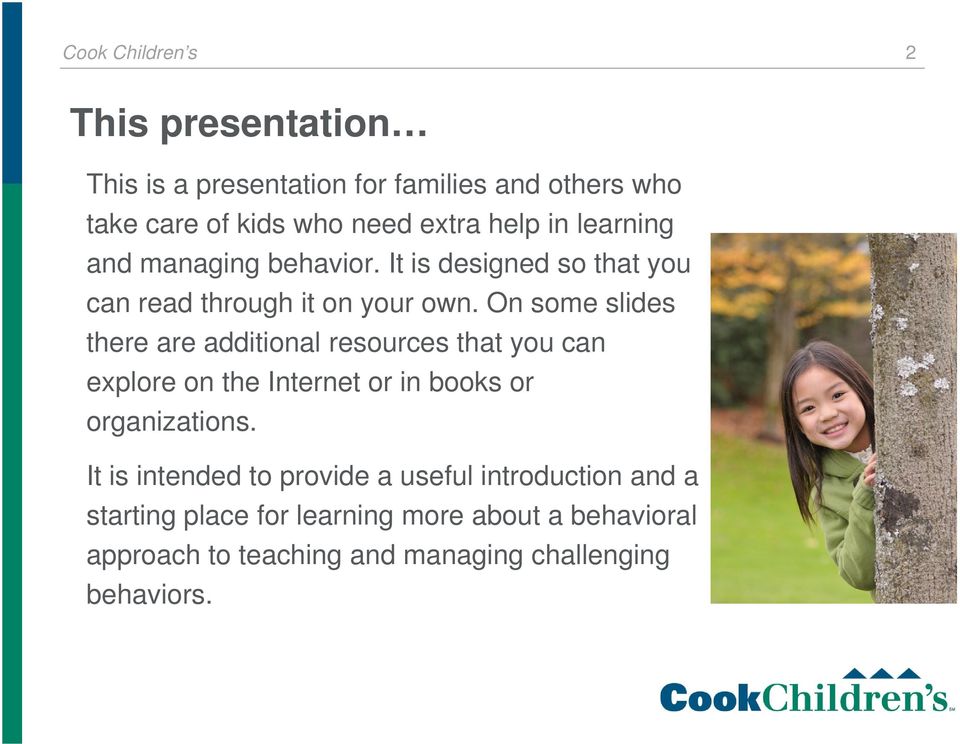
2 Cook Children s 2 This presentation This is a presentation for families and others who take care of kids who need extra help in learning and managing behavior. It is designed so that you can read through it on your own. On some slides there are additional resources that you can explore on the Internet or in books or organizations. It is intended to provide a useful introduction and a starting place for learning more about a behavioral approach to teaching and managing challenging behaviors.
3 Cook Children s 3 This is for parents and caregivers of children whose behavioral and learning style is like this : Limited back-and-forth speech (such as commenting, questioning, listening and responding) Limited understanding of simple conversation or directions Generally, explaining or negotiating with the child does not work very well Usually does not learn skills just by watching others Learning new skills takes more time and effort than for most kids Limited ability to cope with frustration and solve problems
4 Cook Children s 4 For caregivers of children such as these: Some of these children might have diagnoses such as encephalopathy, autism spectrum disorder, intellectual disability, or similar conditions, although others may not. The main thing is, these kids do not learn easily by just telling them or showing them, and this means that considerable planning and effort may be needed in order to teach new skills. It also means that a lot of the skills that seem to get learned automatically in daily life may not come about unless we go out of our way to teach them.

5 Cook Children s 5 Please note As you go through this presentation, you will find ideas and techniques that you may use and that may be helpful. You will find information will help you decide what your next steps might be. However, additional professional guidance is usually needed. This presentation is not enough, by itself, to prepare families to plan and implement behavioral programs on their own. This is especially true for children who have problems that are severe or have been going on for a long time.

6 Cook Children s 6 So what do we do? What do we do to help a child who can answer a few questions and make a few requests but gets confused by simple conversations (or shows no interest in them)? How about the child who is only willing to do what he wants to do right at that moment, and has outbursts if we insist that he do anything else? Some children with neurological or developmental problems may have trouble with skills that other kids seem to get easily, and some of them have behavior problems that cause themselves and their families lots of grief. There is no medicine to specifically fix such challenges, and being extra nice or extra tough does not work (niceness, combined with a certain amount of toughness or persistence, can be part of the solution, though). When we have tried lots of things without much success, we need to find a new way to change behavior.
7 Cook Children s 7 Learning and behavior change In our discussion, when we talk about changing behavior, we are talking about learning. Learning takes place both in and out of a classroom. So, if we work with a child to get her to use better social greetings out in the community, learning has occurred. If we teach a boy to handle frustration by using self-calming or asking for help, so that he uses these strategies more often, learning has occurred. So, teaching and learning are more than just sitting at a desk and raising your hand, or presenting facts to be remembered for a test. All parents are teachers, every day that they interact with their children. We have to choose what we want to teach, and we have to teach in ways that match our children s learning styles.

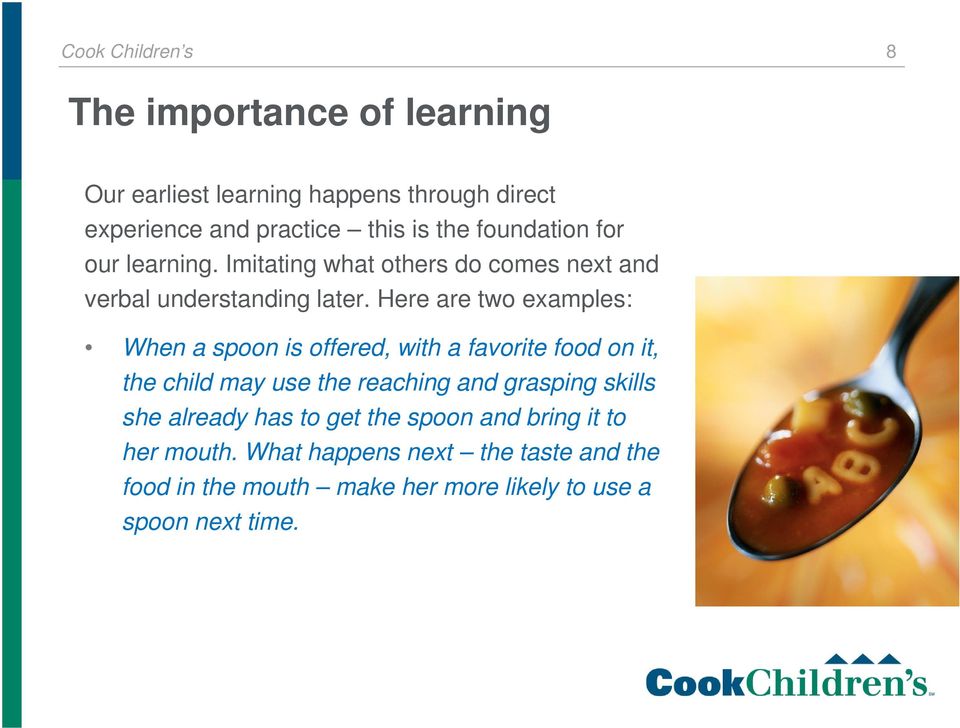
8 Cook Children s 8 The importance of learning Our earliest learning happens through direct experience and practice this is the foundation for our learning. Imitating what others do comes next and verbal understanding later. Here are two examples: When a spoon is offered, with a favorite food on it, the child may use the reaching and grasping skills she already has to get the spoon and bring it to her mouth. What happens next the taste and the food in the mouth make her more likely to use a spoon next time.
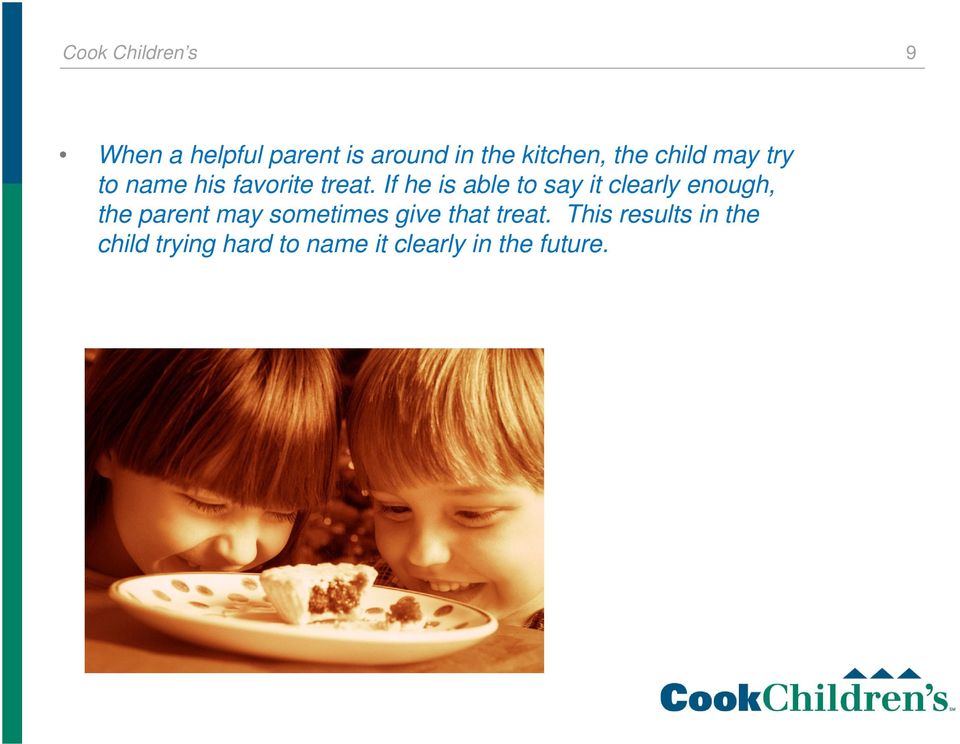
9 Cook Children s 9 When a helpful parent is around in the kitchen, the child may try to name his favorite treat. If he is able to say it clearly enough, the parent may sometimes give that treat. This results in the child trying hard to name it clearly in the future.
10 Cook Children s 10 The importance of learning A new mother tries to settle her crying baby. When she sways and bounces in a particular way that works for the baby, the baby quiets. Mother is careful to remember how the baby likes to be soothed and is quick to try doing it just that way, next time the baby is crying. (The mother s behavior changes!)

11 Cook Children s 11 A teenage boy is eager to fit in with others at his school. He finds that some kinds of words and conversations get you branded a nerd or worse, while other kinds of words and topics are considered cool and desirable. This boy soon begins to sound like the popular boys (or if unable to be accepted by the popular boys, he may start talking more like the leaders of whatever out - group he is around).

12 Cook Children s 12 The importance of learning The common theme in these examples is that a person responds to a situation by doing something, and the outcome may help strengthen and refine that behavior in the future. We could diagram it like this: Cues and other things in our surroundings What we do in response What happens next, positive or negative The cues and things that come before the behavior are called antecedents, and the things that come after the behavior are called consequences

13 Cook Children s 13 The foundation for learning When does learning occur? When these things happen The child is motivated to do something or get something There are previously-learned skills that can be used as building blocks to do something new The surroundings provide the right supports these are the people and objects that can serve as cues for the skill and can reinforce use of the skill The new skill produces a good outcome that makes it more likely to occur next time it is needed A scientific discipline that understands this is called: applied behavior analysis

14 Cook Children s 14 A practical, hands-on approach Applied Behavior Analysis (ABA) helps us understand behaviors and skills, and helps us change behaviors in good ways ABA involves: Looking at specific behaviors Seeing what happens in the child s surroundings when the behavior does or does not occur Making sure there are enough helpful cues to get the desired behaviors to occur Making sure the consequences for desired behaviors will encourage the child to do more Tracking the results and changing strategies when needed
15 Cook Children s 15 A science-based approach The ABA approach comes from years of applied research in everyday situations It has been successful in clinical, rehabilitation, education, and other settings The focus is on strengthening positive behaviors and decreasing challenging behaviors Data from a very large number of studies demonstrates that ABA is an effective way to teach skills and change behavior ABA is not a single set of procedures or a bag of tricks it is a way of understanding behavior that results in individualized, self-correcting procedures For more information, see this page from the Kennedy Krieger Institute (click to open)
16 Cook Children s 16 Characteristics of ABA Decide what skills are currently needed, and what behaviors may need to be managed Make these decisions with the child s input, when possible Define those target behaviors so that everyone consistently knows when they occur or do not occur The focus will be on getting desired behaviors to occur that is, teaching will focus on the child s active responding as much as it does on the information we present to the child Measure how much the skills and behaviors are happening now, by recording when they occur over a few days We use this baseline as a way to track progress do target behaviors occur more often or less often as the days or weeks go by More characteristics see next page
17 Cook Children s 17 Characteristics of ABA Identify things that may be used after desired behaviors occur, to strengthen those behaviors (such things are reinforcers ) Reinforcers may be special privileges, fun activities, praise and approval, or other things that work for this particular child Identify things that are effective as cues for the desired behavior, including extra cues and prompts that we might temporarily use to help the child be successful We use enough extra help (pointing, giving a short instruction, using pictures, etc.) so that the desired behavior occurs, but no more help than is necessary Identify things that may be serving as cues and reinforcers for challenging behavior, so we can manage or eliminate them (this involves what is called a functional analysis ) More characteristics see next page

18 Cook Children s 18 Characteristics of ABA Make a teaching plan that spells out what target behaviors we will address (breaking them down into small, achievable steps), how we will teach them, and how we will track progress As much as possible, the people around the child and the activities in the child s environment follow the teaching plan throughout the day As we measure the behavior and track progress, we adjust the teaching procedures This includes gradually shifting so that the supports for positive behavior are more and more natural, as much as possible like what the everyday environment does to support positive behavior As the child masters these skills, we get ready to teach new ones, so that the child moves toward having functional, independent, age-appropriate skills
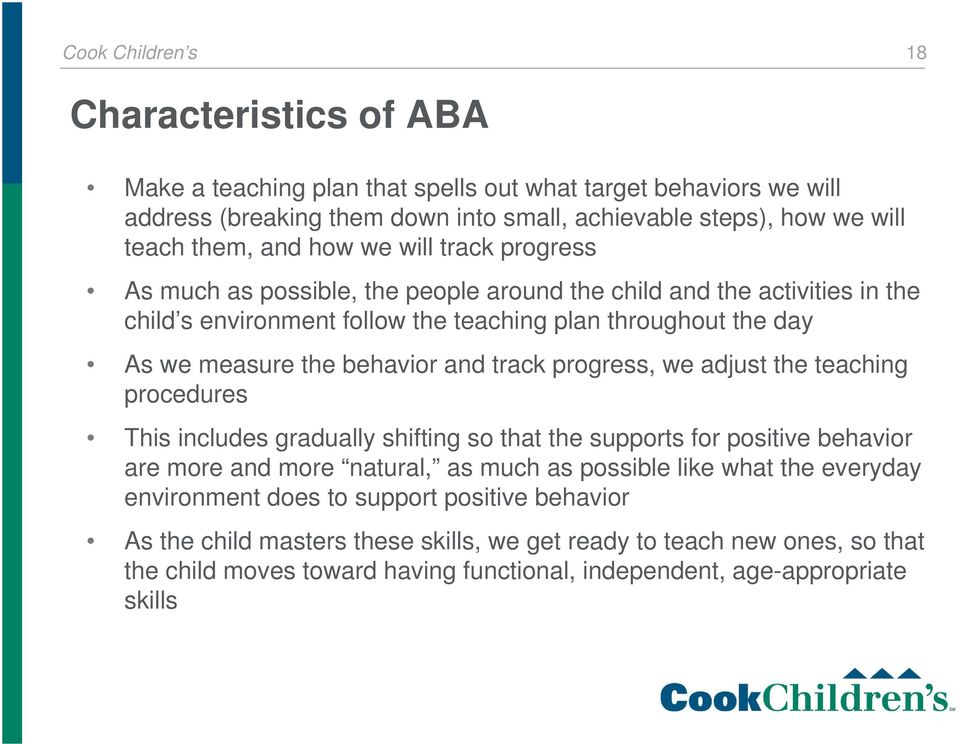
19 Cook Children s 19 ABA or other approaches? ABA is not the only approach out there but it is our focus in this presentation, because there is strong evidence that it can be effective for people with many kinds of challenges A behavioral approach is a good fit for some families, and they can play a major role in teaching their child, with a trained therapist as a consultant For other families, the time commitment, focus on details, and the required consistency of a behavioral approach may not come as easily. They are still very important partners in educating and advocating for their child. They may choose a behavioral approach in which a therapist takes a greater role in teaching, or they may choose a different approach for helping their child.
20 Cook Children s 20 What does ABA look like? Good ABA often looks like fun with a young child it may look like play, and with anyone it may look like a friendly adult patiently encouraging and supporting a learner who is attempting some everyday skill We could imagine a family (we will call them Mr. and Ms. Evans) working with their son John using ABA John has delays in several areas, and his parents have selected five skills to work on right now. They picked these five based on what building block skills John already had, what skills would be most functional, and what opportunities the daily schedule provided. John also has tantrums when he gets frustrated, where he may throw something, scream, or fall to the floor. He is currently 8 years old, so this is a real problem for him and for those around him. (Continued)
21 Cook Children s 21 What does ABA look like? In the morning, Mr. Evans works with John on grooming and dressing. The particular skill they work on right now is rinsing his mouth after toothbrushing, washing the brush and putting the toothbrush and toothpaste away. When John completes all three steps correctly, he gets an extra five minutes of TV time. During the day, Ms. Evans works with John on three other skills before she goes to work in the evening. One of these skills involves a sort of game in which John has to ask for help in order to do the next step and possibly win. It is set up so that he does not get overwhelmed and his mom coaches him through asking for the specific help that he needs. The idea is that as he gets better at tolerating a little frustration and asking for help appropriately, he will use this same skill in real life situations. (Continued)
22 Cook Children s 22 What does ABA look like? After working on a skill, each parent jots down some quick notes on a calendar they keep handy. This morning Mr. Evans notes: rinse/spit out independently; put brush away with one reminder; required touch prompt to put toothpaste away. Later, Ms. Evans noted that John was able to ask for help in the game 3 of 5 times, required prompts once, and had no tantrums. Compared to last week, things are getting better! They meet with a consultant once a week to look at how he is doing with each skill and see if he is ready to try new ones. In these meetings, they ask John what he likes or does not like about each teaching procedure and listen to any suggestions he has. Sometimes John doesn t have anything to say, and other times he may say something unrealistic, but the family and consultant listens for cues as to what motivates John and what teaching strategies are workable for him.
23 Cook Children s 23 What s next? You have finished part one of Teaching and Behavioral Challenges. In the next section we will get more specific about teaching strategies. For more information about ABA and learning, check out these resources: Applied Behavior Analysis, 2 nd Edition, by John Cooper, Timothy Heron, & William Heward Right From the Start: Behavioral Intervention for Young Children with Autism, 2 nd Edition, by Sandra Harris & Mary Jane Weiss Overcoming Autism, by Lynn Koegel & Claire LaZebnik
SUGGESTIONS FOR WORKING WITH STUDENTS WITH AUTISM SPECTRUM DISORDERS (ASD) Provided for Information and sharing only
 SUGGESTIONS FOR WORKING WITH STUDENTS WITH AUTISM SPECTRUM DISORDERS (ASD) Provided for Information and sharing only 1. I have attached an informational handout about autism spectrum disorders and the
Doctor Visits. How Much to Participate
 Family Caregiver Guide Doctor Visits Caregiving involves not only major crises, but also routine experiences like going to the doctor. HIPAA is a federal law that protects patient privacy, while allowing
GUIDELINES FOR WRITING FAMILY-CENTERED OUTCOMES
 GUIDELINES FOR WRITING FAMILY-CENTERED OUTCOMES There has been much confusion regarding the writing of outcomes and goals following our previous EI trainings. In Virginia, outcomes and goals must be family-centered
Behavior Impedes Learning
 Behavior Impedes Learning ARSD 24:05:27:01.02. (1) In the case of a student whose behavior impedes his or her learning or that of others, consider the use of positive behavioral interventions and supports
Become Independent with Daily Routines
 Teaching Your Child to: Become Independent with Daily Routines Does this Sound Familiar? Nadine is a single mom with two young children ages 3 and 5. Her children attend preschool while she is working.
Pivotal Response Training: Parent Professional Collaboration
 Minutes: North Tidewater Community of Practice in Autism (NT CoPA) Topic: Pivotal Response Training Date: October 13, 2009 Location: Healthy Families Partnership Building, Hampton Participants: 6 Pivotal
Nick s Plan. My case study child is a young boy in the third grade. I will call him Nick. Nick is a
 Jamie Oliver Nick s Plan My case study child is a young boy in the third grade. I will call him Nick. Nick is a student who has cerebral palsy. He remains in a wheelchair all day long while in school.
Classroom Behavior Management Plan
 Haffner 1 Classroom Behavior Management Plan Daniel Haffner November 20, 2009 EDUC 348 Haffner 2 Philosophy of Classroom Management Classroom management is a course taught at every teacher college across
Whatever the specifics of a plan may be, the following are key principles to make the plan most effective:
 Behavior Management Principles For the ADHD Child What I would like to talk about in the last part of this presentation is on the behavior management principles for the ADHD child. In order to get specific
Why use a visual schedule?
 Why use a visual schedule? As teachers or parents working with children with disabilities, we often assume that the child knows the daily schedule. Do they really know? Think how lost you would be if someone
Practical Principles Using Applied Behavior Analysis
 Practical Principles Using Applied Behavior Analysis Annie Baghdayan, PhD, BCBA-D, LBA [email protected] May 28 th, 2014 The Oklahoma Autism Network The Oklahoma Autism Network Established in October
Acknowledging Children s Positive Behaviors What Works Brief Series Matt Timm and Sharon Doubet
 Center on the Social and Emotional Foundations for Early Learning Project funded by the Child Care and Head Start Bureaus in the U.S. Department of Health and Human Services Acknowledging Children s Positive
Sample Behavior Intervention Plan for Child With Attention Deficit Disorder and Conduct Problems
 Sample Behavior Intervention Plan for Child With Attention Deficit Disorder and Conduct Problems for Developed by: Date: This behavior intervention plan has been created to support the goals and objectives
Positive Behaviour Support Plan for Jane. Brief Summary of the Critical System Strengths and Concerns (for school):
 Brief Summary of Focus Person: Positive Behaviour Support Plan for Jane Jane is a 6 year old girl with ADHD, oppositional defiant disorder, prenatal exposure to cocaine and possible fetal alcohol spectrum
Lesson 6: Solomon Writes Many Proverbs
 Lesson 6: Solomon Writes Many Proverbs Bible Point: Wisdom means following God s word. 1 Kings 4:29-34; Proverbs 1:1-7 Key Verse: The fear of the Lord is the beginning of wisdom, and knowledge of the Holy
Steps for Implementation: Least-to-Most Prompts
 Steps for Implementation: Least-to-Most Prompts Neitzel, J., & Wolery, M. (2009). Steps for implementation: Least-to-most prompts. Chapel Hill, NC: National Professional Development Center on, Frank Porter
ABA & Teaching Methods
 ABA & Teaching Methods C H A P T E R 7 E A S T E R S E A L S S O U T H E A S T W I S C O N S I N S T A R T E A R L Y, S T A R T S T R O N G P R O G R A M ABA ABA = Applied Behavior Analysis Science devoted
Effectively Using Applied Behavior Analysis Interventions in Home Settings. Prepared by Sheri Kingsdorf, MA, BCBA, CABAS TI, TII, MT
 Effectively Using Applied Behavior Analysis Interventions in Home Settings Prepared by Sheri Kingsdorf, MA, BCBA, CABAS TI, TII, MT What do you think?? That. Effectively Using Applied Behavior Analysis
Promoting Generalization of Positive Behavior Change: Practical Tips for Parents and Professionals
 Promoting Generalization of Positive Behavior Change: Practical Tips for Parents and Professionals Jonathan Tarbox, PhD CARD Distinguished Lecturer Series Center for Autism & Related Disorders, Inc. CARD
Part 5. Dinosaur School Notes to Teachers. 1. Introduction. 2. Iguanodon Unit: How to be Successful in School
 Part 5 Dinosaur School Notes to Teachers 1. Introduction 2. Iguanodon Unit: How to be Successful in School 3 & 4. Triceratops Unit: Detecting, Understanding and Talking About Feelings 5. Stegosaurus Unit:
Case Study Child Development Kelsey Heisler May 6, 2009
 Case Study Child Development Kelsey Heisler May 6, 2009 This case study is on a young girl named Hannah. She was observed in a classroom at the Early Learning Center. She is 4 years old. She is the only
ADD/ADHD in the Classroom
 ADD/ADHD in the Classroom TIPS FOR TEACHERS AND PARENTS At any given time, a teacher can expect to have at least one student with ADHD. The impulsive and hyperactive behavior of such students can be distracting
AN ABA APPROACH TO TEACHING THE DIFFICULT CHILD. By: Lindsay Rice and Stephanie Beaulieu
 AN ABA APPROACH TO TEACHING THE DIFFICULT CHILD By: Lindsay Rice and Stephanie Beaulieu Overview Defining the behavior Data collection and how to begin this process The why : Why is this behavior occurring
Alert Program Overview: Supporting Children with Autism by Mary Sue Williams and Sherry Shellenberger
 Alert Program Overview: Supporting Children with Autism by Mary Sue Williams and Sherry Shellenberger We believe that all behavior is a child s best attempt to communicate. Also, we believe that by understanding
Preventing and Responding to Challenging Behaviors in the Home. Michael Boardman, MA, BCBA
 Preventing and Responding to Challenging Behaviors in the Home Michael Boardman, MA, BCBA Learning Objectives 1. Understanding Problem Behaviors 2. A behavior analytic perspective on behavior 3. Defining
Parenting Children with Disabilities. National Dissemination
 Parenting Children with Disabilities Resources Developed by: National Dissemination Center for Children with Disabilities 1 Table of Contents* Disorder Page # Attention Deficit/Hyperactivity Disorder (AD/HD).3
Grade 2 Lesson 3: Refusing Bullying. Getting Started
 Getting Started Lesson Concepts You can refuse to let bullying happen to you or to others. Being assertive is one way to refuse bullying. Key Words Refuse, assertive Objectives Students will be able to:
General Therapies for Individuals with Autism
 General Therapies for Individuals with Autism Speech and Language Pathology Speech- language therapy entails the assessment, diagnosis, treatment, and helping to prevent speech, language, cognitive, communication,
INTRODUCTION TEACHING TIPS. THE NURSERY CLASS Purpose
 INTRODUCTION THE NURSERY CLASS Purpose Letter to Parents The purpose of the nursery class is to help children learn the restored gospel of Jesus Christ and live it. The nursery class should help the children
Applied Behavior Analysis Reinforcement. Elisabeth (Lisa) Kinney, M.S. September 19, 2007
 Applied Behavior Analysis Reinforcement Elisabeth (Lisa) Kinney, M.S. September 19, 2007 Skinner Box & Reinforcement In operant conditioning, behavior is also affected by its consequences, but the process
What strategies work when teaching and coaching individuals with ASD? Using Evidence- Based Practices in Your Settings
 What strategies work when teaching and coaching individuals with ASD? Using Evidence- Based Practices in Your Settings National Autism Center: Evidence-Based Practices The National Autism Center s National
Trouble at Recess STUTTERING FOUNDATION THE PUBLICATION NO. 0034
 Trouble at Recess THE STUTTERING FOUNDATION PUBLICATION NO. 0034 Trouble at Recess Publication No. 0034 Published by Stuttering Foundation of America ISBN 0-933388-60-1 Copyright 2008-2014 by Stuttering
PLAY STIMULATION CASE STUDY
 PLAY STIMULATION CASE STUDY AIMS Play stimulation work contributes towards the following 2003-2006 PSA targets: Improving social and emotional development, and Improving learning. With regard to PSA targets
Portage Guide Birth to Six Preschool Indicator 7 Child Outcomes Crosswalk. Outcome 2 Acquisition & Use of Knowledge & Skills
 Portage Guide Birth to Six Preschool Indicator 7 Child Outcomes Crosswalk NPG Domains Outcome 1 Positive Social Emotional Skills Outcome 2 Acquisition & Use of Knowledge & Skills Outcome 3 Appropriate
Brief Overview of the Alert Program for Parents by Mary Sue Williams
 Brief Overview of the Alert Program for Parents by Mary Sue Williams As parents, we all want to help our children to grow, play, and learn. For our young ones, perhaps we hope they will learn to dress
INTRODUCTION TO COACHING TEACHING SKILLS TEACHING/LEARNING. September 2007 Page 1
 TEACHING SKILLS September 2007 Page 1 TEACHING SKILLS Being a teacher is one of the main roles a coach fulfils for their players. The ability to teach effectively, especially the technical skills of ice
STEP 5: Giving Feedback
 STEP 5: Giving Feedback Introduction You are now aware of the responsibilities of workplace mentoring, the six step approach to teaching skills, the importance of identifying the point of the lesson, and
Tips on Building Classroom Procedures and Routines: How to have a well-managed classroom. Teacher Resources
 Teacher Resources Tips on Building Classroom Procedures and Routines: How to have a well-managed classroom Note: The following references and excerpts taken from three sources: 1. How to be an effective
Collaborative Documentation on Daily Living Activities Regardless of Age
 Collaborative Documentation on Daily Living Activities Regardless of Age Katherine Hirsch and Annie Jensen MTM Services http://www.thenationalcouncil.org/mtm-services/ 0 Learning Objectives Participants
Step 1: Come Together
 THE STORY FOR LITTLE ONES: Preschool LESSON GUIDE: Lesson 2 5 ABRAHAM FOLLOWS GOD Bible Basis: Genesis 12:1 9, 17; 21:1 7 Bible Verse: Abram believed the Lord. The Lord accepted Abram because he believed.
A Parenting Roadmap. Understanding Applied Behavioral Analysis and Using Behavioral Strategies at Home
 A Parenting Roadmap Understanding Applied Behavioral Analysis and Using Behavioral Strategies at Home By Deborah Hammer Autism Coordinator Arlington Public Schools (703) 228-2133 [email protected]
Classroom Management Plan Nicole Short EDUC 360
 Classroom Management Plan Nicole Short EDUC 360 The purpose of this classroom management plan is to address my philosophy and beliefs about discipline, state classroom procedures, and the implementation
AGES & STAGES QUESTIONNAIRES : SOCIAL-EMOTIONAL
 Version 1.1 AGES & STAGES QUESTIONNAIRES : SOCIAL-EMOTIONAL A PARENT-COMPLETED, CHILD-MONITORING SYSTEM FOR SOCIAL-EMOTIONAL BEHAVIORS by Jane Squires, Ph.D. Diane Bricker, Ph.D. and Elizabeth Twombly,
SAMPLE TEST INFORMATION -- English Language Test (ELT) General Information There are three parts to the ELT: Listening, Reading, and Writing.
 SAMPLE TEST INFORMATION -- English Language Test (ELT) General Information There are three parts to the ELT: Listening, Reading, and Writing. The Listening Comprehension Test The listening comprehension
Behavior & Sensory Strategies for Individuals with ASD
 Behavior & Sensory Strategies for Individuals with ASD Kathleen Mo Taylor, OTR/L The Autism Programs Center for Development and Disability University of New Mexico This presentation is made possible, in
Community Support Program and Recovery Pathways. Skill Building. Goals, Objectives, Interventions and Skills
 ADVANCED BEHAVIORAL HEALTH, INC Community Support Program and Recovery Pathways Skill Building Goals, Objectives, Interventions and Skills kscott 11/22/2010 (11/24/10 CSP/RP handout) 2 The following are
Difficult Tutoring Situations
 Difficult Tutoring Situations At some time or other, all tutors will find themselves faced with difficult situations in a tutoring session. The following information will provide you with some common categories
Behavior Therapy for ADHD Children: More Carrot, Less Stick
 Page 1 of 5 ADDitudeMag.com Behavior Therapy for ADHD Children: More Carrot, Less Stick The best programs to eliminate problem behaviors in children with ADHD - and where parents can find discipline help.
Module 2: Conflict Management
 Module 2: Conflict Management Conflict management, like effective communication skills, is another important element of social competency. This module promotes the use of several forms of conflict management
The Doctor-Patient Relationship
 The Doctor-Patient Relationship It s important to feel at ease with your doctor. How well you are able to talk with your doctor is a key part of getting the care that s best for you. It s also important
reduction in aggression increase in appropriate greetings and sharing aggression screaming, grabbing toys, using inappropriate table manners, crying
 Social stories Definition A social story is a short story that describes a situation in terms of relevant social cues and accurate and specific information regarding what occurs in a given situation and
Role Plays for Teacher Classroom Management
 Role Plays for Teacher Classroom Management Collaboration, Workshop 1 After Vignette #4 Making connection with quiet child Practice making a connection with a child who is quiet, shy, or sad. Think about
Encourage and develop each child s unique interests and curiosity. Help the children discover their own unique gifts & talents
 Adoption: Adoption is the legal process by which a person becomes a lawful member of a family different from their birth family. Adoption is a permanent lifelong commitment to a child. Becoming a parent
Building Blocks: Effective Practices for Including Young Children with Disabilities in Community Based Programs
 Building Blocks: Effective Practices for Including Young Children with Disabilities in Community Based Programs Cassandra Cerros Jaime Martin Gail Joseph Head Start Center for Inclusion University of Washington
Classroom Management Plan
 Classroom Management Plan 1 Classroom Management Plan Miss. Jessica Stiffler Classroom Management Plan 2 Classroom Management Plan Jessica Stiffler Education 360 November 22, 2010 Classroom Management
Interview with David Bouthiette [at AMHI 3 times] September 4, 2003. Interviewer: Karen Evans
![Interview with David Bouthiette [at AMHI 3 times] September 4, 2003. Interviewer: Karen Evans](/thumbs/39/20139896.jpg "Interview with David Bouthiette [at AMHI 3 times] September 4, 2003. Interviewer: Karen Evans") Interview with David Bouthiette [at AMHI 3 times] September 4, 2003 Interviewer: Karen Evans KE: What we are going to talk about first are your experiences while you were at AMHI, and then we will go on
Interview with David Bouthiette [at AMHI 3 times] September 4, 2003 Interviewer: Karen Evans KE: What we are going to talk about first are your experiences while you were at AMHI, and then we will go on
Title: Conducting FBAs and Designing Behavior Interventions for Individuals with ASD: Keeping the Characteristics in Mind
 Title: Conducting FBAs and Designing Behavior Interventions for Individuals with ASD: Keeping the Characteristics in Mind Presenters: Ruth Aspy, Ph.D., and Barry G. Grossman, Ph.D. Recognizing when problem
AR State PIRC/ Center for Effective Parenting
 Helping Young Children Learn to Read What Parents Can Do Reading is one of the basic building blocks for your child s learning and school success. It is a skill on which most other learning is built. Children
Social Emotional Tips
 Social Emotional Tips FOR Families with Toddlers Introduction The quality of each toddler s relationships with familiar adults especially their parents sets the foundation for social and emotional health.
Insecure Attachment and Reactive Attachment Disorder
 Attachment Disorders Insecure Attachment and Reactive Attachment Disorder When infants and young children have a loving caregiver consistently responding to their needs, they build a secure attachment.
Bullying 101: Guide for Middle and High School Students
 Bullying 101: Guide for Middle and High School Students A guide to the basics of bullying, what it is and isn t, the role of students, and tips on what you can do. 952.838.9000 PACERTeensAgainstBullying.org
Last name: State/ Province: Home telephone number:
 54 Ages & Stages Questionnaires 51 months 0 days through 56 months 30 days Month Questionnaire Please provide the following information. Use black or blue ink only and print legibly when completing this
Hand-Over-Hand Method
 Hand-Over-Hand Method written by, Jean M. Slater, MS Speech/Language Pathologist 2000 Slater Software, Inc. Have you ever told your child to give you something that is dangerous and he or she ignores you?
Starting School. Guidelines for Parents/Guardians of Children with Special Educational Needs
 Starting School Guidelines for Parents/Guardians of Children with Special Educational Needs NCSE 2016 The word parent in this document should be taken to include guardians of children. Contents Introduction
Arkansas State PIRC/ Center for Effective Parenting
 How to Effectively COMMUNICATE With Your Child Talk between parents and children is very important, if for no other reason than it is relatively rare when compared to the other activities that today s
Cain and Abel. The children will hear that we can learn to love our brothers and sisters and to help take care of them.
 Cain and Abel Teacher Pep Talk: Everyone understands sibling rivalry. Even the youngest child can relate to being upset with a brother or sister. Cain and Abel are the first example of this enmity. Cain
Ten Tips for Parents. To Help Their Children Avoid Teen Pregnancy
 Ten Tips for Parents To Help Their Children Avoid Teen Pregnancy Ten Tips for Parents To Help Their Children Avoid Teen Pregnancy The National Campaign to Prevent Teen Pregnancy has reviewed research
Grade 2, Theme Two. Family Letter
 Family Letter Grade 2, Theme Two Dear Family, It s time for the second theme of Fully Alive, our family life program. Because the partnership of home, church, and school is so important, this letter is
Early Signs of Autism
 Early Signs of Autism Gerald T. Guild, PhD Licensed Psychologist Preschool Learning Center Springville, New York Long Term Outcomes Crucial Variables known to maximize student outcomes Early Identification
Conflict Resolution / Behavior Management Notes - New
 Conflict Resolution / Behavior Management Notes - New I have found that one of the major stressors for mentoring ministry staff is dealing with conflict and behavioral issues. Mentoring is all about developing
COACHING GUIDE. Preparing Athletes for Competition
 COACHING GUIDE Preparing Athletes for Competition Table of Contents Table of Contents Psychological Considerations Anxiety and Stress Management Winning and Losing Handling Grief Taking Athletes to Competition
activities at home Planning the day for a person with moderate or severe dementia
 activities at home Planning the day for a person with moderate or severe dementia Activities and a person with dementia Activities are the things we do, like getting dressed, doing chores, playing cards
What is aphasia? Aphasia is a language disorder. It can cause problems with. Thinking (cognitive) skills are usually good.
 Adult Aphasia What is aphasia? Aphasia is a language disorder. It can cause problems with understanding speaking reading writing Thinking (cognitive) skills are usually good. What causes aphasia? Aphasia
1999 Simon Baron-Cohen, Michelle O Riordan, Rosie Jones & Kate Plaisted. Faux Pas Recognition Test. (Child Version)
 Citation for use of this test: Faux Pas Recognition Test (Child Version) Created by Simon Baron-Cohen, Michelle O Riordan, Valerie Stone, Rosie. Baron-Cohen, S., O Riordan, M., Jones, R., Stone, V.E. &
Learn about and discuss some of the issues related to classroom behavior management, ADHD, and communication with parents.
 Activity THE Objective Learn about and discuss some of the issues related to classroom behavior management, ADHD, and communication with parents. Scenario Matt was diagnosed with attention deficit hyperactivity
The Good Behavior Game
 Special points of interest: The Good Behavior Game in elementary school has lowered early adolescent smoking. The Game is just as effective as positive reinforcement. The Game has a positive affect on
FIT Child Development Audio Conference Journal Date: March 10, 2010 Topic: 24 30 months Participants: 6 New information:
 FIT Child Development Audio Conference Journal Date: March 10, 2010 Topic: 24 30 months Participants: 6 New information: ~ In the area of gross motor/movement development, babies are, with support, walking
Classroom Management Plan
 Classroom Management Plan Jeanna Collins EDUC 360 C: Classroom Behavioral Management November 26, 2007 Collins 1 Descriptive Statement: The purpose of this document is to outline my current beliefs about
Customer Service Communications Guidelines
 Customer Service Communications Guidelines Effective October 1, 2013 Purpose Authority Reference Resource To establish Customer Service Communications expectations for the Department of Natural Resources
Car Safety for Your Child with Autism
 Car Safety for Your Child with Autism Children with autism may have special needs that can cause challenges during travel. This brochure answers some questions you might have about transporting your child
YOUTH SOCCER COACHES GUIDE TO SUCCESS Norbert Altenstad
 The Reason Why Most Youth Soccer Coaches Fail Lack of knowledge to make and keep practice fun and enjoyable for the kids is really the primary cause for failure as a youth soccer coach, it s sad. It s
Project Teamwork. Theme: Cooperative games encourage students to work together as a team while having fun in a positive environment.
 Project Teamwork August 2007 Theme: Cooperative games encourage students to work together as a team while having fun in a positive environment. Concepts: 1. Any collection of people has the potential to
Acknowledge, Ask, Adapt Negotiation Practice
 Sample Issue ~ Late for School Again Sunshine Center s Parent Handbook clearly outlines the center s policy that parents must have their children to the center by 9am at the latest. All parents review
ONLINE SAFETY TEACHER S GUIDE:
 TEACHER S GUIDE: ONLINE SAFETY LEARNING OBJECTIVES Students will learn how to use the Internet safely and effectively. Students will understand that people online are not always who they say they are.
PROCEDURE Supporting and Reporting Client Behaviours of Concern
 PROCEDURE Supporting and Reporting Client Behaviours of Concern 1. PURPOSE The purpose of this procedure is to: Minimise the risk of injury to Senses Australia staff and clients, from behaviours of concern
Assertive Communication
 Using assertive communication is an important part of recovery from drugs and alcohol. Being assertive can help you express your opinions and feelings, make requests of others and respond to requests of
What is ABA? What is ABA? Why use ABA? Getting Started. ABA Tools and Techniques. Basic ABA. Milestones Autism Organization
 What is ABA? Basic ABA Kiersten Johnson Milestones Autism Organization Milestones.org 216-371-4765 Applied Behavior Analysis B.F. Skinner www.lovaas.com Based on learning and behaviors principals Reinforcement
Listen, Protect, and Connect
 Page 1 Listen, Protect, and Connect PSYCHOLOGICAL FIRST AID FOR CHILDREN, PARENTS, AND OTHER CAREGIVERS AFTER NATURAL DISASTERS Helping you and your child in times of disaster. Page 2 As a parent or adult
ESOL Customer Service Training: Unit 1 1: 1 Student Book. Unit 1: Talking With Your Customer
 ESOL Customer Service Training: Unit 1 1: 1 Unit 1: Talking With Your Customer ESOL Customer Service Training: Unit 1 1: 2 What are your goals? Note to Instructor: If you have permission, use Stand Out
Devotion NT273 CHILDREN S DEVOTIONS FOR THE WEEK OF: LESSON TITLE: The Garden of Gethsemane. THEME: We always need to pray! SCRIPTURE: Luke 22:39-53
 Devotion NT273 CHILDREN S DEVOTIONS FOR THE WEEK OF: LESSON TITLE: The Garden of Gethsemane THEME: We always need to pray! SCRIPTURE: Luke 22:39-53 Dear Parents Welcome to Bible Time for Kids. Bible Time
Speech and Language. Social Communication. Occupational Therapy. Self Regulation
 Speech and Language Social Communication Occupational Therapy Self Regulation Executive Functioning Skills 4400 Keller Avenue, Suite 200, Oakland, CA 94605 (510) 639-2929 www.cwtherapy.com Experience Makes
LESSON 7: LEARNING MODELS
 LESSON 7: LEARNING MODELS INTRODUCTION mobility motivation persistence sociological Think about your favorite class. Does the teacher lecture? Do you do experiments or go on field trips? Does the teacher
Lesson 2: How to Give Compliments to Tutees
 Kids As Reading Helpers: A Peer Tutor Training Manual Copyright 2002 by Jim Wright www.interventioncentral.org L2-1 Lesson 2: How to Give Compliments to Tutees Introduction When correctly used, compliments
Evidence-Based Practice in Autism Spectrum Disorders: What Does it Mean? CIGNA Autism Education Series
 Evidence-Based Practice in Autism Spectrum Disorders: What Does it Mean? CIGNA Autism Education Series Jill Krata, Ph.D. Manager of Clinical Services, YAI Autism Center & Associate Chief, Premier HealthCare
Autism and Intellectual Disabilities
 Autism and Intellectual Disabilities (DSM IV & V) Accessibility Politecnico di Milano Autism (I) A total of six (or more) items from (A), (B), and (C), with at least two from (A), and one each from (B)
Cambridge English: ESOL Skills for Life
 Cambridge English: ESOL Skills for Life ESOL Skills for Life Speaking and Listening Entry 3 Sample Test E This test should not exceed 22 minutes. Please note: With the exception of the Task Sheets in Phases
Early School Readiness Series Preparing Children for Kindergarten: Learning Centers
 Early School Readiness Series Preparing Children for Kindergarten: Learning Centers Rimm-Kaufman, Pianta, and Cox reported in 2000 that 40% of young children were simply unprepared for the demands of kindergarten
The CMC- The Coming Home Contract
 During Resident breaks and before coming home the teen prepares to transition out of FMSLH and back into their community. With the help of FMSLH staff and weekly meetings the family is coached through
What Is the Olweus Bullying Prevention Program?
 Dear Parent/Guardians, Your child s school will be using the Olweus Bullying Prevention Program. This research-based program reduces bullying in schools. It also helps to make school a safer, more positive