
The business of sustainability
|
|
|
- Melanie Craig
- 9 years ago
- Views:
Transcription
1 96 The business of sustainability More companies are managing sustainability to improve processes, pursue growth, and add value to their companies rather than focusing on reputation alone. Sheila Bonini Many companies are actively integrating sustainability principles into their businesses, according to a recent McKinsey survey, 1 and they are doing so by pursuing goals that go far beyond earlier concern for reputation management for example, saving energy, developing green products, and retaining and motivating employees, all of which help companies capture value through growth and return on capital. In our sixth survey of executives on how their companies understand and manage issues related to sustainability, 2 this year s results show that, since last year, larger shares of executives say sustainability programs make a positive contribution to their companies short- and long-term value. This survey explored why and how companies are addressing sustainability and to what extent executives believe it affects their companies bottom line, now and over the next five years. On the whole, respondents report a more wellrounded understanding of sustainability and its expected benefits than in prior surveys. As in the past, they see the potential for supporting corporate reputation. But they also expect

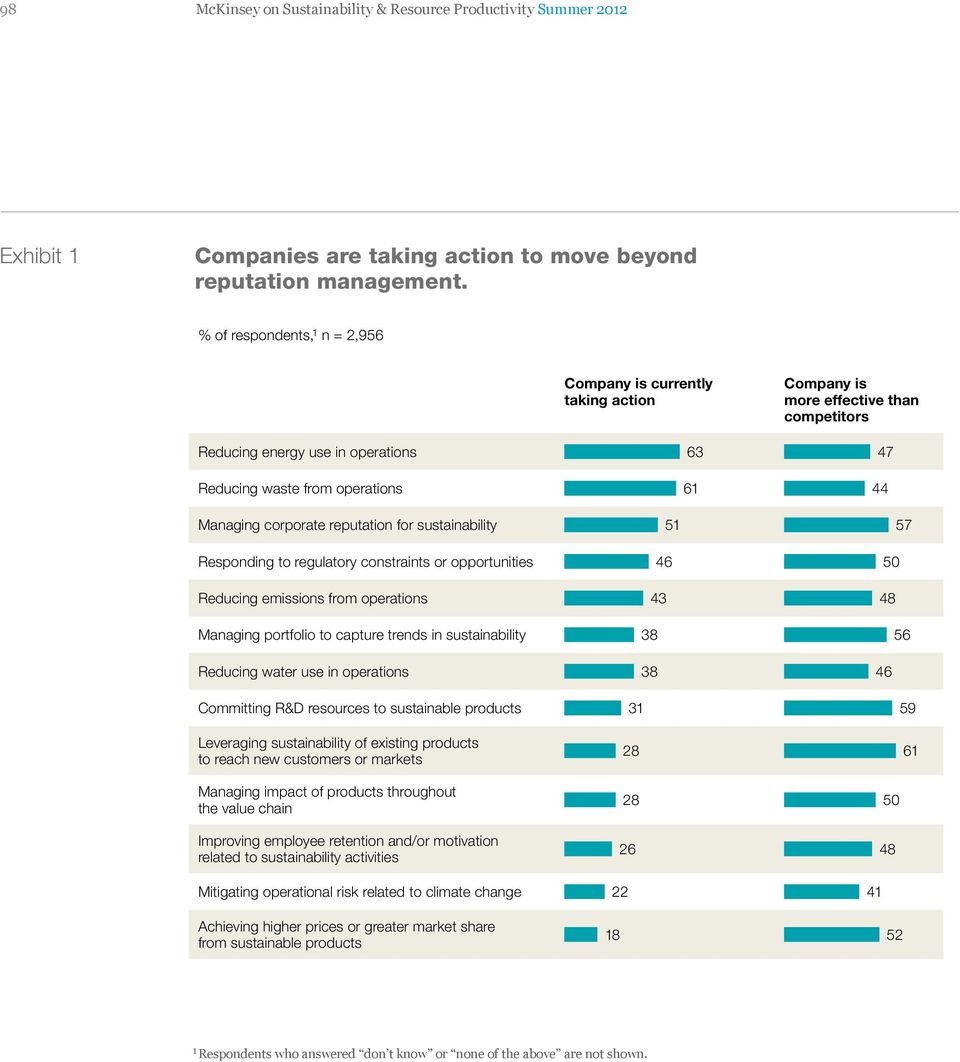
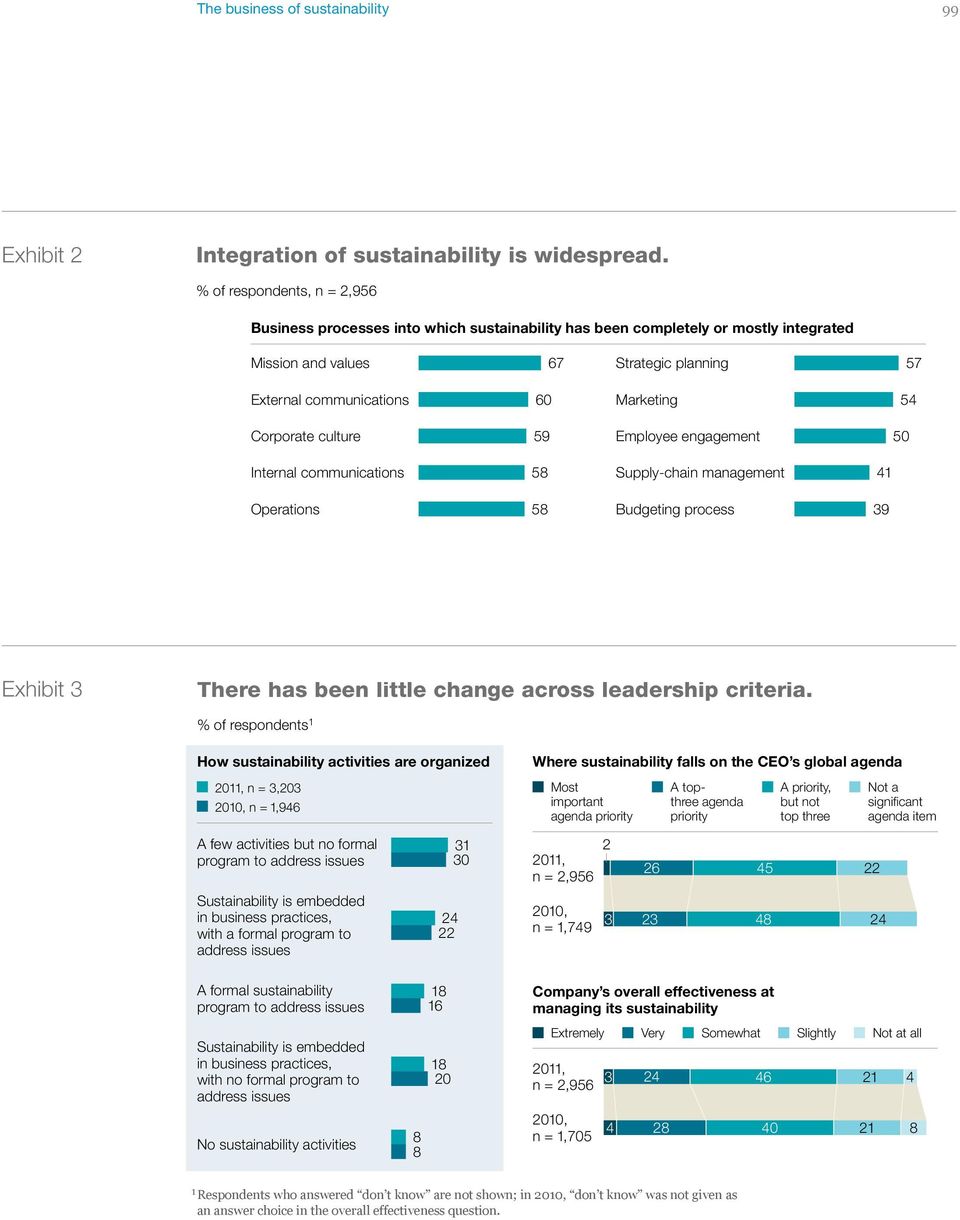
2 97 operational and growth-oriented benefits in the areas of cutting costs and pursuing opportunities in new markets and products. Furthermore, respondents in certain industries energy, the extractive industries, 3 and transportation report that their companies are taking a more active approach than those in other sectors, probably as a result of those industries potential regulatory and natural-resource constraints. A more active agenda There are some noteworthy changes since our 2010 survey 4 in the actions executives report their companies are taking on sustainability, their reasons for doing so, and the extent to which they have integrated sustainability into their business. For instance, the share of respondents saying their companies top reasons for addressing sustainability include improving operational efficiency and lowering costs jumped 14 percentage points since last year, to 33 percent. This concern for costs replaces corporate reputation as the most frequently chosen reason; at 32 percent, reputation 5 is the second most cited reason, followed by alignment with the company s business goals, mission, or values 6 (31 percent) and new growth opportunities (27 percent), which climbed 10 percentage points since last year. sustainability can drive growth: organizations that act in these areas are the likeliest to say they re more effective than their competitors at managing any other sustainability initiatives. These results suggest that companies may be better able to find a competitive advantage when pursuing growth activities than operational activities. Companies are also integrating sustainability across many processes, according to respondents: 57 percent say their companies have integrated sustainability into strategic planning (Exhibit 2). The most integrated area is mission and values, followed by external communications, while the least integrated areas are supply-chain management and budgeting. That said, sustainability has stayed at about the same place on CEOs agendas, and about the same share of respondents say they have formal programs to address it (Exhibit 3). The share of respondents saying their companies effectively manage sustainability has even shrunk somewhat. Starting last year, we used these three characteristics to define a group of sustainability leaders, 7 companies that are more adept at capturing value through sustainability along various measures that the survey asked about. Therefore, it s not surprising that the areas where most executives say their companies are taking action are reducing energy usage and reducing waste in operations, ahead of reputation management (Exhibit 1). Fewer respondents report that their companies are leveraging the sustainability of existing products to find new growth or committing R&D resources to bring sustainable products to market. Yet both of these are important ways Leading the way with a strategic approach In general, respondents from companies in the leaders group say their companies do more on every aspect of sustainability; this is especially true in the areas of growth and risk management that, along with return on capital, are three ways in which sustainability can create value based on McKinsey research 8 (Exhibit 4). For example, 94 percent say their companies have

3 98 McKinsey on Sustainability & Resource Productivity Summer 2012 Survey 2011 Sustainability Exhibit 1 of 6 Exhibit title: Moving beyond reputation Exhibit 1 Companies are taking action to move beyond reputation management. % of respondents, 1 n = 2,956 Company is currently taking action Company is more effective than competitors Reducing energy use in operations Reducing waste from operations Managing corporate reputation for sustainability Responding to regulatory constraints or opportunities Reducing emissions from operations Managing portfolio to capture trends in sustainability Reducing water use in operations Committing R&D resources to sustainable products Leveraging sustainability of existing products to reach new customers or markets Managing impact of products throughout the value chain Improving employee retention and/or motivation related to sustainability activities Mitigating operational risk related to climate change Achieving higher prices or greater market share from sustainable products Respondents who answered don t know or none of the above are not shown.
4 The business of sustainability 99 Survey 2011 Sustainability Exhibit 2 of 6 Exhibit title: Widespread integration Exhibit 2 Integration of sustainability is widespread. % of respondents, n = 2,956 Business processes into which sustainability has been completely or mostly integrated Mission and values 67 Strategic planning 57 External communications 60 Marketing 54 Corporate culture 59 Employee engagement 50 Internal communications Survey Supply-chain management 41 Sustainability Operations 58 Budgeting process 39 Exhibit 3 of 6 Exhibit title: Little change across leadership criteria Exhibit 3 There has been little change across leadership criteria. % of respondents 1 How sustainability activities are organized 2011, n = 3, , n = 1,946 Where sustainability falls on the CEO s global agenda Most important agenda priority A topthree agenda priority A priority, but not top three Not a significant agenda item A few activities but no formal program to address issues Sustainability is embedded in business practices, with a formal program to address issues A formal sustainability program to address issues Sustainability is embedded in business practices, with no formal program to address issues No sustainability activities , n = 2, , n = 1, Company s overall effectiveness at managing its sustainability Extremely Very Somewhat Slightly Not at all 2011, n = 2, , n = 1, Respondents who answered don t know are not shown; in 2010, don t know was not given as an answer choice in the overall effectiveness question.
5 100 McKinsey on Sustainability & Resource Productivity Summer 2012 Survey 2011 Sustainability Exhibit 4 of 6 Exhibit title: Sustainability leaders take action to create value. Exhibit 4 Sustainability leaders take action to create value. % of respondents 1 Value-creation levers Company is currently taking action Sustainability leaders, n = 293 All other respondents, n = 2,663 Company is more effective than competitors Growth Committing R&D resources to sustainable products Leveraging sustainability of existing products to reach new customers or markets Managing portfolio to capture trends in sustainability Return on capital Achieving higher prices or market share because of sustainable products Improving employee retention and/or motivation related to sustainability activities Managing impact of products throughout the value chain Reducing emissions from operations Reducing energy use in operations Reducing waste from operations Reducing water use in operations Risk management Managing corporate reputation for sustainability Mitigating operational risk related to climate change Responding to regulatory constraints or opportunities Respondents who answered don t know or none of the above are not shown.
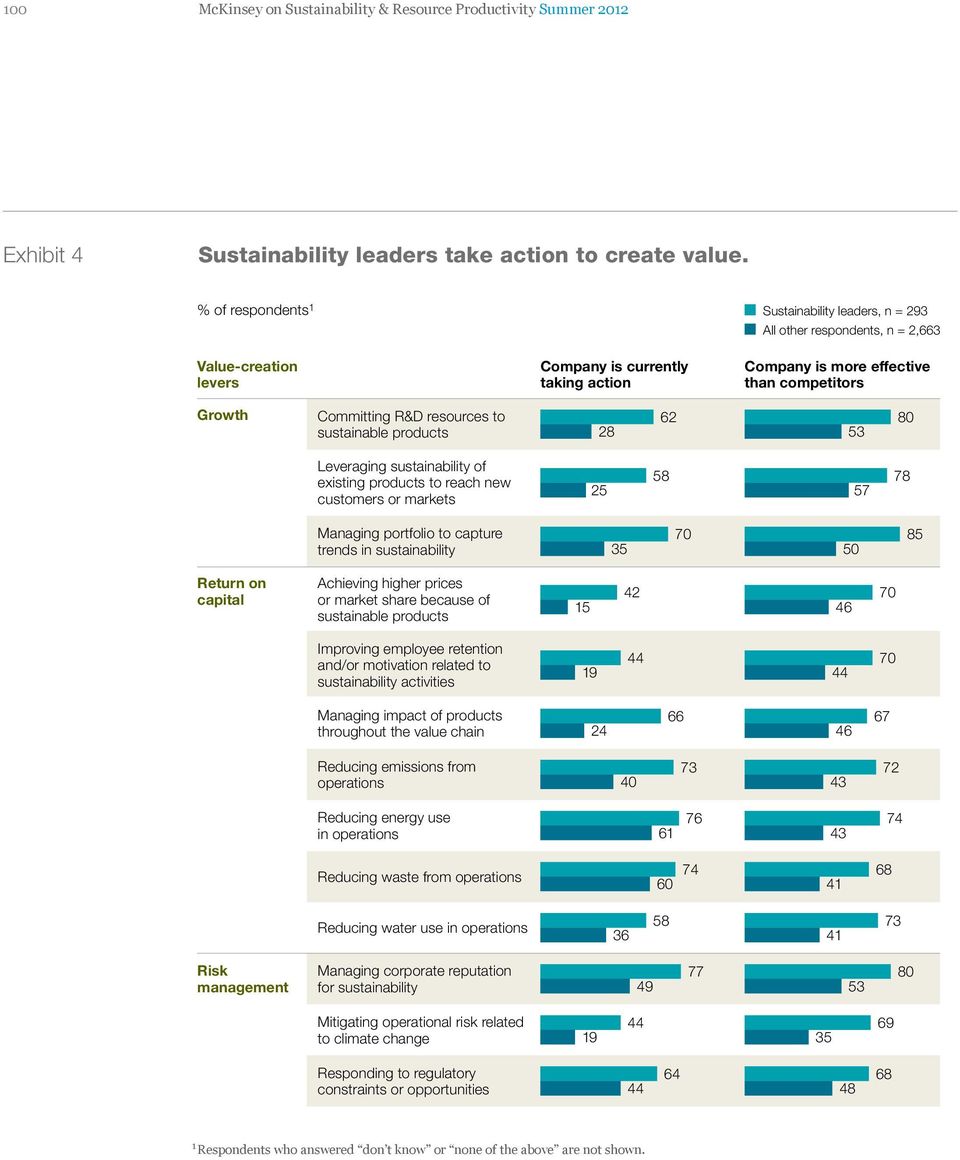
6 The business of sustainability 101 integrated sustainability into strategic planning, versus 53 percent of all other respondents. Compared with the integration of sustainability into other processes, however, the leaders supply chains and budgets are less integrated; respondents at other companies report this pattern as well. In addition, respondents in the leaders group are more likely than other respondents to report that their companies are pursuing each of the 13 actions related to sustainability listed in the survey, and they rate themselves more effective at taking action, relative to competitors, more often than the rest of respondents do. Executives in the leaders group are also more likely to say their companies are taking higherlevel, more strategic actions: much higher shares of leaders are managing their business portfolios to capture trends in sustainability and committing R&D resources to sustainable products. Furthermore, just 9 percent of respondents at these companies say they have sustainability programs in place to respond to regulatory requirements, compared with 25 percent of all other respondents. Those in the leaders group are more likely to say instead that sustainability is aligned with their goals, mission, and values (59 percent versus 28 percent of all others) and that it strengthens their competitive position (43 percent versus 24 percent). It s likely related that executives in the leaders group are more than twice as likely as all others to say their companies capture value from sustainability opportunities. Indeed, 30 percent say they are capturing all the value they can, versus 9 percent of all others. And while all respondents struggle with the pressure of shortterm earnings performance as a barrier to value creation, the leaders struggle less with

7 102 McKinsey on Sustainability & Resource Productivity Summer 2012 leadership, systems, and processes that enable organizations to drive value through sustainability (Exhibit 5). at other companies. 9 This finding suggests that the integration of sustainability extends far beyond business practices at these companies. Executives whose companies fall into the leaders Survey group also 2011 report that employees at all levels Sustainability are far more knowledgeable about their companies sustainability 5 of 6 activities and that Exhibit Exhibit sustainability title: is Fewer more important barriers for for attracting leaders and retaining employees than respondents It s important to note that the mix of industries represented in the leaders group differs from the full group of respondents to the survey. A handful of industries arguably those with a higher impact on environmental issues such as resource use and emissions, whose need to be Exhibit 5 Leaders see fewer barriers. % of respondents 1 Barriers that prevent companies from capturing potential value from sustainability initiatives Sustainability leaders, n = 293 All other respondents, n = 2,663 Lack of incentives tied to performance on sustainability initiatives Sustainability isn t integrated into existing performance management system Pressure of short-term earnings performance is at odds with longer-term nature of sustainability Business units are not engaged with implementing sustainability initiatives 7 19 Lack of, or use of wrong, key 13 performance indicators (KPIs) 28 Company leadership sets sustainability as too low a priority 2 17 Insufficient resources for sustainability initiatives Company lacks the right capabilities and/or skills 4 16 Too few people are accountable for sustainability Sustainability department is disconnected from the rest of the organization, or is too low to be influential 4 11 Current organizational structure doesn t support accountability for sustainability activities 9 24 We are capturing all the value we can 9 30 Insufficient data or information to implement initiatives Respondents who answered don t know or other are not shown.

8 The business of sustainability 103 more proactive on sustainability to effectively manage their future business is more urgent are overrepresented: energy, extractive industries, manufacturing, and transportation. Relatively few respondents from finance, retail, and business, legal, and professional services are in the leaders group. Value creation and industry The fact that some industries are overrepresented in the leaders group highlights differences in emphasis on and effective management of sustainability across industries. This carries over to value creation. Overall, the relationship between sustainability and quantifiable value is still somewhat unclear, executives indicate: about one-third of respondents say they don t know how much sustainability initiatives add to shareholder value at their companies. In addition, the share that rate sustainability s contribution to short-term value as positive has only inched up since last year s survey, to 48 percent. However, respondents do cite several different levers for value creation over the next five years. Among the top are managing corporate reputation, capturing sustainability trends in the business portfolio, and committing R&D resources to sustainable products; across industries, the relative importance of each effort varies (Exhibit 6). Respondents at consumer and B2B companies diverge on the levers that could drive longerterm value creation. Respondents in both groups expect reputation to add a similar level of significant value, or more than 11 percent of shareholder value indeed, it s the most frequently selected action by respondents at consumer companies. Among B2B respondents, however, the highest share (23 percent) say managing their business portfolios to capture sustainability trends adds significant value to companies in their industries, compared with 15 percent of consumer respondents. Achieving higher prices or greater market share through sustainable products, committing R&D resources, and responding to regulations has more value potential for B2B companies, executives say, while those at consumer companies see more potential in managing sustainability through the value chain, water use, and waste. Across industries, executives also differ in how they view barriers to value creation. Those at extractive firms point to a lack of capabilities (25 percent versus 15 percent of all respondents) and lack of incentives tied to sustainability performance (42 percent versus 32 percent) as being bigger barriers than they are for respondents in other industries. Higher shares of transportation respondents than the average also cite lack of incentives (45 percent), while fewer executives at energy firms select most of the barriers presented, perhaps suggesting that they ve been thinking about sustainability and value longer than others. Some in the energy sector do still cite key performance indicators (KPIs) and integrating sustainability into their performance management systems as concerns. Executives at retail firms are more likely to report barriers except for organizational structure and a disconnected sustainability department than the average. Looking ahead Companies are not doing as much to integrate sustainability into internal communications or employee engagement as they are into other
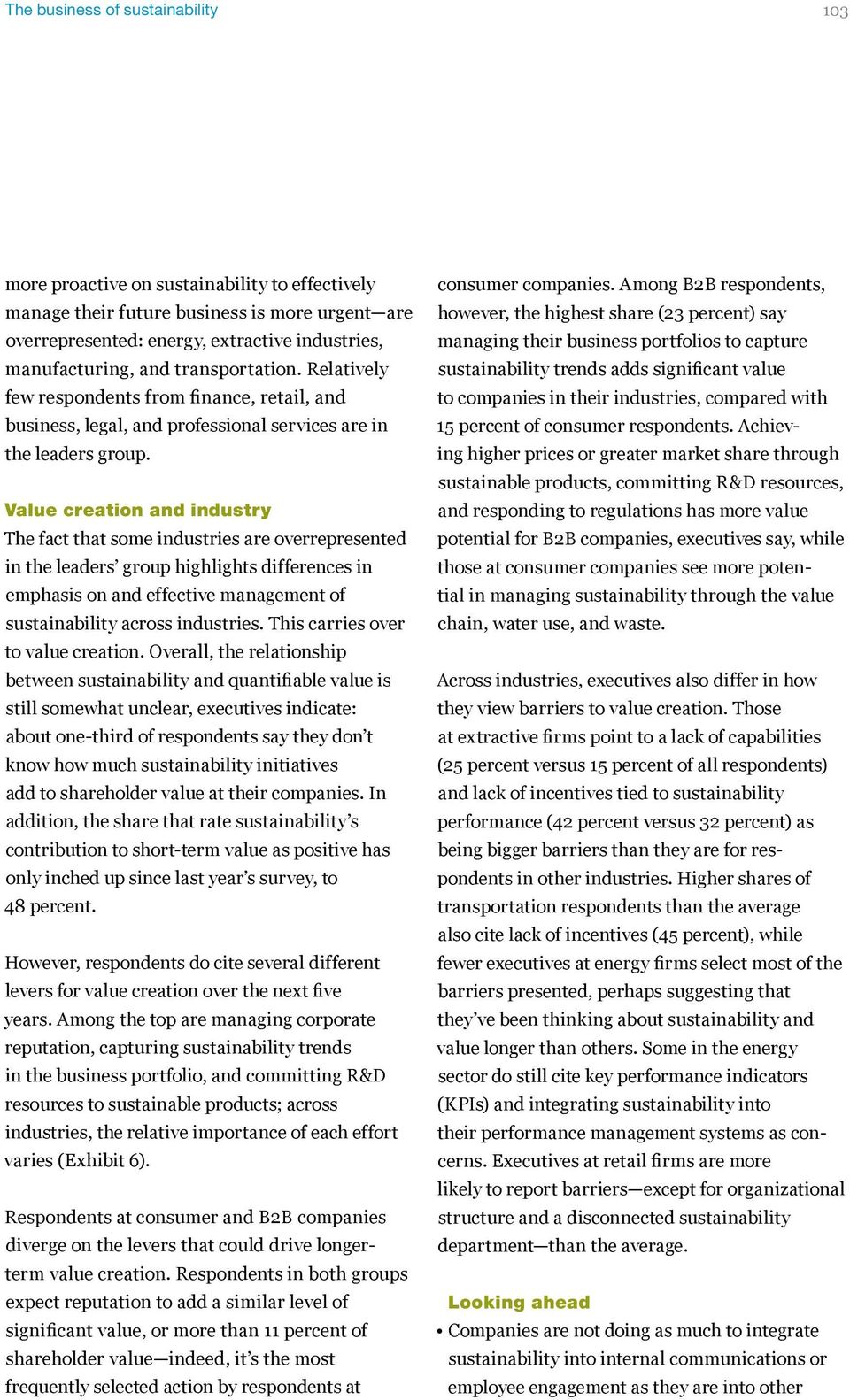
9 104 McKinsey on Sustainability & Resource Productivity Summer 2012 Survey 2011 Sustainability Exhibit 6 of 6 Exhibit title: Value varies by industry Exhibit 6 Value varies by industry. % of respondents Value-creation levers Total, n = 3,203 Industry, top three most cited activities 1 with potential to create significant value over the next 5 years Growth Committing R&D resources to sustainable products 17 Energy (2), high tech/telecom (3), manufacturing (1) Leveraging sustainability of existing products to reach new customers or markets 15 Health care/pharma (3) Managing portfolio to capture trends in sustainability 20 Energy (1), extractive services 2 (3), finance (2), high tech/telecom (1), manufacturing (2), retail (3), transportation (2) Return on capital Achieving higher prices or market share because of sustainable products 13 Improving employee retention and/or motivation related to sustainability activities 11 Finance (3), health care/pharma (2) Managing impact of products throughout the value chain 13 Retail (1) Reducing emissions from operations 10 Reducing energy use in operations 15 Extractive services (3), retail (3), transportation (1) Reducing waste from operations 13 Retail (2), transportation (3) Reducing water use in operations 9 Risk management Managing corporate reputation for sustainability 20 Energy (3), extractive services (1), finance (1), health care/pharma (1), high tech/telecom (1), manufacturing (2), retail (3), transportation (2) Mitigating operational risk related to climate change 8 Responding to regulatory constraints or opportunities 13 Energy (3), extractive services (2), health care/pharma (3) 1 Numbers 1, 2, and 3, in parentheses, indicate the first, second, and third most frequently chosen activities within each industry. 2 This group includes respondents from the coal, metal, oil and gas extraction, petroleum and natural-gas distribution, petroleum refining, and other mining subindustries.

10 The business of sustainability 105 areas of business, such as strategic planning. With 53 percent of respondents saying company performance on sustainability is at least somewhat important to attracting and retaining employees, companies that take action are more likely to gain an advantage in employee retention. The leaders are better at engaging employees on this issue (and at keeping employees at all levels more informed), suggesting that it s possible to make the most of this opportunity in sustainability. Our experience in working with companies in different industries on sustainability aligns with the survey findings that different industries use different levers (growth, return on capital, and risk management) to create significant value. There s no single way to create value from sustainability, so knowing where the biggest opportunities for value creation are in an industry and where the risks and barriers lie can serve as a guide for developing sustainability strategies. Coupled with the shift in reasons for pursuing sustainability, from reputation management to operational improvements and new growth opportunities, the overall high degree of integration seems to indicate that companies have become more businesslike about their sustainability agenda. Most companies, however, are still struggling to factor sustainability into the hard areas of their business, such as supply chain and the budget, so there is still a lot of potential to drive further integration and increased value creation. Where leaders and all others diverge most is around KPIs, organizational structure, and leadership engagement; these may be high-potential areas for companies striving to become sustainability leaders. 1 The online survey was in the field from July 12 to July 22, 2011, and received responses from 3,203 executives representing the full range of regions, industries, tenures, company sizes, and functional specialties. 2 Defined as a combination of environmental, social, and governance issues also known as corporate social responsibility (CSR) or corporate responsibility. 3 In these survey results, this group includes respondents from the coal, metal, oil and gas extraction, petroleum and natural-gas distribution, petroleum refining, and other mining subindustries. 4 The online survey was in the field in February 2010 and received responses from 1,946 executives representing a wide range of industries and regions. 5 In 2011, the answer choice was, building, maintaining, or improving our corporate reputation ; in 2010, the answer choice was, maintaining or improving corporate reputation. 6 In 2010, the answer choice was, alignment with company s business goals. 7 Respondents in this group say sustainability is either the most important or a top-three priority on their CEOs agenda, that it is embedded in their companies business practices, that their companies have a formal program to address related issues, and that their companies manage sustainability very or extremely effectively. This year s analysis is not fully comparable to the 2010 sustainability survey, because leaders in the most recent survey include energy industry respondents, whereas the 2010 survey excluded them from the leaders group. 8 McKinsey s research on sustainability and value creation has allowed us to develop a framework that shows how sustainability creates value for companies with three levers. 9 Within the leaders group, 23 percent of respondents say their companies performance on sustainability issues is one of the most important factors for attracting and retaining employees, while 5 percent of all other respondents say the same. Sheila Bonini, a contributor to the development and analysis of this survey, is a consultant in McKinsey s Silicon Valley office. Copyright 2012 McKinsey & Company. All rights reserved.
The business of sustainability
 McKinsey Global Survey results The business of sustainability More companies are managing sustainability to improve processes, pursue growth, and add value to their companies rather than focusing on reputation
The business of sustainability: Putting it into practice
 Sustainability & Resource Productivity Practice The business of sustainability: Putting it into practice Sheila Bonini and Stephan Görner Companies should integrate environmental, social, and governance
CSI Publications. The State of Business Model Innovation in Norway. By: Tina Saebi and Krysta Alexa Singh. Theme 1: Business Model Innovation
 CSI Publications Theme 1: Business Model Innovation The State of Business Model Innovation in Norway By: Tina Saebi and Krysta Alexa Singh Table of Contents 1 1. The Study 3 2. Low Degree of Business Model
SUSTAINABILITY & EMPLOYEE ENGAGEMENT
 SUSTAINABILITY & EMPLOYEE ENGAGEMENT The State of The Art By John Davies VP Senior Analyst, GreenBiz September 2014 Finding Common Ground with HR Sustainability professionals usually think of their challenges
What sets breakthrough innovators apart PwC s Global Innovation Survey 2013: US Summary
 What sets breakthrough innovators apart PwC s Global Innovation Survey 2013: US Summary www.pwc.com/innovationsurvey 60% $250b The top innovators in our study plan to grow by more than 60 percent over
Sustainability Services Strategy, technology and implementation services that drive business performance improvement
 Sustainability Services Strategy, technology and implementation services that drive business performance improvement Sustainability is good for business period That s why organizations around the world
Can Energy Management Deliver Real Savings?
 Can Energy Management Deliver Real Savings? Garrett Forsythe, Global Solutions Architect DuPont Sustainable Solutions September 28, 2011 Copyright 2010 DuPont. All rights reserved. The DuPont Oval Logo,
IBM Business Consulting Services. CRM done right. deeper. An IBM Institute for Business Value executive brief. ibm.com/bcs
 IBM Business Consulting Services CRM done right deeper An IBM Institute for Business Value executive brief ibm.com/bcs The IBM Institute for Business Value develops fact-based strategic insights for senior
The State of Employee Engagement in Sustainability and CSR. Trends in engaging employees for better business results, 2009 2014
 The State of Employee Engagement in Sustainability and CSR Trends in engaging employees for better business results, 2009 WeSpire original research - June About WeSpire WeSpire is a technology company
Understanding supply chain risk: A McKinsey Global Survey
 Page 1 of 6 Survey Understanding supply chain risk: A McKinsey Global Survey Executives believe they face growing risk from disruptions to their supply chains yet many are unprepared to manage those risks.
BPM 2015: Business Process Management Trends & Observations
 BPM 2015: Business Process Management Trends & Observations 1 I BPM 2015: Business Process Management Trends & Observations BPM 2015: Business Process Management Trends & Observations Executive Summary
What really drives customer satisfaction during the insurance claims process?
 Research report: What really drives customer satisfaction during the insurance claims process? TeleTech research quantifies the importance of acting in customers best interests when customers file a property
Is business ready to grow? How human capital and talent technology are influencing global business
 Is business ready to grow? How human capital and talent technology are influencing global business Unified Human Capital Management and Talent Technology Survey Report August 2011 Contents 1 Key findings
Creating Line of Sight
 Creating Line of Sight How to Get to the Bottom Line Through Your Employees Presented by: Ed Krow, SPHR, CCP, CHCM Objectives Identify key behaviors of all levels of employees and the link between those
Singapore Exchange Sustainability Reporting Guide. Guide to Sustainability Reporting for Listed Companies
 Guide to Sustainability Reporting for Listed Companies Contents 1. Policy Statement... 03 2. Purpose of the Guide... 07 3. Why Should Listed Companies Report?... 08 4. Who Should Report?... 09 5. How Should
Why Sales Training Doesn t Work. And What to Do About It!
 Why Sales Training Doesn t Work And What to Do About It! Selling isn t a great sport in which to come second. In the world of winner takes all, anything that gives you a small increase in performance relative
Accenture Sustainability Performance Management. Delivering Business Value from Sustainability Strategy
 Accenture Sustainability Performance Management Delivering Business Value from Sustainability Strategy Global executives are as committed as ever to sustainable business. Yet, executing a sustainability
Building Energy Efficiency Opportunity Report
 Building Energy Efficiency Opportunity Report September 2013 Building Energy Efficiency Opportunity Report TABLE OF CONTENTS Introduction 3 Building Efficiency Opportunities 4 #1: High Potential Buildings
Implementing Sustainability:
 Implementing Sustainability: THE ROLE OF LEADERSHIP AND ORGANIZATIONAL CULTURE This article is based on a study supported by IMA s Foundation for Applied Research (FAR). By Marc J. Epstein, Adriana Rejc
The greatness gap: The state of employee disengagement. Achievers 2015 North American workforce survey results
 The greatness gap: The state of employee disengagement Achievers 2015 North American workforce survey results Greatness doesn t happen by chance it s the accumulation of daily successes. True greatness
The Missing Link: Driving Business Results Through Pay-for-Performance. For Small & Midsized Businesses. Copyright 2007 SuccessFactors, Inc.
 The Missing Link: Driving Business Results Through Pay-for-Performance. For Small & Midsized Businesses Copyright 2007 SuccessFactors, Inc. I. Introduction More successful small and mid-sized companies
Creating Line of Sight
 Creating Line of Sight How to Get to the Bottom Line Through Your Employees Presented by: Ed Krow, SPHR, CCP, SHRM-SCP, CHCM Objectives Identify key behaviors of all levels of employees and the link between
ENGINEERING A BETTER WORLD. 2012 Corporate Responsibility Scorecard
 1 ENGINEERING A BETTER WORLD 2012 Corporate Responsibility Scorecard MESSAGE FROM THE CEO Connecting A BRIGHTER future As a global leader in the communications semiconductor industry, Broadcom knows the
THE HR GUIDE TO IDENTIFYING HIGH-POTENTIALS
 THE HR GUIDE TO IDENTIFYING HIGH-POTENTIALS What makes a high-potential? Quite possibly not what you think. The HR Guide to Identifying High-Potentials 1 Chapter 1 - Introduction If you agree people are
Our clients are tapping social media to generate brand awareness and create emotional connections.
 he power of social media and social technology is being felt throughout organizations today much in the way the internet influenced the way we did business in the early 1990s. In the beginning, expanding
Paying the Price of Inaction? Why Original Equipment Manufacturers Must Reinvent Competitive Parts Pricing
 Paying the Price of Inaction? Why Original Equipment Manufacturers Must Reinvent Competitive Parts Pricing Original Equipment Manufacturers know that things must change In the spare parts market, overpriced
Global Talent Management and Rewards Study
 Global Talent Management and Rewards Study At a glance Overview The 2014 Global Talent Management and Rewards Study provides an in-depth look at the practices and concerns of organisations around the globe.
How do I manage the complexity in my organization?
 Insights into organization How do I manage the complexity in my organization? Suzanne Heywood Rubén Hillar David Turnbull How do I manage the complexity in my organization? 1 Why is this important? All
The Truths About Change
 The Truths About Change What It Takes to Get It Right A Spotlight on Effective Change Management Based on results from the 2011 2012 Change and Communication ROI Study This year s findings reveal that
International Management
 International Management 7.5 ECTS Ladok code: The exam is given to: Registered students Name: Personal number: Date of exam: 2 nd of June Time: 09:00 14:00 Means of assistance: No assistance Total amount
Sustainability Innovation and Improvements a Case Study. Wende Huehn-Brown, Ph.D., CPIM
 Sustainability Innovation and Improvements a Case Study Wende Huehn Brown Ph.D., CPIM October 15, 2012 Biography Wende Huehn-Brown, Ph.D., CPIM Professor: St. Petersburg College Ph.D. : University of Missouri
MBA Dissertation Summary
 MBA Dissertation Summary Barriers and Enablers to Environmental Sustainability Implementation in UK Business The purpose of the dissertation was to answer the following research question: What are the
Could a Managed Services Agreement Save Your Company Tens of Thousands of Dollars Each Year?
 MANAGED IT SERVICES Could a Managed Services Agreement Save Your Company Tens of Thousands of Dollars Each Year? A lot of business owners, executives, and managers have a love-hate relationship with managed
Accounting for ethical, social, environmental and economic issues: towards an integrated approach
 Accounting for ethical, social, environmental and economic issues: towards an integrated approach Research Executive Summaries Series Vol. 2, No. 12 By Professor Carol A Adams La Trobe University and Dr
SUSTAINABILITY REPORT 2010
 SUSTAINABILITY REPORT 2010 MESSAGE FROM THE CEO Sustainability makes good business sense for Oxford. There are two reasons why: First, because it helps us to meet and exceed tenant expectations. As more
Tapping the benefits of business analytics and optimization
 IBM Sales and Distribution Chemicals and Petroleum White Paper Tapping the benefits of business analytics and optimization A rich source of intelligence for the chemicals and petroleum industries 2 Tapping
Enterprise Risk Management: From Theory to Practice
 INSURANCE Enterprise Risk Management: From Theory to Practice KPMG LLP Executive Summary Enterprise Risk Management (ERM) is a structured and disciplined business tool aligning strategy, processes, people,
Culture of Purpose Building business confidence; driving growth 2014 core beliefs & culture survey
 Culture of Purpose Building business confidence; driving growth 2014 core beliefs & culture survey Executive summary Our research indicates that focusing on purpose rather than profits builds business
Benefits make up an important component of the employment. Employee Benefits in a Total Rewards Framework. article Business Case for Benefits
 article Business Case for Benefits Employee Benefits in a Total Rewards Framework Benefits represent one of the largest investments a company makes in its talent. However, our tendency can be to design,
Portfolio Carbon Initiative
 Portfolio Carbon Initiative Acting as market makers, capital providers, and advisers, financial institutions (FIs) are important actors in the shift to a low-carbon economy. As providers of debt and equity,
For Optimal Sales Force Performance, Pay Is Not Enough
 For Optimal Sales Force Performance, Pay Is Not Enough Three must-have elements for optimal sales performance How to develop sustainable engagement of sales professionals How sales managers make a significant
2010 Study on the State of Performance Management. research. A report by WorldatWork and Sibson Consulting October 2010
 2010 Study on the State of research A report by WorldatWork and Sibson Consulting October 2010 About WorldatWork Media Contact: Marcia Rhodes 14040 N. Northsight Blvd. Scottsdale, Arizona USA 852-31 480-304-6885
ISO 14001: 2015. White Paper on the Changes to the ISO Standard on Environmental Management Systems JULY 2015
 ISO 14001: 2015 White Paper on the Changes to the ISO Standard on Environmental Management Systems JULY 2015 4115, Sherbrooke St. West, Suite 310, Westmount QC H3Z 1K9 T 514.481.3401 / F 514.481.4679 eem.ca
5/30/2012 PERFORMANCE MANAGEMENT GOING AGILE. Nicolle Strauss Director, People Services
 PERFORMANCE MANAGEMENT GOING AGILE Nicolle Strauss Director, People Services 1 OVERVIEW In the increasing shift to a mobile and global workforce the need for performance management and more broadly talent
Financial Services Sector: Missing Customer Expectations?
 Financial Services Sector: Missing Customer Expectations? Independent Market Research Commissioned by June 01 Executive Summary: 77 global say the way they deal with companies has changed in the last 1
FINTECH CORPORATE INNOVATION INDEX 2015
 FINTECH CORPORATE INNOVATION INDEX 2015 Page 01 FOREWORD Nicole Anderson CEO FINTECH CIRCLE INNOVATE The FinTech eco-system is shaping the future of financial services and it s about new entrants, new
Evolution of the networked enterprise: McKinsey Global Survey results
 34 Feature article Jean-François Martin Evolution of the networked enterprise: McKinsey Global Survey results In our sixth annual survey on social technologies, executives report broader benefits from
Customer-Focused Innovation in High Tech Industries. Benchmark best practices and performances for next-generation success
 Customer-Focused Innovation in High Tech Industries Benchmark best practices and performances for next-generation success Executive Summary are struggling today to stay competitive in a difficult economy,
Sustainability Value Management: Stronger metrics to drive differentiation and growth. By Alexander Holst
 Sustainability Value Management: Stronger metrics to drive differentiation and growth By Alexander Holst Can a focus on sustainability also drive stronger business performance and tangible financial results?
Position statement on corporate tax avoidance and tax transparency 18 december 2015
 Position statement on corporate tax avoidance and tax transparency 18 december 2015 1. Introduction After various waves of public outrage, tax avoidance and the need for tax transparency by companies is
Improving Corporate Governance with the Balanced Scorecard
 #04-044 Improving Corporate Governance with the Balanced Scorecard Robert S. Kaplan Michael E. Nagel Copyright 2004 Robert S. Kaplan and Michael E. Nagel Working papers are in draft form. This working
Big Data and Analytics Survey Report
 Big Data and Analytics Survey Report Background and Methodology Marketing2020 Organizing for Growth is the most comprehensive global marketing leadership initiative ever undertaken. Focused on identifying
Internal audit strategic planning Making internal audit s vision a reality during a period of rapid transformation
 2015 State of the Internal Audit Profession Study Internal audit strategic planning Making internal audit s vision a reality during a period of rapid transformation 68% of companies have gone through or
Revisiting Roll-Ups Value Creation through ecommerce
 Revisiting Roll-Ups Value Creation through ecommerce Situation The concept of consolidating an industry by acquiring many small companies and rolling them up into a larger firm remains an intriguing path
Competitive Pay Policy
 www.salary.com/hr Copyright 2002 Salary.com, Inc. Competitive Pay Policy Lena M. Bottos and Christopher J. Fusco, SPHR Salary.com, Inc. Abstract A competitive pay policy articulates an organization s strategy
Chapter 9 Basics of Enterprise Reporting. Fundamentals of Business Analytics RN Prasad and Seema Acharya
 Chapter 9 Basics of Enterprise Reporting Fundamentals of Business Analytics Learning Objectives and Learning Outcomes Learning Objectives 1. To introduce the Balanced Score Card (Kaplan and Norton s) 2.
It ain t what you do; it s the way that you do IT
 It ain t what you do; it s the way that you do IT Software License Optimization Report 2013 Software asset management is obsolete. Its base processes come from a bygone era of floppy disks and unique license
2016 Canadian Procurement Forecast
 2016 Canadian Procurement Forecast The following report was prepared based on several months of research and interviews with procurement executives conducted by event producer Natasia Langfelder. In addition,
Planning a Basel III Credit Risk Initiative
 Risk & Compliance the way we see it Planning a Basel III Credit Risk Initiative How to Achieve Return on Investment Contents 1 Introduction 3 2 Banks need a strong data foundation 4 3 A new focus on models
B-to-B Lead Generation:
 Marketing ROI & Performance Evaluation Study A special report from MarketingProfs, with support from Lenskold Group Copyright 2008. MarketingProfs Research Insights, MarketingProfs, LLC. All rights reserved.
Sustainable Investing
 Sustainable Investing Principles and Practices ur real problem, then, is not our strength today; it is rather the vital necessity of action today to ensure our strength tomorrow. Dwight D. Eisenhower In
2016 Survey on Leadership Development. Copyright Borderless - http://borderless.net
 2016 Survey on Leadership Development Table of Contents 3 9 Executive Summary About Survey Respondents 15 Leadership Development definition & scope Leadership Development inside organizations 24 36 Leadership
Building a Unique Total Rewards and HR System For A Unique Company At
 Building a Unique Total Rewards and HR System For A Unique Company At Since Starbucks isn t your typical company, this isn t a typical case study. Rather than focusing on a single reward program or even
Case Study. We are growing quickly, and Saba is key to that successful growth.
 Case Study In the dynamic energy industry, Mansfield Oil one of Forbes 50 Largest Private Companies fuels its employee engagement and retention with a new talent management strategy powered by Saba Software.
#KPMG Ignite. Join the conversation
 #KPMG Ignite Join the conversation Increasing value in supply chain and procurement Mary Hemmingsen Mark Woods Welcome Mary Hemmingsen Partner, Energy Advisory Leader and Global LNG Leader Mark Woods Partner,
THE BALANCED SCORECARD IN A STRATEGY-FOCUSED ORGANIZATION
 THE BALANCED SCORECARD IN A STRATEGY-FOCUSED ORGANIZATION Engineer (economist) Bogza (Cozma) Rodica Maria, PhD The Bucharest Academy of Economic Studies ABSTRACT The power to focus means the power to succeed.
The Talent on Demand Approach. Talent management is the process through which employers anticipate and meet
 The Talent on Demand Approach Talent management is the process through which employers anticipate and meet their needs for human capital. Getting the right people with the right skills into the right jobs
Community/School Partnerships: A National Survey
 Community/School Partnerships: A National Survey February 2007 About DeHavilland Associates DeHavilland Associates is a consulting and communications firm that helps its corporate, nonprofit, and association
Renewable Choice Energy
 Catawba College Table of Contents About Renewable Choice The Problem: Electricity Production Today The Solutions: Renewable Energy Sources Renewable Energy Credits (RECs) Who can participate in Renewable
PRIORITIZING CYBERSECURITY
 April 2016 PRIORITIZING CYBERSECURITY Five Investor Questions for Portfolio Company Boards Foreword As the frequency and severity of cyber attacks against global businesses continue to escalate, both companies
Social Media for B2B: A Beginner s Guide
 COMMUNITY EBOOK / JULY 2012 / WWW.RADIAN6.COM / 1 888 6radian Social Media for B2B: A Beginner s Guide Copyright 2012 - Radian6 Technologies 1 888 6RADIAN 1 888 672-3426 / [email protected] Copyright
Strategic priorities for UK businesses
 Strategic priorities for UK businesses An independent report on the issues affecting today s CFOs Contents 03 04 06 09 10 11 Strategic priorities for UK businesses Executive summary The view from within:
Strategic Brand Management Building, Measuring and Managing Brand Equity
 Strategic Brand Management Building, Measuring and Managing Brand Equity Part 1 Opening Perspectives 开 放 视 觉 Chapter 1 Brands and Brand Management ------------------------------------------------------------------------
Figure 1: Level of CEO Total Remuneration (in HK$ million) by Industry - Hong Kong Listed and Incorporated Companies $10.62 $12.16 $12.45 $16.
 Hong Kong CEOs and How They are Paid Hong Kong, 23 January 2014 - With a median CEO total reward value of HK$16.78M, and despite globally having lost some of its gloss in recent years, the finance sector
McKinsey Global Survey results Implementing change with impact
 McKinsey Global Survey results Implementing change with impact When it comes to large-scale change, the companies with the most developed implementation capabilities see clear financial benefits as a result
BUILDING AN INNOVATIVE INNOVATION TEAM
 NINESIGMA WHITE PAPER BUILDING AN INNOVATIVE INNOVATION TEAM Author: Denys Resnick Director, Strategic Programs Denys Resnick is responsible for incubating and launching NineSigma s new products and services.
A REPORT BY HARVARD BUSINESS REVIEW ANALYTIC SERVICES The Age of Modern HR. Sponsored by
 A REPORT BY HARVARD BUSINESS REVIEW ANALYTIC SERVICES The Age of Modern HR Sponsored by The Age of Modern HR Building human resources management systems that deliver ACROSS THE GLOBE, human resources
I D C T E C H N O L O G Y S P O T L I G H T
 I D C T E C H N O L O G Y S P O T L I G H T Capitalizing on the Future with Data Solutions December 2015 Adapted from IDC PeerScape: Practices for Ensuring a Successful Big Data and Analytics Project,
Long-Term Growth, Short-Term Differentiation and Profits from Sustainable Products and Services. A global survey of business executives
 Long-Term Growth, Short-Term Differentiation and Profits from Sustainable Products and Services A global survey of business executives It is clear that sustainability is becoming integral to the way to
Using the Cloud for Business Resilience
 Allen Downs IBM Business Continuity and Resiliency Services Using the Cloud for Business Resilience June 20, 2011 1 Agenda Why resiliency matters A successful cloud-based approach to resiliency Moving