
Clinical Mental Health Counseling Program. Council for the Accreditation of Counseling and Related Educational Programs (CACREP) Self-Study
|
|
|
- Mitchell Adams
- 9 years ago
- Views:
Transcription
1 Department of Counseling Clinical Mental Health Counseling Program Council for the Accreditation of Counseling and Related Educational Programs (CACREP) Self-Study December 2015 CACREP Liaison CD created on December 4, 2015 Jeffery Haynes, Ph.D., MSM, LMHC, NBCC Microsoft Word 2013 Bethune Cookman University Version: Windows 7 PC 739 West International Speedway Boulevard Daytona Beach, Florida [email protected]
2 TABLE OF CONTENTS APPLICATION FOR ACCREDITATION 4-8 TABLE 1 2 FACULTY WHO CURRENTLY TEACH IN PROGRAM TABLE 3 CURRENT STUDENTS. 11 TABLE 4 GRADUATES (CURRENT).. 11 SECTION 1: THE LEARNING ENVIORNMENT- STRUCTURE AND EVALUATION THE INSTITUTION (A H) THE ACADEMIC UNIT (I - T) FACULTY AND STAFF (U-Z) EVALUATION (A) COMPREHENSIVE ASSESSMENT PLAN SECTION II: PROFESSIONAL IDENTITY 36 FOUNDATION (A-C) PROGRAM OBJECTIVES.. 37 KNOWLEDGE (D-G) COMMON CORE CURRICULAR AREAS.. 40 PROFESSIONAL ORIENTATION AND ETHICAL PRACTICE. 41 SOCIAL AND CULTURAL DIVERSITY 42 HUMAN GROWTH AND DEVELOPMENT CAREER DEVELOPMENT.44 HELPING RELATIONSHIPS. 45 GROUP WORK 46 ASSESSMENT RESEARCH AND PROGRAM EVALUATION. 48 SECTION III: PROFESSIONAL PRACTICE 49 SUPERVISOR QUALIFICATIONS AND SUPPORT (A-E) PRACTICUM (F) INTERNSHIP (G) CLINICAL MENTAL HEALTH COUNSELING 52 FOUNDATION KNOWLEDGE

3 FOUNDATIONS SKILLS AND PRACTICE.. 54 COUNSELING, PREVENTION, INTERVENTION KNOWLEDGE 55 COUNSELING, PREVENTION, INTERVENTION AND SKILLS AND PRACTICES 56 DIVERSITY AND ADVOCACY KNOWLEDGE 57 DIVERSITY AND ADVOCACY SKILLS AND PRACTICE...58 ASSESSMENT KNOWLEDGE 59 ASSESSMENT SKILLS AND PRACTICE 60 RESEARCH AND EVALUATION KNOWLEDGE RESEARCH AND EVALUATION SKILLS AND PRACTICES DIAGNOSIS KNOWLEDGE 63 DIAGNOSIS SKILLS AND PRACTICES 64 3
4 Council for Accreditation of Counseling and Related Educational Programs Application for Accreditation Instructions for Completion 1. Submit a hard copy of Pages 2 and 3 with original signatures. 2. Include a copy of the complete application, including all accompanying documents and tables, in an electronic format on the self-study disk. 3. Submit a check or money order payable to CACREP for the application fee. The current fee may be obtained by calling the CACREP office or checking 4. Submit four (4) copies of the self-study in read-only format on disks. See Accreditation Process Policy #17 in the current Policy Document for formatting guidelines. Mail the signature pages, application fee, and four (4) copies of the self-study to: Council for Accreditation of Counseling and Related Educational Programs 1001 North Fairfa Street, Suite 510 Aleandria, Virginia
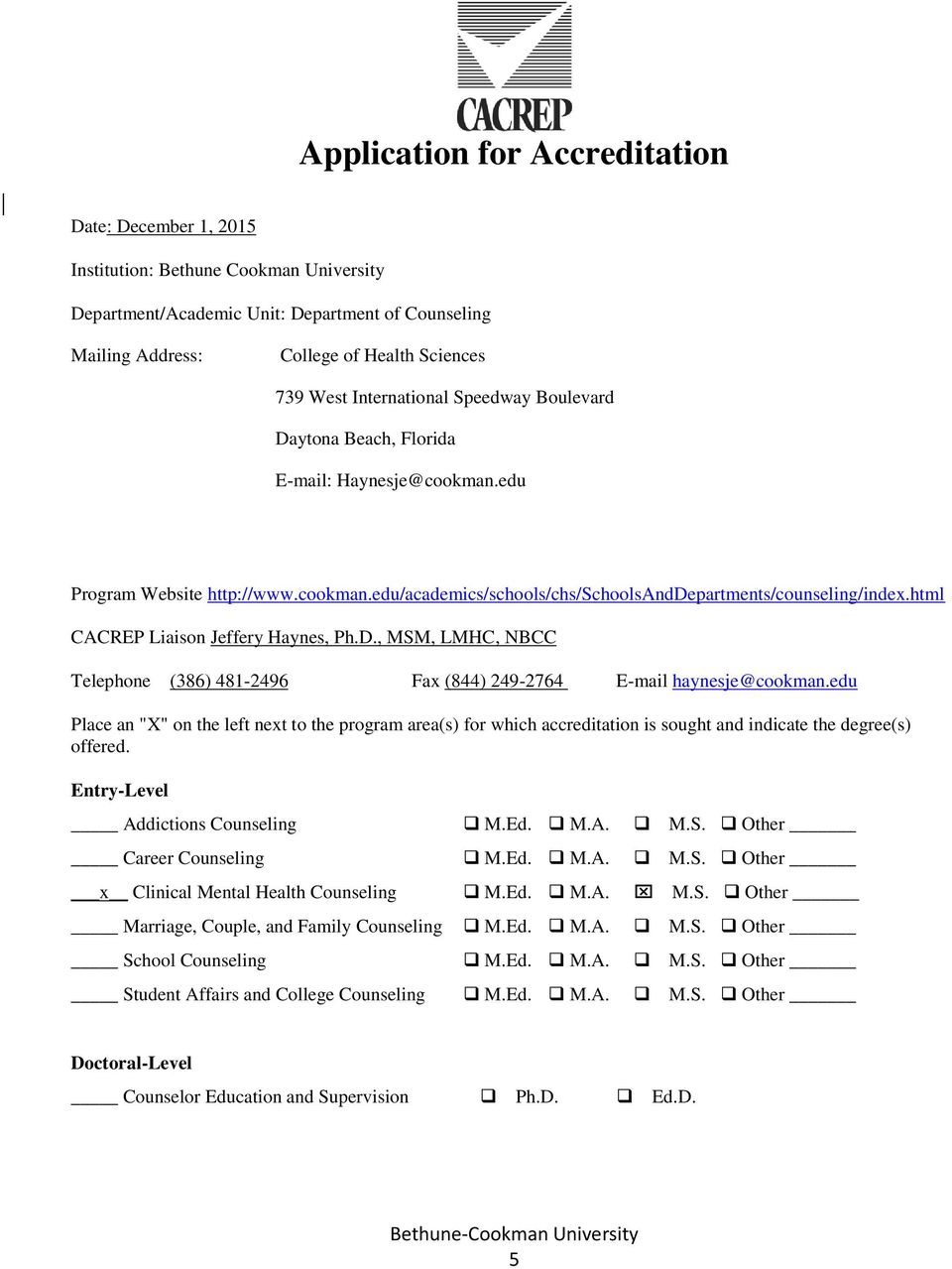
5 Application for Accreditation Date: December 1, 2015 Institution: Bethune Cookman University Department/Academic Unit: Department of Counseling Mailing Address: College of Health Sciences 739 West International Speedway Boulevard Daytona Beach, Florida Program Website CACREP Liaison Jeffery Haynes, Ph.D., MSM, LMHC, NBCC Telephone (386) Fa (844) Place an "" on the left net to the program area(s) for which accreditation is sought and indicate the degree(s) offered. Entry-Level Addictions Counseling M.Ed. M.A. M.S. Other Career Counseling M.Ed. M.A. M.S. Other Clinical Mental Health Counseling M.Ed. M.A. M.S. Other Marriage, Couple, and Family Counseling M.Ed. M.A. M.S. Other School Counseling M.Ed. M.A. M.S. Other Student Affairs and College Counseling M.Ed. M.A. M.S. Other Doctoral-Level Counselor Education and Supervision Ph.D. Ed.D. 5
6 Application for Accreditation President/CEO of the Institution Edison O Jackson Ed.D., President (Name) (Signature) Mailing Address _Office of the President 640 Dr. Mary McLeod Bethune Boulevard Daytona Beach, Florida [email protected] Dean of the College Deanna Wathington MD. MPH., Eecutive Dean (Name) (Signature) Mailing Address: College of Health Sciences 739 West International Speedway Boulevard Daytona Beach, Florida [email protected] Department Chair Jeffery Haynes, Ph.D., MSM. LMHC. Department Chair (Name) (Signature) Mailing Address: College of Health Sciences 739 West International Speedway Boulevard Daytona Beach, Florida [email protected] 6
7 Application for Accreditation 1. Please list each site where the program(s) is offered and the percentage of the degree requirements that can be completed at each site. At this time, the main campus in Daytona Beach, Florida is the only site where this program is being offered. 2. Please provide a sample transcript (with blacked out identifying information) for each program area for which accreditation is sought A Transcript of recent graduate from the Clinical Mental Health Counseling program is attached. We began admitting students to the Clinical Mental Health Counseling (CMHC) program in the spring of Please provide a current program of study for each program area that includes all required courses and indicates the total number of hours to obtain the degree. This information should also include the number of clinical hours required in practicum and internship courses. Attached is the program of study vertical curriculum (Appendi J) for the sity hour (60) clinical mental health counseling program. The propose course sequence is also attached in (Appendi J). 4. Please create tables or charts with the following information. If the program(s) is offered at multiple sites, please provide information for each site as well as for the overall program. a) Table 1 Faculty Who Currently Teach in the Program 1. List all core faculty by name and include each person s credit hours generated in last 12 months, terminal degree and major, primary teaching focus, professional memberships, licenses/ certifications and nature of involvement in the program(s) (e.g., Academic Unit Leader) b) Table 2- Table List of noncore faculty 2. List all noncore faculty by name and include each person s credit hours generated in last 12 months, terminal degree and major, primary teaching focus, professional memberships, licenses/ certifications and nature of involvement in the program(s) (e.g., clinical faculty, adjunct) c) Table 3 Current Students a. Please indicate for each applicant program (e.g., School Counseling), the number of full-time, part-time, and full time equivalent (FTE) students at each campus site. 7

8 d) Please indicate any other counseling program(s) in the academic unit that are not applying for accreditation, the number of full-time, part-time, and full time equivalent (FTE) students at each campus site. Table 3 conveys the students on the social services track (SST). This 36 hour program is not applying for accreditation. e) Table 4 Graduates for the past Three (3) Years a. Please indicate for each applicant program (e.g., School Counseling), the number graduates at each campus site. 2. Please indicate for any other counseling program in the academic unit, the number of graduates at each campus site. Graduates in fall of 2015 is the first class to graduate from the Clinical Mental Health Counseling Program 5. Please provide evidence of institutional accreditation by an accreditor recognized by the US Department of Education or the Council for Higher Education Accreditation (CHEA). Bethune Cookman University is accredited by the Southern Association of Colleges and Schools. This accreditation is noted in the Institutional Profile on the university s main website. 6. Clearly label and submit as part of the response for Standard I.AA in the self-study a comprehensive assessment plan that satisfies the conditions specified in Transition Policy #5 See pages of this self-study document 8
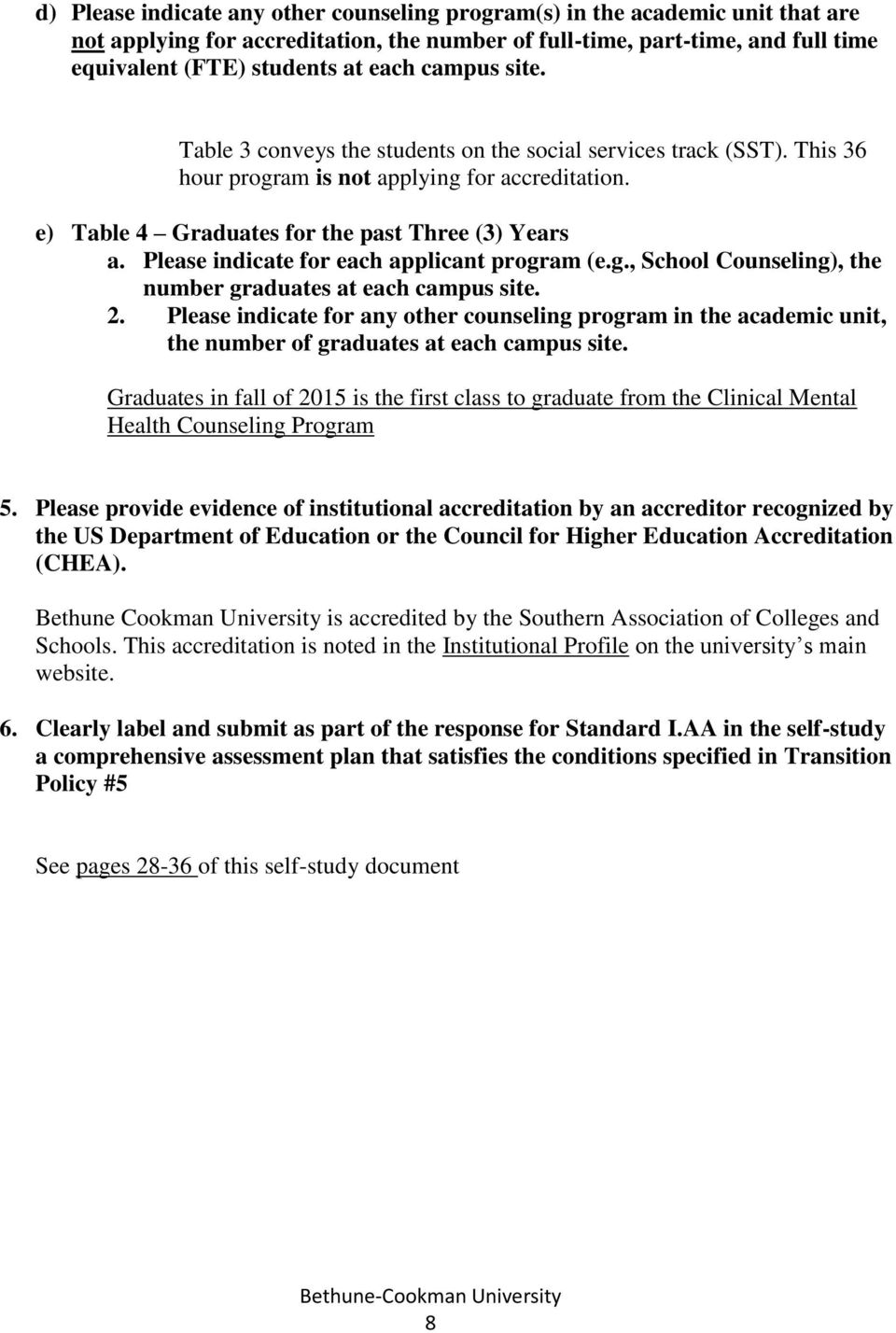
9 Table 1 Core Faculty Who Currently Teach In Program (Jan 2014 Jan 2015) Faculty Member Credit Hours Generated Per Year Haynes, Jeffrey 189 Deborah M. Wilson Nichole E. Jones Terminal Degree & Major PhD, Clinical Psychology 294 Ed.D. Counselor Education 294 Ed.D Counselor Education Teaching Focus Crisis Intervention, Clinical Mental Health Counseling, Legal, Ethical, and Professional Issues, Diagnosis and Treatment Planning, and Professional Credentialing / Licensure, Research Methodology, Practicum, and Internship Drug Education, Theories of Counseling, Behavior Pathology, Professional Orientation and Ethics, Group Dynamics, Theories of Personality Drug Education, Human Lifespan, Career Counseling, Evaluation & Assessment, Marriage & Family Group Assessment, Counseling Diverse Populations, Vocational Psychology, Group Dynamics, Psychopharmacology Professional Memberships ACA, ACES, ACS, NBCC AMHCA,ABS CAP, ACA ACES ACA Licenses / Certifications License Mental health Counselor (LMHC), Florida Supreme Court Family Mediator, American Academy of Clinical Seologist Approve Board Clinical Supervisor License Professional Counselor (LPC), substance Abuse, Clinical Supervisor License Professional Counselor (LPC) Nature of Involvement in Program Chair, Counseling Program; and Clinical Supervisor Mental Health Program Full Time Core Faculty Full Time Core faculty Full Time Core Faculty Note: credit hours generated are based on calculating number classes taught for the school year multiplied by credit hours (3) multiplied by the average class size of (7). 9
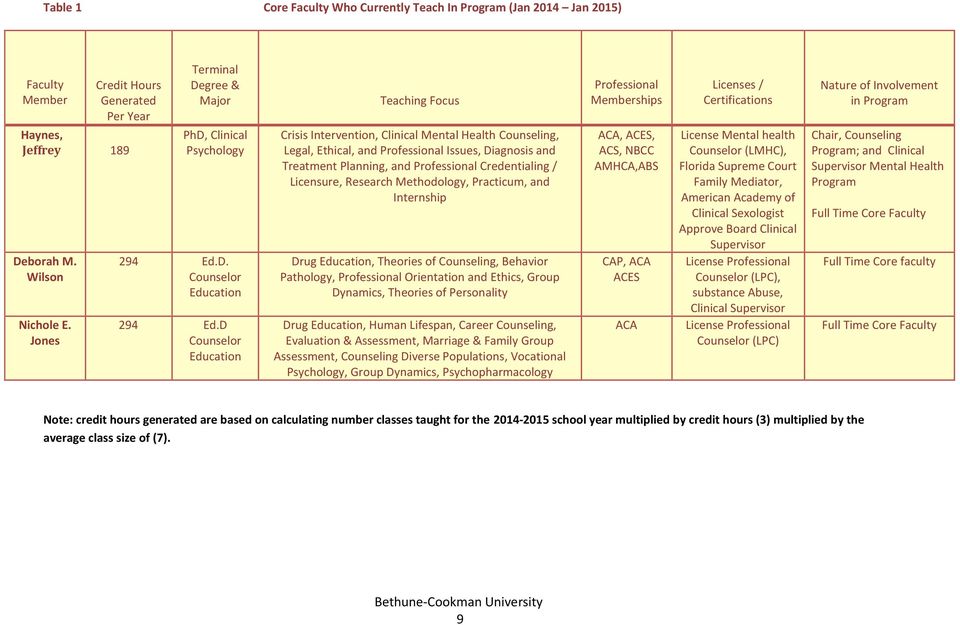
10 Table 2 Non-Core Faculty Who Currently Teach In Program (Jan 2014 Jan 2016) Faculty Member Sheila Davis Credit Hours Generated Terminal Degree & Major 168 Ed.D. Counseling Psychology Wayne Wilson 168 Ed.D Counselor Education Makil Rasheed 168 Ph.D. Health Psychology Teaching Focus Facilitation skills, group dynamics, marriage and family and se therapy, diagnosing and treatment plan. Group dynamics, vocational psychology, drug education. Theories of counseling, assessment and evaluation, counseling diverse population. Professional Memberships ACA ACA Phi Delta Kappa American Society of Training and Development, National Rehabilitation Counseling Association. APA Licenses / Certifications Licensed Mental Health Counselor (LMHC), National Certified Health Counselor (NCC), Certified Addictions Professional (CAP) Managing development and diversity, Seual harassment, Building collaborative relationships. Licensed psychologist. Nature of Involvement in Program Adjunct faculty Adjunct faculty Adjunct faculty 10
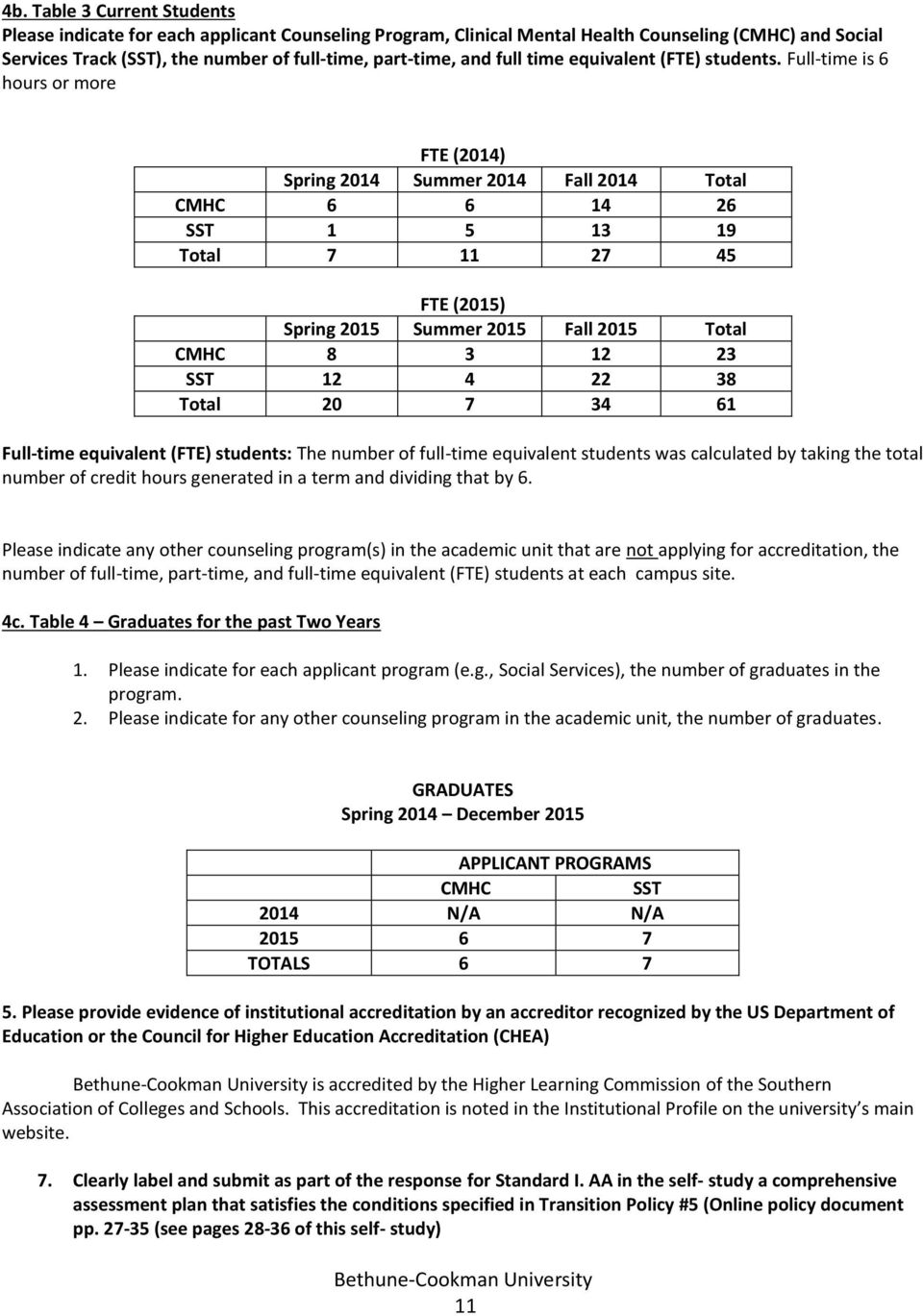
11 4b. Table 3 Current Students Please indicate for each applicant Counseling Program, Clinical Mental Health Counseling (CMHC) and Social Services Track (SST), the number of full-time, part-time, and full time equivalent (FTE) students. Full-time is 6 hours or more FTE (2014) Spring 2014 Summer 2014 Fall 2014 Total CMHC SST Total FTE (2015) Spring 2015 Summer 2015 Fall 2015 Total CMHC SST Total Full-time equivalent (FTE) students: The number of full-time equivalent students was calculated by taking the total number of credit hours generated in a term and dividing that by 6. Please indicate any other counseling program(s) in the academic unit that are not applying for accreditation, the number of full-time, part-time, and full-time equivalent (FTE) students at each campus site. 4c. Table 4 Graduates for the past Two Years 1. Please indicate for each applicant program (e.g., Social Services), the number of graduates in the program. 2. Please indicate for any other counseling program in the academic unit, the number of graduates. GRADUATES Spring 2014 December 2015 APPLICANT PROGRAMS CMHC SST 2014 N/A N/A TOTALS Please provide evidence of institutional accreditation by an accreditor recognized by the US Department of Education or the Council for Higher Education Accreditation (CHEA) is accredited by the Higher Learning Commission of the Southern Association of Colleges and Schools. This accreditation is noted in the Institutional Profile on the university s main website. 7. Clearly label and submit as part of the response for Standard I. AA in the self- study a comprehensive assessment plan that satisfies the conditions specified in Transition Policy #5 (Online policy document pp (see pages of this self- study) 11
12 SECTION I THE LEARNING ENVIRONMENT; STRUCTURE AND EVALUATION THE INSTITUTION A. The institutional media accurately describe he academic unit and each program offered, including admissions criteria, accreditation status, delivery systems used for instruction, minimum program requirements, matriculation requirements (e.g., eaminations, academic-standing policies), and financial aid information. The Department of Counseling consists of one master s degree program with two tracks (clinical mental health, and social services). The Clinical Mental Health sity hour (60) program is the program seeking CACREP accreditation. The Graduate School and College of Health Sciences website and the online Graduate School Catalog provide etensive information about the counseling programs: Clinical Mental health Counseling and Social Services Counseling; admission requirements and process, accreditation status, etc. Financial aid information for graduate students in all departments is available on the Graduate School website and the Office of Financial Aid website. B. The academic unit is clearly identified as part of the institution s graduate degree offerings and has a primary responsibility for the preparation of students in the program. If more than one academic unit has responsibility for the preparation of students in the program, the respective areas of responsibility and the relationships among and between them must be clearly documented. The Graduate School and the College of Health Sciences website clearly identifies the Clinical Mental health, program and Social Services counseling Programs, as master s degree programs of study within the Department of Graduate Studies, and College of Health Sciences. The Counseling Program within the College of Health Sciences is the only academic unit at Bethune- Cookman University that has the responsibility for preparing students in counseling. While students may take some elective coursework in other departments and colleges, the counseling faculty makes all admission, retention, and eit decisions, and assumes responsibilities for advising and program development. C. The institution is committed to providing the program with sufficient financial support to ensure continuity, quality, and effectiveness in all of the program s learning environments. The institution is committed to providing the program with sufficient financial support that ensures continuity, quality, and effectiveness in all of the program s learning environments. This is demonstrated in a number of ways. The overall Department of Counseling operations and personnel budget for 2014 was one hundred twenty five thousand dollars (125,000) and in 2015 was three hundred thousand (300,000) there will likely be moderate reductions in the future in light of the downturn in the State of Florida economy. This budget reflects three full-time faculty lines in Counseling who are supported by three adjunct faculty and 1 full-time support staff Ms. Doretha Snell. Faculty travel is also part of this budget, and has remained relatively stable. 12
13 The housing of the counseling program in the College of Health Sciences building was one of the most significant contributions to the program s learning environment which took place in early This state-of-the-art facility houses the counseling and health sciences faculty. An annual budget of approimately 50, is dedicated to maintain this facility. There are also ongoing development activities and grant opportunities being sought to address the need to update the equipment in the building. D. The institution provides encouragement and support for program faculty to participate in professional organizations and activities (e.g., professional travel, research, and leadership positions). The University provides faculty with an etensive network of support that encourages participation in professional organizations and activities. The Division of academic Affairs offers numerous awards that encourage faculty research and scholarly activity. Internal research funding awards include faculty research fellowships, the Provost s new faculty research award, and dedicated time for scholarly/creative activity. The Office of Research Development in the College of Health Sciences, headed by Dr. Bridgett Rahim- Williams supports faculty seeking funding from eternal agencies. The goal of this office is to: Assist with developing faculty research strategic plan that will guide faculty research in support of the university s overall research initiative Mentor new faculty in the development of research that will lead to publication and funding (when appropriate) that may contribute to tenure and promotion Support eisting faculty in refining or developing research initiatives that will lead to publication and eternal funding Provide faculty with assistance in locating funding sources and consultation on writing and submitting grant proposal Supports efforts to create an active and collaborative research culture within the College of Health Sciences Develop and participate in activities to highlight faculty and student research agendas Engage faculty in multi-disciplinary research within the university and with eternal constituencies At the Department level, the Counseling Department encourages faculty to join professional organizations, attend conferences and workshops, and present at professional meetings as part of their professional responsibilities. Each faculty member receives $ annually to use for travel to professional meetings, professional memberships, and/or books and other materials to support their teaching and scholarship. Faculty are also encouraged to assume professional leadership positions, which often involve etensive travel away from the university. E. Access to learning resources is appropriate for scholarly inquiry, study, and research by program faculty and students. The Carl S. Swisher Library is a state of the art facility that provides faculty and students an etensive array of information resources and instructional services and resources to support scholarly inquiry, study and research. The library is open 24 hours seven days a week to accommodate students. The collection of print and electronic material s includes the following: 13
14 Quantity Titles / Volumes Held Form Books Print 106,075 Government Documents Print 0 Bound Periodicals Print 400 Total (Books/Gov Docs/ Bound Periodicals) Print 110,075 Full Tet E-Books / Documents E- Books Electronic 238,831 E-Government Documents Electronic 0 Total Electronic 238,831 Journal Subscriptions Over 30,000 Current Journal Subscriptions Print 44 Microform Journal Subscriptions Microform 4 Library pays some fee for access Electronic 0 Free access Electronic 2 Total (Journals Received) Print/Micro/Electronic Indees and Databases Electronic 51 Maps Print 10 Microforms Microfiche Total (Microforms) Microforms Audio Items CDs 55 Audio Items Audiocassettes 200 Audio Items LPs 0 Total (Audio Items) Video Items Videocassettes 1,532 Video Items DVD 4,719 Video Items Videodiscs Total (Video Items) 6,251 Total (Audiovisual Items) All AV Formats Services that are available to help faculty and students find and use the library s resources include inperson, online, and via telephone assistance; in-depth consultations; instruction on library research that is customized to meet individual class needs; and interlibrary loan and document library for material not available in the library. An academic liaison program links a faculty member in each department with the librarian specializing in the department s subject area. Faculty and students can search the library s databases from computers on or off campus. Additional information about the library s etensive array of services is available on the university s website. The library is also open 24 hours seven days a week. Additional information about the Library s etensive array of services is available on the BCU library web site. 14

15 Faculty Development Center The BCU Center for Divergent Learning supports faculty s teaching, learning, and research needs. They provide services such as consultations in teaching and learning issues, workshops on a range of teaching and learning topics, technology training, mid-semester student feedback, teaching portfolio reviews, scholarship of teaching and learning seminars. F. The institution provides technical support to program faculty and students to ensure access to information systems for learning, teaching, and research. The Center of Information technology (IT) oversees the university s information services. The Division of Information technology works to maintain, and upgrade the network infrastructure as well as insuring that faculty and students have access to computers throughout the campus. The division offers technology training and support for faculty, students, and staff. Faculty members receive new computers when requested to support faculty and lecturers in obtaining the resources needed to successfully integrate technology that enhances student-focused instruction in courses and curriculum. The goal of this enhancement is to improve and enhance student learning and the scholarship of teaching through the integration of appropriate technology. The College of Health Sciences building is the location were all counseling courses are taught, houses smart classrooms and one auditorium that have built-in podiums for all forms of technology presentation. The technology lab provides students with a variety of software and hardware to enhance their learning. A Class room for students and faculty with special needs is designed for use by students, faculty, and staff with disabilities to incorporate the use of computers and related technology into their learning and work. The College of Health Sciences building also has a simulation lab # 2, available to faculty and counseling students to observe and record counseling students conducting mock counseling sessions. G. The institution provides information to students in the program about personal counseling services provided by professionals other than program faculty and students. The university makes personal counseling services available for all students through the university counseling center. Services include individual and group counseling; structured workshops; and self-help library that include books, audiotapes and reference materials. No counseling faculty member is on the staff at the counseling center. Although college counseling students may do their practicum/internship at the counseling center, there are other professional staff members and interns who work at the counseling center. H. A Counseling instruction environment (on or off campus) is conducive to modeling, demonstration, supervision, and training, and is available and used by the program. Administrative control of the counseling instruction environment ensures adequate and appropriate access by faculty and students. The counseling instruction environment includes all of the following: 1. Settings for individual counseling, with assured privacy and sufficient space for appropriate equipment. 2. Settings for small-group work, with assured privacy and sufficient space for appropriate equipment. 3. Necessary and appropriate technologies and other observational capabilities that assist learning. 4. Procedures that ensure that the client s confidentiality and legal rights are protected. 15
16 The College of Health Sciences houses the Masters of Counseling Program. The operation of the Counseling Program is managed by the Department Chair, which is a member of the Counseling Program faculty. The facility is very well-equipped to provide counseling services to clients, training, and supervision. The Counseling program uses two offices for the administrative activities of the Counseling Program. In the College of Health Sciences building there are individual counseling rooms, two group counseling rooms, a therapy room with an attached observation room, and videoconference rooms. All counseling rooms are equipped with video recording equipment. All rooms are wheelchair accessible. All faculty offices are located in the college of health sciences building. The videoconference simulation labs are equipped with DVRs for use in recording counseling sessions, video monitors, and a long conference table and chairs. The protection of client confidentiality is assured by restricted access to the videoconference rooms.. THE ACADEMIC UNIT I. Entry level degree programs in Career Counseling, and Student Affairs and College Counseling are comprised of approved graduate-level study with a minimum of 48 semester credit or 72-quarter credit hours required of all students. Entry-level degree programs in Addiction Counseling and Marriage and Family Counseling are comprised of approved graduate-level study with a minimum of 60 semester credit hours or 90 quarter credit hours required of all students. Beginning July, all applicant programs in Clinical Mental Health Counseling must require a minimum of 54 semester credit hours or 81 quarter credit hours for all students. As of July, , all applicant programs in Clinical Mental health Counseling must require a minimum of 60 semester credit hours or 90 quarter credit hours for all students. The Clinical Mental Health Counseling Program is comprised of 60 semester credit hours of approved graduate level study. These requirements are outlined on programs of study, in the Counseling Student Handbook (Pages 25, 26, and 27) and, as described previously in the Graduate catalog. J. The counseling program has made systematic efforts to attract, enroll, and retain a diverse group of students and to create and support an inclusive learning community. Recruiting and retaining a diverse group of students for the program has been a continuous goal of the program faculty. Data from 2014 and 2015 (see chart page 17) indicate that approimately 98% of enrolled students are students of color. The number of female students continues to far eceed the number of male students. 16
17 African-American/ Black MSC Program Diversity Male (2%) Female (98%) Total Male (3%) Female (97%) % Asian American 0 1 Total Hispanic/Latino % Caucasian 0 Other / 2 or more races *NOTE: Bethune-Cookman is a Historically Black College/University. Therefore, a large number of the students in Counseling Program and the university faculty are African American. We have made an effort to attract students from all over the state of Florida by offering courses in the evening and on weekends. The first cohort of students are completing the program fall of The program continues to receive a large number of its students from the undergraduate psychology program. We continue to look for markets where we can offer the program to a diverse group of students. K. Admission decision recommendations are made by the academic unit s selection committee and include consideration of the following: 1. Each applicant s potential success in forming effective and culturally relevant interpersonal relationships in individual and small-group contets. 2. Each applicant s aptitude for graduate-level study. 3. Each applicant s career goals and their relevance to the program. All regular program faculty participate in the program admission decisions. In the first phase of the process, faculty members conduct a paper screening of applicants and recommends those who are invited for the second phase. The second phase includes individual interviews, an assessment using an admission rubric, and interview rating scale. (Recommendations letters and the student goal statement are also part of the admission processes. The applicant s aptitude for graduate-level study is evaluated based on the undergraduate GPA (minimum 2.75, or 3.0 in second half) the GPA from another completed graduate degree (3.0 minimum). Students GRE scores must be in the 50 th percentile. In addition, the applicant is required to submit three professional recommendations, and a professional goals statement. Students are also assessed using an admission rubric and interview rating scale. For applicants who do not meet the GPA or GRE criteria, but who do have an acquired knowledge of the field based on the last five years of counseling related eperience, aptitude for graduate-level study must be judged on the basis of a writing eamination in addition to an epanded resume and letters of recommendation. If these students are admitted into the program, they will be admitted on provisional status. Which means that they will have to maintain a GPA of 3.0 or higher for two terms in order to remain in the program. Career goals and their relevance to the program are assessed in several ways. In the letter of intent, the applicant is asked to describe reasons for seeking admission to this particular program in light of his/her 17

18 professional goals. Applicants who are invited for interviews are asked, in the individual interviews, to describe their career goals and how this program will help them achieve those goals. The applicant s resume is also reviewed for work and volunteer eperiences that reflect and interest and commitment to the helping profession. The applicant s potential success in forming effective and culturally relevant interpersonal relationships in individual and small group contets is evaluated using several sources of information. The admission rubric rating form contains items that address understanding of others, ability to work in a multicultural setting, and aptitude for professional counseling. During one hour interview, applicants talk about their eperiences in the counseling field. Each applicant is interviewed by regular faculty members in a group setting. One of the interview questions asks the applicant to describe eperiences with people who are different from him/her. The way applicants respond says a great deal about how they define difference and about the life eperiences they ve had with those who are difference. Through the interview, the faculty member can certainly make inferences about the applicant s interpersonal effectiveness. L. Before or at the beginning of the first 8 week term of enrollment in the academic unit, the following occurs for all new students: 1. A new student orientation is conducted. Twice a year (early in the fall and spring), a formal orientation is held for all newly admitted students. The orientation covers program Requirements and epectations. Program faculty members are introduced; important issues covered in the Student Handbook are highlighted; and relevant university information is discussed. At new student orientation, each student meets their faculty adviser. 2. A student handbook (Counseling Student Handbook) is disseminated that includes the following: [NOTE: Go to the Table of Contents in the Student Handbook, and click on chapters to go directly to the designated chapter.] a. Mission statement of the academic unit and program objectives (P. 2 student handbook) b. Information about appropriate professional organizations, opportunities for professional involvement, and activities potentially appropriate for students (P. 3, 5 student handbook) c. Written endorsement policy eplaining the procedures for recommending students for credentialing and employment (P. 14 student handbook) d. Student retention policy eplaining procedures for student remediation and/or dismissal from the program (P. 7 student handbook) e. Academic appeal policy (P. 7 student handbook) The Student handbook is available to all students online through the Department website, and students are directed to it during the orientation process. Also, each student is given a copy of the student handbook at orientation. M. For any calendar year, the number of credit hours delivered by noncore faculty must not eceed the number of credit hours delivered by core faculty. As indicated in the faculty tables (pp. 11 &12 of this self-study) the total number of credit hours 18
19 Delivered by core faculty in the past 12 months was 777 the total number of credit hours delivered by adjunct faculty for that same time period was 504. N. Institutional data reflects that the ratio of full-time equivalent (FTE) students to FTE faculty should not eceed 10:1. As the chart below indicates, the student-faculty ratio was 5:1 in the , in Fiscal year Fiscal year 6:1 and fall :1. Fiscal Year FTE Students: Faculty Fall Summer :1 Fall Summer :1 Fall :1 The ratios were calculated as follows: Divide the total credit hours produced in one year by 24 Credits (the number of credits a full-time student would take in a fiscal year) to get the full-time equivalent students for the fiscal year. Divide the number of full-time equivalent students by the number of faculty Data used for these calculations is available in the attached student-faculty ration chart. O. Students have an assigned faculty advisor at all times during enrollment in the program. Students, with their faculty adviser, develop a planned program of study within the first 12 months of graduate study. When students are accepted into the program, they receive a letter informing them of their acceptance into the program. Students are encouraged to meet with their adviser as soon as possible in order to discuss the program, and begin writing their program of study, etc. In the counseling student handbook the student-adviser relationship is described as ongoing, and students are urged to meet with their advisers periodically throughout their programs. Students are assigned to faculty advisers who are identified during new student orientation and on the student acceptance letter. The Counseling Program requires that students develop a planned program on study prior to the completion of twelve credit hours of coursework or one 8 week session. This is communicated to students in the Student Handbook (pages 25 and 26, graduate degree plans). However, students are encouraged to meet with their assigned advisers and to write their programs as soon as possible after admission to the program. 19

20 The student and adviser discuss program requirements and elective options, complete the program of study, and sign it. The date by which the student must complete the program two years from the time the first course is taken) is also noted. One copy of the program of study is given to the student and original is kept on file by the department s administrative assistant. Students wishing to make changes in their program of study must meet with their adviser to discuss desired changes. P. The program faculty conducts a systematic developmental assessment of each student s progress throughout the program, including consideration of the student s academic performance, professional development, and personal development. Consistent with established institutional due process policy and the American Counseling Association s (ACA) code of ethics and other relevant codes of ethics and standards of practice, if evaluations indicate that a student is not appropriate for the program, faculty members help facilitate the student s transition out of the program and, if possible, into a more appropriate area of study. Each student s progress is systematically assessed at several points during the program, and this process is described in more depth in the discussion of assessment in this self-study (see response to Standard AA 4.) The chart below identifies points at which each student s performance is regularly assessed. The assessments take into account the student s academic performance as reflected in course grades and overall GPA and the student s professional and personal development as reflected in repeated ratings on the rubric, Evaluation of Counselor Development: Skills Dispositions. Ultimately, the student s academic and professional developments are assessed on the Counselor Preparation Comprehensive Eam (CPCE). Early CPCE EAM CON 627 Skills and depositions evaluation. CPCE Entrance Eam Midpoint 1 Eam CON 600 Skills and depositions evaluation. Eam on core courses CON, 620,647,613, ,600 completed Performance Assessment Completed Midpoint 2 Admission to practicum Completion of core and all course work courses; 3.0 (B) or better; Overall GPA of 3.0 (B); Faculty approval Midpoint 3 Practicum Skills and depositions evaluation. Completion of practicum Late 1 Admission to internship Successful completion of practicum; Faculty approval Late 2 Internship Faculty supervisor site visit (midway) Site supervisor mid and final evaluation completion of internship Eit Completion of internship hours. CPCE Eit Eam The Counseling Program Student Disciplinary Policy clearly identifies the academic and non-academic behaviors that may result in disciplinary action and/or dismissal from the program, as well as procedures for remediation when problems arise. Any time a faculty member has concerns about a student s behavior or academic performance, he/she may request an informal or formal review. Skills courses in which students must receive minimum grades of B or better are identified, along with procedures that must be followed if students do not attain these grades. The Disciplinary Policy is available to all students in the Counseling Student Handbook. 20

21 Q. The practicum and internship eperiences are tutorial forms of instruction; therefore, when individual and/or triadic supervision is provided by program faculty, the ration of si students to on faculty member is considered equivalent to the teaching of one 3-semester-hour course. Such a ratio is considered maimum per course. CON 615 Counseling Practicum is 3 hours. This class are always taught by core faculty. The facultystudent ratio for individual practicum supervision is maintained at a ratio of 6-to-1. During the student s practicum individual supervision is provided by the student s on-site supervisor. CON 640,650, 660 Counseling Internships (9) hours are taken once the practicum is completed. These classes are always taught by core faculty. The student ratio for internship supervision is 6-to 1. However, group supervision maybe offered, and the ratio for group supervision will not eceed 12 student to 1 faculty. R. Group supervision for practicum and internship should not eceed 12 students. Supervision groups for Counseling Practicum and internships consist of five or si students and one faculty supervisor. The students receive group supervision from the same faculty member who provides their individual supervision. Whenever possible, interns are placed in group supervision sections according to their program area (mental health counseling). To maintain the ratio at 10-to-1, students are scheduled in internship and practicum with this ratio in mind. S. Programs provide evidence that students are covered by professional liability insurance while enrolled or participating in practicum, internship, or other field eperiences. Prior to enrolling in practicum and internship all students are required to obtain professional liability insurance, and maintain it throughout their supervised counseling eperiences. This epectation is communicated to students in the Student Handbook (P.13), Internship Manual (P. 7) and the Practicum Manual (P.7). students must provide faculty supervisors with proof of insurance before they can begin their internships or practicum. Also, proof of insurance is maintained in the students practicum and internship file. T. Opportunities for graduate assistantships for program students are commensurate with graduate assistantship opportunities in other clinical training programs in the institution. The Counseling Program receives an equitable number of graduate assistantships as compared to other degree programs. These students work in the counseling department at the College of Health Sciences. As shown in the table below, the Department has been able to offer 3 graduate assistantships from 2015 to Graduate assistants are typically counseling program students and primarily serve the counseling faculty. However, students are given the opportunity to engage in others areas of research. 21
22 Graduate Assistantships by Year Academic Year Graduate Assistants Source: Department Records FACULTY AND STAFF U. The academic unit has made systematic efforts to recruit, employ, and retain a diverse Faculty., and the Counseling Program are committed to recruiting and retaining faculty members representative of the diversity among people in society. Because new faculty members are hired infrequently, the composition of the faculty has not changed. The newest faculty member has been with us since January Of the core faculty members in the Counseling Programs, there is diverse representation with regard to race, seual orientation, and religious affiliation. When we have had opportunities to recruit new faculty, we recruited nationally through venues targeted at diverse populations. V. The teaching loads of program faculty members are consistent with those of the institution s other graduate level units that require intensive supervision as an integral part of professional preparation, and incorporate time for supervising student research using formulae consistent with institutional policies and practices. The regular teaching load for core faculty teaching graduate courses is fairly consistent throughout the University, particularly in programs where intensive supervision is required. The load is 12 graduate credits (four graduate courses) per semester, and the caps on those courses that require intensive supervision (i.e. practicum and internship) are strictly adhered to in the program. Advising and supervision of student research is part of our professional teaching load, and all faculty members share in these responsibilities. Release time is awarded at the discretion of the department chair. W. The academic unit has faculty resources of appropriate quality and sufficiency to achieve its mission and objectives. The academic unit has an identifiable core faculty who meet the following requirements: 1. Number at least persons whose full-time academic appointments are in counselor education. All three core faculty members are tenure-track and have full-time academic appointments in the counseling program. There are release times for administrative duties and research. 2. Have earned doctoral degrees in counselor education and supervision, preferably from a CACREPaccredited program, or have been employed as full-time faculty members in a counselor education program for a minimum of one full academic year before July 1,
23 Of our five faculty members, three have doctoral degree in Counselor Education and Supervision Dr. Deborah Wilson, Dr. Wayne Wilson, Dr. Nicole Jones, one faculty have a degree in Counseling Psychology Dr. Sheila Davis. Dr. Jeffery Haynes Department Chair degree is in Psychology. Dr. Deborah Wilson has been full time faculty since 2014 and Dr. Nicole Jones has been full time faculty since Dr. Wayne Wilson and Dr. Shelia Davis serve as adjunct faculty, and was hired in Have relevant preparation and eperience in the assigned program area. Faculty vitae reflect how the professional eperiences of faculty members match their assigned program areas. Dr. Nichole Jones and Dr. Deborah Wilson are responsible for the counseling area, and all have served as professional counselors in community mental health setting Dr. Jeffery Haynes is the department chair, and is responsible for the clinical mental health area, and has eperience working with clients in community agencies. Most members of the core faculty continue to provide clinical services, either directly to clients or indirectly by doing clinical supervision with limited licensed professional counselors. 4. Identify with the counseling profession through memberships in professional organizations (i.e., ACA and/or its divisions), and through appropriate certifications and/or licenses pertinent to the profession. All three core faculty members are licensed mental health counselors in the state of Florida, and they all have other professional licenses and certifications including the NCC and ACS credentials. Faculty vitae reflect membership and involvement in professional organization at both the state and national levels. Dr. Wayne Wilson ACA, Dr. Jeffrey Haynes, LMHC, ACA, ACS, NBCC, AACS, AMHCA, ABS, NBCC Dr. Nichole Jones, LMHC ACA, NBCC Dr. Deborah Wilson, LPC, ACA, CAP Dr. Sheila Davis, LMHC, ACA 5. Engage in activities of the counseling profession and its professional organizations, including all of the following: a. Development/renewal (e.g., appropriate professional meetings, conventions, workshops, seminars); b. Research and scholarly activity; and c. Service and advocacy (e.g., program presentations, workshops, consultations, speeches, direct services). It is difficult to list all the professional activities in which the faculty are engaged; vitae do reflect this etensive involvement. All attend professional meetings and are active in delivering papers, presentations, and workshops. Faculty are involved in scholarly activities including research, publication in professional journals, authoring/editing books, and serving on community boards. A number of faculty serve as consultants to universities, school, community agencies, and business/industry. 6. Have the authority to determine program curricula within the structure of the institution s policies and to establish the operational policies and procedures of the program. The Counseling faculty have the authority to determine program curricula within Bethune- Cookman University s input structure. The Department of Counseling appoints a faculty member who sits on the Curriculum Committee in the College of Health Sciences. This committee approves new courses and 23
24 programs, as well as course and program revisions. These proposals are then sent through the university system for approval. Any curricular changes in program policies or procedures for any of the graduate counseling programs is initiated and approved by the counseling faculty. The proposed changes are then reviewed by the Graduate Council, and then sent through the University approval process, which entails approval for University Academic Standards Committee. Dr. Haynes is a member of the university Graduate council, and a member of the university Academic Standards Committee.. The academic unit has clearly defined administrative and curricular leadership that is sufficient for its effective operation. A faculty member may hold more than one of the following positions: 1. A faculty member is clearly designated as the academic unit leader for counselor education who a. Is responsible for the coordination of the counseling programs(s); b. Receives inquiries regarding the overall academic unit; c. Makes recommendations regarding the development of and ependitures from the budget; d. Provides or delegates year-round leadership to the operation of the program(s); and e. Has release time from faculty member responsibilities to administer the academic unit. Dr. Jeffery Haynes is the faculty member who serves as the counseling program chairperson. Dr. Haynes has a full-time appointment to the counseling program and is released from teaching one course in the fall and one course in the spring to perform the duties associated with program coordination. At, a Department Chair provides the administrative leadership for each academic department. Dr. Jeffery Haynes is the program leader and Counseling Department Chair. He provides leadership, support, and advocacy for both program areas in the Department. He is responsible for the budget, although he consults with the faculty and Dean of the College of Health Sciences on some of those decisions. As program Chair, Dr. Haynes serves as the primary contact personal for the counseling program and works closely with the Dean to coordinate the activities of the counseling program. Responsibilities include overseeing program development and course scheduling; serving as the CACREP liaison and providing leadership and coordination for accreditation activities; preparing monthly program meeting agendas, chairing monthly program meetings, and checking meeting minutes; responding to inquiries about the counseling programs; and insuring that the Dean is aware of counseling program needs. 2. A faculty member or administrator is identified as the practicum and internship coordinator for the academic unit and /or program who a. Is responsible for the coordination of all practicum and internship eperiences in each counselor education program for which accreditation is sought; b. Is the person to whom inquiries regarding practicum and internship eperiences are referred; and c. Has clearly defined responsibilities. As the Counseling Department Chair, Dr. Haynes is also a licensed mental health counselor in the State of Florida, Qualified Supervisor, and approved clinical supervisor with the National Board of Certified Counselors (NBCC). Dr. Haynes is responsible for the administrative coordination of the practicum and internship eperiences. He receives and processes Practicum and internship applications, alone with core faculty places students in practicum and internship placements in collaboration with faculty. The majority of students practicum hours are completed in the community-level program. As the chair/coordinator, Dr. Haynes is responsible for overseeing the operations; he is released from teaching three courses a year. More specifically his responsibilities include: 24
25 Facilitate Counseling orientations Market Counseling Clinic services to the campus and surrounding communities Participate in and manage the intake process involving screening, evaluation and placement of prospective clients Manage the database of clinical services provided by the BCU Counseling Program Establish and maintain file management procedures Monitor and maintain program resource materials and test protocols Conduct outcome research Work in conjunction and collaboration with other supervisors Develop and establish students placements Maintain collaborative relationships with other programs on campus community center and other relevant units within the University Y. The academic unit may employ noncore faculty (e.g., adjunct, affiliate, clinical) who support the mission, goals, and curriculum of the program and meet the following requirements: 1. Hold graduate degrees, preferably in counselor education for a CACREP-accredited program. 2. Have relevant preparation and eperience in the assigned area of teaching. 3. Identify with the counseling profession through memberships in professional organizations, appropriate certifications, and/or licenses pertinent to the profession. Adjunct faculty credit hour production for the past 12 months illustrates that we employ very few non core faculty. Those who we have employed to teach core courses have doctoral degrees in counselor education or counseling psychology. They are selected because they have relevant counseling and/or teaching eperience in the course content areas. For more specialized courses such as Substance Abuse Counseling, or Counseling children, we employed faculty Dr. Wayne Wilson, and Dr. Shelia Davis who have etensive eperience in that area. They are selected, in part based on their ability to bring their realworld epertise into the classroom. The two adjunct faculty hold doctoral degrees in counseling education and counseling psychology. Z. Clerical assistance is available to support faculty/program activities and is commensurate with that provided for similar graduate programs. Dee Snell is the administrative assistant assigned to work for the counseling department. She has over 10 years of eperience working for the university as administrative assistant. This eperience and longevity greatly enhances the support to our program and students. The program also has three graduate assistant to assist with some of the clerical duties. Some of the graduate assistant responsibilities are as follows: a. (Full-time) Ms. Dee Snell job responsibilities for the department include: managing the operating and personnel budget, course schedule entry, and supervision of student worker s. She also has department job responsibility for the following: maintenance of student files and student databases, all admissions applications requests, acceptance and denials. b. (Part-time) This individual is a graduate student who provides Clerical support to the department. 25
26 EVALUATION A. Program faculty members engage in continuous systematic program evaluation indicating how the mission, objectives, and student learning outcomes are measured and met. The plan includes the following: 1. A review by program faculty of programs, curricular offerings, and characteristics of program applicants. We engage in an ongoing process of self-evaluation as evidenced by the numerous program modifications we have implemented. We use monthly program meetings, annual or bi-annual meetings with the Counseling Program Advisory Board, and a University Program Review process to identify program areas that need modification, as well as other programmatic issues that need to be addressed. The following are significant changes that reflect our continuous, systematic program evaluation. Changes in curricular Offerings and Requirements PSY 626 Psychopharmacology (new required course) Feedback from the student and faculty indicated that we needed a course that focused specifically in this area. Faculty often conveyed that students need more knowledge on how psychotropic medication impacts behavior. To address this need, we developed and implemented a new course in Psychopharmacology. CON 625 Counseling in Community setting (new course requirement Florida Board) Based on new licensure requirements from the State of Florida Licensure Board. CPCE Eit Eam Replaces internal Eit Eam The decision to change the eit requirement from the internal eit eam to the Eternal CPCE eam was the result of a great deal of dialogue and evaluation of the pros and cons of each. 2. Formal follow-up studies of program graduates to assess graduate perceptions and evaluations of major aspects of the program. This year, we ed program surveys and a follow-up survey to current and past counseling program graduates. The BCU testing Center also sent s to recent graduates asking them to respond. The survey items focus on the etent to which the program prepared graduates for their work professional counselors. All graduates respond to items asking about the core areas (professional identity standards) of their training, including their practicum and internship eperiences. They also respond to several items that are specific to their program area. The follow-up survey and results of this year s study are stated below. Note that the results are for the Mental Health Counseling Program. Those who complete the survey (n+5) were overwhelmingly positive about the program and the etent to which they felt prepared for their work. Means for all items are at or above 3.3 (On a scale of 4.0). 26
27 3. Formal studies of site supervisors and program graduate employers that assess their perceptions and evaluations of major aspects of the program. We asked graduates to provide us with contact information ( address) for an employer who we could contact and ask to complete the survey. We stressed that we were looking for feedback on the program and how well the program prepared the graduate for the job. We obtain feedback about the program s strengths and weaknesses from site supervisors at two points during the student s internship. On the Site Supervisor Midway Evaluation we ask site supervisors to identify areas in which the intern s training seems to be particularly strong and areas in which the intern s training is limited/needs strengthening. We ask the same questions on the final site supervisor evaluation form. 4. Assessment of student learning and performance on professional identify, professional practice, and program area standards. COMPREHENSIVE ASSESSMENT PLAN Assessment at Gateway Points Program faculty assess student learning and performance in multiple ways. First, we monitor students progress systematically throughout the program. These assessments take into account the student s academic performance as reflected in course grades and overall GPA.; the student s professional development as reflected in the acquisition/performance of counseling skills in skills courses and supervised eperiences (professional practice), and the student s personal development as reflected in qualities such as respect for individual differences, openness to personal growth, and interpersonal or intrapersonal problems that may interfere with the ability to be a helping professional helper. We have identified a series of gateway points at which we assess student performance/outcomes in these areas. 27
28 Admission Early CON 627 CPCE Eam Midpoint 1 Completing Core courses CON 620,647,613, 632,622,600 Midpoint 2 Admission to practicum CON 615 Midpoint 3 Practicum CON 615 Late 1 Admission to internship CON ,660, Late 2 Internship CON ,660 Eit GPA Goals/ Program fit Eperience Recs. Interviews CPCE Entrance Eam Skills and dispositions Evaluation, knowledge eam. Degree Planning, and (advising) Skills and dispositions Evaluation. (Advising) Performance Assessment Rubric of Core Curriculum Completion Of core Courses; 3.0 (B) or better In CON,620,647, 613, ,600 Overall GPA of 3.0; Faculty Approval (Advising) Skills and dispositions evaluation (Advising) Successful Completion of practicum; Faculty Approval (Advising) Faculty Supervisor Site visit (midway) Site Supervisor Mid and Final Evaluation (Advising) CPCE Eit Eam Admissions process/evaluation: Each applicant for admission must demonstrate evidence of aptitude for graduate study and potential for effectiveness as a counselor as reflected in the undergraduate GPA (minimum 2.75, or 3.0 in second half), and the GPA from another completed graduate degree (3.0 minimum). Students GRE scores must be in the 50 th percentile. Students must also submit three recommendation letters, letter of intent focusing on professional goals, and current resume conveying prior work eperience. Faculty rate applicants on each of these criteria (1-4 scale) admissions rubric in order to screen out those who are not suitable for the program. The maimum points allowed is 24. If the candidate receives less than 8 total points, the candidate will not be admitted to the program. Individual interviews focus on the fit between the applicant s professional goals, program goals, interpersonal skills and multicultural awareness/sensitivity, and readiness for the demands of graduate study in counseling. Counseling Skills and Dispositions Using the interview assessment scale and the admissions rubric, we evaluate each student s development in the acquisition and performance of intervention and relationship skills, professional skills, conceptualization skills, and personalization skills. The student is rated on a 4-point interview scale ranging from poor (1) to (2) average (3) good, and (4) ecellent. These skills are evaluated at three points during the program, upon completion of the courses identified below. If the faculty member has concerns about a student s performance, the faculty member requests an informal review meeting with the student and the student s adviser to discuss ways to remediate the problem. (See Student Handbook) (Early) CON 627, and the CPCE Entrance Eam. The CPCE Entrance Eam is taken early (first or second 8 week term) in the program and is a prerequisite before starting term three. The eam focuses on various contents areas such as: group, research, appraisal, professional orientation and ethics, social and cultural, 28
29 helping, and human growth and development. The student completes the eam and the results are discussed with the student, and the scores are entered into a database. (Midpoint 1) CON617,630,627,613,632,647,622,600,649 The completion of core courses is done at this point. At this point, students have opportunities to practice/demonstrate basic skills, professional skills, conceptual skills, and personalization skills. A performance Assessment Rubric is completed on each student in the program. All faculty meet and review each student s progress in the program. The instructor meets with the student, shares feedback with the student, and finalize the student practicum placement. (Midpoint2) CON 615: Counseling Practicum is taken after the student has successfully completed all required core courses. Practicum students must obtain a passing evaluation (demonstrates unevenly or inconsistently) on each criterion in the evaluation assessment in order to pass practicum. The practicum supervisor completes the rating form, shares feedback with the student, and returns the form to the supervising faculty. Overall Performance in Skills Classes: In addition to performance evaluation/monitoring students development in skills and dispositions as they progress through the program, we have set a minimum knowledge and performance standard for three counseling skills courses. Students must successfully master basic knowledge and skills before they can master higher level skills. Therefore, students must receive a grade of B or better in CON 627: Facilitation Skills; CON 630 Research, 613 Theories of Counseling, CON 620 Group Counseling; CON 632 Evaluation and Assessment. CON 600 Professional Orientation. Any student who does not obtain a B or better must meet with the course instructor and the program adviser for an informal review to develop a remediation plan, which often includes retaking the course (see Student Disciplinary Policy). If a student receives less than a B in either course a second time, the student is dismissed from the program. Admission to Practicum: Faculty meet during fall and winter terms to evaluate applicants for admission to practicum. In these meetings, faculty reviews each student s progress through the program as well as readiness to provide counseling services. Considerations include completion of core courses, total number of courses completed, overall GPA (3.0 or above), and skills and dispositions ratings in skills courses. The faculty either approves the student or identifies issues that need to be resolved before the student may enroll in practicum. Admission to Internship: Faculty meet during fall and winter terms to evaluate applicants for admission to internship. Approval for admission to internship is based primarily on the applicant s successful performance in practicum and the recommendation of the practicum supervisor. Further, all program faculty must approve each student. Internship Evaluations: The faculty supervisor conducts an on-site visit (Faculty Site Visit) about one-third ( hours) of the way through the student s internship. In this meeting, the on-site supervisor shares feedback regarding the student s progress with the student and the faculty supervisor. After the student has completed approimately 300 hours, the site supervisor completes the Site Supervisor Midway Evaluation. At the end of the internship, the site supervisor, in consultation with the faculty supervisor, completes the final evaluation of the students internship. These evaluations address basic and advanced counseling skills, professional behaviors, attitude, and supervision process. All evaluations are discussed with the student. Eit Requirement: All students must take the Counselor Preparation Comprehensive Eamination (CPCE) in order to graduate. If a student fails in their first attempt, they must meet with their adviser and develop a plan of study that will help them be successful in their net attempt. The plan of study is placed in the student s program file. Students may retake the CPCE at the net administration. Should students fail in a second attempt to pass the CPCE, they are given the chance to take the department of counseling written eam. In this eam the student must answer a series of question based on the information outlined in the case. Students must receive a passing score of 29
30 70% on this eam. If the student fail to receive a passing score he/she will have two weeks to request a retake of the eam. Assessment of Student Learning and Performance on Professional Identity Standards In addition to assessing student development at identified gateway points, we assess student learning in the CACREP areas identified as the foundations for the professional preparation and development of counselors. In ten core courses, embedded performance assessment rubrics capture how students and the program are meeting learning objectives in the areas of Professional Orientation and Ethical Practice, Social and Cultural Diversity, Human Growth and Development, Career Development, Helping relationships, Group Work, Assessment, and Research and Program Evaluation. Professional Identity Areas and Corresponding Courses Research & Program Evaluation CON 630 Professional Orientation and Ethical Practice CON 600 Social & Cultural Diversity CON622 Assessment PSY 632 PSY 627 CACREP Section II G Human Growth & Development CON 617 Group Work CON620 Helping Relationships CON649 CON625 Career Development CON 647 Based on each student s performance on the constellation of assignments and activities that reflect learning in key areas, the instructor completes the performance assessment rubric for the student. 30
31 Propose course outline, Vertical curriculum, and Student Performance Assessment Rubrics can be found under (Appendi J, and D). CON 617 Human Lifespan and Development CON 630 Research Methodology CON 613 Theories of Counseling CON 632 Evaluation and Assessment of the Individual CON 647 Vocational Psychology and Career Development CON 620 Group Dynamics and Counseling CON Counseling Diverse Population CON 600 Professional Orientation and Ethics Assessment of student learning and performance on program area standards In addition to required core coursework that addresses professional identity standards, required coursework in the program area is designed to meet the standards for that area of specialization in clinical mental health. We have conceptualized assessment of student learning on the program area standards in a way similar to the assessment of learning on professional identity standards. Using a constellation of assignments and other course activities (reading and threaded discussion, presentation, eams, etc.), each student s learning and performance can be rated on a 4-point scale from unsatisfactory to developing to on target to advanced. Core and Program Area Standards: PSY 617 Human Lifespan and Development CON 630 Research Methodology CON 627 Facilitation Skills and Counseling Techniques CON 613 Theories of Counseling CON 632 Evaluation and Assessment of the Individual CON 647 Vocational Psychology and Career Development CON 622 Counseling Diverse Population CON 600 Professional Orientation and Ethics CON 649 Legal, Ethical and Professional Standards Clinical Mental Health Counseling Courses PSY 638 Marriage, Family and Se Therapy CON 657 Drug Education Prevention/Intervention PSY626 Psychopharmacology PSY 642 Theories of Personality PSY 653 Diagnosis and Treatment Planning CON 625 Counseling in Community Setting CON 615 Practicum CON 640 Internship I CON 650 Internship II CON 660 Internship III 31
32 5. Evidence of the use of findings to inform program modifications Faculty review data from the CPCE, performance assessments in professional identity areas, and skills and dispositions (practice) assessments periodically at regular faculty meetings. The most recent review took place at a meeting in November CPCE: On the CPCE Eit Eam (N=12), students are scoring consistently slightly below national means on all eight sections of the test (see chart below). These results have not pointed to any necessary program modification. However, we continue to monitor those scores and will look closely at any areas in which our students scored 3 points lower than national means. Note: this data below reflects two students who took the CPCE eam who were not on the clinical mental health track. The results from those two students scores, did have an impact on the overall scores listed below. CPCE Scores Compared to National Means (n=237) Human Growth & Dev. Social / Cult. Found. Helping Rel. Group Career Appraisal Research/ Program Evaluation Prof. Orient./ Ethics Total/ Mean /8.88 BCU Mean /10.89 Composite Nat l Mean St. Dev Composite Nat l. SDs # questions 32
33 Performance Assessment Rubrics: Performance is rated on a 1 to 4 scale: 1=unsatisfactory, 2=developing, 3=proficient, 4=advanced. The chart below reflects mean learning/performance scores in each of eight CACREP Professional Identity areas. The majority of means are clearly in the proficient range, and don t point to any immediate need for program modifications. Human Growth & Development Performance Assessments in Professional Identity Areas Course Mean Course Mean Group work Understanding of theories 3.2 Types of Groups 3.2 Reflection / integration of behavior 3.2 Group Leadership 4.2 Score 3.2 Group Dynamics 3.2 Professional Orient/Ethical Practice Professional Ethics 3.2 Professional role 3.4 Score 3.3 Relationships and functions 3.3 Social/Cultural Diversity Professional engagement 3.3 Awareness 4.6 Score 3.3 Knowledge 3.4 Appraisal Skills 3.3 Assessment instrument 2.9 Score 3.8 Description 2.9 Helping relationships Analysis 2.8 Counseling theory 3.5 Application 3.3 Reflective understanding 3.4 Quantitative understanding 2.9 Score 3.5 Norming samples and multicultural considerations 2.9 Research N/A Career & Lifestyle Theory 3.1 Social and Cultural Diversity 3.1 Interrelationships of Roles 3.0 Resources and Career Planning and Evaluation 3.1 Professionalism 3.1 Score 3.0 Score 2.9 Score 3.1 MEAN FOR ALL AREAS
34 Skills and Dispositions assessments: Data from assessment of skills and dispositions in CON 627 facilitation skills, CON 620 Group and in PSY 615 (Practicum) indicate that overall, students are performing at a proficient level (see chart below). Performance is rated on a 1 to 4 scale: 1 = unsatisfactory, 2 = developing, 3 = proficient, 4 = advanced. Although the rubrics used for assessment in these courses are based on epected/targeted performance at the end of the program, students are epected to be proficient in these areas. Mean Ratings of Skills and Disposition CON 615 Practicum CON 620 Group Work CON 627 Facilitation Skills Intervention & Relationship Skills Professional Skills Conceptualization Skills Personalization Skills Program Area Assessment: We have yet to collect quantitative data on learning/performance outcomes for the program area standards. The assessment rubrics will be developed further and procedures will be similar to those we use to assess outcomes in the professional identity areas. 6. Distribution of an official report that documents outcomes of the systematic program evaluation, with descriptions of any program modifications, to students currently in the program, program faculty, institutional administrators, personnel in cooperating agencies (e.g., employers, site supervisors), and the public. All programs at go through a systematic review process every four years. The review of the Department of Counseling took place in September The department of counseling also submits each year its annual report to the Office of intuitional effectiveness. The final step in the process will be program review roundtable, hosted by Department of Counseling.. The purpose of the roundtable is to openly discuss the program review process and findings in a dialogue between the administrators, the Department Head, faculty and members of the counseling department advisory board. Program review roundtables are public meetings that are open to all members of the University community, site supervisor, community agencies. AA. Students have regular and systematic opportunities to formally evaluate faculty who provide curricular eperiences and supervisors of clinical eperiences. The University conducts course evaluations every term; thus students do have regular and systematic opportunities to formally evaluate the faculty and the curricular eperiences in which they participate. On the standard evaluation form the student is asked to rate the overall effectiveness of the instructor and the overall effectiveness of the course. The Department has selected additional items that are consistent with our department evaluation document. Students are also asked to respond to open-ended questions regarding what they liked and disliked about the course. 34
35 Counseling interns evaluate their faculty and on-site clinical supervisors using the evaluation forms developed by the faculty. BB. Annual results of student course evaluations are provided to faculty. Every term faculty members receive the results of their course evaluations from the previous term. They receive the completed Scantron sheets, which include student responses to open-ended questions, along with aggregated data for each course. CC. Written faculty evaluation procedures are presented to program faculty and supervisors at the beginning of each evaluation period and whenever changes are made in the procedures. Faculty evaluation procedures are described in the contract and in the Department Evaluation Document. Faculty are involved in writing and changing their own Department Evaluation Document. 35
36 SECTION II PROFESSIONAL IDENTITY FOUNDATION A. A comprehensive mission statement has been developed that brings the counseling program into focus and concisely describes the program s intent and purpose. The mission statement is publicly available and systematically reviewed. The Counseling Program mission statement is: The mission of the Department of Counseling Program is to train counseling professionals by utilizing the highest standards set by state and national licensing/certifying boards. Highly qualified faculty design and deliver counseling programs through a wide range of instructional modalities. The counseling degree programs deliver graduate education and a professional licensure track for those students seeking to obtain license as mental health counselors. The program seeks qualified students from various diverse populations. This mission statement appears at the beginning of all course syllabi, front page of the student handbook and within the Counseling Student Handbook. Faculty reviewed the mission statement during the annual program review process and made minor modifications. The mission statement was reviewed again in The mission statement can be found on the front page of the counseling department web site. B. The program area objectives meet the following requirements: 1. Reflect current knowledge and projected needs concerning counseling practice in a multicultural and pluralistic society. 2. Reflect input from all persons involved in the conduct of the program, including program faculty, current and former students, and personnel in cooperating agencies. 3. Are directly related to program activities. 4. Are written so they can be evaluated. The Counseling Program Objectives are in the chart below. Faculty reviewed the program objectives in light of the 2009 CACREP standards. A faculty committee considered an American Counseling Association model for program objectives along with CACREP s professional identity, professional practice, and program area standards. We used input from our Program Advisory Board members regarding how our training prepares students for the realities of work in the field. Similarly, we consider feedback from program graduates and their employers to gauge the etent to which program objectives are being met. The faculty decided to streamline the program objectives, aligning them with CACREP standards but eliminating the level of specificity in the standards. Our assessment of student learning and performance on professional identity, clinical practice, and program area standards certainly provides etensive information on how we are meeting these objectives. 36
37 BCU Program Objective CACREP Professional Identity Standard Professional Orientation and Identity Social and Cultural Diversity Human Growth and Development Career Development Helping Relationships Group Work Assessment Research and Program Evaluation Program Area Standards Professional Practice Standards Personal Growth and Understanding BCU Program Objective To prepare counselors who are knowledgeable about the philosophy, history and current and future trends in the counseling profession To train counselors who can recognize, understand, and respond to social and cultural differences and change in society To train counselors who have a foundation for understanding human behavior and development To prepare counselors who are able to design, implement, and evaluate developmentally appropriate counseling interventions and programs To prepare counselors who are knowledgeable and skilled in helping clients make life and career decisions To train counselors who are knowledgeable and skilled in the helping/counseling process To prepare counselors who are able to apply knowledge, theory, and skills to work effectively with clients in a variety of modalities (individual, group, family) and to use crisis intervention, brief counseling, and long term approaches. To train counselors who are knowledgeable and skilled in providing group counseling To prepare counselors who are knowledgeable and skilled in gathering, analyzing, interpreting, and presenting data about individuals To prepare counselors who are knowledgeable and skilled in the use of assessment techniques, including diagnosis, with individuals and groups To prepare counselors who are knowledgeable about research and program evaluation To prepare counselors who are able to read, critique, utilize and contribute to professional research literature and who are able to engage in program evaluation To prepare counselors who meet additional curricular objectives for their specialization area in the areas of service, prevention, treatment, referral, and program management Develop, through supervised practicum and internship eperiences, and integration of the knowledge and skills needed to be successful as practicing counselors Develop, through self-reflection and insight, an understanding of oneself and the use of self in the counseling process. Develop a personal approach to counseling and client advocacy with a clear understanding of counselor functions C. Students actively identify with the counseling profession by participating in professional organizations and by participating in seminars, workshops, or other activities that contribute to personal and professional growth. From the time students are admitted to the program and attend orientation, they are encouraged to join professional organizations. The importance of professional involvement is discussed at the orientation session, which is held every term (two times per year). While professional involvement is discussed in many classes, it 37
38 is a focus in the first Professional Orientation and Ethics class (CON 600) and in the (CON 649, CON 625, and CON 630). Information about professional organizations, along with encouragement to join, is contained in the Student Handbook. In order to encourage student participation in professional conferences, we have offered credit for attendance at the Counseling Association Conference. In this special topics course, students attend the conference and meet as a group before and after the conference. They complete assignments and participate in group discussions based on the conference sessions they attend. The counseling students puts on a mental health conference each year here at the university. This conference includes guest speakers, open workshops, and seminars. A future indicator of the student s involvement in professional activities is their participation in the Chi Sigma Iota chapter here at the university. KNOWLEDGE D. Syllabi are distributed at the beginning of each curricular eperience, are available for review by all enrolled or prospective students, and include all of the following: 1. Content areas 2. Knowledge and skills outcomes 3. Methods of instruction 4. Required tet(s) and/or reading(s) 5. Student performance evaluation criteria and procedures University policy requires that a course syllabus be distributed at the beginning of each curricular eperience. A master syllabus for every course offered in the counseling program is on file in the department. Each syllabus contains the counseling program mission statement, course description, prerequisites, course objectives, retired tetbooks/readings, methods of instruction, statements on epected ethical/professional behavior and academic integrity, course content areas, sample course requirements and evaluation procedures. Enrolled and prospective students may review these syllabi by contacting the department chair. E. Evidence eists of the use and infusion of current counseling-related research in teaching practice among program faculty and students. Faculty members infuse counseling-related research into their teaching and epect students to become familiar with current research in the field. Evidence of this can be found in required reading lists in the course syllabi. In many courses, students are required to write literature review papers, to critique published research, or to develop programs and program evaluations. All students are required to take CON 630 Research Methodology. The purpose of this course is to emphasize the role of research in the counseling profession. It covers how to use APA style, basic statistics, literature review, proposal and report development, research implementation, needs assessment, program development, and ethical and legal considerations regarding research. Student must develop a formal research proposal and/or present a completed research report. Students are encouraged to present research projects at the annual BCU Community Mental Conference. All graduate assistants and students in the Department are required to participate. At the annual community counseling Conference held at students present presentations, and invite guest speakers from the mental health field. Many local and state mental health providers also attend. F. Evidence eists of the use and infusion of technology in program delivery and technology s impact on the counseling profession. 38
39 Faculty incorporate the latest pedagogy and technology into their courses in order to meet the diverse needs of our students. Classrooms are equipped with technology such as computers and projectors, DVD/video players, and internet access. Most faculty use course tools such as e-companion so that even courses not taught online are web-enhanced. This technology allows faculty to incorporate activities such as threaded discussions in their teaching. The Counseling Center is one of the practicum/internship sites in which students complete their Counseling internship/ practicum requirement. The College of Health Sciences where the counseling program is housed, is equipped with equipment that allows students to digitally record (on DVDs) counseling sessions and observe their peers from two remote recording rooms. In the earlier skills and process courses (con 627 and con 620), students use the room to practice skills under faculty supervision /observation. Computers are available in the Center so that counselors-in-training can access the internet and complete their required clinical paperwork. A library of books and videotapes is available for use by counselors in-training. All of the library technology and other resources are integral to our ability to provide students with high quality supervision and learning eperiences during their skill building and practicum courses. The Center for Divergent Learning offers numerous workshops and other assistance for faculty on how to incorporate technology into their teaching. G. Common core curricular eperiences and demonstrated knowledge in each of the eight common core curricular areas are required of all students in the program. For each of the eight sections below, a rubric identifies the required courses in which each standard is addressed. These core courses are required for all students (clinical mental health counseling and social services counseling). For most standards several courses are checked because different parts of the standard are addressed in different courses. Place within each course where standards are addressed or identified in the course content outline on each syllabus. 39
40 Common Core Curricular Areas 40
41 1. Professional Orientation and Ethical Practices PROFESSIONAL ORIENTATION AND ETHICAL PRACTICES studies that provide an understanding of all of the following aspects of professional functioning: 1NOTE: Although two ethical, legal, and professional issues courses (COUN 600, CON649 address issues specific to each program area, the professional orientation and ethical practice standards for the counseling profession as a whole are also addressed in each course. 600 Prof. Orient. & Ethics 649 Legal, Ethical, & Prof. Standards 613 Theories of Counseling 617 Human Life Span & Development 620 Group Dynamics & Counseling 622 Counseling Diverse Population 625 Counseling in a Community Setting 626 Psychopharmacology 627 Facilitation Skills & Counseling Tech. 632 Evaluation & Asses. Of the Individual 638 Marriage, Family & Se Therapy 642 Theories of Personality 647 Vocational Psych. & Career Develop. 615 Practicum (100 hours) 640 Internship: Mental Health (300 hours) 650 Internship: Mental Health (300 hours) 660 Internship: Mental Health (300 hours) 630 Research Methodology 657 Drug Ed., Prevention, & Intervention 653 Diagnosis & Treatment Planning 1a. History and philosophy of the counseling profession 1b. Professional roles, functions, and relationships with other human service providers, including strategies for interagency / interorganization collaboration and communications 1c. Counselors roles and responsibilities as members of an interdisciplinary emergency management response team during a local, regional, or national crisis, disaster or other trauma-causing event. 1d. Self-care strategies appropriate to the counselor 1e. Counseling supervision models and practices 1f. Professional organizations, including membership benefits, activities, services to members, and current issues 1g. Professional credentialing, including certification, licensure, and accreditation practices and standards, and the effects of public policy on these issues 1h. The role and process of the professional counselor advocating on behalf of the profession 1i. Advocacy processes needed to address institutional and social barriers that impede access, equity, and success for clients 1j. Ethical standards of professional organizations and credentialing bodies, and applications of ethical and legal considerations in professional counseling 41
42 2. Social and Cultural Diversity # SOCIAL AND CULTURAL DIVERSITY studies that provide and understanding of the cultural contet of relationships, issues, and trends in a multicultural society, including all of the following: 600 Prof. Orient. & Ethics 649 Legal, Ethical, & Prof. Standards 613 Theories of Counseling 617 Human Life Span & Development 620 Group Dynamics & Counseling 622 Counseling Diverse Population 625 Counseling in a Community Setting 626 Psychopharmacology 627 Facilitation Skills & Counseling Tech. 632 Evaluation & Asses. Of the Individual 638 Marriage, Family & Se Therapy 642 Theories of Personality 647 Vocational Psych. & Career Develop. 615 Practicum (100 hours) 640 Internship: Mental Health (300 hours) 650 Internship: Mental Health (300 hours) 660 Internship: Mental Health (300 hours) 630 Research Methodology 657 Drug Ed., Prevention, & Intervention 653 Diagnosis & Treatment Planning 2a. Multicultural and pluralistic trends, including characteristics and concerns within and among diverse groups nationally and internationally 2b. Attitudes, beliefs, understanding, and acculturative eperiences including specific eperiential learning activities designed to foster students understanding of self and culturally diverse clients 2c. Theories of multicultural counseling, identity development, and social justice 2d. Individual, couple, family, group and community strategies for working with and advocating for diverse population, including multicultural competencies 2e. Counselor s roles in developing cultural self-awareness, promoting cultural social justice advocacy and conflict resolution, and other culturally supported behaviors that promote optimal wellness and growth of the human spirit, mind, or body 2f. Counselors roles in eliminating biases, prejudices, and processes of intentional and unintentional oppression and discrimination 42
43 3. Human Growth and Development # HUMAN GROWTH AND DEVELOPMENT studies that provide an understanding of the nature and needs of persons at all developmental levels and in multicultural contets, including all of the following: 600 Prof. Orient. & Ethics 649 Legal, Ethical, & Prof. Standards 613 Theories of Counseling 617 Human Life Span & Development 620 Group Dynamics & Counseling 622 Counseling Diverse Population 625 Counseling in a Community Setting 626 Psychopharmacology 627 Facilitation Skills & Counseling Tech. 632 Evaluation & Asses. Of the Individual 638 Marriage, Family & Se Therapy 642 Theories of Personality 647 Vocational Psych. & Career Develop. 615 Practicum (100 hours) 640 Internship: Mental Health (300 hours) 650 Internship: Mental Health (300 hours) 660 Internship: Mental Health (300 hours) 630 Research Methodology 657 Drug Ed., Prevention, & Intervention 653 Diagnosis & Treatment Planning 3a. Theories of individual and family development and transitions across the life span 3b. Theories of learning and personality development, including current understanding about neurobiological behavior 3c. Effects of crises, disaster, and other-trauma-causing events on persons of all ages 3d. Theories and models of individual, cultural, couple, family and community resilience 3e. A general framework for understanding eceptional abilities and strategies for differentiated interventions 3f. Human behavior, including an understanding of developmental crises, disability, psychopathology, and situational and environmental factors that affect both normal and abnormal behavior 3g. Theories and etiology of addictions and addictive behaviors including, strategies for prevention, intervention and treatment 3h. Theories for facilitating optimal development and wellness over the life span 43
44 4. Career Development # Standard CAREER DEVELOPMENT studies that provide an understanding of career development and related life factors, including all of the following: 600 Prof. Orient. & Ethics 649 Legal, Ethical, & Prof. Standards 613 Theories of Counseling 617 Human Life Span & Development 620 Group Dynamics & Counseling 622 Counseling Diverse Population 625 Counseling in a Community Setting 626 Psychopharmacology 627 Facilitation Skills & Counseling Tech. 632 Evaluation & Asses. Of the Individual 638 Marriage, Family & Se Therapy 642 Theories of Personality 647 Vocational Psych. & Career Develop. 615 Practicum (100 hours) 640 Internship: Mental Health (300 hours) 650 Internship: Mental Health (300 hours) 660 Internship: Mental Health (300 hours) 630 Research Methodology 657 Drug Ed., Prevention, & Intervention 653 Diagnosis & Treatment Planning 4a. Career development theories and decision-making models 4b. Career, avocational, educational, occupational and labor market information resources, and career information systems 4c. Career development program planning, organization, implementation, administration, and evaluation 4d. Interrelationships among and between work, family, and other life roles and factors including the role of multicultural issues in career development 4e. Career and educational planning, placement, follow-up, and evaluation 4f. Assessment instruments and techniques relevant to career planning and decision making 4g. Career counseling processes, techniques, and resources, including those applicable to specific populations in a global economy 44
45 5. Helping Relationships #5 Standard HELPING RELATIONS- studies that provide an understanding of the counseling process in a multicultural society, including all of the following: 600 Prof. Orient. & Ethics 649 Legal, Ethical, & Prof. Standards 613 Theories of Counseling 617 Human Life Span & Development 620 Group Dynamics & Counseling 622 Counseling Diverse Population 625 Counseling in a Community Setting 626 Psychopharmacology 627 Facilitation Skills & Counseling Tech. 632 Evaluation & Asses. Of the Individual 638 Marriage, Family & Se Therapy 642 Theories of Personality 647 Vocational Psych. & Career Develop. 615 Practicum (100 hours) 640 Internship: Mental Health (300 hours) 650 Internship: Mental Health (300 hours) 660 Internship: Mental Health (300 hours) 630 Research Methodology 657 Drug Ed., Prevention, & Intervention 653 Diagnosis & Treatment Planning 5a. An orientation to wellness and prevention as desired counseling goals 5b. Counselor characteristics and behaviors that influence helping processes 5c. Essential interviewing and counseling skills 5d. Counseling theories that provide the student with models to conceptualize client presentation and that help the student select appropriate counseling interventions. Students will be eposed to models of counseling that are consistent with current professional research and practice in the field so they begin to develop a personal model of counseling 5e. A system perspective that provides an understanding of family and other system theories and major models of family and related interventions 5f. A general framework for understanding practicing consultation 5g. Crisis intervention and suicide prevention and suicide prevention models, including the use of psychological first aid strategies 45
46 6. Group Work # GROUP studies that provide both theoretical and eperiential understanding of group purpose, development, dynamics theories, methods, skills, and other group approaches un a multicultural society, including all of the following: 600 Prof. Orient. & Ethics 649 Legal, Ethical, & Prof. Standards 613 Theories of Counseling 617 Human Life Span & Development 620 Group Dynamics & Counseling 622 Counseling Diverse Population 625 Counseling in a Community Setting 626 Psychopharmacology 627 Facilitation Skills & Counseling Tech. 632 Evaluation & Asses. Of the Individual 638 Marriage, Family & Se Therapy 642 Theories of Personality 647 Vocational Psych. & Career Develop. 615 Practicum (100 hours) 640 Internship: Mental Health (300 hours) 650 Internship: Mental Health (300 hours) 660 Internship: Mental Health (300 hours) 630 Research Methodology 657 Drug Ed., Prevention, & Intervention 653 Diagnosis & Treatment Planning 6a. Principles of group dynamics, including group process components, developmental stage theories, group members role and behaviors, and therapeutic factors of group work 6b. Group leadership or facilitation styles and approaches, including characteristics of various types of group leaders and leadership styles 6c. Theories of group counseling, including commonalities, distinguishing characteristics, and pertinent research and literature 6d. Group counseling methods, including group counselor, orientations and behaviors, appropriate selection criteria and methods, and methods of evaluation of effectiveness 6e. Direct eperiences in which students participate as group members in a small group activity, approved by program, for a minimum of 10 clock hours over the course of one academic year 46
47 7. Assessment # ASSESSMENT studies that provide an understanding of individual and group approach to assessment and evaluation in multicultural society, including all of the following: 600 Prof. Orient. & Ethics 649 Legal, Ethical, & Prof. Standards 613 Theories of Counseling 617 Human Life Span & Development 620 Group Dynamics & Counseling 622 Counseling Diverse Population 625 Counseling in a Community Setting 626 Psychopharmacology 627 Facilitation Skills & Counseling Tech. 632 Evaluation & Asses. Of the Individual 638 Marriage, Family & Se Therapy 642 Theories of Personality 647 Vocational Psych. & Career Develop. 615 Practicum (100 hours) 640 Internship: Mental Health (300 hours) 650 Internship: Mental Health (300 hours) 660 Internship: Mental Health (300 hours) 630 Research Methodology 657 Drug Ed., Prevention, & Intervention 653 Diagnosis & Treatment Planning 7a. Historical perspectives concerning the nature and meaning of assessment 7b. Basic concepts of standardized and non-standardized testing and other assessment techniques, including norm-referenced and criterion referenced assessment, environmental assessment, individual assessment, performance assessment, individual and group test and inventory, psychological testing and behavioral observations. 7c. Statistical concepts, including scales of measurement, of central tendency, indices of variability, shapes and types of distributions, and correlations 7d. Reliability (i.e., theory of measurement error, models of reliability, and the use of reliability information 7e. Validity(i.e., evidence of validity, types of validity, and the relationship between reliability and Validity 7f. Social and cultural related to the assessment and evaluation of individuals, group, and specific populations 7g. Ethical strategies for selecting, administering and interpreting assessment and evaluation instruments and techniques in counseling 47
48 8. Research and Program Evaluation # 8 RESEARCH AND PROGRAM EVALUATION-studies that provide an understanding of research methods, statistical analysis needs assessment, and program evaluation. 600 Prof. Orient. & Ethics 649 Legal, Ethical, & Prof. Standards 613 Theories of Counseling 617 Human Life Span & Development 620 Group Dynamics & Counseling 622 Counseling Diverse Population 625 Counseling in a Community Setting 626 Psychopharmacology 627 Facilitation Skills & Counseling Tech. 632 Evaluation & Asses. Of the Individual 638 Marriage, Family & Se Therapy 642 Theories of Personality 647 Vocational Psych. & Career Develop. 615 Practicum (100 hours) 640 Internship: Mental Health (300 hours) 650 Internship: Mental Health (300 hours) 660 Internship: Mental Health (300 hours) 630 Counseling Research 657 Drug Ed., Prevention, & Intervention 653 Diagnosis & Treatment Planning 8a. The importance of research in advancing the counseling profession 8b. Research methods such as qualitative, quantitative, single-case designs, action research, and outcome based research 8c. Statistical methods used in conducting research and program evaluation 8d. Principles, models, and applications of needs assessment, program evaluations, and the use of finding to effect program modifications 8e. The use of research to inform evidence-based practice 8f. Ethical and culturally relevant strategies for interpreting and reporting the results of research and /or program evaluation studies. 48
49 SECTION III PROFESSIONAL PRACTICE Professional practice, which includes practicum and internship, provides for the application of theory and the development of counseling skills under supervision. These eperiences will provide opportunities for students to counsel clients who represent the ethnic and demographic diversity of their community. Professional practice, which includes practicum and internship, provides for the application of theory and the development of counseling skills under supervision. These eperiences will provide opportunities for students to counsel clients who represent the ethnic and demographic diversity of their community. SUPERVISOR QUALIFICATIONS AND SUPPORT A. Program faculty members serving as individual or group practicum/internship supervisors must have the following: 1. A doctoral degree and/or appropriate counseling preparation, preferably from a CACREP-accredited counselor education program. 2. Relevant eperience and appropriate credentials/licensure and/or demonstrated competence in counseling. 3. Relevant supervision training and eperience. All practicum and on-campus internship supervision is provided by the three core program faculty members. As indicated in the faculty chart (p. 2 of this self-study) and in their vitae, has a doctoral degree in counselor education and supervision (2) or counseling psychology (2). All faculty are licensed professional counselors with eperience in areas relevant to their teaching focus, and all have supervision eperience. Faculty vitae are available here: Dr. Jeffery Haynes, Dr. Deborah Wilson, and Dr. Nichole Jones., Dr. Shelia Davis, Dr. Wayne Wilson, Dr. Makil Rasheed B. Students serving as individual or group practicum student supervisors must meet the following requirements: 1. Have completed a master s degree, as well as counseling practicum and internship eperiences equivalent to those in a CACREP-accredited entry-level program. 2. Have completed or are receiving preparation in counseling supervision. 3. Be supervised by program faculty, with a faculty-student ratio that does not eceed 1:6. Note: Students never serve as practicum supervisors. C. Site supervisors must have the following qualifications: 1. A minimum of a master s degree in counseling or a related profession with equivalent qualifications, including appropriate certifications and/or licenses. 2. A minimum of two years of pertinent professional eperience in the program area in which the student is enrolled. All internship site supervisors have, at minimum, masters' degrees in counseling, social work, or psychology and the state certification or licensure appropriate to their degrees (LPC, LMHC, LCSW). All supervisors have at least two years of relevant professional eperience in the setting in 49
50 which the student is placed. To insure that supervisors meet these qualifications, the supervisor must provide a resume or information sheet before the site is approved. These epectations are communicated in the Site Supervisor Manual (p. 13) and in the COUN 615,640, 650, 660 Counseling Internship syllabus. Resumes and information sheets from recent site supervisors reflect these qualifications. 3. Knowledge of the program s epectations, requirements, and evaluation procedures for students. Program epectations, requirements, and evaluation procedures are communicated to site supervisors in several ways. In an initial welcome letter to the supervisor, epectations are summarized. The site supervisor manual provides etensive information about program epectations, requirements, and evaluation procedures. 4. Relevant training in counseling supervision. Because many site supervisors have limited training in supervision, we will require all site supervisors to complete supervision training hours, which is part of the "Orientation, Supervision, and Professional Development" program. This epectation is communicated to site supervisors in a Supervision Memorandum of Understanding and in the Site Supervisor Manual (pages. 10, 11, 14, 15). D. Orientation, assistance, consultation, and professional development opportunities are provided by counseling program faculty to site supervisors. Site supervisors are encouraged to contact program faculty for assistance and consultation, particularly at times when they have concerns about one of our interns. The name and contact information for the faculty supervisor (and all other program faculty) is provided in the welcome letter, and in the Site Supervisor Manual. Our chapter of Chi Sigma Iota conducts training and workshops for site supervisors to help with professional development. Site supervisors can attend some of these programs free of charge. E. Supervision contracts for each student are developed to define the roles and responsibilities of the faculty supervisor, site supervisor, and student during practicum and internship. Supervision contracts are developed to define the roles and responsibilities of the faculty supervisor and student during practicum (practicum supervision contract) and during internship (group supervision contract). A contract defining the roles and responsibilities of the site supervisor and student during internship (internship supervision contract) is also developed. PRACTICUM F. Students must complete supervised practicum eperiences that total a minimum of 100 clock hours over a minimum 10-week academic term. Each student s practicum includes all of the following: 1. At least 40 clock hours of direct service with actual clients that contributes to the development of counseling skills. 2. Weekly interaction that averages one hour per week of individual and/or triadic supervision throughout the practicum by a program faculty member, a student supervisor, or a site supervisor who is working in biweekly consultation with a program faculty member in accordance with the supervision contract. 3. An average of 1 1/2 hours per week of group supervision that is provided on a regular schedule throughout the practicum by a program faculty member or a 50
51 student supervisor. 4. The development of program-appropriate audio/video recordings for use in supervision or live supervision of the student s interactions with clients. 5. Evaluation of the student s counseling performance throughout the practicum, including documentation of a formal evaluation after the student completes the practicum. These epectations are communicated to students in the course syllabus (COUN 615 Practicum syllabus). The faculty supervisor evaluates the student s development throughout practicum by observing sessions (either live or recorded), meeting with the student in weekly individual supervision sessions, and reviewing paperwork that includes intake reports, case notes, and final reports. Feedback to the student is ongoing. At the conclusion of practicum, the supervisor completes the Evaluation and offers feedback to the student. INTERNSHIP G. The program requires completion of a supervised internship in the student s designated program area of 900 clock hours, begun after successful completion of the practicum. The internship is intended to reflect the comprehensive work eperience of a professional counselor appropriate to the designated program area. Each student s internship includes all of the following: 1. At least 240 clock hours of direct service, including eperience leading groups. 2. Weekly interaction that averages one hour per week of individual and/or triadic supervision throughout the internship, usually performed by the onsite supervisor. 3. An average of 1 1/2 hours per week of group supervision provided on a regular schedule throughout the internship and performed by a program faculty member. 4. The opportunity for the student to become familiar with a variety of professional activities and resources in addition to direct service (e.g., record keeping, assessment instruments, supervision, information and referral, in-service and staff meetings). 5. The opportunity for the student to develop program-appropriate audio/video recordings for use in supervision or to receive live supervision of his or her interactions with clients. 6. Evaluation of the student s counseling performance throughout the internship, including documentation of a formal evaluation after the student completes the internship by a program faculty member in consultation with the site supervisor. These epectations are communicated to students and site supervisors in the Counseling Internship Manual (p 11), the Site Supervisor Manual (p 6, 10), and in the course syllabus (COUN 640,650,660 Counseling Internship syllabus). In the Memorandum of Understanding site supervisors must agree to assist students in recording some client sessions (or providing live supervision). Evaluations are conducting at several points during the internship. The faculty supervisor conducts an evaluation during a site visit (Faculty Site Visit) after the student has completed approimately 225 hours. The site supervisor completes an evaluation mid-way through the student s internship (Site Supervisor Midway Evaluation). In consultation with the faculty supervisor, the site supervisor completes an evaluation at the end of the internship. 51
52 Clinical Mental Health Counseling Students who are preparing to work as clinical mental health counselors will demonstrate the professional knowledge, skills, and practices necessary to address a wide variety of circumstances within the clinical mental health counseling contet. In addition to the common core curricular eperiences outlined in section II.F, programs must provide evidence that student learning has occurred in the following domains. Courses beyond the common core that are required for students in the mental health counseling program are identified in the rubric below as CMHC Courses. The students below are met primarily by these program area courses; however in some cases, core, professional identity courses supplement these specialized courses. As an eample, we have a required core course in counseling diverse populations (CON622), which provides the foundation for specialized course content focusing on diversity. Student learning in each domain can be assessed on a 4-point scale as unsatisfactory (1), developing (2), on-target (3), or advanced (4). The instructor uses a constellation of assignments and other course activities to evaluate each student s learning/performance on each standard. The Sample Course Requirements/Evaluation to ward the end of each syllabus identifies the assignments and activities used to assess learning and performances in the course. The rubrics on the following pages identify the courses in which each standard is met. Relevant syllabi are available in the master syllabi file. 52
53 # Foundations: Knowledge 600 Prof. Orient. & Ethics 649 Legal, Ethical, & Prof. Standards 613 Theories of Counseling 617 Human Life Span & Development 620 Group Dynamics & Counseling 622 Counseling Diverse Population 625 Counseling in a Community Setting 626 Psychopharmacology 627 Facilitation Skills & Counseling Tech. 632 Evaluation & Asses. Of the Individual 638 Marriage, Family & Se Therapy 642 Theories of Personality 647 Vocational Psych. & Career Develop. 615 Practicum (100 hours) 640 Internship: Mental Health (300 hours) 650 Internship: Mental Health (300 hours) 660 Internship: Mental Health (300 hours) 630 Research Methodology 657 Drug Ed., Prevention, & Intervention 653 Diagnosis & Treatment Planning A1 A2 A3 A4 A5 A6 A7 A8 A9 Understand the history, philosophy, and trends in clinical mental health counseling Understands ethical and legal considerations specifically related to the practice of clinical mental health counseling Understands the roles and functions of clinical mental health counselors in various practice settings and the importance of relationship between counselors and other professionals, including interdisciplinary treatment teams. Understands a variety of methods and theories related to clinical mental health counseling, including the methods, models, and principles of clinical supervision. Recognizes the potential for substance use disorders to mimic and coeist with a variety of medical and psychological disorders. Is aware of professional issues that affect clinical mental health counselors (e.g., core provider status, epert witness status, access to and practice privileges within managed care systems) Understands the management of mental health services and programs, including areas such as administration, finance, and accountability. Understands the impact of crisis, disasters, and other trauma causing events on people. Understands the operation of an emergency management system within clinical mental health agencies and in the community. 53
54 # Foundations: Skills and Practices 600 Prof. Orient. & Ethics 649 Legal, Ethical, & Prof. Standards 613 Theories of Counseling 617 Human Life Span & Development 620 Group Dynamics & Counseling 622 Counseling Diverse Population 625 Counseling in a Community Setting 626 Psychopharmacology 627 Facilitation Skills & Counseling Tech. 632 Evaluation & Asses. Of the Individual 638 Marriage, Family & Se Therapy 642 Theories of Personality 647 Vocational Psych. & Career Develop. 615 Practicum (100 hours) 640 Internship: Mental Health (300 hours) 650 Internship: Mental Health (300 hours) 660 Internship: Mental Health (300 hours) 630 Research Methodology 657 Drug Ed., Prevention, & Intervention 653 Diagnosis & Treatment Planning B1 B2 Demonstrates the ability to apply and adhere to ethical and legal standards in clinical mental health counseling. Applies knowledge of public mental health policy, financing, and regulatory processes to improve service delivery opportunities in clinical mental health counseling. 54
55 # Counseling, Prevention and Intervention- Knowledge 600 Prof. Orient. & Ethics 649 Legal, Ethical, & Prof. Standards 613 Theories of Counseling 617 Human Life Span & Development 620 Group Dynamics & Counseling 622 Counseling Diverse Population 625 Counseling in a Community Setting 626 Psychopharmacology 627 Facilitation Skills & Counseling Tech. 632 Evaluation & Asses. Of the Individual 638 Marriage, Family & Se Therapy 642 Theories of Personality 647 Vocational Psych. & Career Develop. 615 Practicum (100 hours) 640 Internship: Mental Health (300 hours) 650 Internship: Mental Health (300 hours) 660 Internship: Mental Health (300 hours) 630 Research Methodology 657 Drug Ed., Prevention, & Intervention 653 Diagnosis & Treatment Planning C1 C2 C3 C4 C5 C6 C7 C8 C9 Describes the principles of mental health, including prevention intervention, consultation, education, and advocacy, as well as the operation of programs and networks that promote mental health in a multicultural society Knows the etiology, the diagnostic process and nomenclature, treatment referral, and prevention of mental and emotional disorders. Knows the models, methods, and principles of program development and service delivery (support groups, peer facilitation training, parent education, self help). Knows the diseases concept and etiology of addiction and cooccurring disorders. Understands the range of mental health services delivery-such as inpatient, outpatient, partial treatment and aftercare-and the clinical mental health counseling services network. Understands the principles of crisis intervention for people during crises, disasters, and other trauma-causing events. Knows the principles, models, and documentation formats of bio psychosocial case conceptualization and treatment planning Recognizes the importance of family, social networks, and community systems in the treatment of mental and emotional disorders. Understands professional issues relevant to the practice of clinical mental health counseling, 55
56 # Counseling, Prevention and Intervention- Skills and Practices 600 Prof. Orient. & Ethics 649 Legal, Ethical, & Prof. Standards 613 Theories of Counseling 617 Human Life Span & Development 620 Group Dynamics & Counseling 622 Counseling Diverse Population 625 Counseling in a Community Setting 626 Psychopharmacology 627 Facilitation Skills & Counseling Tech. 632 Evaluation & Asses. Of the Individual 638 Marriage, Family & Se Therapy 642 Theories of Personality 647 Vocational Psych. & Career Develop. 615 Practicum (100 hours) 640 Internship: Mental Health (300 hours) 650 Internship: Mental Health (300 hours) 660 Internship: Mental Health (300 hours) 630 Research Methodology 657 Drug Ed., Prevention, & Intervention 653 Diagnosis & Treatment Planning D1 D2 D3 D4 D5 D6 D7 D8 D9 Uses the principles and practices of diagnosis, treatment, referral, and prevention of mental and emotional disorders to imitate, maintain, and terminate counseling. Applies multicultural competencies to clinical mental health counseling involving case conceptualization, diagnosis, treatment, referral, and prevention of mental health and emotional disorders. Promotes optimal human development, wellness, and mental health though prevention, education, and advocacy activities. Applies effective strategies to promote client understanding of and access to a variety of community resources. Demonstrates appropriate use of culturally responsive individual, couple, family, group, and systems modalities for imitating, maintaining, and terminating counseling. Demonstrates the ability to use procedures for assessing and managing suicide risk. Applies current record-keeping standards related to clinical mental health counseling. Provides appropriate counseling strategies when working with clients with addiction and Co-occurring disorders. Demonstrates the ability to recognize his or her own limitations as a clinical mental health counselor and to seek supervision or refer clients when appropriate. 56
57 # Diversity and Advocacy- Knowledge 600 Prof. Orient. & Ethics 649 Legal, Ethical, & Prof. Standards 613 Theories of Counseling 617 Human Life Span & Development 620 Group Dynamics & Counseling 622 Counseling Diverse Population 625 Counseling in a Community Setting 626 Psychopharmacology 627 Facilitation Skills & Counseling Tech. 632 Evaluation & Asses. Of the Individual 638 Marriage, Family & Se Therapy 642 Theories of Personality 647 Vocational Psych. & Career Develop. 615 Practicum (100 hours) 640 Internship: Mental Health (300 hours) 650 Internship: Mental Health (300 hours) 660 Internship: Mental Health (300 hours) 630 Research Methodology 657 Drug Ed., Prevention, & Intervention 653 Diagnosis & Treatment Planning E1 E2 E3 E4 E5 E6 Understand how living in a multicultural society affects clients who are seeking clinical mental health counseling Understands the effects of racism, discrimination, seism, power, privilege, and oppression on one s own life and career and those of the client. Understands current literature that outlines theories, approaches, strategies, and techniques shown to be effective when working with specific populations of clients with mental and emotional disorders. Understands effective strategies to support client advocacy and influence public policy and government relations on local, state, and national levels to enhance equity, increase funding, and promote programs that affect the practice of clinical mental health counseling. Understands the implications of concepts such as internalized oppression and institutional racism, as well as the historical and current political climate regarding immigration, poverty, and welfare. Knows public policies on the local, state, and national levels that affects the quality and accessibility of mental health services. 57
58 # Diversity and Advocacy Skills and Practices 600 Prof. Orient. & Ethics 649 Legal, Ethical, & Prof. Standards 613 Theories of Counseling 617 Human Life Span & Development 620 Group Dynamics & Counseling 622 Counseling Diverse Population 625 Counseling in a Community Setting 626 Psychopharmacology 627 Facilitation Skills & Counseling Tech. 632 Evaluation & Asses. Of the Individual 638 Marriage, Family & Se Therapy 642 Theories of Personality 647 Vocational Psych. & Career Develop. 615 Practicum (100 hours) 640 Internship: Mental Health (300 hours) 650 Internship: Mental Health (300 hours) 660 Internship: Mental Health (300 hours) 630 Research Methodology 657 Drug Ed., Prevention, & Intervention 653 Diagnosis & Treatment Planning F1 F2 F3 Maintains information regarding community resources to make appropriate referrals. Advocates for policies, programs, and services that are equitable and responsive to the unique needs of clients. Demonstrates the ability to modify counseling systems, theories, techniques, and interventions to make them culturally appropriate for diverse populations. 58
59 # Assessment: Knowledge 600 Prof. Orient. & Ethics 649 Legal, Ethical, & Prof. Standards 613 Theories of Counseling 617 Human Life Span & Development 620 Group Dynamics & Counseling 622 Counseling Diverse Population 625 Counseling in a Community Setting 626 Psychopharmacology 627 Facilitation Skills & Counseling Tech. 632 Evaluation & Asses. Of the Individual 638 Marriage, Family & Se Therapy 642 Theories of Personality 647 Vocational Psych. & Career Develop. 615 Practicum (100 hours) 640 Internship: Mental Health (300 hours) 650 Internship: Mental Health (300 hours) 660 Internship: Mental Health (300 hours) 630 Research Methodology 657 Drug Ed., Prevention, & Intervention 653 Diagnosis & Treatment Planning G1 G2 G3 G4 Knows the principles and models of assessment, case conceptualization, theories of human development, and concepts of normalcy and psychopathology leading to diagnoses and appropriate counseling treatment plans. Understands various models and approaches to clinical evaluations and their appropriate uses, including diagnostic interviews, mental status eaminations, symptom inventories, and personality assessments. Understands basic classifications, indications, and contraindications of commonly prescribed psychopharmacological medications so that appropriate referrals can be made for medication evaluations and so that the side effects of such medications can be identified. Identifies standard screening and assessment instruments for substance use disorders and process addictions. 59
60 # Assessment: Skills and Practices 600 Prof. Orient. & Ethics 649 Legal, Ethical, & Prof. Standards 613 Theories of Counseling 617 Human Life Span & Development 620 Group Dynamics & Counseling 622 Counseling Diverse Population 625 Counseling in a Community Setting 626 Psychopharmacology 627 Facilitation Skills & Counseling Tech. 632 Evaluation & Asses. Of the Individual 638 Marriage, Family & Se Therapy 642 Theories of Personality 647 Vocational Psych. & Career Develop. 615 Practicum (100 hours) 640 Internship: Mental Health (300 hours) 650 Internship: Mental Health (300 hours) 660 Internship: Mental Health (300 hours) 630 Research Methodology 657 Drug Ed., Prevention, & Intervention 653 Diagnosis & Treatment Planning H1 H2 H3 H4 Selects appropriate comprehensive assessment interventions to assist in diagnosis and treatment planning, with an awareness of cultural bias in the implementation and interpretation of assessment protocols. Demonstrates skill in conducting an intake interview, a mental status evaluation, a bio psychosocial history, a mental health history, and a psychological assessment for treatment planning and caseload management. Screens for addiction, aggression, and danger to self and, or others, as well as co-occurring mental disorders. Applies the assessment of a client s stage of dependence, change, or recovery to determine the appropriate treatment modality and placement criteria within the continuum of care, 60
61 # Research and Evaluation: Knowledge 600 Prof. Orient. & Ethics 649 Legal, Ethical, & Prof. Standards 613 Theories of Counseling 617 Human Life Span & Development 620 Group Dynamics & Counseling 622 Counseling Diverse Population 625 Counseling in a Community Setting 626 Psychopharmacology 627 Facilitation Skills & Counseling Tech. 632 Evaluation & Asses. Of the Individual 638 Marriage, Family & Se Therapy 642 Theories of Personality 647 Vocational Psych. & Career Develop. 615 Practicum (100 hours) 640 Internship: Mental Health (300 hours) 650 Internship: Mental Health (300 hours) 660 Internship: Mental Health (300 hours) 630 Research Methodology 657 Drug Ed., Prevention, & Intervention 653 Diagnosis & Treatment Planning I1 I2 I3 Understands how to critically evaluate research relevant to the practice of clinical mental health counseling Knows models of program evaluation for clinical mental health programs. Knows evidence-based treatments and basic strategies for evaluating counseling outcomes in clinical mental health programs. 61
62 # Research and Evaluation: Skills and Practices 600 Prof. Orient. & Ethics 649 Legal, Ethical, & Prof. Standards 613 Theories of Counseling 617 Human Life Span & Development 620 Group Dynamics & Counseling 622 Counseling Diverse Population 625 Counseling in a Community Setting 626 Psychopharmacology 627 Facilitation Skills & Counseling Tech. 632 Evaluation & Asses. Of the Individual 638 Marriage, Family & Se Therapy 642 Theories of Personality 647 Vocational Psych. & Career Develop. 615 Practicum (100 hours) 640 Internship: Mental Health (300 hours) 650 Internship: Mental Health (300 hours) 660 Internship: Mental Health (300 hours) 630 Research Methodology 657 Drug Ed., Prevention, & Intervention 653 Diagnosis & Treatment Planning J1 J2 J3 Applies relevant research finding to inform the practice of clinical mental health counseling. Develop measurable outcomes for clinical mental health counseling programs, interventions, and treatments. Analyzes and uses data to increase the effectiveness of clinical mental health counseling interventions and programs. 62
63 # Diagnosis: Knowledge 600 Prof. Orient. & Ethics 649 Legal, Ethical, & Prof. Standards 613 Theories of Counseling 617 Human Life Span & Development 620 Group Dynamics & Counseling 622 Counseling Diverse Population 625 Counseling in a Community Setting 626 Psychopharmacology 627 Facilitation Skills & Counseling Tech. 632 Evaluation & Asses. Of the Individual 638 Marriage, Family & Se Therapy 642 Theories of Personality 647 Vocational Psych. & Career Develop. 615 Practicum (100 hours) 640 Internship: Mental Health (300 hours) 650 Internship: Mental Health (300 hours) 660 Internship: Mental Health (300 hours) 630 Research Methodology 657 Drug Ed., Prevention, & Intervention 653 Diagnosis & Treatment Planning K1 K2 K3 K4 K5 Selects appropriate comprehensive assessment interventions to assist in diagnosis and treatment planning, with an awareness of cultural bias in the implementation and interpretation of assessment protocols. Demonstrates skill in conducting an intake interview, a mental status evaluation, a bio psychosocial history, a mental health history, and a psychological assessment for treatment planning and caseload management. Screens for addiction, aggression, and danger to self and, or others, as well as co-occurring mental disorders. Applies the assessment of a client s stage of dependence, change, or recovery to determine the appropriate treatment modality and placement criteria within the continuum of care. Understands appropriate use of diagnosis during a crisis, disaster, or other trauma causing event. 63
64 # Diagnosis: Skills and Practices 600 Prof. Orient. & Ethics 649 Legal, Ethical, & Prof. Standards 613 Theories of Counseling 617 Human Life Span & Development 620 Group Dynamics & Counseling 622 Counseling Diverse Population 625 Counseling in a Community Setting 626 Psychopharmacology 627 Facilitation Skills & Counseling Tech. 632 Evaluation & Asses. Of the Individual 638 Marriage, Family & Se Therapy 642 Theories of Personality 647 Vocational Psych. & Career Develop. 615 Practicum (100 hours) 640 Internship: Mental Health (300 hours) 650 Internship: Mental Health (300 hours) 660 Internship: Mental Health (300 hours) 630 Research Methodology 657 Drug Ed., Prevention, & Intervention 653 Diagnosis & Treatment Planning L1 L2 L3 Demonstrates appropriate use of diagnostic tools, including the current edition of the DSM-5 to describe the symptoms and clinical presentation of clients with mental and emotional impairments. Able to conceptualize an accurate diagnosis of disorders presented by a client and discuss the differential diagnosis with collaborating professionals. Differentiates between diagnosis and developmentally appropriate reactions during crises, disasters, and other trauma causing events. 64
Georgia Regents University M.Ed. Counselor Education Program
 Georgia Regents University M.Ed. Counselor Education Program Information for Prospective Students The Counselor Education Master of Education (M.Ed.) degree graduate program at Georgia Regents University
Augusta University Counselor Education Program. Information for Prospective Student (M.Ed.)
 Augusta University Counselor Education Program Information for Prospective Student (M.Ed.) The Counselor Education Master of Education (M.Ed.) degree graduate program at Augusta University prepares students
BOARD OF REGENTS ACADEMIC AND STUDENT AFFAIRS COMMITTEE 5 STATE OF IOWA MARCH 2, 2016
 STATE OF IOWA MARCH 2, 2016 REHABILITATION AND COUNSELOR EDUCATION PROGRAMS ACCREDITATION REPORT AT THE UNIVERSITY OF IOWA Contact: Diana Gonzalez Action Requested: Receive the accreditation report from
Counselor Education CAREER COUNSELING, CLINICAL MENTAL HEALTH COUNSELING, AND SCHOOL COUNSELING
 Counselor Education CAREER COUNSELING, CLINICAL MENTAL HEALTH COUNSELING, AND SCHOOL COUNSELING Dr. Peggy Whiting, Coordinator Counselor Education Program Program Telephone: (919) 530-6182 Fax: (919) 530-5328
Application for Accreditation (Please note that this is a tab and type document)
 COUNCIL FOR ACCREDITATION OF COUNSELING AND RELATED EDUCATIONAL PROGRAMS Date: June 1, 2011 Application for Accreditation (Please note that this is a tab and type document) Institution: Southeastern Oklahoma
M.A. Clinical Mental Health Counseling 2014-2015 Program Guidebook
 M.A. Clinical Mental Health Counseling 2014-2015 Program Guidebook NOTE: 1) This guidebook is subject to change. If it does, students will be notified via email and will be provided with the revised version.
Virginia Tech Counselor Education Program ADVISING MANUAL
 Virginia Tech Counselor Education Program ADVISING MANUAL Revised April, 2014 1 Table of Contents VISION AND MISSION STATEMENT 5 DEGREE AUTHORIZATION 10 ADMISSION POLICIES 11 Master s Degree Admission
Counseling (MA) Degrees. Program Description. Learning Outcomes. Counseling (MA)
 This program offered by College of Arts & Sciences Program Description The mission of the Webster University graduate professional counseling degree program is to provide high-quality learning experiences
1. List proposed program changes related to merging, splitting, renaming or modifying a program. Community Counseling and School Counseling.
 Proposal to Modify the MA in School Counseling Department of Counseling Prepared and Submitted by Department of Counseling DATE: November, 2013 SEHS COI Approved: December 3, 2013 1. List proposed program
Program Evaluation. Gannon University. Clinical Mental Health Counseling Program. Program Evaluation. Revised 1/29/13
 1 Gannon University Clinical Mental Health Counseling Program 2012 Program Evaluation 2 Clinical Mental Health Counseling Program Evaluation Review of Current Program Goals Counselor Knowledge Counselor
Rehabilitation & Mental Health Counseling Program Manual 1
 Rehabilitation & Mental Health Counseling Program Manual 1 I. INTRODUCTION ILLINOIS INSTITUTE OF TECHNOLOGY DIVISION OF COUNSELING AND REHABILITATION SCIENCE MASTER OF SCIENCE IN REHABILITATION AND MENTAL
The University of Alabama Rehabilitation Counselor Education. Information for Prospective Students
 The University of Alabama Rehabilitation Counselor Education Information for Prospective Students Thank you for your interest in the Rehabilitation Counselor Education (RCE) program at The University of
SECTION I THE LEARNING ENVIRONMENT: STRUCTURE AND EVALUATION
 INTRODUCTION When a program applies for CACREP accreditation, it is evidence of an attitude and philosophy that program excellence is a fundamental goal. Accreditation entails assessing a program s quality
M.A. Counseling Psychology 2015 2016 Program Guidebook
 M.A. Counseling Psychology 2015 2016 Program Guidebook NOTE: 1) This guidebook is subject to change. If it does, students will be notified via email and will be provided with the revised version. 2) Policies
2016 CACREP Standards
 2016 CACREP Standards This document includes the final version of the 2016 CACREP Standards that were adopted by the CACREP Board. CACREP is providing this document so that counseling program faculty,
Stephen F. Austin State University Department of Human Services. Clinical Mental Health Counselor Education Program
 Stephen F. Austin State University Department of Human Services Clinical Mental Health Counselor Education Program Information Packet Revised January 2016 THE DEPARTMENT OF HUMAN SERVICES Stephen F. Austin
STUDENT HANDBOOK Department of Counselor Education 2014-2015
 STUDENT HANDBOOK Department of Counselor Education 2014-2015 STUDENT HANDBOOK Department of Counselor Education Northeastern Illinois University 2014-2015 Table of Contents Mission Statement 1 Accreditation
College of Social Justice and Human Service
 College of Social Justice and Human Service Graduate Programs The College of Social Justice and Human Service offers flexible programs leading to a range of master s, educational specialist, and doctoral
Stephen F. Austin State University
 Stephen F. Austin State University Department of Human Services School Counselor Education Program Information Packet Revised January 2016 1 THE DEPARTMENT OF HUMAN SERVICES Stephen F. Austin State University,
Practicum and Internship Manual
 "One of America s Great Metropolitan Research Universities" DEPARTMENT OF COUNSELING, EDUCATIONAL PSYCHOLOGY AND RESEARCH The College of Education The University of Memphis Memphis, TN 38152 (901) 678-2841
III. Standards for Accreditation of Graduate Education Programs in Audiology and Speech-Language Pathology
 III. Standards for Accreditation of Graduate Education Programs in Audiology and Speech-Language Pathology Effective January 1, 2008 Introduction The Council on Academic Accreditation in Audiology and
CHADRON STATE COLLEGE. Department of Counseling, Psychology, and Social Work. Counseling Program. Graduate Student Handbook
 CHADRON STATE COLLEGE Department of Counseling, Psychology, and Social Work Counseling Program Graduate Student Handbook Revised 2008 1 INTRODUCTION The Chadron State College Department of Counseling,
Comprehensive Assessment Plan (CAP) Report 2012-2013. The University of Alabama. Executive Summary Report for the Public
 Comprehensive Assessment Plan (CAP) Report 2012-2013 The University of Alabama Executive Summary Report for the Public (Adopted by Faculty - January 31, 2014 (Approved by the Counselor Education Advisory
JACKSON STATE UNIVERSITY DEPARTMENT OF SCHOOL, COMMUNITY AND REHABILITATION REHABILITATION COUNSELING PROGRAM
 JACKSON STATE UNIVERSITY DEPARTMENT OF SCHOOL, COMMUNITY AND REHABILITATION REHABILITATION COUNSELING PROGRAM NATURE AND SCOPE Jackson State University in cooperation with the U.S. Department of Education,
Ph.D. Counselor Education and Supervision 2014 2015 Program Guidebook
 Ph.D. Counselor Education and Supervision 2014 2015 Program Guidebook NOTE: 1) This guidebook is subject to change. If it does, students will be notified via email and will be provided with the revised
American International College PSYCHOLOGY. Doctor of Education in Educational
 American International College 1 PSYCHOLOGY Doctor of Education in Educational cognition Doctor of Education in Educational Psychology The Doctor of Education in Educational Psychology (EdD) program provides
The Council for the Accreditation of Counseling and Related Educational Programs
 The Council for the Accreditation of Counseling and Related Educational Programs Assuring High Quality for Counseling Programs Jack Culbreth, Chair CACREP Board of Directors CACREP s Mission To promote
Master of Science in Education Counseling
 Program Director Matthew Paylo 3312 Beeghly Hall (330) 941-3264 [email protected] Program Description Master of Science in Education Counseling The counseling program prepares individuals as professional
August 2014. Doctor of Philosophy Counselor Education and Supervision
 August 2014 Doctor of Philosophy Counselor Education and Supervision Doctor of Philosophy in Counselor Education and Supervision Kansas State University College of Education The official title of this
Graduate Programs in Education and Human Development
 Graduate Programs in Education and Human Development Department of Curriculum and Instruction Two master s degree options and a doctorate degree are offered in Curriculum and Instruction. The Master of
JACKSON STATE UNIVERSITY DEPARTMENT OF SCHOOL, COMMUNITY AND REHABILITATION REHABILITATION COUNSELING PROGRAM
 JACKSON STATE UNIVERSITY DEPARTMENT OF SCHOOL, COMMUNITY AND REHABILITATION REHABILITATION COUNSELING PROGRAM NATURE AND SCOPE Jackson State University in cooperation with the U.S. Department of Education,
Alumni, Employer, and Site Supervisor (AESS) Surveys School Counseling & Clinical Mental Health Counseling Programs Annual Report Summary, 2011
 School of Education Department of Human Services & Counseling Counselor Education Programs Alumni, Employer, and Site Supervisor (AESS) Surveys School Counseling & Clinical Mental Health Counseling Programs
DEGREE APPLICATION (New or Renewal program)
 Indiana Commission for Higher Education Indiana Board for Proprietary Education Out-of-State Institutions and In-State Proprietary Institutions Offering Instruction in Indiana with a Physical Presence
Mental Health Counselor Practicum Training Brochure
 The Mental Health Center Mental Health Counselor Practicum Training Brochure 1 Updated 02/05/13 Mission Statement The Mental Health Center's (MHC's) mission of service, training, and advocacy focuses on
Objectives In keeping with the mission statement and as a result of matriculation through the program, students will be able to:
 Master s of Education Degree in School Counseling, Community/Clinical Mental Health Counseling, and Student Affairs & College Counseling: A Handbook for Students Full-time Faculty Linda Autry, Ph.D., LPC-S,
Draft #2 of the 2016 CACREP Standards
 Draft #2 of the 2016 CACREP Standards 1 SECTION I: THE LEARNING ENVIRONMENT The following Standards apply to all entry-level and doctoral level programs for which accreditation is being sought unless otherwise
The University of Tennessee at Chattanooga 615 McCallie Avenue, Dept. 5305 Chattanooga, TN 37403 Counseling Program Application Checklist:
 The University of Tennessee at Chattanooga Counselor Education Program Clinical Mental Health Counseling M.Ed. and School Counseling M.Ed. Thank you for your interest in the Counseling program at the University
2014-15 Spring 2015. Master of Arts in counseling degree programs Handbook. And Certificates of Graduate Study
 2014-15 Spring 2015 Master of Arts in counseling degree programs Handbook And Certificates of Graduate Study School of Psychology & Counseling 1000 Regent University Drive Virginia Beach, VA 23464 regent.edu/acad/schcou
2014-15 Revised September 2014
 2014-15 Revised September 2014 Master of Arts in Counseling Degree Program Handbook And Certificates of Graduate Study School of Psychology & Counseling 1000 Regent University Drive Virginia Beach, VA
How To Become A Clinical Mental Health Counselor
 CMHC Student Handbook 1 APPALACHIAN STATE UNIVERSITY REICH COLLEGE OF EDUCATION DEPARTMENT OF HUMAN DEVELOPMENT AND PSYCHOLOGICAL COUNSELING (HPC) CLINICAL MENTAL HEALTH COUNSELING STUDENT HANDBOOK Revised
I look forward to meeting you and speaking with you personally.
 Dear Counselor Education Applicant, Thank you for your interest in the Master of Science in Counselor Education, School Counseling program at Florida International University. Counselors have significant
SCHOOL PSYCHOLOGY 95. DIRECTOR, SCHOOL PSYCHOLOGY PROGRAM William Robelee, Psy.D. (845) 575-3000, ext. 6016 bill.robelee@marist.
 SCHOOL PSYCHOLOGY 95 DIRECTOR, SCHOOL PSYCHOLOGY PROGRAM William Robelee, Psy.D. (845) 575-3000, ext. 6016 [email protected] MISSION AND OBJECTIVES Today s school psychologists must function as effective
Master of Science in Counseling Psychology
 Emphasis Options Addictions Counseling Psychology Child and Family Counseling Psychology Providing training in professional psychology at the graduate level, the program is designed for those pursuing
August 2014. Master of Science School Counseling
 August 2014 Master of Science School Counseling Master of Science in School Counseling Kansas State University College of Education The official title of this degree that was approved by the Kansas Board
Troy University College of Education Counseling Programs Master Syllabus CACREP 2009 Standards
 Troy University College of Education Counseling Programs Master Syllabus CACREP 2009 Standards Course Number: CP 6660 Course Title: Internship: Mental Health Semester Hours: 3 Pre-requisites: Completion
PhD in Counselor Education & Supervision Handbook 2012-2014
 PhD in Counselor Education & Supervision Handbook 2012-2014 WELCOME TO THE UNIVERSITY OF WYOMING COUNSELOR EDUCATION & SUPERVISION DOCTORAL PROGRAM Students, faculty and staff join me in welcoming you
Doctor of Education Higher Education with Emphasis in Community College Administration Program Handbook
 Doctor of Education Higher Education with Emphasis in Community College Administration Program Handbook College of Education Graduate Education and Research Texas Tech University Box 41071 Lubbock, TX
Program Coordinator, Clinical Mental Health Counseling. Montreat College, Montreat, NC. Position Activities
 Program Coordinator, Clinical Mental Health Counseling Montreat College, Montreat, NC Position Activities Montreat College is currently seeking to fill a part-time (20 hours per week) Program Coordinator
Wichita State University School Psychologist, Narrative Describing the Operation of the Program Assessment Plan Approved 11-15-05
 School Psychologist, Narrative Describing the Operation of the Program Assessment Plan Approved 11-15-05 Program evaluation in the Program occurs both (a) to make decisions about individual candidates
Graduate Student HANDBOOK. Rehabilitation Counseling Program
 Graduate Student HANDBOOK Rehabilitation Counseling Program 2014-2015 Dear Rehabilitation Counseling Students, On behalf of the Rehabilitation Counseling faculty, staff, and second year students, I would
Counseling, Educational Psychology, and Foundations
 Mississippi State University 1 Counseling, Educational Psychology, and Foundations Department Head: Dr. David Morse Graduate Coordinator (COE): Dr. Charles Palmer Graduate Coordinator (EPY): Dr. Carlen
Professional Programs
 Counseling (COU) Graduate Faculty: Roger Beach, Ed.D. (Chair); Jeffrey Lewis, Ph.D.; Linda Lytle, Ph.D.; Kendra Smith, Ph.D.; LaShaun Williams, Psy.D.; Cheryl Wu, Psy.D.; Frank R. Zieziula, Ph.D. Adjunct
Master of Science in Counselor Education, Clinical Mental Health Counseling program
 Dear Counselor Education Applicant, Thank you for your interest in the Master of Science in Counselor Education, Clinical Mental Health Counseling program at Florida International University. Counselors
I. PROGRAM PHILOSOPHY. The mission of the Clinical Psychology Doctoral Program at Jackson State University (JSU) is four-fold:
 NOTIFICATION OF APPLICANT AND INFORMED CONSENT TO PARTICIPATE IN THE ADMISSIONS SCREENING, EVALUATION AND INTERVIEW PROCESS CONDUCTED BY THE ADMISSIONS COMMITTEE I. PROGRAM PHILOSOPHY The mission of the
Western Kentucky University Department of Counseling and Student Affairs P-12 School Counseling Program Practicum and Internship Manual.
 1 Western Kentucky University Department of Counseling and Student Affairs P-12 School Counseling Program Practicum and Internship Manual Introduction Practicum and Internship provide for the application
Counselor Education COLLEGE OF EDUCATION AND HUMAN SERVICES. Master of Science in Education. 136 / Graduate Catalog 2015-2016 Chapter 2
 136 / Graduate Catalog 2015-2016 Chapter 2 Counselor Education http://epse.ehs.siu.edu/ COLLEGE OF EDUCATION AND HUMAN SERVICES Graduate Faculty: Asner-Self, Kimberly K., Associate Professor, Ed.D., George
The University of Tennessee at Chattanooga 615 McCallie Avenue, Dept. 5305 Chattanooga, TN 37403 Counseling Program Application Checklist:
 The University of Tennessee at Chattanooga Counselor Education Program Clinical Mental Health Counseling M.Ed. and School Counseling M.Ed. Thank you for your interest in the Counseling program at the University
M.Ed. COUNSELING AND GUIDANCE School Counseling and Community Counseling
 College of Education M.Ed. COUNSELING AND GUIDANCE School Counseling and Community Counseling The Counseling and Guidance Program prepares qualified counselors who can work with diverse populations and
Our Program. Counselor Education 10/24/14. This Overview Will: An Overview of the CACREP-Accredited Programs The University of Alabama
 10/24/14 Counselor Education An Overview of the CACREP-Accredited Programs The University of Alabama Graduate Programs in Counselor Education Welcome and thank you for your interest in our program. Counselor
STUDENT MANUAL FOR THE REHABILITATION COUNSELING PROGRAM. (M.S. Degree)
 STUDENT MANUAL FOR THE REHABILITATION COUNSELING PROGRAM (M.S. Degree) Department of Counselor Education Emporia State University Emporia, Kansas 66801 620-341-5220 http://www.emporia.edu/ce/rehabilitation-counseling/
Marquette University Learning Assessment Plan
 Marquette University Learning Assessment Plan Counseling and Educational Psychology Program: Clinical Mental Health Counseling Degree: M.A. Date Submitted: May 2013 Program Learning Outcomes Students will
STUDENT HANDBOOK. Counselor Education Program
 STUDENT HANDBOOK Counselor Education Program PURPOSE OF Handbook Welcome to the CACREP accredited Counselor Education Program in the Department of Human Studies at the University of Alabama at Birmingham.
Master of Arts in Counseling and Educational Psychology with emphasis in: Marital, Couple, and Family Counseling/Therapy
 Master of Arts in Counseling and Educational Psychology with emphasis in: Marital, Couple, and Family Counseling/Therapy College of Education University of Nevada, Reno Mailstop 0281 Reno, NV 89557-0280
SECTION I THE LEARNING ENVIRONMENT: STRUCTURE AND EVALUATION
 THE ACADEMIC UNIT SECTION I THE LEARNING ENVIRONMENT: STRUCTURE AND EVALUATION M. For any calendar year, the number of credit hours delivered by noncore faculty must not exceed the number of credit hours
Florida International University College of Education Department of Leadership & Professional Studies
 Florida International University College of Education Department of Leadership & Professional Studies 11200 SW 8 th Street ZEB 230 A Miami, FL 33199 305-348-3506 Fax: 305-348-4125 Dear Counselor Education
Doctor of Philosophy (Ph.D.) in Counselor Education and Supervision Program Applicant:
 Doctor of Philosophy (Ph.D.) in Counselor Education and Supervision Program Applicant: Adams State University and the welcomes your application for admission into our 66 credit hour Doctor of Philosophy
University of the Southwest. Student Handbook for the Master of Science in Education Program in Mental Health Counseling 2015-2016
 University of the Southwest School of Education Student Handbook for the Master of Science in Education Program in Mental Health Counseling 2015-2016 School of Education University of the Southwest 6610
Master of Science and Master of Arts Degree in Counseling with a concentration in Clinical Mental Health Counseling
 Master of Science and Master of Arts Degree in Counseling with a concentration in Clinical Mental Health Counseling Courses and Credit Hours The list of courses and credit hours needed for the M.S. in
Master of Arts in Psychology
 Master of Arts in Psychology Introduction This handbook describes the major milestones, program regulations and requirements that students will encounter as they complete the Master s program in Psychology
NCU - Clinical Mental Health Counseling. Annual Report for Stakeholders and the Public
 NCU - Clinical Mental Health Counseling Annual Report for Stakeholders and the Public February 22, 2016 Report prepared by Marilyn Montgomery, Ph.D., CMHC Assessment Coordinator, and the CMHC Faculty.
COUNSELING. What can I do with this graduate degree?
 COUNSELING What can I do with this graduate degree? MENTAL HEALTH Medication Monitoring Crisis Intervention Program Planning Counseling Therapy and Speciality Areas Include: Eating Disorders Grief Hypnotherapy
2009-2010 ANNUAL PROGRAM REVIEW MS IN COUNSELING SCHOOL COUNSELING CONCENTRATION
 2009-2010 ANNUAL PROGRAM REVIEW MS IN COUNSELING SCHOOL COUNSELING CONCENTRATION I. School Counseling Graduate Program The Counseling and Psychology faculty discuss course content and offer suggestions
CMHC/MFT Intern Contract Rev. 08/26/12 1
 CMHC/MFT Intern Contract Rev. 08/26/12 1 Western Kentucky University Department of Counseling and Student Affairs Clinical Mental Health Counseling; Marriage and Family Therapy Internship Site and Supervision
CACREP Self Study: Program Evaluation
 CACREP Self Study: Program Evaluation Executive Summary Report on Survey Findings and Recommendations During the 2013-14 and 2014-2015 academic years, as part of its CACREP Self-Study and accreditation
COMPREHENSIVE ASSESSMENT PLAN (CAP)
 COMPREHENSIVE ASSESSMENT PLAN (CAP) MASTER OF SCIENCE (M.S.) AND SPECIALIST IN EDUCATION (Ed.S.) DEGREES IN COUNSELING AND HUMAN SYSTEMS Career Counseling and Mental Health Counseling Psychological and
Master of Arts in Counseling and Educational Psychology with emphasis in: Clinical Mental Health
 Master of Arts in Counseling and Educational Psychology with emphasis in: Clinical Mental Health College of Education Mailstop 0281 Reno, NV 89557-0281 Office (775) 682-5517 Fax (775) 784-1990 1 College
Counseling Program Student Handbook:Policies and Procedures Department of Psychology University of West Florida
 Counseling Program Student Handbook:Policies and Procedures Department of Psychology University of West Florida (Revised 2014) Overview and General Issues A. This review of the Counseling Program s graduate
Appendix A Components for the Review of Institutions of Higher Education
 Appendix A Components for the Review of Institutions of Higher Education Appendix A: Components for the Review of Institutions of Higher Education The PI 34 requirements for program approval are organized
Master of Arts in Counseling and Educational Psychology with emphasis in: School Counseling
 Master of Arts in Counseling and Educational Psychology with emphasis in: School Counseling College of Education Mailstop 0281 Reno, NV 89557-0281 Office (775) 682-5517 Fax (775) 784-1990 1 College of
Master of Science in Mental Health Counseling Advanced Certificate in Mental Health Counseling
 Advanced Certificate in Mental Health Counseling Program Overview The program at St. John Fisher College educates students to provide therapeutic mental health interventions in the community. This program
Professional Skills and Practices are assessed accordingly: Midterm Site Supervisor Assessment. Final Site Supervisor Assessment
 Department of Counseling and Student Affairs Programs in Clinical Mental Health Counseling; Marriage, Couple, and Family Counseling; and School Counseling 2013/2014 Assessment Report Introduction Each
COUNSELING Ph.D. PROGRAM HANDBOOK 2015-2016. Our Lady of Holy Cross College 4123 Woodland Drive New Orleans, LA 70131 www.olhcc.
 COUNSELING Ph.D. PROGRAM HANDBOOK 2015-2016 Our Lady of Holy Cross College 4123 Woodland Drive New Orleans, LA 70131 www.olhcc.edu Revised August 24, 2015 TABLE OF CONTENTS Ph.D. Program Description...
Why The College of New Jersey (TCNJ) for advanced study in counseling?
 THE COLLEGE OF NEW JERSEY Graduate Programs in Counselor Education Why The College of New Jersey (TCNJ) for advanced study in counseling? "The coursework required to obtain a Masters of Counseling at TCNJ
Counseling Programs Practicum and Internship Handbook
 Counseling Programs Practicum and Internship Handbook Alabama Locations: Dothan, Montgomery, Phenix City, Troy; Southeast Region at Augusta, Ft. Walton Beach, Orlando, Panama City/Tyndall AFB, Pensacola,
MASTER S DEGREE IN PROFESSIONAL COUNSELING 2009-2010 http://pc.ed.utah.edu/
 MASTER S DEGREE IN PROFESSIONAL COUNSELING 2009-2010 http://pc.ed.utah.edu/ UPDATED: JUNE 1, 2009 Professional mental health counselors facilitate the growth and development of individuals, families, and
Master of Science in Counseling Psychology
 Certificates Addictions Counseling Psychology Child and Family Counseling Psychology Providing training in professional psychology at the graduate level, the program is designed for those pursuing further