
Addressing Over-Representation of African American Students in Special Education
|
|
|
- Ann Cole
- 10 years ago
- Views:
Transcription

1 Addressing Over-Representation of African American Students in Special Education THE PREREFERRAL INTERVENTION PROCESS AN ADMINISTRATOR'S GUIDE

2

3 Copyright 2002 by the Council for Exceptional Children, 1110 No. Glebe Rd., Suite 300, Arlington, VA , and the National Alliance of Black School Educators, 310 Pennsylvania Avenue, SE, Washington, DC ISBN: The ILIAD 1 Project at the Council for Exceptional Children is a leadership initiative in partnership with the ASPIIRE, FAPE and PMP IDEA Partnership Projects 2. Funding comes from the U.S. Department of Education, Office of Special Education Programs (Cooperative Agreement No. H326A80005). This document was reviewed by the U.S. Office of Special Education Programs (OSEP), the OSEP Project Officer and the ILIAD Project Director for consistency with the Individuals with Disabilities Education Act Amendments of The contents of this document do not necessarily reflect the views or policies of the Department of Education, nor does mention of other organizations imply endorsement by those organizations or the U.S. Government. 1 IDEA Local Implementation by Local Administrators Partnership 2 Associations of Service Providers Implementing IDEA Reforms in Education Partnership, Families and Advocates Partnership for Education, The Policymaker Partnership There are no copyright restrictions on this document; however, please credit the source and support of federal funds when copying all or part of this document. This document also is available on the ASPIIRE/ILIAD web site for printing at: Recommended citation: National Alliance of Black School Educators (NABSE), & ILIAD Project (2002). Addressing Over-Representation of African American Students in Special Education. Arlington, VA: Council for Exceptional Children, and Washington, DC: National Alliance of Black School Educators. Additional copies may be obtained from: ILIAD Project Council for Exceptional Children 1110 N. Glebe Road, Suite 300 Arlington, VA Voice TTY FAX [email protected] National Alliance of Black School Educators 310 Pennsylvania Avenue, SE Washington, DC ii

4 Acknowledgments This guide was developed under the leadership of the following individuals: Quentin Lawson, Executive Director, National Alliance of Black School Educators Leah Humphrey, Project Manager, National Alliance of Black School Educators Stephanie Wood-Garnett, Director, ILIAD Project, Council for Exceptional Children Kayte Fearn, Special Assistant for Diversity, Council for Exceptional Children Charity Welch, Research Analyst, American Institutes for Research Betty Greene-Bryant, Special Education Practitioner in Residence, National Association of Secondary School Principals Selete Avoké, Project Officer (ILIAD and ASPIIRE), U.S. Office of Special Education Programs The National Alliance of Black School Educators (NABSE) and the IDEA Local Implementation by Local Administrators Project (ILIAD) acknowledge with deep appreciation the work of the outstanding committee chosen to provide content for the first draft and/or review subsequent drafts of this document. Focus group members and others who have assisted in the development of this product are: Diane Chase, Cremola Carter, Doris Duncan, Donnie Evans, Alice Farling, Betty Gray, Vinnie Hall, Cassondria Green, Rochelle Jones, Myra Martin Booke, Robert Mitchell, James Patton, Brenda Townsend, Gwen Webb- Johnson, and Jay McIntire. Synthia Saint James designed the cover artwork. NABSE is a member of the ILIAD Partnership Project at the Council for Exceptional Children. iii

5 NABSE would like to recognize its Board of Directors for their guidance and direction during the development of this guide. The 2002 listing of the Board is presented below: PRESIDENT Andre J. Hornsby, Ed.D Supervising Superintendent NY City Board of Education PRESIDENT-ELECT Deloris M. Saunders, Ph.D Associate Professor University of Maryland Baltimore County RECORDING SECRETARY TREASURER Emma L. Epps, Ed.D. Superintendent Ecorse Public Schools TREASURER Charlie Mae Knight, Ed.D. Superintendent Ravenswood City School District FOUNDER Charles D. Moody, Sr., Ph.D. Provost Emeritus DISTRICT ADMINISTRATION Cynthia Butler-Blucher Personnel Administrator Jefferson Parish Public School System GOVERNANCE IN EDUCATION Joyce Brown Policy and Governance Consultant JB Consulting Service HIGHER EDUCATION Abdulalim Shabazz, Ph.D. Distinguished Professor of Mathematics Lincoln University INSTRUCTION & INSTRUCTIONAL SUPPORT Marietta English Teacher Mentor Baltimore, MD LOCAL SCHOOL ADMINISTRATION Wanda D. Brooks Principal Thomy Lafon School PROGRAM DEVELOPMENT, RESEARCH & EVALUATION Doris J. Hodge, Ph.D. Detroit, MI RETIRED EDUCATORS James A. Clarke, Ed.D. Retired Superintendent/Professor Raleigh, NC AFFILIATE COUNCIL Willie Foster, Ph.D East Point, GA SPECIAL PROJECTS ADMINISTRATION Martha Young Senior Consultant Foundations, Inc. SUPERINTENDENTS J. Russell Garris, Ed.D Principal Asbury Park High School FOUNDATION CHAIRPERSON Deborah Hunter-Harvill, Ed.D. Principal Whitney Young Magnet Middle School PARENT COUNCIL CHAIR Gloria Funches-Noland High School Guidance Counselor Lorain, OH HISTORIAN Christella D. Moody Las Vegas, NV PAST PRESIDENT Lois Harrison-Jones, Ed.D. Clinical Professor Howard University LEGAL COUNSEL Aubrey V. McCutcheon, Jr., P.C. Ypsilanti, MI GOVERNMENT RELATIONS LaRuth Gray, Ph.D. Deputy Director New York University EXECUTIVE DIRECTOR Quentin R. Lawson NABSE iv
6 Table of Contents Acknowledgments...iii Introduction...1 Overview...5 Guidance from the Law...11 The Prereferral Intervention Process...15 Understanding the Effect of School Climate...25 Involving Families...31 Taking Action Where It Is Needed...37 Resources...39 v

7 vi
8 Addressing Over-Representation Introduction The Individuals with Disabilities Education Act (IDEA) is designed to ensure that students with disabilities receive a free appropriate public education. To accomplish this goal, schools must have in place appropriate procedures to determine if the child who is referred for special education services is a child with a disability and requires special education and related services to achieve and progress appropriately in the school curriculum. In many cases, however, children are inappropriately referred and erroneously determined to require special education and related services when, in fact, they do not. When this happens repeatedly and primarily to one group of students in a school district as is the case for African American students in many districts across the country it results in a disproportionate percentage of group membership in special education. Over-representation in special education occurs when a group s membership in the program is larger than the percentage of that group in the educational system or within a given disability category (e.g., learning disability, mental retardation, emotional disturbance, etc.). Such population variance is rarely justifiable and is always cause for concern. When such disproportionality occurs, the entire school community teachers, administrators, school board members, community leaders, and family members must ask the question, Why is this group of students over-represented in special education? In many cases, the answer will lead stakeholders to examine general education program practices and consider strategies particularly those related to school climate, prereferral intervention practices, family involvement, and professional development that may prevent and/or reduce the incidence of over-representation. Administrators have an important role to play in leading this inquiry and carrying out actions designed to remedy and/or improve situations that may be found to exist. 1

9 Accountability is a requirement of the entire school community not just special education. Leadership is needed at all levels classroom, building, district, greater school community to ensure that all students receive an appropriate education. NABSE Focus Groups, 2001 Although IDEA provides support for administrators who wish to tackle the issue of overrepresentation of African American students in special education, it stops short of prescribing what an administrator might do to intervene. Addressing Over-Representation of African American Students in Special Education: The Prereferral Intervention Process fills that void by describing promising approaches that researchers and experienced practitioners recommend may be undertaken to prevent the over-representation of African American students. About this Guide The National Alliance of Black School Educators (NABSE) is committed to the mandates of IDEA, especially the provisions for a free appropriate public education for all children (FAPE). NABSE s intent is to ensure that appropriate educational opportunities are available for diverse exceptional learners. Appropriate infers that African American students have equitable opportunities to learn in special and general education programs. To this end, NABSE, in collaboration with the IDEA Local Implementation by Local Administrators Project (ILIAD) at the Council for Exceptional Children, has developed Addressing Over-Representation of African American Students in Special Education: The Prereferral Intervention Process. The guide is designed to assist administrators a term used here to include building administrators, central office administrators, and school board members, as appropriate in assuming a leadership role in addressing overrepresentation in their districts. In recent years, a number of strategies to address over-representation of African American students have been presented in the professional literature. The focus of this guide is on preventive strategies specifically how administrators may use the prereferral intervention process, school climate, family involvement, and professional development to prevent and/or help reduce the over-representation of African American students in special education, as well as ensure that students receive an appropriate education that maximizes their learning potential. The guide is designed to provide administrators with a general understanding of the issue so that they may review their programs for signs of over-representation of African American students and take appropriate action as needed. To this end, the guide presents information on the following topics: An overview of over-representation, including U.S. Department of Education data showing the extent and seriousness of the problem. How the law supports administrators in addressing over-representation of African American students in special education. How experienced practitioners and researchers suggest administrators might intervene to prevent and eliminate the over-representation of African American students in their 2

10 districts through a prereferral intervention process, attention to school climate, family involvement, and professional development. Resources on over-representation that administrators may refer to for further study and programmatic support. Featured in the guide are recommendations of practices that show promise in preventing the over-representation of African American students in special education. NABSE and ILIAD convened focus groups of experienced practitioners and researchers most of whom had knowledge of both special education and culturally diverse students to develop the recommendations. These recommendations have been organized into checklists at the end of each chapter. Administrators are encouraged to compare their own program processes and procedures with those suggested in the checklists and use their findings to recommend possible changes. [Please note that the suggestions in the checklists are not required by IDEA.] In most cases, carrying out the recommendations will require a joint effort between building administrators, central office administrators, and school board members, We must make learning relevant for all students. NABSE Focus Groups, 2001 not to mention instructional staff and family members. It is hoped that administrators will collaborate with each other, as well as with other stakeholders school board members, teachers, related service providers, family members, community members, state and local government officials in using the guide to review school practices related to appropriate identification of children for special education. NABSE and ILIAD recognize that the responsibilities of being a school administrator are great. Therefore, this guide was developed and reviewed by professionals in similar roles to ensure that the strategies and resources offered are user-friendly, practical, and reflect the perceptions of successful practitioners and administrators as they relate to disproportionate placement of African American learners in special education. 3
11 4

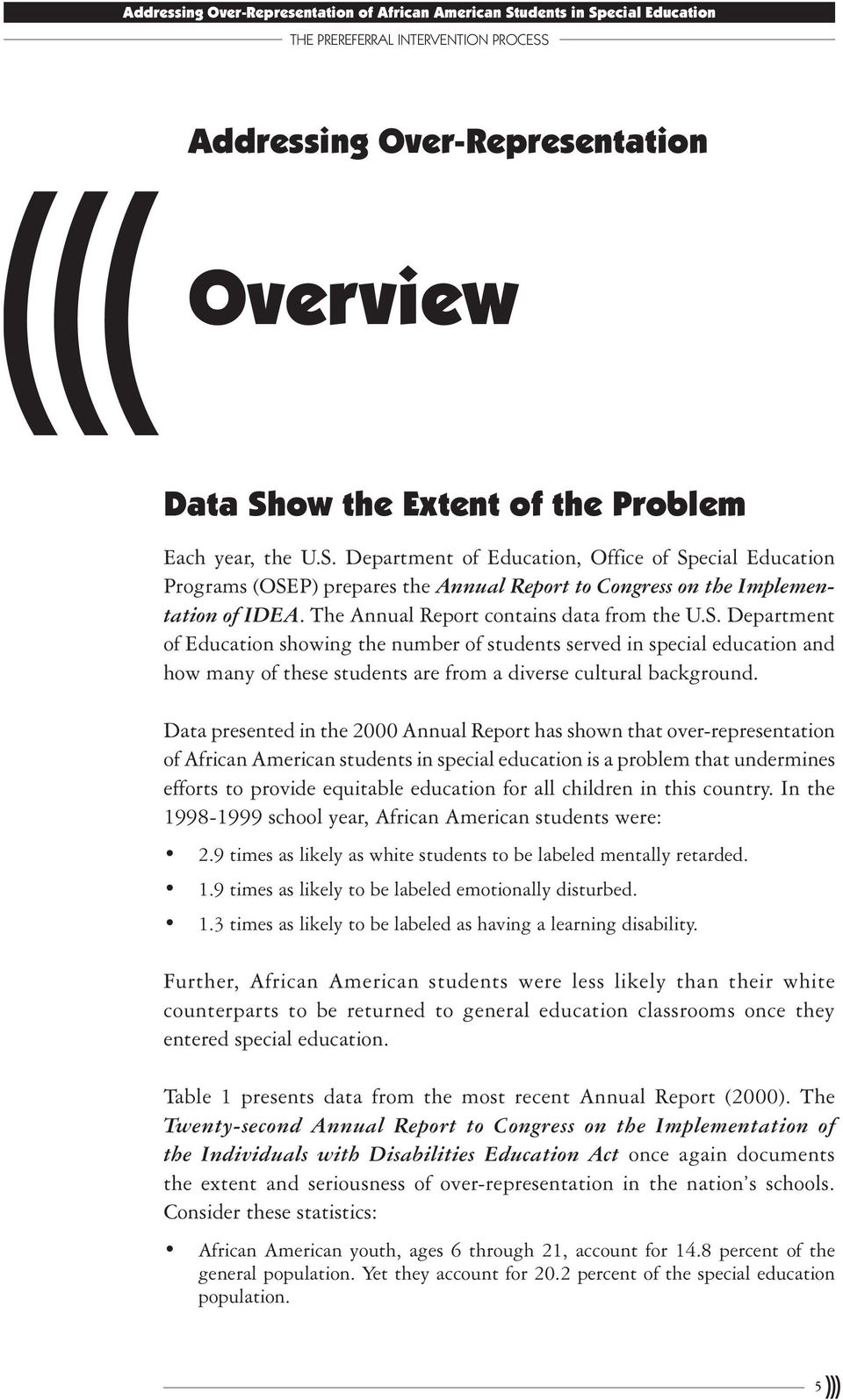
12 Addressing Over-Representation Overview Data Show the Extent of the Problem Each year, the U.S. Department of Education, Office of Special Education Programs (OSEP) prepares the Annual Report to Congress on the Implementation of IDEA. The Annual Report contains data from the U.S. Department of Education showing the number of students served in special education and how many of these students are from a diverse cultural background. Data presented in the 2000 Annual Report has shown that over-representation of African American students in special education is a problem that undermines efforts to provide equitable education for all children in this country. In the school year, African American students were: 2.9 times as likely as white students to be labeled mentally retarded. 1.9 times as likely to be labeled emotionally disturbed. 1.3 times as likely to be labeled as having a learning disability. Further, African American students were less likely than their white counterparts to be returned to general education classrooms once they entered special education. Table 1 presents data from the most recent Annual Report (2000). The Twenty-second Annual Report to Congress on the Implementation of the Individuals with Disabilities Education Act once again documents the extent and seriousness of over-representation in the nation s schools. Consider these statistics: African American youth, ages 6 through 21, account for 14.8 percent of the general population. Yet they account for 20.2 percent of the special education population. 5
13 Table 1. Percentage of Students Ages 6-21 Served by Disability and Race/Ethnicity in the School Year 1 Disability American Indian Asian/ Pacific Islander Black (non - Hispanic) Hispanic White (non- Hispanic) Specific Learning Disabilities Speech and Language Impairments Mental Retardation Emotional Disturbance Multiple Disabilities Hearing Impairments Orthopedic Impairments Other Health Impairments Visual impairments Autism Deaf-Blindness Traumatic Brain Injury Developmental Delay All Disabilities Resident Population Source: U.S. Department of Education, Office of Special Education Programs, Data Analysis System (DANS) 6
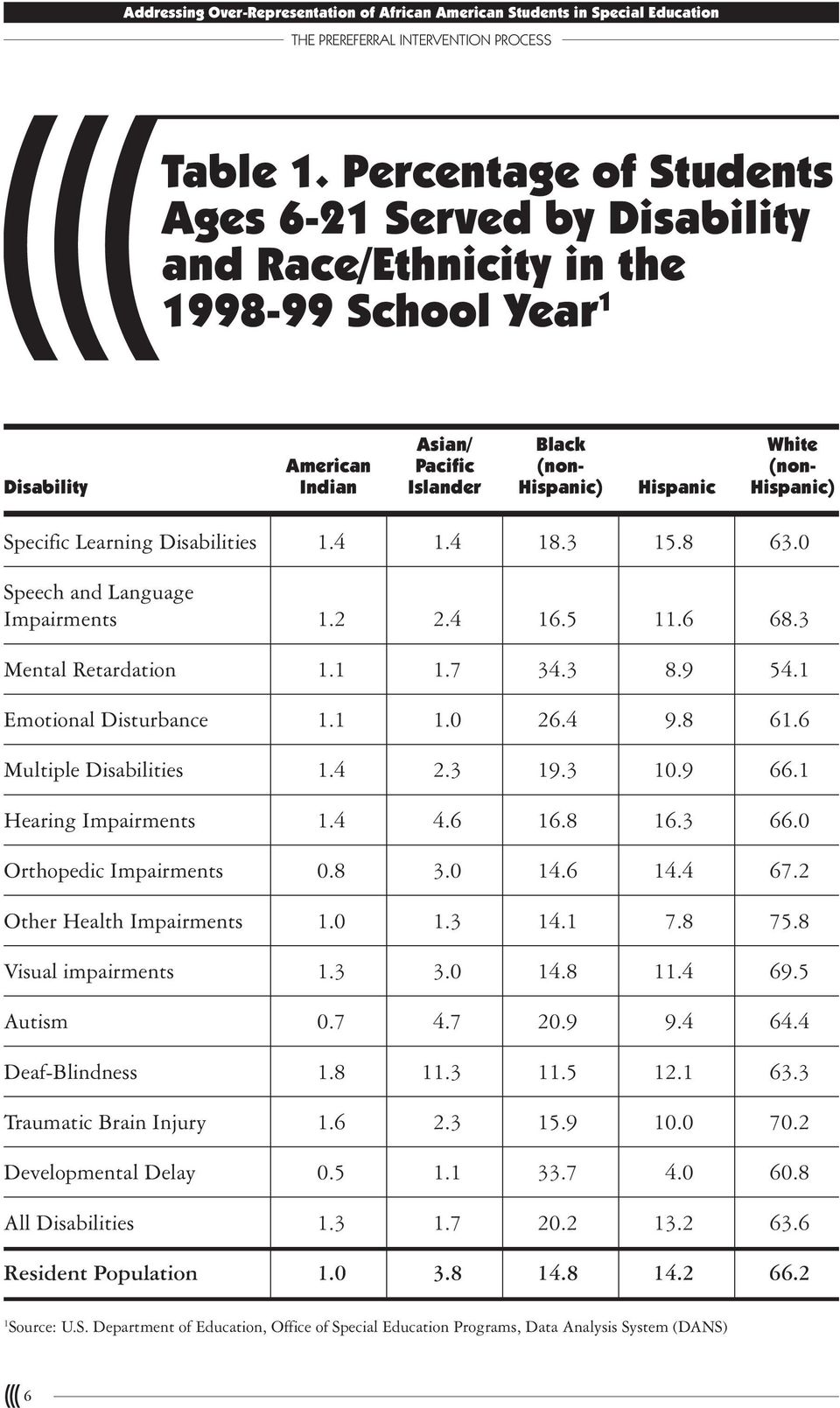
14 In 10 of the 13 disability categories, the percentage of African American students equals or exceeds the resident population percentage. The representation of African American students in the mental retardation and developmental delay categories is more than twice their national population estimates. Data from Annual Reports have subsequently been used by the U.S. Office of Civil Rights as a basis for monitoring school districts. [It is important to note that many of the references cited in this guide use Department of Education and OCR data as a basis for discussion.] Underrepresentation Also Is Disproportionality Disproportionality may denote an underrepresentation, as in the percentages of African American students in programs for the gifted and talented or the percentages of Asian students in special education classes. In contrast, disproportionality also denotes over-representation, as in the percentages of African Americans students and other diverse groups in special education programs. Serious Implications Result from the Over- Representation of African American Students in Special Education Over-representation has been shown to cause harm to many African American students nationwide. Students may: Be denied access to the general education curriculum. Receive services that do not meet their needs. Be misclassified or inappropriately labeled. Too often mislabeling results in low expectations for achievement that are held for the student. The potential for social-emotional problems increases and post-school outcomes are seriously undermined. Mislabeled students may, in fact, experience similar negative results as students with disabilities, such as inequity in educational opportunity, differential graduation rates, differential earning power upon graduation, and differential enrollment in postsecondary educational institutions. A variety of reasons may be given for why overidentification of some students occurs the most prevalent ones being: The difficulty in constructing instructional programs that address students unique learning strengths and needs. Ineffective procedures and processes used to refer and classify students for special education. Lack of knowledge that a problem exists and, subsequently, how to resolve it. When over-representation occurs, children who actually do not have disabilities are suddenly treated as if they are disabled, and the label that accompanies categorization tends to persist throughout their school experience. Such a situation is unjustifiable by any standard. 7
15 Does Over- Representation Exist In Your School? One of the most important things administrators can do is understand the seriousness of over-representation and commit themselves to reviewing their own school programs for any evidence of it. Administrators are encouraged to begin their investigation with a review of their state s data and the school s and/or district s report of who is being served in special education. In determining whether over-representation exists, administrators should consider the following questions: Are special education referrals being made for appropriate reasons? Is there a noticeable pattern in which teachers refer students regularly? Do certain teachers and/or schools have particularly high referral rates? Is there a high percentage of students whose families have low socioeconomic status or who are culturally and/or linguistically diverse in special education classes? Have other possible sources of the problem been investigated, such as limited instructional materials, a non-welcoming school climate, language differences, poor instruction, etc.? What documented interventions were attempted before the student was evaluated for special education? Were the interventions instituted and modified for enough time before they were abandoned? What were the results for each child referred? Why African American Students May Be Over- Represented in Special Education The professional literature has identified the following possible causal factors: Failure of the general education system to educate children from diverse backgrounds. Inequities associated with special education referral and placement procedures. Misidentification and the misuse of tests. Lack of access to effective instruction in general education programs. Insufficient resources and less well trained teachers making learning more difficult. Should over-representation be found to exist, it is imperative legally, as well as ethically that steps be taken to prevent and reduce it. Many strategies and interventions are available that prevent the need for special education programs. These strategies typically focus on helping all students succeed, ensuring that: Students participate and learn in a high quality curriculum and instructional program. The school climate respects the cultural and linguistic diversity of students and staff members. 8

16 Families are appropriately and sensitively involved in the education of their children. Teachers have the professional development and support they need to address student needs in the classroom. In the following chapters, recommendations from experienced practitioners and researchers for preventing and reducing the incidence of over-representation in each of these areas are presented. Administrators should review data and develop performance-based evaluations for teachers and students. Student achievement data must be disaggregated and aggregated based on race, gender, ethnicity, and language. It must be reported to the community. NABSE Focus Groups,
17 10

18 Addressing Over-Representation Guidance from the Law Federal law has long been concerned with providing equity and academic parity for the nation s children. Administrators can draw support from federal law specifically the Individuals with Disabilities Education Act (IDEA), Public Law when addressing the over-representation of African American students in their districts. A brief review of current activities related to overrepresentation of African American students in IDEA follows. Congress Identifies the Over- Representation of African American Students in Special Education as a National Concern During the reauthorization of the IDEA (1997), Congress examined research on the general profile and academic performance of students with disabilities in schools. The data indicated that students with disabilities were more likely than other students to come from families with low socioeconomic status and families whose parents had less formal education. Consistent with previous studies, these data also revealed disproportionate numbers of African American students in certain special education classes. Congress was troubled by the fact that there continued to be more African American children in special education than would be expected based on the percentage of diverse learners in the general school population. In response to the accumulation of these data, Congress called for greater efforts to ensure that African American students were classified accurately and appropriately placed. 11
19 Relevant IDEA Provisions 34 C.F.R Disproportionality. (a) General. Each State that receives assistance under Part B of the Act, and the Secretary of the Interior, shall provide for the collection and examination of data to determine if significant disproportionality based on race is occurring in the State or in the schools operated by the Secretary of the Interior with respect to (1) The identification of children as children with disabilities, including the identification of children as children with disabilities in accordance with a particular impairment described in section 602(3) of the Act; and (2) The placement in particular educational settings of these children. (b) Review and revision of policies, practices, and procedures. In the case of a determination of significant disproportionality with respect to the identification of children as children with disabilities, or the placement in particular educational settings of these children, in accordance with paragraph (a) of this section, the State or the Secretary of the Interior shall provide for the review and, if appropriate revision of the policies, procedures, and practices used in the identification or placement to ensure that the policies, procedures, and practices comply with the requirements of Part B of the Act. (Authority: 20 U.S.C. 1418(c)) 34 C.F.R (a)(2)(ii). Development, review, and revision of IEP. (2) Consideration of special factors. (i) The IEP team also shall (ii) In the case of a child with limited English proficiency, consider the language needs of the child as those needs relate to the IEP. (Authority: 20 U.S.C. 1414(d)(3) and (4)(B) and (e)) 34 C.F.R Evaluation procedures. Each public agency shall ensure, at a minimum, that the following requirements are met: (a) (1) Tests and other evaluation materials used to assess a child under Part B of the Act (i) Are selected and administered so as not to be discriminatory on a racial or cultural basis; and (ii) Are provided and administered in the child s native language or other mode of communication, unless it is clearly not feasible to do so; and (2) Materials and procedures used to assess a child with limited English proficiency are selected and administered to ensure that they measure the extent to which the child has a disability and needs special education, rather than measuring the child s English language skills. (b) A variety of assessment tools and strategies are used to gather relevant functional and developmental information about the child, including information provided by the parent, and information related to enabling the child to be involved in and progress in the general curriculum (or for a preschool child, to participate in appropriate activities), that may assist in determining (1) Whether the child is a child with a disability under 300.7; and (2) The content of the child s IEP. (c) (1) Any standardized tests that are given to a child (i) Have been validated for the specific purpose for which they are used; and (ii) Are administered by trained and knowledgeable personnel in accordance with any instructions provided by the producer of the tests. (2) If an assessment is not conducted under standard conditions, a description of the extent to which it varied from standard conditions (e.g., the qualifications of the person administering the test, or the method of test administration) must be included in the evaluation report. (d) Tests and other evaluation materials include those tailored to assess specific areas of educational need and not merely those that are designed to provide a single general intelligence quotient. (e) Tests are selected and administered so as best to ensure that if a test is administered to a child with impaired sensory, manual, or speaking skills, the test results accurately reflect the child s aptitude or achievement level or whatever other factors the test purports to measure, rather than reflecting the child s impaired sensory, manual, or speaking skills (unless those skills are the factors that the test purports to measure). (f) No single procedure is used as the sole criterion for determining whether a child is a child with a disability and for determining an appropriate educational program for the child. (g) The child is assessed in all areas related to the suspected disability, including, if appropriate, health, vision, hearing, social and emotional status, general intelligence, academic performance, communicative status, and motor abilities. (h) In evaluating each child with a disability under , the evaluation is sufficiently comprehensive to identify all of the child s special education and related services needs, whether or not commonly linked to the disability category in which the child has been classified. (i) The public agency uses technically sound instruments that may assess the relative contribution of cognitive and behavioral factors, in addition to physical or developmental factors. (j) The public agency uses assessment tools and strategies that provide relevant information that directly assists persons in determining the educational needs of the child. (Authority: 20 U.S.C. 1412(a)(6)(B), 1414(b)(2) and (3)) 34 C.F.R Determination of eligibility. (a) Upon completing the administration of tests and other evaluation materials (1) A group of qualified professionals and the parent of the child must determine whether the child is a child with a disability, as defined in 300.7; and (2) The public agency must provide a copy of the evaluation report and the documentation of determination of eligibility to the parent. (b) A child may not be determined to be eligible under this part if (1) The determinant factor for that eligibility determination is (i) Lack of instruction in reading or math; or (ii) Limited English proficiency; and (2) The child does not otherwise meet the eligibility criteria under 300.7(a). (c) (1) A public agency must evaluate a child with a disability in accordance with and before determining that the child is no longer a child with a disability. (2) The evaluation described in paragraph (c)(1) of this section is not required before the termination of a student's eligibility under Part B of the Act due to graduation with a regular high school diploma, or exceeding the age eligibility for FAPE under State law. (Authority: 20 U.S.C. 1414(b)(4) and (5), (c)(5)) 12
20 Under IDEA 97, states are now required to gather and examine data to determine if significant disproportionality based on race is occurring in the state with respect to the identification of children as children with disabilities and their placement in particular educational settings. 34 C.F.R To allow for comparisons between states, Congress identified five race/ethnicity categories that all states must use in collecting and reporting data: American Indian. Asian/Pacific Islander. Black (non-hispanic). Hispanic. White (non-hispanic). By creating reporting mechanisms that include race/ethnicity data, Congress felt that they could better monitor the issue. Further, the reporting mechanism provided a mechanism for states and districts to examine potential over-representation issues. Whether the child is from a culturally diverse background or not, IDEA 97 emphasizes that special education is not a place. Rather, special education is a set of services to support the needs of children with disabilities to succeed in the curriculum. In determining the individualized education program (IEP) for a child with limited English proficiency, IEP teams must consider the language needs of the child as those needs relate to the IEP. 34 C.F.R (a)(2)(ii). Further, IDEA provides that non-biased tests and evaluation procedures be used to assess children for possible identification as a child with a disability. 34 C.F.R Finally, IDEA specifies that when it is decided that the determinant factor for eligibility is limited English proficiency, a child is ineligible for special education. 34 C.F.R Moreover, a child also must be found ineligible for special education if the determinant factor is lack of instruction in reading or math. 34 C.F.R The Role of the U.S. Office of Civil Rights Since 1965, the U.S. Department of Education, Office of Civil Rights (OCR) has tracked data on African American students related to their enrollment in special education. OCR has monitored school districts and required compliance activities when problems were found to exist. For example, compliance activities in two districts resulted in the establishment of prereferral intervention processes that enabled practitioners to solve learning and behavioral problems in the context of providing instructional support and interventions in general education classrooms. OCR is responsible for enforcing several laws that affect school practices related to the over-representation of African American students. These laws are: Section 504 of the Rehabilitation Act of 1973 (Section 504). This law prohibits discrimination against individuals with disabilities. The protections apply to individuals who are perceived as having but who do not actually have a disability (e.g., children who have been misclassified). Title II of the Americans with Disabilities Act (ADA). This law also prohibits discrimination against individuals with disabilities. The protections apply to individuals who are perceived as having but who do not actu- 13

21 ally have a disability (e.g., children who have been misclassified). Title VI of the Civil Rights Act (Title VI). This law prohibits discrimination on the basis of race, color, or national origin. Administrators can turn to these laws for support when tackling over-representation issues. Litigation: School Districts Found Out of Compliance with Federal Regulations What might happen if data show that overrepresentation exists in a school district and that nothing is being done to reduce or eliminate it? Due to the seriousness of the issue, the district may become involved in legal challenges. In addition, OCR may cite the district, and should that happen, the district will be instructed to enter into a corrective action plan with OCR. For over three decades, over-representation data have figured prominently in court cases and in discussions aimed at eliminating inequities in the educational system. Administrators may benefit from knowing about several landmark court cases in the 1970s that are relevant to the present discussion of overrepresentation of African American students in special education. These cases are: Diana v. the California State Board of Education (1970). Johnson v. the San Francisco Unified School District (1971). Larry P. v. Riles, California (1979). Generally, these cases found that public school assessment practices were discriminatory. The assessments inaccurately identified a disproportionate number of minority students as students in need of special education and unnecessarily segregated them into special education classes. These cases were extremely influential in shaping IDEA Part B requirements for nondiscriminatory testing and classification, and the procedural safeguards against misclassification. 14
22 Addressing Over-Representation The Prereferral Intervention Process In schools where the entire school community teachers, administrators, family members, and other stakeholders hold high expectations for student learning and students are positively reinforced for their achievements and participation, over-representation typically is not an issue. It is when the teaching-learning process breaks down that incidences of over-representation tend to increase. This can happen in any school or district. Here s why. In many schools, the only way teachers can obtain help or support when their instructional approaches are not working is to refer the child for special education evaluation. It is well-documented that errors often occur during the assessment, eligibility, and placement processes resulting in students being found eligible for special education services when they may have been victims of ineffective teaching. There is clearly a need for a step prior to special education referral at which time instructional staff may request help with a child who exhibits an academic or behavioral problem that the teacher is unable to resolve. The prereferral intervention process is such a strategy because it prevents referrals by assisting teachers and students with the presenting problems in the context of the general education classroom. Although different prereferral intervention approaches exist, they all have in common one important purpose: To provide supports necessary to maintain the student in general education if at all possible. School districts have used prereferral intervention processes since the 1970s. In fact, more than a decade ago at least 34 states required or recommended some form of prereferral intervention prior to formal special education referral. Many school districts across the country including large urban districts in 15
23 Chicago, Baltimore, Miami-Dade County, and Las Vegas have developed prereferral manuals and implemented large-scale prereferral intervention processes in their district schools. How do administrators use a prereferral intervention process to address the over-representation of African American students in special education? The professional literature suggests that prereferral intervention processes show promise for preventing the overidentification of African American students for special education referral. Such processes may have the potential to identify and address systemic problems (e.g., inadequate instruction, irrelevant curriculum, lack of resources), and may, in turn, alleviate the source of the student s academic and/or behavioral difficulties. To prevent over-representation, administrators should become familiar with effective prereferral intervention systems and institute one in their building. When functioning properly, these prereferral intervention systems often reduce inappropriate referrals to special education and produce improved student performance. In fact, experienced practitioners report that the majority of students discussed at these prereferral meetings are never referred to special education. Because the goal of prereferral intervention systems is to ensure that students have access to quality education, administrators also may want to direct their attention to making sure that instructional staff have Report Tracks Over-Representation from 1982 to Present The 2002 National Academy of Sciences (NAS) report, Minority students in special and gifted education, examines the evidence documenting the presence of over-representation from 1982 to present day. Among the findings of the NAS report is the assertion that to reduce the type of learning and behavioral problems that typically result in large numbers of students from culturally diverse backgrounds being referred to special education, schools should do more and do it earlier to ensure that students receive quality general education services. Further, the report cautions that no child should be found eligible for special education unless there is evidence of insufficient response to high quality interventions in the relevant domains of functioning in school settings. Although the study stopped short of identifying strategies to carry out recommendations, both of these findings underscore the need for preventive approaches, such as prereferral systems. From: National Research Council (2002). Minority students in special and gifted education. Washington, DC: National Academy Press. sufficient resources, skills, and professional development opportunities to understand the needs of diverse learners. 16
24 Understanding Prereferral Intervention Practices Administrators should be aware that the foundation for a prereferral system is a solid educational program. In successful schools, students participate and progress in a high quality curriculum. Instructional staff members receive sufficient resources and professional development to ensure that instructional pedagogy is appropriate to student needs. Unfortunately, reports such as those prepared by the U.S. Department of Education, Office of Civil Rights have found that there is a linkage between the overidentification of African American students in special education programs and their lack of access to effective instruction and intervention in general education programs. Start with the student s strengths. Discover what the student needs to be successful in school. NABSE Focus Groups, 2001 Prereferral intervention teams go by many names, such as school-based problem solving teams, teacher assistance teams, and intervention teams. At the core of most prereferral intervention models is collaborative problem solving among teachers, related service personnel, family members, and administrators. These individuals work as a team to provide instructional staff with support and strategies designed to improve achievement for all students. A major goal of the school-based prereferral intervention team is to improve attitudes and augment the skills of school-based staff to adequately address students academic and behavioral needs. The process recognizes that many variables affect learning. Thus, rather than first assuming the difficulty lies within the child, team members and the teacher consider a variety of variables that may be at the root of the problem, including the curriculum, instructional materials, instructional practices, and teacher perceptions. In general, the prereferral intervention process is intended to: Document difficulties the student may be having with instruction and determine possible reasons for the problem. Provide and document classroom modifications and/or other strategies. Assess interventions to ensure that they are appropriate and successful. Monitor the student s progress for a significant period of time. Identify students for whom the learning and/or behavioral difficulty persists in spite of suggested interventions. The process by which prereferral intervention teams solve problems varies. Generally, the referring teacher documents attempts to solve the problem. These data are shared with the team and become a part of the prereferral documentation. The team discusses the data, and in some cases may gather additional information. Together with the 17
25 Sample References: Prereferral During the 1980s and early 1990s, a substantial number of prereferral approaches were presented in the literature. While it is beyond the scope of this guide to present them all, following are selected references. Bay, M., Bryan, T., & O Connor, R. (1994). Teachers assisting teachers: A prereferral model for urban educators. Teacher Education and Special Education, 17, Chalfant, J., & Pysh, M. (1989). Teacher assistance teams: Five descriptive studies on 96 teams. Remedial and Special Education, 10, Dodd, J., Nelson, J., & Sprint, W. (1995). Prereferral activities: One way to avoid biased testing procedures and possible inappropriate special education placement for American Indian students. Journal of Educational Issues of Language Minority Students, 15. Fuchs, D., & Fuchs, L. (1989). Exploring effective and efficient prereferral interventions: A component analysis of behavioral consultation. School Psychology Review, 23, Graden, J., Casey, A., & Christenson, S. (1985). Implementing a prereferral intervention system: The model. Exceptional Children, 51(5), Hayek, R. (1987). The teacher assistance team: A prereferral support system. Focus on Exceptional Children, 20, 1-7. Pugach, M., & Johnson, L. (1989). Prereferral interventions: Progress, problems, and challenges. Exceptional Children, 56, Rosenfield, S. (1992). Developing schoolbased consultation teams: A design for organizational change. School Psychology Quarterly, 7, Ross, R. P. (1995). Best practices in implementing intervention assistance teams. In A. Thomas and J. Grimes, (Eds.), Best Practices in School Psychology, Rockville, MD: National Association of School Psychologists. Schrag, J., & Henderson, K. (1995). Schoolbased intervention assistance teams and their impact on special education: Final report. Alexandria, VA: National Association of State Directors of Special Education. (ERIC Document Reproduction Service No. EC ). Sindelar, P., Griffin, C., Smith, S., & Watanabe, A. (1992). Prereferral intervention: Encouraging notes on preliminary findings. The Elementary School Journal, 92(3), *IDEA does not require the use of these resources. 18
26 referring teacher, the team generates interventions that are designed to enable the student to progress in the general education classroom. Administrators can facilitate an effective prereferral intervention process designed to prevent the over-representation of African American students by: Identifying team members who have experience using and designing instructional techniques that address the individual needs of students. Identifying team members with expertise in addressing the educational needs of African American students. Making sure prereferral team members understand that their purpose is to recommend and support effective interventions in general education and not to operate as a special education eligibility or placement committee. Giving teams adequate time to develop and become institutionalized as a school resource. Making arrangements to ensure that paperwork requirements do not become a burden. Providing sufficient human and fiscal resources for team members to plan, consult, and communicate with all parties. Administrators should monitor the effectiveness of the prereferral intervention process to ensure that students are appropriately supported and challenged in general education by putting in place a process for the review of interventions and their implementation. Records should be kept that document: Initial learning concerns. Interventions implemented. Length of time each intervention was attempted. Possible Prereferral Roles for Team Members General education teacher. Identifies during the prereferral phase individual students who may need assistance. May implement interventions, or consult with other staff members who may provide small group or classroom assistance. School psychologist or educational assessor. Provides individual or small group observations, support sessions, screening, and academic diagnostic assessment. School counselor. Reviews student records and support for diagnostic testing profiles. Plans with classroom teacher and support staff to target learning and behavioral needs of students. Reading and math specialists. Provide instructional supports and/or small group instruction. Suggest whole class methods of working in the classroom. Grade level or clusters of teachers. May plan, share, or exchange optional methods, materials, and instructional practices that work with students in the general education curriculum. Vision, hearing, and health screening professionals. May be asked to determine if sensory acuity or health difficulties are contributing to, or causing, the student s school problems. Parents. Share knowledge about the child s strengths and needs. Provide information about the family s cultural background. Suggest strategies that have worked with the child. Implement strategies in the home. 19
27 Outcomes of each intervention. In addition, profiles of students that show progress over a period of time should be kept. Such data allow administrators to compare students maintained in general education and/or referred to special education over the years to discover trends or needs evident in the school. There are many levels of intervention, however early intervention is most important. Catch problems early and give students intensive support. NABSE Focus Groups, 2001 Similarly, documentation should be kept on teachers who show patterns of difficulty with their students. Appropriate steps should be taken whenever it is suspected that the source of a student s problem is ineffective instruction or biased attitudes. Making Available General Education Intervention Strategies and Supports A successful prereferral intervention system assumes that general education staff have the instructional skills necessary to instruct diverse groups of learners. Familiarity and knowledge of individual learning strengths and needs is critical to effective instructional practices. Successful prereferral practices assist instructional staff in carrying out recommended interventions where needed. Interventions may lead to adjustments in instructional methods and adaptations in the curriculum that promote continued success for students. Prereferral intervention teams may consider a wide range of instructional supports. Types of classroom support that the professional literature suggests are important to the success of African American students are: Differentiated curriculum that is appropriate to all learners. Instruction that is culturally relevant and culturally appropriate. Adaptation of instruction for a wide variety of learning styles within each cultural or ethnic population. Experienced and culturally-competent general education personnel. Individualized intervention strategies that reflect students cultural contexts. Home-school-community collaboration. Administrators also may want to review these strategies with instructional and support staff to determine sources of expertise within the school and larger community. While it is beyond the scope of this document to provide a full description of these strategies, administrators are encouraged to consult the references in the bibliography section for more information. 20
28 Ensuring Effective Prereferral Intervention Practices: Recommendations From NABSE When reviewing prereferral intervention practices for appropriateness, administrators may benefit from the following recommendations. The recommendations, if carried out, may prevent and/or reduce over-representation. The recommendations were generated by the NABSE focus groups, comprised of researchers and practitioners with expertise in educating African American students. In each case, recommendations have support in the professional literature. While IDEA does not specify tasks that administrators must perform, the NABSE recommendations support administrators who assume leadership for developing and implementing prereferral intervention processes that address the needs of all children to progress in the general curriculum. 21
29 Addressing Over- Representation with a Prereferral Intervention Process RECOMMENDATIONS Extent to which we do this Administrators can establish prereferral intervention systems to prevent and reduce over-representation of African American students in special education by All of the time Sometimes, needs improvement Not at all, need a plan Not applicable to our school/district Incorporating Effective Elements in Prereferral Intervention Practices Develop a school and/or district-wide policy for the establishment of local school prereferral models. Institute a school-based prereferral intervention program to be used prior to referring students to special education. Monitor the success of the prereferral approach. Collect and compare annual data regarding the numbers of students maintained by general education prereferral support efforts. Monitor school and system-wide data to identify repeat referrals. Require intervention plans to address the diverse learning needs and individual learning style of the child. Identify a staff member to lead the prereferral intervention process. Define staff members roles on prereferral teams. Continued *IDEA does not require the use of these recommendations. 22
30 Always Sometimes Not at all NA Incorporating Effective Elements in Prereferral Intervention Practices (continued) Clarify the goal of the prereferral team. Keep the emphasis on prereferral and support for the student in general education, and not on eligibility for special education. Provide administrative support and funding for: planning, staff training in team process and problem solving, release time for team meetings and consultations, and record keeping. Involve parents as active participants in prereferral meetings and encourage them to discuss culturally relevant concerns and suggestions for instructional supports. Give parents clear information and feedback as to their role and the purpose of the interventions for their child. Develop minimal but efficient record keeping and administrative procedures. Avoid burdensome paperwork. Provide prereferral team members with research-based information related to academic and behavioral prereferral interventions. Ensure consistency of interventions when students transfer or transition to other schools or teachers. Ensuring the Availability of General Education Strategies and Supports Make sure the general education curriculum has addressed the needs of all learners. Devise a school operational plan that concentrates on individual achievement for all students. Provide incentives for school staff members to develop expertise in successful intervention programs. Continued *IDEA does not require the use of these recommendations. 23
31 Always Sometimes Not at all NA Ensuring the Availability of General Education Strategies and Supports (continued) Provide on-going, coherent professional development on topics such as how to differentiate instruction, provide multilevel instruction, individualize instruction, and make instructional accommodations. Support teachers in using pedagogy that addresses diverse student needs. Make supports available. Develop a plan for using community and local agency supports, such as mental health services, the faith community, community health services, parent support groups, and preschool programs. Provide professional development activities that enable participants to confront and overcome biases and attitudes that may hinder students learning. *IDEA does not require the use of these recommendations. 24
32 Addressing Over-Representation Understanding the Effect of School Climate Administrators are the key to establishing the climate that exists in schools. They have the opportunity to create a school climate that is fair and equitable to the entire school community students, teachers, support staff, related service providers, parents, and community members. Students, parents, staff, faculty, and administrators all hold perceptions including observations, feelings, impressions, and expectations of the school. School climate encompasses these perceptions. How does school climate affect the referral of African American students for special education? School climate can markedly affect over-representation. Administrators, faculty, and staff bring into the workplace their own assumptions, theories, and beliefs about students. A school climate that respects individual differences and embraces diversity may contribute to the decline of students being referred to special education, thus reducing the numbers of African American students disproportionately represented in special education. Beyond understanding the role of climate in encouraging the capabilities and emphasizing the worth of individuals, administrators may wish to pay particular attention to those aspects related directly to respecting the educational needs of African American students. These are: Eliminating harmful forms of bias. Ensuring cultural competence. 25
33 Eliminating Bias Everyone has certain biases that can influence decision making and actions. Problems arise when biases are harmful to groups of individuals. For example, a harmful (and unfounded) bias may be that certain races of students have low intelligence. Such a bias may result in low expectations for student achievement which, in turn, research has clearly and repeatedly shown is detrimental to student achievement! Administrators must be diligent in eliminating practices in the school climate that result in harmful biases and unfair expectations. Because individuals often are unaware of their biases, as well as the effect their negative beliefs may be having on school climate, efforts must be made to help individuals become cognizant of unfounded biases. In the context of special education referral, open discussions related to perceptions of student cultural backgrounds are necessary. Ensuring Cultural Competence Learn More About Addressing Bias According to Larson and Ovando, Teachers, supervisors, and others bring to the classroom a variety of agendas, some public, many hidden, and probably most unknown, each of which has a telling impact on educational decisionmaking. Unfortunately, some of these life experiences that staff and faculty bring with them to the educational setting will manifest themselves in the form of many unfounded biases some of them in the areas of student achievement, low expectations, and student intelligence as they apply to race and discriminatory systems and practices that people have created, supported, and maintained over time. From: Larson, C., & Ovando, C. (2001). The color of bureaucracy: The politics of equity in multicultural school communities. Belmont, CA: Thomson Publishing, Inc. Cultural competence assumes that individuals are able to relate and communicate effectively with individuals who do not share the same culture, ethnicity, and/or language. Individuals who are culturally responsive think, feel, and act in ways that respect ethnic, sociocultural, and linguistic diversity. Administrators and staff members should respond positively to all children, understanding the richness and limitations reflected by their own life experiences, as well as the life experiences of the students they are teaching. Cultural competence is particularly important for African American students because discontinuities may exist between the child s home experience and the value structures typical of many public schools. As a result of the discontinuity, some educators may misinterpret students actions or responses as negative or problematic. Such reactions often alienate students from the rest of the school and can make them prime candidates for referral out of the classroom. 26
34 Understanding the Impact of Discontinuity Researcher Brenda Townsend has shown that the school climate may be inconsistent with the environmental factors found in African American students homes. This discontinuity may manifest itself in behaviors that alienate students from the school. The implication of this cannot be understated. Using OCR data, Townsend found that a disproportionate number of African American students were suspended and expelled from school. Townsend points to culturally responsive instructional and management strategies as means to mitigate school suspensions and expulsions. From: Townsend, B. (2000). The dis pro - portionate discipline of African American learners: Reducing school suspensions and expulsions. Exceptional Children, 66(3), how culture and life experience impact upon student learning. Staff members possess adequate skills and knowledge to work in multicultural settings. In the context of school climate, cultural competence must be present in all stakeholders. If it is not, then NABSE recommends that administrators must consider cultural competence training for school personnel as a key component to improving academic outcomes. Administrators also must make cultural competence a priority when hiring new staff members. Efforts to recruit qualified staff from diverse cultural and linguistic backgrounds as well as those with multicultural and bilingual preparation should be undertaken, especially in light of changing demographics. The following elements are found in culturally competent classrooms: Culturally diverse student populations are respected and responded to in natural ways. Instructional staff acknowledge that students benefit when they are given opportunities to find relevant connections among themselves and with the subject matter and the instructional tasks. Multicultural educational practices in which students prior knowledge, cultural contexts and experiences, and learning styles are taken into consideration. Teachers and other service providers demonstrate knowledge and understanding of Become Knowledgeable About Standards For a review of standards related to multicultural education and special education, see What Every Special Educator Should Know: The International Standards for the Preparation and Licensure of Special Educators. The guide, which includes eleven common core items related to multicultural skills and competencies, is available from the Council for Exceptional Children. Contact: CEC Constituent Services, CEC-SPED. 27
35 Use Staff Development To Address Over- Representation Researcher James Patton reports that often teachers are faced with a limited understanding of cultures and learning styles different from their own. They must also face the consequences that a lack of cultural understanding will have on their students learning, Patton says. Staff development can be a useful strategy for enhancing teachers understanding of other cultures. It can be a powerful tool when used as a critical self-assessment or to engage in reflective practices of one s cultural experiences. From: Patton, J.M. (1998). The dis pro por - tionate representation of African Americans in special education: Looking behind the curtain for understanding and solutions. The Journal of Special Education, 32(1), Improving School Climate: Recommendations From NABSE When reviewing the school climate for signs of bias and the presence of cultural competence, administrators may benefit from the following recommendations. The recommendations, if carried out, may prevent and/or reduce over-representation. The recommendations were generated by the NABSE focus group, comprised of researchers and practitioners with expertise in educating African American students. In each case, recommendations have support in the professional literature. While IDEA does not specify tasks that administrators must perform, the NABSE recommendations support administrators who assume leadership for continually encouraging a climate that recognizes the value of all individuals. 28
36 Addressing Over- Representation Through School Climate RECOMMENDATIONS Extent to which we do this Administrators can establish a positive school climate that prevents and reduces the overrepresentation of African American students in special education by All of the time Sometimes, needs improvement Not at all, need a plan Not applicable to our school/district Addressing Harmful Biases Support school staff in accepting the responsibility for supporting achievement for all students. Obtain membership in organizations that promote equitable education and provide instructional strategies for all students (e.g., NABSE, National Association for Bilingual Education) and prominently share materials obtained from such groups with all stakeholders. Discuss unfounded biases with staff members and let staff members know that disrespectful responses to any child, regardless of cultural background, ethnicity, and/or socioeconomic status will not be tolerated on the school campus. Ensuring Cultural Competence Establish school and district-wide professional development training in cultural competence. Work with community members and institutions of higher education to identify a cultural competence training program that will meet the needs of your community. Include students in school and district-wide professional development on cultural competence. Continued *IDEA does not require the use of these recommendations. 29
37 Always Sometimes Not at all NA Ensuring Cultural Competence (continued) 30 Identify and use multiple assessment tools and strategies that are research-based and culturally competent. Provide school and district-wide training in the administration of assessment tools and methods that consider the student s culture and background. Assign personnel who are knowledgeable about students cultures to conduct assessments. Ensure that high stakes tests have been validated for the purpose for which they are used and have been standardized on populations of students similar to your own. Schedule visits to students homes and neighborhoods to learn more about them and their cultures. Provide training to employees before making home visits. Include skills that demonstrate cultural competence on teachers exams for employment in your district. Enlist the help of community members and higher education personnel in developing standards and skills for school staff in becoming culturally competent and assisting all students in accessing the general curriculum. Assign task forces to suggest ways staff members may retool their skills. Tap into the expertise of community members who may be knowledgeable about African American and other cultures represented in your student population. Encourage the state licensing agency to require course work in areas such as multicultural education, cultural competence, accessing the general education curriculum, and improving student achievement for all students by improving instructional strategies. Hire personnel who demonstrate cultural competencies. *IDEA does not require the use of these recommendations.
38 Addressing Over-Representation Involving Families Families offer a rich source of information about their children. Family-centered approaches may hold promise for reducing the incidence of inappropriately referred children and youth to special education by improving the appropriateness of their education and subsequent progress. Systemic support in the form of culturally competent and family-centered practices as well as respect for culturally-based child rearing practices facilitates family participation in their children s education. How can family involvement prevent over-representation of African American students? Family involvement is an important element in the prereferral intervention process. In the context of preventing over-representation, families are a valuable source of information. Families may share relevant information about their children s culture that can assist school personnel in planning appropriate educational programs. Families also should be engaged in planning childcentered and family-centered interventions that can be carried out at home and at school. Administrators have an important role to play in helping school staff members show responsiveness to families of diverse cultural backgrounds. Steps should be taken to involve families in their children s education, including participation in prereferral teams. A welcoming attitude by everyone in the school will encourage families to become involved. 31
39 Communicating with Families About their Child s Educational Needs Communication between families and school staff should reflect an open interchange of information. School personnel should be responsive to the cultural values and beliefs of families. Involvement of African American families may be increased when school personnel adjust their approaches to the family s beliefs about disability, health, and healing; respect the family s sense of propriety; and eliminate or reduce language barriers. It also is important to recognize that African American families may hold a nontraditional interpretation of school involvement that should be respected. For example, many African American parents practice with their children home-based involvement, which must be affirmed before transitioning to schoolbased involvement. Family involvement should be promoted early in the child s school experience and maintained throughout the middle and On all levels, administrators can enhance outreach into the community. In addition to communicating with families, communicate with community members and engage them in supporting student achievement. NABSE Focus Groups, 2001 high school years. Family members should be informed continuously regarding positive progress in, as well as concerns with, the general education program. Family involvement should not be initiated for the first time when problems emerge. Family members need to know well in advance of a crisis that there may be a problem. Administrators also should include families in professional development opportunities. Family development and training may support the parent in becoming a more effective advocate for his or her own child. Inviting Parents To Serve on Prereferral Intervention Teams As previously pointed out, parents should be members of prereferral teams and notified if their child is referred to a prereferral intervention team. They should be involved in identifying the learning needs of their child and generating suggestions that reflect the values of their family and culture. Prereferral team members should make efforts to perceive the intervention and support process from the parent s perspective. Administrators and teachers who listen to parents concerns and respond in positive ways build effective relationships that support student progress. The members of the prereferral team should be diverse and trained in communication techniques that support cultural diversity. 32
40 Improving Family Involvement: Recommendations From NABSE When considering strategies to increase family involvement, administrators may benefit from the following recommendations. The recommendations, if carried out, may prevent and/or reduce over-representation. The recommendations were generated by the NABSE focus groups, comprised of researchers and practitioners with expertise in educating African American students. In each case, recommendations have support in the professional literature. While IDEA does not specify tasks that administrators must perform, the NABSE recommendations support administrators who assume leadership for improving family involvement in their children s education. 33
41 Addressing Over- Representation by Involving Families RECOMMENDATIONS Extent to which we do this Administrators can involve families in ways that may prevent and reduce the over-representation of African American students in special education by All of the time Sometimes, needs improvement Not at all, need a plan Not applicable to our school/district Communicating with Families About Their Child s Educational Needs Develop effective, ongoing parent communication systems. Improve and maintain communication with parents by routinely reporting student accomplishments. Provide professional development for school staff members in effective communication skills with African American and other culturally diverse families. Plan school and district-wide activities with input from parents. Present district-wide opportunities for meaningful input from African Americans in the community concerning curricula and school management. Survey African American parents to gather their suggestions on ways to involve parents in their child s education (e.g., written, telephone, face-to-face interview). Cooperate with parents in finding effective ways for them to help their child in school. Ensure that the school is welcoming, staff are accessible, and staff understand and respect diverse family networks and child rearing customs and practices. Continued *IDEA does not require the use of these recommendations. 34
42 Always Sometimes Not at all NA Communicating with Families About Their Child s Educational Needs (continued) Support parent-to-parent advocacy approaches. Involving Families in the Prereferral Intervention Process Provide adequate information about the prereferral education process to African American families in the language spoken in the home. Educate families regarding IDEA and educational services as they relate to prereferral. Collaborate with Parent Training Information Centers (PTIs) in the community (when available) to provide joint training. Talk with the family to learn about how members view disabilities, education in general, mental health, and discipline. Recruit and maintain a resource list of culturally competent staff and community contacts who can communicate effectively with parents. Have a person familiar with the culture of the parent participate on the prereferral team. If needed, provide an interpreter for the prereferral meetings. Develop a method of tracking parent conference outcomes and the percentage of parental participation. Guide families to interagency resources that are available to them (e.g., medical, mental health, social services, community organizations, and advocates). *IDEA does not require the use of these recommendations. 35
43 36
44 Addressing Over-Representation Taking Action Where It Is Needed As the 2000 U.S. Census indicates, the United States is a multiracial, multiethnic society. In order for students to achieve to high standards, access to the general education curriculum is essential. This means that all children, regardless of cultural background, are provided with a challenging curriculum that addresses their individual strengths and needs. The overidentification of African American students for special education challenges administrators to review their educational programs and make sure that they are serving the needs of all students. Administrators can do much to ensure positive school outcomes for all students including African American students. As this guide has shown, this entails: Establishing an appropriate prereferral intervention process to provide students with support that keeps them participating and progressing in the general education curriculum. Understanding how the school climate may affect the educational progress of African American students. Involving families and learning from them how to understand and respect their child s unique learning strengths, needs, and cultural background. Administrators are encouraged to use this guide as they review their programs for signs of inappropriate referrals and misidentification of African American students for special education. With the knowledge presented in this guide, it is possible for leaders to: Help facilitate the development of a school improvement plan that addresses and gives credence to school and community stakeholders concerns. Survey staff members to determine problematic issues and to plan professional development activities to address them. Provide school staff members with continuous cultural competency training. 37
45 Work collaboratively with central office administrators to make decisions about where to allocate fiscal support to improve instructional practices. Administrators may use the recommendations offered by NABSE as a starting point for considering where they may need to take action. Share the recommendations, as well as the following resources, with school personnel and parents. Consider piloting the recommendations in one or more schools and sharing successes with colleagues throughout the school district. For legal, practical, and ethical reasons, inappropriate special education referrals are not justifiable and must be eliminated. As this guide has shown, it can be done. It takes a knowledgeable and compassionate leader to take action and do what is right for children. It is NABSE s and ILIAD s hope that this guide has provided you with what you need to tackle any over-representation in special education by ensuring an equitable education for African American students. 38
46 Addressing Over-Representation Resources References and contacts for organizations are presented in this section. In all cases, the resource offers a more in-depth understanding of the over-representation of African American and other students in special education. No endorsement of any resource by NABSE, ILIAD, or the federal government should be inferred. IDEA does not require use of these resources. Bibliography Artiles, A. (1998). The dilemma of difference: Enriching the disproportionality discourse with theory and context. The Journal of Special Education, 32, Artiles, A., Aguirre-Munoz, Z., & Abedi, J. (1998). Predicting placement in learning disabilities programs: Do predictors vary by ethnic group? Exceptional Children, 64, Artiles, A.J., & Trent, S.C. (1999). The overrepresentation of minority students in special education: A continuing debate. The Journal of Special Education, 27, Artiles, A., & Trent, S. (1994). Overrepresentation of minority students in special education: A continuing debate. The Journal of Special Education, 22, Avoké, S., & Wood-Garnett, S. (2001). Language minority children and youth in special education. Teaching Exceptional Children, 33, Banks, J. (1977). Multiethnic education: Practices and promises. Bloomington, IN: Phi Delta Kappa Educational Foundation. 39
47 Burnette, J. (1998, March). Reducing the disproportionate representation of minority students in special education. ERIC/OSEP Digest. Reston, VA: ERIC Clearinghouse on Disabilities and Gifted Education. (ED ) Bynoe, P. (1998). Rethinking and retooling teacher preparation to prevent perpetual failure by our children. The Journal of Special Education, 32, Daniels, V. (1998). Minority students in gifted and special education programs: The case for educational equity. The Journal of Special Education, 32, Davern, L. (1996). Listening to parents of children with disabilities. Educational Leadership, 53, Daugherty, D. (2001). Overidentification. A Framing Paper for the National Summit on the Shared Implementation of IDEA. Arlington, VA: IDEA Partnership Projects. Ellison, C., Boykin, W., Towns, D., & Stokes, A. (2000). Classroom cultural ecology: The dynamics of classroom life in schools serving low-income African American children. Unpublished Manuscript. Finn, J.D. (1981). Patterns in special education placement as revealed by the OCR surveys. In K. Heller, et al. (Eds.), Placing children in special education: A strategy for equity (pp ). Washington, DC: National Academy Press. Ford, B.A. (2001). Connecting with community resources: Optimizing the potential of multicultural learners with mild disabilities. In C. Utley and F. Obiakor (Eds.), Special education, multicultural education, and school reform. Illinois: Thomas. Harry, B. (1994). The disproportionate representation of minority students in special education: Theories and recommendations. Alexandria, VA: National Association of State Directors of Special Education. Harry, B. (1992). Restructuring the participation of African-American parents in special education. Exceptional Children, 59, Harry, B., Allen, N., & McLaughlin, M. (1995). Communication versus compliance: African-American parents involvement in special education. Exceptional Children, 61, Harry, B., Grenot-Scheyer, M., Smith-Lewis, M., Park, H.S., Xin, F., & Schwartz, I. (1995). Developing culturally inclusive services for individuals with severe disabilities. The Journal of The Association for Persons with Severe Handicaps, 20, Harry, B., Rueda, R., & Kalyanpur, M. (1999). Cultural reciprocity in sociocultural perspective: Adapting the normalization principle for family collaboration. Exceptional Children, 66, Hilliard, A.G., III. (1994). What good is this thing called intelligence? Black Psychology, 20, Hilliard, A.G., III. (1996). Either a paradigm shift or no mental measurement: The nonscience and nonsense of the Bell Curve. Cultural Diversity and Mental Health Journal, 2, Hoover, J., & Collier, C. (1991). Meeting the needs of culturally and linguistically diverse exceptional learners: Prereferral to mainstreaming. Teacher Education and Special Education, 14,
48 Kea, C., & Utley, C. (1998). To teach me is to know me. The Journal of Special Education, 32, Ladner, M., & Hammons, C. (2001). Special but unequal: Race and special education. In C. Finn, A. Rotherham, & C. Hokanson Jr. (Eds.) Rethinking special education for a new century. Washington, D.C., Thomas B. Fordham Foundation and Program Policy Institute. Larson, C., & Ovando, C. (2001). The color of bureaucracy: The politics of equity in multicultural school communities. Belmont, CA: Thomson Publishing, Inc. Lipsky, D.K., & Gartner, A. (1997). Inclusion and School Reform: Transforming America s Classrooms. Baltimore, MD: Paul H. Brookes Publishing. Lovitt, T.C., & Cushing, S. (1999). Parents of youth with disabilities: Their perceptions of school programs. Remedial and Special Education, 20, MacMillan, D.L., & Reschly, D.J. (1998). Overrepresentation of minority students: The case for greater specificity or reconsideration of the variables examined. The Journal of Special Education, 32, Maheady, L., Towne, R., Algozzine, B., Mercer, J., & Ysseldyke, J. (1983). Minority overrepresentation: A case for alternative practices prior to referral. Learning Disability Quarterly, 6, National Information Center for Children and Youth with Disabilities (2000). Questions and answers about IDEA, information for parents Defining their rights and responsibilities, resources for special education services and information about the Public Law. News Digest, Osher, D., Woodruff, D., & Sims, A. (no date). Exploring relationships between inappropriate and ineffective special education services for African American children and youth and their overrepresentation in the juvenile justice system. Cambridge, MA: The Civil Rights Project, Harvard University. [Available on The Civil Rights Project web site at law.harvard.edu/ civilrights/conferences/speced/ osherpaper2.html.] Oswald, D.P., Coutinho, M.J., & Best, A.M. (no date). Community and school predictors of over-representation of minority children in special education. Cambridge, MA: Harvard Law School Students. [Available online: law.harvard.edu/ civilrights/conferences/speced/ oswaldpaper2.html.] Patton, J.M. (1998). The disproportionate representation of African Americans in special education: Looking behind the curtain for understanding and solutions. The Journal of Special Education, 32, Patton, J.M., & Townsend, B. (1999). Ethics, power, and privilege: neglected considerations in the education of African American learners with special needs. Teacher Education and Special Education, 22, Pruitt, P., Wandry, D., & Hollums, D. (1998). Listen to us! Parents speak out about their interactions with special educators. Preventing School Failure, 42, Ross, R. P. (1995). Best practices in implementing intervention assistance teams. In A. Thomas and J. Grimes, (Eds.), Best Practices in School Psychology, Rockville, MD: National Association of School Psychologists. 41
49 Schrag, J., & Henderson, K. (1995). Schoolbased intervention assistance teams and their impact on special education: Final report. Alexandria, VA: National Association of State Directors of Special Education. (ERIC Document Reproduction Service No. EC ). Serna, L., Forness, S., & Nielson, M. (1998). Intervention versus affirmation: Proposed solutions to the problem of disproportionate minority representation in special education. The Journal of Special Education, 32, Sindelar, P., Griffin, C., Smith, S., & Watanabe, A. (1992). Prereferral intervention: Encouraging notes on preliminary findings. The Elementary School Journal, 92, Townsend, B. (2000). The disproportionate discipline of African American learners: Reducing school suspensions and expulsions. Exceptional Children, 66, Townsend, B., & Patton, J. (2000). Reflecting on ethics, power, and privilege. Teacher Education and Special Education, 23, Turnbull, A.P., & Turnbull, H.R. (1997). Families, professionals, and exceptionality: A special partnership. New Jersey: Prentice Hall. U.S. Department of Education (2000). Twentysecond annual report to Congress on the implementation of the Individuals with Disabilities Education Act. Washington, DC: U.S. Government Printing Office. U.S. Department of Education (1999). Twentyfirst annual report to Congress on the implementation of the Individuals with Disabilities Education Act. Washington, DC: U.S. Government Printing Office. U.S. Department of Education (1997). Disproportionate representation: Can this civil rights concern be addressed by educators? [I-41] In the Nineteenth annual report to Congress on the implementation of the Individuals with Disabilities Education Act. Washington, DC: U.S. Government Printing Office. U.S. Department of Education, Office for Civil Rights. National Association of Attorneys General (1999). Protecting students from harassment and hate crime: A guide for schools. Washington, DC: U.S. Government Printing Office. Valles, E. (1998). The disproportionate representation of minority students in special education: Responding to the problem. The Journal of Special Education, 32,
50 Organization Contacts The following resources include organizations and/or web sites that feature information on the topic. In most cases, OSEP has not reviewed the information available from these resources for consistency with IDEA and no endorsement by OSEP is implied. In some cases, OSEP-reviewed resources are available from the resource, in which case it should be indicated as such. Center for Research on Education, Diversity, and Excellence (CREDE) Housed At: University of California, Santa Cruz, CA. Brief Description: The site houses a variety of resources, including news, reports, research briefs, and links to other related web sites. The Civil Rights Project, Harvard University Housed At: Harvard University, Cambridge, MA. Brief Description: The web site contains a number of reports and resources related to minority issues in special education. Of particular note are the civil rights alerts, which describe national trends and legal issues related to overidentification. Of particular note is the Executive Summary: Conference on Minority Issues in Special Education. CLAS Institute Housed At: 61 Gerty Drive, Champaign, IL Brief Description: The Early Childhood Research Institute on Culturally and Linguistically Appropriate Services (CLAS) maintains a resource bank of culturally and linguistically appropriate materials for early intervention and preschool services. The CLAS Institute has developed review guidelines to help practitioners select culturally and linguistically appropriate materials. Council for Exceptional Children (CEC) Housed at: 1110 N. Glebe Road, Suite 300, Arlington, VA Brief Description: The Council for Exceptional Children (CEC) is the largest international professional organization dedicated to improving educational outcomes for individuals with exceptionalities, students with disabilities, and/or the gifted. CEC advocates for appropriate governmental policies, sets professional standards, provides continual professional development, advocates for newly and historically underserved individuals with exceptionalities, and helps professionals obtain conditions and resources necessary for effective professional practice. 43
51 Linking Academic Scholars to Educational Resources (LASER) Housed At: University of South Florida, Department of Special Education, 4202 E. Fowler Avenue EDU 162, Tampa, FL Brief Description: LASER seeks to improve the educational outcomes for urban children and youth with or suspected of having disabilities by enhancing the research and development capacity of faculty and graduate students at minority institutions. LASER s mission is to: develop cadres of faculty and graduate students in minority institutions who will conduct and sustain urban special education research/scholarship; develop a national strength-based model that documents strategies for enhancing individual and institutional research capacities; and define and coordinate a national agenda that narrows the gap between research and urban school practice. LASER provides technical assistance and professional development for minority doctoral students and faculty. National Alliance of Black School Educators (NABSE) Housed At: 310 Pennsylvania Avenue, SE, Washington, DC Brief Description: The National Alliance of Black School Educators (NABSE), a 6,000-plus member, non-profit organization founded in 1970 by Dr. Charles D. Moody, Sr., is the nation s largest network of African American educators. NABSE is dedicated to improving the educational accomplishments of African American youth through the development and deployment of instructional and motivational methods that increase levels of inspiration, attendance, and overall achievement. To that end, NABSE seeks to: Promote and facilitate the education of all students, especially those of African descent. Establish a coalition of African American educators and others directly and indirectly involved in the educational process. Create a forum for the exchange of ideas and strategies to improve opportunities for people of African descent. Identify and develop African American professionals who will assume leadership positions in education. Influence public policy concerning the education of African Americans. NABSE s compelling mission and purposes are achieved through four primary areas of focus: Professional development programs that strengthen the skills of teachers, principals, specialists, superintendents, and school board members. Information sharing around innovative instructional and learning strategies that have proven successful in motivating African American youth and increasing academic performance in critical learning areas. Policy advocacy to ensure high standards and quality in our public and private education systems. Research and demonstration programs that increase motivation and academic achievement of African American students. 44
52 National Association for Bilingual Education (NABE) Housed At: The association is located at th Street, NW, Suite 470, Washington, DC Brief Description: The National Association for Bilingual Education (NABE) is a professional organization at the national level devoted to representing both the interests of language-minority students and the bilingual education professionals who serve them. National Association of State Directors of Special Education (NASDSE) Housed At: 1800 Diagonal Road, Suite 320, Alexandria, VA, Brief Description: NASDSE is dedicated to assisting State agency staff carry out the mission of ensuring a quality education for students with disabilities. The web site contains a number of resources related to IDEA and supporting achievement for children with disabilities. National Clearinghouse for Bilingual Education (NCBE) Housed At: The George Washington University, Washington, DC. Brief Description: The federally-funded clearinghouse features numerous resources online, including: Frequently asked questions. Online library (go directly to documents related to special education) that may be downloaded. Issues and briefs (search for topics related to special education such as critical issues in large-scale assessment). State pages (find out state policies and resources related to meeting the educational needs of linguistically and culturally diverse students). Newsline (weekly online news bulletin). 100 Black Men of America, Inc. Housed At: 141 Auburn Avenue, Atlanta, GA Brief Description: With a mission to improve the quality of life and enhance educational opportunities for African Americans, members work to overcome the cultural and financial obstacles that have limited the achievements of African American youth, particularly young African American males. The organization promotes the message that African Americans can, and do, excel in corporate and community leadership. The 100 also supports opportunities for youth to stabilize their learning environment, become self supportive, and become empowered to control their own destinies. PACER: Parent Advocacy Center Coalition for Educational Rights Housed At: 8161 Normandale Blvd., Minneapolis, Minnesota Brief Description: Founded in 1977, PACER 45
53 Center was created by parents of children and youth with disabilities to help other parents and families facing similar challenges. PACER s mission is to expand opportunities and enhance the quality of life of children and young adults with disabilities and their families, based on the concept of parents helping parents. U.S. Department of Education (ED) Housed At: 400 Maryland Avenue, S.W., Washington, DC Brief Description: The U.S. Department of Education s web site houses a variety of resources related to education, including links to the U.S. Office of Special Education Programs. Of particular relevance to the topic of overidentification of children and youth from diverse cultural and linguistic backgrounds for special education services are the Annual Report Tables at This is where you will find the data used to prepare the Annual Report to Congress on the Implementation of Individuals with Disabilities Education Act. Data is available for the number of students served under IDEA by race/ethnicity and disability. About the IDEA Partnership Projects The IDEA Partnerships are four national projects funded by the U.S. Department of Education s Office of Special Education and Rehabilitative Services to deliver a common message about the landmark 1997 reauthorization of the Individuals with Disabilities Education Act (IDEA). The Partners, working together for five years, inform professionals, families, and the public about IDEA 97 and strategies to improve educational results for children. Four linked projects work closely with a network of more than 105 organizations to realize the goals of IDEA 97: ASPIIRE: The Associations of Service Providers Implementing IDEA Reforms in Education at the Council for Exceptional Children brings together teachers and related services providers. ILIAD: The IDEA Local Implementation by Local Administrators Partnership, also at the Council for Exceptional Children, supports associations of educational leaders. FAPE: The Families and Advocates Partnership for Education at PACER Center links families, advocates, and self-advocates. PMP: The Policymaker Partnership at the National Association of State Directors of Special Education increases the capacity of policymakers. 46
54 IDEA Local Families and Advocates The Policymaker Associations of Service Implementation Partnership for Education Partnership Providers Implementing by Local Administrators IDEA Reforms in Partnership Education Partnership ILIAD FAPE PMP ASPIIRE 1110 North Glebe Road 8161 Normandale Boulevard 1800 Diagonal Road 1110 North Glebe Road Suite 300 Minneapolis, MN Suite 320 Suite 300 Arlington, VA Alexandria, VA Arlington, VA (toll free) 877.CEC.IDEA (toll free) (TTY) 877.IDEA.INFO (toll free) 877.CEC.IDEA (toll free) (TTY toll free) (fax) (TTY) (TTY toll free) (fax) (fax) (fax)
Disability Evaluation & Second Language Learners. Martha Buenrostro PhD, Education Program Specialist, ODE [email protected] 503.947.
 Disability Evaluation & Second Language Learners Martha Buenrostro PhD, Education Program Specialist, ODE [email protected] 503.947.5611 Learning Objectives Review: Oregon s ELL SPED K-12 data,
Students. With. for. Public. Free. Appropriate. Requirements Under Section 504 of The Rehabilitation Act of 1973
 for Students With Disabilities: Free Appropriate Public Education Requirements Under Section 504 of The Rehabilitation Act of 1973 Free Appropriate Public Education for Students With Disabilities: Requirements
FAIRFAX COUNTY PUBLIC SCHOOLS PROCEDURES REQUIRED FOR IMPLEMENTATION OF SPECIAL EDUCATION REGULATIONS IN VIRGINIA S PUBLIC SCHOOLS
 FAIRFAX COUNTY PUBLIC SCHOOLS PROCEDURES REQUIRED FOR IMPLEMENTATION OF SPECIAL EDUCATION REGULATIONS IN VIRGINIA S PUBLIC SCHOOLS Table of Contents Child Find... 2 Screening... 3 General Screening Procedures...
Annual Public Notice of Special Education Services and Programs for Students with Disabilities
 1 Annual Public Notice of Special Education Services and Programs for Students with Disabilities Mastery Charter School publishes the following Annual Notice in the school s Parent-Student Handbook and
CHILD FIND POLICY and ANNUAL PUBLIC NOTICE OF SPECIAL EDUCATION STUDENTS AND PROGRAMS FOR STUDENTS WITH DISABILITIES
 CHILD FIND POLICY and ANNUAL PUBLIC NOTICE OF SPECIAL EDUCATION STUDENTS AND PROGRAMS FOR STUDENTS WITH DISABILITIES It is the policy of YouthBuild Philadelphia Charter School that all students with disabilities,
1. Each LEA shall ensure that evaluation procedures are established and implemented that meet the requirements of this Rule.
 Code: IDDF (4) 160-4-7-.04 EVALUATIONS AND REEVALUATIONS. (1) INITIAL EVALUATIONS. (a) Each LEA must conduct a full and individual initial evaluation before the initial provision of special education and
Compliance Standards for Special Education
 s for Special Education Michigan Department of Education Office of Special Education October 2013 State Board of Education John C. Austin, President Casandra E. Ulbrich, Vice President Daniel Varner, Secretary
Annual Public Notice of Special Education & Early Intervention Services and Programs
 Annual Public Notice of Special Education & Early Intervention Services and Programs It is the responsibility of the Pennsylvania Department of Education to ensure that all children with disabilities residing
SPECIAL EDUCATION RIGHTS AND RESPONSIBILITIES
 SPECIAL EDUCATION RIGHTS AND RESPONSIBILITIES Chapter 2 Information on Evaluations/Assessments TABLE OF CONTENTS Question Page 1. How can I get the school district to evaluate or assess my child?... 1
Annual Public Notice of Special Education Services and Programs
 Annual Public Notice of Special Education Services and Programs It is the responsibility of the Pennsylvania Department of Education to ensure that all children with disabilities residing in the Commonwealth,
AUSTIN INDEPENDENT SCHOOL DISTRICT INTERNAL AUDIT DEPARTMENT SPECIAL EDUCATION AUDIT PROGRAM
 SPECIAL EDUCATION GENERAL: Texas Administrative Code 89.1001 Special Education Services shall be provided to eligible students in accordance with all applicable federal law and regulations, state statutes,
The Framework for Gifted Endorsement Guidelines
 The Framework for Gifted Endorsement Guidelines March/2015 COMMONWEALTH OF PENNSYLVANIA DEPARTMENT OF EDUCATION 333 Market Street Harrisburg, PA 17126-0333 www.education.state.pa.us Commonwealth of Pennsylvania
ETR. Evaluation Team Report TYPE OF EVALUATION: CHILD'S INFORMATION: DATES PARENTS'/GUARDIAN INFORMATION ETR FORM STATUS CHILD'S NAME:
 CHILD'S INFORMATION: TYPE OF EVALUATION: STREET: GENDER: CITY: STATE: OH ZIP: DISTRICT OF RESIDENCE: DISTRICT OF SERVICE: GRADE: INITIAL EVALUATION DATES DATE OF MEETING: DATE OF LAST ETR: REFERRAL DATE:
Henrico County Public Schools Department of Exceptional Education
 Henrico County Public Schools Department of Exceptional Education EDUCATIONAL EVALUATION CRITERIA FOR CONSIDERATION OF PRIVATE EVALUATIONS Revised 06/12/2013 Professionals utilize educational evaluations
Role and Special Education in. A Principal s
 1 Role and Special Massachusetts Education in A Principal s Goal of This Presentation To provide information regarding general and special education laws and regulations to assist you in integrating the
Position Statement IDENTIFICATION OF STUDENTS WITH SPECIFIC LEARNING DISABILITIES
 Position Statement IDENTIFICATION OF STUDENTS WITH SPECIFIC LEARNING DISABILITIES NASP endorses the provision of effective services to help children and youth succeed academically, socially, behaviorally,
CHAPTER 16. SPECIAL EDUCATION FOR GIFTED STUDENTS
 CHAPTER 16. SPECIAL EDUCATION FOR GIFTED STUDENTS Sec. GENERAL PROVISIONS 16.1. Definitions. 16.2. Purpose. 16.3. Experimental programs. 16.4. Strategic plans. 16.5. Personnel. 16.6. General supervision.
SCHOOL PSYCHOLOGIST. Reasonable accommodation maybe made to enable a person with a disability to perform the essential functions of the job.
 ORANGE UNIFIED SCHOOL DISTRICT Orange, California CLASSIFICATION SPECIFICATION SCHOOL PSYCHOLOGIST DEFINITION Primary responsibility is to comply with federal, state and local regulations including civil
Parent s Guide to Special Education
 Revised 2010 Parent s Guide to Special Education Virginia Department of Education Division of Special Education and Student Services Table of Contents Introduction....3 Understanding Special Education
Special Education Services. Serving Children Supporting Families Encouraging Success
 Special Education Services Serving Children Supporting Families Encouraging Success 1 If you have this brochure in your hand, then you are most likely asking: 1. Does PA Distance Learning Charter School
IDENTIFICATION AND ASSESSMENT OF ENGLISH LANGUAGE LEARNERS
 IDENTIFICATION AND ASSESSMENT OF ENGLISH LANGUAGE LEARNERS CHAPTER 3 INDEX 3.1 PURPOSE AND SCOPE... 3 1 3.2 IDENTIFICATION AND REFERRAL OF ENGLISH LEARNERS SUSPECTED OF HAING A DISABILITY... 3 1 3.3 SPECIAL
NEW MEXICO PRIMER ON SPECIAL EDUCATION IN CHARTER SCHOOLS: BACKGROUND SECTION
 NEW MEXICO PRIMER ON SPECIAL EDUCATION IN CHARTER SCHOOLS: BACKGROUND SECTION This section is divided into two parts: a discussion of the legal status of charter schools and their linkage to other local
SPECIAL EDUCATION IN MASSACHUSETTS
 SPECIAL EDUCATION IN MASSACHUSETTS Children's Law Center of Massachusetts 298 Union Street Lynn, MA 01901 (781) 581-1977 *updated February 2013 Introduction.1 When is a student eligible for special education
REPUBLIC OF PALAU KOROR, PALAU 96940 MINISTRY OF EDUCATION SPECIAL EDUCATION SERVICES
 REPUBLIC OF PALAU KOROR, PALAU 96940 MINISTRY OF EDUCATION SPECIAL EDUCATION SERVICES SPECIAL EDUCATION POLICIES FOR COMPLIANCE WITH Part B of the Individuals With Disabilities Education Act, As Amended
Catholic Conference of Ohio
 Catholic Conference of Ohio Q&A DOCUMENT TO ASSIST PARENTS OF SPECIAL NEEDS CHILDREN AND SERVE AS A RESOURCE FOR CATHOLIC SCHOOLS ENROLLING CHILDREN WITH DISABILITIES 1. What is the Individual Disability
Special Education Audit: Organizational, Program, and Service Delivery Review. Yonkers Public Schools. A Report of the External Core Team July 2008
 Special Education Audit: Organizational, Program, and Service Delivery Review Yonkers Public Schools A Report of the External Core Team July 2008 The Collaborative Founded in 1994 Sponsored by the Education
Code of Professional Responsibilities in Educational Measurement
 Code of Professional Responsibilities in Educational Measurement Prepared by the NCME Ad Hoc Committee on the Development of a Code of Ethics: Cynthia B. Schmeiser, ACT--Chair Kurt F. Geisinger, State
STAFF DEVELOPMENT in SPECIAL EDUCATION
 STAFF DEVELOPMENT in SPECIAL EDUCATION Roles and Responsibilities of the Special Education Teacher AASEP s Staff Development Course Roles and Responsibilities of the Special Education Teacher Copyright
ELIGIBILITY GUIDELINES SPEECH PATHOLOGY
 ELIGIBILITY GUIDELINES SPEECH PATHOLOGY These guidelines are consistent with the Texas Speech- Language-Hearing Association s (TSHA) eligibility templates. It is recommended that you contact the TSHA Vice
Lock in Your Team: The Role of the School Nurse in Special Education
 Lock in Your Team: The Role of the School Nurse in Special Education 2009 National Alliance for Medicaid in Education Thursday, October 15, 10:45 AM 12:15 PM Derby Janet Lowe, LSN, CPN, MA Lock In : To
NEW YORK STATE TEACHER CERTIFICATION EXAMINATIONS
 NEW YORK STATE TEACHER CERTIFICATION EXAMINATIONS TEST DESIGN AND FRAMEWORK September 2014 Authorized for Distribution by the New York State Education Department This test design and framework document
Questions and Answers Regarding English Language Learners (ELLs) with Disabilities. Volume 10
 Questions and Answers Regarding English Language Learners (ELLs) with Disabilities Volume 10 1) What factors should be considered prior to referral for evaluation? A: Local Education Agencies (LEAs) must
Standards for the School Counselor [23.110]
![Standards for the School Counselor [23.110]](/thumbs/25/6617639.jpg "Standards for the School Counselor [23.110]") II. STANDARDS FOR THE SCHOOL SERVICE PERSONNEL CERTIFICATE Standards for the School Counselor [23.110] STANDARD 1 - Academic Development Domain The competent school counselor understands the learning process
II. STANDARDS FOR THE SCHOOL SERVICE PERSONNEL CERTIFICATE Standards for the School Counselor [23.110] STANDARD 1 - Academic Development Domain The competent school counselor understands the learning process
PSYCHOLOGY 592B. School Psychology Practicum, Three Credits. Rationale: The Psychology 592B Practicum, second in the School Psychology
 PSYCHOLOGY 592B School Psychology Practicum, Three Credits Rationale: The Psychology 592B Practicum, second in the School Psychology Practicum series, occurs during the spring quarter of the second year
Ethical Issues for Rehabilitation and School Counselors Involved in Transition Services
 Ethical Issues for Rehabilitation and School Counselors Involved in Transition Services Presenters Dr. Frank Giles, Professor and Project Director Jackson State University Dr. Gloria Dansby-Giles, Professor
Monroe Public Schools English Language Learner Program Description and Guidelines Revised, Fall 2012
 Monroe Public Schools Language Learner Program Description and Guidelines Revised, Fall 2012 It is the policy of Monroe Public Schools not to discriminate on the basis of race, color, national origin,
EVALUATION AND ELIGIBILITY. Processes and Procedures From Referral to Determination of Eligibility
 AZ-TAS EVALUATION AND ELIGIBILITY Processes and Procedures From Referral to Determination of Eligibility Exceptional Student Services January 2012 Table of Contents Introduction.. 3 Child Find...3 Response
SPECIAL EDUCATION RIGHTS AND RESPONSIBILITIES
 5051.01 English SPECIAL EDUCATION RIGHTS AND RESPONSIBILITIES Chapter 11 Information on Preschool Education Services From a 13-Chapter Manual Available by Chapter and in Manual Form Written by: Community
DEPARTMENT OF SPECIAL EDUCATION AND DISABILITY POLICY
 VCU 1 DEPARTMENT OF SPECIAL EDUCATION AND DISABILITY POLICY Colleen Thoma, Ph.D. Professor and chair The mission of the Department of Special Education and Disability Policy is to prepare skilled, effective
OPERATING STANDARDS FOR IDENTIFYING AND SERVING GIFTED STUDENTS
 OPERATING STANDARDS FOR IDENTIFYING AND SERVING GIFTED STUDENTS Ohio Administrative Code 3301-51-15 March 2008 3301-51-15 Operating standards for identifying and serving gifted students. (A) Definitions
NEW TSPC SPECIALIZATION: AUTISM SPECTRUM DISORDER. Q and A. May 24, 2012
 NEW TSPC SPECIALIZATION: AUTISM SPECTRUM DISORDER 1. What is a TSPC "Specialization"? Q and A May 24, 2012 This is a new specialization on a license now offered by TSPC. The first TSPC "specialization"
Framework and Guidelines for Principal Preparation Programs
 THE FRAMEWORK FOR PRINCIPAL PREPARATION PROGRAM GUIDELINES PENNSYLVANIA DEPARTMENT OF EDUCATION 1 Purpose Of all the educational research conducted over the last 30 years in the search to improve student
ALTERNATE ACHIEVEMENT STANDARDS FOR STUDENTS WITH THE MOST SIGNIFICANT COGNITIVE DISABILITIES. Non-Regulatory Guidance
 ALTERNATE ACHIEVEMENT STANDARDS FOR STUDENTS WITH THE MOST SIGNIFICANT COGNITIVE DISABILITIES Non-Regulatory Guidance August 2005 Alternate Achievement Standards for Students with the Most Significant
TOOL KIT for RESIDENT EDUCATOR and MENT OR MOVES
 Get to Know My RE Observe Collect Evidence Mentor Moments Reflect Review Respond Tailor Support Provide Provide specific feedback specific Feedback What does my RE need? Practice Habits Of Mind Share Data
Oregon Education Investment Board: Equity Lens
 Oregon Education Investment Board: Equity Lens OEIB Vision Statement To advise and support the building, implementation and investment in a unified public education system in Oregon that meets the diverse
Determining Appropriate Referrals of English Language Learners to Special Education:
 Determining Appropriate Referrals of English Language Learners to Special Education: A Self-Assessment Guide for Principals idea PARTNERSHIPS ADMINISTRATORS Determining Appropriate Referrals of English
Eligibility, and Individualized Education Program (IEP) Process in Maryland
 A Guide For Parents of Students With Disabilities Understanding the Evaluation, Eligibility, and Individualized Education Program (IEP) Process in Maryland Maryland State Department of Education Division
Job Description of the School Psychologist Reports To: Supervises: Purpose:
 Reports To: Supervises: Purpose: Job Description of the School Psychologist Superintendent, Level II or Level III School Psychologists, Director, or Associate or Assistant Superintendent May supervise
OSPI Special Education Technical Assistance Paper No. 5 (TAP 5) REVISED
 OSPI Special Education Technical Assistance Paper No. 5 (TAP 5) REVISED The Individuals with Disabilities Education Act (IDEA): Evaluation Procedures Under Part B Note: All TAPS are posted on OSPI s Web
SPECIAL EDUCATION POLICIES AND PROCEDURES MANUAL
 SPECIAL EDUCATION POLICIES AND PROCEDURES MANUAL Los Angeles Unified School District July 2007 COMMODITY CODE 966 121 8565 Page 1 of 358 PUBLISHED BY LOS ANGELES UNIFIED SCHOOL DISTRICT DIVISION OF SPECIAL
SPECIAL EDUCATION AND DISABILITY POLICY (SEDP)
 VCU 1 SPECIAL EDUCATION AND DISABILITY POLICY (SEDP) SEDP 330. Survey of Special Education. 3 Semester course; 3 lecture hours. 3 credits. Presents an overview of the historical basis and regulatory requirements
Special Education Process
 Special Education Process Special education is intended to provide services to students who have disabilities, and who, because of those disabilities, need help to make progress in the general education
Frequently Asked Questions about Making Specific Learning Disability (SLD) Eligibility Decisions
 Frequently Asked Questions about Making Specific Learning Disability (SLD) Eligibility Decisions This document is part of the department s guidance on implementing Wisconsin SLD criteria. It provides answers
Special Education Process: From Child-Find, Referral, Evaluation, and Eligibility To IEP Development, Annual Review and Reevaluation
 Special Education Process: From Child-Find, Referral, Evaluation, and Eligibility To IEP Development, Annual Review and Reevaluation Companion Document to NJOSEP Code Trainings October/November 2006 Updated
Glossary of Special Education Terminology
 Glossary of Special Education Terminology 1. "A Child with a Disability": A student who has been properly evaluated in accordance with regulations who is found to have a disability which results in the
School Questionnaire, Part II-B Special Education Programs Operated by District Office
 Special Education Expenditure Project (SEEP) Sponsored by the Contact information Please complete the required information before returning this questionnaire School (required) District (required) State
Section Three: Ohio Standards for Principals
 Section Three: Ohio Standards for Principals 1 Principals help create a shared vision and clear goals for their schools and ensure continuous progress toward achieving the goals. Principals lead the process
2015-2016 Instructional Management Plan
 Greenwood Public School District Dr. Montrell Greene, Superintendent Dr. June Leigh, Director of Curriculum 2015-2016 Instructional Management Plan Greenwood Public School District Academic Education Department
Legal Issues in Special Education relating to San Bernardino City USD January 8, 2015
 Legal Issues in Special Education relating to San Bernardino City USD January 8, 2015 Michael Dominguez Director Special Education/SELPA Laws that Protect Students with Disabilities IDEA Core Principals
Riverside County Special Education Local Plan Area Assessing African-Americans for Special Education. Summary of Larry P.
 Riverside County Special Education Local Plan Area Assessing African-Americans for Special Education Table of Contents Summary of Larry P. Litigation... 1 How to Purge Information from A Pupil Record...
WHAT HAPPENS IF MY CHILD IS HAVING TROUBLE LEARNING IN SCHOOL?
 TABLE OF CONTENTS INTRODUCTION... 1 WHAT HAPPENS IF MY CHILD IS HAVING TROUBLE LEARNING IN SCHOOL?... 2 STEPS TO GETTING SERVICES... 3 ANSWERS TO FREQUENTLY ASKED QUESTIONS... 9 REQUEST FOR ASSISTANCE...
Table 1100.1 Required Assessments and Qualified Examiners by Type of Disability Disability Assessments Required Qualified Examiners
 Table 1100.1 Required Assessments and Qualified Examiners by Type of Disability Disability Assessments Required Qualified Examiners AUTISM School School Professional Licensed to provide a DEAF-BLINDNESS
Principles to Actions
 Principles to Actions Executive Summary In 1989 the National Council of Teachers of Mathematics (NCTM) launched the standards-based education movement in North America with the release of Curriculum and
EAST QUOGUE UNION FREE SCHOOL DISTRICT PROGRAMS FOR STUDENTS WITH DISABILITIES UNDER THE IDEA AND NEW YORK EDUCATION LAW ARTICLE 89 Policy 4321
 I. General The Board of Education shall make available a free appropriate public education to all students with disabilities who reside within the School District and are eligible for special education
Technical Assistance Manual
 Operating Standards for Identifying and Serving Gifted Students OAC 3301-51-15 March 2008 Published by Gifted Services Unit Office of Exceptional Children Section A. Definitions Section A: Definitions
... and. Uses data to help schools identify needs for prevention and intervention programs.
 Rubric for Evaluating North Carolina s School Psychologists Standard 1: School psychologists demonstrate leadership. School psychologists demonstrate leadership by promoting and enhancing the overall academic
PART 226 SPECIAL EDUCATION SUBPART A: GENERAL
 ISBE 23 ILLINOIS ADMINISTRATIVE CODE 226 TITLE 23: EDUCATION AND CULTURAL RESOURCES : EDUCATION CHAPTER I: STATE BOARD OF EDUCATION : INSTRUCTION FOR SPECIFIC STUDENT POPULATIONS PART 226 SPECIAL EDUCATION
Standards for the School Social Worker [23.140]
![Standards for the School Social Worker [23.140]](/thumbs/40/21507228.jpg "Standards for the School Social Worker [23.140]") Standards for the School Social Worker [23.140] STANDARD 1 - Content The competent school social worker understands the theories and skills needed to provide individual, group, and family counseling; crisis
Standards for the School Social Worker [23.140] STANDARD 1 - Content The competent school social worker understands the theories and skills needed to provide individual, group, and family counseling; crisis
COURSE SYLLABUS COVER SHEET Lewis & Clark College Graduate School of Education and Counseling
 COURSE SYLLABUS COVER SHEET Lewis & Clark College Graduate School of Education and Counseling Please attach completed cover sheet to course syllabus. Course Number SCED 512 Course Name Special-Needs Populations
GAO INDIVIDUALS WITH DISABILITIES EDUCATION ACT
 GAO United States Government Accountability Office Report to the Chairman, Committee on Health, Education, Labor, and Pensions, U.S. Senate February 2013 INDIVIDUALS WITH DISABILITIES EDUCATION ACT Standards
Special Education For Preschoolers
 C A L I F O R N I A E A R L Y S T A R T Special Education For Preschoolers A G U I D E F O R P A R E N T S Early Intervention services system encouraging partnerships between families and professionals,
Charles A. Szuberla, Jr.
 THE STATE EDUCATION DEPARTMENT / THE UNIVERSITY OF THE STATE OF NEW YORK / ALBANY, NY 12234 TO: FROM: Higher Education Committee P-12 Education Committee John L. D Agati Charles A. Szuberla, Jr. SUBJECT:
Rubric for Evaluating North Carolina s Speech- Language Pathologists
 Rubric for Evaluating North Carolina s Speech- Language Pathologists STANDARD 1: School speech-language pathologists demonstrate leadership, advocacy, collaboration, and ethical practices. School Speech-Language
IDENTIFICATION, EVALUATION AND INTERVENTION FOR ELL STUDENTS WITH COMMUNICATION DISORDERS
 IDENTIFICATION, EVALUATION AND INTERVENTION FOR ELL STUDENTS WITH COMMUNICATION DISORDERS INTRODUCTION Public school systems in the United States have experienced a significant increase in the number of
Baden Academy Charter School Special Education Policy. with disabilities appropriate to their needs, abilities and interests and that complies with
 Baden Academy Charter School Special Education Policy Baden Academy Charter School is committed to providing a quality education to children with disabilities appropriate to their needs, abilities and
NC TEACHER EVALUATION PROCESS SAMPLE EVIDENCES AND ARTIFACTS
 STANDARD I: ELEMENT A: Teachers demonstrate leadership Teachers lead in their classroom Developing Has assessment data available and refers to it to understand the skills and abilities of students Accesses
CENTRAL WASHINGTON UNIVERSITY GUIDELINES FOR SCHOOL PSYCHOLOGY INTERNSHIP PROGRAMS
 CENTRAL WASHINGTON UNIVERSITY GUIDELINES FOR SCHOOL PSYCHOLOGY INTERNSHIP PROGRAMS Rationale Over the past two decades, the role and function of school psychologists has been changing and expanding. While
EDUCATION RELATED EDUCATIONAL INTERVENTION: EVALUATION, EDUCATION AND THE LAW
 National(Association(of(Pediatric(Nurse(Practitioners,(April(2013 EDUCATION RELATED EDUCATIONAL INTERVENTION: EVALUATION, EDUCATION AND THE LAW Once a pediatric healthcare provider recommends that a child
Financing Special Education in New Jersey New Jersey School Boards Association September 2007. History of Special Education in New Jersey
 Financing Special Education in New Jersey New Jersey School Boards Association September 2007 History of Special Education in New Jersey Establishment. By an act of the legislature in 1911, New Jersey
SCHOOL SOCIAL WORKER EVALUATION SAMPLE EVIDENCES
 As School Social Workers, we often do not fit into typical district forms for employment or evaluation. As a result, teacher evaluation forms are often used to evaluate school social workers. The following
Guide to Planning and Assessing School-based Special Education Services
 Guide to Planning and Assessing School-based Special Education Services GUIDE TO PLANNING AND ASSESSING SCHOOL-BASED SPECIAL EDUCATION SERVICES 1 T his guide is designed to help school improvement teams
THE ROLE OF THE SCHOOL COUNSELOR
 THE ROLE OF THE SCHOOL COUNSELOR Code No.: PS 201 The Need for School Counseling As students develop from childhood through adolescence, they face unique sets of challenges. Mastery of these academic,
THE FRAMEWORK FOR AUTISM SPECTRUM DISORDERS PROGRAM ENDORSEMENT GUIDELINES PENNSYLVANIA DEPARTMENT OF EDUCATION
 THE FRAMEWORK FOR AUTISM SPECTRUM DISORDERS PROGRAM ENDORSEMENT GUIDELINES PENNSYLVANIA DEPARTMENT OF EDUCATION TABLE OF CONTENTS Definition of an Endorsement Certificate...3 Introduction to Autism Spectrum
SPECIAL EDUCATION RIGHTS AND RESPONSIBILITIES
 SPECIAL EDUCATION RIGHTS AND RESPONSIBILITIES Chapter 13 Information on Preschool Education Services TABLE OF CONTENTS Question Page 1. What is the federal law that requires preschool education services?...
U.S. Department of Education. 36th Annual Report to Congress on the Implementation of the Individuals with Disabilities Education Act, 2014
 U.S. Department of Education 36th Annual Report to Congress on the Implementation of the Individuals with Disabilities Education Act, 2014 Discrimination Prohibited Sec. 504(a) of the Rehabilitation Act
ARLINGTON PUBLIC SCHOOLS SPECIAL EDUCATION PROGRAMS AND SERVICES
 ARLINGTON PUBLIC SCHOOLS SPECIAL EDUCATION PROGRAMS AND SERVICES Introduction The Arlington Public Schools provides a comprehensive array of programs and services from pre-school through grades 12 designed
Research Brief: By: Orla Higgins Averill and Claudia Rinaldi, Urban Special Education Leadership Collaborative
 Research Brief: Multi-tier System of Supports (MTSS) By: Orla Higgins Averill and Claudia Rinaldi, Urban Special Education Leadership Collaborative Introduction: From RTI and PBIS to MTSS Most educators
SALT LAKE CITY SCHOOL DISTRICT SPECIAL EDUCATION PROCEDURES
 SALT LAKE CITY SCHOOL DISTRICT SPECIAL EDUCATION PROCEDURES This Procedures Manual ensures the implementation of special education services in Salt Lake City School District. It is to be used in coordination
(i) The program shall prepare candidates who are familiar with the historical foundations of gifted and talented education;
 Effective May 15, 2014 505-3-.90 GIFTED IN-FIELD EDUCATION ENDORSEMENT PROGRAM (1) Purpose. This rule states field-specific content standards for approving endorsement programs that prepare individuals
If you asked 100 directors of special education why special
 01-Book 2-4908.qxd 2/10/2006 7:37 PM Page 9 1 Which Laws Affecting Special Education Should Every Teacher Know? If you asked 100 directors of special education why special education services exist in their
Charles A. Szuberla, Jr.
 THE STATE EDUCATION DEPARTMENT / THE UNIVERSITY OF THE STATE OF NEW YORK / ALBANY, NY 12234 TO: FROM: Higher Education Committee P-12 Education Committee John L. D Agati Charles A. Szuberla, Jr. SUBJECT:
ROLE OF SCHOOL PSYCHOLOGIST AS A RELATED SERVICE PROVIDER
 ROLE OF SCHOOL PSYCHOLOGIST AS A RELATED SERVICE PROVIDER I. Related Services Definition - IDEA According to the Individuals with Disabilities Education Act, psychological services include: Administering
Enrollment Forms Packet (EFP)
 Enrollment Forms Packet (EFP) Please review the information below. Based on r student(s) grade and applicable circumstances, are required to submit documentation in order to complete this step in the enrollment
Section Two: Ohio Standards for the Teaching Profession
 12 Section Two: Ohio Standards for the Teaching Profession 1 Teachers understand student learning and development and respect the diversity of the students they teach. Teachers display knowledge of how