
California 540NR Nonresident or Part-Year Resident Booklet. Forms & Instructions
|
|
|
- Arnold McLaughlin
- 10 years ago
- Views:
Transcription
1 Forms & Instructions California 540NR 2014 Nonresident or Part-Year Resident Booklet Members of the Franchise Tax Board John Chiang, Chair Jerome E. Horton, Member Michael Cohen, Member F R A N C H IS E T A X B O AR COVER GRAPHICS OMITTED FOR DOWNLOADING SPEED D

2 Table of Contents Important Dates... 2 Do I Have to File?... 3 What s New and Other Important Information for How Nonresidents and Part-Year Residents are Taxed Additional Information... 6 Which Form Should I Use?... 7 Frequently Asked Questions... 8 Instructions for Short Form 540NR... 9 Short Form 540NR, California Nonresident or Part-Year Resident Income Tax Return Instructions for Long Form 540NR Long Form 540NR, California Nonresident or Part-Year Resident Income Tax Return California Tax Table California Tax Rate Schedules Important Dates Schedule CA (540NR), California Adjustments - Nonresidents or Part-Year Residents Instructions for Schedule CA (540NR) Schedule D (540NR), California Capital Gain or Loss Adjustment Instructions for Schedule D (540NR) FTB 3519, Payment for Automatic Extension for Individuals Paying Your Taxes FTB 3885A, Depreciation and Amortization Adjustments Voluntary Contribution Fund Descriptions Credit Chart Nonrefundable Renter s Credit Qualification Record How To Get California Tax Information Privacy Notice Automated Phone Service When the due date falls on a weekend or holiday, the deadline to file and pay without penalty is extended to the next business day. April 15, 2015 Last day to file and pay the 2014 amount you owe to avoid penalties and interest.* See form FTB 3519 on page 55 for more information. *If you are living or traveling outside the United States on April 15, 2015, the dates for filing your tax return and paying your tax are different. See form FTB 3519 on page 55 for more information. October 15, 2015 Last day to file or e-file your 2014 tax return to avoid a late filing penalty and interest computed from the original due date of April 15, April 15, 2015 June 15, 2015 September 15, 2015 January 15, 2016 The dates for 2015 estimated tax payments. Generally, you do not have to make estimated tax payments if your California withholding in each payment period totals 90% of your required annual payment. Also, you do not have to make estimated tax payments if you will pay enough through withholding to keep the amount you owe with your tax return under $500 ($250 if married/registered domestic partner (RDP) filing separately). However, if you do not pay enough tax either through withholding or by making estimated tax payments, you may have an underpayment of estimated tax penalty. For more information call , select personal income tax, then select frequently asked questions, and enter code 208. $$$ for You Refund of Excess State Disability Insurance (SDI) If you worked for at least two employers during 2014 who together paid you more than $101,636 in wages, you may qualify for a refund of excess SDI. See the instructions on page 23. Common Errors and How to Prevent Them Help us process your tax return quickly and accurately. When we find an error, it requires us to stop to verify the information on the tax return, which slows processing. The most common errors consist of: Claiming the wrong amount of estimated tax payments Claiming the wrong amount of standard deduction or itemized deductions Making tax computation errors Claiming the wrong amount of real estate and other withholding To avoid errors and to help process your tax return faster, use these helpful hints when preparing your tax return. Claiming estimated tax payments: Verify the amount of estimated tax payments claimed on your tax return matches what you sent to the Franchise Tax Board (FTB) for that year. Go to ftb.ca.gov and search for myftb account to view your total estimated tax payments before you file your tax return. Verify the overpayment amount from your 2013 tax return you requested to be applied to your 2014 estimated tax. If the FTB records do not match the amount of estimated tax payments claimed, a Return Information Notice will be sent explaining the difference. Claiming standard deduction or itemized deductions: See Form 540NR, line 18 instructions and worksheets for the amount of standard deduction or itemized deductions you can claim. Computing your tax: Carry all percentages out four digits to the right of the decimal. Verify the total tax amount on Form 540NR, line 74 is calculated correctly. Go to ftb.ca.gov and search for tax calculator to compute your tax with the tax calculator or with the tax tables. Locate the correct tax amount from the tax table and transfer it to your tax return correctly. Verify any affected schedule to ensure that the total tax amount is correctly transferred over. Claiming real estate and other withholding: Only claim withholding from Forms 592-B and 593 for tax year Claim withholding from Forms 592-B and 593 on Form 540NR Long, line 83. Do not include withholding from Form W-2 or estimated tax payments on line 83. By using the helpful hints above, you assist in preventing delays in processing your tax return and unnecessary account adjustments. Page 2 540NR Tax Booklet 2014

3 Do I Have to File? Steps to Determine Filing Requirement If you are a nonresident of California and received income in 2014 with sources in California, go to Step 1. For more details see page 5. Step 1: Is your gross income (gross income is computed under California law and consists of all income you received from all sources in the form of money, goods, property, and services, that is not exempt from tax) more than the amount shown in the California Gross Income chart below for your filing status, age, and number of dependents? If yes, you have a filing requirement. If no, go to Step 2. Step 2: Is your adjusted gross income (adjusted gross income is computed under California law and consists of your federal adjusted gross income from all sources, reduced or increased by all California income adjustments) more On 12/31/14, my filing status was: Single or Head of household Married/RDP filing jointly Married/RDP filing separately (The income of both spouses/rdps must be combined; both spouses/rdps may be required to file a tax return even if only one spouse/rdp had income over the amounts listed.) and on 12/31/14, my age was: (If your 65th birthday is on January 1, 2015, you are considered to be age 65 on December 31, 2014) Under or older Qualifying widow(er) Under or older Dependent of another person Any age Any filing status Under 65 (both spouses/rdps) 65 or older (one spouse/rdp) 65 or older (both spouses/rdps) Requirements for Children with Investment Income California law conforms to federal law which allows parents election to report a child s interest and dividend income from children under age 19 or a student under age 24 on the parent s tax return. For each child under age 19 and student under age 24 who received more than $2,000 of investment income in 2014, complete Long Form 540NR and form FTB 3800, Tax Computation for Certain Children with Investment Income, to figure the tax on a separate Long Form 540NR for your child. If you qualify, you may elect to report your child s income of $10,000 or less (but not less than $1,000) on your return by completing form FTB 3803, Parents Election to Report Child s Interest and Dividends. To make this election, your child s income must be only from interest and/or dividends. See Order Forms and Publications or go to ftb.ca.gov. Other Situations When You Must File If you have a tax liability for 2014 or owe any of the following taxes for 2014, you must file Long Form 540NR. Tax on a lump-sum distribution. Tax on a qualified retirement plan including an Individual Retirement Arrangement (IRA) or an Archer Medical Savings Account. Tax for children under age 19 or a student under age 24 who have investment income greater than $2,000 (see paragraph above). Alternative minimum tax. Recapture taxes. Deferred tax on certain installment obligations. Tax on an accumulation distribution from a trust. Filing Status Use the same filing status for California that you used for your federal income tax return, unless you are an RDP. If you are an RDP and file single for federal, you must file married/rdp filing jointly or married/rdp filing separately for California. If you are an RDP and file head of household for federal, you may file head of household for California only if you meet the requirements to be considered not in a domestic partnership. Exception: If you file a joint tax return for federal, you may file separately for California if either spouse was: An active member of the United States armed forces or any auxiliary military branch during A nonresident for the entire year and had no income from California sources during Community Property States: If the spouse earning the California source income is domiciled in a community property state, community income will be split equally between the spouses. Both spouses will have California source income and they will not qualify for the nonresident spouse exception. If you had no federal filing requirement, use the same filing status for California you would have used to file a federal income tax return. than the amount shown in the California Adjusted Gross Income chart below for your filing status, age, and number of dependents? If yes, you have a filing requirement. If no, go to Step 3. Step 3: If your income is less than the amounts on the chart you may still have a filing requirement. See Requirements for Children with Investment Income and Other Situations When You Must File. Do those instructions apply to you? If yes, you have a filing requirement. If no, go to step 4. Step 4: Are you married/registered domestic partner (RDP) filing separately with separate property income? If no, you do not have a filing requirement. If yes, prepare a tax return. If you owe tax, you have a filing requirement. Active duty military personnel, get FTB Pub. 1032, Tax Information for Military Personnel. California Gross Income California Adjusted Gross Income Dependents Dependents or more or more 16,047 21,447 32,097 37,497 42,897 27,147 29,772 43,197 45,822 51,222 27,147 29,772 35,472 36,432 51,522 52,482 57,882 35,472 36,432 12,838 18,238 25,678 31,078 36,478 23,938 26,563 36,778 39,403 44,803 23,938 26,563 32,263 33,223 45,103 46,063 51,463 32,263 33,223 More than your standard deduction (Use the California Standard Deduction Worksheet for Dependents on page 19 to figure your standard deduction.) Single You are single if any of the following is true on December 31, 2014: You were never married or an RDP. You were divorced under a final decree of divorce, legally separated under a final decree of legal separation, or terminated your registered domestic partnership. You were widowed before January 1, 2014, and did not remarry or enter into another registered domestic partnership in Married/RDP Filing Jointly You may file married/rdp filing jointly if any of the following is true: You were married or an RDP as of December 31, 2014, even if you did not live with your spouse/rdp at the end of Your spouse/rdp died in 2014 and you did not remarry or enter another registered domestic partnership in Your spouse/rdp died in 2015 before you filed a 2014 tax return. Married/RDP Filing Separately Community property rules apply to the division of income if you use the married/rdp filing separately status. For more information, get FTB Pub. 1031, Guidelines for Determining Resident Status, FTB Pub. 737, Tax Information for Registered Domestic Partners, FTB Pub. 1051A, Guidelines for Married/RDP Filing Separate Returns, or FTB Pub. 1032, Tax Information for Military Personnel. See Order Forms and Publications or go to ftb.ca.gov. You cannot claim a personal exemption credit for your spouse/rdp even if your spouse/rdp had no income, is not filing a tax return, and is not claimed as a dependent on another person s tax return. You may be able to file as head of household if you had a child living with you and you lived apart from your spouse/rdp during the entire last six months of Head of Household For the specific requirements that must be met to qualify for head of household filing status, get FTB Pub. 1540, California Head of Household Filing Status. In general, head of household filing status is for unmarried individuals and certain married individuals or RDPs living apart who provide a home for a specified relative. You may be entitled to use head of household filing status if all of the following apply: You were unmarried and not in a registered domestic partnership, or you met the requirements to be considered unmarried or considered not in a registered domestic partnership on December 31, You paid more than one-half the cost of keeping up your home for the year in For more than half the year, your home was the main home for you and one of the specified relatives who by law can qualify you for head of household filing status. You were not a nonresident alien at any time during the year. For a child to qualify as your foster child for head of household purposes, the child must either be placed with you by an authorized placement agency or by order of a court. 540NR Tax Booklet 2014 Page 3

4 For more information, get FTB Pub at ftb.ca.gov or see code 934 on page 63 to order FTB Pub.1540 by telephone. Qualifying Widow(er) with Dependent Child Check the box on Long or Short Form 540NR, line 5 and use the joint tax return tax rates for 2014 if all five of the following apply: Your spouse/rdp died in 2012 or 2013 and you did not remarry or enter into another registered domestic partnership in Differences between California and Federal Law In general, for taxable years beginning on or after January 1, 2010, California law conforms to the Internal Revenue Code (IRC) as of January 1, However, there are continuing differences between California and federal law. When California conforms to federal tax law changes, we do not always adopt all of the changes made at the federal level. For more information, go to ftb.ca.gov and search for conformity. Additional information can be found in FTB Pub. 1001, Supplemental Guidelines to California Adjustments, the instructions for California Schedule CA (540NR), and the Business Entity tax booklets. The instructions provided with California tax forms are a summary of California tax law and are only intended to aid taxpayers in preparing their state income tax returns. We include information that is most useful to the greatest number of taxpayers in the limited space available. It is not possible to include all requirements of the California Revenue and Taxation Code (R&TC) in the tax booklets. Taxpayers should not consider the tax booklets as authoritative law. Conformity For updates regarding federal acts, go to ftb.ca.gov and search for conformity Tax Law Changes/What s New Slain Officer Family Support Contribution California does not conform to the federal Slain Officer Family Support Act of 2015, enacted April 1, For federal, taxpayers can choose to treat cash contributions for the relief of the families of slain New York Police Department detectives made between January 1, 2015 and April 15, 2015, as if made on December 31, Eligible contributions can be claimed on either a 2014 or 2015 tax return, but not both. Contributions made after April 14, 2015, but on or before December 31, 2015, can only be claimed on a 2015 tax return. For California purposes, contributions may only be claimed on your 2015 tax return. If you claimed contributions under the Slain Officer Family Support Act on your 2014 federal tax return, make an adjustment to remove the contribution on your 2014 California tax return. Voluntary Contributions You may contribute to the following new funds: California Senior Legislature Fund Habitat For Humanity Fund California Sexual Violence Victim Services Fund Financial Incentive for Turf Removal For taxable years beginning on or after January 1, 2014, and before January 1, 2019, taxpayers can exclude from gross income any amount received as a rebate, voucher, or other financial incentive issued by a local water agency or supplier for participation in a turf removal water conservation program. Additional information can be found in the instructions for California Schedule CA (540NR). Penalty Assessed by Professional Sports League For taxable years beginning on or after January 1, 2014, an owner of all or part of a professional sports franchise will not be allowed a deduction for the amount of any fine or penalty paid or incurred, that was assessed or imposed by the professional sports league that includes that franchise. Additional information can be found in the instructions for California Schedule CA (540NR). Philippines Disaster California does not conform to the federal Philippines Charitable Giving Assistance Act, enacted March 25, For federal, taxpayers can choose to treat cash contributions for the relief of victims in areas affected by Typhoon Haiyan made on or after March 26, 2014, and before midnight on Monday, April 14, 2014, as if made on December 31, Eligible contributions can be claimed on either a 2013 or 2014 tax return, but not both. Contributions made after April 14, 2014, but on or before December 31, 2014, can only be claimed on a 2014 tax return. For California purposes, contributions may only be claimed on your 2014 tax return. If for federal purposes, you claimed the contribution on your 2013 tax return, you will make an adjustment to your 2014 California tax return to add the amount of the contribution to your charitable deductions. If you erroneously deducted the contribution on your 2013 California tax return, you will need to amend your 2013 tax return to reduce the contribution. New Employment Credit For taxable years beginning on or after January 1, 2014, and before January 1, 2021, the New Employment Credit (NEC) is available to a qualified taxpayer that hires a qualified full-time employee on or after January 1, 2014, and pays or incurs qualified wages attributable to work performed by the qualified full-time employee in a designated census tract or economic development area, and receives a tentative credit reservation for that qualified full-time employee. In addition, an annual certification of employment is required with respect to each qualified full-time employee hired in a previous taxable year. In order to be allowed a credit, the qualified taxpayer must have a net increase in the total number of full-time employees in California. Any credits not used in the taxable year may be carried forward up to five years. If a qualified employee is terminated within the first 36 months after beginning employment, the employer may be required to recapture previously taken credits. For more information, go to ftb.ca.gov and search for nec or get form FTB 3554, New Employment Credit. Page 4 540NR Tax Booklet 2014 (REV 04-15) You have a child, stepchild, adopted child, or foster child whom you claim as a dependent. This child lived in your home for all of Temporary absences, such as for vacation or school, count as time lived in the home. You paid over half the cost of keeping up your home for this child. You could have filed a joint tax return with your spouse/rdp the year he or she died, even if you actually did not do so. What s New and Other Important Information for 2014 Repeal of Geographically Targeted Economic Development Area Tax Incentives The California legislature repealed and made changes to all of the Geographically Targeted Economic Development Area (G-TEDA) Tax Incentives. Enterprise Zones (EZ) and Local Agency Military Base Recovery Areas (LAMBRA) were repealed on January 1, The Targeted Tax Areas (TTA) and Manufacturing Enhancement Areas (MEA) both expired on December 31, For more information, go to ftb.ca.gov and search for repeal tax incentives. California Competes Credit For taxable years beginning on and after January 1, 2014, and before January 1, 2025, the California Competes Credit is available to businesses that want to come to California or stay and grow in California. Tax credit agreements will be negotiated by the Governor s Office of Business and Economic Development (GO-Biz) and approved by the California Competes Tax Credit Committee. The California Competes Credit only applies to state income or franchise tax. Taxpayers who are awarded a contract by the committee will claim the credit on their income or franchise tax returns using credit code 233. The credit can reduce tax below the tentative minimum tax. Any credits not used in the taxable year may be carried forward up to six years. For more information, go to the GO Biz website at business.ca.gov or ftb.ca.gov and search for ca competes. Like-Kind Exchanges For taxable years beginning on or after January 1, 2014, California requires taxpayers who exchange property located in California for like kind property located outside of California, and meet all of the requirements of the Internal Revenue Code Section 1031, to file an annual information return with the Franchise Tax Board (FTB). For more information, get form FTB 3840, California Like-Kind Exchanges, or go to ftb.ca.gov and search for like kind. College Access Credit For taxable years beginning on or after January 1, 2014, and before January 1, 2017, a credit is available to taxpayers who contribute to the College Access Tax Credit Fund. Taxpayers who receive a certificate from the California Educational Facilities Authority (CEFA) may claim the credit on their income or franchise tax returns using credit code 235. The CEFA will provide a copy of each credit certificate issued, to the Franchise Tax Board (FTB). Any credits not used in the taxable year may be carried forward to future years for up to six years. For more information, go to treasurer.ca.gov/cefa. Direct Deposit for ScholarShare 529 College Savings Plans If you have a ScholarShare 529 College Savings Plan account maintained by the ScholarShare Investment Board, you may have your refund directly deposited to your ScholarShare account. Minimum Wage On and after July 1, 2014, the minimum wage for all industries shall not be less than nine dollars ($9) per hour. Other Important Information Cancellation of Debt Income (CODI) For taxable years beginning on or after January 1, 2014, and before January 1, 2019, California did not conform to the federal recognition of CODI under IRC Section 108(i). If you recognized the CODI for federal tax purposes, then you must deduct the federal CODI amount. See Specific Line Instructions for more information. Net Operating Loss (NOL) Carryback NOLs incurred in taxable years beginning on or after January 1, 2013, shall be carried back to each of the preceding two taxable years. The allowable NOL carryback percentage varies. For an NOL incurred in a taxable year beginning on or after: January 1, 2013, and before January 1, 2014, the carryback amount shall not exceed 50% of the NOL. January 1, 2014, and before January 1, 2015, the carryback amount shall not exceed 75% of the NOL. January 1, 2015, the carryback amount shall be 100% of the NOL. To make the election, check the box in Part I under Section C Election to Waive Carryback, of form FTB 3805V, and attach form FTB 3805V to the tax return. For more information, get form FTB 3805V. Individuals, Estates, and Trusts compute the NOL carryback in Part IV of form FTB 3805V, Net Operating Loss (NOL) Computation and NOL and Disaster Loss Limitations Individuals, Estates, and Trusts. For more information, get form FTB 3805V. Election to Waive Carryback Any taxpayer entitled to a carryback period pursuant to Internal Revenue Code (IRC) Section 172(b)(3) may elect to relinquish/waive the entire carryback period with respect to an NOL incurred in the 2013 taxable year. By making the election, the taxpayer is electing to carry an NOL forward instead of carrying it back in the previous two years. Mandatory Electronic Payments You are required to remit all your payments electronically once you make an estimate or extension payment exceeding $20,000 or you file an original tax return with a total tax liability over $80,000.

5 Once you meet this threshold, all subsequent payments regardless of amount, tax type, or taxable year must be remitted electronically. The first payment that would trigger the mandatory e-pay requirement does not have to be made electronically. Individuals who do not send the payment electronically may be subject to a 1% noncompliance penalty. You can request a waiver from mandatory e-pay if one or more of the following is true: You have not made an estimated tax or extension payment in excess of $20,000 during the current or previous taxable year. Your total tax liability reported for the previous taxable year did not exceed $80,000. The amount you paid is not representative of your total tax liability. For more information or to obtain the waiver form, go to ftb.ca.gov and search for mandatory epay. Electronic payments can be made using Web Pay on FTB s website, electronic funds withdrawal (EFW) as part of the e-file tax return, or your credit card. Estimated Tax Payments Taxpayers are required to pay 30% of the required annual payment for the 1st required installment, 40% of the required annual payment for the 2nd required installment, no installment is due for the 3rd required installment, and 30% of the required annual payment for the 4th required installment. Taxpayers with a tax liability less than $500 ($250 for married/rdp filing separately) do not need to make estimated tax payments. Mortgage Forgiveness Debt Relief California law does not conform to federal law regarding the discharge of indebtedness from the disposition of your principal residence occurring on or after January 1, For more information, get Schedule CA (540NR). Backup Withholding With certain limited exceptions, payers that are required to withhold and remit backup withholding to the Internal Revenue Service (IRS) are also required to withhold and remit to the FTB on income sourced to California. If the payee has backup withholding, the payee must contact the FTB to provide a valid taxpayer identification number, before filing the tax return. Failure to provide a valid taxpayer identification number may result in a denial of the backup withholding credit. For more information, go to ftb.ca.gov and search for backup withholding. Registered Domestic Partners (RDP) Under California law, RDPs must file their California income tax return using either the married/rdp filing jointly or married/rdp filing separately filing status. RDPs have the same legal benefits, protections, and responsibilities as married couples unless otherwise specified. If you entered into a same sex legal union in another state, other than a marriage, and that union has been determined to be substantially equivalent to a California registered domestic partnership, you are required to file a California income tax return using either the married/rdp filing jointly or married/rdp filing separately filing status. For purposes of California income tax, references to a spouse, husband, or wife also refer to a California RDP, unless otherwise specified. When we use the initials RDP they refer to both a California registered domestic partner and a California registered domestic partnership, as applicable. For more information on RDPs, get FTB Pub. 737, Tax Information for Registered Domestic Partners. Direct Deposit Refund You can request a direct deposit refund on your tax return whether you e-file or file a paper tax return. Please be sure to fill in the routing and account numbers carefully and double-check the numbers for accuracy to avoid it being rejected by your bank. Group Nonresident Returns (also known as Composite Returns) For taxable years beginning on or after January 1, 2009: Group nonresident returns may include less than two nonresident individuals. Nonresident individuals with more than $1,000,000 of California taxable income are eligible to be included in group nonresident returns. An additional 1% tax will be assessed on their entire California taxable income if they elect to be part of the group return. See FTB Pub. 1067, Guidelines for Filing a Group Form 540NR, for more information. California Disclosure Obligations If the individual was involved in a reportable transaction, including a listed transaction, the individual may have a disclosure requirement. Attach federal Form 8886, Reportable Transaction Disclosure Statement, to the back of the California tax return along with any other supporting schedules. If this is the first time the reportable transaction is disclosed on the tax return, send a duplicate copy of the federal Form 8886 to the address below. The FTB may impose penalties if the individual fails to file federal Form 8886 or fails to provide any other required information. A material advisor is required to provide a reportable transaction number to all taxpayers and material advisors for whom the material advisor acts as a material advisor. TAX SHELTER FILING ATSU 398 MS F385 FRANCHISE TAX BOARD PO BOX 1673 SACRAMENTO CA For more information, go to ftb.ca.gov and search for tax shelters. How Nonresidents and Part-Year Residents Are Taxed General Information Nonresidents of California who received California sourced income in 2014, or moved into or out of California in 2014, file either the Long or Short Form 540NR, California Nonresident or Part-Year Resident Income Tax Return. California taxes all income received while you resided in California and the income you received from California sources while a nonresident. See Which Form Should I Use? to determine which form to use (Long or Short Form 540NR). If you file the Long Form 540NR, use Schedule CA (540NR), California Adjustments Nonresidents or Part-Year Residents, column A through column D to compute your total adjusted gross income as if you were a resident of California for the entire year. Use column E to compute all items of total adjusted gross income you received while a resident of California and those you received from California sources while a nonresident. You determine your California tax by multiplying your California taxable income by an effective tax rate. The effective tax rate is the tax on total taxable income, taken from the tax table, divided by total taxable income. You may also qualify for California tax credits, which reduces the amount of California tax you owe. If you file the Short Form 540NR, use line 13, line 14, and line 17 to compute your total adjusted gross income as if you were a resident of California for the entire year. Use line 32 to compute all items of total adjusted gross income you received while a resident of California and those you received from California sources while a nonresident. If you were a resident of California for all of 2014 get a California Resident Personal Income Tax Booklet and file Form 540, California Resident Income Tax Return; or Form 540 2EZ, California Resident Income Tax Return. For more information on the taxation of nonresidents and part-year residents, get FTB Pub. 1100, Taxation of Nonresidents and Individuals Who Change Residency. Go to ftb.ca.gov or see Where To Get Income Tax Forms and Publications. Pension Income of Retirees Who Move to Another State Nonresidents of California Receiving a California Pension California does not impose tax on retirement income attributable to services performed in California received by a nonresident after December 31, California Residents Receiving an Out-of-State Pension In general California residents are taxed on all income, including income from sources outside California. Therefore, a pension attributable to services performed outside California but received after you become a California resident is taxable. For more information about pensions, get FTB Pub. 1005, Pension and Annuity Guidelines. Go to ftb.ca.gov or see Where to Get Income Tax Forms and Publications. Temporary and Transitory Absences from California If you are domiciled in California and you worked outside of California for an uninterrupted period of at least 546 consecutive days under an employment contract, you are considered a nonresident. This provision also applies to the spouse/rdp who accompanies the employed individual during those 546 consecutive days. However, you will not qualify under this provision if you are present in California for a total of more than 45 days during any taxable year covered by the contract, or if you have income from stocks, bonds, notes, or other intangible property in excess of $200,000 for any taxable year covered by the contract. For more information, get FTB Pub Go to ftb.ca.gov or see Where To Get Income Tax Forms and Publications. Group Nonresident Return Nonresident partners, nonresident members, and nonresident shareholders of a partnership, limited liability company, or S corporation that does business 540NR Tax Booklet 2014 Page 5

6 in California or has income from California sources may elect to file a group nonresident return on the Long Form 540NR. For more information get FTB Pub. 1067, Guidelines for Filing a Group Form 540NR. This publication includes form FTB 1067A, Nonresident Group Return Schedule, which must be attached to the group Long Form 540NR. Go to ftb.ca.gov or see Where to Get Income Tax Forms and Publications. Military Servicemembers Active duty military servicemembers refer to FTB Pub. 1032, Tax Information for Military Personnel. Go to ftb.ca.gov or see Where to Get Income Tax Forms and Publications. Additional Information California Sales and Use Tax In general, the purchase of goods outside California that are brought into the state for storage, use, or other consumption may be subject to use tax. The use tax rate is the same as the sales tax rate in effect where the goods will be stored, used, or consumed; usually your residence address. The tax is based on the purchase price of the goods. If you purchased goods from an out-of-state retailer (such as a mail order firm) and sales tax would have been charged if you purchased the goods in California, you may owe the use tax on your purchase if the out-of-state retailer did not collect the California tax. If you traveled to a foreign country and brought goods home with you, the use tax will be based on the purchase price of the goods you listed on your U.S. Customs Declaration after deduction of the $800 per individual exemption allowable by law within any 30-day period. This deduction does not apply to goods sent or shipped to California by common carrier. You should report and pay your use tax directly to the State Board of Equalization using the electronic registration system (ereg) on their website at boe.ca.gov/ elecsrv/ereg/index.html. On the ereg page, click on the Get Started button and select the option Pay use tax on one-time purchase item(s) from the Main Menu. For more information about use tax, please visit the State Board of Equalization s website at boe.ca.gov/taxprograms/usetax/index.html. If you file a Schedule C (Form 1040), Profit or Loss From Business, with your federal income tax return and are in the business of selling tangible personal property, you may be required to obtain a seller s permit with the State Board of Equalization. If you do not sell tangible personal property, but you have at least $100,000 in business gross receipts, you may be required to register with the State Board of Equalization to report use tax. If you have any questions concerning the taxability of a purchase, or want information about obtaining a seller s permit, or registering to report use tax, go to the State Board of Equalization s website at boe.ca.gov or call their Taxpayer Information Section at or California Relay Service (CRS) 711 (for hearing and speech disabilities). Income tax information is not available at these numbers. Collection Fees The FTB is required to assess collection and filing enforcement cost recovery fees on delinquent accounts. Deceased Taxpayers A final tax return must be filed for a person who died in 2014 if a tax return normally would be required. The administrator or executor, if one is appointed, or beneficiary must file the tax return. Please print deceased and the date of death next to the taxpayer s name at the top of the tax return. If you are a surviving spouse/rdp and no administrator or executor has been appointed, file a joint tax return if you did not remarry or entered into another registered domestic partnership during Indicate next to your signature that you are the surviving spouse/rdp. You may also file a joint tax return with an administrator or executor acting on behalf of the deceased taxpayer. If you file a tax return and claim a refund due to a deceased taxpayer, you are certifying under penalty of perjury either that you are the legal representative of the deceased taxpayer s estate (in this case, attach certified copies of the letters of administration or letters testamentary) or that you are entitled to the refund as the deceased s surviving relative or sole beneficiary under the provisions of the California Probate Code. You must also attach a copy of federal Form 1310, Statement of Person Claiming Refund Due a Deceased Taxpayer, or a copy of the death certificate when you file a tax return and claim a refund due. Innocent Joint Filer Relief If you file a joint tax return, both you and your spouse/rdp are generally responsible for paying the tax and any interest or penalties due on the tax return. Page 6 540NR Tax Booklet 2014 Servicemembers domiciled outside of California, and their spouses/rdps, exclude the member s military compensation from gross income when computing the tax rate on nonmilitary income. Requirements for military servicemembers domiciled in California remain unchanged. Military servicemembers domiciled in California must include their military pay in total income. In addition, they must include their military pay in California source income when stationed in California. However, military pay is not California source income when a servicemember is permanently stationed outside of California. Beginning 2009, the federal Military Spouses Residency Relief Act may affect the California income tax filing requirements for spouses of military personnel. However, you may qualify for relief of payment on all or part of the balance as an innocent joint filer. For more information, get FTB Pub. 705, Innocent Joint Filer - Relief From Paying California Income Taxes, at ftb.ca.gov or call , Monday - Friday between 8 a.m. to 5 p.m., except holidays. Requesting a Copy of Your Tax Return The FTB keeps personal income tax returns for three and one-half years from the original due date. To obtain a copy of your tax return, write a letter or complete form FTB 3516, Request for Copy of Personal Income Tax or Fiduciary Return. In most cases, a $20 fee is charged for each taxable year you request. However, no charge applies for victims of a designated California or federal disaster, or you request copies from a field office that assisted you in completing your tax return. See Order Forms and Publications. Local Benefits You cannot deduct the amounts you pay for local benefits that apply to property in a limited area (construction of streets, sidewalks, or water and sewer systems). You must look at your real estate tax bill to determine if any nondeductible itemized charges are included in your bill. For more information, go to ftb.ca.gov and search for real estate tax or get federal Publication 17, Your Federal Income Taxes-For Individuals, Chapter 22. Vehicle License Fees for Federal Schedule A On your federal Schedule A (Form 1040), you may deduct the California motor vehicle license fee listed on your Vehicle Registration Billing Notice from the Department of Motor Vehicles. The other fees listed on your billing notice such as registration fee, weight fee, and county fees are not deductible. Voting Is Everybody s Business You may register to vote if you meet these requirements: You are a United States citizen. You are a resident of California. You will be 18 years old by the date of the next election. You are not in prison or on parole for the conviction of a felony. You need to re-register every time you move, change your name, or wish to change political parties. In order to vote in an election, you must be registered to vote at least 15 days before that election. If you need to get a Voter Registration Card, call the California Secretary of State s office voter hotline at VOTE or go to sos.ca.gov. It s Your Right... Register and Vote If You File Electronically If you e-file your tax return, make sure all the amounts entered on the paper copy of your California tax return are correct before you sign form FTB 8453, California e-file Return Authorization for Individuals, or form FTB 8879, California e-file Signature Authorization for Individuals. If you are requesting direct deposit of a refund, make sure that your account and routing information is correct. Your tax return can be transmitted to the FTB by your preparer or e-file service only after you sign form FTB 8453 or FTB The preparer or e-file service must provide you with: A copy of form FTB 8453 or FTB Any original Form(s) W-2, 592-B, 593, 1099-G, and any other Form(s) 1099 that you provided. A paper copy of your California tax return showing the data transmitted to the FTB. You cannot retransmit an e-filed tax return once we ve accepted the original. You can correct an error only by completing a Form 540X, Amended Individual Income Tax Return, and mailing the paper copy to us. Go to ftb.ca.gov or see Where To Get Income Tax Forms and Publications.

7 Which Form Should I Use? Were you and your spouse/rdp California residents during the entire year 2014? No. Check the chart below to see which form to use. Yes. Use Forms 540, or 540 2EZ. To download or order the Form 540 Personal Income Tax Booklet or the Form 540 2EZ Personal Income Tax Booklet, go to ftb.ca.gov or see, Where to Get Income Tax Forms and Publications. Filing Status Short Form 540NR Single, married/rdp filing jointly, head of household, qualifying widow(er) Long Form 540NR Any filing status Dependents 0-5 allowed All dependents you are entitled to claim Amount of Income Total income of $100,000 or less Any amount of income Sources of Income Only income from: Wages, salaries, tips Taxable interest Unemployment compensation Paid Family Leave Insurance California does not tax unemployment compensation All sources of income California Adjustments to Income Unemployment compensation Military pay adjustment (R&TC Section ) Paid Family Leave Insurance All adjustments to income Standard Deduction Allowed Allowed Itemized Deductions No itemized deductions All itemized deductions Payments Only withholding on Form(s) W-2 and 1099 s showing California tax withheld Withholding from all sources Estimated tax payments Payments made with extension Excess state disability insurance (SDI) or voluntary plan disability insurance (VPDI) Tax Credits Personal exemption credits Blind exemption credit Up to 5 dependent exemption credits Nonrefundable renter s credit All tax credits Other Taxes Taxes computed using only the tax table All taxes 540NR Tax Booklet 2014 Page 7

8 Frequently Asked Questions (Go to ftb.ca.gov for more frequently asked questions.) 1. What if I can t file by April 15, 2015, and I think I owe tax? You must pay 100% of the amount you owe by April 15, 2015, to avoid interest and penalties. If you cannot file because you have not received all your Form(s) W-2, estimate the amount of tax you owe by completing form FTB 3519, Payment for Automatic Extension for Individuals. Mail it to the FTB with your payment by April 15, 2015, or pay online at ftb.ca.gov. Then, when you receive all your Form(s) W-2, complete and mail your tax return by October 15, 2015, (you must use Long Form 540NR). 2. I never received a Form W-2. What should I do? If not all your Forms W-2 were received by January 31, 2015, contact your employer. Only an employer issues or corrects a Form W-2. For more information, call , select 204 Personal Income Tax, then Frequently Asked Questions, and enter code 204 when instructed. If you cannot get a copy of your Form(s) W-2, complete form FTB 3525, Substitute for Form W-2, Wage and Tax Statement, or Form 1099-R, Distributions from Pensions, Annuities, Retirement, or Profit Sharing Plans, IRAs, Insurance Contracts, etc. Go to ftb.ca.gov or see Where To Get Income Tax Forms and Publications. For online wage and withholding information, go to ftb.ca.gov and search for myftb account. 3. How can I get help? Throughout California more than 1,200 sites provide trained volunteers offering free help during the tax filing season to persons who file simple federal and state income tax returns. Many military bases also provide this service for members of the U.S. Armed Forces. Go to ftb.ca.gov and search for vita to find a list of participating locations or call the FTB at to find a location near you. 4. What do I do if I can t pay what I owe with my 2014 tax return? Pay as much as possible when you file your tax return. If unable to pay your tax in full with your tax return, make a request for monthly payments. However, interest accrues and an underpayment penalty may be charged on the tax not paid by April 15, 2015, even if your request for monthly payments is approved. To make monthly payments, complete form FTB 3567, Installment Agreement Request, online or mail it to the address on the form. Do not mail it with your tax return The Installment Agreement Request might not be processed and approved until after your tax return is processed, and you may receive a bill before you receive approval of your request. To order this form, go to ftb.ca.gov or call , select Personal Income Tax, then select Forms and Publications, and enter code 949 when instructed. For information on how to pay by credit card, go to ftb.ca.gov and search for credit card, or call , select Personal Income Tax, then select Frequently Asked Questions, and enter code 610 when instructed. 5. How long will it take to get my refund? If you e-file, you get the fastest possible refund. Your refund check is generally mailed within seven to ten calendar days (or if you request direct deposit, the refund generally posts to your checking or savings account within five to seven banking days) from the time the FTB receives your electronic return. For more 112 information about e-file, go to ftb.ca.gov and search for efile, or call , select Personal Income Tax, then select Frequently Asked Questions and enter code 112 when instructed. If you do not e-file your tax return, you will generally receive your refund check within six to eight weeks after you file your tax return. If you request direct deposit, the refund posts to your account within six to eight weeks after you file your tax return. Page 8 540NR Tax Booklet I expected my refund by now. How can I check on the status? Go to ftb.ca.gov and search for refund status. You will need your social security number (SSN) or individual taxpayer identification number (ITIN) and the refund amount from your tax return. You can also call our automated phone service. 7. I discovered an error on my tax return. What should I do? If you discover an error on your California income tax return, after you filed it (paper or e-file), use Form 540X, Amended Individual 908 Income Tax Return, to correct your return. Get Form 540X at ftb.ca.gov or call and enter code 908. You cannot e-file an amended tax return. 8. The IRS made changes to my federal tax return. What should I do? If your federal income tax return is examined and changed by the IRS and you owe additional tax, report these changes to the FTB within six months of the date of the final federal determination. If the changes the IRS made result in a refund due for California, claim a refund within two years of the date of the final federal determination. Either use Form 540X, to correct the California income tax return you already filed, or send a copy of the federal changes to: ATTN RAR/VOL MS F310 FRANCHISE TAX BOARD PO BOX 1998 RANCHO CORDOVA CA or Fax the information to If you have any questions relating to the IRS audit adjustments, call For general tax information or questions, call Regardless of which method you use to notify the FTB, you must include a copy of the final federal determination along with all data and schedules on which the federal adjustment was based. Get FTB Pub. 1008, Federal Tax Adjustments and Your Notification Responsibilities to California, for more information. Go to ftb.ca.gov or see Order Forms and Publications. File Form 540X only if the change affected your California tax liability. 9. How long should I keep my tax information? Requests for information from you regarding your California income tax return usually occurs within the California statute of limitations period, which is usually the later of four years from the due date of the tax return or four years from the file date of the tax return. (Exception: An extended statute of limitations period may apply for California or federal tax returns that are related to or subject to a federal audit.) Keep a copy of your tax return and the records that verify the income, deductions, adjustments, or credits reported on your return. Some records should be kept longer. For example, keep property records as long as needed to figure the basis of the property or records needed to verify carryover losses (e.g., net operating losses, capital losses, passive losses, casualty losses, etc.). 10. I will be moving after I file my tax return. How do I notify the FTB of my new address? Notify the FTB of your new address by using form FTB 3533, Change of Address. This form is available at ftb.ca.gov. You may also go to ftb.ca.gov and search for myftb account or call , select Personal Income Tax, then select option 6 to report a change of address. If you change your address online or by phone, you do not need to file form FTB After filing your tax return, report a change of address to us for up to four years, especially if you leave the state and no longer have a requirement to file a California tax return. 11. Are all domestic partners required to file joint or separate tax returns? No, only domestic partners who are registered with the California Secretary of State are required to file using the married/rdp filing jointly or married/rdp filing separately filing status.

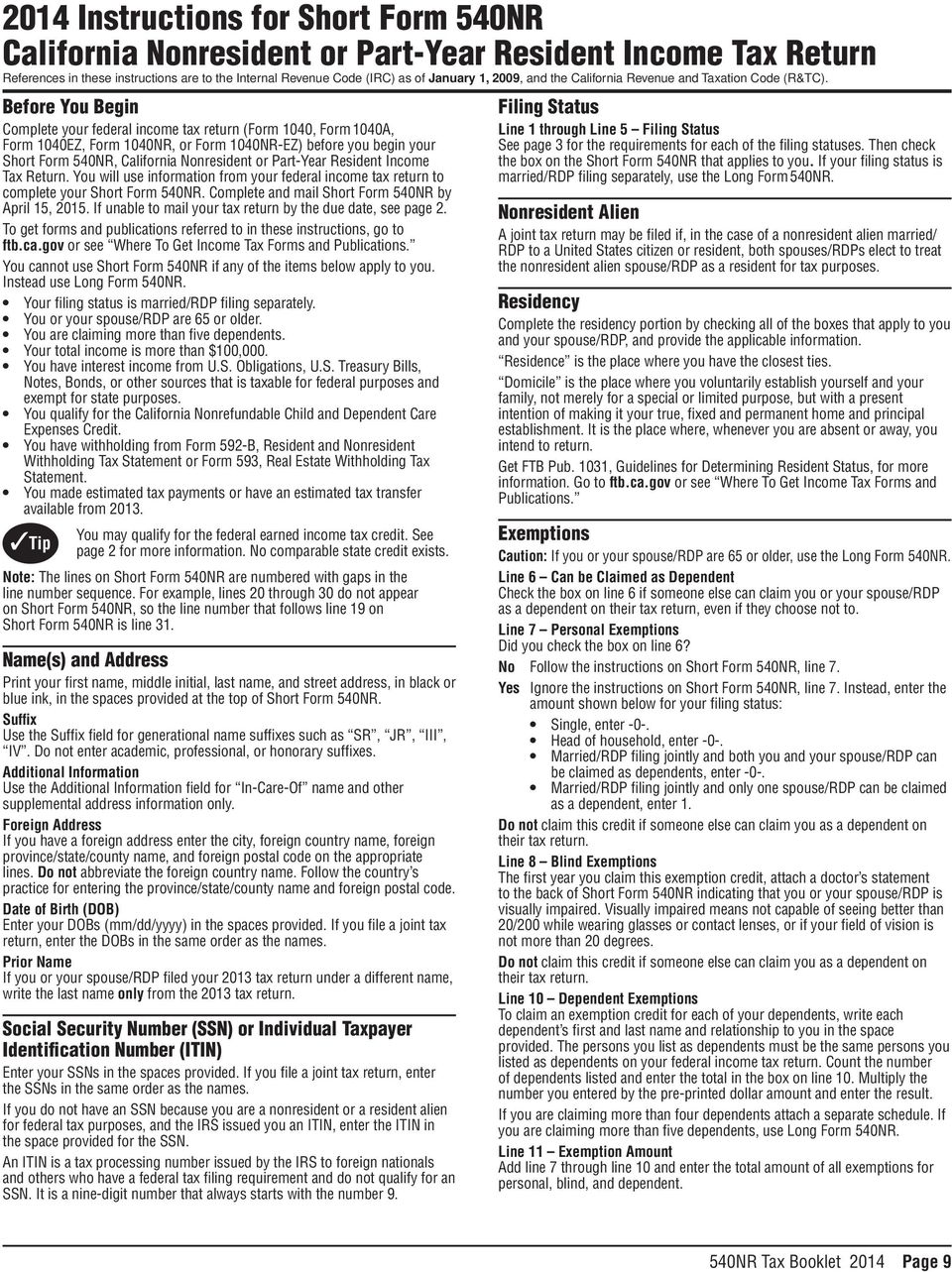
9 2014 Instructions for Short Form 540NR California Nonresident or Part-Year Resident Income Tax Return References in these instructions are to the Internal Revenue Code (IRC) as of January 1, 2009, and the California Revenue and Taxation Code (R&TC). Before You Begin Complete your federal income tax return (Form 1040, Form 1040A, Form 1040EZ, Form 1040NR, or Form 1040NR-EZ) before you begin your Short Form 540NR, California Nonresident or Part-Year Resident Income Tax Return. You will use information from your federal income tax return to complete your Short Form 540NR. Complete and mail Short Form 540NR by April 15, If unable to mail your tax return by the due date, see page 2. To get forms and publications referred to in these instructions, go to ftb.ca.gov or see Where To Get Income Tax Forms and Publications. You cannot use Short Form 540NR if any of the items below apply to you. Instead use Long Form 540NR. Your filing status is married/rdp filing separately. You or your spouse/rdp are 65 or older. You are claiming more than five dependents. Your total income is more than $100,000. You have interest income from U.S. Obligations, U.S. Treasury Bills, Notes, Bonds, or other sources that is taxable for federal purposes and exempt for state purposes. You qualify for the California Nonrefundable Child and Dependent Care Expenses Credit. You have withholding from Form 592-B, Resident and Nonresident Withholding Tax Statement or Form 593, Real Estate Withholding Tax Statement. You made estimated tax payments or have an estimated tax transfer available from Tip You may qualify for the federal earned income tax credit. See page 2 for more information. No comparable state credit exists. Note: The lines on Short Form 540NR are numbered with gaps in the line number sequence. For example, lines 20 through 30 do not appear on Short Form 540NR, so the line number that follows line 19 on Short Form 540NR is line 31. Name(s) and Address Print your first name, middle initial, last name, and street address, in black or blue ink, in the spaces provided at the top of Short Form 540NR. Suffix Use the Suffix field for generational name suffixes such as SR, JR, III, IV. Do not enter academic, professional, or honorary suffixes. Additional Information Use the Additional Information field for In-Care-Of name and other supplemental address information only. Foreign Address If you have a foreign address enter the city, foreign country name, foreign province/state/county name, and foreign postal code on the appropriate lines. Do not abbreviate the foreign country name. Follow the country s practice for entering the province/state/county name and foreign postal code. Date of Birth (DOB) Enter your DOBs (mm/dd/yyyy) in the spaces provided. If you file a joint tax return, enter the DOBs in the same order as the names. Prior Name If you or your spouse/rdp filed your 2013 tax return under a different name, write the last name only from the 2013 tax return. Social Security Number (SSN) or Individual Taxpayer Identification Number (ITIN) Enter your SSNs in the spaces provided. If you file a joint tax return, enter the SSNs in the same order as the names. If you do not have an SSN because you are a nonresident or a resident alien for federal tax purposes, and the IRS issued you an ITIN, enter the ITIN in the space provided for the SSN. An ITIN is a tax processing number issued by the IRS to foreign nationals and others who have a federal tax filing requirement and do not qualify for an SSN. It is a nine-digit number that always starts with the number 9. Filing Status Line 1 through Line 5 Filing Status See page 3 for the requirements for each of the filing statuses. Then check the box on the Short Form 540NR that applies to you. If your filing status is married/rdp filing separately, use the Long Form 540NR. Nonresident Alien A joint tax return may be filed if, in the case of a nonresident alien married/ RDP to a United States citizen or resident, both spouses/rdps elect to treat the nonresident alien spouse/rdp as a resident for tax purposes. Residency Complete the residency portion by checking all of the boxes that apply to you and your spouse/rdp, and provide the applicable information. Residence is the place where you have the closest ties. Domicile is the place where you voluntarily establish yourself and your family, not merely for a special or limited purpose, but with a present intention of making it your true, fixed and permanent home and principal establishment. It is the place where, whenever you are absent or away, you intend to return. Get FTB Pub. 1031, Guidelines for Determining Resident Status, for more information. Go to ftb.ca.gov or see Where To Get Income Tax Forms and Publications. Exemptions Caution: If you or your spouse/rdp are 65 or older, use the Long Form 540NR. Line 6 Can be Claimed as Dependent Check the box on line 6 if someone else can claim you or your spouse/rdp as a dependent on their tax return, even if they choose not to. Line 7 Personal Exemptions Did you check the box on line 6? No Follow the instructions on Short Form 540NR, line 7. Yes Ignore the instructions on Short Form 540NR, line 7. Instead, enter the amount shown below for your filing status: Single, enter -0-. Head of household, enter -0-. Married/RDP filing jointly and both you and your spouse/rdp can be claimed as dependents, enter -0-. Married/RDP filing jointly and only one spouse/rdp can be claimed as a dependent, enter 1. Do not claim this credit if someone else can claim you as a dependent on their tax return. Line 8 Blind Exemptions The first year you claim this exemption credit, attach a doctor s statement to the back of Short Form 540NR indicating that you or your spouse/rdp is visually impaired. Visually impaired means not capable of seeing better than 20/200 while wearing glasses or contact lenses, or if your field of vision is not more than 20 degrees. Do not claim this credit if someone else can claim you as a dependent on their tax return. Line 10 Dependent Exemptions To claim an exemption credit for each of your dependents, write each dependent s first and last name and relationship to you in the space provided. The persons you list as dependents must be the same persons you listed as dependents on your federal income tax return. Count the number of dependents listed and enter the total in the box on line 10. Multiply the number you entered by the pre-printed dollar amount and enter the result. If you are claiming more than four dependents attach a separate schedule. If you are claiming more than five dependents, use Long Form 540NR. Line 11 Exemption Amount Add line 7 through line 10 and enter the total amount of all exemptions for personal, blind, and dependent. 540NR Tax Booklet 2014 Page 9
10 Instructions: Short Form 540NR Total Taxable Income Refer to your completed federal income tax return to complete this section. If your total income from federal Form 1040, line 37; Form 1040A, line 21; Form 1040EZ, line 4; Form 1040NR, line 36; or Form 1040NR-EZ, line 10 is more than $100,000, you cannot file this form. File the Long Form 540NR. Line 12 Total California Wages Enter the total amount of your California wages from your Form(s) W 2, Wage and Tax Statement. This amount is reported on Form W-2, box 16. Line 14 California Adjustments To Income California does not tax unemployment compensation or Paid Family Leave Insurance benefits. Enter the total of any unemployment compensation and/ or Paid Family Leave Insurance benefits reported on federal Form(s) 1099-G, Certain Government Payments, and shown on your federal Form 1040EZ, line 3; Form 1040A, line 13; Form 1040, line 19; or Form 1040NR, line 20. If you have interest income from U.S. Obligations, U.S. Treasury Bills, Notes, Bonds, or other sources that is taxable for federal purposes and exempt for state purposes, you cannot file this form. File the Long Form 540NR. Military Pay Adjustment Compensation for military service of a servicemember domiciled outside of California is exempt from California tax. It is excluded from adjusted gross income. If you are an active duty military servicemember domiciled outside of California, your active duty military pay is excluded from adjusted gross income. To claim your adjustment, write MPA on the dotted line to the left of line 14. Add this amount to any unemployment compensation and/or Paid Family Leave Insurance benefits and enter on line 14. You will also exclude this amount from adjusted gross income on line 32. Attach a copy of your Form(s) W-2, reflecting your military compensation, to your tax return. See Assembling Your Tax Return. Line 18 California Standard Deduction Did you check the box on line 6? If yes, use the California Standard Deduction Worksheet for Dependents on page 19 of the Long Form 540NR instructions. If no, use the standard deduction amount for your filing status. California Taxable Income Tip e-file and you won t have to do the math. Go to ftb.ca.gov and search for efile. Line 31 Tax on Total Taxable Income Figure the tax on the amount on line 19 (see California tax table that begins on page 31). Use the correct filing status and taxable income amount. To automatically figure your tax or to verify your tax calculation, use our online tax calculator. Go to ftb.ca.gov and search for tax calculator. Line 32 CA Adjusted Gross Income If married/rdp filing jointly, each spouse/rdp reports income based on his or her residency status. Full-year nonresident Enter your California wages from Form(s) W-2, box 16. Part-year resident Enter your: California wages from Form(s) W-2, box 16. Non-California wages received while you were a California resident from Form(s) W-2, box 16. Interest income received while you were a California resident. Full-year resident Enter your: California and non-california wages from all your Form(s) W-2, box 16. All of your interest income. Line 36 CA Tax Rate In this computation, the Franchise Tax Board (FTB) rounds the tax rate to four digits after the decimal. If your computation is different, you may receive a notice due to the difference in rounding. Contact us at if you disagree with this notice. Line 38 CA Exemption Credit Percentage Divide the California Taxable Income (line 35) by Total Taxable Income (line 19). This percentage does not apply to the Nonrefundable Renter s Credit, Other State Tax Credit, or credits that are conditional upon a transaction occurring wholly within California. If more than 1, enter Credits Line 61 Nonrefundable Renter s Credit If you paid rent on your principal California residence in 2014, you may be Page NR Tax Booklet 2014 e-file at ftb.ca.gov eligible for a credit to reduce your tax. See Nonrefundable Renter s Credit Qualification Record to find out if you qualify. Nonrefundable Child and Dependent Care Expenses Credit You may be eligible for the California nonrefundable child and dependent care expenses credit. If you qualify for the credit, file the Long Form 540NR. See line 50 for more information. Payments Line 81 California Income Tax Withheld Enter your total California income tax withheld from your Form(s) W 2, box 17. Attach a copy of your Form(s) W-2, to your tax return. See Assembling Your Tax Return. Contributions You can make contributions to the funds listed on Short Form 540NR, Side 2. See Voluntary Contribution Fund Descriptions for more information. You may also contribute any amount to the State Parks Protection Fund/ Parks Pass Purchase. To receive a single annual park pass, your contribution must equal or exceed $195. When applicable, FTB will forward your name and address from your tax return to the Department of Parks and Recreation (DPR) who will issue a single Vehicle Day Use Annual Pass to you. Only one pass will be provided per tax return. You may contact DPR directly to purchase additional passes. If there is an error on your tax return in the computation of total contributions or if we disallow the contribution you requested because there is no credit available for the tax year, your name and address will not be forwarded to DPR. Any contribution less than $195 will be treated as a voluntary contribution and may be deducted as a charitable contribution. For more information go to parks.ca.gov/annualpass/ or [email protected]. Amount You Owe Line 121 Amount You Owe If you did not enter an amount on line 120, enter the amount from line 104 on line 121. This is the amount you owe with your Short Form 540NR. If you entered an amount on line 120, add line 104 and line 120. Enter the total on line 121. This is the amount you owe with your Short Form 540NR. If you have an amount on line 103 and line 120, subtract line 120 from line 103. If line 120 is more than line 103 enter the difference on line 121. This is the amount you owe with your Short Form 540NR. Web Pay Pay the amount you owe using our secure online payment service. Go to ftb.ca.gov for more information. Using black or blue ink, make your check or money order payable to the Franchise Tax Board for this amount, or see Paying Your Taxes. Do not send cash. Write your SSN or ITIN and 2014 Short Form 540NR on the check or money order. Make all checks or money orders payable in U.S. dollars and drawn against a U.S. financial institution. Enclose, but do not staple, your payment with your return. To avoid a late filing penalty, file your Short Form 540NR by the due date even if unable to pay the amount you owe. Refund and Direct Deposit Line 125 Refund or No Amount Due If you did not enter an amount on line 120, enter the amount from line 103. If you entered an amount on line 120, subtract that amount from the amount on line 103. If the result is zero or more, enter the amount on line 125. If the result is less than zero, your contributions are more than your overpaid tax available on line 103. In this case, do not enter an amount on line 125. Enter the result on line 121 and see the instructions for line 121. Line 126 and Line 127 Direct Deposit of Refund Direct deposit is fast, safe, and convenient. To have your refund directly deposited into your bank account, fill in the account information on Short Form 540NR, Side 3, line 126 and line 127. Fill in the routing and account numbers and indicate the account type. Verify routing and account numbers with your financial institution. See the illustration below. Do not attach a voided check or deposit slip. Individual taxpayers may request that their refund be electronically deposited into more than one checking or savings account. This allows more options for managing your refund. For example, you can request part of your refund go to your checking account to use now and the rest to your savings account to save for later.

11 e-file is fast, easy, and secure! The routing number must be nine digits. The first two digits must be 01 through 12 or 21 through 32. On the sample check, the routing number is The account number can be up to 17 characters and can include numbers and letters. Include hyphens, but omit spaces and special symbols. On the sample check, the account number is Check the appropriate box for the type of account. Do not check more than one box for each line. Enter the portion of your refund you want directly deposited into each account. Each deposit must be at least $1. The total of line 126 and line 127 must equal the total amount of your refund on line 125. If line 126 and line 127 do not equal line 125, the FTB will issue a paper check. Caution: Check with your financial institution to make sure your deposit will be accepted and to get the correct routing and account numbers. The FTB is not responsible for a lost refund due to incorrect account information entered by you or your representative. Some financial institutions will not allow a joint refund to be deposited to an individual account. If the direct deposit is rejected, the FTB will issue a paper check. John Doe Mary Doe 1234 Main Street Anytown, CA PAY TO THE ORDER OF ANYTOWN BANK Anytown, CA For Routing number Account number I : I : $ Do not include the check number DOLLARS /0000 Direct Deposit for ScholarShare 529 College Savings Plans If you have a ScholarShare 529 College Savings Plan account maintained by the ScholarShare Investment Board, you may have your refund directly deposited to your ScholarShare account. Fill in the routing number, account type and account number. To obtain the nine-digit routing number go to scholarshare.com or call Check Savings as type of account. Enter your complete account number that includes (1) the CA prefix, (2) your four-digit investment portfolio number, and (3) your ScholarShare account number (for account numbers less than 11 digits, add leading zeros). Type Routing number Checking Account number X X X X X X X X X C A X X X X 0 0 X X X X X X X X X Savings 9-digit routing number from ScholarShare website (1) CA prefix (2) investment portfolio number (3) ScholarShare account number with leading zeroes Sign Your Tax Return Sign your tax return in the designated space on Side 3. If you file a joint tax return, your spouse/rdp must sign the tax return also. Include your phone number and address in case the FTB needs to contact you for information needed to process your tax return. By providing this information the FTB will be able to process your tax return or issue your refund faster. Joint Tax Return. If you file a joint tax return, both you and your spouse/rdp are generally responsible for the tax and any interest or penalties due on the tax return. If one spouse/rdp neglects to pay the tax, the other spouse/rdp may have to pay. See Innocent Joint Filer Relief for more information. Paid Preparer Information. If you pay a person to prepare your Short Form 540NR, that person signs and completes the area near the bottom of Side 3 including an identification number. Effective January 1, 2011, the IRS requires a paid tax preparer to get and use a preparer tax identification number (PTIN). If the preparer has a federal employer identification number (FEIN), it should be entered only in the space provided. A paid preparer must give you a copy of your tax return. Instructions: Short Form 540NR Third Party Designee. If you want to allow your preparer, a friend, family member, or any other person you choose to discuss your 2014 tax return with the FTB, check the Yes box in the signature area of your tax return. Also print the designee s name and telephone number. If you check the Yes box, you and your spouse/rdp, if filing a joint tax return, are authorizing the FTB to call the designee to answer any questions that may arise during the processing of your tax return. You are also authorizing the designee to: Give the FTB any information that is missing from your tax return. Call the FTB for information about the processing of your tax return or the status of your refund or payments. Receive copies of notices or transcripts related to your tax return, upon request. Respond to certain FTB notices about math errors, offsets, and tax return preparation. You are not authorizing the designee to receive any refund check, bind you to anything (including any additional tax liability), or otherwise represent you before the FTB. If you want to expand or change the designee s authorization, get form FTB 3520, Power of Attorney Declaration for the Franchise Tax Board. The authorization will automatically end no later than the due date (without regard to extensions) for filing your 2015 tax return. This is April 15, 2016, for most people. If you wish to revoke the authorization before it ends, notify us by telephone at or by writing to Franchise Tax Board, PO Box , Sacramento, CA , include your name, SSN, and the designee s name. Power of Attorney. If another person prepared your tax return, he or she is not automatically granted access to your tax information in future dealings with us. At some point, you may wish to designate someone to act on your behalf in matters related or unrelated to your 2014 tax return (e.g., an audit examination). To protect your privacy, you must submit to us a legal document called a Power of Attorney (POA) authorizing another person to discuss or receive personal information about your income tax records. For more information, get form FTB 3520 at ftb.ca.gov or see Where To Get Income Tax Forms and Publications. Assembling Your Tax Return Assemble your tax return in the order shown below. Enclose, but do not staple, any payment. W Short Form 540NR Short Form 540NR Short Form 540NR Side 1 Side 2 Side 3 Make sure to attach all federal Form(s) W-2 and 1099 you received to the front of your tax return. Do not attach a copy of your federal tax return or any other document to your Short Form 540NR unless specifically instructed. This will help us reduce government processing and storage costs. Mailing Your Tax Return If you owe, mail your tax return to: FRANCHISE TAX BOARD PO BOX SACRAMENTO CA If you have a refund, or if no amount due, mail your tax return to: FRANCHISE TAX BOARD PO BOX SACRAMENTO CA NR Tax Booklet 2014 Page 11

12 THIS PAGE INTENTIONALLY LEFT BLANK Visit our website: ftb.ca.gov Page NR Tax Booklet 2014

13 TAXABLE YEAR 2014 California Nonresident or Part-Year Resident Income Tax Return Your first name Initial Last name Suffix Your SSN or ITIN If joint tax return, spouse s/rdp s first name Initial Last name Suffix Spouse s/rdp s SSN or ITIN Additional Information (See instructions) Short Form - - FORM 540NR - - PBA Code A R RP Street address (Number and street) or PO Box Apt. no./ste. no. PMB/Private Mailbox City (If you have a foreign address, see instructions) State ZIP Code Foreign Country Name Foreign Province/State/County Foreign Postal Code - Date of Birth Your DOB (mm/dd/yyyy) / / Spouse s/rdp s DOB (mm/dd/yyyy) / / Prior Name Filing Status Residency If you filed your 2013 tax return under a different last name, write the last name only from the 2013 tax return. Taxpayer Spouse/RDP 1 Single 4 Head of household (with qualifying person). See instructions. 2 Married/RDP filing jointly. See inst. 5 Qualifying widow(er) with dependent child. Enter year spouse/rdp died If your California filing status is different from your federal filing status, check the box here... State of residence: Yourself Spouse/RDP Dates of California residency: Yourself from to Spouse/RDP from to State or country of domicile: Yourself Spouse/RDP 6 If someone can claim you (or your spouse/rdp) as a dependent, check the box here. See inst... 6 emptions Ex For line 7, line 8, and line 10: Multiply the amount you enter in the box by the pre-printed dollar amount for that line. Whole dollars only 7 Personal: If you checked box 1 or 4 above, enter 1 in the box. If you checked box 2 or 5, enter 2 in the box. If you checked the box on line 6, see instructions X $108 = $ 8 Blind: If you (or your spouse/rdp) are visually impaired, enter 1; if both are visually impaired, enter 2. 8 X $108 = $ 10 Dependents: Do not include yourself or your spouse/rdp. First name Last name Dependent s relationship to you Total dependent exemptions X $333 = $ 11 Exemption amount: Add line 7 through line $ T otal T axab le Income 12 Total California wages from your Form(s) W-2, box Enter federal adjusted gross income from Form 1040, line 37; Form 1040A, line 21; Form 1040EZ, line 4; Form 1040NR, line 36; or Form 1040NR-EZ, line If the amount on line 13 is more than $100,000, stop here and use Long Form 540NR. 14 Unemployment compensation and military pay adjustment. See instructions Adjusted gross income from all sources. Subtract line 14 from line Standard deduction for your filing status. If you checked the box on line 6, see instructions. Single... $3,992 Married/RDP filing jointly, Head of household, or Qualifying widow(er)... $7, Subtract line 18 from line 17. This is your total taxable income. If less than zero, enter For Privacy Notice, get FTB 1131 ENG/SP Short Form 540NR C Side 1

14 Your name: Your SSN or ITIN: 31 Tax on the amount shown on line 19, see line 31 instructions CA adjusted gross income. Add wages from line 12 and California taxable interest (Form 1099, box 1). Military servicemembers see line 14 instructions Calif ornia T axable Income 33 CA Standard Deduction Percentage. Divide line 32 by line 17. If more than 1, enter CA Prorated Standard Deduction. Multiply line 18 by line CA Taxable Income. Subtract line 34 from line 32. If less than zero, enter CA Tax Rate. Divide line 31 by line CA Tax Before Exemption Credits. Multiply line 35 by line CA Exemption Credit Percentage. Divide line 35 by line 19. If more than 1, enter CA Prorated Exemption Credits. Multiply line 11 by line CA Regular Tax Before Credits. Subtract line 39 from line 37. If less than zero, enter Nonrefundable Renter s Credit 61 Nonrefundable renter s credit. See instructions Total tax. Subtract line 61 from line 42. If less than zero, enter yments a P 81 California income tax withheld (Form(s) W-2, box 17) Overpaid Tax or Tax Due 103 Overpaid tax. If line 81 is larger than line 74, subtract line 74 from line Tax due. If line 81 is less than line 74, subtract line 81 from line utions Contrib Code Amount Code Amount Alzheimer s Disease/Related Disorders Fund Child Victims of Human Trafficking Fund Rare and Endangered Species School Supplies for Homeless Children Fund Preservation Program State Parks Protection Fund/Parks Pass Purchase California Breast Cancer Research Fund Protect Our Coast and Oceans Fund California Firefighters Memorial Fund Keep Arts in Schools Fund Emergency Food for Families Fund American Red Cross, California Chapters Fund California Peace Officer Memorial California Senior Legislature Fund Foundation Fund Habitat for Humanity Fund California Sea Otter Fund California Sexual Violence Victim Services Fund California Cancer Research Fund Add code 401 through code 429. This is your total contribution Side 2 Short Form 540NR C

15 Your name: Your SSN or ITIN: Amount You Owe 121 AMOUNT YOU OWE. Add line 104 and line 120. See instructions. Do Not Send Cash. Mail to: FRANCHISE TAX BOARD, PO BOX , SACRAMENTO CA Pay Online Go to ftb.ca.gov for more information.,,. 00 Refund and Direct Deposit 125 REFUND OR NO AMOUNT DUE. Subtract line 120 from line Mail to: FRANCHISE TAX BOARD PO BOX SACRAMENTO CA Fill in the information to authorize direct deposit of your refund into one or two accounts. Do not attach a voided check or a deposit slip. See instructions Have you verified the routing and account numbers? Use whole dollars only. All or the following amount of my refund (line 125) is authorized for direct deposit into the account shown below: Checking Savings Routing number Type Account number 126 Direct deposit amount The remaining amount of my refund (line 125) is authorized for direct deposit into the account shown below: Checking Savings,,. 00,,. 00,,. 00 Routing number Type Account number 127 Direct deposit amount Under penalties of perjury, I declare that I have examined this tax return, including accompanying schedules and statements, and to the best of my knowledge and belief, it is true, correct, and complete. Your signature Date Spouse s/rdp s signature (if a joint tax return, both must sign) X Sign Here It is unlawful to forge a spouse s/rdp s signature. Joint tax return? (See instructions) Your address (optional). Enter only one address. Daytime phone number (optional) ( ) Paid preparer s signature (declaration of preparer is based on all information of which preparer has any knowledge) Firm s name (or yours, if self-employed) PTIN Firm s address FEIN X Do you want to allow another person to discuss this tax return with us? See instructions.... m Yes m No Print Third Party Designee s Name Telephone Number ( ) For Privacy Notice, get FTB 1131 ENG/SP Short Form 540NR C Side 3

16 THIS PAGE INTENTIONALLY LEFT BLANK Visit our website: ftb.ca.gov Page NR Tax Booklet 2014

17 2014 Instructions for Long Form 540NR California Nonresident or Part-Year Resident Income Tax Return References in these instructions are to the Internal Revenue Code (IRC) as of January 1, 2009, and the California Revenue and Taxation Code (R&TC). Before You Begin Complete your federal income tax return (Form 1040, Form 1040A, Form 1040EZ, Form 1040NR, or Form 1040NR-EZ) before you begin your Long Form 540NR, California Nonresident or Part-Year Resident Income Tax Return. Use information from your federal income tax return to complete your Long Form 540NR. Complete and mail Long Form 540NR by April 15, If unable to mail your return by the due date see page 2. To get forms and publications referred to in these instructions, go to ftb.ca.gov or see Where To Get Income Tax Forms and Publications. Tip You may qualify for the federal earned income tax credit. See page 2 for more information. No comparable state credit exists. Note: The lines on Long Form 540NR are numbered with gaps in the line number sequence. For example, lines 20 through 30 do not appear on Long Form 540NR. So the line number that follows line 19 on Long Form 540NR is line 31. Caution: Long Form 540NR has three sides. If filing Long Form 540NR, you must send all three sides to the Franchise Tax Board (FTB). Filling in Your Return Use black or blue ink on the tax return you send to the FTB. Enter your Social Security Number(s) (SSN) or Individual Taxpayer Identification Number(s) (ITIN) at the top of Long Form 540NR, Side 1. Print numbers and CAPITAL LETTERS between the combed lines. Be sure to line up dollar amounts. If you do not have an entry for a line, leave it blank unless the instructions for a line specifically tell you to enter zero. Do not enter a dash or the word NONE. Name(s) and Address Print your first name, middle initial, last name, and street address in the spaces provided at the top of Long Form 540NR. Suffix Use the Suffix field for generational name suffixes such as SR, JR, III, IV. Do not enter academic, professional, or honorary suffixes. Additional Information Use the Additional Information field for In-Care-of name and other supplemental address information only. Foreign Address If you have a foreign address enter the city, foreign country name, foreign province/state/county name, and foreign postal code on the appropriate line. Do not abbreviate the foreign country name. Follow the country s practice for entering the province/state/county name and foreign postal code. Principal Business Activity (PBA) Code For federal Schedule C (Form 1040), Profit or Loss From Business (Sole Proprietorship) business filers, enter the numeric PBA code from federal Schedule C (Form 1040), line B. Date of Birth (DOB) Enter your DOBs (mm/dd/yyyy) in the spaces provided. If your filing status is married/rdp filing jointly or married/rdp filing separately, enter the DOBs in the same order as the names. Prior Name If you or your spouse/rdp filed your 2013 tax return under a different last name, write the last name only from the 2013 tax return. Social Security Number (SSN) or Individual Taxpayer Identification Number (ITIN) Enter your SSNs in the spaces provided. If you file a joint tax return, enter the SSNs in the same order as the names. If you do not have an SSN because you are a nonresident or a resident alien for federal tax purposes, and the Internal Revenue Service (IRS) issued you an ITIN, enter the ITIN in the space provided for the SSN. An ITIN is a tax processing number issued by the IRS to foreign nationals and others who have a federal tax filing requirement and do not qualify for an SSN. It is a nine-digit number that always starts with the number 9. Filing Status Check only one box for line 1 through line 5. Enter the required additional information if you checked the box on line 3 or line 5. For filing status requirements, see page 3. Usually, your California filing status must be the same as the filing status you used on your federal income tax return. Exception for Married Taxpayers Who File a Joint Federal Income Tax Return You may file separate California returns if either spouse was: An active member of the United States Armed Forces or any auxiliary military branch during A nonresident for the entire year and had no income from California sources during Community Property. If either spouse earned California source income while domiciled in a community property state, the community income will be split equally between the spouses. Both spouses will have California source income and they will not qualify for the nonresident spouse exception. For more information, get FTB Pub. 1031, Guidelines for Determining Resident Status, and FTB Pub. 1051A, Guidelines For Married/RDP Filing Separate Returns. If you did not file a federal tax return because you did not have a federal filing requirement, use the filing status you would have used had you been required to file. Registered domestic partners (RDPs) who file single for federal must file married/rdp filing jointly or married/rdp filing separately for California. If you are an RDP and file head of household for federal purposes, you may file head of household for California purposes only if you meet the requirements to be considered unmarried or considered not in a domestic partnership. Nonresident Alien A joint tax return may be filed if, in the case of a nonresident alien married to a United States citizen or resident, both spouses/rdps elect to treat the nonresident alien spouse/rdp as a resident for tax purposes. If You Filed Federal Form 1040NR or Form 1040NR-EZ, you do not qualify to use the head of household or married/rdp filing jointly filing statuses. Instead, use single, married/rdp filing separately, or qualifying widow(er) filing status, whichever applies to you. If You File as Head of Household, do not claim yourself or a nonrelative as the qualifying individual for head of household. Get FTB Pub. 1540, California Head of Household Filing Status, for more information. See Where To Get Income Tax Forms and Publications. Exemptions Line 6 Can be Claimed as a Dependent Check the box on line 6 if someone else can claim you or your spouse/rdp as a dependent on their tax return, even if they chose not to. Line 7 Personal Exemptions Did you check the box on line 6? No Follow the instructions on Long Form 540NR, line 7. Yes Ignore the instructions on Long Form 540NR, line 7. Instead, enter the amount shown below for your filing status: Single or married/rdp filing separately, enter -0-. Head of household, enter -0-. Married/RDP filing jointly and both you and your spouse/rdp can be claimed as dependents, enter -0-. Married/RDP filing jointly and only one spouse/rdp can be claimed as a dependent, enter 1. Do not claim this credit if someone else can claim you as a dependent on their tax return. 540NR Tax Booklet 2014 Page 17

18 Instructions: Long Form 540NR Line 8 Blind Exemptions The first year you claim this exemption credit, attach a doctor s statement to the back of Long Form 540NR indicating that you or your spouse/rdp is visually impaired. Visually impaired means not capable of seeing better than 20/200 while wearing glasses or contact lenses, or if your field of vision is not more than 20 degrees. Do not claim this credit if someone else can claim you as a dependent on their tax return. Line 9 Senior Exemptions If you were 65 years of age or older by December 31, 2014*, you should claim an additional exemption credit on line 9. If you are married or an RDP, each spouse/rdp 65 years of age or older should claim an additional credit. You may contribute all or part of this credit to the California Seniors Special Fund. See Voluntary Contribution Fund Descriptions for more information. * If your 65th birthday is on January 1, 2015, you are considered to be age 65 on December 31, Do not claim this credit if someone else can claim you as a dependent on their tax return. Line 10 Dependent Exemptions To claim an exemption credit for each of your dependents, write each dependent s first and last name and relationship to you in the space provided. If you are claiming more than four dependents, attach a statement with the required dependent information to your tax return. The persons you list as dependents must be the same persons you listed as dependents on your federal income tax return. Count the number of dependents listed and enter the total in the box on line 10. Multiply the number you entered by the pre printed dollar amount and enter the result. Line 11 Exemption Amount Add line 7 through line 10 and enter the total dollar amount of all exemptions for personal, blind, senior, and dependent. Total Taxable Income Refer to your completed federal income tax return to complete this section. Line 12 California Wages Enter the total amount of your California wages from your Form(s) W 2, Wage and Tax Statement. This amount appears on Form W-2, box 16. Line 13 Federal AGI from Form 1040, line 37; 1040A, line 21; 1040EZ, line 4; 1040NR, line 36; or 1040NR-EZ, line 10 Registered domestic partners (RDPs) who file a California tax return as married/rdp filing jointly and have no RDP adjustments between federal and California, combine their individual AGIs from their federal tax returns filed with the IRS. Enter the combined AGI on Long Form 540NR, line 13. RDP adjustments include but are not limited to the following: Transfer of property between spouses/rdps Capital loss Transactions between spouses/rdps Sale of residence Dependent care assistance Investment interest Qualified residence interest acquisition loan & equity loan Expense depreciation property limits Individual Retirement Account Interest education loan Rental real estate passive loss Rollover of publicly traded securities gain into specialized small business investment companies RDPs filing as married/rdp filing separately, former RDPs filing separately, and RDPs with RDP adjustments will use the California RDP Adjustments Worksheet in FTB Pub. 737, Tax Information for Registered Domestic Partners, or complete a federal pro forma Form Transfer the amount from the California RDP Adjustments Worksheet, line 37, column D, or federal pro forma Form 1040, line 37, to Long Form 540NR, line 13. e-file at ftb.ca.gov Line 14 California Adjustments Subtractions (from Schedule CA (540NR), line 37, column B) Complete Schedule CA (540NR), California Adjustments Nonresidents or Part Year Residents, to find the amount to enter on Long Form 540NR, line 14. Follow the instructions for Schedule CA (540NR). Enter the amount from Schedule CA (540NR), line 37, column B on Long Form 540NR, line 14. If the amount on Schedule CA (540NR) line 37, column B is a negative number, do not transfer it to Long Form 540NR, line 14 as a negative number. Instead, transfer the number as a positive number to Long Form 540NR, line 16. Line 15 Subtotal Subtract the amount on line 14 from the amount on line 13. Enter the result on line 15. If the amount on line 13 is less than zero, combine the amounts on line 13 and line 14 and enter the amount in parentheses. For example: (12,325). Line 16 California Adjustments Additions (from Schedule CA (540NR), line 37, column C) Complete Schedule CA (540NR), to find the amount to enter on Long Form 540NR, line 16. Follow the instructions for Schedule CA (540NR). Enter the amount from Schedule CA (540NR), line 37, column C on Long Form 540NR, line 16. If the amount on Schedule CA (540NR) line 37, column C is a negative number, do not transfer it to Long Form 540NR, line 16 as a negative number. Instead, transfer the number as a positive number to Long Form 540NR, line 14. Line 17 Adjusted Gross Income From All Sources Combine line 15 and line 16. This amount should match the amount on Schedule CA (540NR), line 37, column D. Line 18 California Itemized Deductions or California Standard Deduction Decide whether to itemize your deductions, such as charitable contributions, medical expenses, etc., or take the standard deduction. Your California income tax will be less if you take the larger of your California: Itemized deductions (total itemized deductions allowed under California law). Standard deduction. On federal tax returns, individual taxpayers who claim the standard deduction are allowed an additional deduction for net disaster losses. For California, deductions for disaster losses are only allowed for those individual taxpayers who itemized their deductions. If married or an RDP and filing separate Long Form 540NR, you and your spouse/rdp must either both itemize your deductions (even if the itemized deductions of one spouse/rdp are less than the standard deduction) or both take the standard deduction. Also, if someone else can claim you as a dependent, you may claim the greater of the standard deduction or your itemized deductions. To figure your standard deduction, see the California Standard Deduction Worksheet for Dependents. Itemized Deductions. Figure your California itemized deductions by completing Schedule CA (540NR), Part III, line 38 through line 44. Enter the result on Long Form 540NR, line 18. If you did not itemize deductions on your federal income tax return but will itemize deductions for your Long Form 540NR, first complete federal Schedule A (Form 1040), Itemized Deductions. Then complete Schedule CA (540NR), Part III, line 38 through line 44. Standard Deduction. Find your standard deduction on the California Standard Deduction Chart for Most People. If you checked the box on Long Form 540NR, line 6, use the California Standard Deduction Worksheet for Dependents, instead. Page NR Tax Booklet 2014

19 e-file is fast, easy, and secure! California Standard Deduction Chart for Most People Do not use this chart if your parent, or someone else, can claim you (or your spouse/rdp) as a dependent on their tax return. Your Filing Status Enter On Line 18 1 Single.... $3,992 2 Married/RDP filing jointly... $7,984 3 Married/RDP filing separately.... $3,992 4 Head of household... $7,984 5 Qualifying widow(er)... $7,984 The California standard deduction amounts are less than the federal standard deduction amounts. California Standard Deduction Worksheet for Dependents Use this worksheet only if your parent, or someone else, can claim you (or your spouse/rdp) as a dependent on their tax return. Use whole dollars only. 1. Enter your earned income from: line 1 of the Standard Deduction Worksheet for Dependents in the instructions for federal Form 1040; Form 1040A; or from line A of the worksheet on the back of Form 1040EZ Minimum standard deduction... 2 $1, Enter the larger of line 1 or line 2 here Enter the amount shown for your filing status: Single or married/rdp filing separately, } enter $3,992 4 Married/RDP filing jointly, head of household, or qualifying widow(er), enter $7, Standard deduction. Enter the smaller of line 3 or line 4 here and on the Short or Long Form 540NR, line Line 19 Taxable Income Capital Construction Fund (CCF). If you claim a deduction on your federal Form 1040, line 43 for a contribution made to a CCF set up under the Merchant Marine Act of 1936, reduce the amount you would otherwise enter on line 19 by the amount of the deduction. Next to line 19, enter CCF and the amount of the deduction. For details, see federal Publication 595, Capital Construction Fund for Commercial Fishermen. California Taxable Income When you figure your tax, use the correct filing status and taxable income amount. Line 31 Tax Tip e-file and you won t have to do the math. Go to ftb.ca.gov and search for efile. To figure your tax on the amount on line 19, use one of the following methods and check the matching box on line 31: Tax Table. If your taxable income on line 19 is $100,000 or less, use the tax table beginning on page 31. Use the correct filing status column in the tax table. Tax Rate Schedules. If your taxable income on line 19 is over $100,000, use the tax rate schedules on page 36. FTB Generally, you use form FTB 3800, Tax Computation for Certain Children with Investment Income, to figure the tax on a separate Long Form 540NR for your child who was 18 and under or a student under age 24 on January 1, 2015, and who had more than $2,000 of investment income. Attach form FTB 3800 to the child s Long Form 540NR. FTB If, as a parent, you elect to report your child s interest and dividend income of $10,000 or less (but not less than $1,000) on your return, complete form FTB 3803, Parents Election to Report Child s Interest and Dividends. File a separate form FTB 3803 for each child whose income you elect to include on your Long Form 540NR. Add the amount of tax, if any, from each form FTB 3803, line 9, to the amount of your tax from the tax table or tax rate schedules and enter the result on Long Form 540NR, line 31. Attach form(s) FTB 3803 to your return. Instructions: Long Form 540NR To prevent possible delays in processing your tax return or refund, enter the correct tax amount on this line. To automatically figure your tax or to verify your tax calculation, use our online tax calculator. Go to ftb.ca.gov and search for tax calculator. Line 32 CA Adjusted Gross Income Complete Schedule CA (540NR), line 45 to determine your California adjusted gross income. Follow the instructions for Schedule CA (540NR). Enter on Long Form 540NR, line 32 the amount from Schedule CA (540NR), line 45. Line 36 CA Tax Rate In this computation, the FTB rounds the tax rate to four digits after the decimal. If your computation is different, you may receive a notice due to the difference in rounding. Contact us at if you disagree with this notice. Line 38 CA Exemption Credit Percentage Divide the California Taxable Income (line 35) by Total Taxable Income (line 19). This percentage does not apply to the Nonrefundable Renter s Credit, Nonrefundable Child and Dependent Care Expenses Credit, Other State Tax Credit, or credits that are conditional upon a transaction occurring wholly within California. If more than 1, enter Line 39 CA Prorated Exemption Credits Use your exemption credits to reduce your tax. If your federal adjusted gross income (AGI) on line 13 is more than the amount listed below for your filing status, your credits will be limited. Is Long Form 540NR, If your filing status is: line 13 more than: Single or married/rdp filing separately...$176,413 Married/RDP filing jointly or qualifying widow(er)...$352,830 Head of household...$264,623 Yes...Complete the AGI Limitation Worksheet below. No Multiply line 11 by line 38. AGI Limitation Worksheet Use whole dollars only a Enter the amount from Long Form 540NR, line a b Enter the amount for your filing status on line b: Single or married/rdp filing separately $176,413 } Married/RDP filing jointly or b qualifying widow(er)...$352,830 Head of household...$264,623 c Subtract line b from line a...c d Divide line c by $2,500 ($1,250 if married/rdp filing separately). If the result is not a whole number, round it to the next higher whole number...d e f Multiply line d by $6....e Add the numbers from the boxes on Long Form 540NR, line 7, line 8, and line 9 (not the dollar amounts)...f g Multiply line e by line f...g h Add the total dollar amounts from Long Form 540NR, line 7, line 8, and line 9....h i j k l Subtract line g from line h. If zero or less enter i Enter the number from the box on Long Form 540NR, line 10 (not the dollar amount)....j Multiply line e by line j...k Enter the dollar amount from Long Form 540NR, line 10...l m Subtract line k from line l. If zero or less, enter m n Add line i and line m. Enter the result here....n o Multiply the amount on line n by the CA Exemption Credit Percentage on Long Form 540NR, line 38. Enter the result here and on Long Form 540NR, line 39...o 540NR Tax Booklet 2014 Page 19

20 Instructions: Long Form 540NR Line 41 Tax from Schedule G-1 and Form FTB 5870A If you received a qualified lump-sum distribution in 2014 and you were born before January 2, 1936, get Schedule G-1, Tax on Lump-Sum Distributions, to figure your tax by special methods that may result in less tax. If you received accumulation distributions from foreign trusts or from certain domestic trusts, get form FTB 5870A, Tax on Accumulation Distribution of Trusts, to figure the additional tax. To get these forms, see Order Forms and Publications. Special Credits and Nonrefundable Credits A variety of California tax credits are available to reduce your tax if you qualify. To figure and claim most special credits, you must complete a separate form or schedule and attach it to your Long Form 540NR. The Credit Chart on page 60 describes the credits and provides the name, credit code, and number of the required form or schedule. Many credits are limited to a certain percentage or a certain dollar amount. In addition, the total amount you may claim for all credits is limited by tentative minimum tax (TMT); go to Box A to see if your credits are limited. If you are not claiming any other special credits go to line 50 and line 61 to see if you qualify for the nonrefundable child and dependent care expenses credit or the nonrefundable renter s credit. Box A Did you complete federal Schedule C, D, E, or F and claim or receive any of the following (Note: If your business gross receipts are less than $1,000,000 from all trades or businesses, you do not have to report AMT. For more information, see line 71 instructions.): Accelerated depreciation in excess of straight-line Intangible drilling costs Depletion Circulation expenditures Research and experimental expenditures Mining exploration/development costs Amortization of pollution control facilities Income/loss from tax shelter farm activities Income/loss from passive activities Income from long-term contracts using the percentage of completion method Pass-through AMT adjustment from an estate or trust reported on Schedule K-1 (541) Yes Get and complete Schedule P (540NR). See Order Forms and Publications. No Go to Box B. Box B Did you claim or receive any of the following: Investment interest expense 226 Income from incentive stock options in excess of the amount reported on your return 225 Income from installment sales of certain property Yes Get and complete Schedule P (540NR). See Order Forms and Publications. No Go to Box C. Is Long Form 540NR, Box C If your filing status is: line 17 more than: Single or head of household...$243,288 Married/RDP filing jointly or qualifying widow(er)...$324,384 Married/RDP filing separately...$162,191 Yes Get and complete Schedule P (540NR). See Order Forms and Publications. No Your credits are not limited. e-file at ftb.ca.gov Line 50 Nonrefundable Child and Dependent Care Expenses Credit Claim this credit if you paid someone to care for your child under the age of 13, other dependent who is physically or mentally incapable of caring for him or herself, or spouse/rdp if physically or mentally incapable of caring for him or herself. To claim this credit, your federal adjusted gross income must be $100,000 or less. Complete and attach form FTB 3506, Child and Dependent Care Expenses Credit. See Where To Get Income Tax Forms and Publications. The care must have been provided in California. You must have Californiasourced income (wages earned working in California or self-employment income from California business activities). A servicemember s active duty military pay is considered earned income, regardless of whether the servicemember is domiciled in California. Get FTB Pub. 1032, Tax Information for Military Personnel, for more information. Schedule P (540NR) If you need to complete Schedule P (540NR) and you claim any of the credits on line 51 through line 53, do not enter an amount on line 51 through line 53. Instead, enter the total amount of these credits from Schedule P (540NR), Part III, Section B1, line 14 through line 16, on Long Form 540NR, line 55. Do not follow the instructions for line 55. Write Schedule P (540NR) to the left of the amount entered on line 55. Line 51 Credit for Joint Custody Head of Household Code 170 You may not claim this credit if you used the head of household, married/ RDP filing jointly, or the qualifying widow(er) filing status. Claim the credit if unmarried and not an RDP at the end of 2014 (or if married or an RDP, you lived apart from your spouse/rdp for all of 2014 and you used the married/rdp filing separately filing status); and if you furnished more than one-half the household expenses for your home that also served as the main home of your child, step-child, or grandchild for at least 146 days but not more than 219 days of your taxable year. If the child is married or an RDP, you must be entitled to claim a dependent exemption for the child. Also, the custody arrangement for the child must be part of a decree of dissolution or legal separation or part of a written agreement between the parents where the proceedings have been initiated, but a decree of dissolution or legal separation has not yet been issued. If your Federal AGI is more than $176,413, subtract line n from the AGI Limitation Worksheet on page 19 from line 31 of the Long Form 540NR and enter this amount on line 1 of the worksheet below to calculate your credit. Use the worksheet below to figure this credit using whole dollars only: 1. Subtract line 11 from line 31 on Long Form 540NR and enter the result here Enter the amount from Long Form 540NR, line Add line 1 and line Credit percentage 30% x Credit amount. Multiply line 3 by line 4. Enter on this line the result or $425, whichever is less. Enter this amount on Long Form 540NR, line If you qualify for both the Credit for Joint Custody Head of Household and the Credit for Dependent Parent, you are only allowed to claim one or the other, not both. Select the credit that will allow the maximum benefit. Line 52 Credit for Dependent Parent Code 173 You may not claim this credit if you used the single, head of household, qualifying widow(er), or married/rdp filing jointly filing status. Claim this credit only if all of the following apply: You were married or an RDP at the end of 2014 and you used the married/rdp filing separately filing status. Your spouse/rdp was not a member of your household during the last six months of the year. You furnished over one-half the household expenses for your dependent mother s or father s home, whether or not she or he lived in your home. Page NR Tax Booklet 2014

21 e-file is fast, easy, and secure! To figure the amount of this credit, use the worksheet for the Credit for Joint Custody Head of Household, on this page. On the last line of the worksheet, enter the result or $425, whichever is less. Enter this amount on Long Form 540NR, line 52. If you qualify for both the Credit for Joint Custody Head of Household and the Credit for Dependent Parent, you are only allowed to claim one or the other, not both. Select the credit that will allow the maximum benefit. Line 53 Credit for Senior Head of Household Code 163 Claim this credit if you: Were 65 years of age or older on December 31, 2014*. Qualified as a head of household in 2012 or 2013 by providing a household for a qualifying individual who died during 2012 or Did not have adjusted gross income over $69,005 for *If your 65th birthday is on January 1, 2015, you are considered to be age 65 on December 31, If you meet all the conditions listed, you do not need to qualify to use the head of household filing status for 2014 in order to claim this credit. Use the worksheet below to figure this credit using whole dollars only: 1. Enter the amount from Long Form 540NR, line Credit percentage 2% x Credit amount. Multiply line 1 by line 2. Enter on this line the result or $1,300, whichever is less. Enter this amount on Long Form 540NR, line Line 54 and Line 55 Credit Percentage and Credit Amount If you claimed credits on line 51, line 52, or line 53, complete the worksheet below to compute your credit percentage and the allowable prorated credit to enter on line 55 using whole dollars only. If you completed Schedule P (540NR), see the instructions above the Line 51 instructions. Part I Credit Percentage 1. Divide Long Form 540NR, line 35 by line 19. Enter the result here and on Long Form 540NR, line 54. If more than 1, enter _. Part II Credit Amount Credit for Joint Custody Head of Household 1. Enter the amount from Long Form 540NR, line Credit Percentage from Part I, line x 3. Multiply line 1 by line Enter the lesser of the amount from line 3 or $ Credit for Dependent Parent 5. Enter the amount from Long Form 540NR, line Credit Percentage from Part I, line x 7. Multiply line 5 by line Enter the lesser of the amount on line 7 or $ Credit for Senior Head of Household 9. Enter the amount from Long Form 540NR, line Credit Percentage from Part I, line x 11. Multiply line 9 by line Enter the lesser of the amount on line 11 or $1, Total Prorated Credits 13. Add line 4, line 8, and line 12. Enter the result here and on Long Form 540NR, line Line 58 through Line 60 Additional Special Credits A code identifies each credit. To claim only one or two credits, enter the credit name, code, and amount of the credit on line 58 and line 59. To claim more than two credits, use Schedule P (540NR), Part III. See Schedule P (540NR) instructions, How to Claim Your Credits. Important: Attach Schedule P (540NR) and any required supporting schedules or statements to your Long Form 540NR. Instructions: Long Form 540NR Carryovers: If you claim a credit with carryover provisions and the amount of the credit available this year exceeds your tax, carry over any excess credit to future years until the credit is used (unless the carryover period is a fixed number of years). If you claim a credit carryover for an expired credit, use form FTB 3540, Credit Carryover and Recapture Summary, to figure the amount of the credit. Credit for Child Adoption Costs Code 197 For the year in which an adoption decree or an order of adoption is entered (e.g. adoption is final), claim a credit for 50% of the cost of adopting a child who was both: A citizen or legal resident of the United States In the custody of a California public agency or a California political subdivision Treat a prior unsuccessful attempt to adopt a child (even when the costs were incurred in a prior year) and a later successful adoption of a different child as one effort when computing the cost of adopting the child. Include the following costs if directly related to the adoption process: Fees for Department of Social Services or a licensed adoption agency Medical expenses not reimbursed by insurance Travel expenses for the adoptive family Note: This credit does not apply when a child is adopted from another country or another state, or who was not in the custody of a California public agency or a California political subdivision. Any deduction for the expenses used to claim this credit must be reduced by the amount of the child adoption costs credit claimed. Use the following worksheet to figure this credit using whole dollars only. If more than one adoption qualifies for this credit, complete a separate worksheet for each adoption. The maximum credit is limited to $2,500 per minor child. 1. Enter qualifying costs for the child Credit percentage 50% x Credit amount. Multiply line 1 by line 2. Do not enter more than $2, Your allowable credit is limited to $2,500 for You may carryover the excess credit to future years until the credit is used. Line 61 Nonrefundable Renter s Credit If you paid rent for at least six months in 2014 on your principal residence located in California you may qualify to claim the nonrefundable renter s credit which may reduce your tax. Complete the qualification record on page 61. Line 63 Subtract the amount on line 62 from the amount on line 42. Enter the result on line 63. If the amount on line 62 is more than the amount on line 42, enter -0-. Other Taxes Attach the specific form or statement required for each item below. Line 71 Alternative Minimum Tax (AMT) If you claim certain types of deductions, exclusions, and credits, you may owe AMT if your total income is more than: $86,502 married/rdp filing jointly or qualifying widow(er) $64,878 single or head of household $43,250 married/rdp filing separately A child under age 19 or a student under age 24 may owe AMT if the sum of the amount on line 19 (taxable income) and any preference items listed on Schedule P (540NR) and included on the return is more than the sum of $7,250 plus the child s earned income. AMT income does not include income, adjustments, and items of tax preference related to any trade or business of a qualified taxpayer who has gross receipts, less returns and allowances, during the taxable year of less than $1,000,000 from all trades or businesses. Get Schedule P (540NR) for more information. See Where To Get Income Tax Forms and Publications. 540NR Tax Booklet 2014 Page 21
22 Instructions: Long Form 540NR Line 72 Mental Health Services Tax If your taxable income or nonresident CA source taxable income is more than $1,000,000, compute the Mental Health Services tax below using whole dollars only: 1. CA Taxable income from Long Form 540NR, line Less....2 $(1,000,000) 3. Subtotal Tax rate 1%...4 x _ Mental Health Services Tax Multiply line 3 by line 4. Enter this amount here and on Long Form 540NR, line Line 73 Other Taxes and Credit Recapture If you received an early distribution of a qualified retirement plan and were required to report additional tax on your federal tax return, you may also be required to report additional tax on your California tax return. Get form FTB 3805P, Additional Taxes on Qualified Plans (Including IRAs) and Other Tax-Favored Accounts. If required to report additional tax, report it on line 73 and write FTB 3805P to the left of the amount. California conforms to federal law for income received under IRC Section 409A on a nonqualified deferred compensation (NQDC) plan and discounted stock options and stock appreciation rights. Income received under IRC Section 409A is subject to an additional 5% tax plus interest. Include the additional tax, if any, on line 73. Write NQDC on the dotted line to the left of the amount. If you owe interest on deferred tax from installment obligations, include the additional tax, if any, in the amount you enter on line 73. Write IRC Section 453 interest or IRC Section 453A interest and the amount on the dotted line to the left of the amount on line 73. If you used form(s) FTB 3540, Credit Carryover and Recapture Summary FTB 3805Z, Enterprise Zone Deduction and Credit Summary FTB 3807, Local Agency Military Base Recovery Area Deduction and Credit Summary FTB 3808, Manufacturing Enhancement Area Credit Summary FTB 3809, Targeted Tax Area Deduction and Credit Summary Include the additional tax for credit recapture, if any, on line 73. Write the form number on the dotted line to the left of the amount on line 73. Payments Have your Form(s) W-2, Wage and Tax Statement, W-2G, Certain Gambling Winnings, 1099-DIV, Dividends and Distributions, 1099-INT, Interest Income, 1099 MISC, Miscellaneous Income, 1099-OID, Original Issue Discount, 1099 R, Distributions from Pensions, Annuities, Retirement or Profit-Sharing Plans, IRAs, Insurance Contracts, etc., 592 B, Resident and Nonresident Withholding Tax Statement, and 593, Real Estate Withholding Tax Statement, before you begin this section. If you received wages and do not have a Form W-2, see page 8, Question 2. Line 81 California Income Tax Withheld Enter the total California income tax withheld from your Form(s): W-2, box 17 W-2G, box DIV, Dividends and Distributions, box INT, Interest Income, box MISC, box OID, Original Issue Discount, box R, box 12 e-file at ftb.ca.gov Do not include city, local, or county tax withheld, tax withheld by other states,or nonconsenting nonresident (NCNR) member s tax from Schedule K-1 (568), line 15e. Do not include nonresident or real estate withholding from Form(s) 592-B or 593, on this line. Do not include NCNR member s tax from Schedule K-1 (568), line 15e as withholding. See line 82. If you had California tax withheld and did not receive Form(s) W-2 or 1099, contact the entity that paid the income. If you received Form(s) 1099-DIV, 1099-INT, 1099-MISC, 1099-OID, or 1099-R showing California income tax withheld, include in the total on line 81 the amount(s) withheld and attach a copy of the Form(s) 1099 to the lower front of your tax return. Generally, tax should not be withheld on Form 1099-MISC. If you want to pre-pay tax on income reported on Form 1099-MISC, use Form 540 ES, Estimated Tax for Individuals. Line CA Estimated Tax and Other Payments Enter the total of any: California estimated tax payments you made using 2014 Form 540 ES, electronic funds withdrawal, Web Pay, or credit card. Overpayment from your 2013 California income tax return that you applied to your 2014 estimated tax. Payment you sent with form FTB 3519, Payment for Automatic Extension for Individuals. California estimated tax payments made on your behalf by an estate or trust on Schedule K-1 (541) or an S corporation on Schedule K-1(100S). If you are including NCNR tax, write LLC on the dotted line to the left of the amount on line 82, and attach Schedule K-1 (568) with the amount of the NCNR tax claimed. If you and your spouse/rdp paid joint estimated taxes but are now filing separate income tax returns, either of you may claim the entire amount paid, or each may claim part of the joint estimated tax payments. If you want the estimated tax payments to be divided, notify the FTB before you file the tax returns so the payments can be applied to the proper account. The FTB will accept in writing, any divorce agreement (or court-ordered settlement) or a statement showing the allocation of the payments along with a notarized signature of both taxpayers. Send statements to: JOINT ESTIMATED CREDIT ALLOCATION MS F225 TAXPAYER SERVICES CENTER FRANCHISE TAX BOARD PO BOX SACRAMENTO, CA To view payments made or get your current account balance, go to ftb.ca.gov and search for myftb account. If you or your spouse/rdp made separate estimated tax payments, but are now filing a joint income tax return, add the amounts you each paid. Attach a statement to the front of your Long Form 540NR explaining that payments were made under both SSNs. You do not have to make estimated tax payments if you are a nonresident or new resident of California in 2015 and did not have a California tax liability in Line 83 Real Estate and Other Withholding If you were a nonresident who received California source income or sold California real estate, enter the total California tax withheld from your Form(s) 592-B and 593. Attach a copy of Form(s) 592-B and 593 to the lower front of Long Form 540NR, Side 1. Do not include withholding from other forms on this line. Do not include NCNR member s tax from Schedule K-1 (568), line 15e as withholding. See line 82. Page NR Tax Booklet 2014
23 e-file is fast, easy, and secure! Line 84 Excess California SDI (or VPDI) Withheld You may be entitled to claim a credit for excess State Disability Insurance (SDI) or Voluntary Plan Disability Insurance (VPDI) only if you meet all of the following conditions: You had two or more California employers during You received more than $101,636 in social security wages (Box 3 on your Form W-2) from California sources. The amounts of SDI (or VPDI) withheld appear on your Form(s) W-2. Be sure to attach your Form(s) W-2 to your Long Form 540NR. If SDI (or VPDI) was withheld from your wages by a single employer, at a rate of more than 1.0% of your social security wages, you may not claim excess SDI (or VPDI) on your Long Form 540NR. Contact the employer for a refund. To determine the amount to enter on line 84, complete the Excess SDI (or VPDI) Worksheet below. If married/rdp filing jointly, figure the amount of excess SDI (or VPDI) separately for each spouse/rdp. Excess SDI (or VPDI) Worksheet Use whole dollars only Follow the instructions below to figure the amount of income tax to enter on Long Form 540NR, line 84. If you are married or an RDP and file a joint tax return, you must figure the amount of excess SDI (or VPDI) separately for each spouse/rdp. Your You Spouse/ 1. Add amounts of SDI (or VPDI) withheld RDP shown on your Forms W-2. Enter the total here SDI (or VPDI) limit $1, $1, Excess SDI (or VPDI) withheld. Subtract line 2 from line 1. Enter the results here. Combine the amounts on line 3 and enter the total, in whole dollars only, on Long Form 540NR, line If zero or less, enter -0- on line 84. Line 85 For the Claim of Right credit, follow the reporting instructions in Schedule CA (540NR), line 41 under the Claim of Right. Claim of Right: If you are claiming the tax credit on your California tax return, include the amount of the credit in the total for this line. Write in IRC 1341 and the amount of the credit to the left of the amount column. To determine if you are entitled to this credit, refer to your prior year California Form 540, Form 540NR (Long or Short), Schedule CA (540), or Schedule CA (540NR), column E, to verify the amount was included in your CA taxable income. If the amount repaid under a Claim of Right was not originally taxed by California, you are not entitled to claim the credit. Overpaid Tax or Tax Due If you received a refund for 2013, you may receive a Form 1099 G, Certain Government Payments. The refund amount reported on your Form 1099-G will be different from the amount shown on your tax return if you claimed the Child and Dependent Care Expenses Credit. This is because the credit is not part of the refund from withholding or estimated tax payments. To avoid a delay in the processing of your tax return, enter the correct amounts on line 101 through line 104. Line 101 Overpaid Tax If the amount on line 85 is more than the amount on line 74, subtract the amount on line 74 from the amount on line 85. Enter the result on line 101. Your payments and credits are more than your tax. Instructions: Long Form 540NR Line 102 Amount You Want Applied to Your 2015 Estimated Tax Apply all or part of the amount on line 101 to your estimated tax for Enter on line 102 the amount of line 101 you want applied to An election to apply an overpayment against estimated tax is binding. Once the election is made, the overpayment cannot be applied to a deficiency after the due date of the tax return. Line 103 Overpaid Tax Available This Year If you entered an amount on line 102, subtract it from the amount on line 101. Enter the result on line 103. You may have this entire amount refunded to you or make contributions to the California Seniors Special Fund or make other voluntary contributions from this amount. If you make a contribution, skip line 104 and go to the instructions for contributions. Line 104 Tax Due If the amount on line 85 is less than the amount on line 74, subtract the amount on line 85 from the amount on line 74. Enter the result on line 104. Your tax is more than your payments and credits. There is a penalty for not paying enough tax during the year. You may have to pay a penalty if: The tax due on line 104 is $500 or more ($250 or more if married/rdp filing separately). The amount of state income tax withheld on line 81 is less than 90% of the amount of your total tax on line 74. If you owe a penalty, the FTB will figure the penalty and send you a bill. Contributions You can make voluntary contributions to the funds listed on Long Form 540NR, Side 3. See Voluntary Contributions Fund Descriptions for more information. You may also contribute any amount to the State Parks Protection Fund/ Parks Pass Purchase. To receive a single annual park pass, your contribution must equal or exceed $195. When applicable, FTB will forward your name and address from your tax return to the Department of Parks and Recreation (DPR) who will issue a single Vehicle Day Use Annual Pass to you. Only one pass will be provided per tax return. You may contact DPR directly to purchase additional passes. If there is an error on your tax return in the computation of total contributions or if we disallow the contribution you requested because there is no credit available for the tax year, your name and address will not be forwarded to DPR. Any contribution less than $195 will be treated as a voluntary contribution and may be deducted as a charitable contribution. For more information go to parks.ca.gov/ annualpass/ or [email protected]. Code 400 Contribution to California Seniors Special Fund If you and/or your spouse/rdp are 65 years of age or older and claim the Senior Exemption Credit on line 9, you may make a combined total contribution of up to $216 or $108 per spouse/rdp. Contributions entered on code 400 will be distributed to The Area Agency on Aging Council of California (TACC) to provide advice on and sponsorship of Senior Citizen issues. Any excess contributions not required by TACC will be distributed to senior citizen service organizations throughout California for meals, adult day care, and transportation. Use the worksheet below to figure your contribution: 1. If you contribute, enter $108; if you and your spouse/rdp contribute, enter $ Enter the ratio from Long Form 540NR, line Contribution amount. Multiply line 1 by line 2. Enter the result (rounded to the nearest whole dollar) here You may contribute any amount up to the amount on line 3. Enter your contribution on the line for code NR Tax Booklet 2014 Page 23
24 Instructions: Long Form 540NR Line 120 Total Contributions Add code 400 through code 429. Enter the result on line 120. Amount You Owe Add or subtract correctly to figure the amount you owe. Line 121 Amount You Owe If you did not enter an amount on line 120, enter the amount from line 104 on line 121. This is the amount you owe with your Long Form 540NR. If you entered an amount on line 120, add that amount to the amount on line 104. Enter the result on line 121. This is the amount you owe with your Long Form 540NR. If you have an amount on line 103 and line 120, subtract line 120 from line 103. If line 120 is more than line 103 enter the difference on line 121. To avoid a late filing penalty, file your Long Form 540NR by the extended due date even if unable to pay the amount you owe. Mandatory Electronic Payments. You are required to remit all your payments electronically once you make an estimate or extension payment exceeding $20,000 or you file an original return with a total tax liability over $80,000. Once you meet this threshold, all subsequent payments regardless of amount, tax type, or taxable year must be remitted electronically. The first payment that would trigger the mandatory e-pay requirement does not have to be made electronically. Individuals that do not send the payment electronically will be subject to a 1% noncompliance penalty. You can request a waiver from mandatory e-pay if one or more of the following is true: You have not made an estimated tax or extension payment in excess of $20,000 during the current or previous taxable year. Your total tax liability reported for the previous taxable year did not exceed $80,000. The amount you paid is not representative of your total tax liability. For more information or to obtain the waiver form, go to ftb.ca.gov and search for mandatory epay. Electronic payments can be made using Web Pay on FTB s website, electronic funds withdrawal (EFW) as part of the e-file tax return, or your credit card. Payment Options Electronic Funds Withdrawal Instead of paying by check or money order, you may use this convenient option if you e-file. Provide your bank information, amount you want to pay, and the date you want the balance due to be withdrawn from your account. Your tax preparation software will offer this option. Web Pay Pay the amount you owe using our secure online payment service. Go to ftb.ca.gov for more information. Credit Card Whether you e-file or file by mail, you can use your Discover, MasterCard, Visa, or American Express card to pay your personal income taxes. If you pay by credit card, do not mail form FTB 3519 to us. Call or go to the Official Payments Corp. website at officialpayments.com, and use the jurisdiction code Official Payments Corp. charges a convenience fee for using this service. Check or Money Order Using black or blue ink, make your check or money order payable to the Franchise Tax Board. Do not send cash. Write your SSN or ITIN and 2014 Long Form 540NR on the check or money order. Enclose, but do not staple, your payment with your return. Make all checks or money orders payable in U.S. dollars and drawn against a U.S. financial institution. Do not combine your 2014 tax payment and any 2015 estimated tax payment in the same check. Prepare two separate checks and mail each in a separate envelope. If you e-filed your tax return, mail your check or money order with form FTB 3582, Payment Voucher for Individual e-filed Returns. Do not mail a copy of your e-filed tax return. A penalty may be imposed if your check is returned by your bank for insufficient funds. If you enter an amount on line 122 or line 123, see the instructions for line 124 for information about how to prepare your check or money order. e-file at ftb.ca.gov Paying by Credit Card Whether you e-file or file by mail, use your Discover, MasterCard, Visa, or American Express card to pay your personal income taxes (tax return balance due, extension payment, estimated tax payment, or tax due with bill notice). There is a convenience fee for this service. This fee is paid directly to Official Payments Corp. based on the amount of your tax payment. Convenience Fee 2.30% of the tax amount charged (rounded to the nearest cent) Minimum fee: $1 Example: Tax Payment = $ Convenience Fee = $17.33 When will my payments be effective? Your payment is effective on the date you charge it. What if I change my mind? If you pay your tax liability by credit card and later reverse the credit card transaction, you may be subject to penalties, interest, and other fees imposed by the FTB for nonpayment or late payment of your tax liability. How do I use my credit card to pay my income tax bill? Once you have determined the type of payment and how much you owe, the following information is needed: Your Discover, MasterCard, Visa, or American Express card Credit card number Expiration date Amount you are paying Your and your spouse s/rdp s SSN (or ITIN) First 4 letters of your and your spouse s/rdp s last name Taxable year Home phone number (including area code) ZIP Code for address where your monthly credit card bill is sent FTB Jurisdiction Code: 1555 Go to the Official Payments Corp. website at officialpayments.com and select Payment Center, or call 800.2PAY.TAX or and follow the recorded instructions. Official Payments Corp. provides customer assistance at Monday through Friday, 5:00 a.m. to 5:00 p.m. PST. Official Payments Corp. will tell you the convenience fee before you complete your transaction. Decide whether to complete the transaction at that time. Payment Date : Confirmation Number: If you cannot pay the full amount shown on Long Form 540NR, line 121, see the information regarding monthly payments on page 8, question 4. Interest and Penalties If you file your tax return or pay your tax after the original due date, you may owe interest and penalties on the tax due. Do not reduce the amount on line 101 or increase the amount on line 104 by any penalty or interest amounts. Enter on Long Form 540NR, line 122 the amount of interest and penalties. Line 122 Interest and Penalties Interest. Interest will be charged on any late filing or late payment penalty from the original due date of the return to the date paid. In addition, if other penalties are not paid within 15 days, interest will be charged from the date of the billing notice until the date of payment. Interest compounds daily and the interest rate is adjusted twice a year. The FTB website has a chart of interest rates in effect since Go to ftb.ca.gov and search for interest rates. Late Filing of Tax Return. If you do not file your tax return by October 15, 2015, you will incur a late filing penalty plus interest from the original due date of the tax return. The maximum total penalty is 25% of the tax not paid if the tax return is filed after October 15, The minimum penalty for filing a tax return more than 60 days late is $135 or 100% of the balance of tax due, whichever is less. Late Payment of Tax. If you fail to pay your total tax liability by April 15, 2015, you will incur a late payment penalty plus interest. The penalty is 5% of the tax not paid when due plus 1/2% for each month, or part of a month, the tax remains unpaid. We may waive the late payment penalty based on reasonable cause. Reasonable cause is presumed when 90% of the tax shown on the return is paid by the original due date of the return. However, the imposition of interest is mandatory. If, after April 15, 2015, you find that your estimate of tax due was too low, pay the additional tax as soon as possible to avoid or minimize further accumulation of penalties and interest. Page NR Tax Booklet 2014
25 e-file is fast, easy, and secure! Other Penalties. We may impose other penalties if a payment is returned for insufficient funds. We may also impose penalties for negligence, substantial understatement of tax, and fraud. Line 123 Underpayment of Estimated Tax You may be subject to an estimated tax penalty if any of the following is true: Your withholding and credits are less than 90% of your current tax year liability. Your withholding and credits are less than 100% of your prior year tax liability (110% if AGI is more than $150,000 or $75,000 if married/rdp filing separately). You did not pay enough through withholding to keep the amount you owe with your tax return under $500 ($250 if married/rdp filing separately). The FTB can figure the penalty for you when you file your tax return and send you a bill. Is line 104 less than $500 ($250 if married/rdp filing separately)? Yes Stop. You are not subject to an estimated payment penalty. No Continue. You may be subject to an estimated payment penalty. Is line 104 less than 10% of the amount on line 63 (excluding the tax on lump-sum distributions on line 41)? Yes No Stop. You are not subject to an estimated payment penalty. You may be subject to an estimated payment penalty, see form FTB 5805, Underpayment of Estimated Tax by Individuals and Fiduciaries (or form FTB 5805F, Underpayment of Estimated Tax by Farmers and Fishermen). The underpayment of estimated tax penalty shall not apply to the extent the underpayment of an installment was created or increased by any provision of law that is chaptered during and operative for the taxable year of the underpayment. To request a waiver of underpayment of estimated tax penalty, get form FTB 5805 or form FTB 5805F. See Where To Get Income Tax Forms and Publications. If you complete one of these forms, enter the amount of the penalty on line 123 and check the correct box on line 123. Complete and attach the form if you claim a waiver, use the annualized income installment method, or pay tax according to the schedule for farmers and fishermen, even if no penalty is owed. See Important Dates for more information on estimated tax payments and how to avoid the underpayment penalty. Line 124 Total Amount Due Is there an amount on line 121? Yes Add line 121, line 122, and line 123. Enter the result on line 124. For payment options, see line 121 instructions. No Go to line 125. Make all checks or money orders payable in U.S. dollars and drawn against a U.S. financial institution. Refund and Direct Deposit Line 125 Refund or No Amount Due Did you report amounts on line 120, line 122, or line 123? No Enter the amount from line 103 on line 125. This is your refund amount. If it is less than $1, attach a written statement to your Long Form 540NR requesting the refund. Yes Combine the amounts from line 120, line 122, and line 123. If the result is: More than line 103, subtract line 103 from the sum of line 120, line 122, and line 123 and enter the result on line 124. This is your total amount due. For payment options, see line 121 instructions. Less than line 103, subtract the sum of line 120, line 122, and line 123 from line 103 and enter on line 125. This is your refund amount. 112 Want a fast refund? Get your refund in 10 days or less when you e-file your tax return! Instructions: Long Form 540NR Line 126 and Line 127 Direct Deposit of Refund Direct deposit is fast, safe, and convenient. To have your refund directly deposited into your bank account, fill in the account information on Long Form 540NR, Side 3, line 126 and line 127. Fill in the routing and account numbers and indicate the account type. Verify routing and account numbers with your financial institution. Do not attach a voided check or deposit slip. See the illustration on this page. Individual taxpayers may request that their refund be electronically deposited into more than one checking or savings account. This allows more options for managing your refund. For example, you can request part of your refund go to your checking account to use now and the rest to your savings account to save for later. The routing number must be nine digits. The first two digits must be 01 through 12 or 21 through 32. On the sample check, the routing number is The account number can be up to 17 characters and can include numbers and letters. Include hyphens but omit spaces and special symbols. On the sample check, the account number is Check the appropriate box for the type of account. Do not check more than one box for each line. Enter the portion of your refund you want directly deposited into each account. Each deposit must be at least $1. The total of line 126 and line 127 must equal the total amount of your refund on line 125. If line 126 and line 127 do not equal line 125, the FTB will issue a paper check. Caution: Check with your financial institution to make sure your deposit will be accepted and to get the correct routing and account numbers. The FTB is not responsible for a lost refund due to incorrect account information entered by you or your representative. Some financial institutions will not allow a joint refund to be deposited to an individual account. If the direct deposit is rejected, the FTB will issue a paper check. John Doe Mary Doe 1234 Main Street Anytown, CA PAY TO THE ORDER OF ANYTOWN BANK Anytown, CA For Routing number I: I: DOLLARS /0000 Direct Deposit for ScholarShare 529 College Savings Plans If you have a ScholarShare 529 College Savings Plan account maintained by the ScholarShare Investment Board, you may have your refund directly deposited to your ScholarShare account. Fill in the routing number, account type and account number. To obtain the nine-digit routing number go to scholarshare.com or call Check Savings as type of account. Enter your complete account number that includes (1) the CA prefix, (2) your four-digit investment portfolio number, and (3) your ScholarShare account number (for account numbers less than 11 digits, add leading zeros). Type Account number Routing number Checking Account number 20 $ Do not include the check number X X X X X X X X X C A X X X X 0 0 X X X X X X X X X Savings 9-digit routing number from ScholarShare website (1) CA prefix (2) investment portfolio number (3) ScholarShare account number with leading zeroes 540NR Tax Booklet 2014 Page 25
26 Instructions: Long Form 540NR Sign Your Tax Return Sign your tax return in the designated space on Side 3. If you file a joint tax return, your spouse/rdp must sign the tax return also. Include your phone number and address in case the FTB needs to contact you for information needed to process your tax return. By providing this information the FTB will be able to process your tax return or issue your refund faster. Joint Tax Return. If you file a joint tax return, both you and your spouse/ RDP are generally responsible for the tax and any interest or penalties due on the tax return. This means that if one spouse/rdp does not pay the tax due, the other spouse/rdp may have to pay the tax due. See Innocent Joint Filer Relief. Paid Preparer s Information. If you pay a person to prepare your Long Form 540NR, that person signs and completes the area at the bottom of Side 3 including an identification number. Effective January 1, 2011, the IRS requires a paid tax preparer to get and use a preparer tax identification number (PTIN). If the preparer has a federal employer identification number (FEIN), it should be entered only in the space provided. A paid preparer must give you a copy of your tax return to keep for your records. Third Party Designee. If you want to allow your preparer, a friend, family member, or any other person you choose to discuss your 2014 tax return with the FTB, check the Yes box in the signature area of your tax return. Also print the designee s name and telephone number. If you check the Yes box, you, and your spouse/rdp if filing a joint tax return, are authorizing the FTB to call the designee to answer any questions that may arise during the processing of your tax return. You are also authorizing the designee to: Give the FTB any information that is missing from your tax return. Call the FTB for information about the processing of your tax return or the status of your refund or payments. Receive copies of notices or transcripts related to your tax return, upon request. Respond to certain FTB notices about math errors, offsets, and tax return preparation. You are not authorizing the designee to receive any refund check, bind you to anything (including any additional tax liability), or otherwise represent you before the FTB. If you want to expand or change the designee s authorization, get form FTB 3520, Power of Attorney Declaration for the Franchise Tax Board. The authorization will automatically end no later than the due date (without regard to extensions) for filing your 2015 tax return. This is April 15, 2016, for most people. If you wish to revoke the authorization before it ends, notify us by telephone at or by writing to Franchise Tax Board, PO Box , Sacramento, CA , include your name, SSN, and the designee s name. Power of Attorney. If another person prepared your tax return, he or she is not automatically granted access to your tax information in future dealings with us. At some point, you may wish to designate someone to act on your behalf in matters related or unrelated to your 2014 tax return (e.g., an audit examination). To protect your privacy, you must submit to us a legal document called a Power of Attorney (POA) authorizing another person to discuss or receive personal information about your income tax records. For more information, get form FTB 3520 at ftb.ca.gov or see Where To Get Income Tax Forms and Publications. Check Your Social Security Number (or ITIN). Verify that you have written your social security number (or ITIN) in the spaces provided at the top of Long Form 540NR. If you file a joint tax return, verify that you and your spouse s/rdp s numbers are entered in the same order as your names. Enclose, but do not staple, any payment. W-2 W-2G B 593 e-file at ftb.ca.gov Filing Your Tax Return Important: Attach a copy of your federal income tax return, and all supporting federal forms and schedules to the back of Long Form 540NR. Federal Form(s) W-2, W-2G, and 1099, and CA Form(s) 592-B, and 593. Attach all the Form(s) W-2 and W 2G you received to the lower front of your tax return. Also, attach any Form(s) 1099, 592-B, and 593 showing California income tax withheld. If you do not receive your Form(s) W-2 by January 31, 2015, contact your employer or go to ftb.ca.gov and search for myftb account. Only your employer can issue or correct a Form W-2. If you cannot get a copy of your Form W-2, complete form FTB 3525, Substitute for Form W-2, Wage and Tax Statement, or Form 1099-R, Distributions from Pensions, Annuities, Retirement or Profit-Sharing Plans, IRAs, Insurance Contracts, etc. See Where To Get Income Tax Forms and Publications. If you forget to send your Form(s) W-2 or any other withholding form(s) with your income tax return, do not send it separately, or with another copy of your tax return. Wait until the FTB requests it from you. Assembling Your Tax Return Assemble your tax return in the order shown below. Copy of other state tax return Copy of federal tax return Supporting California Schedules Long Form 540NR Long Form 540NR Long Form 540NR Side 1 Side 2 Side 3 Caution: Long Form 540NR has three sides. If filing Long Form 540NR, you must file all three sides with the FTB. Mailing Your Tax Return If you owe, mail your tax return to: FRANCHISE TAX BOARD PO BOX SACRAMENTO CA If you have a refund, or if no amount due, mail your tax return to: FRANCHISE TAX BOARD PO BOX SACRAMENTO CA Page NR Tax Booklet 2014
27 TAXABLE YEAR 2014 California Nonresident or Part-Year Resident Income Tax Return Long Form Fiscal year filers only: Enter month of year end: month year Your first name Initial Last name Suffix Your SSN or ITIN FORM 540NR If joint tax return, spouse s/rdp s first name Initial Last name Suffix Spouse s/rdp s SSN or ITIN Additional Information (See instructions) PBA Code A R RP Street address (number and street) or PO Box Apt. no./ste. no. PMB/Private Mailbox City (If you have a foreign address, see instructions) State ZIP Code Foreign Country Name Foreign Province/State/County Foreign Postal Code - Date of Birth Your DOB (mm/dd/yyyy) / / Spouse s/rdp s DOB (mm/dd/yyyy) / / Prior Name If you filed your 2013 tax return under a different last name, write the last name only from the 2013 tax return. Taxpayer Spouse/RDP Filing 2 Married/RDP filing jointly. See inst. 5 Qualifying widow(er) with dependent child. Enter year spouse/rdp died 3 Married/RDP filing separately. Enter spouse s/rdp s SSN or ITIN above and full name here If your California filing status is different from your federal filing status, check the box here... Status 1 Single 4 Head of household (with qualifying person). See instructions. 6 If someone can claim you (or your spouse/rdp) as a dependent, check the box here. See inst... 6 T otal T axable Income Ex emptions For line 7, line 8, line 9, and line 10: Multiply the amount you enter in the box by the pre-printed dollar amount for that line. Whole dollars only 7 Personal: If you checked box 1, 3, or 4 above, enter 1 in the box. If you checked box 2 or 5, enter 2. If you checked the box on line 6, see instructions X $108 = $ 8 Blind: If you (or your spouse/rdp) are visually impaired, enter 1; if both are visually impaired, enter X $108 = $ 9 Senior: If you (or your spouse/rdp) are 65 or older, enter 1; if both are 65 or older, enter 2. 9 $108 = 10 Dependents: Do not include yourself or your spouse/rdp. First name Last name Total dependent exemptions X $333 = $ 11 Exemption amount: Add line 7 through line $ 12 Total California wages from your Form(s) W-2, box X $ Dependent s relationship to you 13 Enter federal AGI from Form 1040, line 37; 1040A, line 21; 1040EZ, line 4; 1040NR, line 36; or 1040NR-EZ, line California adjustments subtractions. Enter the amount from Schedule CA (540NR), line 37, column B Subtract line 14 from line 13. If less than zero, enter the result in parentheses. See instructions California adjustments additions. Enter the amount from Schedule CA (540NR), line 37, column C Adjusted gross income from all sources. Combine line 15 and line Enter the larger of: Your California itemized deductions from Schedule CA (540NR), line 44; OR Your California standard deduction. See instructions Subtract line 18 from line 17. This is your total taxable income. If less than zero, enter For Privacy Notice, get FTB 1131 ENG/SP Long Form 540NR C Side 1
28 Your name: Your SSN or ITIN: Special Credits CA T axable Income 31 Tax. Check the box if from: Tax Table Tax Rate Schedule FTB 3800 FTB CA adjusted gross income from Schedule CA (540NR), Part IV, line CA Taxable Income from Schedule CA (540NR), Part IV, line CA Tax Rate. Divide line 31 by line CA Tax Before Exemption Credits. Multiply line 35 by line CA Exemption Credit Percentage. Divide line 35 by line 19. If more than 1, enter CA Prorated Exemption Credits. Multiply line 11 by line 38. If the amount on line 13 is more than $176,413, see instructions CA Regular Tax Before Credits. Subtract line 39 from line 37. If less than zero, enter Tax. See instructions. Check the box if from: Schedule G-1 FTB 5870A Add line 40 and line Nonrefundable Child and Dependent Care Expenses Credit. See instructions. Attach form FTB Credit for joint custody head of household. See instructions Credit for dependent parent. See instructions Credit for senior head of household. See instructions Credit percentage. Divide line 35 by line 19. If more than 1, enter See instructions Credit amount. See instructions Enter credit name code and amount Enter credit name code and amount To claim more than two credits. See instructions Nonrefundable renter s credit. See instructions Add line 50, line 55, and line 58 through 61. These are your total credits Subtract line 62 from line 42. If less than zero, enter axes Other T 71 Alternative minimum tax. Attach Schedule P (540NR) Mental Health Services Tax. See instructions Other taxes and credit recapture. See instructions Add line 63, line 71, line 72, and line 73. This is your total tax yments Pa 81 California income tax withheld. See instructions CA estimated tax and other payments. See instructions Real estate and other withholding. See instructions Excess SDI (or VPDI) withheld. See instructions Add line 81, line 82, line 83, and line 84. These are your total payments Overpaid ax/t ax Due T 101 Overpaid tax. If line 85 is more than line 74, subtract line 74 from line Amount of line 101 you want applied to your 2015 estimated tax Overpaid tax available this year. Subtract line 102 from line Tax due. If line 85 is less than line 74, subtract line 85 from line Side 2 Long Form 540NR C
29 Your name: Your SSN or ITIN: Contributions Code Amount California Seniors Special Fund See inst Alzheimer s Disease/Related Disorders Fund Rare and Endangered Species Preservation Program California Breast Cancer Research Fund California Firefighters Memorial Fund Emergency Food for Families Fund California Peace Officer Memorial Foundation Fund California Sea Otter Fund Code Amount California Cancer Research Fund Child Victims of Human Trafficking Fund School Supplies for Homeless Children Fund State Parks Protection Fund/Parks Pass Purchase Protect Our Coast and Oceans Fund Keep Arts in Schools Fund American Red Cross, California Chapters Fund California Senior Legislature Fund Habitat for Humanity Fund California Sexual Violence Victim Services Fund Add code 400 through code 429. This is your total contribution Amount You Owe 121 AMOUNT YOU OWE. Add line 104 and line 120. See instructions. Do not send cash. Mail to: FRANCHISE TAX BOARD, PO BOX , SACRAMENTO CA Pay Online Go to ftb.ca.gov for more information.,,. 00 Refund and Direct Deposit Interest and Penalties 122 Interest, late return penalties, and late payment penalties Underpayment of estimated tax. Check the box: FTB 5805 attached FTB 5805F attached Total amount due. See instructions. Enclose, but do not staple, any payment REFUND OR NO AMOUNT DUE. Subtract line 120 from line 103. Mail to: FRANCHISE TAX BOARD, PO BOX , SACRAMENTO CA Fill in the information to authorize direct deposit of your refund into one or two accounts. Do not attach a voided check or a deposit slip. See instructions. Have you verified the routing and account numbers? Use whole dollars only. All or the following amount of my refund (line 125) is authorized for direct deposit into the account shown below: Checking Savings Routing number Type Account number 126 Direct deposit amount The remaining amount of my refund (line 125) is authorized for direct deposit into the account shown below: Checking Savings,,. 00,,. 00,,. 00 Routing number Type Account number 127 Direct deposit amount IMPORTANT: Attach a copy of your complete federal return. Under penalties of perjury, I declare that I have examined this tax return, including accompanying schedules and statements, and to the best of my knowledge and belief, it is true, correct, and complete. Your signature Date Spouse s/rdp s signature (if a joint tax return, both must sign) X Sign Here It is unlawful to forge a spouse s/rdp s signature. Joint tax return? (See instructions) Your address (optional). Enter only one address. Daytime phone number (optional) Paid preparer s signature (declaration of preparer is based on all information of which preparer has any knowledge) Firm s name (or yours, if self-employed) PTIN Firm s address FEIN X ( ) Do you want to allow another person to discuss this tax return with us? See instructions.... m Yes m No Print Third Party Designee s Name Telephone Number ( ) For Privacy Notice, get FTB 1131 ENG/SP Long Form 540NR C Side 3
30 THIS PAGE INTENTIONALLY LEFT BLANK Visit our website: ftb.ca.gov Page NR Tax Booklet 2014
31 2014 California Tax Table To Find Your Tax: Read down the column labeled If Your Taxable Income Is... to find the range that includes your taxable income from Form 540, line 19. Read across the columns labeled The Tax For Filing Status until you find the tax that applies for your taxable income and filing status. Filing status: 1 or 3 (Single; Married/RDP Filing Separately) 2 or 5 (Married/RDP Filing Jointly; Qualifying Widow(er)) 4 (Head of Household) If Your Taxable Income Is... The Tax For Filing Status At But Not 1 Or 3 2 Or 5 4 Least Over Is Is Is $1 $50 $0 $0 $ , ,051 1, ,151 1, ,251 1, ,351 1, ,451 1, ,551 1, ,651 1, ,751 1, ,851 1, ,951 2, ,051 2, ,151 2, ,251 2, ,351 2, ,451 2, ,551 2, ,651 2, ,751 2, ,851 2, ,951 3, ,051 3, ,151 3, ,251 3, ,351 3, ,451 3, ,551 3, ,651 3, ,751 3, ,851 3, ,951 4, ,051 4, ,151 4, ,251 4, ,351 4, ,451 4, ,551 4, ,651 4, ,751 4, ,851 4, ,951 5, ,051 5, ,151 5, ,251 5, ,351 5, ,451 5, ,551 5, ,651 5, ,751 5, ,851 5, ,951 6, ,051 6, ,151 6, ,251 6, ,351 6, If Your Taxable Income Is... The Tax For Filing Status At But Not 1 Or 3 2 Or 5 4 Least Over Is Is Is 6,451 6, ,551 6, ,651 6, ,751 6, ,851 6, ,951 7, ,051 7, ,151 7, ,251 7, ,351 7, ,451 7, ,551 7, ,651 7, ,751 7, ,851 7, ,951 8, ,051 8, ,151 8, ,251 8, ,351 8, ,451 8, ,551 8, ,651 8, ,751 8, ,851 8, ,951 9, ,051 9, ,151 9, ,251 9, ,351 9, ,451 9, ,551 9, ,651 9, ,751 9, ,851 9, ,951 10, ,051 10, ,151 10, ,251 10, ,351 10, ,451 10, ,551 10, ,651 10, ,751 10, ,851 10, ,951 11, ,051 11, ,151 11, ,251 11, ,351 11, ,451 11, ,551 11, ,651 11, ,751 11, ,851 11, ,951 12, ,051 12, ,151 12, ,251 12, ,351 12, ,451 12, ,551 12, ,651 12, ,751 12, ,851 12, If Your Taxable Income Is... The Tax For Filing Status At But Not 1 Or 3 2 Or 5 4 Least Over Is Is Is 12,951 13, ,051 13, ,151 13, ,251 13, ,351 13, ,451 13, ,551 13, ,651 13, ,751 13, ,851 13, ,951 14, ,051 14, ,151 14, ,251 14, ,351 14, ,451 14, ,551 14, ,651 14, ,751 14, ,851 14, ,951 15, ,051 15, ,151 15, ,251 15, ,351 15, ,451 15, ,551 15, ,651 15, ,751 15, ,851 15, ,951 16, ,051 16, ,151 16, ,251 16, ,351 16, ,451 16, ,551 16, ,651 16, ,751 16, ,851 16, ,951 17, ,051 17, ,151 17, ,251 17, ,351 17, ,451 17, ,551 17, ,651 17, ,751 17, ,851 17, ,951 18, ,051 18, ,151 18, ,251 18, ,351 18, ,451 18, ,551 18, ,651 18, ,751 18, ,851 18, ,951 19, ,051 19, ,151 19, ,251 19, ,351 19, Continued on next page. 540NR Booklet 2014 Page 31
32 2014 California Tax Table Continued Filing status: 1 or 3 (Single; Married/RDP Filing Separately) 2 or 5 (Married/RDP Filing Jointly; Qualifying Widow(er)) 4 (Head of Household) If Your Taxable The Tax For If Your Taxable The Tax For If Your Taxable The Tax For Income Is... Filing Status Income Is... Filing Status Income Is... Filing Status At But Not 1 Or 3 2 Or 5 4 Least Over Is Is Is 19,451 19, ,551 19, ,651 19, ,751 19, ,851 19, ,951 20, ,051 20, ,151 20, ,251 20, ,351 20, ,451 20, ,551 20, ,651 20, ,751 20, ,851 20, ,951 21, ,051 21, ,151 21, ,251 21, ,351 21, ,451 21, ,551 21, ,651 21, ,751 21, ,851 21, ,951 22, ,051 22, ,151 22, ,251 22, ,351 22, ,451 22, ,551 22, ,651 22, ,751 22, ,851 22, ,951 23, ,051 23, ,151 23, ,251 23, ,351 23, ,451 23, ,551 23, ,651 23, ,751 23, ,851 23, ,951 24, ,051 24, ,151 24, ,251 24, ,351 24, ,451 24, ,551 24, ,651 24, ,751 24, ,851 24, ,951 25, ,051 25, ,151 25, ,251 25, ,351 25, ,451 25, ,551 25, ,651 25, ,751 25, ,851 25, ,951 26, ,051 26, ,151 26, ,251 26, ,351 26, Page NR Booklet 2014 At But Not 1 Or 3 2 Or 5 4 Least Over Is Is Is 26,451 26, ,551 26, ,651 26, ,751 26, ,851 26, ,951 27, ,051 27, ,151 27, ,251 27, ,351 27, ,451 27, ,551 27, ,651 27, ,751 27, ,851 27, ,951 28, ,051 28, ,151 28, ,251 28, ,351 28, ,451 28, ,551 28, ,651 28, ,751 28, ,851 28, ,951 29, ,051 29, ,151 29, ,251 29, ,351 29, ,451 29, ,551 29, ,651 29, ,751 29, ,851 29, ,951 30, ,051 30, ,151 30, ,251 30, ,351 30, ,451 30, ,551 30, ,651 30, ,751 30, ,851 30, ,951 31, ,051 31, ,151 31, ,251 31, ,351 31, ,451 31, ,551 31, ,651 31, ,751 31, ,851 31, ,951 32, ,051 32, ,151 32, ,251 32, ,351 32, ,451 32, ,551 32, ,651 32, ,751 32, ,851 32, ,951 33, ,051 33, ,151 33, ,251 33, ,351 33, At But Not 1 Or 3 2 Or 5 4 Least Over Is Is Is 33,451 33, ,551 33, ,651 33, ,751 33,850 1, ,851 33,950 1, ,951 34,050 1, ,051 34,150 1, ,151 34,250 1, ,251 34,350 1, ,351 34,450 1, ,451 34,550 1, ,551 34,650 1, ,651 34,750 1, ,751 34,850 1, ,851 34,950 1, ,951 35,050 1, ,051 35,150 1, ,151 35,250 1, ,251 35,350 1, ,351 35,450 1, ,451 35,550 1, ,551 35,650 1, ,651 35,750 1, ,751 35,850 1, ,851 35,950 1, ,951 36,050 1, ,051 36,150 1, ,151 36,250 1, ,251 36,350 1, ,351 36,450 1, ,451 36,550 1, ,551 36,650 1, ,651 36,750 1, ,751 36,850 1, ,851 36,950 1, ,951 37,050 1, ,051 37,150 1, ,151 37,250 1, ,251 37,350 1, ,351 37,450 1, ,451 37,550 1, ,551 37,650 1, ,651 37,750 1, ,751 37,850 1, ,851 37,950 1, ,951 38,050 1, ,051 38,150 1, ,151 38,250 1, ,251 38,350 1, ,351 38,450 1, ,451 38,550 1, ,551 38,650 1, ,651 38,750 1, ,751 38,850 1, ,851 38,950 1, ,951 39,050 1, ,051 39,150 1, ,151 39,250 1, ,251 39,350 1, ,351 39,450 1, ,451 39,550 1, ,551 39,650 1, ,651 39,750 1, ,751 39,850 1, ,851 39,950 1, ,951 40,050 1, ,051 40,150 1, ,151 40,250 1, ,251 40,350 1, ,351 40,450 1, Continued on next page.
33 2014 California Tax Table Continued Filing status: 1 or 3 (Single; Married/RDP Filing Separately) 2 or 5 (Married/RDP Filing Jointly; Qualifying Widow(er)) 4 (Head of Household) If Your Taxable The Tax For If Your Taxable The Tax For If Your Taxable The Tax For Income Is... Filing Status Income Is... Filing Status Income Is... Filing Status At But Not 1 Or 3 2 Or 5 4 Least Over Is Is Is 40,451 40,550 1, ,551 40,650 1, ,651 40,750 1, ,751 40,850 1, ,851 40,950 1, ,951 41,050 1, ,051 41,150 1, ,151 41,250 1, ,251 41,350 1, ,351 41,450 1, ,451 41,550 1, ,551 41,650 1, ,651 41,750 1, ,751 41,850 1, ,851 41,950 1, ,951 42,050 1, ,051 42,150 1, ,151 42,250 1, ,251 42,350 1, ,351 42,450 1, ,451 42,550 1, ,551 42,650 1, ,651 42,750 1, ,751 42,850 1, ,851 42,950 1, ,951 43,050 1, ,051 43,150 1, ,151 43,250 1, ,251 43,350 1, ,351 43,450 1, ,451 43,550 1, ,551 43,650 1, ,651 43,750 1, ,751 43,850 1, ,851 43,950 1, ,951 44,050 1, ,051 44,150 1, ,151 44,250 1, ,251 44,350 1, ,351 44,450 1, ,451 44,550 1, ,551 44,650 1, ,651 44,750 1, ,751 44,850 1, ,851 44,950 1, ,951 45,050 1, ,051 45,150 1, ,151 45,250 1, ,251 45,350 1, ,351 45,450 1, ,451 45,550 1, ,551 45,650 1, ,651 45,750 1, ,751 45,850 1, ,851 45,950 1, ,951 46,050 1, ,051 46,150 1, ,151 46,250 1, ,251 46,350 1, ,351 46,450 1, ,451 46,550 1, ,551 46,650 1, ,651 46,750 1, ,751 46,850 1, ,851 46,950 1, ,951 47,050 1, ,051 47,150 1, ,151 47,250 1, ,251 47,350 1,954 1,002 1,002 47,351 47,450 1,962 1,006 1,007 At But Not 1 Or 3 2 Or 5 4 Least Over Is Is Is 47,451 47,550 1,970 1,010 1,013 47,551 47,650 1,978 1,014 1,019 47,651 47,750 1,986 1,018 1,025 47,751 47,850 1,994 1,022 1,031 47,851 47,950 2,002 1,026 1,037 47,951 48,050 2,010 1,030 1,043 48,051 48,150 2,018 1,034 1,049 48,151 48,250 2,026 1,038 1,055 48,251 48,350 2,034 1,042 1,061 48,351 48,450 2,042 1,046 1,067 48,451 48,550 2,050 1,050 1,073 48,551 48,650 2,058 1,054 1,079 48,651 48,750 2,066 1,058 1,085 48,751 48,850 2,074 1,062 1,091 48,851 48,950 2,082 1,066 1,097 48,951 49,050 2,090 1,070 1,103 49,051 49,150 2,098 1,074 1,109 49,151 49,250 2,106 1,078 1,115 49,251 49,350 2,114 1,082 1,121 49,351 49,450 2,122 1,086 1,127 49,451 49,550 2,130 1,090 1,133 49,551 49,650 2,138 1,094 1,139 49,651 49,750 2,146 1,098 1,145 49,751 49,850 2,154 1,102 1,151 49,851 49,950 2,162 1,106 1,157 49,951 50,050 2,170 1,110 1,163 50,051 50,150 2,178 1,114 1,169 50,151 50,250 2,186 1,118 1,175 50,251 50,350 2,194 1,122 1,181 50,351 50,450 2,202 1,126 1,187 50,451 50,550 2,210 1,130 1,193 50,551 50,650 2,218 1,134 1,199 50,651 50,750 2,226 1,138 1,205 50,751 50,850 2,234 1,142 1,211 50,851 50,950 2,243 1,146 1,217 50,951 51,050 2,252 1,150 1,223 51,051 51,150 2,261 1,154 1,229 51,151 51,250 2,270 1,158 1,235 51,251 51,350 2,280 1,162 1,241 51,351 51,450 2,289 1,166 1,247 51,451 51,550 2,298 1,170 1,253 51,551 51,650 2,308 1,174 1,259 51,651 51,750 2,317 1,178 1,265 51,751 51,850 2,326 1,182 1,271 51,851 51,950 2,336 1,186 1,277 51,951 52,050 2,345 1,190 1,283 52,051 52,150 2,354 1,194 1,289 52,151 52,250 2,363 1,198 1,295 52,251 52,350 2,373 1,202 1,301 52,351 52,450 2,382 1,206 1,307 52,451 52,550 2,391 1,210 1,313 52,551 52,650 2,401 1,214 1,319 52,651 52,750 2,410 1,218 1,325 52,751 52,850 2,419 1,222 1,331 52,851 52,950 2,429 1,226 1,337 52,951 53,050 2,438 1,230 1,343 53,051 53,150 2,447 1,234 1,349 53,151 53,250 2,456 1,238 1,355 53,251 53,350 2,466 1,242 1,361 53,351 53,450 2,475 1,246 1,367 53,451 53,550 2,484 1,250 1,373 53,551 53,650 2,494 1,254 1,379 53,651 53,750 2,503 1,258 1,385 53,751 53,850 2,512 1,262 1,391 53,851 53,950 2,522 1,266 1,397 53,951 54,050 2,531 1,270 1,403 54,051 54,150 2,540 1,274 1,409 54,151 54,250 2,549 1,278 1,415 54,251 54,350 2,559 1,282 1,421 54,351 54,450 2,568 1,286 1,427 At But Not 1 Or 3 2 Or 5 4 Least Over Is Is Is 54,451 54,550 2,577 1,290 1,433 54,551 54,650 2,587 1,294 1,439 54,651 54,750 2,596 1,298 1,445 54,751 54,850 2,605 1,302 1,451 54,851 54,950 2,615 1,306 1,457 54,951 55,050 2,624 1,310 1,463 55,051 55,150 2,633 1,314 1,469 55,151 55,250 2,642 1,318 1,475 55,251 55,350 2,652 1,322 1,481 55,351 55,450 2,661 1,326 1,487 55,451 55,550 2,670 1,330 1,493 55,551 55,650 2,680 1,334 1,499 55,651 55,750 2,689 1,338 1,505 55,751 55,850 2,698 1,342 1,511 55,851 55,950 2,708 1,346 1,517 55,951 56,050 2,717 1,350 1,523 56,051 56,150 2,726 1,354 1,529 56,151 56,250 2,735 1,358 1,535 56,251 56,350 2,745 1,362 1,541 56,351 56,450 2,754 1,366 1,547 56,451 56,550 2,763 1,370 1,553 56,551 56,650 2,773 1,374 1,559 56,651 56,750 2,782 1,378 1,565 56,751 56,850 2,791 1,382 1,571 56,851 56,950 2,801 1,386 1,577 56,951 57,050 2,810 1,390 1,583 57,051 57,150 2,819 1,394 1,589 57,151 57,250 2,828 1,398 1,595 57,251 57,350 2,838 1,402 1,601 57,351 57,450 2,847 1,406 1,607 57,451 57,550 2,856 1,410 1,613 57,551 57,650 2,866 1,414 1,619 57,651 57,750 2,875 1,418 1,625 57,751 57,850 2,884 1,422 1,631 57,851 57,950 2,894 1,426 1,637 57,951 58,050 2,903 1,430 1,643 58,051 58,150 2,912 1,436 1,649 58,151 58,250 2,921 1,442 1,655 58,251 58,350 2,931 1,448 1,661 58,351 58,450 2,940 1,454 1,667 58,451 58,550 2,949 1,460 1,673 58,551 58,650 2,959 1,466 1,679 58,651 58,750 2,968 1,472 1,686 58,751 58,850 2,977 1,478 1,694 58,851 58,950 2,987 1,484 1,702 58,951 59,050 2,996 1,490 1,710 59,051 59,150 3,005 1,496 1,718 59,151 59,250 3,014 1,502 1,726 59,251 59,350 3,024 1,508 1,734 59,351 59,450 3,033 1,514 1,742 59,451 59,550 3,042 1,520 1,750 59,551 59,650 3,052 1,526 1,758 59,651 59,750 3,061 1,532 1,766 59,751 59,850 3,070 1,538 1,774 59,851 59,950 3,080 1,544 1,782 59,951 60,050 3,089 1,550 1,790 60,051 60,150 3,098 1,556 1,798 60,151 60,250 3,107 1,562 1,806 60,251 60,350 3,117 1,568 1,814 60,351 60,450 3,126 1,574 1,822 60,451 60,550 3,135 1,580 1,830 60,551 60,650 3,145 1,586 1,838 60,651 60,750 3,154 1,592 1,846 60,751 60,850 3,163 1,598 1,854 60,851 60,950 3,173 1,604 1,862 60,951 61,050 3,182 1,610 1,870 61,051 61,150 3,191 1,616 1,878 61,151 61,250 3,200 1,622 1,886 61,251 61,350 3,210 1,628 1,894 61,351 61,450 3,219 1,634 1,902 Continued on next page. 540NR Booklet 2014 Page 33
34 2014 California Tax Table Continued Filing status: 1 or 3 (Single; Married/RDP Filing Separately) 2 or 5 (Married/RDP Filing Jointly; Qualifying Widow(er)) 4 (Head of Household) If Your Taxable The Tax For If Your Taxable The Tax For If Your Taxable The Tax For Income Is... Filing Status Income Is... Filing Status Income Is... Filing Status At But Not 1 Or 3 2 Or 5 4 Least Over Is Is Is 61,451 61,550 3,228 1,640 1,910 61,551 61,650 3,238 1,646 1,918 61,651 61,750 3,247 1,652 1,926 61,751 61,850 3,256 1,658 1,934 61,851 61,950 3,266 1,664 1,942 61,951 62,050 3,275 1,670 1,950 62,051 62,150 3,284 1,676 1,958 62,151 62,250 3,293 1,682 1,966 62,251 62,350 3,303 1,688 1,974 62,351 62,450 3,312 1,694 1,982 62,451 62,550 3,321 1,700 1,990 62,551 62,650 3,331 1,706 1,998 62,651 62,750 3,340 1,712 2,006 62,751 62,850 3,349 1,718 2,014 62,851 62,950 3,359 1,724 2,022 62,951 63,050 3,368 1,730 2,030 63,051 63,150 3,377 1,736 2,038 63,151 63,250 3,386 1,742 2,046 63,251 63,350 3,396 1,748 2,054 63,351 63,450 3,405 1,754 2,062 63,451 63,550 3,414 1,760 2,070 63,551 63,650 3,424 1,766 2,078 63,651 63,750 3,433 1,772 2,086 63,751 63,850 3,442 1,778 2,094 63,851 63,950 3,452 1,784 2,102 63,951 64,050 3,461 1,790 2,110 64,051 64,150 3,470 1,796 2,118 64,151 64,250 3,479 1,802 2,126 64,251 64,350 3,489 1,808 2,134 64,351 64,450 3,498 1,814 2,142 64,451 64,550 3,507 1,820 2,150 64,551 64,650 3,517 1,826 2,158 64,651 64,750 3,526 1,832 2,166 64,751 64,850 3,535 1,838 2,174 64,851 64,950 3,545 1,844 2,182 64,951 65,050 3,554 1,850 2,190 65,051 65,150 3,563 1,856 2,198 65,151 65,250 3,572 1,862 2,206 65,251 65,350 3,582 1,868 2,214 65,351 65,450 3,591 1,874 2,222 65,451 65,550 3,600 1,880 2,230 65,551 65,650 3,610 1,886 2,238 65,651 65,750 3,619 1,892 2,246 65,751 65,850 3,628 1,898 2,254 65,851 65,950 3,638 1,904 2,262 65,951 66,050 3,647 1,910 2,270 66,051 66,150 3,656 1,916 2,278 66,151 66,250 3,665 1,922 2,286 66,251 66,350 3,675 1,928 2,294 66,351 66,450 3,684 1,934 2,302 66,451 66,550 3,693 1,940 2,310 66,551 66,650 3,703 1,946 2,318 66,651 66,750 3,712 1,952 2,326 66,751 66,850 3,721 1,958 2,334 66,851 66,950 3,731 1,964 2,342 66,951 67,050 3,740 1,970 2,350 67,051 67,150 3,749 1,976 2,358 67,151 67,250 3,758 1,982 2,366 67,251 67,350 3,768 1,988 2,374 67,351 67,450 3,777 1,994 2,382 67,451 67,550 3,786 2,000 2,390 67,551 67,650 3,796 2,006 2,398 67,651 67,750 3,805 2,012 2,406 67,751 67,850 3,814 2,018 2,414 67,851 67,950 3,824 2,024 2,422 67,951 68,050 3,833 2,030 2,430 68,051 68,150 3,842 2,036 2,438 68,151 68,250 3,851 2,042 2,446 68,251 68,350 3,861 2,048 2,454 68,351 68,450 3,870 2,054 2,462 Page NR Booklet 2014 At But Not 1 Or 3 2 Or 5 4 Least Over Is Is Is 68,451 68,550 3,879 2,060 2,470 68,551 68,650 3,889 2,066 2,478 68,651 68,750 3,898 2,072 2,486 68,751 68,850 3,907 2,078 2,494 68,851 68,950 3,917 2,084 2,502 68,951 69,050 3,926 2,090 2,510 69,051 69,150 3,935 2,096 2,518 69,151 69,250 3,944 2,102 2,526 69,251 69,350 3,954 2,108 2,535 69,351 69,450 3,963 2,114 2,544 69,451 69,550 3,972 2,120 2,554 69,551 69,650 3,982 2,126 2,563 69,651 69,750 3,991 2,132 2,572 69,751 69,850 4,000 2,138 2,582 69,851 69,950 4,010 2,144 2,591 69,951 70,050 4,019 2,150 2,600 70,051 70,150 4,028 2,156 2,609 70,151 70,250 4,037 2,162 2,619 70,251 70,350 4,047 2,168 2,628 70,351 70,450 4,056 2,174 2,637 70,451 70,550 4,065 2,180 2,647 70,551 70,650 4,075 2,186 2,656 70,651 70,750 4,084 2,192 2,665 70,751 70,850 4,093 2,198 2,675 70,851 70,950 4,103 2,204 2,684 70,951 71,050 4,112 2,210 2,693 71,051 71,150 4,121 2,216 2,702 71,151 71,250 4,130 2,222 2,712 71,251 71,350 4,140 2,228 2,721 71,351 71,450 4,149 2,234 2,730 71,451 71,550 4,158 2,240 2,740 71,551 71,650 4,168 2,246 2,749 71,651 71,750 4,177 2,252 2,758 71,751 71,850 4,186 2,258 2,768 71,851 71,950 4,196 2,264 2,777 71,951 72,050 4,205 2,270 2,786 72,051 72,150 4,214 2,276 2,795 72,151 72,250 4,223 2,282 2,805 72,251 72,350 4,233 2,288 2,814 72,351 72,450 4,242 2,294 2,823 72,451 72,550 4,251 2,300 2,833 72,551 72,650 4,261 2,306 2,842 72,651 72,750 4,270 2,312 2,851 72,751 72,850 4,279 2,318 2,861 72,851 72,950 4,289 2,324 2,870 72,951 73,050 4,298 2,330 2,879 73,051 73,150 4,307 2,336 2,888 73,151 73,250 4,316 2,342 2,898 73,251 73,350 4,326 2,348 2,907 73,351 73,450 4,335 2,354 2,916 73,451 73,550 4,344 2,360 2,926 73,551 73,650 4,354 2,366 2,935 73,651 73,750 4,363 2,372 2,944 73,751 73,850 4,372 2,378 2,954 73,851 73,950 4,382 2,384 2,963 73,951 74,050 4,391 2,390 2,972 74,051 74,150 4,400 2,396 2,981 74,151 74,250 4,409 2,402 2,991 74,251 74,350 4,419 2,408 3,000 74,351 74,450 4,428 2,414 3,009 74,451 74,550 4,437 2,420 3,019 74,551 74,650 4,447 2,426 3,028 74,651 74,750 4,456 2,432 3,037 74,751 74,850 4,465 2,438 3,047 74,851 74,950 4,475 2,444 3,056 74,951 75,050 4,484 2,450 3,065 75,051 75,150 4,493 2,456 3,074 75,151 75,250 4,502 2,462 3,084 75,251 75,350 4,512 2,468 3,093 75,351 75,450 4,521 2,474 3,102 At But Not 1 Or 3 2 Or 5 4 Least Over Is Is Is 75,451 75,550 4,530 2,480 3,112 75,551 75,650 4,540 2,486 3,121 75,651 75,750 4,549 2,492 3,130 75,751 75,850 4,558 2,498 3,140 75,851 75,950 4,568 2,504 3,149 75,951 76,050 4,577 2,510 3,158 76,051 76,150 4,586 2,516 3,167 76,151 76,250 4,595 2,522 3,177 76,251 76,350 4,605 2,528 3,186 76,351 76,450 4,614 2,534 3,195 76,451 76,550 4,623 2,540 3,205 76,551 76,650 4,633 2,546 3,214 76,651 76,750 4,642 2,552 3,223 76,751 76,850 4,651 2,558 3,233 76,851 76,950 4,661 2,564 3,242 76,951 77,050 4,670 2,570 3,251 77,051 77,150 4,679 2,576 3,260 77,151 77,250 4,688 2,582 3,270 77,251 77,350 4,698 2,588 3,279 77,351 77,450 4,707 2,594 3,288 77,451 77,550 4,716 2,600 3,298 77,551 77,650 4,726 2,606 3,307 77,651 77,750 4,735 2,612 3,316 77,751 77,850 4,744 2,618 3,326 77,851 77,950 4,754 2,624 3,335 77,951 78,050 4,763 2,630 3,344 78,051 78,150 4,772 2,636 3,353 78,151 78,250 4,781 2,642 3,363 78,251 78,350 4,791 2,648 3,372 78,351 78,450 4,800 2,654 3,381 78,451 78,550 4,809 2,660 3,391 78,551 78,650 4,819 2,666 3,400 78,651 78,750 4,828 2,672 3,409 78,751 78,850 4,837 2,678 3,419 78,851 78,950 4,847 2,684 3,428 78,951 79,050 4,856 2,690 3,437 79,051 79,150 4,865 2,696 3,446 79,151 79,250 4,874 2,702 3,456 79,251 79,350 4,884 2,708 3,465 79,351 79,450 4,893 2,714 3,474 79,451 79,550 4,902 2,720 3,484 79,551 79,650 4,912 2,726 3,493 79,651 79,750 4,921 2,732 3,502 79,751 79,850 4,930 2,738 3,512 79,851 79,950 4,940 2,744 3,521 79,951 80,050 4,949 2,750 3,530 80,051 80,150 4,958 2,756 3,539 80,151 80,250 4,967 2,762 3,549 80,251 80,350 4,977 2,768 3,558 80,351 80,450 4,986 2,774 3,567 80,451 80,550 4,995 2,780 3,577 80,551 80,650 5,005 2,788 3,586 80,651 80,750 5,014 2,796 3,595 80,751 80,850 5,023 2,804 3,605 80,851 80,950 5,033 2,812 3,614 80,951 81,050 5,042 2,820 3,623 81,051 81,150 5,051 2,828 3,632 81,151 81,250 5,060 2,836 3,642 81,251 81,350 5,070 2,844 3,651 81,351 81,450 5,079 2,852 3,660 81,451 81,550 5,088 2,860 3,670 81,551 81,650 5,098 2,868 3,679 81,651 81,750 5,107 2,876 3,688 81,751 81,850 5,116 2,884 3,698 81,851 81,950 5,126 2,892 3,707 81,951 82,050 5,135 2,900 3,716 82,051 82,150 5,144 2,908 3,725 82,151 82,250 5,153 2,916 3,735 82,251 82,350 5,163 2,924 3,744 82,351 82,450 5,172 2,932 3,753 Continued on next page.
35 2014 California Tax Table Continued Filing status: 1 or 3 (Single; Married/RDP Filing Separately) 2 or 5 (Married/RDP Filing Jointly; Qualifying Widow(er)) 4 (Head of Household) If Your Taxable Income Is... The Tax For Filing Status At But Not 1 Or 3 2 Or 5 4 Least Over Is Is Is 82,451 82,550 5,181 2,940 3,763 82,551 82,650 5,191 2,948 3,772 82,651 82,750 5,200 2,956 3,781 82,751 82,850 5,209 2,964 3,791 82,851 82,950 5,219 2,972 3,800 82,951 83,050 5,228 2,980 3,809 83,051 83,150 5,237 2,988 3,818 83,151 83,250 5,246 2,996 3,828 83,251 83,350 5,256 3,004 3,837 83,351 83,450 5,265 3,012 3,846 83,451 83,550 5,274 3,020 3,856 83,551 83,650 5,284 3,028 3,865 83,651 83,750 5,293 3,036 3,874 83,751 83,850 5,302 3,044 3,884 83,851 83,950 5,312 3,052 3,893 83,951 84,050 5,321 3,060 3,902 84,051 84,150 5,330 3,068 3,911 84,151 84,250 5,339 3,076 3,921 84,251 84,350 5,349 3,084 3,930 84,351 84,450 5,358 3,092 3,939 84,451 84,550 5,367 3,100 3,949 84,551 84,650 5,377 3,108 3,958 84,651 84,750 5,386 3,116 3,967 84,751 84,850 5,395 3,124 3,977 84,851 84,950 5,405 3,132 3,986 84,951 85,050 5,414 3,140 3,995 85,051 85,150 5,423 3,148 4,004 85,151 85,250 5,432 3,156 4,014 85,251 85,350 5,442 3,164 4,023 85,351 85,450 5,451 3,172 4,032 85,451 85,550 5,460 3,180 4,042 85,551 85,650 5,470 3,188 4,051 85,651 85,750 5,479 3,196 4,060 85,751 85,850 5,488 3,204 4,070 85,851 85,950 5,498 3,212 4,079 85,951 86,050 5,507 3,220 4,088 86,051 86,150 5,516 3,228 4,097 86,151 86,250 5,525 3,236 4,107 86,251 86,350 5,535 3,244 4,116 86,351 86,450 5,544 3,252 4,125 86,451 86,550 5,553 3,260 4,135 86,551 86,650 5,563 3,268 4,144 86,651 86,750 5,572 3,276 4,153 86,751 86,850 5,581 3,284 4,163 86,851 86,950 5,591 3,292 4,172 86,951 87,050 5,600 3,300 4,181 87,051 87,150 5,609 3,308 4,190 87,151 87,250 5,618 3,316 4,200 87,251 87,350 5,628 3,324 4,209 87,351 87,450 5,637 3,332 4,218 87,451 87,550 5,646 3,340 4,228 87,551 87,650 5,656 3,348 4,237 87,651 87,750 5,665 3,356 4,246 87,751 87,850 5,674 3,364 4,256 87,851 87,950 5,684 3,372 4,265 87,951 88,050 5,693 3,380 4,274 88,051 88,150 5,702 3,388 4,283 88,151 88,250 5,711 3,396 4,293 88,251 88,350 5,721 3,404 4,302 88,351 88,450 5,730 3,412 4,311 88,451 88,550 5,739 3,420 4,321 88,551 88,650 5,749 3,428 4,330 88,651 88,750 5,758 3,436 4,339 88,751 88,850 5,767 3,444 4,349 88,851 88,950 5,777 3,452 4,358 If Your Taxable Income Is... The Tax For Filing Status At But Not 1 Or 3 2 Or 5 4 Least Over Is Is Is 88,951 89,050 5,786 3,460 4,367 89,051 89,150 5,795 3,468 4,376 89,151 89,250 5,804 3,476 4,386 89,251 89,350 5,814 3,484 4,395 89,351 89,450 5,823 3,492 4,404 89,451 89,550 5,832 3,500 4,414 89,551 89,650 5,842 3,508 4,423 89,651 89,750 5,851 3,516 4,432 89,751 89,850 5,860 3,524 4,442 89,851 89,950 5,870 3,532 4,451 89,951 90,050 5,879 3,540 4,460 90,051 90,150 5,888 3,548 4,469 90,151 90,250 5,897 3,556 4,479 90,251 90,350 5,907 3,564 4,488 90,351 90,450 5,916 3,572 4,497 90,451 90,550 5,925 3,580 4,507 90,551 90,650 5,935 3,588 4,516 90,651 90,750 5,944 3,596 4,525 90,751 90,850 5,953 3,604 4,535 90,851 90,950 5,963 3,612 4,544 90,951 91,050 5,972 3,620 4,553 91,051 91,150 5,981 3,628 4,562 91,151 91,250 5,990 3,636 4,572 91,251 91,350 6,000 3,644 4,581 91,351 91,450 6,009 3,652 4,590 91,451 91,550 6,018 3,660 4,600 91,551 91,650 6,028 3,668 4,609 91,651 91,750 6,037 3,676 4,618 91,751 91,850 6,046 3,684 4,628 91,851 91,950 6,056 3,692 4,637 91,951 92,050 6,065 3,700 4,646 92,051 92,150 6,074 3,708 4,655 92,151 92,250 6,083 3,716 4,665 92,251 92,350 6,093 3,724 4,674 92,351 92,450 6,102 3,732 4,683 92,451 92,550 6,111 3,740 4,693 92,551 92,650 6,121 3,748 4,702 92,651 92,750 6,130 3,756 4,711 92,751 92,850 6,139 3,764 4,721 92,851 92,950 6,149 3,772 4,730 92,951 93,050 6,158 3,780 4,739 93,051 93,150 6,167 3,788 4,748 93,151 93,250 6,176 3,796 4,758 93,251 93,350 6,186 3,804 4,767 93,351 93,450 6,195 3,812 4,776 93,451 93,550 6,204 3,820 4,786 93,551 93,650 6,214 3,828 4,795 93,651 93,750 6,223 3,836 4,804 93,751 93,850 6,232 3,844 4,814 93,851 93,950 6,242 3,852 4,823 93,951 94,050 6,251 3,860 4,832 94,051 94,150 6,260 3,868 4,841 94,151 94,250 6,269 3,876 4,851 94,251 94,350 6,279 3,884 4,860 94,351 94,450 6,288 3,892 4,869 94,451 94,550 6,297 3,900 4,879 94,551 94,650 6,307 3,908 4,888 94,651 94,750 6,316 3,916 4,897 94,751 94,850 6,325 3,924 4,907 94,851 94,950 6,335 3,932 4,916 94,951 95,050 6,344 3,940 4,925 95,051 95,150 6,353 3,948 4,934 95,151 95,250 6,362 3,956 4,944 95,251 95,350 6,372 3,964 4,953 95,351 95,450 6,381 3,972 4,962 If Your Taxable Income Is... The Tax For Filing Status At But Not 1 Or 3 2 Or 5 4 Least Over Is Is Is 95,451 95,550 6,390 3,980 4,972 95,551 95,650 6,400 3,988 4,981 95,651 95,750 6,409 3,996 4,990 95,751 95,850 6,418 4,004 5,000 95,851 95,950 6,428 4,012 5,009 95,951 96,050 6,437 4,020 5,018 96,051 96,150 6,446 4,028 5,027 96,151 96,250 6,455 4,036 5,037 96,251 96,350 6,465 4,044 5,046 96,351 96,450 6,474 4,052 5,055 96,451 96,550 6,483 4,060 5,065 96,551 96,650 6,493 4,068 5,074 96,651 96,750 6,502 4,076 5,083 96,751 96,850 6,511 4,084 5,093 96,851 96,950 6,521 4,092 5,102 96,951 97,050 6,530 4,100 5,111 97,051 97,150 6,539 4,108 5,120 97,151 97,250 6,548 4,116 5,130 97,251 97,350 6,558 4,124 5,139 97,351 97,450 6,567 4,132 5,148 97,451 97,550 6,576 4,140 5,158 97,551 97,650 6,586 4,148 5,167 97,651 97,750 6,595 4,156 5,176 97,751 97,850 6,604 4,164 5,186 97,851 97,950 6,614 4,172 5,195 97,951 98,050 6,623 4,180 5,204 98,051 98,150 6,632 4,188 5,213 98,151 98,250 6,641 4,196 5,223 98,251 98,350 6,651 4,204 5,232 98,351 98,450 6,660 4,212 5,241 98,451 98,550 6,669 4,220 5,251 98,551 98,650 6,679 4,228 5,260 98,651 98,750 6,688 4,236 5,269 98,751 98,850 6,697 4,244 5,279 98,851 98,950 6,707 4,252 5,288 98,951 99,050 6,716 4,260 5,297 99,051 99,150 6,725 4,268 5,306 99,151 99,250 6,734 4,276 5,316 99,251 99,350 6,744 4,284 5,325 99,351 99,450 6,753 4,292 5,334 99,451 99,550 6,762 4,300 5,344 99,551 99,650 6,772 4,308 5,353 99,651 99,750 6,781 4,316 5,362 99,751 99,850 6,790 4,324 5,372 99,851 99,950 6,800 4,332 5,381 99, ,000 6,807 4,338 5,388 OVER $100,000 YOU MUST COMPUTE YOUR TAX USING THE TAX RATE SCHEDULES. 540NR Booklet 2014 Page 35
36 2014 California Tax Rate Schedules Tip Go to ftb.ca.gov to e-file and eliminate the math. Or search our website for tax calculator to figure your tax online. Use only if your taxable income on Long Form 540NR, line 19 is more than $100,000. If $100,000 or less, use the Tax Table. Schedule X Use if your filing status is Single or Married/RDP Filing Separately If the amount on Form 540NR, line 19 is Enter on Form 540NR, of the over But not over line 31 amount over $ 0 $ 7,749 $ % $ 0 7,749 18, % 7,749 18,371 28, % 18,371 28,995 40, % 28,995 40,250 50,869 1, % 40,250 50, ,844 2, % 50, , ,812 21, % 259, , ,687 27, % 311, ,687 AND OVER 50, % 519,687 Schedule Y Use if your filing status is Married/RDP Filing Jointly or Qualifying Widow(er) with Dependent Child $ 0 $ 15,498 $ % $ 0 15,498 36, % 15,498 36,742 57, % 36,742 57,990 80,500 1, % 57,990 80, ,738 2, % 80, , ,688 4, % 101, , ,624 43, % 519, ,624 1,039,374 54, % 623,624 1,039,374 AND OVER 101, % 1,039,374 Schedule Z Use if your filing status is Head of Household $ 0 $ 15,508 $ % $ 0 15,508 36, % 15,508 36,743 47, % 36,743 47,366 58,621 1, % 47,366 58,621 69,242 1, % 58,621 69, ,387 2, % 69, , ,065 28, % 353, , ,774 36, % 424, ,774 AND OVER 68, % 706,774 How to Figure Tax Using the 2014 California Tax Rate Schedules Example: Chris and Pat Smith are filing a joint tax return using Long Form 540NR. Their taxable income on Long Form 540NR, line 19 is $125,000. Step 1: Using Schedule Y, they find the taxable income range that includes their taxable income of $125,000. Step 2: They subtract the amount at the beginning of their range from their taxable income. Example $125, ,738 $ 23,262 Your Income $ - $ Step 3: They multiply the result from Step 2 by the percentage for their range. $ 23,262 x.0930 $2, $ $ x Step 4: They round the amount from Step 3 to two decimals (if necessary) and add it to the tax amount for their income range. After rounding the result, they will enter $6, on Form 540NR, line 31. $4, , $6, $ + $ Page NR Tax Booklet 2014
37 TAXABLE YEAR 2014 California Adjustments Nonresidents or Part-Year Residents Important: Attach this schedule behind Long Form 540NR, Side 3 as a supporting California schedule. Name(s) as shown on tax return SSN or ITIN SCHEDULE CA (540NR) Part I Residency Information. Complete all lines that apply to you and your spouse/rdp. During 2014: 1 a I was domiciled in (enter state or country)... b I was in the military and stationed in (enter state or country)... 2 I became a California resident (enter the state or country of prior residence and date of move).. 3 I became a nonresident (enter new state or country of residence and date of move) I was a nonresident of California the entire year (enter state or country of residence) The number of days I spent in California (for any purpose) is:... 6 I owned a home/property in California (enter Yes or No )... Before 2014: 7 I was a California resident for the period of (enter dates as mm/dd/yyyy)... 8 I entered California on (enter date as mm/dd/yyyy)... 9 I left California on (enter date as mm/dd/yyyy)... Part II Income Adjustment Schedule Section A Income 7 Wages, salaries, tips, etc. See instructions before making an entry in col. B or C Taxable interest. (b).. 8(a) 9 Ordinary dividends. See instructions. (b)... 9(a) 10 Taxable refunds, credits, or offsets of state and local income taxes Alimony received. See instructions Business income or (loss) Capital gain or (loss). See instructions Other gains or (losses) IRA distributions. See instructions. (a)...15(b) 16 Pensions and annuities. See instructions. (a)...16(b) 17 Rental real estate, royalties, partnerships, S corporations, trusts, etc Farm income or (loss) Unemployment compensation Social security benefits. (a) 20(b) 21 Other income. a California lottery winnings b Disaster loss carryover from FTB 3805V c Federal NOL (Form 1040, line 21) d NOL carryover from FTB 3805V 21 e NOL from FTB 3805D, FTB 3805Z, FTB 3806, FTB 3807, or FTB 3809 f Other (describe): 22 a Total: Combine line 7 through line 21 in each column. Continue to Side a A Federal Amounts (taxable amounts from your federal tax return) B Subtractions See instructions (difference between CA & federal law) Yourself a { a b b c c d d e e f f Spouse/RDP C Additions D Total Amounts E CA Amounts See instructions (difference between CA & federal law) Using CA Law As If You Were a CA Resident (subtract col. B from col. A; add col. C to the result) (income earned or received as a CA resident and income earned or received from CA sources as a nonresident) For Privacy Notice, get FTB 1131 ENG/SP Schedule CA (540NR) 2014 Side 1
38 Income Adjustment Schedule Section B Adjustments to Income 22 b Enter totals from Side 1, line 22a, col. A through col. E... 22b 23 Educator expenses Certain business expenses of reservists, performing artists, and fee-basis government officials Health savings account deduction Moving expenses Deductible part of self-employment tax Self-employed SEP, SIMPLE, and qualified plans Self-employed health insurance deduction Penalty on early withdrawal of savings a Alimony paid. b Enter recipient s: SSN - - Last name. 31a 32 IRA deduction Student loan interest deduction Tuition and fees Domestic production activities deduction Add line 23 through line 35 in each column, A through E Total. Subtract line 36 from line 22b in each column, A through E. See instructions.. 37 Total Amounts Using CA Law As If You Were a CA Resident (subtract col. B from col. A; add col. C to the result) A Federal Amounts (taxable amounts from your federal tax return) Part III Adjustments to Federal Itemized Deductions 38 Federal Itemized Deductions. Enter the amount from federal Schedule A (Form 1040), lines 4, 9, 15, 19, 20, 27, and 28 (or Schedule A (Form 1040NR), lines 1, 5, 6, 13, and 14) Enter total of federal Schedule A (Form 1040), line 5 (State Disability Insurance, and state and local income tax, or General Sales Tax), and line 8 (foreign taxes only) (or Schedule A (Form 1040NR), line 1). See instructions Subtract line 39 from line Other adjustments including California lottery losses. See instructions. Specify Combine line 40 and line Is your federal AGI (Long Form 540NR, line 13) more than the amount shown below for your filing status? Single or married/rdp filing separately...$176,413 Head of household...$264,623 Married/RDP filing jointly or qualifying widow(er) $352,830 No. Transfer the amount on line 42 to line 43. Yes. Complete the Itemized Deductions Worksheet in the instructions for Schedule CA (540NR), line Enter the larger of the amount on line 43 or your standard deduction. See instructions Part IV California Taxable Income 45 California AGI. Enter your California AGI from line 37, column E Enter your deductions from line Deduction Percentage. Divide line 37, column E by line 37, column D. Carry the decimal to four places. If the result is greater than , enter If less than zero, enter California Itemized/Standard Deductions. Multiply line 46 by the percentage on line California Taxable Income. Subtract line 48 from line 45. Transfer this amount to Long Form 540NR, line 35. If less than zero, enter B Subtractions See instructions (difference between CA & federal law) C Additions See instructions (difference between CA & federal law) D E CA Amounts (income earned or received as a CA resident and income earned or received from CA sources as a nonresident) Side 2 Schedule CA (540NR)
39 2014 Instructions for Schedule CA (540NR) References to these instructions are to the Internal Revenue Code (IRC) as of January 1, 2009, and the California Revenue and Taxation Code (R&TC). General Information In general, for taxable years beginning on or after January 1, 2010, California law conforms to the Internal Revenue Code (IRC) as of January 1, However, there are continuing differences between California and federal law. When California conforms to federal tax law changes, we do not always adopt all of the changes made at the federal level. For more information, go to ftb.ca.gov and search for conformity. Additional information can be found in FTB Pub. 1001, Supplemental Guidelines to California Adjustments, and the Business Entity tax booklets. The instructions provided with California tax forms are a summary of California tax law and are only intended to aid taxpayers in preparing their state income tax returns. We include information that is most useful to the greatest number of taxpayers in the limited space available. It is not possible to include all requirements of the California Revenue and Taxation Code (R&TC) in the tax booklets. Taxpayers should not consider the tax booklets as authoritative law. Conformity For updates regarding federal acts, go to ftb.ca.gov and search for conformity. Registered Domestic Partners (RDP) RDPs will compute their limitations based on the combined federal adjusted gross income (AGI) of each partner s individual tax return filed with the Internal Revenue Service (IRS). For column A, line 7 through line 21, and line 23 through line 35, combine your federal amounts from each partner s individual federal tax return. For more information on RDPs, get FTB Pub. 737, Tax Information for Registered Domestic Partners. The combined federal AGI used to compute limitations is different from the recalculated federal AGI used on Form 540NR, California Resident or Part-Year Resident Income Tax Return, line 13. In situations where RDPs have no RDP adjustments, these amounts may be the same. Military Personnel Servicemembers domiciled outside of California and their spouses may exclude the servicemember s military compensation from gross income when computing the tax rate on nonmilitary income. Requirements for military servicemembers domiciled in California remain unchanged. Military servicemembers domiciled in California must include their military pay in total income. In addition, they must include their military pay as California source income when stationed in California. However, military pay is not California source income when a servicemember is permanently stationed outside of California. Beginning 2009, the federal Military Spouses Residency Relief Act may affect the California income tax filing requirements for spouses of military personnel. For more information, get FTB Pub. 1032, Tax Information for Military Personnel. Amended Tax Returns If you are an active duty military servicemember domiciled outside California and you included your military compensation in income from all sources, you may file an amended tax return for tax years with an open statute of limitations. For more information, get FTB Pub and Form 540X, Amended Individual Income Tax Return. Part-Year Residents Complete the Part-Year Resident Worksheet on page 9 to determine the amounts to enter on Part II, line 7 through line 22a, column E. Avoid Common Mistakes on this Schedule. Column A Copy the amounts from your federal tax return. Use the (a) amounts on line 8 and line 9 and the (b) amounts on line 15, line 16, and line 20, from your federal tax return. Form 1040, U.S. Individual Income Tax Return, line 37, should equal Sch CA (540NR), California Adjustments - Nonresidents and Part-Year Residents, line 37, column A. Column B (line 7 through line 21) Subtract income that is not taxable to a California resident such as California lottery winnings and social security benefits. Do not use column B to deduct income that was earned while a nonresident of California or from sources outside of California. There must be a difference in state and federal tax law. Generally, if a full-year California resident cannot subtract the income in column B, a nonresident or part-year resident may not subtract the income in column B. Column C (line 7 through line 21) Add income that was not taxed on your federal tax return but is taxable to a California resident such as foreign income or interest/dividends from non-california municipal bonds. Column D Combine the columns (column A - column B + column C). Line 37, column D, should equal Long Form 540NR, line 17. The amounts in this column represent income earned from all sources as if you were a full year California resident, after applying California and federal law differences. Column E Enter all income from all sources while a resident of California and income from California sources while a nonresident. Purpose Use Schedule CA (540NR), California Adjustments Nonresidents or Part-Year Residents, to determine California taxable income by doing the following: Identify the domiciles and also, current and past residency information. Enter the amounts of income and deductions reported on your federal tax return. Adjust the income and deductions reported on your federal tax return for differences in California and federal law. Determine the portion of income reported on your federal tax return that was earned or received while you were a California resident. Determine the portion of income reported on your federal tax return that was earned or received from California sources while you were a nonresident. Determine your allowable standard deduction or itemized deductions. Specific Line Instructions for Part I Residency Information Answer all the questions in this part for you and your spouse/rdp. If a question does not apply, enter N/A on the line for the answer. For more information get: FTB Pub. 1031, Guidelines for Determining Resident Status FTB Pub. 1032, Tax Information for Military Personnel Line 1 Domicile and Military If you served in the military, your state of domicile is generally the state where you were living when you first entered military service. If you were not in the military, your domicile is the place you consider your permanent home, the place to which you, whenever absent, intend to return. Line 5 The Number of Days I Spent in California The total number of days in California should include all days in California for any purpose including residency, business, and vacation. Specific Line Instructions for Part II Income Adjustment Schedule Column A Federal Amounts Enter all the amounts shown on your federal tax return on the corresponding lines in column A. If married/rdp filing separately under either exception described in the instructions for Long Form 540NR, enter in column A the amounts you would have reported on a separate federal tax return. Attach a statement to the tax return showing how the income and expenses were split between you and your spouse/rdp. Line 7 through Line 21 Enter on line 7 through line 21 the same amounts you entered on federal Form 1040, line 7 through line 21; Form 1040A, U.S. Individual Income Tax Return, line 7 through line 14b; Form 1040EZ, Income Tax Return for Single and Joint Filers with No Dependents, line 1, line 2, and line 3; or Form 1040NR, U.S. Nonresident Alien Income Tax Return, line 8 through line 21 for the same types of income. Line 22a Total Combine the amounts on line 7 through line 21. Enter the total on line 22a. This number should be the same as the amount on federal Form 1040, line 22; Form 1040A, line 15; Form 1040EZ, line 4; or Form 1040NR, line 23. Line 22b Balance Carried Forward Enter on line 22b the total from Side 1, line 22a, column A. Line 23 through Line 30 and Line 32 through Line 35 Enter the same amounts you entered on federal Form 1040, line 23 through line 30 and line 32 through line 35; Form 1040A, line 16 through line 19; or Form 1040NR, line 24 through line 34. Line 31a and Line 31b Enter on line 31a the same amount entered on federal Form 1040, line 31a. Enter on line 31b the social security number (SSN) or individual taxpayer identification number (ITIN) and last name of the person to whom you paid alimony. Line 36 Add line 23 through line 31a and line 32 through line 35. This amount should be the same as the amount on federal Form 1040, line 36; Form 1040A, line 20; or Form 1040NR, line 35. However, if you made any of the adjustments described in the instructions for federal Form 1040, line 36, or if you claimed the foreign housing deduction from federal Form 2555, Foreign Earned Income, Schedule CA (540NR) Instructions 2014 Page 39
40 or Form 2555 EZ, Foreign Earned Income Exclusion, enter the amount from Form 1040, line 36 on this line. If you used Form 1040NR and reported an amount on Form 1040NR, line 31 for excluded scholarship and fellowship grants, enter the amount from Form 1040NR, line 35 on this line. Line 37 Total Subtract line 36 from line 22b. This amount should be the same as the amount on federal Form 1040, line 37; Form 1040A, line 21; Form 1040EZ, line 4; or Form 1040NR, line 36. Column B and Column C Subtractions and Additions Use these columns to enter subtractions and additions to federal amounts in column A that are necessary because of the differences between California and federal law. Enter all amounts on line 7 through line 36 as positive numbers. Do not deduct income that was earned while a nonresident of California or from sources outside of California. There must be a difference in tax law. Generally, if a California resident cannot subtract the income in column B, a nonresident or part-year resident may not subtract income from column B. If you are a nonresident alien, use column B and column C to adjust federal AGI to include income from all sources, even if you were not required to report it on your federal tax return. California does not have special rules limiting total AGI from all sources to U.S. source or effectively connected income of nonresident aliens. You may need one of the following FTB publications to complete column B and column C: 1001, Supplemental Guidelines to California Adjustments 1005, Pension and Annuity Guidelines 1031, Guidelines for Determining Resident Status 1032, Tax Information for Military Personnel 1100, Taxation of Nonresidents and Individuals Who Change Residency To get forms and publications, go to ftb.ca.gov. Line 7 Wages, Salaries, Tips, etc. Generally, no adjustments are made on this line. If you did not receive any of the following types of income, make no entry on this line in either column B or column C. Military pay adjustment. Compensation for military service of a servicemember domiciled outside of California is exempt from California tax. It is excluded from adjusted gross income from all sources. For more information, get FTB Pub Active duty military servicemembers domiciled outside of California, may claim an adjustment for active duty military pay. To claim the adjustment, write MPA to the left of column A or include it according to your software s instructions and enter only the amount of your active duty military pay in column B. Exclude this amount from column E. Sick pay received under the Federal Insurance Contributions Act and Railroad Retirement Act. California excludes these items from income. Enter in column B the amount of these benefits included in the amount in column A. Ride-sharing fringe benefit differences. Under federal law, qualified transportation benefits are excluded from gross income. Under the California R&TC, there are no monthly limits for the exclusion of these benefits and California s definitions are more expansive. Enter the amount of ridesharing benefits received and included in federal income on line 7, column B. Foreign income. If you excluded income exempted by U.S. tax treaties on your federal Form 1040 (unless specifically exempt for state purposes), enter the excluded amount in column C. If you claimed foreign earned income or housing cost exclusion on your federal Form 1040 (under IRC Section 911), see the instructions for line 21. Exclusion for compensation from exercising a California Qualified Stock Option (CQSO). To claim this exclusion: Your earned income is $40,000 or less from the corporation granting the CQSO. The market value of the options granted to you must be less than $100,000. The total number of shares must be 1,000 or less. The corporation issuing the stock must designate that the stock issued is a CQSO at the time the option is granted. If you included in federal income an amount qualifying for this exclusion, enter that amount in column B. Nonresident compensation of merchant seamen and employees of rail carriers, motor carriers, and air carriers. Exclude the following from gross income: compensation for the performance of duties of certain merchant seamen, rail carriers, motor carriers, and air carriers. Enter the amount included in federal income on line 7, column B. For more information, get FTB Pub Employer health savings account (HSA) contribution. Enter the amount of any employer HSA contribution from federal Form W-2, box 12, code W on line 7, column C. Income exclusion for In-Home Supportive Services (IHSS) supplementary payments If you are an IHSS provider who received IHSS supplementary payments that was included in federal wages, enter the IHSS supplementary payments on line 7, column B. IHSS providers only receive a supplementary payment if they paid a sales tax on the IHSS services they provide. The supplementary payment is equal to the sales tax paid plus any increase in the federal payroll withholding paid due to the supplementary payment. Line 8 Taxable Interest If you did not receive any of the kinds of income listed below, make no entry on this line in either column B or column C. Enter in column B, the interest that you received from: U.S. saving bonds (except for interest from series EE U.S. savings bonds issued after 1989 that qualified for the Education Savings Bond Program exclusion). U.S. Treasury Bills, notes, and bonds. Any other bonds or obligations of the United States and its territories. Interest from Ottoman Turkish Empire settlement payments. Interest income from children under age 19 or students under age 24 included on the child s federal tax return and reported on the California tax return by the parent. For more information, get form FTB 3803, Parents Election to Report Child s Interest and Dividends. Certain mutual funds pay exempt-interest dividends. If the mutual fund has at least 50% of its assets invested in tax-exempt U.S. obligations and/or in California or its municipal obligations, that amount of dividend is exempt from California tax. The proportion of dividends tax-exempt will be shown on your annual statement or statement issued with Form 1099-DIV, Dividends and Distributions. For more information, get FTB Pub Enter in column C, the interest you identified as tax-exempt interest on your federal Form 1040 (or Form 1040A), line 8b or Form 1040NR, line 9b; and which you received from: The federally exempt interest dividends from other states, or their municipal obligations and/or from mutual funds that do not meet the 50% rule above. Non-California state bonds. Non-California municipal bonds issued by a county, city, town, or other local government unit. Obligations of the District of Columbia issued after December 27, Non-California bonds if the interest was passed through to you from S corporations, trusts, partnerships, or Limited Liability Companies (LLCs). Interest or other earnings from a Health Savings Account (HSA) are not treated as tax deferred. Interest or earnings in an HSA are taxable in the year earned. Interest on any bond or other obligation issued by the Government of American Samoa. Interest income from children under the age of 19 or students under age 24 included on the parent s federal tax return and reported on the California tax return by the child. Make no entries in either column B or column C for interest earned on Federal National Mortgage Association (Fannie Mae) Bonds, Government National Mortgage Association (Ginnie Mae) Bonds, and Federal Home Loan Mortgage Corporations (FHLMC) securities, or grants paid to low income individuals. Get FTB Pub. 1001, if you received interest income from the following sources: Loans made in an enterprise zone (EZ), or the former Los Angeles Revitalization Zone (LARZ). Items listed above passed through to you from S corporations, trusts, partnerships, or LLCs. Line 9 Ordinary Dividends Generally, no difference exists between the amount of dividends reported in column A and the amount reported using California law. However, California taxes dividends derived from other states and their municipal obligations. Enter in column B dividend income from children under age 19 and students under age 24, included on the parent s or child s federal tax return and reported on the California tax return by the opposite taxpayer. Enter in column C dividend income from children under age 19 and students under age 24, excluded on the parent s or child s federal tax return and reported on the California tax return by the opposite taxpayer. Get FTB Pub. 1001, if you received dividend income from: Noncash patronage dividends from farmers cooperatives or mutual associations. A controlled foreign corporation (CFC). Distribution of pre-1987 earnings from S corporations. Undistributed capital gains for regulated investment company (RIC) shareholders. Page 40 Schedule CA (540NR) Instructions 2014
41 Line 10 Taxable Refunds, Credits, or Offsets of State and Local Income Taxes California does not tax the state income tax refund received in Enter in column B, the amount of state tax refund entered in column A. Line 11 Alimony Received If you are a nonresident alien and received alimony not included in your federal income, enter the alimony on this line in column C. Otherwise, make no entry on this line. Line 12 Business Income or (Loss) Adjustments to federal business income or loss you reported in column A generally are necessary because of the difference between California and federal law relating to depreciation methods, special credits, and accelerated write-offs. As a result, the recovery period or basis used to figure California depreciation may be different from the amount used for federal purposes. Adjustments are figured on form FTB 3885A, Depreciation and Amortization Adjustments, and are most commonly necessary because of the following: Before January 1, 1987, California did not allow depreciation under the federal accelerated cost recovery system. Continue to figure California depreciation for those assets in the same manner as prior years. On or after January 1, 1987, California provides special credits and accelerated write-offs that affect the California basis of qualifying assets. Refer to the bulleted list below. Use form FTB 3801, Passive Activity Loss Limitations, to figure the total adjustment for line 12 if you have: One or more passive activities that produce a loss. One or more passive activities that produce a loss and any nonpassive activity reported on federal Schedule C (Form 1040), Profit or Loss From Business. Use form FTB 3885A to figure the total adjustment for line 12 if you have: Only nonpassive activities which produce either gains or losses (or a combination of gains and losses). Passive activities that produce gains. Penalty Assessed by Professional Sports League For taxable years beginning on or after January 1, 2014, California does not allow a business expense deduction for any fine or penalty paid or incurred by an owner of a professional sports franchise assessed or imposed by the professional sports league that includes that franchise. If the fine or penalty was deducted for federal purposes, enter this amount in column C. Cancellation of Debt Income (CODI). California did not conform to the federal election under IRC Section 108(i) to defer the recognition of CODI in connection with the reacquisition of an applicable debt instrument after December 31, 2008, and before January 1, The deferral period is five taxable years for CODI generated in 2009, or four taxable years for CODI generated in For federal tax purposes, at the end of the deferral period (taxable years beginning on or after January 1, 2014, and before January 1, 2019), the income is reported ratably over five years. If for California purposes, the CODI had been included in income during previous taxable years and you recognized the CODI for federal tax purposes in the current year, enter the federal CODI amount on line 12, column B. Get FTB Pub for more information about: Income related to: Business, trade, or profession carried on within California that is an integral part of a unitary business carried on both within and outside California. Pro-rata share of income received from a CFC by a U.S. shareholder. Basis adjustments related to: Property acquired prior to becoming a California resident. Sales or use tax credit for property used in a former EZ, Local Agency Military Base Recovery Area (LAMBRA), Targeted Tax Area (TTA), or LARZ. Reduced recovery periods for fruit-bearing grapevines replaced in a California vineyard on or after January 1, 1992, as a result of phylloxera infestation; or on or after January 1, 1997, as a result of Pierce s disease. Expenditures for tertiary injectants. Property placed in service on an Indian reservation after January 1, 1994, and before January 1, Amortization of pollution control facilities. Discharge of real property business indebtedness. Vehicles used in an employer-sponsored ridesharing program. An enhanced oil recovery system. Joint Strike Fighter property costs. The cost of making a business accessible to disabled individuals. Property for which you received an energy conservation subsidy from a public utility on or after January 1, 1995, and before January 1, Research and experimental expenditures. Business deductions related to: Wages paid in an EZ, LAMBRA, Manufacturing Enhancement Area (MEA), or TTA. Certain employer costs for employees who are also enrolled members of Indian tribes. Abandonment or tax recoupment fees for open-space easements and timberland preserves. Research expense. Employer wage expense for the Work Opportunity Credit. Pro-rata share of deductions received from a CFC by a U.S. shareholder. Interest paid on indebtedness in connection with company-owned life insurance policies. Premiums paid on life insurance policies, annuities or endowment contracts issued after June 8, 1997, where the owner of the business is directly or indirectly a policy beneficiary. Commercial Revitalization Deductions for Renewal Communities. Small Employer Health Insurance Credit Line 13 Capital Gain or (Loss) Generally, no adjustments are made on this line. California taxes long and short term capital gains as regular income. No special rate for long term capital gains exists. However, the California basis of the assets listed below may be different from the federal basis due to differences between California and federal laws. If there are differences, use Schedule D (540NR), California Capital Gain or Loss Adjustment, to calculate the amount to enter on line 13: Gain on the sale of qualified small business stock under IRC Section 1045 and IRC Section Basis amounts resulting from differences between California and federal law in prior years. Gain or loss on stock and bond transactions. Installment sale gain reported on form FTB 3805E, Installment Sale Income. Gain on the sale of personal residence where depreciation was allowable. Pass-through gain or loss from partnerships, fiduciaries, S corporations, or LLCs. Capital loss carryover from your 2013 California Schedule D (540NR). Capital gain from children under age 19 or students under age 24 included on the parent s or child s federal tax return and reported on the California tax return by the opposite taxpayer. For more information, get form FTB Get FTB Pub for more information about: Disposition of S corporation stock acquired before Capital gain exclusion for sale of principal residence by a surviving spouse. Gain on the sale or disposition of a qualified assisted housing development to low-income residents or to specified entities maintaining housing for low income residents. Undistributed capital gain for RIC shareholders. Gain or loss on the sale of property inherited before January 1, Capital loss carrybacks. Line 14 Other Gains or (Losses) Generally, no adjustments are made on this line. However, the California basis of your other assets may differ from your federal basis due to differences between California and federal law. Therefore, you may have to adjust the amount of other gains or losses. Get Schedule D 1, Sales of Business Property, for more information. Line 15 IRA Distributions Beginning with tax year 2002, calculate your IRA basis as if you were a California resident for all prior years. Generally, no adjustments are made on this line. However, there may be significant differences in the taxable amount of a distribution (including a distribution from conversion of a traditional IRA to a Roth IRA) depending on when you made your IRA contributions. California did not conform to the $2,000 or 100% of compensation annual contribution limit permitted under federal law from 1982 through During these years, California limited the deduction to the lesser of 15% of compensation or $1,500 and disallowed a deduction altogether to individuals who were active participants in qualified government plans. Any amount an individual contributed in excess of California deduction limits during these years creates a basis in the IRA. Differences also occur if your California IRA deductions were different from your federal deductions because of differences between California and federal self employment income. If the taxable amount using California law is: Less than the amount taxable under federal law, enter the difference in column B. More than the amount taxable under federal law, enter the difference in column C. Get FTB Pub. 1005, for more information and worksheets for figuring the adjustment to enter on this line, if any. Schedule CA (540NR) Instructions 2014 Page 41
42 Coverdell Education Savings Account (ESA) formerly known as Education (ED) IRA If column A includes a taxable distribution from an ED IRA, you may owe additional tax on that amount. Get form FTB 3805P, Additional Taxes on Qualified Plans (Including IRAs) and Other Tax-Favored Accounts. Report only the taxable amount of the distribution on line 21f. Line 16 Pensions and Annuities Generally, no adjustments are made on this line. However, if you received Tier 2 railroad retirement benefits or partially taxable distributions from a pension plan, you may need to make the adjustments. If you received a federal Form RRB-1099-R, Annuities or Pensions by the Railroad Retirement Board, for railroad retirement benefits and included all or part of these benefits in taxable income in column A, enter the taxable benefit amount in column B. If you began receiving a retirement annuity between July 1, 1986, and January 1, 1987, and elected to use the three-year rule for California purposes and the annuity rules for federal purposes, enter in column C the amount of the annuity payments you excluded for federal purposes. You may have to pay an additional tax if you received a taxable distribution from a qualified retirement plan before reaching age 59½ and the distribution was not rolled over into another qualified plan. See Long Form 540NR, line 73 instructions; or form FTB 3805P. The cost of group term life insurance for retirees funded by the transfer of excess pension assets is taxable for California purposes. Enter in column C the amount of the cost excluded for federal purposes. Line 17 Rental Real Estate, Royalties, Partnerships, S Corporations, Trusts, etc. Adjustments to federal income or loss you reported in column A generally are necessary because of the difference between California and federal law relating to depreciation methods, special credits, and accelerated write-offs. As a result, the recovery period or basis used to figure California depreciation may be different from the recovery period or amount used for federal purposes. For more information, see the instructions for Schedule CA (540NR), column B and column C, line 12. California law does not conform to federal law for material participation in rental real estate activities. Beginning in 1994, and for federal purposes only, rental real estate activities conducted by persons in real property businesses are not automatically treated as passive activities. Get form FTB 3801, for more information. Use form FTB 3801, to figure the total adjustment for line 17 if you have: One or more passive activities that produce a loss. One or more passive activities that produce a loss and any nonpassive activity reported on federal Schedule E (Form 1040), Supplemental Income and Loss. Use form FTB 3885A, to figure the total adjustment for line 17 if you have: Only nonpassive activities which produce either gains or losses (or a combination of gains and losses). Passive activities that produce gains. LLCs that are classified as partnerships for California purposes and limited liability partnerships (LLPs) are subject to the same rules as other partnerships. LLCs report distributive items to members on Schedule K 1 (568), Member s Share of Income, Deductions, Credits, etc. LLPs report to partners on Schedule K-1 (565), Partner s Share of Income, Deductions, Credits, etc. Get FTB Pub. 1001, for more information about accumulation distributions to beneficiaries for which the trust was not required to pay California tax because the beneficiary s interest was contingent. Line 18 Farm Income or (Loss) Adjustments to federal income or loss you report in column A generally are necessary because of the difference between California and federal law relating to depreciation methods, special credits, and accelerated write-offs. As a result, the recovery period or the basis you should use to figure California depreciation may be different from the amount used for federal purposes. For more information about the types of income and adjustments that often require adjustments, see the instructions for Schedule CA (540NR), column B and column C, line 12. Use form FTB 3801, to figure the total adjustment for line 18 if you have: One or more passive activities that produce a loss. One or more passive activities that produce a loss and any nonpassive activity reported on federal Schedule F (Form 1040), Profit or Loss From Farming. Use form FTB 3885A, to figure the total adjustment for line 18 if you have: Only nonpassive activities which produce either gains or losses (or a combination of gains and losses). Passive activities that produce gains. Line 19 Unemployment Compensation California excludes unemployment compensation from taxable income. Enter on line 19, column B, the amount of unemployment compensation shown in column A. Paid Family Leave Insurance (PFL) benefits, also known as, Family Temporary Disability Insurance. California excludes payments received from the PFL program from taxable income. Enter on line 19, column B, the amount of PFL program payments shown in column A. For more information, get FTB Pub Line 20 Social Security Benefits California excludes U.S. social security benefits or equivalent Tier 1 railroad retirement benefits from taxable income. Enter in column B the amount of taxable U.S. social security benefits or equivalent Tier 1 railroad retirement benefits shown in column A, line 20(b). Line 21 Other Income a. California Lottery Winnings California excludes California lottery winnings from taxable income. Enter in column B the amount of California lottery winnings included in the federal amount on line 21 in column A. Make no adjustment for lottery winnings from other states. They are taxable by California. California and federal laws allow gambling losses only to the extent you report gambling income. If you reduced gambling income for California lottery income, you may need to reduce the losses included in the federal itemized deductions on line 38. Enter these losses on line 41 as a negative number. b. Disaster Loss Carryover from Form FTB 3805V, Part III, line 6 If you have a California disaster loss carryover from your 2013 form FTB 3805V, Net Operating Loss (NOL) Computation and NOL and Disaster Loss Limitations Individuals, Estates, and Trusts, enter that amount as a positive number in column B. c. Federal NOL from Form 1040, line 21 If the amount on line 21 in column A includes a federal NOL, enter the amount of the federal NOL as a positive number in column C. Get form FTB 3805V to figure the allowable California NOL. d. NOL Carryover from Form FTB 3805V, Part III, line 5 The allowable NOL carryover under California law is different from the allowable NOL carryover under federal law. If you have a California NOL carryover from your 2013 form FTB 3805V, enter it as a positive number in column B. e. NOL from Forms FTB 3805D, FTB 3805Z, FTB 3806, FTB 3807, or FTB 3809 Enter in column B the total NOL figured on the following forms. FTB 3805D, Net Operating Loss (NOL) Carryover Computation and Limitation Pierce s Disease, line 7, column C. FTB 3805Z, Enterprise Zone Deduction and Credit Summary, line 5b. FTB 3806, Los Angeles Revitalization Zone Deduction and Credit Summary, line 3b. FTB 3807, Local Agency Military Base Recovery Area Deduction and Credit Summary, line 5b. FTB 3809, Targeted Tax Area Deduction and Credit Summary, line 4b. f. Other (describe) Identify the type of income reported in the space provided. If there is more than one item to report on line 21f, attach a statement that lists each item and enter the total of all individual items in column B or column C as instructed below. Parents Election to Report Child s Interest and Dividends. California conforms to federal law for elections made by parents reporting their child s interest and dividends. Parents may elect to report their child s income on their California income tax return by completing form FTB 3803, Parents Election to Report Child s Interest and Dividends. If you make this election, the child will not have to file a tax return. You may report your child s income on your California income tax return even if you do not do so on your federal income tax return. If the amount of your child s income you are reporting on your California income tax return is different than the amount you reported on your federal income tax return, enter the difference on line 21f, column B or column C and write FTB 3803 on line 21f. Get form FTB 3803 for more information. Reward from a crime hotline. Enter in column B the amount of a reward authorized by a government agency received from a crime hotline established by a government agency or nonprofit organization and that is included in the amount on line 21, column A. You may not make this adjustment if you are an employee of the hotline or someone who sponsors rewards for the hotline. Federal foreign income or housing exclusion. Enter in column C the amount deducted from federal income on Form 1040, line 21. Beverage container recycling income. Enter in column B the amount of recycling income included in the amount on line 21, column A. Rebates or vouchers from a local water agency, energy agency, or energy supplier. California law allows an income exclusion for rebates or vouchers from a local water agency, energy agency, or energy supplier for the purchase and installation of water conservation appliances and devices. Enter in column B the amount of this type of income included in the amount on line 21, column A. Page 42 Schedule CA (540NR) Instructions 2014
43 Financial Incentive for Turf Removal California law allows an income exclusion for rebates, vouchers or other financial incentive issued by a local water agency or supplier in a turf removal water conservation program. Enter in column B the amount of this type of income included in the amount on line 21, column A. Original issue discount (OID) for debt instruments issued in 1985 and In the year of sale or other disposition, you must recognize the difference between the amount reported on your federal tax return and the amount reported for California purposes. Issuers: Enter the difference between the federal deductible amount and the California deductible amount on line 21f in column B. Holders: Enter the difference between the amount included in federal gross income and the amount included for California purposes on line 21f in column C. Foreign income of nonresident aliens. Adjust federal income to reflect worldwide income computed under California law. Enter losses from foreign sources in column B. Enter foreign source income in column C. Cost-share payments received by forest landowners. Enter in column B the cost-share payments received from the Department of Forestry and Fire Protection under the California Forest Improvement Act of 1978 or from the United States Department of Agriculture, Forest Service, under the Forest Stewardship Program and the Stewardship Incentives Program, pursuant to the Cooperative Forestry Assistance Act. Compensation for false imprisonment. California excludes compensation for false imprisonment from income. Enter the amount of compensation on line 21f, column B. Coverdell ESA distributions. If you received a distribution from a Coverdell ESA, report only the taxable amount of the distribution on line 21f. Grants paid to low-income individuals. California excludes grants paid to low-income individuals to construct or retrofit buildings to make them more energy efficient. Federal has no similar exclusion. Enter on line 21f, column B the amount of this type of income. Health Savings Account (HSA) distributions for unqualified medical expense. Distributions from an HSA not used for qualified medical expenses and included in federal income, are not taxable for California purposes. Enter the distribution not used for qualified medical expenses on line 21f, column B. California National Guard Surviving Spouse & Children Relief Act of Death benefits received from the State of California by a surviving spouse/rdp or member-designated beneficiary of certain military personnel killed in the performance of duty is excluded from gross income. Military personnel include the California National Guard, State Military Reserve, or the Naval Militia. If you reported a death benefit on line 21, column A, enter the death benefit amount in column B. Ottoman Turkish Empire settlement payments. If you received settlement payments as a person persecuted by the regime that was in control of the Ottoman Turkish Empire from 1915 until 1923 your gross income does not include those excludable settlement payments, or interest, received by you, your heirs, or your estate for payments received on or after January 1, If you reported settlement payments on line 21, column A, enter the amount of settlement payments in column B. Mortgage forgiveness debt relief. California law does not conform to federal law regarding the discharge of indebtedness from the disposition of your principal residence occurring on or after January 1, Enter the amount of discharge on line 21f, column C. Line 22a Total Add line 7 through line 21f in column B and column C. Enter the totals on line 22a. Line 22b Balance Carried Forward Enter the totals from Side 1, line 22a, column B and column C. Line 23 through Line 31a and Line 32 through Line 35 California law is the same as federal with the exception of the following: Line 23 (Educator Expenses) California does not conform to federal law regarding educator expenses. Enter the amount from column A, line 23 to column B, line 23. Line 24 (Certain Business Expense of Reservists, Performing Artists, and Fee Basis Government Officials) If claiming a depreciation deduction as an unreimbursed employee business expense on federal Form 2106, Employee Business Expenses, or Form 2106-EZ, Unreimbursed Employee Business Expenses, you may have an adjustment in column B or column C. For more information, get Pub Line 25 (Health Savings Account (HSA) Deduction) Federal law allows the taxpayer a deduction for contributions to an HSA account. California does not conform to this provision. Transfer the amount from column A, line 25, to column B, line 25. Line 31a (Alimony Paid) Enter the SSN or ITIN and last name of the person to whom you paid alimony. If you are a nonresident alien and you did not deduct alimony on your federal tax return, enter the amount you paid on this line in column C. Line 32 (IRA Deduction) If you are an active duty military servicemember domiciled outside of California, you may have an adjustment. See line 36 instructions. Line 33 (Student Loan Interest Deduction) California conforms to federal law regarding student loan interest deduction except for non-california domiciled military taxpayers. Military taxpayers use the Student Loan Interest Deduction Worksheet to compute the amount to enter on line 33. For more information, get FTB Pub Student Loan Interest Deduction Worksheet 1 Enter the total amount from Schedule CA (540NR), line 33, column A. If the amount on line 1 is zero, STOP. You are not allowed a deduction for California Enter the total interest you paid in 2014 on qualified student loans but not more than $2,500 here From Form 1040, add line 33 (student loan interest deduction) to line 37 (AGI). Enter the result here Enter the total military income included in federal adjusted gross income (get FTB Pub. 1032) Subtract line 4 from line Enter. the amount shown below for your filing status. Single, head of household, or qualifying widow(er) $60,000 Married/RDP filing jointly $120,000 } Is the amount on line 5 more than the amount on line 6?. m No. Skip lines 7 and 8, enter -0- on line 9, and go to line 10. m Yes. Subtract line 6 from line Divide line 7 by $15,000 ($30,000 if married/rdp filing jointly). Enter the result as a decimal (rounded to at least three places). If the result is or more, enter _. 9 Multiply line 2 by line Student loan interest deduction. Subtract line 9 from line 2. Enter the result here and on, Schedule CA (540NR), line 33, column D Student loan interest adjustment. Enter the result here. If line 1 is less than line 10, enter the difference on Schedule CA (540NR), line 33, column C Line 34 (Tuition and Fees) California does not conform to federal law regarding the tuition and fees deduction. Enter the amount from column A, line 34 to column B, line 34. Line 35 (Domestic production activities deduction) California does not conform to the federal law regarding the domestic production activities deduction. Enter the amount from column A, line 35, to column B, line 35. Line 36 Add line 23 through line 31a and line 32 through line 35 in column B and column C. Enter the totals on this line in the appropriate columns. If you claimed the foreign housing deduction, include that amount in the total you enter in column B, line 36. Enter the amount on Form 2555 or Form 2555-EZ on the dotted line next to line 36. If you are active duty military and not domiciled in California and your IRA deduction was limited because of a federal AGI limitation, recalculate your deduction excluding your active duty military pay. If the recalculated amount is larger than the amount on line 32, column A, enter the difference between the two amounts in column C, line 36. Enter the amount and MPA Adjustment on the dotted line next to line 36. Line 37 Total Subtract line 36 from line 22b in column B and column C. Enter the totals on this line in the appropriate column. These amounts should be the same as Long Form 540NR, line 14 and line 16, respectively. In some cases the total on line 37 in column B or column C will be a negative number. Read the caution note when you get to line 37, column E. Schedule CA (540NR) Instructions 2014 Page 43
44 Column D Total Amounts Using California Law Use this column to show the amount remaining after adjustments (subtractions or additions). For each line, 7 through 37: 1. Subtract the amounts in column B from the amounts in column A. 2. Add the amounts in column C to the result of the calculation made in 1 above. 3. Enter the total in column D. Line 21 Other Income If you made any adjustments on line 21 in column B or column C: Step 1 Add the adjustments in column B, lines a, b, d, e, and f. Step 2 Subtract that total from line 21, column A. Step 3 Add the adjustments in column C, lines c and f. Step 4 Add that total to the result of Step 2; then continue as instructed above for all other lines. The total on line 37, column D should be the same as the amount on Long Form 540NR, line 17. Column E California Amounts Column E is used to show how much of the amount of income reported on Schedule CA (540NR), column D is taxable by California. The taxable amount depends on your residency status. Full-year California resident: A resident is taxed on all income from all sources, including income from sources outside California. Follow the California Resident Amounts instructions for each line below. Full-year residents use Long Form 540NR if filing jointly with a spouse/rdp who is a nonresident or a part-year resident. Full-year nonresident: A nonresident is only taxed on income derived from California sources. Follow the California Nonresident Amounts instructions for each line below. Part-year resident: A part-year resident is taxed on all income from all sources while a resident and only on income derived from California sources while a nonresident. Follow the instructions as stated in the Part Year Resident Worksheet instructions. Refer to instructions for each line below to be sure you are including the correct amounts. Line 7 Wages, Salaries, Tips, Etc. California resident amounts Enter the wages, salaries, tips, or other compensation that you received while a California resident. Active duty military personnel, who are domiciled in California and stationed in California, report their military income here. Get FTB Pub for more information. California nonresident amounts If you worked in California while a nonresident, enter the wages, salaries, tips, or other compensation received for those California services. Line 8 Taxable Interest California resident amounts Enter the interest income received while a California resident. California nonresident amounts Enter the interest income received while a nonresident from an account or security that was used in a trade or business or was pledged as security for a loan, the proceeds of which were used in a trade or business located in California. Line 9 Ordinary Dividends California resident amounts Enter the ordinary dividends received while a California resident. California nonresident amounts Enter the ordinary dividends received while a nonresident from an account or security that was used in a trade or business or was pledged as security for a loan, the proceeds of which were used in a trade or business located in California. Line 11 Alimony Received California resident amounts Enter the alimony received while a California resident. California nonresident amounts Alimony received by a nonresident is not taxable. Line 12 Business Income or (Loss) California resident amounts Enter the total profits or losses (including losses allowed from passive activities) from all businesses conducted while a California resident. California nonresident amounts Enter the total amount of profits or losses (including losses allowed from passive activities) from all businesses sourced to California while a nonresident of California. California uses a mandatory market assignment method and single-sales factor apportionment to apportion business Page 44 Schedule CA (540NR) Instructions 2014 income to California. A nonresident may have California sourced income or apportionable business income if receiving income from intangibles or services from California sources. If, as a nonresident, you derived income from a business, trade, or profession conducted partly within California and partly outside California, only income from the part conducted within California is considered California source income that you must report in column E. If there is any business relationship between the parts within and outside California (flow of goods, etc.), apportion the gross income or loss from the entire business. To determine the portion of income or loss from businesses engaged in multistate activities that you must report, use the apportionment formula described in Schedule R, Apportionment and Allocation of Income. Line 13 Capital Gain or (Loss) California resident amounts Enter capital gains and losses from all sources while a California resident. California nonresident amounts Enter capital gains and losses from sources within California while a nonresident. Complete Schedule D (540NR) Worksheet for Nonresidents and Part-Year Residents, to compute this amount. Part-year resident amounts Complete Schedule D (540NR) Worksheet for Nonresidents and Part-Year Residents. Enter the amount from column E, line 4 (if there is an overall gain) or line 5 (if there is a loss) of that worksheet on the Part Year Resident Worksheet, line 13, column C. Line 14 Other Gains or (Losses) California resident amounts Enter gains and losses (including losses allowed from passive activities) from all sources while a resident. California nonresident amounts Enter gains and losses from sources within California while a nonresident. Line 15 IRA Distributions (Taxable Amount) California resident amounts Enter the taxable portion of the IRA distributions received while a California resident. Include regular distributions, premature distributions, and any other money or property received from your IRA account or annuity. For more information on traditional, Coverdell ESA, and Roth IRAs, get FTB Pub If this amount is a premature distribution and you owed the early distribution tax on your federal tax return, you generally owe this tax to California. Get form FTB 3805P, to figure any additional tax due on this amount. California nonresident amounts IRA distributions received by a nonresident are not taxable. Line 16 Pensions and Annuities (Taxable Amount) California resident amounts Enter the portion of taxable pension and annuity income received while a resident of California. If this amount is a premature distribution and you owed the early distribution tax on your federal tax return, you generally owe this tax to California. Get form FTB 3805P to figure any additional tax due on this amount. California nonresident amounts Qualified retirement distributions received by a nonresident are not taxable. For more information, get FTB Pub Line 17 Rental Real Estate, Royalties, Partnerships, S Corporations, Trusts, Etc. California resident amounts Enter your profit or loss (including losses allowed from passive activities) from all rents, royalties, partnerships, S corporations, LLCs, estates, and trusts that accrued while a California resident. California nonresident amounts Enter your profit or loss related to property or business located in California while a nonresident of California. Your Schedule K-1 (100S, 541, 565, or 568) will indicate the amount of S corporation, estate, trust, partnership, or LLC profit or loss derived from California sources. Part-year resident amounts Allocate income between the period of residency and the period of non residency in a manner that reflects the actual date of realization of partnership, S corporation, and certain trust income. In the absence of information that reflects the actual date of realization, the taxpayer allocates an annual amount on a proportional basis between the two periods, using a daily pro rata methodology. For more information, get FTB Pub Line 18 Farm Income or (Loss) California resident amounts Enter profit or loss (including losses allowed from passive activities) from all farming activity while a California resident. California nonresident amounts Enter profit or loss (including losses allowed from passive activities) for farming activity conducted in California while a nonresident of California.
45 Line 21 Other Income Identify the type of income reported in the space provided. If there is more than one item to report on line 21f, attach a statement that lists each item and enter the total of all individual items in column E. Line 22a Total Add line 7 through line 21 in column E. Enter the result on this line. Line 22b Balance Carried Forward Enter the total from Side 1, line 22a, column E on this line. Line 26 Moving Expenses California law and federal law are the same for moving expenses. If you moved: Into California in connection with your new job, enter the amount from line 26, column A, in line 26, column E. Out of California in connection with your new job, enter -0- on line 26, column E. Exception: If you moved out of California in connection with your new job and received compensation from that job attributable to a California source, your moving expense adjustment will be limited by the ratio of California source compensation from the new job to total compensation from the new job. Line 27 Deductible part of Self-Employment Tax If you claimed a deduction in column A for self-employment tax paid, your California deduction is limited to a percentage of the total California deduction, line 27, column D. That percentage is the ratio of: Self-employment income Self-employment reported income reported in column A in column A from all sources + from CA sources while a CA resident while a nonresident = California ratio Total self-employment income reported in column A Multiply your total California deduction, line 27, column D by the California ratio described above and enter the result on line 27, column E. If the California ratio is greater than 1.00, enter the amount from line 27, column D on line 27, column E. If the California ratio is less than zero, enter -0- on line 27, column E. Line 28 and Line 32 IRA, Keogh, SEP, and SIMPLE Deduction The amount of the California deduction for IRA, Keogh, SEP, and SIMPLE contributions is the same as the federal deduction. However, the California deduction may be limited by California compensation or by California self employment income. Example: Susan moved into California on December 1. She made contributions to her IRA and claimed a deduction of $2,000 on her federal tax return. Her California wages were $500. Her allowable deduction is the lesser of: The federal deduction of $2,000. The California compensation of $500. Therefore, she enters $500 on line 28, column E. She will make no entry in column B or column C. Keogh, SEP, and SIMPLE deductions are limited to a percentage of the federal deduction. Self-employment income reported in column E = California ratio Total self-employment income reported in column D Multiply federal deductions by the California ratio described above and enter the result on line 28, column E. If the California ratio is greater than 1.00, enter the amount from line 28, column D on line 28, column E. If the California ratio is less than zero, enter -0- on line 28, column E. Get FTB Pub for more information. Line 29 Self-Employed Health Insurance Deduction If you claimed a deduction in column A for payments you made to a health insurance plan while you were self-employed, your California deduction is limited to a percentage of the federal deduction. That percentage is the ratio of: Total self-employment income reported in column E = California ratio Total self-employment income reported in column D Multiply your federal deduction on line 29, by the California ratio described above and enter the result on line 29, column E. If the California ratio is greater than 1.00, enter the amount from line 29, column D on line 29, column E. If the California ratio is less than zero, enter -0- on line 29, column E. Line 30 Penalty on Early Withdrawal of Savings Enter the interest penalties charged while a California resident. Line 31a Alimony Paid If you claimed a deduction in column D for alimony payments, first compute your California ratio: California AGI (line 37, column E) (without the alimony deduction) = California ratio Total AGI (line 37, column D) (without the alimony deduction) California nonresident amounts Multiply the deduction (line 31a, column D) by the California ratio (see above) and enter the amount in line 31a, column E. If the California ratio is greater than 1.00, enter the amount from line 31a, column D on line 31a, column E. If the California ratio is less than zero, enter -0- on line 31a, column E. Part-year resident amounts Multiply the alimony paid while a nonresident by the California ratio (see above) to determine the nonresident portion. If the California ratio is greater than 1.00, use 1.00 for the California ratio. If the California ratio is less than zero, your nonresident portion of alimony paid is zero. Add the nonresident portion of alimony paid to the alimony paid while a resident. Enter the total in line 31a, column E. Line 36 Add line 23 through line 31a and line 32 through line 35 in column E. Enter the result on this line. Line 37 Total Subtract line 36 from line 22b in column E. This is your California adjusted gross income (AGI). Enter the result on this line. Also enter this amount on line 45. Also, transfer the amount from: Line 37, column B to Long Form 540NR, line 14. If column B is a negative number, transfer the amount as a positive number to Long Form 540NR, line 16. Line 37, column C to Long Form 540NR, line 16. If column C is a negative number, transfer the amount as a positive number to Long Form 540NR, line 14. Line 37, column E to Long Form 540NR, line 32. If you plan to itemize deductions, go to Part III. Specific Line Instructions for Part III Adjustments to Federal Itemized Deductions Line 38 Federal Itemized Deductions Enter the total amount of itemized deductions from your federal Schedule A (Form 1040), Itemized Deductions, lines 4, 9, 15, 19, 20, 27, and 28 or Schedule A (Form 1040NR), lines 1, 5, 6, 13, and 14. Nonresident military servicemembers domiciled outside of California exclude military pay from federal AGI when calculating threshold limits for the following federal Schedule A (Form 1040) items: medical and dental expenses, gifts to charity, casualty and theft losses, and job expenses and most other miscellaneous deductions. Recalculate these amounts using the modified federal AGI amount. Subtract military pay from federal AGI, and then recalculate itemized deductions using the new threshold limits. Enter the recalculated Schedule A (Form 1040), total itemized deductions on Schedule CA (540NR), line 38. Important: If you did not itemize deductions on your federal tax return but will itemize deductions on your California tax return, first complete federal Schedule A (Form 1040). Then complete Schedule CA (540NR), Part III, line 38 through line 44. Attach a copy of federal Schedule A (Form 1040) to your Long Form 540NR. Line 39 State, Local, and Foreign Income Taxes; General Sales Tax Add the following amounts from federal Schedule A (Form 1040) and enter on line 39: Line 5, state and local income tax (including limited partnership tax and income or franchise tax paid by corporations), and State Disability Insurance (SDI) or state and local general sales tax. Line 8, foreign income taxes or Schedule A (Form 1040NR), line 1. Line 41 Other Adjustments Slain Officer Family Support Contribution If you deducted contributions made for the relief of the families of slain New York Police Department detectives on your federal Schedule A (Form 1040), California does not conform to the federal Slain Officer Family Support Act, and therefore those deducted contributions must be reported as a negative number on line 41. Medical and Dental Expense Deduction For federal purposes, a deduction is allowed for unreimbursed allowable medical and dental expenses that exceeds 10% of federal AGI. California allows a deduction for medical and dental expenses that exceed 7.5% of federal AGI. To determine the amount of the itemized deduction adjustment: Calculate the medical and dental expense deduction for California. Calculate the medical and dental expense deduction for federal. Subtract the federal amount from the California amount. Enter the amount on line 41, as a positive number. Schedule CA (540NR) Instructions 2014 (REV 04-15) Page 45
46 College Access Credit If you deducted a charitable contribution amount for the College Access Credit Fund on your federal Schedule A (Form 1040) and are claiming the College Access Credit on your Long Form 540NR, enter the amount used to calculate the College Access Credit on line 41 as a negative number. Adoption-related expenses If you deducted adoption-related expenses on your federal Schedule A (Form 1040) and are claiming the adoption cost credit on your Long Form 540NR, enter the amount of the adoption cost credit claimed as a negative number on line 41. Mortgage interest credit If you reduced your federal mortgage interest deduction by the amount of your mortgage interest credit (from federal Form 8396, Mortgage Interest Credit), increase your California itemized deductions by the same amount. Enter the amount of your federal mortgage interest credit as a positive number on line 41. Nontaxable income expenses If, on federal Schedule A (Form 1040), you claim expenses related to producing income taxed under federal law but not taxed by California, enter the amount as a negative number on line 41. You may claim expenses related to producing income taxed by California law but not taxed under federal law by entering the amount as a positive number on line 41. Employee business expense If you completed federal Form 2106 or Form 2106 EZ, prepare a second set of forms reflecting your employee business expense using California amounts (i.e., following California law). Generally, California law conforms with federal law and no adjustment is needed. However, differences occur when: Assets (requiring depreciation) were placed in service before January 1, Figure the depreciation based on California law. Federal employees were on temporary duty status. California does not conform to the federal provision that expanded temporary duties to include prosecution duties, in addition to investigative duties. Therefore, travel expenses paid or incurred in connection with temporary duty status (exceeding one year), involving the prosecution (or support of the prosecution) of a federal crime, should not be included in the California amount. Compare federal Form 2106, line 10 or Form 2106-EZ, line 6 and the form completed using California amounts. If the federal amount is larger, enter the difference as a negative number on line 41. If the California amount is larger, enter the difference as a positive number on line 41. Investment interest expense Your California deduction for investment interest expense may be different from your federal deduction. Use form FTB 3526, Investment Interest Expense Deduction, to figure the amount to enter on line 41. Gambling losses California Lottery losses are not deductible for California. Enter the amount of California Lottery losses shown on federal Schedule A (Form 1040) as a negative number on line 41. Federal estate tax Federal estate tax paid on income in respect of a decedent is not deductible for California. Enter the amount of federal estate tax shown on federal Schedule A (Form 1040) as a negative number on line 41. Generation skipping transfer tax Tax paid on generation skipping transfers is not deductible under California law. Enter the amount of expenses shown on federal Schedule A (Form 1040) as a negative number on line 41. State legislator s travel expenses Under California law, deductible travel expenses for state legislators include only those incurred while away from their places of residence overnight. Figure the difference between the amount allowed using federal law and the amount allowed using California law. Enter the difference as a negative number on line 41. Qualified charitable contributions Your California deduction may be different from your federal deduction. California limits the amount of your deduction to 50% of your federal adjusted gross income. Figure the difference between the amount allowed using federal law and the amount allowed using California law. Enter the difference as a negative number on line 41. Charitable contribution carryover deduction If deducting a prior year charitable contribution carryover, and the California carryover is larger than the federal carryover, enter the additional amount as a positive number on line 41. Health savings account (HSA) distributions If you received a tax-free HSA distribution for qualified medical expenses, enter the qualified expenses paid that exceed 7.5% of federal AGI as an adjustment to itemized deductions. To determine the amount of the itemized deduction adjustment: Calculate the medical expense deduction for California. Calculate the medical expense deduction for federal. Subtract the federal amount from the California amount. Enter the amount on line 41, as a positive amount. Carryover deduction appreciated stock contributed to a private foundation prior to January 1, 2002 If deducting a charitable contribution carryover of appreciated stock donated to a private operating foundation made prior to January 1, 2002, and the fair market value allowed for federal purposes is larger than the basis allowed for California purposes, enter the difference as a negative number on line 41. Interest on loans from utility companies Taxpayers are allowed a tax deduction for interest paid or incurred on a public utility company financed loan that is used to purchase and install energy efficient equipment or products, including zoneheating products for a qualified residence located in California. Federal law has no equivalent deduction. Enter the amount as a positive number on line 41. Private mortgage insurance (PMI) If you took the deduction on federal Schedule A (Form 1040), line 13, then subtract the same amount on line 41. Claim of right If you had to repay an amount that you included in your income in an earlier year, because at the time you thought you had an unrestricted right to it, you may be able to deduct the amount repaid from your income for the year in which you repaid it. Or, if the amount you repaid is more than $3,000, you may take a credit against your tax for the year in which you repaid it, whichever results in the least tax. If the amount repaid was not taxed by California, then no deduction or credit is allowed. If you claimed a credit for the repayment on your federal tax return and are deducting the repayment for California, enter the allowable deduction as a positive amount on Schedule CA (540NR), line 41. Deductions of $3,000 or less are subject to the 2% federal AGI limit. If you deducted the repayment on your federal tax return and are taking a credit for California, enter the amount of the federal deduction as a negative amount on Schedule CA (540NR), line 41. To help you determine whether to take a credit or deduction, see the Repayment section of federal Publication 525, Taxable and Nontaxable Income. Remember to use the California tax rate in your computations. If you choose to take the credit instead of the deduction for California, add the credit amount on line 85, the total payment line, of the Long Form 540NR. To the left of the total, write IRC 1341 and the amount of the credit. Line 43 California Itemized Deductions Is the amount on Long Form 540NR, line 13 more than the amount shown below for your filing status? Single or married/rdp filing separately...$176,413 Head of household...$264,623 Married/RDP filing jointly or qualifying widow(er)...$352,830 NO Transfer the amount from line 42 to line 43. Do not complete the worksheet on the following page. YES Complete the Itemized Deductions Worksheet on the following page. Note: If you are married/rdp and file a separate tax return, you and your spouse/rdp must either both itemize your deductions or both take the standard deduction. Also, if someone else can claim you as a dependent, claim the greater of the standard deduction or your itemized deductions. See the California Standard Deduction Worksheet for Dependents of your California 540NR Booklet to figure your standard deduction. Military pay of a servicemember domiciled outside of California cannot be used to reduce the amount of this deduction. Modify your federal adjusted gross income used to compute this limitation by subtracting your military pay from federal adjusted gross income. Get FTB Pub for more information. Line 44 Amount from Line 43 or Standard Deduction Enter the larger of the amount on line 43 or your standard deduction listed below: Single or married/rdp filing separately...$3,992 Married/RDP filing jointly, head of household, or qualifying widow(er)...$7,984 If your filing status is Married/RDP filing separately and your spouse itemizes, enter the amount from line 43 (even if the standard deduction is larger). Specific Line Instructions for Part IV California Taxable Income Line 45 California AGI Enter your California AGI from line 37, column E. Line 47 Deduction Percentage Divide line 37, column E by line 37, column D. Carry the decimal to four places. This number may not be greater than If the result is greater than , enter Line 49 California Taxable Income Subtract line 48 from line 45. If less than zero, enter -0-. Enter this amount on Long Form 540NR, line 35. Page 46 Schedule CA (540NR) Instructions 2014
47 Itemized Deductions Worksheet 1. Amount from Schedule CA (540NR), line Using California amounts, add the amounts on federal Schedule A (Form 1040), line 4, line 14, and line 20 plus any gambling losses included on line 28 (or on Schedule A (Form 1040NR), line 6 plus any investment interest expense included on line 9 and any gambling losses on line 14) Subtract line 2 from line 1. If the result is -0-, stop. Enter the amount from line 1 above on Schedule CA (540NR), line Multiply line 3 by 80% (.80) Enter the amount from Long Form 540NR, line Enter the amount from line 43 instructions on the previous page for your filing status Subtract line 6 from line If the result is -0- or less stop. Enter the amount from line 1 above on Schedule CA (540NR), line Multiply line 7 by 6% (.06) Compare the amounts on line 4 and line 8. Enter the smaller amount here Total itemized deductions. Subtract line 9 from line 1. Enter the result here and on Schedule CA (540NR), line Part-Year Resident Worksheet A B C Important: Part-year residents use this worksheet to determine the amounts to enter on Schedule CA (540NR), column E, line 7 through line 22a. Income 7 Wages, salaries, tips, etc (a) Taxable interest.... 8(a) 9 (a) Ordinary dividends. See instructions... 9(a) 10 Taxable refunds, credits, or offsets of state and local income taxes Alimony received Business income or (loss) Capital gain or (loss). See instructions Other gains or (losses) (b) IRA distributions. See instructions...15(b) 16 (b) Pensions and annuities. See instructions (b) 17 Rental real estate, royalties, partnerships, S corporations, trusts, etc. See instructions Farm income or (loss) Unemployment compensation (b) Social security benefits....20(b) 21 Other income. Identify a Totals: Combine line 7 through line 21 in column C. Transfer the amounts from column C, line 7 through line 22a, to Schedule CA (540NR), column E, line 7 through line 22a....22a California Resident Amounts Amounts reported on Schedule CA (540NR) column D earned or received while you were a CA resident California Nonresident Amounts Amounts reported on Schedule CA (540NR) column D earned or received from CA sources while you were a nonresident Total Combine column A and column B Transfer amounts to Schedule CA (540NR), column E Part-Year Resident Worksheet Part-year residents use this worksheet to determine the amounts to enter on Schedule CA (540NR), column E, line 7 through line 22a. Column A: For the part of the year you were a resident, follow the California Resident Amounts instructions. Enter the result in column A of the worksheet. Column B: For the part of the year you were a nonresident, follow the California Nonresident Amounts instructions. Enter the result in column B of the worksheet. Column C: For each line, combine column A and column B of the worksheet. Transfer the amounts in column C of the worksheet to Schedule CA (540NR), column E, line 7 through line 22a. Important: If completing line 13 or line 17, see the column E, part-year resident instructions for those lines. Schedule CA (540NR) Instructions 2014 Page 47
48 THIS PAGE INTENTIONALLY LEFT BLANK Visit our website: ftb.ca.gov Page NR Tax Booklet 2014
49 TAXABLE YEAR SCHEDULE 2014 California Capital Gain or Loss Adjustment D (540NR) Name(s) as shown on return SSN or ITIN (a) (b) (c) (d) (e) Description of property Sales price Cost or other basis Loss Gain Identify S corporation stock If (c) is more than (b), If (b) is more than (c), 1 Example: 100 shares of Z (S stock) subtract (b) from (c) subtract (c) from (b) a b c d e f g h i j k l m n o p q r s t u v 2 Net gain or (loss) shown on California Schedule(s) K-1 (100S, 541, 565, and 568) Capital gain distributions (federal Form 1099-DIV, box 2a) Total 2014 gain from all sources. Add column (e) amounts of line 1, line 2, and line loss. Add column (d) amounts of line 1 and line ( ) 6 California capital loss carryover from 2013, if any. See instructions ( ) 7 Total 2014 loss. Add line 5 and line ( ) 8 Combine line 4 and line 7. If a loss, go to line 9. If a gain, go to line If line 8 is a loss, enter the smaller of: (a) the loss on line 8. (b) $3,000 ($1,500 if married/rdp filing separate). See instructions... 9 ( ) 10 Enter the gain or (loss) from federal Form 1040, line Enter the California gain from line 8 or (loss) from line a If line 10 is more than line 11, enter the difference here and on Schedule CA (540NR), line 13, column B... 12a b If line 10 is less than line 11, enter the difference here and on Schedule CA (540NR), line 13, column C... 12b For Privacy Notice, get FTB 1131 ENG/SP Schedule D (540NR) 2014
50 THIS PAGE INTENTIONALLY LEFT BLANK Visit our website: ftb.ca.gov Page NR Tax Booklet 2014
51 2014 Instructions for California Schedule D (540NR) California Capital Gain or Loss Adjustment References in these instructions are to the Internal Revenue Code (IRC) as of January 1, 2009, and to the California Revenue and Taxation Code (R&TC). What s New Like-Kind Exchanges For taxable years beginning on or after January 1, 2014, California requires taxpayers who exchange property located in California for like-kind property located outside of California, and meet all of the requirements of the Internal Revenue Code (IRC) Section 1031, to file an annual information return with the Franchise Tax Board (FTB). For more information, get form FTB 3840, California Like Kind Exchanges, or go to ftb.ca.gov and search for like kind. General Information In general, for taxable years beginning on or after January 1, 2010, California law conforms to the IRC as of January 1, However, there are continuing differences between California and federal law. When California conforms to federal tax law changes, we do not always adopt all of the changes made at the federal level. For more information, go to ftb.ca.gov and search for conformity. Additional information can be found in FTB Pub. 1001, Supplemental Guidelines to California Adjustments, the instructions for California Schedule CA (540 or 540NR), and the Business Entity tax booklets. The instructions provided with California tax forms are a summary of California tax law and are only intended to aid taxpayers in preparing their state income tax returns. We include information that is most useful to the greatest number of taxpayers in the limited space available. It is not possible to include all requirements of the California Revenue and Taxation Code (R&TC) in the tax booklets. Taxpayers should not consider the tax booklets as authoritative law. For purposes of California income tax, references to a spouse, husband, or wife also refer to a California registered domestic partner (RDP), unless otherwise specified. When we use the initials RDP they refer to both a California registered domestic partner and a California registered domestic partnership, as applicable. For more information on RDPs, get FTB Pub. 737, Tax Information for Registered Domestic Partners. Purpose Full-year nonresidents or part-year residents report gains and losses as if they were full-year residents for the entire year using California amounts. Therefore, all gains and losses must be reported. Full-year nonresidents or part-year residents complete Schedule D (540NR), California Capital Gain or Loss Adjustment, and the Schedule D (540NR) Worksheet for Nonresident and Part-Year Residents, in order to complete column E on Schedule CA (540NR), California Adjustments - Nonresidents or Part Year Residents. For nonresidents, the computation of California taxable income, capital loss carryovers, and capital loss limitations are determined based upon California source income and loss items only. For purposes of calculating California taxable income, the character of gains and losses on the sale or exchange of property used in the trade or business or certain involuntary conversions (IRC Section 1231) are determined by netting California source Section 1231 gains and losses only. If you moved in or out of California during the year, get FTB Pub.1100, Taxation of Nonresidents and Individuals Who Change Residency. Get FTB Pub. 1001, for more information about the following: Disposition of property inherited before Gain on the sale or disposition of a qualified assisted housing development to low-income residents or to specific entities maintaining housing for low-income residents. Capital loss carryback. Installment Sales. If you sold property at a gain (other than publicly traded stocks or securities) and you will receive a payment in a tax year after the year of sale, report the sale on the installment method unless you elect not to do so. Get form FTB 3805E, Installment Sale Income. Also, use that form if you received a payment in 2014, for an installment sale made in an earlier year. You may elect to not use the installment sale method for California by reporting the entire gain on Schedule D (540NR) (or Schedule D-1, Sales of Business Property, for business assets) in the year of the sale and filing your return on or before the due date. At-Risk Rules and Passive Activity Limitations. If you dispose of (1) an asset used in an activity to which the at-risk rules apply, or (2) any part of your interest in an activity to which the at-risk rules apply, and you have amounts in the activity for which you are not at risk, get and complete federal Form 6198, At-Risk Limitations, using California amounts to figure your California deductible loss under the at-risk rules. Once a loss becomes allowable under the at risk rules, it becomes subject to the passive activity rules. Get form FTB 3801, Passive Activity Loss Limitations. Specific Line Instructions Line 1 List each capital asset transaction. Column (a) Description of Property. Describe the asset you sold or exchanged. Column (b) Sales Price. Enter in this column either the gross sales price or the net sales price. If you received a Form 1099-B, Proceeds From Broker and Barter Exchange Transactions; Form 1099-S, Proceeds From Real Estate Transactions; or similar statement showing the gross sales price, enter that amount in column (b). However, if box 2a of Form 1099-B indicates that gross proceeds less commissions and option premiums were reported to the IRS, enter that net amount in column (b). If you entered the net amount in column (b), do not include the commissions and option premiums in column (c). Column (c) Cost or Other Basis. In general, the cost or other basis is the cost of the property plus purchase commissions and improvements, minus depreciation, amortization, and depletion. Enter the cost or adjusted basis of the asset for California purposes. Use your records and California tax returns for years before 1987 to determine the California amount to enter in column (c). If you used an amount other than cost as the original basis, your federal basis may be different from your California basis. Other reasons for differences include: Depreciation Methods and Property Expensing Before 1987, California law disallowed the use of accelerated cost recovery system (ACRS) and disallowed the use of an asset depreciation range 20% above or below the standard rate. Before 1999, California had different limits on the expensing of property under IRC Section 179. California law permits rapid write-off of certain property such as solar energy systems, pollution control devices, and property used in an Enterprise Zone, Local Agency Military Base Recovery Area, Targeted Tax Area, or Los Angeles Revitalization Zone. Inherited Property The California basis of property inherited from a decedent is generally the fair market value at the time of death. S Corporation Stock Prior to 1987, California law did not recognize S corporations and your California basis in S corporation stock may differ from your federal basis. In general, your California basis will be cost-adjusted for income, loss, and distributions received after 1986, while your stock was California S corporation stock. Your federal basis will be cost-adjusted for income, loss, and distributions received during the time your stock qualified for federal S corporation treatment. Effective for taxable years beginning on or after January 1, 2002, any corporation with a valid federal S corporation election is considered an S corporation for California purposes. Existing law already requires federal C corporations to be treated as C corporations for California purposes. Schedule D (540NR) Instructions 2014 Page 51
52 Special Credits California law authorizes special tax credits not allowed under federal law or computed differently under federal law. If you claimed special credits related to capital assets, reduce your basis in the assets by the amount of credit. Qualfied Small Business Stock California does not conform to the qualified small business stock deferral and gain exclusion under IRC Section 1045 and IRC Section Enter the entire gain realized in column (e). Other adjustments may apply differently to the federal and California basis of your capital assets. Figure the original basis of your asset using the California law in effect when the asset was acquired, and adjust it according to provisions of California law in effect during the period of your ownership. Line 2 Net Gain or (Loss) Shown on California Schedule(s) K-1 (100S, 541, 565, and 568). Combine gain(s) and loss(es) from all California Schedule(s) K-1 (100S, 541, 565, and 568), Share of Income, Deductions, Credits, etc. See California Schedule K-1 (100S, 541, 565, and 568) instructions for more information on capital gains and losses. Enter the net loss on line 2, column (d) or the net gain on line 2, column (e). Line 3 Capital Gain Distributions. If you receive federal Form 2439, Notice to Shareholder of Undistributed Long-Term Capital Gains, from a mutual fund, do not include the undistributed capital gain dividends on Schedule D (540NR). If you receive federal Form 1099 DIV, Dividends and Distributions, enter the amount of distributed capital gain dividends. Line California Capital Loss Carryover. If you had California capital loss carryover from 2013, recalculate those losses as if you had been a resident for all prior years. Enter this amount on line 6. Get FTB Pub for more information. Line 8 Net Gain or Loss. If the amount on line 4 is more than the amount on line 7, subtract line 7 from line 4. Enter the difference as a gain on line 8. If the amount on line 7 is more than the amount on line 4, subtract line 4 from line 7 and enter the difference as a negative amount on line 8. Use the worksheet on the next page to figure your capital loss carryover to Line 9 If line 8 is a net capital loss, enter the smaller of the loss on line 8 or $3,000 ($1,500 if married or an RDP filing a separate return). Line 12a Compare the amounts entered on line 10 and line 11 to figure the adjustment to enter on Schedule CA (540NR), line 13, column B. For example: Loss on line 10 is less than loss on line 11. Federal loss on line 10 is.... ($1,000) California loss on line 11 is.... ($2,000) Difference between line 10 and line $1,000 Gain on line 10 and loss on line 11. Federal gain on line 10 is... $3,000 California loss on line 11 is.... ($3,000) Difference between line 10 and line $6,000 Line 12b Compare the amounts entered on line 10 and line 11 to figure the adjustment to enter on Schedule CA (540NR), line 13, column C. For example: Loss on line 10 is more than loss on line 11. Federal loss on line 10 is.... ($2,000) California loss on line 11 is.... ($1,000) Difference between line 11 and line $1,000 Loss on line 10 and gain on line 11. Federal loss on line 10 is... ($2,000) California gain on line 11 is... $5,000 Difference between line 10 and line $7,000 Page 52 Schedule D (540NR) Instructions 2014
53 California Capital Loss Carryover Worksheet For Full-Year Residents 1. Loss from Schedule D (540NR), line 11, stated as a positive number Amount from Long Form 540NR, line Amount from Long Form 540NR, line Subtract line 3 from line 2. If less than zero, enter as a negative amount Combine line 1 and line 4. If less than zero, enter Enter loss from Schedule D (540NR), line 8 as a positive number Enter the smaller of line 1 or line Subtract line 7 from line 6. This is your capital loss carryover to Schedule D (540NR) Worksheet for Nonresidents and Part-Year Residents Complete Schedule D (540NR) first. Full-year Nonresidents: Complete column A and column B only. Enter the amount shown in column B, line 4 (if there is an overall gain) or line 5 (if there is a loss), on Schedule CA (540NR), line 13, column E. Part-year Residents: Enter the number of days during the year you were a CA resident:. Enter the number of days during the year you were a nonresident:. Column A, line 1 through line 5 should be the same as the amounts shown on Schedule D (540NR), lines 4, 5, 6, 8, and 9 respectively. Columns A and B, line 3, should show a carryover amount that has been computed as if you had been a resident in all prior years for column A and as if you had been a nonresident for all prior years for column B. Columns C and D should be completed taking into account the dates of the transactions. For column C, multiply the amount in column A by the number of days you were a resident divided by 365 days. For column D, multiply the amount in column B by the number of days you were a nonresident divided by 365 days. Line 4 If the amount shown in column E is a gain, enter that amount on Schedule CA (540NR) Part-Year Resident Worksheet, line 13, column C. If a loss, go to line 5. Line 5 Enter the amount shown in column E on Schedule CA (540NR) Part-Year Resident Worksheet, line 13, column C. A B C D E Enter total as if you were a CA resident for the entire year. Enter amounts earned or received from CA sources as if you were a nonresident for the entire year. Enter amounts earned or received during the portion of the year you were a CA resident. Enter amounts earned or received from CA sources during the portion of the year you were a nonresident. Total Combine column C and column D. 1 Gains 2 Losses 3 Prior year loss carryover. 4 Combine line 1 through line 3. 5 Enter the smaller of the loss on line 4 or $3,000 ($1,500 if married or an RDP filing separately). Capital Loss Carryover Worksheet Complete this worksheet only if at the end of the year you were a resident and line 4, column A above shows a loss or at the end of the year you were a nonresident and line 4, column B above shows a loss. In completing this worksheet, if you were a resident at the end of the year, use the column A amounts shown above; if you were a nonresident, use the column B amounts. 1 Enter the total loss from the Schedule D (540NR) Worksheet, line 5, as a positive number 2 Amount from Long Form 540NR, line 17 3 Amount from Long Form 540NR, line 18 4 Subtract line 3 from line 2. If less than zero, enter as a negative amount 5 Combine line 1 and line 4. If less than zero, enter -0-6 Enter the total loss from Schedule D (540NR) Worksheet, line 4, as a positive number 7 Enter the smaller of line 1 or line 5 8 Subtract line 7 from line 6. This is your capital loss carryover to 2015 Schedule D (540NR) Instructions 2014 Page 53
54 THIS PAGE INTENTIONALLY LEFT BLANK Visit our website: ftb.ca.gov Page NR Tax Booklet 2014
55 2014 Instructions for Form FTB 3519 Payment for Automatic Extension for Individuals General Information Mandatory Electronic Payments You are required to remit all your payments electronically once you make an estimate or extension payment exceeding $20,000 or you file an original tax return with a total tax liability over $80,000. Once you meet this threshold, all subsequent payments regardless of amount, tax type, or taxable year must be remitted electronically. The first payment that would trigger the mandatory e-pay requirement does not have to be made electronically. Individuals who do not send the payment electronically will be subject to a 1% noncompliance penalty. For more information or to obtain the waiver form, go to ftb.ca.gov and search for mandatory epay. Electronic payments can be made using Web Pay on the Franchise Tax Board s (FTB s) website, electronic funds withdrawal (EFW) as part of the e-file tax return, or your credit card. Use form FTB 3519, Payment for Automatic Extension for Individuals, only if both of the following apply: You cannot file your 2014 tax return by April 15, Note: Fiscal Year Filers, your tax return is due the 15th day of the 4th month following the close of your fiscal year. You owe tax for When you file your 2014 tax return, you can e-file or CalFile. Go to ftb.ca.gov and search for e-file options. If you use form FTB 3519, you may not file Form 540 2EZ or Short Form 540NR. Use the worksheet below to determine if you owe tax. If you do not owe tax, do not complete or mail form FTB However, file your tax return by October 15, If you owe tax, choose one of the following payment options: Web Pay: Individuals can make payments online using Web Pay for Individuals. After a one-time online registration, taxpayers can make an immediate payment or schedule payments up to a year in advance. Go to ftb.ca.gov for more information. Do not mail form FTB 3519 to the FTB. 1 Total tax you expect to owe. This is the amount you expect to enter on Form 540, line 64; or Long Form 540NR, line Payments and credits: a California income tax withheld (including real estate and nonresident withholding)...2a 00 b California estimated tax payments and amount applied from your 2013 tax return...2b 00 (To check your estimated tax payments go to ftb.ca.gov and search for myftb account.) c Other payments and credits (including any tax payments made with any previous form FTB 3519)...2c 00 3 Total tax payments and credits. Add line 2a, line 2b, and line 2c Tax due. Is line 1 more than line 3? No. Stop here. You have no tax due. Do not mail form FTB If you file your tax return by October 15, 2015 (fiscal year filer see instructions), the automatic extension will apply. Yes. Subtract line 3 from line 1 and enter on line 4. This is your tax due. For online payments, do not mail the form, go to ftb.ca.gov and search for web pay to schedule your payment. If you meet the requirements of the Mandatory e-pay program, you must make all payments electronically, regardless of the tax year or amount. Go to ftb.ca.gov and search for mandatory epay. For check or money order payments, using black or blue ink, complete your check or money order and form FTB 3519 below. Enter the tax due amount from line 4 as the Amount of payment. Make your check or money order payable to the Franchise Tax Board, and write your SSN or ITIN and 2014 FTB 3519 in the For section. Enclose, but do not staple your payment to form FTB 3519 and mail to: FRANCHISE TAX BOARD, PO BOX , SACRAMENTO CA Save the stamp pay online with Web Pay! DETACH HERE IF NO PAYMENT IS DUE, DO NOT MAIL THIS FORM DETACH HERE (Calendar year filers File and Pay by April 15, 2015) (Fiscal year filers see instructions) TAXABLE YEAR 2014 CAUTION: You may be required to pay electronically. See instructions. Payment for Automatic Extension for Individuals Your first name Initial Last name Your SSN or ITIN If joint payment, spouse s/rdp s first name Initial Last name Spouse s/rdp s SSN or ITIN Address (number and street, PO Box, or PMB no.) Credit Card: Use your major credit card. Call or go to officialpayments.com, use code Official Payments Corp. charges a convenience fee for using this service. Do not mail form FTB 3519 to the FTB. Check or Money Order: Using black or blue ink, complete your check or money order and the payment form below and mail both to the Franchise Tax Board. Make all checks or money orders payable in U.S. dollars and drawn against a U.S. financial institution. Penalties and Interest If you fail to pay your total tax liability by April 15, 2015, you will incur a late payment penalty plus interest. We may waive the late payment penalty based on reasonable cause. Reasonable cause is presumed when 90% of the tax is paid by the original due date of the tax return. However, the imposition of interest is mandatory. If, after April 15, 2015, you find that your estimate of tax due was too low, pay the additional tax as soon as possible to avoid or minimize further accumulation of penalties and interest. Pay your additional tax with another form FTB If you do not file your tax return by October 15, 2015, you will incur a late filing penalty plus interest from the original due date of the tax return. For Fiscal Year Filers, your tax return is due the 15th day of the 10th month following the close of your fiscal year. Taxpayers Residing or Traveling Outside the USA If you are residing or traveling outside the USA on April 15, 2015, the deadline to file your tax return and pay the tax is June 15, Interest will accrue from the original due date until the date of payment. If you need additional time to file, you will be allowed a six-month extension without filing a request. To qualify for the extension, file your tax return by December 15, To avoid any late-payment penalties, pay your tax liability by June 15, When filing your tax return, write Outside the USA on April 15, 2015 at the top of your tax return in RED INK, or include it according to your software s instructions. TAX PAYMENT WORKSHEET KEEP FOR YOUR RECORDS For calendar year 2014 or fiscal year beginning (mm/dd/yyyy), and ending (mm/dd/yyyy). CALIFORNIA FORM 3519 (PIT) Apt. no./ste. no. City State ZIP Code IF PAYMENT IS DUE, MAIL TO: FRANCHISE TAX BOARD PO BOX SACRAMENTO CA If amount of payment is zero, do not mail this form } Amount of payment -,,. 00 For Privacy Notice, get FTB 1131 ENG/SP FTB
56 Paying Your Taxes General Information You must file and pay 100% of the amount you owe by April 15, 2015, to avoid interest and penalties. There are several ways to pay your tax: Electronic funds withdrawal Web Pay Credit card Check or money order (Make all checks or money orders payable in U.S. dollars and drawn against a U.S. financial institution.) Pre-approved monthly payments Electronic Funds Withdrawal Web Pay Use this convenient option if you e-file. Simply provide your bank information, amount you want to pay, and the date you want the balance due to be withdrawn from your account. Your tax preparation software will offer this option. Enjoy the convenience of online bill payment with Web Pay. Pay the amount you owe using our secure online payment service. Go to ftb.ca.gov for more information. With Web Pay, you can schedule it, and forget it! Credit Card To make a payment using your Discover, MasterCard, Visa, or American Express card go to the Official Payments Corp. website or call: officialpayments.com and select Payment Center PAY.TAX or and follow the recorded instructions. Official Payments Corp. charges a convenience fee for this service. This fee is based on the amount of your tax payment. Official Payments Corp. will tell you the convenience fee before you complete your transaction. You can decide whether to complete the transaction at that time. Fee: 2.30% of tax amount charged (round to nearest cent) Example: Tax Payment = $ Minimum fee: $1 2.30% Fee = $17.33 Assistance for persons with disabilities. If you have a hearing or speech impairment, call TTY/TDD at (California Relay Service). For all other special assistance, call , Monday through Friday, 5 a.m. to 5 p.m. PST. Frequently Asked Questions When will my payment be effective? Web Pay: Your payment is effective on the payment date you select. Credit Card: Your payment is effective on the date you charge it. What if I change my mind? Web Pay: Contact our e-programs Customer Service at at least two business days before your scheduled payment date to cancel your payment. Credit Card: Contact your card issuer for information about canceling or reversing the charge. If you change your mind and you still owe money, be sure to make your payment another way. We may charge penalties, interest, and other fees for nonpayment or late payment of taxes. How do I know if you received my payment? Your account statement is your proof of payment. To verify the payment, go to ftb.ca.gov and search for myftb account. Page NR Tax Booklet 2014
57 TAXABLE YEAR 2014 Name(s) as shown on tax return Depreciation and Amortization Adjustments Do not complete this form if your California depreciation amounts are the same as federal amounts. SSN or ITIN CALIFORNIA FORM 3885A Part I Identify the Activity as Passive or Nonpassive. (See instructions.) 1 This form is being completed for a passive activity. This form is being completed for a nonpassive activity. Part II Election to Expense Certain Tangible Property (IRC Section 179). Business or activity to which form FTB 3885A relates 2 Enter the amount from line 12 of the Tangible Property Expense Worksheet in the instructions... 2 Part III Depreciation (a) Description of property placed in service (b) Date placed in service mm/dd/yyyy (c) California basis for depreciation (d) Method (e) Life or rate 3 (f) California depreciation deduction 4 Add the amounts on line 3, column (f) California depreciation for assets placed in service prior to Total California depreciation from this activity. Add the amounts on line 2, line 4, and line Total federal depreciation from this activity. Enter depreciation from federal Form 4562, line a If line 6 is more than line 7, enter the difference here and see instructions... 8a b If line 6 is less than line 7, enter the difference here and see instructions... 8b Part IV Amortization 9 (a) Description of cost (b) Date amortization begins mm/dd/yyyy (c) California basis for amortization (d) Code section (e) Period or percentage (f) California amortization deduction 10 Total California amortization from this activity. Add the amounts on line 9, column (f) California amortization of costs that began before Total California amortization from this activity. Add the amounts on line 10 and line Total federal amortization from this activity. Enter amortization from federal Form 4562, line a If line 12 is more than line 13, enter the difference here and see instructions...14a b If line 12 is less than line 13, enter the difference here and see instructions...14b Instructions for Form FTB 3885A Depreciation and Amortization Adjustments References in these instructions are to the Internal Revenue Code (IRC) as of January 1, 2009, and to the California Revenue and Taxation Code (R&TC). General Information In general, for taxable years beginning on or after January 1, 2010, California law conforms to the Internal Revenue Code (IRC) as of January 1, However, there are continuing differences between California and federal law. When California conforms to federal tax law changes, we do not always adopt all of the changes made at the federal level. For more information, go to ftb.ca.gov and search for conformity. Additional information can be found in FTB Pub. 1001, Supplemental Guidelines to California Adjustments, the instructions for California Schedule CA (540 or 540NR), and the Business Entity tax booklets. The instructions provided with California tax forms are a summary of California tax law and are only intended to aid taxpayers in preparing their state income tax returns. We include information that is most useful to the greatest number of taxpayers in the limited space available. It is not possible to include all requirements of the California Revenue and Taxation Code (R&TC) in the tax booklets. Taxpayers should not consider the tax booklets as authoritative law. Purpose Use form FTB 3885A, Depreciation and Amortization Adjustments, only if there is a difference between the amount of depreciation and amortization allowed as a deduction using California law and the amount allowed using federal law. California law and federal law have not always allowed the same depreciation methods, special credits, or accelerated write-offs. As a result, the recovery periods or the basis on which the depreciation is figured for California may be different from the amounts used for federal purposes. You will probably have reportable differences if all or part of your assets were placed in service: Before January 1, California disallowed depreciation under the federal accelerated cost recovery system (ACRS). Continue to figure California depreciation for those assets in the same manner as in prior years for those assets. On or after January 1, California provides special credits and accelerated write-offs that affect the California basis of qualifying assets. California did not conform to all changes to federal law enacted in 1993; therefore, the California basis or recovery periods may be different for some assets. On or after September 11, If you claimed the 30% additional depreciation for federal purposes, California has not conformed to the For Privacy Notice, get FTB 1131 ENG/SP FTB 3885A 2014
58 federal Job Creation and Worker Assistance Act of 2002 which allows taxpayers to take an additional first year depreciation deduction and Alternative Minimum Tax depreciation adjustment for property placed in service after September 10, Get FTB Pub for more information on differences between California and federal law for the following items: Amortization of certain intangibles (IRC Section 197) Qualified Indian Reservation property Grapevines subject to Phylloxera or Pierce s disease Additional depreciation (IRC Section 168(k)) Startup expenses (IRC Section 195) Asset expense election (IRC Section 179) California generally conforms to the federal 2003 increase (IRC Section 280F) for the limitation on luxury automobile depreciation. In addition, SUVs and minivans built on a truck chassis are included in the definition of trucks and vans when applying the 6,000 pound gross weight limit. However, California does not conform to the federal increase to first-year depreciation for qualified vehicles placed in service in Differences may also occur for other less common reasons, and the instructions for Schedule CA (540 or 540NR) list them on the line for the type of income likely to be affected. Get FTB Pub for more information about figuring and reporting these adjustments. If reporting a difference for assets related to a passive activity, get form FTB 3801, Passive Activity Loss Limitations, for more information about passive activities. Do not use form FTB 3885A to report depreciation expense from federal Form 2106, Employee Business Expenses. Instead, see the instructions for Schedule CA (540 or 540NR), line 41. Specific Line Instructions Prepare and file a separate form FTB 3885A for each business or activity on your tax return that has a difference between California and federal depreciation or amortization. Enter the name of the business or activity in the space provided at the top of the form. If you need more space, attach additional sheets. However, complete Part II, Election to Expense Certain Tangible Property (IRC Section 179), only once. Part I Identify the Activity as Passive or Nonpassive Line 1 Check the box to identify the activity as passive or nonpassive. A passive activity is any activity involving the conduct of any trade or business in which you did not materially participate. Get form FTB 3801 for more information. If the activity is passive, use this form as a worksheet to figure the depreciation adjustment to carry to form FTB Beginning in 1994, and for federal purposes only, rental real estate activities of persons in real property business are not automatically treated as passive activities. California did not conform to this provision. Part II Election To Expense Certain Tangible Property If you qualify, you may elect to expense part of the cost of depreciable personal property used in your trade or business and certain other property described in federal Publication 946, How to Depreciate Property. To qualify, you must have purchased property, as defined in the IRC Section 179(d)(2), and placed it in service during 2014, or have a carryover of unused cost from If you elect this deduction, you must reduce your California depreciable basis by the IRC Section 179 expense. Federal limitation amounts are different than California limitation amounts. For California purposes, the maximum IRC Section 179 expense deduction allowed for 2014 is $25,000. Complete the worksheet in the next column to figure IRC Section 179 expense for California. Include all assets qualifying for the deduction because the limit applies to all qualifying assets as a group rather than to each asset individually. Refer to federal Form 4562, Depreciation and Amortization, for more information. Tangible Property Expense Worksheet 1 Maximum dollar limitation for California... 1 $25,000 2 Total cost of Section 179 property placed in service Threshold cost of Section 179 property before reduction in limitation... 3 $200,000 4 Reduction in limitation. Subtract line 3 from line 2. If zero or less, enter Dollar limitation for tax year. Subtract line 4 from line 1. If zero or less, enter (a) Description of property (b) Cost (c) Elected cost 6 7 Listed property (elected Section 179 cost) Total elected cost of Section 179 property. Add line 6 column (c) and line Tentative deduction. Enter the smaller of line 5 or line Carryover of disallowed deduction from Enter the smaller of business income (not less than zero) or line Section 179 expense deduction for California. Add line 9 and line 10, but do not enter more than line 11. Also, enter the result on form FTB 3885A, line Carryover of disallowed deduction to Add line 9 and line 10. Subtract line 12 from the result Part III Depreciation Line 3 Complete column (a) through column (f) for each tangible asset or group of assets placed in service during the tax year. Use the California basis for assets on which you elected to take the Section 179 deduction. It will be the difference between line 6, column (b) and line 6, column (c) of the Tangible Property Expense Worksheet in Part II. Line 8a and Line 8b Are you using this form as a worksheet in connection with form FTB 3801? Yes Enter the amount from line 8a or line 8b on form FTB 3801, Side 2, California Passive Activity Worksheet, column (e). No Include the amount from line 8a on Schedule CA (540 or 540NR) in column B on line 12 for federal Schedule C (Form 1040), Profit or Loss From Business, activities; on line 17 for federal Schedule E (Form 1040), Supplemental Income and Loss, activities; and on line 18 for federal Schedule F (Form 1040), Profit or Loss From Farming, activities. Include the amount from line 8b on Schedule CA (540 or 540NR) in column C on line 12 for federal Schedule C activities; on line 17 for federal Schedule E activities; and on line 18 for federal Schedule F activities. Part IV Amortization Line 9 Complete column (a) through column (f) for intangible assets placed in service during the tax year. Use the California basis and the California recovery period. Line 14a and Line 14b Are you using this form as a worksheet in connection with form FTB 3801? Yes Enter the amount from line 14a or line 14b on form FTB 3801, Side 2, California Passive Activity Worksheet, column (e). No Include the amount from line 14a on Schedule CA (540 or 540NR) in column B on line 12 for federal Schedule C activities; on line 17 for federal Schedule E activities; and on line 18 for federal Schedule F activities. Include the amount from line 14b on Schedule CA (540 or 540NR) in column C on line 12 for federal Schedule C activities; on line 17 for federal Schedule E activities; and on line 18 for federal Schedule F activities. Page 58 FTB 3885A Instructions 2014
59 Voluntary Contribution Fund Descriptions Make voluntary contributions of $1 or more in whole dollar amounts to the funds listed below. To contribute to the California Seniors Special Fund, use the instructions for code 400 below. The amount you contribute either reduces your overpaid tax or increases your tax due. You may contribute only to the funds listed and cannot change the amount you contribute after you file your tax return. For more information, go to ftb.ca.gov and search for voluntary contributions. Code 400, California Seniors Special Fund If you and/or your spouse/rdp are 65 years of age or older as of January 1, 2015, and claim the Senior Exemption Credit on line 7, you may make a combined total contribution of up to $216 or $108 per spouse/rdp. Contributions made to this fund will be distributed to the Area Agency on Aging Councils (TACC) to provide advice on and sponsorship of Senior Citizens issues. Any excess contributions not required by TACC will be distributed to senior citizen service organizations throughout California for meals, adult day care, and transportation. Code 401, Alzheimer s Disease/Related Disorders Fund Contributions will be used to provide grants to California scientists to study Alzheimer s disease and related disorders. This research includes basic science, diagnosis, treatment, prevention, behavioral problems, and caregiving. With almost 600,000 Californians living with the disease and another 2 million providing care to a loved one with Alzheimer s, our state is in the early stages of a major public health crisis. Your contribution will ensure that Alzheimer s disease receives the attention, research, and resources it deserves. For more information go to cdph.ca.gov and search for Alzheimer. Code 403, Rare and Endangered Species Preservation Program Contributions will be used to help protect and conserve California s many threatened and endangered species and the wild lands that they need to survive, for the enjoyment and benefit of you and future generations of Californians. Code 405, California Breast Cancer Research Fund Contributions will fund research toward preventing and curing breast cancer. Breast cancer is the most common cancer to strike women in California. It kills 4,000 California women each year. Contributions also fund research on prevention and better treatment, and keep doctors up-to-date on research progress. For more about the research your contributions support, go to cbcrp.org. Your contribution can help make breast cancer a disease of the past. Code 406, California Firefighters Memorial Fund Contributions will be used for the repair and maintenance of the California Firefighters Memorial on the grounds of the State Capitol, ceremonies to honor the memory of fallen firefighters and to assist surviving loved ones, and for an informational guide detailing survivor benefits to assist the spouses/ RDPs and children of fallen firefighters. Code 407, Emergency Food for Families Fund Contributions will be used to help local food banks feed California s hungry. Your contribution will fund the purchase of much-needed food for delivery to food banks, pantries, and soup kitchens throughout the state. The State Department of Social Services will monitor its distribution to ensure the food is given to those most in need. Code 408, California Peace Officer Memorial Foundation Fund Contributions will be used to preserve the memory of California s fallen peace officers and assist the families they left behind. Since statehood, over 1,300 courageous California peace officers have made the ultimate sacrifice while protecting law-abiding citizens. The non-profit charitable organization, California Peace Officers Memorial Foundation, has accepted the privilege and responsibility of maintaining a memorial for fallen officers on the State Capitol grounds. Each May, the Memorial Foundation conducts a dignified ceremony honoring fallen officers and their surviving families by offering moral support, crisis counseling, and financial support that includes academic scholarships for the children of those officers who have made the supreme sacrifice. On behalf of all of us and the law-abiding citizens of California, thank you for your participation. Code 410, California Sea Otter Fund The California Coastal Conservancy and the Department of Fish and Wildlife will each be allocated 50% of the contributions. Contributions allocated to the California Coastal Conservancy will be used for research, science, protection, projects, or programs related to the Federal Sea Otter Recovery Plan or improving the nearshore ocean ecosystem, including, program activities to reduce sea otter mortality. Contributions allocated to the Department of Fish and Wildlife will be used to establish a sea otter fund within the department s index coding system for increased investigation, prevention, and enforcement action. Code 413, California Cancer Research Fund Contributions will be used to conduct research relating to the causes, detection, and prevention of cancer and to expand community-based education on cancer, and to provide prevention and awareness activities for communities that are disproportionately at risk or afflicted by cancer. Code 419, Child Victims of Human Trafficking Fund Contributions will be used to fund, through grants, eligible community-based organizations that agree to provide services to minors who are victims of human trafficking. Code 422, School Supplies for Homeless Children Fund Contributions will be used to provide school supplies and health-related products to homeless children. Code 423, State Parks Protection Fund/Parks Pass Purchase Contributions will be used for the protection and preservation of California s state parks and for the cost of a Vehicle Day Use Annual Pass valid at most park units where day use fees are collected. The pass is not valid at off-highway vehicle units, or for camping, oversized vehicle, extra vehicle, per-person, or supplemental fees. If a taxpayer s contribution equals or exceeds $195 the taxpayer will receive a single Vehicle Day Use Annual Pass. Amounts contributed in excess of the parks pass cost may be deducted as a charitable contribution for the year in which the voluntary contribution is made. Any contribution less than $195 will be treated as a voluntary contribution and may be deducted as a charitable contribution. For more information go to parks.ca.gov/annualpass/ or [email protected]. Code 424, Protect Our Coast and Oceans Fund Contributions will be used to provide grants to community organizations working to protect, restore, and enhance the California coast and ocean. Contributions will support shoreline cleanups, habitat restoration, coastal access improvements, and ocean education programs. Code 425, Keep Arts in Schools Fund Contributions will be used by the Arts Council for the allocation of grants to individuals or organizations administering arts programs for children in preschool through 12th grade. Code 426, American Red Cross, California Chapters Fund Contributions will be used by the American Red Cross, California Chapters for planning and implementing programs for disaster relief in California. Code 427, California Senior Legislature Fund Contributions will be used to conduct the sessions of the California Senior Legislature and to support its ongoing activities on behalf of older persons. Code 428, Habitat for Humanity Fund Contributions will be used to build affordable housing in California. Code 429, California Sexual Violence Victim Services Fund Contributions will be used to further the services that California s rape crisis centers provide for victims of rape or sexual assault. 540NR Tax Booklet 2014 Page 59
60 CREDIT CHART Credit Name Code Description California Competes 233 The credit, which is allocated and certified by the California Competes Tax Credit Committee, is available for businesses that want to come to California or to stay and grow in California. Website: business.ca.gov California Motion Picture and Television Production FTB 3541 Page NR Tax Booklet The credit, which is allocated and certified by the California Film Commission, is 20% of expenditures attributable to a qualified motion picture and 25% of production expenditures attributable to an independent film or a TV series that relocates to California. Child Adoption Costs Worksheet on page % of qualified costs in the year an adoption is ordered Child and Dependent Care Expenses FTB 3506 See the instructions on page Similar to the federal credit except that the California credit amount is based on a specified percentage of the federal credit. College Access 235 The credit, which is allocated and certified by the California Educational Facilities Authority, is available for taxpayers who contribute to the College Access Tax Credit Fund. Website: treasurer.ca.gov/cefa Community Development Financial Institutions Investments Certification Required % of each qualified investment made to a community development financial institution Obtain certification from: California Organized Investment Network (COIN), Department of Insurance, 300 Capitol Mall, Suite 1600, Sacramento CA Website: insurance.ca.gov. Dependent Parent See page Must use married/rdp filing separately status and have a dependent parent Disabled Access for Eligible Small Business FTB Similar to the federal credit but limited to $125 based on 50% of qualified expenditures that do not exceed $250 Donated Agricultural Products Transportation FTB % of the costs paid or incurred for the transportation of agricultural products donated to nonprofit charitable organizations Donated Fresh Fruits or Vegetables FTB % of the donation s costs for qualified taxpayers who donate fresh fruits or fresh vegetables to a California food bank Enhanced Oil Recovery FTB One third of the similar federal credit and limited to qualified enhanced oil recovery projects located within California. Enterprise Zone Hiring & Sales 176 Business incentives for enterprise zone businesses or Use Tax FTB 3805Z Environmental Tax FTB Five cents ($.05) for each gallon of ultra low sulfur diesel fuel produced during the taxable year by a small refiner at any facility located in this state Joint Custody Head of Household Worksheet on page % of tax up to $425 for taxpayers who are single or married/rdp filing separately, who have a child and meet the support test Local Agency Military Base Recovery Area Hiring FTB Business incentives for trade or business activities conducted within a local agency military base recovery area. Low-Income Housing FTB Similar to the federal credit but limited to low-income housing in California Manufacturing Enhancement Area (MEA) 211 Percentage of qualified wages paid to qualified disadvantaged individuals Hiring FTB 3808 Natural Heritage Preservation FTB % of the fair market value of any qualified contribution of property donated to the state, any local government, or any nonprofit organization designated by a local government New Employment FTB The credit is available for a taxpayer that hires a full-time employee and pays or incurs wages in a designated census tract or economic development area, and receives a tentative credit reservation for that full-time employee. Nonrefundable Renter s See page 21 None For California residents who paid rent for their principal residence for at least 6 months in 2013 and whose AGI does not exceed a certain limit Other State Tax Schedule S 187 Net income tax paid to another state or a U.S. possession on income also taxed by California Prior Year Alternative Minimum Tax FTB Must have paid alternative minimum tax in a prior year and have no alternative minimum tax liability in 2014 Prison Inmate Labor FTB % of wages paid to prison inmates Research FTB Similar to the federal credit but limited to costs for research activities in California Senior Head of Household Worksheet on page % of taxable income up to $1,300 for seniors who qualified for head of household in 2012 or 2013 and whose qualifying individual died during 2012 or 2013 Targeted Tax Area (TTA) Hiring FTB Business incentive for TTA business Repealed Credits: The expiration dates for these credits have passed. However, these credits had carryover provisions. You may claim these credits only if you have an unused carryover available from prior years. If you are not required to complete Schedule P (540NR), Alternative Minimum Tax and Credit Limitations Nonresidents or Part-Year Residents, get form FTB 3540, Credit Carryover and Recapture Summary, to figure your credit carryover to future years. For LAMBRA or TTA credit carryovers, get form FTB 3807 or form FTB See Where To Get Income Tax Forms and Publications. Agricultural Products Commercial Solar Electric System Commercial Solar Energy Employee Ridesharing Employer Childcare Contribution Employer Childcare Program Employer Ridesharing: Large employer Small employer Transit passes Energy Conservation Farmworker Housing Joint Strike Fighter Wages Joint Strike Fighter Property Cost Local Agency Military Base Recovery Area Sales or Use Tax Los Angeles Revitalization Zone Hiring & Sales or Use Tax Low-Emission Vehicles Manufacturers Investment New Jobs Orphan Drug Political Contributions Recycling Equipment Residential Rental & Farm Sales Rice Straw Ridesharing Salmon & Steelhead Trout Habitat Restoration Solar Energy Solar Pump Solar or Wind Energy System Targeted Tax Area Sales or Use Tax Water Conservation Young Infant Owe Money? Web Pay lets you pay online, so you can schedule it and forget it! Go to ftb.ca.gov for more information.
61 Nonrefundable Renter s Credit Qualification Record Tip 1. Were you a resident of California for at least six full months of the tax year in 2014? Military personnel. If you are not a legal resident of California, you do not qualify for this credit. Your spouse/rdp may claim up to a maximum of $60 if he or she was a resident, did not live in military housing during 2014, and is otherwise qualified. YES. Go to question 2. NO. Stop. You do not qualify for this credit. 2. Is your adjusted gross income from all sources on your Long or Short 540NR, line 17: $37,768 or less if single or married/rdp filing separately $75,536 or less if married/rdp filing jointly, head of household, or qualifying widow(er)? YES. Go to question 3. NO. Stop here. You do not qualify for this credit. 3. Did you pay rent, for at least half of 2014, on property (including a mobile home that you owned on rented land) in California, which was your principal residence? YES. Go to question 4. NO. Stop here. You do not qualify for this credit. 4. Can you be claimed as a dependent by a parent, foster parent, legal guardian, or any other person in 2014? NO. Go to question 6. YES. Go to question For more than half the year in 2014, did you live in the home of the person who can claim you as a dependent? NO. Go to question 6. YES. Stop here. You do not qualify for this credit. 6. Was the property you rented exempt from property tax in 2014? You do not qualify for this credit if, for more than half of the year, you rented property that was exempt from property taxes. Exempt property includes most government-owned buildings, church-owned parsonages, college dormitories, and military barracks. However, if you or your landlord paid possessory interest taxes for the property you rented, then you may claim this credit. NO. Go to question 7. YES. Stop here. You do not qualify for this credit. 7. Did you claim the homeowner s property tax exemption anytime during 2014? You do not qualify for this credit if you or your spouse/rdp received a homeowner s property tax exemption at any time during the year. However, if you lived apart from your spouse/rdp for the entire year and your spouse/rdp received a homeowner s property tax exemption for a separate residence, then you may claim this credit if you are otherwise qualified. NO. Go to question Were you single in 2014? YES. Go to question 11. NO. Go to question 9. YES. If your filing status is single or married/rdp filing separately, stop here, you do not qualify for this credit. If your filing status is married/rdp filing jointly, go to question Did your spouse/rdp claim the homeowner s property tax exemption anytime during 2014? You do not qualify for this credit if you or your spouse/rdp received a homeowner s property tax exemption at any time during the year. However, if you lived apart from your spouse/rdp for the entire year and your spouse/rdp received a homeowner s property tax exemption for a separate residence, then you may claim this credit if you are otherwise qualified. NO. Go to question 11. e-file and skip this page! The tax software product you use to e-file will help you find out if you qualify for this credit and will figure the correct amount of the credit automatically. Go to ftb.ca.gov to check your e-file options. If you were a resident of California for at least six months in 2014 and paid rent on property in California, which was your principal residence, you may qualify for a credit that you can use to reduce your tax. Answer the questions below to see if you qualify. For purposes of California income tax, references to a spouse, husband, or wife also refer to a California registered domestic partner (RDP), unless otherwise specified. When we use the initials RDP they refer to both a California registered domestic partner and a California registered domestic partnership, as applicable. For more information on RDPs, get FTB Pub Do not mail this record. Keep with your tax records. YES. If both you and your spouse/rdp claimed the homeowner s property tax exemption, stop here, you do not qualify for this credit. Otherwise, go to question Did you and your spouse/rdp maintain separate residences for the entire year in 2014? YES. Go to question 11. NO. Stop here. You do not qualify for this credit. 11. Use the following chart to find the amount of your credit based on the number of full months you were a resident of and rented property in California in Enter the amount on the line below. If married/rdp filing jointly where one spouse/rdp claimed the homeowner s property tax exemption and both spouses/rdps lived apart for the entire year, enter half of the amount listed on the chart for married/rdp filing jointly on the line below. Follow the instructions next to the chart. Number of months Filing status Single or married/rdp filing separately $30 $35 $40 $45 $50 $55 $60 Married/RDP filing File jointly, head of $60 $70 $80 $90 $100 $110 Form household or qualifying 540 widow(er) $ If this credit is the only special credit you are claiming, enter the amount on your Long or Short Form 540NR, line 61. If you are a Long Form 540NR filer and are claiming additional special credits in addition to this credit, go to the instructions on page 20 for Long Form 540NR. Street Address City, State, and ZIP Code Dates Rented in 2014 (From to ) a b Enter the name, address, and telephone number of your landlord(s) or the person(s) to whom you paid rent for the residence(s) listed above. Name Street Address City, State, ZIP Code, and Telephone Number a b 540NR Tax Booklet 2014 Page 61
62 How To Get California Tax Information Where To Get Income Tax Forms and Publications By Internet You can download, view, and print California income tax forms and publications at ftb.ca.gov or you may have these forms and publications mailed to you. Our most frequently used forms may be filed electronically, printed out for submission, and saved for record keeping. By phone To order California tax forms and publications: Refer to the list on the next page and find the code number for the form you want to order. Call Select Personal Income Tax. Select Forms and Publications. Enter the three-digit form code when you are instructed. Allow two weeks to receive your order. If you live outside California, allow three weeks to receive your order. In person Many post offices and libraries provide free California tax booklets during the filing season. Employees at libraries and post offices cannot provide tax information or assistance. By mail Write to: TAX FORMS REQUEST UNIT FRANCHISE TAX BOARD PO BOX 307 RANCHO CORDOVA CA Letters If you write to us, be sure your letter includes your social security number (SSN), or individual taxpayer identification number (ITIN), and your daytime and evening telephone numbers. Send your letter to: FRANCHISE TAX BOARD PO BOX SACRAMENTO CA We will respond to your letter within 10 weeks. In some cases, we may call you to respond to your inquiry, or ask for additional information. Do not attach correspondence to your tax return unless the correspondence relates to an item on the tax return. Need help with your tax return? Your Rights As A Taxpayer The FTB s goals include making certain that your rights are protected so that you have the highest confidence in the integrity, efficiency, and fairness of your state tax system. FTB 4058, California Taxpayers Bill of Rights, includes information on your rights as a California taxpayer, the Taxpayers Rights Advocate Program, and how you request written advice from the FTB on whether a particular transaction is taxable. See Where To Get Income Tax Forms and Publications. Privacy Notice The Franchise Tax Board considers the privacy of your tax information to be of the utmost importance. Reasons for Information Requests We ask for return information so that we can administer the tax law fairly and correctly. Rights and Responsibility You have the right to see our records that contain your personal information. To obtain information about your records, you may write to: DISCLOSURE OFFICER MS A181 FRANCHISE TAX BOARD PO BOX 1468 SACRAMENTO, CA or call: within the United States, or outside of the United States. Your Responsibility California Revenue and Taxation Code Sections and require you to file a return on the forms we prescribe if you meet certain requirements. It is mandatory that you furnish all requested information. You may be charged penalties and interest, and in certain cases, you may be criminally prosecuted if you do not provide the information we ask for, or you provide fraudulent information. Information Disclosures As provided by law, we may give your tax information to other tax officials to determine your tax liability or collect tax amounts you owe. If you owe the Franchise Tax Board money we may also give your information to employers, financial institutions, county recorders, or others who hold assets belonging to you. For full text of Franchise Tax Board s Privacy Notice, get FTB 1131 ENG/SP. We provide free assistance to individuals with limited income and/or over the age of 60 who need help in completing simple federal and state income tax returns. For more information, go to ftb.ca.gov and search for vita. > MyFTB ACCOUNT The window to your info ftb.ca.gov The window to your information... MyFTB Account MyFTB Account is a secure online service allowing you to: View estimated tax payments, recent payments made, and the total balance due on your account. Look up your California wage and withholding and FTB-issued 1099-G and 1099-INT records. Update your mailing address and phone number Pay online with Web Pay. Link to additional services offered by FTB: File your tax return with CalFile Apply for an installment agreement Check your refund status Go to ftb.ca.gov and search for myftb account. Request a paper copy of your filed tax return Sign-up for estimated tax payment reminders Page NR Tax Booklet 2014
63 Automated Phone Service Automated Phone Service Use our automated phone service to get recorded answers to many of your questions about California Taxes and to order current year Personal Income Tax Forms and Publications. You can also: Get current year tax refund information. Get balance due and payment information. Have paper and pencil ready to take notes. Telephone: from within the United States from outside the United States Answers To Tax Questions Call our automated phone service, select Personal Income Tax Information, then Frequently Asked Questions, and enter the 3-digit code. Code Filing Assistance 100 Do I need to file a tax return? 111 Which form should I use? 112 How do I file electronically and get a fast refund? 201 How can I get an extension to file? 203 What is the nonrefundable renter s credit and how do I qualify? 204 I never received a Form W-2. What do I do? 205 I have no withholding taken out. What do I do? 206 Do I have to attach a copy of my federal tax return? 209 I lived in California for part of the year. Do I have to file a tax return? 210 I did not live in California. Do I have to file a tax return? 215 Who qualifies me to use the head of household filing status? 222 How much can I deduct for vehicle license fees? Penalties 403 What is the estimate penalty rate? Notices And Bills 503 How do I file a protest against a Notice of Proposed Assessment? 506 How can I get information about my Form 1099-G? Tax For Children 601 Can my child take a personal exemption credit when I claim her or him as a dependent on my tax return? Miscellaneous 611 What address do I send my payment to? 619 How do I report a change of address? Order Forms and Publications If your current address is on file, you can order California tax forms and publications. Call our automated phone service, select Personal Income Tax, then Forms and Publications, and enter the 3 digit code. Code California Tax Forms and Publications 900 California Resident Income Tax Booklet: Form 540, Resident Income Tax Return 965 Form 540 2EZ Tax Booklet 903 Schedule CA (540), California Adjustments Residents, FTB 3885A, Depreciation & Amortization Adjustments, and Schedule D, California Capital Gain or Loss Adjustment 907 Form 540-ES, Estimated Tax for Individuals 908 Form 540X, Amended Individual Income Tax Return 909 Schedule D-1, Sales of Business Property 910 Schedule G-1, Tax on Lump-Sum Distributions 911 Schedule P (540), Alternative Minimum Tax and Credit Limitations Residents 913 Schedule S, Other State Tax Credit 914 California Nonresident Income Tax Booklet: Long and Short Form 540NR, Nonresident or Part-Year Resident Income Tax Return 917 Schedule CA (540NR), California Adjustments Nonresidents or Part -Year Residents 918 Schedule P (540NR), Alternative Minimum Tax and Credit Limitations Nonresidents or Part-Year Residents 932 FTB 3506, Child and Dependent Care Expenses Credit 937 FTB 3516, Request for Copy of Personal Income Tax or Fiduciary Tax Return 921 FTB 3519, Payment for Automatic Extension for Individuals 972 FTB 3520, Power of Attorney 922 FTB 3525, Substitute for W-2 Wage and Tax Statement 923 FTB 3526, Investment Interest Expense Deduction 940 FTB 3540, Credit Carryover and Recapture Summary 949 FTB 3567, Installment Agreement Request 924 FTB 3800, Tax Computation for Certain Children with Investment Income 929 FTB 3801, Passive Activity Loss Limitations 925 FTB 3805E, Installment Sale Income 928 FTB 3805P, Additional Taxes from Qualified Retirement Plans 926 FTB 3805V, Net Operating Loss (NOL) Individuals 943 FTB 4058, California Taxpayers Bill of Rights 927 FTB 5805, Underpayment of Estimated Tax Individuals and Fiduciaries 919 FTB Pub. 1001, Supplemental Guidelines to California Adjustments 920 FTB Pub. 1005, Pension and Annuity Guidelines 945 FTB Pub. 1006, California Tax Forms and Related Federal Forms 946 FTB Pub. 1008, Federal Tax Adjustments and Your Notification Responsibilities (Keep This Booklet For Future Use) 941 FTB Pub. 1031, Guidelines for Determining Resident Status 942 FTB Pub. 1032, Tax Information for Military Personnel 951 FTB Pub. 1051A, Guidelines for Married/ RDP Filing Separate Returns 934 FTB Pub. 1540, California Head of Household Filing Status Current Year Refund Information If you file by mail, wait at least 8 weeks after you file your tax return before you call to find out about your refund. You need your social security number, the numbers in your street address, box number, route number, or PMB number, and your ZIP Code to use this service. Balance Due And Payment Information Wait at least 45 days from the date you mailed your payment before you call to verify receipt. You need your social security number, the numbers in your street address, box number, route number or PMB number, and your ZIP Code to use this service. General Phone Service Telephone assistance is available year-round from 7 a.m. until 5 p.m. Monday through Friday, except holidays. Hours are subject to change. Telephone: from within the United States from outside the United States for federal tax questions, call the IRS TTY/TDD: for persons with hearing or speech impairments Asistencia en español Asistencia telefónica está disponible durante todo el año desde las 7 a.m. hasta las 5 p.m. de lunes a viernes, excepto días feriados. Las horas están sujetas a cambios. Teléfono: dentro de los Estados Unidos fuera de los Estados Unidos para preguntas sobre impuestos federales, llame al IRS TTY/TDD: para personas con discapacidades auditivas o del habla 540NR Tax Booklet 2014 Page 63
2015 Personal Income Tax Booklet
 Forms & Instructions California 540 2015 Personal Income Tax Booklet Members of the Franchise Tax Board Betty T. Yee, Chair Jerome E. Horton, Member Michael Cohen, Member F R A N C H IS E T A X B O AR
2013 Personal Income Tax Booklet
 Forms & Instructions California 540 2013 Personal Income Tax Booklet Members of the Franchise Tax Board John Chiang, Chair Jerome E. Horton, Member Michael Cohen, Member F R A N C H IS E T A X B O AR COVER
Frequently Asked Questions
 Frequently Asked Questions 1. Do I have to file? In general, you must file a California tax return if you are: Single, or head of household, and either of the following apply: Gross income is more than
Guidelines for Filing a Group Form 540NR
 State of California Franchise Tax Board FTB Publication 1067 Guidelines for Filing a Group Form 540NR Contents Purpose... 1 Terms Used in this Publication... 1 General Information... 1 Introduction....
Exemptions. Filing Status. Line 6 Can be Claimed as Dependent
 Instructions for Form 540 California Resident Income Tax Return References in these instructions are to the Internal Revenue Code (IRC) as of January 1, 2009, and the California Revenue and Taxation Code
California 100S. Franchise Tax Board. Forms & Instructions. S Corporation Tax Booklet
 California Forms & Instructions 100S 2014 S Corporation Tax Booklet Members of the Franchise Tax Board John Chiang, Chair Jerome E. Horton, Member Michael Cohen, Member For more information regarding business
CACalifornia Taxpayers Bill of Rights
 CACalifornia Taxpayers Bill of Rights Inside 01 Taxpayers Bill of Rights legislation enacted 1988 02 Taxpayers Bill of Rights legislation enacted 1997 Information for Taxpayers» 03 California Taxpayers
Pension and Annuity Guidelines
 STATE OF CALIFORNIA FRANCHISE TAX BOARD FTB Publication 1005 Pension and Annuity Guidelines ONLINE SERVICES Go to ftb.ca.gov for: MyFTB Account view payments, balance due, and withholding information.
Pension and Annuity Guidelines
 STATE OF CALIFORNIA FRANCHISE TAX BOARD FTB Publication 1005 Pension and Annuity Guidelines ONLINE SERVICES Go to ftb.ca.gov for: MyFTB Account view payments, balance due, and withholding information.
Guidelines for Determining Resident Status
 of California Franchise Tax Board FTB Publication 1031 Guidelines for Determining Resident Status Contents Introduction.... 1 Basic Filing Requirements... 2 Which Form to File... 2 Filing Status... 2 Who
Tax Considerations for Rollovers
 Tax Considerations for Rollovers 2015 Contents Introduction 3 30-Day Notice Period and Your Right to Waive General Information About Rollovers 4 What Is a Rollover? What Payments Can Be Rolled Over? What
Tax Considerations for Rollovers
 Tax Considerations for Rollovers 2014 Contents Introduction 3 30-Day Notice Period and Your Right to Waive General Information About Rollovers 4 What Is a Rollover? What Payments Can Be Rolled Over? What
California. Franchise Tax Board. Forms & Instructions 100
 California Forms & Instructions 100 2014 Corporation Tax Booklet Members of the Franchise Tax Board John Chiang, Chair Jerome E. Horton, Member Michael Cohen, Member For more information regarding business
Guidelines for Determining Resident Status 2011
 of California Franchise Tax Board FTB Publication 1031 Guidelines for Determining Resident Status 2011 Contents Introduction.................................. 1 Basic Filing Requirements......................
Line-by-Line Instructions for Schedule 1, Additions and Subtractions
 and interest and send you a bill. If you annualize your income, you must complete and attach an MI-2210. Enter the penalty and interest amounts on the lines provided. Line 35: Refund. This includes any
Taxation of Nonresidents and Individuals Who Change Residency
 State of California Franchise Tax Board Taxation of Nonresidents and Individuals Who Change Residency FTB Publication 1100 (REV 04-2014) For forms and information, go to ftb.ca.gov and search for forms
Arizona Form 2013 Property Tax Refund (Credit) Claim 140PTC
 Arizona Form 2013 Property Tax Refund (Credit) Claim 140PTC NOTICE: If you are age 70 or over and meet certain tests, you may be able to defer the payment of your property taxes on your home. You should
Tax Tips for Tax Year 2007 (Issued January 2008)
 Topic Tax Tips for Tax Year 2007 (Issued January 2008) Publish Before Tax Tip 1 What s New for 2007? January 31, 2008 Tax Tip 2 Filing Requirements January 31, 2008 Tax Tip 3 Tax Assistance January 31,
General Information. Purpose. Specific Line Instructions Part I Income Adjustment Schedule. Schedule CA (540) Instructions 2013 Page 1
 Instructions for Schedule CA (540) References to these instructions are to the Internal Revenue Code (IRC) as of January 1, 2009, and the California Revenue and Taxation Code (R&TC). General Information
Guide for Corporations Starting Business in California
 State of California Franchise Tax Board FTB Publication 1060 Guide for Corporations Starting Business in California Go to ftb.ca.gov for: Current year California forms, instructions, and publications.
California 100S. Franchise Tax Board. Forms & Instructions. S Corporation Tax Booklet
 California Forms & Instructions 100S 2015 S Corporation Tax Booklet Members of the Franchise Tax Board Betty T. Yee, Chair Jerome E. Horton, Member Michael Cohen, Member For more information regarding
Arizona Form 2013 Individual Amended Income Tax Return 140X
 Arizona Form 2013 Individual Amended Income Tax Return 140X Phone Numbers For information or help, call one of the numbers listed: Phoenix (602) 255-3381 From area codes 520 and 928, toll-free (800) 352-4090
Member / Beneficiary Request To Withdraw Contributions / Elect Rollover
 Orange County Employees Retirement System 2223 E. Wellington Avenue. Suite 100 Santa Ana, CA 92701 (714) 558-6200 www.ocers.org Member / Beneficiary Request To Withdraw Contributions / Elect Rollover Please
2015 Universal IT 1040 Individual Income Tax Return
 Rev. 11/15 Do not use staples. Use only black ink and UPPERCASE letters. 2015 Universal IT 1040 Individual Income Tax Return Note: For taxable year 2015 and forward this form encompasses the IT 1040 IT
ATTENTION: NEW NC-4 WITHHOLDING FORMS ENCLOSED
 North Carolina Department of Revenue ATTENTION: NEW NC-4 WITHHOLDING FORMS ENCLOSED IMMEDIATE ACTION REQUIRED North Carolina Department of Revenue TO: IMPORTANT NOTICE: NEW NC-4 REQUIRED FOR PAYMENTS BEGINNING
Real Estate Withholding Guidelines
 State of California Franchise Tax Board FTB Publication 1016 Real Estate Withholding Guidelines Contents Purpose... 2 Legal Authority... 2 General Information... 2 Definitions... 2 Real Estate Withholding
Did You Know? FREE E-File Available. Arizona Form 2009 Resident Personal Income Tax Return 140
 Arizona Form 2009 Resident Personal Income Tax Return 140 Leave the Paper Behind - e-file! Quick Refunds Accurate Proof of Acceptance Free ** No more paper, math errors, or mailing delays when you e-file!
CALIFORNIA PERSONAL INCOME TAX A REVIEW FOR TAX PREPARERS
 CALIFORNIA PERSONAL INCOME TAX A REVIEW FOR TAX PREPARERS COPYRIGHT 1985-2015 CALIFORNIA TAX INSTITUTE (Our 30 th Year) YORBA LINDA, CA. 92886 REVISION JULY 2015 Continuing Education: 5 CE Hours California
Instructions for Form 8938
 2015 Instructions for Form 8938 Statement of Specified Foreign Financial Assets Department of the Treasury Internal Revenue Service Section references are to the Internal Revenue Code unless otherwise
Nonresident Withholding S Corporation and Partnership Guidelines. State of California Franchise Tax Board
 Nonresident Withholding S Corporation and Partnership Guidelines State of California Franchise Tax Board For additional information, contact the Withholding Services and Compliance Section Telephone: (888)
What is Real Estate Withholding?
 What is Real Estate Withholding? WHAT is ReAL estate WiTHHOLDiNg? Real estate withholding is: WHY DO We WiTHHOLD? We withhold to: WiTHHOLDiNg AgeNT instructions trustee other than a trustee of a deed of
Limited Liability Company Filing Information. LLCs are not subject to the annual tax and fee if. both of the following are true:
 STATE OF CALIFORNIA SACRAMENTO CA 95827-0540 General LLC Information Limited liability companies (LLCs) combine traditional corporate and partnership characteristics. The California Revised Uniform Limited
TAX INFORMATION RELEASE NO. 2010-01
 LINDA LINGLE GOVERNOR JAMES R. AIONA, JR. LT. GOVERNOR KURT KAWAFUCHI DIRECTOR OF TAXATION STANLEY SHIRAKI DEPUTY DIRECTOR STATE OF HAWAII DEPARTMENT OF TAXATION P.O. BOX 259 HONOLULU, HAWAII 96809 PHONE
OPIC. Part-Year Residents
 New Jersey Division of Taxation TAX OPIC Part-Year Residents Bulletin GIT-6 Contents Introduction 1 Definitions 2 Filing Requirements 3 Filing Status Considerations 6 How Residents and Nonresidents Are
Instructions for Form 1045
 2015 Instructions for Form 1045 Application for Tentative Refund Department of the Treasury Internal Revenue Service General Instructions Future developments. For the latest information about developments
1. Participant Information Please print clearly in CAPITAL LETTERS.
 REQUIRED MINIMUM DISTRIBUTION FORM PLAN NAME: PLAN NUMBER: Use this form to request a required minimum distribution following attainment of age 70½, unless you are still employed and are not a 5% owner.
University of Northern Iowa
 University of Northern Iowa Direct Deposit of Payroll Authorization Form Name (Please Print) (Last, First, MI) UNI ID# I hereby authorize the University of Northern Iowa to initiate direct deposit credit
Instructions for Form 1045
 2014 Instructions for Form 1045 Application for Tentative Refund Department of the Treasury Internal Revenue Service General Instructions Future developments. For the latest information about developments
New York State Income Tax Information for Military Personnel and Veterans
 Publication 361 New York State Income Tax Information for Military Personnel and Veterans Pub 361 (6/13) Note: A Publication is an informational document that addresses a particular topic of interest to
California. Franchise Tax Board. Forms & Instructions 100
 California Forms & Instructions 100 2013 Corporation Tax Booklet Members of the Franchise Tax Board John Chiang, Chair Jerome E. Horton, Member Michael Cohen, Member For more information regarding business
ARIZONA INDIVIDUAL ESTIMATED INCOME TAX PAYMENTS
 This publication is designed to provide general information with respect to the Arizona individual income tax estimated payment requirements. For complete details, refer to the Arizona Revised Statutes.
Special Tax Notice for UC Retirement Plan Distributions
 Special Tax Notice for UC Retirement Plan Distributions Special Tax Notice for UC Retirement Plan Distributions This notice explains how you can continue to defer federal income tax on your retirement
How To Get A Pension From The Retirement Plan
 Defined Contribution Plan Distribution Kit for CSU Safe Harbor Participants University of California Retirement System (UCRS) UBEN 143 CSU (R3/99) Use the form in the back of this kit if you have left
Arizona Form 2002 Property Tax Refund (Credit) Claim 140PTC
 Arizona Form 2002 Property Tax Refund (Credit) Claim 140PTC NOTICE: If you are age 70 or over and meet certain tests, you may be able to defer the payment of your property taxes on your home. You should
Exemptions, Standard Deduction, and Filing Information
 Department of the Treasury Internal Revenue Service Publication 501 Cat. No. 15000U Exemptions, Standard Deduction, and Filing Information For use in preparing 2013 Returns Contents What's New... 1 Reminders...
GENERAL INSTRUCTIONS FOR COMPLETING YOUR RETURN
 GENERAL INSTRUCTIONS FOR COMPLETING YOUR RETURN PITTSBURGH CITY & SCHOOL DISTRICT The City of Pittsburgh Earned Income Tax is levied at the rate of 1% under ACT 511. The Pittsburgh School District Earned
2015 California Individual and Fiduciary e-file Guide For Software Developers And Transmitters FTB Pub. 1346X
 2015 California Individual and Fiduciary e-file Guide For Software Developers And Transmitters FTB Pub. 1346X State of California Franchise Tax Board ftb.ca.gov Table of Contents Table of Contents... 2
Instructions for Form 8938 (Rev. December 2014)
 Instructions for Form 8938 (Rev. December 2014) Statement of Specified Foreign Financial Assets Department of the Treasury Internal Revenue Service Section references are to the Internal Revenue Code unless
Annuitant Mailing Address Street Address City State ZIP Code. Annuitant Social Security Number/Tax I.D. Number Annuitant Date of Birth (mm/dd/yyyy)
 Annuitization Questions? Call our National Service Center at 1-800-888-2461. Instructions Please type or print. Use this form to begin annuity payments. Complete each section of the form. If you select
Guide for Corporations Starting Business in California
 STATE OF CALIFORNIA FRANCHISE TAX BOARD Contents General Information.............................1 Definitions.................................... 2 FTB Publication 1060 Guide for Corporations Starting
Annuity Contract Proof of Death
 Annuity Contract Proof of Death Questions? Call our National Service Center at 1-800-888-2461. Instructions This form is to be completed in order to claim proceeds payable upon death. A separate Proof
WITHHOLDING CERTIFICATE FOR PENSION OR ANNUITY PAYMENTS
 WITHHOLDING CERTIFICATE FOR PENSION OR ANNUITY PAYMENTS Type or Print Your Full Name Your Social Security Number Home Address (Number and Street or Rural Route) Claim or Identification Number (if any)
BY REQUEST OF THE REVENUE AND TRANSPORTATION INTERIM COMMITTEE A BILL FOR AN ACT ENTITLED: "AN ACT REVISING CERTAIN PROVISIONS RELATED TO THE
 SB00.0 SENATE BILL NO. INTRODUCED BY F. THOMAS BY REQUEST OF THE REVENUE AND TRANSPORTATION INTERIM COMMITTEE A BILL FOR AN ACT ENTITLED: "AN ACT REVISING CERTAIN PROVISIONS RELATED TO THE ADMINISTRATION
Colorado Severance Tax Booklet
 (06/19/15) Colorado Severance Tax Booklet THIS BOOKLET CONTAINS: DR 0021 Oil and Gas Severance Tax Return DR 0021D Oil and Gas Severance Tax Computation Schedule DR 0021S Application for Extension of Time
Oregon Income Tax. Part-Year Resident / Nonresident Form 40P and Form 40N Form 40-V. Taxes are due April 15, 2014
 Oregon Income Tax 2013 Part-Year Resident / Nonresident Form 40P and Form 40N Form 40-V Taxes are due April 15, 2014 E-file to get your refund in 7 10 days See page 2. Veterans benefits Find out more at
Withholding Certificate for Pension or Annuity Payments
 Withholding Certificate for Pension or Annuity Payments Type or Print Your Full Name Your Social Security Number Home Address (Number and Street or Rural Route) Claim or Identification Number (if any)
Who Must Make Estimated Tax Payments
 2014 Form Estimated Income Tax for Estates and Trusts Section references are to the Internal Revenue Code unless otherwise noted. Future Developments For the latest information about developments related
Disability Benefits Application Instructions (Includes Service Retirement During Evaluation of a Disability Application)
 Disability Benefits Application Instructions (Includes Service Retirement During Evaluation of a Disability Application) This application is for Defined Benefit members who are applying for a disability
North Carolina. Individual Income Tax WWW.DOR.STATE.NC.US. Are you interested in... Instructions for Forms D-400 and D-400EZ.
 North Carolina WWW.DOR.STATE.NC.US NC TAX TALK 2000 Individual Income Tax Instructions for Forms D-400 and D-400EZ IRS Are you interested in... A Faster Refund? A More Accurate Return? Filing Your Federal
Franklin Templeton Retirement Plan Beneficiary Distribution Request
 Franklin Templeton Retirement Plan Beneficiary Distribution Request For assistance, please call your financial advisor or Franklin Templeton Retirement Services at 1-800/527-2020. 1 PARTICIPANT (DECEDENT)
Publication 88. New York State Department of Taxation and Finance. For tax year 2009
 New York State Department of Taxation and Finance Publication 88 (12/09) General Tax Information for New York State Nonresidents and Part-Year Residents For tax year 2009 The information presented is current
2014 California Individual and Fiduciary e-file Guide For Software Developers And Transmitters FTB Pub. 1346X
 2014 California Individual and Fiduciary e-file Guide For Software Developers And Transmitters FTB Pub. 1346X State of California Franchise Tax Board ftb.ca.gov Table of Contents Table of Contents... 2
General Information. Nonresident Step-by-Step Instructions
 Illinois Department of Revenue Schedule NR IL-1040 Instructions 2014 General Information What is the purpose of Schedule NR? Schedule NR, Nonresident and Part-Year Resident Computation of Illinois Tax,
LUMP-SUM DEATH PAYMENT, RESIDUAL LUMP-SUM, AND ANNUITIES UNPAID AT DEATH
 For Use With Form AA-21 LUMP-SUM DEATH PAYMENT, RESIDUAL LUMP-SUM, AND ANNUITIES UNPAID AT DEATH Railroad Retirement Board Visit our Web site at http://www.rrb.gov FORM RB-21 (12-02) Paperwork Reduction
DOMINI SOCIAL INVESTMENTS INDIVIDUAL RETIREMENT ACCOUNT (IRA) TRADITIONAL IRA SEP IRA ROTH IRA
 DOMINI SOCIAL INVESTMENTS INDIVIDUAL RETIREMENT ACCOUNT (IRA) TRADITIONAL IRA SEP IRA ROTH IRA TABLE OF CONTENTS TRADITIONAL and ROTH INDIVIDUAL RETIREMENT ACCOUNT (IRA) 4 COMBINED DISCLOSURE STATEMENT
Oregon Income Tax Full-Year Resident Form 40 and Form 40-V Schedules OR-ASC and OR-529
 2013 Oregon Income Tax Full-Year Resident Form 40 and Form 40-V Schedules OR-ASC and OR-529 Taxes are due April 15, 2014 E-file to get your refund in 7 10 days See page 2. Veterans benefits Find out more
Oregon Income Tax Full-Year Resident Form 40 and Form 40-V Schedules OR-ASC and OR-529
 2014 Oregon Income Tax Full-Year Resident Form 40 and Form 40-V Schedules OR-ASC and OR-529 April 15, 2015 is the due date for filing your return and paying your tax due Find out if you qualify for the
Supplement to IRA Custodial Agreements
 Supplement to IRA Custodial Agreements Effective December 31, 2014, the update below will be made to the American Century Custodial agreements for the following retirement accounts: Traditional IRAs, Roth
2014 Handbook for Authorized e-file Providers FTB Pub. 1345
 2014 Handbook for Authorized e-file Providers FTB Pub. 1345 State of California Franchise Tax Board ftb.ca.gov Table of Contents Table of Contents... 2 Section 1 Introduction... 3 1.1 Welcome... 3 1.2
CHECK LIST FOR REFUND REQUESTS FROM PUBLIC SAFETY
 CHECK LIST FOR REFUND REQUESTS FROM PUBLIC SAFETY (1) Please Complete and Submit a Form P6 Application For A Separation Refund Or Deferred Retirement: Complete the top portion of the P6 form Initial under
Instructions for Form 1040X (Rev. December 2014)
 Instructions for Form X (Rev. December 2014) Amended U.S. Individual Income Tax Return Section references are to the Internal Revenue Code unless otherwise noted. Contents Page Future Developments... 1
Military Personnel. What s New in 2014. Military Subtraction
 www.revenue.state.mn.us Military Personnel 5 Income Tax Fact Sheet 5 Minnesota forms you may need: M1, M1B, M1C, M1CD, M1CR, M1ED, M1LTI, M1M, M1MA, M1NR, M1PR, M1READ, M1WFC, M1X, M99, M23 Fact Sheet
Tax Relief for Victims of Terrorist Attacks
 Department of the Treasury Internal Revenue Service Publication 3920 (Rev. September 2014) Cat. No. 32806E Tax Relief for Victims of Terrorist Attacks Contents Future Developments... 1 Introduction...
Purpose. General Information. Specific Line Instructions for Part I Residency Information
 Instructions for Schedule CA (540NR) References to these instructions are to the Internal Revenue Code (IRC) as of January 1, 2009, and the California Revenue and Taxation Code (R&TC). General Information
Alaska Supplemental Annuity Plan Benefit Payment Election
 Alaska Supplemental Annuity Plan Benefit Payment Election FOR OFFICE USE ONLY S T A T E O F A L A S K A Toll-Free: 1-800-821-2251 www.state.ak.us/drb Division of Retirement and Benefits PO Box 110203 Juneau,
Withholding Certificate for Pension or Annuity Payments
 Withholding Certificate for Pension or Annuity Payments Type or Print Your Full Name Your Social Security Number Home Address (Number and Street or Rural Route) Claim or Identification Number (if any)
North Carolina. 2014 Income Tax Withholding Tables and Instructions for Employers. www.dornc.com. NC - 30 Web 11-13. New for 2014
 NC - 30 Web 11-13 2014 Income Tax Withholding Tables and Instructions for Employers North Carolina www.dornc.com You can file your return and pay your tax online at www.dornc.com. Click on Electronic Services.
Table of Contents. What s New? Tips To Speed Up The Processing Of Your Return
 Illinois Department of Revenue 2015 Form IL-1040 Instructions What s New? Enhanced Fraud Prevention We are taking additional steps to protect Illinois taxpayers from identity theft and fraud. As a result
Janus Qualified Retirement Accounts Distribution Form
 Janus Qualified Retirement Accounts Distribution Janus Qualified PO Box 55932 Form Retirement Accounts Distribution Form Boston, MA 02205-5932 800-525-1093 PO Box 55932 Boston, MA 02205-5932 800-525-1093
CALIFORNIA DEPARTMENT OF VETERANS AFFAIRS DEPENDENTS FEE WAIVER PROGRAM POLICY MANUAL
 CALIFORNIA DEPARTMENT OF VETERANS AFFAIRS DEPENDENTS FEE WAIVER PROGRAM POLICY MANUAL July 1, 2014 CALIFORNIA DEPARTMENT OF VETERANS AFFAIRS DEPENDENTS FEE WAIVER PROGRAM CONTENTS Introduction... 1 Plan
Substitute W-4P Tax Withholding Certificate for Pension or Annuity Payments Wis. Stat. 40.08 (1)
 Substitute W-4P Tax Withholding Certificate for Pension or Annuity Payments Wis. Stat. 40.08 (1) Wisconsin Department of Employee Trust Funds 801 W Badger Road PO Box 7931 Madison WI 53707-7931 1-877-533-5020
Participant Name (First) (Middle Initial) (Last) Social Security Number I.D. Number. Participant Address (Street) City State ZIP Code + 4
 Mailing Address: Des Moines, IA 50392-0001 Principal Life Insurance Company Early Withdrawal of Benefits Without Guaranteed Accounts No Spousal Consent Needed CTD00603 Complete this form to withdraw part
Nebraska. Fiduciary Income Tax Booklet. Nebraska. Department of Revenue. ne dep of 8-305-97
 1 9 9 7 Nebraska Fiduciary Income Tax Booklet ne dep of Nebraska Department of Revenue 8-305-97 1997 Nebraska Fiduciary Income Tax INSTRUCTIONS FIDUCIARY DEFINED. The term fiduciary means a trustee, personal
Form CT-706 NT Instructions Connecticut Estate Tax Return (for Nontaxable Estates)
 (Rev. 06/11) Form CT-706 NT Instructions Connecticut Estate Tax Return (for Nontaxable Estates) General Information For decedents dying on or after January 1, 2011, the Connecticut estate tax exemption
Separation Benefits. ET-3101 (REV 9/23/2015) Scan to read online.
 Separation Benefits ET-3101 (REV 9/23/2015) Scan to read online. Table Of Contents Before You Apply for a Separation Benefit...1 Vesting Requirements...1 Special Circumstances...2 Benefit Eligibility...2
File by Mail Instructions for your 2012 Federal Tax Return Important: Your taxes are not finished until all required steps are completed.
 File by Mail Instructions for your 0 Federal Tax Return Important: Your taxes are not finished until all required steps are completed. (If you prefer, you can still e-file. Go to the end of these instructions
District of Columbia Judges. Retirement Plan
 District of Columbia Judges Retirement Plan Summary Plan Description 2008 JUDGES_COV_10-5-08.indd 1 10/6/08 7:27:13 AM Summary Plan Description 2008 This booklet is a Summary Plan Description of the benefits
North Carolina. 2016 Income Tax Withholding Tables and Instructions for Employers. www.dornc.com. NC - 30 Web 12-15. New for 2016
 NC - 30 Web 12-15 North Carolina www.dornc.com 2016 Income Tax Withholding Tables and Instructions for Employers You can file your return and pay your tax online at www.dornc.com. Click on eservices. New
2013 Montana Form 2. Individual Income Tax Forms and Instructions (Includes Form 2EC) MONTANA DEPARTMENT OF REVENUE
 2013 Montana Form 2 Individual Income Tax Forms and Instructions (Includes Form 2EC) MONTANA DEPARTMENT OF REVENUE Get Your Refund Faster - File Online! Check out the options at revenue.mt.gov. Choose
CASH DISTRIBUTION FORM For VALIC Annuity Accounts Only All Plan Types
 1. CLIENT INFORMATION Name: Daytime Phone: ( ) Date of Birth: SSN or Tax ID: 2. DISTRIBUTION REQUEST Please select either OPTION A or OPTION B below. Selecting both options will delay processing your distribution
Form 200-02 NR. Who Must File. What Form to File
 Form 200-02 NR NON-RESIDENT INDIVIDUAL INCOME TAX RETURN Who Must File What Form to File 1. Non-Residents File a tax return if you have any gross income during the tax year from sources in Delaware. NOTE: