
A HANDBOOK FOR DEVELOPING CREDIT SCORING SYSTEMS IN A MICROFINANCE CONTEXT
|
|
|
- Todd Maxwell
- 10 years ago
- Views:
Transcription
1 A HANDBOOK FOR DEVELOPING CREDIT SCORING SYSTEMS IN A MICROFINANCE CONTEXT microreport #66 FEBRUARY 2006 This publication was produced for review by the United States Agency for International Development. It was prepared by DAI Washington.

2

3 A HANDBOOK FOR DEVELOPING CREDIT SCORING SYSTEMS IN A MICROFINANCE CONTEXT The Accelerated Microenterprise Advancement Project (AMAP) is a four-year contracting facility that U.S. Agency for International Development (USAID)/Washington and Missions can use to acquire technical services to design, implement, or evaluate microenterprise development, which is an important tool for economic growth and poverty alleviation. For more information on AMAP and related publications, please visit Contract Number: GEG-I Task Order: 01 Contractor: DAI Washington Authors: Dean Caire, DAI Europe (formerly Bannock Consulting) Susan Barton, ACCION International Alexandra de Zubiria, ACCION International Zhivko Alexiev, DAI Europe Jay Dyer, DAI Europe Frances Bundred, ECIAfrica (Pty) Ltd. Neil Brislin, ECIAfrica (Pty) Ltd. The authors views expressed in this publication do not necessarily reflect the views of the United States Agency for International Development or the United States Government.

4

5 ABSTRACT This paper is meant to be a guide for banks, microfinance institutions (MFIs), and donors who are considering applying credit scoring as part of their business model. The research team draws on the experience of microlenders from three continents to illustrate a four-step framework for designing and implementing custom credit scorecards. The framework is flexible, does not advocate any one rigid methodology or technology, and is thus appropriate to any organization with a clear strategy and some experience lending to its target market. Keywords: microlending, credit scoring, risk management ABSTRACT i

6

7 TABLE OF CONTENTS 1. INTRODUCTION AND PURPOSE BACKGROUND AND SCOPE 1 2. OVERVIEW OF BANKS/MFIS INCLUDED IN STUDY 3 3. GUIDELINES ON HOW TO APPLY CREDIT SCORING IN A MICROFINANCE CONTEXT STEP 1: DEFINE THE SCORING SEGMENT STEP 2: SELECT THE TYPE OF SCORECARD STEP 3: DESIGN THE CREDIT SCORECARD DEFINITION DISCOVERY DEVELOPMENT STEP 4 TEST, IMPLEMENT, AND MANAGE THE SCORECARD BACK TESTING PILOT TESTING TRAINING INTEGRATION WITH IT SYSTEMS LONG-TERM MODEL MANAGEMENT CONCLUSION 21 APPENDIX A: BANCOSOL, BOLIVIA 23 APPENDIX B: CAC LEASING SLOVAKIA 33 APPENDIX C: CREDIT INDEMNITY 37 APPENDIX D: MIBANCO PERU 45 APPENDIX E: TEBA BANK CREDIT SCORING CASE STUDY 55 APPENDIX F: UNITED BULGARIAN BANK, SOFIA, BULGARIA AND LATVIJAS UNIBANKA 59 USEFUL LINKS 65 REFERENCES 67 TABLE OF CONTENTS i

8

9 LIST OF TABLES AND FIGURES Table 1 Factors to Consider Before Embarking on Scorecard Development Types of Scorecards and Scoring Segments for Banks in Study Types of Scoring Good/Bad Classification by Score Back Test with Good/Bad Interval and Cumulative Analysis Reduction in Costs Calculation United Bank of Bulgaria Global Follow-Up Report (All Loans Scored October October 2005)...18 Figure 1 Progressive Scorecard Development Model Selection Drivers Three Judgmental Scorecards...15 LIST OF TABLES AND FIGURES iii

10

11 ABBREVIATIONS ABIL AMAP APS CEE EU EBRD IT MFI MIS SME USAID African Bank Investments Limited Accelerated Microenterprise Advancement Project application processing system Central and Eastern European European Union European Bank for Reconstruction and Development information technology microfinance institution management information system Small and Medium Enterprises U.S. Agency for International Development ABBRREVIATIONS v

12

13 1. INTRODUCTION AND PURPOSE This paper is meant to be a guide for banks, microfinance institutions (MFIs), and donors who are considering applying credit scoring as part of their business model. The research team draws on the experience of microlenders from three continents to illustrate a four-step framework for designing and implementing custom credit scorecards. The framework is flexible, does not advocate any one rigid methodology or technology, and is thus appropriate to any organization with a clear strategy and some experience lending to its target market. 1.1 BACKGROUND AND SCOPE Application credit scoring is used throughout the world to process many types of small-value loan transactions. It has been applied most widely and successfully for personal credit cards and consumer and mortgage loans. Repayment risk for these products is closely linked to verifiable factors such as income, credit bureau information, and demographic factors such as age, education, and homeowner status. More recently, credit scoring has been used to evaluate loans to small and micro businesses, but even in the most developed financial markets, credit scoring for small business loans generally works in conjunction with a judgmental process rather than as an independent decision-making tool (Business Banking Board, 2000). Credit scoring systems help to: Streamline the lending process; Improve loan officer efficiency; Increase the consistency of the evaluation process; Reduce human bias in the lending decision; Enable the bank to vary the credit policy according to risk classification, such as underwriting or monitoring some lower risk loans without on-site business inspections; Better quantify expected losses for different risk classes of borrowers; and Reduce time spent on collections, which in some markets claim up to 50 percent of loan officers time (ACCION, Credit Scoring for Microenterprise Brief, One conceptual difficulty with embracing credit scoring for microfinance is that a data-driven business approach does not intuitively seem like a good fit for reaching data-poor clients who have been typically excluded by banks. Some examples of data limitations in the microfinance field are: The self-employed poor frequently cannot document income and credit history (Dellien and Schreiner, 2005); Small businesses purposefully misstate tax accounting statements, particularly profit, to reduce their tax burden; and Microfinance borrowers are rarely included in credit bureaus, or credit bureaus themselves are underdeveloped in many markets. In light of such data limitations, thoughtful innovation is required to identify meaningful risk factors for microfinance clients and to measure them in terms of characteristics that are feasible to collect. Credit 1. INTRODUCTION AND PURPOSE 1

14 bureau information, if available, will definitely enhance the value of a credit scoring system, but it is not a pre-requisite for developing scorecards. Similarly, the presence of good bureau data does not eliminate the need to analyze institution-specific client data and experience. Developing scorecards appropriate to microfinance requires a combination of technical modeling skills and practical knowledge of the credit risks associated with borrowers in the micro segment. Banks and MFIs often lack the technical expertise in-house, but it can be purchased for varying costs from large international credit bureau operators and a wide range of consultancies. However, practical knowledge of the credit risks associated with micro-borrowers should come at least partially from the microfinance organization itself. Any consultancies hired to build models should vet their data-based findings with senior credit managers. Bearing this in mind, off-the-shelf products or generic models are unlikely to be appropriate, particularly if they were developed outside of the market in which they are to be applied. We have found no literature on the use of credit scoring using joint liability or village banking settings. Although it would be problematic to use purely statistical techniques to build factor models for group situations (Schreiner, 2003), the scorecard development principles provided in this handbook could also be applied to a group lending situation given a combination of modeling expertise and significant group lending experience in the local market. For example, a hybrid model, which will be explained in more detail in Section 3, might combine some statistically derived measures of individual borrowers repayment risk with a judgmental score quantifying some perceived relationships between group composition and repayment success. If we can construct models with reasonable power to distinguish between high- and low-risk applicants, a scorecard can be an effective tool to speed up the processing of the highest and lowest risk applicants and to set lending policy and pricing decisions according to risk. The scorecard does not replace loan officers and human judgment it augments them to improve decision making. In summary, expertise in microfinance credit scoring grows each year as more banks and MFIs design and implement scoring systems. The organizations surveyed here are a few of the pioneers of credit scoring for microfinance. Building on the lessons they have learned, and drawing on the principles of developed market credit scoring (Dickens and Keppler, 1998; Mays, 2000), we can further develop credit scoring as a tool enabling profitable and sustainable microlending, thus expanding overall availability of credit for micro-borrowers. 2 A HANDBOOK FOR DEVELOPMENT CREDIT SCORING SYSTEMS IN A MICROFINANCE CONTEXT

15 2. OVERVIEW OF BANKS/MFIS INCLUDED IN STUDY This study draws on the experience of seven institutions from six countries on three continents: BancoSol (Bolivia); CAC Leasing (Slovakia); African Bank/Credit Indemnity (South Africa); Mibanco (Peru); Teba Bank (South Africa); Unibanka (Latvia); and United Bulgarian Bank (Bulgaria). Each of these banks or MFIs has developed a credit scorecard or credit scoring system for specific microfinance products. The scorecards range in developmental complexity from purely judgmental in Teba Bank, Unibanka, and United Bulgarian Bank, to a combination of statistical and judgmental techniques in CAC Leasing and Credit Indemnity, to empirically derived statistical models in BancoSol and Mibanco. The banks range in size and strategy. The large Latin American banks focus on microenterprise clients. The South African banks are more oriented toward consumer loans and clients who were underserved by the formal banking sector. The Central and Eastern European (CEE) banks/leasing companies historically focused on corporate clients and have more recently expanded into microenterprise lending. The market information infrastructure varies widely across our study, with South Africa most advanced in credit bureau services, Latin America not so far behind, and CEE much less developed, but slowly and surely progressing. Credit bureau scores and data are integral to credit scoring models in the markets in which they are most widely used, namely North America and Continental Europe. As different as these organizations and markets may be, the case studies attached to this guide illustrate that the defining factors for successful implementation of credit scoring are neither bound by geography, nor dependent on the presence or absence of credit bureaus. Furthermore, they are not tied to any one particular type of scorecard or technology. Each project examined here developed an appropriate scorecard for its market based on its own data, institutional experience, and strategy. Each organization followed a number of common steps, and we will make them the focus of the body of this handbook. 2. OVERVIEW OF BANKS/MFIS INCLUDED IN STUDY 3

16

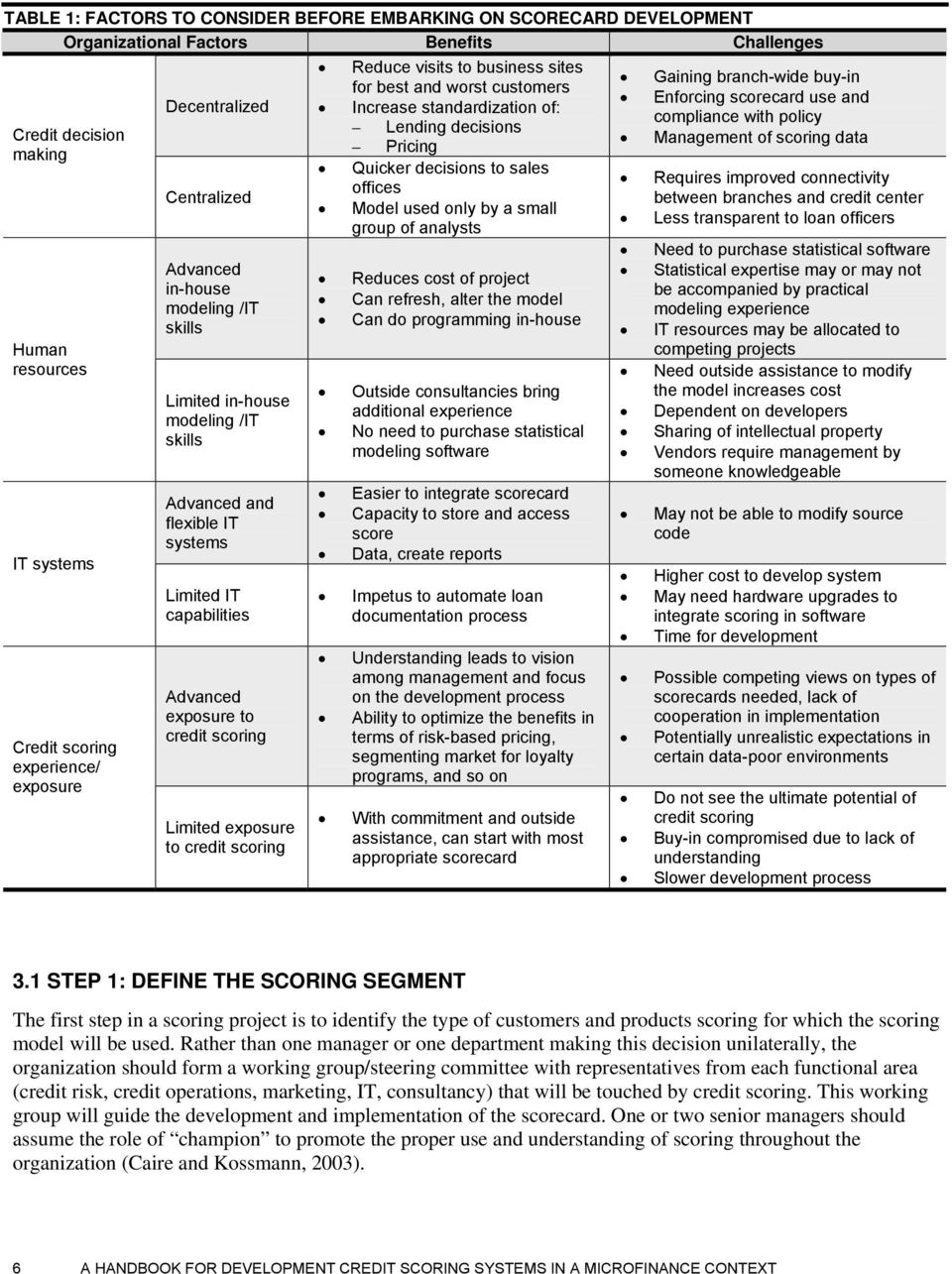
17 3. GUIDELINES ON HOW TO APPLY CREDIT SCORING IN A MICROFINANCE CONTEXT This handbook describes a four-step process for developing a credit-scoring model in the microfinance context. The main difference between this framework and other credit-scoring literature is that it offers recommendations for situations in which historic data are limited or do not match future strategy and objectives. Before embarking on developing the scoring system itself, let us consider some of the costs and benefits of developing and implementing a credit scoring system. In all cases, it requires at least the intermittent time of a senior manager and in-house information technology (IT) specialist for anywhere from 6 to 24 months. Outside expertise could charge $10,000 to $65,000 to develop a scorecard. Specialized software to deploy a scorecard can also cost thousands of dollars. (Salazar, 2003). However, cost savings from improved efficiency in operations, pricing and provisioning can run in the hundreds of thousand of dollars, depending on the volume of transactions to be scored. Thus, the payback period for a credit-scoring project is likely to be relatively short for banks and MFIs with significant lending volume in the target segments. Once development costs are recovered, a scoring system can significantly increase long-term profitability. Table 1 shows some potential benefits of scoring as well as some potential challenges for different types of organizations: those with centralized or decentralized credit decision making, in-house expertise or lack thereof in risk modeling and IT, and advanced or limited IT systems. The table is designed to illustrate that organizational factors generally do not determine whether scoring is appropriate, but influence how creditscoring systems are developed, implemented, and maintained. We assume that credit scoring can provide a benefit to any organization with a clear strategy for issuing a high volume of standardized, low-valued loans and with a willingness to accept and manage the organizational change that scoring will bring. Similarly, we assume that all banks and MFIs use scoring to improve efficiency and increase the profitability and/or outreach of microlending, although these improvements are possible only if the scorecard is developed and tested thoroughly. Over-reliance on the scorecard and the neglect of adequate human judgment and oversight can also be detrimental to loan performance and subsequently to the confidence in this and future scorecards. 3. GUIDELINES ON HOW TO APPLY CREDIT SCORING IN A MICROFINANCE CONTEXT 5

18 TABLE 1: FACTORS TO CONSIDER BEFORE EMBARKING ON SCORECARD DEVELOPMENT Organizational Factors Benefits Challenges Credit decision making Human resources IT systems Credit scoring experience/ exposure Decentralized Centralized Advanced in-house modeling /IT skills Limited in-house modeling /IT skills Advanced and flexible IT systems Limited IT capabilities Advanced exposure to credit scoring Limited exposure to credit scoring Reduce visits to business sites for best and worst customers Increase standardization of: Lending decisions Pricing Quicker decisions to sales offices Model used only by a small group of analysts Reduces cost of project Can refresh, alter the model Can do programming in-house Outside consultancies bring additional experience No need to purchase statistical modeling software Easier to integrate scorecard Capacity to store and access score Data, create reports Impetus to automate loan documentation process Understanding leads to vision among management and focus on the development process Ability to optimize the benefits in terms of risk-based pricing, segmenting market for loyalty programs, and so on With commitment and outside assistance, can start with most appropriate scorecard Gaining branch-wide buy-in Enforcing scorecard use and compliance with policy Management of scoring data Requires improved connectivity between branches and credit center Less transparent to loan officers Need to purchase statistical software Statistical expertise may or may not be accompanied by practical modeling experience IT resources may be allocated to competing projects Need outside assistance to modify the model increases cost Dependent on developers Sharing of intellectual property Vendors require management by someone knowledgeable May not be able to modify source code Higher cost to develop system May need hardware upgrades to integrate scoring in software Time for development Possible competing views on types of scorecards needed, lack of cooperation in implementation Potentially unrealistic expectations in certain data-poor environments Do not see the ultimate potential of credit scoring Buy-in compromised due to lack of understanding Slower development process 3.1 STEP 1: DEFINE THE SCORING SEGMENT The first step in a scoring project is to identify the type of customers and products scoring for which the scoring model will be used. Rather than one manager or one department making this decision unilaterally, the organization should form a working group/steering committee with representatives from each functional area (credit risk, credit operations, marketing, IT, consultancy) that will be touched by credit scoring. This working group will guide the development and implementation of the scorecard. One or two senior managers should assume the role of champion to promote the proper use and understanding of scoring throughout the organization (Caire and Kossmann, 2003). 6 A HANDBOOK FOR DEVELOPMENT CREDIT SCORING SYSTEMS IN A MICROFINANCE CONTEXT
19 We will call the choice of product and customer type the scoring segment. Segmentation is a marketing term used for a group of customers who share specific characteristics. In the context of scoring, the segment identifies a group of clients and products for which scoring is an appropriate risk appraisal method. Scoring is most appropriate for high-volume, standard products and smaller loan amounts, which makes scoring a natural fit for microfinance. Some possible scoring segments are term loans up to $5,000, borrowers with total assets less than $50,000, all sole-proprietors, and so on. Table 2 lists the scoring segments for the seven organizations in our study. TABLE 2: TYPES OF SCORECARDS AND SCORING SEGMENTS FOR BANKS IN STUDY Name of Bank/MFI Scoring Segment Scorecard Type BancoSol Working capital loans <= $20,000 Statistical CAC Leasing Light vehicle leases up to 125,000 Hybrid Credit Indemnity 1 Consumer finance loan <= R 10,000 ( 1,350) Judgmental (application) Statistical (behavioral) Latvijas Unibanka Term and working capital loans <= 30,000 Judgmental Mibanco Working Capital loans <= $20,000 Statistical Teba Bank Multipurpose loan <= R5,000 ( 675) Judgmental United Bulgarian Bank Term and working capital loans <= 30,000 Judgmental In addition to the scoring segment for a given scorecard, there can be several types of scoring for various purposes, as illustrated in the Table 3. BancoSol and Mibanco use separate application scorecards for pre-visit and post-visit, loan renewal, and collections. Credit Indemnity has separate scorecards for first time borrowers (judgmental application scorecard) and repeat borrowers (statistical behavioral scorecard), as well as a collections scorecard (hybrid). Alternatively, one scorecard can be built with a combination of factors that makes its one score appropriate for several purposes (Dellien and Schreiner, 2005). TABLE 3: TYPES OF SCORING Type of Scoring Application Scoring Behavioral Scoring Collections Scoring Desertion Scoring Primary Use Predicts probability that a loan will go bad Predicts the probability that the next loan installment will be late Predicts probability that a loan late for a given number of days (x) will be late for another given number (y) of days Predicts the probability a borrower will apply for a new loan once the current loan is paid off (Source: Schreiner, 2001) 1 Credit Indemnity is a fully integrated division of African Bank Investments Limited (ABIL). 3. GUIDELINES ON HOW TO APPLY CREDIT SCORING IN A MICROFINANCE CONTEXT 7

20 Where scoring is new to an organization, it may be beneficial to phase in scorecards one at a time, as opposed to trying to introduce several simultaneously. For example, Credit Indemnity went through the following phases of scorecard development and implementation: Paper based judgmental application scorecard; System driven judgmental application scorecard; Statistically developed behavioral scorecard; Collections scorecard; and Plan to develop a fraud prevention scorecard. A phased-in approach is particularly appropriate for organizations lacking data or historical experience. Use of scorecards can be a stimulus for improving data collection and data management. More and better data open opportunities for developing more powerful scorecards over time. Figure 1 from the Credit Indemnity study indicates how this progression can look. FIGURE 1: PROGRESSIVE SCORECARD DEVELOPMENT Judgmental application scorecards for select products or markets More sophisticated statistically developed scorecards A range of scorecards for multiple purposes Banks starting with a wealth of statistical data and the willingness to engage outside modeling expertise can consider developing several types of scorecards simultaneously. ACCION s experiences in BancoSol and Mibanco (described in Appendixes A and D, respectively) provide two examples of how separate application and behavioral scoring models can be introduced concurrently. Regardless of the type of scorecard to be developed, the working group should assemble all available information on the chosen segment. Information refers not only to electronic or hard copy data available for statistical analysis, but also to institutional experience, credit policy and the rules-of-thumb used in credit decisions. The type and availability of information will influence the choices made in Step 2: Select the Type of Scorecard. 3.2 STEP 2: SELECT THE TYPE OF SCORECARD There are three main types of scorecards: Statistical: empirically derived from data on past loans; Judgmental: structured from expert judgment and institutional experience; and Hybrid: some cross of statistical and judgmental techniques. A statistical model score predicts the probability of default for an individual borrower. This degree of precision makes it the most powerful scorecard type for risk management, pricing and provisioning. Judgmental and hybrid model scores rank the relative risk of a borrower, with high scores indicate less risk than lower scores. A 8 A HANDBOOK FOR DEVELOPMENT CREDIT SCORING SYSTEMS IN A MICROFINANCE CONTEXT

21 judgmental or hybrid model, however, can be back-tested on all historic cases to define historic probability of default at various score levels. In reality, all scorecards will contain some mixture of statistics and expert judgment. Where there is an abundance of data for statistical modeling, expert judgment must be exercised in defining, selecting, and excluding some factors. Where there is a lack of data for advanced statistical techniques, judgmental models, parameters, and classification should nevertheless be back-tested to the extent possible on past data. The term hybrid is thus reserved for mixed models where, for example, a set of factors with statistically derived coefficients or weights are joined with other factors weighted judgmentally. The selection of scorecard type can be influenced by several factors: Quality and quantity of historical data on good and problem loans; The extent to which the scoring segment resembles past clients and products; The modeling expertise available in-house and/or the cost of consultants; and The limitations of the information technology (IT) systems. The quality and quantity of historical data available are the most important factors to determining what type of scorecard should be developed. Sometimes the data are available, but only in hard copy format. In the case of BancoSol, the bank hired dedicated staff to key in historical data over a two-month period in order to proceed with the development of a statistical model. Second in importance is the extent to which an organization expects its future business to resemble its past business. In the case of CAC Leasing, management wanted to add cash-flow measures to its risk analysis in order to extend express processing to clients making lower down payments. CAC Leasing had statistical data on a number of factors, but had not previously collected cash flow information. Regression analysis was used to derive a statistically weighted scorecard, and expert judgment was used to assign weights to the new cash flow measures, thus creating a hybrid scorecard. Figure 2 graphically represents the choice of scorecard with an x-axis representing availability of data and a y- axis representing the degree to which the strategy or segment differs from existing strategies or segments. The three shaded squares represent the types of models and the trade-offs involved in the selection of scorecard type. FIGURE 2: MODEL SELECTION DRIVERS New Segment/Strategy Judgmental Hybrid Statistical Existing Segment/Strategy No Data Extensive Data 3. GUIDELINES ON HOW TO APPLY CREDIT SCORING IN A MICROFINANCE CONTEXT 9
22 For example: Teba Bank had no historical data available and was developing the scorecard for a completely new segment as part of a USAID program. This combination can be found in the top left corner on Figure 2; they did, in fact, develop a judgmental scorecard. CAC Leasing had extensive data on some, but not all, of the risk factors it wanted to evaluate. It also had extensive experience in the vehicle segment, but was modifying its appraisal strategy slightly. CAC was somewhere in the middle of Figure 2; not surprisingly, they developed a hybrid scorecard. Mibanco had a wealth of transaction data covering a two-year period to design a scoring tool for a segment in which had extensive experience. This experiences places Mibanco to the bottom right of Figure 2; Mibanco did indeed develop a statistical scorecard. In summary, the scorecard development methodology depends on the availability of quality historical data and on future strategy. Different modeling methodologies may return scorecards with a wide range of predictive power. The more accurate a scorecard is in predicting good or bad cases, the better. However, considering that microlenders should not base lending decisions solely on scoring, any relatively accurate scorecard will deliver the bulk of scoring s benefits by identifying the best and worst of clients and providing a common scale on which to base policy measures. Thus, credit-scoring success may depend less on statistical measures of predictive accuracy than on the degree to which the organization thoughtfully incorporates scoring into its overall credit policy. This is a valuable point of consideration for organizations that have forgone scoring due to perceived high development costs and/or lack of historical data for statistical modeling. 3.3 STEP 3: DESIGN THE CREDIT SCORECARD The scorecard design process, regardless of the type of scorecard, can be grouped into the following three phases: Definition: what is a bad loan? Discovery: which characteristics most influence risk? Development: which combination of factors provides the best results in back testing? With this new 3- D terminology, we attempt to simplify and unify the presentation of a topic that can tend to lose the layperson in scoring-specific terminology. We will demonstrate that, on a conceptual level, we follow the same basic steps to develop statistical, judgmental, and hybrid models, only use different tools for each job DEFINITION The financial institution must determine what it considers a bad client. Bad means a loss-making client that with perfect hindsight the bank would have chosen to avoid. A precise, quantitative definition of bad is crucial for developing statistical models as these derive numeric relationships between each risk measure and the bad loans. A judgmental model can be developed without a precise bad definition, but requires a definition of bad for testing and validation. An MFI s bad client might have been more than 15 days late per installment on average, while for commercial banks, the definition is commonly arrears of 90 or more days, the Basel 2 measure for probability of default. It is important that the bad definition fit the institution and its risk appetite. 10 A HANDBOOK FOR DEVELOPMENT CREDIT SCORING SYSTEMS IN A MICROFINANCE CONTEXT
23 3.3.2 DISCOVERY Discovery is the process of identifying the characteristics that will be included as variables in the model. For a statistical model, discovery involves rigorous statistical analysis of all available borrower and repayment data in relation to the bad variable. Software packages such as STATA, SAS, SPSS, and others facilitate a range of analytical techniques, from relatively simple cross-tabulations and classification trees to more complex neural networks. Exploratory analysis should result in a list of characteristics to consider for inclusion in the model and a basic understanding of the shape of the relationship between each characteristic and repayment risk. To make informed judgments in the statistical modeling process, the modeler should understand not only statistics, but also the business of credit, including how the financial institution gathers, stores, and A Laundry List of Microfinance Client Characteristics Demographics: gender, year of birth, marital status, highest education Household Information: number of people in household Household Assets: homeowner status, years at residence, number of rooms, vehicles owned Business Demographics: sector, type of business, years in business, number of employees Financial Flows: business revenue, household income, rent payment Balance Sheet: total assets, total liabilities (formal debt, informal debt), total equity Repayment History: number of loans, longest spell in arrears, days in arrears per installment Credit Bureau Information: bureau score, presence on black list Quantified Subjective Judgments: managerial skills, cash-flow variability, business prospects Loan Characteristics: amount requested, type of loan, borrower s contribution to financing (Source: Schreiner, 2003) uses credit information. Consultants are frequently hired not only because they possess this relatively rare combination of skills, but also because they will bring experience from other markets. An illustration of the statistical modeling process is included in the BancoSol (Appendix A) and Mibanco (Appendix D) cases. For a judgmental model, no advanced statistical knowledge or software is necessary in the discovery phase. Instead, a panel of credit decision makers should discuss which factors guide their current decisions. One technique is to rank the risk factors used in the credit review process according to their perceived importance in determining a client s creditworthiness. Consultants may provide advice during this process, but the bank and the MFI s staff should contribute actively since they generally have an intuitive in depth knowledge of their client base. Hybrid models combine statistical and judgmental techniques. For example, a list of key characteristics identified by statistical analysis might be augmented with other factors that a panel of experts suggests are strongly related to repayment risk. Discovery ends with what we can call a debriefing. The list of potential scorecard variables is presented to senior credit decision makers, such as credit committee members, to review and verify or question the strength and direction of each factor s relationship with repayment risk. This debriefing is most important for statistical analysis, where data irregularities or peculiar past customers may have distorted the results. For judgmental scorecards, it is more of a chance for the modeling team to share the proposed scorecard characteristics with a wider audience for comment. The list of potential scorecard characteristics will vary according to each organization, the data it collects and analyzes, and local market factors. An example of characteristics used in ACCION s scorecards in BancoSol and Mibanco include business profile information, such as business type, years of experience, and ownership of premises, as well as information related to the client s credit history, such as the length of relationship with the 3. GUIDELINES ON HOW TO APPLY CREDIT SCORING IN A MICROFINANCE CONTEXT 11
24 institution and number of active and repaid loans. Some additional factors that may be widely applicable to microfinance are shown in the accompanying text box. A guiding principal is that micro-businesses analysis should include characteristics of both the business and its owner DEVELOPMENT Development involves applying weights to the selected model factors and creating a scorecard. Statistical model weights are taken directly from the statistical outputs, such as a regression equation, while judgmental model weights are set manually based on the perceived importance of individual factors and the implications of their interactions. No matter which type of model is being developed, it is important to document the development process as outlined in the accompanying text box Development of Statistical Scorecards Statistical scorecard development requires specialized skills and software. We would recommend that only people with a working knowledge of applied statistics and at least some experience in modeling credit risk attempt to develop such scorecards. Banks and MFIs who have the data to develop statistical models will find that a majority of the model development time is spent on preparing the data for modeling. As a rule of thumb, the larger the set of development data, the more time will be necessary to clean Documentation in Scorecard Development From the Credit Indemnity Study: One of the most important tasks to conduct when developing a scorecard is documenting every step of the process. Documentation should include information on: Basic decisions taken; Data sampling techniques; Data quality issues; Steps taken with the data (manipulation); and Details of back testing. Such documentation enables the developer to go back later and identify errors or make necessary changes. data, calculate variables, set bin ranges for categorical values, and so on. The more variables that are selected for the final model, the more programming work will be required to develop a test model, program a scoring module, and link it to the IT system. For ease of memory, we can simply call this the Big Data Rule: the more data involved in scorecard development and implementation, the longer we should expect to work on the scorecard in all phases of the project Development of Judgmental Scorecards Judgmental scorecard characteristics are selected and weighted using the expert judgment of experienced lenders/consultants. To help banks and MFIs develop their own judgmental scorecards, we provide an example of how weightings can be set. In Figure 3, three judgmental scorecards are presented. Scorecard 1 is equally weighted, while Scorecards 2 and 3 are variably weighted. Looking at the equal weighted Scorecard 1, assume the bank requires a score of 5 to approve new applicants. A successful applicant must have a loan to collateral value of less than 70 percent, annual turnover at least three times more than the loan amount, a business track record longer than one year, a current ratio greater than 0.5, and total assets of greater than 100,000. This simplest form of scoring could just as easily be represented by a checklist. 12 A HANDBOOK FOR DEVELOPMENT CREDIT SCORING SYSTEMS IN A MICROFINANCE CONTEXT
25 FIGURE 3: THREE JUDGMENTAL SCORECARDS JUDGMENTAL SCORECARD 1 JUDGMENTAL SCORECARD 2 JUDGMENTAL SCORECARD 3 Variable 1 Loan to Collateral Value >70% <70% Annual Turnover to Loan Value <3x >3x Years in Business <1 > Current Ratio < 0.5 > Total Assets (EUR) <100K > 100K 0 1 Variable 1 Loan to Collateral Value >70% <70% Annual Turnover to Loan Value <3x >3x Years in Business <1 > Current Ratio < 0.5 > Total Assets (EUR) <100K > 100K 0 1 Variable 1 Loan to Collateral Value >70% 50-70% <50% Annual Turnover to Loan Value <3x 3-5x >5x Years in Business <1 2-4 > Current Ratio < > Total Assets (EUR) <100K K > 500K For scorecards 2 and 3, assume the passing score is still 5 points. Now an applicant who would have failed Judgmental Scorecard 1 for having a current ratio of less than 0.5 would still pass scorecards 2 and 3 with a Loan to Collateral Value of less than 50 percent. Judgmental scorecard weights should be set carefully. The scorecards should be tested on a combination of actual clients and hypothetical future clients to ensure that the scores adequately represent risk profiles for which the bank is prepared to prescribe standard policies such as approve, reject, review, or require additional securities Development of Hybrid Scorecards Hybrid scorecards combine the statistical and judgmental techniques explained above. One potential hybridization is the combination of a statistically derived score, such as a bureau score, with a judgmental score using a matrix approach, as described in the accompanying text box. Whether it is statistically or judgmentally derived, ideally the scoring equation can finally be represented in a visually simple scorecard that is intuitive for end-users. This step is not The Dual Score Matrix In 1998 and 1999 in South Africa, Trans Union ITC and Fair Isaac developed a bureau score called Emperica. This score was an additional field that Credit Indemnity could access during the bureau enquiry. The Emperica score was combined with Credit Indemnity s judgmental scorecard in a dual score matrix, or the cross-tabulation of Credit Indemnity s application score and the Emperica bureau score. Integrating the bureau score improved the quality of Credit Indemnity s decision making. necessary, but it makes it easier to present the scorecard to a working group, users, or programmers. Judgmental scorecards can be limited to no more than 30 variables 15 to 20 is a common range. For statistical scorecards, the number of variables should be determined by balancing improved predictive power with cost of data collection and programming complexity. Some microfinance models have included from 50 to 80 variables in order to improve predictive power and reduce predictive variance (Schreiner, 2003). 3. GUIDELINES ON HOW TO APPLY CREDIT SCORING IN A MICROFINANCE CONTEXT 13
26 3.4 STEP 4: TEST, IMPLEMENT, AND MANAGE THE SCORECARD BACK TESTING The first crucial test any scorecard should pass is the back test 2 using historical data. Back test results can be a key tool in setting scoring policy. For statistical models, back tests present the scorecard s classifications for the entire set of data used to develop the card. For judgmental models, we can perform similar analysis if we can gather a sample of data on repaid loans for which we know whether the client was always good or at any point became bad. Table 4 taken from the Mibanco experience, shows an example of a Good/Bad Classification by Score. TABLE 4: GOOD/BAD CLASSIFICATION BY SCORE Score Good Bad # % # % < % % 676 A % % 702 A % % 730 A % % 763 A % % 786 A % % 807 A % % 823 A % % 843 A % % 860 A % % 876 A % % 899 A % % > % % No Data % % Total % % The percentage column in this table represents the concentration of good or bad loans respectively in each score band. In general, if a scorecard has discriminatory power, scores indicating higher risk (lower scores in this example) should have a higher concentration of bad cases. This table shows that more than 30 percent of cases scoring less than 675 points are bad versus less than 10 percent for cases scoring between 876 and 898. This performance data suggests that the scorecard accurately sorts the good loans from the bad loans. Table 5 expands on the type of analysis presented in Table 4. It presents not only the numbers of good and bad cases, but also the cumulative figures and percentages of total cases at any given score level. Tables such as these can be used to set scoring policy and determine thresholds for rejection, review, and approval. 2 Back testing is the process of testing a scorecard s performance on a sample of past borrowers. 14 A HANDBOOK FOR DEVELOPMENT CREDIT SCORING SYSTEMS IN A MICROFINANCE CONTEXT
27 We illustrate below the effects of one policy decision: approve all loans scoring 350 or more points and review all others. Table 5 contains data on a total of 37,123 loans (the sums of the last row in each of the Cumulative Good and Cumulative Bad columns (36, ,078 = 37,123). Applying the policy of approve over 350, the far right column, the percentage of total cases, indicates that 71.3 percent (1-28.7% = 71.3%) of customers would have been automatically approved. The shaded region of the table, which includes scores between 350 to 700 shows that, in the past, the bank would have approved 26,115 good loans and 337 bad loans, for a total of 26,452 loans. The last row of the table, labeled Over 350 presents the total numbers for the shaded score ranges The historic bad rate for loans scoring over 350 is 1.3 percent (337/26,452 = 1.3%). TABLE 5: BACK TEST WITH GOOD/BAD INTERVAL AND CUMULATIVE ANALYSIS Interval Good Cumulative Good Cumulative Bad Percent of All Cases POLICY Score Range Interval Bad % % % % REVIEW , , % , , % , , % , , % , ,573 1, % , ,933 1, % APPROVE , ,043 1, % , ,045 1, % OVER , % Thus, Table 5 illustrates that a policy of approving all loans scoring over 350 will result in an expected bad rate of 1.3 percent. At the same time, more than 70 percent of clients could be approved in a fraction of the time, while the rest would be subject to standard review. To illustrate the proposed scoring policy s impact on costs, let us assume that from the moment of scoring is completed it takes 5 minutes to process an automatic approval, 30 minutes to conduct a standard review, and 4 hours (240 minutes) to process and work out a bad loan. To keep the computations simple, assume wages and overhead cost $1 per minute. Finally, assume that before introducing scoring all loans were processed using standard review techniques. With this set of assumptions, Table 6 shows that automatically approving all loans with scores over 350 would have reduced wages and overhead costs by $580,420. As overhead and wages are to some degree fixed, this implies that business volumes can be increased with the same human resources, or spare resources can be focused in other areas. 3. GUIDELINES ON HOW TO APPLY CREDIT SCORING IN A MICROFINANCE CONTEXT 15
28 TABLE 6: REDUCTION IN COSTS CALCULATION Costs Element Intermediate Calculation Total Cost of Standard Review 26,452 x ,560 Minus Cost of Automatic Approval 26,452 x 5-132,260 Minus Cost of Processing Bad Loans 337 x ,880 Total Costs Reduction 793, ,260-80,880 = $580,420 The better the a bank or MFI can estimate the income for good loans and the cost of bad loans, the more precisely it can estimate the effects of scoring on profits. Another way to look at scoring s relation to profit is to apply the below formula to any cut-off point below which loans would be rejected. (Cost per Bad x Bads Avoided) + (Benefit per Good x Goods Lost) (Source: Schreiner, 2003) Policy thresholds, such as cut-off scores, enable banks and MFIs to increase or decrease their risk exposure in response to the quality of the loan book and market forces. Combined with information on work-out costs and interest income, tabular analysis can be used to set risk-based pricing: for example, rather than rejecting riskier clients, pricing can be set so that interest income will cover expected losses for that segment. Using tabular analysis of back-testing results, we can examine the expected effects of any number of different scoring policies. Thus, the back test is perhaps the most valuable tool in setting scoring policy PILOT TESTING The real work begins once back testing is completed. As noted earlier in this handbook, and highlighted in all the cases, successful implementation depends less on the model s predictive accuracy than on factors such as management and loan officer buy in, accurate data capture, a well thought-out credit policy, and good management information system (MIS) reporting (for more detail, please see Key Success Factors in the Credit Indemnity case). The first step of putting the scorecard into practice is a pilot test. For pilot testing, we need some method of performing the scoring calculations. Generally, the scorecard will be put into some sort of user-friendly format so that users can begin testing it on new cases. If the scorecard has relatively few factors, the least IT-intensive method of testing it would be to calculate the scores on paper, as in the case of Credit Indemnity when the application scorecard was first introduced in In the cases of CAC Leasing, Unibanka, and United Bulgarian Bank, the scorecards were tested in specially designed, user-friendly programs written in Visual Basic for Microsoft Excel. Excel is available on most workstations and programs for it are relatively easy to write. Simple scorecards can also be programmed directly into the institution s core IT system or application processing system (APS) in a relatively short time, if the APS allows. For scorecards with more variables or calculations, we need to consider again the Big Data Rule, this time applied to the programming of test scorecards. One key issue is whether scorecard calculations are based on user inputs only or also require repayment data captured directly from the core IT system, as is the case for many behavioral scorecards. The more data taken directly from the core IT system, the more time is needed for core system programming and the less feasible are any of the quicker options suggested above. Debugging complicated programs also takes more time. In the Mibanco case, development of the scorecard module in the 16 A HANDBOOK FOR DEVELOPMENT CREDIT SCORING SYSTEMS IN A MICROFINANCE CONTEXT
29 banking system took six months. Project management should keep the Big Data Rule in mind to help set realistic project implementation timelines. The goal of pilot testing is to get a feel for how the model works in practice: What are the score ranges? Do the scores coincide with perceived risk levels? Are there any unexpected complications in collecting data needed for scoring? The answers to these questions can shape scorecard policy and procedures. A pilot test can last for a certain period of time, such as 3 to 6 months or until a certain number of new cases have been processed, such as 500 scored loans. It can also run in parallel to standard procedures, where credit committees review test model scores either before or after making the credit decision. The new procedures could also be tested on a stand-alone basis in selected branches. As the case studies indicate, there are no set rules. The choice of best approach depends on the type of scorecard (What type and volume of data are needed to evaluate the pilot test?) and the credit decision process in each organization (Are decisions are centralized or decentralized?) TRAINING The pilot testing phase should start with adequate training of scorecard users. Topics to cover include the basics of how the scorecard was developed, organizational goals for using scoring, as well as procedural training. The pilot test training is where we can first secure the buy-in of loan officers. Without the interest and cooperation of loan officers, the pilot test is likely to face delays, as was the case in the beginning of the BancoSol project. In any case, feedback from frontline users should be solicited throughout the testing period. As highlighted throughout the case studies, training is not limited to pilot testing or roll out, but should be an ongoing part of the scoring process. If scorecards are developed by outside consultants, senior managers need to be trained in the how the scorecard works and how it can be used to set scoring policy. Risk managers and IT staff must understand the model parameters and how they can be modified. Human resource and project managers must provide follow-up training to loan officers each time significant changes are made to the scorecard or scoring process. Finally, the scorecard should become a part of the organization, not remain in the purview of only a consultancy or one project manager. The Four-Eyes of Scoring principle presented in the accompanying text box highlights the importance of spreading knowledge of the scorecard throughout the organization. The Four-Eyes Principal for Scoring INTEGRATION WITH IT SYSTEMS In modern financial institutions, a scorecard can be deployed most effectively as an additional module to an existing software platform. As such, scoring is often just one part of an automated APS. For institutions that do not have an APS, a scoring project can provide the stimulus to either develop or purchase a system that either includes or can be adapted to include a scorecard deployment module. Scoring s role in the development of an APS is described in the case of United Bulgarian Bank. Automated application processing and scoring fit well together since one common benefit of scoring is that it can recommend different policy actions or processes for clients with different levels of risk. Many bankers are familiar with the Four- Eyes Principle as a staple of underwriting policy that guards against fraud. At least two people, and thus four eyes, must review and sign off on any credit decisions. This same principle can be applied, with a twist, to long-term scoring model management. At least two people should understand and be involved with the model. Otherwise there is a risk that one person with all operative institutional knowledge of the scoring models could take another job and leave the bank with an information and institutional history gap that can be difficult to fill and at the very least require extensive retraining (see also the Mibanco case). The maturity and flexibility of IT systems will influence how best to integrate the scorecard. Remembering the Big Data Rule one last time, the more complex a scorecard, the more complex will be its integration with the IT system. If scoring s user interface cannot be easily integrated directly into the existing IT system, it may pay to develop a separate 3. GUIDELINES ON HOW TO APPLY CREDIT SCORING IN A MICROFINANCE CONTEXT 17
30 APS from scratch and then link this to the core database system. A number of IT concerns brought out in the Teba Bank case are presented in the text box to the side. In addition to supporting lending decisions, scorecards are effectively data management tools. As such, the information that goes into and comes out of a scorecard should be tracked and stored. Data should be stored for clients who are scored but later rejected. Decisions not to follow scorecard policy, often called overrides, should also be catalogued for use during reviews of scorecard effectiveness. All of this data, including information on loan performance (for example, which loans were bad, how much did the bad loans cost) should be stored for future analysis, including the refreshing or redevelopment of scorecards. Behavioral scorecards in particular need to be refreshed regularly LONG-TERM MODEL MANAGEMENT The scoring software module should generate several standard reports, the most universally useful of which is referred to as the Global Follow-Up Report (Schreiner, 2003). An example of the Global Follow-Up Report from the United Bulgarian Bank case study is presented below in Table 7. This report will indicate the model s effectiveness in correctly assigning risk classifications to borrowers. Five Tips for Integrating Scorecards in IT Systems The programmer needs to understand how the scorecard works. If he or she does not have experience with scorecards, the data model must be very explicit and the card must be tested extensively. As scoring can affect data requirements for day-end processing and storage, a knowledgeable database architect may be needed to structure the scoring database and ensure proper data warehousing. The scorecard program ideally will be parameterized rather than hard coded, allowing nonprogrammers to modify variables, weights, and cut-off scores. Reporting functionality should make it easy for management to generate periodic reports and monitor scorecard performance and the quality of the scorecard loan portfolio. The system should avoid any redundant data entry or capture and should protect against data input errors. TABLE 7: UNITED BANK OF BULGARIA GLOBAL FOLLOW-UP REPORT (ALL LOANS SCORED OCTOBER OCTOBER 2005) Loans with cases of arrears of days Loans with cases of arrears of 60 days or more Final Credit Center Score No. of loans % of total No. % of applications in score range % of total applications No. % of applications in score range % of total applications % % 0.28% % 0.09% % % 2.31% % 0.75% % % 2.12% % 0.61% % % 1.23% % 0.42% % % 0.71% % 0.24% % % 0.19% % 0.00% % % 0.00% % 0.00% Total 2, % % 6.84% % 2.12% 18 A HANDBOOK FOR DEVELOPMENT CREDIT SCORING SYSTEMS IN A MICROFINANCE CONTEXT
31 As shown in Table 7, there is a clear and consistent progression in the concentration of bad loans (defined as loans with arrears greater than 60 days) moving from high to low scores (where high scores indicate low risk). For example, only 1.96 percent of loans scoring over 400 went bad and no loans between 450 and 500 went bad. Bads increase to 2.21 percent of loans scoring between 251 and 300 points, and 4.76 percent of loans scoring 175 and 200 points. Scorecard management is a long-term process that must live well beyond the initial excitement of scorecard development and implementation. Whether or not data are the driver for scorecard creation, data are the longterm driver of scorecard success. Consistently collecting, storing, and periodically monitoring scorecard data, and also other borrower information, will allow an institution to validate judgmental models, transform judgmental or hybrid models to fully statistical models, refresh and potentially improve predictability of statistical models, and refresh and potentially improve the predictive power of statistical models, or develop models for additional segments. 3. GUIDELINES ON HOW TO APPLY CREDIT SCORING IN A MICROFINANCE CONTEXT 19
32
33 4. CONCLUSION As this handbook has illustrated, a scorecard, thoughtfully developed, flexibly implemented, and properly managed can speed loan processing and inform pricing and provisioning, which can help banks and MFIs save costs, reduce subjectivity, and improve risk management. Improved efficiency in the microloan segment will both increase profitability and expand micro-borrowers access to credit. 4. CONCLUSION 21
34
35 APPENDIX A: BANCOSOL, BOLIVIA 1. OVERVIEW In November 1986, international and Bolivian investors founded PRODEM (Foundation for the Promotion and Development of the Microenterprise/Fundación para la Promoción y el Desarrollo de la Microempresa) as a nongovernmental organization (NGO). PRODEM was created to provide resources to the Bolivian microenterprise sector by offering working capital microloans to groups of three or more individuals dedicated to similar activities, with each individual formally guaranteeing the other s loans. By January 1992, PRODEM had an outstanding loan portfolio of US$4 million and 17,000 outstanding clients. Given this strong growth, and the ever-increasing demand for credit among Bolivian microentrepreneurs, PRODEM s Board of Directors recognized that the legal and financial limitations of NGOs meant that the most promising and viable alternative to meet this demand would be the creation of a commercial bank, to be called Banco Solidario S.A., or BancoSol ( the Bank ). To date, after more than a decade of operations, BancoSol has disbursed more than US$1 billion to more than a million microentrepreneurs. Currently, the Bank has about 74,000 loan clients and an outstanding loan portfolio of US$110 million, as well as US$80 million in deposits from more than 60,000 savings clients. BancoSol has 30 branches in six regions of Bolivia (La Paz, Cochabamba, Santa Cruz, Sucre, Tarija, and Oruro), making it one of the most important financial institutions in the country. In recent years, Bolivia has experienced a weakening economic environment, aggravated by constant social conflict. At times, the entire economic structure has been threatened by roadblocks and armed conflicts. However, specialized microfinance institutions (MFIs) have continued to grow their loan portfolios, with delinquency levels lower than those seen in the traditional banking sector. BancoSol has registered profits in recent years, despite turmoil in Bolivia, thanks to its strategic management focused on strengthening the Bank during these adverse times. In terms of BancoSol s core microlending business, improvement strategies are evident in stronger loan policies and a diversified range of products. It has also redesigned its overall loan processes to improve operating efficiency and overall customer service, as well as to improve upon credit risk management practices at the branch level. THE PROJECT The credit-scoring project began at BancoSol in early 2001, with the support of ACCION International and an external consulting firm. The overall goal of the project was to implement three different scoring models: first, Collections Scoring and, later, Selection and Segmentation Scoring. The Bank would become the first Bolivian financial institution to incorporate scoring in its loan processes, making it a pioneer in the international microfinance arena. When the project began, BancoSol had 57,266 loan clients and used traditional methods to evaluate microfinance loan applications, including an exhaustive analysis of both quantitative and qualitative aspects for both new and repeat loan clients, regardless of their risk profile. Loan collection methods were determined based on the amount and numbers of days that payments were past due. 2. THE DRIVERS FOR CREDIT SCORING BancoSol intended to meet the following objectives when it initiated a credit-scoring project for working capital microenterprise loans: APPENDIX A 23
36 Improve customer service by accelerating the loan approval process; Standardize policies, processes, and procedures; Increase the retention of low-risk clients; Maximize efficiency of collection activities; Contribute to improved portfolio quality; and Increase loan officer productivity. 3. TYPE OF CREDIT SCORING MODEL USED BancoSol introduced three credit-scoring models: Collections Scoring. By quantifying risks, the MFI is able to lower recovery costs and increase efficiency. Selection Scoring. By quantifying information about the potential client s profile and risk factors, the MFI is able to prioritize and personalize the evaluation of new credit applications. Segmentation Scoring. By classifying existing clients by risk, the MFI is able to improve portfolio quality and overall customer service. These credit-scoring models, developed by ACCION, facilitate the speedy, consistent, and objective evaluation of a client s creditworthiness. The models were developed using regression analysis to generate a score, which can be used to order a client population based on risk. ACCION s scoring models allow an MFI to predict the level of risk related to a loan, based on client profile and loan repayment history. Among the characteristics that affect risk, ACCION uses those that are directly related to the client and business profile (such as age, business experience, type of business, ownership of business premises, and so on.), as well as information related to the client s credit history (experience with the institution, number of loans, repayment rate, and so on.). This detailed information about the client allows for the creation of a well-defined risk profile. 4. PROCESS OF ADOPTING CREDIT SCORING BancoSol implemented credit scoring in five phases: Phase I: Analysis and Preparation Phase II: Construction of Statistical Model Phase III: Development of the Scoring Module Phase IV: Testing the Model (Pilot) Phase V: Expansion and Transfer 24 A HANDBOOK FOR DEVELOPMENT CREDIT SCORING SYSTEMS IN A MICROFINANCE CONTEXT
37 PHASE I: ANALYSIS AND PREPARATION Phase I consisted of an extensive analysis of BancoSol s client database to identify the necessary variables. While analyzing the database, it was recognized that additional data from existing clients credit files would be needed, as only partial information was actually being captured in the database. This partial information had been sufficient for credit analysis through credit committees, but would be insufficient to determine the variables required for the statistical model. In early 2001, BancoSol hired full-time temporary staff to enter the data into the system, demonstrating its full commitment to the project. It took about two months to enter the information, after which the database was analyzed again, the appropriate client population was identified, and all available variables were analyzed. With the completion of this phase, the databases were well structured and it was time to begin the development of the statistical model. PHASE II: CONSTRUCTION OF THE STATISTICAL MODEL The process of creating the scorecards began with the statistical analysis of client performance information, both current and historical, for the two years prior to the initiation of the project. At the same time, given that the starting point for modeling is the definition of Good and Bad clients, a team of staff from both BancoSol and ACCION collaborated on these definitions. Once these basic definitions were determined, development of the models for the three scorecards could begin, and the construction of the statistical model was presented to Bank management in July PHASE III: DEVELOPMENT OF THE SCORING MODULE The main activity of this phase, which began in August 2001, was the review of credit and collection processes, as well as the design and development of the support application for the scorecard tool by the Bank s Systems Department. Functional tests of the application, once development work was completed, proved to be just as important. To develop the functional specifications of the project, all of BancoSol s existing credit processes, both office- and field-based, needed to be identified and documented. As some inconsistencies between policies and actual practice were identified in this analysis, improvements to the loan processes were made. As modifications and additional work required to enter all the data into the database were resulting in small delays that began to add up, it was decided that it would be best to create a program that would interface with the Bank s own system and allow the Bank to use the collections scoring model more quickly. Such a program was created, known as the black box, that automatically calculated and assigned strategies. The finalized functional specifications document for collections scoring was presented to BancoSol s management team at the beginning of September Programming was completed by early October 2001, and functional testing was conducted, identifying a few necessary adjustments, which were completed before the official pilot was launched. The previously mentioned analysis of the credit processes also concluded that the order of some of the subprocess tasks required modifications for selection and segmentation scoring. For example, not all branches were entering data from loan files into the system before credit committee meetings, but rather only after loans were approved. However, for selection and/or segmentation scoring, credit application data needed to be entered into the system from the beginning of the process in order to obtain the score. APPENDIX A 25
38 A combined functional specifications document for selection and segmentation scoring was generated and finalized in September However, given that the Bank was focused on collections scoring at that time, the Selection module was not developed and tested until February The segmentation score module was completed in August PHASE IV: PILOT TESTING Collections Scorecard Given their proximity to the Bank s headquarters, three branches in La Paz were selected to pilot test the collections scorecard in the fourth quarter of These branches monitored performance and behavior on a daily basis. Staff from the pilot branches received both classroom and field-based training. Classroom sessions were primarily focused on raising staff awareness of the benefits of using the scorecard. This was especially important for loan officers, who were traditionally responsible for all collections activities, and scoring would assign some of these activities to third parties (call center, and so on.). Selection Scorecard Pilot testing of the selection scorecard began in mid-february At that time, the Bank s management also decided that the scores would not be decisive in the loan approval decision, meaning that it would be possible to override the decision/strategy suggested by the score. Given this decision, the forced approval option, or override of a model rejection, was introduced into the system. The program required the user to record a reason for all such forced approvals. Later forced approvals came to require the authorization of more senior staff. In March 2004, the Bank hired full-time monitors for the project and formed a Project Coordination Committee with representation from all functional areas, led by ACCION s Resident Advisor. This committee took on all projects activities, with special emphasis on branch activities. It was responsible for supervising, monitoring, and making any required policy changes. Segmentation Scorecard The segmentation pilot began on a small scale in March PHASE V: EXPANSION AND TRANSFER As the collections and selection scores were being finalized, BancoSol began to plan for the incremental expansion of scoring to all branches. This expansion phase began with the training of branches that would receive the scoring model first, while the Systems Department was generating the corresponding data for those branches. During the expansion phase, reports were developed to monitor statistical indicators to guarantee the statistical validity of the tools. The reports indicated high levels of reliability in the tools predictability capacity. Monitoring reports also revealed that, because of BancoSol s recent expansion into lower-end markets, the scorecard variables and ranges of the score-distribution tables needed some adjustments. As a result, the statistical model and the loan module also needed to be redesigned. Once these modifications were complete, the selection-scoring model was launched in all branches. 26 A HANDBOOK FOR DEVELOPMENT CREDIT SCORING SYSTEMS IN A MICROFINANCE CONTEXT
39 5. IMPACT OF CREDIT SCORING UTILIZATION BancoSol s uses Selection Scoring in 99 percent of its decisions, scoring from 1,000 to 2,000 loans per month. Most renewals have been evaluated with selection scoring, as the piloting of the segmentation score began only in March Selection Scoring was used for more than 20 percent of cases by April PORTFOLIO QUALITY Selection Score The actual use of the selection pre-score is to prioritize client visits by loan officers. Table A-1 illustrates that the behavior of new clients with outstanding loans as expected: lower-priority or high-risk clients register a higher arrears rate. In addition, the highest-priority clients (A Clients) show an arrears rate of just 2.3 percent, reflecting good risk-based selection. TABLE A-1: SELECTION PRE-SCORING Priority Clients % Total Delinquent Clients % Delinquent clients Outstanding Portfolio Portfolio in Arrears Arrears rate (> 5 days) C (Low) 5, % % 7,734, , % B (Med) A (High) 9, % 1, % 16,408, , % 10, % % 22,810, , % Total 26, % 2, % 46,954,152 2,176, % For the final selection score, the percentage of delinquent clients, as well as the value of the portfolio in arrears also shows the expected behavior: for clients with a better score, we see lower delinquency. Without considering those C strategy clients whose recommended rejection was overridden and loans were approved (forced approvals), the delinquency rate drops to 4.2 percent, as shown in the bottom shaded row of Table A-2. APPENDIX A 27
40 TABLE A-2: FINAL SELECTION SCORE Recommended Action Clients % Total Delinquent Clients % Delinq. Clients Portfolio Portfolio in Arrears Arrears rate (> 5 days) C Rejection 2, % % 3,681, , % B Review 13, % 1, % 21,703,713 1,267, % A Approval 10, % % 21,569, , % Total 26, % 2, % 46,954,152 2,176, % Total without C loans 23, % 2, % 43,273,040 1,800, % Segmentation Score Within the outstanding portfolio, there are 1,917 credits that have been evaluated with segmentation scoring, and we see, as expected, a much better portfolio quality among these loans (see Table A-3). TABLE A-3: SEGMENTATION SCORE Strategy Clients % Total Delinquent Clients % Delinq. Clients Portfolio Delinquent Portfolio PAR > 5 days Normal Evaluation % 5 0.6% 1,245,939 2, % Recommend Renewal % 2 0.3% 1,108, % Recommend Credit Line % 0 0.0% 700, % Total 1, % 7 0.4% 3,055,133 3, % EVALUATION OF THE MODEL To fully evaluate the model, we need to analyze not only client behavior at one point in time (as with the portfolio quality), but also client payment history. This historical analysis uses what is called the Good and Bad Indicator of good and bad, which classifies clients based on behavior of indicators such as maximum days in arrears and the average days in arrears for credit(s) previously evaluated with scoring. This was the same analysis used when determining the model. 28 A HANDBOOK FOR DEVELOPMENT CREDIT SCORING SYSTEMS IN A MICROFINANCE CONTEXT
41 Selection Scoring Table A-4 illustrates the results of an analysis of clients using both Good and Bad indicators and the overall Selection Score. The analysis shows that the model is functioning well in terms of risk discrimination. TABLE A-4: SELECTION SCORES WITH GOOD AND BAD INDICATORS Cumul. Score GOOD % BAD % Disbur. % Denied % Total % < % % % 23 12% % % % % % % % % % % % % % % % % % % % % % % % % % % % % % % % % % % % % % % % % % % % % % % % % % % % % % % % % > % % % 124 8% % Total % % % % % Collections Scoring Figure A-1 and Table A-5 illustrate collections rates by branches in the pilot program since November 2004; in general, we see a significant increase in collections at these branches since scoring was introduced. APPENDIX A 29
42 FIGURE A-1: AVERAGE COLLECTION RATES AT BRANCHES, % 70% 60% 50% 40% 30% 20% 10% 0% Feb- 02 Jun- 02 Oct- 02 Feb- 03 Jun- 03 Oct- 03 Feb- 04 Jun- 04 Oct- 04 Nov- 04 Dec- 04 Apr- 05 TABLE A-5: COLLECTION RATES BY BRANCH, Branch Feb-02 Jun-02 Oct-02 Feb-03 Jun-03 Oct-03 Feb-04 Jun-04 Oct-04 Nov-04 Dec-04 Apr-05 No Scoring A 50% 49% 53% 61% 61% 54% 68% 66% 61% 69% 74% 70% 49% B 40% 37% 42% 46% 40% 34% 54% 53% 48% 64% 70% 59% 42% C 35% 36% 50% 64% 61% 51% 66% 61% 57% 65% 66% 71% 53% D 56% 53% 53% 63% 52% 47% 63% 63% 62% 73% 78% 73% 57% E 52% 52% 58% 65% 59% 51% 66% 66% 60% 75% 77% 76% 59% F 36% 43% 53% 61% 55% 52% 46% 53% 51% 62% 58% 55% 50% G 39% 37% 37% 46% 57% 57% 66% 72% 72% 72% 74% 72% 52% H 58% 64% 62% 65% 77% 82% 84% 85% 72% 80% 86% 82% 72% I 20% 26% 23% 58% 64% 58% 65% 70% 75% 74% 77% 69% 51% J 55% 53% 47% 54% 71% 64% 63% 66% 76% 76% 79% 75% 59% K 45% 49% 46% 69% 84% 81% 78% 79% 80% 77% 82% 73% 68% L 36% 36% 37% 55% 57% 53% 62% 66% 67% 72% 74% 68% 56% Total: 38% 39% 40% 56% 57% 51% 63% 65% 65% 72% 74% 70% 56% Table A-6 shows the average collections activities performed by loan officers on a monthly basis, which are conducted in addition to third-party support strategies. On average, the loan officer activities represent 36.9 percent of the total, based on all activities entered into the system. Upon further analysis of the data for loan officers who registered 80 or more collection activities a month, we found that an average of 33.6 percent of their total work time is devoted to collections activities, with each loan officer spending approximately 37 hours per month on collections activities. TABLE A-6: AVERAGE COLLECTIONS ACTIVITIES Strategies by Month Average 2005 # % Loan Officer Calls 1, % Strategies Visits 5, % Total LO Strategies 6, % Support Strategies 11, % Total Strategies 18, % 30 A HANDBOOK FOR DEVELOPMENT CREDIT SCORING SYSTEMS IN A MICROFINANCE CONTEXT
43 PREDICTION CAPABILITY Table A-7 shows that the tool has excellent prediction capabilities, with much higher percentages of clients classified as Good with high scores. TABLE A-7: SCORING WITH GOOD AND BAD INDICATORS Score Good Bad Total # % # % # % < % % % 10 to % % % 25 to % % % 77 to % % % 354 to % % % 799 to % % % 848 to % % % 894 to % % % 897 to % % % 940 to % % % > % % % Total % % % CONCLUSION BancoSol s experience in microfinance CREDIT SCORING has been a success in many ways. The Bank was able to take advantage of the need to analyze policies and procedures linked to the credit evaluation process that would impact the overall score and vice versa, which resulted in a number of standardized improvements to the credit process. Additionally, the project led BancoSol to recognize the importance of maintaining complete and accurate data on all operations. Such standardizations, as well as streamlining the database and increased use of the credit scores, have meant improved customer service as loan officers have increased productivity and spent less time analyzing every loan. The use of the collections scorecard has also increased the efficiency of BancoSol s loan recovery efforts, as the Bank has reported increased collections with much less actual recovery tasks. Finally, as illustrated in the above figures and tables, we see that from a technical standpoint, the scoring model has proven to function very well. APPENDIX A 31
44
45 APPENDIX B: CAC LEASING SLOVAKIA 1. OVERVIEW/BACKGROUND CAC Leasing (CAC) commenced business in October 1996, adopting its current name in It is now wholly owned within the Bank Austria Creditanstalt Leasing (BACA) group. CAC is the market leader in Slovakia more than 15 percent market share. In December 2002, CAC signed a 15 million loan agreement with the European Bank for Reconstruction and Development (EBRD) in December 2002 to develop its business of leasing to small and medium-sized enterprises (SMEs) in Slovakia as a part of the European Union (EU)/EBRD SME Finance Facility for EU Accession Countries (Facility). Bannock Consulting Ltd. of the United Kingdom (now called DAI Europe) was the consultant selected to implement technical assistance on the assignment. Historically, the company s leasing assessment reflects a major emphasis on asset value with down payment levels being set to increase cover and reduce risk. One aim of participation in the Facility was to enable the company to move toward greater reliance on cash flow and other financial assessments of customers, particularly by using credit scoring. Bannock and CAC developed a credit-scoring model for passenger vehicle leasing between May and October The model was tested over a one-year period and it was rolled out for use company-wide in October THE DRIVERS FOR CREDIT SCORING When the consultants started to work with CAC on a credit-scoring model, CAC already was number one in its market, and was a strong competitor in the vehicles segment. Its efficient leasing procedure required a minimum of paperwork for clients that met certain minimum down payment levels. As a result, CAC was able to guarantee fast decision times. CAC s motivation for introducing scoring was to improve its risk assessment of vehicles in order to: Decentralize more leasing decisions to the branch level; and Bring explicit measures of cash flow into the appraisal of applicants offering lower down payments. The technical assistance under the Facility provided a stimulus and resources for development of the scoring system. 3. TYPE OF CREDIT SCORING MODEL USED CAC had a limited set of 20 fields of data on a large number of lease contracts more than 35,000. This opened up a possibility for statistical modeling, but meant that some factors CAC wanted to consider, such as cash flow, were not available in the historic data set. This combination of extensive data on a limited set of factors with a strategy designed to introduce new risk measures led the choice of a hybrid model. The consultants used the data set to develop a scorecard using logistic regression. This scorecard contained eight variables and had a Kolmogrov-Smirnov statistic of 34.4 percent, which is considered a reasonably strong model. Using a working group, three variables were removed from the regression scorecard. These were replaced with other variables based on expert judgment of the working group and the modeling expertise of the consultants. APPENDIX B 33
46 Although scores from the eight-variable regression scorecard could be directly converted to probability of default predictions for each borrower, the hybrid model scores could only rank the borrowers into risk ranges. However, with new data, this hybrid card could be validated and historic, or observed, probability of defaults could be assigned to scores in various score ranges. 4. PROCESS OF ADOPTING CREDIT SCORING The scorecard was designed by a working group made up of the consultants and a team of experienced leasing professionals from the car leasing, risk management, information technology (IT), and work-out divisions. The consultants performed statistical analysis on the data and presented this analysis the working group. Based on discussion and further testing, the working group adjusted the variables included in the model. Once the working group agreed on a satisfactory scorecard, the consultants designed a test model in Microsoft Excel. Standard Microsoft Office products are good for model testing because they can perform complex calculations, are easy to modify, and are available on the workstations of most companies. Training was conducted for a group of salespeople in sales offices located in Bratislava. The training covered the concept of credit scoring, how the model was designed, and the purpose of pilot testing. Specifically, salespeople were told that their evaluation and comments on the scorecard and its perceived benefits or pitfalls in practice was very valuable to the further adaptation and development of the scorecard. Pilot testing was conducted in parallel with existing procedures, meaning that scores were generated, collected, and saved for each client, but the score was not used in the decision making process. Lease decisions continued to be made according to standard procedure. In parallel with the pilot testing in branches, the consultants continued to back test the new scorecard on historic cases using a combination of electronic and hard copy files in the head office. Although the original statistical scorecard was validated through out-of-sample testing during the model development phase, the hybrid scorecard, which contained a mix of regression weighted and judgmentally weighted variables, needed to be validated with additional data on the full set of scorecard variables. An additional 300 cases were manually tested by the consultants in the head office. At the end of the testing period, the consultants compiled the data from the pilot testing with the 300 back-tested cases. The consultants presented their conclusions from this analysis to the working group. Based on both data analysis and anecdotal feedback from the pilot branches, some minor modifications were made to the scorecard and several changes were made into the draft scoring policy. The scorecard, pilot test results, and the draft scoring policy were presented to the CAC board and representatives of the parent company BACA for approval. The scorecard was approved and CAC drafted an official written scoring policy. Still in its temporary software platform, the vehicle-leasing scorecard was launched company wide in the fourth quarter of The model is currently being integrated into a new web-based offer generation and lease tracking system that should be completed in the summer of A HANDBOOK FOR DEVELOPMENT CREDIT SCORING SYSTEMS IN A MICROFINANCE CONTEXT
47 5. IMPACT OF CREDIT SCORING As noted in the opening of this study, CAC was already a market leader in Slovakia. It had a relatively sophisticated IT system, streamlined procedures, and competitive products. Credit scoring offered CAC an opportunity to shape its risk evaluation and continue to decentralize the decision making process for small ticket leases. Because CAC had an acceptably low-overall bad rate on the portfolio, and because neither the regression weighted scorecard nor the hybrid scorecard had particularly powerful discrimination in the low score ranges, CAC does not use the scorecard to reject any cases. Rather, the scorecard helps speed the approval of more than 60 percent of cases, while requiring the others to go through standard review. The efficiency gain is the time saved on 60 percent of its offers. Finally, the scorecard is only one piece of the company s larger strategy to automate its offer generation and lease approval systems for standardized products and comprehensively track data for its Basel 2 compliance strategy. The hybrid scorecard scores can be converted into probability of defaults using historical data and default experience and feed into the group s wider Basel 2 strategy. CAC and the consultants are also working on a scorecard for standard leasing that is judgmental in terms of its development, but has vendor and asset value analysis factors specific to the Slovak market. This card is still undergoing testing in 2006, and will be incorporated into the web-based offer generation software once testing is complete. 6. PARTICULAR LEARNING AREAS OF INTEREST FOR MICROFINANCE INSTITUTIONS CAC would not normally be described as a microfinance institution (MFI). Instead, it is an example of a commercial leasing company that has embraced scoring as a way to do business more effectively in the micro and small business sector. The most important lesson MFIs might take from CAC s experience is that hybrid scorecards are an effective answer to the challenge of having extensive data, but not necessarily all of the data required to implement a new strategy or evaluate clients based on the most important risk factors for that segment. Another lesson from CAC s experience is that model accuracy is important, but thoughtful scoring policy can derive significant benefit from reasonably predictive models. For example, CAC is not using its scorecard to reject clients, since historic data indicates that the company would lose too many profitable clients for each bad client it avoids. So instead, CAC is using the card to automatically approve and thus reduce analysis time on more than half of its borrowers. With the same number of sales people and risk managers, this means that the time saved on rote analysis of very low risk cases can be spent on some combination of additional sales, more thorough analysis of borderline cases, and more thorough analysis of larger and, in terms of exposure, riskier contracts. One final lesson that was not highlighted in the text above but which has been crucial to the success of credit scoring in CAC is management and key staff commitment to the development, implementation, and ongoing improvement of the model. The model development process had equal inputs from CAC and the consultants. Salespeople understand the model, have had a chance to comment on it, and have through this process bought into credit scoring. Management has seen the scorecards power in estimating risk both in historic and live tests. This organization-wide commitment and involvement in the scoring process is what will continue to provide a range of benefits to CAC s micro-leasing business. APPENDIX B 35
48
49 APPENDIX C: CREDIT INDEMNITY 1. OVERVIEW/BACKGROUND Credit Indemnity was launched in 1978 in Pietermaritzburg (KwaZulu-Natal Province) in South Africa when an estate agent and building contractor saw the demand for extending credit to a market that was not served by the formal financial services sector. The organization had little competition to begin with and the business grew primarily from retained earnings. By 1998, the branch network had increased to 23 branches in KwaZulu-Natal. It was not until after 1998 when the family owned business sold 35 percent of its shares to Nisela (which would later become Theta Investments part of ABIL) that Credit Indemnity grew more rapidly. The branch network expanded from 23 to 118 branches nationwide and its loan advances increased from R169 million in 1998 to R722 million in In 2002, Credit Indemnity was absorbed into African Bank Investments Limited (ABIL) as a wholly owned subsidiary and has since been fully operationally integrated into the African Bank business. For the past three years the ABIL group has focused on consolidating their efforts through optimizing its business model, enhancing its service offering to its clients, re-establishing appropriate growth patterns, and providing its funders and shareholders with satisfactory returns. The Credit Indemnity brand and branch infrastructure still exists and operates as it did in the past. The Credit Indemnity product/short-term product is a 4-, 6-, 12-, or 18-month loan to salaried individuals, while the African Bank product ranges from 12 to 35 months. The important distinction between the two business models is that the repayment method for Credit Indemnity is mainly cash, while African Bank depends on payroll and debit order strikes to a client s account. For the purpose of this case study, we will focus on the application and behavioral scorecards of the Credit Indemnity/short-term book since scoring has been an integral part of the Credit Indemnity business approach from the start. There are 125 branches that only sell the 4-, 6-, 12-, and 18-month product and 30 branches that allow customers to choose between the shorter- and longer-term loan products. The short-term loan book currently has approximately 120,000 active clients with a loan book of R400 million. 1 The average loan size across this loan book is R2,500, but this varies considerably over the different product offerings with average loan sizes varying from approximately R1,200 in the 4-month product to approximately R4,500 in the 18-month product. 2. THE DRIVERS FOR CREDIT SCORING When Credit Indemnity first started providing 4-month loans, they used a paper-based system to assess loan applications including an elementary judgmental scorecard with the calculation of the score done manually on paper. Throughout the growth and life of Credit Indemnity, scoring has been used to assess and manage risk. The fact that scoring has been an integral part of Credit Indemnity s approach to business has led to the development of a sophisticated risk management approach. In 1996/1997 a new custom-built information technology (IT) system was introduced, bringing with it standardization of the application process and growth in the portfolio. The system included an elementary judgmental scorecard and allowed for checking of bureau information. At this point, the application started focusing more on payment profiles. The process was entirely decentralized with the decision- 1 Subsequent to the absorption of CI into ABIL, CI clients have started to migrate to the longer-term loans traditionally offered by ABIL, hence the decrease in the CI loan book, which is essentially ABIL s short term loan book. APPENDIX C 37
50 making power resting with the branch manager. A great deal of emphasis was placed on the bureau information despite the fact that the client was being scored on the application scorecard. Managers were allowed to override the scorecard decision in limited instances. In 1998/1999 Trans Union ITC and Fair Isaac developed a bureau score called Emperica. This score was an additional field that could be accessed during the bureau inquiry. This score enabled the development of a dual score matrix (cross tabulating the Credit Indemnity application score and the Emperica bureau score) thereby improving the application scorecard power. The bureau information improved the quality of decision making. Rapid growth after 1998 led to decreased portfolio quality, necessitating a strong analytical approach to managing risk. With 70 to 80 percent of Credit Indemnity s applicants being repeat borrowers, a behavioral scorecard was an appropriate mechanism to manage risk. A behavioral scorecard was hence developed with the objective of enabling market segmentation and improving risk management. The behavioral scorecard was developed with the assistance of PIC Solutions and became the major focus of attention in terms of risk management at Credit Indemnity. While first time applications took approximately 30 minutes to process, repeat borrowers were able to access a loan within 5 minutes using the new behavioral scorecard. The behavioral scorecard also enabled modified, flexible offerings in terms of loan size, loan term, and interest rate based on the risk exposure of the applicant. 3. TYPE OF CREDIT SCORING MODEL USED Credit Indemnity has progressively advanced through various phases of scorecard development starting with a paper-based elementary judgmental application scorecard in 1978 to a range of empirically developed scorecards today. Figure C-1 illustrates this process. FIGURE C-1: PROGRESSION IN SCORECARD DEVELOPMENT Simple paper-based judgmental application scorecard Dual score matrix (judgmental application scorecard & bureau score) Behavioral scorecard for repeat borrowers Range of scorecards including: - Application scorecard (dual matrix) - Behavioral scorecard - Collections scorecard 38 A HANDBOOK FOR DEVELOPMENT CREDIT SCORING SYSTEMS IN A MICROFINANCE CONTEXT
51 4. PROCESS OF ADOPTING CREDIT SCORING The application scorecard was not empirically developed. As a result, the most intensive development process that occurred at Credit Indemnity was the development of the behavioral scorecard. As pointed out already, Credit Indemnity had used a scorecard since inception; hence, the concept was not new to anyone in the organization. Nevertheless, it was still necessary to ensure buy-in across the board, starting at the top. The Exco team and the Credit Committee were very involved in the strategic decision making process throughout the behavioral scorecard development. These forums were valuable since all members had their say, debated issues openly, and then decisions were made. There were significant changes to the way Credit Indemnity did business including, among other things, changing the method of age analysis, changing business rules, and looking at data on a customer level rather than a product level. One of the most important tasks to conduct when developing a scorecard is documenting every step of the process. (Documentation should include information on basic decisions taken, data sampling, data issues, distribution, steps taken with the data (manipulation), back testing, and so on.) This enables the developer to go back later and identify errors or make necessary changes. The development process consists of: Analysis of the Observation and Performance window data. The Observation window includes application data for a specific period in time (such as 6 months) and the Performance window includes the subsequent performance data for a period (6 to 12 months). This will show whether the application system currently has the ability to sort the applicants ( goods from bads ). Extraction of a data set to carry out data validation and to reconstruct data at a customer level rather than a product level. Logistic regression analysis to determine the significance of the various variables and to determine the parameters of the various bands to be statistically significant. The next step is testing the scorecard using historical data to demonstrate the impact in practical terms. This testing can be particularly powerful for illustrating to both head office and operational staff that the scorecard can accurately rank order risk. Pilot test the scorecard in a few branches before full roll out. The pilot test enables you test the roll out of the scorecard on the system, the scorecard itself, and the reactions to the scorecard from both staff and clients. The pilot can be a great success because generally head office tends to test new scorecards in branches where the branch manager understands the scorecard and has bought into the scorecard. Roll out to other branches, where branch management and staff may be less enthusiastic, is the challenge. The actual scorecard development does not take long (a few months at most), but the implementation of the scorecard is time consuming. Implementation of the scorecard requires: Systems development or modifications. Training of operational staff; Credit Indemnity carried out intensive training over a period of about a year. They started with training branch managers at head office for three days in a month. The training was not on the variable details, but rather on what a scorecard is, why Credit Indemnity wanted to implement one, the purpose, the value, and so on. After this, head office staff did road shows to all the branches and presented to all branch staff. This included the new business rules. Having completed this APPENDIX C 39
52 intensive training and providing ongoing support, there were some training-of-trainers exercises and additional branch visits by the trained trainers. Securing the required buy-in from staff. Ensuring that scorecard data are adequately stored for future analysis (keeping historical data is costly). Managing and monitoring the scorecard through developing supportive management information systems (MIS)/reporting systems, and so on. The cost of development, including expert assistance from consultants, IT development, and indirect labor costs was estimated to be in excess of R2 million. However, it was felt that the payback period of the investment was short, with profitability at Credit Indemnity at least doubling for three years in a row after implementation of the behavioral scorecard (See Table 1). TABLE 1: EFFICIENCY AND PROFITABILITY FIGURES September 2002 September 2003 September 2004 Loans per staff member After tax profit R30 million R56 million R151.5 million 5. IMPACT OF CREDIT SCORING The behavioral scorecard has had the largest impact on Credit Indemnity s ability to manage risk, through allowing market segmentation by risk profile. The scorecard enables risk-based pricing, an informed collections strategy that has led to improved efficiency in collections and a flexible product offering that is responsive to Credit Indemnity s risk appetite, the ability for finance to provision successfully according to the various segments and enhancing Credit Indemnity s ability to develop new products. One of the side benefits of developing the scorecard was analyzing and looking at the data. Credit Indemnity went through a process of redefining various fields and consolidating performance data on a customer level leaving Credit Indemnity with standardized and easy to use information on their business and clients. Because of the application and behavioral scorecards and their success, Credit Indemnity and African Bank also have other scorecards in operation (such as a scorecard used for collections that predicts the probability of repayment) and look forward to developing additional scorecards (such as one for fraud management). Credit Indemnity sees the main advantages of the scorecard in its ability to segment the market, enabling targeting and increasing profitability. This increase in profitability is largely due to the improved quality of the portfolio. There are also some increases in efficiency a first-time borrower application takes approximately 30 minutes, while a repeat borrower application takes 5 minutes. This is a drastic improvement in efficiency (largely brought about by the reduced necessity to carry out reference checks and employment confirmations). Table 1 shows the number of loans per loan officer and after tax profit for a period of three years after the behavioral scorecard was employed. Credit Indemnity views scoring as one of the key factors contributing to these efficiency gains, although it would need to do further research to estimate what share 40 A HANDBOOK FOR DEVELOPMENT CREDIT SCORING SYSTEMS IN A MICROFINANCE CONTEXT
53 of growth in these figures is attributable to credit scoring rather than other factors such as staff rationalization and growth in the loan portfolio. The application and behavioral scorecards also improved Credit Indemnity s confidence in extending new products. Through improved ability to assess risk, Credit Indemnity started to extend loans of longer terms, hence the development of the product range from purely a 4-month loan to a choice of 4-, 6-, 12-, and 18-month loans. Credit Indemnity was also able to start offering variable interest rates based on risk exposure. Figure C-2 illustrates how the behavioral scorecard has affected the distribution of sales across the various risk profiles in the scorecard. The Diamond profile represents the lowest-risk group of clients and the Ore profile represents the highest risk group of clients. The figure shows how over time, relatively more loans have been sold to lower risk clients and less loans to higher-risk clients. FIGURE C-2: SALES DISTRIBUTION FIGURES Percentage of sales 35.0% 30.0% 25.0% 20.0% 15.0% 10.0% 5.0% 0.0% Diamond Platinum Gold Silver Sep-02 Sep-03 Sep-04 Bronze Steel Risk profile Tin Ore New Accounts Other Figure C-3 illustrates the same change in distribution but as a percentage of the loan book value. The third columns in each set show the most recent data on the loan book distribution and illustrate how over time the loan book is shifting positively to lower-risk profile categories. APPENDIX C 41
54 FIGURE C-3: LOAN BOOK BALANCE DISTRIBUTION 35.0% 30.0% Percentage of book 25.0% 20.0% 15.0% 10.0% 5.0% 0.0% Diamond Platinum Gold Silver Sep-02 Sep-03 Sep-04 Bronze Steel Tin Risk profile Ore New Acc Collection Other 6. PARTICULAR LEARNING AREAS OF INTEREST FOR MICROFINANCE INSTITUTIONS KEY SUCCESS FACTORS Some of the key success factors identified within Credit Indemnity are: Staff buy-in. The Credit Indemnity loan application process allowed for branch managers to override the scorecard decision. Although small numbers of overrides are commonly acceptable, the scorecard becomes invalid if this occurs to frequently due to lack of faith in the scorecards ability to rank order risk or avoiding confrontation with a long-term client. It is important for staff to trust and understand the abilities of the scorecard. This can be achieved over time once performance illustrates the ability of the scorecard to rank order risk. Senior management support. Senior management at Credit Indemnity saw the strategic value in developing, implementing, and using scorecards as an integral approach to managing risk within Credit Indemnity and African Bank. This is important because credit scoring is resource intensive, there are often major system changes, and developing and implementing a scorecard is a costly exercise. Data. Staff need to develop a culture/practice of capturing data accurately during the application. This can only be achieved if branch managers buy in to the scorecard. In addition to accurate capturing, IT needs to store historical data including snapshots at specific relevant points in time. Storing large amounts of historical data are costly, but it is especially important in a decentralized operation such as Credit Indemnity. Analytical skills. Scoring requires specific skills. Although outsourcing some elements of the development of the scorecard is possible, internal capacity of staff is required in order to manage the vendor. Credit scoring should also not be outsourced on a long-term basis since this leads to loss of intellectual property to external parties. In-house analytical skills are vital for the improvement of decision making over time and generation of useful reliable reports for management. In the absence of 42 A HANDBOOK FOR DEVELOPMENT CREDIT SCORING SYSTEMS IN A MICROFINANCE CONTEXT
55 these skills, the value of this risk management approach is diminished. It is also important to consider succession planning and good documentation so that this intellectual property is kept in-house. Credit policy. A credit scorecard is only one tool in the toolbox. A credit policy is required in support of the scorecards. The policy should describe how the financial institution can harness the application scorecard to enhance their decision making ability and manage risk better. MIS/useful reporting is critical to proving the power of the scorecard to skeptics. It is also imperative in interpreting the results correctly. The value of scoring is achieved through segmentation of the loan book for various different analyses and then responding to the results through changes in policy. Without the correct reports, monitoring of the data and the scorecard and responding to observed trends in the market is made difficult if not impossible. Client reaction. Customer relationship management was an important element of the behavioral scorecard introduction. Clients found it difficult to understand why one month they receive a longerterm product at a lower interest rate while the next time they come into the branch they receive a higher interest rate. It is important to remember that the behavioral scorecard is not about a yes/no decision (because most repeat clients get second loans) it is about risk exposure and what terms you are prepared to offer to the client. CHALLENGES Good quality data are always a challenge especially due to the cost and ability of the system to store a great deal of historical data and snapshots of data at specific significant points in time, such as when there were policy changes or re-factoring of the scorecard. Data quality at the credit bureau was also a challenge, although this has improved. Convincing senior management and operational staff of the power of the scorecard. Due to lack of understanding, some people still do not see the value in the scorecard. Building the model is easy in comparison to selling it to the business (illustrating what an impact it can have on business). IT system. The system was one of the biggest challenges, because interfacing the scorecard into the application and banking systems is uncertain. The scorecard will require revision and changes over time and the system should have the ability to handle this. One of the other challenges specific to the behavioral scorecard was the inconsistent product offerings made to clients because of the way the behavioral scorecard was structured. Because the scorecard is based on risk exposure, one of the key elements in this score is outstanding loan amount. If a customer has a good repayment history but has a large outstanding amount, he will only be offered a small, short-term loan at higher interest rates than his current loan. A new behavioral scorecard has been developed that attempts to smooth out the score. OTHER OBSERVATIONS In addition to the challenges and key success factors summarized above, it is apparent that the impact of a behavioral scorecard is particularly powerful in comparison to that of an application scorecard. It is also easier to cheat the system on an application scorecard, as staff eventually figure out which variables to manipulate to get to the answer they want. The biggest impact on institution comes from implementing a behavioral scorecard as shown in Credit Indemnity s case. Good credit bureau information is also helpful in strengthening the ability of the scorecard to rank order risk. APPENDIX C 43
56
57 APPENDIX D: MIBANCO PERU 1. OVERVIEW/BACKGROUND The Peruvian microfinance bank called Mibanco ( the Bank ) was formally founded with the transformation of the microfinance nongovernmental organization Acción Comunitaria del Perú (ACP) on May 2, The Bank, which had 13 branches when operations began, was one of the first microfinance institutions (MFIs) in Latin America to implement credit scoring. By the end of 2005, Mibanco had 32 branches located throughout Peru, an outstanding loan portfolio of US$162 million, and more than 125,000 active loan clients. Less than 20 percent of total loans are group loans; the vast majority are individual loans. Mibanco s Credit Scoring Project began in April 2000 with the support of ACCION International and an external consulting firm THE DRIVERS FOR CREDIT SCORING Specifically, Mibanco intended to meet the following objectives when it decided to implement credit scoring for working capital microenterprise loans: Improve customer service, by accelerating the loan approval process; Contribute to the standardization of policies, processes, and procedures as actually used in the field; Increase the retention of low-risk clients; and Contribute to improved portfolio quality. 3. TYPE OF CREDIT SCORING MODEL USED The two credit scoring models introduced were: Selection Scoring. Specifically for new clients. By quantifying information about the potential client s profile and risk factor, the MFI is able to prioritize and personalize the evaluation of new credit applications. Segmentation Scoring. By classifying existing clients by risk, the MFI is able to improve portfolio quality and overall customer service. These credit-scoring models, as developed by ACCION, are based on an analytical method that allows for the speedy, trusted, and objective evaluation of the client s creditworthiness. Regression analysis is used to generate a score, which can be used to order a client population based on risk, including both credit history and demographic information. The score becomes a valuable credit analysis tool, minimizing the risk related to the credit operation. ACCION s scoring model allows an MFI to predict the level of risk related to a loan, based on client profile and loan repayment history. Among the characteristics that affect risk, ACCION uses those that are directly related to the client and business profile (such as age, business experience, type of business, ownership of business premises, and so on), as well as information related to the client s credit history 4 ACCION initially partnered with LiSim, a specialized Colombian consulting firm in its credit scoring efforts. ACCION later decided to continue to implement scoring at MFIs without the participation of any outside consultants. APPENDIX D 45
58 (experience with the institution, number of loans, repayment rate, and so on). This detailed information about the client allows for the creation of a well-defined risk profile. 4. PROCESS OF ADOPTING CREDIT SCORING Credit Scoring was implemented at Mibanco in five phases: Phase I: Analysis and Preparation Phase II: Design and Development Phase III: Development of the Scoring Module Phase IV: Testing the Model (Pilot) Phase V: Roll Out PHASE I: ANALYSIS AND PREPARATION Phase I consisted of an extensive analysis of Mibanco s client database, and more specifically, an analysis of the sources that would provide the necessary variables. Based on this analysis, it was determined that there was enough information to complete modeling, despite the following challenges: Lack of information on rejected clients. Client information in the system as well as information on previously performed character evaluations and financial data was being overwritten when there were renewals. That is, previously utilized information was erased and updated information was stored. This implied a serious limitation to sampling for the development of the score for new clients, as the most important information would be information on clients and their businesses when first applying for a loan. PHASE II: DESIGN AND DEVELOPMENT The process of creating the scorecards began with the statistical analysis of a sample of client performance information, both current and historical, for the two years prior to initiation of the project. Some important assumptions for the definition of the sample included the following: The samples for each of the models consisted exclusively of individual microenterprise clients either applying for their first loan, or renewing a working capital loans. Information for each client included in the sample corresponded as closely as possible to the actual moment of disbursement of his or her first loan. The construction of the segmentation model was based almost exclusively on approximately two years worth of performance data. At the same time as the statistical analysis was being performed, the team collaborated on the definitions of Good and Bad clients, which is the starting point of any good scoring model. The definitions determined by the team in 2000 are still in effect today. 46 A HANDBOOK FOR DEVELOPMENT CREDIT SCORING SYSTEMS IN A MICROFINANCE CONTEXT
59 The new client selection score, the first version of which would be based on qualitative client data only, is divided into a pre- and post-score. The pre-score, which is an evaluation of basic client data, initially included 17 variables; adjustments to the model made in 2004 reduced the total number of variables to 13. The post-score, which corresponds to the variables of the evaluation, is composed of 15 variables. The final score is the sum of the pre- and post-scores; the recommendations resulting from this score are approve the application, reject it, or normal evaluation. Normal evaluation is a gray area for which the model in unable to make a recommendation, which alerts the loan officer of the need to conduct a more in-depth analysis before making a final decision. The segmentation score for renewals has 29 variables, of which 25 are based on the client s performance with Mibanco. The strategies recommended by this score are Credit Line, Renewal, Normal Evaluation, and Rejection. PHASE III: DEVELOPMENT OF THE SCORING MODULE The functional specifications for the incorporation of the tools into Mibanco s system were prepared by the Bank s Information Technology (IT) Department in September 2000 and the corresponding work in the system took about six months. PHASE IV: PILOT TESTING Based on loan officer productivity and portfolio size, Mibanco selected the Chorrillos branch for pilot testing the scorecards. Testing of the Selection score began in February 2001 and the Segmentation score testing began in May of the same year. PHASE V: ROLL OUT During the roll out phase, which began in July 2003, reports were developed to monitor statistical indicators to guarantee the statistical validity of the tools. These reports indicated high levels of reliability in the tools predictability capacity. This monitoring also revealed that some variables included in the initial model were not providing the expected results, and in December 2003, a temporary adjustment was made to the model to eliminate those variables that were not functioning properly. The actual modification, which was made to the model in mid-march 2004, incorporated additional quantitative variables from the financial evaluation, and were put into effect in November To date, the model has required no further adjustments. Beginning in September 2004, ACCION transferred the responsibility for monitoring reports, including all the underlying Structured Query Language methodology, to Mibanco s Risk Management Department. 5. IMPACT OF CREDIT SCORING PORTFOLIO QUALITY The selection pre-score classifies clients as A, B, or C corresponding to low, medium, or high risk. This pre-score was initially to prioritize client visits, or to identify how client visits should be conducted, as parameters for the loan officer to establish the client s risk profile. The pre-score uses socio-demographic information provided by the client when he or she first applies for a loan. APPENDIX D 47
60 Pre-Scores Table D-1 shows that the clients scored as higher risk (C clients) have a much lower portfolio quality, with a portfolio-at-risk (PAR) over 30 days 5.8 times that of the low risk clients (A clients) and 1.55 times that of the combined A and B clients. TABLE D-1: PRE-SCORE RESULTS Pre-Score Clients % Delinquent Clients % Portfolio Past-Due Portfolio PAR > 30 days A 12, % % 6,772, , % B 4, % % 2,321, , % C % % 432,817 76, % Total 18, % % 9,526, , % Final Score The final score is the sum of the pre-score and the post score, and Table D-2 shows that the scoring system is functioning well. We can see that clients whose score recommended rejection, yet received loans, have a poor quality loan portfolio, with PAR > 30 days of 20.4 percent, while those clients whose score recommended a credit line have a high-quality loan portfolio, with PAR > 30 days of just 2.0 percent. If these forced approvals (of clients whose scores recommended rejection) are not considered, outstanding clients would be reduced by 4.4 percent, but the overall PAR > 30 days would be reduced by 14 percent and the percentage of delinquent clients would be reduced by 9.3 percent. TABLE D-2: FINAL SCORE RESULTS Final Score Clients % total Delinquent Clients % Delinquency Portfolio Past-Due Loans PAR > 30 days No post score % % 24, % Rejection % % 405,745 82, % Normal evaluation 5, % % 3,156, , % Recommended approval 8, % % 4,665, , % Credit line 2, % % 1,274,781 25, % Total 18, % 1, % 9,526, , % Without forced approvals (recommended rejection) 17, % 1, % 9,096, , % 48 A HANDBOOK FOR DEVELOPMENT CREDIT SCORING SYSTEMS IN A MICROFINANCE CONTEXT
61 Segmentation Score Table D-3 shows that the segmentation score is also functioning well, although here the recommended rejections have a lower PAR than the normal evaluations. This is because there are so few recommended rejections, and those that have received forced approvals have demonstrated lower risk in actual operations with Mibanco. TABLE D-3: SEGMENTATION SCORE Segmentation Score Clients % Total Delinquent Clients % Delinq. Portfolio Delinquent Balance PAR > 30 days Automatic rejection % % 781,232 59, % Normal Evaluation 2, % % 5,590, , % Automatic Renewal 9, % % 23,503, , % Credit Line 19, % % 53,278, , % Total 32, % 1, % 83,153,787 1,841, % PERCENTAGE OF FORCED APPROVALS Selection Scoring In Table D-4, we can see that since Selection scoring began in July 2003, 58.8 percent of clients whose score recommended rejection received loans through forced approvals. During the same period, only 5.4 percent of those clients whose score recommended approval or lines of credit did not receive loans. TABLE D-4: SELECTION SCORING Not Disbursed Disbursed Selection Score # % # % Total % No post score 17, % % 17, % Recommended rejection 1, % 2, % 4, % Normal evaluation 1, % 19, % 20, % Recommended approval 1, % 18, % 19, % Line of credit % 3, % 4, % Total 22, % 44, % 66, % Although the percentage of forced approvals is above the 30 percent maximum acceptable limit for forced approvals established by Mibanco, this is because early on, the score was not being used as a final decision, but rather as input for the loan officer s decision. However, once the model s prediction capabilities were established and the score s recommendation became final, the number of forced approvals has fallen off. APPENDIX D 49
62 Segmentation Scoring Since Mibanco launched segmentation scoring in the field in July 2003 through April 2005, 19.8 percent of clients whose score recommended rejections received loans through forced approvals. During the same period, only 4.3 percent of recommended renewals and 2.6 percent of recommended credit lines were not disbursed. TABLE D-5: SEGMENTATION SCORING RESULTS Not disbursed Disbursed Segmentation Score # % # % Total % Rejection 4, % 1, % 5, % Normal Evaluation 1, % 15, % 16, % Renewal 1, % 27, % 28, % Credit Line % 28, % 28, % Total 7, % 71, % 79, % RESPONSE TIME Selection Scoring Table D-6 shows that the weighted average response time for clients evaluated with selection scoring (new clients) since July 2003 is 4.6 days. This is almost half the response time required before Mibanco initiated its scoring strategy, which was close to 8 days. 50 A HANDBOOK FOR DEVELOPMENT CREDIT SCORING SYSTEMS IN A MICROFINANCE CONTEXT
63 TABLE D-6: AVERAGE RESPONSE TIME, SELECTION SCORING Days # Loans % Weighted 0 11, % 0 1 8, % , % , % , % , % , % , % , % , % % % % % % % % % % % % > 20 1, % Total 50, % 4.6 APPENDIX D 51
64 Segmentation Scoring As shown in Table D-7, the weighted average response time for clients evaluated with segmentation scoring (renewals), is down to 2.3 day; this is considered excellent customer service. Days # Loans % Weighted % % % % % % % % % % % % % % % % % % % % % > % Total % 2.3 EVALUATION OF THE MODEL To fully evaluate the model, we need to analyze client behavior not only at one point in time (as with the portfolio quality), but also client payment history. This historical analysis uses what is called the Good 52 A HANDBOOK FOR DEVELOPMENT CREDIT SCORING SYSTEMS IN A MICROFINANCE CONTEXT
65 and Bad Indicator of good and bad, which classifies clients based on behavior of indicators such as maximum days in arrears and the average days in arrears for credit(s) previously evaluated with scoring. This was the same analysis used when determining the model. Selection Scoring It is expected that a model that is functioning well will have a greater proportion of clients classified as bad, with a lower score. Table D-8 shows that the model in use at Mibanco is functioning well, as the percentage of bad clients with a lower score is at 32.9 percent while among those with the highest scores, only 6.1 percent are deemed bad. In addition, the proportion of rejections classified as bad must be taken into account, given that for some reason it was decided not to approve them. TABLE D-8: SELECTION SCORING WITH GOOD AND BAD INDICATORS Good Bad Score # % # % Disbur. % Reject % Total % < % % % % % % % % % % % % % % % % % % % % % % % % % % % % % % % % % % % % % % % % % % % % % % % % % % % % % % % % % % % % > % % % % % No Data % % % % % Total % % % % % APPENDIX D 53
66 Segmentation Scoring As shown in Table D-9, the distribution of segmentation scores also shows a strong classification by score ranges. The distribution is not even more extended given the high percentage of rejections of clients with lower scores. TABLE D-9: SEGMENTATION SCORING WITH GOOD AND BAD INDICATORS Good Bad Score # % # % Disbur. % Rejec. % Total % < % % % % % % % % % % % % % % % % % % % % % % % % % % % % % % % % % % % % % % % % % % % % % % % % % % % % % % % > % % % % % Total % % % % % CONCLUSION Mibanco, one of the very first MFIs in the world to introduce credit scoring into its loan evaluation processes, continues to use the tool to its fullest advantage in the evaluation of microenterprise loan applications. Analysis of the results and use of the scores demonstrate that Mibanco has succeeded in meeting its established objectives of standardizing the application of policies, processes, and procedures, increasing the retention of low-risk clients and improving portfolio quality. A further advantage of the credit-scoring project has been the streamlining of the use of Mibanco s client database, as the institution has recognized the importance of maintaining complete and accurate data on all operations. 54 A HANDBOOK FOR DEVELOPMENT CREDIT SCORING SYSTEMS IN A MICROFINANCE CONTEXT
67 APPENDIX E: TEBA BANK CREDIT SCORING CASE STUDY 1. OVERVIEW/BACKGROUND Teba Bank evolved from Teba Ltd., a century old recruitment agency and payroll master for the mining sector in South Africa. Teba Bank previously operated as a Savings Fund offering savings and remittance transfer services to mineworkers. In 2000, Teba Bank received their banking license and started operating as a fully licensed savings bank. Credit products were introduced in a joint venture partnership. Initially the credit offering was limited to payroll-backed consumer loans to mineworkers. In the past year, Teba Bank has introduced a range of credit products independently and has grown their loan book from R60 to R190 million. The range includes pension/provident fund-backed housing loans; consumer credit to nonmineworkers 1, mostly in mining towns; consumer credit to mineworkers; loans secured by fixed deposits; a general purpose loan for the informal market; and a business loan for small contractors to the mines (secured by the procurement contract). In addition to the credit offering, Teba Bank offers savings services to mineworkers and the general public, has piloted a debit card (A-card) with several partners, and has a funeral plan for mineworkers, which has recently been made available to the general market. The current value of the savings book is R1.7 billion. Teba Bank s branch network is unique since it developed around mining towns and more recently in rural areas of the Eastern Cape Province (where many mineworkers originated). They have 22 full-service branches (11 in the Eastern Cape), but the majority of their outlets are on various mines in order to provide mineworkers with financial services. Teba Bank also has agency agreements with Teba Ltd for limited financial services (repayments, cash withdrawals, and deposits) with agency outlets throughout South Africa. As a licensed bank, Teba Bank is regulated by the South African Reserve Bank, is a voluntary member of the Banking Association and is required to adhere to the Banking and Usury Acts. Teba Bank is also registered with the Micro Finance Regulatory Council (MFRC) in order to provide micro-loans. According to the Usury Act, the regime differs according to the amount of the loan provided by the financial institution: 1) if the loan is under R10,000 and provided by a registered lender, then it falls within the Exemption Notice and the MFRC s jurisdiction and interest rates are not limited; and 2) for loans over R10,000, the Usury Act itself applies and limitations on interest rates are defined from time to time by the Department of Trade and Industry. The current interest rate is capped at 17 percent. A new Consumer Credit Bill is likely to be enacted in the near future, which will encompass all forms of consumer credit below R500,000. This more comprehensive legislation has a strong focus on consumer protection and will have far-reaching consequences across the consumer credit sector. Due to Teba Bank s unique origins, their traditional market and approach to business is distinctive. However, Teba is increasingly trying to diversify and grow outside of their traditional market. This means that they have to compete directly with many consumer microlenders 2. Teba Bank s strong social mission, constant aims to develop the communities in which they operate, and rural/ peri-urban branch network differentiates them within this market space. 1 The target market is the low-income formally or informally employed person in smaller towns and peri-urban areas that surround or are near to their traditional mine based outlets. Bank branches have been opened in some of these towns. 2 The gross portfolio of microloans in South Africa is in excess of R17 billion. There are more than 1,600 registered microlenders in South Africa. Ninety percent of the microloan book is provided by the largest 50 of these lenders (small banks, non-bank financial institutions, and furniture retailers). (Source: MFRC, 2005) APPENDIX E 55
68 2. THE DRIVERS FOR CREDIT SCORING In 2002, Teba Bank was awarded a USAID grant to develop a new loan product for a market segment that was currently underserved. Market research was conducted and following a conceptualization workshop, some basic product design and concept testing, it was decided that Teba Bank would develop a savingsbacked loan for the informal market. The product would serve clients that do not have a pay-slip and that had saved with Teba Bank or elsewhere for six months or more. It was decided that an application credit scorecard would assist in the loan application decision making for this product. The product and judgmental application scorecard was launched in three branches for a pilot phase in December 2004 and has subsequently been rolled out to all 22 branches. To date, the scorecard has not been validated and does not form part of the decision. Once a sufficient volume of application and performance data has been gathered, the scorecard will be validated and implemented fully. This product development was the initial reason for the scorecard development, but since then Teba Bank recognizes the importance of incorporating scoring into their risk management approach. The bank sees this as an important element of their strategy to compete in the market. 3. TYPE OF CREDIT SCORING MODEL USED The scorecard was developed for a new product and a new target market, hence no historical data was available for the scorecard design/development. As such, a judgmental scorecard was developed for Teba Bank by a specialized consultancy. Validation of the scorecard is still to be carried out. Teba Bank also plans to develop additional scorecards for the other products and target markets that they serve. In some cases, it may be possible to develop empirical application scorecards, but it is most likely that the majority will be judgmental since most new products have been launched since May IMPACT OF CREDIT SCORING IMPACT ON BUSINESS PROCESSES AND STAFF The true impact of the scorecard at Teba Bank is yet to be seen since it has not been implemented yet. To date the impact has been focused on the learning that has occurred within Teba Bank around scorecards as an approach to risk management. The scorecard development has led to the development of strong reporting mechanisms and processes. Reports are easily accessible to the Credit Risk division to monitor risk and to report to the Credit Risk Committee and other forums. The application process at Teba Bank has always been fully automated, so the addition of scorecard variables to the application interface has had a minor impact on the application process for operational staff. The Credit Department has developed the internal analytical resources by undergoing training and by recruiting a Credit Risk Analyst with experience in scoring. This places them in a strong position going forward with respect to reaping the benefits of the work they have already carried out in scoring. 56 A HANDBOOK FOR DEVELOPMENT CREDIT SCORING SYSTEMS IN A MICROFINANCE CONTEXT
69 5. PARTICULAR LEARNING AREAS OF INTEREST FOR MICROFINANCE INSTITUTIONS LESSONS LEARNED Scoring a new approach to business Scoring is a strategy that the entire organization needs to understand and buy in to. Adopting this approach to risk management, and your business as a whole, needs to be a conscious choice at a very senior level within the financial institution. This high-level buy-in or strategic vision is necessary due to the investment that is required and the far-reaching consequences of implementing scoring into the business. Scoring will not only influence credit risk management but also it will influence every function within the institution (Finance, Marketing, Information Technology, Operations, and so on). For scoring to be a success, all functions need to understand that this is an organizational strategy and that it will benefit the entire company. Buy-in and understanding The benefits of a using scoring as part of your approach to risk management can only be optimized if the entire organization understands the fundamental principles of credit scoring. If scoring is understood by the business, maximum benefits can be achieved if not, the benefits will be limited since it will not be fully integrated into the business approach. Scoring enables you to understand your customers better, segment your customer according to risk bands, and respond to your market quickly in line with your risk appetite. Application versus behavioral scorecards An application scorecard has some benefits in terms of rank ordering risk among first-time applicants, but the real benefits of scoring can be seen more powerfully in a behavioral scorecard. Behavioral scorecards lead to increased efficiency (faster loan applications for repeat borrowers), loyalty programs, preapproved loans, more targeted marketing due to the ability to segment your portfolio, more accurate provisioning, and competitive pricing according to risk. CHALLENGES Teba Bank has faced and is facing many challenges in implementing credit scoring into their business approach. These challenges can be summarized as follows: Data are one of the most challenging elements of scoring. Data collection, storage, and maintenance are an integral part of successful scoring due to the necessity for consistent, good quality, voluminous data. This is imperative for both the development and maintenance of credit scorecards. IT systems should either be mature but flexible enough to enable complete integration of the scorecard into the application interface or start from scratch to allow for full integration of the scorecard into the application process and system. Some specific areas to consider when developing a scorecard with reference to the IT system follow: The programmer needs to have had exposure to a credit scorecard before in order to understand the desired end product. It is difficult/ impossible to conceptualize a credit scorecard in operation without having seen it before. The system also needs to be able to handle intensive stress testing. The collection and storage of data requires a great deal of attention. A knowledgeable technical architect is required to structure the databases and to structure the data warehousing. APPENDIX E 57
70 Since changes to the scorecard are inevitable, the system needs to be built in a parameterized way rather than hard coded. This will mean that changes to the scorecard can be implemented easily through modifying variables in the parameters rather than changing hard code. The integration of the scorecard needs to be ambiguous to the end user so that the variables are not obvious. Reporting and validations/checks need to be carefully developed to enable easy management of the scorecard (such as vintage reports, roll rates, and population stability reports). The true value of the scorecard is limited without the ability/ power to monitor and manage the data. The system needs to be streamlined to avoid recapturing of the same variables more than once, such as customer information. There can be impacts on day-end processing and these should be considered, such as additional data storage requirements at day ends and behavioral scorecards will need to be updated regularly. Cultures/mindsets. Changing an institution s approach to business is a huge challenge. In Teba Bank the mindset operationally was to approve credit, based on affordability not risk exposure. It is a major challenge to change this mindset at all levels within the institution and to secure buy-in. In order to secure buy-in, Credit Risk needed to educate the rest of the business on credit risk management and scoring specifically. To achieve this, new skills were brought on board. Without an understanding of the scoring and the impact it can have on your entire business approach, business will not have the vision to envisage behavioral scoring, risk based pricing, improved provisioning, targeted marketing and loyalty programs, and so on. Bringing about this understanding is an immense challenge. New product and new target market. In hindsight, implementing a credit scorecard for a new product and target market was a challenging way of introducing scorecards to Teba Bank. The learning curve would have been far more reasonable if the product and target market was well known and understood to the bank. In a new market, it takes longer to understand the market and to observe trends. Without known benchmarks, historical data, and an understanding of the market, it is difficult to manage the scorecard. 58 A HANDBOOK FOR DEVELOPMENT CREDIT SCORING SYSTEMS IN A MICROFINANCE CONTEXT
71 APPENDIX F: UNITED BULGARIAN BANK, SOFIA, BULGARIA AND LATVIJAS UNIBANKA 1. OVERVIEW This background summary deals with DAI Europe s work developing judgmental scorecards for two partner banks participating in the European Union (EU)/European Bank for Reconstruction and Development (EBRD) Small and Medium Enterprise Finance Facility for EU Accession Countries (Facility). In both cases, the banks leveraged participation in the EU/EBRD Facility to strengthen their microlending capacity, with microlending described as loans of up to 30,000. United Bulgarian Bank (UBB) was incorporated in 1992 after a merger of two Bulgarian banks. The privatization of UBB in 1997 also constituted the first privatization of a large state-owned Bulgarian bank. The bank was bought from National Bank of Greece in The bank is the third-biggest bank in the country and provides a full range of corporate, small and medium-sized enterprise (SME) and retail banking services. UBB is aided in this task by one of the largest branch networks in the country with more than 130 branches and offices. Approximately half of the loan portfolio consists of retail loans the size range from as low as 100 up to 100,000. UBB s business strategy recognizes the importance of SMEs in the make up of the Bulgarian economy, as well as the sector s potential for further growth, and regards the SME sector as of strategic importance to UBB s banking business. Lending to SMEs constitutes a major portion of the bank s lending business. The Latvijas Unibanka (now SEB Unibanka of Latvia, and further referred to as Unibanka ) was founded on September 28, 1993, uniting the sections that were not privatized in the reorganization of the Bank of Latvia 21 separate sections of various banks. In the succeeding years, SEB Unibanka has become the leading commercial bank with a wide range of clients in Latvia and stable cooperating partners abroad. The bank has more than 50 branches and client services centers throughout Latvia. 2. THE DRIVERS FOR CREDIT SCORING Both Unibanka and UBB recognized a need to standardize and streamline the microloan process. In the case of UBB, we worked together to developed five dedicated microloan products. Each of these products has standardized loan terms, including maximum grace periods and equal monthly principal repayments, and fees. In mid-2000, Unibanka made a strategic decision to focus on SMEs, one of the last, great growth markets in that part of the world. The bank had been the first in its market to introduce a specifically SME product, Business Package, a bundle of services targeting start-ups and growing small businesses. Now it wanted to introduce a credit product aimed at the same group, but its existing credit processes were well suited to large corporate lending. Initially, the bank used the same analytical procedures to review all commercial loans, whether for 5,000,000 or 5,000. The microloan scorecard developed under the Facility served as a decision support tool recommending the rejection of the weakest clients, further review for borderline clients, and approval for clients identified as less risky. In both UBB and Unibanka, the scorecard helped to make the appraisal process more consistent and transparent, providing the following benefits: Common risk characteristics for micro clients were captured in one model; Approval criteria were standardized throughout the bank; APPENDIX F 59
72 Weak applications cold be rejected early in the appraisal process, thus saving time both for the client and the loan officer; The scorecard is a tool that guides further analysis of the borrower s business; and Risk is linked to pricing through the score. Furthermore, in both banks the scorecard was linked to new automated tools for processing microloan applications. In UBB, the scorecard project led into the development of a newly created application processing system (APS), which automates the entire small loan review and documentation process from application to payout. 3. TYPE OF CREDIT SCORING MODEL USED Both UBB and Unibanka had a history of small business lending, but neither had systematically collected enough historic data on applicant characteristics, financial statements and repayment behavior. In both banks, the judgmental scorecards combined a replication of the banks current risk appraisal of borrowers with some new measures designed to better measure some risks particular to micro business, in comparison to corporate borrowers. Judgmental scorecards of the type developed in UBB and Unibanka assign specific scores to a number of microbusiness borrower characteristics. The specific characteristics are different in each of the cards, but in general comprise elements of business information, such as years in business, type of business, and credit history, with measures of financial strength, not only from historic financial statement indicators, but also from estimations of future cash flow over the requested loan term. In general, the parameters of these judgmental scorecards should present a reasonable measure of both the borrower s willingness (character related) and ability (financial strength) to repay the obligation. Judgmental models provide scores that rank borrowers in terms of relative risk, generally with higher scores linked to lower risk, and lower scores linked to higher risk. In data-poor environments, the introduction of judgmental scoring can facilitate the consistent capture of application, financial statement, and repayment information. Over time, this information can be used to weight statistically the judgmental model, or, more likely, redesign it with empirically weighted factors. 4. PROCESS OF ADOPTING CREDIT SCORING Credit scoring was phased into practice in UBB and Unibanka through a process of back testing and pilot testing. Carefully monitored testing is crucial to the introduction of judgmental scorecards, as a lack of historical data normally precludes validating them with past data, the standard practice for testing statistical models. Phase One: Testing to Adjust Parameters and Policy Thresholds. In Unibanka, we tested the scorecard on a sample of 50 historic cases, systematically reviewing the scorecard s sensitivity with various combinations of the indicators for which historic data was not available in the credit files, such as cash flow projections. Another approach, used in UBB, was to test the card with new clients in parallel with the normal approval process. Either of these forms of testing serves the purpose of gauging a card s granularity, or ability to classify clients into a range of risk levels, as opposed to clustering clients into a few limited ranges. 60 A HANDBOOK FOR DEVELOPMENT CREDIT SCORING SYSTEMS IN A MICROFINANCE CONTEXT
73 Phase Two: Pilot Testing in Branches. Pilot testing brings valuable feedback from the front-line lenders and credit committee decision makers. Both Unibanka and UBB tested their scorecards in a number of branches selected based on their strength in SME lending. The pilot testing began with training provided to lenders in the selected branches. In addition to covering procedural issues, the training highlighted the differences between microbusinesses and larger companies, and explained why scoring is an appropriate tool for quickly evaluating micro-borrowers. The training participants also had a chance to score sample clients and to see first hand the practical benefits the system could bring. At the initiation of pilot testing, there are many skeptics, particularly the most senior branch lenders who may feel threatened by a new methodology that encroaches on their territory as depositories of credit knowledge. Only after testing, these skeptics can come to understand that the scorecard does not supplant their judgment, but is a tool to help sharpen the decision-making skills of less experienced loan officers and draw their attention to borrowers who merit the additional review. Some lenders may never be convinced of the benefits of scoring; this becomes a management issues for the credit risk department to ensure adherence to credit policy that incorporates a scorecard. In UBB and Unibanka, the scorecards were tested for several months in Excel-based software. Scores were tracked centrally and local feedback solicited periodically. This information was reviewed by the consultants and management and led to some modifications. After pilot testing, Unibanka made changes to the procedures for using the scoring model as opposed to changes in the scorecard itself. In both banks, some minor technical changes were required to scorecard formulas. Generally, pilot testing leads to minor adjustment rather than major changes. The technical sophistication of the pilot test scorecard is not essential. The more technically advanced the data input, scoring, and collection, the easier it is to analyze the test data and make adjustments to the scorecard if they are necessary. It is also possible to program the card directly into the bank s core software from the beginning if programming resources are readily and cheaply available in the bank. However, due to the heavy workloads that programmers often face, it may make sense to test the scorecard in a technically simpler user-friendly format such as Excel in which the cost and time of working out bugs is negligible. Phase Three: Roll Out in Long-Term Software Platform. In UBB and Unibanka, the model was rolled out bank wide while still in the temporary-excel based platform. Ideally, it would be programmed as a web-based module of the bank s information system even prior to bank-wide roll out. Roll out was accompanied by training program similar to the pilot testing training, but improved on by the feedback from the first pilot training sessions. In UBB, a completely new web-based APS system was developed under the technical assistance from the Facility and the scorecard was programmed as a module of this system. In Unibanka, the scorecard was programmed as a module in the banks in-house credit underwriting software designed for processing microloans. The actual software used to integrate scoring into the application processing system is less important than the bank s ability to modify the scorecard independently in the future. We advocate the bank to select the optimal program based on its current systems or those it plans to purchase or develop in the immediate future. The code that we have helped banks to develop under the Facility becomes the sole property of the banks, as long-term sustainability of the models requires that the banks be able to modify them at their own discretion. APPENDIX F 61
74 Training should be repeated bank-wide any time there are changes to the model or to the policies or procedures guiding its use. In Unibanka, follow up trainings were conducted twice over the two-year technical assistance in connection with changes to the credit policy related to scoring. Finally, responsibility for monitoring and managing the scoring model should be assigned to bank office staff, not guarded by consultants. In Unibanka, the model was managed by the marketing product manager for the SME segment, while a credit risk manager handled the reporting and risk management at the portfolio level. 5. IMPACT OF CREDIT SCORING Credit scorecards have improved microlending in both UBB and Unibanka. Some statistics on efficiency related to scoring and accompanying automated processing in UBB are: Loan officer time required to prepare a micro loan has been reduced by more than 60 percent; Average time to review a microloan has been reduced from 12 hours before scoring was introduced to under 2.5 hours; this saves costs and allows loan officers and credit managers to focus more attention on larger exposures where the potential risk to UBB is greater; and The Head Office loan rejection rate has been reduced from over 20 percent, to fewer than 8 percent, demonstrating the scorecard s effectiveness in filtering out weak applications at branch level. An analysis of the performance of UBB s scorecard demonstrates that it has been effective in ranking risk. As shown in Table F-1, there is a clear and consistent progression in the concentration of bad loans, defined as loans with arrears greater than 60 days, moving from high to low scores. For example, only 1.96 percent of loans scoring over 400 points went bad, while 2.21 percent of loans scoring between points did, and 4.76 percent of loans scoring points did. TABLE F-1: UBB GLOBAL RISK REPORT All Loans Scored October October 2005 Loans with cases of arrears of days Loans with cases of arrears of 60 days or more Final Credit Centre Score No of loans % of total No % of application s in score range % of total application s No % of applications in score range % of total applications % % 0.28% % 0.09% % % 2.31% % 0.75% % % 2.12% % 0.61% % % 1.23% % 0.42% % % 0.71% % 0.24% % % 0.19% % 0.00% % % 0.00% % 0.00% Total 2, % % 6.84% % 2.12% 62 A HANDBOOK FOR DEVELOPMENT CREDIT SCORING SYSTEMS IN A MICROFINANCE CONTEXT
75 Some other qualitative testimonials of the impact of credit scoring include: UBB was able to attract clients by offering an instant evaluation of the loan application. High-scoring applicants are informed that they are approved pending verification of the information supplied, while low-scoring clients are rejected before the client spends time and resources collecting documents and having collateral evaluated. By rejecting low-scoring applicants early in the approval process, UBB reduced staff resources spent on proposals that are unlikely to be successful. The scorecard in both banks scores key credit risk factors, providing strong guidance and structure for loan proposal preparation. Loan officers are able to write less about a standard set of small business risk factors and produce clearer, more consistent loan proposals. The scores help underwriters quickly understand and focus their analysis on the weak and strong aspects of the loan. Both UBB and Unibanka link price to risk as described by the score. The score is a powerful risk management tool for monitoring portfolio performance and adjusting lending practices, for example by altering an approval or rejection threshold. APPENDIX F 63
76
77 USEFUL LINKS The Consultative Group to Assist the Poorest: Microfinance Risk Management: Women s World Banking: ACCION: DAI Europe: Fair Isaac: Fair Isaac Credit Scoring 101: Experian: CRIF: Credit Scoring and Credit Control XI: USEFUL LINKS 65
78
79 REFERENCES Berger, Allen N., W. Scott Frame, and Nathan H. Miller. Credit Scoring and the Availability, Price, and Risk of Small Business Credit Business Banking Board. Credit Scoring for High-end Small Business Customers Caire, Dean. Building Credit Scorecards for Small Business Lending in Developing Markets Caire, Dean, and Robert Kossmann. Credit Scoring: Is it Right for Your Bank? Dickens, Mark, and Bob Keppler. Summary on credit application scoring. The PA Consulting Group, Frame, W. Scott, Michael Padhi, and Lynn Woosley. The Effect of Credit Scoring on Small Business Lending in Low- and Moderate-Income Areas. Federal Reserve Bank of Atlanta, Lewis, Edward M. An Introduction to Credit Scoring. San Rafael: Athena Press, Making Small Business Lending Profitable: Proceedings from the Global Conference on Credit Scoring, April 2 3, 2001, Washington D.C. Mays, Elizabeth. Handbook of Credit Scoring. Chicago, Glenlake, ISBN X. Salazar, Daniel G. Credit Scoring, CGAP IT Innovation Series, CGAP, Schreiner, Mark. Scoring: The Next Breakthrough in Microcredit?, Occasional Papers 7. CGAP, January Schreiner, Mark, Hans Dellien. Credit Scoring, Banks, and Microfinance: Balancing High-Tech with High-Touch Women s World Banking. Credit Scoring in Microfinance: Guidelines Based on Experience with WWB Affiliates in Colombia and the Dominican Republic REFERENCES 67
Building Credit Scorecards for Small Business Lending in Developing Markets
 Building Credit Scorecards for Small Business Lending in Developing Markets Dean Caire, CFA Bannock Consulting November 2004 This article presents seven steps to building scorecards for small business
Cross-Tab Weighting for Retail and Small-Business Scorecards in Developing Markets
 Cross-Tab Weighting for Retail and Small-Business Scorecards in Developing Markets Dean Caire (DAI Europe) and Mark Schreiner (Microfinance Risk Management L.L.C.) August 24, 2011 Abstract This paper presents
Credit Scorecards for SME Finance The Process of Improving Risk Measurement and Management
 Credit Scorecards for SME Finance The Process of Improving Risk Measurement and Management April 2009 By Dean Caire, CFA Most of the literature on credit scoring discusses the various modelling techniques
Credit Scoring for Microfinance
 Credit Scoring for Microfinance Can It Work? by Mark Schreiner ABSTRACT: In rich countries, lenders often rely on credit scoring formulae to predict risk based on the performance of past loans with characteristics
DCU BULLETIN Division of Credit Unions Washington State Department of Financial Institutions Phone: (360) 902-8701 FAX: (360) 704-6901
 DCU BULLETIN Division of Credit Unions Washington State Department of Financial Institutions Phone: (360) 902-8701 FAX: (360) 704-6901 December 19, 2007 No. B-07-13 Structuring a Member Business Lending
Chapter 3: Scorecard Development Process, Stage 1: Preliminaries and Planning.
 Contents Acknowledgments. Chapter 1: Introduction. Scorecards: General Overview. Chapter 2: Scorecard Development: The People and the Process. Scorecard Development Roles. Intelligent Scorecard Development.
5. SOCIAL PERFORMANCE MANAGEMENT IN MICROFINANCE 1
 5. SOCIAL PERFORMANCE MANAGEMENT IN MICROFINANCE 1 INTRODUCTION TO SOCIAL PERFORMANCE MANAGEMENT Achieving Social and Financial Performance In the microfinance arena, performance has long been associated
Summary. January 2013»» white paper
 white paper A New Perspective on Small Business Growth with Scoring Understanding Scoring s Complementary Role and Value in Supporting Small Business Financing Decisions January 2013»» Summary In the ongoing
Negros Women For Tomorrow Foundation (NWTF): Progress out of Poverty Index (PPI ) Case Study Series
 Negros Women For Tomorrow Foundation (NWTF): Progress out of Poverty Index (PPI ) Case Study Series April 2008 Acknowledgments We would like to thank Gilbert (Gomby) Maramba, Manager of the Research and
Strategy management systems for collections. White paper
 Strategy management systems for collections White paper Introduction to strategy management A strategy management solution for debt collections offers the potential for significantly improving operational
6 th African Microfinance Conference
 6 th African Microfinance Conference Presentation by: Mr. Wilson Twamuhabwa CEO, UGAFODE Microfinance Limited (MDI) President AMFIU- Uganda MFI Network Contact: [email protected] About UGAFODE
Using Credit to Your Advantage.
 Using Credit to Your Advantage. Topic Overview. The Using Credit To Your Advantage topic will provide participants with all the basic information they need to understand credit what it is and how to make
Measurement Information Model
 mcgarry02.qxd 9/7/01 1:27 PM Page 13 2 Information Model This chapter describes one of the fundamental measurement concepts of Practical Software, the Information Model. The Information Model provides
SME Credit Scoring: Key Initiatives, Opportunities, and Issues
 The World Bank Group March 2006 Issue No. 10 AccessFinance A Newsletter Published by the Financial Sector Vice Presidency Access to Finance Thematic Group SME Credit Scoring: Key Initiatives, Opportunities,
Supervisory Letter. Current Risks in Business Lending and Sound Risk Management Practices
 Dollars in Billions Supervisory Letter Current Risks in Business Lending and Sound Risk Management Practices The September 2009 Financial Performance Report data reflects an increasing portion of loans
Small Institutions Examination Procedures and Sample Format for Public Disclosure of Examination Results
 Small Institutions Examination Procedures and Sample Format for Public Disclosure of Examination Results The Examination Procedures for Small Institutions (which include the CRA Ratings Matrix for Small
3. Assessing and selecting project implementation partners
 3. Assessing and selecting project implementation partners IFAD DECISION TOOLS FOR RURAL FINANCE 3. Assessing and selecting project implementation partners Action: Assess and select project implementation
analytics stone Automated Analytics and Predictive Modeling A White Paper by Stone Analytics
 stone analytics Automated Analytics and Predictive Modeling A White Paper by Stone Analytics 3665 Ruffin Road, Suite 300 San Diego, CA 92123 (858) 503-7540 www.stoneanalytics.com Page 1 Automated Analytics
Chapter 1 Introduction
 Chapter 1 Introduction 1.1 Aim of the study Development economists and policy makers generally identify access to credit as one of the main determinants of economic activity and alleviation of poverty
Basel Committee on Banking Supervision. Working Paper No. 17
 Basel Committee on Banking Supervision Working Paper No. 17 Vendor models for credit risk measurement and management Observations from a review of selected models February 2010 The Working Papers of the
The Total Economic Impact Of SAS Customer Intelligence Solutions Real-Time Decision Manager
 A Forrester Total Economic Impact Study Commissioned By SAS Project Director: Dean Davison May 2014 The Total Economic Impact Of SAS Customer Intelligence Solutions Real-Time Decision Manager Table Of
SMALL BUSINESS OWNER S HANDBOOK
 SMALL BUSINESS OWNER S HANDBOOK PART II: FINANCIAL PLANNING FOR SMALL BUSINESSES Introduction Financial Planning Methods of Financing Your Business Other Types of Funds & Financing How to Approach Lenders
Understanding Your Credit Score
 Understanding Your Credit Score Prof. Michael Staten Director, Take Charge America Institute Norton School of Family and Consumer Sciences FEFE Conference, Baltimore, MD April 30, 2010 A Good Credit Score
So You Want to Borrow Money to Start a Business?
 So You Want to Borrow Money to Start a Business? M any small business owners cannot understand why a lending institution would refuse to lend them money. Others have no trouble getting money, but they
Easily Identify the Right Customers
 PASW Direct Marketing 18 Specifications Easily Identify the Right Customers You want your marketing programs to be as profitable as possible, and gaining insight into the information contained in your
KEY GUIDE. Setting up a new business
 KEY GUIDE Setting up a new business The business idea You have a business idea, but can you turn it into a viable enterprise? Is there a market for the goods you will produce or the services you will supply?
Your bid for growth funds. Supporting your business with financing decisions
 Your bid for growth funds Supporting your business with financing decisions Contents 3 Introduction 4 Preparing your application 6 Assessing applications 8 What Barclays considers 9 Funding solutions 10
Social Performance Rating System
 Social Performance Rating System methodology report Inclusion [ Social Ratings ] Inclusion [ Africa ] MFI Social Performance Rating System Introduction Inclusion [Social Ratings] has designed its Social
Loan Review: A Critical Element of Effective Portfolio Risk Management
 Loan Review: A Critical Element of Effective Portfolio Risk Management By Donna Nails May 2010 This publication is made possible by the generous support of the Citi Foundation. Introduction All lending
Behavior Model to Capture Bank Charge-off Risk for Next Periods Working Paper
 1 Behavior Model to Capture Bank Charge-off Risk for Next Periods Working Paper Spring 2007 Juan R. Castro * School of Business LeTourneau University 2100 Mobberly Ave. Longview, Texas 75607 Keywords:
Risk-Based Pricing Back to the Basics
 Risk-Based Pricing Back to the Basics Brian King BenchMark Consulting International Risk-based pricing, in the simplest terms, is alignment of loan pricing with the expected loan risk. Typically, a borrower
WHAT IS BUSINESS CREDIT?
 1 WHAT IS BUSINESS CREDIT? Why Do I Need Credit? Establishing a good credit rating is an important financial priority for every business. Having good business credit means that owners of businesses can
IMPULSE MICROFINANCE INVESTMENT FUND
 IMPULSE MICROFINANCE INVESTMENT FUND INVESTMENT OBJECTIVES AND GUIDELINES Investment objective The Investment Fund is being established primarily to build a well-structured portfolio of microfinance investments,
Project Management. Systems Analysis and Design, 8e Kendall & Kendall
 Project Management Systems Analysis and Design, 8e Kendall & Kendall Learning Objectives Understand how projects are initiated and selected, define a business problem, and determine the feasibility of
New Predictive Analytics for Measuring Consumer Capacity for Incremental Credit
 white paper New Predictive Analytics for Measuring Consumer Capacity for Incremental Credit July 29»» Executive Summary More clearly understanding a consumer s capacity to safely take on the incremental
Easily Identify Your Best Customers
 IBM SPSS Statistics Easily Identify Your Best Customers Use IBM SPSS predictive analytics software to gain insight from your customer database Contents: 1 Introduction 2 Exploring customer data Where do
Residential Mortgage Underwriting Guideline
 Residential Mortgage Underwriting Guideline BC CREDIT UNIONS JANUARY 2015 www.fic.gov.bc.ca INTRODUCTION The Residential Mortgage Underwriting Guideline (guideline) outlines the Financial Institutions
STATISTICA. Financial Institutions. Case Study: Credit Scoring. and
 Financial Institutions and STATISTICA Case Study: Credit Scoring STATISTICA Solutions for Business Intelligence, Data Mining, Quality Control, and Web-based Analytics Table of Contents INTRODUCTION: WHAT
KEY GUIDE. Setting up a new business
 KEY GUIDE Setting up a new business The business idea Some of the decisions and actions that you take when starting a business can have significant effects for some time. The foundations you put in place
How to Assess Your Financial Planning and Loan Proposals By BizMove Management Training Institute
 How to Assess Your Financial Planning and Loan Proposals By BizMove Management Training Institute Other free books by BizMove that may interest you: Free starting a business books Free management skills
Appendix B D&B Rating & Score Explanations
 Appendix B D&B Rating & Score Explanations 1 D&B Rating & Score Explanations Contents Rating Keys 3-7 PAYDEX Key 8 Commercial Credit/Financial Stress Scores 9-17 Small Business Risk Account Solution 18-19
Introduction1. Sample Description. Drivers of Costs and the Empirical Approach or Explanatory Variables:
 Efficiency Drivers of Microfinance Institutions (MFIs): The Case of Operating Costs 1 Adrian Gonzalez, Researcher, MIX ([email protected]) The findings, interpretations, and conclusions expressed in
Calculating and Reporting Customer Profitability at: North Shore Credit Union. A Case Study
 Calculating and Reporting Customer Profitability at: North Shore Credit Union A Case Study Site Visit Date: November 20, 2005 Site Visit Location: Vancouver, British Columbia Site Visit Hosts: Marni Johnson
EFL Case Study: Controlling Risk in a Microfinance Graduation
 JFS customer population Probablitiy of default EFL Case Study: Controlling Risk in a Microfinance Graduation Janalakshmi Financial Services India Executive Overview Janalakshmi Financial Services (JFS),
OCC 98-3 OCC BULLETIN
 To: Chief Executive Officers and Chief Information Officers of all National Banks, General Managers of Federal Branches and Agencies, Deputy Comptrollers, Department and Division Heads, and Examining Personnel
Introduction to Strategic Supply Chain Network Design Perspectives and Methodologies to Tackle the Most Challenging Supply Chain Network Dilemmas
 Introduction to Strategic Supply Chain Network Design Perspectives and Methodologies to Tackle the Most Challenging Supply Chain Network Dilemmas D E L I V E R I N G S U P P L Y C H A I N E X C E L L E
Accounting for Microfinance Organizations
 The Russia Microfinance Project Document No.54 A U.S. Department of State/NISCUP Funded Partnership among the University of Washington-Evans School of Public Affairs, The Siberian Academy of Public Administration,
Proven Best Practices for a Successful Credit Portfolio Conversion
 Proven Best Practices for a Successful Credit Portfolio Conversion 2011 First Data Corporation. All trademarks, service marks and trade names referenced in this material are the property of their respective
CREDIT BUREAUS AND FINANCIAL CO-OPERATIVES: TIME TO JOIN THE BANDWAGON?
 CREDIT BUREAUS AND FINANCIAL CO-OPERATIVES: TIME TO JOIN THE BANDWAGON? Agenda Introduction Role of credit bureaus Definition of a credit bureau Solving the challenge of asymmetric information Contributors
Appendix 1: Performance Management Guidance
 Appendix 1: Performance Management Guidance The approach to Performance Management as outlined in the Strategy is to be rolled out principally by Heads of Service as part of mainstream service management.
Statistics in Retail Finance. Chapter 2: Statistical models of default
 Statistics in Retail Finance 1 Overview > We consider how to build statistical models of default, or delinquency, and how such models are traditionally used for credit application scoring and decision
Finance Primer: A Guide to SBA s Loan Guaranty Programs. Text File
 Finance Primer: A Guide to SBA s Loan Guaranty Programs Text File Slide 1 Finance Primer: A Guide to SBA s Loan Guaranty Programs Welcome to SBA s online training program, the Finance Primer: A Guide to
9 Keys to Construction Loan Funding Success
 9 Keys to Construction Loan Funding Success By Barbara Leuin, Ph.D. Commercial Lending Expert www.sofiacapitalventures.com Key Steps to Construction Loan Funding Success Most people think construction
Introduction. Why the PPI? Center for Agriculture & Rural Development (CARD):
 Center for Agriculture & Rural Development (CARD): Using the PPI to Promote Microsavings and Enhance Targeted Marketing to the Poor Introduction The Center for Agriculture and Rural Development (CARD),
Measurement of Banks Exposure to Interest Rate Risk and Principles for the Management of Interest Rate Risk respectively.
 INTEREST RATE RISK IN THE BANKING BOOK Over the past decade the Basel Committee on Banking Supervision (the Basel Committee) has released a number of consultative documents discussing the management and
IS YOUR DATA WAREHOUSE SUCCESSFUL? Developing a Data Warehouse Process that responds to the needs of the Enterprise.
 IS YOUR DATA WAREHOUSE SUCCESSFUL? Developing a Data Warehouse Process that responds to the needs of the Enterprise. Peter R. Welbrock Smith-Hanley Consulting Group Philadelphia, PA ABSTRACT Developing
Executive Summary... 2. OpenEdge Streamlines Development and Support... 2. Factors Affecting Benefits And Costs... 3. Disclosures...
 TABLE OF CONTENTS Executive Summary... 2 OpenEdge Streamlines Development and Support... 2 Factors Affecting Benefits And Costs... 3 Disclosures... 3 TEI Framework And Methodology... 5 Analysis... 7 Interview
U.S. Department of the Treasury. Treasury IT Performance Measures Guide
 U.S. Department of the Treasury Treasury IT Performance Measures Guide Office of the Chief Information Officer (OCIO) Enterprise Architecture Program June 2007 Revision History June 13, 2007 (Version 1.1)
ADS Chapter 219 Microenterprise Development
 Microenterprise Development Document Quality Check Date: 02/08/2013 Partial Revision Date: 07/08/2011 Responsible Office: E3 File Name: 219_020813 Functional Series 200 Programming Policy Microenterprise
Credit Score Basics, Part 1: What s Behind Credit Scores? October 2011
 Credit Score Basics, Part 1: What s Behind Credit Scores? October 2011 OVERVIEW Today, credit scores are often used synonymously as an absolute statement of consumer credit risk. Or, credit scores are
WHITEPAPER. How to Credit Score with Predictive Analytics
 WHITEPAPER How to Credit Score with Predictive Analytics Managing Credit Risk Credit scoring and automated rule-based decisioning are the most important tools used by financial services and credit lending
Loan Approval and Follow-up
 Agricultural Lending Self Study Guide for Loan Officers LESSON SIX Loan Approval and Follow-up Objective: to examine in detail the steps that follow loan appraisal, including the approval process, setting
White Paper. Thirsting for Insight? Quench It With 5 Data Management for Analytics Best Practices.
 White Paper Thirsting for Insight? Quench It With 5 Data Management for Analytics Best Practices. Contents Data Management: Why It s So Essential... 1 The Basics of Data Preparation... 1 1: Simplify Access
Statement #4/Managerial Cost Accounting Concepts and Standards for the Federal Government
 Statement #4/Managerial Cost Accounting Concepts and Standards for the Federal Government Executive Office of the President Office of Management and Budget "Managerial Cost Accounting Concepts and Standards
Validation of low-default portfolios in the Basel II Framework
 Basel Committee Newsletter No. 6 (September 2005) Validation of low-default portfolios in the Basel II Framework The purpose of this Newsletter is to set forth the views of the Basel Committee Accord Implementation
Procurement guidance Prequalifying suppliers
 Procurement guidance Prequalifying suppliers Procurement guidance: Prequalifying suppliers Page 2 of 21 Table of contents Table of contents... 2 Purpose of this Guide... 4 Who should read this Guide?...
REAL ROI REPORT MICROSOFT DYNAMICS NAV
 REAL ROI REPORT MICROSOFT DYNAMICS NAV Corporate Headquarters Nucleus Research Inc. 36 Washington Street Wellesley MA 02481 Phone: +1 781.416.2900 Fax: +1 781.416.5252 Nucleus Research Inc. www.nucleusresearch.com
FORGE A PERSONAL CONNECTION
 ONLINE REPORT SPONSORED BY: SNAPSHOT: FORGE A PERSONAL CONNECTION EMPLOY CRM IN HIGHER EDUCATION TO STREAMLINE AND SOLIDIFY STUDENT RECRUITING AND RETENTION. INSIDE P2 DEPLOY AN INTEGRATED CRM SYSTEM P3
Accounting Basics. (Explanation)
 Accounting Basics (Explanation) Your AccountingCoach PRO membership includes lifetime access to all of our materials. Take a quick tour by visiting www.accountingcoach.com/quicktour. Introduction to Accounting
Sun Bear Marketing Automation Software
 Sun Bear Marketing Automation Software Provide your marketing and sales groups with a single, integrated, web based platform that allows them to easily automate and manage marketing database, campaign,
Banking Analytics Training Program
 Training (BAT) is a set of courses and workshops developed by Cognitro Analytics team designed to assist banks in making smarter lending, marketing and credit decisions. Analyze Data, Discover Information,
USAID-Funded Economic Governance II Project Credit Risk Workshop - Intermediate March 2006. The Credit Process. Funded by: 2006 BearingPoint, Inc.
 USAID-Funded Economic Governance II Project Credit Risk Workshop - Intermediate March 2006 The Credit Process Funded by: 2006 BearingPoint, Inc. Table of Contents MODULE 2: THE CREDIT PROCESS OVERVIEW...1
How To Price Factoring
 Factoring Costs The 10 Most Misunderstood Cost Drivers Joe Sillay Executive Vice President Federal National Commercial Credit 7315 Wisconsin Avenue Suite 600W Bethesda, MD 20814 301.961.6450 FederalNational.com
Relationship Manager (Banking) Assessment Plan
 1. Introduction and Overview Relationship Manager (Banking) Assessment Plan The Relationship Manager (Banking) is an apprenticeship that takes 3-4 years to complete and is at a Level 6. It forms a key
4 Keys to Driving Results from Project Governance
 THOUGHT LEADERSHIP WHITE PAPER In partnership with Agile or Waterfall? 4 Keys to Driving Results from Project Governance You can t swing a project manager these days without hitting the debate of Agile
APPLICATIONS OF PERFORMANCE SCORING TO ACCOUNTS RECEIVABLE MANAGEMENT IN CONSUMER CREDIT John Y. Coffman * Gary G. Chandler
 1 APPLICATIONS OF PERFORMANCE SCORING TO ACCOUNTS RECEIVABLE MANAGEMENT IN CONSUMER CREDIT John Y. Coffman * Gary G. Chandler Abstract Performance scoring offers credit grantors improved ability to manage
Annex I to the Open Call for Expression of Interest to select Financial Intermediaries under EaSI Guarantee Financial Instrument
 To: European Investment Fund EaSI 37B, avenue J.F. Kennedy L - 2968 Luxembourg EXPRESSION OF INTEREST For the (Counter-)Guarantee in the context of the EaSI Applicant submitting the Expression of Interest:,
VII. UNDERWRITING AND LOAN APPROVAL PROCESS
 VII. UNDERWRITING AND LOAN APPROVAL PROCESS Underwriting is the process by which the lender decides whether an applicant is creditworthy and should receive a loan. An effective underwriting and loan approval
How to Get More Value from Your Survey Data
 Technical report How to Get More Value from Your Survey Data Discover four advanced analysis techniques that make survey research more effective Table of contents Introduction..............................................................2
FINANCIAL TOOLKIT INTRODUCTION & USER GUIDE. January 1
 January 1 FINANCIAL TOOLKIT 2014 A toolkit or Trainers Guide in the form of a series of separate Modules grouped progressively into four levels of training for delivery as workshops. The Guide is flexible
CRISP-DM, which stands for Cross-Industry Standard Process for Data Mining, is an industry-proven way to guide your data mining efforts.
 CRISP-DM, which stands for Cross-Industry Standard Process for Data Mining, is an industry-proven way to guide your data mining efforts. As a methodology, it includes descriptions of the typical phases
Gain superior agility and efficiencies with enterprise origination solution. Finacle Origination
 Finacle Origination Gain superior agility and efficiencies with enterprise origination solution The recent global financial meltdown has reshaped the landscape of the lending business around the world.
How to Prepare a Loan Package
 How to Prepare a Loan Package Text File Slide 1 How to Prepare a Loan Package Welcome to SBA s online training course, How to Prepare a Loan Package. This program is a product of the agency s Small Business
Handout for Rule-making meeting on May 20, 2016
 Compare sections of Chapter 208-460 to 12 CFR 723 (2016). Handout for Rule-making meeting on May 20, 2016 Section of Existing State Rule WAC 208-460-040 WAC 208-460-040 How do you implement a member business
CODE OF CONDUCT FUNDAMENTALS FOR CREDIT RATING AGENCIES
 CODE OF CONDUCT FUNDAMENTALS FOR CREDIT RATING AGENCIES THE TECHNICAL COMMITTEE OF THE INTERNATIONAL ORGANIZATION OF SECURITIES COMMISSIONS REVISED MAY 2008 CODE OF CONDUCT FUNDAMENTALS FOR CREDIT RATING
Re: Response of the Consumer Bankers Association to the Request for Information Regarding Student Loan Servicing
 Monica Jackson Office of the Executive Secretary Bureau of Consumer Financial Protection 1700 G Street, NW Washington, DC 20552 July 13, 2015 Re: Response of the Consumer Bankers Association to the Request
Riverside County s Credit Union LOAN POLICY Revised 11/22//99 ==================================================================== INTRODUCTION
 INTRODUCTION Riverside County s Credit Union (RCCU) considers the making of loans to members to be the most important element of our operation. In order to protect the credit union s asset quality, emphasis
SMALL BUSINESS DEVELOPMENT CENTER RM. 032
 SMALL BUSINESS DEVELOPMENT CENTER RM. 032 FINANCING THROUGH COMMERCIAL BANKS Revised January, 2013 Adapted from: National Federation of Independent Business report Steps to Small Business Financing Jeffrey
RMA Commercial & Business Banking
 RMA Commercial & Business Banking The Commercial Real Estate Lending Decision Process The Commercial Real Estate Lending Decision Process, authored by The Risk Management Association and brought to you
Comprehensive Business Budgeting
 Management Accounting 137 Comprehensive Business Budgeting Goals and Objectives Profit planning, commonly called master budgeting or comprehensive business budgeting, is one of the more important techniques
Summary of GAO Cost Estimate Development Best Practices and GAO Cost Estimate Audit Criteria
 Characteristic Best Practice Estimate Package Component / GAO Audit Criteria Comprehensive Step 2: Develop the estimating plan Documented in BOE or Separate Appendix to BOE. An analytic approach to cost
Application of SAS! Enterprise Miner in Credit Risk Analytics. Presented by Minakshi Srivastava, VP, Bank of America
 Application of SAS! Enterprise Miner in Credit Risk Analytics Presented by Minakshi Srivastava, VP, Bank of America 1 Table of Contents Credit Risk Analytics Overview Journey from DATA to DECISIONS Exploratory
Marketing in Microfinance Institutions
 Innovations in Microfinance This series showcases innovative microfinance programs from the February 2000 Advancing Microfinance in Rural West Africa conference held in Bamako, Mali. The programs emphasize