
Introduction. A Summary of the Research. Abstract
|
|
|
- Blake Stevenson
- 5 years ago
- Views:
From this document you will learn the answers to the following questions:
How was the research designed?
What did the research on student agency in science education focus on?
What type of agents did the research provide?
Transcription
1 THE USE OF VIDEO TECHNOLOGY TO ENHANCE RESEARCHER CAPACITY TO MEET SCIENTIFIC AND MORAL CRITERIA FOR EVALUATION OF DISCURSIVE PSYCHOLOGICAL STUDIES IN EDUCATION. Jenny Arnold 1 and David Clarke 2 1 Australian Catholic University, Melbourne; 2 The University of Melbourne, Melbourne Abstract The purpose of this paper is to justify and reflect upon the way in which video technologies were employed in data generation for a study of student agency in a science classroom using discursive psychology. The research was designed with the purpose of providing new understanding of how students develop a sense of themselves as responsible agents in secondary science classrooms. The study drew upon discursive psychology for this purpose, and attended to the social meaning made relatively determinate in participants conversations. An instrumental case study was developed from video recordings of a science classroom in action and video-stimulated interviews with the research participants. The scientific and moral criteria for evaluation underlying the research is explained in the paper. Phonological transcripts were generated as the primary data source for the study. The analysis, including the production of the phonological transcripts, is explained and an example of the report is provided to reflect upon the importance of the video technology for meeting the scientific and moral criteria for evaluation of discourse-based research in education. By making the criteria for evaluation explicit and reflecting upon the enhanced capacities of researchers to meet these criteria using video technology, the paper contributes to the theme of the symposium of researcher practice in the generation of data for educational research using video-based research design. Introduction The purpose of this paper is to justify and reflect upon the way in which video technologies were employed in data generation for a study of student agency in a science classroom using discursive psychology. The research was designed with the purpose of providing new understanding of how students develop a sense of themselves as responsible agents in secondary science classrooms. The study drew upon discursive psychology for this purpose, and attended to the social meaning made relatively determinate in participants conversations. An instrumental case study was developed from video recordings of a science classroom in action and video-stimulated interviews with the research participants. The scientific and moral criteria for evaluation underlying the research is explained in the paper. Phonological transcripts were generated as the primary data source for the study. The analysis, including the production of the phonological transcripts, is explained and an example of the report is provided to reflect upon the importance of the video technology for meeting the scientific and moral criteria for evaluation of discourse-based research in education. By making the criteria for evaluation explicit and reflecting upon the enhanced capacities of researchers to meet these criteria using video technology, the paper contributes to the theme of the symposium of researcher practice in the generation of data for educational research using video-based research design. A Summary of the Research Joint AARE APERA International Conference, Sydney 2012 Page 1 of 11

2 The use of discursive psychology is a new theoretical approach for researching student agency in science education, where cognitive psychology has previously provided the dominant research theory (Arnold, 2012a). The analytic focus in the discursive psychological approach is the psychological locations (positions) that participants take up in their everyday conversations (Davies & Harré, 1990). This focus marks a shift in studies of student agency in science education from hidden mechanisms behind discursive practices, such as individual students intentions, attitudes or cognitive schema (Sharma, 2007; Basu, 2008; Barton & Tan, 2010), to discursive practices through which students can take themselves up as agentic beings (Davies, 1990). The study was conducted as an instrumental case (Arnold, forthcoming) and focused on the opportunities of participating students for agentic positioning in science classroom conversations. The group of three girls chosen for the case study were successful science students according to local practices, but seemed to have limited opportunities for agentic positioning in their science classroom. A discursive psychological analysis of the students conversations was conducted in order to understand how their agentic positioning could be better supported. This focus was also consistent with the aim of the research to improve the balance of agency in science classrooms for all students. Historically, girls have been marginalised in science (Brotman & Moore, 2008). The main data source required for the study concerned the participants discourse in and about their science lessons. For this purpose, videotapes of the participants science lessons for a complete unit of work and the documentation of all of their written work was sought. Supplementary ethnographic information to support analyses of participants classroom discourse included: documents of the teacher s unit and lesson plans, videotaped pre-unit and post-lesson, video-stimulated interviews with the teacher and videotaped post-lesson video-stimulated interviews with individual students and, the researcher s observations of each lesson. This large data set satisfied the requirements of the study for clear recordings of naturally occurring (Wood & Kroger, 2000, p57) participant discourse. A coding system for participant discourse, based upon grammar that can be used to index a person s sense of responsibility was developed and used for selecting episodes in which the participants indexed responsibility to themselves. The social meaning of their language use was analysed using the positioning triad (Harré & van Langenhove, 1999a). The positioning triad are three interdependent features of a conversation: positions, the conversational storyline and the actions, including speech-actions, that are said or done, which together make the social meaning of any action relatively determinate. Nine conversational episodes were chosen to exemplify variability in the participants capacity for agentic positioning. The research was reported using the phonological transcripts of these episodes juxtaposed with the researcher s discursive psychological analysis of the social meaning of the participants actions. It was found that the girls joint action supported their development as collectively agentic but not as personally agentic, and that their collective agency was not recognised by their teacher in the public collective practices of the classroom. A framework for learning design in science classrooms was developed from the findings for addressing the balance of agency in school science (Arnold, 2012b; Arnold, forthcoming). Criteria for Evaluation Whilst scientific criteria for judging the integrity of discourse-based approaches to qualitative research have been provided in the literature (for example, Smith & Hodkinson, 2005; Potter & Wetherell, 1987; Wood & Kroger, 2000), there has been a comparative lack of discussion of moral criteria (Wood & Kroger, 2000, p. 177). A discursive psychological approach is consistent with the philosophical position that there is no possibility of theory-free observation and knowledge. As such, any list of criteria will always be rooted in researchers standpoints and socially constructed. The scientific criteria employed in the research was drawn from the published work of discourse analysts Joint AARE APERA International Conference, Sydney 2012 Page 2 of 11

3 in social psychology, but the moral criteria was drawn from diverse sources, reflecting the lack of discussion for criteria for evaluation in moral terms. The scientific criteria included trustworthiness and soundness (Woods & Kroger, 2000, p. 167). The criteria adopted to elaborate the moral criteria underpinning the research included privileging persons (Harré, 1997; Shawver, 2001) and dialogic interaddressivity (Matusov, 2011, p. 103). The scientific and moral criteria, which are elaborated below have been separated for clarity in communication, but they are, in practice, interlinked. Trustworthiness Claims that research is replicable and generaliseable are not made in discursive studies. Instead, findings should be trustworthy in that they derive from accountable procedures and can be depended upon as a useful way for understanding the participants discourse and as a possible basis for understanding other discourse for further work. A comprehensive research design and the systematic documentation of the stages of data generation undertaken in the analysis contributed to the trustworthiness of the research account. The significance of multiple cameras and audio tracks for the construction of the phonological transcripts in the representation of participants discourse and the process of interpretation of social meaning is demonstrated in the excerpt below. The research account was based upon phonological transcripts, provided in recognition that readers of discourse analytic studies need to be able, to an important extent, to perform their own evaluations of the analytic conclusions (Potter & Wetherell, 1994, cited by Wood & Kroger, 2000, p. 169). The data was presented as participants discourse, allowing for transparency of analysis that is not possible using narrative styles of reporting. Soundness The scientific criteria of soundness refers to the methodological practices of demonstration, participants orientation and coherence. Transparency of analysis is crucial in discourse analysis. Demonstration is a key requirement of warrantability. Demonstration means showing how the interpretations of individual excerpts, as well as the over all claims, are grounded in the text (Wood & Kroger, 2000, p. 170). In discourse analysis, it is important to be able to show that the interpretations have been grounded in the participant s orientation. The interpretations of the classroom discourse were orientated towards the participants agentic positioning by grounding claims in participants own grammatical choices and the way in which the participants responded to each other in the negotiation of social meaning at the research site. A coherent set of claims will account for both the broad, general pattern and the details of individual sequences. A coherent analysis will show the reader how the discourse fits together and how the discursive structure produces effects and functions (Potter & Wetherell, 1987, p. 170). Coherence was facilitated by the comprehensiveness of the research design and through a focus on variability in the participants meaning making during the complete unit of work in science. The patterns in the participants discourse that were identified in the analysis account for this variability. Privileging Persons Moral criteria for the evaluation of research claims have received a relative lack of discussion (Woods & Kroger, 2000, p. 177) despite being recognised as important. Wood and Kroger state that it is incumbent on researchers to assess work in terms of its moral implications and to articulate the criteria on which they do so (p. 177). A person-centered methodology was developed in the study that assumed person-based ethics (Aristotelian) instead of action-based ethics (utilitarianism) (Harré, cited in Shawver, 2001). Under action-based ethics in research, the coding of action could be done without paying attention to its social meaning (Arnold, 2004, p. 56). Privileging persons includes: Joint AARE APERA International Conference, Sydney 2012 Page 3 of 11

4 1. Refusing to do research that does not track the way individuals behave differently and uniquely, and 2. Acknowledging that we are only capable of seeing the world from our distinct, embodied point of view (Shawver, 2001; Harré, 1997). This moral position satisfies the sense of duty experienced by the researcher, who was also an educator, to be consciously concerned with the personal development of individual learners. Harré has been reported as cautioning that if we do not privilege... we will lose something precious: our western traditional way of recognising that each person has agency, that is, each person has the ability to initiate action and take responsibility for this action (Shawver, 2001). The ontological stance taken in the study was to privilege the person responsible for action, including speech-action, and the social meaning of their actions, and to look to the conversation as the site of social and psychological construction. This has been achieved by employing an analytical tool and coding system that is person-centred, focusing on the meanings negotiated by particular individuals at the research site, and reporting the data as dialogue. Dialogic Interaddressivity Dialogic interaddressivity is a concept developed by Masutov (2011, p. 103), inspired by Bahktin, implying that a researcher can never fully know the meaning of a text to the research participants. Persons maintain incalculability and this insight captures the researcher s moral orientation to the participants in the study. Therefore, the researcher s interpretations of the participants discourse was seen as the fusion of horizons (Gadamer, 1979); interpretation is as much about the researcher s cultural history as it is about the text representing the cultural history of the three girls upon whom the research gaze was focussed and their joint activity. Dialogic interaddressivity was acknowledged in the researcher s practices by endeavoring to open up rather than close down dialogic interaction between a reader and the text of the research report. The reporting of the analysis, illustrated in the excerpt below, is an example of heterodiscoursia (Masutov, 2011, p. 107, after Bahktin), meaning that the reader of the report has not been presented with a monologic account, but has been enabled to interact with the participants voices in the text representing their conversational episodes and the researcher s interpretation of those episodes. In the next section, the example of the analysis facilitates the researchers reflections on the use of video technology to meet these criteria. The discussion in the last section elaborates on the moral criteria in light of the dearth of discussion in this area. The Analysis of Social Meaning Using Discursive Psychology Discursive psychology is a development of discourse analysis in social psychology (Edwards & Potter, 1992; Harré, 1984; Harré, 1995; Potter & Wetherell, 1987). The ontological commitments of a discourse analytic approach imply a central interest in recordings and records (but not reports) of verbal and nonverbal aspects of discourse in recognition that people and situations can be described in multiple ways (Edwards & Potter, 1992). Reports or descriptions by researchers are inevitably selective and may not capture those features that are relevant to participants (Wood & Kroger, 2000, p. 69). Clear, unbroken recordings of the students science classroom conversations were required. The International Centre for Classroom Research at the University of Melbourne provided the labour and technical support for high quality video recordings of the science classroom in action that were generated using four video cameras and seven audio tracks. Phonological transcripts, using conventions developed by conversation analysts (Wood & Kroger, Joint AARE APERA International Conference, Sydney 2012 Page 4 of 11

5 2000, p. 193, see Appendix), were generated as the main data source. Phonological transcripts differ from conventional orthographic transcripts because, not only are the words that were spoken by participants conveyed, but also the way in which they are uttered. The excerpt from the research report illustrates the way in which the phonological transcripts were used to convey aspects of the focus students speech-action that would not have been possible without the use of video technology. The phonological transcripts were the main source of data generated for the study, providing detailed and accurate representations of the participants action. Phonological transcription was necessary because meaning is conveyed in the way words are said and what is done, and not just by what is said. In the phonological transcripts, the sounds of the participants verbal actions were represented as words, quazi words and symbols. Non-verbal actions were represented as descriptions. The following features were marked: overlapping and latched speech, pauses, intonation, pronunciation, laughter, audible in and out takes of breath, the relative length of sounds and the relative speed of utterances. Descriptions of non-verbal action from the video recordings were included in the transcripts when they were deemed necessary for the analysis of social meaning. Care was taken with descriptions to avoid interpretation. Generation of data and analysis were concurrent and overlapping processes. Repeated viewing of the videos was necessary to ensure the accuracy and completeness of the transcripts. In the initial reading (Wood & Kroger, p. 87), and viewing, the specific focus and appropriate sections for analysis were identified. Relevant episodes consisted of verbal action that contributed to conversations in which the participating students or their teacher participated. Whilst this was unproblematic with respect to the interview transcripts, repeated viewing of the lesson videos was necessary because in a classroom there can be multiple speakers, concurrent conversations and who was speaking and to whom was not always obvious from the audio recordings and the words alone. The identification of speakers was facilitated by the capacity for cross-referencing using the four classroom videos, as has been illustrated elsewhere (Arnold, 2010). For example, the Teacher Camera may not have captured a student speaker during a whole-class conversation. However the video recorded by the Whole Class Camera could be used to identify a student speaker. Excerpt from The Research Report - The Tissue In the episode that this excerpt is taken from, the girls observe the phenomenon that air in an upturned cup prevents water from entering the cup and find the explanation of this phenomenon problematic. Illustrated in this episode are two social contexts relevant to the participants science classroom discourse: individually realised acts (self conversation or thoughts) and the collective space of the small group conversation. The pseudonyms, Kesar and Tasha are used for the participating students. This episode illustrates Kesar s sense of what is part of the joint activity and what is not. There is a marked difference in the episode between Kesar s individually realised acts and those acts published in the collective space of the science classroom. Kesar s sense of her duty within the collective space is evident in her reflexive repositioning (not illustrated in the excerpt here, see Arnold, 2012b). Kesar s reflexive repositioning is accepted by Tasha and potential storylines of collaborative dialogue do not eventuate. The episode took place during a practical activity in lesson one. The group had completed the instructions on a handout, reproduced below: Crumple a tissue and fit it tightly into the bottom of a glass. Push the glass, mouth down, into a large container of water until most of the glass is under water. Pull the glass out of the water and check whether the tissue is wet. [Handout, lesson 1]. The purpose of this experiment was to illustrate a general property of gases that gases take up space [Teacher, post-lesson interview lesson 1; lesson 2]. Air, a gas, took up space and prevented water from Joint AARE APERA International Conference, Sydney 2012 Page 5 of 11

6 entering into the cup. The tissue remaining dry even though the cup was submerged in water provided an observable phenomenon. The questions on the handout that the girls were addressing in the episode were: (A) What do you observe? (B) Write an inference to explain your observations. The conversation took place after the girls had each written the observation that the tissue stayed dry and had begun to address question (B) above. In her first two turns, Tasha indexed her responsibility using the indicative mood in asking a question and providing a hypothesis as to why the tissue stayed dry. By flagging her hypothesis as incomplete ( somehow ) and laughing, she reduced the reliability of her hypothesis and positioned the other group members as responsible for evaluating it or for participating in co-constructing an explanation. This positioning is consistent with the possible storyline: Students as Responsible for Providing Explanations in Collaborative Dialogue. Tasha: Yeah (.) so how does it wo:rk (.) the air goes into the cup and (.) what? Kesar: <Um>= Tasha: =>and the tissue somehow stops it< heh Kesar: And let's- I want to do that again just to observe it I- [Picks up the cup and places it upside down in the tub of water.] Tasha: Can we do that again? Please. [Looks around the room, locating the box of tissues.] Kesar: [Picks up cup]. Do we need- [pushes the cup upside down into the tub of water without the tissue] ºah yeah (.) we probably didn't.º Kesar responded to Tasha s appeal, her actions revealing that she was unable to provide a satisfactory explanation. However, instead of commenting upon Tasha s hypothesis and engaging in collaborative dialogue, Kesar took personal responsibility for working out the right answer to the question on the handout. In Kesar s second turn, she indexed her sense of personal agency using the first person and by describing her psychological state as wanting. She acted according to her expression of desire by immediately picking up the cup and placing it into the water without the tissue. She did this without waiting for approval from Tasha or the other group members. Her use of the first person in saying, I want to do that again was marked because it was not in alignment with the sense of shared obligation to perform the experiment usually expressed by the group members, for example, Tasha s appeal to the group in, Can we do that again? Please. In the last turn, Kesar spoke quietly, her utterances were incomplete and were not directed to an audience. In individually realised acts, she repositioned herself as responsible by forming her question and resolving her own inquiry. Kesar s question, Do we need- [the tissue], was a different question from Tasha s initial question about the role of the tissue. Kesar s talk revealed the sense she was making of her observations including her evaluation that the tissue was probably not necessary. Her actions, from expressing her desire to resolving her inquiry, align with Dewey s theory of inquiry as a creative need-desire-inquiry-satisfaction cycle that results in learning. Discussion and Conclusions In discursive psychology, the complex psychology arising from our embodiment as individual beings, and our location as a person amongst other persons in the social world is acknowledged. The thesis of double location (Harré & van Langenhove, 1999b) posits that people have two kinds of identity: 1. Social identity: what it is to be and to be seen to be, a certain kind of person, produced by what people say and do. 2. Personal identity: what it is to be one and the same individual through a life course, produced by a sense of bodily continuity in time and space (Muhlhäusler & Harré 1990, p. 100). Joint AARE APERA International Conference, Sydney 2012 Page 6 of 11

7 Often, social identity is referred to as the multiplicity of selfhood because people belong to many communities of practice (Wenger 1996) and employ a variety of social identities in their competent management of everyday life, and personal identity can be referred to as the singularity of selfhood because one s sense of self is relatively stable over the course of one s life (Harré & van Langenhove 1999b). In the study, personhood and selfhood were used by way of distinction between these two kinds of identity. The term person is used in discursive psychology to refer to an individual s location as an embodied being, embedded in the social world amongst other persons and imbued with a relative sense of responsibility and duty. The criterion, privileging persons, refers to the discursive practice of indexing responsibility to a person or group of persons embedded in a local moral order. One s personhood is the cluster of positions that a person has the capacity to occupy in social interaction, whereas one s personal identity, is the leading concept of a theory a person has about him/herself (Harré & van Langenhove, 1999b, p. 71). Other researchers have shown that stories of the self can be told in multiple ways for different purposes (Bamberg, 2008). A person has several and changing representations of him/herself centered on the theoretical concept of a personal unity (Harré & van Langenhove, 1999b, p. 71). It is therefore seen as important, in discursive psychology, to consider the social meaning or function of biographical stories in conversation. As illustrated in the excerpt above, video recording of action in the social world enhances the researcher s capacity to privilege the participants as persons because, the participants actions in the social world can be slowed down, replayed, and understood in terms of both verbal and non-verbal cues, enabling the analysis of the relative determinate social meaning of participants action to be interpreted. The social meaning of participants action, as interpreted by the researcher was made explicit in the reporting of the research, as illustrated above. This was facilitated by the generation of phonological transcripts. As discussed, phonological transcription was made possible using video technology and, in particular, the reliability of the transcripts were enhanced due to the provision for multiple concurrent recordings of the classroom from cameras placed in four strategic locations in the classroom according to the research design. In the analysis, the researcher grounded the interpretations in the participants orientations by way of marking the participants use of grammar. The accurate representation of participant's language use in the context of their situated discourse, facilitated by high quality video recordings, provided for the reader the means to evaluate the soundness of the research. Hence, the researcher s capacity to address the criterion, dialogic interaddressivity, was enhanced through the video-based research design. It must be recognised that the moral criteria of privileging persons and dialogic interaddressivity elaborated by this researcher may not comprehensively satisfy the standpoints of researchers with different analytic foci, and that other researchers have posited different views, for example, Tracey suggested the criteria: a) helpful problem framing, in which the problems of practice are formulated at an appropriate level of abstraction and ideas about how to act are suggested; b) research practitioner problem solving is explicated; and C) situated ideals are formulated, in which the participants solutions are incorporated and normative principals are suggested (Tracey, 1995, see Wood & Kroger, 2000, p. 177). The reflection provided in this paper upon the capacity for addressing criteria for evaluating discourse-based studies in education using one study of student agency in a science classroom as illustrative should promote much needed discussion about the use of video-based research design in educational research and the enhanced capacities facilitated by video technology for researchers to meet their own (socially constructed) lists of characteristics for warranting their claims. References Joint AARE APERA International Conference, Sydney 2012 Page 7 of 11

8 Arnold, J. (2004). Researching Teacher Agency in Primary School Science: A Discursive Psychological Approach. Unpublished Masters Thesis. Melbourne: The University of Melbourne. Arnold J. (2010). Data generation and representation of science classroom discourse: A case for video recording using multiple cameras. In proceedings of the Contemporary Approaches to Research in Mathematics, Science, Health and Environmental Education Symposium Melbourne, Australia: Centre for Research in Educational Futures and Innovation, Faculty of Arts and Education, Deakin University. Arnold J. (2011). Operationalising agency for classroom research. In proceedings of Contemporary Approaches to Research in Mathematics, Science, Health and Environmental Education Symposium Melbourne, Australia: Centre for Research in Educational Futures and Innovation, Faculty of Arts and Education, Deakin University. Arnold, J. (2012a). Science students classroom discourse: Tasha s umwelt. Research in Science Education 42(2), Arnold, J. (2012b). Inquiry on the periphery: Researching student agency in school science. Paper presented at the Annual General Meeting of the American Educational Research Association. April, 2012: Vancouver. Arnold, J. (forthcoming). Addressing the Balance of Agency in Science Classrooms. Unpublished PhD Thesis. The University of Melbourne, Melbourne. Barton, A. C., & Tan, E. (2010). We be burnin'! Agency, identity, and science learning. Journal of the Learning Sciences, 19(2), Basu, S. J. (2008). How students design and enact physics lessons: Five immigrant caribbean youth and the cultivation of student voice. Journal of Research in Science Teaching, 45(8), Brotman, J. S., & Moore, F. M. (2008). Girls and science: A review of four themes in the science education literature. Journal of Research in Science Teaching, 45(9), Clarke, D. J. (2006). The LPS Research Design. In D. J. Clarke, C. Keitel & Y. Shimizu (Eds.), Mathematics classrooms in twelve countries: The insider's perspective (pp ). Rotterdam: Sense Publishers. Davies, B. (1990). Agency as a form of discursive practice. A classroom scene observed. British Journal of Sociology of Education, 11(3), Davies, B., & Harré, R. (1990). Positioning: The discursive production of selves. Journal for the Theory of Social Behaviour, 20, Edwards, D., & Potter, J. (1992). Discursive Psychology. London: SAGE Publications Ltd. Gadamer, H. C. (1979). Truth and method, 2nd edition. London: Sheed & Ward. Harré, R. (1984). Personal being; a theory for individual psychology. Oxford: Basil Blackwell Publishers Limited. Harré, R. (1997). Forward to Aristotle: the case for a hybrid ontology. Journal for the Theory of Social Behaviour, 27(2-3), Harré, R. (1995). Discursive Psychology. In J. A. Smith, R. Harré, & L. van Langenhove (Eds.), Rethinking Psychology (pp ). Thousand Oaks, CA: Sage. Harré, R., & Langenhove, L. v. (1999a). The dynamics of social episodes. In R. Harré & L. v. Langenhove (Eds.), Positioning theory (pp. 1-13). Oxford: Blackwell. Harré, R., & Langenhove, L. v. (1999b). Reflexive positioning: Autobiography. In R. Harré & L. v. Langenhove (Eds.), Positioning theory (pp ). Oxfordshire: Blackwell Publishers Inc. Matusov, E. (2011). Irreconcilable differences in Vygotsky's and Bahktin's approaches to the social and the individual: An educational perspective. Culture and Psychology, 17(1), Muhlhaüsler, P., & Harré, R. (1990). Pronouns and people. Oxford: Blackwell. Potter, J., & Wetherell, M. (1987). Discourse and social psychology. Newbury Park, CA: Sage. Sharma, A. (2007). Making (electrical) connections: Exploring student agency in a school in India. Science Education, 92(2), Shawver, L. Privileging persons. Postmodern Therapies News. accessed 9th June, Joint AARE APERA International Conference, Sydney 2012 Page 8 of 11

9 Smith, J. K., & Hodkinson, P. (2005). Relativism, criteria, and politics. In N. K. Denzin & Y. S. Lincoln (Eds.), The Sage handbook of qualitative research (third edition) (pp ). Thousand Oaks: Sage. Wenger, E. (1998). Communities of practice: learning, meaning, and identity. Cambridge, U.K. ; New York, N.Y. : Cambridge University Press. Wood, L. A., & Kroger, R. O. (2000). Doing discourse analysis: methods for studying action in talk and text. Thousand Oaks, California: Sage Publications. Joint AARE APERA International Conference, Sydney 2012 Page 9 of 11

10 Appendix Phonological Transcription Conventions Adapted from the system developed by Jefferson (Woods & Kroger 2000, p193). LESSON 3 [24:26- Extract headings refer to the segment of the lesson shown in the transcript. It 28:52] includes the lesson number and an interval corresponding to minutes from the start of the lesson. some talk overlap end of line= =start of line (.) Untimed pause Square brackets between lines bracketing two lines of talk indicate the onset and end of overlapping talk Equal signs indicate latching between utterances. (1.2) Times pause to the nearest tenth of a second bu- Under; pie CAPITALS soft >fast< <slow> ho:me A dash shows a sharp cut off of speech Underlining indicates emphasis Capital letters indicate talk that is noticeably louder than surrounding talk Degree signs indicate talk that is noticeably more quiet than surrounding talk Less-than and greater-than signs indicate talk that is noticeably faster or slower than the surrounding talk A colon indicate an extension of the sound or syllable that it follows rising falling Upward and downward pointing arrows indicate marked rising and falling shifts in intonation in the talk immediately following.,?! Punctuation marks are used to mark speech delivery rather than grammar. A period indicates a stopping fall in tone; a comma indicates a continuing intonation; a question mark indicates a rising inflection; an exclamation mark indicates an animated or emphatic tone. wghord heh or hah.hh hh Rilly (word) gh within a word indicates guttural pronunciation Indicate laughter Audible inbreath Audible outbreath (sometimes associated with laughter). Modified spelling is used to suggest pronunciation Transcriber s guess at unclear material ( ) Unclear speech or noise [talks while writing].. Brackets enclose contextual information Horizontal ellipses indicate talk omitted from the data segment Vertical ellipses indicate intervening turns omitted from th data segment A horizontal arrow in the left margin points to an utterance discussed in the text Joint AARE APERA International Conference, Sydney 2012 Page 10 of 11
![It 28:52] includes the lesson number and an interval corresponding to minutes from the start of the lesson. some talk overlap end of line= =start of line (.](/docs-images/48/18689160/images/page_10.jpg ") Untimed pause Square brackets between lines bracketing two lines of talk indicate the onset and end of overlapping talk Equal signs indicate latching between utterances. (1.")
11 Repeated symbols indicate, for example: ::: greater elongation more quiet hhhh longer outbreath Joint AARE APERA International Conference, Sydney 2012 Page 11 of 11

INTERVALS WITHIN AND BETWEEN UTTERANCES. (.) A period in parentheses indicates a micropause less than 0.1 second long. Indicates audible exhalation.
 All of the articles in this Special Issue use Jefferson s (2004) transcription conventions (see also Psathas, 1995; Hutchby and Woofit, 1998; ten Have; Markee and Kasper, 2004), in accordance with the
Unit: Fever, Fire and Fashion Term: Spring 1 Year: 5
 Unit: Fever, Fire and Fashion Term: Spring 1 Year: 5 English Fever, Fire and Fashion Unit Summary In this historical Unit pupils learn about everyday life in London during the 17 th Century. Frost fairs,
How To Build Connection With New Arrival Students
 Building connection in working with new arrival immigrant and refugee students Jenny Barnett, University of South Australia, South Australia Rosie Antenucci, Department of Education and Children s Services,
THE BACHELOR S DEGREE IN SPANISH
 Academic regulations for THE BACHELOR S DEGREE IN SPANISH THE FACULTY OF HUMANITIES THE UNIVERSITY OF AARHUS 2007 1 Framework conditions Heading Title Prepared by Effective date Prescribed points Text
Assessing speaking in the revised FCE Nick Saville and Peter Hargreaves
 Assessing speaking in the revised FCE Nick Saville and Peter Hargreaves This paper describes the Speaking Test which forms part of the revised First Certificate of English (FCE) examination produced by
Guide to Pearson Test of English General
 Guide to Pearson Test of English General Level 3 (Upper Intermediate) November 2011 Version 5 Pearson Education Ltd 2011. No part of this publication may be reproduced without the prior permission of Pearson
Minnesota K-12 Academic Standards in Language Arts Curriculum and Assessment Alignment Form Rewards Intermediate Grades 4-6
 Minnesota K-12 Academic Standards in Language Arts Curriculum and Assessment Alignment Form Rewards Intermediate Grades 4-6 4 I. READING AND LITERATURE A. Word Recognition, Analysis, and Fluency The student
SSS 955 ADVANCED QUALITATIVE RESEARCH METHODOLOGIES
 THE CATHOLIC UNIVERSITY OF AMERICA CUA National Catholic School of Social Service Washington, DC 20064 202-319-5458 Fax 202-319-5093 SSS 955 ADVANCED QUALITATIVE RESEARCH METHODOLOGIES I. COURSE PURPOSE
Qualitative approaches to language analysis
 Contents Qualitative approaches to language analysis 1 Introduction... 1 2 Qualitative content analysis... 1 3 Discourse analysis... 3 4 Conversation analysis... 6 5 References... 9 1 Introduction This
WHO HOMESCHOOLS? TOWARDS UNDERSTANDING HOW HOMESCHOOLING FAMILIES IN SINGAPORE AND JAPAN CONSTRUCT THEMSELVES. TEO SIEW HUI, DAWN (B.A. (Hons.
 WHO HOMESCHOOLS? TOWARDS UNDERSTANDING HOW HOMESCHOOLING FAMILIES IN SINGAPORE AND JAPAN CONSTRUCT THEMSELVES TEO SIEW HUI, DAWN (B.A. (Hons.), NUS) A DISSERTATION SUBMITTED IN PART FULFILLMENT OF THE
Doctor of Education - Higher Education
 1 Doctor of Education - Higher Education The University of Liverpool s Doctor of Education - Higher Education (EdD) is a professional doctoral programme focused on the latest practice, research, and leadership
Analyzing Research Articles: A Guide for Readers and Writers 1. Sam Mathews, Ph.D. Department of Psychology The University of West Florida
 Analyzing Research Articles: A Guide for Readers and Writers 1 Sam Mathews, Ph.D. Department of Psychology The University of West Florida The critical reader of a research report expects the writer to
PTE Academic Preparation Course Outline
 PTE Academic Preparation Course Outline August 2011 V2 Pearson Education Ltd 2011. No part of this publication may be reproduced without the prior permission of Pearson Education Ltd. Introduction The
French Language and Culture. Curriculum Framework 2011 2012
 AP French Language and Culture Curriculum Framework 2011 2012 Contents (click on a topic to jump to that page) Introduction... 3 Structure of the Curriculum Framework...4 Learning Objectives and Achievement
English. Stage 6 Syllabus. English (Standard) English (Advanced) English as a Second Language (ESL) English (Extension) Fundamentals of English
 English Stage 6 Syllabus English (Standard) English (Advanced) English as a Second Language (ESL) English (Extension) Fundamentals of English Original published version updated: Nov/Dec 1999 Board Bulletin/Official
Qualitative Research: Transparency and Narrative Oriented Inquiry
 Qualitative Research: Transparency and Narrative Oriented Inquiry David Hiles & Ivo Čermák Faculty of Health and Life Sciences, De Montfort University, Leicester, UK and Institute of Psychology, Academy
ELTT course 10: Writing Up Qualitative Research (Independent Study version) English Language Teaching Centre
 3 Methodology (In this unit I use the word Methodology as a general term to cover whatever you decide to include in the chapter where you discuss alternative methodological approaches, justify your chosen
Effective Values Education:
 Effective Values Education: Introduction: An individual s values are formed and informed through the beliefs, history and traditions of their family of origin, their culture, and the society in which they
Virginia English Standards of Learning Grade 8
 A Correlation of Prentice Hall Writing Coach 2012 To the Virginia English Standards of Learning A Correlation of, 2012, Introduction This document demonstrates how, 2012, meets the objectives of the. Correlation
Inspiration Standards Match: Virginia
 Inspiration Standards Match: Virginia Standards of Learning: English Language Arts Middle School Meeting curriculum standards is a major focus in education today. This document highlights the correlation
Things to remember when transcribing speech
 Notes and discussion Things to remember when transcribing speech David Crystal University of Reading Until the day comes when this journal is available in an audio or video format, we shall have to rely
Common European Framework of Reference for Languages: learning, teaching, assessment. Table 1. Common Reference Levels: global scale
 Common European Framework of Reference for Languages: learning, teaching, assessment Table 1. Common Reference Levels: global scale C2 Can understand with ease virtually everything heard or read. Can summarise
An Online Resource for the Design of Instructional Videos and Animations
 Appendix 6 Hatsidimitris, G. & Allen, B. (2010). In Proceedings of World Conference on E Learning in Corporate, Government, Healthcare, and Higher Education 2010 (pp. 1024 1028). Chesapeake, VA: AACE.
Using the e5 Instructional model (engage, explore, explain, elaborate, evaluate) in Traffic Safety Education
 Using the e5 Instructional model (engage, explore, explain, elaborate, evaluate) in Traffic Safety Education Conrad Remenyi, Senior Project Officer, Department of Education & Early Childhood Development,
Dissertation Guidelines
 Dissertation Guidelines Department of International Relations University of Malta 2012-2014 The following details outline the expected standards by the Department of International Relations, University
REGULATIONS FOR THE DEGREE OF MASTER OF EDUCATION (MEd)
 247 REGULATIONS FOR THE DEGREE OF MASTER OF EDUCATION (MEd) (See also General Regulations) Any publication based on work approved for a higher degree should contain a reference to the effect that the work
Bilingual Education Assessment Urdu (034) NY-SG-FLD034-01
 Bilingual Education Assessment Urdu (034) NY-SG-FLD034-01 The State Education Department does not discriminate on the basis of age, color, religion, creed, disability, marital status, veteran status, national
PERFORMANCE STANDARDS FOR ADVANCED MASTERS PROGRAMS CURRICULUM STUDIES
 1 PERFORMANCE STANDARDS FOR ADVANCED MASTERS PROGRAMS CURRICULUM STUDIES 2 PREAMBLE VINCENTIAN SPIRIT AND URBAN MISSION Given that the School of Education subscribes to the Vincentian spirit and urban
BIRMINGHAM CITY UNIVERSITY. MA Criminology. Programme Specification
 BIRMINGHAM CITY UNIVERSITY MA Criminology Programme Specification Faculty of Education, Law and Social Sciences March 2011 Programme Specification: MA Criminology NOTE: This specification provides a concise
Instructional Technology Capstone Project Standards and Guidelines
 Instructional Technology Capstone Project Standards and Guidelines The Committee recognizes the fact that each EdD program is likely to articulate some requirements that are unique. What follows are a
A brief introduction to Solution Focused Brief Therapy through the comparison with other traditional approaches. ã2011 Eva Golding
 A brief introduction to Solution Focused Brief Therapy through the comparison with other traditional approaches. ã2011 Eva Golding As the named suggests Solution Focused Brief Therapy (SFBT), is an approach
Modern foreign languages
 Modern foreign languages Programme of study for key stage 3 and attainment targets (This is an extract from The National Curriculum 2007) Crown copyright 2007 Qualifications and Curriculum Authority 2007
Qualitative research: An overview and general issues by Stephanie Tierney ([email protected])
 Qualitative research: An overview and general issues by Stephanie Tierney ([email protected]) Enquiry into service users opinions has been denoted as an important area to examine because
On the attributes of a critical literature review. Saunders, Mark N. K. 1 & Rojon, Céline 2. United Kingdom.
 On the attributes of a critical literature review Saunders, Mark N. K. 1 & Rojon, Céline 2 1 School of Management, University of Surrey, Guildford, GU2 7XH, United Kingdom; 2 Department of Psychology &
How To Read With A Book
 Behaviors to Notice Teach Level A/B (Fountas and Pinnell) - DRA 1/2 - NYC ECLAS 2 Solving Words - Locates known word(s) in. Analyzes words from left to right, using knowledge of sound/letter relationships
AITSL is funded by the Australian Government. Guide to the Certification of Highly Accomplished and Lead Teachers in Australia
 AITSL is funded by the Australian Government Guide to the Certification of Highly Accomplished and Lead Teachers in Australia The Australian Institute for Teaching and School Leadership (AITSL) has been
Considering the Cultural Issues of Web Design in Implementing Web-Based E-Commerce for International Customers
 Considering the Cultural Issues of Web Design in Implementing Web-Based E-Commerce for International Customers Kyeong. S. Kang The First International Conference on Electronic Business, Faculty of Information
What is Grounded Theory? Dr Lynn Calman Research Fellow School of Nursing, Midwifery and Social Work
 What is Grounded Theory? Dr Lynn Calman Research Fellow School of Nursing, Midwifery and Social Work Grounded theory The aim of grounded theory is: to generate or discover a theory (Glaser and Strauss,
LOURDES UNIVERSITY Graduate School Master of Science in Nursing NUR 698 NURSING CAPSTONE
 LOURDES UNIVERSITY Graduate School Master of Science in Nursing NUR 698 NURSING CAPSTONE Credit Hours: 3 semester hours Prerequisites: All graduate nursing courses Capstone Advisors: PhD Prepared nursing
SIXTH GRADE UNIT 1. Reading: Literature
 Reading: Literature Writing: Narrative RL.6.1 RL.6.2 RL.6.3 RL.6.4 RL.6.5 RL.6.6 RL.6.7 W.6.3 SIXTH GRADE UNIT 1 Key Ideas and Details Cite textual evidence to support analysis of what the text says explicitly
AUSTRALIAN PROFESSIONAL STANDARDS FOR TEACHERS I L C O U N C
 AUSTRALIAN PROFESSIONAL STANDARDS FOR TEACHERS QUALITY TEACHING I L C O U N C Contents Introduction 2 Organisation of the Australian Professional Standards for Teachers 4 Professional Knowledge 8 Professional
Using the Creative Arts to Develop Critical Thinking Skills: Examining the Qualitative Method of Ethnography
 Velde, Critical Thinking and Clinical Reasoning in the Health Sciences, Facione and Facione (eds.), California Academic Press. 1 Measuring Thinking Worldwide This document is a best practices essay from
Study Plan for Master of Arts in Applied Linguistics
 Study Plan for Master of Arts in Applied Linguistics Master of Arts in Applied Linguistics is awarded by the Faculty of Graduate Studies at Jordan University of Science and Technology (JUST) upon the fulfillment
Annotated work sample portfolios are provided to support implementation of the Foundation Year 10 Australian Curriculum.
 Work sample portfolio summary WORK SAMPLE PORTFOLIO Annotated work sample portfolios are provided to support implementation of the Foundation Year 10 Australian Curriculum. Each portfolio is an example
University Reviews: Exploring a New and Coordinated Approach
 University Reviews: Exploring a New and Coordinated Approach Abstract Sue Leahy University of Technology Sydney The University of Technology, Sydney (UTS) has endorsed the implementation of a new model
Research Methods: Qualitative Approach
 Research Methods: Qualitative Approach Sharon E. McKenzie, PhD, MS, CTRS, CDP Assistant Professor/Research Scientist Coordinator Gerontology Certificate Program Kean University Dept. of Physical Education,
10th Grade Language. Goal ISAT% Objective Description (with content limits) Vocabulary Words
 Standard 3: Writing Process 3.1: Prewrite 58-69% 10.LA.3.1.2 Generate a main idea or thesis appropriate to a type of writing. (753.02.b) Items may include a specified purpose, audience, and writing outline.
The National Curriculum. Level descriptions for subjects
 The National Curriculum Level descriptions for subjects The Qualifications and Curriculum Authority (QCA) is currently operating certain of its non-regulatory functions under the name Qualifications and
Inquiry As Stance: Practitioner Research for the Next Generation.
 i.e.: inquiry in education Volume 1 Issue 2 Article 7 12-1-2010 Inquiry As Stance: Practitioner Research for the Next Generation. Della R. Leavitt DePaul University, [email protected] Follow this
QUALITATIVE RESEARCH. [Adapted from a presentation by Jan Anderson, University of Teesside, UK]
![QUALITATIVE RESEARCH. [Adapted from a presentation by Jan Anderson, University of Teesside, UK]](/thumbs/31/14888825.jpg "QUALITATIVE RESEARCH. [Adapted from a presentation by Jan Anderson, University of Teesside, UK]") QUALITATIVE RESEARCH [Adapted from a presentation by Jan Anderson, University of Teesside, UK] QUALITATIVE RESEARCH There have been many debates around what actually constitutes qualitative research whether
QUALITATIVE RESEARCH [Adapted from a presentation by Jan Anderson, University of Teesside, UK] QUALITATIVE RESEARCH There have been many debates around what actually constitutes qualitative research whether
A Guide to Cambridge English: Preliminary
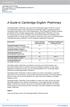 Cambridge English: Preliminary, also known as the Preliminary English Test (PET), is part of a comprehensive range of exams developed by Cambridge English Language Assessment. Cambridge English exams have
How to write your research proposal
 How to write your research proposal by Maria Joyce, Lecturer, Faculty of Health and Social Care, University of Hull June 2004 The writing of a research proposal is generally understood to be a part of
LANGUAGE! 4 th Edition, Levels A C, correlated to the South Carolina College and Career Readiness Standards, Grades 3 5
 Page 1 of 57 Grade 3 Reading Literary Text Principles of Reading (P) Standard 1: Demonstrate understanding of the organization and basic features of print. Standard 2: Demonstrate understanding of spoken
Phenomenological Research Methods
 Phenomenological Research Methods Clark Moustakas, Sage Publications, Thousand Oaks California, 1994 I Human Science Perspectives and Models Moustakas starts with discussing different human science perspectives
Investigators place signposts to carry the reader through a plan for a
 07-Creswell (RD)-45593:07-Creswell (RD)-45593.qxd 6/20/2008 4:37 PM Page 129 CHAPTER SEVEN Research Questions and Hypotheses Investigators place signposts to carry the reader through a plan for a study.
Developing an R Series Plan that Incorporates Mixed Methods Research
 Developing an R Series Plan that Incorporates Mixed Methods Research / 16 Developing an R Series Plan that Incorporates Mixed Methods Research primary mechanism for obtaining NIH grants to conduct mixed
ANALYSIS OF FOCUS GROUP DATA
 ANALYSIS OF FOCUS GROUP DATA Focus Groups generate a large amount of data which needs to be organized and processed so that the main ideas are elicited. The first step is transcribing the FGs in a way
Reading Competencies
 Reading Competencies The Third Grade Reading Guarantee legislation within Senate Bill 21 requires reading competencies to be adopted by the State Board no later than January 31, 2014. Reading competencies
THE UNIVERSITY OF SYDNEY: FACULTY OF EDUCATION AND SOCIAL WORK UNDERGRADUATE AND PRESERVICE DIVISION UNIT OF STUDY
 THE UNIVERSITY OF SYDNEY: FACULTY OF EDUCATION AND SOCIAL WORK UNDERGRADUATE AND PRESERVICE DIVISION UNIT OF STUDY 1. Unit of Study EDMT 5009 School Psychology Practicum 2. Credit Points 4 3. Coordinator
How To Teach Reading
 Florida Reading Endorsement Alignment Matrix Competency 1 The * designates which of the reading endorsement competencies are specific to the competencies for English to Speakers of Languages (ESOL). The
Characteristics of Effective and Sustainable Teaching Development Programs for Quality Teaching in Higher Education
 Characteristics of Effective and Sustainable Teaching Development Programs for Quality Teaching in Higher Education This presentation will address the following conference aim/question: What are the contextual
CREDIT TRANSFER: GUIDELINES FOR STUDENT TRANSFER AND ARTICULATION AMONG MISSOURI COLLEGES AND UNIVERSITIES
 CREDIT TRANSFER: GUIDELINES FOR STUDENT TRANSFER AND ARTICULATION AMONG MISSOURI COLLEGES AND UNIVERSITIES With Revisions as Proposed by the General Education Steering Committee [Extracts] A. RATIONALE
Revolutionary Scholarship: Innovation of Community Engagement Models
 Revolutionary Scholarship: Innovation of Community Engagement Models Welcome to Boston, where tradition meets innovation! Boston is home to historic Faneuil Hall and The Old State House, places where revolution
Upon completion of the First Year Navigation Competency, students will be able to: Understand the physical and virtual WCSU campus;
 FIRST YEAR NAVIGATION (FY) COMPETENCY First Year Experience programs take a variety of forms to provide academic and cocurricular support as students begin university life. This competency allows first
by Learning Area Achievement Objectives The New Zealand Curriculum Set of 8 charts
 The New Zealand Curriculum Achievement Objectives by Learning Area Set of 8 charts Published for the Ministry of Education by Learning Media Limited, Box 3293, Wellington, New Zealand. www.learningmedia.co.nz
DynEd International, Inc.
 General Description: Proficiency Level: Course Description: Computer-based Tools: Teacher Tools: Assessment: Teacher Materials: is a multimedia course for beginning through advanced-level students of spoken
St. Petersburg College. RED 4335/Reading in the Content Area. Florida Reading Endorsement Competencies 1 & 2. Reading Alignment Matrix
 Course Credit In-service points St. Petersburg College RED 4335/Reading in the Content Area Florida Reading Endorsement Competencies 1 & 2 Reading Alignment Matrix Text Rule 6A 4.0292 Specialization Requirements
INTRODUCTION: WHY SHOULD TEACHERS DO SCHOOL-BASED RESEARCH?
 INTRODUCTION: WHY SHOULD TEACHERS DO SCHOOL-BASED RESEARCH? Teachers constantly reflect on classroom interactions and question why students behave and perform in a particular way. However, to understand
Evaluating the role of web-based tutorials in educational practice Moring, Camilla Elisabeth; Schreiber, Trine Louise
 university of copenhagen University of Copenhagen Evaluating the role of web-based tutorials in educational practice Moring, Camilla Elisabeth; Schreiber, Trine Louise Publication date: 2012 Document Version
CLAN Manual for the CEAPP project 1
 CLAN Manual for the CEAPP project 1 About CHILDES, CLAN, and CHAT This manual explains how to transcribe audiovisual interactional data using the CLAN- CHAT program. The program was built by Brian MacWhinney
the treasure of lemon brown by walter dean myers
 the treasure of lemon brown by walter dean myers item analysis for all grade 7 standards: vocabulary, reading, writing, conventions item analysis for all grade 8 standards: vocabulary, reading, writing,
Feedback: ensuring that it leads to enhanced learning
 The Clinical Teacher s Toolbox Feedback: ensuring that it leads to enhanced learning David Boud School of Education, University of Technology, Sydney, New South Wales, Australia Editors note: This article
Analysing Qualitative Data
 Analysing Qualitative Data Workshop Professor Debra Myhill Philosophical Assumptions It is important to think about the philosophical assumptions that underpin the interpretation of all data. Your ontological
Industry Guidelines on Captioning Television Programs 1 Introduction
 Industry Guidelines on Captioning Television Programs 1 Introduction These guidelines address the quality of closed captions on television programs by setting a benchmark for best practice. The guideline
NMBA Registered nurse standards for practice survey
 Registered nurse standards for practice 1. Thinks critically and analyses nursing practice 2. Engages in therapeutic and professional relationships 3. Maintains fitness to practise and participates in
PROGRAM CONCENTRATION:
 Implementation date PROGRAM CONCENTRATION: Business & Computer Science CAREER PATHWAY: Administrative Information/Support COURSE TITLE: Business Communication and Presentation Course Description: The goal
School of Advanced Studies Doctor Of Management In Organizational Leadership/information Systems And Technology. DM/IST 004 Requirements
 School of Advanced Studies Doctor Of Management In Organizational Leadership/information Systems And Technology The mission of the Information Systems and Technology specialization of the Doctor of Management
Undergraduate Psychology Major Learning Goals and Outcomes i
 Undergraduate Psychology Major Learning Goals and Outcomes i Goal 1: Knowledge Base of Psychology Demonstrate familiarity with the major concepts, theoretical perspectives, empirical findings, and historical
Teaching Reading: A K-6 Framework
 eaching Reading: A K-6 Framework 1997 NSW Department of School Education Curriculum Directorate Smalls Road Ryde NSW 2112 ISBN: 0731083431 SCIS: 898002 PAGE 3 Contents Introduction 5 Understanding reading
Bridging the Global Skills Gap
 Bridging the Global Skills Gap Teachers views on how to prepare a Global Generation for the challenges ahead. About the research This report represents the findings of a survey of teachers 1 conducted
What Does Research Tell Us About Teaching Reading to English Language Learners?
 Jan/Feb 2007 What Does Research Tell Us About Teaching Reading to English Language Learners? By Suzanne Irujo, ELL Outlook Contributing Writer As a classroom teacher, I was largely ignorant of, and definitely
LONDON SCHOOL OF COMMERCE. Programme Specifications for the. Cardiff Metropolitan University. MSc in International Hospitality Management
 LONDON SCHOOL OF COMMERCE Programme Specifications for the Cardiff Metropolitan University MSc in International Hospitality Management 1 Contents Programme Aims and Objectives 3 Programme Learning Outcomes
School of Advanced Studies Doctor Of Management In Organizational Leadership. DM 004 Requirements
 School of Advanced Studies Doctor Of Management In Organizational Leadership The mission of the Doctor of Management in Organizational Leadership degree program is to develop the critical and creative
Looking at Classroom Practice
 Support Materials Contents This resource guide has been developed to support the work of school leaders, teachers and educators who work in and with schools across Australia. guide is designed to enable
Dialogical research on psychotherapy. Eugenie Georgaca & Evrinomy Avdi Aristotle University of Thessaloniki, Greece
 Dialogical research on psychotherapy Eugenie Georgaca & Evrinomy Avdi Aristotle University of Thessaloniki, Greece Workshop structure 11.00-13.00 Introduction to qualitative psychotherapy research and
School of Management MSc in Entrepreneurship Postgraduate Student Handbook Section 1
 School of Management MSc in Entrepreneurship Postgraduate Student Handbook Section 1 2015-2016 i Contents Page MSC IN ENTREPRENEURSHIP AT THE SCHOOL OF MANAGEMENT 1 PROGRAMME SPECIFICATION 2 PROGRAMME
Field Education in the 2008 EPAS: Implications for the Field Director s Role Dean Pierce
 Field Education in the 2008 EPAS: Implications for the Field Director s Role Dean Pierce 2008 EPAS Curriculum Features The 2008 EPAS consists of four curriculum features: 1) program mission and goals;
Message, Audience, Production (MAP) Framework for Teaching Media Literacy Social Studies Integration PRODUCTION
 Message, Audience, Production (MAP) Framework for Teaching Media Literacy Social Studies Integration PRODUCTION All media messages - a film or book, photograph or picture, newspaper article, news story,
Intercoder reliability for qualitative research
 Intercoder reliability for qualitative research You win some, but do you lose some as well? TRAIL Research School, October 2012 Authors Niek Mouter, MSc and Diana Vonk Noordegraaf, MSc Faculty of Technology,
University of Cambridge: Programme Specifications POSTGRADUATE AWARD IN EDUCATIONAL STUDIES
 University of Cambridge: Programme Specifications Every effort has been made to ensure the accuracy of the information in this programme specification. Programme specifications are produced and then reviewed