
U.S. Department of Housing and Urban Development COMMUNITY PLANNING AND DEVELOPMENT
|
|
|
- Brittany Andrews
- 9 years ago
- Views:
Transcription
1 U.S. Department of Housing and Urban Development COMMUNITY PLANNING AND DEVELOPMENT Special Attention of: NOTICE: CPD All Regional Office Directors All Field Office Directors Issued: October 23, 2006 All CPD Division Directors Expires: October 23, 2007 SUBJECT: Implementing Risk Analyses for Monitoring Community Planning and Development Grant Programs in FY I. Purpose The purpose of this Notice is to provide a consistent methodology for conducting risk analyses for Community Planning and Development (CPD) formula and competitive grantees and establish monitoring priorities within available resources. This risk analysis process has been incorporated into CPD Grants Management System (GMS) and is recorded into the Grants Management Process (GMP), a computer-based information system, to provide a documented record of conclusions and results. This Notice is intended to augment the Departmental policy contained in Handbook , Rev-3, Departmental Management Control Program, which requires the development of risk-based rating systems for all programs, and which are incorporated in Handbook REV-5, Community Planning and Development Monitoring Handbook. The major steps for implementing risk-based monitoring include: Developing risk-based rating systems for program grantees; Rating and selecting grantees for monitoring; Identifying program risks and setting monitoring objectives; and Documenting the process and recording the rationale for choosing grantees. Each Field Office will perform the risk analysis using the methodology described in this Notice. Both CPD managers and field staff are assigned distinct responsibilities to complete the risk analysis as outlined further in this Notice. II. Background Each CPD Field Office is responsible for developing monitoring strategies and an office work plan encompassing CPD grantees and programs to be monitored during the fiscal year. Headquarters establishes the completion dates for risk analysis and work plan each fiscal year. The purpose of a monitoring strategy is to define the scope and focus the monitoring efforts, including establishing a framework for determining the appropriate level of monitoring for CPD Distribution: W-3-1 HUD-21B

2 2 grantees consistent within available resources. The work plan documents the Field Office decisions regarding where to apply staff and travel resources for monitoring, training and/or technical assistance. Risk analysis provides the information needed for CPD to effectively target its resources to grantees that pose the greatest risk to the integrity of CPD programs, including identification of the grantees to be monitored on-site and remotely, the program areas to be covered, and the depth of the review. The selection process should result in identifying those grantees and activities that represent the greatest vulnerability to fraud, waste, and mismanagement. III. Frequency of Risk Analysis For FY 2007, new risk analysis worksheets will be created in GMP. The Evaluator (CPD Representative, Financial Analyst or Specialist) and Management Representative (CPD Director, Deputy Director, Program Manager, or designated senior staff person) have specific responsibilities for worksheet review and information update for each grantee. IV. Applicability Field Offices will apply the risk analysis process to the formula and competitive grant programs listed below. Formula Community Development Block Grant Program (CDBG) HOME Investment Partnerships Program (HOME) Emergency Shelter Grants Program (ESG) Housing Opportunities for Persons with AIDS Program (HOPWA) Competitive Historically Black Colleges and Universities (HBCU) Economic Development Initiative (EDI) Brownfields Economic Development Initiative (BEDI) Housing Opportunities for Persons with AIDS (HOPWA) Colonias Programs (Colonias) Youthbuild Program (Youthbuild) Round II Empowerment Zones (EZs) Rural Housing and Economic Development (RHED) Community Development Block Grant (CDBG) Small Cities Competitive Shelter Plus Care (S+C) Supportive Housing (SHP) Section 8 Single Room Occupancy (SRO) Moderate Rehabilitation
3 3 V. Risk Categories and Criteria All CPD program risk analyses are standardized for formula and competitive grantees and use a five factor quantifiable rating system (with the exception of the Community Development Block Grant (CDBG) Risk Analysis Worksheet which has four factors). Based on a 100-point rating scale, grantees are assigned one of three risk categories: High risk a total score of 51 or more: Medium risk a score between 30 50; and Low risk a score of less than 30. These risk analysis factors are consistent with those described in the HUD Monitoring Desk Guide: Policies and Procedures for Program Oversight: Financial; Physical; Management; Satisfaction; and Services. These factors are further defined by subfactors and specific criteria identified for each. Rated subfactors such as dollar value, complexity of programs, number of programs administered, and compliance issues are critical in determining those grantees defined as high risk. With minimal variation among the CPD programs, the subfactors used for each risk factor include the areas listed below. 1. Financial a. Size of Grant b. Timeliness c. Timely submission of A-133 audits d. Financial Compliance e. Expenditure Provisions 2. Physical a. Physical Conditions of Projects b. Acquisition, Construction, and Rehabilitation of Assets 3. Management a. Staff Capacity and Oversight b. On-Site Monitoring and Last Monitored c. Program Caps d. Program Complexity e. OIG Audits f. Program Design g. Timely and Accurate Submissions h. Environmental/Relocation 4. Satisfaction a. Citizen Complaints

4 4 b. Grantee Responsiveness 5. Services a. Meeting Program Objectives b. Carrying Out Program Activities c. Program Progress VI. Risk Analysis Process Risk assessment consists of two steps: 1. Rating: Assessing and recording of risk for each grantee by the Evaluator; Reviewing results by Management; and 2. Ranking: Listing grantees by category of risk, from highest to lowest; Determining monitoring exceptions; and Certifying results. The results of this two-step process provide the basis for developing office work plan and individual grantee monitoring strategies. This includes: identifying which grantees will be monitored; method of monitoring (on-site or remote); programs and areas to be monitored; type of monitoring (in-depth or limited); areas of technical assistance and training needed; resources needed; and projected timeframes. As stated earlier in this Section of the Notice, each factor and its relevant sub-factors are assigned a level of risk: high, medium or low. An individual grantee monitoring strategy must include all appropriate factor(s) and sub-factor(s) rated as high-risk as an area or program requirement that will be reviewed during monitoring. This does not exclude, however, the Field Office from reviewing medium- or low-risk areas and program requirements identified during risk analysis. Strategies should also include recommended monitoring exhibits that will be used during the review (see Attachment E-1). In addition, all individual grantee monitoring strategies should be documented into GMP under the appropriate heading (see Section VII). Step 1 Rating Grantees Timing of Risk Analysis Process: The CPD Director will have the opportunity to choose one of the following options for the timing of the risk analysis rating process. A preliminary rating may be performed during a grantee s scheduled program year performance cycle while reviewing documents such as Consolidated Annual Performance and Evaluation Reports (CAPERs) or Annual Performance Reports (APRs). At the end of the fiscal year, prior to the official ranking process, the preliminary grantee ratings would then require only brief updates to take into
5 5 consideration any subsequent issues identified for a grantee since the initial performance-rating period. Examples of subsequent issues would include timeliness, audit reports, or the results of monitoring visits not previously incorporated. Alternately, the Field Office may choose to perform the entire rating process for all grantees immediately prior to ranking at the end of the federal fiscal year. Evaluator: The Evaluator will review and rate each program administered by a grantee. The risk analysis process begins with a review of each grantee against a predetermined set of criteria. This review of each grantee's program(s) provides the basic knowledge needed to rank each grantee. In completing this review, various sources of information are used including data obtained from the Integrated Disbursement and Information System (IDIS), CAPERS and APRs, prior monitoring visits, previous audits, and citizen complaints. Special attention should be given to recent audits with findings, compliance with program expenditure requirements established by the Department, and fair housing/civil rights issues. Competitive programs are evaluated using criteria outlined in Attachment A-1. Formula programs are evaluated using criteria outline in Attachments A-2 (for CDBG), A-3 (for HOME), A-4 (for ESG), and A-5 (for HOPWA). A grantee is to be evaluated using such criteria for each program type it administers. For example, if a grantee administers HBCU and Youthbuild programs, the grantee s risk will be evaluated for both programs separately: one analysis for HBCU, and one analysis for Youthbuild. The risk analysis covers all open grants. An open grant is defined as any grant within the field office s portfolio at the start of the risk analysis review process. When evaluating each grantee against program criteria, the results will be recorded and documented in GMP in the Risk Analysis Module. Management Review: After the Evaluator has completed documenting the risk analysis results for each grantee in GMP, a Management Representative begins the review and certification process. The role of the Management Representative is to provide quality control to ensure validity and consistency through an assessment of each Evaluator s ratings and comments. The Management Representative reviews each risk analysis worksheet and completes the certification process with his/her electronic or manual signature. The results of the worksheets are entered into the Grants Management System (GMP). Step 2 Grantee Ranking and Selection After all worksheet information has been entered into GMP, the automated system provides the results in two composite lists, one for formula and one for competitive grantees (see Attachments C-1 and C-2). Grantees on both lists will be ranked in descending order, from highest to lowest risk. The Management Representative will then begin the exception process starting with the Composite Summary Sheet.

6 6 Beginning in FY 2007, the Management Representative will have four exceptions categories to deviate from monitoring grantees in rank order. The four exceptions that will be included in GMP for FY 2007 are the following: A The Office of Inspector General is currently conducting an audit of the high-risk grantee and/or high-risk program(s); B - Highrisk grantee and/or high-risk program(s) were monitored within the last two years; C Grantee will be provided technical assistance or training in current Fiscal Year; and X Other. It should also be noted that for any grantee with an average risk score of 51 or higher and/or a single program score of 51 or higher, the only allowable exceptions the Management Representative can apply are Exceptions A - The Office of Inspector General is currently conducting an audit of the high-risk grantee and/or high-risk program(s) or B High-risk grantee and/or high-risk program(s) were monitored within the last two years. Any grantee and/or program(s) rated high-risk must be monitored on-site unless Exception A or B is documented. a) Grantees will be selected for monitoring in rank order. b) Those grantees with total average scores of 51 or higher are to be further reviewed by the Management Representative to determine if Exception A or B is applicable. For grantees determined to be high-risk, but not scheduled for monitoring during current Fiscal Year, the Management Representative must annotate them as Exception A or B on the Composite Summary Worksheet for the applicable program type (on either Attachment C-1or C-2). c) In addition, any grantee with a single program score of 51 or higher must be reviewed and considered for on-site monitoring. Exception A or B can be used if the high-risk program(s) is currently under audit review by OIG or has been reviewed on-site in the last two years. The Management Representative must annotate grantees with single program scores of 51 or higher not scheduled for on-site monitoring as Exception A or B on the Composite Summary Worksheet for applicable program type (on either Attachment C-1 or C-2). d) The appropriate Fiscal Year Management Plan national goal must be applied to determine the total number of grantees to be monitored for the fiscal year. e) In-depth monitoring as defined in Chapter 1, Paragraph 1-6.D of Handbook REV-5, must be completed for high-risk grantees and high-risk programs selected for on-site monitoring. Limited monitoring, as defined in Chapter 1, Paragraph 1-6.E of Handbook REV-5, may be performed for medium- and low-risk grantees selected for monitoring on-site or remotely. f) Remote monitoring should principally be used to monitor medium- and low-risk grantees to validate the soundness of the rating criteria as well as possibly obtain early warnings of potentially serious problems. g) Although Field Offices use risk analysis as their primary monitoring basis, they may also identify other areas needing special emphasis during monitoring based on national program

7 7 reviews and evaluations by Congress, the U.S. Office of Management and Budget, or the HUD Office of Inspector General. h) When developing individual monitoring strategies, CPD Monitoring Handbook Exhibits should be selected based upon the areas of risk identified by grantee and program. Attachment E-1 provides a breakout of Handbook Exhibits by the five risk analysis factors. VII. Individual Grantee Monitoring Strategy Chapter 2-5 A. of the CPD Monitoring Handbook REV 5 provides guidance below on the development of individual grantee monitoring strategies. The individual grantee monitoring strategy defines the scope of monitoring for each grantee selected for monitoring and focuses the monitoring effort to maximize the effectiveness of the review. To be effective, the contents of the individual grantee monitoring strategy must identify the following: 1. The programs and areas to be reviewed; 2. The statutes, regulations and policies applicable to each area to be monitored; 3. In-house reports (i.e. performance reports, audits, complaints) to be reviewed prior to the monitoring; 4. Include the rationale for the linkages of the identified subfactors, areas or program requirement that will be reviewed during monitoring. 5. Any data/information required from grantee prior to monitoring; 6. The grantee/subrecipient staff that will be interviewed and location of any site visits; 7. Anticipated staff to be used such as: the CPD Representatives and Specialists (i.e., Economic Development, Relocation, Financial Analyst, Environment, and FHEO); 8. Clearly defined areas of responsibilities for each staff reviewer to avoid duplication if more than one staff will be conducting the monitoring; 9. Selection of potential CPD Monitoring Handbook exhibits; 10. A list of the expected tasks and time frames for completion; and 11. Required travel resources if applicable. The individual grantee monitoring strategy must be summarized and documented in GMP in the work plan module under the tab Individual Work Plan Strategy/Rationale. Timely and concise written documentation of the individual grantee monitoring strategy is an important tool for management use in assessing planned grantee actions against accomplishments. VIII. Recordkeeping All results of the risk analysis process are to be fully documented in GMP, and records maintained in accordance with Departmental policy. Each Field Office must be able to document and justify its rankings and proposed management responses. The documented results to be recorded in GMP (with any exceptions noted) consist of:
8 8 Grantee Risk Analysis Worksheets (Attachments A-1, A-2, A-3, A-4, and A-5) that provides criteria for evaluation of grantee risk by program area, and electronic certification in GMP. Grantee Risk Analysis Worksheets (Attachments B-1, B-2, B-3, B-4, and B-5) that provides grantee s program scoring results by factor and sub-factor with evaluation comments. Competitive Composite Summary Worksheet and Formula Composite Summary Worksheet (Attachments C-1 and C-2) that provides composite summary results of all grantees and programs. Competitive and Formula Exception Reports (Attachments D-1 and D-2) which provides reports that details exception codes and reasons for any exception(s). IX. Work Plans As a result of assessing those grantees that pose the greatest risk, and program areas in need of improvement, a work plan will be developed in accordance with the guidance provided in Chapter 2 of Handbook REV-5. This work plan will include identification of: Grantees scheduled for monitoring, including program area(s); Method of monitoring (for example, on-site or remote); Type of monitoring (in-depth or limited); Scheduled timeframes for monitoring; and Resources needed, such as staff, travel, etc. Work plans also include: Technical assistance and training to be provided to grantees based on needs identified through risk analysis; and Other grantees that need to be addressed as part of the annual work plan. Work plans must be documented in GMP under the work plan module.

9 9 Attachment A-1 Competitive Grants Risk Analysis Worksheet Part I To Be Completed By CPD Evaluator Name of Grantee: Fiscal Year Review: Name of Program: Total Number of Open Grants Considered: Total Dollar Value of all Open Grants: Name of HUD Evaluator: Date: Risk Criteria considerations include: - Risk exposure to the Department - The likelihood that a program participant has failed to comply with program requirements; or - The participant has performed unacceptably If a grantee has been awarded funds under more than one competitive program, a separate worksheet should be completed for each competitive program carried out by the above named grantee (For example A grantee has received funds under both Youthbuild and the Rural Housing and Economic Development Program, or a Continuum of Care (CoC) grantee has received funds under both, the Supportive Housing Program and Shelter Plus Care. If so, two worksheets must be completed (one for each of the programs). This worksheet has been designed for evaluating CPD s competitive programs. Although factors and subfactors are consistent for all competitive programs, rating criteria may differ in some cases for Continuum of Care grantees. In completing this worksheet, the Evaluator should consider the total number of all open grants for each type of program awarded to a grantee. An open grant is defined as any grant within the field office s portfolio at the start of the risk analysis review process. The Evaluator will provide an assessment of the grantee, utilizing five standard factors selected by the Department to determine the level of risk a grantee may pose to a HUD program. The five factors include: Financial, Physical, Management, Satisfaction and Services. Listed under each factor is a set of one or more subfactors. Each subfactor identifies a set of criteria that will define a numeric value based on risk level. You are to choose the appropriate risk level based on the definition provided and assign the numeric value that is indicated. One score should be assigned for each subfactor that best represents your assessment of the factual information available on this grantee. This score should be indicated in the Evaluator s Rating Box. The Evaluator s Comment Box must be completed when any subfactor is rated as high risk. Assessment indicators used in evaluating criteria should be available through current reporting systems or readily available information. FACTOR 1 - FINANCIAL Factor Definition: The extent to which a grantee accounts for and manages financial resources in accordance with approved financial management standards and the amount of potential monetary exposure to the Department. Rating Considerations: The basis for the Evaluator s rating under this factor is derived from information that could be obtained from, but not limited to, financial management to applicable NOFAs, approved or amended grant agreements, audit management systems, A-133 audits, assessment of grantee s draw-down history (i.e., LOCCS/PAS), the submission of required documents, timeliness standards and expenditure rates as they relate to financial management and history of financial activities, HQ reporting systems, grantee performance reports and any on-site or remote monitoring information as available. The Evaluator should award point values to subfactors A through D. Choose only one risk score for each subfactor from the point values listed below

10 10 FACTOR 1 - FINANCIAL Factor Definition Factor Score A. Total Grant Award Amount/s/: The total amount of all grant awards being considered are: i. $ 1,000,000 or more High 5 ii. $ 400,000 - $ 999,999 Medium 3 iii. $399,000 or less B. Audits i. An A-133 audit due for the most recently completed reporting period or any previous reporting period within the three most recent program years has not been submitted to the Federal Audit Clearinghouse within prescribed timeframe OR a grantee has open findings and is overdue in carrying out any agreed upon corrective action. ii. An A-133 audit has been submitted to the Federal Clearinghouse for the most recently completed reporting period as well as all audits within the last three program years have been submitted AND the grantee is on schedule for carrying out any agreed upon corrective actions identified in current or former audits. iii. A-133 audits are current as of the date of this review, financial management performance is satisfactory, and any previously agreed upon corrective actions have been completed as of the date of this review OR the grantee s audit reports for the three most recently completed program years have indicated no findings. C. Timely Expenditures. i. A grantee s performance has been untimely in the expenditure of funds in accordance with program requirements, grant agreements, or any amendments; OR a prior problem of this nature has not been resolved as of the date of this assessment. ii. A grantee is now performing adequately under a HUD requirement to correct an identified problem; OR the matter is minor in nature and it is likely to be corrected following a HUD-request for correction. iii. A grantee s performance is satisfactory AND any prior problem was corrected AND there are no known financial problems as of the date of this assessment. D. Financial Compliance i. During the most recent completed program year, staff has demonstrated an inability to administer the financial management responsibilities for the competitive program as evidenced through one or more violation of regulations or deficiencies of Part 85, Part 84, A-87 or A-110 or such equivalent requirements as set forth by the program OR there are one or more vacancies for key financial management staff of competitive programs that have existed for more than six months (Key financial management staff is defined as staff with direct oversight of financial records and or distribution of program funds). High 5 Medium 3 High 10 Medium 5 High 5 Evaluator s Rating Evaluator s Comments
11 11 ii. Although no substantial violations of regulations have been identified as specified in (i) above, one or more vacancies for key financial vacancies have existed for the past 3 to 6 months OR key financial staff have been hired in the past program year and have not received financial management training in this type of competitive program. iii. No financial management deficiencies have been identified as evidenced through violations or findings AND any key financial staff vacancies have existed for less than three months, AND any key staff hired in the past program year have received formal financial management training. Subtotal for Financial Assessment (Max. 25 pts.) SUBTOTAL: Medium 3 FACTOR 2 - PHYSICAL Factor Definition: Extent to which HUD-funded physical assets are developed, maintained and operated according to established standards. Rating Considerations: The basis of the Evaluator s rating is derived from HUD s inspection of records and reports, observations of the grantee s proper use of established forms and procedures, information received through public comments, A-133 or other audits, press accounts, and other sources of information. The Evaluator should consider any existing or previously identified problems with physical assets and the extent to which problems have been, or, are likely to be corrected; whether HUD funds are used for acquisition, construction or rehabilitation activities; the number of sites at which HUD-funded physical assets are located, and the activities supported by the physical asset; and the extent of any previous on site monitoring. The Evaluator should award point values to subfactors A through C. Choose only one risk score for each subfactor from the point values listed below. FACTOR 2 PHYSICAL Factor Definition Factor Score Evaluator s Rating Evaluator s Comments A. Existing or Previous Physical Assets i. A problem or finding that has been identified in the acquisition, development, maintenance or operation of a HUD-funded physical asset or with other physical site-related activity that has not been resolved as of the date of this review OR the physical asset has not been monitored within the most recent three program years. ii. A problem or finding identified, with the acquisition, development, maintenance or operation of the physical asset is currently subject to corrective action pursuant to a HUD-approved schedule or plan. iii. The acquisition, development, maintenance and operation of the physical asset is satisfactory OR any previously identified problem has been corrected AND no other problems with the physical asset have been identified. iv. No HUD funds are used in the acquisition, development, maintenance or operation of a physical asset. B. Acquisition, Construction and Rehabilitation of Physical Assets i. If evaluating a CoC grantee CoC funds are used for the acquisition or construction or rehabilitation of twenty-four or more units of a physical asset. High 5 Medium 3 None 0 High 5
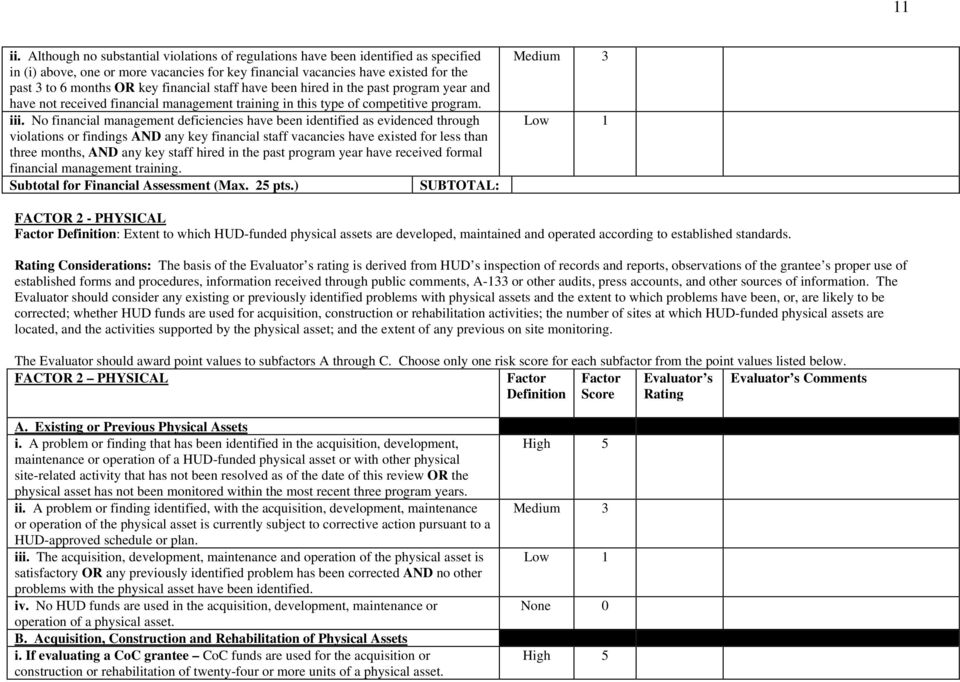
12 12 For all other competitive grantees - HUD funds are used for the acquisition or construction or rehabilitation of twelve or more units of a physical asset OR funds are used at an existing property used for business or in developing economic development opportunities. ii. If evaluating a CoC grantee CoC funds are used for the acquisition, construction, or rehabilitation of twelve to twenty-three units of a physical asset OR are used at an existing property currently used for housing or residential programs. For all other competitive grantees HUD funds are used for the acquisition, construction, or rehabilitation of eleven or less units of a physical asset OR are used at an existing property currently used for housing or residential programs. iii. If evaluating a CoC grantee No CoC funds are used for the acquisition, construction or any rehabilitation of a physical asset, excluding maintenance or repairs within the last three years. For all other competitive grantees - No HUD funds are used for the acquisition, construction or any rehabilitation of a physical asset, excluding maintenance or repairs. C. Multiple Sites for Physical Assets i. HUD funds (or CoC funds for homeless grantees) are used for the acquisition, development, maintenance or operation of physical assets at more than 3 facility sites during the grant term. ii. HUD funds (or CoC funds for homeless grantees) are used for the acquisition, development, or maintenance or operation of physical assets at 1-3 facility sites or at scattered sites. iii. HUD funds (or CoC funds for homeless grantees) are used exclusively to support activities not related to the acquisition, development, maintenance or operation of a physical asset such as any of the following: supportive services, tenant-based rental assistance, leasing of individual units, counseling, training, organizational capacity building, etc. Subtotal for Physical Assessment (Max. 15 pts.) SUBTOTAL: Medium 3 High 5 None 0 FACTOR 3 - Management: Factor Definition: Extent to which the program participant has the capacity to carry out HUD programs according to established requirements. Rating Considerations: The basis for the Evaluator s rating under this factor is derived from information that could be obtained from, but not limited to, consideration of the knowledge, skills and ability of program staff and the grantee s administrative capacity to manage the grant, including: the eligibility of activities and recipients; or problems such as the lack of progress in implementing a project; rapid staff and/or board turnover; major changes in the agency's mission or direction; lack of experience with Federal grants or project activities; the frequency and level of technical assistance required by the grantee before and during project. Additionally OIG audits and related reporting system may be considered. Evaluator should also include other functional issues related to carrying out and impacting on overall program activities, which include; environmental and wage requirements, as well as compliance with Uniform Relocation and Acquisition Act. If problems are identified the appropriate specialist will be consulted.

13 13 The Evaluator should award point values to subfactors A through E. Choose only one risk score for each subfactor from the point values listed below. FACTOR 3 MANAGEMENT Factor Factor Evaluator s Evaluator s Comments Definition Score Rating A. OIG Audit i. An OIG Audit is scheduled or currently underway and a final report has not been High 3 issued OR a previous OIG Audit identified one or more recommendations that have not been cleared AND the grantee is not on schedule for carrying out such recommendations as of the date of this review. ii. A previous OIG audit identified one or more recommendations that have not Medium 2 been cleared AND the grantee is on schedule for carrying out such recommendations as of the date of this review. iii. An OIG audit is not scheduled or currently underway AND any findings from previous audits have been cleared as of the date of this review. B. Staff Capacity i. If evaluating a CoC grantee During the most recent program year, staff has demonstrated an inability to administer this program as evidenced through one or more violations of regulations, or monitoring findings related to this homeless program that the grantee has failed to resolve within the last six months OR there are one or more vacancies for key staff that have existed for more than six months OR staff hired within the most recently completed program year or prior years has not received training for this type of homeless program OR based on the Section B of the application (experience narrative) the grantee lacks the requisite experience for the specific activity that is being undertaken. High 20 For all other competitive grantees - During the most recent program year, staff has demonstrated an inability to administer this program as evidenced through one or more violations of regulations or monitoring findings related to this competitive program that the grantee has failed to resolve within the last six months OR there are one or more key staff vacancies that have existed for more than six months (Key staff is defined as staff with assigned management and administrative responsibilities for program compliance with rules and regulations). ii. For use in evaluating CoC or other competitive grantees No violations of regulations have been identified as specified in (i) above AND one or more vacancies for key staff have existed for the past 3 to 6 months OR key staff have been hired in the past program year and have not received training in this program. Medium 10

14 14 iii. For use in evaluating CoC or other Competitive grantees- No program deficiencies have been identified as evidenced through violations or findings as indicated in (i) above AND any key staff vacancies for the program have existed for less than three months AND any key staff hired in the past program year have received training in this program. C. On Site Monitoring i. HUD has not conducted an on-site monitoring of the homeless or competitive program (as applicable) for this grantee within the last two program years OR there is one or more overdue open findings. ii. HUD has conducted an on-site monitoring of the homeless or competitive program (as applicable) within the last two program years AND if any findings were identified they were resolved OR there are open findings that are not overdue. iii. HUD has conducted an on-site monitoring of the homeless or competitive program (as applicable) within the last two years AND no findings were identified. High 10 Medium 5 D. Timely and Accurate Submissions i. One and/or more of the grantee s required submissions are incomplete OR are received 30 days or more after prescribed timeframes. This includes: annual performance reports, technical submissions as appropriate during the most recent program year. ii. While all documents indicated in i. (above) are current and up-to-date for the most recent program year, in the three most recent program years, at least one of the submissions has not been received within the prescribed timeframe OR was incomplete. iii. All grantee s required submissions are complete AND have been received by the Field Office within required timeframes for the three most recent program years. High 5 Medium 3 E. Environmental/Relocation i. The grantee has not demonstrated a record of program compliance or currently has known compliance problems with either Environmental (Part 50 or 58), or Uniform Relocation Acquisition Act requirements. ii. The grantee has demonstrated a record of program compliance or has no known compliance problems with either Environmental (Part 50 or 58), or Uniform High 2
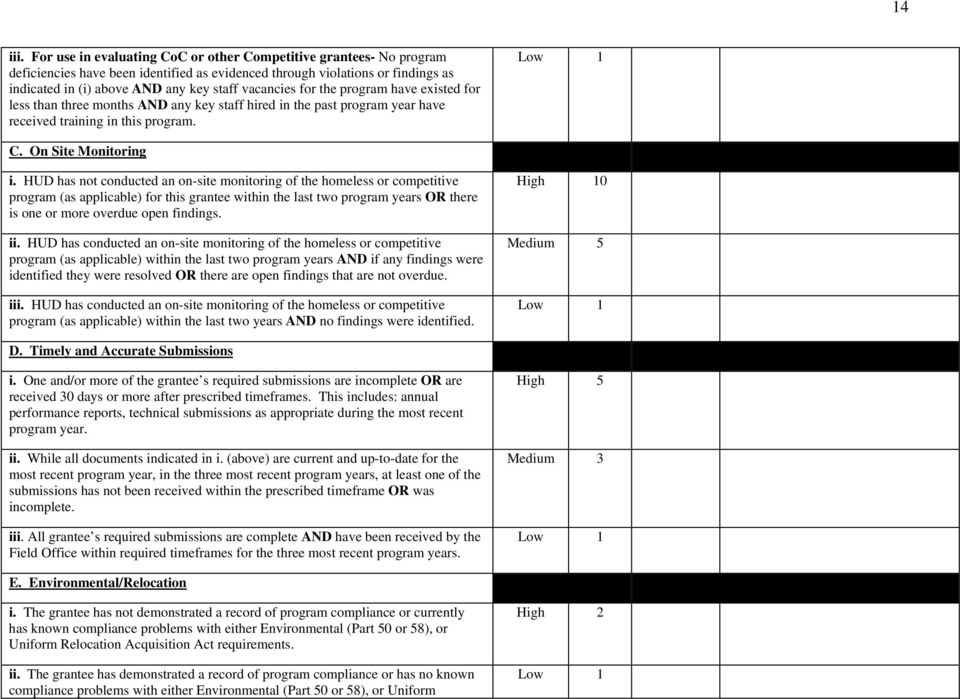
15 15 Relocation Acquisition Act requirements. Subtotal for Management Assessment (Max. 40 pts.) SUBTOTAL: FACTOR 4 - SATISFACTION Factor Definition: Extent to which clients or beneficiaries express satisfaction or dissatisfaction with the delivery of program services. Rating Considerations: The basis for the Evaluator s rating under this factor is derived from correspondence or other communication to HUD, the grantee or other parties with respect to the program; and any written or other responses by the grantee. Consider any recent problems, such as citizen complaints and the grantee/project sponsor 's response/ failure to submit reports or respond to inquiries, and the loss of community support. For homeless grantees also consider, the use of case management intake procedures in providing on-going support, client surveys, resident advisory councils and other means of achieving appropriate support from stakeholders. The Evaluator should award point values to subfactor A. Choose only one risk score for each subfactor from the point values listed below. FACTOR 4 - SATISFACTION Factor Factor Evaluator s Evaluator s Comments Definition Score Rating A. Citizen Complaints i. Citizen complaints have been received during the most recently completed High 5 program year through such sources as: citizen letters, phone calls, hot line complaints, newspapers articles, etc., and when considering the grantee s response result in violations of program regulations or findings. ii. Citizen complaints have been received during the most recently completed Medium 3 program year through such sources as: citizen letters, phone calls, hot line complaints, newspapers articles, etc., and considering the grantee s response have not been found in violations of program regulations but there are concerns that could lead to future violations if not addressed by the grantee. iii. No valid citizen complaints have been received during the most recently completed program year as described in (i) or (ii) above. Subtotal for Satisfaction Assessment (Max. 5 pts.) SUBTOTAL: FACTOR 5 - SERVICES Factor Definition: Extent to which HUD program participants effectively and efficiently deliver services to intended beneficiaries/clientele. Rating Consideration: The Evaluator should consider the planned program support provided by the grantee and whether it is appropriately being carried out to address the intended range of economic development or housing needs and related supportive services issues, including any specialized efforts for subpopulations (e.g., persons with HIV/AIDS, disadvantaged youth, etc.). Consider also any difficulty in serving the proposed number of program participants and for homeless programs, any difficulty in moving homeless clients to permanent housing. The evaluation for this factor is derived from information that could be
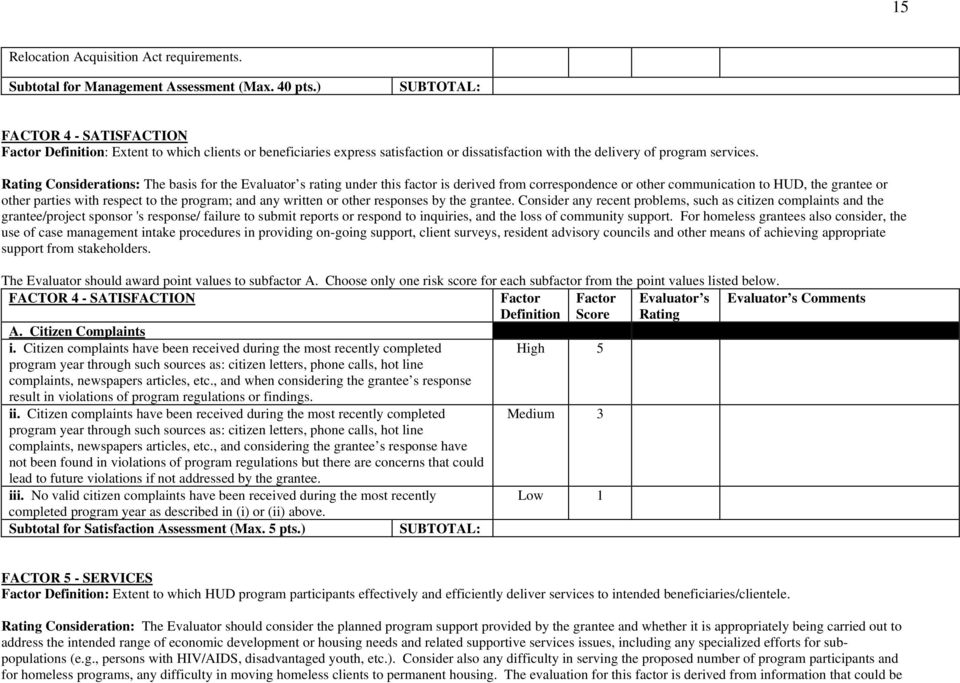
16 16 obtained from, but not limited to; Applicable NOFA, approved and amended grant agreements, annual performance plans, correspondence, release of funds requests, local, HQ or grantee generated automated reports or spreadsheets. The Evaluator should award point values to subfactors A through B. Choose only one risk score for each subfactor from the point values listed below. FACTOR 5 - SERVICES Factor Factor Evaluator s Evaluator s Comments Definition Score Score A. Meeting Program Objectives i. If evaluating a CoC grantee Proposed activities to be carried out by the grantee High 10 or sponsors have not been on schedule during the most recently program year OR the grantee has not submitted a revised timetable to carry out activities OR activities that are being carried out do not address the intended beneficiaries, sub-populations or needs of this homeless program. For all other competitive grantees - Proposed activities to be carried out by grantee or subrecipients have not been on schedule during the most recently completed program year; OR activities that are being carried out do not address the intended beneficiaries, sub-populations or needs of this competitive program. ii. If evaluating a CoC grantee Proposed activities to be carried out by the grantee Medium 5 or sponsors are on schedule for the most recently completed program year, however in the three most recently program years, the grantee has not been on schedule at least once AND the grantee has submitted a revised timetable to bring into compliance. For all other competitive grantees - Proposed activities to be carried out by grantee or subrecipients are on schedule for the most recently competed program year, however in the three most recent program years the grantee has not been on schedule at least once AND the grantee has submitted a revised timetable to come into compliance. iii. If evaluating a CoC grantee Proposed activities to be carried out by grantee or sponsors have been carried out with no known problems, and address the beneficiaries, sub-populations or needs of this homeless program for the three most recent program years or since grant execution if less than three program years. For all other competitive grantees - Proposed activities to be carried out by grantee or subrecipients have been carried out with no known problems, have been on schedule and address the beneficiaries, sub-populations or needs of this competitive program for the three most recent program years or since grant execution if less than three program years.
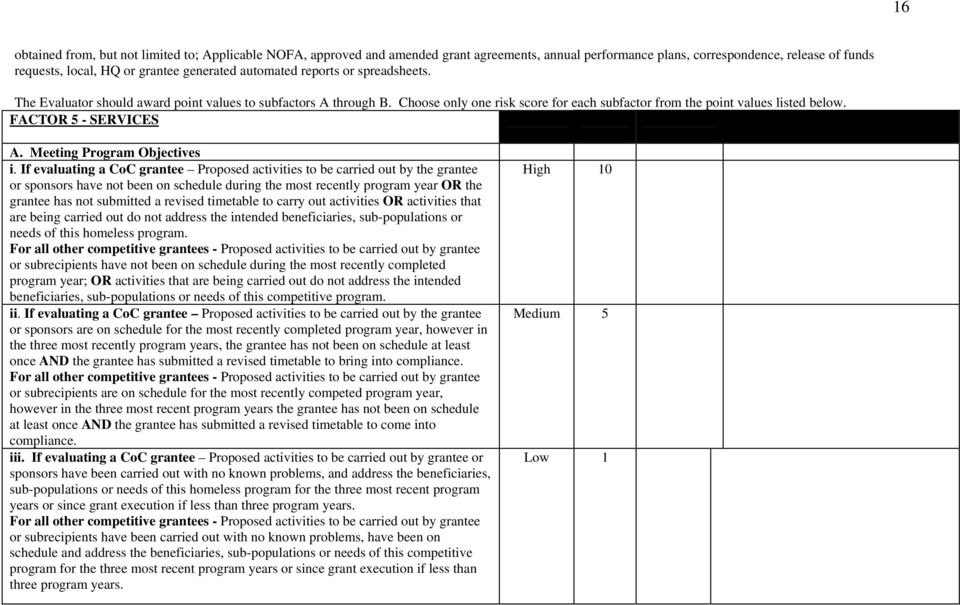
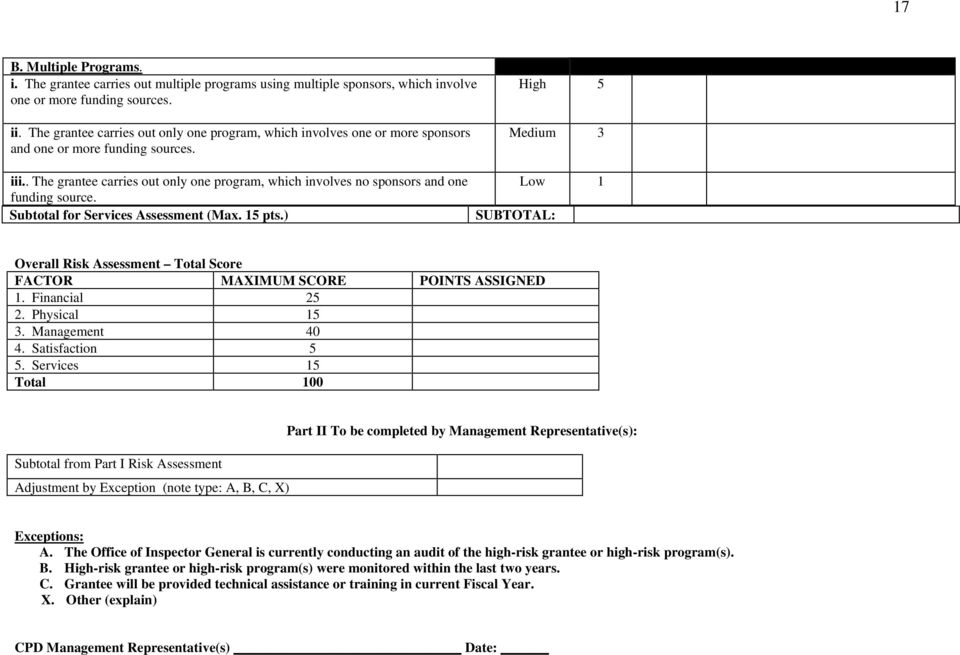
17 17 B. Multiple Programs. i. The grantee carries out multiple programs using multiple sponsors, which involve one or more funding sources. ii. The grantee carries out only one program, which involves one or more sponsors and one or more funding sources. High 5 Medium 3 iii.. The grantee carries out only one program, which involves no sponsors and one funding source. Subtotal for Services Assessment (Max. 15 pts.) SUBTOTAL: Overall Risk Assessment Total Score FACTOR MAXIMUM SCORE POINTS ASSIGNED 1. Financial Physical Management Satisfaction 5 5. Services 15 Total 100 Subtotal from Part I Risk Assessment Adjustment by Exception (note type: A, B, C, X) Part II To be completed by Management Representative(s): Exceptions: A. The Office of Inspector General is currently conducting an audit of the high-risk grantee or high-risk program(s). B. High-risk grantee or high-risk program(s) were monitored within the last two years. C. Grantee will be provided technical assistance or training in current Fiscal Year. X. Other (explain) CPD Management Representative(s) Date:
18 18 Attachment A-2 CDBG Program Formula Risk Analysis Worksheet Part I To Be Completed By CPD Evaluator Name of Grantee: Fiscal Year Review: Name of HUD Evaluator: Date: Risk Criteria considerations include: - Risk exposure to the Department - The likelihood that a program participant has failed to comply with program requirements; or - The participant has performed unacceptably In completing this worksheet, the Evaluator will provide an assessment of the grantee, utilizing four of the five standard factors selected by the Department to determine the level of risk a grantee may pose to a HUD program. These factors include: Financial, Management, Satisfaction and Services. Listed under each factor is a set of one or more subfactors. Each subfactor identifies a set of criteria that will define a numeric value based on risk level. You are to choose the appropriate risk level based on the definition provided and assign the numeric value that is indicated. One score should be assigned for each subfactor that best represents your assessment of the factual information available on this grantee. This score should be indicated in the Evaluator s Rating Box. The Evaluator s Comment Box must be completed when any subfactor is rated as high risk. Assessment indicators used in evaluating criteria should be available through current reporting systems or readily available information. FACTOR I - FINANCIAL: Factor Definition: The extent to which grantee accounts for and manages financial resources in accordance with approved financial management standards and the amount of potential monetary exposure to the Department. Rating Considerations: The basis for Evaluator s rating in this factor is derived from information that could be obtained from, but not limited to, financial management and information system such as: IDIS, audit management systems, A-133 audits, assessment of grantee s drawdown history, grantee s financial records, timeliness standards and expenditure rates as they relate to financial management and history of financial activities, Headquarters (HQ) reporting systems and grantee performance reports.

19 19 The Evaluator should award point values to subfactors A through E. Choose only one risk score for each subfactor from the point values listed below. Factor Factor Evaluator s Evaluator s Comments FACTOR 1 FINANCIAL Definition Score Rating A. Grant Amount i. The community s grant amount for the most recently completed program year falls within the top quartile of all CDBG-funded communities within the Office s jurisdiction for the same program year. ii. The community s grant amount for the most recently completed program year falls within the second quartile of all CDBG grants awarded within the Office s jurisdiction within the same program year. iii. The community s grant amount for the most recently completed program year falls within the third or fourth quartile of all CDBG grants awarded within the Office s jurisdiction for the same program year. B. Timeliness i. If evaluating an entitlement grantee The grantee is currently untimely as the amount of CDBG funds available to the grantee 60 days prior to the end of the most recent program year is more than 1.5 times the grant amount for the current program year. If evaluating a State grantee - The current rate of expenditure for the past 12 months is less than 1.0 and the State has a ratio of greater than 2.5, 60 days prior to the start of the program year or the State has not distributed and announced 100% of its State CDBG grant excluding State Administration and TA within 15 months of the date of its last grant award. ii. If evaluating an entitlement grantee - The grantee is timely for the most recent program year, however based on the definitions in i. (above), the grantee has not been timely one or more times in the most recently completed three program years. If evaluating a State grantee The rate of expenditure for the past 12 months is less than 1.0 and the state has a ratio between 2.0 and 2.49, 60 days prior to the start of the program year. iii. If evaluating an entitlement grantee - Based on the definitions in i. (above), the grantee has been timely within the most recent three program years. If evaluating a State grantee The rate of expenditure for the past 12 months is more than 1.0 or the State has a ratio of less than 2.0 sixty days prior to the start of the program year AND the State has distributed 100% of its State CDBG grant excluding TA and State Administration within 15 months of the date of its last grant award. C. Program Income i. The grantee, State recipient(s) or its sub-recipient(s) received program income over $100,000 per year directly generated from the use of CDBG funds during the most High 5 Medium 3 High 10 Medium 5 High 5

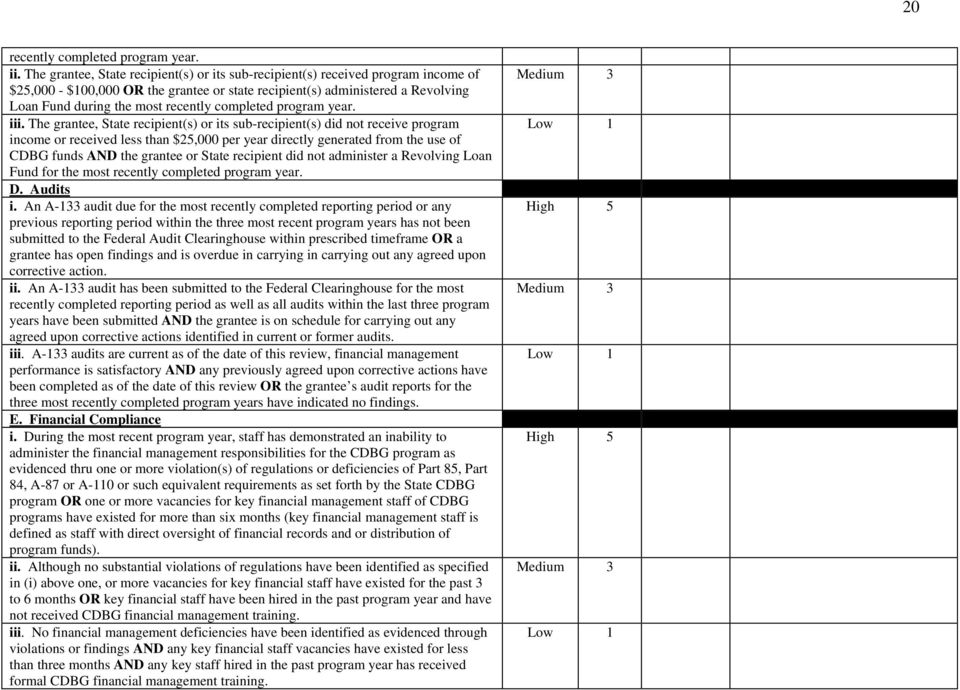
20 20 recently completed program year. ii. The grantee, State recipient(s) or its sub-recipient(s) received program income of $25,000 - $100,000 OR the grantee or state recipient(s) administered a Revolving Loan Fund during the most recently completed program year. iii. The grantee, State recipient(s) or its sub-recipient(s) did not receive program income or received less than $25,000 per year directly generated from the use of CDBG funds AND the grantee or State recipient did not administer a Revolving Loan Fund for the most recently completed program year. D. Audits i. An A-133 audit due for the most recently completed reporting period or any previous reporting period within the three most recent program years has not been submitted to the Federal Audit Clearinghouse within prescribed timeframe OR a grantee has open findings and is overdue in carrying in carrying out any agreed upon corrective action. ii. An A-133 audit has been submitted to the Federal Clearinghouse for the most recently completed reporting period as well as all audits within the last three program years have been submitted AND the grantee is on schedule for carrying out any agreed upon corrective actions identified in current or former audits. iii. A-133 audits are current as of the date of this review, financial management performance is satisfactory AND any previously agreed upon corrective actions have been completed as of the date of this review OR the grantee s audit reports for the three most recently completed program years have indicated no findings. E. Financial Compliance i. During the most recent program year, staff has demonstrated an inability to administer the financial management responsibilities for the CDBG program as evidenced thru one or more violation(s) of regulations or deficiencies of Part 85, Part 84, A-87 or A-110 or such equivalent requirements as set forth by the State CDBG program OR one or more vacancies for key financial management staff of CDBG programs have existed for more than six months (key financial management staff is defined as staff with direct oversight of financial records and or distribution of program funds). ii. Although no substantial violations of regulations have been identified as specified in (i) above one, or more vacancies for key financial staff have existed for the past 3 to 6 months OR key financial staff have been hired in the past program year and have not received CDBG financial management training. iii. No financial management deficiencies have been identified as evidenced through violations or findings AND any key financial staff vacancies have existed for less than three months AND any key staff hired in the past program year has received formal CDBG financial management training. Medium 3 High 5 Medium 3 High 5 Medium 3
21 21 Subtotal for Financial Assessment (Max. 30 Pts.) Subtotal FACTOR 2 - MANAGEMENT Factor Definition: Extent to which the program participant has the capacity to carry out HUD programs according to established requirements. Rating Considerations: The basis for the Evaluator s rating in this factor is derived from information that could be obtained from but not limited to: consideration of the knowledge, skills and ability of program staff and the grantee s administrative capacity to manage the grant, including: eligibility of activities and recipients; or problems such as: lack of progress in implementing activities, change in staff during the last year, lack of experience with Federal grants or project activities, frequency and level of technical assistance required by the grantee to carry out activities. Additionally, OIG audits and related reporting systems can be considered, including but not limited to: Consolidated Plans, CAPERS, PERs, Technical Assistance Plans, IDIS, and other reporting mechanisms. Environmental Compliance, Uniform Relocation and Acquisition Act Compliance may be considered. If problems are identified the appropriate specialist will be consulted. The Evaluator should award point values to subfactors A through H. Choose only one risk score for each subfactor from the point values listed below. FACTOR 2 MANAGEMENT Factor Factor Evaluator s Evaluator s Comments Definition Score Rating A. Program Complexity i. Grantee or State recipients undertakes activities beyond those described in 24 CFR High and AND utilizes Community Based Development Organizations (CBDOs) and/or subrecipients to assist in carrying out such activities. ii. Grantee or State recipients undertake activities beyond those described in Medium 3 and AND does not utilize CBDOs and/or subrecipients to assist in carrying out such activities. iii. Grantee or State recipients carries out basic eligible activities as defined by and B. Timely and Accurate Submissions i. One and/or more of grantee s required submissions are incomplete OR are received High 5 30 days or more after prescribed timeframes. This includes: Consolidated Plans, Annual Action Plans, PERS and CAPERS during the most recent program year. ii. While all documents indicated in i. (above) are current and up-to-date for the most Medium 3 recent program year, in the three most recent program years, at least one of the submissions has not been received within 30 days of the prescribed timeframe OR was incomplete. iii. All grantee s required submissions are complete AND have been received by the Field Office within 30 days of the prescribed timeframes for the three most recent program years.
22 22 C. Program Administration CAP i. The grantee has exceeded the administration CAP for the CDBG program for the most recently completed program year. ii. The grantee has not exceeded the Administration CAP for the most recent program year, however the grantee has exceeded the CAP one or more times for the most recent three program years. iii. The grantee has not exceeded the administration CAP during the three most recently completed program years. D. Staff Capacity i. During the most recent program year, staff has demonstrated an inability to administer the CDBG program as evidenced through one or more violations of regulations, or monitoring findings related to the CDBG program that the grantee has failed to resolve within the last six months OR there are one or more vacancies for CDBG key staff that have existed for more than six months (key staff is defined as staff with assigned management and administrative responsibilities for program compliance with rules and regulations). ii. Although no violations of regulations have been identified as specified in (i) above, one or more vacancies for key CDBG program staff have existed for the past 3 to 6 months OR key CDBG staff have been hired in the past program year and have not received CDBG program training. iii. No CDBG program deficiencies have been identified as evidenced through violations or findings AND any key staff vacancies have existed for less than three months AND any key staff hired in the past program year has received CDBG program training. E. OIG Audit i. An OIG Audit is scheduled or currently underway and a final report has not been issued OR a previous OIG Audit identified one or more recommendations that have not been cleared AND the grantee is not on schedule for carrying out such recommendations as of the date of this review. ii. A previous OIG audit within the past three years identified one or more recommendations that have not been cleared AND the grantee is on schedule for carrying out such recommendations as of the date of this review. iii. An OIG audit is not scheduled or currently underway AND any findings from previous audits have been cleared as of the date of this review. High 5 Medium 3 High 5 Medium 3 High 3 Medium 2
23 23 F. On Site Monitoring i. HUD has not conducted an on-site monitoring of the CDBG program for this grantee High 15 within the last two program years OR there are one or more overdue open findings. ii. HUD has conducted an on-site monitoring of the CDBG program within the last Medium 10 two program years AND if any findings were identified they were resolved or there are open findings that are not overdue. iii. HUD has conducted an on-site monitoring of the CDBG program within the last two program years AND no findings were identified. G. Section 108 Activity i. The grantee manages a Section 108 Loan portfolio of more than $2,000,000 or High 5 funds that are the equivalent of 25% or more of the grantee s most recent CDBG grant amount. ii. The grantee manages a Section 108 Loan portfolio of less than $2,000,000 or funds Medium 3 are equivalent to less than 25% of the grantees most recent CDBG grant amount. iii. The grantee does not have an active Section 108 Loan portfolio. H. Environmental/Relocation i. The grantee has not demonstrated a record of program compliance or currently has known compliance problems with either Environmental (Part 50 or 58) or Uniform Relocation Acquisition Act requirements. High 2 ii. The grantee has demonstrated a record of program compliance or has no known compliance problems with either Environmental (Part 50 or 58) or Uniform Relocation Acquisition Act requirements. Subtotal for Management Assessment (Max. 45 pts.) Subtotal: FACTOR 3 - SATISFACTION Factor Definition: Extent to which clients express satisfaction or dissatisfaction with the delivery of program services. Rating Considerations: The basis for Evaluator s rating in this factor is derived from information that could be obtained from, but not limited to: client or citizen-originated correspondence, grantee responses, Freedom Of Information Act, Congressional inquiries, citizen complaints, press information, loss of community support, failure to reply or submit reports, Consolidated Plans, Annual Performance Plans, CAPERS, PERS and automated tracking systems. The Evaluator should award a point value to subfactors A through B. Choose only one risk score for this subfactor from the point values listed below. FACTOR 3 SATISFACTION Factor Factor Evaluator s Evaluator s Comments Definition Score Rating A. Citizen Complaints i. Citizen complaints have been received during the most recently completed program year through such sources as; citizen letters, phone calls, hot line complaints, newspapers articles, etc., and when considering the grantee s response High 5
24 24 resulted in violations of CDBG regulations or findings. ii. Citizen complaints have been received during the most recently completed program year through such sources as: citizen letters, phone calls, hot line complaints, newspapers articles, etc.; and considering the grantee s response have not been found to be in violation of CDBG regulations, but are concerns that could lead to possible future statutory or regulatory violations if not addressed by grantee response. iii. No citizen complaints have been received during the most recently completed program year as described in (i) or (ii) above. B. Responsiveness i. Grantee has failed to respond to complaints and/or citizen inquiries forwarded through HUD within prescribed timeframes during the most recent program year. ii. Grantee has responded to complaints and/or citizen inquiries within the prescribed timeframes OR has not received any complaints forwarded through HUD within prescribed timeframes. Subtotal for Satisfaction Assessment (Max. 7 pts.) SUBTOTAL: Medium 3 High 2 FACTOR 4 - SERVICES Factor Definition: Extent to which HUD program participants effectively and efficiently deliver services to intended beneficiaries/clientele. Rating Considerations: The basis for Evaluator s rating in this factor is derived from information that could be obtained from, but not limited to: Consolidated Plans, Annual Action Plans, CAPERS, PERS, correspondence, release of funds requests, local, HQ or grantee generated automated reports or spreadsheets, IDIS. The Evaluator should consider the grantee s overall effectiveness in carrying out program activities and delivery to target population. The Evaluator should award point values to subfactors A through B. Choose only one risk score for each subfactor from the point values listed below. Factor Factor Evaluator s Evaluator s Comments FACTOR 4 - SERVICES Definition Score Rating A. Meeting National Objectives i. Sanctions have been placed on the grantee for noncompliance with national objectives or eligibility requirements during the most recently completed program year OR the grantee has not taken recommended corrective actions to address outstanding sanctions OR there are known problems identified through review of reports or information received that indicates that the grantee is currently not meeting the national objectives OR is implementing ineligible activities. ii. The grantee has been in noncompliance of program national objectives or eligibility requirements one or more times in the past three years AND the grantee has taken appropriate corrective actions to address any outstanding High 12 Medium 6
25 25 sanctions and/or monitoring audit findings related to eligibility and national objectives. iii. Activities carried out by grantee during the three most recent program years are in compliance with national objectives and eligible activity requirements AND there are no known problems. B. Public Service CAP i. Grantee exceeded the public service CAP for the most recently completed High 6 program year. ii. Grantee has not exceeded the public service CAP for the most recent program Medium 3 year; however, the grantee has exceeded the CAP one or more times within the last three program years. iii. Grantee has not exceeded the public service CAP during the three most recently completed program years. Subtotal for Services Assessment (Max. 18 pts.) SUBTOTAL: Overall Risk Assessment - Total Score FACTOR MAXIMUM SCORE POINTS ASSIGNED 1. Financial Management Satisfaction 7 4. Services 18 Total 100 Subtotal from Part I Risk Assessment Adjustment by Exception (note type: A, B, C, X) Part II To be completed by CPD Management Representative(s): Exceptions: A. The Office of Inspector General is currently conducting an audit of the high-risk grantee or high-risk program(s). B. High-risk grantee or high-risk program(s) were monitored within the last two years. C. Grantee will be provided technical assistance or training in current Fiscal Year. X. Other (explain) CPD Management Representative(s) Date:
26 26 Attachment A-3 HOME Program Formula Risk Analysis Worksheet Part I To Be Completed By CPD Evaluator Name of Grantee: Fiscal Year Review: Name of HUD Evaluator: Date: Risk Criteria considerations include: - Risk exposure to the Department - The likelihood that a program participant has failed to comply with program requirements; or - The participant has performed unacceptably In completing this worksheet, the Evaluator will provide an assessment of the grantee, utilizing five standard factors selected by the Department to determine the level of risk a grantee may pose to a HUD program. The five factors include: Financial, Physical, Management, Satisfaction and Services. Listed under each factor is a set of one or more subfactors. Each subfactor identifies a set of criteria that will define a numeric value based on risk level. You are to choose the appropriate risk level based on the definition provided and assign the numeric value that is indicated. One score should be assigned for each subfactor that best represents your assessment of the factual information available on this grantee. This score should be indicated in the Evaluator s Rating Box. The Evaluator s comment box must be completed when any subfactor is rated as high risk. In instances where a lesser rating is assigned for any subfactor, the Evaluator may use the comment box to support his/her decision. Assessment indicators used in evaluating criteria should be available through current reporting systems or readily available information. FACTOR 1 - FINANCIAL Factor Definition: Extent to which grantee accounts for and manages financial resources in accordance with approved financial management standards, and the amount of potential monetary exposure to the Department. Rating Considerations: The basis for Evaluator s rating in this factor is derived from information that could be obtained from, but not limited to, financial management and information system such as: IDIS, audit management systems, A-133 audits, assessment of grantee s drawdown history, grantee s financial records, timeliness standards and expenditure rates as they relate to financial management and history of financial activities, HQ reporting systems and grantee performance reports.
27 27 The Evaluator should award point values to subfactors A through E. Choose only one risk score for each subfactor from the point values listed below. FACTOR 1 - FINANCIAL Risk Risk Evaluator s Evaluator s Comments Definition Score Rating A. Grant Amount i. The Participating Jurisdiction s (PJ) grant amount for the most recently completed High 5 program year falls within the top quartile of all HOME funded communities within the Office s jurisdiction for the same program year. ii. The PJ s grant amount for the most recently completed program year falls within the Medium 3 second quartile of all HOME grants awarded within the Office s jurisdiction within the same program year. iii. The PJ s grant amount for the most recently completed program year falls within the third or fourth quartile of all HOME grants awarded within the Office s jurisdiction for the same program year. B. Commitments, CHDO Reservations, and Expenditures i. HOME Production Reports indicate that the most recent commitment and expenditure High 5 deadlines were not met. ii. HOME Production Reports indicate that the PJ will not meet the deadline requirements Medium 3 for commitments or CHDO reservations for the most current reporting period OR the PJ missed a deadline one or more times within three most recent program years for failure to meet commitment, CHDO reservation or expenditure requirements. iii. HOME Production Reports indicate that the commitment and expenditure and CHDO requirements have been met for the three most recent program years. C. Program Income i. The PR 27 indicates that the PJ is not receipting program income. High 3 ii. The PR 27 indicates that program income has not been expended before grants funds. Medium 2 iii. Based on the PR 27, the PJ has been receipting and expending program income prior to expending grant funds. D. Audits i. An A-133 audit due for the most recently completed reporting period or any previous High 5 reporting period within the three most recent program years has not been submitted to the Federal Audit Clearinghouse within prescribed timeframe OR a PJ has open findings and is overdue in carrying out any agreed upon corrective action. ii. An A-133 audit has been submitted to the Federal Clearinghouse for the most recently Medium 3 completed reporting period as well as all audits within the last three program years have been submitted AND the PJ is on schedule for carrying out any agreed upon corrective actions identified in current or former audits. iii. A-133 audits are current as of the date of this review, financial management performance is satisfactory and any previously agreed upon corrective actions have been completed as of the date of this review OR the PJ s audit reports for the three most
28 28 recently completed program years have indicated no findings. E. Financial Compliance i. During the most recent program year, staff has demonstrated an inability to administer High 5 the financial management responsibilities for the HOME program as evidenced through one or more violations of regulations or deficiencies of Part 85, Part 84, A-87 or A-110 OR one or more vacancies for key financial management staff of HOME programs have existed for more than six months (key financial management staff is defined as staff with direct oversight of financial records and or distribution of program funds). ii. Although no violations of regulations have been identified as specified in (i) above, Medium 3 one or more vacancies for key financial staff have existed for the past 3 to 6 months AND key financial staff have been hired in the past program year, and have not received HOME financial management training. iii. No financial management deficiencies have been identified as evidenced through violations or findings AND any key financial staff vacancies have existed for less than three months AND any key staff hired in the past program year has received HOME financial management training. Subtotal for Financial Assessment (Max. 23 pts.) SUBTOTAL: FACTOR 2. PHYSICAL Factor Definition: Extent to which HUD-funded physical assets are developed, maintained and operated according to established standards. Rating Considerations: HOME funds are used almost exclusively for physical activity (rehabilitation, new construction). Consequently, the Evaluator needs to assess the quality of physical development activities undertaken with HOME funds. The Evaluator should award a point value to subfactor A. Choose only one risk score for this subfactor from the point values listed below. FACTOR 2 PHYSICAL Risk Risk Evaluator s Evaluator s Comments Definition Score Rating A. Physical Condition of Projects i. HUD has not conducted an onsite review of the physical conditions of any HOME units in more than 3 years OR Previous monitoring (on-site or remote) identified findings concerning the physical condition of HOME properties which have not been resolved as of this date OR HOME projects did not meet applicable standards at completion or are not maintained in standard and habitable conditions for the last two most recently completed program years which was determined by such means as the CAPER review or citizen correspondence. High 12
29 29 ii. HUD has not conducted an onsite review of the physical conditions of any HOME units Medium 6 in the past 3 years OR HOME projects did not meet applicable standards at completion OR are not maintained in standard and habitable conditions for the most recently completed program year which was determined by such means as the CAPER review or citizen correspondence. iii. An onsite review of the physical conditions of HOME units during the last twelve months by HUD, CAPER review or citizen correspondence indicates that HOME projects are meeting applicable standards at completion and are maintained in standard and habitable condition as of the date of this review. Subtotal for Physical Assessment (Max. 12 pts) SUBTOTAL: FACTOR 3 - MANAGEMENT Factor Definition: Extent to which the program participant has the capacity to carry out HUD programs according to established requirements. Rating Considerations: The basis for the Evaluator s rating in this factor is derived from information that could be obtained from, but not limited to: consideration of the knowledge, skills and ability of program staff and the grantee s administrative capacity to manage the grant, including: eligibility of activities and recipients; or problems such as; lack of progress in implementing activities, change in staff during the last year, lack of experience with Federal grants or project activities, frequency and level of technical assistance required by the grantee to carry out activities. Additionally, OIG audits and related reporting systems can be considered, including but not limited to, Con Plans, CAPERS, Technical Assistance Plans, IDIS, and other reporting mechanisms. Environmental Compliance, Uniform Relocation and Acquisition Act Compliance may be considered. If problems are identified the appropriate specialist will be consulted. The Evaluator should award point values to subfactors A through K. Choose only one risk score for each subfactor from the risk score column listed below. FACTOR 3 - MANAGEMENT Risk Risk Evaluator s Evaluator s Comments Definition Score Rating Program Complexity The following elements contribute to the overall complexity of the administration of the HOME program by the PJ. A. Multiple Funding Sources i. There are large (25 or more units) rental projects OR other projects with three or more High 2 funding sources. ii. Not applicable None 0 B. Program Design i. PJ is administering more than three HOME-funded programs/activities OR since the High 2 HOME program was last monitored on-site, the PJ has undertaken new activities or made changes to an existing program. ii. Not applicable None 0 C. CHDO activities i. Based on the PR 25 or SNAPSHOT reports, the PJ s CHDO activities are not High 2
30 30 progressing from reservations to commitment, from commitments to disbursement or CHDOs are responsible for carrying out activities that are complex (i.e., funding from more than one source, more than 25 units, or new project types) in nature. ii. Not Applicable None 0 D. Program Delegations i. Program functions are being delegated to, and carried out by other entities such as: High 2 state recipients, contractors, lenders, and/or real estate professionals. ii. Not applicable None 0 E. Affordability Requirements i. More than one project in the most recently completed program year has not complied High 2 with affordability requirements. ii. Not applicable None 0 F. Staff Capacity i. During the most recent program year, staff has demonstrated an inability to administer High 9 the HOME program as evidenced through one or more violations of regulations or monitoring findings related to the HOME program, that the grantee has failed to resolve within the last six months OR one or more vacancies for HOME key staff have existed for more than six months (Key staff is defined as staff with assigned management and administrative responsibilities for program compliance with rules and regulations). ii. Although no violations of regulations have been identified as specified in (i) above, Medium 5 one or more vacancies for key HOME program staff have existed for the past 3 to 6 months OR key HOME program staff have been hired in the past program year and have not received HOME program training. iii. No HOME program deficiencies have been identified as evidenced through violations or findings AND any key staff vacancies have existed for less than three months. AND any key staff hired in the past program year has received HOME program training. G. Ongoing Project Monitoring by PJ s i. In the most recent program year, monitoring or other information available to the field High 5 office (e.g., through sampling, inquiries or complaints) indicated that the PJ was not monitoring or might not be adequately monitoring HOME rents, occupancy requirements, and physical conditions of projects under a period of affordability. ii. Excluding the most recent program year, in the past three program years monitoring or Medium 3 other information available to the field office (e.g., through sampling, inquiries or complaints) indicated that the PJ was not monitoring or might not be adequately monitoring HOME rents, occupancy requirements, and physical conditions of projects under a period of affordability OR the field office has not monitored or otherwise verified ongoing PJ oversight of projects under the periods of affordability in the past three years. iii. In the past year, the PJ s ongoing monitoring of HOME projects under affordability
31 31 periods has been monitored and was found to be compliant with HOME regulations OR the field office tested compliance with ongoing project monitoring requirements (e.g. through sampling) and the results suggested that the PJ is compliant with HOME requirements for project monitoring. H. Subrecipient/Consortia Members/CHDOs/State Recipient Capacity and Oversight i. Available information (e.g., internal PJ monitoring reports, monitoring plans, audits, citizen correspondence, previous HUD monitoring audits, etc.) indicate that PJ has not carried out oversight responsibilities in regards to subrecipients/state recipients or has not reviewed performance of subrecipients/state recipients within the last two program years. ii. Available information (as listed in i. above) indicates that subrecipient/state recipient staff lack housing experience OR they have not received HOME training. iii. Available information (as listed in i. above) indicates that PJ is overseeing the operations of subrecipients/state recipients and that training is provided when necessary, OR the PJ does not rely on subrecipients/state recipients to administer its program. I. OIG Audit i. An OIG Audit is scheduled or currently underway and a final report has not been issued OR a previous OIG Audit identified one or more recommendations that have not been cleared and the grantee is not on schedule for carrying out such recommendations as of the date of this review. ii. An OIG audit is not scheduled or currently underway AND any findings from previous audits have been cleared as of the date of this review or the grantee is on schedule for implementing the recommendations. J. On-Site Monitoring i. HUD has not conducted an on-site monitoring of the HOME program for this grantee within the last two program years OR there are one or more overdue open findings. ii. HUD has conducted an on-site monitoring of the HOME program within the last two program years AND if any findings were identified they were resolved or there are open findings that are not overdue. iii. HUD has conducted an on-site monitoring of the HOME program within the last two years AND no findings were identified. K. Environmental/Relocation i. The grantee has not demonstrated a record of program compliance or currently has known compliance problems with either Environmental (Part 50 or 58) or Uniform Relocation Acquisition Act requirements. ii. The grantee has demonstrated a record of program compliance or has no known compliance problems with either Environmental (Part 50 or 58) or Uniform Relocation Acquisition Act requirements. High 7 Medium 4 High 2 High 15 Medium 10 High 2
32 32 Subtotal for Management Assessment (Max. 50 Pts.) SUBTOTAL: FACTOR 4 - SATISFACTION Factor Definition: Extent to which clients express satisfaction or dissatisfaction with the delivery of program services. Rating Considerations: The basis for Evaluator s rating in this factor is derived from information that could be obtained from, but not limited to: client or citizen-originated correspondence, grantee responses, FOIA, Congressional inquiries, citizen complaints, press information, loss of community support, failure to reply or submit reports, Consolidated Plans, Annual Action Plans, CAPERS, and automated tracking systems. The Evaluator should award point values to subfactors A through B. Choose only one risk score for each subfactor from the risk score column listed below. FACTOR 4 SATISFACTION Risk Risk Evaluator s Evaluator s Comments Definition Score Rating A. Citizen Complaints i. Citizen complaints have been received during the most recently completed program High 5 year through such sources as: citizen letters, phone calls, hot line complaints, newspapers articles, etc., and when considering the PJ s response resulted in violations of HOME regulations or findings. ii. Citizen complaints have been received during the most recently completed program Medium 3 year through such sources as; citizen letters, phone calls, hot line complaints, newspapers articles, etc. and considering the PJ s response have not been found to be violations of HOME regulations but are concerns that could lead to possible future violations if not addressed by grantee. iii. No valid complaints have been received during the most recently completed program year as described in (i) or (ii) above. B. Responsiveness i. Grantee has failed to respond to complaints and/or citizen inquiries forwarded through High 2 HUD within prescribed timeframes during the most recent program year.. ii. Grantee has responded to complaints and/or citizen inquiries, OR has not received any complaints forwarded through HUD within prescribed timeframes. Subtotal for Satisfaction Assessment (Max. 7 Pts.) SUBTOTAL: FACTOR 5 SERVICES Factor Definition: Extent to which HUD program participants effectively and efficiently deliver services to intended beneficiaries/clientele. Rating Considerations: The basis for Evaluator s rating in this factor is derived from information that could be obtained but not limited to: Consolidated Plans, Annual Performance Plans, CAPERS, correspondence, release of funds requests, local, HQ or grantee generated automated reports or spreadsheets, or IDIS. The Evaluator should consider the grantee s overall effectiveness in carrying out program activities and delivery to target population.
33 33 The Evaluator should award point values to subfactors A through B. Choose only one risk score for each subfactor from the risk score column listed below. FACTOR 5 SERVICES Risk Risk Evaluator s Evaluator s Comments Definition Score Rating A. Income Targeting i. Income determinations procedures have not been monitored within the most recent High 3 three program years, OR the previous monitoring has found that the PJ did not meet income-targeting requirements or was incorrectly determining income. ii. PJ is meeting income-targeting requirements based on available information (e.g. audits, complaints) OR monitoring of income determination procedures within last 3 years indicates compliance. B. Program Progress i. PR 22 report (IDIS Report), HOME SNAPSHOT or other information show that more High 5 than 20% of PJ projects are not moving from commitment to construction and from construction to completion within prescribed timeframe OR PR 16 and 22 indicate that occupancy data is not being entered for completed projects. ii. PR 22 report, HOME SNAPSHOT or other information show that less than 20% of PJ Medium 3 projects are not moving from commitment to construction and from construction to completion within prescribed timeframes. iii. PR 22 report, HOME SNAPSHOT or other information show that PJ projects are moving from commitment to construction and from construction to completion within prescribed timeframe AND PR 16 and 22 indicate that occupancy data is being entered for completed projects. Subtotal for Services Assessment (Max. 8 pts.) SUBTOTAL: Overall Risk Assessment Total Score FACTOR MAXIMUM SCORE POINTS ASSIGNED 1. Financial Physical Management Satisfaction 7 5. Services 8 Total 100 Subtotal from Part I Risk Assessment Adjustment by Exception (note type: A, B, C, X) Part II To be completed by Management Representative(s):
34 34 Exceptions: A. The Office of Inspector General is currently conducting an audit of the high-risk grantee or high-risk program(s). B. High-risk grantee or high-risk program(s) were monitored within the last two years. C. Grantee will be provided technical assistance or training in current Fiscal Year. X. Other (explain) CPD Management Representative(s) Date:
35 35 Attachment A-4 Emergency Shelter Grants Program Formula Risk Analysis Worksheet Part I To Be Completed By CPD Evaluator Name of Grantee: Fiscal Year Review: Name of HUD Evaluator: Date: Risk Criteria considerations include: - Risk exposure to the Department - The likelihood that a program participant has failed to comply with program requirements; or - The participant has performed unacceptably In completing this worksheet, the Evaluator will provide an assessment of the grantee, utilizing five standard factors selected by the Department to determine the level of risk a grantee may pose to a HUD program. The five factors include: Financial, Physical, Management, Satisfaction and Services. Listed under each factor is a set of one or more subfactors. Each subfactor identifies a set of criteria that will define a numeric value based on risk level. You are to choose the appropriate risk level based on the definition provided and assign the numeric value that is indicated. One score should be assigned for each subfactor that best represents your assessment of the factual information available on this grantee. This score should be indicated in the Evaluator s Rating Box. The Evaluator s Comment Box must be completed when any subfactor is rated as high risk. Assessment indicators used in evaluating criteria should be available through current reporting systems or readily available information. FACTOR 1 - FINANCIAL: Factor Definition: Extent to which grantee accounts for and manages financial resources in accordance with approved financial management standards and the amount of potential monetary exposure to the Department. Rating Considerations: The basis for Evaluator s rating in this factor is derived from information that could be obtained from but not limited to, financial management and information system such as: IDIS, audit management systems, A-133 audits, assessment of grantee s drawdown history, submission of required documents, timeliness standards and expenditure rates as they relate to financial management and history of financial activities, HQ reporting systems and grantee performance reports. The Evaluator should award point values to subfactors A through D. Choose only one risk score for each subfactor from the point values listed below FACTOR 1 - FINANCIAL Risk Factor Evaluator s Evaluator s Comments Definition Score Rating A. Grant Amount i. The community s grant amount for the most recently completed program year falls within the top quartile of all ESG funded communities within the Office s jurisdiction High 5
36 36 for the same program year. ii. The community s grant amount for the most recently completed program year falls within the second quartile of all ESG grants awarded within the Office s jurisdiction within the same program year. iii. The community s grant amount for the most recently completed program year falls within the third or fourth quartile of all ESG grants awarded within the Office s jurisdiction within the same program year. B. Audits i. An A-133 audit due for the most recently completed reporting period or any previous reporting period within the three most recent program years has not been submitted to the Federal Audit Clearinghouse within prescribed timeframe OR a grantee has open findings and is overdue in carrying out any agreed upon corrective action. ii. An A-133 audit has been submitted to the Federal Clearinghouse for the most recently completed reporting period as well as all audits within the last three program years have been submitted AND the grantee is on schedule for carrying out any agreed upon corrective actions identified in current or former audits. iii. A-133 audits are current as of the date of this review, financial management performance is satisfactory AND any previously agreed upon corrective actions have been completed as of the date of this review OR the grantee s audit reports for the three most recently completed program years have indicated no findings. C. 24 Month Expenditure Provisions i. The grantee has failed to carry out activities that would provide for all funds to be expended within the most recent 24-month timeframe as evidenced by the most currently submitted CAPER and other reports as of the date of this review. ii. The grantee has met the most recent 24-month expenditure requirement. However, within the last five years the grantee failed to meet this requirement at least once. iii. Over the last five years the grantee has not demonstrated any problem with meeting the 24-month expenditure. D. Financial Compliance i. During the most recent program year, staff has demonstrated an inability to administer the financial management responsibilities for the ESG program as evidenced through one or more violation of regulations or deficiencies of Part 85, Part 84, A-87 or A-110 OR one or more vacancies for key financial management staff of ESG programs have existed for more than six months (Key financial management staff is defined as staff with direct oversight of financial records and or distribution of program funds). Medium 3 High 5 Medium 3 High 5 Medium 3 High 5
37 37 ii. Although no violations of regulations have been identified as specified in (i) above, one or more vacancies for key financial staff have existed for the past 3 to 6 months AND key financial staff have been hired in the past program year and have not received ESG financial management training. iii. No financial management deficiencies have been identified as evidenced through violations or findings AND any key financial staff vacancies have existed for less than three months AND any key staff hired in the past program year has received ESG financial management training. Subtotal for Financial Assessment (Max. 20 pts.) SUBTOTAL: Medium 3 FACTOR 2. PHYSICAL Factor Definition: Extent to which HUD funded physical assets are maintained and operated according to established standards. Rating Considerations: The basis of the Evaluator s rating is derived from HUD s inspection of records and reports, observations of the grantee s proper use of established forms and procedures, information received through public comments, A-133 or other audits, press accounts and other sources of information. The Evaluator should consider any existing or previously identified problems with the physical asset and the extent to which problems have been or are likely to be corrected; the number of sites at which HUD-funded physical assets are located and the activities supported by the physical asset; and the extent of any previous on site monitoring. The Evaluator should award a point value to subfactor A. Choose only one risk score for each subfactor from the point values listed below. FACTOR 2 - PHYSICAL Risk Factor Evaluator s Evaluator s Comments Definition Score Rating A. Rehabilitation i. HUD has not conducted an onsite review of the physical conditions of any ESG High 10 rehabilitation project in more than three program years OR previous monitoring (on-site or remote) identifies findings concerning the physical condition of ESG rehabilitated properties OR the grantee has not met its services obligation (either ten or three years as applicable). ii. HUD has not conducted an onsite review of the physical conditions of any ESG Medium 5 rehabilitation in the past three program years OR ESG projects did not meet applicable standards at completion or are not maintained in standard and habitable conditions for the most recently completed program year which was determined by such means as; the CAPER review, citizens correspondence. iii. HUD has conducted an onsite review of the physical conditions during the last two program years AND there were no findings relating to rehabilitation OR grantee did not use ESG funds for rehabilitation. Subtotal for Physical Assessment (Max. 10 pts.) SUBTOTAL:
38 38 FACTOR 3. MANAGEMENT Factor Definition: Extent to which the program participant has the capacity to carry out HUD programs according to established requirements. Rating Considerations: The basis for the Evaluator s rating in this factor is derived from information that could be obtained from, but not limited to: consideration of the knowledge, skills and ability of program staff and the grantee s administrative capacity to manage the grant, including: eligibility of activities and recipients; or problems such as; lack of progress in implementing activities, change in staff during the last year, lack of experience with Federal grants or project activities, frequency and level of technical assistance required by the grantee to carry out activities. Additionally, OIG audits and related reporting systems can be considered, including but not limited to: Consolidated Plans, Consolidated Annual Performance and Evaluation Reports (CAPERs), Integrated Disbursement and Information System (IDIS), and other reporting mechanisms. Environmental Compliance, Uniform Relocation and Acquisition Act Compliance may be considered. If problems are identified, the appropriate Specialist will be consulted. The Evaluator should award point values to subfactors A through H. Choose only one risk score for each subfactor from the point values listed below. FACTOR 3 - MANAGEMENT Risk Factor Rater s Rater s Comments Definition Score Rating A. Program Complexity i. Grantee undertakes three or more activities provided for at 24 CFR OR uses a High 5 subrecipient to assist in carrying out such activities; OR activities are being currently undertaken that have not been carried out since the grantee was last monitored on site for the ESG program. ii. Grantee carries out two or fewer eligible activities as defined by 24 CFR OR Medium 3 grantee has taken on rehabilitation or homeless prevention as new activities, which the grantee has not previously carried out. iii. Grantee has not undertaken any new activities during the current or most recently completed program year AND there are no known problems or findings under the ESG program that exist as of the date of this review. B. Timely and Accurate Submissions i. One and/or more of grantee s required submissions are incomplete OR are received High 5 30 days or more after prescribed timeframes. This includes: Consolidated Plans, Annual Actions Plans and CAPERS during the most recent program year. ii. While all documents indicated in i. (above) are current and up-to-date for the most Medium 3 recent program year, in the three most recent program years at least one of the submissions has not been received within the prescribed timeframe OR was incomplete. iii. All grantee s required submissions are complete AND have been received by the Field Office within thirty days of the prescribed timeframes for the three most recent program years. C. Program Administration CAP i. The grantee has exceeded the administration CAP for the ESG program for the most High 5 recently completed program year. ii. The grantee has not exceeded the Administration CAP for the most recent program Medium 3
39 39 year, however the grantee has exceeded the CAP one or more times within the last three program years. iii. The grantee has not exceeded the administration CAP during the three most recently completed program years. D. Staff Capacity i. During the most recent program year, staff has demonstrated an inability to administer the ESG program as evidenced through one or more violations of regulations or monitoring findings related to the ESG program that the grantee has failed to resolve within the last six months OR there are one or more vacancies for ESG key staff have existed for more than six months (Key staff is defined as staff with assigned management and administrative responsibilities for program compliance with rules and regulations). ii. Although no violations of regulations have been identified as specified in (i) above, one or more vacancies for key ESG program staff have existed for the past 3 to 6 months OR key ESG program staff have been hired in the past program year and have not received ESG program training. iii. No ESG program deficiencies have been identified as evidenced through violations or findings AND any key staff vacancies have existed for less than three months AND any key staff hired in the past program year has received ESG program training. E. OIG Audit i. An OIG Audit is scheduled or currently underway and a final report has not been issued OR a previous OIG Audit identified one or more recommendations that have not been cleared AND the grantee is not on schedule for carrying out such recommendations as of the date of this review. ii. A previous OIG audit identified one or more recommendations that have not been cleared AND the grantee is on schedule for carrying out such recommendations as of the date of this review. iii. An OIG audit is not scheduled or currently underway AND any findings from previous audits have been cleared as of the date of this review. F. On-Site Monitoring i. HUD has not conducted an on-site monitoring of the ESG program for this grantee within the last two program years OR there are one or more overdue open findings. ii. HUD has conducted an on-site monitoring of the ESG program within the last two program years AND if any findings were identified they were resolved or there are open findings that are not overdue. iii. HUD has conducted an on-site monitoring of the ESG program within the last two years AND no findings were identified. High 5 Medium 3 High 3 Medium 2 High 15 Medium 10
40 40 G. Staff Costs i. Staff operating costs are classified improperly OR have exceeded ten percent of annual allocation during the most recently completed program year. ii. Staff operating costs were not exceeded or improperly classified during the most recently completed program year, however based on information available through reporting systems grantee staff operating costs exceeded the ten percent limit of the annual allocation or were improperly classified during the three most recent program years. iii. Staff operating costs are classified properly AND staff operating costs did not exceed ten percent of annual allocation during the three most recent program years. H. Environmental/Relocation i. The grantee has not demonstrated a record of program compliance or currently has known compliance problems with either Environmental (Part 50 or 58) or Uniform Relocation Acquisition Act requirements. ii. The grantee has demonstrated a record of program compliance, or has no known compliance problems with either Environmental (Part 50 or 58) or Uniform Relocation Acquisition Act requirements. High 5 Medium 3 High 2 Subtotal for Management Assessment (Max. 45 pts.) SUBTOTAL: FACTOR 4. SATISFACTION Factor Definition: Extent to which clients express satisfaction or dissatisfaction with the delivery of program services. Rating Considerations: The basis for Evaluator s rating in this factor is derived from information that could be obtained but not limited to: client or citizenoriginated correspondence, grantee responses, FOIA, Congressional inquiries, citizen complaints, press information, loss of community support, failure to reply or submit reports, Consolidated Plans, Annual Action, CAPERS, and automated tracking systems. The Evaluator should award point values to subfactors A through B. Choose only one risk score for each subfactor from the point values listed below FACTOR 4 - SATISFACTION Factor Factor Evaluator s Evaluator s Comments Definition Score Rating A. Citizen Complaints i. Citizen complaints have been received during the most recently completed program High 5 year through such sources as: citizen letters, phone calls, hot line complaints, newspapers articles, etc., and when considering the grantee s response resulted in violations of ESG regulations or findings. ii. Citizen complaints have been received during the most recently completed program year through such sources as: citizen letters, phone calls, hot line complaints, newspapers articles, etc. and considering the grantee s response have not been found to be violations of ESG regulations, but are concerns that could lead to possible future Medium 3
41 41 violations if not addressed by grantee. iii. No valid complaints have been received during the most recently completed program year as described in (i) or (ii) above. B. Responsiveness i. Grantee has failed to respond to complaints and/or citizen inquiries forwarded through HUD within prescribed timeframes during the preceding program year. ii. Grantee has responded to complaints and/or citizen inquiries within prescribed timeframes, OR has not received any complaints forwarded through HUD. Subtotal for Satisfaction Assessment (Max 10 pts) SUBTOTAL: High 5 FACTOR 5 - SERVICES Factor Definition: Extent to which HUD program participants effectively and efficiently deliver services to intended beneficiaries/clientele. Rating Considerations: The basis for Evaluator s rating in this factor is derived from information that could be obtained from. but not limited to: Consolidated Plans, Annual Performance Plans, CAPERS, correspondence, release of funds requests, local, HQ or grantee generated automated reports or spreadsheets, IDIS. The Evaluator should consider the grantee s overall effectiveness in carrying out program activities and delivery to target population. The Evaluator should award point values to subfactors A through C. Choose only one risk score for each subfactor from the point values listed below FACTOR 5 - SERVICES Factor Factor Evaluator s Evaluator s Comments Definition Score Rating A. Meeting Program Objectives i. Sanctions have been placed on grantee for failing to meet program requirements during High 5 the most recently completed program year OR the grantee is not complying with sanctions that were previously placed on them within the three most recent program years OR there are known problems identified through review of reports or information received that indicate grantee is currently not in compliance or is carrying out ineligible activities. ii. The grantee has been in noncompliance for meeting program requirements or carrying Medium 3 out ineligible activities one or more times within the past three years AND the grantee is currently working toward compliance. iii. Activities carried out by grantee during the three most recent program years are in compliance with meeting program requirements AND there are no known problems. B. Homeless Prevention i. Homeless prevention activities are classified improperly OR exceed more than 30 High 5 percent of the annual allocation during the most recently completed program year. ii. Homeless prevention activities are classified properly and did not exceed more than 30 percent of the annual allocation during the most recent program year; however, during the most recent three program years, homeless prevention activities were Medium 3
42 42 classified improperly, or exceeded more than 30 percent of the annual allocation. iii. Homeless prevention activities are classified properly and limited to no more than 30 percent of annual allocation during the past three program years. C. Essential Services i. Essential services activities are classified improperly OR exceed more than 30 percent High 5 during the most recently completed program year and no waiver was granted. ii. Essential services activities were classified properly and the grantee did not exceed Medium 3 30% of the annual allocation for essential services or a waiver was granted; however, during the three most recent program years, essential services were classified improperly, or the 30 percent annual allocation was exceeded without an approved waiver. iii. Essential services activities are classified properly and limited to no more than 30 percent of annual allocation during the three most recently completed program years. In cases where more than 30 percent has been expended, the grantee has requested and was granted a waiver. Subtotal for Services Assessment (Max. 15 pts.) SUBTOTAL: Overall Risk Assessment Total Score FACTOR MAXIMUM SCORE POINTS ASSIGNED 1. Financial Physical Management Satisfaction Services 15 Total 100 Subtotal from Part I Risk Assessment Adjustment by Exception (note type: A, B, C, X) Part II To be completed by Management Representative(s): Exceptions: A. The Office of Inspector General is currently conducting an audit of the high-risk grantee or high-risk program(s). B. High-risk grantee or high-risk program(s) were monitored within the last two years. C. Grantee will be provided technical assistance or training in current Fiscal Year. X. Other (explain) CPD Management Representative(s) Date:
43 43 Attachment A-5 HOPWA Program Formula Risk Analysis Worksheet Part I To Be Completed By CPD Evaluator Name of Grantee: Fiscal Year Review: Name of HUD Evaluator: Date: Risk Criteria considerations include: - Risk exposure to the Department - The likelihood that a program participant has failed to comply with program requirements; or - The participant has performed unacceptably In completing this worksheet, the Evaluator will provide an assessment of the grantee, utilizing five standard factors selected by the Department to determine the level of risk a grantee may pose to a HUD program. The five factors include: Financial, Physical, Management, Satisfaction and Services. Listed under each factor is a set of one or more subfactors. Each subfactor identifies a set of criteria that will define a numeric value based on risk level. You are to choose the appropriate risk level based on the definition provided and assign the numeric value that is indicated. One score should be assigned for each subfactor that best represents your assessment of the factual information available on this grantee. This score should be indicated in the Evaluator s Rating Box. The Evaluator s comment box must be completed when any subfactor is rated as high risk. Assessment indicators used in evaluating criteria should be available through current reporting systems, or readily available information. FACTOR I - FINANCIAL Factor Definition: Extent to which grantee accounts for and manages financial resources in accordance with approved financial management standards and the amount of potential monetary exposure to the Department. Rating Considerations: The basis for Evaluator s rating in this factor is derived from information that could be obtained from, but not limited to, financial management and information system such as: IDIS, audit management systems, A-133 audits assessment of grantee s draw-down history (i.e., IDIS/LOCCS/PAS), submission of required documents, timeliness standards and expenditure rates as they relate to financial management and history of financial activities, HQ reporting systems and grantee performance reports.
44 44 The Evaluator should award point values to subfactors A through D. Choose only one risk score for each subfactor from the point values listed below. FACTOR 1 - FINANCIAL Factor Definition Factor Score Evaluator s Rating Evaluator s Comments A. Audits. i. An A-133 audit due for the most recently completed reporting period or any High 5 previous reporting period within the three most recent program years has not been submitted to the Federal Audit Clearinghouse within prescribed timeframe OR a grantee has open findings and is overdue in carrying out any agreed upon corrective action. ii. An A-133 audit has been submitted to the Federal Clearinghouse for the Medium 3 most recently completed reporting period, as well as all audits within the last three program years have been submitted AND the grantee is on schedule for carrying out any agreed upon corrective actions identified in current or former audits. iii. A-133 audits are current as of the date of this review, financial management performance is satisfactory, and any previously agreed upon corrective actions have been completed as of the date of this review OR the grantee s audit reports for the three most recently completed program years have indicated no findings. B. Timely Expenditures i. A grantee s performance has been untimely in the expenditure of funds in accordance with program requirements OR a prior problem of this nature was not resolved as of the date of this assessment. ii. Grantee is now performing adequately under a HUD Notice to correct an identified problem OR the matter is minor in nature, which would not result in a sanction, finding or loss of grant award, and it is likely to be corrected following a HUD request for correction of this action. iii. The grantee s performance is satisfactory, any prior problem(s) were corrected AND there are no known financial problems. High 10 Medium 5 C. Size of funding The total amount of unexpended balances under the program as of the date of this review: i. $ 2,000,000 or more; High 5 ii. $800,000 to $1,999,999; Medium 3 iii. $200,000 to $799,999.
45 45 D. Financial Compliance i. During the most recent program year, staff has demonstrated an inability to High 5 administer the financial management responsibilities for the HOPWA program as evidenced through one or more violation of regulations or deficiencies of Part 85, Part 84, A-87 or A-110 OR one or more vacancies for key financial management staff of HOPWA programs have existed for more than six months (Key financial management staff is defined as staff with direct oversight of financial records and or distribution of program funds). ii. Although no violations of regulations have been identified as specified in Medium 3 (i) above, one or more vacancies for key financial staff have existed for the past 3 to 6 months AND key financial staff have been hired in the past program year and have not received HOPWA financial management training. iii. No financial management deficiencies have been identified as evidenced through violations or findings AND any key financial vacancies have existed for less than three months AND any key staff hired in the past program year has received HOPWA financial management training. Subtotal for Financial Assessment (Max. 25 pts.) SUBTOTAL: FACTOR 2 - PHYSICAL Factor Definition: Extent to which HUD-funded physical assets are developed, maintained and operated according to established standards. Rating Consideration: The basis for Evaluator s rating is derived from HUD s inspection of records and reports, observation of the grantee s proper use of established forms and procedures, information received through public comments, A-133 or other audits and other sources of information. The Evaluator should consider any existing or previously identified problems with the physical assets and the extent to which problems have been, or are likely to be corrected; whether HUD funds are used for acquisition, construction or rehabilitation activities; the number of sites at which HUD funded physical assets are located and the activities supported by the physical asset and the extent of any previous on site monitoring. The Evaluator should award point values to subfactors A through C. Choose only one risk score for each subfactor from the point values listed below. FACTOR 2 - PHYSICAL Risk Factor Evaluator s Evaluator s Comments Definition Score Rating A. Existing or Previous Physical Asset Problems i. A problem or finding has been identified in the development, maintenance or operation of a HOPWA-funded physical asset or other physical site-related activity; and has not been resolved as of the date of this review OR the physical asset has not been monitored within the most recent three program years. ii. An identified problem or finding with the development, maintenance or operation of the physical asset is currently subject to corrective action pursuant to a HUD-approved schedule or plan; and is on schedule. High 5 Medium 3
46 46 iii. The development, maintenance and operation of the physical asset are satisfactory OR any previously identified problem has been corrected AND no known problems exist. B. Acquisition, Construction and Rehabilitation of Physical Assets i. HOPWA funds were used for the acquisition or construction or rehabilitation High 5 of twenty-four or more units of a physical asset within the most recent three program years. ii. HOPWA funds are used for the rehabilitation of less than twenty-four units Medium 3 of a physical asset OR are used at an existing property currently used for housing or residential programs within the most recent three program years. iii. No HOPWA funds are used for the acquisition, construction or any rehabilitation of a physical asset, excluding minor maintenance or repairs within the most recent three program years. C. Multiple Sites for Physical Assets i. HOPWA funds are used for the development, or maintenance or operation of High 5 physical assets at more than 7 current facility sites within the most recent three program years. ii. HOPWA funds are used for the development, or maintenance or operation Medium 3 of physical assets at 1-6 current facility sites at scattered sites within the most recent three program years. iii. HOPWA funds are used only to support activities not directly related to the development, or maintenance or operation of a physical asset such as any of the following: supportive services, tenant-based rental assistance, leasing of individual units, counseling, training, organizational capacity building, etc. during the most recent three program years. Subtotal for Physical Assessment (Max. 15 pts.) SUBTOTAL: FACTOR 3 - MANAGEMENT Factor Definition: Extent to which the program participant has the capacity to carry out HUD programs according to established requirements. Rating Considerations: The basis for Evaluator s rating in this factor is derived from information that could be obtained from, but not limited to, consideration of the knowledge, skills and ability of program staff and the grantee s administrative capacity to manage the grant, including: eligibility of activities and recipients; or problems such as the lack of progress in implementing a project, changes in staff during the last year, major changes in the agency's mission or direction, lack of experience with Federal grants or project activities, frequency and level of technical assistance required by the grantee before and during project. Additionally OIG audits and related reporting systems can be considered, including but not limited to, Con Plans, CAPERS, Technical Assistance Plans, IDIS, and other reporting mechanisms. Environmental Compliance, Uniform Relocation and Acquisition Act Compliance may be considered. If problems are identified, the appropriate specialist will be consulted.
47 47 The Evaluator should award point values to subfactors A through F. Choose only one risk score for each subfactor from the point values listed below. FACTOR 3 - MANAGEMENT Risk Risk Evaluator s Evaluator s Comments Definition Factor Rating A. OIG Audit i. An OIG Audit is scheduled, or is currently underway and a final report has High 3 not been issued, OR a previous OIG Audit identified one or more recommendations that have not been cleared, and the grantee is not on schedule for carrying out such recommendations as of the date of this review. ii. A previous OIG audit within the past three years identified one or more Medium 2 recommendations that have not been cleared and the grantee is on schedule for carrying out such recommendations as of the date of this review. iii. An OIG audit is not scheduled or currently underway, and any findings from previous audits have been cleared as of the date of this review. B. Staff Capacity i. During the most recent program year, staff has demonstrated an inability to administer the HOPWA program as evidenced through one or more violations of regulations, or monitoring findings related to the HOPWA program that the grantee has failed to resolve within the last six months OR there are one or more vacancies for HOPWA key staff have existed for more than six months (Key staff is defined as staff with assigned management and administrative responsibilities for program compliance with rules and regulations). High 10 ii. Although no violations of regulations have been identified as specified in (i) above, one or more vacancies for key HOPWA program staff have existed for the past 3 to 6 months OR key HOPWA program staff have been hired in the past program year and have not received HOPWA program training. iii. No HOPWA program deficiencies have been identified as evidenced through violations or findings AND any current staff vacancies that have existed for less than three months AND any key staff hired in the past program year has received HOPWA program training. Medium 5
48 48 C. On-Site Monitoring i. HUD has not conducted an on-site monitoring of the HOPWA program for this grantee within the last three program years OR there are one or more overdue open findings. ii. HUD has conducted an on-site monitoring of the HOPWA program within the last two program years, and if any findings were identified they were resolved, or there are open findings that are not overdue. iii. HUD has conducted an on-site monitoring of the HOPWA program within the last two years, and no findings were identified. D. Timely and Accurate Submissions i. One and/or more of grantee s required submissions are incomplete OR are received 30 days or more after prescribed timeframes. This includes: Consolidated Plans, Annual Action Plans, PERS and CAPERS during the most recent program year. ii. While all documents indicated in i. (above) are current and up-to-date in the most recent program year, in the three most recent program years, at least one of the submissions has not been received within the prescribed timeframe OR was incomplete. iii. All grantee s required submission are complete AND been received by the Field Office within required timeframes for the three most recent program years. E. Program Administration CAP i. The grantee has exceeded the administration CAP for the HOPWA program for the most recently completed program year. ii. The grantee has not exceeded the administration CAP for the most recent program year, however the grantee has exceeded the CAP one or more times within the last three program years. iii. The grantee has not exceeded the administration CAP during the three most recently completed program years. F. Environmental/Relocation i. The grantee has not demonstrated a record of program compliance, or currently has known compliance problems with either Environmental (Part 50 or 58) or Uniform Relocation Acquisition Act requirements. ii. The grantee has demonstrated a record of program compliance, or has no known compliance problems with either Environmental (Part 50 or 58) or Uniform Relocation Acquisition Act requirements. High 15 Medium 10 High 5 Medium 3 High 5 Medium 3 High 2
49 49 Subtotal for Management Assessment (Max. 40 pts.) SUBTOTAL: FACTOR 4 - SATISFACTION Factor Definition: Extent to which clients or beneficiaries express satisfaction or dissatisfaction with the delivery of program services. Rating Considerations: The basis for the Evaluator s rating under this factor is derived from correspondence, or other communication to HUD, the grantee or other parties with respect to the project; and any written or other responses by the grantee. The Evaluator should consider any recent problems, such as citizen complaints and the grantee/project sponsor s response/failure to submit reports or respond to inquiries, and the loss of community support. The Evaluator s should award point values to subfactors A through B. Choose only one risk score for each subfactor from the point values listed below. FACTOR 4 - SATISFACTION Factor Factor Evaluator s Evaluator s Comments Definition Score Rating A. Citizen Complaints i. Citizen complaints have been received during the most recently completed High 5 program year through such sources as: citizen letters, phone calls, hot line complaints, newspapers articles, etc., and when considering the grantee s response resulted in violations of HOPWA regulations or findings. ii. Citizen complaints have been received during the most recently completed Medium 3 program year through such sources as; citizen letters, phone calls, hot line complaints, newspapers articles, etc. and considering the grantee s response have not been found to be violations of HOPWA regulations but are concerns that could lead to possible future violations if not addressed by grantee. iii. No valid complaints have been received during the most recent program year as described in (i) or (ii) above. B. Responsiveness i. Grantee has failed to respond to complaints and/or citizen inquiries High 5 forwarded through HUD within prescribed timeframes during the most recent program year. ii. Grantee has responded to complaints and/or citizen inquiries within prescribed timeframes OR has not received any complaints forwarded through HUD. Subtotal for Satisfaction Assessment (Max. 10 pts.) SUBTOTAL:
50 50 FACTOR 5 - SERVICES Factor Definition: Extent to which HUD program participants effectively and efficiently deliver services to intended beneficiaries/clientele. Rating Consideration: The Evaluator should consider the planned program support and how it is appropriately being carried out to address intended range of housing needs and related supportive service issues, including any specialized efforts for sub-populations of homeless clients (or persons with HIV/AIDS for HOPWA) or difficulty in serving the proposed number of participants or moving homeless clients to permanent housing. The Evaluator rater in this factor is derived from information that could be obtained from but not limited to: Consolidated Plans, Annual Performance Plans, CAPERS, correspondence, release of funds requests, local, HQ or grantee generated automated reports or spreadsheets. The Evaluator should award point values to subfactors A and B. Choose only one risk score for each subfactor from the point values listed below. FACTOR 5 - SERVICES Risk Definition Risk Score Evaluator Rating Evaluator s Comments A. Meeting Program Objectives i. Sanctions have been placed on grantee for failing to meet program High 5 requirements during the most recently completed program year OR the grantee has not taken corrective actions to address outstanding sanctions that were previously placed on them within the three most recent program years OR there are known problems identified through review of reports or information received that indicate grantee is currently not in compliance, or is carrying out ineligible activities. ii. The grantee has been in compliance for meeting program requirements Medium 3 and has carried out eligible activities during the most recent program year; however, the grantee has not been in compliance one or more times for meeting program requirements or carrying out eligible activities within the three most recent program years. iii. Activities carried out by grantee during the three most recent program years are in compliance with meeting program requirements AND there are no known problems. B. Multiple Sponsors i. A grantee carries out a program with five or more sponsors AND/OR the High 5 grantee or sponsor receives funding from more than two additional entities (e.g., HHS, State, City, Foundation, etc.) within the most recent three program years ii. A grantee carries out a program with less than five sponsors AND/OR the grantee or sponsor receives funding from no more than two funding sources within the most recent three program years. Subtotal for Services Assessment (Max. 10 pts. ) SUBTOTAL:
51 51 Overall Risk Assessment Total Score FACTOR MAXIMUM SCORE POINTS ASSIGNED 1. Financial Physical Management Satisfaction Services 10 Total 100 Subtotal from Part I Risk Assessment Adjustment by Exception (note type: A, B, C, X) Part II To be completed by Management Representative(s): Exceptions: A. The Office of Inspector General is currently conducting an audit of the high-risk grantee or high-risk program(s). B. High-risk grantee or high-risk program(s) were monitored within the last two years. C. Grantee will be provided technical assistance or training in current Fiscal Year. X. Other (explain) CPD Management Representative(s) Date:
52 52 Attachment B-1 Competitive Grants Programs Risk Analysis Worksheet Including Homeless Programs Grantee: Fiscal Year Review: Name of Program: Name of Evaluator: Date: Total Dollar Value of Grant(s): Number of Grants: Description: To Be Completed By Evaluator Factor 1 Financial A. Total Grant Award/s/ Amount (5/3/1) B. Audits (5/3/1) C. Timely Expenditures (10/5/1) D. Financial Compliance (5/3/1) Subtotal for Financial (Max. 25 pts.) Factor 2 - Physical A. Existing or Previous Physical Assets (5/3/1/0) B. Acquisition, Construction and Rehabilitation of Physical Assets (5/3/1) C. Multiple Sites for Physical Assets (5/1/0) Subtotal for Physical (Max. 15 pts.) Factor 3 - Management A. OIG Audit (3/2/1) B. Staff Capacity (20/10/1) C. On-Site Monitoring (10/5/1) D. Timely and Accurate Submissions (5/3/1) E. Environmental/Relocation (2/1) Subtotal for Management (Max. 40 pts.) Factor 4 - Satisfaction A. Citizen Complaints (5/3/1) Subtotal for Satisfaction (Max. 5 pts.) Factor 5 - Services A. Meeting Program Objectives (10/5/1) B. Multiple Programs (5/3/1) Subtotal for Services (Max. 15 pts.) Total Overall Competitive Risk Score (Max. 100 pts.) Evaluator s Rating
53 53 Attachment B-2 CDBG Risk Analysis Worksheet Grantee: Name of Evaluator: Fiscal Year Review: Date: Description: To Be Completed By Evaluator Factor 1 Financial A. Grant Amount (5/3/1) B. Timeliness (10/5/1) C. Program Income (5/3/1) D. Audits (5/3/1) E. Financial Compliance (5/3/1) Subtotal for Financial (Max. 30 pts.) Factor 2 - Management A. Program Complexity (5/3/1) B. Timely and Accurate Submissions (5/3/1) C. Program Administration CAP (5/3/1) D. Staff Capacity (5/3/1) E. OIG Audit (3/2/1) F. On-Site Monitoring (15/10/1) G. Section 108 Activity (5/3/1) H. Environmental/Relocation (2/1) Subtotal for Management (Max. 45 pts.) Factor 3 Satisfaction A. Citizen Complaints (5/3/1) B. Responsiveness (2/1) Subtotal for Satisfaction (Max. 7 pts.) Factor 4 - Services A. Meeting National Objectives (12/6/1) B. Public Service CAP (6/3/1) Evaluator s Rating Subtotal for Services Total Overall CDBG Risk Score (Max. 18 pts.) (Max. 100 pts.)
54 54 Attachment B-3 HOME Risk Analysis Worksheet Grantee: Name of Evaluator: Fiscal Year Review: Date: Description: To Be Completed By Evaluator Factor 1 Financial A. Grant Amount (5/3/1) B. Commitments, CHDO Reservations and Expenditures (5/3/1) C. Program Income (3/2/1) D. Audits (5/3/1) E. Financial Compliance (5/3/1) Subtotal for Financial (Max. 23 pts.) Factor 2 Physical A. Physical Condition of Projects (12/6/1) Subtotal for Physical (Max. 12 pts.) Factor 3 - Management A. Multiple Funding Sources (2/0) B. Program Design (2/0) C. CHDO Activities (2/0) D. Program Delegations (2/0) E. Affordability Requirements (2/0) F. Staff Capacity (9/5/1) G. On Going Project Monitoring by PJ (5/3/1) H. Sub-recipient/Consortia Members/CHDOs/State Recipient Capacity & Oversight (7/4/1) I. OIG Audit (2/1) J. On site Monitoring (15/10/1) K. Environmental/Relocation (2/1) Subtotal for Management (Max. 50 pts.) Factor 4 Satisfaction A. Citizen Complaints (5/3/1) B. Responsiveness (2/1/) Subtotal for Satisfaction (Max. 7 pts.) Factor 5 - Services A. Income Targeting (3/1) B. Program Progress (5/3/1) Subtotal for Services (Max. 8 pts.) Total Overall HOME Score (Max. 100 pts.) Evaluator s Rating
55 55 Attachment B-4 ESG Risk Analysis Worksheet Grantee: Name of Evaluator: Fiscal Year Review: Date: Description: To Be Completed By Evaluator Factor 1 Financial A. Grant Amount (5/3/1) B. Audits (5/3/1) C. 24 Month Expenditure Provisions (5/3/1) D. Financial Compliance (5/3/1) Subtotal for Financial (Max. 20 pts.) Factor 2 Physical A. Rehabilitation (10/5/1) Subtotal for Physical (Max. 10 pts.) Factor 3 Management A. Program Complexity (5/3/1) B. Timely and Accurate Submissions (5/3/1) C. Program Administration CAP (5/3/1) D. Staff Capacity (5/3/1) E. OIG Audit (3/2/1) F. On-Site Monitoring (15/10/1) G. Staff Costs (5/3/1) H. Environmental/Relocation (2/1) Subtotal for Management (Max. 45 pts.) Factor 4- Satisfaction A. Citizen Complaints (5/3/1) B. Responsiveness (5/1) Subtotal for Satisfaction (Max. 10 pts.) Factor 5 - Services A. Meeting Program Objectives (5/3/1) B. Homeless Prevention (5/3/1) C. Essential Services (5/3/1) Evaluator s Rating Subtotal for Services Total Overall ESG Risk Score (Max. 15 pts.) (Max. 100 pts.)
56 56 Attachment B-5 HOPWA Risk Analysis Worksheet Grantee: Fiscal Year Review: Name of Evaluator: Date: Description: To Be Completed By Evaluator Factor 1 Financial A. Audits (5/3/1) B. Timely Expenditures (10/5/1) C. Size of Funding (5/3/1) D. Financial Compliance (5/3/1) Subtotal for Financial (Max. 25 pts.) Factor 2 Physical A. Existing or Previous Physical Asset Problems (5/3/1) B. Acquisition, Construction and Rehabilitation of Physical Assets (5/3/1) C. Multiple Sites for Physical Assets (5/3/1) Subtotal for Physical (Max. 15 pts.) Factor 3 - Management A. OIG Audit (3/2/1) B. Staff Capacity (10/5/1) C. On-Site Monitoring (15/10/1) D. Timely and Accurate Submissions (5/3/1) E. Program Administration CAP (5/3/1) F. Environmental/Relocation (2/1) Subtotal for Management (Max. 40 pts.) Factor 4 Satisfaction A. Citizen Complaints (5/3/1) B. Responsiveness (5/1) Subtotal for Satisfaction (Max. 10 pts.) Factor 5 - Services A. Meeting Program Objectives (5/3/1) B. Multiple Sponsors (5/1) Subtotal for Services (Max. 10 pts.) Evaluator s Rating Total Overall HOPWA Risk Score (Max. 100 pts.)
57 57 Attachment C-1 Competitive Composite Summary Worksheet Grantee BEDI Colonias EDI HBCU HOPWA comp. RHED Round II EZs Sec. 8 SRO Mod. Rehab. S+ C SHP Small Cities Comp. Youthbuild Total Average Score Rank Exception Code Exception Comments Management Representative Initials High Risk = any grantee whose program score is 51 or more. KEY to Competitive Programs Acronyms BEDI Colonias EDI HBCU HOPWA competitive RHED Round II EZs Sec. 8 SRO Mod. Rehab. S + C SHP Small Cities Comp. Youthbuild Program Brownfields Economic Development Initiative Colonias Programs Economic Development Initiative Historic Black Colleges and Universities Housing Opportunities for Persons with AIDS Rural Housing and Economic Development Round II Empowerment Zones Section 8 Single Room Occupancy Medium Rehabilitation Shelter Plus Care Supportive Housing Program Small Cities Competitive Youthbuild
58 58 Attachment C-2 Formula Composite Summary Worksheet Grantee CDBG HOME ESG HOPWA Total Score Average Score Rank Exception Code Exception Comments Management Representative Initials High Risk = any grantee whose program score is 51 or more. Key to Formula Programs Acronym CDBG HOME ESG HOPWA Program Community Development Block Grant Program Home Investment Partnerships Program Emergency Shelter Grant Program Housing Opportunities for Persons With AIDS
59 59 Attachment D-1 Competitive Exception Report (Use codes A, B, C or X as appropriate, justification for code X must be provided.) Grantee Name Risk Exception Reason for Exception Ranking Code Grantee X 2 A Grantee Y 6 X Grantee was monitored in 2004 and field office will continue to work with them to clear open findings. Grantee C 4 B
60 60 Attachment D-2 Formula Exception Report (Use codes A, B, C, or X as appropriate, justification for code X must be provided.) Grantee Name Risk Exception Reason for Exception Ranking Code Grantee T 2 A Grantee U 6 X Grantee was monitored in 2004 and field office will continue to work with them to clear open findings. Grantee C 4 B
61 61 Attachment E-1 Cross Reference of CPD Monitoring Handbook Exhibits by Risk Factors Program /Specialty Area Financial Physical Management Satisfaction Services CDBG Exhibit 3-14 Exhibit Exhibit 3-10 Exhibit Exhibit State CDBG Section 108/EDI/BEDI 5-1 Disaster 6-1 HOME HOZ ESG Shelter Plus Care Supportive Housing Program
62 62 Program /Specialty Area Financial Physical Management Satisfaction Services Section 8 SRO HOPWA EZs HBCUs RHED Youthbuild Citizen Participation Lead Hazards Relocation ConPlan 20-1 FHEO
63 63 Program /Specialty Area Financial Physical Management Satisfaction Services Environmental Labor 23-1 CD-TA 17-1 Alternative Monitoring 26-1
COC PROGRAM MONITORING REQUIREMENTS
 COC PROGRAM MONITORING REQUIREMENTS HomeBase December 3, 2014 Agenda for Today Overview Section 1: Types of Monitoring Section 2: Scope of Monitoring Section 3: Frequent Compliance Issues Section 4: Risk
CHAPTER 22 FAIR HOUSING AND EQUAL OPPORTUNITY (FHEO)
 CHAPTER 22 FAIR HOUSING AND EQUAL OPPORTUNITY (FHEO) 22-1 PURPOSE. This Chapter provides guidance to CPD Field Office staff in carrying out their responsibilities to conduct limited monitoring reviews
Monitoring HOME. U.S. Department of Housing and Urban Development Office of Community Planning and Development. Prepared by
 Monitoring HOME U.S. Department of Housing and Urban Development Office of Community Planning and Development Prepared by September 2010 Introduction Purpose of this Guidebook When HUD provides a HOME
U. S. Department of Housing and Urban Development. Office of Inspector General for Investigation. Inspections and Evaluations Division
 U. S. Department of Housing and Urban Development Office of Inspector General for Investigation Inspections and Evaluations Division Inspection of Whether Duplicate Rental Assistance Payments Were Made
Supportive Housing Program (SHP) Self-Monitoring Tools
 Supportive Housing Program (SHP) Self-Monitoring Tools U.S. Department of Housing and Urban Development Office of Community Planning and Development Table of Contents INTRODUCTION...1 TOOL 1 MEASURING
Community Development Block Grant Program
 OFFICE OF AUDIT REGION 1 BOSTON, MA 1 City of Worcester, MA Community Development Block Grant Program 2013-BO-1002 JULY 29, 2013 Issue Date: July 29, 2013 Audit Report Number: 2013-BO-1002 TO: Robert Shumeyko
Frequently Asked Questions and Answers About. Section 3 of the Housing & Urban Development Act of 1968
 1 Frequently Asked Questions and Answers About Section 3 of the Housing & Urban Development Act of 1968 General Questions Applicability Consistency with Other Laws Recipient Responsibilities Section 3
Nelson R. Bregon, General Deputy Assistant Secretary for Community Planning and Development. James D. McKay Regional Inspector General for Audit, 4AGA
 Issue Date July 26, 2006 Audit Report Number 2006-AT-1014 TO: Nelson R. Bregon, General Deputy Assistant Secretary for Community Planning and Development FROM: James D. McKay Regional Inspector General
2. Ensure that small and minority and women s businesses are solicited whenever they are potential sources of products or services to be bid;
 MBE/WBE: Six (6) Affirmative Steps The Code of Federal Regulations Title 40 Part 31.36(e), Procurement, requires the Recipient and Prime Contractor to take all necessary affirmative steps to assure that
Chapter 1: Grants Management
 Chapter 1 Chapter 1: Grants Management The pdf version of this document was produced using Adobe software. To open and print it properly, you must have the Adobe Reader installed on your computer. This
CDBG Disaster Recovery Recordkeeping Requirements & Website Maintenance. U.S. Department of Housing and Urban Development
 CDBG Disaster Recovery Recordkeeping Requirements & Website Maintenance U.S. Department of Housing and Urban Development Welcome Goal for today: To get a broad understanding of the CDBG-DR recordkeeping
Five-Year Strategic Plan
 U.S. Department of Education Office of Inspector General Five-Year Strategic Plan Fiscal Years 2014 2018 Promoting the efficiency, effectiveness, and integrity of the Department s programs and operations
System Performance Measures An introductory guide to understanding system-level performance measurement
 May 2015 System Performance Measures An introductory guide to understanding system-level performance measurement Version 2 0 TABLE of Contents I. Introduction... 0 Key Terms... 2 II. The McKinney-Vento
COSTS CHARGED TO HEAD START PROGRAM ADMINISTERED BY ROCKINGHAM COMMUNITY ACTION,
 Department of Health and Human Services OFFICE OF INSPECTOR GENERAL COSTS CHARGED TO HEAD START PROGRAM ADMINISTERED BY ROCKINGHAM COMMUNITY ACTION, INC. DECEMBER 2003 A-01-03-02500 Office of Inspector
City of West Palm Beach Community Needs Assessment Workshop FY 2014-2015 Annual Action Plan
 City of West Palm Beach Community Needs Assessment Workshop FY 2014-2015 Annual Action Plan Presented By: Community Redevelopment Associates of FL Gaines Park Community Center April 2, 2014 6:00 p.m. PRESENTATION
U.S. DEPARTMENT OF HOUSING AND URBAN DEVELOPMENT WASHINGTON, DC 20410-8000 ASSISTANT SECRETARY FOR HOUSING- FEDERAL HOUSING COMMISSIONER
 U.S. DEPARTMENT OF HOUSING AND URBAN DEVELOPMENT WASHINGTON, DC 20410-8000 ASSISTANT SECRETARY FOR HOUSING- FEDERAL HOUSING COMMISSIONER Special Attention of All Multifamily Hub Directors Notice H 2011-05
Section 1. Overview of Relationships and Responsibilities
 CHAPTER 1. INTRODUCTION TO COINSURED LOAN SERVICING 1-1. ORGANIZATION OF HANDBOOK. This Handbook sets forth HUD's requirements regarding owners' management, lenders' loan servicing and oversight and lenders'
The City of New York, Office of Management and Budget, New York, NY
 The City of New York, Office of Management and Budget, New York, NY Community Development Block Grant Disaster Recovery Funds, Business Loan and Grant Program Office of Audit, Region 2 New York New Jersey
OFFICE OF AUDIT REGION 6 FORT WORTH, TX. Eustis Mortgage Corporation New Orleans, LA. HUD Federal Housing Administration Direct Endorsement Lender
 OFFICE OF AUDIT REGION 6 FORT WORTH, TX Eustis Mortgage Corporation New Orleans, LA HUD Federal Housing Administration Direct Endorsement Lender 2013-FW-1002 MARCH 21, 2013 Issue Date: March 21, 2013 Audit
HOME Investment Partnerships Program FAQs
 HOME Investment Partnerships Program FAQs Last Updated: April 25, 2016 Description: This document contains the HOME Investment Partnerships Program FAQs posted on the HUD Exchange website (https://www.hudexchange.info/home/).
William D. Tamburrino, Director, Baltimore Public Housing Program Hub, 3BPH
 Issue Date December 19, 2007 Audit Report Number 2008-PH-1004 TO: William D. Tamburrino, Director, Baltimore Public Housing Program Hub, 3BPH FROM: SUBJECT: John P. Buck, Regional Inspector General for
Department of Homeland Security Office of Inspector General. Improvements Needed in Federal Emergency Management Agency Monitoring of Grantees
 Department of Homeland Security Office of Inspector General Improvements Needed in Federal Emergency Management Agency Monitoring of Grantees OIG-09-38 March 2009 Office of Inspector General U.S. Department
City of Wichita. Housing and Community Services Department HOME INVESTMENT PARTNERSHIPS PROGRAM HOUSING DEVELOPMENT LOAN PROGRAM
 City of Wichita Housing and Community Services Department HOME INVESTMENT PARTNERSHIPS PROGRAM HOUSING DEVELOPMENT LOAN PROGRAM 2015-2016 Program Year INFORMATION PACKET APPLICATION FORM 1 Overview and
Technical Assistance Services Request for Qualifications (RFQ)
 Vision Strategy Implementation Technical Assistance Services Request for Qualifications (RFQ) Since 2000, HUD has awarded Capital Access, Inc. (CA) national Technical Assistance Contracts under the One
The City of New York, Office of Management and Budget, New York, NY
 The City of New York, Office of Management and Budget, New York, NY Community Development Block Grant Disaster Recovery Assistance Funds, Administration Costs Office of Audit, Region 2 New York New Jersey
Attn: Tracy Atkinson, Chief Officer Flint, MI
 CITY OF FLINT DEPARTMENT OF COMMUNITY AND ECONOMIC DEVELOPMENT REQUEST FOR PROPOSALS HUD PROGRAMS PAYMENT PROCESSING AND COMPLIANCE AND PERFORMANCE MONITORING SERVICES July 28, 2014 I. Key Dates and Information
CITY OF BEATRICE, NEBRASKA ECONOMIC DEVELOPMENT PROGRAM (LB840)
 CITY OF BEATRICE, NEBRASKA ECONOMIC DEVELOPMENT PROGRAM (LB840) Effective April 1, 2013 March 31, 2023 TABLE OF CONTENTS NEED AND PURPOSE 1 SECTION I. GENERAL COMMUNITY AND ECONOMIC DEVELOPMENT STRATEGY
GRANTS MANAGEMENT. After completing the module, you will have a working knowledge of the:
 MODULE 4 LEARNING OBJECTIVES: GRANTS MANAGEMENT After completing the module, you will have a working knowledge of the: Components of grants management Reporting requirements Financial regulations Administrative
Core Monitoring Guide
 Core Monitoring Guide April 2005 eta UNITED STATES DEPARTMENT OF LABOR EMPLOYMENT AND TRAINING ADMINISTRATION Core Monitoring Guide April 2005 United States Department of Labor Employment and Training
Understanding SRO. January 2001
 Understanding SRO January 2001 The Single Room Occupancy (SRO) program is authorized by Section 441 of the McKinney- Vento Homeless Assistance Act. Under the program, HUD enters into Annual Contributions
NOT ALL COMMUNITY SERVICES BLOCK GRANT RECOVERY ACT COSTS CLAIMED
 Department of Health and Human Services OFFICE OF INSPECTOR GENERAL NOT ALL COMMUNITY SERVICES BLOCK GRANT RECOVERY ACT COSTS CLAIMED ON BEHALF OF THE COMMUNITY ACTION PARTNERSHIP OF NATRONA COUNTY FOR
The City of Joplin, MO
 OFFICE [Type OF text] AUDIT REGION 7 KANSAS CITY, KS The City of Joplin, MO CDBG Disaster Recovery Program 2014-KC-1002 January 29, 2014 Issue Date: January 29, 2014 Audit Report Number: 2014-KC-1002 TO:
Chapter 11. Lender Underwriting HUD Review. 11.1 Lender Underwriting
 Lender Underwriting HUD Review 11.1 Lender Underwriting A. Pre-application. When a Lender is contemplating submitting a pre-application to HUD, the Lender should provide HUD immediately in writing the
EMERGENCY SOLUTIONS GRANT PROGRAM
 TABLE OF CONTENTS AND CHECKLIST Lead Applicant name: Provider or Sub-recipient named in this application: This is application is # of a total # of applications being submitted by this lead applicant. Lead
TIPS AND TRICKS FOR USING THE HRE VIRTUAL HELP DESKS
 HUDHRE.info TIPS AND TRICKS FOR USING THE HRE VIRTUAL HELP DESKS The following is a collection of tips and tricks for using the HUD HRE Virtual Help Desks. Using these suggestions will facilitate the Help
Review of Medicaid Upper-Payment-Limit Requirements for Kansas Nursing Facility Reimbursement (A-07-03-02672)
 DEPARTMENT OF HEALTH & HUMAN SERVICES Office of Inspector General '%..,- Washington, D.C. 20201 TO: Mark B. McClellan, M.D., Ph.D. Administrator Centers for Medicare & Medicaid Services FROM: Daniel R.
Vicki Bott, Deputy Assistant Secretary for Single Family Housing, HU
 Issue Date June 22, 2010 Audit Report Number 2010-PH-1010 TO: FROM: SUBJECT: Vicki Bott, Deputy Assistant Secretary for Single Family Housing, HU //signed// John P. Buck, Regional Inspector General for
Tips for Reporting Timely and Accurate CDBG Data in IDIS
 Tips for Reporting Timely and Accurate CDBG Data in IDIS HUD Requires CDBG Data that are Complete Accurate Timely 2 Why IDIS Data Are Important Demonstrate Compliance Provide Transparency and Accountability
PASS-THROUGH SHORT-TERM BOND PROGRAM. (Debt Financing Under Section 44c of the Authority's Act)
 PASS-THROUGH SHORT-TERM BOND PROGRAM (Debt Financing Under Section 44c of the Authority's Act) The Authority s Act permits the Michigan State Housing Development Authority (the Authority ) to participate
Resource Allocation and Monitoring Strategies
 Resource Allocation and Monitoring Strategies Cynthia Nagendra Jason Satterfield HomeBase Laura Gillis Center for Social Innovation Vicki Judice Unity New Orleans Overview A. Why Monitor? 1. Changes to
Mississippi Development Authority. Final Action Plan for CDBG Supplemental Disaster Recovery Funds 2nd Allocation, Public Law 110-252
 Mississippi Development Authority Final Action Plan for CDBG Supplemental Disaster Recovery Funds 2nd Allocation, Public Law 110-252 July 29, 2009 Mississippi Development Authority Proposed Action Plan
St Johns County CoC Governance Charter St Johns County Continuum of Care St Johns County Continuum of Care Board Purpose of the CoC and CoC Board
 St Johns County CoC Governance Charter The name of this Continuum of Care (CoC) shall be the St Johns County Continuum of Care and the name of the CoC board shall be the St Johns County Continuum of Care
The econ Planning Suite: A Desk Guide for Using IDIS to Prepare the Consolidated Plan, Annual Action Plan, and CAPER/PER
 The econ Planning Suite: A Desk Guide for Using IDIS to Prepare the Consolidated Plan, Annual Action Plan, and CAPER/PER TABLE OF CONTENTS Overview... 3 Section I: Features of the Template... 6 Integration
CHAPTER TEN. Quality Assurance and Quality Control MAINE RIGHT OF WAY MANUAL
 CHAPTER TEN Quality Assurance and Quality Control MAINE RIGHT OF WAY MANUAL December 2010 Section Table of Contents Page 10-1 PURPOSE AND OBJECTIVES... 10-1(1) 10-1.01 Purpose... 10-1(1) 10-1.02 Quality
U.S. Department of Housing and Urban Development Community Planning and Development
 U.S. Department of Housing and Urban Development Community Planning and Development Special Attention of: Notice: CPD 13-07 All CPD Division Directors All CDBG Grantees Issued: August 23, 2013 Expires:
Glossary of Grant Terms
 Glossary of Grant Terms Office of Grants and Alternative Funding Grant-ese" is the jargon used by specialists in proposal preparation. This Glossary currently holds 50 of the most commonly used terms.
Guidance on NSP-Eligible Acquisition & Rehabilitation Activities
 Guidance on NSP-Eligible Acquisition & Rehabilitation Activities This NSP Policy Guidance describes how to determine whether or not a property is eligible for acquisition and or rehabilitation with NSP
CITY OF SPRINGFIELD, MA THE CDBG-R SUBSTANTIAL AMENDMENT
 CITY OF SPRINGFIELD, MA THE CDBG-R SUBSTANTIAL AMENDMENT Jurisdiction(s): City of Springfield, MA Jurisdiction Web Address: www.springfieldcityhall.com (URL where CDBG-R Substantial Amendment materials
GAO FEDERAL STUDENT LOAN PROGRAMS. Opportunities Exist to Improve Audit Requirements and Oversight Procedures. Report to Congressional Committees
 GAO United States Government Accountability Office Report to Congressional Committees July 2010 FEDERAL STUDENT LOAN PROGRAMS Opportunities Exist to Improve Audit Requirements and Oversight Procedures
West Valley City Grants Department Rehabilitation Loan Program Policy & Information Packet
 West Valley City Grants Department Rehabilitation Loan Program Policy & Information Packet Current Revision: 9/09 1 CONTENTS REHABILITATION LOAN PROGRAM (RLP) POLICY: Section I Section II Section III Section
CENTERS FOR INDEPENDENT LIVING COMPLIANCE REVIEW REPORT
 CENTERS FOR INDEPENDENT LIVING COMPLIANCE REVIEW REPORT People Achieving Real Independence, Inc. (PARI) Center for Independent Living Grant Award Number: H132A930034 (Pawtucket) Rhode Island REVIEW DATES:
CITIZEN PARTICIPATION PLAN Rev. March 13, 2014
 CITIZEN PARTICIPATION PLAN Rev. March 13, 2014 A Citizen Participation Plan sets forth the policies and procedures for citizen participation in the development of the five-year Consolidated Plan, annual
ESG SUBSTANTIAL AMENDMENT for FY 2011
 ESG SUBSTANTIAL AMENDMENT for FY 2011 Community & Economic Development Department City of Salinas Table of Contents Consultation 2 Citizen Participation 2 Summary of Consultation Process 3 Summary of Citizen
City of Syracuse Department of Neighborhood and Business Development
 City of Syracuse Department of Neighborhood and Business Development Community Development Block Grant (CDBG) RFP Program Year 40 (2014 2015) Mayor Stephanie A. Miner Paul Driscoll, Commissioner September
Housing Opportunities for Persons with AIDS (HOPWA) Financial Management Training for HOPWA Grantees March 2013
 Housing Opportunities for Persons with AIDS (HOPWA) Financial Management Training for HOPWA Grantees March 2013 Office of HIV/AIDS Housing Acknowledgements This guidance material was prepared by ICF
CMS DID NOT ALWAYS MANAGE AND OVERSEE CONTRACTOR PERFORMANCE
 Department of Health and Human Services OFFICE OF INSPECTOR GENERAL CMS DID NOT ALWAYS MANAGE AND OVERSEE CONTRACTOR PERFORMANCE FOR THE FEDERAL MARKETPLACE AS REQUIRED BY FEDERAL REQUIREMENTS AND CONTRACT
Implementing the HEARTH Act: The Emergency Solutions Grants (ESG) program. October 16 th, 2012
 Implementing the HEARTH Act: The Emergency Solutions Grants (ESG) program October 16 th, 2012 Presenters / Virtual Help Desk Presenters: Michael Roanhouse, Division Director, SNAPS Susan Ziff, ESG Team
New Hampshire HMIS Governance Model
 New Hampshire HMIS Governance Model The NH-HMIS governance model: Defines the relationship between the HMIS implementation and the CoC; Establishes organizational requirements for the HMIS implementation;
Environmental Protection Agency Clean Water and Drinking Water State Revolving Funds ARRA Program Audit
 Environmental Protection Agency Clean Water and Drinking Water State Revolving Funds ARRA Program Audit Audit Period: December 1, 2009 to February 12, 2010 Report number Issuance date: March 9, 2010 Contents
South Carolina State Housing Finance and Development Authority Tax Credit Assistance Program Implementation Plan
 South Carolina State Housing Finance and Development Authority Tax Credit Assistance Program Implementation Plan I. Introduction and Purpose On February 17, 2009, President Obama signed into law the American
REVIEW OF MEDICARE CONTRACTOR INFORMATION SECURITY PROGRAM EVALUATIONS FOR FISCAL YEAR 2013
 Department of Health and Human Services OFFICE OF INSPECTOR GENERAL REVIEW OF MEDICARE CONTRACTOR INFORMATION SECURITY PROGRAM EVALUATIONS FOR FISCAL YEAR 2013 Inquiries about this report may be addressed
New York State Housing Trust Fund Corporation Office of Community Renewal. New York State HOME Local Program FY 2014-2015 Application Workshop
 New York State Housing Trust Fund Corporation Office of Community Renewal New York State HOME Local Program FY 2014-2015 Application Workshop Ann M. Petersen, LEED AP Director, NYS HOME Local Program 38-40
Understanding the Basics of Section 3 and Vicinity Hiring Preferences for the NSP Program
 Understanding the Basics of Section 3 and Vicinity Hiring Preferences for the NSP Program Table of Contents Introduction... 3 Chapter 1 - Understanding Section 3 and Vicinity Hiring Preference... 5 Chapter
City of Paterson, NJ. HOME Investment Partnerships Program. Office of Audit, Region 2 New York-New Jersey
 City of Paterson, NJ HOME Investment Partnerships Program Office of Audit, Region 2 New York-New Jersey Audit Report Number: 2015-NY-1005 April 30, 2015 To: From: Subject: Anne Marie Uebbing Director Community
FY 2015 Senior Professional (SP) Performance Appraisal System Opening Guidance
 Office of Executive Resources Office of the Chief Human Capital Officer U.S. Department of Energy FY 2015 Senior Professional (SP) Performance Appraisal System Opening Guidance Table of Contents Contents
Rental Assistance Guidebook
 OFFICE OF HIV/AIDS HOUSING JANUARY 2013 HOUSING OPPORTUNITIES FOR PERSONS WITH AIDS (HOPWA) Rental Assistance Guidebook HOPWA Housing Opportunities for Persons With AIDS Acknowledgements This guidance
U.S. Department of Housing and Urban Development. Programs of HUD. (Major Grant, Assistance, and Regulatory Programs)
 U.S. Department of Housing and Urban Development Programs of HUD (Major Grant, Assistance, and Regulatory Programs) PROGRAMS OF HUD Major Mortgage, Grant, Assistance, and Regulatory Programs 2005 2 Community
perform cost settlements to ensure that future final payments for school-based services are based on actual costs.
 Page 2 Kerry Weems perform cost settlements to ensure that future final payments for school-based services are based on actual costs. In written comments on our draft report, the State agency concurred
Vicki B. Bott, Deputy Assistant Secretary for Single Family Housing, HU
 Issue Date October 25, 2010 Audit Report Number 2011-AT-1001 TO: Vicki B. Bott, Deputy Assistant Secretary for Single Family Housing, HU FROM: //signed// James D. McKay, Regional Inspector General for
Public Housing ASSISTANCE PROGRAMS
 HOUSING ASSISTANCE Breakfast program receive the severe need subsidy. Reimbursement payments for all meals are higher in Alaska and Hawaii. Schools may charge no more than 30 cents for a reducedprice breakfast.
PROCUREMENT. Actions Needed to Enhance Training and Certification Requirements for Contracting Officer Representatives OIG-12-3
 PROCUREMENT Actions Needed to Enhance Training and Certification Requirements for Contracting Officer Representatives OIG-12-3 Office of Inspector General U.S. Government Accountability Office Report Highlights
Audit of Creighton University s Administration of Its Federal TRIO Projects
 Audit of Creighton University s Administration of Its Federal TRIO Projects FINAL AUDIT REPORT. ED-OIG/A07-80027 March 2000 Our mission is to promote the efficient U.S. Department of Education and effective
SUBJECT: ADMINISTRATIVE, FISCAL & QUALITY ASSURANCE/IMPROVEMENT CONTRACT COMPLIANCE MONITORING
 Effective Date: 10/9/2003, Approved by BOD, Motion #03-055 Revised Date: 11/22/2005 Review Date: North Sound Mental Health Administration Section 5000 Contract/Audit: Administrative, Fiscal & Quality Assurance/Improvement
MEDICAID DRUG PRICE COMPARISON: AVERAGE SALES PRICE TO AVERAGE WHOLESALE PRICE
 Department of Health and Human Services OFFICE OF INSPECTOR GENERAL MEDICAID DRUG PRICE COMPARISON: AVERAGE SALES PRICE TO AVERAGE WHOLESALE PRICE Daniel R. Levinson Inspector General June 2005 OEI-03-05-00200
CoC Debriefing Summary FY 2013
 CoC Name: Portland CoC CoC Number: ME-502 High Score: 143.25 Low Score: 45.00 This chart indicates the maximum amount of points available for each scoring category and the actual score the CoC received.
Maria Cremer, Acting Director, Community and Planning Development Division, 9AD. Joan S. Hobbs, Regional Inspector General for Audit, Region IX, 9DGA
 Issue Date August 17, 2009 Audit Report Number 2009-LA-1015 TO: Maria Cremer, Acting Director, Community and Planning Development Division, 9AD FROM: Joan S. Hobbs, Regional Inspector General for Audit,