
University Of Wollongong Main Campus Site Report
|
|
|
- Jasmine McKinney
- 9 years ago
- Views:
Transcription
1 ENERGY AUDIT REPORT University Of Wollongong Main Campus Site Report Prepared by Version 5.6 August 2007 Disclaimer: EMET Consultants and its personnel have no financial interests in any equipment or supplier services recommended in this report

2 Document History and Status Rev. Date Reviewed By Approved By Revision Details Nov06 C Berry, S Pupilli S Pupilli Prelim. Draft Partial results included Nov06 C Berry, S Pupilli S Pupilli Final Draft Nov06 C Hewitt, C Berry, S Pupilli 5 13Dec06 C Hewitt, C Berry, S Pupilli Mar07 C Hewitt, C Berry, S Pupilli Aug07 C Hewitt, C Berry, S Pupilli Distribution of copies: Copy No. Quantity Issued To S Pupilli S Pupilli V3-1 1 C. Hewitt UoW 22Nov06 V C. Hewitt UoW 28Nov06 V C. Hewitt UoW V C. Hewitt UoW V C. Hewitt UoW V C. Hewitt UoW UoW comments incorporated Results of Bldg 16 incorporated S Pupilli Further UoW comments incorporated S Pupilli Corrected figure in Table E1 and Table 5.1 Last Saved: 23/08/2007 File Name: Site Report V5.5-19Aug07 Document Version: 5.5 Copyright Copyright 23/08/2007 by EMET Consultants Pty Ltd. All rights reserved. No part of the contents of this document may be reproduced or transmitted in any form by parties other than those employed or engaged by University of Wollongong by any means without written permission of EMET Consultants Pty Ltd. Confidential & Privacy This document contains confidential material solely for the University of Wollongong. All reasonable precautionary methods in handling the document and the information contained herein should be taken to prevent any third party from obtaining access. EMET Consultants Pty Ltd does not divulge client information to any third party without authorisation from the client. Some data may be used in a generic sense to refine or update energy performance indices and other similar generic materials. In any such case, data is normalised and consolidated with other relevant materials to remove any connection or identity with the original user. Main Campus

3 Page : 3 Energy Audit University of Wollongong Main Campus TABLE OF CONTENTS DOCUMENT HISTORY AND STATUS... II 1. EXECUTIVE SUMMARY INTRODUCTION BUILDINGS AND ENGINEERING SYSTEMS ENERGY LOAD PROFILES AND ENERGY CONSUMPTION PATTERNS SUMMARY OF MAIN CAMPUS ENERGY CONSUMPTION AND PERFORMANCE BUSINESS ACTIVITY INDICATORS (BAI) AND BASELINE ENERGY USE ELECTRICITY NATURAL GAS BREAKDOWN OF ENERGY USE AND APPLICATION ENERGY PERFORMANCE BENCHMARKS AND TARGETS ANALYSIS OF ENERGY SYSTEMS AND ESTIMATED SAVINGS POTENTIAL OVERVIEW OF ENERGY SAVINGS IDENTIFIED ENERGY SAVING ISSUES AND INITIATIVES MAXIMUM DEMAND MANAGEMENT POWER FACTOR CORRECTION UTILITIES METERING PROPOSED UTILITIES METERING SYSTEM UPGRADE (WATER, ELECTRICITY AND GAS) ELECTRICITY NATURAL GAS ENERGY MANAGEMENT CURRENT STATUS DESIGN STANDARDS IMPLEMENTATION STRATEGY APPENDIXES 1. Summary of Proposed changes to the building assets at October Itemised List of Energy Management Initiatives Main Campus
4 Page : 4 1. EXECUTIVE SUMMARY The Main Campus of the University of Wollongong consumed 25,911 MWh of electricity and approximately 23,500 GJ of gas at a total cost of approximately $2,050,000 (ex GST). This equates to an average energy consumption index of 687 MJ per square metre and to annual greenhouse gas emissions equivalent to 27,197 tonnes of CO 2. An estimated breakdown of this energy consumption is shown in Figure E1 below. Breakdown of Total Energy Use by Application Office Equipmt Lifts & Escalatrs 7% 0.4% Other Equipmt 10% Lighting 17% Cooking & Amenit. 0.4% Hot Water 4% Heating 29% Cooling & Vent 33% Figure E1: Estimated Breakdown of Energy Consumption The audit of the main campus of the University identified energy efficiency cost savings worth approximately $419,000 per annum including some minor maintenance savings due to reduced operations of systems. These savings represent approximately 24% of the energy currently used by the audited buildings. Approximately 94% of the above savings fall within the University s financial hurdle rate of 7% (IRR), at an estimated cost of approximately $1,070,000 (not including the metering system costs). The main categories of projects falling within this economic range are listed in Table E1. It is recommended that these projects be implemented over the next 3 years. The remaining projects are estimated to cost more than $697,000 to produce the estimated annual cost savings of approximately $36,200. Table E2 provides a breakdown of the main categories of projects falling within this economic range. In addition to the above energy efficiency works, it is recommended that a utilities metering system be implemented across the campus to provide monitoring, metering and apportioning of energy use and efficiency as required under the Energy Savings Action Plan and to carry out the other functions required under the University s energy management programs. This is estimated to cost approximately $300,000 and should be implemented in the first year to assist in the monitoring of the program and to provide tenant metering and cost recovery. This initiative is included with the cost-effective projects in Table E1. Main Campus

5 Page : 5 Notes on savings quoted above and in the report: (1) Savings for items are based on the average energy rates (excluding GST) for the past 12 months except for initiatives subject to off-peak rates (2) Refer to the body of the report for additional notes and qualifications on the above estimates (3) All costs and savings estimates are based on information available and investigations possible at the time of the audit. Each requires confirmation in subsequent feasibility studies. Main Campus
6 Page : 6 Table E1: Energy Saving Projects falling within the 7% Hurdle Rate Area of Project Implement' Savings Payback Cost Energy Maintenance % of tot Costs Costs Energy Energy Emissions $ $ pa $ pa GJ pa T CO2-e yrs Implement identified cost-effective HVAC 1 initiatives 702, ,280 1,847 17, % 3, Implement identified cost-effective DHW 2 and Staff Amenities initiatives 69,985 11, , % Implement identified cost-effective Utilities initiatives 10,000 37, , % Implement identified cost-effective Lighting initiatives 166,727 21,059 9,279 1, % Implement identified cost-effective Office and Other Equipment initiatives Nil 10, % 131 immediate Implement identified cost-effective Pool system initiatives 40,930 12, , % Implement identified cost-effective Power Factor Correction initiatives 80,625 17, % Implement a site-wide metering system 300,000 n/a n/a n/a n/a n/a n/a Total 1,370, ,320 11,125 24, % 4, (1) Heating, Ventilation and Air Conditioning (2) Domestic Hot Water

7 Page : 7 Table E2: Energy Saving Projects falling outside the 7% Hurdle Rate Area of Project Implement' Savings Payback Cost Energy Maintenance % of tot Costs Costs Energy Energy Emissions $ $ pa $ pa GJ pa T CO2-e yrs Identified but currently uneconomic HVAC initiatives 451,550 19, , % Identified but currently uneconomic DHW and Staff Amenities initiatives 17, % Identified but currently uneconomic Lighting initiatives 228,620 11,989 3, % Identified but currently uneconomic Power Factor Correction initiatives 18, % Total 715,920 33,082 3,127 1, % (1) Heating, Ventilation and Air Conditioning

8 Page : 8 2. Introduction 2.1 Background Energy Audit University of Wollongong Main Campus The University of Wollongong, being a major consumer of energy as designated by DEUS, is required to prepare an Energy Savings Action Plan for the Main Campus under the Energy Administration Amendment (Water and Energy Savings) Act 2005 to the requirements of the NSW Department of Energy, Utilities and Sustainability (DEUS). The necessary steps in preparing an Energy Savings Action Plan are: Determine baseline energy use Conduct an Energy Management Review Undertake a Technical Review, in the form of a Level 3 Energy Audit in accordance with AS/NZS 3598:2000 Complete an Energy Savings Action Plan 2.2 Scope of Works This report covers all energy use by the Main Campus at Northfields Avenue, Wollongong which is defined by all of the buildings and services managed by the University s Buildings and Grounds Division. Energy audits were also conducted at Building 37 (Kooloobong) and Building 121 (Graduate House), these buildings are managed by a separate entity to the Building and grounds Division and are therefore not covered by this report; separate reports have been prepared for these buildings. Also, in the case of tenanted buildings, the report only covers the services managed by the University, which typically consist of house services such as central heating, cooling and ventilation, hot water and lifts. This report includes the determination of baseline energy use, the Technical Review which is a Level 3 Energy Audit in accordance with AS/NZS 3598:2000 and other reviews associated with the preparation of an Energy Savings Action Plan for the site. The Energy Management Review has already been prepared by others and has been incorporated into this report. A Level 3 Energy Audit provides a detailed analysis of energy usage, the savings that can be made and the cost of achieving these savings. A Level 3 Energy Audit is expected to provide a firm estimate of savings and cost. Accuracy of figures would be within +10% for costs and -10% for benefits. However, refer to section 2.4 for factors which affect the accuracy of these estimates.

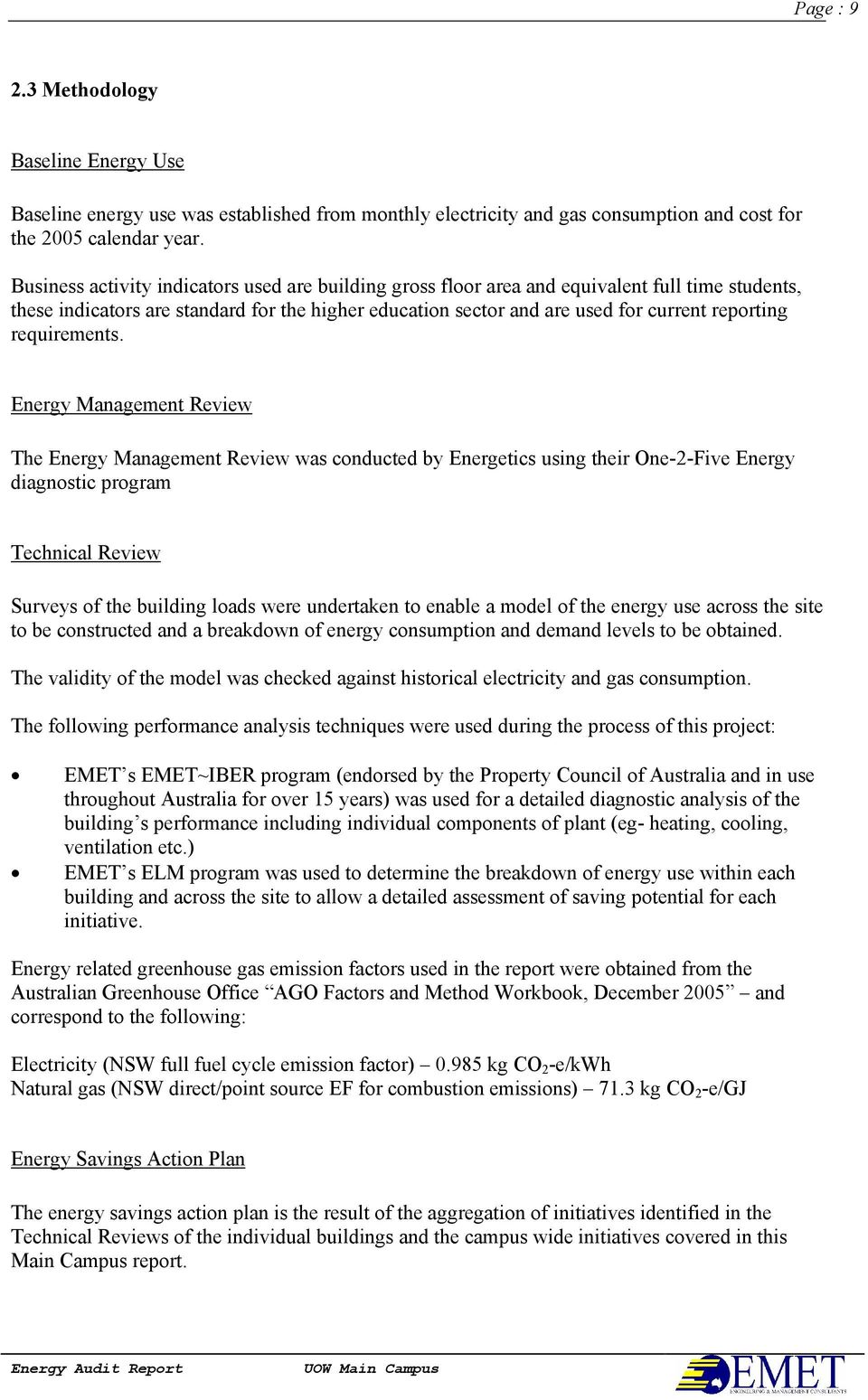
9 Page : Methodology Baseline Energy Use Baseline energy use was established from monthly electricity and gas consumption and cost for the 2005 calendar year. Business activity indicators used are building gross floor area and equivalent full time students, these indicators are standard for the higher education sector and are used for current reporting requirements. Energy Management Review The Energy Management Review was conducted by Energetics using their One-2-Five Energy diagnostic program Technical Review Surveys of the building loads were undertaken to enable a model of the energy use across the site to be constructed and a breakdown of energy consumption and demand levels to be obtained. The validity of the model was checked against historical electricity and gas consumption. The following performance analysis techniques were used during the process of this project: EMET s EMET~IBER program (endorsed by the Property Council of Australia and in use throughout Australia for over 15 years) was used for a detailed diagnostic analysis of the building s performance including individual components of plant (eg- heating, cooling, ventilation etc.) EMET s ELM program was used to determine the breakdown of energy use within each building and across the site to allow a detailed assessment of saving potential for each initiative. Energy related greenhouse gas emission factors used in the report were obtained from the Australian Greenhouse Office AGO Factors and Method Workbook, December 2005 and correspond to the following: Electricity (NSW full fuel cycle emission factor) kg CO 2 -e/kwh Natural gas (NSW direct/point source EF for combustion emissions) 71.3 kg CO 2 -e/gj Energy Savings Action Plan The energy savings action plan is the result of the aggregation of initiatives identified in the Technical Reviews of the individual buildings and the campus wide initiatives covered in this Main Campus report.
10 Page : Sources of Information, Assumptions and Qualifications The information contained in this report is based on a range of sources that have selectively been evaluated; these sources include site historical energy consumption data, production data, site control system data, daily plant run time and lost time records, individual plant electrical readings, site observations, and discussions with site personnel. Site drawings and operating and maintenance manuals have been reviewed, where available, to gain an understanding of the installed plant and equipment. Where practical and appropriate, information has been confirmed by inspection of the installed plant. Recommendations and observations are based on visual inspections of plant and equipment. Dismantling of plant or carrying out detailed technical inspections was outside the brief of this audit. The information and recommendations stated in this report are based on the above techniques and limitations. However these estimates can be affected by a multitude of external factors, which are subject to change. As a result, each recommendation should be reviewed at the time of consideration, to ensure that its relevance and economics are still acceptable. Some of these factors include: Variations in production requirements Addition or deletion of energy consuming equipment; Variation in activity levels; Variations in the standard of maintenance and efficiency monitoring; Variations in process settings Changes in energy tariff rates; and Other relevant changes. 2.5 Site Issues Capital Management Plan Years 2006 to 2010 The University has an ongoing program of building refurbishment, reconstruction and the construction of new buildings. Inputs to this process incorporate building preventative maintenance history, Building Code of Australia (BCA) compliance and functional upgrade requirements. The renewal and expansion of the building assets is expected to result in the increase in the total energy consumed by the site while the continual renewal of building assets is expected to result in improved energy performance as older less efficient systems are replaced. To this end extension of the existing high voltage system is in the planning stages. Refer Appendix 1 for a summary of proposed changes to the building assets at October 2006 for the main campus.

11 Page : Acknowledgements Throughout the conductance of this Technical Review the assistance and cooperation of the University s Buildings and Grounds Division s indoor and outdoor staff has been invaluable. We would like to especially thank the following whose cooperation has been a significant contribution towards the completion of this report. Chris Hewitt Manager Maintenance & Energy Peter Sparkowski Mechanical and Electrical Maintenance Supervisor John McGrath Maintenance Planner and OH&S Coordinator Eric Weddell Air Conditioning Technician University s electricians for their assistance with the extensive data logging that was conducted across the campus

12 Page : Buildings and Engineering Systems 3.1 General Description of the Site and Activity Levels The Main Campus of the University of Wollongong comprises approximately 70 buildings representing a gross building floor area of 169,967 square metres during The progressive construction and refurbishment active on the site has resulted in buildings ranging in period of construction from the 1960 s to the present time, most with refurbishments of less than 10 years. The gross building floor area for 2004 was 170,303 square metres. This energy audit covers 58 of the buildings representing a gross building floor area of 168,267 square metres equivalent to 99% of the site s gross building floor area. The Equivalent Full Time (EFT) student enrolments for 2005 were 16,179, including Wollongong University College (WUC) students. Table 3.1 below shows EFT student enrolments steadily rising from 1997 through to saw a reduction in enrolments of 1,894 or 10.5% from EFT Student Enrolments Head Count Year Figure 3.1: EFT Enrolments 1997 to 2005 A campus gross floor area of 169,967 square metres and 16,179 EFT students has been use as the business activity indicators in determining the energy performance indices for the 2005 baseline year.

13 Page : Heating, Ventilation and Air Conditioning (HVAC) The general policy with regards HVAC is for all areas to be ventilated to meet Australian Standards. Areas occupied by nominated senior executive staff, dedicated lecture theatres, dedicated computer laboratories and nominated laboratories are to be fully air conditioned. The types of systems in use comprise centralised chilled water and heating hot water systems; ducted reverse cycle and packaged systems; a chilled beam system; and reverse cycle room air conditioners. Non air conditioned offices are heated by personal heaters and cooling relief is provided by ceiling fans. Laboratories and workshops with make up air systems for fume cupboard and exhaust hoods comply with BCA standards and generally have tempered outside air heating systems. Seminar and tutorial rooms in general have no heating or cooling. 3.3 Building Management System (BMS) The site has a Siemens Apogee Building Management System that currently serves 18 buildings to principally provide Heating Ventilation and Air Conditioning system monitoring and control. In some cases the BMS also provides lighting control and electrical meter monitoring. 3.4 Domestic Hot Water and Staff Amenities Domestic hot water systems are a mix of gas and electric systems and are generally as follows: Student and staff amenities: Local electric mains pressure systems. Student accommodation: Centralised gas and mains pressure electric circulating systems. Laboratories: Centralised gas and mains pressure electric circulating systems. Sporting complex: Centralised gas circulating systems. The site also has approximately 70 boiling water units installed in lunch rooms and staff amenities areas; these systems generally are connected to a General Purpose Outlet (GPO) and remain energised at all times. The site also has approximately 80 refrigerators installed in lunch rooms and staff amenities areas, these systems generally are less than 3 star rated out of a 5 star energy efficiency rating Lighting Lighting systems are mostly linear fluorescent, with compact fluorescents used in corridors and foyers. Automatic lighting control systems such as movement sensors, voltage reduction units and time of day control of corridor, external and security lighting have been used extensively throughout the site.

14 Page : Office Equipment Personal computers The main campus has approximately 3,000 personal computers which are managed by different groups across the campus, consisting principally of Information Technology Services (ITS), Commerce Faculty, and Informatics Faculty. ITS currently manages about 1,500 machines expanding to 2,000 by January 2007 as it takes over the management of additional machines on the campus. ITS currently has a policy of enabling the Energystar facility on all computers where appropriate and phasing in lower energy consuming liquid crystal monitors as leases expire. The Commerce Faculty manages about 300 computers which are owned by the University. There is a policy of enabling the Energystar facility on all computers. The machines are automatically woken up between 2am and 5am for software updates. The Informatics Faculty manages about 450 computers which are replaced every three years. There is a policy of enabling the Energystar facility on a roll out basis, approximately 50% of the machines have the Energystar facility enabled. Computers in other areas in general are left operating, particularly in locations where older computers are in use such as research laboratories. ITS advise that the most appropriate way to promote energy savings initiatives such as Energystar is via the IT Forum. Photocopiers The Main Campus has 133 combination photocopier/fax/printers of which approximately 100 are networked via the campus Ethernet, within the next twelve months almost all machines will be connected to the network as machines are upgraded on lease expiry. All of the machines have an energy saver facility which sets the machine to energy save mode after a programmable time period of inactivity. The time period is currently set at the maximum of four hours and is centrally programmed for those machines connected to the network. Energy use under different modes of operation for these units is as follows: (model AF2015/18/18D model AF1035 in brackets): o Warm-up 1.28kW (1.5 kw) o Copying 1.28kW (1.5kW) o Standby 130 W (500 W) o Energy Saver 10 W (223 W) o Auto-off 1 W (10 W)

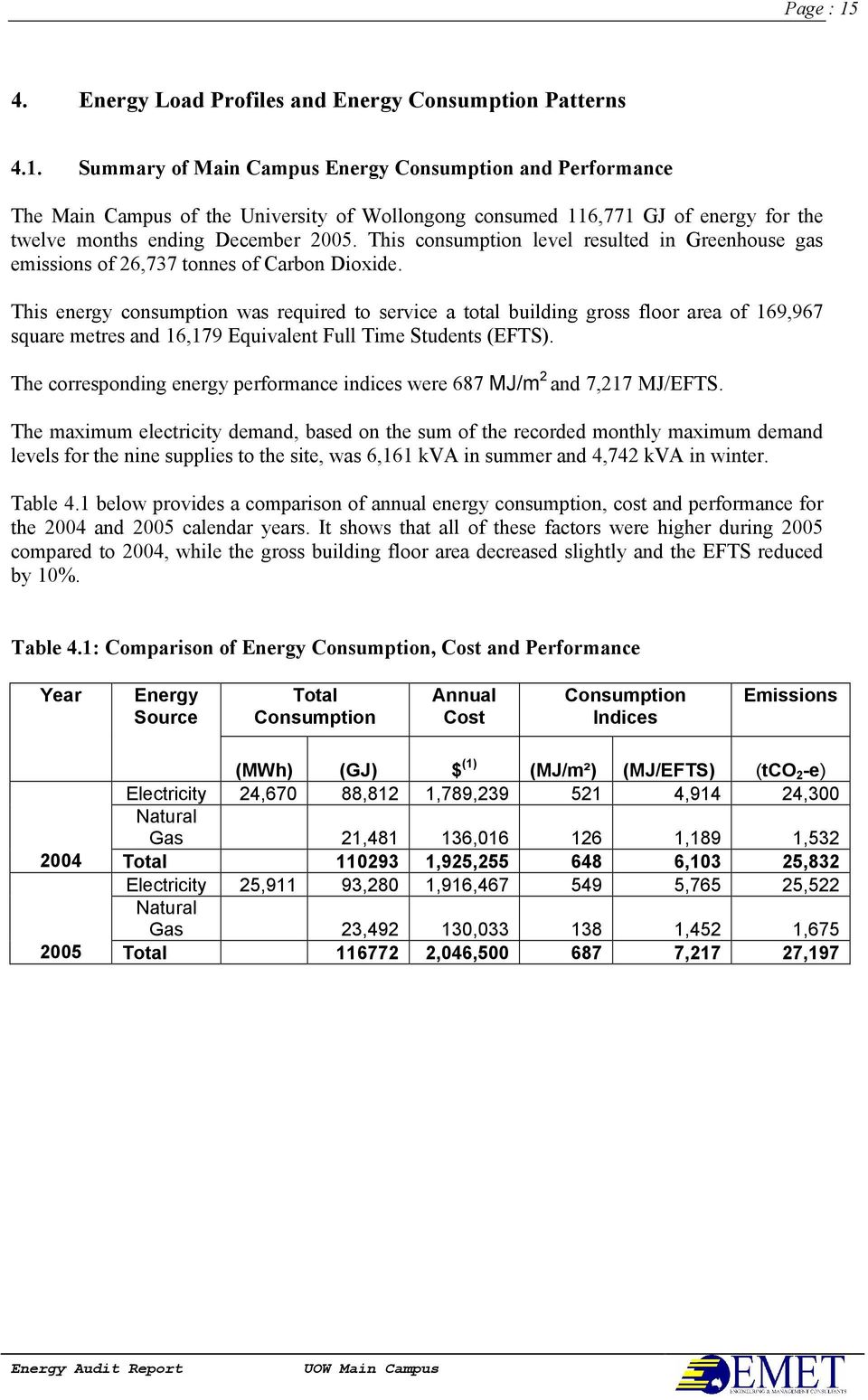
15 Page : Energy Load Profiles and Energy Consumption Patterns 4.1. Summary of Main Campus Energy Consumption and Performance The Main Campus of the University of Wollongong consumed 116,771 GJ of energy for the twelve months ending December This consumption level resulted in Greenhouse gas emissions of 26,737 tonnes of Carbon Dioxide. This energy consumption was required to service a total building gross floor area of 169,967 square metres and 16,179 Equivalent Full Time Students (EFTS). The corresponding energy performance indices were 687 MJ/m 2 and 7,217 MJ/EFTS. The maximum electricity demand, based on the sum of the recorded monthly maximum demand levels for the nine supplies to the site, was 6,161 kva in summer and 4,742 kva in winter. Table 4.1 below provides a comparison of annual energy consumption, cost and performance for the 2004 and 2005 calendar years. It shows that all of these factors were higher during 2005 compared to 2004, while the gross building floor area decreased slightly and the EFTS reduced by 10%. Table 4.1: Comparison of Energy Consumption, Cost and Performance Year Energy Source Total Consumption Annual Cost Consumption Indices Emissions (MWh) (GJ) $ (1) (MJ/m²) (MJ/EFTS) (tco 2 -e) Electricity 24,670 88,812 1,789, ,914 24,300 Natural Gas 21, , ,189 1, Total ,925, ,103 25,832 Electricity 25,911 93,280 1,916, ,765 25,522 Natural Gas 23, , ,452 1, Total ,046, ,217 27,197
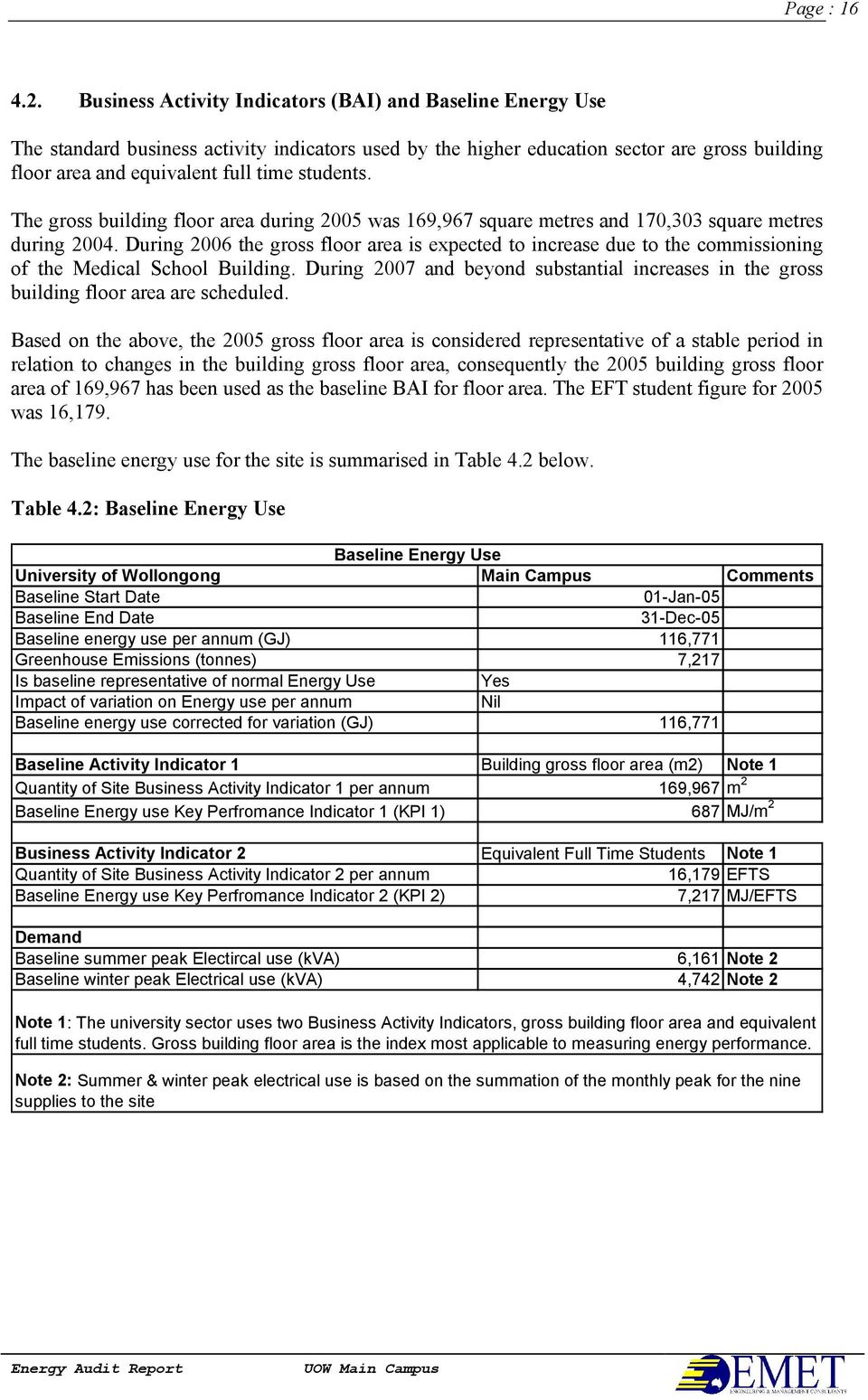
16 Page : Business Activity Indicators (BAI) and Baseline Energy Use The standard business activity indicators used by the higher education sector are gross building floor area and equivalent full time students. The gross building floor area during 2005 was 169,967 square metres and 170,303 square metres during During 2006 the gross floor area is expected to increase due to the commissioning of the Medical School Building. During 2007 and beyond substantial increases in the gross building floor area are scheduled. Based on the above, the 2005 gross floor area is considered representative of a stable period in relation to changes in the building gross floor area, consequently the 2005 building gross floor area of 169,967 has been used as the baseline BAI for floor area. The EFT student figure for 2005 was 16,179. The baseline energy use for the site is summarised in Table 4.2 below. Table 4.2: Baseline Energy Use Baseline Energy Use University of Wollongong Main Campus Comments Baseline Start Date 01-Jan-05 Baseline End Date 31-Dec-05 Baseline energy use per annum (GJ) 116,771 Greenhouse Emissions (tonnes) 7,217 Is baseline representative of normal Energy Use Yes Impact of variation on Energy use per annum Nil Baseline energy use corrected for variation (GJ) 116,771 Baseline Activity Indicator 1 Building gross floor area (m2) Note 1 Quantity of Site Business Activity Indicator 1 per annum 169,967 m 2 Baseline Energy use Key Perfromance Indicator 1 (KPI 1) 687 MJ/m 2 Business Activity Indicator 2 Equivalent Full Time Students Note 1 Quantity of Site Business Activity Indicator 2 per annum 16,179 EFTS Baseline Energy use Key Perfromance Indicator 2 (KPI 2) 7,217 MJ/EFTS Demand Baseline summer peak Electircal use (kva) 6,161 Note 2 Baseline winter peak Electrical use (kva) 4,742 Note 2 Note 1: The university sector uses two Business Activity Indicators, gross building floor area and equivalent full time students. Gross building floor area is the index most applicable to measuring energy performance. Note 2: Summer & winter peak electrical use is based on the summation of the monthly peak for the nine supplies to the site
17 Page : Electricity General Description The Main Campus is supplied by ten low voltage supplies metered by revenue meters. All of these supplies are totally independent of one another. Power factor correction equipment is installed on some of the low voltage supplies. Table 4.3 contains a schedule of the electrical supplies and identifies those which have power factor correction installed. Table 4.3: Schedule of Electrical Supplies Revenue LV Substation Meter No. NMI Meter location NEEE UOW Switchroom 2, Building 16 Yes NEEE UOW Switchroom 2, Building 16 Yes NEEE UOW Switchroom 3, Building 19 Yes NEEE UOW Switchroom 3, Building 40 Yes NEEE UOW Switchroom 4, Building 25 Yes NEEE UOW Switchroom 5, Building 64 Yes NEEE UOW Switchroom 6, Building 66 Yes NEEE UOW Switchroom 7, Building 1 Yes NEEE UOW Switchroom 7, Building 1 Yes NEEE UOW Switchroom 8, Building 30 No Power Factor Correction Electricity Consumption, Cost and Performance The electricity consumption for the calendar year 2005 was 25,911 MWh or 93,278 GJ and corresponds to Greenhouse gas emissions equivalent to 25,522 tonnes of Carbon Dioxide. Table 4.4 provides a comparison of annual electricity consumption, cost and performance for the 2004 and 2005 calendar years. It shows electricity consumption increased by 5% during 2005, the electricity MJ/m 2 also increased by 5% while MJ/EFTS increased by 17% in association with a decrease in EFTS enrolments of 10%. The average cost of electricity for the campus for the 2005 calendar year was 7.4 cents per kwh Table 4.4: Comparison of Electricity Consumption, Cost and Performance Total Consumption Annual MJ/EFT Tonnes Year Energy Source MWh GJ Cost ($) MJ/m2 Student of CO Electricity 24,670 88,810 1,789, ,914 24, Electricity 25,911 93,278 1,916, ,765 25,522

18 Page : Seasonal Patterns of Electricity Use Figure 4.1 shows monthly campus electricity consumption for the 2004 and 2005 calendar years. The profiles show no clear seasonal variation in energy consumption and 2005 consumption levels being consistently greater than 2004 levels after April The reason for the increased consumption level after April 2005 has not been established, it is not due to the commissioning of new or the refurbishment of existing buildings. Campus Electricity Consumption kwh Jan Feb Mar Apr May Jun Jul Aug Sep Oct Nov Dec Month Figure 4.1: Campus monthly electricity consumption

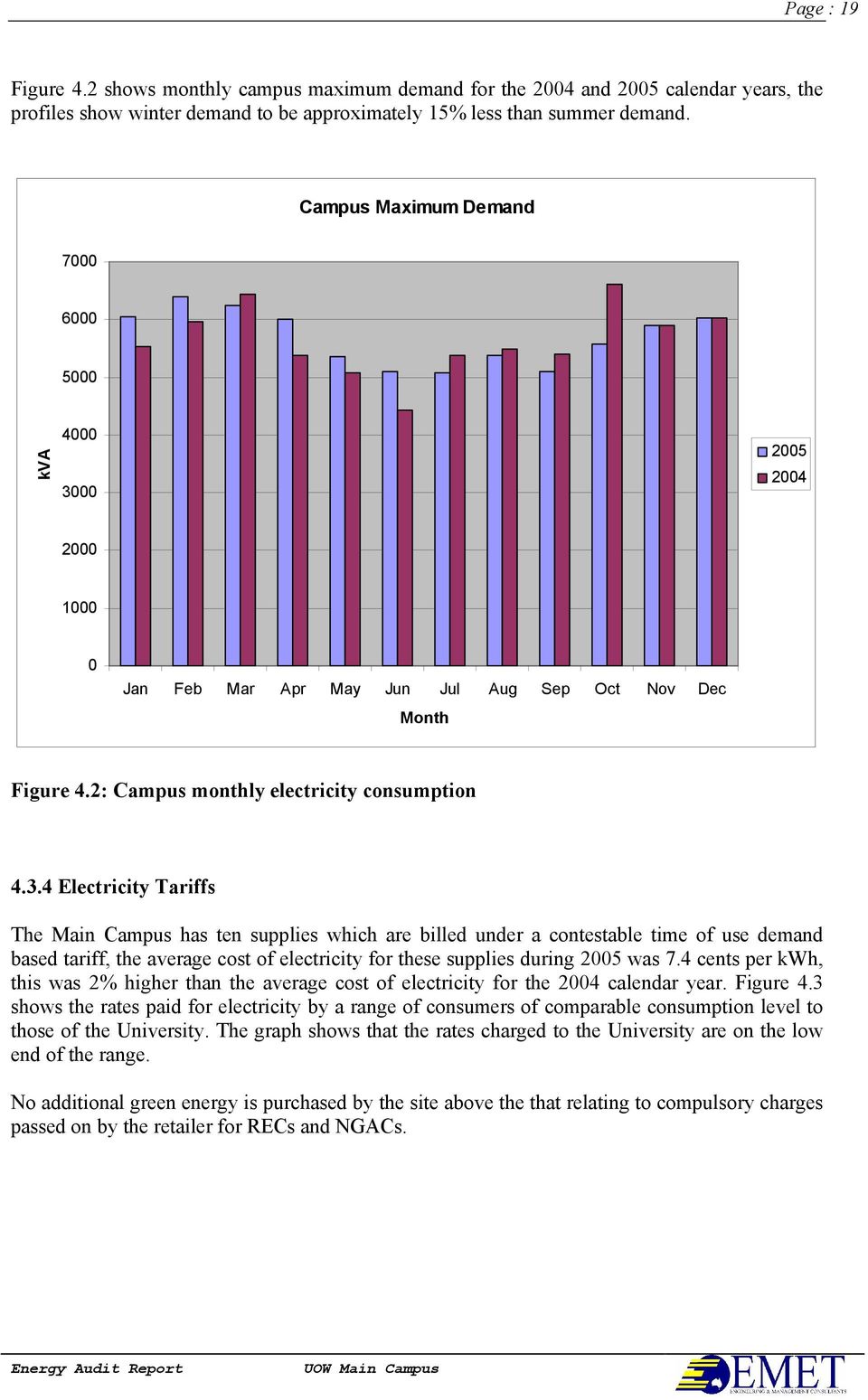
19 Page : 19 Figure 4.2 shows monthly campus maximum demand for the 2004 and 2005 calendar years, the profiles show winter demand to be approximately 15% less than summer demand. Campus Maximum Demand kva Jan Feb Mar Apr May Jun Jul Aug Sep Oct Nov Dec Month Figure 4.2: Campus monthly electricity consumption Electricity Tariffs The Main Campus has ten supplies which are billed under a contestable time of use demand based tariff, the average cost of electricity for these supplies during 2005 was 7.4 cents per kwh, this was 2% higher than the average cost of electricity for the 2004 calendar year. Figure 4.3 shows the rates paid for electricity by a range of consumers of comparable consumption level to those of the University. The graph shows that the rates charged to the University are on the low end of the range. No additional green energy is purchased by the site above the that relating to compulsory charges passed on by the retailer for RECs and NGACs.
20 Page : 20 Average Cost of Electricity for a Range of Similar Consumers Average Electricity Cost - c/kwh F H UoW D G E C B I A Consumer Figure 4.3: Comparison of Average Cost of Electricity for a Range of Similar Consumers It should be noted that Figure 4.3 is an indicative price comparison only as the prices do not cover exactly the same period, location, level of activity or consumption patterns. The two sites showing lower rates of electricity consist of a research centre and a major commercial building of lower total electricity consumption. The sites with higher costs include one university and several commercial buildings all of which have lower consumption compared to UoW Natural Gas General Description The main campus is supplied by natural gas from a single meter located at the rear of Building 31 and reticulated via a ring main to buildings within the university ring road. The Graduate House accommodation complex is supplied by a separate meter Natural Consumption, Cost and Performance The natural gas consumption for the calendar year 2005 was 23,492 GJ and corresponds to Greenhouse gas emissions equivalent to 1,675 tonnes of Carbon Dioxide. Table 4.5 provides a comparison of annual natural gas consumption, cost and performance for the 2004 and 2005 calendar years. It shows that natural gas consumption increased by 9% and the gas

21 Page : 21 consumption index in MJ/m 2 increased by 10%. The gas MJ/EFTS index increased by 22% in association with a decrease in EFTS enrolments of 10%. The average cost of natural gas for the campus for the 2005 calendar year was $5.48/GJ, due to the consumption based tariff the lowest price was $4.32/GJ in July and the highest $11.75/GJ in January. Table 4.5: Comparison of Natural Gas Consumption, Cost and Performance Year Energy Source Total Consumptio n (GJ) 2004 Natural gas 21, Natural gas 23,492 Annual Cost ($) MJ/m2 136,01 MJ/EFT Studen t Tonne s of CO ,189 1, , ,452 1, Seasonal Patterns of Natural Gas Use Figure 4.4 shows monthly campus natural gas consumption for the 2004 and 2005 calendar years. The profiles show increased consumption during cooler months due to heating systems and increased consumption during 2005 compared with 2004 after April The reason for the increased consumption level after April 2005 has not been established, it is not due to the commissioning of new or the refurbishment of existing buildings. Campus Natural Gas Consumption 140, , ,000 MJ/Day 80,000 60, ,000 20,000 0 Jan Feb Mar Apr May Jun Jul Aug Sep Oct Nov Dec Month Figure 4.4: Campus monthly natural gas consumption
22 Page : Daily Patterns of Natural Gas Use Figure 4.5 shows campus daily natural gas consumption for January and July The profiles show no substantial difference in gas consumption from a weekend to a weekday indicating that systems are operating when not required on weekends. This substantiates findings in the individual building reports of boilers operating on a 24 hour basis 7 days a week during winter. Daily Gas Consumption GJ January July Date Figure 4.5: Summer and Winter Daily Gas Consumption Natural Gas Tariffs The price of gas is based on a variable consumption based component, a monthly fixed cost component and a network cost component, consequently the average cost of gas is lower during periods of higher consumption. Figure 4.6 shows the rates paid for gas by a range of consumers of comparable consumption level to the University. The graph shows that the rates charged to the University are on the lowest end of the range. The university negotiated a new gas supply contract in late 2006.
23 Page : 23 Average Cost of Gas for a Range of Similar Consumers Average Gas Cost - $/GJ I UoW A H E D B G C Consumer Figure 4.6: Comparison of Average Cost of Natural Gas for a Range of Similar Consumers It should be noted that Figure 4.3 is an indicative price comparison only as the prices do not cover exactly the same period, location, level of activity or consumption patterns. The site showing lower cost is a university with consumption levels approximately 6 times those of UoW. The two sites showing costs of around $6 per GJ comprise a research centre and a major commercial building, one with higher consumption and one much lower than UoW. The remainder of the sites are major commercial buildings.
24 Page : Breakdown of Energy Use and Application Energy Use by Building and Energy Source Figure 4.7 shows the estimated energy consumption for each of the audited buildings by energy source. These consumption levels were derived by a combination of metering data, site observations, measurements and modelling using EMET s diagnostic and modelling programs, as noted in the Methodology clauses. The largest consumer is Building 39 followed by Building 16 and Building 13. Building 13 is also estimated to be the larger consumer of natural gas. Energy Consumption by Building and Energy Source 16,000 Estimated Consumption - GJ (2005) 14,000 12,000 10,000 8,000 6,000 4,000 2,000 Gas Electricity Building Figure 4.7: Estimated Energy Consumption by Building and Energy Source Energy Use by Application The breakdown of energy consumption and cost by application is shown in Table 4.6 and Figure 4.7. These show the most significant applications of energy across the site to be Heating, Cooling and Ventilation, Lighting and Other Equipment. The latter comprises a multitude of laboratory equipment and other specialist equipment generally related to the teaching and research activities in the buildings and generally activated manually by occupants. Office equipment and hot water delivery also constitute significant loads.
25 Page : 25 Table Estimated Energy Consumption, Performance and Cost by Application APPLICATION Location Lighting Cooling & Vent Cooking Heating Hot Water & Amenit. Lifts & Escal Office Equipmt Other Equipmt Total Consumption GJ pa 18,207 33,713 31,274 3, ,170 10, ,024 Performance MJ/m2 pa Cost $ pa 381, , ,046 35,481 8,339 8, , ,090 1,861,45 4 Breakdown of Total Energy Use by Application Office Equipmt Lifts & Escalatrs 7% 0.4% Other Equipmt 10% Lighting 17% Cooking & Amenit. 0.4% Hot Water 4% Heating 29% Cooling & Vent 33% Figure 4.7 Breakdown of Total Energy Use by Application Figures 4.8 and 4.9 show the simulated breakdown of the weekday electrical demand under peak Summer and Winter conditions respectively. The patterns show the major loads to be heating, cooling and ventilation systems and lighting. It should be noted that the charts show the typical demand patterns during Summer and Winter, with peak demand levels reached on days of extreme weather and/or activity.
26 Page : 26 Simulated Electricity Demand Profile - Peak Summer Day 6,000 5,000 Demand - kw 4,000 3,000 2,000 Other Equipment Office Equipment Lifts & Escalators Cooking & Amenities Hot Water Heating Cooling & Vent Lighting 1, :30 2:00 3:30 5:00 6:30 8:00 9:30 11:00 12:30 14:00 15:30 17:00 18:30 20:00 21:30 23:00 Time of Day
27 Page : 27 Simulated Electricity Demand Profile - Peak Winter Day 5,000 4,500 4,000 3,500 Demand - kw 3,000 2,500 2,000 Other Equipment Office Equipment Lifts & Escalators Cooking & Amenities Hot Water Heating Cooling & Vent Lighting 1,500 1, :30 2:00 3:30 5:00 6:30 8:00 9:30 11:00 12:30 14:00 15:30 17:00 18:30 20:00 21:30 23:00 Time of Day
28 Page : Energy Performance Benchmarks and Targets The average energy use index for the audited buildings for their estimated 2005 consumption was 640 MJ/m 2 per annum. It is estimated that this index would be reduced to 456 MJ/m 2 per annum after the implementation of all of the energy management initiatives identified in the energy audit. Figure 4.10 shows the current energy use index by building as well as the projected index (target) following the identification of the energy initiatives identified. Note that some buildings, such as building 12 contain recommendations for metering and subtracting energy consumption for which the University is not responsible or not under its control. Existing and Projected Energy Consumption Index by Building 2,500 Energy Consumtpion Index - MJ/m2 pa 2,000 1,500 1, Building Current Energy Use Index Target Energy Use Index Notes: B 12 - The major reduction shown is due to the repair of a major gas leak and the metering and hand-over of substantial electricity consumption related to the tenant. B 22 Substantial reduction is due to changes to the operations of HVAC systems B 30 - Substantial reduction is due to changes to the operations of HVAC systems (Refer to individual building reports for details) Figure 4.10: Current and Target Energy Consumption Index by Building Table 4.7 shows a breakdown of this energy target by energy source and application, based on the results of this audit. The figures show the most significant improvement potential to be in the Heating, Cooling and Ventilation systems and Office Equipment.
29 Page : 29 Table 4.7: Target Energy Consumption by Application APPLICATION Energy Source Annual Consumption (kwh) (GJ) Annual Cost ($pa) Perform. Index (MJ/m 2 ) Proportion of Total Energy Consumption (%) Lighting Electricity 5,419,088 19,509 $408, % Cooling and Ventilation Electricity 8,181,651 29,454 $617, % Heating Electricity 1,869,122 6,729 $140, % Heating Gas 9,891 $54, % Amenities Electricity 133, $10, % Lifts & Escalators Electricity 47, $3, % Office Equipment Electricity 1,702,025 6,127 $128, % Other Equipment Electricity 3,192,233 11,492 $240, % Hot Water Electricity 218, $16, % Hot Water Gas 1,894 $10, % Total 20,763, ,533 $1,620, % Notes: (1) The costs shown are calculated on an average cost of electricity and gas as noted under methodology (2) Numbers do not necessarily add due to rounding off Based on the current building types and the extent of operations carried out within the buildings, the target energy performance levels for the University are as follows: o Current Performance MJ/m 2 o Following the implementation of all projects within the MJ/m 2 University hurdle rate o Following the implementation of all identified projects MJ/m 2 The above levels are shown in Figure 4.11 together with the 2004 performance levels for other Australian Universities. Note that the above targets do not represent the best practice level of performance which could only be achieved in the long term following major refurbishments of systems and services as new buildings and plant are brought on line. This performance level, based on the current level of operations and services provided is approximately 425 MJ/m 2.
30 Page : 30 Comparison of UoW Performance and Targets against Performance of other Australian Univerisities 1,400 1,200 Performance Index - MJ/m2 pa 1, Current level of performance Forecast performance after implementation of costeffective projects Forecast performance after implementation of all projects Current Source: Other University data Tertiary Education Facilities Management Association 2004 Benchmark report Figure 4.11: Comparison of Current and Forecast UoW performance Indexes against other universities current performance UOW, Main Campus
31 Page : Analysis of Energy Systems and Estimated Savings Potential Overview of Energy Savings Identified The audit of the main campus of the University identified energy efficiency cost savings worth approximately $419,000 per annum including some minor maintenance savings due to reduced operation of systems. These savings represent approximately 25% of the energy used by the audited buildings. Approximately 94% of the above savings fall within the University s financial hurdle rate of 7% (IRR), at an estimated cost of approximately $1,070,000. The remaining 6% are estimated to cost more than $716,000 to produce the estimated annual cost savings of approximately $36,200. Table 5.1 shows a breakdown of costs and savings falling within and outside the University s hurdle rate. Table 5.1: Summary of Identified Energy Saving Projects Internal Rate of Return (IRR) Implement ' Cost Savings Combine d Payback Energy Costs Maintenanc e Costs Energ y % of tot Energ y Emission s $ $ pa $ pa GJ pa T CO2-e yrs Better than 7% 1,070, , ,125 24,497 23% 4, Less than 7% 715,920 33,082 3,127 1,620 2% 1, Total 1,786, , ,252 26,117 25% 6, Estimated Annual Energy Savings by Building 5,000 4,500 Annual Energy Savings - GJ pa 4,000 3,500 3,000 2,500 2,000 1,500 1, Building Number Figure 5.1: Estimated Annual Energy Savings by Building 1 All savings and costs quoted in this report are ex-gst 2 Implementation costs shown are budget estimates only. They include an allowance for the typical engineering costs involved in fully scoping and documenting the works however, this cost will depend on the complexity of the specific installation and the amount of documentation available and will therefore vary with each case
32 Page : 32 Figure 5.1 (previous page) and Table 5.2 (below) show the identified energy savings for each audited building. These the buildings with the highest potential to be buildings 39, 16, 13, 30, 12, 17, 20, 41, 22, 40 and 35, which together represent more than 80% of the identified savings. These form the group of priority buildings. Power factor correction works (PFC) are not shown on the Figure 5.1 as they do not produce direct energy savings however they represent 4.3% of estimated total cost savings and are included as a site-wide initiative in table 5.2. Table 5.2: Estimated Annual Energy Savings by Building Implement Savings Payback ' Cost Energy Maintenance % of tot Emission Costs Costs Energy Energy s Building $ $ pa $ pa GJ pa T CO2-e yrs 1 18,508 3, % ,800 6, % ,026 8,025 1, % ,017 4, % % ,310 3, % , % , % ,520 6, % ,250 37, , % ,016 21, , % , % ,060 7, % ,120 59,096 4,475 3, % ,700 23, , % ,854 4, % ,414 9,457 1, % ,925 30, , % , % ,700 12, , % , % ,550 8, % , % ,450 26, , % , % ,500 7, % ,916 3, % , % ,688 49,465 2,107 4, % ,370 14,578 1, % ,550 24, , % , % ,000 4, % Total for Buildings 1,687, ,628 14,252 26, % 5, PFC 99,375 18, kva n/a Grand Total 1,787, ,634 14,252 26, % 5,
33 Page : 33 A breakdown of the major applications of energy use expected to produce the estimated energy savings is shown in Table 5.3. Heating, Ventilation and Air Conditioning (HVAC) systems represent the largest component of energy savings at 73% of the total. This category includes comfort cooling and heating systems as well as process cooling and heating provided for specialised equipment and locations as well as specialised ventilation for areas such as laboratories. The next major area of potential savings is Utilities which includes the metering and subtraction of energy provided to tenants, for which the University has no control, as well as the repair to a major gas leak which existed during the base year. Savings shown against Office and Other relate to improved awareness to the proper operation of systems and equipment by occupants, as well as the activation of built-in energy saver features on equipment. The remainder of savings relate to Power Factor Correction (PFC) works, and the improvement of the efficiency and operation of Pool systems, Domestic Hot Water and other staff (and occupant) amenities and Lighting systems. Table 5.3: Sources of Energy Savings Potential by Application Implement ' Cost Savings Payback Energy Costs Maintenance Costs Energ y % of tot Energ y Emission s Building $ $ pa $ pa GJ pa T CO2-e yrs Heating, ventilation and air conditioning 1,154, ,03 9 1,847 18, % 3, Utilities 10,000 37, , % Pool 40,930 12, , % Domestic Hot Water and Staff Amenities 86,985 11, , % Lighting 395,347 33,048 12,405 1, % Office Nil 9, % 129 immediat e Other Nil % 1 immediat e PFC 99,375 18, kva n/a Total 1,787, , ,252 26, % 5, Refer to the next sections for a more detailed analysis of the types of initiatives identified for each of the above areas of energy saving potential, as well as Appendix 2 for a detailed list of recommendations resulting from this energy audit.
34 Page : Energy Saving Issues and Initiatives This energy audit has identified a number of initiatives and issues, both technical and procedural, which are sources of energy losses or inefficiencies. These are discussed below, together with recommended actions and estimated savings. It should be noted that the University is in the process of addressing many of these issues by commissioning the following standards, which are currently being finalised: Building Monitoring and Control Systems Design Standards Building Monitoring and Control Systems Commissioning Procedures & Schedules Mechanical Services Design Standards Mechanical Services Commissioning Standard Electrical Services design Standard Energy and Demand Management Standards for the Design Process The following clauses address each of the major issues and areas of opportunities identified. The site s Building Management System is discussed separately as it is a major influence over many systems and services and has the opportunity to provide a substantial component of the savings and also assist in the monitoring and management of the energy management program of the site Building Management System (BMS) The site has a BMS that currently serves 18 buildings to principally provide Heating Ventilation and Air Conditioning system monitoring and control, in some cases the BMS also provides lighting control and electrical meter monitoring. Table 5.4 provides a summary of buildings served by the BMS and their features. In some cases the BMS only serves part of the building or only provides time of day control to air conditioning systems with local proprietary controls. There are 15 larger buildings that are not served by the BMS. These buildings mostly have no air conditioning. In cases where air conditioning is installed, it is controlled by time clocks, timers or local on/off control. The BMS installed at the site is a Siemens Apogee System which has expanded as new buildings and refurbishments have required BMS control.
35 Page : 35 Table 5.4: Summary of Building BMS Features Building Number Description HVAC Monitoring & Control Laboratory Ventilation Monitoring & Control External Lighting Control 1 Materials Engineering Yes Yes No No 3 Informatics Yes No Yes No 5 Animal House Yes No Yes No 8 Mechanical Engineering Features Electricity Metering 11 Uni Centre Yes No No No 14 Central Lecture Theatre Yes No No No 15 Austin Keane Building Yes Yes No No 16 Michael Birt Library Yes No No Yes 17 IT Resource Centre Yes No No No Comments Scheduled for refurbishment, to include BMS Auditorium only, remainder time clocks 18 The Halpern Chemistry Building Yes Yes No No Top floor to have HVAC added, BMS to be considered 20 Communications Centre Yes No No No Office areas time clock controlled 22 Education & Clinic Building Yes No No No 25 Creative Arts Yes No No No 30 WUC/AEC Yes No No No 35 Biology/Informatics Scheduled Check scheduled No No 36 Administration Yes No No No 38 Graduate School of Business No No No No 39 Illawarra Technology Centre Yes No No No 40 Commerce/Hope Theatre Yes No No No 41 The Sciences Building Yes No No No 67 The McKinnon Building Yes No No No North Wing to be upgraded to BMS control, remainder time clocks which should be considered for BMS control Scheduled for refurbishment, to include BMS BMS control of stage 2 and 3 only, stage 1 recommended BMS control of Hope Theatre only, BMS control of centralised proprietary controllers recommended BMS control of Stage 2, stage 3 and CT scanner, Anatomy lab upgrade to include BMS. BMS control of central plant and R 104 and 107 only. i) BMS documentation The BMS installation has expanded over time as new buildings and refurbishments requiring BMS control have proceeded. During this expansion the documentation on the systems installed has tended to be generic and lacking in details on the specifics of the control algorithms, how the system is setup and what features are enabled. Further, operator access is limited to an extent that it is necessary to request the BMS service contractor to access the software to determine relatively basic information such as temperature control, dead band settings or if features such as night purge are enabled. It is understood that these requests for information are at the university s cost.
36 Page : 36 ii) Commissioning The BMS documentation does not always reflect the system installed and can reflect the system that was offered rather than that which has been installed, in some cases there is no documentation, only a reference in the time of day schedule. To establish what actually has been installed would require the software to be analysed by the BMS service provider as outlined in item i) above. During the audit a number of systems were identified that were not operating correctly and appear to never have operated correctly, these include: Boilers and chillers operating 24 hours a day when they are not supposed to Economy cycles not functioning correctly Night purge not functioning correctly iii) Operator interface & system management The Building s & Grounds staff monitor the BMS on a daily basis and trend selected parameters to identify system problems which are then passed on to the BMS service provider for action. During the audit it was found that basic parameters that would normally be accessible to the end user via the Graphical User Interface (GUI) to fine tune system and identify unsatisfactory operation were not accessible. They were only accessible within the software program by the BMS service provider. Also, attempts to identify the cause of plant such as boilers and chillers operating 24 hours a day seven days a week when the BMS time schedules indicated that these systems should not be operating were not possible due to the lack of access to the BMS via the GUI. The BMS service provider was also not able to identify the cause of these problems from the GUI, it would be necessary to undertake an analysis of the software. iv) Time of day control The time of day control of HVAC plant is globally programmed for public holidays and for after hours use for special occasions. The special occasions function is automatically cancelled after the date of the event. It is common practice to schedule air conditioning plant to operate from around 5am for when the cleaners commence work through to when the area is not likely to be in use and for after hours push buttons to be used outside these times. There is no facility to globally program selected time channels for university recess which occurs approximately 76 days of the year, consequently these systems continue to operate throughout the university recess. v) Control algorithms Control algorithms have been duplicated across the site as new BMS installations are installed and it is presumed that this practice applies to recently commissioned buildings that are still in the warranty period.
37 Page : 37 This energy audit has identified problems with the economy cycle, night purge and night setback algorithms. Problems have also been identified with chillers and boilers operating when they are not intended to in a number of buildings. vi) Monitoring & Verification Good energy management practice and this energy audit recommended that energy efficiency initiatives be monitored and verified for their correct effectiveness, and that building refurbishments and new buildings should consider the improvements in energy consumption at the design stage and then monitor and verify the results after the work is commissioned and handed over. The utilisation of the BMS for monitoring & verification is a critical part of this process. Recommendations: Note: The University has indicated a desire that better controls be put on service providers to improve the performance of energy systems. Develop a strategy that enables the BMS to be better used as a management tool by university staff to improve maintenance, fine tune system operation for improved performance, monitor & verify energy efficiency improvements and reduce energy consumption. The following are key steps considered necessary to develop the above strategy. Ideally, many of the steps should involve a person technically competent to understand the system(s) being controlled in each case and the level of information and interaction required to be incorporated in the systems. It would be expected that these would involve a person/organisation not linked to the BMS contractor. i) Review the documentation for each building so that it reflects the current installation. ii) Where appropriate provide additional BMS access to university staff to enable improved system monitoring, improved fault finding, on going fine tuning and better management of service contractors. iii) Provide appropriate training for university staff iv) Implement BMS commissioning procedures v) Incorporate monitoring and verification of energy performance at the design stage into energy efficiency improvement projects, building refurbishments and new buildings. vi) Revise BMS time of day control to allow global scheduling of university recess days for student accessed areas, alternatively link the Cardax system for common teaching areas to the BMS to control plant dedicated to common teaching areas. vii) Implement optimum start/stop strategies and set the time of day schedules to core occupancy times (typically 8am to 6pm for office areas), not cleaning periods, and utilise after hours push buttons outside core hours. For student accessed areas university recess should be considered as outside core hours unless programmed for special occasions which are automatically cancelled after the date of the event. viii) Modify control algorithms as recommended in this report, refer Section 5.2.2, and ensure that building design guidelines are updated. ix) Implement a request tracking system to monitor the progress of requests made to the BMS contractor; and a performance tracking system to measure the effectiveness of the BMS contractor.
38 Page : Heating, Ventilation and Air Conditioning (HVAC) Systems The building s HVAC systems are estimated to consume approximately 11,200 MWh of electricity and 14,000 GJ of gas at a total cost of approximately $923,000 per annum and have an energy utilisation index of 335 MJ/m 2 per annum. This overall consumption index shows a high level of energy use for the types and extent of systems employed on the site. Table Estimated Energy Use and Cost by HVAC Systems APPLICATION Energy Annual Consumption Source (kwh) (GJ) Annual Cost ($pa) Perform. Index (MJ/m2) Proportion of Total Energy (%) Cooling and Ventilation Electricity 8,173,084 29, , % Heating Electricity 3,046,709 10, , % Heating Gas 14,010 76, % Total 11,219,792 54,401 $922, % The energy audit identified energy efficiency cost savings for the HVAC systems as being worth approximately $284,000 per annum including some minor maintenance savings due to reduced operation of systems. These savings represent approximately 18% of the energy used by the audited buildings. Approximately 95% of the above savings fall within the University s financial hurdle rate of 7% (IRR), at an estimated cost of approximately $703,000. Table 5.5 shows a breakdown of costs and savings falling within and outside the University s hurdle rate. A full list of identified energy management projects for each building is included in Appendix 2. Table Summary of Costs and Savings - HVAC Initiatives IRR Implement ' Cost Savings Energy Costs Maintenanc e Costs Energ y % of tot Energ y Emission s $ $ pa $ pa GJ pa T CO2-e Better than 7% 702, ,51 2 1,847 17,917 17% 3,490 Less than 7% 451,550 19, ,004 1% 263 Total 1,154, ,03 9 1,847 18,921 18% 3,753 Figure 5.2 shows a breakdown of the above energy savings amongst the major categories of initiatives. It should be noted that these are broad categories which often overlap (ie. an initiative may incorporate items of more than one category). Also Table 5.6 provides an overview of the type of HVAC energy management actions identified for each building. Refer to the itemised list of initiatives in Appendix 2 and to individual building reports for further information.
39 Page : 39 Major Categories of Energy Saving Potential - HVAC Systems New or refurbished plant 3% Control of personal equipment and general awareness 6% Other 1% Economy Cycle, CO 2, Outside air and Night purge 7% Control Improvements 33% Holiday scheduling and time of day 38% Boiler 4% Chiller and Condenser Water 7% Figure 5.2: Major Categories of Energy Saving Potential HVAC Systems The major categories identified in figure 5.2 include: o The improved control of operating times of plant through holiday scheduling, time of day control etc; o Improvements to the controls which activate or operate the plant including adjustments to operating parameters, automatic (de)-activation, fine tuning etc; o The application of improved or expansion to the use of economy cycles, outside air control, night purging functions etc; o Specific Chiller, Boiler and Condenser system improvements; o Better control of systems operated by occupants through awareness and additional controls; o Other functions.
40 Page : 40 Table 5.6: Energy Efficiency Project Type for each building Building No. Description BMS 1 Materials Engineering Y Y Y Y 2 Engineering Extension N Y Y Y Y Y Y 3 Informatics Y Y Y Y 4 Engineering N Y Y Y 5 Animal House Y 6, 7 Engineering Laboratories N Y 8 Mechanical Engineering N 10 Kid's Uni N Y 11 Uni Centre Y Y Y 12 UniBar N 13 URAC N Y 14 Central Lecture Theatre Y Y Y Y Y Y 15 Austin Keane Building Y Y Y Y 16 Michael Birt Library Y Y Y Y Y Y Y Y Y Y 17 IT Resource Centre Y Y Y Y Y Y Y Y 18 The Halpern Chemistry Building Y Y Y Y Y 19 Arts N Y Y 20 Communications Centre Y Y Y Y Y Y Y 21 Education laboratories N 22 Education & Clinic Building Y Y Y Y Y Y Y Y Y 23 Education Building N Y 25 Creative Arts Y Y Y Y Y Y Y Y Y 29 & Demountables Public Health, classrooms N Y Y 30 WUC/AEC Y Y Y Y Y Y Y Y 31 Building & Grounds N Y 32 Printery, Central Store N 35 Biology/Informatics N Y Y Y Y Y Y Y 36 Administration Y Y Y Y Y Y Y 37 Kooloobong N Y 38 Graduate School of Business Y Y 39 Illawarra Technology Centre Y Y Y Y Y Y Y Y Y Y 40 Commerce/Hope Theatre Y Y Y Y Y Y 41 The Sciences Building Y Y Y Y Y Y Y Y 42 The Science Annexe N 67 The McKinnon Building Y Y Y Y Y Y Y Y Y 121 Graduate House N Y i) BMS time of day schedule Energy Efficiency Opportunities The BMS controls the operating times of HVAC systems in buildings with BMS control and in some cases external lighting, the current time of day schedules provide for global public holiday scheduling and special event scheduling on request to Building & Grounds, the schedules are automatically reset after the scheduled data has passed. The start and stop times of HVAC systems are often not set to core occupancy hours, the start times of HVAC systems in some cases have been set to provide comfort conditions for cleaners, who commence work around 5am, and stop times have been set to suit after hours periods when a small number of people may be present. BMS time of day schedule Optimum start/stop Condenser water temperature control Chilled water temperature setpoint reset Excessive chiller & boiler operation Variable speed pump control Economy cycle Night purge Space temperature Setback Fume cupboard sash monitoring Outside air compensation CO2 Control Timer control control of A/C Timer control of personal heaters
41 Page : 41 It has been proposed in Section 5.2 that the facility be incorporated into the BMS time of day scheduling to enable global scheduling of student occupied areas for university recess so that these systems don t operate during these periods. It is also proposed that time of day schedules be set to core occupancy hours for systems with economy cycle control and that after hours push button timers be used to provide air conditioning outside core occupancy hours unless automatic reset special events scheduling has been requested. For example after hours timers would provide air conditioning when activated for cleaners, staff working out of hours or student occupied areas such as lecture theatres and tutorial rooms during university recess. Automatic reset special events scheduling would be used for events conducted during university recess such as exams, conferences and trade exhibitions. An alternative to the above for common teaching areas is to link the Cardax system to the BMS so that HVAC plant dedicated to common teaching areas is energised from scheduled booking times. The Cardax system at this stage has not been interfaced to a Siemens BMS, the costs associated with the Cardax system to provide this link is approximately $15,000 and the costs for the Siemens BMS is not known. In view of the uncertainty of costs, development time and implementation time this approach has not been considered. Optimum start/stop Optimum start stop control should be used for central plant or each package and split unit serving more than a single room independently. Small split units and room air conditioners serving one room should not be controlled by an optimum start/stop system. Under optimum start control, the system should seek to start the air conditioning units as late as possible whilst achieving the following average space temperatures by the scheduled occupancy times: If cooling: Setpoint +1C If Heating: Setpoint -1C If the optimum start sequence determines that cooling is required then all zone re-heats should be disabled until occupancy, conversely, if the optimum start sequence determines that heating is required, then all stages of cooling should be disabled until occupancy. Under optimum stop control, the system should seek to utilise the residual cooling or heating capacity of the chilled water or heating water systems by shutting down primary plant as early as possible whilst not allowing the average space temperature to go beyond the following levels during the scheduled occupancy time: If cooling: Setpoint +2C If heating: Setpoint 2C In all cases, the fan should run on for a minimum of 15 minutes after the last heater is deenergised to allow it to cool down. The energy audit has identified a number of buildings with optimum start/stop control listed in the Operating & Maintenance Manual. However, it has not been possible to establish if the optimum start/stop facility is enabled and the control strategy employed due to the inability to access these features from the BMS GUI. Hirotech, the mechanical services contractor, indicates
42 Page : 42 that these systems do not function and this is substantiated by the early and late starting and stopping times via the BMS time of day schedule to cater for worse case occupancies. ii) Condenser water temperature control The site utilises condenser water systems to reject waste heat to atmosphere from water cooled chillers and water cooled packaged air conditioners. Reducing the condenser water temperature as low as possible within the system requirements, the manufacturers guidelines and ambient dry bulb and wet bulb temperature constraints will reduce the compressor head pressure resulting in improved system efficiency and hence energy reduction. Typically condenser water systems are set to higher temperatures than necessary, penalising chiller efficiency unnecessarily. The opportunities identified in the reports involve better controlling the condenser water circulating temperature by various means including: converting the cooling tower fan to variable speed; modulating the fan speed and cooling tower bypass valve; changing operating setpoints in relation to ambient wet bulb temperature and to minimum temperatures acceptable to the system and manufacturer s requirements (typically 20C). iii) Chilled water temperature setpoint reset The site has chilled water plant installed in six buildings for space cooling, the chilled water reticulated to cooling coils is generally controlled to 6C at all times. A chilled water temperature of 6C is typically a design temperature to which cooling coils are designed to cover the maximum design space thermal load. That is, for much of the time a higher chilled water temperature will be adequate to satisfy the space thermal load. Increasing the chilled water temperature reduces the compressor suction pressure resulting in improved system efficiency and hence energy reduction. The implementation of a chilled water temperature setpoint based on the load on the system allows for improved efficiencies. This is achieved by controlling the chilled water flow temperature to maintain a constant return flow temperature (typically 12C) and applying a reset strategy based on sustained changes in cooling demand (eg. reset down if any chilled water valve is>95% open and up if any chilled water valve is <80% open). Note that all figures given are typical and require fine tuning. During this operation, RH levels should be monitored and raising of chilled water temperatures prevented or reversed incrementally to maintain RH levels within acceptable limits (typically 65%). iv) Excessive chiller and boiler operation Four buildings, buildings 16, 22, 30 and 39, were found to have chiller and or boiler plant operating outside scheduled operating times from BMS trend data and electrical data logging. Building 16 electrical data logging shows chiller plant operating 24/7 during August, BMS trend data shows boiler operation 24/7 between 10/08/06 and 16/08/06 except for five hours on Monday and 7.5 hours on Tuesday, time of day schedules are set from 0400 to This operation could result from inappropriate night setback control settings.
43 Page : 43 Building 22 BMS trend data over a seven day period from 9/08/06 to 15/08/06 shows minimal chiller operation and boiler operation through the night and during the cooler parts of the day on a seven day basis, the scheduled plant operating times are from 7am to 5pm five days a week. This operation could result from inappropriate night setback control settings. Building 30 trend data shows both the chiller and hot water boiler to be operating continuously over the period 10/08/06 to 16/08/06, the scheduled plant operating hours are 7am to 5pm five days a week. The boiler operation could result from inappropriate night setback control settings, this would not explain the continuous chiller operation. Building 39 electrical data logging shows chiller plant operating 24/7 and BMS trend data for the periods 9/06/06 to 15/06/06 and 9/08/06 to 15/08/06 show the stage 2 hot water flow temperature to be above 58^C at all times indicating there is a 24 hour heating demand on the stage 2 boiler, the scheduled plant operating hours are 7am to 6pm. The boiler operation could result from inappropriate night setback control settings, this would not explain the continuous chiller operation. The causes of the above operation have not been confirmed due to the limited BMS access via the BMS GUI, refer Section 5.1 above. It is recommended that the BMS software be reviewed and rectified to ensure that buildings 16, 22, 30 and 39 chillers and boilers are not enabled when the systems they service are not in operation and that all other chillers and boilers are checked to ensure that they also are only enabled when the systems they service are in operation. v) Variable speed pump control Pump energy consumption is proportional to the cube of the speed and proportional to flow quantity. A number of situations have been identified where the pump flow has been throttled as part of system balancing or because the pump has been sized for future expansion. Building 17 has a condenser water pump system that is sized for future expansion with the discharge throttled by about 50% to reduce the flow. The building heating hot water pump is also throttled by about 30%. Building 67 has a condenser water pump that operates when any one package air conditioner is enabled, a variable number of air conditioners operate at any one time resulting in a variable system flow requirements. The condenser water flow has been set to suit the requirements of when all package air conditioners are operating. Controlling the flow by varying the pump speed instead of throttling the flow will result in substantial energy consumption reduction. vi) Economy Cycle Outside air is one of the main components contributing to the building load, modulating the outside air intake to a minimum acceptable level can lead to savings of typically 20% of HVAC system energy costs. Outside air management should provide the primary means of temperature control within the building. For systems with a common return air plenum, such as multi zone installation or systems with central and perimeter zones, the proportion of outside air entering the various air handling units should be controlled by modulating outside and return air dampers on each unit.
44 Page : 44 The common relief air damper should be modulated to maintain a constant pressure in the return air plenum as the return air dampers are modulated to suit the loads for each air handler. The position of the outside air dampers should generally be programmed as shown in Table Table 5.7: Schedule of operation for outside air dampers Situation Outside air damper position (0% represents minimum outside air damper position) Cooling call registered and the required S/A 100% open temperature<o/a temperature<r/a temperature and R/A enthalpy>oa enthalpy As above but the O/A temperature<s/a temperature Modulate outside air dampers to suit supply air requirements. Disable cooling valve No cooling or heating call registered 0% Heating call registered and R/A 100% temperature<o/a temperature Morning start-up during winter heating (prior Completely closed outside air dampers to occupancy) In addition, in potentially high occupancy areas such as lecture theatres and the like, control of the outside air quantity should be provided through a CO 2 monitoring system to ensure that excessive quantities are not provided when the occupancy levels are low, unless an outside air function is deemed appropriate as detailed above. Refer to item (ix) below. The energy audit has identified at least 10 buildings with economy cycle controls listed in the Operating & Maintenance Manual. The control strategy used is relatively basic and does not maximise the use of outside air cooling and does not include outside air heating and is generally as follows: During a call for cooling the economy cycle is enabled under the following conditions: Outside air temperature is less than 20 o C Outside air temperature is less than the return air temperature The outside air humidity is less than 65% Outside air temperature is greater than 13 o C Hirotech, the mechanical services contractor, indicates that the economy cycles throughout the site do not function correctly due to the software installed. Site observations during the audit indicated the economy cycles in some systems were not operating correctly for the prevailing outside air conditions. This energy audit has recommended that all existing systems with economy cycles be modified in accordance with Table 5.7 above, all modified economy cycles be commissioned and checked for correct operation and a preventative maintenance program be put in place to ensure these systems continue to operate correctly. Further, the existing guidelines for new building construction and building refurbishments be altered to reflect the modified economy cycle control strategy and that any new installations with economy cycles that are still under warrantee have the economy cycles modified in accordance with Table 5.7. vii) Night purge
45 Page : 45 A night purge utilises outside air prior to normal occupancy hours to cool the building with all heating and cooling systems disabled; night purge is mostly used in buildings where a high level of heat build up occurs overnight or weekends. The recommended control strategy is shown in Table below and should be linked to the economy cycle control strategy if one is installed Table 5.8: Schedule of operation for night purge Situation Average internal space temperature (of the area served) >25C and outside air temperature <21C Other conditions Night Purge Operation Operate between 12am and 4am or until the average internal space temperature =<22C or =< (O/A temp + 4C) No night purge operation This energy audit has identified two buildings with night purge control strategies listed in the Operating & Maintenance Manuals. The control strategy used enables the night purge facility whenever the outside air temperature is in the range 16C to 22C between 12am and 6am, this strategy does not take into consideration the internal space temperature and could result in ventilation systems operating unnecessarily. This energy audit has recommended that all existing systems with night purge be modified in accordance with Table 5.8 above, all modified night purge cycles be commissioned and checked for correct operation and a preventative maintenance program be put in place to ensure these systems continue to operate correctly. Further, the existing guidelines for new building construction and building refurbishments be altered to reflect the modified night purge control strategy and that any new installations with economy cycles that are still under warrantee have the night purge strategy modified in accordance with Table 5.8. viii) Space temperature setback Automatic temperature reset control functions can be used to minimise the energy consumption of the cooling and heating systems by resetting the space temperature setpoint based on occupancy within an area for each system; if no activity has been detected for a predetermined time period (eg. 10 minutes), then the area or room is determined to be unoccupied. Alternatively, night setback can be employed based on normal occupancy times for the area or room. Occupancy based temperature reset control is appropriate in areas that are not occupied on a continuous basis such as lecture theatres, tutorial rooms, conference rooms, meeting rooms and laboratories. Once an area or room has been identified to be unoccupied, the system will pre-condition the space temperature based on the following: If the space is determined to be unoccupied then: If the OA temperature is above the normal setpoint, then the space temperature setpoint shall be set to 4C above the normal setpoint.
46 Page : 46 If the OA temperature is below the normal setpoint, then the space temperature setpoint shall be set to 2C under the normal setpoint. Where feasible, the system may be turned off completely while temperatures remain within the setback temperature. Once activity is detected, and the area or room is identified as occupied, then the space temperature setpoint shall be set back to the normal setpoint value. This energy audit has recommended that occupancy based setpoint control be implemented 7 buildings and that occupancy setpoint control be incorporated into the preventative maintenance programme and the existing guidelines for new building construction and building refurbishments. ix) Fume cupboard sash monitoring Laboratory ventilation systems require makeup air systems to operate whenever a fume cupboard sash is not closed in order to maintain a negative pressure in the space, in some cases the makeup air system is either cooled and heated or heated only. Buildings 1 and 2 have tempered outside air makeup systems as outlined above which have been found to operate 24/7 due to fume cupboard sashes remaining in the raised position. Building 1 has BMS monitoring of the fume cupboard status, Building 2 is not connected to the BMS. This report has recommended that the BMS be utilised to monitor and report on fume cupboard status so that fume cupboard usage can be better managed to reduce energy consumption. Trending of these systems would take place out of hours. Further, it is recommended that new building and refurbishment guidelines include BMS monitoring and reporting on fume cupboard status. x) Outside air compensation Outside air compensation is used to reduce system losses in heating hot water systems by reducing the hot water temperature as the outside air temperature increases and in tempered air systems by disabling heating when the outside air temperature is greater than 18C. The proposed function operates by controlling the flow temperature to maintaining a constant return water temperature which is reset as ambient temperatures increase as described above. Buildings 2, 4, 22, 25 and 30 have been identified as suitable for the installation of outside air compensation. Further, it is recommended that new building and refurbishment guidelines include outside air compensation as outlined above.
47 Page : 47 xi) CO 2 control of outside air CO 2 control of outside air is used to minimise outside air to air handling units based on air quality. The use of CO 2 control of outside air is appropriate in spaces such as lecture theatres where there is variable occupancy. Buildings 3, 16, 17 and 25 have been identified as suitable for the installation of CO 2 control of outside air. Further, it is recommended that new building and refurbishment guidelines include CO 2 control of outside air as outlined above. xii) Timer control of room air conditioners Split units and room air conditioners serving one room should have local manual start with a programmable time duration automatic shutdown of the air conditioner. Local controllers where time schedules can be programmed by the occupants are not recommended. Room air conditioner controls throughout the site comprise the following: Local on off Remote hand held controllers with manual on off control, time of day scheduling, manual start with time duration operation. Buildings 3, 4, 13, 15, 19, 29 and demountables have been identified as suitable for the installation push button timer control of air conditioners. Further, it is recommended that new building and refurbishment guidelines include timer control of room air conditioners as outlined above. xiii) Timer control of personal heaters Personal heaters should have local manual start with a programmable time duration automatic switch off. Personal heaters throughout the site are used mostly in non air conditioned offices throughout the site and generally consist of the following: Forced fan heaters with local on/off control Convection heaters with on/off and thermostat control The installation of push button timer control of existing personal heaters across the site has been recommended. Further, it is recommended that new building and refurbishment guidelines include provision for dedicated heater circuits fitted with a round earth pin socket so that only university issued heaters fitted with a round earth pin plug can be connected to the dedicated circuit. The dedicated circuit is to provide centralised reset control of the individual heaters connected to the circuit so that after a reset pulse, typically every 2 hours, the local heater has to be manually initiated. It is also recommended that the purchasing policy be changed as follows:
48 Page : 48 Purchase of fan forced heaters be discontinued. Purchase low wattage under desk convection heaters with push button timer control for office areas. The heater plug is to have a round earth pin; the socket where the heater is to be located is to be replaced with a round earth pin socket. Purchase halogen or infrared radiant heaters for open areas such as lunch rooms and meeting rooms where heaters are required, the heaters are to have push button timer control with an on duration no greater than 1 hour. xiv) Other Energy Efficiency Opportunities Energy efficiency opportunities that are building specific, i.e. not listed in Table 5.6 above, are contained in the detailed listing of projects for each building in Appendix 2. xv) Space temperature reset based on outside air temperature Air conditioning systems at the university are controlled to unchanging setpoints throughout the year, irrespective of ambient conditions and seasonal changes. The above recommendations have assumed a continuation of the current practice. Consideration should be given to seasonally adjusting the control points used for comfort air conditioning systems to provide conditions more appropriate with clothing and climatisation factors applicable during the year. The reduction of the heating setpoint by 1C during winter and the increase of the cooling setpoint by 1C during summer may be expected to produce savings in the order of 420 GJ per annum in electricity and gas combined, worth approximately $9,400 per annum. However the application of this initiative during winter needs careful review to ensure that energy use is not actually increased in areas where substantial internal heat loads exist and limited outside air cooling is available.
49 Page : Domestic Hot Water (DHW) and Staff Amenities The domestic hot water (DHW) systems and staff amenities on the campus are estimated to consume approximately 360,000 kwh of electricity and 3,000 GJ of gas per annum at a cost of approximately $43,500 and have an energy utilisation index of 26 MJ/m 2 per annum. Refer to Table 5.8 for the estimated breakdown of this energy use. Table Estimated Energy Use and Cost by Domestic Hot Water and Staff Amenities Systems Consumption Electricity Gas Total Index Cost ITEM kwh pa GJ pa GJ pa MJ/m2 $ pa Domestic Hot Water Units 242,305 2,989 3, ,654 Refrigerators 69, ,232 Other Staff Amenities 48, ,646 TOTAL 360,024 2,989 4, ,532 The energy audit identified energy efficiency cost savings for the Domestic Hot Water and Staff Amenities as being worth approximately $11,700. These savings represent approximately 1.5% of the energy used by the audited buildings. Approximately 97% of the above savings fall within the University s financial hurdle rate of 7% (IRR), at an estimated cost of approximately $70,000. Table 5.9 shows a breakdown of costs and savings falling within and outside the University s hurdle rate. A full list of identified energy management projects for each building is included in Appendix 2 Table Summary of Costs and Savings Domestic Hot Water and Staff Amenities IRR Implement ' Cost Savings Energy Costs Maintenanc e Costs Energ y % of tot Energ y Emission s $ $ pa $ pa GJ pa T CO2-e Better than 7% 69,985 11, , % 151 Less than 7% 17, % 12 Total 86,985 11, , % 163 Note: no cost is allocated to the changes in domestic fridges as this would take place at the time of replacement. Figure 5.3 shows a breakdown of the above energy savings amongst the major categories of initiatives. Refer to the itemised list of initiatives in Appendix 2 and to individual building reports for further information.
50 Page : 50 Major Categories of Energy Saving Potential DHW and Staff Amenities Boiling Water Units Refrigerators 3% 5% Domestic Hot Water 92% Figure 5.3: Major Categories of Energy Saving Potential Domestic Hot Water Systems and Staff Amenities The opportunities identified within these major categories are described below Domestic hot water Domestic hot water is mostly provided by local electric mains pressure storage units and circulating gas systems in areas of high usage such as commercial kitchens (Buildings 11, 12 and 69) or showers (URAC, building 13), or specialised areas such as building 5 (animal house) and buildings 18 (chemistry) and 41 (Science building). Opportunities identified are as follows: Time control of circulating systems to reduce system losses when there is no demand for hot water Solar systems with gas or electric backup for URAC. Further, it is recommended that new building and refurbishment guidelines include timer control of circulating hot water systems as outlined above, preferably controlled via the BMS time of day schedule. A detailed listing of domestic hot water projects for each building are contained in Appendix 2
51 Page : Boiling water units Boiling water units are extensively used throughout the site in staff amenities, these units remain energised at all times, normally being plugged into a GPO. The opportunity identified is to energise the boiling water units via a push button timer to reduce system losses during periods of low utilisation. Further, it is recommended that new building and refurbishment guidelines include timer control of boiling water systems as outlined above, preferably controlled via the BMS time of day schedule Refrigerators Refrigerators throughout the site are generally rated at three stars or less, there are approximately 80 refrigerators used in staff amenities. It is recommended that existing refrigerators be replaced with 5 star rated refrigerators on failure and that the purchasing policy be changed so that only 5 star rated refrigerators are purchased Lighting The lighting systems on the site are estimated to consume approximately 5,060,000 kwh of electricity per annum at a cost of $380,000. This level of energy use corresponds to an average energy utilisation index of 112MJ/m 2 per annum, which is considered to be reasonable for the type of applications and activities involved on the site. A comprehensive upgrade of the lighting systems was conducted by NDYLIGHT in The upgrade covered many of the larger buildings on the site, namely 11, 16, 17, 19, 20, 25, 35, 39, 40, 41 and 67. The upgrade mostly covered the following initiatives: Voltage regulator units Movement detectors Daylight cells Replacement of existing fittings Lamp removal Earlier improvements in to other buildings have resulted in the extensive use of movement sensors in corridors and intermittently occupied areas such as tutorial rooms, offices, lecture theatres and staff amenities. This energy audit identified energy efficiency cost savings for the Lighting systems as being worth approximately $45,500 per annum including some minor maintenance savings due to reduced operation of systems. These savings represent approximately 1.6% of the energy used by the audited buildings. Approximately 66% of the above savings fall within the University s financial hurdle rate of 7% (IRR), at an estimated cost of approximately $166,700. Table 5.10 shows a breakdown of costs and savings falling within and outside the University s hurdle rate. A full list of identified energy management projects for each building is included in Appendix 2
52 Page : 52 Table Summary of Costs and Savings - HVAC Initiatives IRR Implement ' Cost Savings Energy Costs Maintenance Costs Energ y % of tot Energ y Emission s $ $ pa $ pa GJ pa T CO2-e Better than 7% 166,727 21,059 9,279 1, % 298 Less than 7% 228,620 11,989 3, % 157 Total 395,347 33,048 12,405 1, % 455 Table 5.11 shows a breakdown of the above energy savings amongst the major categories of initiatives. These represent an extension to the recent program of initiatives. It should be noted that these are broad categories which often overlap (ie. an initiative may incorporate items of more than one category). Figure 5.11: Major Categories of Energy Saving Potential Lighting Systems Type of Recommendation Implement ' Cost Savings % of tot Energ y Energ y Costs Maintenance Costs Energ y Emission s $ $ pa $ pa GJ pa T CO2-e Daylight Control 8,650 1, % 25 De-Lamp Fittings 26,268 4,123 3, % 54 Movement Detector Control 31,045 2, % 35 Higher efficacy Lamps 47,550 5,651 1, % 74 Refurbish Systems 216,320 11,835 3, % 155 Replace Systems 23,000 1, % 13 Timer Control 13,214 1, % 22 Voltage Regulators 16,950 2,362 1, % 54 Total 395,347 33,048 12,405 1, % 455 Note: The majority of initiatives under Refurbish Systems relate to planned refurbishments where little or no additional cost is included.
53 Page : Office and Other 3 Equipment The office and other equipment on the site are estimated to consume approximately 5,000,000 kwh of electricity per annum at a cost of $18,000. This level of energy use corresponds to an energy utilisation index of 111MJ/m 2 per annum, which is considered to be moderately high. Refer to Table 5.12 for the estimated breakdown of this energy use. Table Estimated Energy Use and Cost by Office and Other Equipment Consumption Index Cost ITEM kwh pa GJ MJ/m2 $ pa Office Equipment 1,991,597 7, ,201 Other Equipment 3,002,726 10, ,457 TOTAL 4,994,323 17, , Personal computers The main campus has approximately 3,000 personal computers, approximately 2,750 of these are managed by ITS, the Commerce Faculty and the Informatics Faculty, these groups have or are in the process of enabling the Energystar facility on all computers and phasing out CRT monitors. A significant number of the remaining 250 or so computers, based on site observations, are likely to remain on at all times Combined Photocopiers/Printers The Main Campus has 133 combination photocopiers/printers which are mostly linked via the campus network. The energy saver time out facility after equipment use is centrally programmed at the maximum time of 4 hours. The energy saver time out facility should be centrally programmed to an optimum time, typically 5 minutes Other Office Equipment and Systems A large proportion of general office equipment and many items of other occupant activated plant and equipment was found to be running continuously or for extended periods of time when not being utilised. A general awareness campaign and the use of dedicated shut-down procedures for laboratory services and systems would reduce the incidence of this unnecessary load. 3 Other equipment refers to specialised occupant equipment which is not part of building services and typically includes laboratory equipment and services.
54 Page : 54 Recommendations: o Through the campus IT Forum Group formulate a campus wide policy to enable the Energystar facility, improve staff and user awareness of office systems and phase out CRT monitors. o Implement a staff/occupant awareness program and dedicated shut-down procedures to reduce unnecessary operation of equipment. Summary of Costs and Savings Office and Other Equipment ITEM Implement ' Cost Energy Costs Savings % of total Energy Energy Emission s Payback $ $ pa GJ pa T CO2-e yrs Office Equipment Nil 9, % 129 immediate Other Equipment Nil % 1 immediate TOTAL Nil 10, % 131 immediate
55 Page : Maximum Demand Management 6.1. Power Factor Correction The main campus has nine substations, all of which have power factor equipment installed. The average power factor is in the range 0.91 to Table 6.1 summarises an analysis of the power factor for each of the substations Table 6.1: Power factor correction analysis Substatio n Maximum Demand Reductio n Average Power Correctio n required Cost Savings Project Cost Payback Factor kva kvar $ $ Years $18, $ $0.00 $0.00 n/a $3,515.7 $16, $2,995.9 $13, $4,437.9 $18, $3,055.9 $15, $ $3, $1,359.9 Building $5, Building $0.00 $0.00 n/a Building $1, $7, Power Factor correction works for substation 2 fall outside the University s hurdle rate of 7%IRR. The remainder, at a total cost of $80,600, are estimated to produce a combined electricity demand reduction of 348 kva, resulting in annual cost savings of $17, Maximum Demand Control Building 20 has provision for shedding of air conditioning plant based on a programmable current and Building 16 has provisions in the software for demand load shedding of mechanical plant, this system is not currently enabled. Load shedding based on a current level may not necessarily achieve maximum demand reduction. An effective maximum demand control system for the campus needs to monitor the maximum demand for each revenue meter or substation so as to shed loads associated with the revenue meter or substation on the approach of a maximum demand event for that system. That is, as the demand approaches the maximum demand for that month loads are shed in a prioritised order in attempt to prevent the current maximum demand for that month being exceeded. In the event that the maximum demand for that month is exceeded that demand becomes the target against which loads are shed.
56 Page : 56 The following illustrates some typical ways in which loads can be shed on the approach of a maximum demand event:
57 Page : 57 i) Load limiting of air conditioning compressors ii) Cycling of cooling and heating systems iii) Increase cooling setpoints in summer and reducing heating setpoints in winter iv) Increasing chilled water temperatures v) Decreasing heating hot water temperatures vi) Widening dead bands on heating and cooling systems Sheddable loads should be shed in a priority order based on the criticality of the load. A maximum demand control system for the Main Campus would be best implemented via the BMS as the potential sheddable loads are mostly already interfaced to the BMS. It is proposed that a maximum demand control system be evaluated once the major HVAC control and operational issues identified as part of this Technical review are rectified.
58 Page : Utilities Metering 7.1. Proposed Utilities Metering System Upgrade (Water, Electricity and Gas) The NSW Energy Administration Amendment (Water and Energy Savings) Act 2005 requires Energy and/or Water Savings Action Plan participants to report on their progress towards implementing cost-effective energy efficiency improvements on an annual basis, and revise their Energy and/or Water Savings Action Plans every four years. This energy audit has identified baseline consumption and performance levels for the main campus and for each building, the main campus baselines are based on revenue meter data and the building baselines are based on sub-meter data or estimates where the sub-meter data does not exist or is considered unreliable. The audit has also identified target consumption and performance levels for the campus and for each building against which energy performance improvement measures can be compared. The proposed metering system upgrade is to address the following issues: i) Provide sub-metering for tenant billing purposes, based on both network and retailer billing rates for both electricity and gas. ii) iii) iv) Generate monthly and annual reports on the campus energy consumption and performance as part of the University s energy management program and annual reporting responsibilities to DEUS Generate monthly and annual reports on individual building s energy consumption and performance as part of the University s energy management program incorporating monitoring and verification of the implementation of energy efficiency opportunities. The requirements of future meter requirements for new and refurbished buildings in terms of establishing baselines, verifying design energy performance and incorporation into the proposed energy management reporting system. v) Provide a similar monitoring and reporting regime for the University s Water Saving Action Plan requirements The University of Wollongong has recognised the need for an improved metering system and has commissioned tender documents be prepared in conjunction with this Energy Savings Action Plan for a utilities metering system covering electricity, natural gas and water. The system will apply to buildings consuming more than 5% of campus energy consumption or where reporting to DEUS is applicable. The system is required to link in with the University s Strategic Plan and provide notional energy charges to faculties for posting on the University s intranet.
59 Page : Electricity The Main Campus is supplied electricity via ten revenue meters. The site has numerous electricity sub-meters that are mostly intended to monitor individual building consumption. The sub-meters are mostly a synchronous disc type more than 20 years old, some recent installations include sub-meters on mechanical services plant and a BMS based energy monitoring system on the mechanical service plant in Building 16. The metering system is generally in poor condition with a significant number of meters not functioning, not reading correctly, incorrect or no K factor or not commissioned properly. In some cases meters are not clearly identified in relation to the load being metered. Selected meters are read on a monthly basis and the results compiled on a spreadsheet. The readings for URAC, Building 13 and Kooloobong (Building 37) are used for tenant billing purposes; no other tenants on the main campus are billed for their energy consumption on a user pays basis. No other use is currently made of the monthly meter readings. Graduate House, Building 121 pays for its electricity directly with the electricity provider. Revenue meter data for the main campus is available from the electricity retailer as 30 minute interval data Natural Gas The main campus is supplied by natural gas via one revenue meter. Graduate House (Building 121) has a separate meter and pays for its natural gas directly to the natural gas service provider. The main campus has nine natural gas sub-meters that supply free standing buildings. There is also provision for the installation of additional sub-meters in a number of areas. URAC (Building 13), UniCentre (Building 11) and UniBar (Building 12) meters are read on a monthly basis and used for tenant billing purposes, none of the other gas meters are read on a regular basis. Revenue meter data for the main campus is available from the gas retailer as 24 hour interval data.
60 Page : Energy Management 8.1. Current Status A Diagnostic Review of energy management at the University of Wollongong was completed on June 15, 2005 by Energetics using the One-2-Five energy management rating tool. The review ranked the university at one star out of a five star range suggesting that there is limited focus on energy. The recommended actions of the Diagnostic Review are paraphrased below together with the actions taken before and subsequent to the Diagnostic Review. 1. Understanding of performance and opportunities Conduct a baseline study ( energy audit ) to establish energy consumption by major users and opportunities for savings. Action taken: 2. Plans This Technical Review has established baselines and targets and identified energy consumption by major users and opportunities for savings. Prior to the Diagnostic Review extensive lighting control projects were implemented aimed at reducing energy consumption Implement an annual planning process that identifies all priority projects, schedules, responsibilities and budgets. Action taken: This Technical Review has identified cost effective prioritised costed projects which are to be incorporated into the university s five year Capital Management Plan which is reviewed annually. 3. Awareness and training Conduct basic energy-awareness activities within the organisation, focusing on cost savings and environmental issues associated with energy use. Disseminate the information using tools such as the organisation web site or newsletter. Action taken: A campus energy management working party has been set up; energy management issues are reviewed and delegated to divisional groups. The university s intranet is to be used to disseminate information on the ESAP; this has already been implemented for the Water Savings Action Plan (WSAP). 4. Demonstrated corporate commitment
61 Page : 61 a) Arrange for an executive-level officer to sign an energy policy or directive containing specific goals and objectives for improving energy efficiency and reducing energy costs. b) Ensure that energy management activities and progress made towards goals are contained in the organisation s energy directive/policy Action taken: Prior to the Diagnostic Review the role of Energy Manager was incorporated into the Maintenance Manager s role. An Environmental Policy came into effect on 23 rd of June 2006; one of the aims of the policy is to focus particularly on minimisation of energy and water consumption, waste management, including recycling, and endeavour to become a community leader in these areas. The preparation of design standards to address energy efficiency requirements for new and the refurbishment of existing buildings is in progress (refer to comments on these work-in-progress documents in Section 9). 5. Metering and Monitoring Regularly monitor the energy use of all major facilities/cost centres/energy intensive end users. Action taken: The university has commissioned the documentation of a utilities metering system to be prepared concurrently with this Technical Review The key requirements of the metering systems identified during this review include (refer also to the Section 7 above): i. A user pays principal for tenants ii. Monthly and annual report generation on campus energy consumption and performance against target as part of the university s energy management program. iii. Monthly and annual report generation on individual building s energy consumption and performance against target as part of the university s energy management program. iv. Monitoring and verification of the implementation of energy efficiency opportunities.
62 Page : Energy Initiatives to Date A comprehensive review of lighting systems across the campus has been carried out. The majority of recommendations from these have been implemented across the campus. In addition, a number of air conditioning projects including a chilled beam system and other programs have been completed. It is estimated that these are accruing savings of approximately 9,300 GJ per annum. A series of additional projects with the potential to save 3,553 GJ per annum are at various stages of processing. The preparation of a series of design standards, which address (among other matters) the energy efficiency aspects of new developments and refurbishments, has been commissioned. 8.3 Energy Initiatives Proposed Section 5 and Section 6 above outline site wide energy efficiency and management opportunities and the individual building reports provide details on specific energy efficiency opportunities applicable to each building. The energy initiatives proposed are broadly summarised as follows: Improve the operation and utilisation of the BMS for improved control, monitoring and line management of energy systems Fine tune time of day control of HVAC plant and incorporate university recess scheduling and after hours control Modify existing BMS control algorithms and carry these changes through to the building Design Standards Incorporate energy efficiency requirements in the university s purchasing policies Install a utilities metering system to provide inputs into the university s Energy Management Program by generating monthly and annual reports on campus and individual building energy consumption and performance against targets. 8.4 Energy Performance Indicators Baseline energy consumption and performance has been established as part of this Technical Review for the main campus for the 2005 calendar year and performance benchmarks and targets have been established for each building. Load profiles have also been established for peak summer and winter demand days. The inputs required to compare actual consumption and performance against baseline consumption and performance are as follows: Campus: i) Building gross floor area ii) Monthly and annual campus energy consumption derived from energy accounts iii) Record of changes to the site impacting on energy consumption Buildings: i) Monthly and annual electricity consumption for each building derived from utility meter readings. ii) Record of changes to the building impacting on energy consumption
63 Page : 63 iii) Daily load profiles derived from the utilities metering system with alarm outputs when the expected load profile envelope is exceeded. 8.5 Energy Use Monitoring and Reporting System The energy use monitoring and reporting system is required to receive data inputs from the utilities metering system and manual data entry to generate reports that provide the following outputs: i) Report on changes in business activity indicators ii) Performance against baseline and target iii) Identification of areas of poor performance iv) Highlight savings achieved 8.6 Monitoring and Verification of Energy Efficiency Measures Energy efficiency projects need to be monitored before the project commences and after the project is completed to verify that expected improvements have been achieved. There also needs to be ongoing monitoring to ensure that the expected improvements are maintained, the ongoing monitoring would be provided by the energy use monitoring and reporting system subject to a revision of the targets that should be determined as part of a new project. Documentation for new buildings and building refurbishments should include estimates of energy consumption and performance at the design stage which should be monitored and verified after building commissioning is complete.
64 Page : Design Standards The University has commissioned the preparation of a number of design standards to provide guidance and direction for new developments and refurbishments on the site. Among other issues, these standards address the energy aspects of the proposed works. Currently, design standards are being prepared for: 1. Building Monitoring and Control Systems 2. Mechanical Services 3. Building Elements 4. Energy Saving Items At the time of writing this report, the above documents are at various stages of preparation. The following comments apply to the documents at the time of inspection. In general, It is recommended that the procedures called up in the BCA, to ensure that the entire design is modelled and its performance compared against target energy consumption, be called up in these standards and provision be made for energy modelling and assessment of all major components at the time of design to ensure that the final project is optimised. 9.1 Building Monitoring and Control Systems The standard is focused on the technical issues of design and installation of the system. Many energy management functions are called up as being required however, no details are provided with respect to the operating parameters, user interface requirements, documentation and other operating factors which have been identified as lacking in the system during this energy audit. An example of this is the economy cycle which is called up in the standard but its specific operation and control/adjustment parameters are not specified, possibly resulting in unoptimised operation, as is currently the case across the campus. Documentation and operator access issues which were found lacking in this energy audit have also not been addressed in this document. Similarly, metering and monitoring parameters need to be better specified including the ability to set targets hourly, weekly, monthly and alarming of unusual consumption etc. Other areas where the existing BMCS has been identified as lacking in this energy audit (refer to the relevant clauses) should also be addressed in the standard. BCA 2006 contains a number of provisions applicable to the University and should be called up in lieu of the 2005 edition.
65 Page : Mechanical Services As for the BMCS standard, this document focuses on the technical issues of design and installation on a general basis. No specific provisions are included for ensuring energy efficiency, specifying target consumption levels, undergoing design review sessions which include energy efficiency etc. The design temperature selections appear to be too extreme and not representative of normal design conditions (eg. design day ambient temperature for cooling is 37C) which will lead to excessive capacities in the system designs. An issue noted during the energy audit was the inefficient operation of systems oversized possibly for future expansion or due to excessively conservative design. Where this is required, a modular approach to the design may be considered more appropriate. Comfort condition settings for heating and cooling also appear to be too restrictive at a maximum of 22.5C and minimum of 20C. These are not in line with general energy efficiency policies. The provisions of BCA 2006 should be called up in the standard and existing areas of conflict with this document should be resolved. In addition, items of equipment and plant which are nominated in the standard need to be checked for compliance against the efficiency requirements contained in the BCA. 9.3 Building Elements This standard covers items of construction, including insulation, material finishes and other areas which affect the overall energy use of the building. Energy efficiency is mentioned as one consideration in the choice of the elements. It is recommended that the procedures called up in the BCA, to ensure that the entire design is modelled and its performance compared against target energy consumption, be called up in this standard and provision be made for energy modelling and assessment of all major components at the time of design to ensure that the final project is optimised. 9.4 Energy Saving Items This document is in its early stages of preparation and only includes a brief description and main advantages and disadvantages of a number of lighting control devices. It is recommended that the final document be expanded to cover control devices and systems across all areas of energy use and that the discussion of each item be expanded to cover the applications where these systems should be used; provisions for installation; operation; on-going maintenance; programming etc as appropriate for each item. It should be noted that many of these devices and their applications are further specified in the Building Code of Australia. Reference to this document should be included and any anomalies between the two documents should be addressed.
66 Page : Implementation Strategy A number of cash flow analyses were conducted to develop an optimised implementation strategy for the cost-effective (within the university s 7% hurdle rate) energy management works identified during this energy audit. The options analysed included: 1. Each recommendation carried out in order of cost effectiveness 2. HVAC projects (being the major contributor to total savings) given priority 3. Buildings with most savings first 4. Each type of project (eg. HVAC control improvements) carried out across the campus in order of cost-effectiveness (by project type) Following is a comparison of effective investment cost for each of the above options assuming all savings achieved from projects previously carried out are made available to assist in financing subsequent projects. Table 10.1 Comparison of Effective Investment Cost by Type of Implementation Implementation Type Effective Investment Cost 1. Projects by cost effectiveness $724, HVAC priority 1 $892, Buildings with most savings first $885, Project Type $815,637 Note: the HVAC propriety projects achieve a positive cash flow by year 2 compared to year 3 for the other strategies, due to the larger number of projects included in the initial year. The analysis shows that the individual project approach provides the optimum results in providing the quickest return on investment. However this approach is not practical in all cases as it does not make allowances for the administrative and implementation efficiencies found in carrying out like-projects on a site-wide scale, as per option 4 (Project Type). Also, some individual projects will not achieve the predicted cost-effectiveness if they are not carried out at the appropriate time (eg. when the building is being refurbished or the plant is to be upgraded etc), which is a condition on many of these cases. The following program of implementation was found to provide the best combination of priority project types (option 4), combined with some individual projects of high cost-effectiveness (option 1), where these can be effectively undertaken separately. The project-type approach focuses on HVAC projects initially, as the major source of potential, while also ensuring that all energy management options are implemented in buildings and systems which are refurbished during the time of this work program.
67 Page : 67 Project Numbe r Table 10.2 Suggested Program of Implementation Cost to Implement Savings - GJ Total Cost savings Internal rate of return Time required to implement Planned completio n date Measure Description HVAC - Control 1 Improvements 258,050 6,004 79, % 1 yr Dec-07 2 HVAC Boiler Systems 29, , % 3 yrs Dec-09 HVAC - Chiller and 3 Condenser Water Systems 116,700 1,260 25, % 1 yrs Dec-07 HVAC - Holiday 4 scheduling and time of day 92,650 7, , % 1 yr Dec-07 5 HVAC - Economy Cycle, CO 2, Outside air and Night purge 57,000 1,522 27, % 1 yr Dec-07 6 HVAC- Control of personal equipment and general awareness 123, , % 3 yrs Dec-09 7 HVAC - New or refurbished plant , % 4 yrs Dec-10 8 HVAC - Other 24, , % 4 yrs Dec-10 DHW 2 and Staff Amenities 9 initiatives 69,985 1,578 11, yrs Dec Specific Utilities initiatives 10,000 1,879 37,587 >100% 1 yr Dec Lighting initiatives 166,727 1,091 30, yrs Dec-08 Office and Other 12 Equipment initiatives Nil ,000 >100% 4 yrs Dec Pool system initiatives 40,930 1,565 12, yrs Dec-08 Power Factor Correction 14 initiatives 80, kva 17, yrs Dec Implement a site-wide metering program n/a n/a 1 yr Dec-07 Total 1,371,198 24, , % 1,371,198 Table 10.2 shows the projected simple cash flow resulting from the application of the above implementation program. It shows that the program becomes self-funding after year 1 following an initial investment of approximately $835,000 and assuming that all energy and maintenance cost savings are retained to fund subsequent projects. Table 10.3 Projected Simple Cash Flow of Recommended Program Year Subsequen t years Implementation Cost -$834,600 -$207,857 -$303,860 -$24,880 Annual Savings $275,744 $321,992 $375,509 $382,678 Net cost -$834,600 $67,887 $18,132 $350,629 $382,678
68 Page : 68 Energy Audit University of Wollongong Main Campus APPENDIXES 1. Summary of Proposed changes to the building assets at October Itemised List of Energy Management Initiatives
69 Page : 69 Energy Audit University of Wollongong Main Campus Appendix 1: Summary of Proposed changes to the building assets at October 2006 Building Description Proposed Works Scheduled Works Materials 1 Engineering Process chiller for instrument cooling Engineering Extension Refurbishment No date scheduled 6 Demolish existing and replace with new building 2008 Start 8 15 Mechanical Engineering Austin Keane Building 16 Library The Halpern 18 Chemistry Building 19 Arts Communications 20 Centre Buildings & 31 Grounds Printery and 32 Central Store Biology/Informatic 35 s 36 Administration Graduate School 38 of Business 41 Anatomy lab Refurbishment including lighting, lab upgrade to PC2 and air conditioning of top floor Start 2007 Max Olsen Labs (grnd floor NE) air conditioning to be added 2007 Part refurbishment & extension, additional air Tenders to handling plant and external glass areas will be issued impact on existing plant operation late 2006 No date Air conditioning to be added to the top floor scheduled Minor upgrade, old room air conditioners and package units to be replaced 2010 Complete Major upgrade 2006 No date Trial system to remove heat/cool peaks scheduled The Printery is to be located off site and the site redeveloped as a medical research facility North Wing laboratory HVAC plant replacement, No date scheduled air balance and converted to BMS control 2006/2007 Minor works, additional air conditioning to meeting room In progress Interior refurbishment and addition of air conditioning 2007 Medical research anatomy lab to be refurbished Tenders to and made PC2 compliant. Works include HVAC be issued and electrical upgrade late 2006 Complete New building October 2006 New building to be constructed on the West side of Robson Road Start 2007 New building with expected high lighting and air conditioning loads Start 2007 Medical School Animal Holding Facility Oval 2 Field House Western Carpark Additional security lighting and CCTV 2007 Creative Arts and B & G Carparks Additional security lighting and CCTV 2007 South West Carpark Additional security lighting and CCTV 2007
70 Page : 70 APPENDIX 2 Itemised List of Energy Management Initiatives (Note: The individual items included below are summarised and abbreviated for the purposes of presentation. Refer to the specific building reports which provide further background and details to each recommendation) Building Categor y of Initiative Site- Wide Meters 1 HVAC Recommendation Cost Savings Payback Energy $ pa Maintenanc e $ pa GJ pa % of tot Energy t CO 2 -e pa $ yrs 300,00 0 n/a 0 n/a n/a n/a n/a Install a site-wide utilities metering and monitoring system Install a monitoring system via the BMS to track fume cupboard doors that are open for more than a specified period of time, the system should also monitor the makeup air fan to ensure it shuts down outside normal working periods. Trending of these systems would take place out of hours. 5,900 1, % HVAC Install push button timer control of personal heaters 7, % Install time of day control on the domestic hot water circulating pump via 1 DHW the BMS % Ref Replace the refrigerators with 5 star units when due for replacement % Light Delamp areas of high light levels 1, % Light Daylight link the link corridor between building 1 and building 4 on level 1 and level 2 1, % Off Implement Energy Star and a staff awareness program % HVAC Implement night setback on the 100% outside air system (AHU-RF-01) that provides make up air to the laboratories to cover the situation when fume cupboards are left operating after hours. If appropriate the heating could be turned off out of hours instead of night setback. 2, % BWU Install push button timer control to boiling water units % HVAC Implement night setback on the tempered air system serving Lab G04 and the four packaged air conditioners serving Labs 102, 104, 106 and 108 to cover the situation when fume cupboards are left operating after hours. If appropriate the heating could be turned off out of hours instead 12,500 5, %
71 Page : 71 Building Categor y of Initiative Recommendation Cost Savings Payback $ Energy $ pa Maintenanc e $ pa GJ pa % of tot Energy of night setback. Implement outside air compensation on the tempered air system serving Lab G04 and the four packaged air conditioners serving Labs 102, 104, 106 and 108 to disable heating when the outside air temperature is above 18C or the room temperature is greater than 21C. 2, % HVAC 2 HVAC Install push button timer control of personal heaters 7, % Ref Replace the refrigerators with 5 star units when due for replacement % Off Implement Energy Star and a staff awareness program % HVAC Install audible alarms on the laboratory doors to ensure doors remain closed at all times. 4, % HVAC Install a monitoring system via the BMS to track fume cupboard doors that are open for more than a specified period of time, the system should also monitor the air handling plant to ensure that it shuts down outside normal working hours. Trending of these systems would take place out of hours. 9, % BWU Install push button timer control to boiling water units % HVAC Disable the teaching and computer lab time of day control and operate the air conditioning from the adjustable push button timers 8,100 1, % Install low flow taps with automatic shut off in the student toilets on 3 DHW levels 1 and % Ref Replace the refrigerators with 5 star units when due for replacement % Light Install push button timer control on the staff room lighting and ceiling fans? % Light Install auto transformer control on the ground floor car park lighting 1, % Light When the building is due for a bulk lamp replacement with triphosphors, conduct a lighting survey and selectively delamp 8,122 1, % Replace the fluorescent tubes in stairs 1 to 3 with T5 28 watt tube kits 3 Light with electronic ballasts 2, % Off Implement Energy Star and a staff awareness program 0 1, % t CO 2 -e pa yrs
72 Page : 72 Building Categor y of Initiative 3 HVAC Recommendation Cost Savings Payback Energy $ pa Maintenanc e $ pa GJ pa % of tot Energy $ yrs Install shut-off dampers on O/A intakes to air-conditioners to close when the each unit is not operating and automate the speed control on the O/A fan. 21,300 1, % t CO 2 -e pa 3 HVAC Install push button timer control of personal heaters 12, % BWU Install push button timer control to boiling water units % HVAC Control the air conditioners in rooms 1.18 and 1.19 using the average of the two temperature sensors to avoid conflicting operations. 1, % HVAC Install outside air compensation on the tempered air system that serves room G29 so that there is no heating when the outside air is greater than 18C or the room temperature is greater than 21C. 1, % HVAC Seal the exhaust vent above the fan coil unit discharge in room % HVAC Convert the time control of the air conditioner serving lecture room G31 to push button timer control % Ref Replace the refrigerators with 5 star units (if due for replacement during this time) % Light Delamp areas of high light levels 1, % Light Daylight link the first floor walkway lights below the atrium. (13 by quad by 18 watt lights) % Light Install PIR control of the lights in the following areas: G31, 118, 119, 120, 122, 123A, 123C, 141, 142 and G02 of the North wing. 4, % Light Install push button timer control of the lights in the staff lunch room % Light Install reduced voltage control of the workshop high bay lights 3, % Off Implement Energy Star and a staff awareness program 0 1, % HVAC Install push button timer control of personal heaters 19, % BWU Install push button timer control to boiling water units %
73 Page : 73 Building Categor y of Initiative Recommendation Cost Savings Payback Maintenanc e $ pa GJ pa $ Energy $ pa t CO 2 -e pa yrs 5 DHW Install time of day control on the laboratory hot water circulating pump % Ref Replace the refrigerators with 5 star units when due for replacement % Off Implement Energy Star and a staff awareness program % BWU Install push button timer control to boiling water units % Ref % of tot Energy Replace the refrigerators with 5 star units (if due for replacement during this time) % Undertake lighting survey and selectively delamp areas of high light levels % Light 6 Light Install PIR control of the lighting in the toilet and shower area % Off Implement Energy Star and a staff awareness program % HVAC Upgrade the animal house air conditioning systems 55,200 2, % HVAC Install push button timer control on personal heater circuits 7, % Light Install reduced voltage control of high bay lights in G18 and G18A 2, % BWU Install push button timer control to boiling water units % HVAC Undertake the scheduled HVAC refurbishment 0 4, % Ref Replace the refrigerators with 5 star units when due for replacement % Light Undertake the scheduled refurbishment of Lighting systems % Off Implement Energy Star and a staff awareness program % BWU Install push button timer control to boiling water units % HVAC Install push button timer control on personal heaters 2, % DHW Install time of day control on the domestic hot water circulating pump % Ref Replace the refrigerators with 5 star units when due for replacement % HVAC 11 HVAC 11 DHW Automate the Auditorium outside air occupancy control and incorporate economy cycle operation. 7,000 4, % Install thermostatic control on the level 3 plant room exhaust fans so that they only operate when the condenser units are in operation. 1, % Install time of day control on the domestic hot water circulating pump via the BMS % 2 3.1
74 Page : 74 Building Categor y of Initiative Recommendation Cost Savings Payback Energy $ pa Maintenanc e $ pa GJ pa $ yrs Replace the mercury vapour lamps in the colonnade and auditorium foyer with fluorescent and metal halide downlights respectively; the 11 Light colonnade lighting is to be controlled by photocell 15,270 1, % Light Install PE cell control of the top two levels of the multi-level carpark % HVAC Convert the tenant condenser water system serving the central area of the building to variable speed and control based on wet bulb temperature 8, % DHW Install time clock control of the DHW circulating pump % Gas Repair Gas Leak % Elec Install electricity metering and charge tenancy 10,000 36, , % HVAC Install local push button timer control to replace the on/off control and keyswitch control of the air conditioners and fan coil units serving Aerobics rooms G09 and 106, stretch aerobics room 199 and the four fan coil units servings room 105 3,600 1, % HVAC Install reset control on AC-1, FC-1, 2, 3 and 4 so that they are shut down when the Centre closes. 6, % Pool Install a variable speed control on the pool filter pumps to operate to maintain a constant flow across the filters between back-flushing. 11,500 4, % Pool Install solar preheating of the gas fired pool heating system 29,430 7, , % DHW Install time of day control of the domestic hot water system circulating pumps 1, % Convert the gas fired domestic hot water system to a solar storage 13 DHW system with gas boost heating 59,485 4, % DHW Install AAA rated showers and fittings % % of tot Energy Install occupancy sensor control of the lighting in rooms 108B, 106 and G09. 1, % Light 13 Light Install PE control of the carpark lighting % Light Daylight link the perimeter lights in the exercise area (room 105) % HVAC Set the time of day schedule to the hours and days that the building is 2, % t CO 2 -e pa
75 Page : 75 Building Categor y of Initiative Recommendation normally occupied while the university is in session, install an after hours control through a local momentary switch to provide a maximum of one hour operation of the air conditioning system outside core hours. Implement space temperature setback when the lighting system is not Cost Savings Payback $ Energy $ pa Maintenanc e $ pa GJ pa 14 HVAC enabled. Turn off the ventilation when the wider settings are satisfied. 3, % Install local on/off control and space temperature adjustment of the 15 HVAC Biomechanics laboratories 5,000 1, % Control the air conditioning in intermittently occupied areas with push 15 HVAC button timers at all times 3,500 1, % HVAC Install roof insulation above rooms G20 and G21 2, % Ref Replace the refrigerators with 5 star units when due for replacement % Install movement control of the lights in seminar/post graduate areas 15 Light (rooms 107, 108, 111, 113, 206 and 222). ELM 12 3, % Light Replace 36 watt fluorescent tubes in stairways with T5 kits. ELM 26 2, % Light Delamp the lighting in corridors in conjunction with a lighting survey. Refer ELM item 24 and item 27, delamp say 50% in link corridors and 30% in other corridors. Note changes in ELM are highlighted in green 2, % Off Implement Energy Star and a staff awareness program % HVAC Setback the space temperature outside normal occupancy hours in the North Wing ground floor area served by the tempered air system 6, % HVAC Install push button timer control of personal heaters 26,250 1, % BWU Install push button timer control to boiling water units % Light Replace linear fluorescent light fittings in G99 (covered walkway area) with compact fluorescent downlights and daylight link. (ELM 6, 7, 8) 10, % HVAC Energy savings introduced due to reduced operations on chillers for building , % HVAC Set the time of day schedules to suit the minimum occupancy periods of the areas served 5,000 21, , % HVAC Disable night setback and establish the cause of continuous boiler and chiller operation 9,000 4, % % of tot Energy t CO 2 -e pa yrs
76 Page : 76 Building Categor y of Initiative Recommendation Cost Savings Payback Energy $ pa Maintenanc e $ pa GJ pa $ yrs Alter the economy cycle algorithm to maximise the use of outside air 16 HVAC cooling, while maintaining the required RH limits within the library 4,300 5, % HVAC Control the chiller condensing temperature 33,300 6, % HVAC Rectify chiller staging and plant operating problems 4,500 1, % HVAC % of tot Energy Convert the chilled water valves to two way and modulate the secondary chilled water pumps. Refer to the building 16 report for details on the existing primary/secondary setup. 4, % HVAC Control the variable speed condenser water pumps (chillers 1 and 2) based on maintaining the minimum flow requirements of the chiller at partial load. Refer to the building 16 report for details on the existing variable speed condenser water pumps. 2, % HVAC Implement outside air compensation on the leaving hot water setpoint 4, % Ref Replace the refrigerators with 5 star units when due for replacement % Light Install after hours push buttons to enable cleaner control of the lighting systems 12,150 1,361 1, % Light Refurbish the lighting systems in Rooms 101 and 201 as part of a building refurbishment 213, ,20 5 2, % Off Implement Energy Star and a staff awareness program 0 1, % Consider supplementary air conditioners as part of the building 16 HVAC refurbishment for areas of identified with high thermal loads 67,500 2, % BWU Install push button timer control to boiling water units % HVAC 17 HVAC 17 HVAC Set the time of day schedules to suit the minimum occupancy periods of the areas served and implement optimum start stop incorporating a night purge cycle and holiday scheduling. 7,000 t CO 2 -e pa 18, , % Alter the economy cycle algorithm to maximise the use of outside air cooling 2, % Convert the condenser water pump to variable speed control and set the speed to suit the flow requirements of the condenser water loop. Refer to the Building 17 report for details on future expansion requirements of the condenser water system. 7,800 1, %
77 Page : 77 Building Categor y of Initiative 17 HVAC 17 HVAC 17 HVAC 18 HVAC 18 HVAC Recommendation Cost Savings Payback $ Energy $ pa Maintenanc e $ pa GJ pa % of tot Energy Convert the heating hot water pump to variable speed control and set the speed to suit the flow requirements of the reticulation loop. Refer to the Building 17 report for details on throttling of the heating hot water pump flow. 4, % Install CO 2 control of AHU 1 and 2 outside air dampers, while taking into consideration the minimum air flow requirements of the VAV s 8,500 3, % Install occupancy based control of the Presentation room 235 served by AHU-RF-04 2, % Implement optimum start stop control, after hours control and holiday scheduling on the air conditioning plant controlled by the BMS 2, % Install push button timer control of personal heaters and provide low wattage under desk heaters with push button timer control for replacement and new personal heaters 10,500 2, % Install night setback control of the level 1, level 2 and ground floor tempered air systems 4,500 1, % HVAC Install time of day control of the laboratory circulating gas hot water 18 DHW systems % Ref Replace the refrigerators with 5 star units when due for replacement % Light Replace stair twin-36 watt tubes with T5 kits 1, % Off Implement Energy Star and a staff awareness program % BWU Install push button timer control to boiling water units % HVAC Install push button timer control on the room air conditioners and packaged air conditioners 8, % HVAC Install push button timer control of personal heaters and provide low wattage under desk heaters with push button timer control for new heaters and replacement personal heaters 39,400 5, % Ref Replace the refrigerators with 5 star units when due for replacement % Light Replace fluorescent tubes in stairways with 28 watt T5 kits 2, % t CO 2 -e pa yrs
78 Page : 78 Building Categor y of Initiative Recommendation Cost Savings Payback Energy $ pa Maintenanc e $ pa GJ pa $ yrs De- lamp teaching area light fittings in conjunction with a bulk lamp 19 Light replacement with triphosphors 7,258 1,232 1, % Off Implement Energy Star and a staff awareness program % HVAC Replace all room and packaged air conditioners with new more efficient split air conditioners 67, % BWU Install push button timer control to boiling water units 1, % HVAC Install automatic doors on the North and South side of the building 12,800 1, % HVAC 20 HVAC 20 HVAC 20 HVAC 20 HVAC 20 HVAC 20 HVAC % of tot Energy Set the BMS time of day schedules to suit the minimum occupancy periods of the areas served and implement optimum start stop incorporating a night purge cycle, session and holiday scheduling 12,500 6, % Install occupancy sensor control to setback the space temperature of the BMS controlled air conditioners. Shut down dedicated air conditioners to these rooms while the temperature is within the setback range 27,500 3, % Set the Foyer air conditioner space temperature to the average Lecture Theatre setpoint with a dead band of 4C for heating and cooling 2, % Install variable speed control of the Lecture Theatre air conditioners to reduce the fan speed based on space CO 2 levels. 4,800 1, % Install signage to indicate that Lecture Theatre and Cedir TV studio doors should remain closed at all times 5, % Convert the CEDIR offices air conditioners to BMS control and other efficiency improvements. Refer to the Building 20 report for further 13,69 details. 6, % Establish the reason for the out of hours operation of the Lecture Theatre air conditioning and rectify 3,500 1, % Foyer air conditioner load shedding. Refer building 20 report for further details 3, % HVAC 20 Ref Replace the refrigerators with 5 star units when due for replacement % Light Install PE control of the Foyer notice board lighting % Light Install reduced voltage control of the Video Conference room high bay 1, % t CO 2 -e pa
79 Page : 79 Building Categor y of Initiative Recommendation Cost Savings Payback $ Energy $ pa Maintenanc e $ pa GJ pa % of tot Energy lights Install access lighting in the Video Conference room and operate the high bay lighting only when required 5, % Light 20 Off Implement Energy Star and a staff awareness program % BWU Install push button timer control to boiling water units % Ref Replace the refrigerators with 5 star units when due for replacement % Light Install movement sensor control in the following ground floor areas: Science lab G01B, Science lab G.01 and Piano lab G.05A 1, % Light Install movement sensor control in the following first floor areas: Visual Arts studios 101A and 101, class room 105 and resource room 102 1, % BWU Install push button timer control to boiling water units % HVAC Rectify AHU 1 damper operation and alter the economy cycle algorithm to maximise the use of outside air cooling 3, % HVAC 22 HVAC 22 HVAC 22 HVAC 22 HVAC 22 Light 23 HVAC Remove the night setback operation and replace with an optimum start/stop control in conjunction with night flush and holiday scheduling of the BMS time of day schedule for AHU 1. 10,000 t CO 2 -e pa 10, % Implement chilled water temperature setpoint reset control, while ensuring that temperatures and RH levels are maintained at acceptable levels. 6, % Implement outside air compensation on the leaving hot water setpoint and increase deadbands on zone re-heat systems 8, % Replace the 11kW chilled water pump motor with a 5.5 kw motor. Refer to the Building 22 report for further details. 1, % Reposition the Zone 2 sensor located in the library away from local heat sources % Install movement sensor control of the lights in meeting room 102A, computer labs 101 and 102 1, % New issue heaters should be a low wattage under desk convection type with the only mode of control being push button timer, the maximum timer setting should be two hours % yrs
80 Page : 80 Building Categor y of Initiative Recommendation Cost Savings Payback Maintenanc e $ pa GJ pa $ Energy $ pa t CO 2 -e pa yrs 23 Ref Replace the refrigerators with 5 star units when due for replacement % Light Install occupancy sensor control of the corridor lighting % Off Implement Energy Star and a staff awareness program % HVAC Install reset control of the ground floor heater circuits 1, % BWU Install push button timer control to boiling water units % HVAC 25 HVAC 25 HVAC 25 HVAC 25 HVAC % of tot Energy AHU-1 - alter de-humidification, O/A cycle, disable night set-back, review night purge, chilled water setpoint control, O/A compensation on boiler, holiday scheduling, HHW pump control, CO2 control of O/A quantities 9,950 1, % Link the operation of ACU-GF-01 (G18 lecture theatre) to the existing occupancy sensor so that the space temperature is set back when the room is not occupied 2, % Link the operation of ACU-RF-01 (128 lecture theatre) to the existing occupancy sensor so that the space temperature is set back when the room is not occupied. 2,000 1, % Disable the tempered air systems heating (AHU-RF-01, AHU-RF-02, AHU-RF-03 and SAF-GF-01) when the outside air temperature is greater than 18C 6,200 1, % Incorporate public holiday and university holiday scheduling into the time of day control of AC-GF-01, AC-GF-02, AC-GF-03, AC-RF-01, AHU-RF- 01, AHU-RF-02, AHU-RF-03, SAF-GF-01 and SAF-GF % HVAC Install push button timer control of personal heaters and provide low wattage under desk heaters with push button timer control for replacement and new personal heaters. 16,100 1, % Ref Replace the refrigerators with 5 star units when due for replacement % Light 25 Light Install push button timer control of the first floor South corridor art display spotlights, one push button timer is to be installed for each light track. (Steve, there are 5 tracks.item 8 in ELM) 2, % Install occupancy control of the ground floor lecture theatre (room 107) and room 153 lighting. Steve, room 152 has 9 twin 36 watt fittings, the 2, % 7 2.8
81 Page : 81 Building Categor y of Initiative Recommendation Cost Savings Payback Energy $ pa Maintenanc e $ pa GJ pa $ yrs lecture theatre has 30 x twin 36 watt fittings plus 28 x 36 watt compact fluorescents 25 Off Implement Energy Star and a staff awareness program % BWU Install push button timer control to boiling water units 1, % Ref Replace the refrigerators with 5 star units when due for replacement % Off Implement Energy Star and a staff awareness program % HVAC Install push button timer control of personal heaters 2, % BWU Install push button timer control to boiling water units % HVAC Alter the economy cycle algorithm to maximum the use of outside air cooling 2,000 1, % HVAC Implement optimum start stop control in conjunction with night purge and set air conditioning time of day schedules to core occupancy hours 7,000 18, , % HVAC Review the night purge facility control strategy 2, % HVAC Implement chilled water temperature setpoint reset control, while ensuring that temperatures and RH levels are maintained at acceptable levels. 6,500 3, % HVAC Implement outside air compensation on the leaving hot water setpoint 8, % Install push button timer control of the Demountables room air 30 HVAC conditioners 7, % Ref Replace the refrigerators with 5 star units when due for replacement % Install PE control of the lights in the ground floor foyer adjacent to S2 30 Light and the corridor on the Western side % Light Install PE control of the lights in the ground floor foyer G % % of tot Energy Install movement sensor control of the Demountable classroom lights. Refer to the Building 30 report for details on the Demountable classrooms recommendations 5, % Light 30 Off Implement Energy Star and a staff awareness program % BWU Install push button timer control to boiling water units % Light Install PE control of the lights in the ground floor foyer adjacent to S % t CO 2 -e pa
82 Page : 82 Building Categor y of Initiative Recommendation Cost Savings Payback Energy $ pa Maintenanc e $ pa GJ pa % of tot Energy $ yrs Install push button timer control of personal heaters and provide low wattage under desk heaters with push button timer control for new heaters and replacement personal heaters 2, % HVAC 31 Ref Replace the refrigerators with 5 star units when due for replacement % Light PIR and daylight link the lunch room lighting % Off Implement Energy Star and a staff awareness program % BWU Install push button timer control to boiling water units % HVAC Incorporate optimum start stop in conjunction with night purge and set the BMS time of day schedule to core occupancy times, utilise after hours push button control at all other times including university recess and public holiday periods 500 2, % Install movement sensors to setback the lecture theatre space temperatures when the space is unoccupied while the BMS time of day schedule is enabled. Shut down the systems when the temperature is within the setback range. 1, % HVAC 35 HVAC An economy cycle that maximises the lecture theatre outside air cooling % HVAC Incorporate space temperature setback of the rooms served by SF-1 5,000 2, % HVAC Control the cooling tower fan based on wet bulb temperature 1, % HVAC Incorporate optimum start stop in conjunction with night purge and set the BMS time of day schedule to core occupancy times, utilise after hours push button control at all other times including university recess and public holiday periods % Install movement sensors to setback the lecture theatre space temperatures when the space is unoccupied while the BMS time of day schedule is enabled. Shut down the systems when the temperature is within the setback range. A setback of +/-2C should be used during system enabled times subject to site testing) 1, % HVAC 35 HVAC An economy cycle that maximises the lecture theatre outside air cooling % HVAC Install push button timer control of personal heaters 8, % t CO 2 -e pa
83 Page : 83 Categor y of Initiative Recommendation Cost Savings Payback Maintenanc % of Building Energy e tot t CO 2 -e $ $ pa $ pa GJ pa Energy pa yrs 35 Ref Replace the refrigerators with 5 star units when due for replacement % Light Install movement sensor control of the corridor lights 6, % Light Convert the on/off push button timer control of the lecture theatre lights to time duration control (use 2 stage control to provide warning prior to total shut-down) 1, % BWU Install push button timer control to boiling water units % HVAC 36 HVAC Install after hours push button control of the banks of Daikin air conditioners via the BMS and set the time of day schedule to normal occupancy hours and implement optimum start stop in conjunction with night purge 5,000 1, % Re-label the after hours push buttons for AC 1 and AC 2 located in the level 3 foyer to identify the area served. Set the time of day schedule for the level 4 offices and foyer (AC 1 and AC 2) to core occupancy hours and utilise the after hours push buttons at all other times 1, % HVAC Set the time of day schedule for the level 3 meeting rooms (AC 3 and AC 4) to core occupancy hours and utilise the after hours push buttons at all other times % Ref Replace the refrigerators with 5 star units when due for replacement % Light De-lamp the triple 18 watt fittings in the corridors on levels 1, 2 and 3 by removing the centre tube in each fitting. 1, % Light Reduce the lighting level in the level 3 stair area to the correct level during the forthcoming refurbishment % Light De-lamp the triple 36 watt fittings in the open plan office area (room 203) in conjunction with a light level survey by removing the centre tube of each fitting. 1, % Light Install movement sensor control of the lighting in meeting rooms 301 to 305 inclusive. 1, % Light Install movement sensor control of the lighting in the staff lunch room (room 207) % Light Replace the low level mercury vapour down lights in the level 1 foyer % 3 0.0
84 Page : 84 Categor y of Initiative Recommendation Cost Savings Payback Maintenanc e $ pa GJ pa Building Energy t CO 2 -e $ $ pa pa yrs with more efficient alternatives at the time of refurbishment. 36 Off Implement Energy Star and a staff awareness program % Install occupancy sensor control of the meeting room 301 air conditioner (AC-3) to setback the space temperature when the room is unoccupied. Shut down the air conditioner when the temperature is within the 36 HVAC setback range 5, % % of tot Energy Convert the cooling tower fan to variable speed and control the condenser water temperature to a set point of 3C above the outdoor wet bulb temperature down to a minimum of 21C by cooling tower bypass and modulation of the cooling tower fan speed 5, % HVAC 36 HVAC Implement outside air compensation on the leaving hot water setpoint 4, % BWU Install push button timer control to boiling water units % Ref Replace the refrigerators with 5 star units when due for replacement % Light Introduce energy efficient measures into the lighting systems as part of the new refurbishment 2, % Off Implement Energy Star and a staff awareness program % BWU Install push button timer control to boiling water units % HVAC Control the stage 1 air conditioners and condenser water system from the BMS 72,000 16, % HVAC Operate the condenser water system within the manufacturer s recommended temperature limits 4, , % HVAC Replace the stage 3 condenser water pump and motor with a pump set designed for the plant installed 1, % HVAC Alter the economy cycle to maximise outside air cooling 1,500 4, % HVAC Control the cooling tower fan based on wet bulb temperature 3,800 4, % HVAC Incorporate optimum start/stop in conjunction with night purge and set the BMS time of day schedule to core occupancy hours and utilise the after hours push buttons at all other times 4,000 4, % HVAC Disable night setback and establish the cause of continuous boiler and 8,000 12,42 0 2, %
85 Page : 85 Categor y of Initiative Recommendation Cost Savings Payback Maintenanc e $ pa GJ pa Building Energy t CO 2 -e $ $ pa pa yrs chiller operation 3 Implement chilled water temperature setpoint reset control, while ensuring that temperatures and RH levels are maintained at acceptable 39 HVAC levels. 6,000 2, % HVAC Implement outside air compensation on the leaving hot water setpoint 4,300 1, % Ref Replace the refrigerators with 5 star units when due for replacement % Install time of day control on the domestic hot water circulating pump 39 DHW serving stage 1 and 2 2, % Replace auto/off/manual keyswitches in rooms 151, 151A, 152, 153 and 153A of level 1 stage 3 with a local on/off switch in series with a 39 Light movement sensor 2, % Light 39 Light 39 Light 39 Light % of tot Energy Daylight link the walkway lights running parallel to the atrium on level 1 stage 3 1, % Daylight link the compact fluorescent downlights that run parallel to the atrium on level 2 stage 3 1, % Replace the resource/archives/meeting room keyswitch room 2S10 on level 2 stage 3 with push button timer control % Replace the 36 watt fluorescent lamps in the fire stairs with T5 28 watt kits with electronic ballasts 1, % Light Install auto transformer control of the car park lighting 1, % Light Install auto transformer control of the Robotics workshop high bay lights 1, % Off Implement Energy Star and a staff awareness program % HVAC Convert the chilled water system to a primary/secondary system. Refer to the Building 39 report for the background to this recommendation and the possible cause of problems relating to this system 32, % BWU Install push button timer control to boiling water units 3, % HVAC Improve the control of the Block C Theatre air conditioning system. Refer to the Building 40 report for the background to this recommendation. 24,000 1, %
86 Page : 86 Building Categor y of Initiative Recommendation Cost Savings Payback Energy $ pa Maintenanc e $ pa GJ pa $ yrs Convert the cooling tower fan to variable speed and control based on 40 HVAC wet bulb temperature 3, % HVAC Install push button timer control of personal heaters 17,000 3, % Control the operating times of the Block A and Block B office air 40 HVAC conditioners by timer control 8,100 1, % HVAC % of tot Energy Control the proprietary controllers in Block A East and Block B, level 2 computer labs by the BMS time of day schedule in conjunction with optimum start/stop, holiday and university recess scheduling 17,000 3, % t CO 2 -e pa 40 Ref Replace the refrigerators with 5 star units when due for replacement % Light Replace stairway linear fluorescent tubes with T5 28 watt tube replacement kits 2, % Light Replace corridor dichroics with 9 watt compact fluorescents 23,000 1, % Light Install movement sensor control of the lights in rooms 125, 126 and 131 1, % Light Install movement sensor control of the corridor lighting 12,000 1, % Light De-lamp the triple 36 watt fittings in room % Light Selectively de-lamp the Block B computer labs and corridor in conjunction with a light level survey 2, % Off Implement Energy Star and a staff awareness program % BWU Install push button timer control to boiling water units 1, % HVAC Incorporate holiday scheduling of the Anatomy Laboratory air conditioning system and review controls as part of the forthcoming refurbishment to eliminate excessive running % HVAC Stage 2 BMS time of day schedule and optimum start/stop 7,000 8, % HVAC Modify the outside air economy cycle to maximise the use of outside air for cooling 7,000 3, % HVAC Convert the condenser water pumps to variable speed control and set the speed to suit the flow requirements of the condenser water loop 7,800 1, %
87 Page : 87 Categor y of Initiative Recommendation Cost Savings Payback Maintenanc % of Building Energy e tot t CO 2 -e $ $ pa $ pa GJ pa Energy pa yrs 41 HVAC Rectify the cooling tower staging 7, % Incorporate space temperature setback on the stage 3 laboratory tempered air systems outside core occupancy times 12,000 1, % HVAC 41 Ref Replace the refrigerators with 5 star units when due for replacement % DHW Install time of day control of the circulating gas hot water systems 1,900 1, % Off Implement Energy Star and a staff awareness program 0 1, % HVAC Convert the cooling tower fans to variable speed and control the condenser water temperature 10, % Modify stage 2 air conditioner control strategies. Refer to the Building 41 report for details on this recommendation. 67,200 4, % HVAC 41 BWU Install push button timer control to boiling water units 1, % DHW Install time of day control on the domestic hot water circulating pump % Off Implement Energy Star and a staff awareness program % Implement a staff awareness program to ensure that all unnecessary laboratory equipment and support services are turned off when not needed % Other 42 HVAC Install push timer control of room air conditioners and personal heaters. 2, % Light Install movement sensor control of the first floor laboratory lights 1, % HVAC Install occupancy based setback on lecture theatre air conditioning 6, % Incorporate holiday scheduling and optimum start/stop into the BMS time of day schedule 2, % HVAC 67 HVAC Install CO2 control of the lecture theatre outside air dampers 5, % HVAC Install a bypass valve on the cooling tower 12,800 1, % HVAC Alter the lecture theatre economy cycle to maximise outside air cooling 4, % Ref Replace the refrigerators with 5 star units when due for replacement % BWU Install push button timer control to boiling water units % DHW Install time of day control of level 2 plant room domestic hot water circulating pump % 6 1.9
88 Page : 88 Categor y of Initiative Recommendation Cost Savings Payback Maintenanc % of Building Energy e tot t CO 2 -e $ $ pa $ pa GJ pa Energy pa yrs 67 Off Implement Energy Star and a staff awareness program % HVAC Install push button timer control on personal heaters 12, % Sub 4 PFC Improve Power Factor Correction 16,875 3,516 0 kva n/a n/a Sub 5 PFC Improve Power Factor Correction 13,125 2,996 0 kva n/a n/a Sub 6 PFC Improve Power Factor Correction 18,750 4,438 0 kva n/a n/a Sub 7-1 PFC Improve Power Factor Correction 15,000 3,056 0 kva n/a n/a Sub 7-2 PFC Improve Power Factor Correction 3, kva n/a n/a 12.5 Sub Bld PFC Improve Power Factor Correction 5,625 1,360 0 kva n/a n/a 4.1 Sub Bld 40 PFC Improve Power Factor Correction 7,500 1, kva n/a n/a 5.2
ENERGY SAVINGS ACTION PLAN 2014 2018
 Environment Unit ENERGY SAVINGS ACTION PLAN 2014 2018 LISA MILLER ENVIRONMENT MANAGER JOHN HAZELTON ENERGY & WATER SUSTAINABILITY PROJECTS ENGINEER FACILITIES MANAGEMENT DIVISION MAY 2014 APPROVED BY:
THE EUROPEAN GREEN BUILDING PROGRAMME. Technical Module on Combined Heat and Power
 THE EUROPEAN GREEN BUILDING PROGRAMME Technical Module on Combined Heat and Power Contents Foreword...1 1. Introduction...2 2. Inventory of the CHP system...3 3. Assessment of technical energy saving measures...5
Level 1 Energy Audit Report. For: Gladstone Regional Council
 Level 1 Energy Audit Report For: Gladstone Regional Council Gladstone Art Gallery & Museum Conducted by: Jamie Rogers - EcoXpert Barnes Electrical Service 1/54 Callemondah Drive Gladstone QLD 4680 Mob:
Air Conditioning. The opportunity for energy efficiency. Low cost actions to reduce energy usage now
 Fact Sheet #6 Air Conditioning In this fact sheet you will discover: The opportunity for energy efficiency How air conditioning works Low cost actions to reduce energy usage now Investments to reduce costs
Case Study. Commercial Building Energy Efficiency Retrofit 4 Mort Street, Canberra. Results. Background PEOPLE PRACTICES SYSTEMS
 Case Study PEOPLE PRACTICES SYSTEMS Commercial Building Energy Efficiency Retrofit 4 Mort Street, Canberra In 2010, 4 Mort St, Canberra (Figure 1) was upgraded to significantly improve its energy performance.
UNDERSTANDING ENERGY BILLS & TARRIFS
 UNDERSTANDING ENERGY BILLS & TARRIFS as part of the Energy Efficiency Information Grants Program Reading and understanding your energy and gas bills is a good first step to help you to identify where you
Corporate Energy Conservation & Demand Management Plan (CECDMP) 2014-2019
 Corporate Energy Conservation & Demand Management Plan (CECDMP) 2014-2019 Table of Contents Our Commitment to Energy Conservation...1 1.0 Introduction...2 2.0 Energy Supply in Ontario...3 2.1 Energy Supply
10 Strategic Steps to Reducing Your Energy Costs AEE Regional Chapter Meeting February 2, 2005
 10 Strategic Steps to Reducing Your Energy Costs AEE Regional Chapter Meeting February 2, 2005 Presented by: Gary A. Swanson, PE President Energy Management Solutions (612) 819-7975 10 Step Summary 1.
FINAL REPORT LIFE-CYCLE COST STUDY OF A GEOTHERMAL HEAT PUMP SYSTEM BIA OFFICE BLDG., WINNEBAGO, NE
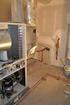 FINAL REPORT LIFE-CYCLE COST STUDY OF A GEOTHERMAL HEAT PUMP SYSTEM BIA OFFICE BLDG., WINNEBAGO, NE February 2006 FINAL REPORT LIFE-CYCLE COST STUDY OF A GEOTHERMAL HEAT PUMP SYSTEM BIA OFFICE BLDG., WINNEBAGO,
ENERGY AUDITS (OR SURVEYS) & ENERGY MANAGEMENT PROGRAMS SECTION B
 ENERGY AUDITS (OR SURVEYS) & ENERGY MANAGEMENT PROGRAMS SECTION B GOALS OF THE ENERGY AUDIT Clearly identify types and costs of energy use Understand how energy is being used--and possibly wasted Identify
Georgian Bay General Hospital Strategic Energy Management Plan 2014
 Georgian Bay General Hospital Strategic Energy Management Plan 2014 TABLE OF CONTENTS TABLE OF CONTENTS... 2 INTRODUCTION... 3 ENERGY MANAGEMENT VISION... 4 GUIDING PRINCIPLES FOR STRATEGIC ENERGY MANAGEMENT...
Tips on Saving Energy in Your Business
 Fact Sheet #3 Tips on Saving Energy in Your Business In this fact sheet you will discover: Quick and easy changes to save energy. Cost effective ways to reduce your heating, cooling, lighting and office
HEATING, VENTILATION & AIR CONDITIONING
 HEATING, VENTILATION & AIR CONDITIONING as part of the Energy Efficiency Information Grants Program Heating and cooling can account for approximately 23 % of energy use in pubs and hotels 1. Reducing heating
Regatta Wharf. City of Sydney SMART GREEN APARTMENTS LEVEL 2 ENERGY AUDIT REPORT
 Regatta Wharf City of Sydney SMART GREEN APARTMENTS LEVEL 2 ENERGY AUDIT REPORT Net Balance Final Report 1/03/2013 Energy Saver Regatta Wharf 1 Energy Saver participant details Name of Apartment Building
5-Minute Primer for Commercial Building Energy Audits
 5-Minute Primer for Commercial Building Energy Audits Why Energy Audits? Because an energy audit is the first step to saving energy at your facility. Putting together an energy project can be like finding
ENERGY CONTRACT Management PACIA August 2010
 ENERGY CONTRACT Management PACIA August 2010 Mark Searle Principal Consultant [email protected] (03) 9885 2633 100118 1 KEY ENERGY & RESOURCES Specialist energy management consultancy Negotiate
AIR CONDITIONING EFFICIENCY F8 Energy eco-efficiency opportunities in Queensland Foundries
 AIR CONDITIONING EFFICIENCY F8 Energy eco-efficiency opportunities in Queensland Foundries Hot tips and cool ideas to save energy and money! Air conditioning units or systems are often used by foundries
Design Guide. Retrofitting Options For HVAC Systems In Live Performance Venues
 Design Guide Retrofitting Options For HVAC Systems In Live Performance Venues Heating, ventilation and air conditioning (HVAC) systems are major energy consumers in live performance venues. For this reason,
Daikin Altherma Hybrid Heat Pump
 your comfort. our world. Daikin Altherma Hybrid Heat Pump Smart heating technology for the best of both worlds Heating Integrated Solutions Ventilation Air Conditioning Refrigeration Forward thinking About
ENERGY MANAGEMENT. for INDUSTRY AND BUSINESS
 ENERGY MANAGEMENT for INDUSTRY AND BUSINESS [Principles of Energy Management] Denis Cooke Denis Cooke & Associates Pty Limited Phone + 61 2 9871 6641 Fax +61 2 9614 1723 Email: [email protected] Web Site
The main steam enters the building in the basement mechanical room; this is where the condensate line also leaves the building.
 MSV: Square Footage: 24,844 No. of Floors: 1 Year Built: 1963 Type of Use: Lounge and dining area open all night for snacks Steam Water-cooled condenser, 50-Ton York unit with a 6 cylinder-reciprocating
HOW TO CONDUCT ENERGY SAVINGS ANALYSIS IN A FACILITY VALUE ENGINEERING STUDY
 HOW TO CONDUCT ENERGY SAVINGS ANALYSIS IN A FACILITY VALUE ENGINEERING STUDY Benson Kwong, CVS, PE, CEM, LEED AP, CCE envergie consulting, LLC Biography Benson Kwong is an independent consultant providing
Daikin Altherma Hybrid Heat Pump
 Daikin Altherma Hybrid Heat Pump Smart technology for the best of both worlds NATIONAL HEAT PUMP 19 JUNE 2014 ICC BIRMINGHAM WINNER Forward thinking Now is the time to rethink the way we heat our homes
Council s energy efficiency upgrades benefit community
 Council s energy efficiency upgrades benefit community Project Snapshot Objective: reduce energy, save money & improve comfort in public buildings Where: Meander Valley Council, Northern Tasmania Total
Waste Management Action Plan 2011-2015
 Waste Management Action Plan 2011-2015 Approved on: 7 June 2011 Owner: Program Manager, 8203 7723 Trim Reference: ACC2011/77875 Next Review Date: June 2014 Executive Summary This Waste Management Action
ENERGY RETAILERS COMPARATIVE PERFORMANCE REPORT PRICING 2013-14
 PERFORMANCE REPORT PRICING 2013-14 October 2014 An appropriate citation for this paper is: Essential Services Commission 2014, Energy retailers comparative performance report pricing 2013-14, October 2014
Direct Fresh Air Free Cooling of Data Centres
 White Paper Introduction There have been many different cooling systems deployed in Data Centres in the past to maintain an acceptable environment for the equipment and for Data Centre operatives. The
Analysis of Energy Consumption. ACME Limited
 Analysis of Energy Consumption at ACME Limited by A.N. Energy Consultancy A report written using the BizEE Benchmark energy auditing software package developed by BizEE Software Ltd www.bizeesoftware.com
Energy Audits. Good energy management begins with an energy audit
 Energy Audits Good energy management begins with an energy audit Effective management of energy-consuming systems can lead to significant cost and energy savings as well as increased comfort, lower maintenance
Greenhouse Gas Implications of HVAC Upgrades in Multi-Unit Residential Buildings
 Greenhouse Gas Implications of HVAC Upgrades in Multi-Unit Residential Buildings J A NUARY 2015 INTRODUCTION This Research Report explores best practices and approaches for reducing greenhouse gas (GHG)
Energy consumption forecasts
 Pty Ltd ABN 85 082 464 622 Level 2 / 21 Kirksway Place Hobart TAS 7000 www.auroraenergy.com.au Enquiries regarding this document should be addressed to: Network Regulatory Manager Pty Ltd GPO Box 191 Hobart
Air-Conditioning Buying Guide
 Air-Conditioning Buying Guide Buying a new air-conditioning system is a big decision. This Air-Conditioning Buying Guide can help you make the right choice, save energy and money. Shop with confidence
Improving comfort and energy efficiency in a nursery school design process S. Ferrari, G. Masera, D. Dell Oro
 Improving comfort and energy efficiency in a nursery school design process S. Ferrari, G. Masera, D. Dell Oro Dept. Building Environment Science &Technologies Politecnico di Milano Italy Research funded
Best Practice Guide BPGCS007
 Best Practice Guide BPGCS007 ENERGY MANAGEMENT Introduction: With rising fuel costs, opening of electricity and gas markets to alternate suppliers and climate change, the requirement to monitor and reduce
PROTOCOL FOR BUILDING ENERGY ANALYSIS SOFTWARE For Class 3, 5, 6, 7, 8 and 9 buildings
 PROTOCOL FOR BUILDING ENERGY ANALYSIS SOFTWARE For Class 3, 5, 6, 7, 8 and 9 buildings Version 2006.1 AUSTRALIAN BUILDING CODES BOARD JANUARY 2006 TABLE OF CONTENTS Foreword 1. Scope 2. Purpose and context
BGE Smart Energy Savers Program Energy Efficiency and Demand Response Programs December 4, 2012 USEA Global Workshop On Clean Energy Development
 BGE Smart Energy Savers Program Energy Efficiency and Demand Response Programs December 4, 2012 USEA Global Workshop On Clean Energy Development Ruth C. Kiselewich, Director Demand Side Management Programs
DATA CENTRE DESIGN AND
 SPUSC 2008 SOUTH PACIFIC USER SERVICES CONFERENCE DATA CENTRE DESIGN AND ENERGY INITIATIVES Presented by Jarrad Clift Electrical Engineer Greenstar Accredited Presentation Content Data Centres General
OEH Energy Efficient HVAC for Business Training Course
 OEH Energy Efficient HVAC for Business Training Course www.environment.nsw.gov.au/training Presenter: Chris Warris, BCW Carbon and Energy Agenda for Today Overview of OEH Energy Efficiency Training Program
Daikin Altherma Hybrid Heat Pump
 your comfort. our world. Daikin Altherma Hybrid Heat Pump The natural combination Heating Integrated Solutions Ventilation Air Conditioning Refrigeration About Daikin Forward thinking... Daikin has a worldwide
Continuous Energy Management at UC San Diego. Anna Levitt, P.E. Assistant Energy Manager June 13, 2013
 Continuous Energy Management at UC San Diego Anna Levitt, P.E. Assistant Energy Manager June 13, 2013 UC San Diego: A 42 megawatt Microgrid With a daily population of over 45,000, UC San Diego is the size
Sea Water Heat Pump Project
 Sea Water Heat Pump Project Alaska SeaLife Center, Seward, AK Presenter: Andy Baker, PE, YourCleanEnergy LLC Also Present is ASLC Operations Manager: Darryl Schaefermeyer ACEP Rural Energy Conference Forum
Victoria Government Gazette
 Victoria Government Gazette No. S 143 Friday 2 May 2014 By Authority of Victorian Government Printer Electricity Industry Act 2000 COMMANDER POWER & GAS Electricity Standing Offer rates effective from
International Telecommunication Union SERIES L: CONSTRUCTION, INSTALLATION AND PROTECTION OF TELECOMMUNICATION CABLES IN PUBLIC NETWORKS
 International Telecommunication Union ITU-T TELECOMMUNICATION STANDARDIZATION SECTOR OF ITU Technical Paper (13 December 2013) SERIES L: CONSTRUCTION, INSTALLATION AND PROTECTION OF TELECOMMUNICATION CABLES
UNDERSTANDING YOUR UTILITY BILL A GUIDE FOR BUSINESSES IN OHIO
 UNDERSTANDING YOUR UTILITY BILL A GUIDE FOR BUSINESSES IN OHIO TABLE OF CONTENTS INTRODUCTION Introduction... 3 Basic Billing Concepts... 4 Customer Choice Programs... 4 Gas Consumption and Charges...
Rules of Thumb Energy Efficiency in Buildings
 Energy Efficiency in Buildings Energy Savings Cost Savings Increased Productivity Economic Development Other Standard lighting retrofits: $0.90-$1.20 per square foot. High-efficiency packaged and split
Energy Efficiency: Integrated Design and HVAC Systems HEALTHCARE - TOP 5 GREEN BUILDING STRATEGIES
 EPA Publication 909-F-07-001 What? Energy use in healthcare facilities is higher than nearly all other building types. With rising energy costs and climate change concerns energy efficiency is financially
Hot Water. Heat pump water heaters. Residential and Commercial R410a
 Hot Water Heat pump water heaters Residential and Commercial R410a Heat pump technology Heat Pump Water Heating is a new idea using existing technology and is viewed as the latest generation of water heating
Dallas/Fort Worth International Airport District Energy Plant Upgrades Project Making More with Less Sustainable Communities Conference Dallas, TX
 Dallas/Fort Worth International Airport District Energy Plant Upgrades Project Making More with Less Sustainable Communities Conference Dallas, TX March 10, 2009 Agenda DFW Capital Development Program
Subtropical Cities September 2006. Design for Energy Efficiency in Commercial Buildings in Queensland
 Subtropical Cities September 2006 Design for Energy Efficiency in Commercial Buildings in Queensland Contents Typical Building Constraints & Requirements Understanding Energy Consumption in Buildings HVAC
Mailing Address 4650 Adohr Ln. Camarillo, CA 93012. 25 Year Financial Analysis. $1,051 / mo (avg) Cost Breakdown. System Description
 Summary Customer Dan Glaser - CASSK-13-00932 SolarWorld USA Site Address 4650 Adohr Ln. Camarillo, CA 93012 Mailing Address 4650 Adohr Ln. Camarillo, CA 93012 Company Contact We turn sunlight into power
Energy Performance Certificate
 Energy Performance Certificate 0 Raleigh Drive CULLOMPTON EX15 1FZ Dwelling type: Date of assessment: Date of certificate: Reference number: Type of assessment: Total floor area: Semi detached house 09
Daily Daily Network Network Network Energy Rates Step Rates Capacity. Price Rates Rates
 Excludes GST Effective from 1 July 2010 Tariff Class Daily Daily Network Network Network Energy Rates Step Rates Capacity Capacity Price Rates Rates No. Network Price DLF Access Non-ToU Time of Use (ToU)
MICRO HYDRO FOR THE FARM AND HOME
 MICRO HYDRO FOR THE FARM AND HOME How much can I expect to save? This depends entirely on the available flow, available head (fall) and the duration that the flow is available. Some farms struggle to maintain
ENERGY EFFICIENCY AUDITING
 GUIDANCE NOTE ON ENERGY EFFICIENCY AUDITING July 2003 ENVIRONMENTAL PROTECTION AGENCY An Ghníomhaireacht um Chaomhnú Comhshaoil PO Box 3000, Johnstown Castle, Co.Wexford, Ireland Telephone: +353-53-60600
Victoria Government Gazette
 Victoria Government Gazette No. S 448 Monday 16 December 2013 By Authority of Victorian Government Printer Electricity Industry Act 2000 DODO POWER & GAS PTY LTD Electricity Standing Offer rates effective
Monitoring your Energy Bills in Your Business
 Fact Sheet #2 Monitoring your Energy Bills in Your Business In this fact sheet you will discover: What to look for on your energy bills to indentify problems and reduce costs. How to monitor and track
Building Performance Optimization Services in the city of Boras, Sweden.
 Building Performance Optimization Services in the city of Boras, Sweden. Siemens Building Technologies Johny Hjerpe +46317276103 [email protected] Summary In 2002 the Siemens branch office of Gothenburg
Network Price List (excludes GST)
 Network Price List (excludes GST) Effective from 1 July 2007 Monthly Monthly Monthly Network Network Network Energy Rates Step Rates Demand Capacity Capacity Price Network Price DLF Access Rates Rates
Do your own home energy audit
 Do your own home energy audit Are you spending too much on your energy bills? Find out how you use energy in the home and what you can do to start saving $ www.sa.gov.au/energysmart Do your own home energy
HOW TO READ YOUR BILLS
 Resources for School Energy Managers Electricity and gas bills provide a variety of information about average consumption over the billing period. Information from regular energy bills can be used in the
Switching Energy Providers and PECO Smart Ideas. March 23, 2011
 Switching Energy Providers and PECO Smart Ideas March 23, 2011 Agenda Market Changes Taking Advantage of Competition PECO Smart Ideas for your home Questions Market Changes Utility Functions Before deregulation,
Energy Efficiency Tips for Businesses
 Energy Efficiency Tips for Businesses Top 10 Tips Lighting Tips Heating and Cooling Temperature Control Office Equipment Laundry Service Refrigeration Equipment Food Service Equipment Employee Involvement
GAS HEATING IN COMMERCIAL PREMISES
 ENERGY EFFICIENCY OFFICES GAS HEATING IN COMMERCIAL PREMISES www.energia.ie www.energia.ie Typically, energy reductions of 10% or more can be made easily through maintenance and low cost improvements.
First Time Home Buyers Energy Efficiency Workshop Guide
 First Time Home Buyers Energy Efficiency Workshop Guide Why is efficiency important when buying a home? Affordability: lower utility bills Environmental responsibility: reduces your carbon footprint and
effective energy management guide
 effective energy management guide going low-carbon is the only option for a profitable, future-proof business Environment Agency published on www.oursouthwest.com the South West in partnership with the
Methodology For Illinois Electric Customers and Sales Forecasts: 2016-2025
 Methodology For Illinois Electric Customers and Sales Forecasts: 2016-2025 In December 2014, an electric rate case was finalized in MEC s Illinois service territory. As a result of the implementation of
Applying ICT and IoT to Multifamily Buildings. U.S. Department of Energy Buildings Interoperability Vision Meeting March 12, 2015 Jeff Hendler, ETS
 Applying ICT and IoT to Multifamily Buildings U.S. Department of Energy Buildings Interoperability Vision Meeting March 12, 2015 Jeff Hendler, ETS ETS is an Energy Technology, Behavior Management, and
Prudential plc. Basis of Reporting: GHG emissions data and other environmental metrics.
 Prudential plc. Basis of Reporting: GHG emissions data and other environmental metrics. This Basis of Reporting document supports the preparation and reporting of GHG emissions data and other environmental
University of Melbourne Symposium on ICT Sustainability Dan Pointon 25 November 2008
 University of Melbourne Symposium on ICT Sustainability Dan Pointon 25 November 2008 Contents Welcome and Introduction Chapter 1: Data centre energy recap Chapter 2: Co-generation Chapter 3: CTC case study
Case Study Family Room Renovation 3br family home, Melbourne
 Family Room Renovation 3br family home, Melbourne In a Nutshell With time and budget constraints we often renovate just one room at a time. This case study looks at a family room renovation where the key
POLK STATE COLLEGE CHILLER PLANT EVALUATION WINTER HAVEN, FLORIDA APRIL 2, 2014. C arastro & A ssociates, C&A# 5747
 POLK STATE COLLEGE WINTER HAVEN, FLORIDA CHILLER PLANT EVALUATION APRIL 2, 2014 C&A# 5747 C arastro & A ssociates, c o n s u l t i n g e n g i n e e r s inc. 2609 W. De Leon Street, Tampa, Florida 33609
Energy Benchmarking Report for Lakeside Middle School. Millville, NJ
 Energy Benchmarking Report for Lakeside Middle School Millville, NJ (for the period: June 1, 2008 through May 31, 2009) Prepared by: Background & Findings: The New Jersey Clean Energy Program (NJCEP) developed
POWER NETWORKS. 2014-15 Electricity Network Tariffs and Charges and Future Price Trends
 POWER NETWORKS 2014-15 Electricity Network Tariffs and Charges and Future Price Trends August 2014 Power and Water Corporation Table of Contents 1 Business Characteristics... 3 2 2014 Network Price Determination...
Energy Performance Certificate
 Energy Performance Certificate Flat 2 Bagshot House Redhill Street LONDON NW1 4BY Dwelling type: Date of assessment: Date of certificate: Reference number: Total floor area: Ground-floor flat 09 April
BCA-IDA Green Mark for Existing Data Centres Version EDC/1.0
 BCA-IDA Green Mark for Existing Data Centres Version EDC/1.0 To achieve GREEN MARK Award Pre-requisite Requirement All relevant pre-requisite requirements for the specific Green Mark Rating are to be complied
Data driven approach in analyzing energy consumption data in buildings. Office of Environmental Sustainability Ian Tan
 Data driven approach in analyzing energy consumption data in buildings Office of Environmental Sustainability Ian Tan Background Real time energy consumption data of buildings in terms of electricity (kwh)
Building Management Systems
 Building Management Systems Summary A well designed and managed Building Management System (BMS) provides great opportunities for improvements in energy efficiency by: Enabling building managers to provide
Tools for Energy Tracking and Benchmarking. ENERGY STAR Portfolio Manager for Congregations
 Tools for Energy Tracking and Benchmarking ENERGY STAR Portfolio Manager for Congregations Steve Bell (Contractor) Energy and Security Group LLC ENERGY STAR Congregations Why Does Green Start With Energy?
NEW COMMERCIAL Rates. Understanding the. Commercial Customers
 Understanding the NEW COMMERCIAL Rates The Austin City Council increased Austin Energy s base rates, which pay for operations and maintenance, for the first time in 18 years. The new rates, which amount
Network Price List and Explanatory Notes
 Essential Energy Network Price List (Excluding GST) Effective 1 July 2014 Tariff Code Obsolete tariffs on same rate Description Network Energy Energy Energy Energy Energy Energy Energy Peak Shoulder OffPeak
Energy Performance Certificate
 Energy Performance Certificate Flat 307 Windsor House Cumberland Market LONDON NW1 4DE Dwelling type: Date of assessment: Date of certificate: Reference number: Total floor area: Mid-floor flat 8361-6824-6900-7049-8026
HVAC. Kitchen Exhaust. rooftop equipment! let s drop on a few exhaust fans! it doesn t get easier!
 HVAC & Kitchen Exhaust The Heart of Restaurant HVAC rooftop equipment! let s drop on a few exhaust fans! it doesn t get easier! 1 CKV Design: Just not that easy! There is no piece of equipment in the commercial
Ecodan Air Source Heat Pump and Flow Temperature Controller 2
 HOMEOWNER STANDALONE Homeowner Information SEPTEMBER 2011 Ecodan Air Source Heat Pump and Flow Temperature Controller 2 Ecodan Air Source Heat Pump Model Number PUHZ-W50VHA(2)-BS PUHZ-W85VHA(2)-BS PUHZ-HW140VHA(2)-BS
Energy and Water Efficiency Management Practice Guide
 Carbonproof Energy and Water Efficiency Management Practice Guide The material provided in this guide has been produced in conjunction with our partner Energetics Pty Ltd. 2011 Energetics Pty Ltd and AgriFood
Solar Power Frequently Asked Questions
 General information about solar power 1. How do I get solar power? Solar Power Frequently Asked Questions Many companies install solar power systems including some electricity retailers. It is worth comparing
Air conditioning is AIR CONDITIONING GUIDE
 ool Air conditioning is AIR CONDITIONING GUIDE ool Contents Making the right decisions for the right reasons Keep a cool head 2 Buying 3 Be a cool customer Installation 5 For a licensed technician, installation
INSTITUTE FOR SUSTAINABLE FUTURES NSW BUSINESS ENERGY PRICES TO 2020
 INSTITUTE FOR SUSTAINABLE FUTURES NSW BUSINESS ENERGY PRICES TO 2020 NSW business energy prices to 2020 FINAL REPORT Revision 1 FOR THE NSW OFFICE OF ENVIRONMENT AND HERITAGE AUTHORS NICKY ISON, JAY RUTOVITZ
Case Studies: Infrared Heating in Industrial Applications
 Case Studies: Infrared Heating in Industrial Applications Chao Chen, Puget Sound Energy ABSTRACT Puget Sound Energy (PSE) is a utility which serves more than one million electric customers and over 700,000