
Introduction to Fatal Accident Claims Procedure and Quantification
|
|
|
- Dortha McCormick
- 9 years ago
- Views:
Transcription
1 Introduction to Fatal Accident Claims Procedure and Quantification 275 CHAPTER 18 Introduction to Fatal Accident Claims Procedure and Quantification 18.1 Introduction Cause of action The appointment of personal representatives Damages under the Law Reform (Miscellaneous Provisions) Act Damages under the Fatal Accidents Act Interest Pension loss Loss of consortium Conduct Conclusion Further reading Overview of damages in fatal claims 291 LEARNING OUTCOMES After reading this chapter you will be able to: understand the causes of action available to the estate and dependants of the deceased after a fatal accident identify who may claim as a dependant of the deceased advise on the heads of damage which may be claimed by the estate of the deceased calculate the amount of a dependency claim identify who may claim bereavement damages and the amount of those damages INTRODUCTION This chapter sets out the basic principles involved in assessing damages in personal injury and clinical negligence cases where the victim has died before trial. There are two elements to a claim in such circumstances: the Law Reform (Miscellaneous Provisions) Act 1934 (LR(MP)A 1934), which allows a claim for the benefit of the deceased s estate; and the Fatal Accidents Act 1976 (FAA 1976), which allows a claim for the benefit of the dependants and those entitled to an award of bereavement damages. While the Acts provide two separate causes of action, they are commonly brought together and, to some extent, may overlap. The methods of valuing damages which may be claimed under each Act are considered below.

2 276 Personal Injury and Clinical Negligence Litigation In certain cases, specific statutes provide for recompense for the deceased s family, such as the Carriage by Air Act 1961 in cases of death arising out of civil aviation accidents. These are not dealt with in this text CAUSE OF ACTION The LR(MP)A 1934 provides (for the benefit of the deceased s estate) for the continuation of the cause of action to which the deceased was entitled the instant before he died (LR(MP)A 1934, s 1(2)). It does not create a separate cause of action. The FAA 1976 does create a separate cause of action for the dependants (and those entitled to the award of bereavement damages), but it is based on the pre-condition that the deceased, had he lived, would have been able to sue successfully (FAA 1976, s 1). Three things follow from this, namely: (c) if the deceased had no cause of action then the estate and the dependants have no cause of action; any defence that could have been used against the deceased can be used against the estate and the dependants; if the deceased was contributorily negligent then the damages of the estate and the dependants are reduced accordingly. EXAMPLE 1 Tom is driving his car when it collides with a car driven by Sharon. Tom dies as a result of his injuries. He is survived by his widow, Elaine, and his son, Christopher. The accident is entirely the fault of Tom. As a result, neither Tom s estate, nor Elaine or Christopher has any right of action against Sharon. EXAMPLE 2 Lucy is killed in an accident at work. She is survived by her husband, Michael, and daughter, Patricia. Lucy and her employers are equally to blame for the accident. Although Lucy s estate, Michael and Patricia may claim against the employers, the damages awarded to each will be reduced by 50%. In the case of Jameson and Another v Central Electricity Generating Board and Another [2000] AC 455, the House of Lords held that in a case where the second co-defendant had paid a compensation payment to the injured person when he was still alive (on a less than full liability basis), this did prevent the dependants bringing a claim under FAA 1976 against the first co-defendant (who was a concurrent tortfeasor) and did amount to a settlement of claim. Pleadings may be amended to plead a fatal accident claim if the deceased dies during the course of proceedings which were commenced in his name when he was alive. However, once judgment is given or a claim is settled by a living claimant, there can be no subsequent claim by dependants. This is well illustrated by the case of Thompson v Arnold [2007] EWHC 1875 (QB). Mrs Thompson commenced proceedings against her GP, Dr Arnold, who had incorrectly diagnosed a lump in her breast as benign. The case was settled for 120,000, in full and final settlement, in January Mrs Thompson died in April 2002 and, in April 2005, her husband and two daughters as her dependants sought to bring a claim against the defendant under the FAA Their claim was dismissed on the basis of the previous settlement made by Mrs Thompson during her lifetime. If there is a possibility that a claimant might die of their injuries during the course of proceedings, the best approach (as suggested by Langstaff J in Thompson v Arnold) may be to seek an interim payment of equal value to a lifetime award, together with an adjournment of the case. This will preserve the dependant s right to claim under the FAA 1976 in the event of death. Alternatively, a claim for provisional

3 Introduction to Fatal Accident Claims Procedure and Quantification 277 damages could be made (see 15.4). Section 3 of the Damages Act 1996 makes it clear that a provisional damages award does not bar a claim under the FAA 1976, although the award will be taken into account in assessing damages payable to the dependants under the 1976 Act THE APPOINTMENT OF PERSONAL REPRESENTATIVES Fatal accident claims are normally representative actions. This means that the personal representative normally brings a claim simultaneously on behalf of the estate under the LR(MP)A 1934 and on behalf of the dependants under the FAA The grant of probate or letters of administration should therefore be obtained before the claim is commenced DAMAGES UNDER THE LAW REFORM (MISCELLANEOUS PROVISIONS) ACT 1934 Generally, the damages awarded to the estate under the LR(MP)A 1934 are based on the losses for which the deceased could have claimed at the instant before he died. In essence, the estate inherits the deceased s right to sue in respect of the death. Any head of damages that is duplicated between the LR(MP)A 1934 and the FAA 1976 is recoverable only once. The following heads of damages may be appropriate Pain, suffering and loss of amenity (PSLA) Chapter 1 of the 12th edition of the Guidelines for the Assessment of General Damages in Personal Injury Cases allows for an element of PSLA for the period between injury and death. There are four brackets: (A) Full Awareness 16,940 to 19,250 Severe burns and lung damage coupled with full awareness initially then fluctuating consciousness for 4 to 5 weeks and intrusive treatment. (B) Followed by Unconsciousness 8,470 to 11,330 Severe burns and lung damage causing excruciating pain but followed by unconsciousness after 3 hours and death two weeks later; or very severe chest and extensive orthopaedic injuries from which recovery was being made, but complications supervened. (C) Immediate Unconsciousness/Death after Six Weeks 6,820 Immediate unconsciousness after injury, and death occurring after six weeks. (D) Immediate Unconsciousness/Death within One Week 1,100 to 2,255 Immediate unconsciousness, or unconsciousness following very shortly after injury, and death occurring within a week. Previously, there was no guidance in this area, with parties having to search for authorities in each case, and defendants often argued that there could really be no pain with immediate unconsciousness, so reaching a conclusion that no PSLA award should be made. For example, in Hicks v Wright [1992] 2 All ER 65, no damages under this head were awarded to victims of the Hillsborough disaster for the short period of terror and pain they experienced before death. It would seem likely that if those cases were being valued today they would be awarded something for PSLA. Chapter 1 does not apply, for example, to cases relating to asbestos exposure or other cancer claims where reference will continue to be made to the awards for those underlying conditions. Although the above brackets are a useful starting point, every case will be unique and so the amount of the award for pain, suffering and loss of amenity will depend upon the actual level of pain and the length of time over which the pain was experienced. Reference should therefore still be made to case law in order to obtain a more accurate valuation. For example,

4 278 Personal Injury and Clinical Negligence Litigation in Fallon v Beaumont, 16 December 1993, CC (Leeds), a 22-year-old man was involved in a highspeed road accident, during which the car in which he was a passenger exploded and burst into flames. He was trapped in the burning car until the emergency services arrived, and was conscious throughout. He died 30 days later. He would have had significant insight into the gravity of his situation and an award of 10,000 (the equivalent of about 16,500 at today s values) was made for pain and suffering. The Court of Appeal case of Kadir v Mistry [2014] All ER (D) 247 concerned a claim for damages for the distress caused by the knowledge of the deceased that she was going to die as a result of the delay by her GP to diagnose that she was suffering from cancer. Section 1(1) of the Administration of Justice Act 1982 provides: In an action under the law of England and Wales or the law of Northern Ireland for damages for personal injuries no damages shall be recoverable in respect of any loss of expectation of life caused to the injured person by the injuries; but if the injured person s expectation of life has been reduced by the injuries, the court, in assessing damages in respect of pain and suffering caused by the injuries, shall take account of any suffering caused or likely to be caused to him by awareness that his expectation of life has been so reduced. The appellant/claimant, as personal representative of the deceased s estate, appealed against a decision awarding no damages for pain, suffering and loss of amenity, or for mental anguish, arising from the admitted negligent failure of the respondent/defendant general practitioners to diagnose his late wife with stomach cancer as early as they should have done. For several months the deceased had been visiting the defendants complaining of various stomach-related symptoms until, in March 2008, she was diagnosed with stomach cancer. She was advised that the cancer was too advanced to treat, and thereafter she received only palliative care until she died in August She was 32 years old and had four small children. The claimant claimed against the defendant on behalf of himself and the children under the FAA 1976, and on behalf of the deceased s estate under the LR(MP)A The defendants admitted liability for the delay in the diagnosis and the consequent delay in treatment. The claimant gave evidence that in March 2008 the family was told by doctors that the deceased might have survived if she had been diagnosed sooner, and that during a home visit in May 2008 she asked her GP why she was not diagnosed earlier and whether she would have survived if she had been. The trial judge found that if the defendants had not been negligent the deceased would have been diagnosed in June or July 2007, and would probably have lived until July or August He found that if the deceased had been diagnosed earlier she would have suffered the same symptoms as she did, albeit later, and would have had to endure intensive and gruelling treatments, so he awarded no damages for pain, suffering and loss of amenity. He also rejected the claim under s 1(1) of the Administration of Justice Act 1982 for damages in respect of mental anguish caused or likely to be caused by the deceased s awareness that her life expectation had been reduced. Allowing the claimant s appeal, the Court of Appeal held that it was important to bear in mind that there were no special rules for the assessment of damages in cases under the 1934 Act: the court was required to undertake the conventional exercise, namely, decide what pain was occasioned by the negligence. If the court was looking at a living claimant facing an early death, like the deceased, the court inevitably had to compare the facts as they occurred with the likely facts if there had been no negligence. On that basis, the fact that the deceased would have had the same symptoms two years later was relevant, as was the pain of treatment. The judge had been correct on the evidence to refuse the claim for pain, suffering and loss of amenity.

5 Introduction to Fatal Accident Claims Procedure and Quantification 279 The word awareness in s 1(1) of the 1982 Act did not mean strictly certain knowledge. As a matter of ordinary humanity, if there was good reason for the anguish, it could be inferred that the sufferer would have suffered some. The claimant had given evidence that the deceased had believed that the delay had caused the cancer to spread. The issue of why she was not diagnosed earlier was a live question during her last months. There was plainly material that gave rise to the proper inference that she feared on good objective grounds that her life expectancy had been reduced by the delayed diagnosis. It was necessary to prove that she knew that it was reduced. No cases had been found that were relevant to the assessment of damages under s 1(1) of the 1982 Act for the deceased s suffering occasioned by her awareness of her reduced life expectancy. On the evidence, her mental anguish was proved for the three-month period from May 2008 until her death. It was important to recognise that there was no psychiatric injury, but there were other important elements: in particular, she was a young woman with four small children; her anguish must have been exacerbated by her knowledge that they would be left without her and that she would not see them grow up. It was proper to take those factors into account. Adopting a broad-brush approach, 3,500 would do justice Loss of income The estate is entitled to claim the lost net earnings of the deceased from the time of the accident until death, calculated in the same way as for a living claimant (see ). No claim can be made for loss of income in respect of any period after that person s death (LR(MP)A 1934, s 1(2)(ii), as amended by the Administration of Justice Act 1982) Funeral expenses Funeral expenses are specifically provided for in s 1(2)(c) of the LR(MP)A The expenses may be claimed provided they are: reasonable; and incurred by the estate. What is reasonable will depend on the individual circumstances of the case, including the social standing and racial origin of the deceased. In Gammell v Wilson [1982] AC 27, the court drew a distinction between the cost of the funeral service and a headstone (which was allowed), and the cost of a wake and a memorial to the deceased (which was not allowed). In Brown v Hamid [2013] EWHC 4067 (QB), no award was allowed for funeral expenses on the basis that they would have been incurred shortly in any event. The court found that, even if the defendant had not been negligent, the deceased would have survived for only another 12 months. If the expenses are incurred by a dependant of the deceased rather than by the deceased s estate, the dependant may claim the expenses as part of the fatal accidents claim. On a practical note, it is important to obtain receipts in order to prove all the expenses incurred. Many insurers are amenable to making an immediate interim payment in relation to the funeral expenses, in order to relieve the dependants of some of the immediate expenses and to prevent interest accruing on those expenses Value of services rendered by third parties Services rendered by third parties may include, for example: nursing services rendered by a relative to the deceased up to the time of death; expenses incurred by a third party in assisting in bringing the deceased s body home from abroad; or the costs incurred by relatives in visiting the hospital. The quantum is the proper and reasonable cost of supplying the need. (For the general principles involved, see Chapter 15.)

6 280 Personal Injury and Clinical Negligence Litigation Other losses Other losses may include, for example, damage to chattels, such as the car the deceased was driving at the time of the incident, or the clothing which he was wearing Distribution of damages Damages under the LR(MP)A 1934 pass to the deceased s estate, and from there to the deceased s beneficiaries according to the deceased s will or the rules of intestacy. Damages under the LR(MP)A 1934 are, in appropriate cases (eg, where there was a long interval between the accident and the death, and the deceased had been in receipt of recoverable benefits), subject to the Social Security (Recovery of Benefits) Act 1997 (see Chapter 16), but are not subject to any other losses or gains to the estate, such as the receipt of insurance money (LR(MP)A 1934, s 1(2)) Conclusion In the case of instantaneous death, damages under the LR(MP)A 1934 will normally be limited to damages for funeral expenses and damage to chattels. Where there is a period of survival, the damages may be more extensive but will normally still be severely curtailed by the inability of the estate to claim the lost future income of the deceased DAMAGES UNDER THE FATAL ACCIDENTS ACT 1976 In general terms, there are three possible heads of damages, namely: (c) a dependency claim for the financial losses suffered by the dependants of the deceased; an award of bereavement damages; and a claim for the funeral expenses, if paid by the dependants Loss of dependency To succeed in a dependency claim, the claimant must be a dependant as defined by the FAA 1976; and must have had a reasonable expectation of financial benefit from the deceased The statutory meaning of dependant Dependant is defined in s 1(3) of the FAA 1976 as follows: (aa) (c) (d) (e) the wife or husband or former wife or husband of the deceased; the civil partner or former civil partner of the deceased; any person who: (i) was living with the deceased in the same household immediately before the date of the death; and (ii) had been living with the deceased in the same household for at least two years before that date; and (iii) was living during the whole of that period as the husband or wife or civil partner of the deceased; any parent or other ascendant of the deceased; any person who was treated by the deceased as his parent; any child or other descendant of the deceased; (f ) any person (not being a child of the deceased) who, in the case of any marriage to which the deceased was at any time a party, was treated by the deceased as a child of the family in relation to that marriage; (fa) any person (not being a child of the deceased) who, in the case of any civil partnership in which the deceased was at any time a civil partner, was treated by the deceased as a child of the family in relation to that civil partnership;

7 Introduction to Fatal Accident Claims Procedure and Quantification 281 (g) any person who is, or is the issue of, a brother, sister, uncle or aunt of the deceased. The requirement to come within the statutory definition of dependant has resulted in adverse judicial comment (see Shepherd v Post Office (1995) The Times, 15 June), and the introduction of the cohabitee as a possible claimant ( above) by the Administration of Justice Act 1982 was controversial. In Fretwell v Willi Betz, 8 March 2001, the definition of a dependant was challenged, by virtue of the Human Rights Act The case was settled without any admission as regards the claimant s status as a dependant (the argument concerned a child of the girlfriend who was living with the deceased prior to the accident), but it does illustrate the possibility of using the Human Rights Act 1998 to challenge the narrow statutory definition of a dependant (see also Ogur v Turkey (2001) 31 EHRR 912). The requirement to have been living together for two years prior to the death should be noted, and evidence should be obtained on this point if it is anticipated that the defendant will challenge this (see Kotke v Saffarini [2005] EWCA Civ 221). The FAA 1976 contains a provision that the cohabitee s lack of enforceable right to support is to be taken into account (FAA 1976, s 3(4)). This may mean that a cohabitee will receive less compensation than a lawful spouse, as the court may use a lower multiplier in determining the dependency claim. For example, a multiplier of 13 was used for a cohabiting couple, instead of 15 which would have been used if they were married Further provisions with regard to the meaning of dependant Section 1(4) of the FAA 1976 (as amended by the Administration of Justice Act 1982) provides: former wife or husband includes a reference to a person whose marriage to the deceased has been annulled or declared void as well as a person whose marriage to the deceased has been dissolved. Section 1(5) of the FAA 1976 (as amended by the Administration of Justice Act 1982) provides: any relationship by affinity shall be treated as a relationship by consanguinity, any relationship of the half blood as a relationship of the whole blood, and the stepchild of any person as his child; an illegitimate person shall be treated as the legitimate child of his mother and reputed father. Thus, for example, the stepbrother of the deceased is treated as his true brother; the uncle of a wife is treated as the husband s uncle. The Adoption Act 1976 provides that, generally, an adopted child is treated as the natural child of the adopters Identifying the dependants It is important to identify all prospective dependants, as s 2(3) of the FAA 1976 provides that not more than one action shall lie and, as a result, only one claim will be brought. A defendant is entitled to full particulars of all those on whose behalf the claim is being brought. In practice, the particulars of the dependants are set out in the court documentation and generally include details of: (c) the age of the dependants; their relationship with the deceased; the nature of the dependency (eg, the dependant was a minor son wholly supported by the deceased father who was the family breadwinner and who had good promotion prospects). On occasions, the defendants will argue that a claimant is not a true dependant under the FAA 1976, and this is often resolved by the court ordering a trial of the point as a preliminary issue.

8 282 Personal Injury and Clinical Negligence Litigation The requirement of financial loss It is not sufficient that the claimant merely satisfies the statutory meaning of dependant. It must be shown in addition that there is a reasonable likelihood that the claimant has or will suffer financial loss as a result of the death of the deceased. In the case of Thomas v Kwik Save Stores Ltd (2000) The Times, 27 June, the Court of Appeal reaffirmed the principle that, when awarding damages under the FAA 1976, the court was concerned with the financial loss and not the emotional dependency of the claimant on the deceased. In many cases, the dependants will have a clear and immediate financial loss. For example, where a husband was maintaining his wife and children before his death, the fact that they will suffer financial loss as a result of the husband s death is obvious. In addition to the loss of the deceased s earnings, consideration should be given to whether the dependents have lost any fringe benefits to which he was entitled, such as a company car. The loss may still be regarded as financial even if there was no expenditure by the deceased, provided the support can be quantified in monetary terms (eg, where the deceased s elderly mother was allowed to live rent-free in the deceased s house before his death, the mother would be able to claim a quantifiable financial loss). If the deceased regularly did DIY, gardening or other jobs around the house, the dependants can claim for the loss of those gratuitous services. In Crabtree v Wilson [1993] PIQR Q24 the court valued the deceased s work around the home at 1,500 per annum. In the case of Cox v Hockenhull [1999] 3 All ER 577, the Court of Appeal held that the important point in assessing the dependency was to identify the loss the claimant has suffered as a result of a death. In that case, the deceased s income had been certain State benefits which she and her husband had relied upon. The Court allowed the husband s claim for dependency on the basis that he was dependent on certain benefits that had been received prior to the death and which he no longer obtained after his wife was killed in a road traffic accident The loss must be as a result of a personal family relationship with the deceased If the loss to the dependant is, in reality, a loss attributable to a business relationship with the deceased, the claim for loss of dependency will fail (Burgess v Florence Nightingale Hospital for Gentlewomen [1955] 1 QB 349). EXAMPLE Tom is killed in a car accident as a result of the negligent driving of Keith. Tom is survived by his widow, Sally, and his 6-month-old son, Brian. Tom was the sole financial support of Sally and Brian. Tom worked in business with his brother, Joe. As a result of Tom s death, the business fails and Joe suffers heavy financial losses. Tom s married sister, Edwina, is very upset at the news of her brother s death. Sally and Brian may claim as defined dependants who suffer financial losses as a result of a family relationship with Tom. Joe cannot claim because, although he is a defined dependant, his financial losses are as a result of a business relationship with Tom. Edwina cannot claim because, although she is a defined dependant, she has suffered no financial losses (merely grief and sorrow) Assessing loss of dependency the traditional method The award for loss of dependency is ascertained by a multiplicand and multiplier system. The multiplicand is the net annual loss of the dependants; the multiplier is based on the number of years loss of dependency (ie, the length of time that the claimant would have been dependent on the deceased).

9 Introduction to Fatal Accident Claims Procedure and Quantification The multiplicand the net annual loss to the dependants The deceased wage earner The starting point is to calculate the amount of the deceased s earnings and deduct the estimated amount representing the sum that would have been spent by the deceased on his own personal and living expenses. The remaining balance will be the dependency multiplicand. The deceased s net annual earnings must be calculated as at the date of the trial (Cookson v Knowles [1979] AC 556). No allowance is made for inflation (Auty v National Coal Board [1985] 1 All ER 930), but the deceased s future earning capacity (eg, as result of promotion) must be taken into account. For example, a trainee doctor may have been earning a relatively modest income at the date of death, but his earnings would clearly have increased substantially on qualifying and again on becoming a consultant. Evidence will be needed in support of this, and the best evidence may be from a comparative employee or employees who have gone, or who are going through, the same career structure as the deceased would have done. This evidence could be obtained, for example, from the deceased s trade union or employer. Conversely, there may be evidence of likely loss of earning capacity, for example because of redundancy. Calculating the dependency figure There are two approaches that the courts have considered: The old system for calculating the dependency figure is to add up all the financial benefits received by the dependants from the deceased. It is necessary to produce a list of the items which contributed to the annual value of dependency and for the claimant to provide documentary evidence, bills, etc for the year prior to the death. A proportion is then deducted for the deceased s own expenses. For example, the following items have been considered: How much housekeeping money was paid to the wife? How much was spent on the deceased s food? How much was spent on the food for the rest of the family? Who paid how much for the children s shoes, etc? This type of calculation is very difficult and in practice is rarely attempted. The customary modern practice, which was established in the case of Harris v Empress Motors [1983] 3 All ER 561, is to deduct a percentage from the net income figure to represent what the deceased would have spent exclusively on himself. Conventional percentages are adopted. Where the family unit was husband and wife, the usual figure is one-third. Where the family unit was husband, wife and children, the usual figure is one-quarter. However, it is important to note that each case must be judged on its own facts. The court is willing to depart from the conventional figures where there is evidence that they are inappropriate (Owen v Martin [1992] PIQR Q151), for example where the deceased was particularly frugal or a spendthrift. In such circumstances, less or more than the conventional figure should be deducted (see also Coward v Comex Houlder Diving Ltd, 18 July 1988, CA and Dhaliwal v Personal Representatives of Hunt (Deceased) [1995] PIQR Q56, CA). Furthermore, it is quite possible that different multiplicands may have to be selected according to different times in the period of dependency. Had he lived, the deceased s financial affairs would not have remained constant throughout his life. Similarly, therefore, the multiplicand will not remain constant either. For example, in the case of a husband with wife and children, 75% of the husband s earnings may be the appropriate initial multiplicand while his children are likely to be dependent. However, from the point where the children can be expected to become independent the multiplicand may be merely two-thirds of the husband s earnings (see also Coward v Comex Houlder Diving Ltd, above).

10 284 Personal Injury and Clinical Negligence Litigation Frequently, both husband and wife would have been earning at the time of death, and in such circumstances the approach adopted is to calculate the dependency as two-thirds or threequarters (as the case may be) of the total joint net income, less the continuing earnings of the surviving spouse. EXAMPLE Mike and Susan both earn 50,000 pa net. They have no children. Mike dies in an accident at work. Two-thirds of their joint income is approximately 66,600 ( 100,000 x 66%), but Susan s earnings of 50,000 must be deducted to calculate her dependency claim. Susan s annual loss of dependency is therefore 16,000. Services rendered by the deceased The deceased may have been contributing to the support of the family not only in terms of a percentage of his earnings, but also by rendering services to the family free of charge. Examples of such services include: (c) (d) DIY jobs (eg, painting the house annually); vegetable gardening (therefore saving on grocery bills); nursing services to a sick member of the family; contributions to childcare. On the deceased s death, such free services will be lost. The family will have to pay for the services (eg, by employing a decorator) and thus incur a loss. The value of these services can add considerably to the multiplicand. Evidence must be obtained, for example by quotations from the appropriate source. In Beesley v New Century Group Ltd [2008] EWHC 3033 (QB), the claimant s husband had died from malignant mesothelioma as a result of his employment with the defendant company. The court made an award of damages for loss of intangible benefits in respect of the extra value to be attached to help such as domestic services provided by a husband. The court held that there were considerable advantages in having jobs around the house and garden done by a husband in his own time and at his own convenience, rather than having to employ a professional. Accordingly, it awarded the claimant 2,000. See also Manning v King s College Hospital NHS Trust [2008] EWHC 3008 (QB), in which similar sums were awarded to the husband and children of the deceased for the loss of personal attention of a wife and mother, in recognition that what is lost goes beyond the material. The deceased non-wage earner Where the deceased was a wage earner, the valuation of the multiplicand in the dependency claim is predominantly based on a proportion of the deceased s earnings (see above). This is so whether the deceased was male or female (eg, whether husband, father, wife or mother). It is not uncommon, however, that the deceased was not in paid employment. In this case, the value of the services rendered to the family becomes the vital issue. For example, if the deceased was the wife and mother of the family, and was not a wage earner at the date of her death, the services rendered by her to the family might be quantified in the terms of employing a housekeeper to provide the same services. In Regan v Williamson [1976] 1 WLR 305, Watkins J said that in this context the word services [has] been too narrowly construed. It should at least include an acknowledgement that a wife and mother does not work to set hours, and, still less, to rule. Accordingly, a value in excess of a housekeeper was awarded in that case. In Mehmet v Perry [1977] 2 All ER 529, the claimant widower, on the death of his wife, reasonably gave up his job in order to look after his young children. The starting point for the value of the services of the deceased wife was taken as the husband s loss of earnings.

11 Introduction to Fatal Accident Claims Procedure and Quantification 285 Claims by parents, if children unmarried A claim can be made by a parent (who is often unemployed or ill) who was dependent on the support from his unmarried child. When the court considers this type of case, it will have regard to the fact that the child may have married and the financial assistance provided by the child may have ceased The multiplier the period of loss Having calculated the multiplicand, the other side of the equation is to calculate the number of years loss of dependency. Commencement of period of loss The starting point for the number of years loss is the date of death (not the date of trial: Graham v Dodds [1983] 2 All ER 953; White v ESAB Group (UK) Ltd [2002] All ER (D) 02 (Jan) and ATM v MS (2002) The Times, 3 July). However, see the 7th edition of the Ogden Tables for further commentary on this point. End of the period of loss In the case of a deceased wage earner, prima facie the number of years loss will extend to the end of the deceased s working life (ie, usually up to what would have been the deceased s retiring age). Direct evidence should be called on this point. It must be remembered that certain items of loss, such as the claim for the cost of DIY, may extend beyond retirement age, as the deceased would not necessarily have stopped doing DIY when he retired from work. However, each case will turn upon its own facts, and the period of dependency may end before or after what would have been the normal date of the deceased s retirement. For example, where the deceased was a professional person, he might have been expected to work and support his dependants beyond normal retirement age. Equally, if the deceased would have enjoyed a pension, it may be argued that he would have continued to provide for his dependants beyond normal retirement age (although evidence would be needed to substantiate this: Auty v National Coal Board [1985] 1 All ER 930; see Chapter 15). Conversely, the period of dependency may stop before what would have been the normally expected retirement age of the deceased. For example, if the deceased was already in a poor state of health, he may not have been expected to work until normal retirement age, and the financial support for the dependants would therefore have ended earlier. Similarly, if the dependant himself is in a poor state of health and has a short life-expectancy, the period of dependency will be shorter. What if the dependant s shorter life expectancy has been caused by the negligence of the defendant? This was the case in Haxton v Philips Electronics UK Ltd [2014] All ER (D) 138 (Jan). The claimant had developed mesothelioma as a result of handling her husband s work clothes, which had become impregnated with asbestos fibres during his employment with the defendant. After her husband s death from mesothelioma, the claimant issued proceedings against the defendant seeking damages (i) as a dependant, and (ii) in her own right. The defendant admitted liability and damages were agreed, except in respect of her personal claim where she sought a sum to compensate her for the fact that her reduced life expectancy had resulted in a lower dependency claim. Although the claim failed at first instance, the Court of Appeal allowed the claimant s appeal and awarded her an additional 200,000. Effect of likely divorce or remarriage Where there is a claim by a widow as dependant, the likelihood that the marriage would have ended in divorce may be taken into account in assessing the period of dependency. In Owen v Martin [1992] PIQR Q151, the judge adopted a multiplier of 15, but the Court of Appeal reduced this to 11 on the basis that the widow s attitude towards her marriage vows, as shown

12 286 Personal Injury and Clinical Negligence Litigation by her personal history, led the court to believe that the marriage might not have lasted the whole of the natural life of the deceased. The court should take this approach only provided there is some evidence of likelihood of divorce (Wheatley v Cunningham [1992] PIQR Q100). See also D and D v Donald [2001] PIQR Q44, concerning an extra-marital affair. In O Loughlin v Cape Distribution Ltd [2001] EWCA Civ 178, [2001] JPIL 191, the court confirmed that there was no prescribed method by which damages for loss of dependency had to be identified. The key factor was showing economic loss. However, the widow s prospects of remarriage or actual remarriage are to be ignored (FAA 1976, s 3(3)). Therefore, the period of the widow s dependency on her deceased husband is calculated without regard to the fact that she is or may be financially supported by a new husband. Conversion of the period of loss to a multiplier Once the number of years loss of dependency has been ascertained, this is then converted to a multiplier using the Ogden Tables (see Chapter 15) The multiplication Having established the appropriate multiplicand and the overall multiplier, one method of calculating the award for loss of dependency is as follows: Pre-trial losses calculate the actual number of years loss from the date of death until the trial and apply to the multiplicand (or multiplicands).the resulting amount(s) will be treated as special damages and will attract interest. Future losses deduct the number of pre-trial years from the overall multiplier and apply the balance of the multiplier to the multiplicand (or multiplicands). EXAMPLE Tom Brown is killed in a road traffic accident. At the time of his death, Tom was 30 years old. Tom has left a widow, Lucy, aged 29, and twin boys, Mark and James, aged 9. Tom was a DIY enthusiast, and performed many decorating and maintenance tasks in the family home. The value of the services to the family was 750 per year. Prior to the accident, Tom was in good health and was expected to work until he was 65. His net annual earnings at trial have been calculated as 10,000. The case comes to trial three years after the accident. A simplified schedule of loss for the above example is set out below: Tom Brown s date of birth January 1983 Date of accident/death January 2013 Date of schedule/trial January BEREAVEMENT DAMAGES 12, FUNERAL EXPENSES 1, PAST LOSSES FROM DATE OF DEATH TO DATE OF SCHEDULE/TRIAL A. Past loss of earnings Net pre-accident wage 10,000 pa Reduction for deceased s own needs: 25% so multiplicand = 7,500 1 January 2013 to 1 January 2016 (3 years) 3 x 7,500 = 22,500 B. Other services to family (eg, gardening, housework, DIY) = 2,250 TOTAL PAST LOSS OF DEPENDENCY 24,750
![See also D and D v Donald [2001] PIQR Q44, concerning an extra-marital affair.](/docs-images/49/18287265/images/page_12.jpg "In O Loughlin v Cape Distribution Ltd [2001] EWCA Civ 178, [2001] JPIL 191, the court confirmed that there was no prescribed method by which damages for loss of dependency had to be identified.")
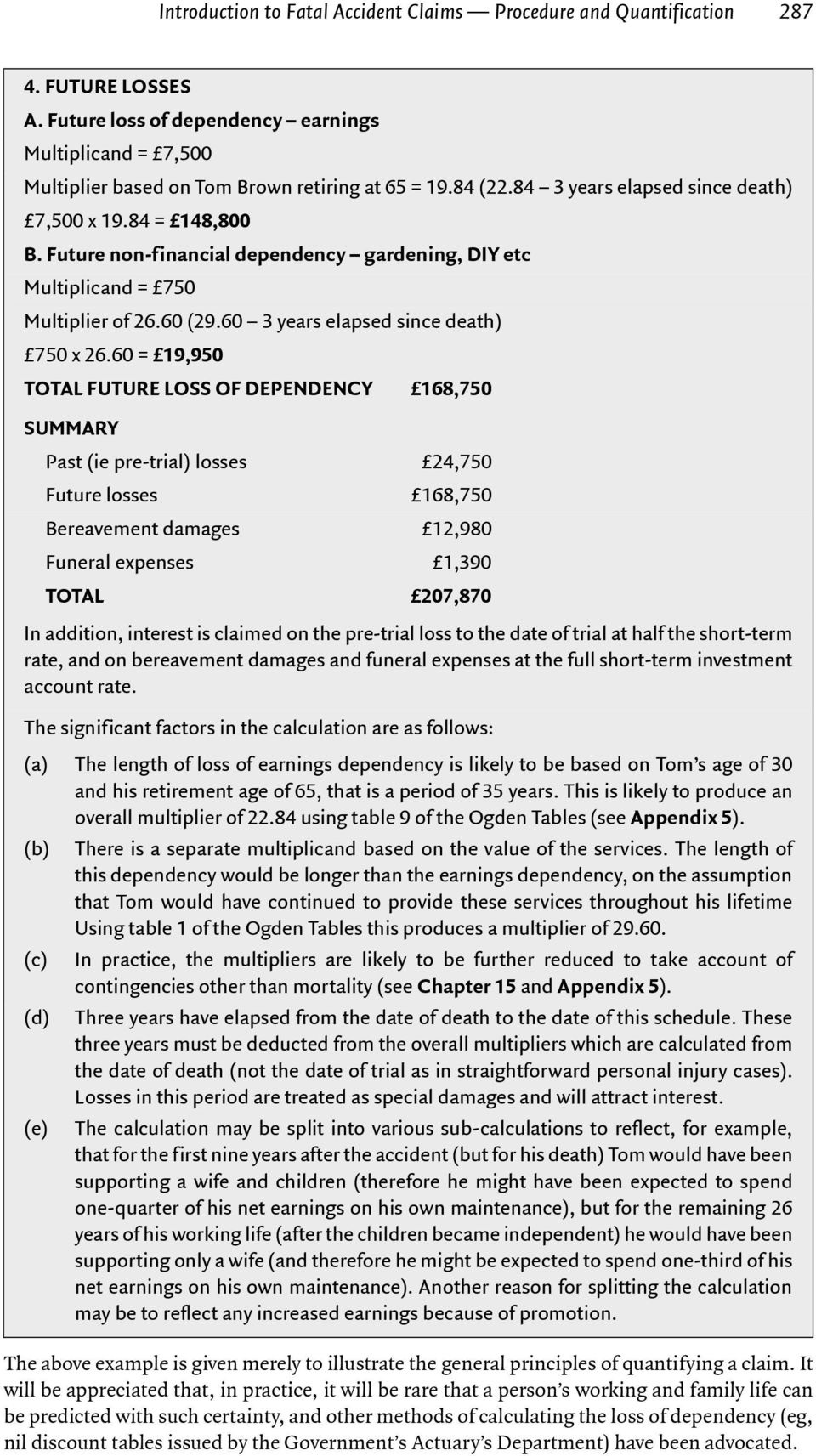
13 Introduction to Fatal Accident Claims Procedure and Quantification FUTURE LOSSES A. Future loss of dependency earnings Multiplicand = 7,500 Multiplier based on Tom Brown retiring at 65 = ( years elapsed since death) 7,500 x = 148,800 B. Future non-financial dependency gardening, DIY etc Multiplicand = 750 Multiplier of ( years elapsed since death) 750 x = 19,950 TOTAL FUTURE LOSS OF DEPENDENCY 168,750 SUMMARY Past (ie pre-trial) losses 24,750 Future losses 168,750 Bereavement damages 12,980 Funeral expenses 1,390 TOTAL 207,870 In addition, interest is claimed on the pre-trial loss to the date of trial at half the short-term rate, and on bereavement damages and funeral expenses at the full short-term investment account rate. The significant factors in the calculation are as follows: The length of loss of earnings dependency is likely to be based on Tom s age of 30 and his retirement age of 65, that is a period of 35 years. This is likely to produce an overall multiplier of using table 9 of the Ogden Tables (see Appendix 5). (c) (d) (e) There is a separate multiplicand based on the value of the services. The length of this dependency would be longer than the earnings dependency, on the assumption that Tom would have continued to provide these services throughout his lifetime Using table 1 of the Ogden Tables this produces a multiplier of In practice, the multipliers are likely to be further reduced to take account of contingencies other than mortality (see Chapter 15 and Appendix 5). Three years have elapsed from the date of death to the date of this schedule. These three years must be deducted from the overall multipliers which are calculated from the date of death (not the date of trial as in straightforward personal injury cases). Losses in this period are treated as special damages and will attract interest. The calculation may be split into various sub-calculations to reflect, for example, that for the first nine years after the accident (but for his death) Tom would have been supporting a wife and children (therefore he might have been expected to spend one-quarter of his net earnings on his own maintenance), but for the remaining 26 years of his working life (after the children became independent) he would have been supporting only a wife (and therefore he might be expected to spend one-third of his net earnings on his own maintenance). Another reason for splitting the calculation may be to reflect any increased earnings because of promotion. The above example is given merely to illustrate the general principles of quantifying a claim. It will be appreciated that, in practice, it will be rare that a person s working and family life can be predicted with such certainty, and other methods of calculating the loss of dependency (eg, nil discount tables issued by the Government s Actuary s Department) have been advocated.
14 288 Personal Injury and Clinical Negligence Litigation It should also be remembered that different multipliers must be applied to items that would not have ceased at the age of 65. Detailed instructions need to be obtained from the client on this point. In practice, therefore, the facts of a particular case are usually such as to defy precise mathematical calculation. The assessment of dependency damages is a difficult matter, and the court has to anticipate what would have occurred in the future. To assist the court, as much evidence as possible should be obtained Apportionment of the dependency Whenever there is more than one dependant under the FAA 1976, the court must apportion the damages between them. Where a claim is made by a surviving spouse and child, the court s approach is often to assess the claim for dependency of the widow alone, and then to apportion a small amount ( pocket money ) to the child. This approach may be justified on the basis that: (c) the surviving spouse will be expected to provide for the child out of her damages; compared to the surviving spouse, the period of dependency of the child will often be short (ending probably between the ages of 16 to 21 depending on whether the child is expected to go on to higher education); and it avoids repeated applications to the court for the release of invested funds for the benefit of the child. However, the court is keen to protect the child s interest, and this approach may not be followed in every case. For example, if the surviving spouse is a known spendthrift and cannot be trusted to provide for the child, the court may assess the claims of the surviving spouse and child separately (see H and Another v S [2002] EWCA Civ 792, [2003] QB 965, concerning the protection of any damages for child dependants). Where the claim involves a minor dependant (or any other protected party), the court s approval of any settlement should be sought, as it will be necessary to satisfy the court that the child s interests are protected Bereavement The claimants The claim for bereavement is open only to a limited class (not just dependants generally: see ). The possible claimants are: (c) the spouse or civil partner of the deceased; or the parents of a legitimate unmarried deceased minor; the mother of an illegitimate unmarried deceased minor. It should be noted that a cohabitee is excluded from the definition, despite the fact that a cohabitee can pursue a dependency claim, as noted above. Furthermore, a child is not entitled to the award of bereavement on the death of his parent; and in a case where both parents can claim, the damages are divided equally between them (FAA 1976, s 1A(4)). However, in Navaei v Navaei, 6 January 1995, the mother was negligent, and this resulted in the death of her daughter. The father claimed all of the bereavement damages and stated that they should not be shared with the mother. He argued that if he were to be paid only half of the damages, the mother/tortfeasor would be benefiting contrary to public policy. The court held that in bringing a claim under the FAA 1976, a claimant is under a duty to act on behalf of all dependants and the father was allowed only half the damages. In the case of Griffiths and Others v British Coal Corporation (QBD, 23 February 1998), it was held that the FAA 1976 did not require an apportionment of damages for bereavement where there were two causes of death (in this case, smoking and exposure to mine dust), and therefore the claimant recovered the full statutory sum.

15 Introduction to Fatal Accident Claims Procedure and Quantification 289 The claim for the bereavement award by parents depends on the deceased being a minor at the date of death, not at the date of the accident (Doleman v Deakin (1990) The Times, 30 January) The amount of the bereavement award The award is a fixed amount of 12,980. Many people have criticised the level of award. In certain cases, especially those with a media interest, defendants have offered a figure higher than the statutory minimum, so as to avoid allegations by the press that they have undervalued a life. Once entitlement is established, defendants are often amenable to paying this part of the claim early by way of an interim payment Funeral expenses Funeral expenses may be claimed if reasonable and paid by a dependant (FAA 1976, s 3(5)). The question of reasonableness will be a decision on the facts of each case. Reference should be made to previous case law in circumstances where the client puts forward an unusual claim, so as to determine whether the court will regard the claim as reasonable or otherwise. If the funeral expenses are paid by the estate then they are claimed as part of a LR(MP)A 1934 claim (see ). Clearly, funeral expenses cannot be claimed under both the LR(MP)A 1934 and the FAA Disregarding benefits Section 4 of the FAA 1976 provides: In assessing damages in respect of a person s death in an action under this Act, benefits which have accrued or will or may accrue to any person from his estate or otherwise as a result of his death shall be disregarded. For example, if a dependant receives insurance money as a result of the deceased s death, the dependant does not have to give credit for that money against the FAA 1976 damages. Similarly, if damages awarded to the estate under a LR(MP)A 1934 claim end up in the hands of a dependant by reason of the deceased s will or rules of intestacy, those damages do not necessarily reduce any FAA 1976 damages which may be awarded to that dependant. See also H and Another v S [2002] EWCA Civ 792, [2003] QB 965, concerning support now being given by a surviving parent who was unlikely to have supported the children if the death had not occurred Recoupment and offsetting of benefits Any payment made in consequence of a claim under the FAA 1976 is not subject to recoupment under the Social Security (Recovery of Benefits) Act 1997 (see Chapter 16) INTEREST Interest on the bereavement damages may be awarded at the full short-term investment rate (Sharman v Sheppard [1989] CLY 1190) from the date of death. Interest on funeral expenses is usually awarded at the full rate from the date that they were paid. The remaining pecuniary losses to the date of the trial are treated as special damages in a fatal injury claim, and therefore are often awarded interest at half the short-term investment rate, although it is arguable that interest can be awarded at the full rate in certain circumstances (see 15.6). Future pecuniary loss attracts no interest PENSION LOSS Investigations should be made as to whether there will be a reduced pension fund available to the deceased s dependants due to the early death, and this should be included within the

16 290 Personal Injury and Clinical Negligence Litigation claim if appropriate (see also ). It is likely that an expert accountant will need to be instructed to assist in the calculation of such losses LOSS OF CONSORTIUM In recent years, there has been a growing trend for separate awards under this head of damages, which is also sometimes referred to as loss of intangible benefits. It originated in a parent and child context in Regan v Williamson [1976] 1 WLR 305, where the sum awarded to the children for loss of services of a mother was increased to reflect the loss of the personal attention and affection which the mother provided and which could not be replaced by a housekeeper or nanny. In Mehmet v Perry [1977] 2 All ER 529, separate awards under this head were made to the children and also to the husband. In Beesley v New Century Group Ltd [2008] EWHC 3033 (QB), the principle was extended to loss of a husband, on the basis that Mrs Beesley had lost not only the domestic services that her husband had provided but also the extra value that was derived from having such help provided by a husband and friend rather than an outside contractor. The sums awarded tend to be fairly modest (between 2,000 and 4,000, depending on the circumstances), on the basis that there is some overlap between this head and bereavement damages (see ) and, in the more recent case of Brown v Hamid [2013] EWHC 4067 (QB), the judge declined to make a separate award for loss of consortium where the deceased had a limited life expectancy. Nevertheless, the principle of making awards for loss of intangible benefits is now well established, and consideration should always be given to including such a claim in a fatal case CONDUCT To avoid conflicts of interest arising, it is good practice to ensure that none of the dependants who could be to blame in whole or part for the accident that resulted in the death are appointed as personal representatives. The conduct of a fatal accident claim clearly requires sympathy and diplomacy on the part of the solicitor. There are frequently conflicts of personality between the dependants and personal representatives, and this is compounded by the fact that only one claim can be brought in respect of the fatal accident. If, after the fatal accident, it comes to light that the deceased had more than one dependent family, it can be anticipated that any interviews with the deceased s wife may be difficult! CONCLUSION Acting on behalf of the relatives in a fatal accident claim requires the personal injury/clinical negligence solicitor to have tact, sympathy and a detailed understanding of the law involved. It should be appreciated that each case will be dealt with on its own facts, and only broad principles have been established by the case law in this area. In fatal accident cases the court is required to anticipate what would have occurred in the future, which will be different in every case. An overview of damages which may be claimed in fatal cases is set out at below FURTHER READING Kemp and Kemp, The Quantum of Damages (Sweet & Maxwell)

17 Introduction to Fatal Accident Claims Procedure and Quantification OVERVIEW OF DAMAGES IN FATAL CLAIMS If there was a period of survival Pain, Suffering and Loss of Amenity Was deceased conscious? Loss of Income Up to date of death Services/Care provided Up to date of death Damages to personal items Eg car, clothing, jewellery Funeral expenses If not claimed under FAA Bereavement 12,980 Spouse/parent? Dependency Who are the dependants? Nature of dependency, eg wages/ diy/childcare? Multiplicand Husband and wife Husband, wife and children ¾ Multiplier Assess at date of death Split between pre- and post-trial Funeral expenses If not claimed under LR(MP)A Loss of consortium/intangible benefits Loss of wife/mother/husband/father No set figure ( 2,000 4,000 approx)

18 292 Personal Injury and Clinical Negligence Litigation

Fatal Accidents. At common law there is no right of action for a person who has suffered a loss arising out of the death of a relative.
 Fatal Accidents At common law there is no right of action for a person who has suffered a loss arising out of the death of a relative. Statute has intervened to change this: The Law Reform (Miscellaneous
SCHEDULES OF LOSS IN FATAL ACCIDENT CASES. THE ESTATE S CLAIM UNDER THE LAW REFORM MISCELLANEOUS PROVISIONS ACT 1934 ( the LRMPA )
 SCHEDULES OF LOSS IN FATAL ACCIDENT CASES INTRODUCTION 1. The entitlement to bring a claim following a person s death derives from statute. The quantification of loss therefore depends largely upon those
DEFENDING THE DEPENDENCY CLAIM: CASES AND STATUTORY MATERIALS
 DEFENDING THE DEPENDENCY CLAIM: CASES AND STATUTORY MATERIALS Anthony Reddiford, Guildhall Chambers Civil Law Reform Bill 2009 1 1 Extension of right of action (1) Section 1 of the Fatal Accidents Act
CHAPTER 160 FATAL ACCIDENTS AND PERSONAL INJURIES LAWS OF BRUNEI ARRANGEMENT OF SECTIONS. Section PART I PRELIMINARY
 Fatal Accidents and Personal Injuries CAP. 160 1 LAWS OF BRUNEI Section CHAPTER 160 FATAL ACCIDENTS AND PERSONAL INJURIES ARRANGEMENT OF SECTIONS PART I PRELIMINARY 1. Citation 2. Application PART II FATAL
Negligence and Damages Bill
 EXPLANATORY NOTES Explanatory notes to the Bill, prepared by Andy McDonald, are published separately as Bill 76 EN. Bill 76 6/1 CONTENTS PART 1 PYSCHIATRIC INJURY 1 Close tie (duty of care) 2 Close tie
Seminar: Fatal Claims
 Seminar: Fatal Claims By James Hawkins 24 th October 2012 Page 1 of 1 SPEAKER PROFILE James Hawkins Year of call: 2003 Main Practice Areas Personal Injury, Commercial and Business Law, Employment Profile
Damages comprise of two main elements; solatium and patrimonial loss (special damages).
 A note on damages in Personal Injury Cases Contents AnoteonDamagesinPersonalInjuryCases.1 Solatium 1 Whatisneededforaclaimofsolatium? 1 PatrimonialLoss(specialdamages)..1 Pastwageloss..2 Futurewageloss.2
BERMUDA 1949 : 68 FATAL INJURIES (ACTIONS FOR DAMAGES) ACT 1949
 BERMUDA 1949 : 68 FATAL INJURIES (ACTIONS FOR DAMAGES) ACT 1949 ARRANGEMENT OF SECTIONS 1 Interpretation and construction 2 Right of action for wrongful act causing death 2A Bereavement 2B Persons entitled
Reform to Lost Years Damages in Mesothelioma Claims
 Reform to Lost Years Damages in Mesothelioma Claims September 2008 Neil Fisher and Kevin Johnson John Pickering and Partners LLP Email: [email protected] 19 Castle Street Liverpool L2 4SX Tel: 0151
FATAL ACCIDENTS CHAPTER 71 FATAL ACCIDENTS ARRANGEMENT OF SECTIONS
 [CH.71 1 CHAPTER 71 ARRANGEMENT OF SECTIONS SECTION 1. Short title. 2. Interpretation. 3. Action maintainable notwithstanding death of person injured. 4. Persons for whose benefit action may be brought.
Fatal Accidents Act claims the oddities all too likely to arise
 Fatal Accidents Act claims the oddities all too likely to arise ROGER COOPER STEPHEN FRIDAY PARKLANE PLOWDEN LEEDS NEWCASTLE A quirk of history At common law though claims for injury have a long history,
GETTING TO KNOW THE OGDEN TABLES
 GETTING TO KNOW THE OGDEN TABLES WHAT ARE THEY? The formal title of the tables is: Actuarial Tables with Explanatory Notes for Use in Personal Injury and Fatal Accident Cases They are admissible in evidence
CHAPTER 310 THE LAW REFORM (FATAL ACCIDENTS AND MISCELLANEOUS PROVISIONS) ACT [PRINCIPAL LEGISLATION] ARRANGEMENT OF SECTIONS
![CHAPTER 310 THE LAW REFORM (FATAL ACCIDENTS AND MISCELLANEOUS PROVISIONS) ACT [PRINCIPAL LEGISLATION] ARRANGEMENT OF SECTIONS](/thumbs/22/1610640.jpg "CHAPTER 310 THE LAW REFORM (FATAL ACCIDENTS AND MISCELLANEOUS PROVISIONS) ACT [PRINCIPAL LEGISLATION] ARRANGEMENT OF SECTIONS") CHAPTER 310 THE LAW REFORM (FATAL ACCIDENTS AND MISCELLANEOUS PROVISIONS) ACT [PRINCIPAL LEGISLATION] ARRANGEMENT OF SECTIONS Section Title 1. Short title and application. 2. Interpretation. PART I PRELIMINARY
CHAPTER 310 THE LAW REFORM (FATAL ACCIDENTS AND MISCELLANEOUS PROVISIONS) ACT [PRINCIPAL LEGISLATION] ARRANGEMENT OF SECTIONS Section Title 1. Short title and application. 2. Interpretation. PART I PRELIMINARY
Munkman on Damages for Personal Injuries and Death
 Munkman on Damages for Personal Injuries and Death Twelfth edition Gordon BA (Warwick) of Lincoln's Inn, Barrister Foreword to the twelfth edition by Julian Goose QC Preface to the twelfth edition Preface
CHAPTER 193A ACCIDENT COMPENSATION (REFORM) 1980-60
 CHAPTER 193A ACCIDENT COMPENSATION (REFORM) 1980-60 This Act came into operation on 22nd January, 1981 by Proclamation (S.I. 1981 No. 9). Amended by: This Act has not been amended Law Revision Orders The
CRIMINAL INJURIES COMPENSATION SCHEME: REVISED SCHEME AS ADOPTED BY THE STATES OF JERSEY 14th APRIL 2015
 CRIMINAL INJURIES COMPENSATION SCHEME: REVISED SCHEME AS ADOPTED BY THE STATES OF JERSEY 14th APRIL 2015 Published by the STATES GREFFE for the HOME AFFAIRS DEPARTMENT Page - 2 CRIMINAL INJURIES COMPENSATION
PLEASE NOTE. For more information concerning the history of this Act, please see the Table of Public Acts.
 PLEASE NOTE This document, prepared by the Legislative Counsel Office, is an office consolidation of this Act, current to December 19, 2009. It is intended for information and reference purposes only.
Clinical Negligence: A guide to making a claim
 : A guide to making a claim 2 Our guide to making a clinical negligence claim At Kingsley Napley, our guiding principle is to provide you with a dedicated client service and we aim to make the claims process
FATALITY CLAIMS CALCULATION OF DAMAGES. Galan T. Lund
 FATALITY CLAIMS CALCULATION OF DAMAGES Galan T. Lund 1 P a g e FATALITY CLAIMS CALCULATION OF DAMAGES The quantification of fatality claims involves the following types of awards: 1. Damages for bereavement,
FATAL ACCIDENT CLAIMS
 FATAL ACCIDENT CLAIMS CHRISTOPHER PURCHAS QC Christopher was called to the Bar in 1966 and took silk in 1990. He sits as a Deputy High Court Judge and is a qualified mediator. He has a wide experience
Wrongful Death and Survival Actions In Maryland & the District of Columbia
 Open Your Eyes Wrongful Death and Survival Actions In Maryland & the District of Columbia A Wrongful Death Action What is a wrongful death lawsuit? In the context of a medical malpractice lawsuit, wrongful
PERSONAL INJURY CLAIMS
 PERSONAL INJURY CLAIMS Frequently Asked Questions 1. Can I make a claim? If you have been injured because of the fault of someone else, you can claim financial compensation through the courts. The dependants
Table of Contents. Selected Iowa Wrongful Death Laws and Rules
 Table of Contents 1. What is a wrongful death claim?... 2 2. Who may recover compensation for a wrongful death?... 3 3. How is a wrongful death claim commenced?... 4 4. What types of losses are compensated
COMPENSATION FOR INJURIES ACT
 COMPENSATION FOR INJURIES ACT CHAPTER 8:05 Act 26 of 1896 Amended by 6 of 1976 50 of 1976 17 of 1981 *22 of 1981 36 of 1997 *See Note on Amendment at page 2 Current Authorised Pages Pages Authorised (inclusive)
Letters of administration (usually when there is no valid will).
 The Probate Service What is probate? When a person dies somebody has to deal with their estate (money property and possessions left) by collecting in all the money, paying any debts and distributing what
CLAIMS FOR DAMAGES FOLLOWING FATAL ACCIDENTS IN GREECE --------------------------------------------
 CLAIMS FOR DAMAGES FOLLOWING FATAL ACCIDENTS IN GREECE -------------------------------------------- Ioannis M. Pavlakis Pavlakis Moschos & Associates Law Offices Piraeus - Greece 1 GENERAL PRINCIPLES [1]
DRAFT MOTOR TRAFFIC (THIRD- PARTY INSURANCE) (COST RECOVERY) (JERSEY) REGULATIONS
 STATES OF JERSEY r DRAFT MOTOR TRAFFIC (THIRD- PARTY INSURANCE) (COST RECOVERY) (JERSEY) REGULATIONS 201- Lodged au Greffe on 13th December 2012 by the Minister for Health and Social Services STATES GREFFE
1.2 Analyse matters to be considered by the judge when awarding damages for pain, suffering and loss of amenity
 Title Damages, Settlement and Costs in Personal Injury Cases Level 4 Credit value 8 Learning outcomes The learner will: Assessment criteria The learner can: Knowledge, understanding and skills 1 Understand
Beattie v Secretary of State for Social Security,
 CASE ANALYSIS Income Support Capital to be treated as income - Structured settlement of damages for personal injury - Whether periodical payments that arise from the annuity are to be treated as income
IN THE HIGH COURT OF JUSTICE
 ST VINCENT AND THE GRENADINES IN THE HIGH COURT OF JUSTICE CIVIL SUIT NO.138 OF 1994 BETWEEN: ALFRED JACKSON As Administrator of the Estate of ENNIS JACKSON Plaintiff and Appearances: Mr Arthur Williams
Isle of Man Criminal Injuries Compensation Scheme 1983. (Incorporating amendments up to 1 st November 1996)
 Isle of Man Criminal Injuries Compensation Scheme 1983 (Incorporating amendments up to 1 st November 1996) (Approved by Resolution of Tynwald 16 th November 1983) (As amended by Resolution of Tynwald 16
How To Decide If A Dependency Claim Can Be Made Under The Fatal Accident Act
 Fatal accidents and fatal errors Gordon Exall Gordon Exall looks at the lessons that practitioners undertaking fatal accident cases can learn from the recent professional negligence case of Amin v- Imran
PROOF OF CAUSATION A new approach in cancer cases
 PROOF OF CAUSATION A new approach in cancer cases Andrew Axon Barrister Parklane Plowden Chambers Life is unpredictable 1 Gregg v Scott Non-Hogkin s lymphoma 9 months delay Injury = premature death due
STATUTORY INSTRUMENTS. S.I. No. 582 of 2014 RULES FOR PRE-EXISTING PUBLIC SERVICE PENSION SCHEME MEMBERS REGULATIONS 2014
 STATUTORY INSTRUMENTS. S.I. No. 582 of 2014 RULES FOR PRE-EXISTING PUBLIC SERVICE PENSION SCHEME MEMBERS REGULATIONS 2014 2 [582] S.I. No. 582 of 2014 RULES FOR PRE-EXISTING PUBLIC SERVICE PENSION SCHEME
Conditional Fee Agreement: What You Need to Know
 Conditional Fee Agreement: What You Need to Know This document forms an important part of your agreement with us. Please read it carefully. Definitions of words used in this document and the accompanying
FATAL ACCIDENTS ACT CHAPTER 32 CAP. 32. Fatal Accidents LAWS OF KENYA
 CAP. 32 LAWS OF KENYA FATAL ACCIDENTS ACT CHAPTER 32 Revised Edition 2012 [2003] Published by the National Council for Law Reporting with the Authority of the Attorney-General www.kenyalaw.org [Rev. 2012]
The Law on Damages Consultation Paper
 Consultation Paper CP 9/07 04/05/2007 This consultation will end on 27/07/2007 A consultation produced by the Department for Constitutional Affairs. This information is also available on the DCA website
IN THE COMMONWEALTH COURT OF PENNSYLVANIA
 IN THE COMMONWEALTH COURT OF PENNSYLVANIA Jay Ebersole, Administrator of the : Estate of Stephanie Jo Ebersole, : Deceased : : v. : No. 1732 C.D. 2014 : Argued: February 9, 2015 Southeastern Pennsylvania
(A) CLAIMS FOR WRONGFUL DEATH
 THE LAW ON DAMAGES (A) CLAIMS FOR WRONGFUL DEATH (B) BEREAVEMENT DAMAGES (C) DAMAGES FOR GRATUITOUS CARE Published on 23 April 2012 This consultation will end on 18 July 2012 This consultation exercise
Clinical negligence. Grounds
 Clinical negligence Clinical negligence occurs when the care or treatment the Claimant received from a health service provider was below the standard that is expected. This test was established in the
Motor Accidents Compensation Amendment (Claims and Dispute Resolution) Act 2007 No 95
 New South Wales Motor Accidents Compensation Amendment (Claims and Dispute Contents Page 1 Name of Act 2 2 Commencement 2 3 Amendment of Motor Accidents Compensation Act 1999 No 41 2 4 Amendment of other
Conditional Fee Agreement: What You Need to Know
 Conditional Fee Agreement: What You Need to Know This document forms an important part of your agreement with us. Please read it carefully. Definitions of words used in this document and the accompanying
Dependant Support Claim Against an Estate. 1. Review the legislation and case law and identify relevant information and documentation
 Dependant Support Claim Against an Estate 1. Review the legislation and case law and identify relevant information and documentation Review Part V of the Succession Law Reform Act (the "SLRA"), titled
scrutiny: Essential Guide to CRU Benefits and Appeals
 scrutiny: Essential Guide to CRU Benefits and Appeals Introduction In writing this guide, we had in mind a broad spectrum of readers from the novice (for whom some of this may be new) through to the more
For what pensionable salary is, you need to read the scheme. It is often gross basic salary (i.e. gross, but not counting overtime etc).
 THE BASICS Understanding pension Schemes 1. There are two basic types:- (1.1) Final Salary Schemes (also known as defined benefit schemes). The deal here is that you get back a proportion of your final
FLORIDA WRONGFUL DEATH ACT
 FLORIDA WRONGFUL DEATH ACT (STATUTES) Disclaimer: This is part of the 2012 version of Florida Statutes and it is offered for general information purposes. The statutes on this site should not be relied
CHAPTER 99: 05 ACCIDENTAL DEATHS AND PERSONAL INJURIES (DAMAGES) ACT ARRANGEMENT OF SECTIONS PART I
 LAWS OF GUYANA 3 CHAPTER 99: 05 ACCIDENTAL DEATHS AND PERSONAL INJURIES (DAMAGES) ACT ARRANGEMENT OF SECTIONS SECTION 1. Short title. 2. Interpretation. PART I 3. Cause of action when death is caused by
Your Guide to Pursuing a Personal Injury Claim
 Your Guide to Pursuing a Personal Injury Claim 2 Contents Introduction... 3 Important things that you must do... 3 In The Beginning... 4 Mitigating your loss... 4 Time limits... 4 Who can claim?... 4 Whose
Work Injury: Benefits, 2010
 Austria Belgium Temporary disability The insured receives the cash sickness benefit until a decision on permanent disability is made. The employer pays 100% of earnings for up to 12 weeks (plus additional
Compensation to Relatives NSW Law Reform Commission Consultation Paper 14
 Compensation to Relatives NSW Law Reform Commission Consultation Paper 14 Submission by Insurance Council of Australia Insurance Council of Australia Limited 14 June 2011 ABN: 50 005 617 318 Level 4, 56
SCHEDULES OF SPECIAL DAMAGE AND FUTURE LOSS IN PERSONAL INJURY CASES
 SCHEDULES OF SPECIAL DAMAGE AND FUTURE LOSS IN PERSONAL INJURY CASES A. Introduction 1. The importance of Schedules of Special Damage and Future Loss cannot be overestimated. 2. They provide the framework
Compensation Agency Royston House 34 Upper Queen Street Belfast BT1 6FD
 Following the positive cross community vote in the Assembly on 9 March 2010, responsibility for policing and justice transferred from the Northern Ireland Office to the Department of Justice for Northern
Civil Law: Compensating the Victims of Road Death or Injury
 InformatIon Handbook 2 Civil Law: Compensating the Victims of Road Death or Injury Produced in partnership with www.emsleys.co.uk Civil Law: Compensating the Victims of Road Death or Injury CONTENTS: Introduction..............................................................3
Judicial Mistake in DIY Divorce Settlement Rapidly Corrected
 Judicial Mistake in DIY Divorce Settlement Rapidly Corrected Mesothelioma Settlements Not Available Capital Over-Simplistic Approach Produces Challenge Pre-Nup Partially Set Aside as Judge Highlights Uncertainty
Civil Liability and Other Legislation Amendment Bill 2009
 Civil Liability and Other Legislation Amendment Bill 2009 Explanatory Notes Objectives of the Bill The objective of the Civil Liability and Other Legislation Amendment Bill 2009 is to improve the civil
Clinical Negligence. Investigating Your Claim
 www.lees.co.uk Clinical Negligence Investigating Your Claim Lees Solicitors LLP 44/45 Hamilton Square Birkenhead Wirral CH41 5AR Tel: 0151 647 9381 Fax: 0151 649 0124 e-mail: [email protected] 1 The
STATES OF JERSEY CRIMINAL INJURIES COMPENSATION SCHEME: REVISED SCHEME STATES GREFFE
 STATES OF JERSEY CRIMINAL INJURIES COMPENSATION SCHEME: REVISED SCHEME Lodged au Greffe on 5th February 2015 by the Minister for Home Affairs STATES GREFFE 2015 Price code: B P.13 PROPOSITION THE STATES
Mesothelioma Act 2014 and the Diffuse Mesothelioma Payment Scheme
 www.fieldfisher.com/personalinjury Freephone 0800 358 3848 Mesothelioma Act 2014 and the Diffuse Mesothelioma Payment Scheme A guide for clients Head and shoulders above the rest in terms of skills, experience
Claims for Dependency, for the Estate of the Deceased and for those terminally injured or ill
 Claims for Dependency, for the Estate of the Deceased and for those terminally injured or ill Introduction 1. Actions for damages in respect of the consequences of the death following a tort may be brought
Asbestos Disease Claims
 Asbestos Disease Claims A client s guide Spring 2007 Contents 2. Essential elements for a successful claim 3. What we will do 3. Funding the case 3. Preliminary investigations 4. What happens next? 4.
} 1 January 1981 L.N. 321 of 1980]
![} 1 January 1981 L.N. 321 of 1980]](/thumbs/24/2804004.jpg "} 1 January 1981 L.N. 321 of 1980]") Chapter: 360 PNEUMOCONIOSIS AND MESOTHELIOMA (COMPENSATION) ORDINANCE Gazette Number Version Date Long title 6 of 2008 18/04/2008 To establish a scheme for compensating persons or their family members
Chapter: 360 PNEUMOCONIOSIS AND MESOTHELIOMA (COMPENSATION) ORDINANCE Gazette Number Version Date Long title 6 of 2008 18/04/2008 To establish a scheme for compensating persons or their family members
MAKING A PERSONAL INJURIES CLAIM*
 MAKING A PERSONAL INJURIES CLAIM* GETTING STARTED DO I HAVE A CASE? The first step is to contact one of our experienced personal injuries solicitors and arrange a no obligation consultation. At the initial
Conditional Fee Agreement ( CFA ) [For use in personal injury and clinical negligence cases only].
![Conditional Fee Agreement ( CFA ) [For use in personal injury and clinical negligence cases only].](/thumbs/24/3969431.jpg "Conditional Fee Agreement ( CFA ) [For use in personal injury and clinical negligence cases only].") Disclaimer This model agreement is not a precedent for use with all clients and it will need to be adapted/modified depending on the individual clients circumstances and solicitors business models. In
Disclaimer This model agreement is not a precedent for use with all clients and it will need to be adapted/modified depending on the individual clients circumstances and solicitors business models. In
The Fatal Accidents Act
 The Fatal Accidents Act being Chapter F-11 of The Revised Statutes of Saskatchewan, 1978 (effective February 26, 1979). NOTE: This consolidation is not official. Amendments have been incorporated for convenience
C.M. Haughey Solicitors Compensation Guide
 C.M. Haughey Solicitors Compensation Guide www.cmhaugheysolicitors.ie Athena Goddess of Wisdom, Strength and Strategy. When your experience needs our experience About Us C. M. Haughey Solicitors, located
Civil Law Compensating the Victims of Road Death & Injury.
 INFORMATION HANDBOOK No 2 Civil Law Compensating the Victims of Road Death & Injury. CADD contact numbers: Help Line: 0845 1235542 (local rate) Office Phone & Fax: 0845 1235541 / 43 Address: CADD, PO Box
BERMUDA CRIMINAL INJURIES (COMPENSATION) ACT 1973 1973 : 107
 QUO FA T A F U E R N T BERMUDA CRIMINAL INJURIES (COMPENSATION) ACT 1973 1973 : 107 TABLE OF CONTENTS 1 2 3 4 5 6 6A 7 8 9 10 11 12 13 14 15 16 17 18 19 20 21 Interpretation Criminal Injuries Compensation
1.2 Analyse matters to be considered by the judge when awarding damages for pain, suffering and loss of amenity
 Title Damages, Settlement and Costs in Personal Injury Cases Level 4 Credit value 8 Learning outcomes The learner will: Assessment criteria The learner can: Knowledge, understanding and skills 1 Understand
Compensation Claims. Contents
 Compensation Claims Contents Employers' duties What kind of claims may be made? The tort of negligence Tort of breach of statutory duty Civil liability exclusions Conditions to be met for breach of statutory
Concerning the Cap on Pain and Suffering Awards for Minor Injuries
 Discussion Paper Concerning the Cap on Pain and Suffering Awards for Minor Injuries Office of the Superintendent of Insurance January, 2010 Introduction The Province of Nova Scotia regulates automobile
Proposed Amendments to the Fatal Accidents Act Discussion Paper. Prepared by the Department of Justice
 Proposed Amendments to the Fatal Accidents Act Discussion Paper Prepared by the Department of Justice Contents About the proposed Amendments to the Fatal Accident Act... 3 Background and Purpose... 4 Proposed
Legal Watch: Personal Injury
 Legal Watch: Personal Injury 2nd July 2014 Issue: 025 Part 36 As can be seen from the case of Supergroup Plc v Justenough Software Corp Inc [Lawtel 30/06/2014] Part 36 is still the subject of varying interpretations.
GUIDE TO PERSONAL INJURY/ACCIDENT CLAIMS
 GUIDE TO PERSONAL INJURY/ACCIDENT CLAIMS At Richard Grogan & Associates we have Solicitors with significant experience and expertise who will advise and guide you through all matters relating to bringing
Legal Watch: Personal Injury
 Legal Watch: Personal Injury 8th August 2014 Issue: 030 Liability/RTA In this publication s predecessor, Greenwoods PI Alert 370, we reported the first instance decision in Landau v Big Bus Co Ltd and
MAKING MULTIPLIERS WORK FOR YOUR CLIENT WORKSHOP ANSWERS
 Guildhall Chambers Personal Injuries Claimant Seminar 11 th November 2010 MAKING MULTIPLIERS WORK FOR YOUR CLIENT WORKSHOP ANSWERS Adam Chippindall, Gabriel Farmer and Sophie Holme, Guildhall Chambers
906 Olive Street, Suite 420 St. Louis, MO 63101 314.241.2481 www.askarcher.com 1
 A Word on MO Comp Subrogation First the Statute: By: Christopher T Archer, 2012 287.150. Subrogation 1. Where a third person is liable to the employee or to the dependents, for the injury or death, the
Health & Safety The Compensation Fund 2013
 The Compensation Fund provides compensation for workers who get hurt at work, or sick from diseases contracted at work, or for death as a result of these injuries or diseases. The Compensation Fund is
EWART PRICE SOLICITORS ROAD TRAFFIC ACCIDENTS - NOTES FOR CLAIMING FOR PERSONAL INJURY AND OTHER UNINSURED LOSSES
 E P EWART PRICE SOLICITORS ROAD TRAFFIC ACCIDENTS - NOTES FOR CLAIMING FOR PERSONAL INJURY AND OTHER UNINSURED LOSSES If you have been involved in a Road Traffic Accident as a driver or passenger we hope
Road Accident Fund Act 56 of 1996 (RAFA)
 Road Accident Fund Act 56 of 1996 (RAFA) Topic: Roads and Public Liability IN A CALABASH Introduction Road transportation is the major mode of transportation in South Africa. Despite a number of road laws
PERSONAL INJURY CLAIMS
 PERSONAL INJURY CLAIMS Frequently Asked Questions 1. Can I make a claim? If you have been injured because of the fault of someone else, you can claim financial compensation through the courts. 2. Who can
chemical poisoning. We work in a practical,
 Our specialist team has a wealth of experience in dealing with claims arising from asbestos and chemical poisoning. We work in a practical, supportive & clear way, dedicated to gaining the best possible
A CLIENT GUIDE TO CLAIMING DAMAGES FOR CLINICAL NEGLIGENCE
 A CLIENT GUIDE TO CLAIMING DAMAGES FOR CLINICAL NEGLIGENCE 1. INTRODUCTION Making a claim for damages (compensation) for clinical negligence can be a worrying and stressful experience. We recognise that
A brief guide to the pension provisions of the Family Law Acts
 A brief guide to the pension provisions of the Family Law Acts www.pensionsauthority.ie The Pensions Authority Verschoyle House 28/30 Lower Mount Street Dublin 2 Tel: (01) 613 1900 Locall: 1890 65 65 65
Have you or someone you know suffered a personal injury? TIPS TO MAXIMIZE COMPENSATION
 Have you or someone you know suffered a personal injury? TIPS TO MAXIMIZE COMPENSATION If you have suffered a personal injury it is important to consider all potential sources of compensation. A personal
Information. Considering a clinical negligence claim. What gives rise to a clinical negligence claim? What about the issue of causation?
 Information You are asking advice from Thomson Snell & Passmore about a possible clinical negligence claim. Such claims are complex and it would greatly assist your understanding of the issues if you read
NEGLIGENT SETTLEMENT ADVICE. Daniel Crowley and Leona Powell consider the Court s approach to negligent settlement advice.
 NEGLIGENT SETTLEMENT ADVICE Daniel Crowley and Leona Powell consider the Court s approach to negligent settlement advice. The standard of care owed by a solicitor to his client has been established for
ATTORNEY GENERAL'S DEPARTMENT OF NSW & THE DEPARTMENT OF PREMIER AND CABINET
 NSW GOVERNMENT REVIEW OF THE DUST DISEASES CLAIMS RESOLUTION PROCESS ISSUES PAPER DECEMBER 2008 ATTORNEY GENERAL'S DEPARTMENT OF NSW & THE DEPARTMENT OF PREMIER AND CABINET Issues Paper: Review of the
"Lost Years" as a Wrongful Death Claim By Geoffrey Young 1
 As published in The Advocate, Vol. 53 Part 5 September 1995 "Lost Years" as a Wrongful Death Claim By Geoffrey Young 1 In a recent article in this journal 2 Messrs. Branch and Price point out that a "lost
Civil Service Injury Benefits Scheme
 Civil Service Injury Benefits Scheme Civil Service Injury Benefits Scheme The Civil Service Injury Benefits Scheme was made on 22 July 2002 under section 1 of the Superannuation Act 1972 and came into
Williams v. University of Birmingham [2011] EWCA Civ 1242 Court of Appeal, 28 October 2011
![Williams v. University of Birmingham [2011] EWCA Civ 1242 Court of Appeal, 28 October 2011](/thumbs/25/6459370.jpg "Williams v. University of Birmingham [2011] EWCA Civ 1242 Court of Appeal, 28 October 2011") Williams v. University of Birmingham [2011] EWCA Civ 1242 Court of Appeal, 28 October 2011 Summary In a mesothelioma claim, the defendant was not in breach of duty in relation to exposure to asbestos for
Williams v. University of Birmingham [2011] EWCA Civ 1242 Court of Appeal, 28 October 2011 Summary In a mesothelioma claim, the defendant was not in breach of duty in relation to exposure to asbestos for
LIMITATION UPDATE. 1. Recently, the Courts have been looking at three areas of limitation law and
 LIMITATION UPDATE 1. Recently, the Courts have been looking at three areas of limitation law and practice. One is when it is permissible to introduce a new claim in pending proceedings after the limitation