
THE MCCLATCHY COMPANY COMPREHENSIVE WELFARE BENEFIT AND CAFETERIA PLAN SUMMARY PLAN DESCRIPTION. (Amended and Restated Effective January 1, 2012)
|
|
|
- Priscilla Stokes
- 9 years ago
- Views:
Transcription
1 THE MCCLATCHY COMPANY COMPREHENSIVE WELFARE BENEFIT AND CAFETERIA PLAN SUMMARY PLAN DESCRIPTION (Amended and Restated Effective January 1, 2012)

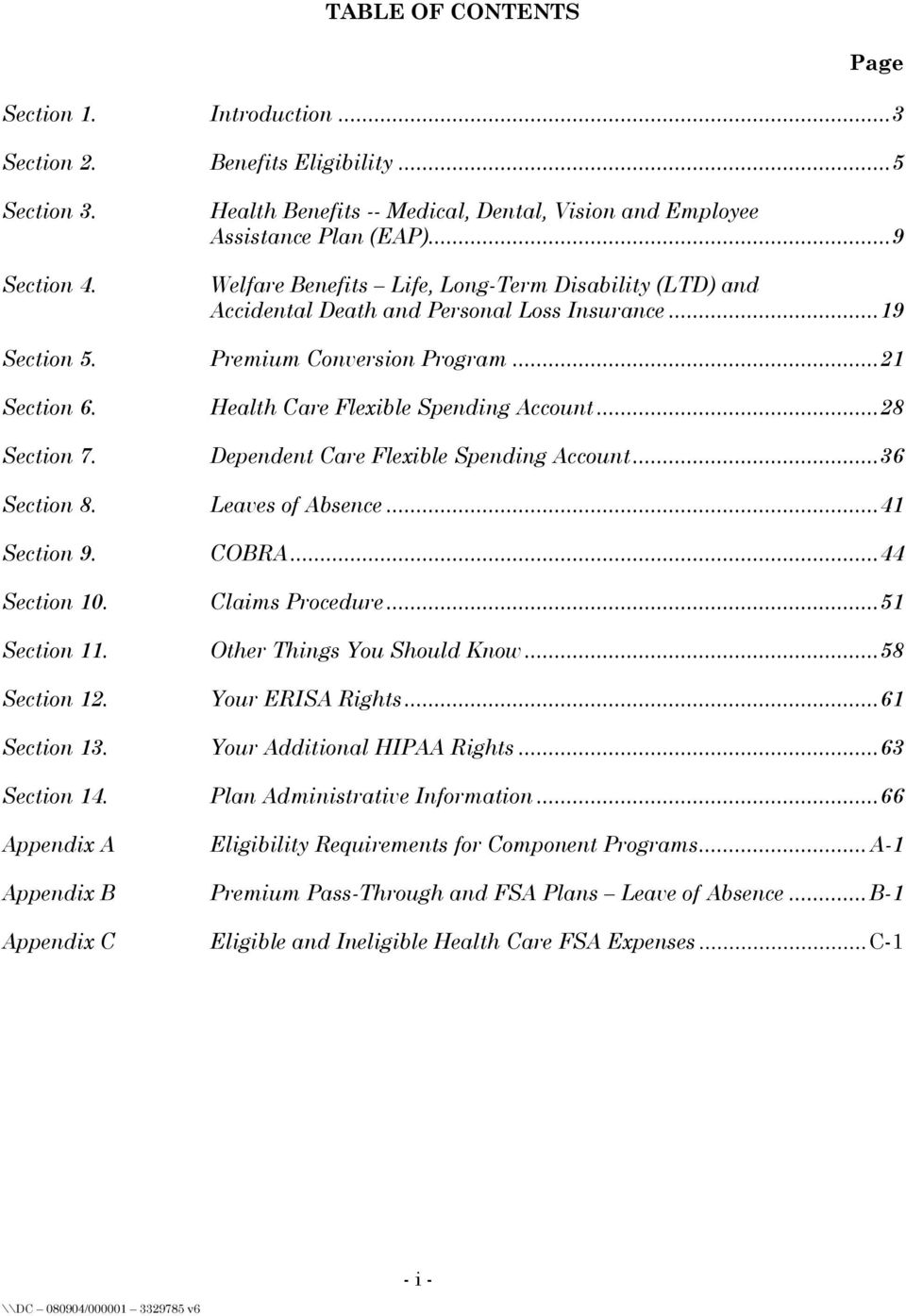
2 TABLE OF CONTENTS Page Section 1. Introduction... 3 Section 2. Benefits Eligibility... 5 Section 3. Section 4. Health Benefits -- Medical, Dental, Vision and Employee Assistance Plan (EAP)... 9 Welfare Benefits Life, Long-Term Disability (LTD) and Accidental Death and Personal Loss Insurance Section 5. Premium Conversion Program Section 6. Health Care Flexible Spending Account Section 7. Dependent Care Flexible Spending Account Section 8. Leaves of Absence Section 9. COBRA Section 10. Claims Procedure Section 11. Other Things You Should Know Section 12. Your ERISA Rights Section 13. Your Additional HIPAA Rights Section 14. Plan Administrative Information Appendix A Eligibility Requirements for Component Programs... A-1 Appendix B Premium Pass-Through and FSA Plans Leave of Absence... B-1 Appendix C Eligible and Ineligible Health Care FSA Expenses... C-1 - i -
3 Section 1. Introduction The McClatchy Company ( Company ) is pleased to offer The McClatchy Company Comprehensive Welfare Benefit and Cafeteria Plan (the Plan ). This is an umbrella plan that covers all health, life, accident, and long-term disability plans for the employees who are part of The McClatchy Company controlled group. The Plan also covers the cafeteria and flexible spending account (FSA) plans, including the Premium Conversion Plan, the Dependent Care FSA and the Health Care FSA. A listing of participating employers, covered health and welfare plans and eligibility requirements is available in Appendix A. Certain participating employers also may offer a short-term disability program. However, those programs are not components under this Plan, but instead separate policies maintained by the employer. This booklet explains how the Plan works. The McClatchy Company s HealthWorks website found at available on both the intranet and internet, has detailed information on each of the benefit options available to you under the Plan. You can also use this booklet as a guide to help you decide what benefit options to elect and to answer questions you may have about the different benefits available under the Plan. In addition to giving you general information on each benefit available under the Plan, this booklet contains information about what happens to your benefits in the event of life changes (like marriage, divorce, the birth of a child, etc.) and information regarding your rights. 1.1 What is the scope of this booklet? Because of laws, government regulations, and the wide variety of possible exceptions to the situations described in this booklet, the information contained here is a summary of the most important provisions and most common situations associated with your benefits. While this booklet highlights the main features of the benefits available under the Plan, it is not a comprehensive description. The official Plan document will govern in case of any omission or conflict between this booklet and the Plan. You may view the more detailed plan document that governs this Plan by contacting Human Resources. More detailed information regarding the administration of these benefits and your legal rights under the Employee Retirement Income Security Act appears in Section 12 of this booklet. This booklet is neither a contract nor a guarantee of employment. Nothing contained in this booklet gives a Plan participant any rights to employment. Plan participants employed by the Company are subject to the policies, terms and conditions of employment as established at each paper. It s also important to remember that many things change during the course of running our business. In any given year, changes to The McClatchy Company s - 3 -

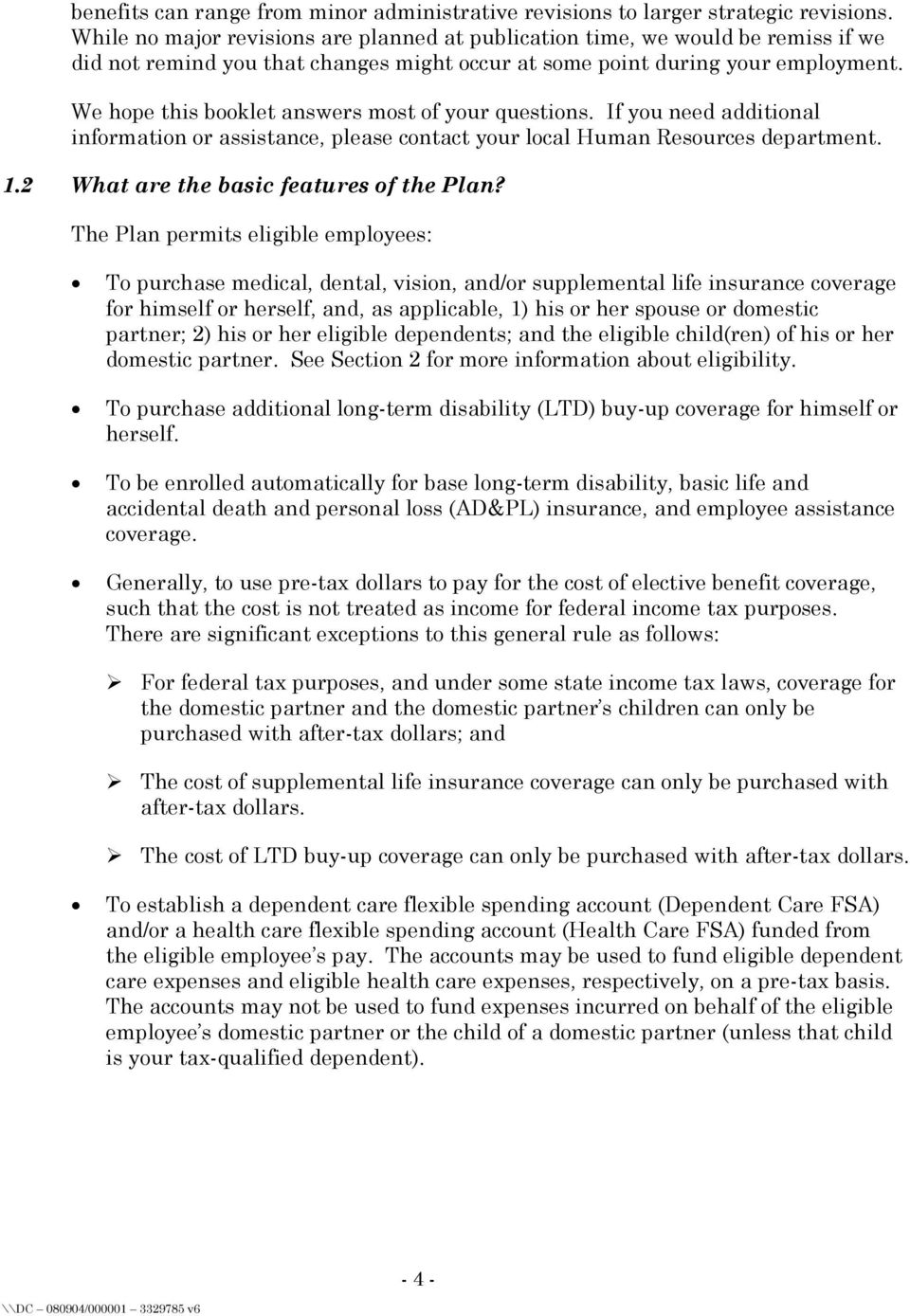
4 benefits can range from minor administrative revisions to larger strategic revisions. While no major revisions are planned at publication time, we would be remiss if we did not remind you that changes might occur at some point during your employment. We hope this booklet answers most of your questions. If you need additional information or assistance, please contact your local Human Resources department. 1.2 What are the basic features of the Plan? The Plan permits eligible employees: To purchase medical, dental, vision, and/or supplemental life insurance coverage for himself or herself, and, as applicable, 1) his or her spouse or domestic partner; 2) his or her eligible dependents; and the eligible child(ren) of his or her domestic partner. See Section 2 for more information about eligibility. To purchase additional long-term disability (LTD) buy-up coverage for himself or herself. To be enrolled automatically for base long-term disability, basic life and accidental death and personal loss (AD&PL) insurance, and employee assistance coverage. Generally, to use pre-tax dollars to pay for the cost of elective benefit coverage, such that the cost is not treated as income for federal income tax purposes. There are significant exceptions to this general rule as follows: For federal tax purposes, and under some state income tax laws, coverage for the domestic partner and the domestic partner s children can only be purchased with after-tax dollars; and The cost of supplemental life insurance coverage can only be purchased with after-tax dollars. The cost of LTD buy-up coverage can only be purchased with after-tax dollars. To establish a dependent care flexible spending account (Dependent Care FSA) and/or a health care flexible spending account (Health Care FSA) funded from the eligible employee s pay. The accounts may be used to fund eligible dependent care expenses and eligible health care expenses, respectively, on a pre-tax basis. The accounts may not be used to fund expenses incurred on behalf of the eligible employee s domestic partner or the child of a domestic partner (unless that child is your tax-qualified dependent)
5 Section 2. Benefits Eligibility 2.1 How do I know if I am eligible to receive benefits? Eligibility requirements and waiting periods for the individual health and welfare plans differ by employer. Appendix A lists the participating employers and describes the classes of workers eligible for coverage, the waiting periods, the number of hours they must work to qualify for coverage, and the coverage options available to them. Employees whose employment is covered by a collective bargaining agreement are only covered to the extent the collective bargaining agreement provides for participation in component programs of this Plan. 2.2 What are some of the classes of workers ineligible to participate in the Plan? You are not eligible to participate in the Plan if you are 1) a temporary or on-call employee; 2) a leased employee, including an employee engaged through a thirdparty service agency; or 3) classified as an independent contractor or in any way as a third-party service provider. If, for some reason, you later are classified as a regular employee, your eligibility to participate in the Plan will be prospective only. Under no circumstances will any employee classified as ineligible be given retroactive admission into the Plan, even if the original classification was made in error. 2.3 May I purchase benefits for my spouse and eligible dependents? Yes. You may purchase certain benefits for you, your spouse and your eligible dependents as further described in this booklet. For purposes of this plan, your spouse is a person of the opposite sex to whom you are legally married. This definition is required in order for the Plan to comply with federal law. The McClatchy Company recognizes common law marriages entered into in a state allowing such marriages in determining whether you have a spouse. Eligible dependents are: For purposes of medical benefits, your married or unmarried children until the end of the month in which they attain age 26, regardless of student status, residency or financial dependency. For purposes of the Health Care FSA, your married or unmarried children until the end of the calendar year in which they attain age 26, regardless of student status, residency or financial dependency. For purposes of the dental, vision, employee assistance plan, and supplemental life insurance benefits, your unmarried children until the end of the month in - 5 -
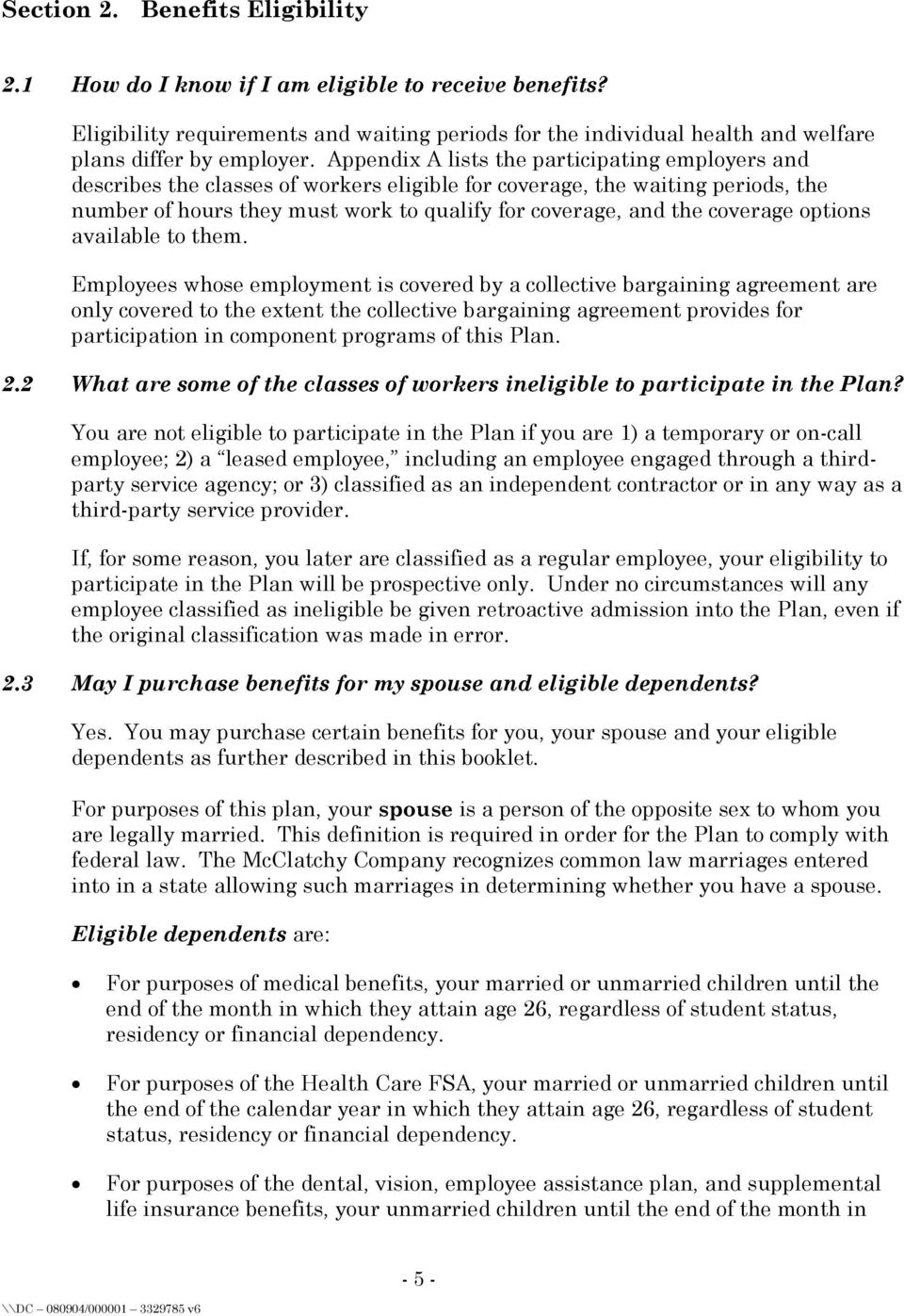
6 which they turn the maximum age defined by the Plan. Information about the maximum age for children can be found in the Evidence of Coverage booklets available on McClatchy s HealthWorks website. Your unmarried children of any age who are handicapped before the maximum age limit defined by the individual plans and who are primarily dependent on you for support. The term children includes your natural children, legally adopted children, stepchildren, foster children, children for whom coverage is required through a QMCSO or other court or administrative order and any other children for whom you are the legal guardian or for whom you have legal custody. The term children also includes children placed for adoption in your home. Your participation in the Plan or any component program of the Plan includes all coverage that you have elected on behalf of dependents. Accordingly, any dependent coverage will terminate upon the termination of your participation in the Plan or, if earlier, the date when the dependent no longer qualifies to be a dependent under the Plan as specified above. For purposes of medical, dental and vision coverages, your spouse or eligible dependents may only be enrolled in the same coverage option you have selected. 2.4 Is my domestic partner eligible to receive benefits? Yes. Your domestic partner is eligible to receive benefits if the appropriate documentation has been submitted to Human Resources. Because the term spouse is narrowly defined for purposes of this Plan, the term domestic partner includes some state law spousal relationships, as next described. A domestic partner is a committed life partner of the same or opposite sex as you. An eligible domestic partnership exists when you either have a registered domestic partner, a civil union or same-sex marriage under state or local law or all of the following criteria are met: You and your partner are financially interdependent and jointly responsible for each other s welfare; There is an intent to remain in a committed relationship; You and your partner have the same permanent address; You and your partner are not so closely related by blood that legal marriage would be prohibited; You and your partner are at least 18 years of age and neither of you is married to another individual; Neither you nor your partner has been in a different domestic partner relationship or marriage within the last 12 months; and - 6 -

7 The current relationship has been in effect for at least 12 months. A domestic partner does not include a mere roommate or a sibling, parent or other close relative. In order to elect benefits under the Plan for your domestic partner, you must submit documentation showing you are registered as domestic partners in your state or local municipality. If state and local municipality registration are not available, you must declare your domestic partnership to the Company by filling out the Affidavit of Domestic Partnership, available on HealthWorks website or from Human Resources. This Affidavit must be notarized before you submit it. In addition to the Affidavit, you must submit two documents evidencing that the relationship has been in existence for at least 12 months. The Company has the right not to accept your Affidavit of Domestic Partnership if all of the conditions for a domestic partnership listed above are not met. You are also required to inform the Company if your domestic partnership ends for any reason. You notify the Company by completing the Declaration of Termination of Domestic Partnership, available on the HealthWorks website or from Human Resources. This Declaration must be notarized. For purposes of medical, dental and vision coverages your domestic partner may only be enrolled in the same coverage option you have selected. More information about the Domestic Partners policy and Domestic Partners forms can be found on McClatchy s HealthWorks website. 2.5 Is the child of my domestic partner eligible to receive benefits? Yes. The child of your domestic partner is eligible to receive benefits under the Plan. The child of your domestic partner includes the domestic partner s natural child, legally adopted child, stepchild, foster child or child in the care of your domestic partner by court or administrative order and any other child for whom your domestic partner is legal guardian or legal custodian. The child of a domestic partner is eligible to receive benefits until reaching the age of majority as provided under the benefit coverage option. These are the same age limits as apply to children who are eligible dependents. (Please refer to Section 2.4) In addition, certain unmarried children who are handicapped before the maximum age limit defined by the individual plans and who are incapable of self-support may continue to be eligible for benefits under the Plan. For purposes of medical, dental and vision coverages, the child of your domestic partner may only be enrolled in the same coverage option you have selected

8 2.6 Which companies are participating employers and what benefits are offered by the participating employers? Participating employers are companies within our controlled group and affiliates of the Company that have agreed to take part in this Plan and offer the benefits provided by the Plan. For the list of participating employers and the benefits they offer under the Plan, please see Appendix A. A newly formed or acquired subsidiary shall only become a participating employer of the Plan as of the date designated to commence participation by the Company, and only as to such Component Programs for which The McClatchy Company authorizes participation. 2.7 Will McClatchy require proof that my enrolled dependent is eligible for coverage? If you enroll your spouse, eligible dependent, domestic partner or domestic partner s child in a McClatchy health care (medical, dental and/or vision) plan, you will be asked to verify that that person s eligibility for coverage. McClatchy has retained a third-party administrator to handle these verifications. If you do not send in the appropriate required documentation to show your enrolled spouse, eligible dependent, domestic partner or domestic partner s child is eligible for coverage within the required deadlines, coverage for that person will be terminated effective the first of the month following the deadline. If coverage is dropped because you did not send in the documents required to verify eligibility, that person cannot be added to coverage until the next open enrollment period, provided you can demonstrate the person s entitlement to coverage, and he/she also is not eligible for COBRA. More information about these eligibility verification requirements can be found on McClatchy s HealthWorks website. 2.8 What are the spousal/domestic partner eligibility rules? If your spouse/domestic partner is eligible for non-hmo medical and/or dental coverage with his/her employer, he/she must be enrolled in that coverage in order to be eligible for secondary medical or dental coverage with McClatchy. If the spouse/domestic partner medical and/or dental plan is an HMO, he/she cannot be covered under a McClatchy plan. Spousal/domestic partner eligibility must be certified each year during Open Enrollment in order to retain medical and/or dental coverage for the spouse/domestic partner for the next year. More information about the spousal/domestic partner eligibility benefit coverage policy can be found on McClatchy s HealthWorks website under the Enrollment tab

9 Section 3. Health Benefits -- Medical, Dental, Vision and Employee Assistance Plan (EAP) 3.1 What health care plan options are available to me? McClatchy offers medical, dental, vision and EAP plans. The health care plans available to you may depend on your full-time or part-time employment status. Appendix A lists the options for each type of health benefit for your employer. More specific information on the health care plan options can be found on McClatchy s HealthWorks website. You may also receive this information by contacting your local Human Resources. Each plan option may have a different cost to you. Some specific rules regarding each option and benefits provided under each option are detailed below. 3.2 Who is eligible? Each eligible employee may purchase coverage for himself or herself. For any health benefit option you select, you may also enroll your spouse/domestic partner, eligible dependents and/or your domestic partner s child in the same option that you are enrolled in. 3.3 What if I am eligible for Medicare or a state medical assistance plan? Your eligibility for Medicare does not affect your ability to enroll in McClatchy s health care plans except as described below in Section 3.6. McClatchy s health plans will be the primary payer; Medicare will be the secondary payer. We will coordinate with any state and federal agencies and follow necessary federal and state laws to make sure that payments for your benefits under the Plan are made appropriately. 3.4 How do I enroll? Enrollment in the EAP program is automatic and fully paid by your employer. For medical, dental and vision coverage, once you become eligible to participate, you must enroll by a process approved by the Company in order to receive these benefits under the Plan. You have the opportunity to enroll in the health care plans when you first become eligible for the coverage. You must actively enroll in coverage by the deadline given when you first become eligible for benefits or you will not have medical, dental or vision coverage. In addition, if you do not enroll in a timely manner, your spouse or domestic partner, your eligible dependents and any child of your domestic partner will not be entitled to any health care coverage. After your initial enrollment period, you will have another opportunity to enroll or change coverage during the annual open enrollment period, which is normally held - 9 -

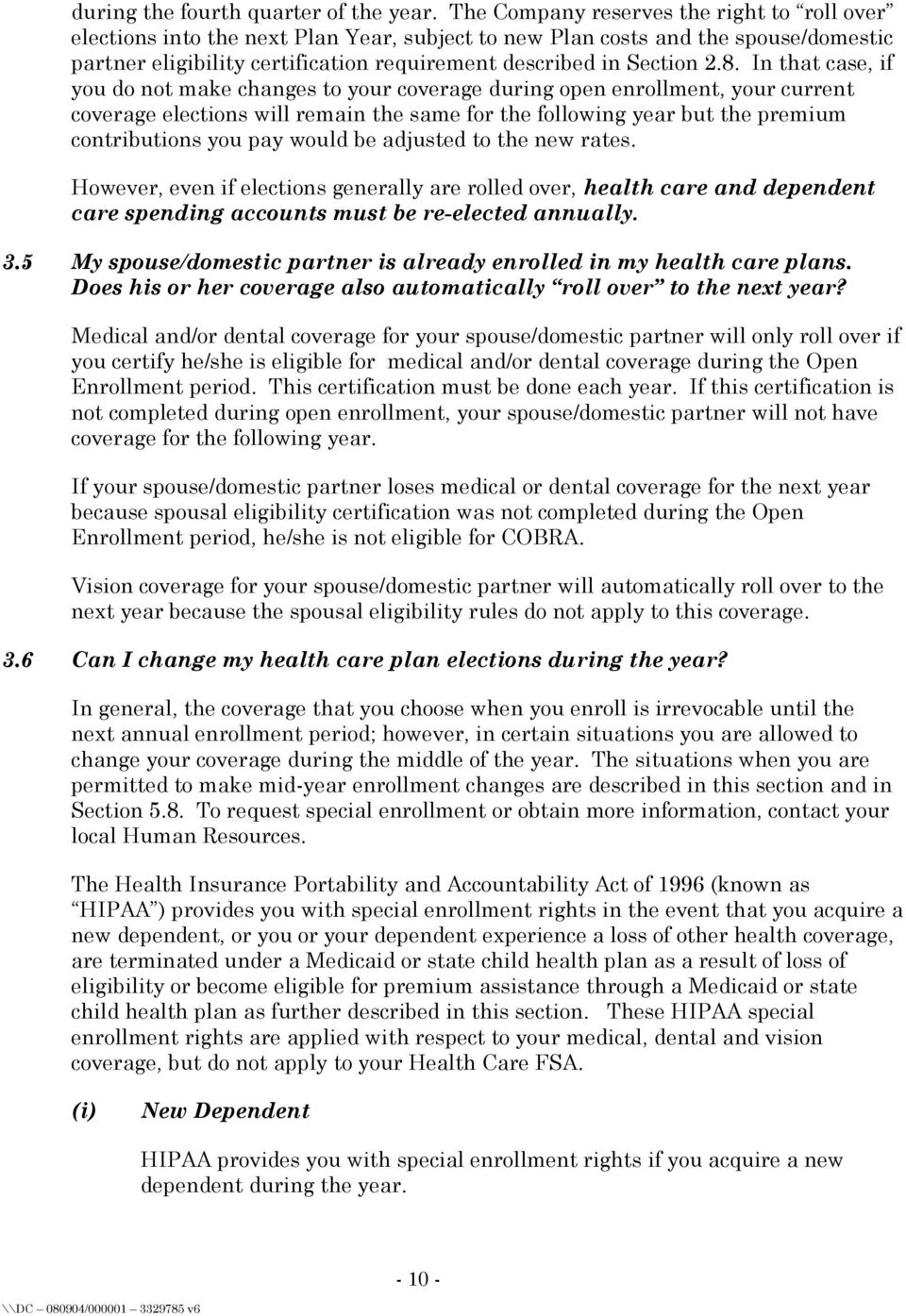
10 during the fourth quarter of the year. The Company reserves the right to roll over elections into the next Plan Year, subject to new Plan costs and the spouse/domestic partner eligibility certification requirement described in Section 2.8. In that case, if you do not make changes to your coverage during open enrollment, your current coverage elections will remain the same for the following year but the premium contributions you pay would be adjusted to the new rates. However, even if elections generally are rolled over, health care and dependent care spending accounts must be re-elected annually. 3.5 My spouse/domestic partner is already enrolled in my health care plans. Does his or her coverage also automatically roll over to the next year? Medical and/or dental coverage for your spouse/domestic partner will only roll over if you certify he/she is eligible for medical and/or dental coverage during the Open Enrollment period. This certification must be done each year. If this certification is not completed during open enrollment, your spouse/domestic partner will not have coverage for the following year. If your spouse/domestic partner loses medical or dental coverage for the next year because spousal eligibility certification was not completed during the Open Enrollment period, he/she is not eligible for COBRA. Vision coverage for your spouse/domestic partner will automatically roll over to the next year because the spousal eligibility rules do not apply to this coverage. 3.6 Can I change my health care plan elections during the year? In general, the coverage that you choose when you enroll is irrevocable until the next annual enrollment period; however, in certain situations you are allowed to change your coverage during the middle of the year. The situations when you are permitted to make mid-year enrollment changes are described in this section and in Section 5.8. To request special enrollment or obtain more information, contact your local Human Resources. The Health Insurance Portability and Accountability Act of 1996 (known as HIPAA ) provides you with special enrollment rights in the event that you acquire a new dependent, or you or your dependent experience a loss of other health coverage, are terminated under a Medicaid or state child health plan as a result of loss of eligibility or become eligible for premium assistance through a Medicaid or state child health plan as further described in this section. These HIPAA special enrollment rights are applied with respect to your medical, dental and vision coverage, but do not apply to your Health Care FSA. (i) New Dependent HIPAA provides you with special enrollment rights if you acquire a new dependent during the year
11 If you acquire a new spouse through marriage, or a new eligible dependent through marriage, the birth of a child, adoption or the placement of a child for adoption, you may make the following changes: If you are already a participant in the health plan, you may enroll your spouse, your newly acquired dependent and other eligible dependents in the same coverage option that you are covered under or you may enroll yourself, your spouse, your newly acquired dependent and other eligible dependents in another available coverage option; or If you are not a participant in the health plan, you must enroll yourself in the applicable health plan if you are adding others as described above. Note: To take advantage of this special enrollment right, you must contact HR and provide the required documentation regarding the enrollees in the health plan within 31 days of the event that gave rise to the new dependent. If the dependent is new due to the birth, adoption of a child or placement for adoption, coverage will be retroactive to the date of the birth, adoption or placement in the home for adoption. If the dependent is new due to marriage, coverage shall be effective no later than the first day of the month after enrollment. (ii) Loss of Other Health Coverage Including Medicaid or a State Child Health Plan HIPAA gives you special enrollment rights if you experience a loss of other health coverage. A loss of other health coverage occurs if you, your spouse, or eligible dependents, lose health coverage by (i) exhausting COBRA coverage, (ii) ceasing to be covered under another health plan because of a loss of eligibility for that plan, or (iii) ceasing to be covered under another employer plan because the employer stopped contributing to the plan. If you are the employee and you are the affected person (i.e., the person experiencing the loss of other health coverage) or if your spouse or eligible dependent is the affected person, you may enroll yourself, your spouse and your eligible dependents in any health coverage option that is a replacement for the lost coverage. If you are not enrolled in the selected health coverage option, in order to enroll your spouse or eligible dependents, you first must enroll yourself. Note: To take advantage of this special enrollment right, you must contact HR and provide the required documentation regarding the enrollees in the health plan within 31 days of the loss of other health coverage. However, if the loss of coverage results from Medicaid or state child health plan coverage, you have 60 days to provide the required documentation regarding your enrollees in the health to HR

12 Your coverage will be effective on the first day of the month after enrollment. (iii) You Become Eligible for Premium Assistance Through a Medicaid or State Child Health Plan Finally, HIPAA also gives you special enrollment rights if you, your spouse or eligible dependent become eligible for assistance with respect to coverage under a health plan through a Medicaid or state child health plan. If you are the employee and you are the affected person (i.e., the person who has become eligible for assistance with respect to coverage under a health plan through a Medicaid or state child health plan) or if your spouse or eligible dependent is the affected person, you may enroll yourself, your spouse and your eligible dependents in any health coverage option. If you are not enrolled in the selected health coverage option, in order to enroll your spouse or eligible dependents, you first must enroll yourself. Note: To take advantage of this special enrollment right, you must contact HR and provide the required documentation regarding the enrollees in the health plan within 60 days of being determined to be eligible for assistance with respect to coverage under the health plan through a Medicaid or state child health plan. Your coverage will be effective on the first day of the month after enrollment. (iv) Qualified Medical Child Support Order You may also have the right, or be required by law, to change your coverage during the year if you are subject to a Qualified Medical Child Support Order (known as a QMCSO ). A QMCSO is a state court or administrative agency order that requires an employer s medical plan to provide benefits to the child of an employee who is covered, or eligible for coverage, under the employer s plan. QMCSOs usually apply to a child who is born out of wedlock or whose parents get divorced. When we receive a QMCSO, we must promptly notify you and the child that the order has been received and what procedures we will use to determine if the order is qualified. If we determine the order is qualified and you must provide coverage for your child pursuant to the QMCSO we will enroll the child in your current medical plan. If you are not enrolled in medical coverage, we will enroll you and your child. We will deduct from your paycheck the amount necessary to pay for such coverage. We will notify you once we determine whether or not the order is qualified

13 A copy of the procedures governing QMCSO determinations is available from Human Resources. 3.7 Do the HIPAA Special Enrollment Rights Permit the Enrollment of My Domestic Partner or My Domestic Partner s Child? No. However, with respect to medical, dental and/or vision coverage, the Plan provides HIPAA-like special enrollment rights to your domestic partner and/or the child of a domestic partner, as follows: If you are the affected person in a loss of other health coverage situation or a Medicaid/state plan premium assistance situation, you may enroll yourself, your domestic partner and your domestic partner s child in any health coverage option that is a replacement for the lost coverage. If you are currently enrolled in a health plan coverage option, and you newly acquire a domestic partner or child of a domestic partner, you may enroll your domestic partner and any child of a domestic partner in the health plan coverage option in which you are enrolled. If you are currently enrolled in a health plan coverage option and your domestic partner or the child of your domestic partner is the affected person in a loss of other health coverage situation or a Medicaid/state plan premium assistance situation, you may enroll your domestic partner and the child of your domestic partner in the health coverage option in which you are enrolled. 3.8 How are health benefit premiums paid? You are required to pay the employee portion of the premiums for your medical, dental, vision and EAP coverage. If you are enrolled in health care coverage, the premium conversion program (described in detail in Section 5 of this booklet) allows you to pay your portion of these premiums with pre-tax dollars. However, the premium contributions for a domestic partner s or domestic partner s dependent s medical, dental, vision or EAP insurance must be paid with after-tax dollars. Enrollment in the premium conversion program is automatic if you elect health coverage. The Company will deduct the amount of your health care premium contributions from your paycheck twice a month. The Company pays a portion of the cost of your health care premiums. We reserve the right to change the amount we contribute at any time. We will announce the amount you must pay for your health care coverage each year at the time of Open Enrollment. 3.9 How do I file a health benefits claim? Each health care insurance provider has different procedures for filing claims. In some cases you simply show your insurance card when using services and your health care provider will file the claim. In other cases, to file a claim you must use the claim form provided by the insurance company providing the health coverage

14 you have selected. These forms are available from Human Resources or may be printed directly from McClatchy s HealthWorks website. You should refer to Section 10 of this booklet for an explanation of certain rights that you have regarding when you will be notified of the decision on your claim What if my health benefits claim is denied? If your claim for benefits under this policy is denied you should follow the procedures outlined in Section 10 of this booklet When will my health coverage end? You will cease to be covered under our health care plans if (i) you cease to be an eligible employee, (ii) you fail to pay required premiums on a timely basis or (iii) we discontinue the medical, dental and/or vision insurance programs. If you cease to be an eligible employee, coverage ends on the last day of the month in which your status changes. For example, if your employment terminates during the month, you will cease to be an eligible employee and your coverage will end on the last day of that month Do I have any special rights when my benefits terminate? If certain events, known as qualifying events cause you to lose your health care coverage, you may be entitled to continue receiving coverage under COBRA. Section 9 of this booklet includes a detailed explanation of when you become entitled to COBRA and how the COBRA program works If my coverage terminates, will I receive a certificate of creditable coverage? If your health coverage or your COBRA continuation coverage ceases (as described in Section 9), HIPAA requires that a certificate of creditable coverage be automatically sent to you and your dependents or domestic partner and your domestic partner s dependents. The certificate will be sent by first class mail to your last known address (or if different, your dependent s last known address, as applicable) generally within 30 days. In addition, regardless of whether you have previously received a certificate, you may request (or a request may be made on your behalf) to receive a certificate of creditable coverage at any time while your health coverage is in effect and up to 24 months after your coverage ceases, by contacting the insurance carrier s Member Services. The telephone number is listed on the HealthWorks website. Upon receipt of your request, a certificate of creditable coverage will be sent by first class mail to your last known address (or if different, your dependent s last known address, as applicable) generally within 30 days. Generally, certificates of creditable coverage are in writing, except that the information may be delivered in another form with your consent under certain
15 narrow circumstances. You may also designate another individual or entity to receive the certificate. Only one certificate of creditable coverage will be provided for you and your dependents or your domestic partner and his/her eligible dependents, if the information is identical for each of you. If the information is not identical, certificates for you and your dependents or domestic partner and his/her eligible dependents may be provided on one form if the form provides all the required information for each individual and separately states any information that is not identical. Please be aware that the right to receive a certificate of creditable coverage either automatically or upon request under HIPAA does not apply with respect to your dental or vision coverage or your Health Care FSA Special rights related to your medical insurance Several federal laws provide that your medical insurance must provide specific coverage in certain circumstances. This section describes these special protections. (i) Maternity Minimum Stay Provisions The Newborns and Mothers Health Protection Act generally prohibits group health plans and health insurance carriers offering group insurance coverage from: Restricting benefits for any hospital length of stay in connection with childbirth for the mother or newborn child to less than 48 hours following a vaginal delivery, or less than 96 hours following a cesarean section, or Requiring that a provider obtain authorization from the plan or the insurance issuer for prescribing a length of stay not in excess of the above periods. However, federal law generally does not prohibit the mother s or newborn s attending provider, after consulting with the mother, from discharging the mother or the newborn earlier than 48 hours (or 96 hours as applicable). If discharged early, a follow-up visit for the mother and newborn within 48 hours of discharge is covered when prescribed by the treating physician. This visit shall be provided by a licensed health care provider whose scope of practice includes postpartum and newborn care. The treating physician, in consultation with the mother, shall determine whether this visit shall occur at home, the contracted facility, or the physician s office. (ii) Coverage for Reconstructive Surgery Following Mastectomy If you have had or are going to have a mastectomy, you may be entitled to certain benefits under the Women s Health and Cancer Rights Act of 1998 ( WHCRA ). When a person insured for medical benefits under the Plan who has had a mastectomy (at any time) decides to have breast reconstruction, based on consultation between the physician and the patient, coverage will be
16 provided for the following benefits, subject to the same coinsurance and deductibles which apply to other medical and surgical benefits provided under the Plan: All stages of reconstruction of the breast on which the mastectomy was performed; Surgery and reconstruction of the other breast to produce a symmetrical appearance; Prostheses; and Treatment of physical complications in all stages of mastectomy, including lymphedema. (iii) Mental Health Parity and Addiction Equity Act If the medical coverage option that you choose offers mental health benefits or substance use disorder programs, any annual or lifetime maximum dollar limit for such benefits may not be more restrictive than the annual or lifetime maximum dollar limit for substantially all of the medical and surgical benefits under the coverage option. In addition, any financial or treatment limitations on coverage or reimbursement for such benefits may not be more restrictive than the financial or treatment limitations on coverage or reimbursement for substantially all of the medical and surgical benefits under the coverage option. These requirements apply separately to the following benefit classifications: Inpatient, in-network; Inpatient, out-of-network; Outpatient, in-network; Outpatient, out-of-network; Emergency care; and Prescription drugs. In addition, the medical coverage option may not impose a nonquantitative treatment limitation with respect to mental health or substance use disorder benefits in a particular classification unless any processes, strategies, evidentiary standards, or other factors used in applying the nonquantitative treatment limitation to mental health or substance use disorder benefits in the classification are comparable to, and are applied no more stringently than, the corresponding processes, strategies, evidentiary standards or other

17 factors used in applying the limitation to medical and surgical benefits. However, clinically appropriate standards of care may permit a difference. Nonquantitative treatment limitations include: Medical management standards limiting or excluding benefits based on medical necessity or medical appropriateness, or based on whether the treatment is experimental or investigative; Formulary design for prescription drugs; Standards for provider admission to participate in a network, including reimbursement rates; Plan methods for determining usual, customary, and reasonable charges; Refusal to pay for higher-cost therapies until it can be shown that a lower-cost therapy is not effective (also known as fail-first policies or step therapy protocols); and Exclusions based on failure to complete a course of treatment. (iv) Genetic Information Non-Discrimination Act The Genetic Information Non-Discrimination Act prohibits group health plans and health insurance carriers from requesting genetic information from you or purchasing your genetic information for use in connection with plan enrollment or for any underwriting purpose (such as premium adjustments or contribution amounts). In addition, no group health plan or health insurance carrier may request or require you or a family member to undergo genetic tests. (v) Patient Protection and Affordable Care Act For plan years beginning on or after January 1, 2014, the Patient Protection and Affordable Care Act prohibits certain health plans from imposing annual or lifetime per beneficiary limits on essential health benefits. For plan years beginning prior to January 1, 2014, these health plans may impose restricted annual limits (per beneficiary) on the dollar value of essential health benefits. For the plan years beginning January 1, 2011, January 1, 2012, and January 1, 2013, the restricted annual limit (per beneficiary) may not be less than $750,000, $1,250,000, and 2,000,000, respectively. In addition, health plans must provide coverage for, and may not impose any cost sharing requirements for: Certain evidence-based items or services; Certain immunizations;
18 With respect to infants, children and adolescents, certain evidenceinformed preventive care and screenings; and With respect to women, certain additional preventive care and screenings

19 Section 4. Welfare Benefits Life, Long-Term Disability (LTD) and Accidental Death and Personal Loss Insurance 4.1 Does McClatchy offer life insurance? We offer group term life insurance to provide financial protection for your designated beneficiary in the event of your death. You have the option to purchase additional supplemental life insurance for yourself, your spouse/domestic partner, or your eligible dependents. We also offer accidental death and personal loss insurance, or AD&PL, to provide you with financial protection in the event of your accidental loss of life, sight, limbs, speech or hearing. Supplemental AD&PL insurance is not available. Details about these insurance coverages, including Guaranteed Issue and Evidence of Insurability rules, can be found on the McClatchy HealthWorks website. 4.2 Who is my beneficiary? It is important for you to designate who you would like to receive your life and AD&PL benefits in the event that you die. If you do not select a beneficiary before your death, state law will control who receives your life and AD&PL insurance benefits. You may designate or change your beneficiary at any time using McClatchy Employee Self Service located on the McClatchy internet and intranet websites or by contacting your local Human Resources. 4.3 What disability benefits does McClatchy offer? McClatchy offers long-term disability (LTD) benefits that are paid after you have been disabled for six months. You receive a percentage of your pay up to a maximum monthly benefit during your disability. You may be eligible to purchase additional LTD buy-up coverage. More information about these benefits can be found on the HealthWorks website or by contacting your local Human Resources. 4.4 When am I eligible to participate? The welfare plans follow the eligibility rules detailed in Appendix A. 4.5 How do I enroll? You are automatically enrolled in life and AD&PL, and base LTD insurance when you become eligible. To purchase additional supplemental life insurance and/or LTD buy-up coverage, you must enroll using the same process as your health care plan enrollment, as designated by the employer. If you do not enroll in additional supplemental life insurance or LTD buy-up coverage when you are initially eligible,

20 you will only be enrolled in the basic life and base LTD benefit. You may be eligible to apply for supplemental life and/or LTD buy-up coverage during the next open enrollment period. 4.9 How are the welfare benefits paid for? Basic life, AD&PL, and base LTD insurance coverage premiums are paid for by McClatchy. Because the coverage is paid by the employer, any future benefits paid will be taxed. The premiums for supplemental life insurance and/or LTD buy-up coverage are paid by the employee. Because these premiums are paid with after-tax dollars, any future benefits paid will be tax-free When will my coverage end? Your coverage in any of the welfare programs will end if you cease to be an eligible employee or if we discontinue such program. Supplemental life insurance and LTD buy-up coverage also would end if you fail to pay the required premiums. If coverage ends because you have ceased to be an eligible employee (for example, if you terminate employment), you will cease to be covered by the welfare plans on the last day you are an eligible employee. Thus, if you terminate employment, basic and supplemental life, AD&PL, and base and buy-up LTD coverage will end on the day you terminate employment. When your life and AD&PL insurance coverage terminates, you may have the option of portability or conversion to an individual policy. Application for portability and/or conversion of life insurance must be made within 30 days from your termination date. Contact the life insurance carrier for details How do I file a claim for benefits? To file a claim, please contact the appropriate insurance company. Further information is available by contacting your local Human Resources What if my claim is denied? If your claim for benefits under these policies is denied, you (or your beneficiary) should follow the procedures outlined in Section 10 of this booklet

21 Section 5. Premium Conversion Program 5.1 What is the premium conversion program? The premium conversion program is a benefit program that allows you to pay for some Plan benefits on a tax-free basis from your salary. The premium conversion program also allows you to participate in the Health Care FSA and the Dependent Care FSA. More detail about the Health Care FSA and Dependent Care FSA can be found in Sections 6 and 7, respectively. 5.2 What benefits may I purchase through the premium conversion program and how do I enroll in the program? When you pay for your health care insurance (medical, dental, vision and EAP coverage) under the Plan, the amounts you have to pay for such coverage for yourself, your spouse, and your eligible dependents, will be run through the premium conversion program on a pre-tax basis. You may not use the premium conversion program, however, to pay for the cost of coverage for your domestic partner or your domestic partner s child, if any. As a result, domestic partner coverage must be paid for with after-tax dollars. 5.3 How do the Health Care FSA and the Dependent Care FSA (FSAs) work? The FSAs allow you to pay certain health and dependent care expenses (see Section 6 and Section 7) on a pre-tax basis. You redirect a portion of your salary to the accounts, and when you incur eligible health and/or dependent care expenses, you are reimbursed from the applicable account. Following is an outline of the process: You estimate your eligible medical or dependent care expenses. You set aside funds in your FSA through payroll deduction. You receive your normal medical or dependent care services and pay for the expenses. You submit for reimbursement for the eligible expenses you have incurred, also submitting substantiating receipts with the reimbursement form. The claim administrator reviews your claim, and provides you with reimbursement if the claim satisfies the conditions for reimbursement. Please see Section 6.8 regarding using an FSA debit card for these expenses, rather than filing for reimbursement. 5.4 What are some of the guidelines I should consider in establishing a FSA? If you elect to participate in either or both the Health Care FSA and Dependent Care FSA, you must follow the following rules:
22 Funds may not be transferred from one FSA to another. Once you have elected your general contribution amount, you are limited in your ability to change that amount. See Section 5.8. Funds may only be used for eligible expenses (please see Sections 6 and 7 and Appendix B), as determined by the claim administrator. Funds not used to pay eligible expenses incurred during the applicable coverage period or disbursed to the employee as a qualified reservist distribution from a Health Care FSA will be forfeited at the end of the applicable coverage run-out period. If you submit a claim to your FSA, you may not claim the same expenses as a deduction on your income tax return. In addition, if you receive a reimbursement from a third-party for expenses already reimbursed by your FSA, you will be required to repay the Plan for the FSA reimbursement. Finally, you cannot receive reimbursement from an FSA for an expense paid for by a health care plan. 5.5 How do I enroll in an FSA and the premium conversion program? Once you become eligible to participate, you are automatically enrolled in the premium conversion program when you enroll in certain benefits that require you to pay premiums. To enroll in an FSA plan, you must follow the same process that is used for your other benefit enrollments. To authorize FSA contributions, you will be required to explicitly set the amount of salary to be withheld from your salary for the year. This amount will be deducted in substantially equal payments twice a month from your paycheck and credited to the applicable FSA. If you do not enroll when you first become eligible, your next opportunity to enroll is generally the next annual enrollment period established by the Company for the new coverage year. Health Care FSA and Dependent Care FSA elections do not rollover from year to ye ar. You must actively elect to participate in the Health Care FSA and/or Dependent Care FSA each year at open enrollment if you wish to participate in the following year. 5.6 How do I benefit from participating in the premium conversion program? The following example illustrates the federal income tax savings that you may be able to achieve by participating in the premium conversion program. Cathy and Jim both work full-time and expect to spend $2,600 for eligible day care in the coming year. Both spend about $3,000 to purchase health coverage for their families. Cathy pays for her family s health care coverage under the Plan, while Jim elects to purchase health care coverage elsewhere. Cathy also decides to redirect $2,600 of her salary towards the Dependent Care FSA, while Jim does not elect to
23 redirect any salary towards the Dependent Care FSA. Cathy s estimated tax savings are shown below in comparison to Jim s. Cathy s Election (With Premium Conversion) Jim s Election (Without Premium Conversion) Salary $40,000 $40,000 Pre-tax Health Care Premium Contributions $3,000 0 FSA Account $2,600 0 Taxable Pay $34,400 ($40,000 $5,600) $40,000 ($40,000 $0) Estimated Tax (20%) $6,880 $8,000 After-Tax Salary $27,520 ($34,400 $6,880) After-Tax Expense $0 Spendable Income $27,520 $32,000 ($40,000 $8,000) $5,600 (for day care, plus health care purchased elsewhere) $26,400 ($32,000 $5,600) By redirecting salary under the premium conversion plan and the Dependent Care FSA, Cathy has saved $1,120 ($27,520 - $26,400) or 2.8% of her annual salary. Contributions to the premium conversion program usually are not subject to state taxes. 5.7 What is the impact of my participation on my Social Security taxes? You should note that you also do not pay Social Security tax on amounts deducted from your pay on a pre-tax basis under the premium conversion program (including the FSAs). This means your contributions to the premium conversion program may reduce your wages reported for Social Security purposes and could ultimately reduce your Social Security benefit amount. 5.8 May I change my election during the year? Your election to participate in the premium conversion program, including the Health Care FSA and the Dependent Care FSA, is generally irrevocable during the year. In other words, once you have decided how much salary you wish to defer in order to pay for benefits under the premium conversion program, you are locked into that salary deferral until the next annual enrollment period
24 However, if certain special circumstances occur, you may be permitted to change your election, or to begin or cease participation in the premium conversion program, before the next annual enrollment period. These circumstances are described below. IMPORTANT: You may not make any change in the amount that you have elected to defer into the Health Care FSA as a result of the circumstances listed below with an *. (i) Change of Status You may change your election under the premium conversion program if you experience a change of status and your election change is consistent with that change of status. A change of status is any of the following events: A change in your legal marital status, including marriage, divorce, death of a spouse, legal separation from a spouse or annulment of a marriage to a spouse; A change in your number of eligible dependents, including birth, adoption, placement for adoption or death, becoming a foster parent or becoming subject to a court order providing for guardianship or a similar relationship; A change in your employment status or in the employment status of your spouse or eligible dependent, including: o o o o o A termination or commencement of employment; A strike or lockout; A commencement of or return from an unpaid leave of absence; A change in worksite; and A change in employment status of you, your spouse or eligible dependent resulting in you, your spouse or eligible dependent becoming (or ceasing to be) eligible under this Plan or other cafeteria plan or benefits plan, such as your, your spouse s or eligible dependent s employment status changing from part-time to full-time, salaried to hourly, union to non-union or vice versa. An eligible dependent satisfies or ceases to satisfy eligibility requirements for coverage on account of attainment of age, student status, or any other similar circumstance; A change in your, your spouse s or eligible dependent s place of residence; and
25 Any other events that may become permissible according to the Internal Revenue Service and that are approved by the plan administrator. Your election change as a result of a change of status must be consistent with the change of status. For example, if you get divorced in the middle of the coverage year, you may only change your premium conversion program election with respect to your ex-spouse. Similarly, if one of your children is no longer eligible for coverage as a result of his age, you may only change your election with respect to that dependent, and not with respect to yourself, your spouse or your other dependents who remain qualified for coverage. (ii) HIPAA Special Enrollment* If a HIPAA special enrollment applies, you may make new health coverage option elections, as described in Section 3.6. (iii) Automatic cost changes* If the cost of a coverage option automatically increases or decreases during the year by an insignificant amount, the plan administrator may automatically increase or decrease your contribution under the premium conversion program to take account of such increase or decrease in premium cost. (iv) Significant cost increases* If the cost of a coverage option increases significantly during the year, you may make either of the following election changes: You may revoke your election of the coverage option that increased in cost and either make a new election to receive coverage under another option providing similar coverage or cease to receive medical coverage if no coverage option providing similar coverage exists; or You may increase your salary deferrals in order to correspond with the increased cost of the coverage option. (v) Significant cost decreases* If the cost of a coverage option for which you are eligible significantly decreases during the year, you may make either of the following election changes: If you are already participating in the premium conversion program but you are covered under an option other than the option that decreased in cost, you may cease your current coverage and elect coverage under the option that decreased in cost; or
26 If you are not participating in the premium conversion program, you may commence participation and elect the coverage option that decreased in cost. (vi) Significant curtailment of coverage without loss of coverage* If you or your dependent has a significant curtailment of coverage under a coverage option that does not amount to a loss of coverage, then you may revoke your election to participate in the coverage option and elect coverage under another coverage option providing similar coverage. Examples of significant curtailments of coverage include a significant increase in the deductible, co-pay or out-of-pocket cost-sharing limit under the coverage option. (vii) Significant curtailment of coverage that results in a loss of coverage* If you or your dependent has a significant curtailment of coverage that results in a loss of coverage, then you may revoke your election to participate in the coverage option and elect coverage under another coverage option providing similar benefits. If no similar benefit option exists, you may cease participation in the premium conversion program. A loss of coverage occurs when there is a complete loss of coverage under the benefit option. (viii) Addition or improvement of a coverage option* If the Plan adds new coverage options during the year or if coverage under existing options is significantly improved during the year, you may make the following election changes: If you are already participating in the premium conversion program, you may change to the newly added or improved coverage option; or If you are not participating in the premium conversion program, you may commence participation and elect the new or improved coverage option. (ix) Change or loss of coverage under another employer plan If you or your dependent has coverage under another employer plan and such coverage changes or is canceled, then you may make a change consistent with the change in that coverage. (x) Loss of coverage under other group health plan If you or your dependent was previously covered under another group health plan sponsored by a governmental or educational institution and you or your dependent loses such coverage, you may elect coverage for yourself or the affected dependent
27 (xi) QMCSO If a QMCSO is issued requiring health coverage for your dependent child, you may change your premium conversion election to: Provide coverage for the dependent child and yourself (if necessary); or Revoke coverage for the dependent child if the QMCSO requires another individual to provide support under that individual s plan, and that coverage is, in fact, provided. (xii) Entitlement to Medicare or Medicaid If you or your dependent is enrolled in a health plan and you participate in the premium conversion program, and you or your dependent becomes entitled to Medicare or Medicaid, you may reduce or cancel your coverage under this program for the person becoming entitled to Medicare or Medicaid. Similarly, you may commence or increase coverage under the premium conversion program for yourself or your dependent who has lost coverage under Medicare or Medicaid. 5.9 If I am allowed to change my election, when must I make the change? If you are allowed to change your election before the annual enrollment period because you meet one of the requirements listed above, you must make your new election within 31 days of the event that allowed you to change your election, unless a longer applicable period is described in Section 3.6. Your election will generally be effective as of the first of the next calendar month. However, elections made with respect to the birth, adoption, or placement for adoption of a child will be effective retroactive to the date of the birth, adoption or placement for adoption of the child. Your new election will be irrevocable until the next annual enrollment period unless a subsequent event allows a further change When do my benefits end? Your benefits under the premium conversion program will end if you cease to be an eligible employee if you fail to pay required premiums under the program or if we discontinue the program. When you terminate employment, you cease to be an eligible employee. When you cease to be an eligible employee, your FSA salary reductions will cease. You may claim reimbursement for all eligible expenses incurred during the period of coverage prior to termination, as long as you file the claim by May 15 of the year following the year the expenses were incurred for the Health Care FSA, or February 28 of the year following the year expenses were incurred for the Dependent Care FSA
28 Section 6. Health Care Flexible Spending Account 6.1 What is the Health Care FSA? The Health Care FSA allows you to elect salary deductions on a pre-tax basis to pay eligible medical expenses directly with a debit card or to reimburse you for medical expenses (as defined by section 213 of the Internal Revenue Code) that are not otherwise covered by your health insurance or reimbursable from any other source, such as co-pays and deductibles. A generalized list of other eligible expenses is provided in Appendix C. 6.2 What is the coverage period under the Health Care FSA? When you elect to participate in the Health Care FSA, it is an election to participate until the end of the year. This means that the coverage period generally is the next calendar year, if your election to participate occurs during annual enrollment. Each new calendar year is a new coverage period under the Plan, if you remain continuously enrolled. However, please note that each coverage period has a grace period described below in Section 6.3 to make it easier for you to use your entire account. (See Section 6.4 for the use-it-or lose it rule.) If you terminate employment (unless you are eligible for COBRA), your coverage period will be treated as ending on your termination date and you will no longer be entitled to make salary deduction contributions to the Health Care FSA after your final paycheck from The McClatchy Company. Your Health Care FSA election ordinarily is irrevocable for the coverage period, which means you generally cannot increase or decrease the amount of your salary deductions during the year. However, under special circumstances described in Section 5.8, you can make a mid-year coverage change, which in some cases would permit late enrollment or early termination of participation during a calendar year. 6.3 What is the grace period? If you are a participant under the Health Care FSA on the last day of the calendar year, and you have not fully used the amounts set aside in your account for the year, the Plan allows you to use eligible expenses incurred before March 15 of the new calendar year to obtain additional reimbursements from your prior year s Health Care FSA account. You will have until May 15 after the end of the calendar year during which to submit eligible expenses incurred during the calendar year and the grace period. 6.4 Why is the coverage period important and what is the use-it-or-lose-it rule? Amounts you set aside in the Health Care FSA through salary deductions for a coverage period may only be used to pay or reimburse eligible medical expenses incurred during the coverage period unless you receive a qualified reservist
29 distribution as described in Sections 6.17 through If, when the coverage period ends, you do not have enough eligible expenses to use up the amounts you have set aside by salary deduction, you will forfeit those amounts. In other words, the amounts that are not used will not rolled over into the new coverage period or be returned to you. Claims incurred after your termination date are not eligible to be paid or reimbursed under the Health Care FSA unless you are eligible for and elect COBRA coverage. 6.5 When are medical expenses incurred? For eligible medical expenses to be paid directly or reimbursed to you from your Health Care FSA, they must have been incurred during the coverage period. A medical expense is incurred when the service is provided, not when the expense is paid, with the exceptions described below. For example, if you pay for medical care on the first day of the month for care given on the 15 th of that month, the expense has not been incurred until the 15 th of that month. In addition, you may not be reimbursed for any expenses incurred at a time you are not a participant under the Health Care FSA. There are two exceptions to the general rule that eligible medical expenses may only be reimbursed if they have been incurred during the coverage period. First, you may be reimbursed for durable medical equipment with a useful life extending beyond the coverage period during which the expense is incurred. You may also be reimbursed for orthodontia services before the services are provided, but only to the extent that you have actually made the payments in advance of the orthodontia services in order to receive the services. Such orthodontia services will be deemed to be incurred when you make the advance payment. Orthodontia expenses may also be treated as incurred periodically over the treatment period if the expenses are paid under the service contract. 6.6 What is the maximum amount that I may contribute to my Health Care FSA? The maximum amount you can contribute to your Health Care FSA is $5,000 per year. If your spouse is employed and covered by their own Health Care FSA, then the maximum amount you can each contribute to your Health Care FSA is $2,500 per year. Effective January 1, 2013, the maximum an individual can contribute to an Health Care FSA is $2,500 per year. The IRS will adjust this limit annually for inflation. 6.7 What if I incur a large reimbursable claim early in the year? As you know, the Health Care FSA is funded through salary deductions taken in substantially equal amounts over 24 pay periods during the year. Thus, for example, if an eligible employee who enrolled during the enrollment period for the upcoming calendar year is paid bi-weekly and elects to contribute $100 a pay period for the upcoming year, that would result in an election to set aside $2,400 for the year. If that employee incurs a significant, and otherwise uncovered, medical expense early in the year, the employee would only have contributed a fraction of the $2,400 by the
30 time the claim is incurred. Nevertheless, even if the eligible employee submits a $2,400 claim in March, for example, the whole of the claim will be reimbursed from the account since the annual election is sufficient to cover the reimbursable expense. On the other hand, if the participant s annualized salary deduction contributions would only have totaled $2,000, only $2,000 would be reimbursable from the account at any point during the coverage year. The total aggregate claims reimbursable from a participant s Health Care FSA account cannot exceed the annualized contribution to the FSA (or, if less, in the case of a participant who enters the Plan mid-year, the amounts expected to be contributed up to year end). 6.8 How can I access my Health Care FSA directly to pay eligible expenses? If you contribute to a Health Care FSA, you will receive a limited use Visa debit card that you can use to pay for your qualified health care expenses and those of your dependents. You cannot use the debit card to pay dependent care expenses. The debit card allows you to pay eligible expenses directly from your Health Care FSA, without having to pay out-of-pocket and file for reimbursement. Any expense paid with the card cannot be reimbursed by another source. If the debit card is used to pay an ineligible expense, the card will be suspended until the participant repays the amount. You may choose not to use the debit card and to instead file for reimbursement for an eligible expense. The dollar value stored on your debit card will be the same as the contribution amount that you elect when you enroll in the account. When you use the debit card, your eligible expenses will be deducted automatically from your account. The Company has retained the services of an independent third-party administrator, to administer the debit card feature of the account. In order to reduce abuse of the card, it will only be accepted at approved points of sale, for example, doctors offices and pharmacies. Some expenses at certain points of sale will be automatically approved. For instance, a $20 co-pay at a doctor s office will usually be automatically approved without further documentation. Other expenses may require documentation, and the administrator will notify you if such documentation is necessary. You should retain receipts for all of your transactions, even for items that are normally automatically approved. Additional cards will be available upon request. Your debit card will be cancelled on the date of your termination of employment with The McClatchy Company, as described in Section How do I make a claim for reimbursement from my Health Care FSA? You may submit a claim for reimbursement from your Health Care FSA as soon as an eligible expense is incurred. Claims forms are available on McClatchy s HealthWorks website, through the FSA third-party administrator s website, or by calling the FSA third-party administrator s Customer Service. In addition, you may submit your claim for reimbursement from your Health Care FSA online and upload your receipts through the FSA third-party administrator s website. Contact
31 information for the FSA third-party administrator can be found in Section 14, Plan Administrative Information. Your claim must include a written statement or bill from an independent party stating that the eligible expenses have been incurred and the amount of such expenses. In addition, you may be required to include an explanation of benefits from any primary medical and/or dental coverage indicating the amounts that you are obligated to pay. You must also attest to the fact that the expense is not reimbursable from any other source. You will have until May 15 after the end of the calendar year in which to submit a claim for reimbursement for eligible medical expenses incurred during that calendar year and grace period, which is March 15. You will be notified in writing if any claim for benefits is denied. The denial will take the form of an Explanation of Benefits ( EOB ) form the Plan that shows the claim will not be paid. You are assumed to receive the EOB form five days after it is mailed to you. You may call the FSA third-party administrator s Customer Service to challenge the denial. If your appeal is denied, you have the right to request a review of any expenses that have not been paid in full. To request a review, you must submit a written request to the FSA third-party administrator within 180 days of receiving the EOB. Be sure to include any additional information that will assist in the review of the claim (such as an itemized billing statement or a physician s statement of medical necessity). Upon receipt of your request, the FSA third-party administrator will review the information submitted and will respond to you in writing within 30 days. You may request, free of charge, copies of the Internal Revenue Service documents upon which the FSA third-party administrator relied in making this determination. If your claim is still denied following review, you may request a second level of review by submitting the claim and any additional information directly to Human Resources, within 60 days following the date you receive the Plan s EOB decision regarding your first appeal. You either may appeal a denial yourself or you may designate an authorized representative to undertake the appeal or appeals on your behalf. At the appeal level we will review all documents, records and other information submitted that relates to the claim. If your benefit denial is based in whole or in part on medical judgment, the Plan will consult with a medical care professional with training and experience in the relevant medical field What if the eligible medical expenses I incur during the Plan Year are less than the annual amount that I elected for Health Care FSA benefits? Generally, you will not be entitled to receive any direct or indirect payment of any amount that represents the difference between the actual eligible medical expenses
32 you have incurred and the annual coverage level you have elected and paid for. The difference will be forfeited as described in Sections 6.4 and There is one exception to the rule that the difference between the actual medical expenses you have incurred and the annual coverage level you have paid for will not be reimbursed to you. If you meet the eligibility requirements for a qualified reservist distribution as described in Section 6.17, the account balance of your Health Care FSA may be reimbursed to you upon your request When would I risk forfeiting my Health Care FSA benefits? You will forfeit any amount allocated to your Health Care FSA account if that amount has not been applied to eligible medical expenses during a coverage period or disbursed to you through a qualified reservist distribution as described in Sections 6.17 through 6.21 or a claim is not filed for eligible expenses by May 15 following the end of the calendar year for which the election was effective. The Company may use amounts so forfeited to pay administrative expenses and future costs of the Plan What expenses are reimbursable and eligible for the Health Care FSA? You can use your Health Care FSA to pay directly or reimburse you for eligible medical expenses not paid or reimbursed in full by another program or plan. In general, eligible expenses include those charges that would be deductible as a medical expense under section 213(d) of the Internal Revenue Code. See Appendix C for a list of eligible and ineligible Health Care FSA expenses Will I be able to use my debit card after I terminate employment with The McClatchy Company? No. If you terminate employment with The McClatchy Company your debit card will be de-programmed as of your date of termination and you will not be able to use it after that date. As a result, you will need to manually submit claims for any eligible expenses that you incur prior to your termination date but you pay for after your termination date Can I use my Health Care FSA to pay eligible expenses that I incur for my dependents or domestic partner? Eligible medical expenses that you incur for your dependents are reimbursable and eligible for debit card use under your Health Care FSA. However, expenses that you incur on account of your domestic partner or the child of your domestic partner who does not qualify as your dependent are not eligible for reimbursement or direct debit card payment under your Health Care FSA Am I eligible to elect COBRA or USERRA coverage for the Health Care FSA? If you lose coverage under the Health Care FSA due to a termination of employment or reduction of hours, you may be eligible to elect to continue coverage under the Health Care FSA through COBRA. COBRA premiums are generally paid with after
33 tax dollars. However, if you pre-pay your entire remaining annual election for COBRA coverage, you may elect to pay with pre-tax dollars if you have sufficient compensation remaining to be paid to cover the election. You are only allowed to elect COBRA for the Health Care FSA if your Health Care FSA account balance is greater than zero at the time of the qualifying event. Your account balance will be considered to be greater than zero if, as of the date of the qualifying event, you have contributed more to your Health Care FSA account than you have been reimbursed, taking into account all claims submitted before the qualifying event. For example, if you contribute $100 per month to your Health Care FSA, your monthly COBRA premium to continue coverage in the program would be $102 (or 102% of $100). If you assume a plan year that is a calendar year, the qualifying event occurs on March 1 and you have not received any reimbursements from your account, your balance will greater than zero. However, if the qualifying event occurs on June 1 and you have already received reimbursements from your account equal to $800, you will not have an account balance that is greater than zero and therefore will not be eligible to elect COBRA for the Health Care FSA. If you go on military leave that qualifies under USERRA, you may elect to continue Health Care FSA coverage for up to 24 months, regardless of whether or not your account balance is positive at the time leave begins Will I be taxed on the Health Care FSA benefits I receive? Generally, you will not be taxed on your Health Care FSA benefits, as long as the validity of the debit card payment or the reimbursement and the eligible medical care expenses is genuine. The Company cannot guarantee this consequence, however. For example, the Plan and the Health Care FSA program are subject to coverage and non-discrimination tests under the Internal Revenue Code. If the tests are not satisfied, then participants who are considered highly compensated employees under the Code may be required to be taxed on the FSA benefits. Accordingly, the Company reserves the right to reduce the benefits payable to highly compensated employees if it believes this action will restore the Plan s compliance with the applicable Internal Revenue Code rules What is a qualified reservist distribution and who is eligible to request one? A qualified reservist distribution is a disbursement to you of all or a portion of the balance of your Health Care FSA subaccount. You are eligible to request a qualified reservist distribution if you are a member of a reserve component who has been called or ordered to active duty for 180 days or more or for an indefinite period during this year. A member of a reserve component is any member of one of the Army National Guard of the United States, the Army Reserve, the Navy Reserve, the Marine Corps Reserve, the Air National Guard of the United States, the Air Force Reserve, the Coast Guard Reserve, or the Reserve Corps of the Public Health Service. Generally, if you are ordered or called to active duty for less than 180 days you are not eligible to request a qualified reservist distribution. However, if
34 subsequent orders or calls to active duty increase your total period of continuous active duty to 180 days or more you will become eligible to request a qualified reservist distribution. Many employees who are eligible to request a qualified reservist distribution will also qualify to extend their Health Care FSA coverage through COBRA as described in Section 6.15 above. Employees who elect to continue Health Care FSA coverage through COBRA will not be eligible to receive a qualified reservist distribution How do I request a qualified reservist distribution? If you qualify for a qualified reservist distribution and would like to receive your account balance from your Health Care FSA as a disbursement to you, you will need to request the distribution from The McClatchy Company no later than March 31 following the end of the calendar year during which the order or call to active duty occurred. You will have to provide The McClatchy Company with a copy of the order or call to active duty. You can only request a qualified reservist distribution of contributions you have made to your Health Care FSA during the same year in which the call or order to active duty occurred How will my Health Care FSA account balance be calculated? Your Health Care FSA account balance will be calculated by subtracting the amount you have received in reimbursements under the Health Care FSA and any amount that has been paid directly for qualifying medical expenses by using your Health Care FSA debit card as of the date you request the qualified reservist distribution from the amount you have contributed to your Health Care FSA as of that date. For example, if you have contributed $600 to your Health Care FSA at the time that you request a qualified reservist distribution and you have received $200 in reimbursements for qualifying medical expenses incurred up to that point, you will be eligible to receive up to $400 as a qualified reservist distribution. If the Health Care FSA has directly paid another $200 in qualifying expenses through the use of your Health Care FSA debit card, you will be able to receive up to $200 as a qualified reservist distribution. The amount of your qualified reservist contribution is capped at the account balance of your Health Care FSA account. You will not be eligible to receive a qualified reservist distribution of any amount you have contributed for any other benefits, including but not limited to the account balance of a Dependent Care FSA as described in Section Will I be able to continue to submit claims for reimbursement from my Health Care FSA subaccount after I receive a qualified reservist distribution? You can continue to submit claims for eligible medical expenses that you incurred prior to the date you requested the qualified reservist distribution but you will not be eligible to receive reimbursement from your Health Care FSA subaccount for any medical expenses incurred after the date of your request. For example, if you
35 request a qualified reservist distribution on the first day of a month and subsequently incur a medical expense on the 15 th of that month, you will not be reimbursed for that medical expense. Therefore, you should consider carefully when to submit your request for a qualified reservist distribution Will I be taxed on a qualified reservist distribution if I receive one? Yes. The amount of your qualified reservist distribution will be included in your gross income and wages and will be subject to employment taxes. In addition, the amount of your qualified reservist distribution, reduced by any amount in the health FSA representing after-tax contributions, will be included as wages on your Form W-2 for the year in which the qualified reservist distribution is paid. A qualified reservist distribution is optional and you should consider the tax consequences of such a distribution as well as your likely eligible medical expenses before requesting a qualified reservist distribution
36 Section 7. Dependent Care Flexible Spending Account 7.1 What is the Dependent Care FSA? The Dependent Care FSA allows you to elect salary deductions on a pre-tax basis to pay for your eligible dependent care expenses. A generalized list of eligible expenses is provided in Section 7.8. Under the Dependent Care FSA, the amount available for reimbursement is limited to the value of your account at the time the claim is received. If your claim is for an amount that is more that the current balance, the excess unpaid portion will be carried over to be paid as your account balance becomes adequate. However, there is no carryover of expenses into a new coverage year. 7.2 What is the coverage period under the Dependent Care FSA? When you elect to participate in the Dependent Care FSA, it is an election to participate until the end of the year. This means that the coverage period generally is the next calendar year, if your election to participate occurs during annual enrollment. Each new calendar year is a new coverage period under the Plan, if you remain continuously enrolled. The election ordinarily is irrevocable for the coverage period, which means you generally cannot increase or decrease the amount of your salary deductions during the year. However, under special circumstances described in Section 5.8 and Section 7.10, you can make a mid-year coverage change, which in some cases would permit late enrollment or early termination of participation during a calendar year. If you terminate employment, your coverage period will be treated as ending at the your termination date and you will no longer be entitled to make salary deduction contributions to the Dependent Care FSA after your final paycheck from The McClatchy Company. Even if you become entitled to and do make a mid-year coverage change under the Dependent Care FSA, you are not allowed to reduce your election of the amount set aside in your Dependent Care FSA account to a point where the annualized contribution is less than the amount already reimbursed. 7.3 Why is the coverage period important and what is the use-it-or-lose-it rule? Amounts you set aside in the Dependent Care FSA through salary deductions for a coverage period may only be used to reimburse eligible dependent care expenses incurred during the coverage period. If, when the coverage period ends, you do not have enough eligible expenses to use up the amounts you have set aside by salary deduction, you will forfeit those amounts
37 7.4 When are dependent care expenses incurred? For eligible dependent care expenses to be reimbursed to you from your Dependent Care FSA, they must be incurred during the coverage period. A dependent care expense is incurred when the service is provided; when the expense is paid is irrelevant. For example, if you pay for your child s daycare on the first day of the month for care given during the entire month, the expense has not been incurred until the end of that month. In addition, you may not be reimbursed for any expenses incurred at a time you are not a participant under the Dependent Care FSA. 7.5 What is the maximum amount that I may contribute to my Dependent Care FSA? If you are married and file a joint tax return, the maximum amount is $5,000 per year or, if less, the lesser of your spouse s earned income or your earned income. If your spouse is a full-time student, he or she is presumed to have $200 of earned income if there is only one Qualifying Dependent (defined in Section 7.8) in the household or $400 per month if you have two or more Qualifying Dependents. (If your spouse is a disabled Dependent whose care you would like to treat as eligible dependent care expenses, your spouse is treated as having earned income as though he or she is a full-time student.) The $5,000 per year limit also applies if you are single. If you are married and you and your spouse file separate tax returns, the maximum amount you can contribute to the Dependent Care FSA is $2,500 per year. 7.6 How do I make a claim for reimbursement from my Dependent Care FSA? You may submit a claim for reimbursement from your Dependent Care FSA as soon as an eligible expense is incurred. Claims forms are available on McClatchy s HealthWorks website, through the FSA third-party administrator s website, or by calling the FSA third-party administrator s customer service. In addition, you may submit your claim for reimbursement from your Health Care FSA online and upload your receipts through the FSA third-party administrator s website. Contact information for the FSA third-party administrator can be found in Section 14, Plan Administrative Information. Your claim must include a receipt from the qualified caregiver indicating the services provided and the tax identification or social security number of the caregiver. You must also attest to the fact that this amount is not being reimbursed from any other source. You will have until February 28 after the end of the calendar year in which to submit a claim for reimbursement for eligible medical expenses incurred during that calendar year. You will be notified in writing if any claim for benefits is denied. You may call the FSA third-party administrator s customer service to challenge the denial. If your
38 appeal is denied, you have the right to request a review of any expenses that have not been paid in full. To request a review, you must submit a written request to the FSA third-party administrator within 180 days of receiving the denial letter. Be sure to include any additional information that will assist in the review of the claim. Upon receipt of your request, the FSA third-party administrator will review the information submitted and will respond to you in writing within 30 days. You may request, free of charge, copies of the Internal Revenue Service documents upon which the FSA third-party administrator relied in making this determination. If your claim is still denied following review, you may request a second level of review by submitting the claim and any additional information directly to Human Resources, within 60 days following the date you receive the Plan s EOB decision regarding your first appeal. You either may appeal a denial yourself or you may designate an authorized representative to undertake the appeal or appeals on your behalf. At the appeal level we will review all documents, records and other information submitted that relates to the claim. If your benefit denial is based in whole or in part on medical judgment, the Plan will consult with a medical care professional with training and experience in the relevant medical field. 7.7 What are dependent care expenses? Dependent care expenses are expenses that you pay for the care of a Qualifying Dependent, if such services enable you and your spouse, if any, to be working, looking for work or enrolled as a full-time student. A Qualifying Dependent is either of the following: An eligible dependent child under age 13 who lives with you for more than one-half of the year. However, a child may be treated as the Qualifying Dependent of his or her noncustodial parent in certain circumstances; or Your spouse or eligible dependent who is incapable of caring for him or herself. (Please refer to Section 2.3 for a description of individuals treated as your dependent.) However, expenses incurred for the following services are NOT dependent care expenses: Services provided outside of your home for the care of a disabled spouse or eligible dependent age 13 or older, unless the dependent regularly spends at least 8 hours each day in your home; Services provided outside of your home by a facility which provides care for more than six individuals and which receives a fee, payment or grant for providing services, unless the facility complies with all state and local laws; and
39 Services rendered by your child who is under the age of 19 or your spouse. 7.8 What are some examples of covered dependent care expenses and expenses that cannot be reimbursed as a dependent care expense? (i) Some expenses that can be reimbursed include: Preschool, day-care or elder-care centers; Non-educational programs for children under age 13 while school is not in session (including summer day camp); Salaries for individuals who care for young children in or outside your home; Home care, non-medical nursing or nurse s aid services for a dependent parent who lives with you; and Special non-medical care for mentally or physically handicapped dependents. (ii) Some expenses that are not covered: The cost of food, clothing and education; The cost of transportation between your house and the place where dependent services are provided; Expenses that are claimed on your federal tax return as either a dependent care tax credit or medical care deduction; and The cost of overnight camp. 7.9 Can I use my Dependent Care FSA to pay eligible expenses that I incur to care for my domestic partner? Expenses that you incur to care for your domestic partner or the child of your domestic partner who does not qualify as your dependent are not eligible for reimbursement under your Dependent Care FSA How do the cost change and coverage change rules under Section 5.8 apply the Dependent Care FSA? When applying the cost change rules in Sections 5.8(iii) and 5.8(iv) above to the Dependent Care FSA, you may only change your salary deferral election for the Dependent Care FSA if the cost change is imposed by a caregiver who is not your relative. Under the coverage rules in Sections 5.8(v), 5.8(vi) and 5.8(vii) above, you may change your salary deferral election for the Dependent Care FSA if you terminate one caregiver and hire a new caregiver, or you may cease participation in the
40 Dependent Care FSA if you terminate a dependent care service provider because a relative becomes available to care for your dependent at no cost If I elect Dependent Care FSA benefits, can I still claim the dependent care tax credit on my federal income tax return? You may not claim any other tax benefit for the tax-free amounts received by you for dependent care benefits under this Plan, although the balance of your dependent care expenses may be eligible for the dependent care tax credit under Internal Revenue Code 21 ( Dependent Care Credit ). Section 7.12 provides a more detailed explanation. Stated differently, the amount of any dependent care credit you may have available will be offset by any dependent care benefits received under the Plan What is the Dependent Care Credit? The Dependent Care Credit is an allowance for a percentage of your annual qualifying dependent care expenses as a credit against your federal income tax liability under the Internal Revenue Code. You will likely want to determine whether maximizing the dependent care tax credit or the Dependent Care FSA is a better alternative for you. To do so, you may wish to consult either IRS Publication No. 503 ( Child and Dependent Care Expenses ) or your personal tax advisor. Congress frequently changes the rules applicable to the Dependent Care Credit, so you should review your choice annually Can I receive a qualified reservist distribution of the account balance of my Dependent Care FSA if I am a military reservist called to active duty? No. Qualified reservist distributions are limited to the account balance of your Health Care FSA. You cannot receive any portion of your account balance from your Dependent Care FSA as a qualified reservist distribution
41 Section 8. Leaves of Absence The rules outlined in this section are summarized in the table found in Appendix B of this SPD. 8.1 What happens to my benefits when I go on a Family and Medical Leave Act (FMLA) Leave of Absence? If you are absent from work because of a leave under the Family and Medical Leave Act (FMLA) of 1993, you are entitled to maintain the coverage you have under the Health Care FSA and Premium Conversion program. Leave to care for a domestic partner or the child of a domestic partner will be treated as giving rise to FMLA leave to the same extent as if the domestic partner was your spouse and the child of your domestic partner was your child. (i) Unpaid FMLA leave If the FMLA leave is unpaid, you also may revoke or change your existing elections. If you maintain health plan coverage or Health Care FSA coverage, you must pay the premiums for the coverage during your absence using one of the following methods: You may prepay your contributions from your pre-fmla compensation by increasing your salary reduction(s) for one or more pay periods in an amount sufficient to cover contributions you anticipate missing while on leave, so long as the leave does not straddle two Plan Years. You may pay contributions directly to the Company on a monthly basis throughout your leave with after-tax dollars. Payments must be made within 30 days of their due date. If you do not pay within the grace period, you will be given 15 days advance notice and then your participation in the Plan will be terminated. You may request that the Company advance the payment of your FSA contributions. You then will be required to repay the Company by increasing your salary reductions for one or more pay periods when you return from leave in an amount sufficient to cover any contributions paid by the Company during your absence. If you choose this option and then fail to return from leave, you will be required to reimburse the Company for this advance. (ii) Paid FMLA Leave If your FMLA leave is paid, you may not change or revoke your election unless you also experience an eligible change in status event or in accordance with the normal open enrollment period
42 8.2 What happens to my benefits when I go on a non-family and Medical Leave Act (Non-FMLA) Leave of Absence? If you are absent from work because of a non-fmla leave or absence, your participation may be affected by your pay status. (i) Unpaid Non-FMLA Leaves of Absence Except to the extent required by applicable law, if you go on unpaid leave that is not an FMLA leave or military leave (discussed below), you will cease to be eligible to participate in the Plan. If you continue to be eligible to participate in the Plan, commencing an unpaid leave of absence is considered a change in status event. Therefore, you may be able to change or revoke your election for the Health Care FSA and/or the Dependent Care FSA, provided that the election change is consistent with the event. If you maintain coverage and your leave is unpaid, you must pay the premiums for the coverage during your absence using one of the following methods: You may prepay your contributions from your pre-leave compensation by increasing your salary reduction(s) for one or more pay periods in an amount sufficient to cover contributions you anticipate missing while on leave, so long as the leave does not straddle two Plan Years. You may pay contributions directly to the Company on a monthly basis throughout your leave with after-tax dollars. Payments must be made within 30 days of their due date. If you do not pay within the grace period, you will be given 15 days advance notice and then your participation in the Plan will be terminated. For the Dependent Care Assistance Plan only, you may elect to make up contributions with before-tax dollars upon return from your leave. (ii) Paid Non-FMLA Leaves of Absence You may not change or revoke your election unless you experience a qualified change in status event or in accordance with the normal open enrollment period. 8.3 When can I re-enter a plan after returning from leave? If you choose to discontinue health care (medical, dental and vision) coverage while on leave, upon returning from leave, you will be allowed to re-enroll in the Plan. Your coverage elections will take effect the first day of the calendar month following your return from leave
43 If you choose to discontinue participation in the Health Care FSA or the Dependent Care FSA while on leave, upon returning from leave, you will be allowed to re-enter the Plan on the same basis that you were participating prior to leave. Your coverage elections will take effect the first day of the calendar month following your return from leave. If you re-enter the plan(s) in the same plan year (upon returning from leave), a new account will be established for you. The dates that services are incurred will determine the accounts from which reimbursements will be made. Furthermore, services incurred during the lapse in coverage will not be eligible for reimbursement. 8.4 What happens if I go on a military leave of absence? If you take a leave of absence from employment with the Company by reason of service in the uniformed services (determined in accordance with the Uniformed Services Employment and Reemployment Rights Act of 1994 (USERRA)), you may elect to continue to participate in the Plan after your active coverage ends pursuant to any written military leave policy to the extent required by USERRA. You will be required to pay for your coverage in accordance with the requirements of USERRA. Your coverage under the Plan shall end on the earlier of: (1) the last day of the 24 month period beginning on the date on which your absence begins; or (2) the day after the date on which you fail to apply for or return to a position in employment with the Company (as determined in accordance with USERRA)
44 Section 9. COBRA 9.1 What is COBRA and to what benefits does it apply? COBRA refers to the extended health coverage that is available to you by the Consolidated Omnibus Budget Reconciliation Act of 1985 at certain times you otherwise would lose coverage. You must, however, pay the required premium for coverage to be effective. COBRA premiums are paid by you on an after-tax basis. The COBRA continuation coverage described in this Section 9 applies only to your medical, dental, vision and employee assistance program options under the Plan. The COBRA rules applicable to the Health Care FSA are described in Section 6.15 and not in this section. Furthermore, COBRA does not apply to any life insurance, disability or accident insurance program or to the dependent care flexible spending account program. 9.2 Who is eligible for COBRA coverage? COBRA coverage may be extended to the following Plan participants who lose their regular group health coverage because of certain qualifying events: An enrolled active employee; The employee s enrolled spouse and eligible dependents; or The employee s enrolled domestic partner and the enrolled domestic partner s children. In addition, a child born to a former employee covered by COBRA, adopted by such former employee, or placed for adoption with such employee, will become eligible for continuation of coverage for the remainder of the applicable coverage period. 9.3 When am I eligible for COBRA coverage? You are eligible for COBRA coverage if you experience a qualifying event that results in a loss of your health coverage option. A qualifying event occurs when you experience a voluntary or involuntary termination of employment (other than for gross misconduct) or a reduction in your work hours to less than the number of hours required to be eligible for the applicable health coverage. Someone who is eligible for COBRA coverage is referred to as a qualified beneficiary. Your enrolled dependents may become qualified beneficiaries if they lose health coverage as a result of one of the following qualifying events: Your termination of employment (other than for gross misconduct) or reduction in your work hours to less than the number of hours required to be eligible for the applicable health coverage;
45 Your death; Your divorce or legal separation from your spouse; The cessation of your child s eligibility as an eligible dependent under a health plan; or Your qualification for Medicare benefits under Title XVIII of the Social Security 9.4 When does COBRA coverage start? If elected, COBRA continuation coverage is effective on the date coverage under the Plan terminates. 9.5 How long does COBRA coverage last? COBRA coverage generally lasts for 18 months. However, there are several situations in which COBRA coverage may be shorter or longer than 18 months. These situations are described in the next two questions and answers. 9.6 When will the maximum COBRA coverage period be longer than 18 months? (i) Determination of Disability If a qualified beneficiary is determined to have been disabled under Title II or XVI of the Social Security Act at the time of the qualifying event or during the first 60 days of the start of COBRA coverage, then he or she may receive an 11-month extension of COBRA coverage beyond the initial 18-month coverage period for up to 29 months. Note that the Social Security Administration ( SSA ) does not have to make the determination during the first 60-days of COBRA coverage. The SSA simply needs to reach the conclusion (and notify the applicable qualified beneficiary before the end of the initial 18-month period) that you, or the applicable beneficiary, are disabled and that the disability occurred on a date during the first 60 days of the person s COBRA coverage. If you are determined to have been disabled, and you wish to receive the additional 11-months of COBRA coverage described in this Section 9.6(i), it is your responsibility to notify McClatchy s COBRA third-party administrator of the disability determination within certain time periods. Please refer to Section 9.11 for a discussion of these time periods and for other information on how to provide the required notice. (ii) 36-Month Coverage Period for Your Dependents in Certain Circumstances If you have health coverage and you die or get divorced or separated and your death, divorce or separation causes a loss of coverage for your dependents, then your dependents who were covered under the health program option plan as of the date of your death, divorce or separation may elect COBRA
46 coverage for a period of up to 36 months after the date of your death or after the end of the month in which your divorce or separation occurs. If your child loses coverage because he or she is no longer a dependent, then he or she may elect COBRA coverage for a period of up to 36 months after the date that he or she stopped being an eligible dependent. (iii) Second Qualifying Event If your spouse or eligible dependent is receiving COBRA coverage due to your reduction in hours or loss of employment and during the original 18-month period of coverage a second qualifying event occurs, then the spouse or eligible dependent may elect an additional 18 months of coverage, for a total of 36 months of COBRA coverage. A second qualifying event is your death, divorce or separation, or the dependent s loss of eligible dependent status. 9.7 When will COBRA coverage cease before the expiration of the applicable maximum COBRA coverage period? If any of the following events occurs, COBRA coverage will end immediately: A qualified beneficiary fails to pay premiums on a timely basis; A qualified beneficiary becomes covered under any other group health plan, unless that coverage excludes or limits coverage of a pre-existing condition that the qualified beneficiary has; A qualified beneficiary becomes entitled to Medicare benefits; Continuation of coverage was extended to twenty-nine (29) months and there has been a final determination that the enrollee is no longer disabled; The McClatchy Company ceases to sponsor any group health plans; or A qualified beneficiary s coverage is terminated for gross misconduct. 9.8 How much does COBRA cost? The cost of COBRA coverage is equal to 102 percent of the cost of coverage under the health plan(s) that the qualified beneficiary is enrolled in. However, if the qualifying beneficiary is disabled, the cost of coverage for the 19th month through the 29th month of COBRA coverage equals 150 percent of the cost of coverage under the respective health plan(s). Your otherwise applicable cost of COBRA coverage may be reduced, to the extent required under applicable law, by any federal or state subsidy requiring direct offset. 9.9 How does a qualified beneficiary elect COBRA coverage? A qualified beneficiary must complete and file the COBRA election form in order to receive COBRA coverage. The election form must be received no later than
47 days after the later of (1) the date notice of COBRA coverage rights was sent to the qualified beneficiary or (2) the date on which the qualified beneficiary was scheduled to lose health benefits coverage as a result of the qualifying event. COBRA coverage will not become effective until you file a completed COBRA election form by the filing due date. If you do not file a completed COBRA election form by the due date, COBRA coverage will be completely lost, and you will be ineligible for such coverage. Of course, your first COBRA premium payment may accompany your COBRA election. However, as described in Section 9.10, you have 45 days from electing COBRA to pay the first premium. If your first premium becomes past due, your COBRA coverage will be revoked retroactively, and your COBRA election will be entirely voided When and how must payment for COBRA coverage be made? (i) First payment for COBRA coverage If a qualified beneficiary elects COBRA coverage, he or she does not have to send any payment for COBRA coverage with the COBRA election form. However, the qualified beneficiary must make the first payment for COBRA coverage within 45 days after the date of the COBRA election. (This is the date the COBRA election notice is post-marked, if mailed.) If the qualified beneficiary does not make the first payment for COBRA coverage within the 45 days, he or she will lose all COBRA coverage rights under the Plan. A qualified beneficiary whose check is returned for non-sufficient funds will not be considered to have made his or her first payment. Following the return of a check for non-sufficient funds, the qualified beneficiary must still make his or her first payment prior to the expiration of the 45-day period. If the qualified beneficiary does not make a payment following the return of the check for insufficient funds within the 45-day period, he or she will not have any COBRA coverage rights under the Plan. The first payment must cover the cost of COBRA coverage from the time coverage under the Plan would have otherwise terminated up to the time the qualified beneficiary makes the first payment. The qualified beneficiary is solely responsible for making sure that the amount of the first payment is enough to cover this entire period. A qualified beneficiary may contact McClatchy s COBRA third-party administrator to confirm the correct amount of the first payment and the address to which to send such payment. Contact information for the COBRA third-party administrator can be found in Section 14, Plan Administrative Information. (ii) Periodic payments for COBRA coverage After the qualified beneficiary makes the first payment for COBRA coverage, he or she will be required to pay for continuation coverage for each such
48 subsequent month of coverage, by sending payment to McClatchy s COBRA third-party administrator. All subsequent premium payments are due on the first day of the calendar month and the qualified beneficiary will be notified of the payment schedule. There is a 30-day grace period for each periodic payment due date. However, if a qualified beneficiary fails to make a periodic payment before the end of the grace period for that payment, he or she will lose all rights to COBRA coverage under the Plan. (iii) Retroactive Loss of Coverage If a qualified beneficiary fails to pay the initial premium or a subsequent periodic premium, then once the premium becomes past due COBRA coverage will retroactively terminate. The retroactive COBRA coverage termination date is the first day of the coverage period for which the past due premium was to relate Do I have to notify someone when a qualifying event occurs? You will receive a notice from McClatchy s COBRA third-party administrator of your eligibility for COBRA continuation of coverage if your employment is terminated or your number of work hours is reduced. You are required to notify us, in the form of a written letter addressed to McClatchy s COBRA third-party administrator, if you get divorced or separated or if your child ceases to be an eligible dependent. If we do not receive this notice within 60 days of the divorce, separation or eligible dependent change, your qualified beneficiary will lose his or her right to COBRA coverage. This notice must come from you or your qualified beneficiary. You may contact the COBRA third-party administrator (see contact information provided in Section 14, Plan Administrative Information) for more information regarding this notice. You are also required to notify us of any determination that you are disabled or that you are no longer disabled for purposes of Title II and XVI of the Social Security Act. In order to be eligible for the 11-month extension of COBRA coverage (described in Section 9.6(i)), we must receive notice that you were disabled as of the date of the qualifying event or that you have been declared disabled as of a date during the first 60 days of continuation coverage. This notice must be received within the initial 18- month period of continuation coverage. In addition, we must receive this notice no later than 60 days after the latest of (1) the date you receive your disability determination from the Social Security Administration; (2) the date on which the qualifying event occurs; (3) the date on which you lose coverage; or (4) the date on which you were informed of your obligation to provide the disability notice. As an example of how these two timing rules work together, assume that you begin COBRA coverage on January 1, You receive a disability determination from the SSA on March 1, 2012, stating that you were disabled as of January 1, You have 60 days from March 1, 2012 (the date on which you received the disability notice) to notify us that you have been declared disabled if you wish to take advantage of the 11-month extension of COBRA coverage. Under this example you
49 are within both the original 18-month period of continuation coverage and the 60- day rules described above. Alternatively, assume that you do not receive a disability determination from the SSA until June 1, 2012, stating that you were disabled as of January 1, Under the 60-day rule above, you would have ordinarily have 60 days from June 1, 2012 (the date on which you received the disability notice) to provide us with notice that you have been declared disabled. However, the end of the initial 18-month period of continuation coverage is July 1, 2012, only 30 days after the determination was issued. Because you must provide notice within both the original 18-month period of coverage and the 60-day period, the 60-day period is shortened to 30 days in this instance. The information regarding disability notices applies to you, or to the qualified beneficiary, as applicable. Such disability notice should take the form of a written letter addressed to McClatchy s COBRA third-party administrator and include a copy of the determination notice from the SSA. Contact information for the COBRA third-party administrator can be found in the Section 14, Plan Administrative Information. If any other qualifying event results in your eligibility for COBRA coverage, we will notify you How do the COBRA rules work in connection with Medicare? (i) Medicare Entitlement, Then COBRA Coverage When any qualified beneficiary is entitled to Medicare on or before the date that COBRA coverage is elected, he or she still has the right to elect COBRA coverage. The COBRA offer cannot be withheld because of Medicare entitlement, and the COBRA coverage may not be terminated early because of Medicare entitlement. In addition, when a covered employee s termination occurs within the 18- month period after the employee becomes entitled to Medicare, the employee s spouse and dependent children (but not the employee) become entitled to COBRA coverage for a maximum period that ends 36 months after the covered employee becomes entitled to Medicare. (ii) COBRA Coverage, Then Medicare Entitlement When any qualified beneficiary first becomes entitled to Medicare after electing COBRA coverage, his or her COBRA coverage will terminate as of the date of entitlement. Thus Medicare entitlement while on COBRA will result in termination of your COBRA coverage before the end of the maximum coverage period. This rule only affects the individual who becomes Medicare-entitled. It does not affect the COBRA coverage rights of other qualified beneficiaries in a family unit who are not yet entitled to Medicare
50 (iii) Medicare Entitlement These guidelines depend on the timing of Medicare entitlement. To be entitled to Medicare under COBRA, an individual must be both (1) eligible for Medicare and (2) enrolled in either Part A or Part B, whichever occurs earlier. While an individual who is age 65 or older is generally eligible for certain Medicare benefits, enrollment may be automatic or a separately-required application depending on the individual s circumstances. For example, Medicare enrollment is automatic for those who are already receiving Social Security benefits when they attain age 65. Upon turning age 65, such an individual becomes both eligible and enrolled, and thus entitled to Medicare under COBRA. Other individuals become eligible for Medicare but must file an application in order to become entitled to benefits. An example is a working individual who attains age 65 and is eligible for Medicare benefits but has not yet applied for them. Under COBRA, such individuals will not be entitled to Medicare until they file an application for enrollment What kind of COBRA subsidy might be applicable? The American Recovery and Reinvestment Act of 2009, enacted in February 2009, provided a temporary COBRA subsidy of up to 65% of the cost of COBRA for eligible individuals who incurred an involuntary termination of employment after September 1, 2008 through December 31, The subsidy later was extended to those individuals who incurred an involuntary termination of employment through May 31, Although there have been numerous bills under consideration by Congress to further extend the subsidy end-date to November 30, 2010, none has yet passed both houses of Congress and become law
51 Section 10. Claims Procedure 10.1 Generally speaking, how do I make a claim for benefits? This section describes the rules regarding when you must be informed whether or not your claim for benefits is approved or denied. It also sets out the basic ERISA rules for filing an appeal if your benefit claim is denied. You should also check your health and welfare plan s Evidence of Coverage booklet for that plan s deadlines for the filing of claims. For information about FSA claim reimbursement, see Section 6.9 for the Health Care FSA rules, and Section 7.6 for the Dependent Care FSA rules When must I receive a decision on my initial claim? The timing of the decision on your claim will depend on whether your claim is a health plan claim (i.e. a claim for medical, dental or vision benefits or under the Health Care FSA), a disability claim or any other claim. (i) Health Plan Claims You are entitled to notification of the decision on your claim as described below and based on the type of claim. a. Urgent Care Claims An urgent care claim is any claim for a medical benefit where the normal review period could seriously jeopardize the life or health of the claimant. You are entitled to written or electronic notification of the determination of your urgent care claim within 72 hours after the Plan receives the claim, unless you fail to provide sufficient information for the claim administrator to determine whether or not benefits are available under the Plan. If additional information is needed, the claim administrator must notify you of the specific information needed to complete the claim within 24 hours after the original claim is received. You are entitled to notice of the determination of your claim within 48 hours after the Plan has received the additional information or the end of your time period to provide the additional information, whichever is earlier. b. Concurrent Care Decisions If the Plan has approved an on-going course of treatment to be provided over a period of time or a number of treatments, any reduction or termination of treatments is an adverse benefit determination. You are entitled to be told of such determination with sufficient time to appeal the decision and obtain a determination on your appeal before the benefit is reduced or terminated. If you request
52 to extend the course of treatment beyond a period of time or number of treatments and your request is a claim involving urgent care, then the claim shall be decided as soon as possible, taking into account the medical exigencies, and the claim administrator shall notify you of the decision on the claim within 24 hours of the receipt of the claim by the Plan, provided that the claim is made at least 24 hours before the course of treatment or number of treatments were set to expire. c. Pre-Service Claims A pre-service claim is any claim for a benefit under the Plan that requires you to obtain approval of the benefit prior to obtaining the medical care. The claim administrator is required to notify you of its determination for pre-service claims within 15 days of receiving the claim. The 15-day period may be extended by an additional period of up to 15 days if the extension is necessary due to conditions beyond the control of the claim administrator. The claim administrator is required to notify you of the need for the extension and when you will receive the determination on your claim. If the extension is necessary because you failed to follow the required procedures for submitting a pre-service claim, the Plan must notify you within 5 days of receipt of your claim of the additional information you are required to submit, and you will be given at least 45 days to submit the information. d. Post-Service Claims The claim administrator must notify you of its determination for a post-service claim within 30 days of its receipt of the claim. This 30- day period may be extended up to another 15 days if the extension is necessary due to conditions beyond the control of the claim administrator. The claim administrator is required to notify you of the need for the extension and when you will receive the determination on your claim. If the extension is necessary because you failed to follow the required procedures for submitting a preservice claim, the notice of extension will specifically describe the information you are required to submit, and you will be given at least 45 days to submit the information. (ii) Disability Claims You are entitled to notification of the determination of your disability claim within 45 days after the Plan receives the claim. The 45-day period may be extended by an additional period of up to 30 days if the extension is necessary due to conditions beyond the control of the claim administrator and the claim administrator notifies you of the extension before the end of the original 45- day period. The extended period may again be extended for up to another 30 days provided that the extension is due to matters beyond the control of the claim administrator and the claim administrator notifies you of the extension before the end of the first 30-day extension
53 (iii) Other Claims The claim administrator is required to notify you of the denial of your claim within 90 days after the filing of the claim. The 90-day period may be extended for up to 90 additional days if there are special circumstances requiring an extension and the claim administrator notifies you of the extension before the end of the original 90-day period. If you have not received a written denial of your claim or a notice of a delay of the decision within 90 days after you file your claim, you may assume it has been denied What information will a notice of denial of a claim contain? If your claim is denied, the notice that you receive from the claim administrator will include: The specific reason(s) for the denial; A reference to the specific plan provision(s) or standard(s) on which the denial is based; A description of any additional material or information necessary for you to perfect your claim, accompanied by an explanation of why such material or data is being requested; and A description of the Plan s review procedures and the time limits applicable to such procedures, including a statement of your right to bring a civil action under ERISA section 502(a) following a denial on review. If your denied claim is a health plan or disability claim, the notice that you receive from the claim administrator will also include: If the claim administrator relied on an internal rule, guideline, protocol or similar criteria in making its determination, either the specific rule, guideline or protocol, or a statement that such a rule, guideline, protocol, or similar criterion was relied upon in making the determination and that a copy of such rule, guideline, protocol or similar criterion will be provided to you free of charge upon request; If the claim administrator s decision is based upon a medical necessity or experimental treatment limit, either an explanation of the scientific or clinical judgment applied for the determination or a statement that such explanation will be provided free of charge upon request; and If the determination involves a claim for urgent care, a statement describing the expedited review process applicable to such claims
54 10.4 Do I have the right to appeal a denied claim? If you or your beneficiary does not receive benefits from the Plan that you believe you should receive, you should contact the Plan Administrator to submit a formal appeal. You may make a claim by writing to the Plan Administrator at the address provided in the Plan Administration section of this booklet. If your claim is denied, you or your authorized representative may request that: The Plan Administrator undertake a review of the claim denial; and Pertinent documents related to this specific request be made available to you for review. No person may take legal action against the Plan until all administrative remedies provided under the Plan are exhausted What procedures and deadlines must I follow to appeal a claim? Your request for review must be in writing. If your claim is a health plan or disability claim, you or your authorized representative will have a 180-day period to request a review after your claim is denied. Otherwise, you or your authorized representative will have a 60-day period to request a review after your claim is denied. The request for review should be sent to the Plan Administrator at the address specified in the Plan Administration section of this booklet What information must be included in my appeal? This written request must contain: Your name and address The date of your appeal petition The date of the notice that informed you of the denied claim The fact that you are disputing a denial of a claim or act or omission The statement of the grounds on which the request for review is based The reasons or arguments in favor of the claim and the evidence supporting those reasons Any other relevant documents or comments to support the request for review How will my appeal be reviewed? Anytime before the appeal deadline you may submit copies of all relevant documents, records, written comments and other information to the claim administrator. The
55 Plan is required to provide you with reasonable access to, and copies of, all documents, records and other information related to the claim. When reviewing your appeal, the claim administrator will take into account all relevant documents, records, comments and other information that you have provided with regard to the claim, regardless of whether or not such information was submitted or considered in the initial determination. If your claim is a health plan or disability claim, then your claim will also be subject to the following procedures. The appeal determination will not afford deference to the initial determination and will be conducted by a fiduciary of the Plan who is neither the individual who made the original determination nor an individual who is a subordinate of the individual who made the initial determination. When deciding an appeal which is based in whole or in part on medical judgment, including determinations with regard to whether a particular treatment, drug or other item is experimental, investigational, or not medically necessary or appropriate, the claim administrator shall consult with a health care professional who has appropriate training and experience in the field of medicine involved in the medical judgment. Further, the Plan will identify the medical or vocational experts whose advice was obtained on behalf of the Plan in connection with the initial determination, without regard to whether the advice was relied on in making the determination. Any health care professional engaged by the Plan for purposes of this review shall be someone who was not consulted in connection with the original determination, and who is not a subordinate of someone who was consulted in connection with the original determination. If your claim is a health plan claim that involves urgent care, an expedited appeal may be submitted orally or in writing and all of the information necessary for the appeal may be submitted by telephone, facsimile or other similarly expeditious method When will I be notified of the decision on my appeal? The timing of the decision on your claim will depend on whether your claim is a health plan claim (i.e. a claim for medical, dental or vision benefits or under the Health Care FSA), a disability claim or any other claim. (i) Health Plan Claims You will be notified of the decision on your appeal within the following time frames: Urgent care claims The claim administrator must notify you of the decision on your appeal of an urgent care claim within 72 hours of receipt of your request for review
56 Pre-Service claims The claim administrator must notify you of the decision on your appeal of a pre-service claim within 30 days of receipt of your request for review. Post-Service claims The claim administrator must notify you of the decision on your appeal of a post-service claim within 60 days of receipt of your request for review. (ii) Disability Claims You will be notified of the decision on your appeal within 45 days after the claim administrator s receipt of your request for review. However, where special circumstances make a longer period for decision necessary or appropriate, the decision may be postponed for an additional 45 days, provided that you are given written notice of such postponement. The notice is required to explain to you why such postponement is necessary and when the claim administrator expects to render the decision on your claim. In no event, shall the claim administrator notify you of your decision on appeal more than 90 days after receipt of your request for review. (iii) Other Claims You will be notified of the decision on your appeal within 60 days after the claim administrator s receipt of your request for review. However, where special circumstances make a longer period for decision necessary or appropriate, the decision may be postponed for an additional 60 days, provided that you are given written notice of such postponement. The notice is required to explain to you why such postponement is necessary What information is included in the notice of the denial of my appeal? You will receive a written notice of the Plan Administrator s decision including the following information: The specific reason(s) for the denial upon review; A reference to the specific plan provision(s) or standard(s) on which the denial is based; A statement that you are required to receive, upon request and free of charge, reasonable access to and copies of, all documents, records and other information relevant to your claim for benefits; A statement describing any voluntary appeal procedures and your right to obtain information about such procedures; and A statement of your right to bring a civil action under ERISA Section 502(a)
57 If your denied claim is a health plan or disability claim, the notice that you receive from the claim administrator will also include: If an internal rule, guideline, protocol or similar criterion was relied upon in making the review determination, either the specific rule, guideline or protocol, or a statement that such a rule, guideline, protocol, or similar criterion was relied upon in making the review determination and that a copy of such rule, guideline, protocol or similar criterion will be provided to you free of charge upon request; If the review decision is based upon a medical necessity or experimental treatment limit, either an explanation of the scientific or clinical judgment applied for the review determination, applying the terms of the Plan to your medical circumstances, or a statement that such explanation will be provided free of charge upon request; and The following statement: You and your Plan may have other voluntary alternative dispute resolution options, such as mediation. One way to find out what may be available is to contact your local U.S. Department of Labor office and your state insurance regulatory agency
58 Section 11. Other Things You Should Know 11.1 Circumstances That Can Reduce or Result in the Loss of Your Benefit There are numerous circumstances under which you may be disqualified from receiving Plan benefits. In general, with respect to benefits other than the FSA benefit options under the Plan, the circumstances will be outlined in the appropriate Evidence of Coverage booklet. In addition, this summary has set forth a number of situations in which you would not be entitled to benefits. For example: If you are ineligible for a particular benefit, you will not be entitled to receive that benefit. In addition, if we pay the benefit to or for you mistakenly, you will be required to repay the Plan. Once your coverage terminates, you are ineligible for benefits under the Plan. Under the FSA(s), if you do not have sufficient eligible expenses to use up your entire account accumulated for the coverage period, you are required to forfeit the unused amounts. If the Plan or any coverage option under the Plan is terminated, you will no longer be entitled to receive benefits under the Plan or coverage option, as applicable. If you fail to pay required premiums, you will be ineligible to receive coverage under the benefit option for which premiums or other payments are past due Non-Discrimination Testing In exchange for favorable tax treatment, the IRS requires plans such as The McClatchy Company Flexible Spending Accounts Plan to pass certain fairness tests. The tests are designed to assure a fair mix of participation in the Plan among employees at various income levels and to prevent discrimination in favor of highly compensated employees. If these tests are not met, it may be necessary for the Company to reduce or stop your contributions or to refund the contributions to you. Refunded contributions would then be taxable. If you are affected, the Company will inform you Forfeitures It is very important that you estimate your eligible expenses carefully under the Dependent Care FSA and Health Care FSA. If your eligible expenses are less than the amount you contribute to your FSA(s), you will not be entitled to receive any direct or indirect payment of any amount that you are unable to claim for reimbursement and you will lose the excess money in your plan(s) at the end of the claim-filing period (currently the end of February for the Dependent Care FSA and
59 May 15 of the next year for the Health Care FSA). You should also remember that the IRS does not allow you to transfer funds from one plan to another Plan Administration The Plan is administered by The McClatchy Company, which in general, is the Plan Administrator. However, The McClatchy Company has delegated the day-to-day administration of the individual health and welfare plans to the human resources staff at the participating papers. The McClatchy Company has the discretionary authority to interpret the provisions of the Plan, supply omissions and resolve inconsistencies, including, but not limited to, determining eligibility, granting or denying reimbursement requests, and appointing third-party administrators to administer and process claims reimbursements. The authority to resolve inconsistencies also applies if the Plan Administrator determines that a provision of the Plan or this summary is inconsistent with the requirements of the Internal Revenue Code. The Plan Administrator s determinations in this regard are binding on all Plan participants, their covered dependents and beneficiaries Future of the Plan The McClatchy Company intends to continue the Plan indefinitely, but has reserved the right to amend, modify or terminate it at any time. The authority to make any such plan changes rests with the Board of Directors of the Company. Any such amendment, modification, revocation, or termination of the Plan shall be made as defined by a resolution adopted by the Board of Directors. You will be notified of any material changes as required by law Assignment of Benefits You cannot use the value of your Plan(s) as collateral for a loan, nor can it be pledged to another person or organization in any way, except as provided under a QMCSO made pursuant to state domestic relations law (a description of which is provided in Section 3.6(iv)) Right of Recovery Every effort is made to ensure that benefit payments are correct. If a mistake is made when your claim is paid or reimbursed, the Company, as Plan Administrator, reserves the right to correct the error Plan Expenses/Funding Employee contributions and employer contributions are used to pay plan premiums. The Company will pay the FSA plans administrative expenses. However, participants may have to pay fees for special services such as direct deposit, etc
60 11.9 Grandfathered Status The Company believes this Plan is a grandfathered health plan under the Patient Protection and Affordable Care Act (the Affordable Care Act). As permitted by the Affordable Care Act, a grandfathered health plan can preserve certain basic health coverage that was already in effect when that law was enacted. Being a grandfathered health plan means that the Plan may not include certain consumer protections of the Affordable Care Act that apply to other plans, for example, the requirement for the provision of preventive health services without any cost sharing. However, grandfathered health plans must comply with certain other consumer protections in the Affordable Care Act, for example, the elimination of lifetime limits on benefits. Questions regarding which protections apply and which protections do not apply to a grandfathered health plan and what might cause a plan to change from grandfathered health plan status can be directed to the Plan Administrator identified below. You may also contact the Employee Benefits Security Administration, U.S. Department of Labor at or This website has a table summarizing which protections do and do not apply to grandfathered health plans
61 Section 12. Your ERISA Rights As a participant in the The McClatchy Company Comprehensive Welfare Benefit and Cafeteria Plan, you are entitled to certain rights under the Employee Retirement Income Security Act of 1974, commonly referred to as ERISA. ERISA provides that all Plan participants shall be entitled to: Examine, without charge, at the principal office of The McClatchy Company and at other specified work locations, all documents governing the Plan, including insurance contracts, and a copy of the latest annual report (Form 5500 series) filed by the Plan with the U.S. Department of Labor and available at the Public Disclosure Room of the Employee Benefits Security Administration. Obtain, upon written request to the Plan Administrator, copies of all documents governing the operation of the Plan, including insurance contracts, and copies of the latest annual report (Form 5500 Series) and updated summary plan description. The Plan Administrator may make a reasonable charge for the copies. Continue group health care coverage for yourself, spouse or dependent if there is a loss of coverage under the Plan as a result of a qualifying event. You or your dependents may have to pay for such coverage. Make sure that you review Section 9 of this booklet and the Plan for the rules governing your COBRA continuation coverage rights. Reduction or elimination of exclusionary periods of coverage for preexisting conditions under your group health plan, if you have creditable coverage from another plan. You should be provided a certificate of creditable coverage, free of charge, from your group health plan or health insurance issuer when you lose coverage under the Plan, when you become entitled to elect COBRA continuation coverage, when your right to elect COBRA continuation coverage ceases, if you request it before losing coverage, or if you request it up to 24 months after losing coverage. Without evidence of creditable coverage, you may be subject to a preexisting condition exclusion for 12 months (18 months for late enrollees) after your enrollment date in your coverage Prudent Actions by Plan Fiduciaries In addition to creating rights for Plan participants, ERISA imposes duties upon the people who are responsible for the operation of the Plan. The people who operate your Plan, called fiduciaries of the plan, have a duty to do so prudently and in the interest of you and other Plan participants and beneficiaries. No one, including your employer or any other person, may fire you or otherwise discriminate against you in any way to prevent you from obtaining a benefit under the Plan or exercising your rights under ERISA
62 12.2 Enforce Your Rights If your claim for a welfare benefit is denied or ignored, in whole or in part, you have a right to know why this was done, to obtain copies of documents relating to this decision without charge, and to appeal any denial, all within certain time schedules. Under ERISA, there are steps you can take to enforce the above rights. For instance, if you request materials from the Plan and do not receive them within 30 days, you may file suit in a federal court. In such a case, the court may require the Plan Administrator to provide the materials and to pay you up to $110 per day until you receive the materials, unless the materials were not sent because of reasons beyond the control of the Plan Administrator. If you have a claim for benefits, which is denied or ignored, in whole or in part, you may file suit in a state or federal court. In addition, if you disagree with the Plan s decision or lack thereof concerning the qualified status of a domestic relations order or medical child support order, you may file suit in federal court. If it should happen that Plan fiduciaries misuse the Plan s money, or if you are discriminated against for asserting your rights, you may seek assistance from the U.S. Department of Labor, or you may file suit in a federal court. The court will decide who should pay court costs and legal fees. If you are successful, the court may order the person you have sued to pay these costs and fees. If you lose, the court may order you to pay these costs and fees, for example, if it finds your claim is frivolous Assistance with Your Questions If you have any questions about your Plan, you should contact your human resources department or the Plan Administrator. If you have any questions about this statement or about your rights under ERISA, or if you need assistance in obtaining documents from the Plan Administrator, you should contact the nearest office of the Employee Benefits Security Administration, U.S. Department of Labor (listed in your telephone directory) or the Division of Technical Assistance and Inquiries, Employee Benefits Security Administration, U.S. Department of Labor, 200 Constitution Avenue N.W., Washington, D.C You may also obtain certain publications about your rights and responsibilities under ERISA by calling the publications hotline of the Employee Benefits Security Administration
63 Section 13. Your Additional HIPAA Rights 13.1 HIPAA Non-Discrimination Rule This Plan will not deny group health benefits (medical, dental or vision benefits) otherwise provided for treatment of the injury if the injury results from an act of domestic violence or medical condition (including both physical and mental health conditions). For example, the group health benefits will not exclude coverage for self-inflicted injuries due to a suicide attempt by a person who suffers from depression Use and Disclosure of Protected Health Information Except for certain permitted uses and disclosures, the Privacy Rule issued by the federal government prohibits the Plan from using or disclosing any health information about you that is created or received by a health program, the Health Care FSA and the employee assistance program without your written authorization ( Protected Health Information or PHI ). For additional information about your privacy rights, please refer to either the Plan s Privacy Notice or contact the Director, Employee Benefits, who is the Plan s Privacy Officer. If you wish to authorize the Plan to use or disclose your PHI in a manner that is not otherwise permitted, submit a signed and completed authorization form to the Plan. You may request a copy of the authorization form from Human Resources. The Privacy Rule means the regulations that were issued by the Department of Health and Human Services in accordance with the requirements of the Health Insurance Portability and Accountability Act of 1996 ( HIPAA ). PHI includes all information, whether written or oral, in connection with a health program, the Health Care FSA or the employee assistance program that (1) is created or received by the Plan; (2) relates to your past, present or future physical or mental health, the provision of health care to you, or the past, present or future payment for the provision of health care; and (3) identifies you or could be used to identify you. (i) Permitted Uses and Disclosures The Plan is permitted under the Privacy Rule to use or disclose your PHI without your authorization only for purposes related to: Health care treatment; Payment for healthcare; Health care operations; and
64 Other specifically permitted exceptions, such as disclosures to assist disaster relief, disclosures to lessen serious health or safety threats or disclosures to business associates. For a complete list of permitted exceptions, please refer to the Plan s Privacy Notice or contact the Plan s Privacy Officer. (ii) Disclosures to the Company After the Company has certified to the Plan that it is in compliance with the Privacy Rule, the Plan may disclose PHI to the Company without your authorization to the extent the PHI is necessary for the Company to perform Plan administration functions. The Plan may not disclose any more PHI to the Company than is necessary for the Company to fulfill its administration functions, and the Plan may not disclose PHI to the Company for purposes of any employment related actions or in connection with any other employee benefit provided by the Company. To the extent that your PHI is disclosed to the Company, the Company will: Not use or further disclose PHI other than as permitted or required by the official Plan document or as required by law; Ensure that any agents, including subcontractors, to whom the Company provides PHI received from the Plan agree to the same restrictions and conditions that apply to the Company with respect to the PHI; Not use or disclose PHI for employment-related actions and decisions unless authorized by you; Not use or disclose PHI in connection with any other benefit provided by the Company unless authorized by you; Report to the Plan s Privacy Officer any misuse or improper disclosure of PHI; Make PHI available to you in accordance with the requirements of the Privacy Rule; Make PHI available to you for amendment and incorporate any amendments to PHI in accordance with the requirements of the Privacy Rule; Make available to you the information required to provide an accounting of disclosures in accordance with the requirements of the Privacy Rule; Make internal practices, books and records relating to the Company s use and disclosure of PHI available to the Secretary of Health and Human Services for the purposes of determining the Plan s compliance with HIPAA; and
65 If feasible, return or destroy all PHI received from the Plan that the Company still maintains in any form, and retain no copies of the PHI, when the PHI is no longer needed for the purpose for which the disclosure was made (or if return or destruction is not feasible, limit further uses and disclosures to those purposes that make the return or destruction infeasible). Ensure that adequate separation is established between the Plan and the Company. Regarding electronic PHI, implement administrative, physical, and technical safeguards to reasonably and appropriately protect the electronic PHI s confidentiality, integrity, and availability; ensure that reasonable and appropriate security measures support the adequate separation between The McClatchy Company and the Plan; ensure that any agent, including a subcontractor, to whom the Company provides such electronic PHI agrees to implement reasonable and appropriate security measures to protect such information; and report to the Plan any security incident of which the Company becomes aware. The Company may only disclose your PHI to the following Company employees and may only do so to the extent that the Company employees perform Plan administration functions: The Privacy Officer; Employees in the Company s Human Resources Department; Employees in the Company s Office of General Counsel; Employees in the Company s Finance Department; Employees in the Company s IT Group; and Any other class of employees designated in writing by the Privacy Officer. If a Company employee does not comply with the requirements of the Privacy Rule, the Company s Privacy Officer shall seek appropriate resolution of the issue. Unresolved issues will be escalated to the Vice President, Human Resources, who shall have the authority to apply appropriate sanctions to the employee in order to ensure compliance with the Privacy Rule, including termination of the non-complying employee s employment. If you become aware of any inappropriate use or improper disclosure of PHI, contact the Privacy Officer immediately
66 Section 14. Plan Administrative Information Name of Plan: Plan Sponsor: The McClatchy Company Comprehensive Welfare Benefit and Cafeteria Plan The McClatchy Company Employer Identification Number: Plan Number: 005 Plan Administrator: Agent for Service of Legal Process: HIPAA Privacy Officer: FSA Third-Party Administrator: COBRA Third-Party Administrator: The McClatchy Company 2100 Q Street (95816) P.O. Box Sacramento, CA (The day-to-day administration of the individual health and welfare plans has been delegated to the human resources staffs at the individual papers.) Corporate Secretary The McClatchy Company 2100 Q Street (95816) P.O. Box Sacramento, CA Director, Employee Benefits The McClatchy Company 2100 Q Street (95816) P.O. Box Sacramento, CA PayFlex Systems USA, Inc. P.O. Box 3039 Omaha, NE (800) (800) (fax) PayFlex Systems USA, Inc. P.O. Box 2239 Omaha, NE (800)
67 Dependent Eligibility Audit Third- Party Administrator: List of Insurance Carriers: Type of Welfare Plan: Funding: Budco Health Service Solutions P.O. Box 8072 Royal Oaks, MI (888) (888) (fax) Please see McClatchy s HealthWorks website for the list of insurers for a particular benefit option. This Plan is a comprehensive welfare plan providing coverage for health, life, accident and disability claims. The Plan includes a cafeteria plan component under Section 125 of the Internal Revenue Code (the Code ) (referred to under the Plan as the premium conversion program), and includes a health care flexible spending account, as described under Section 105(b) of the Code, and a dependent care flexible spending account, as described under Section 129 of the Code. Employee contributions, and, as determined by the Company, employer contributions are used to pay premiums. Benefit Year: January 1 through December 31. HealthWorks Website: Date of SPD: January 1,
68 APPENDIX A ELIGIBILITY REQUIREMENTS FOR COMPONENT PROGRAMS Group 1 and Group 2 Employers. Within each group of Employers (Group 1 or Group 2, as applicable), non-union* Employees of the identified Employers who are classified as part-time with a regular work schedule of at least 30 hours per week are eligible to participate in the Component Programs listed below as the Part-Time Package commencing as of the first day of the month following one year of employment. Non-union Employees of the identified Employers who are classified as full-time are eligible to participate in the Component Programs listed below as the Full-Time Package commencing as of the first day of the month following 30 days of employment. Each Employer has its own definition of full-time for this purpose which may require a regular work schedule of as many as 40 hours per week (and, potentially, as few hours as 2 hours per week). Group 1 Employer Belleville News Democrat Bradenton Herald The Charlotte Observer El Nuevo Herald Star-Telegram Kansas City Star* Lexington Herald-Leader* McClatchy Interactive Miami Herald News & Observer Olympic Cascade Quad County Publishing The Herald Sacramento Bee* The Tribune Shared Service Center News Tribune Tribune Information Services Washington Bureau Group 2 Employer Anchorage Daily News Fresno Bee* McClatchy Corporate Bee IT Modesto Bee* Tri-City Herald Component Programs Part-Time Package: Medical (Choice & Routine Care) Dental (Basic) Vision (Basic) Flexible Spending Accounts (Health Care & Dependent Care) Premium Conversion Full-Time Package: Medical (Select, Choice, Routine Care) Dental (Comprehensive and Basic) Vision (Comprehensive and Basic) Long Term Disability Basic Life and AD&PL Supplemental Life (self, spouse/domestic partner and children) Flexible Spending Accounts (Health Care & Dependent Care) Premium Conversion Component Programs Part-Time Package: Medical (Choice & Routine Care) Premium Conversion Full-Time Package: Medical (Select, Choice, Routine Care) Dental (Comprehensive and Basic) Vision (Comprehensive and Basic) Long Term Disability Basic Life and AD&PL Supplemental Life (self, spouse/domestic A-1 \\DC / v5
69 partner and children) Flexible Spending Accounts (Health Care & Dependent Care) Premium Conversion Group 3 Employers. Non-union* Employees of the identified Employers who are classified as part-time with a regular work schedule of at least 30 hours per week are eligible to participate in the Component Programs listed below as the Part-Time Package commencing as of the first day of the month following one year of employment. Non-union Employees of the identified Employers who are classified as full-time are eligible to participate in the Component Programs listed below as the Full-Time Package commencing as of the first day of the month following one year of employment. Each Employer has its own definition of full-time for this purpose which may require a regular work schedule of as many as 40 hours per week (and, potentially, as few hours as 2 hours per week). Employer Aboard Custom Publishing Florida Keynoter Component Programs Part-Time Package: Medical (Choice & Routine Care) Dental (Basic) Vision (Basic) Flexible Spending Accounts (Health Care & Dependent Care) Premium Conversion Full-Time Package: Medical (Choice & Routine Care) Dental (Basic) Vision (Basic) Long Term Disability Basic Life and AD&PL Supplemental Life (self, spouse/domestic partner and children) Flexible Spending Accounts (Health Care & Dependent Care) Premium Conversion Group 4 Employers. Non-union* Employees of the identified Employers who are classified as full-time are eligible to participate in the Component Programs listed below commencing as of the first day of the month following 30 days of employment. Each Employer has its own definition of full-time for this purpose, which may require a regular work schedule of as many as 40 hours per week (and, potentially, as few hours as 30 hours per week). \\DC / v5 A-2
70 Employer Bellingham Herald Centre Daily Times* Columbus Ledger-Enquirer Sierra Star Idaho Statesman* The Island Packet Merced Sun-Star The Olympian* Sun Herald Sun News The State The Telegraph Wichita Eagle* Component Programs Medical (Select, Choice, Routine Care) Dental (Comprehensive and Basic) Vision (Comprehensive and Basic) Long Term Disability Basic Life and AD&PL Supplemental Life (self, spouse/domestic partner and children) Flexible Spending Accounts (Health Care & Dependent Care) Premium Conversion Group 5 Employers. Non-union* Employees of the identified Employers who are classified as full-time are eligible to participate in the Component Programs listed below commencing as of the first day of the month following one year of employment. Each Employer has its own definition of full-time for this purpose, which may require a regular work schedule of as many as 40 hours per week (and, potentially, as few hours as 30 hours per week). Employer Cass County Lee s Summit Journal Component Programs Medical (Choice & Routine Care) Dental (Basic) Vision (Basic) Long Term Disability Basic Life and AD&PL Supplemental Life (self, spouse/domestic partner and children) Flexible Spending Accounts (Health Care & Dependent Care) Premium Conversion EAP Eligibility. All regular full-time and part-time employees of the employers listed in this Schedule A participate in the Employee Assistance Program commencing as of the first day of the calendar month following 30 days of employment. * Eligibility and Component Plan offering or design is defined by the Collective Bargaining Agreement for employees represented by a union. \\DC / v5 A-3
71 APPENDIX B PREMIUM PASS-THROUGH AND FSA PLANS LEAVES OF ABSENCE Plan FMLA Paid FMLA - Unpaid Premium Passthrough Cannot change or revoke election on account of leave unless Change in Status Event. Can continue, change or revoke coverage due to leave (Change in Status Event). Can pre-pay premiums with before-tax contributions out of pre-fmla compensation. If crosses plan years, then payment will be with after-tax dollars. Can make payments with after-tax dollars during FMLA leave. Non-FMLA - Paid Cannot change or revoke election on account of leave unless Change in Status Event. Non-FMLA Unpaid Can continue, change or revoke coverage due to leave (Change in Status Event). Can pre-pay premiums with before-tax contributions out of pre-leave compensation. If crosses plan years, then payment will be with after-tax dollars. Can make payments with after-tax dollars during leave. Health Care FSA Cannot change or revoke election on account of leave unless Change in Status Event.. If discontinue coverage while on FMLA, can re-enter plan on same basis as prior participation upon return from FMLA leave. Can continue, change or revoke coverage during leave (Change in Status Event). Can pre-pay premiums with before-tax contributions out of pre-fmla Cannot change or revoke election on account of leave unless Change in Status Event. If discontinue coverage while on leave, can re-enter plan on same basis as prior participation upon return from leave. Can continue, change or revoke coverage due to leave (Change in Status Event). Can pre-pay premiums with before-tax contributions out of pre-leave B-1 \\DC / v5
72 Plan FMLA Paid FMLA - Unpaid compensation. If crosses plan years, then payment will be with after-tax dollars. Can make payments with after-tax dollars during FMLA leave. Non-FMLA - Paid Non-FMLA Unpaid compensation. If crosses plan years, then payment will be with after-tax dollars. Can make payments with after-tax dollars during leave. Dependent Care FSA (FMLA doesn t apply to the Dependent Care FSA.) Company can advance payments and EE will repay advance amounts upon return from leave. If discontinue coverage while on FMLA, can re-enter plan on same basis as prior participation upon return from FMLA leave. (FMLA doesn t apply to the Dependent Care FSA.) Cannot change or revoke election on account of leave unless Change in Status Event. If discontinue coverage while on leave, can re-enter plan on same basis as prior participation upon return from leave. Can continue, change or revoke coverage during leave (Change in Status Event). Can pre-pay premiums with before-tax contributions out of pre-leave compensation. If crosses plan years, then payment will be with after-tax dollars. Can make payments with after-tax dollars B-2 \\DC / v5
73 Plan FMLA Paid FMLA - Unpaid Non-FMLA - Paid Non-FMLA Unpaid during leave. Can make up contributions with before-tax dollars upon return from leave. If discontinue coverage while on leave, can re-enter plan on same basis as prior participation upon return from leave. \\DC / v5 B-3
74 APPENDIX C ELIGIBLE AND INELIGIBLE HEALTH CARE FSA EXPENSES Eligible Expenses include the following, if prescribed by a treating physician or other approved health provider: Acupuncture; Alcoholism and drug dependency treatment; Charges above the reasonable and customary charge not covered by a Companysponsored plan; Chiropractor; Counseling for learning disabilities, psychiatric care, and other counseling expenses; Dental expenses, including orthodontic and prosthetic expenses; Dermatology; Fertility enhancement, including in-vitro fertilization expenses, egg and sperm storage costs, and the cost of procuring a donor and harvesting eggs; Hearing expenses, including hearing aids and exams; Hospice care; Medical deductibles and co-payments; Orthopedic expenses; Orthodontic expenses; Over-the-counter medicines or drugs, such as allergy medicines and cold remedies, with a prescription; Oxygen; Physical exams; Physical therapy; Prescription drugs and medicines; Psychologist; Reasonably necessary transportation to and from medical treatment; C-1 \\DC / v5
75 Surgery, including cosmetic surgery following an operation that causes disfigurement or cosmetic surgery that is needed to correct a defect caused by a disease or that interferes with the normal functioning of a body are deductible. Examples include expenses paid for breast reconstruction surgery following a mastectomy for cancer or LASIK and radial keratotomy vision correction surgery; Weight-loss programs or treatments prescribed for a medical condition such as obesity; Vaccinations and immunizations; Vision expenses, including eye exams, glasses, contacts and seeing eye dogs; Vitamin and food supplements; X-ray fees; and Other expenses that qualify, in total or in part, under provisions of Internal Revenue Code section 213(d). Eligible Expenses also include the following, even if not prescribed by a treating physician or other approved health provider: Automobile improvement that is necessary to enable a disabled person to drive; Home improvement that is necessary to enable a disabled person to access or maneuver through the home; Non-prescription birth control drugs or devices; Ovulation monitoring devices; Pregnancy test kits; Smoking cessation products, such as smoking cessation patches and gum; and Smoking cessation programs. Ineligible Expenses that you cannot use your Health Care FSA to reimburse these expenses: Expenses already paid by any medical or dental program; Premiums paid for convalescent or disability income insurance; Medical supplies not related to a disease or defect; Cosmetic surgery expenses or other procedure or services that are cosmetic in nature, unless the surgery or procedure follows an operation that causes disfigurement or is C-2 \\DC / v5
76 needed to correct a defect caused by disease or that interferes with the normal functioning of the body; Insurance premium and qualified long-term care services; Over-the-counter medicines or drugs, such as allergy medicines and cold remedies, without a prescription; Funeral and burial expenses; Household and domestic help; Teeth whitening procedures; Expenses for weight-loss programs or treatments, unless the service is a weight loss program prescribed for a medical condition, such as obesity; Custodial care; Costs for sending a problem child to a special school for benefits the child may receive from the course of study and disciplinary methods; Health club or fitness program dues; Social activities, such as dance lessons (even though recommended by a physician for general health improvement); Bottled water; Maternity clothes; Diaper service or diapers; Cosmetics, toiletries, toothpaste, shaving cream, lotion, etc.; Vitamins and food supplements, if not prescribed by a physician; Automobile insurance premiums; Marijuana and other controlled substances that are in violation of federal laws, even if prescribed by a physician; and Any expense that does not qualify under Internal Revenue Code section 213(d). C-3 \\DC / v5
2014 OPEN ENROLLMENT & BENEFIT GUIDE
 2014 OPEN ENROLLMENT & BENEFIT GUIDE This guide contains important information about Wheaton College s annual benefits open enrollment for our medical, dental and flexible spending accounts plan. Also
DRAKE UNIVERSITY SECTION 125 PRE-TAX SALARY REDUCTION PREMIUM PAYMENT PLAN
 SUMMARY PLAN DESCRIPTION under the DRAKE UNIVERSITY SECTION 125 PRE-TAX SALARY REDUCTION PREMIUM PAYMENT PLAN Dated August 2012 TABLE OF CONTENTS Q-1. What is the purpose of the Plan?.... Page 1 Q-2. What
How To Get A Pension From The Boeing Company
 Employee Benefits Retiree Medical Plan Retiree Medical Plan Boeing Medicare Supplement Plan Summary Plan Description/2006 Retired Union Employees Formerly Represented by SPEEA (Professional and Technical
SUMMARY PLAN DESCRIPTION FOR BENEFITS ELIGIBLE EMPLOYEES
 SUMMARY PLAN DESCRIPTION FOR BENEFITS ELIGIBLE EMPLOYEES Effective January 1, 2015 TABLE OF CONTENTS Introduction 1 Summary of the Benefit Plans 2 Eligibility 4 Enrollment and Elections 8 Changes to Your
About Your Benefits 1
 About Your Benefits 1 BENEFIT HIGHLIGHTS Your Benefits. Provide Immediate Eligibility for You and Your Family As a Full-time or Part-time Employee, you are eligible for coverage under most benefits on
How To Get A Health Insurance Plan
 Document title: AUTHORIZED COPY Progress Energy Health Benefit Plans Document number: HRI-SUBS-00010 Applies to: Keywords: Eligible non-bargaining unit employees of Progress Energy, Inc., Progress Energy
Gap Inc. Welcome to Gap Inc. Benefits. Lifestyle Benefits and Programs
 Welcome Eligibility Eligible Employees Eligible Dependents Child Support Orders Enrollment How to Enroll If You Do Not Enroll After You Enroll Late Enrollment for Life Insurance Beneficiaries When Coverage
Summary Plan Description for the North Las Vegas Fire Fighters Health and Welfare Trust Health Reimbursement Arrangement Plan
 Summary Plan Description for the Health Reimbursement Arrangement Plan General Benefit Information Eligible Expenses All expenses that are eligible under Section 213(d) of the Internal Revenue Code, such
OUTSIDE IDAHO MEDICAL, DENTAL, AND VISION PLANS
 This section of the benefits handbook is applicable to Micron Self Insured Health Plans. Team members assigned to a Northern California or Virginia employment location in Micron s internal database are
Your Health Care Benefit Program
 Your Health Care Benefit Program HMO ILLINOIS A Blue Cross HMO a product of Blue Cross and Blue Shield of Illinois HMO GROUP CERTIFICATE RIDER This Certificate, to which this Rider is attached to and becomes
Health Benefits Plans (Medical, Dental, and Vision) Summary Plan Description General Information Section
 Health Benefits Plans (Medical, Dental, and Vision) Summary Plan Description General Information Section (Effective: January 1, 2007) The Health Plan Summary Plan Description (SPD) includes three major
St. Louis Community College Summary of Insurance Benefits Effective June 1, 2013
 St. Louis Community College Summary of Insurance Benefits Effective June 1, 2013 Employees are eligible to enroll on the first day of employment and coverage becomes effective on the date the enrollment
TABLE OF CONTENTS Introduction... 1 Employee Life and AD&D Insurance... 13 Dependent Life Insurance... 15 Long Term Disability Insurance...
 TABLE OF CONTENTS Introduction... 1 Benefits Overview... 6 Flexible Benefits Overview... 6 Non-Flexible Benefits... 6 Flexible Benefit Waiver Payments... 6 Effect on Social Security... 7 How To Enroll
Employee Group Insurance Benefit Handbook
 Employee Group Insurance Benefit Handbook Rev. 2/24/15 General Information The State Personnel Department Benefits Division is responsible for employee statewide benefit programs including health, dental,
Stryker Benefits Summary
 Stryker Benefits Summary Stryker is pleased to provide you with this summary plan description ( SPD or Benefits Summary ) describing the healthcare, welfare and retirement benefits available to eligible
Open Enrollment. and Summary of Material Modifications. prepared for
 2016 Open Enrollment and Summary of Material Modifications prepared for Medical/Vision, Dental, Disability, Life/AD&D, Flexible Spending Accounts, Employee Assistance Program 2016 Open Enrollment and Summary
SUMMARY OF GUIDE CONTENTS... 1 HIGHLIGHTS OF TAX-ADVANTAGED PLANS... 2 EMPLOYEE SALARY REDUCTION PLANS... 5
 This Guide is for informational and educational purposes only. It does not constitute legal advice or a comprehensive guide to issues to be considered by employers in establishing tax-advantaged benefits
THE AVAYA INC. LIFE INSURANCE PLANS Active Represented SUMMARY PLAN DESCRIPTION. Effective 1/1/2013 Last Updated 3/31/2013
 THE AVAYA INC. LIFE INSURANCE PLANS Active Represented SUMMARY PLAN DESCRIPTION Effective 1/1/2013 Last Updated 3/31/2013 Helpful search tools: Table of Contents (TOC): Each item on the TOC is a hyperlink
Same-Sex Domestic Partner Benefits
 Same-Sex Domestic Partner Benefits UPS Health and Welfare Package UPS Health and Welfare Package for Retired Employees UPS Health and Welfare Package Select UPS Health and Welfare Package Select for Retired
AT&T Flexible Spending Account Plan
 Summary Plan Description Important Benefits Information AT&T Flexible Spending Account Plan This summary plan description (SPD) is a guide for using the AT&T Flexible Spending Account Plan (Plan). Please
SECTION I ELIGIBILITY
 SECTION I ELIGIBILITY A. Who Is Eligible B. When Your Coverage Begins C. Enrolling in the Fund D. Coordinating Your Benefits E. When Your Benefits Stop F. Your COBRA Rights 11 ELIGIBILITY RESOURCE GUIDE
This certificate of coverage is only a representative sample and does not constitute an actual insurance policy or contract.
 Your Health Care Benefit Program BLUE PRECISION HMO a product of Blue Cross and Blue Shield of Illinois A message from BLUE CROSS AND BLUE SHIELD Your Group has entered into an agreement with us (Blue
L-3 Communications Corporation Aetna HealthFund Health Reimbursement Arrangement (HRA) Medical Plan
 S U M M A R Y P L A N D E S C R I P T I O N L-3 Communications Corporation Aetna HealthFund Health Reimbursement Arrangement (HRA) Medical Plan Effective January 1, 2015 L - 3 C O M M U N I C A T I O N
L-3 Communications Corporation Aetna HealthFund Health Reimbursement Arrangement (HRA) Medical Plan
 S U M M A R Y P L A N D E S C R I P T I O N L-3 Communications Corporation Aetna HealthFund Health Reimbursement Arrangement (HRA) Medical Plan Effective January 1, 2014 L - 3 C O M M U N I C A T I O N
Summary Plan Description for Eaton Employees
 EatonBenefits.com Summary Plan Description Effective January 1, 2015 Health and Insurance Benefits Summary Plan Description for Eaton Employees EATON EMPLOYEE BENEFIT PLANS OVERVIEW This Summary Plan Description
GOVERNMENT OF THE DISTRICT OF COLUMBIA FLEXIBLE SPENDING PLAN SUMMARY PLAN DESCRIPTION
 GOVERNMENT OF THE DISTRICT OF COLUMBIA FLEXIBLE SPENDING PLAN SUMMARY PLAN DESCRIPTION TABLE OF CONTENTS I ELIGIBILITY 1. When can I become a participant in the Plan?...1 2. What are the eligibility requirements
It's Your Fund - Your Money - Your Choice You can earn up to $2,400 per year
 UFCW Local 1776 and Participating Employers Health and Welfare Fund 3031 B Walton Road, Plymouth Meeting, PA 19462 Phone (610) 941-9400 Fax (610) 941-5325 www.ufcw1776benefitfunds.org [email protected]
January 1, 2015 December 31, 2015. Employee Benefits Enrollment Guide. Design 2008-2010 Zywave, Inc. All rights reserved.
 January 1, 2015 December 31, 2015 Employee Benefits Enrollment Guide Design 2008-2010 Zywave, Inc. All rights reserved. December 1, 2013 November 30, 2014 Benefits Contact Sheet Moody Insurance Agency
Disability, Life, and Accident Plans
 Disability, Life, and Accident Plans Summary Plan Description 2009 and 2010 Union-Represented Employees SPEEA and AMPA The summary plan description (SPD) for this Plan is this booklet. Any benefit changes
How To Get A Good Health Care Plan At Rochester General
 Welcome to Rochester Regional Health! This online presentation on the Rochester General Health Benefits Program is designed to provide you an overview of the comprehensive benefits package Rochester Regional
Highlights. Your Benefits...
 About Your Benefits Your benefits have been designed to support you during the different times of your life providing comprehensive financial security while you are working as well as income security after
UNIVERSITY AUXILIARY AND RESEARCH SERVICES CORPORATION FLEXIBLE BENEFITS PLAN SUMMARY PLAN DESCRIPTION 01/01/2009
 UNIVERSITY AUXILIARY AND RESEARCH SERVICES CORPORATION FLEXIBLE BENEFITS PLAN SUMMARY PLAN DESCRIPTION 01/01/2009 Copyright 2002-2010 PayPro Administrators UNIVERSITY AUXILIARY AND RESEARCH SERVICES CORPORATION
Electrical. Insurance. Trustees. Health Care Booklet for Electrical Construction Workers
 Electrical Insurance Trustees Health Care Booklet for Electrical Construction Workers Contents Page About This Booklet....................................................1 Your Benefits At-A-Glance...............................................2
and How to Enroll Medical and Vision Care Programs for Pre-Medicare Retirees WE ARE BNSF.
 Who Is Eligible and and How to Enroll Medical and Vision Care Programs for Pre-Medicare Retirees WE ARE BNSF. Who Is Eligible and How to Enroll Medical and Vision Care Programs for Pre-Medicare Retirees
Health and Welfare Handbook
 The Johns Hopkins University Health and Welfare Handbook SUMMARY PLAN DESCRIPTIONS June 2015 Contents Chapter 1 The Big Picture... 1 Health and Welfare Benefits-At-A-Glance... 2 Eligibility and Participation...
IN THIS SECTION SEE PAGE. For More Information. Diageo: Your 2015 Employee Benefits 87
 Diageo: Your 2015 Employee Benefits 87 Health and Dependent Care Flexible Spending Accounts (FSAs) Diageo NA provides you with an opportunity to contribute to two kinds of flexible spending accounts (FSAs),
SAS INSTITUTE INC. RETIREE HEALTH REIMBURSEMENT ARRANGEMENT SUMMARY PLAN DESCRIPTION
 SAS INSTITUTE INC. RETIREE HEALTH REIMBURSEMENT ARRANGEMENT SUMMARY PLAN DESCRIPTION Effective January 1, 2013 Table of Contents INTRODUCTION AND OVERVIEW OF BENEFITS... 3 ELIGIBILITY AND PARTICIPATION...
How To Get Health Insurance For A Company
 State Street Health and Insurance Benefits Programs Summary Plan Description STATE STREET CORPORATION January 1, 2014 This booklet is a Summary Plan Description (SPD) of the State Street Corporation Employee
Sprint Flex Plans Life Events Section
 Sprint Flex Plans Life Events Section What is Inside Sprint Flex Plans... 3 General Rule... 3 Process and Deadlines... 4 Effectiveness of Changes... 5 Enrollment/Election Change Appeals... 7 Index of Life
Summary Plan Descriptions for HCA Benefits Plans
 Summary Plan Descriptions for HCA Benefits Plans As of February 1, 2011 Includes: HCA Health and Welfare Benefits Plans HCA 401(k) Plan Esta Descripción del Resumen del Plan y el folleto contienen un resumen
BOOK GENERAL INFORMATION. NY Active Employees
 2014 GENERAL INFORMATION BOOK NY Active Employees New York State Health Insurance Program for Active Employees of the State of New York and their eligible dependents; also includes information regarding
KNOW YOUR BENEFITS FREQUENTLY ASKED QUESTIONS
 KNOW YOUR BENEFITS FREQUENTLY ASKED QUESTIONS Health Insurance (including dental and vision) 1. Q: I only received two ID cards from the insurance company. I have three children. How do I get a card for
DEPENDENT ELIGIBILITY AND ENROLLMENT
 Office of Employee Benefits Administrative Manual DEPENDENT ELIGIBILITY AND ENROLLMENT 230 INITIAL EFFECTIVE DATE: October 10, 2003 LATEST REVISION DATE: July 1, 2015 PURPOSE: To provide guidance in determining
TIME WARNER GROUP HEALTH PLAN 2013 SUMMARY PLAN DESCRIPTION
 TIME WARNER GROUP HEALTH PLAN 2013 SUMMARY PLAN DESCRIPTION Welcome Summary Plan Description for: Medical Prescription Drug Mental Health and Substance Use Disorder Treatment Autism Advocate PROGRAM This
your Benefits in Brief
 your Benefits in Brief Salaried and Non-Union Non-Exempt Employees of Kaiser Foundation Health Plan, Inc. and Kaiser Foundation Hospitals Northern California Kaiser Permanente is committed to providing
Progress Energy Life Insurance Plan, Progress Energy Accidental Death & Dismemberment Insurance Plan and Progress Energy Business Travel Accident Plan
 Document title: Progress Energy Life Insurance Plan, Progress Energy Accidental Death & Dismemberment Insurance Plan and Progress Energy Business Travel Accident Plan Document number: HRI-SUBS-00013 Applies
General Notification of Your COBRA Rights and Responsibilities
 (11/6/2015) Mark Porter - Cobra-Notice-for-2016-from-Infinisource.doc Page 1 General Notification of Your COBRA Rights and Responsibilities General Notice-D HMO Blkt Mailing Date: November 5, 2015 From:
THE BON-TON DEPARTMENT STORES, INC. WELFARE AND FLEXIBLE BENEFITS PLAN SUMMARY PLAN DESCRIPTION
 THE BON-TON DEPARTMENT STORES, INC. WELFARE AND FLEXIBLE BENEFITS PLAN SUMMARY PLAN DESCRIPTION For Management Associates, Full-Time Associates, Regular Part- Time (B) Associates and Company Retirees As
your Benefits in Brief
 your Benefits in Brief Southern California Employees: Non-Union Non-Exempt Salaried Salaried Patient Care Providers For Employees of Kaiser Foundation Hospitals, Kaiser Foundation Health Plan, Inc., KP
Health Insurance Overview
 Spotsylvania County Open Enrollment August 10 to 28, 2015 Plan Year: October 1, 2015 to September 30, 2016 Health Insurance Overview All Full Time employees are eligible to participate in the County Health
Summary Plan Description and Benefit Programs
 Summary Plan Description and Benefit Programs INTRODUCTION Ryder System, Inc. Summary Plan Description Full-Time Employees January 2013 1 INTRODUCTION TABLE OF CONTENTS INTRODUCTION... 3 ELIGIBILITY...
Your Health Care Benefit Program. The City of Oklahoma City
 Your Health Care Benefit Program For Employees of The City of Oklahoma City Effective January 1, 2010 Administered by: Table of Contents Plan Summary.........................................................................
Section 125 Qualifying Events. Revised June 2013
 Section 125 Qualifying Events Revised June 2013 Section 125: Qualifying Events Page 2 of 6 A Section 125 Cafeteria Plan must provide that participant elections are irrevocable and cannot be changed during
Health Insurance Coverage
 Protecting Your Health Insurance Coverage This booklet explains... Your rights and protections under recent Federal law How to help maintain existing coverage Where you can get more help For additional
YOUR GROUP INSURANCE PLAN BENEFITS
 YOUR GROUP INSURANCE PLAN BENEFITS INGHAM INTERMEDIATE SCHOOL DISTRICT CLASS 0001 AD&D, OPTIONAL LIFE, DEPENDENT LIFE, LTD, LIFE, CRITICAL ILLNESS, VOLUNTARY AD&D, ACCIDENT BENEFITS The enclosed certificate
Flexible Spending Plan
 St. Olaf College Flexible Spending Plan Medical FSA, Dependent Care FSA, and Pre- Tax Premium Summary Table of Contents INTRODUCTION...3 DETAILS REGARDING THE MEDICAL FSA BENEFIT...3 DETAILS REGARDING
Medical. Employee Benefits Guide. Dental. Vision. Transamerica Cancer Plan. Life/AD&D LTD. 403(b) & Matching and Supplemental Retirement
 Medical Employee Benefits Guide January 1, 2012 December 31, 2012 Dental Vision Transamerica Cancer Plan Life/AD&D LTD As a valued employee of Xavier University of Louisiana, you are eligible for a comprehensive
STATE OF IDAHO SECTION 125 PLAN AND ALL SUPPORTING FORMS HAVE BEEN PRODUCED FOR STANLEY, HUNT, DUPREE & RHINE
 STATE OF IDAHO SECTION 125 PLAN AND ALL SUPPORTING FORMS HAVE BEEN PRODUCED FOR STANLEY, HUNT, DUPREE & RHINE Copyright 2012 SunGard All Rights Reserved STATE OF IDAHO SECTION 125 PLAN TABLE OF CONTENTS
Health Care Plans. Summary Plan Description 2008 Edition/Union-Represented Employees UAW 148 and 1482
 Health Care Plans Summary Plan Description 2008 Edition/Union-Represented Employees UAW 148 and 1482 The summary plan description (SPD) for this Plan is this booklet and any summaries of material modifications
Visa Inc. MetLife Life and AD&D Insurance Plan. Summary of Benefits for Employees
 Visa Inc. MetLife Life and AD&D Insurance Plan Summary of Benefits for Employees Effective January 1, 2013 MetLife Life and AD&D Insurance Plan 1 Table of Contents BENEFITS UNDER THE LIFE AND AD&D PLAN...
Flexible Spending Accounts (FSAs)
 Flexible Spending Accounts (FSAs) Frequently Asked Participant Questions (FAQ) GENERAL FSA What Is A Health Care Flexible Spending Account (FSA)? The Health Care FSA is an employer-sponsored plan, which
summary plan description
 summary plan description University of California Tax Savings on Insurance Premiums (TIP) february 2007 Plan Summary of TIP What Is TIP? The Tax Savings on Insurance Premiums (TIP) program, established
CSU Benefits Plan (Cost Share) Privileges and Benefits for Calendar Year 2014. (970) 491-MyHR (6947)
 Academic Faculty * Administrative Professionals * Post Doctoral Fellow * Veterinary and Clinical Psychology Interns CSU Benefits Plan (Cost Share) Privileges and Benefits for Calendar Year 2014 (970) 491-MyHR
ROBERT MORRIS UNIVERSITY SECTION 125 FLEXIBLE BENEFITS PLAN SUMMARY PLAN DESCRIPTION TABLE OF CONTENTS
 ROBERT MORRIS UNIVERSITY SECTION 125 FLEXIBLE BENEFITS PLAN SUMMARY PLAN DESCRIPTION TABLE OF CONTENTS Page Introduction...1 Q-1. What is the purpose of the Plan? 1 Q-2. What benefits are provided by the
PLAN DOCUMENT AND SUMMARY PLAN DESCRIPTION FOR THE TENNESSEE PLAN (Medicare Supplement Benefit Plan)
 PLAN DOCUMENT AND SUMMARY PLAN DESCRIPTION FOR THE TENNESSEE PLAN (Medicare Supplement Benefit Plan) TABLE OF CONTENTS INTRODUCTION... 1 DEFINED TERMS... 3 ELIGIBILITY, FUNDING, EFFECTIVE DATE AND TERMINATION
Flexible Spending Accounts
 Flexible spending accounts (FSAs) help you budget for expected out-of-pocket health and day care expenses and save money on taxes at the same time. Stryker offers two FSAs: The healthcare flexible spending
Flexible Benefits Program & Flexible Spending Accounts
 Flexible Benefits Program & Flexible Spending Accounts Flexible Benefits Program & Flexible Spending Accounts The Flexible Benefits Program offers you a substantial tax savings opportunity. It allows you
University of Chicago Flexible Spending Accounts (FSAs) Summary Plan Description
 University of Chicago Flexible Spending Accounts (FSAs) Summary Plan Description January 2011 University of Chicago Flexible Spending Accounts Page 1 Table of Contents Your FSA Benefits... 4 Participating
2013 Summary Plan Description
 2013 Summary Plan Description for the Health and Welfare Benefit Plan Your This Summary Plan Description is designed to provide general information about the Providence Health & Services Health and Welfare
FUNDAMENTALS OF HEALTH INSURANCE: What Health Insurance Products Are Available?
 http://www.naic.org/ FUNDAMENTALS OF HEALTH INSURANCE: PURPOSE The purpose of this session is to acquaint the participants with the basic principles of health insurance, areas of health insurance regulation
Group Administration Manual For groups with two to 50 eligible employees
 Group Administration Manual For groups with two to 50 eligible employees Horizon Blue Cross Blue Shield of New Jersey Three Penn Plaza East Newark, New Jersey 07105-2200 www.horizonblue.com July 2008 Dear
2016 Annual Enrollment Benefits Snapshot
 Farm Credit Foundations 2016 Annual Enrollment Benefits Snapshot Go to FarmCreditFoundations.com to see all 2016 changes including a unique opportunity for some employees to increase their Group Universal
STATE EMPLOYEE HEALTH PLAN PLAN YEAR 2015 ACTIVE STATE EMPLOYEE HEALTH PLAN GUIDEBOOK TABLE OF CONTENTS INTRODUCTION... 2
 STATE EMPLOYEE HEALTH PLAN PLAN YEAR 2015 ACTIVE STATE EMPLOYEE HEALTH PLAN GUIDEBOOK TABLE OF CONTENTS INTRODUCTION... 2 HEALTH INSURANCE PORTABILITY AND ACCOUNTABILITY ACT (HIPAA)... 5 EMPLOYEE ELIGIBILITY...
RUSH BENEFITS GUIDE. grow WEALTH. choose HEALTH. develop CAREER
 2014 RUSH BENEFITS GUIDE choose HEALTH grow WEALTH develop CAREER CHANGES TO RUSH EMPLOYEE BENEFITS FOR 2014 Rush provides you with a full range of affordable employee benefits to enhance your health,
State of New Hampshire Employee Health Benefit Program. Health Reimbursement Arrangement. Benefit Booklet
 State of New Hampshire Employee Health Benefit Program Health Reimbursement Arrangement Benefit Booklet January 2014 Table of Contents INTRODUCTION... 4 I. Benefits & Eligibility... 4 1. What Benefits
A PUBLICATION OF THE NEW JERSEY DIVISION OF PENSIONS AND BENEFITS. Tax$ave. State Employees who are Eligible for the State Health Benefits Program
 FN-0335-0813 Fact Sheet #44 Tax$ave State Employees who are Eligible for the State Health Benefits Program SPECIAL NOTICE ON PENSION REFORM AND SECTION 125 PLANS Chapter 78, P.L. 2011, the Pension and
COUNTY OF KERN. HEALTH BENEFITS ELIGIBILITY POLICY for participants without Active Employee Medical Coverage. Rev 6/13
 COUNTY OF KERN HEALTH BENEFITS ELIGIBILITY POLICY for participants without Active Employee Medical Coverage Rev 6/13 Date: June 2013 To: From: Kern County Health Benefits Plan Participants Kern County
Amtrak Agreement-Covered Employee Benefits Handbook
 Amtrak Agreement-Covered Employee Benefits Handbook TABLE OF CONTENTS 1 SECTION 1: Introduction 5 SECTION 2: Life Events That Affect Your Benefits 27 SECTION 3: Eligibility And Participation 39 SECTION
HMO ILLINOIS A Blue Cross HMO a product of BlueCross BlueShield of Illinois SAMPLE COPY. Your Health Care Benefit Program
 HMO ILLINOIS A Blue Cross HMO a product of BlueCross BlueShield of Illinois SAMPLE COPY Your Health Care Benefit Program A message from BLUE CROSS AND BLUE SHIELD Your Group has entered into an agreement
Benefits Handbook Date May 1, 2015. Personal Life Insurance Plan Marsh & McLennan Companies
 Date May 1, 2015 Marsh & McLennan Companies Personal Life Insurance is Unum s Interest-Sensitive Whole Life Insurance policy which you may purchase through Mercer Health & Benefits Administration. This
WELFARE FUND SUMMARY PLAN DESCRIPTION. Local No.1 U.A. PLUMBING INDUSTRY BOARD - PLUMBERS LOCAL UNION
 WELFARE FUND SUMMARY PLAN DESCRIPTION Local No.1 U.A. PLUMBING INDUSTRY BOARD - PLUMBERS LOCAL UNION 158-29 GEORGE MEANY BOULEVARD, HOWARD BEACH, NEW YORK 11414 2005 To All Eligible Employees: This booklet
ARCHDIOCESE OF ST. LOUIS. Employee Benefit Plan 2015 2016. Employee Benefits Guide
 ARCHDIOCESE OF ST. LOUIS Employee Benefit Plan 2015 2016 Employee Benefits Guide Office of Human Resources Cardinal Rigali Center 20 Archbishop May Drive St. Louis, MO 63119-5004 314.792.7546 314.792.7548