
MEMORANDUM OF UNDERSTANDING BETWEEN SANTA BARBARA COUNTY AIR POLLUTION CONTROL DISTRICT AND ENGINEERS AND TECHNICIANS ASSOCIATION FOR
|
|
|
- Marilyn Pearson
- 9 years ago
- Views:
Transcription
1 MEMORANDUM OF UNDERSTANDING BETWEEN SANTA BARBARA COUNTY AIR POLLUTION CONTROL DISTRICT AND ENGINEERS AND TECHNICIANS ASSOCIATION FOR August 18, 2011 TO JUNE 24, 2012 Revised July 27,

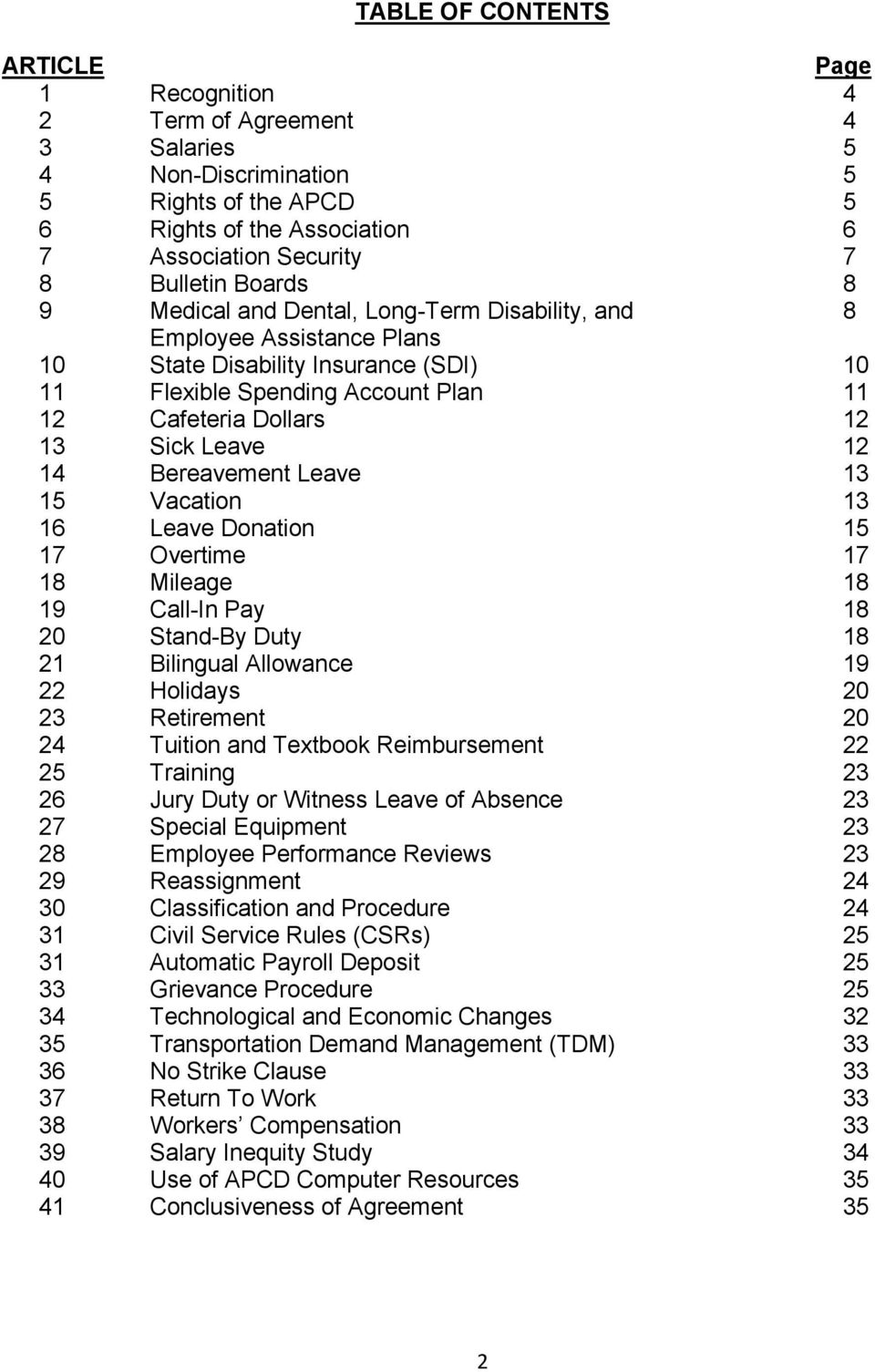
2 TABLE OF CONTENTS ARTICLE Page 1 Recognition 4 2 Term of Agreement 4 3 Salaries 5 4 Non-Discrimination 5 5 Rights of the APCD 5 6 Rights of the Association 6 7 Association Security 7 8 Bulletin Boards 8 9 Medical and Dental, Long-Term Disability, and 8 Employee Assistance Plans 10 State Disability Insurance (SDI) Flexible Spending Account Plan Cafeteria Dollars Sick Leave Bereavement Leave Vacation Leave Donation Overtime Mileage Call-In Pay Stand-By Duty Bilingual Allowance Holidays Retirement Tuition and Textbook Reimbursement Training Jury Duty or Witness Leave of Absence Special Equipment Employee Performance Reviews Reassignment Classification and Procedure Civil Service Rules (CSRs) Automatic Payroll Deposit Grievance Procedure Technological and Economic Changes Transportation Demand Management (TDM) No Strike Clause Return To Work Workers Compensation Salary Inequity Study Use of APCD Computer Resources Conclusiveness of Agreement 35 2
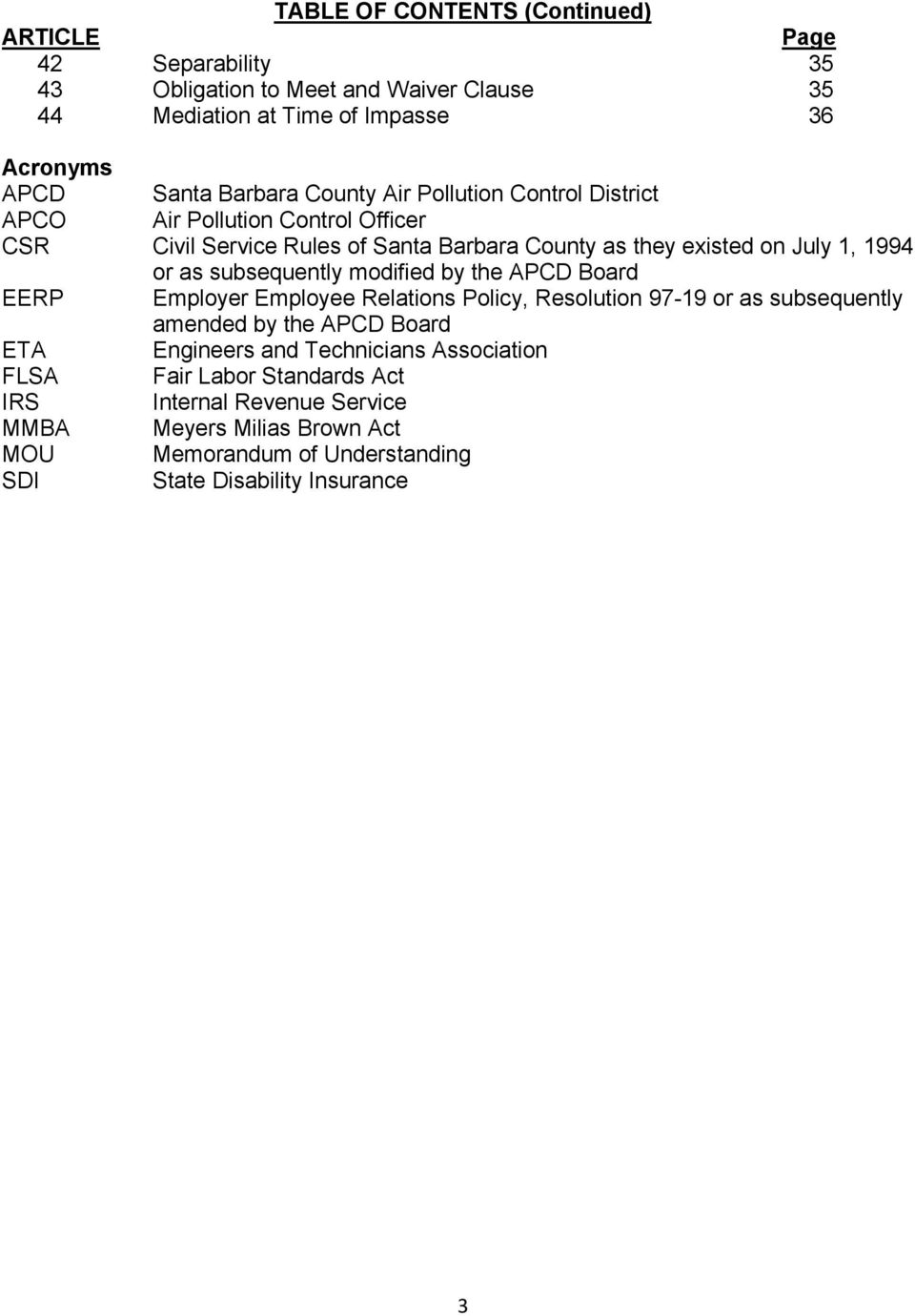
3 TABLE OF CONTENTS (Continued) ARTICLE Page 42 Separability Obligation to Meet and Waiver Clause Mediation at Time of Impasse 36 Acronyms APCD Santa Barbara County Air Pollution Control District APCO Air Pollution Control Officer CSR Civil Service Rules of Santa Barbara County as they existed on July 1, 1994 or as subsequently modified by the APCD Board EERP Employer Employee Relations Policy, Resolution or as subsequently amended by the APCD Board ETA Engineers and Technicians Association FLSA Fair Labor Standards Act IRS Internal Revenue Service MMBA Meyers Milias Brown Act MOU Memorandum of Understanding SDI State Disability Insurance 3
4 Memorandum of Understanding Between Santa Barbara County Air Pollution Control District and Engineers and Technicians Association Pursuant to the provisions of Government Code Sections and Santa Barbara County Air Pollution Control District Employer Employee Relations Policy, Resolution 99-9 (EERP), agreement has been reached between the Santa Barbara Air Pollution Control District of Santa Barbara (hereinafter referred to as APCD ) and the Engineers and Technicians Association (hereinafter referred to as ETA ). It is the general purpose of this Memorandum of Understanding to promote the mutual interest of the APCD and its employees and to establish rates of pay, and certain other terms and conditions of employment. Article 1 Recognition A. Pursuant to the provisions of the EERP and applicable State law, the APCD hereby recognizes the Engineers and Technicians Association as the certified majority representative of the employees in the following representation units 28 Engineers and Technicians Non-Supervisory The term employee or employees as used herein shall refer only to employees employed by the APCD (excluding temporary or extra help) as well as such classes of employees as may be added hereafter throughout the provisions of the EERP or applicable State law. Classes of employees represented by ETA are: Air Quality Engineer I, II, III, Air Quality Specialist I, II, III, Public Information and Education Specialist, Emissions Inventory Planning Specialist I, II, III, Air Pollution Inspection Specialist I, II, III, Principal Inspection Specialist, Monitoring Specialist I, II, III and any other classifications assigned to this unit pursuant to Board action. B. ETA agrees to provide the APCO, or his/her designee, with a list of ETA officers and representatives who are authorized to meet and confer in good faith. ETA shall also provide the above official with a list of all authorized staff representatives. In addition, ETA shall provide a list of council representatives who can post materials on behalf of ETA. These lists shall be kept current by ETA. Article 2 Term of Agreement The APCD and ETA agree that this MOU shall not be binding upon the parties either in whole, or in part, unless and until ratified by ETA members and formally approved by a 4
5 majority vote of the APCD Board. This MOU, as amended on August 18, 2011, shall remain in full force and effect to and including June 24, This contract supersedes and replaces all provisions contained in any previous MOU between the APCD and the ETA. Either party may serve written notice to meet and confer concerning possible changes in the provisions of this agreement. Such notice shall be submitted in writing at least sixty (60) days prior to the termination date of the agreement. It is the intent of the parties to conduct negotiations in such a manner as to reach a new agreement on or before the termination date of this agreement. If either party timely serves notice to meet and confer, the first negotiating session shall not commence earlier than one hundred fifty (150) days nor less than sixty (60) days prior to the last Board hearing before termination date of this agreement, unless the parties mutually agree otherwise. The initial meeting shall be held within two weeks of the request to meet and confer. The responding party will to the best of its ability provide its own proposals by the third meeting. Article 3 Salaries Effective August 20, 2011, the base salaries of all position classifications represented by ETA and for each incumbent in said positions shall not be increased by an amount equivalent to the change in the California Consumer Price Index (CPI) for all urban consumers for the year ending April 2011, over the base salaries in effect on the preceding day. Article 4 Non-Discrimination The provisions of this MOU shall be applied equally to all employees covered hereby without discrimination because of race, color, sex, age and marital status (except as provided by law), disability, national origin, religious affiliation, or ETA membership or nonmembership. Article 5 Rights of the APCD A. The APCD retains, among other management rights, the exclusive right to determine the methods, means, and personnel by which APCD operations are to be conducted, as well as to exercise complete control and discretion over its organization, operations, and technology of performing its work; to determine the mission, function and necessity of APCD divisions, boards and councils and to take all necessary actions to carry out their mission, functions and necessity, or any part thereof, as well as set standards of service to the public. B. The APCD also retains the sole right to administer the Civil Service system, to classify or reclassify positions, add or delete positions or classes to or from the Classification and Salary Plan; to establish standards for employment, promotion, and transfer of employees; to direct its employees, establish rules and regulations, take disciplinary action for proper cause, to establish work 5

6 schedules and work assignments, contract out work, transfer work out of the unit, and to relieve its employees from duty for lack of work or other legitimate reasons. The APCD retains the right to be the sole judge, subject to applicable Civil Service Rules and Procedures, of the qualification and competence of its officers and employees. C. Before implementing any decision to contract out work or to transfer work out of the unit, the APCD shall notify ETA and upon request, negotiate the impact of such decision on employees terms and conditions of employment, to the extent such terms and conditions are within the scope of representation. D. If ETA requests to negotiate a decision to contract out work or transfer work out of the unit, the subjects of bargaining shall include: the reasons, the expected financial impact, the anticipated impact on the quality of services provided, and the comparative costs of contractor versus employee, including the impact on APCD overhead. E. If the decision to contract out services would result in an employee being subject to layoff, the contract shall not be implemented any earlier than thirty (30) days notice to ETA, unless the parties mutually agree. F. The APCD reserves the right to take whatever action may be necessary in an emergency situation; however, a recognized employee organization affected by the action shall be notified promptly of any such emergency action which affects matters within the scope of representation. G. This section is not intended to restrict consultation with employees or employee representatives about the practical consequences that decisions on these matters may have on wages, hours, and other terms and conditions of employment. Article 6 Rights of the Association A. Employees of the APCD shall have the right to form, join, and participate in the activities of employee organizations of their own choosing for the purpose of representation on all matters of employee relations. Employees shall also have the right to represent themselves individually in their employment relations with the APCD. No employee shall be interfered with, intimidated, restrained, coerced, or discriminated against because of his/her exercise of these rights. B. Management employees shall not represent non-management employees on matters within the scope of representation. C. Confidential employees shall not represent non-confidential employees on matters within the scope of representation. 6

7 D. Supervisory employees shall not represent non-supervisory employees on matters within the scope of representation. Article 7 Association Security A. Dues and insurance premiums will be deducted from employees in the abovementioned representation unit who have authorized said dues deductions and insurance premiums in writing on forms prescribed by APCD. The APCD will transmit such deductions to ETA. B. APCD will ensure that payroll/dues deductions from employees represented by ETA shall be changed quarterly upon written authorization from ETA, when authorized in advance by the employee. APCD will ensure that payroll deductions for ETA insurance and benefit programs shall be changed upon written authorization from ETA, when authorized in advance by the employee. C. ETA agrees to indemnify, defend, and hold the APCD harmless against any claims made of any nature and against any suit instituted against the APCD arising from its check off for the dues, insurance, or benefit programs of ETA, or its failure to do so. D. The ETA paid representative is authorized to visit work stations of ETA officers to obtain signatures on official ETA documents within the provision of the EERP. E. Upon request, the APCD shall, once every quarter, provide mailing labels of unit employee names and addresses at a cost of $25 per year to ETA. F. The APCD agrees that the ETA negotiating team shall consist of no more than three (3) employees. Employees shall not suffer a loss in compensation in accordance with the EERP and State law. G. Upon written request by ETA, the APCD may provide meeting space to be used outside working hours, provided such space is available and ETA receives approval of the APCO and complies with APCD policies. Request for use of facilities will be made in advance to the APCO and will indicate the date, time and general purpose of the meeting(s) and facilities needed. H. The APCD will distribute to each new employee in an ETA represented employee classification a letter, furnished by ETA which reads: The Engineers and Technicians Association has been certified as the majority representative of the representation unit to which your classification belongs. ETA represents you in negotiations with the APCD relative to all matters pertaining to employment conditions and employee-employer relations including, but not limited to wages, work hours, and other terms and conditions of employment. For additional information, or if you wish to join ETA, please write: Engineers and 7

8 Technicians Association, P.O. Box 92259, Santa Barbara, CA I. The APCD will allow a representative member of ETA to make a twenty (20) minute presentation at scheduled departmental group new hire orientation meetings. The APCO, or his/her designee, shall notify ETA in advance of these orientation meetings. Article 8 Bulletin Boards The APCD shall provide designated bulletin board space for use by ETA. The size and location to be determine jointly by management and ETA. All materials to be posted must be non-defamatory in nature, must be approved and signed by an ETA official and shall be used for the following subjects: 1. ETA recreational, social, and related news bulletins; 2. Scheduled ETA meetings; 3. Information concerning ETA elections or the results thereof; 4. Reports of official business of ETA, including reports of committee or the ETA Council. Article 9 Medical and Dental, Long-Term Disability, and Employee Assistance Plans A. The APCD and ETA agree that medical and dental plan(s) shall be made available to employees. B. The APCD and ETA also agree that the availability of a choice between two health and dental plans is preferable to either type alone. C. The District shall maintain a committee to review and make recommendations to management on benefits for District employees. ETA shall be allowed to have one representative as a member of this committee. D. The District and the ETA agree to explore and discuss alternate medical plans outside of the traditional HMO and PPO type plans. It is further agreed that in the event an alternate plan is evaluated and found to be beneficial to District employees, the APCD shall be allowed to implement this plan in place of the plan with the lowest enrollment. This provision shall not be construed to waive the District s obligation to meet and confer on this item. E. In the event premiums for either plan increase in excess of 10% per year, the District may choose to make only one type of plan available for medical and one type of plan for dental. 8
9 F. The District shall continue to provide employees with an Employee Assistance Program. This program shall be paid for by the District. G. The District shall continue to provide employees with a Long Term Disability (LTD) Program. This program shall be paid for by the District. H. The APCD shall continue to contribute up to $ biweekly toward the cost of the biweekly premium for employee-only medical plan coverage. The APCD shall continue to contribute up to $9.79 biweekly toward the cost of the biweekly premium for employee-only dental plan coverage. These contributions are based on full-time employment; part-time employees shall receive a prorated contribution based on their percentage of full-time employment status. Insurance plan premiums that exceed the APCD s biweekly contribution shall be paid by the employee through payroll deductions. I. Employees may insure their eligible dependents under medical and dental plans in accordance with the rules and regulations applicable to obtaining said dependent coverage. J. If two regular District employees are married to each other and are both eligible for contributions from the District toward employee only medical dental coverage, they may consolidate the District s contributions toward the premium cost for employee plus two or more dependents coverage held by one of the employees. In this situation, one employee (referred to below as the spouse ) becomes a dependent on the other employee s (referred to below as the primary employee ) medical and dental coverage. In order to be eligible under this provision, all of the following conditions must be met: Both employees are covered by the same medical and dental plan; The spouse is insured as a dependent on the primary employee s medical and dental plan insurance; The spouse has waived employee-only coverage; Both employees have authorized the consolidation of contributions on a form prescribed by the District; In the case of domestic partnerships, the employee must also be so registered with a domestic partner registry maintained by a California city, county, the State of California, or a public jurisdiction in another state provided the affected employee(s) sign the Santa Barbara County Air Pollution Control District s Declaration of Domestic Partnership form. Employees registering as domestic partners shall be responsible for all tax consequences of this benefit. The amount of the consolidated contributions shall be that amount which would otherwise be contributed by the District toward the employee s and the spouse s employee-only premiums for the respective medical and dental plans. 9

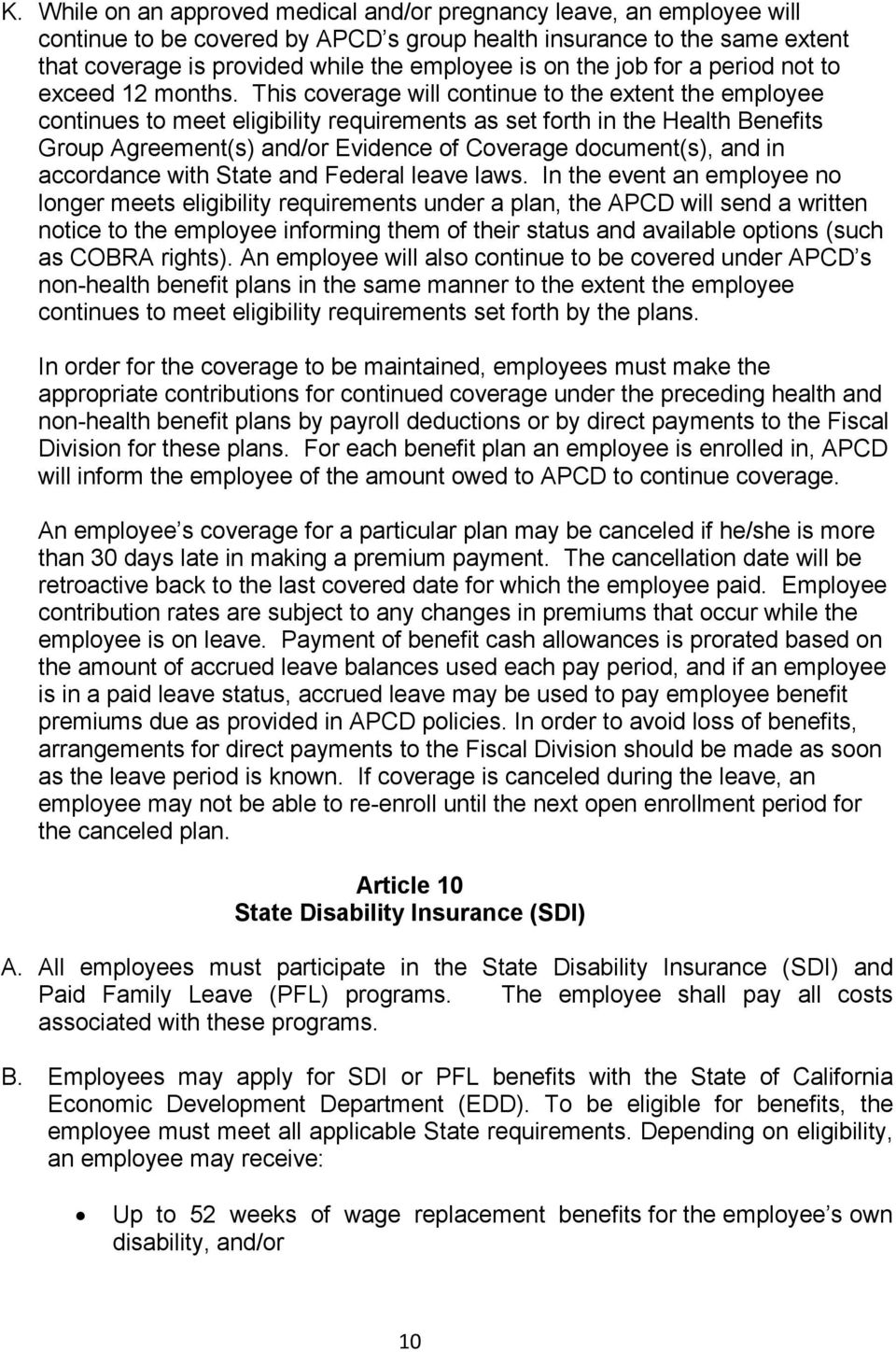
10 K. While on an approved medical and/or pregnancy leave, an employee will continue to be covered by APCD s group health insurance to the same extent that coverage is provided while the employee is on the job for a period not to exceed 12 months. This coverage will continue to the extent the employee continues to meet eligibility requirements as set forth in the Health Benefits Group Agreement(s) and/or Evidence of Coverage document(s), and in accordance with State and Federal leave laws. In the event an employee no longer meets eligibility requirements under a plan, the APCD will send a written notice to the employee informing them of their status and available options (such as COBRA rights). An employee will also continue to be covered under APCD s non-health benefit plans in the same manner to the extent the employee continues to meet eligibility requirements set forth by the plans. In order for the coverage to be maintained, employees must make the appropriate contributions for continued coverage under the preceding health and non-health benefit plans by payroll deductions or by direct payments to the Fiscal Division for these plans. For each benefit plan an employee is enrolled in, APCD will inform the employee of the amount owed to APCD to continue coverage. An employee s coverage for a particular plan may be canceled if he/she is more than 30 days late in making a premium payment. The cancellation date will be retroactive back to the last covered date for which the employee paid. Employee contribution rates are subject to any changes in premiums that occur while the employee is on leave. Payment of benefit cash allowances is prorated based on the amount of accrued leave balances used each pay period, and if an employee is in a paid leave status, accrued leave may be used to pay employee benefit premiums due as provided in APCD policies. In order to avoid loss of benefits, arrangements for direct payments to the Fiscal Division should be made as soon as the leave period is known. If coverage is canceled during the leave, an employee may not be able to re-enroll until the next open enrollment period for the canceled plan. Article 10 State Disability Insurance (SDI) A. All employees must participate in the State Disability Insurance (SDI) and Paid Family Leave (PFL) programs. The employee shall pay all costs associated with these programs. B. Employees may apply for SDI or PFL benefits with the State of California Economic Development Department (EDD). To be eligible for benefits, the employee must meet all applicable State requirements. Depending on eligibility, an employee may receive: Up to 52 weeks of wage replacement benefits for the employee s own disability, and/or 10
11 Up to 6 weeks of wage replacement benefits for providing the required care for the serious health condition of a child, parent, spouse, or domestic partner or for bonding with a new child. C. Employees who receive SDI or PFL benefits must integrate available SDI and PFL benefits with available paid sick leave, vacation, a compensatory time. Documentation of the SDI/PFL benefits received must be provided to the fiscal department for this purpose. D. If during the disability period the employee reaches his/her maximum allowable accrual for vacation, then the employee shall be allowed to use up to forty (40) hours of vacation time, prior to the use of sick leave, overtime and/or holiday credits, in order to supplement his/her SDI benefits so that he/she may receive up to 85% of gross salary. Article 11 Flexible Spending Account Plan A. All full and part-time employees in ETA-represented classifications shall be eligible to participate in the APCD sponsored Flexible Spending Account Plan. Said plan shall be administered in compliance with Section 125 of the Internal Revenue Code (IRC). The Flexible Spending Account Plan will include salary reduction options for the following: 1. Pre-Tax Health Insurance Premium(s) for employees and their dependents; 2. Pre-Tax Health Care Spending Account; 3. Pre-Tax Dependent Care Spending Account; 4. Pre-Tax Transportation Spending Account; 5. Pre-Tax Life Insurance Premium(s) (up to $50,000 coverage); 6. Pre-Tax Personal Accident Insurance; 7. Pre-Tax Catastrophic Care Programs. These options are described in detail in the Flexible Spending Plan brochure and in the legal plan document which is available to all employees. Compensation received in accordance with Article 12 (Cafeteria Dollars) may be used by employees to fund the options described above. All salary reduction amounts are included in base salaries for the purpose of computing retirement earnings subject to appropriate Internal Revenue Service regulations. The APCD shall meet and confer with ETA prior to revising the benefit options unless mandated by law to change benefit options. Benefit option changes for ETA will not be implemented without the agreement of ETA. B. Benefits selected under this plan cannot be changed during the plan year except for a change in family status consistent with the benefit change. Enrollment in the plan shall be offered on an annual basis at the beginning of the plan year. New employees may enroll within the first thirty ( 30 ) days of employment. 11

12 Continued operation of the program shall be subject to APCD administrative procedures and Internal Revenue Service regulations. Article 12 Cafeteria Dollars A. The APCD shall continue to contribute $ per pay period (26 pay period year or $4, annually) per employee as cafeteria dollars. Regular part-time employees are eligible for this allowance based on a prorated equivalent of their employment status. The cafeteria dollars, which are received in cash, have a primary purpose of allowing employees to fund employee and dependent health insurance costs. Employees may also use he dollars to fund options in the Flexible Spending Account Plan and/or receive the remainder in cash. B. These dollars will be paid on a biweekly basis to each regular employee based on the prorated number of non-premium, regular, hours paid in a pay period. Employees hired or promoted into a position during the calendar year shall begin earning the appropriate dollars the first full pay period of their appointment. Article 13 Sick Leave A. Each regular full-time or regular part-time employee shall accrue sick leave at the rate of.0463 hours for each hour in a regular pay status excluding overtime, callback and standby duty. B. Unused sick leave shall be cumulative from year to year, with no accrual limit. C. Sick leave usage may not exceed the employee s accrued sick leave balance reported at the end of the prior pay period. D. The APCO or his/her designee, may require evidence in the form of a physician s certificate, or otherwise, of the adequacy of the reason for any employee s absence during the time for which sick leaves was requested. Under no circumstances is sick leave to be used in lieu of, in addition to, or as vacation. A physician s certificate may also be required in order to determine correctness of payroll records. E. When a member of an ETA-represented employee s immediate family is ill or injured and requires his/her presence and attendance, an employee may be allowed by the APCO to use his/her accumulated sick leave to attend such family member. F. Up to a maximum of five days (40 hours) of his/her accumulated sick leave may be allowed by the APCO to an employee for absences from duty because of any and each death in the employee s immediate family. 12

13 G. For the purpose of Section 13E and 13F above, immediate family is defined as spouse, parent, brother, sister, child, stepchild, grandparent, grandchild, and mother-in-law or father-in-law of the employee. Immediate family shall also include registered domestic partners (as defined by AB 205) and domestic partner s children. H. An employee may, when necessary and at the discretion of the APCO, be granted up to two hours leave with pay to make voluntary non-remunerated blood donations to non-profit blood banks in the county. Time off in excess of two hours and up to an additional two hours may be used for this purpose, but such additional time off shall be charged to accumulated sick leave. Leave for the purpose of donating blood shall not exceed five times in any one calendar year. I. No payment shall be made to any employee for unused sick leave accumulated to his/her credit at the time of his/her termination from APCD service. J. Employees who retire from the APCD shall have their accumulated sick leave credit of up to 2,088 hours added to their term of service for purposes of calculating retirement benefits. Article 14 Bereavement Leave A. The District shall authorize up to a maximum of forty-eight hours (48) of paid bereavement leave of absence per calendar year due to the death of an immediate family member(s). B. Authorized bereavement leave under this article shall not be charged against an employee s accrued sick or vacation balances. C. The APCO and/or his designee may require proof of the need for bereavement leave in the form of a published obituary or copy of an official death certificate. D. For the purpose of subsection A above, "immediate family" is defined as spouse, parent, brother, sister, child, stepchild, grandparent, grandchild, and mother-in-law or father-in-law of the employee. Immediate family shall also include domestic partners (as defined by AB 205) and domestic partner s children. Article 15 Vacation A. For each hour in a regular pay status, excluding overtime, call-back, and standby, each regular full-time or regular part-time employee shall accrue vacation based on continuous APCD service as provided in the chart below. 13

14 Continuous APCD Service Hourly Annual Accrual Max Allow. Accrual 0-2 years (0 24 months) 3 4 years (25-48 months) 5 10 years ( months) years ( months) 15+ (169+ months) hrs/hr (96 hours/yr) hrs/hr (128 hours/yr) hrs/hr (152 hours/yr) hrs/hr (176 hours/yr) hrs/hr (200 hours/yr) B. Annual vacation accrual may accumulate up to the Maximum Allowable Accrual provided for in chart 15A above. C. An employee absent due to a work-related injury, receiving Workers Compensation Temporary Disability and unable to take vacation may accrue vacation up to the Maximum Allowable Accrual. D. Employees who have taken at least 40 hours of vacation within the last 12 months may once during each calendar year and with the approval of the APCO request pay for up to forty hours of accrued vacation in lieu of vacation time off. Such vacation conversion shall be based on the employee s hourly rate in effect at the time of payment. Vacation conversion shall not be allowed if it would reduce an employee s vacation balance to below forty hours. E. No payment in lieu of accrued vacation shall be made to any employee except upon termination of employment or as provided for in Section 15D. Terminating employees shall be paid for accumulated vacation as of the date of termination. F. An employee is not entitled to utilize vacation credits or accrual unless or until they have been a regular employee for six (6) continuous months. A person falling to complete such service shall receive payment for vacation accrual. G. Vacation shall not include any regular holidays taken during a vacation period. H. Vacation shall be taken at the time designated by the APCO or his/her designee. A reasonable effort shall be made to allow vacations to be taken at a time convenient to the employee, so long as such use is consistent with the needs of the service and work load of the APCD. I. In the event vacation usage is denied by the APCO or his/her designee due to unusual workloads and the employee has reached his or her maximum allowable accrual limit the maximum allowable accrual limit shall be temporarily increased by 80- hours. Once vacation usage is approved the employee shall have twelve (12) twelve months in which to use any excess time accrued. If the agency is unable to accommodate scheduling such excess vacation time off within twelve (12) months, the employee shall be paid for the excess vacation time in the pay period immediately following the twelve (12) month period. J. Vacation usage may not exceed the accrued vacation balance reported at the end of the prior pay period. 14
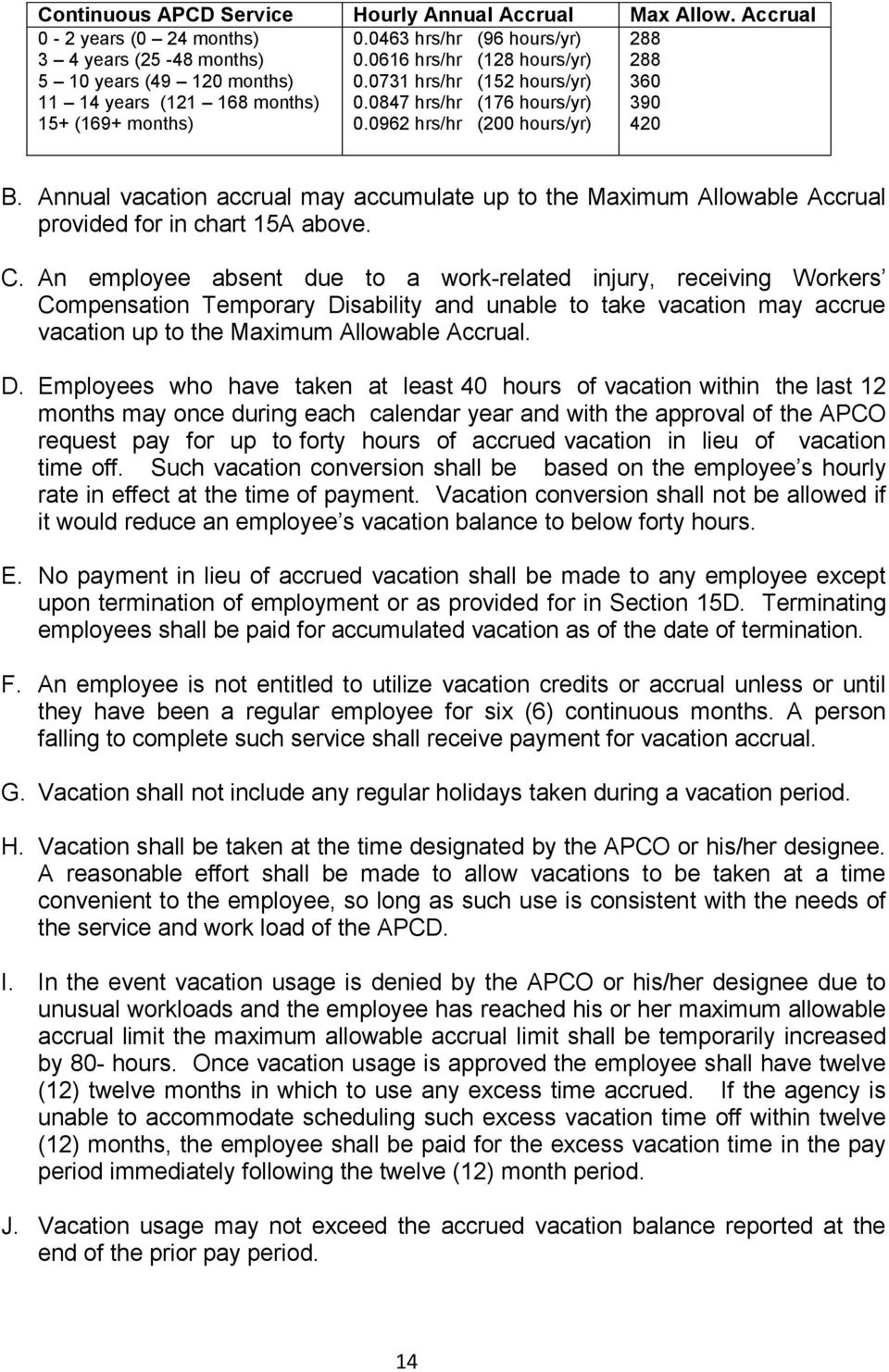
15 K. Effective October 3, 2011 all regular employees, including probationary employees, in a paid status shall have twenty-four (24) hours of vacation credited to their vacation accounts subject to Section B above. Regular part-time employees shall receive a prorated equivalent. Article 16 Leave Donation The purpose of this program is to provide a mechanism for assisting employees who have exhausted paid leave due to their own serious or catastrophic illness or injury or a serious or catastrophic injury or illness of their spouse, child, parent, domestic partner or domestic partner s child; or for bonding with a new child in connection with a birth, adoption, or foster care placement of that child.. This provision allows a regular APCD employee to donate the monetary value of accrued vacation, holiday or overtime hours to a specific employee who has exhausted his/her own available leave balances. Serious or catastrophic illness or injury is defined as an adverse medical condition which requires the employee to be absent from work for more than twenty (20) consecutive work days. A. To receive leave donations, an employee: Must be absent from work due to his/her own single illness or injury or the serious or catastrophic injury or illness or his/her spouse, child or parent for more than twenty consecutive work days (as verified by a physician s statement) or be absent from work to bond with a new child within the first year of birth or in connection with an adoption or foster care placement of a child; and Must have exhausted all earned leave balances (including sick leave, vacation, overtime and holiday credits); except however, the APCO may approve the solicitation/acceptance of leave donations prior to all balances being exhausted, when the physician s statement and leave balances indicate the probable exhaustion of balances within two pay periods. Must apply, or have applied, for State Disability Insurance (SDI) or Paid Family Leave benefits (PFL). Denial of SDI or PFL benefits by the Employment Development Department will not disqualify an employee from participating in this program. B. Donated leave shall be changed to its cash value at the donor s base rate of pay and then credited to the recipient in equivalent hours of vacation at the recipient s base rate of pay. C. Donations: Are voluntary; 15

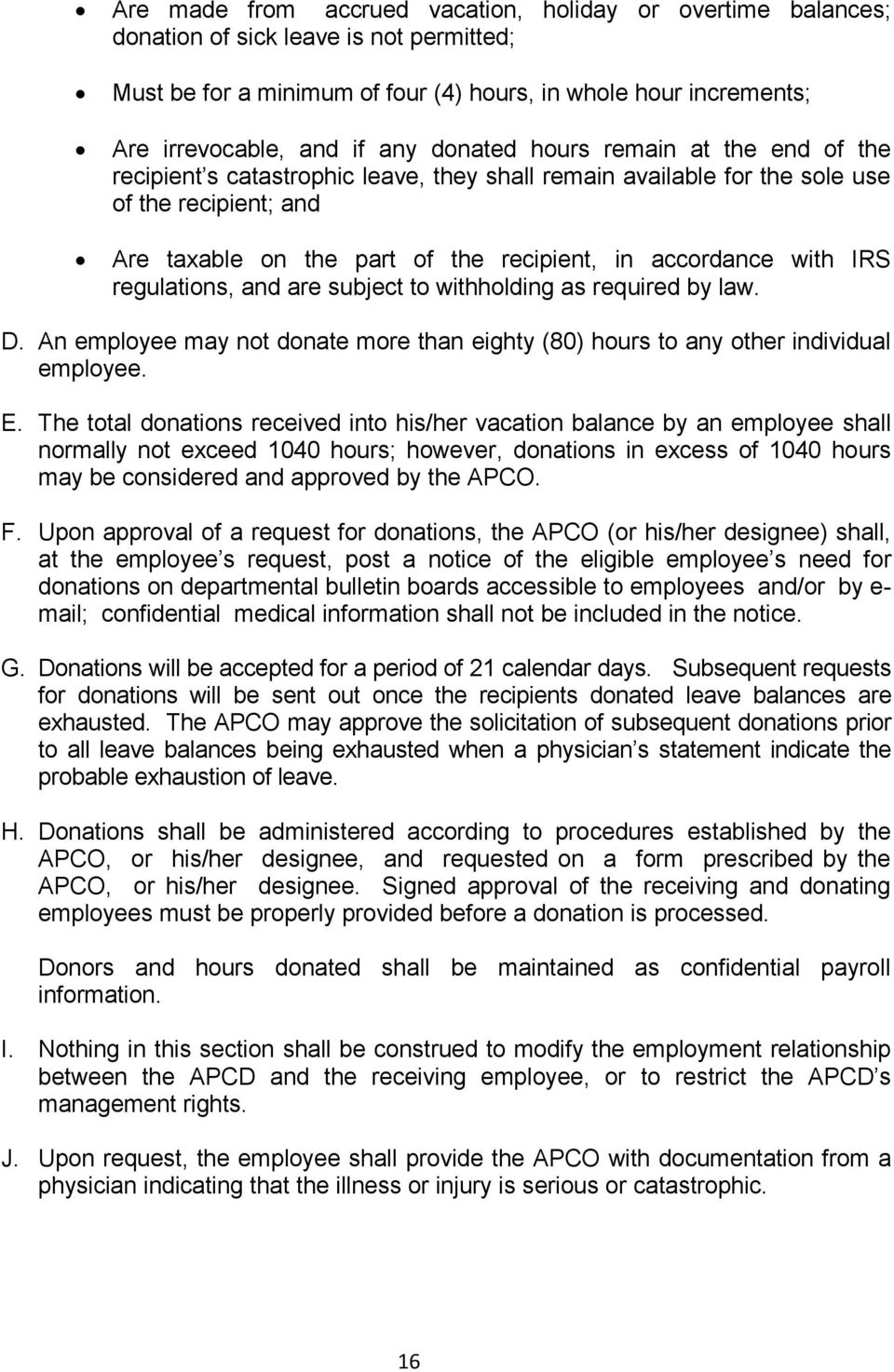
16 Are made from accrued vacation, holiday or overtime balances; donation of sick leave is not permitted; Must be for a minimum of four (4) hours, in whole hour increments; Are irrevocable, and if any donated hours remain at the end of the recipient s catastrophic leave, they shall remain available for the sole use of the recipient; and Are taxable on the part of the recipient, in accordance with IRS regulations, and are subject to withholding as required by law. D. An employee may not donate more than eighty (80) hours to any other individual employee. E. The total donations received into his/her vacation balance by an employee shall normally not exceed 1040 hours; however, donations in excess of 1040 hours may be considered and approved by the APCO. F. Upon approval of a request for donations, the APCO (or his/her designee) shall, at the employee s request, post a notice of the eligible employee s need for donations on departmental bulletin boards accessible to employees and/or by e- mail; confidential medical information shall not be included in the notice. G. Donations will be accepted for a period of 21 calendar days. Subsequent requests for donations will be sent out once the recipients donated leave balances are exhausted. The APCO may approve the solicitation of subsequent donations prior to all leave balances being exhausted when a physician s statement indicate the probable exhaustion of leave. H. Donations shall be administered according to procedures established by the APCO, or his/her designee, and requested on a form prescribed by the APCO, or his/her designee. Signed approval of the receiving and donating employees must be properly provided before a donation is processed. Donors and hours donated shall be maintained as confidential payroll information. I. Nothing in this section shall be construed to modify the employment relationship between the APCD and the receiving employee, or to restrict the APCD s management rights. J. Upon request, the employee shall provide the APCO with documentation from a physician indicating that the illness or injury is serious or catastrophic. 16
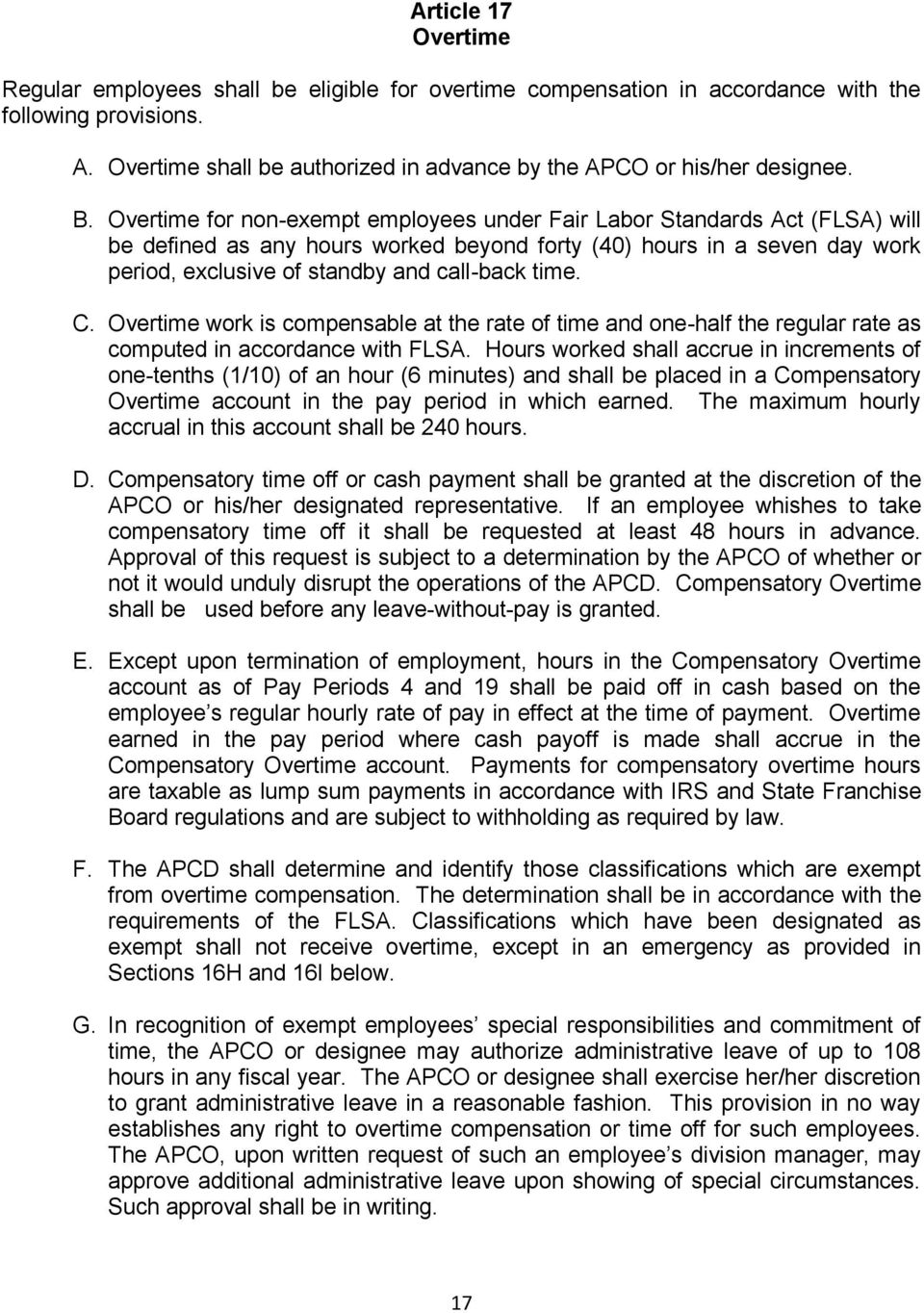
17 Article 17 Overtime Regular employees shall be eligible for overtime compensation in accordance with the following provisions. A. Overtime shall be authorized in advance by the APCO or his/her designee. B. Overtime for non-exempt employees under Fair Labor Standards Act (FLSA) will be defined as any hours worked beyond forty (40) hours in a seven day work period, exclusive of standby and call-back time. C. Overtime work is compensable at the rate of time and one-half the regular rate as computed in accordance with FLSA. Hours worked shall accrue in increments of one-tenths (1/10) of an hour (6 minutes) and shall be placed in a Compensatory Overtime account in the pay period in which earned. The maximum hourly accrual in this account shall be 240 hours. D. Compensatory time off or cash payment shall be granted at the discretion of the APCO or his/her designated representative. If an employee whishes to take compensatory time off it shall be requested at least 48 hours in advance. Approval of this request is subject to a determination by the APCO of whether or not it would unduly disrupt the operations of the APCD. Compensatory Overtime shall be used before any leave-without-pay is granted. E. Except upon termination of employment, hours in the Compensatory Overtime account as of Pay Periods 4 and 19 shall be paid off in cash based on the employee s regular hourly rate of pay in effect at the time of payment. Overtime earned in the pay period where cash payoff is made shall accrue in the Compensatory Overtime account. Payments for compensatory overtime hours are taxable as lump sum payments in accordance with IRS and State Franchise Board regulations and are subject to withholding as required by law. F. The APCD shall determine and identify those classifications which are exempt from overtime compensation. The determination shall be in accordance with the requirements of the FLSA. Classifications which have been designated as exempt shall not receive overtime, except in an emergency as provided in Sections 16H and 16I below. G. In recognition of exempt employees special responsibilities and commitment of time, the APCO or designee may authorize administrative leave of up to 108 hours in any fiscal year. The APCO or designee shall exercise her/her discretion to grant administrative leave in a reasonable fashion. This provision in no way establishes any right to overtime compensation or time off for such employees. The APCO, upon written request of such an employee s division manager, may approve additional administrative leave upon showing of special circumstances. Such approval shall be in writing. 17
18 H. Regular employees in classifications exempt from overtime compensation and therefore not otherwise eligible for overtime pursuant to this agreement shall be paid for overtime worked during an emergency as follows: 1. No overtime compensation shall be paid for overtime work during an emergency for the first twelve (12) hours of such emergency overtime work; 2. Overtime compensation shall be paid at straight time for the second twelve (12) hours of emergency overtime work; and 3. Overtime compensation shall be paid at the rate of time and one-half for all hours of overtime worked in excess of twenty-four (24) hours during any such emergency. I. Emergency for the purposes of Section 17H of this MOU shall mean an emergency in the County of Santa Barbara, duly declared in writing by the Santa Barbara County Board of Supervisors, by the County Administrator or Deputy County Administrator, by other jurisdictions in the State of California (including the cities within Santa Barbara County), when the emergency is approved in writing by the APCO as an emergency that requires APCD staff participation. J. Overtime eligible part-time employees, who work beyond their regularly schedules work hours but less than the maximum allowable in their work period, shall be paid at straight time. Article 18 Mileage Employees who, when authorized by the APCO or designee, use their personal vehicle for APCD business shall be reimbursed for each mile driven on APCD business. Said reimbursement shall be at the amount per mile exempted by the IRS for reporting of income. Article 19 Call-In Pay An employee who is eligible to receive overtime pay, but who is not assigned to or restricted by Stand-By Duty per Article 20 of this MOU, shall receive a minimum credit of two hours of work time if the employee reports to a job site in response to a call from the supervisor or other authorized official. Such employee shall not be considered to be in a stand-by status or eligible for stand-by pay. Article 20 Stand-By Duty Employees assigned to stand-by duty by the APCO shall be compensated and governed by the following: A. Stand-by duty requires that employee so assigned: 18
19 1. Be ready and take steps immediately to respond with a reasonable time to calls for their services; 2. Be available by telephone or paging device; 3. Remain within a specified distance or time from their work stations, and; 4. Refrain from activities which might impair their ability to perform their assigned duties. B. Compensation shall be at the rate of $2.00 per hour for each hour on such standby duty and shall be paid at the same time as scheduled for the pay period in which the stand-by duty was performed. C. Stand-by pay, when properly authorized, shall be paid for a minimum of one hour. D. Employees other than those exempted from overtime compensation shall, when called to active duty while on stand-by duty status, be compensation for such active duty at the applicable overtime rate. Work time for an employee called to active duty while on stand-by status shall begin at the time of notification to report to a job site and shall continue until the employee stops work. A minimum of one hour at the appropriate rate shall be paid in those cases when an employee on stand-by status is required to report to a job site, but the minimum shall not apply for work performed at another location. E. No employee or other qualified person shall be paid for stand-by duty time and other compensable duty time simultaneously. F. An employee who is required to us an assigned vehicle in order to respond to call back duty shall be allowed to take an appropriately equipped APCD vehicle home for those periods of time that he/she is assigned to stand-by duty. G. Employees assigned to stand-by-duty on a weekend or designated APCD holiday shall receive stand by pay for the entire period of time he/she is assigned to such stand-by-duty. Weekend and holiday assignments of this type shall be continuous (i.e. 24 hours). Article 21 Bilingual Allowance A. Employees whose duty assignments require regular and frequent use of bilingual language skills in Spanish and English shall be designated by the APCO to receive a bilingual allowance. The APCO shall designate the employee in writing prior to the allowance being effective. The employee shall retain such bilingual designation only until a change in assignments is reported in writing by the APCO to the Human Resources Officer. 19
20 B. Additional compensation for bilingual duties is payable as an allowance and not as part of basic salary, but shall be payable at the same time as a regular compensation. When a full-time employee is assigned by the APCO to duties requiring regular and frequent use of bilingual language skills he/she shall receive an allowance of $25.38 per pay period. When a part-time employee is assigned to bilingual duties, the bilingual allowance shall be prorated and paid on the same basis that the part-time position is filled and compensated. C. As used in Section 21A above, the phrase regular and frequent means at least once each working day, or at least five times each work week. Payment for the bilingual language skill is restricted to the actual needs of the position. An employee s ability to read, write, or speak Spanish, occasional or incidental use of language skills in Spanish or the use of bilingual language skills other than for the purpose of meeting the requirements of the job shall not warrant a bilingual allowance. Article 22 Holidays A. Holidays regularly observed by the APCD for employees represented by this agreement are: New Year s Day, January 1 Martin Luther King Jr. s Birthday, 3 rd Monday in January President s Day, 3 rd Monday in February Cesar Chavez Day, March 31 Memorial Day, last Monday in May Independence Day, July 4 Labor Day, 1 st Monday in September Veteran s Day, November 11 Thanksgiving Day, 4 th Thursday in November Thanksgiving Day Friday, 4 th Friday in November Christmas Day, December 25 Floating Holiday (see Section 22B below) B. All regular employees, including probationary employees, in a paid status (including paid leave) for any portion of pay period one (pp 1) each year, shall be credited with eight (8) hours holiday leave. Said leave shall accrue to the employee s vacation bank. Regular part-time employees shall receive a prorated equivalent. The floating holiday credit may be used in the same pay period in which it is accrued, subject to Section 22 E below. C. All regular employees, including probationary employees, shall receive December 23, 2011 off as a one-time holiday. D. All regular employees, including probationary employees, shall receive December 30, 2011 off as a one-time holiday. 20

21 E. Holiday leave shall be subject to the approval and/or taken at the direction of the APCO or designee. F. Each APCD holiday which falls on Saturday shall be observed on the preceding Friday; and, in this event, the Saturday shall not be considered as a holiday for purposes of compensation and/or time off. Each APCD holiday which falls on Sunday shall be observed on the following Monday; and, in this event, the Sunday shall not be considered as a holiday for purposes of compensation and/or time off. G. Regular employees leaving APCD service shall be paid all compensatory holiday time which has accrued but has not been otherwise compensated. H. In the following sections, reference to eight (8) hours shall apply to regular fulltime employees and in the case of regular part-time employee the eight (8) hours shall be a prorated equivalent based on employment status (full time, ¾ time, ½ time). I. When a holiday falls on an employee s regularly scheduled work day, the employee shall be paid eight (8) hours cash payment for the holiday. J. When a holiday falls on an employee s regularly schedules day off, the employee shall accrue eight (8) hours of compensatory holiday time. Said leave shall accrue to the employee s vacation bank. K. When an employee who is overtime exempt is required to work on a holiday which falls on the employee s regularly scheduled work day, the employee shall accrue the compensatory holiday time (said time shall accrue to the employees vacation bank). L. When an employee who is eligible for overtime is required to work on a holiday, the employee shall, in addition to eight (8) hours regular cash payment for the holiday, accrue compensatory holiday time (said time shall accrue to the employees vacation bank) at straight time and cash payment at one half time for all hours worked up to eight (8) hours. M. Holiday compensation shall be paid for a portion of a pay period as follows: 1. Any regular employee who is absent-without-pay on a scheduled workday immediately preceding a holiday shall not have compensation reduced by reason of absence on the said holiday. 2. Any regular employee who is absent-without-pay on a scheduled workday immediately following a holiday shall not have compensation reduced by reason of absence on said regular holiday. 21
22 3. Any regular employee who is absent-without-pay on a scheduled workday preceding and following a holiday shall be deemed to have been absentwithout-pay on said holiday and shall not be compensated for said holiday. N. Notwithstanding of Section 22M, neither the first day of employment nor the last day of employment may be a holiday. Article 23 Retirement A. The APCD offers the following retirement plans: 1. Employees Hired Before July 1, 1995 Contributory Retirement Plan (APCD Plan I) 2. Employees Hired On or After July 1, 1995 Contributory Retirement Plan (APCD Plan II) B. The APCD may adjust the employee contribution rates to the Contributory Retirement Plans when such adjustments are based on an Actuarial Report, recommended by the Retirement Board and approved by the Board of Supervisors. Prior to implementing employee contribution rate adjustments, the APCD shall give notice and upon request provide an opportunity to meet. The purpose of the meeting will be to discuss the implementation of the contribution rate changes. The effective date of the rate adjustments shall be in accordance with the applicable provisions of the County Employees Retirement Law of C. The APCD shall deduct employee contributions toward retirement from employee salaries on a pre-tax basis. D. During the term of this agreement, either party may reopen negotiations in the event of proposed changes to the retirement system plans or benefits affecting retirees, current and future employees. The scope of these re-opener negotiations will be limited solely to changes that occur to the retirement system plans or benefits. Article 24 Tuition and Textbook Reimbursement A. To the extent funding is available, the APCD shall provide for tuition and textbook reimbursement for regular full-time employees up to a maximum of $500 per fiscal year and in accordance with existing administrative regulations governing this program. Tuition reimbursement for regular part-time employees shall be prorated based on their part-time percentage. B. Effective June 30, 2008 employees may accrue unused tuition reimbursement for a maximum of three years for use in a single year. The maximum that may be accrued over a three year period shall not exceed $
23 Article 25 Training When written requests for training have been submitted, such requests shall be approved or denied promptly (within 10 working days of submission). If denied, the reason(s) for the denial shall also be provided in writing. Any denial of written training requests may be appealed to the Human Resources Officer who, within 10 working days, shall respond to the appeal. Training required by an employee s supervisor, manager or the APCO for groups of employees (such as training to implement rule changes and customer service) is additional to the training discussed above. Article 26 Jury Duty or Witness Leave-of-Absence A leave of absence with pay not chargeable to sick leave or vacation shall be granted to an employee who serves on a jury or who is subpoenaed as a non-party witness for a civil or criminal proceeding in a court or administrative tribunal. All fees and perquisites collected by any officer or employee as a juror or a non-party witness shall be paid into the APCD Treasury in accordance with the procedures established by the APCD. Article 27 Special Equipment A. The APCD agrees that if employees are required by APCD to purchase special equipment that the cost of such equipment shall be paid for by the APCD. Any equipment purchased by the APCD shall be retained as APCD property. B. The District shall provide, at no cost, approved uniforms (e.g., fire retardant garments), and laundry service for said uniforms for each employee required by the District to wear a uniform. ETA agrees the District has the right to set up reasonable procedures and rules needed to cover details such as: participation, selection, ordering, delivery, cleaning, replacement of defective or damaged goods, return at termination, etc. C. Inspectors and source test engineers required to wear fire retardant garments shall each be provided two (2) jackets and two (2) pairs of coveralls. D. Appropriate personal protective equipment shall also be provided by the District. Article 28 Employee Performance Reviews A. Employees shall be given an opportunity to read and sign their Professional Development Plan and/or their Employee Performance Evaluation (Short Form) prior to placement of the evaluation in the employee s official personnel files. It is acknowledged that the fact the employee has signed either evaluation plan does 23
24 not necessarily mean the employee agrees with the evaluation. Such signature shall be evidence of the employee s knowledge of the completed evaluation. B. The employee's supervisor shall complete the Professional Development Plan or Short Form no later than the end of the pay period following the regular employee's anniversary date or the scheduled date of a special evaluation. If a special evaluation has been scheduled, the Professional Development Plan is the tool utilized. The time period may be extended if the supervisor or the employee is not available or an emergency situation exists. C. Refusal to sign a Professional Development Plan or Short Form shall not be considered insubordination. D. The employee shall receive a copy of the signed evaluation within thirty (30) working days of the date of the evaluation. A Professional Development Plan or Short Form may not be utilized by the APCD to affect an employee s job status unless and until the employee has been given an opportunity to review such evaluation. E. An employee shall have the right to respond in writing to any Professional Development Plan or Short Form. Such response shall be brief and to the point and is to be filed with the employee s evaluation. Article 29 Reassignment A. An employee who wishes to be considered for reassignment within the same classification from one program or division to another program or division shall make a written request for such reassignment to the APCO or his/her designee. The APCO will acknowledge receipt of the request and will maintain the request for a period of one (1) year. Before any bargaining unit member is moved permanently from one location to another, the APCD shall provide the following notice: 1. Change in work site five (5) working days notice 2. Change in work station (3) working days notice B. In addition, the supervisor of the work area shall discuss the impact of the move with the affected employee(s). Article 30 Classification and Procedure A. The parties reaffirm that the APCO or designee retains the sole responsibility and authority for the classification of the various positions in the APCD service. 24
25 B. It is the intention of the parties that this section is included only to inform employees of established process and procedures to follow when requesting a classification study on their own behalf. C. The request for a reclassification study by an employee who believes his/her position is misclassified must be submitted in writing through his/her Division Manager. Within thirty (30) days, the Division Manager will either return the request to the employee or forward it on to Human Resources for consideration and recommendation to the APCO. If the Division Manager returns the request to the employee, the employee may request that it be submitted to the APCO for consideration without the endorsement of the Division Manager. D. This section is not in any way modifying Section 418 (salary on temporary assignment out of class) of the CSRs. Article 31 Civil Service Rules (CSRs) Prior to implementing any modification(s) to the CSRs, the APCD shall notify ETA of any such change(s) and provide an opportunity to meet and confer. Any required negotiations regarding the proposed rule change(s) shall be concluded prior to presenting such change(s) to the APCD Board for its determination. Article 32 Automatic Payroll Deposit A. All employees covered by this agreement shall participate in the APCD s automatic payroll deposit program. Participation shall mean the employee s execution of a payroll authorization form and submission of a bank deposit slip to the APCD. It shall be the employee s choice as to which bank he/she designates as the institution receiving the payroll funds. B. When both the authorization form and bank deposit are properly executed and filed, the APCD shall automatically deposit in the employee s designated bank account the net amount of pay each designated biweekly payday. Article 33 Grievance Procedure A. Purpose 1. To promote improved employer-employee relations by establishing grievance procedures on certain matters for which an appeal, hearing, or process is not provided by other existing regulations. 2. To provide that grievances shall be heard and settled as informally as possible. 25
26 3. To enable grievances to be settled as promptly and as closely as possible to the point of origin. 4. To afford employees, individually or through qualified representation, a systematic means of obtaining consideration of complaints and disputes which constitute grievances as hereinafter defined. 5. The ETA agrees to encourage an employee to discuss his/her grievance with his/her immediate supervisor. The immediate supervisor will, upon request of an employee, discuss the employee s complaint and attempt to adjudicate same at a mutually satisfactory time. B. Grievance, Defined For employees in the representation unit covered by this MOU a grievance shall be defined and processed as indicated below. This definition and procedure shall prevail over any other grievance definition and procedure for employees whose classification is included in the representation units covered by this Memorandum. C. Basic Rules 1. Issues subject to the grievance procedure are those involving an alleged violation, misinterpretation or misapplication of either this MOU or an established APCD policy expressed in rules, regulations, resolutions, ordinances, or a written agreement between the parties; except for those issues that provide their own established resolution procedure such as, but not limited to: Workers Compensation, Occupational Safety and Health Act, Fair Employment and Housing Commission, or any of the management rights currently enumerated in the EERP and the impact or consequences of the exercise of said rights. 2. ETA recognizes management s right to establish policies governing the operation of the APCD. However, allegations also subject to the grievance procedure are those in which the complaint concerns an inconsistent application of policy where the inconsistency results in a denial of the employees rights under those policies defined in B.1. above. 1. The procedure in this section shall be the exclusive means for the disposition of all written grievances arising under this MOU, and the APCD shall not be liable to ETA or to any employee in any respect except as may be determined under said procedure. 2. Any employee (meaning a grievant), as that term is defined above, may file a grievance or may authorize by signature the filing of a grievance on his/her behalf without fear of restraint, interference, coercion, discrimination or reprisal. 26
27 3. ETA Representatives shall not be discriminated against in their employment relationship because of their activity in the investigation and processing of grievances on behalf of other employees. This section shall not be construed to confer any special privileges to ETA Representatives or to relieve them of their obligation to fully perform all of the duties of their APCD position(s) in a timely and competent manner. 4. Formal grievance forms shall be made available to the employee through Human Resources and through ETA, and all formal grievances shall be submitted on these forms. Any changes in the form shall be by mutual agreement. 5. Formal grievance forms shall be complete upon filing and must explicitly specify the policy or the particular section of the agreement, rule, resolution, or ordinance, the violation of which is being alleged as the basis for the grievance. The remedy requested must also be specified. No modifications in the violation being alleged shall be made subsequent to filing unless mutually agreed to by both the APCD and the grievant, or his/her ETA Representative. 6. Both the APCD and the grievant or his/her ETA Representative shall be responsible for giving notice of meetings and conferences at least twentyfour (24) hours prior to any Section G meeting regarding a grievance. 7. The employee has the right to the assistance of one ETA employee representative in addition to the ETA staff representative in the preparation and/or presentation of his/her written grievance. An employee is also entitled to represent himself/herself individually at any step of the formal grievance procedure, provided, however, supervisory employees shall not represent non-supervisory employees where such activity results in a conflict of interest and further provided that the employee may not change his/her designation of representation other than designating himself/herself during the grievance procedure. In the event ETA determines there is no violation or the proposed settlement is just, ETA is not under an obligation to represent a grievant beyond Step 3 (Section G Formal Procedure) of this procedure. If the employee is represented in a formal grievance meeting, the APCD may designate a management representative to be present in such meeting. 8. The grievant may withdraw the grievance at any stage of the formal grievance procedure by affixing him/her signature in the proper space on the copy of the grievance form which shall then become a part of the APCD Personnel records. 9. If the employee s grievance is resolved at Step 1, 2, or 3 in the formal grievance procedure, as provided in Section G, the matter will be closed and the grievance resolved at that step. The grievant(s) concerned shall 27
28 indicate acceptance of the resolution of the grievance by affixing his/her signature in the appropriate space indicated on the formal grievance form. 10. By mutual agreement, the parties may revert the grievance to a prior level for reconsideration. In such an event, the grievant shall have the rights of appeal set forth in this section, if the grievance is not settled at the prior level. 11. Employees with common supervision and with essentially identical grievances, including remedy, may initiate a single grievance. Employees with essentially similar grievances may be required, at the APCD s discretion, to consolidate to a single proceeding at Step 3 through 5 of the formal grievance procedure. 12. All terms used herein will have the meaning as defined in the EERP when used in connection with this document, unless the context indicates or dictates otherwise. D. Time Off for Processing of Grievances The grievant and/or his/her ETA Representative shall be granted reasonable time off with pay from regularly scheduled duty hours to process a grievance, provided that the time off will be devoted to the prompt and efficient investigation and handling of grievances, subject to the following: 1) Any grievant or his/her representative, when said representative is an APCD employee, shall not log compensatory time earned or premium pay time for any time spent in the processing or investigation of a grievance. 2) When a grievant s ETA Representative is an APCD employee, the representative shall be employed in the same work unit or location as the grievant. When it is impossible to meet the foregoing condition, a grievant s representative who is an APCD employee may be employed outside the same work unit or location, provided that said representative is no longer than ten (10) minutes away, by the most practical and common mode of transportation, from the grievant s work location. This time limit may be waived by mutual agreement when the grievant is assigned to a remote work location. In no case shall APCD vehicles be used for transportation in connection with the processing of grievances, nor will reimbursement be considered for use of private vehicles. 3) Before performing any grievance work during scheduled duty hours a grievant or a grievant s ETA Representative who is an APCD employee shall obtain permission from his/her supervisor and shall report back to his/her supervisor when the grievance work is completed. 4) A grievant or grievant s ETA Representative who is an APCD employee shall not leave his/her job to perform any grievance work unless his/her supervisor 28
29 determines that his/her absence will not unduly interfere with the work of the unit in which he/she is employed. However, every reasonable effort will be made to grant such time off within two (2) working days and shall not be unreasonably denied for a period longer than three (3) days. 5) When a grievant or any ETA Representative must go into a division, section, or work unit to investigate or process a grievance, he/she shall be permitted to do so provided that: a. He/she explain the purpose of his/her visit, who he/she is visiting, and checks in and checks out with the supervisor of the division section, or work unit, and b. Such investigation or processing does not unduly interfere with the work of the division, section, or work unit. However, an effort will be made to grant such access within two (2) working days and shall not be unreasonably denied for a period of longer than three (3) working days. c. Management retains the right to have an APCD representative accompany an ETA representative when he/she is granted access to APCD work sites. 6) An APCD employee who has direct fist-hand knowledge of the event giving rise to the grievance and whose testimony is necessary in establishing the facts of a particular grievance may be called as a witness in a formal grievance hearing. If the grievance hearing is held during the employee witness work schedule, the attendance of such witness at the grievance hearing shall be conditional upon: E. Time Limits a. Providing 48 hours notice to his/her APCD Division Manager for his/her proposed attendance; b. Such proposed attendance not unduly interfering with the operation of the APCD; c. Up to 3 needed witnesses may attend mutually called formal grievance hearings on paid APCD time to present their testimony when necessary. 1) Time limits specified in Section G may be extended by mutual consent, in writing, of the grievant and/or the ETA Representative, and the APCD. 2) Failure by a grievant or ETA Representative to file an appeal within the specified time limits provided in Section G, unless extended, shall constitute acceptance of the decision rendered at the lower level and the grievance shall not be subject to further appeal or reconsideration. 29
30 3) Failure by management to respond to the employee s grievance within the time limit specified automatically grants to the employee or his/her representative the right to process the grievance to the next level. F. Informal Procedure Any employee having a grievance should verbally present same directly to his/her supervisor in an effort to clarify the grievance and mutually achieve settlement. The initial presentation should be without the benefit of representation; however, one (1) subsequent presentation may be made with the benefit of representation. The APCD management has the responsibility to: 1) Inform an employee of any limitation of the APCD s authority to fully resolve the grievance; and 2) Supply the employee with the necessary information, including names and phone numbers, to process his/her grievance to the proper agency, organization, or authority. G. Formal Procedure Step 1. Immediate Supervisor An employee may submit a formal grievance, on forms provided by the APCD or ETA as provided in Section C, paragraph 4, by filing one copy with his/her immediate supervisor and one copy with Human Resources not more than ten (10) working days from the date of the action or incident claimed to be the basis for the grievance, or not more than ten (10) working days from the date of discovery of such action or incident, but in no event shall any grievance be accepted for consideration more than one year from the action or incident claimed as its basis regardless of the date of discovery. If the grievance is not presented within the time limitation herein provided, it shall be deemed not to exist. Within seven (7) working days of receipt of the grievance, the immediate supervisor shall deliver his/her written decision to the grievance. Any grievance settled at this step shall be subject to the review and confirmation of the APCO before the settlement may become effective. Such review will occur within seven (7) working days or the grievance shall automatically be moved to Step 2. In the event the APCO does not confirm the settlement, the grievant may initiate Step 2 of this procedure. Step 2. Human Resources and APCO Review Absent settlement or timely decision in Step 1, the grievance may be appealed in writing to Human Resources. The appeal must occur within seven (7) working days after the supervisor s decision or failure to respond timely. Within seven (7) working days of receipt of the appeal, Human Resources and the APCO shall meet with the grievant to discuss the grievance. Human Resources, in consultation with the 30
31 APCO, shall deliver a written decision to the grievant and his/her ETA representative within ten (10) working days after the meeting. Step 3. Mediation If within ten (10) working days after receipt of the written decision of Human Resources, or his/her failure to respond to the grievance, the grievant is still dissatisfied, he/she may request the services of a mediator from the State Mediation and Conciliation Service. If both parties waive the right to mediation they may proceed directly to Step 4 Arbitration. Step 4. Arbitration A. If the grievance is not settled or disposed of at Step 1-3, the grievance may be submitted within ten (10) working days, to Human Resources who will arrange for arbitration. The Arbitrator shall be selected from a panel provided by the State Mediation and Conciliation Service. The hearing shall be conducted in accordance with the rules and regulations of the American Arbitration Association unless the parties mutually agree to other rules or procedures for the conduct of such arbitration. B. The fees and expenses of the Arbitrator shall be shared equally by the parties involved, it being understood and agreed that all other expenses including, but not limited to, fees for witnesses, transcripts, and similar costs incurred by the parties during arbitration, will be the responsibility of the individual party involved. Individuals representing themselves shall be solely responsible for his/her share of the fees and expenses as outlined above. C. The Arbitrator shall have jurisdiction and authority to interpret the provisions of this MOU. The Arbitrator shall not have jurisdiction or authority to alter, in any way, the provisions of this MOU. D. Except as provided in Step 4 G. and Step 5, the decision of the Arbitrator shall be final and binding on both parties. Not more than one grievance shall be submitted to arbitration in the same proceeding without the consent of the parties, except that grievances that are based on the same set of facts which must necessarily be decided in the same way can be submitted in a single arbitration. If ETA fails, or the employee individually fails, refuses, or declines to demand arbitration of any such grievance, the affected employees shall be conclusively bound thereby. E. Thereupon, the APCD and ETA shall endeavor to make a submission agreement, setting forth the issue or issues to be submitted to arbitration and any agreed stipulated relevant facts and principles. In the event of disagreement between the APCD and ETA, the issue or issues of the grievant as set forth in the written grievance shall be an issue to be submitted to arbitration. 31
32 F. A grievance not appealed to arbitration within ten (10) working days after the mediator terminates mediation, shall be barred for all purposes. The limits set forth herein may be extended by mutual agreement. G. Only those grievances which directly concern or involve the interpretation or application of the specific terms and provisions of a MOU currently in effect may be submitted to arbitration hereunder as set forth in Step 4. In no event shall such arbitration extend to: 1. The interpretation, application, or legality of any State or local law, ordinances or resolutions adopted by the APCD Board; however, if the Arbitrator, in his/her discretion, finds it necessary to interpret or apply such State or local law or ordinance or resolutions in order to resolve the grievance which has been submitted to arbitration, he/she may do so. 2. The interpretation, application, or legality of any or all of the CSRs, however, if the Arbitrator, in his/her discretion, finds it necessary to interpret or apply such Civil Service Rules in order to resolve the grievance which has been submitted to the Arbitrator, he/she may do so. 3. The interpretation, application, or the legality of the rules or regulations of the APCO; however, if the Arbitrator, in his discretion, finds it necessary to interpret or apply such rules or regulations in order to resolve the grievance which has been submitted to the Arbitrator, he/she may do so. Step 5. APCD Board Right to Final Decision The Arbitrator s decision and award provided for in Step 4 shall be final and binding on the parties unless the APCD Board, by majority vote, votes to set aside the decision and award of the Arbitrator. In such event, the APCD Board shall deliberate the grievance and, within a reasonable period of time (not to exceed 2 scheduled Board meetings), shall arrive at a decision which shall be final and binding. During such deliberations the APCO, or his designated representative, and the ETA representative shall make their presentations to the APCD Board. When possible, such presentations shall be made at the next APCD Board. Where possible, such presentations shall be made at the next APCD Board hearing from the date of the issuance of the Arbitrator s award. In the event the APCD Board sets aside the decision and award of the Arbitrator, the APCD shall pay the Arbitrator s fee. Each party to the arbitration will still be responsible for their own expenses and costs of arbitration. Article 34 Technological and Economic Changes The APCD agrees to consult with ETA when technological or economic changes occur which would significantly affect the employees covered by this MOU or would result in layoff of any employee represented by ETA. The APCD shall also provide ETA with a designation of affected classes, the number of positions in each affected class and an abstract of the 32
33 employees affected by a layoff at least thirty (30) calendar days prior to the effective date thereof. Article 35 Transportation Demand Management (TDM) Employees shall be eligible to participate in the APCD s TDM program and receive related benefits including the Alternative Commute Incentive. Article 36 No Strike Clause 1) Employees represented by ETA shall not take part in any illegal strike, work action, or other concerted activity of any kind which will result in curtailing or restricting APCD services during the term of this agreement. 2) ETA agrees not to sanction, encourage, or support any such strikes, work actions, or other concerted activity. 3) The term strike, work action or other concerted activity means any concerted failure to report for duty, any concerted absence from position, any concerted stoppage of work, any concerted slowdown, sick-out, refusal to work, interruption, call-in or failure in whole or in part to carry out the full, faithful, and proper performance of the duties of employment. The term strike, work action, or other concerted activity also means any participation in an action curtailing or restricting the operation of the APCD for the purposes of inducing, influencing, or coercing a change in the working conditions, compensation, and rights, privileges, and obligations of employment. 4) In the event that a strike, work action or other concerted activity occurs in violation of this agreement, ETA shall, on written notice by the APCD, issue a statement addressed to the employees, a copy of which shall be delivered to the APCD, declaring the strike or other concerted activity not sanctioned, unlawful, and directing them to immediately return to work, or cease and desist. Article 37 Return to Work APCD may adopt programs, such as the County Department of Public Works Modified or Alternate Temporary Disability Duties Program, which allow the temporary assignment of modified or alternate duties to an employee temporarily unable to perform some or all the duties of his/her position due to illness or injury. Prior to implementing a new program, the APCD shall notify the ETA and, if requested, meet and confer with ETA on elements of the proposed program within the scope of representation. 33
34 Article 38 Workers Compensation Employees eligible for Workers Compensation benefits may use their available sick leave credits (or vacation credits if sick leave is exhausted) to supplement their Workers Compensation benefits so that the sum of the Workers Compensation benefits and sick leave credits used equals 100% of their gross salary. Upon request, the employee is required to submit copies of correspondence from Workers Compensation related to benefits paid and dates for which benefits were paid. Article 39 Salary Inequity Studies A. During the month of August 2008 the ETA may request one inequity study of one classification or classification series contingent on one or more of the following criteria in: Significant turnover in a position or series (2 or more positions) and the APCD must experience a difficulty in recruiting qualified candidates (eligibility list contains less than 10 names), Salary compaction within an ETA represented series below 10% based on the E step, and Significant external misalignment ( significant is to be defined as at least 8% under the median value) with classifications with similar responsibilities or duties based on the median of the following agencies: SLOAPCD VCAPCD SJVUAPCD SCAQMD MBUAPCD B. Requests for review will include the following information: 1. Class to be studied; 2. Which criteria set forth above are applicable; 3. Supporting data that justifies the request; 4. Any known or anticipated compaction or ripple effects created by an adjustment; 5. Percentage increase proposed; and 6. Estimated cost of salary inequity requested (including any known benefit cost adjustment) C. The Human Resources Department will conduct the review and provide copies of the results to the ETA. Following completion of the review or sixty days after the ETA s submittal of the information set forth in Article 39 B, whichever is sooner, and upon request of the ETA, the parties shall meet and confer regarding the results. Costs of agreed upon salary inequity adjustments shall be in addition to any salary increases arising out of Article 3 (Salaries). 34
35 Article 40 Use of APCD Computer Resources Employee s rights and obligations regarding the use of the APCD s computers and computing resources are governed by the APCD s Computer System Acceptable Use Policy (P&P # ). The parties agree that occasional and incidental use of the APCD s computing resources for ETA business is allowable within the parameters of the Computer System Acceptable Use Policy, so long as such use does not interfere with the performance of work duties, the effective delivery of service, result in any cost to the APCD, or unduly compromise the security of APCD systems. Article 41 Conclusiveness of Agreement D. The provisions contained in this Agreement shall prevail over APCD practices and procedures and State laws to the extent permitted by State law. In the absence of specified provisions in this Agreement such practices and procedures are discretionary. E. This Agreement sets forth the full and entire understanding of the parties regarding the matters set forth herein, and any other prior or existing understandings or agreements by the parties, whether formal or informal, regarding any such matters are hereby superseded or terminated in their entirety. F. This Section does not apply to the Civil Service System or to the rules adopted to administer the Civil Service System. Article 42 Separability Should any provision of this agreement be held inoperative, void or invalid by the state or federal legislature or any court of competent jurisdiction, the remaining provisions of this agreement shall not be affected thereby, and the parties shall meet and confer for the sole purpose of arriving at a mutually satisfactory replacement of such provision. Article 43 Obligation to Meet and Waiver Clause A. Except as otherwise expressly provided in this agreement or where the parties mutually agree to meet and confer on the matter, the APCD and the ETA expressly waive and relinquish the right, and each agrees that the other shall not be obligated during the term of this MOU to meet and confer with respect to any subject or matter, including mandatory subjects of negotiation, whether referred to or covered in this agreement, even though such subjects or matter was proposed and later withdrawn. 35
36 B. In the event any new practice, subject or matter arises during the term of this agreement and an action is proposed by the APCD, ETA shall be afforded all possible advance notice and shall have the right to meet and confer upon request. In the absence of agreement on such a proposed action, the APCD reserves the right to take necessary action by management direction and ETA reserves the right to then take whatever lawful action it deems necessary. The waiver or any breach of any term or condition of this MOU by either party shall not constitute a precedent in the future enforcement of all its terms and conditions. Article 44 Mediation at Time of Impasse A. If the management representatives and ETA fail to reach an agreement on matters within the scope of representation, and the parties are unable to agree on a method of solving the dispute, an impasse meeting shall be schedules promptly by the parties involved, unless they mutually agree to extend the impasse date. The purpose of such impasse meeting is to permit review of the positions, needs and interests of ETA and the APCD. B. At that meeting either party may request mediation. ETA and the APCD shall then proceed to mediation to assist the parties in the resolution of the dispute with a mediator from the State Mediation and Conciliation Service. C. The mediator shall review the information presented by ETA and the APCD and shall obtain such other information as considered necessary. The mediator shall hold meetings and attempt to resolve areas of disagreement between ETA and the APCD. D. The mediator shall make no public recommendations nor take any public position regarding issues. All mediation sessions shall be confidential. E. The cost of mediation and related administrative costs, if any, shall be divided equally between ETA and the APCD. F. In the event mediation is not successful, ETA and the APCD may mutually agree to submit the relevant facts and issues to a fact-finder(s) in accordance with the procedures established in the EERP. 36
37 SANTA BARBARA COUNTY AIR POLLUTION CONTROL DISTRICT ENGINEERS AND TECHNICIANS ASSOCIATION DATED: DATED: APPROVED AS TO FORM: DENNIS A. MARSHALL COUNTY COUNSEL By: Deputy County Counsel 37
b. Any change in the standard work week for full-time employees shall require approval of the appropriate employer representative and the President.
 Page: 45 C. Civil Service Employees 1. Coverage This Subsection C. applies to all civil service employees of the Board unless otherwise provided by these Regulations, by law, or by the terms of a collective
CALIFORNIA INSTITUTE OF TECHNOLOGY STAFF PERSONNEL MEMORANDA
 CALIFORNIA INSTITUTE OF TECHNOLOGY STAFF PERSONNEL MEMORANDA Subject: Paid Time Off for Benefit Based Employees Memo No. 15-2 Pages: 10 Date: May 20, 2015 Approved by: Julia M. McCallin, Associate Vice
CHAPTER XII LEAVES AND HOLIDAYS
 12.01 Vacation A. General Policies CHAPTER XII LEAVES AND HOLIDAYS 1. A regular classified employee, permanent and probationary shall earn vacation at the prescribed rate as part of his/her compensation.
POLICY 3006 EMPLOYEE COMPENSATION AND BENEFITS
 I. Health Insurance Program POLICY 3006 EMPLOYEE COMPENSATION AND BENEFITS The State will pay the premium for the insurance plan at the individual rate of Health Choice High for full-time salaried employees
SENIOR MANAGEMENT PERSONNEL POLICY
 SENIOR MANAGEMENT PERSONNEL POLICY A POLICY OF THE CITY OF AUBURN, NEW YORK, TO PROVIDE A COMPENSATION AND BENEFIT PLAN FOR SENIOR MANAGERS AND NON- UNION EMPLOYEES. The Senior Management Policy is designed
CHAPTER XI: VACATION, LEAVES OF ABSENSE AND HOLIDAYS
 CHAPTER XI: VACATION, LEAVES OF ABSENSE AND HOLIDAYS Rule 11.1 Rule 11.2 Rule 11.3 Rule 11.4 Rule 11.5 Rule 11.6 Section Section Section Section Section Section Vacation 11.1.1 Ratio for Earning Vacation
California State University Employees Union (CSUEU) (Units 2, 5, 7, and 9)
 California State University Employees Union (CSUEU) (Units 2, 5, 7, and 9) NOTE: The following summary is intended to provide an overview of leave program information. Please refer to the respective collective
PROFESSIONAL-TECHNICAL EMPLOYEE BENEFITS SUMMARY Updated June 2015
 PROFESSIONAL-TECHNICAL EMPLOYEE BENEFITS SUMMARY Updated Pro-Tech employees receive a comprehensive benefits package consistent with the terms of their Collective Bargaining Agreement. The following summarizes
DETERMINATION OF SALARY SCHEDULES
 CHAPTER XII: SALARIES, OVERTIME PAY, AND BENEFITS RULE 12.1 DETERMINATION OF SALARY SCHEDULES Section 12.1.1 Fixing Annual Salary Schedules 12.1.2 Factors in Salary Determination 12.1.3 Salary Studies
CHAPTER 5: TIME-OFF BENEFITS AND LEAVE PLANS
 CHAPTER 5: TIME-OFF BENEFITS AND LEAVE PLANS Time-Off Benefits and Leave Plans Section 500 The college supports your overall health and well-being and your need to balance the challenges of work and family
LAFOURCHE PARISH FIRE PROTECTION DISTRICT #3 CIVIL SERVICE BOARD RULES RULE I
 LAFOURCHE PARISH FIRE PROTECTION DISTRICT #3 CIVIL SERVICE BOARD RULES MEETING OF THE BOARD: RULE I SECTION 2: SECTION 3: SECTION 4: SECTION 5: SECTION 6: The board shall hold one regular meeting within
Oklahoma State University Policy and Procedures
 Oklahoma State University Policy and Procedures ATTENDANCE AND LEAVE FOR STAFF 3-0713 ADMINISTRATION and FINANCE June 2008 PURPOSE 1.01 An integral part of the staff program for the University is a uniform
ABSENCE FROM WORK ABSENCE FROM WORK
 ABSENCE FROM WORK Revised 12/17/2015 Employee Handbook: Absence From Work 1 of 11 VACATION To define time-off from regular work hours. It is company policy to grant time off from work under specific rules
Trans Canada Trail Ontario
 TABLE OF CONTENTS Section PAGE 1.0 Purpose and Scope of Policy 1 2.0 Introduction and Regulations 1 3.0 Recruitment and Selection 1 4.0 Probation 2 5.0 Hours of Work 3 6.0 Performance Appraisal 3 7.0 Employee
RULE 16 - WORK PERIOD, OVERTIME, COMPENSATORY TIME AND HOLIDAY PAY
 RULE 16 - WORK PERIOD, OVERTIME, COMPENSATORY TIME AND HOLIDAY PAY Section 1. Work Period The work period for all employees shall be as designated by the City Manager. Section 2. Pay Period The pay period
Full-Time Employee Benefits
 Full-Time Employee Benefits Department of Human Resources 1 List of Benefits* Leave Paid Time Off (PTO) (Hybrid participants only) (not Hybrid participants) Sick Leave (not Hybrid participants) Compensatory
MEMORANDUM OF UNDERSTANDING BETWEEN THE CITY OF BEVERLY HILLS AND THE BEVERLY HILLS SUPERVISORS ASSOCIATION
 MEMORANDUM OF UNDERSTANDING BETWEEN THE CITY OF BEVERLY HILLS AND THE BEVERLY HILLS SUPERVISORS ASSOCIATION OCTOBER 6, 2013 SEPTEMBER 30, 2015 TABLE OF CONTENTS Page CHAPTER 1 INTRODUCTION...1 ARTICLE
03.602 Compensatory Leave and Overtime.
 03.602 Compensatory Leave and Overtime. 1. Purpose. To insure that staff members are compensated for overtime worked in accordance with the Fair Labor Standards Act of 1938, as amended, and the Texas Government
Class Code 0004: Full-Time Administrative Assistants & Excluded Clerical. Class Code 0024: Part-Time Administrative Assistants & Excluded Clerical
 Class Code 0004: Full-Time Administrative Assistants & Excluded Clerical Class Code 0024: Part-Time Administrative Assistants & Excluded Clerical Employee Handbook Updated: May 2007 1 Table of Contents
PERSONAL LEAVE SICK PAY POLICY
 PERSONAL LEAVE Hope College recognizes the need for employees to occasionally be absent from work for reasons other than personal illness or death in the immediate family. Such personal time with pay may
YOUR BENEFITS as an Employee of the City of High Point
 YOUR BENEFITS as an Employee of the City of High Point This handbook is a brief outline of benefits available to employees of the City of High Point. It is not intended to constitute an expressed or implied
BENEFITS SUMMARY. Physicians (Unit 1)
 BENEFITS SUMMARY Physicians (Unit 1) THE BENEFITS OF WORKING AT THE CSU This summary provides an overview of systemwide benefits generally available to Physician (Unit 1) employees of the California State
ARTICLE XX -- LEAVES, VACATIONS, AND HOLIDAYS
 ARTICLE XX -- LEAVES, VACATIONS, AND HOLIDAYS Section 1. Voting Leave The Board agrees to allow, whenever possible, an employee who is a registered voter one hour off with pay, to vote in each local and
MONTANA TECH EMPLOYEE BENEFITS
 MONTANA TECH EMPLOYEE BENEFITS The following is a summary explanation of the payroll deductions and fringe benefits provided to eligible employees of Montana Tech. A. REQUIRED DEDUCTIONS 1. F.I.C.A. (SOCIAL
EMPLOYMENT AGREEMENT RECITAL
 EMPLOYMENT AGREEMENT This Employment Agreement is made and entered into by and between, a nonprofit corporation (hereinafter referred to as "Employer") and (hereinafter referred to as "Employee") for the
SUPPORT STAFF EMPLOYEE HANDBOOK. FRANKLIN COUNTY COMMUNITY SCHOOL CORPORATION 225 E. 10 th St. Brookville, Indiana 47012
 SUPPORT STAFF EMPLOYEE HANDBOOK FRANKLIN COUNTY COMMUNITY SCHOOL CORPORATION 225 E. 10 th St. Brookville, Indiana 47012 Support Staff Employees Handbook 1.1 Definition 1.2 Job Postings 1.3 Hiring Procedures
EMPLOYEE MANUAL. Elected Officials
 EMPLOYEE MANUAL Elected Officials March 1, 2015 Table of Contents Preamble... 1 Compensation... 2 Hours of Work... 2 Length of Service... 2 Holidays... 2 Health/Dental/Vision Insurance... 3 Life Insurance...
BENEFITS SUMMARY. Academic Support (Unit 4)
 BENEFITS SUMMARY Academic Support (Unit 4) THE BENEFITS OF WORKING AT THE CSU This summary provides an overview of systemwide benefits generally available to Academic Support (Unit 4) employees of the
REGISTERED NURSES COLLECTIVE BARGAINING AGREEMENT. By and Between WASHINGTON STATE NURSES ASSOCIATION. and WHIDBEY GENERAL HOSPITAL
 REGISTERED NURSES COLLECTIVE BARGAINING AGREEMENT By and Between WASHINGTON STATE NURSES ASSOCIATION and WHIDBEY GENERAL HOSPITAL (August 7, 2012 March 31, 2015) TABLE OF CONTENTS PREAMBLE ----------------------------------------------------------------------------------------
CHAPTER 4. Pay Plan, Hours of Work and Overtime
 CHAPTER 4 Pay Plan, Hours of Work and Overtime 4.1 Pay Ranges -1 In preparing the pay plan, consideration shall be given to the duties and responsibilities of the various types of positions, the prevailing
Employment Contract. for the Network Support Technician
 Employment Contract for the Network Support Technician This Employment Contract is made and entered into agreement on June 25, 2015, by and between the Brick Township Board of Education, with offices located
SUPERINTENDENT S EMPLOYMENT CONTRACT
 SUPERINTENDENT S EMPLOYMENT CONTRACT THIS CONTRACT is made this 16th day of January, 2007, between THE SCHOOL BOARD OF SARASOTA COUNTY, FLORIDA ( Board ) and GARY W. NORRIS ( Superintendent or Dr. Norris
RIVERSIDE TRANSIT AGENCY FULL-TIME ADMINISTRATIVE EMPLOYEES NEW HIRE ENROLLMENT OVERVIEW 2015
 RIVERSIDE TRANSIT AGENCY FULL-TIME ADMINISTRATIVE EMPLOYEES NEW HIRE ENROLLMENT OVERVIEW 2015 Riverside Transit Agency (RTA) is extremely proud of the package of benefits available to you. The benefits
EVANSTON/SKOKIE SCHOOL DISTRICT 65. SCHOOL PSYCHOLOGIST AGREEMENT 2012-13 through 2015-16
 EVANSTON/SKOKIE SCHOOL DISTRICT 65 SCHOOL PSYCHOLOGIST AGREEMENT 2012-13 through 2015-16 I. WORK YEAR 2012-13 There are 261 days on the 10 ½-month calendar including 189 workdays, 13 holidays, and 17 vacation
CUSTODIAN / GROUNDS / OPERATIONS PERSONNEL SALARY AND BENEFIT SCHEDULE. July 1, 2015 June 30, 2016
 MSD Wayne Township CUSTODIAN / GROUNDS / OPERATIONS PERSONNEL SALARY AND BENEFIT SCHEDULE I. SALARY AND RESPONSIBILITIES A. Twelve-Month Pay July 1, 2015 June 30, 2016 Beginning with an employee's first
COMPREHENSIVE AGREEMENT FOR SIOUX CITY EDUCATION SERVICE CENTER ADMINISTRATIVE ASSISTANTS JULY 1, 2014- JUNE 30, 2015
 COMPREHENSIVE AGREEMENT FOR SIOUX CITY EDUCATION SERVICE CENTER ADMINISTRATIVE ASSISTANTS JULY 1, 2014- JUNE 30, 2015 All full-time employees working 30 hours or more per week are eligible for the regular
1.1 Work Services Corporation recognizes certain designated days throughout the year as paid holidays.
 Policy #300 Time, Attendance and Leaves of Absence Purpose Work Services Corporation provides various types of leave for employees covered by a collective bargaining agreement as well as those not covered
Staffing and Compensation Plan
 I. EFFECTIVE DATE The provisions of this plan shall be effective commencing July 1, 2005 except as it has been or may be amended from time to time by resolution of the City Council and subject to budget
MEMORANDUM OF UNDERSTANDING BETWEEN THE CITY OF BEVERLY HILLS AND THE BEVERLY HILLS MANAGEMENT AND PROFESSIONAL EMPLOYEES ASSOCIATION
 MEMORANDUM OF UNDERSTANDING BETWEEN THE CITY OF BEVERLY HILLS AND THE BEVERLY HILLS MANAGEMENT AND PROFESSIONAL EMPLOYEES ASSOCIATION October 6, 2013 - September 30, 2015 TABLE OF CONTENTS Page 1. SALARIES...
SUTTER COUNTY RULES GOVERNING EMPLOYEE COMPENSATION, BENEFITS AND WORKING CONDITIONS TABLE OF CONTENTS SECTION 1.0 PURPOSE... 1
 SUTTER COUNTY RULES GOVERNING EMPLOYEE COMPENSATION, BENEFITS AND WORKING CONDITIONS TABLE OF CONTENTS SECTION 1.0 PURPOSE... 1 SECTION 2.0 DEFINITIONS Section 2.1 Appointing Authority... 1 Section 2.2
SUMMARY OF EMPLOYEE BENEFITS
 SUMMARY OF EMPLOYEE BENEFITS The City of Gaithersburg offers a competitive and comprehensive employee benefit package to eligible employees. This summary of benefits highlights general information about
Shasta-Tehama-Trinity Joint Community College District. Appendix A to. Classified Administrator Employment Agreement
 Shasta-Tehama-Trinity Joint Community College District Appendix A to Classified Administrator Employment Agreement Leaves of Absence and Insurance Benefits Effective 07/1/97 Revised 10/09/13, 03/29/15
Policies of the University of North Texas Chapter 5. Human Resources. 1.4.2 Compensatory Leave and Overtime
 Policies of the University of North Texas Chapter 5 1.4.2 Compensatory Leave and Overtime Human Resources Policy Statement. To insure that staff members are compensated for overtime worked in accordance
Non-Contract Employees Terms and Conditions of Employment
 Non-Contract Employees Terms and Conditions of Employment Effective January 1, 2015 Terms and Conditions of Employment Terms and Conditions of Employment... 2 1. Preamble and Application... 4 2. Definitions...
NYS PERB Contract Collection Metadata Header
 NYS PERB Contract Collection Metadata Header This contract is provided by the Martin P. Catherwood Library, ILR School, Cornell University. The information provided is for noncommercial educational use
Paid Leave Programs Policy 6.27 Office of Human Resources
 Applies to: (Examples follow) Faculty, staff, student employees, students and volunteers POLICY Issued: 06/22/1997 Edited: 04/15/2014 The university strives to recruit and retain a world class faculty
LOCAL ISSUES. ST. MICHAEL S HOSPITAL (hereinafter referred to as "the Hospital") ONTARIO NURSES ASSOCIATION (hereinafter referred to as "the Union")
 LOCAL ISSUES Between: ST. MICHAEL S HOSPITAL (hereinafter referred to as "the Hospital") And: ONTARIO NURSES ASSOCIATION (hereinafter referred to as "the Union") Combined Expiry Date: March 31, 2016 TABLE
STATE BOARD FOR COMMUNITY COLLEGES AND OCCUPATIONAL EDUCATION. Employee Benefits
 Page 1 of 8 STATE BOARD FOR COMMUNITY COLLEGES AND OCCUPATIONAL EDUCATION BP 3-60 APPROVED: February 14, 1991 EFFECTIVE: February 14, 1991 REVISED: July 14, 1994 REVISED: March 12, 1998 REVISED: June 8,
City of St. Louis Human Resource Department City Hall 1200 Market St. St. Louis, MO 63103 (314) 622-4000 SICK LEAVE POLICY I.
 City of St. Louis Human Resource Department City Hall 1200 Market St. St. Louis, MO 63103 (314) 622-4000 SICK LEAVE POLICY I. PURPOSE: The compensation ordinance establishes the City of St. Louis sick
MASTER AGREEMENT. Between. Educational Service Unit 7 Board & Educational Service Unit 7 Special Education Professional Staff. For the Contract Year
 MASTER AGREEMENT Between Educational Service Unit 7 Board & Educational Service Unit 7 Special Education Professional Staff For the Contract Year 2015-2016 Final Copy PREAMBLE THIS AGREEMENT, made and
Policy Statement PAYROLL TIME AND LEAVE REPORTING
 Policy Statement PAYROLL TIME AND LEAVE REPORTING It is the policy of the County of Monterey to pay all employees for time worked in an accurate and timely manner, in accordance with applicable Federal
A Guide to Long Term Disability Benefits
 A Guide to Long Term Disability Benefits The University of Maine System is proud to offer a Long Term Disability (LTD) plan to eligible employees. Long term disability is defined as a severe illness or
Executives. Benefits. Summary. The California State University
 Executives Benefits Summary The California State University January 2006 The Benefits of Working at the CSU This summary of executive perquisites, relocation benefits, and general benefits provides an
ROCHESTER INSTITUTE OF TECHNOLOGY
 ROCHESTER INSTITUTE OF TECHNOLOGY Sick/Personal Leave and Short-Term Disability Table of Contents Introduction...2 Sick/Personal Leave for Non-Exempt Staff...2 Staff Employees Scheduled for Less Than 12
EXEMPT EMPLOYEE BENEFITS & COMPENSATION SUMMARY Updated October 2015
 EXEMPT EMPLOYEE BENEFITS & COMPENSATION SUMMARY Updated Exempt employees receive a comprehensive fringe benefits and compensation package consistent with the terms of their employment agreement. The following
MEMORANDUM OF AGREEMENT APPENDIX J
 MEMORANDUM OF AGREEMENT APPENDIX J This Memorandum of Agreement ( MOA ) is entered into between the Communications Workers of America ( CWA or the Union ) and Southwestern Bell Telephone, L.P., SBC Advanced
AGREEMENT BETWEEN SOUTH WASHINGTON COUNTY ISD NO 833 BUS MECHANICS. and INTERNATIONAL UNION OF OPERATIING ENGINEERS, LOCAL NO 70, AFL-CIO 2014-2016
 AGREEMENT BETWEEN SOUTH WASHINGTON COUNTY ISD NO 833 BUS MECHANICS and INTERNATIONAL UNION OF OPERATIING ENGINEERS, LOCAL NO 70, AFL-CIO 2014-2016 BUS MECHANICS' CONTRACT TABLE OF CONTENTS ARTICLE I PURPOSE...
SUN LIFE ASSURANCE COMPANY OF CANADA
 SUN LIFE ASSURANCE COMPANY OF CANADA Policyholder: Nevada Public Employee Voluntary Life Plan Policy Number: 08703-001 Policy Effective Date: March 1, 2008 Policy Anniversary: March 1, 2009 Policy Amendment
RULES AND REGULATIONS IN THE APPLICATION OF ADMINISTRATIVE PERSONNEL POLICIES AND SALARY SCHEDULES
 DOVER SCHOOL DISTRICT DATE OF ADOPTION: 6/22/15 A ROLL CALL VOTE PASSED: 4/2 POLICY CODE: GCBD PAGE 1 OF 7 RULES AND REGULATIONS IN THE APPLICATION OF ADMINISTRATIVE PERSONNEL POLICIES AND SALARY SCHEDULES
MASSACHUSETTS DEPARTMENT OF CORRECTION SICK LEAVE 103 DOC 209 TABLE OF CONTENTS 209.01 DEFINITIONS...2 209.02 ACCRUAL OF SICK LEAVE CREDITS...
 MASSACHUSETTS DEPARTMENT OF CORRECTION SICK LEAVE 103 DOC 209 TABLE OF CONTENTS 209.01 DEFINITIONS...2 209.02 ACCRUAL OF SICK LEAVE CREDITS...3 209.03 CONDITIONS UNDER WHICH SICK LEAVE IS GRANTED...3 209.04
THE FLORIDA POLYTECHNIC UNIVERSITY BOARD OF TRUSTEES FLORIDA BOARD OF GOVERNORS NOTICE OF PROPOSED REGULATION
 THE FLORIDA POLYTECHNIC UNIVERSITY BOARD OF TRUSTEES FLORIDA BOARD OF GOVERNORS NOTICE OF PROPOSED REGULATION REGULATION TITLE: Hours of Work, Benefits and Leave Requirements. REGULATION NO.: FPU-6.003
PAID HOLIDAYS. I. PURPOSE To identify holidays that are observed and paid to eligible employees by the Shelby County Board of Education.
 Shelby County Board of Education 4044 Issued Date: 05/28/13 Effective: 07/01/13 Revised: 02/25/14, 10/28/14 PAID HOLIDAYS I. PURPOSE To identify holidays that are observed and paid to eligible employees
BETWEEN COMMONWEALTH OF PENNSYLVANIA AND COUNCIL 13, AMERICAN FEDERATION OF STATE, COUNTY AND MUNICIPAL EMPLOYEES, AFL-CIO. asd
 MASTER AGREEMENT BETWEEN COMMONWEALTH OF PENNSYLVANIA AND COUNCIL 13, AMERICAN FEDERATION OF STATE, COUNTY AND MUNICIPAL EMPLOYEES, AFL-CIO Effective July 1, 2011 to June 30, 2015 asd TABLE OF CONTENTS
TOWNSHIP OF WASHINGTON FRANKLIN COUNTY, PENNSYLVANIA RESOLUTION NO. 594 WASHINGTON TOWNSHIP EMPLOYEE BENEFIT POLICY JANUARY 5, 2015
 1230 Section 1. Definitions TOWNSHIP OF WASHINGTON FRANKLIN COUNTY, PENNSYLVANIA RESOLUTION NO. 594 OF THE BOARD OF SUPERVISORS OF THIS TOWNSHIP ESTABLISHING THE EMPLOYEE BENEFIT POLICY FOR THE TOWNSHIP.
Employment Contract. For the Human Resources Manager
 Employment Contract For the Human Resources Manager This Employment Contract is made and entered into on August 28, 2014, by and between the Brick Township Board of Education, with offices located at 101
MERRILLVILLE COMMUNITY SCHOOL CORPORATION POLICIES AND FRINGE BENEFITS. for SCHOOL SOCIAL WORKERS 2015-2016
 MERRILLVILLE COMMUNITY SCHOOL CORPORATION POLICIES AND FRINGE BENEFITS for SCHOOL SOCIAL WORKERS 2015-2016 Board Approved 11/17/2015 EMPLOYMENT Section 1 - Employment Procedure Employment of all employees
POLICY AND PROCEDURES MANAGEMENT VOLUNTARY LEAVE TRANSFER PROGRAM. Table of Contents
 POLICY AND PROCEDURES MANAGEMENT VOLUNTARY LEAVE TRANSFER PROGRAM Table of Contents PURPOSE...1 BACKGROUND...1 POLICY...2 RESPONSIBILITIES...6 When receiving donated leave as a recipient applicant...6
ADMINISTRATIVE EMPLOYEES
 NORTHVIEW PUBLIC SCHOOLS SALARY & BENEFITS MANUAL ADMINISTRATIVE EMPLOYEES August 1, 2010 July 31, 2012 Administrative Personnel August 1, 2010 July 31, 2012 TABLE OF CONTENTS CLASSIFICATION... 1 COMPENSATION...
SALARY RESOLUTION No. 95-0926
 COUNTY OF SONOMA SALARY RESOLUTION No. 95-0926 Prepared by: Sonoma County Human Resources Department Revised: February 2015 SECTION 1 - TITLE... 1 SECTION 2 - APPLICABILITY... 1 2.3 SPECIAL DISTRICTS...
your Benefits in Brief
 your Benefits in Brief Salaried and Non-Union Non-Exempt Employees of Kaiser Foundation Health Plan, Inc. and Kaiser Foundation Hospitals Northern California Kaiser Permanente is committed to providing
COLLECTIVE BARGAINING AGREEMENT BETWEEN CITY AND COUNTY OF DENVER AND DENVER POLICE PROTECTIVE ASSOCIATION
 COLLECTIVE BARGAINING AGREEMENT BETWEEN CITY AND COUNTY OF DENVER AND DENVER POLICE PROTECTIVE ASSOCIATION 2013 2014 TABLE OF CONTENTS PREAMBLE...1 ARTICLE 1 RECOGNITION...2 ARTICLE 2 DEFINITIONS...3 ARTICLE
Index SEIU, Local 1021 & Sonoma County Junior College District
 AGREEMENT, 1 Copies of, to unit members, 14 APPENDICES, 127-172 A) Salary Schedule, Classified, 127 B) Employee Benefits Comparison, 131 C) Interdepartmental Transfer/Promotion Request Form, 133 D) Evaluation
LA County Sanitation Districts
 SEIU Local 721 LA County Sanitation Districts BU 500 Blue Collar Unit Memorandum of Understanding March 23, 2011 through June 30, 2017 MEMORANDUM OF UNDERSTANDING BLUE COLLAR UNIT MARCH 23, 2011 - JUNE
STATE OF MICHIGAN LONG TERM DISABILITY INCOME PROTECTION PLAN October 1, 2007
 STATE OF MICHIGAN LONG TERM DISABILITY INCOME PROTECTION PLAN October 1, 2007 This document is the State of Michigan self-funded Long Term Disability Income Protection Plan (LTD Plan). The LTD Plan is
"Base Daily Hours" Average hours that an employee will work in a normal workday.
 2490 Payroll PURPOSE: To establish the College s payroll procedure regarding pay schedules, classification, absences and to comply with the requirements of the Fair Labor Standards Act. DEFINITIONS "Base
Employee Benefits. There is a supplemental life insurance package in the TMRS retirement plan that is equal to one year s annual salary.
 Employee Benefits The City of Big Spring provides the following benefits to all regular, full-time employees: 1. Texas Municipal Retirement System 2. Deferred Compensation (in lieu of Social Security)
My Time. Time Tracking. C&T Employees
 My Time Time Tracking C&T Employees Welcome!! We re glad you re here! 2 Course Schedule Overview Time Tracking Time Off Requests Questions 3 Time Capture Overview My Time is accessed through the My University
Employees. Table of Contents
 Table of Contents 1. Introduction 2 2. Recruitment 2 3. Pay and Leave Administration 5 3.1 Pay Administration 5 3.2 Leave Administration 7 4. Benefits 10 5. Employee Assistance Program 12 6. Conflict Resolution
UNIVERSITY OF ROCHESTER LONG-TERM DISABILITY PLAN
 UNIVERSITY OF ROCHESTER LONG-TERM DISABILITY PLAN The Long-Term Disability (LTD) Plan provides a monthly income benefit when an individual is totally disabled for more than six months. The benefit provided
Livingston County Michigan Human Resources Policy Manual
 Livingston County Michigan Human Resources Policy Manual Section: Subject: A. POLICY 1. PURPOSE: To establish uniform procedures for claims and payments. 2. POLICY STATEMENT: Livingston County will provide