
Handouts. Team Awareness Training For Workplace Substance Abuse Prevention Small Business 4-Hour 4
|
|
|
- Sherilyn Dorthy Parks
- 9 years ago
- Views:
Transcription
1 Handouts Team Awareness Training For Workplace Substance Abuse Prevention Small Business 4-Hour 4 Edition Copyright 2004 Small Business Wellness Initiative, Fort Worth, Texas. All rights reserved. Copyright 2002 TCU Institute of Behavioral Research, Fort Worth, Texas. All rights reserved.
2 Team Awareness Training for Workplace Substance Abuse Prevention (Small Business 4-Hour Edition) This manual was developed as an abridged version by Beth Mivedor, MEd, as part of the Small Business Wellness Initiative (SBWI) through funding by the Substance Abuse Mental Health Services Administration (SAMHSA). This version was based on the Small Business Four-Hour Edition of Team Awareness as part of the SBWI, a community collaborative project funded by the Department of Health and Human Services through a grant from SAMHSA. The Small Business Four-Hour Edition of Team Awareness was developed by Joel Bennett, PhD, Principal Investigator, Darlene Beard, Erin Kelley, Renee Lovett, LCDC, Camille Patterson, PhD, Richard Sledz, LCDC, and Wyndy Wiitala, PhD. The training presentation is also available in Spanish; special thanks to Erin Kelley and Maria Rojas for translating these materials. This project combined the efforts of three organizations: Tarrant Council on Alcoholism & Drug Abuse, Organizational Wellness & Learning Systems, and the Small Business Development Center: Technical Assistance Center of North Texas. For more information, visit The original manual, on which the SBWI manual is based, was developed as part of a NIDA Grant (DA04390), Drug Use in the Workplace: A Prevention Training Program, to the Institute of Behavioral Research, Texas Christian University. The contents were solely the responsibility of the developers and did not necessarily represent the official views of NIDA. The developers were Wayne E. K. Lehman, Ph.D., Principal Investigator, Joel Bennett, PhD, Norma G. Bartholomew, MA, and G. Shawn Reynolds, MS. Team Awareness training may be used freely for personal, educational, research, and/or information purposes only. Permission is hereby granted to reproduce and distribute copies of content material (except reprinted passages from copyrighted sources) for nonprofit educational and nonprofit library purposes, provided that copies are distributed at or below costs and that credit for author, source, and copyright are included on each copy. No part of any material may be copied, downloaded, stored in a retrieval system, or redistributed for any commercial purpose without the expressed written permission of Texas Christian University. For more information, please contact: Institute of Behavioral Research, Texas Christian University, P.O. Box , Fort Worth, TX, or visit Copyright 2004 Small Business Wellness Initiative, Fort Worth, Texas. All rights reserved. Copyright 2002 TCU Institute of Behavioral Research, Fort Worth, Texas. All rights reserved.
3 Module 1 Handouts
4 1 1. Identify and reduce risks that cause or aggravate the problem Reduce your Risks 1. Identify and reduce risks that cause or aggravate the problem Reduce your Risks 2. Identify and increase benefits & strengths that address the problem 2. Identify and increase benefits & strengths that address the problem 3. Know and appreciate policy as your guide and safeguard 3. Know and appreciate policy as your guide and safeguard 4. Understand your own tolerance for the situation & adjust if necessary 4. Understand your own tolerance for the situation & adjust if necessary 5. Work together as a team to communicate & solve problems 5. Work together as a team to communicate & solve problems 6. Develop or enhance stress problem solving skills (alternative solutions) 6. Develop or enhance stress problem solving skills (alternative solutions) 7. Communicate the problem & support others (don t isolate & withdraw) Increase your Strengths 7. Communicate the problem & support others (don t isolate & withdraw) Increase your Strengths 1. Identify and reduce risks that cause or aggravate the problem Reduce your Risks 1. Identify and reduce risks that cause or aggravate the problem Reduce your Risks 2. Identify and increase benefits & strengths that address the problem 2. Identify and increase benefits & strengths that address the problem 3. Know and appreciate policy as your guide and safeguard 3. Know and appreciate policy as your guide and safeguard 4. Understand your own tolerance for the situation & adjust if necessary 4. Understand your own tolerance for the situation & adjust if necessary 5. Work together as a team to communicate & solve problems 5. Work together as a team to communicate & solve problems 6. Develop or enhance stress problem solving skills (alternative solutions) 6. Develop or enhance stress problem solving skills (alternative solutions) 7. Communicate the problem & support others (don t isolate & withdraw) Increase your Strengths 7. Communicate the problem & support others (don t isolate & withdraw) Increase your Strengths
5 PERSONAL EXER a Personal Exercise 2 Initial Assessment of Risks & Strengths This questionnaire is for you to take. Please answer questions about your everyday work. Think about the people and places (in the office or outside) that are most common or familiar to you. Do not write your name on this form.
6 GROUP RISK GROUP STRENGTH 1 In the past six months, have you experienced any of the problems below while at work and from co-workers or supervisors? (Circle 0 for NO and 1 for YES) 3 Indicate how much you disagree or agree with the statements by circling a number from 1 to 5 below. 1. Verbal abuse, anger or rudeness from a co-worker or supervisor An employee failed to get help for a personal problem, and this increased the risk of productivity or safety problems.. 3. You witnessed sexual harassment from another co-worker either toward you or someone else (lewd comments or jokes, inappropriate touching) Co-workers work under influence of alcohol or affected by alcohol (work with hangover) Co-workers work under influence of illegal drugs (such as marijuana or cocaine), selling drugs, or using any drugs that negatively affect their work.. NO YES The people in my work group trust each other and cooperate to get the job done. 2. In my work group, there are individuals who do not do their fair share of the work. 3. There is often too much friction among the members of my work group. 4. People in my work group work together as a team for group objectives and goals. Strongly In Strongly Disagree Disagree Between Agree Agree If their work was affected by an employee with a drinking or drug problem, would your coworkers ignore the problem, cover for, or pick up the slack? When I face a difficult job, my co-workers can be counted on to help me out When you are done, add all 1 scores and write the total here and again below: TOTAL 4 When you are done, add all five scores and write the total in the square here and below: TOTAL TOTAL (SCORE BETWEEN 0 and 6) TOTAL (SCORE BETWEEN 5 and 25) 2b
7 Module 2 Handouts
8 Company policy (optional) Prepare new for Module 2, Step 1 3
9 4 Costs Benefits
10 5 Employee Assistance Program Insert EAP Information Here EAP Provider EAP Phone Number EAP Website, if applicable Number of sessions
11 6 Community resource guide Prepare new. See Module 2, Appendix II for instructions.
12 Module 3 Handout
13 GROUP TOLERANCE Highly Tolerable Highly Intolerable 1. A coworker comes to work late several days in a row in the past few weeks, and explains that he/she has problems at home A very efficient and productive coworker has recently become withdrawn and isolates him/herself. Her productivity level is slipping, but they insist that nothing is wrong A group of hard-working employees get together for a few beers on a regular basis after work. Sometimes they drink so much they get drunk and have to get rides home
14 Module 4 Handouts
15 Stress at Work Print separate PDF file for the handout Stress at Work, See Module 4, Step 1 for more information. 8
16 Stress, Problem Solving, and You Print separate PDF file for the handout Stress, Problem Solving, and You, See Module 4, Step 2 for more information. 9
17 Module 5 Handouts
18 10 Seven Guidelines for Effective Communication THINK ABOUT WHAT YOU WANT TO SAY MAKE YOUR MOVE GET RIGHT TO THE POINT USE GOOD COMMUNICATION SKILLS MAKE A CLEAR REQUEST ROLL WITH RESISTANCE END ON A POSITIVE NOTE
19 11 Controversial Topics See Module 5, Step 3 for more information and a sample.
20 Listening Do s and Don ts DO: Let the speaker have his/her say. Show that you are paying attention and interested. Use your own words to restate what the speaker said. Ask the speaker to say it again, if needed. DON T: Tune out or plan what you will say next. Interrupt to object, explain, or correct. Give off signals that you are bored or in a hurry to say something. Add sarcasm or put-downs when you restate the speaker s ideas. Team Awareness Small Business 12
21 Really Listening Activity Select one of the issues (or pick your own "controversial" topic). This will be the topic you will talk about with each other during this activity. You will discuss your topic by following the guidelines below. Before beginning, read over the following guideline. Make sure all group members understand. Each person can speak only after restating the ideas & opinions of the previous speaker, accurately & to that speaker's satisfaction. Someone should volunteer to begin the discussion by talking briefly about his/her thoughts & opinions about the chosen issue. You must first show the previous speaker that you got his/her meaning. If the previous speaker is satisfied that you "got his/her meaning, then you can give your opinion. Team Awareness Small Business 13
22 Module 6 Handouts
23 More Guides for Effective Communication Use I-Statements I am concerned about I d like for you to I am not going to ignore Avoid You-Statements You re messed up You ve really got a problem. Listen Listen with concern and respect Don t interrupt the speaker Use prompts; request clarification Restate and reflect Body Language Use a calm, level tone of voice Maintain eye contact Avoid angry gestures or threats Team Awareness Small Business 14
24 15 CASE STUDIES Al, a facilities technician, has a problem with gossiping. Lately, he has been very careless & has upset several people with the things he s said. Al is your friend, he s a good guy & never means any harm by what he says. But lately, you ve realized just how much damage this seemingly innocent habit of Al s is causing. In addition, you have heard other workers say that they just can t trust him anymore. This is causing tension in the work group. What might you say to set up a meeting with Al? How might you present your concerns? What might you say? How might you respond if there is resistance/denial?
25 16 CASE STUDIES John is a mechanic in your work group. John is casual & easy-going. Recently you ve noticed that he s gained a few pounds. At first, you thought it was just growing older. Later, you overheard that he s been diagnosed with diabetes, but recently you caught a glimpse of him eating candy bars & drinking soda during lunch break. Your concerned that he s jeopardizing his health & may need additional help dealing with the changes needed to treat his diabetes. What might you say to set up a meeting with John? How might you present your concerns? What might you say? How might you respond if there is resistance/denial?
26 17 CASE STUDIES Sam, an electrician, is often described as the life of the party. When co-workers gather after work for socializing, he s always the first to order a second round & the one who always has just one for the road. On several occasions lately, Sam has smelled of stale alcohol when he comes to work in the morning. You suspect that he s probably very hung over from the night before. Sam needs to be alert for his safety & the safety of everyone else. What might you say to set up a meeting with Sam? How might you present your concerns? What might you say? How might you respond if there is resistance/denial?
27 18 CASE STUDIES Joan is the athlete of the work group. She jogs, hikes, plays tennis, swims, & coaches softball. Lately, she has been moody & difficult to work with. Joan used to be easygoing & fun to be around, but lately she looses her temper over every little thing. No one wants to work with her anymore, because of her unpredictable angry outbursts. Other co-workers have confided in you that they are also worried about Joan. What might you say to set up a meeting with Joan? How might you present your concerns? What might you say? How might you respond if there is resistance/denial?
28 19 CASE STUDIES George is a carpenter with an excellent work record. Lately, you ve noticed that he s becoming a loner. His unwillingness to work or communicate with coworkers has led to several mistakes resulting in major project delays. He no longer goes to lunch with everyone else. You never see him in the break room anymore. You re worried about George not being himself, but he doesn t seem to want to talk to or be around anyone. What might you say to set up a meeting with George? How might you present your concerns? What might you say? How might you respond if there is resistance/denial?
29 20 CASE STUDIES Mark is a grounds worker. Recently, some of the grounds keeping procedures have changed. At first, no one seemed to like the changes, but everyone has gotten used to them, except for Mark. He refuses to adopt the changes. His unwillingness to change has led to several conflicts with his team & his supervisor. Mark is your friend; usually, he s laidback & easygoing. You don t understand why he s making such a big deal about these small changes. You re worried that Mark s job might be in jeopardy. What might you say to set up a meeting with Mark? How might you present your concerns? What might you say? How might you respond if there is resistance/denial?
30 1 Reduce Risks 2 6 Solve Stress Problems 7 Communicate Notice someone with stress or problems Understand that you may have a role to play in the solution Decide if you should say something Use Guides (Roll with resistance, listen, show concern, make your move) Encourage him or her to get help (know your limits) Increase Tolerance 5 Teamwork Strengths 3 Know Policy 4 Understand Notice Understand Decide Use Guidelines Encourage Usually, no one person is responsible for the problem... More often, we are all responsible for the solution. TAKING ACTION NO THOUGHTS OF CHANGE DETERMINATION THINKING ABOUT IT 21
Improving Workplace Communication: An Orientation to the NUDGE Model
 TITLE Improving Workplace Communication: An Orientation to the NUDGE Model Module 5 of Team Awareness Training for Substance Abuse Prevention The Workplace Project 1 Institute of Behavioral Research Texas
FACES of CHANGE. Do I have a problem with alcohol or drugs?
 FACES of CHANGE Do I have a problem with alcohol or drugs? 1 Alcohol and drug problems affect many people. Some people see that drinking alcohol or using illegal drugs is hurting them. But there are a
TCU Drug Screen II Instruction Page
 TCU Drug Screen II Instruction Page The following questions ask about your drug use (including alcohol) in the past 12 months. Please answer them by marking only one circle for each question. If you do
General Information. Age: Date of Birth: Gender (circle one) Male Female. Address: City: State: Zip Code: Telephone Numbers: (day) (evening)
 Kelly Bernstein, MS, LCDC, LPC Medical Center Psychological Services 7272 Wurzbach Road, Suite 1504 San Antonio, Texas 78240 Office: (210) 522-1187 Fax: (210) 647-7805 Functional Assessment Tool The purpose
A L C O H O L D R U G S and G A M B L I N G
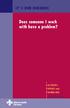 IT S OUR BUSINESS Does someone I work with have a problem? A L C O H O L D R U G S and G A M B L I N G in the Workplace S O M E O N E A T W O R K H A S A P R O B L E M 3 Co-workers often get to know each
A safe, healthy and drug-free workplace is everybody s responsibility. Thanks for making it yours.
 TOOL BOX TALK 1: DRUG-FREE WORKPLACES: The Basic Message Worksite alcohol and drug use cannot be taken lightly, especially on construction sites where we rely on each other for safety. As a worker on this
Why Accountability Matters
 PREVIEW GUIDE Why Accountability Matters Table of Contents: Sample Pages from Leader s Guide...pgs. 2-8 Program Information and Pricing...pgs. 9-10 Leader s Guide Can We Count on You? CRM Learning s Can
DUI Voir Dire Questions INTRODUCTION
 DUI Voir Dire Questions INTRODUCTION 1. Can you give me an example of a law that you disagree with (i.e., the speed limit)? 2. Someone tell me what the First Amendment protects? You see Ladies and Gentlemen,
Raising Drug-Free Teens
 A Parent s Guide to Raising Drug-Free Teens Dear Parent, You are the single most important influence in keeping your children drug free. In fact, research shows that the number one reason teenagers don
Young people and drugs
 Young people and drugs Many parents worry about whether their son or daughter is taking illegal drugs, how they can tell, and what to do about it. While there s a lot of concern about illegal drugs in
Sometimes people live in homes where a parent or other family member drinks too
 Alcohol and Drugs What If I'm Concerned About Someone Else's Drinking? Sometimes people live in homes where a parent or other family member drinks too much. This may make you angry, scared, and depressed.
Expanding Sources of Support in the Workplace: Introducing EAPs to Community Mental Health Care Providers of Vocational Services
 Expanding Sources of Support in the Workplace: Introducing EAPs to Community Mental Health Care Providers of Vocational Services GOAL: The goal of this training is to help community mental health care
Providing Quality Customer Service
 Providing Quality Customer Service What is Customer Service? For all school district employees to provide the best customer service possible, we must first understand customer service. There are many acceptable
Preparing to Serve: Online Training Modules
 Preparing to Serve: Online Training Modules M A S S E N, A. A N D K O W A L E W S K I, B. ( E D S. ) C O P Y R I G H T 2 0 1 0. W E B E R S T A T E U N I V E R S I T Y P R E P A R I N G T O S E R V E :
Child Abuse, Child Neglect. What Parents Should Know If They Are Investigated
 Child Abuse, Child Neglect What Parents Should Know If They Are Investigated Written by South Carolina Appleseed Legal Justice Center with editing and assistance from the Children s Law Center and the
A Guide for the Non-Professional Provider of Supervised Visitation
 A Guide for the Non-Professional Provider of Supervised Visitation Superior Court of California County of Orange Answers To Your Questions A Guide for the Non-Professional Provider of Supervised Visitation
National Health Education Standards and Performance Indicators. Interpersonal Communication [4.12.1; 4.12.2; 4.12.3] Self Management [7.12.2; 7.12.
![National Health Education Standards and Performance Indicators. Interpersonal Communication [4.12.1; 4.12.2; 4.12.3] Self Management [7.12.2; 7.12.](/thumbs/27/9539429.jpg "National Health Education Standards and Performance Indicators. Interpersonal Communication [4.12.1; 4.12.2; 4.12.3] Self Management [7.12.2; 7.12.") LESSON 8 Interpersonal Communication and Self Management Student Learning Objectives Identify how interpersonal communication and self management are needed for healthy living. Expand on the definition
LESSON 8 Interpersonal Communication and Self Management Student Learning Objectives Identify how interpersonal communication and self management are needed for healthy living. Expand on the definition
Related KidsHealth Links
 Grades 9 to 12 Personal Health Series KidsHealth.org/classroom Teacher s Guide This guide includes: Standards Related Links Discussion Questions Activities for Students Reproducible Materials Standards
Office Etiquette and Professionalism. Working to support our military veterans in cooperation with Accenture
 Office Etiquette and Professionalism Working to support our military veterans in cooperation with Accenture Published May 19, 2014 Workplace code of conduct A code of conduct outlines the mission and values
Improving Workplace Communication
 Team Awareness Training For Workplace Substance Abuse Prevention Module 5 Improving Workplace Communication Developed by Joel B. Bennett, Ph.D. Norma G. Bartholomew, M.A. G. Shawn Reynolds, M.S. Wayne
Employee Drug-Free Workplace Education
 Employee Drug-Free Workplace Education South Carolina State University Alcohol- and Drug-Free Workplace Provided by the Office of Professional Development & Training SC State University Employee Education
Today s Professional Teller
 As the face of the credit union, you must keep in mind the needs of the members at all times. The United States is facing a crisis of confidence in all financial institutions. As a credit union employee
What is an intervention?
 (Adapted from the Mayo Clinic, 2014) It's challenging to help a loved one struggling with any type of addiction. Sometimes a direct, heart-to-heart conversation can start the road to recovery. But when
Presented by: Heather J. Donnelly HDI Certified Instructor. Telephone Skills
 Presented by: Heather J. Donnelly HDI Certified Instructor Telephone Skills Objectives Recall the key principles for dealing with an irate caller Apply specific techniques effective in providing excellent
Working in a Customer Service Culture
 Working in a Customer Service Culture Customer service skills course designed for participants in the Senior Community Service Employment Program. You can find the student guide to this course located
Bullying. A guide for employers and workers. Bullying A guide for employers and workers 1
 Bullying A guide for employers and workers Bullying A guide for employers and workers 1 Please note This information is for guidance only and is not to be taken as an expression of the law. It should be
New Beginnings: Managing the Emotional Impact of Diabetes Module 1
 New Beginnings: Managing the Emotional Impact of Diabetes Module 1 ALEXIS (AW): Welcome to New Beginnings: Managing the Emotional Impact of Diabetes. MICHELLE (MOG): And I m Dr. Michelle Owens-Gary. AW:
Connectedness and the Emotional Bank Account
 Connectedness and the Emotional Bank Account Directions This is a self-guided activity that can be completed by parents, teens or both. It contains five parts and should take about 45 minutes to complete.
RESET THE CLOCK: REPLACE LIABILITY WITH CREDIBILITY MICHAEL J. MIRARCHI. TAB / SHRM Employment Relations Symposium An Excerpt from:
 TAB / SHRM Employment Relations Symposium An Excerpt from: RESET THE CLOCK: REPLACE LIABILITY WITH CREDIBILITY Practical Employee Relations for HR Professionals MICHAEL J. MIRARCHI MIRARCHI MANAGEMENT
How To Prevent Alcohol And Drug Abuse At Stanford
 STANFORD UNIVERSITY Office for Campus Relations Stanford Help Center Alcohol and Drug Abuse Prevention at Stanford Information for Faculty and Staff Phone: 650-723-4577 or Email: [email protected]
SUBSTANCE ABUSE AND THE WORKPLACE SUPERVISORY TRAINING
 SUBSTANCE ABUSE AND THE WORKPLACE SUPERVISORY TRAINING Objectives: 1. To Identify Signs and Symptoms of Substance Abuse 2. To Provide Guidelines for Effective Intervention 3. To Provide Supervisory Guidelines
From The Desk of Mrs. Samine Charles Pierre.. INTRODUCING YOUR SCHOOL COUNSELOR
 From The Desk of Mrs. Samine Charles Pierre.. INTRODUCING YOUR SCHOOL COUNSELOR What is a school counselor? Your school counselor is a person who is specially trained to help you realize your full potential
WHY DO WE GET ANGRY? EVERYONE FEELS ANGRY SOMETIMES
 FEELING ANGRY? WHY DO WE GET ANGRY? There are lots of things that can make us angry. Here are a few examples... EVERYONE FEELS ANGRY SOMETIMES It s normal and healthy to get angry when there is a good
Managing RN/RN and RN/MD Conflict Kathleen Bartholomew [email protected]
 Managing RN/RN and RN/MD Conflict Kathleen Bartholomew [email protected] Managers are in a pivotal position to decrease conflict. By their response, or lack of response, they informally create the code
Responding to a Disappointing Performance Review
 Responding to a Disappointing Performance Review Overview When your manager reviews your work and finds it wanting. Receiving a disappointing review First steps: Take notes and ask for clarification Gather
Older Adults and Alcohol
 Older Adults and Alcohol You can get help From the National Institute on Aging Table of Contents What s inside 1 Get the facts about aging and alcohol 2 You can become more sensitive to alcohol as you
PROBLEM ORIENTED SCREENING INSTRUMENT FOR TEENAGERS (POSIT) Developed by the National Institute on Drug Abuse National Institutes of Health
 PROBLEM ORIENTED SCREENING INSTRUMENT FOR TEENAGERS (POSIT) Developed by the National Institute on Drug Abuse National Institutes of Health Problem Oriented Screening Instrument for Teenagers (POSIT) The
SAMPLE INTERVIEW QUESTIONS TEACHER S MASTER
 C-12 INFORMATION SHEET SAMPLE INTERVIEW QUESTIONS TEACHER S MASTER QUESTIONS ABOUT YOU Tell Me a Little about Yourself. The interviewers want to know if you are well adjusted, work well with others, have
"Please answer the following questions about the past [two months] in your life?"
![Please answer the following questions about the past [two months] in your life?](/thumbs/20/408891.jpg "Please answer the following questions about the past [two months] in your life?") PROBLEM ORIENTED SCREENING INSTRUMENT FOR TEENAGERS POSIT FOLLOW-UP QUESTIONNAIRE INSTRUCTIONS TO THE RESPONDENT "Please answer the following questions about the past [two months] in your life?" GUIDELINES
PROBLEM ORIENTED SCREENING INSTRUMENT FOR TEENAGERS POSIT FOLLOW-UP QUESTIONNAIRE INSTRUCTIONS TO THE RESPONDENT "Please answer the following questions about the past [two months] in your life?" GUIDELINES
Creating a Safe and Healthy Environment for Neighborhood Councils
 Creating a Safe and Healthy Environment for Neighborhood Councils Department of Neighborhood Empowerment Regional Roundtable and Training Day 2009 Patrick Prince, M.A. & Ann Phelps, Ph.D. PRINCE & PHELPS
Now that marijuana is legal in Washington... A parent s guide to preventing underage marijuana use
 Now that marijuana is legal in Washington... A parent s guide to preventing underage marijuana use How does Marijuana Use Effect Adolescent Health? Three reasons why YOU should care: 1. Marijuana is addictive.
For more information, contact:
 This manual was developed as part of the National Institute on Drug Abuse (NIDA) Grant DA08608, Cognitive Enhancements for the Treatment of Probationers (CETOP). The TCU Guide Maps: A Resource for Counselors
Module 1: Communication
 Module 1: Communication The use of effective communication skills is an important social competency. This module assists adolescents with distinguishing between aggressive, assertive and nonassertive communication.
Related KidsHealth Links
 Grades 3 to 5 Health Problems Series KidsHealth.org/classroom Teacher s Guide This guide includes: Standards Related Links Discussion Questions Activities for Students Reproducible Materials Standards
What You Need to Know About Substance Use Disorder in Nursing
 What You Need to Know About Substance Use Disorder in Nursing Facts about Substance Use Disorder Substance use disorder encompasses a pattern of behaviors that range from misuse to dependency or addiction,
Suspect Your Teen Is Using Drugs or Drinking? P ARENTS. Resources A BRIEF GUIDE TO ACTION FOR PARENTS
 Resources National Clearinghouse for Alcohol and Drug Information (NCADI) Phone:1-800-788-2800 Web: www.health.org National Institute on Drug Abuse (NIDA) Web: www.nida.nih.gov National Institute on Alcohol
Bullying. Take Action Against. stealing money. switching seats in the classroom. spreading rumors. pushing & tripping
 switching seats in the classroom stealing money Take Action Against Bullying spreading rumors pushing & tripping U.S. DEPARTMENT OF HEALTH & HUMAN SERVICES Substance Abuse and Mental Health Services Administration
Mental Health Role Plays
 Mental Health Role Plays Goals: To discuss various mental health issues and mental illnesses. To discuss stigma, support and treatment options surrounding mental health issues and mental illnesses. Requirements:
Skills for Adolescence unit 6, Lesson 10
 Skills for Adolescence unit 6, Lesson 10 Unit 6, Lesson 10 STANDING UP TO PRESSURE TO USE DRUGS IN THIS LESSON Studies show that drug use jumps significantly between grades six and seven, making it likely
GET IT IN WRITING. PARENTS ARE THE KEY TO SAFE TEEN DRIVING. LEARN HOW.
 GET IT IN WRITING. Don t just talk about safe driving; set your family s own driving rules and get your teen to agree to them in writing through a Parent-Teen Driving Agreement. Put a copy of your agreement
Sample Behavioral-Based Interview Questions
 Sample Behavioral-Based Interview Questions Background, skills overview, job/culture fit Communication Skills Confirmation of a work requirement Conflict Management/ Resolution Coping Skills/ Resilience
Guidelines for Preventing and Dealing with Bullying Issues
 Guidelines for Preventing and Dealing with Bullying Issues Stapleford School aims to value all its members, to give all the opportunity to learn, act fairly and celebrate differences between individuals.
a threat made in school
 a threat made in school ADAM S BACKGROUND LEADING UP TO THE CRIME Adam, 15, is the youngest of four children. His parents are divorced. He lives with his mother, has regular contact with his father, and
Parenting. Coping with A Parent s Problem Drug or Alcohol Use. For children. aged 6 to 12
 Parenting Positively Coping with A Parent s Problem Drug or Alcohol Use For children aged 6 to 12 The information in this booklet is meant to help children who are living with harmful parental drug or
Raising Difficult Issues with Your Service Provider
 Self-Determination Series Raising Difficult Issues with Your Service Provider Determine Your Destiny Raising Difficult Issues with Your Service Provider Prepared by: Carol A. Petersen, M.Ed. Jessica A.
Transforming Toxic Employees Into Positive Performers
 Transforming Toxic Employees Into Positive Performers Essential and Effective Management Skills to Improve Employee Performance Edward R. Mitnick, Esq. Just Training Solutions, LLC. All rights reserved.
when i m at work: drugs and alcohol
 disability BUSINESS and advocacy services when i m at work: drugs and alcohol a fact sheet for supported employees This fact sheet is to help you understand the dangers of mixing drugs and alcohol with
Too Good for Drugs Grade 5
 Dear Parent: Our class is participating in Too Good for Drugs, a prevention program designed by the Mendez Foundation to teach skills for living healthy, drug-free lives. We are excited about this opportunity
Why is service important?
 Spring Conference April 30, 2009 through May 1, 2009 CUSTOMER SERVICE Marta De La Torre, RHIA, CHP, CHE Service Line Leader, Revenue Cycle Local Integrity & Privacy Officer Saint Agnes Medical Center [email protected]
Problems with food are fairly common try not to panic.
 A Psychological Guide for Families: Feeding & Eating Child & Family Psychology Introduction This booklet is part of a series that has been written by Clinical Child Psychologists from the Child and Family
How To Use Powerful Phrases In Customer Service
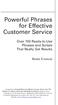 Powerful Phrases for Effective Customer Service Over 700 Ready-to-Use Phrases and Scripts That Really Get Results Renée Evenson Excerpted from Powerful Phrases for Effective Customer Service: Over 700
Benefits-Based Performance Management. White Paper
 Benefits-Based Performance Management White Paper 1 Overview Employee engagement is a somewhat overused term. But it is obviously very important for employees to be engaged and to care. A real challenge
Communication Choices
 Communication Choices Dealing with unwanted calls on your BT line Call control Peace of mind bt.com/unwantedcalls Contents Dealing with unwanted phone calls... 3 Marketing and sales calls... 4 Silent calls...
EPI/AAK 032 (1/6) 92 Ver. 1. Project Northland Questionnaire
 EPI/AAK 032 (1/6) 92 Ver. 1 Project Northland Questionnaire Part 1 We would like you to give honest answers to these questions about alcohol and drugs. No one will see your answers with your names. Please
APPENDIX B. ASSESSMENT OF RISK POSED TO CHILDREN BY DOMESTIC VIOLENCE Anne L. Ganley, Ph.D.
 APPENDIX B ASSESSMENT OF RISK POSED TO CHILDREN BY DOMESTIC VIOLENCE Anne L. Ganley, Ph.D. Assessment of Domestic Violence for Child Protective Services (CPS) Decision Making Guidelines for Interviewing
Difficult Tutoring Situations
 Difficult Tutoring Situations At some time or other, all tutors will find themselves faced with difficult situations in a tutoring session. The following information will provide you with some common categories
AIDET Overview: Why, What & How
 AIDET Overview: Why, What & How TRAINING OBJECTIVES By the end of this training session you will be able to: 1 Explain what AIDET means and understand the use of Key Words as a tactic to: Improve Operational
Brett. Jorge. Nicole. Marisol. Dre. Kenny
 No one is too young to have trouble with alcohol. Alcoholism is an illness that affects people of all ages, the rich, the poor, men and women. It doesn t matter how long, or how much you drink. When your
RECOVERY ALTERNATIVES
 RECOVERY ALTERNATIVES Contact us at: 1-800-805-0499 http://www.recoveryalternatives.com INTERVENTION PREPARATION WORKSHEET To help guide you through the process of preparing for the intervention, a series
CAGE. AUDIT-C and the Full AUDIT
 CAGE In the past have you ever: C tried to Cut down or Change your pattern of drinking or drug use? A been Annoyed or Angry because of others concern about your drinking or drug use? G felt Guilty about
Using Motivational Interviewing Techniques in SMART Recovery. Roadblocks to Listening
 Using Motivational Interviewing Techniques in SMART Recovery By Jim (GJBXVI) Braastad According to research dating back to the 1960 s, people tend to believe what they hear themselves say. However, in
A Sample Radio Interview
 A Sample Radio Interview By Erik R, 7/5/00 The following is a sample interview that has been put together to help show how to provide a positive approach to answering questions about Narcotics Anonymous.
How To Be A Team Member
 The following rating descriptions are examples of the behaviors employees would be demonstrating at each of the four levels of performance. These examples should assist the supervisor and employee during
A Time to Tell Troop Meeting Guide
 A Time to Tell Troop Meeting Guide Using This Guide The video A Time to Tell shows several strategies child molesters use to attempt sexual molestation. In addition, one scenario introduces bullying as
Using Motivational Interviewing to Improve Clinical Outcomes
 Using Motivational Interviewing to Improve Clinical Outcomes BARBARA B. WALKER, PH. D. NATIONAL JEWISH HEALTH DENVER, COLORADO [email protected] Overview Why MI? What exactly is MI? Spirit Principles
12 Step Worksheet Questions
 12 Step Worksheet Questions STEP 1 We admitted we were powerless over alcohol that our lives had become unmanageable. The first time I took a drink I knew it wasn't for me. Every time I drank I got drunk
PREPARING FOR THE INTERVIEW
 U N I V E R S I T Y C A R E E R S E R V I C E S PREPARING FOR THE INTERVIEW THE INTERVIEW The interview is an opportunity to demonstrate to an employer why you are the best fit for the position. Essentially,
Older Adults and Alcohol
 Older Adults and Alcohol You Can Get Help 5 What s Inside? Read this booklet to learn about alcohol and aging. Share this booklet with your friends and family. Use this booklet to start talking about how
RECOGNITION AND MANAGEMENT OF WORKPLACE SUBSTANCE ABUSE
 NATIONAL MARITIME SAFETY ASSOCIATION ANNUAL MEETING RECOGNITION AND MANAGEMENT OF WORKPLACE SUBSTANCE ABUSE March 20, 2014 PATRICK PRINCE, M.A. PATRICK PRINCE CONSULTING (661) 886-4076 [email protected]
Interviewing Practice = Preparation
 Interviewing Practice = Preparation What is the Purpose of an Interview? STUDENT An interview is a two-way exchange, a conversation, in which both participants have some goals. The Interviewer wants to
LaGuardia Community College Department of Human Resources CUSTOMER SERVICE COMMUNICATION SKILLS INTERPERSONAL SKILLS E-MAIL & TELEPHONE TECHNIQUES
 LaGuardia Community College Department of Human Resources CUSTOMER SERVICE COMMUNICATION SKILLS INTERPERSONAL SKILLS E-MAIL & TELEPHONE TECHNIQUES 1 This Workshop Provides Strategies to: Deliver quality
For Parents and Families: What to do if a Child is Being Bullied
 WHAT IS BULLYING? For Parents and Families: What to do if a Child is Being Bullied Bullying among children is aggressive behavior that is intentional and that involves an imbalance of power or strength.
Coaching and Feedback
 Coaching and Feedback Follow the Guidelines for Effective Interpersonal Communication There are fundamental strategies that should always be part of interpersonal communication in the work place. Don t
Self Assessment: Substance Abuse
 Self Assessment: Substance Abuse Please respond TRUE (T) or FALSE (F) to the following items as they apply to you. Part 1 I use or have used alcohol or drugs for recreational purposes. I use alcohol despite
Learning Module On Effective. Communication. In Nursing Management
 Learning Module On Effective Communication In Nursing Management Prepared by: Mona AL-Aseeri Supervised by: Prof.Dr. Soheir Mokabel EffectiveCommunication... It is two way. It involves active listening.
Chelmsford City Council. Human Resources. Drugs and Alcohol at Work
 Chelmsford City Council Human Resources Drugs and Alcohol at Work Table of contents 1. Introduction... 1 2. Scope... 1 3. Advice... 1 4. Assistance... 2 5. Further Support and Information... 3 1. Introduction
Are You Addicted to Drugs? Do you abuse drugs or alcohol regularly? Do you often use the drug when others are not around?
 Are You Addicted to Drugs? If you are concerned about your drug or alcohol use, then you might want to determine if you are addicted to the substance. Being addicted to drugs is a serious condition that
Healthy Relationships
 Healthy Relationships March 2005 KSC/CCAFS Health Education and Wellness Program Heather Torbett, MPH Kris S. Calderon, PhD, CHES Patricia Bell, LMC Relationship Health Many relationships are not as healthy
STRESS INDICATORS QUESTIONNAIRE
 The Counseling Team International 1881 Business Center Drive, Suite 11 San Bernardino, CA 92408 (909) 884-0133 www.thecounselingteam.com STRESS INDICATORS QUESTIONNAIRE This questionnaire will show how
Orientation to Quality Customer Service
 Orientation to Quality Customer Service This orientation contains crucial information for all new student employees at DePaul University. The orientation is designed to acquaint you with the everyday practices
Customer Service and Communication. Bringing service to the next level
 Customer Service and Communication Bringing service to the next level 1 Park Authority Philosophy & Goals Before focusing on customer service, it is first important to understand and reinforce the Park
Lesson One: Introduction to Customer Service
 Student s Name: Date: / / Lesson One: Introduction to Customer Service 1. Customer service is a relatively complex puzzle. While engaging customers, we are attempting to offer services in a manner that
Primary Schools. CIRCLE TIME A Whole School Approach
 Primary Schools CIRCLE TIME A Whole School Approach About Circle Time Much has been written of Circle Time in recent years, and as a teaching strategy it has seen increased use in Primary schools. However,