
EHR Standards and Semantic Interoperability
|
|
|
- Marybeth Green
- 9 years ago
- Views:
Transcription
1 EHR Standards and Semantic Interoperability Setting the Frame of Reference Dr. Marco Eichelberg OFFIS - Institute for Information Technology [email protected] Page 1

2 Introduction Semantic Interoperability: A Definition Data semantics is the relationship between data and what the data stand for. In order to obtain mutual understanding of interchanged data, the actors have to share a model of what the data represent. Semantic interoperability is about how to achieve such mutual understanding. This presentation addresses the issue of semantic interoperability in the context of the Electronic Health Record (EHR). EHR: A repository of information regarding the health of a subject of care in computer processable form [ISO TR 20514] Patient centred: stores information about the health status of individually identified patients Health related: stores health related information, i. e. not administrative, financial, etc. Longitudinal: contains information from cradle to grave Cross enterprise: The EHR contains information created from different health providers (i. e., more than a typical HIS system in a hospital) Page 2

3 Introduction: EHR Electronic Health Records (EHRs) have been discussed in scientific literature for about 25 years technology (computers, networks, etc.) perceived as adequate today currently a hot topic in many countries Integral part of many current ehealth initiatives, including: Austria, Australia, Belgium, Canada, Denmark, Estonia, France, Germany, Hungary, Ireland, Netherlands, Norway, Spain, UK, USA. Expected benefits: safer and more effective delivery of health care less medical error (better informed doctors, decision support systems) improvement of case management reduction of duplicate examinations complete & correct data source for public health and research Standards are absolutely needed for successful EHR implementation many systems, many players long-term stability of data Page 3

4 EHR Value Proposition The EHR is not a value on its own - it is valuable when combined with care processes and IT applications that utilise the EHR information! Electronic prescribing: Extract information about the patient s current medication, allergies and diagnoses from the EHR and create warnings if there is a contra-indication or high risk of adverse drug interaction. Laboratory: Make sure that new lab results and historical results from the EHR can be combined to show long-term trends. Telemedicine: Make sure the EHR can be used as a vehicle to offer high-quality diagnostic services to under-served (e. g. rural) areas. Research and public health: Make sure that anonymous data can be extracted automatically from the EHR to enable research. Integrated care: The EHR should serve as a means of synchronising the many health professionals involved in the treatment of patients with chronic diseases (diabetes, coronary heart disease, etc.) Home care: Integrate care provided at the patient s home with the EHR Page 4
5 EHR Information Models Page 5

6 EHR Information Models An Information Model is an abstract model of that part of the world about which the EHR stores information. This is important because The model determines, which types of information each compatible implementation has to manage (read, write, store), but not, how Message formats for the exchange of EHR content can be derived from the model. Due to the longitudinal nature of an EHR, an information model should be stable over a long time, so that past, current and future episodes of health can be recorded in the same EHR, be flexible, because medical knowledge, healthcare delivery processes, standards for best practice in clinical documentation etc. change over time, be powerful enough to cover all relevant information for past, current and future episodes of care in a single model, be simple enough to be manageable and implementable! Isn t this the proverbial squaring the circle??? Page 6
7 Two-Level Modelling: A Solution Two-Level Modelling is the solution to the basic problems of EHR information models, i. e. long-time stability vs. sufficient flexibility expressive power vs. sufficiently simple (implementable) models The idea is to distinguish two separate layers of information model: A simple reference model that is stable over time, plus A set of constraint rules that describe how certain clinical concepts such as a blood pressure measurement, a bed location or lab results can be expressed in the reference model. These constraint rules are called Archetypes (OpenEHR, EHRcom) or Templates (DICOM, HL7 CDA). Archetypes may change over time, but older EHR entries can still be stored in the same database because the reference model remains the same. A change of archetypes does not require structural changes in the database of EHR systems, because these only have to reflect the reference model. The following presentation (by Dr. Dipak Kalra) will address this issue in more detail Page 7
8 EHR Semantics Page 8

9 EHR Semantics - Introduction Domain specific terminology CAD = coronary artery disease LV = left ventricular Traditionally, medical reports consist of prose text, sometimes extended with graphical drawings, tables, images. The patient was admitted for elective invasive study and potential interventional treatment. The diagnostic cath procedure reveals CAD with significant lesions within the proximal circumflex artery and a mediumsized diagonal branch. LV function is normal in presence of arterial hypertension. As planned, interventional catheter treatment is performed in the same session, starting with the proximal circumflex lesion, that is passed with a standard guide wire and dilated with a 3.0 mm balloon with an acceptable result. The wire is then passed into the obstructed diagonal branch and dilatation is performed with a 3mm balloon, again with an acceptable initial result. About 5 min later, the patient develops chest pain and anterior ST elevations. [...] vague expressions numerical values and units Page 9

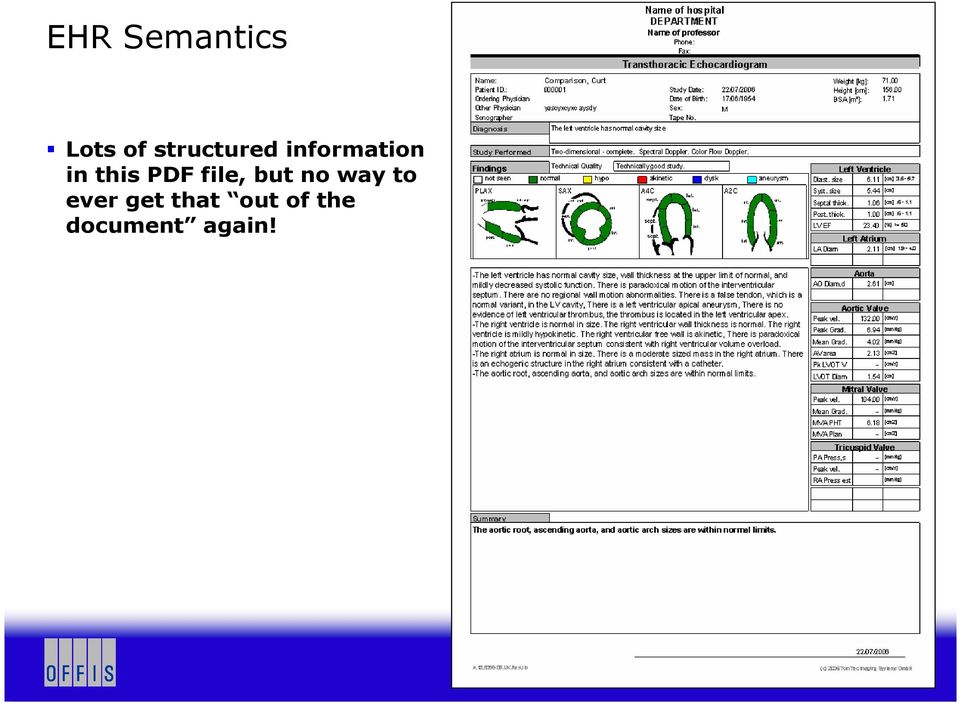
10 EHR Semantics Lots of structured information in this PDF file, but no way to ever get that out of the document again! Page 10
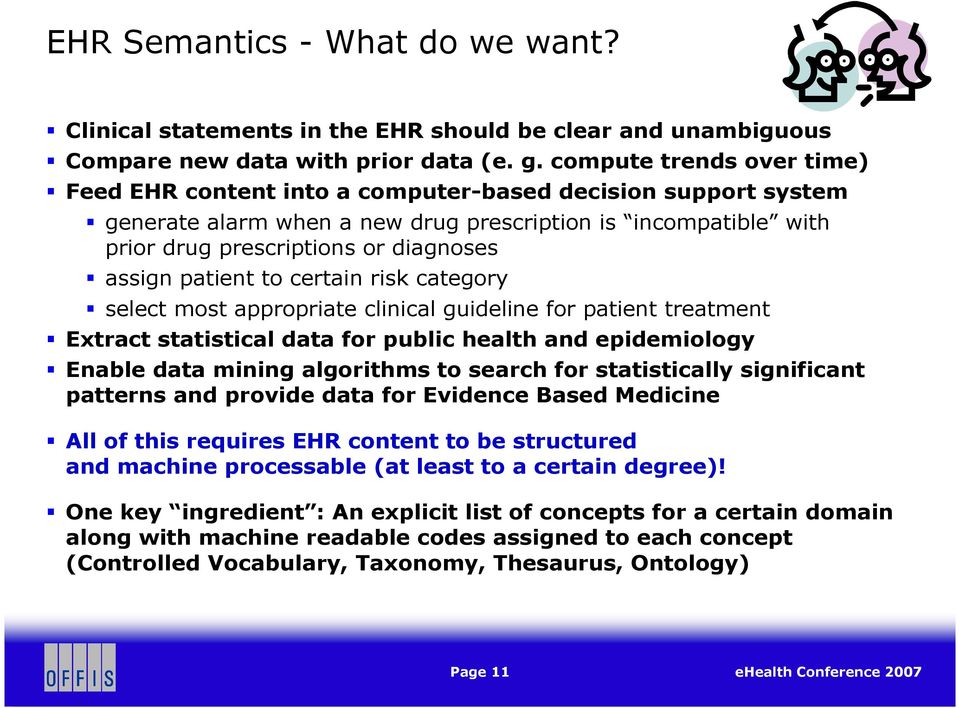
11 EHR Semantics - What do we want? Clinical statements in the EHR should be clear and unambiguous Compare new data with prior data (e. g. compute trends over time) Feed EHR content into a computer-based decision support system generate alarm when a new drug prescription is incompatible with prior drug prescriptions or diagnoses assign patient to certain risk category select most appropriate clinical guideline for patient treatment Extract statistical data for public health and epidemiology Enable data mining algorithms to search for statistically significant patterns and provide data for Evidence Based Medicine All of this requires EHR content to be structured and machine processable (at least to a certain degree)! One key ingredient : An explicit list of concepts for a certain domain along with machine readable codes assigned to each concept (Controlled Vocabulary, Taxonomy, Thesaurus, Ontology) Page 11
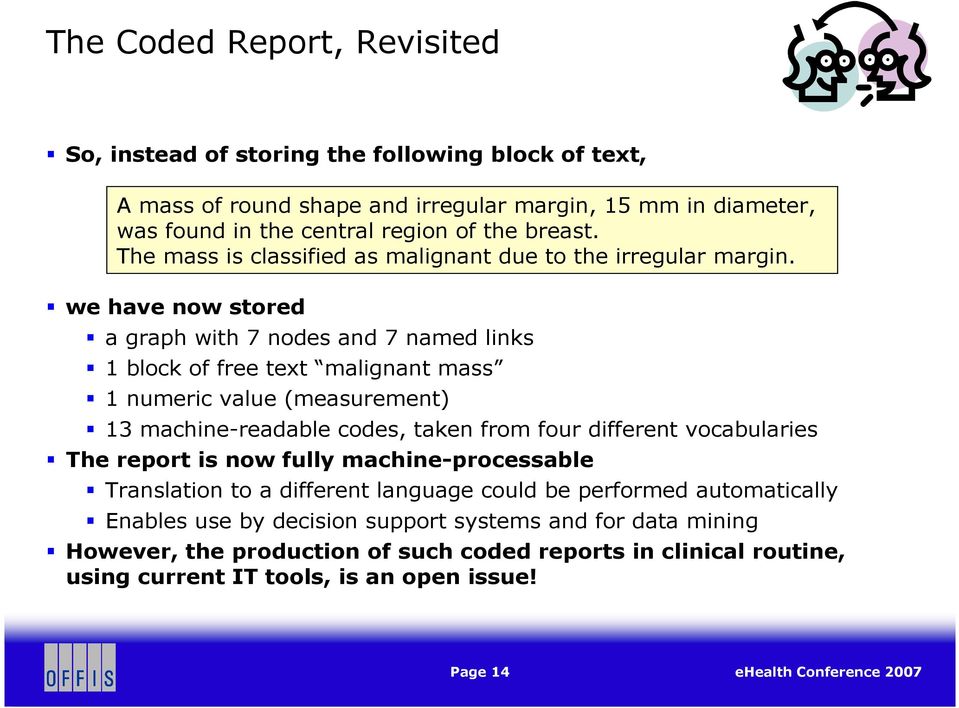
12 Example of a Coded Report (DICOM SR) Each node in the tree has a machine-readable code identifying the concept it represents TEXT Finding Malignant Mass Code= Coding Scheme=DICOM Concept Name=Finding Human readable text (not machine processable) has properties has properties CODE Finding Mass CODE Finding Malignancy by-reference Code=M-020F9 Coding Scheme=SNOMED 3.0 Concept Name=Shape Code=C-C0E3 Coding Scheme=SNOMED-RT Concept Name=Finding Site has properties has properties has properties has properties inferred from Code=G-A428 Coding Scheme=SNOMED-RT Concept Name=Margin CODE CODE NUM CODE Shape Location Size Margin Round Central 15 mm Irregular Numeric Value Page 12 Code= Coding Scheme=DICOM Concept Name=Size Descriptor

13 Example of a Coded Report (DICOM SR) Some nodes have a second machine-readable code identifying their content has properties TEXT Finding Malignant Mass Code=M Coding Scheme=SNOMED-RT Concept Name=Mass Code=G-A245 Coding Scheme=SNOMED-RT Concept Name=Malignant has properties CODE Finding Mass CODE Finding Malignancy by-reference Code=F-0178F Coding Scheme=SNOMED-RT Concept Name=Central region of breast has properties has properties has properties has properties inferred from Code=G-A402 Coding Scheme=SNOMED 3.0 Concept Name=Irregular CODE CODE NUM CODE Shape Location Size Margin Round Central 15 mm Irregular Code=M Coding Scheme=SNOMED 3.0 Concept Name=Round shape Page 13 Code=MM Coding Scheme=UCUM Concept Name=mm
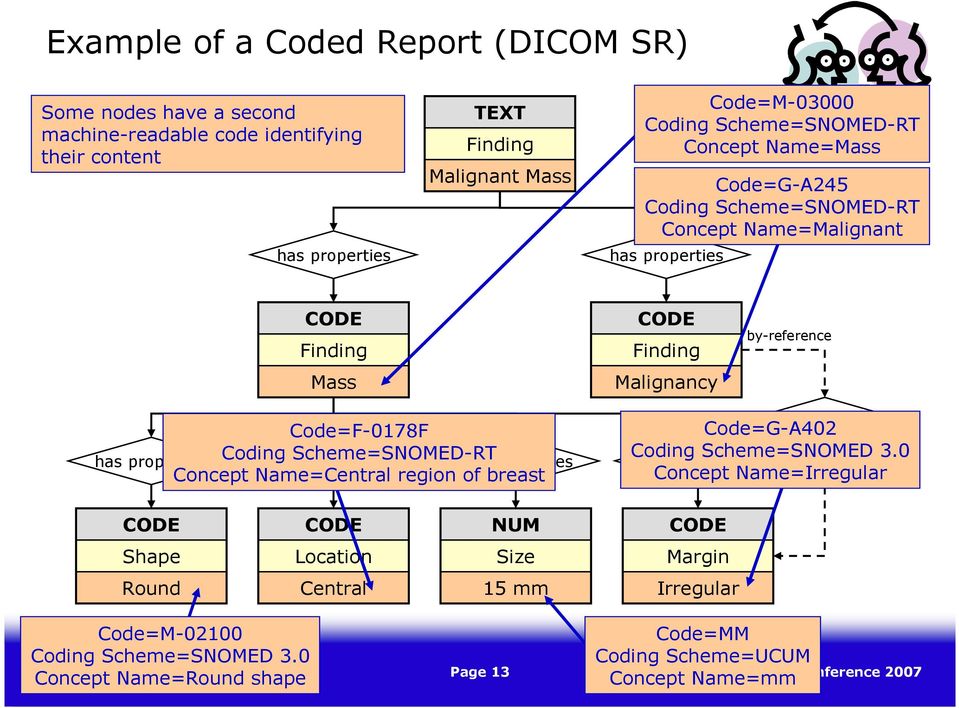
14 The Coded Report, Revisited So, instead of storing the following block of text, A mass of round shape and irregular margin, 15 mm in diameter, was found in the central region of the breast. The mass is classified as malignant due to the irregular margin. we have now stored a graph with 7 nodes and 7 named links 1 block of free text malignant mass 1 numeric value (measurement) 13 machine-readable codes, taken from four different vocabularies The report is now fully machine-processable Translation to a different language could be performed automatically Enables use by decision support systems and for data mining However, the production of such coded reports in clinical routine, using current IT tools, is an open issue! Page 14
15 EHR Standards Page 15
16 EHR Standards In April 2006, the US National Alliance for Health Information Technology published a directory of e-health standards, which lists 2104 standards related to ICT in healthcare, produced by 436 separate organisations! Fortunately, the list of core EHR standards as such is much shorter. Here are the most promising candidates EHRcom: CEN EN Electronic Health Record Communication CDA: The HL7 Clinical Document Architecture IHE XDS: Cross-enterprise Clinical Document Sharing Page 16
17 EHRcom: EN A rigorous and durable information architecture for communicating the EHR, consisting of a reference model (information model) describing how EHR content can be represented and exchanged, a specification language for archetypes (constraint rules for clinical business objects built from the reference model), an initial (small) set of archetypes, a security concept, a set of exchange models (message/service interfaces) Representation of EHR content typically in XML Hierarchical structure where an EHR consists of folders, compositions (~ documents), sections, entries, clusters, elements and data values. Page 17

18 HL7 Clinical Document Architecture (CDA) CDA specifies a standard format for clinical documents for exchange. A CDA document can exist outside of a message, and can include text, images, sounds, and other multimedia content. CDA documents are encoded in XML Only a content format, no definition of services or messages CDA documents derive their meaning from the HL7 Reference Information Model (RIM) and use HL7 V3 data types A CDA document consists of a header and a body Header is consistent across all clinical documents - identifies and classifies the document, provides information on patient, provider, encounter etc. Body contains narrative text / multimedia content (level 1), optionally augmented by coded equivalents (levels 2 & 3) Page 18

19 Cross-enterprise Document Sharing (XDS) XDS is a specification that enables document sharing between EHR systems in different care settings and organisations XDS Properties Distributed: Each organisation publishes clinical information for others. Actual documents may remain in the source patient record system. Cross-Enterprise: A Registry provides an index for published information to authorised organisations belonging to the same clinical affinity domain. Document Centric: Published clinical data is organised into clinical documents using agreed standard document types. Document Content Neutral: Document content is processed only by source and consumer IT systems. Standardised Registry Attributes: Queries based on meaningful attributes ensure deterministic document searches. XDS can transmit and store any type of content, including EHRcom and HL7 CDA. Protocol based on ebxml Registry Services (SOAP, Web Services) Page 19
20 EHR Standards and Semantic Operability Where are we today? Information Models Both EHRcom and CDA use a two-level architecture with a simple reference model and constraint rules (templates/archetypes) EHRcom uses a formal specification for archetypes, CDA is informal IHE XDS only provides communication (plus simple meta-data for indexing) and relies on EHRcom, CDA, etc. for clinical content. Semantics Both EHRcom and CDA enable the creation of fully machine-readable structured content Both standards also still allow free text or semi-structured information, which is critical for migration purposes Both standards rely on external controlled vocabularies Interoperability EHRcom s communication architecture is still work in progress CDA does not address communication at all IHE XDS most advanced in this field with many implementations Page 20
21 Conclusion Is the issue of EHR Semantic Interoperability solved? No, but there has been much progress in the last 2-3 years Controlled vocabularies / ontologies are improving, but not yet there User interfaces / workflow integration for structured documentation Is there one obvious solution or way to go? No, all standards have their strengths and weaknesses Standardisation is still very much in progress The definition and maintenance process for templates / archetypes controlled vocabularies / ontologies will be one of the big issues to be addressed in the years to come Overall, however, my impression is that we re on a good way. Page 21
22 Acknowledgement This work is supported by the European Commission through the RIDE project: A Roadmap for Interoperability of ehealth Systems in Support of COM 356 with Special Emphasis on Semantic Interoperability Project Homepage: Page 22
The next generation EHR
 The next generation EHR European EHR standard OpenEHR Ocean Informatics Gerard Freriks v1 7-11-2007 Electronic Patient Record What do we expect? We need and expect EHR-systems that: 2 Electronic Patient
Electronic Health Records and XDS the IHE approach
 Electronic Health Records and XDS the IHE approach Bill Majurski National Institute of Standards and Technology (NIST) Berthold B. Wein IHE-D User Co-Chair, Aachen, Germany Overview Expectations as user
European Quality Labelling, Certification, Electronic Health Record systems (EHRs) gf v1
 European Quality Labelling, Certification, Electronic Health Record systems (EHRs) gf v1 EuroRec: current standing on EHR certification in Europe AGENDA 1. The EuroRec Institute 2. EHR-systems Certification:
Il lavoro di armonizzazione. e HL7
 Il lavoro di armonizzazione tra CEN 13606, openehr e HL7 Dr Dipak Kalra Centre for Health Informatics and Multiprofessional Education (CHIME) University College London [email protected] Drivers for
EHR Standards Landscape
 EHR Standards Landscape Dr Dipak Kalra Centre for Health Informatics and Multiprofessional Education (CHIME) University College London [email protected] A trans-national ehealth Infostructure Wellness
Electronic Health Record. Standards, Coding Systems, Frameworks, and Infrastructures
 Brochure More information from http://www.researchandmarkets.com/reports/2178436/ Electronic Health Record. Standards, Coding Systems, Frameworks, and Infrastructures Description: Discover How Electronic
IHE IT Infrastructure Cross Enterprise Document Sharing XDS Integration Profile
 ,QWHJUDWLQJWKH+HDOWKFDUH(QWHUSULVH IHE IT Infrastructure Cross Enterprise Sharing XDS Integration Profile Charles Parisot,, GE Healthcare IHE IT Infrastructure co-chair chair G. Claeys,, Agfa Healthcare
Advanced Aspects of Hospital Information Systems
 Advanced Aspects of Hospital Information Systems EHR- and related Standards DI Harald Köstinger ([email protected]) INSO - Industrial Software Institut für Rechnergestützte Automation
Electronic Health Record (EHR) Standards Survey
 Electronic Health Record (EHR) Standards Survey Compiled by: Simona Cohen, Amnon Shabo Date: August 1st, 2001 This report is a short survey about the main emerging standards that relate to EHR - Electronic
Continuity of Care Record (CCR) in Germany? PROREC activities on the way to EHR interoperability
 Herzlich Willkommen! EHTEL Telemed ehealth IOP Satellite Heidelberg, 12 June 2008 Continuity of Care Record (CCR) in Germany? PROREC activities on the way to EHR interoperability Sebastian Claudius Semler
EHR Systems: an Introduction
 ehealth Week 2007 EuroRec Institute / ProRec Germany Workshop EHR Systems: an Introduction Bernd Blobel 1 & Dipak Kalra 2 1 ehealth Competence Center University of Regensburg Medical Center Regensburg,
HL7 Personal Health Record System Functional Model and Standard & Industry Update
 HL7 Personal Health Record System Functional Model and Standard & Industry Update Presented by: R. Lenel James, CPHIT, CPEHR HL7 Co-Lead, EHR WG, Publishing HL7 Co-Lead, PHR WG, Conformance HIMSS, Member
Trends in Healthcare Information Standardization
 TANJI Natsuki Abstract Standardization of medical information systems by industry associations such as ISO/TC 215 and CEN/TC 251 is currently underway internationally. In Japan, too, participation in and
HL7 CDA (Clinical Document Architecture) in Structured Diagnostic Reporting
 RSNA Forum on Structured Reporting HL7 CDA (Clinical Document Architecture) in Structured Diagnostic Reporting Fred M. Behlen, Ph.D. American College of Radiology Co-Chair, DICOM Working Group 20 & HL7
Certification of Electronic Health Record systems (EHR s)
 Certification of Electronic Health Record systems (EHR s) The European Inventory of Quality Criteria Georges J.E. DE MOOR, M.D., Ph.D. EUROREC EuroRec The «European Institute for Health Records» A not-for-profit
How To Write An Electronic Health Record
 EHR Requirements David LLOYD and Dipak KALRA CHIME Centre for Health Informatics and Multiprofessional Education, University College London N19 5LW, by email: [email protected]. Abstract. Published
Improving EHR Semantic Interoperability Future Vision and Challenges
 Improving EHR Semantic Interoperability Future Vision and Challenges Catalina MARTÍNEZ-COSTA a,1 Dipak KALRA b, Stefan SCHULZ a a IMI,Medical University of Graz, Austria b CHIME, University College London,
A Framework for Testing Distributed Healthcare Applications
 A Framework for Testing Distributed Healthcare Applications R. Snelick 1, L. Gebase 1, and G. O Brien 1 1 National Institute of Standards and Technology (NIST), Gaithersburg, MD, State, USA Abstract -
SINTERO SERVER. Simplifying interoperability for distributed collaborative health care
 SINTERO SERVER Simplifying interoperability for distributed collaborative health care Tim Benson, Ed Conley, Andrew Harrison, Ian Taylor COMSCI, Cardiff University What is Sintero? Sintero Server is a
Techniques for ensuring interoperability in an Electronic health Record
 Techniques for ensuring interoperability in an Electronic health Record Author: Ovidiu Petru STAN 1. INTRODUCTION Electronic Health Records (EHRs) have a tremendous potential to improve health outcomes
International Organization for Standardization TC 215 Health Informatics. Audrey Dickerson, RN MS ISO/TC 215 Secretary
 International Organization for Standardization TC 215 Health Informatics Audrey Dickerson, RN MS ISO/TC 215 Secretary 1 Topics Introduction to ISO TC 215, Health Informatics Definitions Structure Membership
EHR Archetypes in practice: getting feedback from clinicians and the role of EuroRec
 EuroRec - EHTEL Conference, Vienna, October 2007 EHR Archetypes in practice: getting feedback from clinicians and the role of EuroRec Dr Dipak Kalra Centre for Health Informatics and Multiprofessional
XDS-I - CROSS-ENTERPRISE DOCUMENT SHARING FOR IMAGING
 Technical White Paper XDS-I - CROSS-ENTERPRISE DOCUMENT SHARING FOR IMAGING Physicians, nurses, administrators and other healthcare professionals foresee a day when vital information can flow seamlessly
Standards and their role in Healthcare ICT Strategy. 10th Annual Public Sector IT Conference
 Standards and their role in Healthcare ICT Strategy 10th Annual Public Sector IT Conference Peter Connolly Oct 2014 What is the Direction of Travel? 1 Understanding the Why- The Data Context 2 Stakeholder
HL7 & HL7 CDA: The Implementation of Thailand s Healthcare Messaging Exchange Standards Nawanan Theera-Ampornpunt, M.D., Ph.D.
 HL7 & HL7 CDA: The Implementation of Thailand s Healthcare Messaging Exchange Standards Nawanan Theera-Ampornpunt, M.D., Ph.D. Deputy Executive Director for Informatics, Chakri Naruebodindra Medical Institute,
Report of the secretariat. CEN/TC 251 secretariat ACTION REQUIRED: For your information
 Secretariat: doc.nr. Vlinderweg 6 P.O. box 5059 CEN/TC 251 N11-014 2623 AX Delft 2600 GB Delft date The Netherlands The Netherlands 2011-02-21 total pages 8 Secretary: Ms Shirin Golyardi Committee CEN/TC
EHR Interoperability Framework Overview
 Hospital Health Information System EU HIS Contract No. IPA/2012/283-805 Final version July 2015 Visibility: Public Target Audience: EHR Developers EHR Administrators EPR Systems Developers This document
Healthcare Data: Secondary Use through Interoperability
 Healthcare Data: Secondary Use through Interoperability Floyd Eisenberg MD MPH July 18, 2007 NCVHS Agenda Policies, Enablers, Restrictions Date Re-Use Landscape Sources of Data for Quality Measurement,
ISO EN 13606 TECHNICAL REVISION
 ISO EN 13606 TECHNICAL REVISION Dipak Kalra!! with support from! Shanghua Sun, Tony Austin! and EN13606 Association EN ISO 13606 EHR Communications A means to exchange part or all of a patients EHR! between
FHIM Model Content Overview
 FHIM Model Content Overview Federal Health Information Model (FHIM) and Associated Terminology Models Goal Produce a logical, health information model that supports semantic interoperability and that is
TRANSFoRm: Vision of a learning healthcare system
 TRANSFoRm: Vision of a learning healthcare system Vasa Curcin, Imperial College London Theo Arvanitis, University of Birmingham Derek Corrigan, Royal College of Surgeons Ireland TRANSFoRm is partially
RSNA 2015 RCA22 A Practical Introduction to Structured Reporting Tools and Resources. DICOM Structured Reports (SR)
 RSNA 2015 RCA22 A Practical Introduction to Structured Reporting Tools and Resources DICOM Structured Reports (SR) David Clunie ([email protected]) PixelMed Publishing Background & Disclosures Owner,
HL7 and Meaningful Use
 HL7 and Meaningful Use Grant M. Wood HL7 Ambassador HIMSS14 2012 Health Level Seven International. All Rights Reserved. HL7 and Health Level Seven are registered trademarks of Health Level Seven International.
ehealth in Austria -- National Strategy and Regional Approches Dr. Thomas Schabetsberger Masterclass, 23-Jul-2007 UMIT, Hall in Tyrol
 ehealth in Austria -- National Strategy and Regional Approches Dr. Thomas Schabetsberger Masterclass, 23-Jul-2007 UMIT, Hall in Tyrol Agenda Introduction in the Austrian health care system and ehealth
Electronic Medical Record Adoption Model (EMRAM) John Rayner Director of Professional Development HIMSS-UK
 Electronic Medical Record Adoption Model (EMRAM) John Rayner Director of Professional Development HIMSS-UK HIMSS UK HIMSS Vision Improve health through the better use of technology and information. Do
The Continuity of Care Document. Changing the Landscape of Healthcare Information Exchange
 The Continuity of Care Document Changing the Landscape of Healthcare Information Exchange 1 Electronic Clinical Document Exchange Prior to the approval of the Continuity of Care Document (CCD) as an ANSI
Using Archetypes with HL7 Messages and Clinical Documents. Heath Frankel HL7 Working Group Meeting 14 January 2011
 Using Archetypes with HL7 Messages and Clinical Documents Heath Frankel HL7 Working Group Meeting 14 January 2011 Ocean Informatics 2011 Template Data Schema (TDS) XML Schema representation of a clinical
Open Source Modular Units for Electronic Patient Records. Hari Kusnanto Faculty of Medicine, Gadjah Mada University
 Open Source Modular Units for Electronic Patient Records Hari Kusnanto Faculty of Medicine, Gadjah Mada University Open Source Initiatives in Patient Information System electronic health records, scheduling
The Big Picture: IDNT in Electronic Records Glossary
 TERM DEFINITION CCI Canada Health Infoway Canadian Institute for Health Information EHR EMR EPR H L 7 (HL7) Canadian Classification of Interventions is the Canadian standard for classifying health care
Health Informatics Standardization: Relevance and Indian Initiatives
 Health Informatics Standardization: Relevance and Indian Initiatives Baljit Singh Bedi Advisor, CDAC (Sc. Society of MCIT, Govt. of India ) Past President, Telemedicine Society of India(TSI) & Member,
HL7 Clinical Document Architecture: Overview and Applications
 HL7 Clinical Document Architecture: Overview and Applications Nawanan Theera-Ampornpunt, M.D., Ph.D. Department of Community Medicine Faculty of Medicine Ramathibodi Hospital Certified HL7 CDA Specialist
Interoperable Medical Record Exchange System among Hospitals in Ethiopia using EMR
 Interoperable Medical Record Exchange System among Hospitals in Ethiopia using EMR Tigist Tedla HiLCoE, Computer Science Programme, Ethiopia [email protected] Abrehet Omer HiLCoE, Ethiopia Department
Greek ehealth Strategy under public consultation
 Greek ehealth Strategy under public consultation Mina Boubaki Ministry of Health, IT Department ehealth Network, ehealth Forum Recent relevant Reforms Law 3892/2010 Electronic Recording of Prescription
A Metabolic Syndrome Health Check EHR based on openehr
 Seagaia Meeting 2009, Okinawa A Metabolic Syndrome Health Check EHR based on openehr 2009/05/15 早 稲 田 大 学 国 際 情 報 通 信 研 究 科 Waseda University, GITS Kano Lab Hsu WanYen (Nora) 徐 婉 晏 1 Research Background
Study on Electronic Health Record and its Implementation
 Master Thesis Spring 2012 School of Health and Society Department Design and Computer Science Embedded Systems Study on Electronic Health Record and its Implementation Writer Qian Huang Qin Yin Instructor
Integration Information Model
 Release 1.0.1 The openehr Reference Model a. Ocean Informatics Editors: T Beale a Revision: 0.6 Pages: 15 Date of issue: 22 Jul 2006 Keywords: EHR, reference model, integration, EN13606, openehr EHR Extract
Standardization of the Australian Medical Data Exchange Model. Michael Legg PhD
 Standardization of the Australian Medical Data Exchange Model Michael Legg PhD Agenda The National ehealth Program Pathology in Australia Standardisation in Australia Some projects Communication Any meaningful
EuroRec (http://www.eurorec.org )
 EuroRec (http://www.eurorec.org ) The «European Institute for Health Records» A not-for-profit organisation, established April 16, 2003 Mission: the promotion of high quality Electronic Health Record systems
The use of ehealth standards in Norway
 The use of ehealth standards in Norway Torbjørn Nystadnes, KITH Archetypes and Architecture Oslo, 26 November 2009 In the beginning... KITH was established in 1990 The same year as CEN/TC251 - Norway has
The EHR and Clinical Archetypes: time for clinical engagement!
 ehealth Planning and Management Symposium 2008 The EHR and Clinical Archetypes: time for clinical engagement! Dr Dipak Kalra and Dr Archana Tapuria Centre for Health Informatics and Multiprofessional Education
Electronic Health Network - Case Study Consent2Share Share with Confidence
 Electronic Health Network - Case Study Consent2Share Share with Confidence Jan 2015 About Consent2Share Complying with privacy regulations in an electronic environment is a very complex process. The Consent2Share
Electronic Health Records: An introduction to openehr and archetypes
 Electronic Health Records: An introduction to openehr and archetypes Dr. Sebastian Garde CCR Workshop Munich 29 th April 2008 Expectations Timely information and reports for ALL professions with a minimum
Beacon User Stories Version 1.0
 Table of Contents 1. Introduction... 2 2. User Stories... 2 2.1 Update Clinical Data Repository and Disease Registry... 2 2.1.1 Beacon Context... 2 2.1.2 Actors... 2 2.1.3 Preconditions... 3 2.1.4 Story
HL7 and SOA Based Distributed Electronic Patient Record Architecture Using Open EMR
 HL7 and SOA Based Distributed Electronic Patient Record Architecture Using Open EMR Priti Kalode 1, Dr Onkar S Kemkar 2, Dr P R Gundalwar 3 Research Student, Dept of Comp Sci &Elec, RTM Nagpur University
Standardised and Flexible Health Data Management with an Archetype Driven EHR System (EHRflex)
 Standardised and Flexible Health Data Management with an Archetype Driven EHR System (EHRflex) Anton Brass 1, David Moner 2, Claudia Hildebrand 1, Montserrat Robles 2 1 Helmholtz Zentrum München, Germany
Clinical Information Security. The norm EN ISO 13606
 Clinical Information Security - The norm EN ISO 13606 Unidad de Investigación en Telemedicina y esalud Instituto de la Salud Carlos III Madrid - Spain Clinical information and security Non-repudiation
National Integrated Services Framework The Foundation for Future e-health Connectivity. Peter Connolly HSE May 2013
 National Integrated Framework The Foundation for Future e-health Connectivity Peter Connolly HSE May 2013 The Context Introduction A national approach to interoperability is essential for Ireland s E-Health
EHR Definition, Scope & Context. Sam Heard for Peter Schloeffel ISO/TC 215 WG1 Aarhus, Denmark 3 Oct 2003
 EHR Definition, Scope & Context Sam Heard for Peter Schloeffel ISO/TC 215 WG1 Aarhus, Denmark 3 Oct 2003 2 Agenda Background to the project A taxonomy and definitions of the EHR Scope of the EHR Context
icardea: a Practical Approach to Facilitate Data Integration of Implantable Cardioverter Defibrillator Patients in Cardiological Treatment
 icardea: a Practical Approach to Facilitate Data Integration of Implantable Cardioverter Defibrillator Patients in Cardiological Treatment Maohua Yang a, Catherine E. Chronaki b, Christian Lüpkes a, Manuela
Vendor Neutral Archiving as an Enabler for ehealth. [email protected]
 Vendor Neutral Archiving as an Enabler for ehealth [email protected] What is ehealth? Health services and health information accessed via ICT connecting remote patients interconnecting health
Accelerating Clinical Trials Through Shared Access to Patient Records
 INTERSYSTEMS WHITE PAPER Accelerating Clinical Trials Through Shared Access to Patient Records Improved Access to Clinical Data Across Hospitals and Systems Helps Pharmaceutical Companies Reduce Delays
IHE s Contribution to Telecardiology. Nick Gawrit, heartbase Antje Schroeder, Siemens Healthcare Paul Dow, ACC Charles Parisot, GE
 IHE s Contribution to Telecardiology Nick Gawrit, heartbase Antje Schroeder, Siemens Healthcare Paul Dow, ACC Charles Parisot, GE Interoperability: From a problem to a solution Base Standards IETF Profile
What s next for openehr. Sam Heard Thomas Beale
 What s next for openehr Sam Heard Thomas Beale Current situation (2010-) General industry movement toward SOA, growing use of terminology SOA: IHE Information / messages HL7 v3 failed, org in fresh look
Clinical Document Exchange Integration Guide - Outbound
 Clinical Document Exchange Integration Guide - Outbound Integrate your healthcare IT system with Practice Fusion s Electronic Health Record (EHR) System Table of Contents 1 Introduction... 2 2 Integration
Archetype-Based Knowledge Management for Semantic Interoperability of Electronic Health Records
 Medical Informatics in a United and Healthy Europe K.-P. Adlassnig et al. (Eds.) IOS Press, 2009 2009 European Federation for Medical Informatics. All rights reserved. doi:10.3233/978-1-60750-044-5-1007
Global Health Informatics Standards for Patient Safety
 Global Health Informatics Standards for Patient Safety Yun Sik Kwak, MD, PhD Dept Med Info.,Kyungpook Nat l Univ Sch Med Daegu, Korea HL7 Korea ISO/TC 215 APAMI ehscg October 28, 2006 APAMI MIC2006 - Taipei
New York ehealth Collaborative. Health Information Exchange and Interoperability April 2012
 New York ehealth Collaborative Health Information Exchange and Interoperability April 2012 1 Introductions Information exchange patient, information, care team How is Health information exchanged Value
Creating a national electronic health record: The Canada Health Infoway experience
 Creating a national electronic health record: The Canada Health Infoway experience Presentation by Dennis Giokas Chief Technology Officer, Canada Health Infoway October 11, 2007 Overview The need for EHR
Regionale uitwisseling van medische gegevens (IHE)
 Regionale uitwisseling van medische gegevens (IHE) Sessie B (10:50-11:50) Nieuwegein, 20 mei 2014 René Spronk Trainer / Senior Consultant Ringholm bv Haarlem, the Netherlands Tel. +31 (0)33 7 630 636 email:
Setting the World on FHIR
 Setting the World on FHIR W. Ed Hammond. Ph.D., FACMI, FAIMBE, FIMIA, FHL7 Director, Duke Center for Health Informatics Director, Applied Informatics Research, DHTS Director of Academic Affairs, MMCi Program
Turkey s National Health Information System (NHIS)
 Turkey s National Health Information System (NHIS) İlker KÖSE 1, Nihat AKPINAR 1, Murat GÜREL 1, Yakup ARSLAN 1, Hakan ÖZER 1, Nihat YURT 1, Yıldıray KABAK 2, Asuman DOGAC 3 1 Dept. of Information Processing,
A cross-platform model for secure Electronic Health Record communication
 International Journal of Medical Informatics (2004) 73, 291 295 A cross-platform model for secure Electronic Health Record communication Pekka Ruotsalainen National Research and Development Centre for
HL7 AROUND THE WORLD
 HL7 International HL7 AROUND THE WORLD Updated by the HL7 International Mentoring Committee, September 2014 Original version by Klaus Veil (2009) / Edited by Diego Kaminker IMC HL7 Around the World 1 What
NATIONAL EHEALTH ARCHITECTURE - FROM STRATEGY TO PRACTICE. Ministry of Social Affairs and Health, Finland
 NATIONAL EHEALTH ARCHITECTURE - FROM STRATEGY TO PRACTICE Ministry of Social Affairs and Health, Finland Agenda Finnish healthcare system on-going & upcoming reforms National ehealth architecture and implementation
Enabling Patients Decision Making Power: A Meaningful Use Outcome. Lindsey Mongold, MHA HIT Practice Advisor Oklahoma Foundation for Medical Quality
 Enabling Patients Decision Making Power: A Meaningful Use Outcome Lindsey Mongold, MHA HIT Practice Advisor Oklahoma Foundation for Medical Quality Today 1. Meaningful Use (MU) 2. 2/3rds of MU relates
HL7 CDA, Clinical Modelling and openehr
 HL7 CDA, Clinical Modelling and openehr Thomas Beale NHS Scotland, February 2007 Thomas Beale Introductions Chief Technology Officer Ocean Informatics Senior Researcher, Centre for Health Informatics,